DAVID HUME
By Olivia, Alex, and Colleen
KEY IDEAS
Custom as our Guide
 Inductive Reasoning
Hume‟s Fork
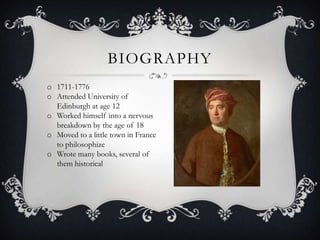
BIOGRAPHY
o 1711-1776
o Attended University of
Edinburgh at age 12
o Worked himself into a nervous
breakdown by the age of 18
o Moved to a little town in France
to philosophize
o Wrote many books, several of
them historical
KEY BELI EF #1:
I NDUCTI VE REASONI NG
 Humans have a tendency to observe an unchanging pattern and
assume that it will continue in that fashion forever
 For example, we notice the sky getting dark every night and the

sun setting, and so we infer that it will do the same tomorrow.
 In reality, we have no true way of knowing that the future will
conform to the past and no reason to believe that just because things
have always been one way, they will continue to do so
INDUCTIVE REASONING
 This kind of reasoning where we infer one thing from another is
called „inductive reasoning‟
 It is one of Hume‟s most prominent theories

 Related to „causation‟, the concept of always seeing one thing
follow another and concluding that
• A) They are connected (A causes B)
• B) Will always react the same way (A will always cause B)
HUME VS. DESCARTES
 Hume was an atheist and believed in no high power
whatsoever, whereas Descartes worked hard to prove that God
existed, and if not his God, then an evil but omniscient and

omnipotent demon
 Hume believes that there is no innate knowledge, that all
knowledge is derived from experience, whereas Descartes believes the
opposite

 Both accept that the „self ‟ is the basis of philosophical reflection
(they disagree on what the „self ‟ is capable of doing)
EPISTEMOLOGICAL SCHOOL:
EMPIRICIST
 The theory of Empiricism suggests and defines the primary
source from which we retain knowledge to be “sensory
experience”.
 David Hume has been characterized as an Empiricist philosopher
as many of his prime theories and ideas revolve around the
concept that experience is the key to understanding what we know
and how we come to know it.
KEY IDEA #2
CUSTOM IS OUR GUIDE
 One of David Hume‟s key theories is known as „Custom is Our
Guide‟
 This concept can be defined and broken down into three ideas:
1. Custom allows us to conceive that the future will conform to the

past.
2. Belief arises directly and only through custom.
3. Custom determines the standards of our future judgments.
KEY ARGUMENTS AND EXAMPLES
BREAKDOWN
 1. David Hume theorizes that custom allows us to perceive that the future will conform accordingly
to the past through experience and learning to understand the common, and in many cases
certain, outcomes associated with certain actions.
- Billiard Ball Example
 2. David Hume suggests that belief formulates solely off the basis of custom because only through

conceiving can we begin believe or determine an impending outcome of a particular action or
circumstance.
- Billiard Ball Belief Example
 3. He goes onto suggest that custom determines our future judgments far more than reason does or
can.
- Body to Mind Example
DESCARTES READINGS
RESPONSE
 1. First Mediation – Overlap
- The idea that the senses are directly connected to forming a reality are seen in both
David Hume‟s reading and Descartes first mediation.
- The concept of conceiving are brought up in both as well.

 2. Second Mediation – Disagree
- In his second mediation, Descartes goes about trying to understand the nature of
the human mind by disregarding the knowledge he is given by his memory whereas David
Hume suggests that the key to understanding what we know and how we know it is
relying on the memory and past experiences/sensations to guide us.

 3. Third Mediation – Overlap and Agree

- Notes that sensory perception is a valid source of knowledge.
- Identifies the connection between conceiving and believing.
CONTRIBUTION TO PHILOSOPHY
A N A LY S I S
 David Hume‟s biggest contributions to Philosophy and the
Epistemological school of Empiricism include:


His skepticism concerning the basis of cause and effect – A
groundbreaking new inquiry about a theory that had been wildly

accepted and left unquestioned.
A DEEPER LOOK AT THE
BLANK SLATE
 Built on Locke‟s idea of the blank slate

 Perceptions = emotions, feelings etc.

 Divides perceptions into two categories

 Impressions and ideas
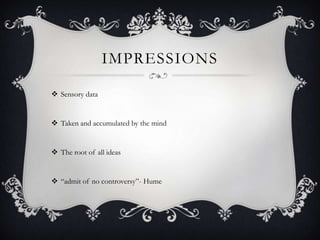
IMPRESSIONS
 Sensory data

 Taken and accumulated by the mind

 The root of all ideas

 “admit of no controversy”- Hume
IDEAS
 Fainter representations of impressions

 A reflection of something already seen

 Derived from impressions

 No innate ideas
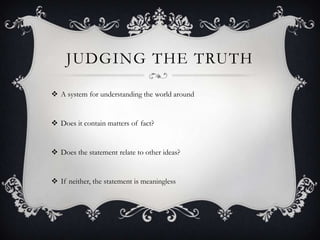
JUDGING THE TRUTH
 A system for understanding the world around

 Does it contain matters of fact?

 Does the statement relate to other ideas?

 If neither, the statement is meaningless
DEMONSTRATIVE
STATEMENTS
 True or false prior to experience

 E.G. 2+2=4

 You know that this is true without experience

 A Priori
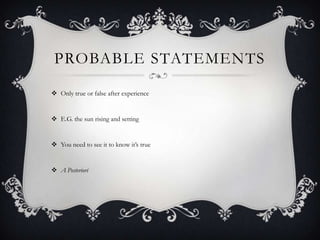
PROBABLE STATEMENTS
 Only true or false after experience

 E.G. the sun rising and setting

 You need to see it to know it‟s true

 A Posteriori
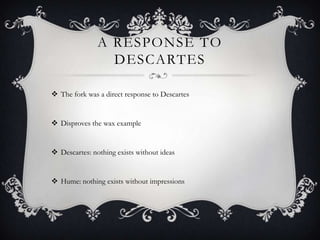
A RESPONSE TO
DESCARTES
 The fork was a direct response to Descartes

 Disproves the wax example

 Descartes: nothing exists without ideas

 Hume: nothing exists without impressions
DREAMS
 Descartes: dreams can feel as real as reality

 Hume: Only a fainter representation

 Dreams are all based on impressions

 No ideas stand on their own
SEEING TO BELIEVE
 Hume‟s argument is atheist

 Contradicts Descartes view of a supreme being

 A Priori only works with logical statements

 Disproves automaton example
A KEY BLOW TO
RATIONALISM
 Went much more in depth

 Explained grey areas

 Cast a shadow of doubt on all that we know
A MODERN ILLUSTRATION
 Put Hume‟s fork to the test

 Try to think of something unique

 Can be linked back to empirical fact

 Cannot think outside of experience
CONTINUED…
 Inductive reasoning is harder to put to test

 Look for opposites in the world around

 If you can conceive it, it could happen

http://www.youtube.com/watch?v=BQ2qjVkMj6s

David hume

  • 1.
    DAVID HUME By Olivia,Alex, and Colleen
  • 2.
    KEY IDEAS Custom asour Guide  Inductive Reasoning Hume‟s Fork
  • 3.
    BIOGRAPHY o 1711-1776 o AttendedUniversity of Edinburgh at age 12 o Worked himself into a nervous breakdown by the age of 18 o Moved to a little town in France to philosophize o Wrote many books, several of them historical
  • 4.
    KEY BELI EF#1: I NDUCTI VE REASONI NG  Humans have a tendency to observe an unchanging pattern and assume that it will continue in that fashion forever  For example, we notice the sky getting dark every night and the sun setting, and so we infer that it will do the same tomorrow.  In reality, we have no true way of knowing that the future will conform to the past and no reason to believe that just because things have always been one way, they will continue to do so
  • 5.
    INDUCTIVE REASONING  Thiskind of reasoning where we infer one thing from another is called „inductive reasoning‟  It is one of Hume‟s most prominent theories  Related to „causation‟, the concept of always seeing one thing follow another and concluding that • A) They are connected (A causes B) • B) Will always react the same way (A will always cause B)
  • 6.
    HUME VS. DESCARTES Hume was an atheist and believed in no high power whatsoever, whereas Descartes worked hard to prove that God existed, and if not his God, then an evil but omniscient and omnipotent demon  Hume believes that there is no innate knowledge, that all knowledge is derived from experience, whereas Descartes believes the opposite  Both accept that the „self ‟ is the basis of philosophical reflection (they disagree on what the „self ‟ is capable of doing)
  • 8.
    EPISTEMOLOGICAL SCHOOL: EMPIRICIST  Thetheory of Empiricism suggests and defines the primary source from which we retain knowledge to be “sensory experience”.  David Hume has been characterized as an Empiricist philosopher as many of his prime theories and ideas revolve around the concept that experience is the key to understanding what we know and how we come to know it.
  • 9.
    KEY IDEA #2 CUSTOMIS OUR GUIDE  One of David Hume‟s key theories is known as „Custom is Our Guide‟  This concept can be defined and broken down into three ideas: 1. Custom allows us to conceive that the future will conform to the past. 2. Belief arises directly and only through custom. 3. Custom determines the standards of our future judgments.
  • 10.
    KEY ARGUMENTS ANDEXAMPLES BREAKDOWN  1. David Hume theorizes that custom allows us to perceive that the future will conform accordingly to the past through experience and learning to understand the common, and in many cases certain, outcomes associated with certain actions. - Billiard Ball Example  2. David Hume suggests that belief formulates solely off the basis of custom because only through conceiving can we begin believe or determine an impending outcome of a particular action or circumstance. - Billiard Ball Belief Example  3. He goes onto suggest that custom determines our future judgments far more than reason does or can. - Body to Mind Example
  • 11.
    DESCARTES READINGS RESPONSE  1.First Mediation – Overlap - The idea that the senses are directly connected to forming a reality are seen in both David Hume‟s reading and Descartes first mediation. - The concept of conceiving are brought up in both as well.  2. Second Mediation – Disagree - In his second mediation, Descartes goes about trying to understand the nature of the human mind by disregarding the knowledge he is given by his memory whereas David Hume suggests that the key to understanding what we know and how we know it is relying on the memory and past experiences/sensations to guide us.  3. Third Mediation – Overlap and Agree - Notes that sensory perception is a valid source of knowledge. - Identifies the connection between conceiving and believing.
  • 12.
    CONTRIBUTION TO PHILOSOPHY AN A LY S I S  David Hume‟s biggest contributions to Philosophy and the Epistemological school of Empiricism include:  His skepticism concerning the basis of cause and effect – A groundbreaking new inquiry about a theory that had been wildly accepted and left unquestioned.
  • 13.
    A DEEPER LOOKAT THE BLANK SLATE  Built on Locke‟s idea of the blank slate  Perceptions = emotions, feelings etc.  Divides perceptions into two categories  Impressions and ideas
  • 14.
    IMPRESSIONS  Sensory data Taken and accumulated by the mind  The root of all ideas  “admit of no controversy”- Hume
  • 15.
    IDEAS  Fainter representationsof impressions  A reflection of something already seen  Derived from impressions  No innate ideas
  • 16.
    JUDGING THE TRUTH A system for understanding the world around  Does it contain matters of fact?  Does the statement relate to other ideas?  If neither, the statement is meaningless
  • 17.
    DEMONSTRATIVE STATEMENTS  True orfalse prior to experience  E.G. 2+2=4  You know that this is true without experience  A Priori
  • 18.
    PROBABLE STATEMENTS  Onlytrue or false after experience  E.G. the sun rising and setting  You need to see it to know it‟s true  A Posteriori
  • 19.
    A RESPONSE TO DESCARTES The fork was a direct response to Descartes  Disproves the wax example  Descartes: nothing exists without ideas  Hume: nothing exists without impressions
  • 20.
    DREAMS  Descartes: dreamscan feel as real as reality  Hume: Only a fainter representation  Dreams are all based on impressions  No ideas stand on their own
  • 21.
    SEEING TO BELIEVE Hume‟s argument is atheist  Contradicts Descartes view of a supreme being  A Priori only works with logical statements  Disproves automaton example
  • 22.
    A KEY BLOWTO RATIONALISM  Went much more in depth  Explained grey areas  Cast a shadow of doubt on all that we know
  • 23.
    A MODERN ILLUSTRATION Put Hume‟s fork to the test  Try to think of something unique  Can be linked back to empirical fact  Cannot think outside of experience
  • 24.
    CONTINUED…  Inductive reasoningis harder to put to test  Look for opposites in the world around  If you can conceive it, it could happen http://www.youtube.com/watch?v=BQ2qjVkMj6s