
Copyright © 2011 Pearson Education, Inc. All rights reserved.
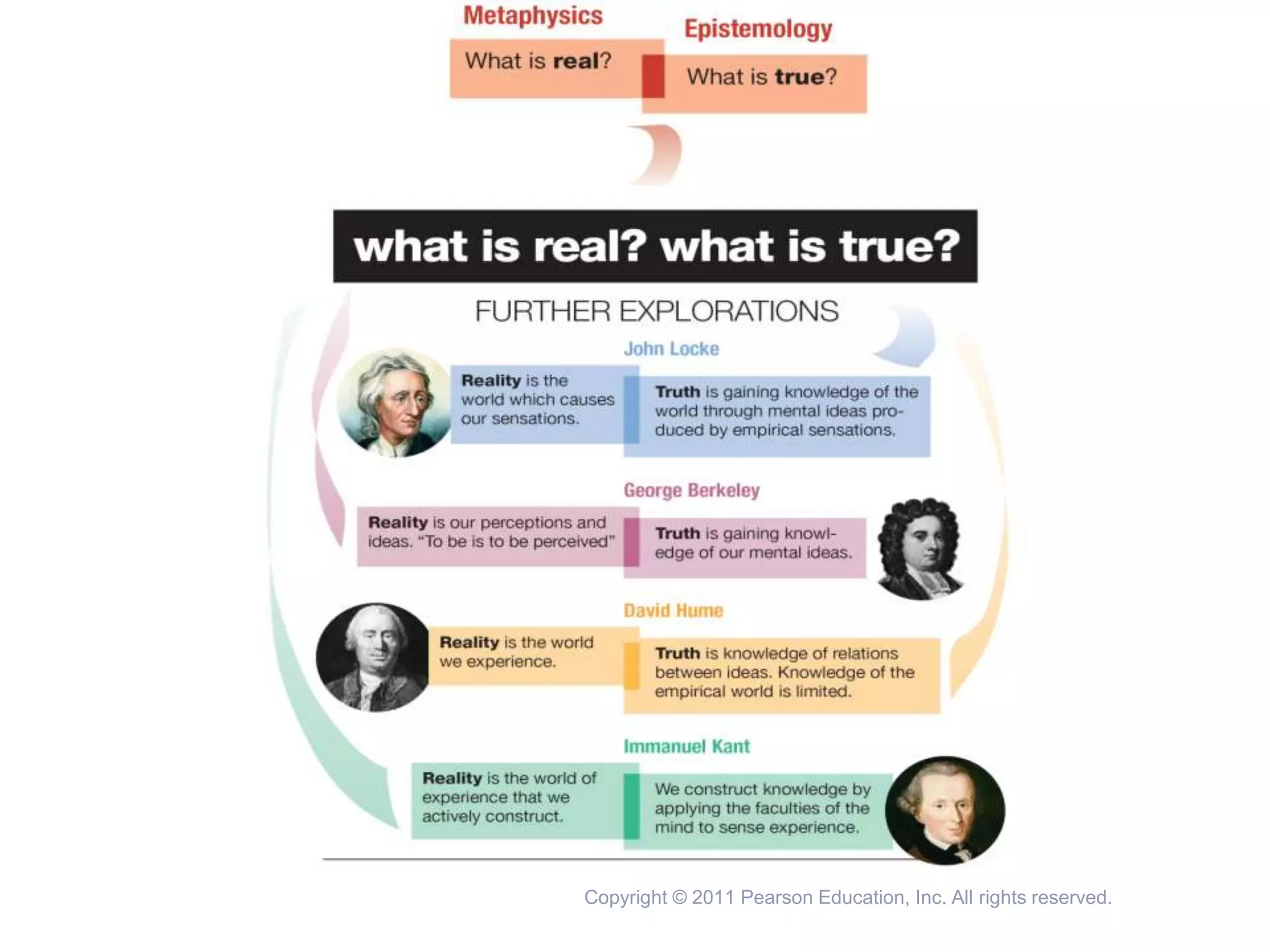
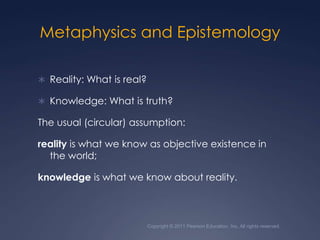
Metaphysics and EpistemologyReality: What is real?Knowledge: What is truth? The usual (circular) assumption: reality is what we know as objective existence in the world; knowledge is what we know about reality. Copyright © 2011 Pearson Education, Inc. All rights reserved.
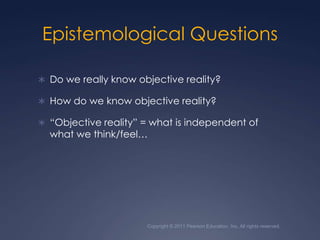
Epistemological QuestionsDo we really know objective reality?  How do we know objective reality? “Objective reality” = what is independent of what we think/feel…Copyright © 2011 Pearson Education, Inc. All rights reserved.
Sources of KnowledgeWhere does knowledge come from? (experience or reasoning?)Empiricism: All knowledge comes from experience (a posteriori).Rationalism: All reliable knowledge (scientific laws, etc.) comes from rational deliberation (innate ideas + reasoning).  (a priori)Copyright © 2011 Pearson Education, Inc. All rights reserved.
Copyright © 2011 Pearson Education, Inc. All rights reserved.LOCKE VS. LEIBNIZ ON INNATE IDEASThe Empiricist: LOCKE: AGAINST INNATE IDEASThe argument from universal consent for innate ideas is inconclusiveChildren and “idiots” do not have innate ideas; we are born with a mind as a blank tablet (tabula rasa)It is impossible to have ideas of which we are not consciousThe Rationalist:LEIBNIZ’S REPLY TO LOCKESense experience alone cannot validate general principles or lawsThere is extensive evidence that we have innate cognitive structures
Rene Descartes’ Rationalism (Chapter 5, pp. 215-227)Experience is not reliable:The wax argument (is it the same thing after it melts?)The dream argumentOnly reason is reliable:“I think, therefore I am.”Copyright © 2011 Pearson Education, Inc. All rights reserved.
Copyright © 2011 Pearson Education, Inc. All rights reserved.The Empiricist: LOCKE’S CAUSAL THEORY OF PERCEPTION: ELEMENTS OF THE KNOWING PROCESSThe entity or object in the worldSensations (sense data, images, sensory impressions) emitted by the objects via “impulses” and transmitted to our five sensesIdeas, which Locke characterizes as “the immediate objects of perception, thought, or understanding”—in other words, the images or impressions produced in our minds by the impulses emitted by the objectsThe human subject, knower, or conscious mind who is able to perceive the ideas in his or her mind and “reflect” on them, thus constructing knowledge
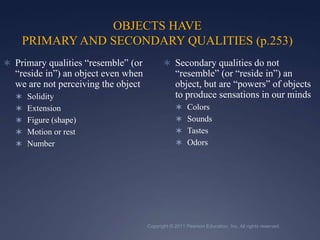
Copyright © 2011 Pearson Education, Inc. All rights reserved.OBJECTS HAVE PRIMARY AND SECONDARY QUALITIES (p.253)Primary qualities “resemble” (or “reside in”) an object even when we are not perceiving the objectSolidityExtensionFigure (shape)Motion or restNumberSecondary qualities do not “resemble” (or “reside in”) an object, but are “powers” of objects to produce sensations in our mindsColorsSounds TastesOdors
Locke’s “Substance”What holds these primary and secondary qualities together to make them the same entity? Locke: “Substance” (something that lies beneath these observable qualities).But do we perceive any “substance”?---empiricism finds its own difficulty.Copyright © 2011 Pearson Education, Inc. All rights reserved.
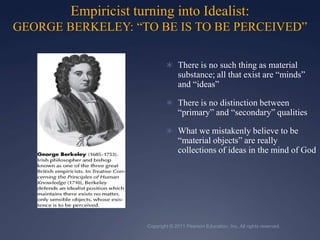
Copyright © 2011 Pearson Education, Inc. All rights reserved.Empiricist turning into Idealist: GEORGE BERKELEY: “TO BE IS TO BE PERCEIVED”There is no such thing as material substance; all that exist are “minds” and “ideas”There is no distinction between “primary” and “secondary” qualitiesWhat we mistakenly believe to be “material objects” are really collections of ideas in the mind of God
Copyright © 2011 Pearson Education, Inc. All rights reserved.The Fate of EmpiricismWith the success of Newtonian physics and Locke’s account of an empiricist metaphysics and epistemologyEmpiricism seemed to clearly have the upper hand against rationalismDavid Hume (1711-1776) comes along and shows that there is something deeply troubling about empiricismIt leads to a radical kind of skepticism
Copyright © 2011 Pearson Education, Inc. All rights reserved.Hume’s Version of EmpiricismContents of the mind can be divided into two categoriesImpressions-- the actual experiences that we haveTasting an apple, seeing a sunset, feeling pain, or angry or jealous, hungry or sad, etcIdeas– Copies of impressions My memory of the taste of the apple, my idea of anger, jealousy, hunger, red
Copyright © 2011 Pearson Education, Inc. All rights reserved.Hume on PerceptionImpressions and ideas are each a kind of perception for Humethey are distinguished by their ‘force and vivacity’Impressions are ‘our more lively perceptions’Ideas (or thoughts) are dull and lifeless copies of the original impressionThis means that both are merely mental phenomena
Copyright © 2011 Pearson Education, Inc. All rights reserved.The Empiricist Theory of MeaningWords in language stand for ideas Hume endorses Locke’s distinction between simple and complex ideasComplex ideas are composed of simple onesSimples ones either can be traced back to an impression from which they were copiedOr else they are meaningless nonsenseIf an idea cannot be traced back to an impression it is meaningless and should not be used
Copyright © 2011 Pearson Education, Inc. All rights reserved.Empiricist EpistemologyHuman knowledge falls into two kinds for HumeRelations of Ideas– all a priori knowledgeMatters of Fact– all empirical knowledgeTo decide which is which you apply the following ruleIf the negation of a true proposition in question is a contradiction then it is a Relation of IdeasIf not, a Matter of Fact (see examples next page->)
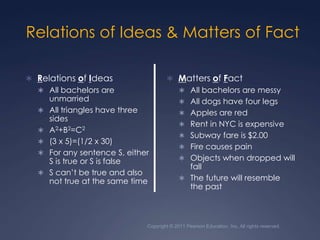
Copyright © 2011 Pearson Education, Inc. All rights reserved.Relations of Ideas & Matters of FactRelations of IdeasAll bachelors are unmarriedAll triangles have three sidesA2+B2=C2(3 x 5)=(1/2 x 30)For any sentence S, either S is true or S is falseS can’t be true and also not true at the same timeMatters of FactAll bachelors are messyAll dogs have four legsApples are redRent in NYC is expensiveSubway fare is $2.00Fire causes painObjects when dropped will fallThe future will resemble the past
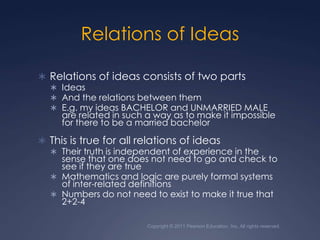
Copyright © 2011 Pearson Education, Inc. All rights reserved.Relations of IdeasRelations of ideas consists of two partsIdeasAnd the relations between themE.g. my ideas BACHELOR and UNMARRIED MALE are related in such a way as to make it impossible for there to be a married bachelorThis is true for all relations of ideasTheir truth is independent of experience in the sense that one does not need to go and check to see if they are trueMathematics and logic are purely formal systems of inter-related definitionsNumbers do not need to exist to make it true that 2+2-4
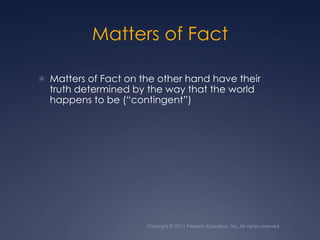
Copyright © 2011 Pearson Education, Inc. All rights reserved.Matters of FactMatters of Fact on the other hand have their truth determined by the way that the world happens to be (“contingent”)
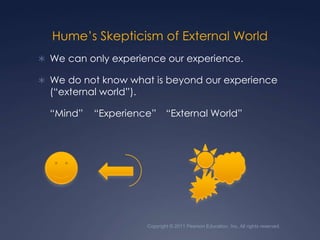
Hume’s Skepticism of External WorldWe can only experience our experience. We do not know what is beyond our experience (“external world”).	“Mind”    “Experience”	“External World”Copyright © 2011 Pearson Education, Inc. All rights reserved.
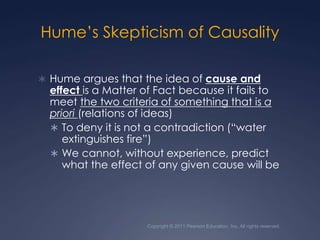
Hume’s Skepticism of CausalityHume argues that the idea of cause and effect is a Matter of Fact because it fails to meet the two criteria of something that is a priori (relations of ideas)To deny it is not a contradiction (“water extinguishes fire”)We cannot, without experience, predict what the effect of any given cause will beCopyright © 2011 Pearson Education, Inc. All rights reserved.
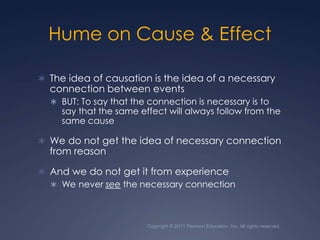
Copyright © 2011 Pearson Education, Inc. All rights reserved.Hume on Cause & EffectThe idea of causation is the idea of a necessary connection between eventsBUT: To say that the connection is necessary is to say that the same effect will always follow from the same causeWe do not get the idea of necessary connection from reasonAnd we do not get it from experienceWe never see the necessary connection
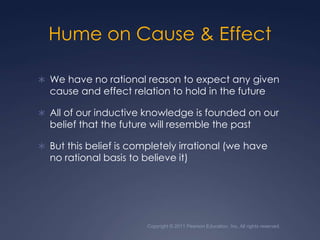
Copyright © 2011 Pearson Education, Inc. All rights reserved.Hume on Cause & EffectWe have no rational reason to expect any given cause and effect relation to hold in the futureAll of our inductive knowledge is founded on our belief that the future will resemble the pastBut this belief is completely irrational (we have no rational basis to believe it)
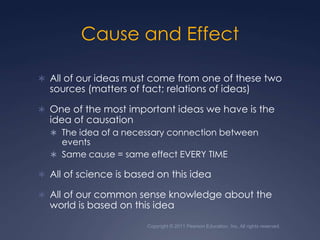
Copyright © 2011 Pearson Education, Inc. All rights reserved.Cause and EffectAll of our ideas must come from one of these two sources (matters of fact; relations of ideas)One of the most important ideas we have is the idea of causationThe idea of a necessary connection between eventsSame cause = same effect EVERY TIMEAll of science is based on this ideaAll of our common sense knowledge about the world is based on this idea
Copyright © 2011 Pearson Education, Inc. All rights reserved.It’s just a Habit!So where does the idea come from?It comes from ‘a habit of expectation’We see A happenWe see B happen right afterWe see A happenWe see B happen right afterThis is repeatedSoon when we see A happen we come to expect that B will happen right after
Copyright © 2011 Pearson Education, Inc. All rights reserved.Spreading the MindIt is the subjective feeling of expectation that we mistakenly ‘project’ out onto the events that we observeFor Hume, “we cannot know if there is anything more to the word than this”This is an epistemological claim: we can’t know if there is a necessary connection between eventsNOT a metaphysical claim: There is no necessary connection between events (we do not know)
Copyright © 2011 Pearson Education, Inc. All rights reserved.Hume’s Challenge to InductionInduction: The process of deriving general principles from particular facts or instances.All inductive knowledge is based on the fallacy of assuming that the future will resemble the pastBut just that something has happened for a long time is no guarantee that it will always happenSo, the sun may have risen everyday so far, but who can say with certainty that it will rise tomorrow?Just like problem of black swans
Copyright © 2011 Pearson Education, Inc. All rights reserved.Pavlov & Classical ConditioningWe have been trained by nature to expect certain events upon seeing certain other eventsJust like Pavlov’s dogYou ring the bell and bring some foodThe dog salivatesRepeatSoon the dog salivates when hearing the bell whether or not food comesThe dog has come to expect ‘bell then food’
Copyright © 2011 Pearson Education, Inc. All rights reserved.Classical Conditioning IINow if the dog were to reason to itself as follows,Every time the bell has rang food has appearedThis has happened everyday of my existence, every since I was a puppyI can infer from this that the next time the bell rings, food will appearWe could easily see that the dog has made a mistake (like Bertrand Russell’s turkey on Thanksgiving day)
Copyright © 2011 Pearson Education, Inc. All rights reserved.Classical Conditioning IIIThere is no necessary connection between bell ringing and food appearing in natureHow can we tell that this is not the way nature is in reality?Nature is regular (so was the bell ringing/food bringing relationship)Things so far have happened regularly and predictably But we have no reason to believe that it must continue (from an empiricist point of view)
Copyright © 2011 Pearson Education, Inc. All rights reserved.READING CRITICALLY: ANALYZING HUME’S CASE FOR SKEPTICISM	Would you agree with Hume’s critique of knowledge claims about the external world, cause and effect, and induction? Why or why not?
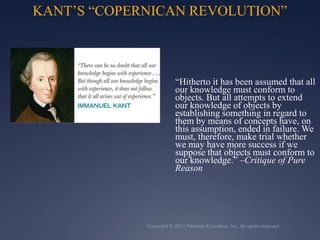
Copyright © 2011 Pearson Education, Inc. All rights reserved.KANT’S “COPERNICAN REVOLUTION”“Hitherto it has been assumed that all our knowledge must conform to objects. But all attempts to extend our knowledge of objects by establishing something in regard to them by means of concepts have, on this assumption, ended in failure. We must, therefore, make trial whether we may have more success if we suppose that objects must conform to our knowledge.” –Critique of Pure Reason
Copyright © 2011 Pearson Education, Inc. All rights reserved.
Copyright © 2011 Pearson Education, Inc. All rights reserved.Kant’s Dogmatic SlumberKant is disturbed from thinking that everything in science is fine by Hume’s argumentEmpiricism cannot deliver necessary truths‘experience can teach us that something is the case but it cannot teach us that it must be the case’Yet science claims to discover necessary truths about nature (Scientific necessity)Even worse, Hume claimed to have shown that human beings are essentially irrational
Copyright © 2011 Pearson Education, Inc. All rights reserved.Transcendental IdealismKant agrees with Hume that we cannot learn that the causal relation is necessary and universal from experienceBut Hume has not shown that we can’t have a priori knowledge For Hume something was a priori if we could not deny it without contradiction For Kant something is a priori if is knowable completely independently of experience
Copyright © 2011 Pearson Education, Inc. All rights reserved.The Structure of ExperienceHow could our experience be the way that it is?How is it?Objects are located in space and timeCan you imagine an object which was not at any place?No !This is something that we can know a prioriIt is not dependent on experience
Copyright © 2011 Pearson Education, Inc. All rights reserved.Conditions of all Possible ExperienceIt is the pre-condition for any experience at allJust like space in the room is a precondition of having objects in the roomSo too space is a necessary condition of any possible experienceThus we can know with absolute certainty that whatever experiences we do have will all take place at some time and at some particular place
Copyright © 2011 Pearson Education, Inc. All rights reserved.The A PrioriSo Kant concludes that there is pure a priori knowledge‘pure’ because it does not depend on experienceBut is rather the pre-conditions for any possible experienceIt is necessaryIt is not possible to have experience without spaceAnd universalAll experiences will be in space
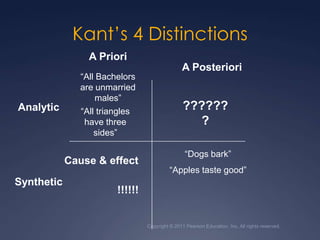
Copyright © 2011 Pearson Education, Inc. All rights reserved.Analytic vs. Synthetic (p. 287)An analytic truth is one that is true by virtue of the meaning of the words themselves“All bachelors are unmarried males”---They do not add anything new to our knowledgeSynthetic truths are true in virtue of the kind of experience we have“All bachelors are messy”---They do add to our knowledge
Copyright © 2011 Pearson Education, Inc. All rights reserved.Kant’s 4 DistinctionsA PrioriA Posteriori“All Bachelors are unmarried males”???????Analytic“All triangles have three sides”“Dogs bark”“Apples taste good”Cause & effectSynthetic!!!!!!
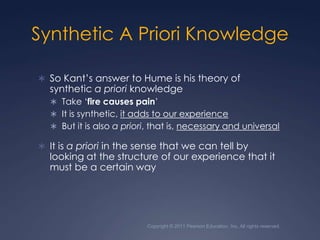
Copyright © 2011 Pearson Education, Inc. All rights reserved.Synthetic A Priori KnowledgeSo Kant’s answer to Hume is his theory of synthetic a priori knowledgeTake ‘fire causes pain’It is synthetic, it adds to our experienceBut it is also a priori, that is, necessary and universalIt is a priori in the sense that we can tell by looking at the structure of our experience that it must be a certain way
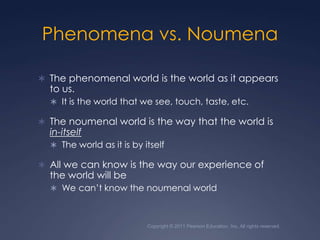
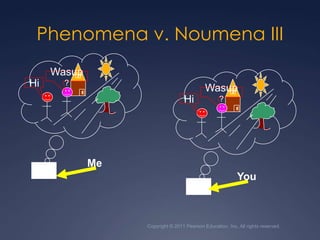
Copyright © 2011 Pearson Education, Inc. All rights reserved.Phenomena vs. NoumenaThe phenomenal world is the world as it appears to us.It is the world that we see, touch, taste, etc.The noumenal world is the way that the world is in-itselfThe world as it is by itselfAll we can know is the way our experience of the world will beWe can’t know the noumenal world
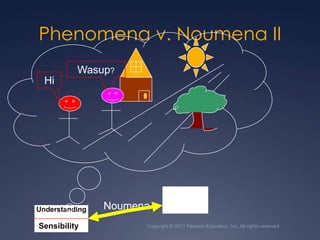
Copyright © 2011 Pearson Education, Inc. All rights reserved.Phenomena v. Noumena IIUnderstandingSensibilityWasup?HiNoumena
Copyright © 2011 Pearson Education, Inc. All rights reserved.Phenomena v. Noumena IIIWasup?Wasup?HiHiMeYou
Copyright © 2011 Pearson Education, Inc. All rights reserved.Kant’s Philosophy of MindOur minds are the same (i.e., we share the same phenomenal world)The mind has two componentsSensibilityUnderstanding“Sensibility” takes in ‘raw’ unorganized noumena and organizes it into phenomena (our experience)Each has their categories that they use in order to construct our experienceThe sensibility has Space and Time
Copyright © 2011 Pearson Education, Inc. All rights reserved.Kant’s Philosophy of MindThe “understanding” has 12 categoriesUnity, plurality, totality, reality, negation, limitation, substance/property, cause & effect, community, possibility/impossibility, existence/non-existence, and necessary/contingentWith these categories, and the two from the sensibility, our mind constructs our experienceWe can know with absolute certainty that our experience will conform to the categories
Copyright © 2011 Pearson Education, Inc. All rights reserved.Kant’s Philosophy of Mind That is the only way that experience like ours is possibleThe same cause must bring about the same effect Because our mind constructs the world that way.Yet this comes at a heavy costScience studies our experience of the worldIt does not, cannot, study the noumenal world
Copyright © 2011 Pearson Education, Inc. All rights reserved.Kant’s Philosophy of MindKant called this a Copernican Revolution in philosophyInstead of the mind passively acting like a recorder of an outside realityKant sees the human mind as actively constructing realityThis is his mix of Rationalism and EmpiricismEmpiricism– science is synthetic knowledgeRationalism– but based on a priori categories
Copyright © 2011 Pearson Education, Inc. All rights reserved.KANT ON THE SYNTETIC A PRIORI AND THE PHENOMENAL AND NOUMENAL WORLDSTHE SYNTHETIC A PRIORITHE PHENOMENAL AND NOUMENAL WORLDSNecessary and universally truea priori—can be discovered independently of experienceSynthetic in the sense that it provides us with genuine information regarding our experience in the worldphenomenal reality is the world as we constitute it and experience itnoumenal reality is the world beyond our perceptions, reality “in-itself”
What is your epistemology?Where does Scientific knowledge (e.g., “Normally water freezes below 0° C”) come from? From experience (empiricism like Locke) From reasoning (rationalism) We do not have such knowledge (Hume)We construct such knowledge in our mind with data from experience (Kant)  ???Copyright © 2011 Pearson Education, Inc. All rights reserved.

philo

  • 1.
    Copyright © 2011Pearson Education, Inc. All rights reserved.
  • 2.
    Metaphysics and EpistemologyReality:What is real?Knowledge: What is truth? The usual (circular) assumption: reality is what we know as objective existence in the world; knowledge is what we know about reality. Copyright © 2011 Pearson Education, Inc. All rights reserved.
  • 3.
    Epistemological QuestionsDo wereally know objective reality? How do we know objective reality? “Objective reality” = what is independent of what we think/feel…Copyright © 2011 Pearson Education, Inc. All rights reserved.
  • 4.
    Sources of KnowledgeWheredoes knowledge come from? (experience or reasoning?)Empiricism: All knowledge comes from experience (a posteriori).Rationalism: All reliable knowledge (scientific laws, etc.) comes from rational deliberation (innate ideas + reasoning). (a priori)Copyright © 2011 Pearson Education, Inc. All rights reserved.
  • 5.
    Copyright © 2011Pearson Education, Inc. All rights reserved.LOCKE VS. LEIBNIZ ON INNATE IDEASThe Empiricist: LOCKE: AGAINST INNATE IDEASThe argument from universal consent for innate ideas is inconclusiveChildren and “idiots” do not have innate ideas; we are born with a mind as a blank tablet (tabula rasa)It is impossible to have ideas of which we are not consciousThe Rationalist:LEIBNIZ’S REPLY TO LOCKESense experience alone cannot validate general principles or lawsThere is extensive evidence that we have innate cognitive structures
  • 6.
    Rene Descartes’ Rationalism(Chapter 5, pp. 215-227)Experience is not reliable:The wax argument (is it the same thing after it melts?)The dream argumentOnly reason is reliable:“I think, therefore I am.”Copyright © 2011 Pearson Education, Inc. All rights reserved.
  • 7.
    Copyright © 2011Pearson Education, Inc. All rights reserved.The Empiricist: LOCKE’S CAUSAL THEORY OF PERCEPTION: ELEMENTS OF THE KNOWING PROCESSThe entity or object in the worldSensations (sense data, images, sensory impressions) emitted by the objects via “impulses” and transmitted to our five sensesIdeas, which Locke characterizes as “the immediate objects of perception, thought, or understanding”—in other words, the images or impressions produced in our minds by the impulses emitted by the objectsThe human subject, knower, or conscious mind who is able to perceive the ideas in his or her mind and “reflect” on them, thus constructing knowledge
  • 8.
    Copyright © 2011Pearson Education, Inc. All rights reserved.OBJECTS HAVE PRIMARY AND SECONDARY QUALITIES (p.253)Primary qualities “resemble” (or “reside in”) an object even when we are not perceiving the objectSolidityExtensionFigure (shape)Motion or restNumberSecondary qualities do not “resemble” (or “reside in”) an object, but are “powers” of objects to produce sensations in our mindsColorsSounds TastesOdors
  • 9.
    Locke’s “Substance”What holdsthese primary and secondary qualities together to make them the same entity? Locke: “Substance” (something that lies beneath these observable qualities).But do we perceive any “substance”?---empiricism finds its own difficulty.Copyright © 2011 Pearson Education, Inc. All rights reserved.
  • 10.
    Copyright © 2011Pearson Education, Inc. All rights reserved.Empiricist turning into Idealist: GEORGE BERKELEY: “TO BE IS TO BE PERCEIVED”There is no such thing as material substance; all that exist are “minds” and “ideas”There is no distinction between “primary” and “secondary” qualitiesWhat we mistakenly believe to be “material objects” are really collections of ideas in the mind of God
  • 11.
    Copyright © 2011Pearson Education, Inc. All rights reserved.The Fate of EmpiricismWith the success of Newtonian physics and Locke’s account of an empiricist metaphysics and epistemologyEmpiricism seemed to clearly have the upper hand against rationalismDavid Hume (1711-1776) comes along and shows that there is something deeply troubling about empiricismIt leads to a radical kind of skepticism
  • 12.
    Copyright © 2011Pearson Education, Inc. All rights reserved.Hume’s Version of EmpiricismContents of the mind can be divided into two categoriesImpressions-- the actual experiences that we haveTasting an apple, seeing a sunset, feeling pain, or angry or jealous, hungry or sad, etcIdeas– Copies of impressions My memory of the taste of the apple, my idea of anger, jealousy, hunger, red
  • 13.
    Copyright © 2011Pearson Education, Inc. All rights reserved.Hume on PerceptionImpressions and ideas are each a kind of perception for Humethey are distinguished by their ‘force and vivacity’Impressions are ‘our more lively perceptions’Ideas (or thoughts) are dull and lifeless copies of the original impressionThis means that both are merely mental phenomena
  • 14.
    Copyright © 2011Pearson Education, Inc. All rights reserved.The Empiricist Theory of MeaningWords in language stand for ideas Hume endorses Locke’s distinction between simple and complex ideasComplex ideas are composed of simple onesSimples ones either can be traced back to an impression from which they were copiedOr else they are meaningless nonsenseIf an idea cannot be traced back to an impression it is meaningless and should not be used
  • 15.
    Copyright © 2011Pearson Education, Inc. All rights reserved.Empiricist EpistemologyHuman knowledge falls into two kinds for HumeRelations of Ideas– all a priori knowledgeMatters of Fact– all empirical knowledgeTo decide which is which you apply the following ruleIf the negation of a true proposition in question is a contradiction then it is a Relation of IdeasIf not, a Matter of Fact (see examples next page->)
  • 16.
    Copyright © 2011Pearson Education, Inc. All rights reserved.Relations of Ideas & Matters of FactRelations of IdeasAll bachelors are unmarriedAll triangles have three sidesA2+B2=C2(3 x 5)=(1/2 x 30)For any sentence S, either S is true or S is falseS can’t be true and also not true at the same timeMatters of FactAll bachelors are messyAll dogs have four legsApples are redRent in NYC is expensiveSubway fare is $2.00Fire causes painObjects when dropped will fallThe future will resemble the past
  • 17.
    Copyright © 2011Pearson Education, Inc. All rights reserved.Relations of IdeasRelations of ideas consists of two partsIdeasAnd the relations between themE.g. my ideas BACHELOR and UNMARRIED MALE are related in such a way as to make it impossible for there to be a married bachelorThis is true for all relations of ideasTheir truth is independent of experience in the sense that one does not need to go and check to see if they are trueMathematics and logic are purely formal systems of inter-related definitionsNumbers do not need to exist to make it true that 2+2-4
  • 18.
    Copyright © 2011Pearson Education, Inc. All rights reserved.Matters of FactMatters of Fact on the other hand have their truth determined by the way that the world happens to be (“contingent”)
  • 19.
    Hume’s Skepticism ofExternal WorldWe can only experience our experience. We do not know what is beyond our experience (“external world”). “Mind” “Experience” “External World”Copyright © 2011 Pearson Education, Inc. All rights reserved.
  • 20.
    Hume’s Skepticism ofCausalityHume argues that the idea of cause and effect is a Matter of Fact because it fails to meet the two criteria of something that is a priori (relations of ideas)To deny it is not a contradiction (“water extinguishes fire”)We cannot, without experience, predict what the effect of any given cause will beCopyright © 2011 Pearson Education, Inc. All rights reserved.
  • 21.
    Copyright © 2011Pearson Education, Inc. All rights reserved.Hume on Cause & EffectThe idea of causation is the idea of a necessary connection between eventsBUT: To say that the connection is necessary is to say that the same effect will always follow from the same causeWe do not get the idea of necessary connection from reasonAnd we do not get it from experienceWe never see the necessary connection
  • 22.
    Copyright © 2011Pearson Education, Inc. All rights reserved.Hume on Cause & EffectWe have no rational reason to expect any given cause and effect relation to hold in the futureAll of our inductive knowledge is founded on our belief that the future will resemble the pastBut this belief is completely irrational (we have no rational basis to believe it)
  • 23.
    Copyright © 2011Pearson Education, Inc. All rights reserved.Cause and EffectAll of our ideas must come from one of these two sources (matters of fact; relations of ideas)One of the most important ideas we have is the idea of causationThe idea of a necessary connection between eventsSame cause = same effect EVERY TIMEAll of science is based on this ideaAll of our common sense knowledge about the world is based on this idea
  • 24.
    Copyright © 2011Pearson Education, Inc. All rights reserved.It’s just a Habit!So where does the idea come from?It comes from ‘a habit of expectation’We see A happenWe see B happen right afterWe see A happenWe see B happen right afterThis is repeatedSoon when we see A happen we come to expect that B will happen right after
  • 25.
    Copyright © 2011Pearson Education, Inc. All rights reserved.Spreading the MindIt is the subjective feeling of expectation that we mistakenly ‘project’ out onto the events that we observeFor Hume, “we cannot know if there is anything more to the word than this”This is an epistemological claim: we can’t know if there is a necessary connection between eventsNOT a metaphysical claim: There is no necessary connection between events (we do not know)
  • 26.
    Copyright © 2011Pearson Education, Inc. All rights reserved.Hume’s Challenge to InductionInduction: The process of deriving general principles from particular facts or instances.All inductive knowledge is based on the fallacy of assuming that the future will resemble the pastBut just that something has happened for a long time is no guarantee that it will always happenSo, the sun may have risen everyday so far, but who can say with certainty that it will rise tomorrow?Just like problem of black swans
  • 27.
    Copyright © 2011Pearson Education, Inc. All rights reserved.Pavlov & Classical ConditioningWe have been trained by nature to expect certain events upon seeing certain other eventsJust like Pavlov’s dogYou ring the bell and bring some foodThe dog salivatesRepeatSoon the dog salivates when hearing the bell whether or not food comesThe dog has come to expect ‘bell then food’
  • 28.
    Copyright © 2011Pearson Education, Inc. All rights reserved.Classical Conditioning IINow if the dog were to reason to itself as follows,Every time the bell has rang food has appearedThis has happened everyday of my existence, every since I was a puppyI can infer from this that the next time the bell rings, food will appearWe could easily see that the dog has made a mistake (like Bertrand Russell’s turkey on Thanksgiving day)
  • 29.
    Copyright © 2011Pearson Education, Inc. All rights reserved.Classical Conditioning IIIThere is no necessary connection between bell ringing and food appearing in natureHow can we tell that this is not the way nature is in reality?Nature is regular (so was the bell ringing/food bringing relationship)Things so far have happened regularly and predictably But we have no reason to believe that it must continue (from an empiricist point of view)
  • 30.
    Copyright © 2011Pearson Education, Inc. All rights reserved.READING CRITICALLY: ANALYZING HUME’S CASE FOR SKEPTICISM Would you agree with Hume’s critique of knowledge claims about the external world, cause and effect, and induction? Why or why not?
  • 31.
    Copyright © 2011Pearson Education, Inc. All rights reserved.KANT’S “COPERNICAN REVOLUTION”“Hitherto it has been assumed that all our knowledge must conform to objects. But all attempts to extend our knowledge of objects by establishing something in regard to them by means of concepts have, on this assumption, ended in failure. We must, therefore, make trial whether we may have more success if we suppose that objects must conform to our knowledge.” –Critique of Pure Reason
  • 32.
    Copyright © 2011Pearson Education, Inc. All rights reserved.
  • 33.
    Copyright © 2011Pearson Education, Inc. All rights reserved.
  • 34.
    Copyright © 2011Pearson Education, Inc. All rights reserved.
  • 35.
    Copyright © 2011Pearson Education, Inc. All rights reserved.Kant’s Dogmatic SlumberKant is disturbed from thinking that everything in science is fine by Hume’s argumentEmpiricism cannot deliver necessary truths‘experience can teach us that something is the case but it cannot teach us that it must be the case’Yet science claims to discover necessary truths about nature (Scientific necessity)Even worse, Hume claimed to have shown that human beings are essentially irrational
  • 36.
    Copyright © 2011Pearson Education, Inc. All rights reserved.Transcendental IdealismKant agrees with Hume that we cannot learn that the causal relation is necessary and universal from experienceBut Hume has not shown that we can’t have a priori knowledge For Hume something was a priori if we could not deny it without contradiction For Kant something is a priori if is knowable completely independently of experience
  • 37.
    Copyright © 2011Pearson Education, Inc. All rights reserved.The Structure of ExperienceHow could our experience be the way that it is?How is it?Objects are located in space and timeCan you imagine an object which was not at any place?No !This is something that we can know a prioriIt is not dependent on experience
  • 38.
    Copyright © 2011Pearson Education, Inc. All rights reserved.Conditions of all Possible ExperienceIt is the pre-condition for any experience at allJust like space in the room is a precondition of having objects in the roomSo too space is a necessary condition of any possible experienceThus we can know with absolute certainty that whatever experiences we do have will all take place at some time and at some particular place
  • 39.
    Copyright © 2011Pearson Education, Inc. All rights reserved.The A PrioriSo Kant concludes that there is pure a priori knowledge‘pure’ because it does not depend on experienceBut is rather the pre-conditions for any possible experienceIt is necessaryIt is not possible to have experience without spaceAnd universalAll experiences will be in space
  • 40.
    Copyright © 2011Pearson Education, Inc. All rights reserved.Analytic vs. Synthetic (p. 287)An analytic truth is one that is true by virtue of the meaning of the words themselves“All bachelors are unmarried males”---They do not add anything new to our knowledgeSynthetic truths are true in virtue of the kind of experience we have“All bachelors are messy”---They do add to our knowledge
  • 41.
    Copyright © 2011Pearson Education, Inc. All rights reserved.Kant’s 4 DistinctionsA PrioriA Posteriori“All Bachelors are unmarried males”???????Analytic“All triangles have three sides”“Dogs bark”“Apples taste good”Cause & effectSynthetic!!!!!!
  • 42.
    Copyright © 2011Pearson Education, Inc. All rights reserved.Synthetic A Priori KnowledgeSo Kant’s answer to Hume is his theory of synthetic a priori knowledgeTake ‘fire causes pain’It is synthetic, it adds to our experienceBut it is also a priori, that is, necessary and universalIt is a priori in the sense that we can tell by looking at the structure of our experience that it must be a certain way
  • 43.
    Copyright © 2011Pearson Education, Inc. All rights reserved.Phenomena vs. NoumenaThe phenomenal world is the world as it appears to us.It is the world that we see, touch, taste, etc.The noumenal world is the way that the world is in-itselfThe world as it is by itselfAll we can know is the way our experience of the world will beWe can’t know the noumenal world
  • 44.
    Copyright © 2011Pearson Education, Inc. All rights reserved.Phenomena v. Noumena IIUnderstandingSensibilityWasup?HiNoumena
  • 45.
    Copyright © 2011Pearson Education, Inc. All rights reserved.Phenomena v. Noumena IIIWasup?Wasup?HiHiMeYou
  • 46.
    Copyright © 2011Pearson Education, Inc. All rights reserved.Kant’s Philosophy of MindOur minds are the same (i.e., we share the same phenomenal world)The mind has two componentsSensibilityUnderstanding“Sensibility” takes in ‘raw’ unorganized noumena and organizes it into phenomena (our experience)Each has their categories that they use in order to construct our experienceThe sensibility has Space and Time
  • 47.
    Copyright © 2011Pearson Education, Inc. All rights reserved.Kant’s Philosophy of MindThe “understanding” has 12 categoriesUnity, plurality, totality, reality, negation, limitation, substance/property, cause & effect, community, possibility/impossibility, existence/non-existence, and necessary/contingentWith these categories, and the two from the sensibility, our mind constructs our experienceWe can know with absolute certainty that our experience will conform to the categories
  • 48.
    Copyright © 2011Pearson Education, Inc. All rights reserved.Kant’s Philosophy of Mind That is the only way that experience like ours is possibleThe same cause must bring about the same effect Because our mind constructs the world that way.Yet this comes at a heavy costScience studies our experience of the worldIt does not, cannot, study the noumenal world
  • 49.
    Copyright © 2011Pearson Education, Inc. All rights reserved.Kant’s Philosophy of MindKant called this a Copernican Revolution in philosophyInstead of the mind passively acting like a recorder of an outside realityKant sees the human mind as actively constructing realityThis is his mix of Rationalism and EmpiricismEmpiricism– science is synthetic knowledgeRationalism– but based on a priori categories
  • 50.
    Copyright © 2011Pearson Education, Inc. All rights reserved.KANT ON THE SYNTETIC A PRIORI AND THE PHENOMENAL AND NOUMENAL WORLDSTHE SYNTHETIC A PRIORITHE PHENOMENAL AND NOUMENAL WORLDSNecessary and universally truea priori—can be discovered independently of experienceSynthetic in the sense that it provides us with genuine information regarding our experience in the worldphenomenal reality is the world as we constitute it and experience itnoumenal reality is the world beyond our perceptions, reality “in-itself”
  • 51.
    What is yourepistemology?Where does Scientific knowledge (e.g., “Normally water freezes below 0° C”) come from? From experience (empiricism like Locke) From reasoning (rationalism) We do not have such knowledge (Hume)We construct such knowledge in our mind with data from experience (Kant) ???Copyright © 2011 Pearson Education, Inc. All rights reserved.