PHARMACEUTICAL CREAMS
ANUPRIYA SINGH
B.PHARM(Ay)-4th YEAR
BANARASA HINDU UNIVERSITY 1
context-
 What is cream.
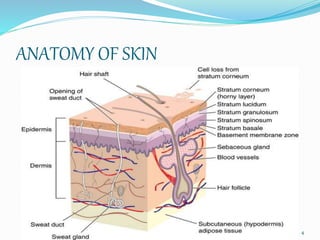
 Anatomy of skin.
 Types of cream.
 Components of cream.
 Manufacturing of cream.
 Uses of cream.
2
•WHAT IS CREAM????
 Cream consist of medicament dissolved or suspended
in water removable or emollient bases, classified as
water-in-oil or oil-in-water and intended for
application on the skin or accesible mucous membrane
to provide localized and sometimes systemic effects at
the site of application.
3
ANATOMY OF SKIN
4
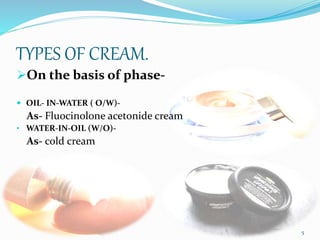
TYPES OF CREAM.
On the basis of phase-
 OIL- IN-WATER ( O/W)-
As- Fluocinolone acetonide cream
• WATER-IN-OIL (W/O)-
As- cold cream
5
CLEANISING CREAMS-
 Keeping the body clean is the most important and
primitive need to on account of personal hygiene and
beautification which leads to the need of cosmetics.
 USES-
 Cleanishing cream is required for removal of facial
make up, surface grime,oil.
 DESIRABLE PROPERTIES OF CLEANISING CREAM-
 It should be shoften on application to the skin.
 It should spread easily without draging.
6
TYPES OF CLEANISING CREAM-
 White ,emuslsified cold cream (Bee wax-borax type)-
 These are white, of high lusture,and free from
graininess.
 These are o/w type of emulsion.
 The cream have firm consistency.
 They liquefy on application to the skin and spread
with ease.
7
.
 Liquefying cleansing creams-
 These are translucent liquefying anhydrous type of
cleanising cream.
 They have a mixture of oil and waxes and have such
consistency that they liquefy when gently massaged on
the skin.
8
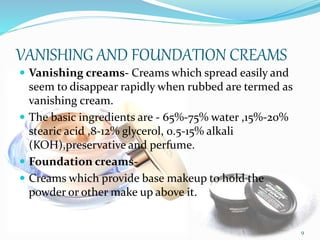
VANISHING AND FOUNDATION CREAMS
 Vanishing creams- Creams which spread easily and
seem to disappear rapidly when rubbed are termed as
vanishing cream.
 The basic ingredients are - 65%-75% water ,15%-20%
stearic acid ,8-12% glycerol, 0.5-15% alkali
(KOH),preservative and perfume.
 Foundation creams-
 Creams which provide base makeup to hold the
powder or other make up above it.
9
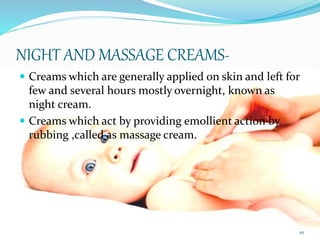
NIGHT AND MASSAGE CREAMS-
 Creams which are generally applied on skin and left for
few and several hours mostly overnight, known as
night cream.
 Creams which act by providing emollient action by
rubbing ,called as massage cream.
10
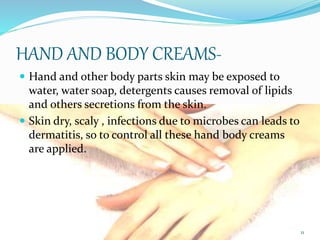
HAND AND BODY CREAMS-
 Hand and other body parts skin may be exposed to
water, water soap, detergents causes removal of lipids
and others secretions from the skin.
 Skin dry, scaly , infections due to microbes can leads to
dermatitis, so to control all these hand body creams
are applied.
11
.
 Main function of hand and body creams are-
 Provide an oily film to protect the skin.
 Keep the skin smooth but not greasy.
 Easy to apply.
12
ALL PURPOSE CREAMS-
 They act nourishing or night cream when applied
excessively, they function as hand creams when
applied sparingly, thus they are called All purpose
cream.
 These were also known as sports cream, as they were
used by sportsman in skiing and outdoor activities.
13
THE COMPOSITION OF THESE CREAM IS SUCH
THAT IT CAN ACT-
 As a foundation cream to provide a foundation base for
make up.
 As a Cleanishing cream and liquefy easily.
 As a hand cream and should have emollient
characters.
 As a protective cream and should form a non occlusive
film.
 As a cream to smooth the rough surface of the skin.
 So, therefore called All purpose cream.
14
CLASSIFICATION OF CREAM ON THE BASIS
OF FUNCTION-
 Cleansing and cold cream.
 Foundation and vanishing cream.
 Night and massage cream.
 Head and body cream.
 All purpose and general cream.
15
FORMULATIONS COMPONANTS-
 ANTIOXIDANT- ex.-TBHT, Ascorbic acid.
 BASE- ex. White petrolium, Lanolin, cholesterol.
 BUFFER- ex. Citrate buffer ,phosphate buffer.
 CHELATING AGENTS- ex. EDTA , Citric acid.
 EMULSIFYING AGENT- ex. Detergent ,Cetostearyl
alchohol.
 HUMECTANT- ex. Glycerin,propylene glycol, PEG.
16
.
 PERMEATION ENHANCER- ex. Ethanol , oleic acid,
PEG
 PRESERVATIVE – ex. Benzoic acid,phenyl ethyl
alchol.
 THICKENING AGENT- ex. Cellolose, pectin
,carbopol.
 FRAGRANCES- ex. Lavender oil,rose oil, lemon oil.
17
CLASSIFICATION OF BASE-
 Hydrocarbon base.
 Absorption base.
 Emulsion base.
 Water soluble base.
 Water removable base.
18
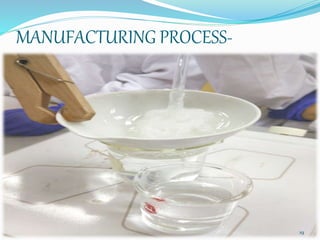
MANUFACTURING PROCESS-
19
TRITURATION METHOD-
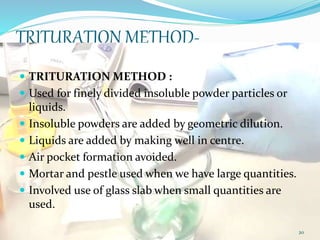
 TRITURATION METHOD :
 Used for finely divided insoluble powder particles or
liquids.
 Insoluble powders are added by geometric dilution.
 Liquids are added by making well in centre.
 Air pocket formation avoided.
 Mortar and pestle used when we have large quantities.
 Involved use of glass slab when small quantities are
used.
20
LEVIGATION-
 Incorporation of insoluble coarse particles.
 Insoluble coarse powder is rubbed with molten base or
liquid or semisolid base.
 Also knows as Wet grinding.
21
FUSION METHOD-
• The fusion method is followed when the drugs and
other solid are soluble in the ointment bases.
• The base is liquefied and the soluble components are
dissolved in the molten base.
 The congeal mixture is then speculated or triturated to
obtain a smooth texture.
 Care is taken to avoid thermal degradation of the base
or other components during the fusion process.
22
MECHANICAL ADDITION-
 Water- removable creams are basically hydrophilic
type emulsions.
 A hydrophilic emulsifying agent is included in the
aqueous phase in order to obtain stable oil-in-water
dispersion.
 Sodium lauryl sulfate is used in the preparation of
hydrophilic ointment.
23
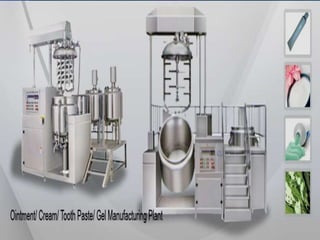
MACHINES-
 A wide range of machines are available are for the large
scale production of creams.
 Creams are produced with the help of low-shear and
high emulsifiers.
24
25
Ayurvedic fairness cream-
 FAIRNESS CREAM-
KEY INGREDIENTS
 Persian rose.
 Walnut.
 Aloe vera.
 Mandarin orange.
26
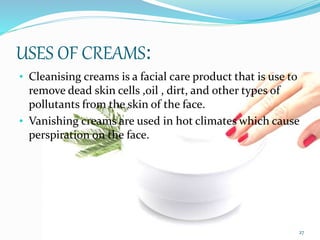
USES OF CREAMS:
• Cleanising creams is a facial care product that is use to
remove dead skin cells ,oil , dirt, and other types of
pollutants from the skin of the face.
• Vanishing creams are used in hot climates which cause
perspiration on the face.
27
.
 The provision of a barrier to protect the skin.
 To aid in the retention of moisture (especially water –
in –oil ).
 Creams can be used for administering drugs via the
vaginal route (e.g. Triple sulfa vaginal creams ).
 Creams are used to help sun burn.
 Emollient effects.
28
NOVEL ADVANCES AND RECENT
DEVELOPMENT
 CREAMS CONTAINING MICROSPHERES:
 Albumin microsphere containing vitamin A can be
administered by using creams 222 +_25 micrometer
size of microsphere of vitamin A were produced by
emulsion method.
29
.
 LAMELLAR FACED CREAMS:
 They are liquid parafin in water emulsion prepared
from certified/fatty alcohol.
 CREAMS CONTAINING LIPID NANOPARTICLES:
 The develpoment of a water-in oil cream containing
small particles of solid paraffin was studied.
30
31

Pharmaceutical creams.....

  • 1.
  • 2.
    context-  What iscream.  Anatomy of skin.  Types of cream.  Components of cream.  Manufacturing of cream.  Uses of cream. 2
  • 3.
    •WHAT IS CREAM???? Cream consist of medicament dissolved or suspended in water removable or emollient bases, classified as water-in-oil or oil-in-water and intended for application on the skin or accesible mucous membrane to provide localized and sometimes systemic effects at the site of application. 3
  • 4.
  • 5.
    TYPES OF CREAM. Onthe basis of phase-  OIL- IN-WATER ( O/W)- As- Fluocinolone acetonide cream • WATER-IN-OIL (W/O)- As- cold cream 5
  • 6.
    CLEANISING CREAMS-  Keepingthe body clean is the most important and primitive need to on account of personal hygiene and beautification which leads to the need of cosmetics.  USES-  Cleanishing cream is required for removal of facial make up, surface grime,oil.  DESIRABLE PROPERTIES OF CLEANISING CREAM-  It should be shoften on application to the skin.  It should spread easily without draging. 6
  • 7.
    TYPES OF CLEANISINGCREAM-  White ,emuslsified cold cream (Bee wax-borax type)-  These are white, of high lusture,and free from graininess.  These are o/w type of emulsion.  The cream have firm consistency.  They liquefy on application to the skin and spread with ease. 7
  • 8.
    .  Liquefying cleansingcreams-  These are translucent liquefying anhydrous type of cleanising cream.  They have a mixture of oil and waxes and have such consistency that they liquefy when gently massaged on the skin. 8
  • 9.
    VANISHING AND FOUNDATIONCREAMS  Vanishing creams- Creams which spread easily and seem to disappear rapidly when rubbed are termed as vanishing cream.  The basic ingredients are - 65%-75% water ,15%-20% stearic acid ,8-12% glycerol, 0.5-15% alkali (KOH),preservative and perfume.  Foundation creams-  Creams which provide base makeup to hold the powder or other make up above it. 9
  • 10.
    NIGHT AND MASSAGECREAMS-  Creams which are generally applied on skin and left for few and several hours mostly overnight, known as night cream.  Creams which act by providing emollient action by rubbing ,called as massage cream. 10
  • 11.
    HAND AND BODYCREAMS-  Hand and other body parts skin may be exposed to water, water soap, detergents causes removal of lipids and others secretions from the skin.  Skin dry, scaly , infections due to microbes can leads to dermatitis, so to control all these hand body creams are applied. 11
  • 12.
    .  Main functionof hand and body creams are-  Provide an oily film to protect the skin.  Keep the skin smooth but not greasy.  Easy to apply. 12
  • 13.
    ALL PURPOSE CREAMS- They act nourishing or night cream when applied excessively, they function as hand creams when applied sparingly, thus they are called All purpose cream.  These were also known as sports cream, as they were used by sportsman in skiing and outdoor activities. 13
  • 14.
    THE COMPOSITION OFTHESE CREAM IS SUCH THAT IT CAN ACT-  As a foundation cream to provide a foundation base for make up.  As a Cleanishing cream and liquefy easily.  As a hand cream and should have emollient characters.  As a protective cream and should form a non occlusive film.  As a cream to smooth the rough surface of the skin.  So, therefore called All purpose cream. 14
  • 15.
    CLASSIFICATION OF CREAMON THE BASIS OF FUNCTION-  Cleansing and cold cream.  Foundation and vanishing cream.  Night and massage cream.  Head and body cream.  All purpose and general cream. 15
  • 16.
    FORMULATIONS COMPONANTS-  ANTIOXIDANT-ex.-TBHT, Ascorbic acid.  BASE- ex. White petrolium, Lanolin, cholesterol.  BUFFER- ex. Citrate buffer ,phosphate buffer.  CHELATING AGENTS- ex. EDTA , Citric acid.  EMULSIFYING AGENT- ex. Detergent ,Cetostearyl alchohol.  HUMECTANT- ex. Glycerin,propylene glycol, PEG. 16
  • 17.
    .  PERMEATION ENHANCER-ex. Ethanol , oleic acid, PEG  PRESERVATIVE – ex. Benzoic acid,phenyl ethyl alchol.  THICKENING AGENT- ex. Cellolose, pectin ,carbopol.  FRAGRANCES- ex. Lavender oil,rose oil, lemon oil. 17
  • 18.
    CLASSIFICATION OF BASE- Hydrocarbon base.  Absorption base.  Emulsion base.  Water soluble base.  Water removable base. 18
  • 19.
  • 20.
    TRITURATION METHOD-  TRITURATIONMETHOD :  Used for finely divided insoluble powder particles or liquids.  Insoluble powders are added by geometric dilution.  Liquids are added by making well in centre.  Air pocket formation avoided.  Mortar and pestle used when we have large quantities.  Involved use of glass slab when small quantities are used. 20
  • 21.
    LEVIGATION-  Incorporation ofinsoluble coarse particles.  Insoluble coarse powder is rubbed with molten base or liquid or semisolid base.  Also knows as Wet grinding. 21
  • 22.
    FUSION METHOD- • Thefusion method is followed when the drugs and other solid are soluble in the ointment bases. • The base is liquefied and the soluble components are dissolved in the molten base.  The congeal mixture is then speculated or triturated to obtain a smooth texture.  Care is taken to avoid thermal degradation of the base or other components during the fusion process. 22
  • 23.
    MECHANICAL ADDITION-  Water-removable creams are basically hydrophilic type emulsions.  A hydrophilic emulsifying agent is included in the aqueous phase in order to obtain stable oil-in-water dispersion.  Sodium lauryl sulfate is used in the preparation of hydrophilic ointment. 23
  • 24.
    MACHINES-  A widerange of machines are available are for the large scale production of creams.  Creams are produced with the help of low-shear and high emulsifiers. 24
  • 25.
  • 26.
    Ayurvedic fairness cream- FAIRNESS CREAM- KEY INGREDIENTS  Persian rose.  Walnut.  Aloe vera.  Mandarin orange. 26
  • 27.
    USES OF CREAMS: •Cleanising creams is a facial care product that is use to remove dead skin cells ,oil , dirt, and other types of pollutants from the skin of the face. • Vanishing creams are used in hot climates which cause perspiration on the face. 27
  • 28.
    .  The provisionof a barrier to protect the skin.  To aid in the retention of moisture (especially water – in –oil ).  Creams can be used for administering drugs via the vaginal route (e.g. Triple sulfa vaginal creams ).  Creams are used to help sun burn.  Emollient effects. 28
  • 29.
    NOVEL ADVANCES ANDRECENT DEVELOPMENT  CREAMS CONTAINING MICROSPHERES:  Albumin microsphere containing vitamin A can be administered by using creams 222 +_25 micrometer size of microsphere of vitamin A were produced by emulsion method. 29
  • 30.
    .  LAMELLAR FACEDCREAMS:  They are liquid parafin in water emulsion prepared from certified/fatty alcohol.  CREAMS CONTAINING LIPID NANOPARTICLES:  The develpoment of a water-in oil cream containing small particles of solid paraffin was studied. 30
  • 31.