Shaik Sana Banu
Third year
Rao’s college of pharmacy

 Ointments are semisolid dosage forms in which one
or more drug substances are dissolved or dispersed
or emulsified in a suitable ointment base and are
meant for application on skin or mucous membrane
where it exhibit local or systemic effects.
Ointment

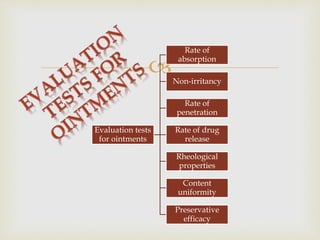
Evaluation tests
for ointments
Rate of
absorption
Non-irritancy
Rate of
penetration
Rate of drug
release
Rheological
properties
Content
uniformity
Preservative
efficacy
 The diadermatic ointment should be
evaluated for the rate of absorption of drug
into the blood stream. This test can be done
in-vivo only.
 The ointment should be applied over a
definite area of the skin by rubbing.
 At regular intervals of time, serum and urine
samples should be analyzed for the quantity
of drug absorbed .
 The rate of absorption i.e., the amount of
drug absorbed per unit time should be more.
1. Test of rate of
absorption
2.Test of non-
irritancy
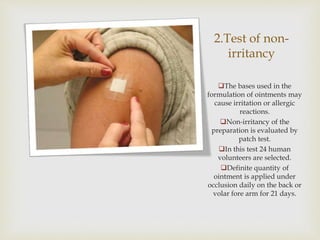
The bases used in the
formulation of ointments may
cause irritation or allergic
reactions.
Non-irritancy of the
preparation is evaluated by
patch test.
In this test 24 human
volunteers are selected.
Definite quantity of
ointment is applied under
occlusion daily on the back or
volar fore arm for 21 days.

 Daily the type of pharmacological action observed is
noted.
 No visible reaction or erythema or intense erythema
with edema and vesicular erosion should occur.
 A good ointment base shows no visible reaction.
Contd…

 The rate of penetration of a semisolid dosage form is
crucial in the onset and duration of action of the
drug.
 Weighed quantity of the preparation should be
applied over selected area of the skin for a definite
period of time.
 Then the preparation left over is collected and
weighed.
3. Test of rate of
penetration

 The difference between the initial and the final
weights of the preparation gives the amount of
preparation penetrated through the skin and this
when divided by the area and time period of
application gives the rate of penetration of the
preparation.
the test should be repeated twice or thrice.
contd…

 To assess the rate of release of medicament, small
amount of the ointment can be placed on the surface
of nutrient agar contained in a petri dish or
alternately in a small cup cut in the agar surface.
4. Test of rate of drug
release

 If the medicament is bactericidal the agar plate is
previously seeded with a suitable organism like
Staphylococcus aureus.
 After a suitable period of incubation, the zone of
inhibition is measured and correlated with the rate of
release.
Contd…..

 The viscosity of the preparation should be such that
the product can be easily removed from the
container and easily applied to the skin.
 Using cone and plate viscometer the viscosity of the
preparation is determined.
5. Test of rheological
properties

 The net weight of contents of ten filled ointment
containers is determined.
 The results should match each other and with the
labelled quantity.
6. Test of content
uniformity

 Using pour plate technique the number of micro-
organisms initially present in the preparation are
determined.
 Solutions of different samples of the preparation are
made and mixed with Tryptone Azolectin (TAT)
broth separately.
 All cultures of the micro-organisms are added into
each mixture, under aseptic conditions. All mixtures
are incubated.
7. Test of preservative
efficacy

 The number of micro-organisms in each sample are
counted on 7th, 14th ,21st , and 28th days of
inoculation.
Microbial limits:
On 14th day, the number of vegetative cells
should not be more than 0.1% of initial concentration.
On 28th day, the number of organisms should be
below or equal to initial concentration.
Contd..

 http://dictionary.sensagent.com/ointments/en-en/
 http://pharmtech.findpharma.com/pharmtech/data/art
iclestandard//pharmtech/112002/12404/article.pdf
 L. Lachman, H.A, Lieberman and J.L. Kanig, Theory &
Practice
of industrial pharmacy, Lea & Febieger, Philadelphia
Latest Edn
 http://dictionary.sensagent.com/ointments/en-en/
 http://pharmtech.findpharma.com/pharmtech/data/art
iclestandard//pharmtech/112002/12404/article.p
References


Evaluation of ointments

  • 1.
    Shaik Sana Banu Thirdyear Rao’s college of pharmacy
  • 2.
      Ointments aresemisolid dosage forms in which one or more drug substances are dissolved or dispersed or emulsified in a suitable ointment base and are meant for application on skin or mucous membrane where it exhibit local or systemic effects. Ointment
  • 3.
     Evaluation tests for ointments Rateof absorption Non-irritancy Rate of penetration Rate of drug release Rheological properties Content uniformity Preservative efficacy
  • 4.
     The diadermaticointment should be evaluated for the rate of absorption of drug into the blood stream. This test can be done in-vivo only.  The ointment should be applied over a definite area of the skin by rubbing.  At regular intervals of time, serum and urine samples should be analyzed for the quantity of drug absorbed .  The rate of absorption i.e., the amount of drug absorbed per unit time should be more. 1. Test of rate of absorption
  • 5.
    2.Test of non- irritancy Thebases used in the formulation of ointments may cause irritation or allergic reactions. Non-irritancy of the preparation is evaluated by patch test. In this test 24 human volunteers are selected. Definite quantity of ointment is applied under occlusion daily on the back or volar fore arm for 21 days.
  • 6.
      Daily thetype of pharmacological action observed is noted.  No visible reaction or erythema or intense erythema with edema and vesicular erosion should occur.  A good ointment base shows no visible reaction. Contd…
  • 7.
      The rateof penetration of a semisolid dosage form is crucial in the onset and duration of action of the drug.  Weighed quantity of the preparation should be applied over selected area of the skin for a definite period of time.  Then the preparation left over is collected and weighed. 3. Test of rate of penetration
  • 8.
      The differencebetween the initial and the final weights of the preparation gives the amount of preparation penetrated through the skin and this when divided by the area and time period of application gives the rate of penetration of the preparation. the test should be repeated twice or thrice. contd…
  • 9.
      To assessthe rate of release of medicament, small amount of the ointment can be placed on the surface of nutrient agar contained in a petri dish or alternately in a small cup cut in the agar surface. 4. Test of rate of drug release
  • 10.
      If themedicament is bactericidal the agar plate is previously seeded with a suitable organism like Staphylococcus aureus.  After a suitable period of incubation, the zone of inhibition is measured and correlated with the rate of release. Contd…..
  • 11.
      The viscosityof the preparation should be such that the product can be easily removed from the container and easily applied to the skin.  Using cone and plate viscometer the viscosity of the preparation is determined. 5. Test of rheological properties
  • 12.
      The netweight of contents of ten filled ointment containers is determined.  The results should match each other and with the labelled quantity. 6. Test of content uniformity
  • 13.
      Using pourplate technique the number of micro- organisms initially present in the preparation are determined.  Solutions of different samples of the preparation are made and mixed with Tryptone Azolectin (TAT) broth separately.  All cultures of the micro-organisms are added into each mixture, under aseptic conditions. All mixtures are incubated. 7. Test of preservative efficacy
  • 14.
      The numberof micro-organisms in each sample are counted on 7th, 14th ,21st , and 28th days of inoculation. Microbial limits: On 14th day, the number of vegetative cells should not be more than 0.1% of initial concentration. On 28th day, the number of organisms should be below or equal to initial concentration. Contd..
  • 15.
      http://dictionary.sensagent.com/ointments/en-en/  http://pharmtech.findpharma.com/pharmtech/data/art iclestandard//pharmtech/112002/12404/article.pdf L. Lachman, H.A, Lieberman and J.L. Kanig, Theory & Practice of industrial pharmacy, Lea & Febieger, Philadelphia Latest Edn  http://dictionary.sensagent.com/ointments/en-en/  http://pharmtech.findpharma.com/pharmtech/data/art iclestandard//pharmtech/112002/12404/article.p References
  • 16.