
Pharmaceutical Emulsion
.
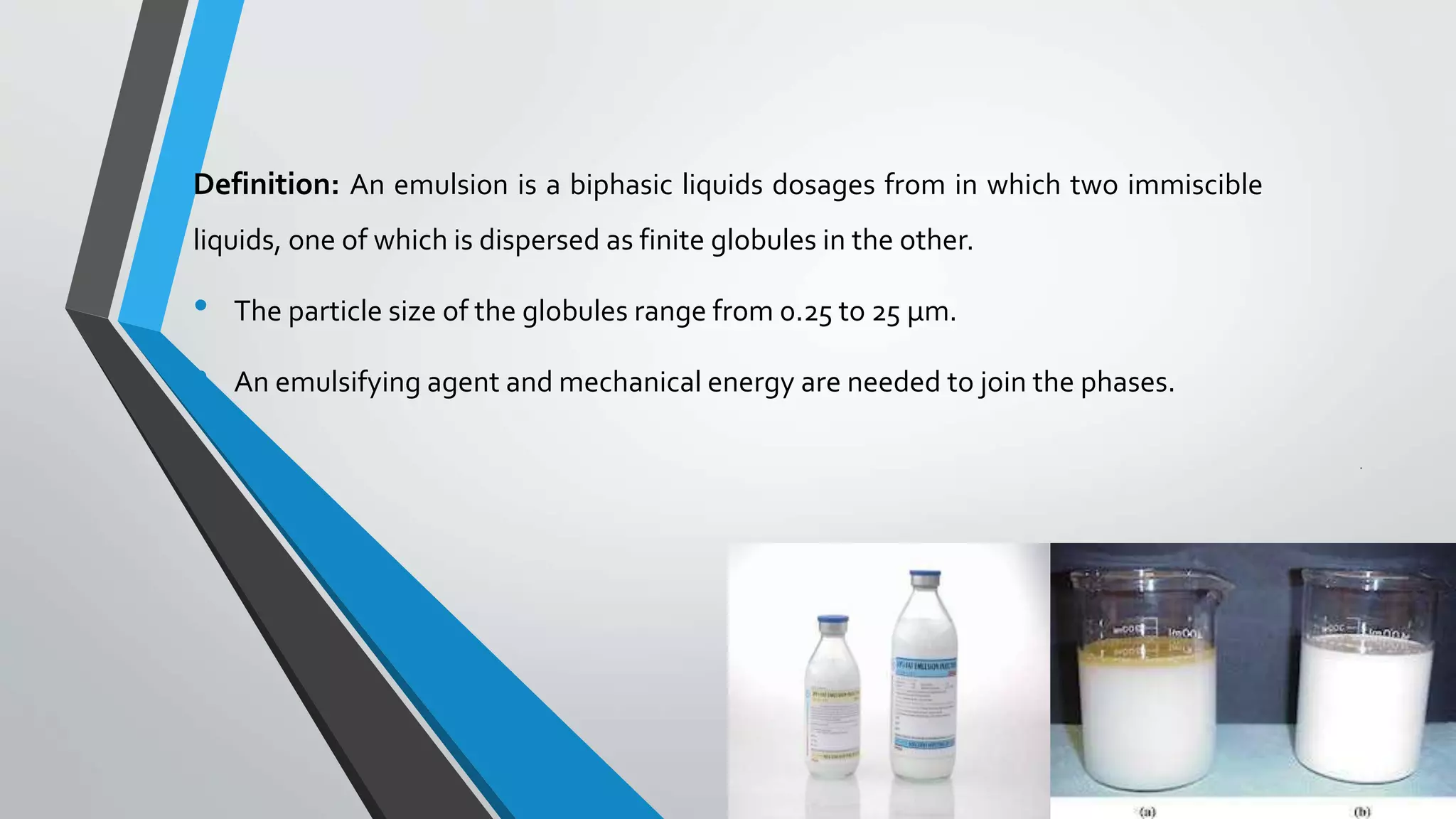
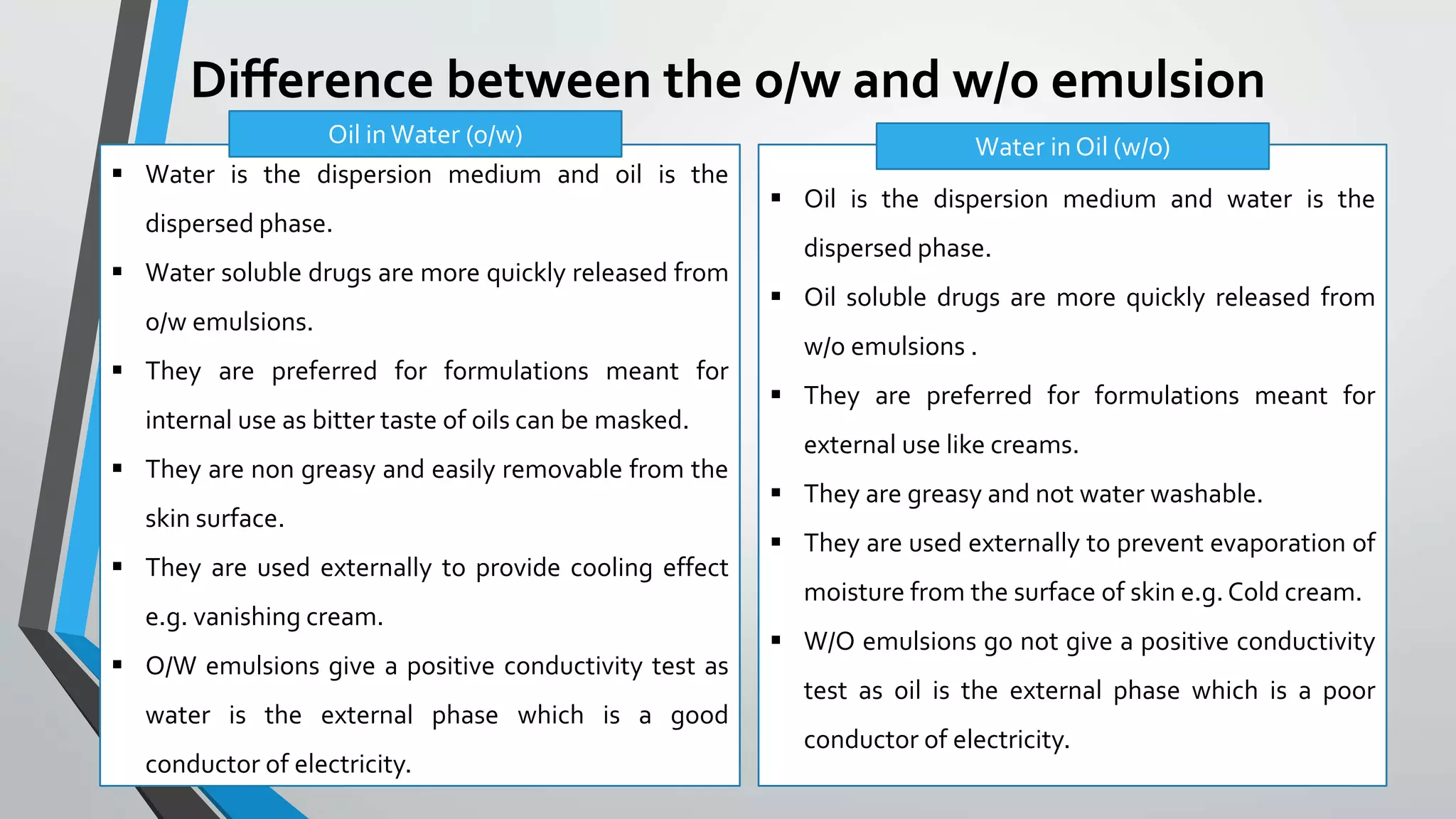
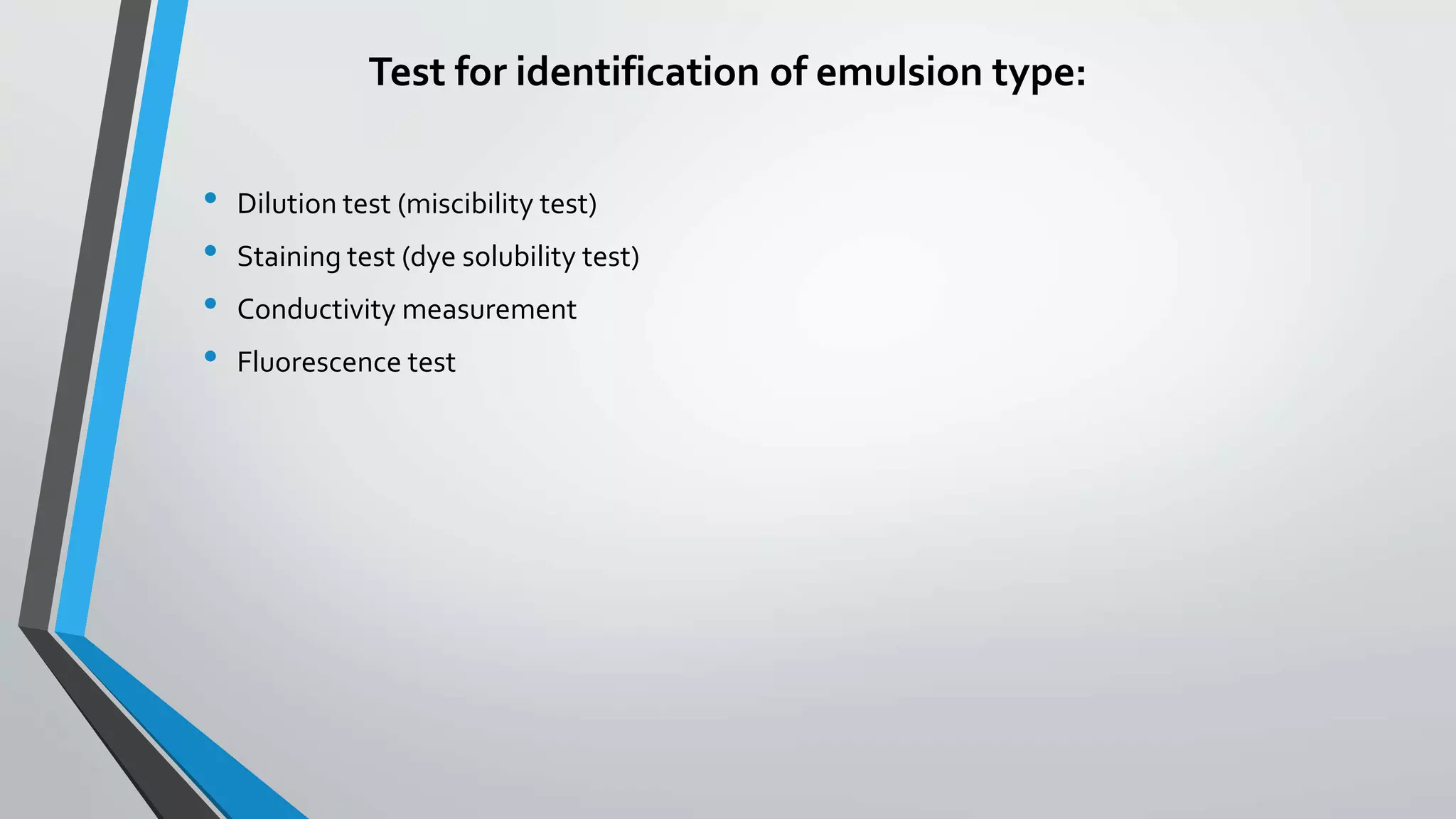
Definition: An emulsion is a biphasic liquids dosages from in which two immiscible
liquids, one of which is dispersed as finite globules in the other.
• The particle size of the globules range from 0.25 to 25 μm.
• An emulsifying agent and mechanical energy are needed to join the phases.
.
Types of Emulsion
Based on dispersed phase
• Oil inWater (O/W):Oil droplets dispersed in water.
• Water in Oil (W/O):Water droplets dispersed in oil.
• Multiple Emulsions (e.g. w/o/w emulsions).
Based on Size of liquid droplets:
• 0.2 – 50 mm Macroemulsions
• 0.01 – 0.2 mm Microemulsions
• 50 – 1000 nm Nanoemulsions
Difference between the o/w and w/o emulsion
.
 Water is the dispersion medium and oil is the
dispersed phase.
 Water soluble drugs are more quickly released from
o/w emulsions.
 They are preferred for formulations meant for
internal use as bitter taste of oils can be masked.
 They are non greasy and easily removable from the
skin surface.
 They are used externally to provide cooling effect
e.g. vanishing cream.
 O/W emulsions give a positive conductivity test as
water is the external phase which is a good
conductor of electricity.
 Oil is the dispersion medium and water is the
dispersed phase.
 Oil soluble drugs are more quickly released from
w/o emulsions .
 They are preferred for formulations meant for
external use like creams.
 They are greasy and not water washable.
 They are used externally to prevent evaporation of
moisture from the surface of skin e.g. Cold cream.
 W/O emulsions go not give a positive conductivity
test as oil is the external phase which is a poor
conductor of electricity.
Oil inWater (o/w) Water in Oil (w/o)
Pharmaceutical Application of Emulsion:
• Oral, rectal and topical administration of oils and oil-soluble drugs.
• The unpleasant taste or odor can be masked by emulsification.
• The absorption and penetration of medicament are enhanced by emulsification.
• Intramuscular injections of water-soluble drugs or vaccine to provide slow release.
• The use of sterile stable i.v emulsion containing fats, carbohydrates and vitamins as a
potential nutrition.
Formulation of Emulsion:
Selection of Emulsifying agents (emulsifiers):
• An emulsifying agent is any material that enhances the stability of an emulsion (i.e.
Prevention of coalescence and reducing creaming).
• The ideal emulsifying agent is colourless, odourless, tasteless, nontoxic, non-irritant and
able to produce stable emulsions at low concentrations.
Examples of Emulsifying agent:
1. Carbohydrate Materials: Ex.: Acacia,Tragacanth,Agar, Pectin. o/w emulsion.
2. Protein Substances: Ex.: Gelatin, Egg yolk, Caesin o/w emulsion.
3. High Molecular Weight Alcohols: Ex.: Stearyl Alcohol, Cetyl Alcohol, Glyceryl Mono
stearate o/w emulsion, cholesterol w/o emulsion.
.
4. Wetting agents:
• Anionic,Cationic, Nonionic
• o/w emulsion
• w/o emulsion
5. Finely divided solids:
• Bentonite, Magnesium Hydroxide, Aluminum Hydroxide o/w emulsion.
Test for identification of emulsion type:
• Dilution test (miscibility test)
• Staining test (dye solubility test)
• Conductivity measurement
• Fluorescence test
The HLB (Hydrphilic lipophilic Balance system) of emulsifying agents:
• An HLB number (1-20) represents the relative proportions of the lipophilic and
hydrophilic parts of the molecule.
• High numbers (8-18) indicate a hydrophilic molecule, and produce an o/w emulsion.
• Low numbers (3-6) indicate a lipophilic molecule and produce a w/o emulsion.
• Oils and waxy materials have a 'required HLB number' which helps in the selection of
appropriate emulsifying agents when formulating emulsions.
• Liquid paraffin, for example, has a required HLB value of 4 to
obtain a w/o emulsion and 10.5 for an o/w emulsion.
Emulsifying agents:
An ideal emulsifying agent should posses the following characteristics:
• It should be able to reduce the interfacial tension between the two immiscible liquids.
• It should be physically and chemically stable, inert and compatible with the other
ingredients of the formulation.
• It should be non irritant and non toxic in the concentration.
• It should be organoleptically inert i.e. should not impart any color, odour or taste to the
preparation.
• It should be able to produce and maintain the required viscosity of the preparation.
• It should be able to form a coherent film around the globules of the dispersed phase
and should prevent the coalescence of the droplet of the dispersed phase.
.
Examples of emulsifying agents:
• Diethylene glycol monostearate 4.7
• Sucrose diolate 7.1
• Polyoxyethylene (4) lauryl ether 9.5
• Sodium Oleate 18.0
• Polyxyethylene (100) Stearate 18.8
• PotassiumOleate 20.0
Preparation of Emulsion:
The methods commonly used to prepare emulsions can be divided into two
categories
A) Trituration Method:
This method consists of dry gum method and wet gum method.
Dry Gum Method:
• In this method the oil is first triturated with gum with a little amount of water to form the
primary emulsion.
• The trituration is continued till a characteristic ‘clicking’ sound is heard and a thick white cream
is formed.
• Once the primary emulsion is formed, the remaining quantity of water is slowly added to form
the final emulsion.
.
Wet Gum Method:
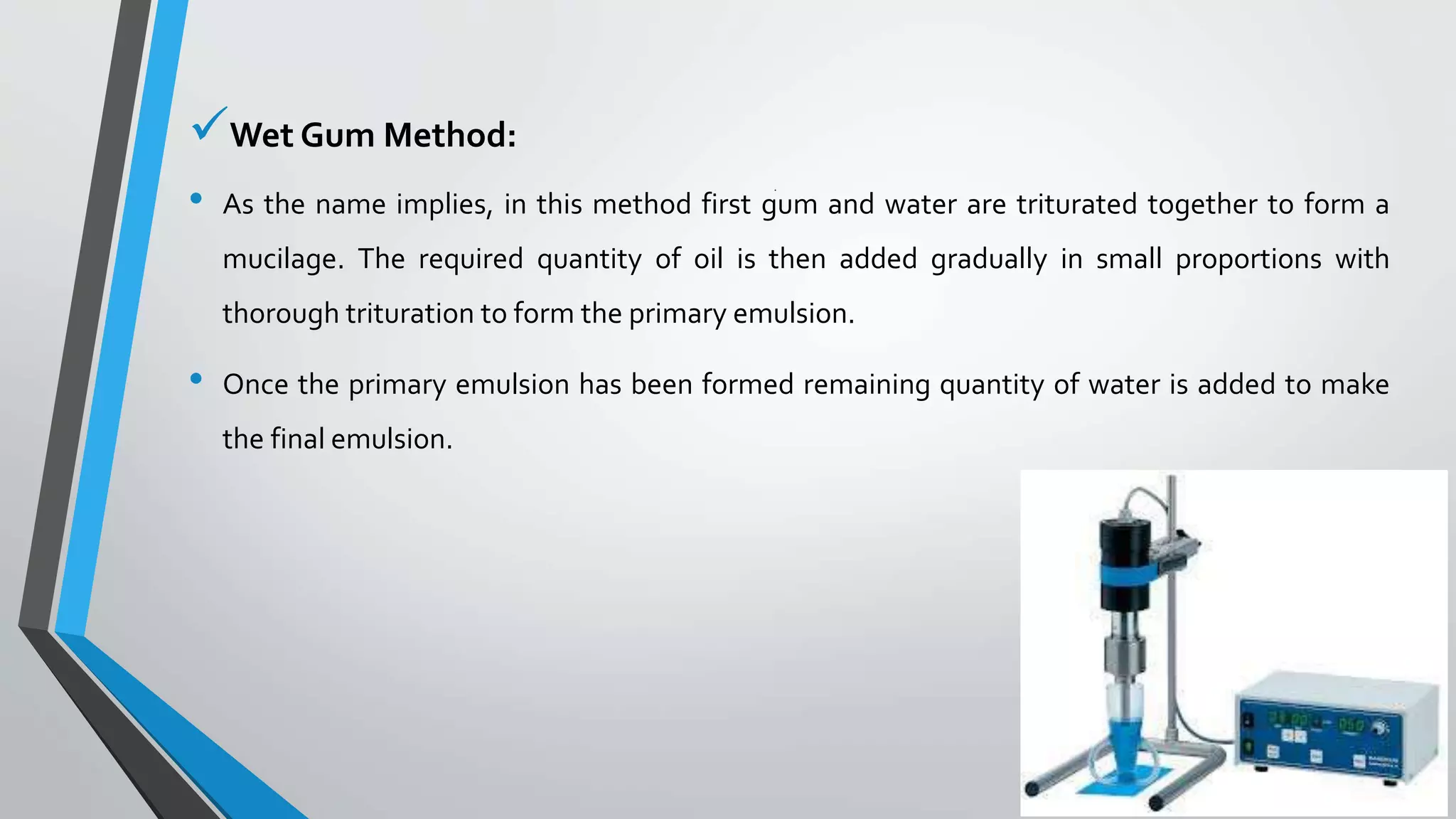
• As the name implies, in this method first gum and water are triturated together to form a
mucilage. The required quantity of oil is then added gradually in small proportions with
thorough trituration to form the primary emulsion.
• Once the primary emulsion has been formed remaining quantity of water is added to make
the final emulsion.
B). Bottle method:
• This method is employed for preparing emulsions containing volatile and other non-viscous
oils.
• Both dry gum and wet gum methods can be employed for the preparation.
• As volatile oils have a low viscosity as compared to fixed oils, they require comparatively large
quantity of gum for emulsification.
• In this method, oil or water is first shaken thoroughly and vigorously with the calculated
amount of gum.
• Once this has emulsified completely, the second liquid (either oil or water) is then added all at
once and the bottle is again shaken vigorously to form the primary emulsion.
• More of water is added in small portions with constant agitation after each addition to
produce the final volume.
Equipment for emulsification (Agitation):
• Mechanical stirrers
• Propeller type mixers:Turbine mixers, Homogenizers.
• Colloid mills
• Ultrasonifiers
Colloidal MillMechanical stirrers
Stability of Emulsion:
• An emulsion is said to be stable if it remains as such after its preparation, that is the dispersed
globules are uniformly distributed through out the dispersion medium during its storage.
• The emulsion should be chemically stable and there should not be any bacterial growth during
it shelf life.
• Emulsion instability may either reversible or irreversible and manifest in the following ways:
1) Cracking (irreversible instability)
2) Flocculation
3) Creaming
4) Phase inversion
1. Cracking:
• Cracking means the separation of two layers of disperse and continuous phase , due to the
coalescence of disperse phase globules which are difficult to redisperse by shaking.
• Cracking may occurs due to following reasons:
i. By addition of emulsifying agent of opposite type
ii. By decomposition or precipitation of emulsifying agent
iii. By addition of common solvent
iv. By microorganisms
v. Change in temperature
vi. By creaming
2) Flocculation
• In flocculated state the secondary interaction (van der waals forces) maintain the droplets
at a defined distance of separation.
• Application of shearing stress to the formulation (shaking) will re-disperse these droplets
to form a homogeneous formulation.
• Although flocculation may stabilise the formulation, there is also possibility that the close
location of droplets would enable droplet coalescence to occur if the mechanical
properties of the interfacial film are compromised.
3) Creaming
• Creaming may be defined as the upward movement of dispersed globules to form a thick
layer at the surface of emulsion.
• Creaming is temporary phase because it can be re-distributed by mild shaking or stirring to
get again a homogenous emulsion.
4) Phase inversion:
• Phase inversion means the change of one type of emulsion into other type, that is oil in water
emulsion changes into water in oil type and vice-versa.
.
Due to following reason phase invesion takes place:
i. By the addition of an electrolyte
ii. By changing the phase-volume ratio
iii. By temperature change
iv. By changing the emulsifying agent
• The phase inversion can be minimised by keeping concentration of disperse phase between 30
to 60 % , storing the emulsion in cool place and using a proper emulsifying agent in adequate
concentration.
.
Thank you!

Pharmaceutical emulsion

  • 1.
  • 2.
    Definition: An emulsionis a biphasic liquids dosages from in which two immiscible liquids, one of which is dispersed as finite globules in the other. • The particle size of the globules range from 0.25 to 25 μm. • An emulsifying agent and mechanical energy are needed to join the phases. .
  • 3.
    Types of Emulsion Basedon dispersed phase • Oil inWater (O/W):Oil droplets dispersed in water. • Water in Oil (W/O):Water droplets dispersed in oil. • Multiple Emulsions (e.g. w/o/w emulsions).
  • 4.
    Based on Sizeof liquid droplets: • 0.2 – 50 mm Macroemulsions • 0.01 – 0.2 mm Microemulsions • 50 – 1000 nm Nanoemulsions
  • 5.
    Difference between theo/w and w/o emulsion .  Water is the dispersion medium and oil is the dispersed phase.  Water soluble drugs are more quickly released from o/w emulsions.  They are preferred for formulations meant for internal use as bitter taste of oils can be masked.  They are non greasy and easily removable from the skin surface.  They are used externally to provide cooling effect e.g. vanishing cream.  O/W emulsions give a positive conductivity test as water is the external phase which is a good conductor of electricity.  Oil is the dispersion medium and water is the dispersed phase.  Oil soluble drugs are more quickly released from w/o emulsions .  They are preferred for formulations meant for external use like creams.  They are greasy and not water washable.  They are used externally to prevent evaporation of moisture from the surface of skin e.g. Cold cream.  W/O emulsions go not give a positive conductivity test as oil is the external phase which is a poor conductor of electricity. Oil inWater (o/w) Water in Oil (w/o)
  • 6.
    Pharmaceutical Application ofEmulsion: • Oral, rectal and topical administration of oils and oil-soluble drugs. • The unpleasant taste or odor can be masked by emulsification. • The absorption and penetration of medicament are enhanced by emulsification. • Intramuscular injections of water-soluble drugs or vaccine to provide slow release. • The use of sterile stable i.v emulsion containing fats, carbohydrates and vitamins as a potential nutrition.
  • 7.
    Formulation of Emulsion: Selectionof Emulsifying agents (emulsifiers): • An emulsifying agent is any material that enhances the stability of an emulsion (i.e. Prevention of coalescence and reducing creaming). • The ideal emulsifying agent is colourless, odourless, tasteless, nontoxic, non-irritant and able to produce stable emulsions at low concentrations. Examples of Emulsifying agent: 1. Carbohydrate Materials: Ex.: Acacia,Tragacanth,Agar, Pectin. o/w emulsion. 2. Protein Substances: Ex.: Gelatin, Egg yolk, Caesin o/w emulsion. 3. High Molecular Weight Alcohols: Ex.: Stearyl Alcohol, Cetyl Alcohol, Glyceryl Mono stearate o/w emulsion, cholesterol w/o emulsion.
  • 8.
    . 4. Wetting agents: •Anionic,Cationic, Nonionic • o/w emulsion • w/o emulsion 5. Finely divided solids: • Bentonite, Magnesium Hydroxide, Aluminum Hydroxide o/w emulsion.
  • 9.
    Test for identificationof emulsion type: • Dilution test (miscibility test) • Staining test (dye solubility test) • Conductivity measurement • Fluorescence test
  • 10.
    The HLB (Hydrphiliclipophilic Balance system) of emulsifying agents: • An HLB number (1-20) represents the relative proportions of the lipophilic and hydrophilic parts of the molecule. • High numbers (8-18) indicate a hydrophilic molecule, and produce an o/w emulsion. • Low numbers (3-6) indicate a lipophilic molecule and produce a w/o emulsion. • Oils and waxy materials have a 'required HLB number' which helps in the selection of appropriate emulsifying agents when formulating emulsions. • Liquid paraffin, for example, has a required HLB value of 4 to obtain a w/o emulsion and 10.5 for an o/w emulsion.
  • 11.
    Emulsifying agents: An idealemulsifying agent should posses the following characteristics: • It should be able to reduce the interfacial tension between the two immiscible liquids. • It should be physically and chemically stable, inert and compatible with the other ingredients of the formulation. • It should be non irritant and non toxic in the concentration. • It should be organoleptically inert i.e. should not impart any color, odour or taste to the preparation. • It should be able to produce and maintain the required viscosity of the preparation. • It should be able to form a coherent film around the globules of the dispersed phase and should prevent the coalescence of the droplet of the dispersed phase.
  • 12.
    . Examples of emulsifyingagents: • Diethylene glycol monostearate 4.7 • Sucrose diolate 7.1 • Polyoxyethylene (4) lauryl ether 9.5 • Sodium Oleate 18.0 • Polyxyethylene (100) Stearate 18.8 • PotassiumOleate 20.0
  • 13.
    Preparation of Emulsion: Themethods commonly used to prepare emulsions can be divided into two categories A) Trituration Method: This method consists of dry gum method and wet gum method. Dry Gum Method: • In this method the oil is first triturated with gum with a little amount of water to form the primary emulsion. • The trituration is continued till a characteristic ‘clicking’ sound is heard and a thick white cream is formed. • Once the primary emulsion is formed, the remaining quantity of water is slowly added to form the final emulsion.
  • 14.
    . Wet Gum Method: •As the name implies, in this method first gum and water are triturated together to form a mucilage. The required quantity of oil is then added gradually in small proportions with thorough trituration to form the primary emulsion. • Once the primary emulsion has been formed remaining quantity of water is added to make the final emulsion.
  • 15.
    B). Bottle method: •This method is employed for preparing emulsions containing volatile and other non-viscous oils. • Both dry gum and wet gum methods can be employed for the preparation. • As volatile oils have a low viscosity as compared to fixed oils, they require comparatively large quantity of gum for emulsification. • In this method, oil or water is first shaken thoroughly and vigorously with the calculated amount of gum. • Once this has emulsified completely, the second liquid (either oil or water) is then added all at once and the bottle is again shaken vigorously to form the primary emulsion. • More of water is added in small portions with constant agitation after each addition to produce the final volume.
  • 16.
    Equipment for emulsification(Agitation): • Mechanical stirrers • Propeller type mixers:Turbine mixers, Homogenizers. • Colloid mills • Ultrasonifiers Colloidal MillMechanical stirrers
  • 17.
    Stability of Emulsion: •An emulsion is said to be stable if it remains as such after its preparation, that is the dispersed globules are uniformly distributed through out the dispersion medium during its storage. • The emulsion should be chemically stable and there should not be any bacterial growth during it shelf life. • Emulsion instability may either reversible or irreversible and manifest in the following ways: 1) Cracking (irreversible instability) 2) Flocculation 3) Creaming 4) Phase inversion
  • 18.
    1. Cracking: • Crackingmeans the separation of two layers of disperse and continuous phase , due to the coalescence of disperse phase globules which are difficult to redisperse by shaking. • Cracking may occurs due to following reasons: i. By addition of emulsifying agent of opposite type ii. By decomposition or precipitation of emulsifying agent iii. By addition of common solvent iv. By microorganisms v. Change in temperature vi. By creaming
  • 19.
    2) Flocculation • Inflocculated state the secondary interaction (van der waals forces) maintain the droplets at a defined distance of separation. • Application of shearing stress to the formulation (shaking) will re-disperse these droplets to form a homogeneous formulation. • Although flocculation may stabilise the formulation, there is also possibility that the close location of droplets would enable droplet coalescence to occur if the mechanical properties of the interfacial film are compromised.
  • 20.
    3) Creaming • Creamingmay be defined as the upward movement of dispersed globules to form a thick layer at the surface of emulsion. • Creaming is temporary phase because it can be re-distributed by mild shaking or stirring to get again a homogenous emulsion. 4) Phase inversion: • Phase inversion means the change of one type of emulsion into other type, that is oil in water emulsion changes into water in oil type and vice-versa.
  • 21.
    . Due to followingreason phase invesion takes place: i. By the addition of an electrolyte ii. By changing the phase-volume ratio iii. By temperature change iv. By changing the emulsifying agent • The phase inversion can be minimised by keeping concentration of disperse phase between 30 to 60 % , storing the emulsion in cool place and using a proper emulsifying agent in adequate concentration.
  • 22.