Ointments, Creams, and Gels
Topicals
•Preparations applied to the skin either for their
physical effects or for the specific effect of a medicinal
agent
•Protectants, lubricants, emollients, drying agents,
astringents
Transdermals
•Designed to support the passage of drug substances from
the surface of the skin, through its various layers, and even
into the systemic circulation
INTRODUCTION
Functions of Dermatologicals
•Protect injured areas from the environment
•Provide for skin hydration (emollient)
•Vehicle for medication transport
Drug Penetration Is Dependent Upon:
•Amount of pressure and vigor of rubbing
•Surface area covered
•Condition of the skin
•Base used
•Occlusive dressing use
Application Areas for Dermatologicals
LOTIONS
CREAMS
OINTMENTS
Intertriginous areas
Moist, weeping lesions
Dry, scaly lesions
INTRODUCTION
Ointments
•Semisolid preparations intended for external
application to the skin or mucous membranes.
•Semisolid plastic flow characteristics
•Definite yield value
•Resistance to flow drops as application continues
Compendial Requirements for Ointments
•Microbial Content
•Minimum Fill
•Packaging, Storage, and Labeling
•Additional Standards
•Oleaginous Bases
•Absorption Bases
•Water-Removable Bases
•Water-Soluble Bases
Ointment Bases Preparation of Ointments
•Incorporation
•Fusion
Ointments
Oleaginous Bases
•Water insoluble
•Not water washable
•Can’t absorb water
•Oily, occlusive, lack
cosmetic appeal
Examples:
•Hydrocarbons (mineral oils, petrolatums,
paraffins, waxes)
•Animal fats/vegetable oils (castor oil,
cottonseed oil, olive oil)
•Synthetic esters (glyceryl monostearate, butyl
stearate, isopropyl lanolate, stearyl alcohol)
•WHITE PETROLATUM
•WHITE OINTMENT
Absorption Bases
•Water insoluble
•Not water washable
•Can absorb water
•Anhydrous
•Oily, occlusive, lacks
cosmetic appeal
Examples:
•Hydrophilic petrolatum
•Aquaphor
•Aquabase
Ointments
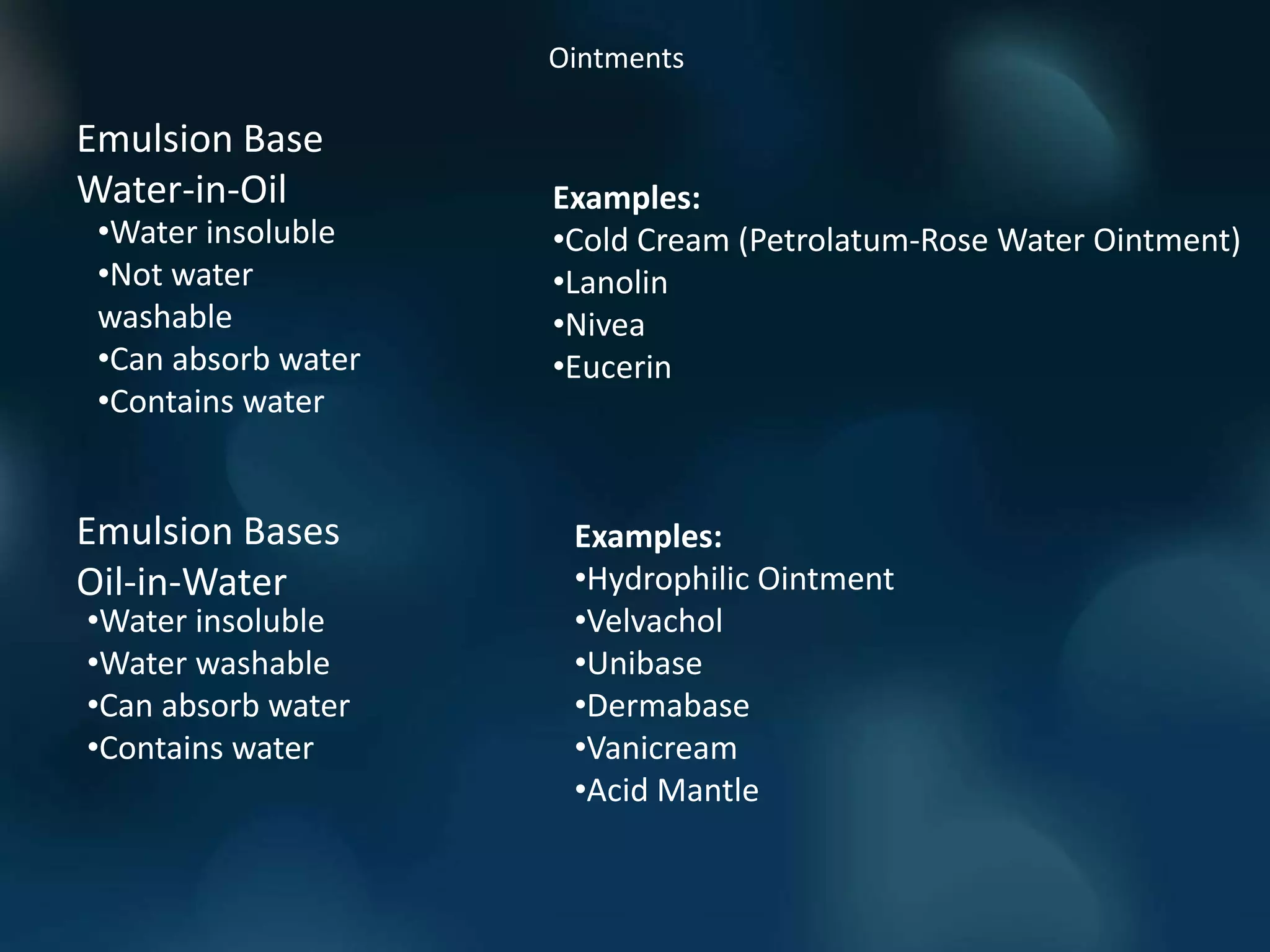
Emulsion Base
Water-in-Oil
•Water insoluble
•Not water
washable
•Can absorb water
•Contains water
Examples:
•Cold Cream (Petrolatum-Rose Water Ointment)
•Lanolin
•Nivea
•Eucerin
Emulsion Bases
Oil-in-Water
•Water insoluble
•Water washable
•Can absorb water
•Contains water
Examples:
•Hydrophilic Ointment
•Velvachol
•Unibase
•Dermabase
•Vanicream
•Acid Mantle
Ointments
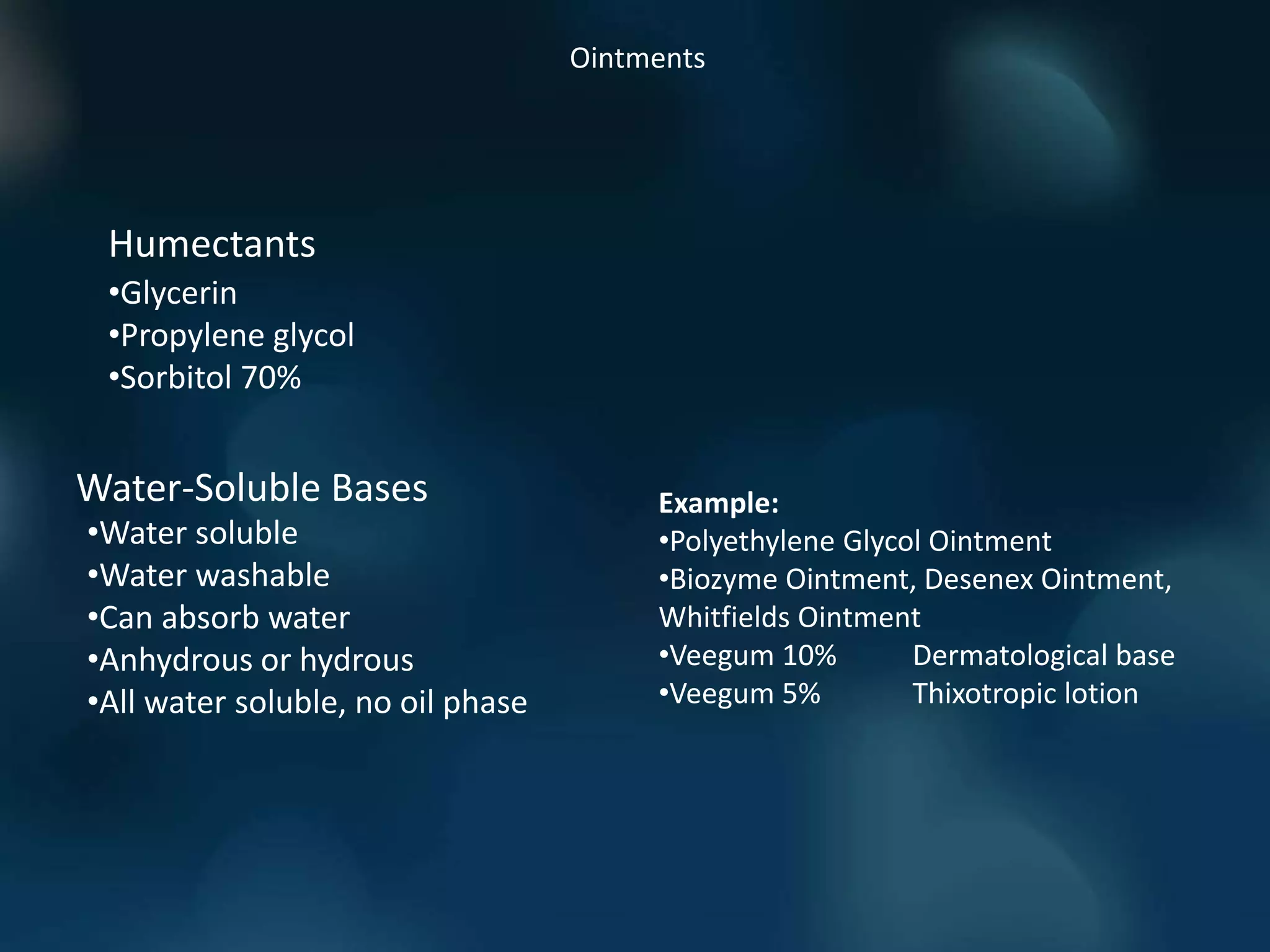
Humectants
•Glycerin
•Propylene glycol
•Sorbitol 70%
Water-Soluble Bases
•Water soluble
•Water washable
•Can absorb water
•Anhydrous or hydrous
•All water soluble, no oil phase
Example:
•Polyethylene Glycol Ointment
•Biozyme Ointment, Desenex Ointment,
Whitfields Ointment
•Veegum 10% Dermatological base
•Veegum 5% Thixotropic lotion
Ointments
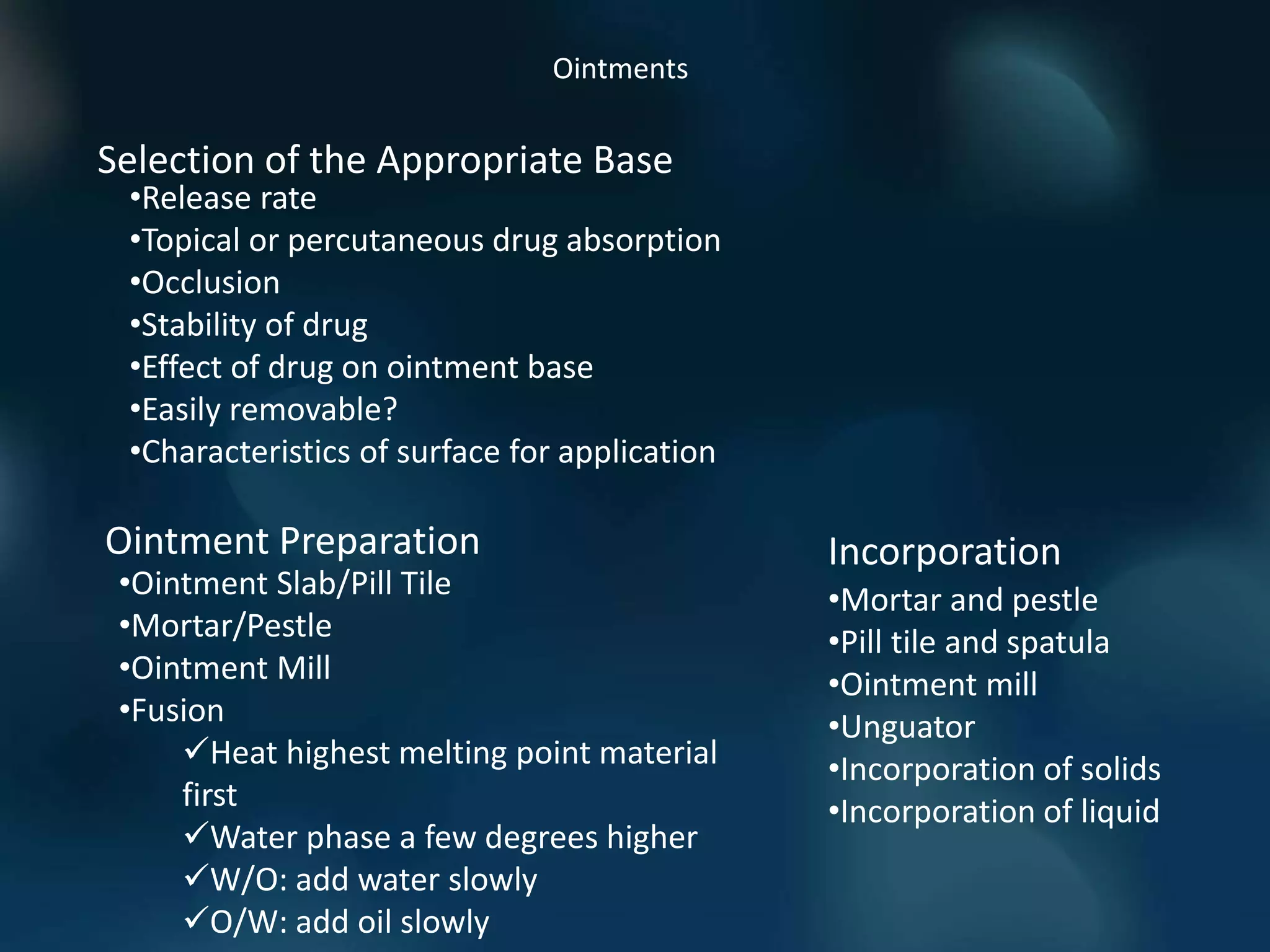
Selection of the Appropriate Base
•Release rate
•Topical or percutaneous drug absorption
•Occlusion
•Stability of drug
•Effect of drug on ointment base
•Easily removable?
•Characteristics of surface for application
Incorporation
•Mortar and pestle
•Pill tile and spatula
•Ointment mill
•Unguator
•Incorporation of solids
•Incorporation of liquid
Ointment Preparation
•Ointment Slab/Pill Tile
•Mortar/Pestle
•Ointment Mill
•Fusion
Heat highest melting point material
first
Water phase a few degrees higher
W/O: add water slowly
O/W: add oil slowly
Ointments
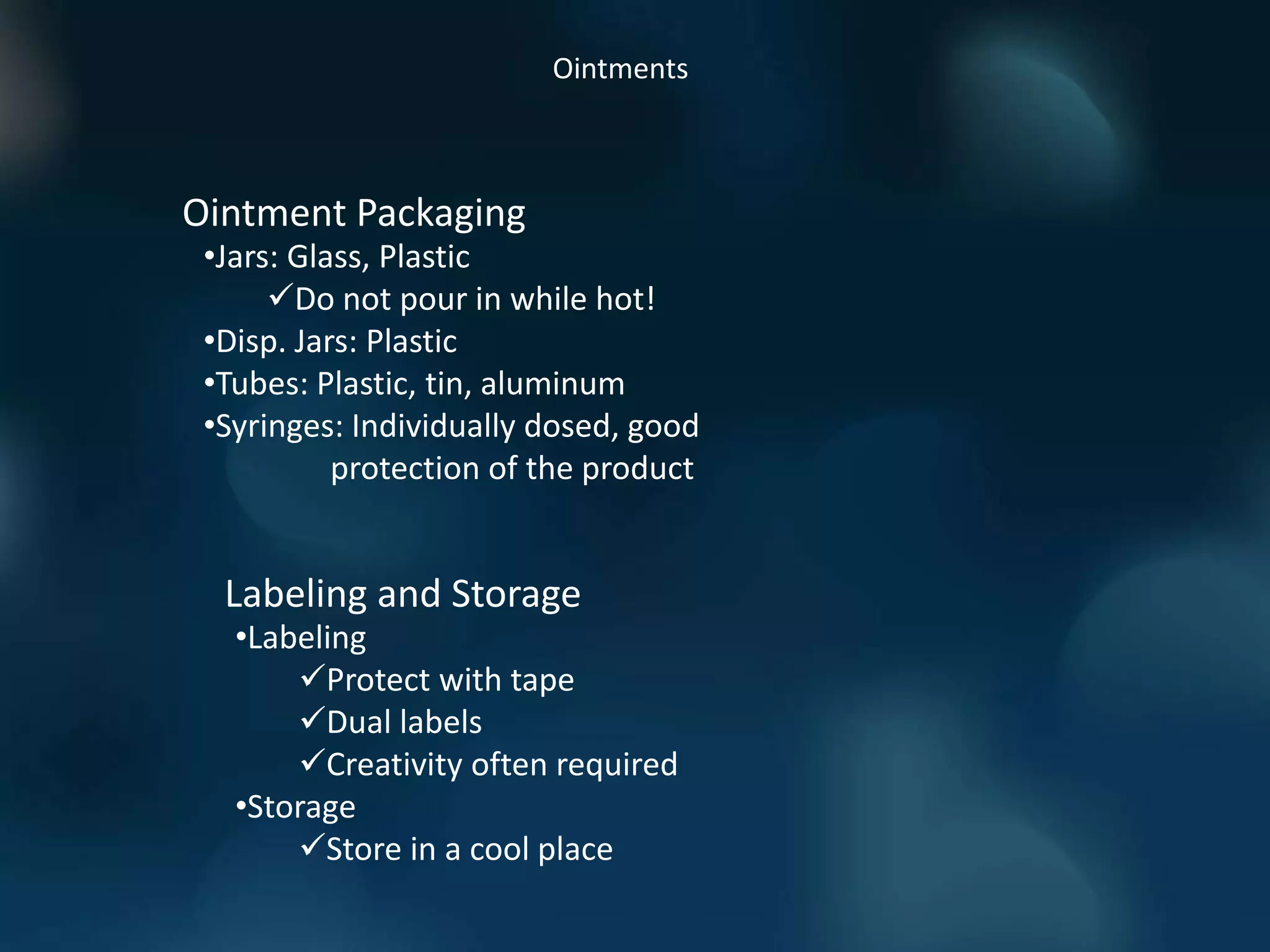
Ointment Packaging
•Jars: Glass, Plastic
Do not pour in while hot!
•Disp. Jars: Plastic
•Tubes: Plastic, tin, aluminum
•Syringes: Individually dosed, good
protection of the product
Labeling and Storage
•Labeling
Protect with tape
Dual labels
Creativity often required
•Storage
Store in a cool place
Ointments
Creams
•Opaque, soft solids, or thick liquids intended for external
application.
•Semisolid, pseudoplastic flow
•Very little yield value
•Won’t flow under force of gravity but small force will
initiate flow
•Viscous liquids or semisolid emulsions of either the O/W
type or the W/O type
•Term “cream” is most frequently applied to soft,
cosmetically acceptable types of preparations.
Gels
•Semisolid systems consisting of dispersions of small or
large molecules in an aqueous liquid vehicle rendered
jelly-like through the addition of a gelling agent
•A semirigid system in which the movement of the
dispersing medium is restricted by an interlacing
network of particles or solvated macromolecules of the
dispersed phase
Types of Gels
•Single Phase
Gels in which the macromolecules
are uniformly distributed throughout
a liquid with no apparent boundaries
between the dispersed
macromolecules and the liquid
Usually involve organics
•Two Phase
When the gel mass consists of
floccules of small distinct particles
Usually involve inorganics
Gels
Gel Composition
•Gelling agent
•Water
•Cosolvents
•Preservatives
•Stabilizers
Kinds of Gels
•Hydrogels
Silica, bentonite, pectin, sodium alginate,
methylcellulose, alumina
•Organic Gels
Contain an organic liquid (e.g., Plastibase)
•Carbomer Gels
Aqueous dispersion neutralized with sodium
hydroxide or triethanolamine
•Methylcellulose Gels
•Starch Glycerite
•Aluminum Hydroxide Gel
Gelation
•As a hot, colloidal dispersion of gelatin
cools, the gelatin macromolecules lose
kinetic energy.
•With a reduction of kinetic energy or
thermal agitation.
•Gelatin, agar, pectin, Irish moss, pectin,
tragacanth form gels by this mechanism.
Gels
Phenomena Associated with Gels
•Syneresis
- When the interaction between particles of the dispersed phase
becomes so great that on standing, the dispersing medium is
squeezed out in droplets and the gel shrinks
•Swelling
-The taking up of liquid by a gel with an increase in volume
•Imbibition
- The taking up of a certain amount of liquid without a measurable
increase in volume
•Thixotropy
-A reversible gel-sol formation with no change in volume or
temperature
•Jelene/Plastibase
- A combination of mineral oils and heavy hydrocarbon waxes with a
MW of about 1300
•Carbomer 934
- A polymer of acrylic acid cross-linked with a polyfunctional agent;
recognized as an official emulsifying and suspending agent
Gels
Applications
•Oral
•Topical
•Intranasal
•Vaginal
•Rectal
Gelling Agents
•Alginic acid
•Bentonite
•Carbomer
•CMC
•CMC Sod
•Colloidal Silicon
Dioxide
•Veegum
•Methylcellulose
•Plastibase/Jelene
•Poloxamer/Pluronic
•Povidone
•Propylene Glycol
Alginate
•Sodium Alginate
•Tragacanth
Gels
Quality Control
•Appearance
•Uniformity
•Weight/Volume
•Viscosity
•Clarity
•pH
•Others
Packaging/Storage/Labeling
•Tight containers
•Room or refrigerated temperatures, as
appropriate
•Prior to use, store in tight containers.
Stability
•Physical Stability
- Shrinkage
- Separation of liquid from the gel
- Discoloration
•Microbial Stability
•BUD: Unless otherwise documented, 14
days when stored in a refrigerator (USP)
Patient Counseling
•Proper application
•Proper storage
•Keep tightly closed
Transdermal Preparations
•Pastes
•Plasters
•Glycerogelatins
•Packaging Semisolid Preparations
- Filling Ointment Jars
- Filling Ointment Tubes
Features and Use of Dermatologic Preparations
•Ointments
•Creams
•Gels
•Pastes
•Plasters
•Topical or systemic effect
Gels
Features and Use of Ophthalmic
Ointments and Gels
•Relative short residence time after
application
•Sterile
•Nonirritating
•Softening point close to body
temperature
•Application technique
Features and Use of Nasal Ointments and Gels
•Primarily local effects but some systemic
also
•Rich blood supply in nasal lining
Gels
Features and Use of Rectal Preparations
•Ointments, creams, gels
•Perianal area and anal canal
•Anorectal pruritus, inflammation,
hemorrhoids
•Proper instruction for use to patient
Features and Use of Vaginal Preparations
•Ointments, creams, foams, and gels
•Anti-infectives, hormones, pH modifiers,
spermicides
Gels
Pastes
•Thick, stiff ointments that do not
ordinarily flow at body temperature, and
therefore serve as protective coatings
over the areas to which they are applied.
Usually >20% solids.
•Semisolid, dilatant flow
•Definite yield value
•Resistance to flow increased with
increased force of application
Lotions
•Aqueous preparations with insoluble
material for external application without
friction
•Fluid preparations, Newtonian flow
•No yield value
•Flow under gravity
•“Lotions” actually also refers to fluid oil-
in-water and water-in-oil emulsions.
Others
Cerates
•Semisolid preparations containing a
relatively high wax content
•Semisolid
•High yield point
•Not to be directly rubbed onto skin
Plasters
•Solid or semisolid preparations that
cannot be spread at room temperature
Cataplasms or Poultices
•Wet masses of solid matter applied to the skin
to reduce inflammation and act as
counterirritants
Others
Prepared By:
Cerna, Divina
Dipus, Sheenara
Rabara, Starette

Ointments, creams, and gels dds ppt pjt

  • 1.
  • 2.
    Topicals •Preparations applied tothe skin either for their physical effects or for the specific effect of a medicinal agent •Protectants, lubricants, emollients, drying agents, astringents Transdermals •Designed to support the passage of drug substances from the surface of the skin, through its various layers, and even into the systemic circulation INTRODUCTION
  • 3.
    Functions of Dermatologicals •Protectinjured areas from the environment •Provide for skin hydration (emollient) •Vehicle for medication transport Drug Penetration Is Dependent Upon: •Amount of pressure and vigor of rubbing •Surface area covered •Condition of the skin •Base used •Occlusive dressing use Application Areas for Dermatologicals LOTIONS CREAMS OINTMENTS Intertriginous areas Moist, weeping lesions Dry, scaly lesions INTRODUCTION
  • 4.
    Ointments •Semisolid preparations intendedfor external application to the skin or mucous membranes. •Semisolid plastic flow characteristics •Definite yield value •Resistance to flow drops as application continues
  • 5.
    Compendial Requirements forOintments •Microbial Content •Minimum Fill •Packaging, Storage, and Labeling •Additional Standards •Oleaginous Bases •Absorption Bases •Water-Removable Bases •Water-Soluble Bases Ointment Bases Preparation of Ointments •Incorporation •Fusion Ointments
  • 6.
    Oleaginous Bases •Water insoluble •Notwater washable •Can’t absorb water •Oily, occlusive, lack cosmetic appeal Examples: •Hydrocarbons (mineral oils, petrolatums, paraffins, waxes) •Animal fats/vegetable oils (castor oil, cottonseed oil, olive oil) •Synthetic esters (glyceryl monostearate, butyl stearate, isopropyl lanolate, stearyl alcohol) •WHITE PETROLATUM •WHITE OINTMENT Absorption Bases •Water insoluble •Not water washable •Can absorb water •Anhydrous •Oily, occlusive, lacks cosmetic appeal Examples: •Hydrophilic petrolatum •Aquaphor •Aquabase Ointments
  • 7.
    Emulsion Base Water-in-Oil •Water insoluble •Notwater washable •Can absorb water •Contains water Examples: •Cold Cream (Petrolatum-Rose Water Ointment) •Lanolin •Nivea •Eucerin Emulsion Bases Oil-in-Water •Water insoluble •Water washable •Can absorb water •Contains water Examples: •Hydrophilic Ointment •Velvachol •Unibase •Dermabase •Vanicream •Acid Mantle Ointments
  • 8.
    Humectants •Glycerin •Propylene glycol •Sorbitol 70% Water-SolubleBases •Water soluble •Water washable •Can absorb water •Anhydrous or hydrous •All water soluble, no oil phase Example: •Polyethylene Glycol Ointment •Biozyme Ointment, Desenex Ointment, Whitfields Ointment •Veegum 10% Dermatological base •Veegum 5% Thixotropic lotion Ointments
  • 9.
    Selection of theAppropriate Base •Release rate •Topical or percutaneous drug absorption •Occlusion •Stability of drug •Effect of drug on ointment base •Easily removable? •Characteristics of surface for application Incorporation •Mortar and pestle •Pill tile and spatula •Ointment mill •Unguator •Incorporation of solids •Incorporation of liquid Ointment Preparation •Ointment Slab/Pill Tile •Mortar/Pestle •Ointment Mill •Fusion Heat highest melting point material first Water phase a few degrees higher W/O: add water slowly O/W: add oil slowly Ointments
  • 10.
    Ointment Packaging •Jars: Glass,Plastic Do not pour in while hot! •Disp. Jars: Plastic •Tubes: Plastic, tin, aluminum •Syringes: Individually dosed, good protection of the product Labeling and Storage •Labeling Protect with tape Dual labels Creativity often required •Storage Store in a cool place Ointments
  • 11.
    Creams •Opaque, soft solids,or thick liquids intended for external application. •Semisolid, pseudoplastic flow •Very little yield value •Won’t flow under force of gravity but small force will initiate flow •Viscous liquids or semisolid emulsions of either the O/W type or the W/O type •Term “cream” is most frequently applied to soft, cosmetically acceptable types of preparations.
  • 12.
    Gels •Semisolid systems consistingof dispersions of small or large molecules in an aqueous liquid vehicle rendered jelly-like through the addition of a gelling agent •A semirigid system in which the movement of the dispersing medium is restricted by an interlacing network of particles or solvated macromolecules of the dispersed phase
  • 13.
    Types of Gels •SinglePhase Gels in which the macromolecules are uniformly distributed throughout a liquid with no apparent boundaries between the dispersed macromolecules and the liquid Usually involve organics •Two Phase When the gel mass consists of floccules of small distinct particles Usually involve inorganics Gels
  • 14.
    Gel Composition •Gelling agent •Water •Cosolvents •Preservatives •Stabilizers Kindsof Gels •Hydrogels Silica, bentonite, pectin, sodium alginate, methylcellulose, alumina •Organic Gels Contain an organic liquid (e.g., Plastibase) •Carbomer Gels Aqueous dispersion neutralized with sodium hydroxide or triethanolamine •Methylcellulose Gels •Starch Glycerite •Aluminum Hydroxide Gel Gelation •As a hot, colloidal dispersion of gelatin cools, the gelatin macromolecules lose kinetic energy. •With a reduction of kinetic energy or thermal agitation. •Gelatin, agar, pectin, Irish moss, pectin, tragacanth form gels by this mechanism. Gels
  • 15.
    Phenomena Associated withGels •Syneresis - When the interaction between particles of the dispersed phase becomes so great that on standing, the dispersing medium is squeezed out in droplets and the gel shrinks •Swelling -The taking up of liquid by a gel with an increase in volume •Imbibition - The taking up of a certain amount of liquid without a measurable increase in volume •Thixotropy -A reversible gel-sol formation with no change in volume or temperature •Jelene/Plastibase - A combination of mineral oils and heavy hydrocarbon waxes with a MW of about 1300 •Carbomer 934 - A polymer of acrylic acid cross-linked with a polyfunctional agent; recognized as an official emulsifying and suspending agent Gels
  • 16.
    Applications •Oral •Topical •Intranasal •Vaginal •Rectal Gelling Agents •Alginic acid •Bentonite •Carbomer •CMC •CMCSod •Colloidal Silicon Dioxide •Veegum •Methylcellulose •Plastibase/Jelene •Poloxamer/Pluronic •Povidone •Propylene Glycol Alginate •Sodium Alginate •Tragacanth Gels
  • 17.
    Quality Control •Appearance •Uniformity •Weight/Volume •Viscosity •Clarity •pH •Others Packaging/Storage/Labeling •Tight containers •Roomor refrigerated temperatures, as appropriate •Prior to use, store in tight containers. Stability •Physical Stability - Shrinkage - Separation of liquid from the gel - Discoloration •Microbial Stability •BUD: Unless otherwise documented, 14 days when stored in a refrigerator (USP) Patient Counseling •Proper application •Proper storage •Keep tightly closed
  • 18.
    Transdermal Preparations •Pastes •Plasters •Glycerogelatins •Packaging SemisolidPreparations - Filling Ointment Jars - Filling Ointment Tubes Features and Use of Dermatologic Preparations •Ointments •Creams •Gels •Pastes •Plasters •Topical or systemic effect Gels
  • 19.
    Features and Useof Ophthalmic Ointments and Gels •Relative short residence time after application •Sterile •Nonirritating •Softening point close to body temperature •Application technique Features and Use of Nasal Ointments and Gels •Primarily local effects but some systemic also •Rich blood supply in nasal lining Gels
  • 20.
    Features and Useof Rectal Preparations •Ointments, creams, gels •Perianal area and anal canal •Anorectal pruritus, inflammation, hemorrhoids •Proper instruction for use to patient Features and Use of Vaginal Preparations •Ointments, creams, foams, and gels •Anti-infectives, hormones, pH modifiers, spermicides Gels
  • 21.
    Pastes •Thick, stiff ointmentsthat do not ordinarily flow at body temperature, and therefore serve as protective coatings over the areas to which they are applied. Usually >20% solids. •Semisolid, dilatant flow •Definite yield value •Resistance to flow increased with increased force of application Lotions •Aqueous preparations with insoluble material for external application without friction •Fluid preparations, Newtonian flow •No yield value •Flow under gravity •“Lotions” actually also refers to fluid oil- in-water and water-in-oil emulsions. Others
  • 22.
    Cerates •Semisolid preparations containinga relatively high wax content •Semisolid •High yield point •Not to be directly rubbed onto skin Plasters •Solid or semisolid preparations that cannot be spread at room temperature Cataplasms or Poultices •Wet masses of solid matter applied to the skin to reduce inflammation and act as counterirritants Others
  • 23.
    Prepared By: Cerna, Divina Dipus,Sheenara Rabara, Starette