Dr. Prashant L. Pingale
Associate Professor,
Dept. of Pharmaceutics,
GES’s Sir Dr. M. S. Gosavi College of Pharm. Edu. and Research,
Nashik-422005
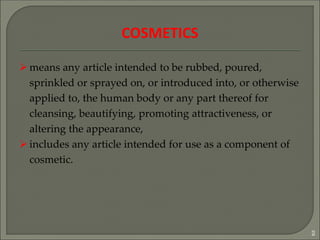
COSMETICS
 means any article intended to be rubbed, poured,
sprinkled or sprayed on, or introduced into, or otherwise
applied to, the human body or any part thereof for
cleansing, beautifying, promoting attractiveness, or
altering the appearance,
 includes any article intended for use as a component of
cosmetic.
2
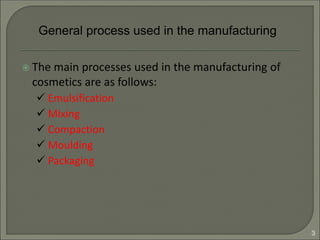
 The main processes used in the manufacturing of
cosmetics are as follows:
 Emulsification
 Mixing
 Compaction
 Moulding
 Packaging
General process used in the manufacturing
3
 Water
 Preservatives
• Anti-microbial agents
• Anti-oxidants
 Humectants
 Surfactants
 Oils, fats & waxes
 Perfumes
 Colors
 Some functional raw materials (active ingredients)
 Herbal or plant materials
Common material used In cosmetics
4
 Control of environment of manufacturing premises
 Control of personal hygiene
 Development of an effective cleaning & sterilization
programme
 Monitoring of quality of water supply
 Observation of quality of water supply
 Use of adequate preservatives
 Monitoring of microbial quality of cosmetics during
manufacturing stages.
Control of microbial contamination
In manufacturing of cosmetics
5
 Cosmetics for skin:
 Skin cream
 Skin bleach cream
 Sunscreen cream
 Antiperspirants & deodorants
 Face powders
 Compact powders
 Rouge
 Lipsticks
 Astringents & skin tonics
 Body powder (talcum powder)
 Face packs
 Bath preparations
Classification of Cosmetic Products
6
 Cosmetics for hair:
• Shampoos
• Depilatories
• Shaving soaps & creams
• Hair dyes
• Anti dandruff products
• Hair tonics & conditioners
• Hair wave sets, lacquers & rinses
• Hair grooming preparations
• Permanent hair waving preparations & hair straighteners
• Hair bleaches & hair colorants
Classification of Cosmetic Products
contd.
7
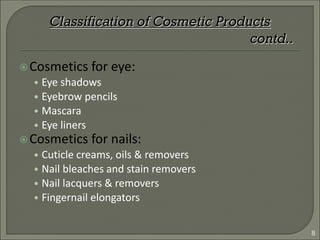
Cosmetics for eye:
• Eye shadows
• Eyebrow pencils
• Mascara
• Eye liners
Cosmetics for nails:
• Cuticle creams, oils & removers
• Nail bleaches and stain removers
• Nail lacquers & removers
• Fingernail elongators
Classification of Cosmetic Products
contd..
8
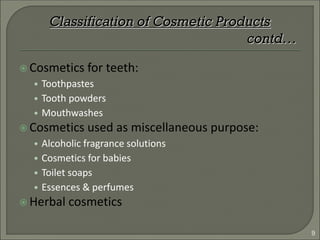
 Cosmetics for teeth:
• Toothpastes
• Tooth powders
• Mouthwashes
 Cosmetics used as miscellaneous purpose:
• Alcoholic fragrance solutions
• Cosmetics for babies
• Toilet soaps
• Essences & perfumes
 Herbal cosmetics
Classification of Cosmetic Products
contd…
9
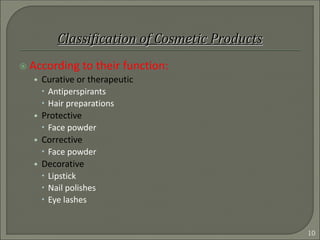
 According to their function:
• Curative or therapeutic
 Antiperspirants
 Hair preparations
• Protective
 Face powder
• Corrective
 Face powder
• Decorative
 Lipstick
 Nail polishes
 Eye lashes
10
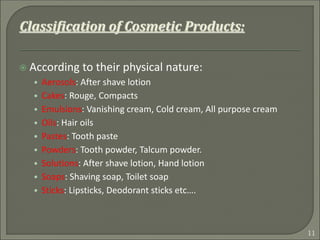
 According to their physical nature:
• Aerosols: After shave lotion
• Cakes: Rouge, Compacts
• Emulsions: Vanishing cream, Cold cream, All purpose cream
• Oils: Hair oils
• Pastes: Tooth paste
• Powders: Tooth powder, Talcum powder.
• Solutions: After shave lotion, Hand lotion
• Soaps: Shaving soap, Toilet soap
• Sticks: Lipsticks, Deodorant sticks etc….
11
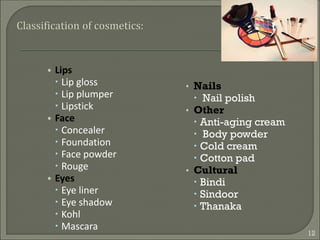
• Lips
 Lip gloss
 Lip plumper
 Lipstick
• Face
 Concealer
 Foundation
 Face powder
 Rouge
• Eyes
 Eye liner
 Eye shadow
 Kohl
 Mascara
• Nails
 Nail polish
• Other
 Anti-aging cream
 Body powder
 Cold cream
 Cotton pad
• Cultural
 Bindi
 Sindoor
 Thanaka
12
 Raw material control
 Packaging material control
 Intermediate product control
 Finished product control
 Shelf testing
 Market survey (an important prevalence)
13
 Emollients,
 Waxes,
 Oils,
 Humectants,
 Preservatives,
 Binders,
 Surfactants,
 Colors,
 Perfumes,
 Herbals
14
Definition
Ideal properties of humectants
Types & examples
 Drying of cosmetic may due to:
• Vaporization of water
• Depends o temperature, degree of exposure to air and RH
in the air
16
 Hygroscopic material
 Used to reduce the loss of moisture
 Used to keep cream soft: vanishing cream
 Possesses emollient action: vanishing cream
 Forms thin film on skin when applied, influences the texture &
condition of skin, all moisturizing preparation contains
humectants.
 Not only humectants are not responsible to avoid drying of
products but also based on container & closure in which it is
packed.
17
 Must absorb moisture from atmosphere
 Should cause a little change only in water content with the
change in RH within normal RH range.
 Compatible with other materials
 Colorless
 Good odor & taste.
 Non-toxic, non-irritant
 Non- corrosive to packaging material
 Not solidify or crystallize at normal condition
 Not be too costly
 Viscosity & temperature curve should be relatively flat.
18
Three classes:
• Inorganic
• Metal-organic
• Organic
19
 Example: Calcium chloride
 Disadvantages:
• Compatibility problem
• Corrosive nature
 Limited use in cosmetics
20
 Example: Sodium lactate
 Advantages:
• Greater hygroscopic power than glycerin
 Disadvantages:
• Compatibility problem, Corrosive nature, Pronounced taste
 Generally used in skin cream as no risk of toxicity
 Admixture of Sodium lactate + lactic acid is used to overcome
pH problems.
 Limited used in cosmetics.
21
 Polyhydric alcohols, their esters & ethers
 Widely used in cosmetics
 Most commonly used are:
• Ethylene glycol,
• Propylene glycol,
• Polyethylene glycol
• Glycerol,
• Sorbitol
22
 Polyethylene oxide (PEO),
 Polyoxyethylene (POE)
 Available in varying molecular weight
 Based on concentration, effectiveness is depends
 PEG 400 = mol. wt. is 400 Daltons
23
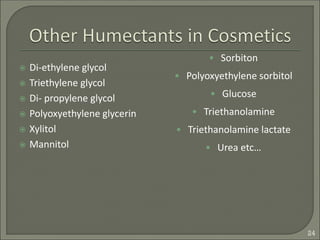
 Di-ethylene glycol
 Triethylene glycol
 Di- propylene glycol
 Polyoxyethylene glycerin
 Xylitol
 Mannitol
• Sorbiton
• Polyoxyethylene sorbitol
• Glucose
• Triethanolamine
• Triethanolamine lactate
• Urea etc…
24

Introduction to cosmetics

  • 1.
    Dr. Prashant L.Pingale Associate Professor, Dept. of Pharmaceutics, GES’s Sir Dr. M. S. Gosavi College of Pharm. Edu. and Research, Nashik-422005
  • 2.
    COSMETICS  means anyarticle intended to be rubbed, poured, sprinkled or sprayed on, or introduced into, or otherwise applied to, the human body or any part thereof for cleansing, beautifying, promoting attractiveness, or altering the appearance,  includes any article intended for use as a component of cosmetic. 2
  • 3.
     The mainprocesses used in the manufacturing of cosmetics are as follows:  Emulsification  Mixing  Compaction  Moulding  Packaging General process used in the manufacturing 3
  • 4.
     Water  Preservatives •Anti-microbial agents • Anti-oxidants  Humectants  Surfactants  Oils, fats & waxes  Perfumes  Colors  Some functional raw materials (active ingredients)  Herbal or plant materials Common material used In cosmetics 4
  • 5.
     Control ofenvironment of manufacturing premises  Control of personal hygiene  Development of an effective cleaning & sterilization programme  Monitoring of quality of water supply  Observation of quality of water supply  Use of adequate preservatives  Monitoring of microbial quality of cosmetics during manufacturing stages. Control of microbial contamination In manufacturing of cosmetics 5
  • 6.
     Cosmetics forskin:  Skin cream  Skin bleach cream  Sunscreen cream  Antiperspirants & deodorants  Face powders  Compact powders  Rouge  Lipsticks  Astringents & skin tonics  Body powder (talcum powder)  Face packs  Bath preparations Classification of Cosmetic Products 6
  • 7.
     Cosmetics forhair: • Shampoos • Depilatories • Shaving soaps & creams • Hair dyes • Anti dandruff products • Hair tonics & conditioners • Hair wave sets, lacquers & rinses • Hair grooming preparations • Permanent hair waving preparations & hair straighteners • Hair bleaches & hair colorants Classification of Cosmetic Products contd. 7
  • 8.
    Cosmetics for eye: •Eye shadows • Eyebrow pencils • Mascara • Eye liners Cosmetics for nails: • Cuticle creams, oils & removers • Nail bleaches and stain removers • Nail lacquers & removers • Fingernail elongators Classification of Cosmetic Products contd.. 8
  • 9.
     Cosmetics forteeth: • Toothpastes • Tooth powders • Mouthwashes  Cosmetics used as miscellaneous purpose: • Alcoholic fragrance solutions • Cosmetics for babies • Toilet soaps • Essences & perfumes  Herbal cosmetics Classification of Cosmetic Products contd… 9
  • 10.
     According totheir function: • Curative or therapeutic  Antiperspirants  Hair preparations • Protective  Face powder • Corrective  Face powder • Decorative  Lipstick  Nail polishes  Eye lashes 10
  • 11.
     According totheir physical nature: • Aerosols: After shave lotion • Cakes: Rouge, Compacts • Emulsions: Vanishing cream, Cold cream, All purpose cream • Oils: Hair oils • Pastes: Tooth paste • Powders: Tooth powder, Talcum powder. • Solutions: After shave lotion, Hand lotion • Soaps: Shaving soap, Toilet soap • Sticks: Lipsticks, Deodorant sticks etc…. 11
  • 12.
    • Lips  Lipgloss  Lip plumper  Lipstick • Face  Concealer  Foundation  Face powder  Rouge • Eyes  Eye liner  Eye shadow  Kohl  Mascara • Nails  Nail polish • Other  Anti-aging cream  Body powder  Cold cream  Cotton pad • Cultural  Bindi  Sindoor  Thanaka 12
  • 13.
     Raw materialcontrol  Packaging material control  Intermediate product control  Finished product control  Shelf testing  Market survey (an important prevalence) 13
  • 14.
     Emollients,  Waxes, Oils,  Humectants,  Preservatives,  Binders,  Surfactants,  Colors,  Perfumes,  Herbals 14
  • 15.
    Definition Ideal properties ofhumectants Types & examples
  • 16.
     Drying ofcosmetic may due to: • Vaporization of water • Depends o temperature, degree of exposure to air and RH in the air 16
  • 17.
     Hygroscopic material Used to reduce the loss of moisture  Used to keep cream soft: vanishing cream  Possesses emollient action: vanishing cream  Forms thin film on skin when applied, influences the texture & condition of skin, all moisturizing preparation contains humectants.  Not only humectants are not responsible to avoid drying of products but also based on container & closure in which it is packed. 17
  • 18.
     Must absorbmoisture from atmosphere  Should cause a little change only in water content with the change in RH within normal RH range.  Compatible with other materials  Colorless  Good odor & taste.  Non-toxic, non-irritant  Non- corrosive to packaging material  Not solidify or crystallize at normal condition  Not be too costly  Viscosity & temperature curve should be relatively flat. 18
  • 19.
    Three classes: • Inorganic •Metal-organic • Organic 19
  • 20.
     Example: Calciumchloride  Disadvantages: • Compatibility problem • Corrosive nature  Limited use in cosmetics 20
  • 21.
     Example: Sodiumlactate  Advantages: • Greater hygroscopic power than glycerin  Disadvantages: • Compatibility problem, Corrosive nature, Pronounced taste  Generally used in skin cream as no risk of toxicity  Admixture of Sodium lactate + lactic acid is used to overcome pH problems.  Limited used in cosmetics. 21
  • 22.
     Polyhydric alcohols,their esters & ethers  Widely used in cosmetics  Most commonly used are: • Ethylene glycol, • Propylene glycol, • Polyethylene glycol • Glycerol, • Sorbitol 22
  • 23.
     Polyethylene oxide(PEO),  Polyoxyethylene (POE)  Available in varying molecular weight  Based on concentration, effectiveness is depends  PEG 400 = mol. wt. is 400 Daltons 23
  • 24.
     Di-ethylene glycol Triethylene glycol  Di- propylene glycol  Polyoxyethylene glycerin  Xylitol  Mannitol • Sorbiton • Polyoxyethylene sorbitol • Glucose • Triethanolamine • Triethanolamine lactate • Urea etc… 24