Presented by: Anupriya Singh
(IMS-BHU)
1
What is business?
Business refers to an occupation
in which people are regularly engage
in activities related to:
• Purchase
• Production
• Sales of goods
• And services with a view of earning
profits. 2
Services
• Services are all those economic activities
that are intangible and imply an
interaction to be realized between
the service provider and the consumer.
They are those essentially intangible
activities that provide satisfaction of
wants.
3
Nature of Services
• Intangibility
• Inconsistency
• Inseparability
• Inventory
• Involvement
4
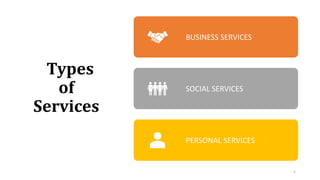
Types
of
Services
BUSINESS SERVICES
SOCIAL SERVICES
PERSONAL SERVICES
5
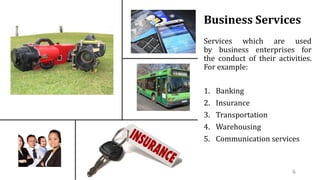
Business Services
Services which are used
by business enterprises for
the conduct of their activities.
For example:
1. Banking
2. Insurance
3. Transportation
4. Warehousing
5. Communication services
6
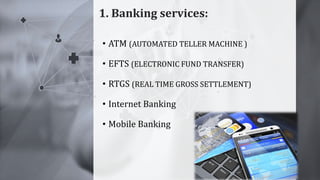
1. Banking services:
7
• ATM (AUTOMATED TELLER MACHINE )
• EFTS (ELECTRONIC FUND TRANSFER)
• RTGS (REAL TIME GROSS SETTLEMENT)
• Internet Banking
• Mobile Banking
2. Insurance
What is Insurance?
Insurance is a practice or arrangement by which company or
government agency provides a guarantee of compensation for
specified loss, damage, illness or death in return for a payment of a
premium.
8
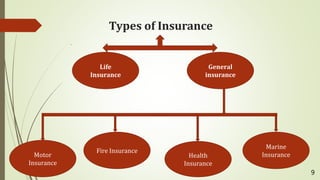
Types of Insurance
.
9
Life
Insurance
General
insurance
Marine
Insurance
Health
Insurance
Fire Insurance
Motor
Insurance
3. Transportation
• The process of moving an item from one place to another
place.
• Safe, efficient, reliable, and sustainable movement of
persons and goods over time and space.
10
Types of transportation:
 Rail Transport
 Road Transport
 Water Transport
 Air Transport
11
4. Warehousing
 Place where goods are kept is called WAREHOUSE.
 Warehousing refers to the activities involving storage of goods on a
large-scale in a systematic and orderly manner and making them
available conveniently when needed.
 Need for storage arises both for raw material as well as finished
products.
12
Types of Warehouses:
 Private
 Public
 Government
 Distribution center or warehouses
 Co-operative
 Bonded
 Cold storage
 Export and Import
 Climate controlled
 Field warehouses
 Agricultural
13
5. Communication services
 Communication is the exchange of thoughts, messages, or
information by speech, visuals, signals, writing or behaviors.
 Business communication is the sharing of information between
people within an organization that is performed for the
commercial benefit of the organization.
14
Types of communication
o One-way
o Two-way
o Verbal(Oral & Written)
o Non-verbal
o Formal
o Informal
o Upward
15
o Downward
o Lateral/Horizontal
o Interpersonal
o Intrapersonal
o Organizational
o Mass Communication
Social services
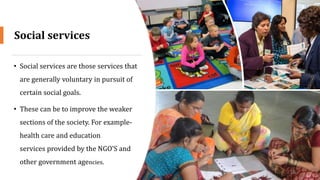
• Social services are those services that
are generally voluntary in pursuit of
certain social goals.
• These can be to improve the weaker
sections of the society. For example-
health care and education
services provided by the NGO’S and
other government agencies.
16
Personal services
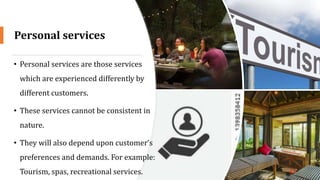
• Personal services are those services
which are experienced differently by
different customers.
• These services cannot be consistent in
nature.
• They will also depend upon customer’s
preferences and demands. For example:
Tourism, spas, recreational services. 17
THANK YOU
18

Business services

  • 1.
    Presented by: AnupriyaSingh (IMS-BHU) 1
  • 2.
    What is business? Businessrefers to an occupation in which people are regularly engage in activities related to: • Purchase • Production • Sales of goods • And services with a view of earning profits. 2
  • 3.
    Services • Services areall those economic activities that are intangible and imply an interaction to be realized between the service provider and the consumer. They are those essentially intangible activities that provide satisfaction of wants. 3
  • 4.
    Nature of Services •Intangibility • Inconsistency • Inseparability • Inventory • Involvement 4
  • 5.
  • 6.
    Business Services Services whichare used by business enterprises for the conduct of their activities. For example: 1. Banking 2. Insurance 3. Transportation 4. Warehousing 5. Communication services 6
  • 7.
    1. Banking services: 7 •ATM (AUTOMATED TELLER MACHINE ) • EFTS (ELECTRONIC FUND TRANSFER) • RTGS (REAL TIME GROSS SETTLEMENT) • Internet Banking • Mobile Banking
  • 8.
    2. Insurance What isInsurance? Insurance is a practice or arrangement by which company or government agency provides a guarantee of compensation for specified loss, damage, illness or death in return for a payment of a premium. 8
  • 9.
  • 10.
    3. Transportation • Theprocess of moving an item from one place to another place. • Safe, efficient, reliable, and sustainable movement of persons and goods over time and space. 10
  • 11.
    Types of transportation: Rail Transport  Road Transport  Water Transport  Air Transport 11
  • 12.
    4. Warehousing  Placewhere goods are kept is called WAREHOUSE.  Warehousing refers to the activities involving storage of goods on a large-scale in a systematic and orderly manner and making them available conveniently when needed.  Need for storage arises both for raw material as well as finished products. 12
  • 13.
    Types of Warehouses: Private  Public  Government  Distribution center or warehouses  Co-operative  Bonded  Cold storage  Export and Import  Climate controlled  Field warehouses  Agricultural 13
  • 14.
    5. Communication services Communication is the exchange of thoughts, messages, or information by speech, visuals, signals, writing or behaviors.  Business communication is the sharing of information between people within an organization that is performed for the commercial benefit of the organization. 14
  • 15.
    Types of communication oOne-way o Two-way o Verbal(Oral & Written) o Non-verbal o Formal o Informal o Upward 15 o Downward o Lateral/Horizontal o Interpersonal o Intrapersonal o Organizational o Mass Communication
  • 16.
    Social services • Socialservices are those services that are generally voluntary in pursuit of certain social goals. • These can be to improve the weaker sections of the society. For example- health care and education services provided by the NGO’S and other government agencies. 16
  • 17.
    Personal services • Personalservices are those services which are experienced differently by different customers. • These services cannot be consistent in nature. • They will also depend upon customer’s preferences and demands. For example: Tourism, spas, recreational services. 17
  • 18.