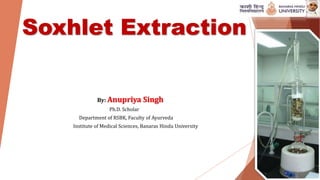
Soxhlet Extraction
By: Anupriya Singh
Ph.D. Scholar
Department of RSBK, Faculty of Ayurveda
Institute of Medical Sciences, Banaras Hindu University
Extraction
 Extraction is the first step in the analysis of plant constituents.
 It is a process of removing or taking out or separating the chemical
constituents from the plant tissues with or without the use of solvents.
 Various methods of extraction are available for this process/extraction.
 The particular method of extraction to be used depends on the:
o Nature of the constituents
o Type of the plant material
o Purpose of the extraction.
Soxhlet extraction
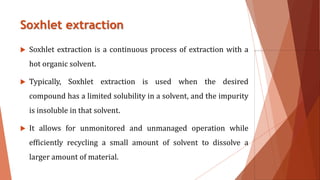
 Soxhlet extraction is a continuous process of extraction with a
hot organic solvent.
 Typically, Soxhlet extraction is used when the desired
compound has a limited solubility in a solvent, and the impurity
is insoluble in that solvent.
 It allows for unmonitored and unmanaged operation while
efficiently recycling a small amount of solvent to dissolve a
larger amount of material.
Soxhlet extractor
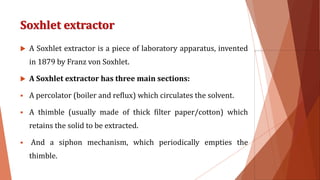
 A Soxhlet extractor is a piece of laboratory apparatus, invented
in 1879 by Franz von Soxhlet.
 A Soxhlet extractor has three main sections:
 A percolator (boiler and reflux) which circulates the solvent.
 A thimble (usually made of thick filter paper/cotton) which
retains the solid to be extracted.
 And a siphon mechanism, which periodically empties the
thimble.
Assembly
 Thimble: The source material containing the compound to be
extracted is placed inside the thimble. The thimble is loaded
into the main chamber of the Soxhlet extractor.
 Distillation flask or Round Bottom Flask (RBF): The
extraction solvent to be used is placed in a distillation flask.
 Heating mantle: The flask is placed on the heating element.
 Reflux condenser: A reflux is placed atop the extractor.
 Water inlet & outlet: Attached in the inlet & outlet opening of
condenser.
Working procedure
 Solid material placed in thimble.
 Soxhlet extractor is placed onto a flask containing the extraction solvent.
Soxhlet equipped with a condenser.
 The solvent is heated to reflux.
 The solvent vapour travels up a distillation arm and floods into the
chamber housing the thimble of solid.
 Solid material in chamber slowly fills warm solvent.
 Desired compound dissolves in the warm solvent.
 When the Soxhlet chamber is almost full, the chamber is emptied by
the siphon. The solvent running back down to the distillation flask.
Cont…
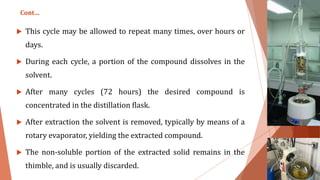
 This cycle may be allowed to repeat many times, over hours or
days.
 During each cycle, a portion of the compound dissolves in the
solvent.
 After many cycles (72 hours) the desired compound is
concentrated in the distillation flask.
 After extraction the solvent is removed, typically by means of a
rotary evaporator, yielding the extracted compound.
 The non-soluble portion of the extracted solid remains in the
thimble, and is usually discarded.
Advantages
 It is mechanically gentle on the samples but still efficient in
separation.
 It is able to extract solute from insoluble impurities.
 It is often used as a benchmark when developing new extraction
methods.
 It allows for unmonitored and unmanaged operation.
 It is the most useful apparatus for solid-liquid extraction in
various fields such as pharmaceutics, environment, foodstuffs
etc.
Disadvantages
 Long operation time required (several hours).
 Large solvent volumes.
 Evaporation and concentration needed at the end of the
extraction.
 Inadequacy for thermolabile analytes.
Advancement
 Focused Microwave-assisted Soxhlet Extraction: Microwave-
assisted soxhlet extraction is a process in which two sources of
energy, namely microwaves (applied on the extraction chamber
of a modified Soxhlet) as auxiliary energy to accelerate the
process and electrical heating (applied on the distillation flask).
Ex. Fat extraction from prefried and fried meat, fish &, bakery
products etc.
Conclusion
o Extraction is essential for isolation of different chemical
constituent from crude drug material.
o Extraction depends on properties of material to be extracted.
References
1. Harwood, Laurence M.; Moody, Christopher J. (13 Jun 1989). Experimental organic chemistry: Principles and
Practice (Illustrated ed.). Wiley-Blackwell. pp. 122–125. ISBN 978-0-632-02017-1.
2. Soxhlet, F. (1879). "Die gewichtsanalytische Bestimmung des Milchfettes". Dingler's Polytechnisches Journal (in German). 232: 461–
465.
3. Jensen, William B. (December 2007). "The Origin of the Soxhlet Extractor". Journal of Chemical Education. 84 (12): 1913–
1914. Bibcode:2007JChEd..84.1913J. doi:10.1021/ed084p1913.
4. Cumpson, Peter; Sano, Naoko (February 2013). "Stability of reference masses V: UV/ozone treatment of gold and platinum
surfaces". Metrologia. 50 (1): 27–36. Bibcode:2013Metro..50...27C. doi:10.1088/0026-1394/50/1/27. The apparatus we propose for
the solvent pre-wash is the Soxhlet apparatus, which has been used very successfully before for washing stainless-steel standard-mass
surfaces. This apparatus has its main application in chemistry for dissolving weakly soluble species from solid matrices
Thank you

soxhlet extraction.pptx

  • 1.
    Soxhlet Extraction By: AnupriyaSingh Ph.D. Scholar Department of RSBK, Faculty of Ayurveda Institute of Medical Sciences, Banaras Hindu University
  • 2.
    Extraction  Extraction isthe first step in the analysis of plant constituents.  It is a process of removing or taking out or separating the chemical constituents from the plant tissues with or without the use of solvents.  Various methods of extraction are available for this process/extraction.  The particular method of extraction to be used depends on the: o Nature of the constituents o Type of the plant material o Purpose of the extraction.
  • 3.
    Soxhlet extraction  Soxhletextraction is a continuous process of extraction with a hot organic solvent.  Typically, Soxhlet extraction is used when the desired compound has a limited solubility in a solvent, and the impurity is insoluble in that solvent.  It allows for unmonitored and unmanaged operation while efficiently recycling a small amount of solvent to dissolve a larger amount of material.
  • 4.
    Soxhlet extractor  ASoxhlet extractor is a piece of laboratory apparatus, invented in 1879 by Franz von Soxhlet.  A Soxhlet extractor has three main sections:  A percolator (boiler and reflux) which circulates the solvent.  A thimble (usually made of thick filter paper/cotton) which retains the solid to be extracted.  And a siphon mechanism, which periodically empties the thimble.
  • 5.
    Assembly  Thimble: Thesource material containing the compound to be extracted is placed inside the thimble. The thimble is loaded into the main chamber of the Soxhlet extractor.  Distillation flask or Round Bottom Flask (RBF): The extraction solvent to be used is placed in a distillation flask.  Heating mantle: The flask is placed on the heating element.  Reflux condenser: A reflux is placed atop the extractor.  Water inlet & outlet: Attached in the inlet & outlet opening of condenser.
  • 6.
    Working procedure  Solidmaterial placed in thimble.  Soxhlet extractor is placed onto a flask containing the extraction solvent. Soxhlet equipped with a condenser.  The solvent is heated to reflux.  The solvent vapour travels up a distillation arm and floods into the chamber housing the thimble of solid.  Solid material in chamber slowly fills warm solvent.  Desired compound dissolves in the warm solvent.  When the Soxhlet chamber is almost full, the chamber is emptied by the siphon. The solvent running back down to the distillation flask.
  • 7.
    Cont…  This cyclemay be allowed to repeat many times, over hours or days.  During each cycle, a portion of the compound dissolves in the solvent.  After many cycles (72 hours) the desired compound is concentrated in the distillation flask.  After extraction the solvent is removed, typically by means of a rotary evaporator, yielding the extracted compound.  The non-soluble portion of the extracted solid remains in the thimble, and is usually discarded.
  • 8.
    Advantages  It ismechanically gentle on the samples but still efficient in separation.  It is able to extract solute from insoluble impurities.  It is often used as a benchmark when developing new extraction methods.  It allows for unmonitored and unmanaged operation.  It is the most useful apparatus for solid-liquid extraction in various fields such as pharmaceutics, environment, foodstuffs etc.
  • 9.
    Disadvantages  Long operationtime required (several hours).  Large solvent volumes.  Evaporation and concentration needed at the end of the extraction.  Inadequacy for thermolabile analytes.
  • 10.
    Advancement  Focused Microwave-assistedSoxhlet Extraction: Microwave- assisted soxhlet extraction is a process in which two sources of energy, namely microwaves (applied on the extraction chamber of a modified Soxhlet) as auxiliary energy to accelerate the process and electrical heating (applied on the distillation flask). Ex. Fat extraction from prefried and fried meat, fish &, bakery products etc.
  • 11.
    Conclusion o Extraction isessential for isolation of different chemical constituent from crude drug material. o Extraction depends on properties of material to be extracted.
  • 12.
    References 1. Harwood, LaurenceM.; Moody, Christopher J. (13 Jun 1989). Experimental organic chemistry: Principles and Practice (Illustrated ed.). Wiley-Blackwell. pp. 122–125. ISBN 978-0-632-02017-1. 2. Soxhlet, F. (1879). "Die gewichtsanalytische Bestimmung des Milchfettes". Dingler's Polytechnisches Journal (in German). 232: 461– 465. 3. Jensen, William B. (December 2007). "The Origin of the Soxhlet Extractor". Journal of Chemical Education. 84 (12): 1913– 1914. Bibcode:2007JChEd..84.1913J. doi:10.1021/ed084p1913. 4. Cumpson, Peter; Sano, Naoko (February 2013). "Stability of reference masses V: UV/ozone treatment of gold and platinum surfaces". Metrologia. 50 (1): 27–36. Bibcode:2013Metro..50...27C. doi:10.1088/0026-1394/50/1/27. The apparatus we propose for the solvent pre-wash is the Soxhlet apparatus, which has been used very successfully before for washing stainless-steel standard-mass surfaces. This apparatus has its main application in chemistry for dissolving weakly soluble species from solid matrices
  • 13.