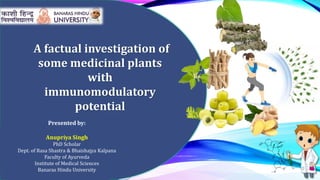
A factual investigation of
some medicinal plants
with
immunomodulatory
potential
Presented by:
Anupriya Singh
PhD Scholar
Dept. of Rasa Shastra & Bhaishajya Kalpana
Faculty of Ayurveda
Institute of Medical Sciences
Banaras Hindu University
What is Immunity?
oImmunity is the capability of multicellular organisms to resist
harmful microorganisms.
oImmunity is a complex biological system that can recognize and
tolerate whatever belongs to the self (specific components) and to
recognize and reject what is foreign (non-specific components).
oIn other words, nonspecific components act as barriers or
eliminators of a wide range of pathogens irrespective of
their antigenic make-up. However, specific components of
the immune system adapt themselves to each new disease
encountered and can generate pathogen-specific immunity. 2
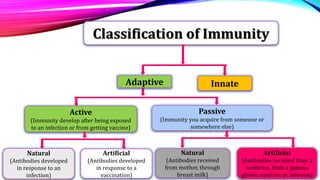
Classification of Immunity
3
Passive
(Immunity you acquire from someone or
somewhere else)
Active
(Immunity develop after being exposed
to an infection or from getting vaccine)
Natural
(Antibodies developed
in response to an
infection)
Artificial
(Antibodies developed
in response to a
vaccination)
Natural
(Antibodies received
from mother, through
breast milk)
Artificial
(Antibodies received from a
medicine, from a gamma
globin injection or infusion)
Innate
Adaptive
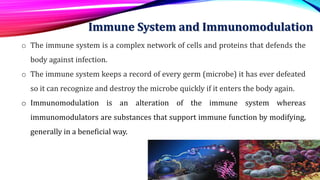
Immune System and Immunomodulation
4
o The immune system is a complex network of cells and proteins that defends the
body against infection.
o The immune system keeps a record of every germ (microbe) it has ever defeated
so it can recognize and destroy the microbe quickly if it enters the body again.
o Immunomodulation is an alteration of the immune system whereas
immunomodulators are substances that support immune function by modifying,
generally in a beneficial way.
Immunomodulatory drugs and their side effects
o Thalidomide (Thalomid), lenalidomide (Revlimid), and pomalidomide (Pomalyst)
are some known immunomodulating drugs.
o These drugs can cause side effects such as drowsiness, fatigue, constipation, low
blood cell counts, and neuropathy (painful nerve damage).
o The modulation of immune system by various medicinal plant products has
become interesting subject for scientific investigations currently worldwide due
to the lack of side effects.
5
Ref.: Immunotherapy. American cancer society. Cancer.org 1.800.227.2345
Namrata Singh, Mukul Tailang, Mehata SC. A review on medicinal plants as immunomodulators. Int J Pharm Sci Res, 2016, 7(9), 3602-3610.
7
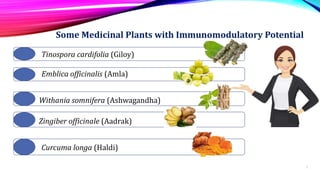
Some Medicinal Plants with Immunomodulatory Potential
Tinospora cardifolia (Giloy)
Emblica officinalis (Amla)
Withania somnifera (Ashwagandha)
Zingiber officinale (Aadrak)
Curcuma longa (Haldi)
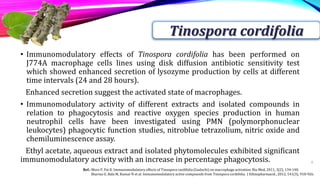
• Immunomodulatory effects of Tinospora cordifolia has been performed on
J774A macrophage cells lines using disk diffusion antibiotic sensitivity test
which showed enhanced secretion of lysozyme production by cells at different
time intervals (24 and 28 hours).
Enhanced secretion suggest the activated state of macrophages.
• Immunomodulatory activity of different extracts and isolated compounds in
relation to phagocytosis and reactive oxygen species production in human
neutrophil cells have been investigated using PMN (polymorphonuclear
leukocytes) phagocytic function studies, nitroblue tetrazolium, nitric oxide and
chemiluminescence assay.
Ethyl acetate, aqueous extract and isolated phytomolecules exhibited significant
immunomodulatory activity with an increase in percentage phagocytosis. 8
Tinospora cordifolia
Ref.: More P, Pai K. Immunomodulatory effects of Tinospora cardifolia (Guduchi) on macrophage activation. Bio Med, 2011, 3(2), 134-140.
Sharma U, Bala M, Kumar N et al. Immunomodulatory active compounds from Tinospora cordifolia. J Ethnopharmacol., 2012, 141(3), 918-926.
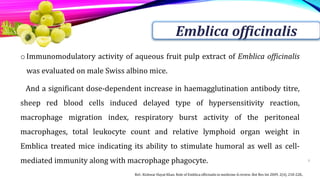
o Immunomodulatory activity of aqueous fruit pulp extract of Emblica officinalis
was evaluated on male Swiss albino mice.
And a significant dose-dependent increase in haemagglutination antibody titre,
sheep red blood cells induced delayed type of hypersensitivity reaction,
macrophage migration index, respiratory burst activity of the peritoneal
macrophages, total leukocyte count and relative lymphoid organ weight in
Emblica treated mice indicating its ability to stimulate humoral as well as cell-
mediated immunity along with macrophage phagocyte. 9
Emblica officinalis
Ref.: Kishwar Hayat Khan. Role of Emblica officinalis in medicine-A review. Bot Res Int 2009, 2(4), 218-228,.
Immunomodulatory activity of Withania somnifera root extract was performed in
mice.
Treatment with root extract along with antigen (Sheep Red Blood Cells) produced
an enhancement in the circulating antibody titre and the number of plaque-
forming cells in the spleen.
Plant root extract inhibits delayed-type hypersensitivity reaction in mice and
enhanced phagocytic activity of peritoneal macrophages when compared to the
control group.
These results confirm the immunomodulatory activity of W. somnifera.
10
Withania somnifera
Ref.: Davis L, Kuttan G. Immunomodulatory activity of Withania somnifera. J Ethanopharmacol., 2000, 71(1-2), 193-200.
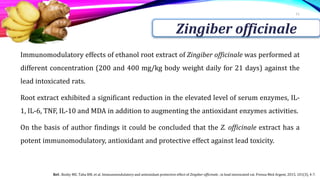
Immunomodulatory effects of ethanol root extract of Zingiber officinale was performed at
different concentration (200 and 400 mg/kg body weight daily for 21 days) against the
lead intoxicated rats.
Root extract exhibited a significant reduction in the elevated level of serum enzymes, IL-
1, IL-6, TNF, IL-10 and MDA in addition to augmenting the antioxidant enzymes activities.
On the basis of author findings it could be concluded that the Z. officinale extract has a
potent immunomodulatory, antioxidant and protective effect against lead toxicity.
11
Zingiber officinale
Ref.: Boshy ME, Taha RM, et al. Immunomodulatory and antioxidant protective effect of Zingiber officinale , in lead intoxicated rat. Prensa Med Argent, 2015, 101(3), 4-7.
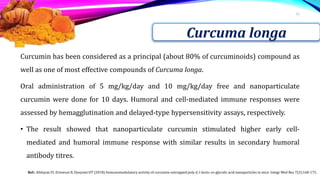
Curcumin has been considered as a principal (about 80% of curcuminoids) compound as
well as one of most effective compounds of Curcuma longa.
Oral administration of 5 mg/kg/day and 10 mg/kg/day free and nanoparticulate
curcumin were done for 10 days. Humoral and cell-mediated immune responses were
assessed by hemagglutination and delayed-type hypersensitivity assays, respectively.
• The result showed that nanoparticulate curcumin stimulated higher early cell-
mediated and humoral immune response with similar results in secondary humoral
antibody titres.
12
Curcuma longa
Ref.: Afolayan FI, Erinwusi B, Oyeyemi OT (2018) Immunomodulatory activity of curcumin-entrapped poly d, l-lactic-co-glycolic acid nanoparticles in mice. Integr Med Res 7(2):168-175.
Plants have been an exemplary source of medicine since ancient time.
These medicinal plants influence the immune system due to the presence of various
active secondary metabolites such as carbohydrates, alkaloids, glycosides,
flavonoids, tannins, and steroids.
The herbs have immunomodulatory potential to treat or prevent illnesses that are
often beyond the grasp of allopathic medication but additional research is needed so
that we can use the maximum potential of these plants and it may be used in the
place of current treatment.
13
Conclusion
14
Thank you!

immunomodulatry potential.pptx

  • 1.
    A factual investigationof some medicinal plants with immunomodulatory potential Presented by: Anupriya Singh PhD Scholar Dept. of Rasa Shastra & Bhaishajya Kalpana Faculty of Ayurveda Institute of Medical Sciences Banaras Hindu University
  • 2.
    What is Immunity? oImmunityis the capability of multicellular organisms to resist harmful microorganisms. oImmunity is a complex biological system that can recognize and tolerate whatever belongs to the self (specific components) and to recognize and reject what is foreign (non-specific components). oIn other words, nonspecific components act as barriers or eliminators of a wide range of pathogens irrespective of their antigenic make-up. However, specific components of the immune system adapt themselves to each new disease encountered and can generate pathogen-specific immunity. 2
  • 3.
    Classification of Immunity 3 Passive (Immunityyou acquire from someone or somewhere else) Active (Immunity develop after being exposed to an infection or from getting vaccine) Natural (Antibodies developed in response to an infection) Artificial (Antibodies developed in response to a vaccination) Natural (Antibodies received from mother, through breast milk) Artificial (Antibodies received from a medicine, from a gamma globin injection or infusion) Innate Adaptive
  • 4.
    Immune System andImmunomodulation 4 o The immune system is a complex network of cells and proteins that defends the body against infection. o The immune system keeps a record of every germ (microbe) it has ever defeated so it can recognize and destroy the microbe quickly if it enters the body again. o Immunomodulation is an alteration of the immune system whereas immunomodulators are substances that support immune function by modifying, generally in a beneficial way.
  • 5.
    Immunomodulatory drugs andtheir side effects o Thalidomide (Thalomid), lenalidomide (Revlimid), and pomalidomide (Pomalyst) are some known immunomodulating drugs. o These drugs can cause side effects such as drowsiness, fatigue, constipation, low blood cell counts, and neuropathy (painful nerve damage). o The modulation of immune system by various medicinal plant products has become interesting subject for scientific investigations currently worldwide due to the lack of side effects. 5 Ref.: Immunotherapy. American cancer society. Cancer.org 1.800.227.2345 Namrata Singh, Mukul Tailang, Mehata SC. A review on medicinal plants as immunomodulators. Int J Pharm Sci Res, 2016, 7(9), 3602-3610.
  • 7.
    7 Some Medicinal Plantswith Immunomodulatory Potential Tinospora cardifolia (Giloy) Emblica officinalis (Amla) Withania somnifera (Ashwagandha) Zingiber officinale (Aadrak) Curcuma longa (Haldi)
  • 8.
    • Immunomodulatory effectsof Tinospora cordifolia has been performed on J774A macrophage cells lines using disk diffusion antibiotic sensitivity test which showed enhanced secretion of lysozyme production by cells at different time intervals (24 and 28 hours). Enhanced secretion suggest the activated state of macrophages. • Immunomodulatory activity of different extracts and isolated compounds in relation to phagocytosis and reactive oxygen species production in human neutrophil cells have been investigated using PMN (polymorphonuclear leukocytes) phagocytic function studies, nitroblue tetrazolium, nitric oxide and chemiluminescence assay. Ethyl acetate, aqueous extract and isolated phytomolecules exhibited significant immunomodulatory activity with an increase in percentage phagocytosis. 8 Tinospora cordifolia Ref.: More P, Pai K. Immunomodulatory effects of Tinospora cardifolia (Guduchi) on macrophage activation. Bio Med, 2011, 3(2), 134-140. Sharma U, Bala M, Kumar N et al. Immunomodulatory active compounds from Tinospora cordifolia. J Ethnopharmacol., 2012, 141(3), 918-926.
  • 9.
    o Immunomodulatory activityof aqueous fruit pulp extract of Emblica officinalis was evaluated on male Swiss albino mice. And a significant dose-dependent increase in haemagglutination antibody titre, sheep red blood cells induced delayed type of hypersensitivity reaction, macrophage migration index, respiratory burst activity of the peritoneal macrophages, total leukocyte count and relative lymphoid organ weight in Emblica treated mice indicating its ability to stimulate humoral as well as cell- mediated immunity along with macrophage phagocyte. 9 Emblica officinalis Ref.: Kishwar Hayat Khan. Role of Emblica officinalis in medicine-A review. Bot Res Int 2009, 2(4), 218-228,.
  • 10.
    Immunomodulatory activity ofWithania somnifera root extract was performed in mice. Treatment with root extract along with antigen (Sheep Red Blood Cells) produced an enhancement in the circulating antibody titre and the number of plaque- forming cells in the spleen. Plant root extract inhibits delayed-type hypersensitivity reaction in mice and enhanced phagocytic activity of peritoneal macrophages when compared to the control group. These results confirm the immunomodulatory activity of W. somnifera. 10 Withania somnifera Ref.: Davis L, Kuttan G. Immunomodulatory activity of Withania somnifera. J Ethanopharmacol., 2000, 71(1-2), 193-200.
  • 11.
    Immunomodulatory effects ofethanol root extract of Zingiber officinale was performed at different concentration (200 and 400 mg/kg body weight daily for 21 days) against the lead intoxicated rats. Root extract exhibited a significant reduction in the elevated level of serum enzymes, IL- 1, IL-6, TNF, IL-10 and MDA in addition to augmenting the antioxidant enzymes activities. On the basis of author findings it could be concluded that the Z. officinale extract has a potent immunomodulatory, antioxidant and protective effect against lead toxicity. 11 Zingiber officinale Ref.: Boshy ME, Taha RM, et al. Immunomodulatory and antioxidant protective effect of Zingiber officinale , in lead intoxicated rat. Prensa Med Argent, 2015, 101(3), 4-7.
  • 12.
    Curcumin has beenconsidered as a principal (about 80% of curcuminoids) compound as well as one of most effective compounds of Curcuma longa. Oral administration of 5 mg/kg/day and 10 mg/kg/day free and nanoparticulate curcumin were done for 10 days. Humoral and cell-mediated immune responses were assessed by hemagglutination and delayed-type hypersensitivity assays, respectively. • The result showed that nanoparticulate curcumin stimulated higher early cell- mediated and humoral immune response with similar results in secondary humoral antibody titres. 12 Curcuma longa Ref.: Afolayan FI, Erinwusi B, Oyeyemi OT (2018) Immunomodulatory activity of curcumin-entrapped poly d, l-lactic-co-glycolic acid nanoparticles in mice. Integr Med Res 7(2):168-175.
  • 13.
    Plants have beenan exemplary source of medicine since ancient time. These medicinal plants influence the immune system due to the presence of various active secondary metabolites such as carbohydrates, alkaloids, glycosides, flavonoids, tannins, and steroids. The herbs have immunomodulatory potential to treat or prevent illnesses that are often beyond the grasp of allopathic medication but additional research is needed so that we can use the maximum potential of these plants and it may be used in the place of current treatment. 13 Conclusion
  • 14.