Presented By
Qirtas Tauheed (100-E-14)
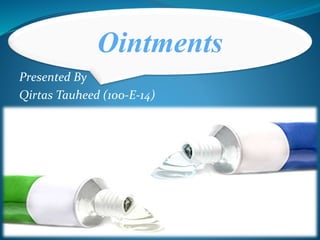
Ointments
Definition:
“Ointments are semi-solid
preparations for
application to the skin.”
Types of Ointments
Medicated ointments
Non-medicated ointments
Medicated ointments
These contain the medicament either dissolved
or dispersed in the vehicle as fine powders or in
the form of micronized powder e.g.
o Gentamicin ointment.
Non medicated ointments
These are used as vehicles for preparation of
medicated ointments or can be used for
their physical effects e.g.
oSoft Paraffin
Properties of ideal ointments
Non sensitizing
Non irritating
Pharmaceutically elegant
Efficient release of medicament at the
site of application
Water -washable
Ointment Bases
Ointment bases are generally classified
by the USP into four groups
I. Oleaginous bases
II. Absorption bases
III.Water removable bases
IV.Water soluble bases
1)Oleaginous bases
Oleaginous bases are also termed as hydrocarbon bases.
On application to the skin
emollient
effect
occlusive
dressings
protect against the escape
of moisture
Examples of Oleaginous Bases
a)Petrolatum (USP)
is a purified mixture of semisolid hydrocarbons
obtained from petroleum.
A commercial product is Vaseline.
b) White Petrolatum(USP)
is a purified mixture of semisolid hydrocarbons from
petroleum that has been wholly or nearly decolorized.
c)Yellow ointment (USP)
is mixture (1000g) of yellow wax (50g) and
petrolatum (950g).
d)White ointment (USP)
This ointment differs from yellow ointment by
substituting white wax and white petrolatum in the
formula.
2) Absorption bases
Absorption bases are of two types:
Those that permit the incorporation of
aqueous solutions resulting in the formation
of water-in-oil emulsions (e.g., hydrophilic
petrolatum)
Those that are water-in-oil emulsions and
permit the incorporation of additional
quantities of aqueous solutions (e.g., Lanolin)
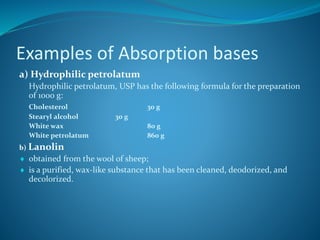
Examples of Absorption bases
a) Hydrophilic petrolatum
Hydrophilic petrolatum, USP has the following formula for the preparation
of 1000 g:
Cholesterol 30 g
Stearyl alcohol 30 g
White wax 80 g
White petrolatum 860 g
b) Lanolin
 obtained from the wool of sheep;
 is a purified, wax-like substance that has been cleaned, deodorized, and
decolorized.
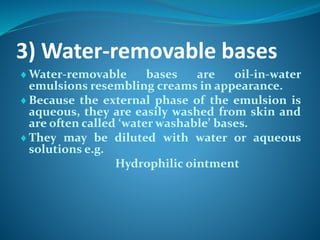
3) Water-removable bases
Water-removable bases are oil-in-water
emulsions resembling creams in appearance.
Because the external phase of the emulsion is
aqueous, they are easily washed from skin and
are often called ‘water washable’ bases.
They may be diluted with water or aqueous
solutions e.g.
Hydrophilic ointment
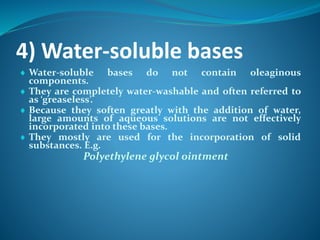
4) Water-soluble bases
 Water-soluble bases do not contain oleaginous
components.
 They are completely water-washable and often referred to
as ‘greaseless’.
 Because they soften greatly with the addition of water,
large amounts of aqueous solutions are not effectively
incorporated into these bases.
 They mostly are used for the incorporation of solid
substances. E.g.
Polyethylene glycol ointment
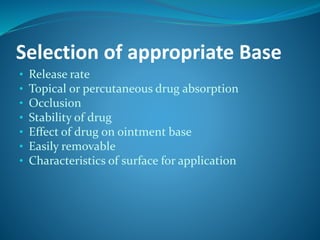
Selection of appropriate Base
• Release rate
• Topical or percutaneous drug absorption
• Occlusion
• Stability of drug
• Effect of drug on ointment base
• Easily removable
• Characteristics of surface for application
Preparation of ointments
Ointments are prepared by two general
methods:
- Incorporation
- Fusion
Incorporation
By the incorporation method, the components
are mixed until a uniform preparation is
attained.
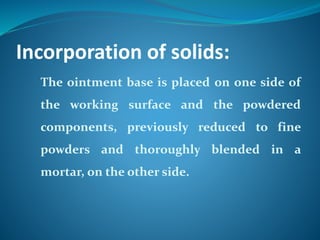
Incorporation of solids:
The ointment base is placed on one side of
the working surface and the powdered
components, previously reduced to fine
powders and thoroughly blended in a
mortar, on the other side.
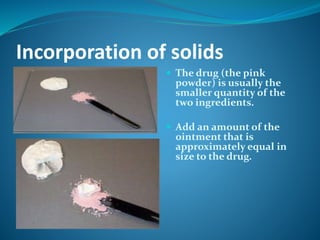
Incorporation of solids
 The drug (the pink
powder) is usually the
smaller quantity of the
two ingredients.
 Add an amount of the
ointment that is
approximately equal in
size to the drug.
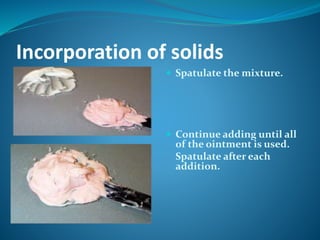
Incorporation of solids
 Spatulate the mixture.
 Continue adding until all
of the ointment is used.
Spatulate after each
addition.
Incorporation of Liquids
• Liquid substances are added to an ointment after consideration of an
ointment bases capacity to accept the volume required.
• Small amount of an aqueous solution may be incorporated into an
oleaginous ointment
• Hydrophilic ointment bases readily accept aqueous solution. Addition of
aqueous preparation to a hydrophobic base
• First the aqueous solution incorporated into a small amount of a
hydrophilic base.
• Second that mixture then added to the hydrophobic abase.
Fusion Method
 Fusion is the act or procedure of liquefying or
melting by the application of heat.
 By the fusion method, all or some of the components
of an ointment are combined by melted together
and cooled with constant stirring until congealed.
 Heat labile substances added last, when the
temperature of the mixture is low enough not to
cause decomposition of the ingredients.
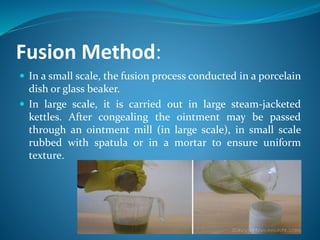
Fusion Method:
 In a small scale, the fusion process conducted in a porcelain
dish or glass beaker.
 In large scale, it is carried out in large steam-jacketed
kettles. After congealing the ointment may be passed
through an ointment mill (in large scale), in small scale
rubbed with spatula or in a mortar to ensure uniform
texture.
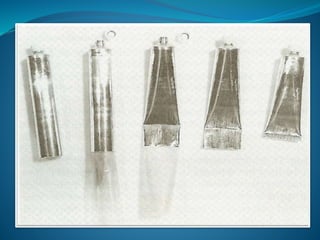
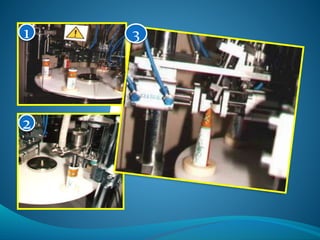
Packaging, storage, and labeling
 In large-mouth ointment jars or in metal or plastic
tubes;
 In well-closed containers to protect against
contamination and in a cool place to protect against
product separation due to heat;
 When required light sensitive preparations are
packaged or light resistant containers.
 In addition to the usual labeling requirements for
pharmaceutical products, the USP directs that the
labeling for certain ointments and creams include
the type of base used (e.g., water-soluble or water-
insoluble).
1
2
3
3
Pharmaceutical Creams:
Creams are semisolid preparations containing
one or more medical agents dissolved or
dispersed in either an oil-in-water emulsion or
in another type of water-washable base.
Many patients and physicians prefer creams to
ointments because they are easier to spread
and remove than many ointments.
Ointment ppt
Ointment ppt

Ointment ppt

  • 2.
    Presented By Qirtas Tauheed(100-E-14) Ointments
  • 3.
  • 4.
    Types of Ointments Medicatedointments Non-medicated ointments
  • 5.
    Medicated ointments These containthe medicament either dissolved or dispersed in the vehicle as fine powders or in the form of micronized powder e.g. o Gentamicin ointment.
  • 6.
    Non medicated ointments Theseare used as vehicles for preparation of medicated ointments or can be used for their physical effects e.g. oSoft Paraffin
  • 7.
    Properties of idealointments Non sensitizing Non irritating Pharmaceutically elegant Efficient release of medicament at the site of application Water -washable
  • 8.
    Ointment Bases Ointment basesare generally classified by the USP into four groups I. Oleaginous bases II. Absorption bases III.Water removable bases IV.Water soluble bases
  • 9.
    1)Oleaginous bases Oleaginous basesare also termed as hydrocarbon bases. On application to the skin emollient effect occlusive dressings protect against the escape of moisture
  • 10.
    Examples of OleaginousBases a)Petrolatum (USP) is a purified mixture of semisolid hydrocarbons obtained from petroleum. A commercial product is Vaseline. b) White Petrolatum(USP) is a purified mixture of semisolid hydrocarbons from petroleum that has been wholly or nearly decolorized.
  • 11.
    c)Yellow ointment (USP) ismixture (1000g) of yellow wax (50g) and petrolatum (950g). d)White ointment (USP) This ointment differs from yellow ointment by substituting white wax and white petrolatum in the formula.
  • 12.
    2) Absorption bases Absorptionbases are of two types: Those that permit the incorporation of aqueous solutions resulting in the formation of water-in-oil emulsions (e.g., hydrophilic petrolatum) Those that are water-in-oil emulsions and permit the incorporation of additional quantities of aqueous solutions (e.g., Lanolin)
  • 13.
    Examples of Absorptionbases a) Hydrophilic petrolatum Hydrophilic petrolatum, USP has the following formula for the preparation of 1000 g: Cholesterol 30 g Stearyl alcohol 30 g White wax 80 g White petrolatum 860 g b) Lanolin  obtained from the wool of sheep;  is a purified, wax-like substance that has been cleaned, deodorized, and decolorized.
  • 14.
    3) Water-removable bases Water-removablebases are oil-in-water emulsions resembling creams in appearance. Because the external phase of the emulsion is aqueous, they are easily washed from skin and are often called ‘water washable’ bases. They may be diluted with water or aqueous solutions e.g. Hydrophilic ointment
  • 15.
    4) Water-soluble bases Water-soluble bases do not contain oleaginous components.  They are completely water-washable and often referred to as ‘greaseless’.  Because they soften greatly with the addition of water, large amounts of aqueous solutions are not effectively incorporated into these bases.  They mostly are used for the incorporation of solid substances. E.g. Polyethylene glycol ointment
  • 16.
    Selection of appropriateBase • Release rate • Topical or percutaneous drug absorption • Occlusion • Stability of drug • Effect of drug on ointment base • Easily removable • Characteristics of surface for application
  • 17.
    Preparation of ointments Ointmentsare prepared by two general methods: - Incorporation - Fusion Incorporation By the incorporation method, the components are mixed until a uniform preparation is attained.
  • 18.
    Incorporation of solids: Theointment base is placed on one side of the working surface and the powdered components, previously reduced to fine powders and thoroughly blended in a mortar, on the other side.
  • 19.
    Incorporation of solids The drug (the pink powder) is usually the smaller quantity of the two ingredients.  Add an amount of the ointment that is approximately equal in size to the drug.
  • 20.
    Incorporation of solids Spatulate the mixture.  Continue adding until all of the ointment is used. Spatulate after each addition.
  • 21.
    Incorporation of Liquids •Liquid substances are added to an ointment after consideration of an ointment bases capacity to accept the volume required. • Small amount of an aqueous solution may be incorporated into an oleaginous ointment • Hydrophilic ointment bases readily accept aqueous solution. Addition of aqueous preparation to a hydrophobic base • First the aqueous solution incorporated into a small amount of a hydrophilic base. • Second that mixture then added to the hydrophobic abase.
  • 22.
    Fusion Method  Fusionis the act or procedure of liquefying or melting by the application of heat.  By the fusion method, all or some of the components of an ointment are combined by melted together and cooled with constant stirring until congealed.  Heat labile substances added last, when the temperature of the mixture is low enough not to cause decomposition of the ingredients.
  • 23.
    Fusion Method:  Ina small scale, the fusion process conducted in a porcelain dish or glass beaker.  In large scale, it is carried out in large steam-jacketed kettles. After congealing the ointment may be passed through an ointment mill (in large scale), in small scale rubbed with spatula or in a mortar to ensure uniform texture.
  • 24.
    Packaging, storage, andlabeling  In large-mouth ointment jars or in metal or plastic tubes;  In well-closed containers to protect against contamination and in a cool place to protect against product separation due to heat;  When required light sensitive preparations are packaged or light resistant containers.  In addition to the usual labeling requirements for pharmaceutical products, the USP directs that the labeling for certain ointments and creams include the type of base used (e.g., water-soluble or water- insoluble).
  • 26.
  • 27.
    Pharmaceutical Creams: Creams aresemisolid preparations containing one or more medical agents dissolved or dispersed in either an oil-in-water emulsion or in another type of water-washable base. Many patients and physicians prefer creams to ointments because they are easier to spread and remove than many ointments.