CONTENT
• DEFINITIONS
• ADVANTAGES
• DISADVANTAGES
• IDEAL PROPERTIES
• TYPES
• BASES USED IN CREAM
• METHOD OF PREPARATION
• FORMULATION
• EVALUATION OF CREAMS
DEFINITIONS
 Creams are homogeneous, semi-solid or viscous
preparations that possess a relatively fluid consistency and
are intended for external application to the skin or certain
mucous membranes for protective, therapeutic or
prophylactic purposes especially where an occlusive effect
is not necessary.
 They are semisolids usually consisting of solutions or
dispersions of one or more medicaments in suitable bases.
 They are formulated using hydrophilic or hydrophobic
bases to provide preparations that are essentially miscible
with the skin secretion.
ADVANTAGES
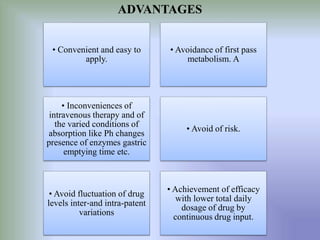
• Avoidance of first pass
metabolism. A
• Convenient and easy to
apply.
• Avoid of risk.
• Inconveniences of
intravenous therapy and of
the varied conditions of
absorption like Ph changes
presence of enzymes gastric
emptying time etc.
• Achievement of efficacy
with lower total daily
dosage of drug by
continuous drug input.
• Avoid fluctuation of drug
levels inter‐and intra-patent
variations
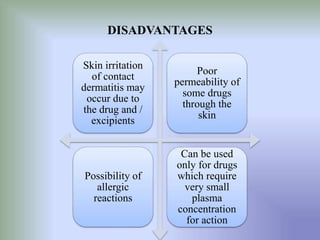
DISADVANTAGES
Skin irritation
of contact
dermatitis may
occur due to
the drug and /
excipients
Poor
permeability of
some drugs
through the
skin
Possibility of
allergic
reactions
Can be used
only for drugs
which require
very small
plasma
concentration
for action
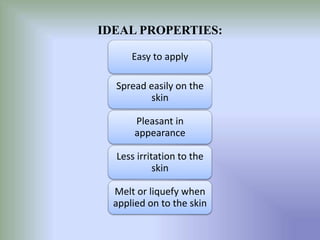
IDEAL PROPERTIES:
Easy to apply
Spread easily on the
skin
Pleasant in
appearance
Less irritation to the
skin
Melt or liquefy when
applied on to the skin
TYPES
• OIL-IN-WATER (O/W) TYPE:
• WATER-IN-OIL (W/O) TYPE:
• COSMETIC CREAMS
• MEDICATED CREAMS
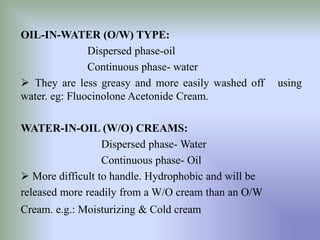
OIL-IN-WATER (O/W) TYPE:
Dispersed phase-oil
Continuous phase- water
 They are less greasy and more easily washed off using
water. eg: Fluocinolone Acetonide Cream.
WATER-IN-OIL (W/O) CREAMS:
Dispersed phase- Water
Continuous phase- Oil
 More difficult to handle. Hydrophobic and will be
released more readily from a W/O cream than an O/W
Cream. e.g.: Moisturizing & Cold cream
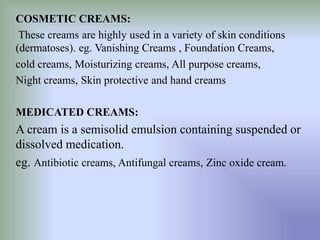
COSMETIC CREAMS:
These creams are highly used in a variety of skin conditions
(dermatoses). eg. Vanishing Creams , Foundation Creams,
cold creams, Moisturizing creams, All purpose creams,
Night creams, Skin protective and hand creams
MEDICATED CREAMS:
A cream is a semisolid emulsion containing suspended or
dissolved medication.
eg. Antibiotic creams, Antifungal creams, Zinc oxide cream.
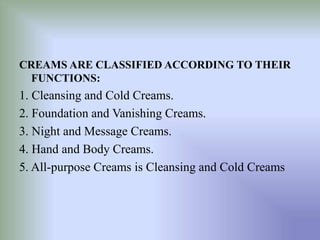
CREAMS ARE CLASSIFIED ACCORDING TO THEIR
FUNCTIONS:
1. Cleansing and Cold Creams.
2. Foundation and Vanishing Creams.
3. Night and Message Creams.
4. Hand and Body Creams.
5. All-purpose Creams is Cleansing and Cold Creams
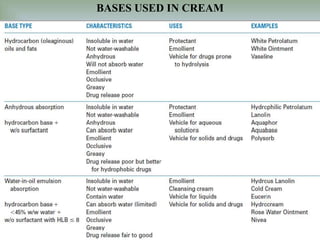
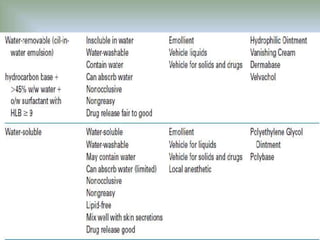
BASES USED IN CREAM
METHOD OF PREPARATION:
TRITURATION:
 Used for finely divided insoluble powder particles
or liquids insoluble powder are added by geometric dilution
Liquids are added by making well in centre.
 Air pocket formation avoided.Involved the use of glass slab
when small quantities are used Mortar and pestle used when
we have large quantities.
LEVIGATION:
Incorporation of insoluble coarse particles.
Also known as “Wet grinding”. Insoluble
coarse powder is rubbed with molten base or
liquid or a semi solid base.
A considerable shearing force is applied to
avoid grittiness.
FUSION METHOD:
 The fusion method is followed when the drugs and
other solid are soluble in the ointment bases. The base is
liquefied and the soluble components are dissolved in the
molten base.
 The congeal mixture is then speculated or triturated to
obtain a smooth texture. Care is taken to avoid thermal
degradation of the base or other components during the
fusion process.
MECHANICALADDITION:
 Water- removable creams are basically hydrophilic
type emulsions.
 A hydrophilic emulsifying agent is included in the
aqueous phase in order to obtain stable oil-in-water
dispersion.
 Sodium lauryl sulfate is used in the preparation of
hydrophilic ointment.
CLEANSING CREAMS:
 They are used for the purpose of removing makeup, surface
grime (layer of dirt on skin) and secretions of skin from the
face and throat respectively.
Cleansing creams are of two types.
They are:
(i) Bees wax-borax type / Emulsified type
(ii) Liquefying type
FORMULATION
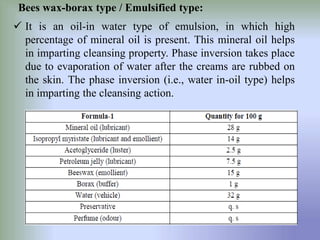
Bees wax-borax type / Emulsified type:
 It is an oil-in water type of emulsion, in which high
percentage of mineral oil is present. This mineral oil helps
in imparting cleansing property. Phase inversion takes place
due to evaporation of water after the creams are rubbed on
the skin. The phase inversion (i.e., water in-oil type) helps
in imparting the cleansing action.
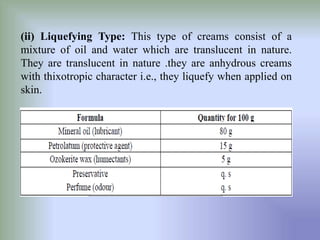
(ii) Liquefying Type: This type of creams consist of a
mixture of oil and water which are translucent in nature.
They are translucent in nature .they are anhydrous creams
with thixotropic character i.e., they liquefy when applied on
skin.
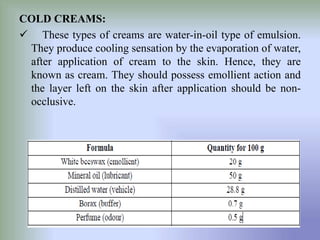
COLD CREAMS:
 These types of creams are water-in-oil type of emulsion.
They produce cooling sensation by the evaporation of water,
after application of cream to the skin. Hence, they are
known as cream. They should possess emollient action and
the layer left on the skin after application should be non-
occlusive.
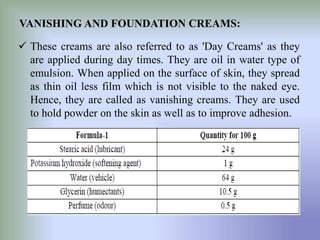
VANISHING AND FOUNDATION CREAMS:
 These creams are also referred to as 'Day Creams' as they
are applied during day times. They are oil in water type of
emulsion. When applied on the surface of skin, they spread
as thin oil less film which is not visible to the naked eye.
Hence, they are called as vanishing creams. They are used
to hold powder on the skin as well as to improve adhesion.
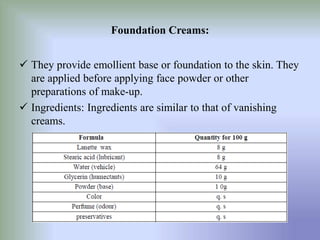
Foundation Creams:
 They provide emollient base or foundation to the skin. They
are applied before applying face powder or other
preparations of make-up.
 Ingredients: Ingredients are similar to that of vanishing
creams.
NIGHT AND MASSAGE CREAMS:
(a) Night Creams: The preparations which are applied during
night time and removed in the morning are called night
creams.
(b) Massage Creams: The preparations which are gently
applied and rubbed on the skin through massage technique are
called massage creams. Skin becomes dry due to the following
reason:
•When stratum corneum is exposed to low humidity, excessive
loss of water takes
place which attributes to dryness of skin.
• When the lower layer of epidermis does not hydrate properly.
• When the skin is in contact with soap or solutions of
detergent for long time.
Hand and Body Creams:
 Due to exposure of skin to water, soaps and detergents
many times a day, removal of lipids and other secretions
from the skin occurs. Cold and dry winds are responsible
for chapping of the skin. Chapping occurs due to loss of
moisture from the skin, which is also associated with
cracking.
 Water is sufficient enough to treat the dryness of the skin,
but evaporation of water takes place rapidly, which
again, makes the skin dry and no emollient effect is
produced.
 In case, if hands are immersed in water for longer
time then abnormal hydration takes place.
 This hydration will lead to swelling of cells in stratum
corneum, which ultimately results in rupturing of cells.
 Hence, hand and body creams are formulated with suitable
emollient, which not only make water available but also
regulates the water take-up by the cells of stratum corneum.
ALL-PURPOSE CREAMS/SPORTS CREAMS:
 These creams are used by sport persons and also by
people who do outdoor activities. Hence, they are called as
sport creams.
 They are oily in nature but non-greasy type.
 They provide protective film to the skin.
 They make the rough surfaces of the skin smooth.
When it is applied in more quantity, it act as
(a) Nourishing agent
(b) Protective cream in order to protect the skin from sunburn.
(c) Night cream.
(d) Cleansing cream
When it is applied in less quantity, it act as
(a) Hand creams
(b) (b) Foundation creams
EVALUATION OF CREAMS
1. Determination of pH
2. Primary skin irritation test:
3. Visual appearance
4. Viscosity in cps v/s shear rate in sec-1.
5. Spreadability
6. Stability studies
7. Reheological studies
8. Thermal behavior
9. Saponification value
10. Acid value
11. In-vitro methods:
(a) Tensile strength tester
(b) Hargen's Gas Bearing Electro dynamometer (GBE)
(c) Occlusive potential of ingredients.
(d) Gravimetric analytical method.
(e) Thermal analytical methods.
(f) Electrical methods.
12. In-vivo methods:
(a) Transpirometry
(b) Scanning electron microscopy (SEM)
(c) Optical microscopy and macro photography.
(d) Skin friction
(e) Sensitivity tests.
• Text book of Cosmetic Formulations: Gaurav Kumar Sharma
Jayesh Gadiya, Meenakshi Dhanawat. P.51-66
• Sarfaraz K. Niazi, “ Handbook of Pharmaceutical
Manufacturing Formulations: Semisolid Products” V-4,
Informa Healthcare, New York, London.
• Tanesh Sahu, Tarun Patel et al., Skin Cream as Topical Drug
Delivery System: A Review . Journal of Pharmaceutical and
Biological Sciences 2016; 4(5): 149-154
• Compounding and Dispensing by john F. Marriot, Keith A.
Wilson Christopher A Langley & Dawn Belcher pg.147-151

CREAMS FORMULATION AND EVALUATION

  • 2.
    CONTENT • DEFINITIONS • ADVANTAGES •DISADVANTAGES • IDEAL PROPERTIES • TYPES • BASES USED IN CREAM • METHOD OF PREPARATION • FORMULATION • EVALUATION OF CREAMS
  • 3.
    DEFINITIONS  Creams arehomogeneous, semi-solid or viscous preparations that possess a relatively fluid consistency and are intended for external application to the skin or certain mucous membranes for protective, therapeutic or prophylactic purposes especially where an occlusive effect is not necessary.  They are semisolids usually consisting of solutions or dispersions of one or more medicaments in suitable bases.  They are formulated using hydrophilic or hydrophobic bases to provide preparations that are essentially miscible with the skin secretion.
  • 4.
    ADVANTAGES • Avoidance offirst pass metabolism. A • Convenient and easy to apply. • Avoid of risk. • Inconveniences of intravenous therapy and of the varied conditions of absorption like Ph changes presence of enzymes gastric emptying time etc. • Achievement of efficacy with lower total daily dosage of drug by continuous drug input. • Avoid fluctuation of drug levels inter‐and intra-patent variations
  • 5.
    DISADVANTAGES Skin irritation of contact dermatitismay occur due to the drug and / excipients Poor permeability of some drugs through the skin Possibility of allergic reactions Can be used only for drugs which require very small plasma concentration for action
  • 6.
    IDEAL PROPERTIES: Easy toapply Spread easily on the skin Pleasant in appearance Less irritation to the skin Melt or liquefy when applied on to the skin
  • 7.
    TYPES • OIL-IN-WATER (O/W)TYPE: • WATER-IN-OIL (W/O) TYPE: • COSMETIC CREAMS • MEDICATED CREAMS
  • 8.
    OIL-IN-WATER (O/W) TYPE: Dispersedphase-oil Continuous phase- water  They are less greasy and more easily washed off using water. eg: Fluocinolone Acetonide Cream. WATER-IN-OIL (W/O) CREAMS: Dispersed phase- Water Continuous phase- Oil  More difficult to handle. Hydrophobic and will be released more readily from a W/O cream than an O/W Cream. e.g.: Moisturizing & Cold cream
  • 9.
    COSMETIC CREAMS: These creamsare highly used in a variety of skin conditions (dermatoses). eg. Vanishing Creams , Foundation Creams, cold creams, Moisturizing creams, All purpose creams, Night creams, Skin protective and hand creams MEDICATED CREAMS: A cream is a semisolid emulsion containing suspended or dissolved medication. eg. Antibiotic creams, Antifungal creams, Zinc oxide cream.
  • 10.
    CREAMS ARE CLASSIFIEDACCORDING TO THEIR FUNCTIONS: 1. Cleansing and Cold Creams. 2. Foundation and Vanishing Creams. 3. Night and Message Creams. 4. Hand and Body Creams. 5. All-purpose Creams is Cleansing and Cold Creams
  • 11.
  • 13.
    METHOD OF PREPARATION: TRITURATION: Used for finely divided insoluble powder particles or liquids insoluble powder are added by geometric dilution Liquids are added by making well in centre.  Air pocket formation avoided.Involved the use of glass slab when small quantities are used Mortar and pestle used when we have large quantities.
  • 14.
    LEVIGATION: Incorporation of insolublecoarse particles. Also known as “Wet grinding”. Insoluble coarse powder is rubbed with molten base or liquid or a semi solid base. A considerable shearing force is applied to avoid grittiness.
  • 15.
    FUSION METHOD:  Thefusion method is followed when the drugs and other solid are soluble in the ointment bases. The base is liquefied and the soluble components are dissolved in the molten base.  The congeal mixture is then speculated or triturated to obtain a smooth texture. Care is taken to avoid thermal degradation of the base or other components during the fusion process.
  • 16.
    MECHANICALADDITION:  Water- removablecreams are basically hydrophilic type emulsions.  A hydrophilic emulsifying agent is included in the aqueous phase in order to obtain stable oil-in-water dispersion.  Sodium lauryl sulfate is used in the preparation of hydrophilic ointment.
  • 17.
    CLEANSING CREAMS:  Theyare used for the purpose of removing makeup, surface grime (layer of dirt on skin) and secretions of skin from the face and throat respectively. Cleansing creams are of two types. They are: (i) Bees wax-borax type / Emulsified type (ii) Liquefying type FORMULATION
  • 18.
    Bees wax-borax type/ Emulsified type:  It is an oil-in water type of emulsion, in which high percentage of mineral oil is present. This mineral oil helps in imparting cleansing property. Phase inversion takes place due to evaporation of water after the creams are rubbed on the skin. The phase inversion (i.e., water in-oil type) helps in imparting the cleansing action.
  • 19.
    (ii) Liquefying Type:This type of creams consist of a mixture of oil and water which are translucent in nature. They are translucent in nature .they are anhydrous creams with thixotropic character i.e., they liquefy when applied on skin.
  • 20.
    COLD CREAMS:  Thesetypes of creams are water-in-oil type of emulsion. They produce cooling sensation by the evaporation of water, after application of cream to the skin. Hence, they are known as cream. They should possess emollient action and the layer left on the skin after application should be non- occlusive.
  • 21.
    VANISHING AND FOUNDATIONCREAMS:  These creams are also referred to as 'Day Creams' as they are applied during day times. They are oil in water type of emulsion. When applied on the surface of skin, they spread as thin oil less film which is not visible to the naked eye. Hence, they are called as vanishing creams. They are used to hold powder on the skin as well as to improve adhesion.
  • 22.
    Foundation Creams:  Theyprovide emollient base or foundation to the skin. They are applied before applying face powder or other preparations of make-up.  Ingredients: Ingredients are similar to that of vanishing creams.
  • 23.
    NIGHT AND MASSAGECREAMS: (a) Night Creams: The preparations which are applied during night time and removed in the morning are called night creams. (b) Massage Creams: The preparations which are gently applied and rubbed on the skin through massage technique are called massage creams. Skin becomes dry due to the following reason: •When stratum corneum is exposed to low humidity, excessive loss of water takes place which attributes to dryness of skin. • When the lower layer of epidermis does not hydrate properly. • When the skin is in contact with soap or solutions of detergent for long time.
  • 24.
    Hand and BodyCreams:  Due to exposure of skin to water, soaps and detergents many times a day, removal of lipids and other secretions from the skin occurs. Cold and dry winds are responsible for chapping of the skin. Chapping occurs due to loss of moisture from the skin, which is also associated with cracking.  Water is sufficient enough to treat the dryness of the skin, but evaporation of water takes place rapidly, which again, makes the skin dry and no emollient effect is produced.  In case, if hands are immersed in water for longer time then abnormal hydration takes place.
  • 25.
     This hydrationwill lead to swelling of cells in stratum corneum, which ultimately results in rupturing of cells.  Hence, hand and body creams are formulated with suitable emollient, which not only make water available but also regulates the water take-up by the cells of stratum corneum.
  • 26.
    ALL-PURPOSE CREAMS/SPORTS CREAMS: These creams are used by sport persons and also by people who do outdoor activities. Hence, they are called as sport creams.  They are oily in nature but non-greasy type.  They provide protective film to the skin.  They make the rough surfaces of the skin smooth.
  • 27.
    When it isapplied in more quantity, it act as (a) Nourishing agent (b) Protective cream in order to protect the skin from sunburn. (c) Night cream. (d) Cleansing cream When it is applied in less quantity, it act as (a) Hand creams (b) (b) Foundation creams
  • 28.
    EVALUATION OF CREAMS 1.Determination of pH 2. Primary skin irritation test: 3. Visual appearance 4. Viscosity in cps v/s shear rate in sec-1. 5. Spreadability 6. Stability studies 7. Reheological studies 8. Thermal behavior 9. Saponification value 10. Acid value
  • 29.
    11. In-vitro methods: (a)Tensile strength tester (b) Hargen's Gas Bearing Electro dynamometer (GBE) (c) Occlusive potential of ingredients. (d) Gravimetric analytical method. (e) Thermal analytical methods. (f) Electrical methods.
  • 30.
    12. In-vivo methods: (a)Transpirometry (b) Scanning electron microscopy (SEM) (c) Optical microscopy and macro photography. (d) Skin friction (e) Sensitivity tests.
  • 31.
    • Text bookof Cosmetic Formulations: Gaurav Kumar Sharma Jayesh Gadiya, Meenakshi Dhanawat. P.51-66 • Sarfaraz K. Niazi, “ Handbook of Pharmaceutical Manufacturing Formulations: Semisolid Products” V-4, Informa Healthcare, New York, London. • Tanesh Sahu, Tarun Patel et al., Skin Cream as Topical Drug Delivery System: A Review . Journal of Pharmaceutical and Biological Sciences 2016; 4(5): 149-154 • Compounding and Dispensing by john F. Marriot, Keith A. Wilson Christopher A Langley & Dawn Belcher pg.147-151