Mr.R.R.Patil
Dr.Shivajirao Kadam College of Pharmacy,
Kasabe digraj, Sangli.
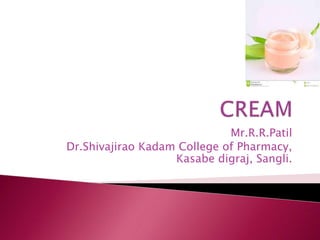
 Creams are defines as “a semisolid dosage
form containing one or more drug substances
dissolved or dispersed in a suitable base”
 Creams are semi-solid emulsions of oil and
water.
 They are of a softer consistency & lighter
body than true ointment.
 semisolid emulsions of either O/W or W/O
type.
 Oil in Water (O/W) Cream
 Water in Oil (W/O) Cream
 oil-in-water (O/W) creams which are composed of small
droplets of oil dispersed in a continuous phase.
 More comfortable and cosmetically acceptable as they are
less greasy and more easily washed off using water.
 Emulsifying agents of natural origins( bees wax, wool
alcohols, wool fat).
 Emollient and creamy, white or translucent and stiff.
 E.g. Vanishing Cream
 water-in-oil (W/O) creams which are composed of
small droplets of water dispersed in a continuous
oily phase.
 More difficult to handle but many drugs which are
incorporated into creams are hydrophobic and will
be released more readily from a W/O cream than
an O/W cream.
 More moisturizing as they provide an oily barrier
which reduces water loss from the stratum
corneum, the outermost layer of the skin.
 e.g. Cold Cream
COSMETIC CREAMS
 All purpose cream, baby cream, barrier cream,
bleaching cream, cleansing cream, cold cream,
hair cream, hand cream, vanishing cream.
MEDICATED CREAMS
Medicated creams are contains active
pharmaceutical ingredients.
 e.g. Cetrimide cream used as antiseptic.
Zinc oxide cream used as astringent.
Hydrocortisone cream - treat rashes like
poison oak or poison ivy

 Preparation of the oil phase: Flake/powder ingredients,
sometimes dry blended in advance, are dispersed into
mineral oil or silicone oil. Heating may be required to
melt some ingredients.
 Hydration of aqueous phase ingredients: Emulsifiers,
thickeners and stabilizers are dispersed into water in a
separate vessel. Heating may be required to accelerate
hydration.
 Forming the Emulsion: The two phases are blended
under vigorous agitation to form the emulsion.
 Dispersion of the Active Ingredient: The active ingredient
often makes up only a small proportion of the
formulation; this must be efficiently dispersed to
maximize yield and product effectiveness.
 They gives prolong contact in their site of
application than any other pharmaceutical semi-
solid dosage forms.
 Injured area can be dried quickly by creams than
other semi-solid preparations.
 Non-irritating when applied to the skin.
 Easily water washable. Easy to wipe away.
 Less greasy compared to ointment.
 Easy to spread on the skin's surface (i.e. easy to
apply).
 Stability is not as good as ointment.
 They are less hydrophobic than other semi-
solid preparation, so risk of contamination is
high than the others.
 It should liquefy at body temperature.
 It should penetrate the epidermis (via natural
opening).
 Its viscosity should be low enough to permit easy
spreading.
 It should be non-toxic.
 It should be non-irritant.
 It should be non-inflammatory.
 pH of the cream
 Viscosity
 Rheological behavioral of the cream
 Determination of type of emulsion
i. Dilution test
ii. Dye solubility test
 The pH of various formulations was determined
by using digital pH meter.
 About 1gm of the cream was weighed and
dissolved in 100 ml of distilled water and stored
for two hours.
 The measurement of pH of each formulation was
done in triplicate and average values were
calculated.
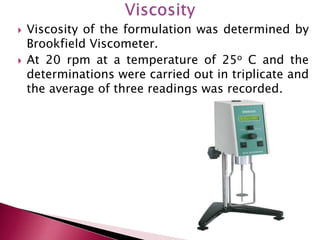
 Viscosity of the formulation was determined by
Brookfield Viscometer.
 At 20 rpm at a temperature of 25o C and the
determinations were carried out in triplicate and
the average of three readings was recorded.
 The rheological property was determined to
know the flow behavior of formulation.
 The viscosity at different rpms was measured
using Brookfield viscometer.
 The rheological behavior of the formulation was
studied by taking 100 g of the cream in the
beaker.
 The rate of shear was increased gradually
from minimum to maximum and
corresponding dial reading was noted; then,
the rate of shear was decreased gradually to
the lowest value and the dial reading was
recorded.
 The graph was plotted between percent
torque and viscosity to determine type of
flow.
 Globule size
 Phase separation
 Moisture absorption studies
 Shelf life
 Spreadability
 1 ml of cream was diluted to 10 ml with
glycerin.
 A few drops of this were transferred onto a
glass slide and was focused in a microscope.
 By using eyepiece micrometer, the diameters
of 200 particles were determined randomly.
 The formulated cream was kept intact in a
closed container at 25 - 300C not exposed to
light.
 Phase separation was observed carefully every
24 hrs for 30 days.
 Any change in phase separation was checked.
 About 50 mg of cream was taken on a watch
glass.
 A beaker was taken with full of water and was
kept in a desiccator without adsorbents.
 Watch glass with cream was
introduced into the desiccator.
 It was left for 24 hrs.
 The formulated product was stored in different
temperature conditions like room temperature,
450 C and 550 C to accelerate degradation for
1 month.
 Samples were withdrawn periodically every week
and observed for drug decomposition by taking
the absorbance under UV spectrophotometer.
 From the concentrations, and the temperatures,
the shelf life of the product can be estimated.
 The Spreadability was expressed in terms of
time in seconds.
 Take two slides to slip off from the cream,
placed in between the slides, under certain load.
 Lesser the time taken for separation of the two
slides, better the Spreadability.
Cream

Cream

  • 1.
    Mr.R.R.Patil Dr.Shivajirao Kadam Collegeof Pharmacy, Kasabe digraj, Sangli.
  • 2.
     Creams aredefines as “a semisolid dosage form containing one or more drug substances dissolved or dispersed in a suitable base”  Creams are semi-solid emulsions of oil and water.  They are of a softer consistency & lighter body than true ointment.  semisolid emulsions of either O/W or W/O type.
  • 3.
     Oil inWater (O/W) Cream  Water in Oil (W/O) Cream
  • 4.
     oil-in-water (O/W)creams which are composed of small droplets of oil dispersed in a continuous phase.  More comfortable and cosmetically acceptable as they are less greasy and more easily washed off using water.  Emulsifying agents of natural origins( bees wax, wool alcohols, wool fat).  Emollient and creamy, white or translucent and stiff.  E.g. Vanishing Cream
  • 5.
     water-in-oil (W/O)creams which are composed of small droplets of water dispersed in a continuous oily phase.  More difficult to handle but many drugs which are incorporated into creams are hydrophobic and will be released more readily from a W/O cream than an O/W cream.  More moisturizing as they provide an oily barrier which reduces water loss from the stratum corneum, the outermost layer of the skin.  e.g. Cold Cream
  • 6.
    COSMETIC CREAMS  Allpurpose cream, baby cream, barrier cream, bleaching cream, cleansing cream, cold cream, hair cream, hand cream, vanishing cream. MEDICATED CREAMS Medicated creams are contains active pharmaceutical ingredients.  e.g. Cetrimide cream used as antiseptic. Zinc oxide cream used as astringent. Hydrocortisone cream - treat rashes like poison oak or poison ivy 
  • 7.
     Preparation ofthe oil phase: Flake/powder ingredients, sometimes dry blended in advance, are dispersed into mineral oil or silicone oil. Heating may be required to melt some ingredients.  Hydration of aqueous phase ingredients: Emulsifiers, thickeners and stabilizers are dispersed into water in a separate vessel. Heating may be required to accelerate hydration.  Forming the Emulsion: The two phases are blended under vigorous agitation to form the emulsion.  Dispersion of the Active Ingredient: The active ingredient often makes up only a small proportion of the formulation; this must be efficiently dispersed to maximize yield and product effectiveness.
  • 8.
     They givesprolong contact in their site of application than any other pharmaceutical semi- solid dosage forms.  Injured area can be dried quickly by creams than other semi-solid preparations.  Non-irritating when applied to the skin.  Easily water washable. Easy to wipe away.  Less greasy compared to ointment.  Easy to spread on the skin's surface (i.e. easy to apply).
  • 9.
     Stability isnot as good as ointment.  They are less hydrophobic than other semi- solid preparation, so risk of contamination is high than the others.
  • 10.
     It shouldliquefy at body temperature.  It should penetrate the epidermis (via natural opening).  Its viscosity should be low enough to permit easy spreading.  It should be non-toxic.  It should be non-irritant.  It should be non-inflammatory.
  • 11.
     pH ofthe cream  Viscosity  Rheological behavioral of the cream  Determination of type of emulsion i. Dilution test ii. Dye solubility test
  • 12.
     The pHof various formulations was determined by using digital pH meter.  About 1gm of the cream was weighed and dissolved in 100 ml of distilled water and stored for two hours.  The measurement of pH of each formulation was done in triplicate and average values were calculated.
  • 13.
     Viscosity ofthe formulation was determined by Brookfield Viscometer.  At 20 rpm at a temperature of 25o C and the determinations were carried out in triplicate and the average of three readings was recorded.
  • 14.
     The rheologicalproperty was determined to know the flow behavior of formulation.  The viscosity at different rpms was measured using Brookfield viscometer.  The rheological behavior of the formulation was studied by taking 100 g of the cream in the beaker.
  • 15.
     The rateof shear was increased gradually from minimum to maximum and corresponding dial reading was noted; then, the rate of shear was decreased gradually to the lowest value and the dial reading was recorded.  The graph was plotted between percent torque and viscosity to determine type of flow.
  • 16.
     Globule size Phase separation  Moisture absorption studies  Shelf life  Spreadability
  • 17.
     1 mlof cream was diluted to 10 ml with glycerin.  A few drops of this were transferred onto a glass slide and was focused in a microscope.  By using eyepiece micrometer, the diameters of 200 particles were determined randomly.
  • 18.
     The formulatedcream was kept intact in a closed container at 25 - 300C not exposed to light.  Phase separation was observed carefully every 24 hrs for 30 days.  Any change in phase separation was checked.
  • 19.
     About 50mg of cream was taken on a watch glass.  A beaker was taken with full of water and was kept in a desiccator without adsorbents.  Watch glass with cream was introduced into the desiccator.  It was left for 24 hrs.
  • 20.
     The formulatedproduct was stored in different temperature conditions like room temperature, 450 C and 550 C to accelerate degradation for 1 month.  Samples were withdrawn periodically every week and observed for drug decomposition by taking the absorbance under UV spectrophotometer.  From the concentrations, and the temperatures, the shelf life of the product can be estimated.
  • 21.
     The Spreadabilitywas expressed in terms of time in seconds.  Take two slides to slip off from the cream, placed in between the slides, under certain load.  Lesser the time taken for separation of the two slides, better the Spreadability.