SIMULATION USING MATLAB
2-Dimensional Wave Equation
• Ahmed Hashem
• Ahmed Radwan
• Amr Mousa
• Hazem Hamdy
• Yomna Hamza
BY
• Our Goal
• Wave Equation (Analytical
Solution)
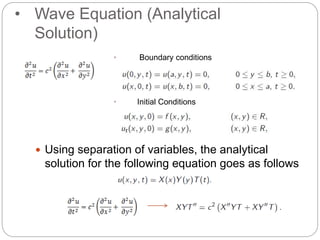
• Boundary conditions
• Initial Conditions
 Using separation of variables, the analytical
solution for the following equation goes as follows
 Dividing both sides by X(x)Y(y)T(t):
• Wave Equation (Analytical
Solution)
 The boundary conditions become:
 Using the conditions and solving for X(x) and
Y(y), we get the non-trivial solutions
(eigenfunctions)
with eigenvalues
• Wave Equation (Analytical
Solution)
 Solving for T(t), where
((eigenvalues)
 Our final solution becomes,
• Wave Equation (Analytical
Solution)
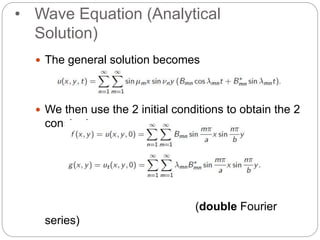
 The general solution becomes
 We then use the 2 initial conditions to obtain the 2
constants
(double Fourier
series)
• Wave Equation (Analytical
Solution)
 Using orthogonality,
• Wave Equation (Analytical
Solution)
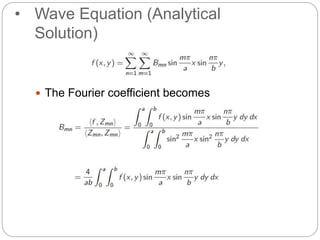
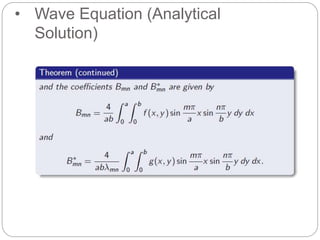
 The Fourier coefficient becomes
• Wave Equation (Analytical
Solution)
 The general solution of the two dimensional wave
equation is then given by the following theorem:
• Wave Equation (Analytical
Solution)
• Wave Equation (Analytical
Solution)
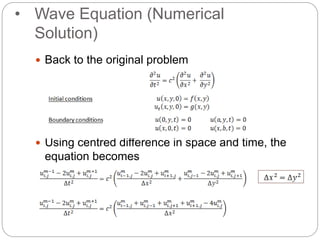
 Back to the original problem
 Using centred difference in space and time, the
equation becomes
• Wave Equation (Numerical
Solution)
 Isolating the term that marches in time, we get
• Wave Equation (Numerical
Solution)
 Stability condition (where c2 =1) :
By optimizing the problem : Cmax was found to
equal 1
 Expressing the boundary conditions using our
new notation, we get:
 Starting from m=2, we iterate for every i and j in
our mesh
 Now, we code!
• Wave Equation (Numerical
Solution)
NOW, Let’s test the
program
References
 Daileda, R. (2012, March 1). The two
dimensional wave equation. Lecture
presented at Partial Differential Equations in
Trinity University, San Antonio, Texas.
 Haberman, R. (n.d.). Finite Difference
Numerical Methods for Partial Differential
Equations. In Applied Partial Differential
Equations (Fifth ed.). Pearson.

2 Dimensional Wave Equation Analytical and Numerical Solution

  • 1.
    SIMULATION USING MATLAB 2-DimensionalWave Equation • Ahmed Hashem • Ahmed Radwan • Amr Mousa • Hazem Hamdy • Yomna Hamza BY
  • 2.
  • 3.
    • Wave Equation(Analytical Solution) • Boundary conditions • Initial Conditions  Using separation of variables, the analytical solution for the following equation goes as follows
  • 4.
     Dividing bothsides by X(x)Y(y)T(t): • Wave Equation (Analytical Solution)
  • 5.
     The boundaryconditions become:  Using the conditions and solving for X(x) and Y(y), we get the non-trivial solutions (eigenfunctions) with eigenvalues • Wave Equation (Analytical Solution)
  • 6.
     Solving forT(t), where ((eigenvalues)  Our final solution becomes, • Wave Equation (Analytical Solution)
  • 7.
     The generalsolution becomes  We then use the 2 initial conditions to obtain the 2 constants (double Fourier series) • Wave Equation (Analytical Solution)
  • 8.
     Using orthogonality, •Wave Equation (Analytical Solution)
  • 9.
     The Fouriercoefficient becomes • Wave Equation (Analytical Solution)
  • 10.
     The generalsolution of the two dimensional wave equation is then given by the following theorem: • Wave Equation (Analytical Solution)
  • 11.
    • Wave Equation(Analytical Solution)
  • 12.
     Back tothe original problem  Using centred difference in space and time, the equation becomes • Wave Equation (Numerical Solution)
  • 13.
     Isolating theterm that marches in time, we get • Wave Equation (Numerical Solution)  Stability condition (where c2 =1) : By optimizing the problem : Cmax was found to equal 1
  • 14.
     Expressing theboundary conditions using our new notation, we get:  Starting from m=2, we iterate for every i and j in our mesh  Now, we code! • Wave Equation (Numerical Solution)
  • 15.
    NOW, Let’s testthe program
  • 16.
    References  Daileda, R.(2012, March 1). The two dimensional wave equation. Lecture presented at Partial Differential Equations in Trinity University, San Antonio, Texas.  Haberman, R. (n.d.). Finite Difference Numerical Methods for Partial Differential Equations. In Applied Partial Differential Equations (Fifth ed.). Pearson.