Fractional Calculus
Fractional Partial Differential Equations
Finite Difference Approximation
Finite Difference Method
for Two Sided Space Fractional
Partial Differential Equations
Divyansh Verma - SAU/AM(M)/2014/14
Ajay Gupta - SAU/AM(M)/2014/20
South Asian University
Supervisor : Prof. Siraj-ul-Islam
November 24, 2015
Divyansh Verma | Ajay Gupta FPDE
Fractional Calculus
Fractional Partial Differential Equations
Finite Difference Approximation
Overview
1 Fractional Calculus
History of Frational Calculus
Applications of Fractional PDE
Objective
2 Fractional Partial Differential Equations
Fractional Partial Differential Equations
Riemann-Liouville Fractional Derivative
Gr¨unwald Definition for Fractional Derivative
Shifted Gr¨unwald Formula/Estimate
3 Finite Difference Approximation
Approximating one-sided Fractional PDE
Stability Analysis
Approximating two-sided Fractional PDE
Stability Analysis
Divyansh Verma | Ajay Gupta FPDE
Fractional Calculus
Fractional Partial Differential Equations
Finite Difference Approximation
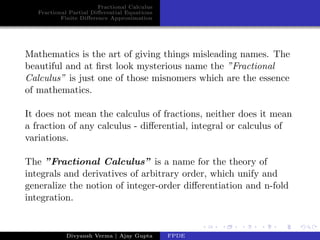
Mathematics is the art of giving things misleading names. The
beautiful and at first look mysterious name the ”Fractional
Calculus” is just one of those misnomers which are the essence
of mathematics.
It does not mean the calculus of fractions, neither does it mean
a fraction of any calculus - differential, integral or calculus of
variations.
The ”Fractional Calculus” is a name for the theory of
integrals and derivatives of arbitrary order, which unify and
generalize the notion of integer-order differentiation and n-fold
integration.
Divyansh Verma | Ajay Gupta FPDE
Fractional Calculus
Fractional Partial Differential Equations
Finite Difference Approximation
History of Frational Calculus
Applications of Fractional PDE
Objective
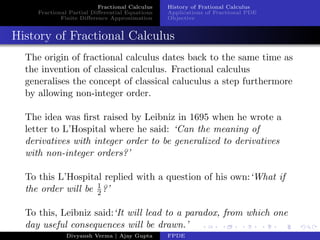
History of Fractional Calculus
The origin of fractional calculus dates back to the same time as
the invention of classical calculus. Fractional calculus
generalises the concept of classical caluculus a step furthermore
by allowing non-integer order.
The idea was first raised by Leibniz in 1695 when he wrote a
letter to L’Hospital where he said: ‘Can the meaning of
derivatives with integer order to be generalized to derivatives
with non-integer orders?’
To this L’Hospital replied with a question of his own:‘What if
the order will be 1
2?’
To this, Leibniz said:‘It will lead to a paradox, from which one
day useful consequences will be drawn.’
Divyansh Verma | Ajay Gupta FPDE
Fractional Calculus
Fractional Partial Differential Equations
Finite Difference Approximation
History of Frational Calculus
Applications of Fractional PDE
Objective
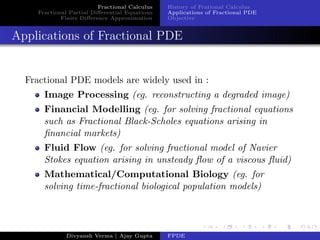
Applications of Fractional PDE
Fractional PDE models are widely used in :
Image Processing (eg. reconstructing a degraded image)
Financial Modelling (eg. for solving fractional equations
such as Fractional Black-Scholes equations arising in
financial markets)
Fluid Flow (eg. for solving fractional model of Navier
Stokes equation arising in unsteady flow of a viscous fluid)
Mathematical/Computational Biology (eg. for
solving time-fractional biological population models)
Divyansh Verma | Ajay Gupta FPDE
Fractional Calculus
Fractional Partial Differential Equations
Finite Difference Approximation
History of Frational Calculus
Applications of Fractional PDE
Objective
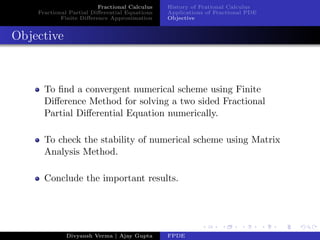
Objective
To find a convergent numerical scheme using Finite
Difference Method for solving a two sided Fractional
Partial Differential Equation numerically.
To check the stability of numerical scheme using Matrix
Analysis Method.
Conclude the important results.
Divyansh Verma | Ajay Gupta FPDE
Fractional Calculus
Fractional Partial Differential Equations
Finite Difference Approximation
Fractional Partial Differential Equations
Riemann-Liouville Fractional Derivative
Gr¨unwald Definition for Fractional Derivative
Shifted Gr¨unwald Formula/Estimate
Fractional Partial Differential Equations
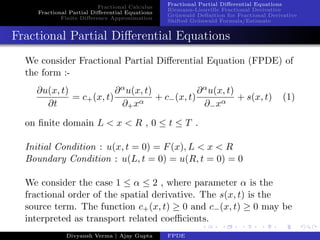
We consider Fractional Partial Differential Equation (FPDE) of
the form :-
∂u(x, t)
∂t
= c+(x, t)
∂αu(x, t)
∂+xα
+ c−(x, t)
∂αu(x, t)
∂−xα
+ s(x, t) (1)
on finite domain L < x < R , 0 ≤ t ≤ T .
Initial Condition : u(x, t = 0) = F(x), L < x < R
Boundary Condition : u(L, t = 0) = u(R, t = 0) = 0
We consider the case 1 ≤ α ≤ 2 , where parameter α is the
fractional order of the spatial derivative. The s(x, t) is the
source term. The function c+(x, t) ≥ 0 and c−(x, t) ≥ 0 may be
interpreted as transport related coefficients.
Divyansh Verma | Ajay Gupta FPDE
Fractional Calculus
Fractional Partial Differential Equations
Finite Difference Approximation
Fractional Partial Differential Equations
Riemann-Liouville Fractional Derivative
Gr¨unwald Definition for Fractional Derivative
Shifted Gr¨unwald Formula/Estimate
Riemann-Liouville Fractional Derivatives
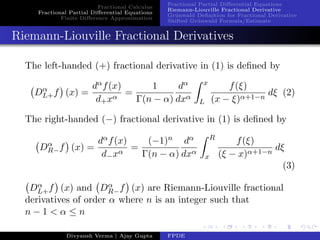
The left-handed (+) fractional derivative in (1) is defined by
Dα
L+f (x) =
dαf(x)
d+xα
=
1
Γ(n − α)
dα
dxα
x
L
f(ξ)
(x − ξ)α+1−n
dξ (2)
The right-handed (−) fractional derivative in (1) is defined by
Dα
R−f (x) =
dαf(x)
d−xα
=
(−1)n
Γ(n − α)
dα
dxα
R
x
f(ξ)
(ξ − x)α+1−n
dξ
(3)
Dα
L+f (x) and Dα
R−f (x) are Riemann-Liouville fractional
derivatives of order α where n is an integer such that
n − 1 < α ≤ n
Divyansh Verma | Ajay Gupta FPDE
Fractional Calculus
Fractional Partial Differential Equations
Finite Difference Approximation
Fractional Partial Differential Equations
Riemann-Liouville Fractional Derivative
Gr¨unwald Definition for Fractional Derivative
Shifted Gr¨unwald Formula/Estimate
Riemann-Liouville Fractional Derivatives
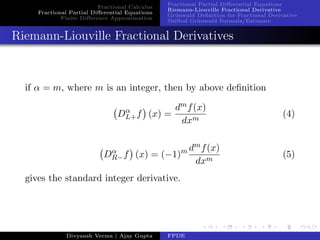
if α = m, where m is an integer, then by above definition
Dα
L+f (x) =
dmf(x)
dxm
(4)
Dα
R−f (x) = (−1)m dmf(x)
dxm
(5)
gives the standard integer derivative.
Divyansh Verma | Ajay Gupta FPDE
Fractional Calculus
Fractional Partial Differential Equations
Finite Difference Approximation
Fractional Partial Differential Equations
Riemann-Liouville Fractional Derivative
Gr¨unwald Definition for Fractional Derivative
Shifted Gr¨unwald Formula/Estimate
Riemann-Liouville Fractional Derivatives
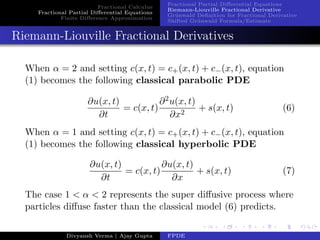
When α = 2 and setting c(x, t) = c+(x, t) + c−(x, t), equation
(1) becomes the following classical parabolic PDE
∂u(x, t)
∂t
= c(x, t)
∂2u(x, t)
∂x2
+ s(x, t) (6)
When α = 1 and setting c(x, t) = c+(x, t) + c−(x, t), equation
(1) becomes the following classical hyperbolic PDE
∂u(x, t)
∂t
= c(x, t)
∂u(x, t)
∂x
+ s(x, t) (7)
The case 1 < α < 2 represents the super diffusive process where
particles diffuse faster than the classical model (6) predicts.
Divyansh Verma | Ajay Gupta FPDE
Fractional Calculus
Fractional Partial Differential Equations
Finite Difference Approximation
Fractional Partial Differential Equations
Riemann-Liouville Fractional Derivative
Gr¨unwald Definition for Fractional Derivative
Shifted Gr¨unwald Formula/Estimate
Gr¨unwald Discretization for Fractional Derivative
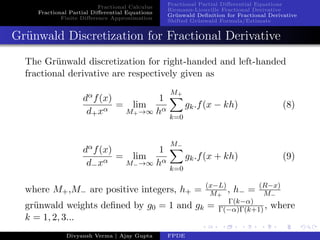
The Gr¨unwald discretization for right-handed and left-handed
fractional derivative are respectively given as
dαf(x)
d+xα
= lim
M+→∞
1
hα
M+
k=0
gk.f(x − kh) (8)
dαf(x)
d−xα
= lim
M−→∞
1
hα
M−
k=0
gk.f(x + kh) (9)
where M+,M− are positive integers, h+ = (x−L)
M+
, h− = (R−x)
M−
gr¨unwald weights defined by g0 = 1 and gk = Γ(k−α)
Γ(−α)Γ(k+1), where
k = 1, 2, 3...
Divyansh Verma | Ajay Gupta FPDE
Fractional Calculus
Fractional Partial Differential Equations
Finite Difference Approximation
Fractional Partial Differential Equations
Riemann-Liouville Fractional Derivative
Gr¨unwald Definition for Fractional Derivative
Shifted Gr¨unwald Formula/Estimate
We define shifted Gr¨unwald formula as
dαf(x)
d+xα
= lim
M+→∞
1
hα
M+
k=0
gk.f[x − (k − 1)h] (10)
dαf(x)
d−xα
= lim
M−→∞
1
hα
M−
k=0
gk.f[x + (k − 1)h] (11)
which defines the following shifted Gr¨unwald estimates resp.
dαf(x)
d+xα
=
1
hα
M+
k=0
gk.f[x − (k − 1)h] + O(h) (12)
dαf(x)
d−xα
=
1
hα
M−
k=0
gk.f[x + (k − 1)h] + O(h) (13)
Divyansh Verma | Ajay Gupta FPDE
Fractional Calculus
Fractional Partial Differential Equations
Finite Difference Approximation
Approximating one-sided Fractional PDE
Stability Analysis
Approximating two-sided Fractional PDE
Stability Analysis
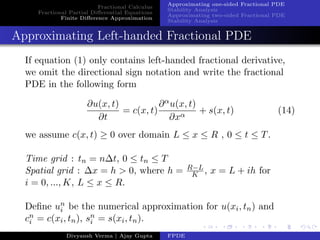
Approximating Left-handed Fractional PDE
If equation (1) only contains left-handed fractional derivative,
we omit the directional sign notation and write the fractional
PDE in the following form
∂u(x, t)
∂t
= c(x, t)
∂αu(x, t)
∂xα
+ s(x, t) (14)
we assume c(x, t) ≥ 0 over domain L ≤ x ≤ R , 0 ≤ t ≤ T.
Time grid : tn = n∆t, 0 ≤ tn ≤ T
Spatial grid : ∆x = h > 0, where h = R−L
K , x = L + ih for
i = 0, ..., K, L ≤ x ≤ R.
Define un
i be the numerical approximation for u(xi, tn) and
cn
i = c(xi, tn), sn
i = s(xi, tn).
Divyansh Verma | Ajay Gupta FPDE
Fractional Calculus
Fractional Partial Differential Equations
Finite Difference Approximation
Approximating one-sided Fractional PDE
Stability Analysis
Approximating two-sided Fractional PDE
Stability Analysis
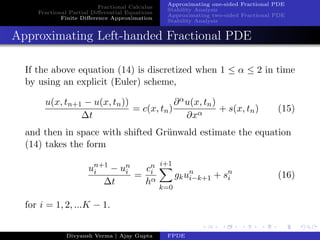
Approximating Left-handed Fractional PDE
If the above equation (14) is discretized when 1 ≤ α ≤ 2 in time
by using an explicit (Euler) scheme,
u(x, tn+1 − u(x, tn))
∆t
= c(x, tn)
∂αu(x, tn)
∂xα
+ s(x, tn) (15)
and then in space with shifted Gr¨unwald estimate the equation
(14) takes the form
un+1
i − un
i
∆t
=
cn
i
hα
i+1
k=0
gkun
i−k+1 + sn
i (16)
for i = 1, 2, ...K − 1.
Divyansh Verma | Ajay Gupta FPDE
Fractional Calculus
Fractional Partial Differential Equations
Finite Difference Approximation
Approximating one-sided Fractional PDE
Stability Analysis
Approximating two-sided Fractional PDE
Stability Analysis
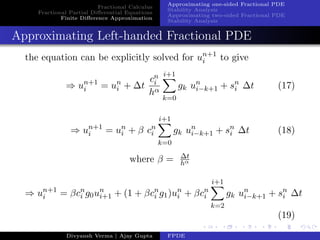
Approximating Left-handed Fractional PDE
the equation can be explicitly solved for un+1
i to give
⇒ un+1
i = un
i + ∆t
cn
i
hα
i+1
k=0
gk un
i−k+1 + sn
i ∆t (17)
⇒ un+1
i = un
i + β cn
i
i+1
k=0
gk un
i−k+1 + sn
i ∆t (18)
where β = ∆t
hα
⇒ un+1
i = βcn
i g0un
i+1 + (1 + βcn
i g1)un
i + βcn
i
i+1
k=2
gk un
i−k+1 + sn
i ∆t
(19)
Divyansh Verma | Ajay Gupta FPDE
Fractional Calculus
Fractional Partial Differential Equations
Finite Difference Approximation
Approximating one-sided Fractional PDE
Stability Analysis
Approximating two-sided Fractional PDE
Stability Analysis
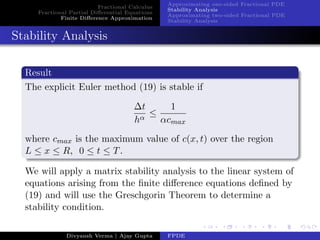
Stability Analysis
Result
The explicit Euler method (19) is stable if
∆t
hα
≤
1
αcmax
where cmax is the maximum value of c(x, t) over the region
L ≤ x ≤ R, 0 ≤ t ≤ T.
We will apply a matrix stability analysis to the linear system of
equations arising from the finite difference equations defined by
(19) and will use the Greschgorin Theorem to determine a
stability condition.
Divyansh Verma | Ajay Gupta FPDE
Fractional Calculus
Fractional Partial Differential Equations
Finite Difference Approximation
Approximating one-sided Fractional PDE
Stability Analysis
Approximating two-sided Fractional PDE
Stability Analysis
Stability Analysis
The difference equations defined by (19), together with the
Dirichlet boundary conditions, result in a linear system of
equations of the form
Un+1
= A Un
+ ∆t Sn
(20)
where Un
= [un
0 , un
1 , un
2 , ..., un
K]T , Sn
= [0, sn
0 , sn
1 , sn
2 , ..., sn
K−1, 0]T
and A is the matrix of coefficients, and is the sum of a lower
triangular matrix and a superdiagonal matrix. The matrix
entries Ai,j for i = 1, ..., K − 1 and j = 1, ..., K − 1
Ai,j = 0 , when j ≥ i + 2
= 1 + g1 β cn
i , when j = i
= gi−j+1 β cn
i , when otherwise
Divyansh Verma | Ajay Gupta FPDE
Fractional Calculus
Fractional Partial Differential Equations
Finite Difference Approximation
Approximating one-sided Fractional PDE
Stability Analysis
Approximating two-sided Fractional PDE
Stability Analysis
Stability Analysis
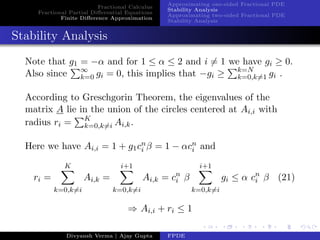
Note that g1 = −α and for 1 ≤ α ≤ 2 and i = 1 we have gi ≥ 0.
Also since ∞
k=0 gi = 0, this implies that −gi ≥ k=N
k=0,k=1 gi .
According to Greschgorin Theorem, the eigenvalues of the
matrix A lie in the union of the circles centered at Ai,i with
radius ri = K
k=0,k=i Ai,k.
Here we have Ai,i = 1 + g1cn
i β = 1 − αcn
i and
ri =
K
k=0,k=i
Ai,k =
i+1
k=0,k=i
Ai,k = cn
i β
i+1
k=0,k=i
gi ≤ α cn
i β (21)
⇒ Ai,i + ri ≤ 1
Divyansh Verma | Ajay Gupta FPDE
Fractional Calculus
Fractional Partial Differential Equations
Finite Difference Approximation
Approximating one-sided Fractional PDE
Stability Analysis
Approximating two-sided Fractional PDE
Stability Analysis
Stability Analysis
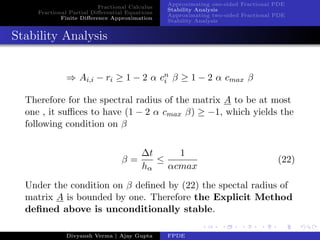
⇒ Ai,i − ri ≥ 1 − 2 α cn
i β ≥ 1 − 2 α cmax β
Therefore for the spectral radius of the matrix A to be at most
one , it suffices to have (1 − 2 α cmax β) ≥ −1, which yields the
following condition on β
β =
∆t
hα
≤
1
αcmax
(22)
Under the condition on β defined by (22) the spectal radius of
matrix A is bounded by one. Therefore the Explicit Method
defined above is unconditionally stable.
Divyansh Verma | Ajay Gupta FPDE
Fractional Calculus
Fractional Partial Differential Equations
Finite Difference Approximation
Approximating one-sided Fractional PDE
Stability Analysis
Approximating two-sided Fractional PDE
Stability Analysis
Approximating two-sided Fractional PDE
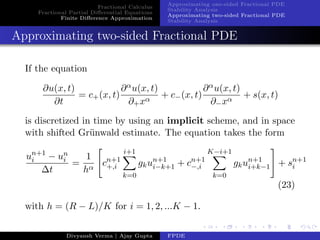
If the equation
∂u(x, t)
∂t
= c+(x, t)
∂αu(x, t)
∂+xα
+ c−(x, t)
∂αu(x, t)
∂−xα
+ s(x, t)
is discretized in time by using an implicit scheme, and in space
with shifted Gr¨unwald estimate. The equation takes the form
un+1
i − un
i
∆t
=
1
hα
cn+1
+,i
i+1
k=0
gkun+1
i−k+1 + cn+1
−,i
K−i+1
k=0
gkun+1
i+k−1 + sn+1
i
(23)
with h = (R − L)/K for i = 1, 2, ...K − 1.
Divyansh Verma | Ajay Gupta FPDE
Fractional Calculus
Fractional Partial Differential Equations
Finite Difference Approximation
Approximating one-sided Fractional PDE
Stability Analysis
Approximating two-sided Fractional PDE
Stability Analysis
Approximating two-sided Fractional PDE
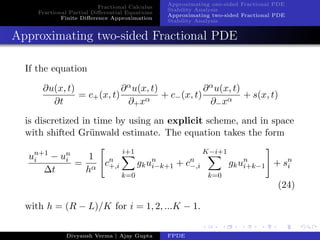
If the equation
∂u(x, t)
∂t
= c+(x, t)
∂αu(x, t)
∂+xα
+ c−(x, t)
∂αu(x, t)
∂−xα
+ s(x, t)
is discretized in time by using an explicit scheme, and in space
with shifted Gr¨unwald estimate. The equation takes the form
un+1
i − un
i
∆t
=
1
hα
cn
+,i
i+1
k=0
gkun
i−k+1 + cn
−,i
K−i+1
k=0
gkun
i+k−1 + sn
i
(24)
with h = (R − L)/K for i = 1, 2, ...K − 1.
Divyansh Verma | Ajay Gupta FPDE
Fractional Calculus
Fractional Partial Differential Equations
Finite Difference Approximation
Approximating one-sided Fractional PDE
Stability Analysis
Approximating two-sided Fractional PDE
Stability Analysis
Stability Analysis
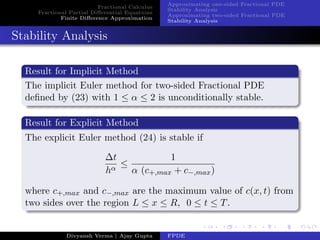
Result for Implicit Method
The implicit Euler method for two-sided Fractional PDE
defined by (23) with 1 ≤ α ≤ 2 is unconditionally stable.
Result for Explicit Method
The explicit Euler method (24) is stable if
∆t
hα
≤
1
α (c+,max + c−,max)
where c+,max and c−,max are the maximum value of c(x, t) from
two sides over the region L ≤ x ≤ R, 0 ≤ t ≤ T.
Divyansh Verma | Ajay Gupta FPDE
Fractional Calculus
Fractional Partial Differential Equations
Finite Difference Approximation
Approximating one-sided Fractional PDE
Stability Analysis
Approximating two-sided Fractional PDE
Stability Analysis
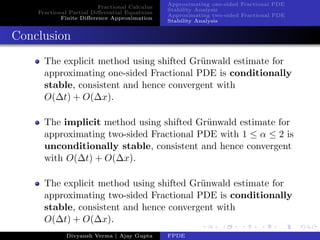
Conclusion
The explicit method using shifted Gr¨unwald estimate for
approximating one-sided Fractional PDE is conditionally
stable, consistent and hence convergent with
O(∆t) + O(∆x).
The implicit method using shifted Gr¨unwald estimate for
approximating two-sided Fractional PDE with 1 ≤ α ≤ 2 is
unconditionally stable, consistent and hence convergent
with O(∆t) + O(∆x).
The explicit method using shifted Gr¨unwald estimate for
approximating two-sided Fractional PDE is conditionally
stable, consistent and hence convergent with
O(∆t) + O(∆x).
Divyansh Verma | Ajay Gupta FPDE
Fractional Calculus
Fractional Partial Differential Equations
Finite Difference Approximation
Approximating one-sided Fractional PDE
Stability Analysis
Approximating two-sided Fractional PDE
Stability Analysis
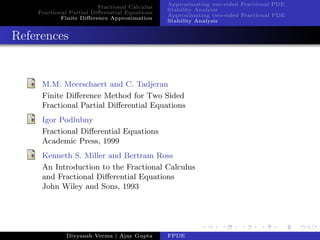
References
M.M. Meerschaert and C. Tadjeran
Finite Difference Method for Two Sided
Fractional Partial Differential Equations
Igor Podlubny
Fractional Differential Equations
Academic Press, 1999
Kenneth S. Miller and Bertram Ross
An Introduction to the Fractional Calculus
and Fractional Differential Equations
John Wiley and Sons, 1993
Divyansh Verma | Ajay Gupta FPDE
Fractional Calculus
Fractional Partial Differential Equations
Finite Difference Approximation
Approximating one-sided Fractional PDE
Stability Analysis
Approximating two-sided Fractional PDE
Stability Analysis
The End
Divyansh Verma | Ajay Gupta FPDE

FPDE presentation

  • 1.
    Fractional Calculus Fractional PartialDifferential Equations Finite Difference Approximation Finite Difference Method for Two Sided Space Fractional Partial Differential Equations Divyansh Verma - SAU/AM(M)/2014/14 Ajay Gupta - SAU/AM(M)/2014/20 South Asian University Supervisor : Prof. Siraj-ul-Islam November 24, 2015 Divyansh Verma | Ajay Gupta FPDE
  • 2.
    Fractional Calculus Fractional PartialDifferential Equations Finite Difference Approximation Overview 1 Fractional Calculus History of Frational Calculus Applications of Fractional PDE Objective 2 Fractional Partial Differential Equations Fractional Partial Differential Equations Riemann-Liouville Fractional Derivative Gr¨unwald Definition for Fractional Derivative Shifted Gr¨unwald Formula/Estimate 3 Finite Difference Approximation Approximating one-sided Fractional PDE Stability Analysis Approximating two-sided Fractional PDE Stability Analysis Divyansh Verma | Ajay Gupta FPDE
  • 3.
    Fractional Calculus Fractional PartialDifferential Equations Finite Difference Approximation Mathematics is the art of giving things misleading names. The beautiful and at first look mysterious name the ”Fractional Calculus” is just one of those misnomers which are the essence of mathematics. It does not mean the calculus of fractions, neither does it mean a fraction of any calculus - differential, integral or calculus of variations. The ”Fractional Calculus” is a name for the theory of integrals and derivatives of arbitrary order, which unify and generalize the notion of integer-order differentiation and n-fold integration. Divyansh Verma | Ajay Gupta FPDE
  • 4.
    Fractional Calculus Fractional PartialDifferential Equations Finite Difference Approximation History of Frational Calculus Applications of Fractional PDE Objective History of Fractional Calculus The origin of fractional calculus dates back to the same time as the invention of classical calculus. Fractional calculus generalises the concept of classical caluculus a step furthermore by allowing non-integer order. The idea was first raised by Leibniz in 1695 when he wrote a letter to L’Hospital where he said: ‘Can the meaning of derivatives with integer order to be generalized to derivatives with non-integer orders?’ To this L’Hospital replied with a question of his own:‘What if the order will be 1 2?’ To this, Leibniz said:‘It will lead to a paradox, from which one day useful consequences will be drawn.’ Divyansh Verma | Ajay Gupta FPDE
  • 5.
    Fractional Calculus Fractional PartialDifferential Equations Finite Difference Approximation History of Frational Calculus Applications of Fractional PDE Objective Applications of Fractional PDE Fractional PDE models are widely used in : Image Processing (eg. reconstructing a degraded image) Financial Modelling (eg. for solving fractional equations such as Fractional Black-Scholes equations arising in financial markets) Fluid Flow (eg. for solving fractional model of Navier Stokes equation arising in unsteady flow of a viscous fluid) Mathematical/Computational Biology (eg. for solving time-fractional biological population models) Divyansh Verma | Ajay Gupta FPDE
  • 6.
    Fractional Calculus Fractional PartialDifferential Equations Finite Difference Approximation History of Frational Calculus Applications of Fractional PDE Objective Objective To find a convergent numerical scheme using Finite Difference Method for solving a two sided Fractional Partial Differential Equation numerically. To check the stability of numerical scheme using Matrix Analysis Method. Conclude the important results. Divyansh Verma | Ajay Gupta FPDE
  • 7.
    Fractional Calculus Fractional PartialDifferential Equations Finite Difference Approximation Fractional Partial Differential Equations Riemann-Liouville Fractional Derivative Gr¨unwald Definition for Fractional Derivative Shifted Gr¨unwald Formula/Estimate Fractional Partial Differential Equations We consider Fractional Partial Differential Equation (FPDE) of the form :- ∂u(x, t) ∂t = c+(x, t) ∂αu(x, t) ∂+xα + c−(x, t) ∂αu(x, t) ∂−xα + s(x, t) (1) on finite domain L < x < R , 0 ≤ t ≤ T . Initial Condition : u(x, t = 0) = F(x), L < x < R Boundary Condition : u(L, t = 0) = u(R, t = 0) = 0 We consider the case 1 ≤ α ≤ 2 , where parameter α is the fractional order of the spatial derivative. The s(x, t) is the source term. The function c+(x, t) ≥ 0 and c−(x, t) ≥ 0 may be interpreted as transport related coefficients. Divyansh Verma | Ajay Gupta FPDE
  • 8.
    Fractional Calculus Fractional PartialDifferential Equations Finite Difference Approximation Fractional Partial Differential Equations Riemann-Liouville Fractional Derivative Gr¨unwald Definition for Fractional Derivative Shifted Gr¨unwald Formula/Estimate Riemann-Liouville Fractional Derivatives The left-handed (+) fractional derivative in (1) is defined by Dα L+f (x) = dαf(x) d+xα = 1 Γ(n − α) dα dxα x L f(ξ) (x − ξ)α+1−n dξ (2) The right-handed (−) fractional derivative in (1) is defined by Dα R−f (x) = dαf(x) d−xα = (−1)n Γ(n − α) dα dxα R x f(ξ) (ξ − x)α+1−n dξ (3) Dα L+f (x) and Dα R−f (x) are Riemann-Liouville fractional derivatives of order α where n is an integer such that n − 1 < α ≤ n Divyansh Verma | Ajay Gupta FPDE
  • 9.
    Fractional Calculus Fractional PartialDifferential Equations Finite Difference Approximation Fractional Partial Differential Equations Riemann-Liouville Fractional Derivative Gr¨unwald Definition for Fractional Derivative Shifted Gr¨unwald Formula/Estimate Riemann-Liouville Fractional Derivatives if α = m, where m is an integer, then by above definition Dα L+f (x) = dmf(x) dxm (4) Dα R−f (x) = (−1)m dmf(x) dxm (5) gives the standard integer derivative. Divyansh Verma | Ajay Gupta FPDE
  • 10.
    Fractional Calculus Fractional PartialDifferential Equations Finite Difference Approximation Fractional Partial Differential Equations Riemann-Liouville Fractional Derivative Gr¨unwald Definition for Fractional Derivative Shifted Gr¨unwald Formula/Estimate Riemann-Liouville Fractional Derivatives When α = 2 and setting c(x, t) = c+(x, t) + c−(x, t), equation (1) becomes the following classical parabolic PDE ∂u(x, t) ∂t = c(x, t) ∂2u(x, t) ∂x2 + s(x, t) (6) When α = 1 and setting c(x, t) = c+(x, t) + c−(x, t), equation (1) becomes the following classical hyperbolic PDE ∂u(x, t) ∂t = c(x, t) ∂u(x, t) ∂x + s(x, t) (7) The case 1 < α < 2 represents the super diffusive process where particles diffuse faster than the classical model (6) predicts. Divyansh Verma | Ajay Gupta FPDE
  • 11.
    Fractional Calculus Fractional PartialDifferential Equations Finite Difference Approximation Fractional Partial Differential Equations Riemann-Liouville Fractional Derivative Gr¨unwald Definition for Fractional Derivative Shifted Gr¨unwald Formula/Estimate Gr¨unwald Discretization for Fractional Derivative The Gr¨unwald discretization for right-handed and left-handed fractional derivative are respectively given as dαf(x) d+xα = lim M+→∞ 1 hα M+ k=0 gk.f(x − kh) (8) dαf(x) d−xα = lim M−→∞ 1 hα M− k=0 gk.f(x + kh) (9) where M+,M− are positive integers, h+ = (x−L) M+ , h− = (R−x) M− gr¨unwald weights defined by g0 = 1 and gk = Γ(k−α) Γ(−α)Γ(k+1), where k = 1, 2, 3... Divyansh Verma | Ajay Gupta FPDE
  • 12.
    Fractional Calculus Fractional PartialDifferential Equations Finite Difference Approximation Fractional Partial Differential Equations Riemann-Liouville Fractional Derivative Gr¨unwald Definition for Fractional Derivative Shifted Gr¨unwald Formula/Estimate Shifted Gr¨unwald Formula/Estimate We define shifted Gr¨unwald formula as dαf(x) d+xα = lim M+→∞ 1 hα M+ k=0 gk.f[x − (k − 1)h] (10) dαf(x) d−xα = lim M−→∞ 1 hα M− k=0 gk.f[x + (k − 1)h] (11) which defines the following shifted Gr¨unwald estimates resp. dαf(x) d+xα = 1 hα M+ k=0 gk.f[x − (k − 1)h] + O(h) (12) dαf(x) d−xα = 1 hα M− k=0 gk.f[x + (k − 1)h] + O(h) (13) Divyansh Verma | Ajay Gupta FPDE
  • 13.
    Fractional Calculus Fractional PartialDifferential Equations Finite Difference Approximation Approximating one-sided Fractional PDE Stability Analysis Approximating two-sided Fractional PDE Stability Analysis Approximating Left-handed Fractional PDE If equation (1) only contains left-handed fractional derivative, we omit the directional sign notation and write the fractional PDE in the following form ∂u(x, t) ∂t = c(x, t) ∂αu(x, t) ∂xα + s(x, t) (14) we assume c(x, t) ≥ 0 over domain L ≤ x ≤ R , 0 ≤ t ≤ T. Time grid : tn = n∆t, 0 ≤ tn ≤ T Spatial grid : ∆x = h > 0, where h = R−L K , x = L + ih for i = 0, ..., K, L ≤ x ≤ R. Define un i be the numerical approximation for u(xi, tn) and cn i = c(xi, tn), sn i = s(xi, tn). Divyansh Verma | Ajay Gupta FPDE
  • 14.
    Fractional Calculus Fractional PartialDifferential Equations Finite Difference Approximation Approximating one-sided Fractional PDE Stability Analysis Approximating two-sided Fractional PDE Stability Analysis Approximating Left-handed Fractional PDE If the above equation (14) is discretized when 1 ≤ α ≤ 2 in time by using an explicit (Euler) scheme, u(x, tn+1 − u(x, tn)) ∆t = c(x, tn) ∂αu(x, tn) ∂xα + s(x, tn) (15) and then in space with shifted Gr¨unwald estimate the equation (14) takes the form un+1 i − un i ∆t = cn i hα i+1 k=0 gkun i−k+1 + sn i (16) for i = 1, 2, ...K − 1. Divyansh Verma | Ajay Gupta FPDE
  • 15.
    Fractional Calculus Fractional PartialDifferential Equations Finite Difference Approximation Approximating one-sided Fractional PDE Stability Analysis Approximating two-sided Fractional PDE Stability Analysis Approximating Left-handed Fractional PDE the equation can be explicitly solved for un+1 i to give ⇒ un+1 i = un i + ∆t cn i hα i+1 k=0 gk un i−k+1 + sn i ∆t (17) ⇒ un+1 i = un i + β cn i i+1 k=0 gk un i−k+1 + sn i ∆t (18) where β = ∆t hα ⇒ un+1 i = βcn i g0un i+1 + (1 + βcn i g1)un i + βcn i i+1 k=2 gk un i−k+1 + sn i ∆t (19) Divyansh Verma | Ajay Gupta FPDE
  • 16.
    Fractional Calculus Fractional PartialDifferential Equations Finite Difference Approximation Approximating one-sided Fractional PDE Stability Analysis Approximating two-sided Fractional PDE Stability Analysis Stability Analysis Result The explicit Euler method (19) is stable if ∆t hα ≤ 1 αcmax where cmax is the maximum value of c(x, t) over the region L ≤ x ≤ R, 0 ≤ t ≤ T. We will apply a matrix stability analysis to the linear system of equations arising from the finite difference equations defined by (19) and will use the Greschgorin Theorem to determine a stability condition. Divyansh Verma | Ajay Gupta FPDE
  • 17.
    Fractional Calculus Fractional PartialDifferential Equations Finite Difference Approximation Approximating one-sided Fractional PDE Stability Analysis Approximating two-sided Fractional PDE Stability Analysis Stability Analysis The difference equations defined by (19), together with the Dirichlet boundary conditions, result in a linear system of equations of the form Un+1 = A Un + ∆t Sn (20) where Un = [un 0 , un 1 , un 2 , ..., un K]T , Sn = [0, sn 0 , sn 1 , sn 2 , ..., sn K−1, 0]T and A is the matrix of coefficients, and is the sum of a lower triangular matrix and a superdiagonal matrix. The matrix entries Ai,j for i = 1, ..., K − 1 and j = 1, ..., K − 1 Ai,j = 0 , when j ≥ i + 2 = 1 + g1 β cn i , when j = i = gi−j+1 β cn i , when otherwise Divyansh Verma | Ajay Gupta FPDE
  • 18.
    Fractional Calculus Fractional PartialDifferential Equations Finite Difference Approximation Approximating one-sided Fractional PDE Stability Analysis Approximating two-sided Fractional PDE Stability Analysis Stability Analysis Note that g1 = −α and for 1 ≤ α ≤ 2 and i = 1 we have gi ≥ 0. Also since ∞ k=0 gi = 0, this implies that −gi ≥ k=N k=0,k=1 gi . According to Greschgorin Theorem, the eigenvalues of the matrix A lie in the union of the circles centered at Ai,i with radius ri = K k=0,k=i Ai,k. Here we have Ai,i = 1 + g1cn i β = 1 − αcn i and ri = K k=0,k=i Ai,k = i+1 k=0,k=i Ai,k = cn i β i+1 k=0,k=i gi ≤ α cn i β (21) ⇒ Ai,i + ri ≤ 1 Divyansh Verma | Ajay Gupta FPDE
  • 19.
    Fractional Calculus Fractional PartialDifferential Equations Finite Difference Approximation Approximating one-sided Fractional PDE Stability Analysis Approximating two-sided Fractional PDE Stability Analysis Stability Analysis ⇒ Ai,i − ri ≥ 1 − 2 α cn i β ≥ 1 − 2 α cmax β Therefore for the spectral radius of the matrix A to be at most one , it suffices to have (1 − 2 α cmax β) ≥ −1, which yields the following condition on β β = ∆t hα ≤ 1 αcmax (22) Under the condition on β defined by (22) the spectal radius of matrix A is bounded by one. Therefore the Explicit Method defined above is unconditionally stable. Divyansh Verma | Ajay Gupta FPDE
  • 20.
    Fractional Calculus Fractional PartialDifferential Equations Finite Difference Approximation Approximating one-sided Fractional PDE Stability Analysis Approximating two-sided Fractional PDE Stability Analysis Approximating two-sided Fractional PDE If the equation ∂u(x, t) ∂t = c+(x, t) ∂αu(x, t) ∂+xα + c−(x, t) ∂αu(x, t) ∂−xα + s(x, t) is discretized in time by using an implicit scheme, and in space with shifted Gr¨unwald estimate. The equation takes the form un+1 i − un i ∆t = 1 hα cn+1 +,i i+1 k=0 gkun+1 i−k+1 + cn+1 −,i K−i+1 k=0 gkun+1 i+k−1 + sn+1 i (23) with h = (R − L)/K for i = 1, 2, ...K − 1. Divyansh Verma | Ajay Gupta FPDE
  • 21.
    Fractional Calculus Fractional PartialDifferential Equations Finite Difference Approximation Approximating one-sided Fractional PDE Stability Analysis Approximating two-sided Fractional PDE Stability Analysis Approximating two-sided Fractional PDE If the equation ∂u(x, t) ∂t = c+(x, t) ∂αu(x, t) ∂+xα + c−(x, t) ∂αu(x, t) ∂−xα + s(x, t) is discretized in time by using an explicit scheme, and in space with shifted Gr¨unwald estimate. The equation takes the form un+1 i − un i ∆t = 1 hα cn +,i i+1 k=0 gkun i−k+1 + cn −,i K−i+1 k=0 gkun i+k−1 + sn i (24) with h = (R − L)/K for i = 1, 2, ...K − 1. Divyansh Verma | Ajay Gupta FPDE
  • 22.
    Fractional Calculus Fractional PartialDifferential Equations Finite Difference Approximation Approximating one-sided Fractional PDE Stability Analysis Approximating two-sided Fractional PDE Stability Analysis Stability Analysis Result for Implicit Method The implicit Euler method for two-sided Fractional PDE defined by (23) with 1 ≤ α ≤ 2 is unconditionally stable. Result for Explicit Method The explicit Euler method (24) is stable if ∆t hα ≤ 1 α (c+,max + c−,max) where c+,max and c−,max are the maximum value of c(x, t) from two sides over the region L ≤ x ≤ R, 0 ≤ t ≤ T. Divyansh Verma | Ajay Gupta FPDE
  • 23.
    Fractional Calculus Fractional PartialDifferential Equations Finite Difference Approximation Approximating one-sided Fractional PDE Stability Analysis Approximating two-sided Fractional PDE Stability Analysis Conclusion The explicit method using shifted Gr¨unwald estimate for approximating one-sided Fractional PDE is conditionally stable, consistent and hence convergent with O(∆t) + O(∆x). The implicit method using shifted Gr¨unwald estimate for approximating two-sided Fractional PDE with 1 ≤ α ≤ 2 is unconditionally stable, consistent and hence convergent with O(∆t) + O(∆x). The explicit method using shifted Gr¨unwald estimate for approximating two-sided Fractional PDE is conditionally stable, consistent and hence convergent with O(∆t) + O(∆x). Divyansh Verma | Ajay Gupta FPDE
  • 24.
    Fractional Calculus Fractional PartialDifferential Equations Finite Difference Approximation Approximating one-sided Fractional PDE Stability Analysis Approximating two-sided Fractional PDE Stability Analysis References M.M. Meerschaert and C. Tadjeran Finite Difference Method for Two Sided Fractional Partial Differential Equations Igor Podlubny Fractional Differential Equations Academic Press, 1999 Kenneth S. Miller and Bertram Ross An Introduction to the Fractional Calculus and Fractional Differential Equations John Wiley and Sons, 1993 Divyansh Verma | Ajay Gupta FPDE
  • 25.
    Fractional Calculus Fractional PartialDifferential Equations Finite Difference Approximation Approximating one-sided Fractional PDE Stability Analysis Approximating two-sided Fractional PDE Stability Analysis The End Divyansh Verma | Ajay Gupta FPDE