Parallel Numerical Methods for Ordinary Differential
Equations
S. I. Solodushkin1,2, I. F. Yumanova1
1 Ural Federal University
2 Institute of Mathematics and Mechanics
Ural HPC 2016, Ekaterinburg, Russia
2016, October 06.
The problem
y (x) = f (x, y(x)),
y(x0) = y0,
(1)
where x ∈ [x0; X], y ∈ Rm.
Gear classification:
1 parallelism across the system or, that is the same, parallelism across
the space;
2 parallelism across the method or, that is the same, parallelism across
the time.
2 / 14
Predictor-corrector type methods
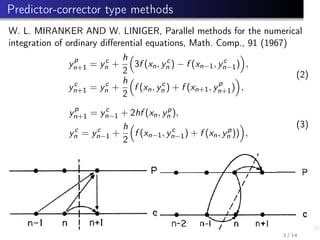
W. L. MIRANKER AND W. LINIGER, Parallel methods for the numerical
integration of ordinary differential equations, Math. Comp., 91 (1967)
yp
n+1 = yc
n +
h
2
3f (xn, yc
n ) − f (xn−1, yc
n−1) ,
yc
n+1 = yc
n +
h
2
f (xn, yc
n ) + f (xn+1, yp
n+1) ,
(2)
yp
n+1 = yc
n−1 + 2hf (xn, yp
n ),
yc
n = yc
n−1 +
h
2
f (xn−1, yc
n−1) + f (xn, yp
n )) ,
(3)
3 / 14
Runge–Kutta methods
Consider an explicit s-stage Runge–Kutta method
k1 = f (xn, yn),
k2 = f (xn + c2h, yn + ha21k1),
k3 = f (xn + c3h, yn + h(a31k1 + a32k2)),
...
ks = f (xn + csh, yn + h(as1k1 + ... + as,s−1ks−1)),
yn+1 = yn + h(b1k1 + ... + bsks)
(4)
0
c2 a21
c3 a31 a32
...
cs as1 as2 ... as,s−1
b1 b2 ... bs−1 bs
k1 = f (xn, yn)
k2 = f (xn + h
2 , yn + h
2 k1)
k3 = f (xn + h
2 , yn + h
2 k2)
k4 = f (xn + h, yn + hk3)
yn+1 = yn + h
6 (k1 + 2k2 + 2k3 + k4)
4 / 14
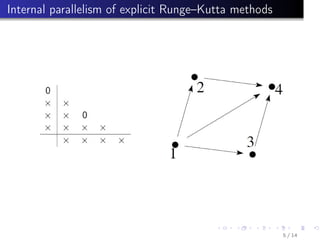
Internal parallelism of explicit Runge–Kutta methods
5 / 14
Internal parallelism of explicit Runge–Kutta methods
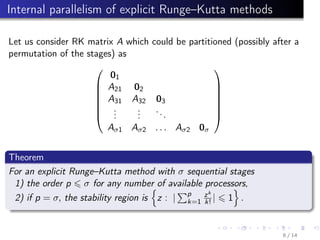
Let us consider RK matrix A which could be partitioned (possibly after a
permutation of the stages) as







01
A21 02
A31 A32 03
...
...
...
Aσ1 Aσ2 . . . Aσ2 0σ







Theorem
For an explicit Runge–Kutta method with σ sequential stages
1) the order p σ for any number of available processors,
2) if p = σ, the stability region is z : | p
k=1
zk
k! | 1 .
6 / 14
Internal parallelism of implicit Runge–Kutta methods
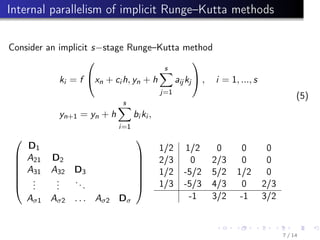
Consider an implicit s−stage Runge–Kutta method
ki = f

xn + ci h, yn + h
s
j=1
aij kj

 , i = 1, ..., s
yn+1 = yn + h
s
i=1
bi ki ,
(5)







D1
A21 D2
A31 A32 D3
...
...
...
Aσ1 Aσ2 . . . Aσ2 Dσ







1/2 1/2 0 0 0
2/3 0 2/3 0 0
1/2 -5/2 5/2 1/2 0
1/3 -5/3 4/3 0 2/3
-1 3/2 -1 3/2
7 / 14
Optimal with respect to the order methods
Whether it is always possible to find ERK method of order p using not
more than p effective stages, assuming that suffucient number of
processors are available?
These methods are called P-optimal.
4 5 6 7 8 9 10
Sequential ERK
smin p 6 7 9 11 12 13
S p 5 6 7 8 9 10
Optimal RK
Seff p 6 7 9 11 12 13
Num. of proc - 3 3 4 4 5 5
8 / 14
Optimal with respect to the order methods
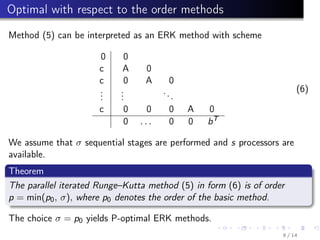
Method (5) can be interpreted as an ERK method with scheme
0 0
c A 0
c 0 A 0
...
...
...
c 0 0 0 A 0
0 . . . 0 0 bT
(6)
We assume that σ sequential stages are performed and s processors are
available.
Theorem
The parallel iterated Runge–Kutta method (5) in form (6) is of order
p = min(p0, σ), where p0 denotes the order of the basic method.
The choice σ = p0 yields P-optimal ERK methods.
9 / 14
How many processors do we need?
What is the least number of processors needed to implement an optimal
ERK method.
The basic method is the s-stage Gaussian–Legendre type RK method,
which has the smallest number of stages with respect to their order.
This allowed to construct the method of order p = 2s which is P-optimal
on s processors.
Van Der Houwen P. J., Sommeijer B. P. Parallel iteration of high-order Runge-Kutta
methods with stepsize control // Journal of Computational and Applied Mathematics,
1990. Volume 29. Issue 1. pp. 111–127.
10 / 14
Block methods
yn+1
yn+2
= h
2/3 −1/12
4/3 1/3
fn+1
fn+2
+
yn
yn
+ h
5/12
1/3
fn
fn
.
εn =
h4
24
u(4)
(ζn+1), −
h5
90
u(5)
(ζn+2)
Shampine L. F. and Watts H. A. Block Implicit One-Step Methods // Math. Comp.,
1969. V. 23. pp. 731–740.
11 / 14
Extrapolation methods
12 / 14
Multiple shooting algorithms
y0(x) = f (x, y0(x)), y1(x) = f (x, y1(x)), . . . yn−1(x) = f (x, yn−1(x)),
y0(0) = y0 y1(x1) = U1 yn−1(xn−1) = Un−1
matching conditions U1 = y0(x1), . . . , Un−1 = yn−2(xn−1),



U1 − y0(x1) = 0
U2 − y1(x2) = 0
. . .
Un−1 − yn−1(xn−1) = 0
Uk+1
0 = y0
Uk+1
i+1 = yi (xi+1, Uk
i ) +
∂yi (xi+1, Uk
i )
∂Ui
(Uk+1
i − Uk
i ), i = 0, 1, 2, . . . , n − 2
13 / 14
Thank you for attention
Parallel Numerical Methods for Ordinary Differential Equations:
a Survey
14 / 14

Parallel Numerical Methods for Ordinary Differential Equations: a Survey

  • 1.
    Parallel Numerical Methodsfor Ordinary Differential Equations S. I. Solodushkin1,2, I. F. Yumanova1 1 Ural Federal University 2 Institute of Mathematics and Mechanics Ural HPC 2016, Ekaterinburg, Russia 2016, October 06.
  • 2.
    The problem y (x)= f (x, y(x)), y(x0) = y0, (1) where x ∈ [x0; X], y ∈ Rm. Gear classification: 1 parallelism across the system or, that is the same, parallelism across the space; 2 parallelism across the method or, that is the same, parallelism across the time. 2 / 14
  • 3.
    Predictor-corrector type methods W.L. MIRANKER AND W. LINIGER, Parallel methods for the numerical integration of ordinary differential equations, Math. Comp., 91 (1967) yp n+1 = yc n + h 2 3f (xn, yc n ) − f (xn−1, yc n−1) , yc n+1 = yc n + h 2 f (xn, yc n ) + f (xn+1, yp n+1) , (2) yp n+1 = yc n−1 + 2hf (xn, yp n ), yc n = yc n−1 + h 2 f (xn−1, yc n−1) + f (xn, yp n )) , (3) 3 / 14
  • 4.
    Runge–Kutta methods Consider anexplicit s-stage Runge–Kutta method k1 = f (xn, yn), k2 = f (xn + c2h, yn + ha21k1), k3 = f (xn + c3h, yn + h(a31k1 + a32k2)), ... ks = f (xn + csh, yn + h(as1k1 + ... + as,s−1ks−1)), yn+1 = yn + h(b1k1 + ... + bsks) (4) 0 c2 a21 c3 a31 a32 ... cs as1 as2 ... as,s−1 b1 b2 ... bs−1 bs k1 = f (xn, yn) k2 = f (xn + h 2 , yn + h 2 k1) k3 = f (xn + h 2 , yn + h 2 k2) k4 = f (xn + h, yn + hk3) yn+1 = yn + h 6 (k1 + 2k2 + 2k3 + k4) 4 / 14
  • 5.
    Internal parallelism ofexplicit Runge–Kutta methods 5 / 14
  • 6.
    Internal parallelism ofexplicit Runge–Kutta methods Let us consider RK matrix A which could be partitioned (possibly after a permutation of the stages) as        01 A21 02 A31 A32 03 ... ... ... Aσ1 Aσ2 . . . Aσ2 0σ        Theorem For an explicit Runge–Kutta method with σ sequential stages 1) the order p σ for any number of available processors, 2) if p = σ, the stability region is z : | p k=1 zk k! | 1 . 6 / 14
  • 7.
    Internal parallelism ofimplicit Runge–Kutta methods Consider an implicit s−stage Runge–Kutta method ki = f  xn + ci h, yn + h s j=1 aij kj   , i = 1, ..., s yn+1 = yn + h s i=1 bi ki , (5)        D1 A21 D2 A31 A32 D3 ... ... ... Aσ1 Aσ2 . . . Aσ2 Dσ        1/2 1/2 0 0 0 2/3 0 2/3 0 0 1/2 -5/2 5/2 1/2 0 1/3 -5/3 4/3 0 2/3 -1 3/2 -1 3/2 7 / 14
  • 8.
    Optimal with respectto the order methods Whether it is always possible to find ERK method of order p using not more than p effective stages, assuming that suffucient number of processors are available? These methods are called P-optimal. 4 5 6 7 8 9 10 Sequential ERK smin p 6 7 9 11 12 13 S p 5 6 7 8 9 10 Optimal RK Seff p 6 7 9 11 12 13 Num. of proc - 3 3 4 4 5 5 8 / 14
  • 9.
    Optimal with respectto the order methods Method (5) can be interpreted as an ERK method with scheme 0 0 c A 0 c 0 A 0 ... ... ... c 0 0 0 A 0 0 . . . 0 0 bT (6) We assume that σ sequential stages are performed and s processors are available. Theorem The parallel iterated Runge–Kutta method (5) in form (6) is of order p = min(p0, σ), where p0 denotes the order of the basic method. The choice σ = p0 yields P-optimal ERK methods. 9 / 14
  • 10.
    How many processorsdo we need? What is the least number of processors needed to implement an optimal ERK method. The basic method is the s-stage Gaussian–Legendre type RK method, which has the smallest number of stages with respect to their order. This allowed to construct the method of order p = 2s which is P-optimal on s processors. Van Der Houwen P. J., Sommeijer B. P. Parallel iteration of high-order Runge-Kutta methods with stepsize control // Journal of Computational and Applied Mathematics, 1990. Volume 29. Issue 1. pp. 111–127. 10 / 14
  • 11.
    Block methods yn+1 yn+2 = h 2/3−1/12 4/3 1/3 fn+1 fn+2 + yn yn + h 5/12 1/3 fn fn . εn = h4 24 u(4) (ζn+1), − h5 90 u(5) (ζn+2) Shampine L. F. and Watts H. A. Block Implicit One-Step Methods // Math. Comp., 1969. V. 23. pp. 731–740. 11 / 14
  • 12.
  • 13.
    Multiple shooting algorithms y0(x)= f (x, y0(x)), y1(x) = f (x, y1(x)), . . . yn−1(x) = f (x, yn−1(x)), y0(0) = y0 y1(x1) = U1 yn−1(xn−1) = Un−1 matching conditions U1 = y0(x1), . . . , Un−1 = yn−2(xn−1),    U1 − y0(x1) = 0 U2 − y1(x2) = 0 . . . Un−1 − yn−1(xn−1) = 0 Uk+1 0 = y0 Uk+1 i+1 = yi (xi+1, Uk i ) + ∂yi (xi+1, Uk i ) ∂Ui (Uk+1 i − Uk i ), i = 0, 1, 2, . . . , n − 2 13 / 14
  • 14.
    Thank you forattention Parallel Numerical Methods for Ordinary Differential Equations: a Survey 14 / 14