Presented by : ACHYUT BORA and NEELOTPAL SHARMA
GAUHATI UNIVERSITY, ASSAM, INDIA
(MRI) Magnetic resonance imaging
(NMRI)Nuclear magnetic resonance imaging
or (MRT) Magnetic resonance tomography
 Magnetic resonance imaging (MRI) is an imaging
technique used primarily in medical settings to
produce high quality images of the anatomy and the
physiological processes of the body in both health
and disease of the human body.
 It is based on the principles of nuclear magnetic
resonance (NMR), a spectroscopic technique to
obtain microscopic chemical and physical
information about molecules.
 MRI has advanced beyond a tomographic imaging
technique to a volume imaging technique.
Brief History of MRI
Felix Bloch Edward PurcellJoseph Fourier Joseph Larmor
Raymond Damadian C Lauterbur Peter Mansfield Seiji OgawaRichard Ernst
The first Nuclear magnetic resonance
experiment was conducted
independently by two scientist in 1946.
Felix Bloch working at Stanford
University
Edward Purcell working at Harvard
University
Bloch and Purcell were awarded Nobel
Prize for Physics in1952
Joseph Fourier
1768- 1830
Joseph Larmor
1857-1942
Published his
collected papers on
electromagnetism
in 1900 in a famous
book entitled
“Aether and Matter”
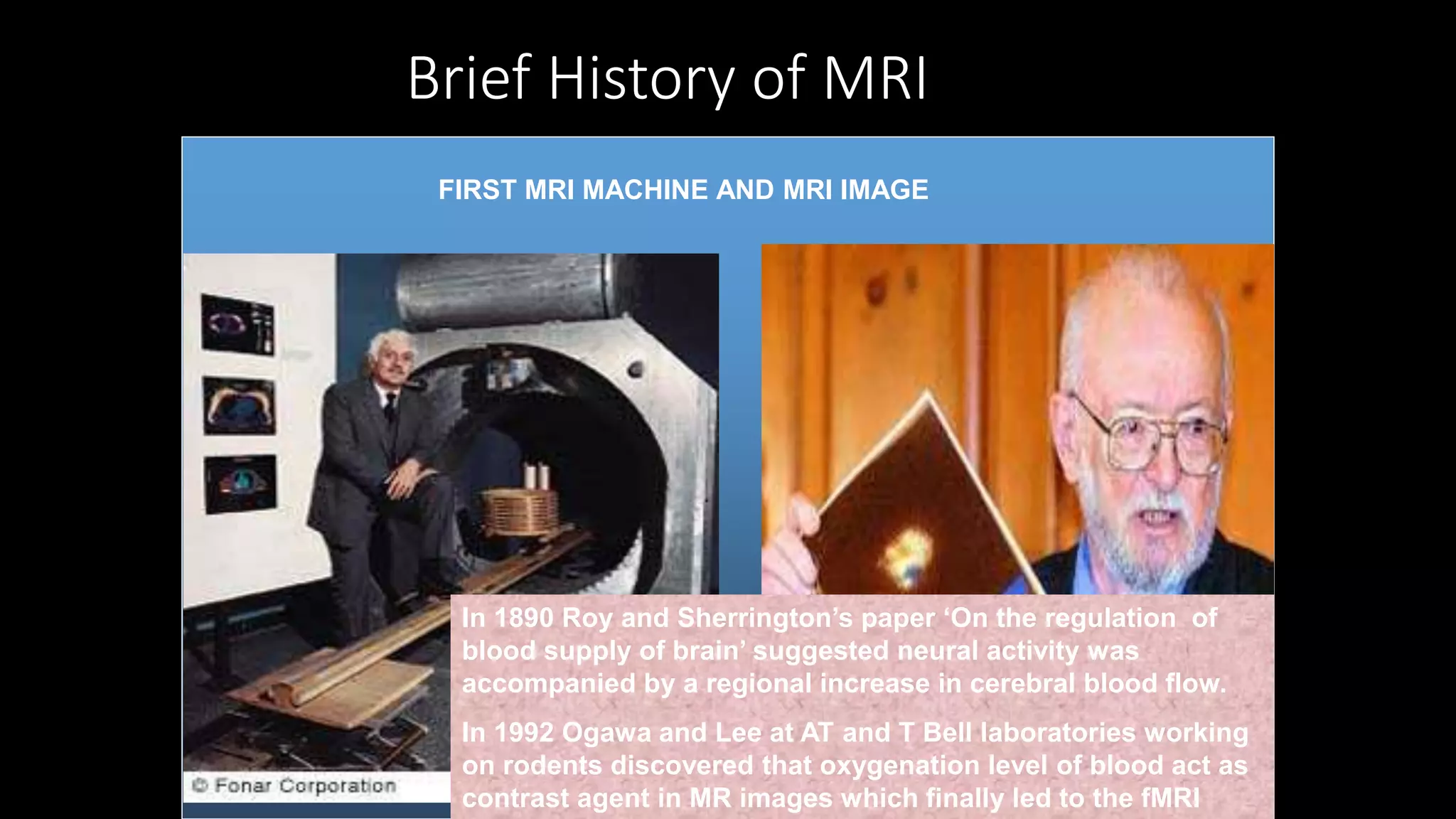
In 1970 Raymond Damadian found
that it is possible to characterize
different body tissues using NMR
Technology
In 1977 he completed the
construction of the first MRI scanner
In 1978 he founded the FONAR
corporation which manufactured the
first commercial MRI
In 1973 Paul C Lauterbur discovered the
possibility to create a two dimensional
picture by introducing gradients in the
magnetic field. He used the back
projection technique to reconstruct the
image. He termed his new imaging
technique zeumatography. He shared
the 2003 Nobel prize for medicine with
Peter Mansfield
Peter Mansfield
developed the technique
of detecting the emitted
signals rapidly
mathematically analyzing
them and turning them
into an image.
He evolved a very fast
imaging technique known
as Echo Planar Imaging
In 1975 Richard Ernst
introduced 2D NMR
using phase and
frequency encoding
and the Fourier
transform instead of
Lauterbur’s back
projection technique
In 1992 Functional
MRI was developed
by Seiji Ogawa.
FIRST MRI MACHINE AND MRI IMAGE
In 1890 Roy and Sherrington’s paper ‘On the regulation of
blood supply of brain’ suggested neural activity was
accompanied by a regional increase in cerebral blood flow.
In 1992 Ogawa and Lee at AT and T Bell laboratories working
on rodents discovered that oxygenation level of blood act as
contrast agent in MR images which finally led to the fMRI
Atomic Physics
ELECTROMAGNETISM
Structure of Atom Magnetic Dipole moment
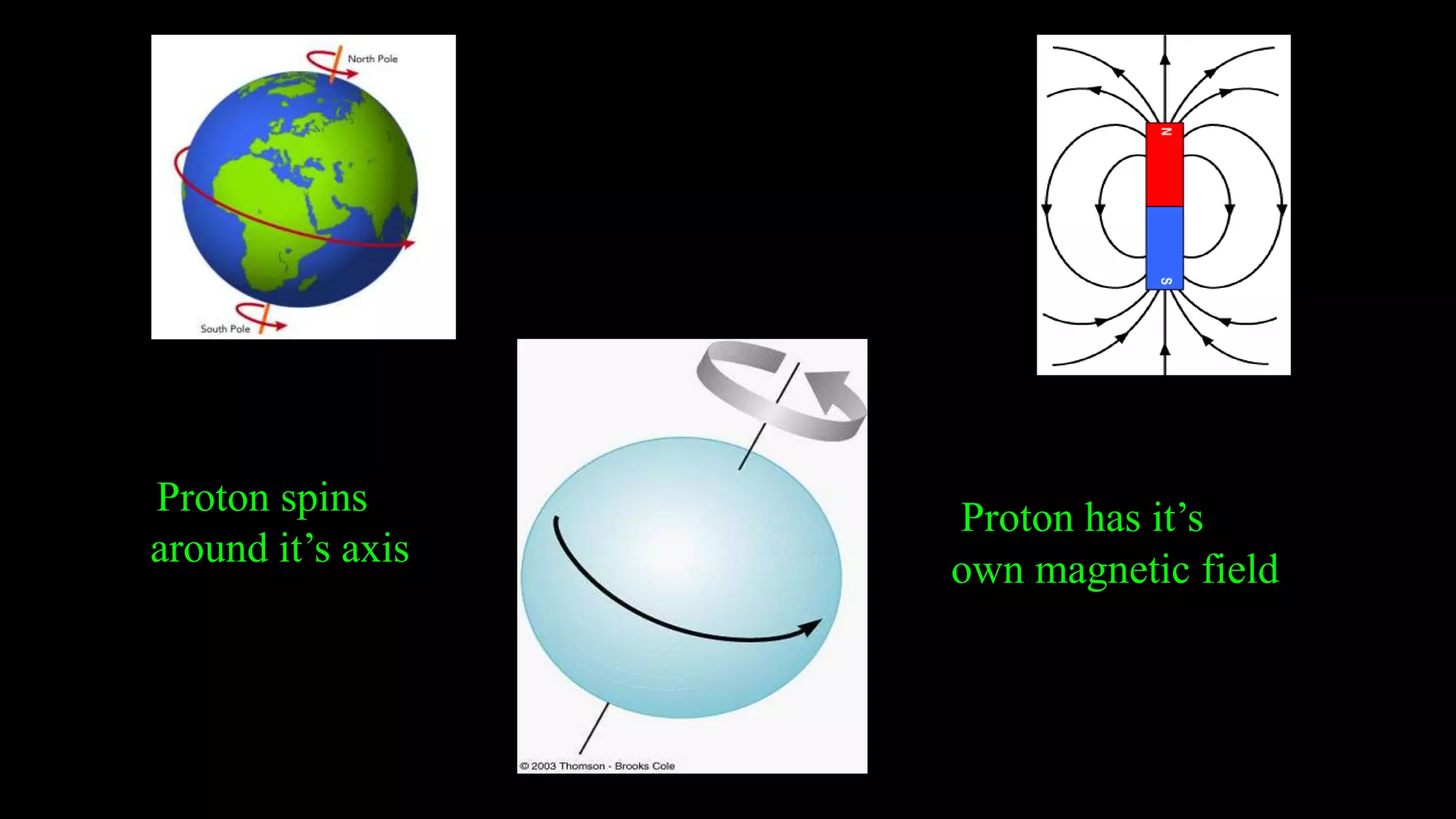
Proton spins
around it’s axis
Proton has it’s
own magnetic field
Microscopic Principles
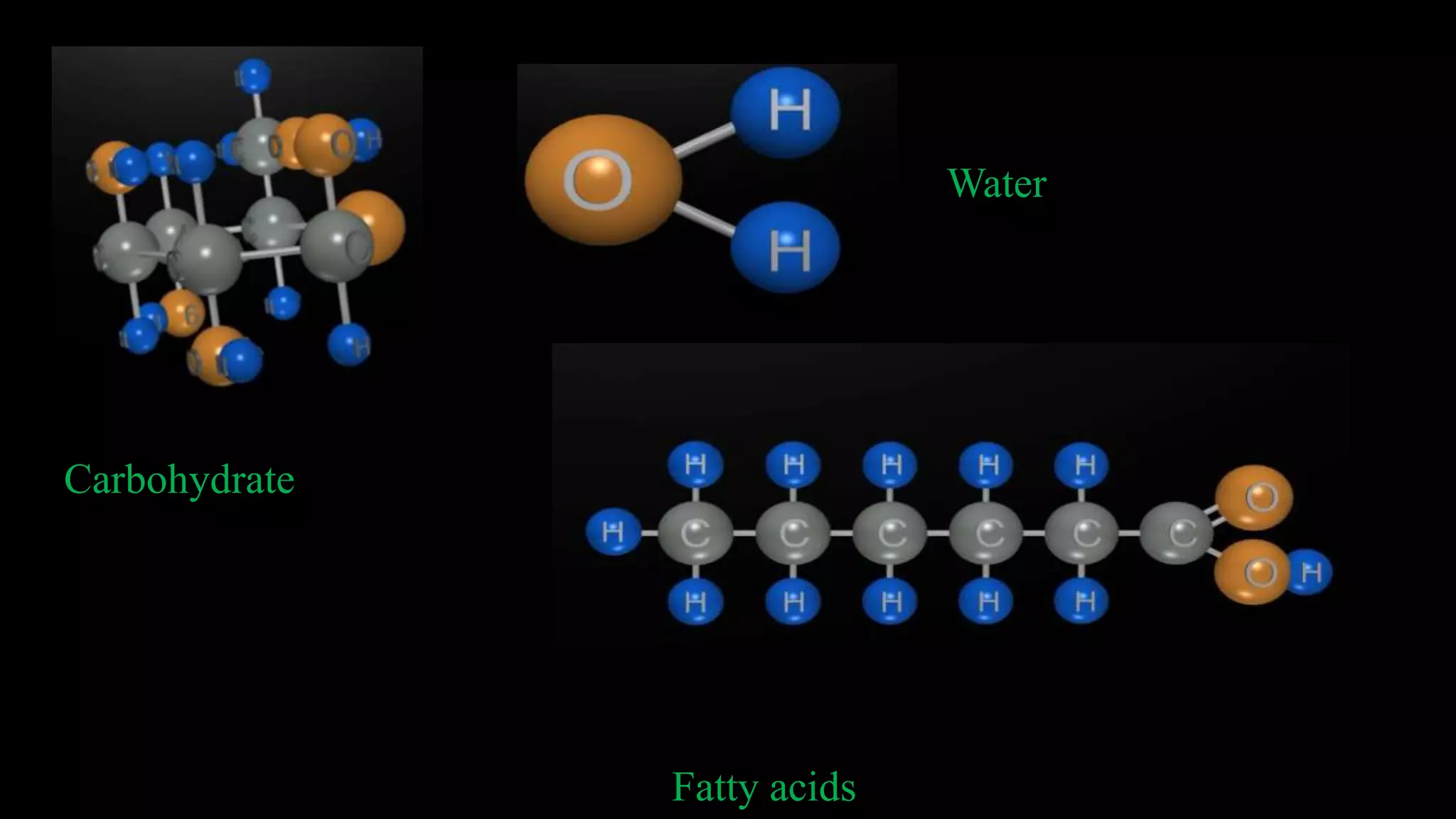
 The composition of the human body is primarily fat and
water
 Fat and water have many hydrogen atoms
 63% of human body is hydrogen atoms
 Hydrogen nuclei have an NMR signal
 MRI uses hydrogen because it has only one proton and
it aligns easily with the MRI magnet.
 The hydrogen atom’s proton, possesses a property
called spin
 A small magnetic field
 Will cause the nucleus to produce an NMR signal
Carbohydrate
Water
Fatty acids
Precession in Magnetic Field
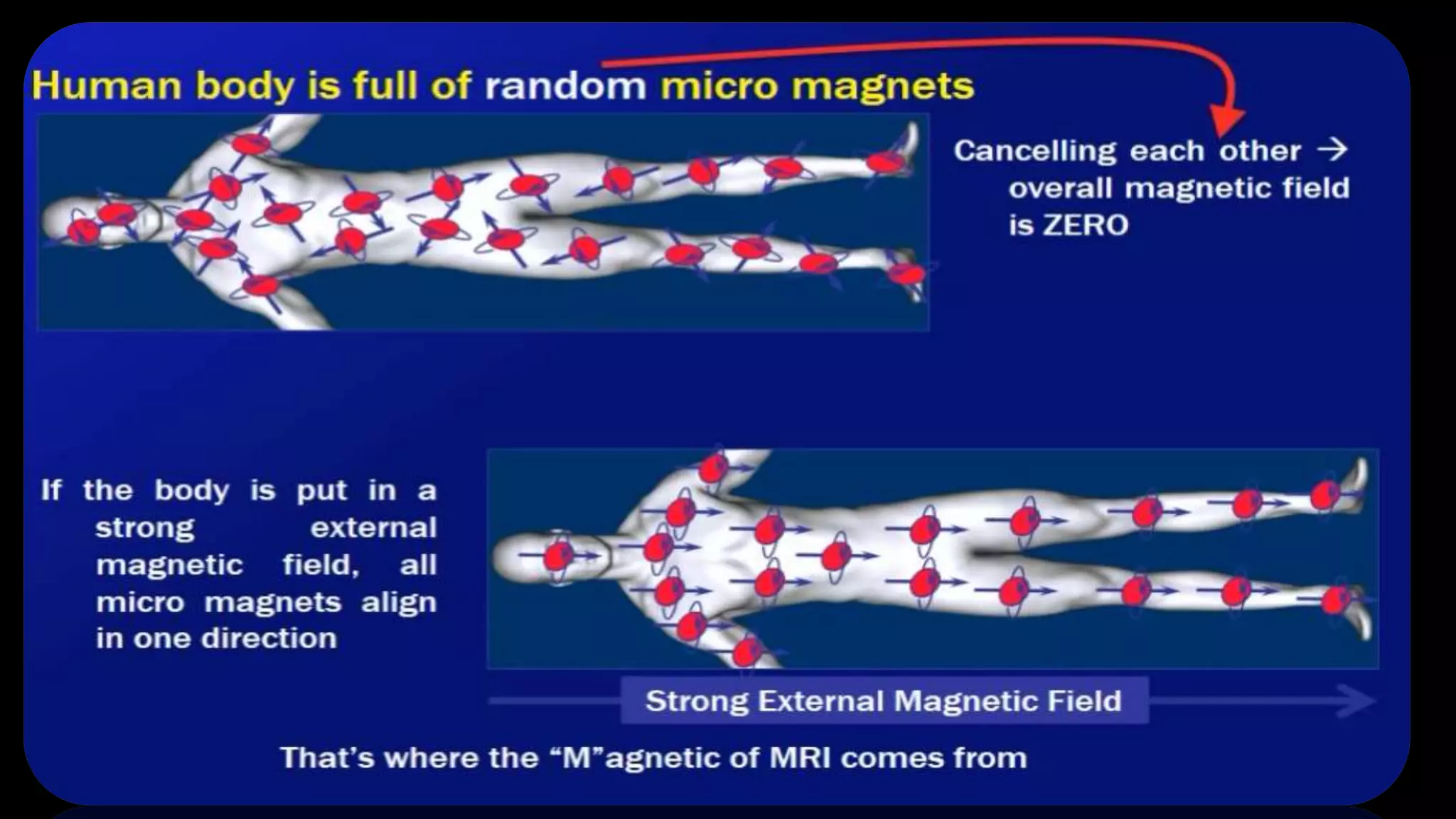
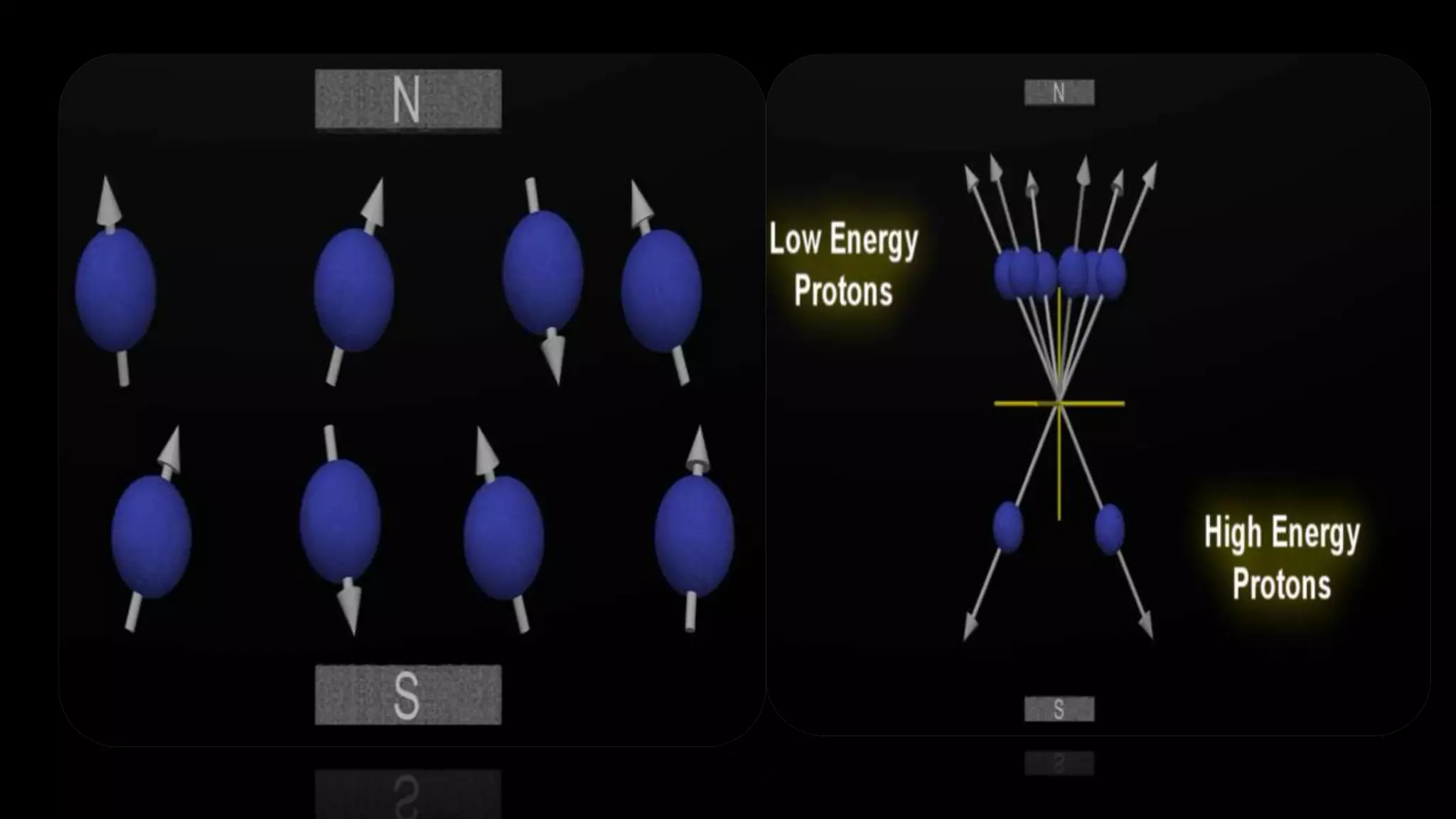
 The spinning hydrogen protons act like small , weak
magnets.
 They align with an external magnetic field (Bø).
 The proton filled a torque that will tend to orient the
magnetic dipole moment along the same axis of the
magnetic field lines.
 But the angular momentum of proton will keep it from
aligning exactly and the magnetic dipole moment will
precesses about an axis .
 And its frequency of precession is known as Larmor or
Resonance frequency.
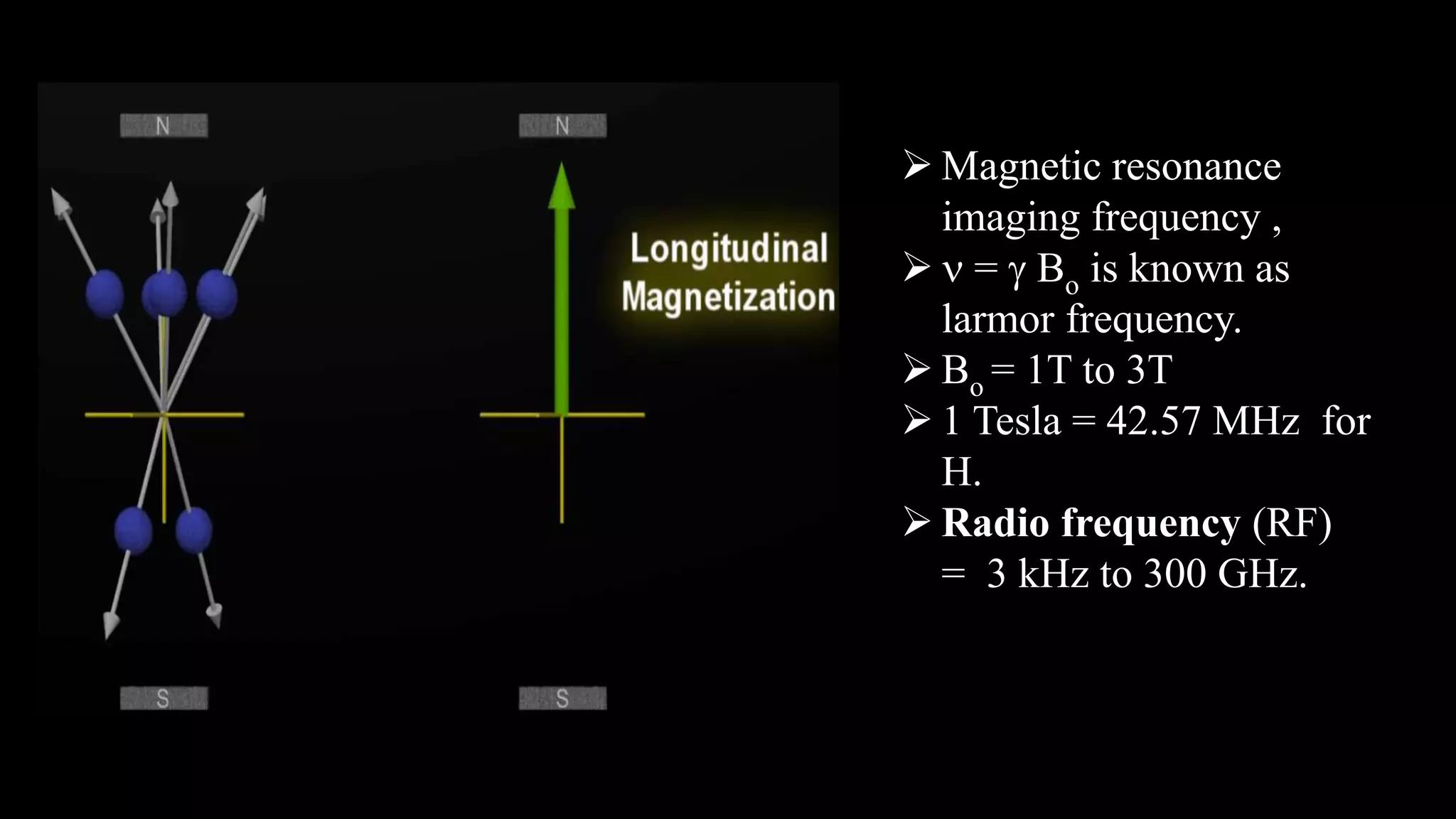
 Magnetic resonance imaging frequency
n = g Bo
where g is the gyromagnetic ratio
The resonance frequency n of a spin is proportional to
the magnetic field, Bo.
 Magnetic resonance
imaging frequency ,
 n = g Bo is known as
larmor frequency.
 Bo = 1T to 3T
 1 Tesla = 42.57 MHz for
H.
 Radio frequency (RF)
= 3 kHz to 300 GHz.
RF PULSE ON!
Impact of RF Pulse
 If we now direct an electromagnetic
wave i.e radiofrequency wave just the
right frequency at the proton, the
precession of the magnetic dipole
moment of the proton will flatten out
since it will tend to align with the
magnetic field line of the wave.
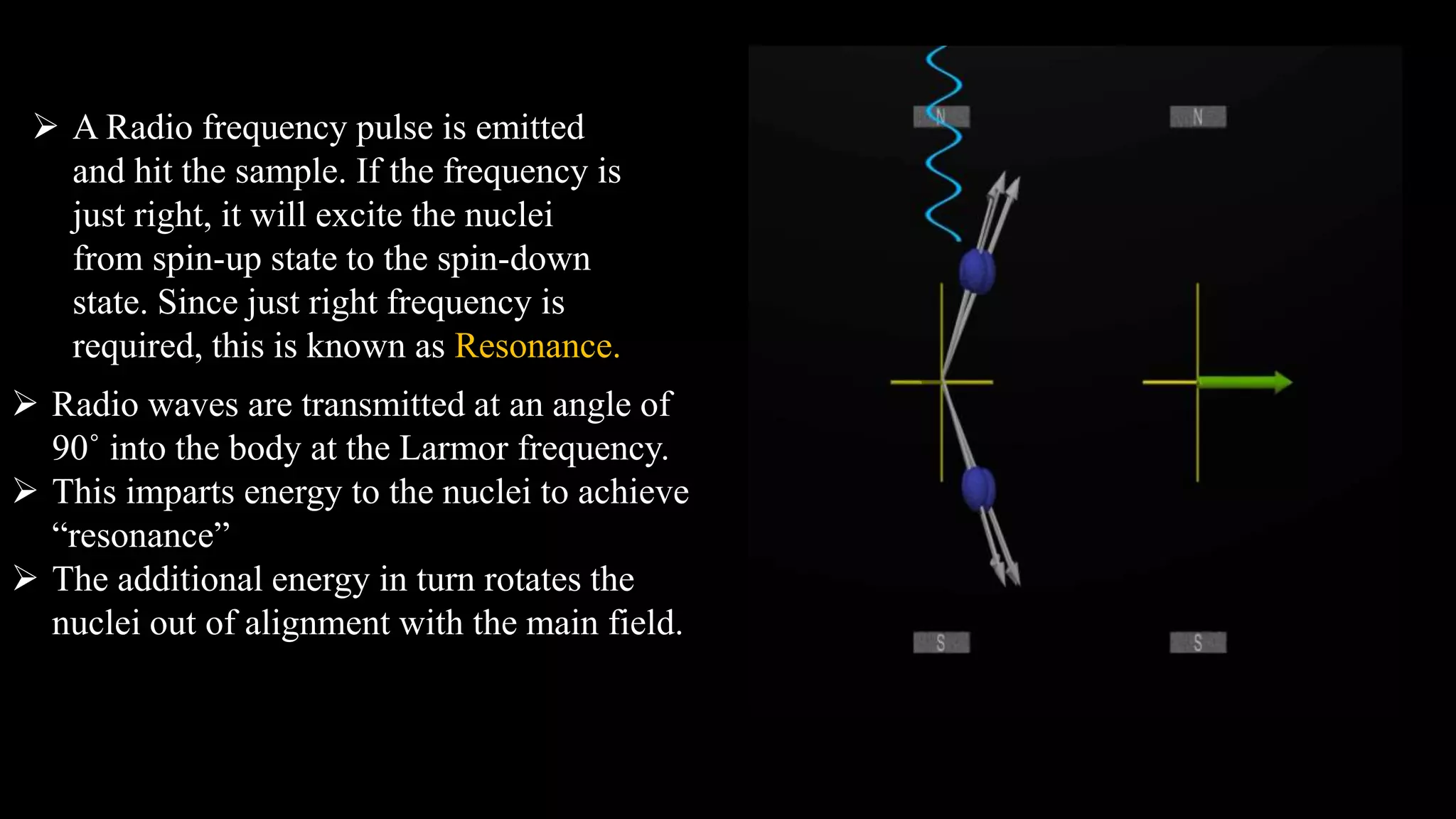
 A Radio frequency pulse is emitted
and hit the sample. If the frequency is
just right, it will excite the nuclei
from spin-up state to the spin-down
state. Since just right frequency is
required, this is known as Resonance.
 Radio waves are transmitted at an angle of
90˚ into the body at the Larmor frequency.
 This imparts energy to the nuclei to achieve
“resonance”
 The additional energy in turn rotates the
nuclei out of alignment with the main field.
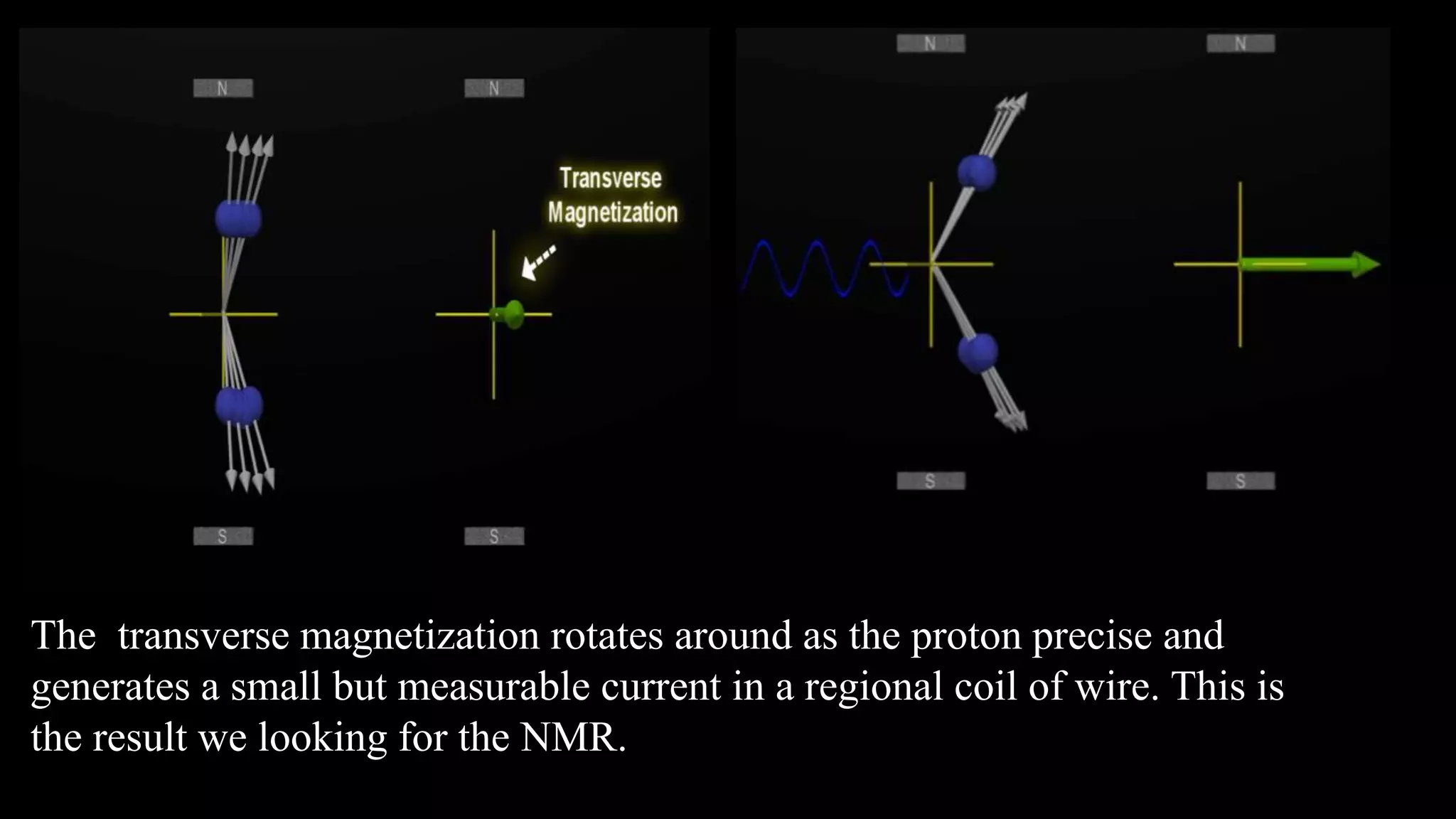
The transverse magnetization rotates around as the proton precise and
generates a small but measurable current in a regional coil of wire. This is
the result we looking for the NMR.
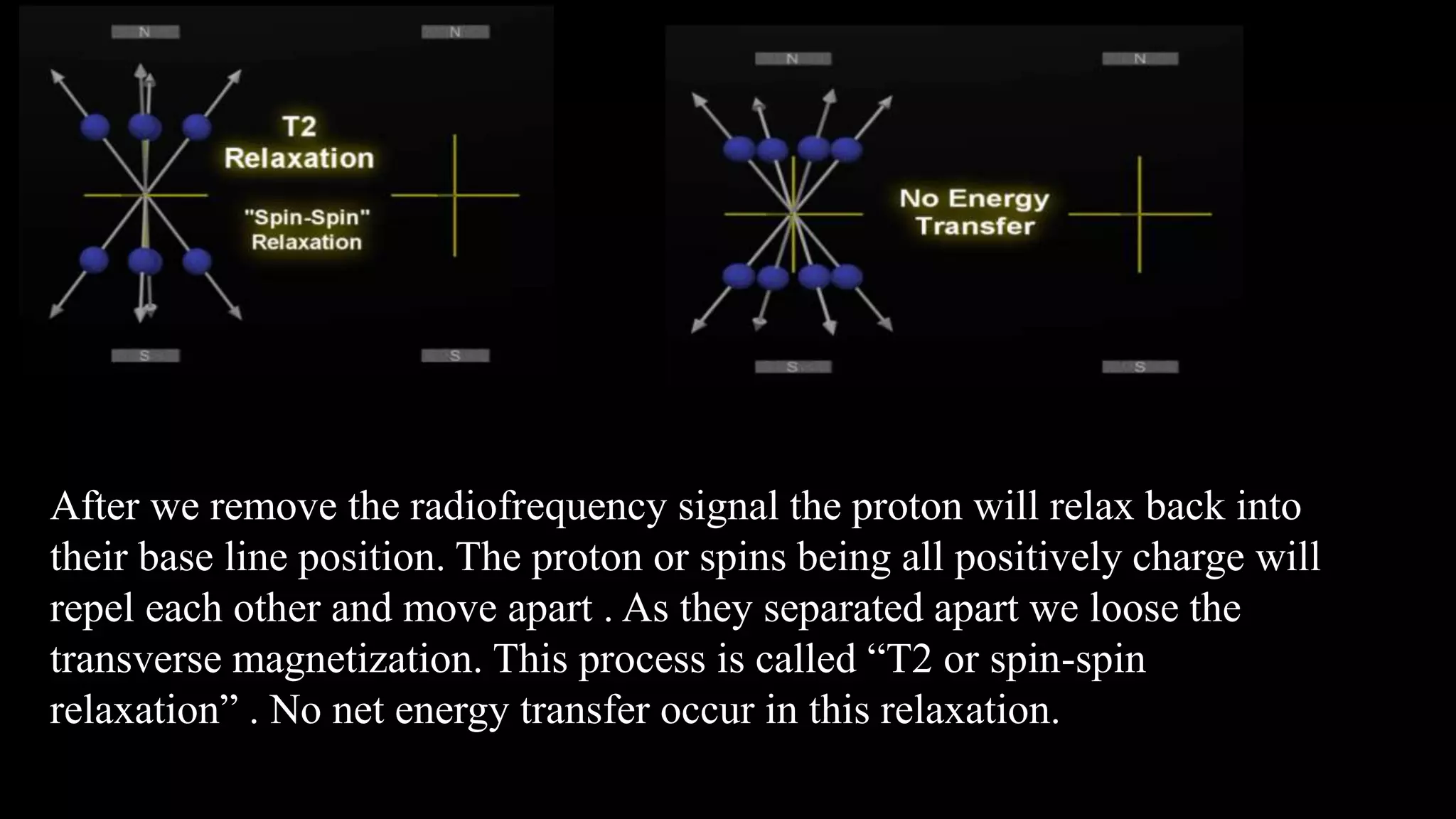
After we remove the radiofrequency signal the proton will relax back into
their base line position. The proton or spins being all positively charge will
repel each other and move apart . As they separated apart we loose the
transverse magnetization. This process is called “T2 or spin-spin
relaxation” . No net energy transfer occur in this relaxation.
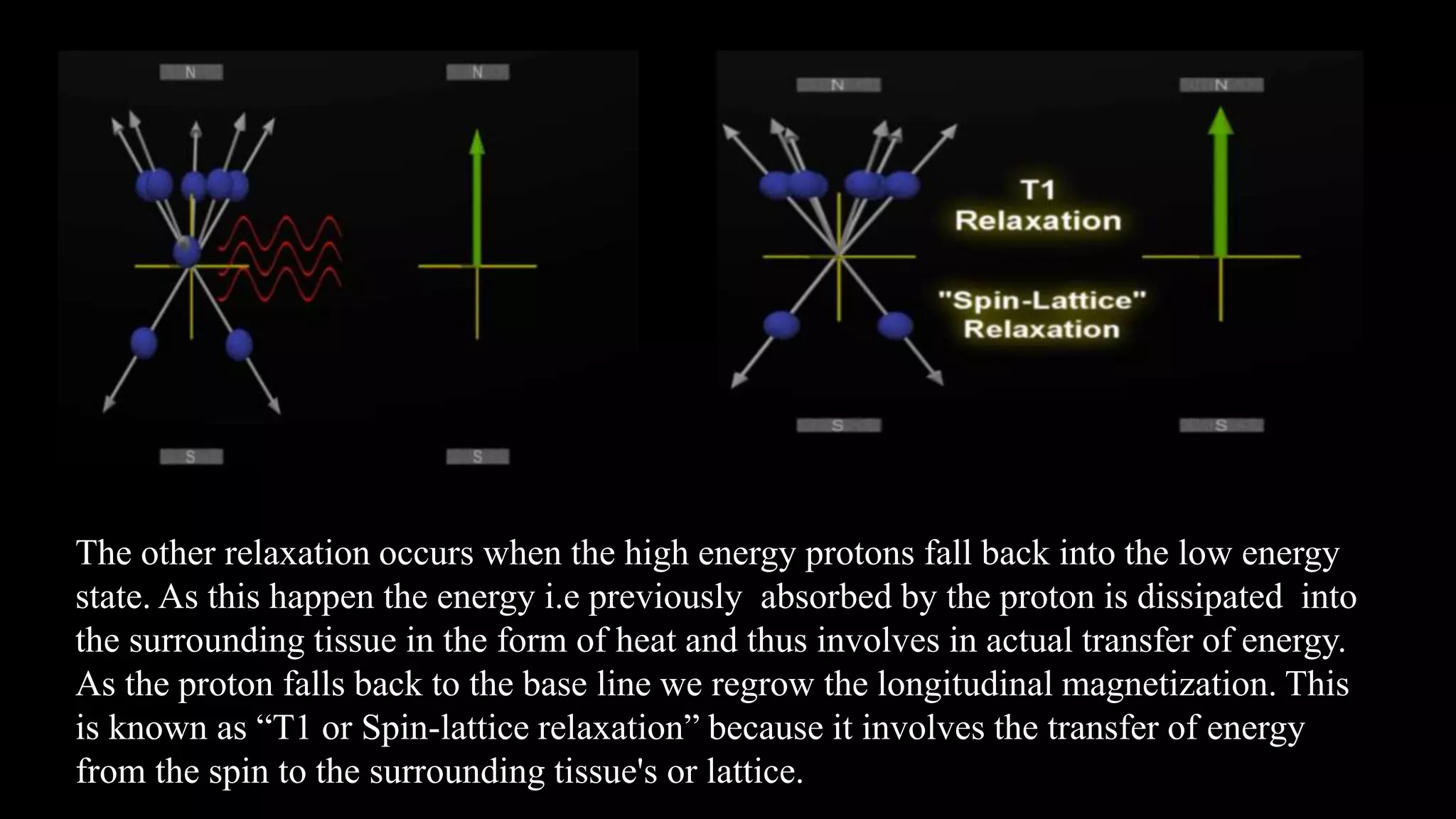
The other relaxation occurs when the high energy protons fall back into the low energy
state. As this happen the energy i.e previously absorbed by the proton is dissipated into
the surrounding tissue in the form of heat and thus involves in actual transfer of energy.
As the proton falls back to the base line we regrow the longitudinal magnetization. This
is known as “T1 or Spin-lattice relaxation” because it involves the transfer of energy
from the spin to the surrounding tissue's or lattice.
 Putting this all together a sufficient RF pulse tune to the natural
precession frequency of the pressing proton is put into the tissues to flip
50% of this spin into the high energy state and cause the proton to
synchronize in phase or spin together.
 Thus moving the longitudinal magnetization 90 degree under the
transfer plain. The transverse magnetization précising at the resonance
frequency at the local proton produces a radio signal of the same
frequency that can be detected by a coil of wires.
 As the energy is removes the proton is first move apart in a “T2 or spin-
spin relaxation” destroying the transverse magnetization and then to T1
or spin lattice relaxation falls back into the lower energy state
dissipating the previously absorbed energy into the surrounding tissue
in the form of heat while restoring the original longitudinal
magnetization.
As our body have different local environment like free flowing water molecules and others fixed
in position as on fats, they have characteristic difference in T1 AND T2 relaxation.
We use a sample of Fat and water to demonstrate this differences.
When we put a resonant frequency pulse all the proton absorbed that energy flip into the higher
energy state and spins together to produce a 90 degree pulse or transverse magnetization.
If we wait a sufficient amount of time the proton will move apart and the T2 or spin-spin
relaxation and a transverse magnetization will decay the proton associated with the free fatty acid
being relatively fixed in a position decay rapidly as the proton pushed away more rapidly as they
fall back to base line and T1 or spin lattice relaxation depositing heat energy into the surrounding
tissues and re-growing their longitudinal magnetization.
On the other hand protons in freely flowing water can hold on to their energy and continue to spin
together in phase thus maintaining the transverse magnetization. At this point when we turn on
our receiving coil and measure the signal coming back from the proton,
 The relatively large transverse magnetization in water give strong signal while the smaller or
absent transverse magnetization in fat will give weak signal. By convention the strong water
signal will be assigned a grey scale color of white and the weak signal of fat will be dark grey or
black.
The schematic diagram of MRI
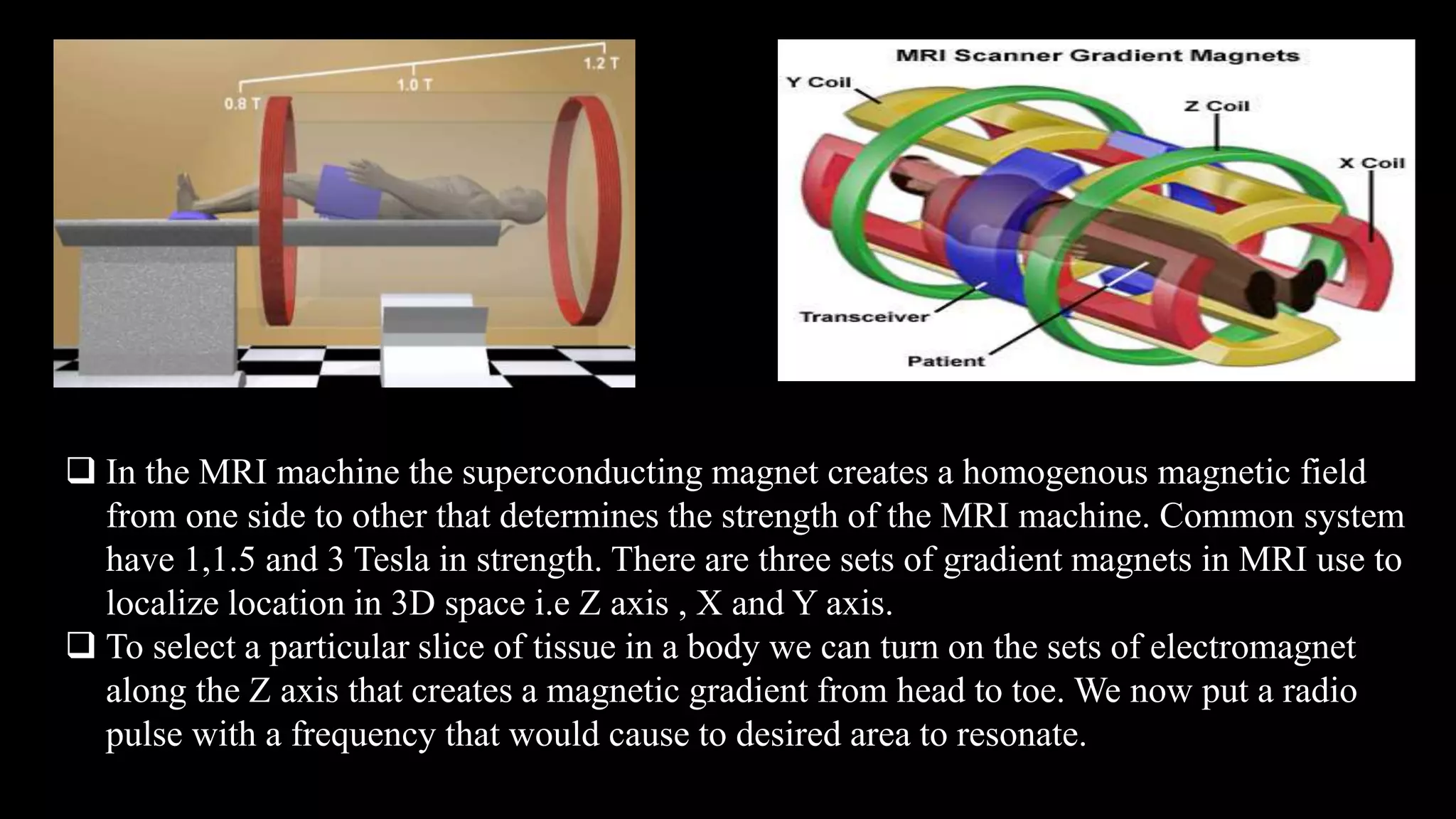
GRADIENT COILS
 Gradient coils are used to produce deliberate variations in the main magnetic field
 There are usually three sets of gradient coils, one for each direction.
 The variation in the magnetic field permits localization of image slices as well as
phase encoding and frequency encoding.
 The set of gradient coils for the z axis are helmholtz pairs, and for the x and y axis
paired saddle coils.
RADIOFREQUENCY COIL
 RF coils act as transmitter and receiver
 RF coils are the "antenna" of the MRI system
 That transmit the RF signal and receives the return signal.
 They are simply a loop of wire either circular or rectangular
 Helmholtz pair coils consist of two circular coils parallel to each other.
 They are used as the z gradient coils in MRI scanners
 Paired saddle coils are also used for the x and y gradient coils.
 In the MRI machine the superconducting magnet creates a homogenous magnetic field
from one side to other that determines the strength of the MRI machine. Common system
have 1,1.5 and 3 Tesla in strength. There are three sets of gradient magnets in MRI use to
localize location in 3D space i.e Z axis , X and Y axis.
 To select a particular slice of tissue in a body we can turn on the sets of electromagnet
along the Z axis that creates a magnetic gradient from head to toe. We now put a radio
pulse with a frequency that would cause to desired area to resonate.
 We had now select our slice to the body because the local magnetic gradient is homogenous all of this net
magnetic movement of the slice or in phase is spinning together in sync and cannot distinguish from one
another. For the isolation of the net magnetic movement we can use two other gradients.
 Due to presences of three gradients each of the signal have unique phase and frequency which can be
localized in 3D space.
 Each of the square or box will assign a grey scale value corresponding to the strength of the local signal by
convention white being strong signal and black being a no signal at all.
 In standard MRI a 256/256 matrix or 512/512 matrix will provide exquisite in atomic details of the body.
What is so good about MRI?
They have given doctors the chance to detect
cancers earlier than ever before.
They allow a view into the body without
surgery.
They are a non invasive way of diagnosing
diseases and conditions.
Gives a clearer set of images than CAT scans
do.
The MRI does not use ionizing radiation,
which is a comfort to patients.
Also the contrast dye has a very low chance
of side effects.
‘Slice’ images can be taken on many planes.
The Uses of the MRI
Diagnosing: Multiple Sclerosis;
strokes; infections of the
brain/spine/CNS; tendonitis
Visualising: Injuries; torn
ligaments – especially in areas
difficult to see like the wrist,
ankle or knee
Evaluating: Masses in soft
tissue; cysts; bone tumours or
disc problems.
Contraindications
The strength of the magnet is 5000 times
stronger than the earth
So all metals must be removed!
People with pacemakers cannot have a scan
If you have any metal fragments in the eye
you cannot have a scan – it would rip the eye
open.
These magnets are so powerful they could pull
a car in!
There has not been enough research done on
babies and magnetism, so pregnant women
shouldn’t have one done before the 4th month
of pregnancy – unless it is highly necessary.
And the disadvantages?
 Claustrophobia. Patients are in a very
enclosed space.
 Weight and size. There are limitations to
how big a patient can be.
 Noise. The scanner is very noisy.
 Keeping still. Patients have to keep very
still for extended periods of time.
 Cost. A scanner is very expensive,
therefore scanning is also costly.
 Medical Contraindications. Pacemakers,
metal objects in body etc.
SHAPES OF MRI MACHINE
CLOSED MRI OPEN MRI UPRIGHT MRI
FUNCTIONAL MRI
 Since the early 1990s, FMRI has come
 FMRI is based on the same technology as MRI
 FMRI looks at blood flow
 It is a technique for measuring brain activity
 It works by detecting the changes in blood
oxygenation and flow that occur in response to
neural activity
DIFFERENCE BETWEEN MRI AND FMRI
MRI
 Views anatomical structure
 Focuses on protons in
hydrogen nuclei
 High spatial resolution
 Utilized for experimental
purposes
FMRI
 Views metabolic function
 Calculates oxygen levels
 Long-distance resolution
 Utilized for diagnostic
purposes
The Future of MRI
 MRI research is ever changing.
 Smaller, lighter machines are always
been developed.
 Work is on going to develop area
specific machines to scan small areas
like feet, arms, hands.
 Ventilation dynamic research is being
tested with Helium to examine lung
function
 Brain mapping is having and will
continue to grow and give us a better
image of how the brain works than
ever before
Basic of mri

Basic of mri

  • 1.
    Presented by :ACHYUT BORA and NEELOTPAL SHARMA GAUHATI UNIVERSITY, ASSAM, INDIA
  • 2.
    (MRI) Magnetic resonanceimaging (NMRI)Nuclear magnetic resonance imaging or (MRT) Magnetic resonance tomography  Magnetic resonance imaging (MRI) is an imaging technique used primarily in medical settings to produce high quality images of the anatomy and the physiological processes of the body in both health and disease of the human body.  It is based on the principles of nuclear magnetic resonance (NMR), a spectroscopic technique to obtain microscopic chemical and physical information about molecules.  MRI has advanced beyond a tomographic imaging technique to a volume imaging technique.
  • 3.
    Brief History ofMRI Felix Bloch Edward PurcellJoseph Fourier Joseph Larmor Raymond Damadian C Lauterbur Peter Mansfield Seiji OgawaRichard Ernst The first Nuclear magnetic resonance experiment was conducted independently by two scientist in 1946. Felix Bloch working at Stanford University Edward Purcell working at Harvard University Bloch and Purcell were awarded Nobel Prize for Physics in1952 Joseph Fourier 1768- 1830 Joseph Larmor 1857-1942 Published his collected papers on electromagnetism in 1900 in a famous book entitled “Aether and Matter” In 1970 Raymond Damadian found that it is possible to characterize different body tissues using NMR Technology In 1977 he completed the construction of the first MRI scanner In 1978 he founded the FONAR corporation which manufactured the first commercial MRI In 1973 Paul C Lauterbur discovered the possibility to create a two dimensional picture by introducing gradients in the magnetic field. He used the back projection technique to reconstruct the image. He termed his new imaging technique zeumatography. He shared the 2003 Nobel prize for medicine with Peter Mansfield Peter Mansfield developed the technique of detecting the emitted signals rapidly mathematically analyzing them and turning them into an image. He evolved a very fast imaging technique known as Echo Planar Imaging In 1975 Richard Ernst introduced 2D NMR using phase and frequency encoding and the Fourier transform instead of Lauterbur’s back projection technique In 1992 Functional MRI was developed by Seiji Ogawa. FIRST MRI MACHINE AND MRI IMAGE In 1890 Roy and Sherrington’s paper ‘On the regulation of blood supply of brain’ suggested neural activity was accompanied by a regional increase in cerebral blood flow. In 1992 Ogawa and Lee at AT and T Bell laboratories working on rodents discovered that oxygenation level of blood act as contrast agent in MR images which finally led to the fMRI
  • 4.
  • 5.
    Proton spins around it’saxis Proton has it’s own magnetic field
  • 6.
    Microscopic Principles  Thecomposition of the human body is primarily fat and water  Fat and water have many hydrogen atoms  63% of human body is hydrogen atoms  Hydrogen nuclei have an NMR signal  MRI uses hydrogen because it has only one proton and it aligns easily with the MRI magnet.  The hydrogen atom’s proton, possesses a property called spin  A small magnetic field  Will cause the nucleus to produce an NMR signal
  • 7.
  • 9.
    Precession in MagneticField  The spinning hydrogen protons act like small , weak magnets.  They align with an external magnetic field (Bø).  The proton filled a torque that will tend to orient the magnetic dipole moment along the same axis of the magnetic field lines.  But the angular momentum of proton will keep it from aligning exactly and the magnetic dipole moment will precesses about an axis .  And its frequency of precession is known as Larmor or Resonance frequency.  Magnetic resonance imaging frequency n = g Bo where g is the gyromagnetic ratio The resonance frequency n of a spin is proportional to the magnetic field, Bo.
  • 11.
     Magnetic resonance imagingfrequency ,  n = g Bo is known as larmor frequency.  Bo = 1T to 3T  1 Tesla = 42.57 MHz for H.  Radio frequency (RF) = 3 kHz to 300 GHz.
  • 12.
    RF PULSE ON! Impactof RF Pulse  If we now direct an electromagnetic wave i.e radiofrequency wave just the right frequency at the proton, the precession of the magnetic dipole moment of the proton will flatten out since it will tend to align with the magnetic field line of the wave.
  • 13.
     A Radiofrequency pulse is emitted and hit the sample. If the frequency is just right, it will excite the nuclei from spin-up state to the spin-down state. Since just right frequency is required, this is known as Resonance.  Radio waves are transmitted at an angle of 90˚ into the body at the Larmor frequency.  This imparts energy to the nuclei to achieve “resonance”  The additional energy in turn rotates the nuclei out of alignment with the main field.
  • 14.
    The transverse magnetizationrotates around as the proton precise and generates a small but measurable current in a regional coil of wire. This is the result we looking for the NMR.
  • 15.
    After we removethe radiofrequency signal the proton will relax back into their base line position. The proton or spins being all positively charge will repel each other and move apart . As they separated apart we loose the transverse magnetization. This process is called “T2 or spin-spin relaxation” . No net energy transfer occur in this relaxation.
  • 16.
    The other relaxationoccurs when the high energy protons fall back into the low energy state. As this happen the energy i.e previously absorbed by the proton is dissipated into the surrounding tissue in the form of heat and thus involves in actual transfer of energy. As the proton falls back to the base line we regrow the longitudinal magnetization. This is known as “T1 or Spin-lattice relaxation” because it involves the transfer of energy from the spin to the surrounding tissue's or lattice.
  • 17.
     Putting thisall together a sufficient RF pulse tune to the natural precession frequency of the pressing proton is put into the tissues to flip 50% of this spin into the high energy state and cause the proton to synchronize in phase or spin together.  Thus moving the longitudinal magnetization 90 degree under the transfer plain. The transverse magnetization précising at the resonance frequency at the local proton produces a radio signal of the same frequency that can be detected by a coil of wires.  As the energy is removes the proton is first move apart in a “T2 or spin- spin relaxation” destroying the transverse magnetization and then to T1 or spin lattice relaxation falls back into the lower energy state dissipating the previously absorbed energy into the surrounding tissue in the form of heat while restoring the original longitudinal magnetization.
  • 19.
    As our bodyhave different local environment like free flowing water molecules and others fixed in position as on fats, they have characteristic difference in T1 AND T2 relaxation. We use a sample of Fat and water to demonstrate this differences. When we put a resonant frequency pulse all the proton absorbed that energy flip into the higher energy state and spins together to produce a 90 degree pulse or transverse magnetization. If we wait a sufficient amount of time the proton will move apart and the T2 or spin-spin relaxation and a transverse magnetization will decay the proton associated with the free fatty acid being relatively fixed in a position decay rapidly as the proton pushed away more rapidly as they fall back to base line and T1 or spin lattice relaxation depositing heat energy into the surrounding tissues and re-growing their longitudinal magnetization. On the other hand protons in freely flowing water can hold on to their energy and continue to spin together in phase thus maintaining the transverse magnetization. At this point when we turn on our receiving coil and measure the signal coming back from the proton,  The relatively large transverse magnetization in water give strong signal while the smaller or absent transverse magnetization in fat will give weak signal. By convention the strong water signal will be assigned a grey scale color of white and the weak signal of fat will be dark grey or black.
  • 21.
  • 22.
    GRADIENT COILS  Gradientcoils are used to produce deliberate variations in the main magnetic field  There are usually three sets of gradient coils, one for each direction.  The variation in the magnetic field permits localization of image slices as well as phase encoding and frequency encoding.  The set of gradient coils for the z axis are helmholtz pairs, and for the x and y axis paired saddle coils. RADIOFREQUENCY COIL  RF coils act as transmitter and receiver  RF coils are the "antenna" of the MRI system  That transmit the RF signal and receives the return signal.  They are simply a loop of wire either circular or rectangular  Helmholtz pair coils consist of two circular coils parallel to each other.  They are used as the z gradient coils in MRI scanners  Paired saddle coils are also used for the x and y gradient coils.
  • 23.
     In theMRI machine the superconducting magnet creates a homogenous magnetic field from one side to other that determines the strength of the MRI machine. Common system have 1,1.5 and 3 Tesla in strength. There are three sets of gradient magnets in MRI use to localize location in 3D space i.e Z axis , X and Y axis.  To select a particular slice of tissue in a body we can turn on the sets of electromagnet along the Z axis that creates a magnetic gradient from head to toe. We now put a radio pulse with a frequency that would cause to desired area to resonate.
  • 24.
     We hadnow select our slice to the body because the local magnetic gradient is homogenous all of this net magnetic movement of the slice or in phase is spinning together in sync and cannot distinguish from one another. For the isolation of the net magnetic movement we can use two other gradients.  Due to presences of three gradients each of the signal have unique phase and frequency which can be localized in 3D space.  Each of the square or box will assign a grey scale value corresponding to the strength of the local signal by convention white being strong signal and black being a no signal at all.  In standard MRI a 256/256 matrix or 512/512 matrix will provide exquisite in atomic details of the body.
  • 25.
    What is sogood about MRI? They have given doctors the chance to detect cancers earlier than ever before. They allow a view into the body without surgery. They are a non invasive way of diagnosing diseases and conditions. Gives a clearer set of images than CAT scans do. The MRI does not use ionizing radiation, which is a comfort to patients. Also the contrast dye has a very low chance of side effects. ‘Slice’ images can be taken on many planes.
  • 26.
    The Uses ofthe MRI Diagnosing: Multiple Sclerosis; strokes; infections of the brain/spine/CNS; tendonitis Visualising: Injuries; torn ligaments – especially in areas difficult to see like the wrist, ankle or knee Evaluating: Masses in soft tissue; cysts; bone tumours or disc problems.
  • 27.
    Contraindications The strength ofthe magnet is 5000 times stronger than the earth So all metals must be removed! People with pacemakers cannot have a scan If you have any metal fragments in the eye you cannot have a scan – it would rip the eye open. These magnets are so powerful they could pull a car in! There has not been enough research done on babies and magnetism, so pregnant women shouldn’t have one done before the 4th month of pregnancy – unless it is highly necessary.
  • 28.
    And the disadvantages? Claustrophobia. Patients are in a very enclosed space.  Weight and size. There are limitations to how big a patient can be.  Noise. The scanner is very noisy.  Keeping still. Patients have to keep very still for extended periods of time.  Cost. A scanner is very expensive, therefore scanning is also costly.  Medical Contraindications. Pacemakers, metal objects in body etc.
  • 29.
    SHAPES OF MRIMACHINE CLOSED MRI OPEN MRI UPRIGHT MRI
  • 30.
    FUNCTIONAL MRI  Sincethe early 1990s, FMRI has come  FMRI is based on the same technology as MRI  FMRI looks at blood flow  It is a technique for measuring brain activity  It works by detecting the changes in blood oxygenation and flow that occur in response to neural activity DIFFERENCE BETWEEN MRI AND FMRI MRI  Views anatomical structure  Focuses on protons in hydrogen nuclei  High spatial resolution  Utilized for experimental purposes FMRI  Views metabolic function  Calculates oxygen levels  Long-distance resolution  Utilized for diagnostic purposes
  • 31.
    The Future ofMRI  MRI research is ever changing.  Smaller, lighter machines are always been developed.  Work is on going to develop area specific machines to scan small areas like feet, arms, hands.  Ventilation dynamic research is being tested with Helium to examine lung function  Brain mapping is having and will continue to grow and give us a better image of how the brain works than ever before