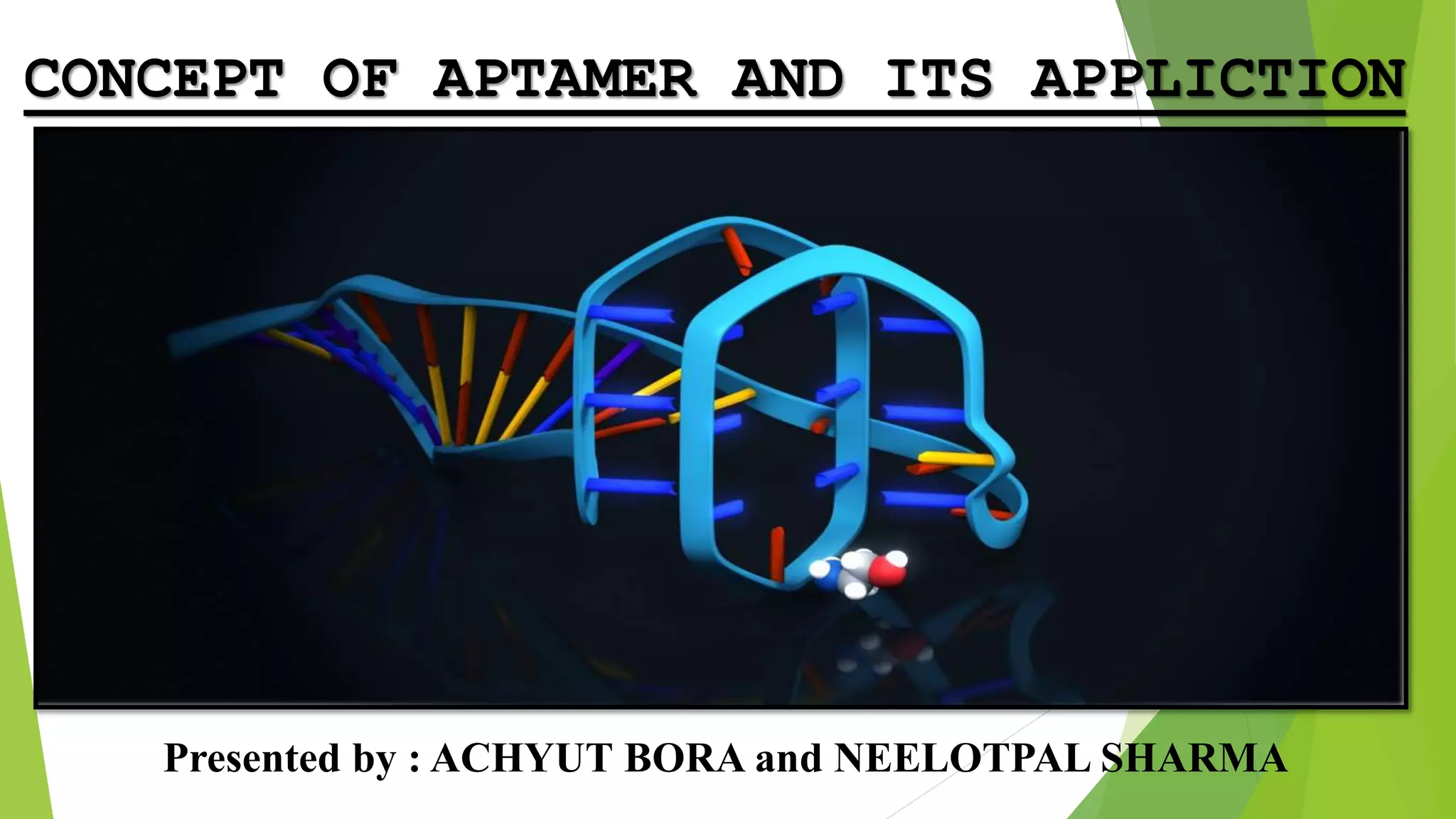
CONCEPT OF APTAMER AND ITS APPLICTION
Presented by : ACHYUT BORA and NEELOTPAL SHARMA
APTAMER
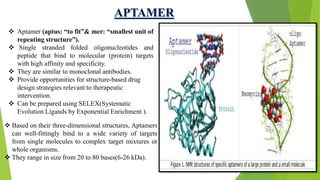
 Aptamer (aptus: “to fit”& mer: “smallest unit of
repeating structure”).
 Single stranded folded oligonucleotides and
peptide that bind to molecular (protein) targets
with high affinity and specificity.
 They are similar to monoclonal antibodies.
 Provide opportunities for structure-based drug
design strategies relevant to therapeutic
intervention.
 Can be prepared using SELEX(Systematic
Evolution Ligands by Exponential Enrichment ).
 Based on their three-dimensional structures, Aptamers
can well-fittingly bind to a wide variety of targets
from single molecules to complex target mixtures or
whole organisms.
 They range in size from 20 to 80 bases(6-26 kDa).
APTAMER PRODUCTION
SELEX
 Systematic Evolution 0f Ligands by Exponential Enrichment
 This method, described primarily in 1990(Ellington, A.D & Szostak, J.W., 1990)
SELEX contd
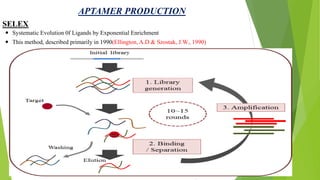
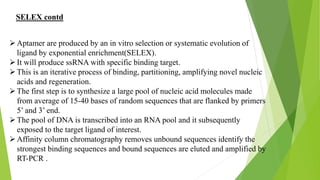
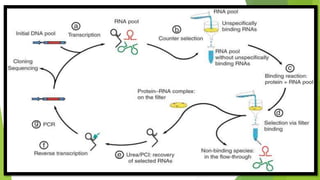
Aptamer are produced by an in vitro selection or systematic evolution of
ligand by exponential enrichment(SELEX).
It will produce ssRNA with specific binding target.
This is an iterative process of binding, partitioning, amplifying novel nucleic
acids and regeneration.
The first step is to synthesize a large pool of nucleic acid molecules made
from average of 15-40 bases of random sequences that are flanked by primers
5’ and 3’ end.
The pool of DNA is transcribed into an RNA pool and it subsequently
exposed to the target ligand of interest.
Affinity column chromatography removes unbound sequences identify the
strongest binding sequences and bound sequences are eluted and amplified by
RT-PCR .
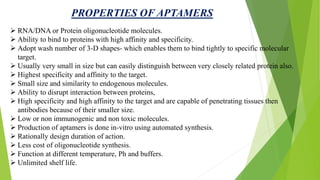
PROPERTIES OF APTAMERS
 RNA/DNA or Protein oligonucleotide molecules.
 Ability to bind to proteins with high affinity and specificity.
 Adopt wash number of 3-D shapes- which enables them to bind tightly to specific molecular
target.
 Usually very small in size but can easily distinguish between very closely related protein also.
 Highest specificity and affinity to the target.
 Small size and similarity to endogenous molecules.
 Ability to disrupt interaction between proteins,
 High specificity and high affinity to the target and are capable of penetrating tissues then
antibodies because of their smaller size.
 Low or non immunogenic and non toxic molecules.
 Production of aptamers is done in-vitro using automated synthesis.
 Rationally design duration of action.
 Less cost of oligonucleotide synthesis.
 Function at different temperature, Ph and buffers.
 Unlimited shelf life.
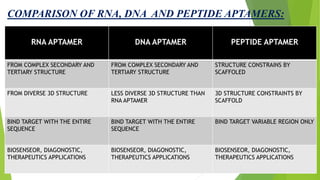
RNA APTAMER DNA APTAMER PEPTIDE APTAMER
FROM COMPLEX SECONDARY AND
TERTIARY STRUCTURE
FROM COMPLEX SECONDARY AND
TERTIARY STRUCTURE
STRUCTURE CONSTRAINS BY
SCAFFOLED
FROM DIVERSE 3D STRUCTURE LESS DIVERSE 3D STRUCTURE THAN
RNA APTAMER
3D STRUCTURE CONSTRAINTS BY
SCAFFOLD
BIND TARGET WITH THE ENTIRE
SEQUENCE
BIND TARGET WITH THE ENTIRE
SEQUENCE
BIND TARGET VARIABLE REGION ONLY
BIOSENSEOR, DIAGONOSTIC,
THERAPEUTICS APPLICATIONS
BIOSENSEOR, DIAGONOSTIC,
THERAPEUTICS APPLICATIONS
BIOSENSEOR, DIAGONOSTIC,
THERAPEUTICS APPLICATIONS
COMPARISON OF RNA, DNA AND PEPTIDE APTAMERS:
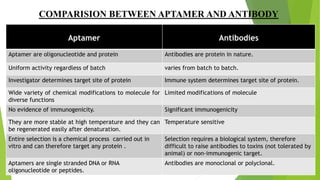
Aptamer Antibodies
Aptamer are oligonucleotide and protein Antibodies are protein in nature.
Uniform activity regardless of batch varies from batch to batch.
Investigator determines target site of protein Immune system determines target site of protein.
Wide variety of chemical modifications to molecule for
diverse functions
Limited modifications of molecule
No evidence of immunogenicity. Significant immunogenicity
They are more stable at high temperature and they can
be regenerated easily after denaturation.
Temperature sensitive
Entire selection is a chemical process carried out in
vitro and can therefore target any protein .
Selection requires a biological system, therefore
difficult to raise antibodies to toxins (not tolerated by
animal) or non-immunogenic target.
Aptamers are single stranded DNA or RNA
oligonucleotide or peptides.
Antibodies are monoclonal or polyclonal.
COMPARISION BETWEEN APTAMER AND ANTIBODY
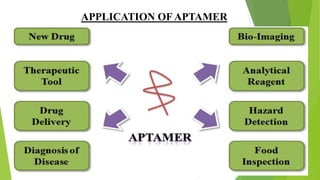
APPLICATION OF APTAMER
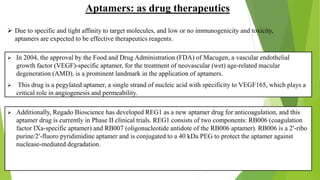
 In 2004, the approval by the Food and Drug Administration (FDA) of Macugen, a vascular endothelial
growth factor (VEGF)-specific aptamer, for the treatment of neovascular (wet) age-related macular
degeneration (AMD), is a prominent landmark in the application of aptamers.
 This drug is a pegylated aptamer, a single strand of nucleic acid with specificity to VEGF165, which plays a
critical role in angiogenesis and permeability.
 Additionally, Regado Bioscience has developed REG1 as a new aptamer drug for anticoagulation, and this
aptamer drug is currently in Phase II clinical trials. REG1 consists of two components: RB006 (coagulation
factor IXa-specific aptamer) and RB007 (oligonucleotide antidote of the RB006 aptamer). RB006 is a 2′-ribo
purine/2′-fluoro pyridimidine aptamer and is conjugated to a 40 kDa PEG to protect the aptamer against
nuclease-mediated degradation.
Aptamers: as drug therapeutics
 Due to specific and tight affinity to target molecules, and low or no immunogenicity and toxicity,
aptamers are expected to be effective therapeutics reagents.
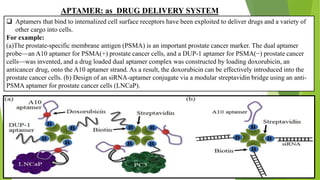
 Aptamers that bind to internalized cell surface receptors have been exploited to deliver drugs and a variety of
other cargo into cells.
For example:
(a)The prostate-specific membrane antigen (PSMA) is an important prostate cancer marker. The dual aptamer
probe—an A10 aptamer for PSMA(+) prostate cancer cells, and a DUP-1 aptamer for PSMA(−) prostate cancer
cells—was invented, and a drug loaded dual aptamer complex was constructed by loading doxorubicin, an
anticancer drug, onto the A10 aptamer strand. As a result, the doxorubicin can be effectively introduced into the
prostate cancer cells. (b) Design of an siRNA-aptamer conjugate via a modular streptavidin bridge using an anti-
PSMA aptamer for prostate cancer cells (LNCaP).
APTAMER: as DRUG DELIVERY SYSTEM
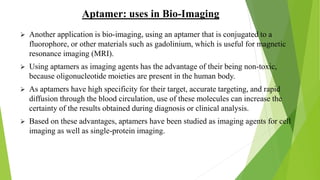
Aptamer: uses in Bio-Imaging
 Another application is bio-imaging, using an aptamer that is conjugated to a
fluorophore, or other materials such as gadolinium, which is useful for magnetic
resonance imaging (MRI).
 Using aptamers as imaging agents has the advantage of their being non-toxic,
because oligonucleotide moieties are present in the human body.
 As aptamers have high specificity for their target, accurate targeting, and rapid
diffusion through the blood circulation, use of these molecules can increase the
certainty of the results obtained during diagnosis or clinical analysis.
 Based on these advantages, aptamers have been studied as imaging agents for cell
imaging as well as single-protein imaging.
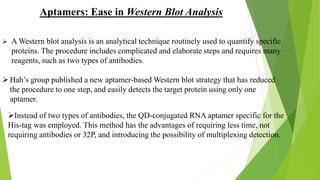
Aptamers: Ease in Western Blot Analysis
 A Western blot analysis is an analytical technique routinely used to quantify specific
proteins. The procedure includes complicated and elaborate steps and requires many
reagents, such as two types of antibodies.
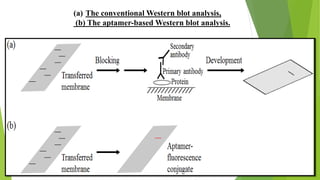
Hah’s group published a new aptamer-based Western blot strategy that has reduced
the procedure to one step, and easily detects the target protein using only one
aptamer.
Instead of two types of antibodies, the QD-conjugated RNA aptamer specific for the
His-tag was employed. This method has the advantages of requiring less time, not
requiring antibodies or 32P, and introducing the possibility of multiplexing detection.
(a) The conventional Western blot analysis,
(b) The aptamer-based Western blot analysis.
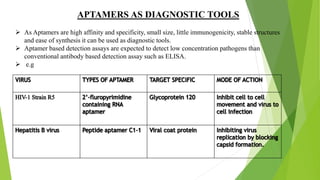
APTAMERS AS DIAGNOSTIC TOOLS
 As Aptamers are high affinity and specificity, small size, little immunogenicity, stable structures
and ease of synthesis it can be used as diagnostic tools.
 Aptamer based detection assays are expected to detect low concentration pathogens than
conventional antibody based detection assay such as ELISA.
 e.g
ADVANTAGES
 Produced chemically in a readily scalable process
 Not prone to viral or bacterial contamination
 Non-immunogenic
 more efficient entry into biological compartments
 Able to select for and against specific targets and to select against cell-surface
targets
 Can usually be reversibly denatured
 Dyes or functional groups can be readily introduced during synthesis
DISADVANTAGES
 Pharmacokinetic and other systemic properties are variable and often hard to
predict
 Small size makes them susceptible to renal filtration
 have a shorter half-life
 Unmodified aptamers are highly susceptible to serum degradation
 Aptamer technologies are currently largely covered by a single intellectual
property portfolio
 Aptamers provide opportunities for structure-based drug design strategies
relevant to therapeutic intervention
 Recent advances in the chemical modifications of nucleic acids suggest that one
of the major barriers to use, stability, can be overcome
 The high affinity and specificity of aptamers rival antibodies and make them a
promising tool in diagnostic and therapeutic application
 We should expect more aptamers to be isolated in the near future against an
ever increasing repertoire of targets, using these different SELEX approaches
with increased speed and efficiency
 Aptamers are poised to successfully compete with monoclonal Abs in
therapeutics and drug development within the next few decades
CONCLUSION
Aptamer and its applications

Aptamer and its applications

  • 1.
    CONCEPT OF APTAMERAND ITS APPLICTION Presented by : ACHYUT BORA and NEELOTPAL SHARMA
  • 2.
    APTAMER  Aptamer (aptus:“to fit”& mer: “smallest unit of repeating structure”).  Single stranded folded oligonucleotides and peptide that bind to molecular (protein) targets with high affinity and specificity.  They are similar to monoclonal antibodies.  Provide opportunities for structure-based drug design strategies relevant to therapeutic intervention.  Can be prepared using SELEX(Systematic Evolution Ligands by Exponential Enrichment ).  Based on their three-dimensional structures, Aptamers can well-fittingly bind to a wide variety of targets from single molecules to complex target mixtures or whole organisms.  They range in size from 20 to 80 bases(6-26 kDa).
  • 3.
    APTAMER PRODUCTION SELEX  SystematicEvolution 0f Ligands by Exponential Enrichment  This method, described primarily in 1990(Ellington, A.D & Szostak, J.W., 1990)
  • 4.
    SELEX contd Aptamer areproduced by an in vitro selection or systematic evolution of ligand by exponential enrichment(SELEX). It will produce ssRNA with specific binding target. This is an iterative process of binding, partitioning, amplifying novel nucleic acids and regeneration. The first step is to synthesize a large pool of nucleic acid molecules made from average of 15-40 bases of random sequences that are flanked by primers 5’ and 3’ end. The pool of DNA is transcribed into an RNA pool and it subsequently exposed to the target ligand of interest. Affinity column chromatography removes unbound sequences identify the strongest binding sequences and bound sequences are eluted and amplified by RT-PCR .
  • 6.
    PROPERTIES OF APTAMERS RNA/DNA or Protein oligonucleotide molecules.  Ability to bind to proteins with high affinity and specificity.  Adopt wash number of 3-D shapes- which enables them to bind tightly to specific molecular target.  Usually very small in size but can easily distinguish between very closely related protein also.  Highest specificity and affinity to the target.  Small size and similarity to endogenous molecules.  Ability to disrupt interaction between proteins,  High specificity and high affinity to the target and are capable of penetrating tissues then antibodies because of their smaller size.  Low or non immunogenic and non toxic molecules.  Production of aptamers is done in-vitro using automated synthesis.  Rationally design duration of action.  Less cost of oligonucleotide synthesis.  Function at different temperature, Ph and buffers.  Unlimited shelf life.
  • 7.
    RNA APTAMER DNAAPTAMER PEPTIDE APTAMER FROM COMPLEX SECONDARY AND TERTIARY STRUCTURE FROM COMPLEX SECONDARY AND TERTIARY STRUCTURE STRUCTURE CONSTRAINS BY SCAFFOLED FROM DIVERSE 3D STRUCTURE LESS DIVERSE 3D STRUCTURE THAN RNA APTAMER 3D STRUCTURE CONSTRAINTS BY SCAFFOLD BIND TARGET WITH THE ENTIRE SEQUENCE BIND TARGET WITH THE ENTIRE SEQUENCE BIND TARGET VARIABLE REGION ONLY BIOSENSEOR, DIAGONOSTIC, THERAPEUTICS APPLICATIONS BIOSENSEOR, DIAGONOSTIC, THERAPEUTICS APPLICATIONS BIOSENSEOR, DIAGONOSTIC, THERAPEUTICS APPLICATIONS COMPARISON OF RNA, DNA AND PEPTIDE APTAMERS:
  • 8.
    Aptamer Antibodies Aptamer areoligonucleotide and protein Antibodies are protein in nature. Uniform activity regardless of batch varies from batch to batch. Investigator determines target site of protein Immune system determines target site of protein. Wide variety of chemical modifications to molecule for diverse functions Limited modifications of molecule No evidence of immunogenicity. Significant immunogenicity They are more stable at high temperature and they can be regenerated easily after denaturation. Temperature sensitive Entire selection is a chemical process carried out in vitro and can therefore target any protein . Selection requires a biological system, therefore difficult to raise antibodies to toxins (not tolerated by animal) or non-immunogenic target. Aptamers are single stranded DNA or RNA oligonucleotide or peptides. Antibodies are monoclonal or polyclonal. COMPARISION BETWEEN APTAMER AND ANTIBODY
  • 9.
  • 10.
     In 2004,the approval by the Food and Drug Administration (FDA) of Macugen, a vascular endothelial growth factor (VEGF)-specific aptamer, for the treatment of neovascular (wet) age-related macular degeneration (AMD), is a prominent landmark in the application of aptamers.  This drug is a pegylated aptamer, a single strand of nucleic acid with specificity to VEGF165, which plays a critical role in angiogenesis and permeability.  Additionally, Regado Bioscience has developed REG1 as a new aptamer drug for anticoagulation, and this aptamer drug is currently in Phase II clinical trials. REG1 consists of two components: RB006 (coagulation factor IXa-specific aptamer) and RB007 (oligonucleotide antidote of the RB006 aptamer). RB006 is a 2′-ribo purine/2′-fluoro pyridimidine aptamer and is conjugated to a 40 kDa PEG to protect the aptamer against nuclease-mediated degradation. Aptamers: as drug therapeutics  Due to specific and tight affinity to target molecules, and low or no immunogenicity and toxicity, aptamers are expected to be effective therapeutics reagents.
  • 11.
     Aptamers thatbind to internalized cell surface receptors have been exploited to deliver drugs and a variety of other cargo into cells. For example: (a)The prostate-specific membrane antigen (PSMA) is an important prostate cancer marker. The dual aptamer probe—an A10 aptamer for PSMA(+) prostate cancer cells, and a DUP-1 aptamer for PSMA(−) prostate cancer cells—was invented, and a drug loaded dual aptamer complex was constructed by loading doxorubicin, an anticancer drug, onto the A10 aptamer strand. As a result, the doxorubicin can be effectively introduced into the prostate cancer cells. (b) Design of an siRNA-aptamer conjugate via a modular streptavidin bridge using an anti- PSMA aptamer for prostate cancer cells (LNCaP). APTAMER: as DRUG DELIVERY SYSTEM
  • 12.
    Aptamer: uses inBio-Imaging  Another application is bio-imaging, using an aptamer that is conjugated to a fluorophore, or other materials such as gadolinium, which is useful for magnetic resonance imaging (MRI).  Using aptamers as imaging agents has the advantage of their being non-toxic, because oligonucleotide moieties are present in the human body.  As aptamers have high specificity for their target, accurate targeting, and rapid diffusion through the blood circulation, use of these molecules can increase the certainty of the results obtained during diagnosis or clinical analysis.  Based on these advantages, aptamers have been studied as imaging agents for cell imaging as well as single-protein imaging.
  • 13.
    Aptamers: Ease inWestern Blot Analysis  A Western blot analysis is an analytical technique routinely used to quantify specific proteins. The procedure includes complicated and elaborate steps and requires many reagents, such as two types of antibodies. Hah’s group published a new aptamer-based Western blot strategy that has reduced the procedure to one step, and easily detects the target protein using only one aptamer. Instead of two types of antibodies, the QD-conjugated RNA aptamer specific for the His-tag was employed. This method has the advantages of requiring less time, not requiring antibodies or 32P, and introducing the possibility of multiplexing detection.
  • 14.
    (a) The conventionalWestern blot analysis, (b) The aptamer-based Western blot analysis.
  • 15.
    APTAMERS AS DIAGNOSTICTOOLS  As Aptamers are high affinity and specificity, small size, little immunogenicity, stable structures and ease of synthesis it can be used as diagnostic tools.  Aptamer based detection assays are expected to detect low concentration pathogens than conventional antibody based detection assay such as ELISA.  e.g
  • 16.
    ADVANTAGES  Produced chemicallyin a readily scalable process  Not prone to viral or bacterial contamination  Non-immunogenic  more efficient entry into biological compartments  Able to select for and against specific targets and to select against cell-surface targets  Can usually be reversibly denatured  Dyes or functional groups can be readily introduced during synthesis
  • 17.
    DISADVANTAGES  Pharmacokinetic andother systemic properties are variable and often hard to predict  Small size makes them susceptible to renal filtration  have a shorter half-life  Unmodified aptamers are highly susceptible to serum degradation  Aptamer technologies are currently largely covered by a single intellectual property portfolio
  • 18.
     Aptamers provideopportunities for structure-based drug design strategies relevant to therapeutic intervention  Recent advances in the chemical modifications of nucleic acids suggest that one of the major barriers to use, stability, can be overcome  The high affinity and specificity of aptamers rival antibodies and make them a promising tool in diagnostic and therapeutic application  We should expect more aptamers to be isolated in the near future against an ever increasing repertoire of targets, using these different SELEX approaches with increased speed and efficiency  Aptamers are poised to successfully compete with monoclonal Abs in therapeutics and drug development within the next few decades CONCLUSION