Sensible Solutions for Refurbished Radiology
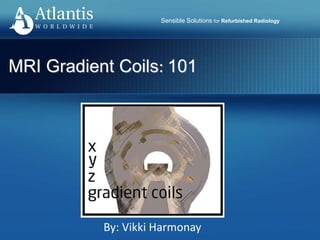
MRI Gradient Coils: 101
By: Vikki Harmonay
Sensible Solutions for Refurbished Radiology
Sometimes it’s great to review the basics of Magnetic Resonance
Imaging; how they work, what they cost, how they’re maintained
and even how they are installed. Let’s take a closer look at Gradient
Coils in MRI scanners.
Sensible Solutions for Refurbished Radiology
Gradients are simply loops of wire or thin conductive sheets on a
cylindrical shell that lies just inside the bore of an MRI Scanner.
When an electrical current passes through these coils, the result is a
secondary magnetic field. This gradient field distorts the main
magnetic field in a slight but predictable pattern. This causes the
resonance frequency of protons to vary in a function of position.
The main function of gradients is to allow spatial encoding of the
MRI signal, but are also critical for a wide range of physiologic
techniques. Examples includes MR angiography, diffusion ad
perfusion imaging.
Sensible Solutions for Refurbished Radiology
MRI gradient coils traditionally were composed of individual wires
wrapped onto fiberglass cylindrical formers coated with epoxy resin.
While this method is still used on many very-high-field human
scanners and laboratory instruments, most widely manufacturer
superconducting scanners now use distributed windings in a
“fingerprint” pattern. They consist of multiple thin metallic strips or
large copper sheets that have been etched into complex patterns and
applied to the cylinder.
Sensible Solutions for Refurbished Radiology
Almost all MR systems use three sets of gradient coils the x-, y- and
z-gradients. An independent power amplifier drives each coil set,
which creates a gradient field whose z-component varies linearly
along the x-, y- and z-directions respectively. The x- and y- gradients
usually have a saddle (Golay) coil configuration and the z- gradients
is usually based on circular (Maxwell) coils. The z -gradient is
produced by using two coils carrying currents in opposite direction.
Sensible Solutions for Refurbished Radiology
When a gradient is applied, it causes a frequency variation of protons
as a function of position along the direction of the gradient, which
can be used for spatial encoding. If the gradient is played out during
slice selection, as well as during signal readout, a slice can be
selected perpendicular to the gradient direction. If, for example, the
z- gradient is turned on in this way, a transverse slice is created in a
supine patient. By turning on two of more gradients simultaneously,
oblique slices can be obtained.
Sensible Solutions for Refurbished Radiology
If you have questions about gradient coils, it’s always wise to talk to
an expert. At Atlantis Worldwide, we’re happy to provide information
or recommendations about MRI, CT Scanners, C-Arms and other
Medical imaging equipment. For more than 30 years, we’ve helped
hospital and healthcare administrators, purchasers, radiology
professionals and physicians determine which MRI equipment is right
for their practice or facility and if refurbished or used equipment is a
wise and economically sound solution. Please feel free to reach out
to us anytime!
Talk To An Expert
Sensible Solutions for Refurbished Radiology
You can read this on our website
https://info.atlantisworldwide.com/blog/mri-gradient-
coils-101
Sensible Solutions for Refurbished Radiology
Contact Us
125 Park Avenue, 25th floor New York, NY – 10017, USA
Phone: 1-212-366-9100
Toll Free: 1-800-533-3356
info@atlantisworldwide.com
https://www.atlantisworldwide.com
https://info.atlantisworldwide.com/blog

Mri gradient coils 101

  • 1.
    Sensible Solutions forRefurbished Radiology MRI Gradient Coils: 101 By: Vikki Harmonay
  • 2.
    Sensible Solutions forRefurbished Radiology Sometimes it’s great to review the basics of Magnetic Resonance Imaging; how they work, what they cost, how they’re maintained and even how they are installed. Let’s take a closer look at Gradient Coils in MRI scanners.
  • 3.
    Sensible Solutions forRefurbished Radiology Gradients are simply loops of wire or thin conductive sheets on a cylindrical shell that lies just inside the bore of an MRI Scanner. When an electrical current passes through these coils, the result is a secondary magnetic field. This gradient field distorts the main magnetic field in a slight but predictable pattern. This causes the resonance frequency of protons to vary in a function of position. The main function of gradients is to allow spatial encoding of the MRI signal, but are also critical for a wide range of physiologic techniques. Examples includes MR angiography, diffusion ad perfusion imaging.
  • 4.
    Sensible Solutions forRefurbished Radiology MRI gradient coils traditionally were composed of individual wires wrapped onto fiberglass cylindrical formers coated with epoxy resin. While this method is still used on many very-high-field human scanners and laboratory instruments, most widely manufacturer superconducting scanners now use distributed windings in a “fingerprint” pattern. They consist of multiple thin metallic strips or large copper sheets that have been etched into complex patterns and applied to the cylinder.
  • 5.
    Sensible Solutions forRefurbished Radiology Almost all MR systems use three sets of gradient coils the x-, y- and z-gradients. An independent power amplifier drives each coil set, which creates a gradient field whose z-component varies linearly along the x-, y- and z-directions respectively. The x- and y- gradients usually have a saddle (Golay) coil configuration and the z- gradients is usually based on circular (Maxwell) coils. The z -gradient is produced by using two coils carrying currents in opposite direction.
  • 6.
    Sensible Solutions forRefurbished Radiology When a gradient is applied, it causes a frequency variation of protons as a function of position along the direction of the gradient, which can be used for spatial encoding. If the gradient is played out during slice selection, as well as during signal readout, a slice can be selected perpendicular to the gradient direction. If, for example, the z- gradient is turned on in this way, a transverse slice is created in a supine patient. By turning on two of more gradients simultaneously, oblique slices can be obtained.
  • 7.
    Sensible Solutions forRefurbished Radiology If you have questions about gradient coils, it’s always wise to talk to an expert. At Atlantis Worldwide, we’re happy to provide information or recommendations about MRI, CT Scanners, C-Arms and other Medical imaging equipment. For more than 30 years, we’ve helped hospital and healthcare administrators, purchasers, radiology professionals and physicians determine which MRI equipment is right for their practice or facility and if refurbished or used equipment is a wise and economically sound solution. Please feel free to reach out to us anytime! Talk To An Expert
  • 8.
    Sensible Solutions forRefurbished Radiology You can read this on our website https://info.atlantisworldwide.com/blog/mri-gradient- coils-101
  • 9.
    Sensible Solutions forRefurbished Radiology Contact Us 125 Park Avenue, 25th floor New York, NY – 10017, USA Phone: 1-212-366-9100 Toll Free: 1-800-533-3356 info@atlantisworldwide.com https://www.atlantisworldwide.com https://info.atlantisworldwide.com/blog