MR Physics
Basic Concepts
Production of a Magnetic Field
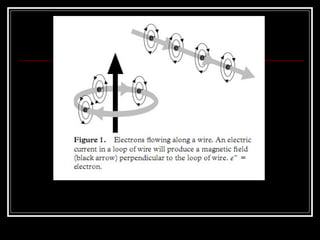
 When an electron travels along a wire, a magnetic field is
produced around the electron.
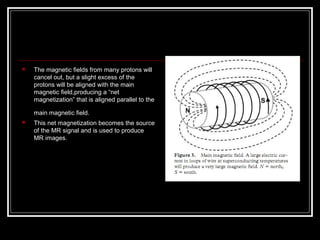
 When an electric current flows in a wire that is formed into a loop,
a large magnetic field will be formed perpendicular to the loop.
Resonance:
 Resonance is the tendency of a system to oscillate at
maximum amplitude at certain frequencies, known as the
system's resonance frequencies (or resonant frequencies).
 At these frequencies, even small periodic driving forces can
produce large amplitude vibrations, because the system
stores vibrational energy.
 One example is a playground swing, which acts as a pendulum.
Pushing a person in a swing in time with the natural interval of the
swing (its resonance frequency) will make the swing go higher
and higher (maximum amplitude), while attempts to push the
swing at a faster or slower tempo will result in smaller arcs.
 This is because the energy the swing absorbs is maximized when
the pushes are ‘in phase' with the swing's oscillations, while some
of the swing's energy is actually extracted by the opposing force
of the pushes when they are not.
Hydrogen Protons
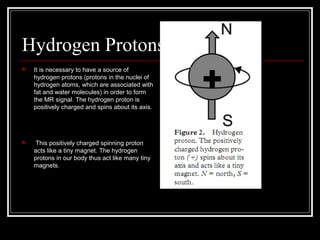
 It is necessary to have a source of
hydrogen protons (protons in the nuclei of
hydrogen atoms, which are associated with
fat and water molecules) in order to form
the MR signal. The hydrogen proton is
positively charged and spins about its axis.
 This positively charged spinning proton
acts like a tiny magnet. The hydrogen
protons in our body thus act like many tiny
magnets.
Main Magnetic Field
 The main magnetic field of an MR system comes from a large electric
current flowing through wires that are formed into a loop in the magnet
of the imaging system.
 Putting these basic elements together, there are protons in the body,
positively charged and spinning about their axes, which act like tiny
magnets.
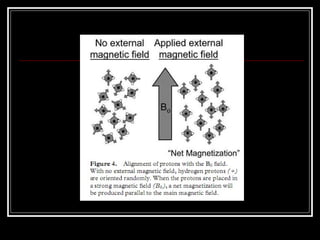
 They are randomly oriented so that their magnetic fields do not sum but
rather cancel out.
 When we place these protons in a strong magnetic field (called B0),
some will tend to align in the direction of the magnetic field and some
will tend to align in a direction opposite to the magnetic field.
 The magnetic fields from many protons will
cancel out, but a slight excess of the
protons will be aligned with the main
magnetic field,producing a “net
magnetization” that is aligned parallel to the
main magnetic field.
 This net magnetization becomes the source
of the MR signal and is used to produce
MR images.
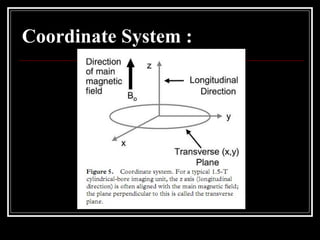
Coordinate System :
Precession :
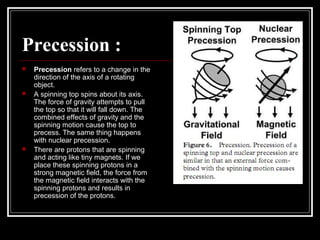
 Precession refers to a change in the 
direction of the axis of a rotating 
object. 
 A spinning top spins about its axis. 
The force of gravity attempts to pull 
the top so that it will fall down. The 
combined effects of gravity and the 
spinning motion cause the top to 
precess. The same thing happens 
with nuclear precession. 
 There are protons that are spinning 
and acting like tiny magnets. If we 
place these spinning protons in a 
strong magnetic field, the force from 
the magnetic field interacts with the 
spinning protons and results in 
precession of the protons. 
 Knowing the proton precessional frequency 
that allows us to create a situation through 
which the resonance phenomenon can be 
used to efficiently transfer energy to the 
protons. 
 The proton precessional frequency is 
determined from the Larmor equation, in 
which the frequency of precession, f, is 
equal to a constant times the main 
magnetic field strength.
 The constant is called the gyromagnetic ratio and is a 
characteristic of each type of nuclei. For hydrogen 
protons, the gyromagnetic ratio is equal to 42.6MHz/T 
(megahertz per tesla). 
Radiofrequency Energy :
 Radiofrequency (RF) energy comes in the form of rapidly 
changing magnetic and electric fields generated by 
electrons traveling through loops of wire with the direction 
of current flow rapidly changing back and forth at “radio 
frequencies.”
  The magnetic field (generated by the flow of electrons) 
will also rapidly change  directions. 
 This RF energy is transmitted by an RF transmit coil.
  The RF is transmitted for a short period of time called an 
RF pulse. 
 This transmitted RF pulse must be at the precessional 
frequency of the protons (calculated via the Larmor equation) 
in order for resonance to occur and for efficient transfer of 
energy from the RF coil to the protons.  “Resonance”.
Absorption of RF Energy
 Recall that when protons in the body are placed in the vicinity of a strong
magnetic field, the magnetic fields from these protons combine to form a net
magnetization. This net magnetization points in a direction parallel to the main
magnetic field.
 As energy is absorbed from the RF pulse, the net magnetization rotates away
from the longitudinal direction. The amount of rotation (termed the flip angle)
depends on the strength and duration of the RF pulse.
:: Start Here ::
MRI physics basic concepts

MRI physics basic concepts