At the end of this lesson, students should be able to:
  • Explain the meaning of neutralisation precisely.
  • Explain the application of neutralisation in daily life.
  • Write equations for neutralisation reactions
  • Describe acid-base titration.
  • Determine the end point of titration during
     neutralisation.
  • Solve numerical problems involving neutralisation
     reactions to calculate either concentration or
     volume of solutions.
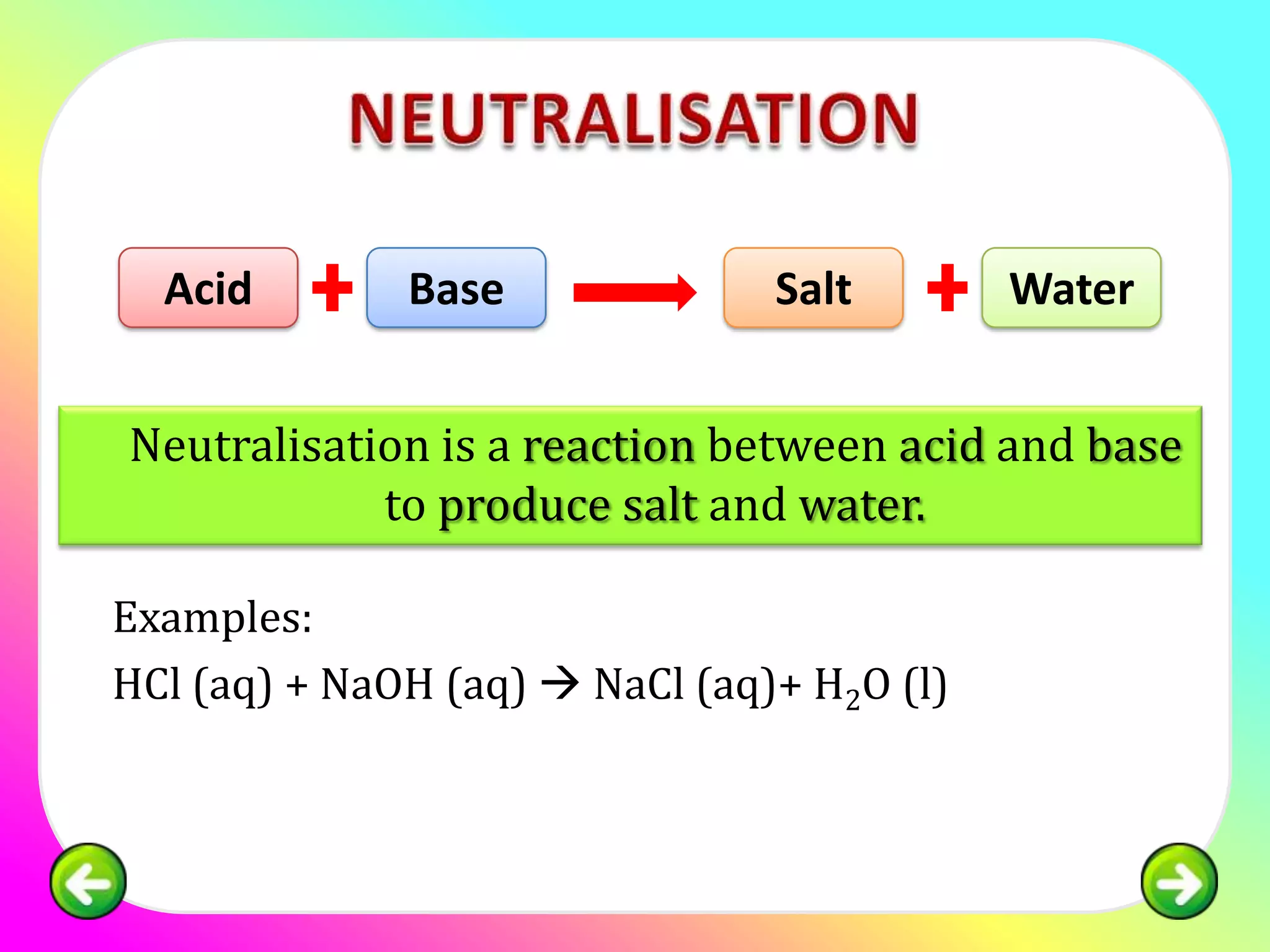
Acid        Base              Salt           Water


Neutralisation is a reaction between acid and base
            to produce salt and water.

Examples:
HCl (aq) + NaOH (aq)  NaCl (aq)+ H2O (l)
H2SO4 (aq) + CuO (aq)  CuSO4 (aq) + H2O (l)
HCl (aq) + NaOH (aq)  NaCl (aq) + H2O (l)
Chemical
Equation
           H+Cl-(aq) + Na+OH- (aq)  Na+Cl- (aq) + H2O (l)


  Ionic
                   H+(aq) + OH- (aq)  H2O (l)
Equation
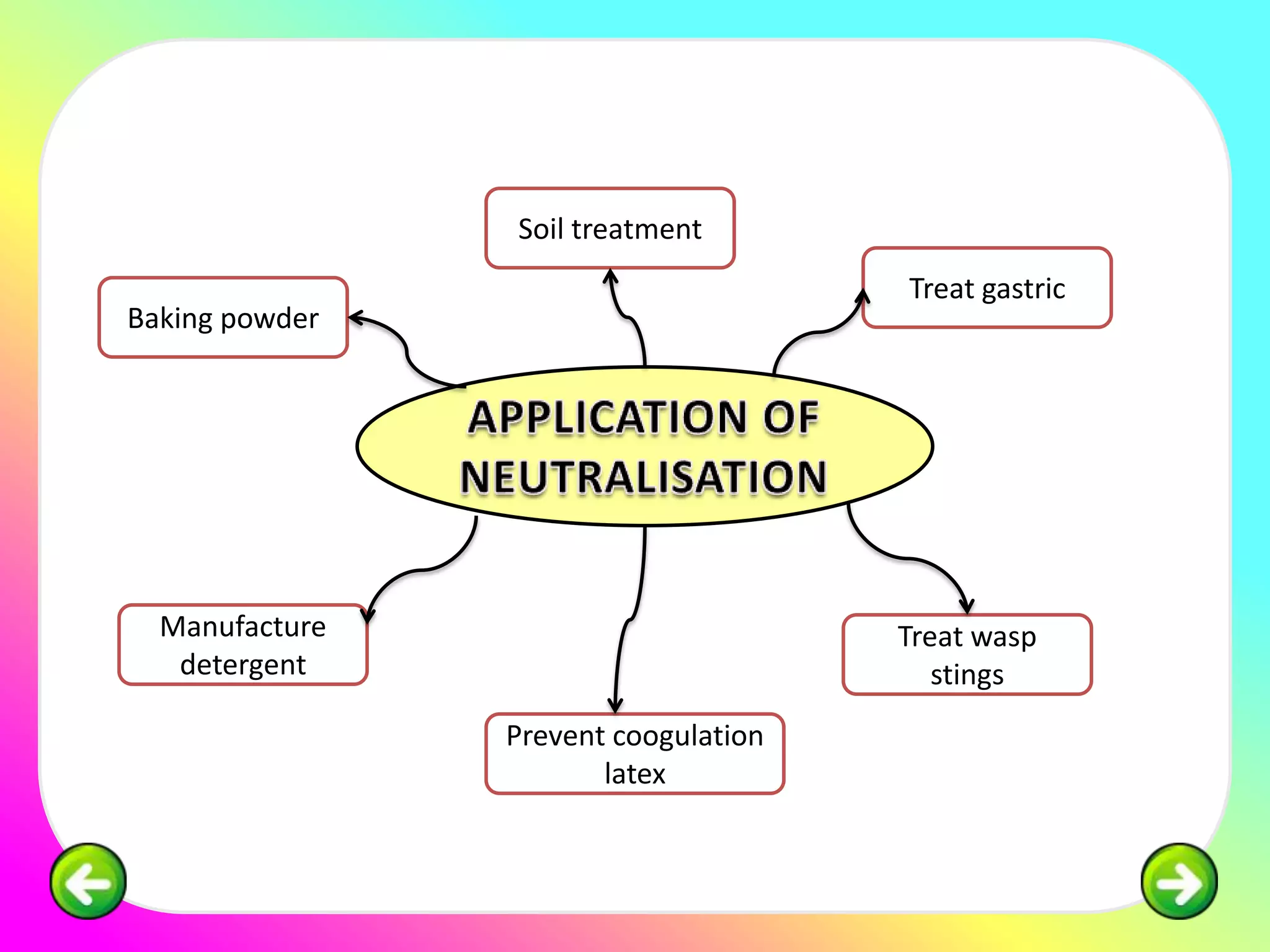
Soil treatment
                                      Treat gastric
Baking powder


  Manufacture                         Treat wasp
   detergent                             stings
                Prevent coogulation
                       latex
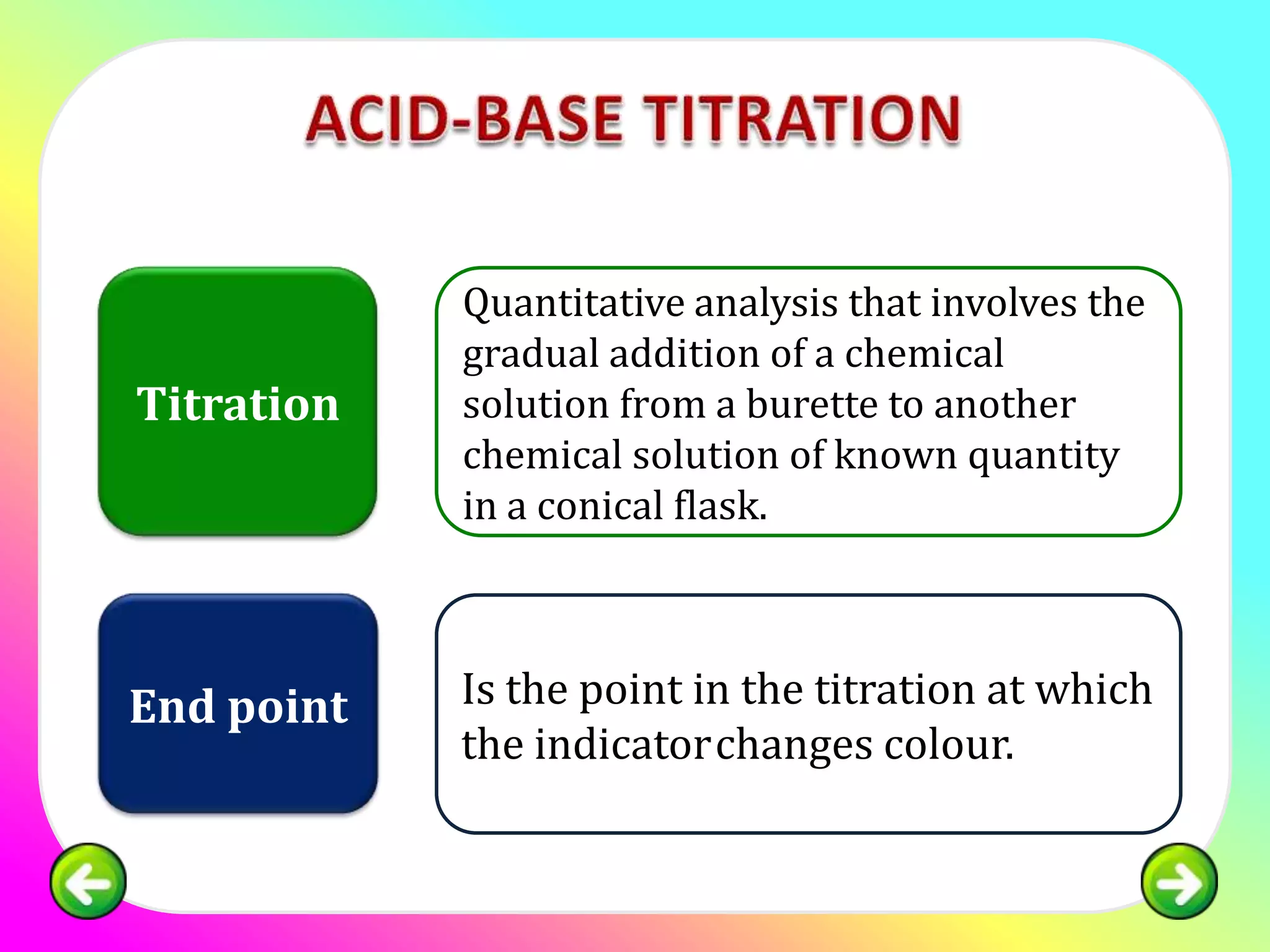
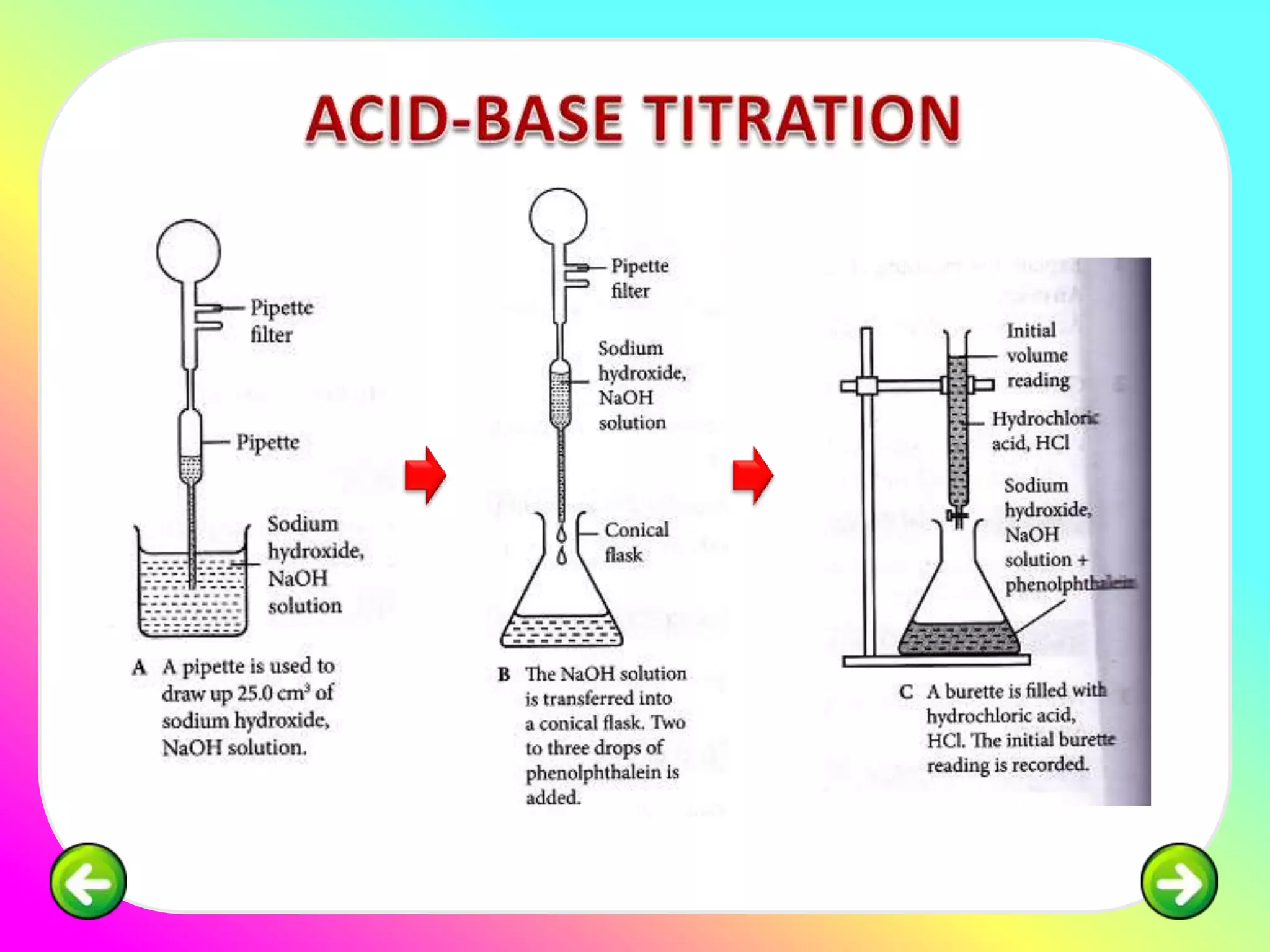
Quantitative analysis that involves the
            gradual addition of a chemical
Titration   solution from a burette to another
            chemical solution of known quantity
            in a conical flask.


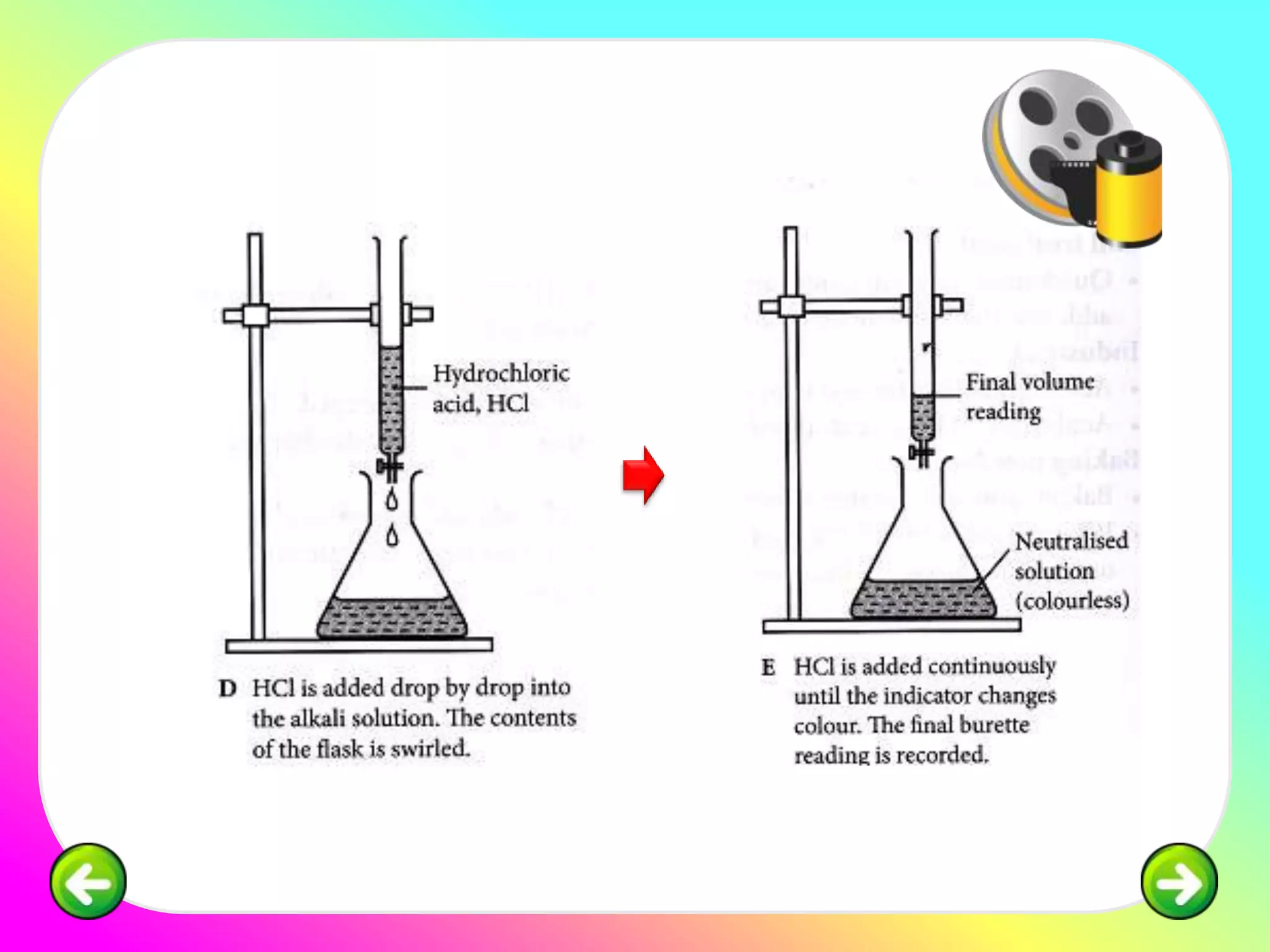
End point   Is the point in the titration at which
            the indicatorchanges colour.
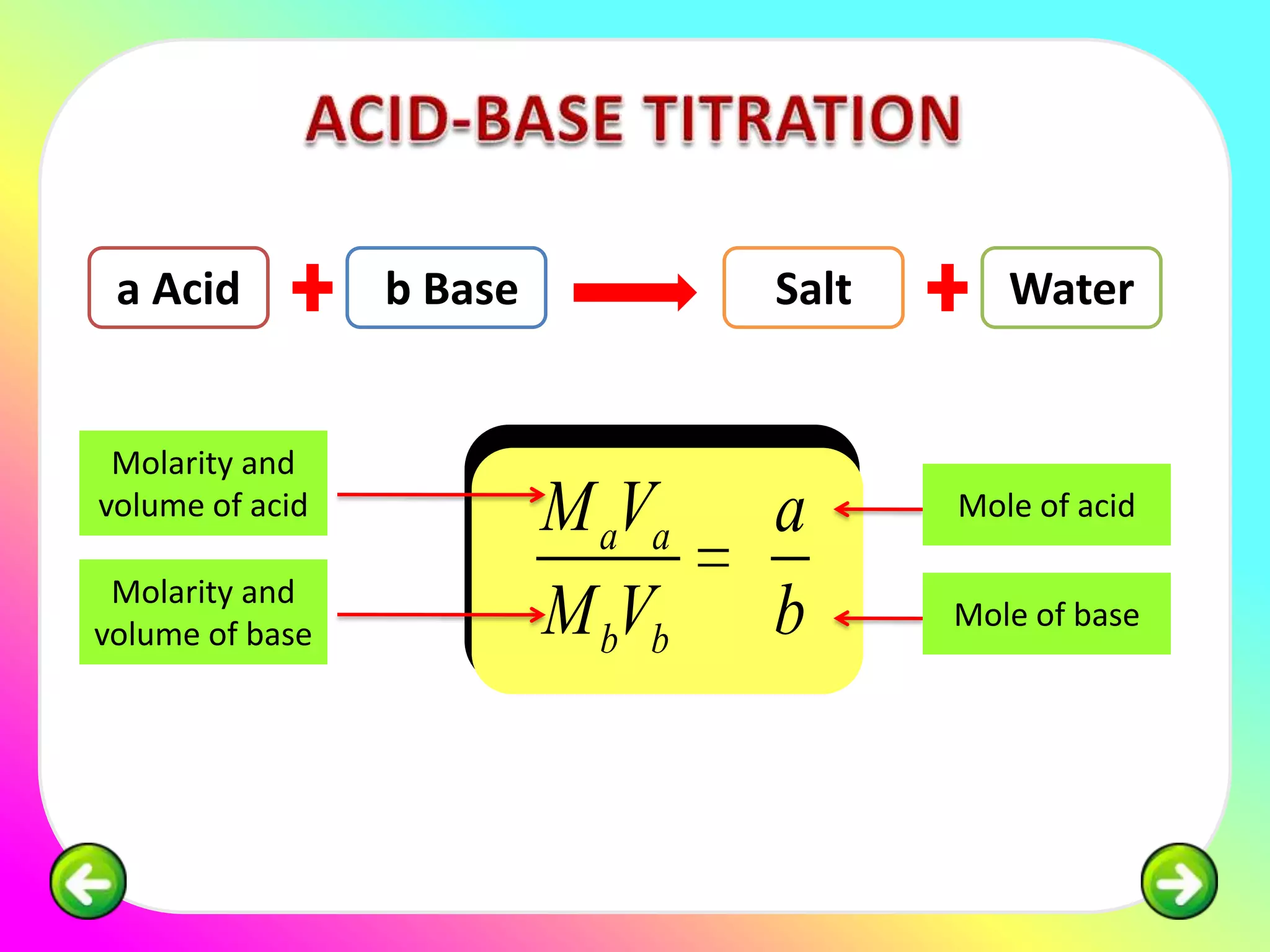
a Acid          b Base           Salt      Water


 Molarity and
volume of acid            M aVa   a      Mole of acid

 Molarity and
volume of base            M bVb   b      Mole of base
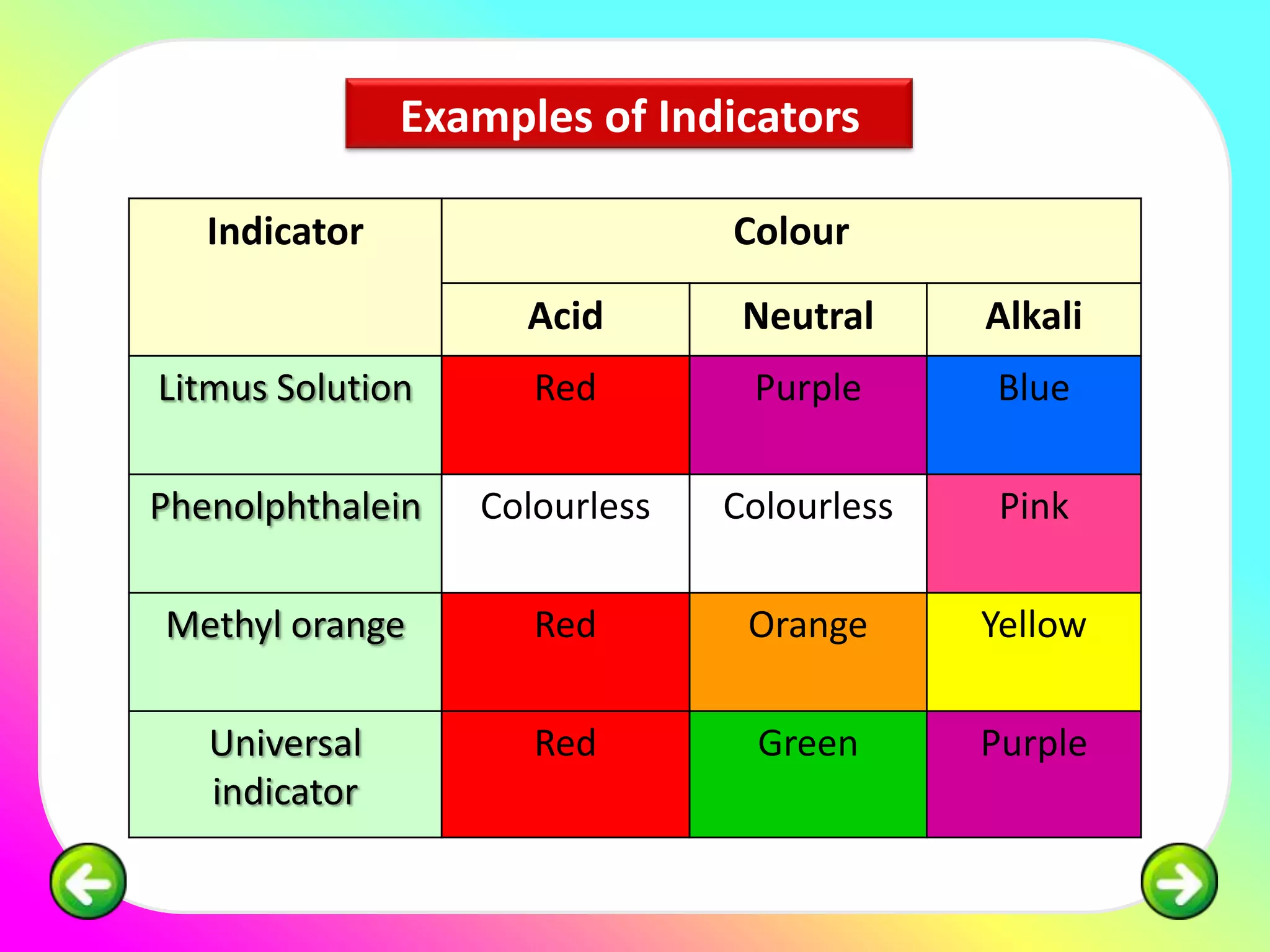
Examples of Indicators

   Indicator                   Colour
                     Acid       Neutral     Alkali
Litmus Solution      Red        Purple      Blue

Phenolphthalein   Colourless   Colourless    Pink

Methyl orange        Red        Orange      Yellow

   Universal         Red         Green      Purple
   indicator
Question 1:

25.0 cm3 of sulphuric acid is neutralised by 34.0
cm3 of 0.1 mol of dm-3 NaOH. Calculate the
concentration of sulphuric acid in:

      (a) mol dm -3
      (b) g dm-3

[relative atomic mass; H:1, S:32, O:16]
Solution:

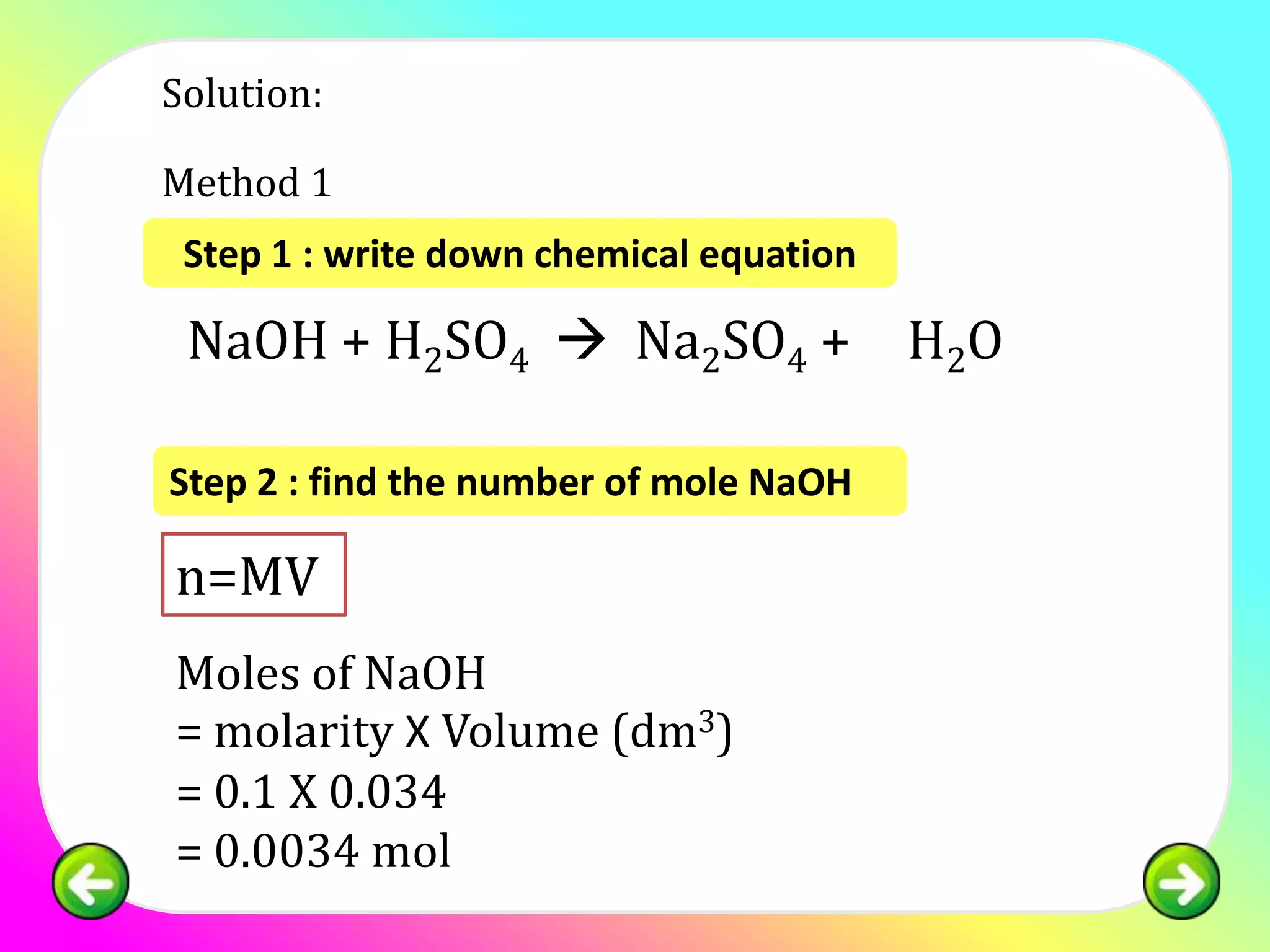
Method 1
 Step 1 : write down chemical equation

2NaOH + H2SO4  Na2SO4 + 2H2O

Step 2 : find the number of mole NaOH

n=MV
Moles of NaOH
= molarity X Volume (dm3)
= 0.1 X 0.034
= 0.0034 mol
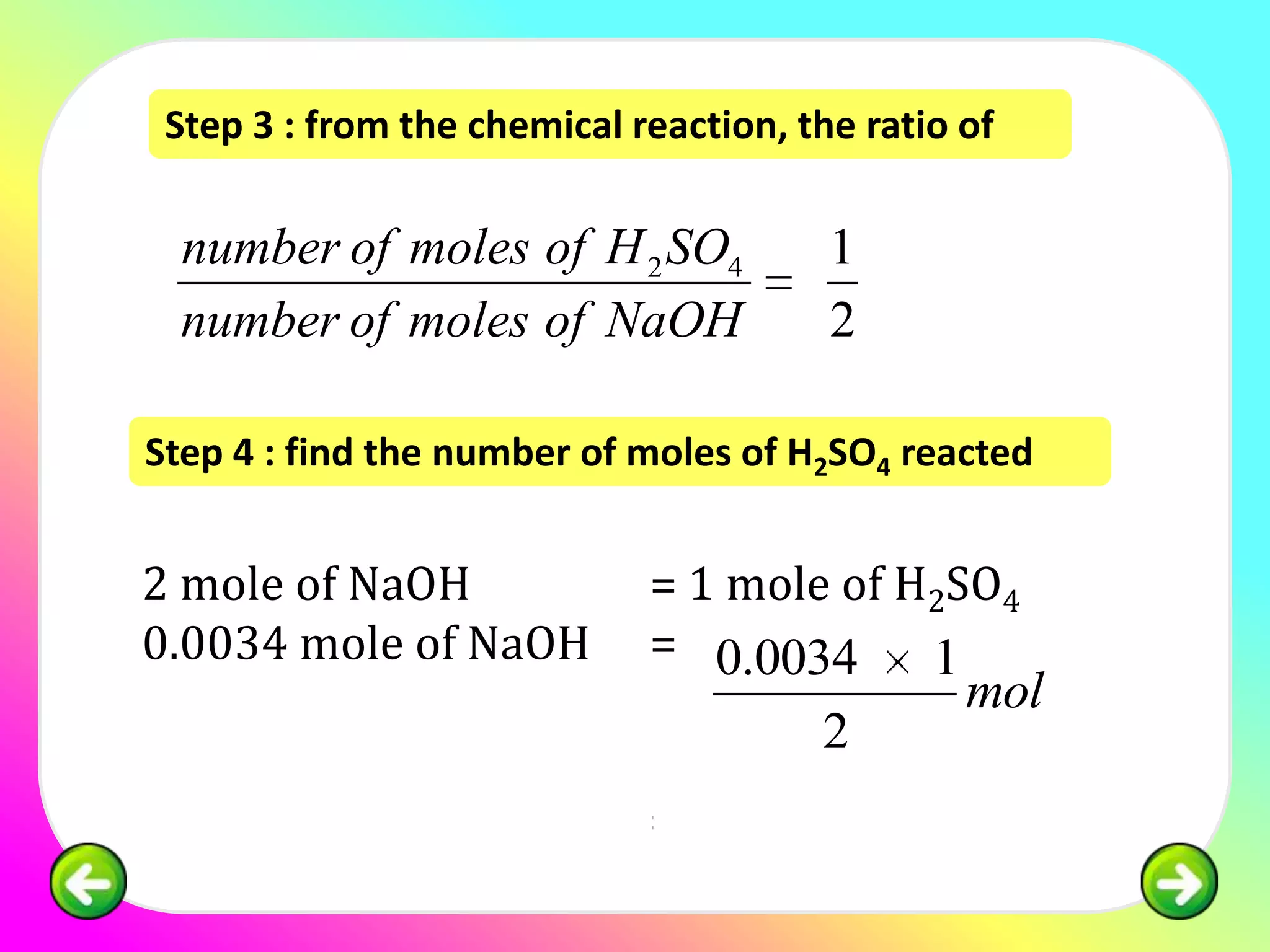
Step 3 : from the chemical reaction, the ratio of

  number of moles of H 2 SO4            1
  number of moles of NaOH               2

Step 4 : find the number of moles of H2SO4 reacted


2 mole of NaOH               = 1 mole of H2SO4
0.0034 mole of NaOH          = 0.0034     1
                                                mol
                                       2
                             = 0.0017 mol
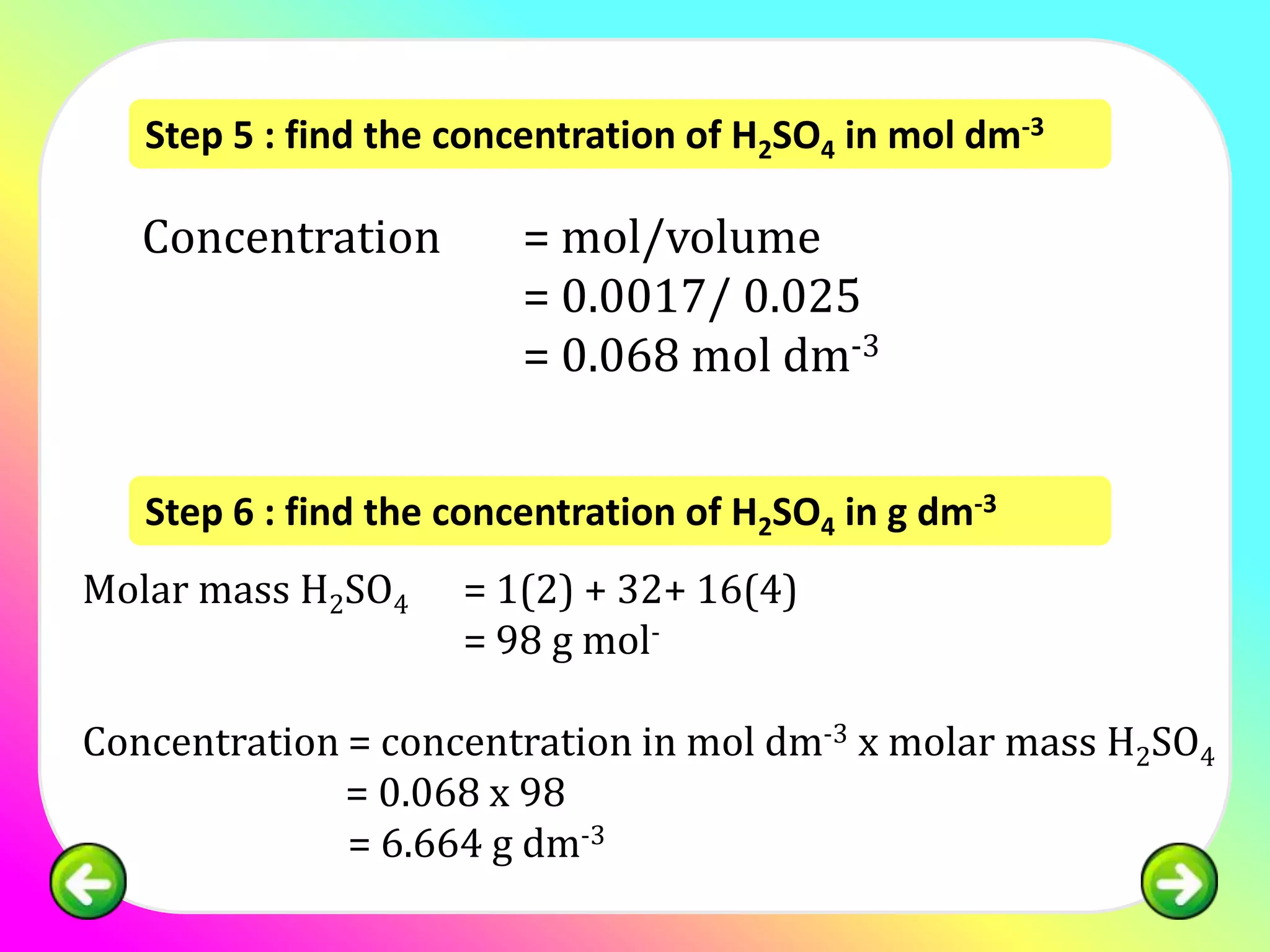
Step 5 : find the concentration of H2SO4 in mol dm-3

   Concentration         = mol/volume
                         = 0.0017/ 0.025
                         = 0.068 mol dm-3


   Step 6 : find the concentration of H2SO4 in g dm-3
Molar mass H2SO4     = 1(2) + 32+ 16(4)
                     = 98 g mol-

Concentration = concentration in mol dm-3 x molar mass H2SO4
              = 0.068 x 98
              = 6.664 g dm-3
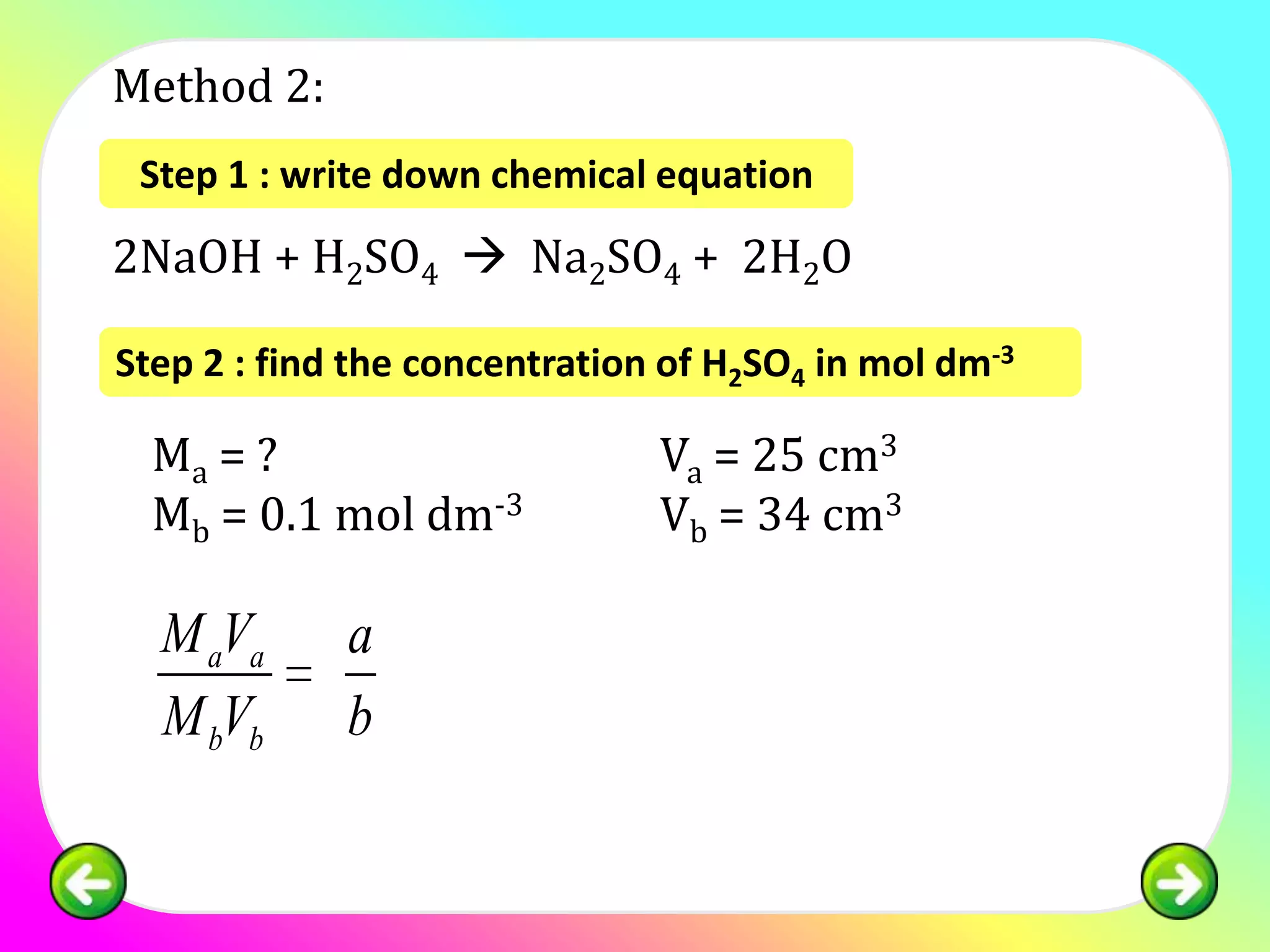
Method 2:
 Step 1 : write down chemical equation

2NaOH + H2SO4  Na2SO4 + 2H2O

Step 2 : find the concentration of H2SO4 in mol dm-3

  Ma = ?                       Va = 25 cm3
  Mb = 0.1 mol dm-3            Vb = 34 cm3

  M aVa      a
  M bVb      b
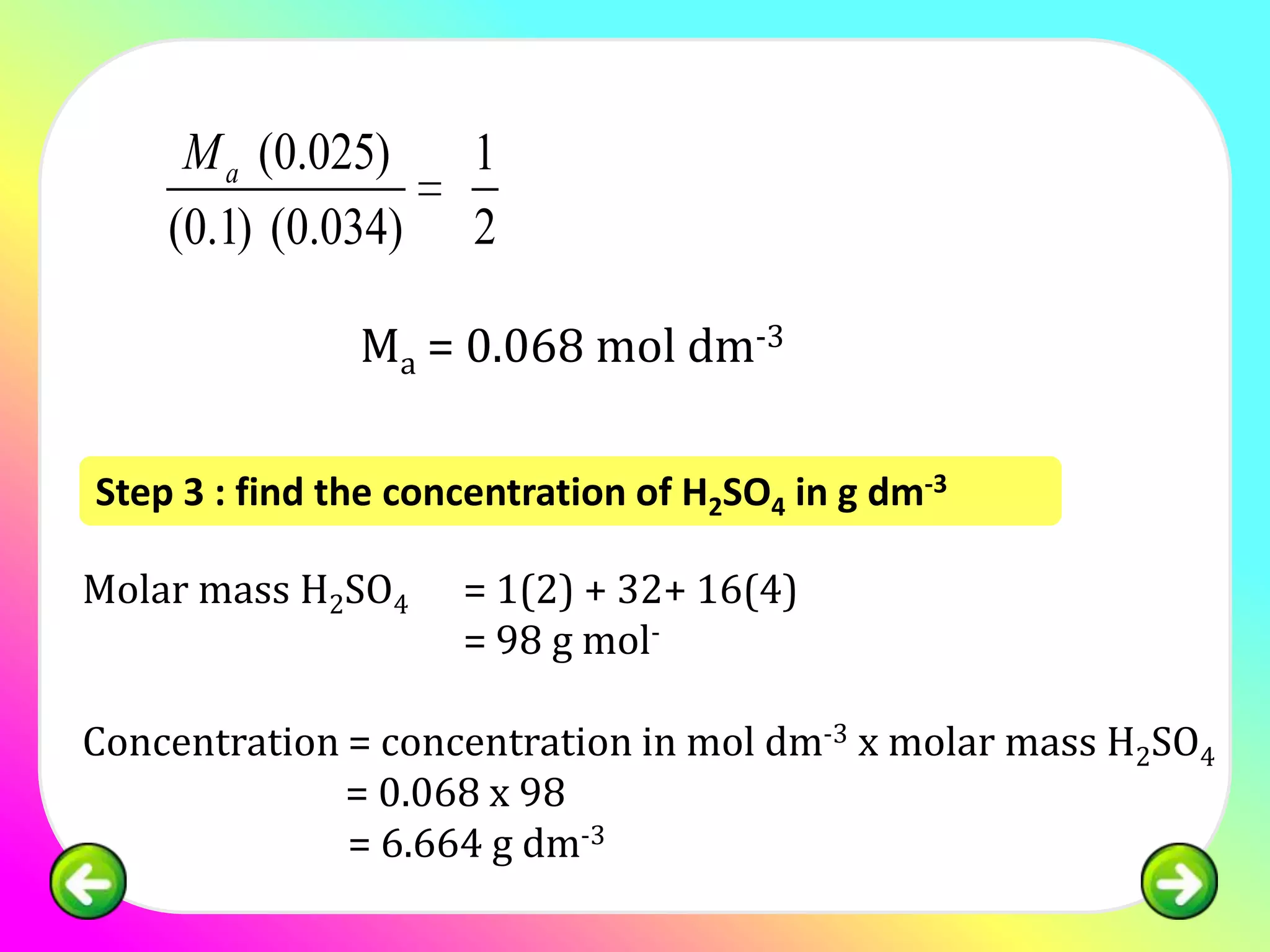
M a (0.025)      1
    (0.1) (0.034)     2

               Ma = 0.068 mol dm-3

Step 3 : find the concentration of H2SO4 in g dm-3

Molar mass H2SO4     = 1(2) + 32+ 16(4)
                     = 98 g mol-

Concentration = concentration in mol dm-3 x molar mass H2SO4
              = 0.068 x 98
              = 6.664 g dm-3
Question 2:

  What volume of 0.20 mol dm-3 nitric
  acid is required to neutralise 0.14 g of
  potassium hydroxide? [relative atomic
  mass: O: 16, K:39, H:1]


                             Ans: 12.5 cm3/0.0125 dm3
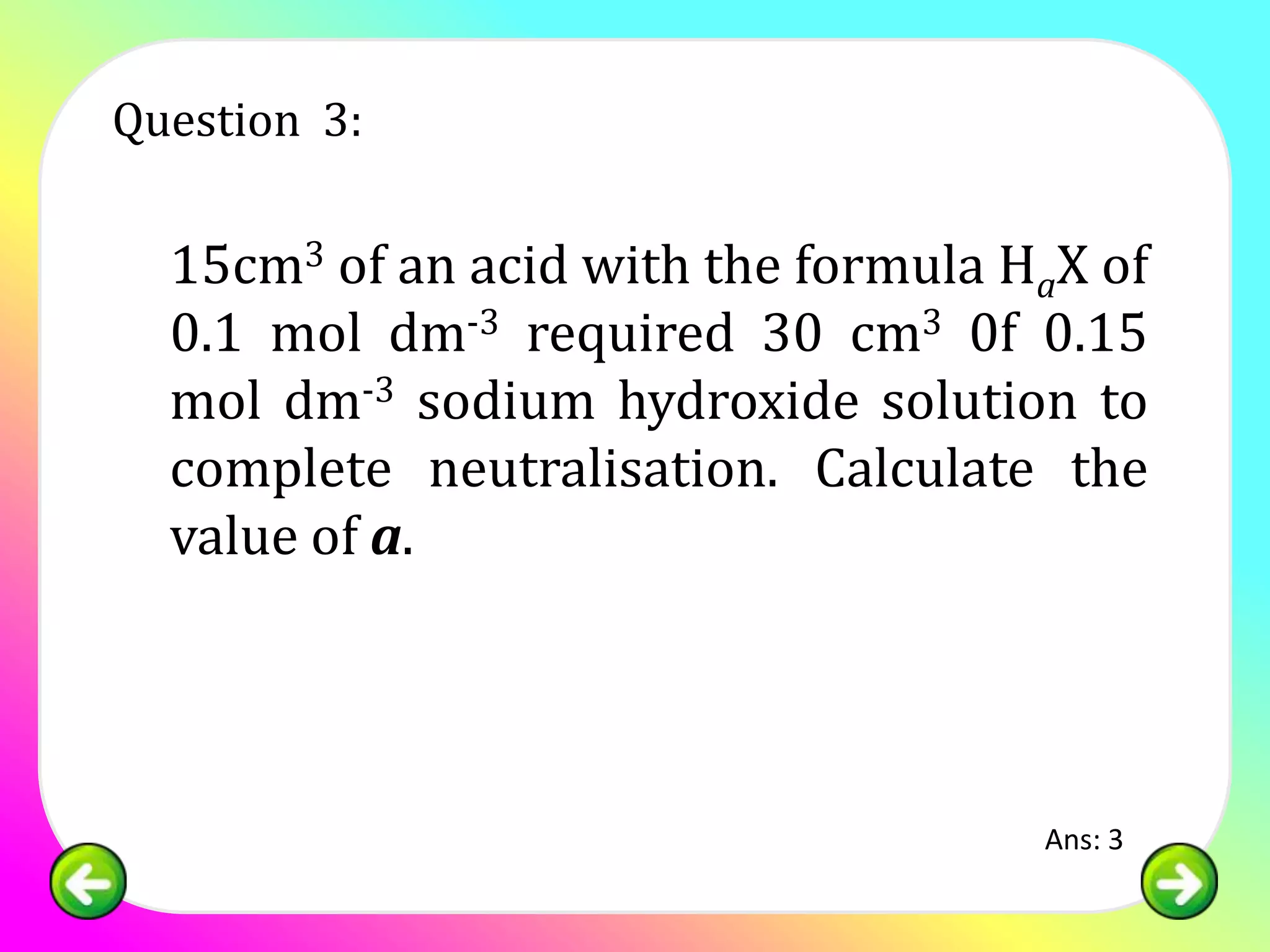
Question 3:

  15cm3 of an acid with the formula HaX of
  0.1 mol dm-3 required 30 cm3 0f 0.15
  mol dm-3 sodium hydroxide solution to
  complete neutralisation. Calculate the
  value of a.


                                     Ans: 3
Chapter 7 acid & bases part 4

Chapter 7 acid & bases part 4

  • 2.
    At the endof this lesson, students should be able to: • Explain the meaning of neutralisation precisely. • Explain the application of neutralisation in daily life. • Write equations for neutralisation reactions • Describe acid-base titration. • Determine the end point of titration during neutralisation. • Solve numerical problems involving neutralisation reactions to calculate either concentration or volume of solutions.
  • 3.
    Acid Base Salt Water Neutralisation is a reaction between acid and base to produce salt and water. Examples: HCl (aq) + NaOH (aq)  NaCl (aq)+ H2O (l) H2SO4 (aq) + CuO (aq)  CuSO4 (aq) + H2O (l)
  • 4.
    HCl (aq) +NaOH (aq)  NaCl (aq) + H2O (l) Chemical Equation H+Cl-(aq) + Na+OH- (aq)  Na+Cl- (aq) + H2O (l) Ionic H+(aq) + OH- (aq)  H2O (l) Equation
  • 5.
    Soil treatment Treat gastric Baking powder Manufacture Treat wasp detergent stings Prevent coogulation latex
  • 6.
    Quantitative analysis thatinvolves the gradual addition of a chemical Titration solution from a burette to another chemical solution of known quantity in a conical flask. End point Is the point in the titration at which the indicatorchanges colour.
  • 7.
    a Acid b Base Salt Water Molarity and volume of acid M aVa a Mole of acid Molarity and volume of base M bVb b Mole of base
  • 8.
    Examples of Indicators Indicator Colour Acid Neutral Alkali Litmus Solution Red Purple Blue Phenolphthalein Colourless Colourless Pink Methyl orange Red Orange Yellow Universal Red Green Purple indicator
  • 11.
    Question 1: 25.0 cm3of sulphuric acid is neutralised by 34.0 cm3 of 0.1 mol of dm-3 NaOH. Calculate the concentration of sulphuric acid in: (a) mol dm -3 (b) g dm-3 [relative atomic mass; H:1, S:32, O:16]
  • 12.
    Solution: Method 1 Step1 : write down chemical equation 2NaOH + H2SO4  Na2SO4 + 2H2O Step 2 : find the number of mole NaOH n=MV Moles of NaOH = molarity X Volume (dm3) = 0.1 X 0.034 = 0.0034 mol
  • 13.
    Step 3 :from the chemical reaction, the ratio of number of moles of H 2 SO4 1 number of moles of NaOH 2 Step 4 : find the number of moles of H2SO4 reacted 2 mole of NaOH = 1 mole of H2SO4 0.0034 mole of NaOH = 0.0034 1 mol 2 = 0.0017 mol
  • 14.
    Step 5 :find the concentration of H2SO4 in mol dm-3 Concentration = mol/volume = 0.0017/ 0.025 = 0.068 mol dm-3 Step 6 : find the concentration of H2SO4 in g dm-3 Molar mass H2SO4 = 1(2) + 32+ 16(4) = 98 g mol- Concentration = concentration in mol dm-3 x molar mass H2SO4 = 0.068 x 98 = 6.664 g dm-3
  • 15.
    Method 2: Step1 : write down chemical equation 2NaOH + H2SO4  Na2SO4 + 2H2O Step 2 : find the concentration of H2SO4 in mol dm-3 Ma = ? Va = 25 cm3 Mb = 0.1 mol dm-3 Vb = 34 cm3 M aVa a M bVb b
  • 16.
    M a (0.025) 1 (0.1) (0.034) 2 Ma = 0.068 mol dm-3 Step 3 : find the concentration of H2SO4 in g dm-3 Molar mass H2SO4 = 1(2) + 32+ 16(4) = 98 g mol- Concentration = concentration in mol dm-3 x molar mass H2SO4 = 0.068 x 98 = 6.664 g dm-3
  • 17.
    Question 2: What volume of 0.20 mol dm-3 nitric acid is required to neutralise 0.14 g of potassium hydroxide? [relative atomic mass: O: 16, K:39, H:1] Ans: 12.5 cm3/0.0125 dm3
  • 18.
    Question 3: 15cm3 of an acid with the formula HaX of 0.1 mol dm-3 required 30 cm3 0f 0.15 mol dm-3 sodium hydroxide solution to complete neutralisation. Calculate the value of a. Ans: 3