Titrations 1/28/2024
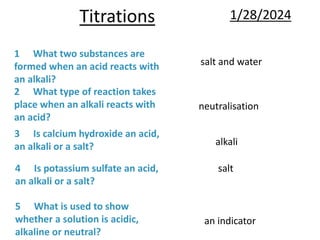
5 What is used to show
whether a solution is acidic,
alkaline or neutral?
4 Is potassium sulfate an acid,
an alkali or a salt?
3 Is calcium hydroxide an acid,
an alkali or a salt?
2 What type of reaction takes
place when an alkali reacts with
an acid?
1 What two substances are
formed when an acid reacts with
an alkali?
salt and water
neutralisation
alkali
salt
an indicator
Titrations 1/28/2024
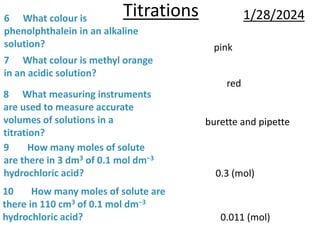
6 What colour is
phenolphthalein in an alkaline
solution?
7 What colour is methyl orange
in an acidic solution?
8 What measuring instruments
are used to measure accurate
volumes of solutions in a
titration?
9 How many moles of solute
are there in 3 dm3 of 0.1 mol dm−3
hydrochloric acid?
10 How many moles of solute are
there in 110 cm3 of 0.1 mol dm−3
hydrochloric acid?
pink
red
burette and pipette
0.3 (mol)
0.011 (mol)
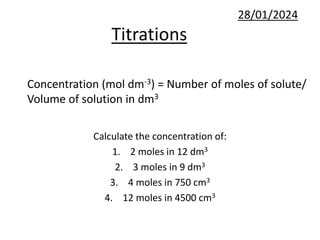
Titrations
28/01/2024
Calculate the concentration of:
1. 2 moles in 12 dm3
2. 3 moles in 9 dm3
3. 4 moles in 750 cm3
4. 12 moles in 4500 cm3
Concentration (mol dm-3) = Number of moles of solute/
Volume of solution in dm3
Titrations
28/01/2024
Calculate the concentration of:
1. 2 g of HCl in 12 dm3 water
2. 3 g of NaOH in 9 dm3 water
3. 4 g H2SO4 in 750 cm3 water
4. 12 g HNO3 in 4500 cm3 water
Moles = Mass/RMM
Followed by
Concentration (mol dm-3) = Number of moles of solute/ Volume
of solution in dm3
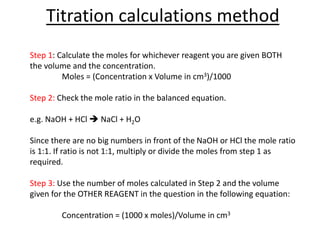
Titration calculations method
Step 1: Calculate the moles for whichever reagent you are given BOTH
the volume and the concentration.
Moles = (Concentration x Volume in cm3)/1000
Step 2: Check the mole ratio in the balanced equation.
e.g. NaOH + HCl  NaCl + H2O
Since there are no big numbers in front of the NaOH or HCl the mole ratio
is 1:1. If ratio is not 1:1, multiply or divide the moles from step 1 as
required.
Step 3: Use the number of moles calculated in Step 2 and the volume
given for the OTHER REAGENT in the question in the following equation:
Concentration = (1000 x moles)/Volume in cm3
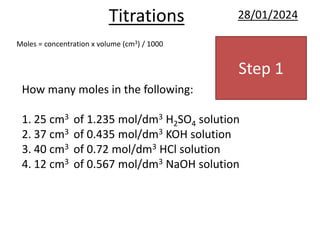
Titrations 28/01/2024
Moles = concentration x volume (cm3) / 1000
How many moles in the following:
1. 25 cm3 of 1.235 mol/dm3 H2SO4 solution
2. 37 cm3 of 0.435 mol/dm3 KOH solution
3. 40 cm3 of 0.72 mol/dm3 HCl solution
4. 12 cm3 of 0.567 mol/dm3 NaOH solution
Step 1
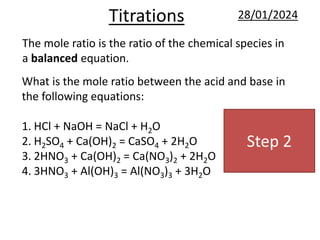
Titrations 28/01/2024
What is the mole ratio between the acid and base in
the following equations:
1. HCl + NaOH = NaCl + H2O
2. H2SO4 + Ca(OH)2 = CaSO4 + 2H2O
3. 2HNO3 + Ca(OH)2 = Ca(NO3)2 + 2H2O
4. 3HNO3 + Al(OH)3 = Al(NO3)3 + 3H2O
Step 2
The mole ratio is the ratio of the chemical species in
a balanced equation.
Titrations 28/01/2024
Moles = concentration x volume (cm3) / 1000
If there are 0.25 moles of acid, how many moles of
base would there be in the following equations:
1. HCl + NaOH  NaCl + H2O
2. H2SO4 + Ca(OH)2  CaSO4 + 2H2O
3. 2HNO3 + Ca(OH)2  Ca(NO3)2 + 2H2O
4. 3HNO3 + Al(OH)3  Al(NO3)3 + 3H2O
Step 2
continued
Titrations 28/01/2024
Concentration = 1000 x moles/ volume
What is the concentration of:
1. 25 cm3 of solution that contains 0.75 moles
2. 38 cm3 of solution that contains 1.75 moles
3. 50 cm3 of solution that contains 0.75 moles
4. 27 cm3 of solution that contains 0.23 moles
Step 3
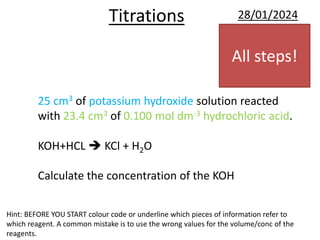
Titrations 28/01/2024
All steps!
25 cm3 of potassium hydroxide solution reacted
with 23.4 cm3 of 0.100 mol dm-3 hydrochloric acid.
KOH+HCL  KCl + H2O
Calculate the concentration of the KOH
Hint: BEFORE YOU START colour code or underline which pieces of information refer to
which reagent. A common mistake is to use the wrong values for the volume/conc of the
reagents.
Titrations 28/01/2024
Answer
Step 1: (0.1 x 23.4)/1000 =
0.00234 moles
Step 2: Ratio is 1:1 so moles of
KOH is also 0.00234
Step 3: (1000 x 0.00234)/25 =
0.936 mol dm-3
Another example
28/01/2024
25cm3 of sodium hydroxide solution was titrated against 0.15 mol
dm-3 hydrochloric acid. 21 cm3 of the acid neutralised the alkali.
HCl+ NaOH  NaCl + H2O
Calculate the concentration of the sodium hydroxide solution
Titrations 28/01/2024
Answer
Step 1: (0.15 x 21)/1000 =
0.00315 moles
Step 2: Ratio is 1:1 so moles of
NaOH is also 0.00315
Step 3: (1000 x 0.00315)/25 =
0.126 mol dm-3
Another example
28/01/2024
25 cm3 of potassium hydroxide solution
was neutralised by 35 cm3 of 0.75 mol
dm-3 sulfuric acid.
2KOH + H2SO4  K2SO4 + H2O
Calculate the concentration of the
potassium hydroxide
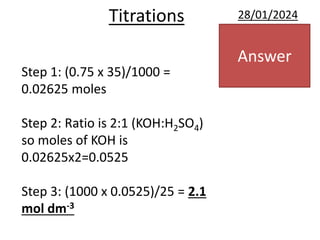
Titrations 28/01/2024
Answer
Step 1: (0.75 x 35)/1000 =
0.02625 moles
Step 2: Ratio is 2:1 (KOH:H2SO4)
so moles of KOH is
0.02625x2=0.0525
Step 3: (1000 x 0.0525)/25 = 2.1
mol dm-3

Titrations-step-by-step-TES.pptx

  • 1.
    Titrations 1/28/2024 5 Whatis used to show whether a solution is acidic, alkaline or neutral? 4 Is potassium sulfate an acid, an alkali or a salt? 3 Is calcium hydroxide an acid, an alkali or a salt? 2 What type of reaction takes place when an alkali reacts with an acid? 1 What two substances are formed when an acid reacts with an alkali? salt and water neutralisation alkali salt an indicator
  • 2.
    Titrations 1/28/2024 6 Whatcolour is phenolphthalein in an alkaline solution? 7 What colour is methyl orange in an acidic solution? 8 What measuring instruments are used to measure accurate volumes of solutions in a titration? 9 How many moles of solute are there in 3 dm3 of 0.1 mol dm−3 hydrochloric acid? 10 How many moles of solute are there in 110 cm3 of 0.1 mol dm−3 hydrochloric acid? pink red burette and pipette 0.3 (mol) 0.011 (mol)
  • 3.
    Titrations 28/01/2024 Calculate the concentrationof: 1. 2 moles in 12 dm3 2. 3 moles in 9 dm3 3. 4 moles in 750 cm3 4. 12 moles in 4500 cm3 Concentration (mol dm-3) = Number of moles of solute/ Volume of solution in dm3
  • 4.
    Titrations 28/01/2024 Calculate the concentrationof: 1. 2 g of HCl in 12 dm3 water 2. 3 g of NaOH in 9 dm3 water 3. 4 g H2SO4 in 750 cm3 water 4. 12 g HNO3 in 4500 cm3 water Moles = Mass/RMM Followed by Concentration (mol dm-3) = Number of moles of solute/ Volume of solution in dm3
  • 5.
    Titration calculations method Step1: Calculate the moles for whichever reagent you are given BOTH the volume and the concentration. Moles = (Concentration x Volume in cm3)/1000 Step 2: Check the mole ratio in the balanced equation. e.g. NaOH + HCl  NaCl + H2O Since there are no big numbers in front of the NaOH or HCl the mole ratio is 1:1. If ratio is not 1:1, multiply or divide the moles from step 1 as required. Step 3: Use the number of moles calculated in Step 2 and the volume given for the OTHER REAGENT in the question in the following equation: Concentration = (1000 x moles)/Volume in cm3
  • 6.
    Titrations 28/01/2024 Moles =concentration x volume (cm3) / 1000 How many moles in the following: 1. 25 cm3 of 1.235 mol/dm3 H2SO4 solution 2. 37 cm3 of 0.435 mol/dm3 KOH solution 3. 40 cm3 of 0.72 mol/dm3 HCl solution 4. 12 cm3 of 0.567 mol/dm3 NaOH solution Step 1
  • 7.
    Titrations 28/01/2024 What isthe mole ratio between the acid and base in the following equations: 1. HCl + NaOH = NaCl + H2O 2. H2SO4 + Ca(OH)2 = CaSO4 + 2H2O 3. 2HNO3 + Ca(OH)2 = Ca(NO3)2 + 2H2O 4. 3HNO3 + Al(OH)3 = Al(NO3)3 + 3H2O Step 2 The mole ratio is the ratio of the chemical species in a balanced equation.
  • 8.
    Titrations 28/01/2024 Moles =concentration x volume (cm3) / 1000 If there are 0.25 moles of acid, how many moles of base would there be in the following equations: 1. HCl + NaOH  NaCl + H2O 2. H2SO4 + Ca(OH)2  CaSO4 + 2H2O 3. 2HNO3 + Ca(OH)2  Ca(NO3)2 + 2H2O 4. 3HNO3 + Al(OH)3  Al(NO3)3 + 3H2O Step 2 continued
  • 9.
    Titrations 28/01/2024 Concentration =1000 x moles/ volume What is the concentration of: 1. 25 cm3 of solution that contains 0.75 moles 2. 38 cm3 of solution that contains 1.75 moles 3. 50 cm3 of solution that contains 0.75 moles 4. 27 cm3 of solution that contains 0.23 moles Step 3
  • 10.
    Titrations 28/01/2024 All steps! 25cm3 of potassium hydroxide solution reacted with 23.4 cm3 of 0.100 mol dm-3 hydrochloric acid. KOH+HCL  KCl + H2O Calculate the concentration of the KOH Hint: BEFORE YOU START colour code or underline which pieces of information refer to which reagent. A common mistake is to use the wrong values for the volume/conc of the reagents.
  • 11.
    Titrations 28/01/2024 Answer Step 1:(0.1 x 23.4)/1000 = 0.00234 moles Step 2: Ratio is 1:1 so moles of KOH is also 0.00234 Step 3: (1000 x 0.00234)/25 = 0.936 mol dm-3
  • 12.
    Another example 28/01/2024 25cm3 ofsodium hydroxide solution was titrated against 0.15 mol dm-3 hydrochloric acid. 21 cm3 of the acid neutralised the alkali. HCl+ NaOH  NaCl + H2O Calculate the concentration of the sodium hydroxide solution
  • 13.
    Titrations 28/01/2024 Answer Step 1:(0.15 x 21)/1000 = 0.00315 moles Step 2: Ratio is 1:1 so moles of NaOH is also 0.00315 Step 3: (1000 x 0.00315)/25 = 0.126 mol dm-3
  • 14.
    Another example 28/01/2024 25 cm3of potassium hydroxide solution was neutralised by 35 cm3 of 0.75 mol dm-3 sulfuric acid. 2KOH + H2SO4  K2SO4 + H2O Calculate the concentration of the potassium hydroxide
  • 15.
    Titrations 28/01/2024 Answer Step 1:(0.75 x 35)/1000 = 0.02625 moles Step 2: Ratio is 2:1 (KOH:H2SO4) so moles of KOH is 0.02625x2=0.0525 Step 3: (1000 x 0.0525)/25 = 2.1 mol dm-3