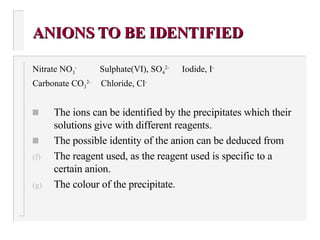
ANIONS TO BE IDENTIFIED Nitrate NO 3 -  Sulphate(VI), SO 4 2-  Iodide, I - Carbonate CO 3 2-  Chloride, Cl - The ions can be identified by the precipitates which their solutions give with different reagents. The possible identity of the anion can be deduced from The reagent used, as the reagent used is specific to a certain anion. The colour of the precipitate.
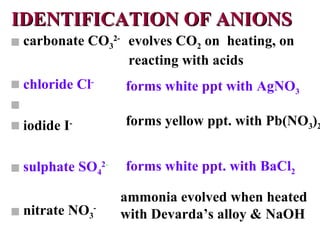
IDENTIFICATION OF ANIONS carbonate CO 3 2- chloride Cl -  iodide I -   sulphate SO 4 2 - nitrate NO 3 -   evolves CO 2  on  heating, on reacting with acids forms white ppt with AgNO 3 forms yellow ppt. with Pb(NO 3 ) 2 forms white ppt. with BaCl 2 ammonia evolved when heated with Devarda’s alloy & NaOH
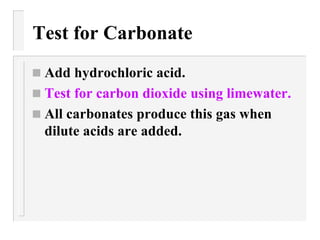
Test for Carbonate Add hydrochloric acid. Test for carbon dioxide using limewater. All carbonates produce this gas when dilute acids are added.
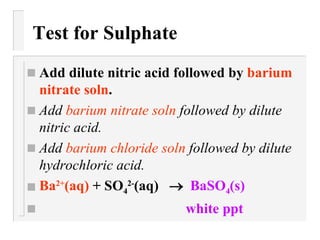
Test for Sulphate Add dilute nitric acid followed by  barium nitrate soln . Add  barium nitrate soln  followed by dilute nitric acid. Add  barium chloride soln  followed by dilute hydrochloric acid. Ba 2+ (aq)  +  SO 4 2- (aq)      BaSO 4 (s) white ppt
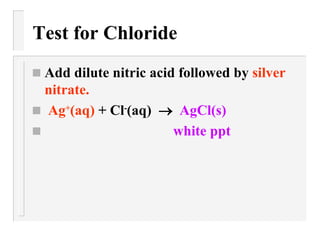
Test for Chloride Add dilute nitric acid followed by  silver nitrate. Ag + (aq)  + Cl - (aq)     AgCl(s) white ppt
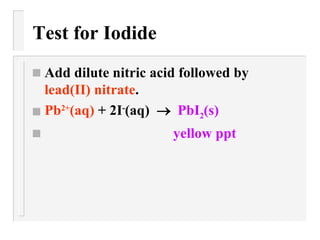
Test for Iodide Add dilute nitric acid followed by  lead(II) nitrate . Pb 2+ (aq)  + 2I - (aq)     PbI 2 (s) yellow ppt
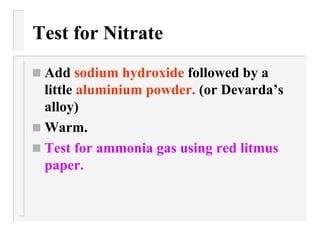
Test for Nitrate Add  sodium hydroxide  followed by a little  aluminium powder.  (or Devarda’s alloy) Warm. Test for ammonia gas using red litmus paper.
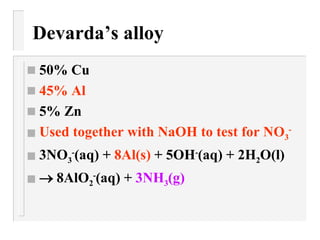
Devarda’s alloy 50% Cu 45% Al 5% Zn Used together with NaOH to test for NO 3 - 3NO 3 - (aq) +  8Al(s)  + 5OH - (aq) + 2H 2 O(l)    8AlO 2 - (aq) +  3NH 3 (g)

Ppt2 Tests For Anions

  • 1.
    ANIONS TO BEIDENTIFIED Nitrate NO 3 - Sulphate(VI), SO 4 2- Iodide, I - Carbonate CO 3 2- Chloride, Cl - The ions can be identified by the precipitates which their solutions give with different reagents. The possible identity of the anion can be deduced from The reagent used, as the reagent used is specific to a certain anion. The colour of the precipitate.
  • 2.
    IDENTIFICATION OF ANIONScarbonate CO 3 2- chloride Cl - iodide I - sulphate SO 4 2 - nitrate NO 3 - evolves CO 2 on heating, on reacting with acids forms white ppt with AgNO 3 forms yellow ppt. with Pb(NO 3 ) 2 forms white ppt. with BaCl 2 ammonia evolved when heated with Devarda’s alloy & NaOH
  • 3.
    Test for CarbonateAdd hydrochloric acid. Test for carbon dioxide using limewater. All carbonates produce this gas when dilute acids are added.
  • 4.
    Test for SulphateAdd dilute nitric acid followed by barium nitrate soln . Add barium nitrate soln followed by dilute nitric acid. Add barium chloride soln followed by dilute hydrochloric acid. Ba 2+ (aq) + SO 4 2- (aq)  BaSO 4 (s) white ppt
  • 5.
    Test for ChlorideAdd dilute nitric acid followed by silver nitrate. Ag + (aq) + Cl - (aq)  AgCl(s) white ppt
  • 6.
    Test for IodideAdd dilute nitric acid followed by lead(II) nitrate . Pb 2+ (aq) + 2I - (aq)  PbI 2 (s) yellow ppt
  • 7.
    Test for NitrateAdd sodium hydroxide followed by a little aluminium powder. (or Devarda’s alloy) Warm. Test for ammonia gas using red litmus paper.
  • 8.
    Devarda’s alloy 50%Cu 45% Al 5% Zn Used together with NaOH to test for NO 3 - 3NO 3 - (aq) + 8Al(s) + 5OH - (aq) + 2H 2 O(l)  8AlO 2 - (aq) + 3NH 3 (g)