Titrations Aim: To understand how to use  volumetric analysis to determine the concentration of acids or bases
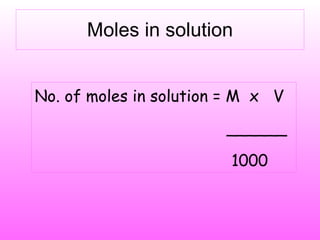
Moles in solution No. of moles in solution = M  x  V ______ 1000
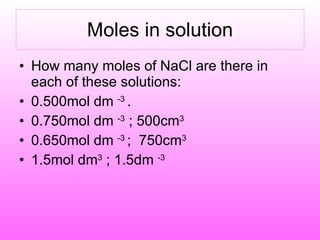
Moles in solution How many moles of NaCl are there in each of these solutions: 0.500mol dm  -3  . 0.750mol dm  -3  ; 500cm 3 0.650mol dm  -3  ;  750cm 3 1.5mol dm 3  ; 1.5dm  -3
Calculations – Solution moles Calculate the number of moles of calcium chloride needed to make a 2 Mol dm  -3  solution, volume 250cm 3. Calculate the mass of Calcium Chloride needed to make up this solution.
Number 2 Calculate the number of moles  of sulphuric acid needed to make a 5 mol dm  -3  solution; volume 100cm 3 . What mass of sulphuric acid would be needed to make up the solution?
Solution calculations If 10.3g of sodium bromide was dissolved in 250cm 3  of solution what would its  concentration in mol dm  -3  be?
Solution calculation 2 If 8g of copper sulphate was dissolved to make up a solution of volume 500cm 3 , what would be its concentration in mol dm  -3 ?
Using titration to find out the exact concentration of NaOH. Titration involves neutralisation – using an acid of known concentration to find out the concentration of NaOH Equation for the reaction: HCl  +  NaOH  NaCl + H 2 O
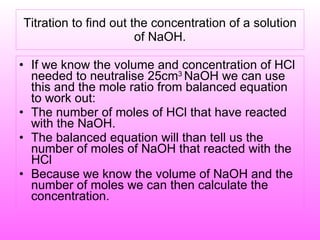
Titration to find out the concentration of a solution of NaOH. If we know the volume and concentration of HCl needed to neutralise 25cm 3  NaOH we can use this and the mole ratio from balanced equation to work out: The number of moles of HCl that have reacted with the NaOH. The balanced equation will than tell us the number of moles of NaOH that reacted with the HCl Because we know the volume of NaOH and the number of moles we can then calculate the concentration.
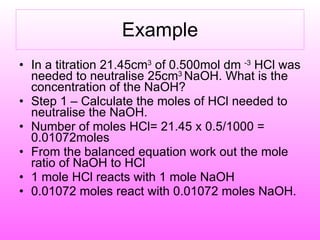
Example In a titration 21.45cm 3  of 0.500mol dm  -3  HCl was needed to neutralise 25cm 3  NaOH. What is the concentration of the NaOH? Step 1 – Calculate the moles of HCl needed to neutralise the NaOH. Number of moles HCl= 21.45 x 0.5/1000 = 0.01072moles From the balanced equation work out the mole ratio of NaOH to HCl  1 mole HCl reacts with 1 mole NaOH 0.01072 moles react with 0.01072 moles NaOH.
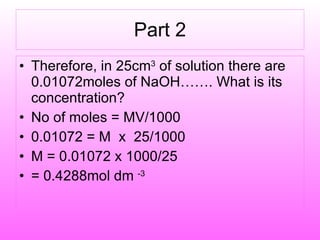
Part 2 Therefore, in 25cm 3  of solution there are 0.01072moles of NaOH……. What is its concentration? No of moles = MV/1000 0.01072 = M  x  25/1000 M = 0.01072 x 1000/25 = 0.4288mol dm  -3
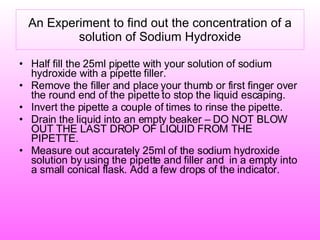
An Experiment to find out the concentration of a solution of Sodium Hydroxide Half fill the 25ml pipette with your solution of sodium hydroxide with a pipette filler. Remove the filler and place your thumb or first finger over the round end of the pipette to stop the liquid escaping. Invert the pipette a couple of times to rinse the pipette. Drain the liquid into an empty beaker – DO NOT BLOW OUT THE LAST DROP OF LIQUID FROM THE PIPETTE. Measure out accurately 25ml of the sodium hydroxide  solution by using the pipette and filler and  in a empty into a small conical flask. Add a few drops of the indicator.
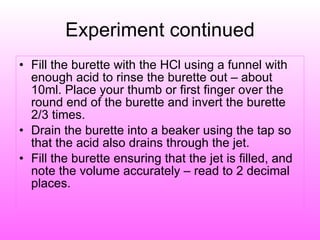
Experiment continued Fill the burette with the HCl using a funnel with enough acid to rinse the burette out – about 10ml. Place your thumb or first finger over the round end of the burette and invert the burette 2/3 times. Drain the burette into a beaker using the tap so that the acid also drains through the jet. Fill the burette ensuring that the jet is filled, and note the volume accurately – read to 2 decimal places.
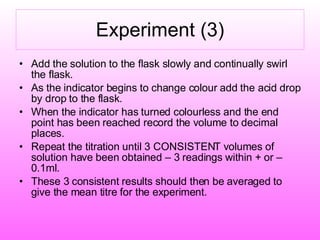
Experiment (3) Add the solution to the flask slowly and continually swirl the flask. As the indicator begins to change colour add the acid drop by drop to the flask. When the indicator has turned colourless and the end point has been reached record the volume to decimal places. Repeat the titration until 3 CONSISTENT volumes of solution have been obtained – 3 readings within + or – 0.1ml. These 3 consistent results should then be averaged to give the mean titre for the experiment.
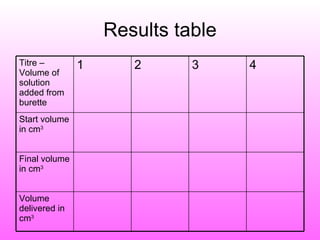
Results table Volume delivered in cm 3 Final volume in cm 3 Start volume in cm 3 4 3 2 1 Titre – Volume of solution added from burette
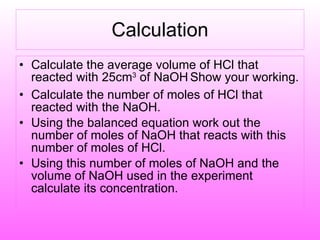
Calculation Calculate the average volume of HCl that reacted with 25cm 3  of NaOH   Show your working. Calculate the number of moles of HCl that reacted with the NaOH. Using the balanced equation work out the number of moles of NaOH that reacts with this number of moles of HCl. Using this number of moles of NaOH and the volume of NaOH used in the experiment calculate its concentration.
Confirming the concentration of your standard solution of Sodium carbonate Carry out a titration to work out the concentration of your solution of sodium carbonate. The acid you are provided with is 0.1M HCl. The indicator you will use for this titration is screened methyl orange. The end point is reached when it grey/purple from green
Experiment write up Diagram and method and explanation for each stage of the practical method. A balanced symbol equation for the reaction A results table identical to the HCl NaOH practical. The calculation to find out: The moles of HCl that reacted. The moles of Na 2 CO 3  in the solution. The concentration of the Na 2 CO 3. A comparison of the calculated value v your stated value on the flask. Sources of experimental error?
Question 25.0 cm 3  of a 0.0504 mol dm  -3  solution of sulphuric acid was titrated with a solution of sodium hydroxide. The mean titre was 27.8cm 3.   Write the balanced equation for this reaction. Calculate the number of moles of sulphuric acid that reacted with the NaOH. Use the balanced equation to calculate the number of moles of NaOH that react with the acid. Claculate the concentration of the NaOH.
Question. Calculate the volume of 0.100 mol dm -3  hydrochloric acid solution required to neutralise 25 cm 3  of 0.0567 mol dm -3  sodium carbonate solution . Write the balanced symbol equation for the reaction. Calculate the number of moles of  sodium carbonate solution. Using the balanced equation calculate the number of moles of HCl that reacts with the sodium carbonate. Calculate the volume of HCl used in the reaction.

Titrations

  • 1.
    Titrations Aim: Tounderstand how to use volumetric analysis to determine the concentration of acids or bases
  • 2.
    Moles in solutionNo. of moles in solution = M x V ______ 1000
  • 3.
    Moles in solutionHow many moles of NaCl are there in each of these solutions: 0.500mol dm -3 . 0.750mol dm -3 ; 500cm 3 0.650mol dm -3 ; 750cm 3 1.5mol dm 3 ; 1.5dm -3
  • 4.
    Calculations – Solutionmoles Calculate the number of moles of calcium chloride needed to make a 2 Mol dm -3 solution, volume 250cm 3. Calculate the mass of Calcium Chloride needed to make up this solution.
  • 5.
    Number 2 Calculatethe number of moles of sulphuric acid needed to make a 5 mol dm -3 solution; volume 100cm 3 . What mass of sulphuric acid would be needed to make up the solution?
  • 6.
    Solution calculations If10.3g of sodium bromide was dissolved in 250cm 3 of solution what would its concentration in mol dm -3 be?
  • 7.
    Solution calculation 2If 8g of copper sulphate was dissolved to make up a solution of volume 500cm 3 , what would be its concentration in mol dm -3 ?
  • 8.
    Using titration tofind out the exact concentration of NaOH. Titration involves neutralisation – using an acid of known concentration to find out the concentration of NaOH Equation for the reaction: HCl + NaOH NaCl + H 2 O
  • 9.
    Titration to findout the concentration of a solution of NaOH. If we know the volume and concentration of HCl needed to neutralise 25cm 3 NaOH we can use this and the mole ratio from balanced equation to work out: The number of moles of HCl that have reacted with the NaOH. The balanced equation will than tell us the number of moles of NaOH that reacted with the HCl Because we know the volume of NaOH and the number of moles we can then calculate the concentration.
  • 10.
    Example In atitration 21.45cm 3 of 0.500mol dm -3 HCl was needed to neutralise 25cm 3 NaOH. What is the concentration of the NaOH? Step 1 – Calculate the moles of HCl needed to neutralise the NaOH. Number of moles HCl= 21.45 x 0.5/1000 = 0.01072moles From the balanced equation work out the mole ratio of NaOH to HCl 1 mole HCl reacts with 1 mole NaOH 0.01072 moles react with 0.01072 moles NaOH.
  • 11.
    Part 2 Therefore,in 25cm 3 of solution there are 0.01072moles of NaOH……. What is its concentration? No of moles = MV/1000 0.01072 = M x 25/1000 M = 0.01072 x 1000/25 = 0.4288mol dm -3
  • 12.
    An Experiment tofind out the concentration of a solution of Sodium Hydroxide Half fill the 25ml pipette with your solution of sodium hydroxide with a pipette filler. Remove the filler and place your thumb or first finger over the round end of the pipette to stop the liquid escaping. Invert the pipette a couple of times to rinse the pipette. Drain the liquid into an empty beaker – DO NOT BLOW OUT THE LAST DROP OF LIQUID FROM THE PIPETTE. Measure out accurately 25ml of the sodium hydroxide solution by using the pipette and filler and in a empty into a small conical flask. Add a few drops of the indicator.
  • 13.
    Experiment continued Fillthe burette with the HCl using a funnel with enough acid to rinse the burette out – about 10ml. Place your thumb or first finger over the round end of the burette and invert the burette 2/3 times. Drain the burette into a beaker using the tap so that the acid also drains through the jet. Fill the burette ensuring that the jet is filled, and note the volume accurately – read to 2 decimal places.
  • 14.
    Experiment (3) Addthe solution to the flask slowly and continually swirl the flask. As the indicator begins to change colour add the acid drop by drop to the flask. When the indicator has turned colourless and the end point has been reached record the volume to decimal places. Repeat the titration until 3 CONSISTENT volumes of solution have been obtained – 3 readings within + or – 0.1ml. These 3 consistent results should then be averaged to give the mean titre for the experiment.
  • 15.
    Results table Volumedelivered in cm 3 Final volume in cm 3 Start volume in cm 3 4 3 2 1 Titre – Volume of solution added from burette
  • 16.
    Calculation Calculate theaverage volume of HCl that reacted with 25cm 3 of NaOH Show your working. Calculate the number of moles of HCl that reacted with the NaOH. Using the balanced equation work out the number of moles of NaOH that reacts with this number of moles of HCl. Using this number of moles of NaOH and the volume of NaOH used in the experiment calculate its concentration.
  • 17.
    Confirming the concentrationof your standard solution of Sodium carbonate Carry out a titration to work out the concentration of your solution of sodium carbonate. The acid you are provided with is 0.1M HCl. The indicator you will use for this titration is screened methyl orange. The end point is reached when it grey/purple from green
  • 18.
    Experiment write upDiagram and method and explanation for each stage of the practical method. A balanced symbol equation for the reaction A results table identical to the HCl NaOH practical. The calculation to find out: The moles of HCl that reacted. The moles of Na 2 CO 3 in the solution. The concentration of the Na 2 CO 3. A comparison of the calculated value v your stated value on the flask. Sources of experimental error?
  • 19.
    Question 25.0 cm3 of a 0.0504 mol dm -3 solution of sulphuric acid was titrated with a solution of sodium hydroxide. The mean titre was 27.8cm 3. Write the balanced equation for this reaction. Calculate the number of moles of sulphuric acid that reacted with the NaOH. Use the balanced equation to calculate the number of moles of NaOH that react with the acid. Claculate the concentration of the NaOH.
  • 20.
    Question. Calculate thevolume of 0.100 mol dm -3 hydrochloric acid solution required to neutralise 25 cm 3 of 0.0567 mol dm -3 sodium carbonate solution . Write the balanced symbol equation for the reaction. Calculate the number of moles of sodium carbonate solution. Using the balanced equation calculate the number of moles of HCl that reacts with the sodium carbonate. Calculate the volume of HCl used in the reaction.