ARAVIND BABU R
SAHUL HAMEED.H
M.E-INDUSTRIAL ENGG
1
AGENDA
• What is control chart?
• History of control chart
• Types of data
• Defect and defective
• Types of control charts
• Control limits vs specification limits
• Variable control charts
• Attribute control charts
CONTROL CHART
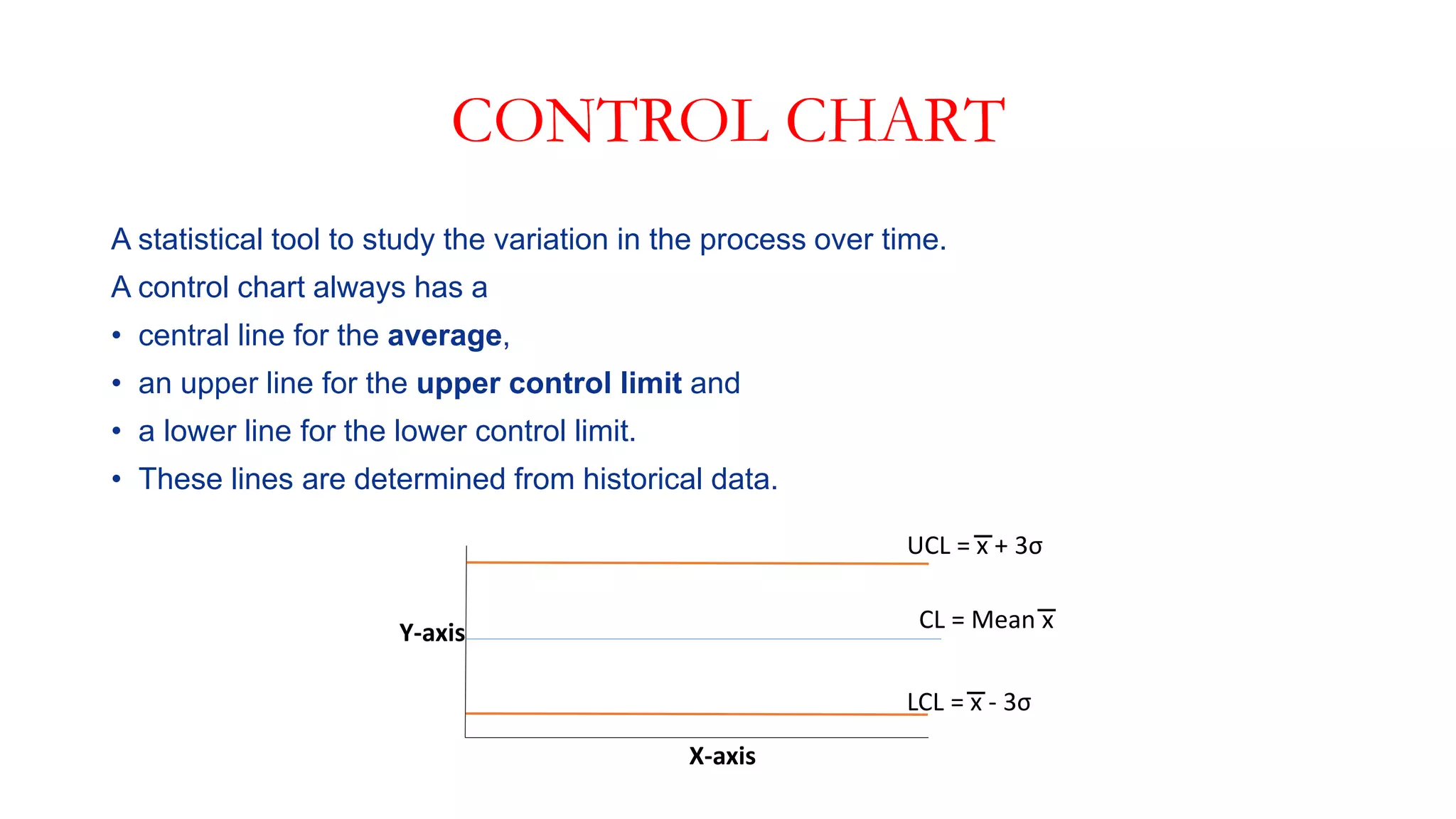
A statistical tool to study the variation in the process over time.
A control chart always has a
• central line for the average,
• an upper line for the upper control limit and
• a lower line for the lower control limit.
• These lines are determined from historical data.
CL = Mean x
UCL = x + 3σ
Y-axis
X-axis
LCL = x - 3σ
CONTROL CHART
Purpose:
• Analyze the past data and determine the performance of the process
• Measure control of the process against standards
HISTORY
• Invented by Walter Andrew Shewhart, father of statistical quality control in 1920.
• The company's engineers had been seeking to improve the reliability of their telephony
transmission systems.
• There was a stronger business need to reduce the frequency of failures and repairs
• Shewhart framed the problem in terms of Common- and special-causes of variation and,
on May 16, 1924, wrote an internal memo introducing the control chart as a tool for
distinguishing between the two.
• He understood data from physical processes typically produce a "normal distribution
curve“.
TYPES OF DATA
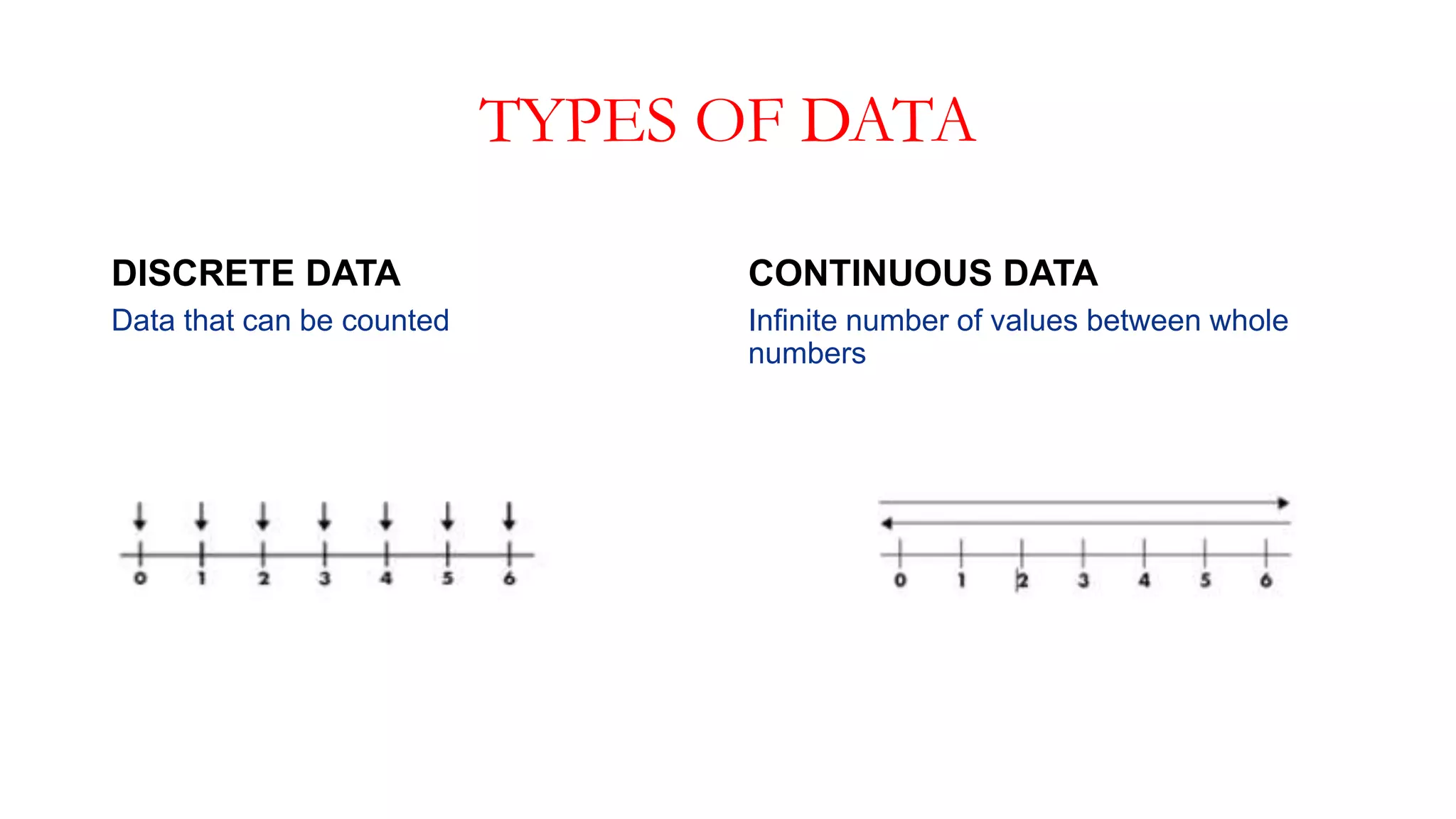
DISCRETE DATA CONTINUOUS DATA
Infinite number of values between whole
numbers
Data that can be counted
DEFECTS AND DEFECTIVES
Defects :
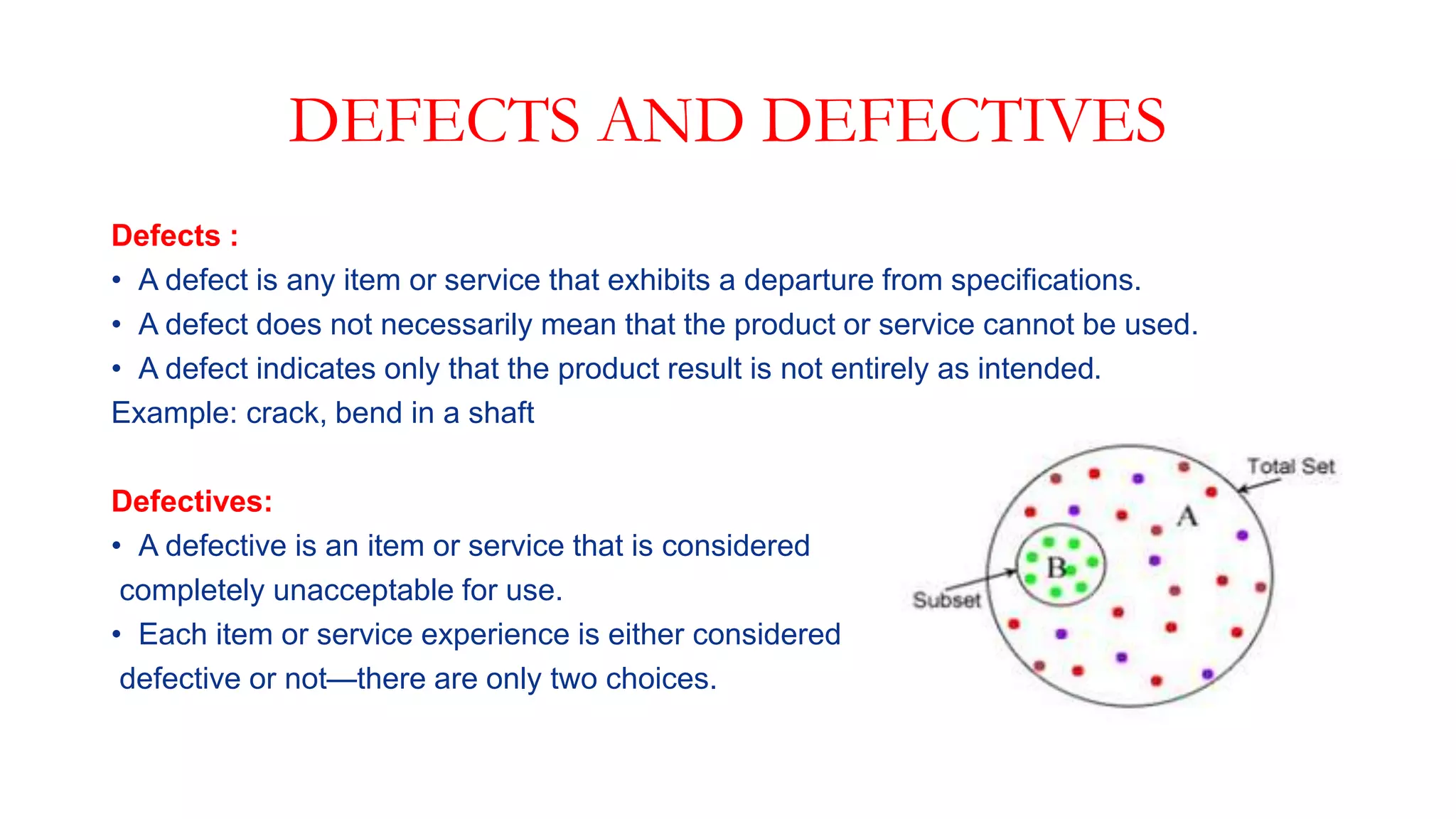
• A defect is any item or service that exhibits a departure from specifications.
• A defect does not necessarily mean that the product or service cannot be used.
• A defect indicates only that the product result is not entirely as intended.
Example: crack, bend in a shaft
Defectives:
• A defective is an item or service that is considered
completely unacceptable for use.
• Each item or service experience is either considered
defective or not—there are only two choices.
LOTS AND SAMPLES
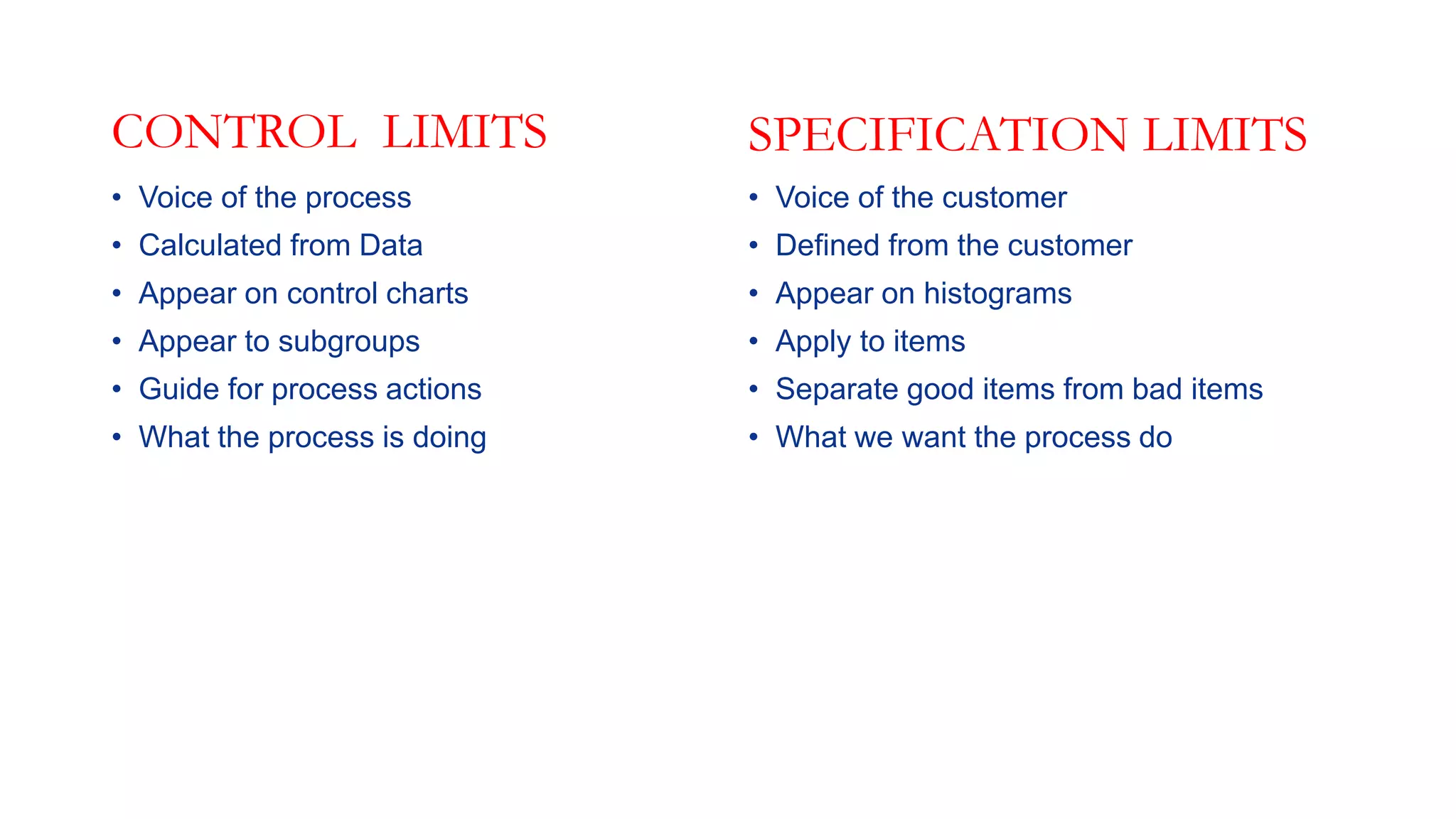
CONTROL LIMITS
• Voice of the process
• Calculated from Data
• Appear on control charts
• Appear to subgroups
• Guide for process actions
• What the process is doing
SPECIFICATION LIMITS
• Voice of the customer
• Defined from the customer
• Appear on histograms
• Apply to items
• Separate good items from bad items
• What we want the process do
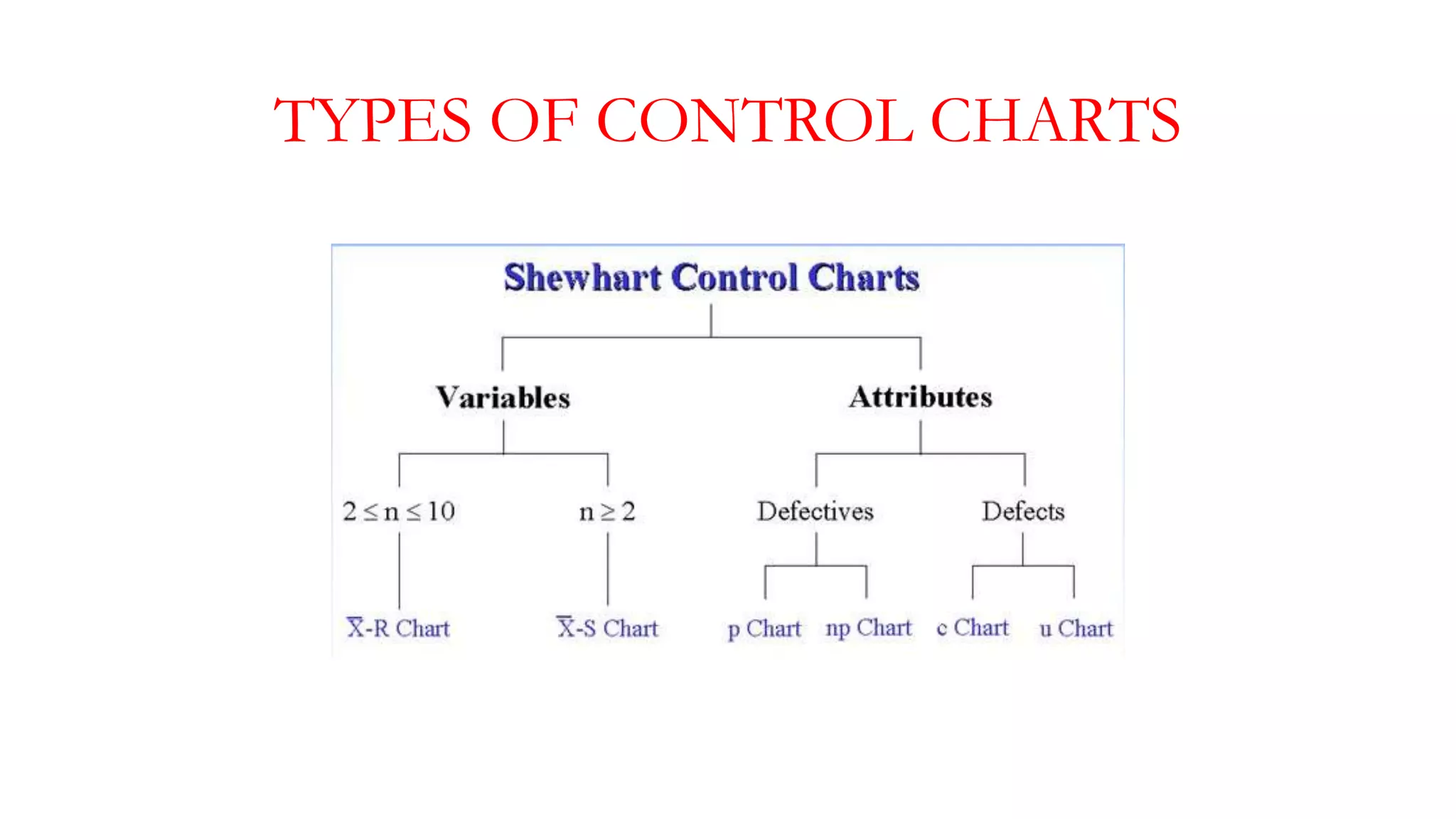
TYPES OF CONTROL CHARTS
CONTROL CHARTS
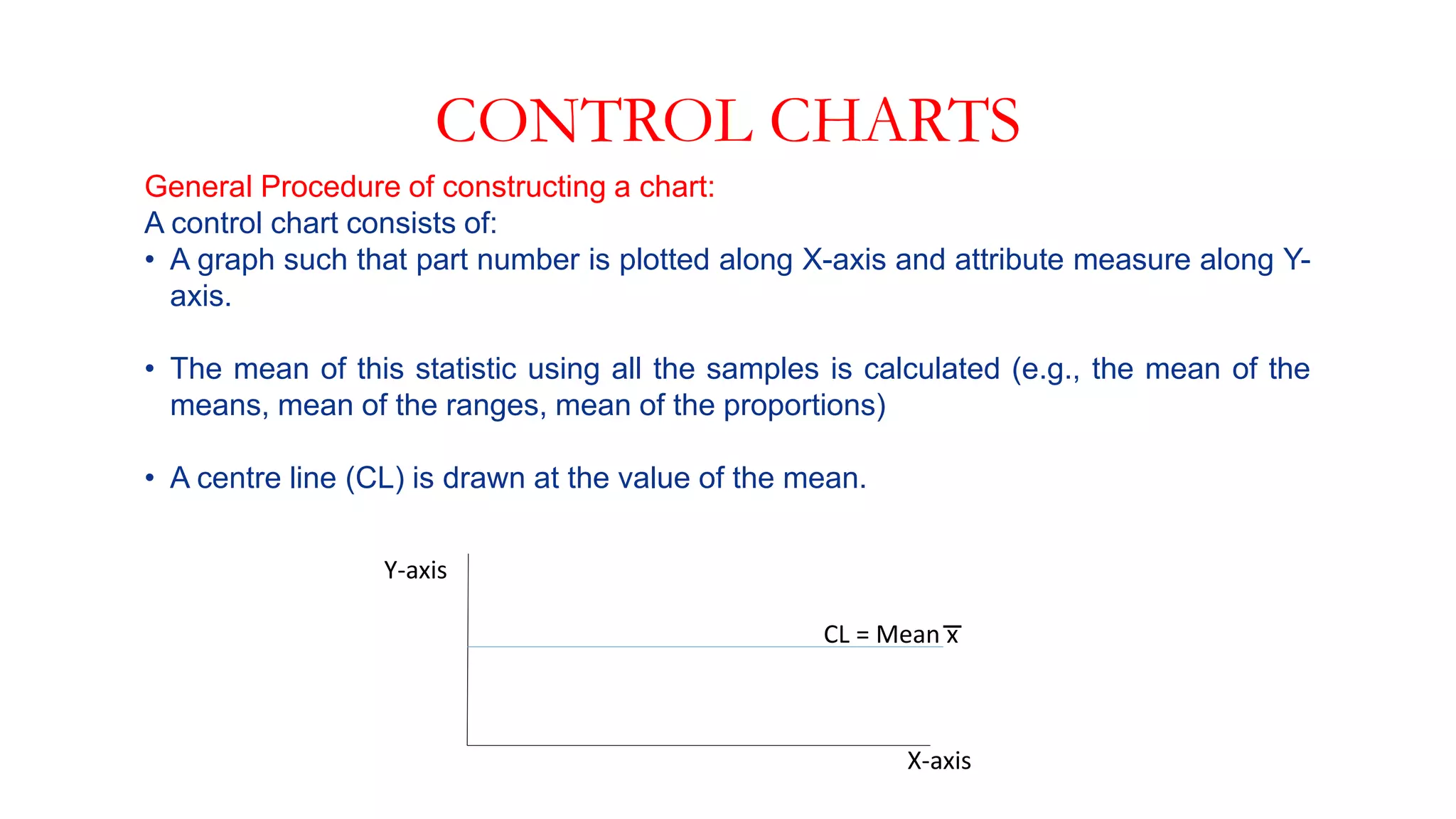
General Procedure of constructing a chart:
A control chart consists of:
• A graph such that part number is plotted along X-axis and attribute measure along Y-
axis.
• The mean of this statistic using all the samples is calculated (e.g., the mean of the
means, mean of the ranges, mean of the proportions)
• A centre line (CL) is drawn at the value of the mean.
CL = Mean x
Y-axis
X-axis
CONTROL CHARTS
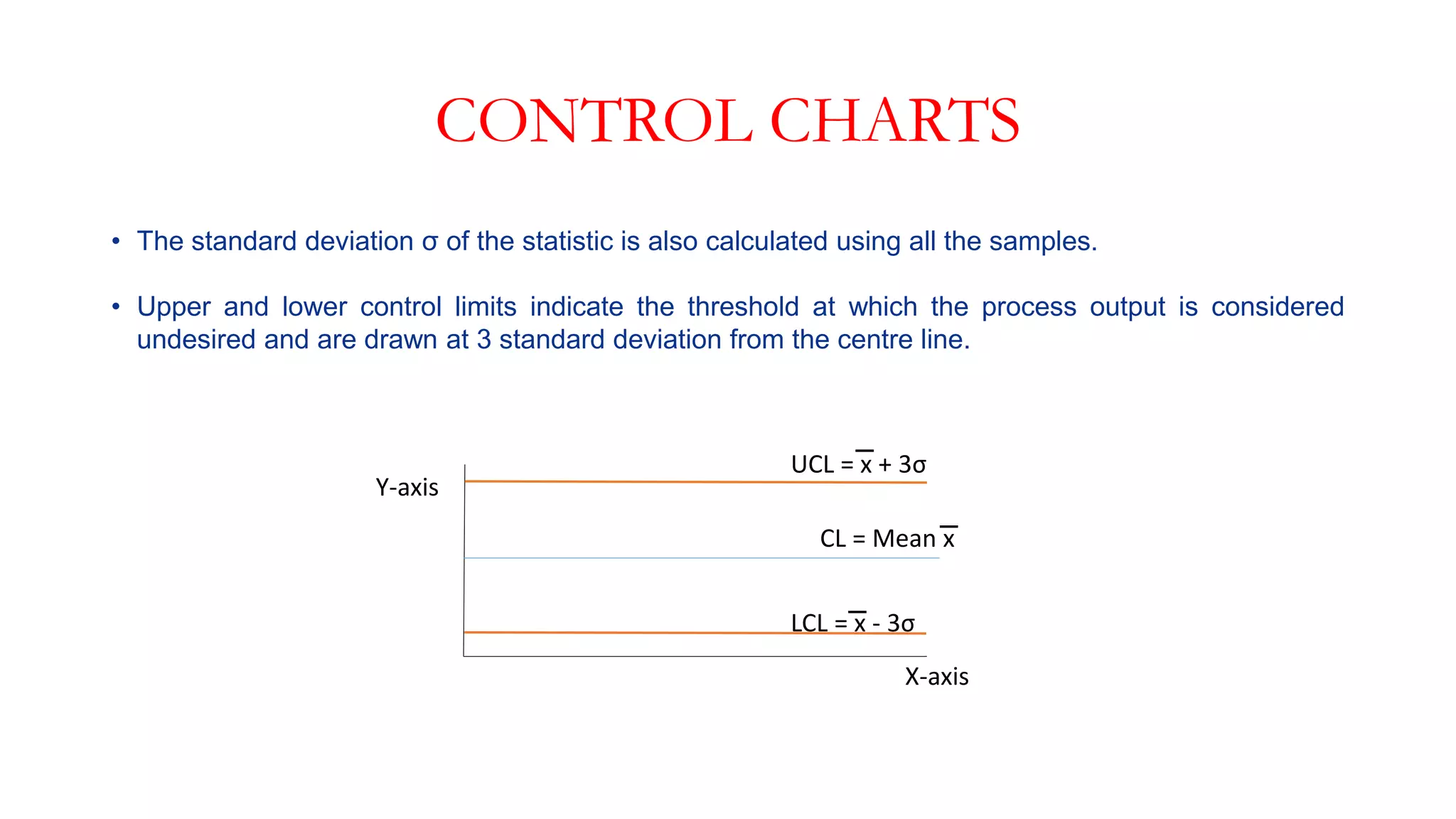
• The standard deviation σ of the statistic is also calculated using all the samples.
• Upper and lower control limits indicate the threshold at which the process output is considered
undesired and are drawn at 3 standard deviation from the centre line.
CL = Mean x
UCL = x + 3σ
LCL = x - 3σ
Y-axis
X-axis
CONTROL CHARTS
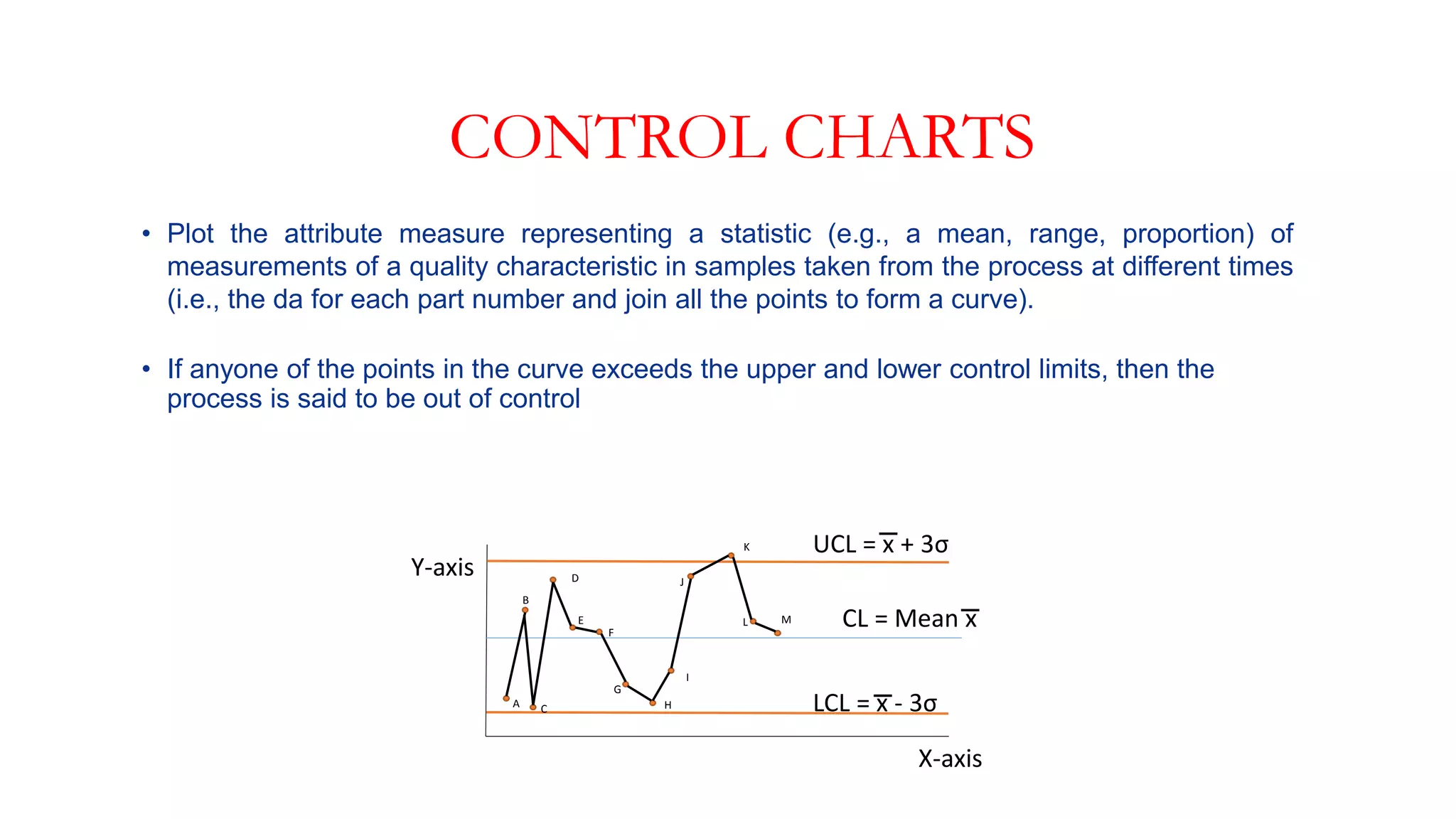
• Plot the attribute measure representing a statistic (e.g., a mean, range, proportion) of
measurements of a quality characteristic in samples taken from the process at different times
(i.e., the da for each part number and join all the points to form a curve).
• If anyone of the points in the curve exceeds the upper and lower control limits, then the
process is said to be out of control
CL = Mean x
UCL = x + 3σ
LCL = x - 3σA
B
C
D
E
F
G
H
I
J
K
L M
Y-axis
X-axis
CONTROL CHART FOR VARIABLES
A single measurable quality characteristic ,such as dimension, weight, or volume, is called
variable.
Our objectives for this section are to learn how to use control charts to monitor continuous
data.
We want to learn the assumptions behind the charts, their application, and their interpretation.
Since statistical control for continuous data depends on both the mean and the variability,
variables control charts are constructed to monitor each.
The most commonly used chart to monitor the mean is called the X-BAR chart.
There are two commonly used charts used to monitor the variability: the R chart and the s
chart.
15
The X-BAR Chart:
This chart is called the X-BAR chart because the statistic being plotted is the sample mean. The
reason for taking a sample is because we are not always sure of the process distribution. By using
the sample mean we can "invoke" the central limit theorem to assume normality.
The R chart
I. The R chart is used to monitor process variability when sample sizes are small (n<10), or to simplify the
calculations made by process operators.
II. This chart is called the R chart because the statistic being plotted is the sample range.
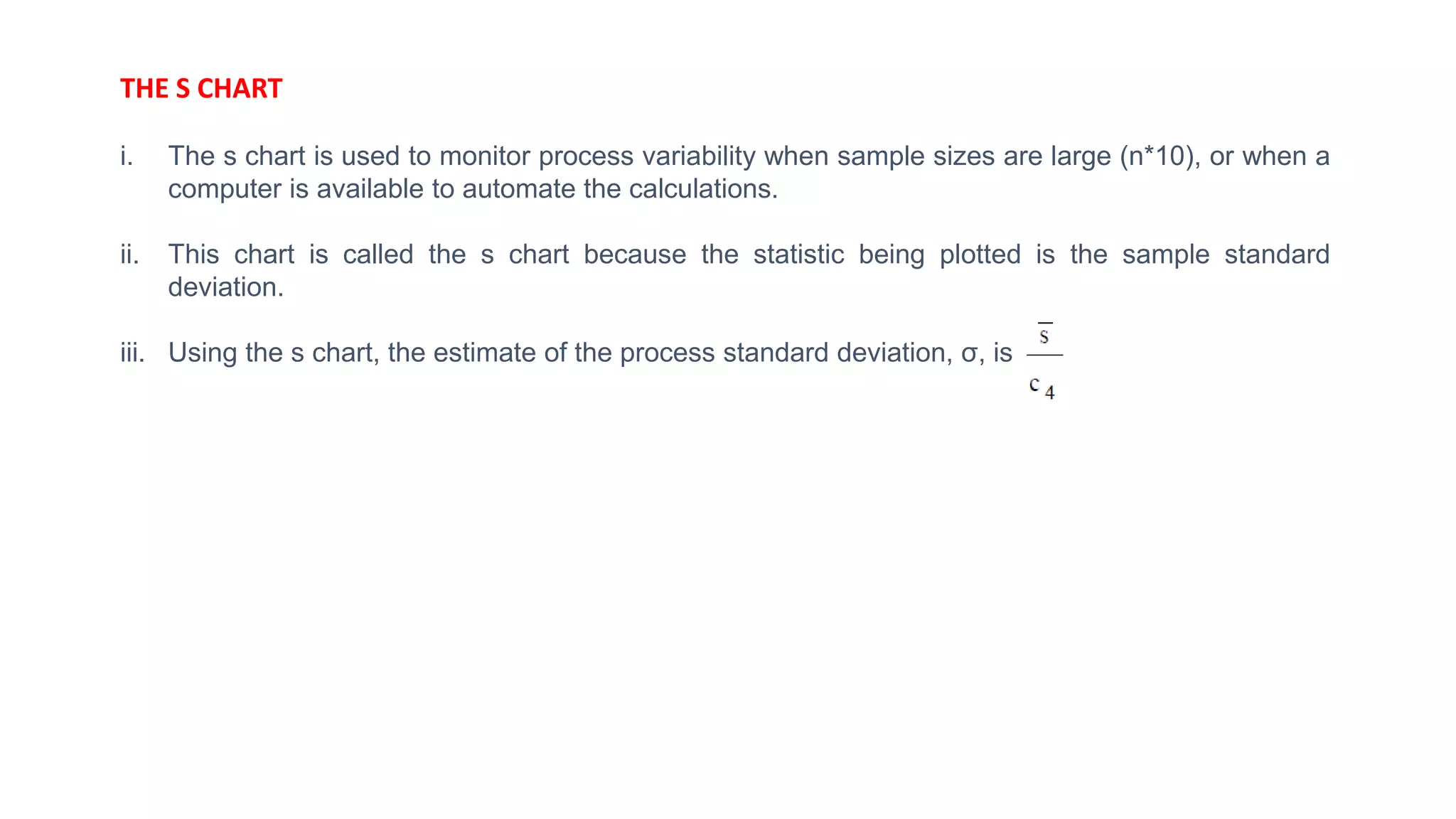
III. Using the R chart, the estimate of the process standard deviation,σ ,is R/d2.
THE S CHART
i. The s chart is used to monitor process variability when sample sizes are large (n*10), or when a
computer is available to automate the calculations.
ii. This chart is called the s chart because the statistic being plotted is the sample standard
deviation.
iii. Using the s chart, the estimate of the process standard deviation, σ, is
PROCEDURE FOR USING VARIABLES CONTROL CHARTS:
I. Determine the variable to monitor.
II. At predetermined, even intervals, take samples of size n (usually n=4 or 5).
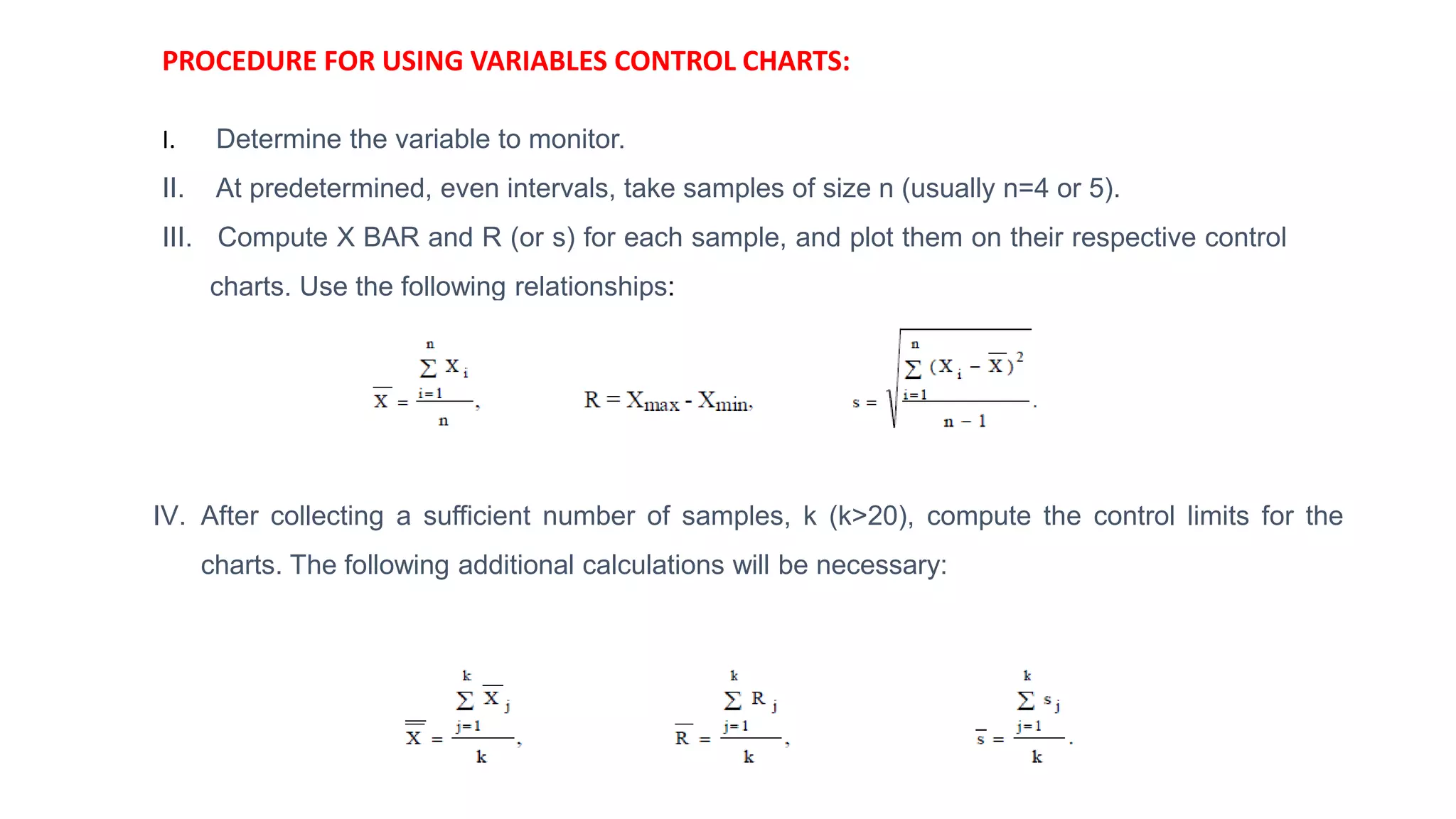
III. Compute X BAR and R (or s) for each sample, and plot them on their respective control
charts. Use the following relationships:
IV. After collecting a sufficient number of samples, k (k>20), compute the control limits for the
charts. The following additional calculations will be necessary:
V. If any points fall outside of the control limits, conclude that the process is out of control, and
begin a search for an assignable or special cause. When the special cause is identified,
remove that point and return to step 4 to re-evaluate the remaining points.
VI. If all the points are within limits, conclude that the process is in control, and use the calculated
limits for future monitoring of the process.
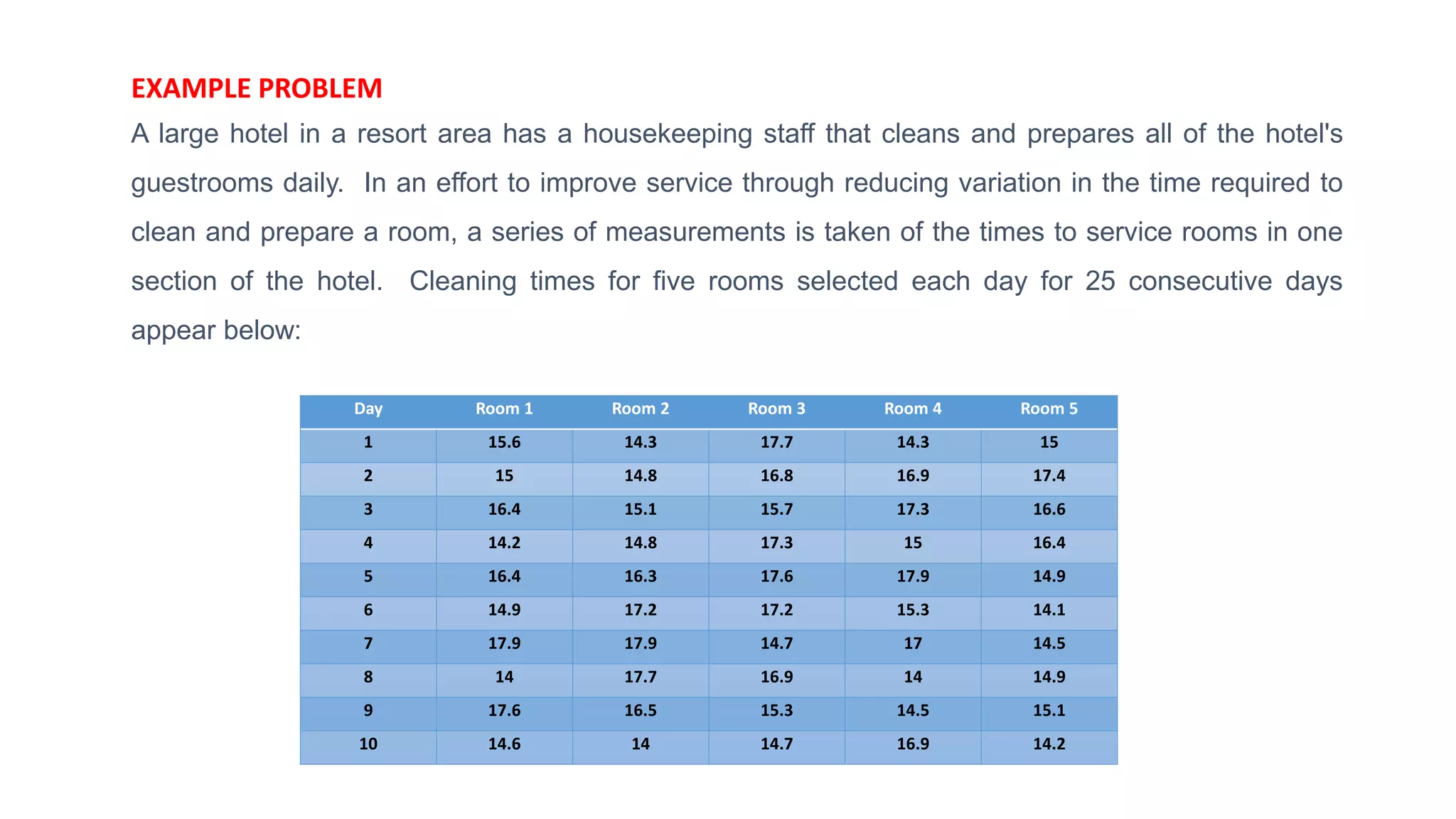
EXAMPLE PROBLEM
A large hotel in a resort area has a housekeeping staff that cleans and prepares all of the hotel's
guestrooms daily. In an effort to improve service through reducing variation in the time required to
clean and prepare a room, a series of measurements is taken of the times to service rooms in one
section of the hotel. Cleaning times for five rooms selected each day for 25 consecutive days
appear below:
Day Room 1 Room 2 Room 3 Room 4 Room 5
1 15.6 14.3 17.7 14.3 15
2 15 14.8 16.8 16.9 17.4
3 16.4 15.1 15.7 17.3 16.6
4 14.2 14.8 17.3 15 16.4
5 16.4 16.3 17.6 17.9 14.9
6 14.9 17.2 17.2 15.3 14.1
7 17.9 17.9 14.7 17 14.5
8 14 17.7 16.9 14 14.9
9 17.6 16.5 15.3 14.5 15.1
10 14.6 14 14.7 16.9 14.2
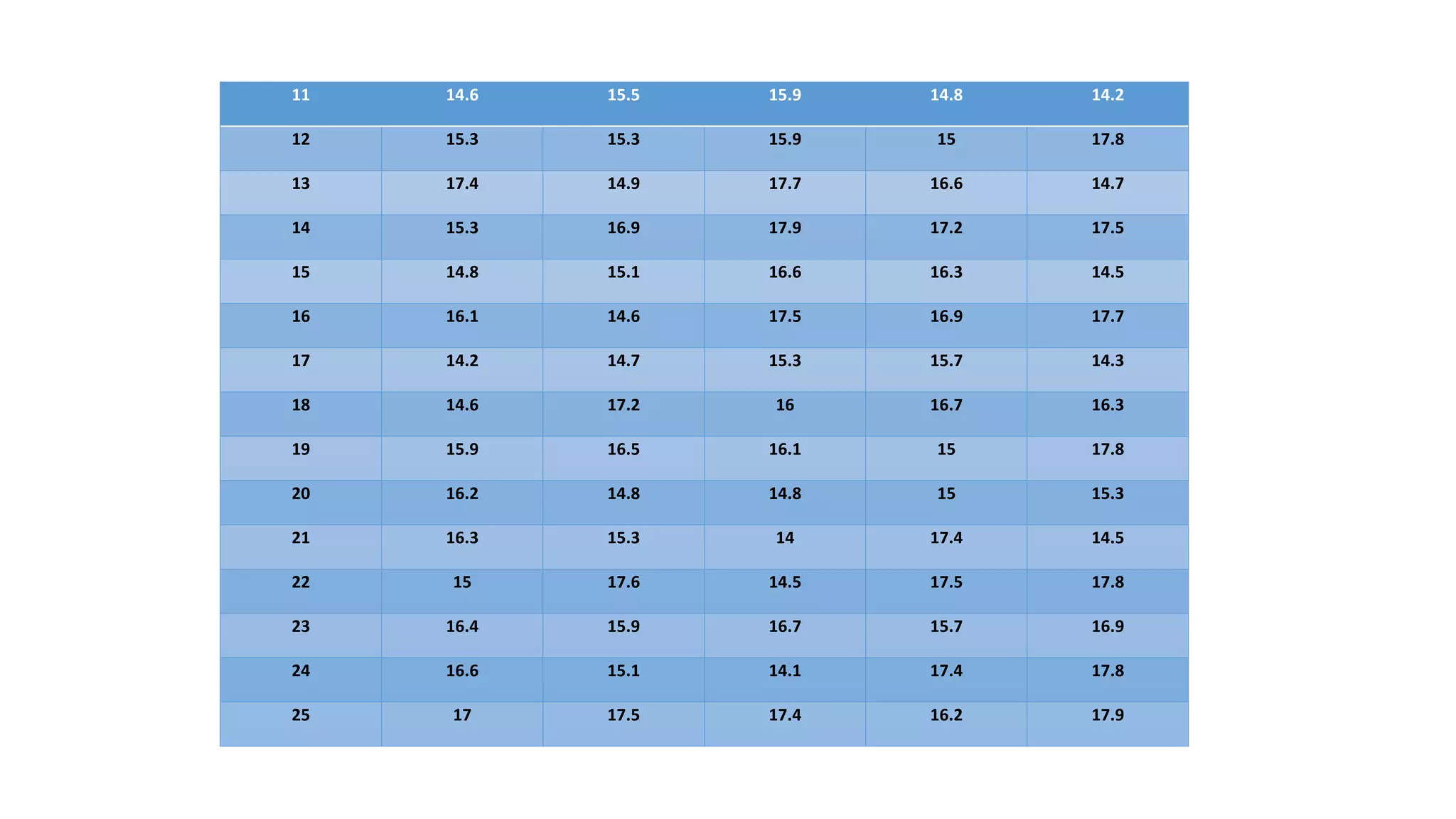
11 14.6 15.5 15.9 14.8 14.2
12 15.3 15.3 15.9 15 17.8
13 17.4 14.9 17.7 16.6 14.7
14 15.3 16.9 17.9 17.2 17.5
15 14.8 15.1 16.6 16.3 14.5
16 16.1 14.6 17.5 16.9 17.7
17 14.2 14.7 15.3 15.7 14.3
18 14.6 17.2 16 16.7 16.3
19 15.9 16.5 16.1 15 17.8
20 16.2 14.8 14.8 15 15.3
21 16.3 15.3 14 17.4 14.5
22 15 17.6 14.5 17.5 17.8
23 16.4 15.9 16.7 15.7 16.9
24 16.6 15.1 14.1 17.4 17.8
25 17 17.5 17.4 16.2 17.9
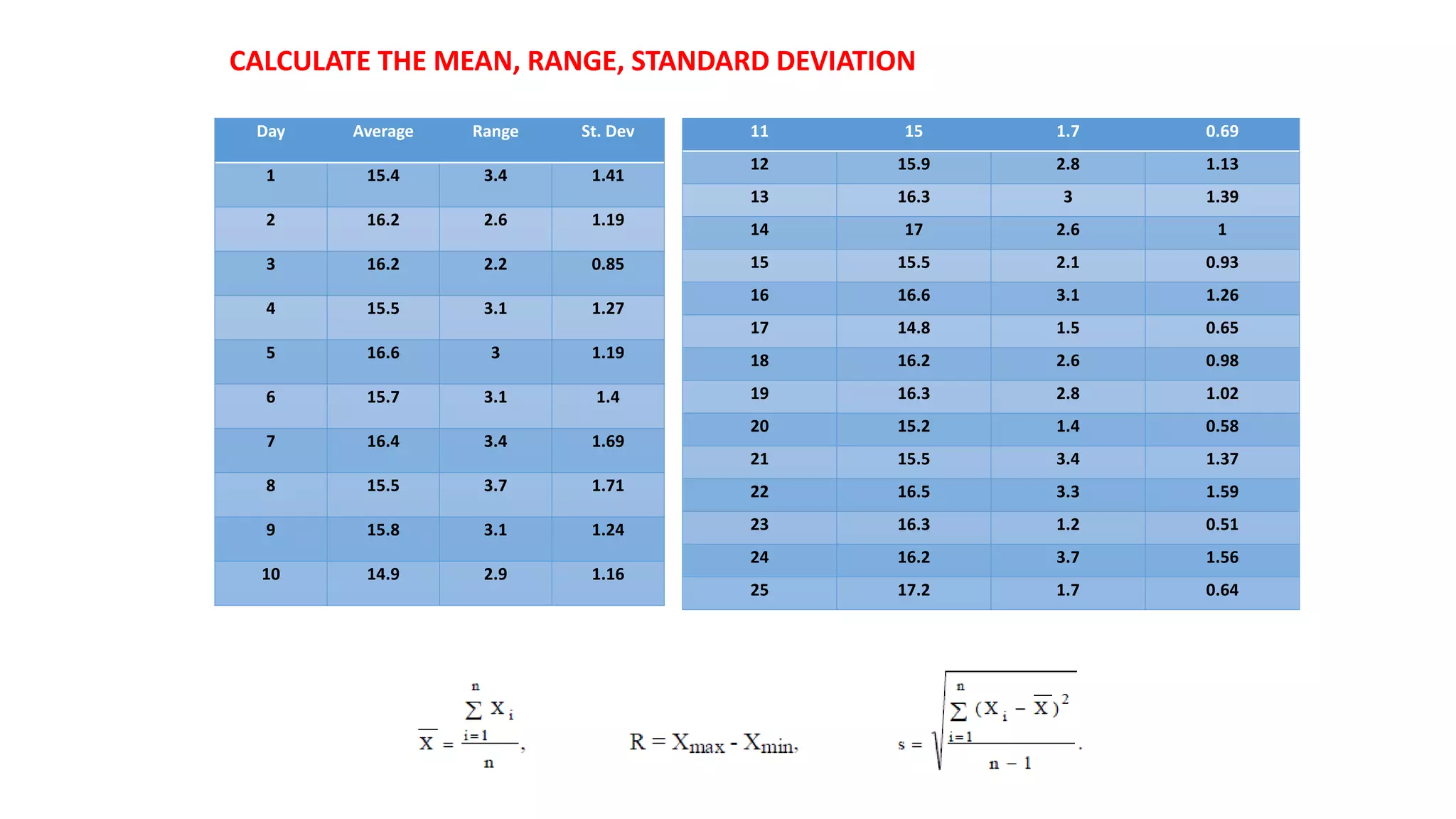
CALCULATE THE MEAN, RANGE, STANDARD DEVIATION
Day Average Range St. Dev
1 15.4 3.4 1.41
2 16.2 2.6 1.19
3 16.2 2.2 0.85
4 15.5 3.1 1.27
5 16.6 3 1.19
6 15.7 3.1 1.4
7 16.4 3.4 1.69
8 15.5 3.7 1.71
9 15.8 3.1 1.24
10 14.9 2.9 1.16
11 15 1.7 0.69
12 15.9 2.8 1.13
13 16.3 3 1.39
14 17 2.6 1
15 15.5 2.1 0.93
16 16.6 3.1 1.26
17 14.8 1.5 0.65
18 16.2 2.6 0.98
19 16.3 2.8 1.02
20 15.2 1.4 0.58
21 15.5 3.4 1.37
22 16.5 3.3 1.59
23 16.3 1.2 0.51
24 16.2 3.7 1.56
25 17.2 1.7 0.64
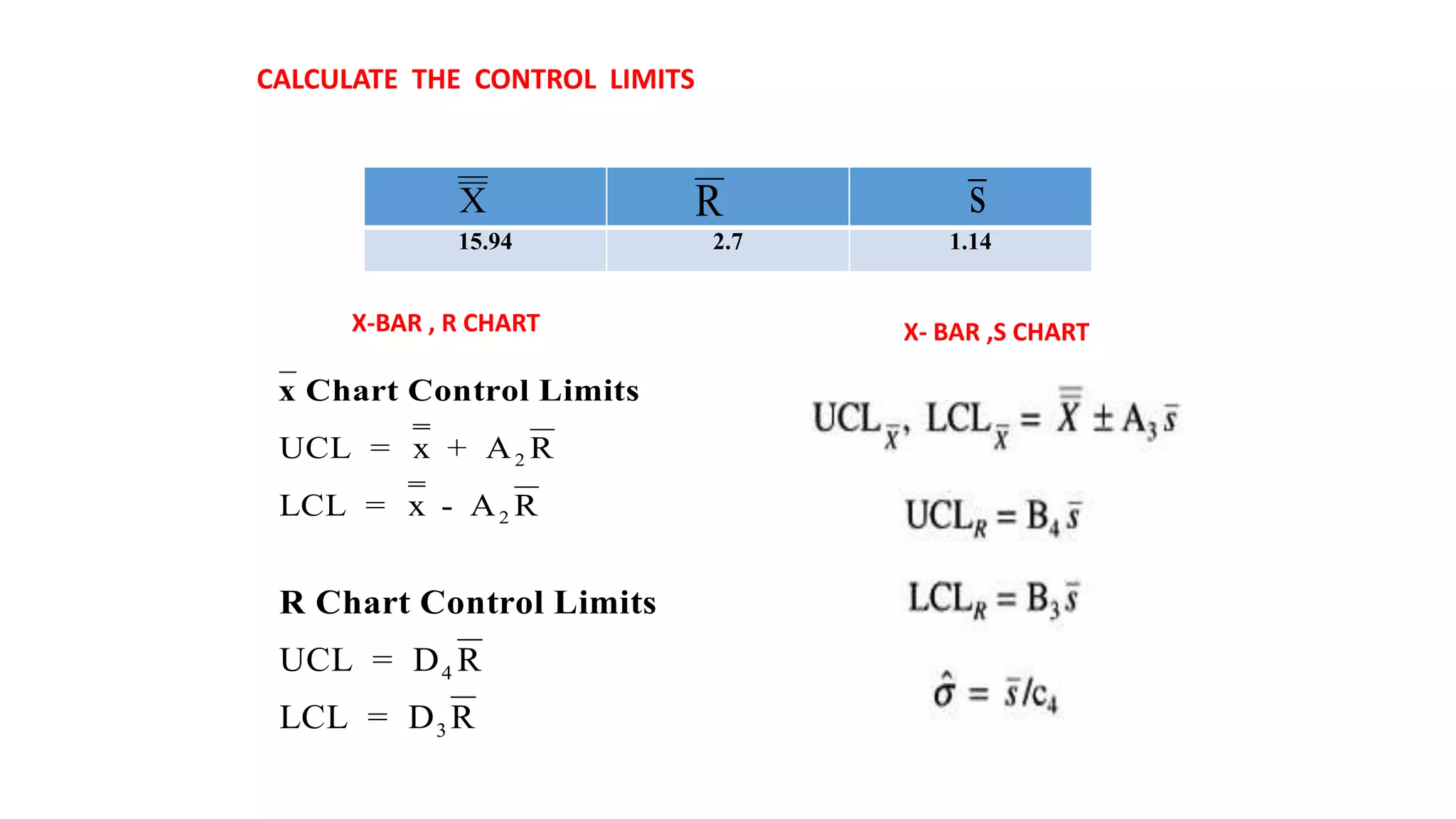
CALCULATE THE CONTROL LIMITS
15.94 2.7 1.14
X R s
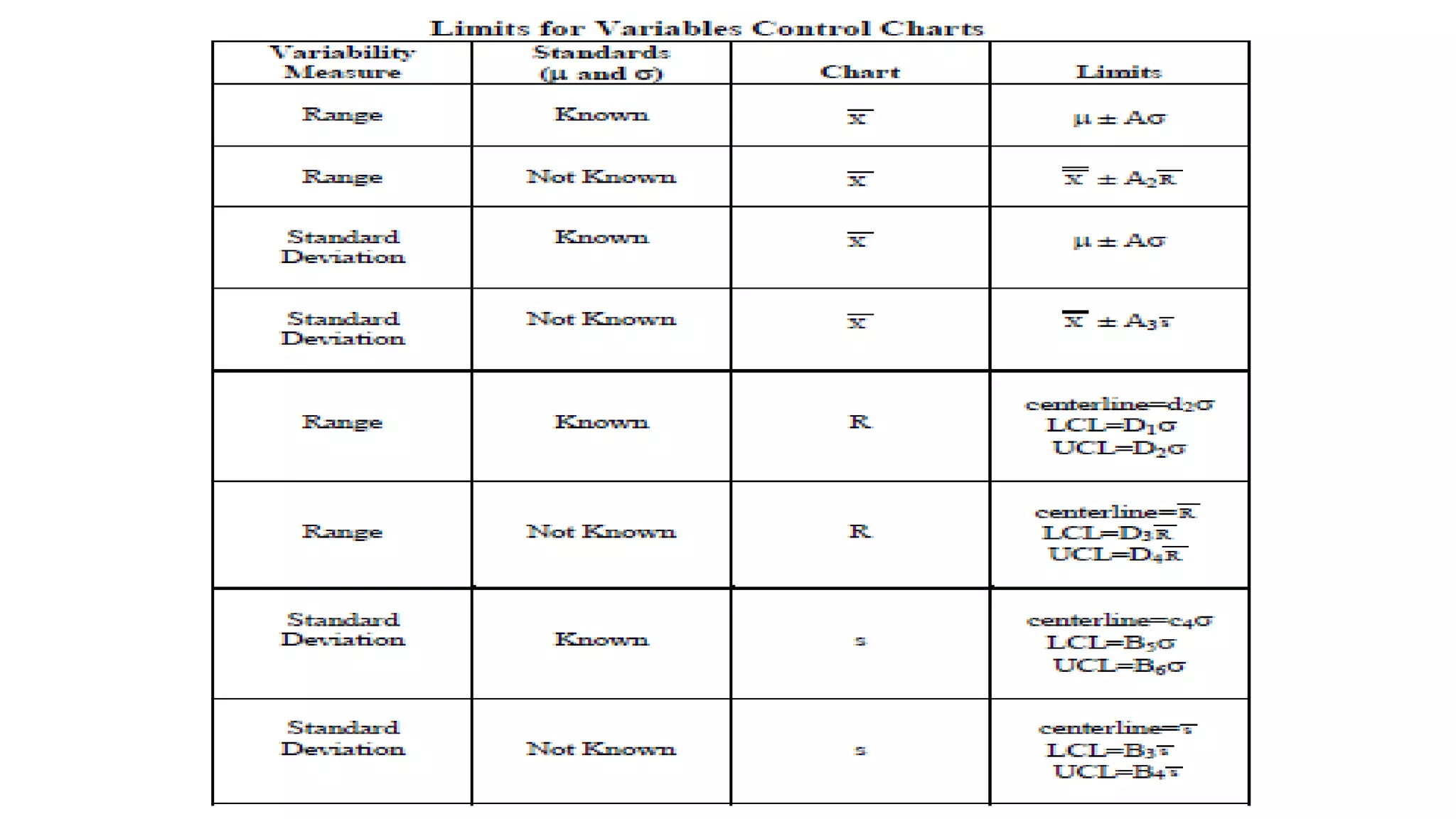
x Chart Control Limits
UCL = x + A R
LCL = x - A R
2
2
R Chart Control Limits
UCL = D R
LCL = D R
4
3
X-BAR , R CHART X- BAR ,S CHART
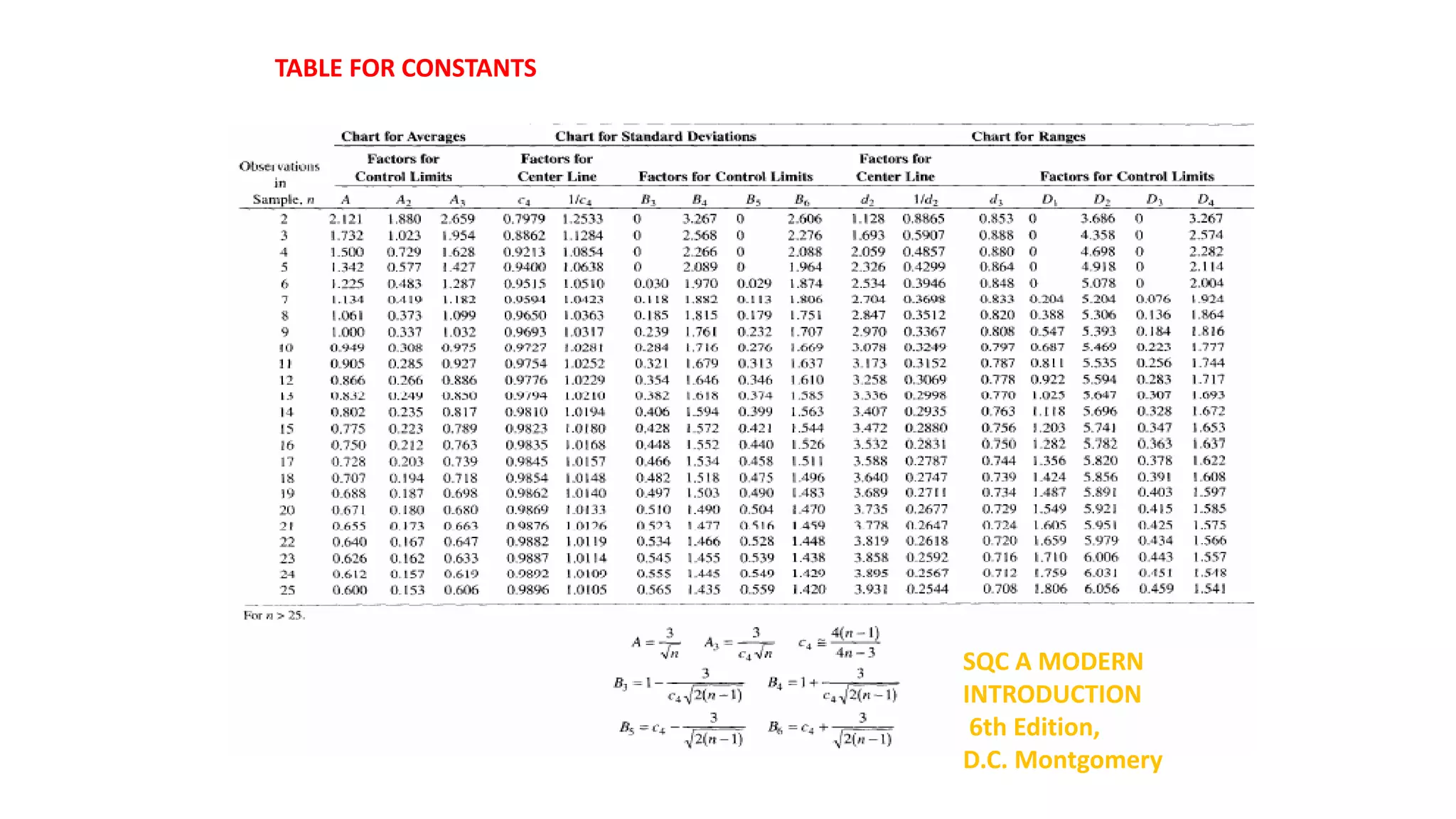
TABLE FOR CONSTANTS
SQC A MODERN
INTRODUCTION
6th Edition,
D.C. Montgomery
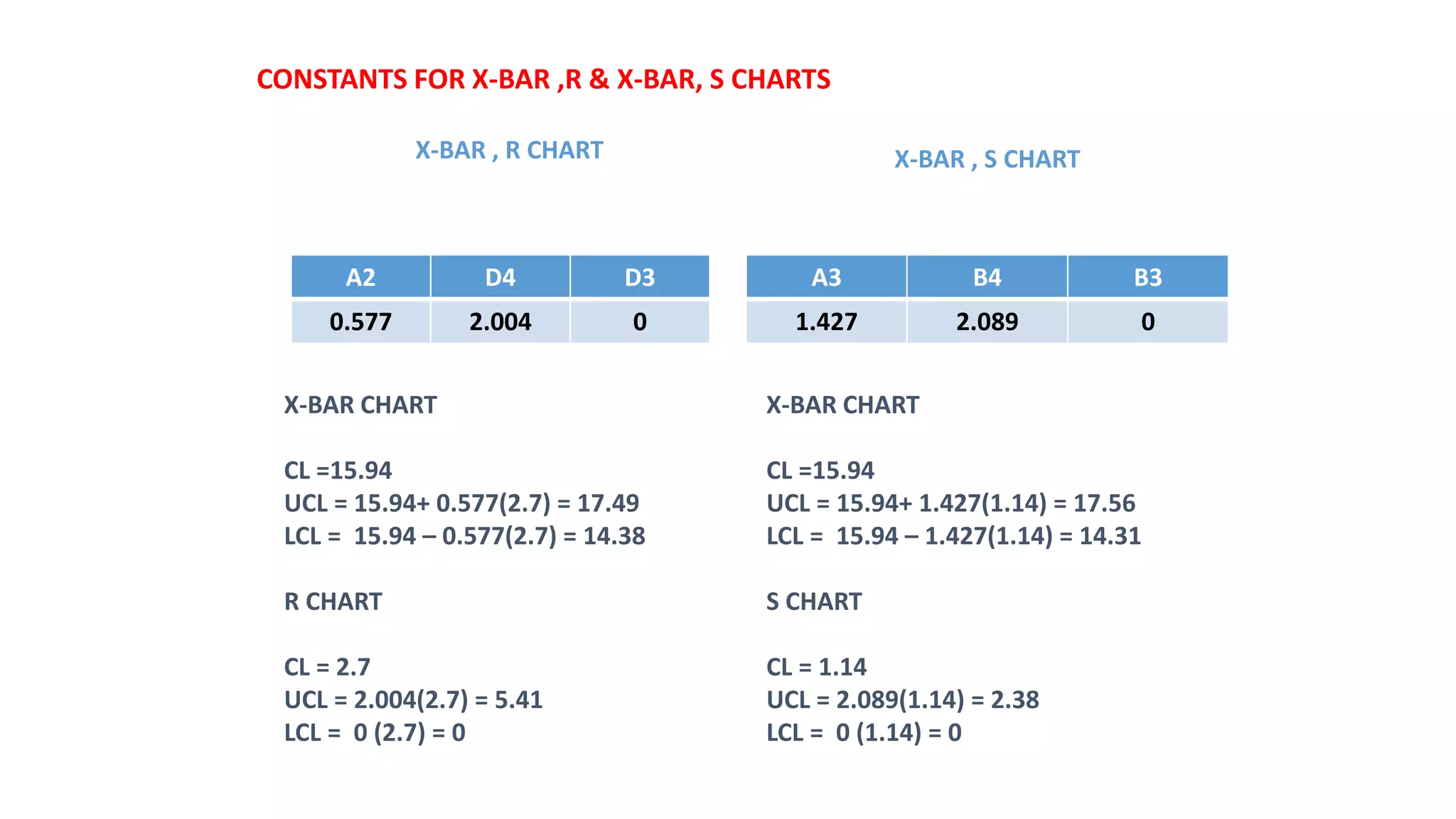
CONSTANTS FOR X-BAR ,R & X-BAR, S CHARTS
X-BAR , R CHART X-BAR , S CHART
A2 D4 D3
0.577 2.004 0
A3 B4 B3
1.427 2.089 0
X-BAR CHART
CL =15.94
UCL = 15.94+ 0.577(2.7) = 17.49
LCL = 15.94 – 0.577(2.7) = 14.38
R CHART
CL = 2.7
UCL = 2.004(2.7) = 5.41
LCL = 0 (2.7) = 0
X-BAR CHART
CL =15.94
UCL = 15.94+ 1.427(1.14) = 17.56
LCL = 15.94 – 1.427(1.14) = 14.31
S CHART
CL = 1.14
UCL = 2.089(1.14) = 2.38
LCL = 0 (1.14) = 0
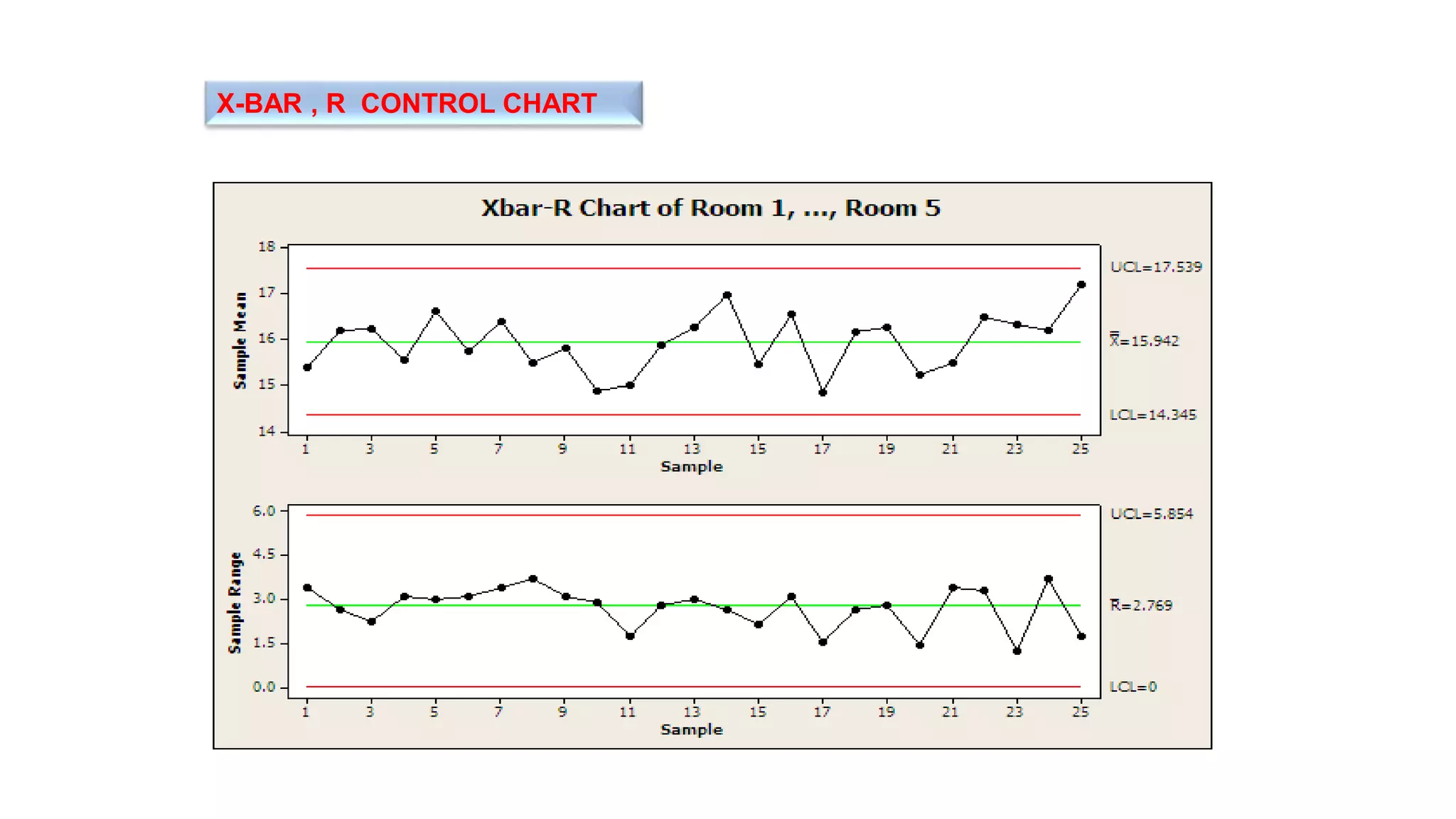
X-BAR , R CONTROL CHART
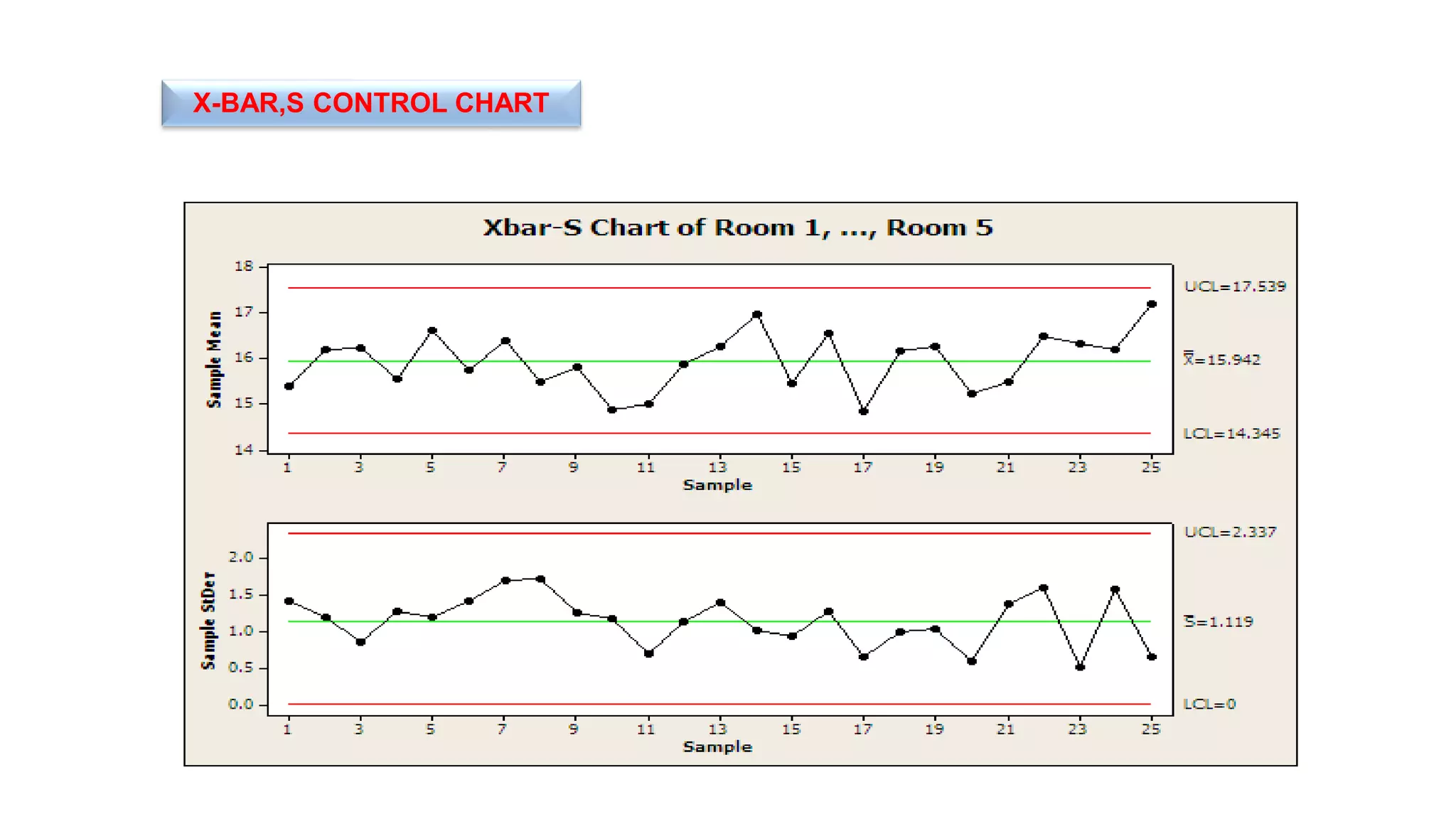
X-BAR,S CONTROL CHART
CONTROL CHARTS
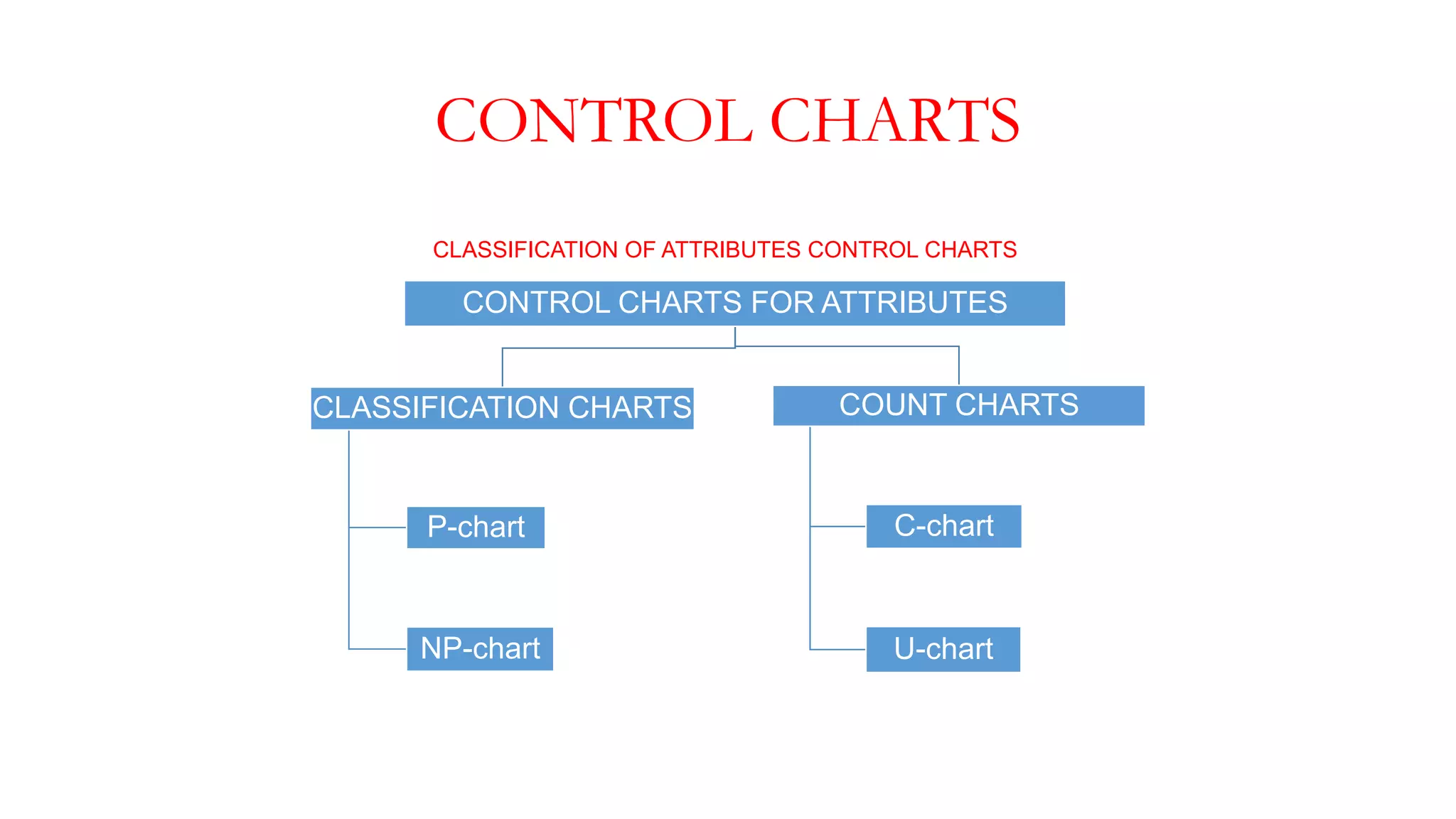
CLASSIFICATION OF ATTRIBUTES CONTROL CHARTS
CONTROL CHARTS FOR ATTRIBUTES
CLASSIFICATION CHARTS
P-chart
NP-chart
COUNT CHARTS
C-chart
U-chart
CONTROL CHARTS FOR ATTRIBUTES
Classification charts:
Classification charts deal with either the fraction of items or the number of
items in a series of subgroups.
CONTROL CHARTS FOR ATTRIBUTES
P – chart:
The P-Chart monitors the percent of samples having the condition, relative to
either a fixed or varying sample size.
EXAMPLE SCENARIO:
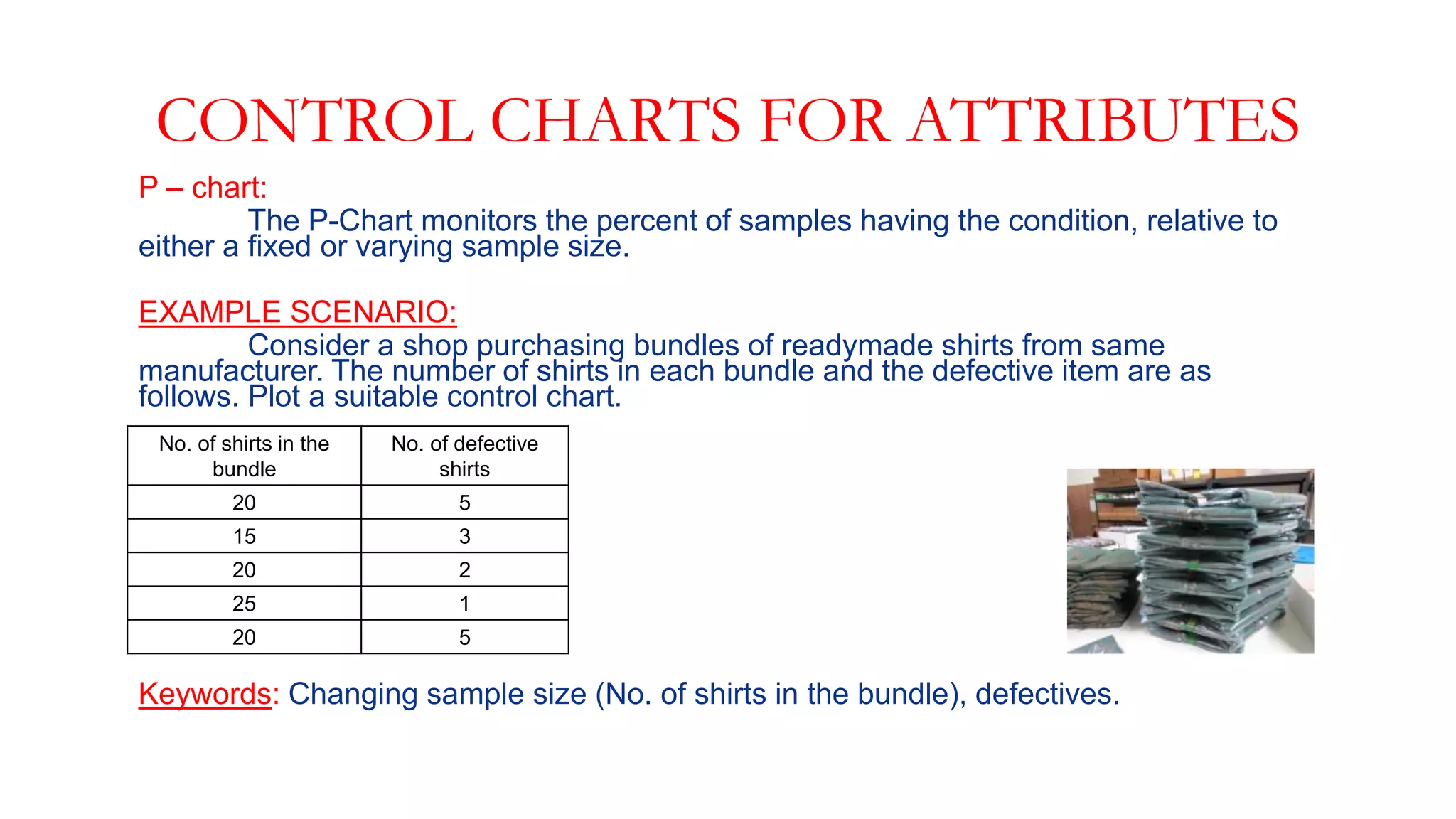
Consider a shop purchasing bundles of readymade shirts from same
manufacturer. The number of shirts in each bundle and the defective item are as
follows. Plot a suitable control chart.
Keywords: Changing sample size (No. of shirts in the bundle), defectives.
No. of shirts in the
bundle
No. of defective
shirts
20 5
15 3
20 2
25 1
20 5
CONTROL CHARTS FOR ATTRIBUTES(P chart)
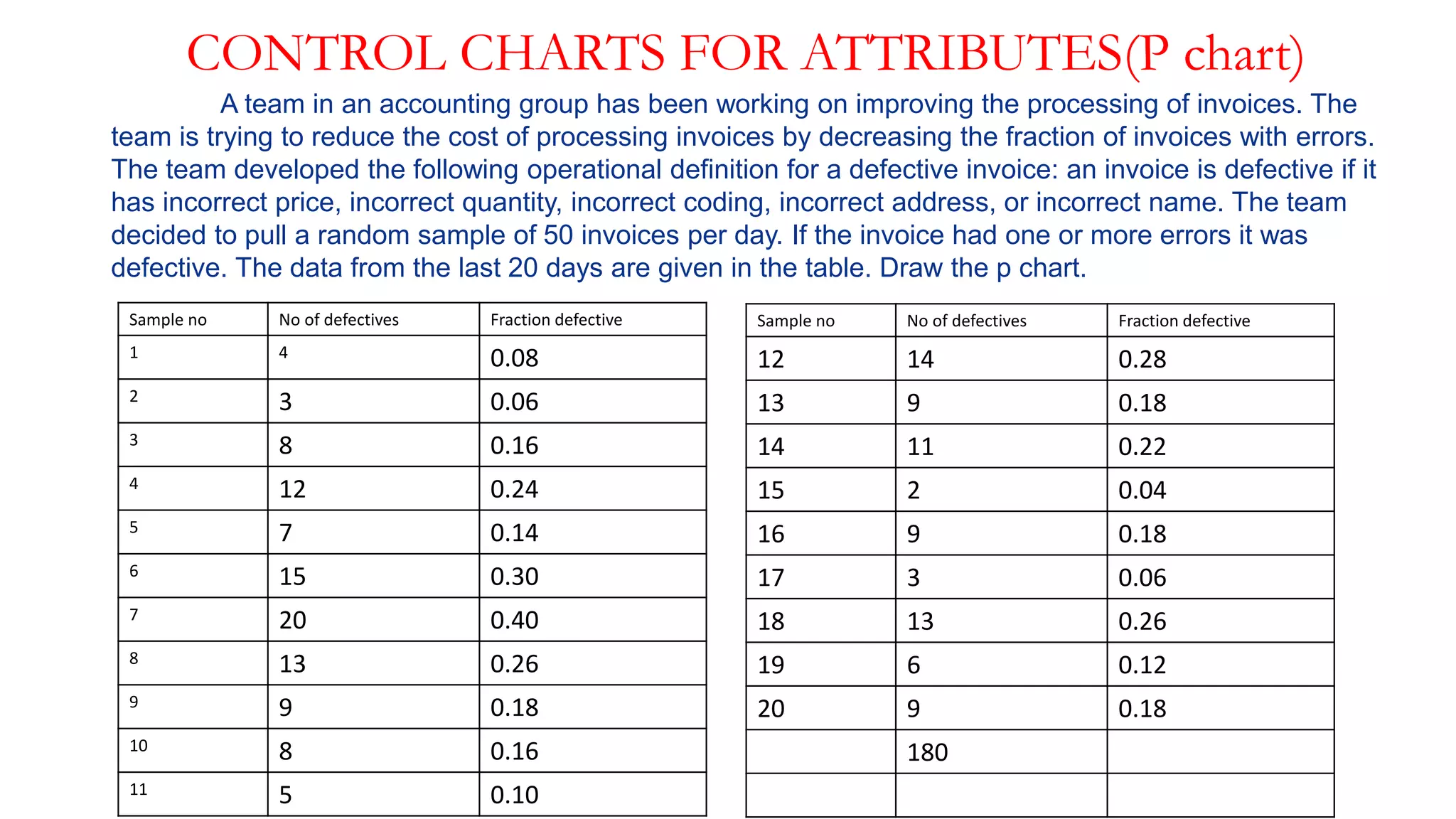
A team in an accounting group has been working on improving the processing of invoices. The
team is trying to reduce the cost of processing invoices by decreasing the fraction of invoices with errors.
The team developed the following operational definition for a defective invoice: an invoice is defective if it
has incorrect price, incorrect quantity, incorrect coding, incorrect address, or incorrect name. The team
decided to pull a random sample of 50 invoices per day. If the invoice had one or more errors it was
defective. The data from the last 20 days are given in the table. Draw the p chart.
Sample no No of defectives Fraction defective
1 4 0.08
2 3 0.06
3 8 0.16
4 12 0.24
5 7 0.14
6 15 0.30
7 20 0.40
8 13 0.26
9 9 0.18
10 8 0.16
11 5 0.10
Sample no No of defectives Fraction defective
12 14 0.28
13 9 0.18
14 11 0.22
15 2 0.04
16 9 0.18
17 3 0.06
18 13 0.26
19 6 0.12
20 9 0.18
180
CONTROL CHARTS FOR ATTRIBUTES (P chart)
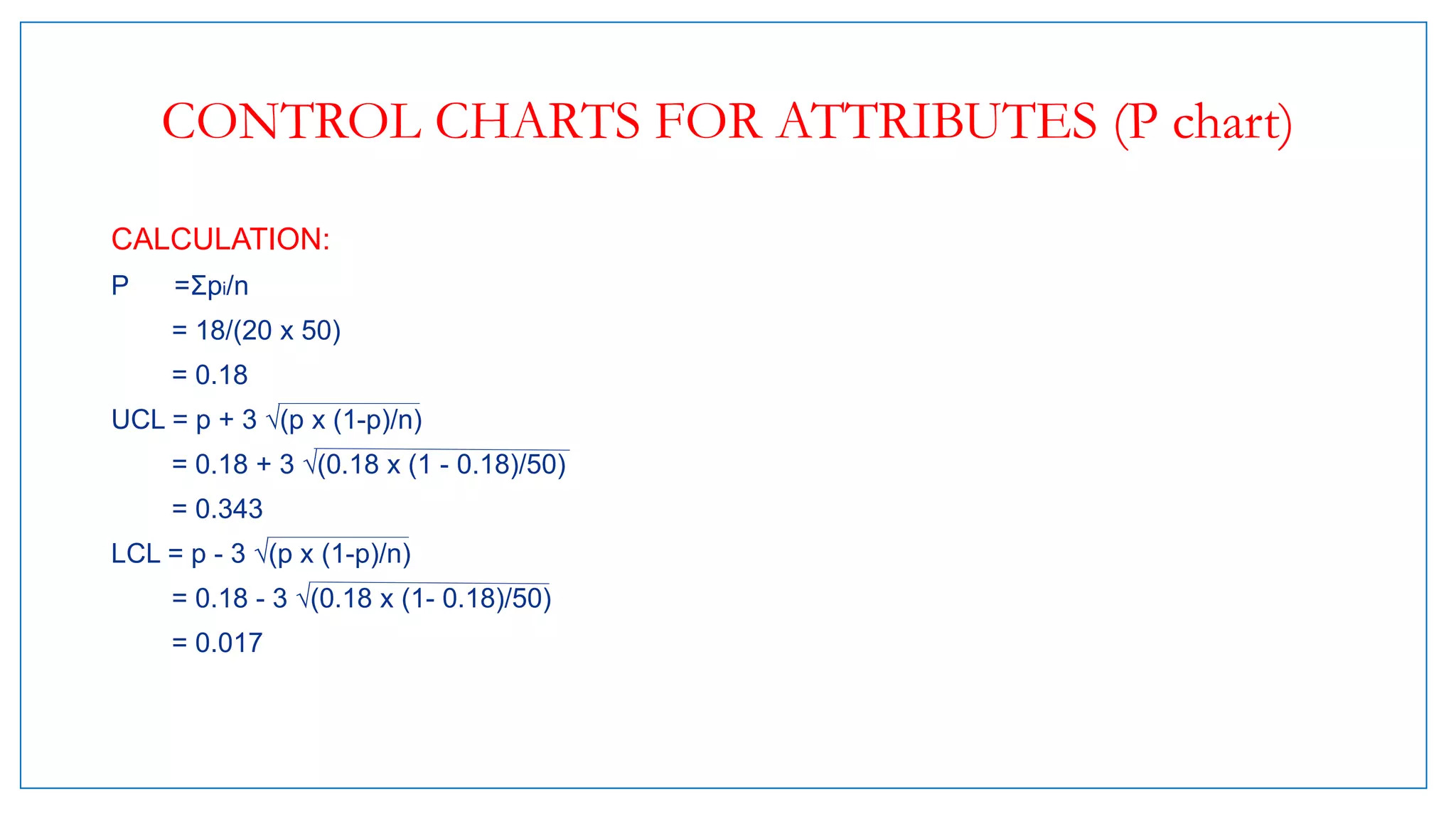
CALCULATION:
P =Σpi/n
= 18/(20 x 50)
= 0.18
UCL = p + 3 √(p x (1-p)/n)
= 0.18 + 3 √(0.18 x (1 - 0.18)/50)
= 0.343
LCL = p - 3 √(p x (1-p)/n)
= 0.18 - 3 √(0.18 x (1- 0.18)/50)
= 0.017
CONTROL CHARTS FOR ATTRIBUTES (P chart)
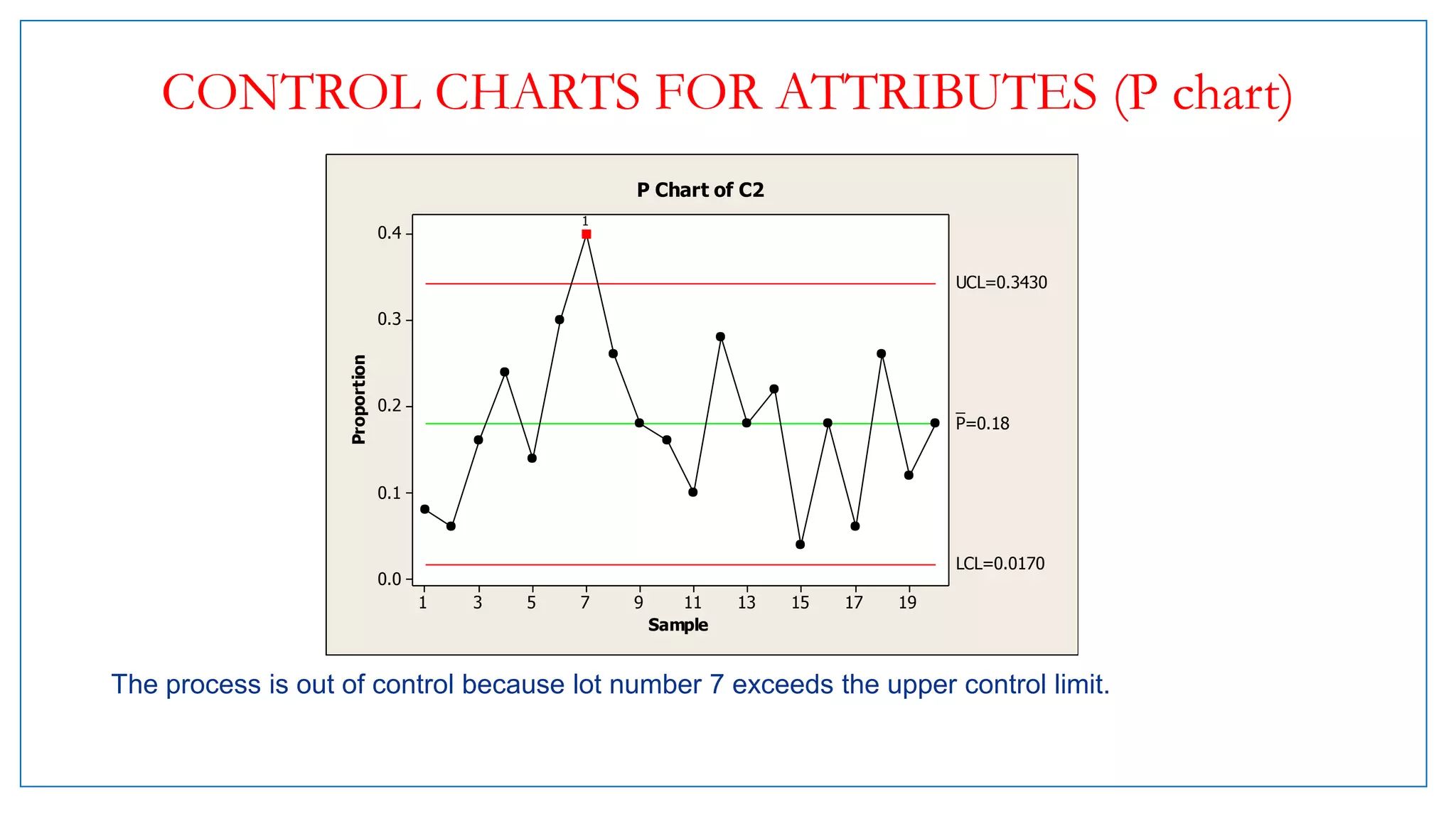
The process is out of control because lot number 7 exceeds the upper control limit.
191715131197531
0.4
0.3
0.2
0.1
0.0
Sample
Proportion
_
P=0.18
UCL=0.3430
LCL=0.0170
1
P Chart of C2
CONTROL CHARTS FOR ATTRIBUTES
NP-chart:
The NP-Chart monitors the number of times a condition occurs, relative to a
constant sample size.
Example scenario:
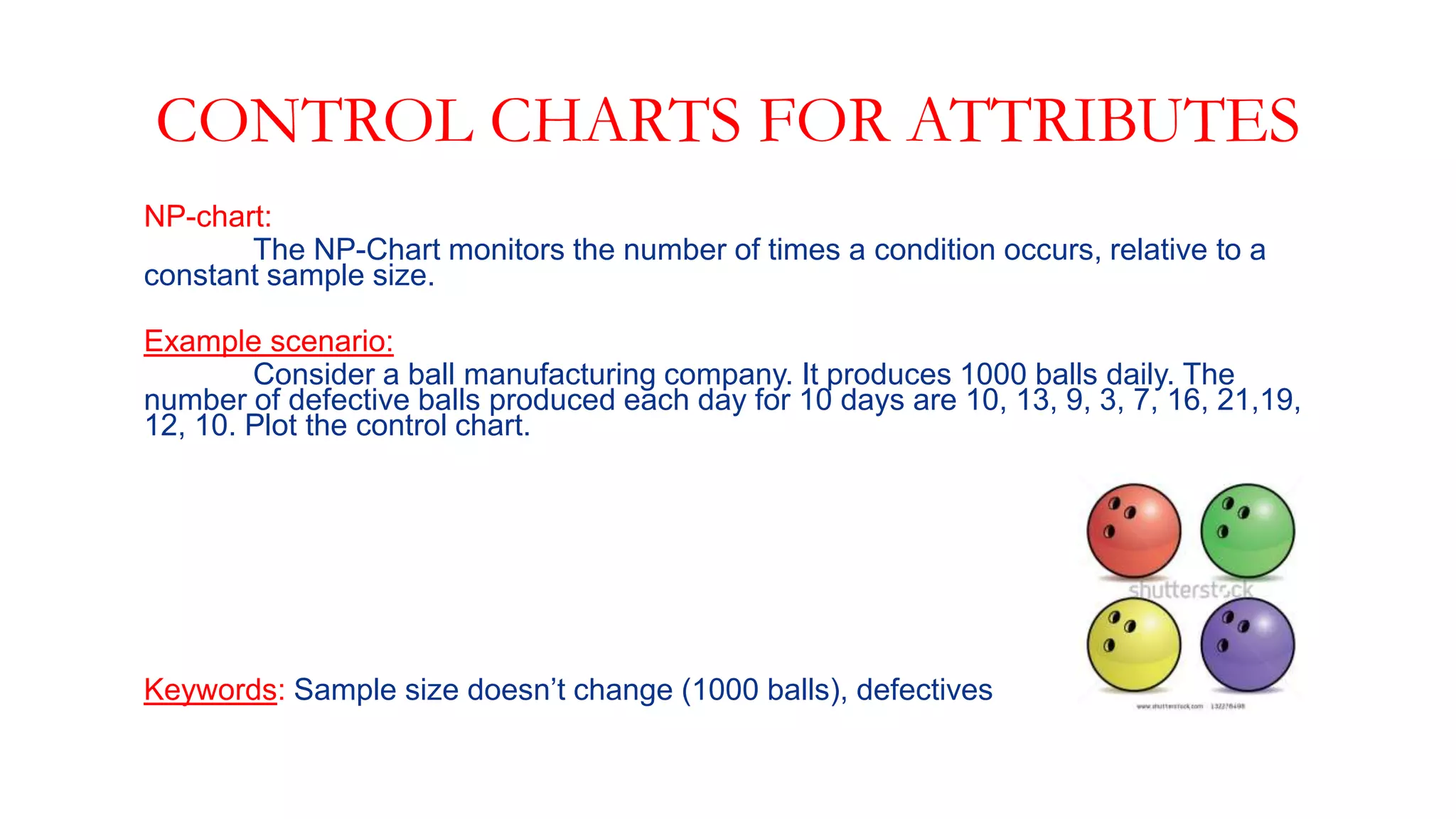
Consider a ball manufacturing company. It produces 1000 balls daily. The
number of defective balls produced each day for 10 days are 10, 13, 9, 3, 7, 16, 21,19,
12, 10. Plot the control chart.
Keywords: Sample size doesn’t change (1000 balls), defectives
CONTROL CHARTS FOR ATTRIBUTES (NP chart)
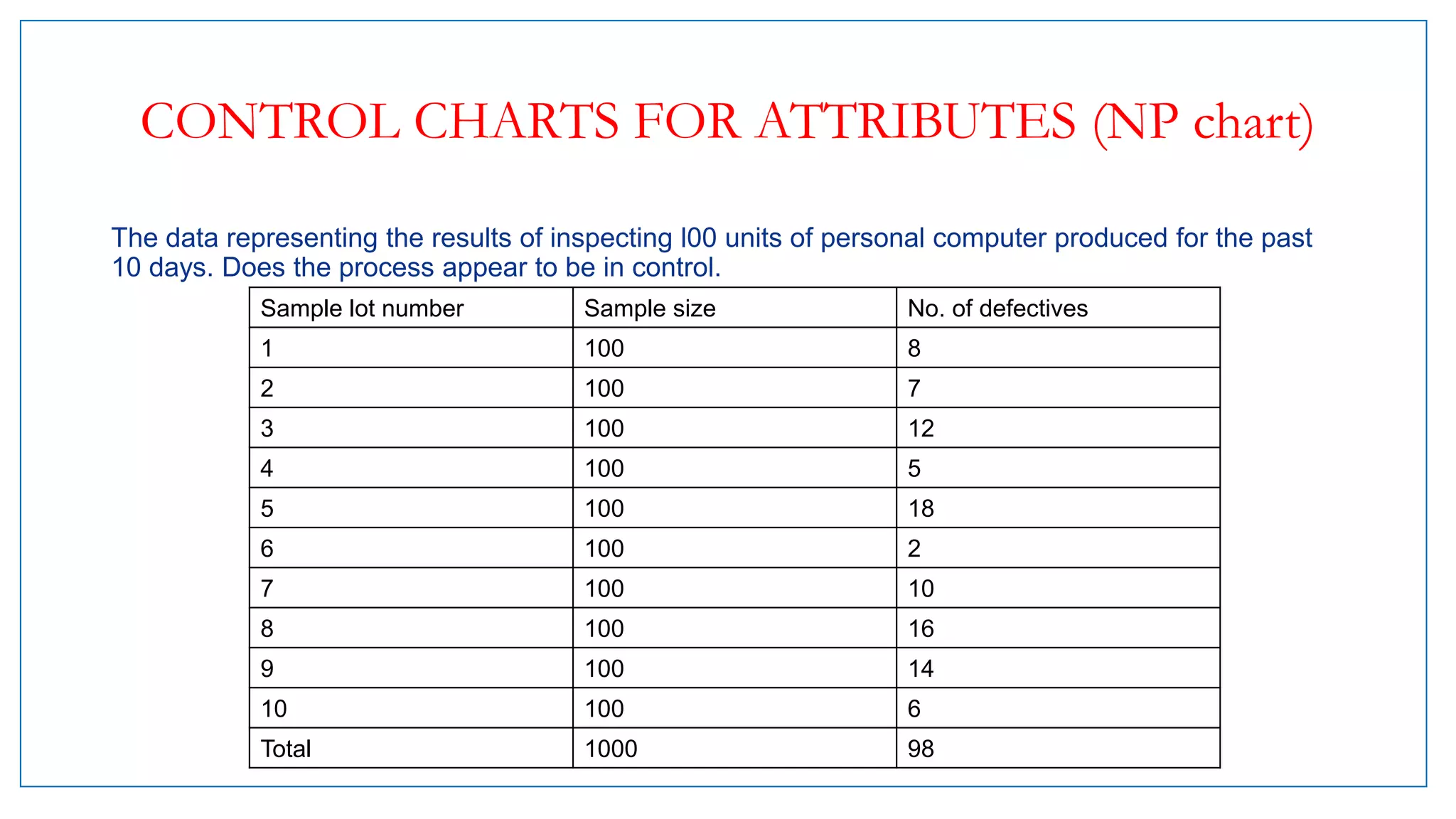
The data representing the results of inspecting l00 units of personal computer produced for the past
10 days. Does the process appear to be in control.
Sample lot number Sample size No. of defectives
1 100 8
2 100 7
3 100 12
4 100 5
5 100 18
6 100 2
7 100 10
8 100 16
9 100 14
10 100 6
Total 1000 98
CONTROL CHARTS FOR ATTRIBUTES (NP chart)
CALCULATION:
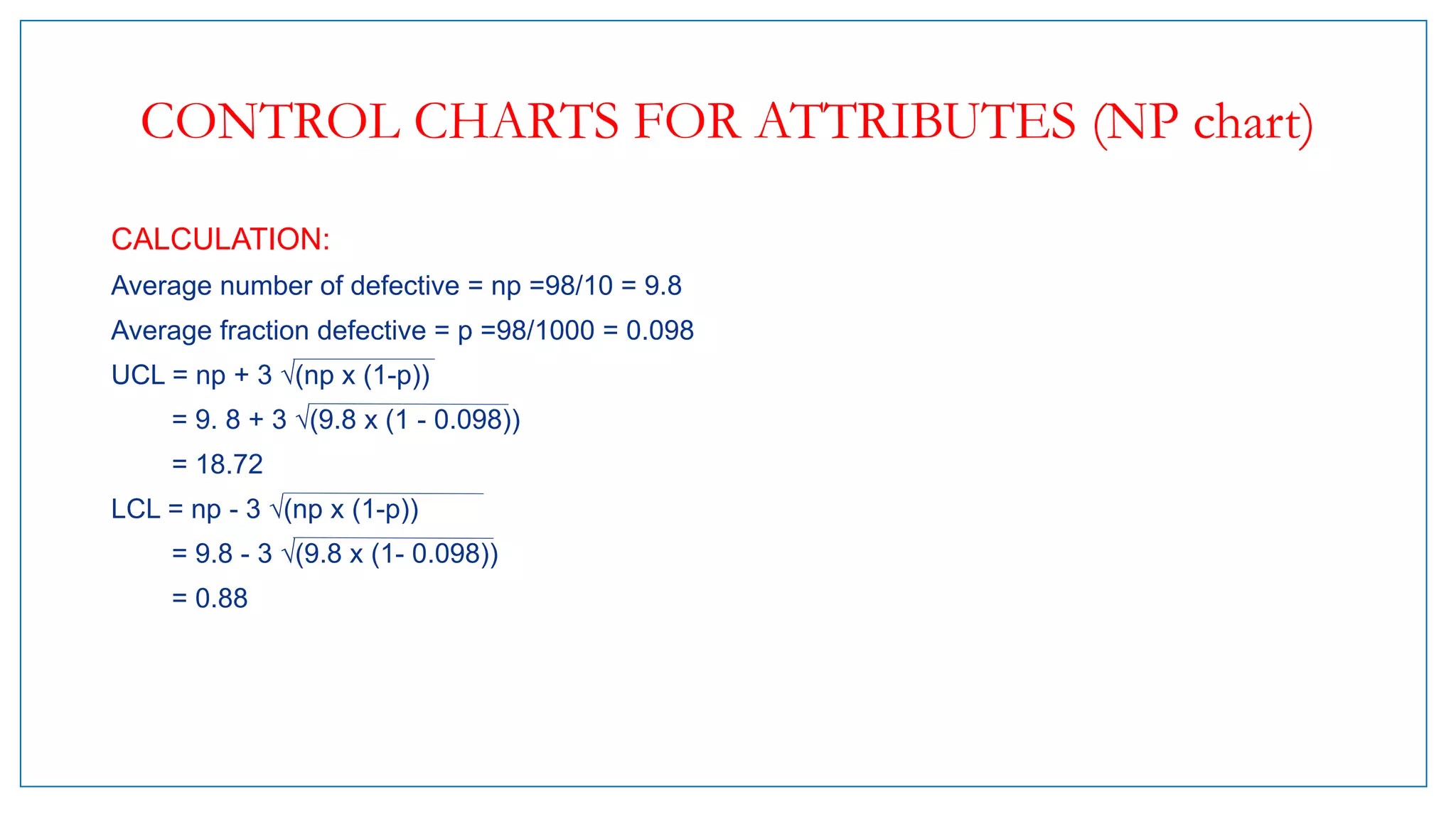
Average number of defective = np =98/10 = 9.8
Average fraction defective = p =98/1000 = 0.098
UCL = np + 3 √(np x (1-p))
= 9. 8 + 3 √(9.8 x (1 - 0.098))
= 18.72
LCL = np - 3 √(np x (1-p))
= 9.8 - 3 √(9.8 x (1- 0.098))
= 0.88
CONTROL CHARTS FOR ATTRIBUTES (NP chart)
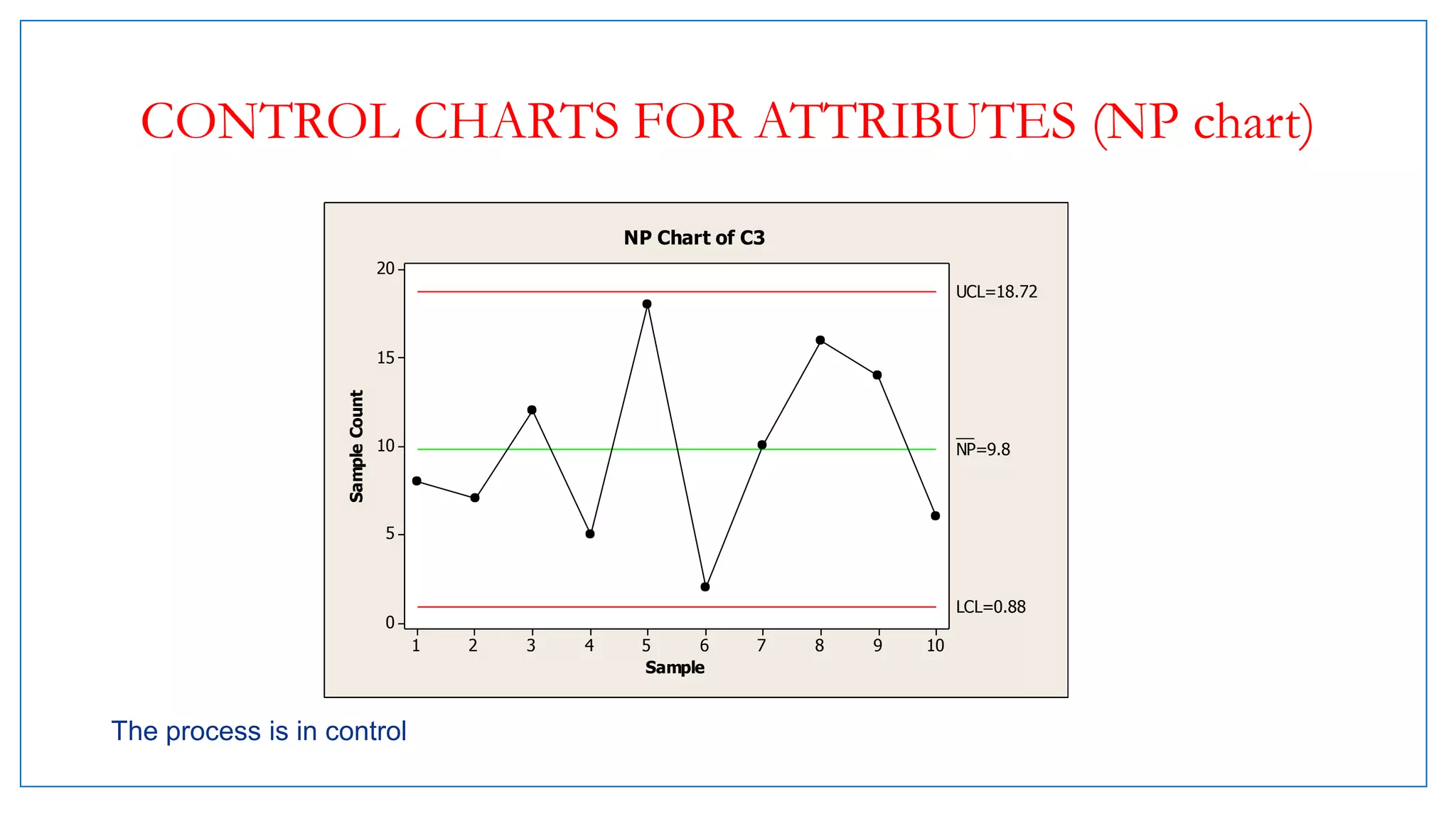
The process is in control
10987654321
20
15
10
5
0
Sample
SampleCount
__
NP=9.8
UCL=18.72
LCL=0.88
NP Chart of C3
CONTROL CHARTS FOR ATTRIBUTES
Count charts:
Count charts deal with the number of times a particular characteristic appear in
some given area of opportunity.
C-chart:
The c-chart monitors the number of times a condition occurs, relative to a constant
sample size. In this case, a given sample can have more than one instance of the
condition, in which case we count all the times it occurs in the sample.
Example scenario:
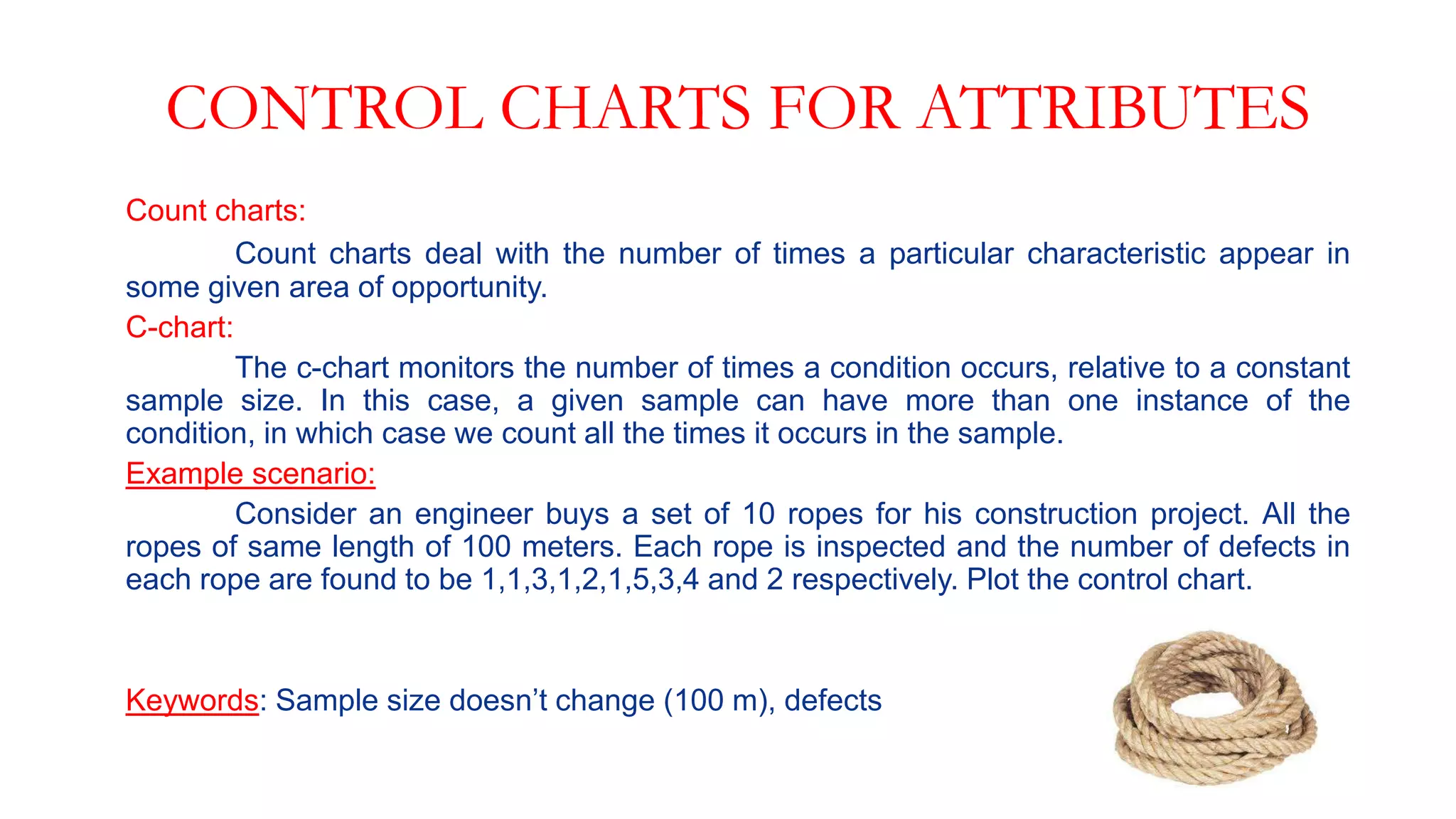
Consider an engineer buys a set of 10 ropes for his construction project. All the
ropes of same length of 100 meters. Each rope is inspected and the number of defects in
each rope are found to be 1,1,3,1,2,1,5,3,4 and 2 respectively. Plot the control chart.
Keywords: Sample size doesn’t change (100 m), defects
CONTROL CHARTS FOR ATTRIBUTES (C chart)
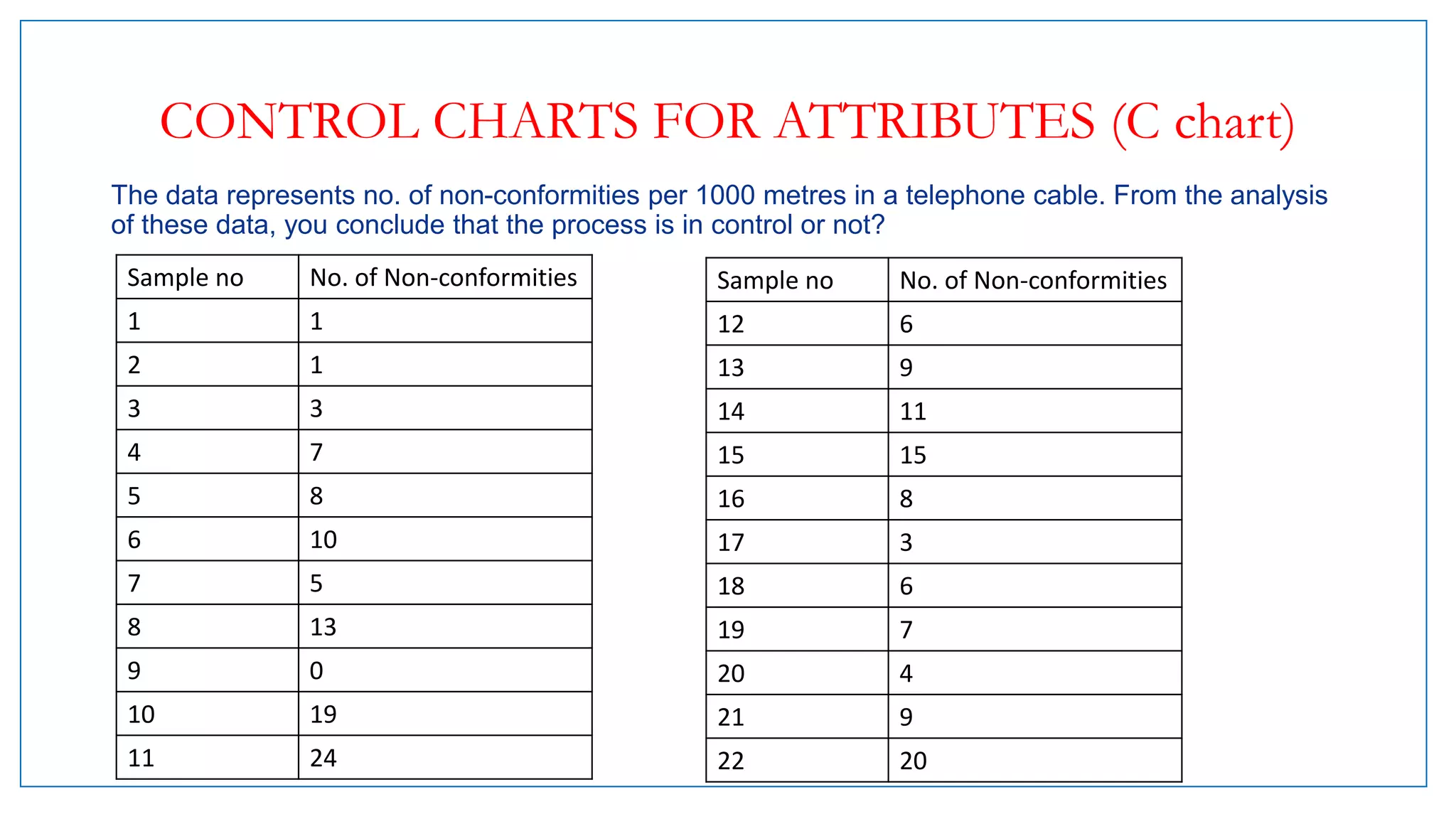
The data represents no. of non-conformities per 1000 metres in a telephone cable. From the analysis
of these data, you conclude that the process is in control or not?
Sample no No. of Non-conformities
1 1
2 1
3 3
4 7
5 8
6 10
7 5
8 13
9 0
10 19
11 24
Sample no No. of Non-conformities
12 6
13 9
14 11
15 15
16 8
17 3
18 6
19 7
20 4
21 9
22 20
CONTROL CHARTS FOR ATTRIBUTES (C chart)
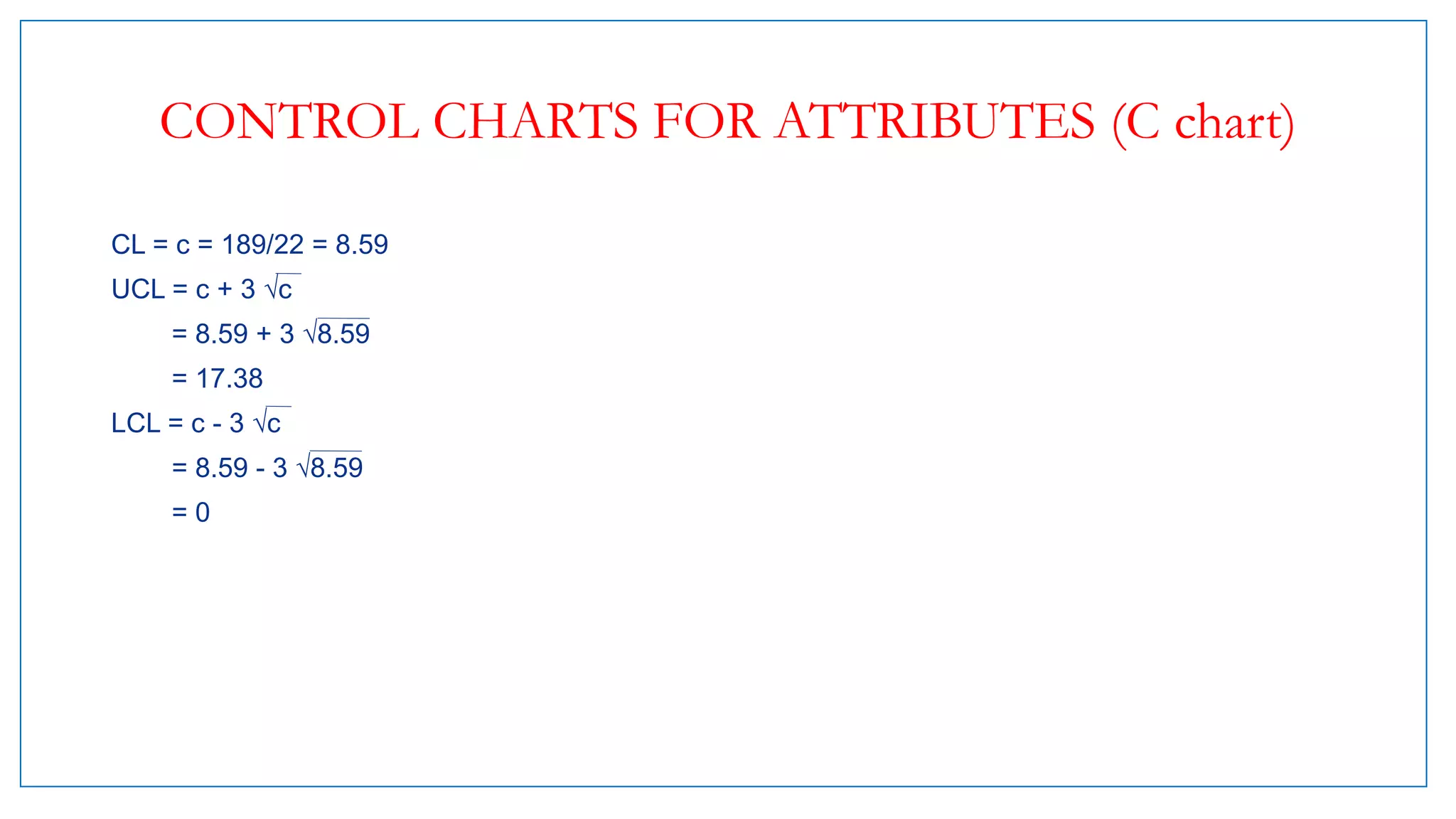
CL = c = 189/22 = 8.59
UCL = c + 3 √c
= 8.59 + 3 √8.59
= 17.38
LCL = c - 3 √c
= 8.59 - 3 √8.59
= 0
CONTROL CHARTS FOR ATTRIBUTES (C chart)
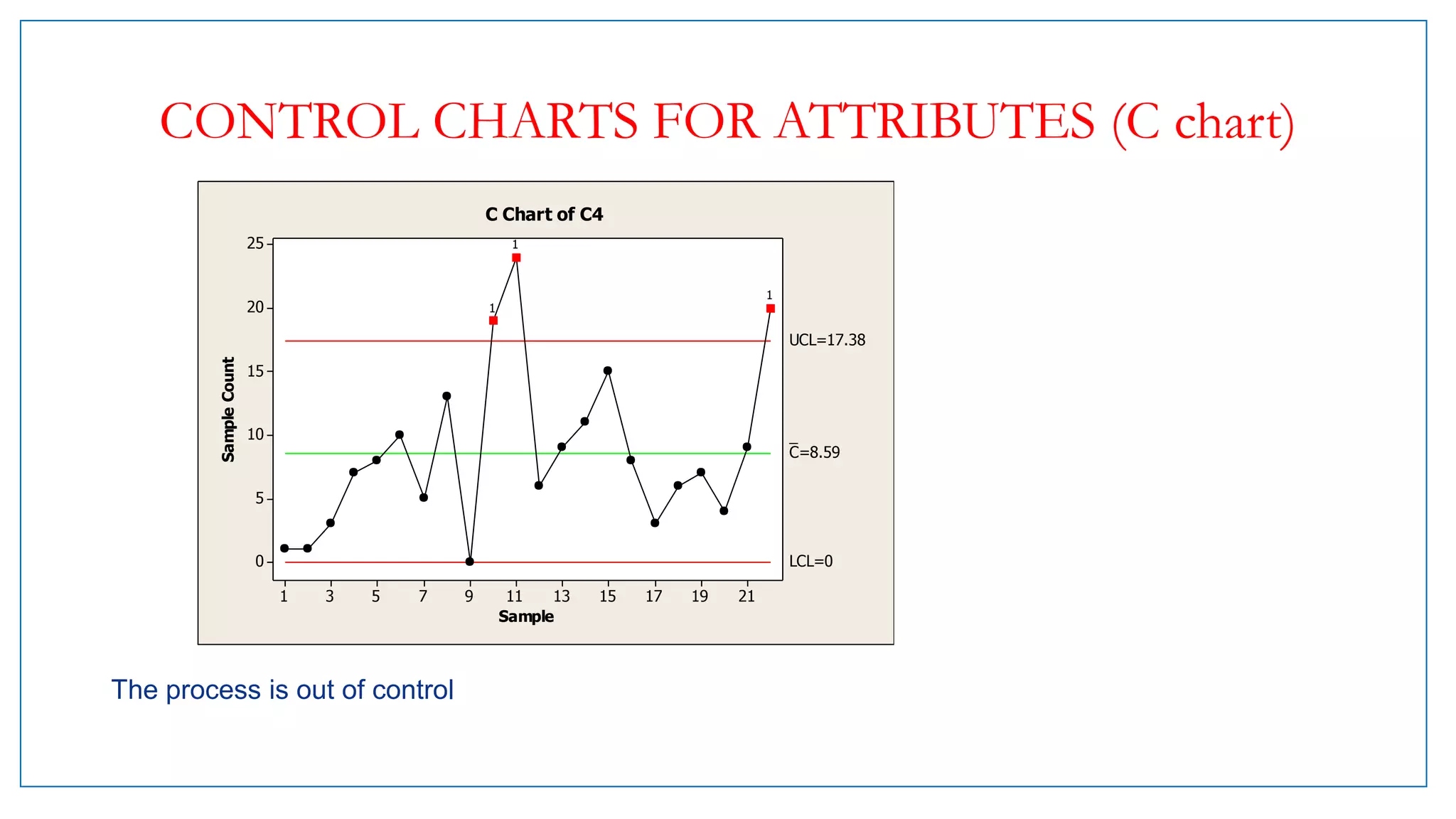
The process is out of control
21191715131197531
25
20
15
10
5
0
Sample
SampleCount
_
C=8.59
UCL=17.38
LCL=0
1
1
1
C Chart of C4
CONTROL CHARTS FOR ATTRIBUTES
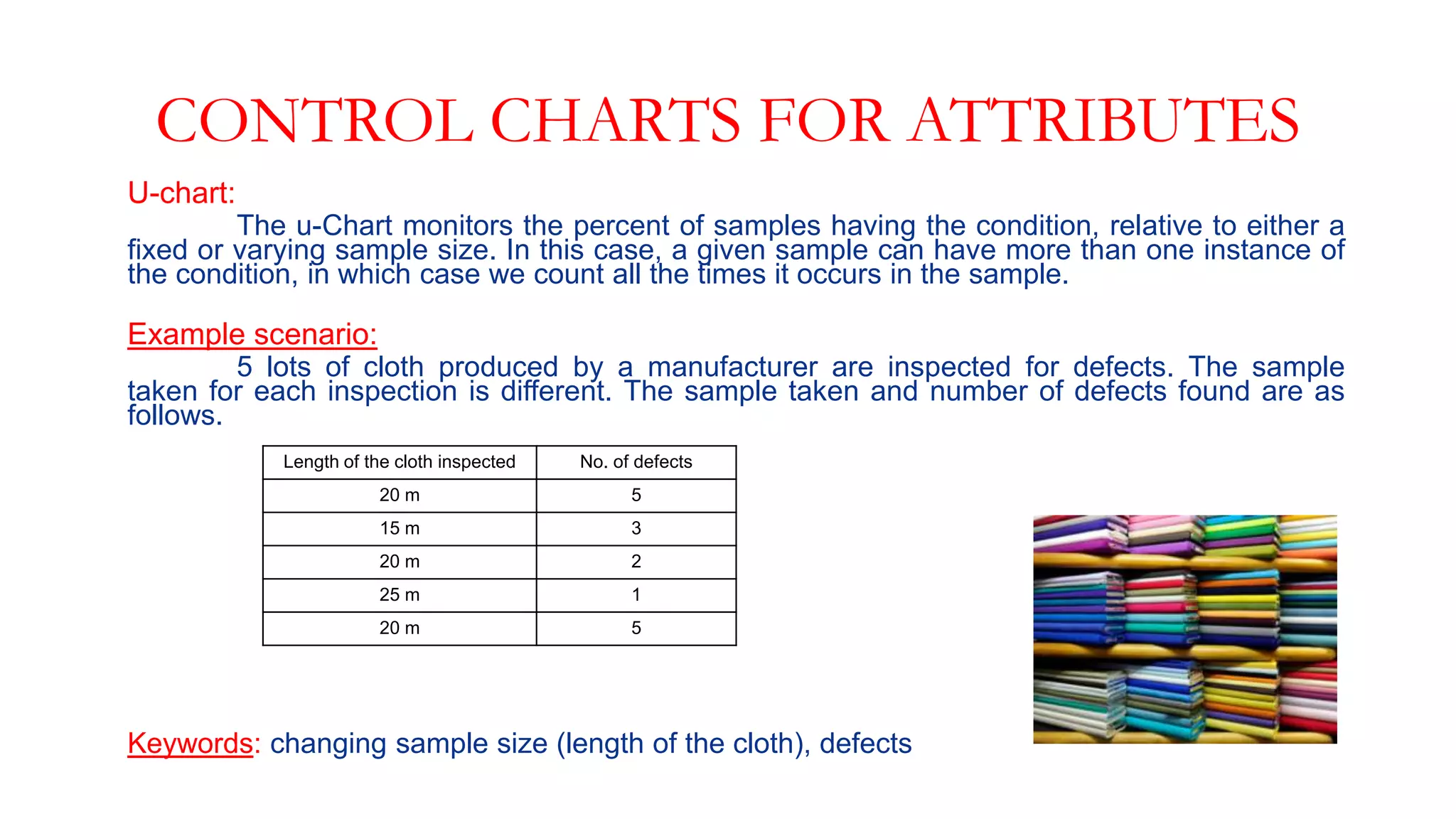
U-chart:
The u-Chart monitors the percent of samples having the condition, relative to either a
fixed or varying sample size. In this case, a given sample can have more than one instance of
the condition, in which case we count all the times it occurs in the sample.
Example scenario:
5 lots of cloth produced by a manufacturer are inspected for defects. The sample
taken for each inspection is different. The sample taken and number of defects found are as
follows.
Keywords: changing sample size (length of the cloth), defects
Length of the cloth inspected No. of defects
20 m 5
15 m 3
20 m 2
25 m 1
20 m 5
CONTROL CHARTS FOR ATTRIBUTES (U chart)
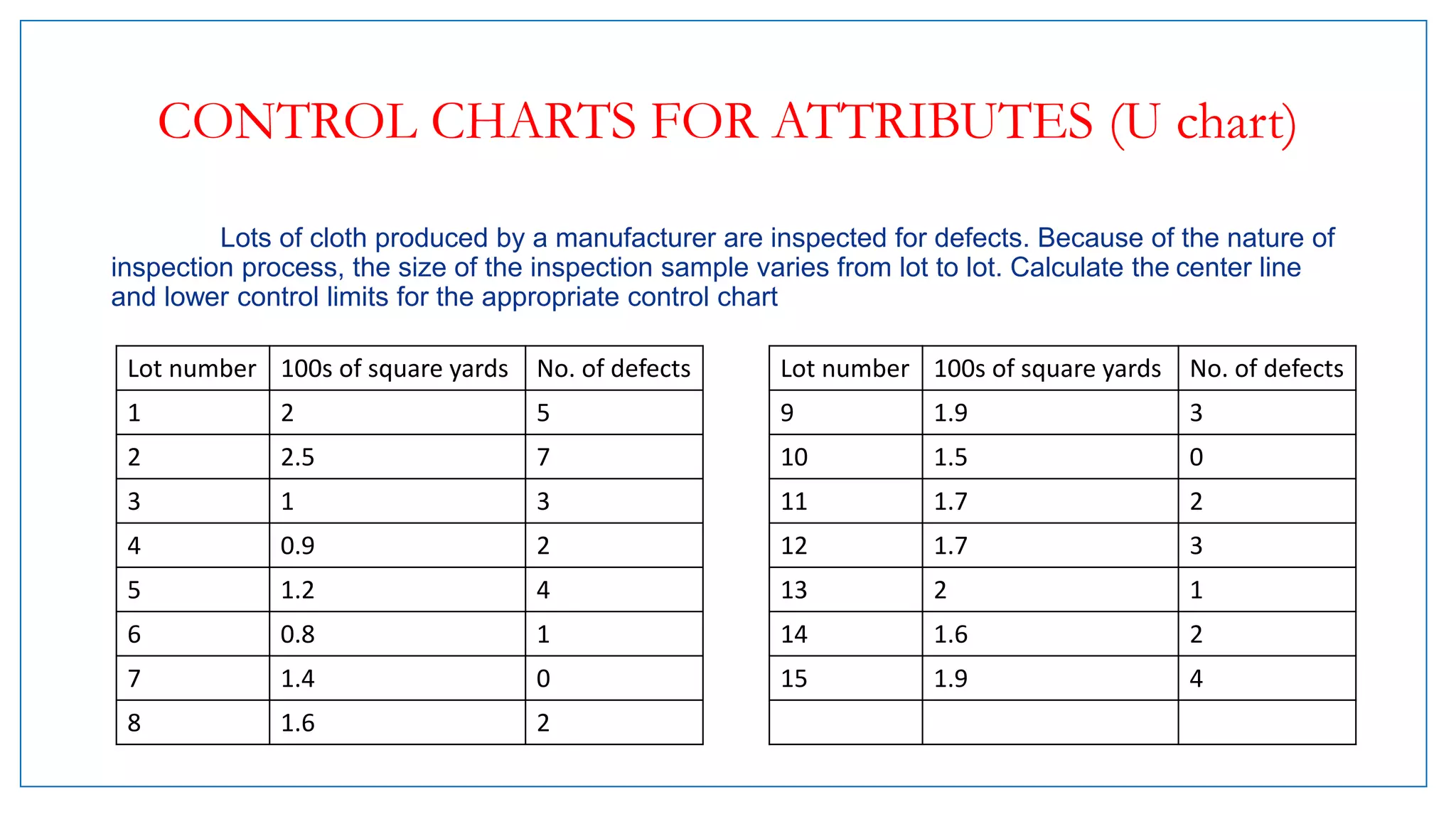
Lots of cloth produced by a manufacturer are inspected for defects. Because of the nature of
inspection process, the size of the inspection sample varies from lot to lot. Calculate the center line
and lower control limits for the appropriate control chart
Lot number 100s of square yards No. of defects
1 2 5
2 2.5 7
3 1 3
4 0.9 2
5 1.2 4
6 0.8 1
7 1.4 0
8 1.6 2
Lot number 100s of square yards No. of defects
9 1.9 3
10 1.5 0
11 1.7 2
12 1.7 3
13 2 1
14 1.6 2
15 1.9 4
CONTROL CHARTS FOR ATTRIBUTES (U chart)
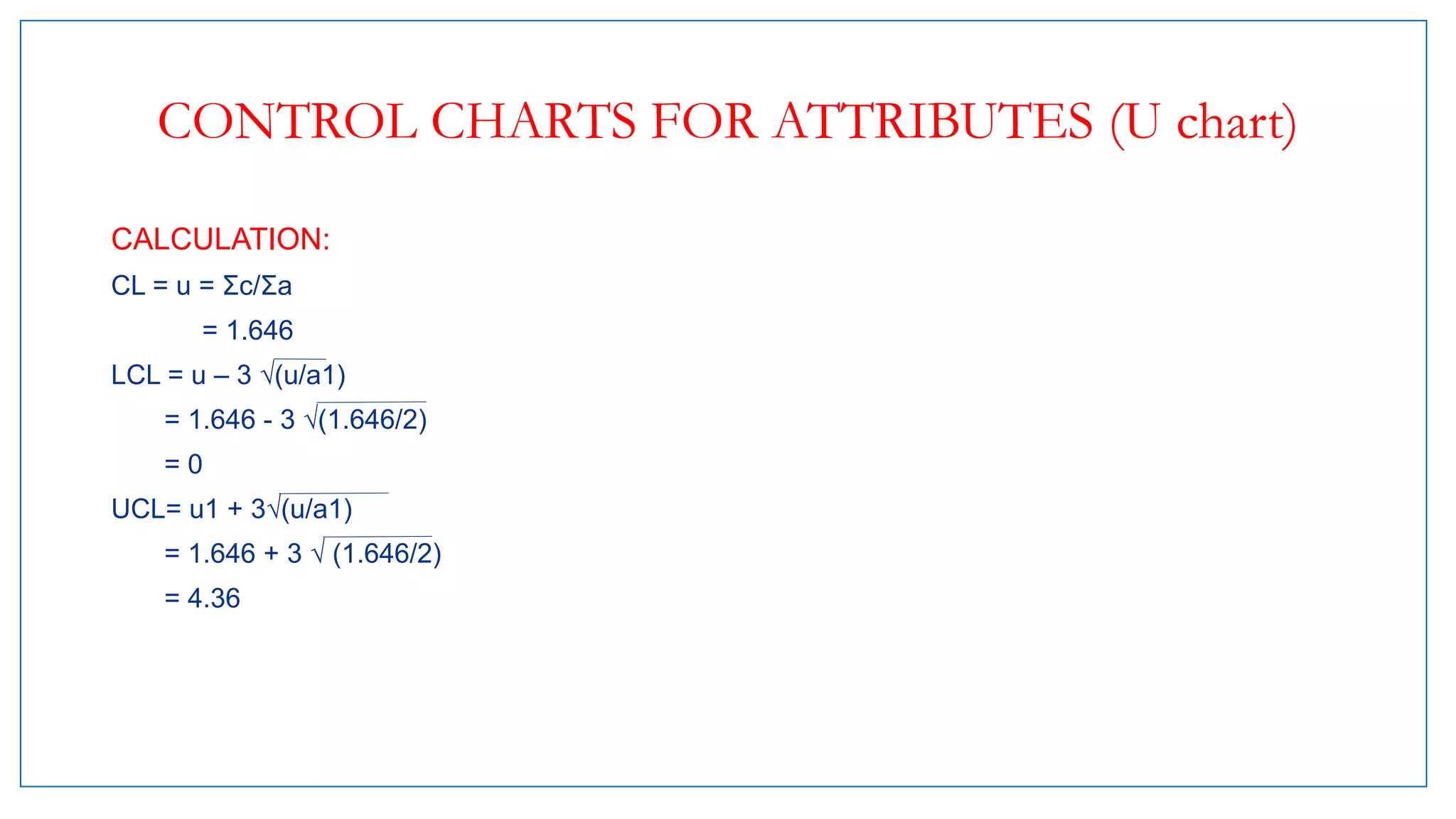
CALCULATION:
CL = u = Σc/Σa
= 1.646
LCL = u – 3 √(u/a1)
= 1.646 - 3 √(1.646/2)
= 0
UCL= u1 + 3√(u/a1)
= 1.646 + 3 √ (1.646/2)
= 4.36
CONTROL CHARTS FOR ATTRIBUTES (U chart)
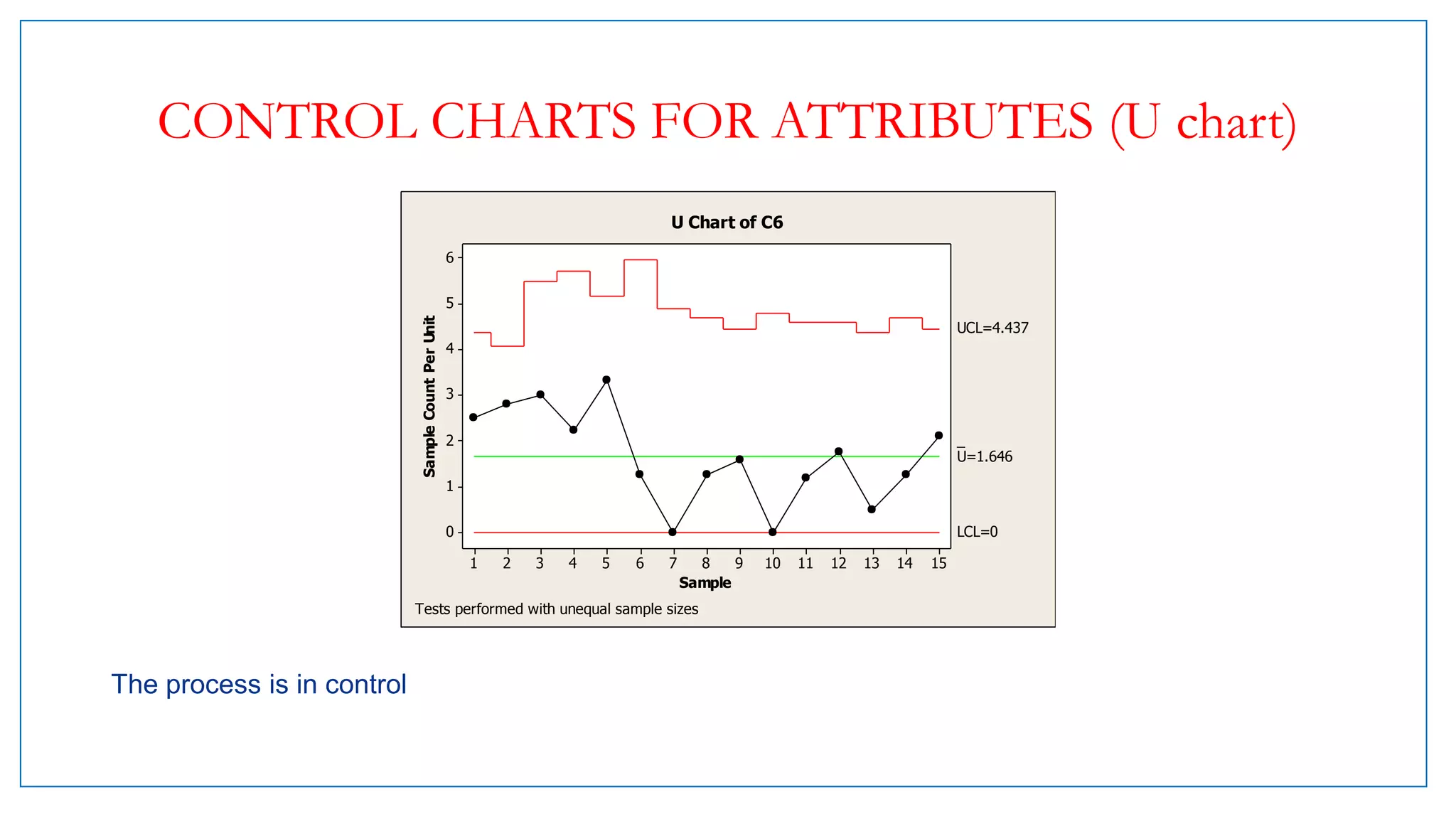
The process is in control
151413121110987654321
6
5
4
3
2
1
0
Sample
SampleCountPerUnit
_
U=1.646
UCL=4.437
LCL=0
U Chart of C6
Tests performed with unequal sample sizes
CONTROL CHARTS FOR ATTRIBUTES
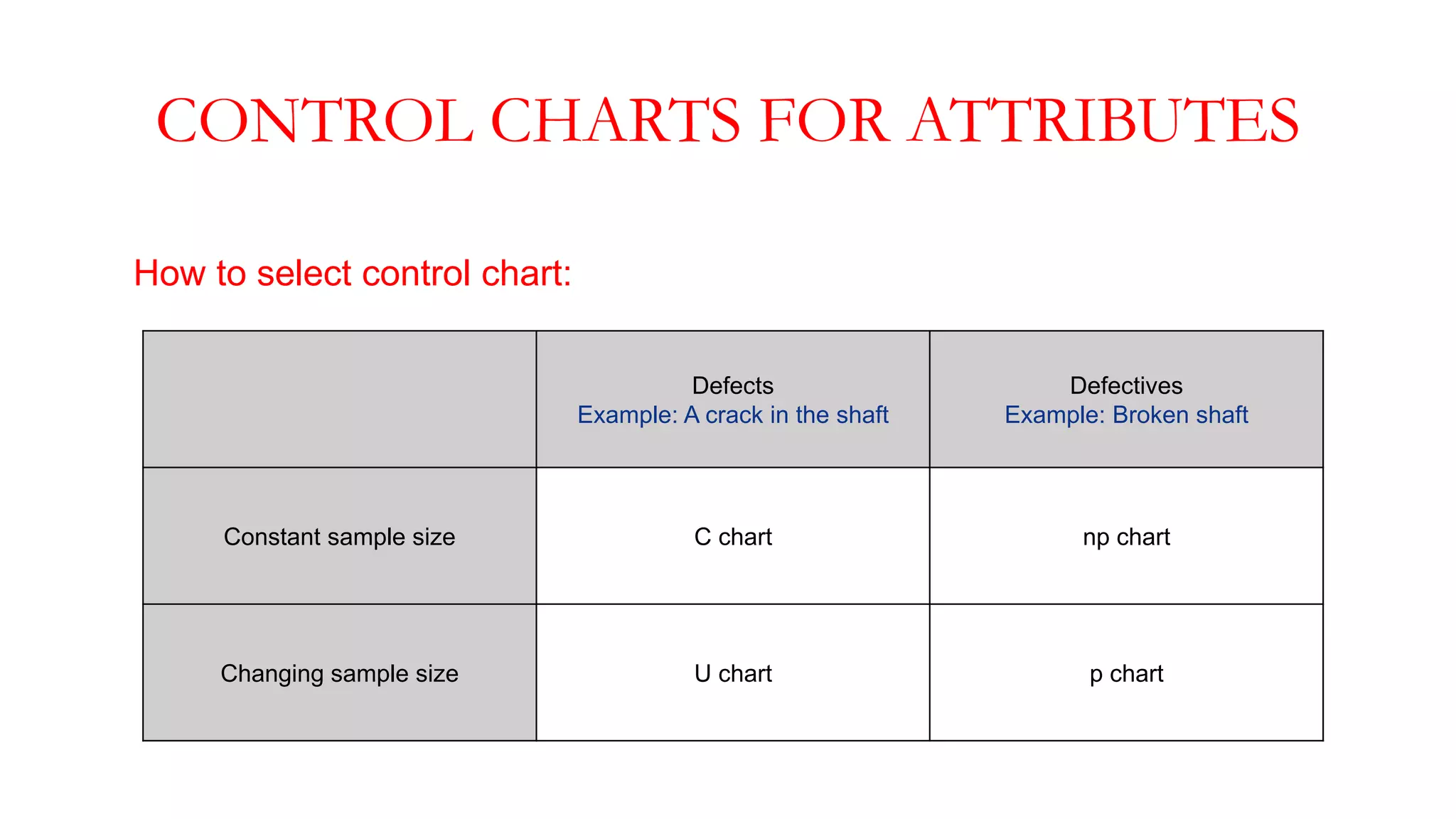
How to select control chart:
Defects
Example: A crack in the shaft
Defectives
Example: Broken shaft
Constant sample size C chart np chart
Changing sample size U chart p chart
CONTROL CHARTS FOR ATTRIBUTES
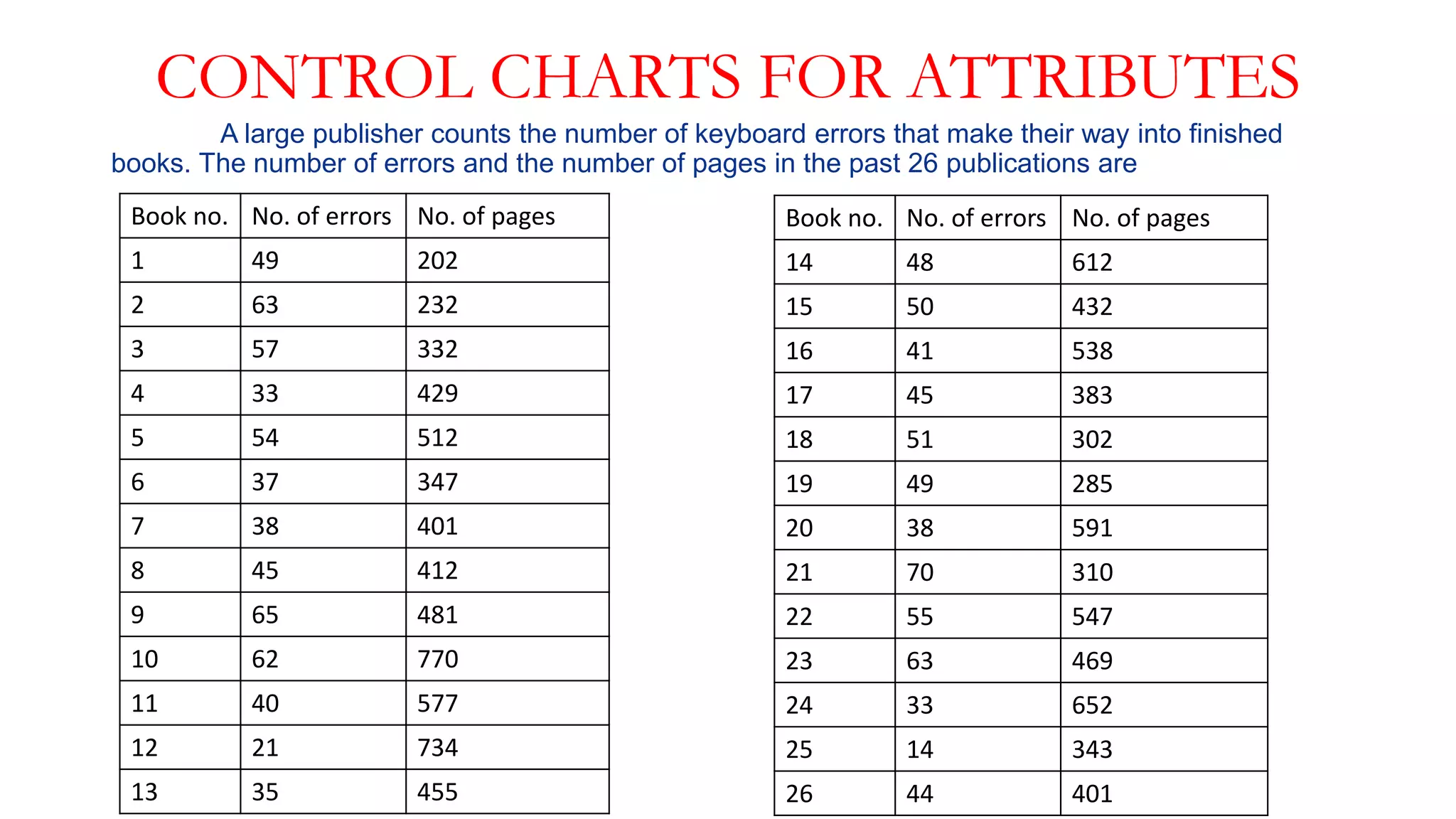
A large publisher counts the number of keyboard errors that make their way into finished
books. The number of errors and the number of pages in the past 26 publications are
Book no. No. of errors No. of pages
1 49 202
2 63 232
3 57 332
4 33 429
5 54 512
6 37 347
7 38 401
8 45 412
9 65 481
10 62 770
11 40 577
12 21 734
13 35 455
Book no. No. of errors No. of pages
14 48 612
15 50 432
16 41 538
17 45 383
18 51 302
19 49 285
20 38 591
21 70 310
22 55 547
23 63 469
24 33 652
25 14 343
26 44 401
CONTROL CHARTS FOR ATTRIBUTES
Try yourself…
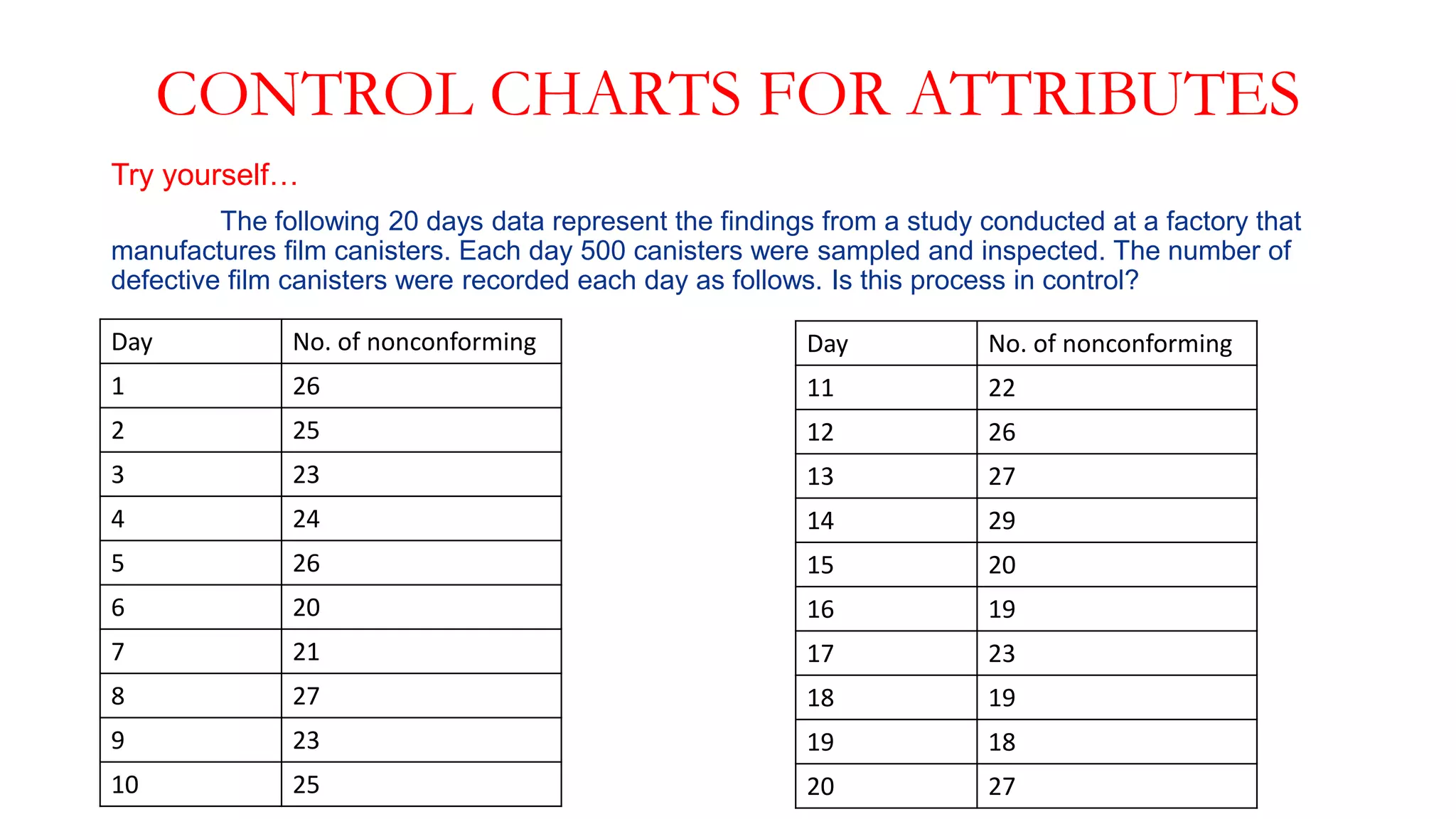
The following 20 days data represent the findings from a study conducted at a factory that
manufactures film canisters. Each day 500 canisters were sampled and inspected. The number of
defective film canisters were recorded each day as follows. Is this process in control?
Day No. of nonconforming
1 26
2 25
3 23
4 24
5 26
6 20
7 21
8 27
9 23
10 25
Day No. of nonconforming
11 22
12 26
13 27
14 29
15 20
16 19
17 23
18 19
19 18
20 27
CONTROL CHARTS FOR ATTRIBUTES
Try yourself…
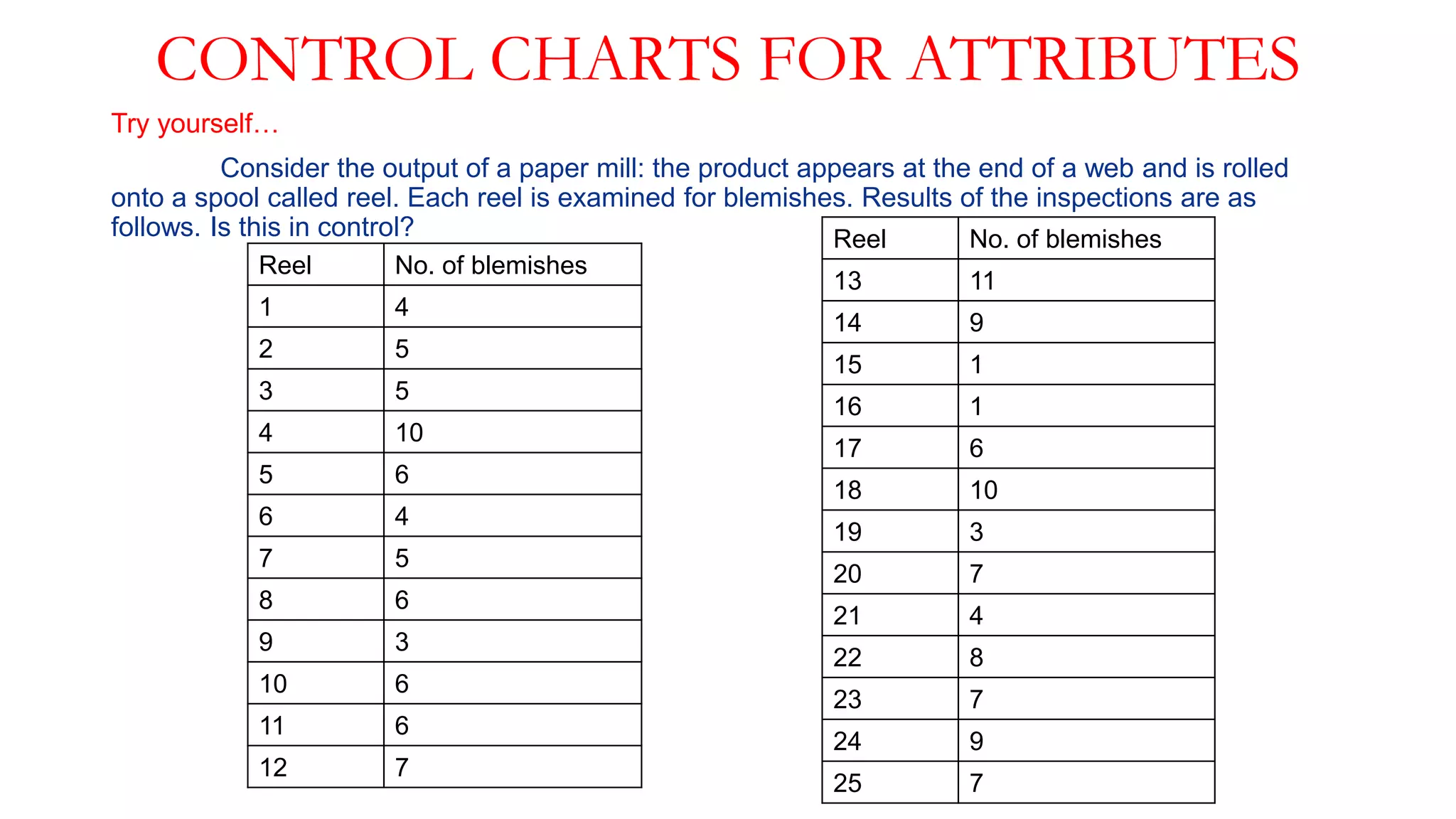
Consider the output of a paper mill: the product appears at the end of a web and is rolled
onto a spool called reel. Each reel is examined for blemishes. Results of the inspections are as
follows. Is this in control?
Reel No. of blemishes
1 4
2 5
3 5
4 10
5 6
6 4
7 5
8 6
9 3
10 6
11 6
12 7
Reel No. of blemishes
13 11
14 9
15 1
16 1
17 6
18 10
19 3
20 7
21 4
22 8
23 7
24 9
25 7
CONTROL CHARTS FOR ATTRIBUTES
Try yourself…
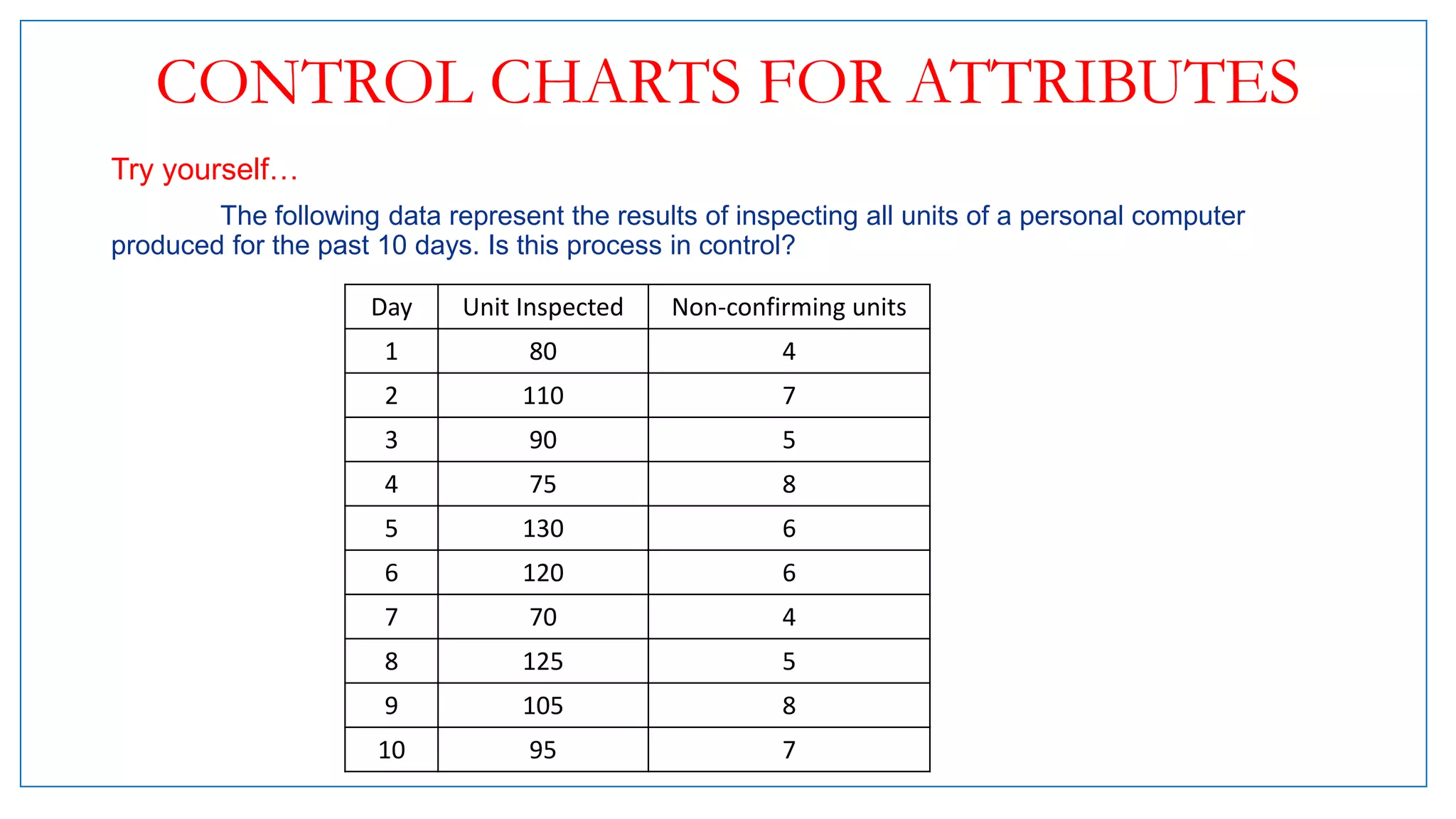
The following data represent the results of inspecting all units of a personal computer
produced for the past 10 days. Is this process in control?
Day Unit Inspected Non-confirming units
1 80 4
2 110 7
3 90 5
4 75 8
5 130 6
6 120 6
7 70 4
8 125 5
9 105 8
10 95 7
ADVANTAGES OF CONTROL CHARTS
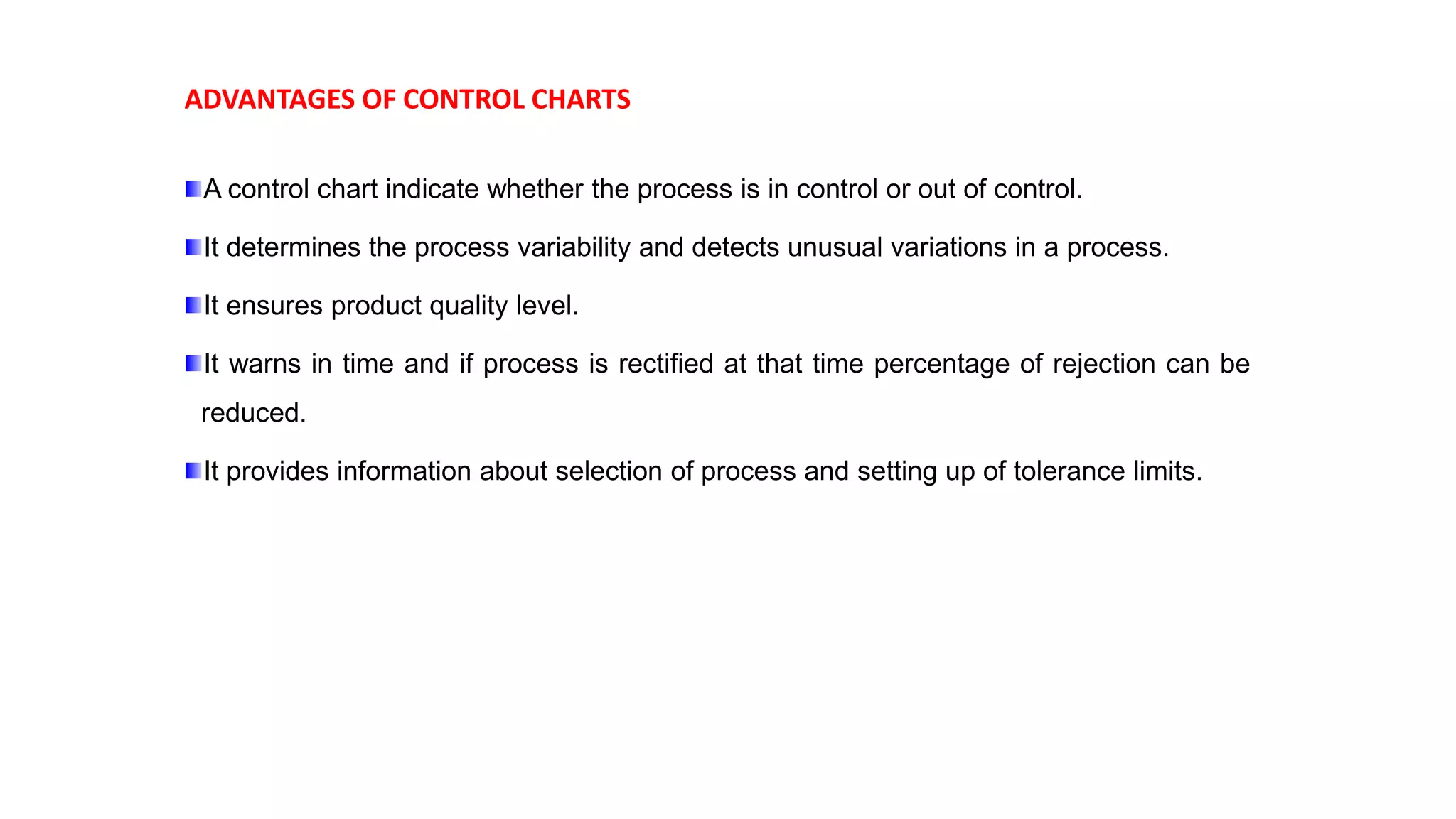
A control chart indicate whether the process is in control or out of control.
It determines the process variability and detects unusual variations in a process.
It ensures product quality level.
It warns in time and if process is rectified at that time percentage of rejection can be
reduced.
It provides information about selection of process and setting up of tolerance limits.
Control charts

Control charts

  • 1.
    ARAVIND BABU R SAHULHAMEED.H M.E-INDUSTRIAL ENGG 1
  • 2.
    AGENDA • What iscontrol chart? • History of control chart • Types of data • Defect and defective • Types of control charts • Control limits vs specification limits • Variable control charts • Attribute control charts
  • 3.
    CONTROL CHART A statisticaltool to study the variation in the process over time. A control chart always has a • central line for the average, • an upper line for the upper control limit and • a lower line for the lower control limit. • These lines are determined from historical data. CL = Mean x UCL = x + 3σ Y-axis X-axis LCL = x - 3σ
  • 4.
    CONTROL CHART Purpose: • Analyzethe past data and determine the performance of the process • Measure control of the process against standards
  • 5.
    HISTORY • Invented byWalter Andrew Shewhart, father of statistical quality control in 1920. • The company's engineers had been seeking to improve the reliability of their telephony transmission systems. • There was a stronger business need to reduce the frequency of failures and repairs • Shewhart framed the problem in terms of Common- and special-causes of variation and, on May 16, 1924, wrote an internal memo introducing the control chart as a tool for distinguishing between the two. • He understood data from physical processes typically produce a "normal distribution curve“.
  • 6.
    TYPES OF DATA DISCRETEDATA CONTINUOUS DATA Infinite number of values between whole numbers Data that can be counted
  • 7.
    DEFECTS AND DEFECTIVES Defects: • A defect is any item or service that exhibits a departure from specifications. • A defect does not necessarily mean that the product or service cannot be used. • A defect indicates only that the product result is not entirely as intended. Example: crack, bend in a shaft Defectives: • A defective is an item or service that is considered completely unacceptable for use. • Each item or service experience is either considered defective or not—there are only two choices.
  • 8.
  • 9.
    CONTROL LIMITS • Voiceof the process • Calculated from Data • Appear on control charts • Appear to subgroups • Guide for process actions • What the process is doing SPECIFICATION LIMITS • Voice of the customer • Defined from the customer • Appear on histograms • Apply to items • Separate good items from bad items • What we want the process do
  • 10.
  • 11.
    CONTROL CHARTS General Procedureof constructing a chart: A control chart consists of: • A graph such that part number is plotted along X-axis and attribute measure along Y- axis. • The mean of this statistic using all the samples is calculated (e.g., the mean of the means, mean of the ranges, mean of the proportions) • A centre line (CL) is drawn at the value of the mean. CL = Mean x Y-axis X-axis
  • 12.
    CONTROL CHARTS • Thestandard deviation σ of the statistic is also calculated using all the samples. • Upper and lower control limits indicate the threshold at which the process output is considered undesired and are drawn at 3 standard deviation from the centre line. CL = Mean x UCL = x + 3σ LCL = x - 3σ Y-axis X-axis
  • 13.
    CONTROL CHARTS • Plotthe attribute measure representing a statistic (e.g., a mean, range, proportion) of measurements of a quality characteristic in samples taken from the process at different times (i.e., the da for each part number and join all the points to form a curve). • If anyone of the points in the curve exceeds the upper and lower control limits, then the process is said to be out of control CL = Mean x UCL = x + 3σ LCL = x - 3σA B C D E F G H I J K L M Y-axis X-axis
  • 15.
    CONTROL CHART FORVARIABLES A single measurable quality characteristic ,such as dimension, weight, or volume, is called variable. Our objectives for this section are to learn how to use control charts to monitor continuous data. We want to learn the assumptions behind the charts, their application, and their interpretation. Since statistical control for continuous data depends on both the mean and the variability, variables control charts are constructed to monitor each. The most commonly used chart to monitor the mean is called the X-BAR chart. There are two commonly used charts used to monitor the variability: the R chart and the s chart. 15
  • 16.
    The X-BAR Chart: Thischart is called the X-BAR chart because the statistic being plotted is the sample mean. The reason for taking a sample is because we are not always sure of the process distribution. By using the sample mean we can "invoke" the central limit theorem to assume normality. The R chart I. The R chart is used to monitor process variability when sample sizes are small (n<10), or to simplify the calculations made by process operators. II. This chart is called the R chart because the statistic being plotted is the sample range. III. Using the R chart, the estimate of the process standard deviation,σ ,is R/d2.
  • 17.
    THE S CHART i.The s chart is used to monitor process variability when sample sizes are large (n*10), or when a computer is available to automate the calculations. ii. This chart is called the s chart because the statistic being plotted is the sample standard deviation. iii. Using the s chart, the estimate of the process standard deviation, σ, is
  • 18.
    PROCEDURE FOR USINGVARIABLES CONTROL CHARTS: I. Determine the variable to monitor. II. At predetermined, even intervals, take samples of size n (usually n=4 or 5). III. Compute X BAR and R (or s) for each sample, and plot them on their respective control charts. Use the following relationships: IV. After collecting a sufficient number of samples, k (k>20), compute the control limits for the charts. The following additional calculations will be necessary:
  • 19.
    V. If anypoints fall outside of the control limits, conclude that the process is out of control, and begin a search for an assignable or special cause. When the special cause is identified, remove that point and return to step 4 to re-evaluate the remaining points. VI. If all the points are within limits, conclude that the process is in control, and use the calculated limits for future monitoring of the process.
  • 21.
    EXAMPLE PROBLEM A largehotel in a resort area has a housekeeping staff that cleans and prepares all of the hotel's guestrooms daily. In an effort to improve service through reducing variation in the time required to clean and prepare a room, a series of measurements is taken of the times to service rooms in one section of the hotel. Cleaning times for five rooms selected each day for 25 consecutive days appear below: Day Room 1 Room 2 Room 3 Room 4 Room 5 1 15.6 14.3 17.7 14.3 15 2 15 14.8 16.8 16.9 17.4 3 16.4 15.1 15.7 17.3 16.6 4 14.2 14.8 17.3 15 16.4 5 16.4 16.3 17.6 17.9 14.9 6 14.9 17.2 17.2 15.3 14.1 7 17.9 17.9 14.7 17 14.5 8 14 17.7 16.9 14 14.9 9 17.6 16.5 15.3 14.5 15.1 10 14.6 14 14.7 16.9 14.2
  • 22.
    11 14.6 15.515.9 14.8 14.2 12 15.3 15.3 15.9 15 17.8 13 17.4 14.9 17.7 16.6 14.7 14 15.3 16.9 17.9 17.2 17.5 15 14.8 15.1 16.6 16.3 14.5 16 16.1 14.6 17.5 16.9 17.7 17 14.2 14.7 15.3 15.7 14.3 18 14.6 17.2 16 16.7 16.3 19 15.9 16.5 16.1 15 17.8 20 16.2 14.8 14.8 15 15.3 21 16.3 15.3 14 17.4 14.5 22 15 17.6 14.5 17.5 17.8 23 16.4 15.9 16.7 15.7 16.9 24 16.6 15.1 14.1 17.4 17.8 25 17 17.5 17.4 16.2 17.9
  • 23.
    CALCULATE THE MEAN,RANGE, STANDARD DEVIATION Day Average Range St. Dev 1 15.4 3.4 1.41 2 16.2 2.6 1.19 3 16.2 2.2 0.85 4 15.5 3.1 1.27 5 16.6 3 1.19 6 15.7 3.1 1.4 7 16.4 3.4 1.69 8 15.5 3.7 1.71 9 15.8 3.1 1.24 10 14.9 2.9 1.16 11 15 1.7 0.69 12 15.9 2.8 1.13 13 16.3 3 1.39 14 17 2.6 1 15 15.5 2.1 0.93 16 16.6 3.1 1.26 17 14.8 1.5 0.65 18 16.2 2.6 0.98 19 16.3 2.8 1.02 20 15.2 1.4 0.58 21 15.5 3.4 1.37 22 16.5 3.3 1.59 23 16.3 1.2 0.51 24 16.2 3.7 1.56 25 17.2 1.7 0.64
  • 24.
    CALCULATE THE CONTROLLIMITS 15.94 2.7 1.14 X R s x Chart Control Limits UCL = x + A R LCL = x - A R 2 2 R Chart Control Limits UCL = D R LCL = D R 4 3 X-BAR , R CHART X- BAR ,S CHART
  • 25.
    TABLE FOR CONSTANTS SQCA MODERN INTRODUCTION 6th Edition, D.C. Montgomery
  • 26.
    CONSTANTS FOR X-BAR,R & X-BAR, S CHARTS X-BAR , R CHART X-BAR , S CHART A2 D4 D3 0.577 2.004 0 A3 B4 B3 1.427 2.089 0 X-BAR CHART CL =15.94 UCL = 15.94+ 0.577(2.7) = 17.49 LCL = 15.94 – 0.577(2.7) = 14.38 R CHART CL = 2.7 UCL = 2.004(2.7) = 5.41 LCL = 0 (2.7) = 0 X-BAR CHART CL =15.94 UCL = 15.94+ 1.427(1.14) = 17.56 LCL = 15.94 – 1.427(1.14) = 14.31 S CHART CL = 1.14 UCL = 2.089(1.14) = 2.38 LCL = 0 (1.14) = 0
  • 27.
    X-BAR , RCONTROL CHART
  • 28.
  • 30.
    CONTROL CHARTS CLASSIFICATION OFATTRIBUTES CONTROL CHARTS CONTROL CHARTS FOR ATTRIBUTES CLASSIFICATION CHARTS P-chart NP-chart COUNT CHARTS C-chart U-chart
  • 31.
    CONTROL CHARTS FORATTRIBUTES Classification charts: Classification charts deal with either the fraction of items or the number of items in a series of subgroups.
  • 32.
    CONTROL CHARTS FORATTRIBUTES P – chart: The P-Chart monitors the percent of samples having the condition, relative to either a fixed or varying sample size. EXAMPLE SCENARIO: Consider a shop purchasing bundles of readymade shirts from same manufacturer. The number of shirts in each bundle and the defective item are as follows. Plot a suitable control chart. Keywords: Changing sample size (No. of shirts in the bundle), defectives. No. of shirts in the bundle No. of defective shirts 20 5 15 3 20 2 25 1 20 5
  • 33.
    CONTROL CHARTS FORATTRIBUTES(P chart) A team in an accounting group has been working on improving the processing of invoices. The team is trying to reduce the cost of processing invoices by decreasing the fraction of invoices with errors. The team developed the following operational definition for a defective invoice: an invoice is defective if it has incorrect price, incorrect quantity, incorrect coding, incorrect address, or incorrect name. The team decided to pull a random sample of 50 invoices per day. If the invoice had one or more errors it was defective. The data from the last 20 days are given in the table. Draw the p chart. Sample no No of defectives Fraction defective 1 4 0.08 2 3 0.06 3 8 0.16 4 12 0.24 5 7 0.14 6 15 0.30 7 20 0.40 8 13 0.26 9 9 0.18 10 8 0.16 11 5 0.10 Sample no No of defectives Fraction defective 12 14 0.28 13 9 0.18 14 11 0.22 15 2 0.04 16 9 0.18 17 3 0.06 18 13 0.26 19 6 0.12 20 9 0.18 180
  • 34.
    CONTROL CHARTS FORATTRIBUTES (P chart) CALCULATION: P =Σpi/n = 18/(20 x 50) = 0.18 UCL = p + 3 √(p x (1-p)/n) = 0.18 + 3 √(0.18 x (1 - 0.18)/50) = 0.343 LCL = p - 3 √(p x (1-p)/n) = 0.18 - 3 √(0.18 x (1- 0.18)/50) = 0.017
  • 35.
    CONTROL CHARTS FORATTRIBUTES (P chart) The process is out of control because lot number 7 exceeds the upper control limit. 191715131197531 0.4 0.3 0.2 0.1 0.0 Sample Proportion _ P=0.18 UCL=0.3430 LCL=0.0170 1 P Chart of C2
  • 36.
    CONTROL CHARTS FORATTRIBUTES NP-chart: The NP-Chart monitors the number of times a condition occurs, relative to a constant sample size. Example scenario: Consider a ball manufacturing company. It produces 1000 balls daily. The number of defective balls produced each day for 10 days are 10, 13, 9, 3, 7, 16, 21,19, 12, 10. Plot the control chart. Keywords: Sample size doesn’t change (1000 balls), defectives
  • 37.
    CONTROL CHARTS FORATTRIBUTES (NP chart) The data representing the results of inspecting l00 units of personal computer produced for the past 10 days. Does the process appear to be in control. Sample lot number Sample size No. of defectives 1 100 8 2 100 7 3 100 12 4 100 5 5 100 18 6 100 2 7 100 10 8 100 16 9 100 14 10 100 6 Total 1000 98
  • 38.
    CONTROL CHARTS FORATTRIBUTES (NP chart) CALCULATION: Average number of defective = np =98/10 = 9.8 Average fraction defective = p =98/1000 = 0.098 UCL = np + 3 √(np x (1-p)) = 9. 8 + 3 √(9.8 x (1 - 0.098)) = 18.72 LCL = np - 3 √(np x (1-p)) = 9.8 - 3 √(9.8 x (1- 0.098)) = 0.88
  • 39.
    CONTROL CHARTS FORATTRIBUTES (NP chart) The process is in control 10987654321 20 15 10 5 0 Sample SampleCount __ NP=9.8 UCL=18.72 LCL=0.88 NP Chart of C3
  • 40.
    CONTROL CHARTS FORATTRIBUTES Count charts: Count charts deal with the number of times a particular characteristic appear in some given area of opportunity. C-chart: The c-chart monitors the number of times a condition occurs, relative to a constant sample size. In this case, a given sample can have more than one instance of the condition, in which case we count all the times it occurs in the sample. Example scenario: Consider an engineer buys a set of 10 ropes for his construction project. All the ropes of same length of 100 meters. Each rope is inspected and the number of defects in each rope are found to be 1,1,3,1,2,1,5,3,4 and 2 respectively. Plot the control chart. Keywords: Sample size doesn’t change (100 m), defects
  • 41.
    CONTROL CHARTS FORATTRIBUTES (C chart) The data represents no. of non-conformities per 1000 metres in a telephone cable. From the analysis of these data, you conclude that the process is in control or not? Sample no No. of Non-conformities 1 1 2 1 3 3 4 7 5 8 6 10 7 5 8 13 9 0 10 19 11 24 Sample no No. of Non-conformities 12 6 13 9 14 11 15 15 16 8 17 3 18 6 19 7 20 4 21 9 22 20
  • 42.
    CONTROL CHARTS FORATTRIBUTES (C chart) CL = c = 189/22 = 8.59 UCL = c + 3 √c = 8.59 + 3 √8.59 = 17.38 LCL = c - 3 √c = 8.59 - 3 √8.59 = 0
  • 43.
    CONTROL CHARTS FORATTRIBUTES (C chart) The process is out of control 21191715131197531 25 20 15 10 5 0 Sample SampleCount _ C=8.59 UCL=17.38 LCL=0 1 1 1 C Chart of C4
  • 44.
    CONTROL CHARTS FORATTRIBUTES U-chart: The u-Chart monitors the percent of samples having the condition, relative to either a fixed or varying sample size. In this case, a given sample can have more than one instance of the condition, in which case we count all the times it occurs in the sample. Example scenario: 5 lots of cloth produced by a manufacturer are inspected for defects. The sample taken for each inspection is different. The sample taken and number of defects found are as follows. Keywords: changing sample size (length of the cloth), defects Length of the cloth inspected No. of defects 20 m 5 15 m 3 20 m 2 25 m 1 20 m 5
  • 45.
    CONTROL CHARTS FORATTRIBUTES (U chart) Lots of cloth produced by a manufacturer are inspected for defects. Because of the nature of inspection process, the size of the inspection sample varies from lot to lot. Calculate the center line and lower control limits for the appropriate control chart Lot number 100s of square yards No. of defects 1 2 5 2 2.5 7 3 1 3 4 0.9 2 5 1.2 4 6 0.8 1 7 1.4 0 8 1.6 2 Lot number 100s of square yards No. of defects 9 1.9 3 10 1.5 0 11 1.7 2 12 1.7 3 13 2 1 14 1.6 2 15 1.9 4
  • 46.
    CONTROL CHARTS FORATTRIBUTES (U chart) CALCULATION: CL = u = Σc/Σa = 1.646 LCL = u – 3 √(u/a1) = 1.646 - 3 √(1.646/2) = 0 UCL= u1 + 3√(u/a1) = 1.646 + 3 √ (1.646/2) = 4.36
  • 47.
    CONTROL CHARTS FORATTRIBUTES (U chart) The process is in control 151413121110987654321 6 5 4 3 2 1 0 Sample SampleCountPerUnit _ U=1.646 UCL=4.437 LCL=0 U Chart of C6 Tests performed with unequal sample sizes
  • 48.
    CONTROL CHARTS FORATTRIBUTES How to select control chart: Defects Example: A crack in the shaft Defectives Example: Broken shaft Constant sample size C chart np chart Changing sample size U chart p chart
  • 50.
    CONTROL CHARTS FORATTRIBUTES A large publisher counts the number of keyboard errors that make their way into finished books. The number of errors and the number of pages in the past 26 publications are Book no. No. of errors No. of pages 1 49 202 2 63 232 3 57 332 4 33 429 5 54 512 6 37 347 7 38 401 8 45 412 9 65 481 10 62 770 11 40 577 12 21 734 13 35 455 Book no. No. of errors No. of pages 14 48 612 15 50 432 16 41 538 17 45 383 18 51 302 19 49 285 20 38 591 21 70 310 22 55 547 23 63 469 24 33 652 25 14 343 26 44 401
  • 51.
    CONTROL CHARTS FORATTRIBUTES Try yourself… The following 20 days data represent the findings from a study conducted at a factory that manufactures film canisters. Each day 500 canisters were sampled and inspected. The number of defective film canisters were recorded each day as follows. Is this process in control? Day No. of nonconforming 1 26 2 25 3 23 4 24 5 26 6 20 7 21 8 27 9 23 10 25 Day No. of nonconforming 11 22 12 26 13 27 14 29 15 20 16 19 17 23 18 19 19 18 20 27
  • 52.
    CONTROL CHARTS FORATTRIBUTES Try yourself… Consider the output of a paper mill: the product appears at the end of a web and is rolled onto a spool called reel. Each reel is examined for blemishes. Results of the inspections are as follows. Is this in control? Reel No. of blemishes 1 4 2 5 3 5 4 10 5 6 6 4 7 5 8 6 9 3 10 6 11 6 12 7 Reel No. of blemishes 13 11 14 9 15 1 16 1 17 6 18 10 19 3 20 7 21 4 22 8 23 7 24 9 25 7
  • 53.
    CONTROL CHARTS FORATTRIBUTES Try yourself… The following data represent the results of inspecting all units of a personal computer produced for the past 10 days. Is this process in control? Day Unit Inspected Non-confirming units 1 80 4 2 110 7 3 90 5 4 75 8 5 130 6 6 120 6 7 70 4 8 125 5 9 105 8 10 95 7
  • 54.
    ADVANTAGES OF CONTROLCHARTS A control chart indicate whether the process is in control or out of control. It determines the process variability and detects unusual variations in a process. It ensures product quality level. It warns in time and if process is rectified at that time percentage of rejection can be reduced. It provides information about selection of process and setting up of tolerance limits.

Editor's Notes

  • #2 1 of 7 QC tools
  • #7 Class strength Dimensions Volume
  • #9 Before, control charts, types of data
  • #49 BROKEN SHAFT