1) Prepared By : Pratik Sharma,
Smit Shah,
Shivani Sharma,
Rehan Shaikh
Smarth Shah
ENROLLMENT NO. : 140410109098
140410109096
140410109099
140410109097
140410109095
Branch :Electrical Engineering
Guided by:
H PATEL
 ORTHOGONAL VECTOR.
 ORTHONORMAL VECTOR.
 GRAM SCHMIDT PROCESS.
 ORTHOGONALLY
DIAGONALIZATION.
 Definition. We say that 2 vectors are
orthogonal if they are perpendicular to each
other. i.e. the dot product of the two vectors
is zero.
 Definition. We say that a set of vectors {v1,
v2, ..., vn} are mutually orthogonal if every
pair of vectors is orthogonal. i.e. vi.vj = 0, for
all i not equal j.
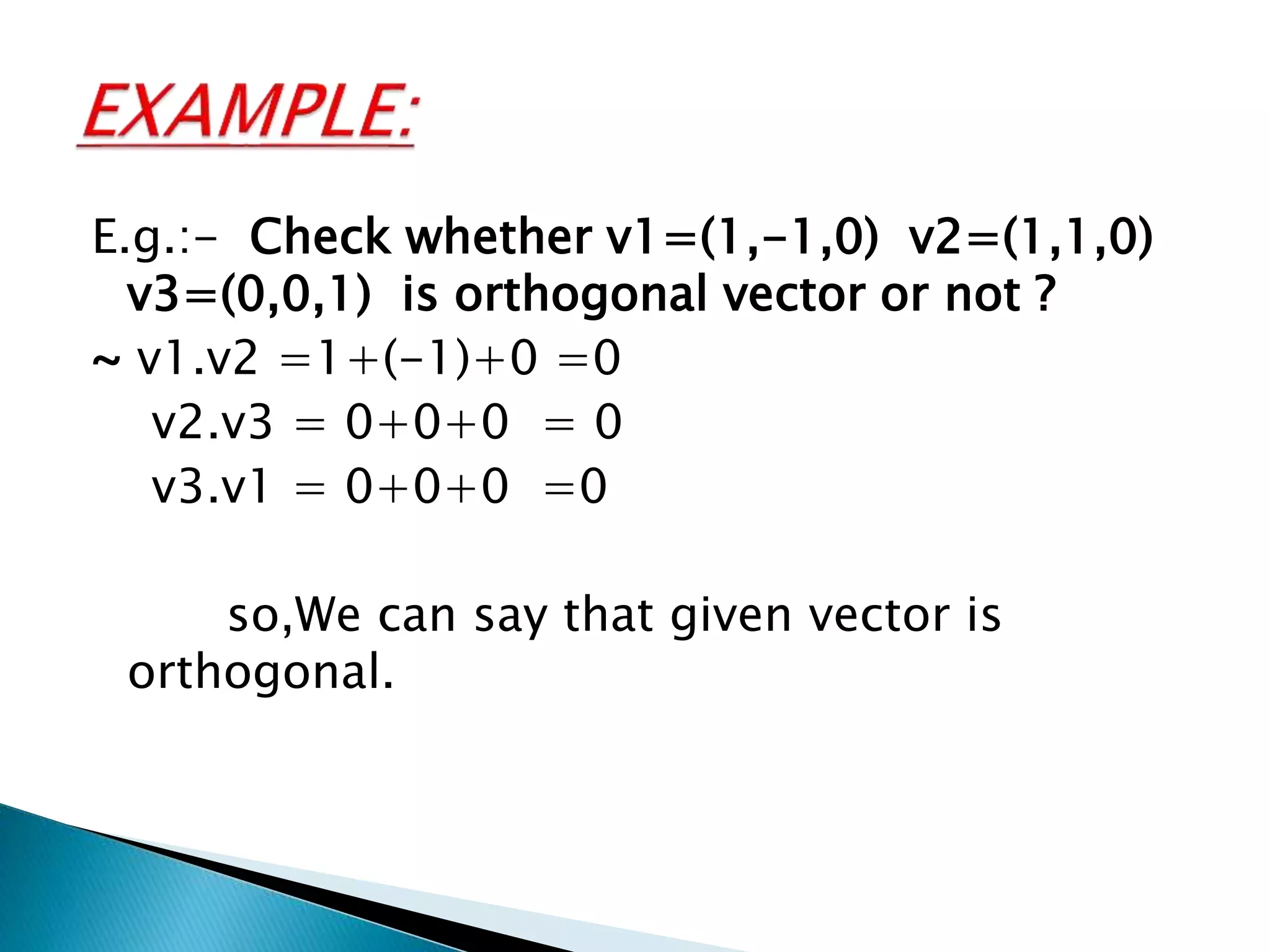
E.g.:- Check whether v1=(1,-1,0) v2=(1,1,0)
v3=(0,0,1) is orthogonal vector or not ?
~ v1.v2 =1+(-1)+0 =0
v2.v3 = 0+0+0 = 0
v3.v1 = 0+0+0 =0
so,We can say that given vector is
orthogonal.
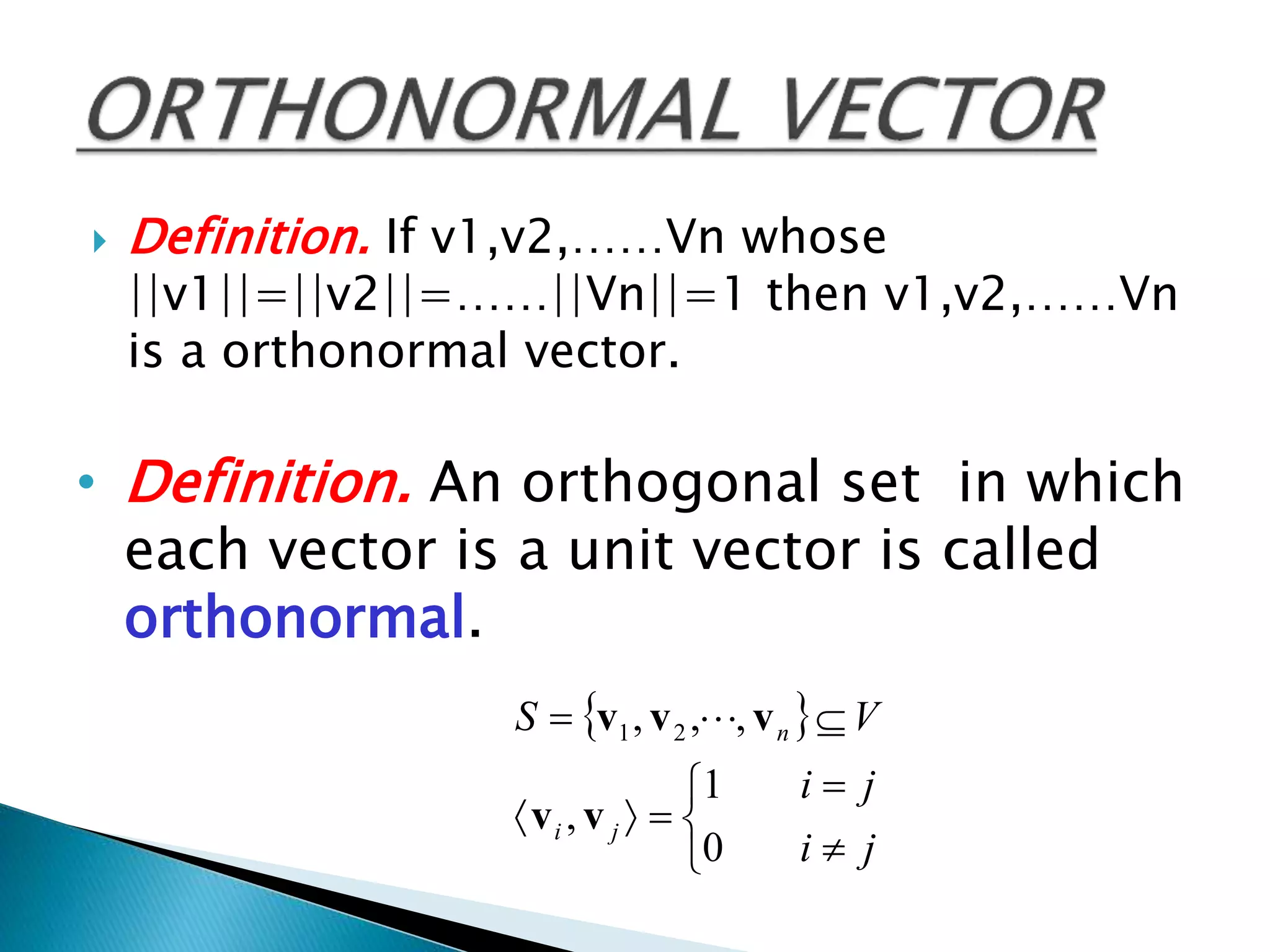
 Definition. If v1,v2,……Vn whose
||v1||=||v2||=……||Vn||=1 then v1,v2,……Vn
is a orthonormal vector.
• Definition. An orthogonal set in which
each vector is a unit vector is called
orthonormal.
 







ji
ji
VS
ji
n
0
1
,
,,, 21
vv
vvv
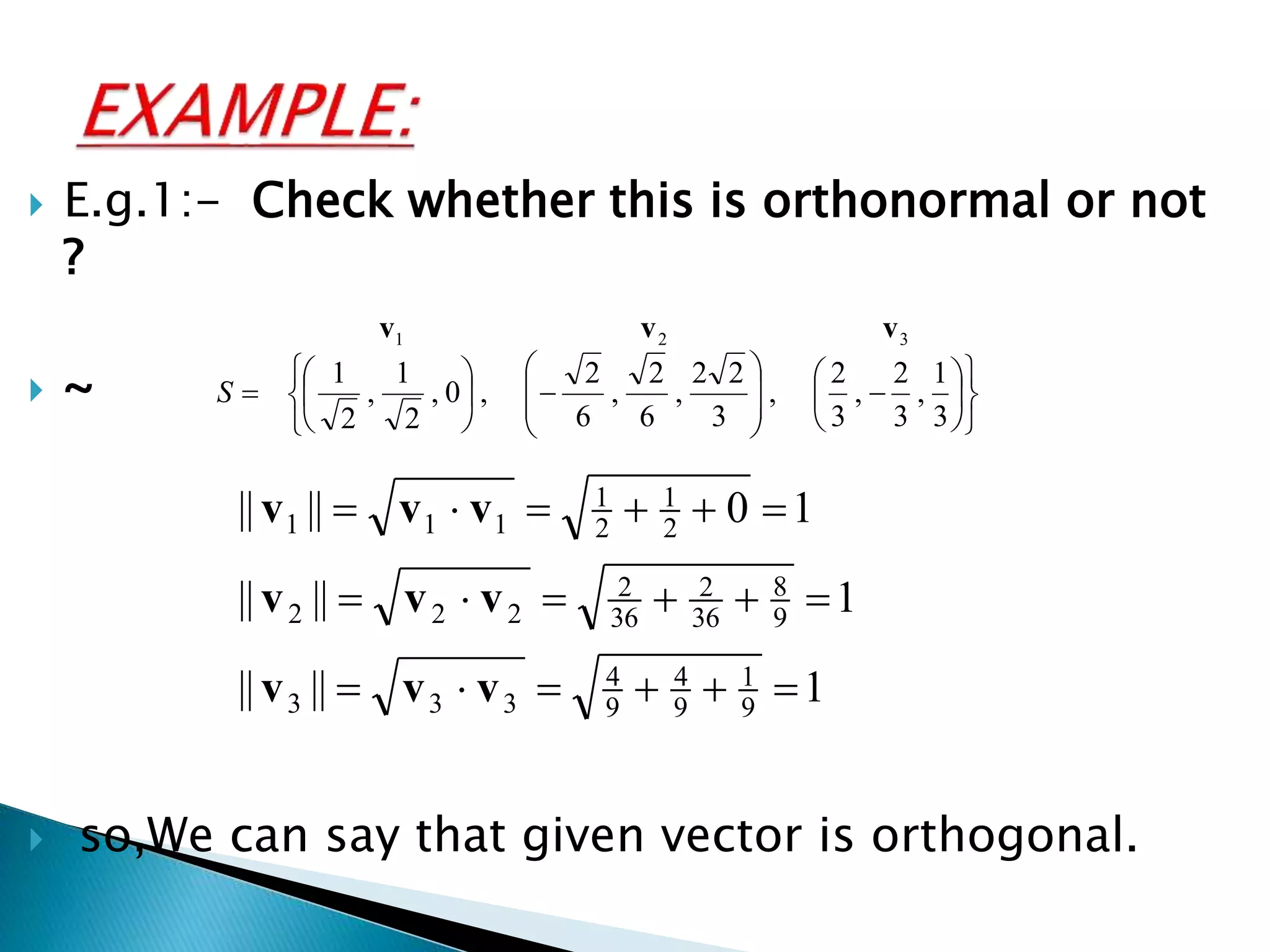
 E.g.1:- Check whether this is orthonormal or not
?
 ~
 so,We can say that given vector is orthogonal.




























3
1
,
3
2
,
3
2
,
3
22
,
6
2
,
6
2
,0,
2
1
,
2
1
321
S
vvv
1||||
1||||
10||||
9
1
9
4
9
4
333
9
8
36
2
36
2
222
2
1
2
1
111



vvv
vvv
vvv
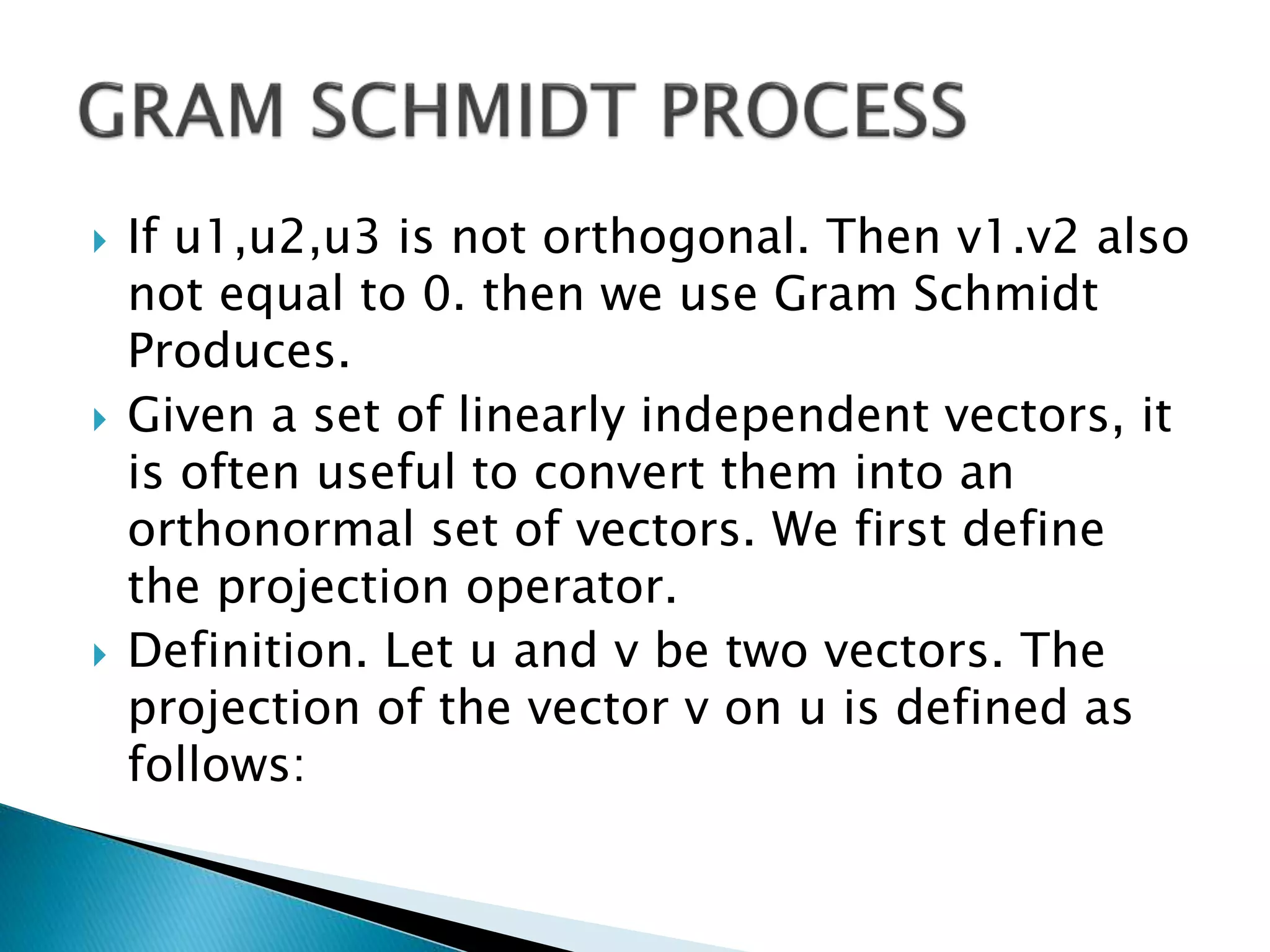
 If u1,u2,u3 is not orthogonal. Then v1.v2 also
not equal to 0. then we use Gram Schmidt
Produces.
 Given a set of linearly independent vectors, it
is often useful to convert them into an
orthonormal set of vectors. We first define
the projection operator.
 Definition. Let u and v be two vectors. The
projection of the vector v on u is defined as
follows:
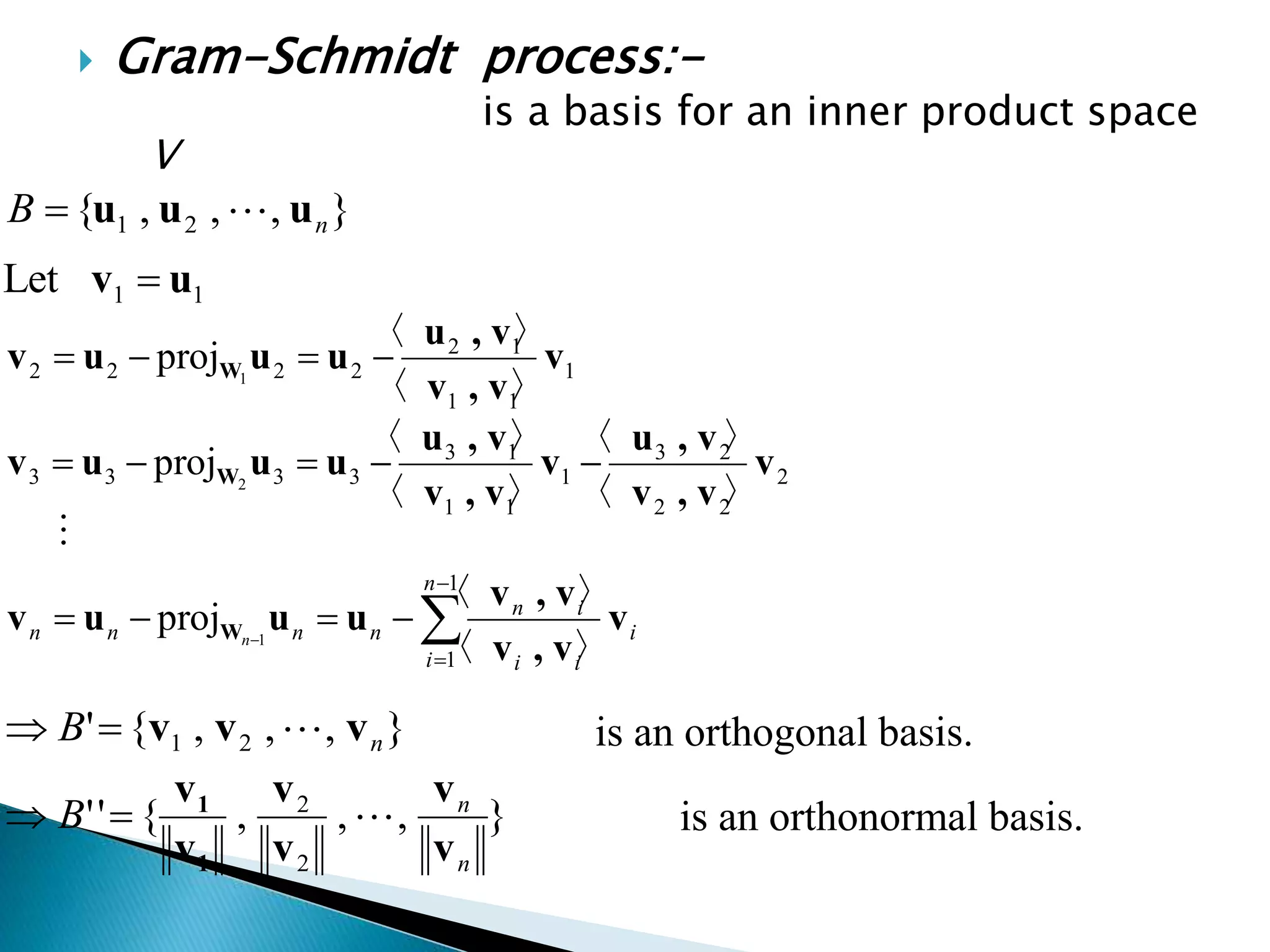
 Gram-Schmidt process:-
is a basis for an inner product space
V
},,,{ 21 nB uuu 
11Let uv 
},,,{' 21 nB vvv 
},,,{''
2
2
n
n
B
v
v
v
v
v
v
1
1




 
1
1 〉〈
〉〈
proj 1
n
i
i
ii
in
nnnn n
v
v,v
v,v
uuuv W

2
22
23
1
11
13
3333
〉〈
〉〈
〉〈
〉〈
proj 2
v
v,v
v,u
v
v,v
v,u
uuuv W 
1
11
12
2222
〉〈
〉〈
proj 1
v
v,v
v,u
uuuv W 
is an orthogonal basis.
is an orthonormal basis.
)0,1,1(11  uv
)2,0,0()0,
2
1
,
2
1
(
2/1
2/1
)0,1,1(
2
1
)2,1,0(
2
22
23
1
11
13
33






 v
vv
vu
v
vv
vu
uv
)}2,1,0(,)0,2,1(,)0,1,1{(
321
B
uuu
)0,
2
1
,
2
1
()0,1,1(
2
3
)0,2,1(1
11
12
22 


 v
vv
vu
uv
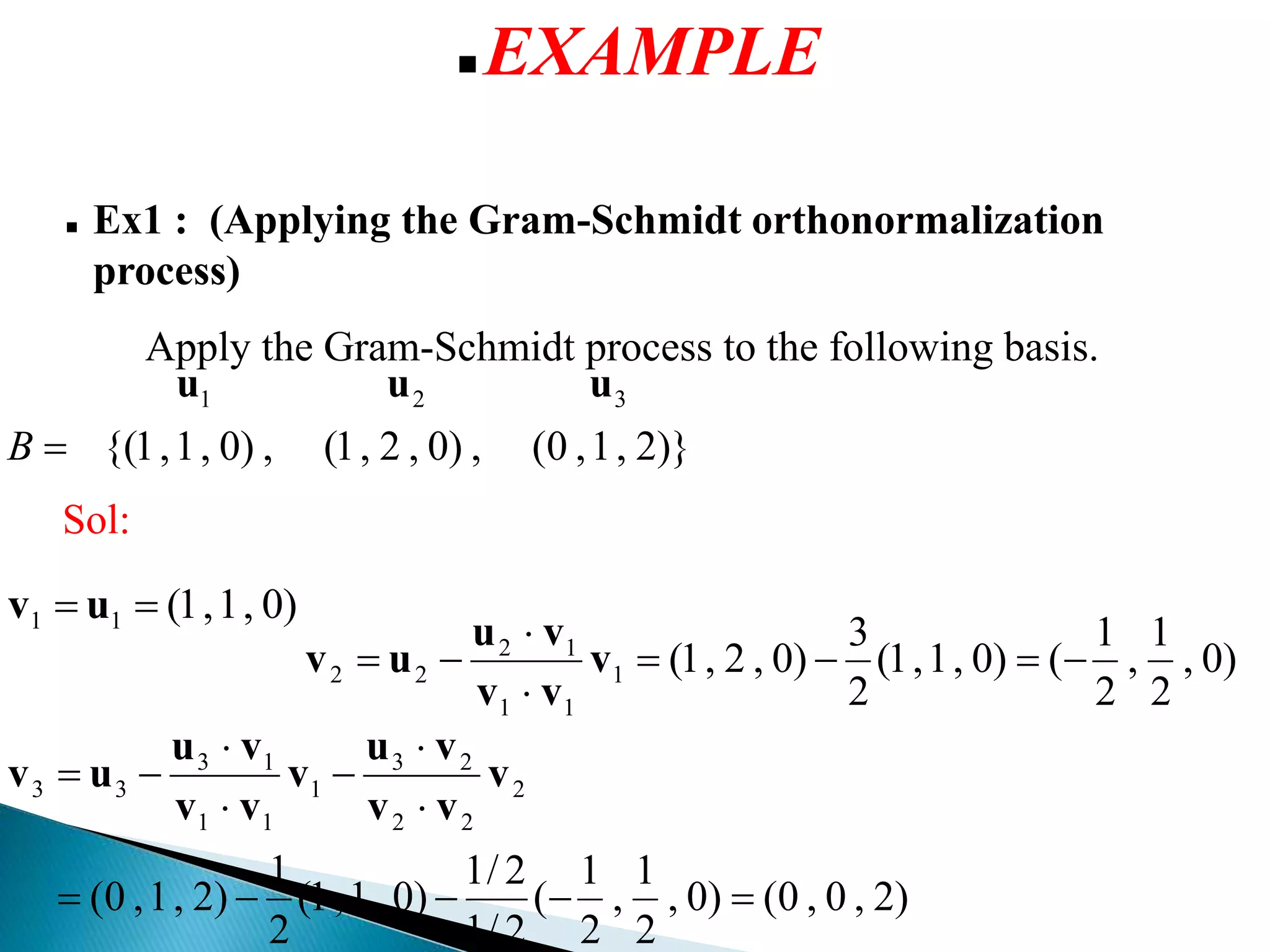
Sol:
 EXAMPLE
 Ex1 : (Applying the Gram-Schmidt orthonormalization
process)
Apply the Gram-Schmidt process to the following basis.
}2)0,(0,0),,
2
1
,
2
1
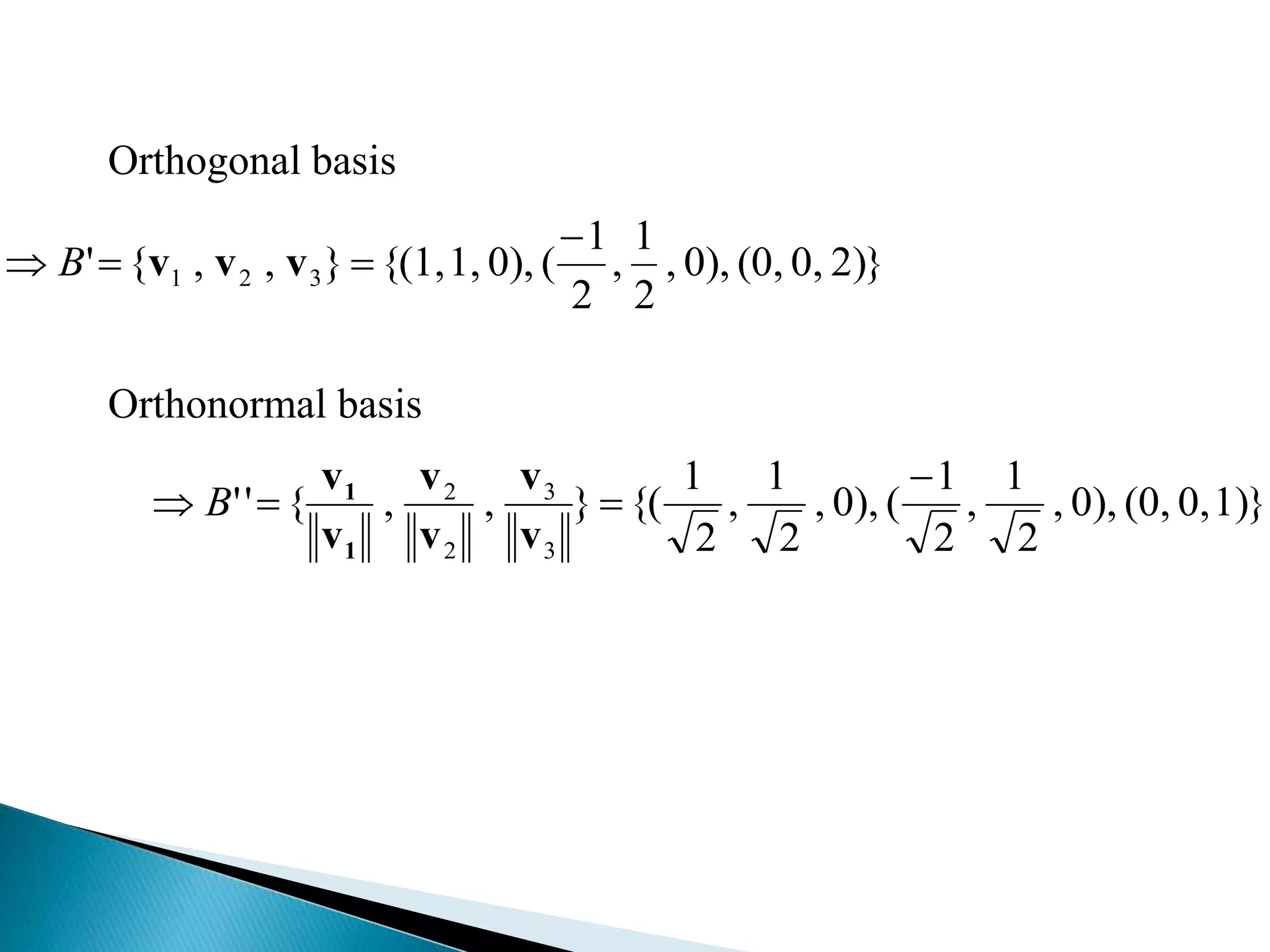
(0),1,(1,{},,{' 321

 vvvB
}1)0,(0,0),,
2
1
,
2
1
(0),,
2
1
,
2
1
({},,{''
3
3
2
2 

v
v
v
v
v
v
1
1
B
Orthogonal basis
Orthonormal basis
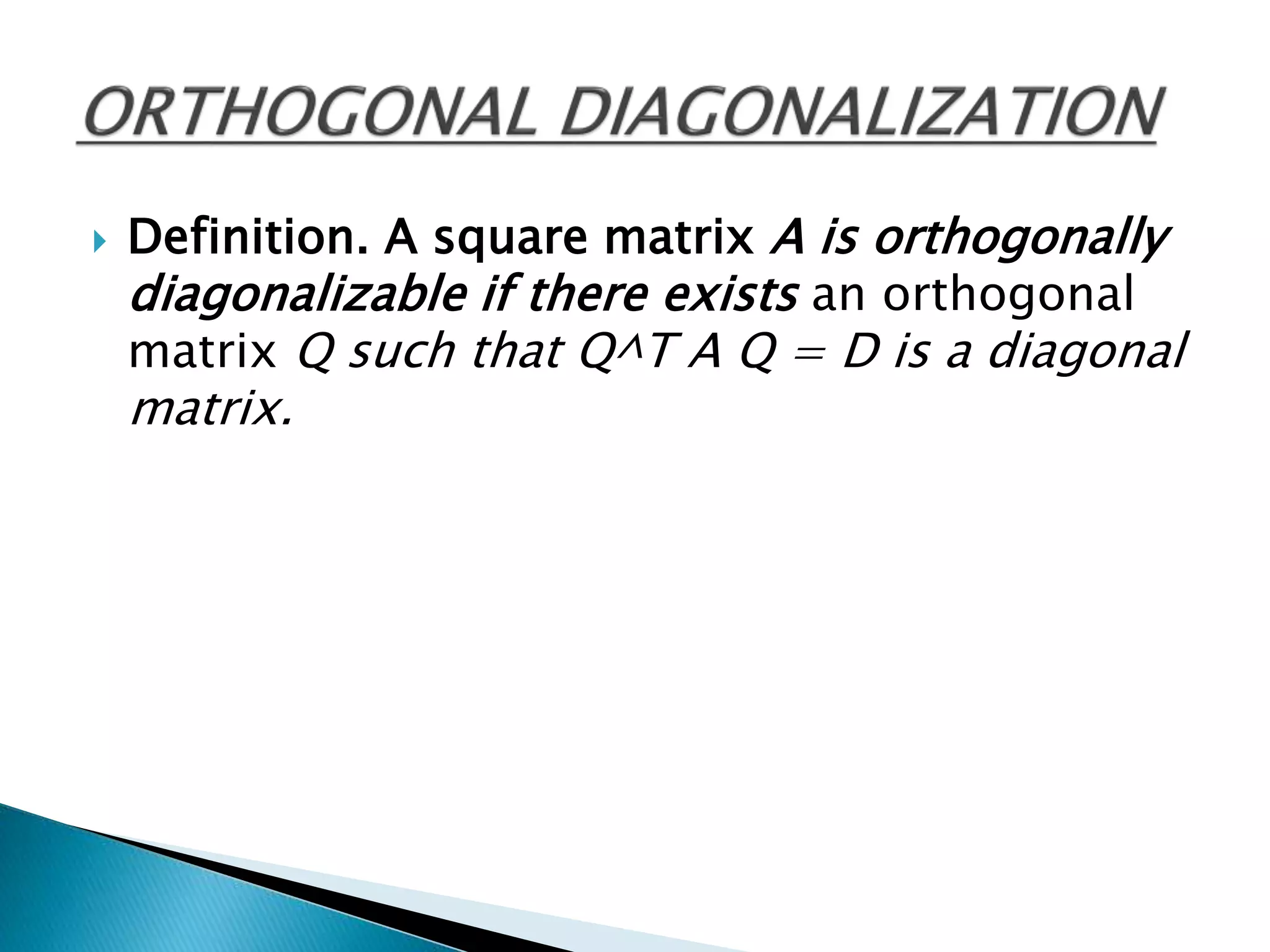
 Definition. A square matrix A is orthogonally
diagonalizable if there exists an orthogonal
matrix Q such that Q^T A Q = D is a diagonal
matrix.
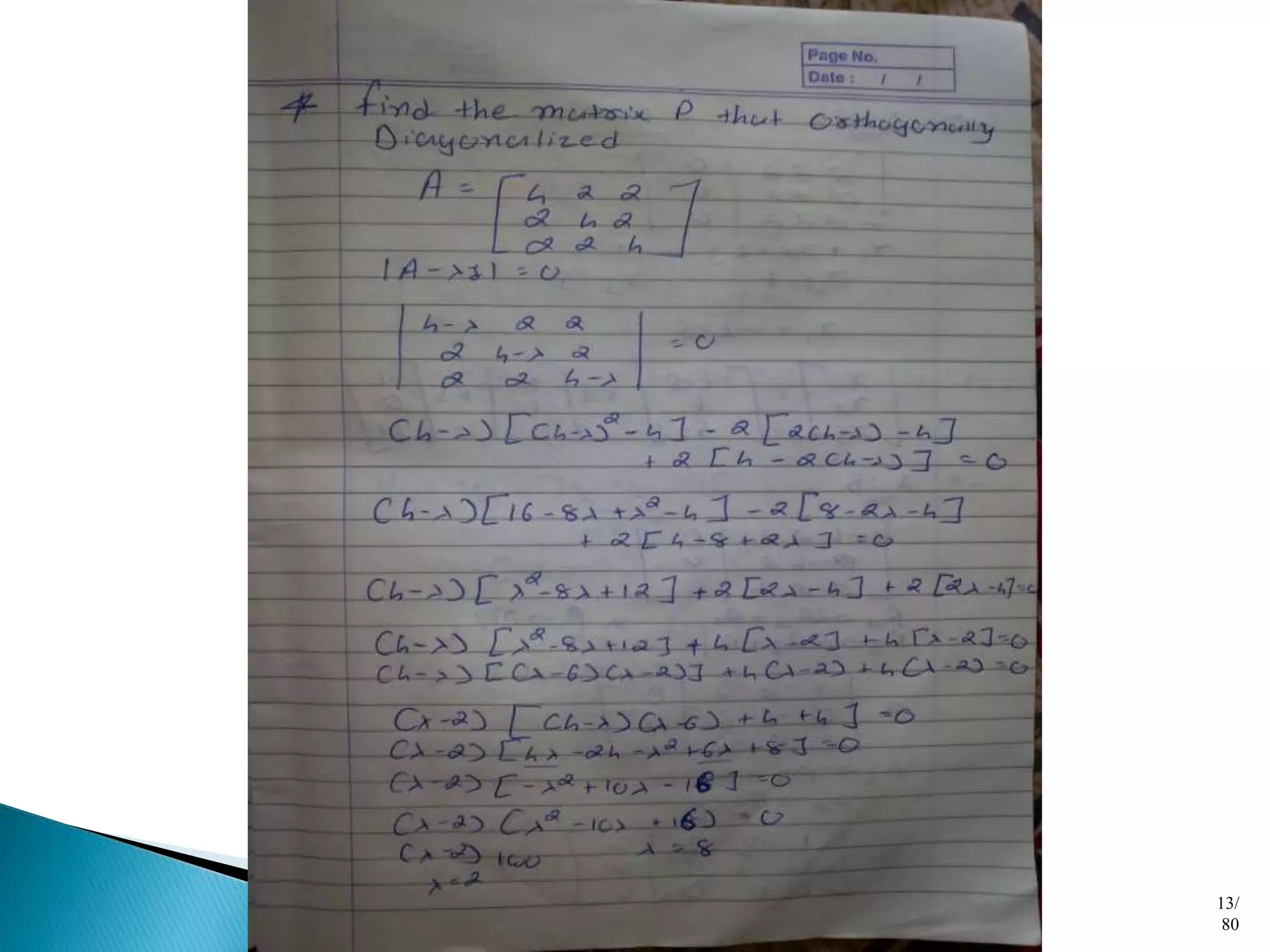
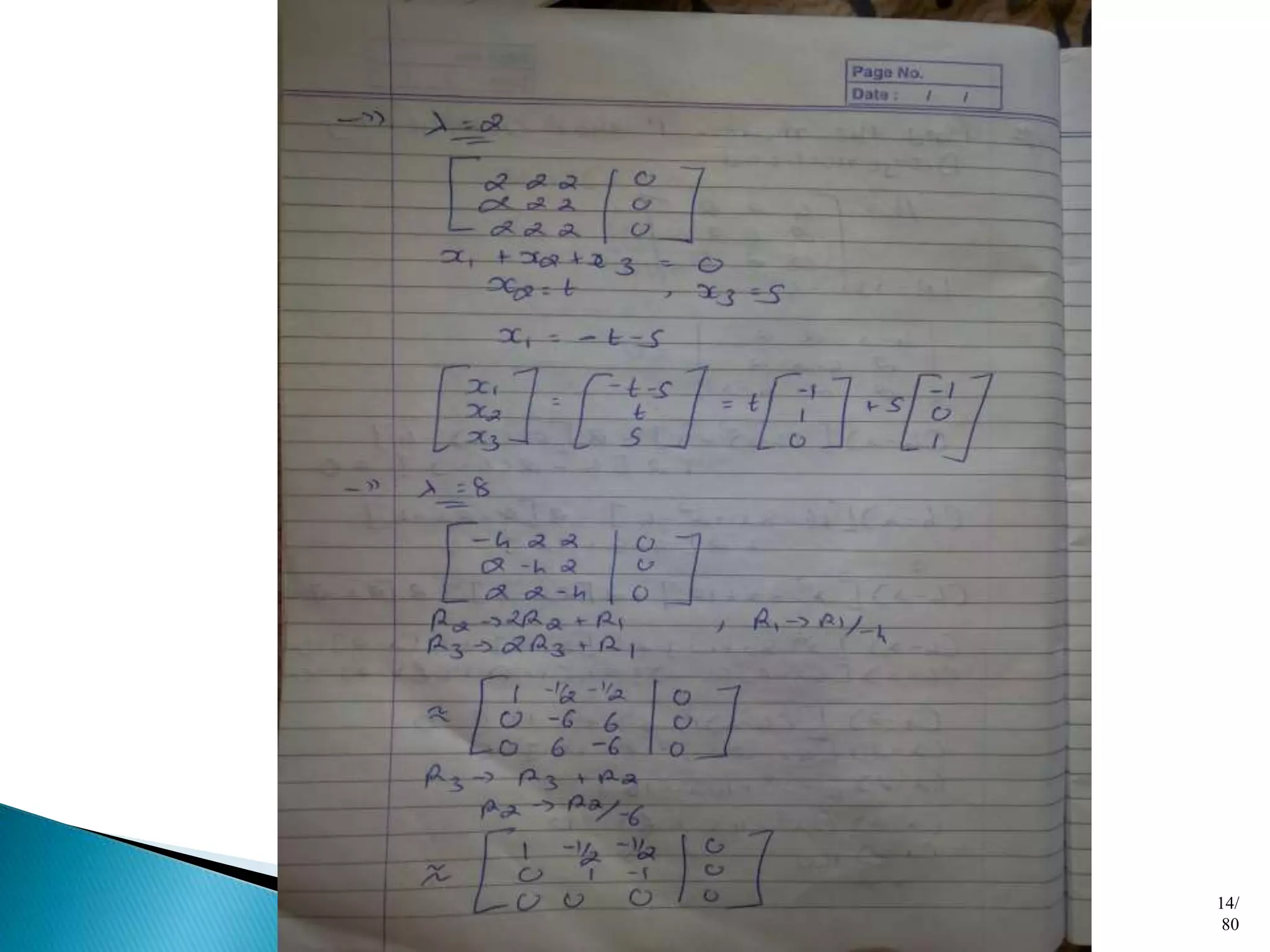
 STEP 1. find out eigen values.
 STEP 2. Find out eigen vectors.
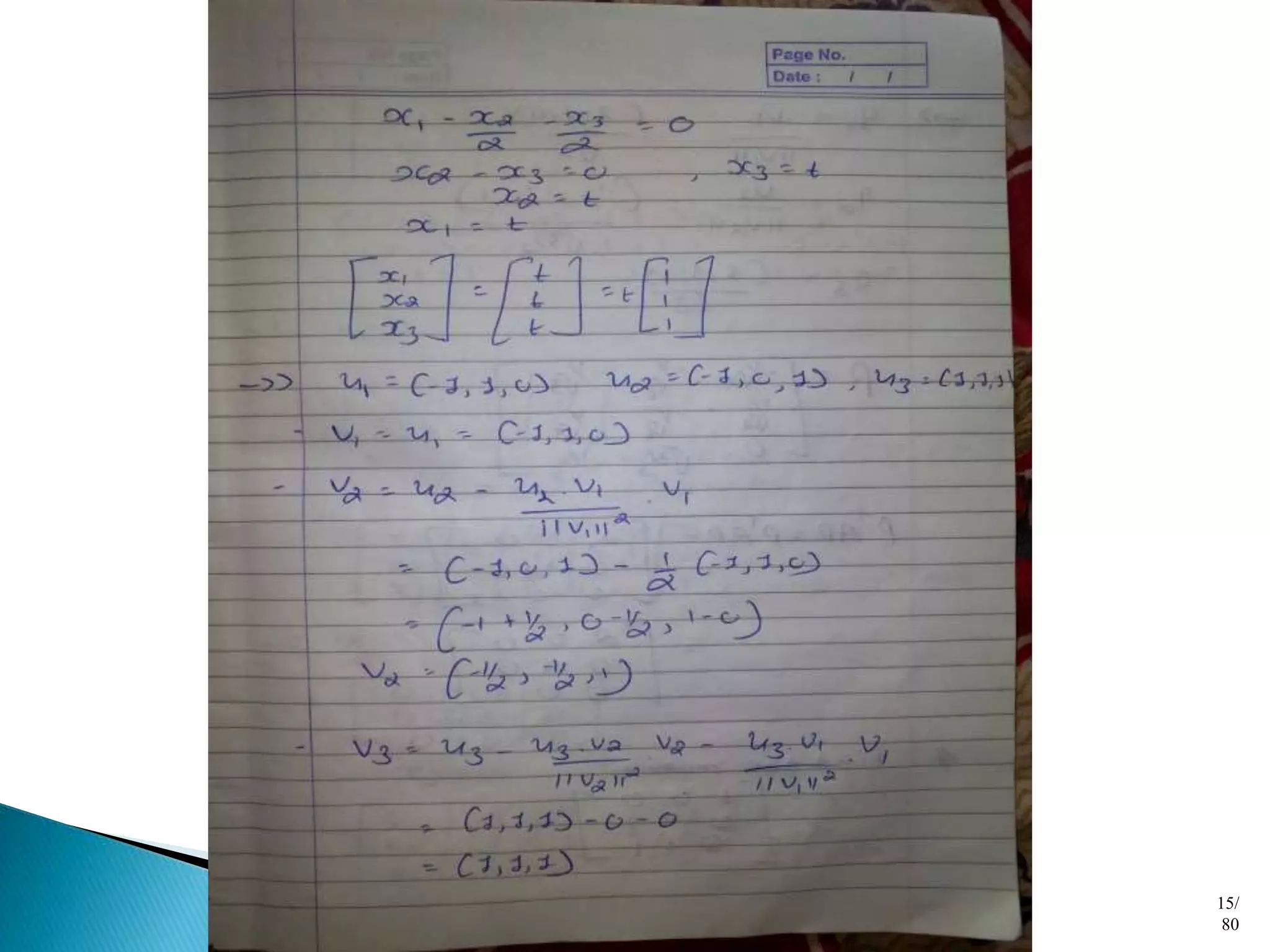
 STEP 3. say eigen vectors as a u1,u2,u3…..
 STEP 4. convert in a ortho normal vector
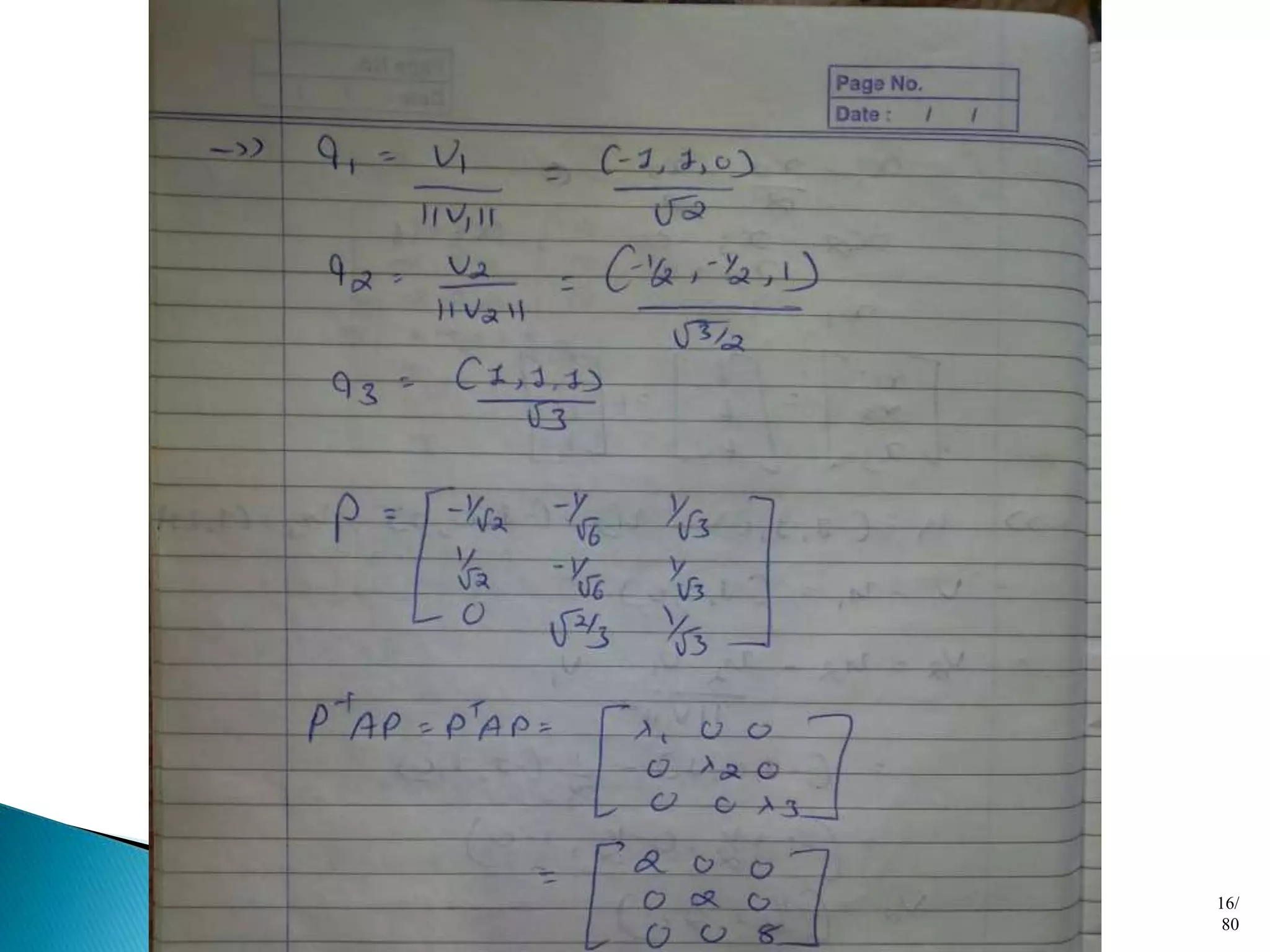
q1,q2,q3….using gram schmidt process.
 STEP 5. find matrix p=[ q1,q2,q3]
 STEP 6.find p^-1 A P= P^T A P=[ λ1 0 0 ]
 [ 0 λ2 0 ]
 [ 0 0 λ3]
13/
80
14/
80
15/
80
16/
80
ORTHOGONAL, ORTHONORMAL  VECTOR, GRAM SCHMIDT PROCESS, ORTHOGONALLY DIAGONALIZATION.

ORTHOGONAL, ORTHONORMAL VECTOR, GRAM SCHMIDT PROCESS, ORTHOGONALLY DIAGONALIZATION.

  • 1.
    1) Prepared By: Pratik Sharma, Smit Shah, Shivani Sharma, Rehan Shaikh Smarth Shah ENROLLMENT NO. : 140410109098 140410109096 140410109099 140410109097 140410109095 Branch :Electrical Engineering Guided by: H PATEL
  • 2.
     ORTHOGONAL VECTOR. ORTHONORMAL VECTOR.  GRAM SCHMIDT PROCESS.  ORTHOGONALLY DIAGONALIZATION.
  • 3.
     Definition. Wesay that 2 vectors are orthogonal if they are perpendicular to each other. i.e. the dot product of the two vectors is zero.  Definition. We say that a set of vectors {v1, v2, ..., vn} are mutually orthogonal if every pair of vectors is orthogonal. i.e. vi.vj = 0, for all i not equal j.
  • 4.
    E.g.:- Check whetherv1=(1,-1,0) v2=(1,1,0) v3=(0,0,1) is orthogonal vector or not ? ~ v1.v2 =1+(-1)+0 =0 v2.v3 = 0+0+0 = 0 v3.v1 = 0+0+0 =0 so,We can say that given vector is orthogonal.
  • 5.
     Definition. Ifv1,v2,……Vn whose ||v1||=||v2||=……||Vn||=1 then v1,v2,……Vn is a orthonormal vector. • Definition. An orthogonal set in which each vector is a unit vector is called orthonormal.          ji ji VS ji n 0 1 , ,,, 21 vv vvv
  • 6.
     E.g.1:- Checkwhether this is orthonormal or not ?  ~  so,We can say that given vector is orthogonal.                             3 1 , 3 2 , 3 2 , 3 22 , 6 2 , 6 2 ,0, 2 1 , 2 1 321 S vvv 1|||| 1|||| 10|||| 9 1 9 4 9 4 333 9 8 36 2 36 2 222 2 1 2 1 111    vvv vvv vvv
  • 7.
     If u1,u2,u3is not orthogonal. Then v1.v2 also not equal to 0. then we use Gram Schmidt Produces.  Given a set of linearly independent vectors, it is often useful to convert them into an orthonormal set of vectors. We first define the projection operator.  Definition. Let u and v be two vectors. The projection of the vector v on u is defined as follows:
  • 8.
     Gram-Schmidt process:- isa basis for an inner product space V },,,{ 21 nB uuu  11Let uv  },,,{' 21 nB vvv  },,,{'' 2 2 n n B v v v v v v 1 1       1 1 〉〈 〉〈 proj 1 n i i ii in nnnn n v v,v v,v uuuv W  2 22 23 1 11 13 3333 〉〈 〉〈 〉〈 〉〈 proj 2 v v,v v,u v v,v v,u uuuv W  1 11 12 2222 〉〈 〉〈 proj 1 v v,v v,u uuuv W  is an orthogonal basis. is an orthonormal basis.
  • 9.
    )0,1,1(11  uv )2,0,0()0, 2 1 , 2 1 ( 2/1 2/1 )0,1,1( 2 1 )2,1,0( 2 22 23 1 11 13 33       v vv vu v vv vu uv )}2,1,0(,)0,2,1(,)0,1,1{( 321 B uuu )0, 2 1 , 2 1 ()0,1,1( 2 3 )0,2,1(1 11 12 22     v vv vu uv Sol:  EXAMPLE  Ex1 : (Applying the Gram-Schmidt orthonormalization process) Apply the Gram-Schmidt process to the following basis.
  • 10.
  • 11.
     Definition. Asquare matrix A is orthogonally diagonalizable if there exists an orthogonal matrix Q such that Q^T A Q = D is a diagonal matrix.
  • 12.
     STEP 1.find out eigen values.  STEP 2. Find out eigen vectors.  STEP 3. say eigen vectors as a u1,u2,u3…..  STEP 4. convert in a ortho normal vector q1,q2,q3….using gram schmidt process.  STEP 5. find matrix p=[ q1,q2,q3]  STEP 6.find p^-1 A P= P^T A P=[ λ1 0 0 ]  [ 0 λ2 0 ]  [ 0 0 λ3]
  • 13.
  • 14.
  • 15.
  • 16.