Definition
 Orthogonal Vectors
Two vectors u, v are said to be orthogonal provided their dot product is zero:
u·v = 0.
If both vectors are nonzero (not required in the definition), then the angle θ
between the two vectors is determined by
cos θ =
𝑢⋅𝑣
𝑢 𝑣
= 0,
which implies θ = 90◦.
In short, orthogonal vectors form a right angle.
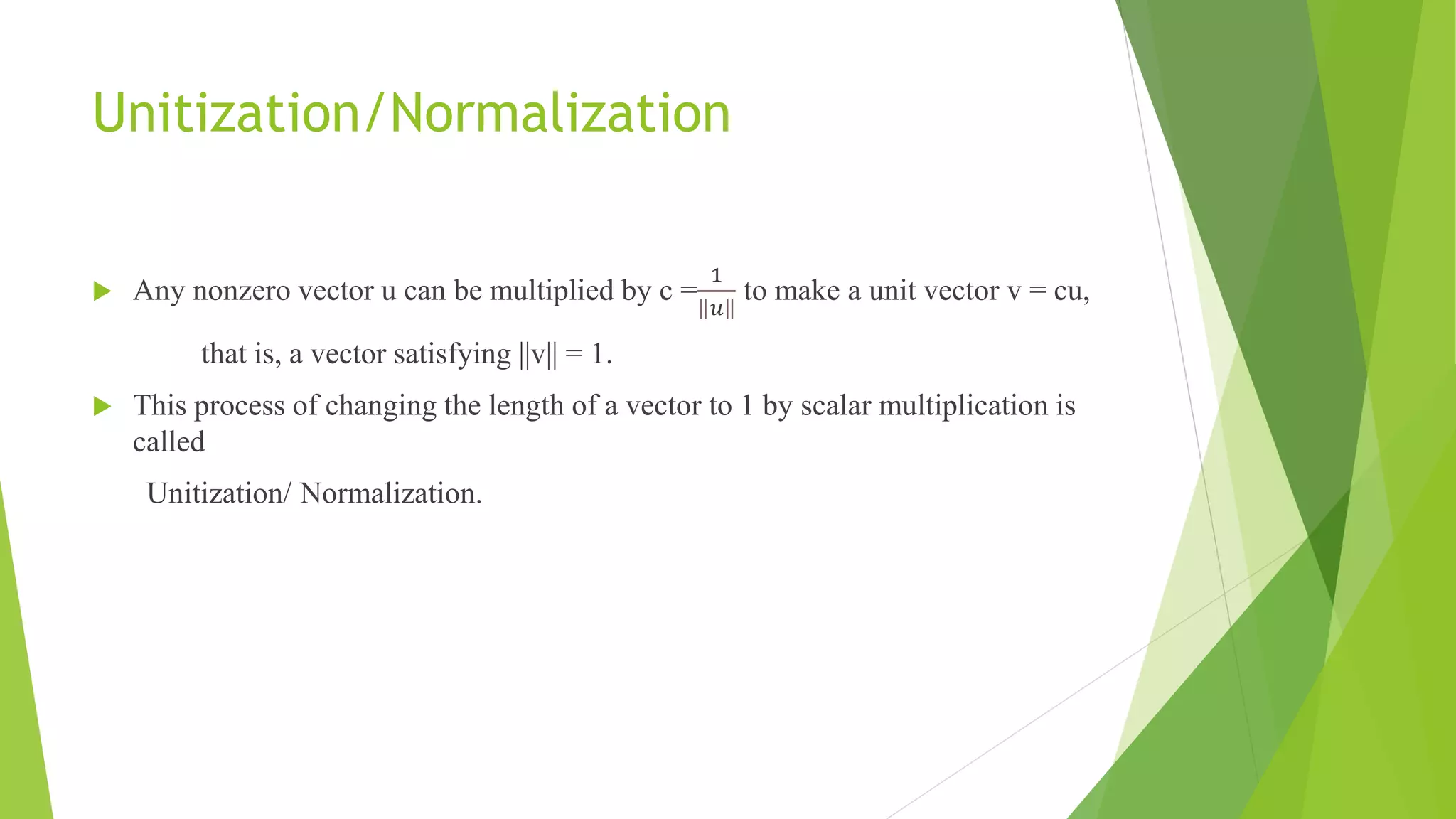
Unitization/Normalization
 Any nonzero vector u can be multiplied by c =
1
𝑢
to make a unit vector v = cu,
that is, a vector satisfying ||v|| = 1.
 This process of changing the length of a vector to 1 by scalar multiplication is
called
Unitization/ Normalization.
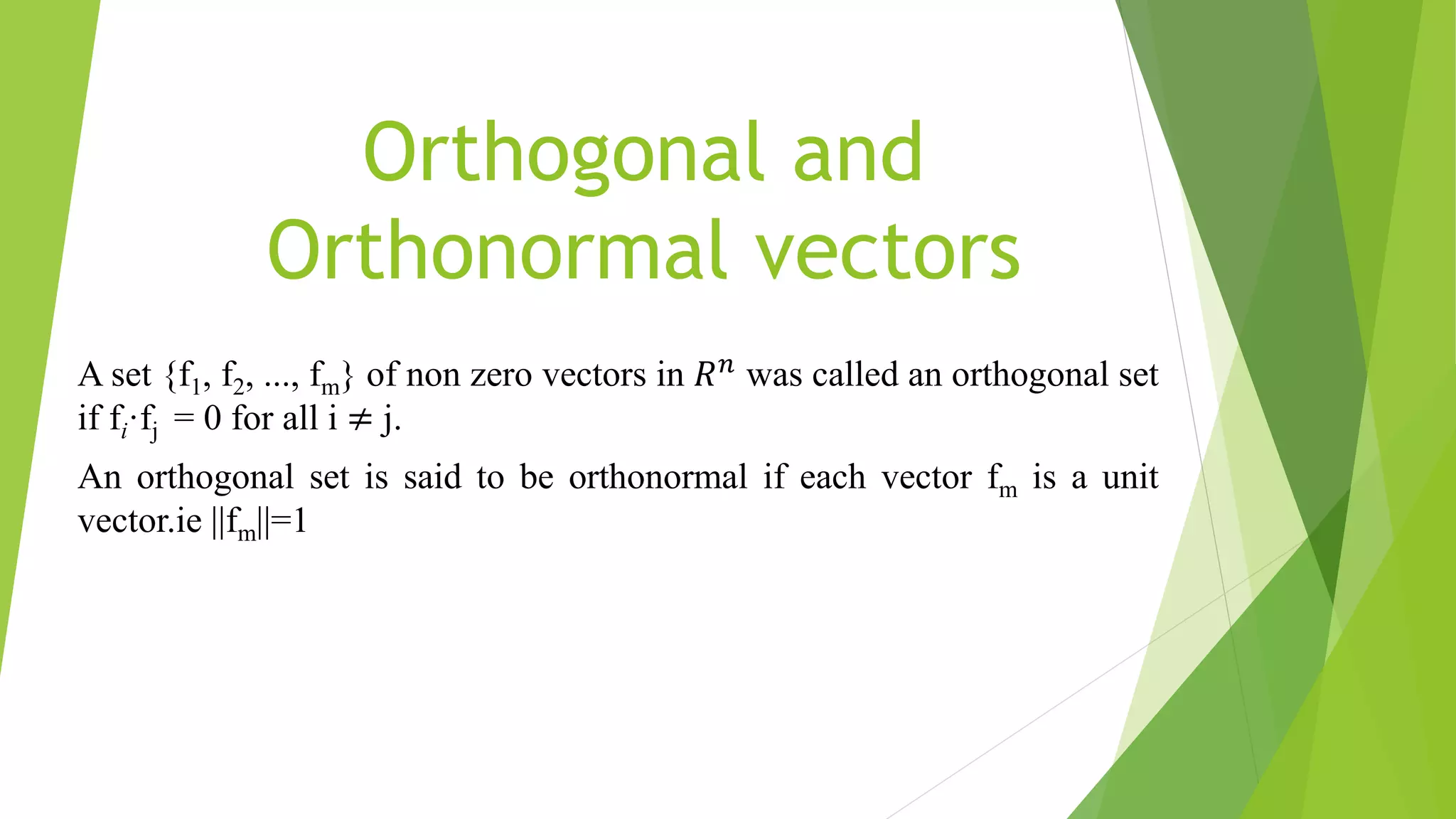
Orthogonal and
Orthonormal vectors
A set {f1, f2, ..., fm} of non zero vectors in 𝑅𝑛 was called an orthogonal set
if fi·fj = 0 for all i ≠ j.
An orthogonal set is said to be orthonormal if each vector fm is a unit
vector.ie ||fm||=1
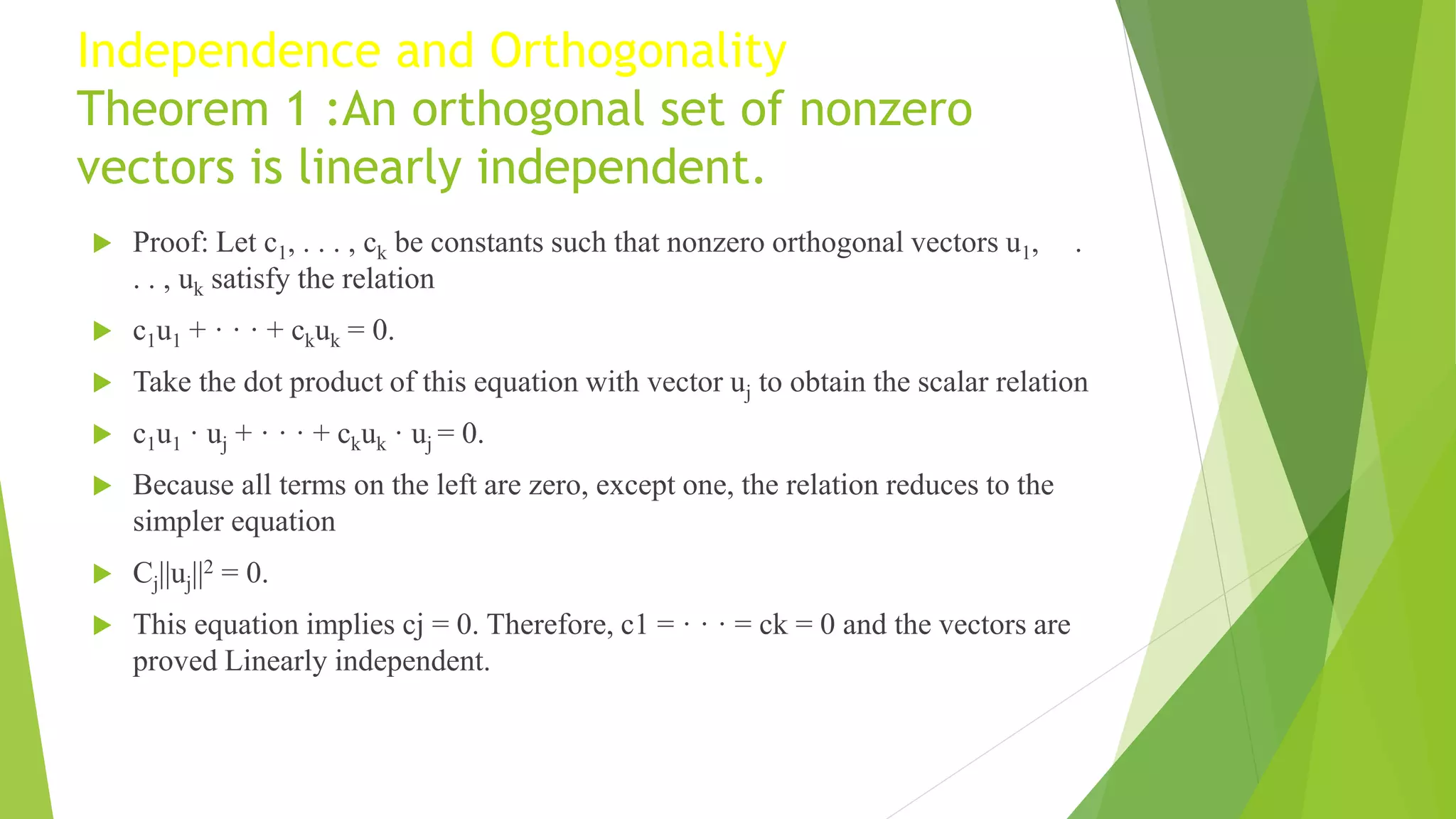
Independence and Orthogonality
Theorem 1 :An orthogonal set of nonzero
vectors is linearly independent.
 Proof: Let c1, . . . , ck be constants such that nonzero orthogonal vectors u1, .
. . , uk satisfy the relation
 c1u1 + · · · + ckuk = 0.
 Take the dot product of this equation with vector uj to obtain the scalar relation
 c1u1 · uj + · · · + ckuk · uj = 0.
 Because all terms on the left are zero, except one, the relation reduces to the
simpler equation
 Cj||uj||2 = 0.
 This equation implies cj = 0. Therefore, c1 = · · · = ck = 0 and the vectors are
proved Linearly independent.
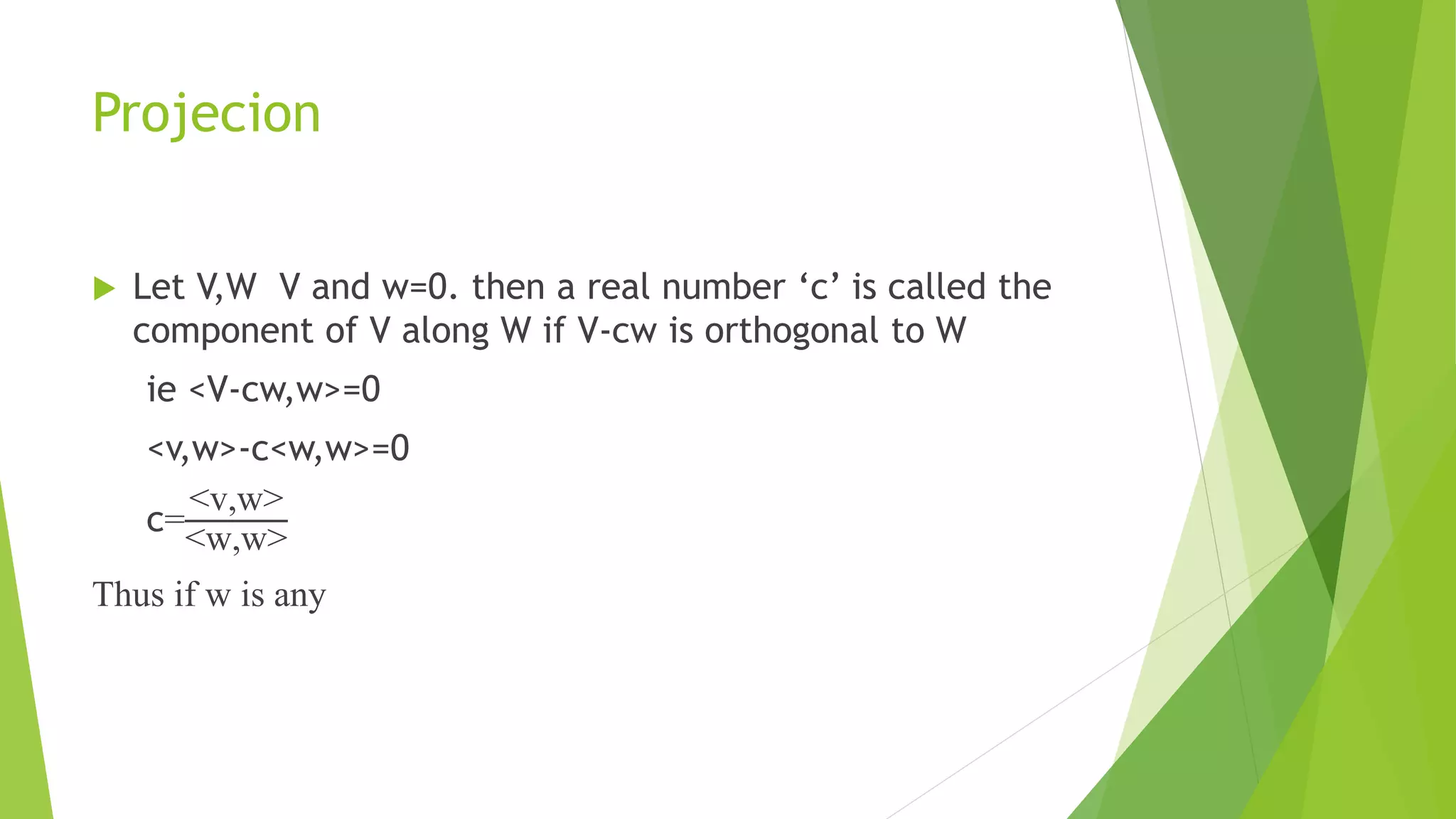
Projecion
 Let V,W V and w=0. then a real number ‘c’ is called the
component of V along W if V-cw is orthogonal to W
ie <V-cw,w>=0
<v,w>-c<w,w>=0
c=
<v,w>
<w,w>
Thus if w is any
Orthogonality property
 Let P and Q be two vectors in Rn , then the differences
of Q and its vector projection onto P is
orthogonal to P.
ie P is orthogonal to [Q-(
𝑄⋅𝑃
𝑃
𝑝
𝑃
]
Grahm Schmidt orthogonalization
process
 Let P and Q be two non zero vectors then the above orthogonality property
can be used to construct a new vector.
R=[Q-(
𝑄⋅𝑃
𝑃
𝑝
𝑃
]
Which is orthogonal to P
This process of constructing orthogonal vector is known as Grahm Schmidt
orthogonalization process.
Orthogonality

Orthogonality

  • 1.
    Definition  Orthogonal Vectors Twovectors u, v are said to be orthogonal provided their dot product is zero: u·v = 0. If both vectors are nonzero (not required in the definition), then the angle θ between the two vectors is determined by cos θ = 𝑢⋅𝑣 𝑢 𝑣 = 0, which implies θ = 90◦. In short, orthogonal vectors form a right angle.
  • 2.
    Unitization/Normalization  Any nonzerovector u can be multiplied by c = 1 𝑢 to make a unit vector v = cu, that is, a vector satisfying ||v|| = 1.  This process of changing the length of a vector to 1 by scalar multiplication is called Unitization/ Normalization.
  • 3.
    Orthogonal and Orthonormal vectors Aset {f1, f2, ..., fm} of non zero vectors in 𝑅𝑛 was called an orthogonal set if fi·fj = 0 for all i ≠ j. An orthogonal set is said to be orthonormal if each vector fm is a unit vector.ie ||fm||=1
  • 4.
    Independence and Orthogonality Theorem1 :An orthogonal set of nonzero vectors is linearly independent.  Proof: Let c1, . . . , ck be constants such that nonzero orthogonal vectors u1, . . . , uk satisfy the relation  c1u1 + · · · + ckuk = 0.  Take the dot product of this equation with vector uj to obtain the scalar relation  c1u1 · uj + · · · + ckuk · uj = 0.  Because all terms on the left are zero, except one, the relation reduces to the simpler equation  Cj||uj||2 = 0.  This equation implies cj = 0. Therefore, c1 = · · · = ck = 0 and the vectors are proved Linearly independent.
  • 5.
    Projecion  Let V,WV and w=0. then a real number ‘c’ is called the component of V along W if V-cw is orthogonal to W ie <V-cw,w>=0 <v,w>-c<w,w>=0 c= <v,w> <w,w> Thus if w is any
  • 6.
    Orthogonality property  LetP and Q be two vectors in Rn , then the differences of Q and its vector projection onto P is orthogonal to P. ie P is orthogonal to [Q-( 𝑄⋅𝑃 𝑃 𝑝 𝑃 ]
  • 7.
    Grahm Schmidt orthogonalization process Let P and Q be two non zero vectors then the above orthogonality property can be used to construct a new vector. R=[Q-( 𝑄⋅𝑃 𝑃 𝑝 𝑃 ] Which is orthogonal to P This process of constructing orthogonal vector is known as Grahm Schmidt orthogonalization process.