Linear Algebra Review
1
Pattern Recognition
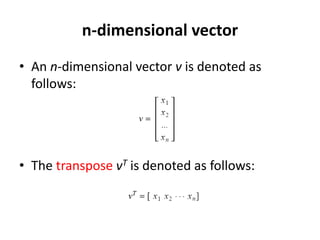
n-dimensional vector
• An n-dimensional vector v is denoted as
follows:
• The transpose vT is denoted as follows:
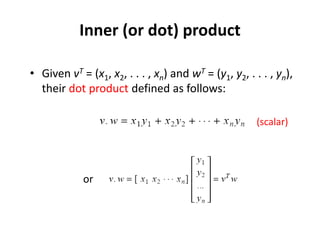
Inner (or dot) product
• Given vT = (x1, x2, . . . , xn) and wT = (y1, y2, . . . , yn),
their dot product defined as follows:
or
(scalar)
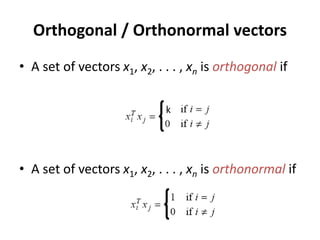
Orthogonal / Orthonormal vectors
• A set of vectors x1, x2, . . . , xn is orthogonal if
• A set of vectors x1, x2, . . . , xn is orthonormal if
k
Linear combinations
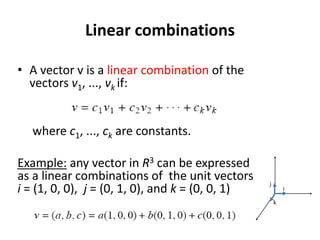
• A vector v is a linear combination of the
vectors v1, ..., vk if:
where c1, ..., ck are constants.
Example: any vector in R3 can be expressed
as a linear combinations of the unit vectors
i = (1, 0, 0), j = (0, 1, 0), and k = (0, 0, 1)
k
j
i
Space spanning
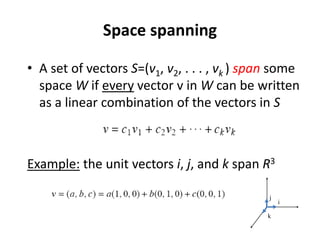
• A set of vectors S=(v1, v2, . . . , vk ) span some
space W if every vector v in W can be written
as a linear combination of the vectors in S
Example: the unit vectors i, j, and k span R3
k
j
i
Linear dependence
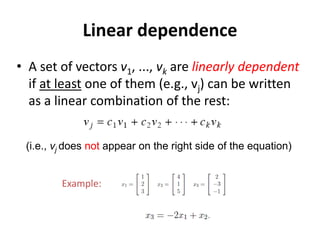
• A set of vectors v1, ..., vk are linearly dependent
if at least one of them (e.g., vj) can be written
as a linear combination of the rest:
(i.e., vj does not appear on the right side of the equation)
Example:
Linear independence
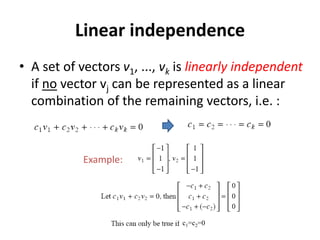
• A set of vectors v1, ..., vk is linearly independent
if no vector vj can be represented as a linear
combination of the remaining vectors, i.e. :
Example:
c1=c2=0
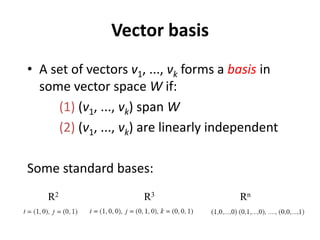
Vector basis
• A set of vectors v1, ..., vk forms a basis in
some vector space W if:
(1) (v1, ..., vk) span W
(2) (v1, ..., vk) are linearly independent
Some standard bases:
R2 R3 Rn
Orthogonal vector basis
• Basis vectors are not necessarily orthogonal.
• Any set of basis vectors (v1, ..., vk) can be
transformed to an orthogonal basis using the
Gram-Schmidt orthogonalization algorithm.
• Normalizing the basis vectors to “unit” length will
yield an orthonormal basis.
• More useful in practice since they simplify
calculations.
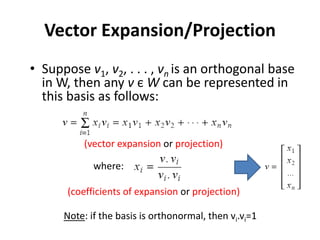
Vector Expansion/Projection
• Suppose v1, v2, . . . , vn is an orthogonal base
in W, then any v є W can be represented in
this basis as follows:
• The xi of the expansion can be computed as follows:
(vector expansion or projection)
(coefficients of expansion or projection)
where:
Note: if the basis is orthonormal, then vi.vi=1
Vector basis (cont’d)
• Given a set of basis vectors in W, each vector
in W can be represented (i.e., projected)
“uniquely” in this basis.
• How many vector bases are there in a vector
space?
– Many, e.g., translate/rotate a given vector basis to
obtain a new one!
– Some vector bases are preferred than others though.
– We will revisit this issue when we discuss Principal
Components Analysis (PCA).
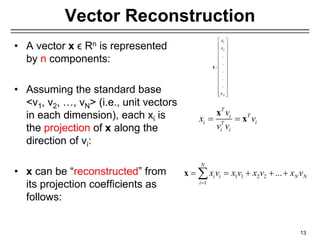
Vector Reconstruction
• A vector x ϵ Rn is represented
by n components:
• Assuming the standard base
<v1, v2, …, vN> (i.e., unit vectors
in each dimension), each xi is
the projection of x along the
direction of vi:
• x can be “reconstructed” from
its projection coefficients as
follows:
13
1
2
.
.
:
.
.
.
N
x
x
x
 
 
 
 
 
 
 
 
 
 
 
 
 
x
T
T
i
i i
T
i i
v
x v
v v
 
x
x
1 1 2 2
1
...
N
i i N N
i
x v x v x v x v

    

x
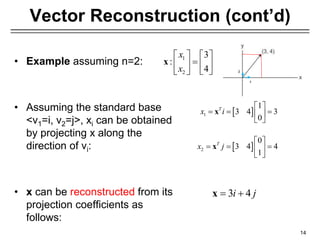
Vector Reconstruction (cont’d)
• Example assuming n=2:
• Assuming the standard base
<v1=i, v2=j>, xi can be obtained
by projecting x along the
direction of vi:
• x can be reconstructed from its
projection coefficients as
follows:
14
1
2
3
:
4
x
x
   

   
 
 
x
 
1
1
3 4 3
0
T
x i
 
  
 
 
x
3 4
i j
 
x
 
2
0
3 4 4
1
T
x j
 
  
 
 
x
i
j
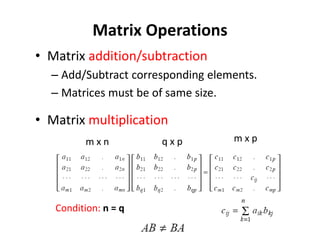
Matrix Operations
• Matrix addition/subtraction
– Add/Subtract corresponding elements.
– Matrices must be of same size.
• Matrix multiplication
Condition: n = q
m x n q x p m x p
n
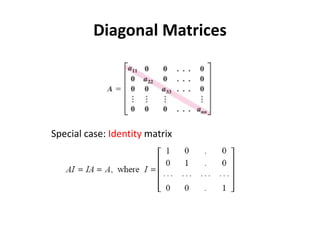
Diagonal Matrices
Special case: Identity matrix
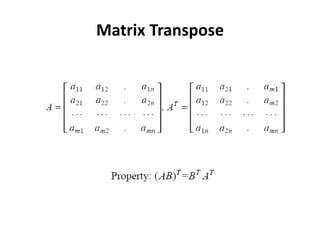
Matrix Transpose
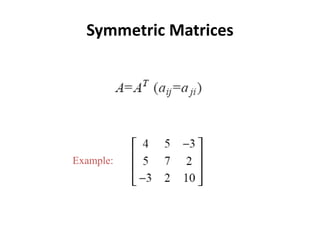
Symmetric Matrices
Example:
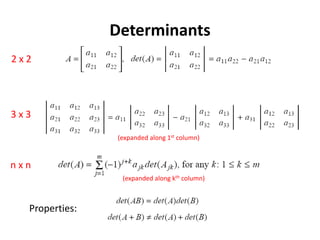
Determinants
2 x 2
3 x 3
n x n
Properties:
(expanded along 1st column)
(expanded along kth column)
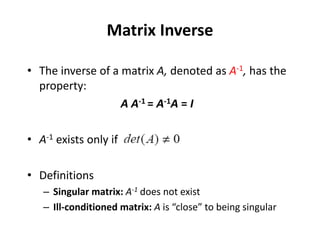
Matrix Inverse
• The inverse of a matrix A, denoted as A-1, has the
property:
A A-1 = A-1A = I
• A-1 exists only if
• Definitions
– Singular matrix: A-1 does not exist
– Ill-conditioned matrix: A is “close” to being singular
Matrix Inverse (cont’d)
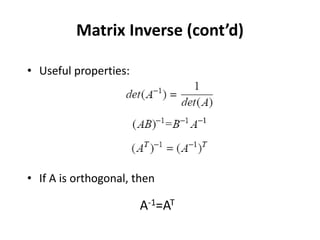
• Useful properties:
• If A is orthogonal, then
A-1=AT
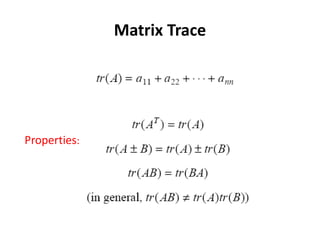
Matrix Trace
Properties:
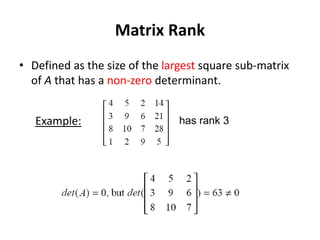
Matrix Rank
• Defined as the size of the largest square sub-matrix
of A that has a non-zero determinant.
Example: has rank 3
Matrix Rank (cont’d)
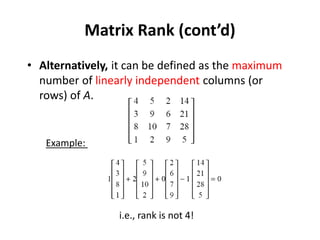
• Alternatively, it can be defined as the maximum
number of linearly independent columns (or
rows) of A.
i.e., rank is not 4!
Example:
Matrix Rank (cont’d)
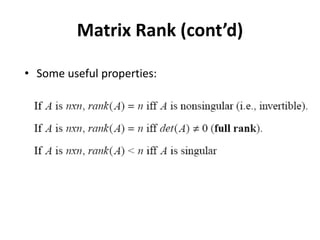
• Some useful properties:
Eigenvalues and Eigenvectors
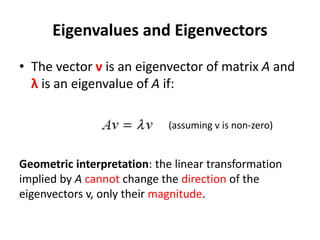
• The vector v is an eigenvector of matrix A and
λ is an eigenvalue of A if:
Geometric interpretation: the linear transformation
implied by A cannot change the direction of the
eigenvectors v, only their magnitude.
(assuming v is non-zero)
Computing λ and v
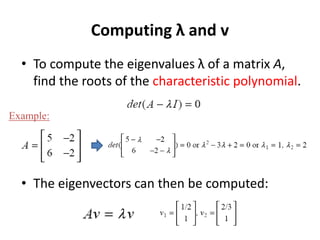
• To compute the eigenvalues λ of a matrix A,
find the roots of the characteristic polynomial.
• The eigenvectors can then be computed:
Example:
Properties of λ and v
• Eigenvalues and eigenvectors are only
defined for square matrices.
• Eigenvectors are not unique (e.g., if v is an
eigenvector, so is kv) 
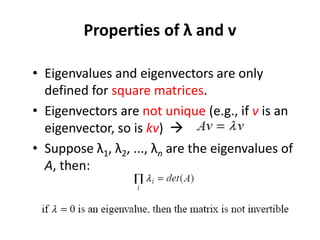
• Suppose λ1, λ2, ..., λn are the eigenvalues of
A, then:
Matrix diagonalization
• Given an n x n matrix A, find P such that:
P-1AP=Λ where Λ is diagonal
• Solution: set P = [v1 v2 . . . vn], where v1,v2 ,. . .
vn are the eigenvectors of A: eigenvalues of A
P-1AP=Λ
Matrix diagonalization (cont’d)
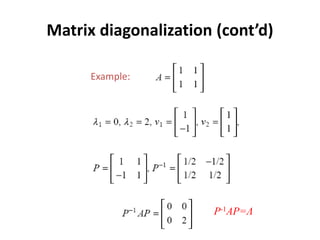
Example:
P-1AP=Λ
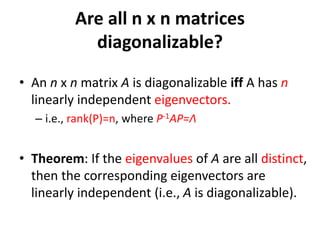
• An n x n matrix A is diagonalizable iff A has n
linearly independent eigenvectors.
– i.e., rank(P)=n, where P-1AP=Λ
• Theorem: If the eigenvalues of A are all distinct,
then the corresponding eigenvectors are
linearly independent (i.e., A is diagonalizable).
Are all n x n matrices
diagonalizable?
• If A is diagonalizable, then the corresponding
eigenvectors v1,v2 ,. . . vn form a basis in Rn
– Since v1,v2 ,. . . vn are linearly independent, they
also span Rn
• If A is also symmetric, its eigenvalues are
real, non-negative and the corresponding
eigenvectors are orthogonal.
– v1,v2 ,. . . vn form an orthogonal basis in Rn
Important Properties
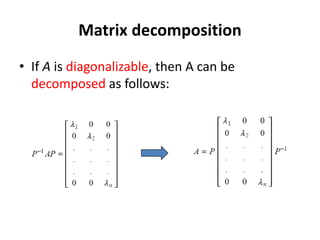
Matrix decomposition
• If A is diagonalizable, then A can be
decomposed as follows:
Matrix decomposition (cont’d)
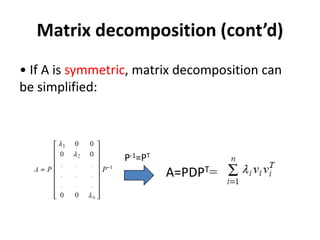
• If A is symmetric, matrix decomposition can
be simplified:
P-1=PT
A=PDPT=

LinearAlgebraReview.ppt

  • 1.
  • 2.
    n-dimensional vector • Ann-dimensional vector v is denoted as follows: • The transpose vT is denoted as follows:
  • 3.
    Inner (or dot)product • Given vT = (x1, x2, . . . , xn) and wT = (y1, y2, . . . , yn), their dot product defined as follows: or (scalar)
  • 4.
    Orthogonal / Orthonormalvectors • A set of vectors x1, x2, . . . , xn is orthogonal if • A set of vectors x1, x2, . . . , xn is orthonormal if k
  • 5.
    Linear combinations • Avector v is a linear combination of the vectors v1, ..., vk if: where c1, ..., ck are constants. Example: any vector in R3 can be expressed as a linear combinations of the unit vectors i = (1, 0, 0), j = (0, 1, 0), and k = (0, 0, 1) k j i
  • 6.
    Space spanning • Aset of vectors S=(v1, v2, . . . , vk ) span some space W if every vector v in W can be written as a linear combination of the vectors in S Example: the unit vectors i, j, and k span R3 k j i
  • 7.
    Linear dependence • Aset of vectors v1, ..., vk are linearly dependent if at least one of them (e.g., vj) can be written as a linear combination of the rest: (i.e., vj does not appear on the right side of the equation) Example:
  • 8.
    Linear independence • Aset of vectors v1, ..., vk is linearly independent if no vector vj can be represented as a linear combination of the remaining vectors, i.e. : Example: c1=c2=0
  • 9.
    Vector basis • Aset of vectors v1, ..., vk forms a basis in some vector space W if: (1) (v1, ..., vk) span W (2) (v1, ..., vk) are linearly independent Some standard bases: R2 R3 Rn
  • 10.
    Orthogonal vector basis •Basis vectors are not necessarily orthogonal. • Any set of basis vectors (v1, ..., vk) can be transformed to an orthogonal basis using the Gram-Schmidt orthogonalization algorithm. • Normalizing the basis vectors to “unit” length will yield an orthonormal basis. • More useful in practice since they simplify calculations.
  • 11.
    Vector Expansion/Projection • Supposev1, v2, . . . , vn is an orthogonal base in W, then any v є W can be represented in this basis as follows: • The xi of the expansion can be computed as follows: (vector expansion or projection) (coefficients of expansion or projection) where: Note: if the basis is orthonormal, then vi.vi=1
  • 12.
    Vector basis (cont’d) •Given a set of basis vectors in W, each vector in W can be represented (i.e., projected) “uniquely” in this basis. • How many vector bases are there in a vector space? – Many, e.g., translate/rotate a given vector basis to obtain a new one! – Some vector bases are preferred than others though. – We will revisit this issue when we discuss Principal Components Analysis (PCA).
  • 13.
    Vector Reconstruction • Avector x ϵ Rn is represented by n components: • Assuming the standard base <v1, v2, …, vN> (i.e., unit vectors in each dimension), each xi is the projection of x along the direction of vi: • x can be “reconstructed” from its projection coefficients as follows: 13 1 2 . . : . . . N x x x                           x T T i i i T i i v x v v v   x x 1 1 2 2 1 ... N i i N N i x v x v x v x v        x
  • 14.
    Vector Reconstruction (cont’d) •Example assuming n=2: • Assuming the standard base <v1=i, v2=j>, xi can be obtained by projecting x along the direction of vi: • x can be reconstructed from its projection coefficients as follows: 14 1 2 3 : 4 x x              x   1 1 3 4 3 0 T x i          x 3 4 i j   x   2 0 3 4 4 1 T x j          x i j
  • 15.
    Matrix Operations • Matrixaddition/subtraction – Add/Subtract corresponding elements. – Matrices must be of same size. • Matrix multiplication Condition: n = q m x n q x p m x p n
  • 16.
  • 17.
  • 18.
  • 19.
    Determinants 2 x 2 3x 3 n x n Properties: (expanded along 1st column) (expanded along kth column)
  • 20.
    Matrix Inverse • Theinverse of a matrix A, denoted as A-1, has the property: A A-1 = A-1A = I • A-1 exists only if • Definitions – Singular matrix: A-1 does not exist – Ill-conditioned matrix: A is “close” to being singular
  • 21.
    Matrix Inverse (cont’d) •Useful properties: • If A is orthogonal, then A-1=AT
  • 22.
  • 23.
    Matrix Rank • Definedas the size of the largest square sub-matrix of A that has a non-zero determinant. Example: has rank 3
  • 24.
    Matrix Rank (cont’d) •Alternatively, it can be defined as the maximum number of linearly independent columns (or rows) of A. i.e., rank is not 4! Example:
  • 25.
    Matrix Rank (cont’d) •Some useful properties:
  • 26.
    Eigenvalues and Eigenvectors •The vector v is an eigenvector of matrix A and λ is an eigenvalue of A if: Geometric interpretation: the linear transformation implied by A cannot change the direction of the eigenvectors v, only their magnitude. (assuming v is non-zero)
  • 27.
    Computing λ andv • To compute the eigenvalues λ of a matrix A, find the roots of the characteristic polynomial. • The eigenvectors can then be computed: Example:
  • 28.
    Properties of λand v • Eigenvalues and eigenvectors are only defined for square matrices. • Eigenvectors are not unique (e.g., if v is an eigenvector, so is kv)  • Suppose λ1, λ2, ..., λn are the eigenvalues of A, then:
  • 29.
    Matrix diagonalization • Givenan n x n matrix A, find P such that: P-1AP=Λ where Λ is diagonal • Solution: set P = [v1 v2 . . . vn], where v1,v2 ,. . . vn are the eigenvectors of A: eigenvalues of A P-1AP=Λ
  • 30.
  • 31.
    • An nx n matrix A is diagonalizable iff A has n linearly independent eigenvectors. – i.e., rank(P)=n, where P-1AP=Λ • Theorem: If the eigenvalues of A are all distinct, then the corresponding eigenvectors are linearly independent (i.e., A is diagonalizable). Are all n x n matrices diagonalizable?
  • 32.
    • If Ais diagonalizable, then the corresponding eigenvectors v1,v2 ,. . . vn form a basis in Rn – Since v1,v2 ,. . . vn are linearly independent, they also span Rn • If A is also symmetric, its eigenvalues are real, non-negative and the corresponding eigenvectors are orthogonal. – v1,v2 ,. . . vn form an orthogonal basis in Rn Important Properties
  • 33.
    Matrix decomposition • IfA is diagonalizable, then A can be decomposed as follows:
  • 34.
    Matrix decomposition (cont’d) •If A is symmetric, matrix decomposition can be simplified: P-1=PT A=PDPT=