ENTHALPY OF FORMATION
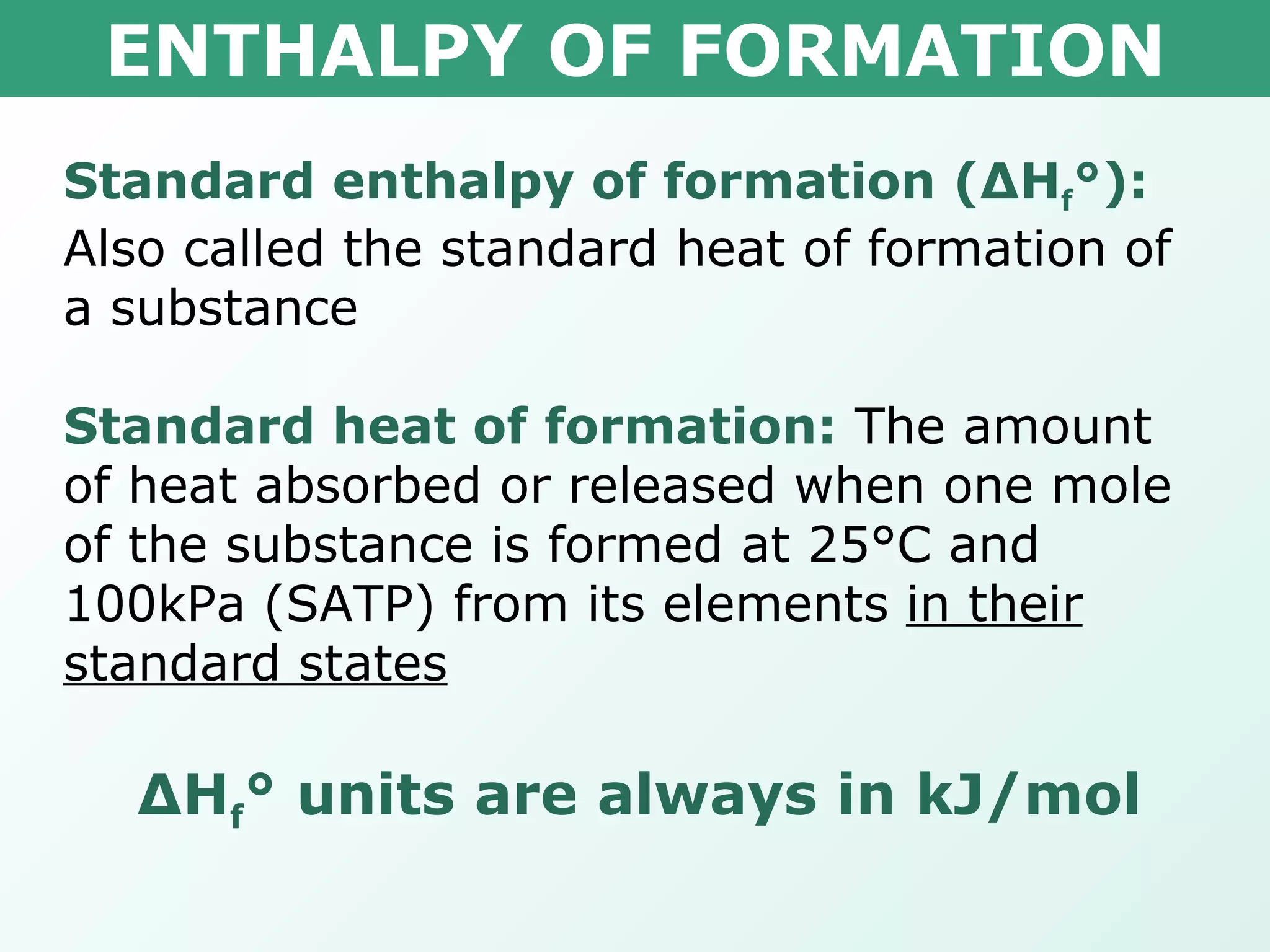
ENTHALPY OF FORMATION Standard enthalpy of formation ( Δ H f °):  Also called the standard heat of formation of a substance Standard heat of formation:  The amount of heat absorbed or released when one mole of the substance is formed at 25°C and 100kPa (SATP) from its elements  in their standard states Δ H f ° units are always in kJ/mol
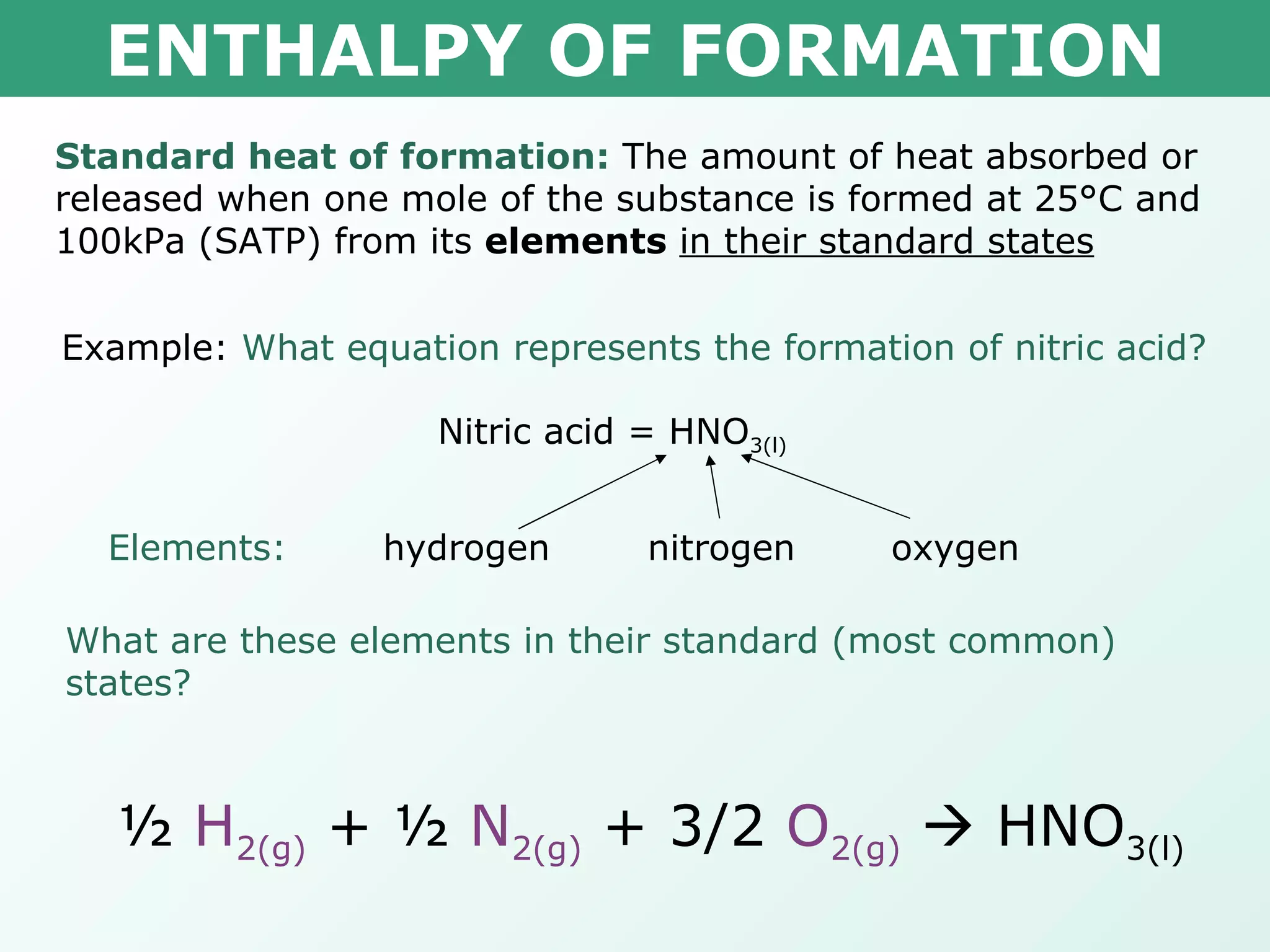
ENTHALPY OF FORMATION Standard heat of formation:  The amount of heat absorbed or released when one mole of the substance is formed at 25°C and 100kPa (SATP) from its  elements   in their standard states Example:  What equation represents the formation of nitric acid? Nitric acid = HNO 3(l) hydrogen nitrogen oxygen Elements: What are these elements in their standard (most common) states? ½  H 2(g)  + ½  N 2(g)  + 3/2  O 2(g)     HNO 3(l)
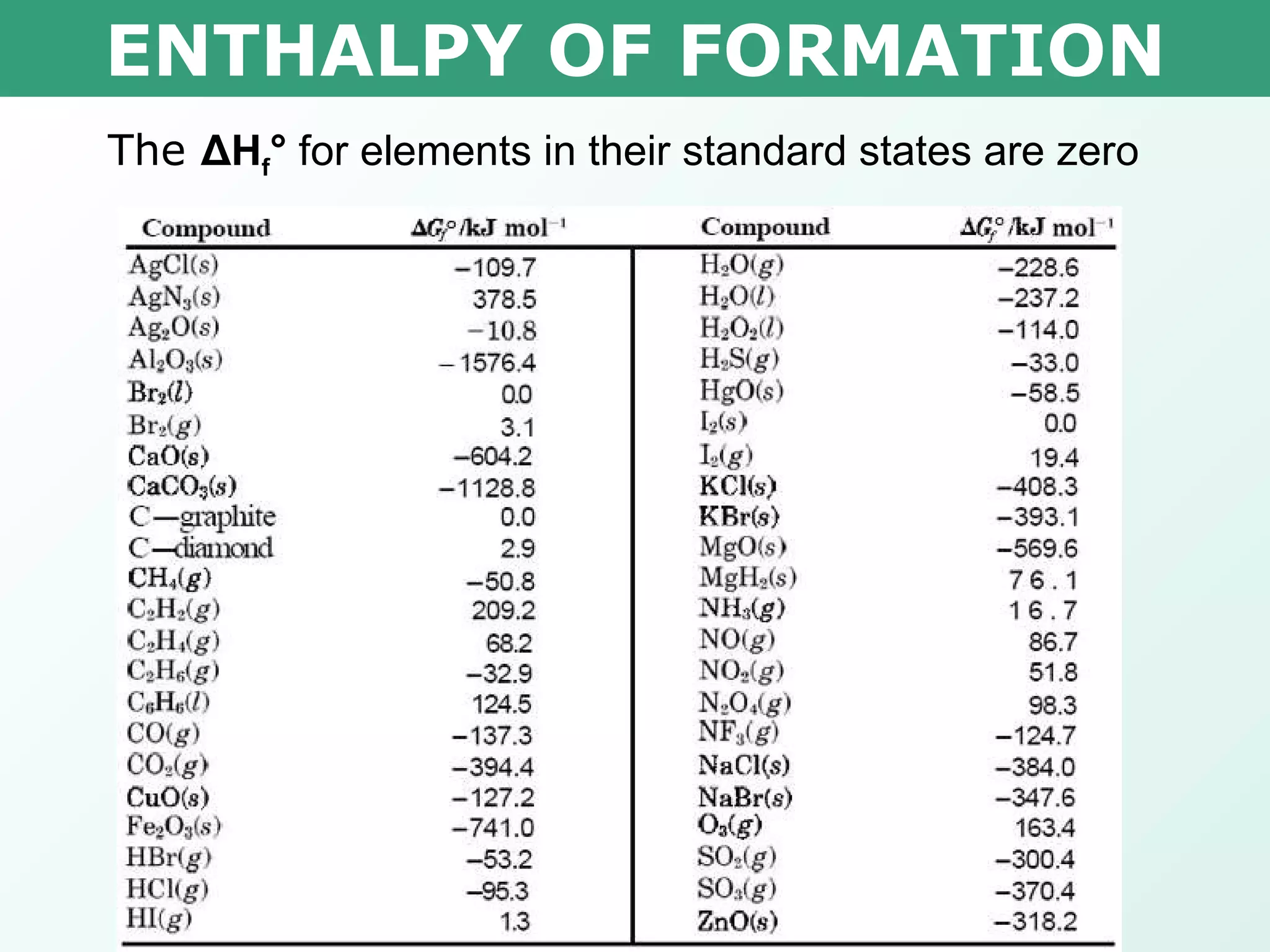
ENTHALPY OF FORMATION The  Δ H f °  for elements in their standard states are zero
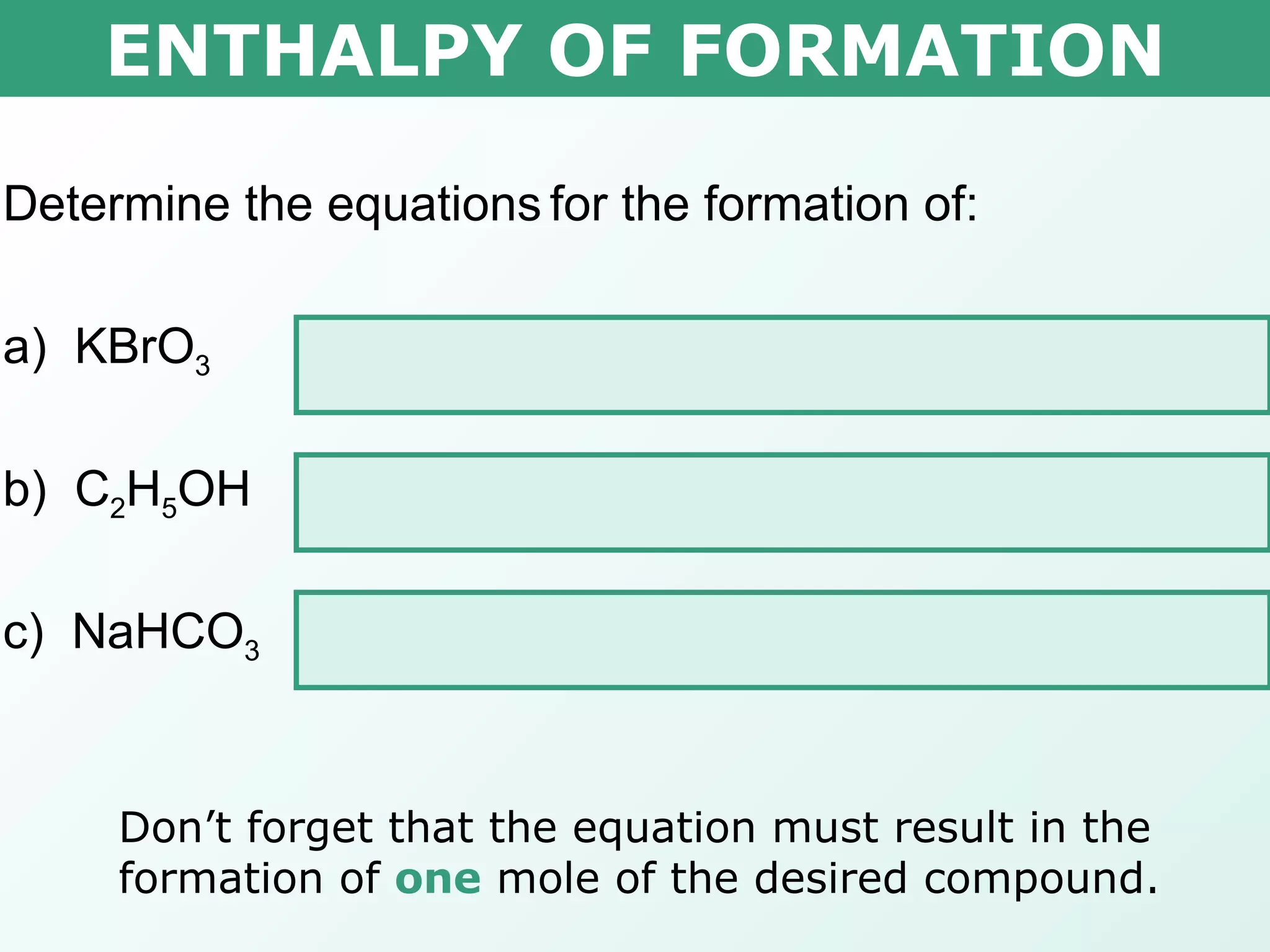
ENTHALPY OF FORMATION Determine the equations   for the formation of: a)  KBrO 3   K (s)  + ½ Br 2(l)  + 3/2 O 2(g)     KBrO 3(s) b)  C 2 H 5 OH  2C (s)  + 3H 2(g)  + 1/2O 2(g)     C 2 H 5 OH (l) c)  NaHCO 3  Na (s)  + ½H 2(g)  + C (s)  + 3/2O 2(g)     NaHCO 3(s) Don’t forget that the equation must result in the formation of  one  mole of the desired compound.
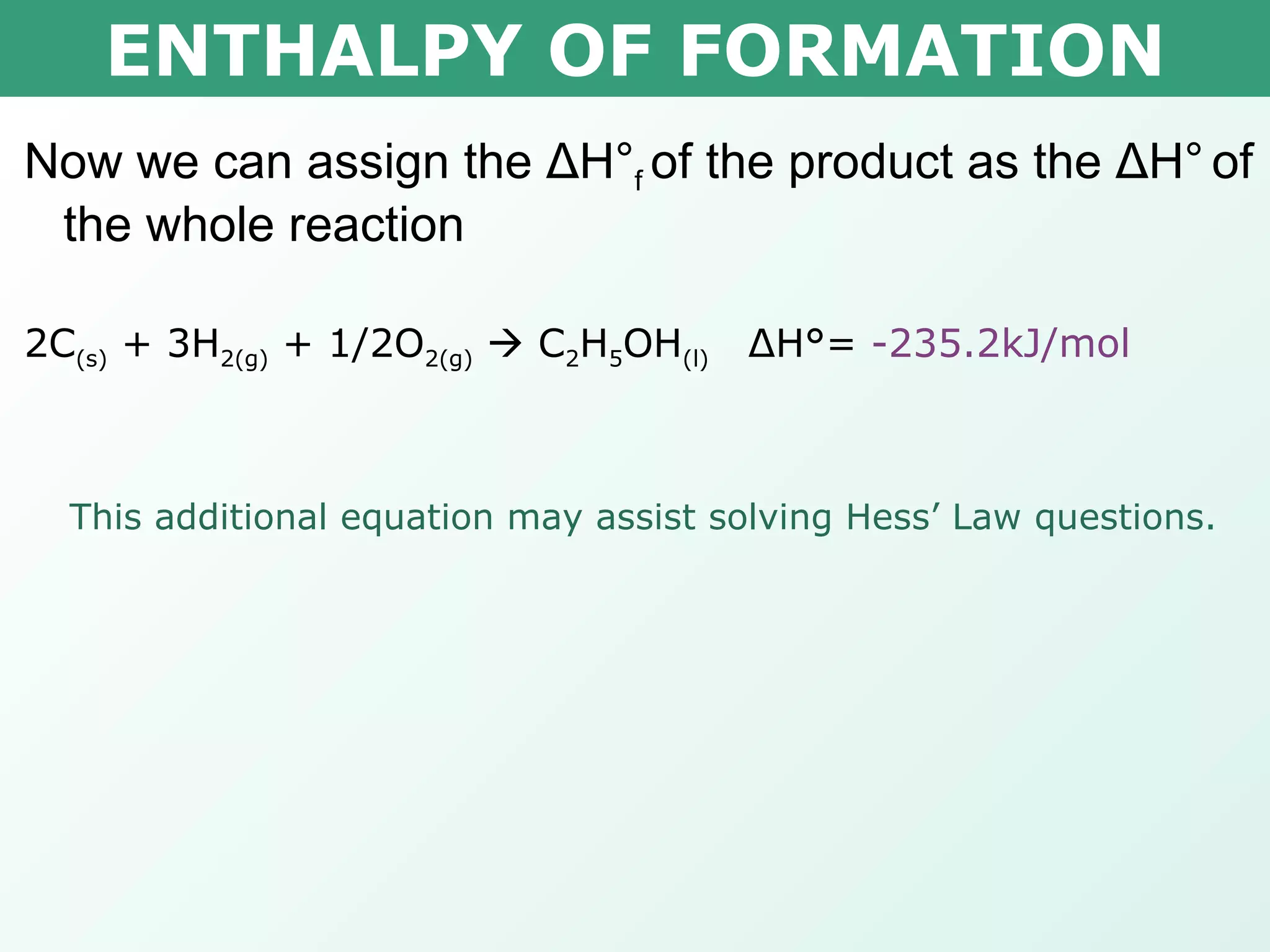
ENTHALPY OF FORMATION Now we can assign the  Δ H° f  of the product as the  Δ H°   of the whole reaction 2C (s)  + 3H 2(g)  + 1/2O 2(g)     C 2 H 5 OH (l)  Δ H°=  -235.2kJ/mol This additional equation may assist solving Hess’ Law questions.
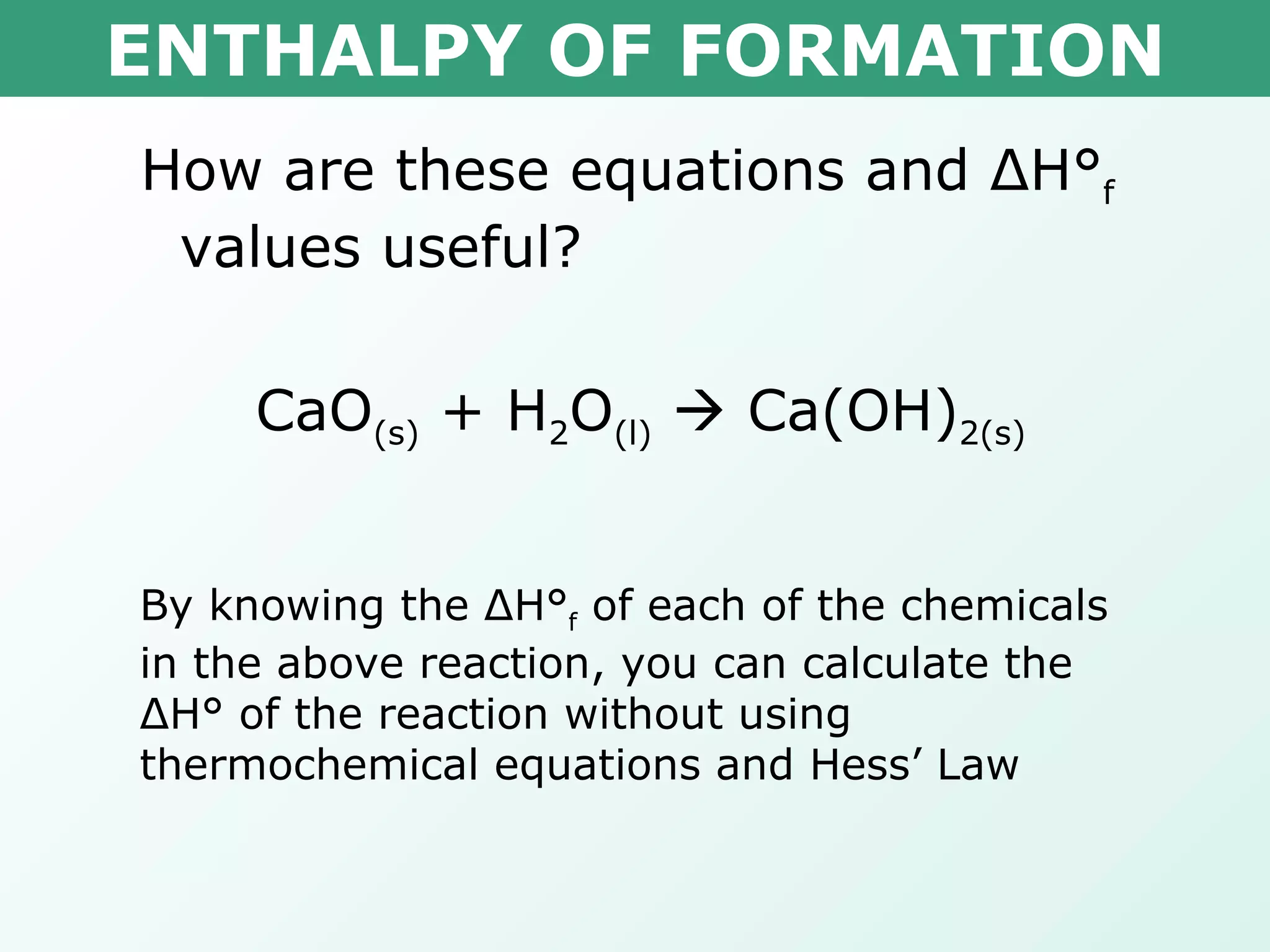
ENTHALPY OF FORMATION How are these equations and  Δ H° f  values useful? CaO (s)  + H 2 O (l)     Ca(OH) 2(s) By knowing the  Δ H° f  of each of the chemicals in the above reaction, you can calculate the  Δ H° of the reaction without using thermochemical equations and Hess’ Law
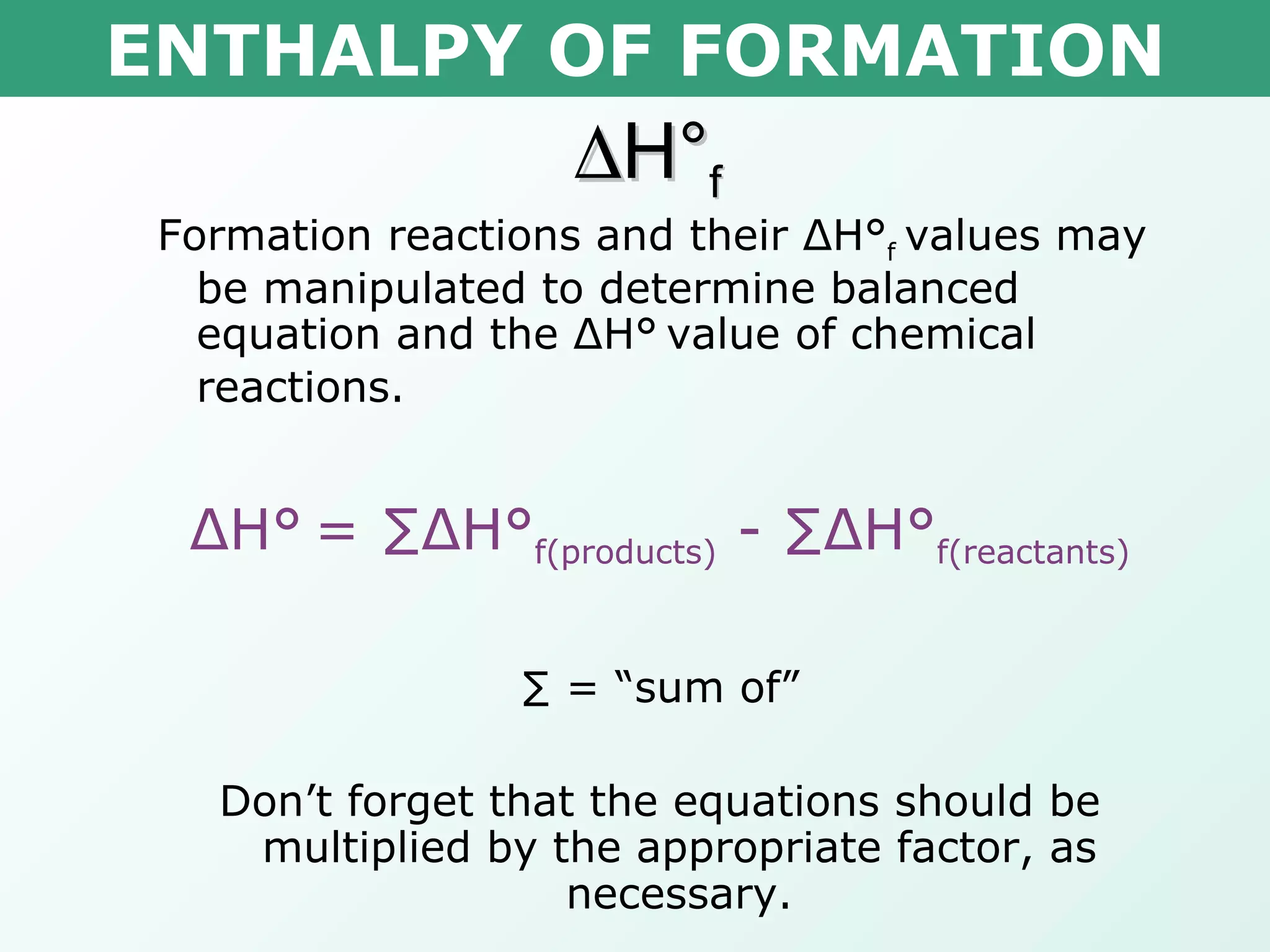
ENTHALPY OF FORMATION  H° f Formation reactions and their  Δ H° f  values may be manipulated to determine balanced equation and the  Δ H°   value of chemical reactions. Δ H°   = ∑ Δ H° f(products)  - ∑ Δ H° f(reactants) ∑  = “sum of” Don’t forget that the equations should be multiplied by the appropriate factor, as necessary.
ENTHALPY OF FORMATION Using  Δ H° f  values, calculate the  Δ H° of combustion of one mole of ethanol to produce carbon dioxide gas and liquid water.  C 2 H 5 OH (l)   +  O 2(g)      CO 2(g)  +  H 2 O (l) 3 2 3 -235.2kJ/mol   0.0000kJ/mol  -393.5kJ/mol  -285.8kJ/mol Δ H° = ∑ Δ H° f(products)  - ∑ Δ H° f(reactants) = [(2 mol x -393.5kJ/mol) + (3 mol x -285.8kJ/mol)]    – [(1 mol x -235.2kJ/mol) + (3 mol x 0.0000kJ/mol)] = -1644.4kJ – (-235.2kJ) = -1409.2kJ Since this equation already combusts 1 mole of ethanol, then the final answer is: Therefore the heat of combustion is -1409kJ/mol of ethanol
ENTHALPY OF FORMATION Using  Δ H° f  values, calculate the  Δ H° for the following reaction: NaOH (s)   +  HCl (g)      NaCl (s)  +  H 2 O (l) -425.6kJ/mol   -92.30kJ/mol  -411.2kJ/mol  -285.8kJ/mol Δ H° = ∑ Δ H° f(products)  - ∑ Δ H° f(reactants) = [(1 mol x –411.2kJ/mol) + (1 mol x -285.8kJ/mol)]    – [(1 mol x -425.6kJ/mol) + (1 mol x -92.30kJ/mol)] = -697.0kJ – (-517.9kJ) = -179.1kJ Therefore the heat of the reaction is -179.1kJ
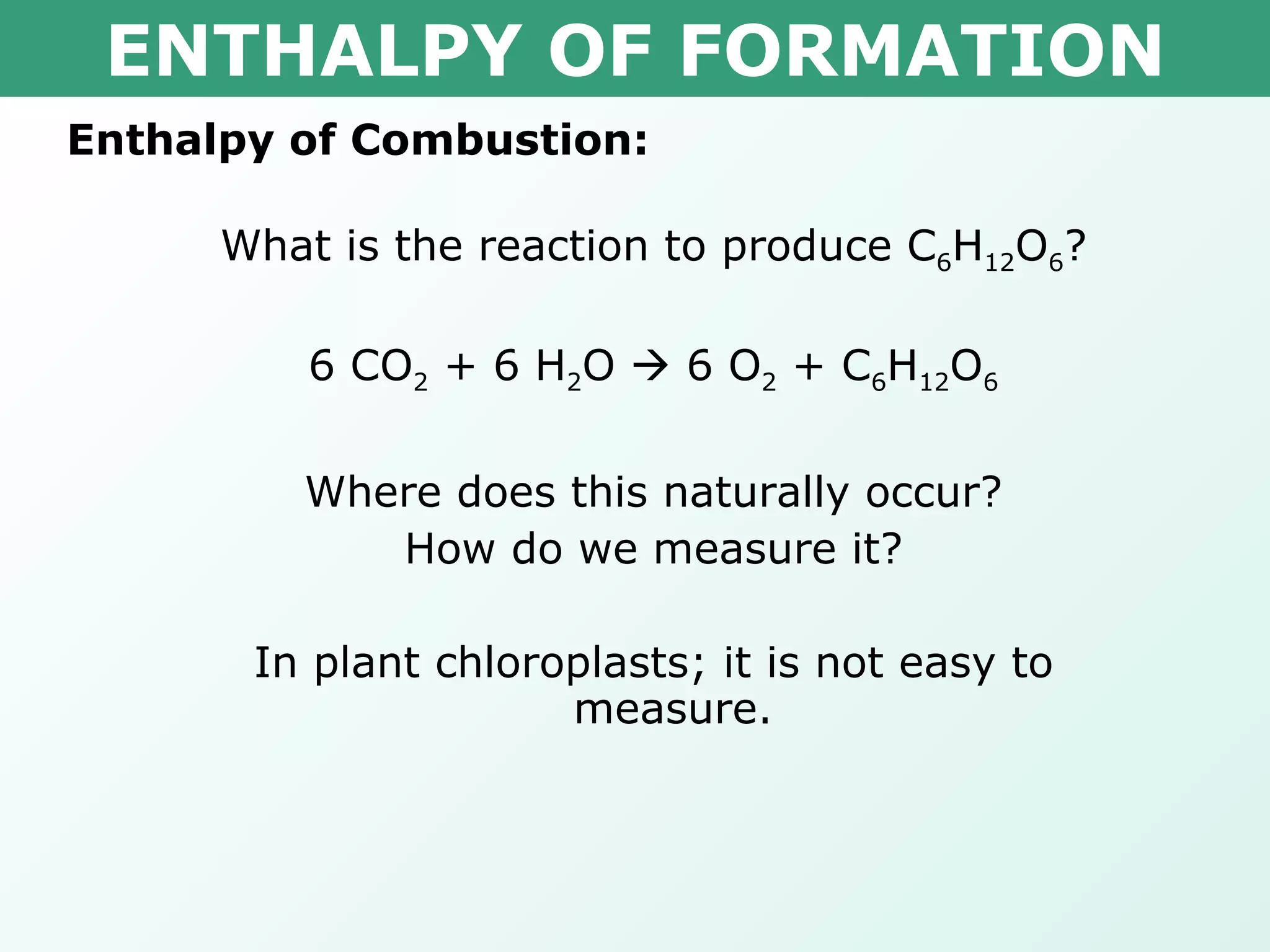
ENTHALPY OF FORMATION Enthalpy of Combustion: What is the reaction to produce C 6 H 12 O 6 ? 6 CO 2  + 6 H 2 O    6 O 2  + C 6 H 12 O 6 Where does this naturally occur? How do we measure it? In plant chloroplasts; it is not easy to measure.
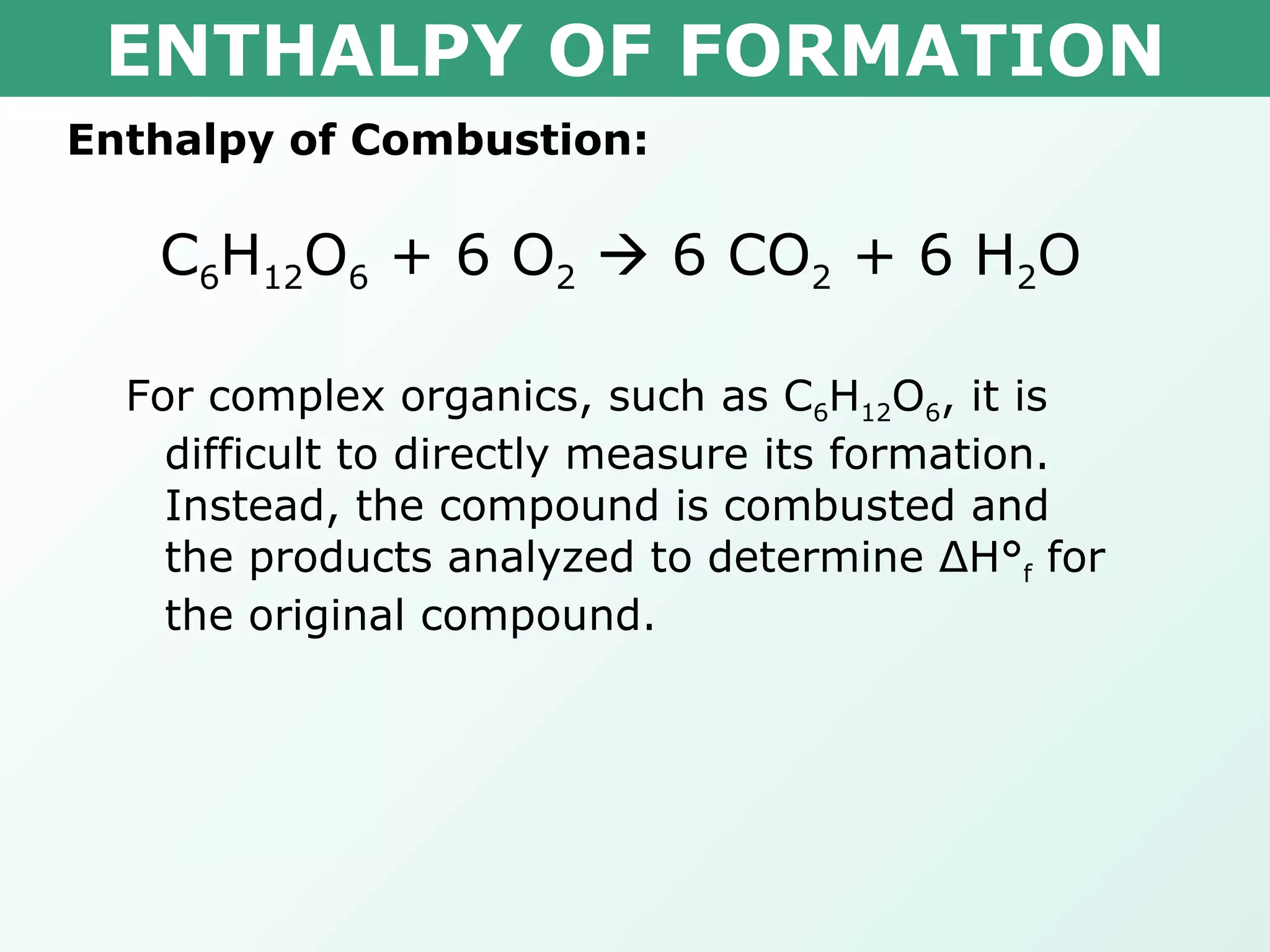
ENTHALPY OF FORMATION Enthalpy of Combustion: C 6 H 12 O 6  + 6 O 2     6 CO 2  + 6 H 2 O   For complex organics, such as C 6 H 12 O 6 , it is difficult to directly measure its formation.  Instead, the compound is combusted and the products analyzed to determine  Δ H° f  for the original compound.
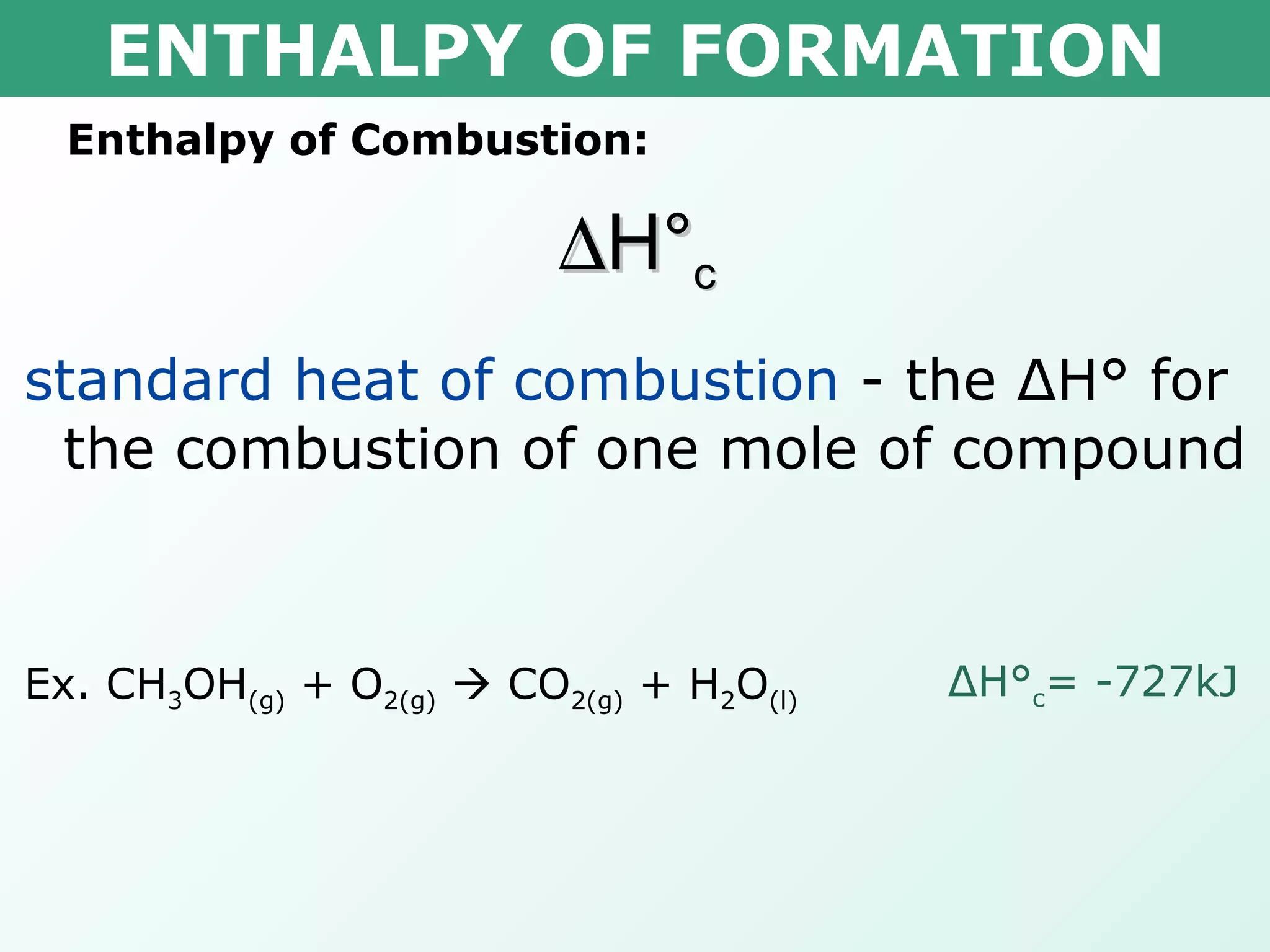
ENTHALPY OF FORMATION Enthalpy of Combustion:  H° c standard heat of combustion  - the  Δ H° for the combustion of one mole of compound Ex. CH 3 OH (g)  + O 2(g)     CO 2(g)  + H 2 O (l) Δ H° c = -727kJ
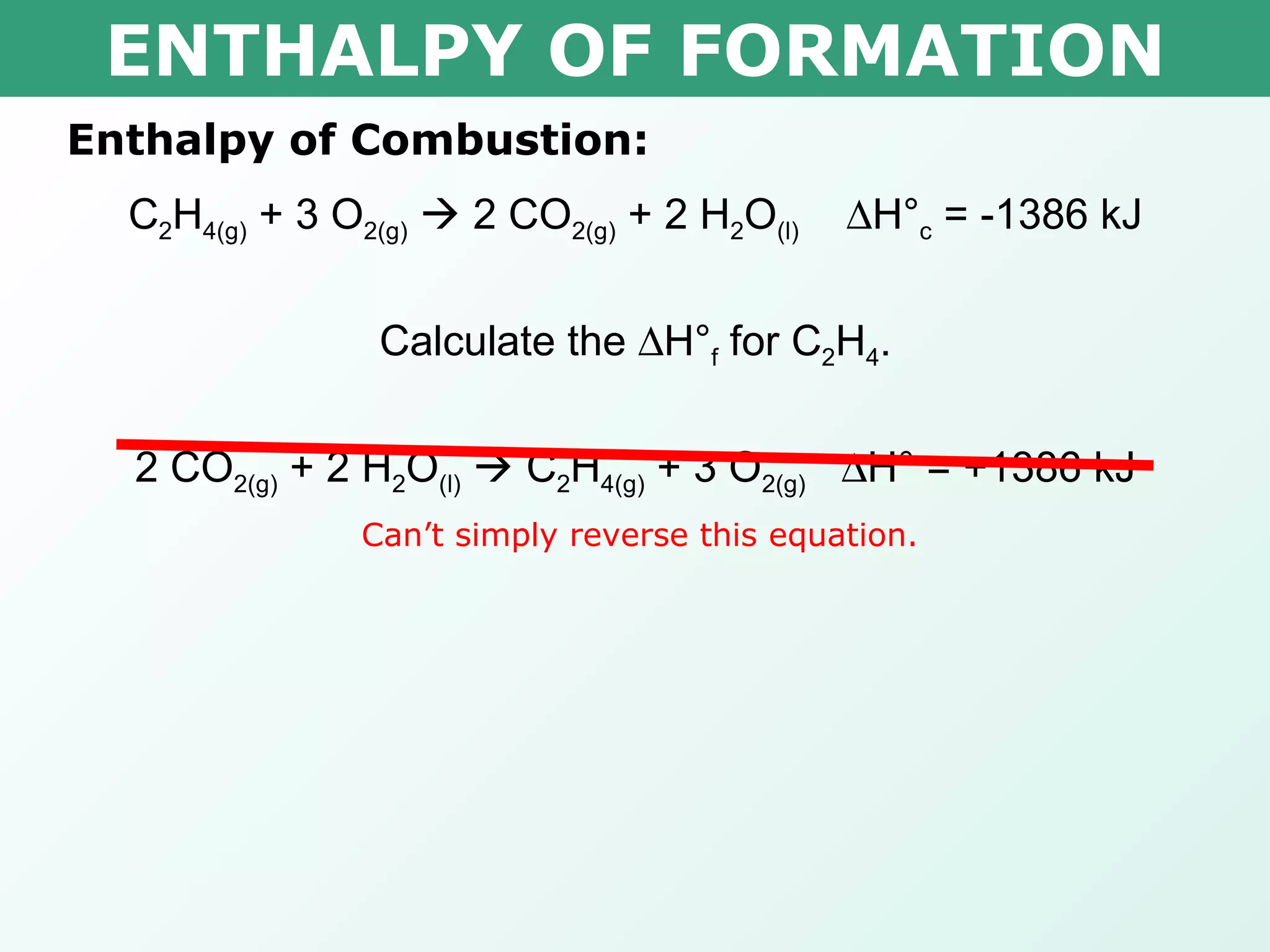
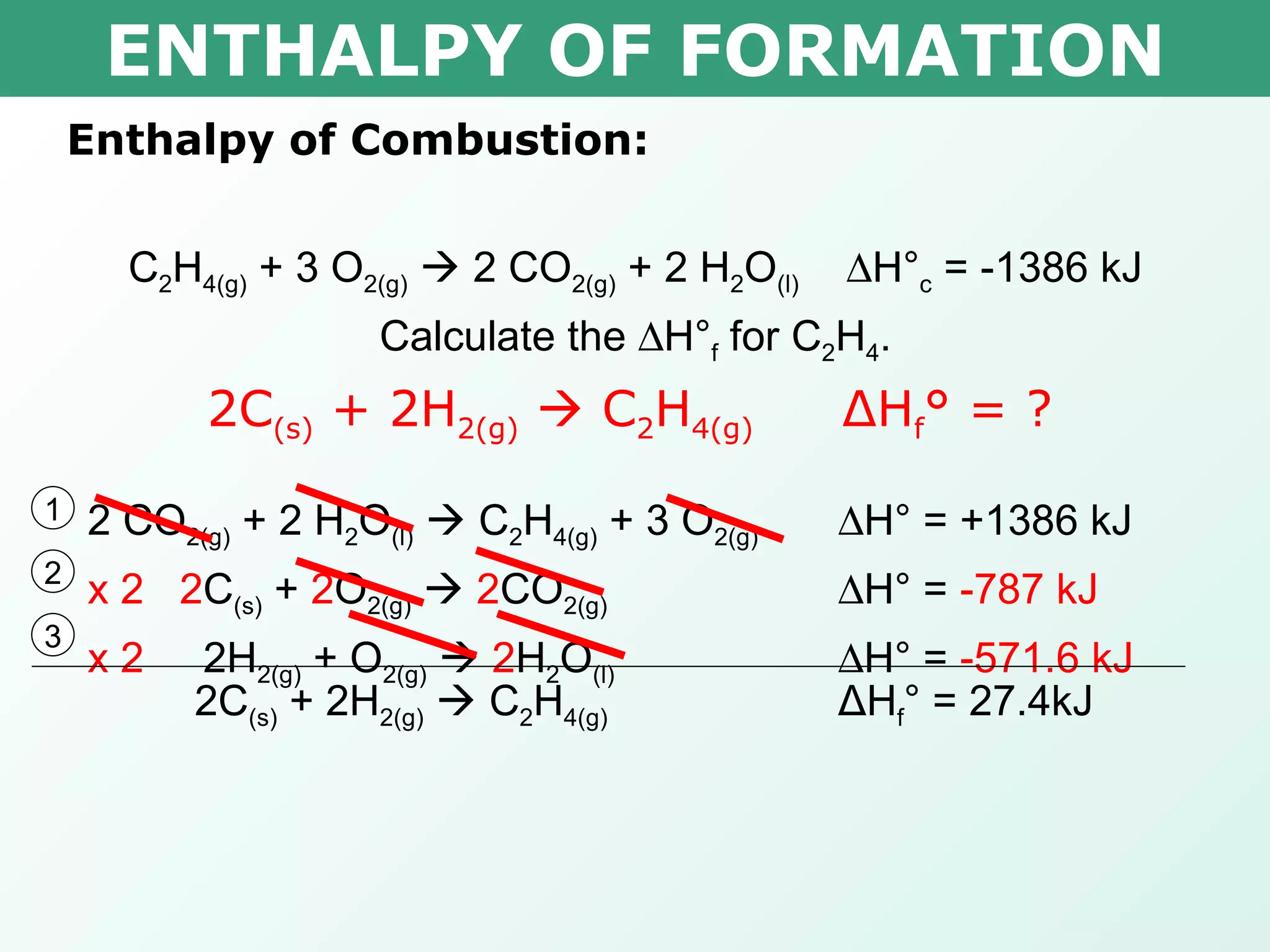
ENTHALPY OF FORMATION Enthalpy of Combustion: C 2 H 4(g)  + 3 O 2(g)     2 CO 2(g)  + 2 H 2 O (l)    H° c  = -1386 kJ Calculate the   H° f  for C 2 H 4 . 2 CO 2(g)  + 2 H 2 O (l)     C 2 H 4(g)  + 3 O 2(g)    H° = +1386 kJ Can’t simply reverse this equation.
ENTHALPY OF FORMATION x   0.000kJ -393.5kJ  -285.8kJ Δ H°   = ∑ Δ H° f(products)  - ∑ Δ H° f(reactants) -1386kJ= [(2 mol x -393.5kJ/mol) + (2 mol x -285.8kJ/mol)]    – [(1 mol x  x ) + (3 mol x 0.000kJ/mol)] -1386kJ= -1358.6kJ –  x   x  = 27.4kJ Therefore the heat of formation is 27.4kJ/mol Calculate the   H° f  for C 2 H 4 . C 2 H 4(g)  + 3 O 2(g)     2 CO 2(g)  + 2 H 2 O (l)    H° c  = -1386 kJ
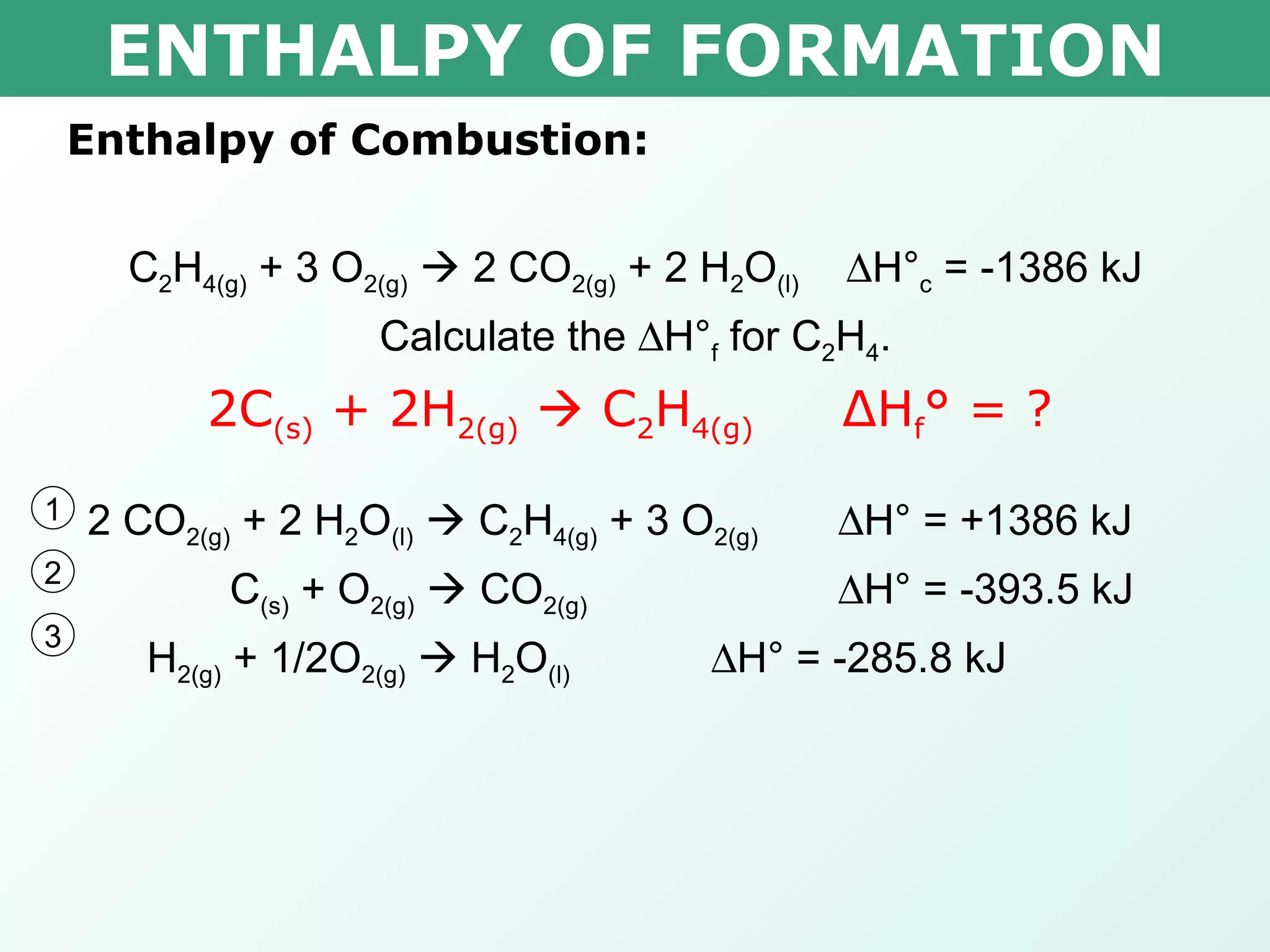
ENTHALPY OF FORMATION Enthalpy of Combustion: C 2 H 4(g)  + 3 O 2(g)     2 CO 2(g)  + 2 H 2 O (l)    H° c  = -1386 kJ Calculate the   H° f  for C 2 H 4 . 2 CO 2(g)  + 2 H 2 O (l)     C 2 H 4(g)  + 3 O 2(g)    H° = +1386 kJ C (s)  + O 2(g)     CO 2(g)  H° = -393.5 kJ H 2(g)  + 1/2O 2(g)     H 2 O (l)  H° = -285.8 kJ 2C (s)  + 2H 2(g)     C 2 H 4(g)  Δ H f ° = ? 1 2 3
ENTHALPY OF FORMATION Enthalpy of Combustion: C 2 H 4(g)  + 3 O 2(g)     2 CO 2(g)  + 2 H 2 O (l)    H° c  = -1386 kJ Calculate the   H° f  for C 2 H 4 . 2 CO 2(g)  + 2 H 2 O (l)     C 2 H 4(g)  + 3 O 2(g)    H° = +1386 kJ x 2   2 C (s)  +  2 O 2(g)      2 CO 2(g)    H° =  -787 kJ x 2   2H 2(g)  + O 2(g)      2 H 2 O (l)  H° =  -571.6 kJ 2C (s)  + 2H 2(g)     C 2 H 4(g)  Δ H f ° = ? 1 2 3 2C (s)  + 2H 2(g)     C 2 H 4(g)  Δ H f ° = 27.4kJ
ENTHALPY OF FORMATION

Tang 03 enthalpy of formation and combustion

  • 1.
  • 2.
    ENTHALPY OF FORMATIONStandard enthalpy of formation ( Δ H f °): Also called the standard heat of formation of a substance Standard heat of formation: The amount of heat absorbed or released when one mole of the substance is formed at 25°C and 100kPa (SATP) from its elements in their standard states Δ H f ° units are always in kJ/mol
  • 3.
    ENTHALPY OF FORMATIONStandard heat of formation: The amount of heat absorbed or released when one mole of the substance is formed at 25°C and 100kPa (SATP) from its elements in their standard states Example: What equation represents the formation of nitric acid? Nitric acid = HNO 3(l) hydrogen nitrogen oxygen Elements: What are these elements in their standard (most common) states? ½ H 2(g) + ½ N 2(g) + 3/2 O 2(g)  HNO 3(l)
  • 4.
    ENTHALPY OF FORMATIONThe Δ H f ° for elements in their standard states are zero
  • 5.
    ENTHALPY OF FORMATIONDetermine the equations for the formation of: a) KBrO 3 K (s) + ½ Br 2(l) + 3/2 O 2(g)  KBrO 3(s) b) C 2 H 5 OH 2C (s) + 3H 2(g) + 1/2O 2(g)  C 2 H 5 OH (l) c) NaHCO 3 Na (s) + ½H 2(g) + C (s) + 3/2O 2(g)  NaHCO 3(s) Don’t forget that the equation must result in the formation of one mole of the desired compound.
  • 6.
    ENTHALPY OF FORMATIONNow we can assign the Δ H° f of the product as the Δ H° of the whole reaction 2C (s) + 3H 2(g) + 1/2O 2(g)  C 2 H 5 OH (l) Δ H°= -235.2kJ/mol This additional equation may assist solving Hess’ Law questions.
  • 7.
    ENTHALPY OF FORMATIONHow are these equations and Δ H° f values useful? CaO (s) + H 2 O (l)  Ca(OH) 2(s) By knowing the Δ H° f of each of the chemicals in the above reaction, you can calculate the Δ H° of the reaction without using thermochemical equations and Hess’ Law
  • 8.
    ENTHALPY OF FORMATION H° f Formation reactions and their Δ H° f values may be manipulated to determine balanced equation and the Δ H° value of chemical reactions. Δ H° = ∑ Δ H° f(products) - ∑ Δ H° f(reactants) ∑ = “sum of” Don’t forget that the equations should be multiplied by the appropriate factor, as necessary.
  • 9.
    ENTHALPY OF FORMATIONUsing Δ H° f values, calculate the Δ H° of combustion of one mole of ethanol to produce carbon dioxide gas and liquid water. C 2 H 5 OH (l) + O 2(g)  CO 2(g) + H 2 O (l) 3 2 3 -235.2kJ/mol 0.0000kJ/mol -393.5kJ/mol -285.8kJ/mol Δ H° = ∑ Δ H° f(products) - ∑ Δ H° f(reactants) = [(2 mol x -393.5kJ/mol) + (3 mol x -285.8kJ/mol)] – [(1 mol x -235.2kJ/mol) + (3 mol x 0.0000kJ/mol)] = -1644.4kJ – (-235.2kJ) = -1409.2kJ Since this equation already combusts 1 mole of ethanol, then the final answer is: Therefore the heat of combustion is -1409kJ/mol of ethanol
  • 10.
    ENTHALPY OF FORMATIONUsing Δ H° f values, calculate the Δ H° for the following reaction: NaOH (s) + HCl (g)  NaCl (s) + H 2 O (l) -425.6kJ/mol -92.30kJ/mol -411.2kJ/mol -285.8kJ/mol Δ H° = ∑ Δ H° f(products) - ∑ Δ H° f(reactants) = [(1 mol x –411.2kJ/mol) + (1 mol x -285.8kJ/mol)] – [(1 mol x -425.6kJ/mol) + (1 mol x -92.30kJ/mol)] = -697.0kJ – (-517.9kJ) = -179.1kJ Therefore the heat of the reaction is -179.1kJ
  • 11.
    ENTHALPY OF FORMATIONEnthalpy of Combustion: What is the reaction to produce C 6 H 12 O 6 ? 6 CO 2 + 6 H 2 O  6 O 2 + C 6 H 12 O 6 Where does this naturally occur? How do we measure it? In plant chloroplasts; it is not easy to measure.
  • 12.
    ENTHALPY OF FORMATIONEnthalpy of Combustion: C 6 H 12 O 6 + 6 O 2  6 CO 2 + 6 H 2 O For complex organics, such as C 6 H 12 O 6 , it is difficult to directly measure its formation. Instead, the compound is combusted and the products analyzed to determine Δ H° f for the original compound.
  • 13.
    ENTHALPY OF FORMATIONEnthalpy of Combustion:  H° c standard heat of combustion - the Δ H° for the combustion of one mole of compound Ex. CH 3 OH (g) + O 2(g)  CO 2(g) + H 2 O (l) Δ H° c = -727kJ
  • 14.
    ENTHALPY OF FORMATIONEnthalpy of Combustion: C 2 H 4(g) + 3 O 2(g)  2 CO 2(g) + 2 H 2 O (l)  H° c = -1386 kJ Calculate the  H° f for C 2 H 4 . 2 CO 2(g) + 2 H 2 O (l)  C 2 H 4(g) + 3 O 2(g)  H° = +1386 kJ Can’t simply reverse this equation.
  • 15.
    ENTHALPY OF FORMATIONx 0.000kJ -393.5kJ -285.8kJ Δ H° = ∑ Δ H° f(products) - ∑ Δ H° f(reactants) -1386kJ= [(2 mol x -393.5kJ/mol) + (2 mol x -285.8kJ/mol)] – [(1 mol x x ) + (3 mol x 0.000kJ/mol)] -1386kJ= -1358.6kJ – x x = 27.4kJ Therefore the heat of formation is 27.4kJ/mol Calculate the  H° f for C 2 H 4 . C 2 H 4(g) + 3 O 2(g)  2 CO 2(g) + 2 H 2 O (l)  H° c = -1386 kJ
  • 16.
    ENTHALPY OF FORMATIONEnthalpy of Combustion: C 2 H 4(g) + 3 O 2(g)  2 CO 2(g) + 2 H 2 O (l)  H° c = -1386 kJ Calculate the  H° f for C 2 H 4 . 2 CO 2(g) + 2 H 2 O (l)  C 2 H 4(g) + 3 O 2(g)  H° = +1386 kJ C (s) + O 2(g)  CO 2(g)  H° = -393.5 kJ H 2(g) + 1/2O 2(g)  H 2 O (l)  H° = -285.8 kJ 2C (s) + 2H 2(g)  C 2 H 4(g) Δ H f ° = ? 1 2 3
  • 17.
    ENTHALPY OF FORMATIONEnthalpy of Combustion: C 2 H 4(g) + 3 O 2(g)  2 CO 2(g) + 2 H 2 O (l)  H° c = -1386 kJ Calculate the  H° f for C 2 H 4 . 2 CO 2(g) + 2 H 2 O (l)  C 2 H 4(g) + 3 O 2(g)  H° = +1386 kJ x 2 2 C (s) + 2 O 2(g)  2 CO 2(g)  H° = -787 kJ x 2 2H 2(g) + O 2(g)  2 H 2 O (l)  H° = -571.6 kJ 2C (s) + 2H 2(g)  C 2 H 4(g) Δ H f ° = ? 1 2 3 2C (s) + 2H 2(g)  C 2 H 4(g) Δ H f ° = 27.4kJ
  • 18.