Chemical Engineering Thermodynamics
-II(2150503)
GUJARAT
TECHNOLOGICAL
UNIVERSITY
Fugacity & Fugacity Coefficient
Fugacity & Fugacity
Coefficient
Contents
1. Introduction
2. Concepts of Fugacity
3. Effect of Temperature & pressure on Fugacity
4. Important relation of Fugacity Coefficient
5. Vapour Liquid Equilibrium for pure species
6. Fugacity & Fugacity coefficient: Species in solution
7. Reference
INTRODUCTION
• The concept of Fugacity was introduced by Gilbert
Newton Lewis.
• Fugacity is widely used in solution thermodynamics to
represent the behaviour of real gases.
 Fugacity is derived from Latin word ‘fleetness’ or the
‘Escaping Tendency’.
Fugacity has been used extensively in the study of phase
and chemical reaction equlibria involving gases at high
pressures.
Concepts of Fugacity
 For an infinitesimal reversible change occurring
in the system under isothermal condition
dG = -SdT + VdP reduces to,
dG = VdP
 For one mole of an ideal gas V in the above
equation may be replaced by RT/P,
dG = RT (dP/P) = RT d(ln P)
 Above equation is applicable only to ideal gas.
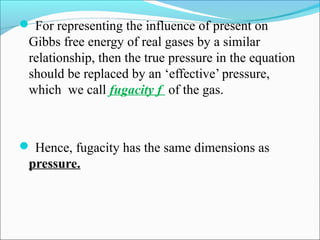
 For representing the influence of present on
Gibbs free energy of real gases by a similar
relationship, then the true pressure in the equation
should be replaced by an ‘effective’ pressure,
which we call fugacity f of the gas.
 Hence, fugacity has the same dimensions as
pressure.
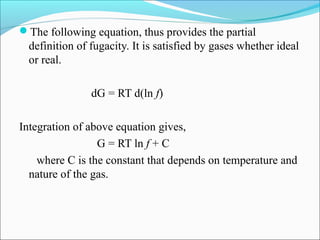
The following equation, thus provides the partial
definition of fugacity. It is satisfied by gases whether ideal
or real.
dG = RT d(ln f)
Integration of above equation gives,
G = RT ln f + C
where C is the constant that depends on temperature and
nature of the gas.
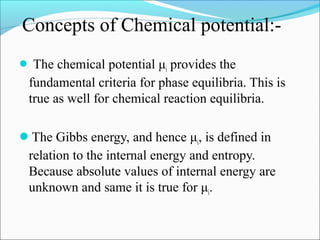
Concepts of Chemical potential:-
 The chemical potential μi provides the
fundamental criteria for phase equilibria. This is
true as well for chemical reaction equilibria.
The Gibbs energy, and hence μi, is defined in
relation to the internal energy and entropy.
Because absolute values of internal energy are
unknown and same it is true for μi.
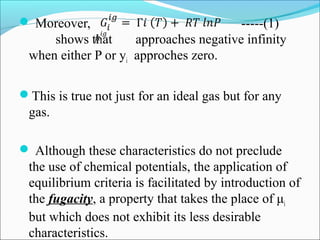
 Moreover, -----(1)
shows that approaches negative infinity
when either P or yi approches zero.
This is true not just for an ideal gas but for any
gas.
 Although these characteristics do not preclude
the use of chemical potentials, the application of
equilibrium criteria is facilitated by introduction of
the fugacity, a property that takes the place of μi
but which does not exhibit its less desirable
characteristics.
 The origin of the fugacity concept resides in
equation-1, valid only for pure species i in the
ideal-gas state.
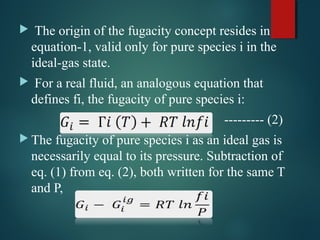
 For a real fluid, an analogous equation that
defines fi, the fugacity of pure species i:
--------- (2)
 The fugacity of pure species i as an ideal gas is
necessarily equal to its pressure. Subtraction of
eq. (1) from eq. (2), both written for the same T
and P,
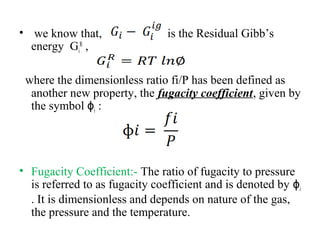
• we know that, is the Residual Gibb’s
energy Gi
R
,
where the dimensionless ratio fi/P has been defined as
another new property, the fugacity coefficient, given by
the symbol ɸi :
• Fugacity Coefficient:- The ratio of fugacity to pressure
is referred to as fugacity coefficient and is denoted by ɸi
. It is dimensionless and depends on nature of the gas,
the pressure and the temperature.
Effect of Temperature &
Pressure on Fugacity
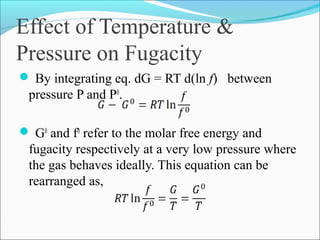
 By integrating eq. dG = RT d(ln f) between
pressure P and P0
.
 G0
and f0
refer to the molar free energy and
fugacity respectively at a very low pressure where
the gas behaves ideally. This equation can be
rearranged as,
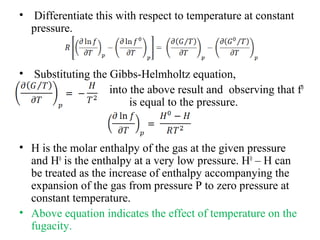
• Differentiate this with respect to temperature at constant
pressure.
• Substituting the Gibbs-Helmholtz equation,
into the above result and observing that f0
is equal to the pressure.
• H is the molar enthalpy of the gas at the given pressure
and H0
is the enthalpy at a very low pressure. H0
– H can
be treated as the increase of enthalpy accompanying the
expansion of the gas from pressure P to zero pressure at
constant temperature.
• Above equation indicates the effect of temperature on the
fugacity.
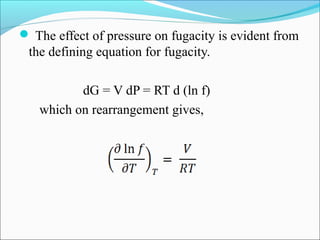
 The effect of pressure on fugacity is evident from
the defining equation for fugacity.
dG = V dP = RT d (ln f)
which on rearrangement gives,
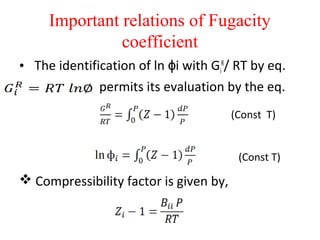
Important relations of Fugacity
coefficient
• The identification of ln i with Gɸ i
R
/ RT by eq.
permits its evaluation by the eq.
 Compressibility factor is given by,
(Const T)
(Const T)
Fugacity & Fugacity coefficient:
Species in solution
• The definition of the fugacity of a species in
solution is parallel to the definition of the pure
species fugacity. For a species i in a mixture of
real gases or in a solution of liquids,
-----------(A)
where fi
^
is the fugacity of species i in
solution, replacing the partial pressure yiP.
• This does not make it a partial molar property,
therefore identified by circumflex rather than by
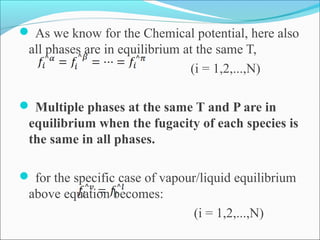
 As we know for the Chemical potential, here also
all phases are in equilibrium at the same T,
(i = 1,2,...,N)
 Multiple phases at the same T and P are in
equilibrium when the fugacity of each species is
the same in all phases.
 for the specific case of vapour/liquid equilibrium
above equation becomes:
(i = 1,2,...,N)
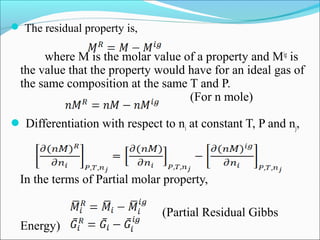
 The residual property is,
where M is the molar value of a property and Mig
is
the value that the property would have for an ideal gas of
the same composition at the same T and P.
(For n mole)
 Differentiation with respect to ni at constant T, P and nj,
In the terms of Partial molar property,
(Partial Residual Gibbs
Energy)
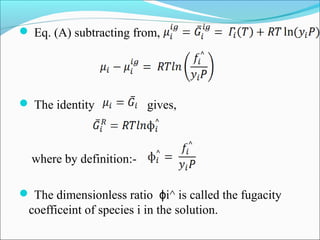
 Eq. (A) subtracting from,
 The identity gives,
where by definition:-
 The dimensionless ratio i^ is called the fugacityɸ
coefficeint of species i in the solution.
Fugacity & fugacity coefficient

Fugacity & fugacity coefficient

  • 1.
  • 2.
  • 3.
    Contents 1. Introduction 2. Conceptsof Fugacity 3. Effect of Temperature & pressure on Fugacity 4. Important relation of Fugacity Coefficient 5. Vapour Liquid Equilibrium for pure species 6. Fugacity & Fugacity coefficient: Species in solution 7. Reference
  • 4.
    INTRODUCTION • The conceptof Fugacity was introduced by Gilbert Newton Lewis. • Fugacity is widely used in solution thermodynamics to represent the behaviour of real gases.
  • 5.
     Fugacity isderived from Latin word ‘fleetness’ or the ‘Escaping Tendency’. Fugacity has been used extensively in the study of phase and chemical reaction equlibria involving gases at high pressures.
  • 6.
    Concepts of Fugacity For an infinitesimal reversible change occurring in the system under isothermal condition dG = -SdT + VdP reduces to, dG = VdP  For one mole of an ideal gas V in the above equation may be replaced by RT/P, dG = RT (dP/P) = RT d(ln P)  Above equation is applicable only to ideal gas.
  • 7.
     For representingthe influence of present on Gibbs free energy of real gases by a similar relationship, then the true pressure in the equation should be replaced by an ‘effective’ pressure, which we call fugacity f of the gas.  Hence, fugacity has the same dimensions as pressure.
  • 8.
    The following equation,thus provides the partial definition of fugacity. It is satisfied by gases whether ideal or real. dG = RT d(ln f) Integration of above equation gives, G = RT ln f + C where C is the constant that depends on temperature and nature of the gas.
  • 9.
    Concepts of Chemicalpotential:-  The chemical potential μi provides the fundamental criteria for phase equilibria. This is true as well for chemical reaction equilibria. The Gibbs energy, and hence μi, is defined in relation to the internal energy and entropy. Because absolute values of internal energy are unknown and same it is true for μi.
  • 10.
     Moreover, -----(1) showsthat approaches negative infinity when either P or yi approches zero. This is true not just for an ideal gas but for any gas.  Although these characteristics do not preclude the use of chemical potentials, the application of equilibrium criteria is facilitated by introduction of the fugacity, a property that takes the place of μi but which does not exhibit its less desirable characteristics.
  • 11.
     The originof the fugacity concept resides in equation-1, valid only for pure species i in the ideal-gas state.  For a real fluid, an analogous equation that defines fi, the fugacity of pure species i: --------- (2)  The fugacity of pure species i as an ideal gas is necessarily equal to its pressure. Subtraction of eq. (1) from eq. (2), both written for the same T and P,
  • 12.
    • we knowthat, is the Residual Gibb’s energy Gi R , where the dimensionless ratio fi/P has been defined as another new property, the fugacity coefficient, given by the symbol ɸi : • Fugacity Coefficient:- The ratio of fugacity to pressure is referred to as fugacity coefficient and is denoted by ɸi . It is dimensionless and depends on nature of the gas, the pressure and the temperature.
  • 13.
    Effect of Temperature& Pressure on Fugacity  By integrating eq. dG = RT d(ln f) between pressure P and P0 .  G0 and f0 refer to the molar free energy and fugacity respectively at a very low pressure where the gas behaves ideally. This equation can be rearranged as,
  • 14.
    • Differentiate thiswith respect to temperature at constant pressure. • Substituting the Gibbs-Helmholtz equation, into the above result and observing that f0 is equal to the pressure. • H is the molar enthalpy of the gas at the given pressure and H0 is the enthalpy at a very low pressure. H0 – H can be treated as the increase of enthalpy accompanying the expansion of the gas from pressure P to zero pressure at constant temperature. • Above equation indicates the effect of temperature on the fugacity.
  • 15.
     The effectof pressure on fugacity is evident from the defining equation for fugacity. dG = V dP = RT d (ln f) which on rearrangement gives,
  • 16.
    Important relations ofFugacity coefficient • The identification of ln i with Gɸ i R / RT by eq. permits its evaluation by the eq.  Compressibility factor is given by, (Const T) (Const T)
  • 17.
    Fugacity & Fugacitycoefficient: Species in solution • The definition of the fugacity of a species in solution is parallel to the definition of the pure species fugacity. For a species i in a mixture of real gases or in a solution of liquids, -----------(A) where fi ^ is the fugacity of species i in solution, replacing the partial pressure yiP. • This does not make it a partial molar property, therefore identified by circumflex rather than by
  • 18.
     As weknow for the Chemical potential, here also all phases are in equilibrium at the same T, (i = 1,2,...,N)  Multiple phases at the same T and P are in equilibrium when the fugacity of each species is the same in all phases.  for the specific case of vapour/liquid equilibrium above equation becomes: (i = 1,2,...,N)
  • 19.
     The residualproperty is, where M is the molar value of a property and Mig is the value that the property would have for an ideal gas of the same composition at the same T and P. (For n mole)  Differentiation with respect to ni at constant T, P and nj, In the terms of Partial molar property, (Partial Residual Gibbs Energy)
  • 20.
     Eq. (A)subtracting from,  The identity gives, where by definition:-  The dimensionless ratio i^ is called the fugacityɸ coefficeint of species i in the solution.