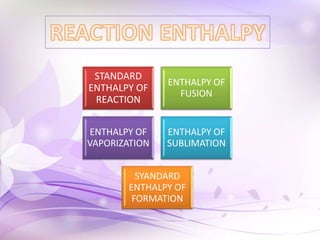
STANDARD
ENTHALPY OF
REACTION
ENTHALPY OF
FUSION
ENTHALPY OF
VAPORIZATION
ENTHALPY OF
SUBLIMATION
SYANDARD
ENTHALPY OF
FORMATION
Standard enthalpy of reaction
The standard enthalpy of reaction is the enthalpy change for a reaction when all the
participating substances are in their standard states. The standard state of a substance at a
specified temperature is its pure form at 1 bar.
ENTHALPY OF FUSION
The enthalpy change that accompanies melting of one mole of a solid substance in standard
state is called standard enthalpy of fusion or molar enthalpy of Fusion.
ENTHALPY OF VAPORIZATION
Amount of heat required to vaporize one mole of a liquid at constant temperature and under
standard pressure (1bar) is called its standard enthalpy of vaporization or molar enthalpy of
vaporization.
ENTHALPY OF SUBLIMATION
Standard enthalpy of sublimation, is the change in enthalpy when one mole of a solid
substance sublimes at a constant temperature and under standard pressure (1bar).
STANDARD ENTHALPY OF FORMATION
The standard enthalpy change for the formation of one mole of a compound from its
elements in their most stable states of aggregation (also known as reference states) is
called Standard Molar Enthalpy of Formation.
EXAMPLE OF STANDARD ENTHALPY
OF FORMATION
Q.1 WHY THE GIVEN ENTHLPY OF REACTION IS NOT THE ENTHALPY OF FORMATION
OF CaCO3?
CaO(s) + CO (g)→ CaCO3 (s) ; ENTHALPY OF REACTION = −1 178.3kJ /mol
ANS: Given reaction enthalpy is not an enthalpy of formation of calcium carbonate :-
Since calcium carbonate has been formed from other compounds, and not from
it constituent elements.
Q.2 WHY THE FOLLOWING REACTION ‘S ENTHALPY IS NOT THE ENTHALPY OF
FORMATION OF HBr?
ANS: For the reaction given below reaction enthalpy is not the enthalpy of formation
because here two moles, instead of one mole of the product is formed from
the elements.
INSTANT QUESTIONS
ENTHALPY CHANGE DURING EXOTHERMIC AND
ENDOTHERMIC REACTION
NECESSARY CONVENTION REGARDING
THERMODYNAMICAL EQUATIONS
1) Coefficient in a balanced thermo chemical equation refer to the number of
moles (never molecules) of reactants and products involved in the reaction.
2) The numerical value of standard enthalpy of reaction refers to the number
of moles of substances specified by an equation. Standard enthalpy change will
have units as kJ mol–1.
3) When a chemical equation is reversed, the value of standard enthalpy of
reaction is reversed in sign.
Example: N2 (g) 3H2 (g)→ 2NH3 (g); standard enthlpy of reaction = 91.8KJ/mol
2NH3 (g) → N2 (g) 3H2 (g); standard enthlpy of reaction = 91.8KJ/mol
# NOTE:- ENTHALPY IS AN EXTENSIVE QUANTITY
If a reaction takes place in several steps then its standard reaction
enthalpy is the sum of the standard enthalpies of the intermediate
reactions into which the overall reaction may be divided at the same
temperature.
EXAMPLE OF HEES’S LAW
STANDARD
ENTHALPY OF
COMBUSTION
ENTHALPY OF
ATOMIZATION
BOND
DISSOCIATION
ENTHALPY
ENTHALPY OF
SOLUTION
LATTICE
ENTHALPY
1) STANDARD ENTHALPY OF COMBUSTION
Standard enthalpy of combustion is defined as the enthalpy change
per mole (or per unit amount) of a substance, when it undergoes
combustion and all the reactants and products being in their
standard states at the specified temperature.
2) ENTHALPY OF atomization
It is the enthalpy change on breaking one mole of bonds completely
to obtain atoms in the GAS PHASE.
NOTE:- In case of diatomic molecules, like dihydrogen, the enthalpy
of atomization is also the bond dissociation enthalpy.
3) BOND DISSOCIATION ENTHALPY
The bond dissociation enthalpy is the change in enthalpy when one mole of covalent
bonds of a gaseous covalent compound is broken to form products in the gas phase.
bond enthalpies of the reactants and
products in gas phase reactions
STANDARD ENTHALPY OF REACTION = Σ BOND ENTHALPIES OF
REACTANTS - Σ BOND ENTHALPIES OF
PRODUCTS
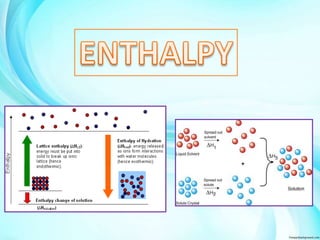
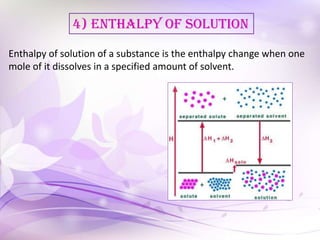
4) ENTHALPY OF SOLUTION
Enthalpy of solution of a substance is the enthalpy change when one
mole of it dissolves in a specified amount of solvent.
LATTICE ENTHALPY
The lattice enthalpy of an ionic compound is the enthalpy change which
occurs when one mole of an ionic compound dissociates into its ions in
gaseous state.
BORN HABER CYCLE 
SOME IMPORTANT QUESTIONS
Q.1) Given that bond energies of H-H and Cl-Cl are 430 kJ/mol and 240 kJ/mol respectively and
enthalpy of formation of HCl is -90 kJ/mol, then find bond enthalpy of HCl.
Ans:-425 kJ/mol
Q.2) The reaction of cyanamide, NH2CN (s), with dioxygen was carried out in a bomb
calorimeter, and ΔU was found to be –742.7 kJ mol–1 at 298 K. Calculate enthalpy change
for the reaction at 298 K.
NH2CN(g) +3/2 O2(g) → N2(g) + CO2(g) + H2O(l)
Q.3) The enthalpy of combustion of methane, graphite and dihydrogen at 298 K are, –890.3 kJ
mol–1 –393.5 kJ mol–1, and –285.8 kJ mol–1 respectively. Enthalpy of formation of CH4(g)
will be how much?
Q.4) Calculate the number of kJ of heat necessary to raise the temperature of 60.0 g of
aluminium from 35°C to 55°C. Molar heat capacity of Al is 24 J /mol/ K.
Q.5) Enthalpy of combustion of carbon to CO2 is –393.5 kJ mol–1. Calculate the heat released
upon formation of 35.2 g of CO2 from carbon and dioxygen gas.
Q.6) The combustion of one mole of benzene takes place at 298 K and 1 atm. After combustion,
CO2(g) and H2O (1) are produced and 3267.0 kJ of heat is liberated. Calculate the standard
enthalpy of formation, of benzene. Standard enthalpies of formation of CO2(g) and H2O( l )
are - 393.5 kJ mol–1 and – 285.83 kJ mol–1 respectively.
Q.7) Define the standard enthalpy of (i) combustion, ΔH
θc, and (ii) formation, ΔHθ
f
Q.8) Given the following standard enthalpies of combustion, ΔHθ
c (298K, 1 atm)C(s) -393
kJmol-1; H2(g) -285.6 kJmol-1; C2H6(g) -1560 kJmol-1
Calculate the standard enthalpy of formation of ethane, ΔHθ
f(C2H6(g)).
Q.9) Given the following bond enthalpies (bond energies) in kJmol-1 bond ΔHBE: C-H 412; C-C
347; O-H 464; O=O 498; C=O 805 (for CO2 only); C-O 358
(i) Calculate the enthalpy of combustion of ethane assuming all the species are gaseous.
(ii) Why in (i) do you not get the value of -1560 kJ mol-1?
Q.10) Given the following standard enthalpies of combustion ΔHθ
c (298K, 1 atm) C(s) -393
kJmol-1; H2(g) -285.6 kJmol-1; C8H18(l) -5512 kJmol-1
Calculate the standard enthalpy of formation of octane, ΔHθ
f(C8H18(l)).
Concept Topic
Heat Transfer Baking a Potato, Cooking with
Microwaves
Thermodynamic Applications:
Refrigeration & Heat Pumps
Personal Refrigerator, Dorm
Room Air-Conditioning &
Heating
1st Law Concepts: 1st Law of
Thermodynamics
Chips, Classroom Air-
Conditioning, Photosynthesis
2nd Law Concepts: Entropy Balloons, Bicycle Tires,
Turbine, Milky Coffee
2nd law Concepts: Energy Frothy Drinks, Air Cars,
'Destructive' Walls
1st Law Concepts: Systems,
Properties & Pure Substances
Coffee Maker, Exploding Soup
Specific Heat Capacity,
Degrees of Freedom
Egg cartoon
Gas Compression Balloons
FOLLOWING WEBSITES WERE VERY HELPFUL IN MAKING THIS PPT:
1) www.engageengineering.org
2) www.scienceclarified.com
3) www.docbrown.info
4) education.seattlepi.com
5) www.ncert.nic.in
FOLLOWING BOOKS ALSO PLAY A VITAL ROLE IN COMPLETING THIS PPT:
1) NCERT CLASS 11TH
2) COMPREHENSIVE CLASS 11TH
3) TOGETHER WITH QUESTION BANK CLASS 11TH

Thermodynamics

  • 3.
    STANDARD ENTHALPY OF REACTION ENTHALPY OF FUSION ENTHALPYOF VAPORIZATION ENTHALPY OF SUBLIMATION SYANDARD ENTHALPY OF FORMATION
  • 4.
    Standard enthalpy ofreaction The standard enthalpy of reaction is the enthalpy change for a reaction when all the participating substances are in their standard states. The standard state of a substance at a specified temperature is its pure form at 1 bar. ENTHALPY OF FUSION The enthalpy change that accompanies melting of one mole of a solid substance in standard state is called standard enthalpy of fusion or molar enthalpy of Fusion. ENTHALPY OF VAPORIZATION Amount of heat required to vaporize one mole of a liquid at constant temperature and under standard pressure (1bar) is called its standard enthalpy of vaporization or molar enthalpy of vaporization.
  • 5.
    ENTHALPY OF SUBLIMATION Standardenthalpy of sublimation, is the change in enthalpy when one mole of a solid substance sublimes at a constant temperature and under standard pressure (1bar). STANDARD ENTHALPY OF FORMATION The standard enthalpy change for the formation of one mole of a compound from its elements in their most stable states of aggregation (also known as reference states) is called Standard Molar Enthalpy of Formation.
  • 6.
    EXAMPLE OF STANDARDENTHALPY OF FORMATION
  • 7.
    Q.1 WHY THEGIVEN ENTHLPY OF REACTION IS NOT THE ENTHALPY OF FORMATION OF CaCO3? CaO(s) + CO (g)→ CaCO3 (s) ; ENTHALPY OF REACTION = −1 178.3kJ /mol ANS: Given reaction enthalpy is not an enthalpy of formation of calcium carbonate :- Since calcium carbonate has been formed from other compounds, and not from it constituent elements. Q.2 WHY THE FOLLOWING REACTION ‘S ENTHALPY IS NOT THE ENTHALPY OF FORMATION OF HBr? ANS: For the reaction given below reaction enthalpy is not the enthalpy of formation because here two moles, instead of one mole of the product is formed from the elements. INSTANT QUESTIONS
  • 8.
    ENTHALPY CHANGE DURINGEXOTHERMIC AND ENDOTHERMIC REACTION
  • 9.
    NECESSARY CONVENTION REGARDING THERMODYNAMICALEQUATIONS 1) Coefficient in a balanced thermo chemical equation refer to the number of moles (never molecules) of reactants and products involved in the reaction. 2) The numerical value of standard enthalpy of reaction refers to the number of moles of substances specified by an equation. Standard enthalpy change will have units as kJ mol–1. 3) When a chemical equation is reversed, the value of standard enthalpy of reaction is reversed in sign. Example: N2 (g) 3H2 (g)→ 2NH3 (g); standard enthlpy of reaction = 91.8KJ/mol 2NH3 (g) → N2 (g) 3H2 (g); standard enthlpy of reaction = 91.8KJ/mol # NOTE:- ENTHALPY IS AN EXTENSIVE QUANTITY
  • 10.
    If a reactiontakes place in several steps then its standard reaction enthalpy is the sum of the standard enthalpies of the intermediate reactions into which the overall reaction may be divided at the same temperature.
  • 11.
  • 12.
  • 13.
    1) STANDARD ENTHALPYOF COMBUSTION Standard enthalpy of combustion is defined as the enthalpy change per mole (or per unit amount) of a substance, when it undergoes combustion and all the reactants and products being in their standard states at the specified temperature.
  • 14.
    2) ENTHALPY OFatomization It is the enthalpy change on breaking one mole of bonds completely to obtain atoms in the GAS PHASE. NOTE:- In case of diatomic molecules, like dihydrogen, the enthalpy of atomization is also the bond dissociation enthalpy.
  • 15.
    3) BOND DISSOCIATIONENTHALPY The bond dissociation enthalpy is the change in enthalpy when one mole of covalent bonds of a gaseous covalent compound is broken to form products in the gas phase.
  • 16.
    bond enthalpies ofthe reactants and products in gas phase reactions STANDARD ENTHALPY OF REACTION = Σ BOND ENTHALPIES OF REACTANTS - Σ BOND ENTHALPIES OF PRODUCTS
  • 17.
    4) ENTHALPY OFSOLUTION Enthalpy of solution of a substance is the enthalpy change when one mole of it dissolves in a specified amount of solvent.
  • 18.
    LATTICE ENTHALPY The latticeenthalpy of an ionic compound is the enthalpy change which occurs when one mole of an ionic compound dissociates into its ions in gaseous state. BORN HABER CYCLE 
  • 20.
    SOME IMPORTANT QUESTIONS Q.1)Given that bond energies of H-H and Cl-Cl are 430 kJ/mol and 240 kJ/mol respectively and enthalpy of formation of HCl is -90 kJ/mol, then find bond enthalpy of HCl. Ans:-425 kJ/mol Q.2) The reaction of cyanamide, NH2CN (s), with dioxygen was carried out in a bomb calorimeter, and ΔU was found to be –742.7 kJ mol–1 at 298 K. Calculate enthalpy change for the reaction at 298 K. NH2CN(g) +3/2 O2(g) → N2(g) + CO2(g) + H2O(l) Q.3) The enthalpy of combustion of methane, graphite and dihydrogen at 298 K are, –890.3 kJ mol–1 –393.5 kJ mol–1, and –285.8 kJ mol–1 respectively. Enthalpy of formation of CH4(g) will be how much? Q.4) Calculate the number of kJ of heat necessary to raise the temperature of 60.0 g of aluminium from 35°C to 55°C. Molar heat capacity of Al is 24 J /mol/ K. Q.5) Enthalpy of combustion of carbon to CO2 is –393.5 kJ mol–1. Calculate the heat released upon formation of 35.2 g of CO2 from carbon and dioxygen gas.
  • 21.
    Q.6) The combustionof one mole of benzene takes place at 298 K and 1 atm. After combustion, CO2(g) and H2O (1) are produced and 3267.0 kJ of heat is liberated. Calculate the standard enthalpy of formation, of benzene. Standard enthalpies of formation of CO2(g) and H2O( l ) are - 393.5 kJ mol–1 and – 285.83 kJ mol–1 respectively. Q.7) Define the standard enthalpy of (i) combustion, ΔH θc, and (ii) formation, ΔHθ f Q.8) Given the following standard enthalpies of combustion, ΔHθ c (298K, 1 atm)C(s) -393 kJmol-1; H2(g) -285.6 kJmol-1; C2H6(g) -1560 kJmol-1 Calculate the standard enthalpy of formation of ethane, ΔHθ f(C2H6(g)). Q.9) Given the following bond enthalpies (bond energies) in kJmol-1 bond ΔHBE: C-H 412; C-C 347; O-H 464; O=O 498; C=O 805 (for CO2 only); C-O 358 (i) Calculate the enthalpy of combustion of ethane assuming all the species are gaseous. (ii) Why in (i) do you not get the value of -1560 kJ mol-1? Q.10) Given the following standard enthalpies of combustion ΔHθ c (298K, 1 atm) C(s) -393 kJmol-1; H2(g) -285.6 kJmol-1; C8H18(l) -5512 kJmol-1 Calculate the standard enthalpy of formation of octane, ΔHθ f(C8H18(l)).
  • 22.
    Concept Topic Heat TransferBaking a Potato, Cooking with Microwaves Thermodynamic Applications: Refrigeration & Heat Pumps Personal Refrigerator, Dorm Room Air-Conditioning & Heating 1st Law Concepts: 1st Law of Thermodynamics Chips, Classroom Air- Conditioning, Photosynthesis 2nd Law Concepts: Entropy Balloons, Bicycle Tires, Turbine, Milky Coffee 2nd law Concepts: Energy Frothy Drinks, Air Cars, 'Destructive' Walls 1st Law Concepts: Systems, Properties & Pure Substances Coffee Maker, Exploding Soup Specific Heat Capacity, Degrees of Freedom Egg cartoon Gas Compression Balloons
  • 23.
    FOLLOWING WEBSITES WEREVERY HELPFUL IN MAKING THIS PPT: 1) www.engageengineering.org 2) www.scienceclarified.com 3) www.docbrown.info 4) education.seattlepi.com 5) www.ncert.nic.in FOLLOWING BOOKS ALSO PLAY A VITAL ROLE IN COMPLETING THIS PPT: 1) NCERT CLASS 11TH 2) COMPREHENSIVE CLASS 11TH 3) TOGETHER WITH QUESTION BANK CLASS 11TH