Student-Centered &
         Constructivist
 Approaches to Learning

 Dr. Jennifer Irwin
EDU 620: Module 7
     Chapter 8
The Constructive Nature of
Human Perception


   Take a look at the pictures on the
    next slides.
What do you see?


Do you see an old woman or a young
woman?
How about now?


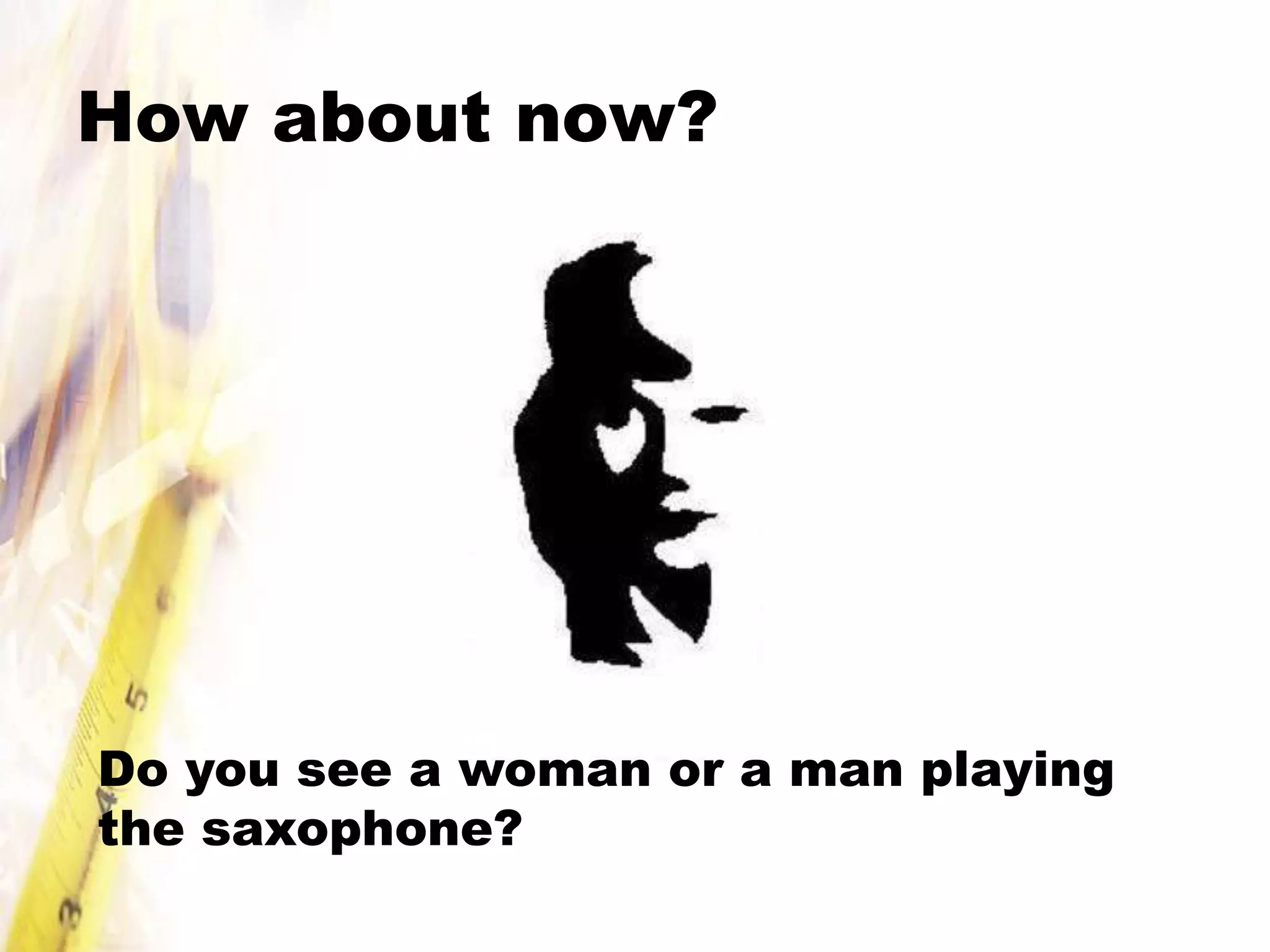
Do you see a woman or a man playing
the saxophone?
How did you do that?
Regardless of which picture you saw, you
 were (hopefully) able to see one of them.

We are able to do this because we observe
 bits and pieces of images and construct
 meaningful wholes from what we see.
What is Constructivism?
Without looking at the text, see if you can fill
 in the missing terms in this definition of
 constructivism:

A theory that learners must individually
  discover information, check it against old
  information (______ _________), and
  revise and transform rules and knowledge
  as needed (_____________).
What is Constructivism?

Did you think of:

A theory that learners must individually
  discover information, check it against old
  information (prior knowledge), and revise
  and transform rules and knowledge as
  needed (adaptation).
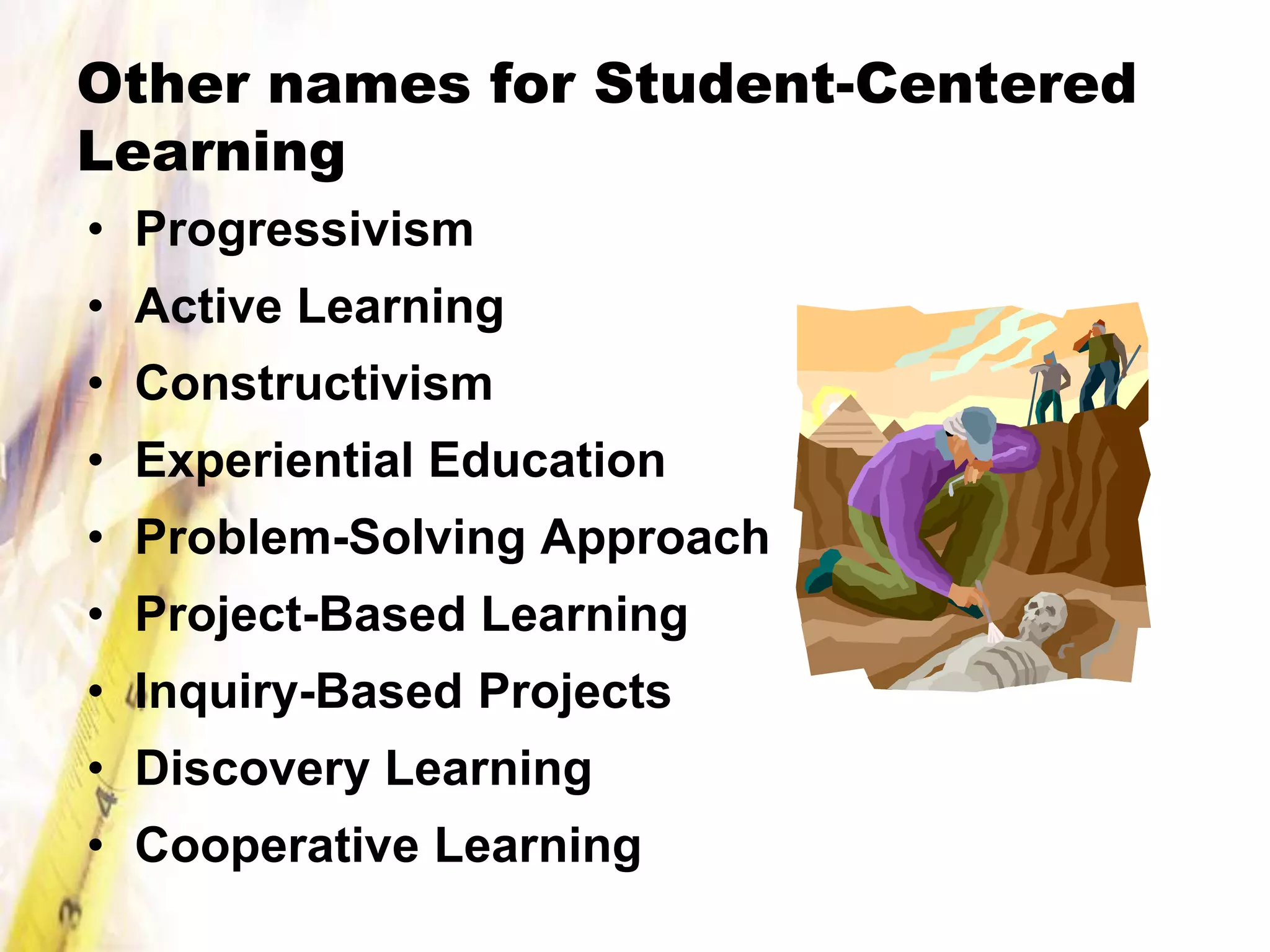
Other names for Student-Centered
Learning
• Progressivism
• Active Learning
• Constructivism
• Experiential Education
• Problem-Solving Approach
• Project-Based Learning
• Inquiry-Based Projects
• Discovery Learning
• Cooperative Learning
Basic Principles of
Constructivism Again, fill in the blanks with
your own prior knowledge

• Teachers seek and value their students’ ______
  of view.
• Classroom __________ challenge students’
  suppositions.
• Teachers pose problems of emerging ________.
• Teachers build lessons around primary concepts
  and “______” ideas.
• Teachers assess student learning in the ______
  of daily teaching.
Basic Principles of
Constructivism
• Teachers seek and value their students’ points
  of view.
• Classroom activities challenge students’
  suppositions.
• Teachers pose problems of emerging
  relevance.
• Teachers build lessons around primary concepts
  and “big” ideas.
• Teachers assess student learning in the context
  of daily teaching.
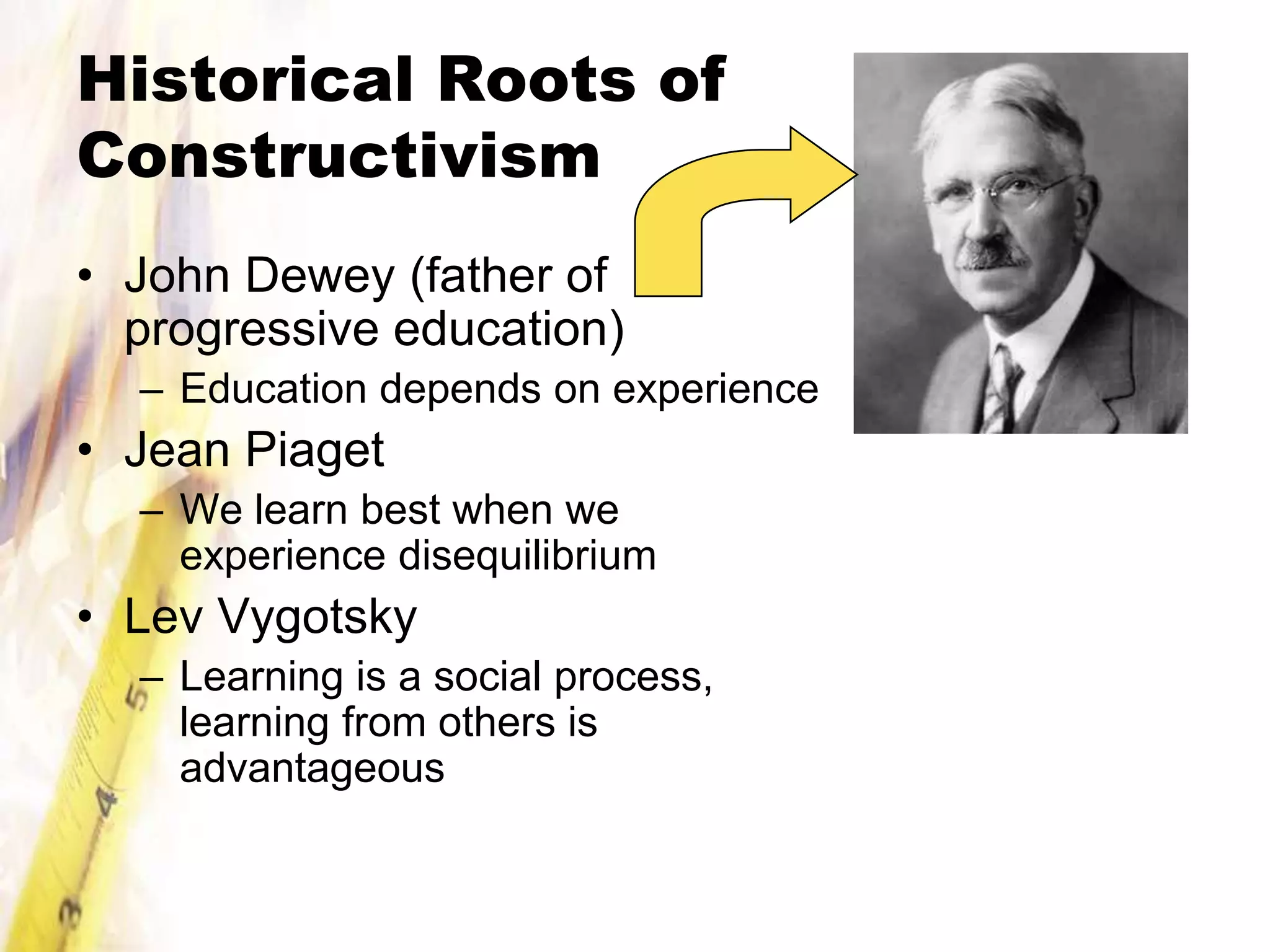
Historical Roots of
Constructivism
• John Dewey (father of
  progressive education)
  – Education depends on experience
• Jean Piaget
  – We learn best when we
    experience disequilibrium
• Lev Vygotsky
  – Learning is a social process,
    learning from others is
    advantageous
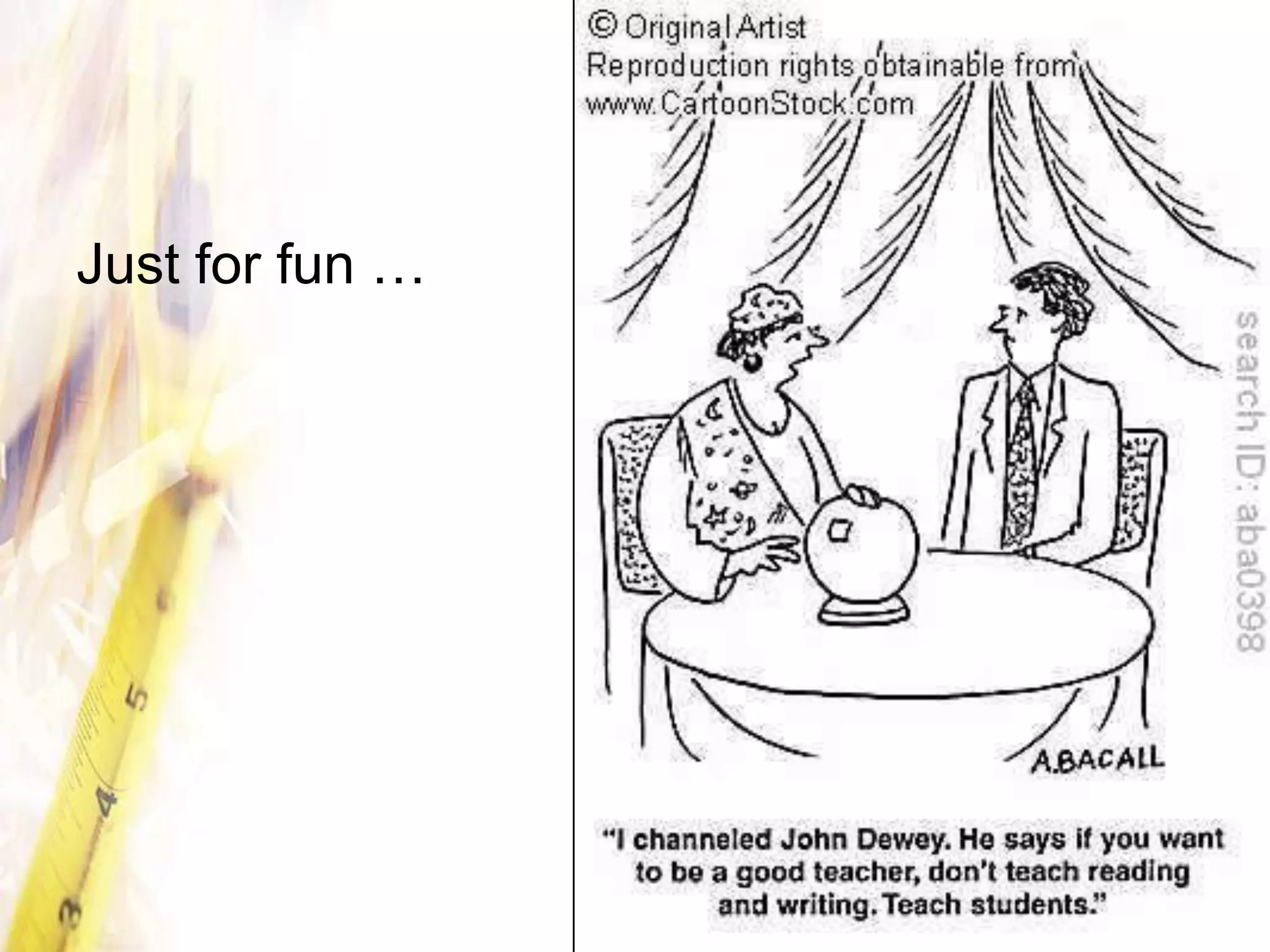
Just for fun …
Constructivist Teaching
• Planning for Instruction
  – Prior knowledge & experience
  – Students’ motivations, interests, needs, & learning
    styles
• The student “constructs” his/her own meaning
  through experience
• Research-supported ideas: student-centered
  learning  higher achievement & motivation
Constructivist Teaching                    (cont.)


• Learning is meaningful, relevant, and it
  builds on prior knowledge
• Critical/Divergent thinking is valued (not
  necessarily based on “correct” answers)


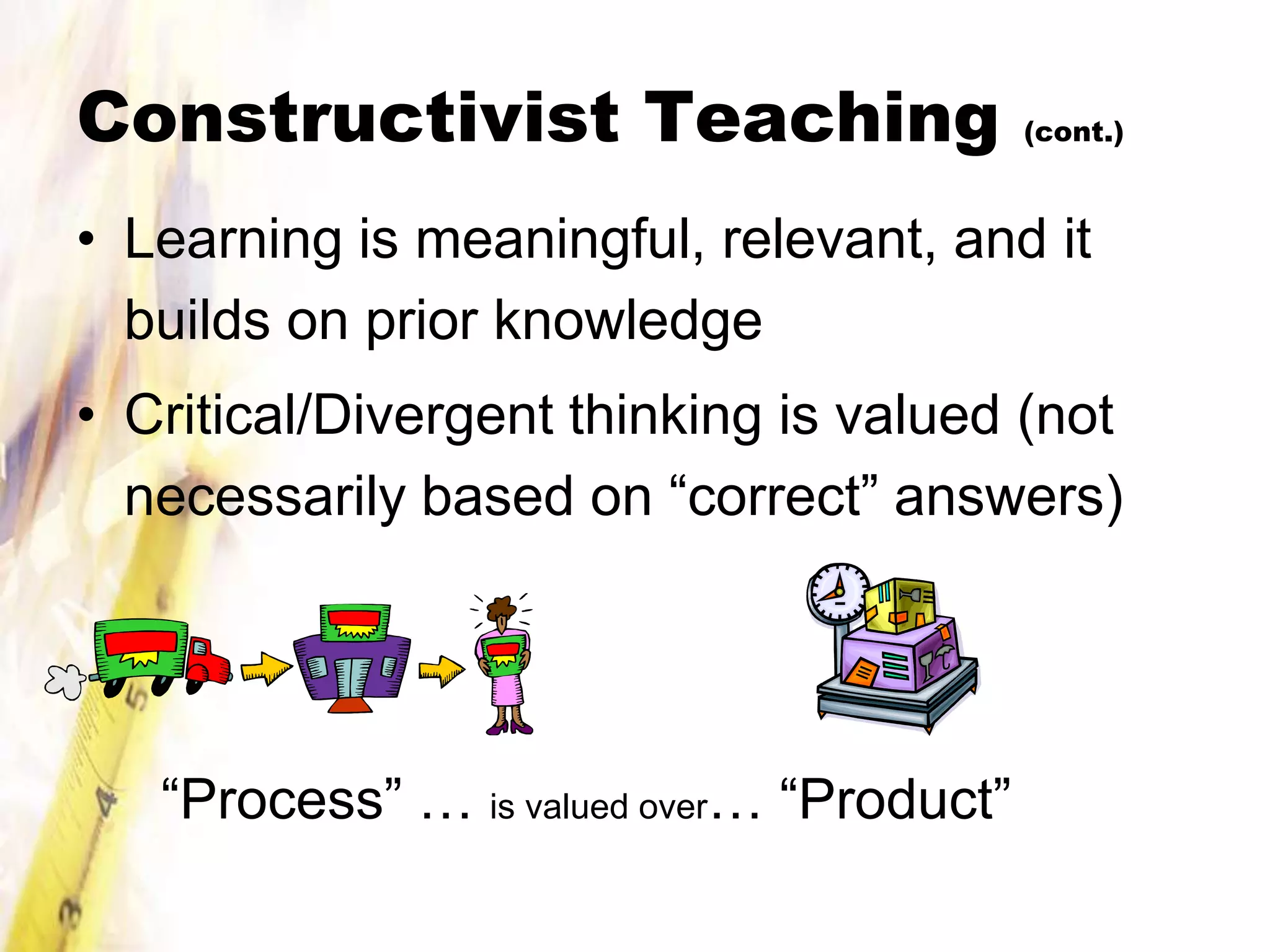
   “Process” … is valued over… “Product”
Other Aspects of Constructivism

•   Breadth v. Depth
•   Importance of Prior Knowledge
•   Schema Theory
•   Top-Down v. Bottom-Up Processing
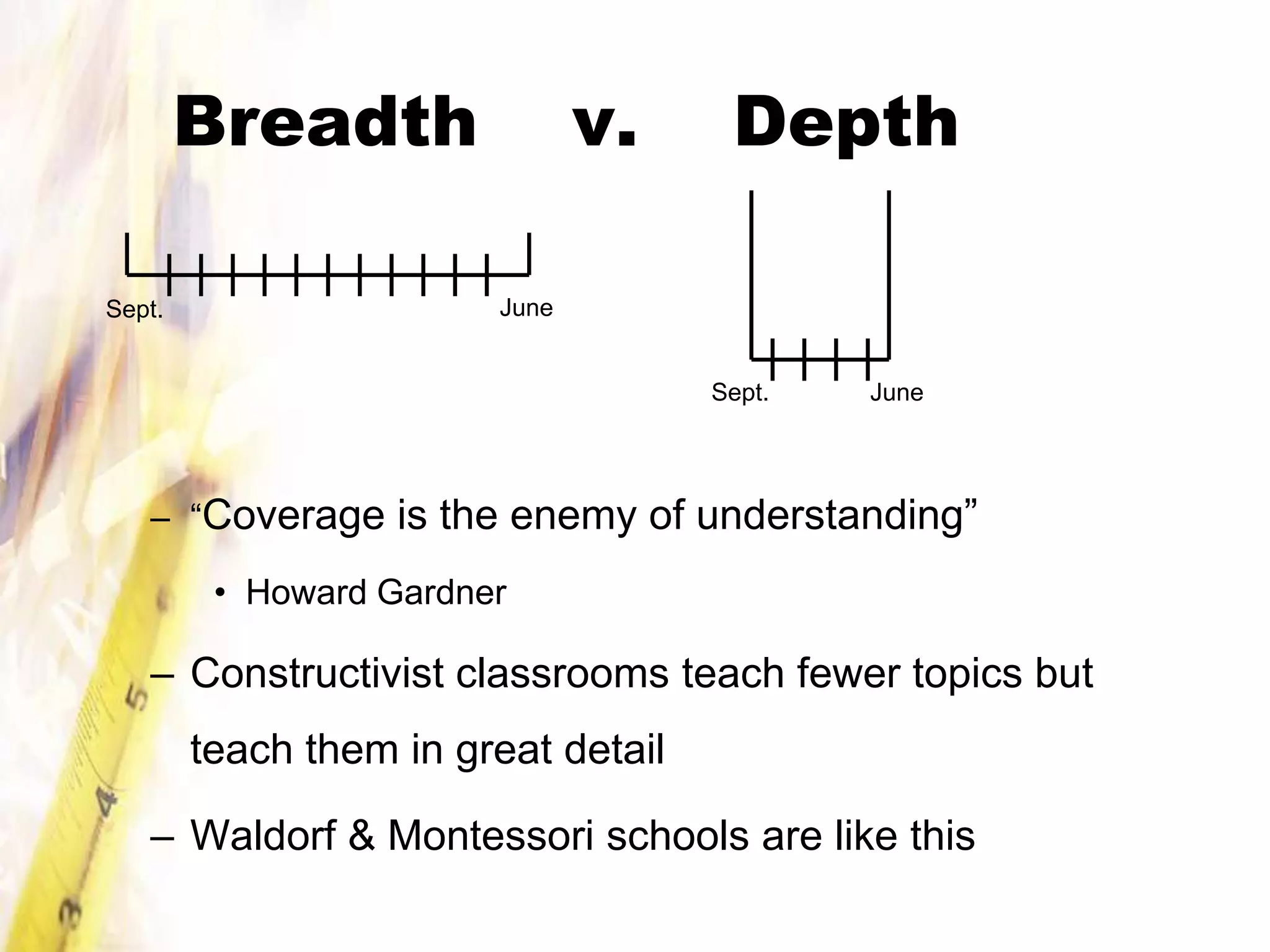
Breadth                v.     Depth

Sept.                   June


                                     Sept.   June


   – “Coverage is the enemy of understanding”

         • Howard Gardner

   – Constructivist classrooms teach fewer topics but
        teach them in great detail

   – Waldorf & Montessori schools are like this
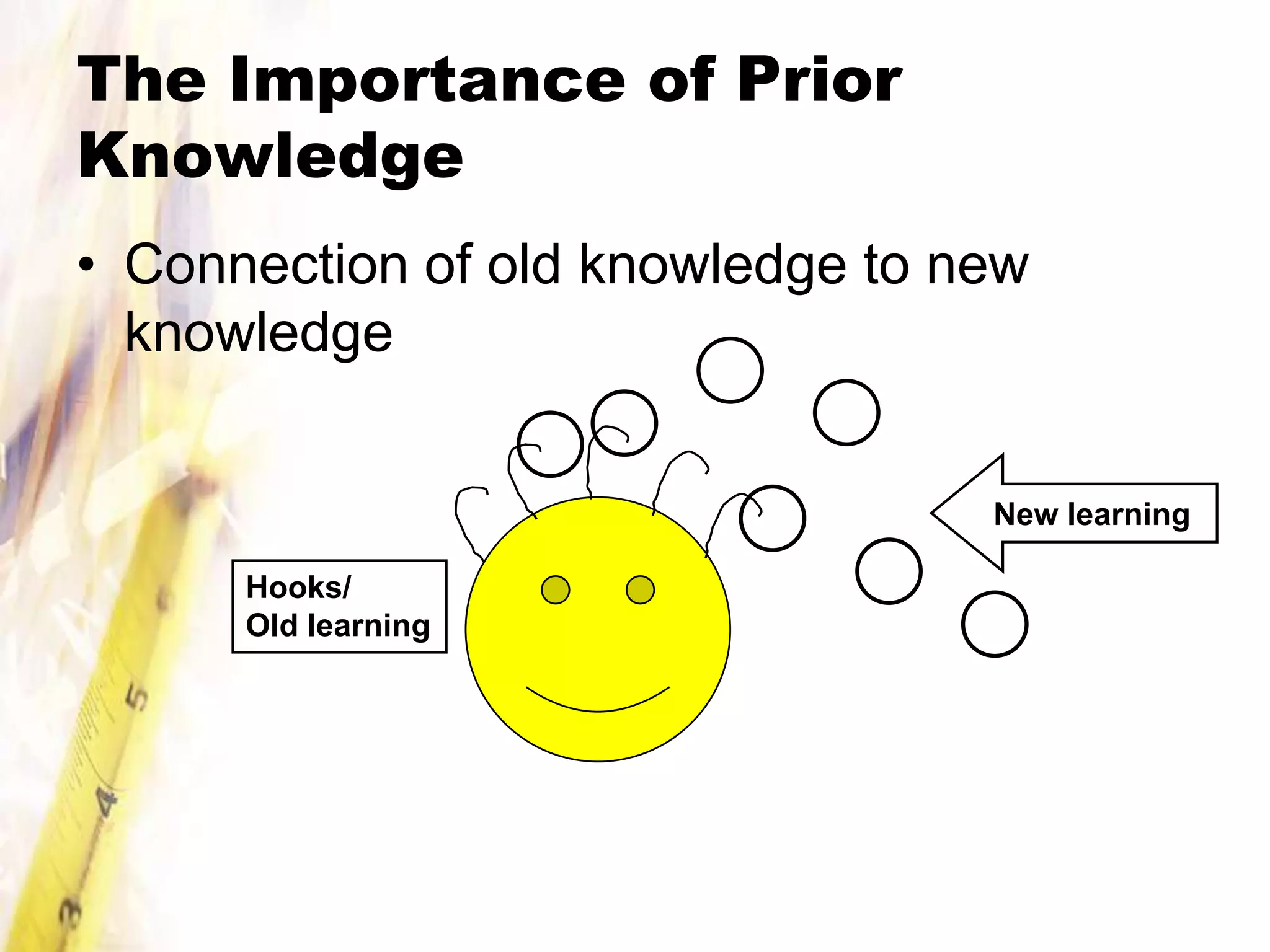
The Importance of Prior
Knowledge
• Connection of old knowledge to new
  knowledge


                                  New learning

      Hooks/
      Old learning
Schema Theory
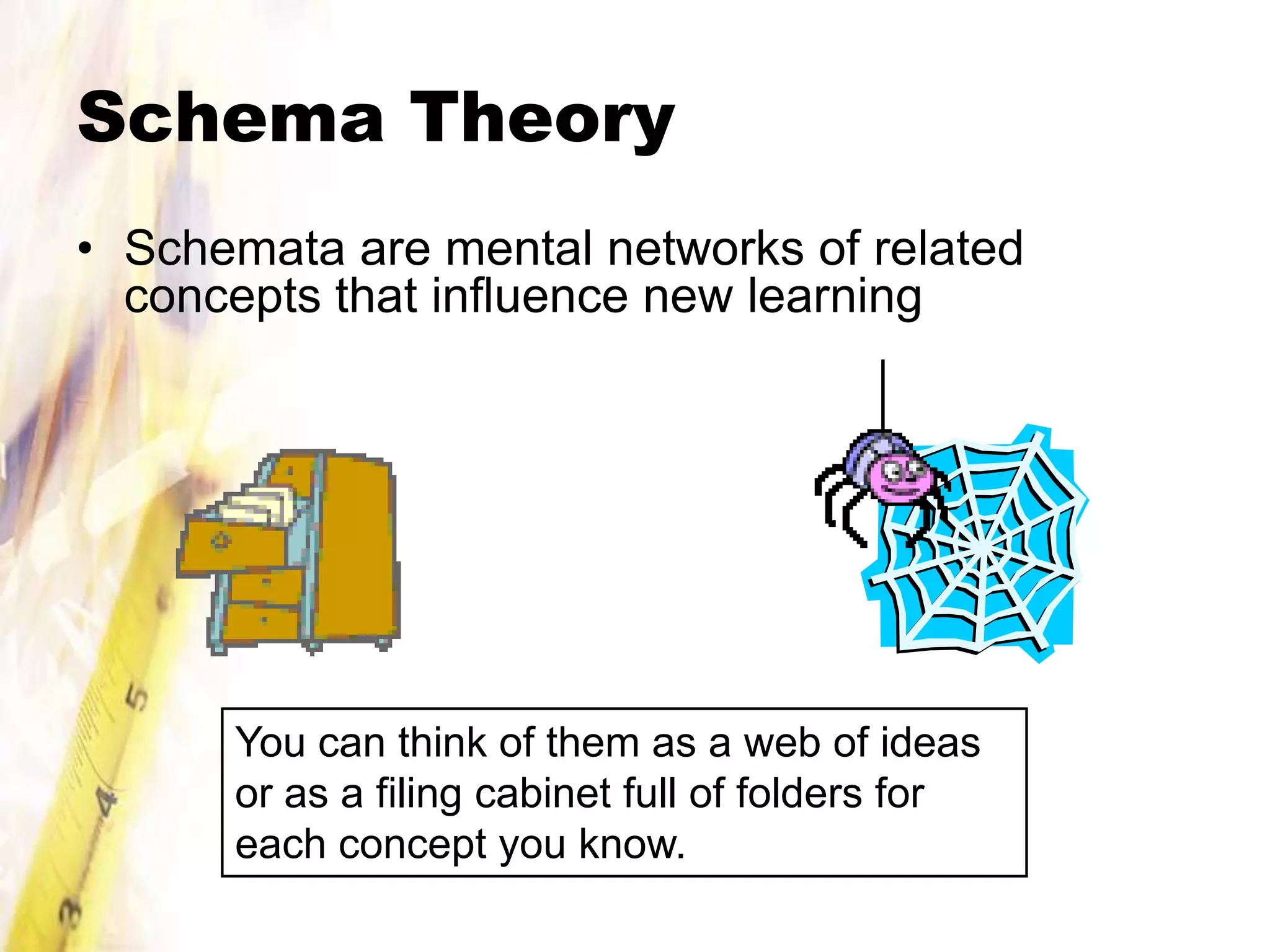
• Schemata are mental networks of related
  concepts that influence new learning


      You can think of them as a web of ideas
      or as a filing cabinet full of folders for
      each concept you know.
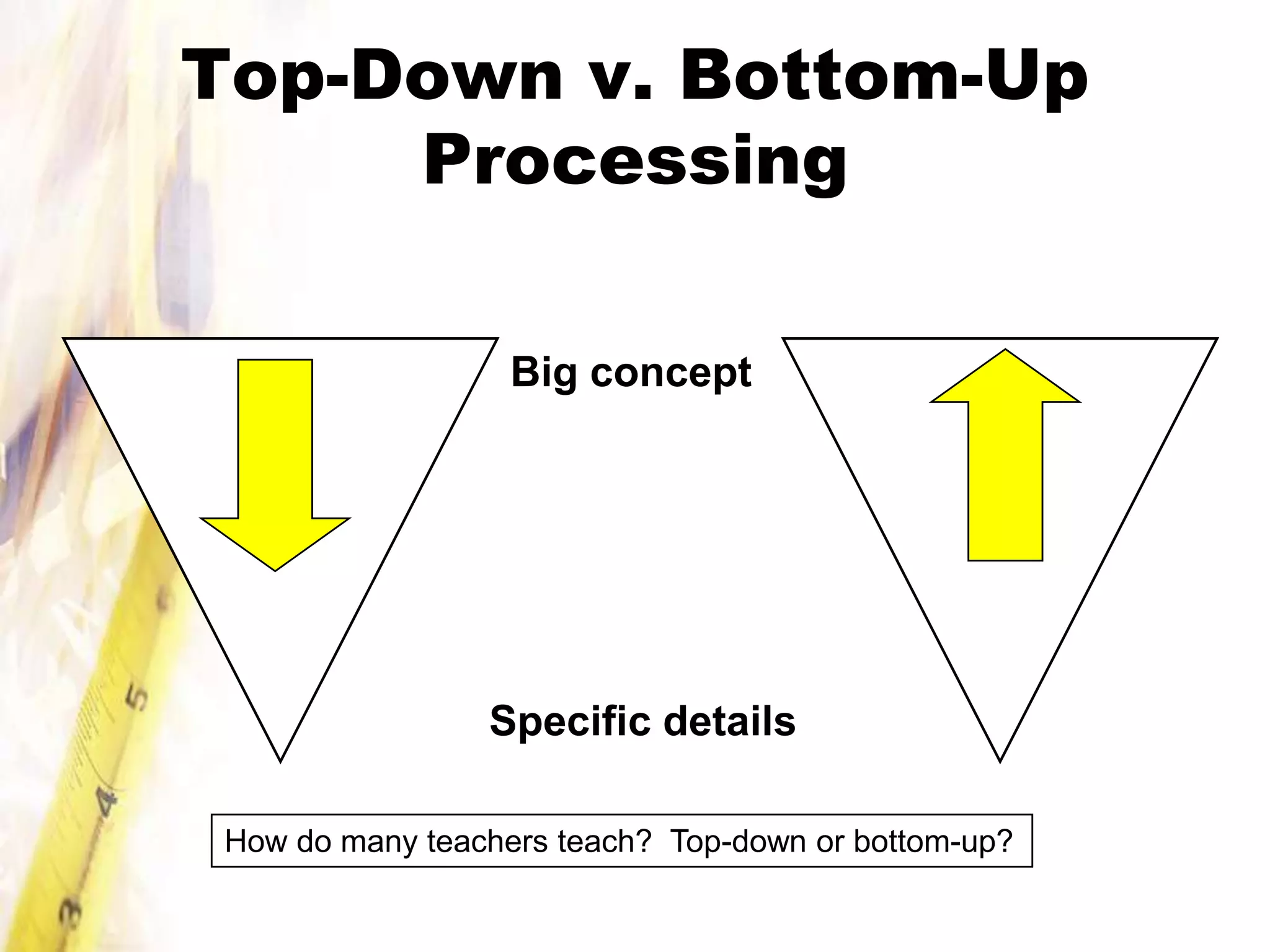
Top-Down v. Bottom-Up
     Processing

                   Big concept


                 Specific details

 How do many teachers teach? Top-down or bottom-up?
Top-Down v. Bottom-Up
            Processing
• Yes, many lessons are Bottom-Up oriented
  (starting with a detailed skill or fact and then
  building up to the big picture, application, or
  relevance)

• Constructivist classrooms are Top-Down. A
  teacher might present a challenge or problem
  first, have students think of solutions, then lastly
  give the answer or details.
What does Constructivism
look like in the classroom?
This is a great book to get you thinking about it. The chart

that follows is from Brooks and Brooks.


     The Case for
     Constructivist
      Classrooms
        Brooks and Brooks
           1999, ASCD
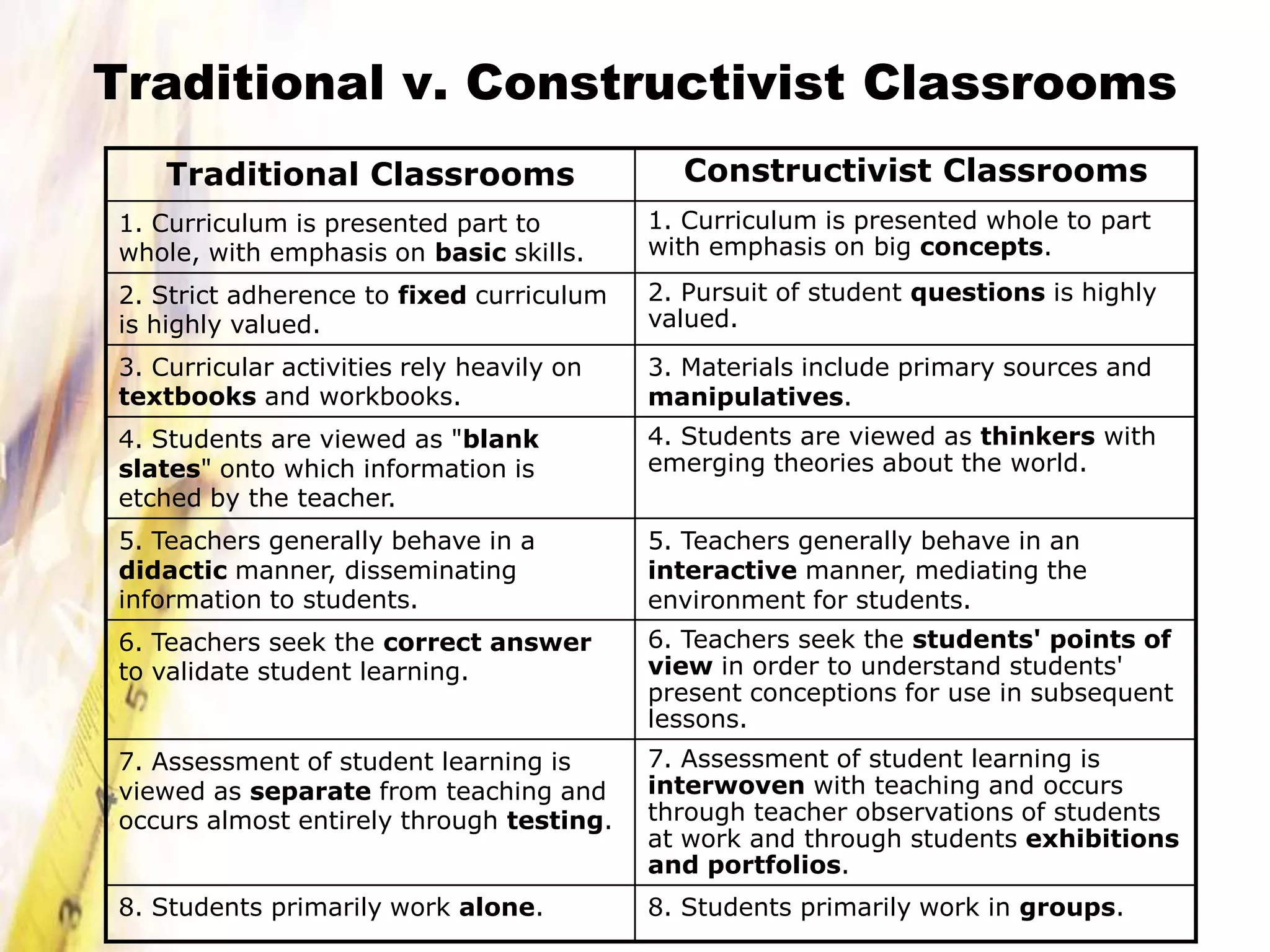
Traditional v. Constructivist Classrooms
    Traditional Classrooms                   Constructivist Classrooms
1. Curriculum is presented part to         1. Curriculum is presented whole to part
whole, with emphasis on basic skills.      with emphasis on big concepts.
2. Strict adherence to fixed curriculum    2. Pursuit of student questions is highly
is highly valued.                          valued.
3. Curricular activities rely heavily on   3. Materials include primary sources and
textbooks and workbooks.                   manipulatives.
4. Students are viewed as "blank           4. Students are viewed as thinkers with
slates" onto which information is          emerging theories about the world.
etched by the teacher.
5. Teachers generally behave in a          5. Teachers generally behave in an
didactic manner, disseminating             interactive manner, mediating the
information to students.                   environment for students.
6. Teachers seek the correct answer        6. Teachers seek the students' points of
to validate student learning.              view in order to understand students'
                                           present conceptions for use in subsequent
                                           lessons.
7. Assessment of student learning is       7. Assessment of student learning is
viewed as separate from teaching and       interwoven with teaching and occurs
occurs almost entirely through testing.    through teacher observations of students
                                           at work and through students exhibitions
                                           and portfolios.
8. Students primarily work alone.          8. Students primarily work in groups.
Can we be “constructivist”
            all the time?

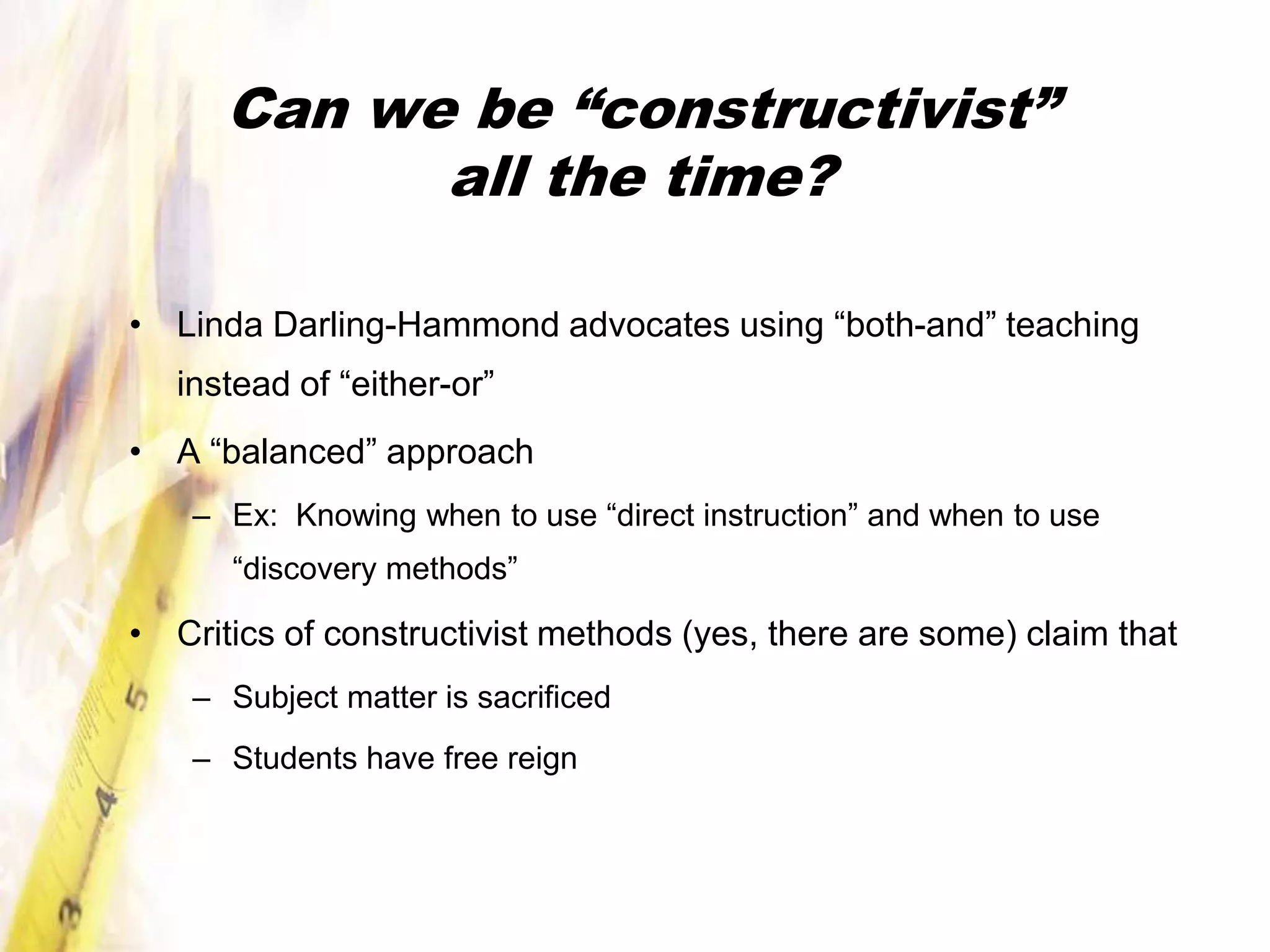
• Linda Darling-Hammond advocates using “both-and” teaching
   instead of “either-or”
• A “balanced” approach
    – Ex: Knowing when to use “direct instruction” and when to use
      “discovery methods”

• Critics of constructivist methods (yes, there are some) claim that
    – Subject matter is sacrificed
    – Students have free reign
More thoughts from Linda Darling-Hammond’s
“Experience and Education: Implications for Teaching and
Schooling Today”

• The constructivist classroom is highly structured, but
  improvisational
• The constructivist teacher has to attend to:
   – Demands of subject matter
   – Needs of students

• Difficult to implement constructivist teaching when under
  constraints of curriculum, school system, & federal
  legislation       Perhaps, but that doesn’t mean we
                    shouldn’t try to be more student-centered!
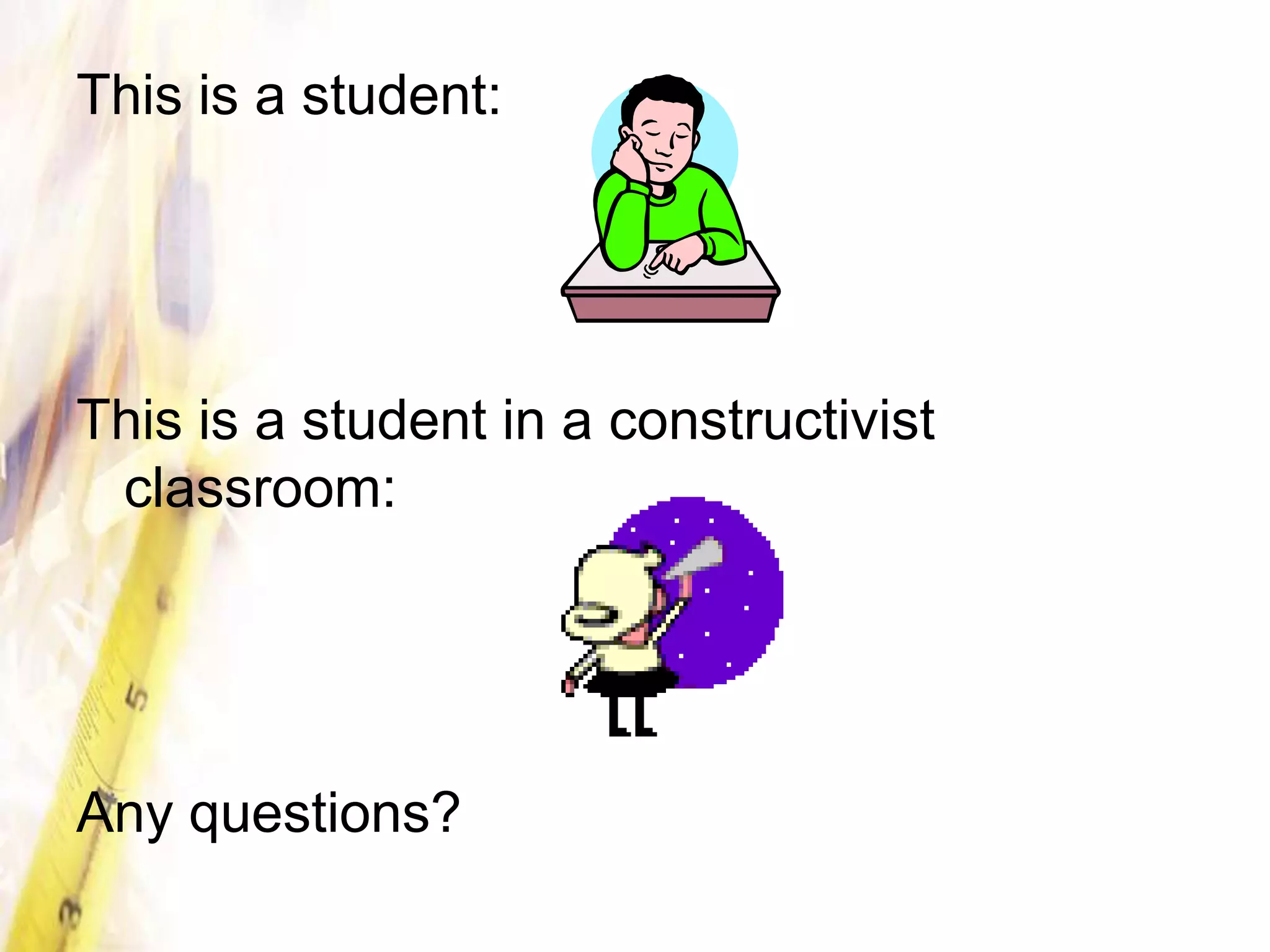
This is a student:


This is a student in a constructivist
 classroom:


Any questions?
Constructivism

  • 1.
    Student-Centered & Constructivist Approaches to Learning Dr. Jennifer Irwin EDU 620: Module 7 Chapter 8
  • 2.
    The Constructive Natureof Human Perception Take a look at the pictures on the next slides.
  • 3.
    What do yousee? Do you see an old woman or a young woman?
  • 4.
    How about now? Doyou see a woman or a man playing the saxophone?
  • 5.
    How did youdo that? Regardless of which picture you saw, you were (hopefully) able to see one of them. We are able to do this because we observe bits and pieces of images and construct meaningful wholes from what we see.
  • 6.
    What is Constructivism? Withoutlooking at the text, see if you can fill in the missing terms in this definition of constructivism: A theory that learners must individually discover information, check it against old information (______ _________), and revise and transform rules and knowledge as needed (_____________).
  • 7.
    What is Constructivism? Didyou think of: A theory that learners must individually discover information, check it against old information (prior knowledge), and revise and transform rules and knowledge as needed (adaptation).
  • 8.
    Other names forStudent-Centered Learning • Progressivism • Active Learning • Constructivism • Experiential Education • Problem-Solving Approach • Project-Based Learning • Inquiry-Based Projects • Discovery Learning • Cooperative Learning
  • 9.
    Basic Principles of ConstructivismAgain, fill in the blanks with your own prior knowledge • Teachers seek and value their students’ ______ of view. • Classroom __________ challenge students’ suppositions. • Teachers pose problems of emerging ________. • Teachers build lessons around primary concepts and “______” ideas. • Teachers assess student learning in the ______ of daily teaching.
  • 10.
    Basic Principles of Constructivism •Teachers seek and value their students’ points of view. • Classroom activities challenge students’ suppositions. • Teachers pose problems of emerging relevance. • Teachers build lessons around primary concepts and “big” ideas. • Teachers assess student learning in the context of daily teaching.
  • 11.
    Historical Roots of Constructivism •John Dewey (father of progressive education) – Education depends on experience • Jean Piaget – We learn best when we experience disequilibrium • Lev Vygotsky – Learning is a social process, learning from others is advantageous
  • 12.
  • 13.
    Constructivist Teaching • Planningfor Instruction – Prior knowledge & experience – Students’ motivations, interests, needs, & learning styles • The student “constructs” his/her own meaning through experience • Research-supported ideas: student-centered learning  higher achievement & motivation
  • 14.
    Constructivist Teaching (cont.) • Learning is meaningful, relevant, and it builds on prior knowledge • Critical/Divergent thinking is valued (not necessarily based on “correct” answers) “Process” … is valued over… “Product”
  • 15.
    Other Aspects ofConstructivism • Breadth v. Depth • Importance of Prior Knowledge • Schema Theory • Top-Down v. Bottom-Up Processing
  • 16.
    Breadth v. Depth Sept. June Sept. June – “Coverage is the enemy of understanding” • Howard Gardner – Constructivist classrooms teach fewer topics but teach them in great detail – Waldorf & Montessori schools are like this
  • 17.
    The Importance ofPrior Knowledge • Connection of old knowledge to new knowledge New learning Hooks/ Old learning
  • 18.
    Schema Theory • Schemataare mental networks of related concepts that influence new learning You can think of them as a web of ideas or as a filing cabinet full of folders for each concept you know.
  • 19.
    Top-Down v. Bottom-Up Processing Big concept Specific details How do many teachers teach? Top-down or bottom-up?
  • 20.
    Top-Down v. Bottom-Up Processing • Yes, many lessons are Bottom-Up oriented (starting with a detailed skill or fact and then building up to the big picture, application, or relevance) • Constructivist classrooms are Top-Down. A teacher might present a challenge or problem first, have students think of solutions, then lastly give the answer or details.
  • 21.
    What does Constructivism looklike in the classroom? This is a great book to get you thinking about it. The chart that follows is from Brooks and Brooks. The Case for Constructivist Classrooms Brooks and Brooks 1999, ASCD
  • 22.
    Traditional v. ConstructivistClassrooms Traditional Classrooms Constructivist Classrooms 1. Curriculum is presented part to 1. Curriculum is presented whole to part whole, with emphasis on basic skills. with emphasis on big concepts. 2. Strict adherence to fixed curriculum 2. Pursuit of student questions is highly is highly valued. valued. 3. Curricular activities rely heavily on 3. Materials include primary sources and textbooks and workbooks. manipulatives. 4. Students are viewed as "blank 4. Students are viewed as thinkers with slates" onto which information is emerging theories about the world. etched by the teacher. 5. Teachers generally behave in a 5. Teachers generally behave in an didactic manner, disseminating interactive manner, mediating the information to students. environment for students. 6. Teachers seek the correct answer 6. Teachers seek the students' points of to validate student learning. view in order to understand students' present conceptions for use in subsequent lessons. 7. Assessment of student learning is 7. Assessment of student learning is viewed as separate from teaching and interwoven with teaching and occurs occurs almost entirely through testing. through teacher observations of students at work and through students exhibitions and portfolios. 8. Students primarily work alone. 8. Students primarily work in groups.
  • 23.
    Can we be“constructivist” all the time? • Linda Darling-Hammond advocates using “both-and” teaching instead of “either-or” • A “balanced” approach – Ex: Knowing when to use “direct instruction” and when to use “discovery methods” • Critics of constructivist methods (yes, there are some) claim that – Subject matter is sacrificed – Students have free reign
  • 24.
    More thoughts fromLinda Darling-Hammond’s “Experience and Education: Implications for Teaching and Schooling Today” • The constructivist classroom is highly structured, but improvisational • The constructivist teacher has to attend to: – Demands of subject matter – Needs of students • Difficult to implement constructivist teaching when under constraints of curriculum, school system, & federal legislation Perhaps, but that doesn’t mean we shouldn’t try to be more student-centered!
  • 25.
    This is astudent: This is a student in a constructivist classroom: Any questions?