Photo from thelandscapeoflearning.com
KEY PEOPLE ASSOCIATED WITH CONSTRUCTIVISM
   Jean Piaget (1896-1980)
   •   Developed the cognitive learning theory through observation of
       children.
   Jerome Bruner (1915-Present)
   •   Constructivist learners learn by participation
        and being actively engaged.
   Lev Vygotsky (1896-1934)
   •   Developed social cognition.
   John Dewey (1859-1952)
   •   Advocate for child-centered instruction.
                                                                        Jean Piaget


Photo from childpsych.umwblogs.org
KEY POINTS OF CONSTRUCTIVISM
•    Learning is an active process; knowledge is constructed
•    Emphasis on ways that people create meaning of the world through
     a series of individual constructs
                                 •    theory of knowledge with roots in
                                      philosophy, psychology, and
                                      cybernetics” – Von Glaserfeld

                                 •    Learning process which allows a
                                      student to experience an
                                      environment first-hand, thereby,
                                      giving the student reliable, trust-
                                      worthy knowledge.


Photo from thirteen.org
KEY POINTS OF CONSTRUCTIVISM
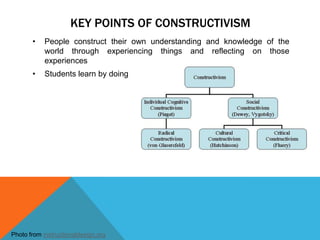
       •    People construct their own understanding and knowledge of the
            world through experiencing things and reflecting on those
            experiences
       •    Students learn by doing


Photo from instructionaldesign.org
TEACHERS AND CONSTRUCTIVISM
      Fundamental Purpose
      •   Teacher encourages students’ to build on previous knowledge by self-
          discovery.
      •   They act as facilitators of learning by creating a nurturing educational
          environment and guiding the learning process for students.


      What Critics Are Saying
      •   Students’ cannot properly identify what it is they should be learning.
          • Counter – Teachers carefully moderate students’ learning and the level of
             their prior knowledge.
      •   Teachers cannot cover enough material of students’ direct their educational.
          • Counter – Well trained facilitators can plan and organize problem-solving
             learning ( that targets a student’s prior knowledge) to teach the subject
             material fully.


Information from learning-theories.com
TEACHERS AND CONSTRUCTIVISM
                How Teachers Implement Theory in Learning Process

   In General                             With Technology
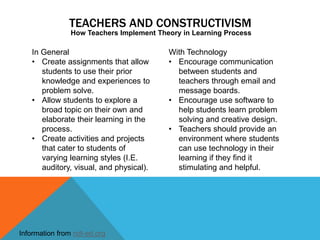
   • Create assignments that allow        • Encourage communication
      students to use their prior           between students and
      knowledge and experiences to          teachers through email and
      problem solve.                        message boards.
   • Allow students to explore a          • Encourage use software to
      broad topic on their own and          help students learn problem
      elaborate their learning in the       solving and creative design.
      process.                            • Teachers should provide an
   • Create activities and projects         environment where students
      that cater to students of             can use technology in their
      varying learning styles (I.E.         learning if they find it
      auditory, visual, and physical).      stimulating and helpful.


Information from ndt-ed.org
STUDENTS AND CONSTRUCTIVISM
                  What do the students do under Constructivism?
• The student is put at the center of the educational stage.
• Constructivism means that knowledge can’t be handed down
  from person to person (like taught by a teacher to a student)
  but instead it is constructed by each
   learner through interpreting and
   reinterpreting a constant flow of
   information.
• Students are constantly
   challenging their own assumptions.


  Photo by istockphoto

Team project

  • 1.
  • 2.
    KEY PEOPLE ASSOCIATEDWITH CONSTRUCTIVISM Jean Piaget (1896-1980) • Developed the cognitive learning theory through observation of children. Jerome Bruner (1915-Present) • Constructivist learners learn by participation and being actively engaged. Lev Vygotsky (1896-1934) • Developed social cognition. John Dewey (1859-1952) • Advocate for child-centered instruction. Jean Piaget Photo from childpsych.umwblogs.org
  • 3.
    KEY POINTS OFCONSTRUCTIVISM • Learning is an active process; knowledge is constructed • Emphasis on ways that people create meaning of the world through a series of individual constructs • theory of knowledge with roots in philosophy, psychology, and cybernetics” – Von Glaserfeld • Learning process which allows a student to experience an environment first-hand, thereby, giving the student reliable, trust- worthy knowledge. Photo from thirteen.org
  • 4.
    KEY POINTS OFCONSTRUCTIVISM • People construct their own understanding and knowledge of the world through experiencing things and reflecting on those experiences • Students learn by doing Photo from instructionaldesign.org
  • 5.
    TEACHERS AND CONSTRUCTIVISM Fundamental Purpose • Teacher encourages students’ to build on previous knowledge by self- discovery. • They act as facilitators of learning by creating a nurturing educational environment and guiding the learning process for students. What Critics Are Saying • Students’ cannot properly identify what it is they should be learning. • Counter – Teachers carefully moderate students’ learning and the level of their prior knowledge. • Teachers cannot cover enough material of students’ direct their educational. • Counter – Well trained facilitators can plan and organize problem-solving learning ( that targets a student’s prior knowledge) to teach the subject material fully. Information from learning-theories.com
  • 6.
    TEACHERS AND CONSTRUCTIVISM How Teachers Implement Theory in Learning Process In General With Technology • Create assignments that allow • Encourage communication students to use their prior between students and knowledge and experiences to teachers through email and problem solve. message boards. • Allow students to explore a • Encourage use software to broad topic on their own and help students learn problem elaborate their learning in the solving and creative design. process. • Teachers should provide an • Create activities and projects environment where students that cater to students of can use technology in their varying learning styles (I.E. learning if they find it auditory, visual, and physical). stimulating and helpful. Information from ndt-ed.org
  • 7.
    STUDENTS AND CONSTRUCTIVISM What do the students do under Constructivism? • The student is put at the center of the educational stage. • Constructivism means that knowledge can’t be handed down from person to person (like taught by a teacher to a student) but instead it is constructed by each learner through interpreting and reinterpreting a constant flow of information. • Students are constantly challenging their own assumptions. Photo by istockphoto