WHAT IS CONSTRUCTIVISM?
 Constructivism refers to the idea
that learners construct knowledge
for themselves---each learner
individually (and socially) constructs
meaning--- as he or she learns.
 A learning theory that “equates
learning with creating
meaning from experience”
MAJOR SCHOLARS OF
CONSTRUCTIVISM AND
THEIR KEY CLAIM:
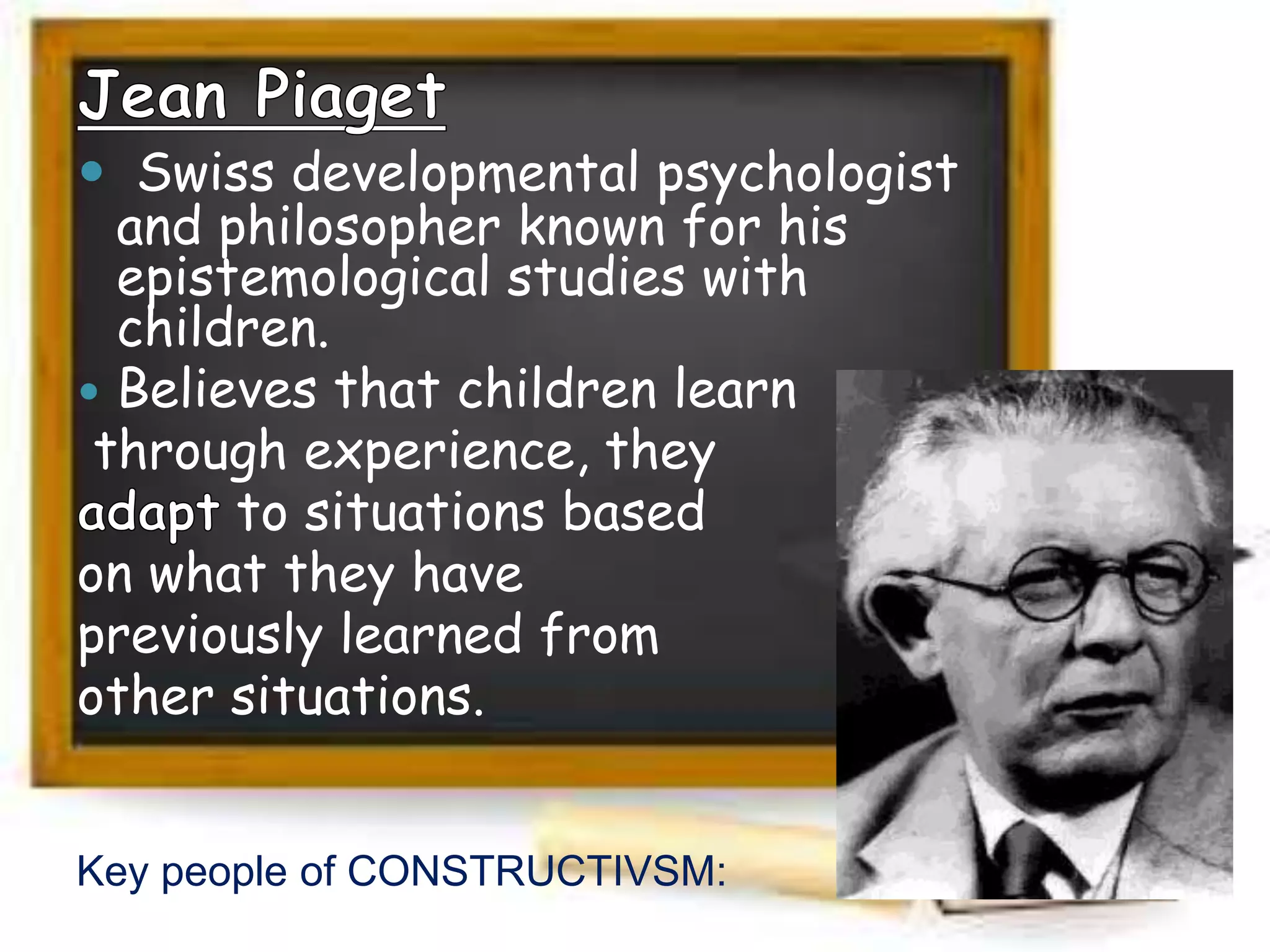
 Swiss developmental psychologist
and philosopher known for his
epistemological studies with
children.
 Believes that children learn
through experience, they
to situations based
on what they have
previously learned from
other situations.
Key people of CONSTRUCTIVSM:
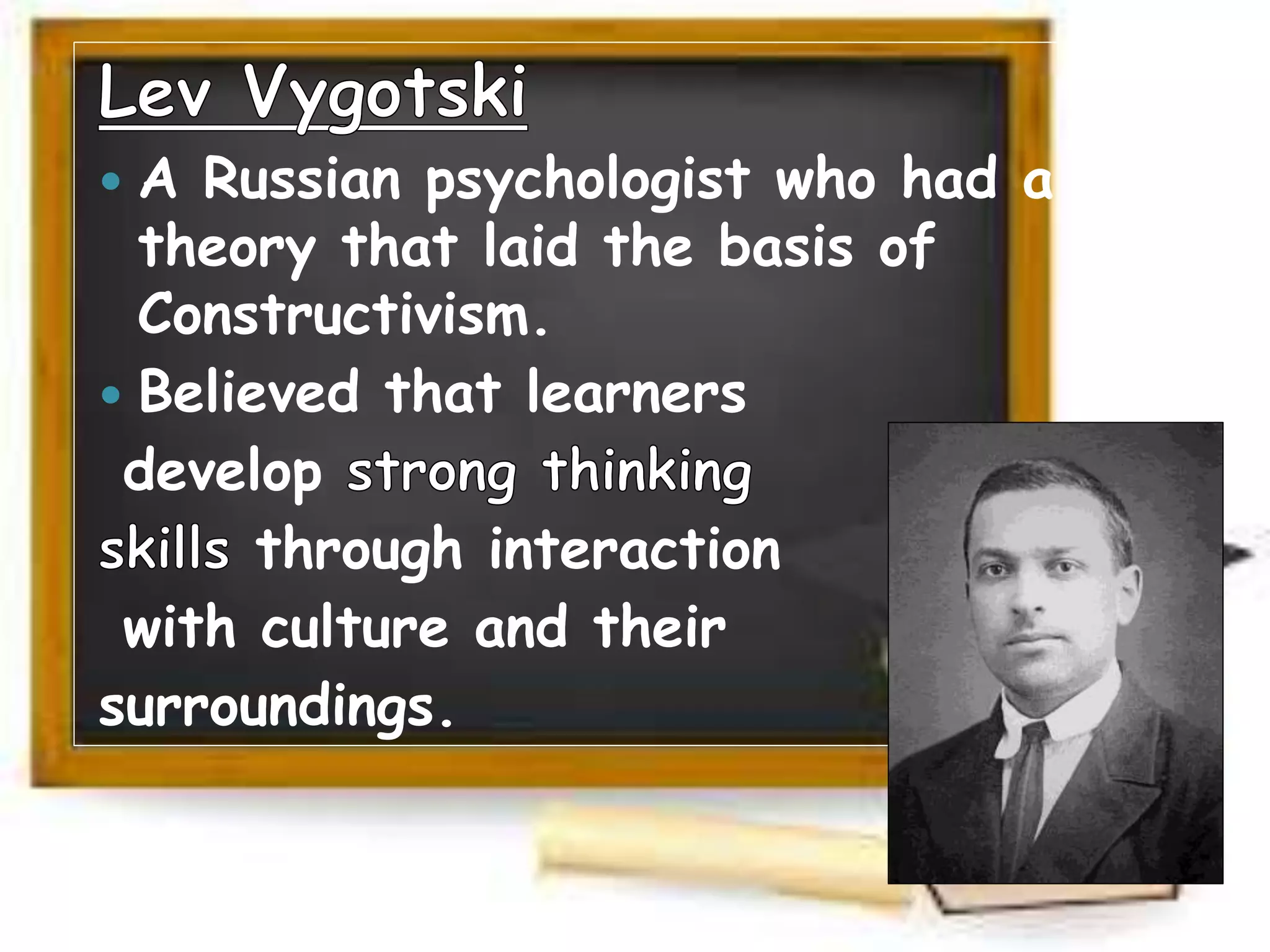
 A Russian psychologist who had a
theory that laid the basis of
Constructivism.
 Believed that learners
develop
through interaction
with culture and their
surroundings.
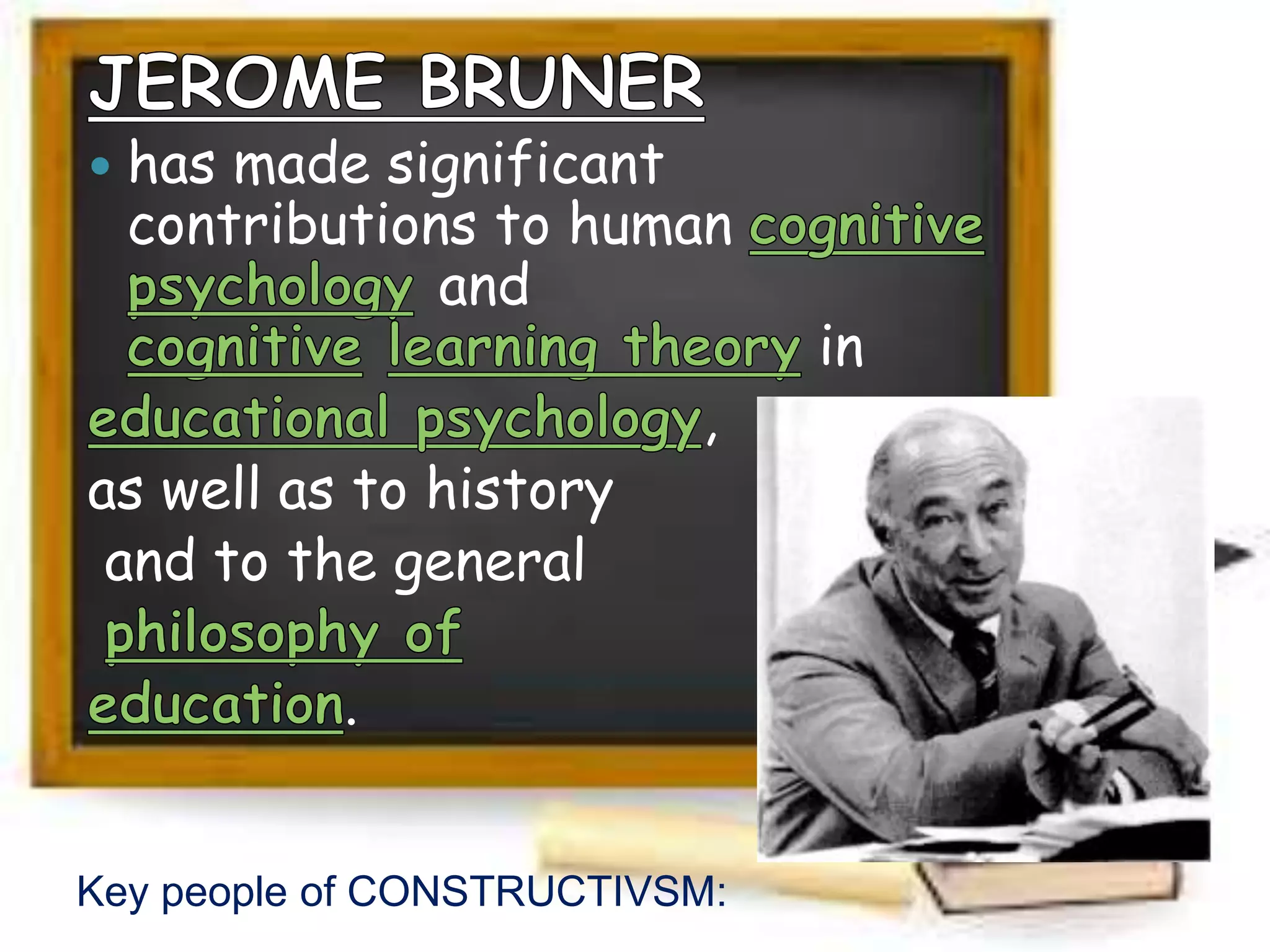
 has made significant
contributions to human
and
in
,
as well as to history
and to the general
.
Key people of CONSTRUCTIVSM:
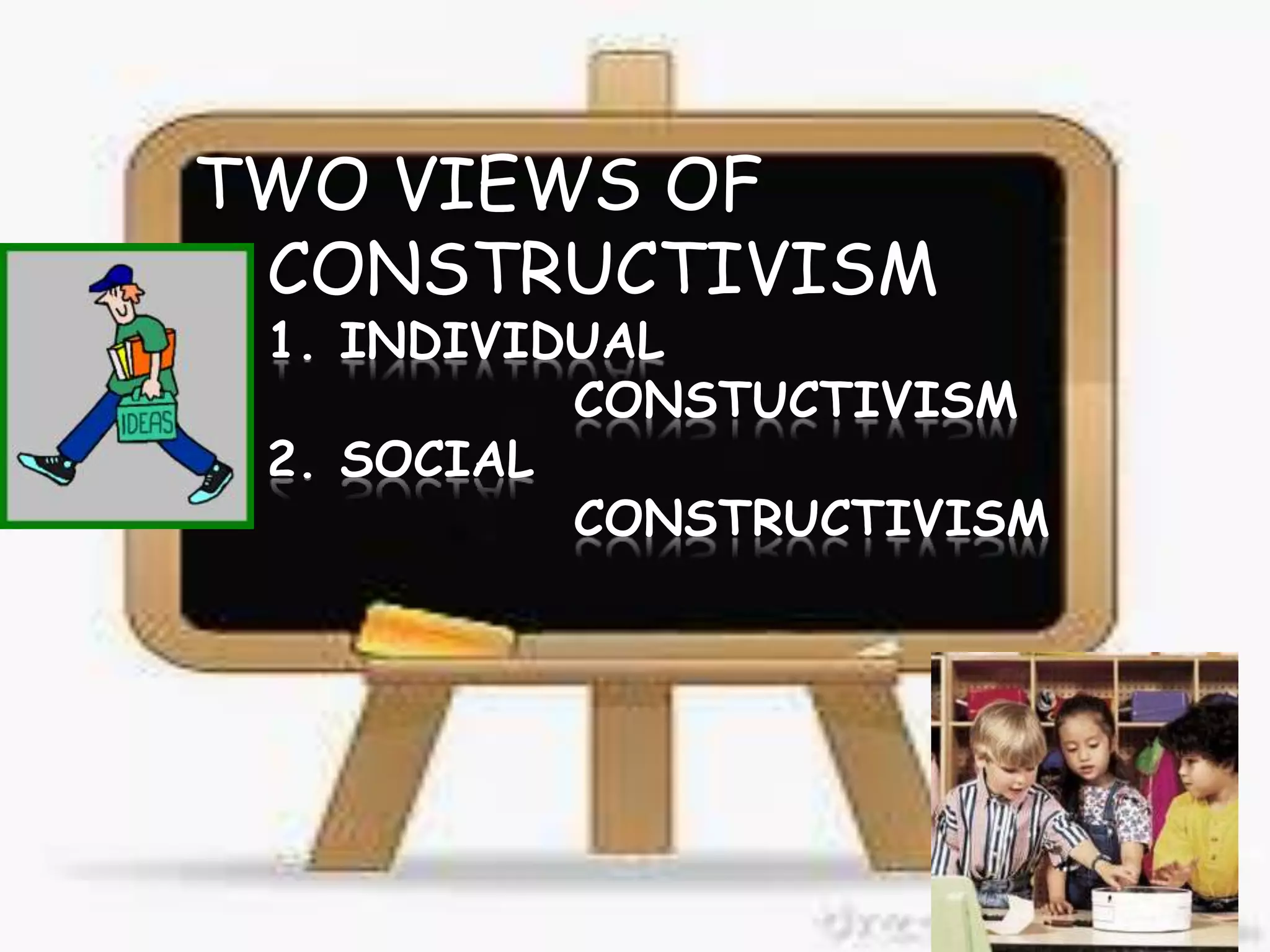
TWO VIEWS OF
CONSTRUCTIVISM
INDIVIDUAL CONSTRUCTIVISM
 This is also called
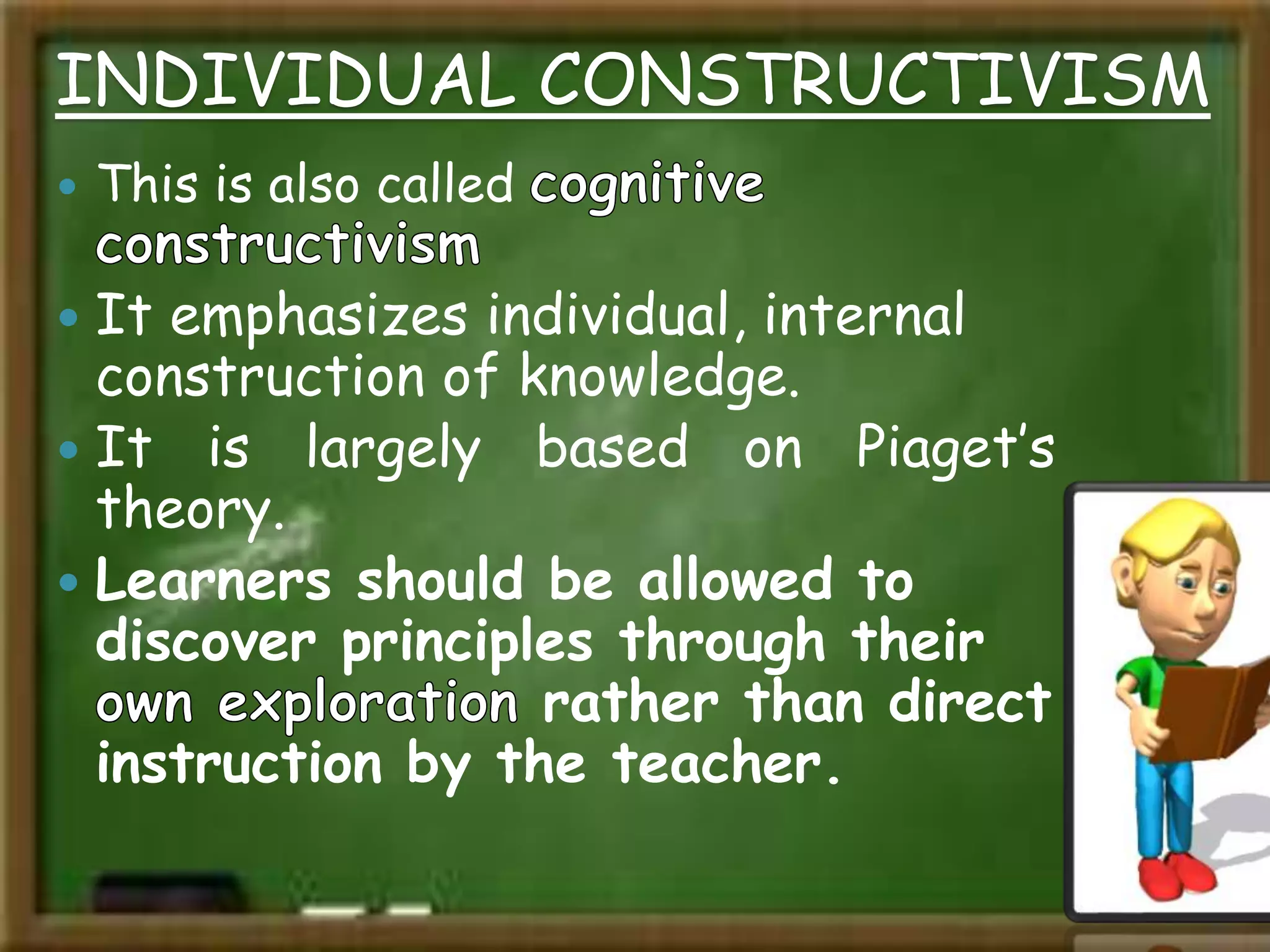
 It emphasizes individual, internal
construction of knowledge.
 It is largely based on Piaget’s
theory.
 Learners should be allowed to
discover principles through their
rather than direct
instruction by the teacher.
SOCIAL CONSTRUCTIVSM
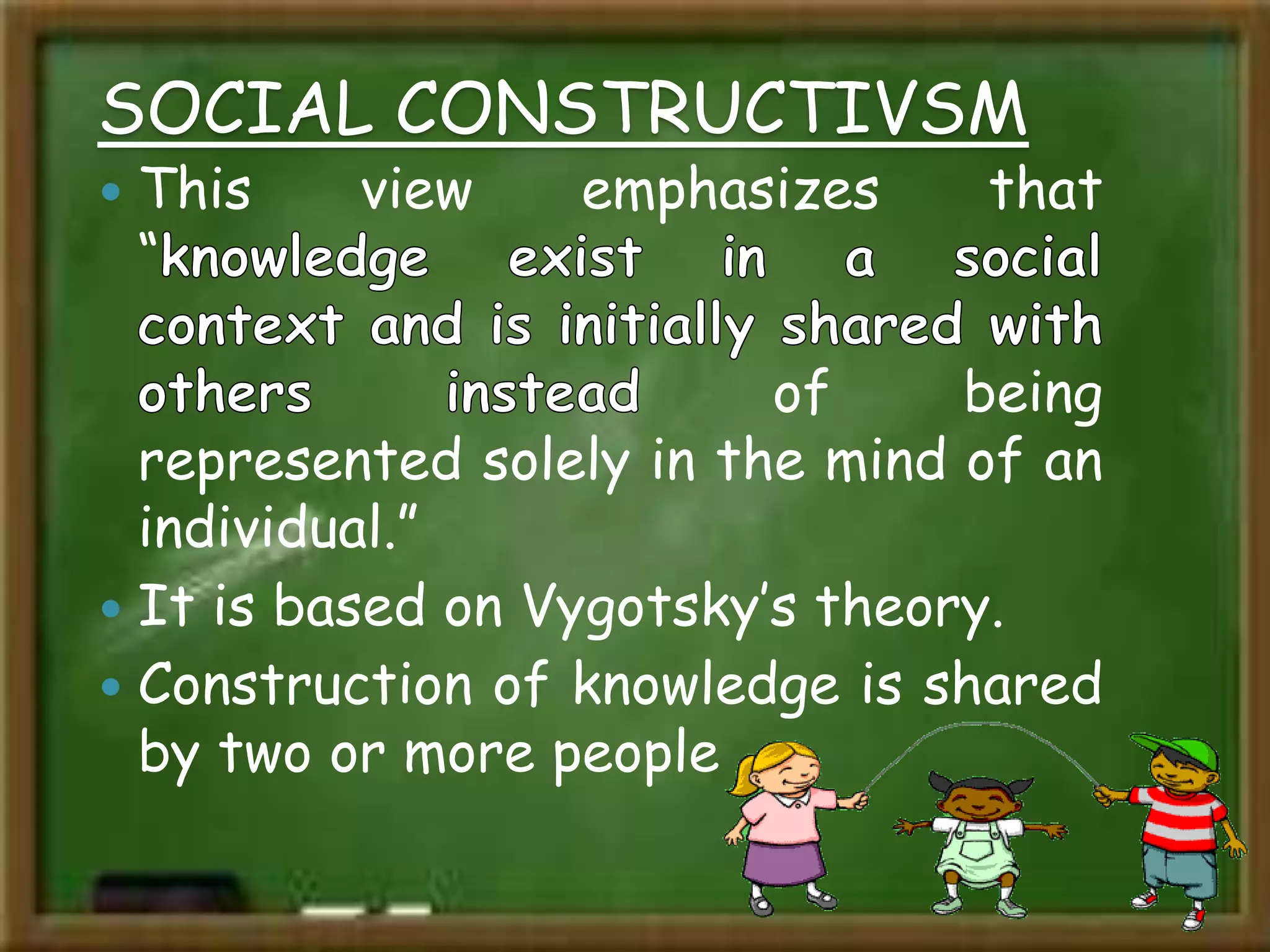
 This view emphasizes that
“
of being
represented solely in the mind of an
individual.”
 It is based on Vygotsky’s theory.
 Construction of knowledge is shared
by two or more people
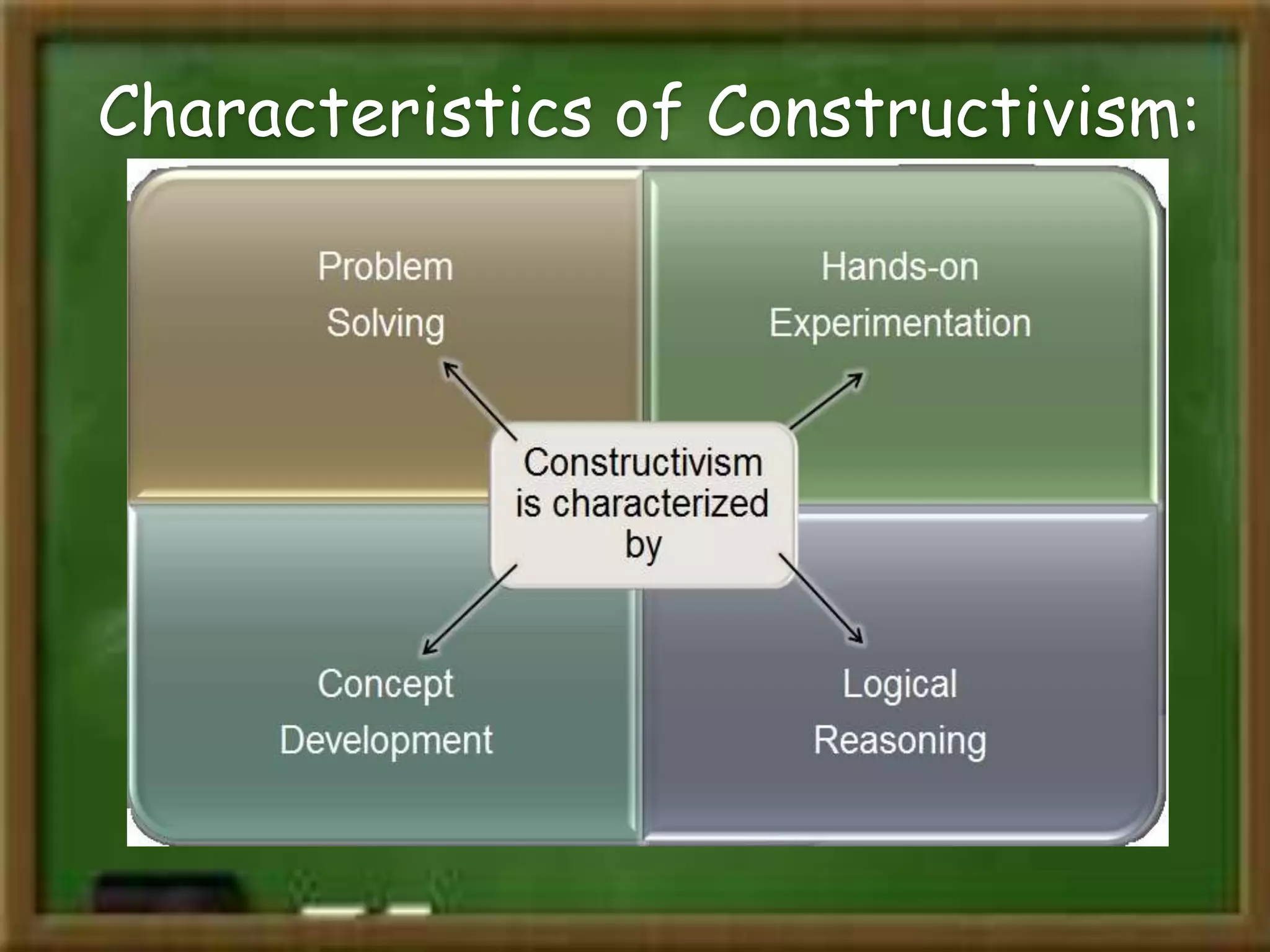
Characteristics of Constructivism:
Traditional Classroom
vs.
Constructivist
Classroom
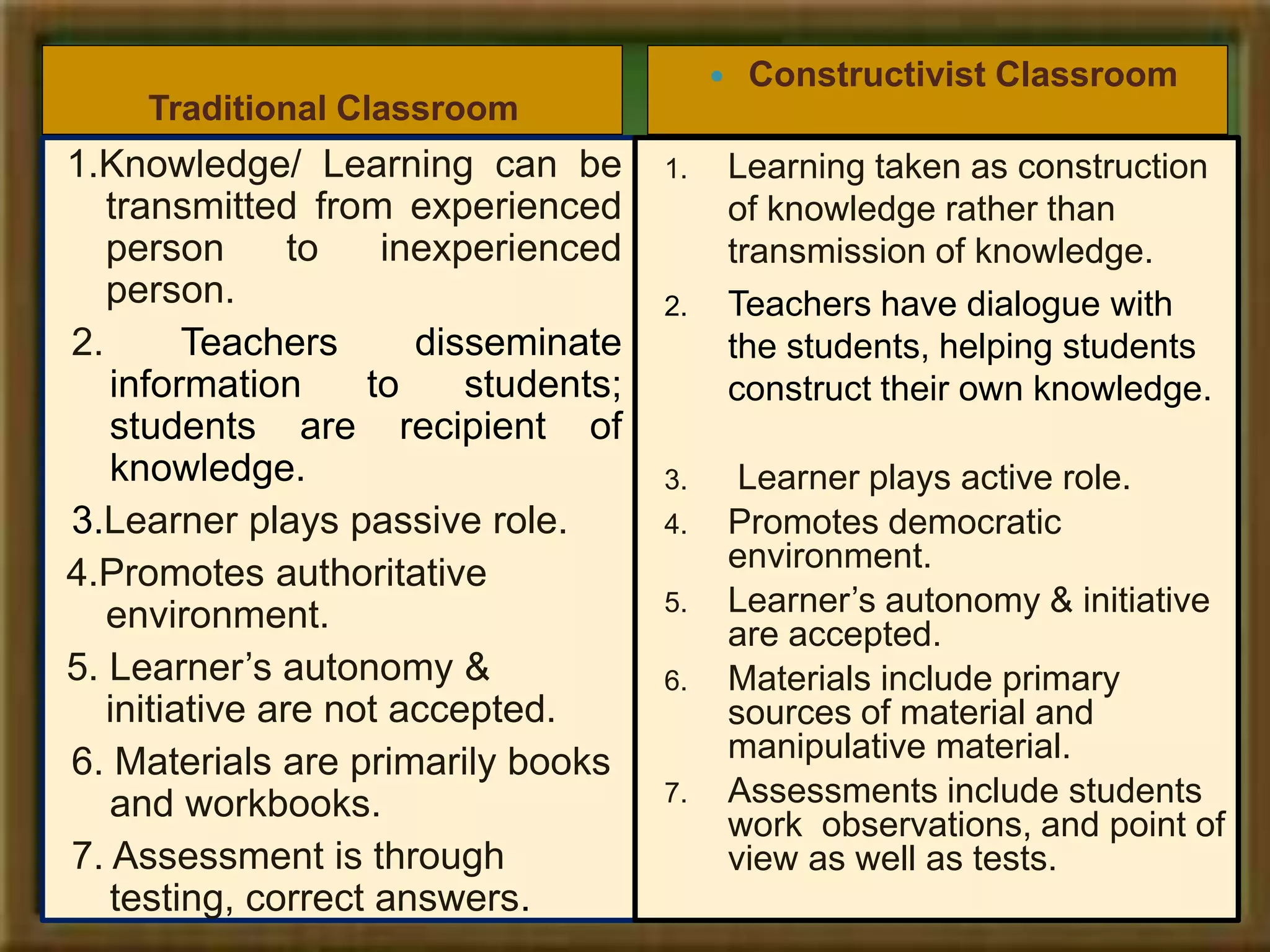
Traditional Classroom
 Constructivist Classroom
1.Knowledge/ Learning can be
transmitted from experienced
person to inexperienced
person.
2. Teachers disseminate
information to students;
students are recipient of
knowledge.
3.Learner plays passive role.
4.Promotes authoritative
environment.
5. Learner’s autonomy &
initiative are not accepted.
6. Materials are primarily books
and workbooks.
7. Assessment is through
testing, correct answers.
1. Learning taken as construction
of knowledge rather than
transmission of knowledge.
2. Teachers have dialogue with
the students, helping students
construct their own knowledge.
3. Learner plays active role.
4. Promotes democratic
environment.
5. Learner’s autonomy & initiative
are accepted.
6. Materials include primary
sources of material and
manipulative material.
7. Assessments include students
work observations, and point of
view as well as tests.
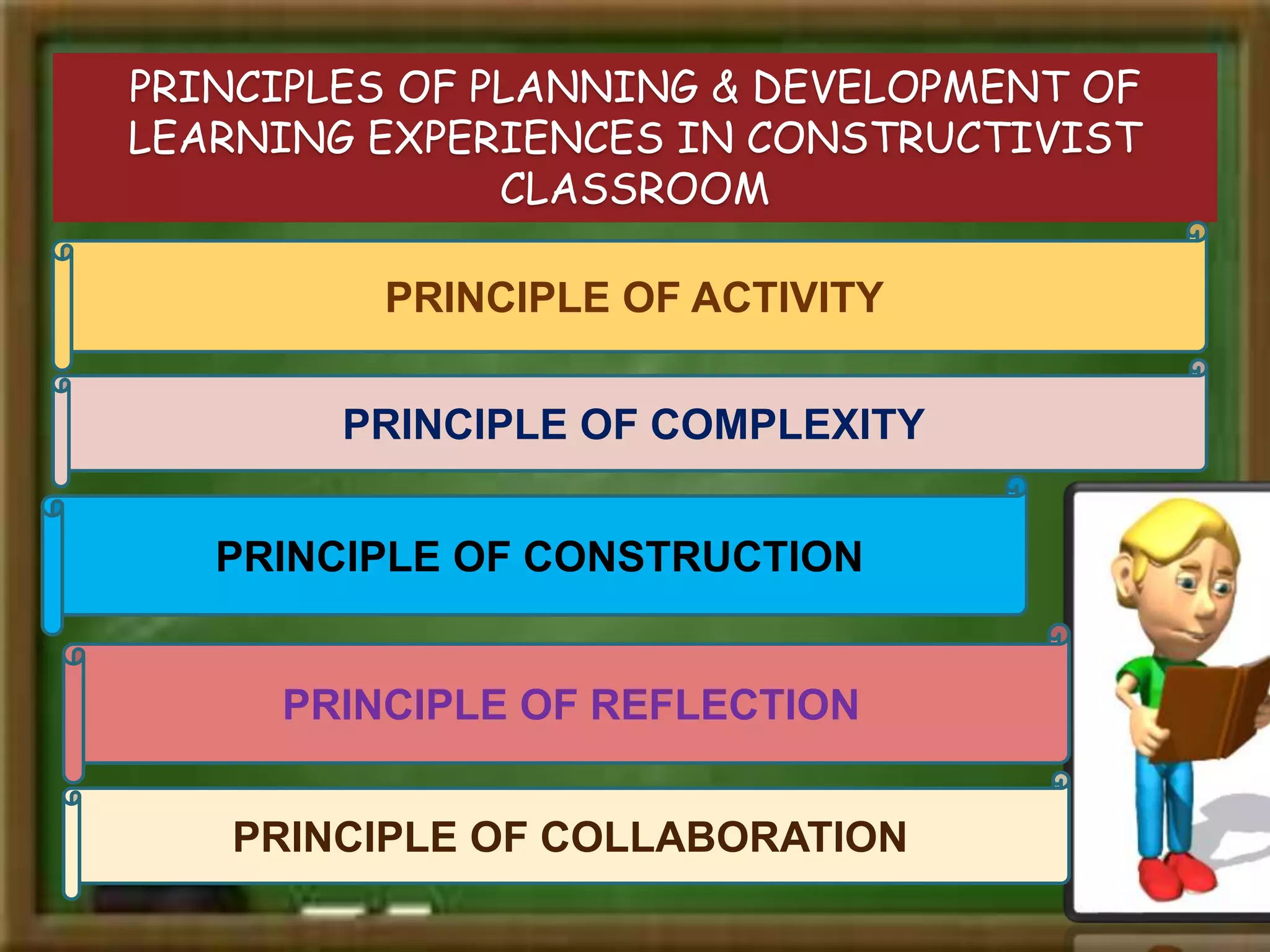
PRINCIPLES OF PLANNING & DEVELOPMENT OF
LEARNING EXPERIENCES IN CONSTRUCTIVIST
CLASSROOM
PRINCIPLE OF ACTIVITY
PRINCIPLE OF COMPLEXITY
PRINCIPLE OF CONSTRUCTION
PRINCIPLE OF REFLECTION
PRINCIPLE OF COLLABORATION
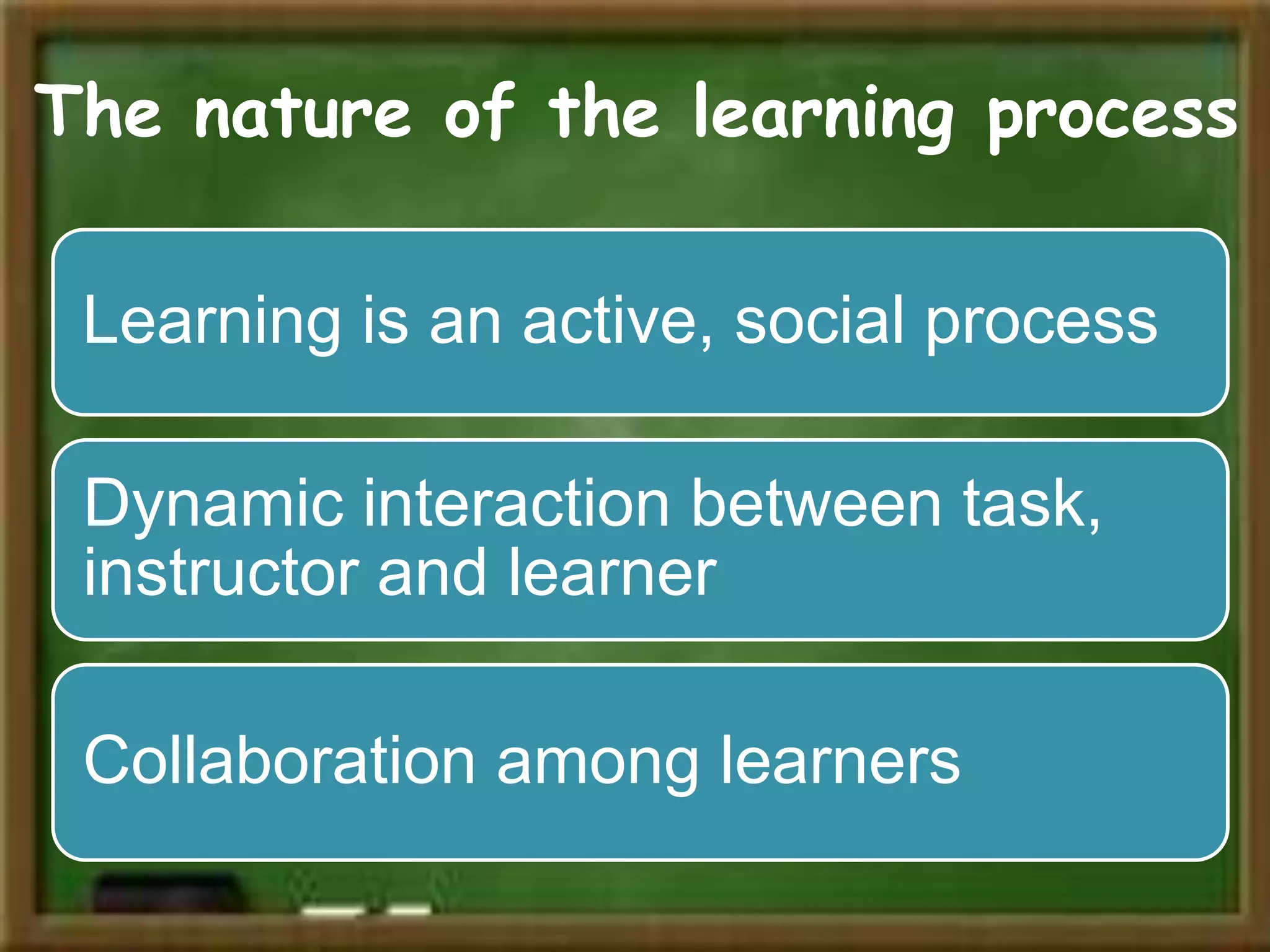
The nature of the learning process
Learning is an active, social process
Dynamic interaction between task,
instructor and learner
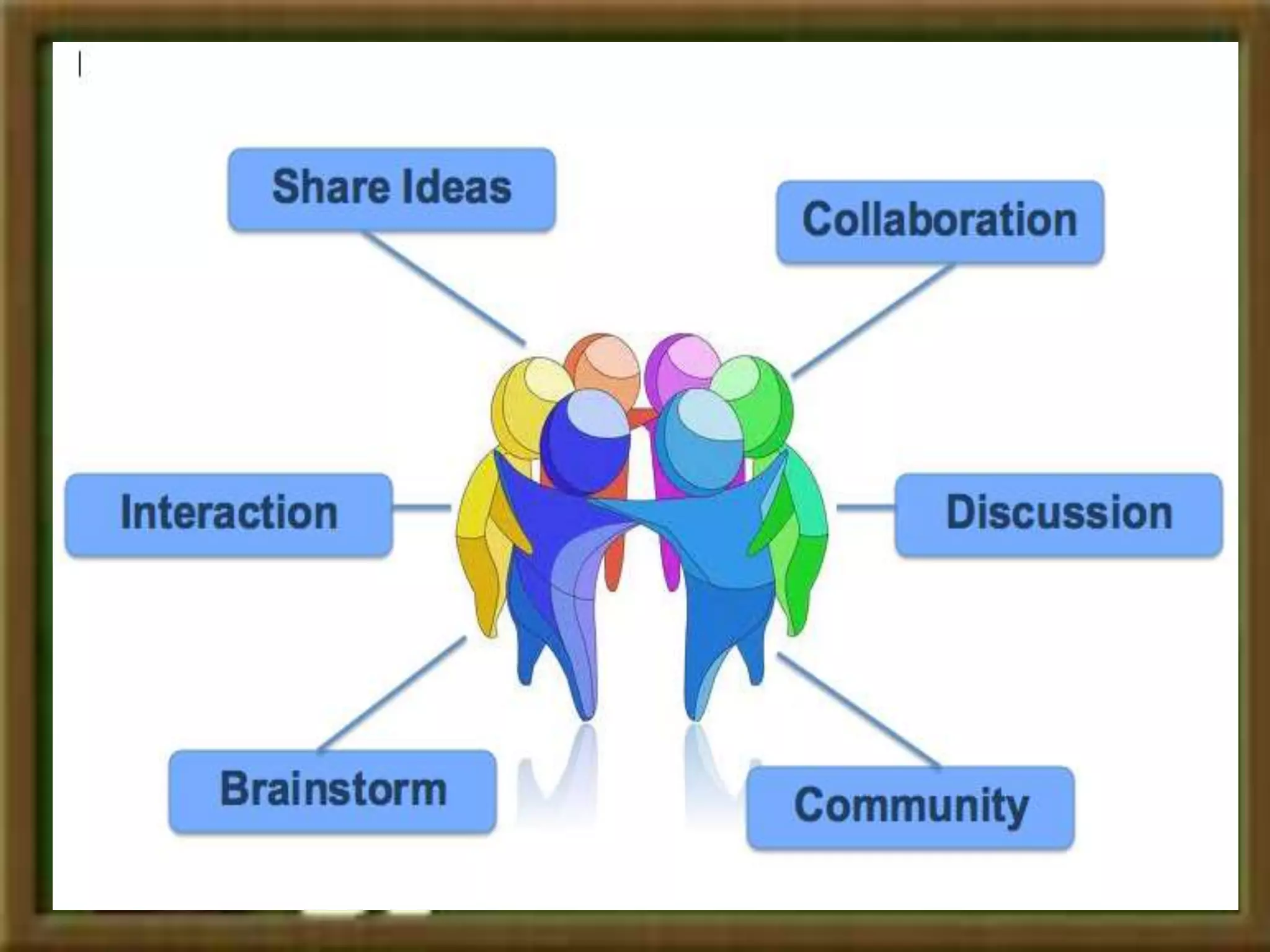
Collaboration among learners
Process for planning &
development of
learning experiences in
constructivist
classroom
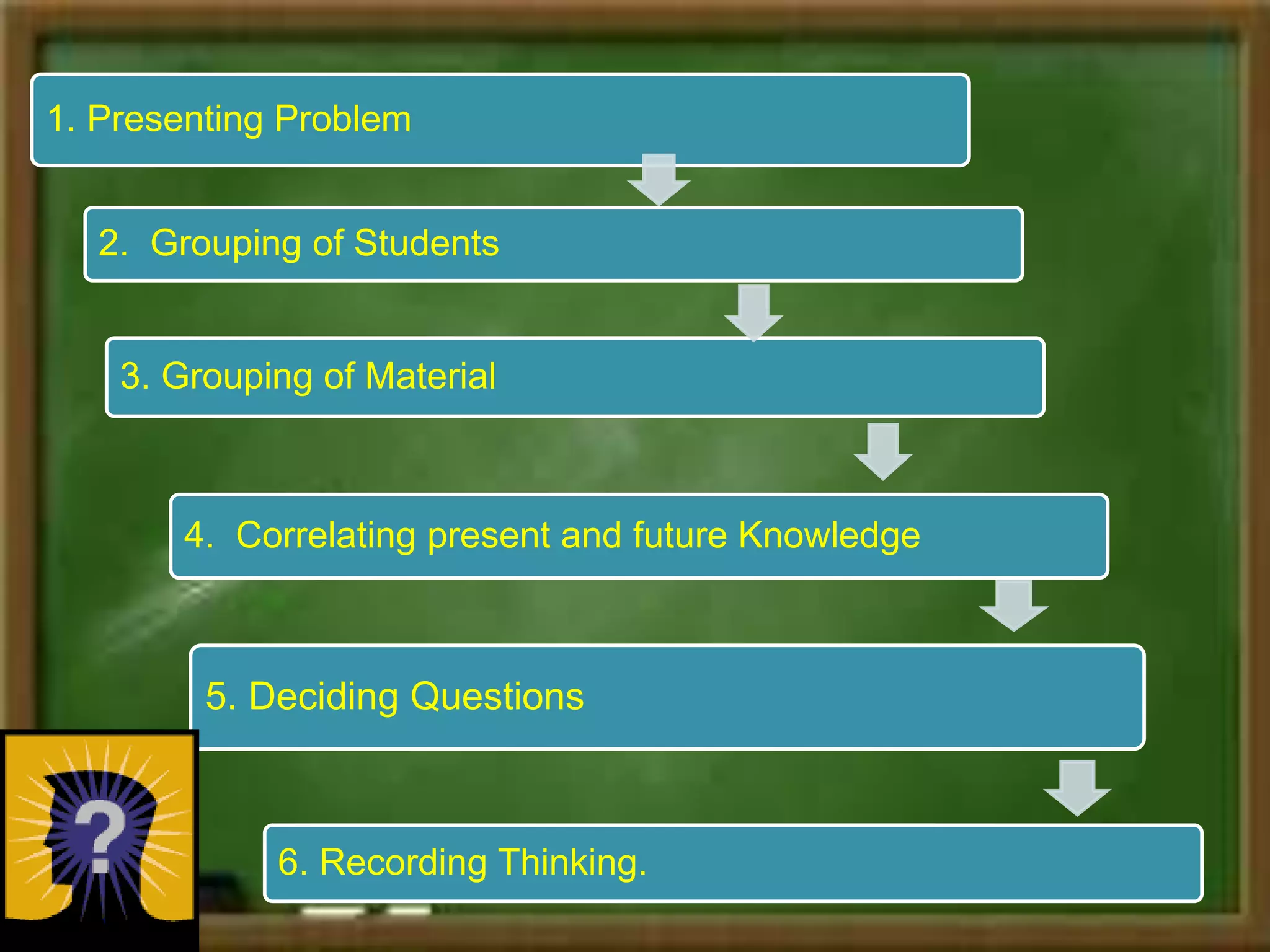
1. Presenting Problem
2. Grouping of Students
3. Grouping of Material
4. Correlating present and future Knowledge
6. Recording Thinking.
5. Deciding Questions
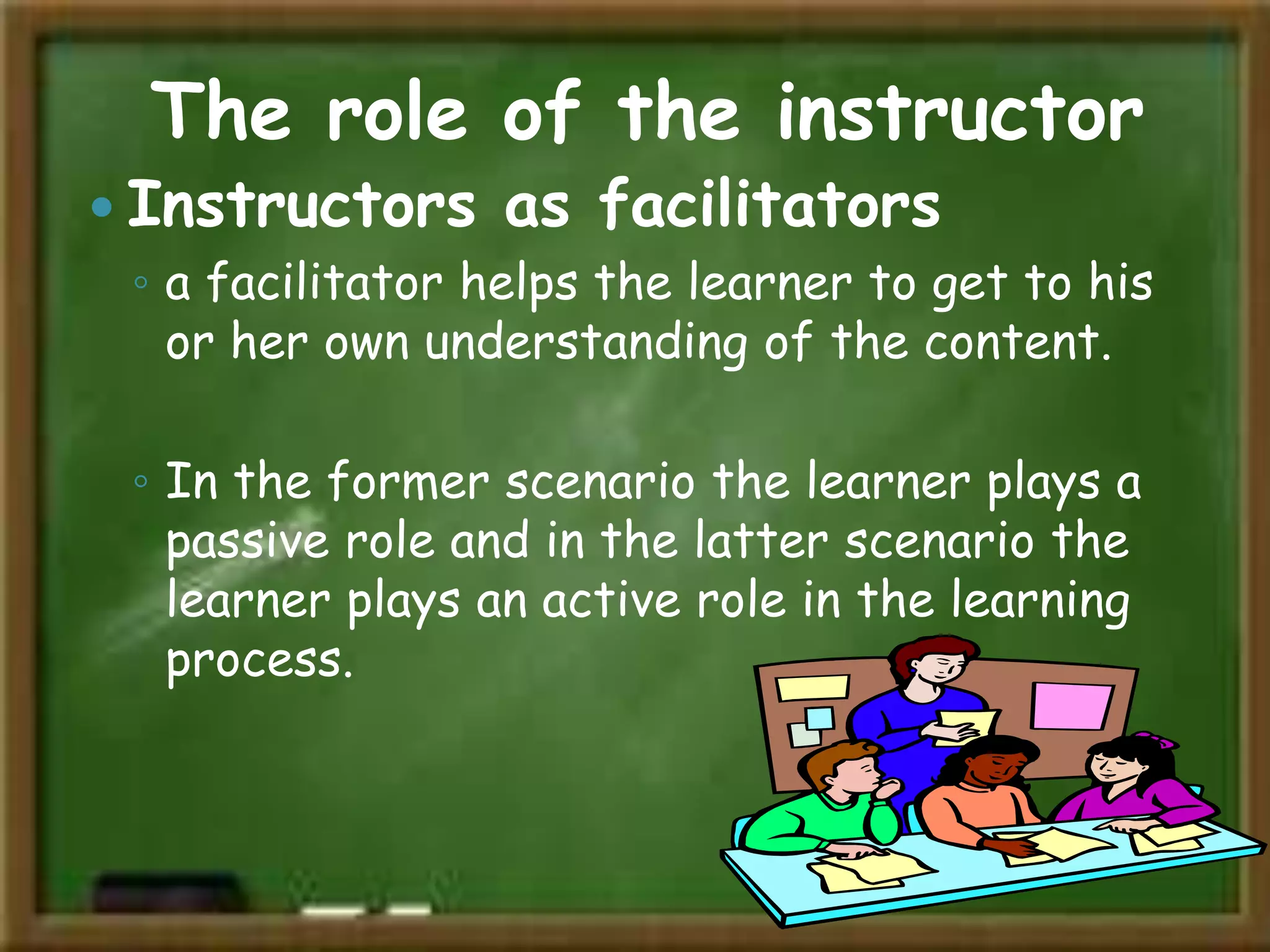
The role of the instructor
 Instructors as facilitators
◦ a facilitator helps the learner to get to his
or her own understanding of the content.
◦ In the former scenario the learner plays a
passive role and in the latter scenario the
learner plays an active role in the learning
process.
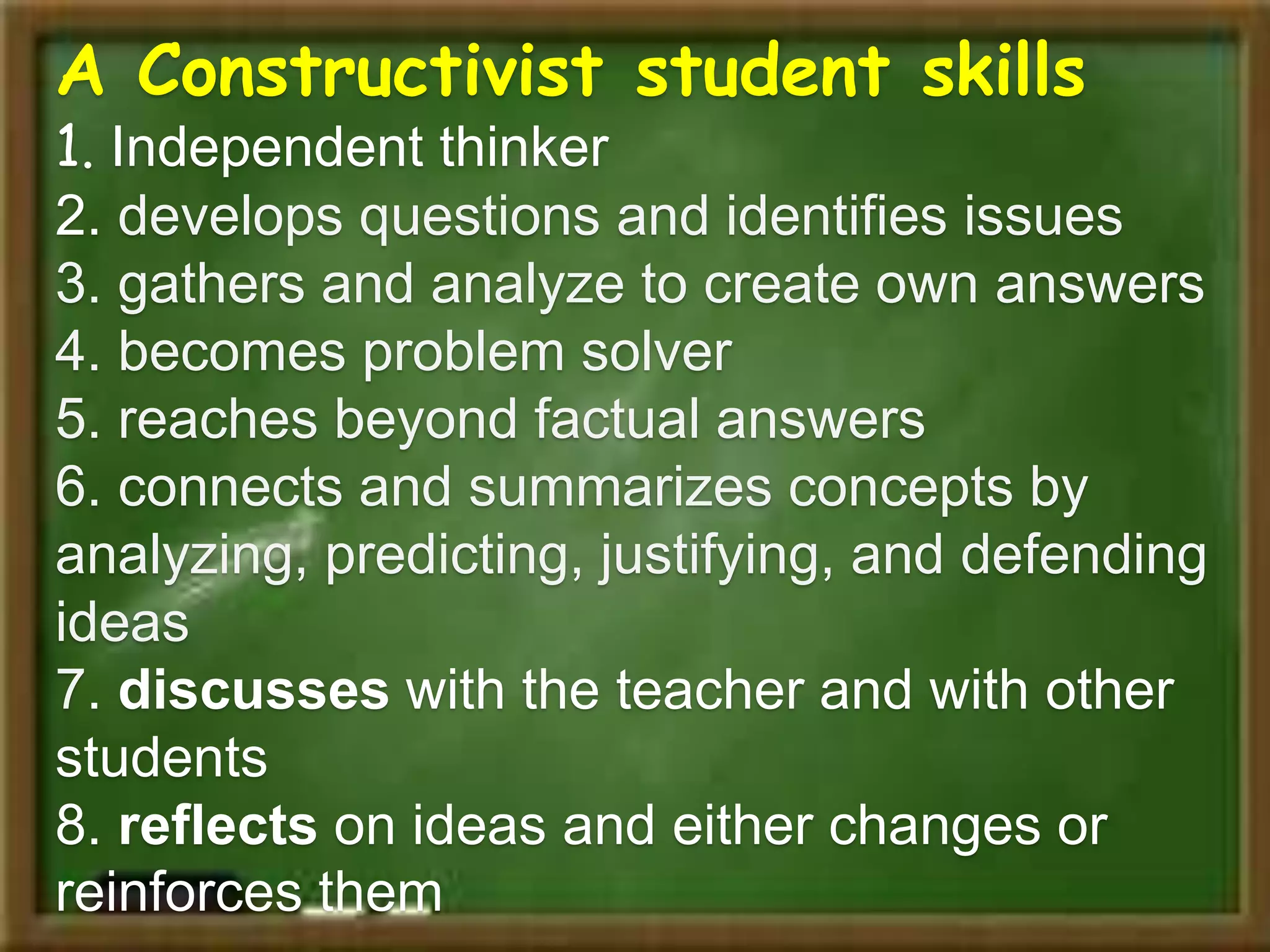
A Constructivist student skills
1. Independent thinker
2. develops questions and identifies issues
3. gathers and analyze to create own answers
4. becomes problem solver
5. reaches beyond factual answers
6. connects and summarizes concepts by
analyzing, predicting, justifying, and defending
ideas
7. discusses with the teacher and with other
students
8. reflects on ideas and either changes or
reinforces them
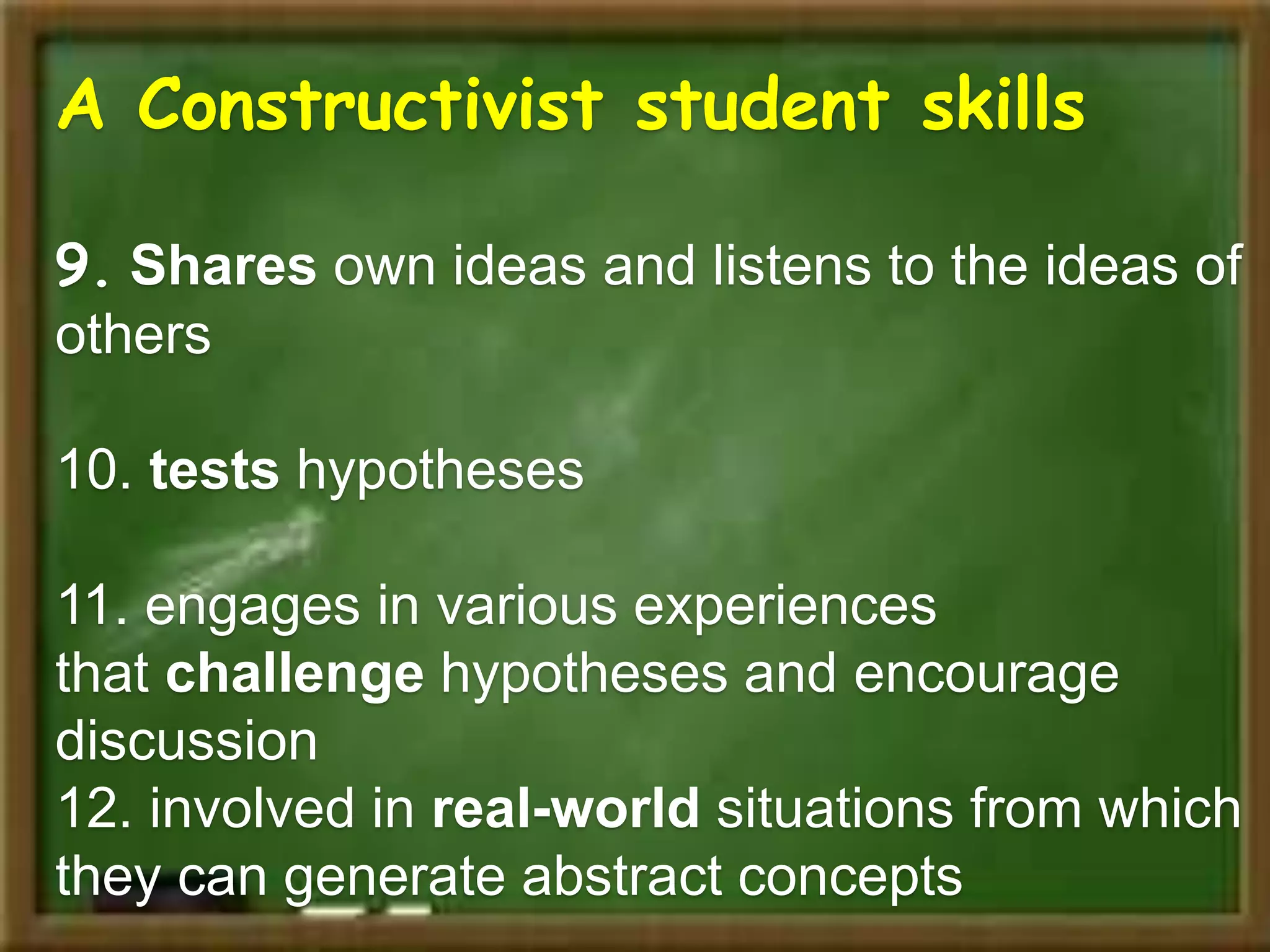
A Constructivist student skills
9. Shares own ideas and listens to the ideas of
others
10. tests hypotheses
11. engages in various experiences
that challenge hypotheses and encourage
discussion
12. involved in real-world situations from which
they can generate abstract concepts
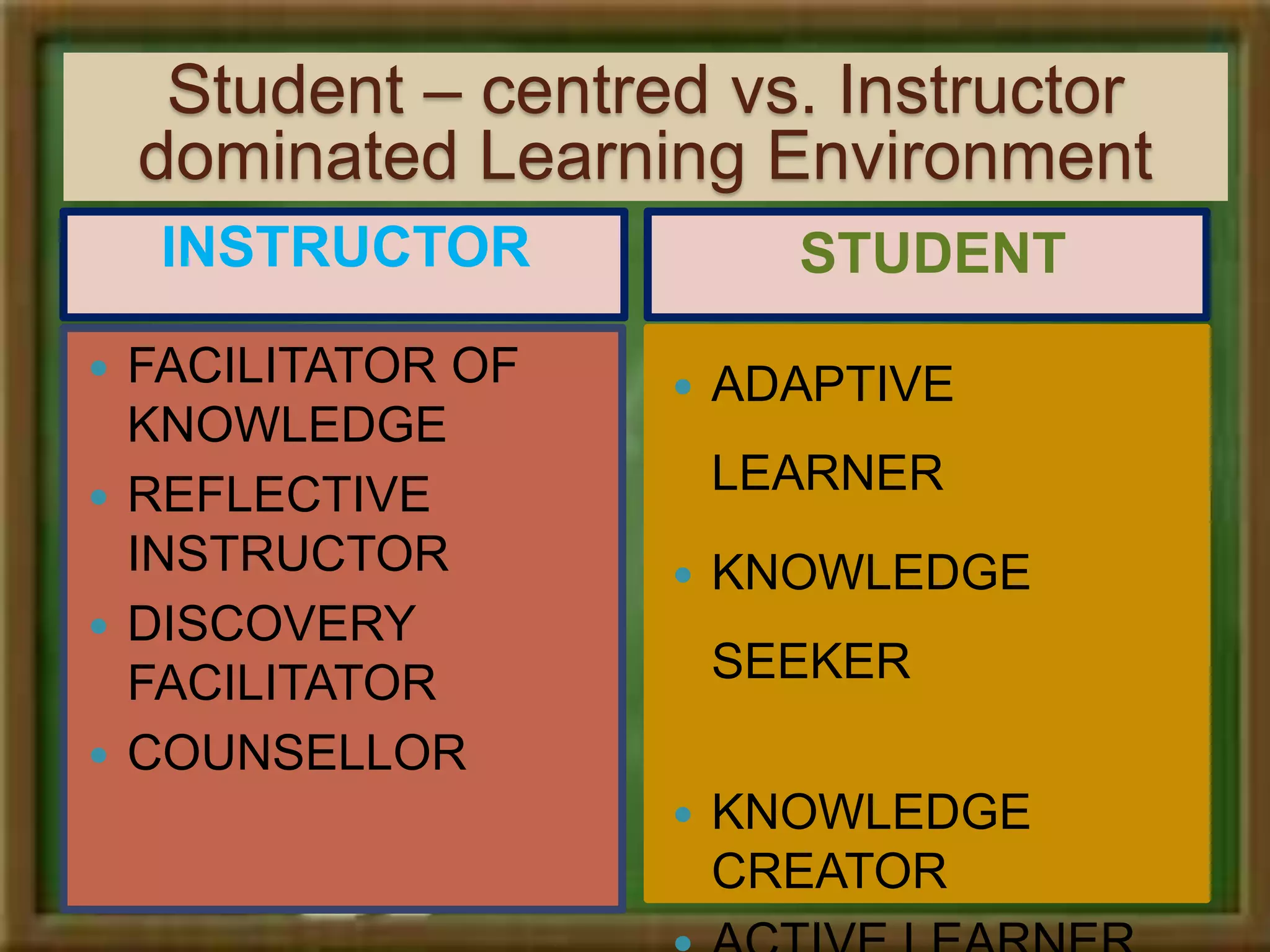
INSTRUCTOR
 FACILITATOR OF
KNOWLEDGE
 REFLECTIVE
INSTRUCTOR
 DISCOVERY
FACILITATOR
 COUNSELLOR
STUDENT
 ADAPTIVE
LEARNER
 KNOWLEDGE
SEEKER
 KNOWLEDGE
CREATOR
Student – centred vs. Instructor
dominated Learning Environment
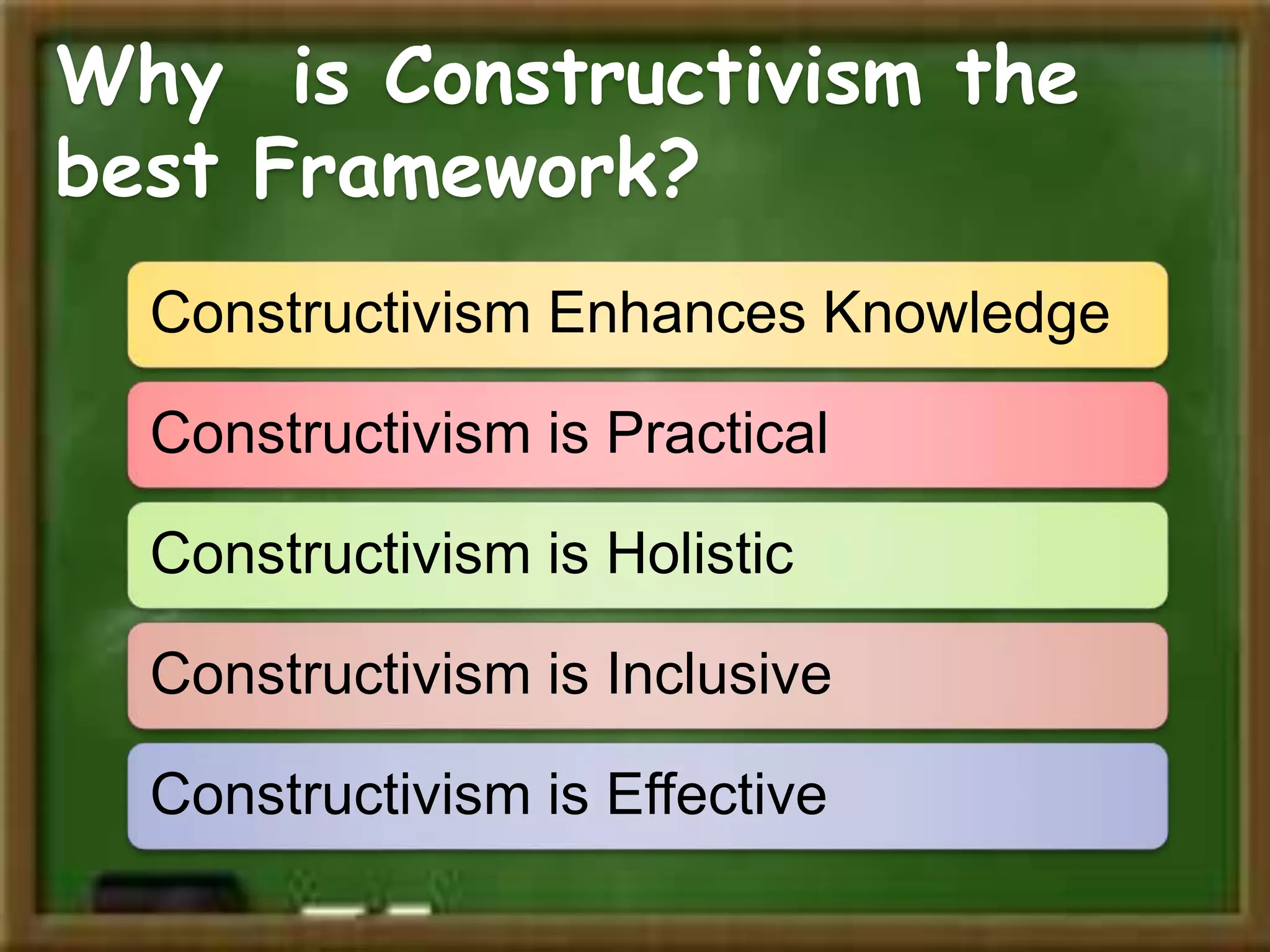
Why is Constructivism the
best Framework?
Constructivism Enhances Knowledge
Constructivism is Practical
Constructivism is Holistic
Constructivism is Inclusive
Constructivism is Effective
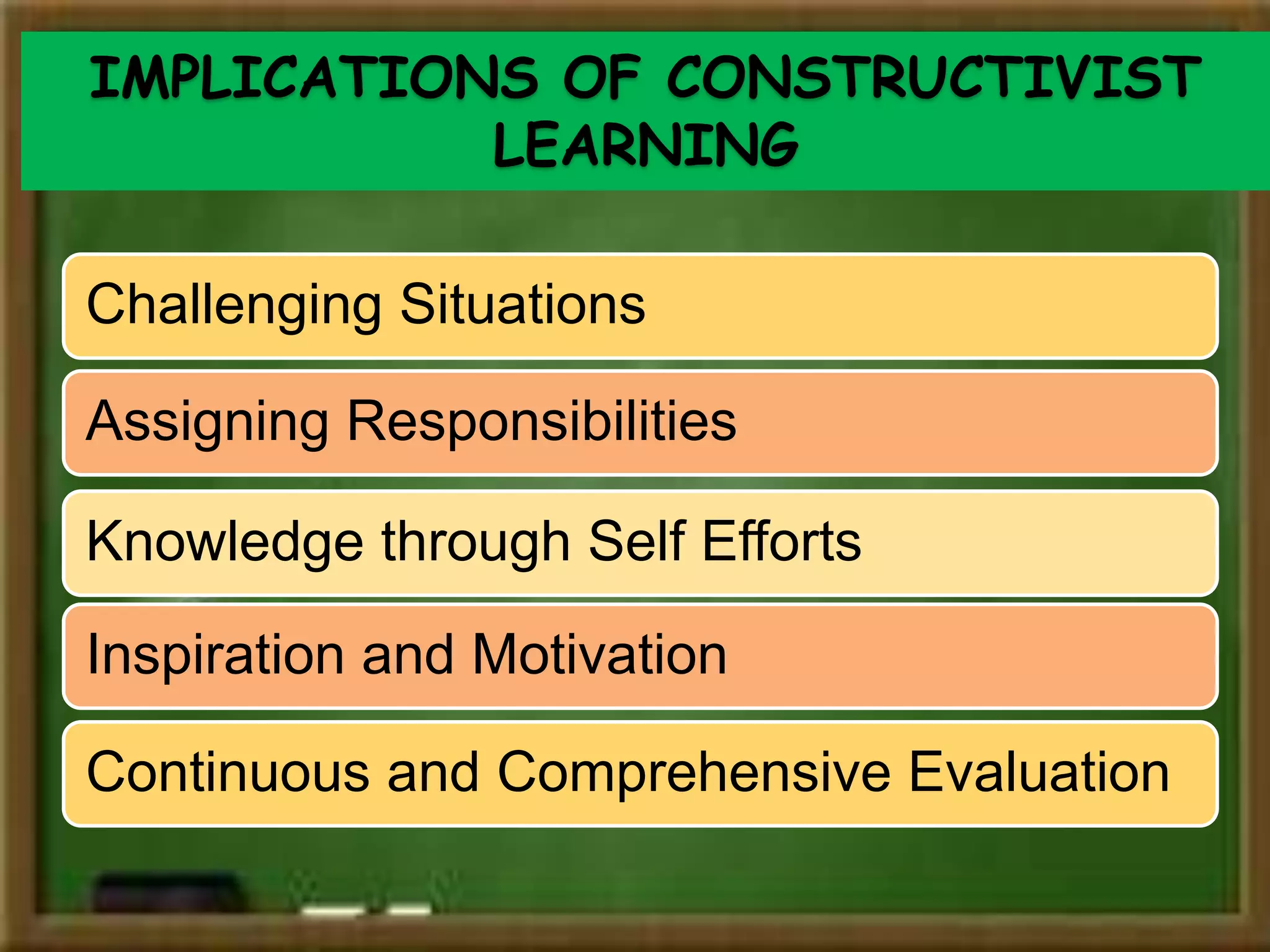
IMPLICATIONS OF CONSTRUCTIVIST
LEARNING
Challenging Situations
Assigning Responsibilities
Knowledge through Self Efforts
Inspiration and Motivation
Continuous and Comprehensive Evaluation
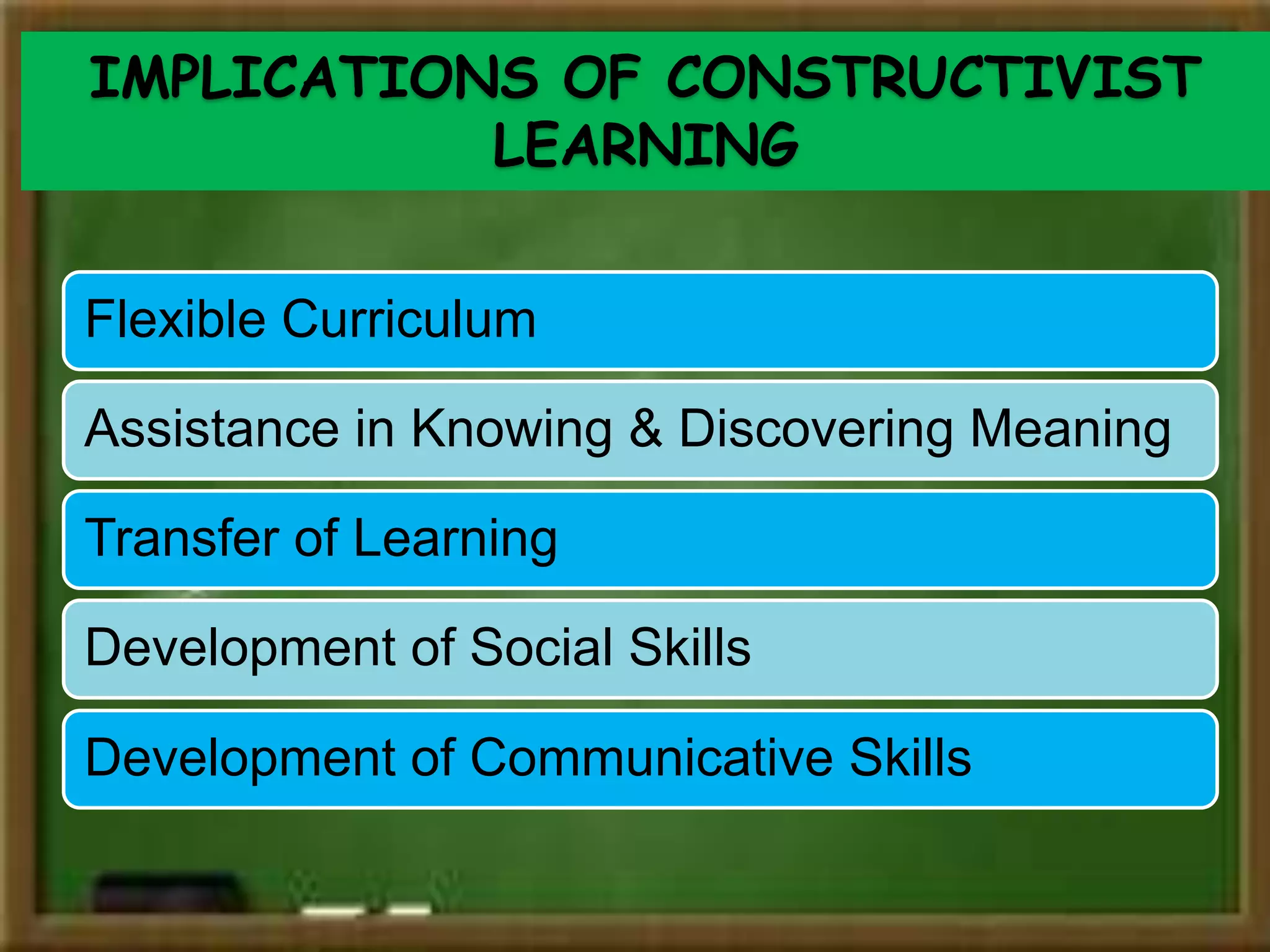
IMPLICATIONS OF CONSTRUCTIVIST
LEARNING
Flexible Curriculum
Assistance in Knowing & Discovering Meaning
Transfer of Learning
Development of Social Skills
Development of Communicative Skills
IMPLICATIONS OF CONSTRUCTIVIST
LEARNING
Development of Cognitive Skills
Active Learning
Satisfaction of Curiosity
Student Centeredness
Democratization of Teaching-Learning Process
Constructivism ppt (1)

Constructivism ppt (1)

  • 3.
    WHAT IS CONSTRUCTIVISM? Constructivism refers to the idea that learners construct knowledge for themselves---each learner individually (and socially) constructs meaning--- as he or she learns.  A learning theory that “equates learning with creating meaning from experience”
  • 4.
  • 5.
     Swiss developmentalpsychologist and philosopher known for his epistemological studies with children.  Believes that children learn through experience, they to situations based on what they have previously learned from other situations. Key people of CONSTRUCTIVSM:
  • 6.
     A Russianpsychologist who had a theory that laid the basis of Constructivism.  Believed that learners develop through interaction with culture and their surroundings.
  • 7.
     has madesignificant contributions to human and in , as well as to history and to the general . Key people of CONSTRUCTIVSM:
  • 8.
  • 9.
    INDIVIDUAL CONSTRUCTIVISM  Thisis also called  It emphasizes individual, internal construction of knowledge.  It is largely based on Piaget’s theory.  Learners should be allowed to discover principles through their rather than direct instruction by the teacher.
  • 10.
    SOCIAL CONSTRUCTIVSM  Thisview emphasizes that “ of being represented solely in the mind of an individual.”  It is based on Vygotsky’s theory.  Construction of knowledge is shared by two or more people
  • 11.
  • 13.
  • 14.
    Traditional Classroom  ConstructivistClassroom 1.Knowledge/ Learning can be transmitted from experienced person to inexperienced person. 2. Teachers disseminate information to students; students are recipient of knowledge. 3.Learner plays passive role. 4.Promotes authoritative environment. 5. Learner’s autonomy & initiative are not accepted. 6. Materials are primarily books and workbooks. 7. Assessment is through testing, correct answers. 1. Learning taken as construction of knowledge rather than transmission of knowledge. 2. Teachers have dialogue with the students, helping students construct their own knowledge. 3. Learner plays active role. 4. Promotes democratic environment. 5. Learner’s autonomy & initiative are accepted. 6. Materials include primary sources of material and manipulative material. 7. Assessments include students work observations, and point of view as well as tests.
  • 15.
    PRINCIPLES OF PLANNING& DEVELOPMENT OF LEARNING EXPERIENCES IN CONSTRUCTIVIST CLASSROOM PRINCIPLE OF ACTIVITY PRINCIPLE OF COMPLEXITY PRINCIPLE OF CONSTRUCTION PRINCIPLE OF REFLECTION PRINCIPLE OF COLLABORATION
  • 17.
    The nature ofthe learning process Learning is an active, social process Dynamic interaction between task, instructor and learner Collaboration among learners
  • 18.
    Process for planning& development of learning experiences in constructivist classroom
  • 19.
    1. Presenting Problem 2.Grouping of Students 3. Grouping of Material 4. Correlating present and future Knowledge 6. Recording Thinking. 5. Deciding Questions
  • 20.
    The role ofthe instructor  Instructors as facilitators ◦ a facilitator helps the learner to get to his or her own understanding of the content. ◦ In the former scenario the learner plays a passive role and in the latter scenario the learner plays an active role in the learning process.
  • 21.
    A Constructivist studentskills 1. Independent thinker 2. develops questions and identifies issues 3. gathers and analyze to create own answers 4. becomes problem solver 5. reaches beyond factual answers 6. connects and summarizes concepts by analyzing, predicting, justifying, and defending ideas 7. discusses with the teacher and with other students 8. reflects on ideas and either changes or reinforces them
  • 22.
    A Constructivist studentskills 9. Shares own ideas and listens to the ideas of others 10. tests hypotheses 11. engages in various experiences that challenge hypotheses and encourage discussion 12. involved in real-world situations from which they can generate abstract concepts
  • 23.
    INSTRUCTOR  FACILITATOR OF KNOWLEDGE REFLECTIVE INSTRUCTOR  DISCOVERY FACILITATOR  COUNSELLOR STUDENT  ADAPTIVE LEARNER  KNOWLEDGE SEEKER  KNOWLEDGE CREATOR Student – centred vs. Instructor dominated Learning Environment
  • 24.
    Why is Constructivismthe best Framework? Constructivism Enhances Knowledge Constructivism is Practical Constructivism is Holistic Constructivism is Inclusive Constructivism is Effective
  • 26.
    IMPLICATIONS OF CONSTRUCTIVIST LEARNING ChallengingSituations Assigning Responsibilities Knowledge through Self Efforts Inspiration and Motivation Continuous and Comprehensive Evaluation
  • 27.
    IMPLICATIONS OF CONSTRUCTIVIST LEARNING FlexibleCurriculum Assistance in Knowing & Discovering Meaning Transfer of Learning Development of Social Skills Development of Communicative Skills
  • 28.
    IMPLICATIONS OF CONSTRUCTIVIST LEARNING Developmentof Cognitive Skills Active Learning Satisfaction of Curiosity Student Centeredness Democratization of Teaching-Learning Process