Student Diver sity

 Dr. Jennifer Irwin
 EDU 620: Module 4
 Chapters 4 &12
Before we begin…

 Please take 5 minutes to watch this
  video.
 http://www.youtube.com/watch?v=7hO9V_g
The “Uh Oh!” Effect
 What did you think about the speaker’s
  description of the “uh oh” effect? Have you ever
  experienced it?
 This is Steve Robbins, a nationally known
  diversity speaker
 I saw him speak last year on “Unintentional
  Intolerance” …. It was very fascinating. Check
  out his website for more info: http://www.slrobbins.com/

 Want to see an example of how we can
  unintentionally make assumptions? … see the
  next slide.
 Form a picture in your mind of someone
  from each of the following places:

     Holland
     Mexico
     Hawaii
 Was the person from Holland
  wearing wooden shoes or
  standing in front of a windmill?

 Was the person from Mexico
  wearing a sombrero?

 Was the person from Hawaii
  wearing a hula skirt or flowered
  lei?
 How is it that we develop these
  stereotypes (which are often simplistic
  and untrue caricatures)?

 What you do in your classroom will
  largely depend on your knowledge of
  your students and their uniqueness.
Let’s talk about you and
c ulture
  Culture is…. shared norms, values,
   behaviors, perceptions, language,
            dress, rituals, etc.
Individuals Belong to Many Different Microcultural Groups


                        Gender

           Region                    Religion


            Social                    Ability/
            Class                    Disability


            Race                     Ethnicity
                        Others?
                                                  James Banks
Pause, practice, & apply

  To which microcultural groups to you
   belong?
  What other cultures do you understand
   other than your own?
  What are some potential areas of cultural
   conflict in the classroom? What would
   you do as a teacher?
What is SES ….

 Socioeconomic Status

   How much income your family earns
                     +
  Your family’s highest level of schooling
                     =
                   SES
What does the research
say about SES and
education? (refer to chapter 4)
Teaching Tips & SES
    Always set high expectations
    Make adjustments to meet the needs of the class
     (differentiate)
    Help students work on retention skills, time
     management, organization, etc…
    Arrange enrichment/challenge opportunities
    Be thoughtful when grouping/ use cooperative
     learning
    Help students get basics met (food, clothing,
     shelter)
    Reach out to parents
Ethnicity & Race

  Not synonymous
  Ethnicity: a history, culture, and sense of
   identity shared by a group of people (e.g.
   Irish, Jewish Americans)
  Race: visible genetic characteristics of
   individuals that cause them to be seen as
   members of the same group (e.g.
   Caucasian)
Pause, practice, &
apply
  Refer to chapter 4 …
  How do ethnicity and race affect
   students’ school experiences and
   achievement?
  What is the “achievement gap” and why
   does it occur?
Teaching Tips &
Cultural Diversity
     Be fair
     Use a variety of instructional materials &
      strategies
     Use community resources
     Openly discuss cultural relations
     Use wait time (allow students 3-5 seconds to
      form an answer to a question)
     Use cooperative learning
     Do not permit prejudicial remarks (ignoring
      such remarks in the classroom is the same
      thing as agreeing with them)
 Before you go on, form a picture in your
  mind of the following individuals:
     Bank President
     Kindergarten Teacher
     Fashion Model
     Scientist
     Building Contractor
     Secretary
 Did you think of these?
     Bank President-male
     Kindergarten Teacher-female
     Fashion Model-female
     Scientist-male
     Building Contractor-male
     Secretary-female
Gender Stereotypes:                                                 Fill
in the following chart with the all stereotypes you can think of.


                           Males                    Females
 Personality
 characteristics


 Best school subjects


 Occupations
Gender Differences
 What are some generalizations made
  about males and females?
 Where do those differences or
  generalizations come from?


How do those generalizations/differences
     affect teaching and learning?
Teaching Tips &
Gender Equity
       Avoid stereotypes
       Promote integration
       Treat equally, but respect learning
        differences
       Provide strong role models
       Promote equal opportunities
       Make student achievement private
       Avoid segregating activities
       Use “wait time”
Language Differences
 Look in chapter 4 to see the different
  approaches to teaching English Language
  Learners:
     English immersion
     Transitional bilingual education
     Paired bilingual education
     Two-way bilingual education

  Which approach do you think is most effective? Why?
Time to visit the
Intelligence Theories
  Survey of experts showed varied definitions of
   intelligence (Sternberg and Detterman, 1986)
  Charles Spearman identified one general
   intelligence in the late 1920s
  J.P. Guilford identified 180 types in the 1940s
  Robert Sternberg (1988) identified three types:
    Analytic, Practical and Synthetic
  Howard Gardner identified nine domains or
   multiple intelligences (1997)
Multiple Intelligences Theory

 Linguistic/Verbal

 Logical/Mathematical

 Musical

 Visual/Spatial
More Multiple Intelligences

               Bodily/Kinesthetic

               Interpersonal

               Intrapersonal

               Naturalist

               Existentialist
We do embody all nine
intelligences!                       (Eakle, 2006)


                                                        Linguistic/Verbal

                                                        Logical/Mathematical

                                                        Musical

                                                        Visual/Spatial

                                                        Bodily/Kinesthetic

                                                        Interpersonal

                                                        Intrapersonal
 Some think that there are people who do
 indeed embody all 9 intelligences. Do you
 agree that someone like Rev. Dr. Martin                Naturalist
 Luther King Jr. was one of these people?
                                                        Existentialist
Next Steps with the MI
Theory…
 Help students hone all nine
  intelligences to promote “well-
  roundedness”
 E. Paul Torrance, father of Creativity,
  believes we should “fall in love with
  something and pursue it with intensity”
 Expose students to multiple
  intelligences in the classroom as a way
  of differentiating your lessons.
Learning Styles
    Numerous learning style theories exist
    Dunn & Dunn is most popular
    A learning style is a way in which each learner
     concentrates on, processes, absorbs, and
     retains new and difficult information (Dunn and Dunn,
     1992; 1993; 1999)

  Believe 21 different variables affecting a
   person’s learning style (environmental,
   emotional, sociological, physiological, and
   cognitive processing preferences)
  Visual, Auditory, Kinesthetic, & Tactile (VAKT)
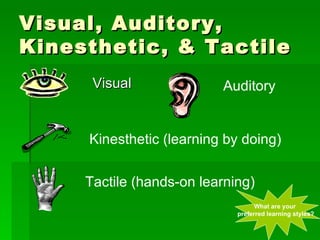
Visual, Auditory,
Kinesthetic, & Tactile
      Visual              Auditory


     Kinesthetic (learning by doing)


     Tactile (hands-on learning)
                                   What are your
                             preferred learning styles?
Learners with
Exceptionalities


  Please skim chapter 12 and complete the
               Study Guide.
Questions? Let me
know … or bring them
to this week’s
discussion board 

Moudle 4 student_diversity

  • 1.
    Student Diver sity Dr. Jennifer Irwin EDU 620: Module 4 Chapters 4 &12
  • 2.
    Before we begin… Please take 5 minutes to watch this video.  http://www.youtube.com/watch?v=7hO9V_g
  • 3.
    The “Uh Oh!”Effect  What did you think about the speaker’s description of the “uh oh” effect? Have you ever experienced it?  This is Steve Robbins, a nationally known diversity speaker  I saw him speak last year on “Unintentional Intolerance” …. It was very fascinating. Check out his website for more info: http://www.slrobbins.com/  Want to see an example of how we can unintentionally make assumptions? … see the next slide.
  • 4.
     Form apicture in your mind of someone from each of the following places:  Holland  Mexico  Hawaii
  • 5.
     Was theperson from Holland wearing wooden shoes or standing in front of a windmill?  Was the person from Mexico wearing a sombrero?  Was the person from Hawaii wearing a hula skirt or flowered lei?
  • 6.
     How isit that we develop these stereotypes (which are often simplistic and untrue caricatures)?  What you do in your classroom will largely depend on your knowledge of your students and their uniqueness.
  • 7.
    Let’s talk aboutyou and c ulture Culture is…. shared norms, values, behaviors, perceptions, language, dress, rituals, etc.
  • 8.
    Individuals Belong toMany Different Microcultural Groups Gender Region Religion Social Ability/ Class Disability Race Ethnicity Others? James Banks
  • 9.
    Pause, practice, &apply  To which microcultural groups to you belong?  What other cultures do you understand other than your own?  What are some potential areas of cultural conflict in the classroom? What would you do as a teacher?
  • 10.
    What is SES….  Socioeconomic Status How much income your family earns + Your family’s highest level of schooling = SES
  • 11.
    What does theresearch say about SES and education? (refer to chapter 4)
  • 12.
    Teaching Tips &SES  Always set high expectations  Make adjustments to meet the needs of the class (differentiate)  Help students work on retention skills, time management, organization, etc…  Arrange enrichment/challenge opportunities  Be thoughtful when grouping/ use cooperative learning  Help students get basics met (food, clothing, shelter)  Reach out to parents
  • 13.
    Ethnicity & Race  Not synonymous  Ethnicity: a history, culture, and sense of identity shared by a group of people (e.g. Irish, Jewish Americans)  Race: visible genetic characteristics of individuals that cause them to be seen as members of the same group (e.g. Caucasian)
  • 14.
    Pause, practice, & apply  Refer to chapter 4 …  How do ethnicity and race affect students’ school experiences and achievement?  What is the “achievement gap” and why does it occur?
  • 15.
    Teaching Tips & CulturalDiversity  Be fair  Use a variety of instructional materials & strategies  Use community resources  Openly discuss cultural relations  Use wait time (allow students 3-5 seconds to form an answer to a question)  Use cooperative learning  Do not permit prejudicial remarks (ignoring such remarks in the classroom is the same thing as agreeing with them)
  • 16.
     Before yougo on, form a picture in your mind of the following individuals:  Bank President  Kindergarten Teacher  Fashion Model  Scientist  Building Contractor  Secretary
  • 17.
     Did youthink of these?  Bank President-male  Kindergarten Teacher-female  Fashion Model-female  Scientist-male  Building Contractor-male  Secretary-female
  • 18.
    Gender Stereotypes: Fill in the following chart with the all stereotypes you can think of. Males Females Personality characteristics Best school subjects Occupations
  • 19.
    Gender Differences  Whatare some generalizations made about males and females?  Where do those differences or generalizations come from? How do those generalizations/differences affect teaching and learning?
  • 20.
    Teaching Tips & GenderEquity  Avoid stereotypes  Promote integration  Treat equally, but respect learning differences  Provide strong role models  Promote equal opportunities  Make student achievement private  Avoid segregating activities  Use “wait time”
  • 21.
    Language Differences  Lookin chapter 4 to see the different approaches to teaching English Language Learners:  English immersion  Transitional bilingual education  Paired bilingual education  Two-way bilingual education Which approach do you think is most effective? Why?
  • 22.
    Time to visitthe Intelligence Theories  Survey of experts showed varied definitions of intelligence (Sternberg and Detterman, 1986)  Charles Spearman identified one general intelligence in the late 1920s  J.P. Guilford identified 180 types in the 1940s  Robert Sternberg (1988) identified three types:  Analytic, Practical and Synthetic  Howard Gardner identified nine domains or multiple intelligences (1997)
  • 23.
    Multiple Intelligences Theory Linguistic/Verbal  Logical/Mathematical  Musical  Visual/Spatial
  • 24.
    More Multiple Intelligences  Bodily/Kinesthetic  Interpersonal  Intrapersonal  Naturalist  Existentialist
  • 25.
    We do embodyall nine intelligences! (Eakle, 2006)  Linguistic/Verbal  Logical/Mathematical  Musical  Visual/Spatial  Bodily/Kinesthetic  Interpersonal  Intrapersonal Some think that there are people who do indeed embody all 9 intelligences. Do you agree that someone like Rev. Dr. Martin  Naturalist Luther King Jr. was one of these people?  Existentialist
  • 26.
    Next Steps withthe MI Theory…  Help students hone all nine intelligences to promote “well- roundedness”  E. Paul Torrance, father of Creativity, believes we should “fall in love with something and pursue it with intensity”  Expose students to multiple intelligences in the classroom as a way of differentiating your lessons.
  • 27.
    Learning Styles  Numerous learning style theories exist  Dunn & Dunn is most popular  A learning style is a way in which each learner concentrates on, processes, absorbs, and retains new and difficult information (Dunn and Dunn, 1992; 1993; 1999)  Believe 21 different variables affecting a person’s learning style (environmental, emotional, sociological, physiological, and cognitive processing preferences)  Visual, Auditory, Kinesthetic, & Tactile (VAKT)
  • 28.
    Visual, Auditory, Kinesthetic, &Tactile Visual Auditory Kinesthetic (learning by doing) Tactile (hands-on learning) What are your preferred learning styles?
  • 29.
    Learners with Exceptionalities Please skim chapter 12 and complete the Study Guide.
  • 30.
    Questions? Let me know… or bring them to this week’s discussion board 