Educational Philosophy:
Constructivism
CREATED BY: NICHOLAS CAMACHO
Menu

Constructivist Theory Overview
     Important People
      In the Classroom
      In My Classroom
         (Click one of the titles
           to find out more!)
Constructivist Theory Overview

 Student-centered
  philosophy
 Learning = constant
  effort to assimilate new
  information.
 New concepts & ideas are
  related to old concepts &   (Click the arrow
                              to continue!)
  ideas.
Constructivist Theory Overview (Cont.)

 Students learn by doing
  and seeing.
 Students learn by actively
  engaging a new concept.
• Learning should be a
  discovery.
•Students continually build on what they
 have already learned. (Click the orange arrow
                           to return to the Menu!)
Important People

 John Dewey
  Viewed learning as student-directed with a
  teacher serving as a guide for resources.
 Jerome Bruner
  Learnersare participatory learners; they are
  engaged in the learning process.
 Lev Vygotsky
  Learning
          is influenced by cognitive/social
  development
                       (Click the arrow to continue!)
(Return
to Menu)
            Important People (Cont.)

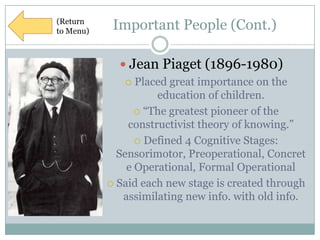
              Jean Piaget (1896-1980)
                Placed great importance on the
                     education of children.
                  “The greatest pioneer of the
               constructivist theory of knowing.”
                  Defined 4 Cognitive Stages:
             Sensorimotor, Preoperational, Concret
               e Operational, Formal Operational
            Said each new stage is created through
              assimilating new info. with old info.
Constructivism in the classroom

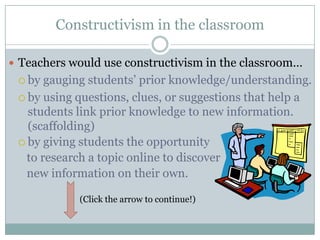
 Teachers would use constructivism in the classroom…
  by  gauging students’ prior knowledge/understanding.
  by using questions, clues, or suggestions that help a
   students link prior knowledge to new information.
   (scaffolding)
  by giving students the opportunity
   to research a topic online to discover
   new information on their own.

            (Click the arrow to continue!)
Constructivism in the classroom (Cont)

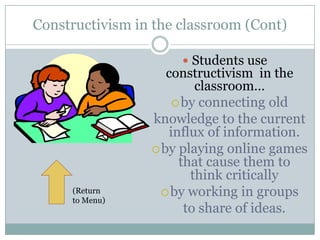
                       Students use
                    constructivism in the
                         classroom…
                      by connecting old
                 knowledge to the current
                    influx of information.
                  by playing online games
                      that cause them to
                        think critically
     (Return       by working in groups
     to Menu)
                       to share of ideas.
Constructivism In My Classroom

 Constructivism will play a major
  role in my classroom.
 Current knowledge will be assessed
  to set foundation for teaching.
 Students will interact with the
  lesson using remote-to-Smart Board
  connection.
     (Click the arrow to continue!)
In My Classroom (Cont.)

 As a math teacher, I will continually build upon
  previous lessons as I teach.
 Students will be able to work in
  groups to discuss new concepts.
 My students will teach themselves
  some areas of math that we cover.
 My students will assimilate new ideas as
   I use scaffolding to bridge two similar concepts.
                     (Return
                     to Menu)

Constructivism

  • 1.
  • 2.
    Menu Constructivist Theory Overview Important People In the Classroom In My Classroom (Click one of the titles to find out more!)
  • 3.
    Constructivist Theory Overview Student-centered philosophy  Learning = constant effort to assimilate new information.  New concepts & ideas are related to old concepts & (Click the arrow to continue!) ideas.
  • 4.
    Constructivist Theory Overview(Cont.)  Students learn by doing and seeing.  Students learn by actively engaging a new concept. • Learning should be a discovery. •Students continually build on what they have already learned. (Click the orange arrow to return to the Menu!)
  • 5.
    Important People  JohnDewey  Viewed learning as student-directed with a teacher serving as a guide for resources.  Jerome Bruner  Learnersare participatory learners; they are engaged in the learning process.  Lev Vygotsky  Learning is influenced by cognitive/social development (Click the arrow to continue!)
  • 6.
    (Return to Menu) Important People (Cont.)  Jean Piaget (1896-1980)  Placed great importance on the education of children.  “The greatest pioneer of the constructivist theory of knowing.”  Defined 4 Cognitive Stages: Sensorimotor, Preoperational, Concret e Operational, Formal Operational  Said each new stage is created through assimilating new info. with old info.
  • 7.
    Constructivism in theclassroom  Teachers would use constructivism in the classroom…  by gauging students’ prior knowledge/understanding.  by using questions, clues, or suggestions that help a students link prior knowledge to new information. (scaffolding)  by giving students the opportunity to research a topic online to discover new information on their own. (Click the arrow to continue!)
  • 8.
    Constructivism in theclassroom (Cont)  Students use constructivism in the classroom…  by connecting old knowledge to the current influx of information.  by playing online games that cause them to think critically (Return  by working in groups to Menu) to share of ideas.
  • 9.
    Constructivism In MyClassroom  Constructivism will play a major role in my classroom.  Current knowledge will be assessed to set foundation for teaching.  Students will interact with the lesson using remote-to-Smart Board connection. (Click the arrow to continue!)
  • 10.
    In My Classroom(Cont.)  As a math teacher, I will continually build upon previous lessons as I teach.  Students will be able to work in groups to discuss new concepts.  My students will teach themselves some areas of math that we cover.  My students will assimilate new ideas as I use scaffolding to bridge two similar concepts. (Return to Menu)