Effective Teaching &
      Learning
     Dr. Jennifer Irwin
   EDU 620: Module 10
      Chapters 7 & 9
I know what to teach,
                now how do I teach it?

 Have you ever had a teacher who knew
  their subject area very well but didn’t
  know how to teach it to others?
 When you completed the first Learning
  Reflection for this class, you were asked
  “is content knowledge enough”?
 I hope by now that you know the answer
  to that question . . . No!
   In this module, we will explore ideas that
    will help you as you plan for instruction,
    including:

    – Different instructional approaches
    – Effective use of discussions & questioning
    – Grouping techniques
    – The QAIT Model
Think about this …
   New teachers usually “teach” the way they
    were “taught”
    – Do you agree with this statement?
    – For me personally, this was very true. When I
      first began, my bag of teaching tricks was
      limited to lectures, worksheets, and tests
      (how sad!)
    – Through hands-on experience and having
      great mentors, I have become a much more
      effective teacher (I hope!).
Different Instructional Approaches
   What is the best way to teach something?
   What are some different ways to teach?
   Do we need to vary our approaches based on
    our students or the subject matter?

   We will take a look at 3 different types of
    teaching approaches….
   I will leave it up to you to decide on the
    effectiveness of each…..
Expository Approaches
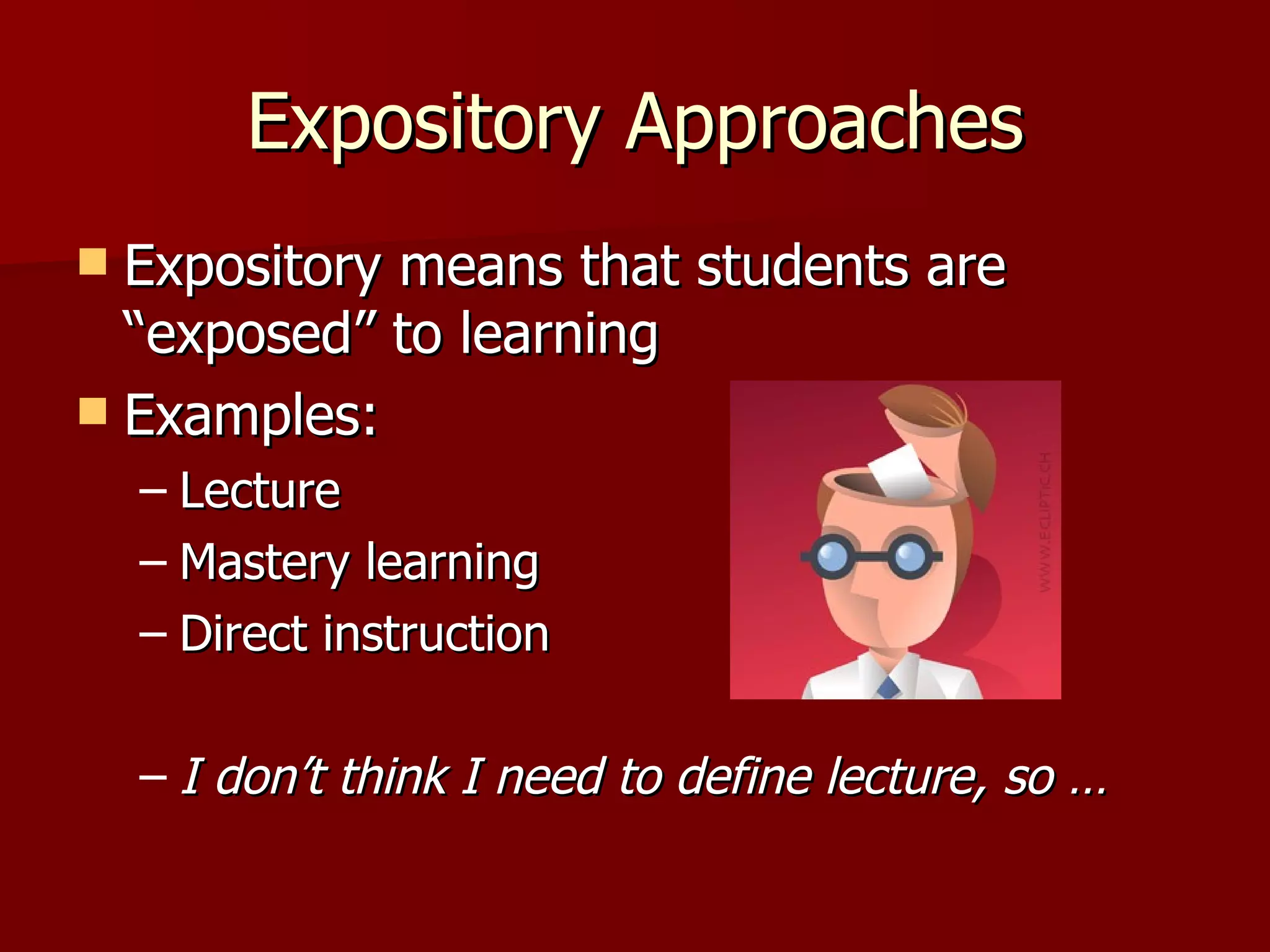
 Expository means that students are
  “exposed” to learning
 Examples:
    – Lecture
    – Mastery learning
    – Direct instruction

    – I don’t think I need to define lecture, so …
Expository Approaches
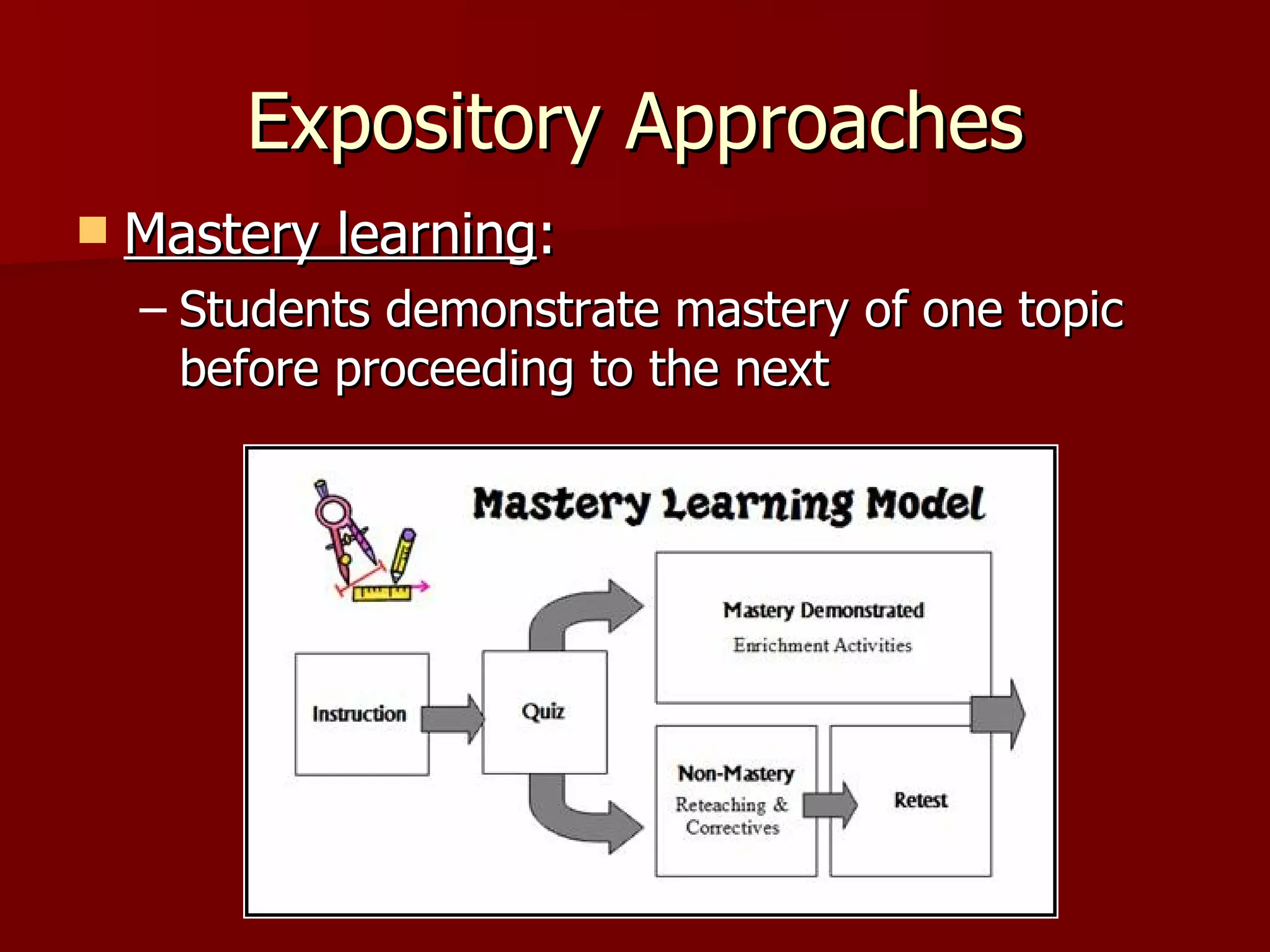
   Mastery learning:
    – Students demonstrate mastery of one topic
      before proceeding to the next
Expository Approaches
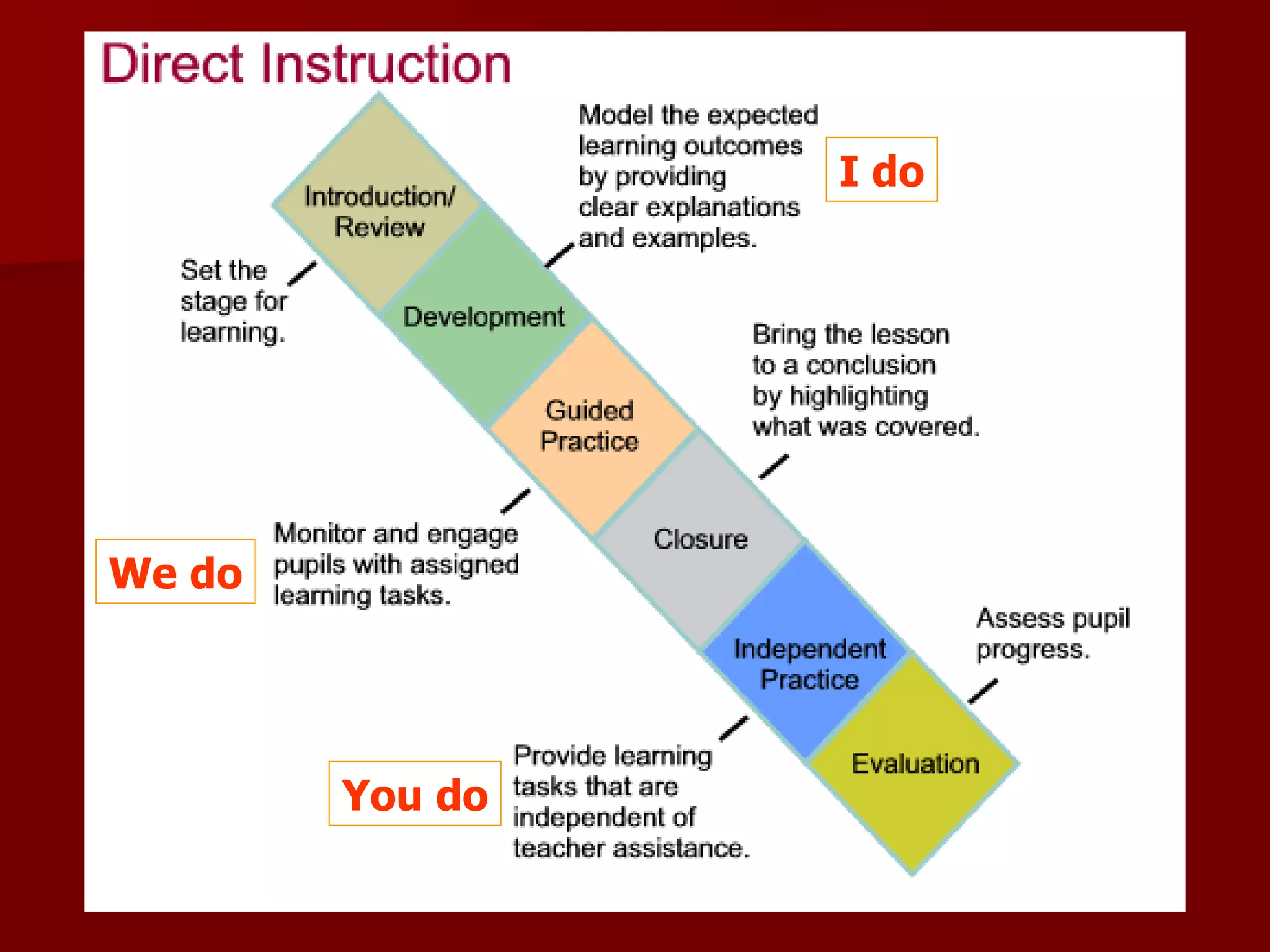
   Direct Instruction:
    – Teacher transmits information directly to
      students; lessons are goal-oriented and
      structured by the teacher
    – To me, this is classic “teaching”
    – Scaffolding at it’s best!
    – The “I do, We do, You do” method

    – How many of you teach this way?
I do


We do


        You do
Hands-On Approaches
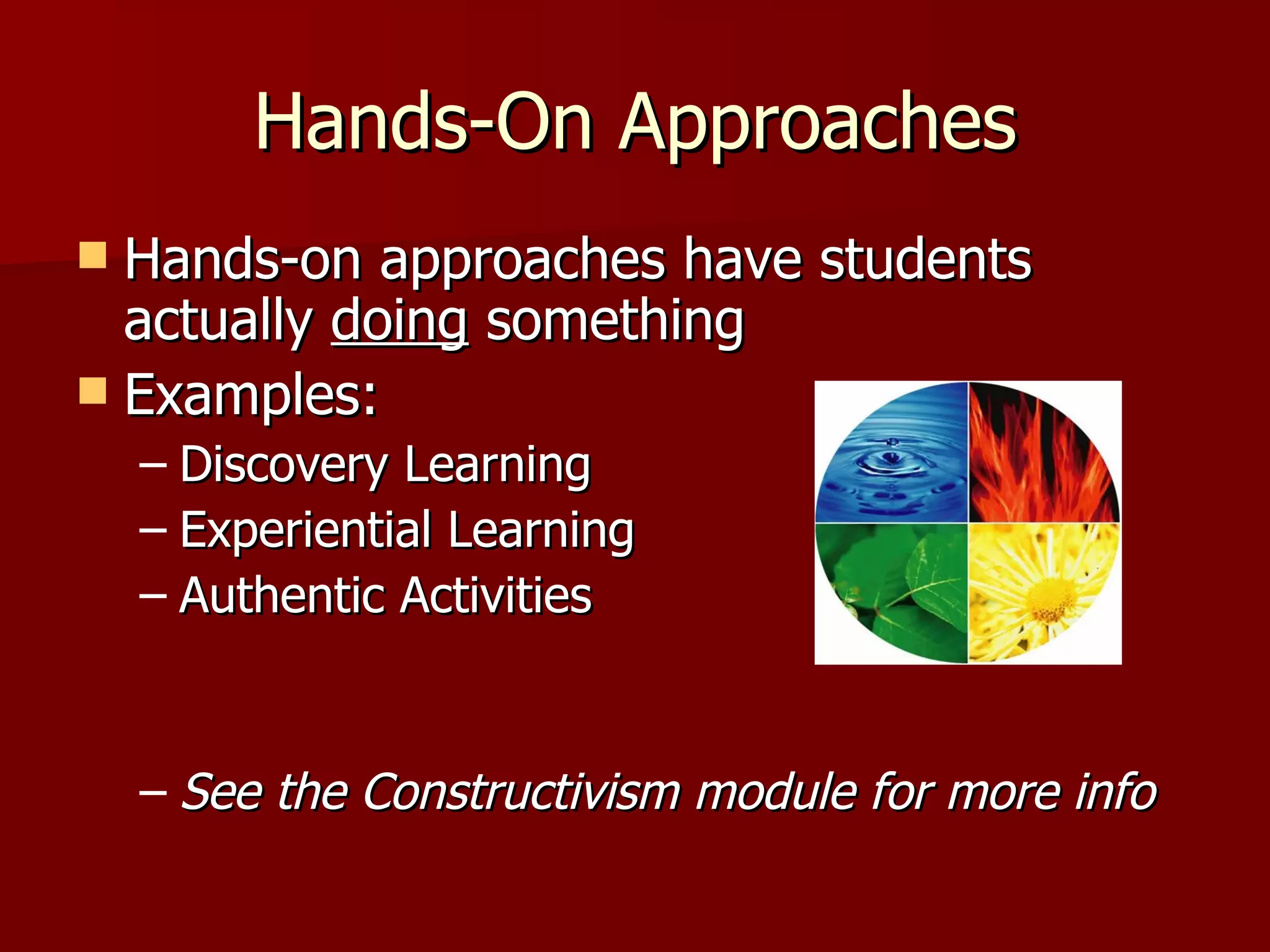
 Hands-on approaches have students
  actually doing something
 Examples:
    – Discovery Learning
    – Experiential Learning
    – Authentic Activities


    – See the Constructivism module for more info
Hands-On Approaches
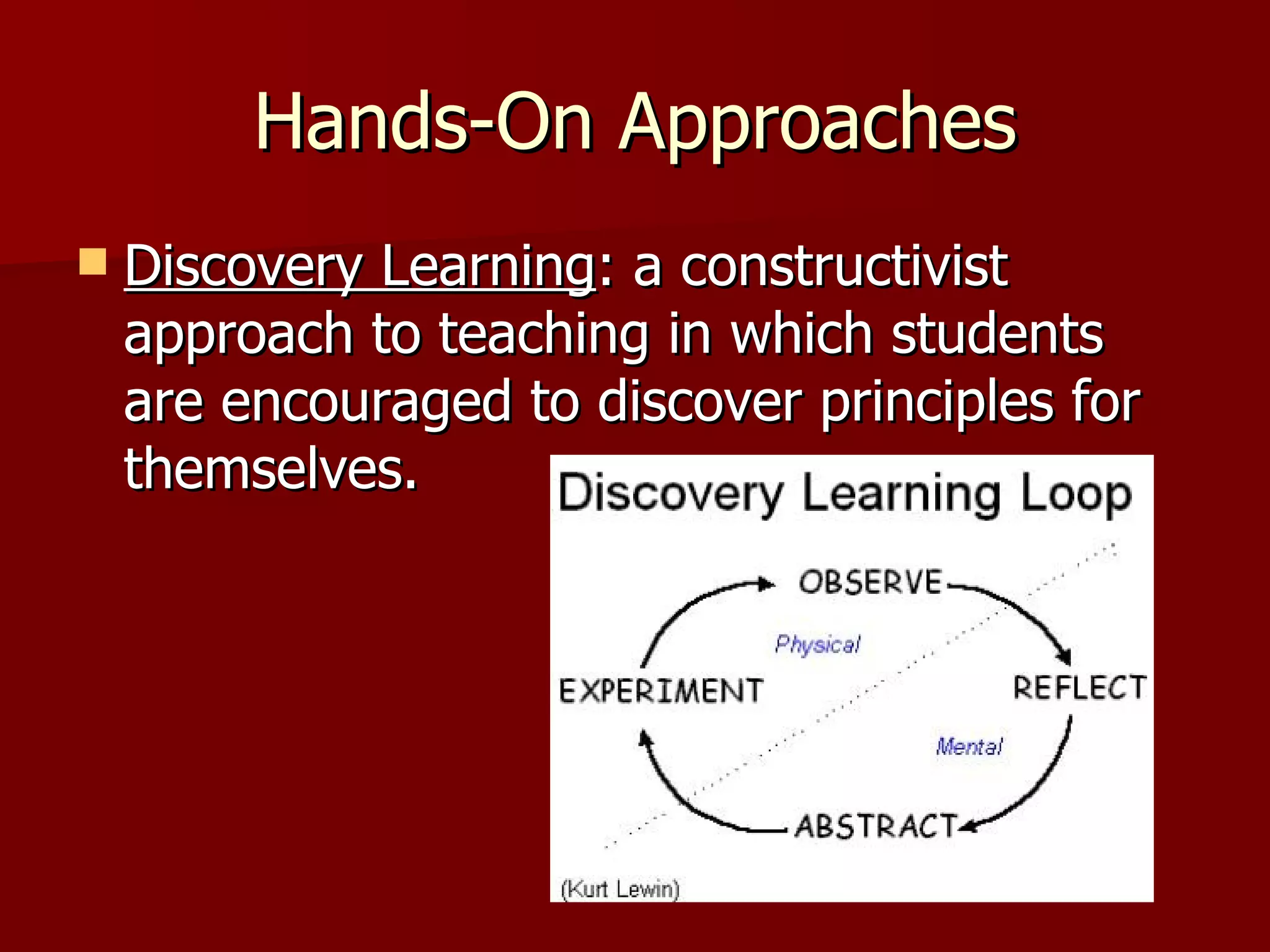
   Discovery Learning: a constructivist
    approach to teaching in which students
    are encouraged to discover principles for
    themselves.
Hands-On Approaches
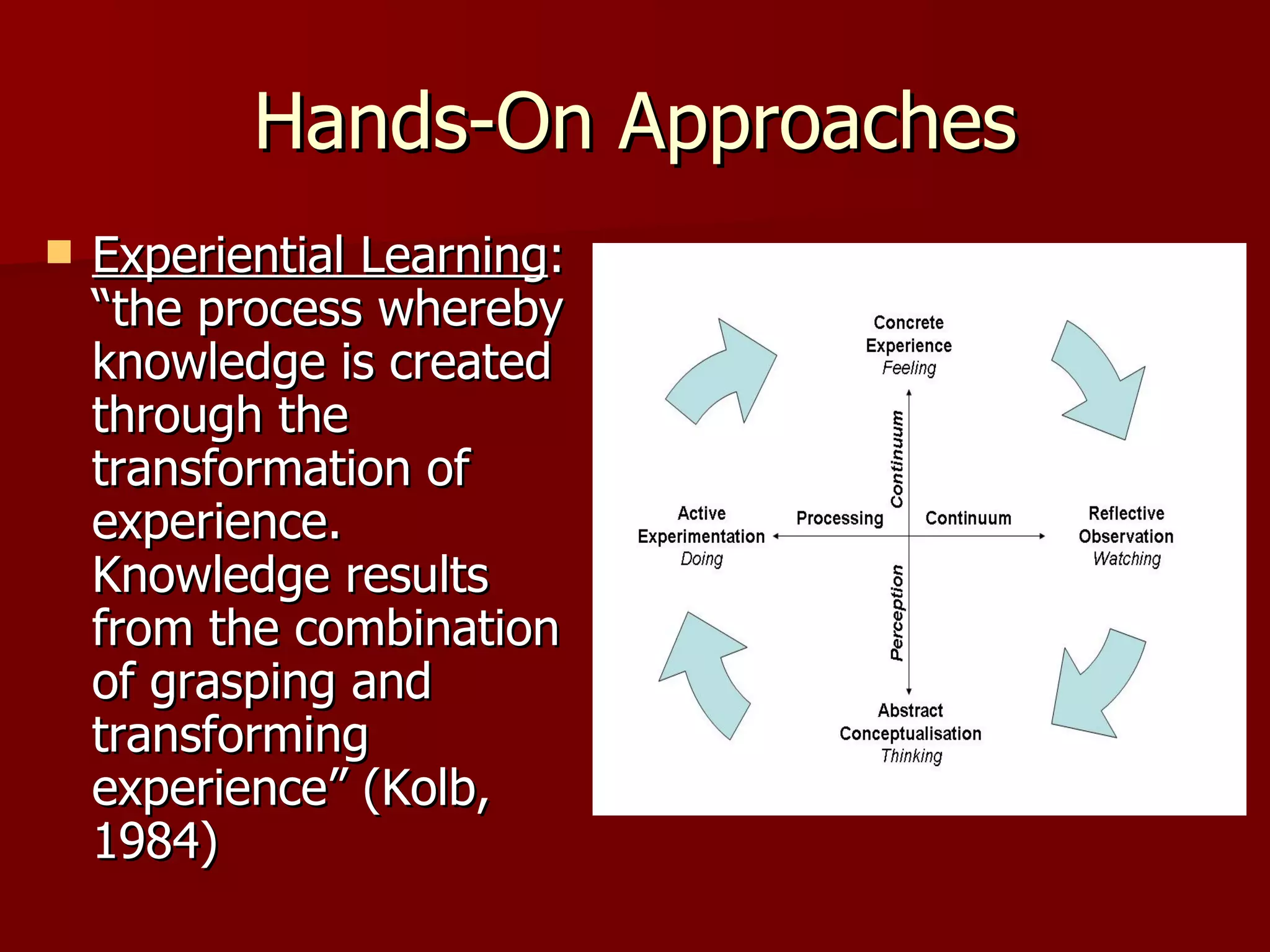
   Experiential Learning:
    “the process whereby
    knowledge is created
    through the
    transformation of
    experience.
    Knowledge results
    from the combination
    of grasping and
    transforming
    experience” (Kolb,
    1984)
Hands-On Approaches
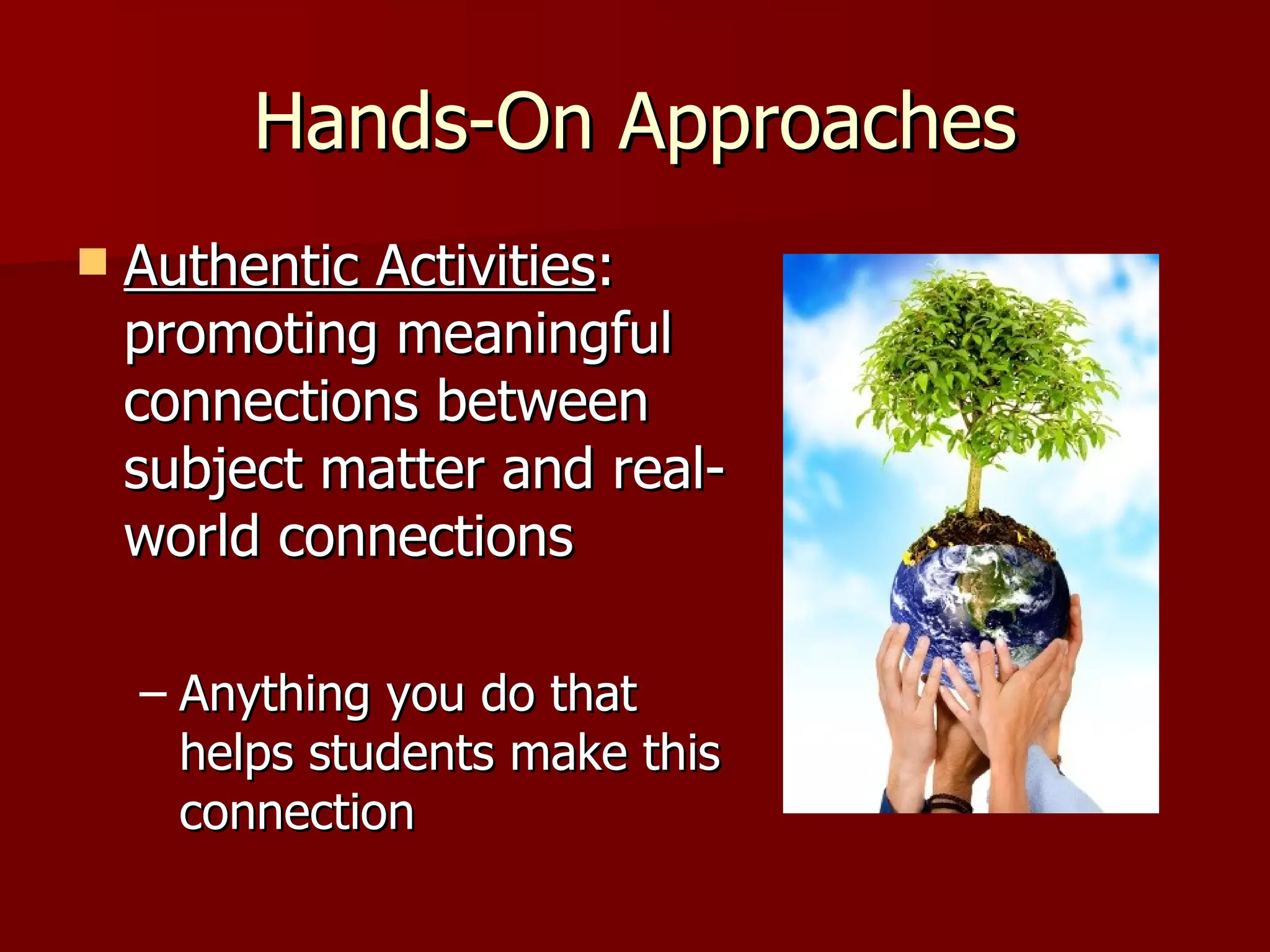
   Authentic Activities:
    promoting meaningful
    connections between
    subject matter and real-
    world connections

    – Anything you do that
      helps students make this
      connection
Interactive/Collaborative Approaches

 Interactive/Collaborative approaches are
  ones in which students work together and
  utilize collective “brain power” to learn
  material.
 Examples:
    – Cooperative Learning
    – Reciprocal Teaching
Interactive/Collaborative Approaches

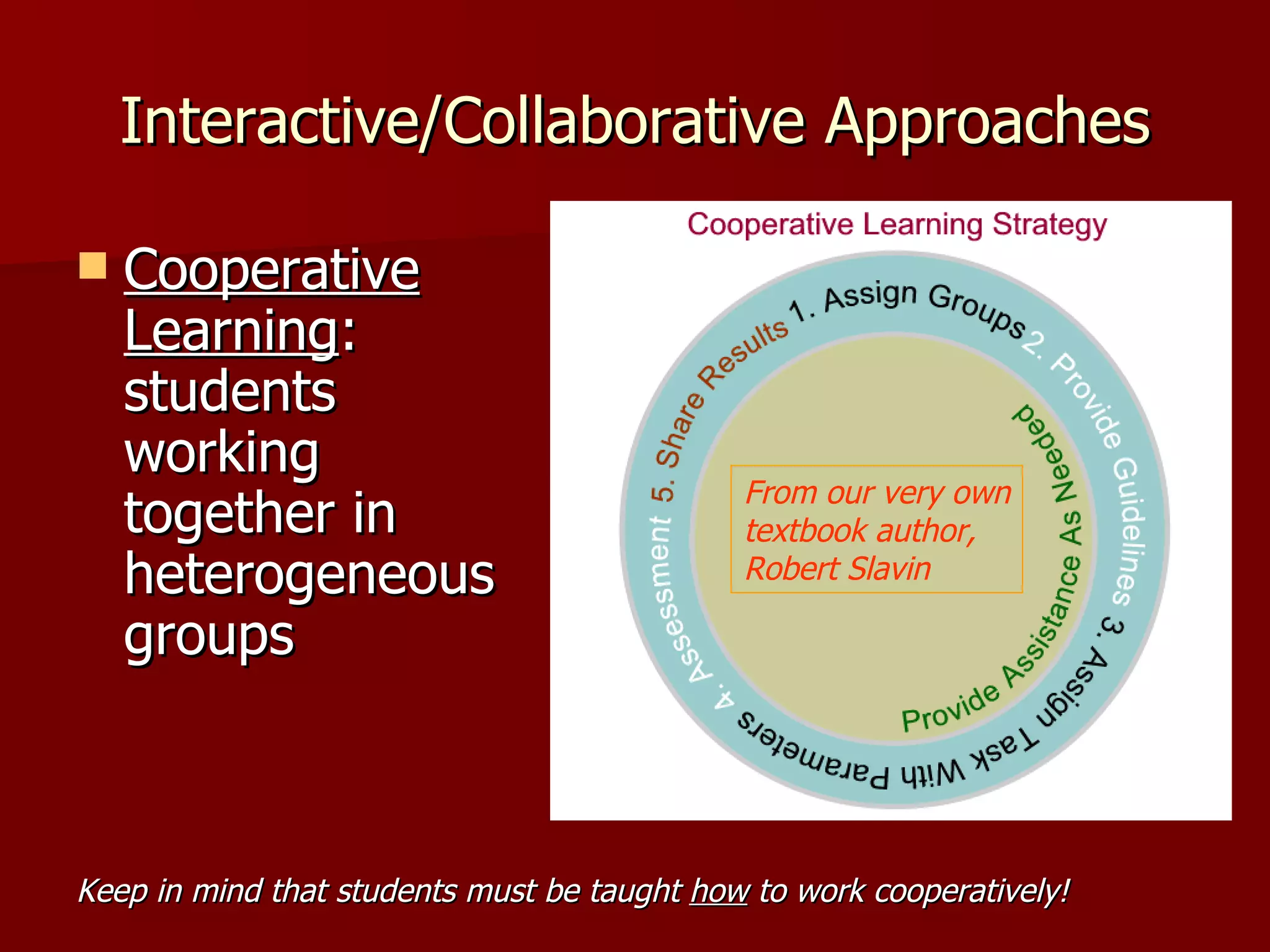
   Cooperative
    Learning:
    students
    working
                                             From our very own
    together in                              textbook author,
    heterogeneous                            Robert Slavin

    groups


Keep in mind that students must be taught how to work cooperatively!
Interactive/Collaborative Approaches
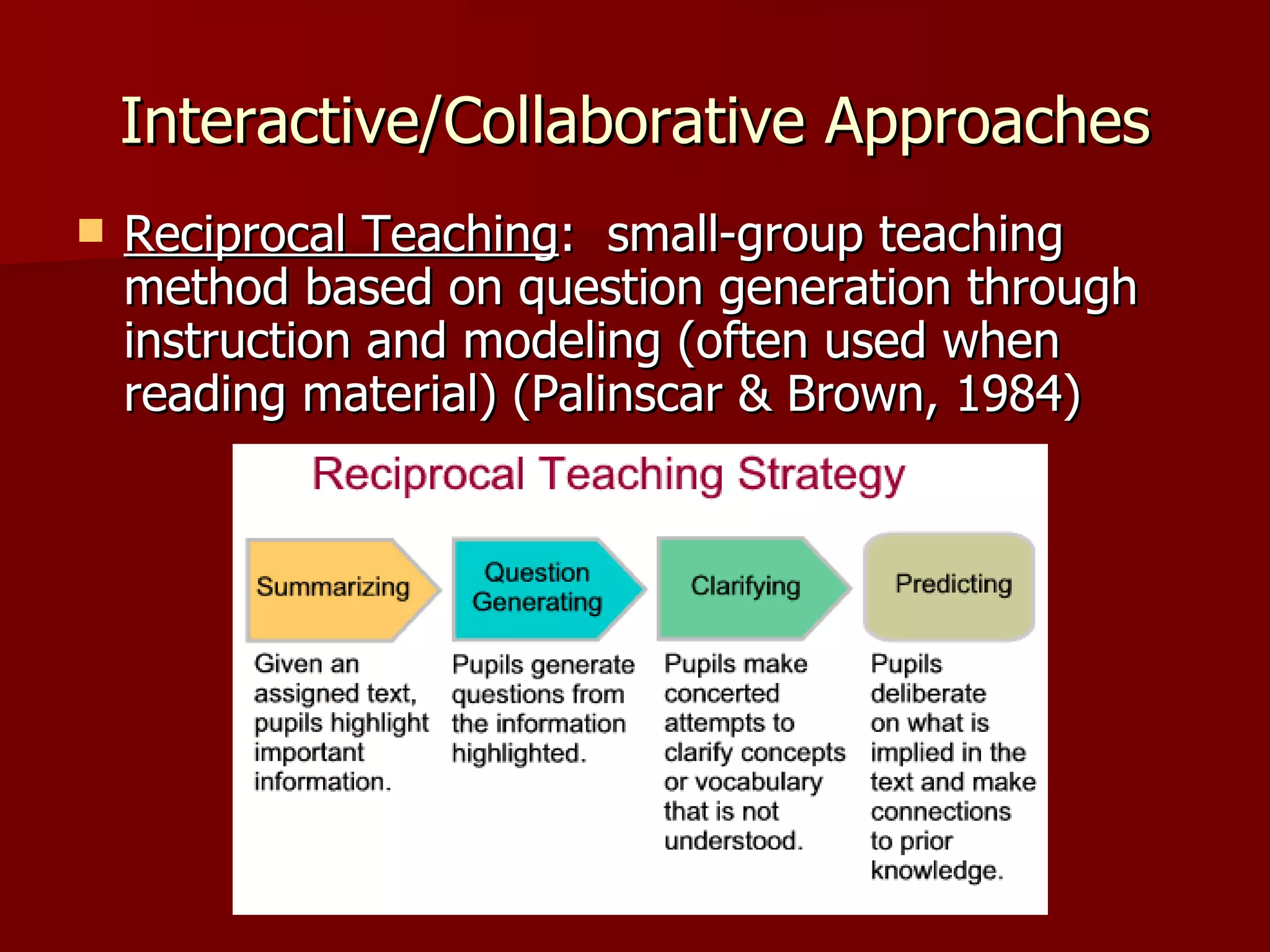
   Reciprocal Teaching: small-group teaching
    method based on question generation through
    instruction and modeling (often used when
    reading material) (Palinscar & Brown, 1984)
Let’s reflect ….
 Which of the 3 general approaches do you
  currently use (or would use)?
 Is one approach more effective than
  another?
 Or do you think that there is a time and
  place for all of these instructional
  approaches?
Effective use of discussions &
               questioning
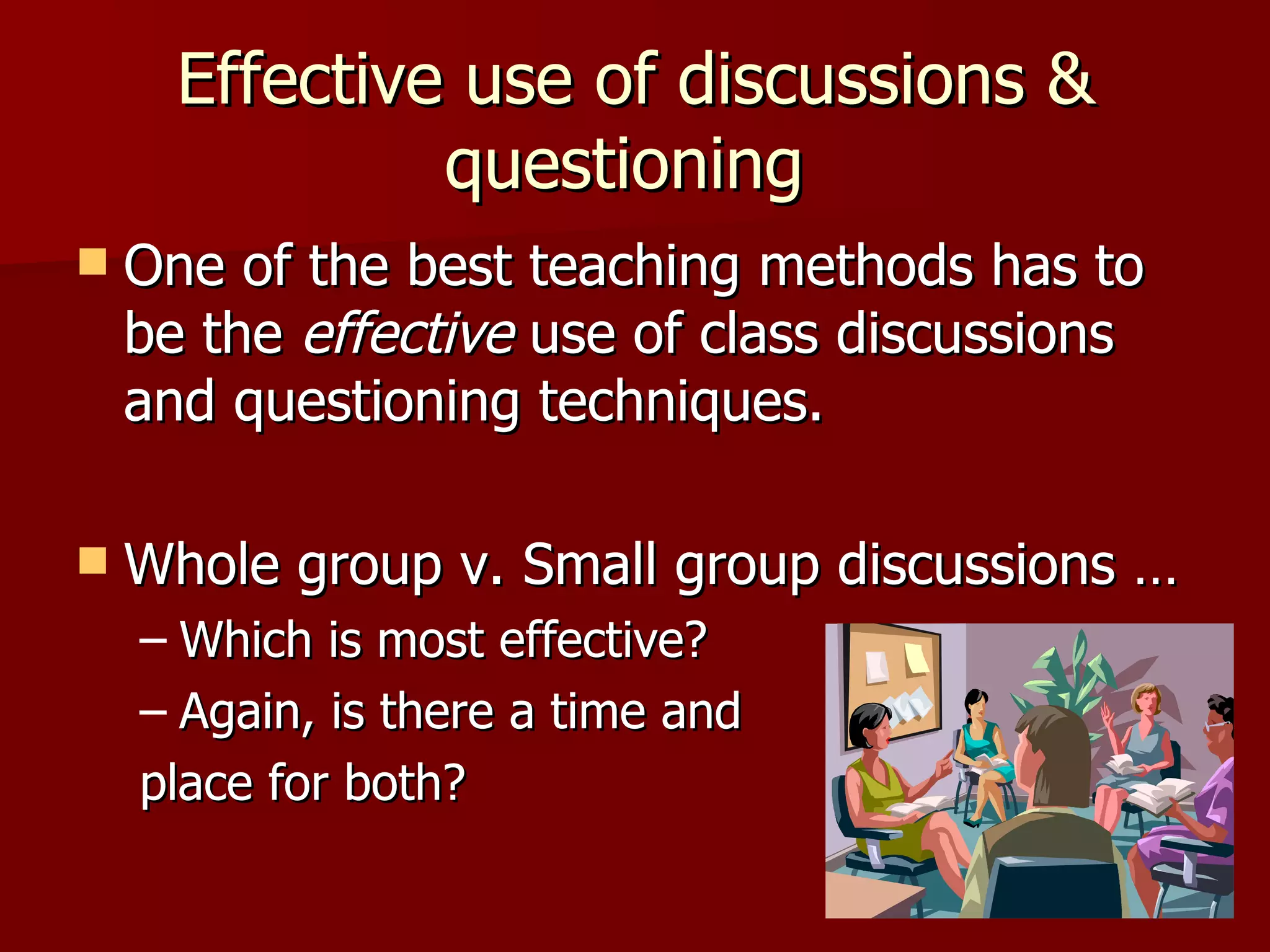
   One of the best teaching methods has to
    be the effective use of class discussions
    and questioning techniques.

   Whole group v. Small group discussions …
    – Which is most effective?
    – Again, is there a time and
    place for both?
Wait Time
 A very important aspect of questioning …
  Wait Time (waiting about 3-5 seconds
  after asking a question to get a student’s
  response)
 This give everyone time to formulate a
  response to the question, and not just
  those who process faster!
 There is much research support
for the effectiveness of wait time …
Wait Time
   Changes in teacher behavior:
    – Comments more fluent
    – Discussion more logical
    – More higher-level questions
    – Higher expectations of students


Source: Sadker & Sadker Teachers, Schools, & Society
Wait Time
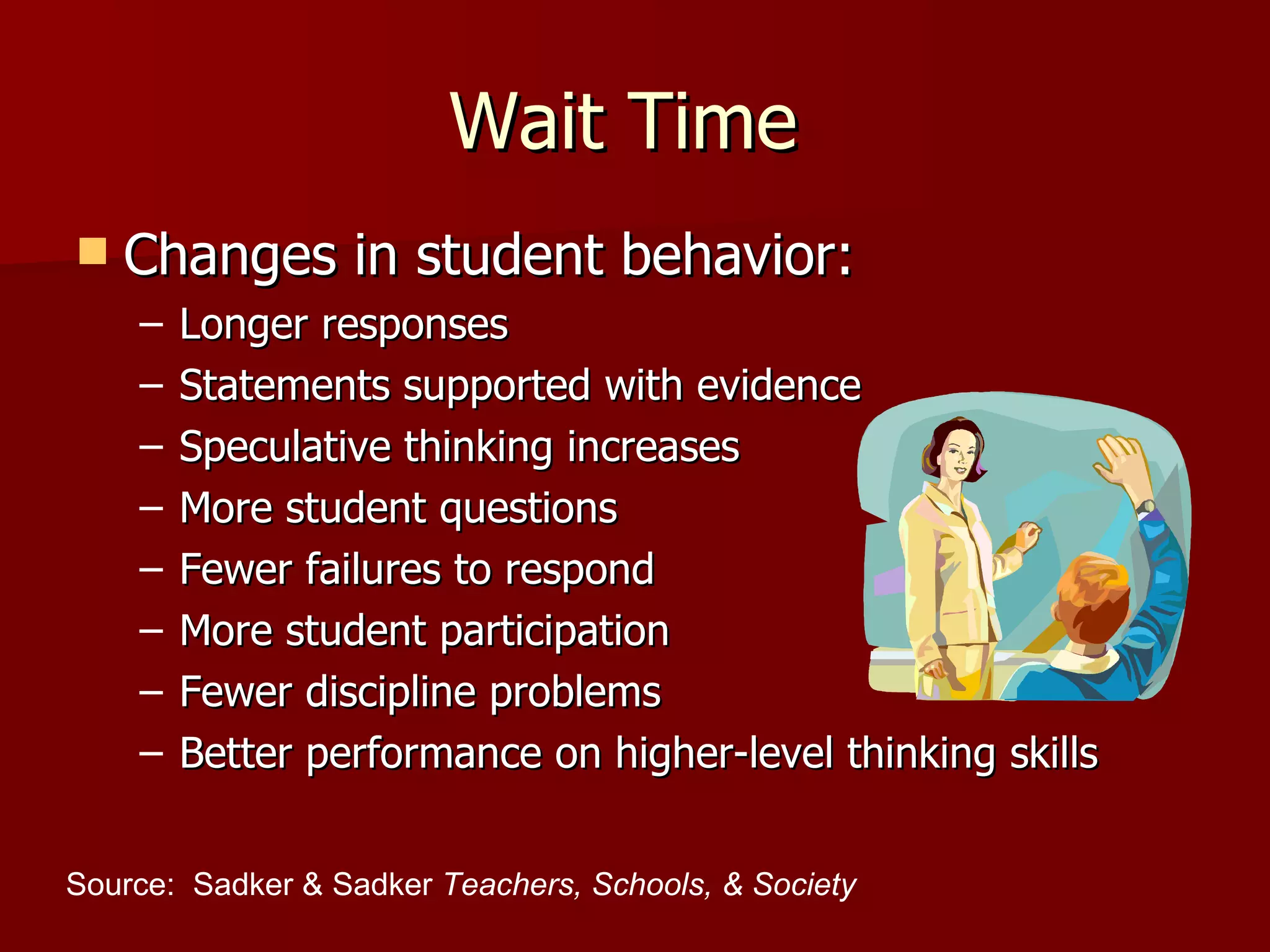
   Changes in student behavior:
    –   Longer responses
    –   Statements supported with evidence
    –   Speculative thinking increases
    –   More student questions
    –   Fewer failures to respond
    –   More student participation
    –   Fewer discipline problems
    –   Better performance on higher-level thinking skills


Source: Sadker & Sadker Teachers, Schools, & Society
Grouping Techniques
   So far, we have talked about cooperative
    learning and whole/small group discussions …
    what is the best way to group students?
    – Homogenously (same ability level)
    – Heterogeneously (different ability levels)

    – We must be careful, however, to avoid “tracking”
      (where year after year some kids end up in the
      bottom groups/classes) … remember what we’ve said
      about teacher expectations!
The QAIT Model (Slavin, 1987)
   “a model of effective instruction that focuses on
    elements teachers can directly control: quality,
    appropriateness, incentive, and time” (see chapter
    9 for more info)

   This model reminds me of the “Serenity Prayer”
     – ... grant me the serenity to accept the things I
       cannot change; courage to change the things I can;
       and wisdom to know the difference …

     – More than once, these thoughts have gotten me
       through a rough day of teaching!!
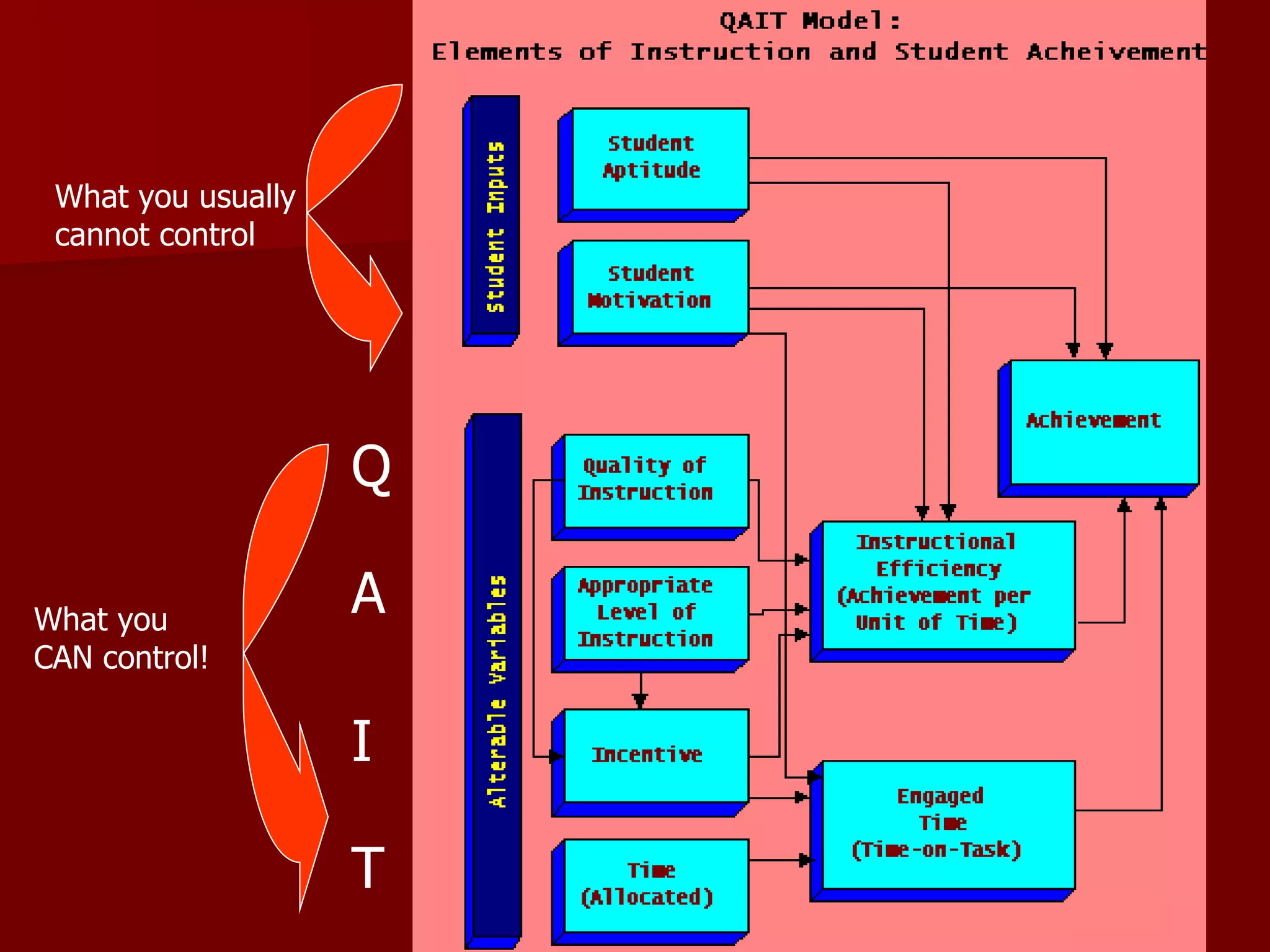
What you usually
 cannot control


                    Q

What you
                    A
CAN control!

                    I

                    T
Last thoughts …

   As you think about these different
    methods of instruction, discussions,
    questioning, and grouping … I hope that
    you are seeing two things:
    1. Each idea presented here is effective in
       some way and for some purposes
    2. You need to have a variety of ideas in your
       teaching Bag O’ Tricks!

Module 10

  • 1.
    Effective Teaching & Learning Dr. Jennifer Irwin EDU 620: Module 10 Chapters 7 & 9
  • 2.
    I know whatto teach, now how do I teach it?  Have you ever had a teacher who knew their subject area very well but didn’t know how to teach it to others?  When you completed the first Learning Reflection for this class, you were asked “is content knowledge enough”?  I hope by now that you know the answer to that question . . . No!
  • 3.
    In this module, we will explore ideas that will help you as you plan for instruction, including: – Different instructional approaches – Effective use of discussions & questioning – Grouping techniques – The QAIT Model
  • 4.
    Think about this…  New teachers usually “teach” the way they were “taught” – Do you agree with this statement? – For me personally, this was very true. When I first began, my bag of teaching tricks was limited to lectures, worksheets, and tests (how sad!) – Through hands-on experience and having great mentors, I have become a much more effective teacher (I hope!).
  • 5.
    Different Instructional Approaches  What is the best way to teach something?  What are some different ways to teach?  Do we need to vary our approaches based on our students or the subject matter?  We will take a look at 3 different types of teaching approaches….  I will leave it up to you to decide on the effectiveness of each…..
  • 6.
    Expository Approaches  Expositorymeans that students are “exposed” to learning  Examples: – Lecture – Mastery learning – Direct instruction – I don’t think I need to define lecture, so …
  • 7.
    Expository Approaches  Mastery learning: – Students demonstrate mastery of one topic before proceeding to the next
  • 8.
    Expository Approaches  Direct Instruction: – Teacher transmits information directly to students; lessons are goal-oriented and structured by the teacher – To me, this is classic “teaching” – Scaffolding at it’s best! – The “I do, We do, You do” method – How many of you teach this way?
  • 9.
  • 10.
    Hands-On Approaches  Hands-onapproaches have students actually doing something  Examples: – Discovery Learning – Experiential Learning – Authentic Activities – See the Constructivism module for more info
  • 11.
    Hands-On Approaches  Discovery Learning: a constructivist approach to teaching in which students are encouraged to discover principles for themselves.
  • 12.
    Hands-On Approaches  Experiential Learning: “the process whereby knowledge is created through the transformation of experience. Knowledge results from the combination of grasping and transforming experience” (Kolb, 1984)
  • 13.
    Hands-On Approaches  Authentic Activities: promoting meaningful connections between subject matter and real- world connections – Anything you do that helps students make this connection
  • 14.
    Interactive/Collaborative Approaches  Interactive/Collaborativeapproaches are ones in which students work together and utilize collective “brain power” to learn material.  Examples: – Cooperative Learning – Reciprocal Teaching
  • 15.
    Interactive/Collaborative Approaches  Cooperative Learning: students working From our very own together in textbook author, heterogeneous Robert Slavin groups Keep in mind that students must be taught how to work cooperatively!
  • 16.
    Interactive/Collaborative Approaches  Reciprocal Teaching: small-group teaching method based on question generation through instruction and modeling (often used when reading material) (Palinscar & Brown, 1984)
  • 17.
    Let’s reflect …. Which of the 3 general approaches do you currently use (or would use)?  Is one approach more effective than another?  Or do you think that there is a time and place for all of these instructional approaches?
  • 18.
    Effective use ofdiscussions & questioning  One of the best teaching methods has to be the effective use of class discussions and questioning techniques.  Whole group v. Small group discussions … – Which is most effective? – Again, is there a time and place for both?
  • 19.
    Wait Time  Avery important aspect of questioning … Wait Time (waiting about 3-5 seconds after asking a question to get a student’s response)  This give everyone time to formulate a response to the question, and not just those who process faster!  There is much research support for the effectiveness of wait time …
  • 20.
    Wait Time  Changes in teacher behavior: – Comments more fluent – Discussion more logical – More higher-level questions – Higher expectations of students Source: Sadker & Sadker Teachers, Schools, & Society
  • 21.
    Wait Time  Changes in student behavior: – Longer responses – Statements supported with evidence – Speculative thinking increases – More student questions – Fewer failures to respond – More student participation – Fewer discipline problems – Better performance on higher-level thinking skills Source: Sadker & Sadker Teachers, Schools, & Society
  • 22.
    Grouping Techniques  So far, we have talked about cooperative learning and whole/small group discussions … what is the best way to group students? – Homogenously (same ability level) – Heterogeneously (different ability levels) – We must be careful, however, to avoid “tracking” (where year after year some kids end up in the bottom groups/classes) … remember what we’ve said about teacher expectations!
  • 23.
    The QAIT Model(Slavin, 1987)  “a model of effective instruction that focuses on elements teachers can directly control: quality, appropriateness, incentive, and time” (see chapter 9 for more info)  This model reminds me of the “Serenity Prayer” – ... grant me the serenity to accept the things I cannot change; courage to change the things I can; and wisdom to know the difference … – More than once, these thoughts have gotten me through a rough day of teaching!!
  • 24.
    What you usually cannot control Q What you A CAN control! I T
  • 25.
    Last thoughts …  As you think about these different methods of instruction, discussions, questioning, and grouping … I hope that you are seeing two things: 1. Each idea presented here is effective in some way and for some purposes 2. You need to have a variety of ideas in your teaching Bag O’ Tricks!