Humanism Theory Victoria Nayshma Jennifer Katherine
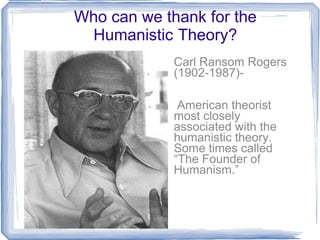
Who can we thank for the Humanistic   Theory? Carl Ransom Rogers (1902-1987)- American theorist most closely associated with the humanistic theory. Some times called “The Founder of Humanism.”
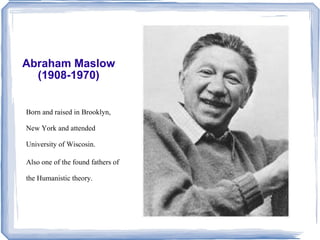
Abraham Maslow (1908-1970) Born and raised in Brooklyn, New York and attended University of Wiscosin. Also one of the found fathers of the Humanistic theory.
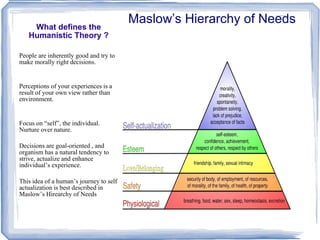
What defines the Humanistic Theory ? Maslow’s Hierarchy of Needs People are inherently good and try to make morally right decisions. Perceptions of your experiences is a result of your own view rather than environment. Focus on “self”, the individual. Nurture over nature. Decisions are goal-oriented , and organism has a natural tendency to strive, actualize and enhance individual’s experience. This idea of a human’s journey to self actualization is best described in Maslow’s Hirearchy of Needs
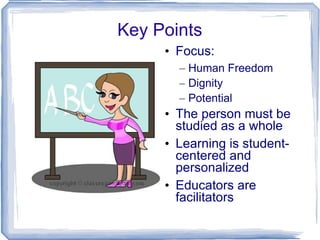
Key Points Focus: Human Freedom Dignity Potential The person must be studied as a whole Learning is student-centered and personalized Educators are facilitators
Main Purposes Developing self-actualized, autonomous people Areas of interest: Study of self Motivation Goals
What does the Teacher do? With Technology: -The teacher demonstrates life skills. -Uses appropriate resources on the Internet to give their students knowledge. -Using different software programs so the students are interactive. Without Technology: -Teachers have open classrooms. -Finding alternative ways to give students assessments. -The teachers themselves become a facilitator  of knowledge.
What do Students Do? With Technology: -Students choose what software they might want to use on their projects. -They can research information on the Internet on a subject of their choice. - Students can use technology to put creatively and imagination on their schoolwork. Without Technology:  -The students can do a lot of co-operative learning.  -The curriculum becomes more focus on what the students want to learn. -They learn to self-evaluate and monitor their own schoolwork.
Humanism Applied in the Classroom Student-centered teaching   focus on interesting topics Teach life skills Respect the rights of the students to self-determinism; development of self-concept Teacher facilitates learning; allows for discovery Nurture creativity Find alternative ways of assessment
Technological Applications Can use online activities to foster discovery of new ideas Can encourage things such as just browsing the web to learn new things each day
Open Classroom Not bound by a certain curriculum Not locked in by age or grade Low student to teacher ratio Goals of individual growth, critical thinking, co-operation, and a need for life-long learning
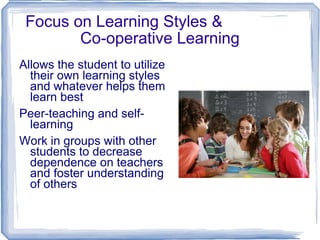
Focus on Learning Styles &  Co-operative Learning Allows the student to utilize their own learning styles and whatever helps them learn best Peer-teaching and self-learning Work in groups with other students to decrease dependence on teachers and foster understanding of others
Sources http://www.garysturt.free-online.co.uk/human.htm www.free-clipart.net   www.classroomclipart.com http://www.learning-theories.com/humanism.html http:// homepage.ntlworld.com/gary.sturt/human.htm

Humanism

  • 1.
    Humanism Theory VictoriaNayshma Jennifer Katherine
  • 2.
    Who can wethank for the Humanistic Theory? Carl Ransom Rogers (1902-1987)- American theorist most closely associated with the humanistic theory. Some times called “The Founder of Humanism.”
  • 3.
    Abraham Maslow (1908-1970)Born and raised in Brooklyn, New York and attended University of Wiscosin. Also one of the found fathers of the Humanistic theory.
  • 4.
    What defines theHumanistic Theory ? Maslow’s Hierarchy of Needs People are inherently good and try to make morally right decisions. Perceptions of your experiences is a result of your own view rather than environment. Focus on “self”, the individual. Nurture over nature. Decisions are goal-oriented , and organism has a natural tendency to strive, actualize and enhance individual’s experience. This idea of a human’s journey to self actualization is best described in Maslow’s Hirearchy of Needs
  • 5.
    Key Points Focus:Human Freedom Dignity Potential The person must be studied as a whole Learning is student-centered and personalized Educators are facilitators
  • 6.
    Main Purposes Developingself-actualized, autonomous people Areas of interest: Study of self Motivation Goals
  • 7.
    What does theTeacher do? With Technology: -The teacher demonstrates life skills. -Uses appropriate resources on the Internet to give their students knowledge. -Using different software programs so the students are interactive. Without Technology: -Teachers have open classrooms. -Finding alternative ways to give students assessments. -The teachers themselves become a facilitator of knowledge.
  • 8.
    What do StudentsDo? With Technology: -Students choose what software they might want to use on their projects. -They can research information on the Internet on a subject of their choice. - Students can use technology to put creatively and imagination on their schoolwork. Without Technology: -The students can do a lot of co-operative learning. -The curriculum becomes more focus on what the students want to learn. -They learn to self-evaluate and monitor their own schoolwork.
  • 9.
    Humanism Applied inthe Classroom Student-centered teaching  focus on interesting topics Teach life skills Respect the rights of the students to self-determinism; development of self-concept Teacher facilitates learning; allows for discovery Nurture creativity Find alternative ways of assessment
  • 10.
    Technological Applications Canuse online activities to foster discovery of new ideas Can encourage things such as just browsing the web to learn new things each day
  • 11.
    Open Classroom Notbound by a certain curriculum Not locked in by age or grade Low student to teacher ratio Goals of individual growth, critical thinking, co-operation, and a need for life-long learning
  • 12.
    Focus on LearningStyles & Co-operative Learning Allows the student to utilize their own learning styles and whatever helps them learn best Peer-teaching and self-learning Work in groups with other students to decrease dependence on teachers and foster understanding of others
  • 13.
    Sources http://www.garysturt.free-online.co.uk/human.htm www.free-clipart.net www.classroomclipart.com http://www.learning-theories.com/humanism.html http:// homepage.ntlworld.com/gary.sturt/human.htm