Social, Moral, and Emotional
Development

  Dr. Jennifer Irwin
  EDU 620: Module 3
  Chapter 3
Types of Development

 Now, we continue our discussion of
  development with module 3.
  Module 2:
      Cognitive
      Language & Literacy

  Module 3:
      Moral
      Social & Emotional
Types of Development
 Again, please keep in mind these basic principles of development:

2. Development proceeds in a somewhat orderly
   and predictable pattern (although this has been
   debated)
3. Different children develop at different rates
4. Periods of relatively rapid growth (spurts) may
   appear between periods of slower growth
   (plateaus)
5. Developments is continually affected by both
   nature (heredity) and nurture (environment)
Please note:

 Important vocabulary from the chapter
  (which is listed on the overview for this
  module) will be underlined throughout this
  presentation.


 Also, be sure to continue adding
  information from modules 2 and 3 to your
  Student Development Study Guide.
Erikson’s Stages of
Psychosocial Development
1.   Trust vs. Mistrust (0 - 18 months)
    Infant’s needs need to be satisfied, if not, infant
    develops mistrust for caregivers & others
2. Autonomy vs. Doubt (18 months – 2 years)
     Child has natural desire to be independent and do
     things for themselves. If not, child feels
     powerless, restricted and doubtful of their ability
3. Initiative vs. Guilt (3 – 6 years)
     Child has natural curiosity to seek, explore and
     understand the world around them. If not, child
     feels guilty about natural urges to explore, be
     curious, etc.
4.   Industry vs. Inferiority (6 – 12 years)
     Child desires to be successful and industrious, if
     not, child has feelings of inadequacy
Erikson’s Stages of Psychosocial
Development (cont.)
 5. Identity vs. Role Confusion (12-18 years)
      Person is discovering themselves educationally,
      occupationally, emotionally, socially, and sexually. If
      not, person is confused about their place or role in
      society
 6. Intimacy vs. Isolation (Young adulthood)
      Person establishes growth relationships with others, if
      not, person goes into isolation to escape relationship
      failures
 7. Generativity vs. Self-Absorption (Middle adulthood)
      Person has interest in guiding others and contributing to
      the greater good of society. If not, person may feel
      stagnate & lead to self-absorption.
 8. Integrity vs. Despair (Late adulthood)
      Person reflects on life and accepts life’s
      accomplishments, failures, and choices. If not, regret
      leads to despair.
Pause, practice, and apply


 Who do you know who fits into each of one of
 Erickson’s stages of psychosocial development?


             Where do you fit in?
Moral Development


 For moral development, we will learn
  about Kohlberg’s stages as well as Piaget’s
  (yes, he had a theory of moral
  development too … busy guy!)
First, think about this:

 How do we learn what is morally right or
  wrong?


 Do our morals change over time?


 If yes, how or why do our morals change?
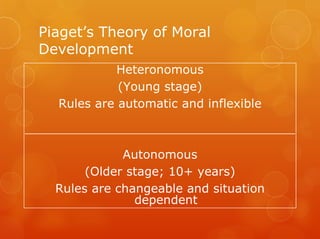
Piaget’s Theory of Moral
Development
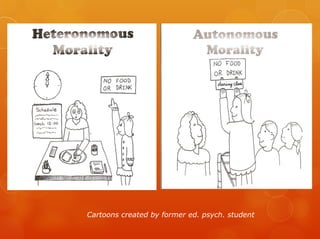
            Heteronomous
            (Young stage)
  Rules are automatic and inflexible


             Autonomous
       (Older stage; 10+ years)
  Rules are changeable and situation
               dependent
Cartoons created by former ed. psych. student
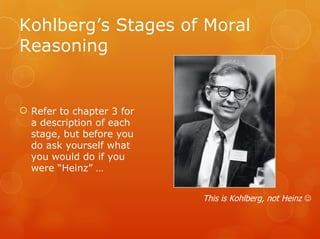
Kohlberg’s Stages of Moral
Reasoning


 Refer to chapter 3 for
  a description of each
  stage, but before you
  do ask yourself what
  you would do if you
  were “Heinz” …


                           This is Kohlberg, not Heinz 
The Heinz Dilemma              (what Kohlberg used to
develop his theory)
  A woman was near death from a special kind of cancer.
    There was one drug that the doctors thought might save
    her. It was a form of radium that a druggist in the same
    town had recently discovered. The drug was expensive
    to make, but the druggist was charging ten times what
    the drug cost him to produce. He paid $200 for the
    radium and charged $2,000 for a small dose of the drug.
    The sick woman's husband, Heinz, went to everyone he
    knew to borrow the money, but he could only get
    together about $1,000 which is half of what it cost. He
    told the druggist that his wife was dying and asked him
    to sell it cheaper or let him pay later. But the druggist
    said: "No, I discovered the drug and I'm going to make
    money from it." So Heinz got desperate and broke into
    the man's store to steal the drug for his wife.

  Should Heinz have broken into the laboratory to steal the
    drug for his wife? Why or why not?
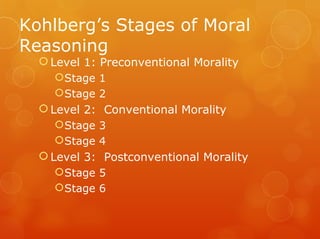
Kohlberg’s Stages of Moral
Reasoning
   Level 1: Preconventional Morality
     Stage 1
     Stage 2
   Level 2: Conventional Morality
     Stage 3
     Stage 4
   Level 3: Postconventional Morality
     Stage 5
     Stage 6
Pause, practice, and apply

        In which stage of Kohlberg’s
         Moral Reasoning are you?
     In which stage is your best friend?


     Can you think of a time where you
        witnessed heteronomous-type
        thinking/moral development?
Social & Emotional Development


 Be sure you are familiar with the following terms. Please add
     the definitions to your Student Development study
     guide:

    Types of play (solitary, parallel, associative, cooperative)
    Self-concept
    Self-esteem
    Prosocial behavior
    Social comparison
    Marcia’s identity statuses (LOVE this theory! Great for
     the Real Me! Project)
For more clarification or additional
information, review chapter 3, ask a
classmate or contact the instructor


Also, I hope you’re thinking
of some great ideas for your
Real Me! Project!

Social, Moral, and Emotional Development (module 3)

  • 1.
    Social, Moral, andEmotional Development Dr. Jennifer Irwin EDU 620: Module 3 Chapter 3
  • 2.
    Types of Development Now, we continue our discussion of development with module 3. Module 2:  Cognitive  Language & Literacy Module 3:  Moral  Social & Emotional
  • 3.
    Types of Development Again, please keep in mind these basic principles of development: 2. Development proceeds in a somewhat orderly and predictable pattern (although this has been debated) 3. Different children develop at different rates 4. Periods of relatively rapid growth (spurts) may appear between periods of slower growth (plateaus) 5. Developments is continually affected by both nature (heredity) and nurture (environment)
  • 4.
    Please note:  Importantvocabulary from the chapter (which is listed on the overview for this module) will be underlined throughout this presentation.  Also, be sure to continue adding information from modules 2 and 3 to your Student Development Study Guide.
  • 5.
    Erikson’s Stages of PsychosocialDevelopment 1. Trust vs. Mistrust (0 - 18 months) Infant’s needs need to be satisfied, if not, infant develops mistrust for caregivers & others 2. Autonomy vs. Doubt (18 months – 2 years) Child has natural desire to be independent and do things for themselves. If not, child feels powerless, restricted and doubtful of their ability 3. Initiative vs. Guilt (3 – 6 years) Child has natural curiosity to seek, explore and understand the world around them. If not, child feels guilty about natural urges to explore, be curious, etc. 4. Industry vs. Inferiority (6 – 12 years) Child desires to be successful and industrious, if not, child has feelings of inadequacy
  • 6.
    Erikson’s Stages ofPsychosocial Development (cont.) 5. Identity vs. Role Confusion (12-18 years) Person is discovering themselves educationally, occupationally, emotionally, socially, and sexually. If not, person is confused about their place or role in society 6. Intimacy vs. Isolation (Young adulthood) Person establishes growth relationships with others, if not, person goes into isolation to escape relationship failures 7. Generativity vs. Self-Absorption (Middle adulthood) Person has interest in guiding others and contributing to the greater good of society. If not, person may feel stagnate & lead to self-absorption. 8. Integrity vs. Despair (Late adulthood) Person reflects on life and accepts life’s accomplishments, failures, and choices. If not, regret leads to despair.
  • 7.
    Pause, practice, andapply Who do you know who fits into each of one of Erickson’s stages of psychosocial development? Where do you fit in?
  • 8.
    Moral Development  Formoral development, we will learn about Kohlberg’s stages as well as Piaget’s (yes, he had a theory of moral development too … busy guy!)
  • 9.
    First, think aboutthis:  How do we learn what is morally right or wrong?  Do our morals change over time?  If yes, how or why do our morals change?
  • 10.
    Piaget’s Theory ofMoral Development Heteronomous (Young stage) Rules are automatic and inflexible Autonomous (Older stage; 10+ years) Rules are changeable and situation dependent
  • 11.
    Cartoons created byformer ed. psych. student
  • 12.
    Kohlberg’s Stages ofMoral Reasoning  Refer to chapter 3 for a description of each stage, but before you do ask yourself what you would do if you were “Heinz” … This is Kohlberg, not Heinz 
  • 13.
    The Heinz Dilemma (what Kohlberg used to develop his theory) A woman was near death from a special kind of cancer. There was one drug that the doctors thought might save her. It was a form of radium that a druggist in the same town had recently discovered. The drug was expensive to make, but the druggist was charging ten times what the drug cost him to produce. He paid $200 for the radium and charged $2,000 for a small dose of the drug. The sick woman's husband, Heinz, went to everyone he knew to borrow the money, but he could only get together about $1,000 which is half of what it cost. He told the druggist that his wife was dying and asked him to sell it cheaper or let him pay later. But the druggist said: "No, I discovered the drug and I'm going to make money from it." So Heinz got desperate and broke into the man's store to steal the drug for his wife. Should Heinz have broken into the laboratory to steal the drug for his wife? Why or why not?
  • 14.
    Kohlberg’s Stages ofMoral Reasoning  Level 1: Preconventional Morality  Stage 1  Stage 2  Level 2: Conventional Morality  Stage 3  Stage 4  Level 3: Postconventional Morality  Stage 5  Stage 6
  • 15.
    Pause, practice, andapply In which stage of Kohlberg’s Moral Reasoning are you? In which stage is your best friend? Can you think of a time where you witnessed heteronomous-type thinking/moral development?
  • 16.
    Social & EmotionalDevelopment Be sure you are familiar with the following terms. Please add the definitions to your Student Development study guide:  Types of play (solitary, parallel, associative, cooperative)  Self-concept  Self-esteem  Prosocial behavior  Social comparison  Marcia’s identity statuses (LOVE this theory! Great for the Real Me! Project)
  • 17.
    For more clarificationor additional information, review chapter 3, ask a classmate or contact the instructor Also, I hope you’re thinking of some great ideas for your Real Me! Project!