


Perception
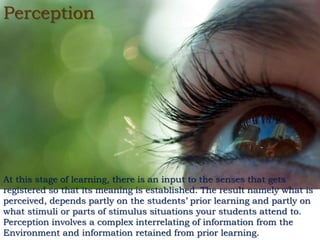
At this stage of learning, there is an input to the senses that gets
registered so that its meaning is established. The result namely what is
perceived, depends partly on the students’ prior learning and partly on
what stimuli or parts of stimulus situations your students attend to.
Perception involves a complex interrelating of information from the
Environment and information retained from prior learning.
Acquisition
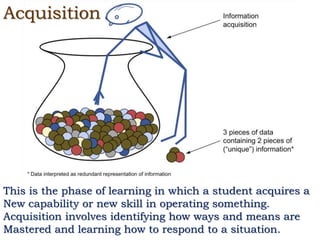
This is the phase of learning in which a student acquires a
New capability or new skill in operating something.
Acquisition involves identifying how ways and means are
Mastered and learning how to respond to a situation.
Retention
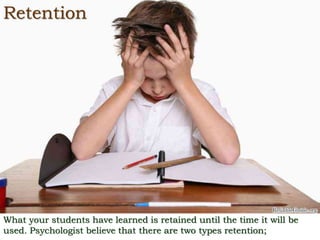
What your students have learned is retained until the time it will be
used. Psychologist believe that there are two types retention;
Short-term retention
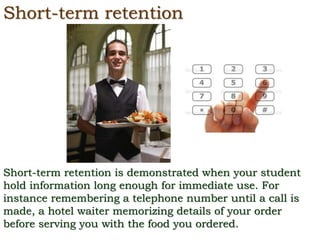
Short-term retention is demonstrated when your student
hold information long enough for immediate use. For
instance remembering a telephone number until a call is
made, a hotel waiter memorizing details of your order
before serving you with the food you ordered.
Long-term retention
When the outcomes of learning last in your student’s mind
beyond the immediate occasion for their use, say from a few
minutes right up to a lifetime, long-term retention is observed
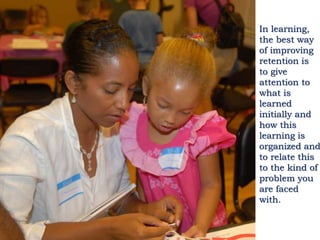
In learning,
the best way
of improving
retention is
to give
attention to
what is
learned
initially and
how this
learning is
organized and
to relate this
to the kind of
problem you
are faced
with.
Transfer
This is sometimes called application and is the highest and
most psychologically complex level of learning. It occurs
when you require your students to apply, or put to use
motor skills they are able to recall. You should now be
aware that objectives that require your student to apply their
knowledge in a real world setting.
Teaching
Approaches
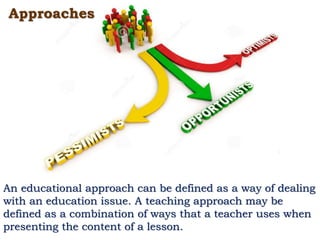
An educational approach can be defined as a way of dealing
with an education issue. A teaching approach may be
defined as a combination of ways that a teacher uses when
presenting the content of a lesson.
Approaches
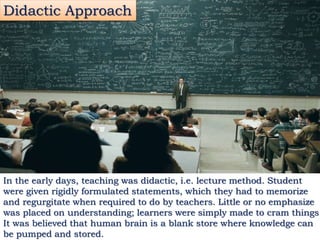
In the early days, teaching was didactic, i.e. lecture method. Student
were given rigidly formulated statements, which they had to memorize
and regurgitate when required to do by teachers. Little or no emphasize
was placed on understanding; learners were simply made to cram things
It was believed that human brain is a blank store where knowledge can
be pumped and stored.
Didactic Approach
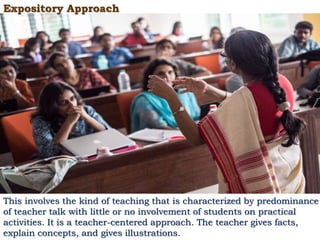
Expository Approach
This involves the kind of teaching that is characterized by predominance
of teacher talk with little or no involvement of students on practical
activities. It is a teacher-centered approach. The teacher gives facts,
explain concepts, and gives illustrations.
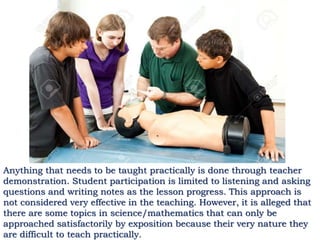
Anything that needs to be taught practically is done through teacher
demonstration. Student participation is limited to listening and asking
questions and writing notes as the lesson progress. This approach is
not considered very effective in the teaching. However, it is alleged that
there are some topics in science/mathematics that can only be
approached satisfactorily by exposition because their very nature they
are difficult to teach practically.
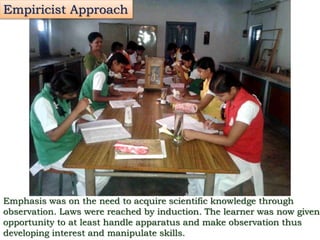
Empiricist Approach
Emphasis was on the need to acquire scientific knowledge through
observation. Laws were reached by induction. The learner was now given
opportunity to at least handle apparatus and make observation thus
developing interest and manipulate skills.
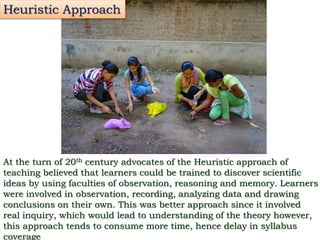
Heuristic Approach
At the turn of 20th century advocates of the Heuristic approach of
teaching believed that learners could be trained to discover scientific
ideas by using faculties of observation, reasoning and memory. Learners
were involved in observation, recording, analyzing data and drawing
conclusions on their own. This was better approach since it involved
real inquiry, which would lead to understanding of the theory however,
this approach tends to consume more time, hence delay in syllabus
coverage
The Inquiry/Discovery Approach
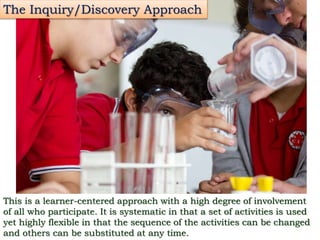
This is a learner-centered approach with a high degree of involvement
of all who participate. It is systematic in that a set of activities is used
yet highly flexible in that the sequence of the activities can be changed
and others can be substituted at any time.
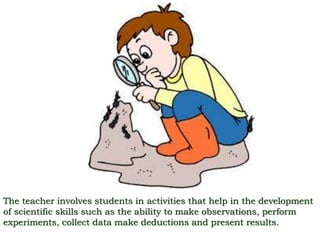
The teacher involves students in activities that help in the development
of scientific skills such as the ability to make observations, perform
experiments, collect data make deductions and present results.
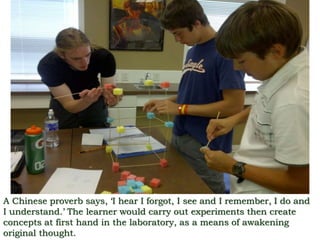
A Chinese proverb says, ‘I hear I forgot, I see and I remember, I do and
I understand.’ The learner would carry out experiments then create
concepts at first hand in the laboratory, as a means of awakening
original thought.
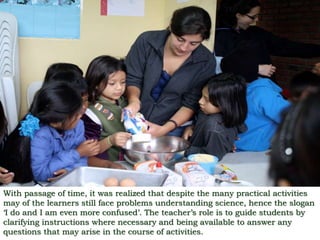
With passage of time, it was realized that despite the many practical activities
may of the learners still face problems understanding science, hence the slogan
‘I do and I am even more confused’. The teacher’s role is to guide students by
clarifying instructions where necessary and being available to answer any
questions that may arise in the course of activities.
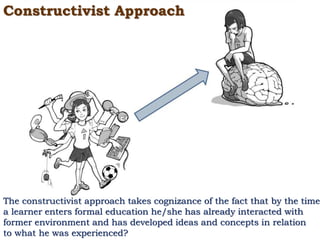
Constructivist Approach
The constructivist approach takes cognizance of the fact that by the time
a learner enters formal education he/she has already interacted with
former environment and has developed ideas and concepts in relation
to what he was experienced?
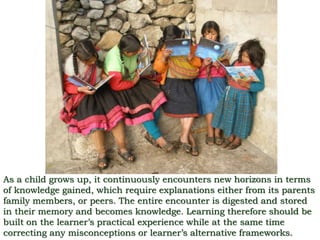
As a child grows up, it continuously encounters new horizons in terms
of knowledge gained, which require explanations either from its parents
family members, or peers. The entire encounter is digested and stored
in their memory and becomes knowledge. Learning therefore should be
built on the learner’s practical experience while at the same time
correcting any misconceptions or learner’s alternative frameworks.
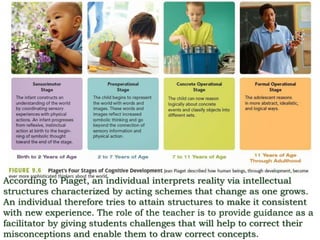
According to Piaget, an individual interprets reality via intellectual
structures characterized by acting schemes that change as one grows.
An individual therefore tries to attain structures to make it consistent
with new experience. The role of the teacher is to provide guidance as a
facilitator by giving students challenges that will help to correct their
misconceptions and enable them to draw correct concepts.
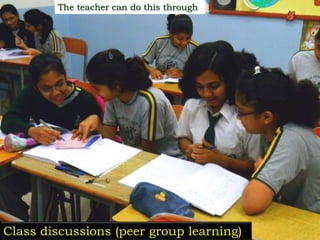
The teacher can do this through
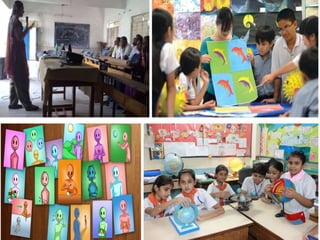
Class discussions (peer group learning)
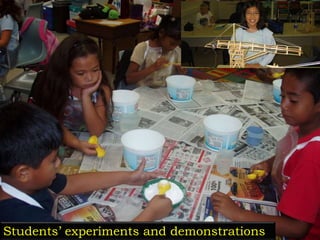
Students’ experiments and demonstrations
Use of audio visual aids, diagrams models etc. In relation to
the inquiry approach, this involves a wider range of activities
centered on helping students to learn by:
 Gaining new insight from the outcome of their
investigations.
 Modifying their pre-existing ideas in the light of new
insights.
 Constructing their understanding of a scientific concept.
The basic assumption is that students have their own
explanations of the phenomena encountered in their
everyday life. This approach helps them to test their
understanding using scientific approach.
There are various approaches to teaching and they
could be teacher or learner-centered. These are:
Didactic
Expository
Empirical
Heuristic
Enquiry
Constructive
Teaching Methods
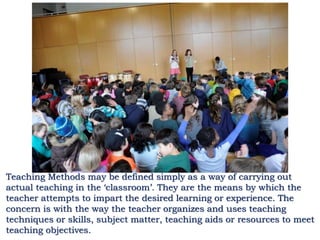
Teaching Methods may be defined simply as a way of carrying out
actual teaching in the ‘classroom’. They are the means by which the
teacher attempts to impart the desired learning or experience. The
concern is with the way the teacher organizes and uses teaching
techniques or skills, subject matter, teaching aids or resources to meet
teaching objectives.
The particular method that a teacher uses is determined by a number
or factors. These include:
 The content to be taught.
 The objectives which the teacher plans to achieve.
 Availability of teaching and learning resources and the
ability and willingness of the teacher to improvise if
conventional teaching aids are not available.
 Evaluation and follow-up activities.
 Individual learner differences.
 Size of the class.
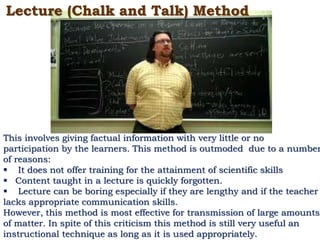
Lecture (Chalk and Talk) Method
This involves giving factual information with very little or no
participation by the learners. This method is outmoded due to a number
of reasons:
 It does not offer training for the attainment of scientific skills
 Content taught in a lecture is quickly forgotten.
 Lecture can be boring especially if they are lengthy and if the teacher
lacks appropriate communication skills.
However, this method is most effective for transmission of large amounts
of matter. In spite of this criticism this method is still very useful an
instructional technique as long as it is used appropriately.
Teacher Demonstration Method
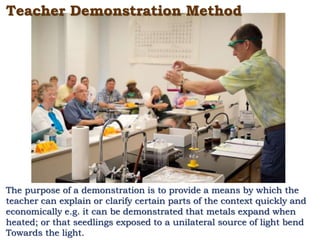
The purpose of a demonstration is to provide a means by which the
teacher can explain or clarify certain parts of the context quickly and
economically e.g. it can be demonstrated that metals expand when
heated; or that seedlings exposed to a unilateral source of light bend
Towards the light.
It is essential that the student should be involved actively. One way in
which this can be achieved is through questioning as the demonstration
progresses.
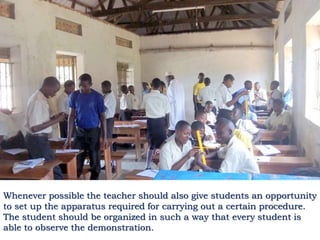
Whenever possible the teacher should also give students an opportunity
to set up the apparatus required for carrying out a certain procedure.
The student should be organized in such a way that every student is
able to observe the demonstration.
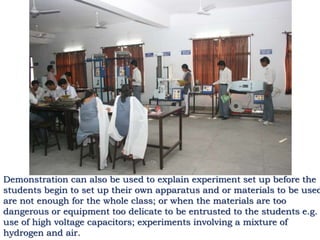
Demonstration can also be used to explain experiment set up before the
students begin to set up their own apparatus and or materials to be used
are not enough for the whole class; or when the materials are too
dangerous or equipment too delicate to be entrusted to the students e.g.
use of high voltage capacitors; experiments involving a mixture of
hydrogen and air.
Practical Work/Experiment Method
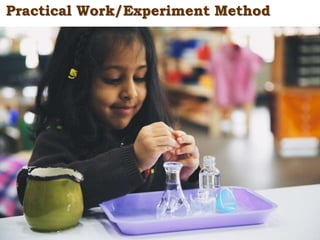
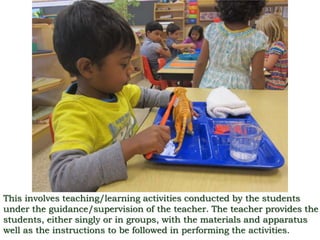
This involves teaching/learning activities conducted by the students
under the guidance/supervision of the teacher. The teacher provides the
students, either singly or in groups, with the materials and apparatus
well as the instructions to be followed in performing the activities.
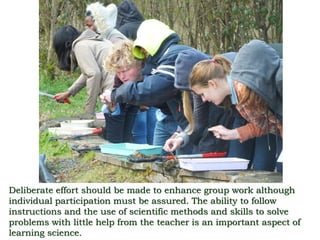
Deliberate effort should be made to enhance group work although
individual participation must be assured. The ability to follow
instructions and the use of scientific methods and skills to solve
problems with little help from the teacher is an important aspect of
learning science.
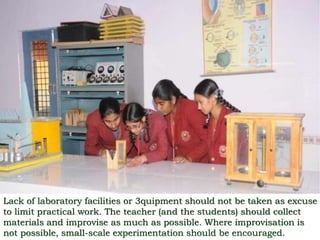
Lack of laboratory facilities or 3quipment should not be taken as excuse
to limit practical work. The teacher (and the students) should collect
materials and improvise as much as possible. Where improvisation is
not possible, small-scale experimentation should be encouraged.
There are certain basic skills that are essential in order for learners to
carry out practical work safely and successfully. Examples of such skills
include:
o Ability to read instruments(measuring cylinders,) accurately.
o Correct use of equipment and apparatus (magnifying glass,)
Successful practical work depends on a number of factors that include
the following:
 Preparation before the practical period.
 Trying out of activities to make sure that the materials used will give
the expected results.
 Clarity of the instructions-language should neither be ambiguous
nor include terms that are unfamiliar to the students. If such terms
must be used they should be clearly defined.
 Effective guidance and supervision by the teacher.
 Group size and composition.
 The ability of the teacher to establish a link between the practical
work and the concept to be learnt (bridge)
 Briefing on any precautions to be taken to ensure the safety of the
students and the equipment.
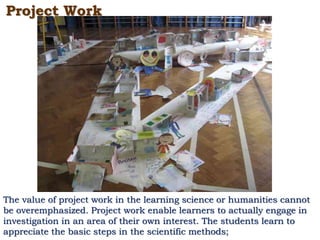
Project Work
The value of project work in the learning science or humanities cannot
be overemphasized. Project work enable learners to actually engage in
investigation in an area of their own interest. The students learn to
appreciate the basic steps in the scientific methods;
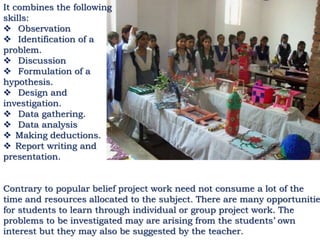
It combines the following
skills:
 Observation
 Identification of a
problem.
 Discussion
 Formulation of a
hypothesis.
 Design and
investigation.
 Data gathering.
 Data analysis
 Making deductions.
 Report writing and
presentation.
Contrary to popular belief project work need not consume a lot of the
time and resources allocated to the subject. There are many opportunitie
for students to learn through individual or group project work. The
problems to be investigated may are arising from the students’ own
interest but they may also be suggested by the teacher.
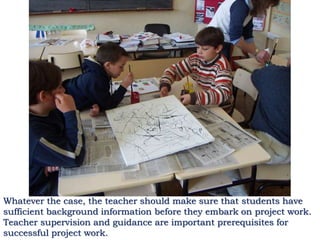
Whatever the case, the teacher should make sure that students have
sufficient background information before they embark on project work.
Teacher supervision and guidance are important prerequisites for
successful project work.
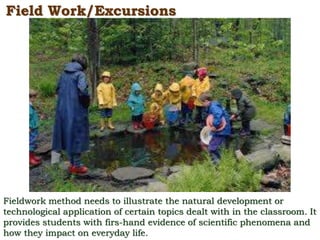
Field Work/Excursions
Fieldwork method needs to illustrate the natural development or
technological application of certain topics dealt with in the classroom. It
provides students with firs-hand evidence of scientific phenomena and
how they impact on everyday life.
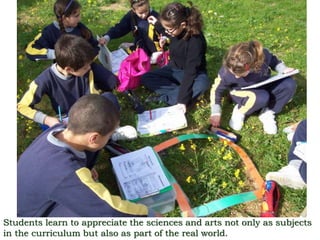
Students learn to appreciate the sciences and arts not only as subjects
in the curriculum but also as part of the real world.
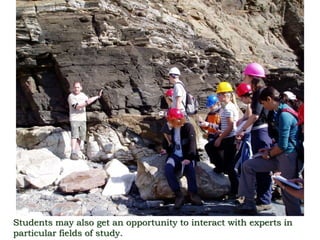
Students may also get an opportunity to interact with experts in
particular fields of study.
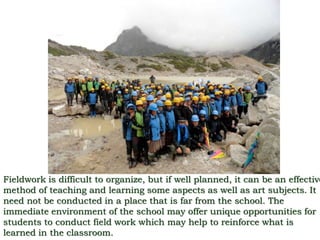
Fieldwork is difficult to organize, but if well planned, it can be an effective
method of teaching and learning some aspects as well as art subjects. It
need not be conducted in a place that is far from the school. The
immediate environment of the school may offer unique opportunities for
students to conduct field work which may help to reinforce what is
learned in the classroom.
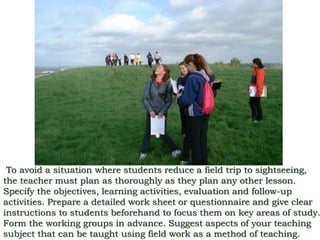
To avoid a situation where students reduce a field trip to sightseeing,
the teacher must plan as thoroughly as they plan any other lesson.
Specify the objectives, learning activities, evaluation and follow-up
activities. Prepare a detailed work sheet or questionnaire and give clear
instructions to students beforehand to focus them on key areas of study.
Form the working groups in advance. Suggest aspects of your teaching
subject that can be taught using field work as a method of teaching.
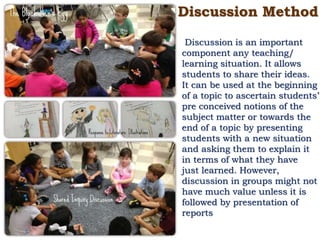
Discussion Method
Discussion is an important
component any teaching/
learning situation. It allows
students to share their ideas.
It can be used at the beginning
of a topic to ascertain students’
pre conceived notions of the
subject matter or towards the
end of a topic by presenting
students with a new situation
and asking them to explain it
in terms of what they have
just learned. However,
discussion in groups might not
have much value unless it is
followed by presentation of
reports
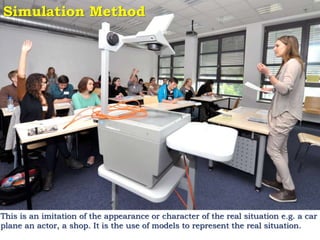
Simulation Method
This is an imitation of the appearance or character of the real situation e.g. a car
plane an actor, a shop. It is the use of models to represent the real situation.
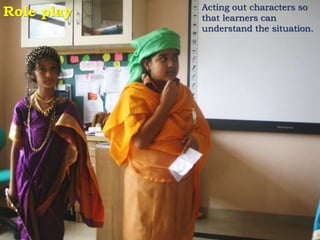
Role play Acting out characters so
that learners can
understand the situation.
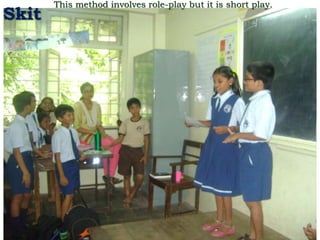
Skit
This method involves role-play but it is short play.
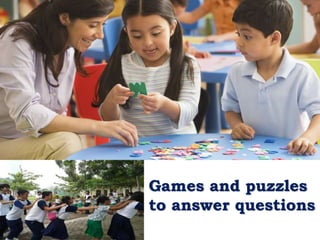
Games and puzzles
to answer questions
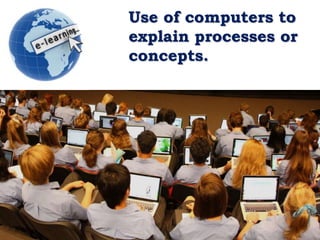
Use of computers to
explain processes or
concepts.
Broadcasting Method
Use of radio and
television to deliver lesson
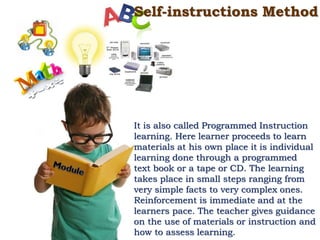
Self-instructions Method
It is also called Programmed Instruction
learning. Here learner proceeds to learn
materials at his own place it is individual
learning done through a programmed
text book or a tape or CD. The learning
takes place in small steps ranging from
very simple facts to very complex ones.
Reinforcement is immediate and at the
learners pace. The teacher gives guidance
on the use of materials or instruction and
how to assess learning.
Thank you
Shirazi

Teaching methodology three

  • 1.
    Perception At this stageof learning, there is an input to the senses that gets registered so that its meaning is established. The result namely what is perceived, depends partly on the students’ prior learning and partly on what stimuli or parts of stimulus situations your students attend to. Perception involves a complex interrelating of information from the Environment and information retained from prior learning.
  • 2.
    Acquisition This is thephase of learning in which a student acquires a New capability or new skill in operating something. Acquisition involves identifying how ways and means are Mastered and learning how to respond to a situation.
  • 3.
    Retention What your studentshave learned is retained until the time it will be used. Psychologist believe that there are two types retention;
  • 4.
    Short-term retention Short-term retentionis demonstrated when your student hold information long enough for immediate use. For instance remembering a telephone number until a call is made, a hotel waiter memorizing details of your order before serving you with the food you ordered.
  • 5.
    Long-term retention When theoutcomes of learning last in your student’s mind beyond the immediate occasion for their use, say from a few minutes right up to a lifetime, long-term retention is observed
  • 6.
    In learning, the bestway of improving retention is to give attention to what is learned initially and how this learning is organized and to relate this to the kind of problem you are faced with.
  • 7.
    Transfer This is sometimescalled application and is the highest and most psychologically complex level of learning. It occurs when you require your students to apply, or put to use motor skills they are able to recall. You should now be aware that objectives that require your student to apply their knowledge in a real world setting.
  • 8.
  • 9.
    An educational approachcan be defined as a way of dealing with an education issue. A teaching approach may be defined as a combination of ways that a teacher uses when presenting the content of a lesson. Approaches
  • 10.
    In the earlydays, teaching was didactic, i.e. lecture method. Student were given rigidly formulated statements, which they had to memorize and regurgitate when required to do by teachers. Little or no emphasize was placed on understanding; learners were simply made to cram things It was believed that human brain is a blank store where knowledge can be pumped and stored. Didactic Approach
  • 11.
    Expository Approach This involvesthe kind of teaching that is characterized by predominance of teacher talk with little or no involvement of students on practical activities. It is a teacher-centered approach. The teacher gives facts, explain concepts, and gives illustrations.
  • 12.
    Anything that needsto be taught practically is done through teacher demonstration. Student participation is limited to listening and asking questions and writing notes as the lesson progress. This approach is not considered very effective in the teaching. However, it is alleged that there are some topics in science/mathematics that can only be approached satisfactorily by exposition because their very nature they are difficult to teach practically.
  • 13.
    Empiricist Approach Emphasis wason the need to acquire scientific knowledge through observation. Laws were reached by induction. The learner was now given opportunity to at least handle apparatus and make observation thus developing interest and manipulate skills.
  • 14.
    Heuristic Approach At theturn of 20th century advocates of the Heuristic approach of teaching believed that learners could be trained to discover scientific ideas by using faculties of observation, reasoning and memory. Learners were involved in observation, recording, analyzing data and drawing conclusions on their own. This was better approach since it involved real inquiry, which would lead to understanding of the theory however, this approach tends to consume more time, hence delay in syllabus coverage
  • 15.
    The Inquiry/Discovery Approach Thisis a learner-centered approach with a high degree of involvement of all who participate. It is systematic in that a set of activities is used yet highly flexible in that the sequence of the activities can be changed and others can be substituted at any time.
  • 16.
    The teacher involvesstudents in activities that help in the development of scientific skills such as the ability to make observations, perform experiments, collect data make deductions and present results.
  • 17.
    A Chinese proverbsays, ‘I hear I forgot, I see and I remember, I do and I understand.’ The learner would carry out experiments then create concepts at first hand in the laboratory, as a means of awakening original thought.
  • 18.
    With passage oftime, it was realized that despite the many practical activities may of the learners still face problems understanding science, hence the slogan ‘I do and I am even more confused’. The teacher’s role is to guide students by clarifying instructions where necessary and being available to answer any questions that may arise in the course of activities.
  • 19.
    Constructivist Approach The constructivistapproach takes cognizance of the fact that by the time a learner enters formal education he/she has already interacted with former environment and has developed ideas and concepts in relation to what he was experienced?
  • 20.
    As a childgrows up, it continuously encounters new horizons in terms of knowledge gained, which require explanations either from its parents family members, or peers. The entire encounter is digested and stored in their memory and becomes knowledge. Learning therefore should be built on the learner’s practical experience while at the same time correcting any misconceptions or learner’s alternative frameworks.
  • 21.
    According to Piaget,an individual interprets reality via intellectual structures characterized by acting schemes that change as one grows. An individual therefore tries to attain structures to make it consistent with new experience. The role of the teacher is to provide guidance as a facilitator by giving students challenges that will help to correct their misconceptions and enable them to draw correct concepts.
  • 22.
    The teacher cando this through Class discussions (peer group learning)
  • 23.
  • 25.
    Use of audiovisual aids, diagrams models etc. In relation to the inquiry approach, this involves a wider range of activities centered on helping students to learn by:  Gaining new insight from the outcome of their investigations.  Modifying their pre-existing ideas in the light of new insights.  Constructing their understanding of a scientific concept. The basic assumption is that students have their own explanations of the phenomena encountered in their everyday life. This approach helps them to test their understanding using scientific approach.
  • 26.
    There are variousapproaches to teaching and they could be teacher or learner-centered. These are: Didactic Expository Empirical Heuristic Enquiry Constructive
  • 27.
  • 28.
    Teaching Methods maybe defined simply as a way of carrying out actual teaching in the ‘classroom’. They are the means by which the teacher attempts to impart the desired learning or experience. The concern is with the way the teacher organizes and uses teaching techniques or skills, subject matter, teaching aids or resources to meet teaching objectives.
  • 29.
    The particular methodthat a teacher uses is determined by a number or factors. These include:  The content to be taught.  The objectives which the teacher plans to achieve.  Availability of teaching and learning resources and the ability and willingness of the teacher to improvise if conventional teaching aids are not available.  Evaluation and follow-up activities.  Individual learner differences.  Size of the class.
  • 30.
    Lecture (Chalk andTalk) Method This involves giving factual information with very little or no participation by the learners. This method is outmoded due to a number of reasons:  It does not offer training for the attainment of scientific skills  Content taught in a lecture is quickly forgotten.  Lecture can be boring especially if they are lengthy and if the teacher lacks appropriate communication skills. However, this method is most effective for transmission of large amounts of matter. In spite of this criticism this method is still very useful an instructional technique as long as it is used appropriately.
  • 31.
    Teacher Demonstration Method Thepurpose of a demonstration is to provide a means by which the teacher can explain or clarify certain parts of the context quickly and economically e.g. it can be demonstrated that metals expand when heated; or that seedlings exposed to a unilateral source of light bend Towards the light.
  • 32.
    It is essentialthat the student should be involved actively. One way in which this can be achieved is through questioning as the demonstration progresses.
  • 33.
    Whenever possible theteacher should also give students an opportunity to set up the apparatus required for carrying out a certain procedure. The student should be organized in such a way that every student is able to observe the demonstration.
  • 34.
    Demonstration can alsobe used to explain experiment set up before the students begin to set up their own apparatus and or materials to be used are not enough for the whole class; or when the materials are too dangerous or equipment too delicate to be entrusted to the students e.g. use of high voltage capacitors; experiments involving a mixture of hydrogen and air.
  • 35.
  • 36.
    This involves teaching/learningactivities conducted by the students under the guidance/supervision of the teacher. The teacher provides the students, either singly or in groups, with the materials and apparatus well as the instructions to be followed in performing the activities.
  • 37.
    Deliberate effort shouldbe made to enhance group work although individual participation must be assured. The ability to follow instructions and the use of scientific methods and skills to solve problems with little help from the teacher is an important aspect of learning science.
  • 38.
    Lack of laboratoryfacilities or 3quipment should not be taken as excuse to limit practical work. The teacher (and the students) should collect materials and improvise as much as possible. Where improvisation is not possible, small-scale experimentation should be encouraged.
  • 39.
    There are certainbasic skills that are essential in order for learners to carry out practical work safely and successfully. Examples of such skills include: o Ability to read instruments(measuring cylinders,) accurately. o Correct use of equipment and apparatus (magnifying glass,) Successful practical work depends on a number of factors that include the following:  Preparation before the practical period.  Trying out of activities to make sure that the materials used will give the expected results.  Clarity of the instructions-language should neither be ambiguous nor include terms that are unfamiliar to the students. If such terms must be used they should be clearly defined.  Effective guidance and supervision by the teacher.  Group size and composition.  The ability of the teacher to establish a link between the practical work and the concept to be learnt (bridge)  Briefing on any precautions to be taken to ensure the safety of the students and the equipment.
  • 40.
    Project Work The valueof project work in the learning science or humanities cannot be overemphasized. Project work enable learners to actually engage in investigation in an area of their own interest. The students learn to appreciate the basic steps in the scientific methods;
  • 41.
    It combines thefollowing skills:  Observation  Identification of a problem.  Discussion  Formulation of a hypothesis.  Design and investigation.  Data gathering.  Data analysis  Making deductions.  Report writing and presentation. Contrary to popular belief project work need not consume a lot of the time and resources allocated to the subject. There are many opportunitie for students to learn through individual or group project work. The problems to be investigated may are arising from the students’ own interest but they may also be suggested by the teacher.
  • 42.
    Whatever the case,the teacher should make sure that students have sufficient background information before they embark on project work. Teacher supervision and guidance are important prerequisites for successful project work.
  • 43.
    Field Work/Excursions Fieldwork methodneeds to illustrate the natural development or technological application of certain topics dealt with in the classroom. It provides students with firs-hand evidence of scientific phenomena and how they impact on everyday life.
  • 44.
    Students learn toappreciate the sciences and arts not only as subjects in the curriculum but also as part of the real world.
  • 45.
    Students may alsoget an opportunity to interact with experts in particular fields of study.
  • 46.
    Fieldwork is difficultto organize, but if well planned, it can be an effective method of teaching and learning some aspects as well as art subjects. It need not be conducted in a place that is far from the school. The immediate environment of the school may offer unique opportunities for students to conduct field work which may help to reinforce what is learned in the classroom.
  • 47.
    To avoid asituation where students reduce a field trip to sightseeing, the teacher must plan as thoroughly as they plan any other lesson. Specify the objectives, learning activities, evaluation and follow-up activities. Prepare a detailed work sheet or questionnaire and give clear instructions to students beforehand to focus them on key areas of study. Form the working groups in advance. Suggest aspects of your teaching subject that can be taught using field work as a method of teaching.
  • 48.
    Discussion Method Discussion isan important component any teaching/ learning situation. It allows students to share their ideas. It can be used at the beginning of a topic to ascertain students’ pre conceived notions of the subject matter or towards the end of a topic by presenting students with a new situation and asking them to explain it in terms of what they have just learned. However, discussion in groups might not have much value unless it is followed by presentation of reports
  • 49.
    Simulation Method This isan imitation of the appearance or character of the real situation e.g. a car plane an actor, a shop. It is the use of models to represent the real situation.
  • 50.
    Role play Actingout characters so that learners can understand the situation.
  • 51.
    Skit This method involvesrole-play but it is short play.
  • 52.
    Games and puzzles toanswer questions
  • 53.
    Use of computersto explain processes or concepts.
  • 54.
    Broadcasting Method Use ofradio and television to deliver lesson
  • 55.
    Self-instructions Method It isalso called Programmed Instruction learning. Here learner proceeds to learn materials at his own place it is individual learning done through a programmed text book or a tape or CD. The learning takes place in small steps ranging from very simple facts to very complex ones. Reinforcement is immediate and at the learners pace. The teacher gives guidance on the use of materials or instruction and how to assess learning.
  • 56.