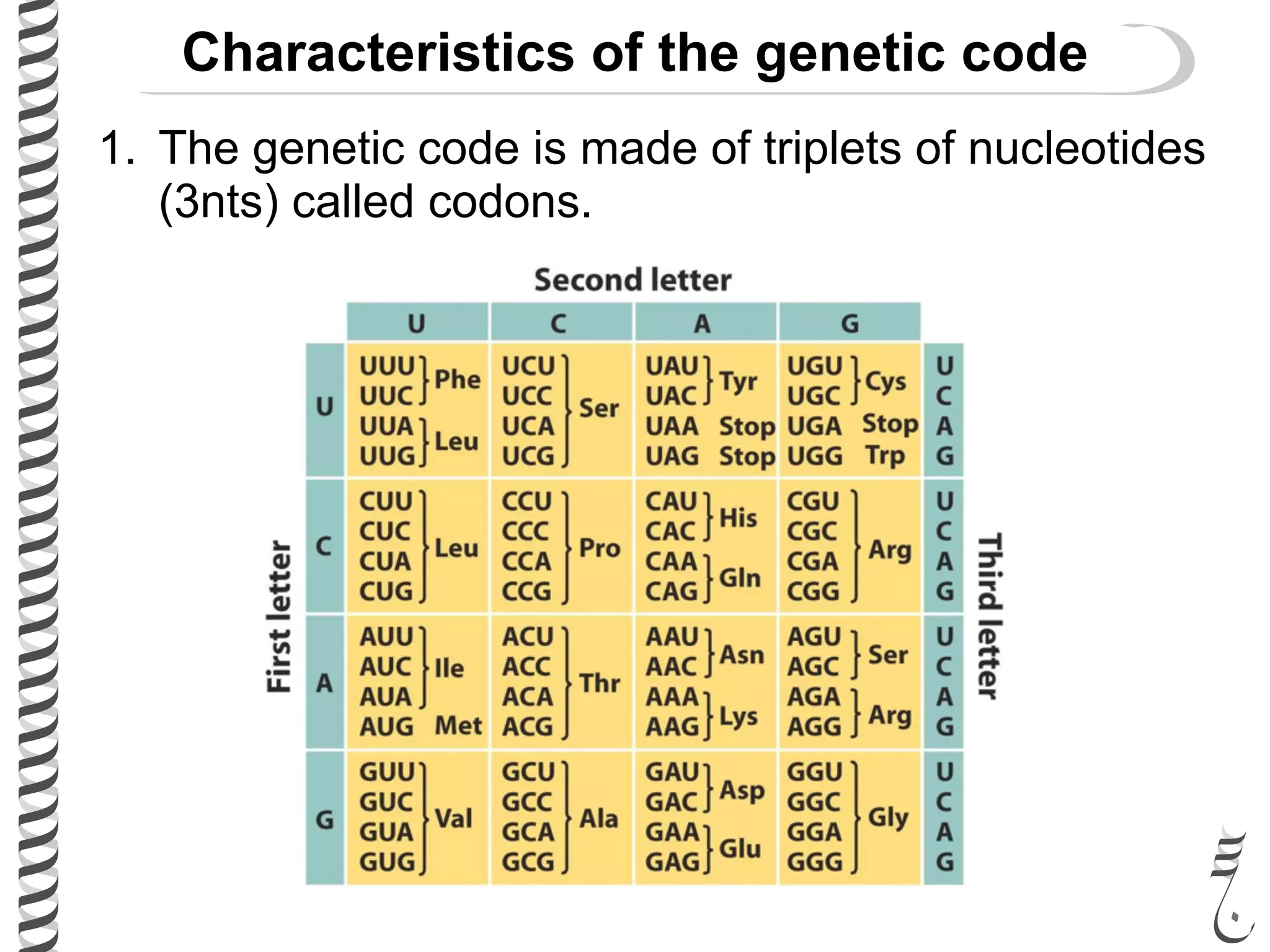
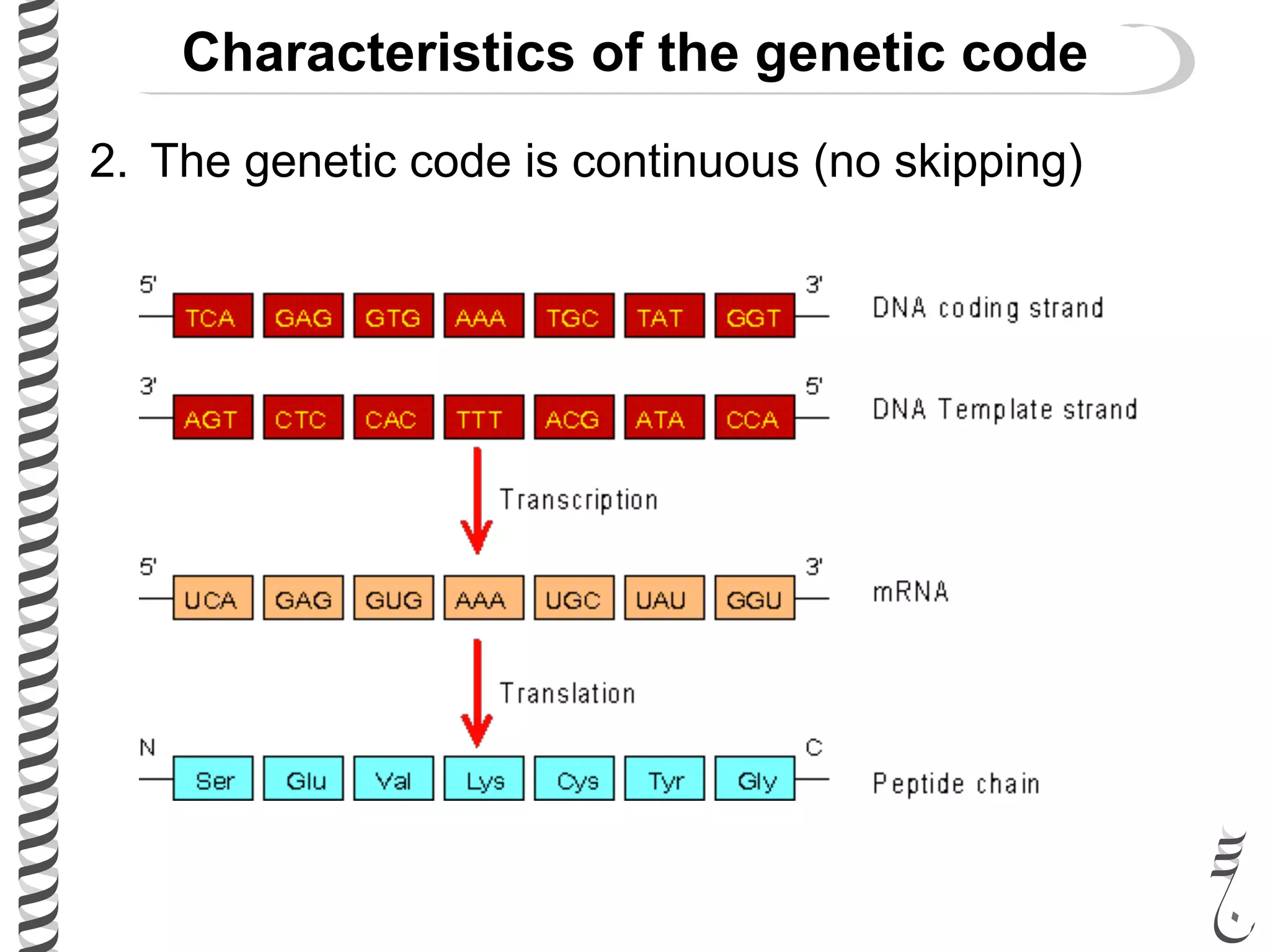
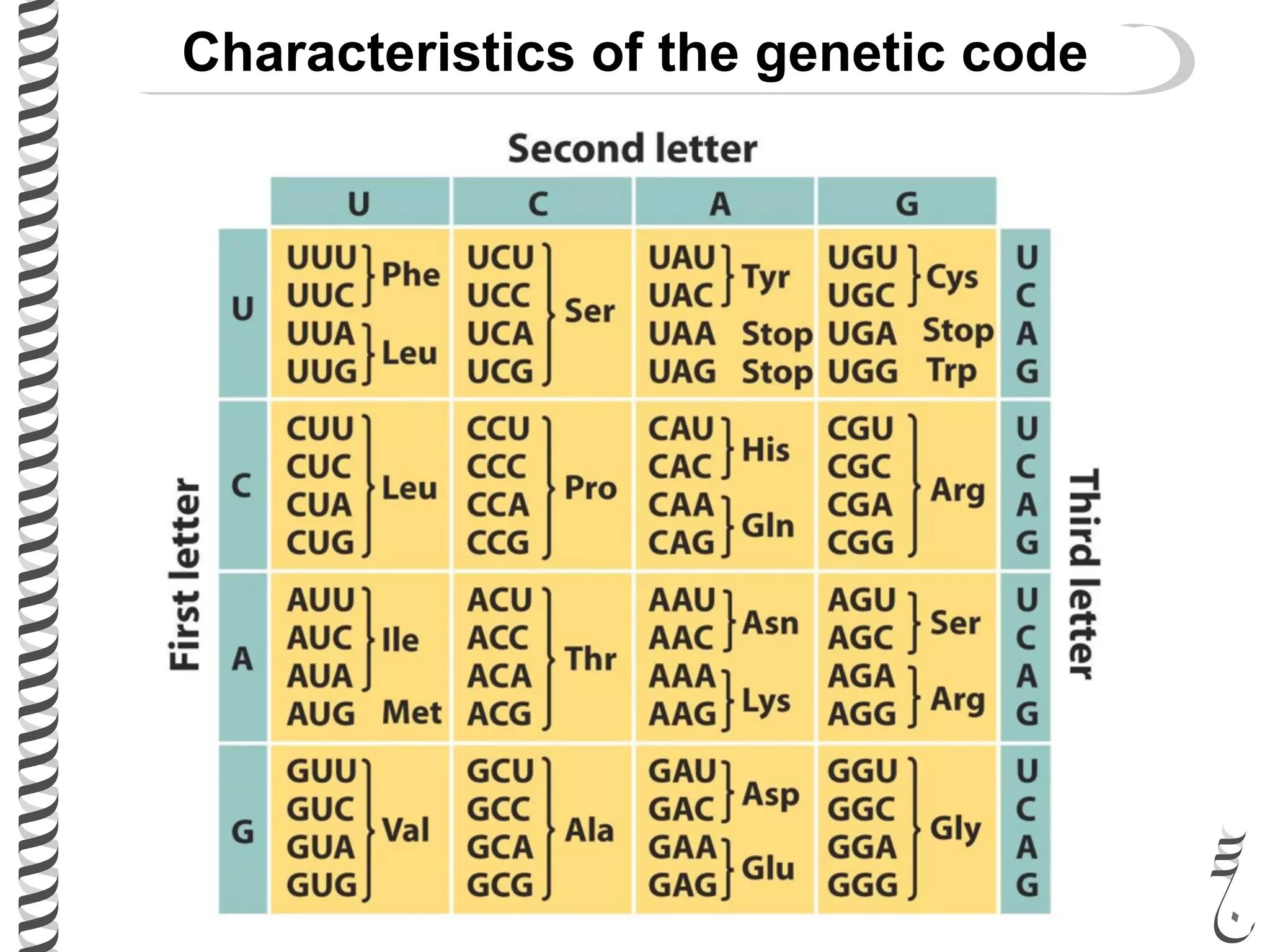
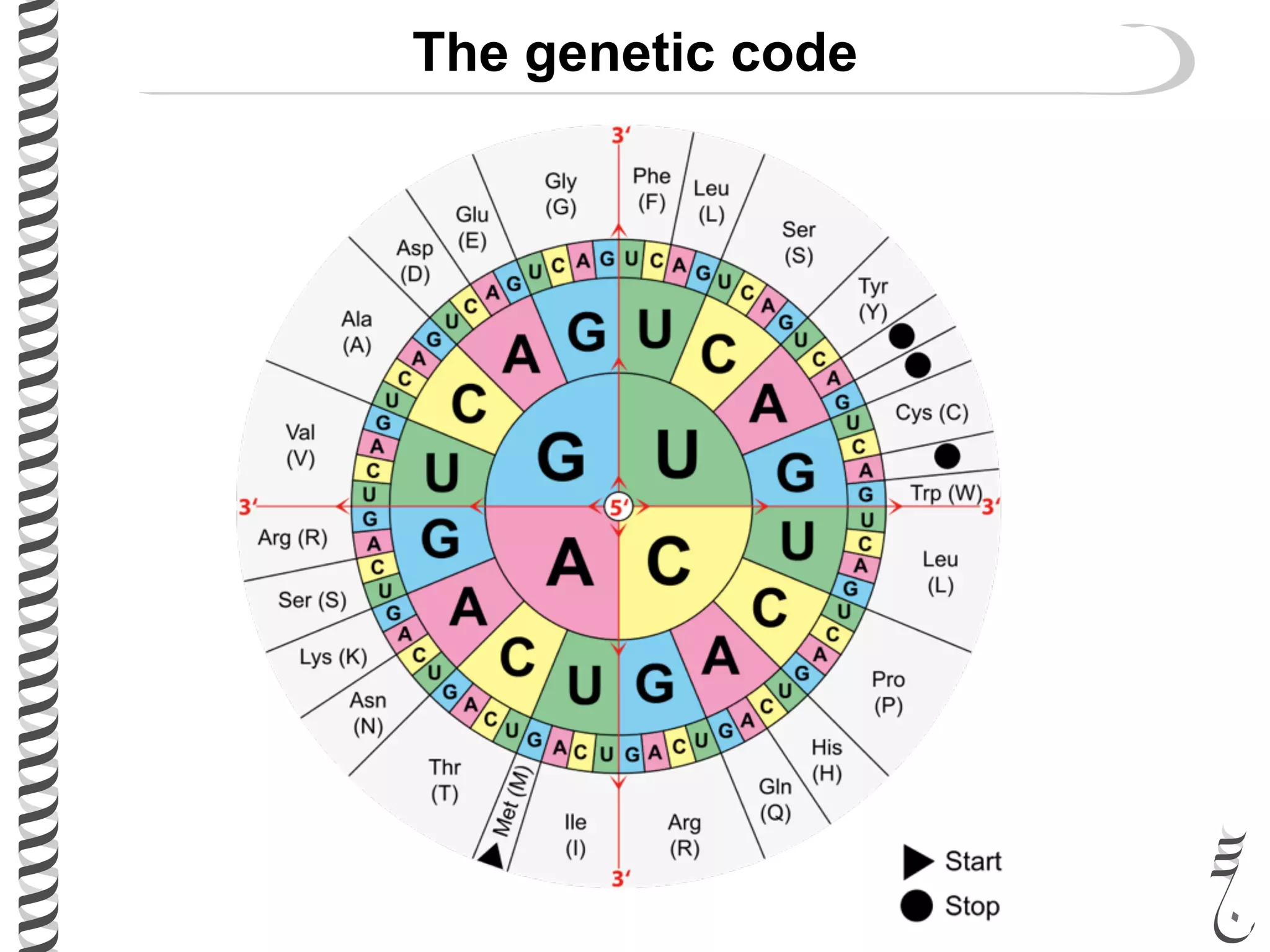
The document discusses the genetic code and how it was decoded through a series of experiments. It explains that the genetic code is made up of triplets of nucleotides called codons that each code for a specific amino acid. Through using random polymers of nucleotides and determining the resulting amino acid sequences, researchers discovered that each codon is three nucleotides long. Further experiments using ribosome binding assays finally determined the sequence of each codon and fully decoded the genetic code. The genetic code is universal across all life, has start and stop codons, and is degenerate with some amino acids corresponding to multiple codons.
AIMS
• Understand thegenetic code and how it was
decoded.
• Understand the codons and what do they code
for.
• Understand the general characteristics of the
genetic code.
4.
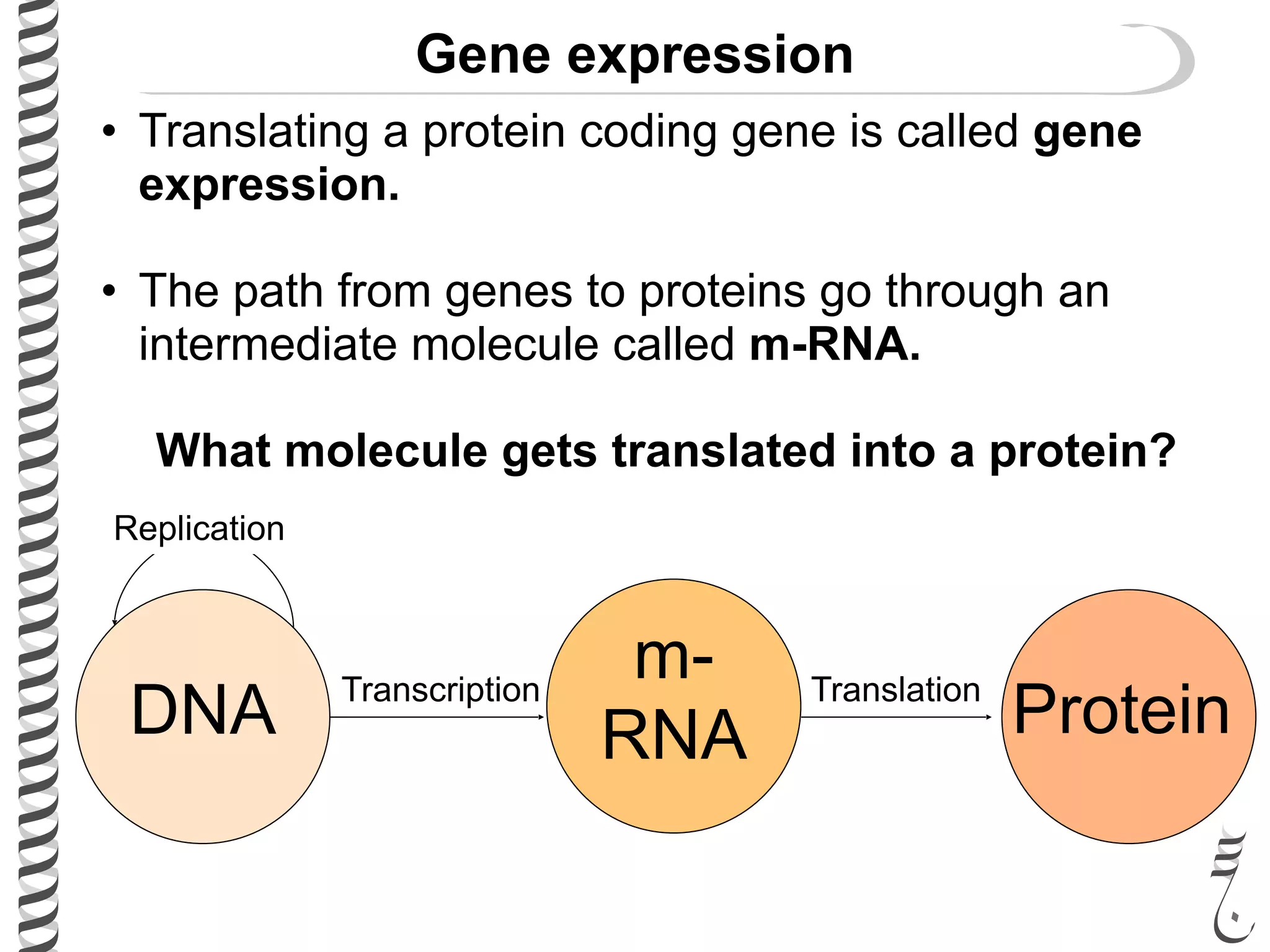
Gene expression
DNA
m-
RNA ProteinTranscriptionTranslation
Replication
• Translating a protein coding gene is called gene
expression.
• The path from genes to proteins go through an
intermediate molecule called m-RNA.
What molecule gets translated into a protein?
5.
The genetic code
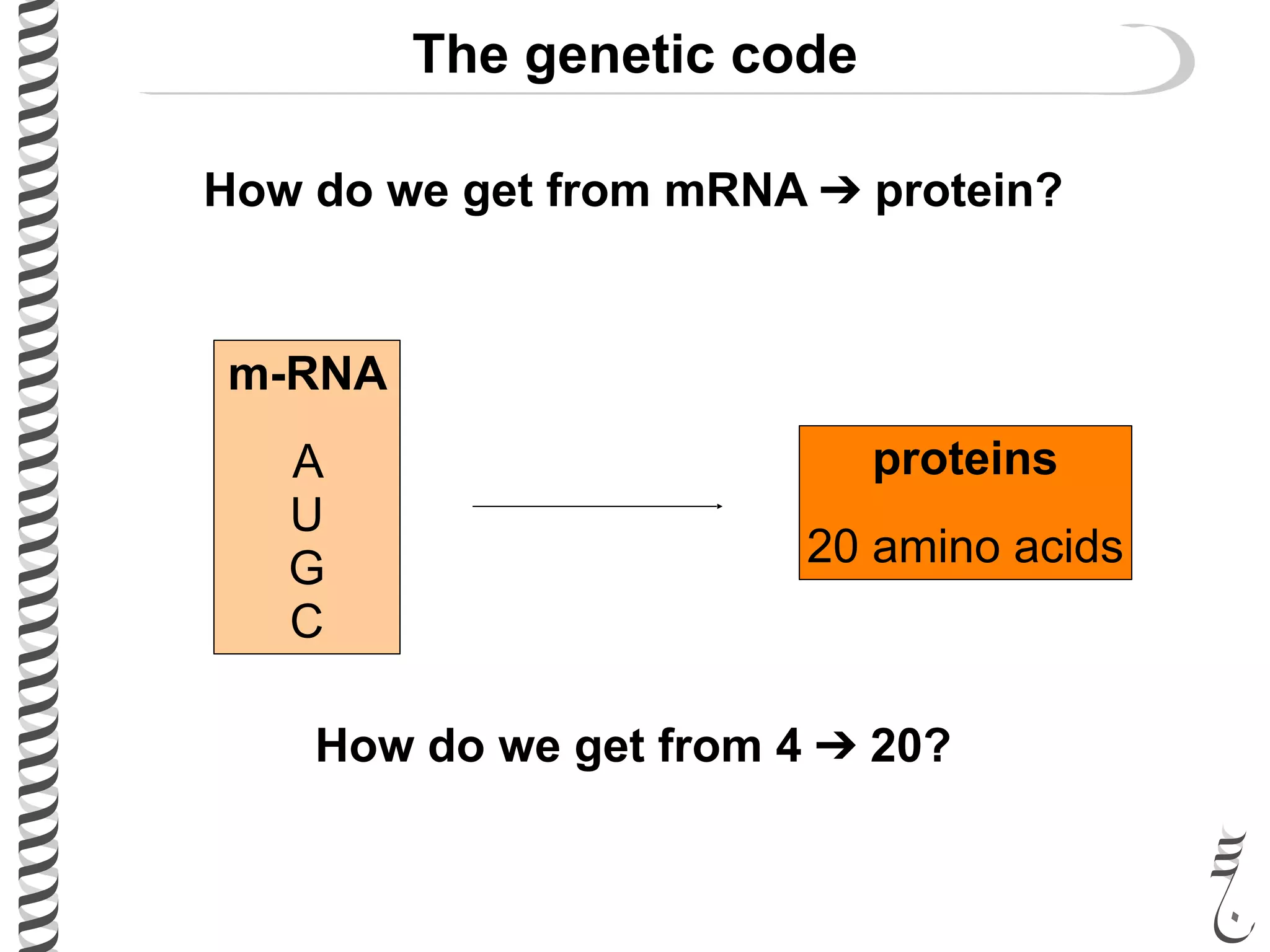
Howdo we get from mRNA ➔ protein?
m-RNA
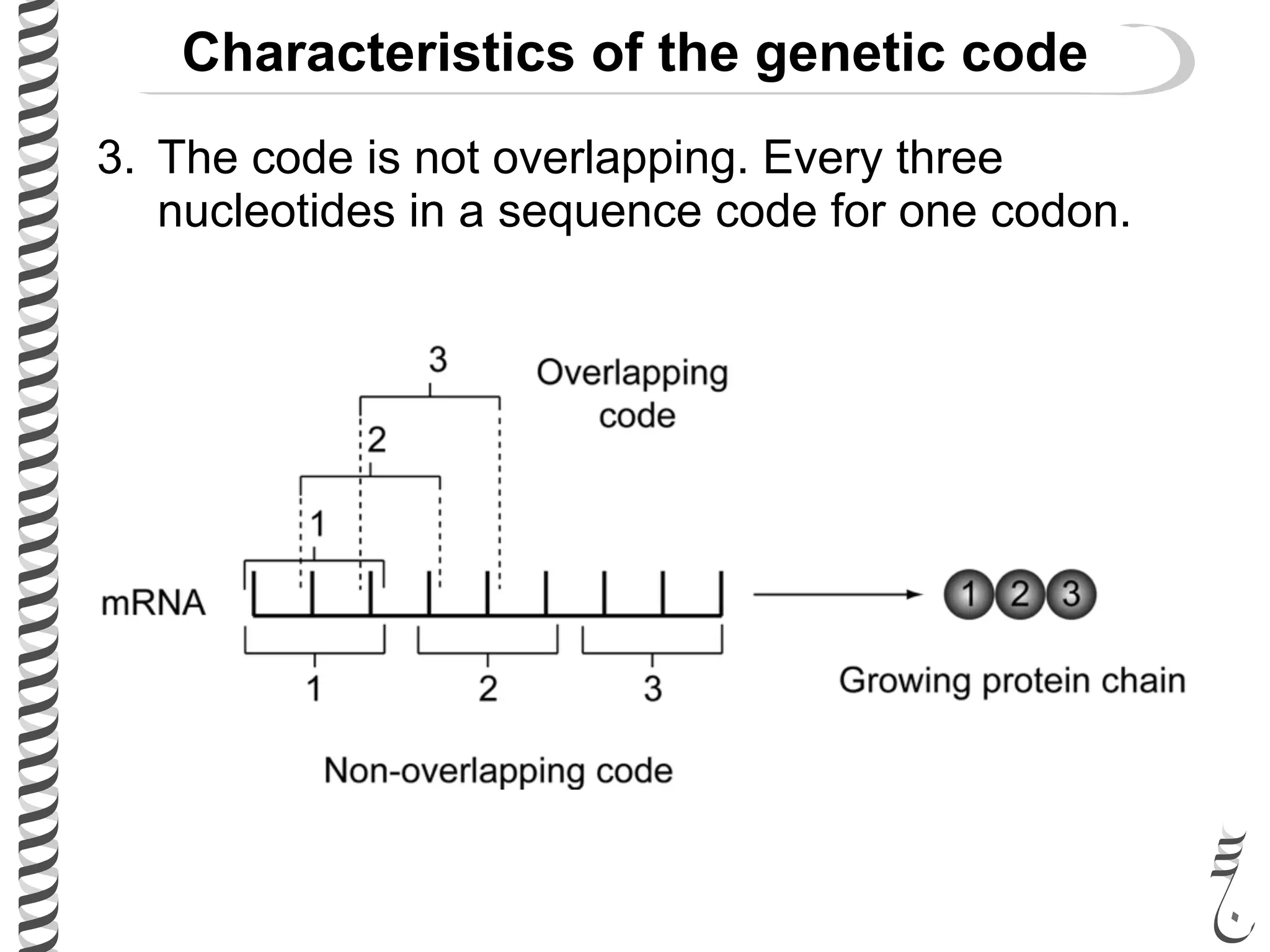
A
U
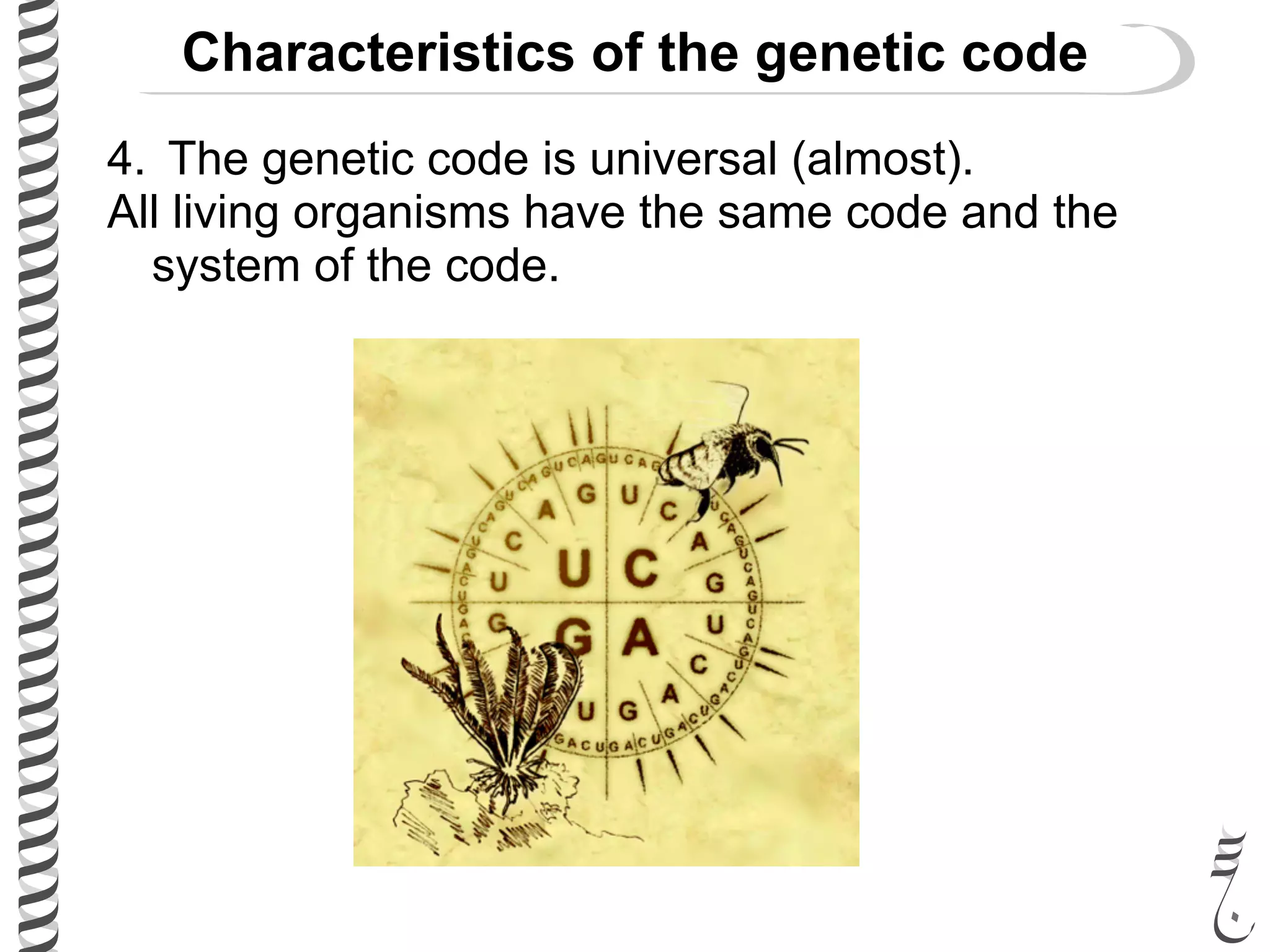
G
C
proteins
20 amino acids
How do we get from 4 ➔ 20?
6.
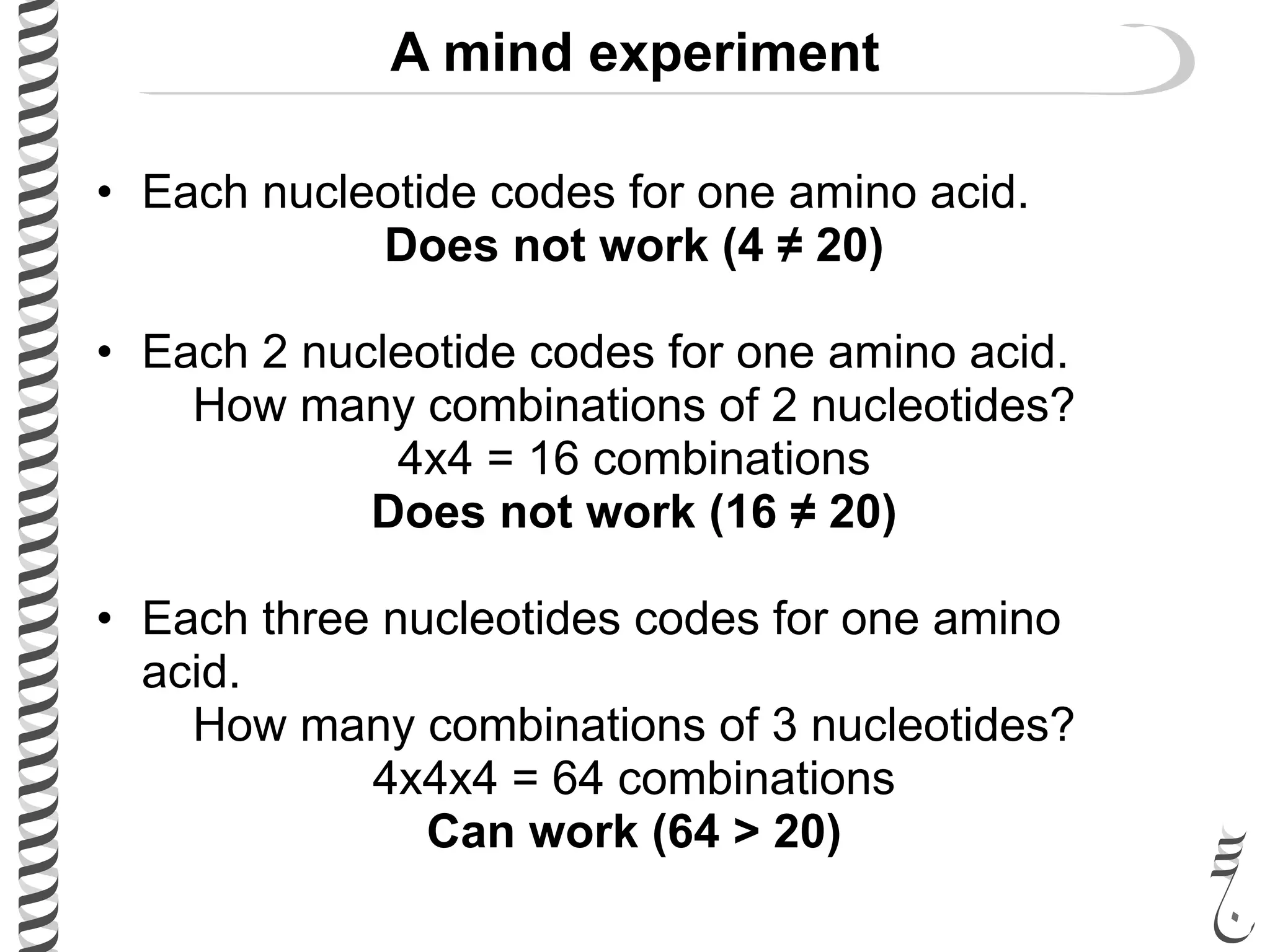
A mind experiment
•Each nucleotide codes for one amino acid.
Does not work (4 ≠ 20)
• Each 2 nucleotide codes for one amino acid.
How many combinations of 2 nucleotides?
4x4 = 16 combinations
Does not work (16 ≠ 20)
• Each three nucleotides codes for one amino
acid.
How many combinations of 3 nucleotides?
4x4x4 = 64 combinations
Can work (64 > 20)
7.
A mind experiment
Acode of three nucleotides coding for a single
amino acid creates more than needed!
8.
The genetic code
•The genetic code is made of triplets (3) nucleotides.
• Codon: three nucleotides in a m-RNA coding for a
single specific amino acid.
How this was found?
9.
The genetic code
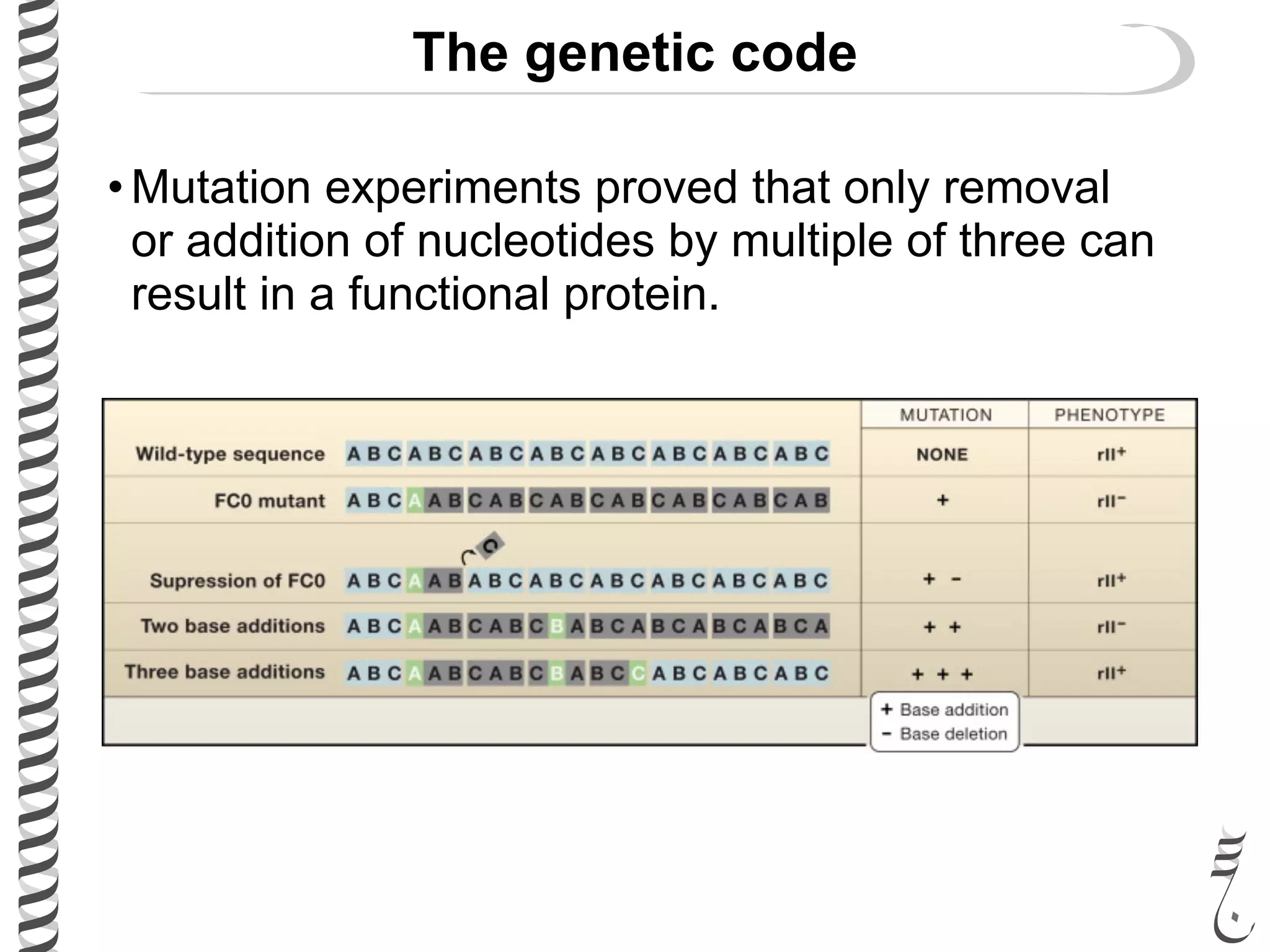
•Mutation experiments proved that only removal
or addition of nucleotides by multiple of three can
result in a functional protein.
10.
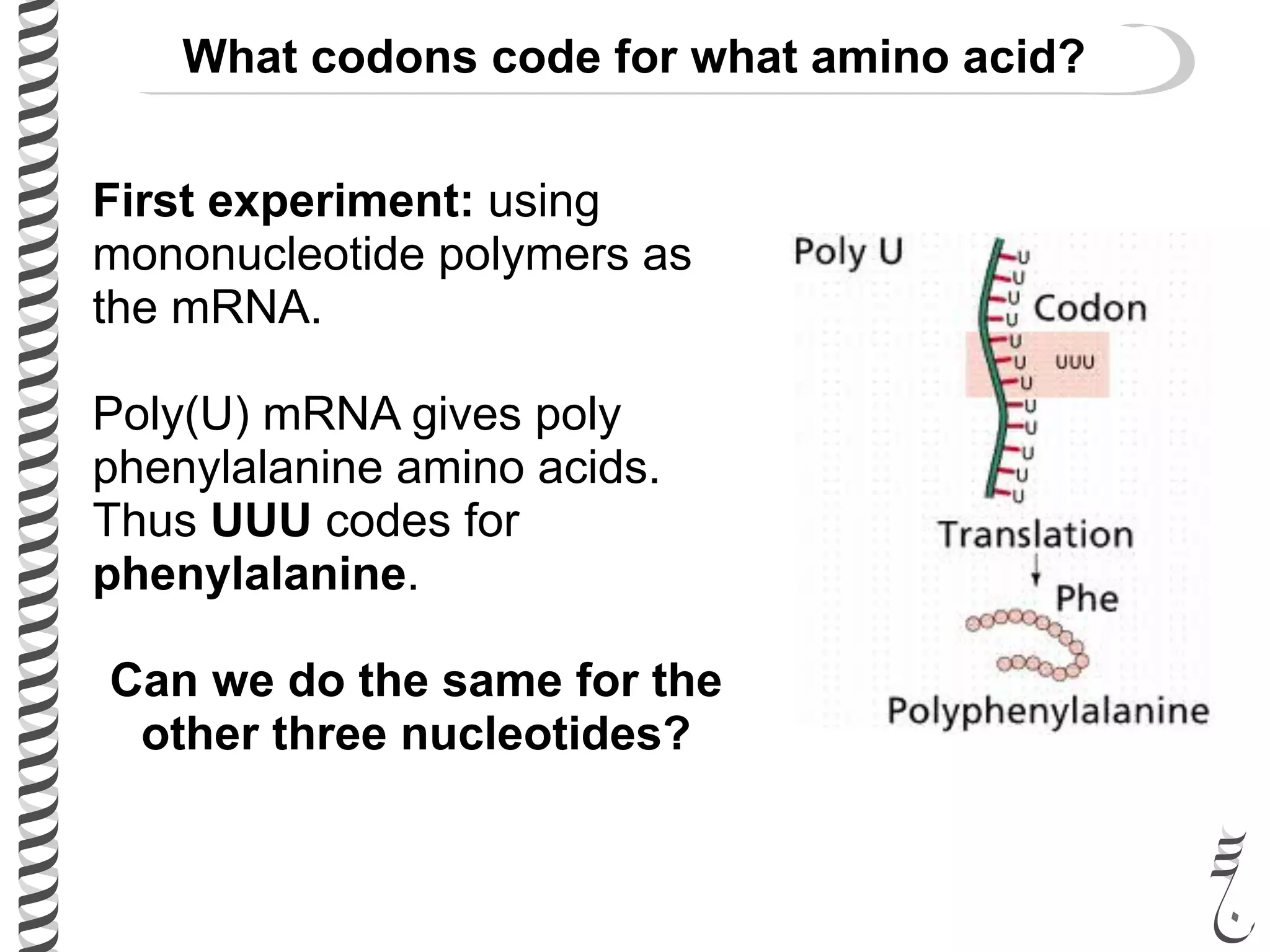
First experiment: using
mononucleotidepolymers as
the mRNA.
Poly(U) mRNA gives poly
phenylalanine amino acids.
Thus UUU codes for
phenylalanine.
Can we do the same for the
other three nucleotides?
What codons code for what amino acid?
11.
Poly(A) mRNA givespoly lysine amino acids. Thus
AAA codes for lysine.
Poly(C) mRNA gives poly proline amino acids. Thus
CCC codes for proline.
Poly(G) could not be done for structural difficulties.
What codons code for what amino acid?
12.
Second experiment: usingrandom copolymer
mRNA of two different nucleotides.
Make a copolymer of (A and C).
What are the outcomes?
What codons code for what amino acid?
13.
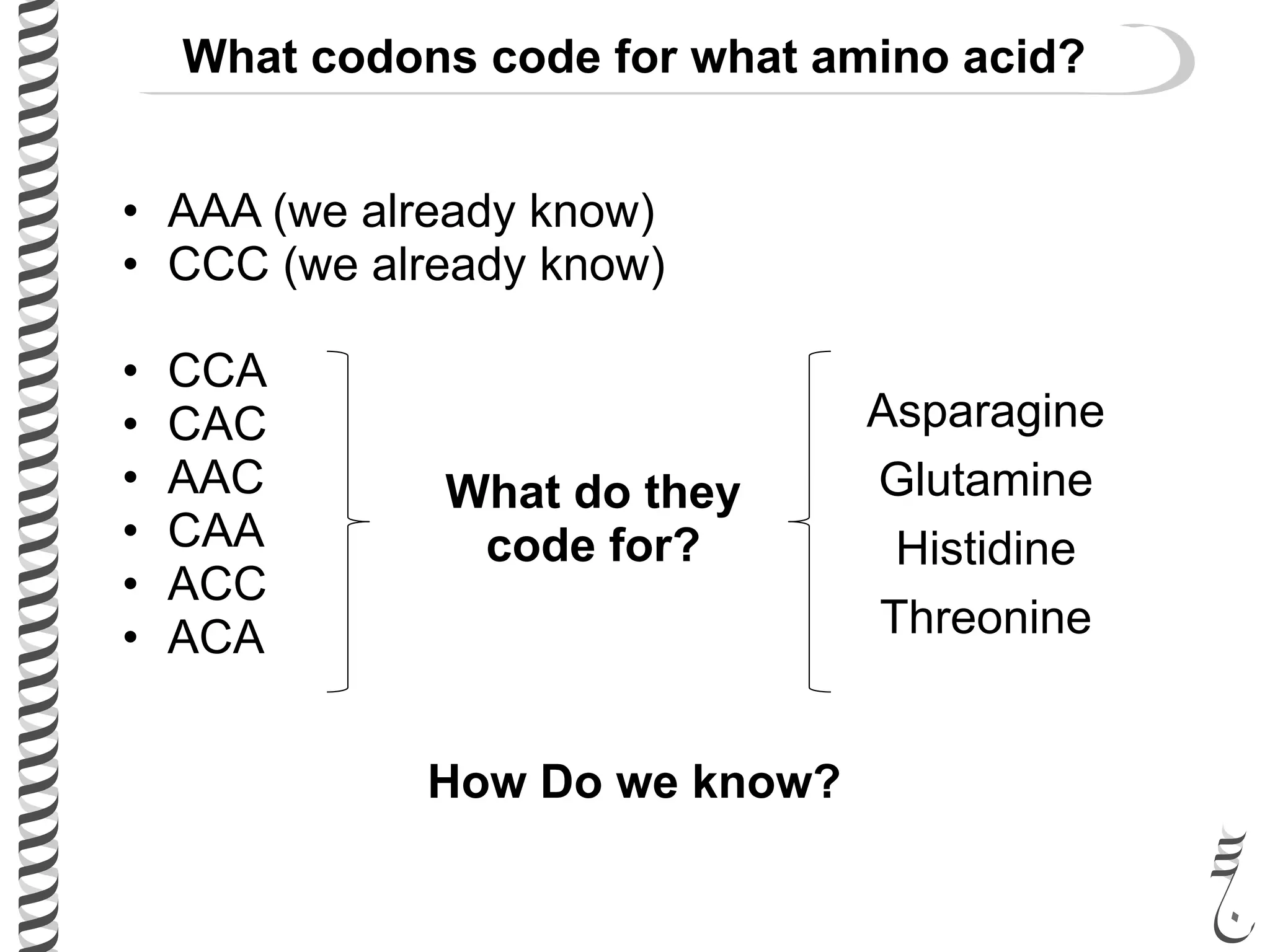
• AAA (wealready know)
• CCC (we already know)
• CCA
• CAC
• AAC
• CAA
• ACC
• ACA
What do they
code for?
Asparagine
Glutamine
Histidine
Threonine
How Do we know?
What codons code for what amino acid?
14.
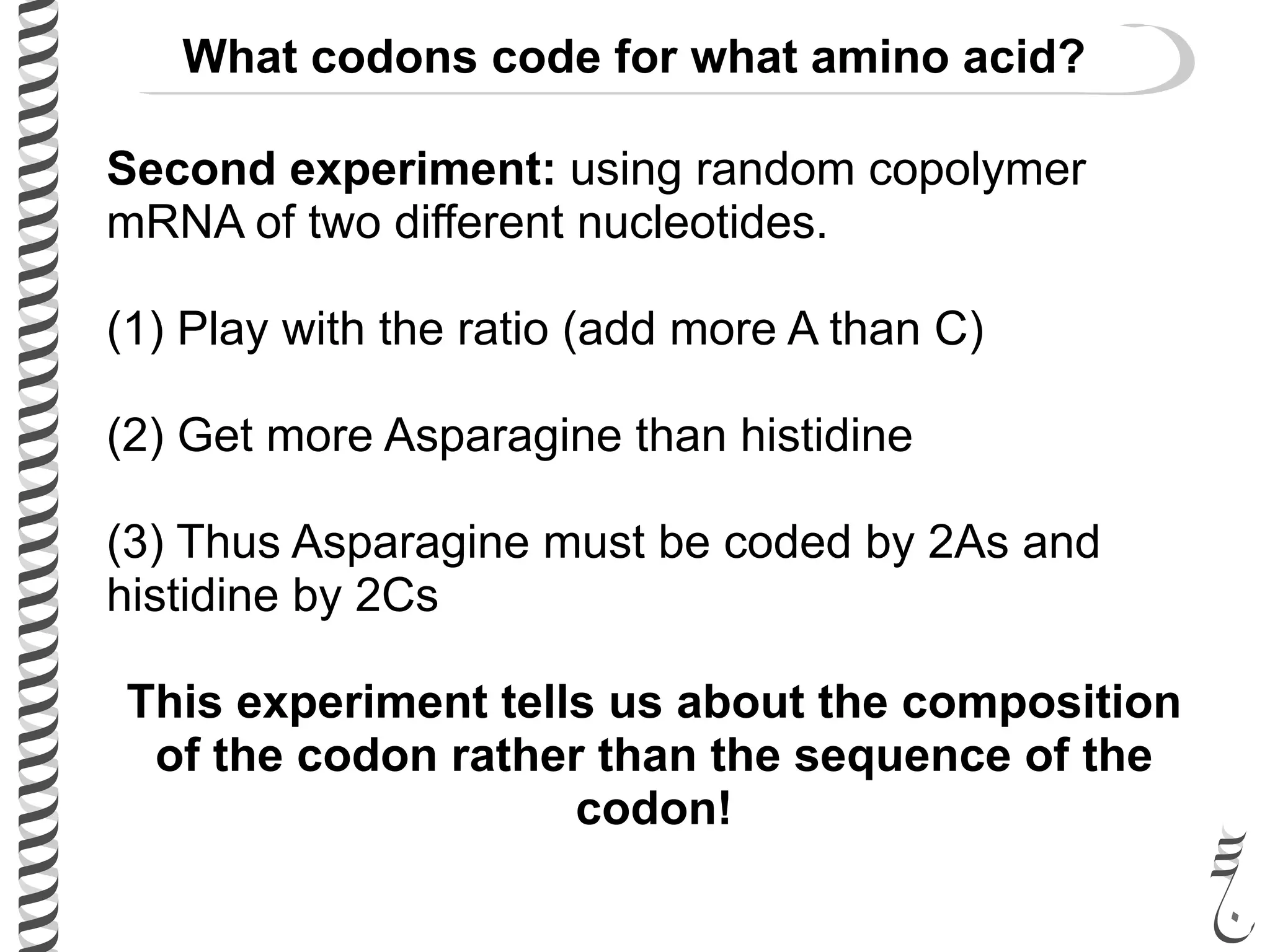
Second experiment: usingrandom copolymer
mRNA of two different nucleotides.
(1) Play with the ratio (add more A than C)
(2) Get more Asparagine than histidine
(3) Thus Asparagine must be coded by 2As and
histidine by 2Cs
This experiment tells us about the composition
of the codon rather than the sequence of the
codon!
What codons code for what amino acid?
15.
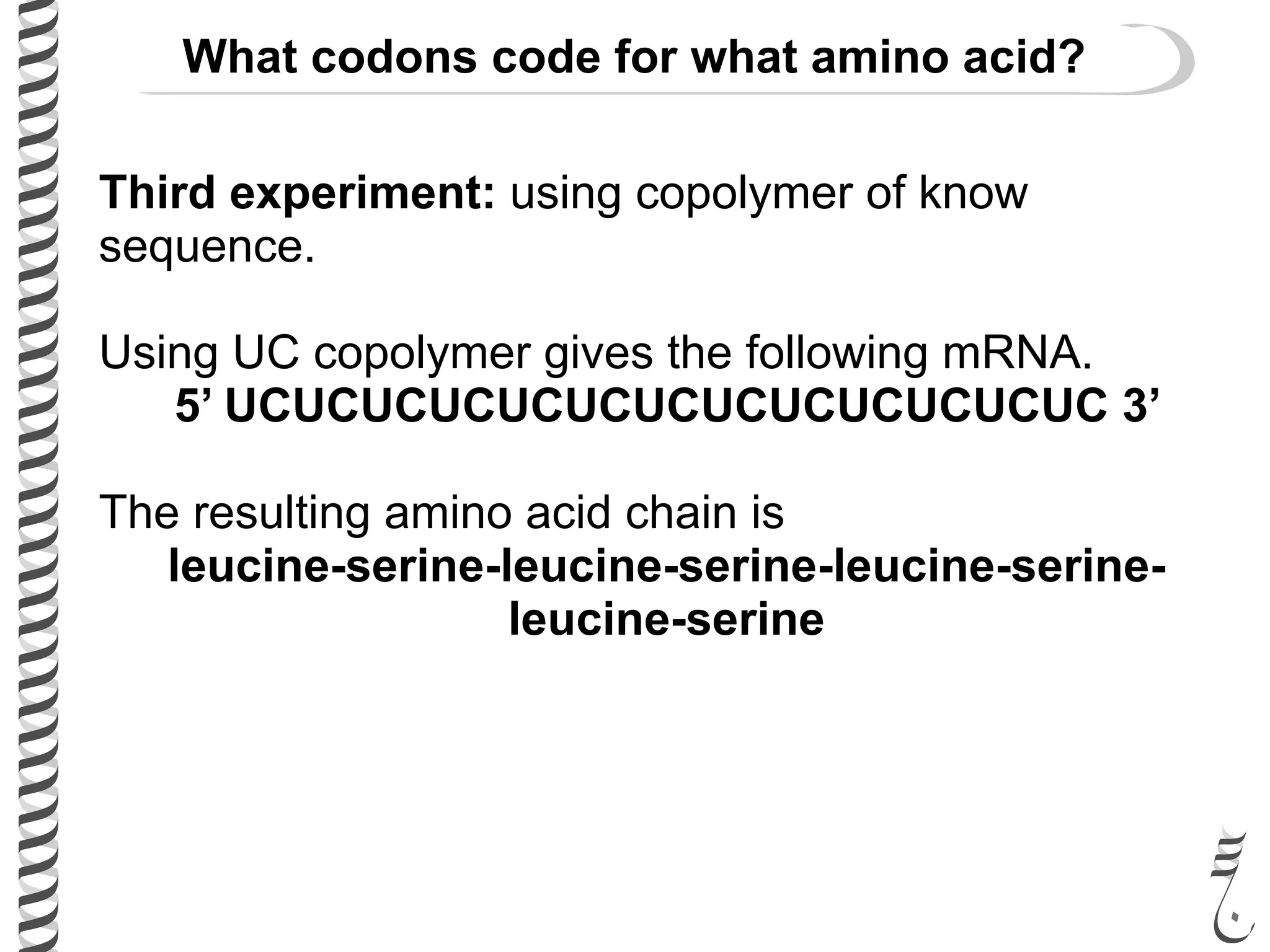
Third experiment: usingcopolymer of know
sequence.
Using UC copolymer gives the following mRNA.
5’ UCUCUCUCUCUCUCUCUCUCUCUCUC 3’
The resulting amino acid chain is
leucine-serine-leucine-serine-leucine-serine-
leucine-serine
What codons code for what amino acid?
16.
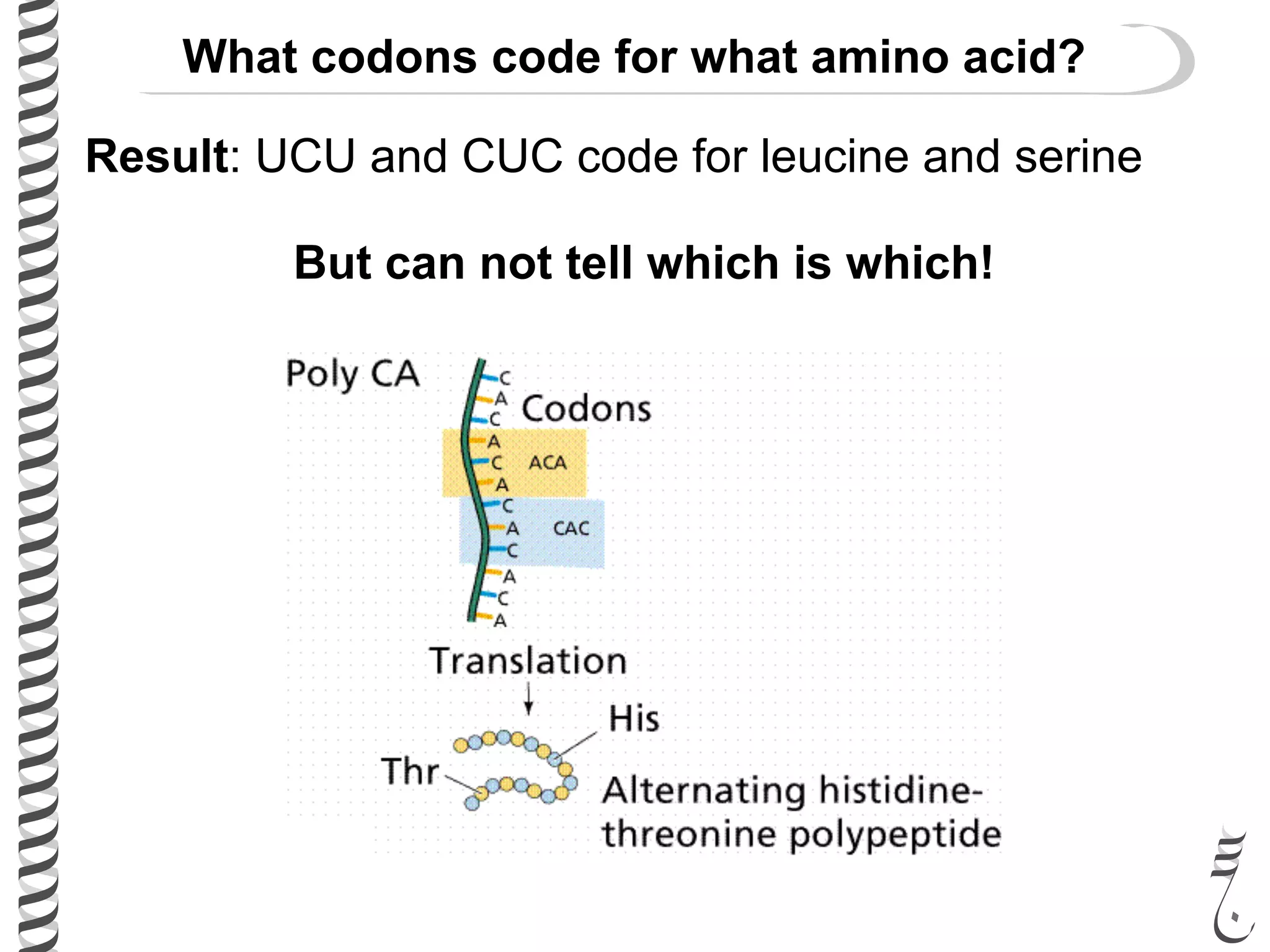
Result: UCU andCUC code for leucine and serine
But can not tell which is which!
What codons code for what amino acid?
17.
Fourth experiment: usingthe translation process to
determine the code.
The approached used was called “ribosome binding
assay”
The experiment determined the specific sequence of
the codons.
What codons code for what amino acid?
18.
When decoding themRNA codons, 1 amino acid go
the ribosome and bind (tRNA).
This approach determined the sequence of the
majority of the codons.
What codons code for what amino acid?
19.
The genetic code
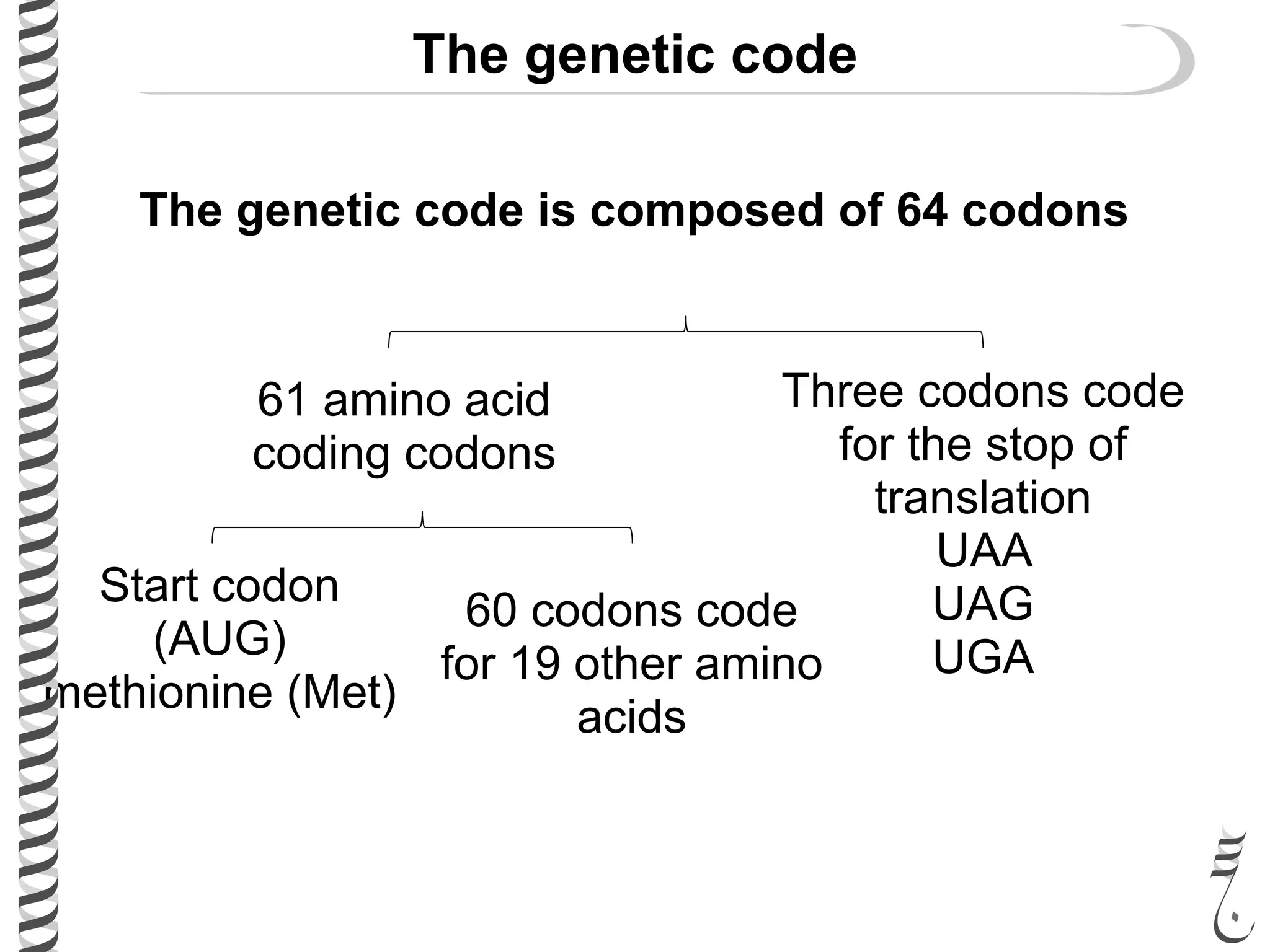
Thegenetic code is composed of 64 codons
61 amino acid
coding codons
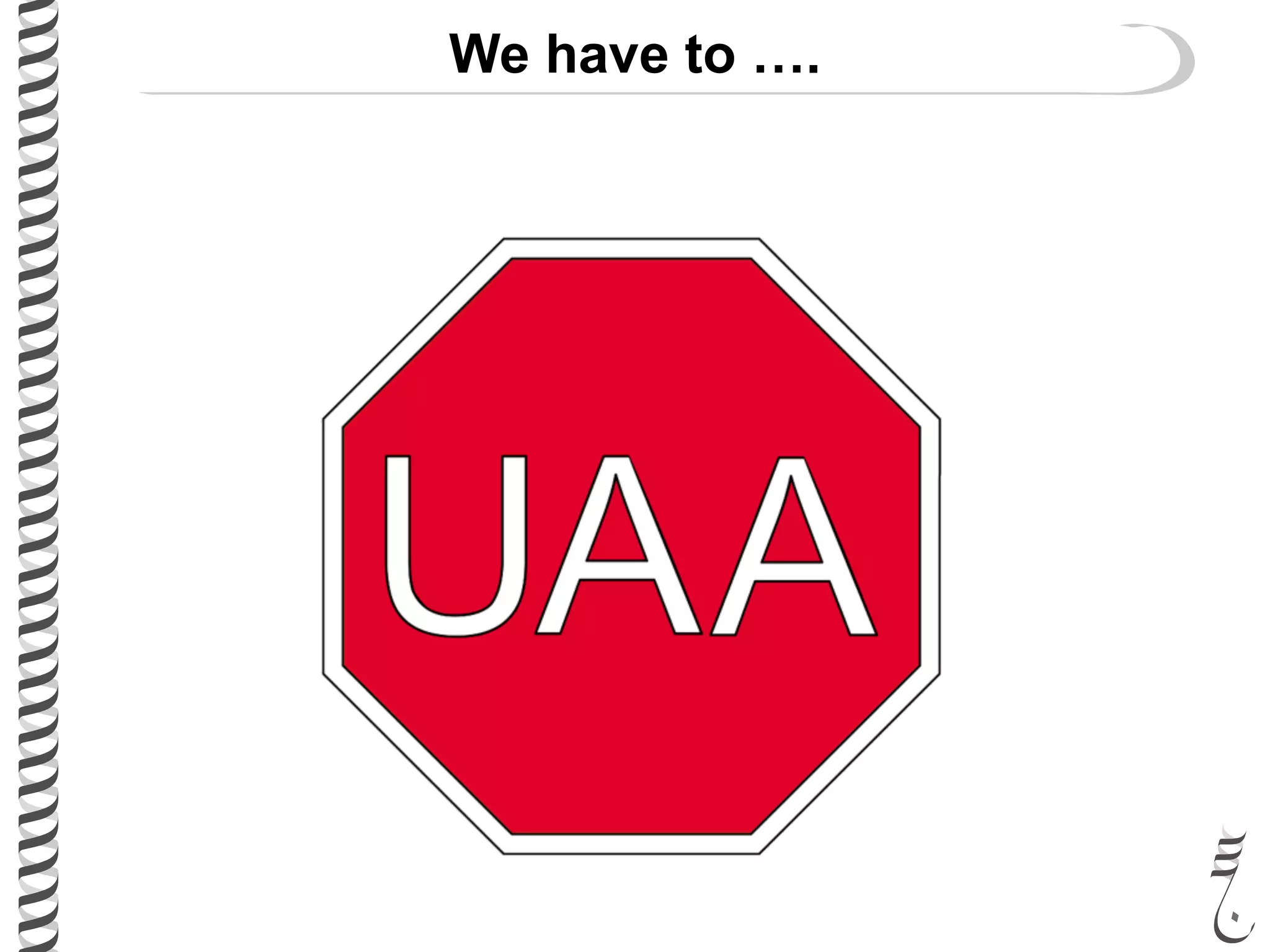
Three codons code
for the stop of
translation
UAA
UAG
UGA
Start codon
(AUG)
methionine (Met)
60 codons code
for 19 other amino
acids
20.
The genetic code
Thecodons are more than what we need to
translate the 20 amino acids
We will learn how and why later!
21.
Characteristics of thegenetic code
1. The genetic code is made of triplets of nucleotides
(3nts) called codons.
Characteristics of thegenetic code
3. The code is not overlapping. Every three
nucleotides in a sequence code for one codon.
24.
Characteristics of thegenetic code
4. The genetic code is universal (almost).
All living organisms have the same code and the
system of the code.
25.
Characteristics of thegenetic code
5. The code has specific signals for start of
translation and stop of translation.
The start codon (AUG) codes for a methionine amino
acid.
Three stop codons (UAA, UAG, UGA) code for a stop
WITHOUT and amino acid.
The stop codons are also called nonsense codons,
or chain termination codons.
26.
Characteristics of thegenetic code
6. The genetic code is “degenerate”.
Degenerate means redundant.
Remember 61 codons code for 20 amino acids
More than one codon for the same one amino acid
27.
Characteristics of thegenetic code
Remember:
Each codon codes for one amino acid
BUT
An amino acid can be coded by more than one
codon
28.
Characteristics of thegenetic code
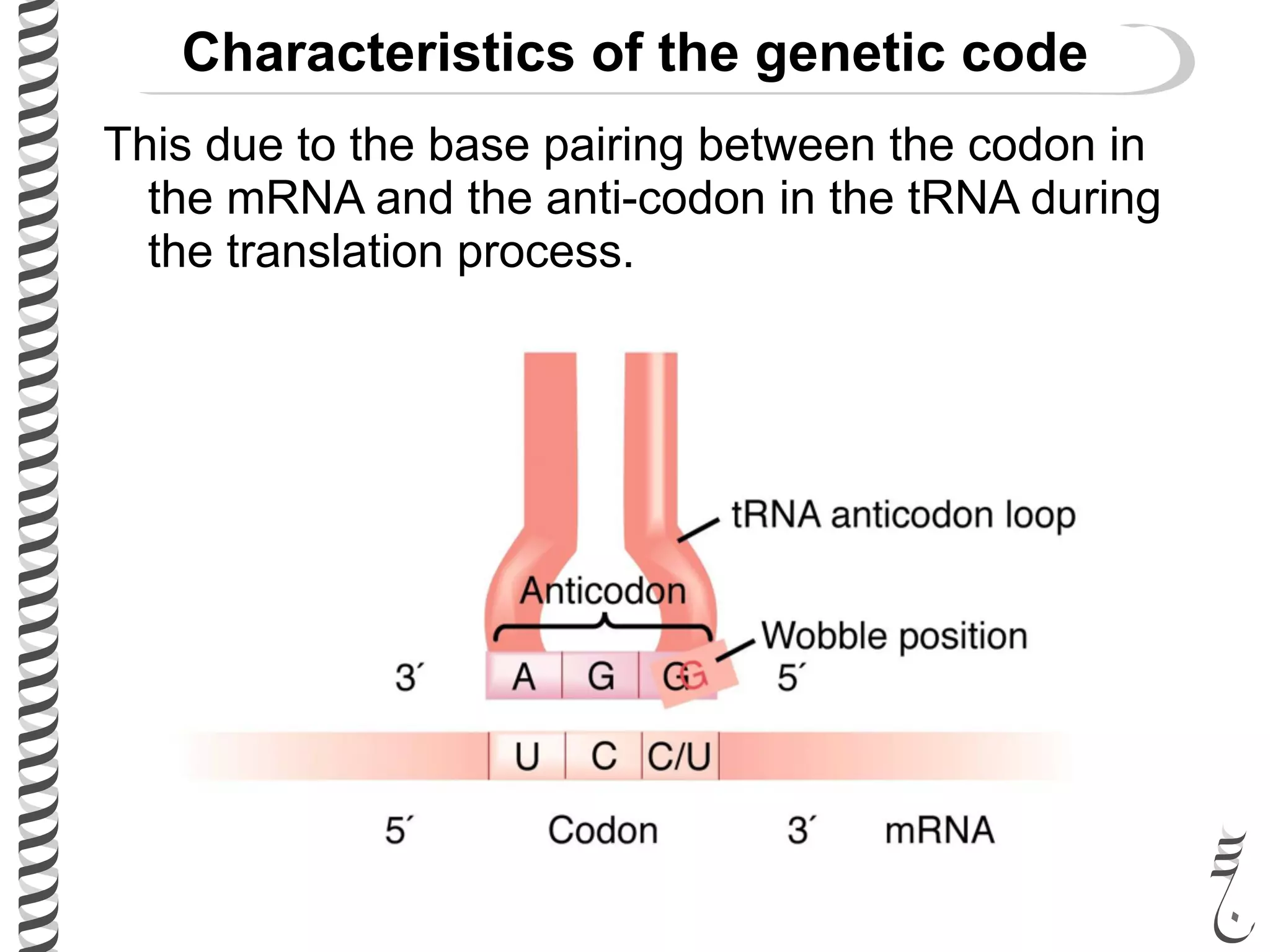
7. The Wobble effect of the third base in the codon
The third nucleotides in some codons are not
essential for determining the identity of the amino
acid.
Characteristics of thegenetic code
This due to the base pairing between the codon in
the mRNA and the anti-codon in the tRNA during
the translation process.
Stuff to know
Polaramino acids
codon
triplets
Mononucleotide polymer
Random copolymer
copolymer
Ribosome binding assay
Start codon
Stop codon
AUG
UUA
UAG
UGA
Nonsense codons
Chain termination codons
33.
Expectations
• You knowhow the mRNA carries the genetic
code and how the sequence is mean to be read.
• You understand the experiments that lead to the
discovery of the genetic code.
• You know the characteristics of the genetic code.