Acid Base Equilibrium
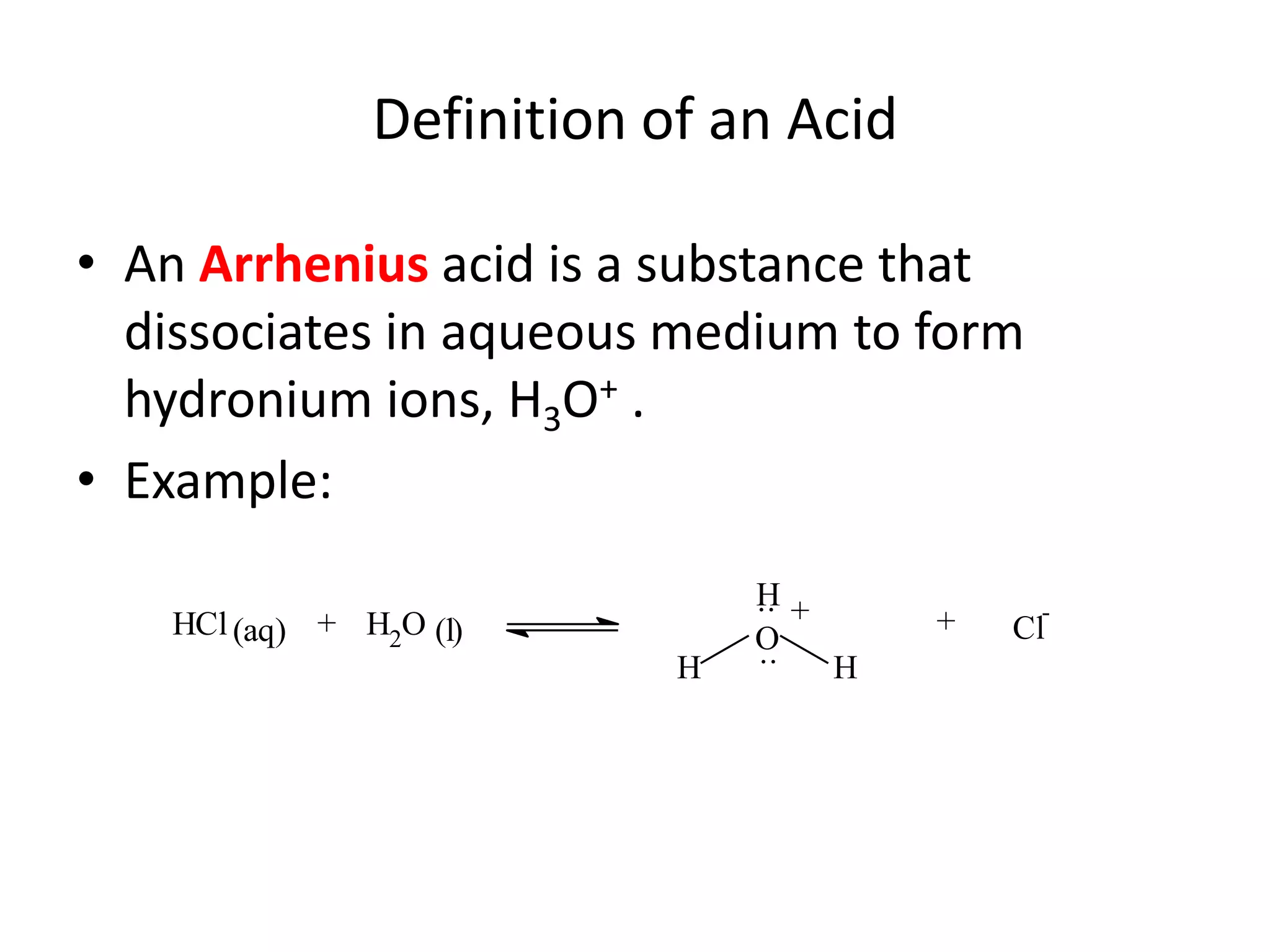
Definition of an AcidAn Arrhenius acid is a substance that dissociates in aqueous medium to form hydronium ions, H3O+ .Example:
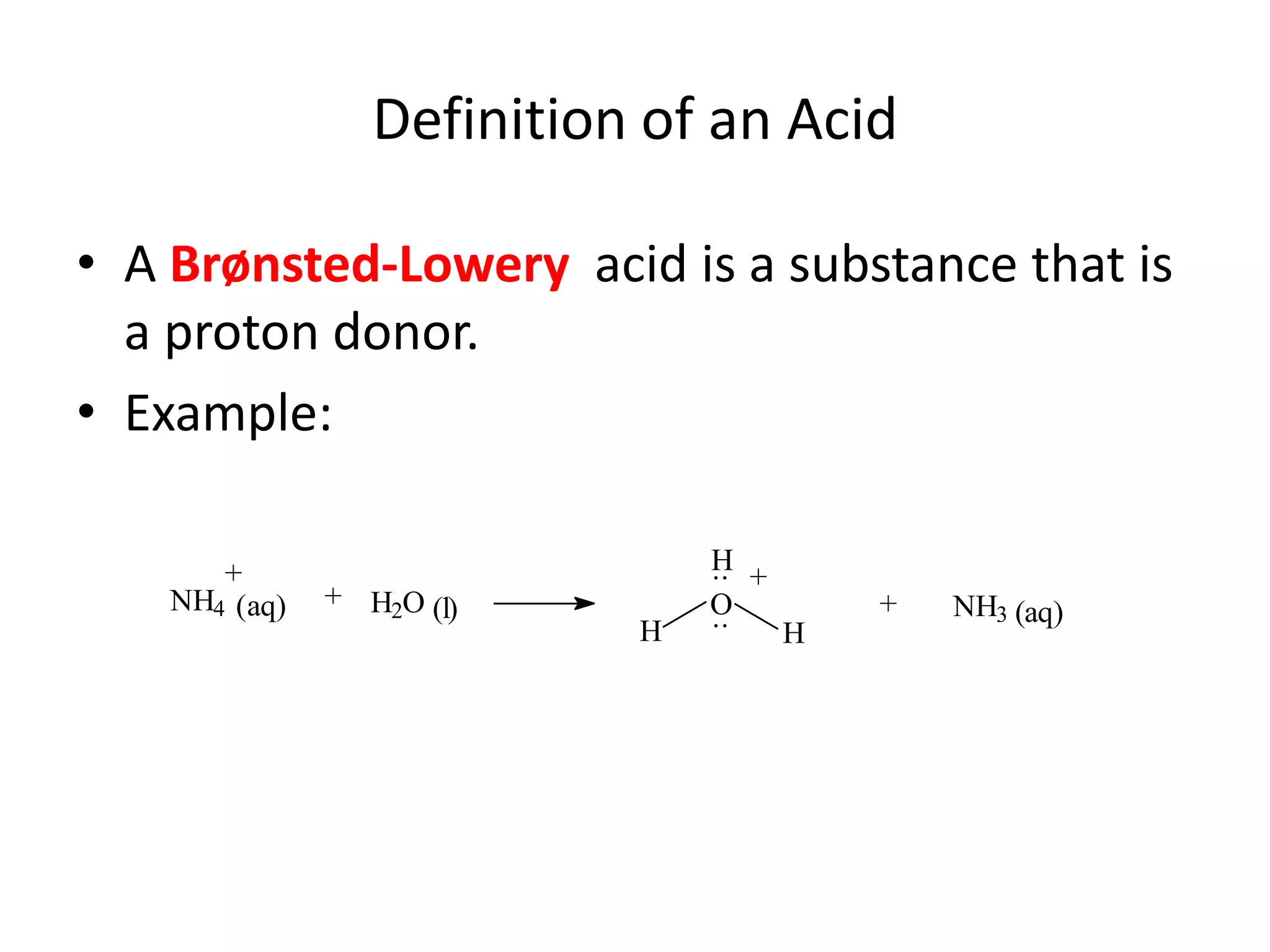
Definition of an AcidA Brønsted-Lowery  acid is a substance that is a proton donor.Example:
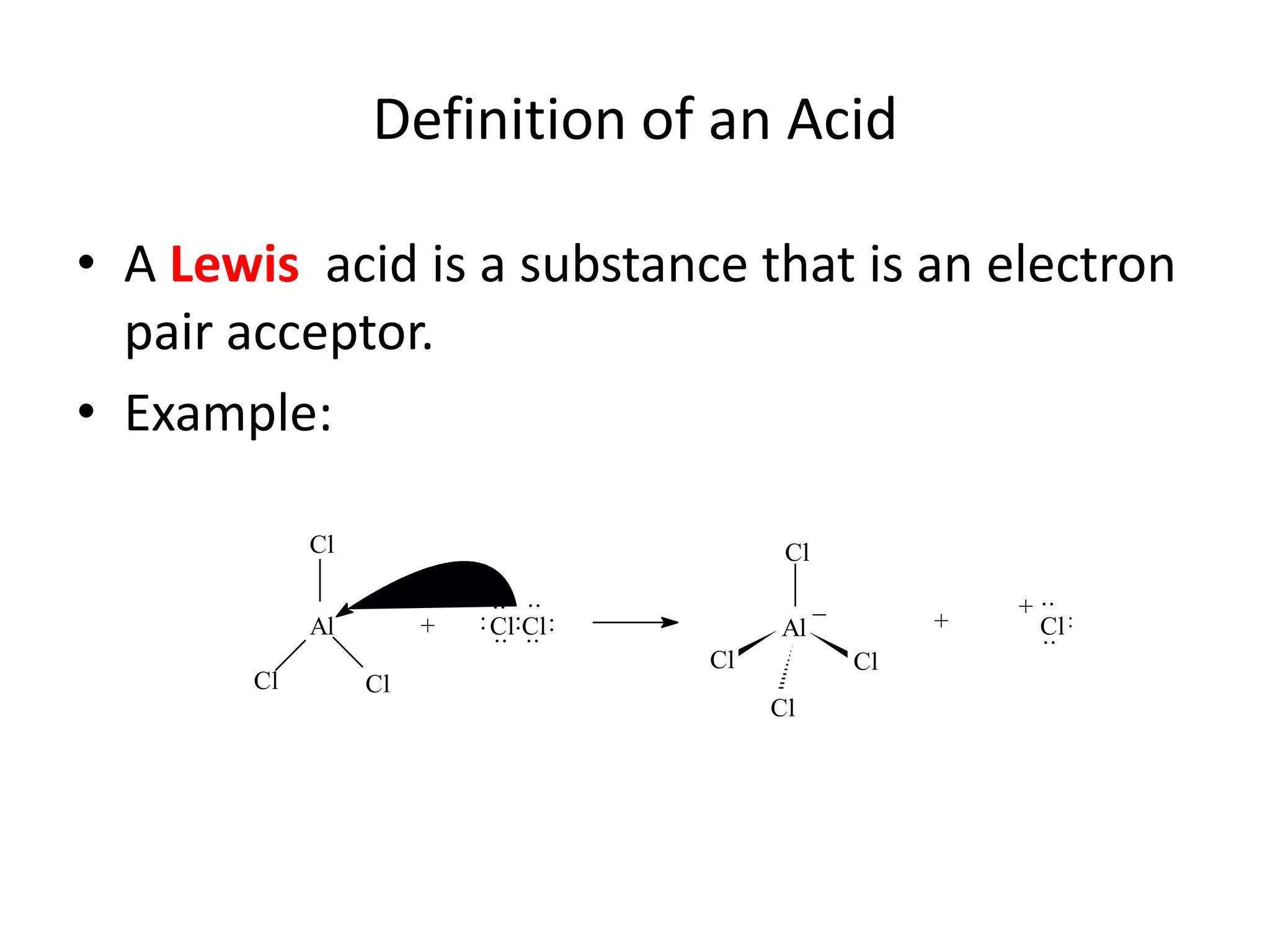
Definition of an AcidA Lewis  acid is a substance that is an electron pair acceptor.Example:
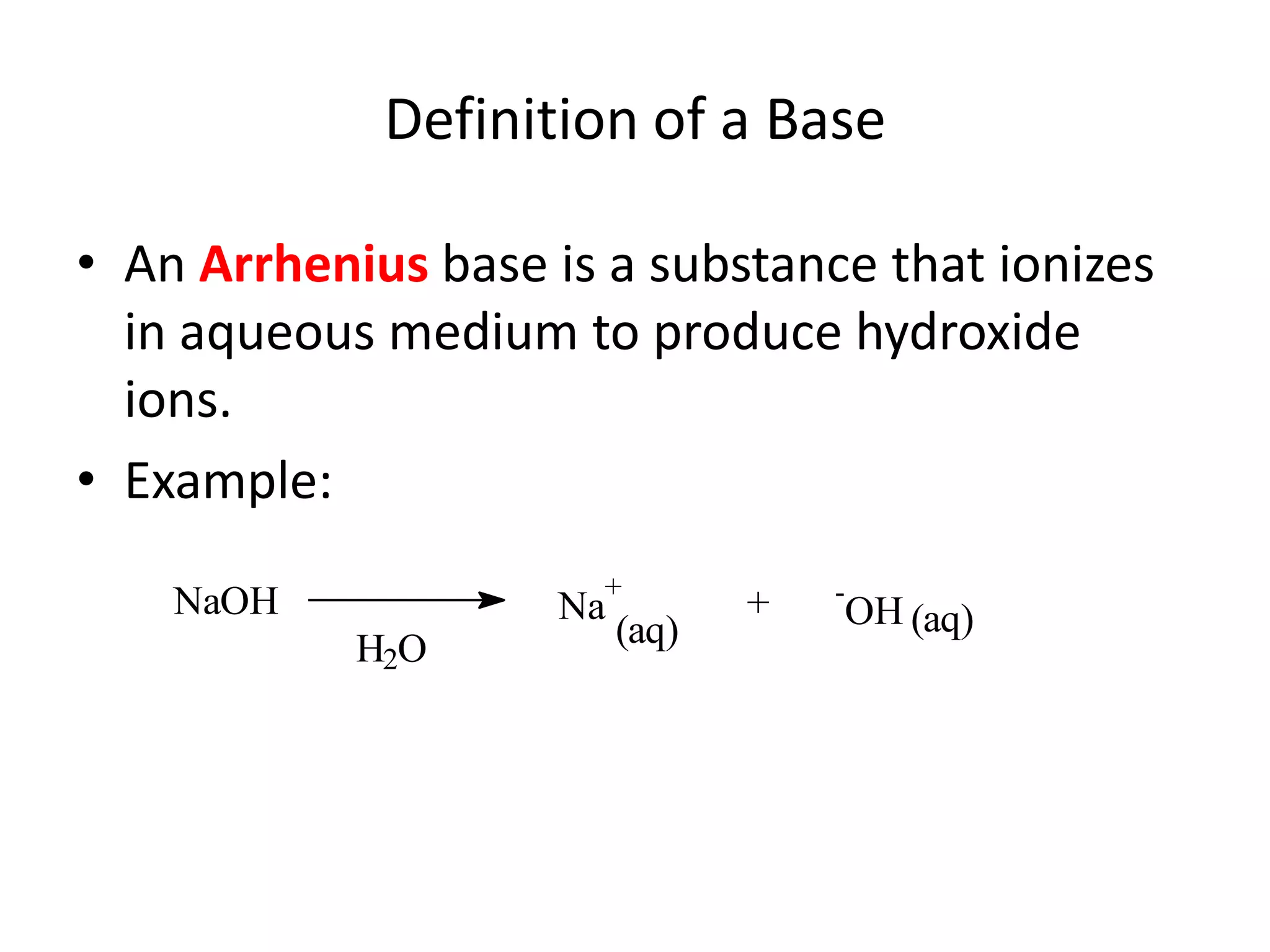
Definition of a BaseAn Arrhenius base is a substance that ionizes in aqueous medium to produce hydroxide ions.Example:
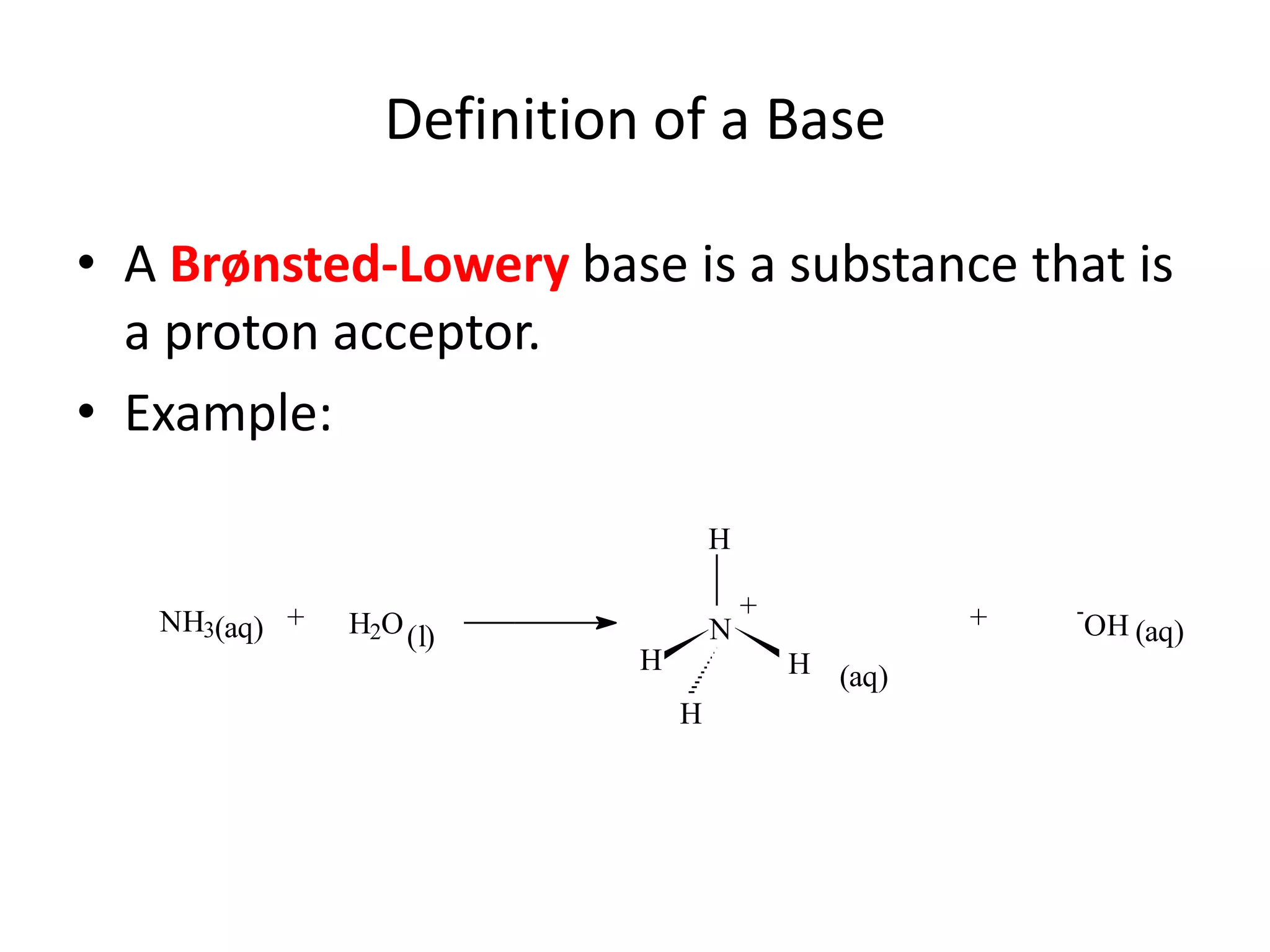
Definition of a BaseA Brønsted-Lowery base is a substance that is a proton acceptor.Example:
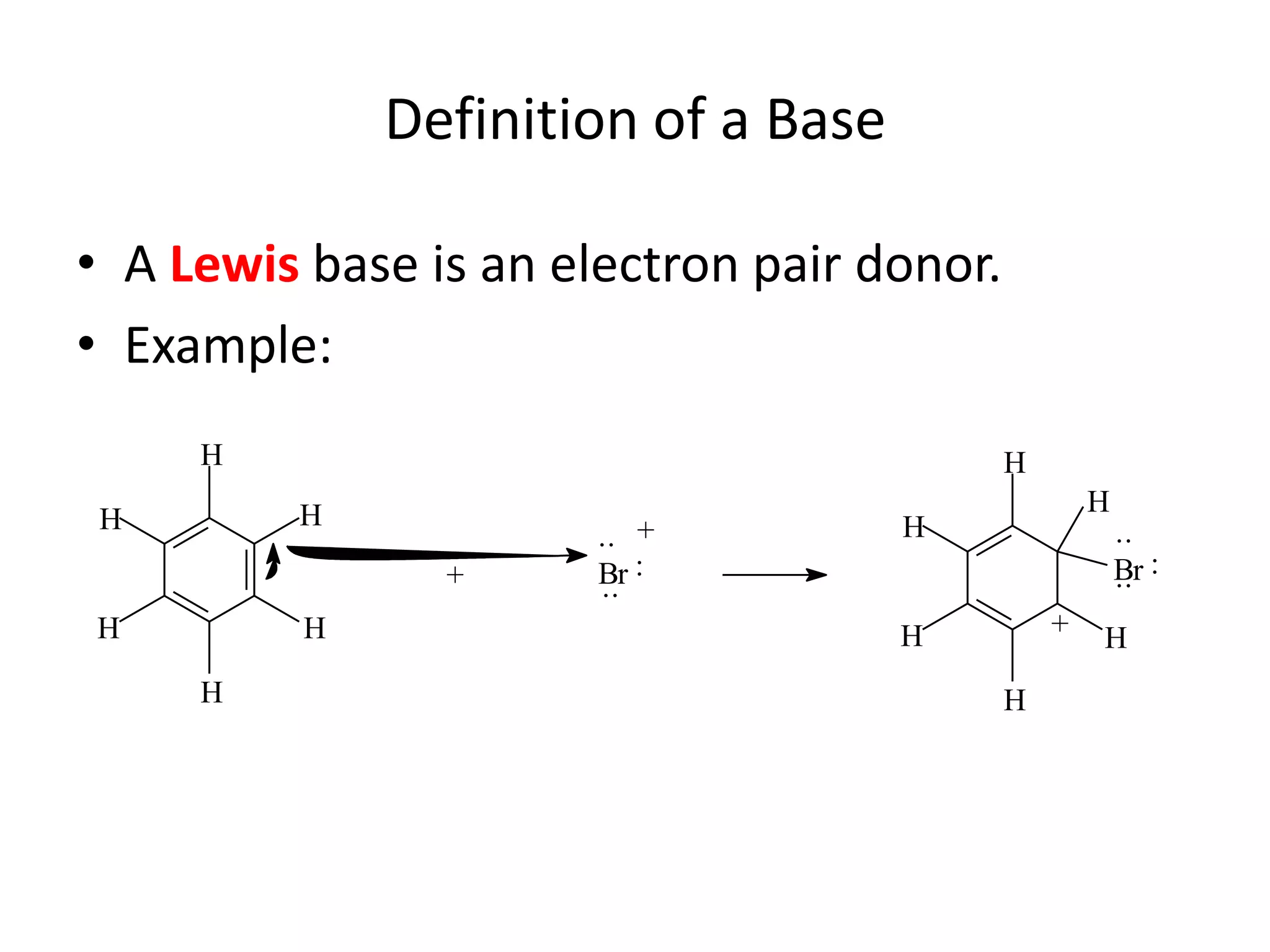
Definition of a BaseA Lewis base is an electron pair donor.Example:
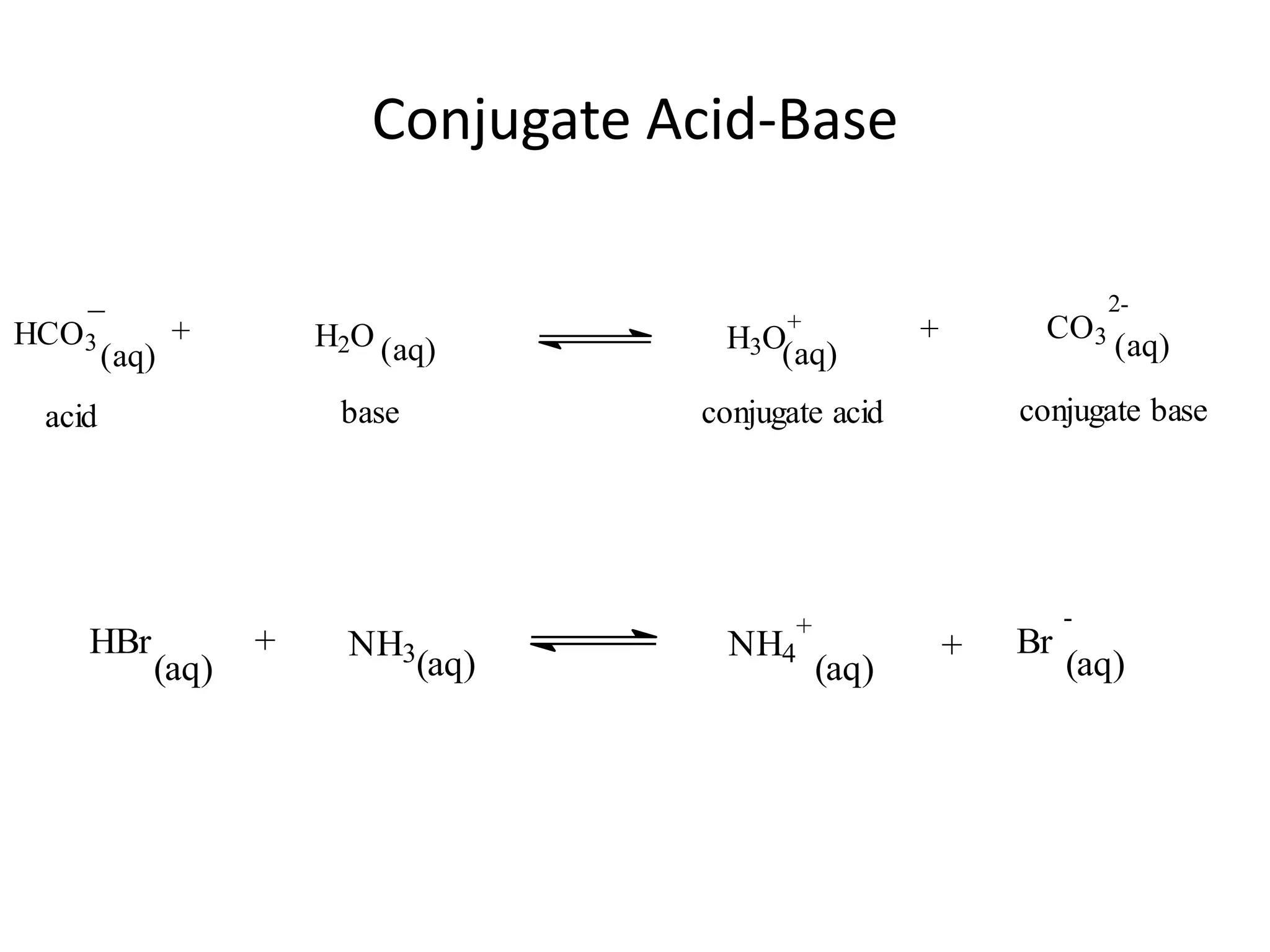
Conjugate Acid-Base
Relative Strengths of Acids and BasesProton transfer reactions proceed from the stronger acid-base pair to the weaker acid-base pair.For the relative strengths of acids and bases refer to figure 16.4 on page 672 of Brown, LeMay, Bursten and Murphy.Write a balanced equation for the reaction that occurs between ammonium chloride and sodium carbonate.  Decide if the equilibrium lies predominantly toward the reactants or the products.
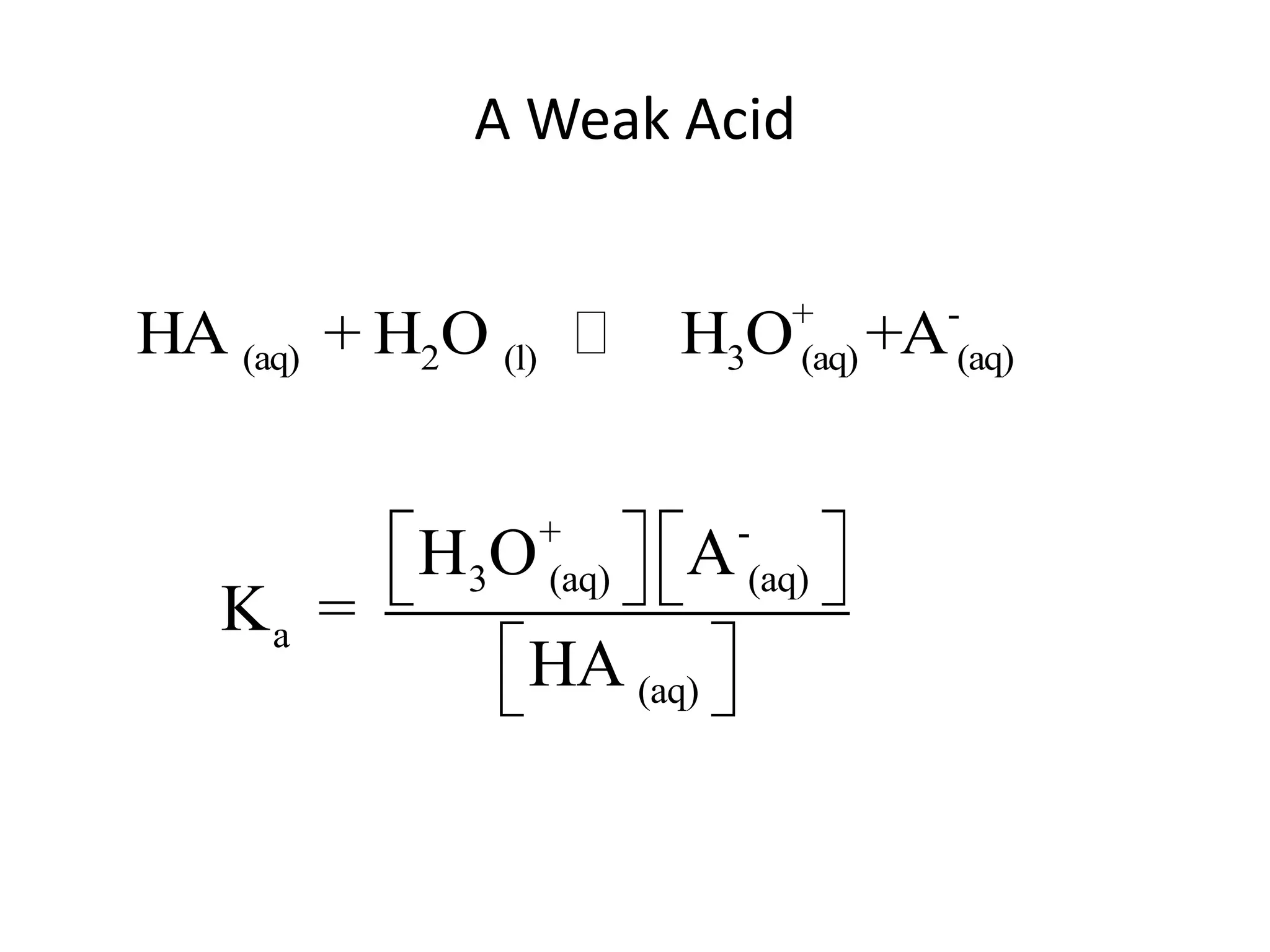
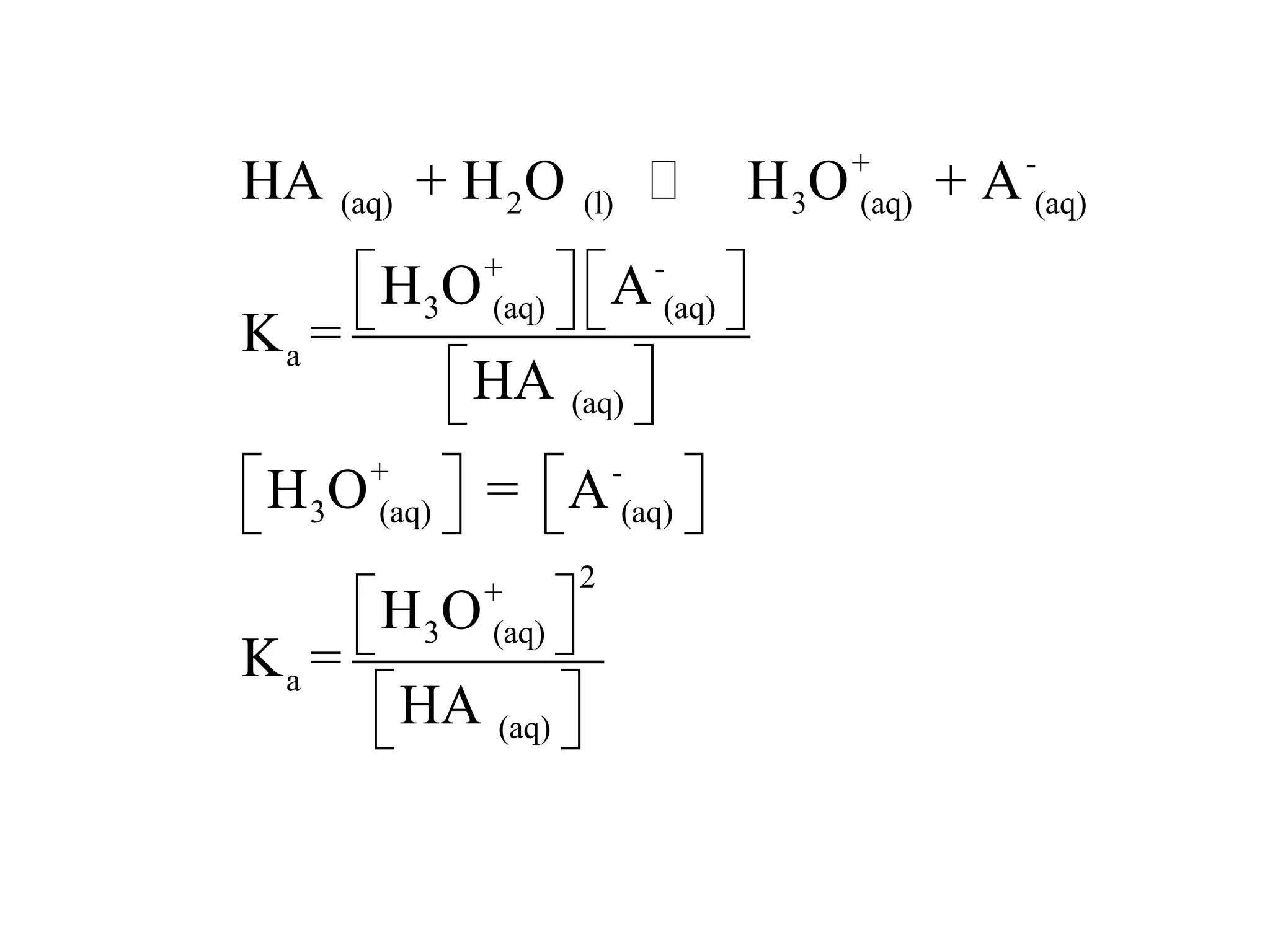
A Weak Acid
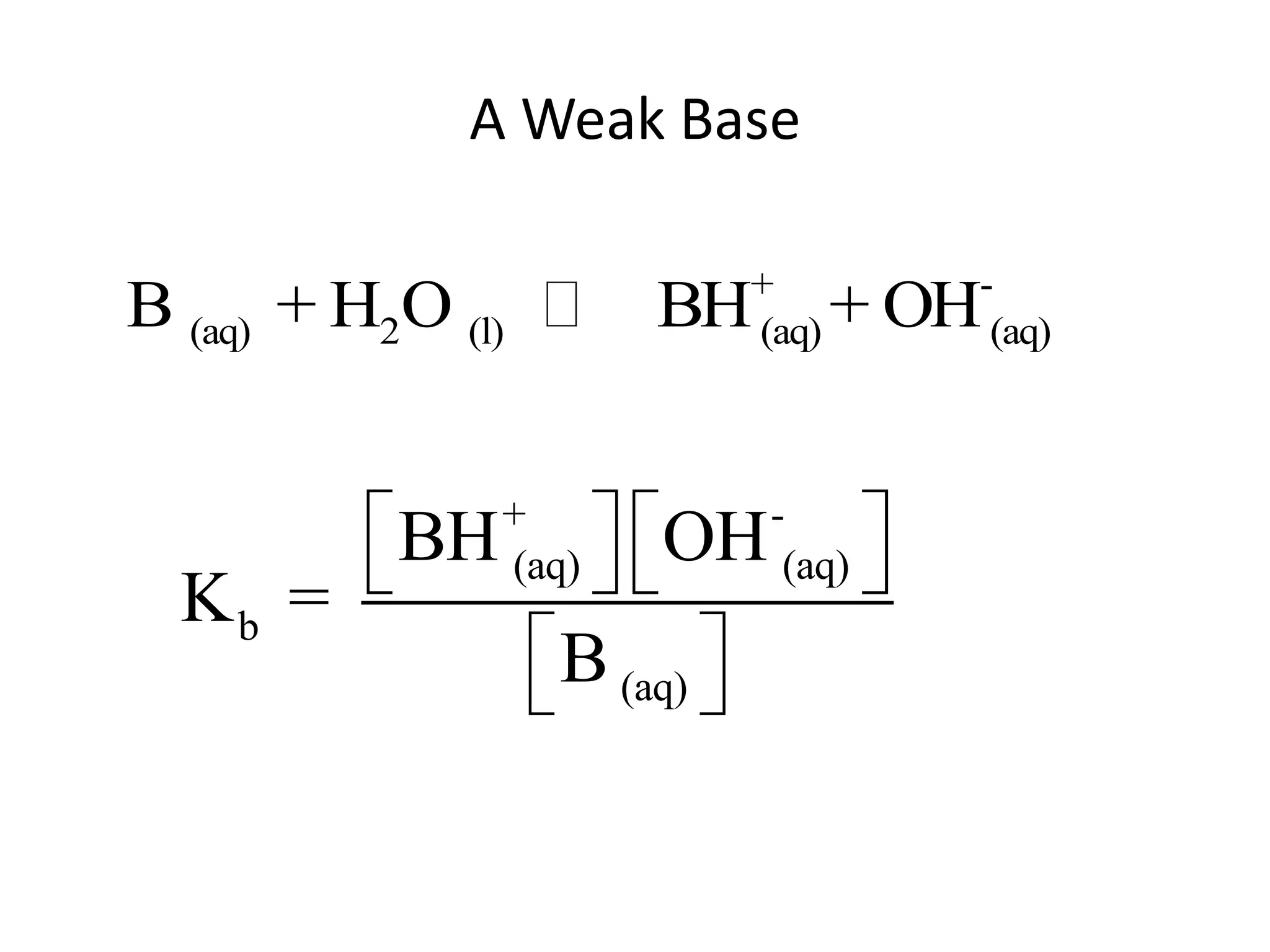
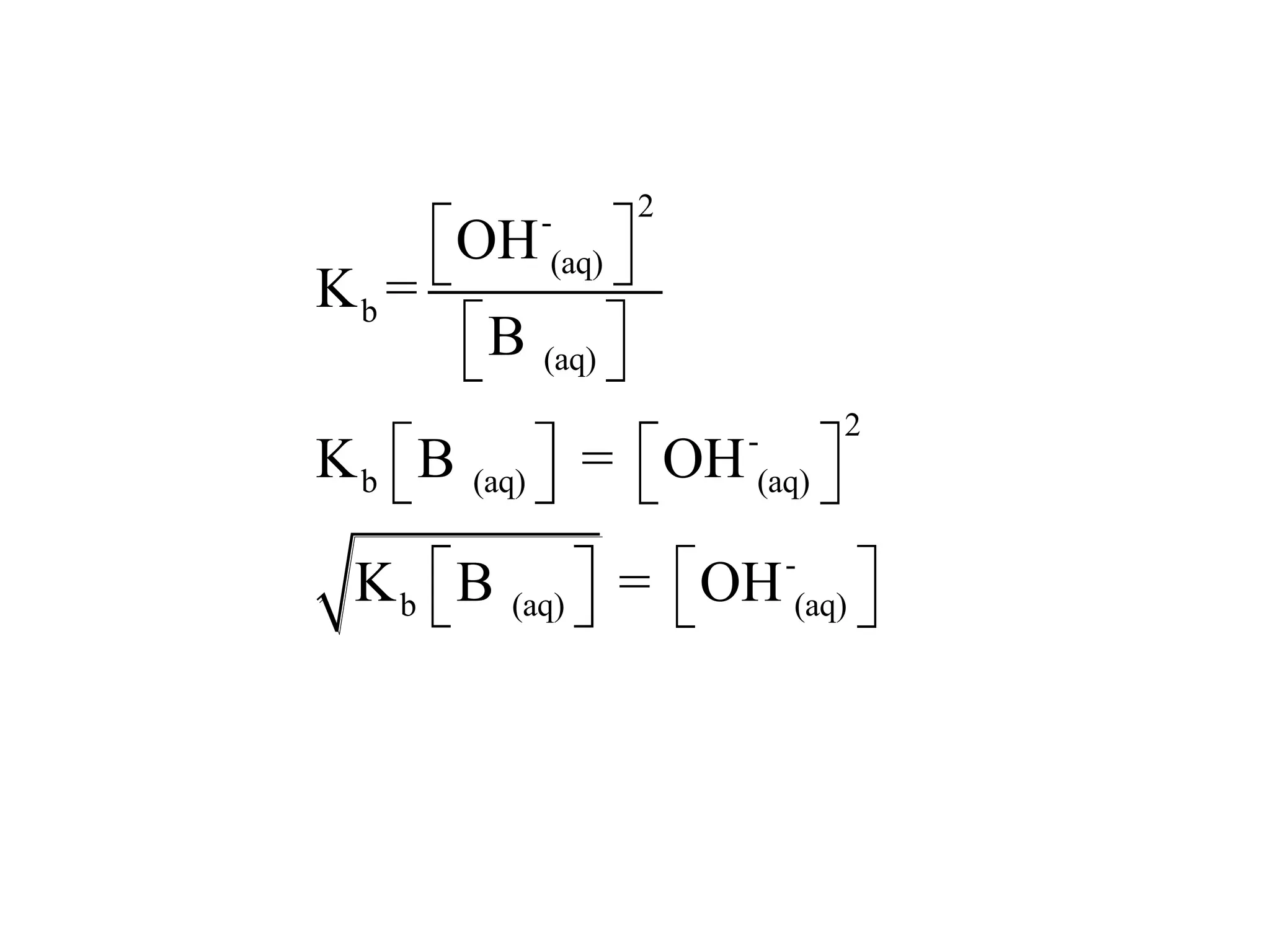
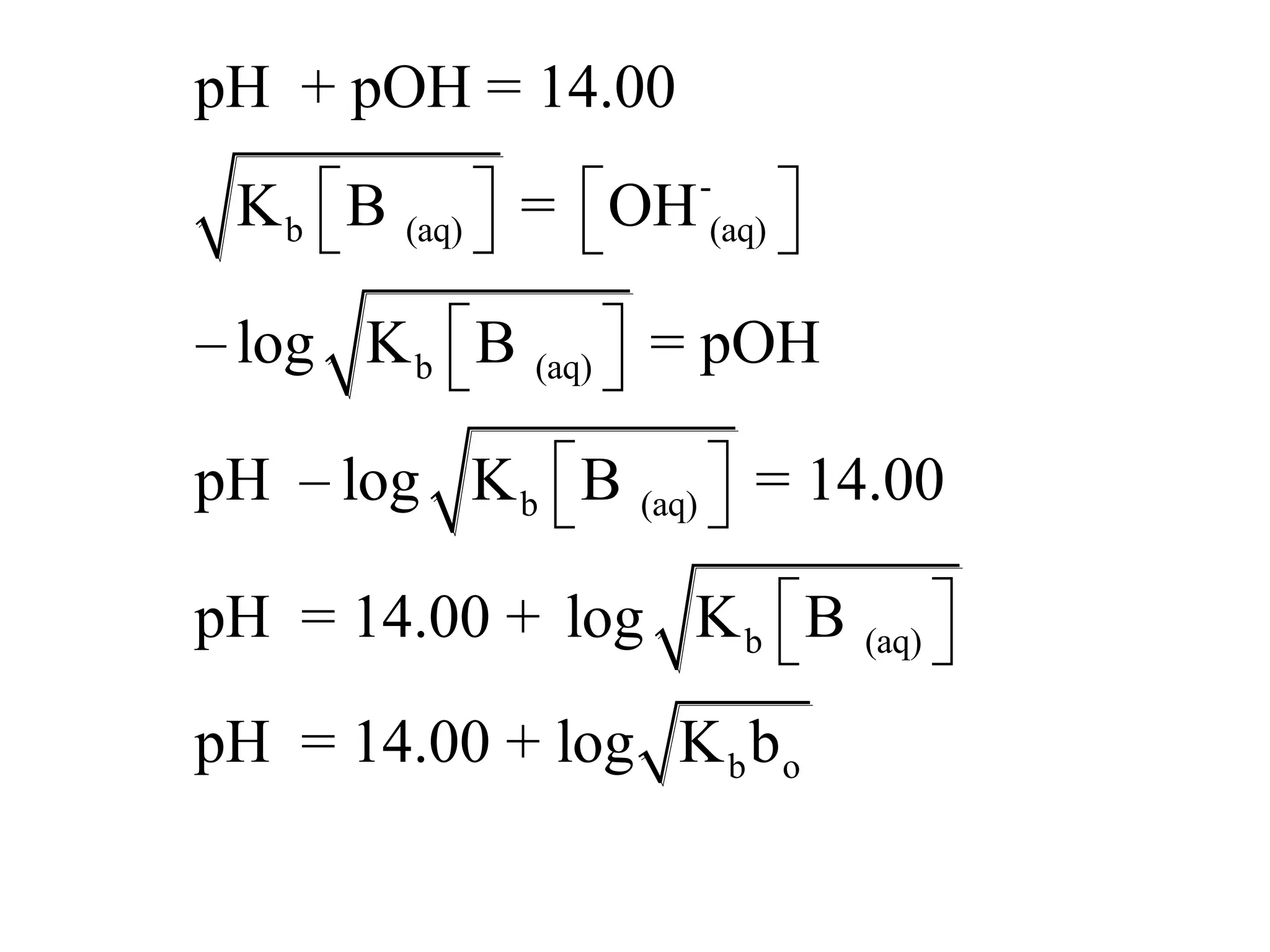
A Weak Base
The Values of KA large vaalue of K means that the reaction favors the formation of product (s).A small value of K means that the reaction favors the reactants.If Kais greater than 1, then the acid is strong and dissociates 100%.If Kb is greater than 1, then the base is strong and dissociates 100%.
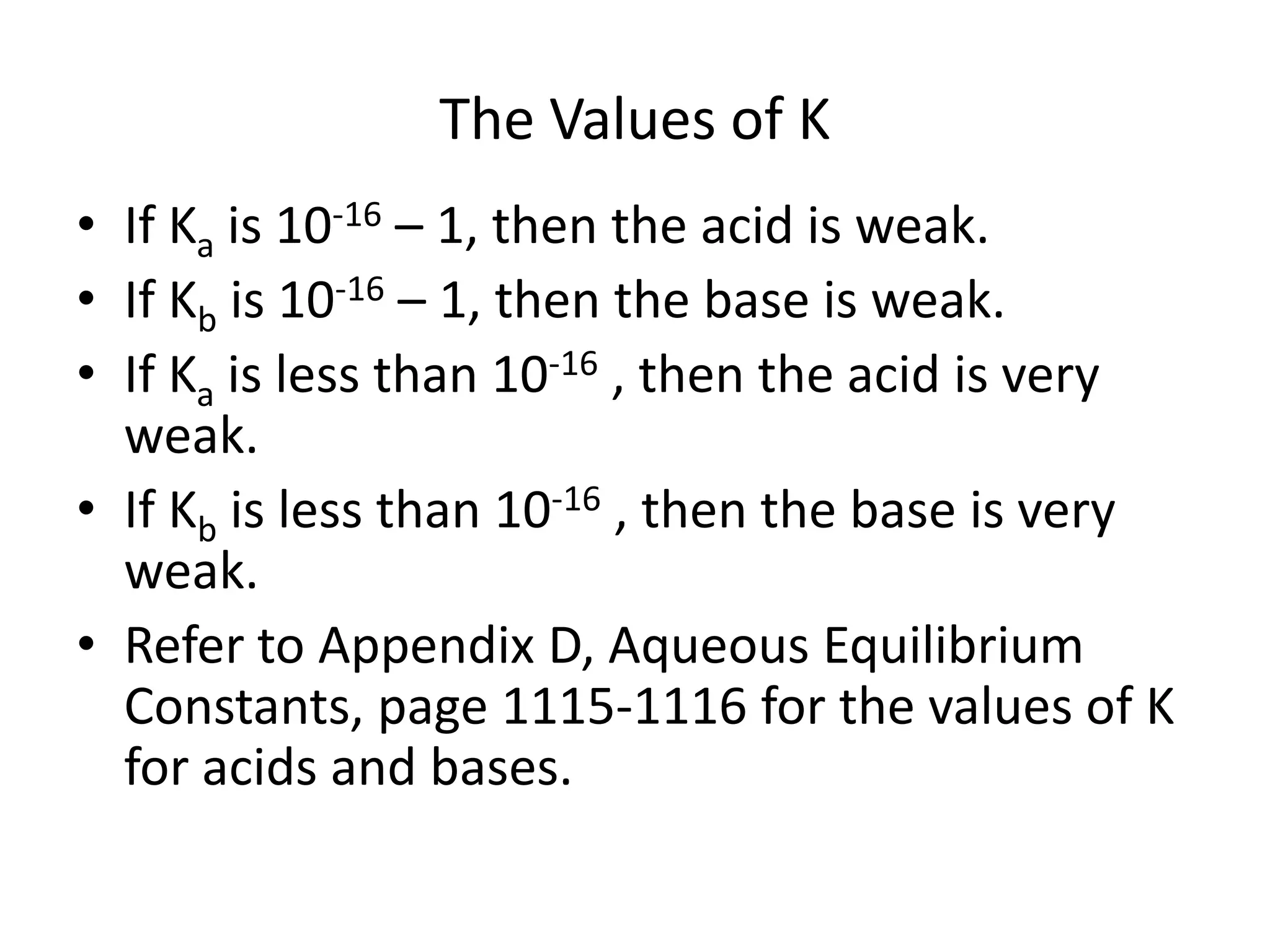
The Values of KIf Ka is 10-16 – 1, then the acid is weak.If Kb is 10-16 – 1, then the base is weak.If Ka is less than 10-16 , then the acid is very weak.If Kb is less than 10-16 , then the base is very weak.Refer to Appendix D, Aqueous Equilibrium Constants, page 1115-1116 for the values of K for acids and bases.
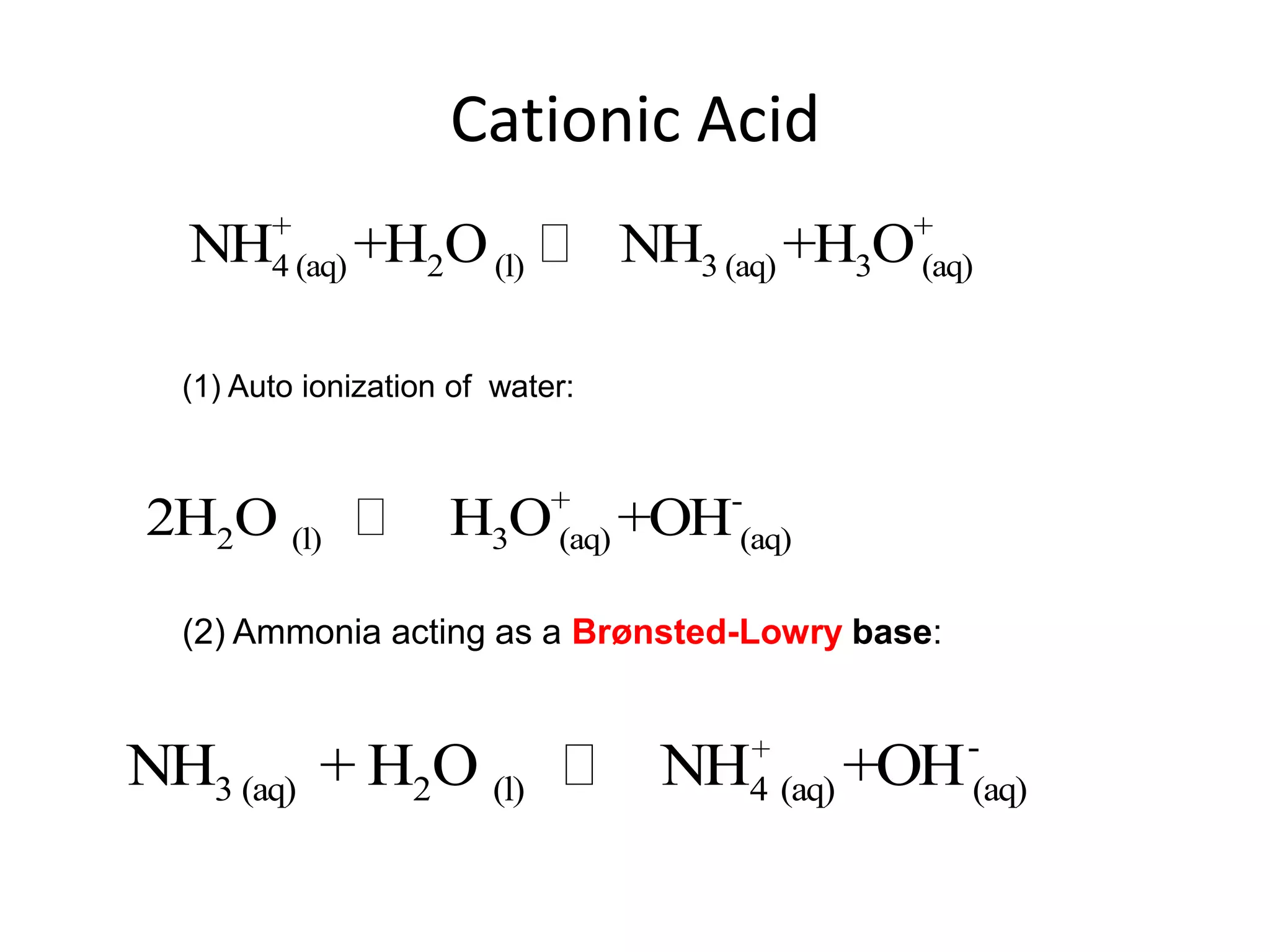
Cationic Acid(1) Auto ionization of  water: (2) Ammonia acting as a Brønsted-Lowry base:
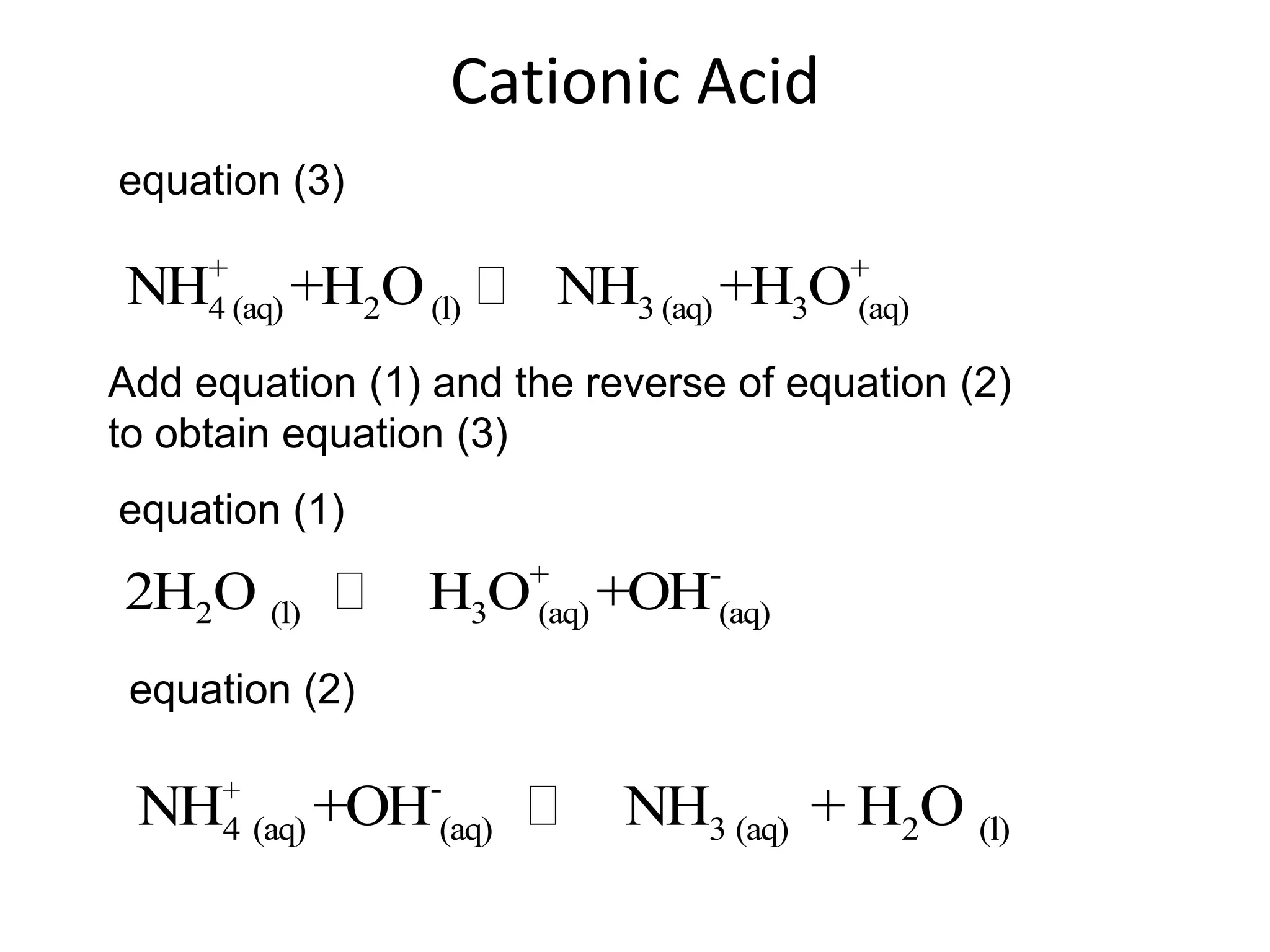
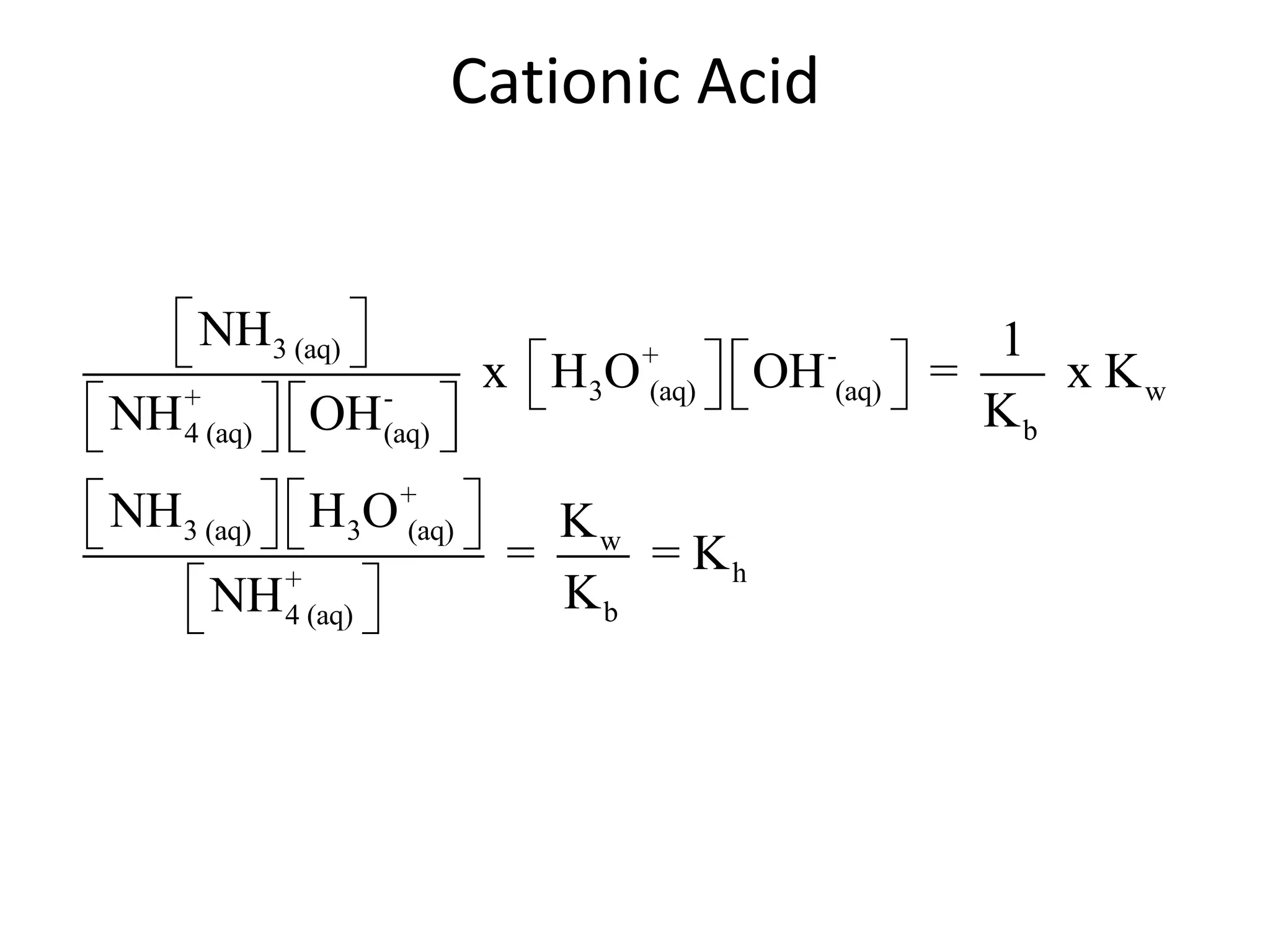
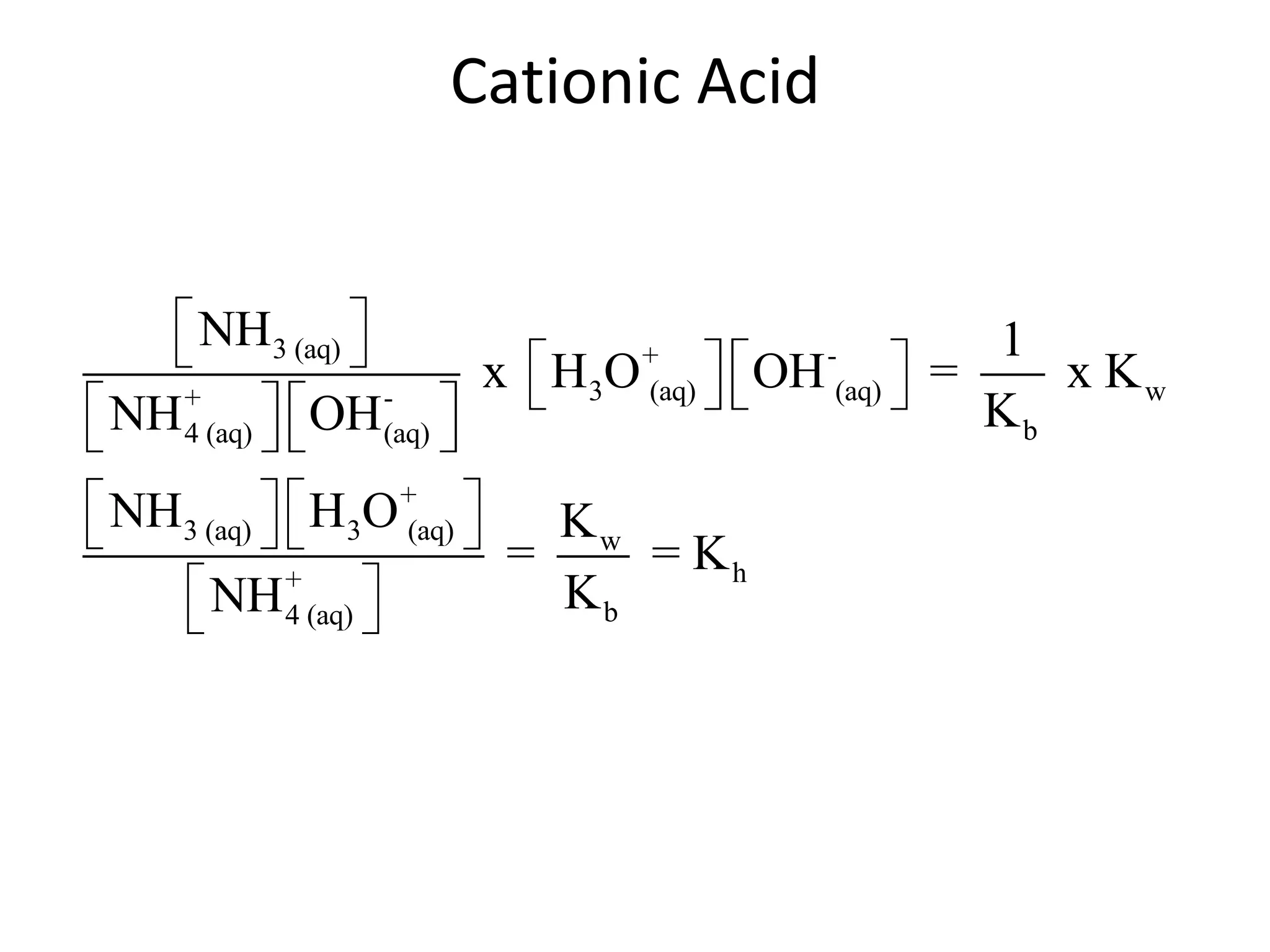
Cationic Acidequation (3)Add equation (1) and the reverse of equation (2) to obtain equation (3)equation (1)equation (2)
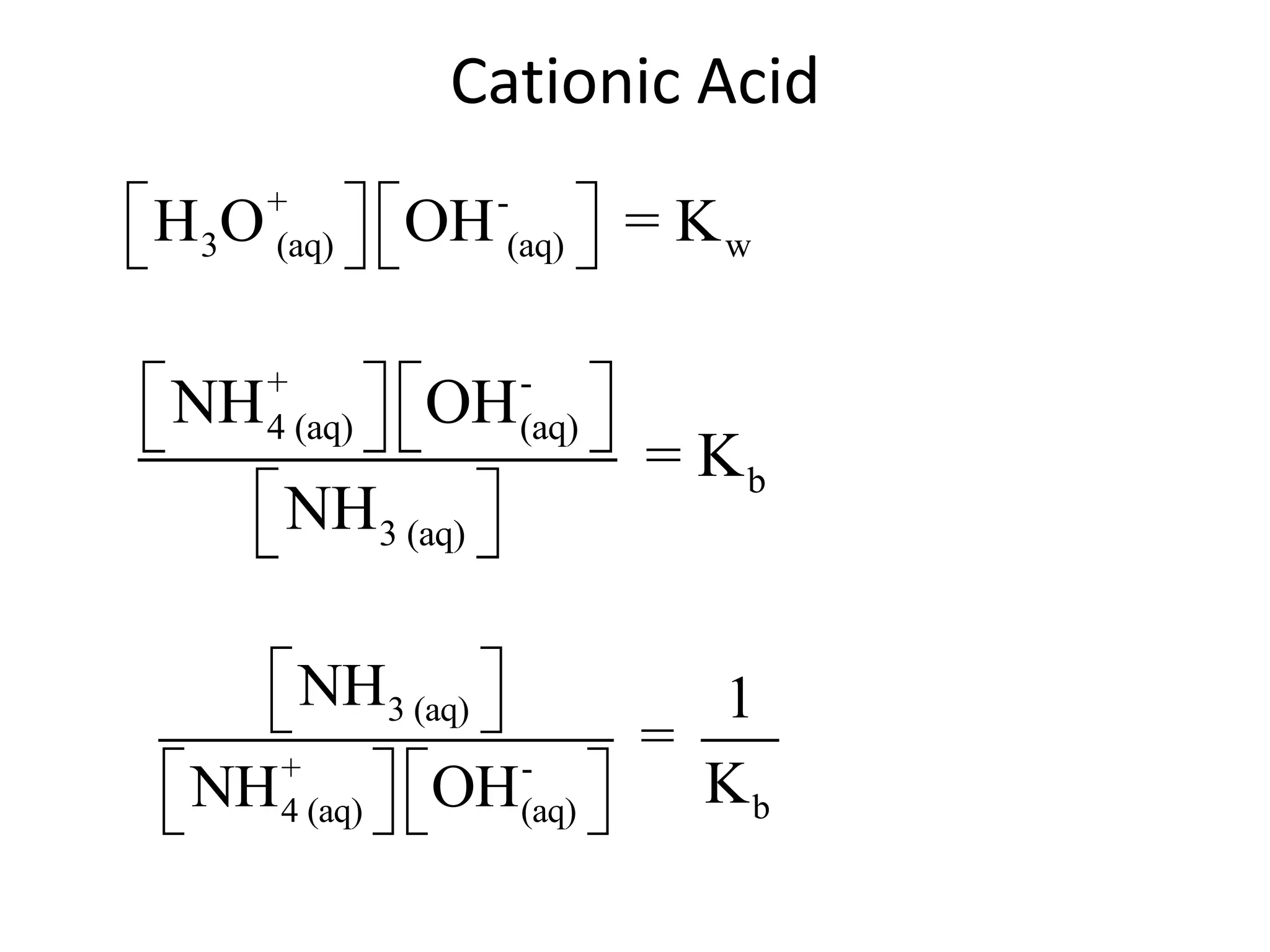
Cationic Acid
Cationic Acid
Cationic Acid
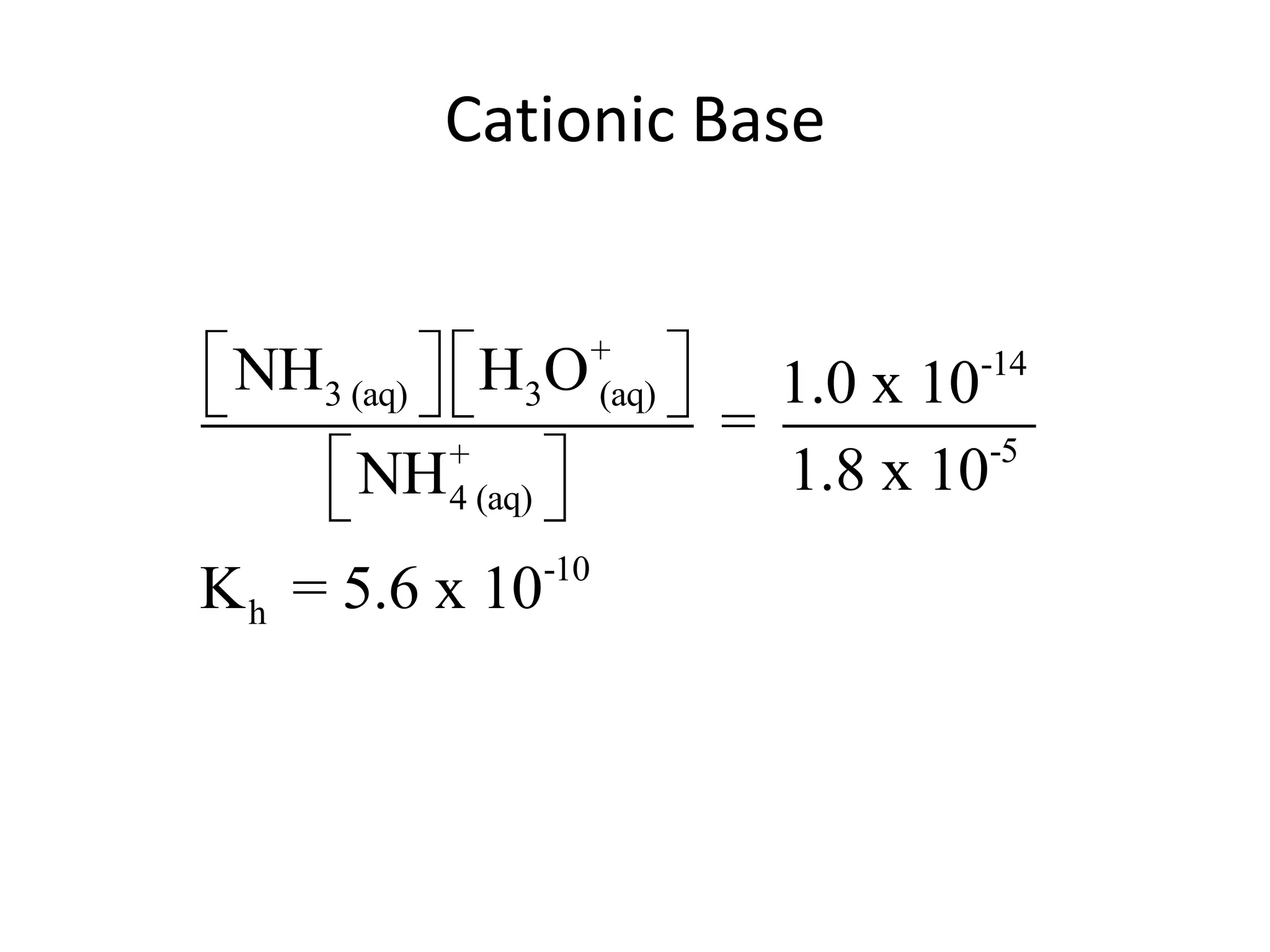
Cationic Base
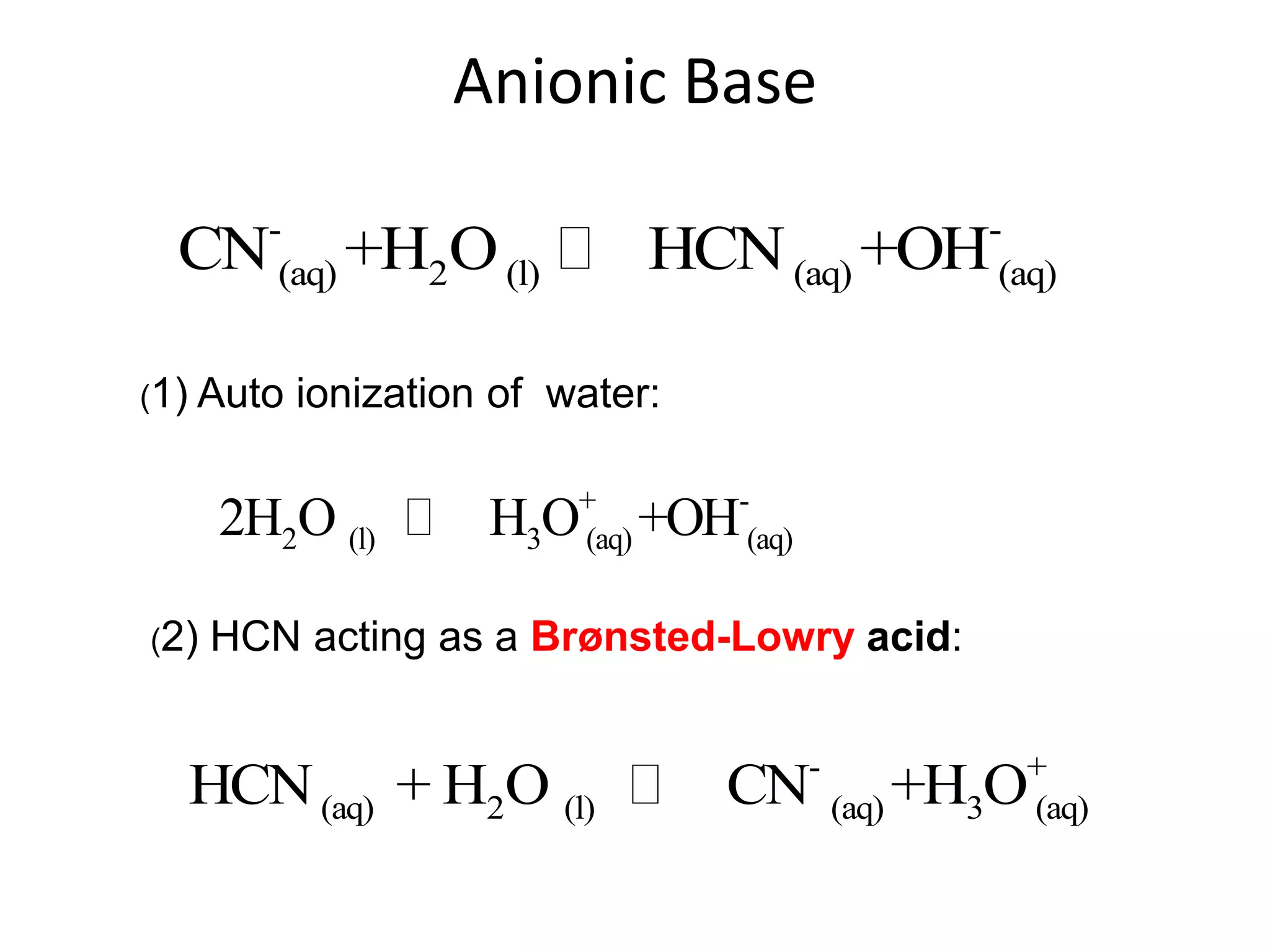
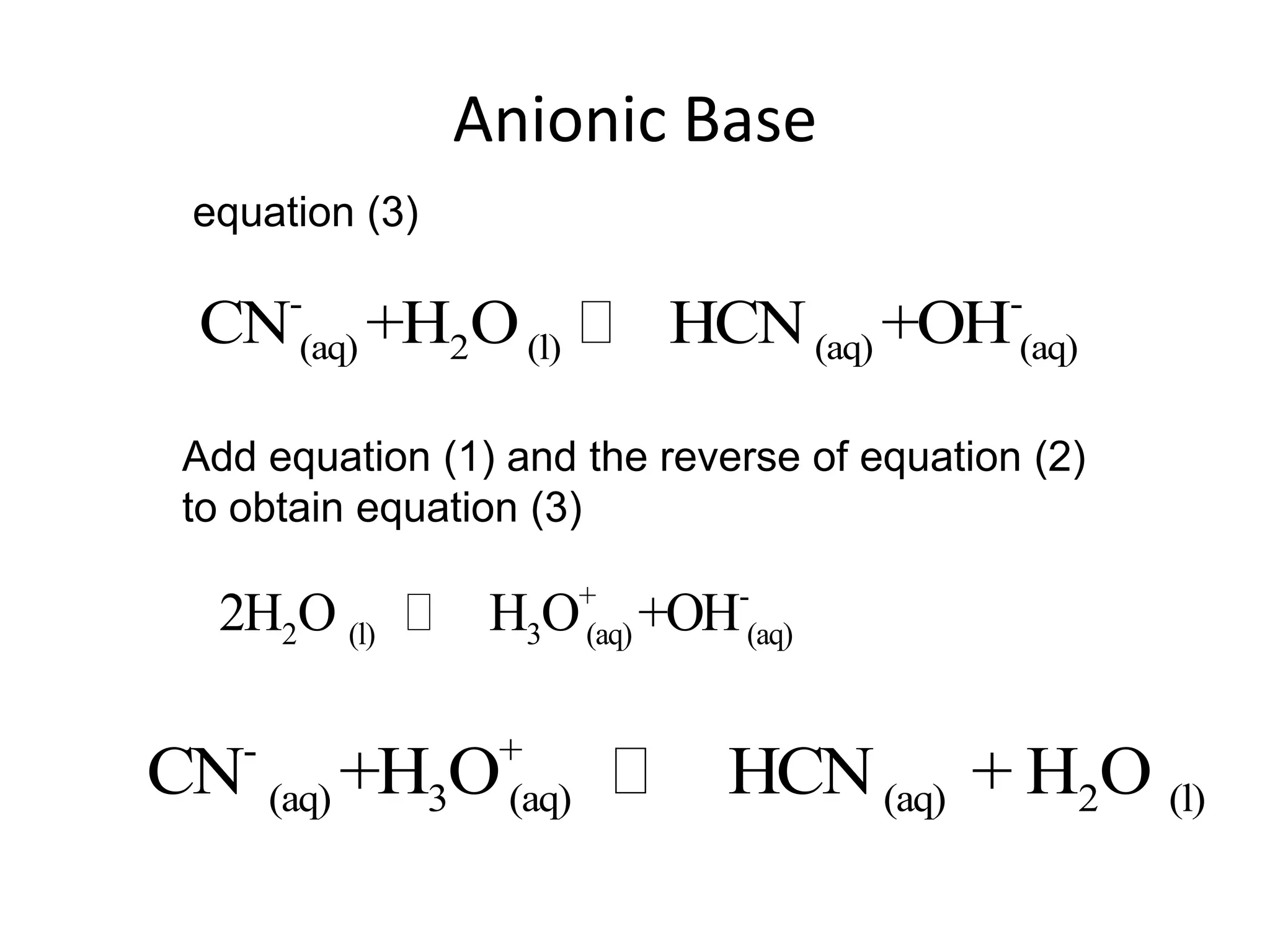
Anionic Base(1) Auto ionization of  water: (2) HCN acting as a Brønsted-Lowry acid:
Anionic Baseequation (3)Add equation (1) and the reverse of equation (2) to obtain equation (3)
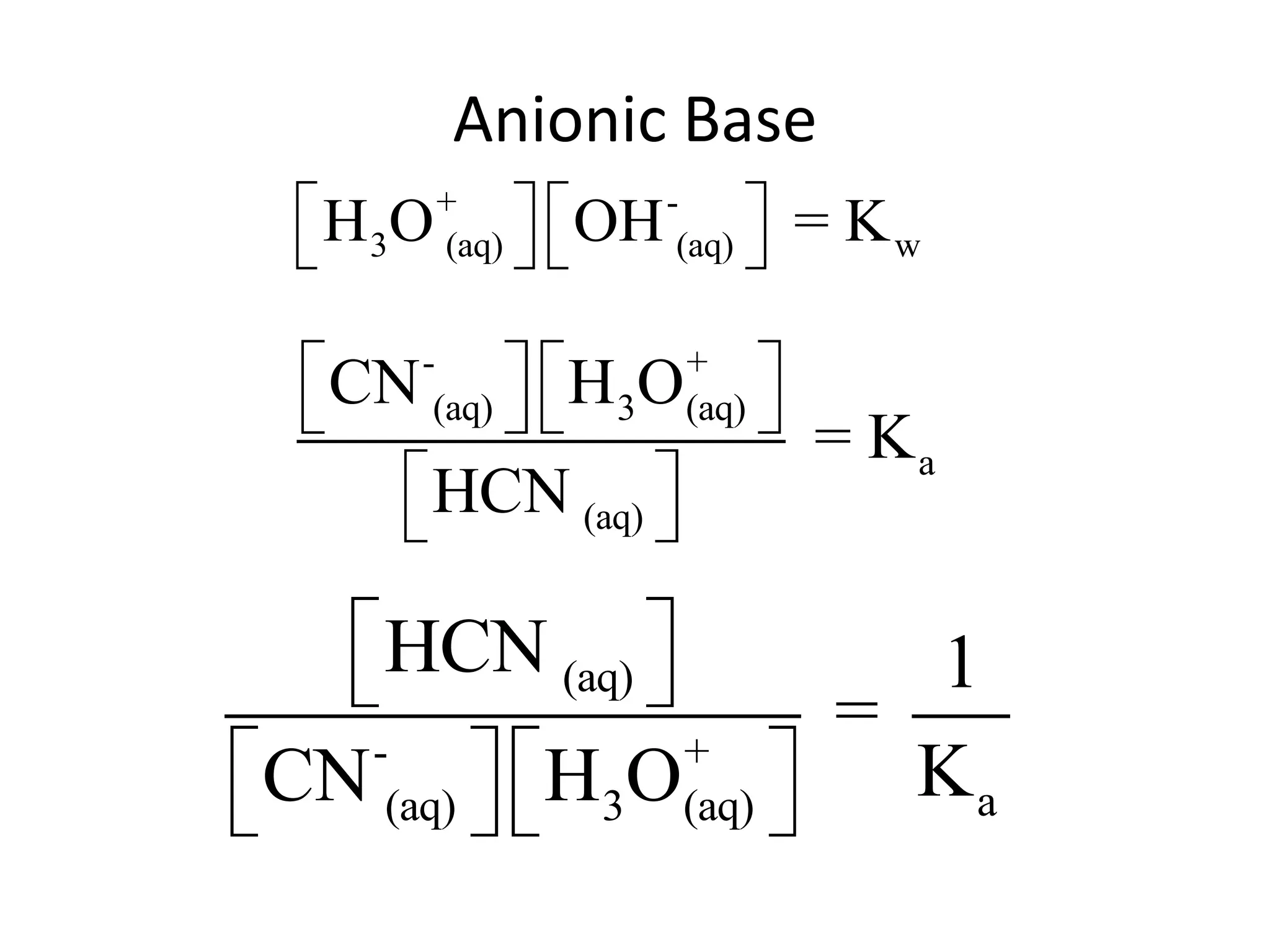
Anionic Base
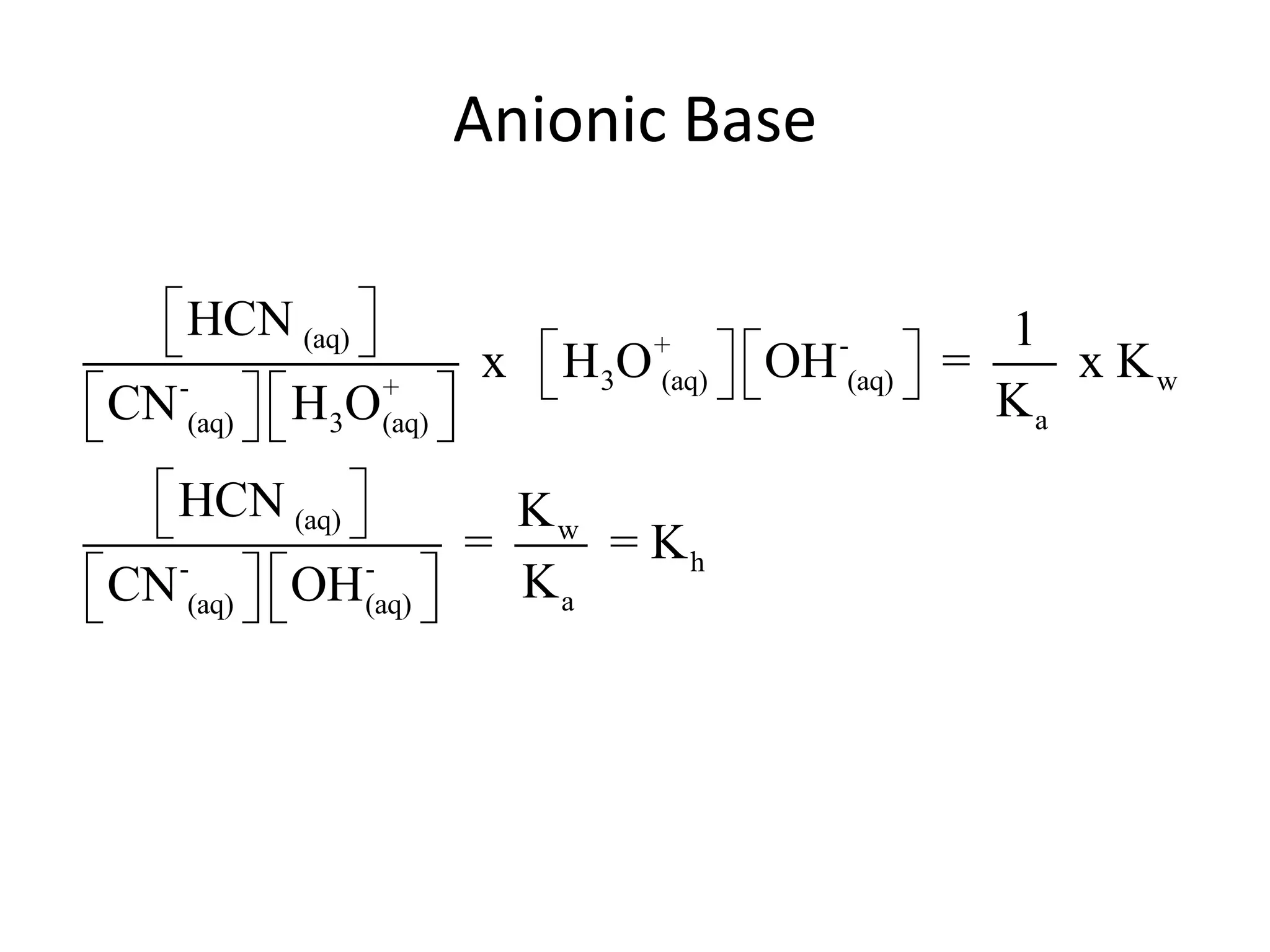
Anionic Base
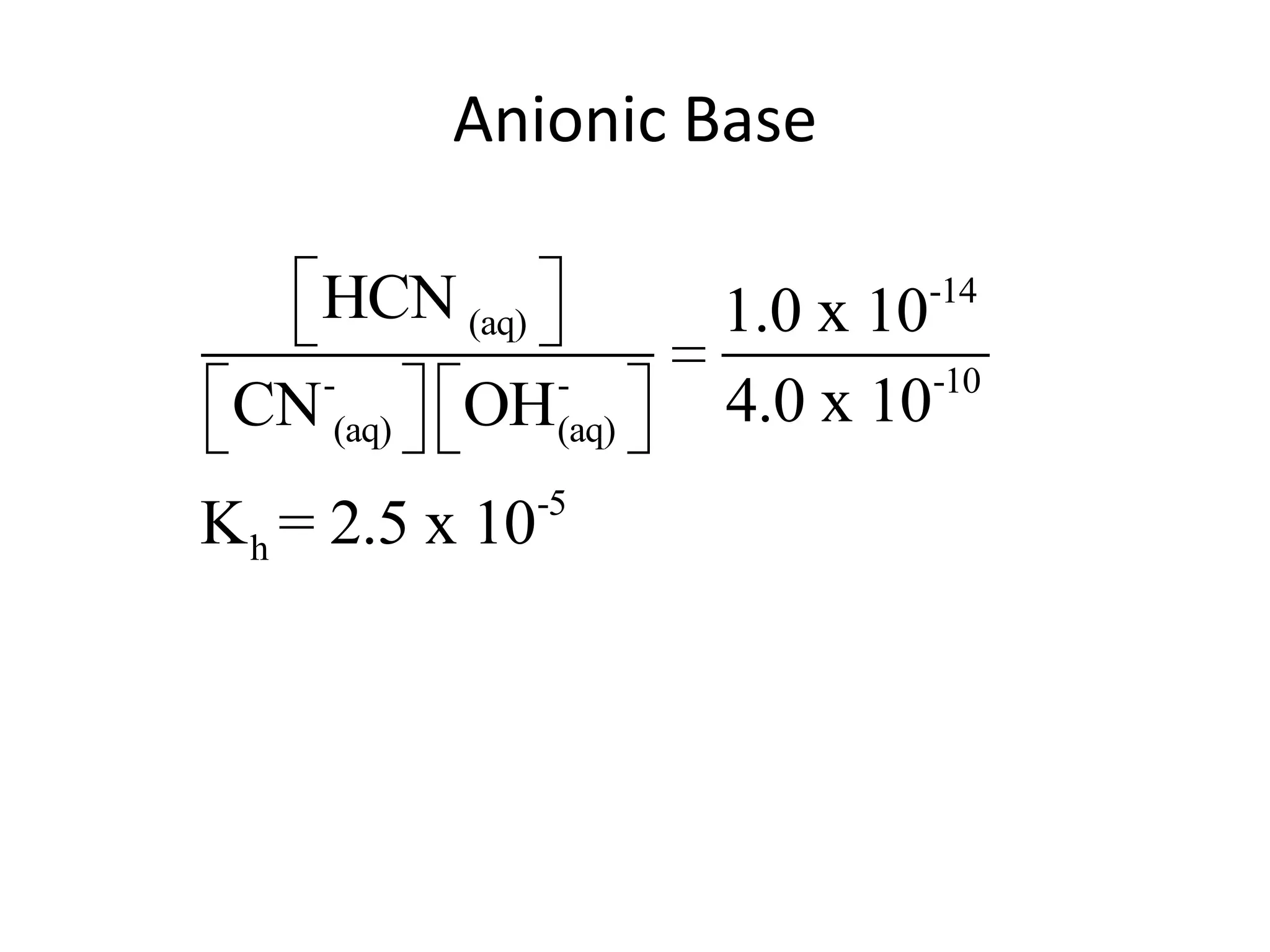
Anionic Base
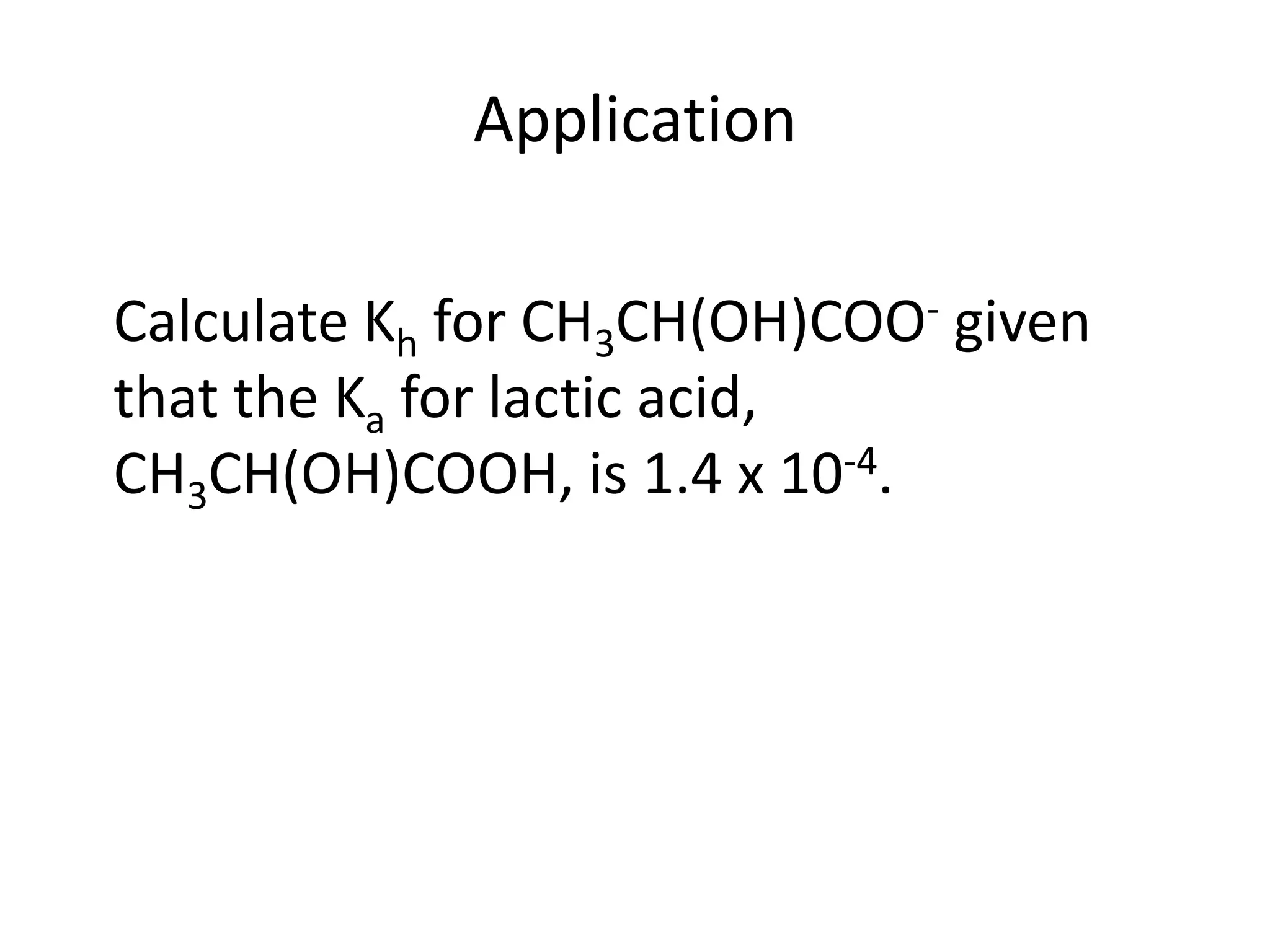
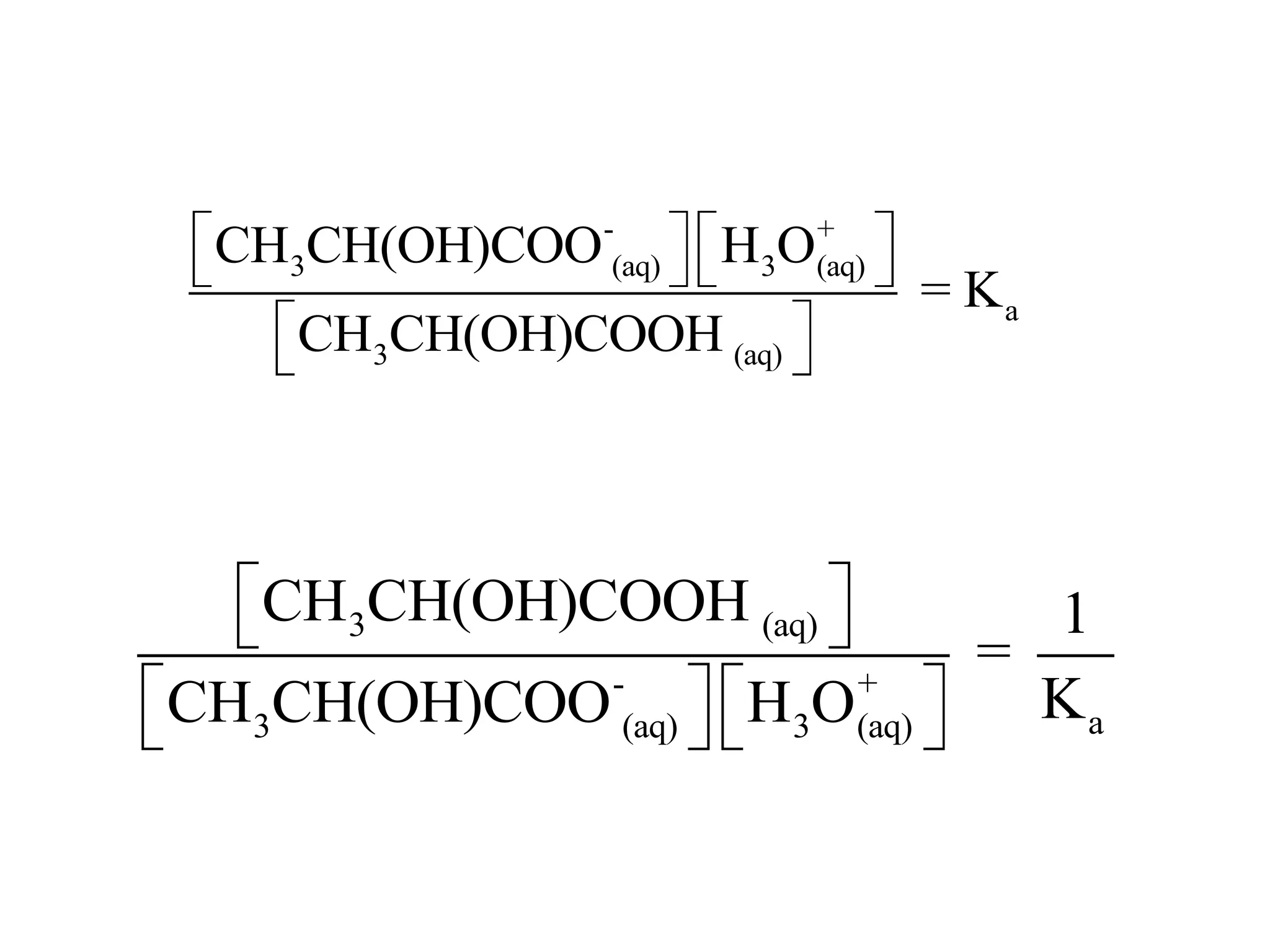
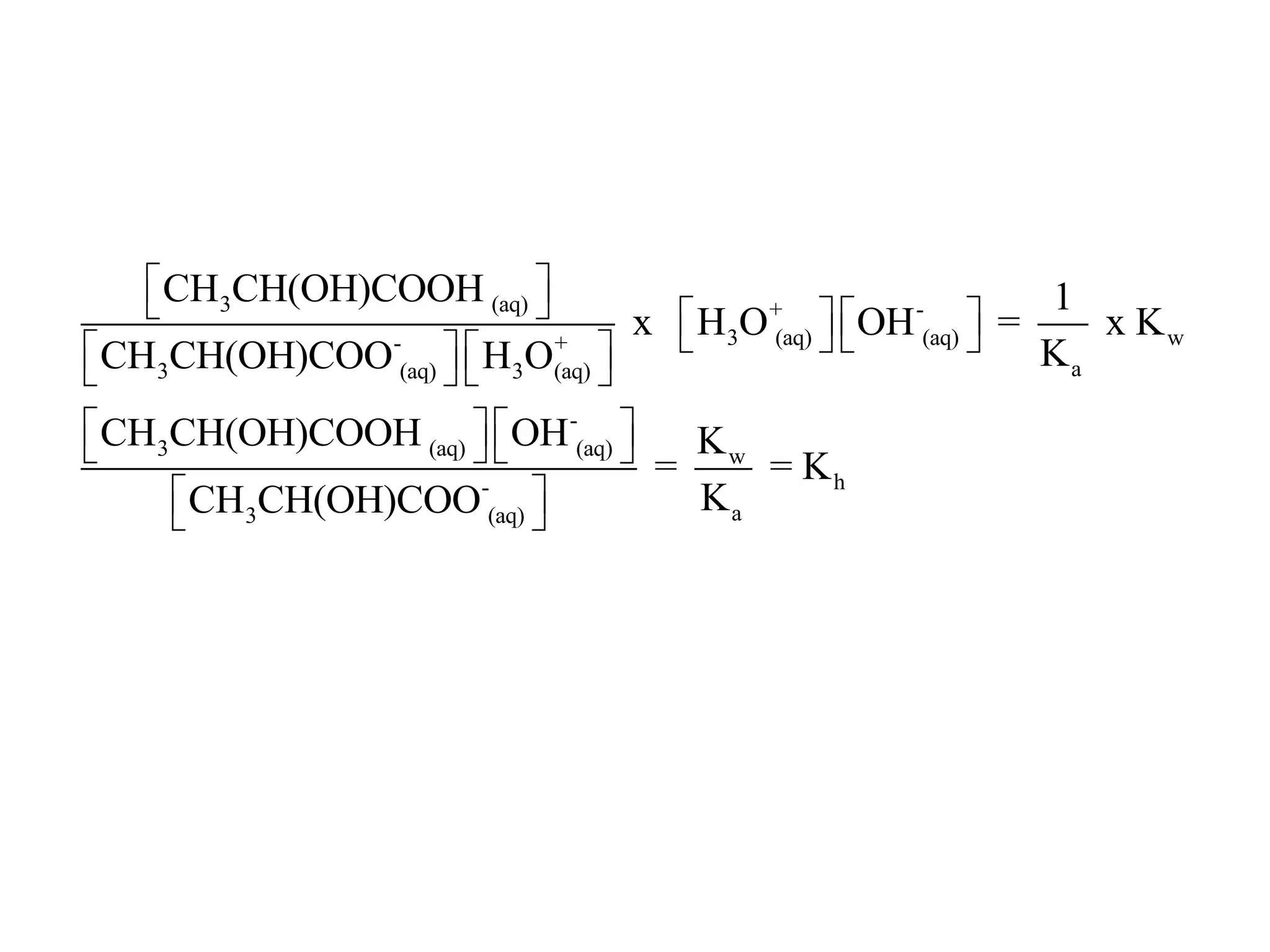
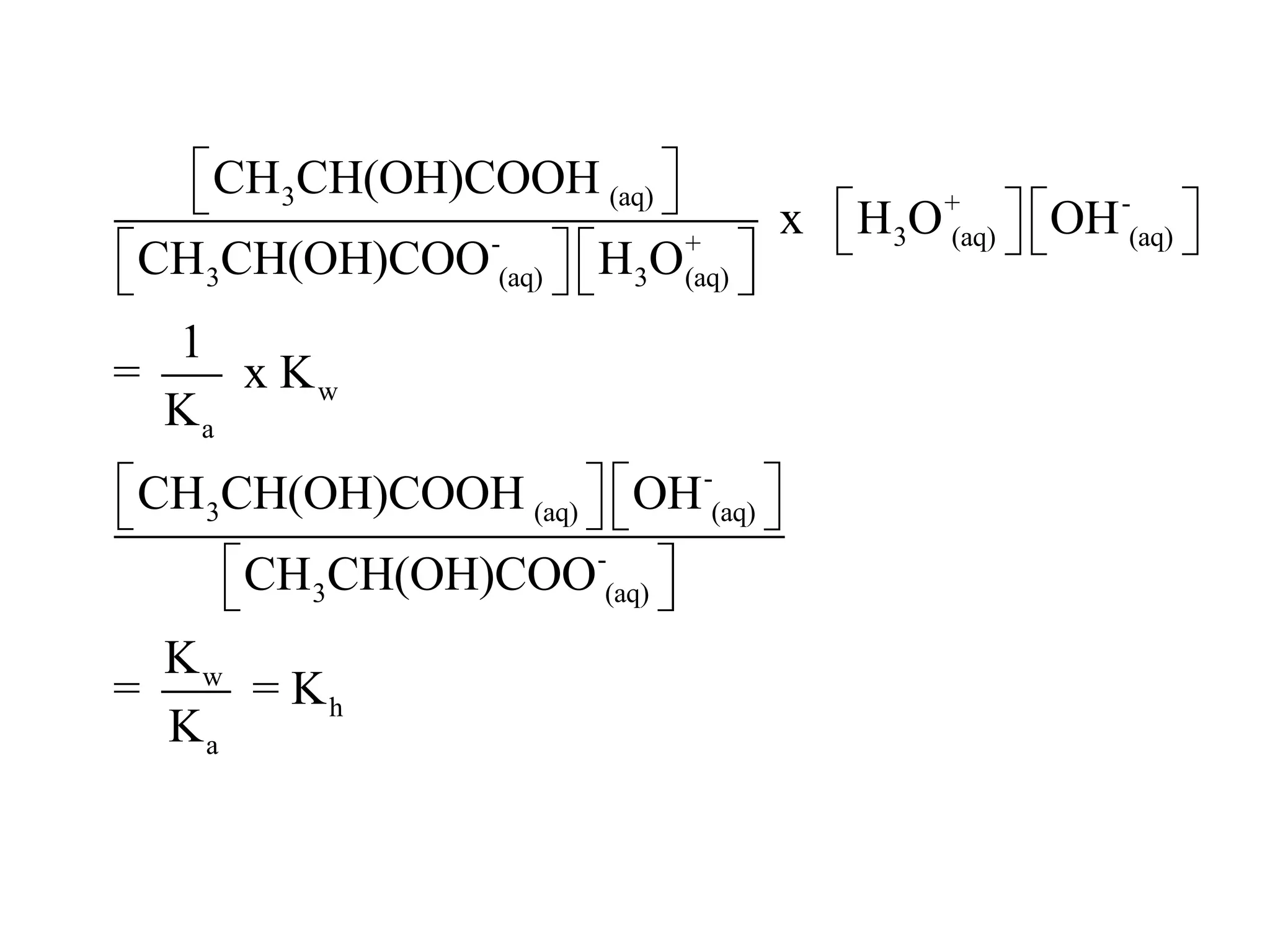
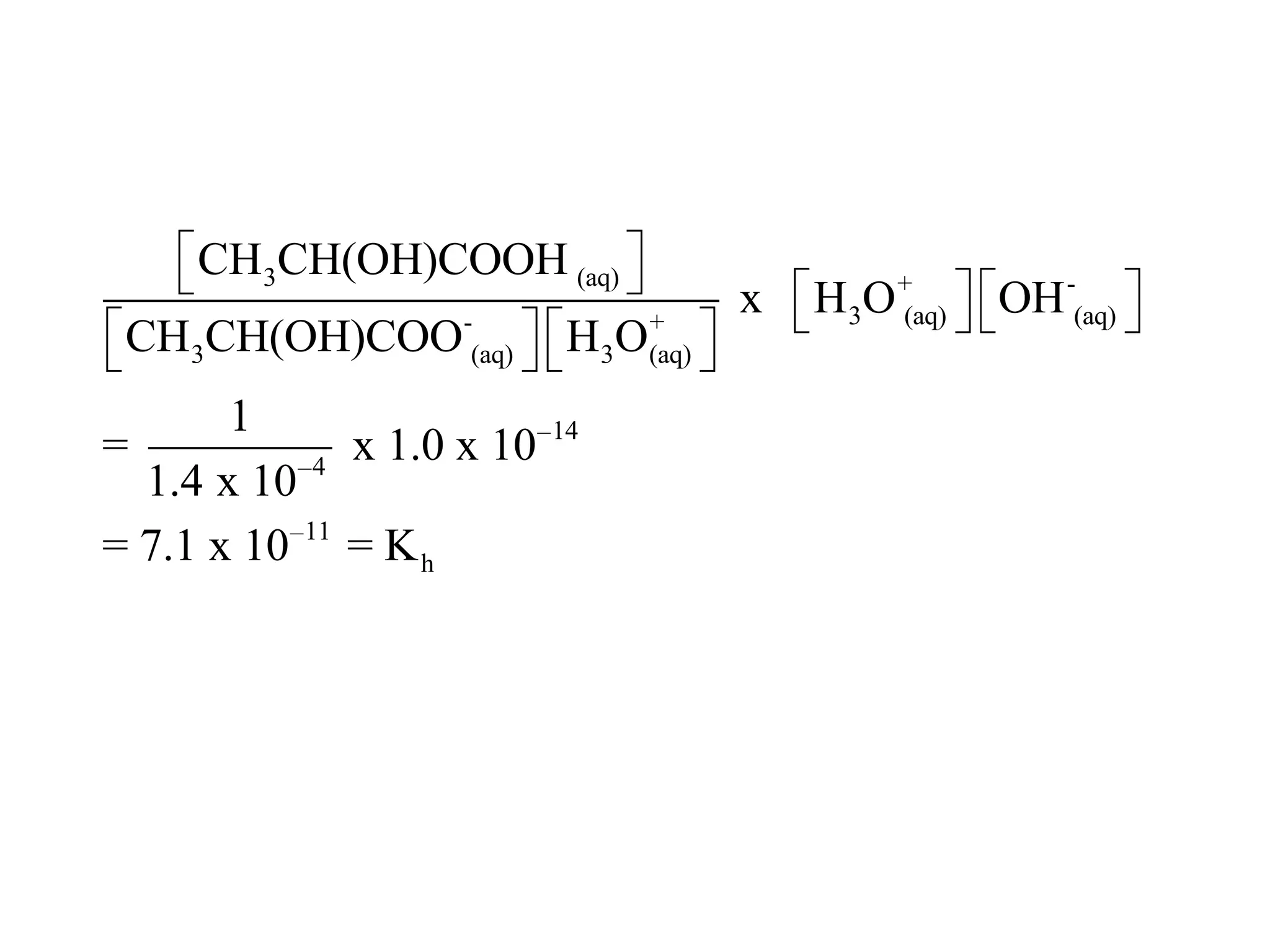
Application	Calculate Kh for CH3CH(OH)COO- given that the Kafor lactic acid, CH3CH(OH)COOH, is 1.4 x 10⁻⁴.
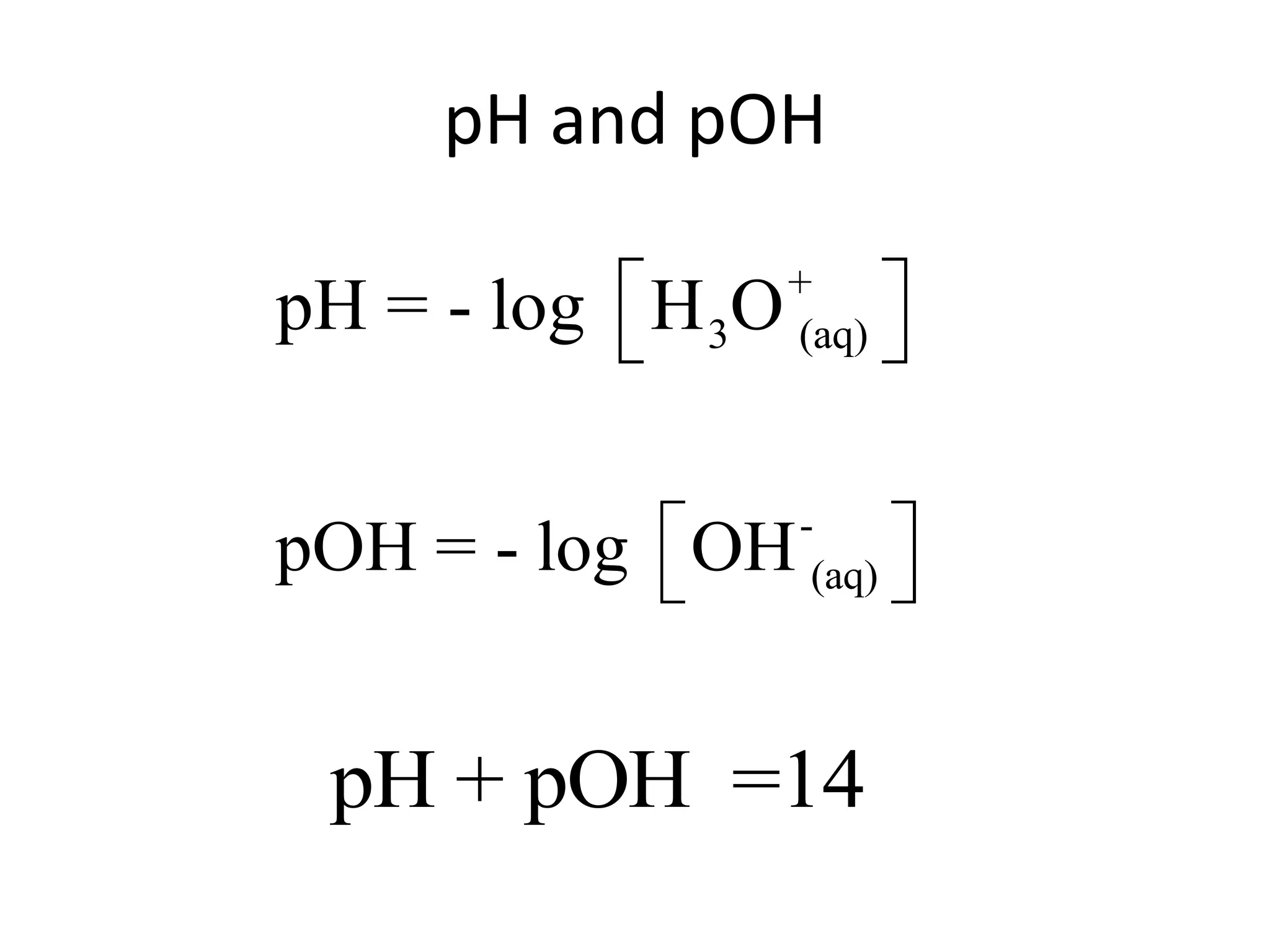
pH and pOH
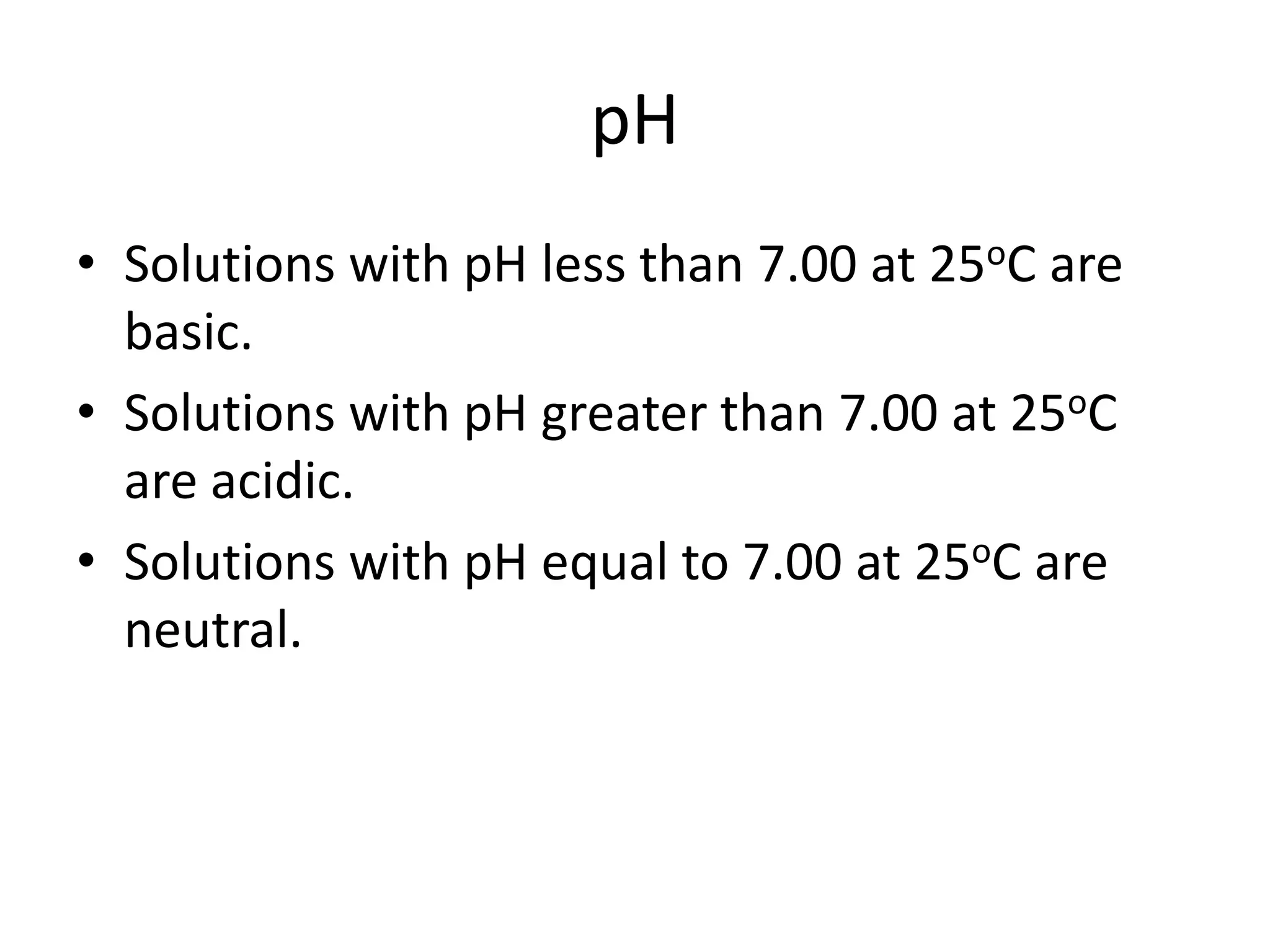
pHSolutions with pH less than 7.00 at 25oC are basic.Solutions with pH greater than 7.00 at 25oC are acidic.Solutions with pH equal to 7.00 at 25oC are neutral.
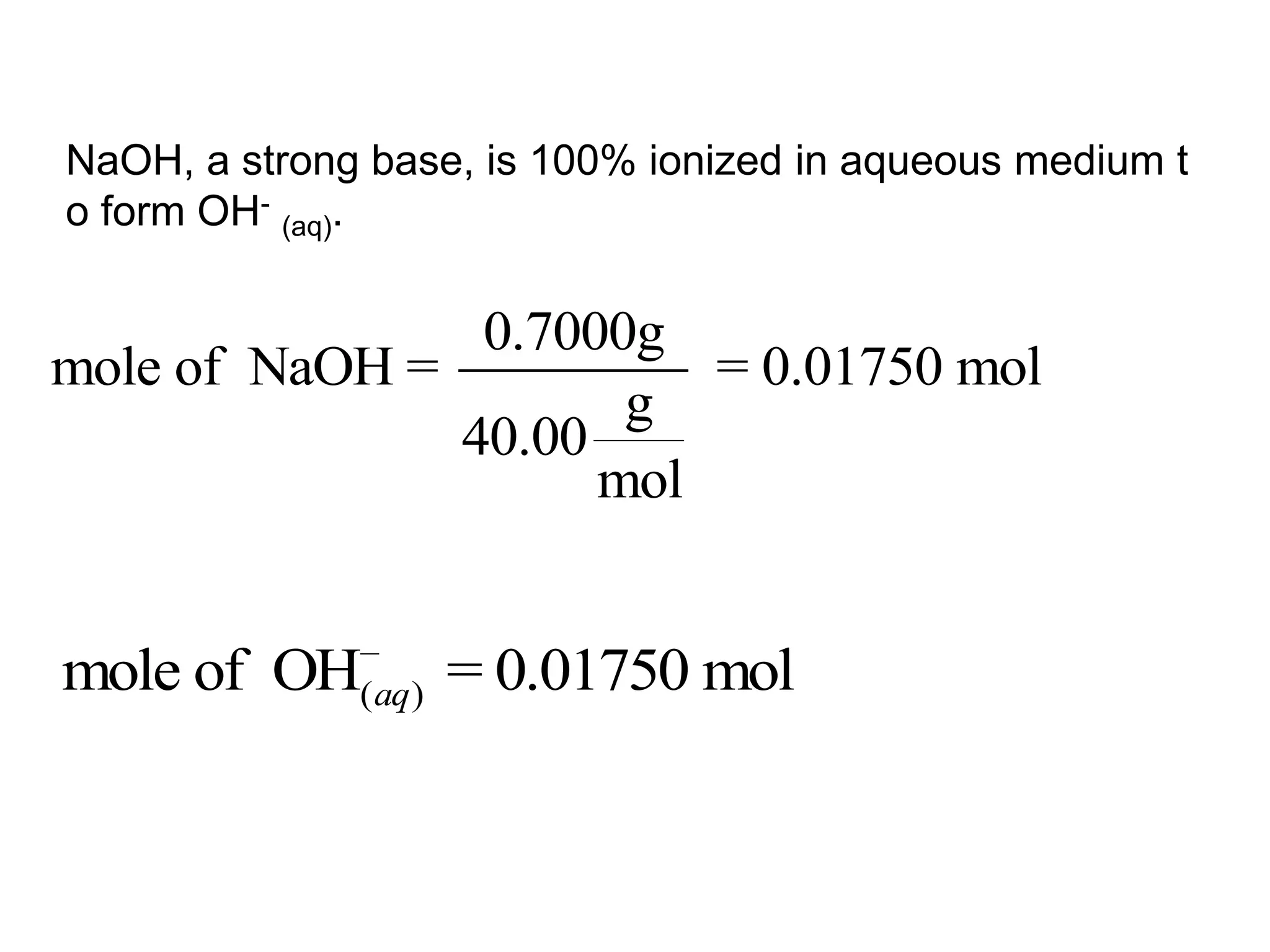
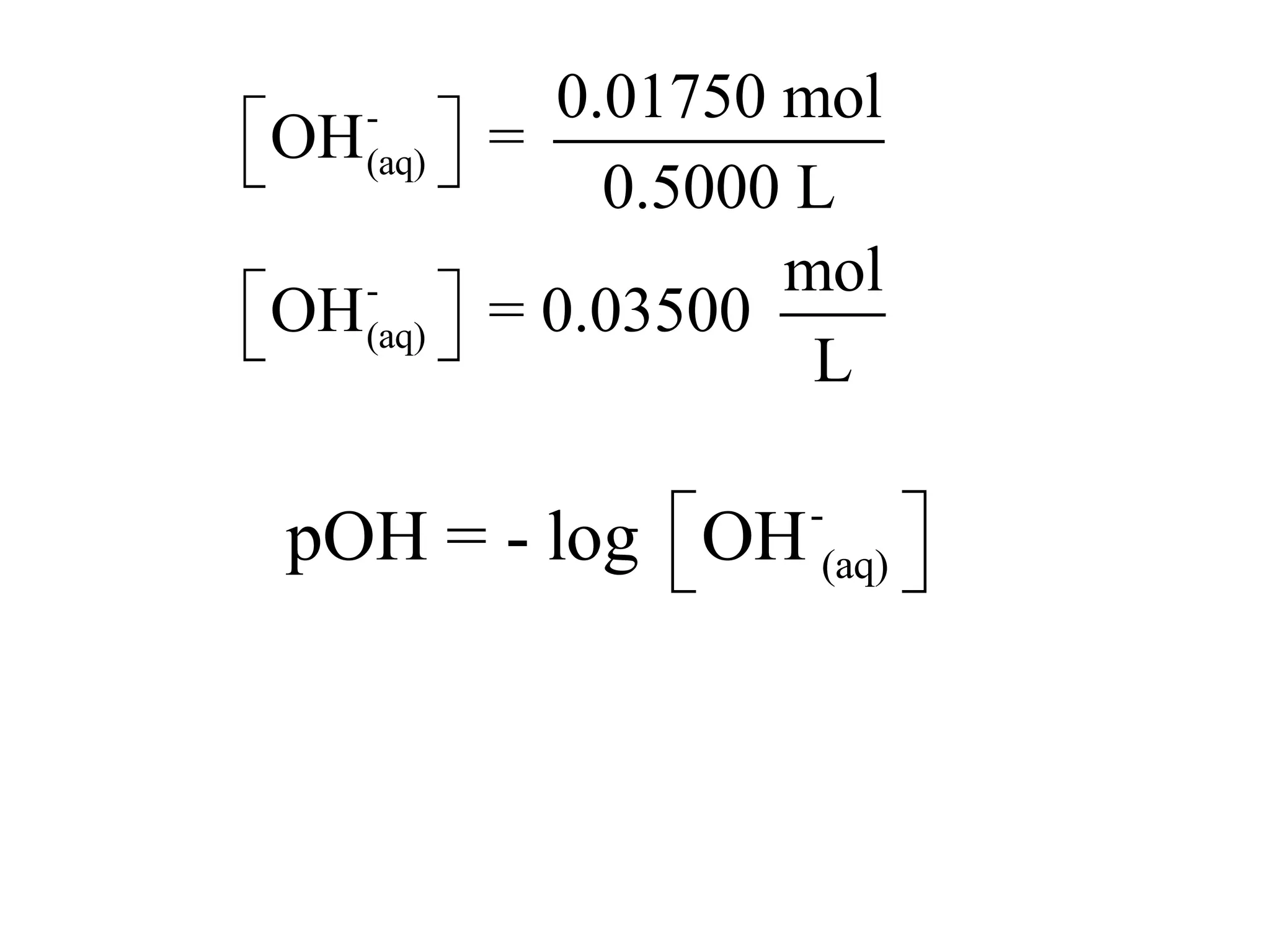
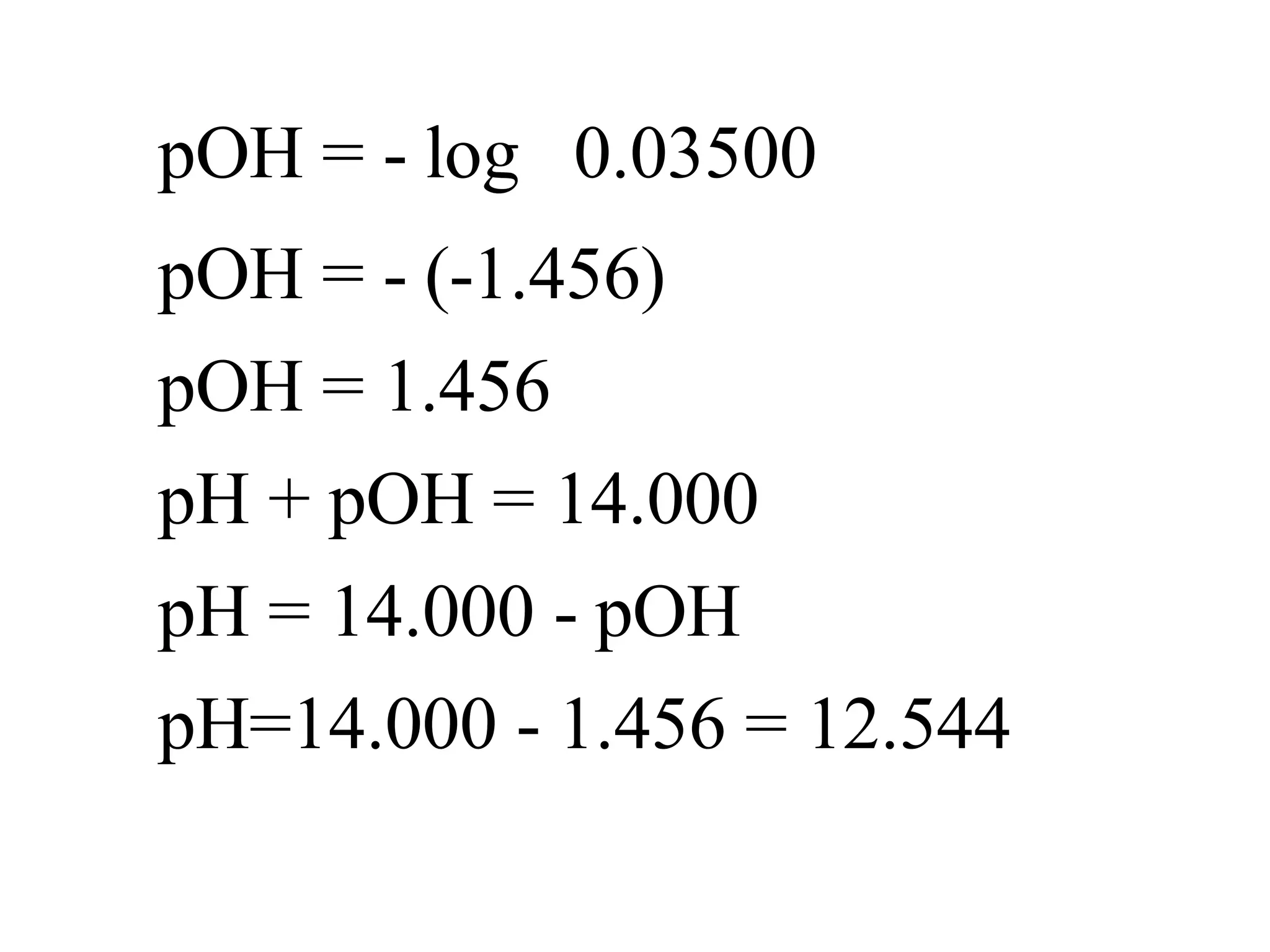
Application	Calculate the pH of a solution made by dissolving 0.7000 g of NaOH in sufficient water to produce a volume of 500.0 mL.
NaOH, a strong base, is 100% ionized in aqueous medium to form OH-(aq).
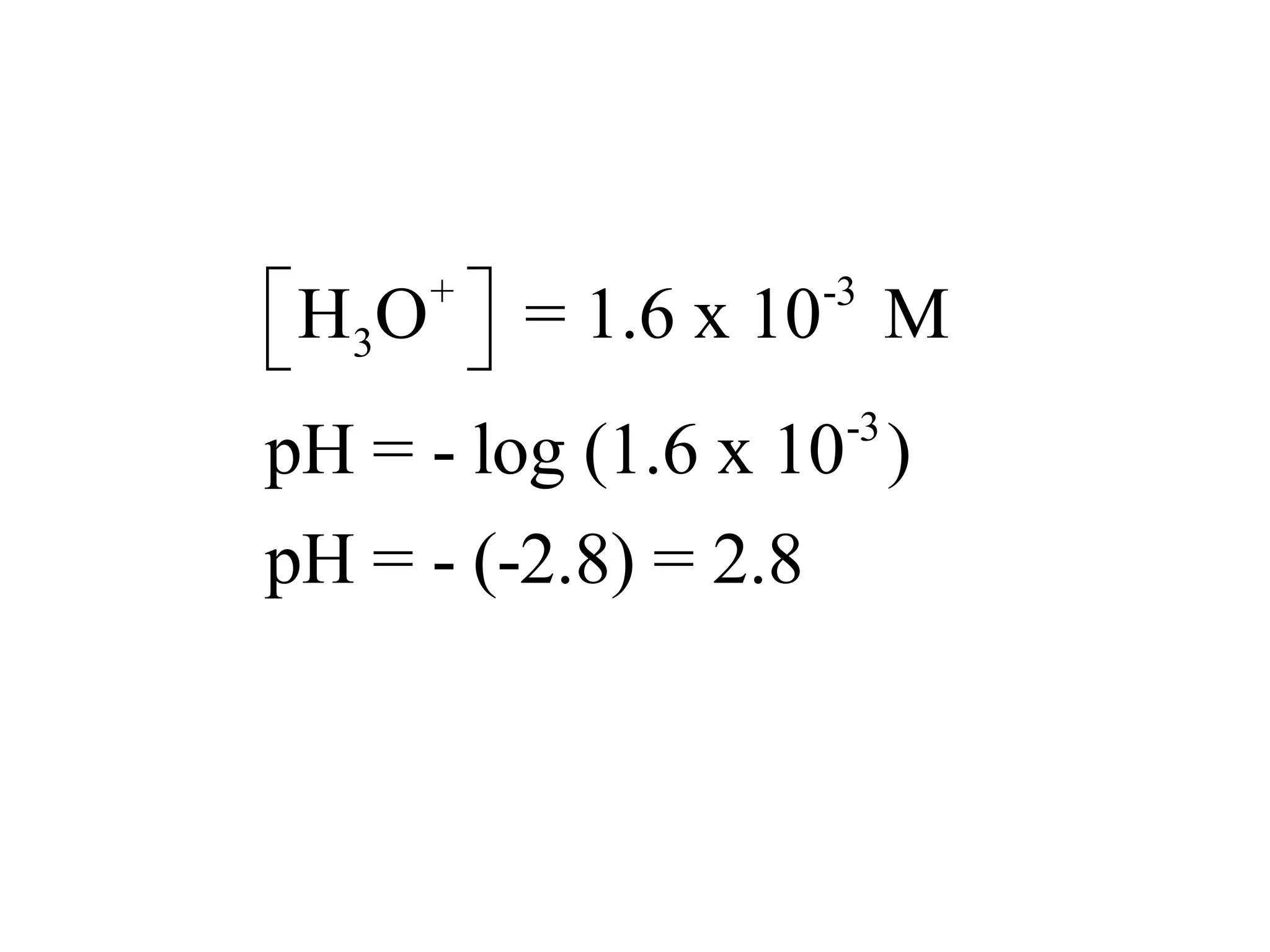
ApplicationIf [H3O+] in vinegar is 1.6 x 10⁻³, calculate its pH.
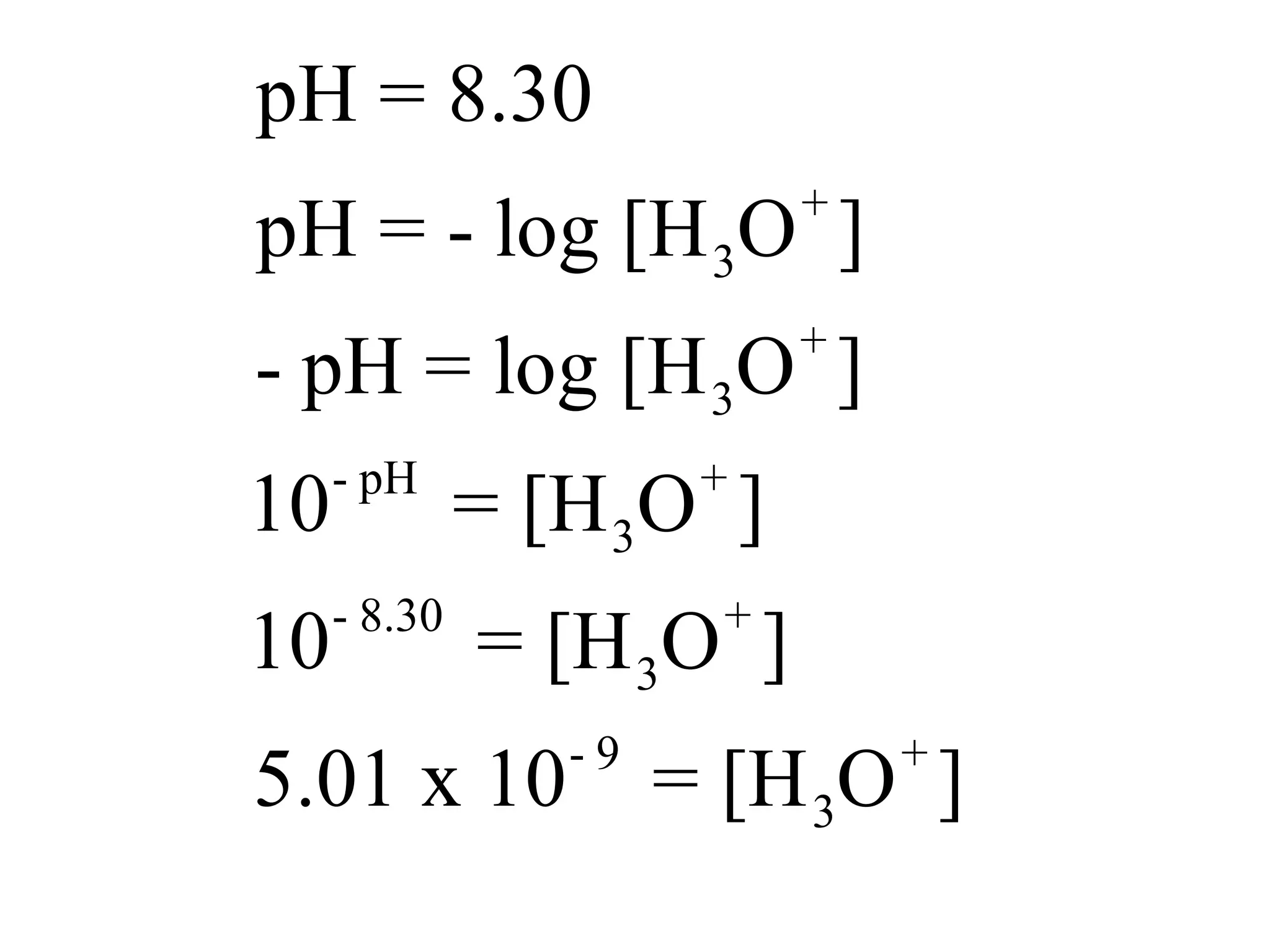
Application	The pH of seawater is 8.30.  Calculate the [H3O+] and [-OH] of seawater.
Determining pH	Indicator: A substance that changes colors in some known pH range.
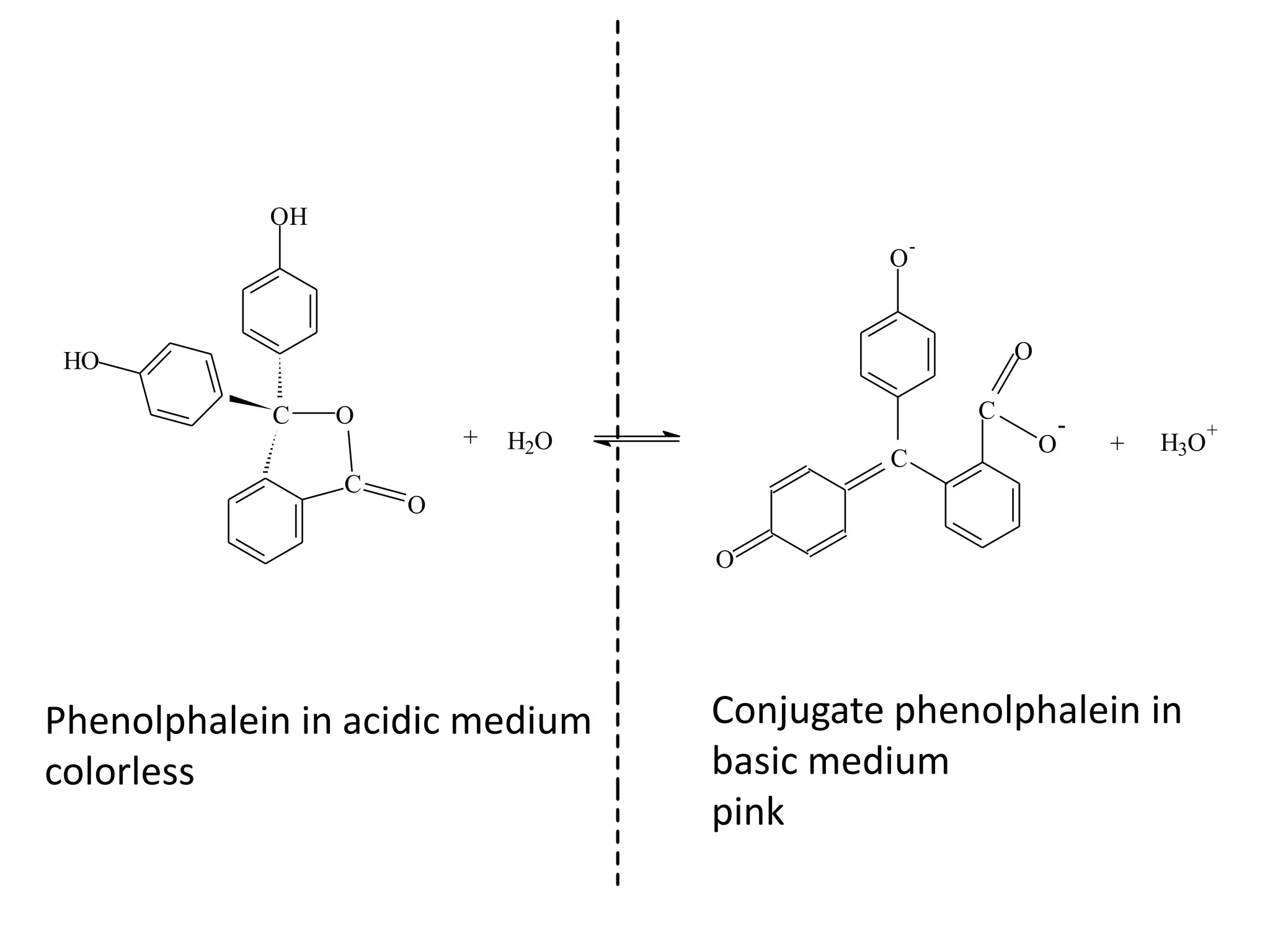
Conjugate phenolphalein in basic mediumpinkPhenolphalein in acidic mediumcolorless
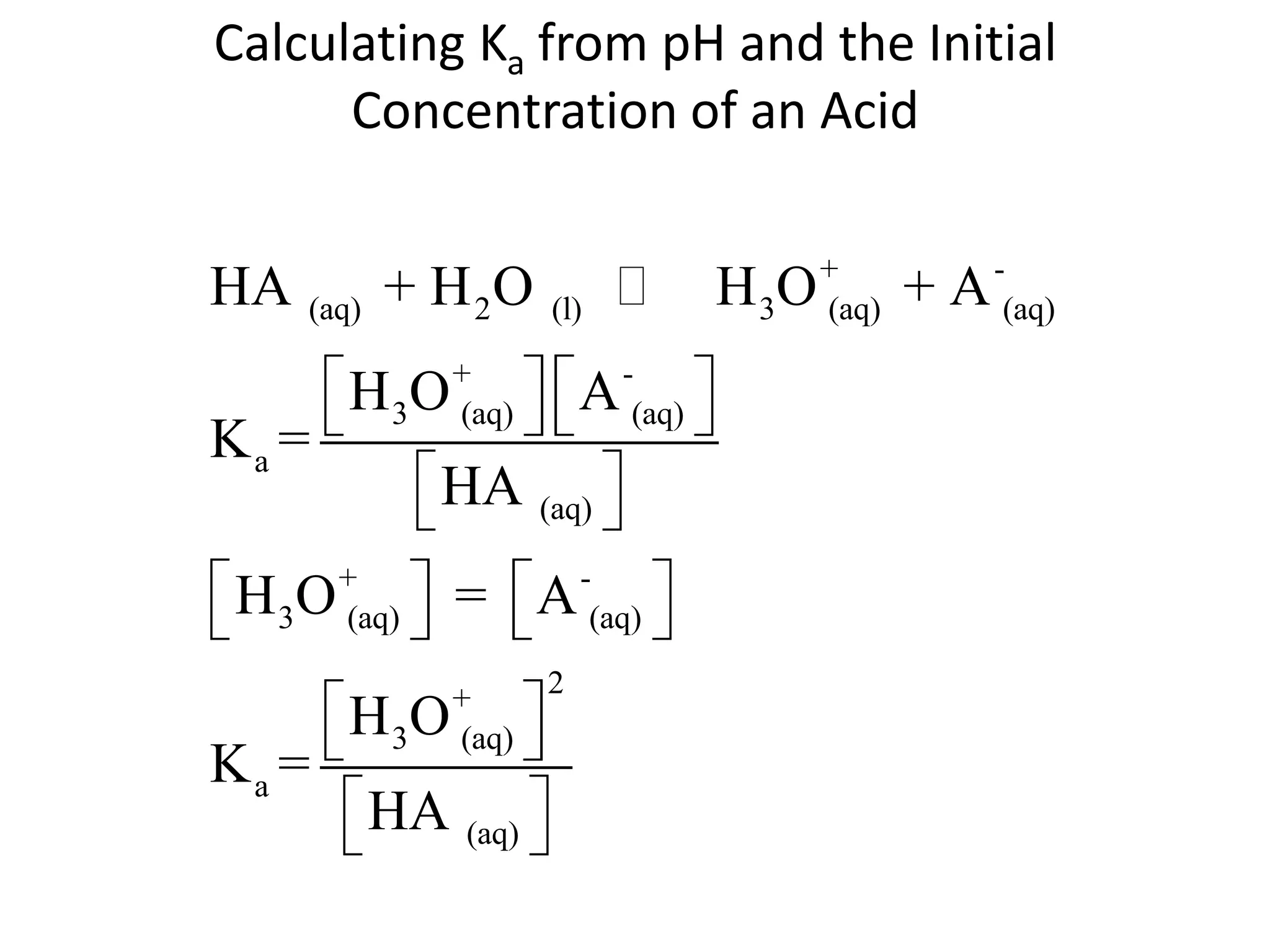
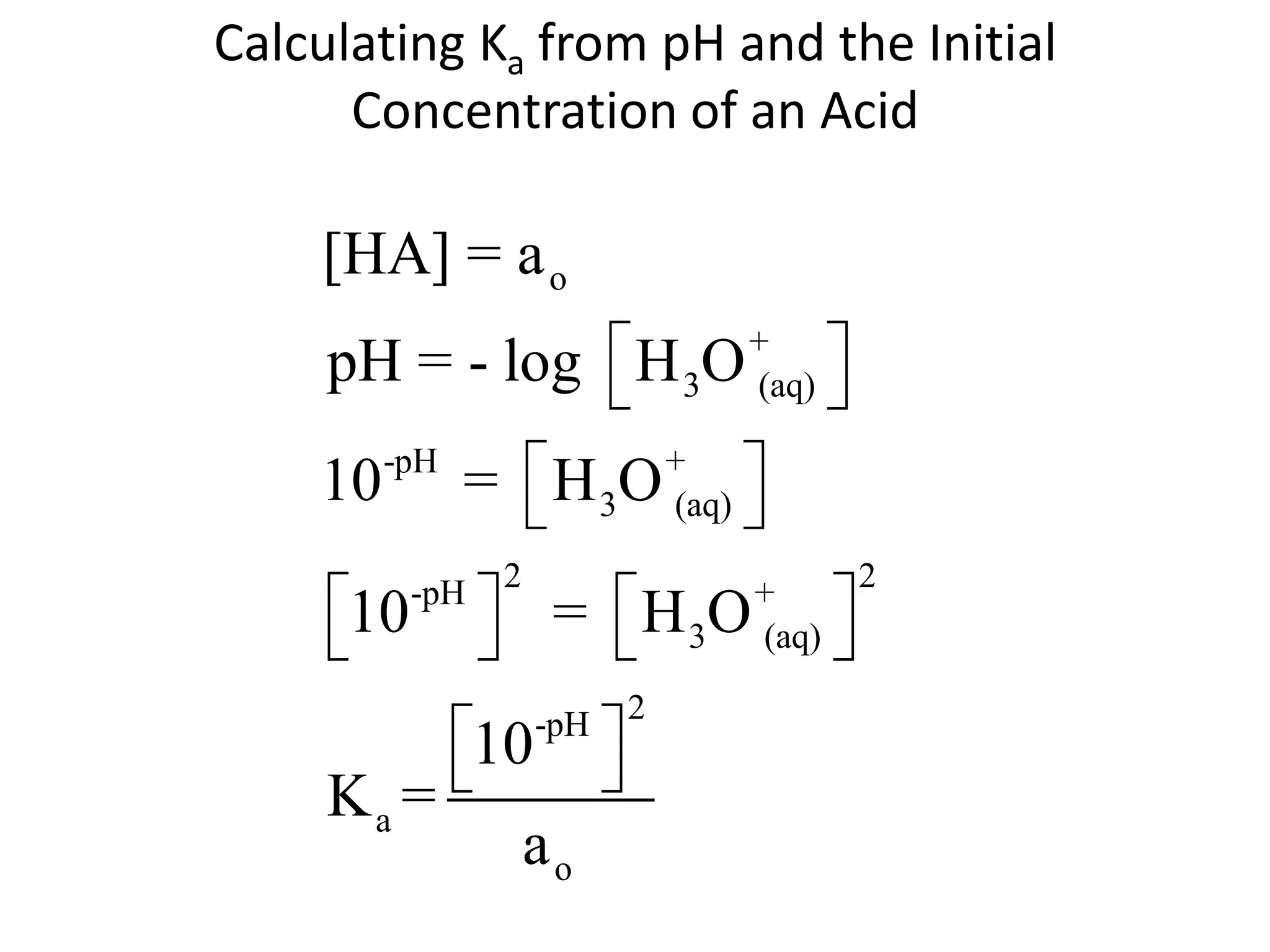
Calculating Ka from pH and the Initial Concentration of an Acid
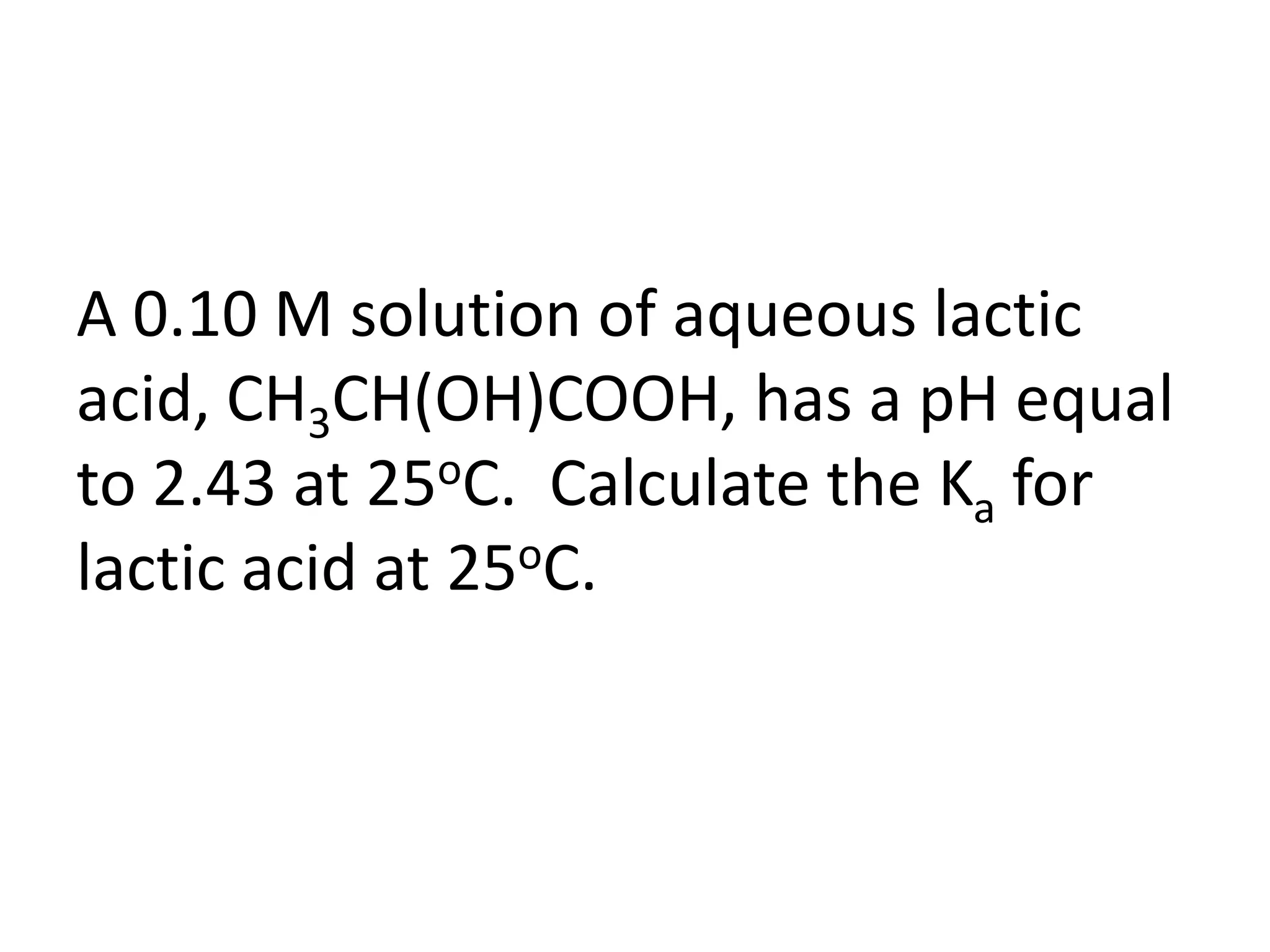
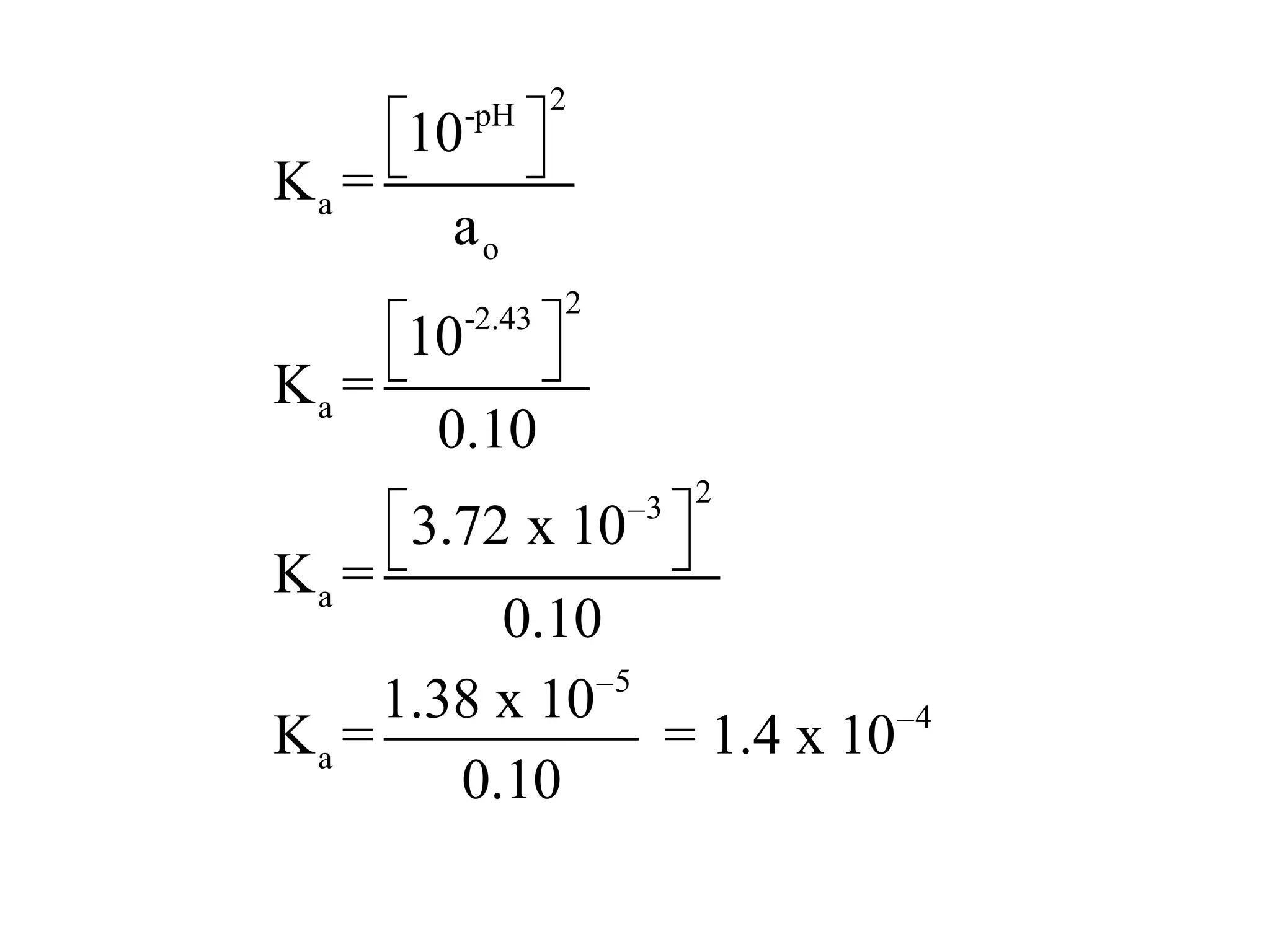
A 0.10 M solution of aqueous lactic acid, CH3CH(OH)COOH, has a pH equal to 2.43 at 25oC.  Calculate the Ka for lactic acid at 25oC.
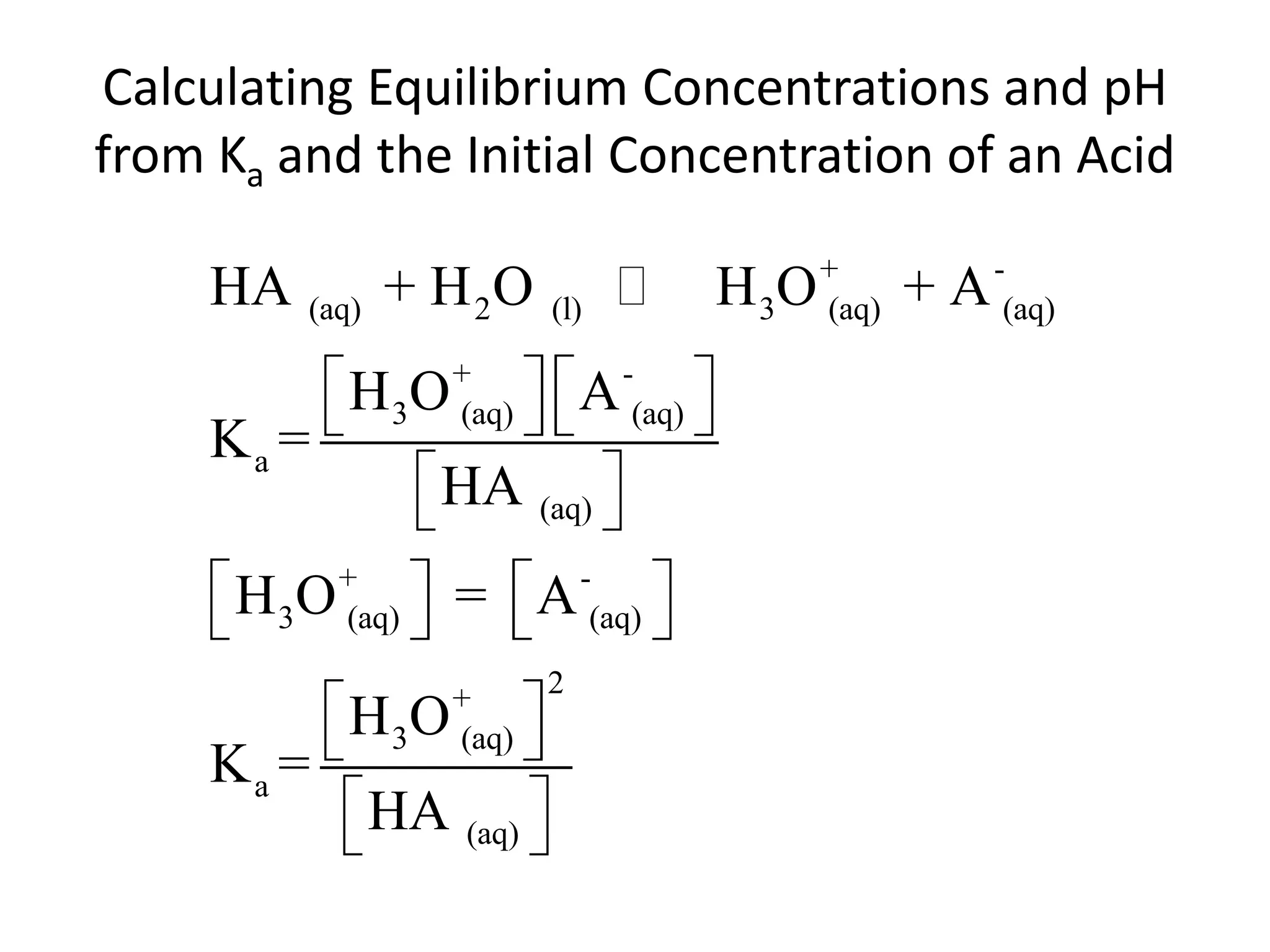
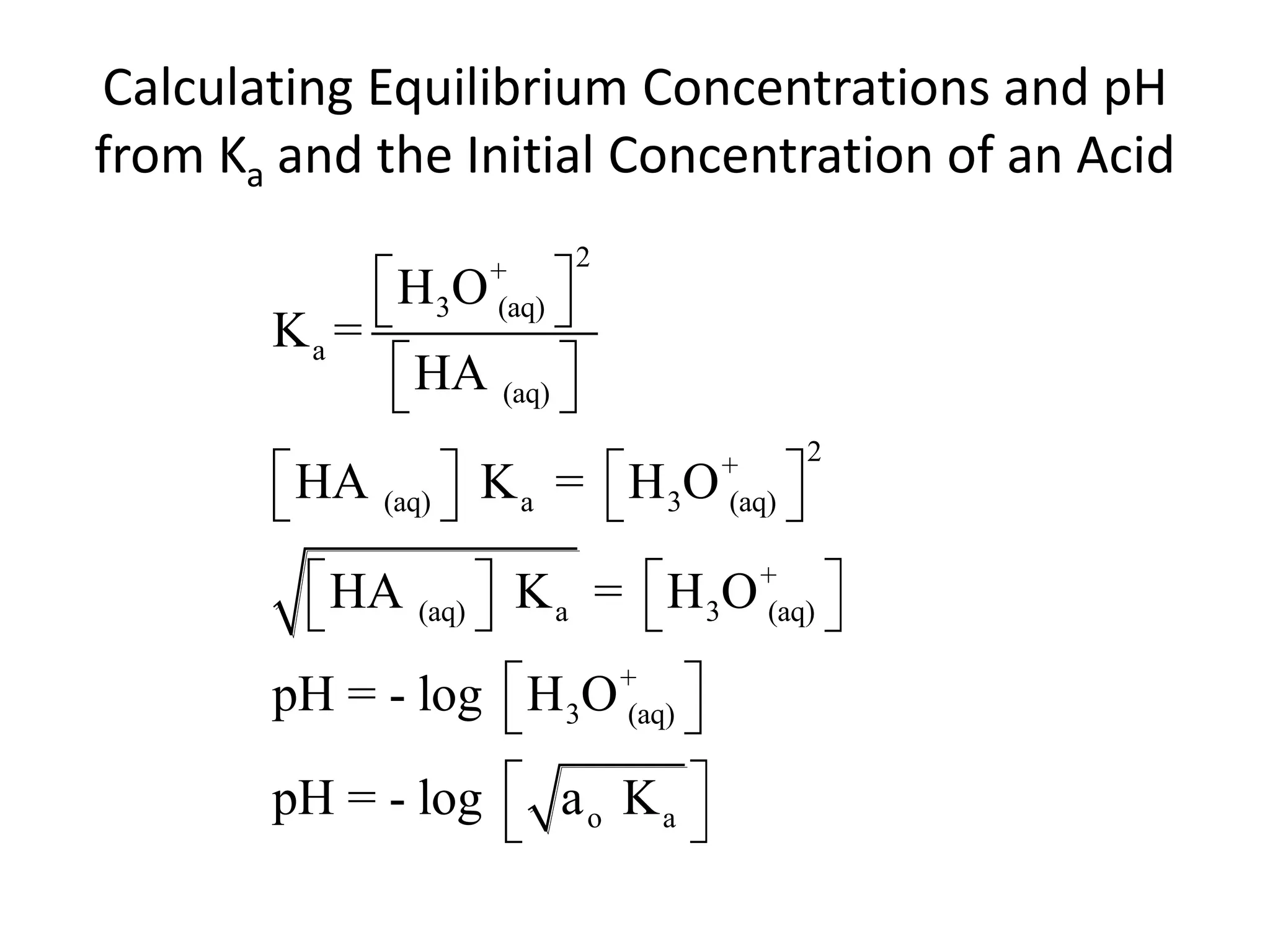
Calculating Equilibrium Concentrations and pH from Ka and the Initial Concentration of an Acid
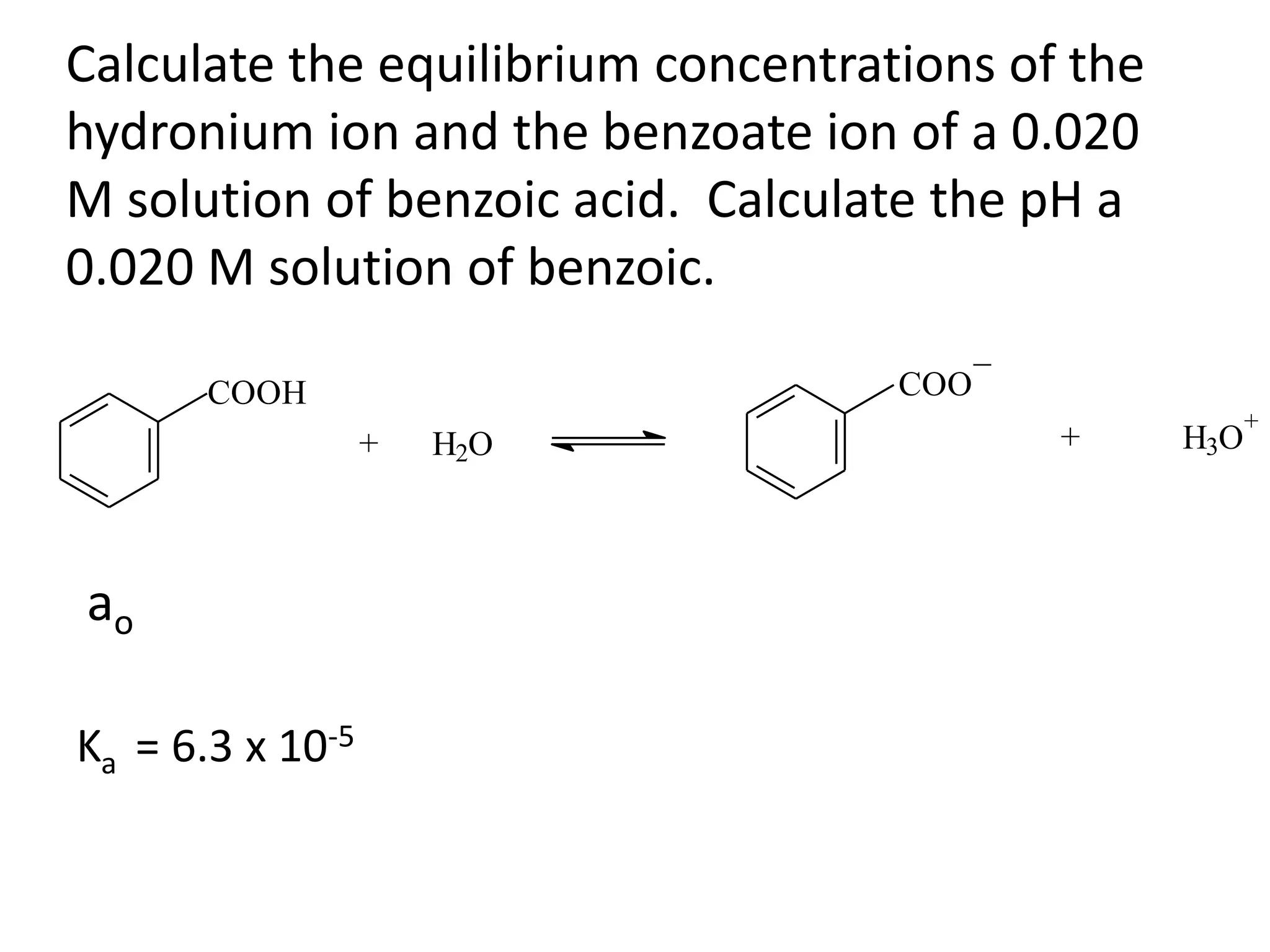
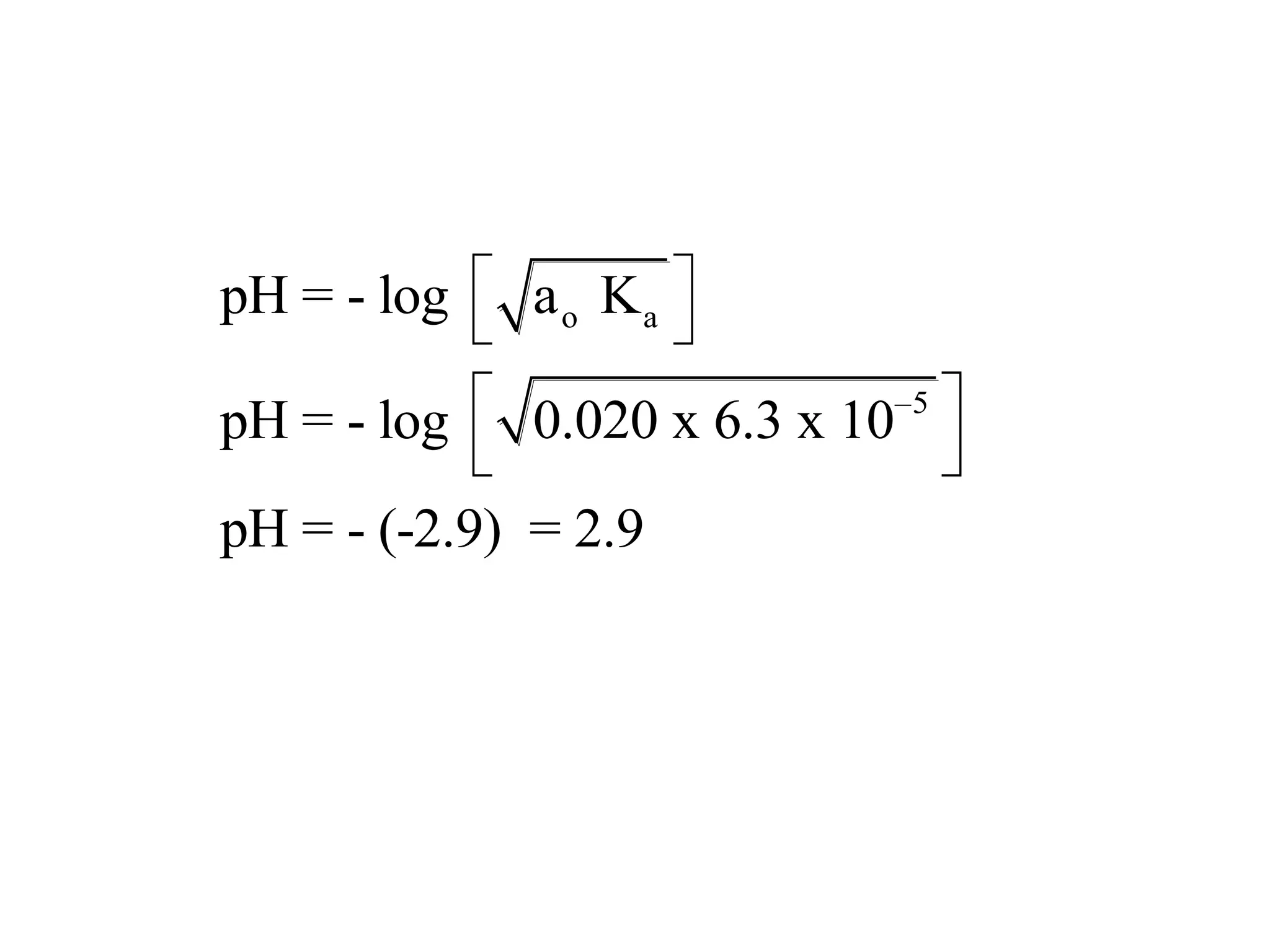
Calculate the equilibrium concentrations of the hydronium ion and the benzoate ion of a 0.020 M solution of benzoic acid.  Calculate the pH a 0.020 M solution of benzoic.aoKa  = 6.3 x 10-5
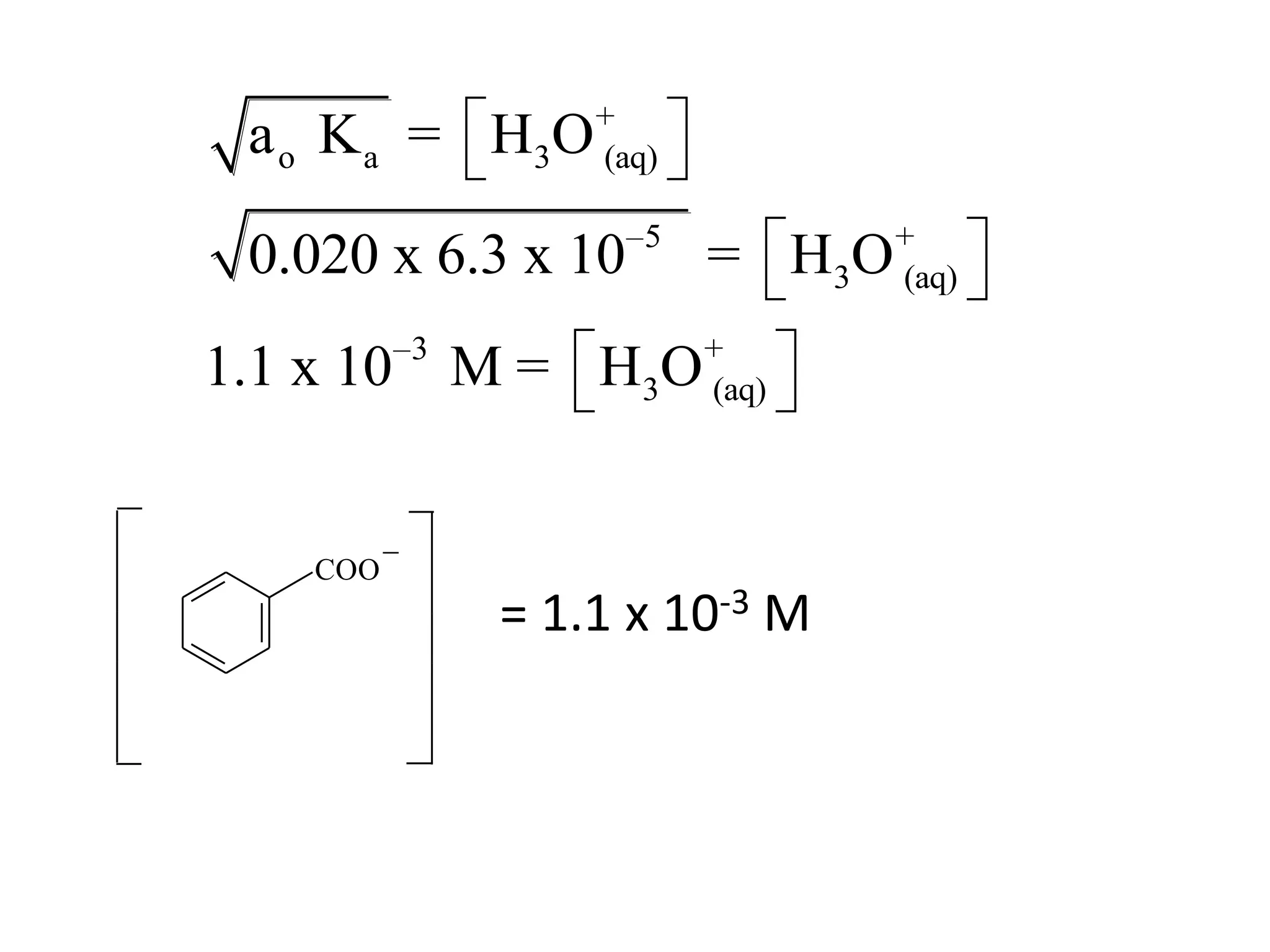
= 1.1 x 10⁻³ M
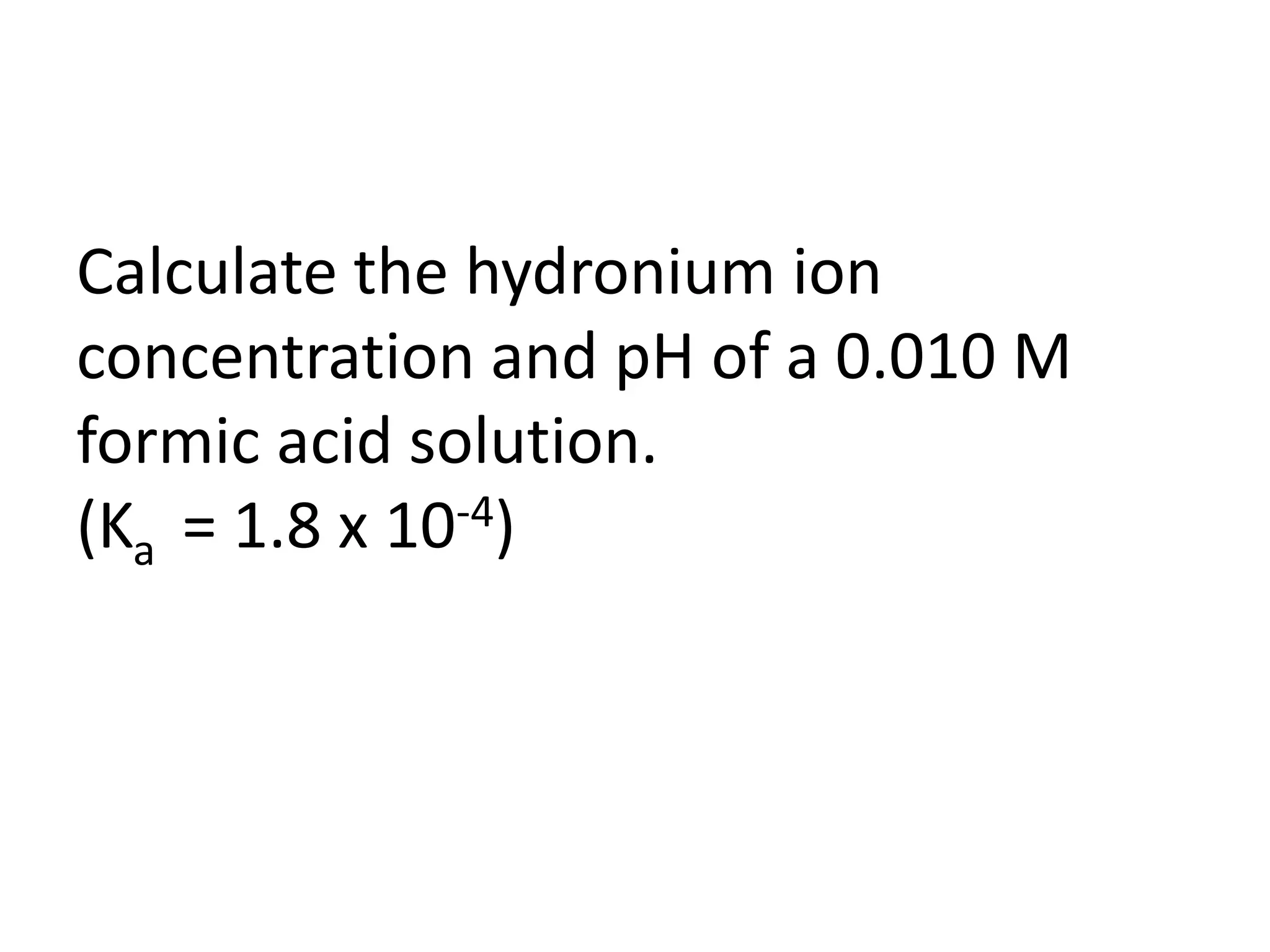
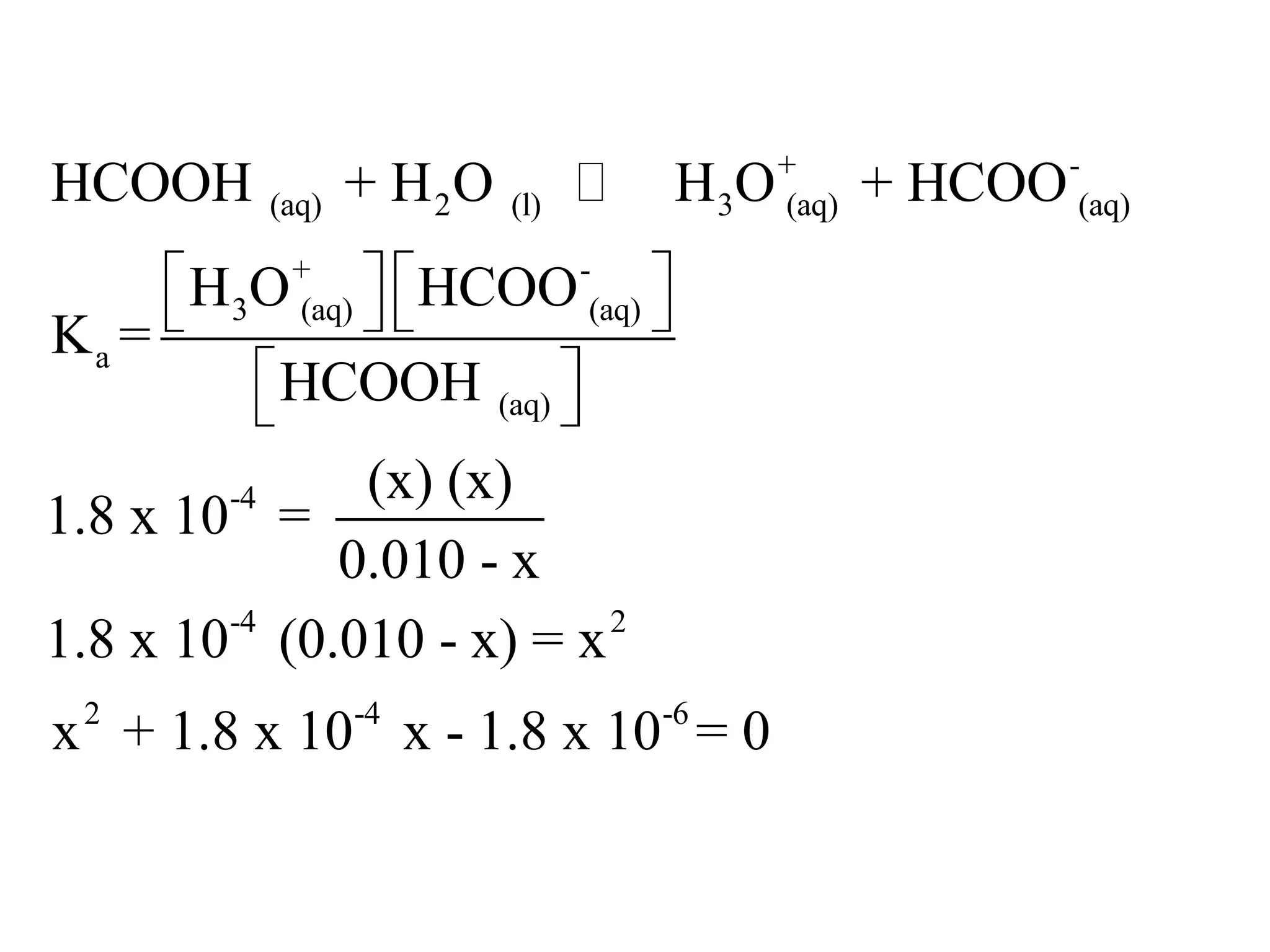
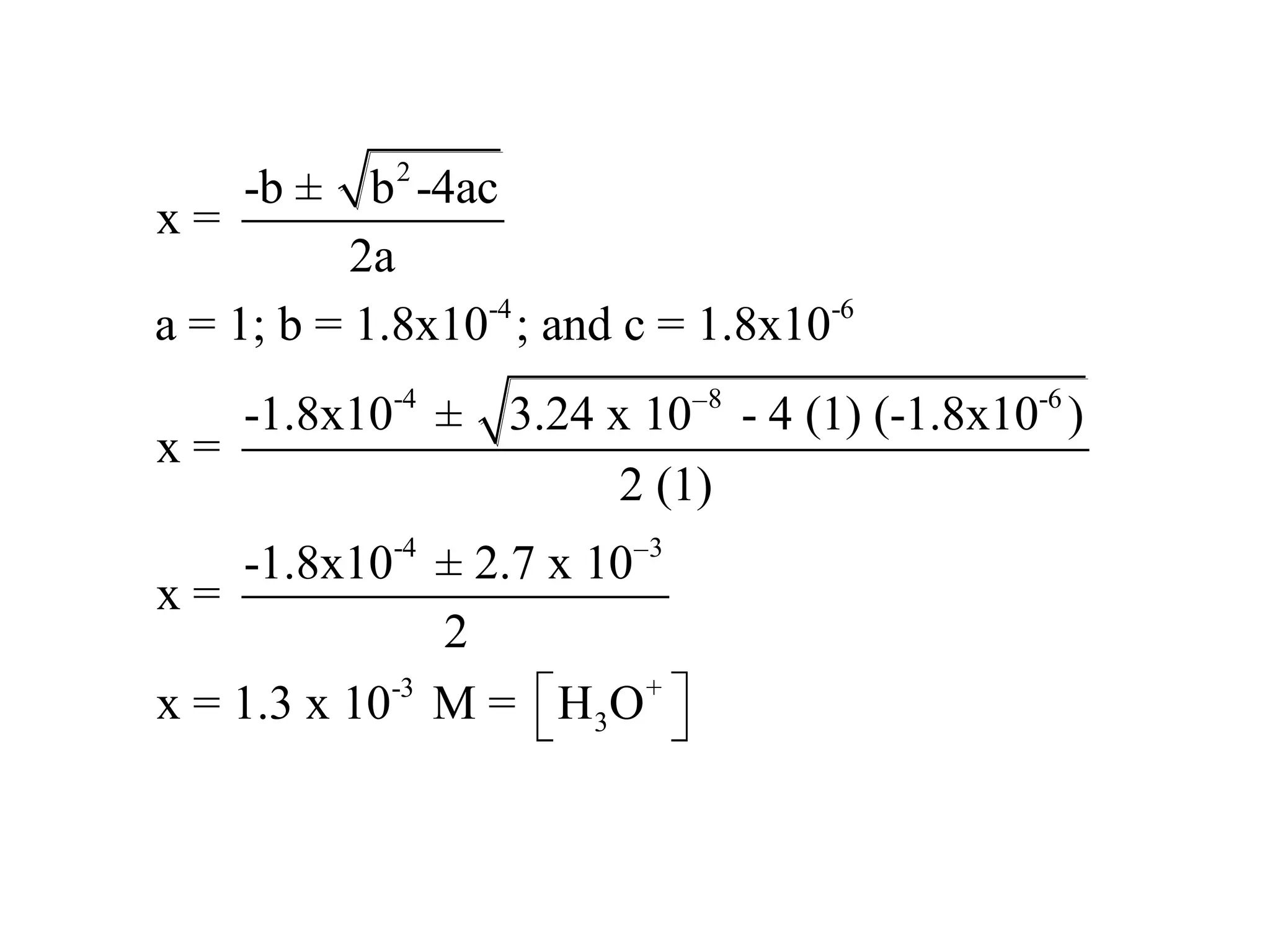
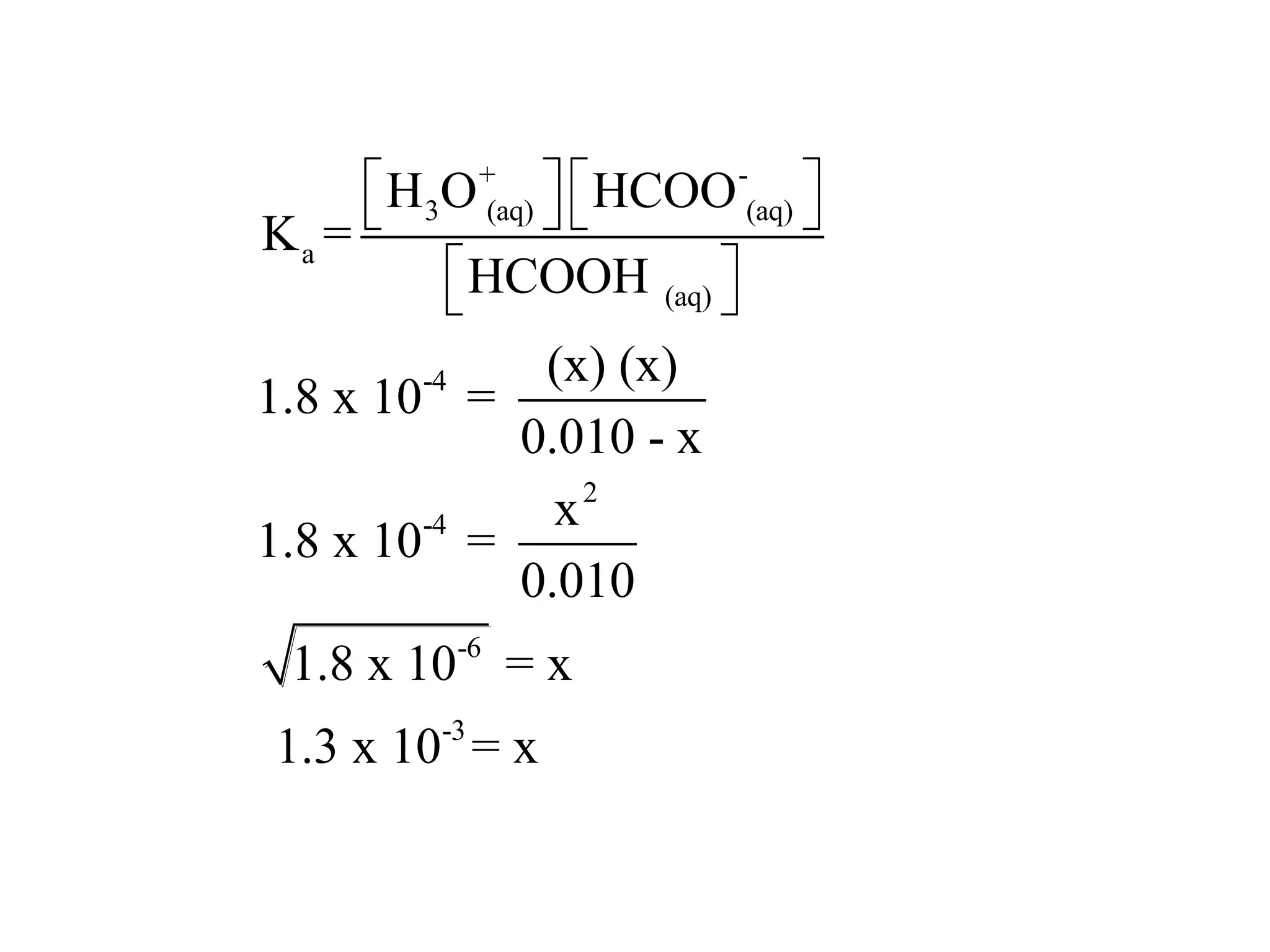
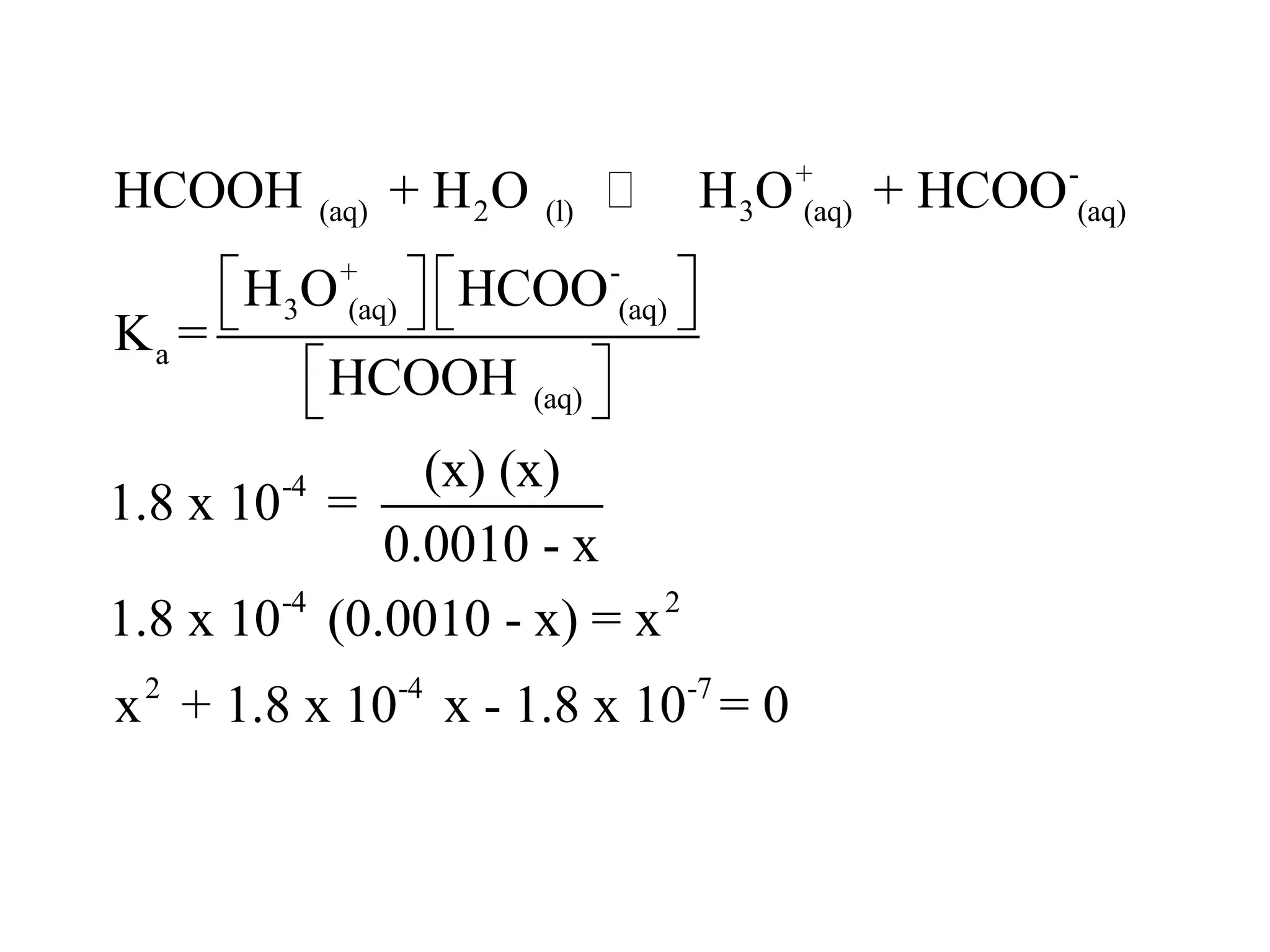
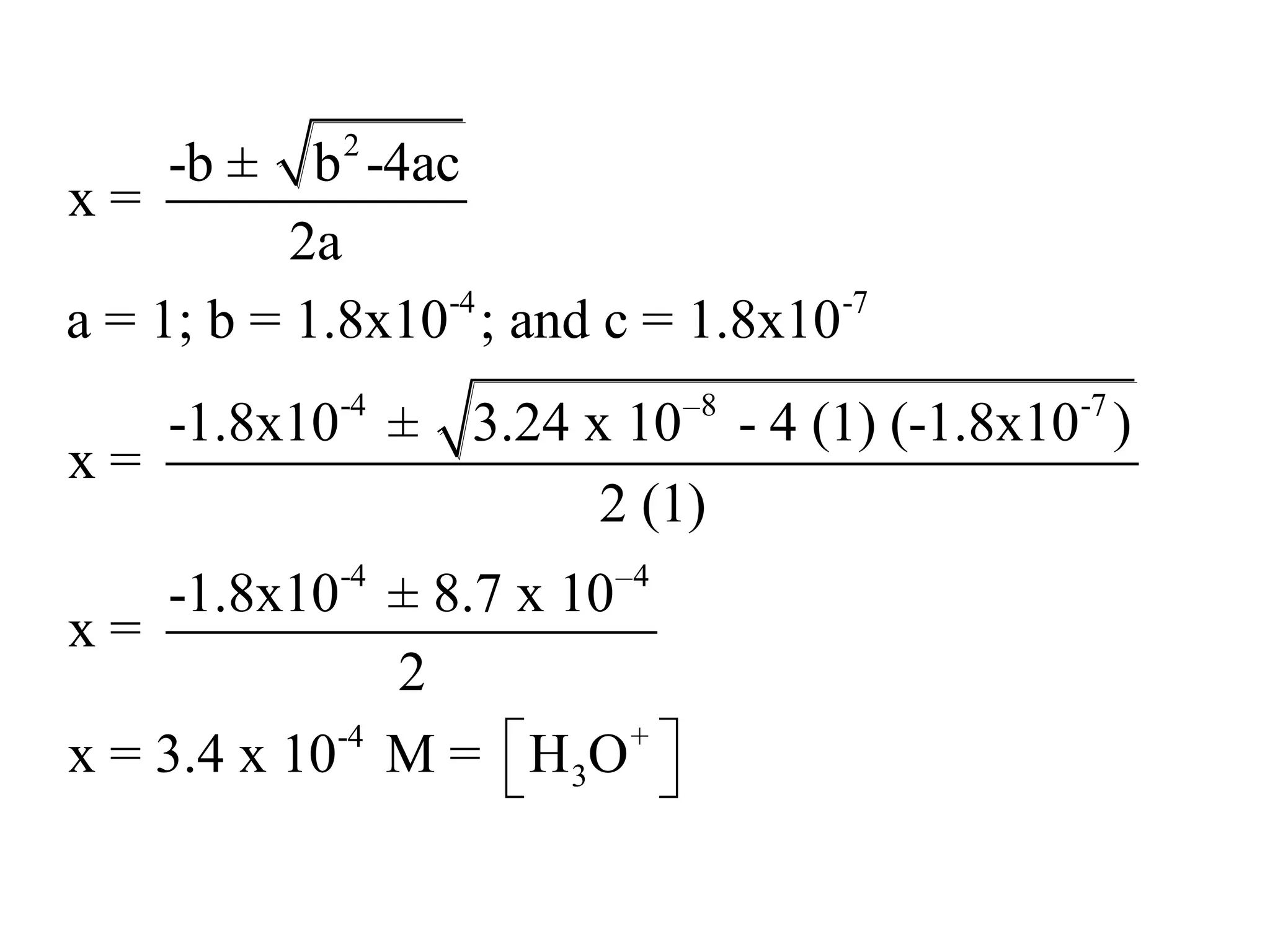
Calculate the hydronium ion concentration and pH of a 0.010 M formic acid solution. (Ka  = 1.8 x 10⁻⁴)
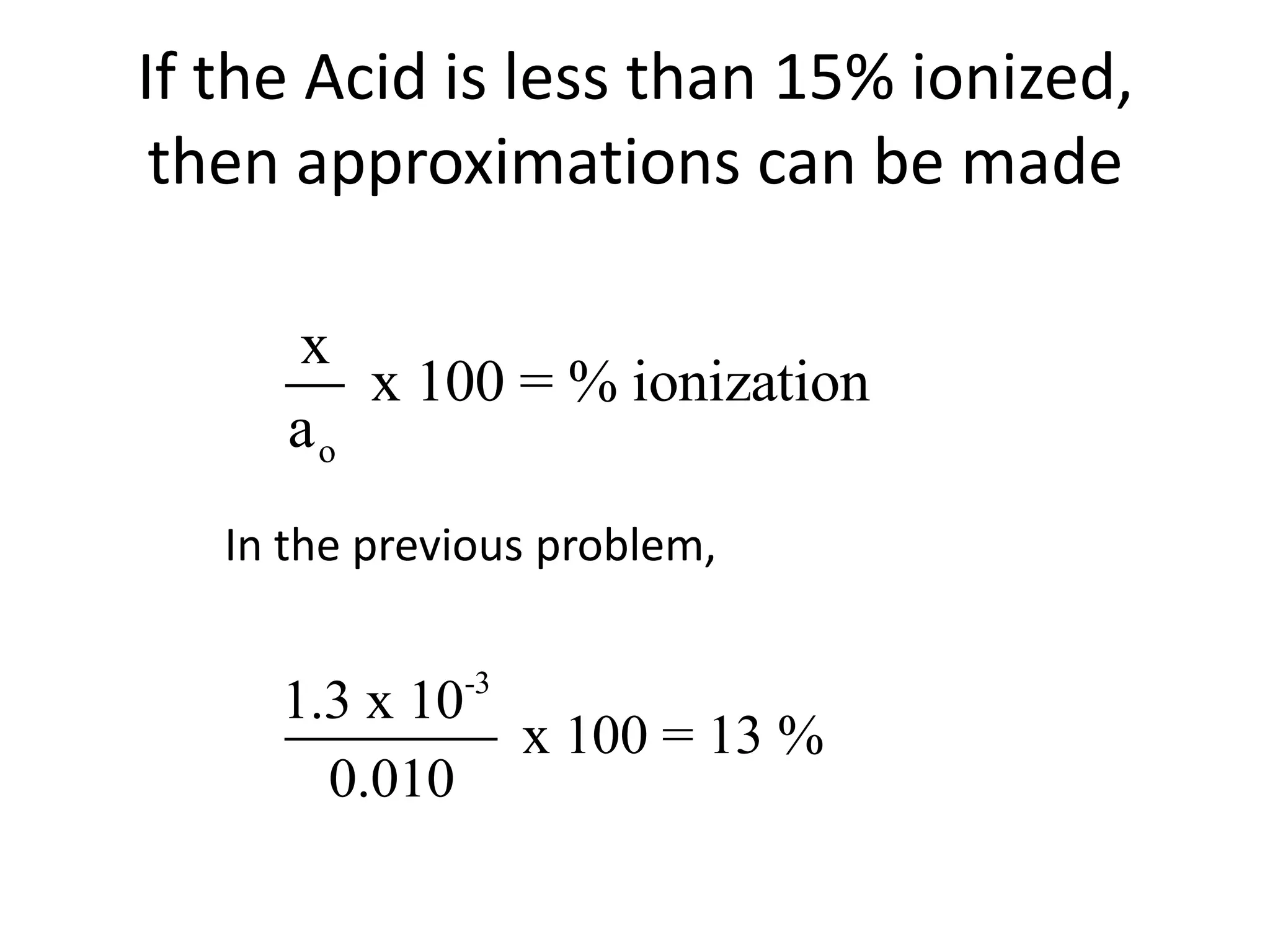
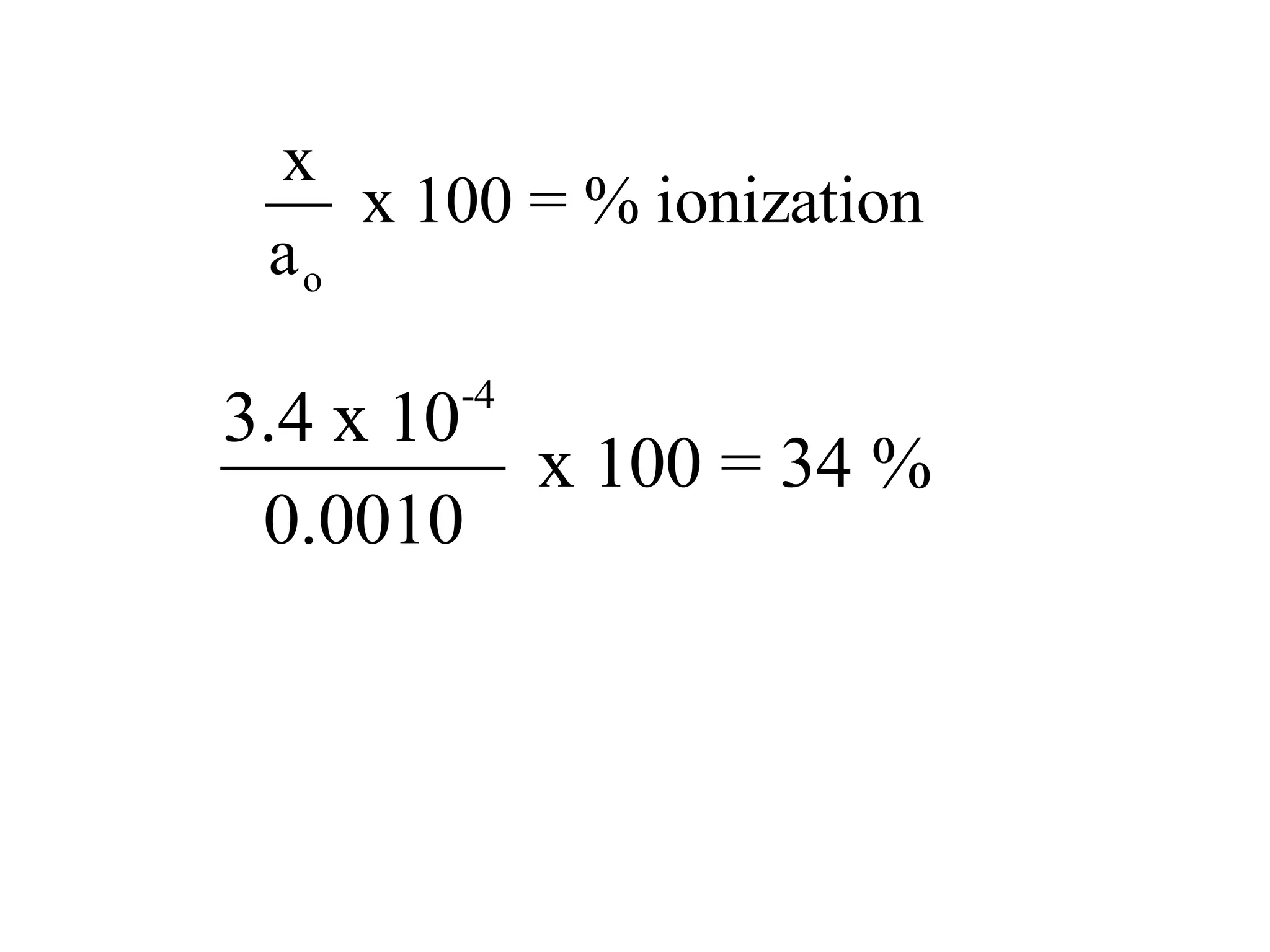
If the Acid is less than 15% ionized, then approximations can be madeIn the previous problem,
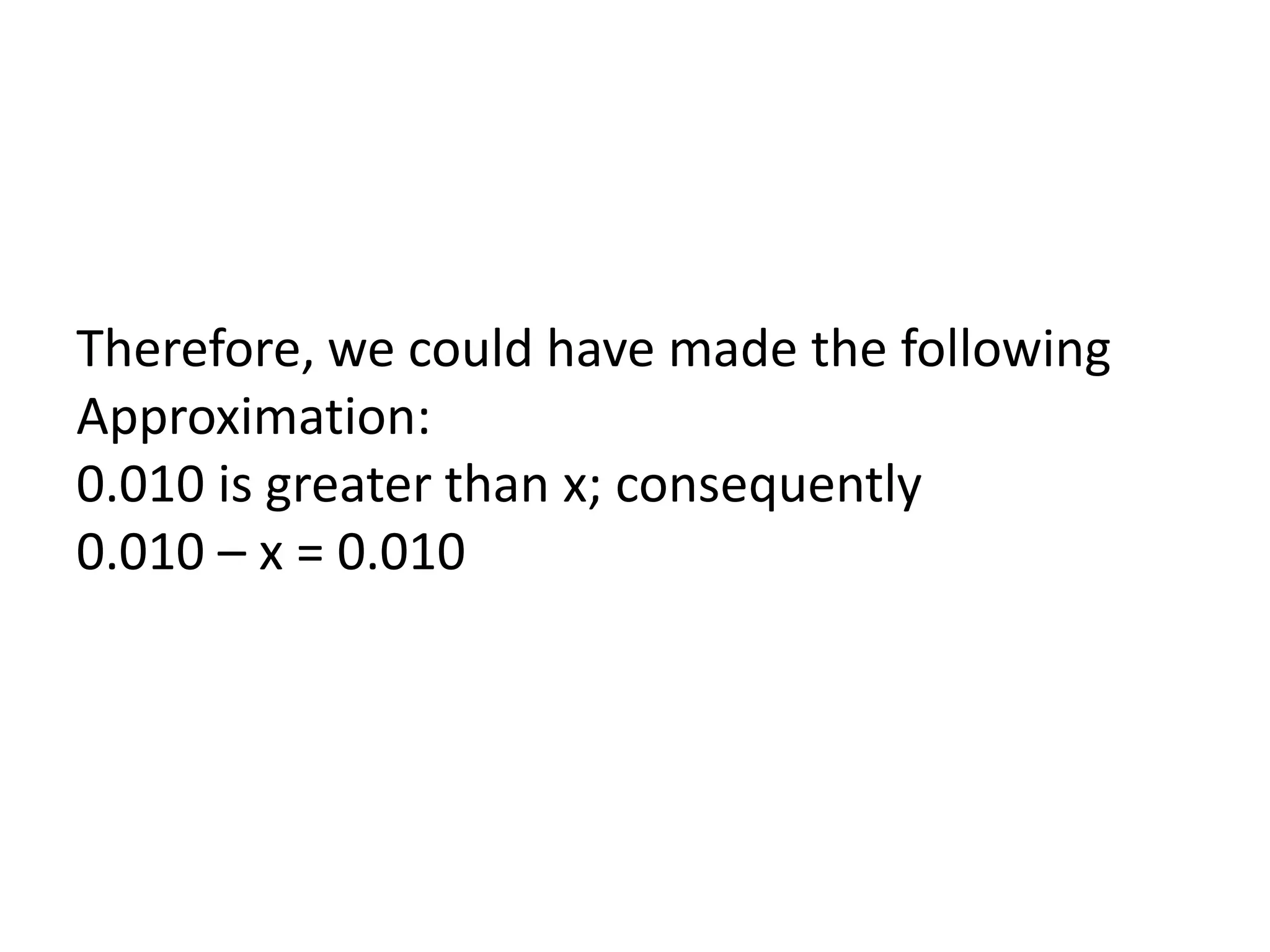
Therefore, we could have made the following Approximation:0.010 is greater than x; consequently 0.010 – x = 0.010
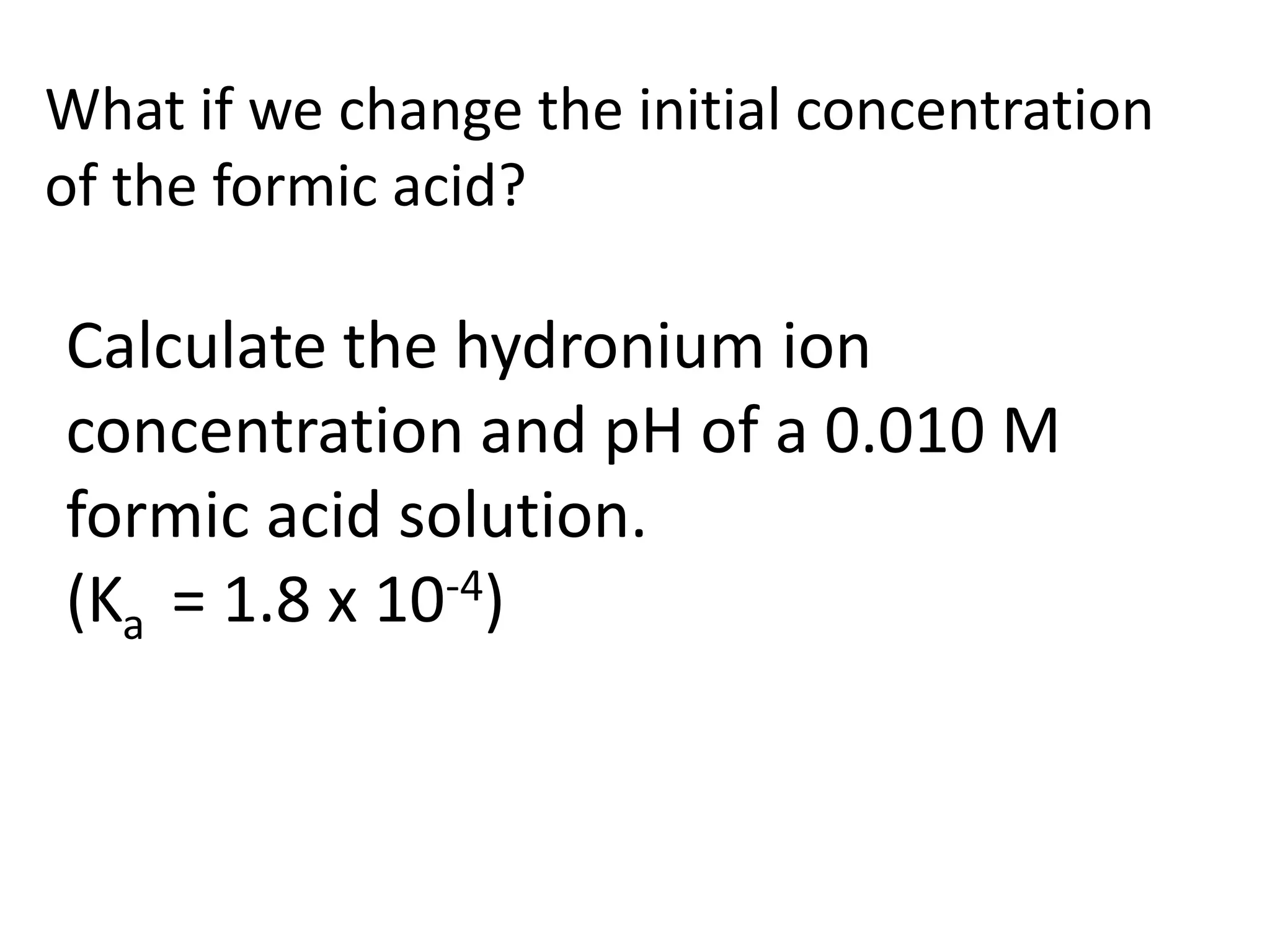
What if we change the initial concentration of the formic acid?Calculate the hydronium ion concentration and pH of a 0.010 M formic acid solution. (Ka  = 1.8 x 10⁻⁴)
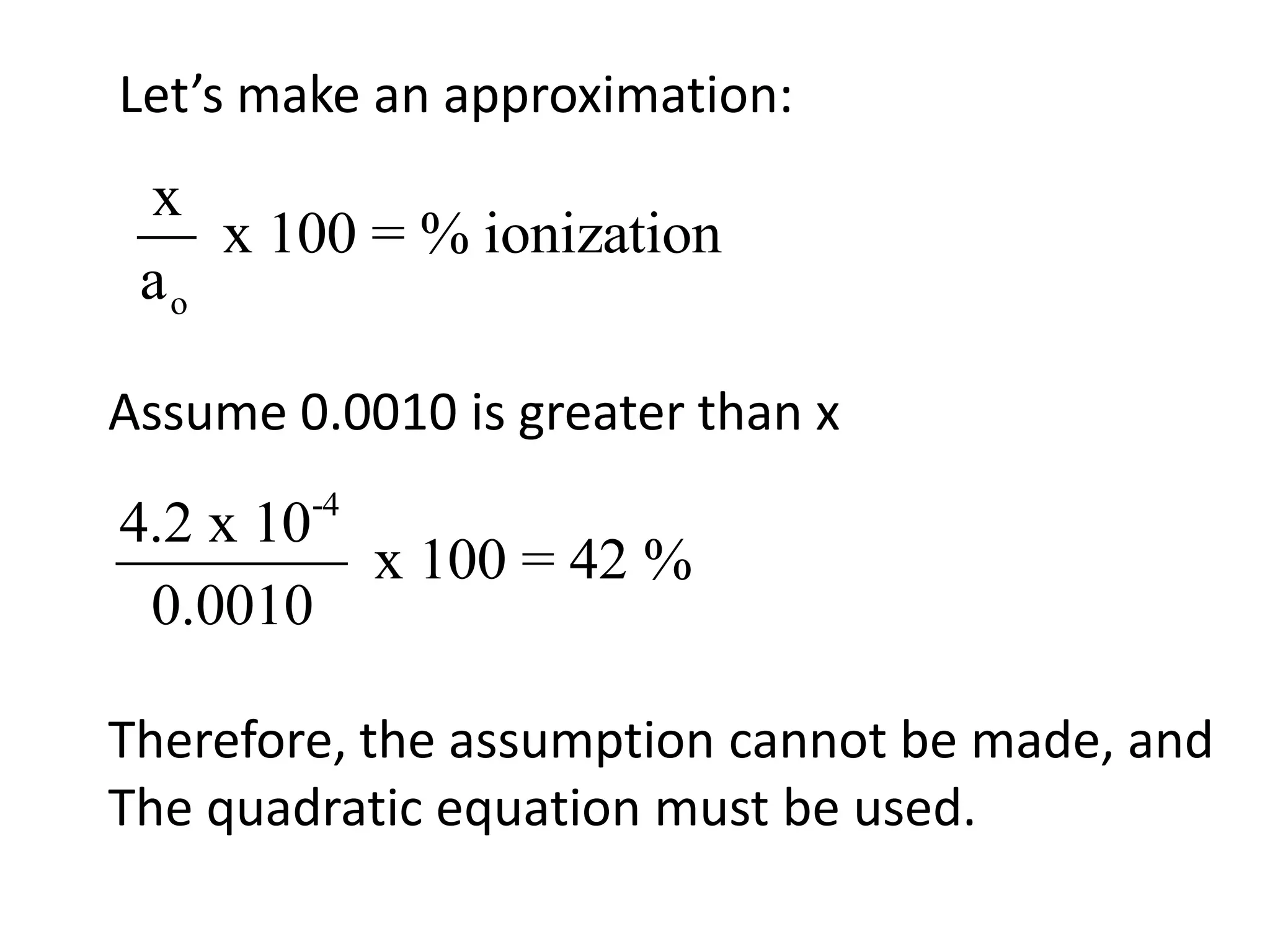
Let’s make an approximation: Assume 0.0010 is greater than xTherefore, the assumption cannot be made, andThe quadratic equation must be used.
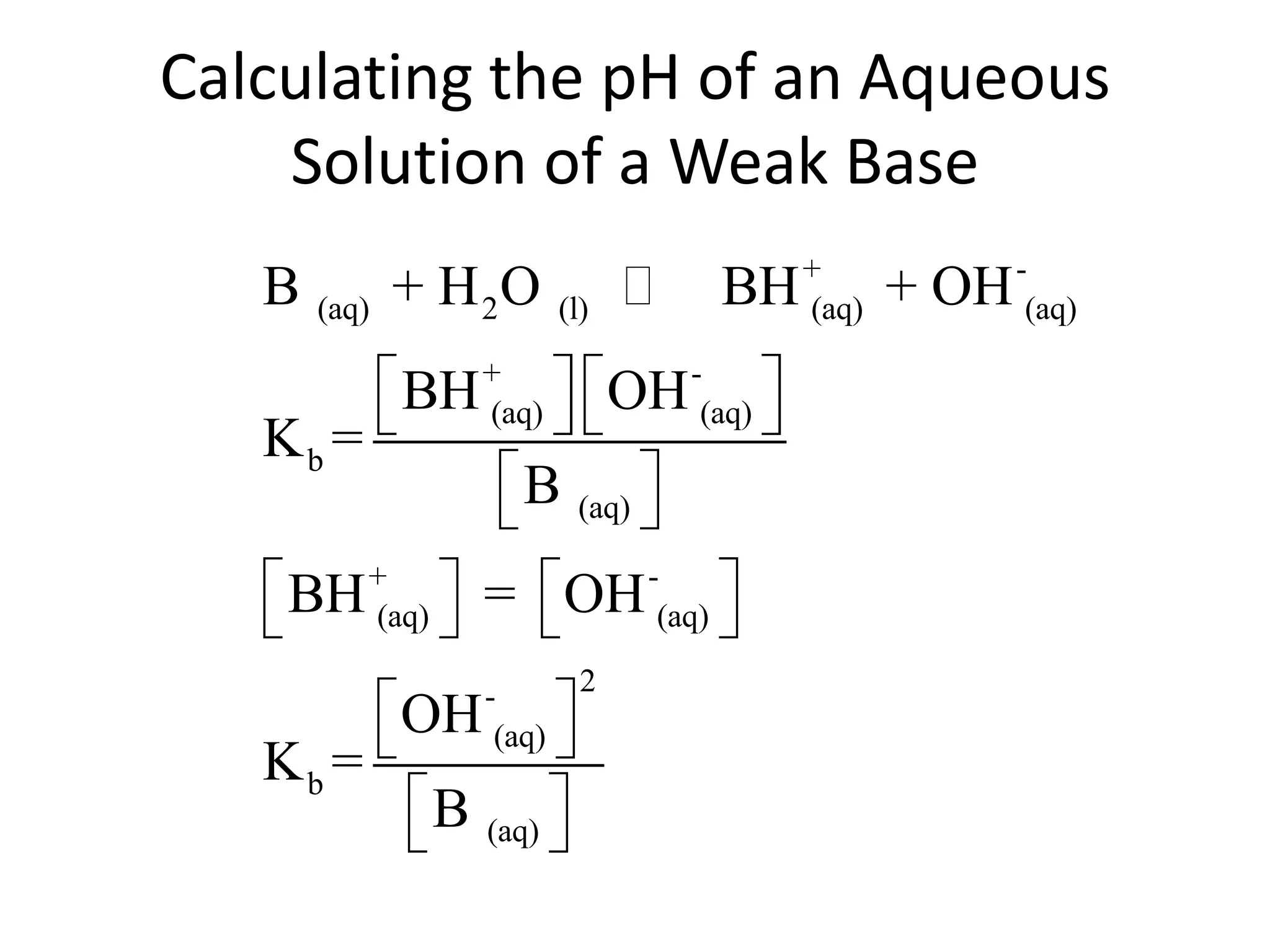
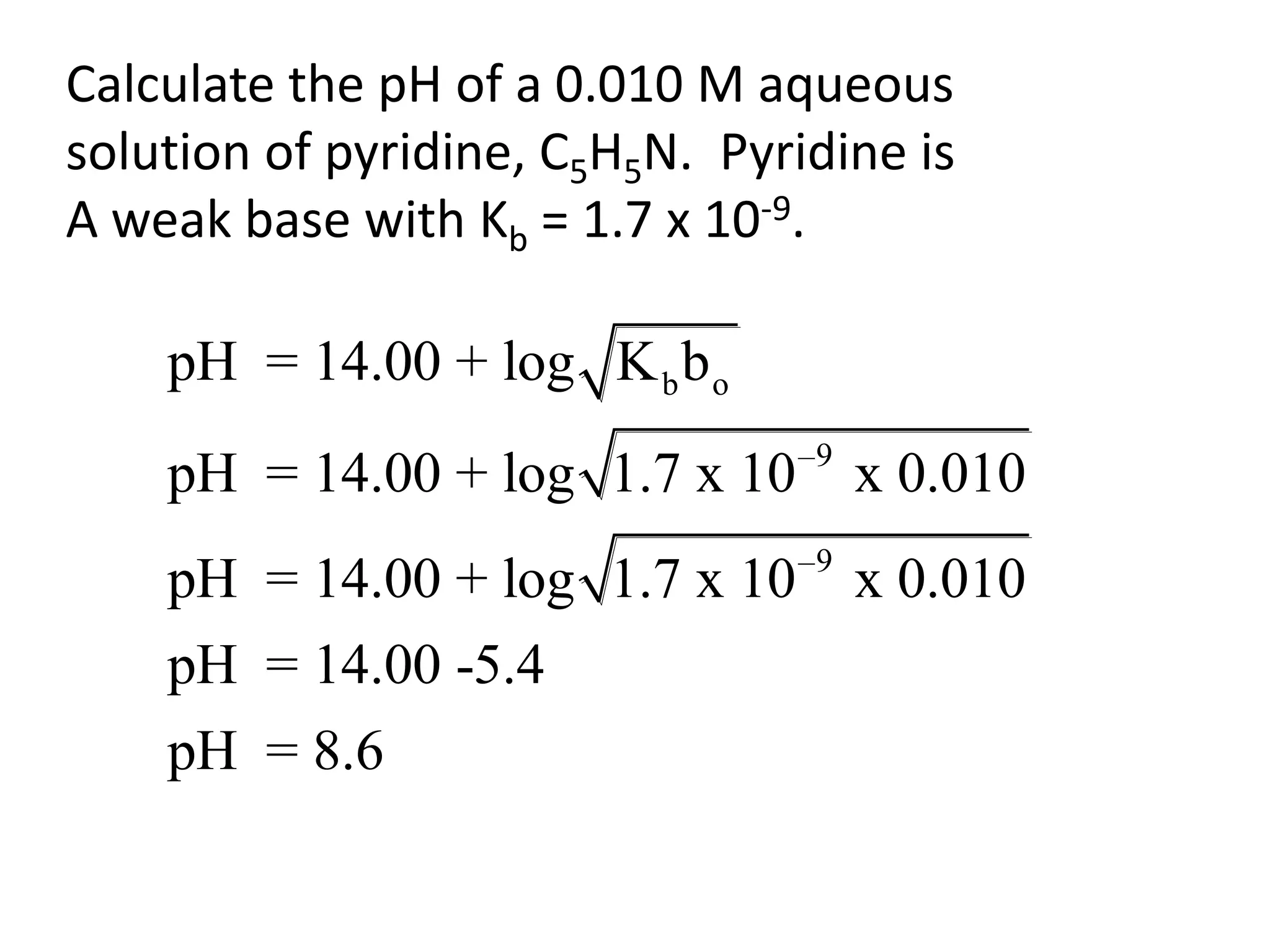
Calculating the pH of an Aqueous Solution of a Weak Base
Calculate the pH of a 0.010 M aqueous solution of pyridine, C5H5N.  Pyridine is A weak base with Kb = 1.7 x 10⁻⁹.
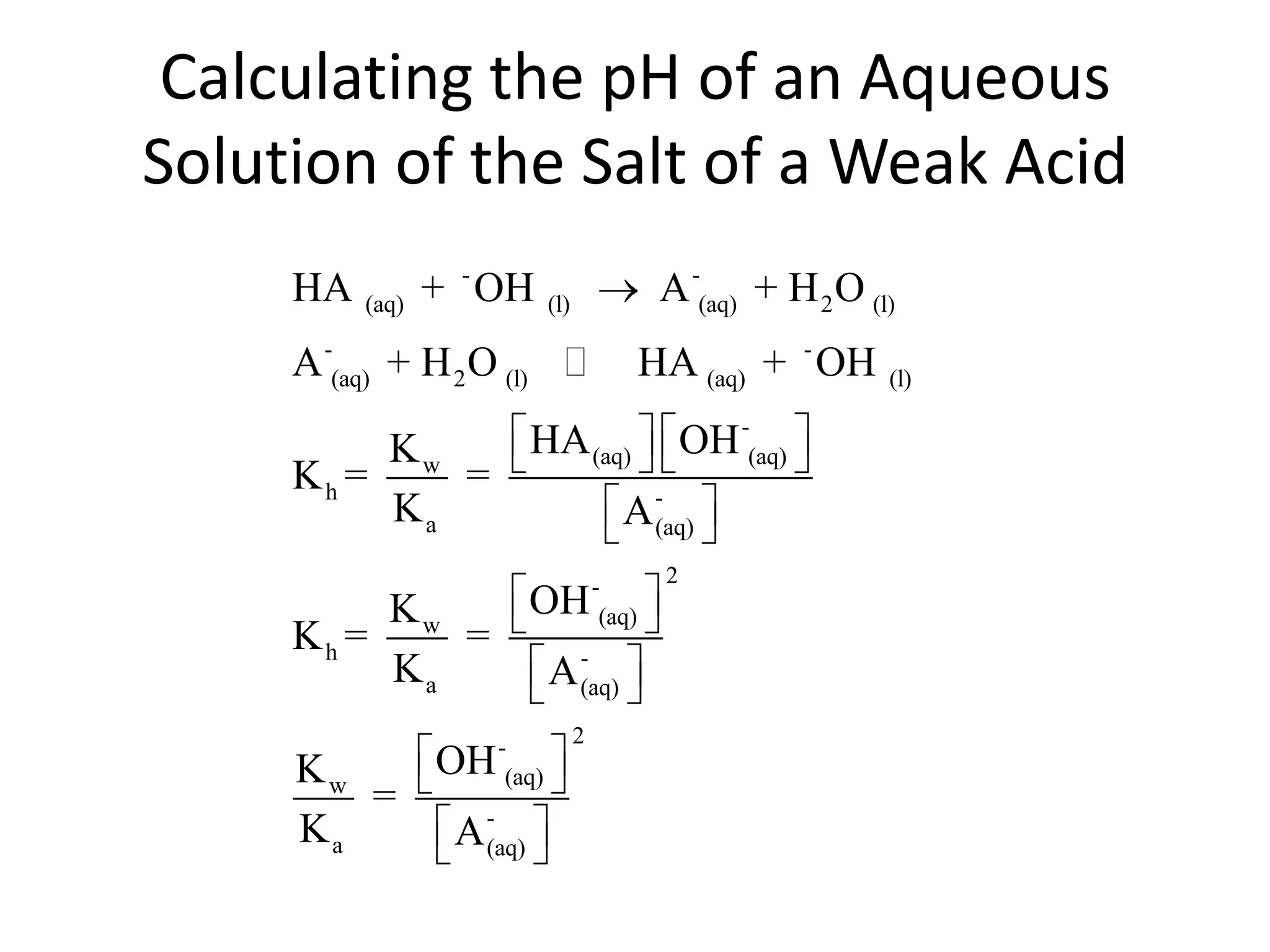
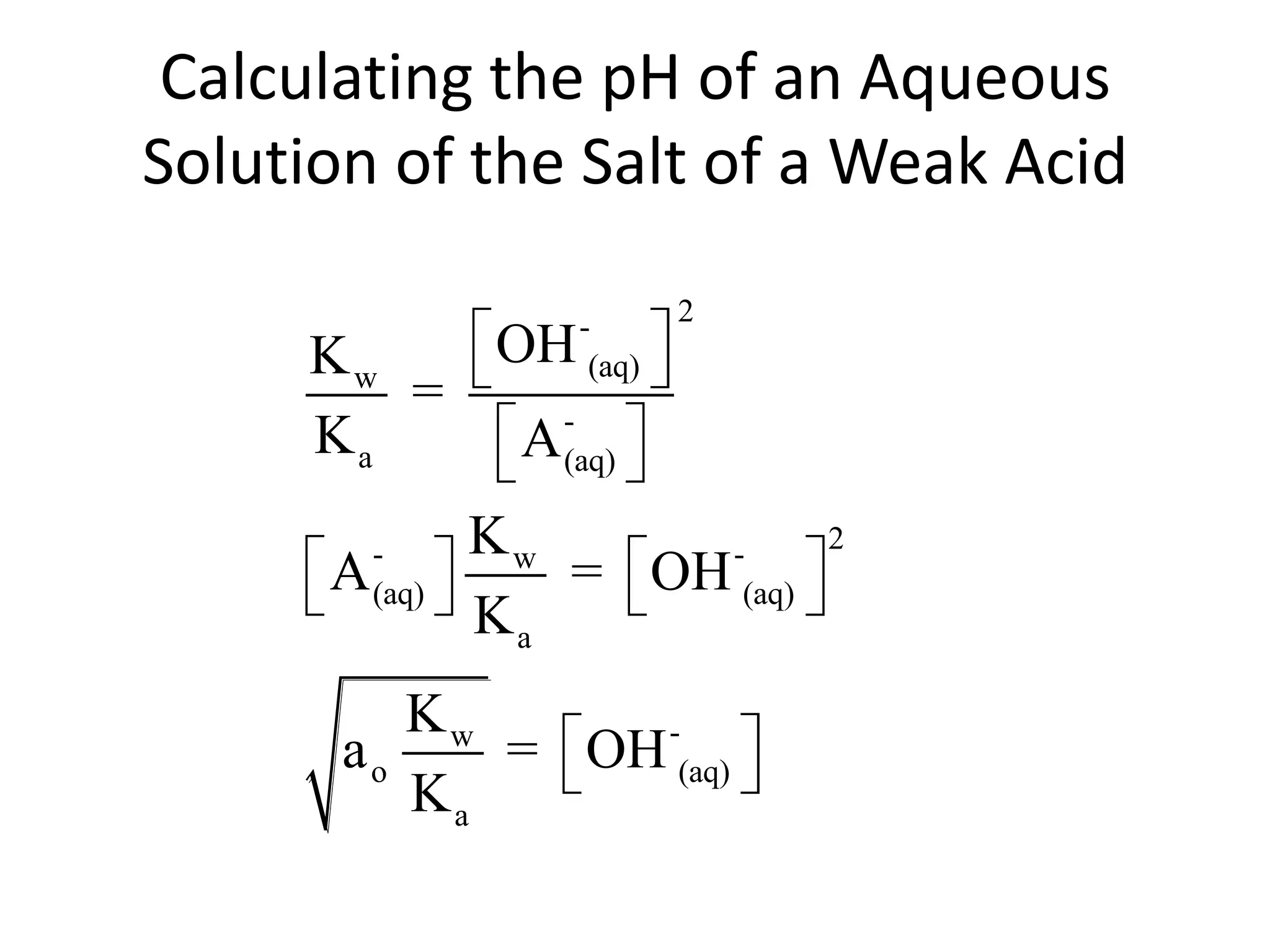
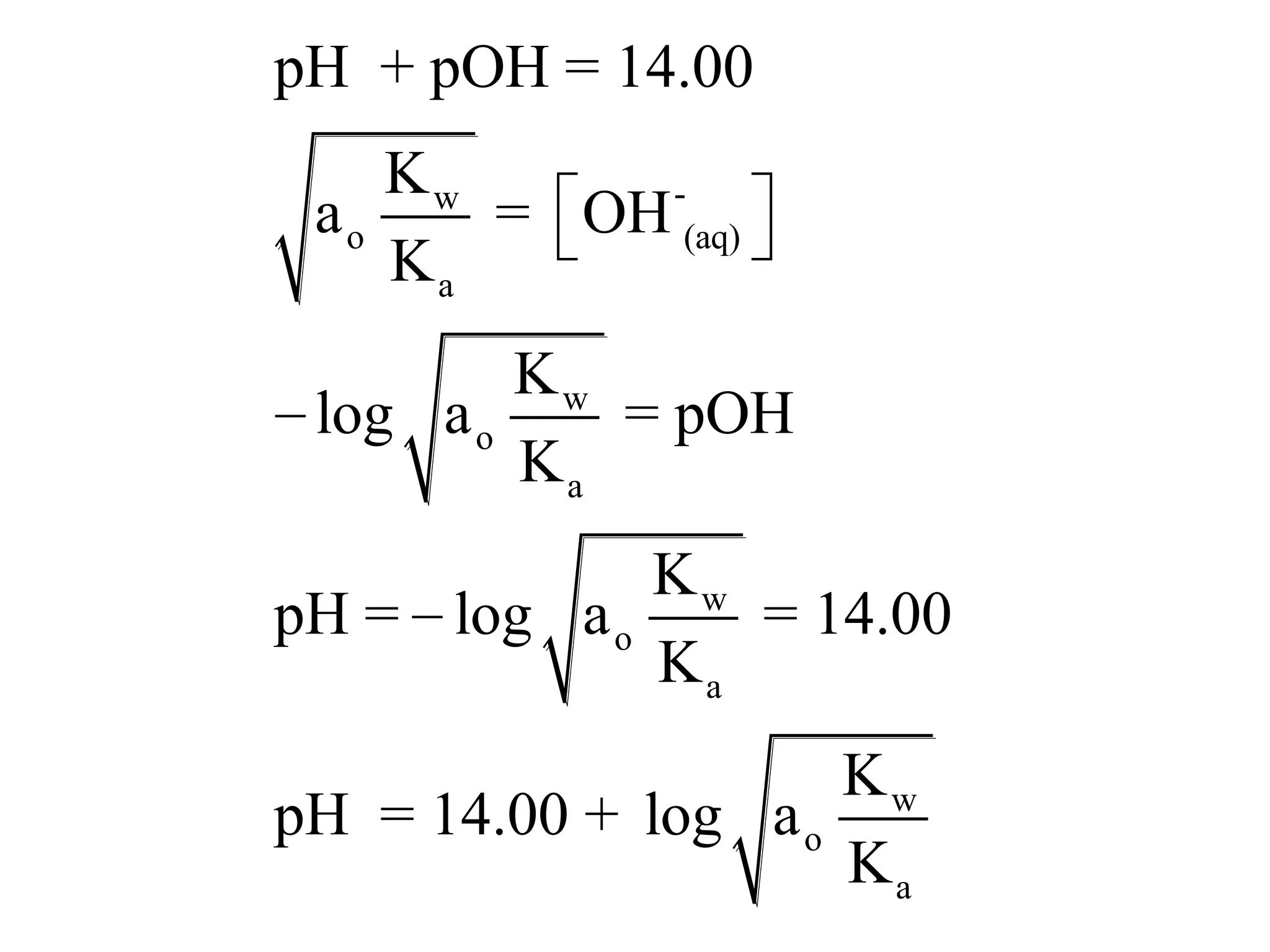
Calculating the pH of an Aqueous Solution of the Salt of a Weak Acid
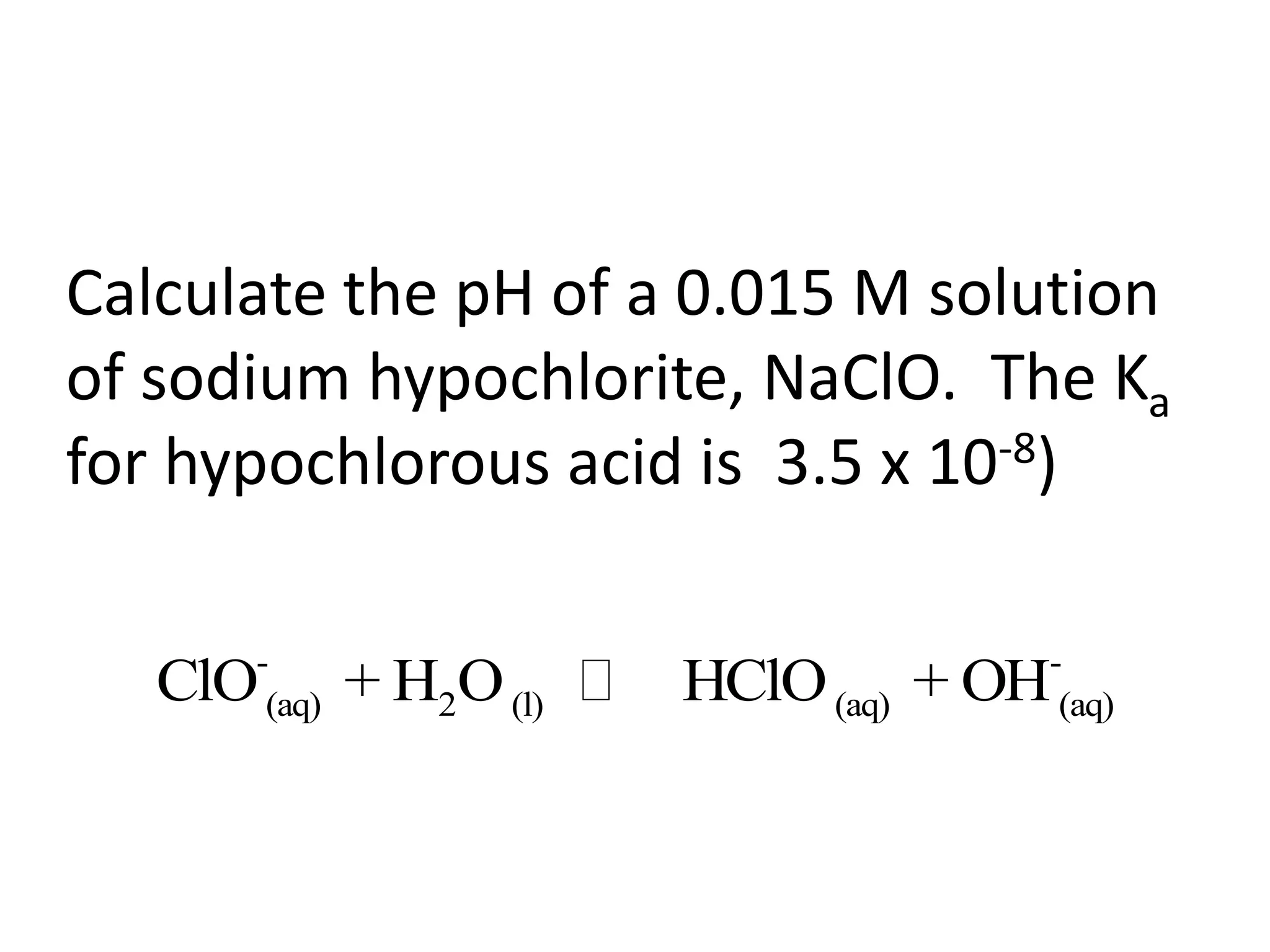
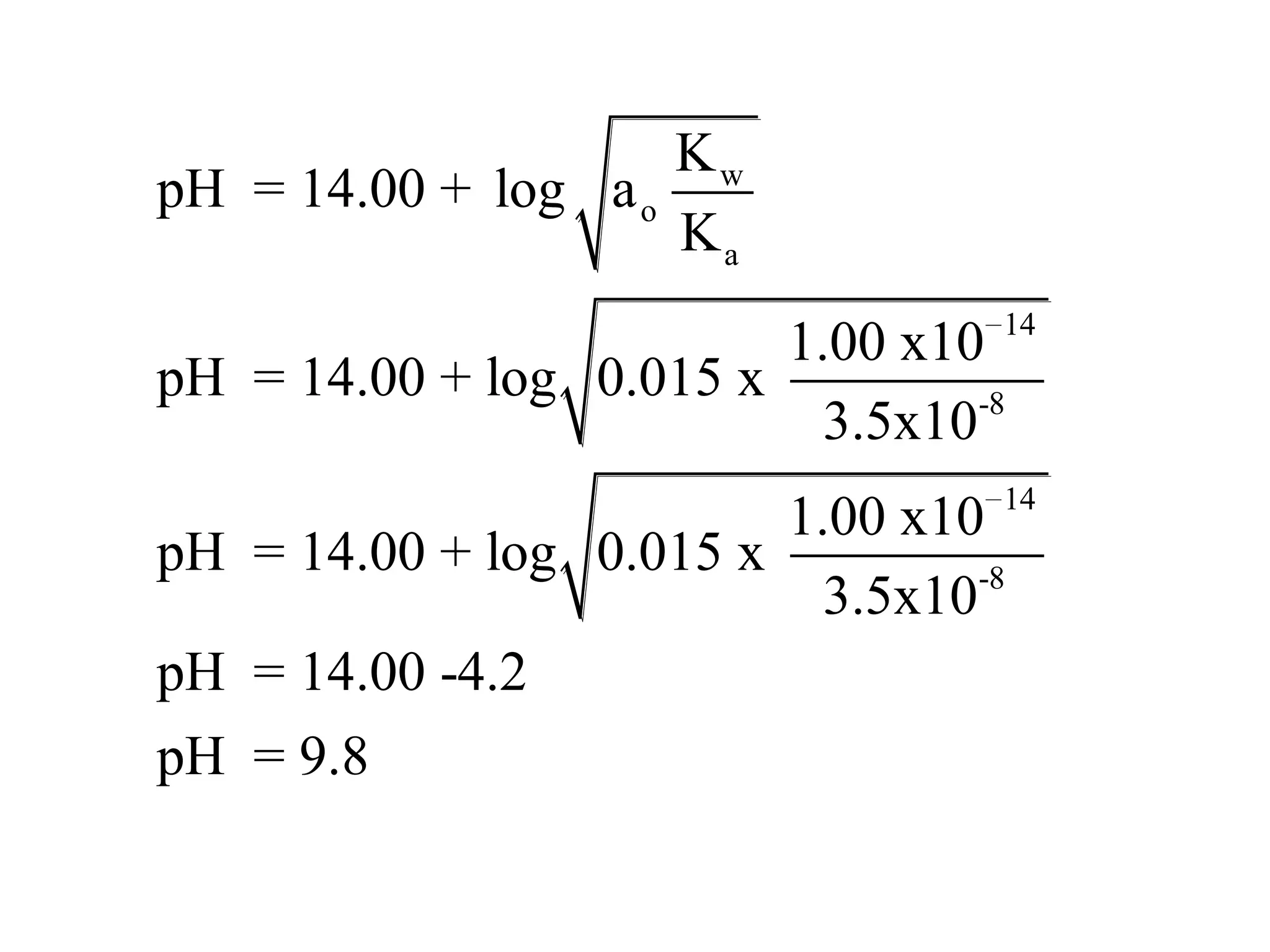
Calculate the pH of a 0.015 M solution of sodium hypochlorite, NaClO.  The Ka  for hypochlorous acid is  3.5 x 10⁻⁸)
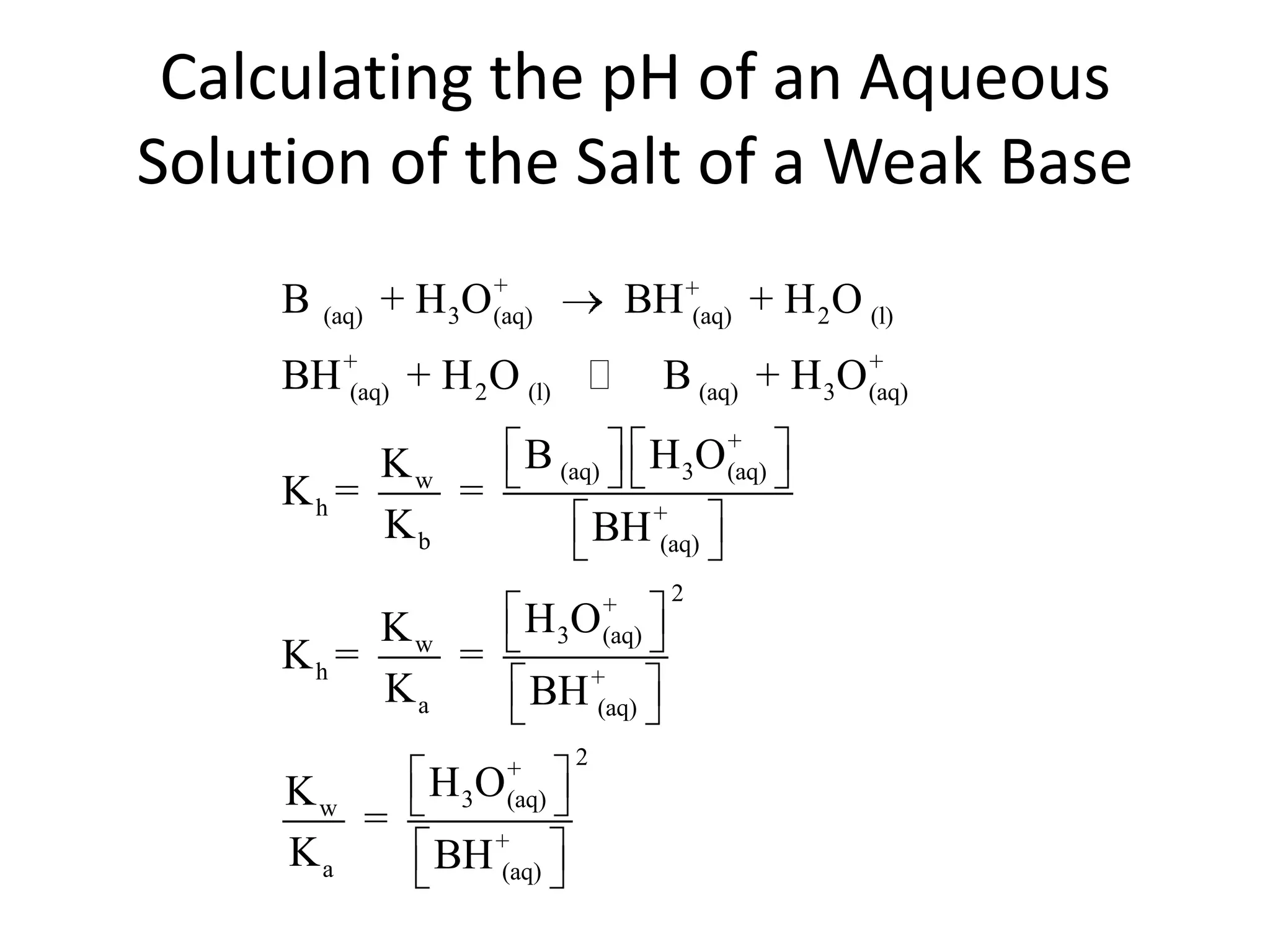
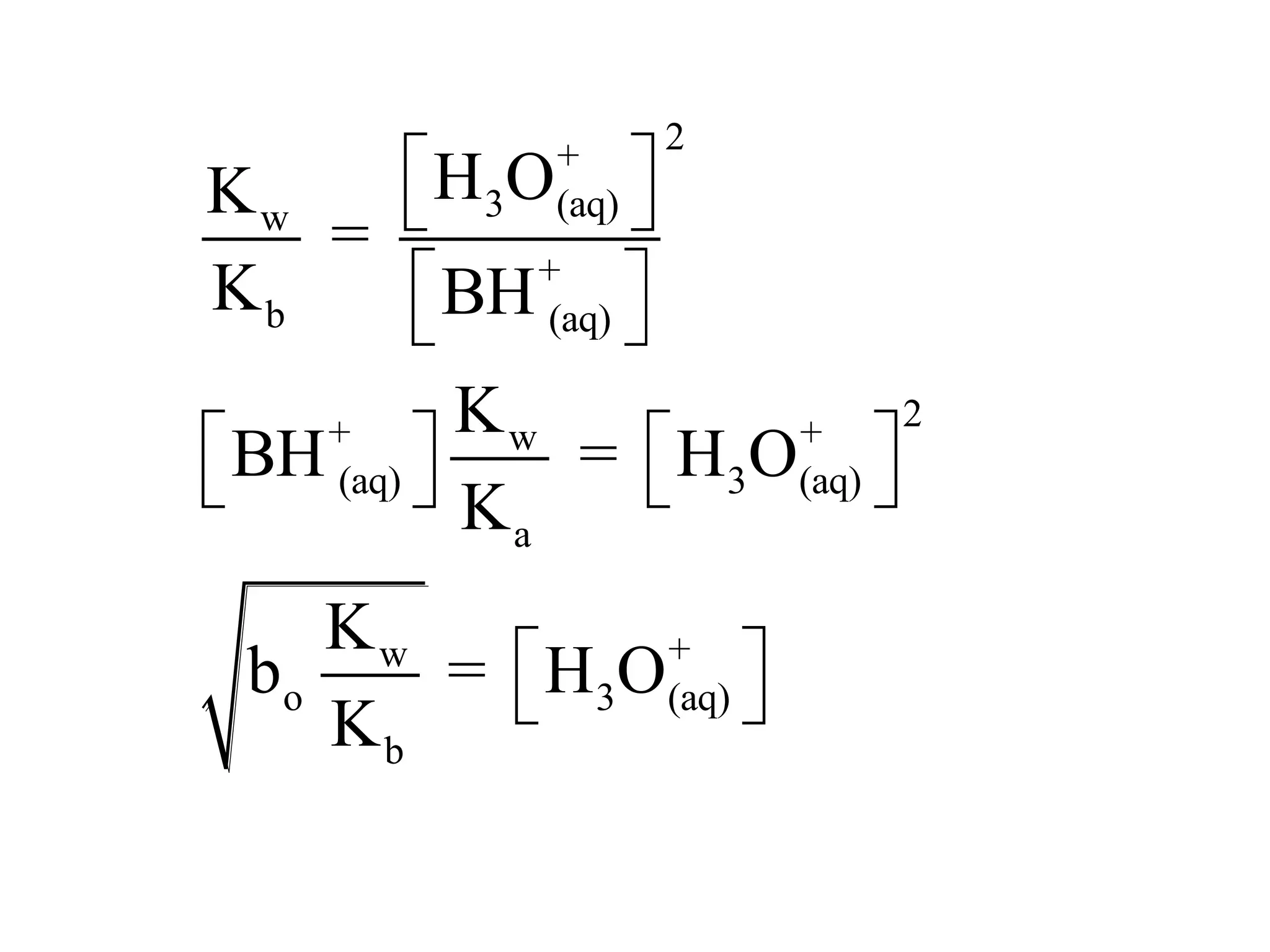
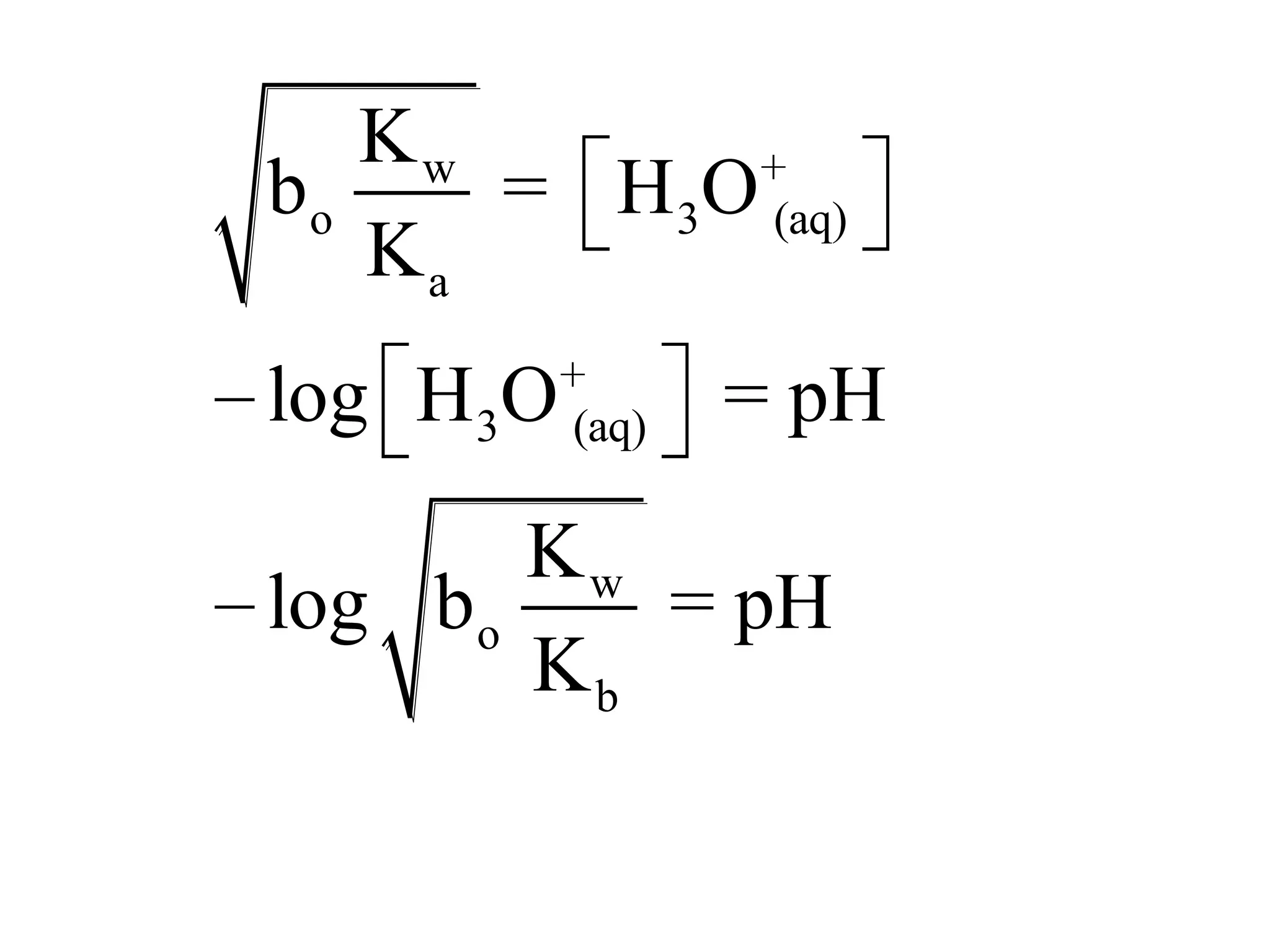
Calculating the pH of an Aqueous Solution of the Salt of a Weak Base
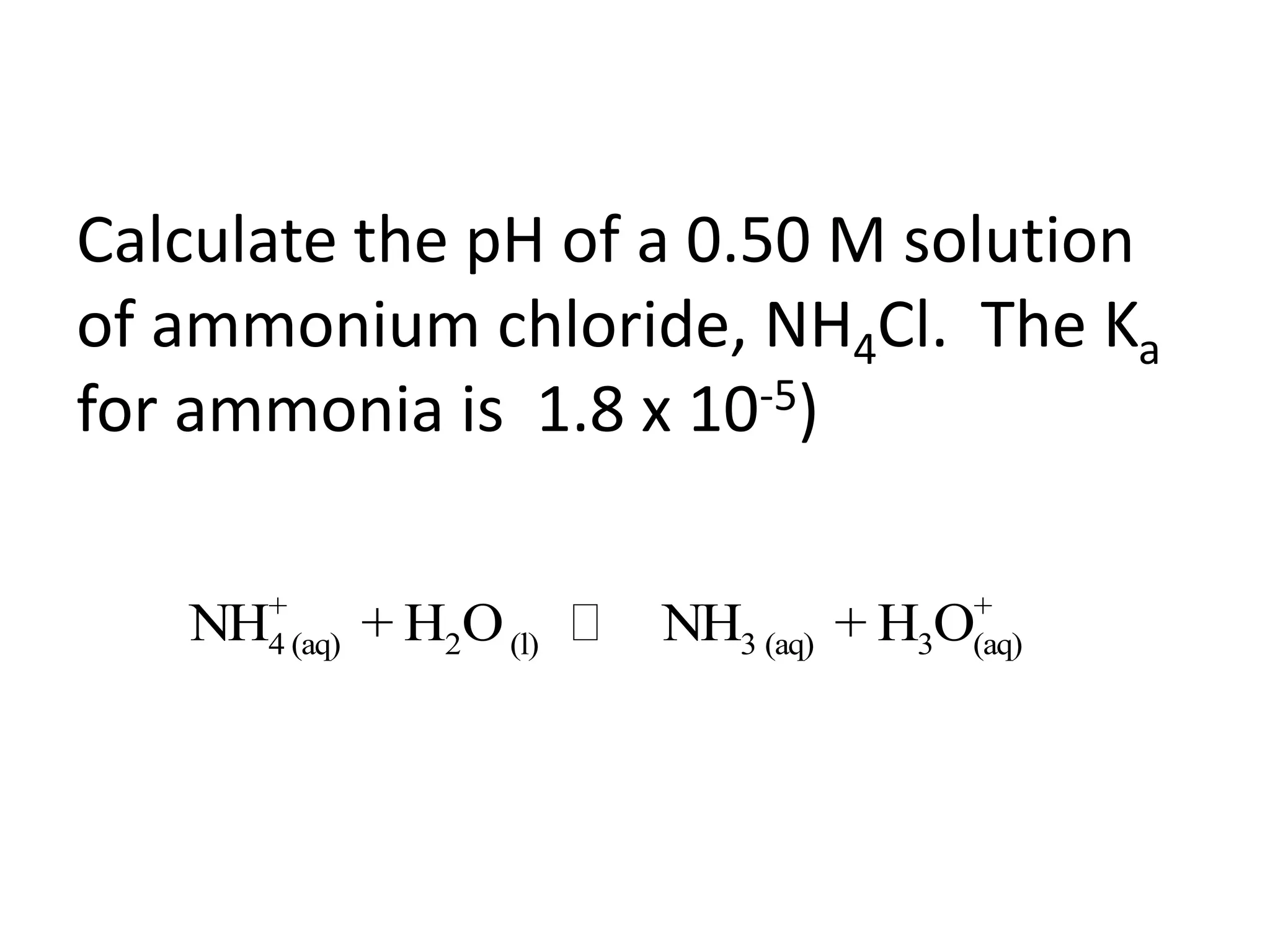
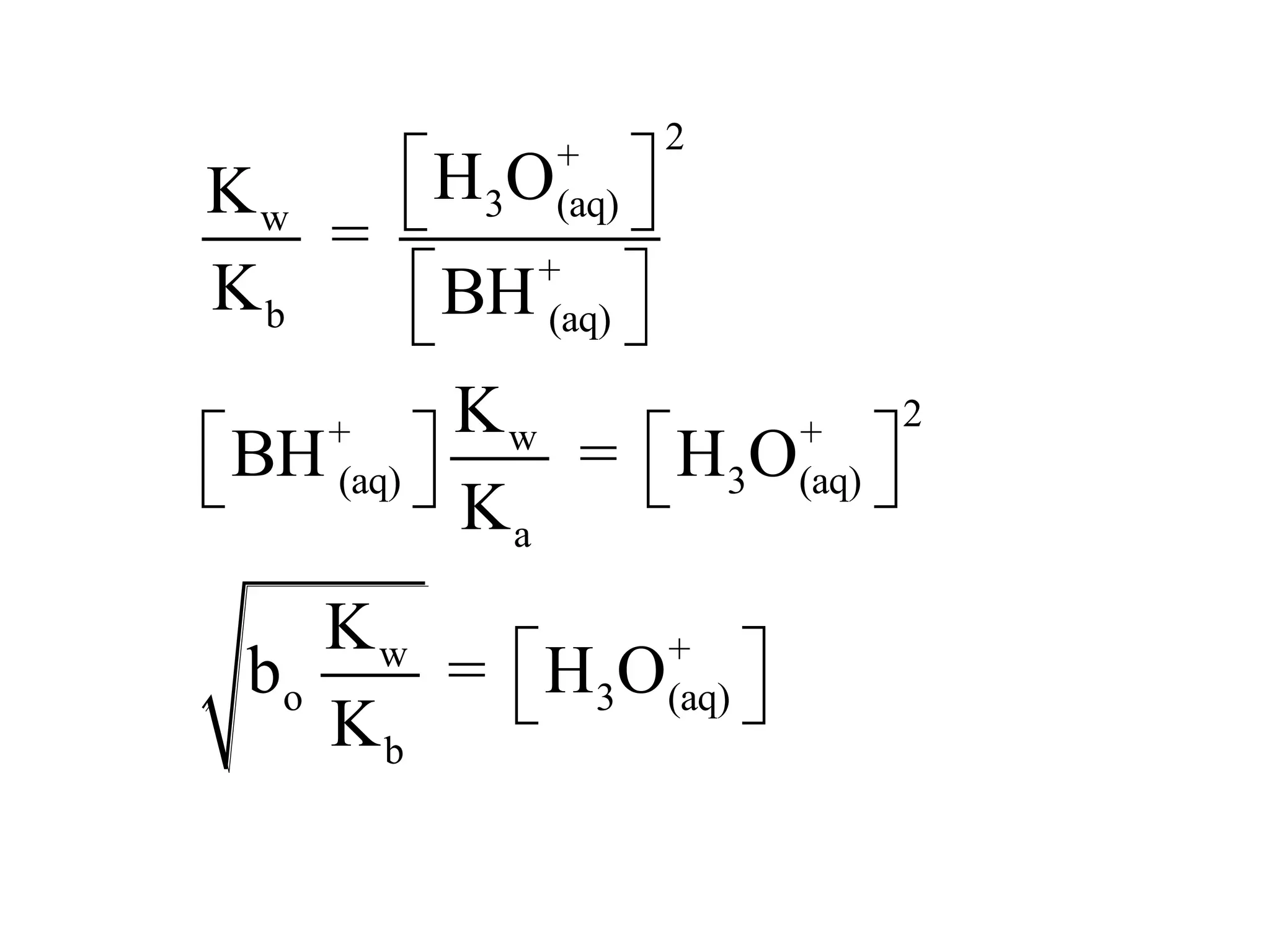
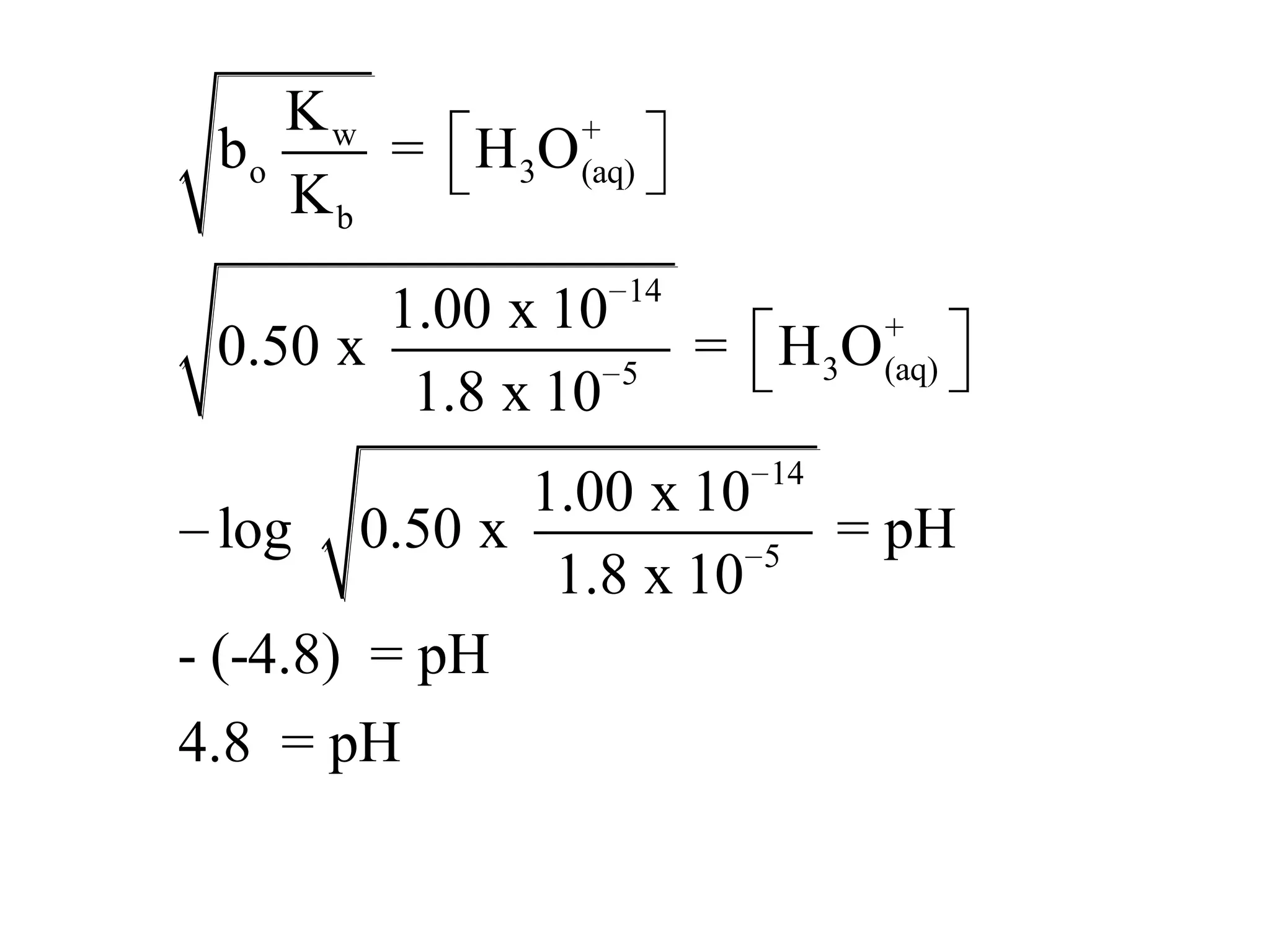
Calculate the pH of a 0.50 M solution of ammonium chloride, NH4Cl.  The Ka  for ammonia is  1.8 x 10⁻⁵)
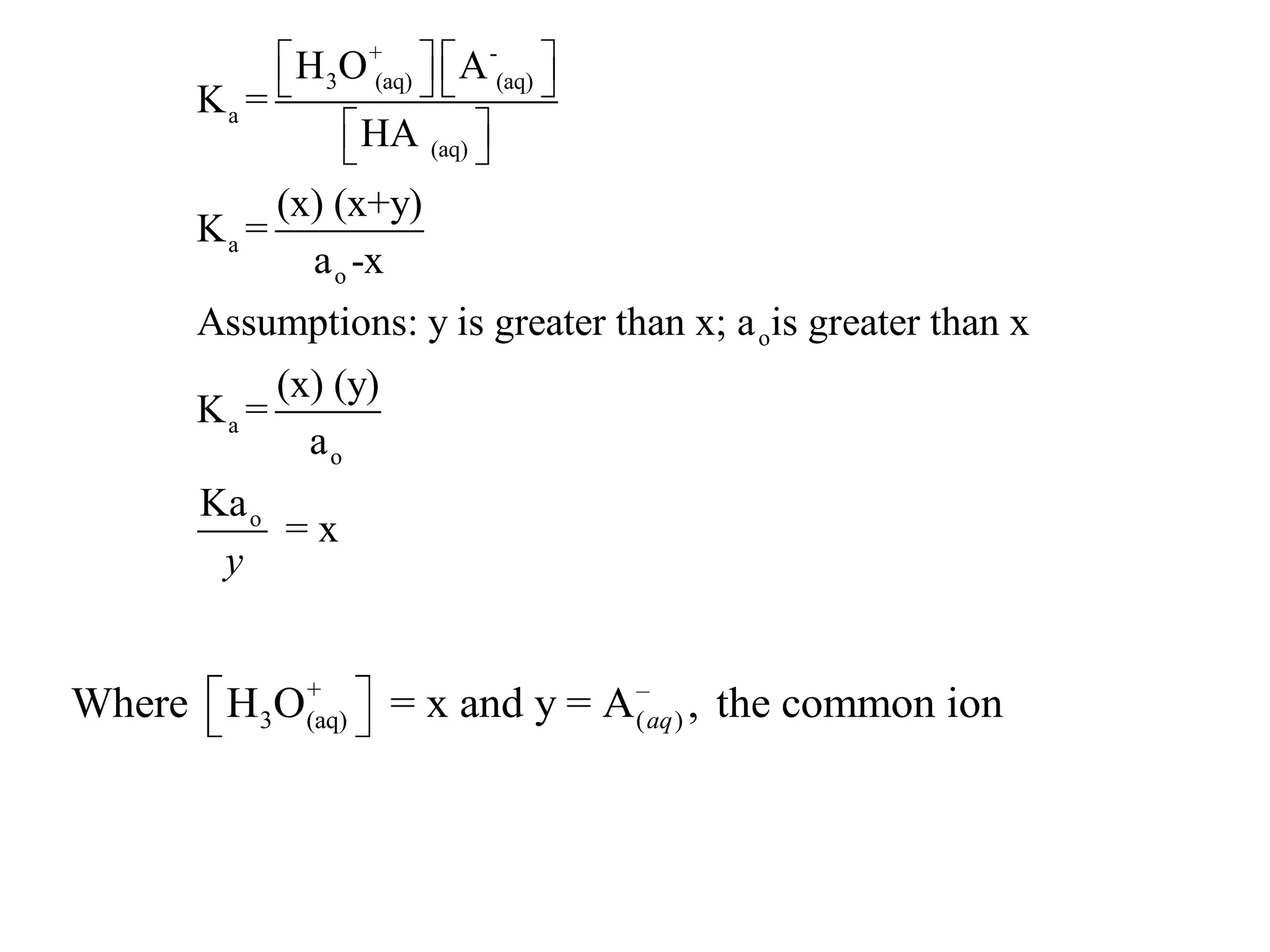
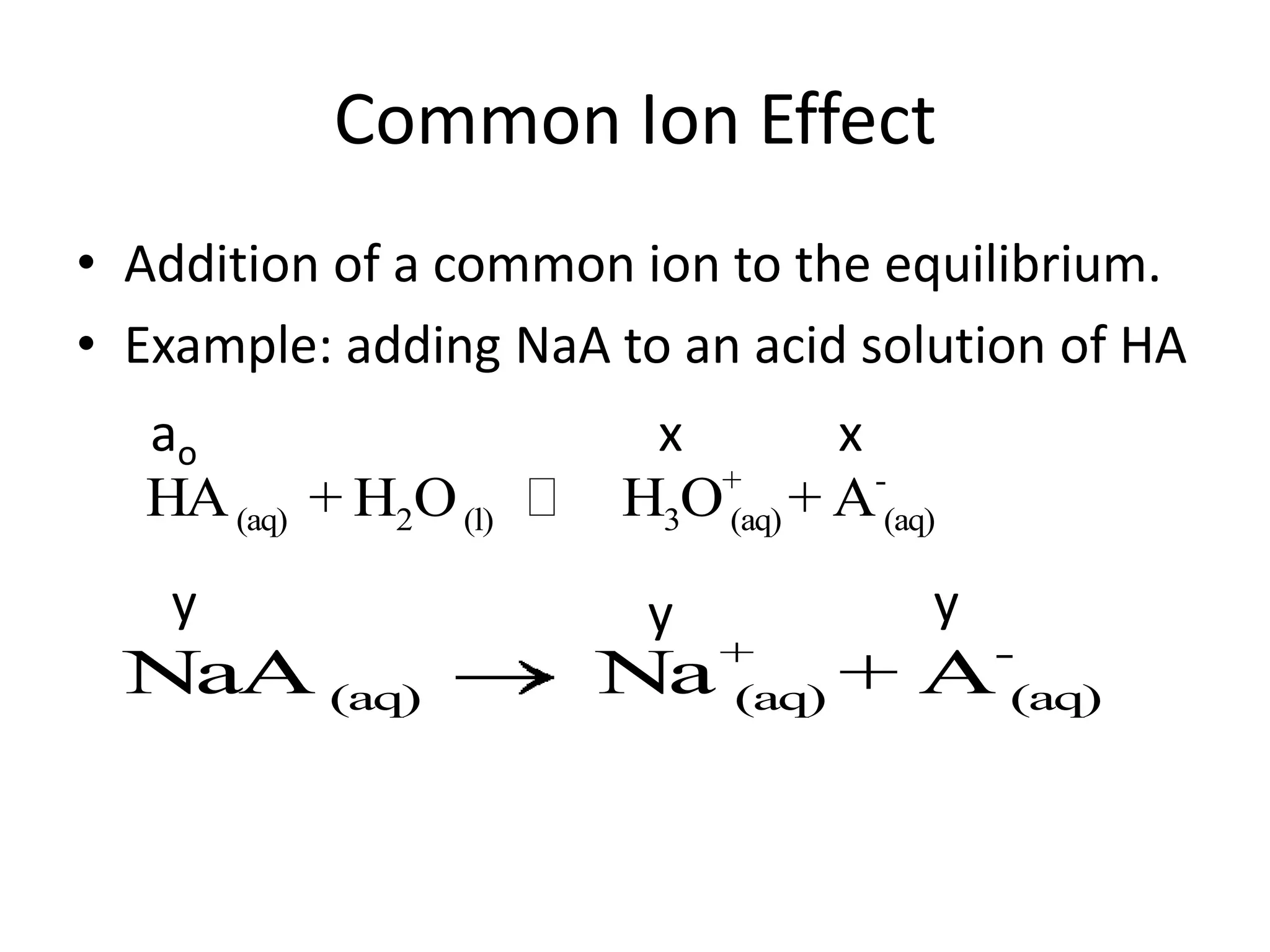
Common Ion EffectAddition of a common ion to the equilibrium.Example: adding NaA to an acid solution of HAaoxxyyy
Calculating the pH and the Equilibrium Concentrations of Species in Solution form from the Reactions of Anionic Bases that Produce Multi-Species in Solution
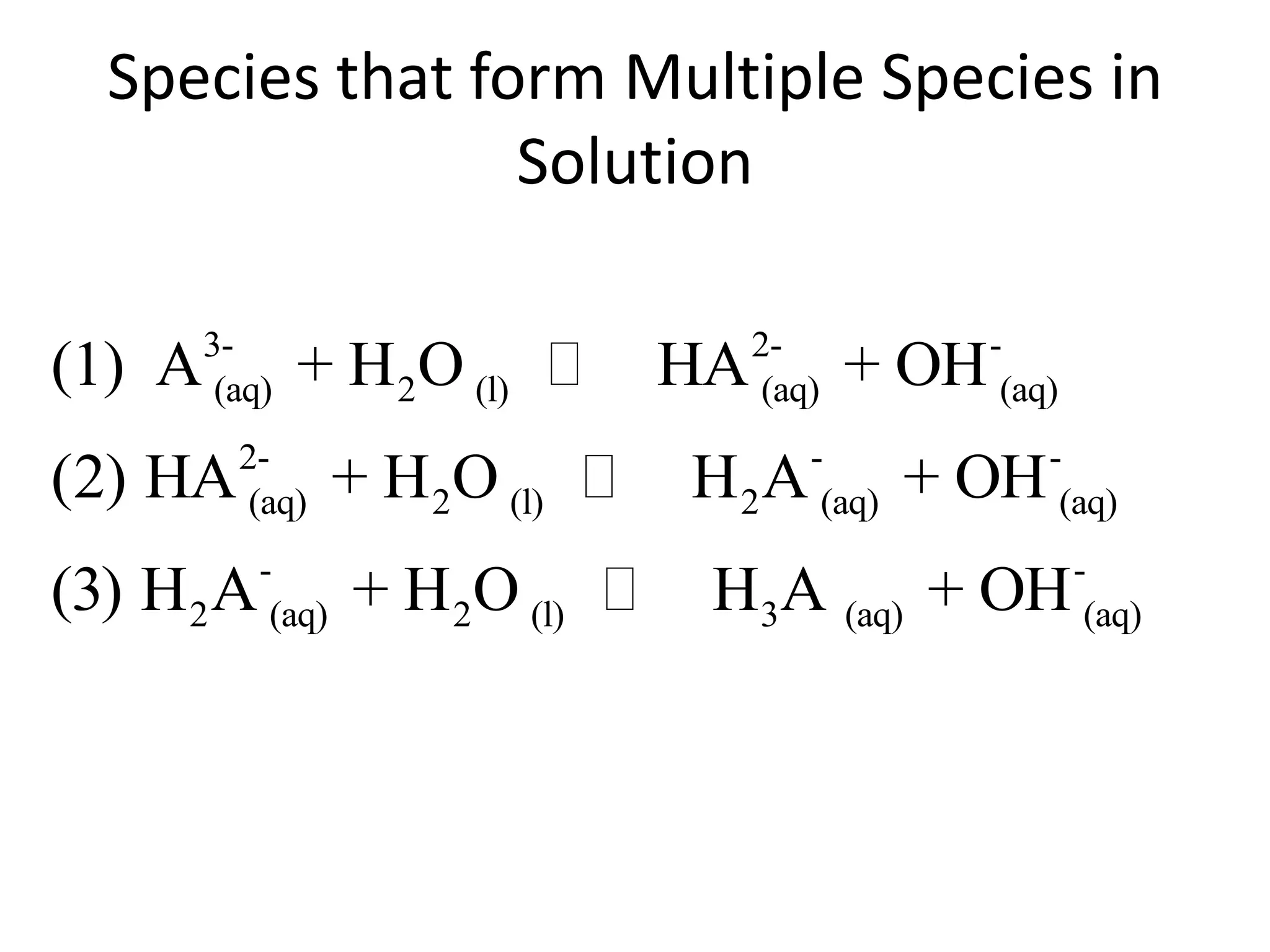
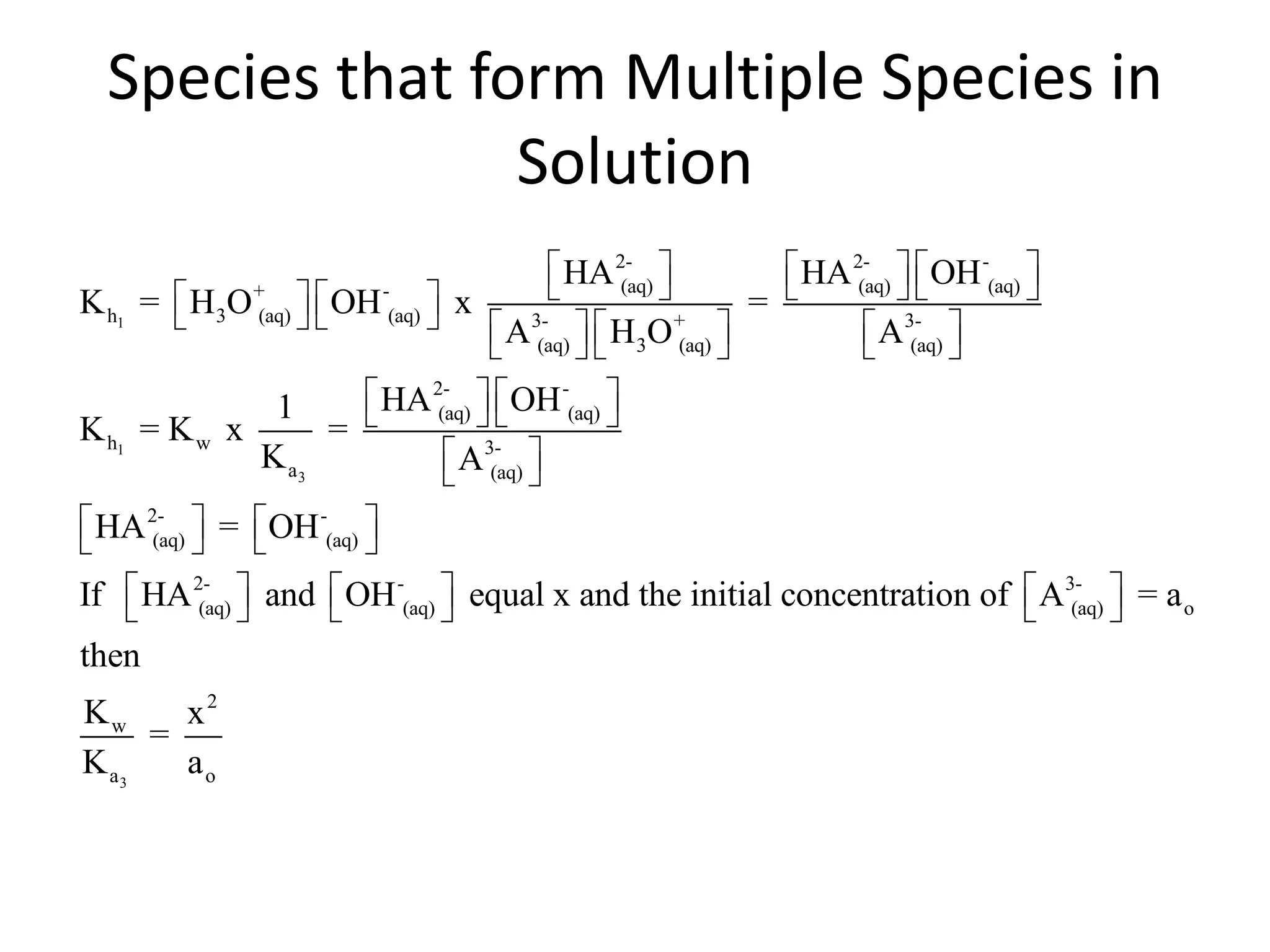
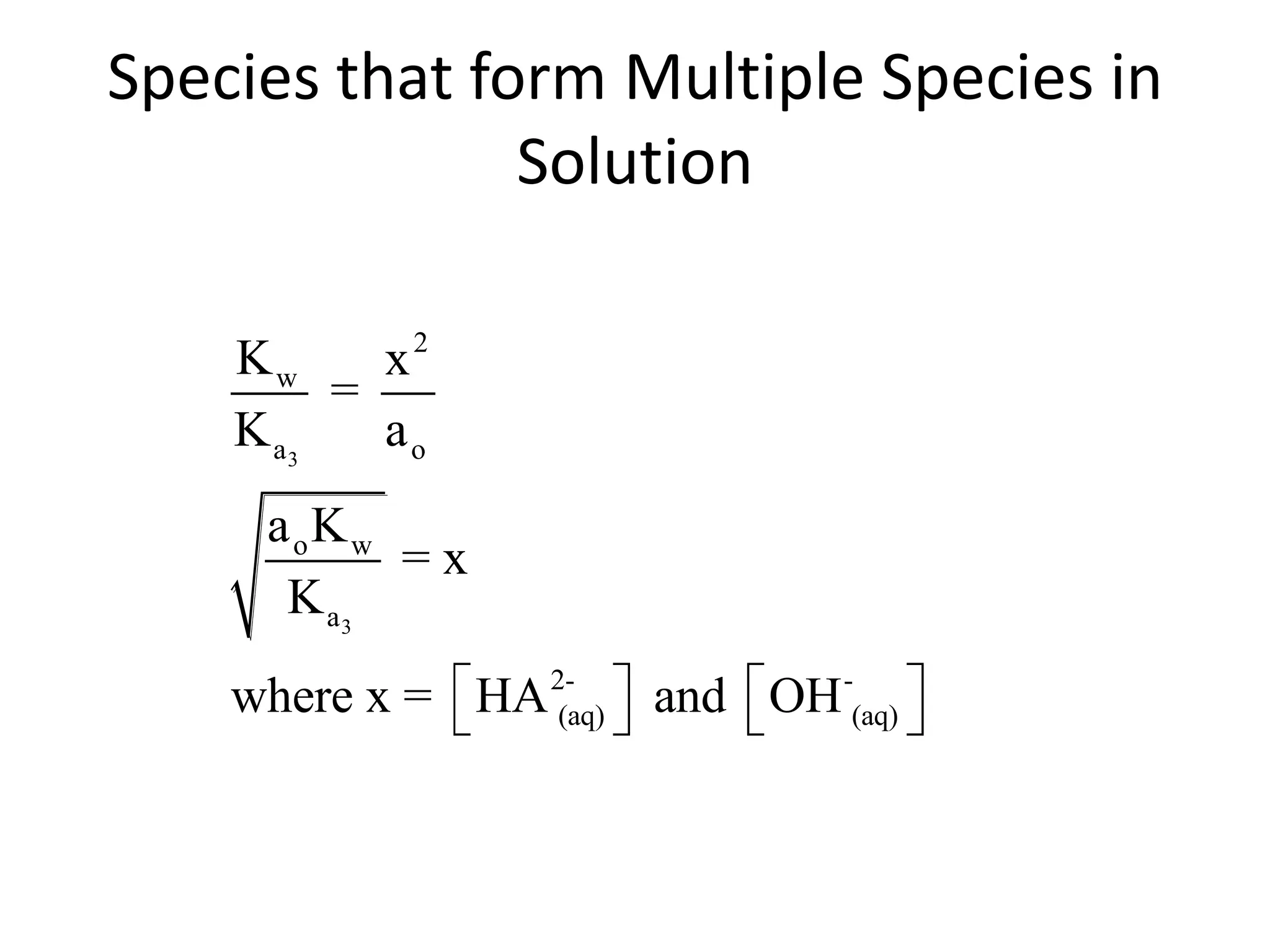
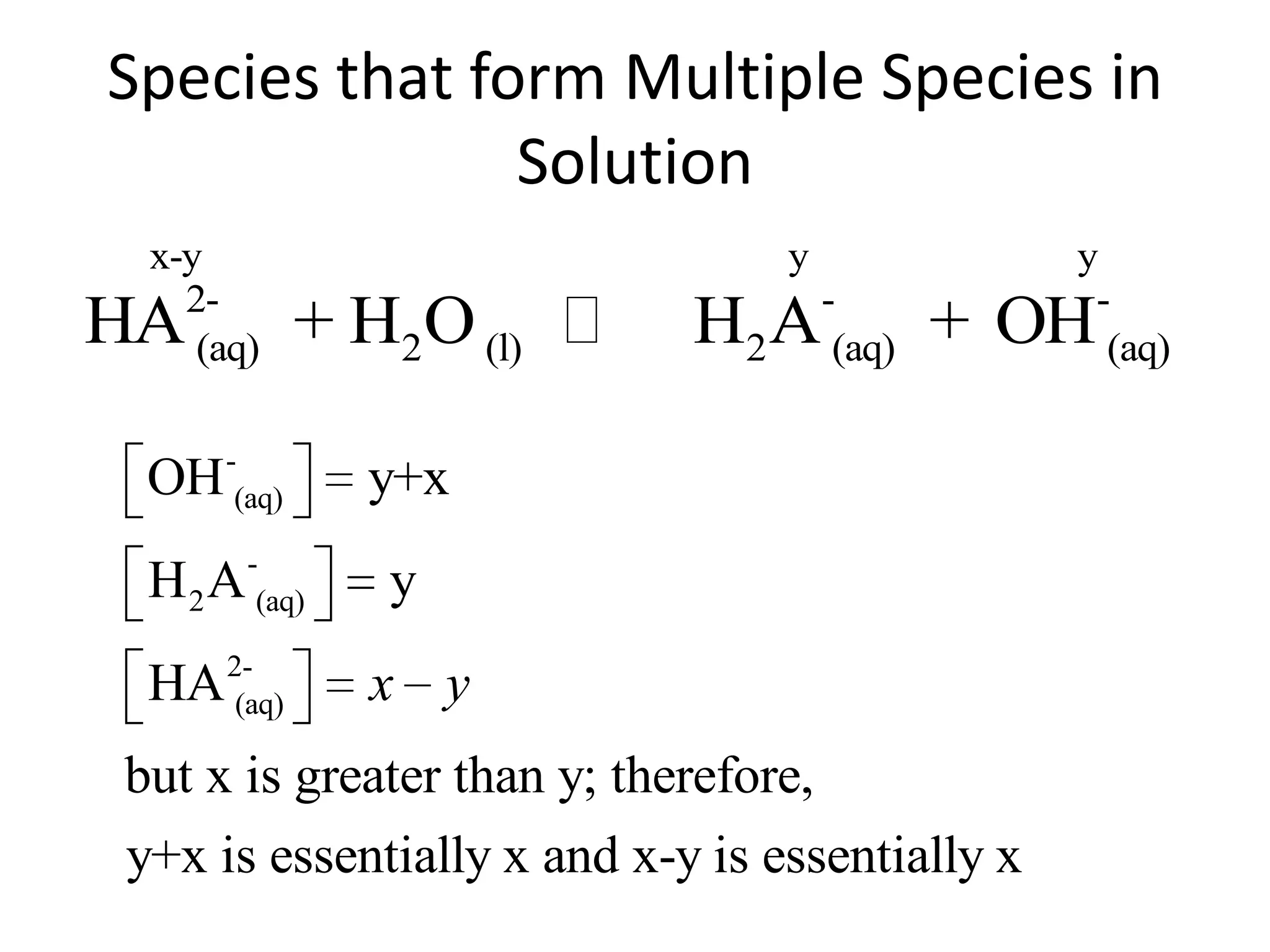
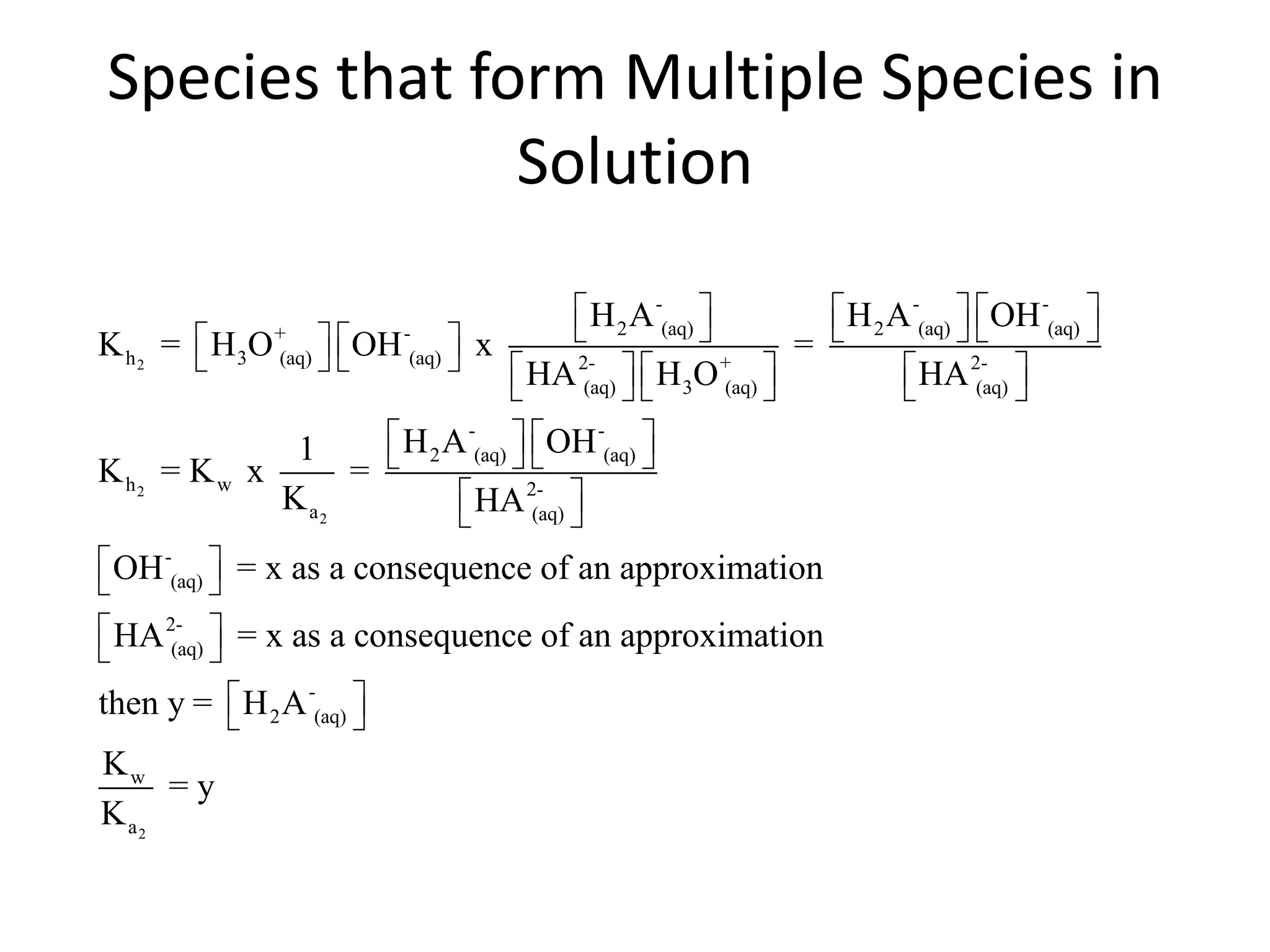
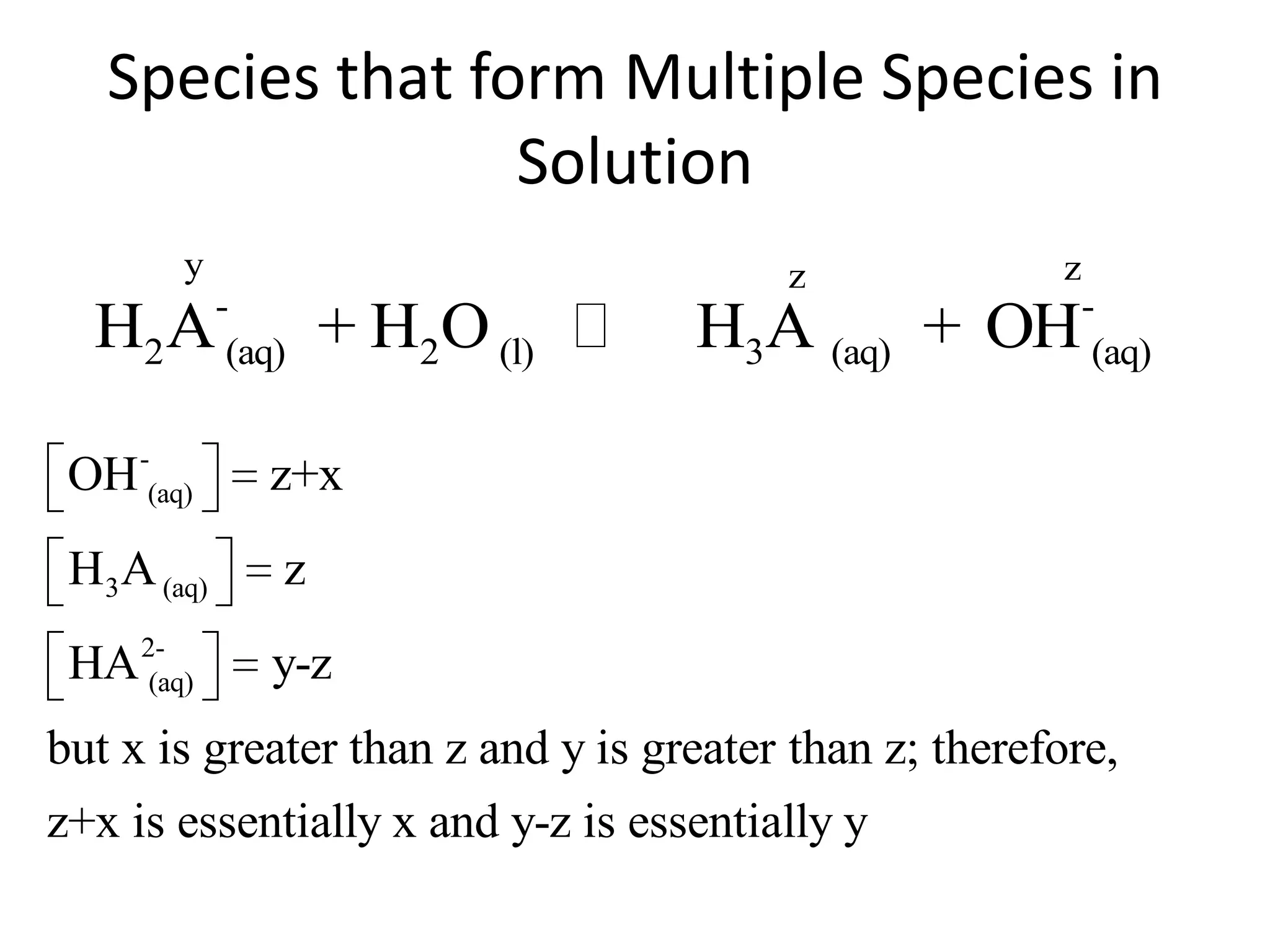
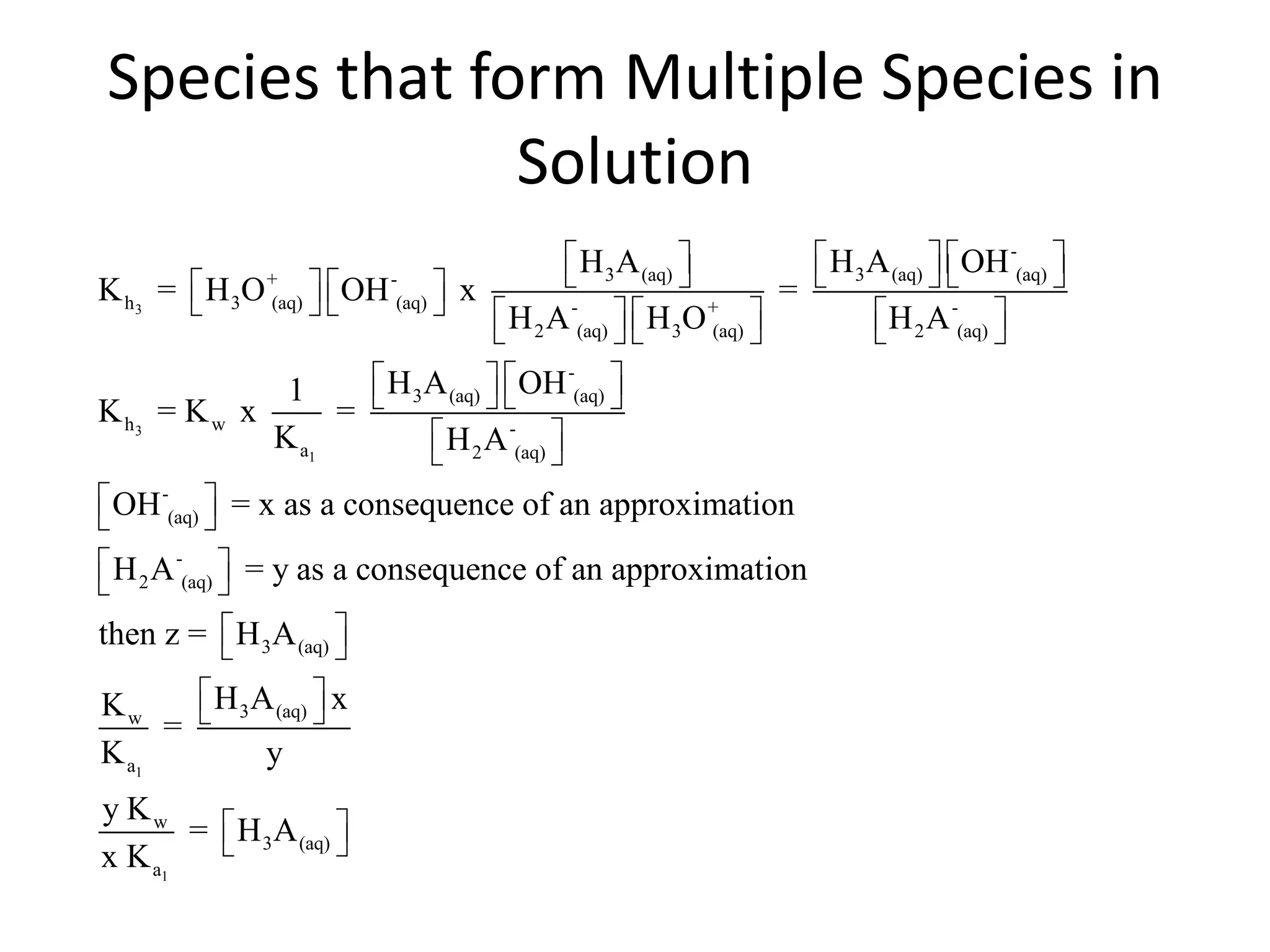
Species that form Multiple Species in Solution
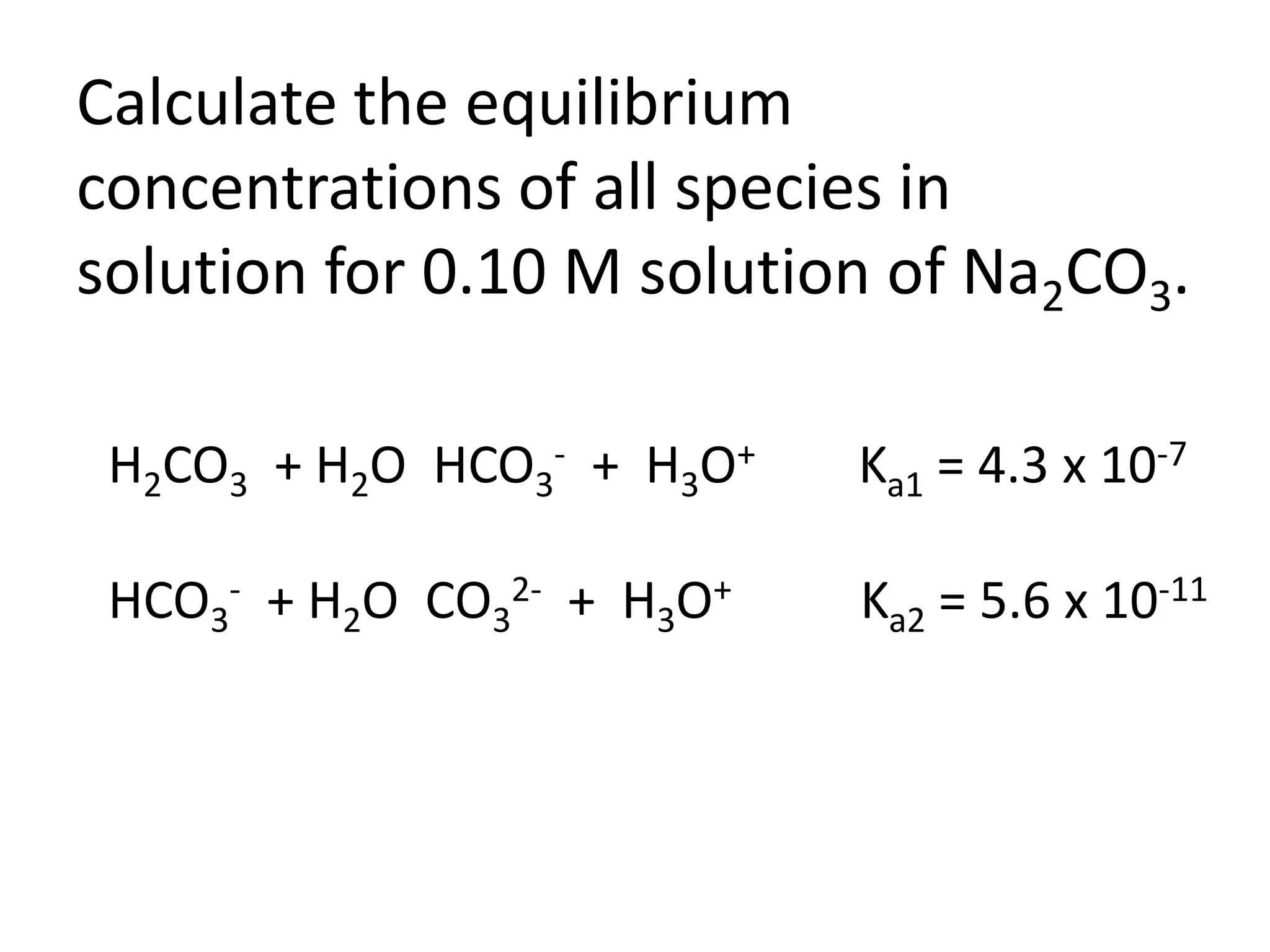
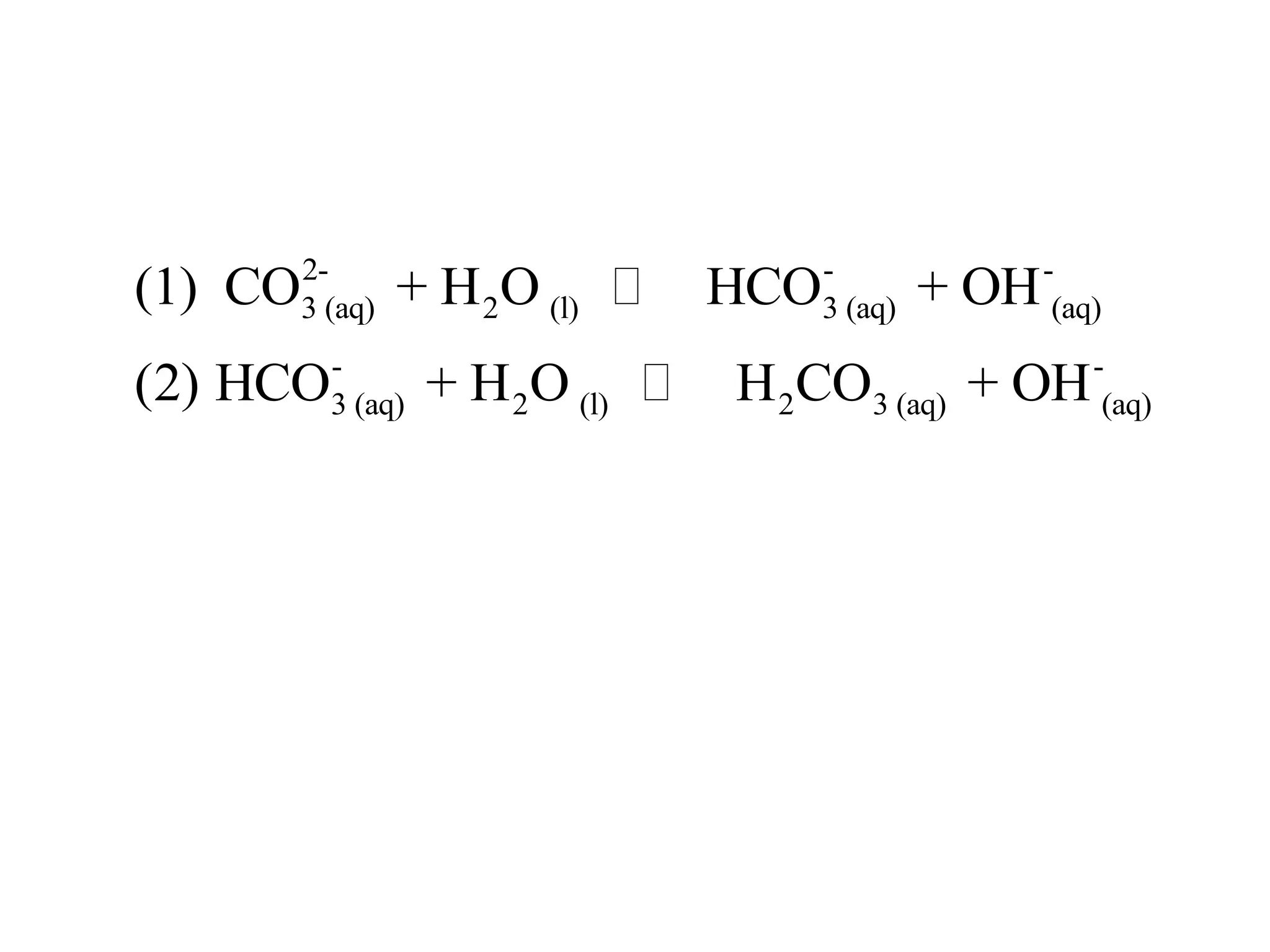
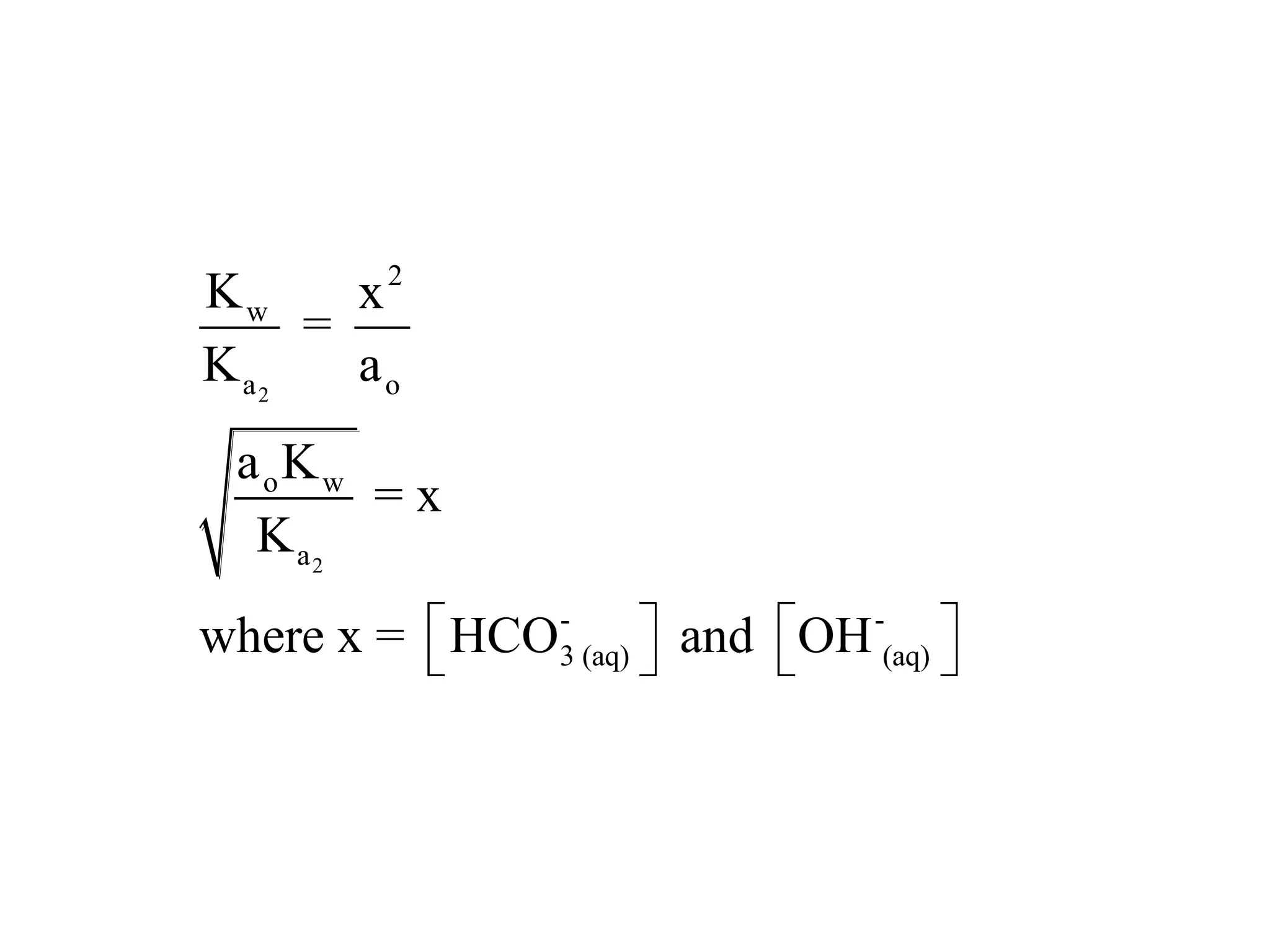
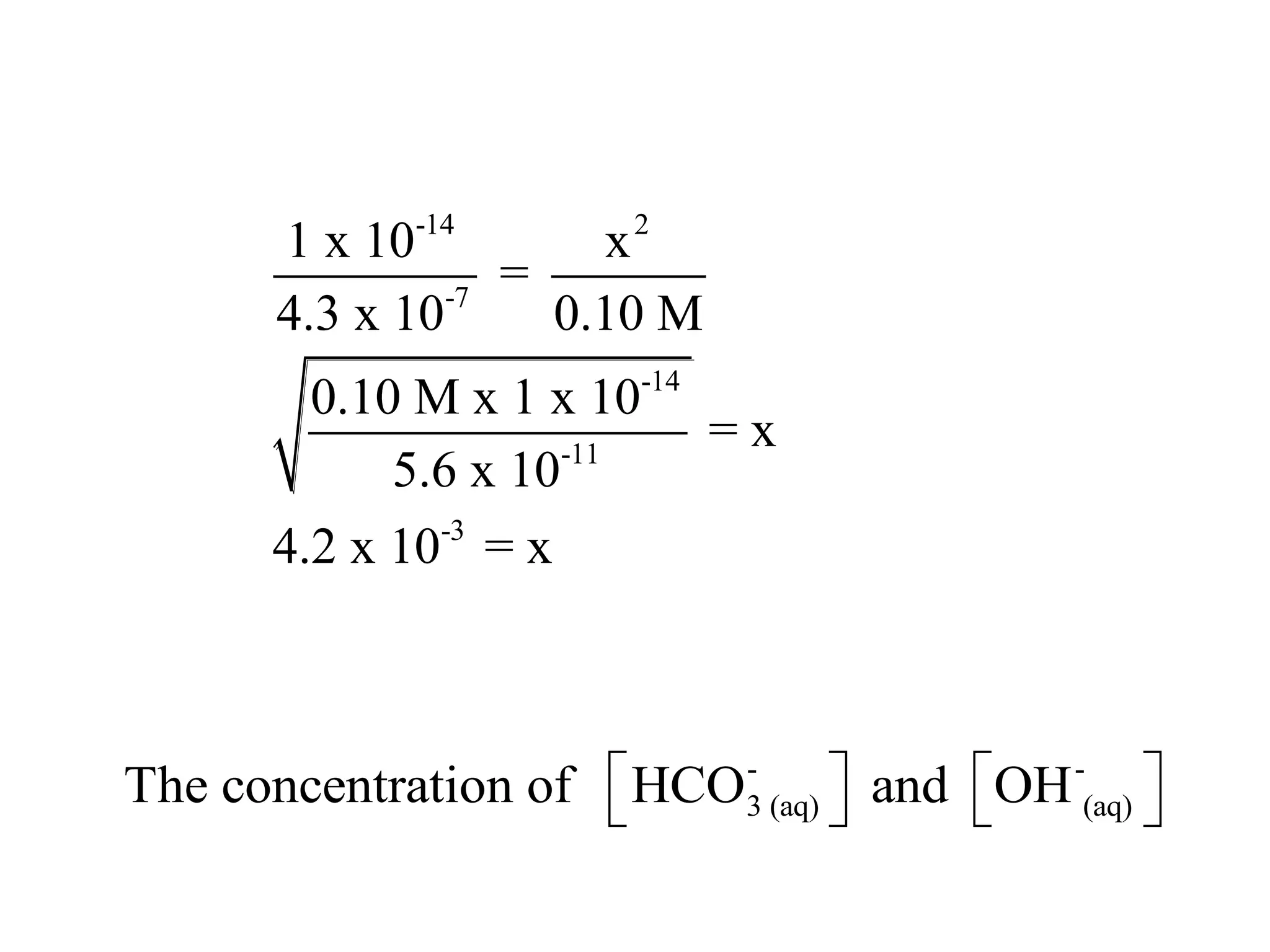
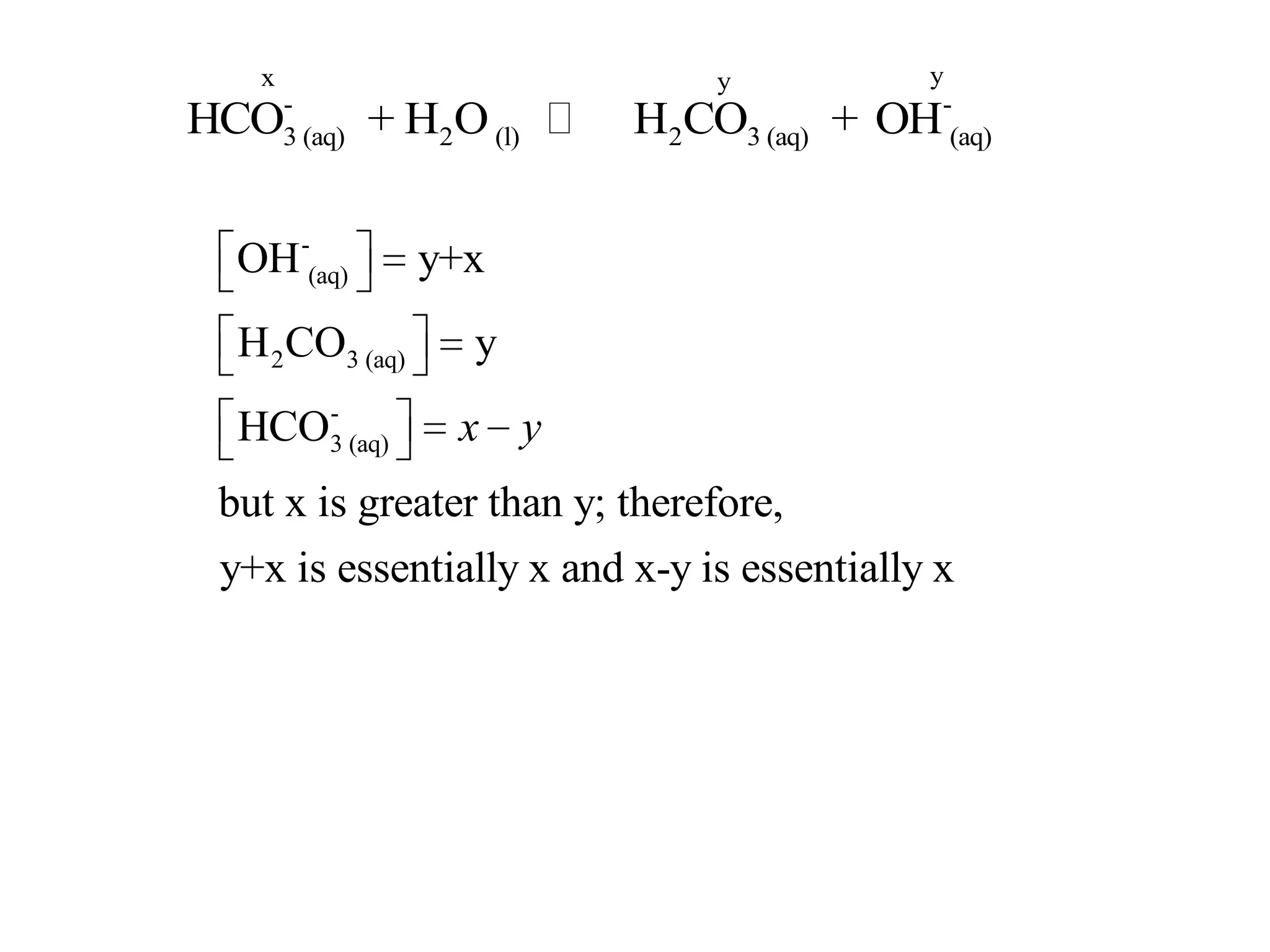
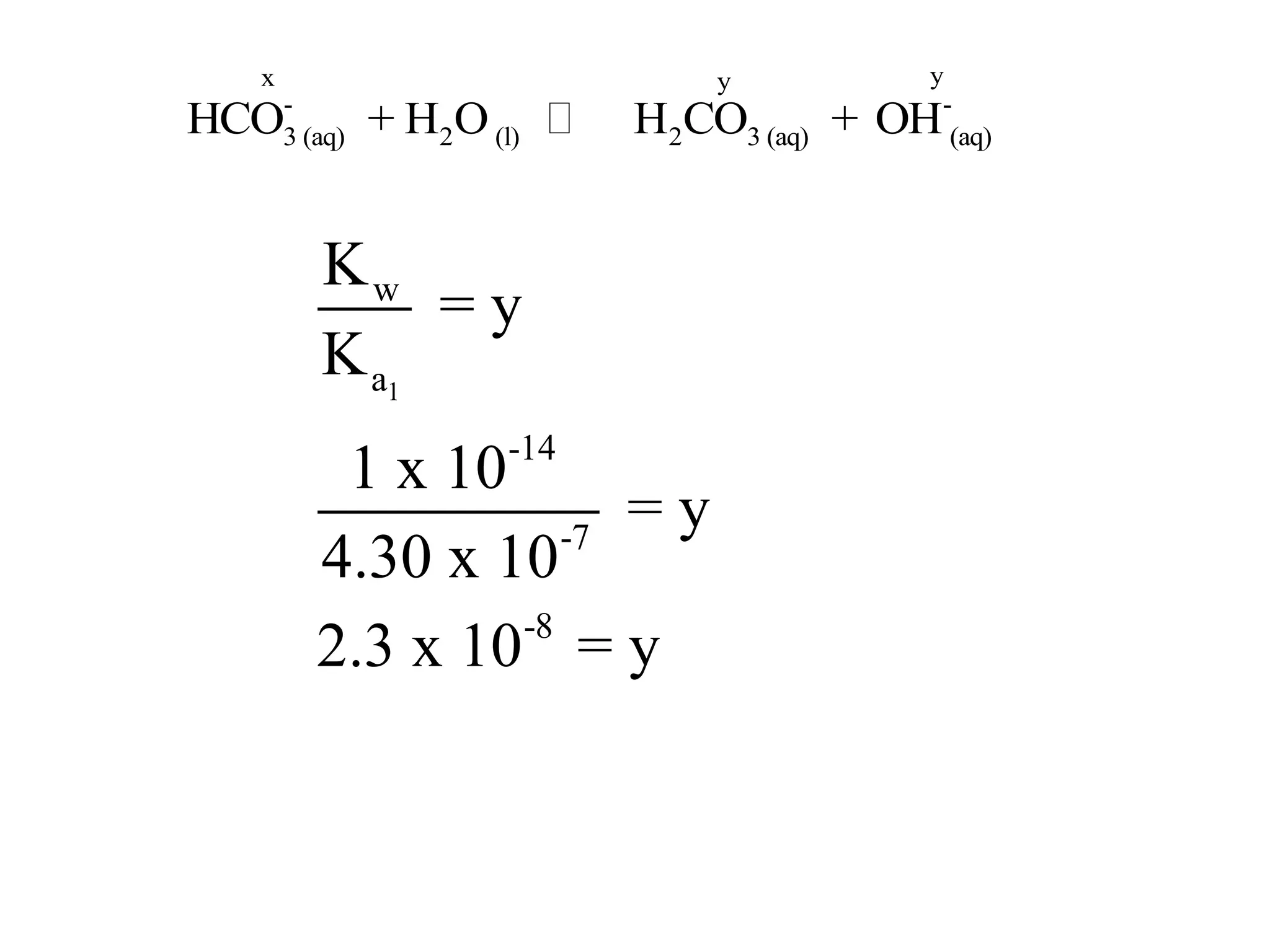
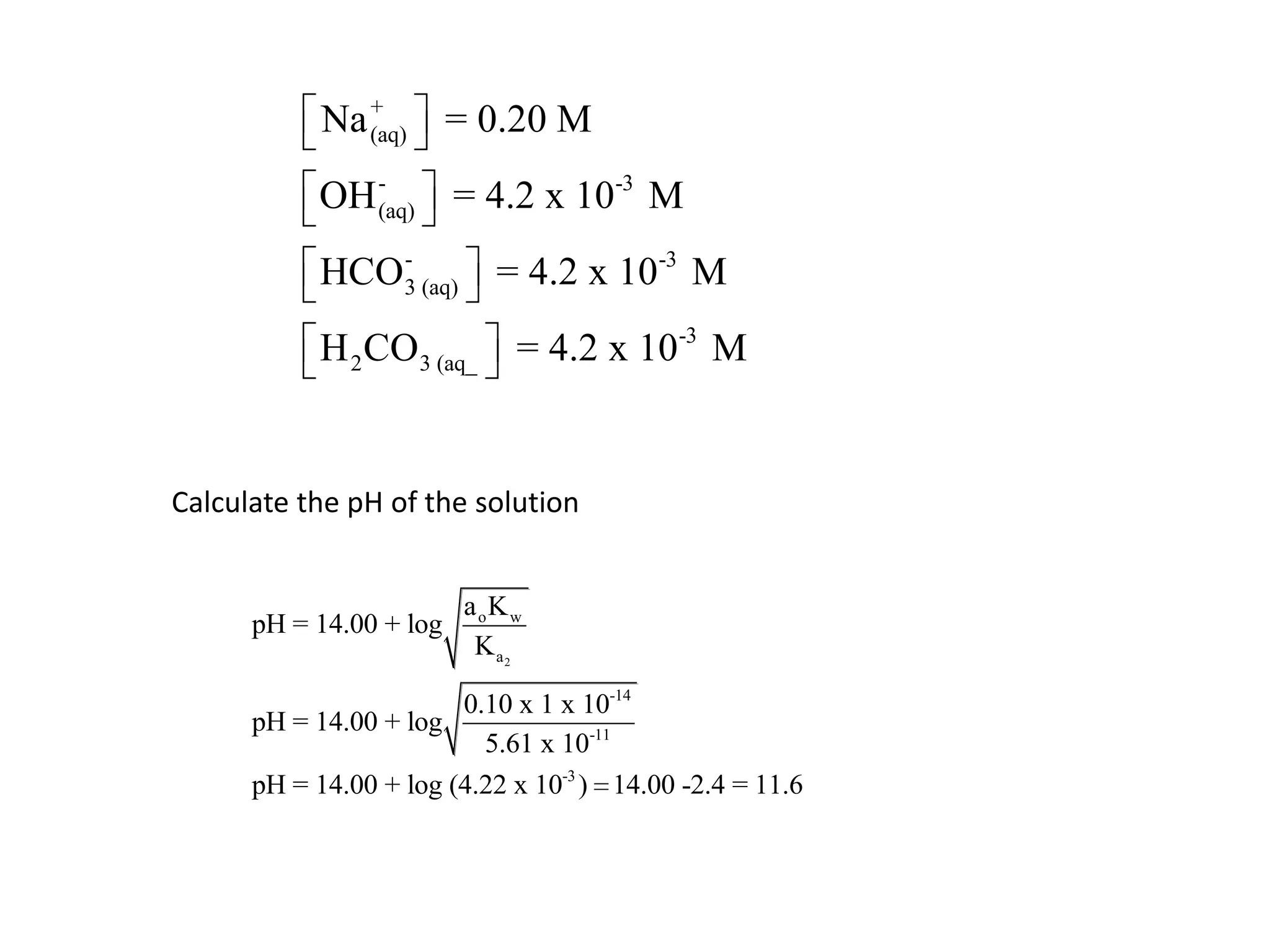
Calculate the equilibrium concentrations of all species in solution for 0.10 M solution of Na2CO3.H2CO3+ H2O  HCO3-  +  H3O+        Ka1 = 4.3 x 10⁻⁷HCO3-  + H2O  CO32-  +  H3O+          Ka2 = 5.6 x 10⁻¹¹
Calculate the pH of the solution

Acid Base Equilibrium

  • 1.
  • 2.
    Definition of anAcidAn Arrhenius acid is a substance that dissociates in aqueous medium to form hydronium ions, H3O+ .Example:
  • 3.
    Definition of anAcidA Brønsted-Lowery acid is a substance that is a proton donor.Example:
  • 4.
    Definition of anAcidA Lewis acid is a substance that is an electron pair acceptor.Example:
  • 5.
    Definition of aBaseAn Arrhenius base is a substance that ionizes in aqueous medium to produce hydroxide ions.Example:
  • 6.
    Definition of aBaseA Brønsted-Lowery base is a substance that is a proton acceptor.Example:
  • 7.
    Definition of aBaseA Lewis base is an electron pair donor.Example:
  • 8.
  • 9.
    Relative Strengths ofAcids and BasesProton transfer reactions proceed from the stronger acid-base pair to the weaker acid-base pair.For the relative strengths of acids and bases refer to figure 16.4 on page 672 of Brown, LeMay, Bursten and Murphy.Write a balanced equation for the reaction that occurs between ammonium chloride and sodium carbonate. Decide if the equilibrium lies predominantly toward the reactants or the products.
  • 10.
  • 11.
  • 12.
    The Values ofKA large vaalue of K means that the reaction favors the formation of product (s).A small value of K means that the reaction favors the reactants.If Kais greater than 1, then the acid is strong and dissociates 100%.If Kb is greater than 1, then the base is strong and dissociates 100%.
  • 13.
    The Values ofKIf Ka is 10-16 – 1, then the acid is weak.If Kb is 10-16 – 1, then the base is weak.If Ka is less than 10-16 , then the acid is very weak.If Kb is less than 10-16 , then the base is very weak.Refer to Appendix D, Aqueous Equilibrium Constants, page 1115-1116 for the values of K for acids and bases.
  • 14.
    Cationic Acid(1) Autoionization of water: (2) Ammonia acting as a Brønsted-Lowry base:
  • 15.
    Cationic Acidequation (3)Addequation (1) and the reverse of equation (2) to obtain equation (3)equation (1)equation (2)
  • 16.
  • 17.
  • 18.
  • 19.
  • 20.
    Anionic Base(1) Autoionization of water: (2) HCN acting as a Brønsted-Lowry acid:
  • 21.
    Anionic Baseequation (3)Addequation (1) and the reverse of equation (2) to obtain equation (3)
  • 22.
  • 23.
  • 24.
  • 25.
    Application Calculate Kh forCH3CH(OH)COO- given that the Kafor lactic acid, CH3CH(OH)COOH, is 1.4 x 10⁻⁴.
  • 30.
  • 31.
    pHSolutions with pHless than 7.00 at 25oC are basic.Solutions with pH greater than 7.00 at 25oC are acidic.Solutions with pH equal to 7.00 at 25oC are neutral.
  • 32.
    Application Calculate the pHof a solution made by dissolving 0.7000 g of NaOH in sufficient water to produce a volume of 500.0 mL.
  • 33.
    NaOH, a strongbase, is 100% ionized in aqueous medium to form OH-(aq).
  • 36.
    ApplicationIf [H3O+] invinegar is 1.6 x 10⁻³, calculate its pH.
  • 38.
    Application The pH ofseawater is 8.30. Calculate the [H3O+] and [-OH] of seawater.
  • 40.
    Determining pH Indicator: Asubstance that changes colors in some known pH range.
  • 41.
    Conjugate phenolphalein inbasic mediumpinkPhenolphalein in acidic mediumcolorless
  • 42.
    Calculating Ka frompH and the Initial Concentration of an Acid
  • 43.
    Calculating Ka frompH and the Initial Concentration of an Acid
  • 44.
    A 0.10 Msolution of aqueous lactic acid, CH3CH(OH)COOH, has a pH equal to 2.43 at 25oC. Calculate the Ka for lactic acid at 25oC.
  • 46.
    Calculating Equilibrium Concentrationsand pH from Ka and the Initial Concentration of an Acid
  • 47.
    Calculating Equilibrium Concentrationsand pH from Ka and the Initial Concentration of an Acid
  • 48.
    Calculate the equilibriumconcentrations of the hydronium ion and the benzoate ion of a 0.020 M solution of benzoic acid. Calculate the pH a 0.020 M solution of benzoic.aoKa = 6.3 x 10⁻⁵
  • 49.
    = 1.1 x10⁻³ M
  • 51.
    Calculate the hydroniumion concentration and pH of a 0.010 M formic acid solution. (Ka = 1.8 x 10⁻⁴)
  • 54.
    If the Acidis less than 15% ionized, then approximations can be madeIn the previous problem,
  • 55.
    Therefore, we couldhave made the following Approximation:0.010 is greater than x; consequently 0.010 – x = 0.010
  • 57.
    What if wechange the initial concentration of the formic acid?Calculate the hydronium ion concentration and pH of a 0.010 M formic acid solution. (Ka = 1.8 x 10⁻⁴)
  • 58.
    Let’s make anapproximation: Assume 0.0010 is greater than xTherefore, the assumption cannot be made, andThe quadratic equation must be used.
  • 62.
    Calculating the pHof an Aqueous Solution of a Weak Base
  • 65.
    Calculate the pHof a 0.010 M aqueous solution of pyridine, C5H5N. Pyridine is A weak base with Kb = 1.7 x 10⁻⁹.
  • 66.
    Calculating the pHof an Aqueous Solution of the Salt of a Weak Acid
  • 67.
    Calculating the pHof an Aqueous Solution of the Salt of a Weak Acid
  • 69.
    Calculate the pHof a 0.015 M solution of sodium hypochlorite, NaClO. The Ka for hypochlorous acid is 3.5 x 10⁻⁸)
  • 71.
    Calculating the pHof an Aqueous Solution of the Salt of a Weak Base
  • 74.
    Calculate the pHof a 0.50 M solution of ammonium chloride, NH4Cl. The Ka for ammonia is 1.8 x 10⁻⁵)
  • 77.
    Common Ion EffectAdditionof a common ion to the equilibrium.Example: adding NaA to an acid solution of HAaoxxyyy
  • 80.
    Calculating the pHand the Equilibrium Concentrations of Species in Solution form from the Reactions of Anionic Bases that Produce Multi-Species in Solution
  • 81.
    Species that formMultiple Species in Solution
  • 82.
    Species that formMultiple Species in Solution
  • 83.
    Species that formMultiple Species in Solution
  • 84.
    Species that formMultiple Species in Solution
  • 85.
    Species that formMultiple Species in Solution
  • 86.
    Species that formMultiple Species in Solution
  • 87.
    Species that formMultiple Species in Solution
  • 88.
    Calculate the equilibriumconcentrations of all species in solution for 0.10 M solution of Na2CO3.H2CO3+ H2O HCO3- + H3O+ Ka1 = 4.3 x 10⁻⁷HCO3- + H2O CO32- + H3O+ Ka2 = 5.6 x 10⁻¹¹
  • 94.
    Calculate the pHof the solution