1
×https://www.youtube.com/watch?v=JFd6eK2TB74
FROM THE PREVIOUS VIDEO WHAT DO YOU THINK ABOUT
ACID?
2
CHAPTER 1:
ACID BASE &
BUFFER
LESSON LEARNING OUTCOME
 1.1 Explain about acids and bases
 1.1.1 Acids and bases according to the
following theories:
a. Arrhenius
b. Bronsted-Lowry
 1.1.2 Equations depicting the behavior of
acids and bases in water
 1.2 Discuss the acid-base reactions
 1.2.1 Equations to illustrate acid-base reactions
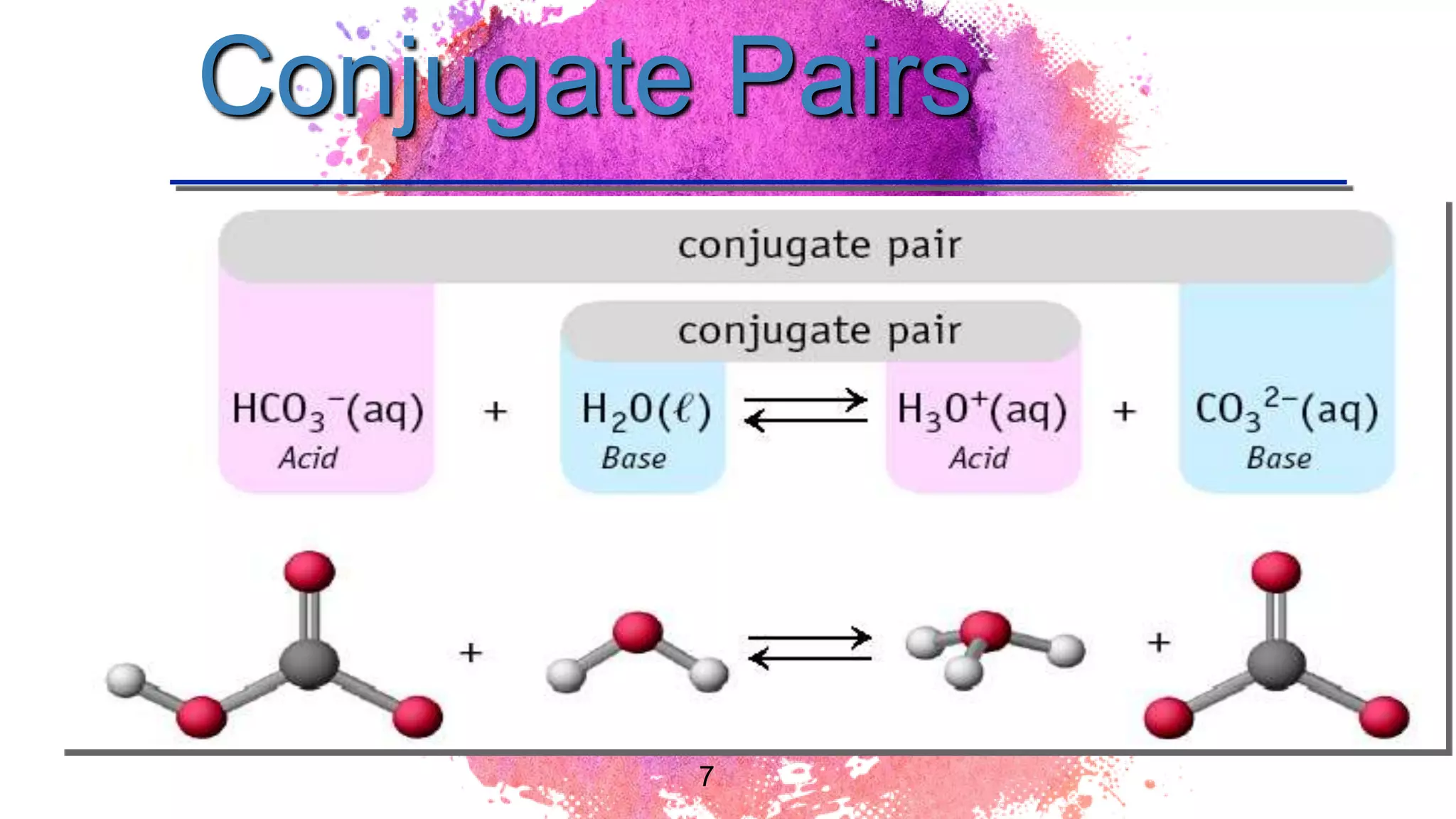
 1.2.2 Conjugate acid-base pairs
4
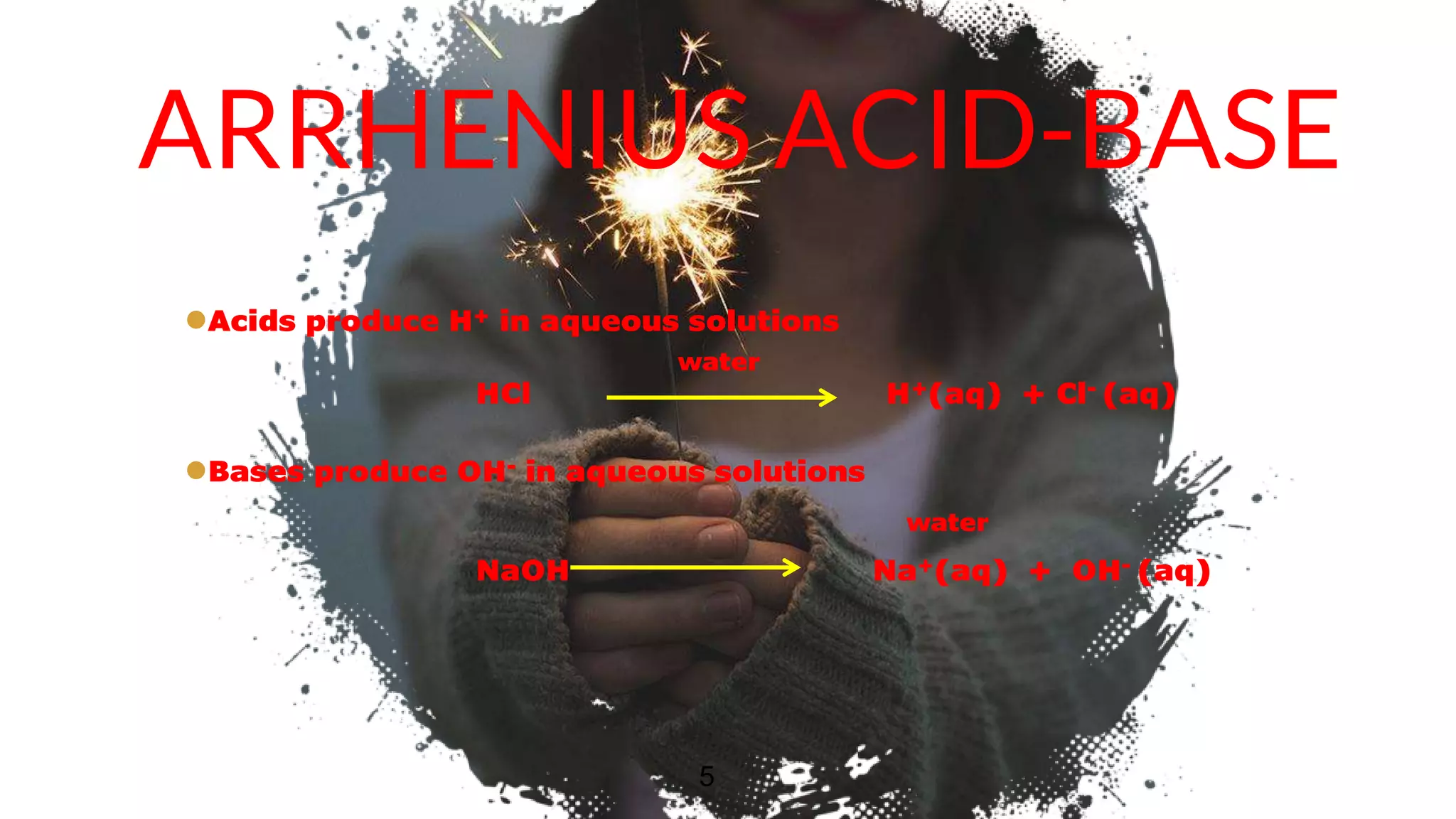
ARRHENIUS ACID-BASE
Acids produce H+ in aqueous solutions
water
HCl H+(aq) + Cl- (aq)
Bases produce OH- in aqueous solutions
water
NaOH Na+(aq) + OH- (aq)
5
6
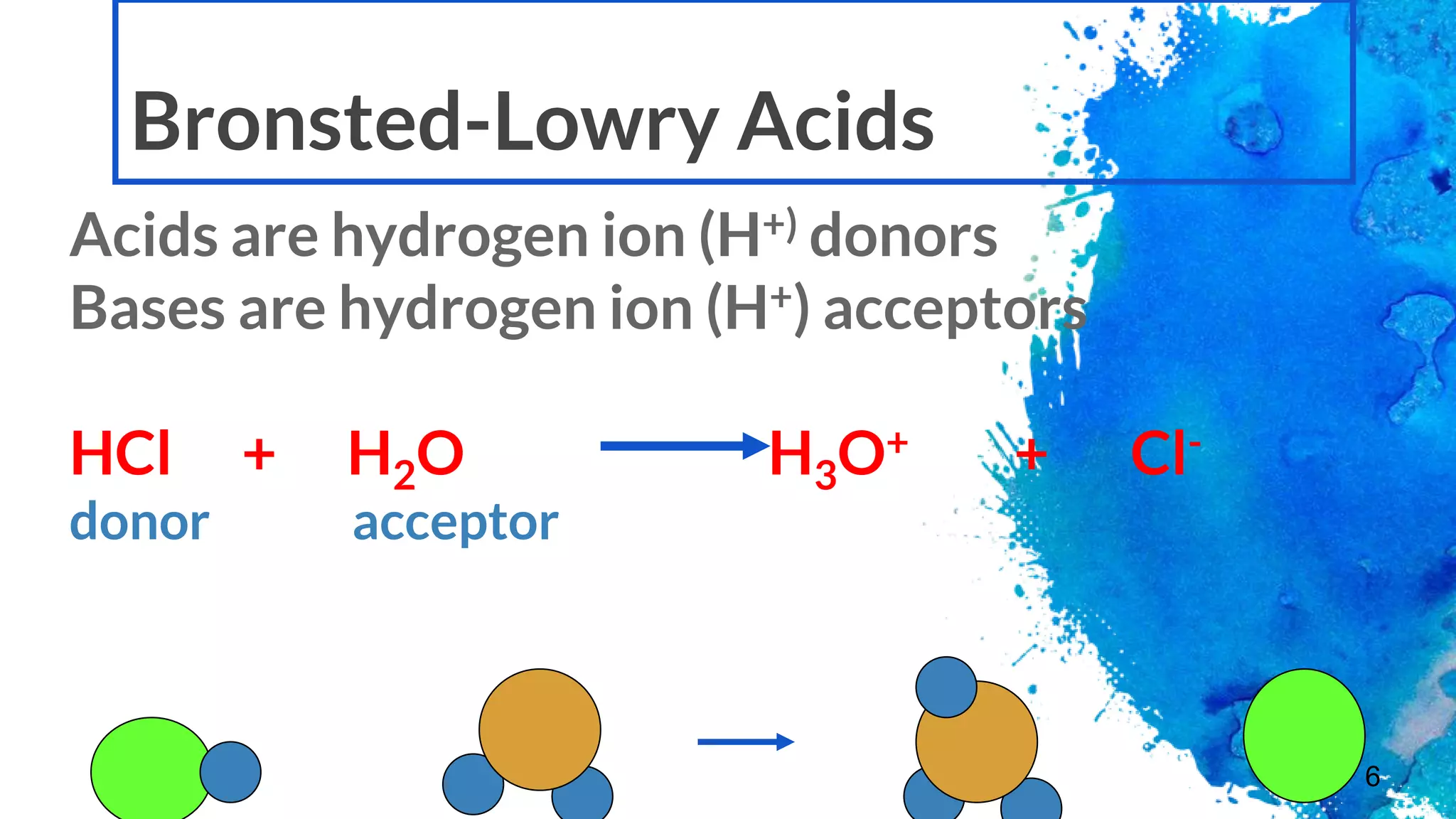
Acids are hydrogen ion (H+) donors
Bases are hydrogen ion (H+) acceptors
HCl + H2O H3O+ + Cl-
donor acceptor
Bronsted-Lowry Acids
“
7
Conjugate Pairs
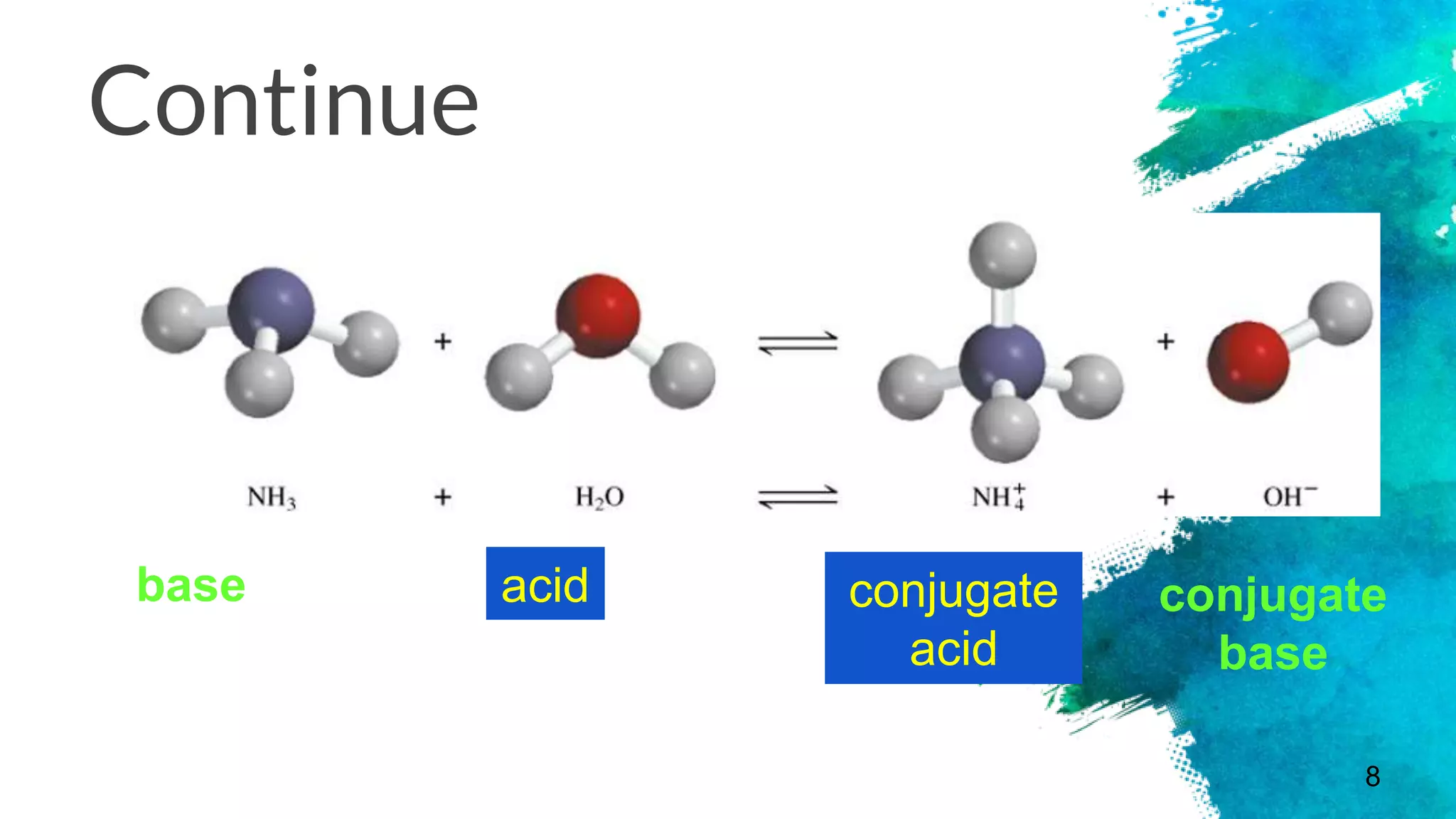
Continue
8
base acid conjugate
acid
conjugate
base
9
PROPERTIES OF ACID AND BASE
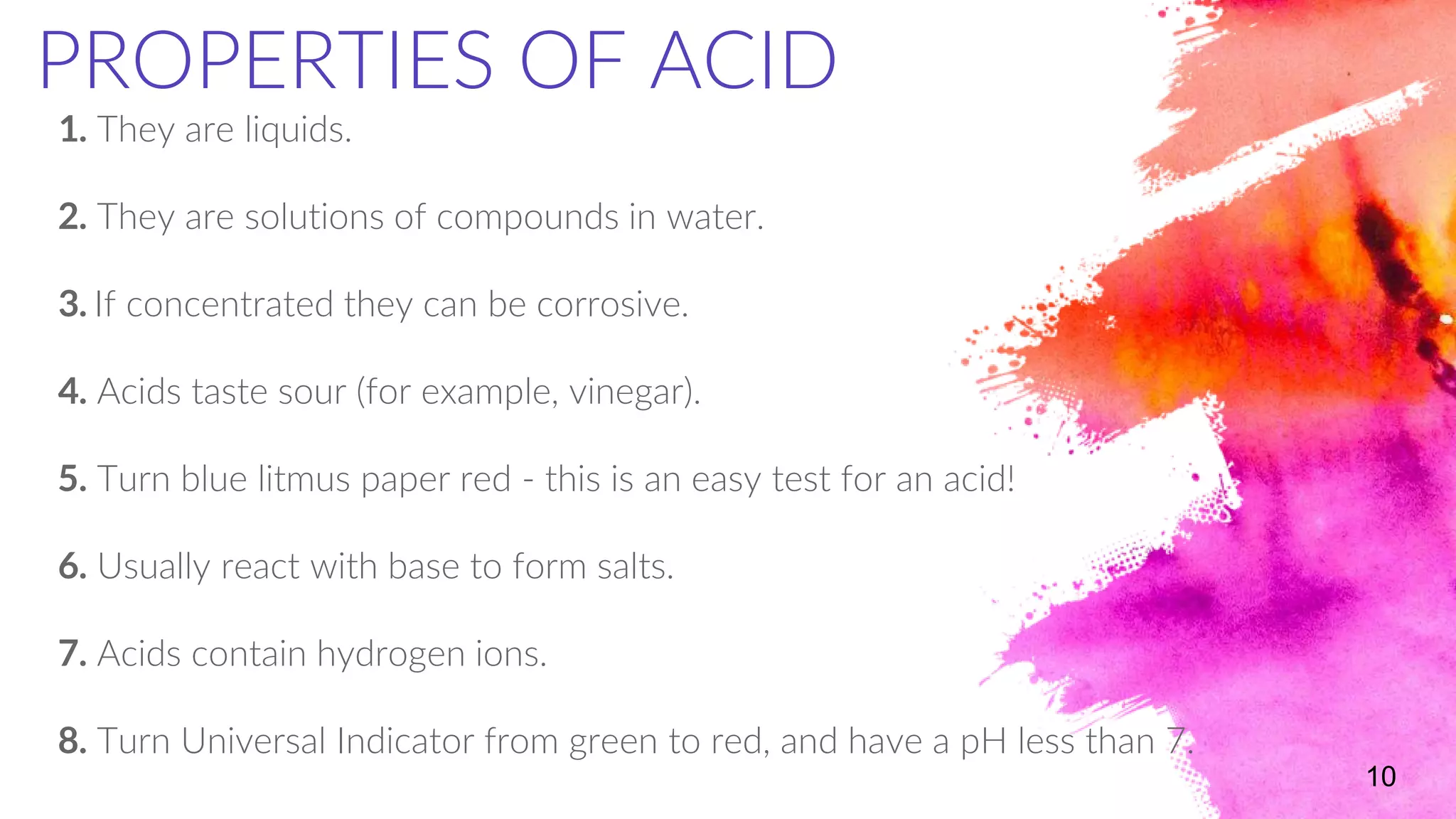
1. They are liquids.
2. They are solutions of compounds in water.
3. If concentrated they can be corrosive.
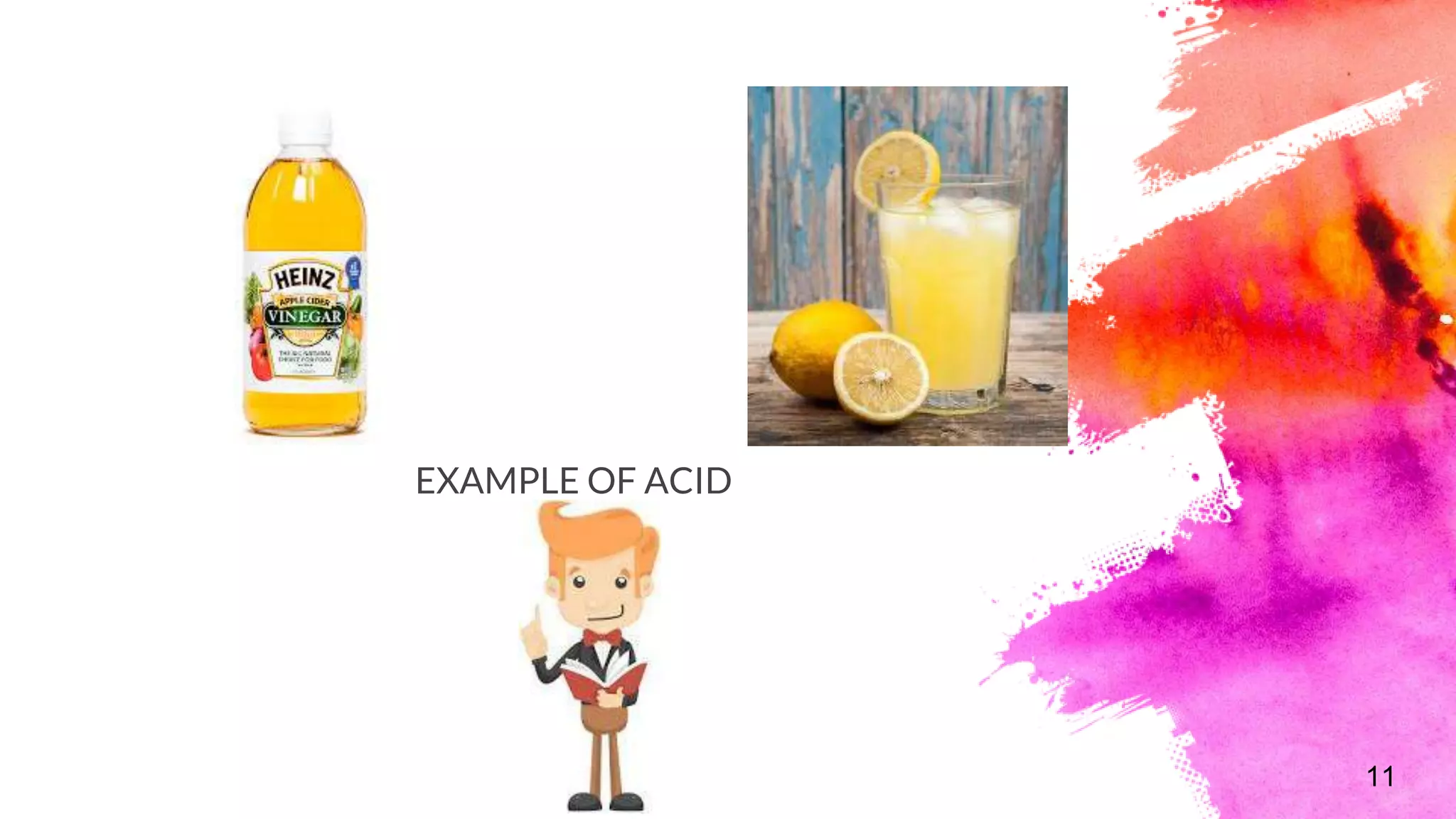
4. Acids taste sour (for example, vinegar).
5. Turn blue litmus paper red - this is an easy test for an acid!
6. Usually react with base to form salts.
7. Acids contain hydrogen ions.
8. Turn Universal Indicator from green to red, and have a pH less than 7.
10
PROPERTIES OF ACID
EXAMPLE OF ACID
11
They have a bitter taste.
They have slippery touch.
They conduct electrically.
It turns red litmus to blue.
It turns colorless phenolphthalein to pink
12
PROPERTIES OF BASE
13
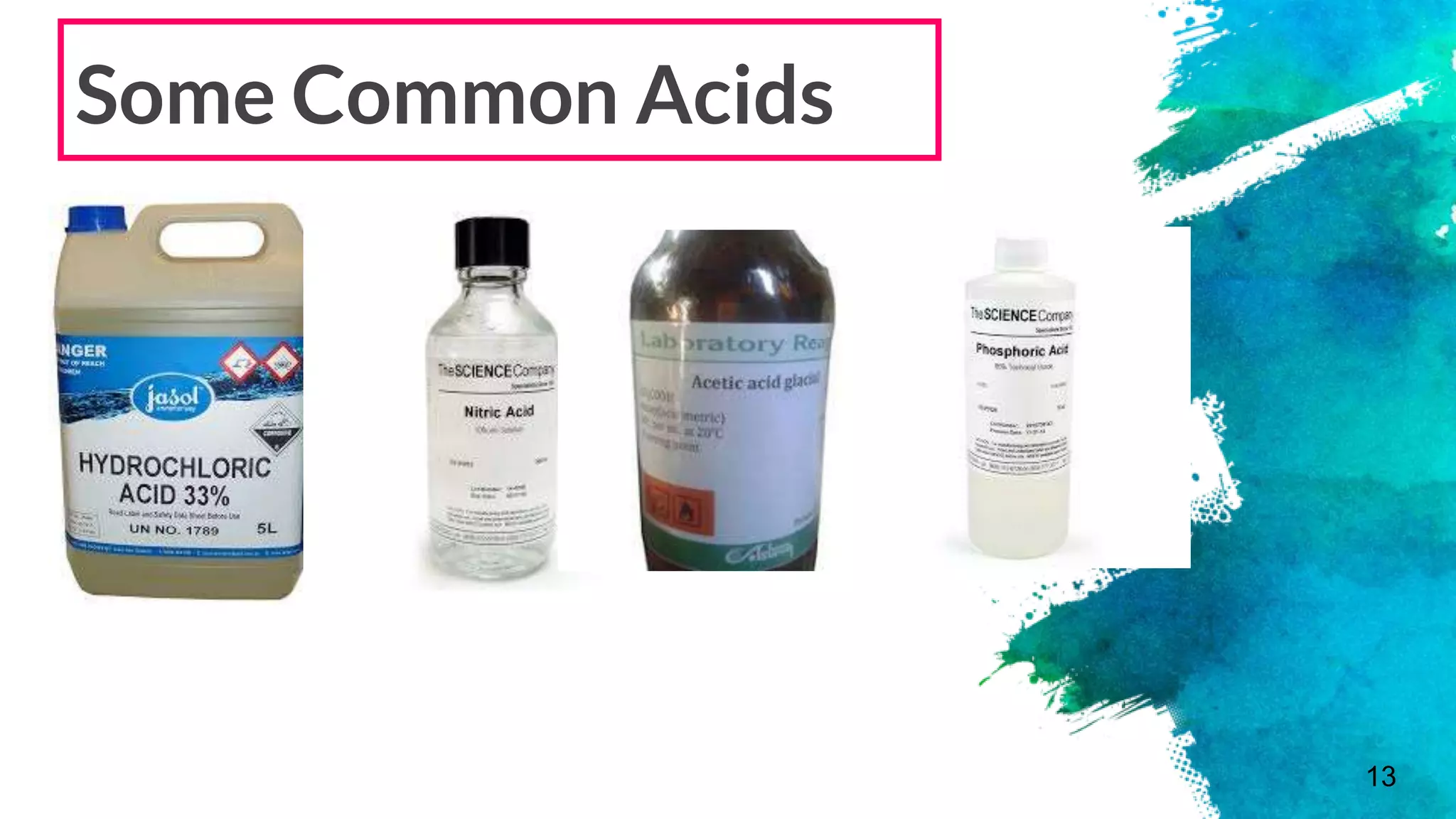
Some Common Acids
14
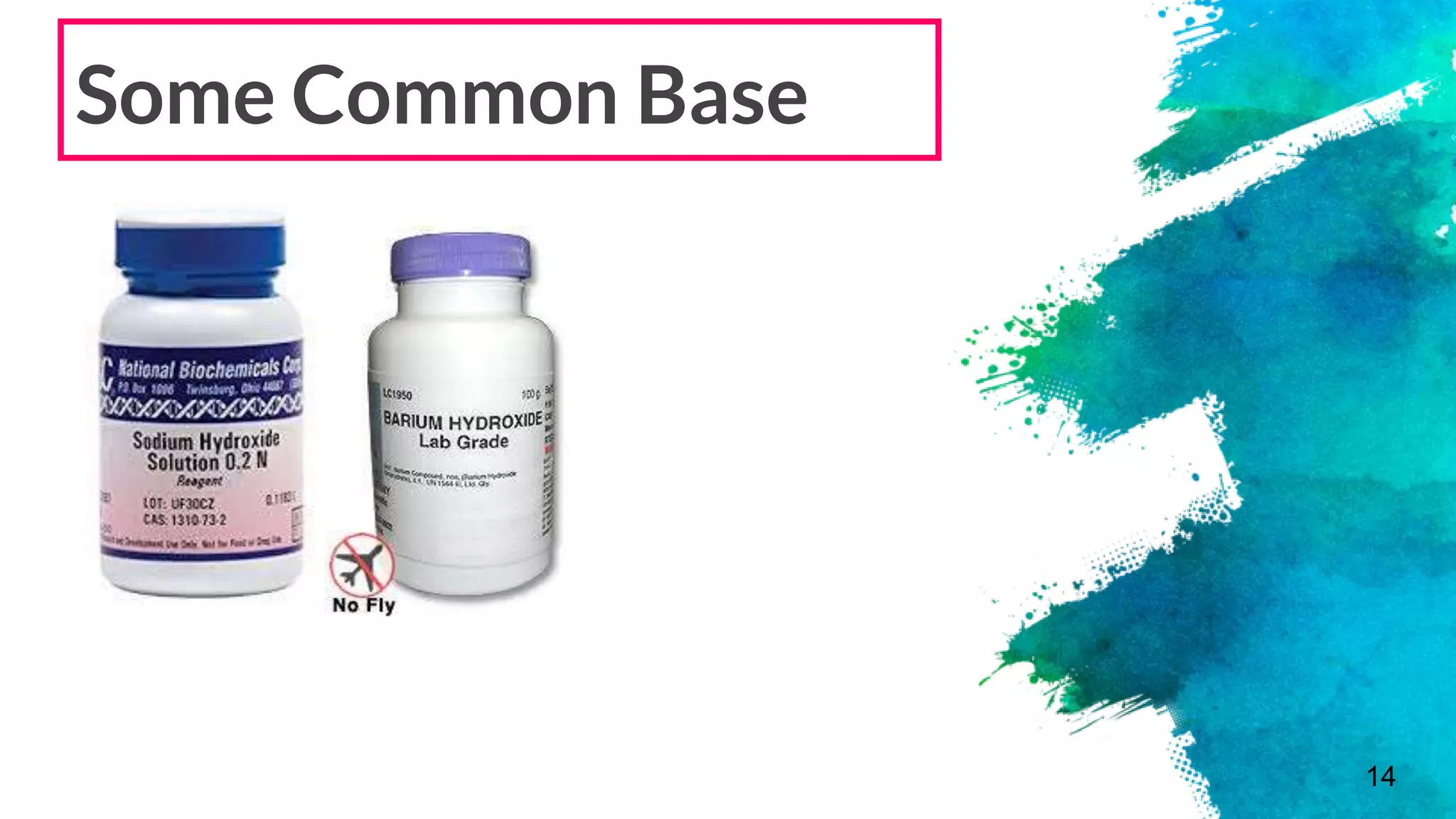
Some Common Base
15
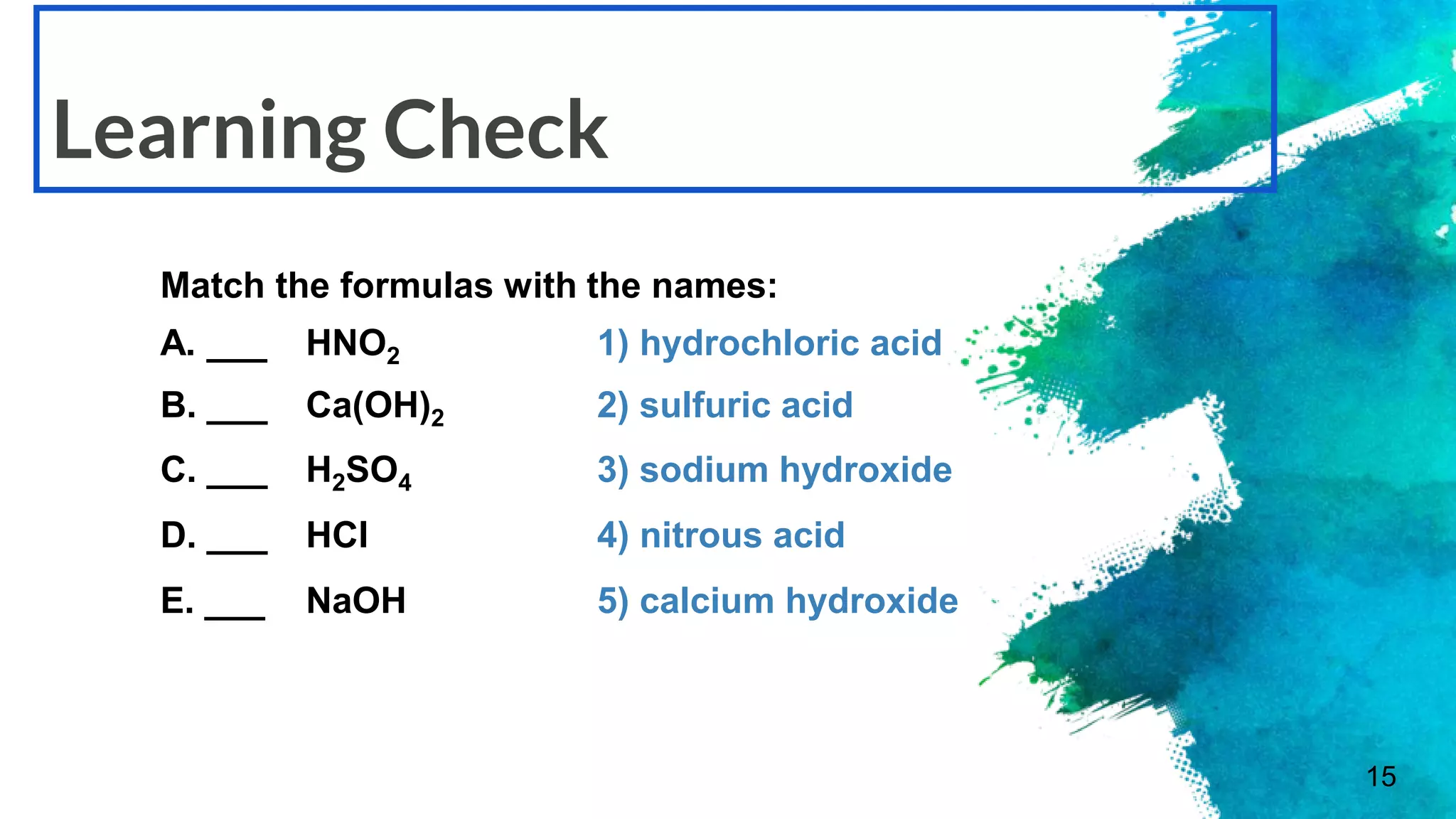
Learning Check
Match the formulas with the names:
A. ___ HNO2 1) hydrochloric acid
B. ___ Ca(OH)2 2) sulfuric acid
C. ___ H2SO4 3) sodium hydroxide
D. ___ HCl 4) nitrous acid
E. ___ NaOH 5) calcium hydroxide
16
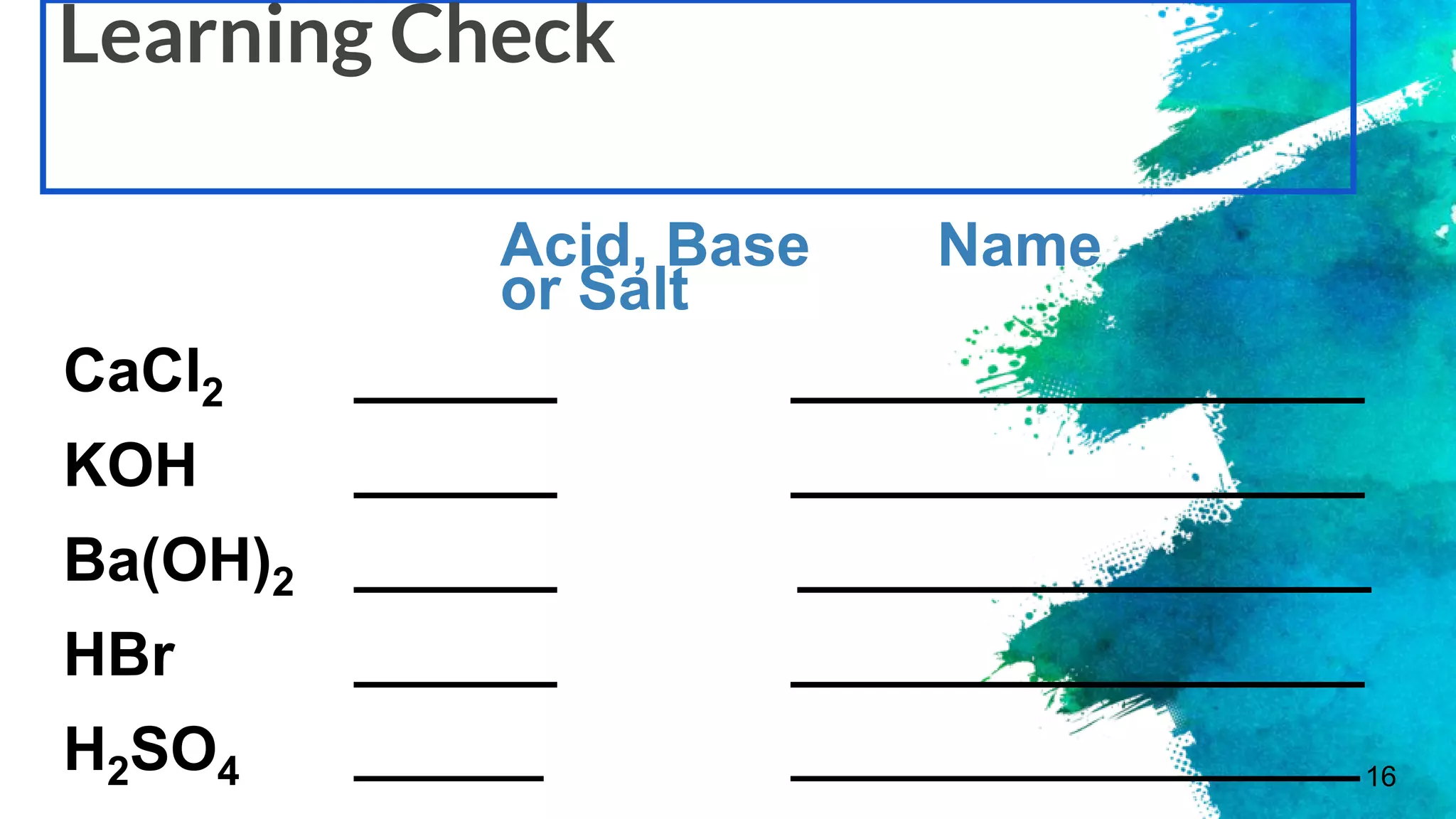
Learning Check
Acid, Base Name
or Salt
CaCl2 ______ _________________
KOH ______ _________________
Ba(OH)2 ______ _________________
HBr ______ _________________
H2SO4 ______ __________________
So what did you learn today?
(each student need to give 1 point)
17
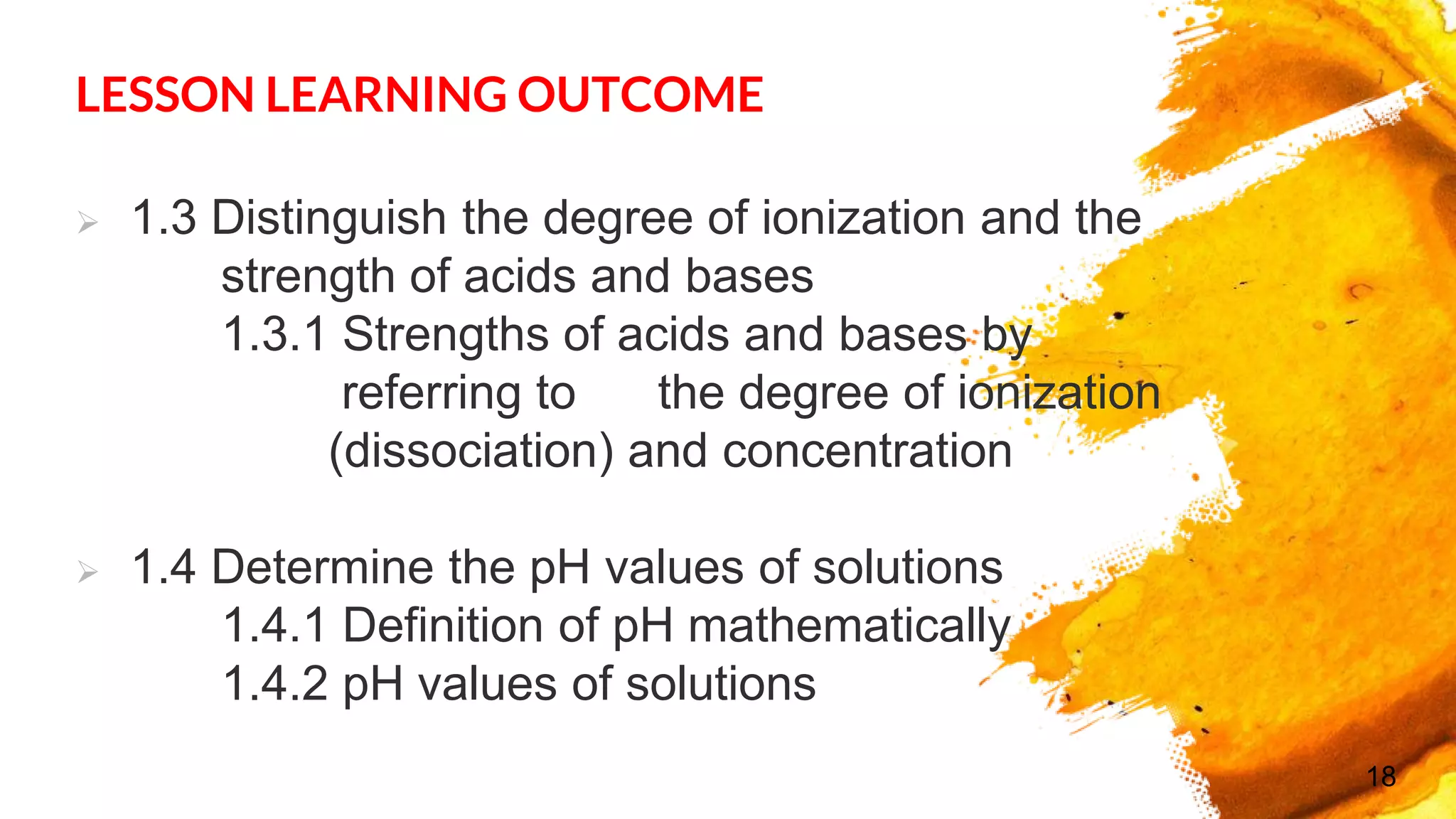
LESSON LEARNING OUTCOME
 1.3 Distinguish the degree of ionization and the
strength of acids and bases
1.3.1 Strengths of acids and bases by
referring to the degree of ionization
(dissociation) and concentration
 1.4 Determine the pH values of solutions
1.4.1 Definition of pH mathematically
1.4.2 pH values of solutions
18
STRENGTH OF ACIDS AND
BASES
19
STRONG ACID
20
21
HA
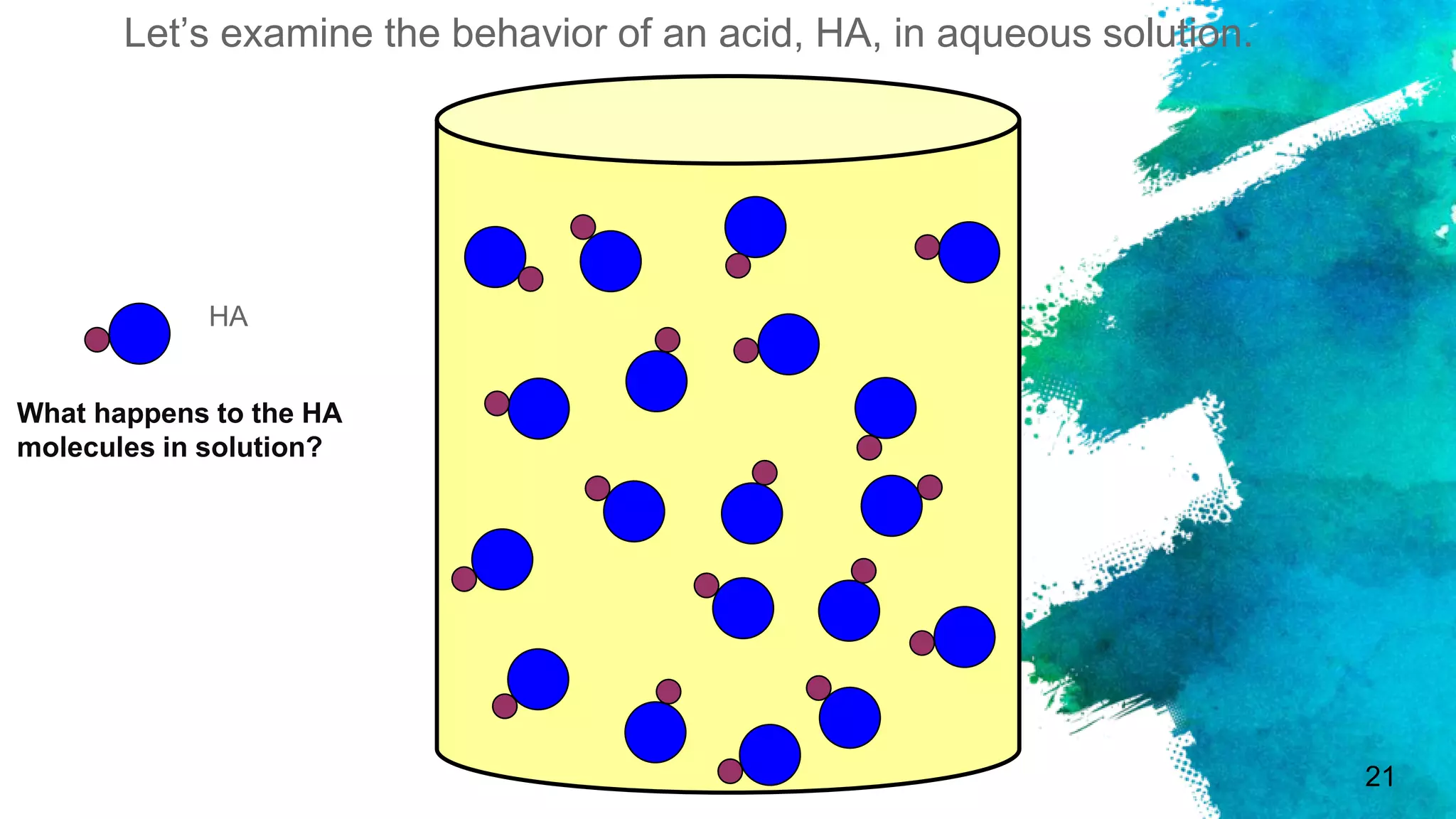
Let’s examine the behavior of an acid, HA, in aqueous solution.
What happens to the HA
molecules in solution?
22
HA
H+
A-
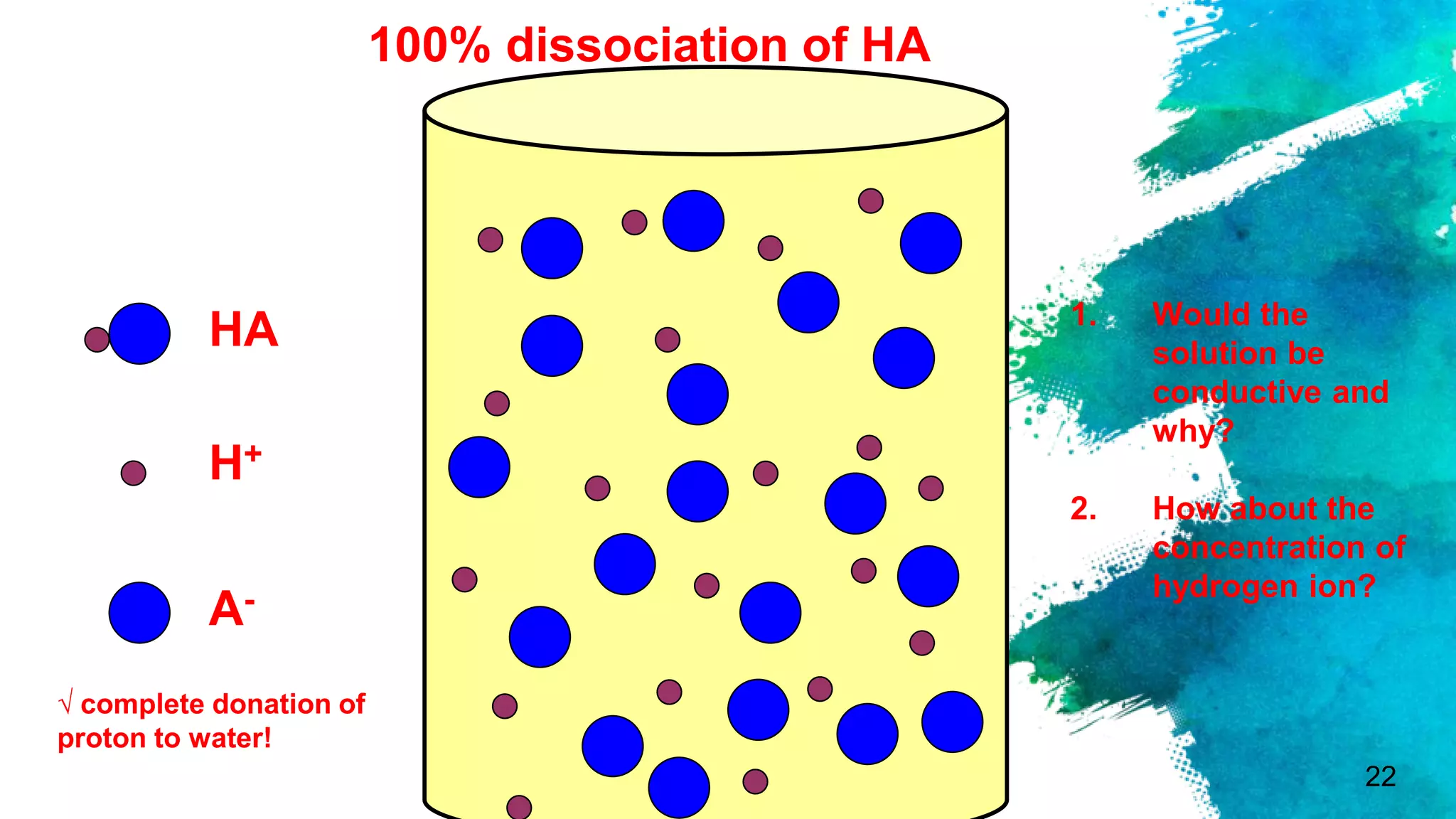
100% dissociation of HA
1. Would the
solution be
conductive and
why?
2. How about the
concentration of
hydrogen ion?
√ complete donation of
proton to water!
23
HA
H+
A-
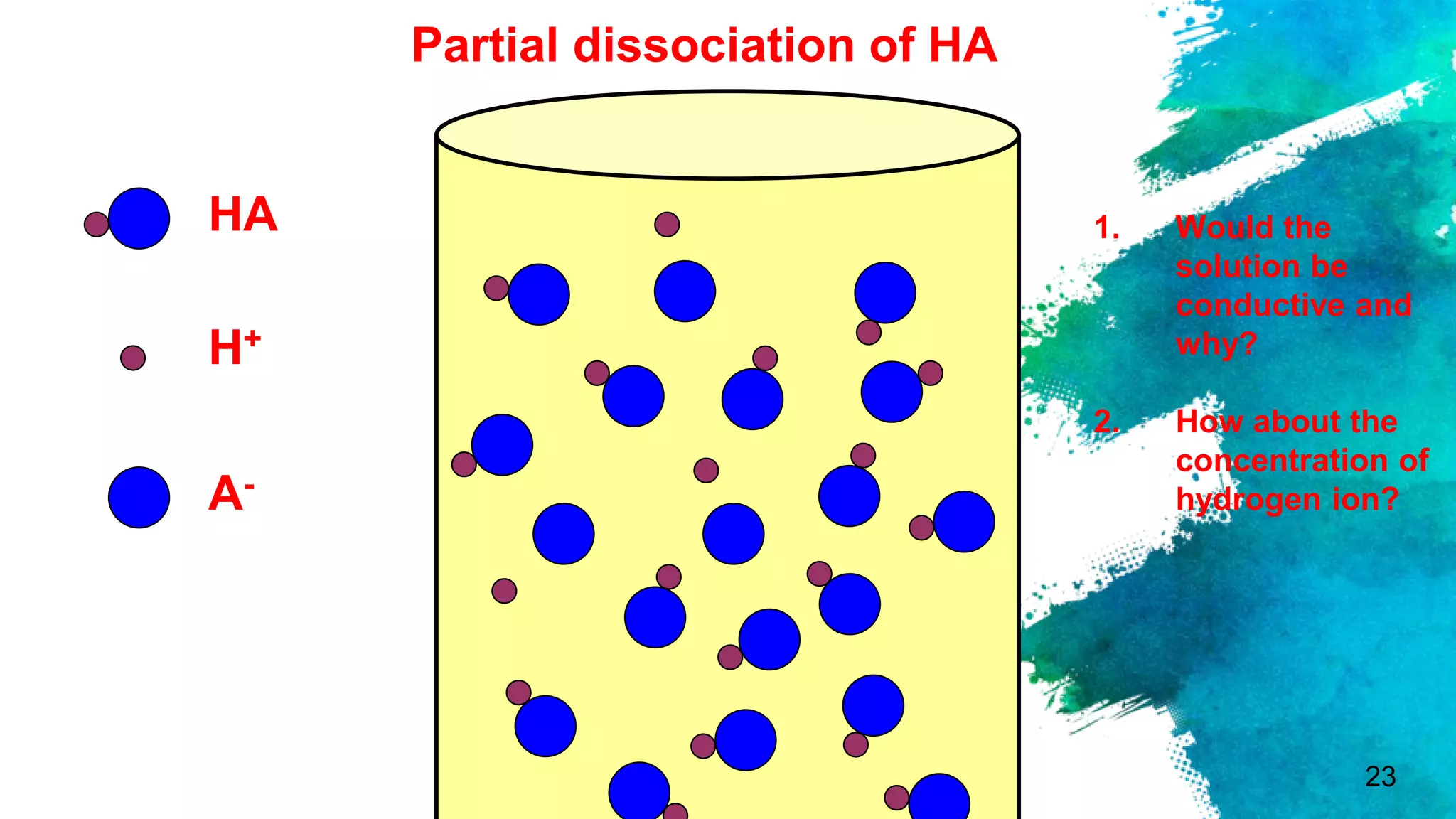
Partial dissociation of HA
1. Would the
solution be
conductive and
why?
2. How about the
concentration of
hydrogen ion?
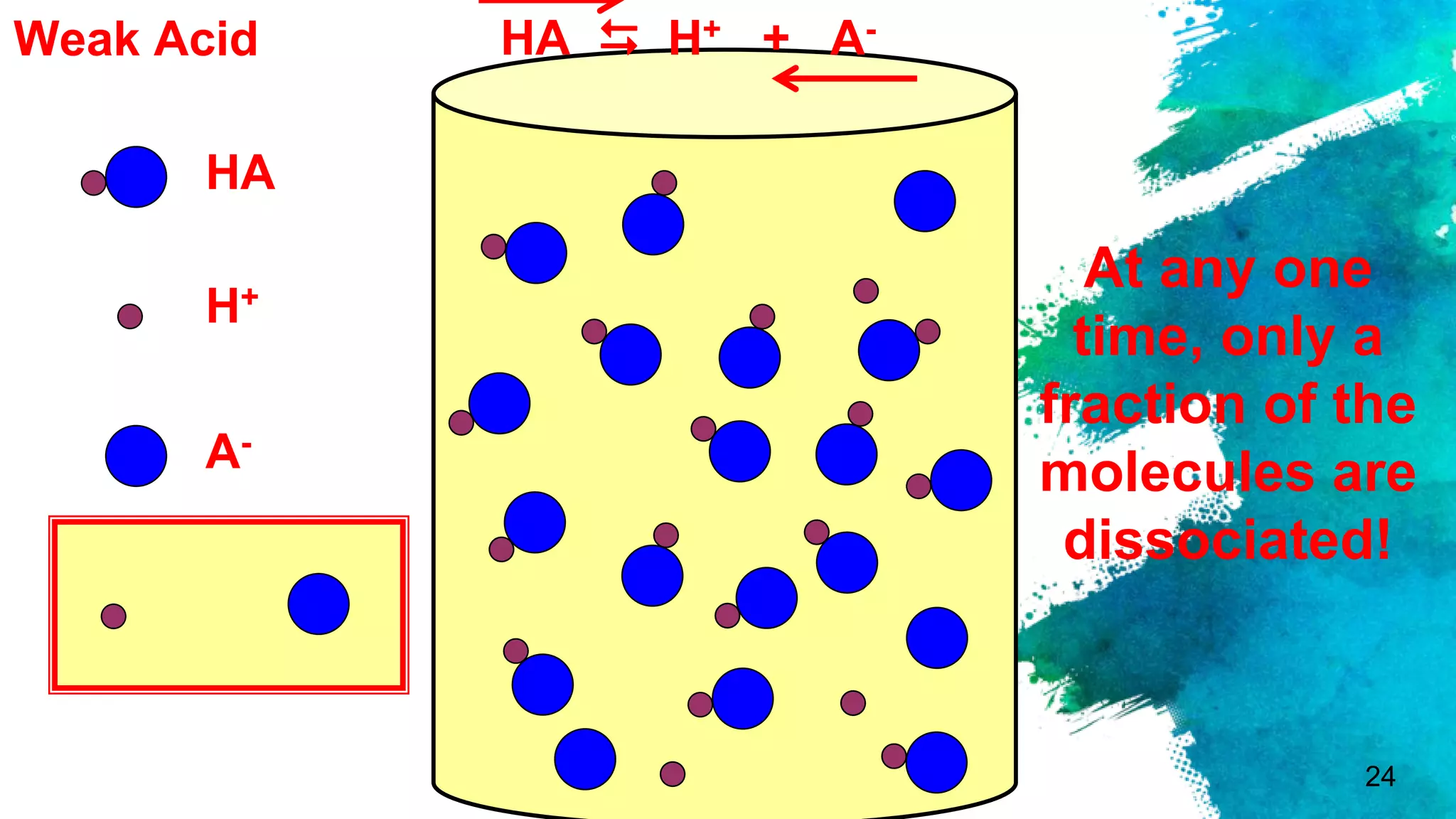
24
HA
H+
A-
Weak Acid HA  H+ + A-
At any one
time, only a
fraction of the
molecules are
dissociated!
25
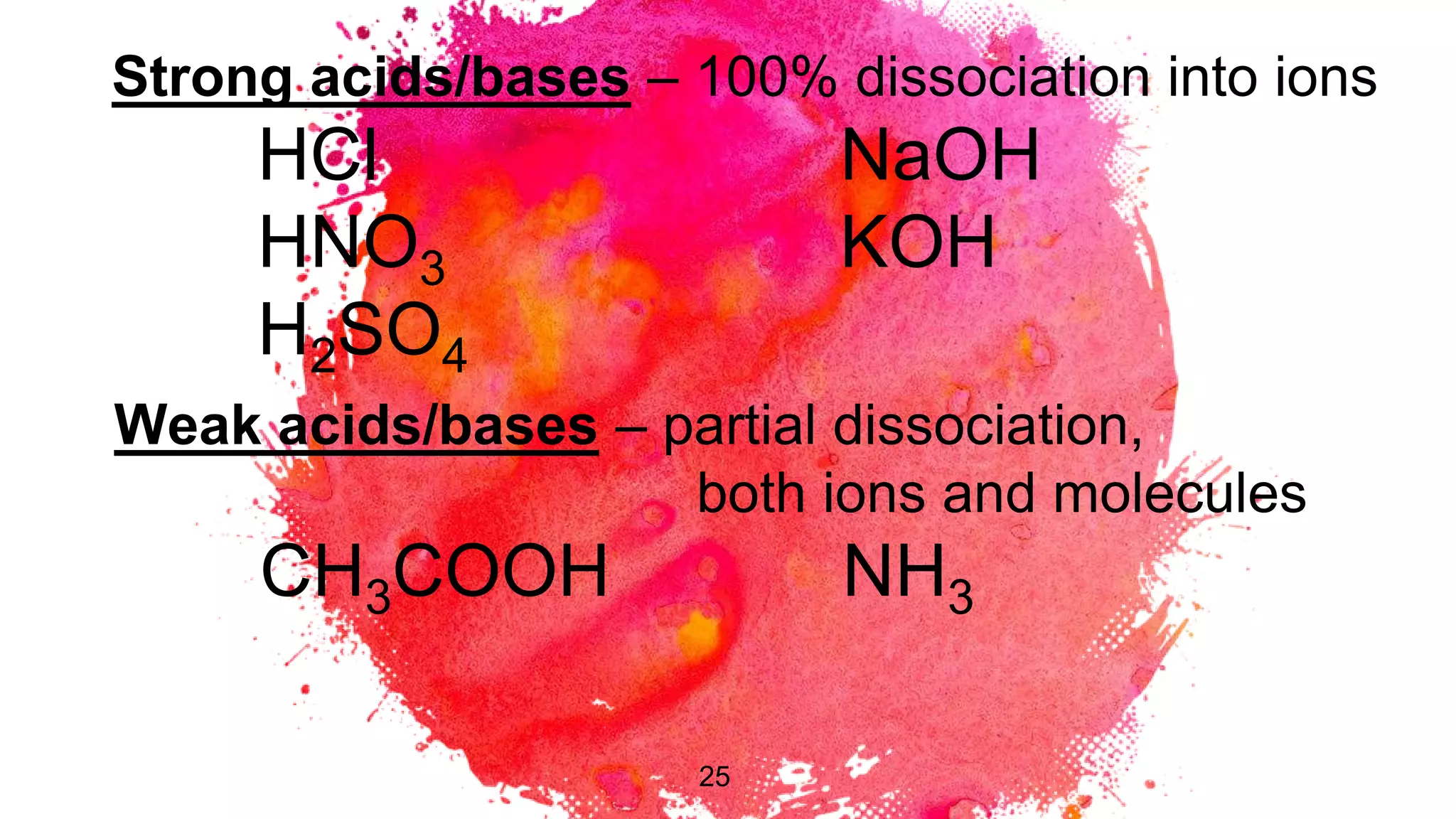
Strong acids/bases – 100% dissociation into ions
HCl NaOH
HNO3 KOH
H2SO4
Weak acids/bases – partial dissociation,
both ions and molecules
CH3COOH NH3
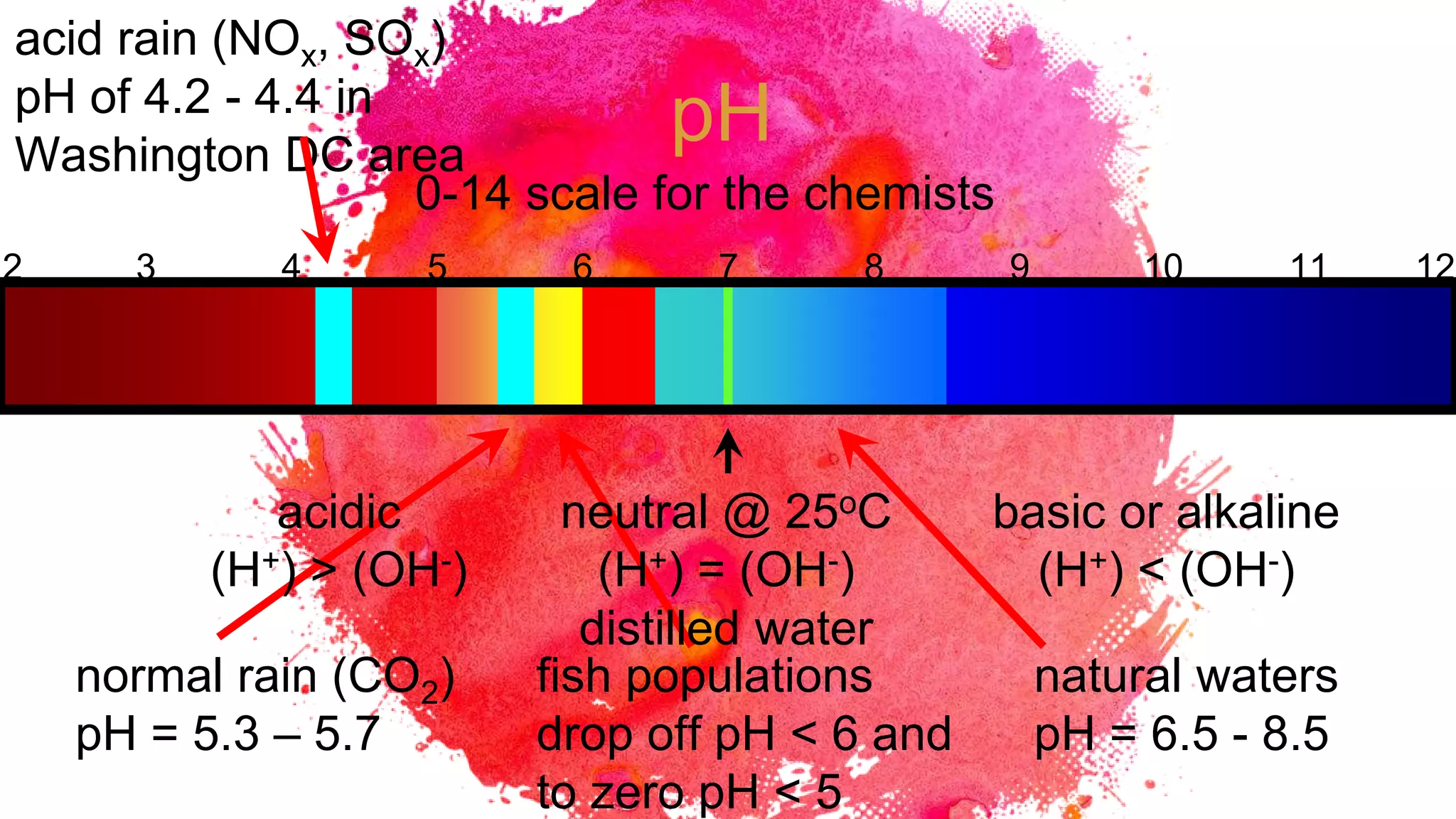
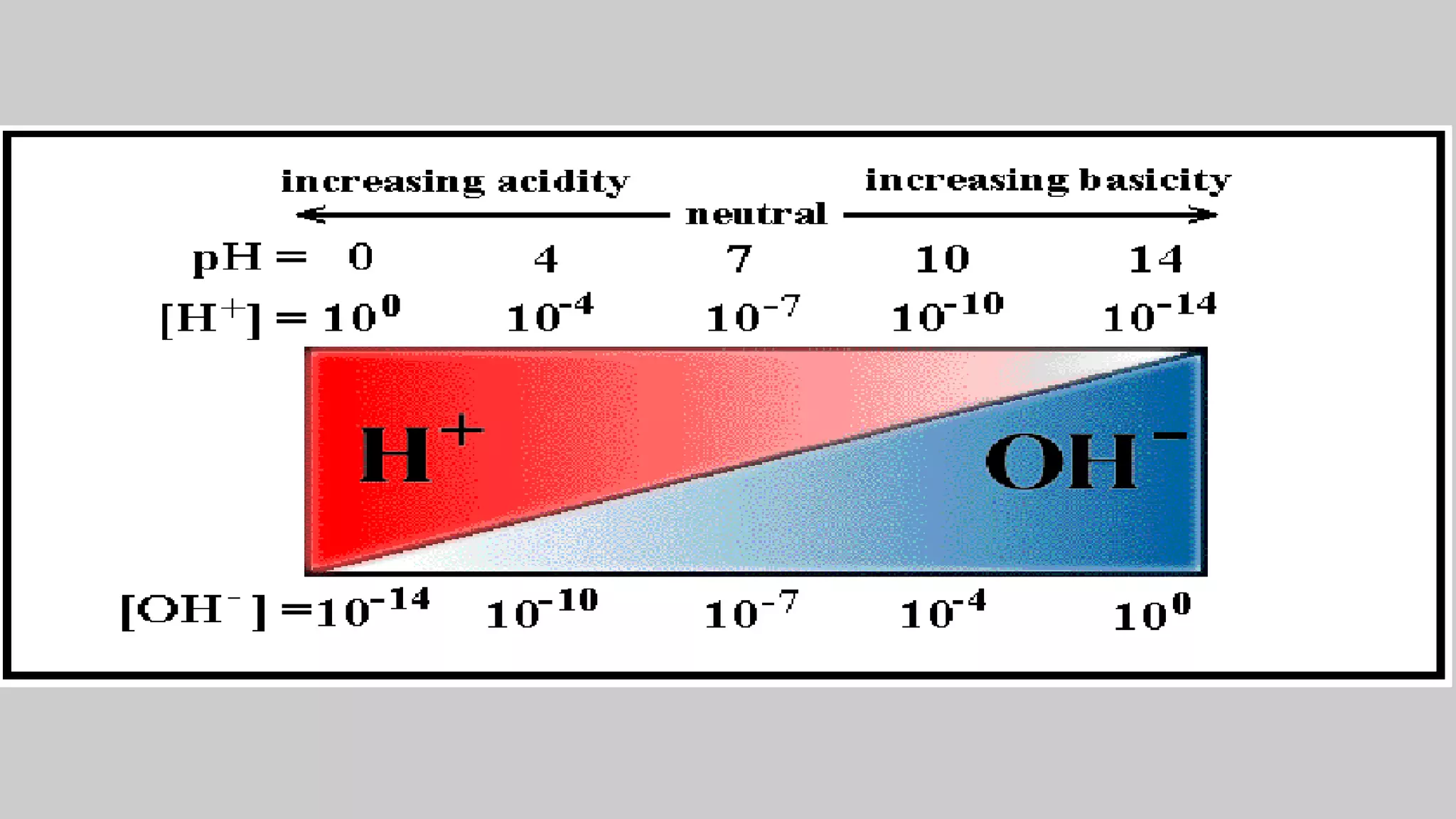
pH
2 3 4 5 6 7 8 9 10 11 12
neutral @ 25oC
(H+) = (OH-)
distilled water
acidic
(H+) > (OH-)
basic or alkaline
(H+) < (OH-)
natural waters
pH = 6.5 - 8.5
normal rain (CO2)
pH = 5.3 – 5.7
acid rain (NOx, SOx)
pH of 4.2 - 4.4 in
Washington DC area
0-14 scale for the chemists
fish populations
drop off pH < 6 and
to zero pH < 5
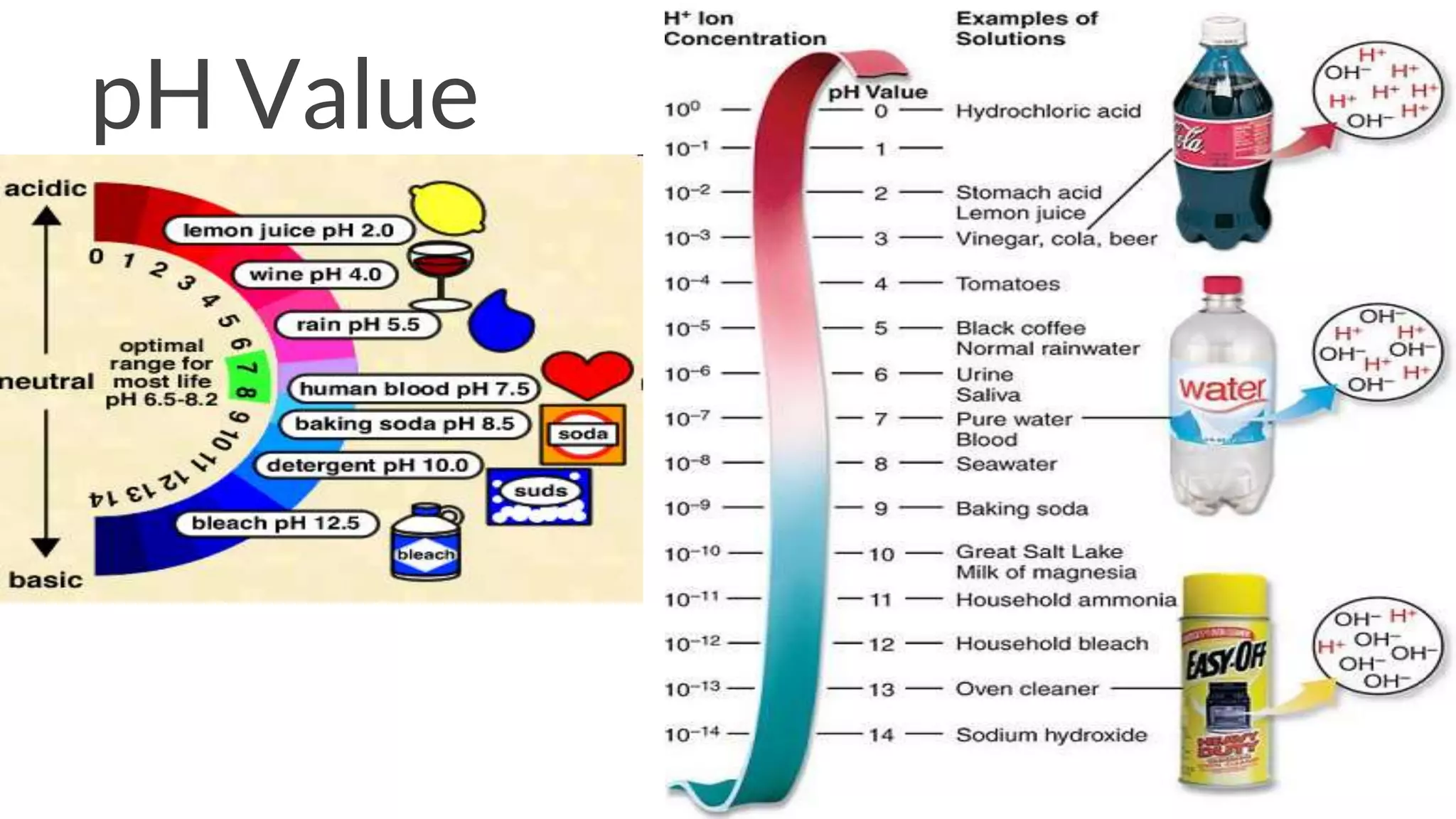
pH Value
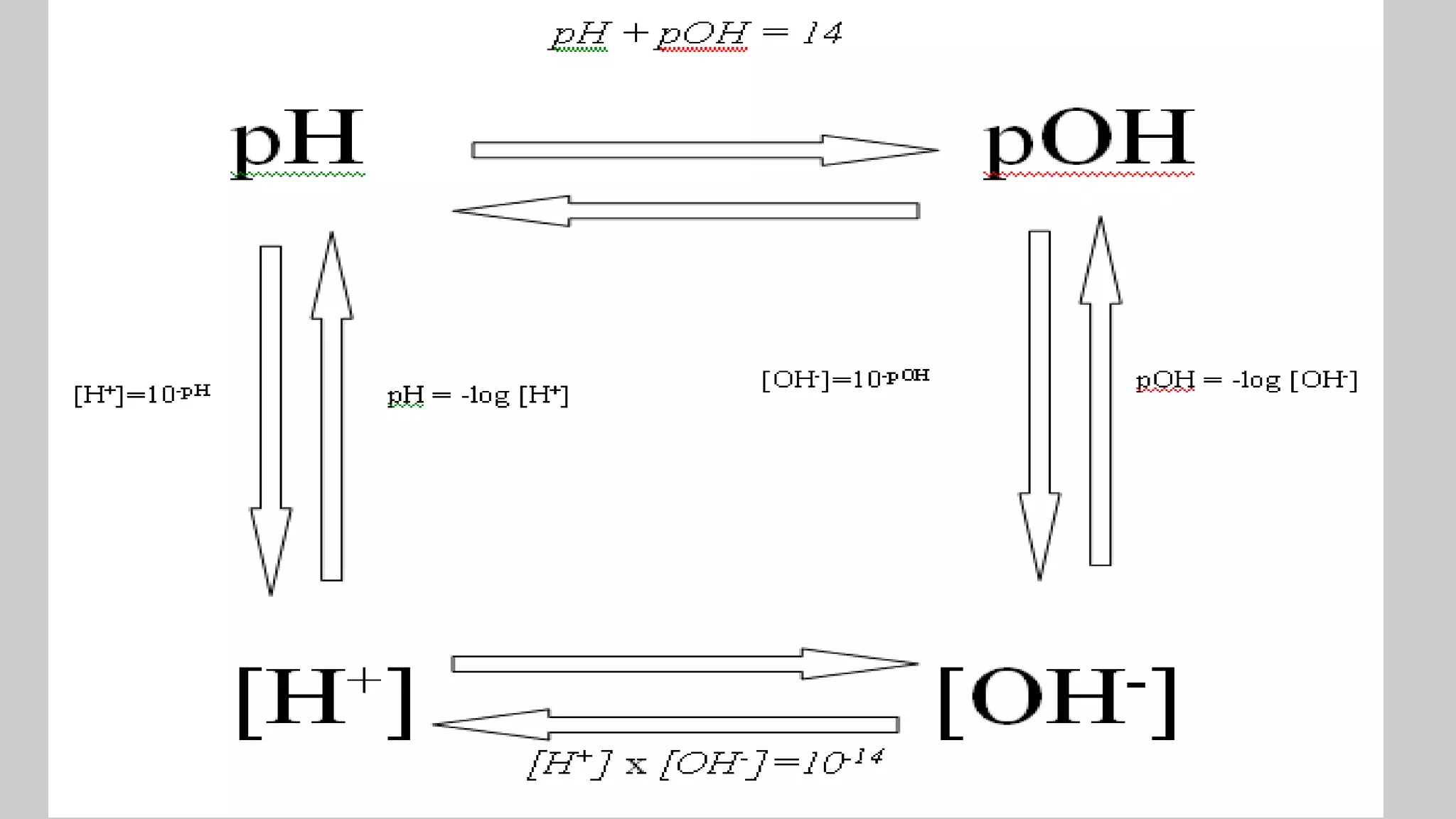
× pH
The negative of the common logarithm of the hydrogen ion concentration
pH = - log [H+]
× pOH
The negative of the common logarithm of the hydroxide ion concentration
pOH = - log [OH-]
Calculating pH & pOH
× For acids
× For bases
× when [H+] = [OH-] the substance is neutral
Water breaks apart to hydrogen and hydroxide ions:
× H2O  H+ + OH-
× pH + pOH = 14
H+1 > OH-1
OH-1 > H+1
More About Water
H2O can function as both an ACID and a BASE.
In pure water there can be AUTOIONIZATION
Equilibrium constant for water = Kw
K = [H O+] [OH-] = 1.00 x 10⁻¹⁴ at 25 oC
Kw = [H3O+] [OH-] = 1.00 x 10⁻¹⁴ at 25 oC
In a neutral solution [H3O+] = [OH-]
and so [H3O+] = [OH-] = 1.00 x 10⁻⁷ M
More About Water
OH-
H3O+
Autoionization
32
LecturePLUS Timberlake 33
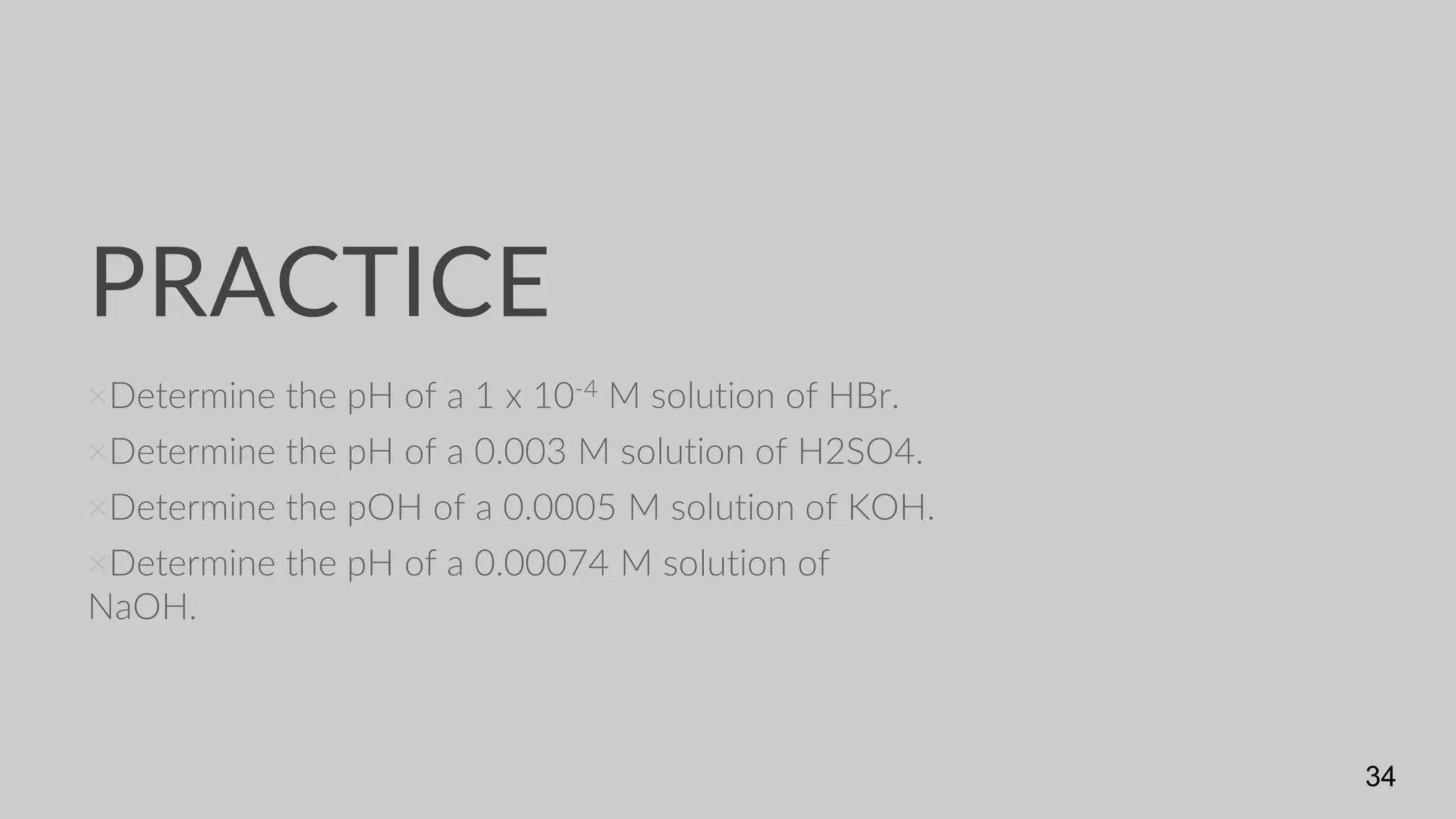
×Determine the pH of a 1 x 10⁻⁴ M solution of HBr.
×Determine the pH of a 0.003 M solution of H2SO4.
×Determine the pOH of a 0.0005 M solution of KOH.
×Determine the pH of a 0.00074 M solution of
NaOH.
34
PRACTICE
×A pH meter is the most accurate
way to measure pH.
×Measures voltage difference between two electrodes
×It will determine the exact pH of a sol’n.
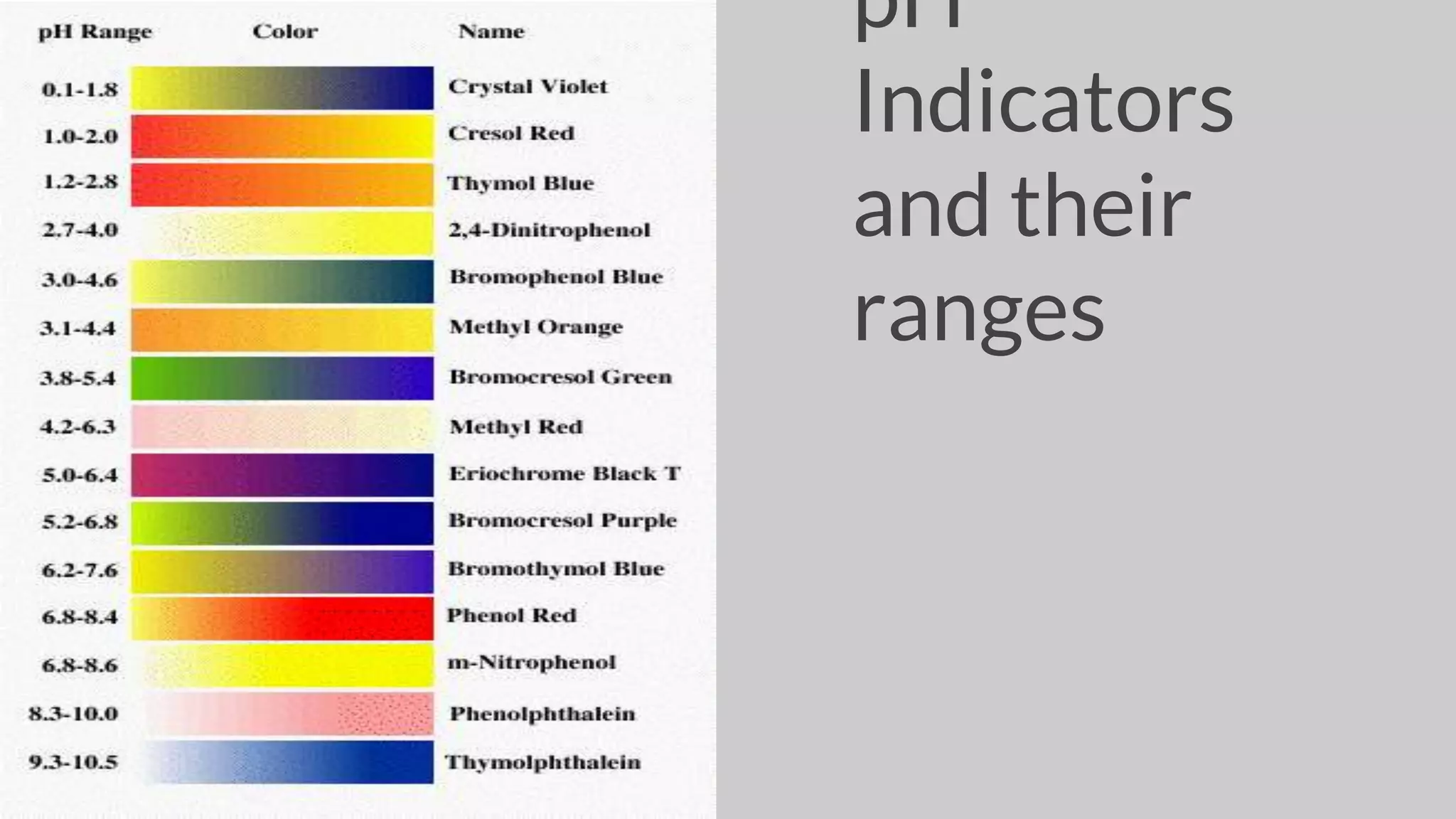
×There are also colored dyes that will change in a
predictable way according to a standard chart. These
are called indicators.
Using Indicators to Measure pH
pH
Indicators
and their
ranges
×pH affects solubility of many substances.
×pH affects structure and function of most proteins - including enzymes.
×Many cells and organisms (esp. plants and aquatic animals) can only survive in a
specific pH environment.
×Important point -
×pH is dependent upon temperature
IMPORTANT OF pH
If the pH of Coke is 3.12, [H+] = ???
Because pH = - log [H+] then
- pH = log [H+]
Take antilog (10x) of both
sides and get
10-pH = [H+]
[H+] = 10-3.12 = 7.6 x 10⁻⁴ M
*** to find antilog on your calculator, look for “Shift” or “2nd function” and then
the log button
pH calculations – Solving for H+
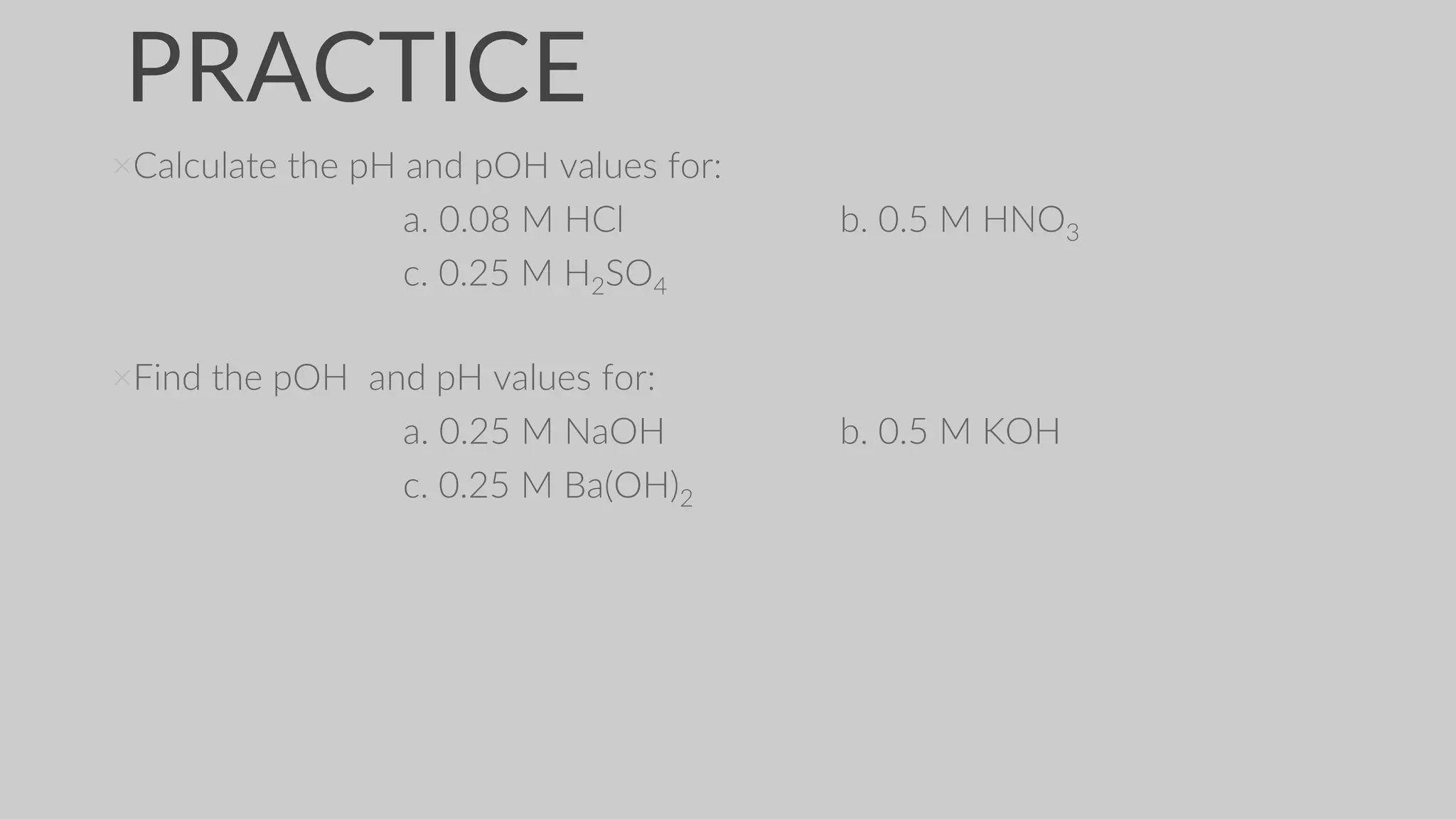
×Calculate the pH and pOH values for:
a. 0.08 M HCl b. 0.5 M HNO3
c. 0.25 M H2SO4
×Find the pOH and pH values for:
a. 0.25 M NaOH b. 0.5 M KOH
c. 0.25 M Ba(OH)2
PRACTICE
What is the pH of a 2 x 10⁻³ M HNO3 solution?
HNO3 is a strong acid – 100% dissociation.
HNO3 (aq) + H2O (l) H3O+ (aq) + NO3
- (aq)
pH = -log [H+] = -log [H3O+] = -log(0.002) = 2.7
Start
End
0.002 M
0.002 M 0.002 M
0.0 M
0.0 M 0.0 M
What is the pH of a 1.8 x 10⁻² M Ba(OH)2 solution?
Ba(OH)2 is a strong base – 100% dissociation.
Ba(OH)2 (s) Ba2+ (aq) + 2OH- (aq)
Start
End
0.018 M
0.018 M 0.036 M
0.0 M
0.0 M 0.0 M
pH = 14.00 – pOH = 14.00 + log(0.036) = 12.56
15.4
×MONOPROTIC ACID
×DIPROTIC ACID
×POLYPROTIC ACID
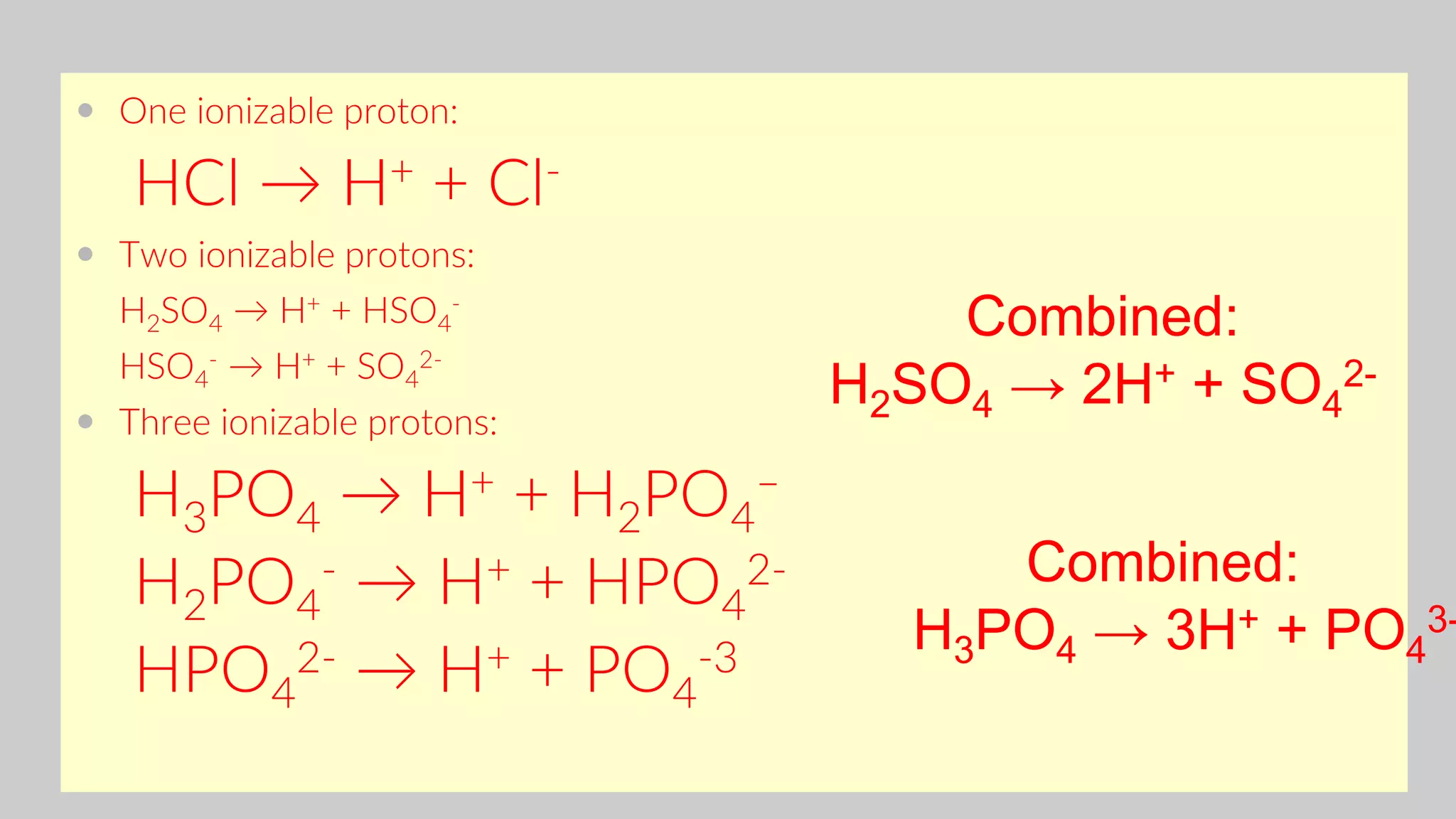
 One ionizable proton:
HCl → H+ + Cl-
 Two ionizable protons:
H2SO4 → H+ + HSO4
-
HSO4
- → H+ + SO4
2-
 Three ionizable protons:
H3PO4 → H+ + H2PO4
–
H2PO4
- → H+ + HPO4
2-
HPO4
2- → H+ + PO4
-3
Combined:
H2SO4 → 2H+ + SO4
2-
Combined:
H3PO4 → 3H+ + PO4
3-
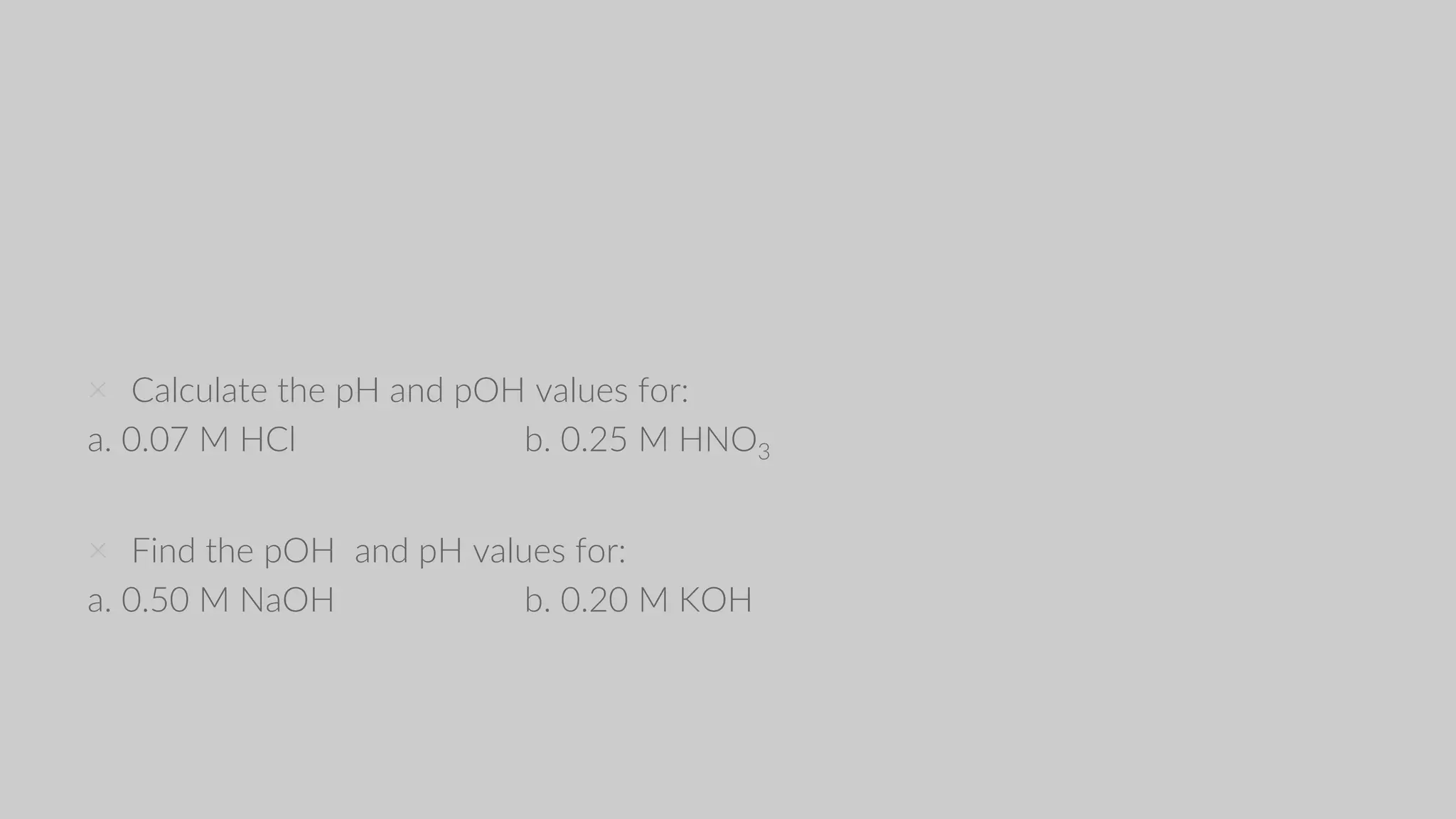
× Calculate the pH and pOH values for:
a. 0.07 M HCl b. 0.25 M HNO3
× Find the pOH and pH values for:
a. 0.50 M NaOH b. 0.20 M KOH
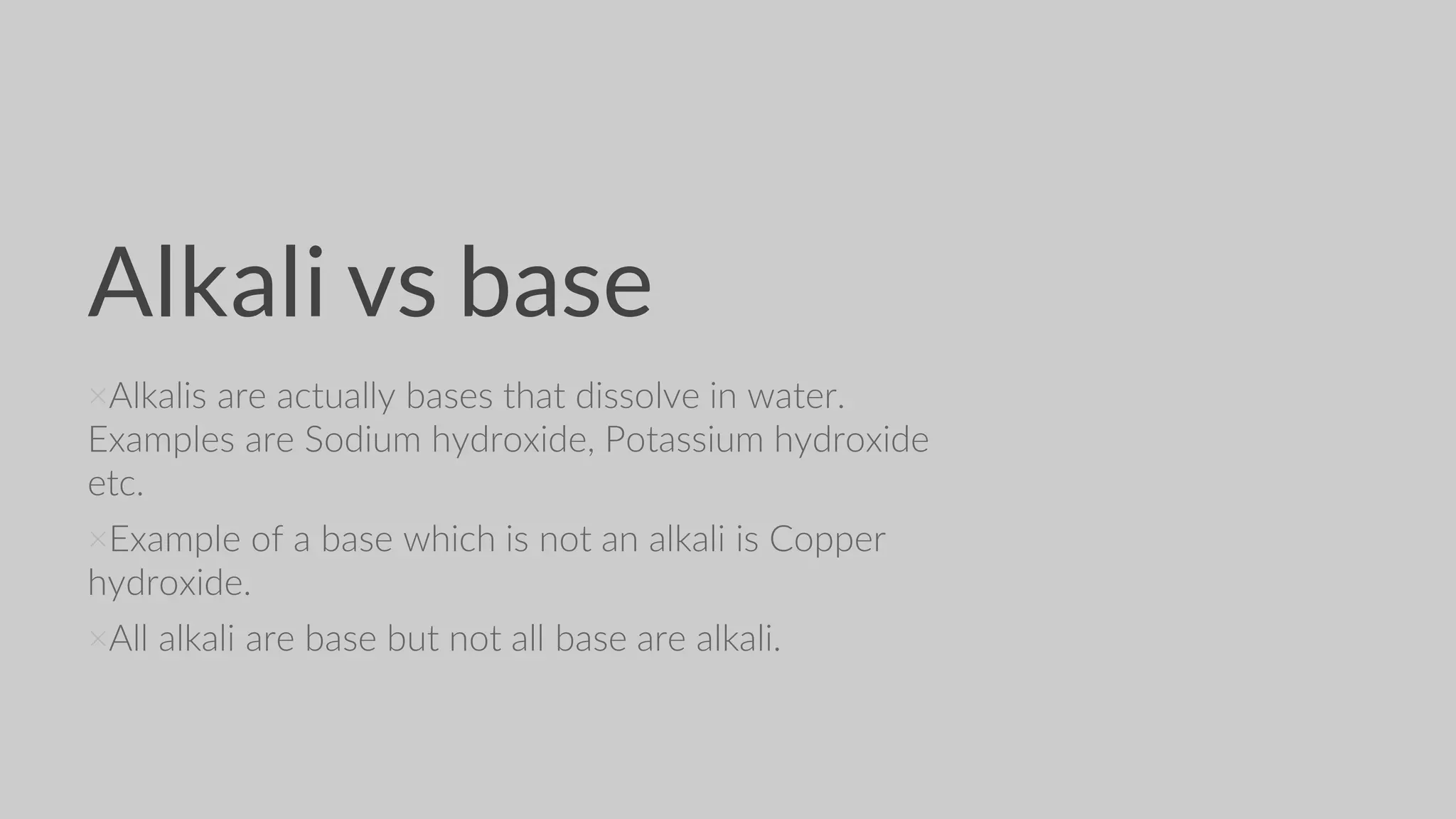
×Alkalis are actually bases that dissolve in water.
Examples are Sodium hydroxide, Potassium hydroxide
etc.
×Example of a base which is not an alkali is Copper
hydroxide.
×All alkali are base but not all base are alkali.
Alkali vs base
Consider acetic acid, HC2H3O2 (HOAc)
HC2H3O2 + H2O ↔ H3O+ + C2H3O2
-
Acid Conj. base
Equilibria Involving
Weak Acids and Bases
Ka 
[H3O+][OAc- ]
[HOAc]
 1.8 x 10⁻⁵
(K is designated Ka for ACID)
K gives the ratio of ions (split up) to molecules (don’t split up)
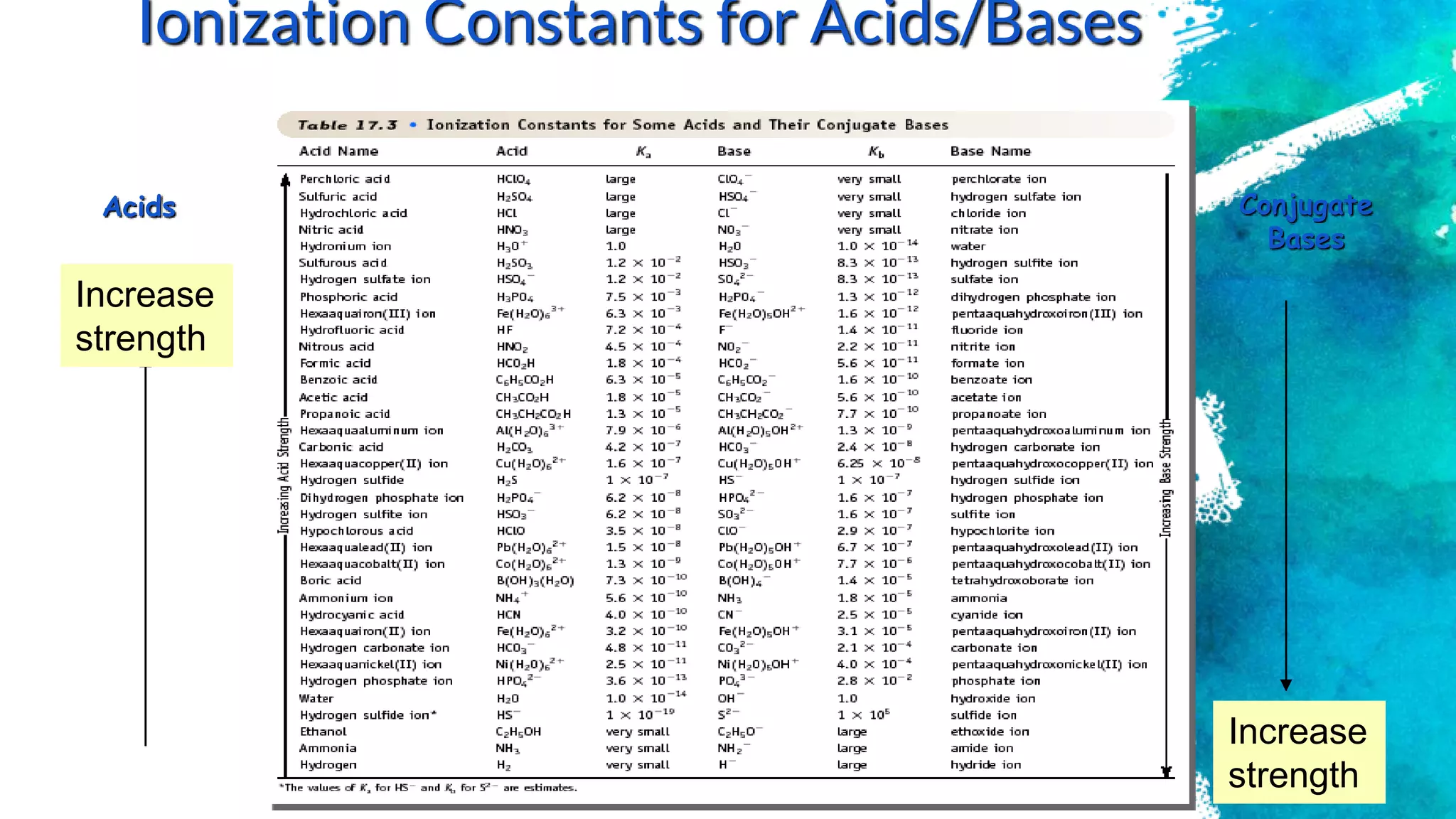
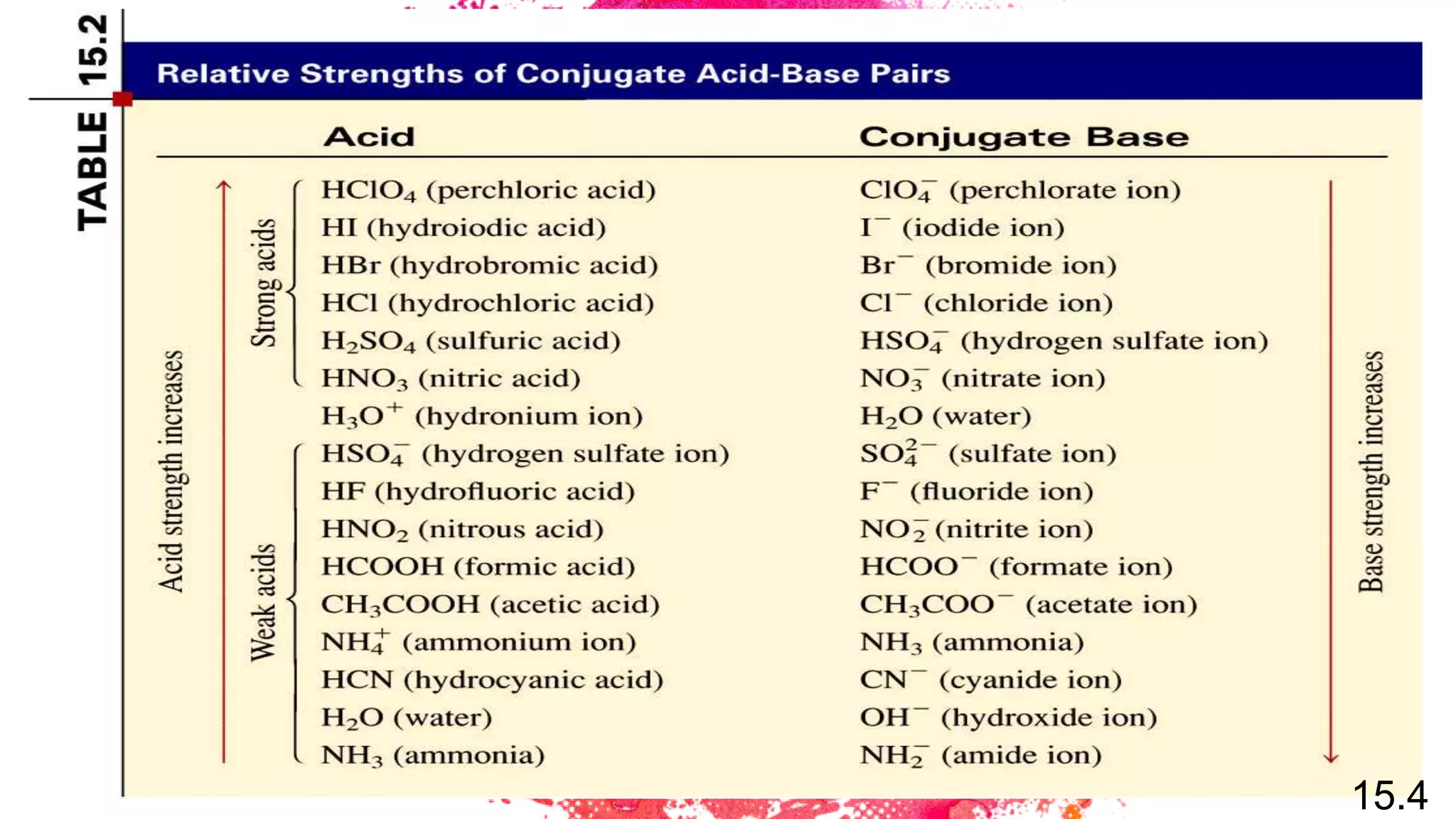
Ionization Constants for Acids/Bases
Acids Conjugate
Bases
Increase
strength
Increase
strength
Equilibrium Constants
for Weak Acids
Weak acid has Ka < 1
Leads to small [H3O+] and a pH of 2 - 7
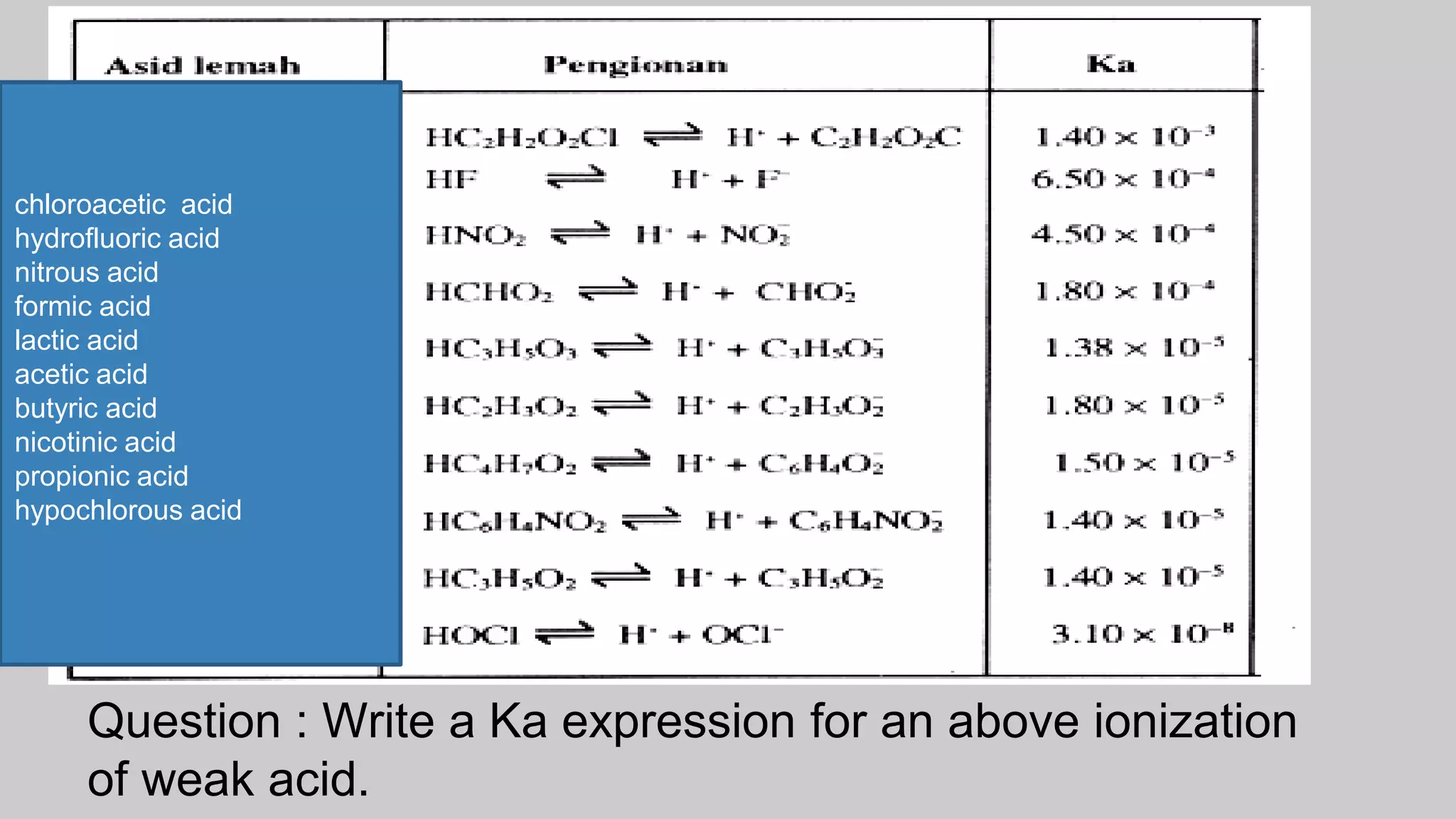
Question : Write a Ka expression for an above ionization
of weak acid.
chloroacetic acid
hydrofluoric acid
nitrous acid
formic acid
lactic acid
acetic acid
butyric acid
nicotinic acid
propionic acid
hypochlorous acid
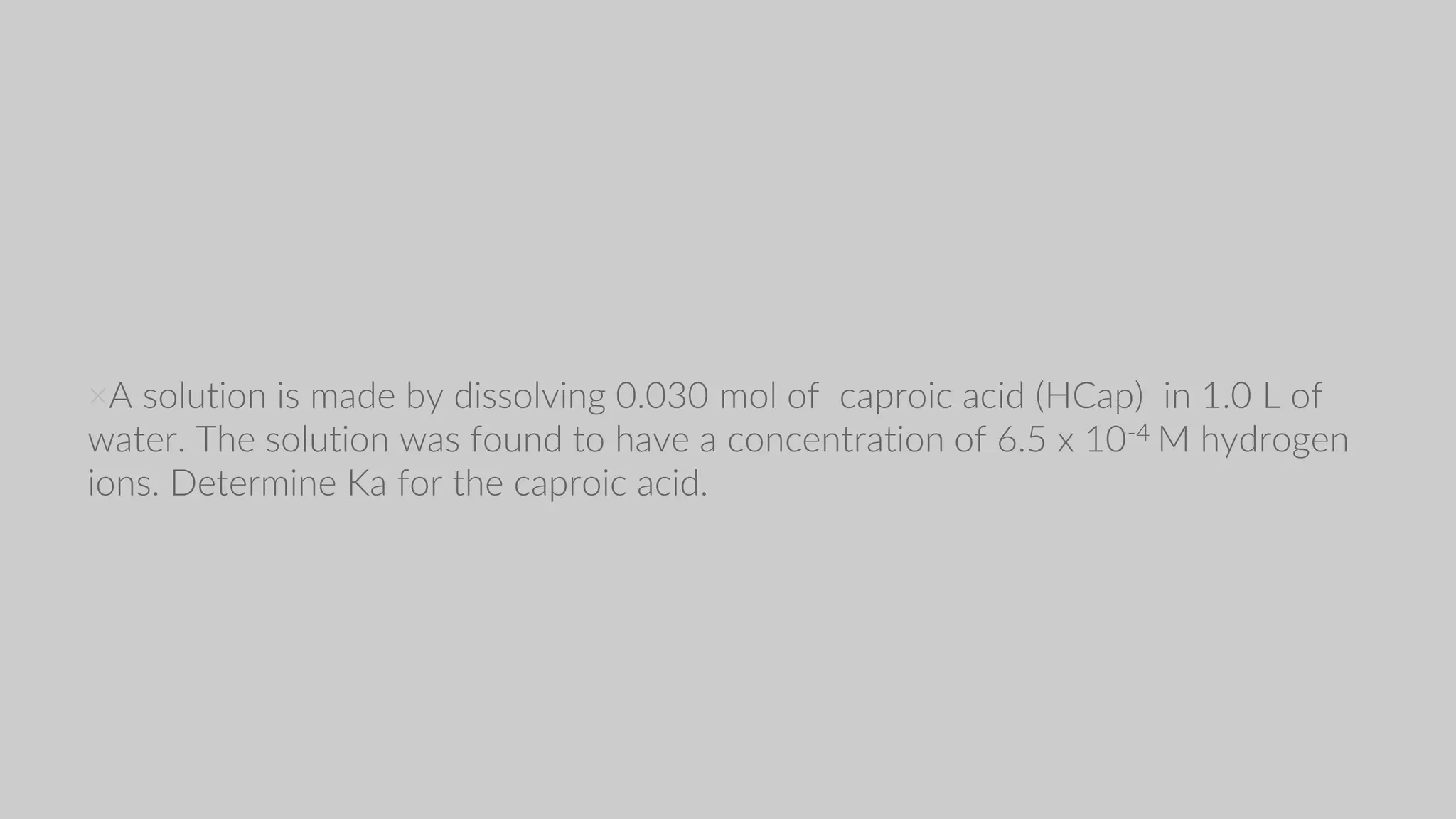
×A solution is made by dissolving 0.030 mol of caproic acid (HCap) in 1.0 L of
water. The solution was found to have a concentration of 6.5 x 10⁻⁴ M hydrogen
ions. Determine Ka for the caproic acid.
 Solution
 Dissociation of caproic acid is shown below:
HCap(aq) H+ + Cap-(aq)
Initial Concentration : 0.030 M 0 M 0 M
Concentration at equilibrium : 0.030 – x) M x M x M
At equilibrium
Ka = [H+][Cap-]
[HCap]
[H+] = [Cap-]
= 6.5 x 10⁻⁴ M
therefore [HCap] =3.0 x 10⁻² M - 6.5 x 10⁻⁴ M
= 2.9 x 10⁻² M
Ka = (6.5 x 10⁻⁴) (6.5 x 10⁻⁴)
2.9 x 10-2
= 1.5 x 10⁻⁵
Equilibrium Constants
for Weak Bases
Weak base has Kb < 1
Leads to small [OH-] and a pH of 12 - 7
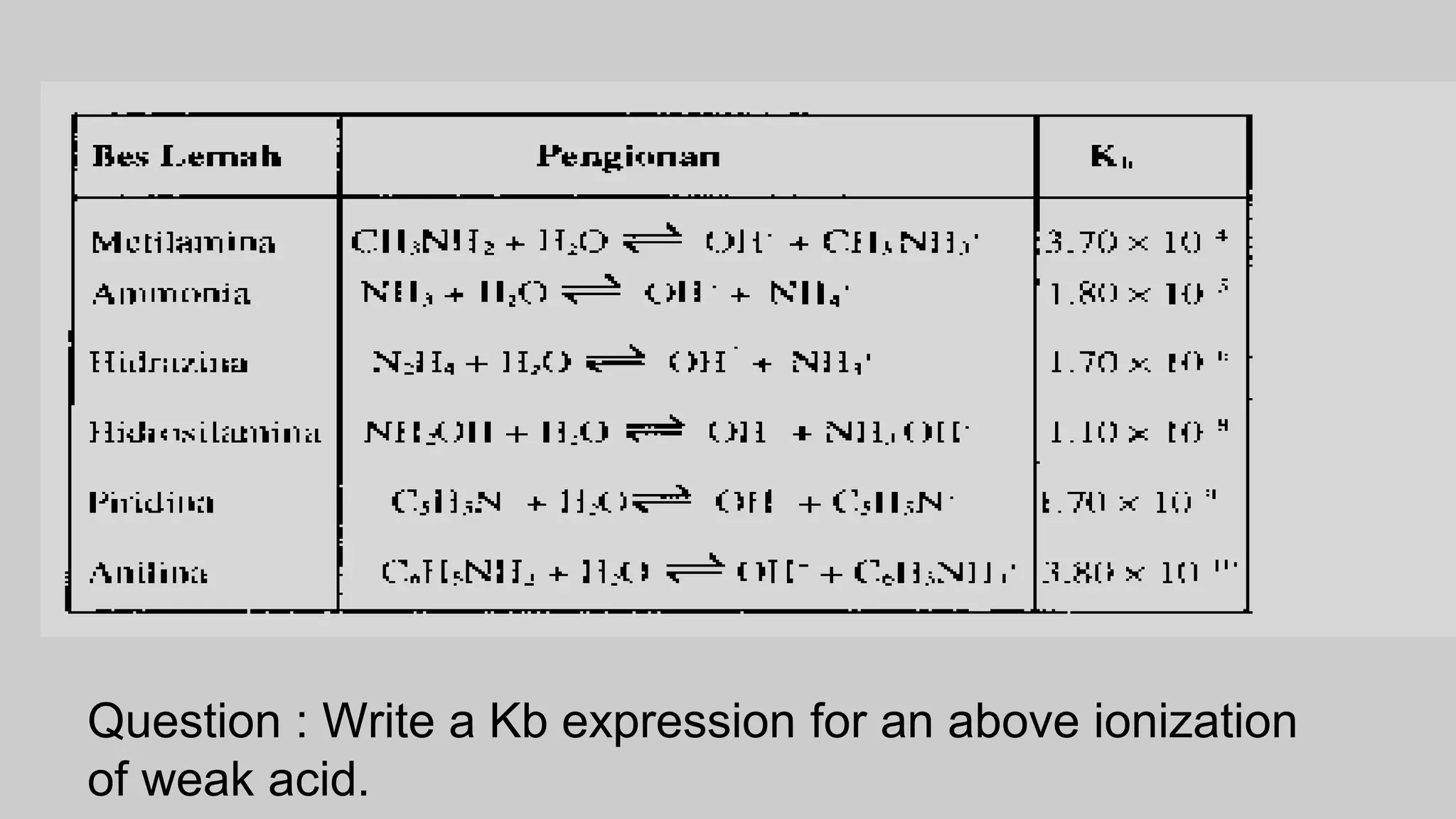
Question : Write a Kb expression for an above ionization
of weak acid.
Calculate [OH-] in 0.20 M aqueous NH3. (Kb = 1.80 x 10⁻⁵)
Solution
NH3 + H20 NH4
+ + OH-
Initial Concentration : 0.2 M 0 M 0 M
Concentration at equilibrium: (0.2 – x ) M x M x M
At equilibrium
Kb = [NH4
+][OH-]
[NH3]
= 1.80 x 10-5
= x2 .
0.20 – x
Kb value is very small, as a result 0.20 – x  0.2,
x2 = (1.8 x 10⁻⁵)(0.2)
x = [OH-]
= 1.9 X 10⁻³ M
It can be seen that the calculation for weak acid and base is long and
complicated. There is a simple way to calculate that is by using the following
formula.
For weak acid:
[ H+] =
For weak base:
[ OH-] =
note: c represents the concentration of the acid or base
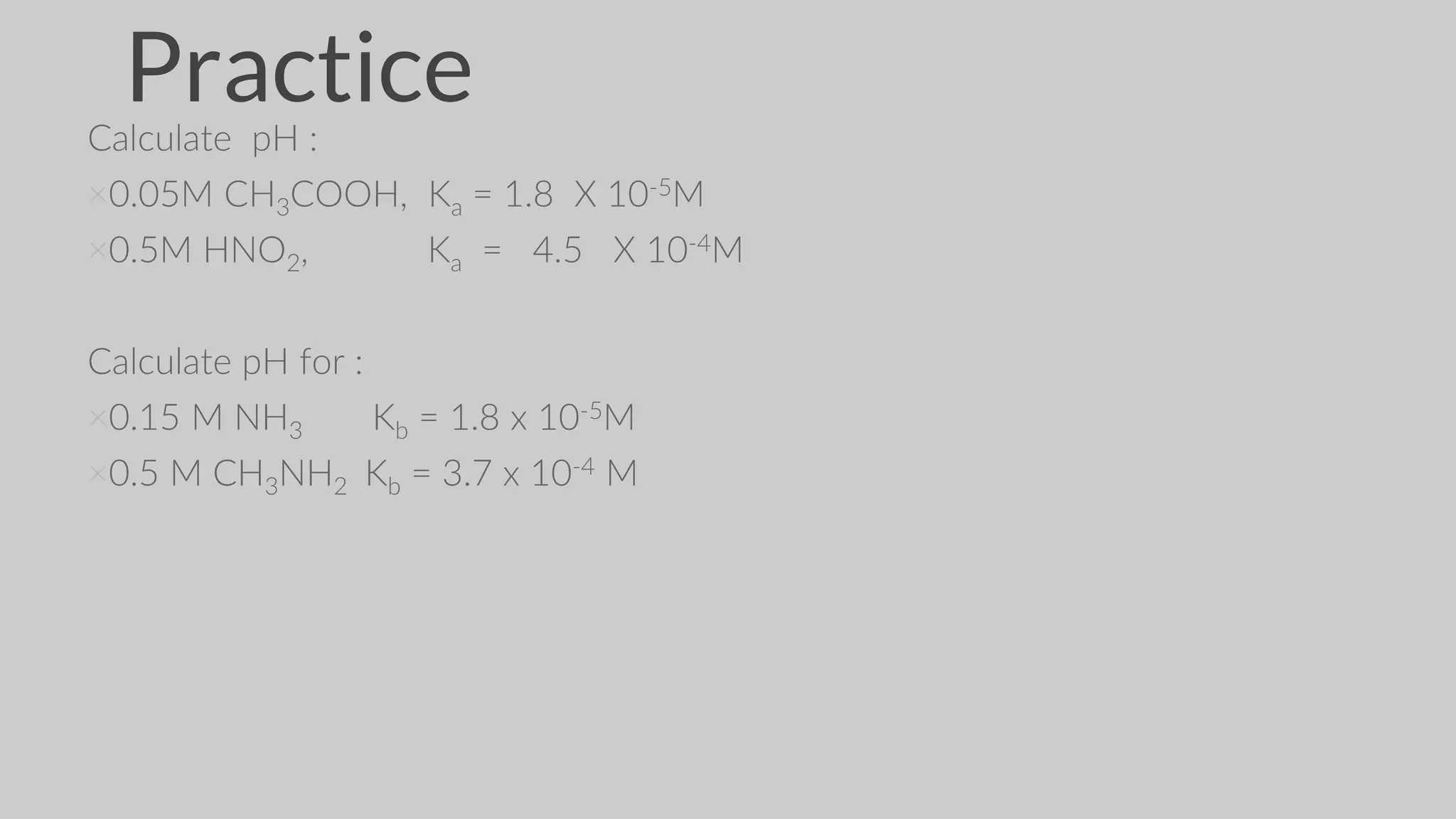
Calculate pH :
×0.05M CH3COOH, Ka = 1.8 X 10-5M
×0.5M HNO2, Ka = 4.5 X 10⁻⁴M
Calculate pH for :
×0.15 M NH3 Kb = 1.8 x 10-5M
×0.5 M CH3NH2 Kb = 3.7 x 10⁻⁴ M
Practice
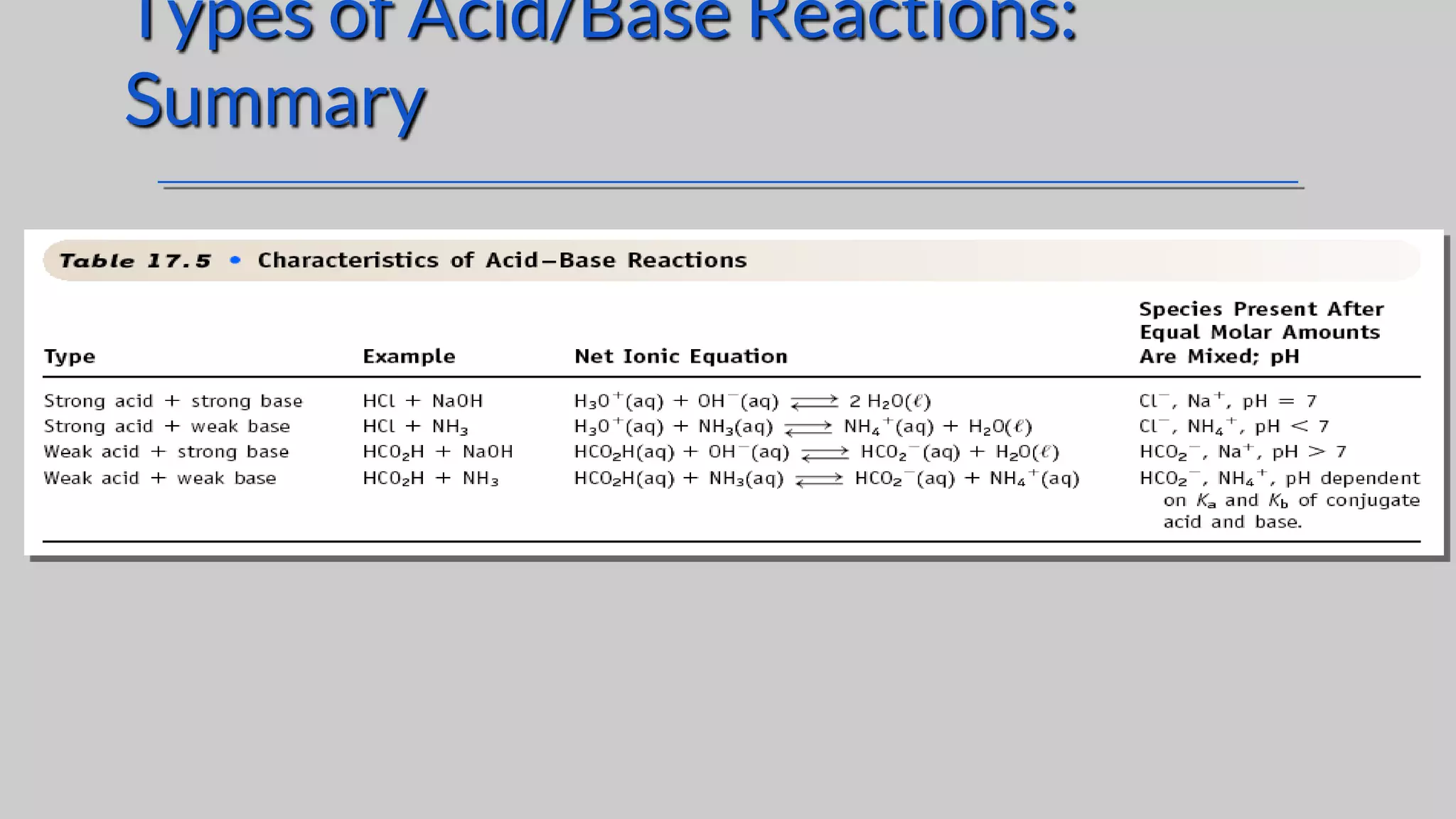
Types of Acid/Base Reactions:
Summary
15.4
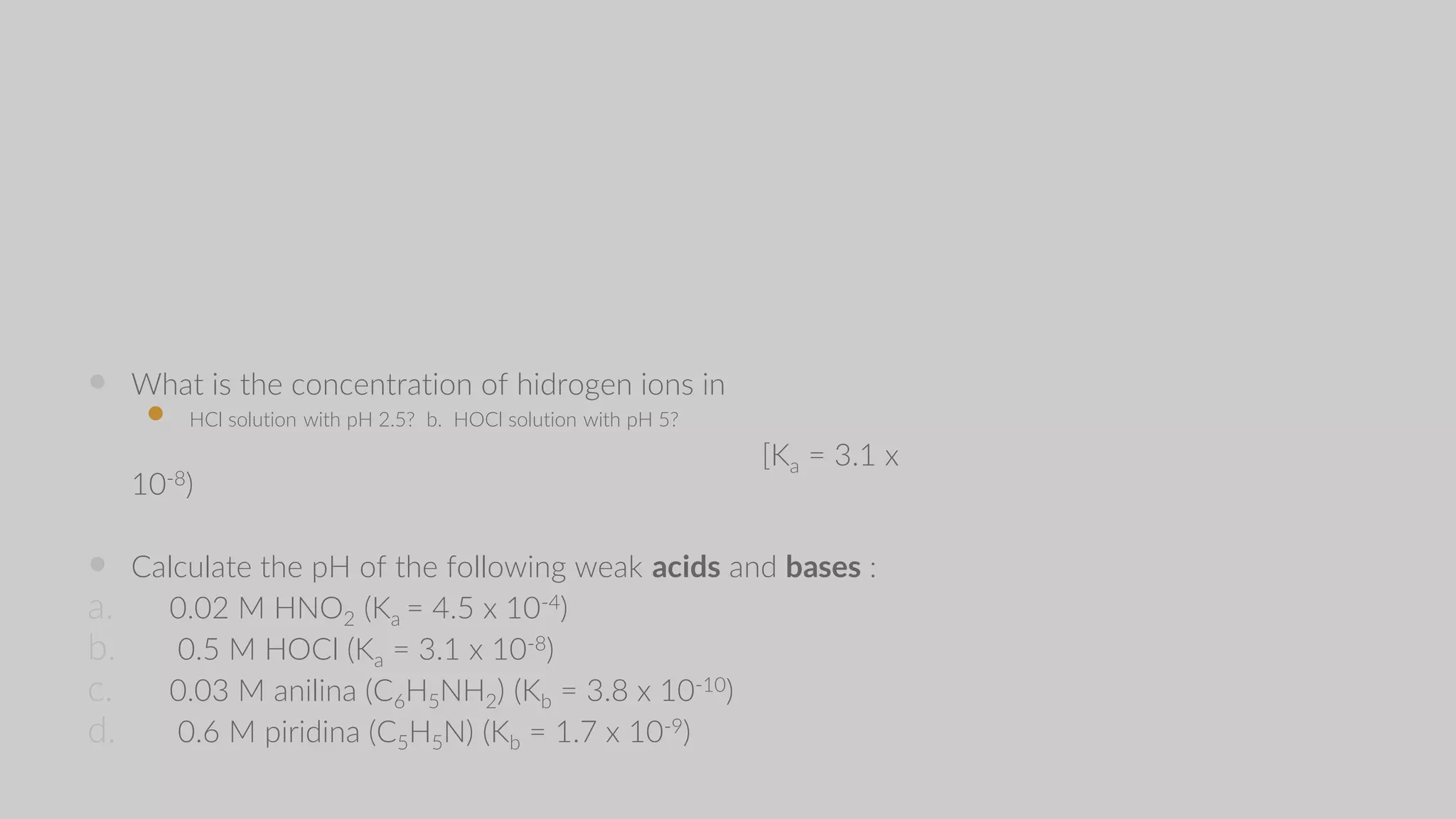
 What is the concentration of hidrogen ions in
 HCl solution with pH 2.5? b. HOCl solution with pH 5?
[Ka = 3.1 x
10-8)
 Calculate the pH of the following weak acids and bases :
a. 0.02 M HNO2 (Ka = 4.5 x 10⁻⁴)
b. 0.5 M HOCl (Ka = 3.1 x 10⁻⁸)
c. 0.03 M anilina (C6H5NH2) (Kb = 3.8 x 10⁻¹⁰)
d. 0.6 M piridina (C5H5N) (Kb = 1.7 x 10⁻⁹)
LESSON LEARNING OUTCOME
 1.5 Discover the importance of buffer
solutions
1.5.1 Buffer solutions
1.5.2 Chemical substances that can
function as a buffer in aqueous
solution
60
BUFFER SOLUTION
Buffer Solutions
×A buffer solution is a mixture that minimises
pH changes on the addition of small amounts of
acid or base.
×pH changes are minimised as long as some of
the buffer solution remains.
Acidic buffer
solutions
×Buffer that have pH less than 7.
×Weak acid + conjugate base
×A common example would be a mixture of ethanoic
acid and sodium ethanoate in solution.
LecturePLUS Timberlake 63
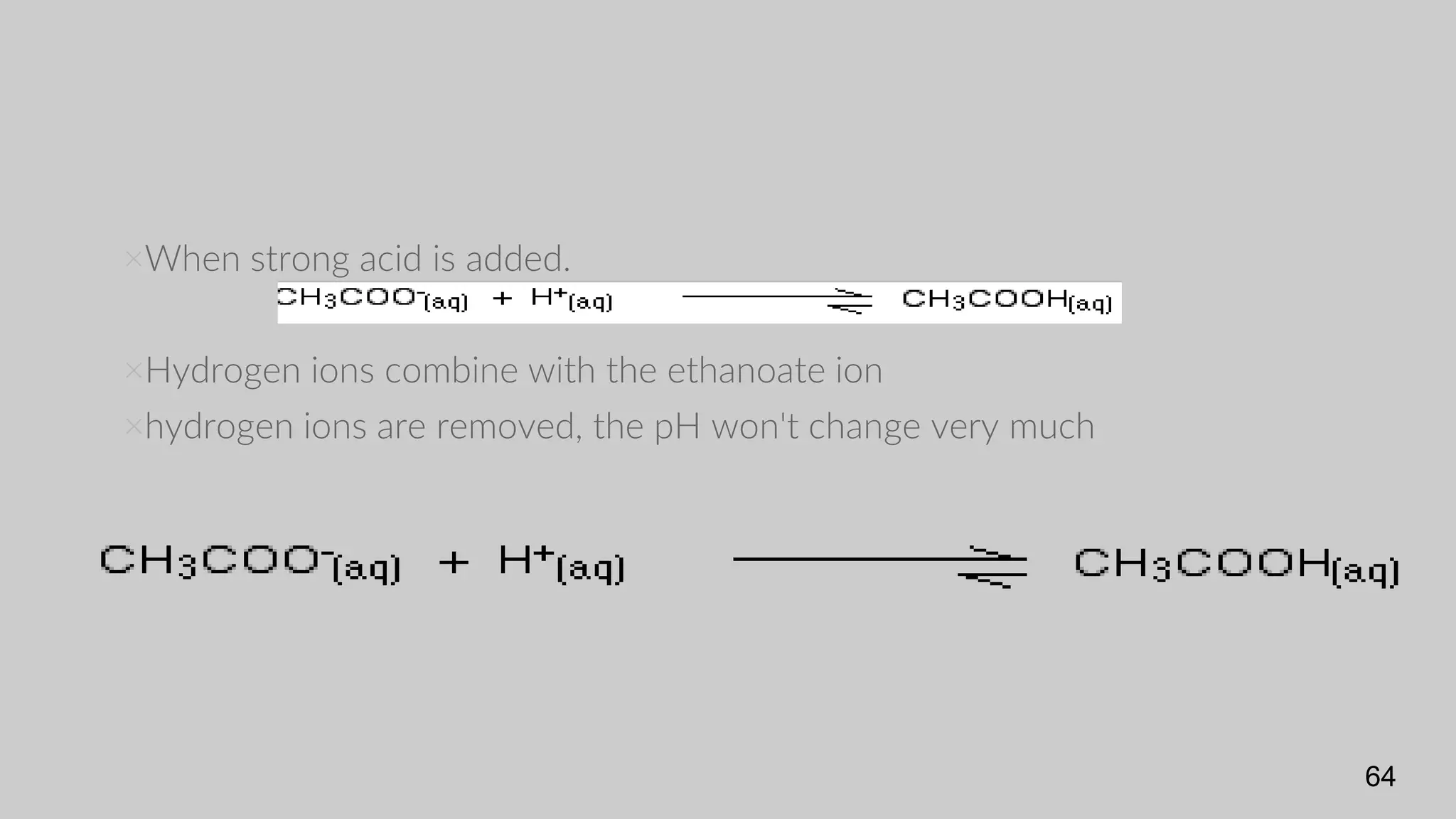
×When strong acid is added.
×Hydrogen ions combine with the ethanoate ion
×hydrogen ions are removed, the pH won't change very much
64
LecturePLUS Timberlake 65
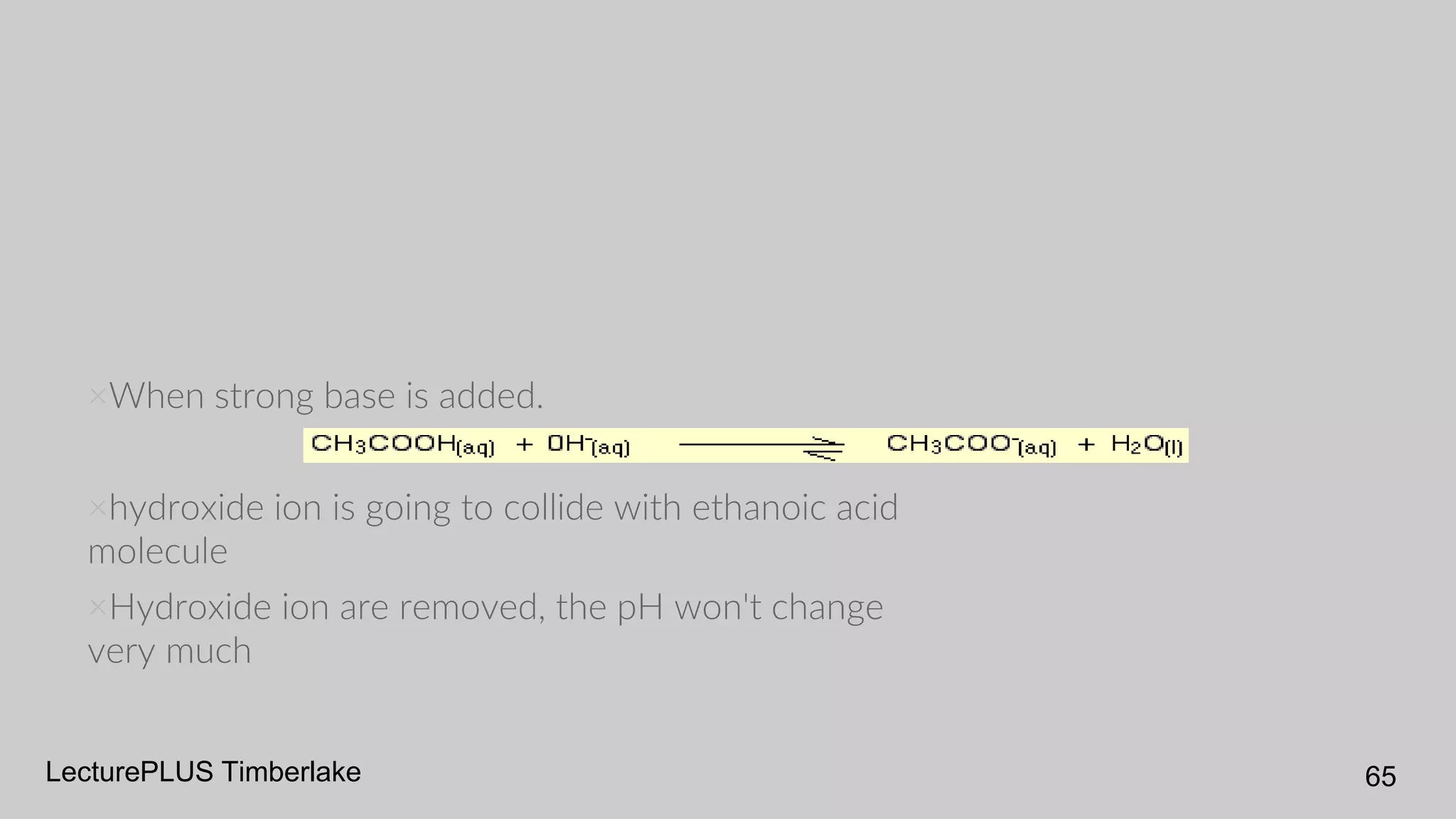
×When strong base is added.
×hydroxide ion is going to collide with ethanoic acid
molecule
×Hydroxide ion are removed, the pH won't change
very much
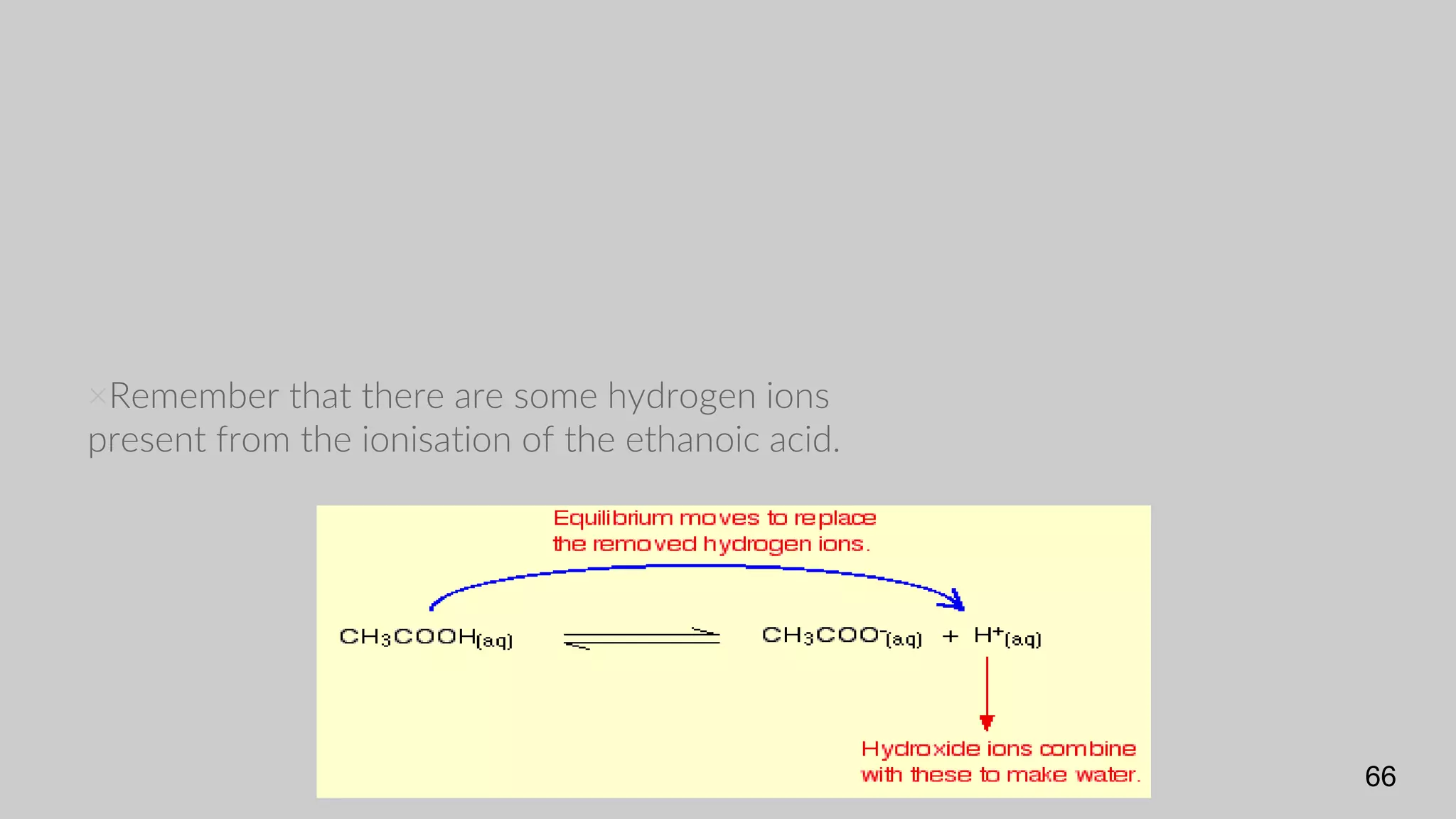
×Remember that there are some hydrogen ions
present from the ionisation of the ethanoic acid.
66
Alkaline buffer
solutions
×An alkaline buffer solution has a pH greater than 7.
×weak base + conjugate acid
×For example: mixture of ammonia and ammonium
chloride solutions
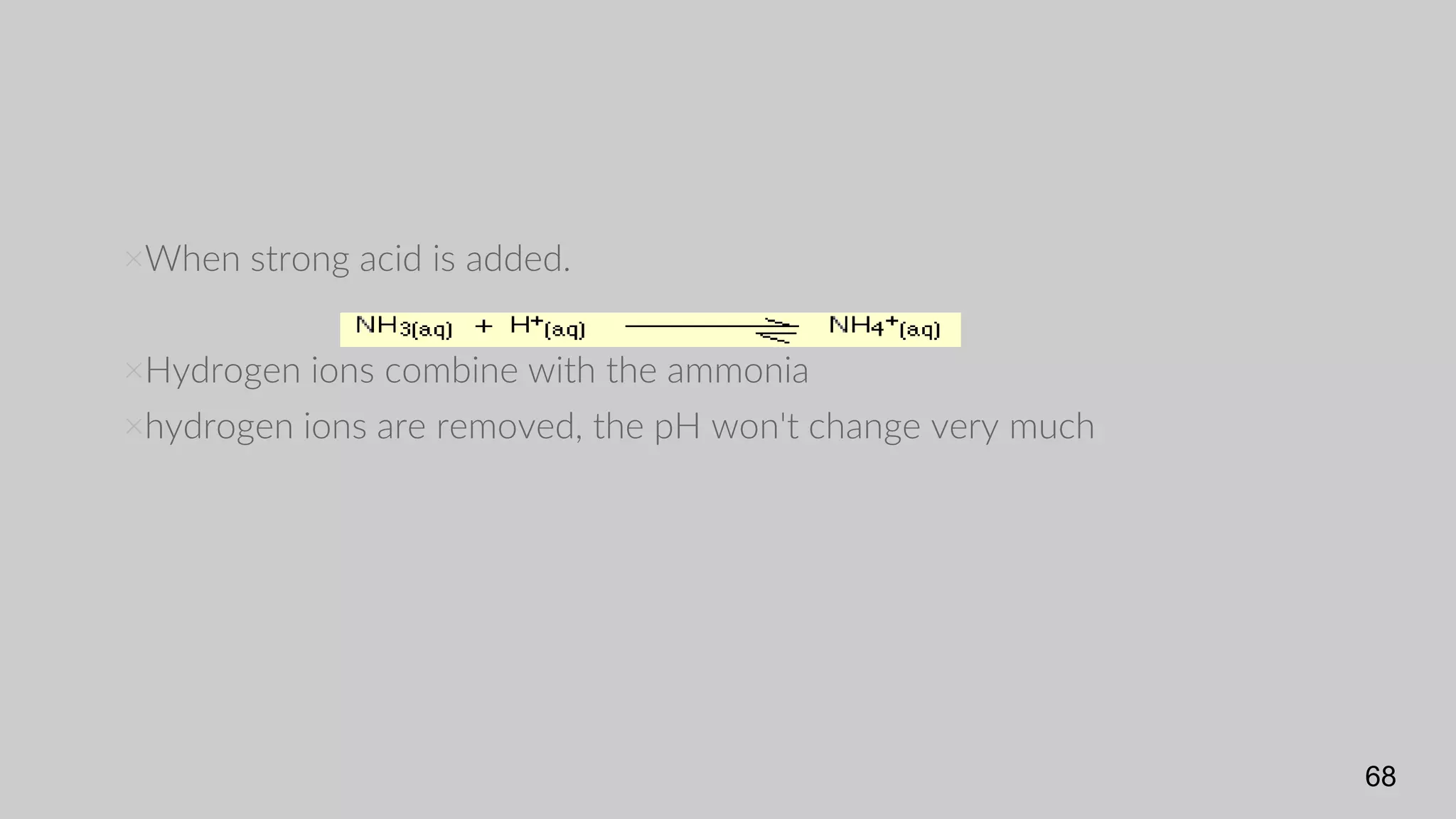
×When strong acid is added.
×Hydrogen ions combine with the ammonia
×hydrogen ions are removed, the pH won't change very much
68
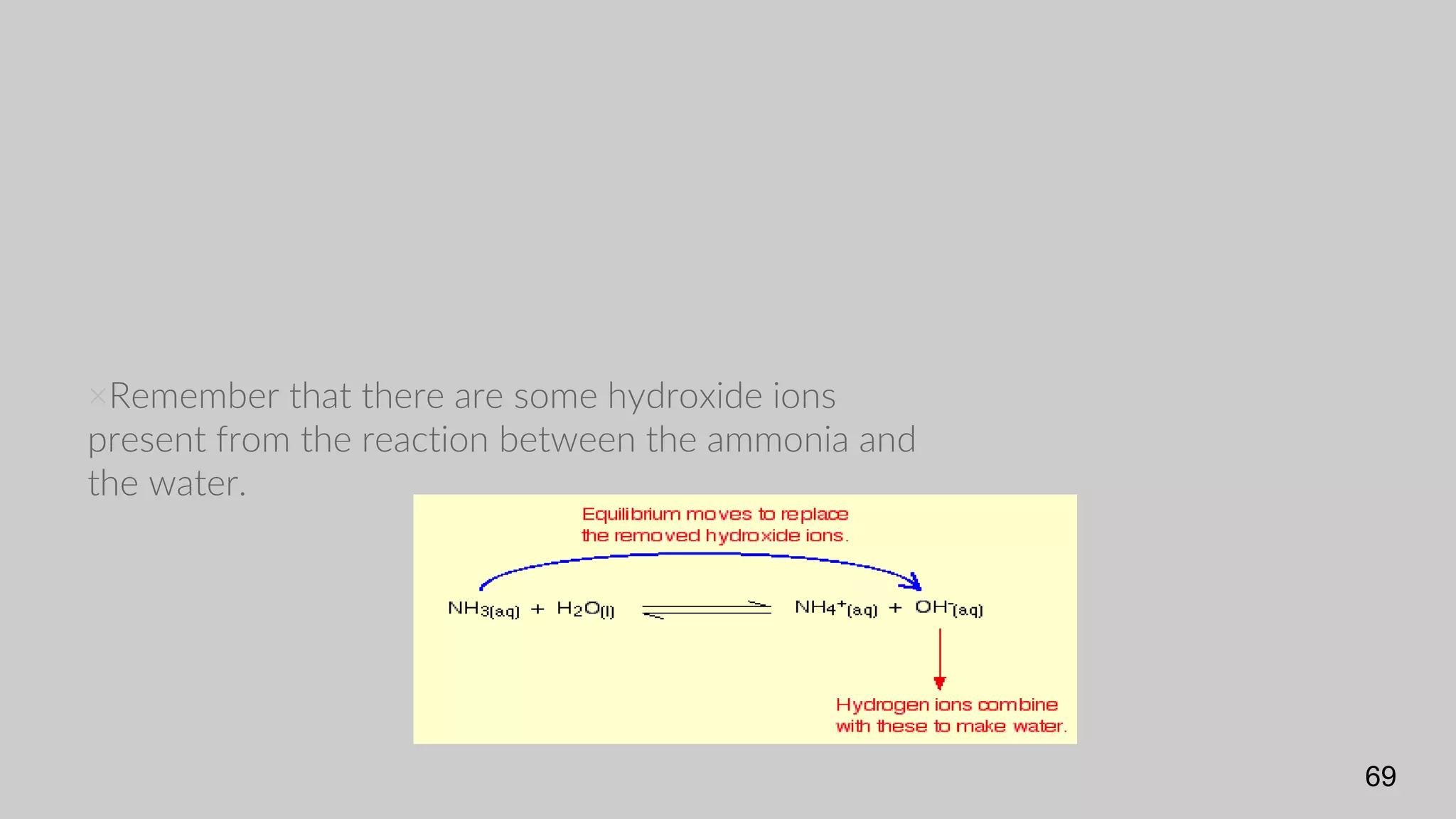
×Remember that there are some hydroxide ions
present from the reaction between the ammonia and
the water.
69
LecturePLUS Timberlake 70
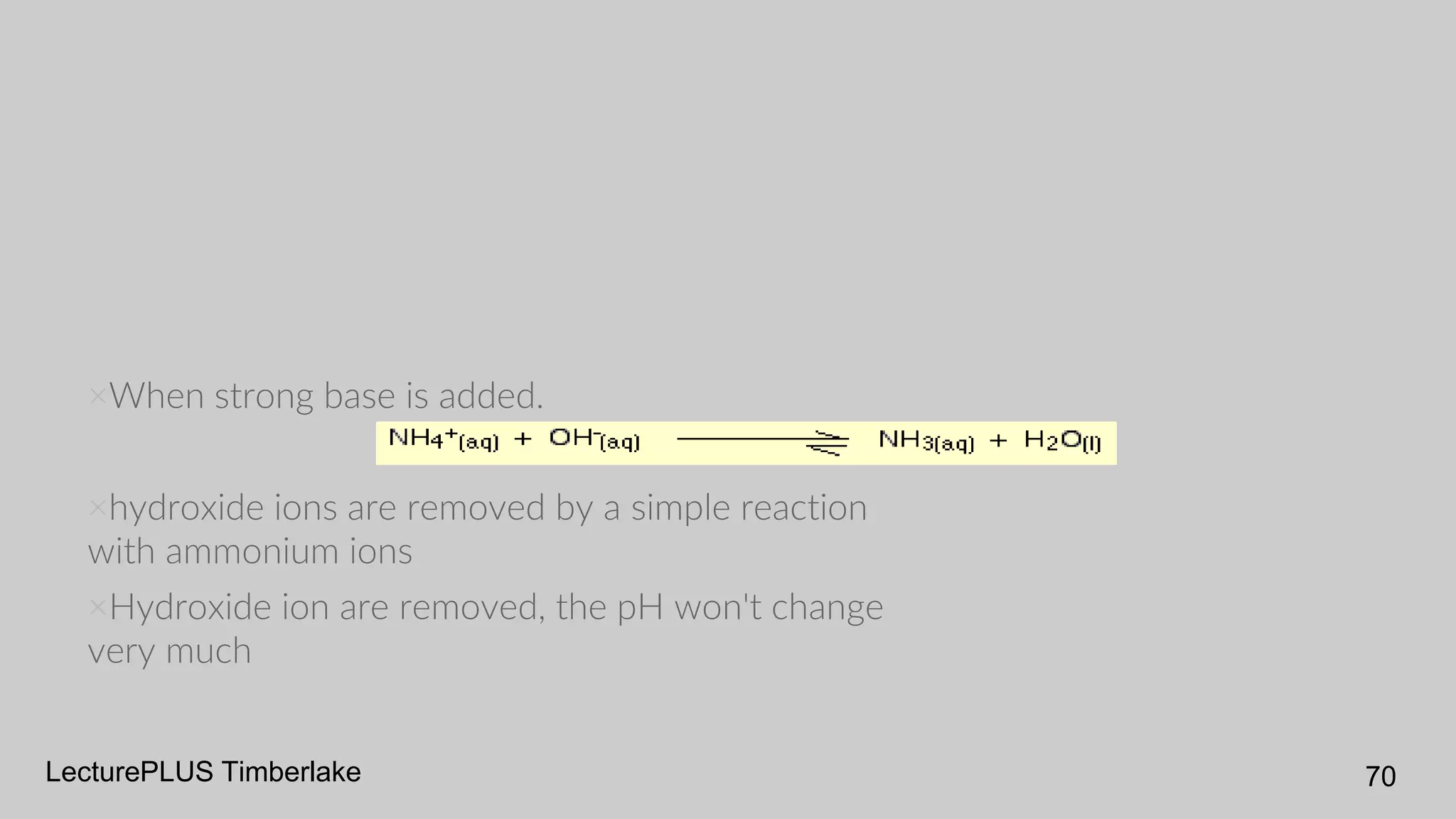
×When strong base is added.
×hydroxide ions are removed by a simple reaction
with ammonium ions
×Hydroxide ion are removed, the pH won't change
very much
REMEMBER!
×Only most (not ALL) access hydrogen ions and hydroxide ions are removed in
reaction of buffer solution.
×No buffer solution can cope with the addition of large concentrations of
acid or alkali.
LecturePLUS Timberlake 71
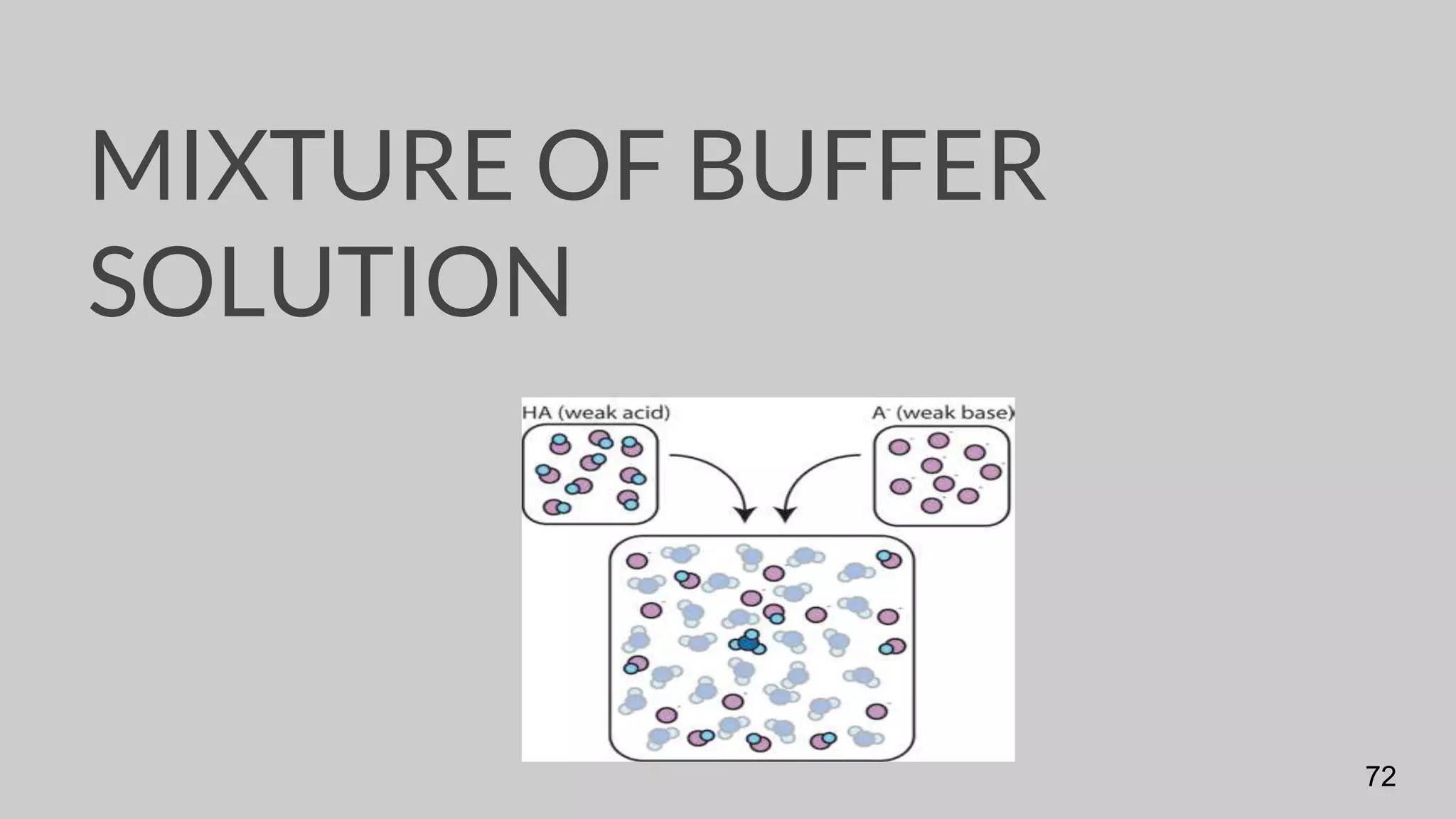
MIXTURE OF BUFFER
SOLUTION
72
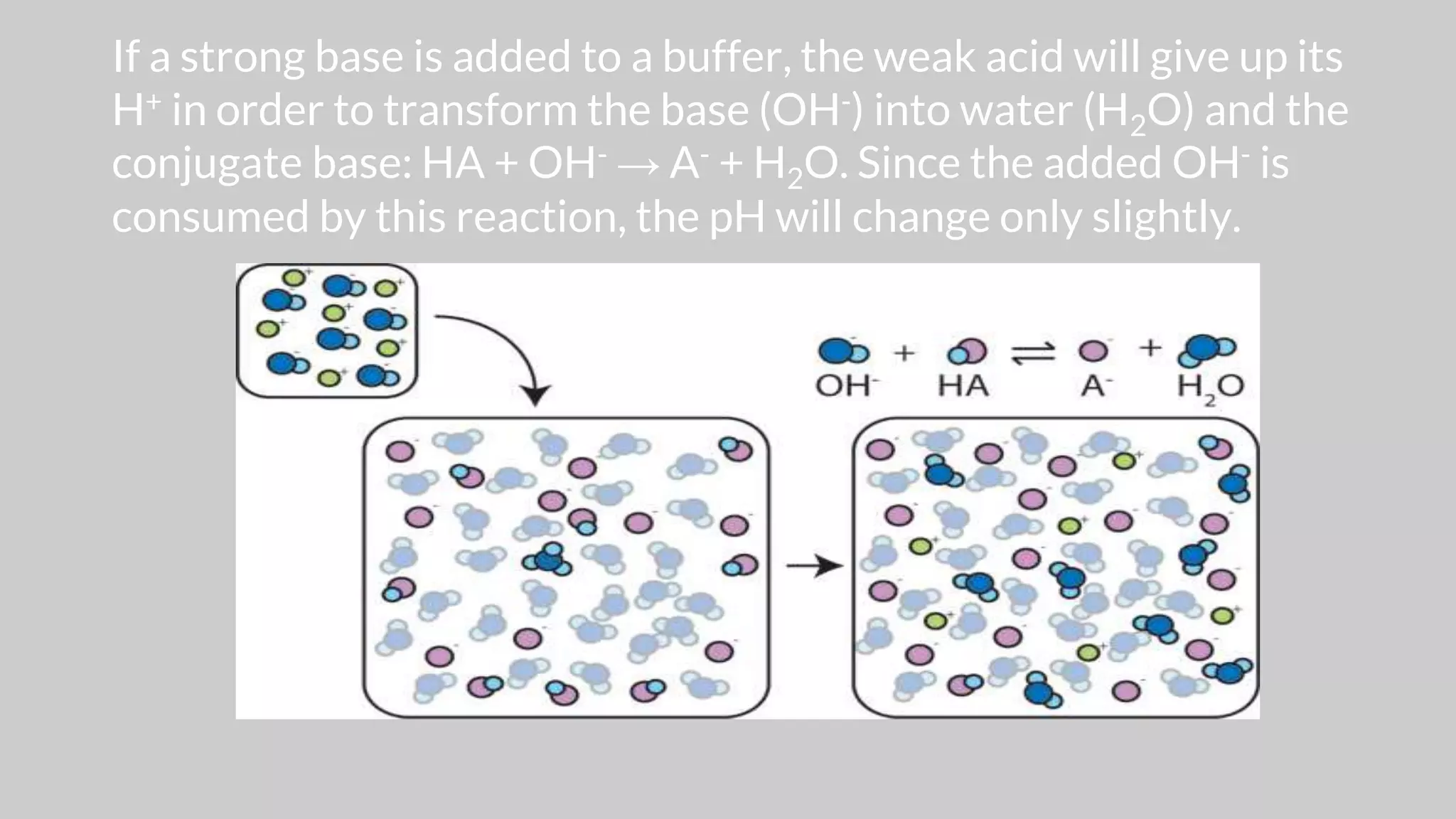
If a strong base is added to a buffer, the weak acid will give up its
H+ in order to transform the base (OH-) into water (H2O) and the
conjugate base: HA + OH- → A- + H2O. Since the added OH- is
consumed by this reaction, the pH will change only slightly.
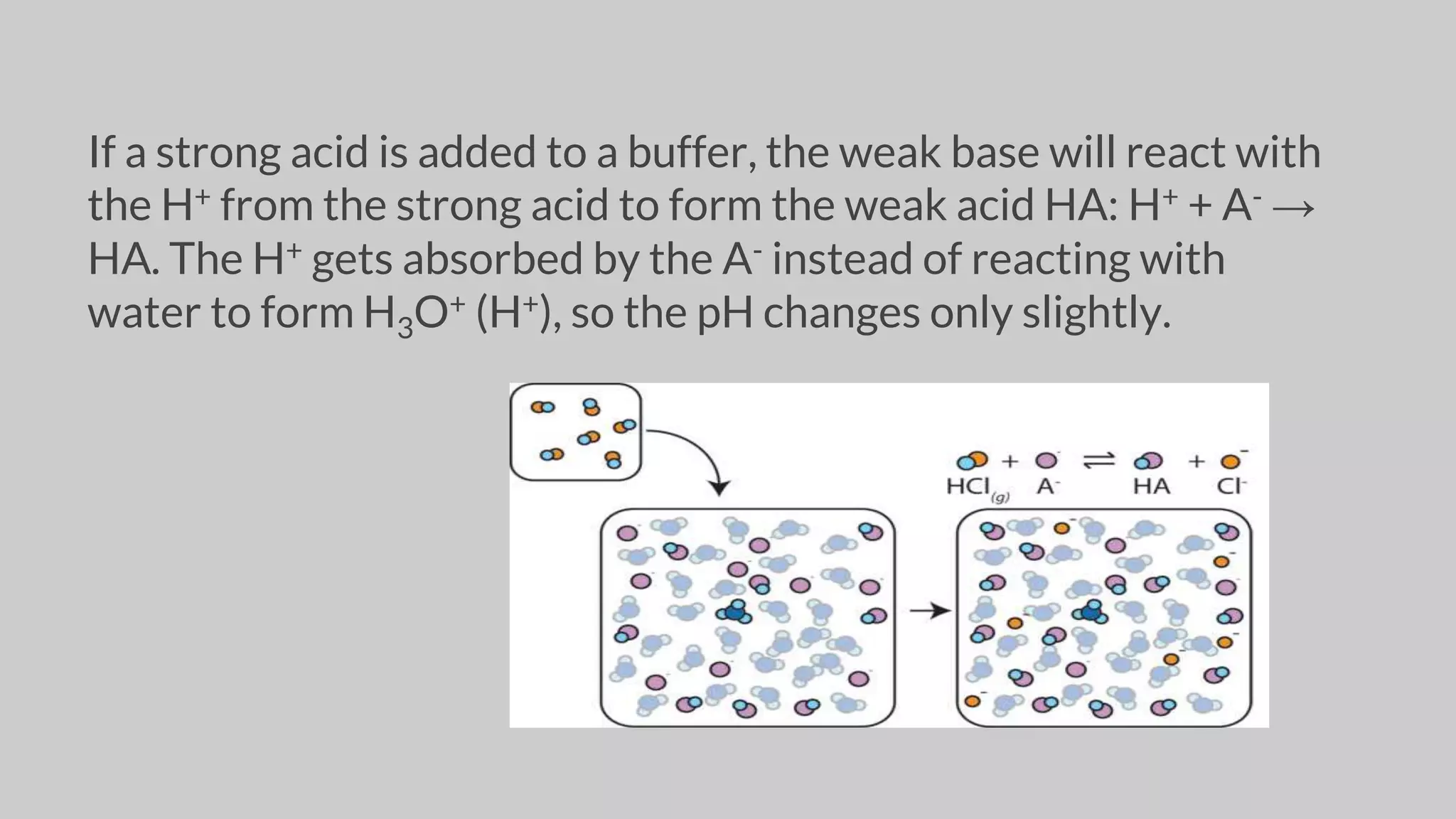
If a strong acid is added to a buffer, the weak base will react with
the H+ from the strong acid to form the weak acid HA: H+ + A- →
HA. The H+ gets absorbed by the A- instead of reacting with
water to form H3O+ (H+), so the pH changes only slightly.
Buffers
×Why use them?
×Enzyme reactions and cell functions have optimum pH’s for performance
×Important anytime the structure and/or activity of a biological material must be
maintained
Factors in choosing a buffer
×Be sure it covers the pH range you need
×Generally: pKa of acid ± 1 pH unit
×Consult tables for ranges or pKa values
×Be sure it is not toxic to the cells or organisms you are working with.
×Be sure it would not confound the experiment (e.g. avoid phosphate
buffers in experiments on plant mineral nutrition).
77

Chapter 1 acid and bases sesi 2

  • 1.
  • 2.
    FROM THE PREVIOUSVIDEO WHAT DO YOU THINK ABOUT ACID? 2
  • 3.
  • 4.
    LESSON LEARNING OUTCOME 1.1 Explain about acids and bases  1.1.1 Acids and bases according to the following theories: a. Arrhenius b. Bronsted-Lowry  1.1.2 Equations depicting the behavior of acids and bases in water  1.2 Discuss the acid-base reactions  1.2.1 Equations to illustrate acid-base reactions  1.2.2 Conjugate acid-base pairs 4
  • 5.
    ARRHENIUS ACID-BASE Acids produceH+ in aqueous solutions water HCl H+(aq) + Cl- (aq) Bases produce OH- in aqueous solutions water NaOH Na+(aq) + OH- (aq) 5
  • 6.
    6 Acids are hydrogenion (H+) donors Bases are hydrogen ion (H+) acceptors HCl + H2O H3O+ + Cl- donor acceptor Bronsted-Lowry Acids
  • 7.
  • 8.
  • 9.
  • 10.
    1. They areliquids. 2. They are solutions of compounds in water. 3. If concentrated they can be corrosive. 4. Acids taste sour (for example, vinegar). 5. Turn blue litmus paper red - this is an easy test for an acid! 6. Usually react with base to form salts. 7. Acids contain hydrogen ions. 8. Turn Universal Indicator from green to red, and have a pH less than 7. 10 PROPERTIES OF ACID
  • 11.
  • 12.
    They have abitter taste. They have slippery touch. They conduct electrically. It turns red litmus to blue. It turns colorless phenolphthalein to pink 12 PROPERTIES OF BASE
  • 13.
  • 14.
  • 15.
    15 Learning Check Match theformulas with the names: A. ___ HNO2 1) hydrochloric acid B. ___ Ca(OH)2 2) sulfuric acid C. ___ H2SO4 3) sodium hydroxide D. ___ HCl 4) nitrous acid E. ___ NaOH 5) calcium hydroxide
  • 16.
    16 Learning Check Acid, BaseName or Salt CaCl2 ______ _________________ KOH ______ _________________ Ba(OH)2 ______ _________________ HBr ______ _________________ H2SO4 ______ __________________
  • 17.
    So what didyou learn today? (each student need to give 1 point) 17
  • 18.
    LESSON LEARNING OUTCOME 1.3 Distinguish the degree of ionization and the strength of acids and bases 1.3.1 Strengths of acids and bases by referring to the degree of ionization (dissociation) and concentration  1.4 Determine the pH values of solutions 1.4.1 Definition of pH mathematically 1.4.2 pH values of solutions 18
  • 19.
    STRENGTH OF ACIDSAND BASES 19
  • 20.
  • 21.
    21 HA Let’s examine thebehavior of an acid, HA, in aqueous solution. What happens to the HA molecules in solution?
  • 22.
    22 HA H+ A- 100% dissociation ofHA 1. Would the solution be conductive and why? 2. How about the concentration of hydrogen ion? √ complete donation of proton to water!
  • 23.
    23 HA H+ A- Partial dissociation ofHA 1. Would the solution be conductive and why? 2. How about the concentration of hydrogen ion?
  • 24.
    24 HA H+ A- Weak Acid HA H+ + A- At any one time, only a fraction of the molecules are dissociated!
  • 25.
    25 Strong acids/bases –100% dissociation into ions HCl NaOH HNO3 KOH H2SO4 Weak acids/bases – partial dissociation, both ions and molecules CH3COOH NH3
  • 26.
    pH 2 3 45 6 7 8 9 10 11 12 neutral @ 25oC (H+) = (OH-) distilled water acidic (H+) > (OH-) basic or alkaline (H+) < (OH-) natural waters pH = 6.5 - 8.5 normal rain (CO2) pH = 5.3 – 5.7 acid rain (NOx, SOx) pH of 4.2 - 4.4 in Washington DC area 0-14 scale for the chemists fish populations drop off pH < 6 and to zero pH < 5
  • 27.
  • 28.
    × pH The negativeof the common logarithm of the hydrogen ion concentration pH = - log [H+] × pOH The negative of the common logarithm of the hydroxide ion concentration pOH = - log [OH-] Calculating pH & pOH
  • 29.
    × For acids ×For bases × when [H+] = [OH-] the substance is neutral Water breaks apart to hydrogen and hydroxide ions: × H2O  H+ + OH- × pH + pOH = 14 H+1 > OH-1 OH-1 > H+1
  • 30.
    More About Water H2Ocan function as both an ACID and a BASE. In pure water there can be AUTOIONIZATION Equilibrium constant for water = Kw K = [H O+] [OH-] = 1.00 x 10⁻¹⁴ at 25 oC
  • 31.
    Kw = [H3O+][OH-] = 1.00 x 10⁻¹⁴ at 25 oC In a neutral solution [H3O+] = [OH-] and so [H3O+] = [OH-] = 1.00 x 10⁻⁷ M More About Water OH- H3O+ Autoionization
  • 32.
  • 33.
  • 34.
    ×Determine the pHof a 1 x 10⁻⁴ M solution of HBr. ×Determine the pH of a 0.003 M solution of H2SO4. ×Determine the pOH of a 0.0005 M solution of KOH. ×Determine the pH of a 0.00074 M solution of NaOH. 34 PRACTICE
  • 35.
    ×A pH meteris the most accurate way to measure pH. ×Measures voltage difference between two electrodes ×It will determine the exact pH of a sol’n. ×There are also colored dyes that will change in a predictable way according to a standard chart. These are called indicators. Using Indicators to Measure pH
  • 36.
  • 37.
    ×pH affects solubilityof many substances. ×pH affects structure and function of most proteins - including enzymes. ×Many cells and organisms (esp. plants and aquatic animals) can only survive in a specific pH environment. ×Important point - ×pH is dependent upon temperature IMPORTANT OF pH
  • 38.
    If the pHof Coke is 3.12, [H+] = ??? Because pH = - log [H+] then - pH = log [H+] Take antilog (10x) of both sides and get 10-pH = [H+] [H+] = 10-3.12 = 7.6 x 10⁻⁴ M *** to find antilog on your calculator, look for “Shift” or “2nd function” and then the log button pH calculations – Solving for H+
  • 39.
    ×Calculate the pHand pOH values for: a. 0.08 M HCl b. 0.5 M HNO3 c. 0.25 M H2SO4 ×Find the pOH and pH values for: a. 0.25 M NaOH b. 0.5 M KOH c. 0.25 M Ba(OH)2 PRACTICE
  • 40.
    What is thepH of a 2 x 10⁻³ M HNO3 solution? HNO3 is a strong acid – 100% dissociation. HNO3 (aq) + H2O (l) H3O+ (aq) + NO3 - (aq) pH = -log [H+] = -log [H3O+] = -log(0.002) = 2.7 Start End 0.002 M 0.002 M 0.002 M 0.0 M 0.0 M 0.0 M What is the pH of a 1.8 x 10⁻² M Ba(OH)2 solution? Ba(OH)2 is a strong base – 100% dissociation. Ba(OH)2 (s) Ba2+ (aq) + 2OH- (aq) Start End 0.018 M 0.018 M 0.036 M 0.0 M 0.0 M 0.0 M pH = 14.00 – pOH = 14.00 + log(0.036) = 12.56 15.4
  • 41.
  • 42.
     One ionizableproton: HCl → H+ + Cl-  Two ionizable protons: H2SO4 → H+ + HSO4 - HSO4 - → H+ + SO4 2-  Three ionizable protons: H3PO4 → H+ + H2PO4 – H2PO4 - → H+ + HPO4 2- HPO4 2- → H+ + PO4 -3 Combined: H2SO4 → 2H+ + SO4 2- Combined: H3PO4 → 3H+ + PO4 3-
  • 43.
    × Calculate thepH and pOH values for: a. 0.07 M HCl b. 0.25 M HNO3 × Find the pOH and pH values for: a. 0.50 M NaOH b. 0.20 M KOH
  • 45.
    ×Alkalis are actuallybases that dissolve in water. Examples are Sodium hydroxide, Potassium hydroxide etc. ×Example of a base which is not an alkali is Copper hydroxide. ×All alkali are base but not all base are alkali. Alkali vs base
  • 46.
    Consider acetic acid,HC2H3O2 (HOAc) HC2H3O2 + H2O ↔ H3O+ + C2H3O2 - Acid Conj. base Equilibria Involving Weak Acids and Bases Ka  [H3O+][OAc- ] [HOAc]  1.8 x 10⁻⁵ (K is designated Ka for ACID) K gives the ratio of ions (split up) to molecules (don’t split up)
  • 47.
    Ionization Constants forAcids/Bases Acids Conjugate Bases Increase strength Increase strength
  • 48.
    Equilibrium Constants for WeakAcids Weak acid has Ka < 1 Leads to small [H3O+] and a pH of 2 - 7
  • 49.
    Question : Writea Ka expression for an above ionization of weak acid. chloroacetic acid hydrofluoric acid nitrous acid formic acid lactic acid acetic acid butyric acid nicotinic acid propionic acid hypochlorous acid
  • 50.
    ×A solution ismade by dissolving 0.030 mol of caproic acid (HCap) in 1.0 L of water. The solution was found to have a concentration of 6.5 x 10⁻⁴ M hydrogen ions. Determine Ka for the caproic acid.
  • 51.
     Solution  Dissociationof caproic acid is shown below: HCap(aq) H+ + Cap-(aq) Initial Concentration : 0.030 M 0 M 0 M Concentration at equilibrium : 0.030 – x) M x M x M At equilibrium Ka = [H+][Cap-] [HCap] [H+] = [Cap-] = 6.5 x 10⁻⁴ M therefore [HCap] =3.0 x 10⁻² M - 6.5 x 10⁻⁴ M = 2.9 x 10⁻² M Ka = (6.5 x 10⁻⁴) (6.5 x 10⁻⁴) 2.9 x 10-2 = 1.5 x 10⁻⁵
  • 52.
    Equilibrium Constants for WeakBases Weak base has Kb < 1 Leads to small [OH-] and a pH of 12 - 7
  • 53.
    Question : Writea Kb expression for an above ionization of weak acid.
  • 54.
    Calculate [OH-] in0.20 M aqueous NH3. (Kb = 1.80 x 10⁻⁵) Solution NH3 + H20 NH4 + + OH- Initial Concentration : 0.2 M 0 M 0 M Concentration at equilibrium: (0.2 – x ) M x M x M At equilibrium Kb = [NH4 +][OH-] [NH3] = 1.80 x 10-5 = x2 . 0.20 – x Kb value is very small, as a result 0.20 – x  0.2, x2 = (1.8 x 10⁻⁵)(0.2) x = [OH-] = 1.9 X 10⁻³ M
  • 55.
    It can beseen that the calculation for weak acid and base is long and complicated. There is a simple way to calculate that is by using the following formula. For weak acid: [ H+] = For weak base: [ OH-] = note: c represents the concentration of the acid or base
  • 56.
    Calculate pH : ×0.05MCH3COOH, Ka = 1.8 X 10-5M ×0.5M HNO2, Ka = 4.5 X 10⁻⁴M Calculate pH for : ×0.15 M NH3 Kb = 1.8 x 10-5M ×0.5 M CH3NH2 Kb = 3.7 x 10⁻⁴ M Practice
  • 57.
    Types of Acid/BaseReactions: Summary
  • 58.
  • 59.
     What isthe concentration of hidrogen ions in  HCl solution with pH 2.5? b. HOCl solution with pH 5? [Ka = 3.1 x 10⁻⁸)  Calculate the pH of the following weak acids and bases : a. 0.02 M HNO2 (Ka = 4.5 x 10⁻⁴) b. 0.5 M HOCl (Ka = 3.1 x 10⁻⁸) c. 0.03 M anilina (C6H5NH2) (Kb = 3.8 x 10⁻¹⁰) d. 0.6 M piridina (C5H5N) (Kb = 1.7 x 10⁻⁹)
  • 60.
    LESSON LEARNING OUTCOME 1.5 Discover the importance of buffer solutions 1.5.1 Buffer solutions 1.5.2 Chemical substances that can function as a buffer in aqueous solution 60
  • 61.
  • 62.
    Buffer Solutions ×A buffersolution is a mixture that minimises pH changes on the addition of small amounts of acid or base. ×pH changes are minimised as long as some of the buffer solution remains.
  • 63.
    Acidic buffer solutions ×Buffer thathave pH less than 7. ×Weak acid + conjugate base ×A common example would be a mixture of ethanoic acid and sodium ethanoate in solution. LecturePLUS Timberlake 63
  • 64.
    ×When strong acidis added. ×Hydrogen ions combine with the ethanoate ion ×hydrogen ions are removed, the pH won't change very much 64
  • 65.
    LecturePLUS Timberlake 65 ×Whenstrong base is added. ×hydroxide ion is going to collide with ethanoic acid molecule ×Hydroxide ion are removed, the pH won't change very much
  • 66.
    ×Remember that thereare some hydrogen ions present from the ionisation of the ethanoic acid. 66
  • 67.
    Alkaline buffer solutions ×An alkalinebuffer solution has a pH greater than 7. ×weak base + conjugate acid ×For example: mixture of ammonia and ammonium chloride solutions
  • 68.
    ×When strong acidis added. ×Hydrogen ions combine with the ammonia ×hydrogen ions are removed, the pH won't change very much 68
  • 69.
    ×Remember that thereare some hydroxide ions present from the reaction between the ammonia and the water. 69
  • 70.
    LecturePLUS Timberlake 70 ×Whenstrong base is added. ×hydroxide ions are removed by a simple reaction with ammonium ions ×Hydroxide ion are removed, the pH won't change very much
  • 71.
    REMEMBER! ×Only most (notALL) access hydrogen ions and hydroxide ions are removed in reaction of buffer solution. ×No buffer solution can cope with the addition of large concentrations of acid or alkali. LecturePLUS Timberlake 71
  • 72.
  • 73.
    If a strongbase is added to a buffer, the weak acid will give up its H+ in order to transform the base (OH-) into water (H2O) and the conjugate base: HA + OH- → A- + H2O. Since the added OH- is consumed by this reaction, the pH will change only slightly.
  • 74.
    If a strongacid is added to a buffer, the weak base will react with the H+ from the strong acid to form the weak acid HA: H+ + A- → HA. The H+ gets absorbed by the A- instead of reacting with water to form H3O+ (H+), so the pH changes only slightly.
  • 75.
    Buffers ×Why use them? ×Enzymereactions and cell functions have optimum pH’s for performance ×Important anytime the structure and/or activity of a biological material must be maintained
  • 76.
    Factors in choosinga buffer ×Be sure it covers the pH range you need ×Generally: pKa of acid ± 1 pH unit ×Consult tables for ranges or pKa values ×Be sure it is not toxic to the cells or organisms you are working with. ×Be sure it would not confound the experiment (e.g. avoid phosphate buffers in experiments on plant mineral nutrition).
  • 77.