ANATOMY OF
VISUAL PATHWAY,
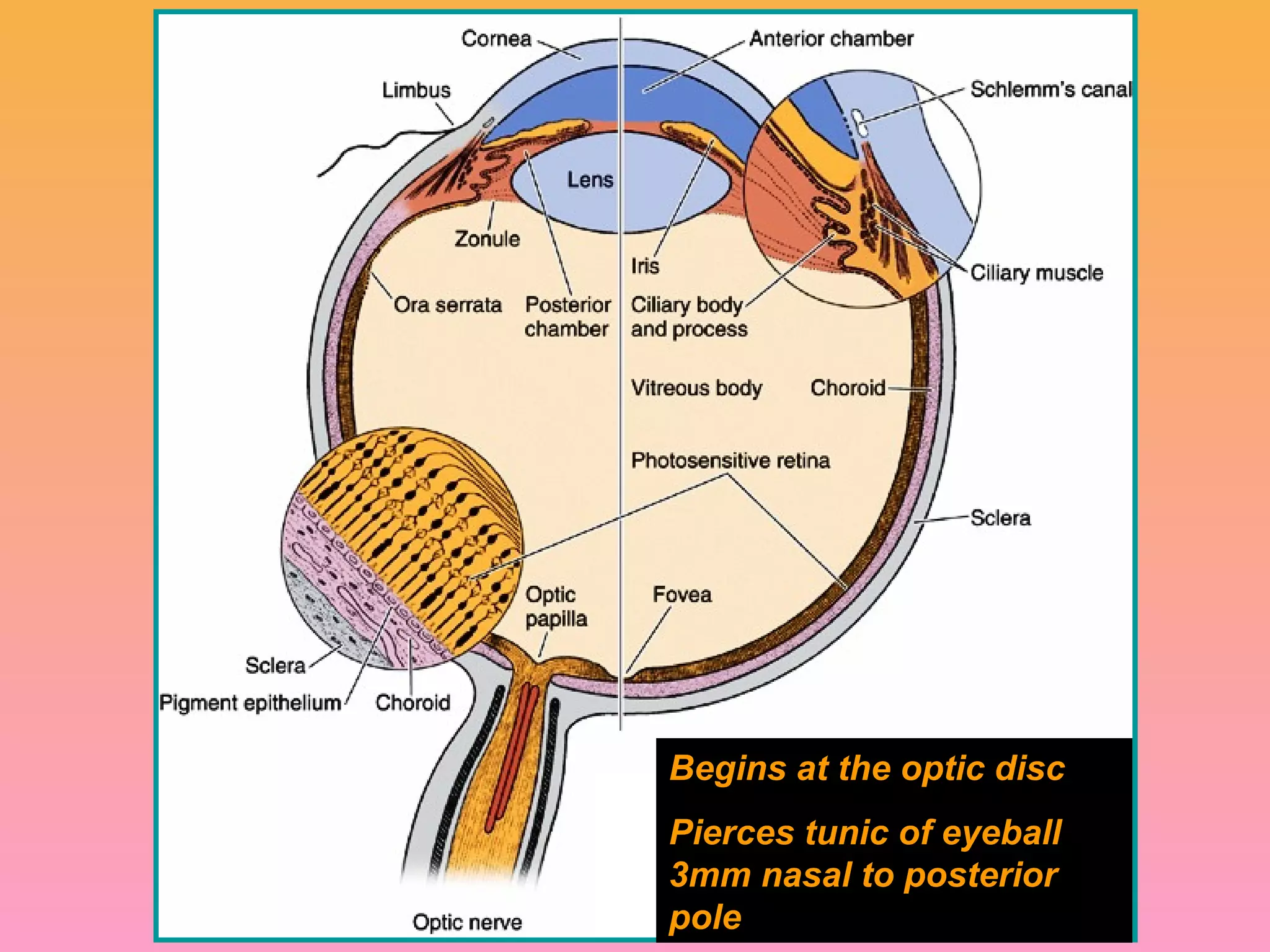
Begins at the optic disc
Pierces tunic of eyeball
3mm nasal to posterior
pole
Visual Pathway
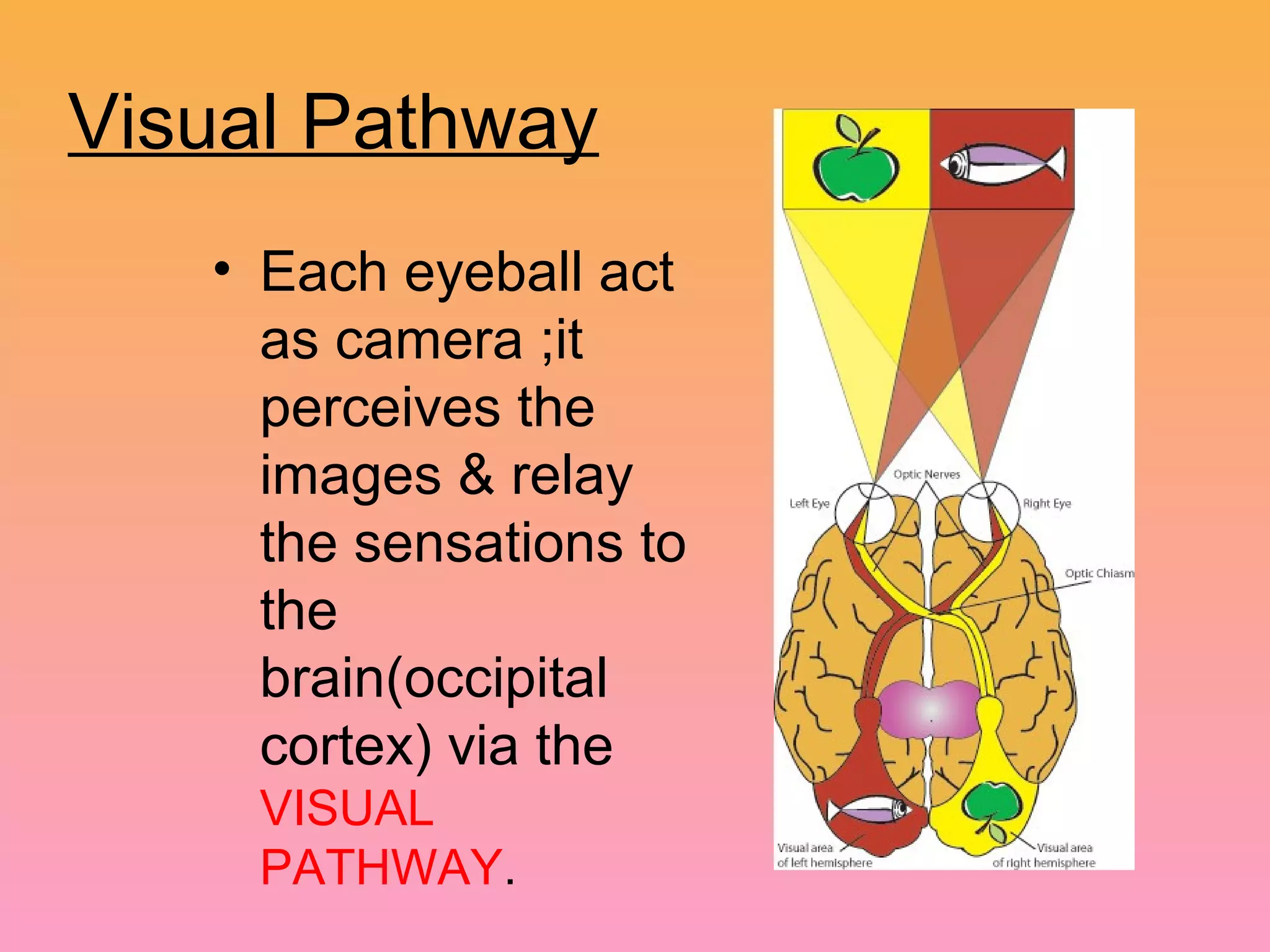
• Each eyeball act
as camera ;it
perceives the
images & relay
the sensations to
the
brain(occipital
cortex) via the
VISUAL
PATHWAY.
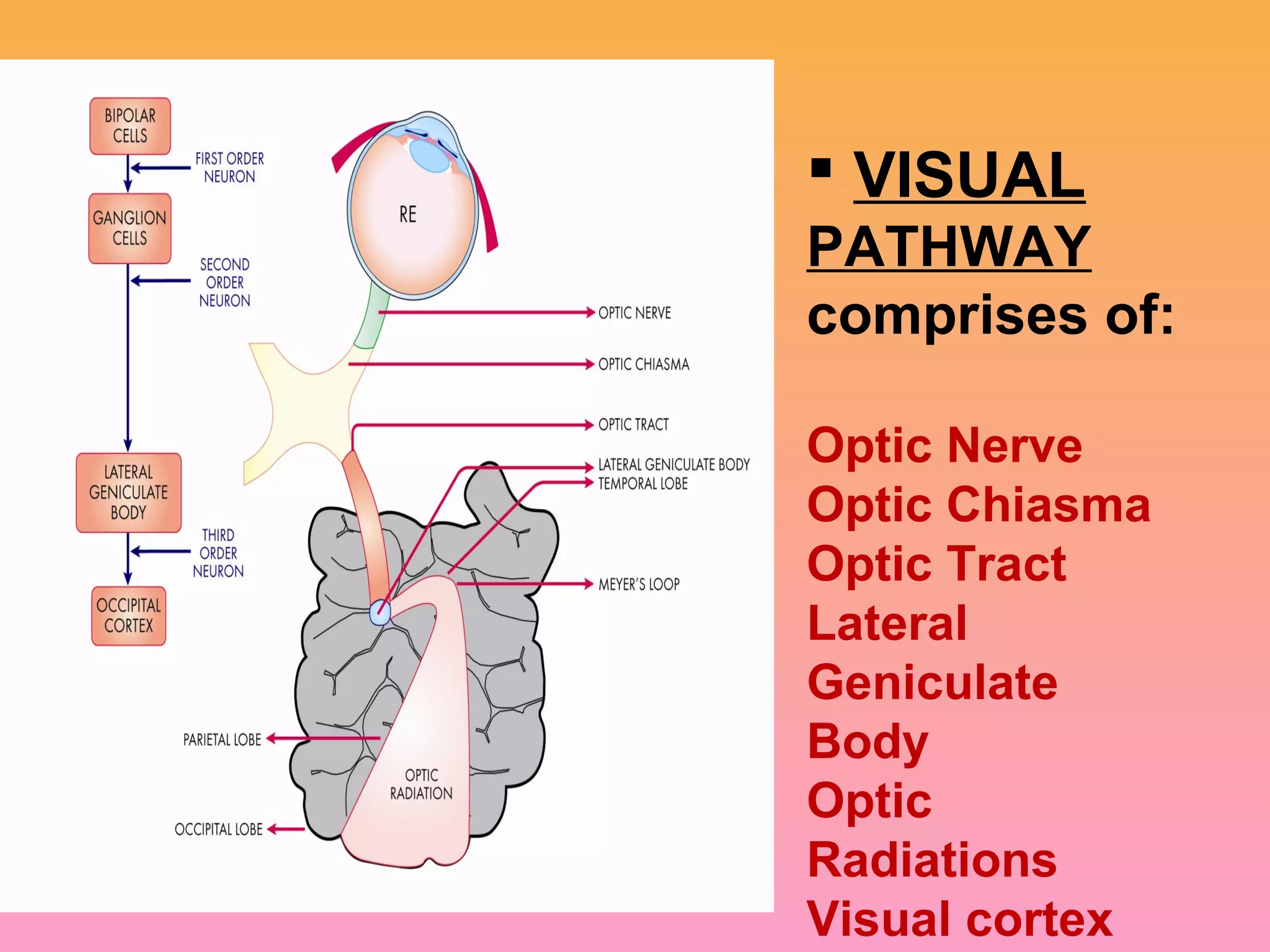
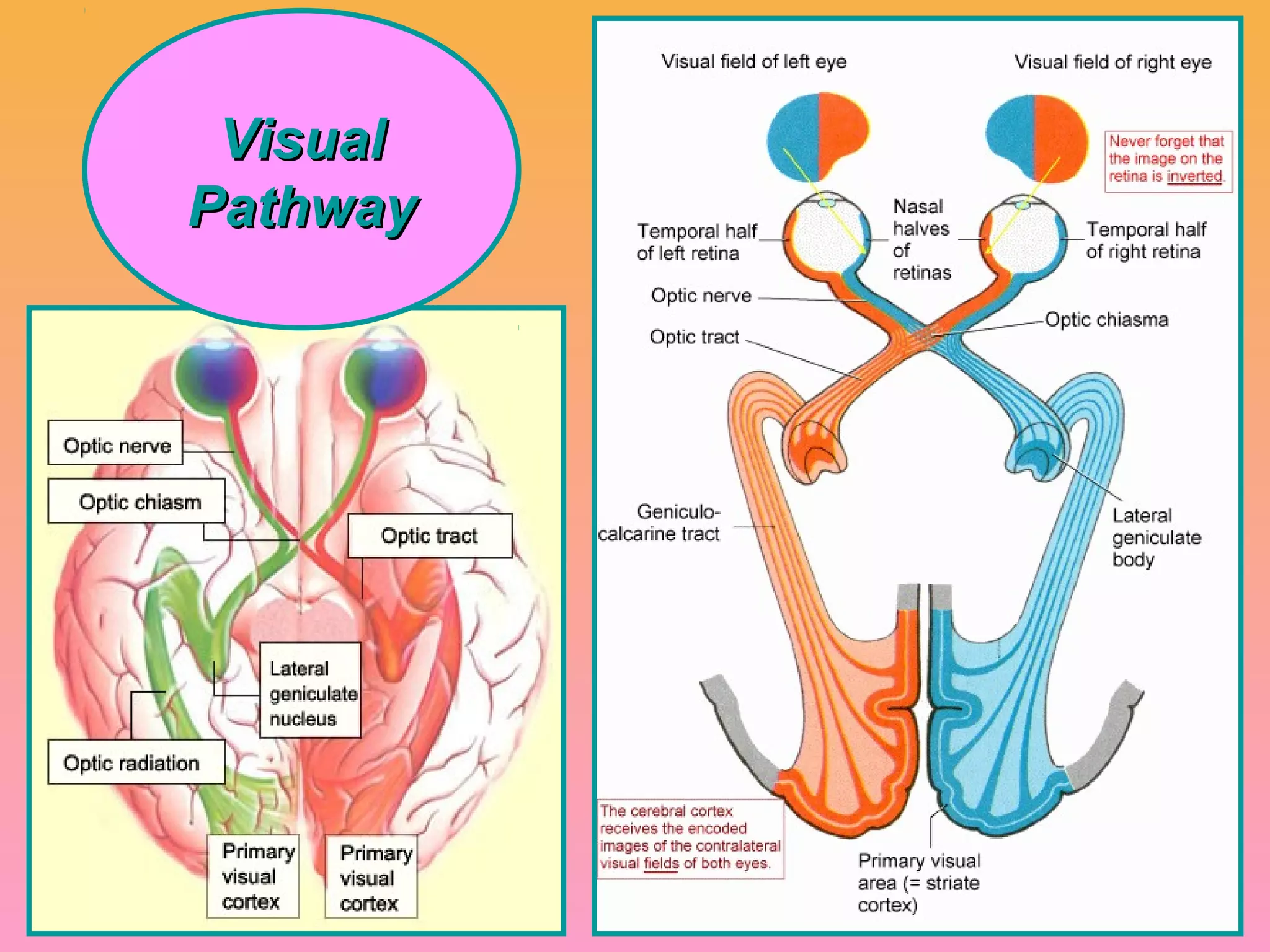
 VISUAL
PATHWAY
comprises of:
Optic Nerve
Optic Chiasma
Optic Tract
Lateral
Geniculate
Body
Optic
Radiations
Visual cortex
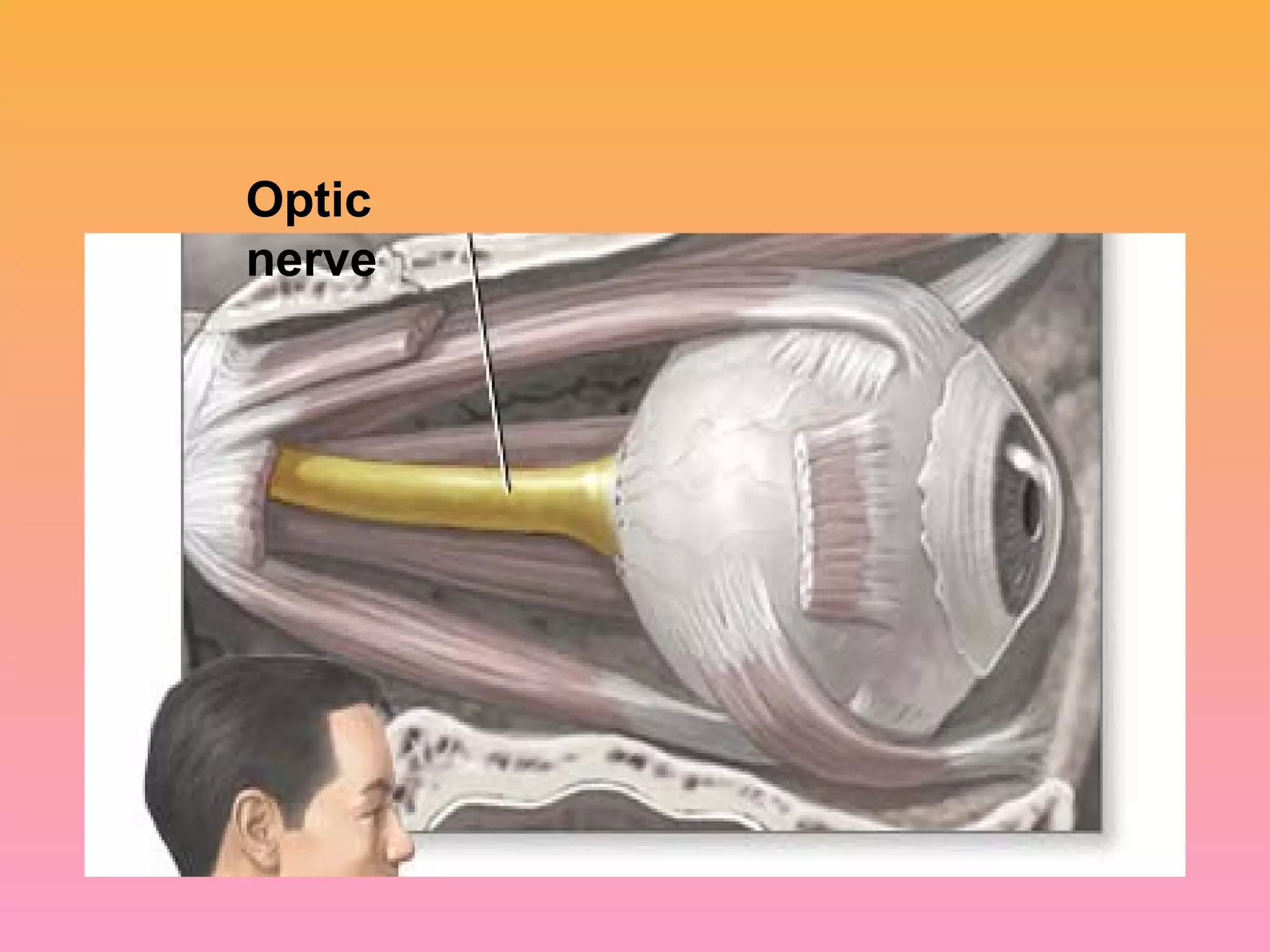
Optic
nerve
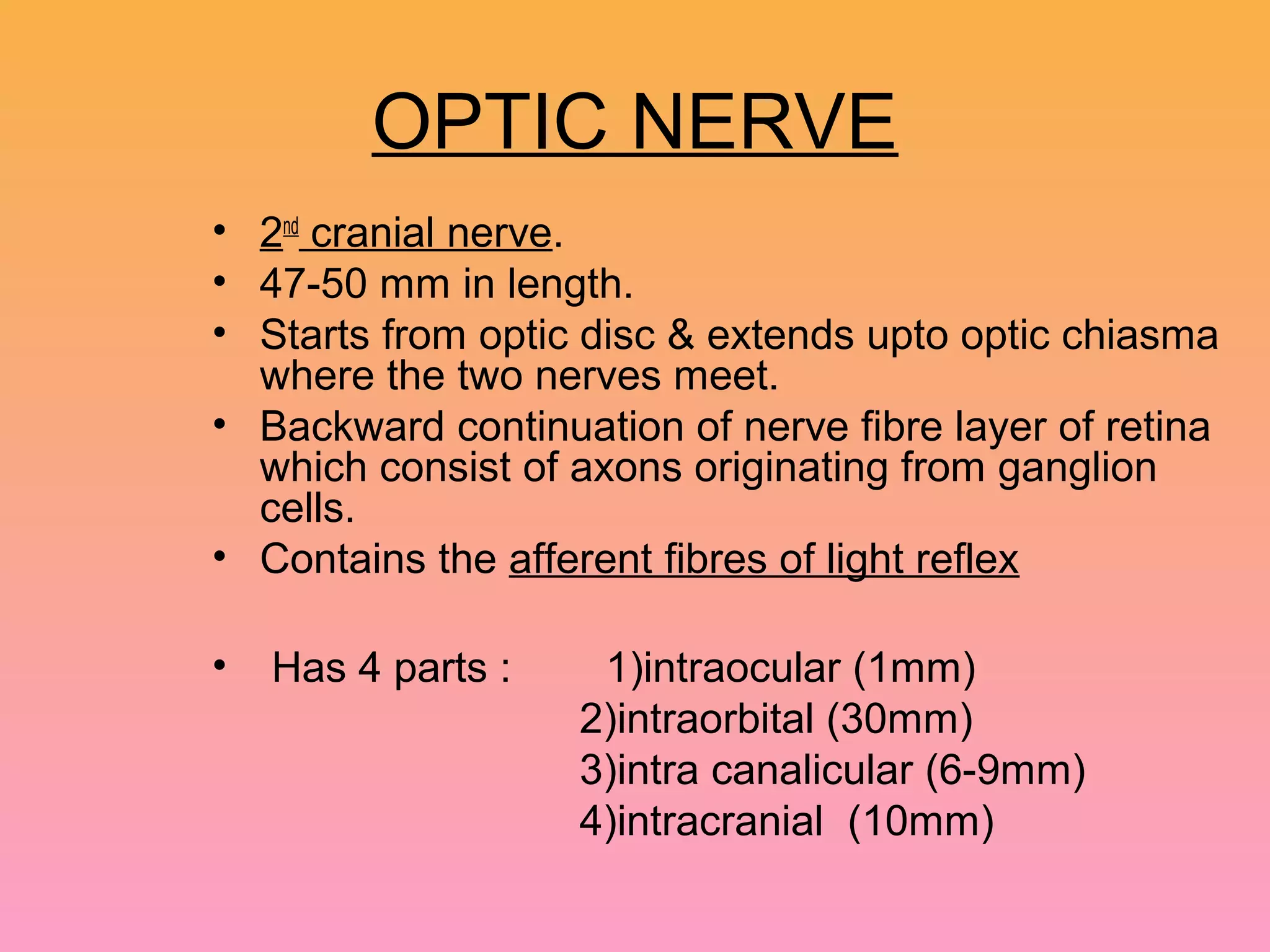
OPTIC NERVE
• 2nd
cranial nerve.
• 47-50 mm in length.
• Starts from optic disc & extends upto optic chiasma
where the two nerves meet.
• Backward continuation of nerve fibre layer of retina
which consist of axons originating from ganglion
cells.
• Contains the afferent fibres of light reflex
• Has 4 parts : 1)intraocular (1mm)
2)intraorbital (30mm)
3)intra canalicular (6-9mm)
4)intracranial (10mm)
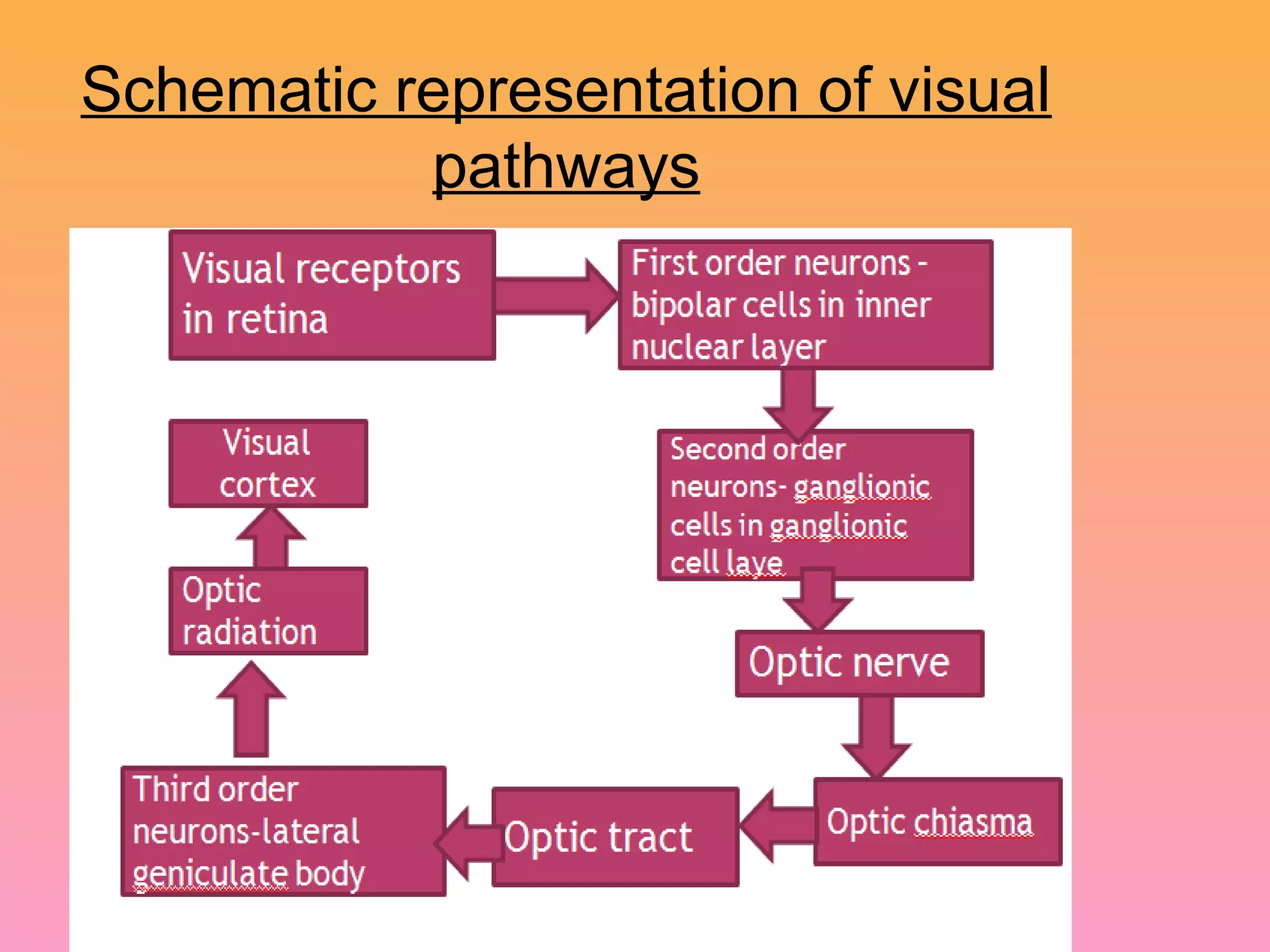
Schematic representation of visual
pathways
VISUAL PATHWAYVISUAL PATHWAY
PrinciplesPrinciples
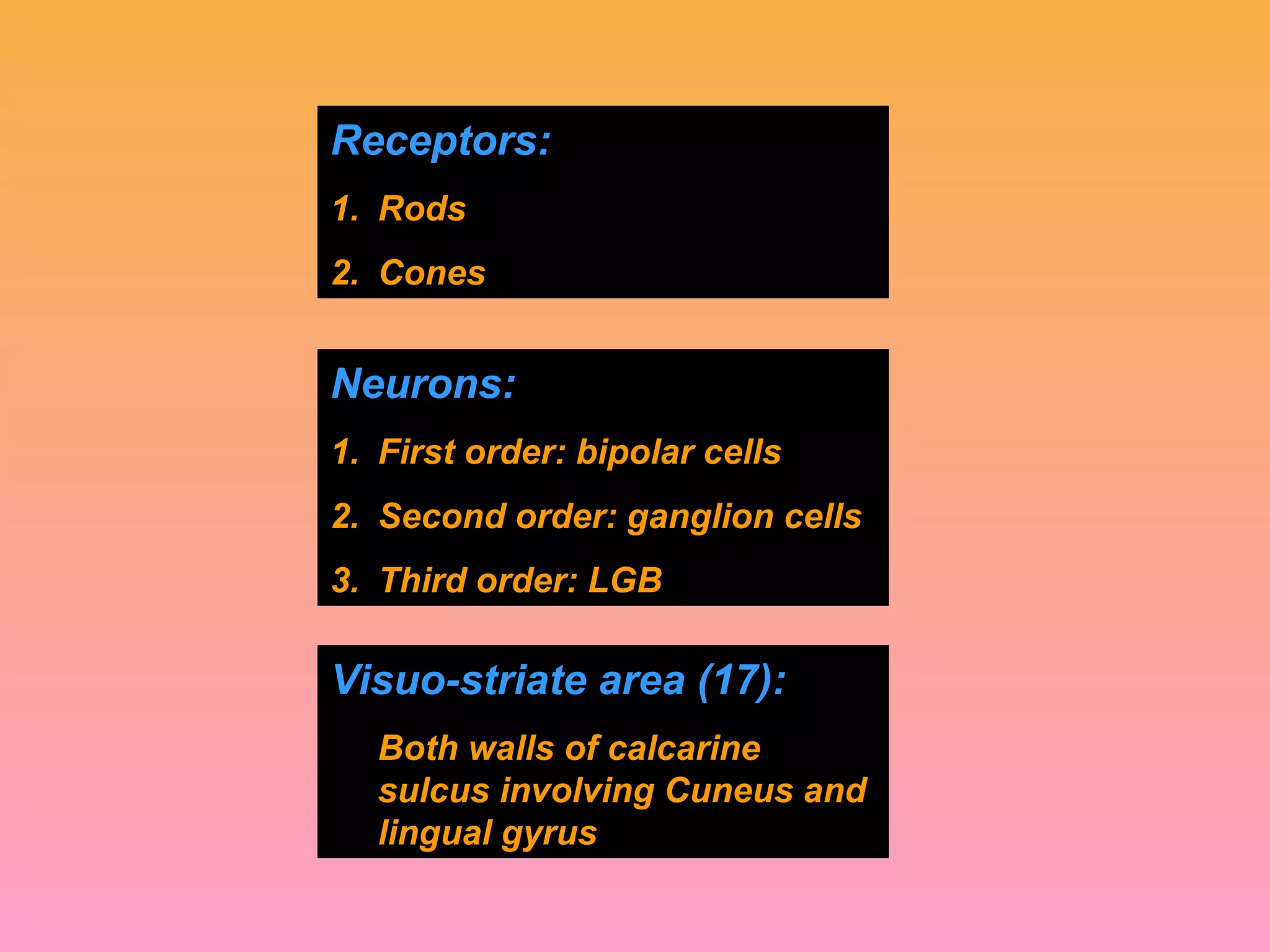
Receptors:
1. Rods
2. Cones
Neurons:
1. First order: bipolar cells
2. Second order: ganglion cells
3. Third order: LGB
Visuo-striate area (17):
Both walls of calcarine
sulcus involving Cuneus and
lingual gyrus
VISUAL PATHWAYVISUAL PATHWAY
ComponentsComponents
VisualVisual
PathwayPathway
OPTIC CHIASMA
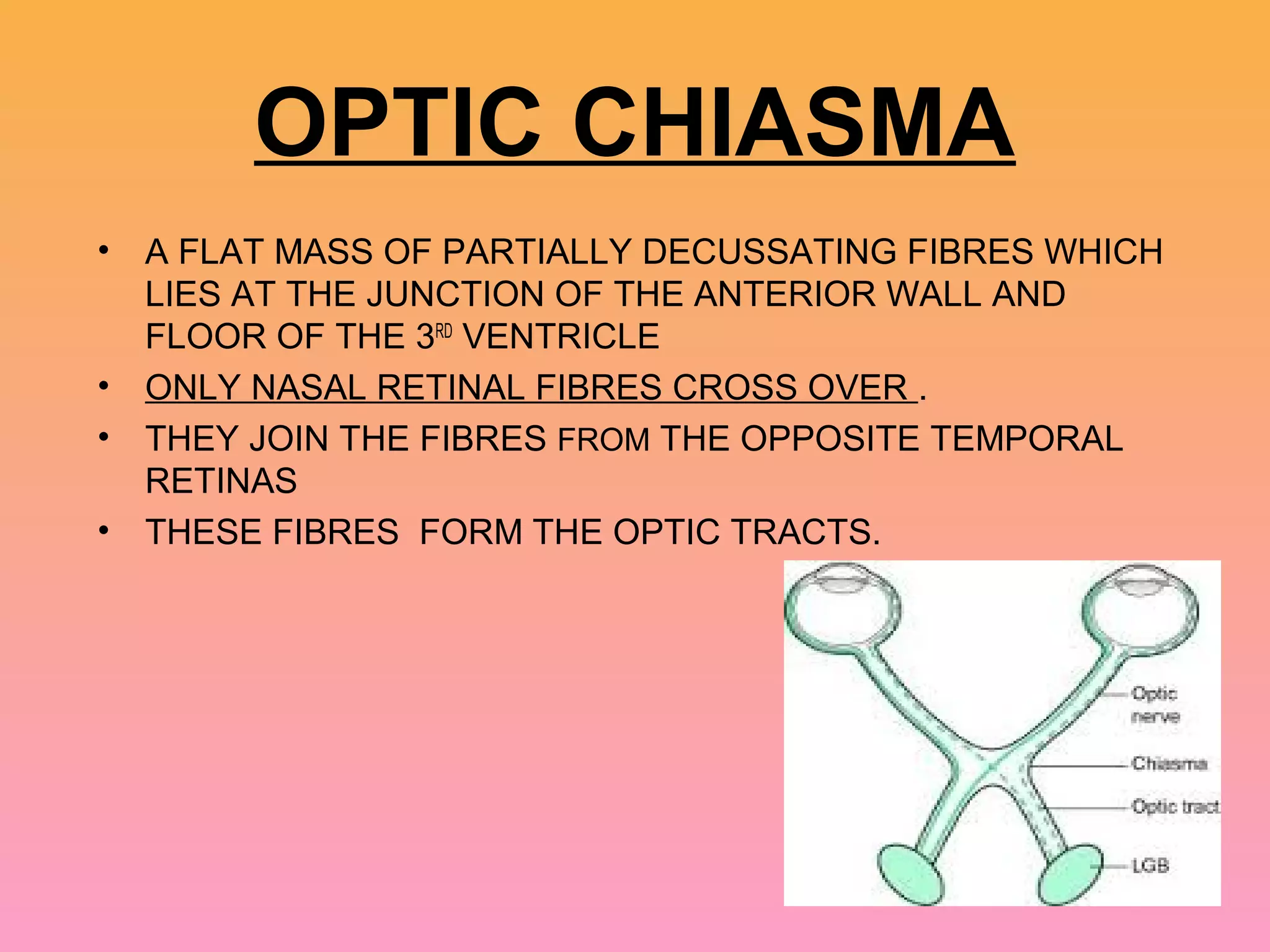
• A FLAT MASS OF PARTIALLY DECUSSATING FIBRES WHICH
LIES AT THE JUNCTION OF THE ANTERIOR WALL AND
FLOOR OF THE 3RD
VENTRICLE
• ONLY NASAL RETINAL FIBRES CROSS OVER .
• THEY JOIN THE FIBRES FROM THE OPPOSITE TEMPORAL
RETINAS
• THESE FIBRES FORM THE OPTIC TRACTS.
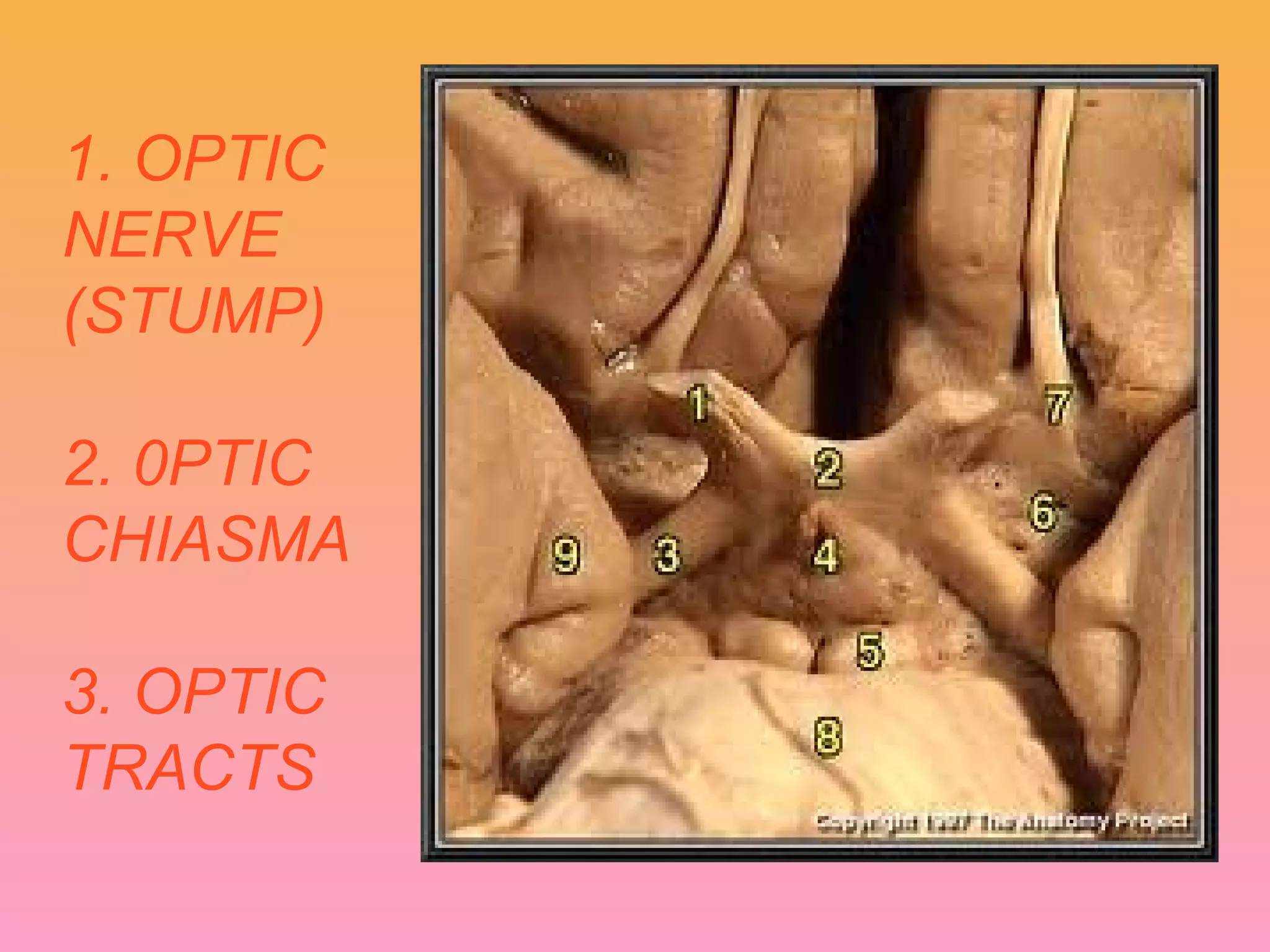
1. OPTIC
NERVE
(STUMP)
2. 0PTIC
CHIASMA
3. OPTIC
TRACTS
VisualVisual
PathwayPathway
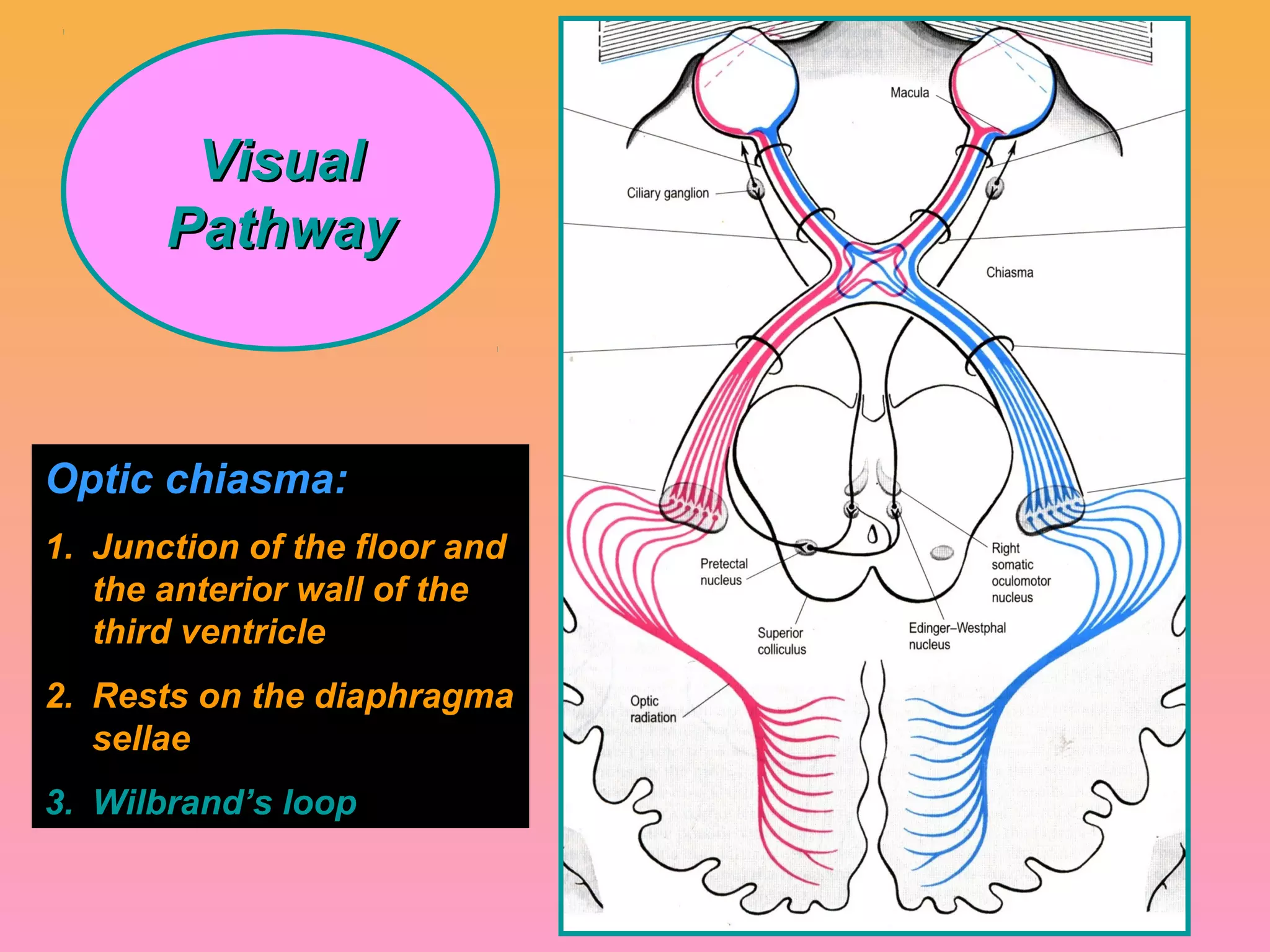
Optic chiasma:
1. Junction of the floor and
the anterior wall of the
third ventricle
2. Rests on the diaphragma
sellae
3. Wilbrand’s loop
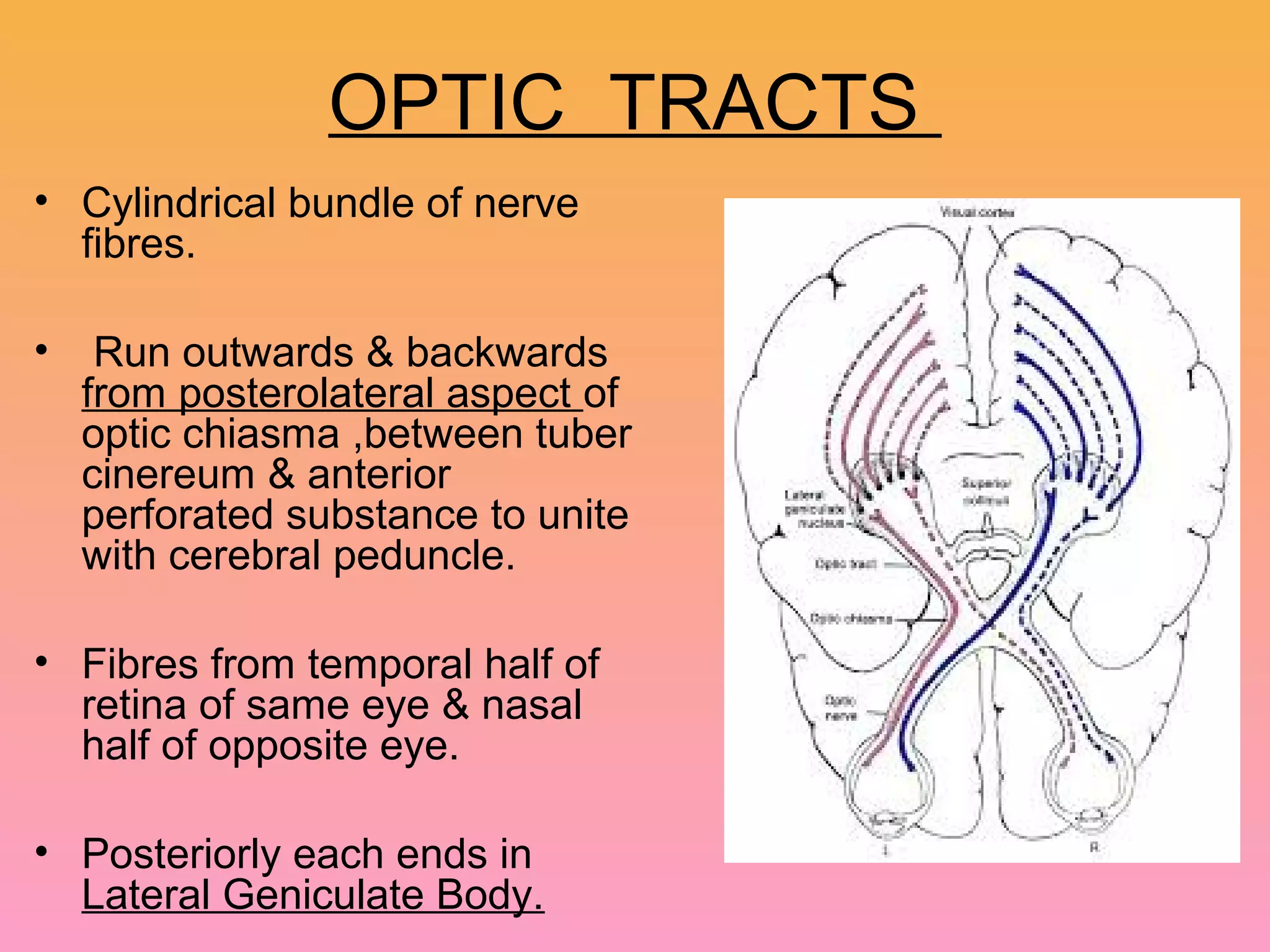
OPTIC TRACTS
• Cylindrical bundle of nerve
fibres.
• Run outwards & backwards
from posterolateral aspect of
optic chiasma ,between tuber
cinereum & anterior
perforated substance to unite
with cerebral peduncle.
• Fibres from temporal half of
retina of same eye & nasal
half of opposite eye.
• Posteriorly each ends in
Lateral Geniculate Body.
VisualVisual
PathwayPathway
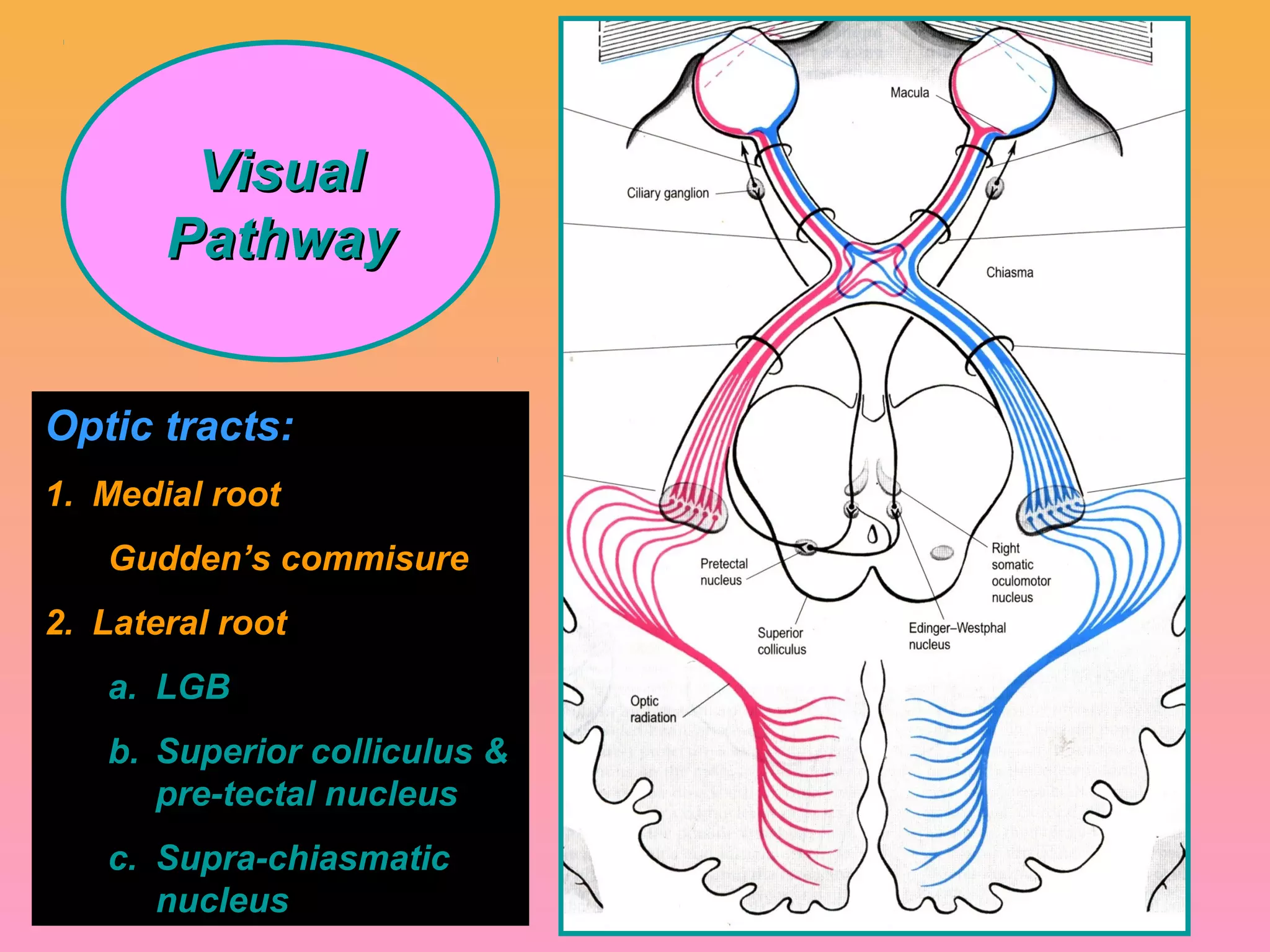
Optic tracts:
1. Medial root
Gudden’s commisure
2. Lateral root
a. LGB
b. Superior colliculus &
pre-tectal nucleus
c. Supra-chiasmatic
nucleus
VisualVisual
PathwayPathway
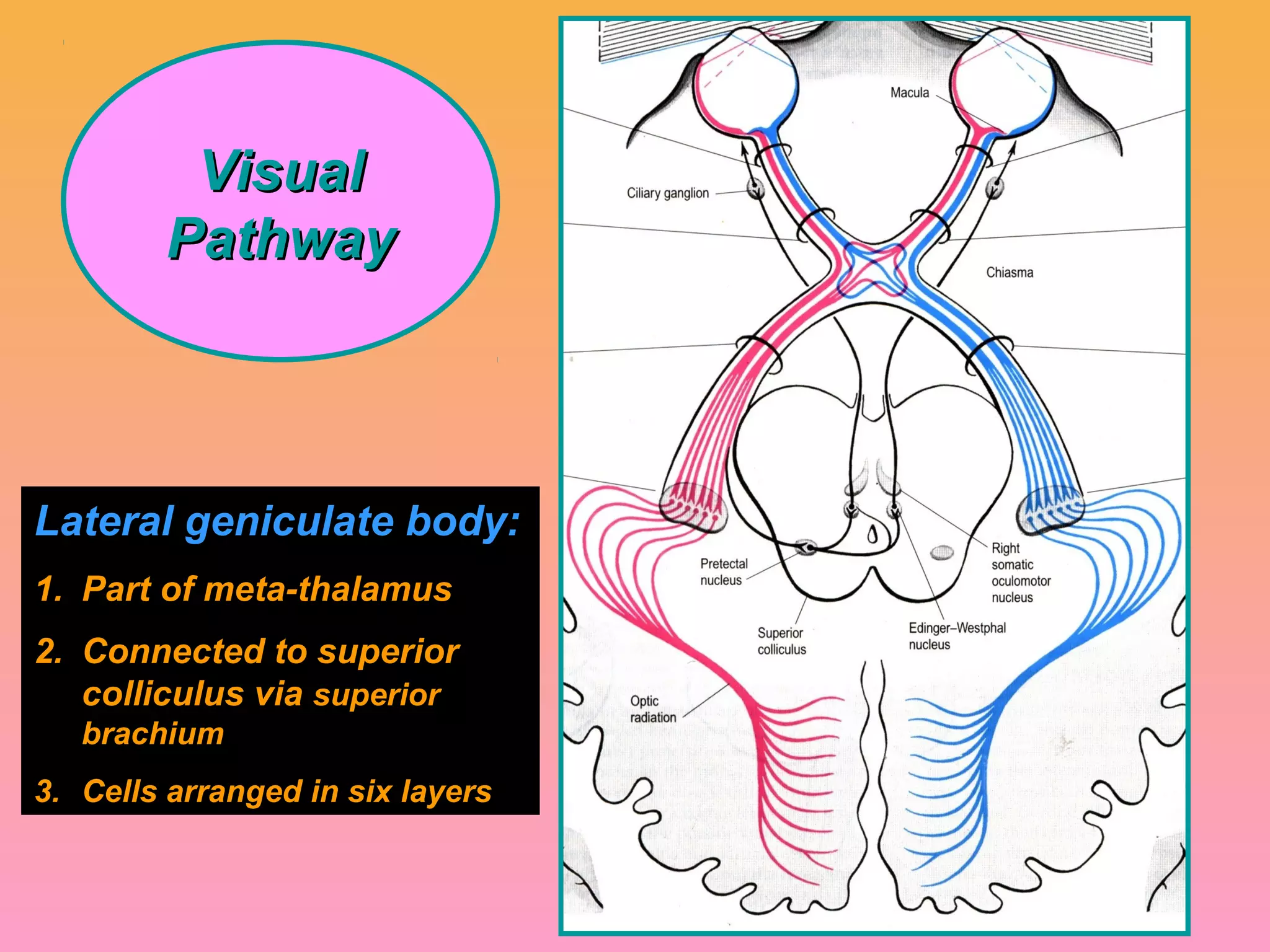
Lateral geniculate body:
1. Part of meta-thalamus
2. Connected to superior
colliculus via superior
brachium
3. Cells arranged in six layers
OPTIC RADIATIONS (Geniculo-
Calcarine Pathway)
• From LGB to the occipital cortex.
• Pass forwards then laterally through the area
of wernicke as optic peduncles.
• Anterior to lateral ventricle ,traversing the
retrolenticular part of internal capsule,medial
to auditory tract.
• Its fibres then spread out fanwise to form
medullary optic lamina.
• Inferior fibres subserve upper visual fields &
sweep anteroinferiorly in meyer’s loop &
temporal lobe to visual cortex.
• Superior fibres subserve inferior visual field
proceed posteriorly through parietal lobe to
visual cortex.
VisualVisual
PathwayPathway
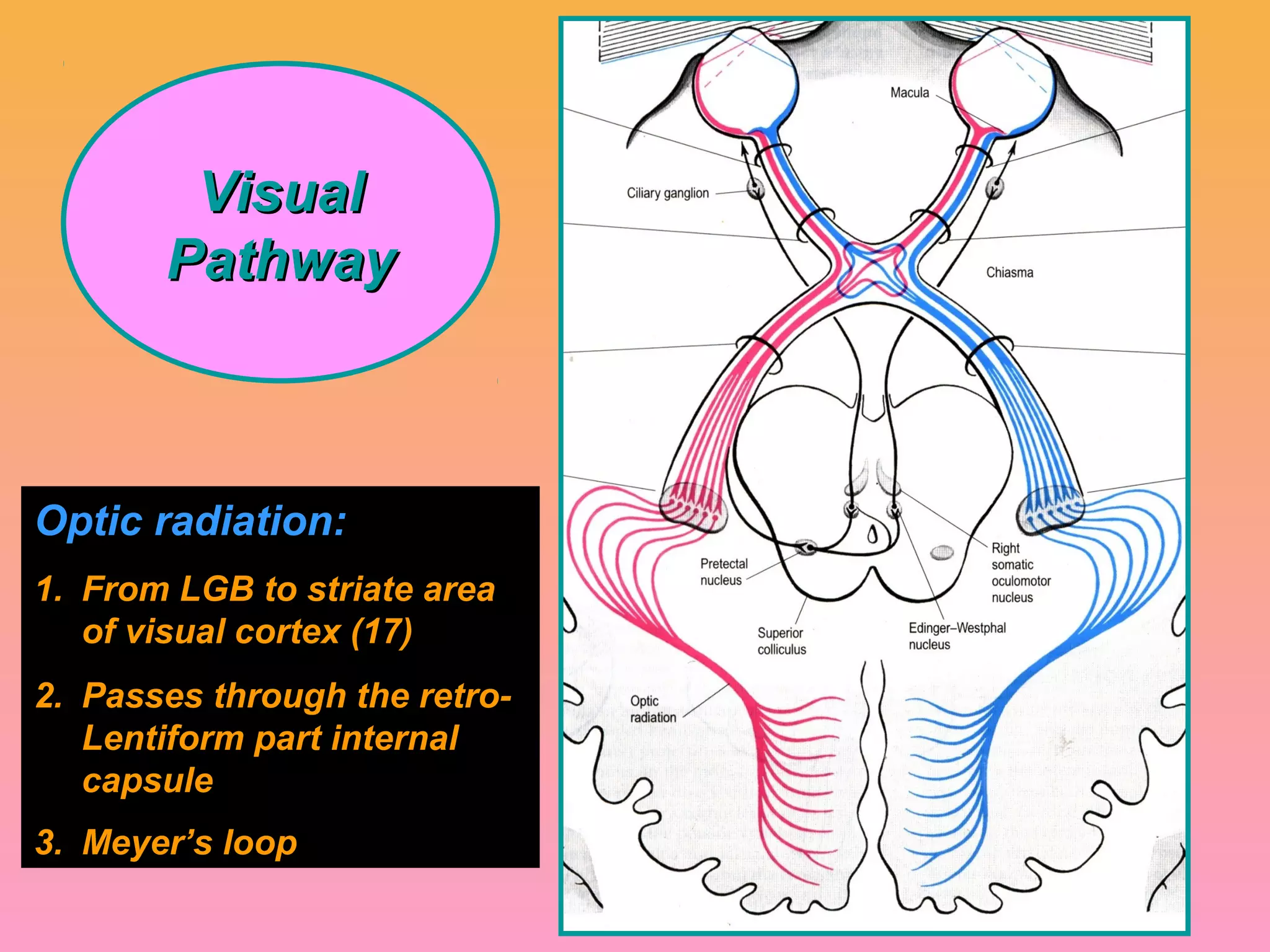
Optic radiation:
1. From LGB to striate area
of visual cortex (17)
2. Passes through the retro-
Lentiform part internal
capsule
3. Meyer’s loop
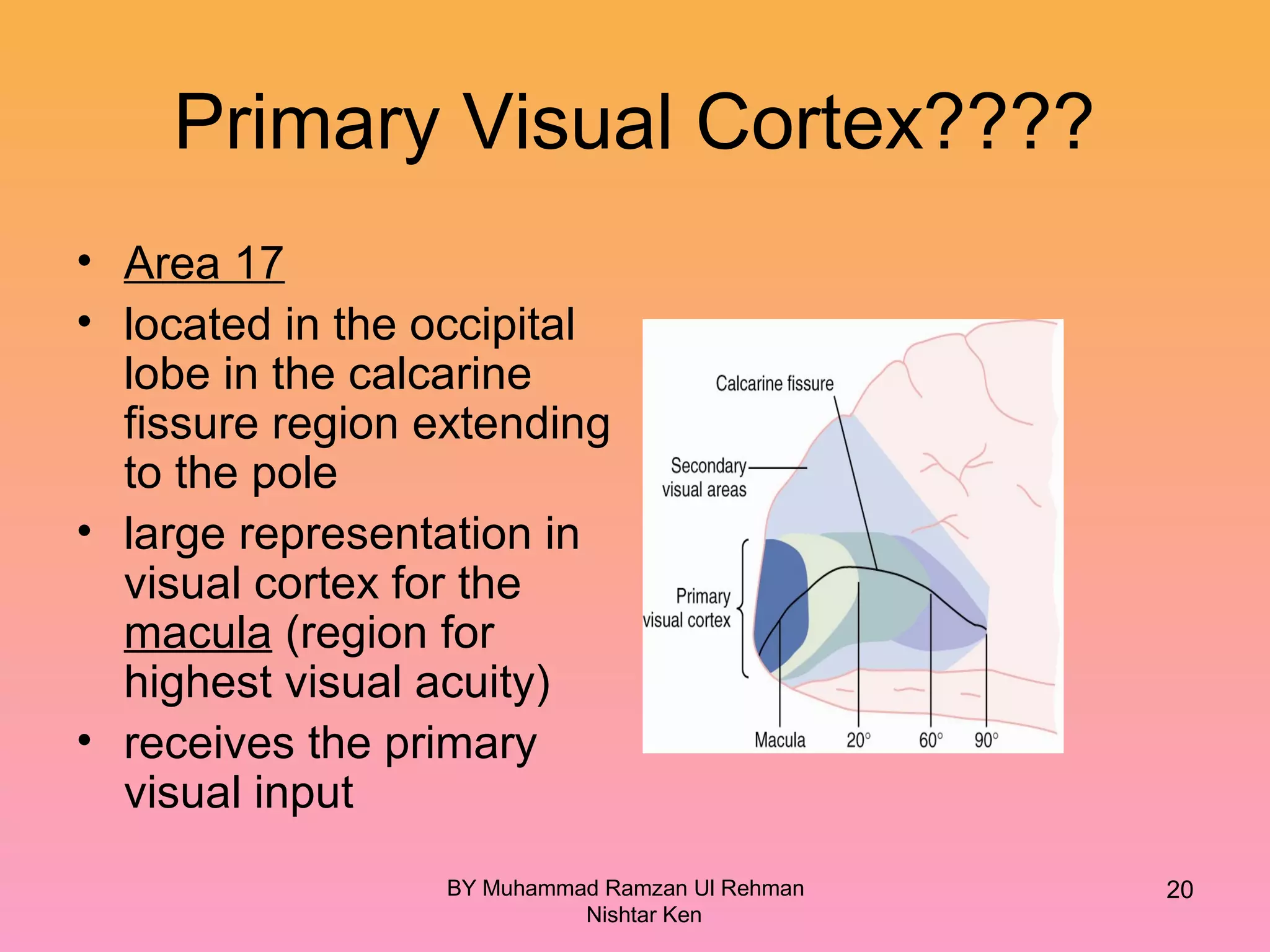
Primary Visual Cortex????
• Area 17
• located in the occipital
lobe in the calcarine
fissure region extending
to the pole
• large representation in
visual cortex for the
macula (region for
highest visual acuity)
• receives the primary
visual input
BY Muhammad Ramzan Ul Rehman
Nishtar Ken
20
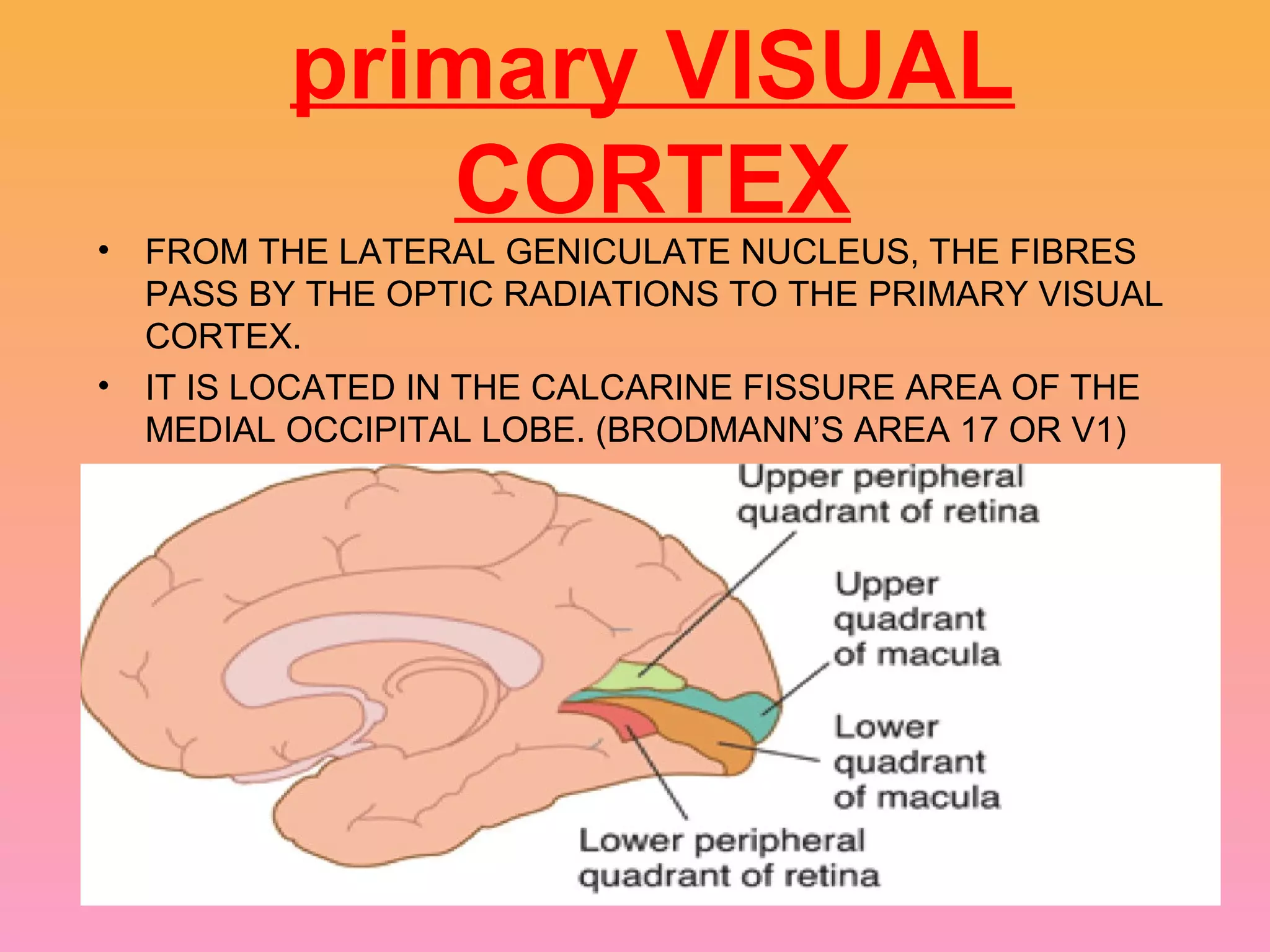
primary VISUAL
CORTEX
• FROM THE LATERAL GENICULATE NUCLEUS, THE FIBRES
PASS BY THE OPTIC RADIATIONS TO THE PRIMARY VISUAL
CORTEX.
• IT IS LOCATED IN THE CALCARINE FISSURE AREA OF THE
MEDIAL OCCIPITAL LOBE. (BRODMANN’S AREA 17 OR V1)
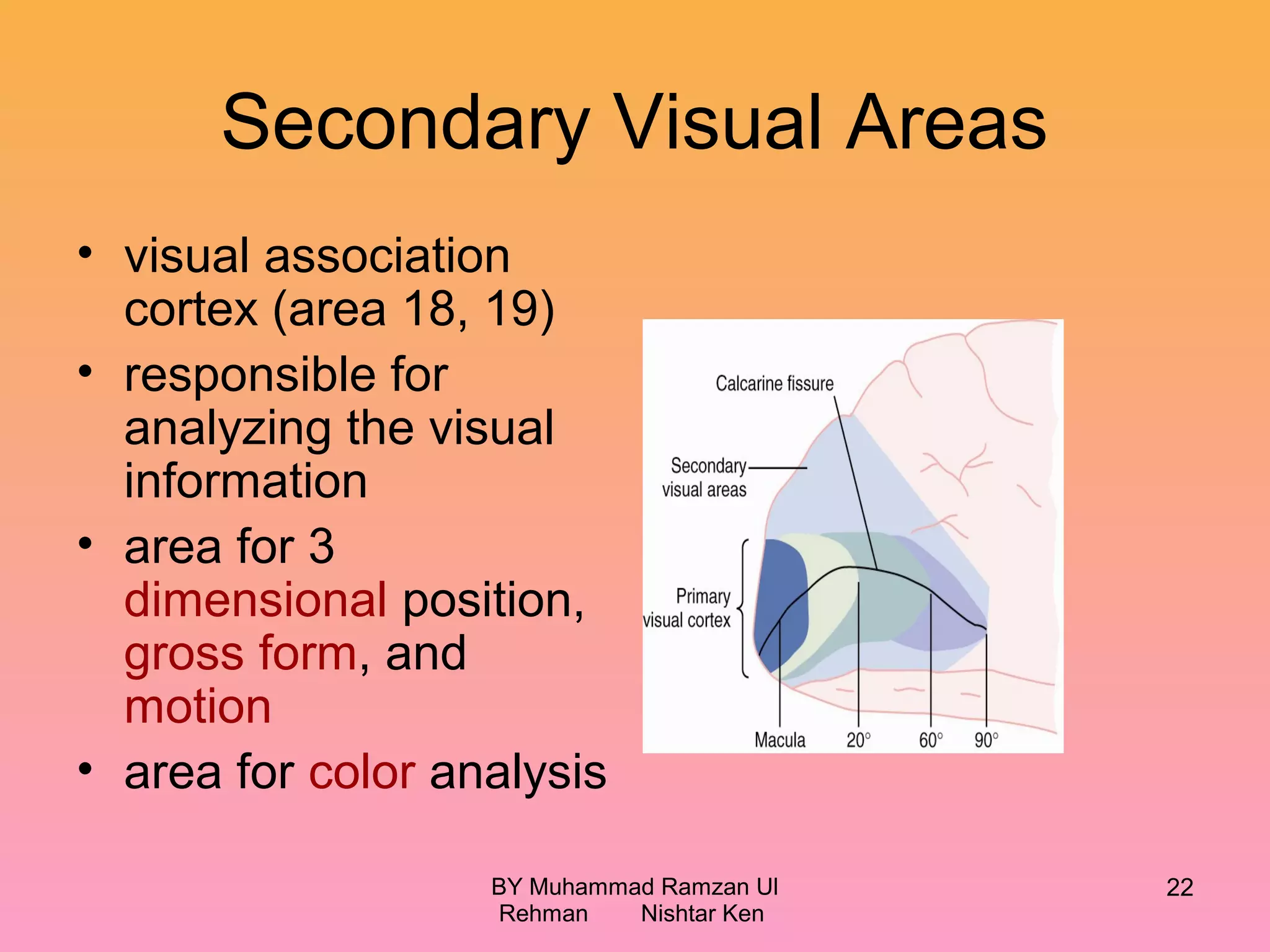
Secondary Visual Areas
• visual association
cortex (area 18, 19)
• responsible for
analyzing the visual
information
• area for 3
dimensional position,
gross form, and
motion
• area for color analysis
BY Muhammad Ramzan Ul
Rehman Nishtar Ken
22
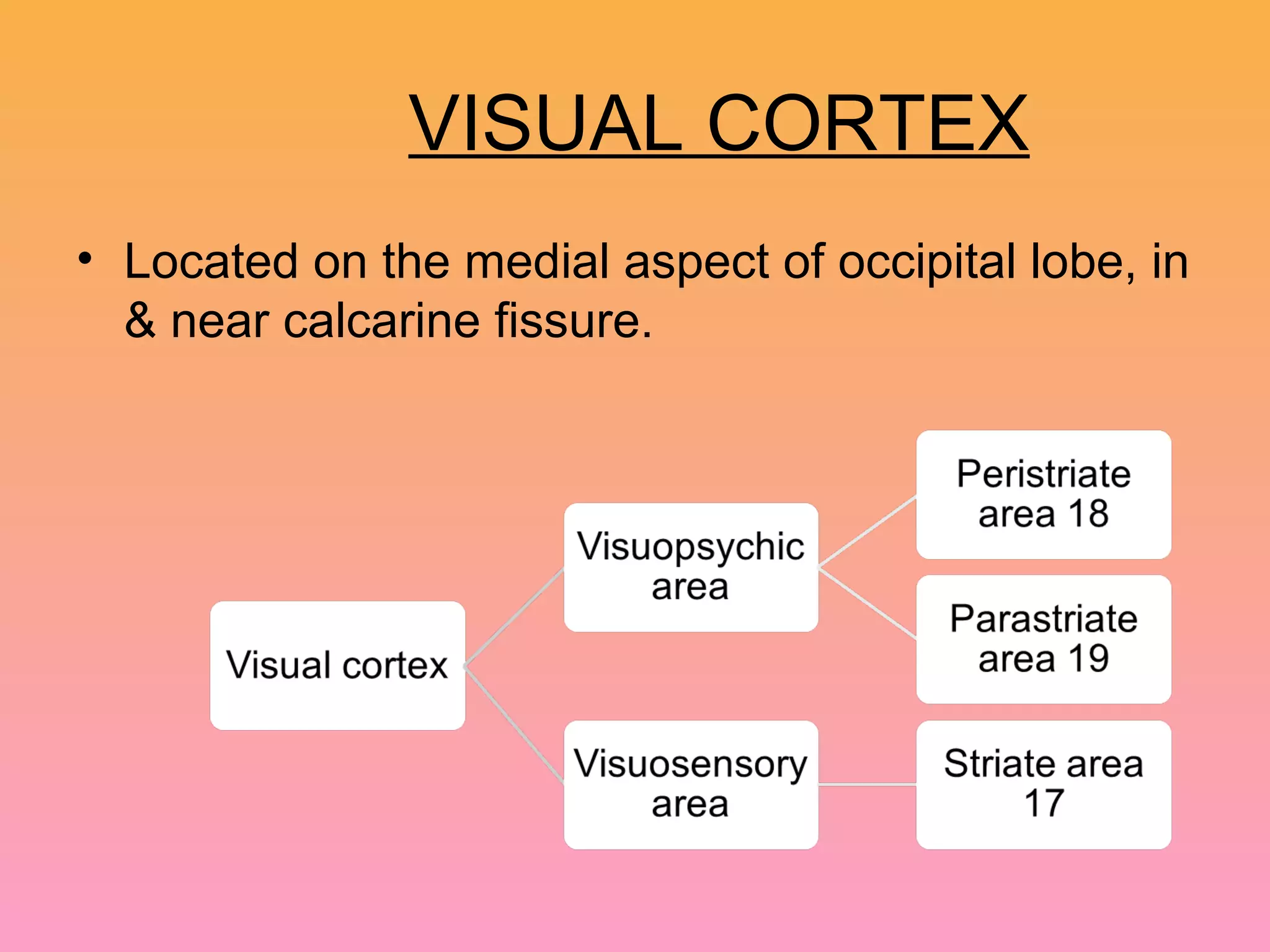
VISUAL CORTEX
• Located on the medial aspect of occipital lobe, in
& near calcarine fissure.
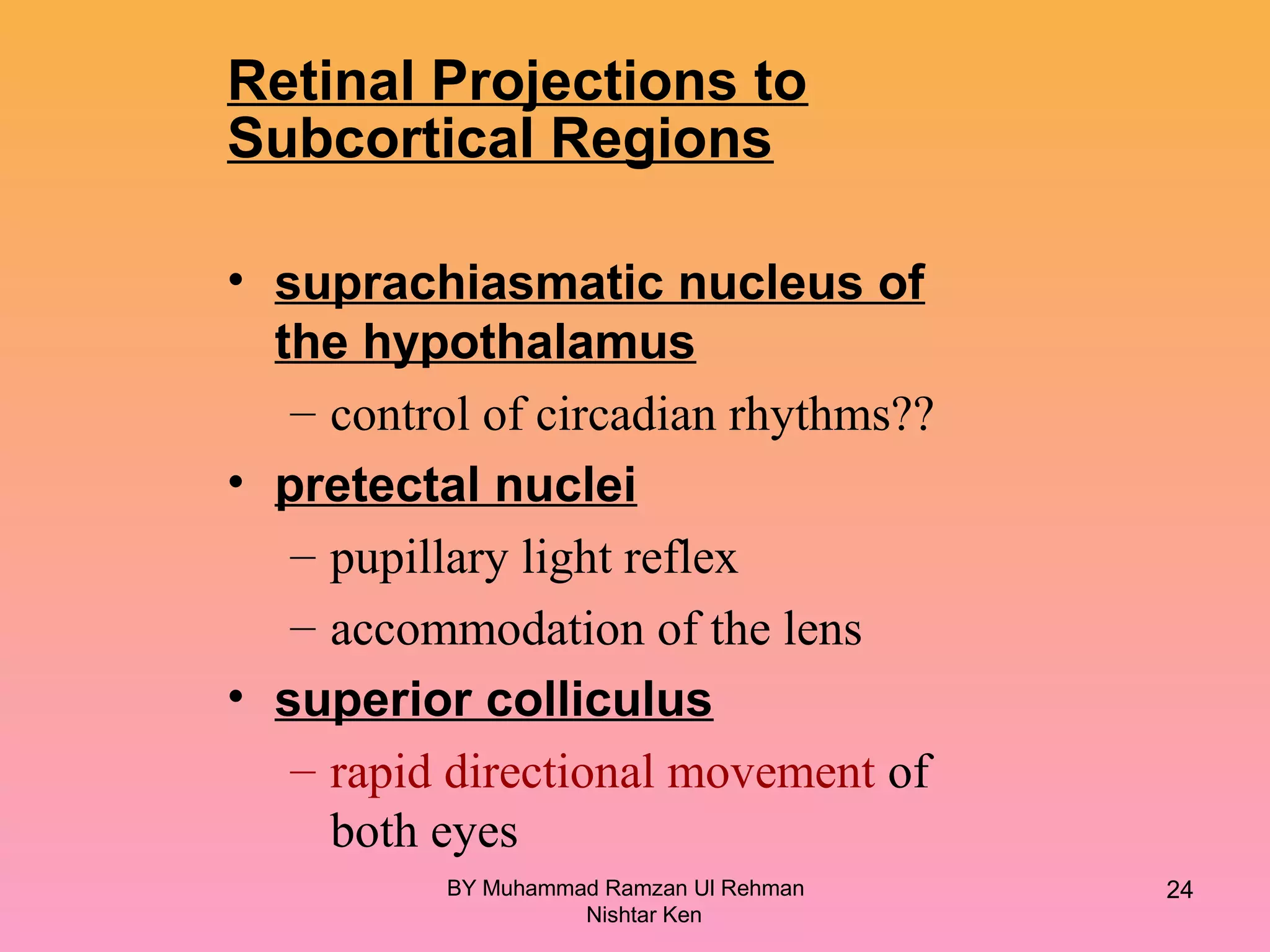
Retinal Projections to
Subcortical Regions
• suprachiasmatic nucleus of
the hypothalamus
– control of circadian rhythms??
• pretectal nuclei
– pupillary light reflex
– accommodation of the lens
• superior colliculus
– rapid directional movement of
both eyes
BY Muhammad Ramzan Ul Rehman
Nishtar Ken
24
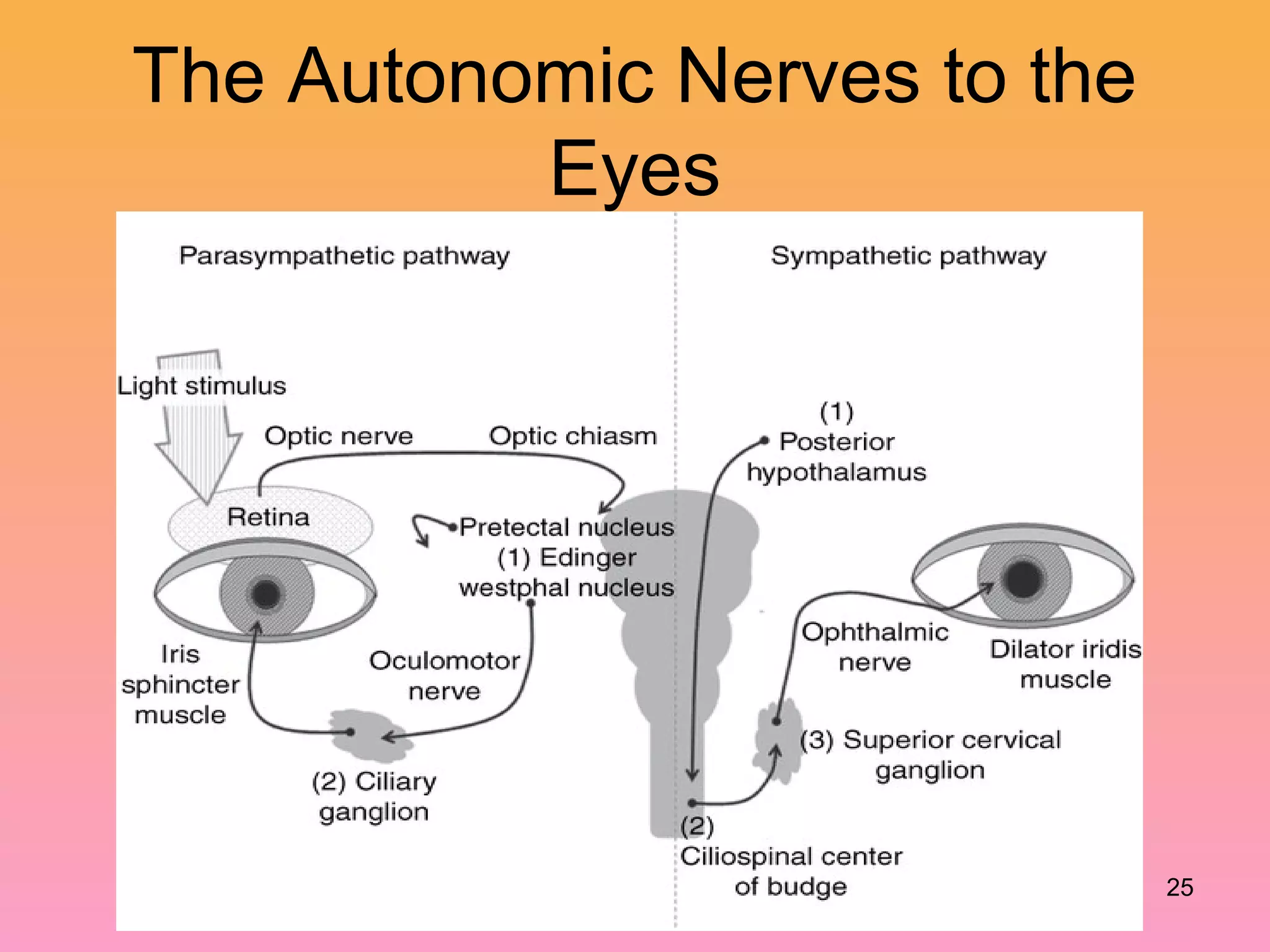
The Autonomic Nerves to the
Eyes
25
The Autonomic Nerves to the
Eyes
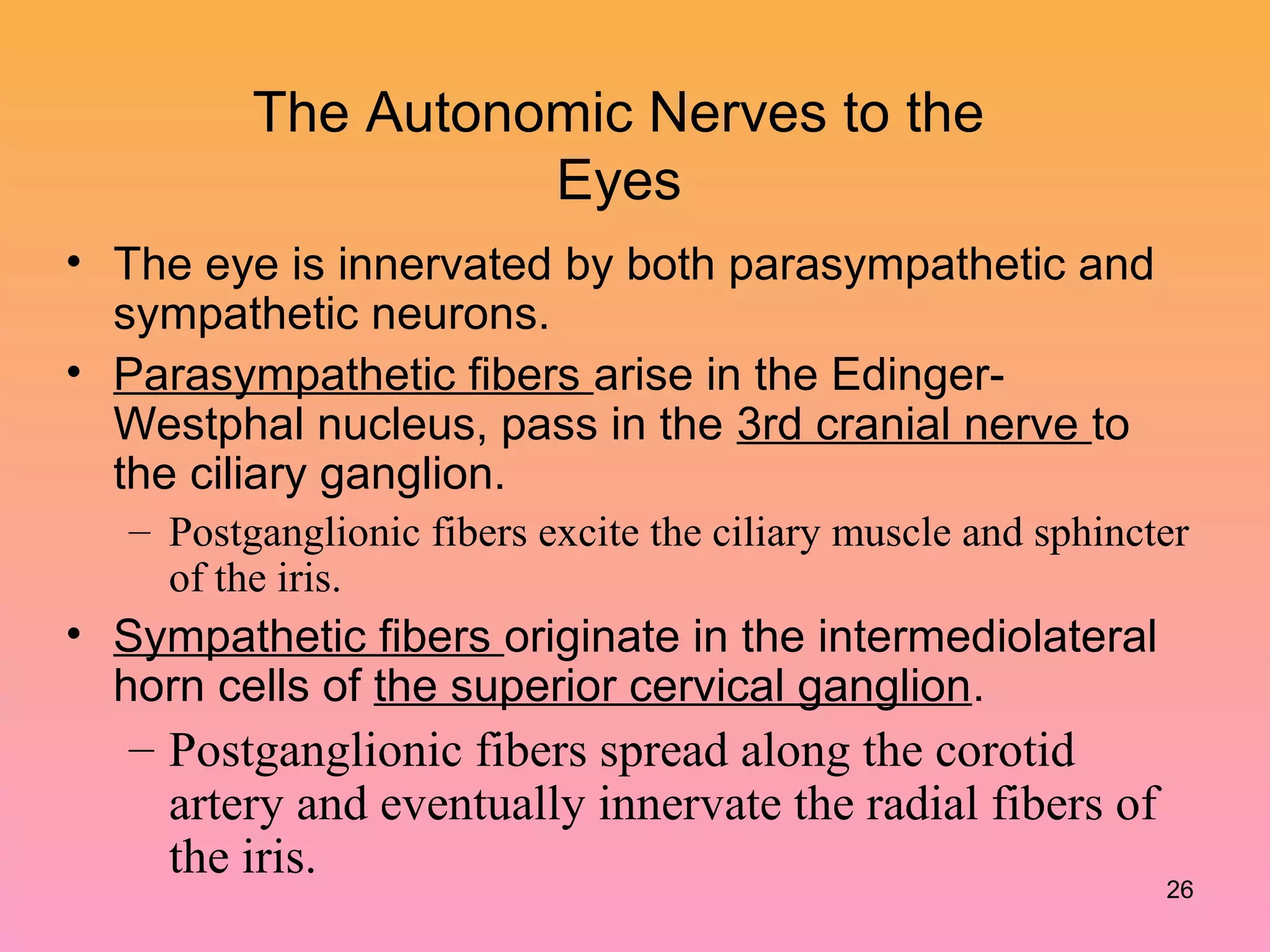
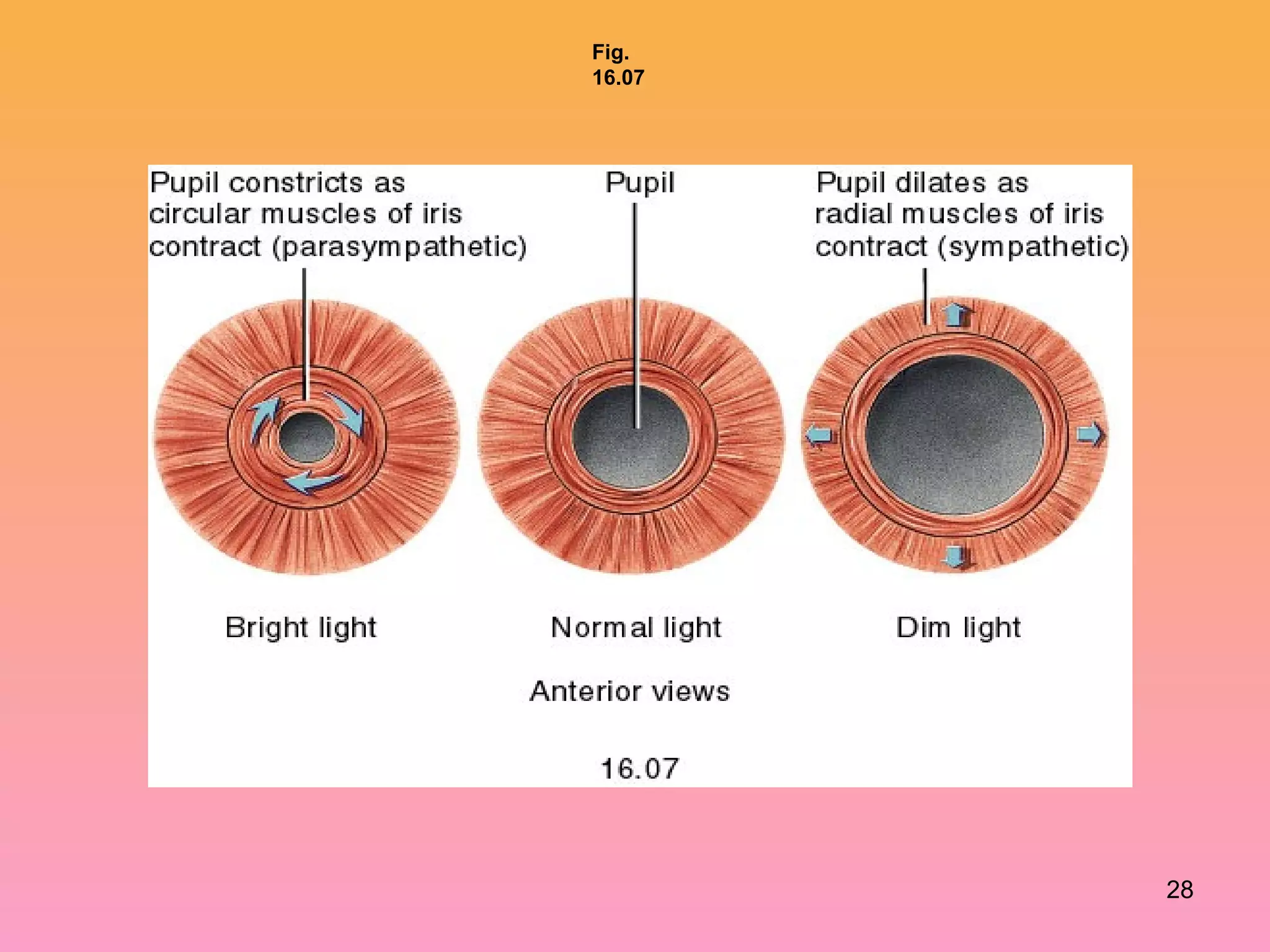
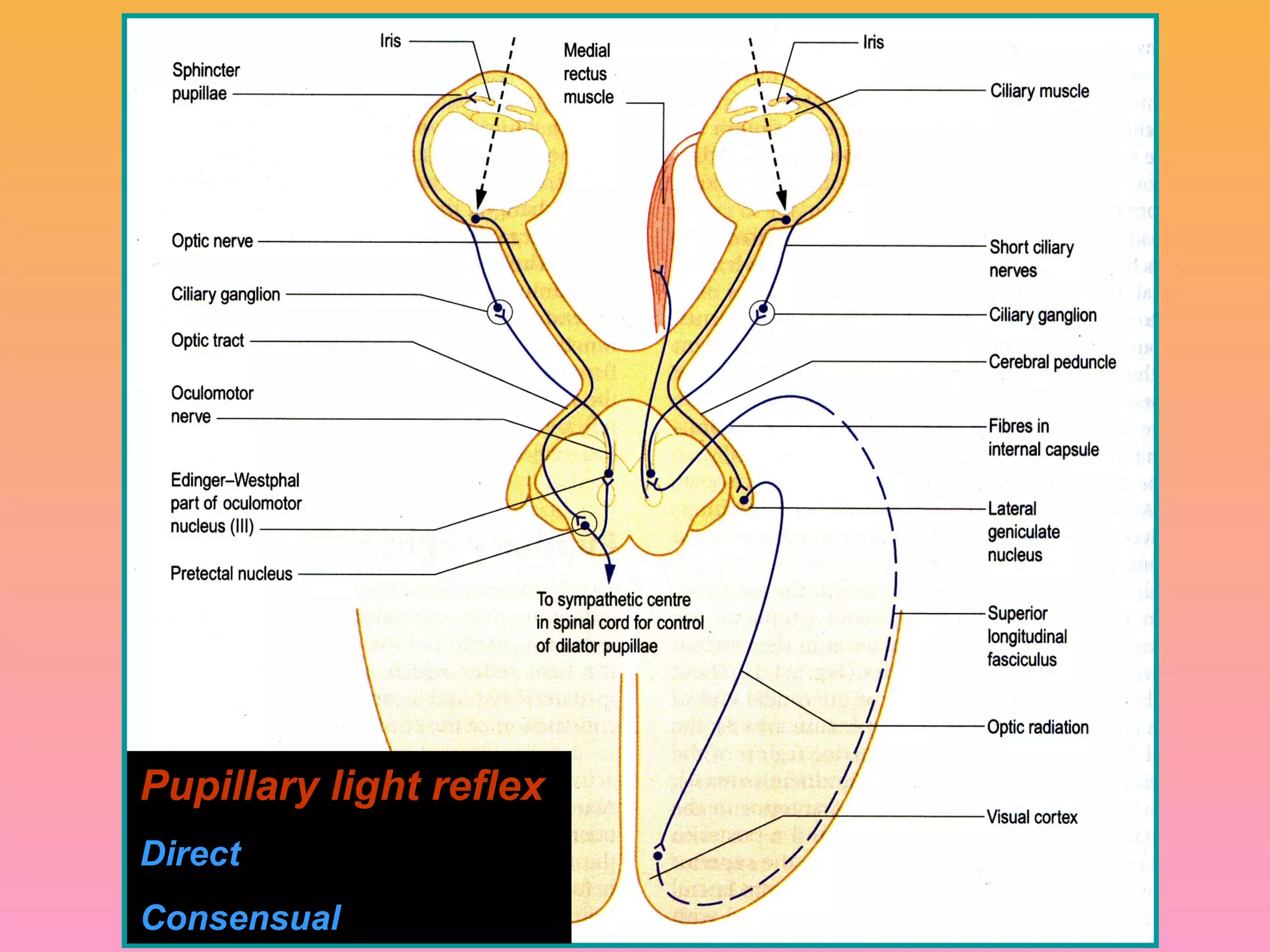
• The eye is innervated by both parasympathetic and
sympathetic neurons.
• Parasympathetic fibers arise in the Edinger-
Westphal nucleus, pass in the 3rd cranial nerve to
the ciliary ganglion.
– Postganglionic fibers excite the ciliary muscle and sphincter
of the iris.
• Sympathetic fibers originate in the intermediolateral
horn cells of the superior cervical ganglion.
– Postganglionic fibers spread along the corotid
artery and eventually innervate the radial fibers of
the iris.
26
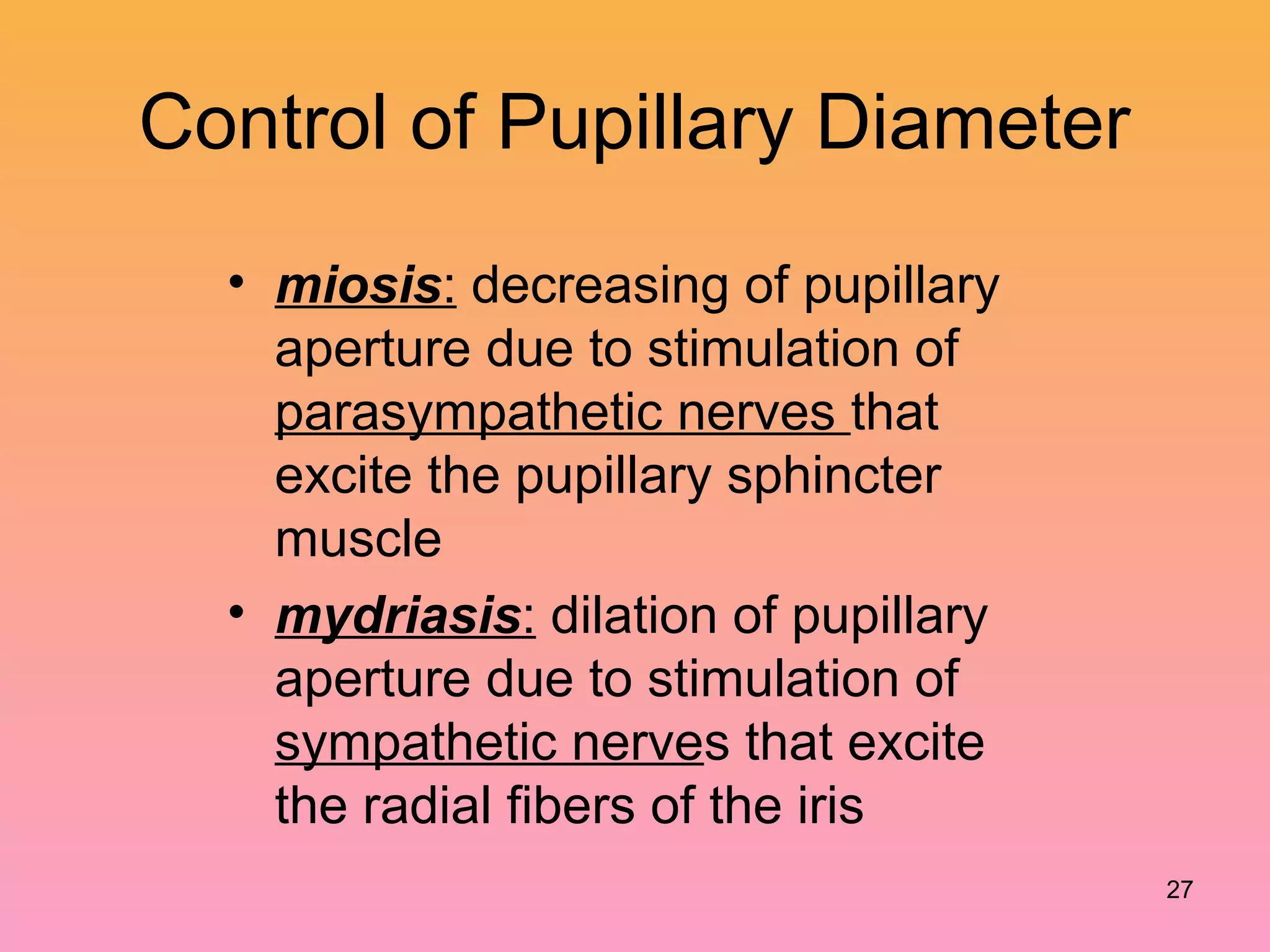
Control of Pupillary Diameter
• miosis: decreasing of pupillary
aperture due to stimulation of
parasympathetic nerves that
excite the pupillary sphincter
muscle
• mydriasis: dilation of pupillary
aperture due to stimulation of
sympathetic nerves that excite
the radial fibers of the iris
27
Fig.
16.07
28
Visual
reflexes
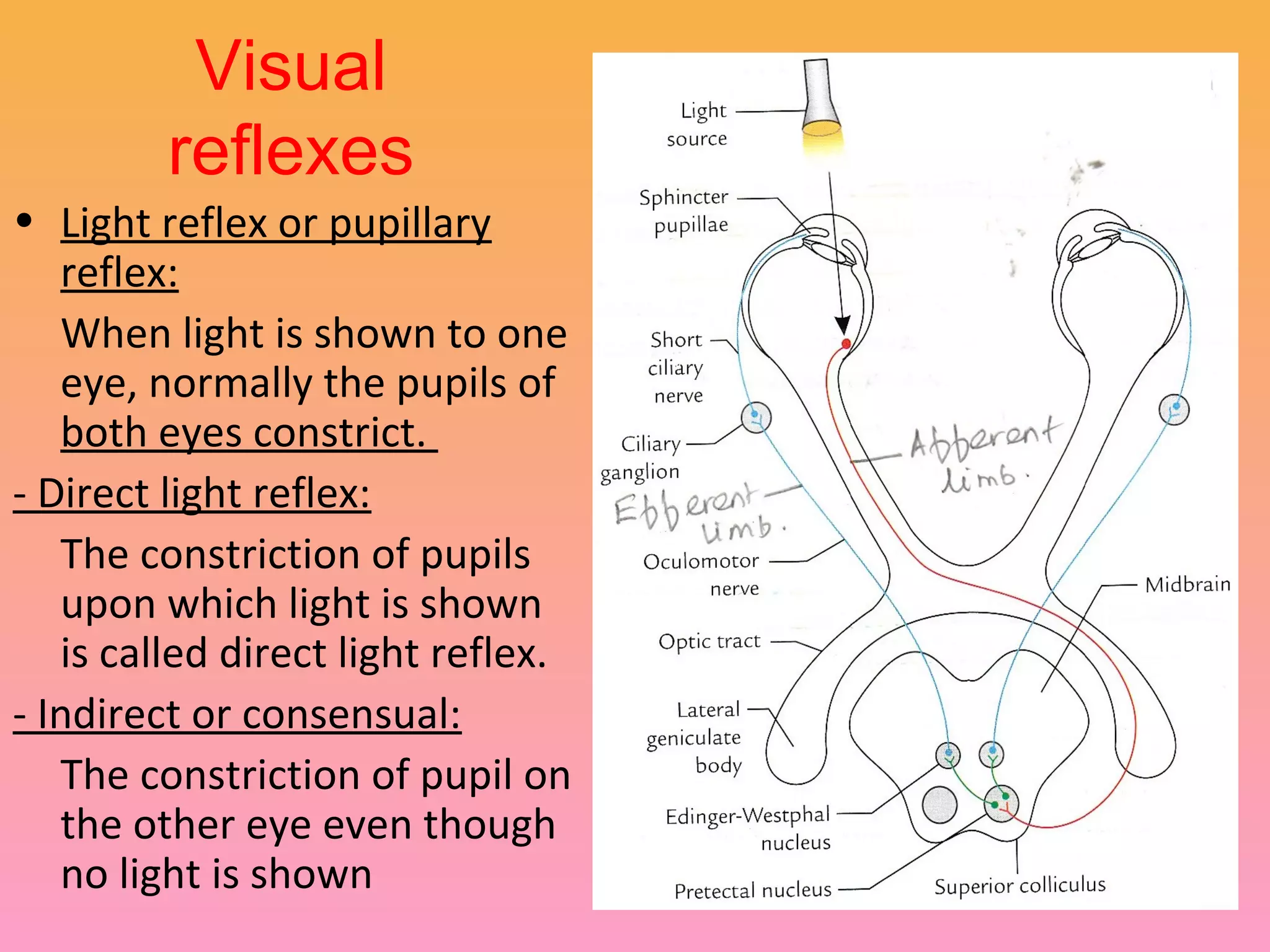
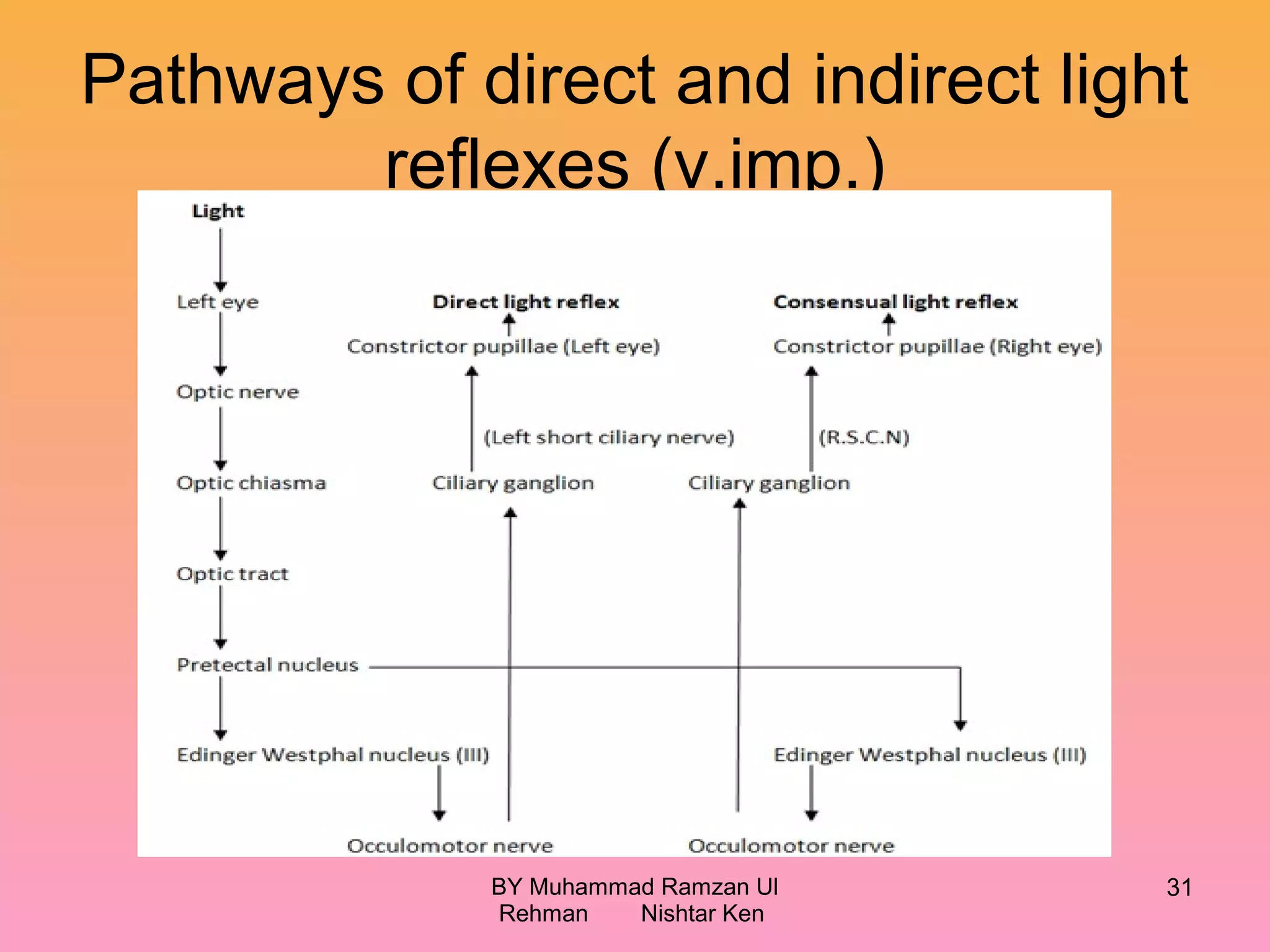
• Light reflex or pupillary
reflex:
When light is shown to one
eye, normally the pupils of
both eyes constrict.
- Direct light reflex:
The constriction of pupils
upon which light is shown
is called direct light reflex.
- Indirect or consensual:
The constriction of pupil on
the other eye even though
no light is shown
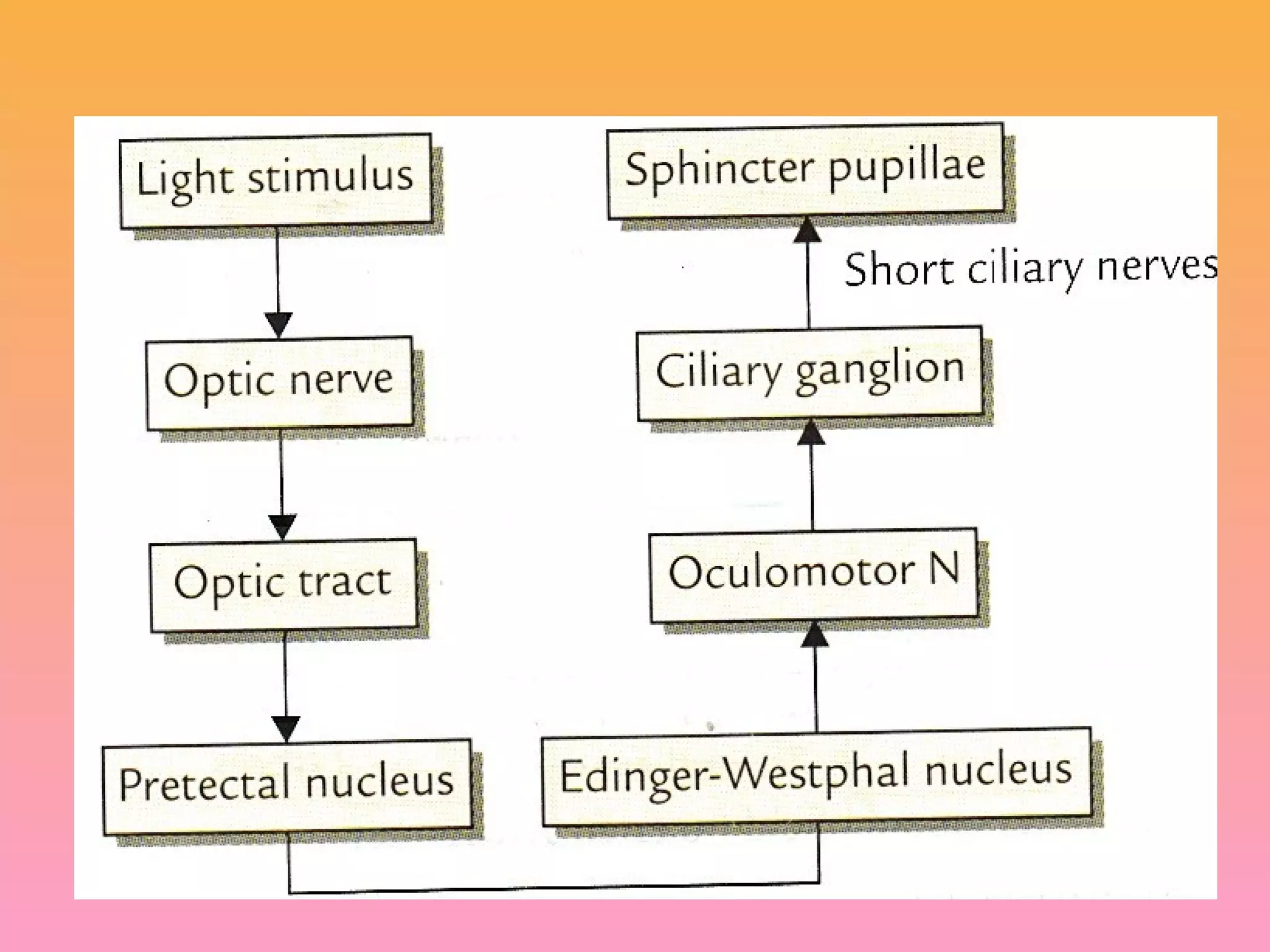
Pathways of direct and indirect light
reflexes (v.imp.)
BY Muhammad Ramzan Ul
Rehman Nishtar Ken
31
Pupillary light reflex
Direct
Consensual
AccommodationAccommodation
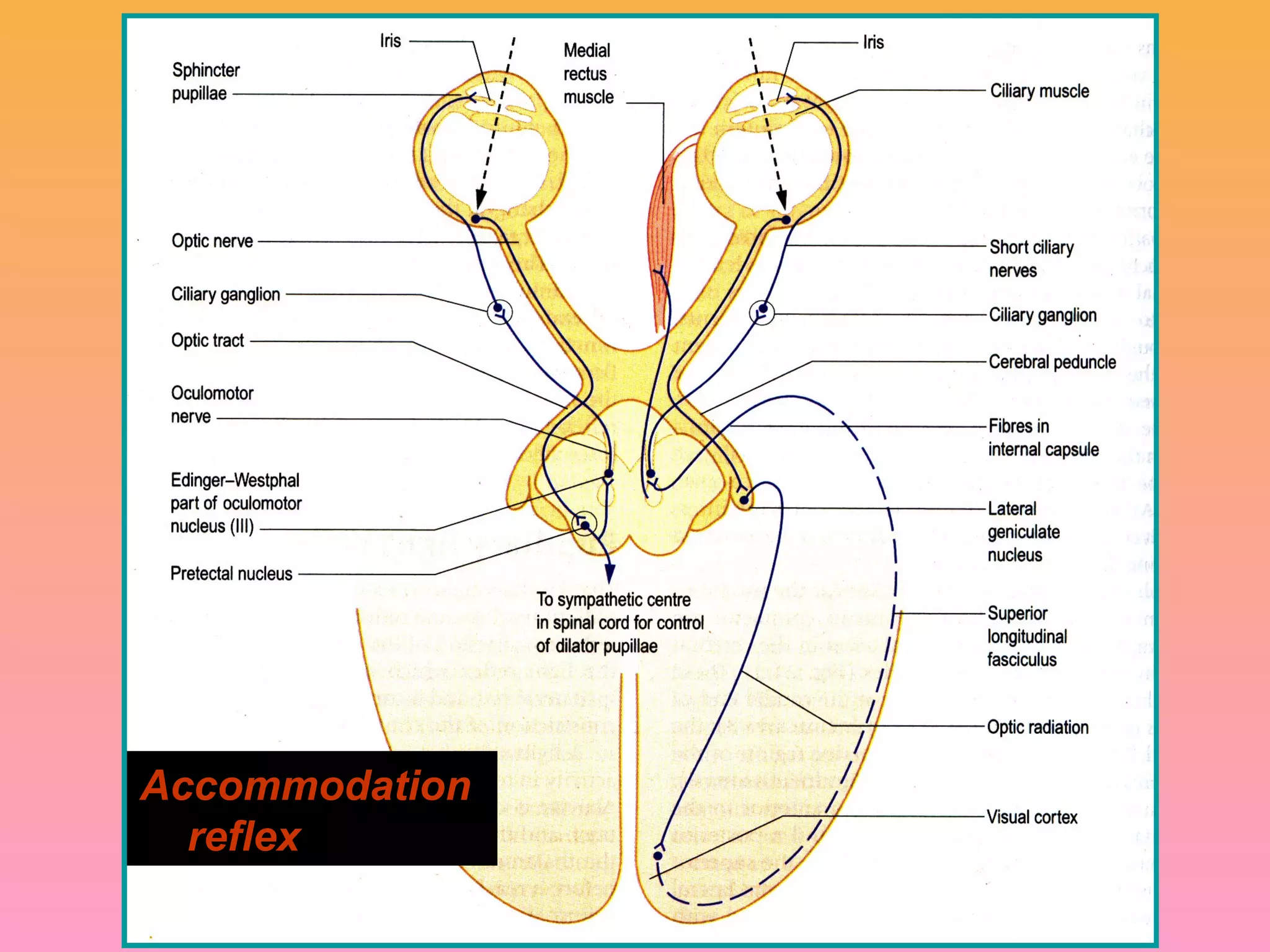
ACCCOMODATION REFLEX
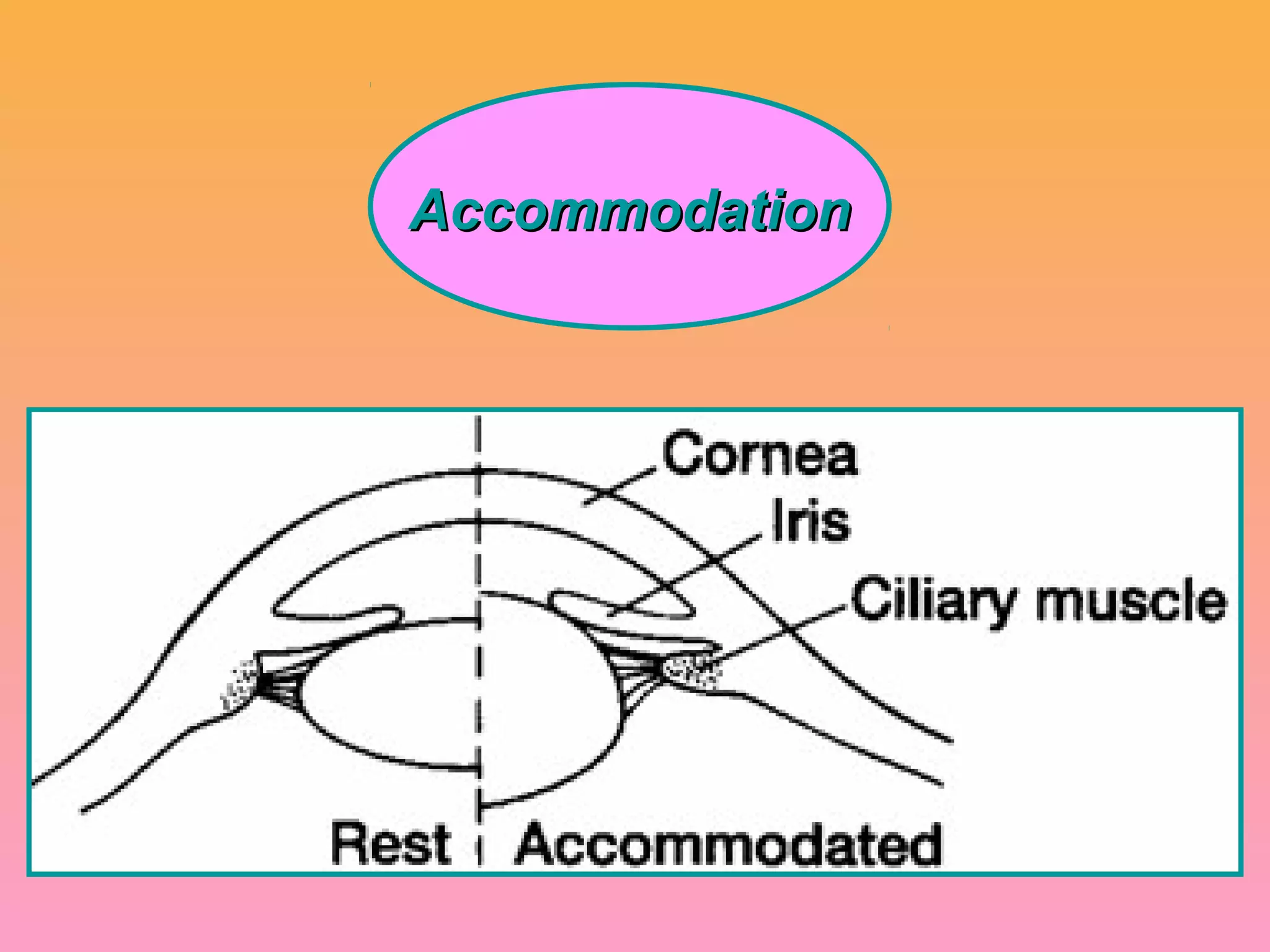
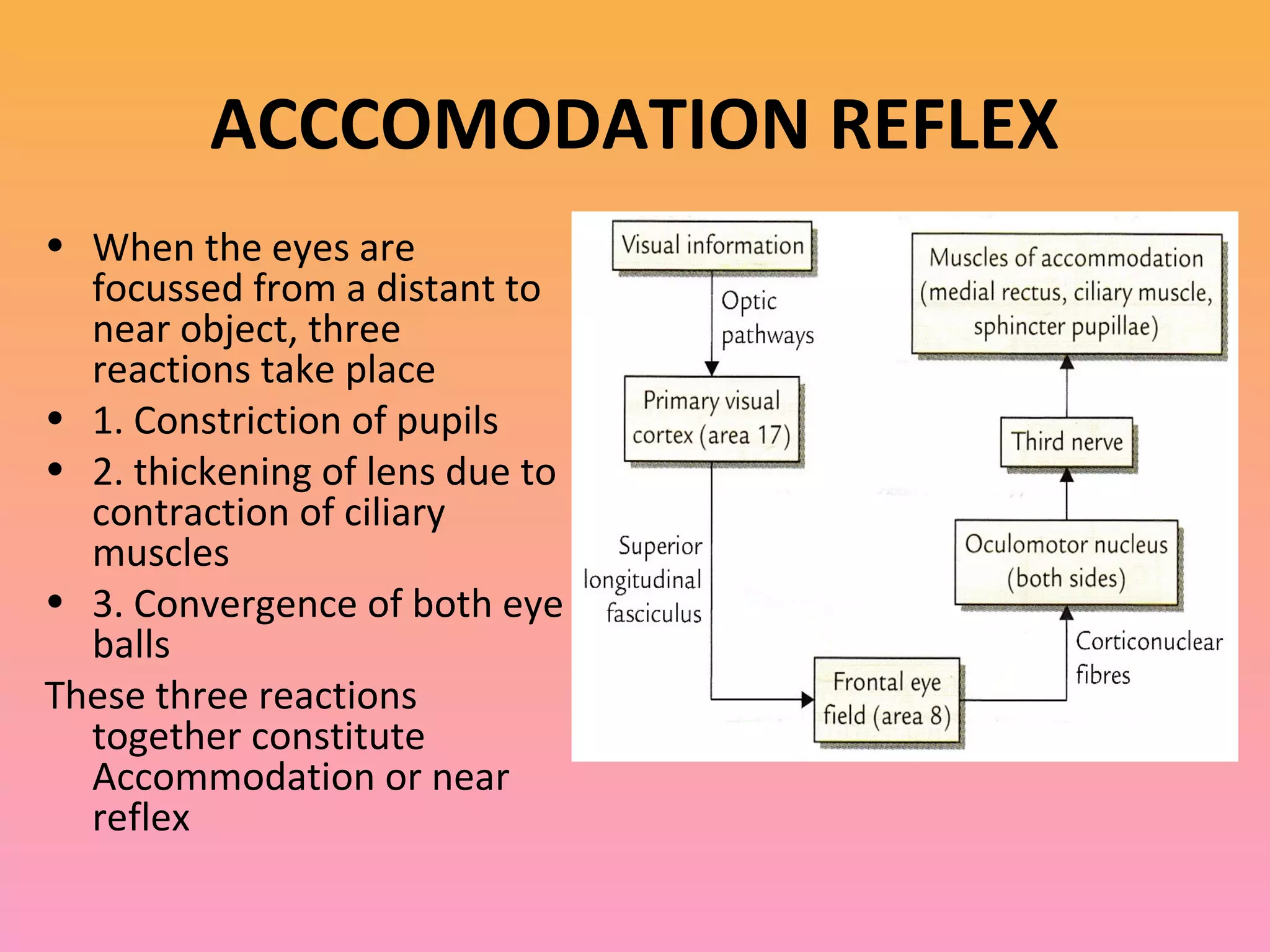
• When the eyes are
focussed from a distant to
near object, three
reactions take place
• 1. Constriction of pupils
• 2. thickening of lens due to
contraction of ciliary
muscles
• 3. Convergence of both eye
balls
These three reactions
together constitute
Accommodation or near
reflex
Accommodation
reflex

visual pathway

  • 1.
  • 2.
    Begins at theoptic disc Pierces tunic of eyeball 3mm nasal to posterior pole
  • 3.
    Visual Pathway • Eacheyeball act as camera ;it perceives the images & relay the sensations to the brain(occipital cortex) via the VISUAL PATHWAY.
  • 4.
     VISUAL PATHWAY comprises of: OpticNerve Optic Chiasma Optic Tract Lateral Geniculate Body Optic Radiations Visual cortex
  • 5.
  • 6.
    OPTIC NERVE • 2nd cranialnerve. • 47-50 mm in length. • Starts from optic disc & extends upto optic chiasma where the two nerves meet. • Backward continuation of nerve fibre layer of retina which consist of axons originating from ganglion cells. • Contains the afferent fibres of light reflex • Has 4 parts : 1)intraocular (1mm) 2)intraorbital (30mm) 3)intra canalicular (6-9mm) 4)intracranial (10mm)
  • 7.
  • 8.
  • 9.
    Receptors: 1. Rods 2. Cones Neurons: 1.First order: bipolar cells 2. Second order: ganglion cells 3. Third order: LGB Visuo-striate area (17): Both walls of calcarine sulcus involving Cuneus and lingual gyrus
  • 10.
  • 11.
  • 12.
    OPTIC CHIASMA • AFLAT MASS OF PARTIALLY DECUSSATING FIBRES WHICH LIES AT THE JUNCTION OF THE ANTERIOR WALL AND FLOOR OF THE 3RD VENTRICLE • ONLY NASAL RETINAL FIBRES CROSS OVER . • THEY JOIN THE FIBRES FROM THE OPPOSITE TEMPORAL RETINAS • THESE FIBRES FORM THE OPTIC TRACTS.
  • 13.
  • 14.
    VisualVisual PathwayPathway Optic chiasma: 1. Junctionof the floor and the anterior wall of the third ventricle 2. Rests on the diaphragma sellae 3. Wilbrand’s loop
  • 15.
    OPTIC TRACTS • Cylindricalbundle of nerve fibres. • Run outwards & backwards from posterolateral aspect of optic chiasma ,between tuber cinereum & anterior perforated substance to unite with cerebral peduncle. • Fibres from temporal half of retina of same eye & nasal half of opposite eye. • Posteriorly each ends in Lateral Geniculate Body.
  • 16.
    VisualVisual PathwayPathway Optic tracts: 1. Medialroot Gudden’s commisure 2. Lateral root a. LGB b. Superior colliculus & pre-tectal nucleus c. Supra-chiasmatic nucleus
  • 17.
    VisualVisual PathwayPathway Lateral geniculate body: 1.Part of meta-thalamus 2. Connected to superior colliculus via superior brachium 3. Cells arranged in six layers
  • 18.
    OPTIC RADIATIONS (Geniculo- CalcarinePathway) • From LGB to the occipital cortex. • Pass forwards then laterally through the area of wernicke as optic peduncles. • Anterior to lateral ventricle ,traversing the retrolenticular part of internal capsule,medial to auditory tract. • Its fibres then spread out fanwise to form medullary optic lamina. • Inferior fibres subserve upper visual fields & sweep anteroinferiorly in meyer’s loop & temporal lobe to visual cortex. • Superior fibres subserve inferior visual field proceed posteriorly through parietal lobe to visual cortex.
  • 19.
    VisualVisual PathwayPathway Optic radiation: 1. FromLGB to striate area of visual cortex (17) 2. Passes through the retro- Lentiform part internal capsule 3. Meyer’s loop
  • 20.
    Primary Visual Cortex???? •Area 17 • located in the occipital lobe in the calcarine fissure region extending to the pole • large representation in visual cortex for the macula (region for highest visual acuity) • receives the primary visual input BY Muhammad Ramzan Ul Rehman Nishtar Ken 20
  • 21.
    primary VISUAL CORTEX • FROMTHE LATERAL GENICULATE NUCLEUS, THE FIBRES PASS BY THE OPTIC RADIATIONS TO THE PRIMARY VISUAL CORTEX. • IT IS LOCATED IN THE CALCARINE FISSURE AREA OF THE MEDIAL OCCIPITAL LOBE. (BRODMANN’S AREA 17 OR V1)
  • 22.
    Secondary Visual Areas •visual association cortex (area 18, 19) • responsible for analyzing the visual information • area for 3 dimensional position, gross form, and motion • area for color analysis BY Muhammad Ramzan Ul Rehman Nishtar Ken 22
  • 23.
    VISUAL CORTEX • Locatedon the medial aspect of occipital lobe, in & near calcarine fissure.
  • 24.
    Retinal Projections to SubcorticalRegions • suprachiasmatic nucleus of the hypothalamus – control of circadian rhythms?? • pretectal nuclei – pupillary light reflex – accommodation of the lens • superior colliculus – rapid directional movement of both eyes BY Muhammad Ramzan Ul Rehman Nishtar Ken 24
  • 25.
    The Autonomic Nervesto the Eyes 25
  • 26.
    The Autonomic Nervesto the Eyes • The eye is innervated by both parasympathetic and sympathetic neurons. • Parasympathetic fibers arise in the Edinger- Westphal nucleus, pass in the 3rd cranial nerve to the ciliary ganglion. – Postganglionic fibers excite the ciliary muscle and sphincter of the iris. • Sympathetic fibers originate in the intermediolateral horn cells of the superior cervical ganglion. – Postganglionic fibers spread along the corotid artery and eventually innervate the radial fibers of the iris. 26
  • 27.
    Control of PupillaryDiameter • miosis: decreasing of pupillary aperture due to stimulation of parasympathetic nerves that excite the pupillary sphincter muscle • mydriasis: dilation of pupillary aperture due to stimulation of sympathetic nerves that excite the radial fibers of the iris 27
  • 28.
  • 29.
    Visual reflexes • Light reflexor pupillary reflex: When light is shown to one eye, normally the pupils of both eyes constrict. - Direct light reflex: The constriction of pupils upon which light is shown is called direct light reflex. - Indirect or consensual: The constriction of pupil on the other eye even though no light is shown
  • 31.
    Pathways of directand indirect light reflexes (v.imp.) BY Muhammad Ramzan Ul Rehman Nishtar Ken 31
  • 32.
  • 33.
  • 34.
    ACCCOMODATION REFLEX • Whenthe eyes are focussed from a distant to near object, three reactions take place • 1. Constriction of pupils • 2. thickening of lens due to contraction of ciliary muscles • 3. Convergence of both eye balls These three reactions together constitute Accommodation or near reflex
  • 35.