Basic Circuit Theory
Yong Heui Cho @ Mokwon University
Some of slides are referred to:
[1] jerbor, Circuit theory mt, slideshare, 2011.
2
Electronic Circuits
1. Semiconductor & Electronic Ckts
2. Introduction to Smart Sensors
3. Basic Circuit Theory
4. Diode – Operational Principle
3
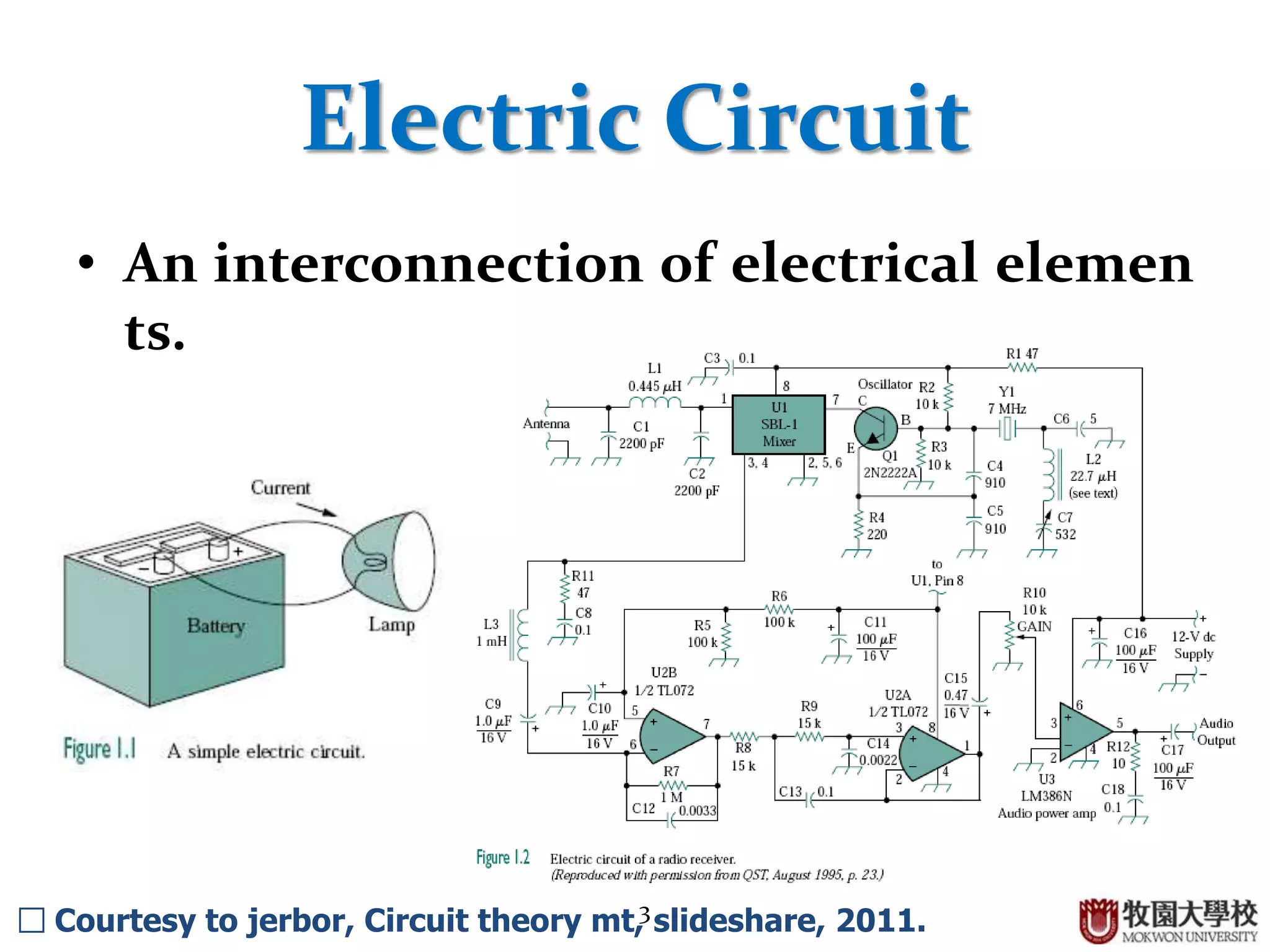
Electric Circuit
• An interconnection of electrical elemen
ts.
□ Courtesy to jerbor, Circuit theory mt, slideshare, 2011.
4
Charge (Q) & Current (I)
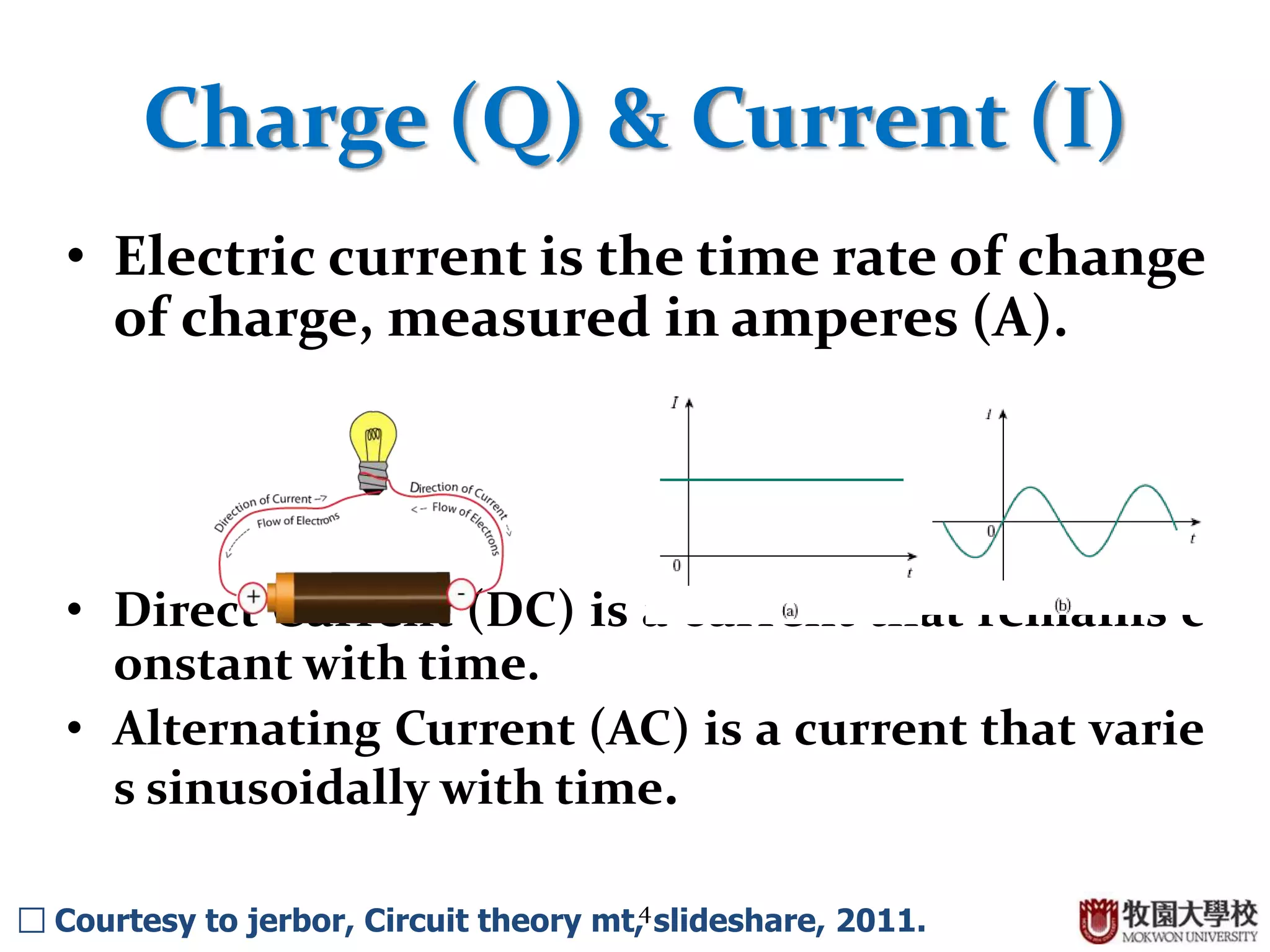
• Electric current is the time rate of change
of charge, measured in amperes (A).
• Direct Current (DC) is a current that remains c
onstant with time.
• Alternating Current (AC) is a current that varie
s sinusoidally with time.
□ Courtesy to jerbor, Circuit theory mt, slideshare, 2011.
5
Voltage (V)
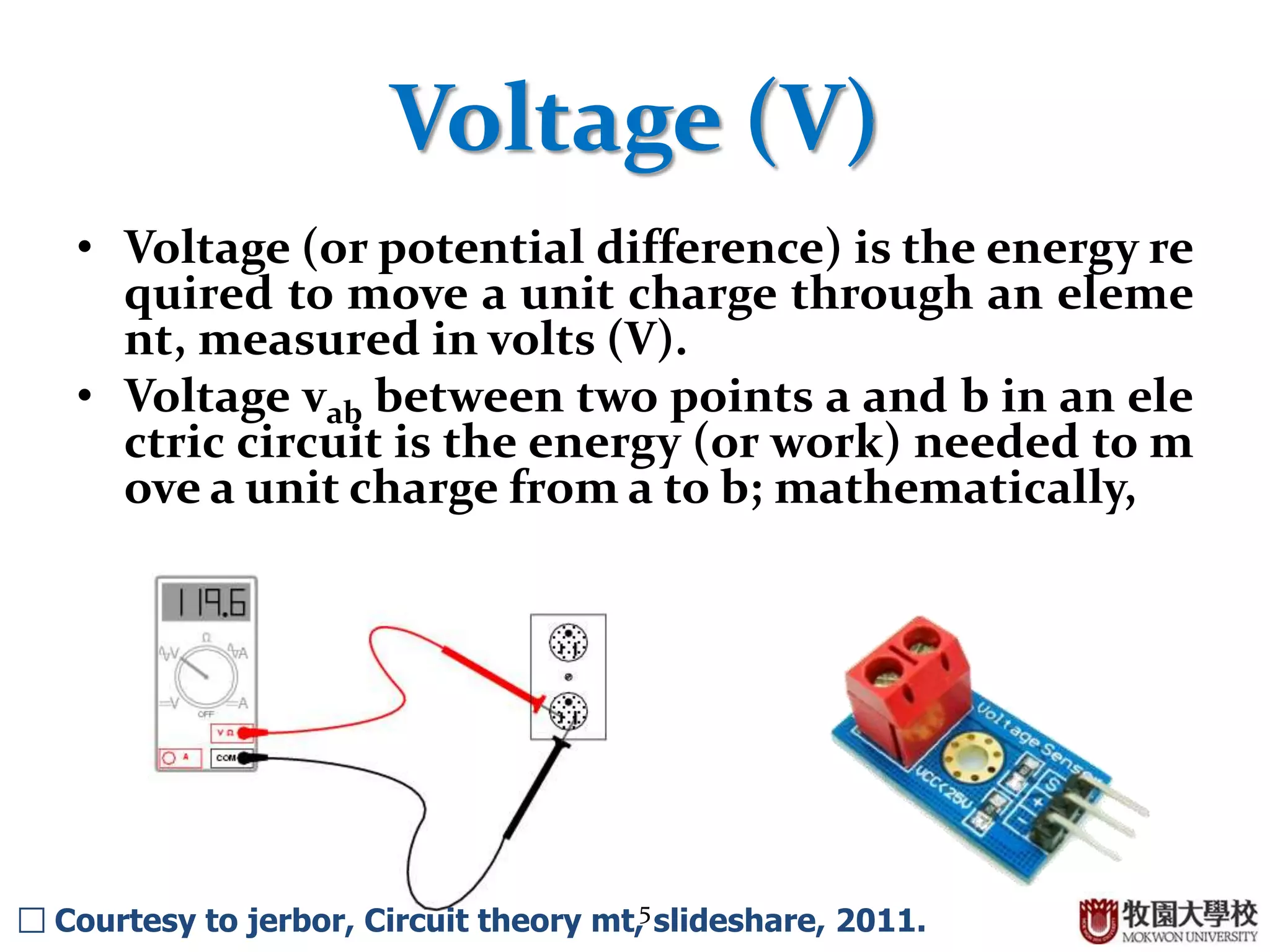
• Voltage (or potential difference) is the energy re
quired to move a unit charge through an eleme
nt, measured in volts (V).
• Voltage vab between two points a and b in an ele
ctric circuit is the energy (or work) needed to m
ove a unit charge from a to b; mathematically,
□ Courtesy to jerbor, Circuit theory mt, slideshare, 2011.
6
Power & Energy
• Electric power [W]
– Rate at which electrical energy is
transferred by an electric circuit
– DC:
– AC:
• Energy [J]
–
– kWh: kW x hours
VIP 
VIP
2
1
av 
time PE
7
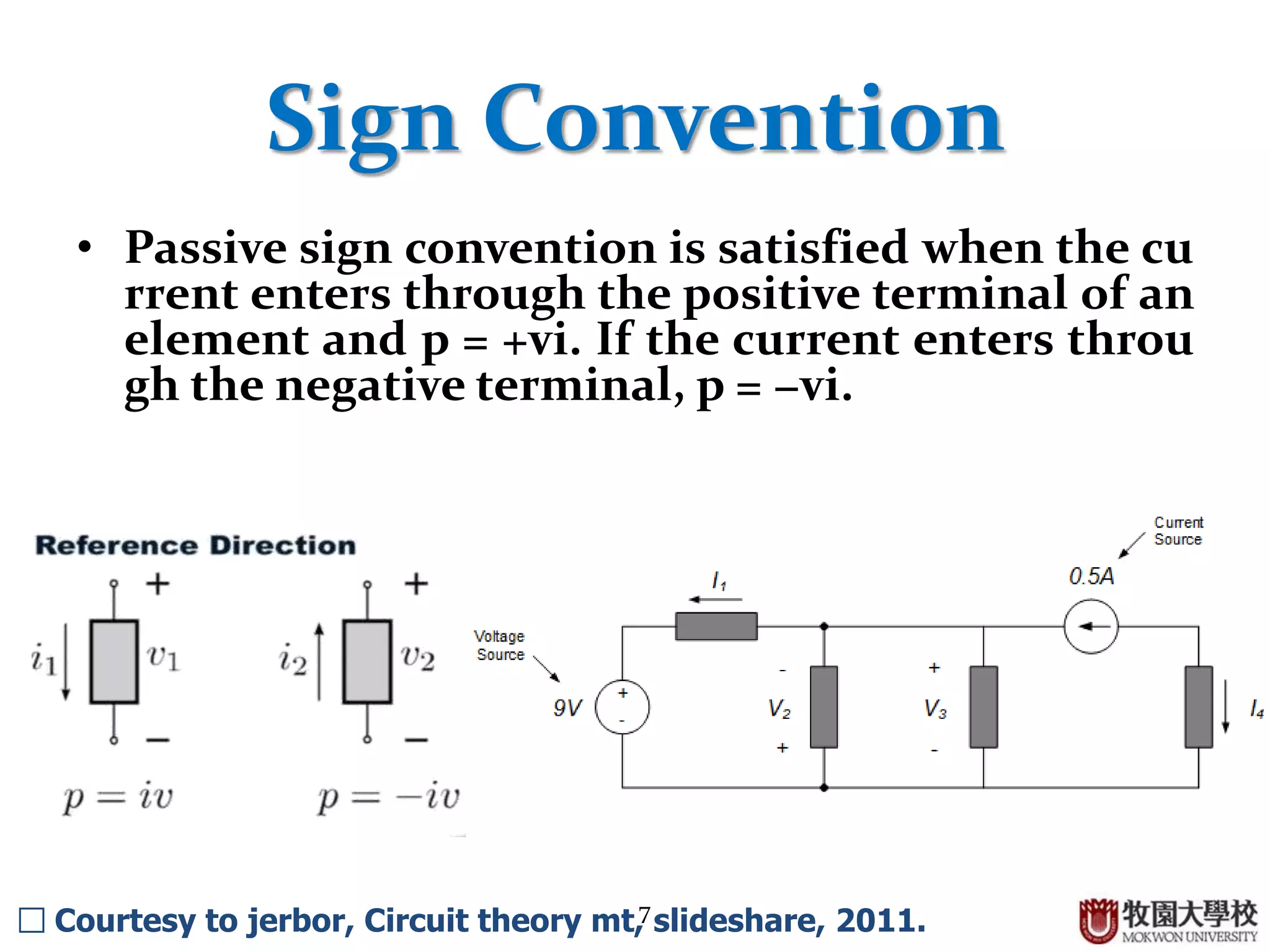
Sign Convention
• Passive sign convention is satisfied when the cu
rrent enters through the positive terminal of an
element and p = +vi. If the current enters throu
gh the negative terminal, p = −vi.
□ Courtesy to jerbor, Circuit theory mt, slideshare, 2011.
8
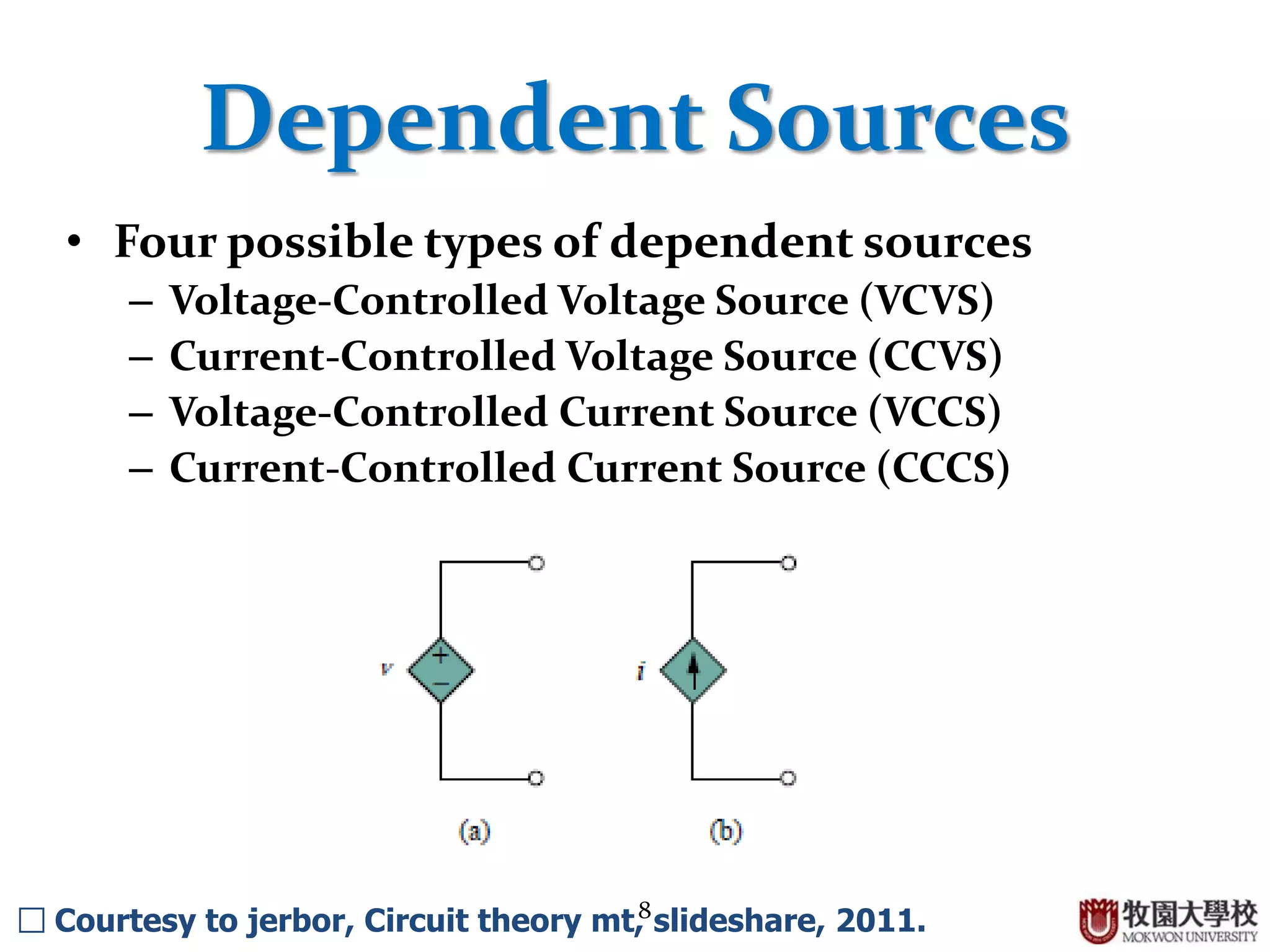
Dependent Sources
• Four possible types of dependent sources
– Voltage-Controlled Voltage Source (VCVS)
– Current-Controlled Voltage Source (CCVS)
– Voltage-Controlled Current Source (VCCS)
– Current-Controlled Current Source (CCCS)
□ Courtesy to jerbor, Circuit theory mt, slideshare, 2011.
9
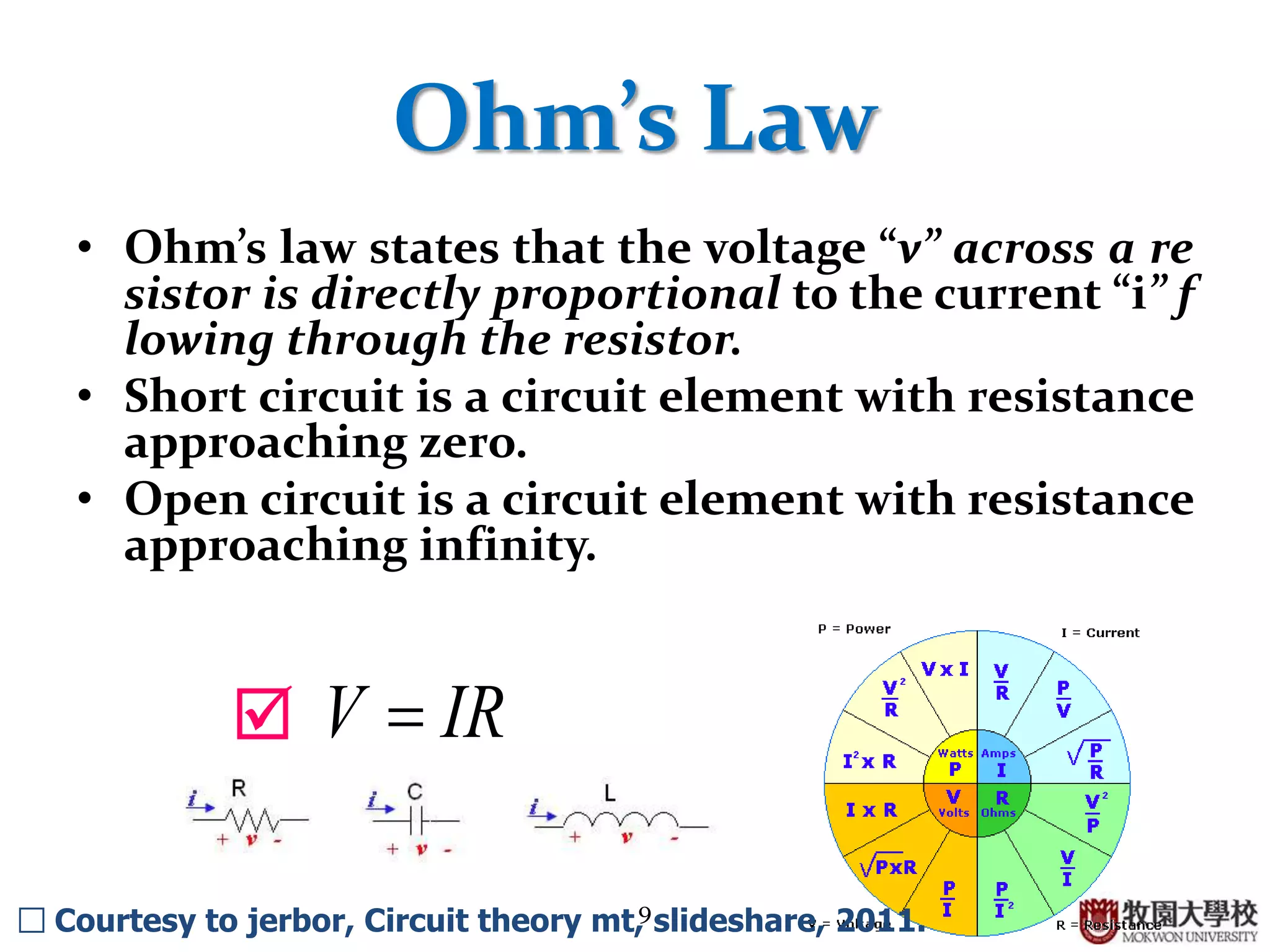
Ohm’s Law
• Ohm’s law states that the voltage “v” across a re
sistor is directly proportional to the current “i” f
lowing through the resistor.
• Short circuit is a circuit element with resistance
approaching zero.
• Open circuit is a circuit element with resistance
approaching infinity.
IRV 
□ Courtesy to jerbor, Circuit theory mt, slideshare, 2011.
10
Current & Water
11
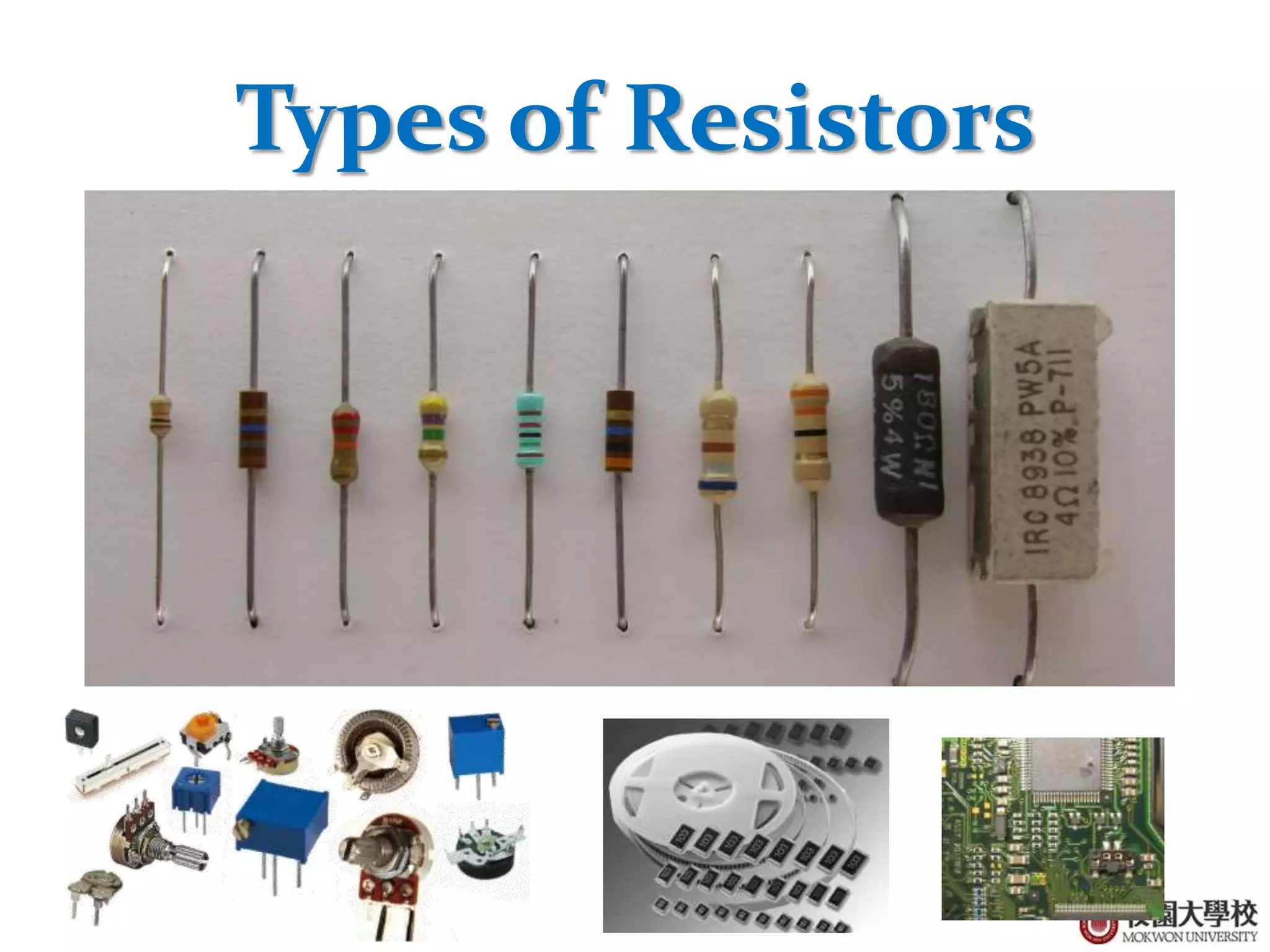
Types of Resistors
12
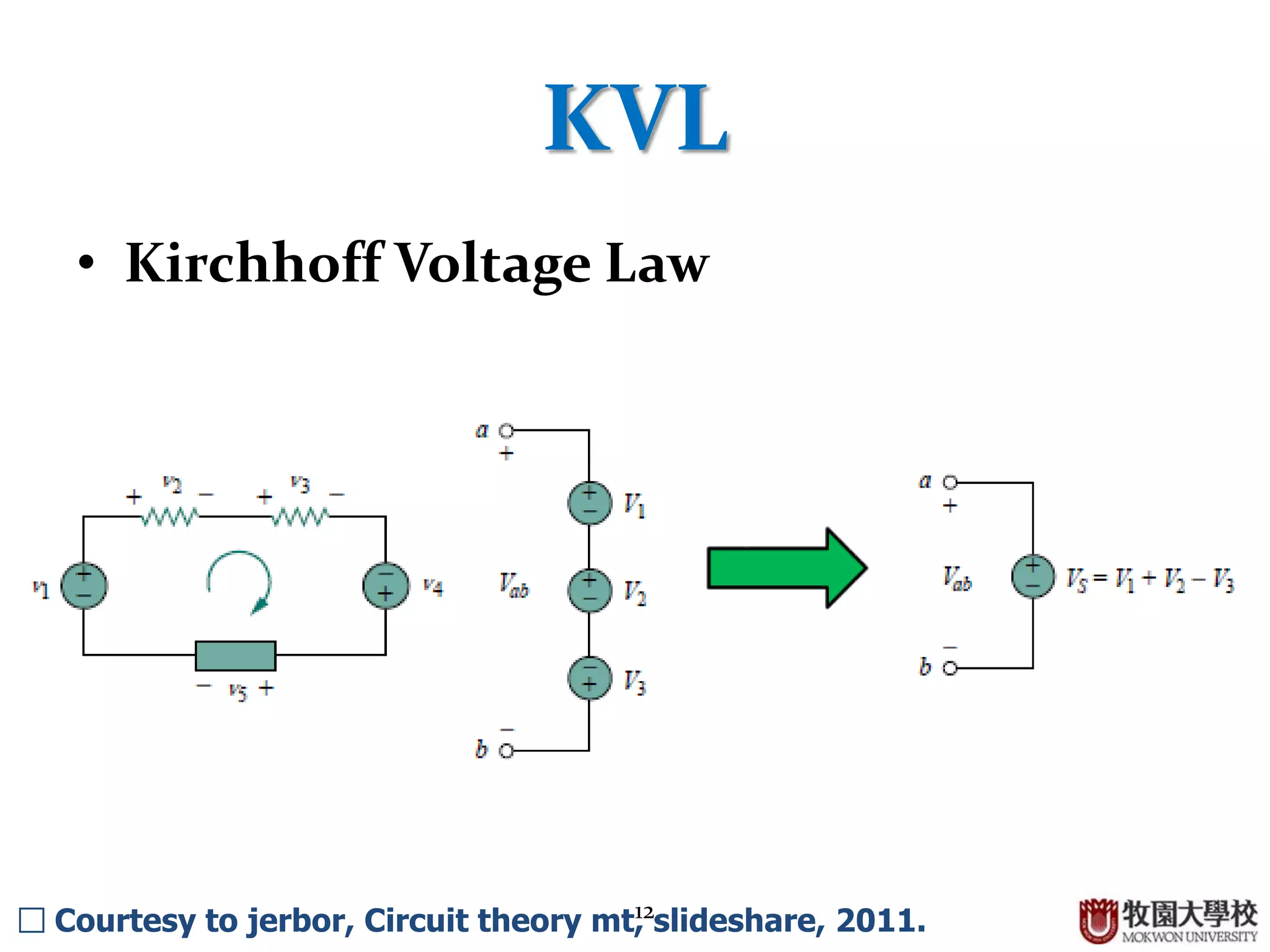
KVL
• Kirchhoff Voltage Law
□ Courtesy to jerbor, Circuit theory mt, slideshare, 2011.
13
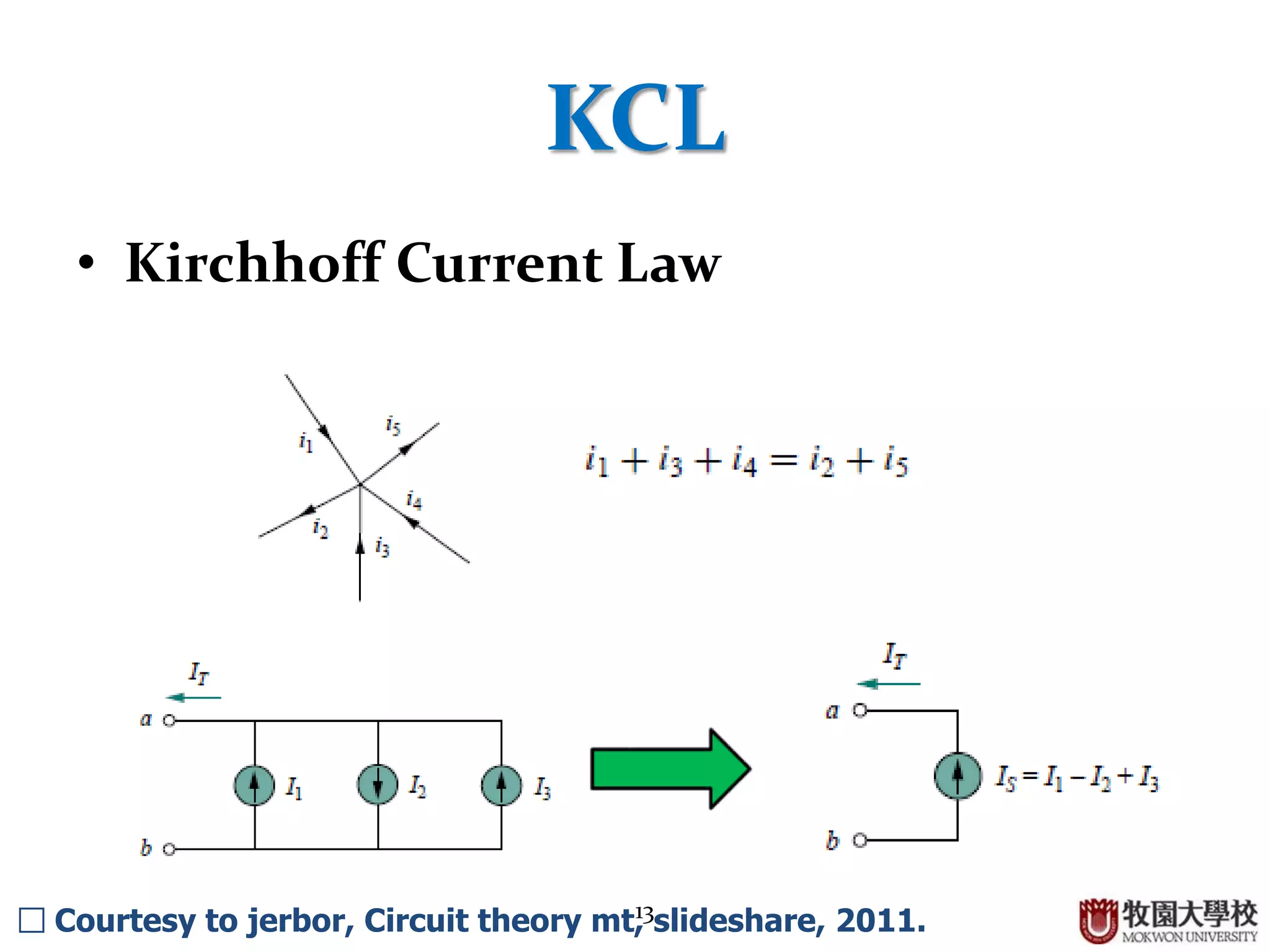
KCL
• Kirchhoff Current Law
□ Courtesy to jerbor, Circuit theory mt, slideshare, 2011.
14
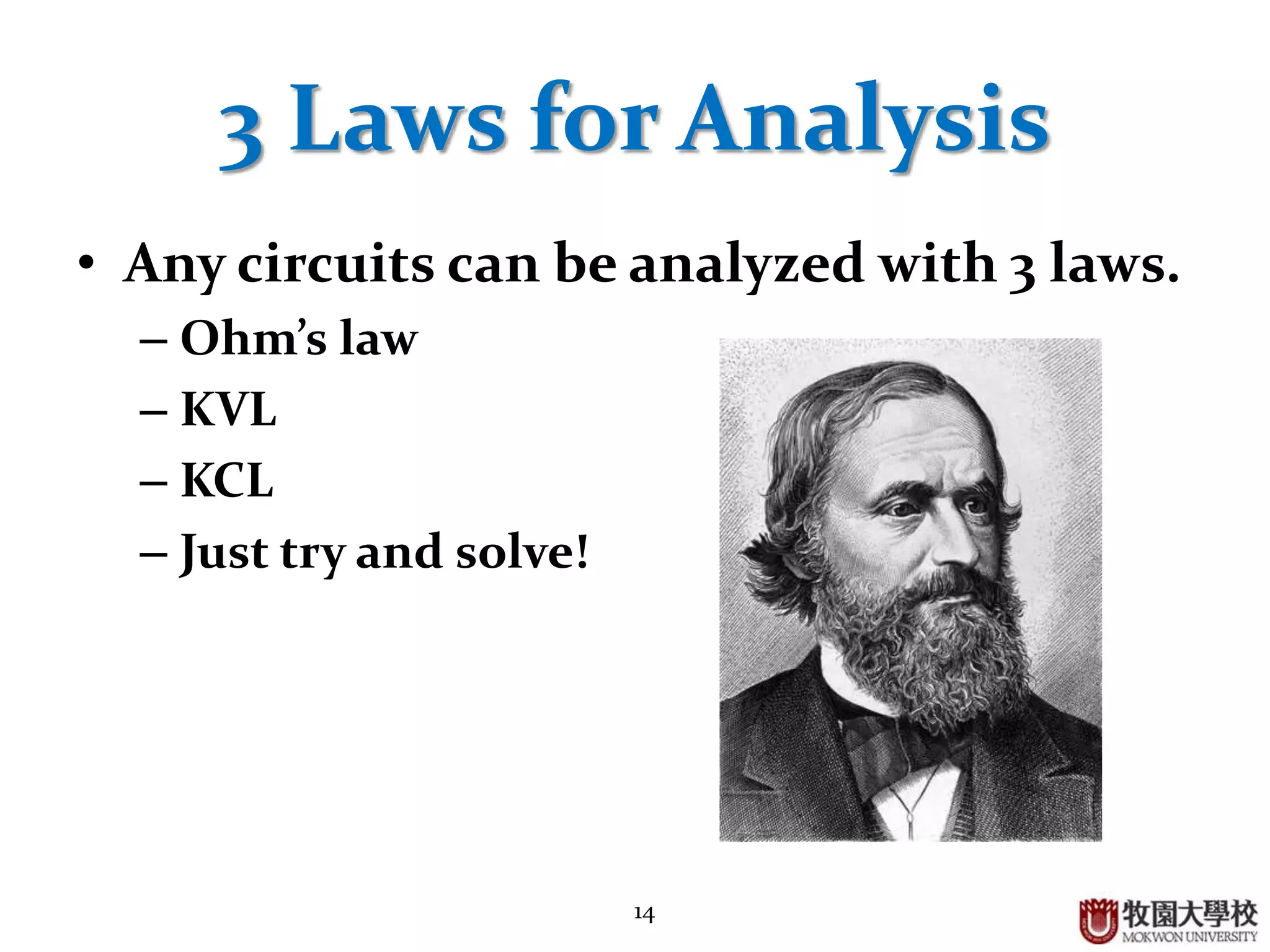
3 Laws for Analysis
• Any circuits can be analyzed with 3 laws.
– Ohm’s law
– KVL
– KCL
– Just try and solve!
15
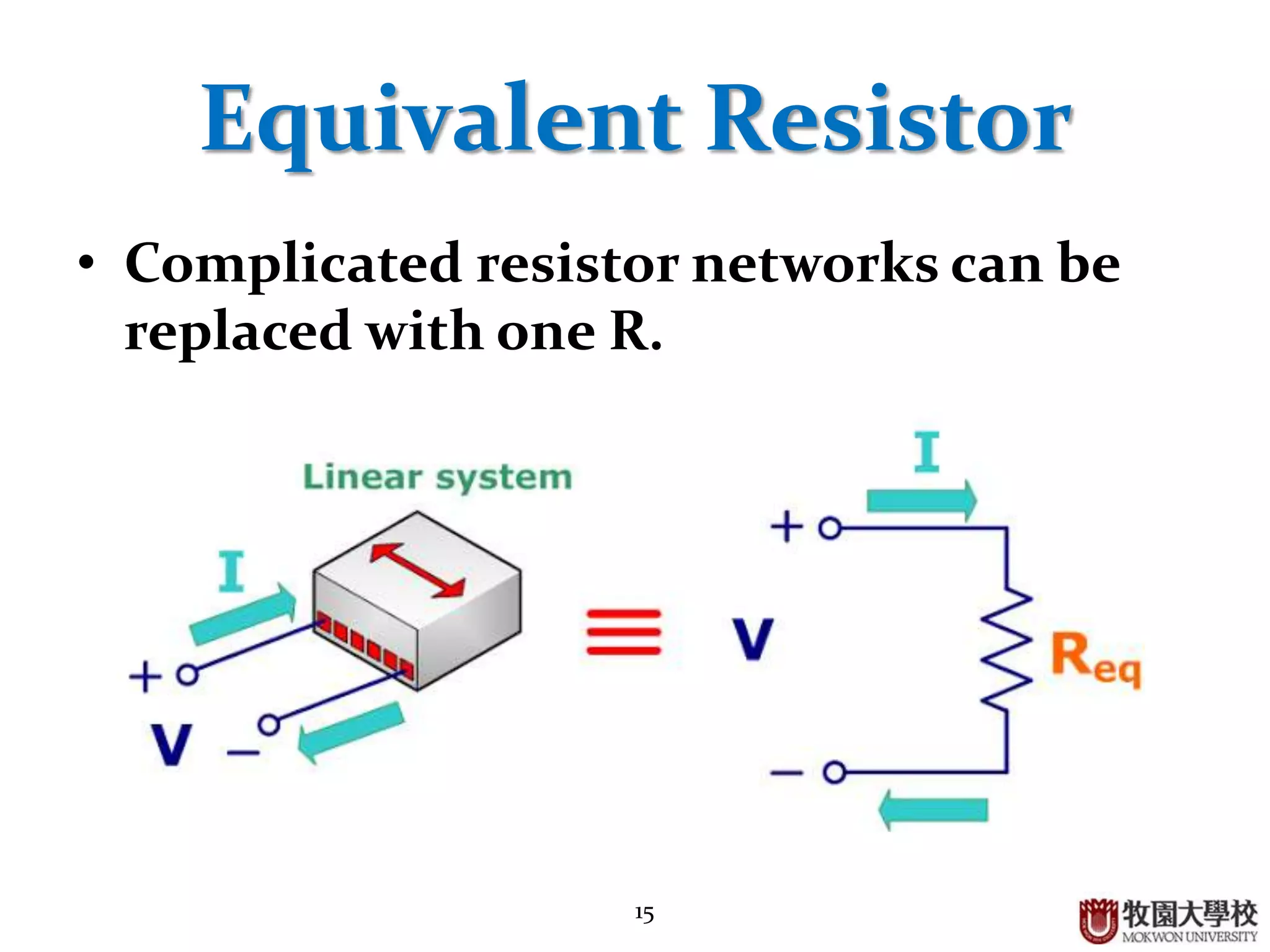
Equivalent Resistor
• Complicated resistor networks can be
replaced with one R.
16
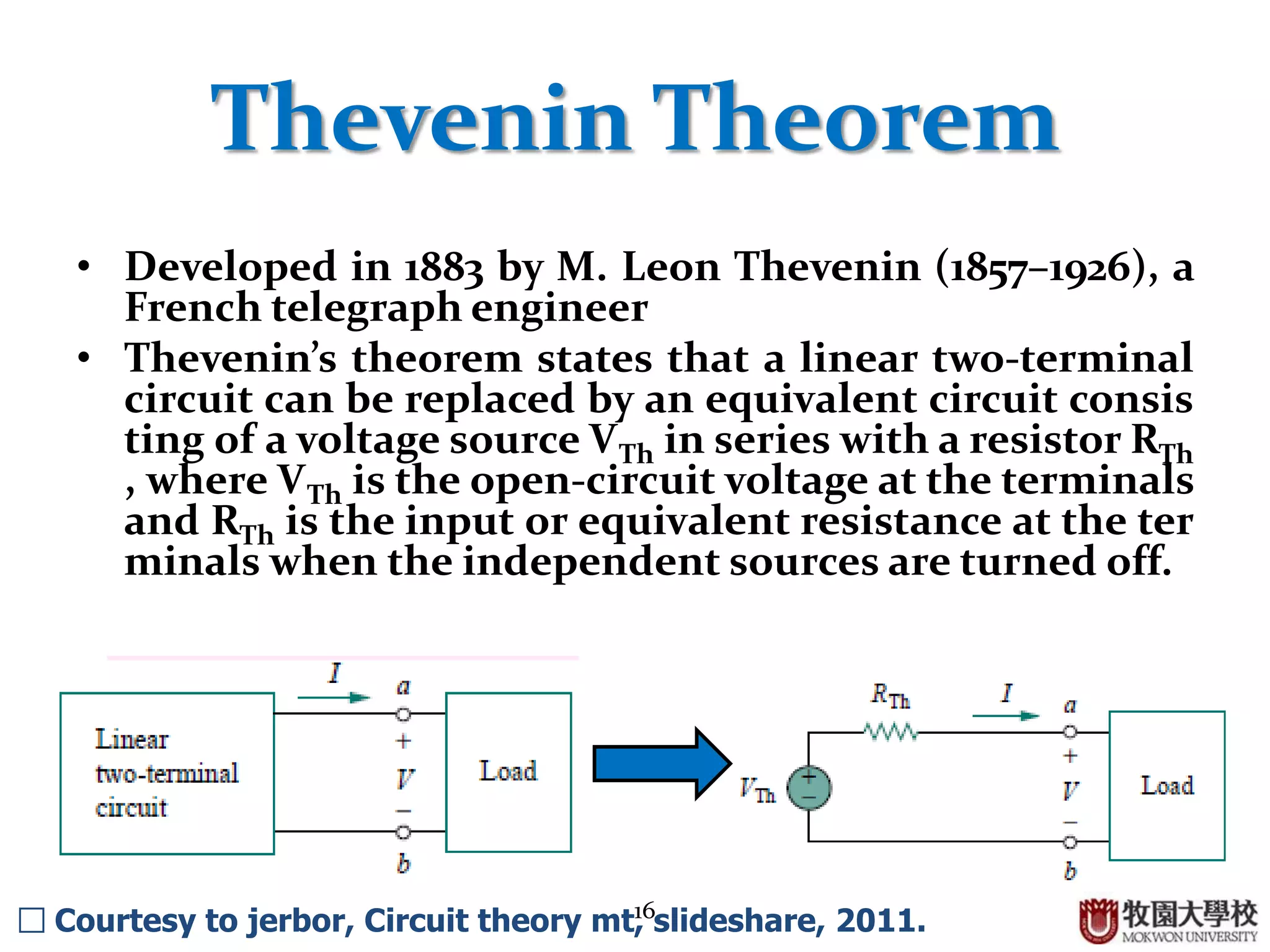
Thevenin Theorem
• Developed in 1883 by M. Leon Thevenin (1857–1926), a
French telegraph engineer
• Thevenin’s theorem states that a linear two-terminal
circuit can be replaced by an equivalent circuit consis
ting of a voltage source VTh in series with a resistor RTh
, where VTh is the open-circuit voltage at the terminals
and RTh is the input or equivalent resistance at the ter
minals when the independent sources are turned off.
□ Courtesy to jerbor, Circuit theory mt, slideshare, 2011.
17
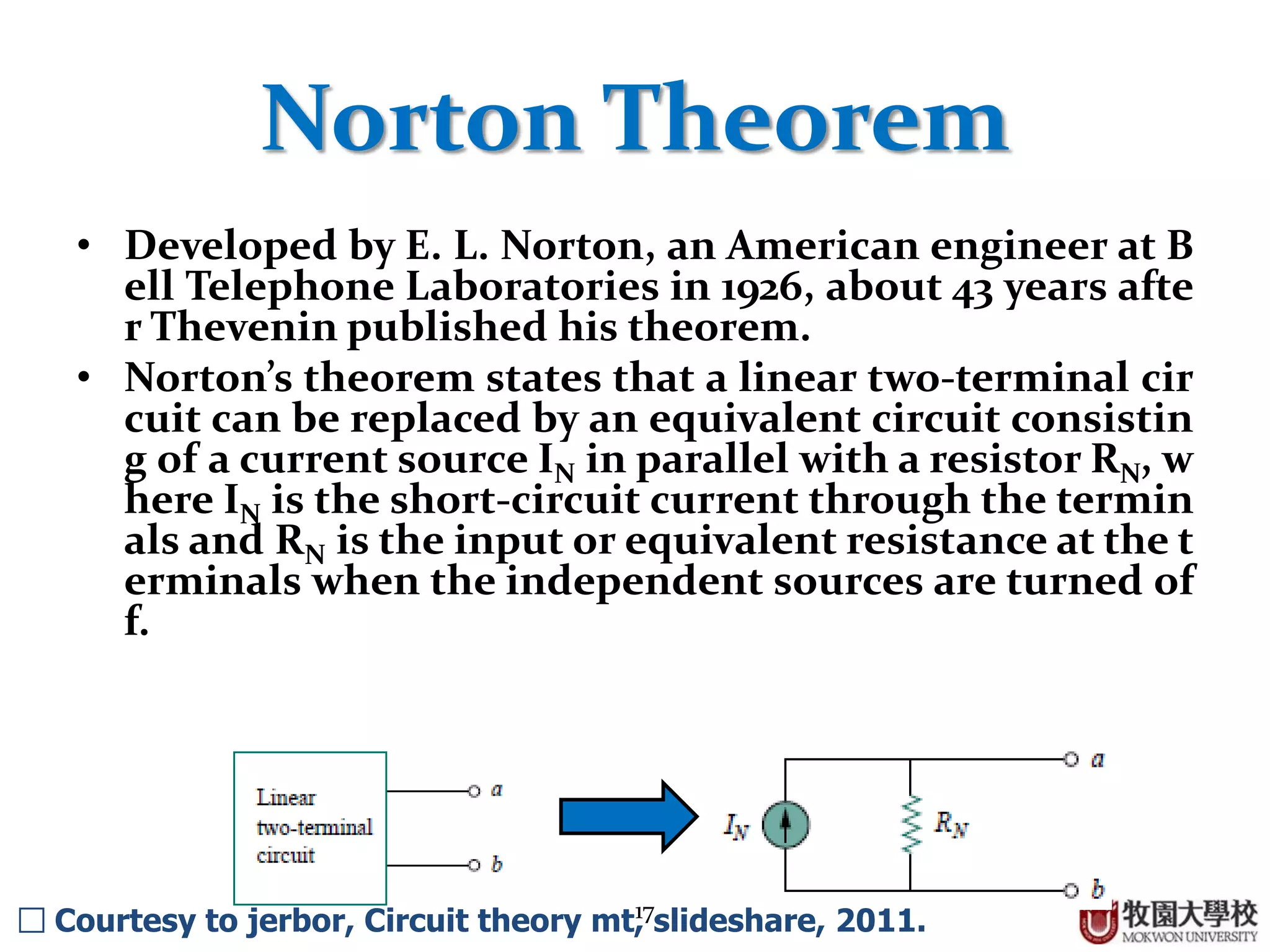
Norton Theorem
• Developed by E. L. Norton, an American engineer at B
ell Telephone Laboratories in 1926, about 43 years afte
r Thevenin published his theorem.
• Norton’s theorem states that a linear two-terminal cir
cuit can be replaced by an equivalent circuit consistin
g of a current source IN in parallel with a resistor RN, w
here IN is the short-circuit current through the termin
als and RN is the input or equivalent resistance at the t
erminals when the independent sources are turned of
f.
□ Courtesy to jerbor, Circuit theory mt, slideshare, 2011.
18
Capacitor [F]
• A component used to store electric
charge
CVQ 
19
Inductor [H]
• A component used to generate magnetic
flux
LI
20
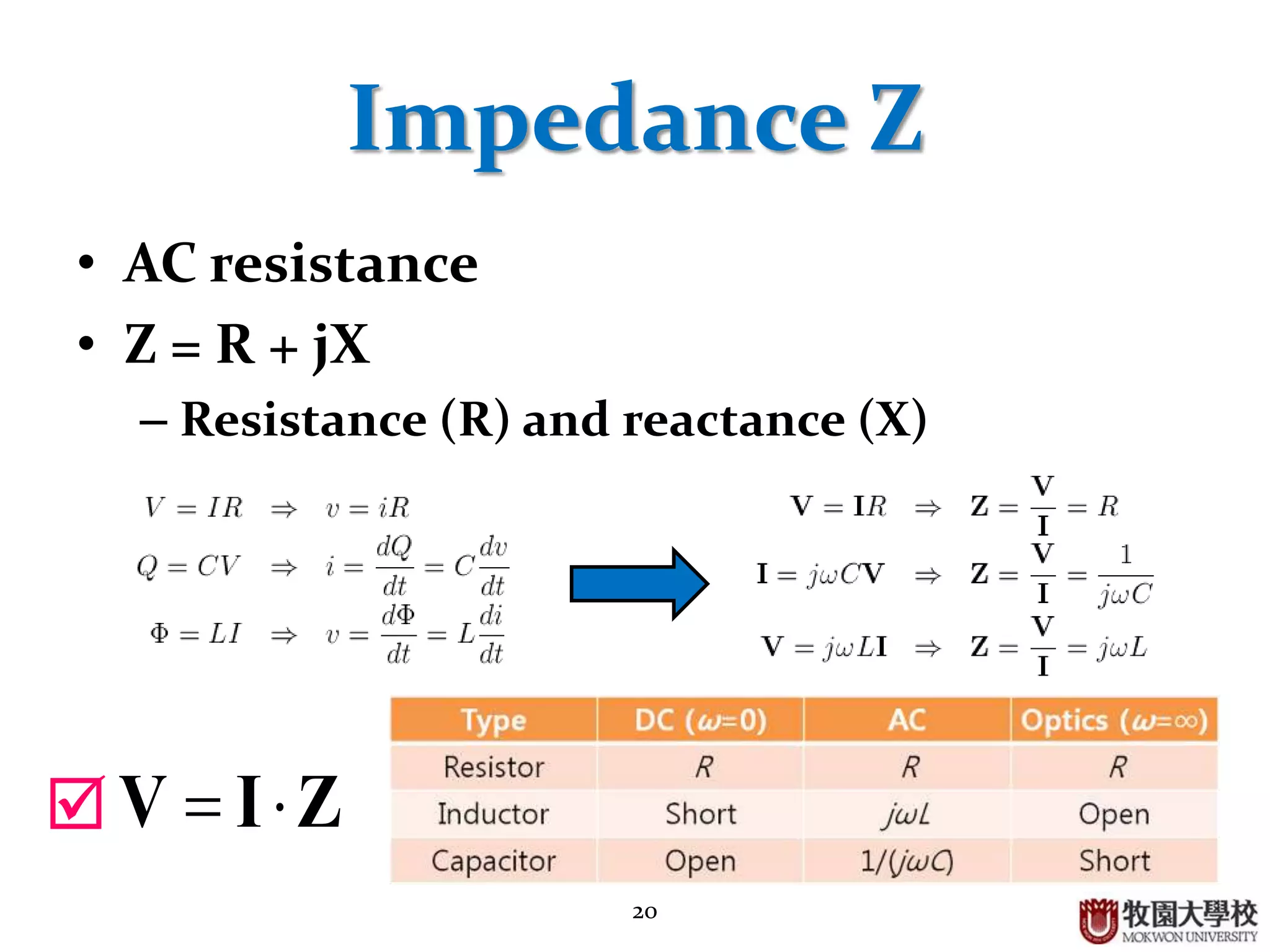
Impedance Z
• AC resistance
• Z = R + jX
– Resistance (R) and reactance (X)
ZIV 

Basic Circuit Theory

  • 1.
    Basic Circuit Theory YongHeui Cho @ Mokwon University Some of slides are referred to: [1] jerbor, Circuit theory mt, slideshare, 2011.
  • 2.
    2 Electronic Circuits 1. Semiconductor& Electronic Ckts 2. Introduction to Smart Sensors 3. Basic Circuit Theory 4. Diode – Operational Principle
  • 3.
    3 Electric Circuit • Aninterconnection of electrical elemen ts. □ Courtesy to jerbor, Circuit theory mt, slideshare, 2011.
  • 4.
    4 Charge (Q) &Current (I) • Electric current is the time rate of change of charge, measured in amperes (A). • Direct Current (DC) is a current that remains c onstant with time. • Alternating Current (AC) is a current that varie s sinusoidally with time. □ Courtesy to jerbor, Circuit theory mt, slideshare, 2011.
  • 5.
    5 Voltage (V) • Voltage(or potential difference) is the energy re quired to move a unit charge through an eleme nt, measured in volts (V). • Voltage vab between two points a and b in an ele ctric circuit is the energy (or work) needed to m ove a unit charge from a to b; mathematically, □ Courtesy to jerbor, Circuit theory mt, slideshare, 2011.
  • 6.
    6 Power & Energy •Electric power [W] – Rate at which electrical energy is transferred by an electric circuit – DC: – AC: • Energy [J] – – kWh: kW x hours VIP  VIP 2 1 av  time PE
  • 7.
    7 Sign Convention • Passivesign convention is satisfied when the cu rrent enters through the positive terminal of an element and p = +vi. If the current enters throu gh the negative terminal, p = −vi. □ Courtesy to jerbor, Circuit theory mt, slideshare, 2011.
  • 8.
    8 Dependent Sources • Fourpossible types of dependent sources – Voltage-Controlled Voltage Source (VCVS) – Current-Controlled Voltage Source (CCVS) – Voltage-Controlled Current Source (VCCS) – Current-Controlled Current Source (CCCS) □ Courtesy to jerbor, Circuit theory mt, slideshare, 2011.
  • 9.
    9 Ohm’s Law • Ohm’slaw states that the voltage “v” across a re sistor is directly proportional to the current “i” f lowing through the resistor. • Short circuit is a circuit element with resistance approaching zero. • Open circuit is a circuit element with resistance approaching infinity. IRV  □ Courtesy to jerbor, Circuit theory mt, slideshare, 2011.
  • 10.
  • 11.
  • 12.
    12 KVL • Kirchhoff VoltageLaw □ Courtesy to jerbor, Circuit theory mt, slideshare, 2011.
  • 13.
    13 KCL • Kirchhoff CurrentLaw □ Courtesy to jerbor, Circuit theory mt, slideshare, 2011.
  • 14.
    14 3 Laws forAnalysis • Any circuits can be analyzed with 3 laws. – Ohm’s law – KVL – KCL – Just try and solve!
  • 15.
    15 Equivalent Resistor • Complicatedresistor networks can be replaced with one R.
  • 16.
    16 Thevenin Theorem • Developedin 1883 by M. Leon Thevenin (1857–1926), a French telegraph engineer • Thevenin’s theorem states that a linear two-terminal circuit can be replaced by an equivalent circuit consis ting of a voltage source VTh in series with a resistor RTh , where VTh is the open-circuit voltage at the terminals and RTh is the input or equivalent resistance at the ter minals when the independent sources are turned off. □ Courtesy to jerbor, Circuit theory mt, slideshare, 2011.
  • 17.
    17 Norton Theorem • Developedby E. L. Norton, an American engineer at B ell Telephone Laboratories in 1926, about 43 years afte r Thevenin published his theorem. • Norton’s theorem states that a linear two-terminal cir cuit can be replaced by an equivalent circuit consistin g of a current source IN in parallel with a resistor RN, w here IN is the short-circuit current through the termin als and RN is the input or equivalent resistance at the t erminals when the independent sources are turned of f. □ Courtesy to jerbor, Circuit theory mt, slideshare, 2011.
  • 18.
    18 Capacitor [F] • Acomponent used to store electric charge CVQ 
  • 19.
    19 Inductor [H] • Acomponent used to generate magnetic flux LI
  • 20.
    20 Impedance Z • ACresistance • Z = R + jX – Resistance (R) and reactance (X) ZIV 