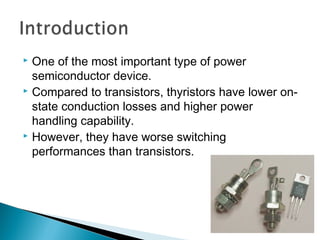
 One of the most important type of power
semiconductor device.
 Compared to transistors, thyristors have lower on-
state conduction losses and higher power
handling capability.
 However, they have worse switching
performances than transistors.
 Have the highest power handling capability.
 It has a rating of 1200V / 1500A with switching
frequencies ranging from 1KHz to 20KHz.
 When the anode is at a positive potential VAK with respect to
the cathode with no voltage applied at the gate, junctions J1
and J3 are forward biased, while junction J2 is reverse
biased. As J2 is reverse biased, no conduction takes place.
 Now if VAK is increased beyond the breakdown voltage VBO of
the thyristor, avalanche breakdown of J2 takes place and
the thyristor starts conducting.
 If a positive potential VG is applied at the gate terminal with
respect to the cathode, the breakdown of the junction J2
occurs at a lower value of VAK. By selecting an appropriate
value of VG, the thyristor can be switched into the on state
suddenly.
Reverse
breakdow
n voltage
Holding
current
Reverse
leakage
current
Latching
current
Forward volt-drop
(conducting)
Forward
break-over
voltage
Forward
leakage
current
Gate
triggere
d
IH
IL
VBO VAK
IT
 Forward breakdown voltage VBO
◦ The voltage of avalanche breakdown

Latching current IL
◦ The minimum anode current required to maintain the
thyristor in the on-state immediately after it is turned on
and the gate signal has been removed

Holding current IH
◦ The minimum anode current to maintain the thyristor in
the on-state
 IL > IH
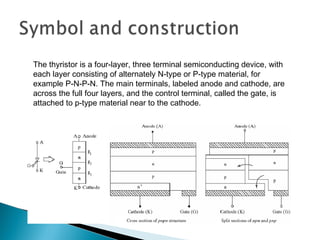
The thyristor is a four-layer, three terminal semiconducting device, with
each layer consisting of alternately N-type or P-type material, for
example P-N-P-N. The main terminals, labeled anode and cathode, are
across the full four layers, and the control terminal, called the gate, is
attached to p-type material near to the cathode.
 Silicon Controlled Rectifier (SCR).
 TRIAC.
 DIAC.
 Silicon Unilateral Switch (SUS) – has built in low
voltage avalanche diode
Construction of SUS
 Mainly used where high currents and voltages are
involved, and are often used to control alternating
currents, where the change of polarity of the current
causes the device to switch off automatically; referred to
as Zero Cross operation.
 Thyristors can be used as the control elements for phase
angle triggered controllers, also known as phase fired
controllers.
 In power supplies for digital circuits, thyristor can be
used as a sort of "circuit breaker" or "crowbar" to prevent
a failure in the power supply from damaging downstream
components, by shorting the power supply output to
ground
Load voltage regulated by thyristor phase
control.
Red trace: load voltage
Blue trace: trigger signal.
 In power supplies for digital circuits, thyristor can be
used as a sort of "circuit breaker" or "crowbar" to prevent
a failure in the power supply from damaging downstream
components, by shorting the power supply output to
ground
Load voltage regulated by thyristor phase
control.
Red trace: load voltage
Blue trace: trigger signal.

Thyristors

  • 2.
     One ofthe most important type of power semiconductor device.  Compared to transistors, thyristors have lower on- state conduction losses and higher power handling capability.  However, they have worse switching performances than transistors.
  • 3.
     Have thehighest power handling capability.  It has a rating of 1200V / 1500A with switching frequencies ranging from 1KHz to 20KHz.
  • 4.
     When theanode is at a positive potential VAK with respect to the cathode with no voltage applied at the gate, junctions J1 and J3 are forward biased, while junction J2 is reverse biased. As J2 is reverse biased, no conduction takes place.  Now if VAK is increased beyond the breakdown voltage VBO of the thyristor, avalanche breakdown of J2 takes place and the thyristor starts conducting.  If a positive potential VG is applied at the gate terminal with respect to the cathode, the breakdown of the junction J2 occurs at a lower value of VAK. By selecting an appropriate value of VG, the thyristor can be switched into the on state suddenly.
  • 5.
    Reverse breakdow n voltage Holding current Reverse leakage current Latching current Forward volt-drop (conducting) Forward break-over voltage Forward leakage current Gate triggere d IH IL VBOVAK IT  Forward breakdown voltage VBO ◦ The voltage of avalanche breakdown  Latching current IL ◦ The minimum anode current required to maintain the thyristor in the on-state immediately after it is turned on and the gate signal has been removed  Holding current IH ◦ The minimum anode current to maintain the thyristor in the on-state  IL > IH
  • 6.
    The thyristor isa four-layer, three terminal semiconducting device, with each layer consisting of alternately N-type or P-type material, for example P-N-P-N. The main terminals, labeled anode and cathode, are across the full four layers, and the control terminal, called the gate, is attached to p-type material near to the cathode.
  • 7.
     Silicon ControlledRectifier (SCR).  TRIAC.  DIAC.  Silicon Unilateral Switch (SUS) – has built in low voltage avalanche diode Construction of SUS
  • 8.
     Mainly usedwhere high currents and voltages are involved, and are often used to control alternating currents, where the change of polarity of the current causes the device to switch off automatically; referred to as Zero Cross operation.  Thyristors can be used as the control elements for phase angle triggered controllers, also known as phase fired controllers.
  • 9.
     In powersupplies for digital circuits, thyristor can be used as a sort of "circuit breaker" or "crowbar" to prevent a failure in the power supply from damaging downstream components, by shorting the power supply output to ground Load voltage regulated by thyristor phase control. Red trace: load voltage Blue trace: trigger signal.
  • 10.
     In powersupplies for digital circuits, thyristor can be used as a sort of "circuit breaker" or "crowbar" to prevent a failure in the power supply from damaging downstream components, by shorting the power supply output to ground Load voltage regulated by thyristor phase control. Red trace: load voltage Blue trace: trigger signal.

Editor's Notes

  • #6 In a conventional thyristor, once it has been switched on by the gate terminal, the device remains latched in the on-state (i.e. does not need a continuous supply of gate current to conduct), providing the anode current has exceeded the latching current (IL). As long as the anode remains positively biased, it cannot be switched off until the anode current falls below the holding current (IH). A thyristor can be switched off if the external circuit causes the anode to become negatively biased. In some applications this is done by switching a second thyristor to discharge a capacitor into the cathode of the first thyristor. This method is called forced commutation.