Presented by C.S.Khandelwal
Electronics and Telecommunication Department
5/16/2021 1
Electric Current
 Definition: rate of positive charge flow
 Symbol: i
 Units: Coulombs per second ≡ Amperes (A)
i = dq/dt
 where q = charge (in Coulombs), t = time (in seconds)
Note: Current has polarity.
5/16/2021 2
Electric Potential (Voltage)
• Definition: energy per unit charge
• Symbol: v
• Units: Joules/Coulomb ≡ Volts (V)
 v = dw/dq
 where w = energy (in Joules), q = charge (in Coulombs)
 Note: Potential is always referenced to some point.
5/16/2021 3
Electric Power
• Definition: transfer of energy per unit time
• Symbol: p
• Units: Joules per second ≡ Watts (W)
p = dw/dt = (dw/dq)(dq/dt) = vi
• Concept:
As a positive charge q moves through a
drop in voltage v, it loses energy
energy change = qv
rate is proportional to # charges/sec
5/16/2021 4
Basic Circuit Analysis
 Basic circuit elements are Resistor,Inductor and Capacitor
 Resistor: it opposes the flow of current
It depends on following factors
Directly proportional to its length
Inversely proportional to the area of cross section of
conductor
Depends on the nature of the material
Depends on the temperature of the conductor
Rά l/A , R = ρl A
5/16/2021 5
Resistor
• An element is said to have a resistance of 1 ohm, if it
permits 1A of current to flow through it when 1V is
impressed across its terminals.
• Ohm’s law, which is related to voltage and current,
v = Ri or R = v/ i
where v is the potential across the resistive element, i
the current through it, and R the resistance of the
element.
5/16/2021 6
Resistor
5/16/2021 7
• The power absorbed by a resistor is given by
• p = vi = v (v/ R)= v2/ R
or
• p = vi = (iR)i = i 2R
• The equation for energy absorbed by or delivered to a
resistor is t t
• E= ∫ −∞ pdτ = ∫ −∞ i 2R dτ
Inductor
 Inductance: it opposes any change of current
flowing through it
It depends on the following factors
Directly proportional to the square of the number of
turns
Directly proportional to the area of cross section
Inversely proportional to the length
Depends on the absolute permability of the magnetic
material
L ά N2A/l , L= μN2A/l
5/16/2021 8
Current –voltage relationship in an inductor
 V= L di/dt
 di=1/L Vdt
Integrating both the sides
i(t) t
∫ di = 1/L ∫ vdt
i(0) 0
t
 i(t) = 1/L ∫ vdt
0
5/16/2021 9
Energy stored in an inductor
5/16/2021 10
 V= L di/dt
 Energy supplied to the inductor during interval dt is given
by
dE= vi dt= L di/dt i dt
= Li dt
 Total energy supplied to the inductor when current is
increased from 0 to I ampere
I I
E = ∫ dE= ∫ Li dt =1/2 L I 2
0 0
Capacitor
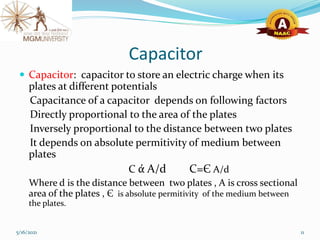
 Capacitor: capacitor to store an electric charge when its
plates at different potentials
Capacitance of a capacitor depends on following factors
Directly proportional to the area of the plates
Inversely proportional to the distance between two plates
It depends on absolute permitivity of medium between
plates
C ά A/d C=Є A/d
Where d is the distance between two plates , A is cross sectional
area of the plates , Є is absolute permitivity of the medium between
the plates.
5/16/2021 11
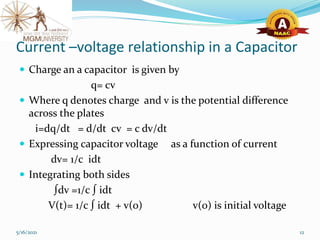
Current –voltage relationship in a Capacitor
 Charge an a capacitor is given by
q= cv
 Where q denotes charge and v is the potential difference
across the plates
i=dq/dt = d/dt cv = c dv/dt
 Expressing capacitor voltage as a function of current
dv= 1/c idt
 Integrating both sides
∫dv =1/c ∫ idt
V(t)= 1/c ∫ idt + v(0) v(0) is initial voltage
5/16/2021 12
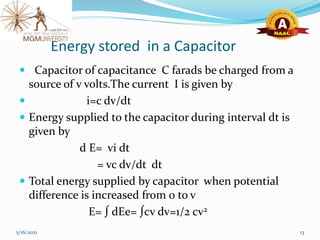
Energy stored in a Capacitor
 Capacitor of capacitance C farads be charged from a
source of v volts.The current I is given by
 i=c dv/dt
 Energy supplied to the capacitor during interval dt is
given by
d E= vi dt
= vc dv/dt dt
 Total energy supplied by capacitor when potential
difference is increased from 0 to v
E= ∫ dEe= ∫cv dv=1/2 cv2
5/16/2021 13
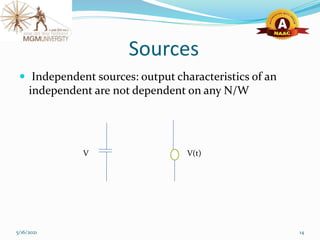
Sources
 Independent sources: output characteristics of an
independent are not dependent on any N/W
5/16/2021 14
V V(t)
Sources
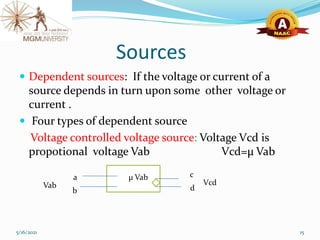
 Dependent sources: If the voltage or current of a
source depends in turn upon some other voltage or
current .
 Four types of dependent source
Voltage controlled voltage source: Voltage Vcd is
propotional voltage Vab Vcd=μ Vab
5/16/2021 15
a
b
c
d
μ Vab
Vab Vcd
Dependent Sources
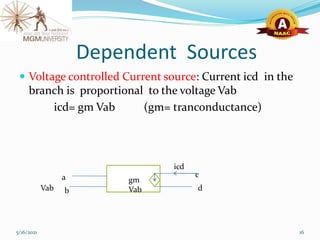
 Voltage controlled Current source: Current icd in the
branch is proportional to the voltage Vab
icd= gm Vab (gm= tranconductance)
5/16/2021 16
a
b
Vab
gm
Vab
c
d
icd
Dependent Sources
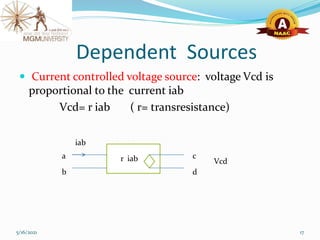
 Current controlled voltage source: voltage Vcd is
proportional to the current iab
Vcd= r iab ( r= transresistance)
5/16/2021 17
a
b
iab
c
d
r iab Vcd
Dependent Sources
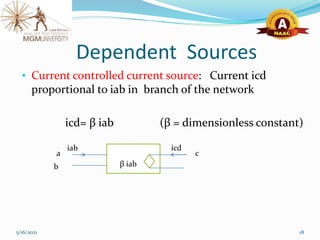
• Current controlled current source: Current icd
proportional to iab in branch of the network
icd= β iab (β = dimensionless constant)
5/16/2021 18
a
b
iab icd
c
β iab
Network and Circuit
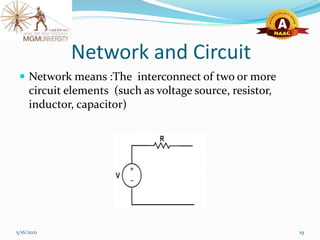
 Network means :The interconnect of two or more
circuit elements (such as voltage source, resistor,
inductor, capacitor)
5/16/2021 19
Network and Circuit
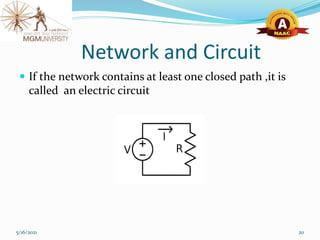
 If the network contains at least one closed path ,it is
called an electric circuit
5/16/2021 20
Linear and Non linear Elements
 Linear element: If the resistance ,inductance or
capacitance offered by an element does change
linearly with change in applied voltage or current .
 Non linear element: in which current doesnot change
linearly with change in applied voltage.
ex. Semiconductor diode
5/16/2021 21
Active and Passive components
 Active components: An element which is a source of
electrical signal or which is capable of increasing of
level of signal energy is turned as an active elements
Ex: Batteries, BJT, FET,OP-AMP
Passive components: resistor, inductor ,
capacitor,VDR,LDR and thermistor are passive
components
5/16/2021 22
Unilateral and Bilateral elements
 Unilateral:If the magnitude of current flowing
through a circuit is affected when polarity of the
applied voltage is changed
 Bilateral : when the voltage is applied ,current start
flowing ,if we change the polarity of the applied
voltage , direction of current is changed but its
magnitude is not affected
5/16/2021 23
Active and passive networks
5/16/2021 24
 Active networks:Network which contains at least one
active elements
 Passive networks: Network which doesnot cotains any
active elements
Time invariant and time variant
networks
 Time invariant: if its input output relationship
doesnot change with time
 Time variant: if its input output relationship does
change with time
5/16/2021 25
Simplification of networks
Series and parallel combinations of resistors
R1,R2,R3,R4 be the resistors of three resistors
connected in series across a dc voltage source v as
shown in figure
5/16/2021 26
5/16/2021 27
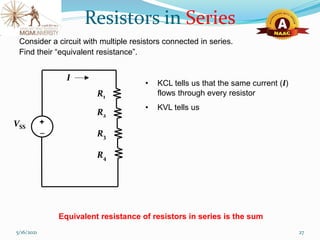
Consider a circuit with multiple resistors connected in series.
Find their “equivalent resistance”.
• KCL tells us that the same current (I)
flows through every resistor
• KVL tells us
Equivalent resistance of resistors in series is the sum
R2
R1
VSS
I
R3
R4

+
Resistors in Series
5/16/2021 28
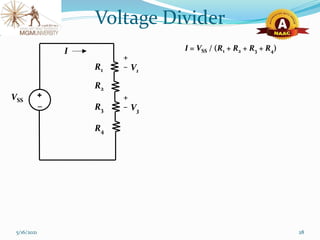
I = VSS / (R1 + R2 + R3 + R4)
Voltage Divider
+
– V1
+
– V3
R2
R1
VSS
I
R3
R4

+
5/16/2021 29
SS
4
3
2
1
2
2
V
R
R
R
R
R
V 
+
+
+
=
Correct, if nothing else
is connected to nodes
because R5 removes condition
of resistors in series
SS
4
3
2
1
2
2
V
R
R
R
R
R
V 
+
+
+
≠
When can the Voltage Divider Formula be Used?
+
– V2
R2
R1
VSS
I
R3
R4

+
R2
R1
VSS
I
R3
R4

+
R5
+
– V2
5/16/2021 30
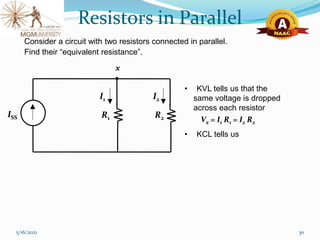
• KVL tells us that the
same voltage is dropped
across each resistor
Vx = I1 R1 = I2 R2
• KCL tells us
R2
R1
ISS
I2
I1
x
Resistors in Parallel
Consider a circuit with two resistors connected in parallel.
Find their “equivalent resistance”.
5/16/2021 31
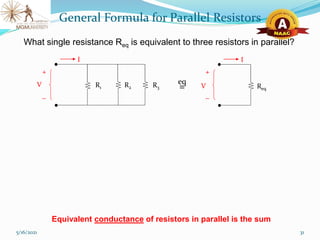
What single resistance Req is equivalent to three resistors in parallel?
+

V
I
V
+

I
R3
R2
R1 Req
eq

General Formula for Parallel Resistors
Equivalent conductance of resistors in parallel is the sum
5/16/2021 32
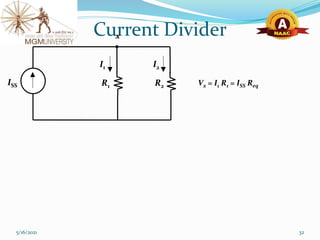
Vx = I1 R1 = ISS Req
Current Divider
R2
R1
ISS
I2
I1
x
5/16/2021 33
R2
R1
I
I2
I1
I3
R3
+

V








+






+






=
3
2
1 R
1
R
1
R
1
I
V






+
+
=
=
3
2
1
3
3
3
1/R
1/R
1/R
1/R
I
R
V
I
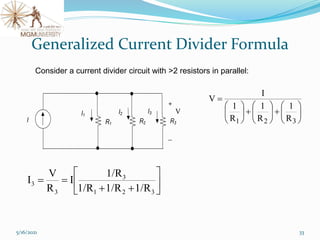
Generalized Current Divider Formula
Consider a current divider circuit with >2 resistors in parallel:

https://www.allaboutcircuits.com ›
direct-current
Thank you
5/16/2021 34

Network analysis lecture 1.pptx

  • 1.
    Presented by C.S.Khandelwal Electronicsand Telecommunication Department 5/16/2021 1
  • 2.
    Electric Current  Definition:rate of positive charge flow  Symbol: i  Units: Coulombs per second ≡ Amperes (A) i = dq/dt  where q = charge (in Coulombs), t = time (in seconds) Note: Current has polarity. 5/16/2021 2
  • 3.
    Electric Potential (Voltage) •Definition: energy per unit charge • Symbol: v • Units: Joules/Coulomb ≡ Volts (V)  v = dw/dq  where w = energy (in Joules), q = charge (in Coulombs)  Note: Potential is always referenced to some point. 5/16/2021 3
  • 4.
    Electric Power • Definition:transfer of energy per unit time • Symbol: p • Units: Joules per second ≡ Watts (W) p = dw/dt = (dw/dq)(dq/dt) = vi • Concept: As a positive charge q moves through a drop in voltage v, it loses energy energy change = qv rate is proportional to # charges/sec 5/16/2021 4
  • 5.
    Basic Circuit Analysis Basic circuit elements are Resistor,Inductor and Capacitor  Resistor: it opposes the flow of current It depends on following factors Directly proportional to its length Inversely proportional to the area of cross section of conductor Depends on the nature of the material Depends on the temperature of the conductor Rά l/A , R = ρl A 5/16/2021 5
  • 6.
    Resistor • An elementis said to have a resistance of 1 ohm, if it permits 1A of current to flow through it when 1V is impressed across its terminals. • Ohm’s law, which is related to voltage and current, v = Ri or R = v/ i where v is the potential across the resistive element, i the current through it, and R the resistance of the element. 5/16/2021 6
  • 7.
    Resistor 5/16/2021 7 • Thepower absorbed by a resistor is given by • p = vi = v (v/ R)= v2/ R or • p = vi = (iR)i = i 2R • The equation for energy absorbed by or delivered to a resistor is t t • E= ∫ −∞ pdτ = ∫ −∞ i 2R dτ
  • 8.
    Inductor  Inductance: itopposes any change of current flowing through it It depends on the following factors Directly proportional to the square of the number of turns Directly proportional to the area of cross section Inversely proportional to the length Depends on the absolute permability of the magnetic material L ά N2A/l , L= μN2A/l 5/16/2021 8
  • 9.
    Current –voltage relationshipin an inductor  V= L di/dt  di=1/L Vdt Integrating both the sides i(t) t ∫ di = 1/L ∫ vdt i(0) 0 t  i(t) = 1/L ∫ vdt 0 5/16/2021 9
  • 10.
    Energy stored inan inductor 5/16/2021 10  V= L di/dt  Energy supplied to the inductor during interval dt is given by dE= vi dt= L di/dt i dt = Li dt  Total energy supplied to the inductor when current is increased from 0 to I ampere I I E = ∫ dE= ∫ Li dt =1/2 L I 2 0 0
  • 11.
    Capacitor  Capacitor: capacitorto store an electric charge when its plates at different potentials Capacitance of a capacitor depends on following factors Directly proportional to the area of the plates Inversely proportional to the distance between two plates It depends on absolute permitivity of medium between plates C ά A/d C=Є A/d Where d is the distance between two plates , A is cross sectional area of the plates , Є is absolute permitivity of the medium between the plates. 5/16/2021 11
  • 12.
    Current –voltage relationshipin a Capacitor  Charge an a capacitor is given by q= cv  Where q denotes charge and v is the potential difference across the plates i=dq/dt = d/dt cv = c dv/dt  Expressing capacitor voltage as a function of current dv= 1/c idt  Integrating both sides ∫dv =1/c ∫ idt V(t)= 1/c ∫ idt + v(0) v(0) is initial voltage 5/16/2021 12
  • 13.
    Energy stored ina Capacitor  Capacitor of capacitance C farads be charged from a source of v volts.The current I is given by  i=c dv/dt  Energy supplied to the capacitor during interval dt is given by d E= vi dt = vc dv/dt dt  Total energy supplied by capacitor when potential difference is increased from 0 to v E= ∫ dEe= ∫cv dv=1/2 cv2 5/16/2021 13
  • 14.
    Sources  Independent sources:output characteristics of an independent are not dependent on any N/W 5/16/2021 14 V V(t)
  • 15.
    Sources  Dependent sources:If the voltage or current of a source depends in turn upon some other voltage or current .  Four types of dependent source Voltage controlled voltage source: Voltage Vcd is propotional voltage Vab Vcd=μ Vab 5/16/2021 15 a b c d μ Vab Vab Vcd
  • 16.
    Dependent Sources  Voltagecontrolled Current source: Current icd in the branch is proportional to the voltage Vab icd= gm Vab (gm= tranconductance) 5/16/2021 16 a b Vab gm Vab c d icd
  • 17.
    Dependent Sources  Currentcontrolled voltage source: voltage Vcd is proportional to the current iab Vcd= r iab ( r= transresistance) 5/16/2021 17 a b iab c d r iab Vcd
  • 18.
    Dependent Sources • Currentcontrolled current source: Current icd proportional to iab in branch of the network icd= β iab (β = dimensionless constant) 5/16/2021 18 a b iab icd c β iab
  • 19.
    Network and Circuit Network means :The interconnect of two or more circuit elements (such as voltage source, resistor, inductor, capacitor) 5/16/2021 19
  • 20.
    Network and Circuit If the network contains at least one closed path ,it is called an electric circuit 5/16/2021 20
  • 21.
    Linear and Nonlinear Elements  Linear element: If the resistance ,inductance or capacitance offered by an element does change linearly with change in applied voltage or current .  Non linear element: in which current doesnot change linearly with change in applied voltage. ex. Semiconductor diode 5/16/2021 21
  • 22.
    Active and Passivecomponents  Active components: An element which is a source of electrical signal or which is capable of increasing of level of signal energy is turned as an active elements Ex: Batteries, BJT, FET,OP-AMP Passive components: resistor, inductor , capacitor,VDR,LDR and thermistor are passive components 5/16/2021 22
  • 23.
    Unilateral and Bilateralelements  Unilateral:If the magnitude of current flowing through a circuit is affected when polarity of the applied voltage is changed  Bilateral : when the voltage is applied ,current start flowing ,if we change the polarity of the applied voltage , direction of current is changed but its magnitude is not affected 5/16/2021 23
  • 24.
    Active and passivenetworks 5/16/2021 24  Active networks:Network which contains at least one active elements  Passive networks: Network which doesnot cotains any active elements
  • 25.
    Time invariant andtime variant networks  Time invariant: if its input output relationship doesnot change with time  Time variant: if its input output relationship does change with time 5/16/2021 25
  • 26.
    Simplification of networks Seriesand parallel combinations of resistors R1,R2,R3,R4 be the resistors of three resistors connected in series across a dc voltage source v as shown in figure 5/16/2021 26
  • 27.
    5/16/2021 27 Consider acircuit with multiple resistors connected in series. Find their “equivalent resistance”. • KCL tells us that the same current (I) flows through every resistor • KVL tells us Equivalent resistance of resistors in series is the sum R2 R1 VSS I R3 R4  + Resistors in Series
  • 28.
    5/16/2021 28 I =VSS / (R1 + R2 + R3 + R4) Voltage Divider + – V1 + – V3 R2 R1 VSS I R3 R4  +
  • 29.
    5/16/2021 29 SS 4 3 2 1 2 2 V R R R R R V  + + + = Correct,if nothing else is connected to nodes because R5 removes condition of resistors in series SS 4 3 2 1 2 2 V R R R R R V  + + + ≠ When can the Voltage Divider Formula be Used? + – V2 R2 R1 VSS I R3 R4  + R2 R1 VSS I R3 R4  + R5 + – V2
  • 30.
    5/16/2021 30 • KVLtells us that the same voltage is dropped across each resistor Vx = I1 R1 = I2 R2 • KCL tells us R2 R1 ISS I2 I1 x Resistors in Parallel Consider a circuit with two resistors connected in parallel. Find their “equivalent resistance”.
  • 31.
    5/16/2021 31 What singleresistance Req is equivalent to three resistors in parallel? +  V I V +  I R3 R2 R1 Req eq  General Formula for Parallel Resistors Equivalent conductance of resistors in parallel is the sum
  • 32.
    5/16/2021 32 Vx =I1 R1 = ISS Req Current Divider R2 R1 ISS I2 I1 x
  • 33.
  • 34.