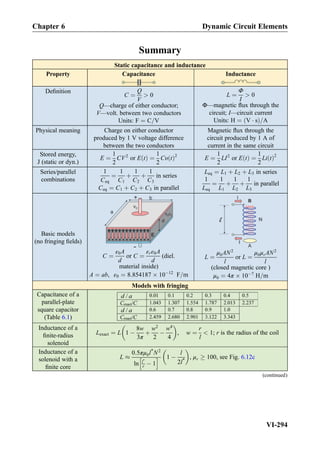
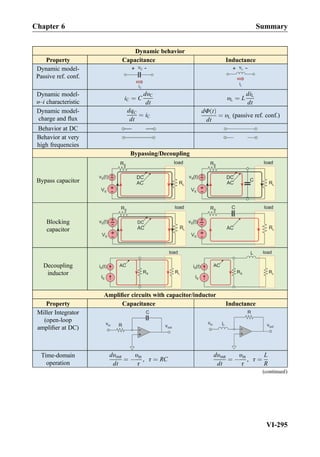
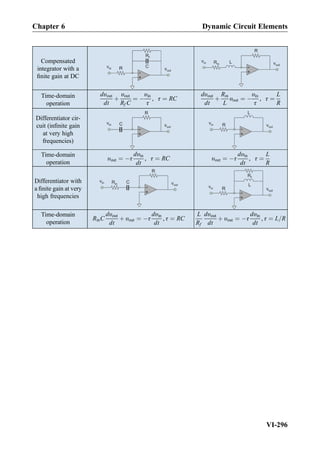
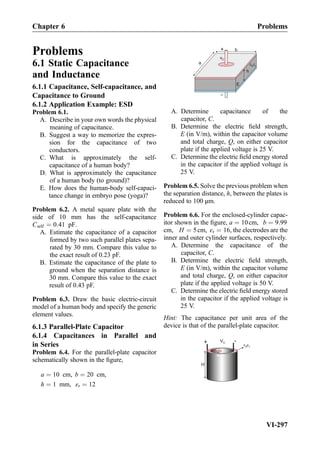
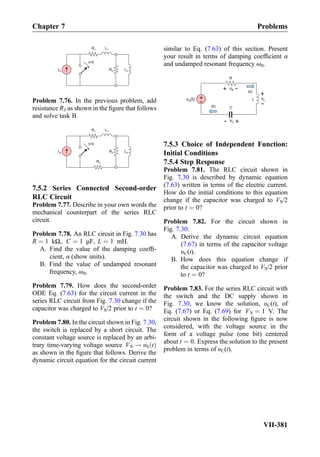
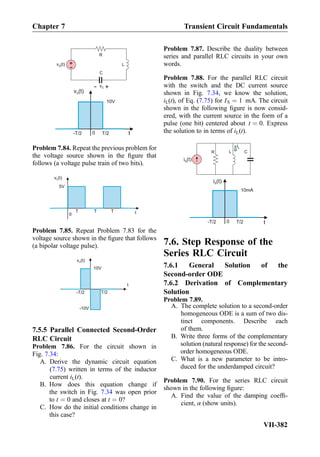
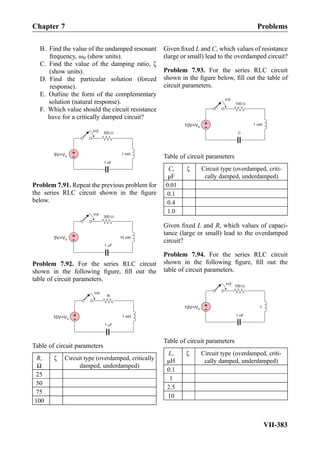
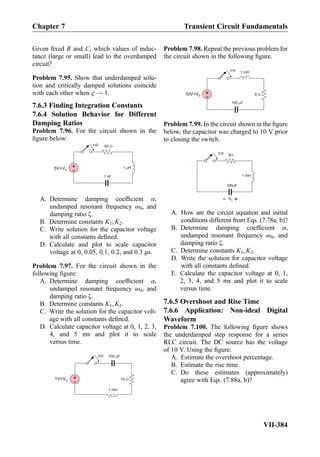
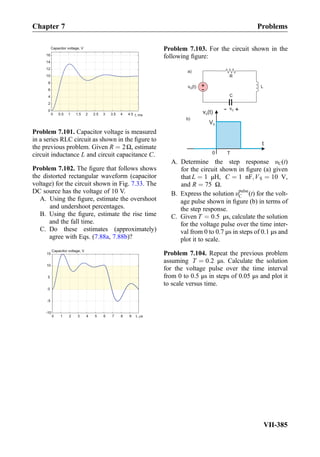
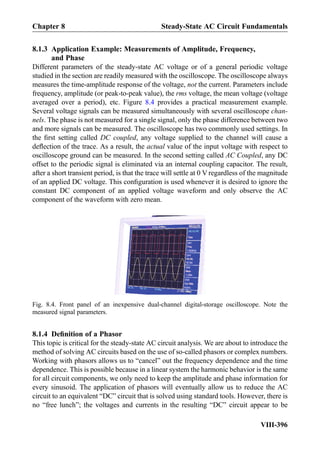
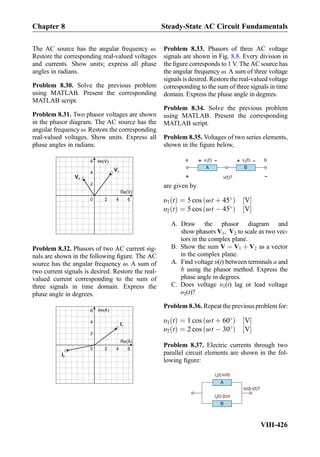
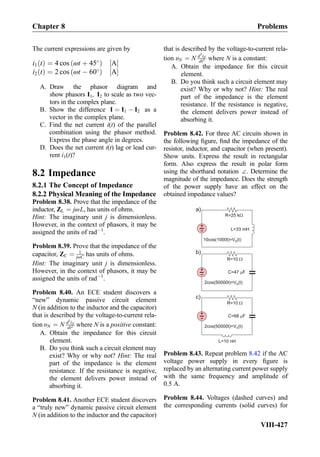
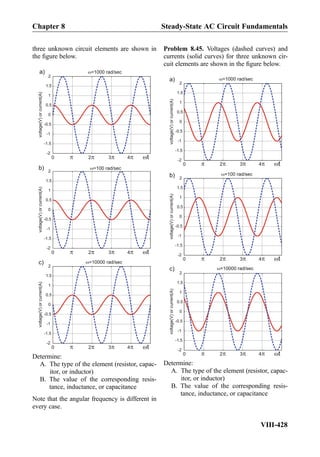
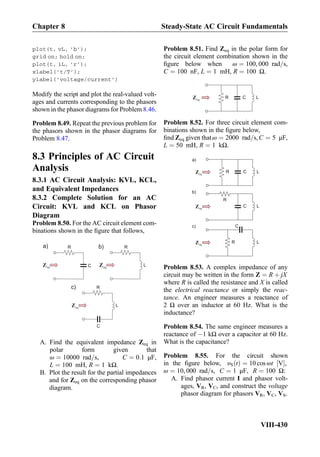
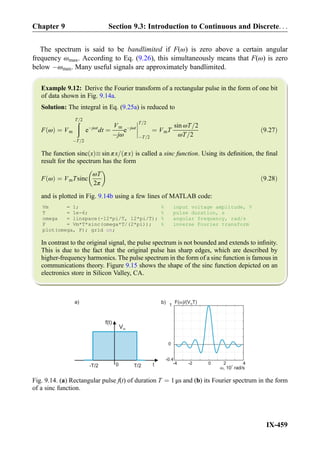
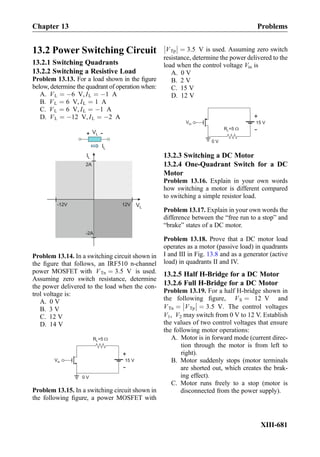
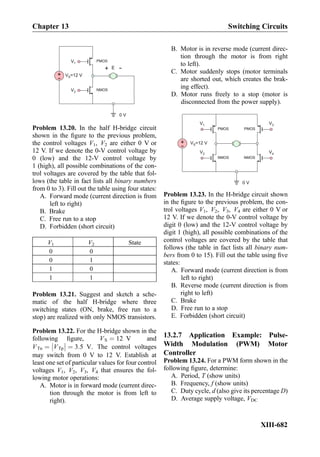
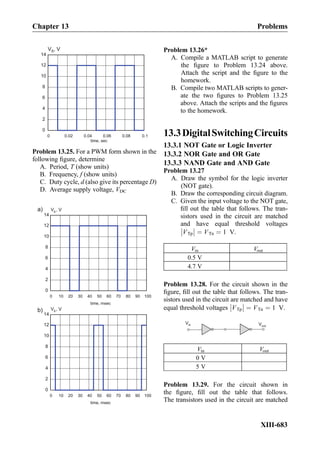
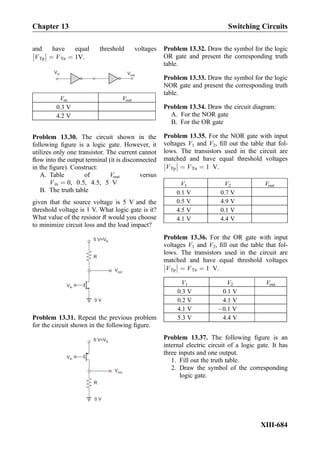
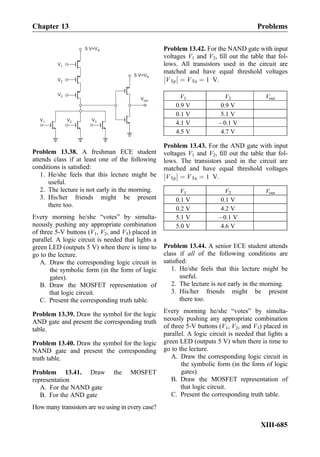
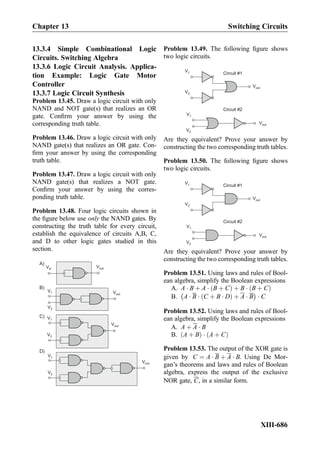
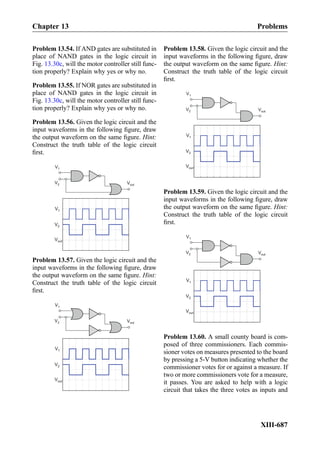
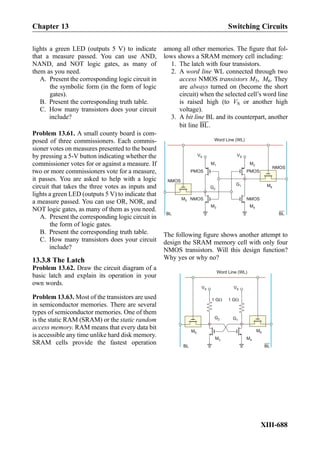
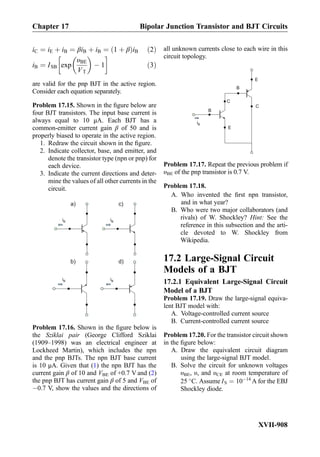
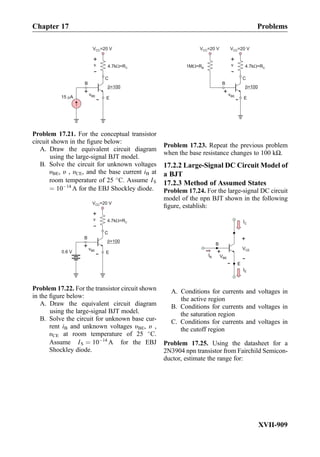
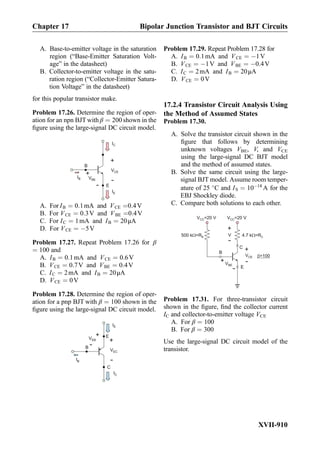
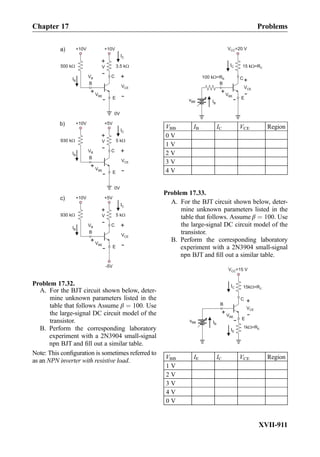
Practical Electrical
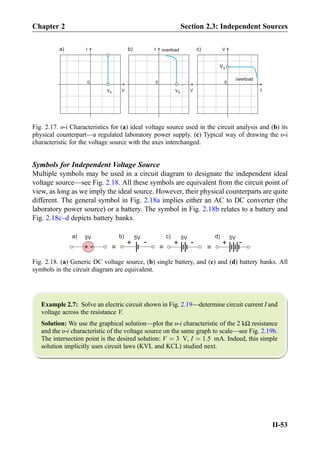
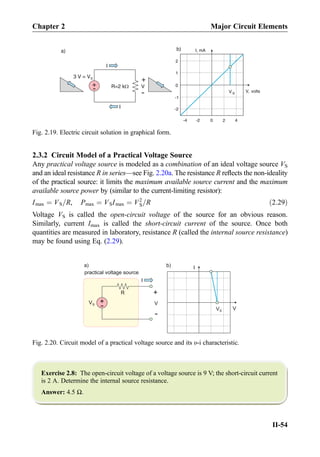
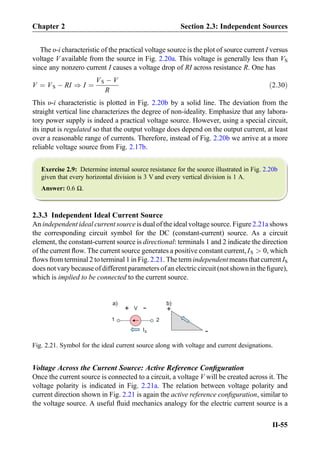
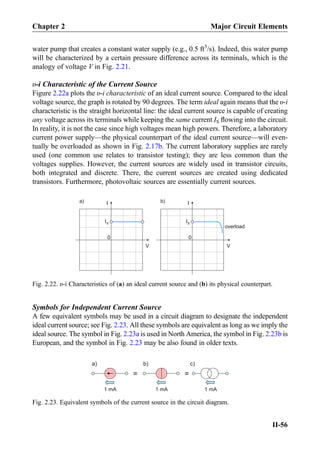
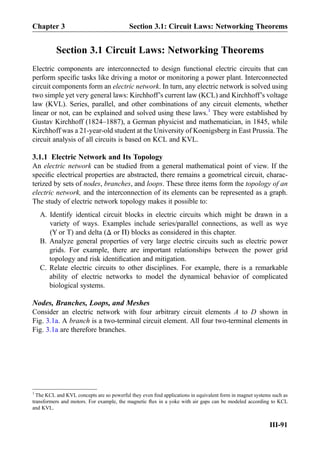
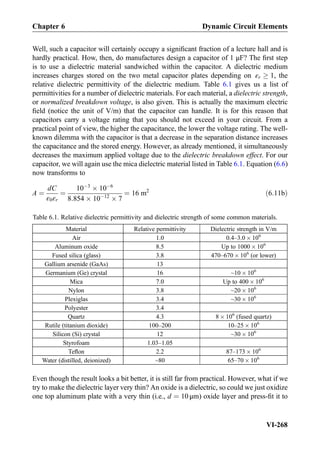
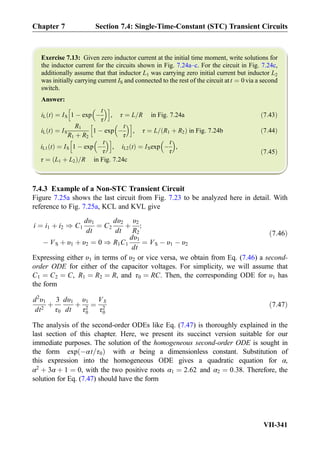
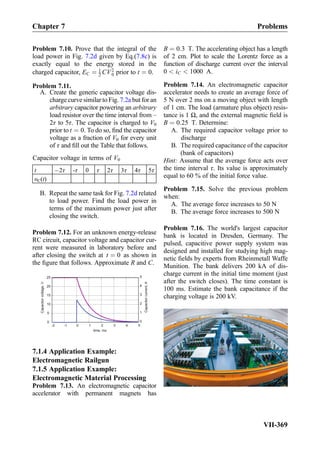
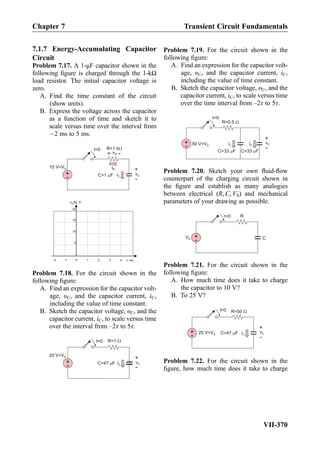
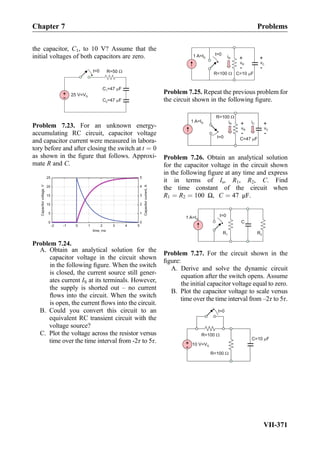
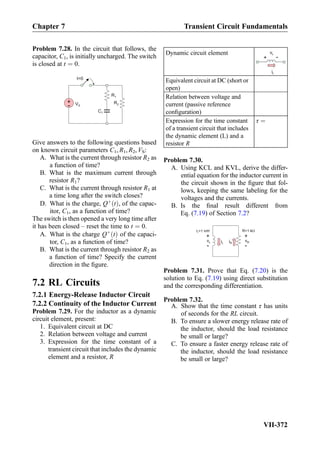
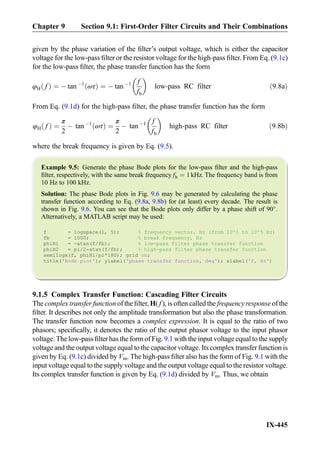
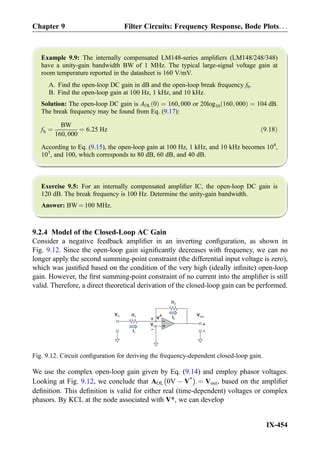
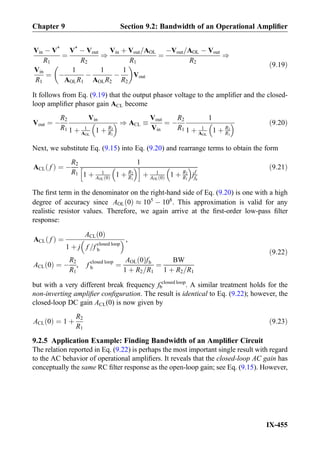
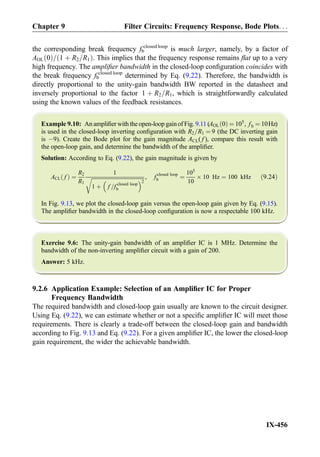
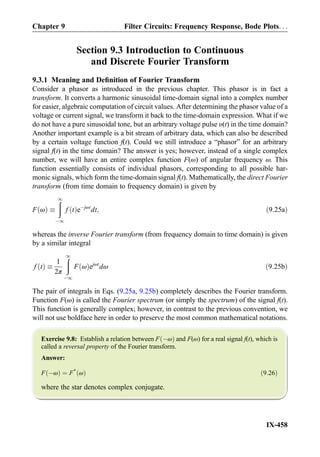
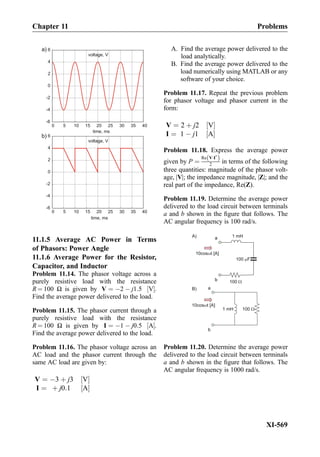
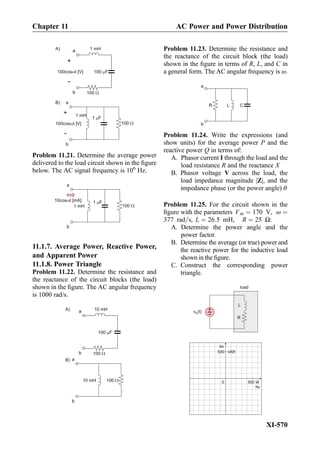
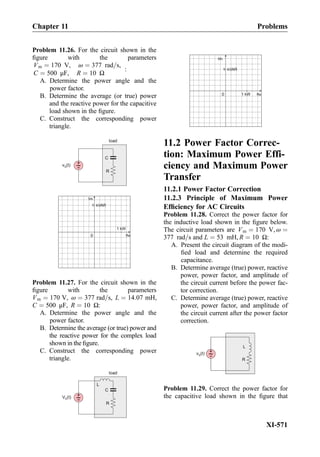
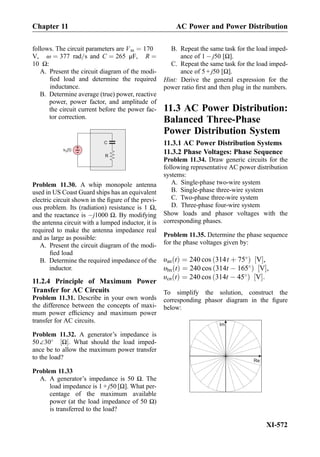
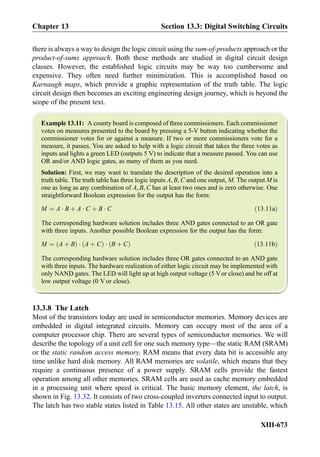
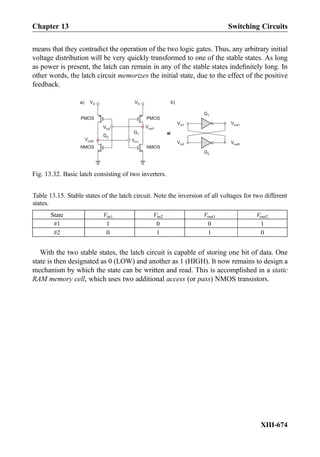
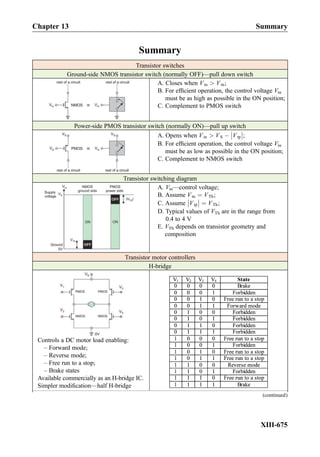
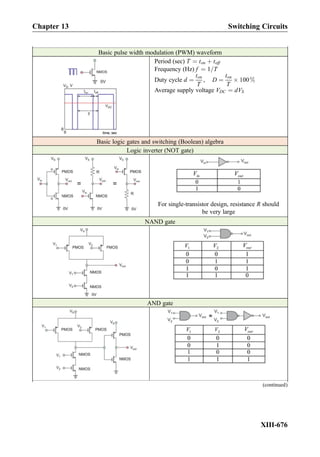
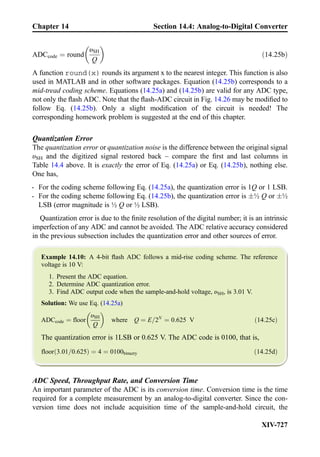
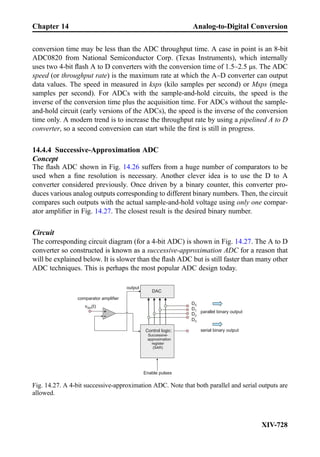
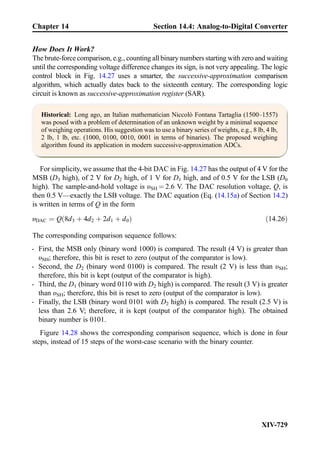
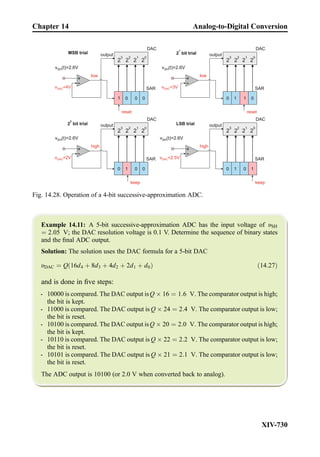
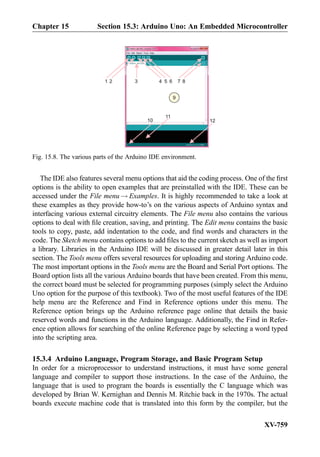
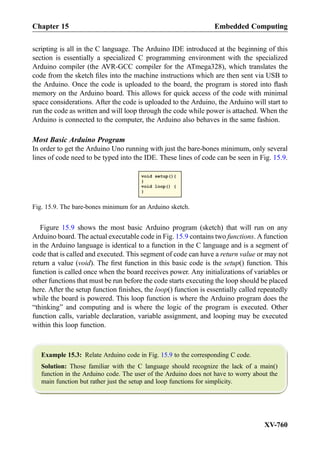
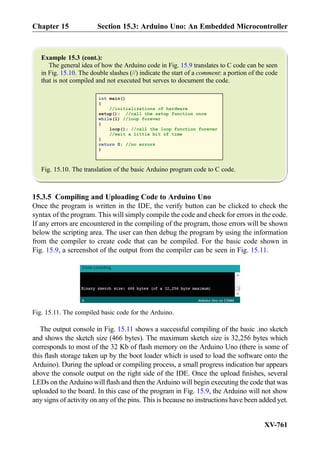
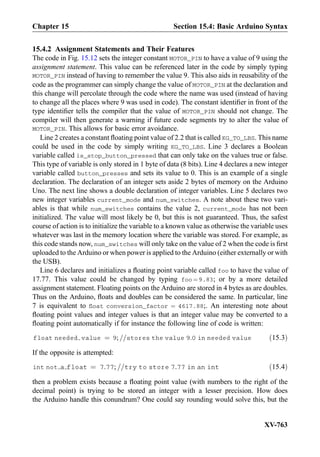
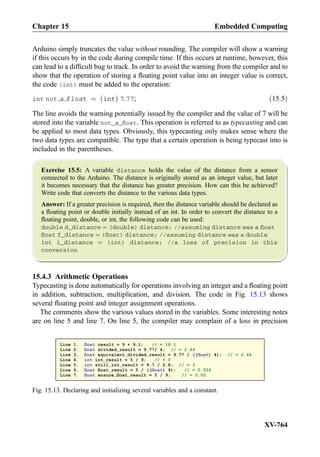
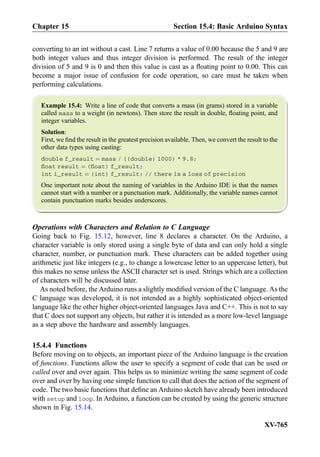
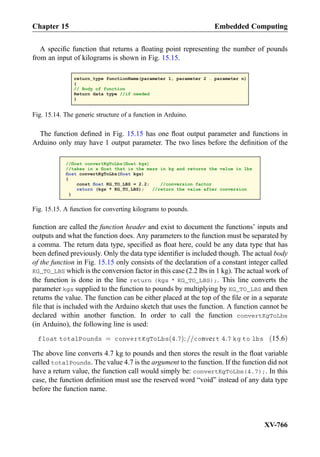
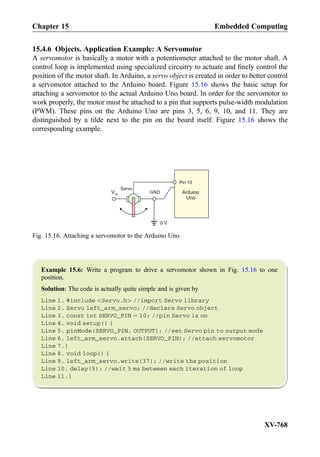
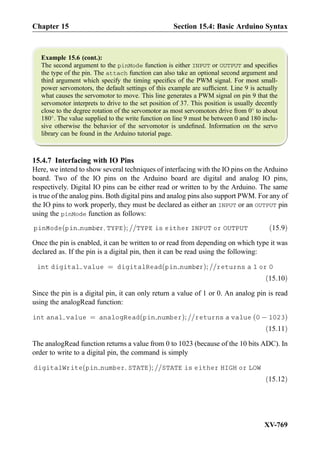
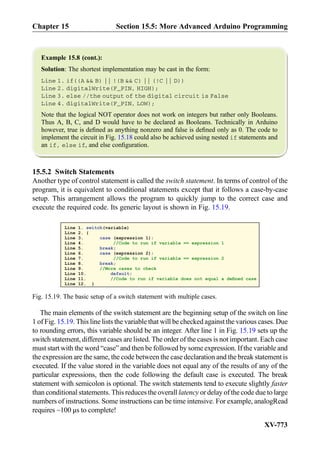
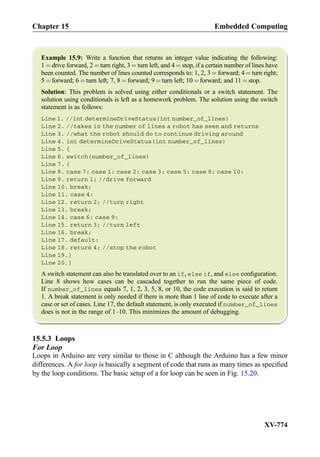
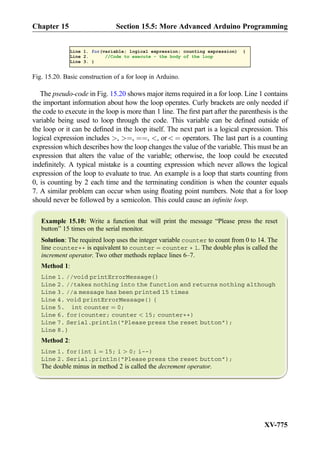
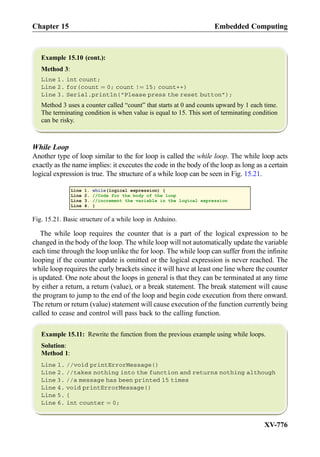
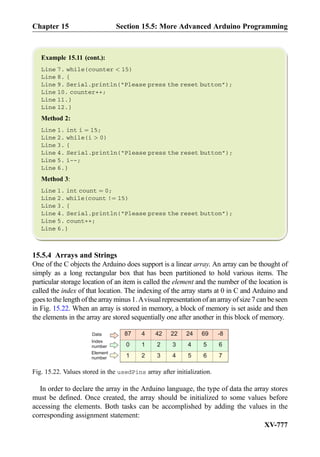
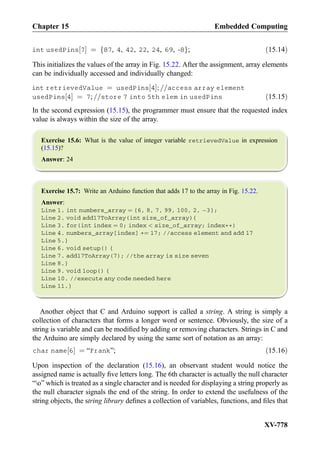
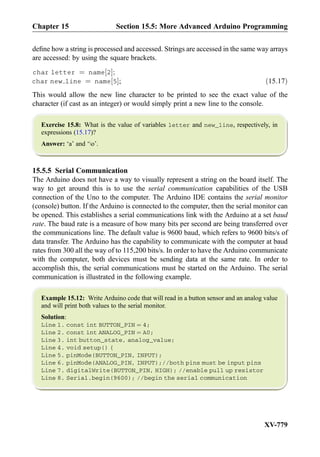
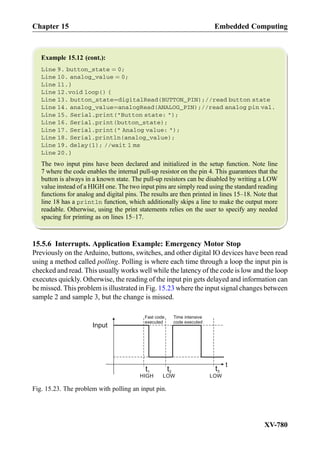
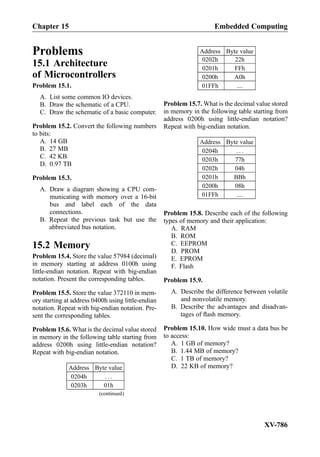
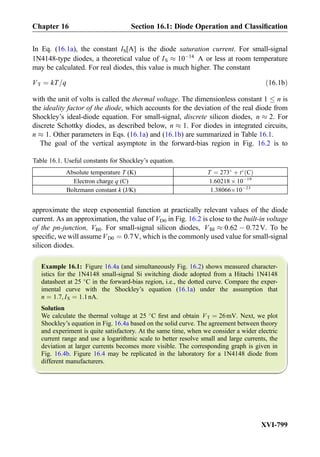
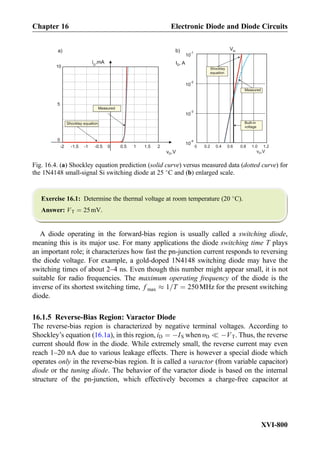
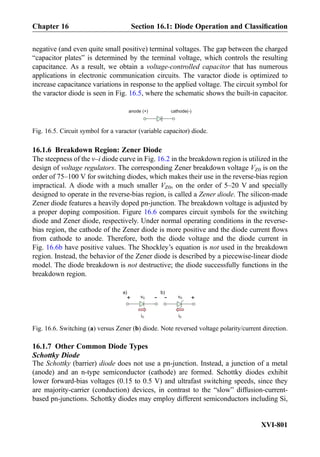
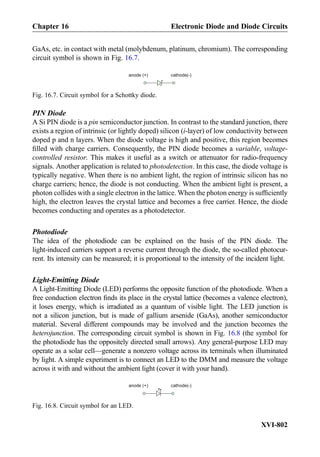
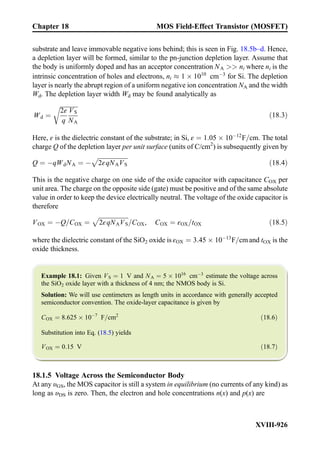
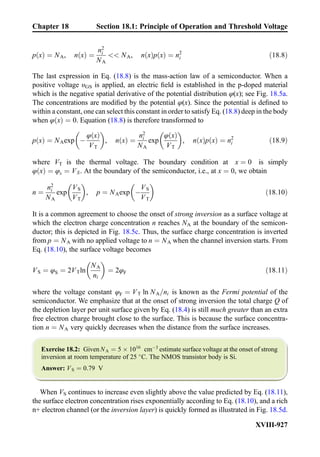
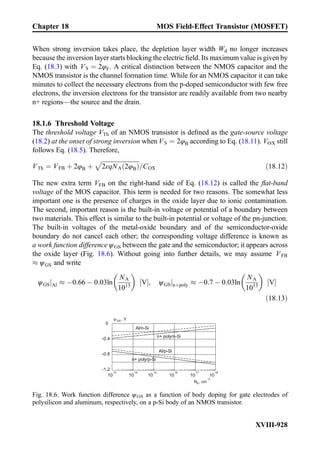
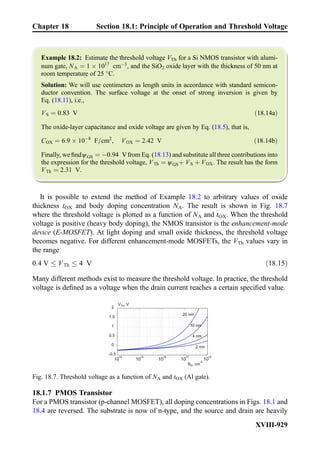
Engineering
Sergey N. Makarov
Reinhold Ludwig
Stephen J. Bitar
Practical Electrical Engineering
Sergey N. Makarov • Reinhold Ludwig •
Stephen J. Bitar
Practical Electrical
Engineering
Sergey N. Makarov
ECE Department
Worcester Polytechnic Institute
Worcester, Washington, USA
Reinhold Ludwig
ECE Department
Worcester Polytechnic Institute
Worcester, Massachusetts, USA
Stephen J. Bitar
Worcester Polytechnic Institute
Worcester, Massachusetts, USA
ISBN 978-3-319-21172-5 ISBN 978-3-319-21173-2 (eBook)
DOI 10.1007/978-3-319-21173-2
Library of Congress Control Number: 2015950619
© Springer International Publishing Switzerland 2016
This work is subject to copyright. All rights are reserved by the Publisher, whether the whole or
part of the material is concerned, specifically the rights of translation, reprinting, reuse of
illustrations, recitation, broadcasting, reproduction on microfilms or in any other physical way,
and transmission or information storage and retrieval, electronic adaptation, computer software, or
by similar or dissimilar methodology now known or hereafter developed.
The use of general descriptive names, registered names, trademarks, service marks, etc. in this
publication does not imply, even in the absence of a specific statement, that such names are exempt
from the relevant protective laws and regulations and therefore free for general use.
The publisher, the authors and the editors are safe to assume that the advice and information in this
book are believed to be true and accurate at the date of publication. Neither the publisher nor the
authors or the editors give a warranty, express or implied, with respect to the material contained
herein or for any errors or omissions that may have been made.
Printed on acid-free paper
This Springer imprint is published by Springer Nature
The registered company is Springer International Publishing AG Switzerland
To Antonina, Margot, and Juliette
Contents
1 From Physics to Electric Circuits . . . . . . . . . . . . . . . . . . . . . . 1
1.1 Electrostatics of Conductors . . . . . . . . . . . . . . . . . . . . . . 3
1.1.1 Charges, Coulomb Force, and Electric Field . . . . 3
1.1.2 Electric Potential and Electric Voltage . . . . . . . . . 4
1.1.3 Electric Voltage Versus Ground . . . . . . . . . . . . . 5
1.1.4 Equipotential Conductors . . . . . . . . . . . . . . . . . . 7
1.1.5 Use of Coulomb’s Law to Solve
Electrostatic Problems . . . . . . . . . . . . . . . . . . . . 9
1.2 Steady-State Current Flow and Magnetostatics . . . . . . . . . 11
1.2.1 Electric Current . . . . . . . . . . . . . . . . . . . . . . . . . 11
1.2.2 Difference Between Current Flow Model
and Electrostatics . . . . . . . . . . . . . . . . . . . . . . . 11
1.2.3 Physical Model of an Electric Circuit . . . . . . . . . 13
1.2.4 Magnetostatics and Ampere’s Law . . . . . . . . . . . 14
1.2.5 Origin of Electric Power Transfer . . . . . . . . . . . . 16
1.3 Hydraulic and Fluid Mechanics Analogies . . . . . . . . . . . . 18
1.3.1 Hydraulic Analogies in the DC Steady State . . . . 18
1.3.2 Analogies for Alternating-Current (AC)
Circuits . . . . . . . . . . . . . . . . . . . . . . . . . . . . . . 19
1.3.3 Analogies for Semiconductor
Circuit Components . . . . . . . . . . . . . . . . . . . . . 20
Part I DC Circuits: General Circuit
Theory—Operational Amplifier
2 Major Circuit Elements . . . . . . . . . . . . . . . . . . . . . . . . . . . . . 29
2.1 Resistance: Linear Passive Circuit Element . . . . . . . . . . . 31
2.1.1 Circuit Elements Versus Circuit Components . . . 31
2.1.2 Resistance . . . . . . . . . . . . . . . . . . . . . . . . . . . . 31
2.1.3 υ-i Characteristic of the Resistance:
Open and Short Circuits . . . . . . . . . . . . . . . . . . 34
2.1.4 Power Delivered to the Resistance . . . . . . . . . . . 35
2.1.5 Finding Resistance of Ohmic Conductors . . . . . . 36
vii
2.1.6 Application Example: Power Loss in
Transmission Wires and Cables . . . . . . . . . . . . . 39
2.1.7 Physical Component: Resistor . . . . . . . . . . . . . . 41
2.1.8 Application Example: Resistive Sensors . . . . . . . 42
2.2 Nonlinear Passive Circuit Elements . . . . . . . . . . . . . . . . . 46
2.2.1 Resistance as a Model for the Load . . . . . . . . . . 46
2.2.2 Nonlinear Passive Circuit Elements . . . . . . . . . . 47
2.2.3 Static Resistance of a Nonlinear Element . . . . . . 48
2.2.4 Dynamic (Small-Signal) Resistance
of a Nonlinear Element . . . . . . . . . . . . . . . . . . . 49
2.2.5 Electronic Switch . . . . . . . . . . . . . . . . . . . . . . . 50
2.3 Independent Sources . . . . . . . . . . . . . . . . . . . . . . . . . . . 52
2.3.1 Independent Ideal Voltage Source . . . . . . . . . . . . 52
2.3.2 Circuit Model of a Practical Voltage Source . . . . 54
2.3.3 Independent Ideal Current Source . . . . . . . . . . . . 55
2.3.4 Circuit Model of a Practical Current Source . . . . 57
2.3.5 Operation of the Voltage Source . . . . . . . . . . . . . 58
2.3.6 Application Example: DC Voltage
Generator with Permanent Magnets . . . . . . . . . . 59
2.3.7 Application Example: Chemical Battery . . . . . . . 61
2.4 Dependent Sources and Time-Varying Sources . . . . . . . . . 64
2.4.1 Dependent Versus Independent Sources . . . . . . . 64
2.4.2 Definition of Dependent Sources . . . . . . . . . . . . 64
2.4.3 Transfer Characteristics . . . . . . . . . . . . . . . . . . . 66
2.4.4 Time-Varying Sources . . . . . . . . . . . . . . . . . . . . 67
2.5 Ideal Voltmeter and Ammeter: Circuit Ground . . . . . . . . . 69
2.5.1 Ideal Voltmeter and Ammeter . . . . . . . . . . . . . . . 69
2.5.2 Circuit Ground: Fluid Mechanics Analogy . . . . . 70
2.5.3 Types of Electric Ground . . . . . . . . . . . . . . . . . . 71
2.5.4 Ground and Return Current . . . . . . . . . . . . . . . . 71
2.5.5 Absolute Voltage and Voltage Drop
Across a Circuit Element . . . . . . . . . . . . . . . . . . 72
3 Circuit Laws and Networking Theorems . . . . . . . . . . . . . . . . 89
3.1 Circuit Laws: Networking Theorems . . . . . . . . . . . . . . . . 91
3.1.1 Electric Network and Its Topology . . . . . . . . . . . 91
3.1.2 Kirchhoff’s Current Law . . . . . . . . . . . . . . . . . . 93
3.1.3 Kirchhoff’s Voltage Law . . . . . . . . . . . . . . . . . . 95
3.1.4 Power-Related Networking Theorems . . . . . . . . . 98
3.1.5 Port of a Network: Network Equivalence . . . . . . 99
3.2 Series and Parallel Network/Circuit Blocks . . . . . . . . . . . 100
3.2.1 Sources in Series and in Parallel . . . . . . . . . . . . . 100
3.2.2 Resistances in Series and in Parallel . . . . . . . . . . 102
3.2.3 Reduction of Resistive Networks . . . . . . . . . . . . 104
3.2.4 Voltage Divider Circuit . . . . . . . . . . . . . . . . . . . 105
3.2.5 Application Example: Voltage Divider
as a Sensor Circuit . . . . . . . . . . . . . . . . . . . . . . 107
Contents
viii
3.2.6 Application Example: Voltage Divider
as an Actuator Circuit . . . . . . . . . . . . . . . . . . . . 109
3.2.7 Current Limiter . . . . . . . . . . . . . . . . . . . . . . . . . 111
3.2.8 Current Divider Circuit . . . . . . . . . . . . . . . . . . . 112
3.2.9 Wheatstone Bridge . . . . . . . . . . . . . . . . . . . . . . 113
3.3 Superposition Theorem and Its Use . . . . . . . . . . . . . . . . . 116
3.3.1 Linear and Nonlinear Circuits . . . . . . . . . . . . . . 116
3.3.2 Superposition Theorem or Superposition
Principle . . . . . . . . . . . . . . . . . . . . . . . . . . . . . . 117
3.3.3 Y (Wye) and Δ (Delta) Networks:
Use of Superposition . . . . . . . . . . . . . . . . . . . . . 119
3.3.4 T and Π Networks: Two-Port Networks . . . . . . . 121
3.3.5 General Character of Superposition Theorem . . . 122
4 Circuit Analysis and Power Transfer . . . . . . . . . . . . . . . . . . . 139
4.1 Nodal/Mesh Analysis . . . . . . . . . . . . . . . . . . . . . . . . . . . 141
4.1.1 Importance of Circuit Simulators . . . . . . . . . . . . 141
4.1.2 Nodal Analysis for Linear Circuits . . . . . . . . . . . 141
4.1.3 Supernode . . . . . . . . . . . . . . . . . . . . . . . . . . . . 145
4.1.4 Mesh Analysis for Linear Circuits . . . . . . . . . . . 146
4.1.5 Supermesh . . . . . . . . . . . . . . . . . . . . . . . . . . . . 147
4.2 Generator Theorems . . . . . . . . . . . . . . . . . . . . . . . . . . . . 149
4.2.1 Equivalence of Active One-Port Networks:
Method of Short/Open Circuit . . . . . . . . . . . . . . 149
4.2.2 Application Example: Reading and Using
Data for Solar Panels . . . . . . . . . . . . . . . . . . . . . 150
4.2.3 Source Transformation Theorem . . . . . . . . . . . . 151
4.2.4 Thévenin’s and Norton’s Theorems:
Proof Without Dependent Sources . . . . . . . . . . . 153
4.2.5 Application Example: Generating Negative
Equivalent Resistance . . . . . . . . . . . . . . . . . . . . 158
4.2.6 Summary of Circuit Analysis Methods . . . . . . . . 159
4.3 Power Transfer . . . . . . . . . . . . . . . . . . . . . . . . . . . . . . . 160
4.3.1 Maximum Power Transfer . . . . . . . . . . . . . . . . . 160
4.3.2 Maximum Power Efficiency . . . . . . . . . . . . . . . . 162
4.3.3 Application Example: Power Radiated
by a Transmitting Antenna . . . . . . . . . . . . . . . . . 163
4.3.4 Application Example: Maximum Power
Extraction from Solar Panel . . . . . . . . . . . . . . . . 164
4.4 Analysis of Nonlinear Circuits: Generic Solar Cell . . . . . . 167
4.4.1 Analysis of Nonlinear Circuits: Load
Line Method . . . . . . . . . . . . . . . . . . . . . . . . . . . 167
4.4.2 Iterative Method for Nonlinear Circuits . . . . . . . . 169
4.4.3 Application Example: Solving the Circuit
for a Generic Solar Cell . . . . . . . . . . . . . . . . . . . 170
Contents
ix
5 Operational Amplifier and Amplifier Models . . . . . . . . . . . . . 189
5.1 Amplifier Operation and Circuit Models . . . . . . . . . . . . . 191
5.1.1 Amplifier Operation . . . . . . . . . . . . . . . . . . . . . 191
5.1.2 Application Example: Operational
Amplifier Comparator . . . . . . . . . . . . . . . . . . . . 194
5.1.3 Amplifier Circuit Model . . . . . . . . . . . . . . . . . . 195
5.1.4 Ideal-Amplifier Model and First
Summing-Point Constraint . . . . . . . . . . . . . . . . . 197
5.2 Negative Feedback . . . . . . . . . . . . . . . . . . . . . . . . . . . . . 199
5.2.1 Idea of the Negative Feedback . . . . . . . . . . . . . . 199
5.2.2 Amplifier Feedback Loop: Second
Summing-Point Constraint . . . . . . . . . . . . . . . . . 199
5.2.3 Amplifier Circuit Analysis Using Two
Summing-Point Constraints . . . . . . . . . . . . . . . . 201
5.2.4 Mathematics Behind the Second
Summing-Point Constraint . . . . . . . . . . . . . . . . . 205
5.2.5 Current Flow in the Amplifier Circuit . . . . . . . . . 206
5.2.6 Multiple-Input Amplifier Circuit:
Summing Amplifier . . . . . . . . . . . . . . . . . . . . . . 207
5.3 Amplifier Circuit Design . . . . . . . . . . . . . . . . . . . . . . . . 209
5.3.1 Choosing Proper Resistance Values . . . . . . . . . . 209
5.3.2 Model of a Whole Voltage Amplifier Circuit . . . . 211
5.3.3 Voltage Amplifier Versus Matched Amplifier . . . 212
5.3.4 Cascading Amplifier Stages . . . . . . . . . . . . . . . . 215
5.3.5 Amplifier DC Imperfections and
Their Cancellation . . . . . . . . . . . . . . . . . . . . . . . 217
5.3.6 DC-Coupled Single-Supply Amplifier:
Virtual-Ground Circuit . . . . . . . . . . . . . . . . . . . . 220
5.4 Difference and Instrumentation Amplifiers . . . . . . . . . . . . 222
5.4.1 Differential Input Signal to an Amplifier . . . . . . . 222
5.4.2 Difference Amplifier: Differential Gain
and Common-Mode Gain . . . . . . . . . . . . . . . . . 223
5.4.3 Application Example: Instrumentation
Amplifier . . . . . . . . . . . . . . . . . . . . . . . . . . . . . 225
5.4.4 Instrumentation Amplifier in Laboratory . . . . . . . 228
5.5 General Feedback Systems . . . . . . . . . . . . . . . . . . . . . . . 230
5.5.1 Signal-Flow Diagram of a Feedback System . . . . 230
5.5.2 Closed-Loop Gain and Error Signal . . . . . . . . . . 230
5.5.3 Application of General Theory to Voltage
Amplifiers with Negative Feedback . . . . . . . . . . 232
5.5.4 Voltage, Current, Transresistance, and
Transconductance Amplifiers with the
Negative Feedback . . . . . . . . . . . . . . . . . . . . . . 233
Contents
x
Part II Transient Circuits
6 Dynamic Circuit Elements . . . . . . . . . . . . . . . . . . . . . . . . . . . 259
6.1 Static Capacitance and Inductance . . . . . . . . . . . . . . . . . . 261
6.1.1 Capacitance, Self-Capacitance, and
Capacitance to Ground . . . . . . . . . . . . . . . . . . . 261
6.1.2 Application Example: ESD . . . . . . . . . . . . . . . . 263
6.1.3 Parallel-Plate Capacitor . . . . . . . . . . . . . . . . . . . 264
6.1.4 Circuit Symbol: Capacitances in Parallel
and in Series . . . . . . . . . . . . . . . . . . . . . . . . . . . 266
6.1.5 Application Example: How to Design
a 1-μF Capacitor? . . . . . . . . . . . . . . . . . . . . . . . 267
6.1.6 Application Example: Capacitive
Touchscreens . . . . . . . . . . . . . . . . . . . . . . . . . . 270
6.1.7 Self-Inductance (Inductance) and Mutual
Inductance . . . . . . . . . . . . . . . . . . . . . . . . . . . . 272
6.1.8 Inductance of a Solenoid With and
Without Magnetic Core . . . . . . . . . . . . . . . . . . . 273
6.1.9 Circuit Symbol: Inductances in Series
and in Parallel . . . . . . . . . . . . . . . . . . . . . . . . . . 275
6.1.10 Application Example: How to Design
a 1-mH Inductor? . . . . . . . . . . . . . . . . . . . . . . . 276
6.2 Dynamic Behavior of Capacitance and Inductance . . . . . . 278
6.2.1 Set of Passive Linear Circuit Elements . . . . . . . . 278
6.2.2 Dynamic Behavior of Capacitance . . . . . . . . . . . 278
6.2.3 Dynamic Behavior of Inductance . . . . . . . . . . . . 281
6.2.4 Instantaneous Energy and Power
of Dynamic Circuit Elements . . . . . . . . . . . . . . . 283
6.2.5 DC Steady State . . . . . . . . . . . . . . . . . . . . . . . . 284
6.2.6 Behavior at Very High Frequencies . . . . . . . . . . 285
6.3 Application Circuits Highlighting Dynamic Behavior . . . . 287
6.3.1 Bypass Capacitor . . . . . . . . . . . . . . . . . . . . . . . 287
6.3.2 Blocking Capacitor . . . . . . . . . . . . . . . . . . . . . . 289
6.3.3 Decoupling Inductor . . . . . . . . . . . . . . . . . . . . . 289
6.3.4 Amplifier Circuits With Dynamic Elements:
Miller Integrator . . . . . . . . . . . . . . . . . . . . . . . . 290
6.3.5 Compensated Miller Integrator . . . . . . . . . . . . . . 291
6.3.6 Differentiator and Other Circuits . . . . . . . . . . . . 292
7 Transient Circuit Fundamentals . . . . . . . . . . . . . . . . . . . . . . . 307
7.1 RC Circuits . . . . . . . . . . . . . . . . . . . . . . . . . . . . . . . . . . 310
7.1.1 Energy-Release Capacitor Circuit . . . . . . . . . . . . 310
7.1.2 Time Constant of the RC Circuit
and Its Meaning . . . . . . . . . . . . . . . . . . . . . . . . 312
7.1.3 Continuity of the Capacitor Voltage . . . . . . . . . . 313
7.1.4 Application Example: Electromagnetic
Railgun . . . . . . . . . . . . . . . . . . . . . . . . . . . . . . 314
Contents
xi
7.1.5 Application Example: Electromagnetic
Material Processing . . . . . . . . . . . . . . . . . . . . . . 316
7.1.6 Application Example: Digital Memory Cell . . . . 317
7.1.7 Energy-Accumulating Capacitor Circuit . . . . . . . 318
7.2 RL Circuits . . . . . . . . . . . . . . . . . . . . . . . . . . . . . . . . . . 321
7.2.1 Energy-Release Inductor Circuit . . . . . . . . . . . . . 321
7.2.2 Continuity of the Inductor Current . . . . . . . . . . . 324
7.2.3 Energy-Accumulating Inductor Circuit . . . . . . . . 325
7.2.4 Energy-Release RL Circuit with the Voltage
Supply . . . . . . . . . . . . . . . . . . . . . . . . . . . . . . . 327
7.2.5 Application Example: Laboratory Ignition
Circuit . . . . . . . . . . . . . . . . . . . . . . . . . . . . . . . 328
7.3 Switching RC Oscillator . . . . . . . . . . . . . . . . . . . . . . . . . 330
7.3.1 About Electronic Oscillators . . . . . . . . . . . . . . . 330
7.3.2 Bistable Amplifier Circuit with the Positive
Feedback . . . . . . . . . . . . . . . . . . . . . . . . . . . . . 330
7.3.3 Triggering . . . . . . . . . . . . . . . . . . . . . . . . . . . . 332
7.3.4 Switching RC Oscillator . . . . . . . . . . . . . . . . . . 333
7.3.5 Oscillation Frequency . . . . . . . . . . . . . . . . . . . . 334
7.3.6 Circuit Implementation: 555 Timer . . . . . . . . . . . 335
7.4 Single-Time-Constant (STC) Transient Circuits . . . . . . . . 337
7.4.1 Circuits with Resistances and Capacitances . . . . . 337
7.4.2 Circuits with Resistances and Inductances . . . . . . 339
7.4.3 Example of a Non-STC Transient Circuit . . . . . . 341
7.4.4 Example of an STC Transient Circuit . . . . . . . . . 342
7.4.5 Method of Thévenin Equivalent and Application
Example: Circuit with a Bypass Capacitor . . . . . 343
7.5 Description of the Second-Order Transient Circuits . . . . . 346
7.5.1 Types of Second-Order Transient Circuits . . . . . . 346
7.5.2 Series-Connected Second-Order RLC Circuit . . . 346
7.5.3 Initial Conditions in Terms of Circuit
Current and Capacitor Voltage . . . . . . . . . . . . . . 349
7.5.4 Step Response and Choice of the
Independent Function . . . . . . . . . . . . . . . . . . . . 350
7.5.5 Parallel Connected Second-Order
RLC Circuit . . . . . . . . . . . . . . . . . . . . . . . . . . . 351
7.6 Step Response of the Series RLC Circuit . . . . . . . . . . . . . 354
7.6.1 General Solution of the Second-order ODE . . . . . 354
7.6.2 Derivation of the Complementary Solution:
Method of Characteristic Equation . . . . . . . . . . . 354
7.6.3 Finding Integration Constants . . . . . . . . . . . . . . 356
7.6.4 Solution Behavior for Different
Damping Ratios . . . . . . . . . . . . . . . . . . . . . . . . 356
7.6.5 Overshoot and Rise Time . . . . . . . . . . . . . . . . . . 357
7.6.6 Application Example: Nonideal Digital
Waveform . . . . . . . . . . . . . . . . . . . . . . . . . . . . . 358
Contents
xii
Part III AC Circuits
8 Steady-State AC Circuit Fundamentals . . . . . . . . . . . . . . . . . 389
8.1 Harmonic Voltage and Current: Phasor . . . . . . . . . . . . . . 391
8.1.1 Harmonic Voltages and Currents . . . . . . . . . . . . 391
8.1.2 Phase: Leading and Lagging . . . . . . . . . . . . . . . 393
8.1.3 Application Example: Measurements
of Amplitude, Frequency, and Phase . . . . . . . . . . 396
8.1.4 Definition of a Phasor . . . . . . . . . . . . . . . . . . . . 396
8.1.5 From Real Signals to Phasors . . . . . . . . . . . . . . . 398
8.1.6 From Phasors to Real Signals . . . . . . . . . . . . . . . 399
8.1.7 Polar and Rectangular Forms:
Phasor Magnitude . . . . . . . . . . . . . . . . . . . . . . . 399
8.1.8 Operations with Phasors and Phasor Diagram . . . 401
8.1.9 Shorthand Notation for the Complex
Exponent . . . . . . . . . . . . . . . . . . . . . . . . . . . . . 404
8.2 Impedance . . . . . . . . . . . . . . . . . . . . . . . . . . . . . . . . . . . 405
8.2.1 The Concept of Impedance . . . . . . . . . . . . . . . . 405
8.2.2 Physical Meaning of Impedance . . . . . . . . . . . . . 407
8.2.3 Magnitude and Phase of Complex Impedance . . . 408
8.2.4 Application Example: Impedance
of a Human Body . . . . . . . . . . . . . . . . . . . . . . . 410
8.3 Principles of AC Circuit Analysis . . . . . . . . . . . . . . . . . . 411
8.3.1 AC Circuit Analysis: KVL, KCL,
and Equivalent Impedances . . . . . . . . . . . . . . . . 411
8.3.2 Complete Solution for an AC Circuit:
KVL and KCL on Phasor Diagram . . . . . . . . . . . 412
8.3.3 Source Transformation . . . . . . . . . . . . . . . . . . . 413
8.3.4 Thévenin and Norton Equivalent Circuits . . . . . . 415
8.3.5 Summary of AC Circuit Analysis
at a Single Frequency . . . . . . . . . . . . . . . . . . . . 417
8.3.6 Multifrequency AC Circuit Analysis:
Superposition Theorem . . . . . . . . . . . . . . . . . . . 417
9 Filter Circuits: Frequency Response, Bode Plots,
and Fourier Transform . . . . . . . . . . . . . . . . . . . . . . . . . . . . . 433
9.1 First-Order Filter Circuits and Their Combinations . . . . . . 435
9.1.1 RC Voltage Divider as an Analog Filter . . . . . . . 435
9.1.2 Half-Power Frequency and Amplitude
Transfer Function . . . . . . . . . . . . . . . . . . . . . . . 440
9.1.3 Bode Plot, Decibel, and Roll-Off . . . . . . . . . . . . 441
9.1.4 Phase Transfer Function and Its Bode Plot . . . . . 444
9.1.5 Complex Transfer Function: Cascading
Filter Circuits . . . . . . . . . . . . . . . . . . . . . . . . . . 445
9.1.6 RL Filter Circuits . . . . . . . . . . . . . . . . . . . . . . . 448
9.2 Bandwidth of an Operational Amplifier . . . . . . . . . . . . . . 451
9.2.1 Bode Plot of the Open-Loop Amplifier Gain . . . . 451
Contents
xiii
9.2.2 Unity-Gain Bandwidth Versus
Gain-Bandwidth Product . . . . . . . . . . . . . . . . . . 452
9.2.3 Model of the Open-Loop AC Gain . . . . . . . . . . . 453
9.2.4 Model of the Closed-Loop AC Gain . . . . . . . . . . 454
9.2.5 Application Example: Finding Bandwidth
of an Amplifier Circuit . . . . . . . . . . . . . . . . . . . 455
9.2.6 Application Example: Selection of an Amplifier
IC for Proper Frequency Bandwidth . . . . . . . . . . 456
9.3 Introduction to Continuous and Discrete
Fourier Transform . . . . . . . . . . . . . . . . . . . . . . . . . . . . . 458
9.3.1 Meaning and Definition of Fourier Transform . . . 458
9.3.2 Mathematical Properties of Fourier Transform . . . 460
9.3.3 Discrete Fourier Transform and
Its Implementation . . . . . . . . . . . . . . . . . . . . . . 461
9.3.4 Sampling Theorem . . . . . . . . . . . . . . . . . . . . . . 463
9.3.5 Applications of Discrete Fourier Transform . . . . . 464
9.3.6 Application Example: Numerical
Differentiation via the FFT . . . . . . . . . . . . . . . . 464
9.3.7 Application Example: Filter Operation
for an Input Pulse Signal . . . . . . . . . . . . . . . . . . 466
9.3.8 Application Example: Converting
Computational Electromagnetic Solution
from Frequency Domain to Time Domain . . . . . . 467
10 Second-Order RLC Circuits . . . . . . . . . . . . . . . . . . . . . . . . . . 481
10.1 Theory of Second-Order Resonant RLC Circuits . . . . . . . 483
10.1.1 Self-Oscillating Ideal LC Circuit . . . . . . . . . . . . 483
10.1.2 Series Resonant Ideal LC Circuit . . . . . . . . . . . . 485
10.1.3 Series Resonant RLC Circuit: Resonance
Condition . . . . . . . . . . . . . . . . . . . . . . . . . . . . . 486
10.1.4 Quality Factor Q of the Series Resonant
RLC Circuit . . . . . . . . . . . . . . . . . . . . . . . . . . . 488
10.1.5 Bandwidth of the Series Resonant
RLC Circuit . . . . . . . . . . . . . . . . . . . . . . . . . . . 490
10.1.6 Parallel Resonant RLC Circuit: Duality . . . . . . . 493
10.2 Construction of Second-Order RLC Filters . . . . . . . . . . . 496
10.2.1 Second-Order Band-Pass RLC Filter . . . . . . . . . 496
10.2.2 Second-Order Low-Pass RLC Filter . . . . . . . . . . 499
10.2.3 Second-Order High-Pass RLC Filter . . . . . . . . . . 500
10.2.4 Second-Order Band-Reject RLC Filter . . . . . . . . 502
10.2.5 Second-Order RLC Filters Derived
from the Parallel RLC Circuit . . . . . . . . . . . . . . 504
10.3 RLC Circuits for Near-Field Communications
and Proximity Sensors . . . . . . . . . . . . . . . . . . . . . . . . . . 506
10.3.1 Near-Field Wireless Link . . . . . . . . . . . . . . . . . . 506
10.3.2 Transmitter Circuit . . . . . . . . . . . . . . . . . . . . . . 507
10.3.3 Receiver Circuit . . . . . . . . . . . . . . . . . . . . . . . . 508
Contents
xiv
10.3.4 Application Example: Near-Field Wireless
Link in Laboratory . . . . . . . . . . . . . . . . . . . . . . 510
10.3.5 Application Example: Proximity Sensors . . . . . . 511
11 AC Power and Power Distribution . . . . . . . . . . . . . . . . . . . . . 523
11.1 AC Power Types and Their Meaning . . . . . . . . . . . . . . . . 525
11.1.1 Instantaneous AC Power . . . . . . . . . . . . . . . . . . 525
11.1.2 Time-averaged AC Power . . . . . . . . . . . . . . . . . 526
11.1.3 Application Example: rms Voltages
and AC Frequencies Around the World . . . . . . . . 528
11.1.4 rms Voltages for Arbitrary Periodic
AC Signals . . . . . . . . . . . . . . . . . . . . . . . . . . . . 529
11.1.5 Average AC Power in Terms of Phasors:
Power Angle . . . . . . . . . . . . . . . . . . . . . . . . . . . 531
11.1.6 Average Power for Resistor, Capacitor,
and Inductor . . . . . . . . . . . . . . . . . . . . . . . . . . . 532
11.1.7 Average Power, Reactive Power,
and Apparent Power . . . . . . . . . . . . . . . . . . . . . 533
11.1.8 Power Triangle . . . . . . . . . . . . . . . . . . . . . . . . . 535
11.1.9 Application Example: Wattmeter . . . . . . . . . . . . 538
11.2 Power Factor Correction: Maximum Power Efficiency
and Maximum Power Transfer . . . . . . . . . . . . . . . . . . . . 539
11.2.1 Power Factor Correction . . . . . . . . . . . . . . . . . . 539
11.2.2 Application Example: Automatic Power
Factor Correction System . . . . . . . . . . . . . . . . . . 542
11.2.3 Principle of Maximum Power Efficiency
for AC Circuits . . . . . . . . . . . . . . . . . . . . . . . . . 542
11.2.4 Principle of Maximum Power Transfer
for AC Circuits . . . . . . . . . . . . . . . . . . . . . . . . . 544
11.3 AC Power Distribution: Balanced Three-Phase Power
Distribution System . . . . . . . . . . . . . . . . . . . . . . . . . . . . 546
11.3.1 AC Power Distribution Systems . . . . . . . . . . . . . 546
11.3.2 Phase Voltages: Phase Sequence . . . . . . . . . . . . . 547
11.3.3 Wye (Y) Source and Load Configurations
for Three-Phase Circuits . . . . . . . . . . . . . . . . . . . 549
11.3.4 Application: Examples of Three-Phase
Source and the Load . . . . . . . . . . . . . . . . . . . . . 550
11.3.5 Solution for the Balanced Three-Phase
Wye-Wye Circuit . . . . . . . . . . . . . . . . . . . . . . . . 551
11.3.6 Removing the Neutral Wire in Long-Distance
Power Transmission . . . . . . . . . . . . . . . . . . . . . . 553
11.4 Power in Balanced Three-Phase Systems:
Delta-connected Three-Phase Circuits . . . . . . . . . . . . . . . 556
11.4.1 Instantaneous Power . . . . . . . . . . . . . . . . . . . . . 556
11.4.2 Average Power, Reactive Power,
and Apparent Power . . . . . . . . . . . . . . . . . . . . . 558
Contents
xv
11.4.3 Application Example: Material Consumption
in Three-Phase Systems . . . . . . . . . . . . . . . . . . . 558
11.4.4 Balanced Delta-Connected Load . . . . . . . . . . . . . 560
11.4.5 Balanced Delta-Connected Source . . . . . . . . . . . 560
12 Electric Transformer and Coupled Inductors . . . . . . . . . . . . . 577
12.1 Ideal Transformer as a Linear Passive Circuit Element . . . 579
12.1.1 Electric Transformer . . . . . . . . . . . . . . . . . . . . . 579
12.1.2 Ideal Open-Circuited Transformer:
Faraday’s Law of Induction . . . . . . . . . . . . . . . . 579
12.1.3 Appearance of Transformer Currents . . . . . . . . . 583
12.1.4 Ampere’s Law . . . . . . . . . . . . . . . . . . . . . . . . . 583
12.1.5 Ideal Loaded Transformer . . . . . . . . . . . . . . . . . 584
12.1.6 Ideal Transformer Versus Real Transformer:
Transformer Terminology . . . . . . . . . . . . . . . . . 586
12.1.7 Mechanical Analogies of a Transformer . . . . . . . 589
12.2 Analysis of Ideal Transformer Circuits . . . . . . . . . . . . . . 590
12.2.1 Circuit with a Transformer in the Phasor
Form . . . . . . . . . . . . . . . . . . . . . . . . . . . . . . . . 590
12.2.2 Referred (Or Reflected) Source Network
in the Secondary Side . . . . . . . . . . . . . . . . . . . . 590
12.2.3 Referred (Or Reflected) Load Impedance
to the Primary Side . . . . . . . . . . . . . . . . . . . . . . 592
12.2.4 Transformer as a Matching Circuit . . . . . . . . . . . 593
12.2.5 Application Example: Electric Power
Transfer via Transformers . . . . . . . . . . . . . . . . . 595
12.3 Some Useful Transformers . . . . . . . . . . . . . . . . . . . . . . . 598
12.3.1 Autotransformer . . . . . . . . . . . . . . . . . . . . . . . . 598
12.3.2 Multiwinding Transformer . . . . . . . . . . . . . . . . . 599
12.3.3 Center-Tapped Transformer: Single-Ended
to Differential Transformation . . . . . . . . . . . . . . 600
12.3.4 Current Transformer . . . . . . . . . . . . . . . . . . . . . 602
12.4 Real-Transformer Model . . . . . . . . . . . . . . . . . . . . . . . . 604
12.4.1 Model of a Nonideal Low-Frequency
Transformer . . . . . . . . . . . . . . . . . . . . . . . . . . . 604
12.4.2 Model Parameters and Their Extraction . . . . . . . 604
12.4.3 Analysis of Nonideal Transformer Model . . . . . . 606
12.4.4 Voltage Regulation and Transformer
Efficiency . . . . . . . . . . . . . . . . . . . . . . . . . . . . . 609
12.4.5 About High-Frequency Transformer Model . . . . . 610
12.5 Model of Coupled Inductors . . . . . . . . . . . . . . . . . . . . . . 612
12.5.1 Model of Two Coupled Inductors . . . . . . . . . . . . 612
12.5.2 Analysis of Circuits with Coupled Inductors . . . . 613
12.5.3 Coupling Coefficient . . . . . . . . . . . . . . . . . . . . . 616
12.5.4 Application Example: Wireless Inductive
Power Transfer . . . . . . . . . . . . . . . . . . . . . . . . . 618
12.5.5 Application Example: Coupling
of Nearby Magnetic Radiators . . . . . . . . . . . . . . 622
Contents
xvi
Part IV Digital Circuits
13 Switching Circuits . . . . . . . . . . . . . . . . . . . . . . . . . . . . . . . . . 641
13.1 Principle of Operation . . . . . . . . . . . . . . . . . . . . . . . . . . 643
13.1.1 Switch Concept . . . . . . . . . . . . . . . . . . . . . . . . . 643
13.1.2 Switch Position in a Circuit . . . . . . . . . . . . . . . . 644
13.1.3 MOSFET Switches and Threshold Voltage . . . . . 645
13.1.4 Sketch of Transistor Physics . . . . . . . . . . . . . . . 647
13.2 Power Switching Circuits . . . . . . . . . . . . . . . . . . . . . . . . 650
13.2.1 Switching Quadrants . . . . . . . . . . . . . . . . . . . . . 650
13.2.2 Switching a Resistive Load . . . . . . . . . . . . . . . . 651
13.2.3 Switching a DC Motor . . . . . . . . . . . . . . . . . . . 651
13.2.4 One-Quadrant Switch for a DC Motor . . . . . . . . 652
13.2.5 Half H-Bridge for a DC Motor . . . . . . . . . . . . . . 653
13.2.6 Full H-Bridge for a DC Motor . . . . . . . . . . . . . . 655
13.2.7 Application Example: Pulse-Width
Modulation (PWM) Motor Controller
PWM Voltage Form . . . . . . . . . . . . . . . . . . . . . 657
13.3 Digital Switching Circuits . . . . . . . . . . . . . . . . . . . . . . . 660
13.3.1 NOT Gate or Logic Inverter . . . . . . . . . . . . . . . . 660
13.3.2 NOR Gate and OR Gate . . . . . . . . . . . . . . . . . . 661
13.3.3 NAND Gate and AND Gate . . . . . . . . . . . . . . . . 664
13.3.4 Simple Combinational Logic Circuits:
Switching Algebra . . . . . . . . . . . . . . . . . . . . . . 668
13.3.5 Universal Property of NAND Gates:
De Morgan’s Laws . . . . . . . . . . . . . . . . . . . . . . 669
13.3.6 Logic Circuit Analysis and Application
Example: Logic Gate Motor Controller . . . . . . . . 670
13.3.7 Logic Circuit Synthesis . . . . . . . . . . . . . . . . . . . 672
13.3.8 The Latch . . . . . . . . . . . . . . . . . . . . . . . . . . . . . 673
14 Analog-to-Digital Conversion . . . . . . . . . . . . . . . . . . . . . . . . . 689
14.1 Digital Voltage and Binary Numbers . . . . . . . . . . . . . . . . 691
14.1.1 Introduction: ADC and DAC Circuits . . . . . . . . . 691
14.1.2 Analog Voltage Versus Digital Voltage . . . . . . . . 692
14.1.3 Bit Rate, Clock Frequency: Timing Diagram . . . . 695
14.1.4 Binary Numbers . . . . . . . . . . . . . . . . . . . . . . . . 698
14.1.5 Hexadecimal Numbers . . . . . . . . . . . . . . . . . . . . 700
14.1.6 ASCII Codes and Binary Words . . . . . . . . . . . . . 702
14.1.7 Tri-state Digital Voltage . . . . . . . . . . . . . . . . . . . 704
14.2 Digital-to-Analog Converter . . . . . . . . . . . . . . . . . . . . . . 707
14.2.1 Digital-to-Analog Converter . . . . . . . . . . . . . . . . 707
14.2.2 Circuit (A Binary-Weighted-Input DAC) . . . . . . . 707
14.2.3 Underlying Math and Resolution Voltage . . . . . . 708
14.2.4 DAC Full-Scale Output Voltage Range,
Resolution, and Accuracy . . . . . . . . . . . . . . . . . 711
14.2.5 Other DAC Circuits . . . . . . . . . . . . . . . . . . . . . 714
Contents
xvii
14.3 Sample-and-Hold Circuit: Nyquist Rate . . . . . . . . . . . . . . 717
14.3.1 Analog-to-Digital Converter . . . . . . . . . . . . . . . . 717
14.3.2 A Quick Look at an Analog Sinusoidal
Voltage . . . . . . . . . . . . . . . . . . . . . . . . . . . . . . . 717
14.3.3 Sample-and-Hold Voltage . . . . . . . . . . . . . . . . . 719
14.3.4 Sample-and-Hold Circuit (SH Circuit) . . . . . . . . 720
14.3.5 Nyquist Rate . . . . . . . . . . . . . . . . . . . . . . . . . . . 721
14.4 Analog-to-Digital Converter . . . . . . . . . . . . . . . . . . . . . . 724
14.4.1 Flash ADC . . . . . . . . . . . . . . . . . . . . . . . . . . . . 724
14.4.2 ADC Resolution in Bits, Full-Scale
Input Voltage Range, and Voltage Resolution . . . 726
14.4.3 ADC Equation and Quantization Error . . . . . . . . 726
14.4.4 Successive-Approximation ADC . . . . . . . . . . . . 728
15 Embedded Computing . . . . . . . . . . . . . . . . . . . . . . . . . . . . . . 745
15.1 Architecture of Microcontrollers . . . . . . . . . . . . . . . . . . . 747
15.1.1 A Generic Microcontroller . . . . . . . . . . . . . . . . . 747
15.1.2 Central Processing Unit . . . . . . . . . . . . . . . . . . . 748
15.1.3 Memory . . . . . . . . . . . . . . . . . . . . . . . . . . . . . . 749
15.1.4 Input and Output Devices . . . . . . . . . . . . . . . . . 750
15.1.5 Timers . . . . . . . . . . . . . . . . . . . . . . . . . . . . . . . 750
15.1.6 Buses . . . . . . . . . . . . . . . . . . . . . . . . . . . . . . . . 750
15.1.7 Universal Synchronous/Asynchronous
Receiver/Transmitter (USART) . . . . . . . . . . . . . 751
15.2 Memory . . . . . . . . . . . . . . . . . . . . . . . . . . . . . . . . . . . . 753
15.2.1 Organization of Memory . . . . . . . . . . . . . . . . . . 753
15.2.2 Types of Memory . . . . . . . . . . . . . . . . . . . . . . . 755
15.2.3 Flash Memory in Embedded Devices . . . . . . . . . 756
15.3 Arduino Uno: An Embedded Microcontroller . . . . . . . . . 757
15.3.1 What Is Arduino? . . . . . . . . . . . . . . . . . . . . . . . 757
15.3.2 Arduino IDE . . . . . . . . . . . . . . . . . . . . . . . . . . . 757
15.3.3 Getting Started with Arduino IDE . . . . . . . . . . . 758
15.3.4 Arduino Language, Program Storage,
and Basic Program Setup . . . . . . . . . . . . . . . . . . 759
15.3.5 Compiling and Uploading Code
to Arduino Uno . . . . . . . . . . . . . . . . . . . . . . . . . 761
15.4 Basic Arduino Syntax . . . . . . . . . . . . . . . . . . . . . . . . . . 762
15.4.1 Data Types . . . . . . . . . . . . . . . . . . . . . . . . . . . . 762
15.4.2 Assignment Statements and Their Features . . . . . 763
15.4.3 Arithmetic Operations . . . . . . . . . . . . . . . . . . . . 764
15.4.4 Functions . . . . . . . . . . . . . . . . . . . . . . . . . . . . . 765
15.4.5 Libraries . . . . . . . . . . . . . . . . . . . . . . . . . . . . . . 767
15.4.6 Objects. Application Example: A Servomotor . . . 768
15.4.7 Interfacing with IO Pins . . . . . . . . . . . . . . . . . . . 769
15.5 More Advanced Arduino Programming . . . . . . . . . . . . . . 771
15.5.1 Conditional Statements . . . . . . . . . . . . . . . . . . . 771
15.5.2 Switch Statements . . . . . . . . . . . . . . . . . . . . . . . 773
Contents
xviii
15.5.3 Loops . . . . . . . . . . . . . . . . . . . . . . . . . . . . . . . . 774
15.5.4 Arrays and Strings . . . . . . . . . . . . . . . . . . . . . . . 777
15.5.5 Serial Communication . . . . . . . . . . . . . . . . . . . . 779
15.5.6 Interrupts. Application Example:
Emergency Motor Stop . . . . . . . . . . . . . . . . . . . 780
15.5.7 Square Wave and PWM Generation
with Arduino . . . . . . . . . . . . . . . . . . . . . . . . . . 782
Part V Diode and Transistor Circuits
16 Electronic Diode and Diode Circuits . . . . . . . . . . . . . . . . . . . 795
16.1 Diode Operation and Classification . . . . . . . . . . . . . . . . . 797
16.1.1 Circuit Symbol and Terminals . . . . . . . . . . . . . . 797
16.1.2 Three Regions of Operation . . . . . . . . . . . . . . . . 797
16.1.3 Mechanical Analogy of Diode Operation . . . . . . 798
16.1.4 Forward-Bias Region: Switching Diode . . . . . . . 798
16.1.5 Reverse-Bias Region: Varactor Diode . . . . . . . . . 800
16.1.6 Breakdown Region: Zener Diode . . . . . . . . . . . . 801
16.1.7 Other Common Diode Types . . . . . . . . . . . . . . . 801
16.2 Diode Models . . . . . . . . . . . . . . . . . . . . . . . . . . . . . . . . 804
16.2.1 Ideal-Diode Model: Method of Assumed
States . . . . . . . . . . . . . . . . . . . . . . . . . . . . . . . . 804
16.2.2 Constant-Voltage-Drop Model . . . . . . . . . . . . . . 808
16.2.3 Exponential Model in the Forward-Bias
Region and Its Use . . . . . . . . . . . . . . . . . . . . . . 809
16.2.4 Load-Line Analysis . . . . . . . . . . . . . . . . . . . . . . 810
16.2.5 Iterative Solution . . . . . . . . . . . . . . . . . . . . . . . . 811
16.2.6 Linearization About a Bias Point:
Small-Signal Diode Model . . . . . . . . . . . . . . . . . 811
16.2.7 Superposition Principle for Small-Signal
Diode Model . . . . . . . . . . . . . . . . . . . . . . . . . . 813
16.3 Diode Voltage Regulators and Rectifiers . . . . . . . . . . . . . 814
16.3.1 Voltage Reference and Voltage Regulator . . . . . . 814
16.3.2 Voltage Regulator with Zener Diode . . . . . . . . . . 815
16.3.3 Half-Wave Rectifier . . . . . . . . . . . . . . . . . . . . . . 817
16.3.4 Full-Wave Rectifier with a Dual Supply . . . . . . . 819
16.3.5 Diode Bridge Rectifier . . . . . . . . . . . . . . . . . . . . 820
16.3.6 Application Example: Automotive
Battery-Charging System . . . . . . . . . . . . . . . . . . 821
16.3.7 Application Example: Envelope (or Peak)
Detector Circuit . . . . . . . . . . . . . . . . . . . . . . . . 823
16.4 Diode Wave-Shaping Circuits . . . . . . . . . . . . . . . . . . . . . 827
16.4.1 Diode Clamper Circuit (DC Restorer) . . . . . . . . . 827
16.4.2 Diode Voltage Doubler and Multiplier . . . . . . . . 828
16.4.3 Positive, Negative, and Double Clipper . . . . . . . . 830
16.4.4 Transfer Characteristic of a Diode Circuit . . . . . . 832
Contents
xix
17 Bipolar Junction Transistor and BJT Circuits . . . . . . . . . . . . 851
17.1 Physical Principles and Operation Laws . . . . . . . . . . . . . 853
17.1.1 Physical Structure: Terminal Voltages
and Currents . . . . . . . . . . . . . . . . . . . . . . . . . . . 853
17.1.2 Principle of Operation . . . . . . . . . . . . . . . . . . . . 854
17.1.3 Operating Regions . . . . . . . . . . . . . . . . . . . . . . 856
17.1.4 Active Region . . . . . . . . . . . . . . . . . . . . . . . . . . 857
17.1.5 Saturation Region and Cutoff Region . . . . . . . . . 859
17.1.6 Transistor v–i Dependencies . . . . . . . . . . . . . . . . 861
17.1.7 Early Effect . . . . . . . . . . . . . . . . . . . . . . . . . . . 863
17.1.8 The pnp Transistor . . . . . . . . . . . . . . . . . . . . . . 863
17.2 Large-Signal Circuit Models of a BJT . . . . . . . . . . . . . . . 866
17.2.1 Large-Signal Circuit Model of a BJT . . . . . . . . . 866
17.2.2 Large-Signal DC Circuit Model of a BJT . . . . . . 868
17.2.3 Method of Assumed States . . . . . . . . . . . . . . . . 870
17.2.4 Transistor Circuit Analysis Using
the Method of Assumed States . . . . . . . . . . . . . . 871
17.2.5 DC Transistor Bias Circuits . . . . . . . . . . . . . . . . 873
17.2.6 β-Independent Biasing and Negative
Feedback . . . . . . . . . . . . . . . . . . . . . . . . . . . . . 874
17.2.7 Common Discrete-Circuit Bias Arrangement . . . . 876
17.2.8 Other Bias Circuits . . . . . . . . . . . . . . . . . . . . . . 878
17.3 Practical BJT Circuits at DC . . . . . . . . . . . . . . . . . . . . . . 880
17.3.1 Constant-Current Sources: Active Region
of Operation . . . . . . . . . . . . . . . . . . . . . . . . . . . 880
17.3.2 Voltage Follower (Voltage Buffer):
Active Region of Operation . . . . . . . . . . . . . . . . 882
17.3.3 BJT Switches: Saturation Region . . . . . . . . . . . . 884
17.3.4 Application Example: Automotive
BJT Dome Light Switch . . . . . . . . . . . . . . . . . . 886
17.3.5 Application Example: Door Lock BJT
Switch and Darlington Pair . . . . . . . . . . . . . . . . 887
17.4 Small-Signal Transistor Amplifier . . . . . . . . . . . . . . . . . . 889
17.4.1 Generic Voltage-Gain Amplifier . . . . . . . . . . . . . 889
17.4.2 Simplified Model of the BJT Common-Emitter
Amplifier . . . . . . . . . . . . . . . . . . . . . . . . . . . . . 890
17.4.3 Small-Signal BJT Analysis and Superposition . . . 892
17.4.4 Analysis of Small-Signal Common-Emitter
Amplifiers . . . . . . . . . . . . . . . . . . . . . . . . . . . . 894
17.4.5 Application Example: Transistor Amplifier
Bandwidth . . . . . . . . . . . . . . . . . . . . . . . . . . . . 898
18 MOS Field-Effect Transistor (MOSFET) . . . . . . . . . . . . . . . . 919
18.1 Principle of Operation and Threshold Voltage . . . . . . . . . 921
18.1.1 Physical Structure: Terminal Voltages
and Currents . . . . . . . . . . . . . . . . . . . . . . . . . . . 921
18.1.2 Simplified Principle of Operation . . . . . . . . . . . . 923
18.1.3 NMOS Capacitor . . . . . . . . . . . . . . . . . . . . . . . 924
Contents
xx
18.1.4 Voltage Across the Oxide Layer Before
and at the Onset of Strong Inversion . . . . . . . . . . 925
18.1.5 Voltage Across the Semiconductor Body . . . . . . . 926
18.1.6 Threshold Voltage . . . . . . . . . . . . . . . . . . . . . . . 928
18.1.7 PMOS Transistor . . . . . . . . . . . . . . . . . . . . . . . 929
18.1.8 Oxide Thicknesses and Capacitances
in CMOS Processes . . . . . . . . . . . . . . . . . . . . . . 930
18.1.9 Family Tree of FETs . . . . . . . . . . . . . . . . . . . . . 931
18.2 Theoretical Model of a MOSFET . . . . . . . . . . . . . . . . . . 932
18.2.1 Test Circuit and Operating Regions . . . . . . . . . . 932
18.2.2 Linear Subregion of Triode Region
at Strong Inversion . . . . . . . . . . . . . . . . . . . . . . 933
18.2.3 Nonlinear Subregion of Triode Region
at Strong Inversion . . . . . . . . . . . . . . . . . . . . . . 934
18.2.4 Saturation Region . . . . . . . . . . . . . . . . . . . . . . . 935
18.2.5 The v-i Dependencies . . . . . . . . . . . . . . . . . . . . 937
18.2.6 PMOS Transistor . . . . . . . . . . . . . . . . . . . . . . . 939
18.2.7 Large-Signal MOSFET Model in Saturation . . . . 939
18.2.8 Device Parameters in CMOS Processes . . . . . . . 940
18.3 MOSFET Switching and Bias Circuits . . . . . . . . . . . . . . . 942
18.3.1 Triode Region for Switching Circuits:
Device Parameter Extraction . . . . . . . . . . . . . . . 942
18.3.2 Resistor-Switch Model in Triode Region . . . . . . . 944
18.3.3 Application Example: Output Resistance
of Digital Logic Gates . . . . . . . . . . . . . . . . . . . . 945
18.3.4 MOSFET Circuit Analysis at DC . . . . . . . . . . . . 947
18.3.5 Application Example: Basic MOSFET
Actuator . . . . . . . . . . . . . . . . . . . . . . . . . . . . . . 951
18.4 MOSFET Amplifier . . . . . . . . . . . . . . . . . . . . . . . . . . . . 953
18.4.1 MOSFET Common-Source Amplifier . . . . . . . . . 953
18.4.2 Voltage Transfer Characteristic . . . . . . . . . . . . . . 953
18.4.3 Principle of Operation and Q-Point . . . . . . . . . . . 955
18.4.4 MOSFET Biasing for Amplifier Operation . . . . . 956
18.4.5 Small-Signal MOSFET Model
and Superposition . . . . . . . . . . . . . . . . . . . . . . . 956
18.4.6 MOSFET Transconductance . . . . . . . . . . . . . . . 957
18.4.7 Analysis of Common-Source
MOSFET Amplifier . . . . . . . . . . . . . . . . . . . . . . 958
Index . . . . . . . . . . . . . . . . . . . . . . . . . . . . . . . . . . . . . . . . . . . . . . . 973
Contents
xxi
Chapter 1: From Physics to Electric Circuits
Overview
Prerequisites:
- Knowledge of university physics: electricity and magnetism
Objectives of Section 1.1:
- Show that the electric voltage and the electric potential may be treated as two
equivalent quantities
- Define the electric voltage—work per unit charge—in the form of a line integral and
show its independence on the integration path for conservative fields
- Relate voltage to the potential energy of the electric field
- Introduce three-dimensional potential distributions and realize the guiding function
of metal wires
- Formulate and understand major conditions of electrostatics of conductors
- Visualize surface charge distributions in the electrostatic case
Objectives of Section 1.2:
- Introduce electric current density as a function of the applied electric field
- Visualize steady-state current flow in a single conductor along with the associated
electric potential/voltage distribution
- Visualize electric and magnetic-field distributions for a two-wire DC transmission
line
- Obtain initial exposure to the Poynting vector
- Realize that electric power is transferred via Poynting vector even in DC circuits
- Indicate a path toward circuit problems where the field effects become important
Objectives of Section 1.3:
- Review basic hydraulic (fluid mechanics) analogies for DC circuit elements
- Present major hydraulic analogies for dynamic circuit elements in AC circuits
- Briefly discuss hydraulic analogies for semiconductor components
Application Examples:
- Human body subject to applied voltage
- Human body in an external electric field
© Springer International Publishing Switzerland 2016
S.N. Makarov et al., Practical Electrical Engineering, DOI 10.1007/978-3-319-21173-2_1
I-1
Chapter 1
Keywords:
Electricity, Electric field intensity, Electric field, Electric field magnitude, Lines of force, Electric
potential, Electric voltage, Line integral, Contour integral, Conservative field, Potential energy of the
electric field, Voltage drop, Voltage difference, Ground reference, Neutral conductor, Common
conductor, Voltage versus ground, Equipotential lines, Volumetric charge density, Surface charge
density, Gauss’ theorem, Equipotential surface, Self-capacitance, Electrostatic discharge, Effect of
electrostatic discharge on integrated circuits, Boundary element method, Electric current density,
Material conductivity, Transmission line, Direct current (DC), Electric load, Ideal wire, Kirchhoff’s
voltage law (KVL), Magnetic field, Magnetic-field intensity, Ampere’s law, Cross (vector) product,
Poynting vector, Poynting theorem, Wireless communications, Wireless power transfer, Fluid
mechanics analogy of an electric circuit, Hydraulic analogy of an electric circuit, Voltage source
(hydraulic analogy), Resistance (hydraulic analogy), Current source (hydraulic analogy), Capacitance
(hydraulic analogy), Inductance (hydraulic analogy), Electric transformer (hydraulic analogy), NMOS
transistor (hydraulic analogy), Bipolar junction transistor (hydraulic analogy)
Chapter 1 From Physics to Electric Circuits
I-2
Section 1.1 Electrostatics of Conductors
This introductory chapter is optional in the sense that the reader does not need its content
as a prerequisite for the subsequent chapters. The aim of this chapter is to illustrate why
electric circuits trace their origin to electromagnetic fields. The chapter highlights several
field concepts which form the theoretical foundation of electric circuits. At the same time
it makes clear why, for the majority of electric circuits, the electric and magnetic fields are
often ignored without affecting the final results. When this is the case, the electric circuits
and components follow useful and simple hydraulic analogies discussed below.
1.1.1 Charges, Coulomb Force, and Electric Field
Electric Charges
The smallest electric charge is known as the elemental charge of an electron,
q ¼À1:60218  10À19
C (coulombs). In electrical engineering, we deal with much
larger charges, which, for this reason, are assumed to be infinitely divisible. There are no
positive movable charges in metal conductors. Therefore, when we talk about positive
charges, it is implied that we have a lack of electrons at acertainlocation, e.g., atthe surface.
Oppositely, the negative charge is the excess of electrons at a certain location.
Definition of the Electric Field
Electrostatics plays a key role in explaining the operations of electric capacitors and all
semiconductor devices. The word electricity is derived from the Greek word for amber.
Probably Thales of Miletus was the first who discovered, about 600 B.C., that amber,
when rubbed, attracts light objects. An electrostatic force acting on a charge q is known as
the Coulomb force. This Coulomb force is a vector; it is measured in newtons (or N)
~F ¼ q~E N½ Š ð1:1Þ
Equation (1.1) is the definition of the electric field intensity vector, ~E, often called the
electric field. This electric field is created by other (remote or nearby) charges. In the
general case, the electric field exists both in free space and within material objects,
whether conductors or dielectrics. The electric field ~E is measured in volts (V) per
meter (V/m). The field magnitude, E ¼
ffiffiffiffiffiffiffiffiffiffiffiffiffiffiffiffiffiffiffiffiffiffiffiffiffiffiffi
E2
x þ E2
y þ E2
z
q
¼ ~E


, has the same units. From
Eq. (1.1),
1V ¼
1 N Â 1m
1 C
¼
1 J
1 C
ð1:2Þ
Chapter 1 Section 1.1: Electrostatics of Conductors
I-3
Electric Field of a Laboratory Power Source
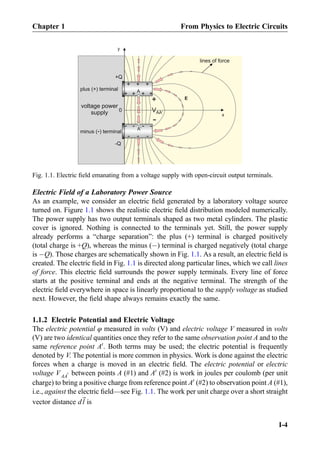
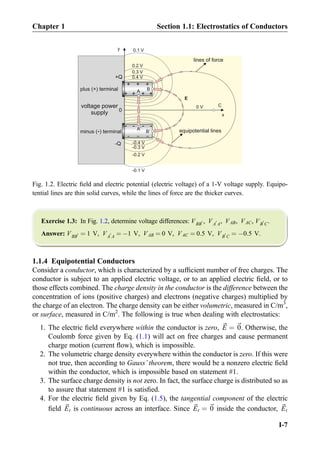
As an example, we consider an electric field generated by a laboratory voltage source
turned on. Figure 1.1 shows the realistic electric field distribution modeled numerically.
The power supply has two output terminals shaped as two metal cylinders. The plastic
cover is ignored. Nothing is connected to the terminals yet. Still, the power supply
already performs a “charge separation”: the plus (+) terminal is charged positively
(total charge is +Q), whereas the minus (À) terminal is charged negatively (total charge
is ÀQ). Those charges are schematically shown in Fig. 1.1. As a result, an electric field is
created. The electric field in Fig. 1.1 is directed along particular lines, which we call lines
of force. This electric field surrounds the power supply terminals. Every line of force
starts at the positive terminal and ends at the negative terminal. The strength of the
electric field everywhere in space is linearly proportional to the supply voltage as studied
next. However, the field shape always remains exactly the same.
1.1.2 Electric Potential and Electric Voltage
The electric potential φ measured in volts (V) and electric voltage V measured in volts
(V) are two identical quantities once they refer to the same observation point A and to the
same reference point A0
. Both terms may be used; the electric potential is frequently
denoted by V. The potential is more common in physics. Work is done against the electric
forces when a charge is moved in an electric field. The electric potential or electric
voltage VAA
0 between points A (#1) and A0
(#2) is work in joules per coulomb (per unit
charge) to bring a positive charge from reference point A0
(#2) to observation point A (#1),
i.e., against the electric field—see Fig. 1.1. The work per unit charge over a short straight
vector distance d~l is
plus (+) terminal
minus ( ) terminal- A’
A
voltage power
supply
+ + +
++ ++
- - -
- ---
y
0
+Q
-Q
+
-
VAA’
E
+Q
-Q
x
lines of force
Fig. 1.1. Electric field emanating from a voltage supply with open-circuit output terminals.
Chapter 1 From Physics to Electric Circuits
I-4
À
1
q
~F Á d~l ¼ À~E Á d~l ¼ ÀEdl cos θ ð1:3Þ
where θ is the angle between ~E and d~l, E ¼ ~E


 , and dl ¼ d~l


. The total work or VAA
0 is
the sum of all such small contributions conventionally written in the form of an integral
VAA
0 ¼ À
ðA
A
0
~E Á d~l ¼
ðA
0
A
~E Á d~l ð1:4Þ
The integral in Eq. (1.4) is a line integral, also called a contour integral. In the general
case, it is evaluated along a curve connecting points A and A0
. In the particular case of
Fig. 1.1, this curve is just a straight line.
Exercise 1.1: Assume for simplicity that the electric field along the line of force from A to
A0
in Fig. 1.1 is strictly uniform and has the magnitude of 50 V/m. The line length is
0.02 m. Find voltage (or potential) VAA
0 .
Answer: VAA
0 ¼ À
ðA
A
0
~E Á d~l ¼ À
ð0:02m
0
50 Â cos π Â dl ¼ 50
V
m
 0:02 m ¼ 1 V.
The electrostatic field (and any slowly varying electric field) is called a conservative
field. There are two equivalent definitions of a conservative field:
1. Electric voltage or electric potentialVAA
0 is path independent; it only depends on the
position of A and A0
, but not on the shape of the curve between A and A0
.
2. The line integral in Eq. (1.4) over any closed contour is zero.
The equivalence of these definitions is proved by treating two different integration
contours between A and A0
as two parts of one closed contour. The independence of the
integration path suggests that the voltage is equal to the potential energy of a unit charge
in the electric field. Strictly speaking, it is the change in the potential energy.
1.1.3 Electric Voltage Versus Ground
The voltage between two arbitrary points VAA
0 (e.g., between two terminals of a resistor) is
a convenient measure when analyzing electric circuits with discrete circuit components.
In this case, it is called the voltage drop (or voltage difference) across a circuit element. At
the same time, it is equally convenient to define the “global” or absolute voltage between
an arbitrary point in space A and some fixed point A0
, which is assigned the voltage value
zero. This fixed point (or the set of points) is called the ground reference. In general, the
ground reference may be chosen arbitrarily. In physics of localized conductors, it is
Chapter 1 Section 1.1: Electrostatics of Conductors
I-5
customary to choose the ground at infinity. In electrical engineering, the ground reference is
either the physical (earth) ground or some neutral (common) conductor assigned to zero
volts. Thus, the absolute voltage versus ground denoted byV ~rð Þis still defined by Eq. (1.4)
where point A is now characterized by the position vector~r. By definition, it becomes zero
when ~r approaches ground, i.e., A0
. The equivalent representation of Eq. (1.4) for
conservative fields may be shown to be
~E ~rð Þ ¼ ÀgradV ~rð Þ ¼ À∇V ~rð Þ ð1:5Þ
Thus, the electrostatic field is expressed as the gradient of the electric potential or of
the (absolute) electric voltage everywhere in space. In other words, it means the
electric field does not have closed loops, but starts and ends at the charges. Equation
(1.5) is of significant value since it replaces a complicated vector ~E by the single scalar
voltage V.
Exercise 1.2: Electric voltage/potential with respect to ground is given in Cartesian
coordinates by V ~rð Þ ¼ Ày V½ Š. Determine the electric field everywhere in space.
Answer: Ey ¼ 1V=m, Ex ¼ Ez ¼ 0.
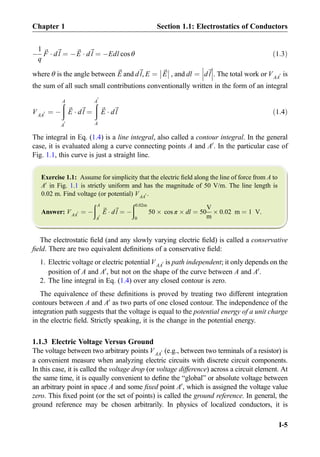
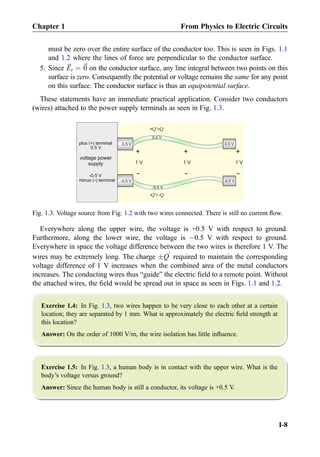
As an example, we choose the x-axis in Fig. 1.1 as the ground reference. The positive
supply terminal is chosen to have a voltage equal to +0.5 V versus ground, and the
negative terminal is assigned a voltage equal to À0.5 V versus ground. Those values will
uniquely determine charges ÆQ in Fig. 1.1. The function V ~rð Þ is now plotted using the
lines of equal potential, or equipotential lines. The result is shown in Fig. 1.2. It will be
proved next that the surface of any metal (or other) conductor in electrostatics is an
equipotential surface. All points on this surface have the same value of the electric
potential: +0.5 V for the plus terminal and À0.5 V for the minus terminal in Fig. 1.2.
Using Eq. (1.5) it can be verified that the equipotential lines and the lines of force are
always perpendicular to each other; you can see this in Fig. 1.2.
Chapter 1 From Physics to Electric Circuits
I-6
Exercise 1.3: In Fig. 1.2, determine voltage differences: VBB
0 , VA
0
A
, VAB, VAC, VB
0
C.
Answer: VBB
0 ¼ 1 V, VA
0
A
¼ À1 V, VAB ¼ 0 V, VAC ¼ 0:5 V, VB
0
C ¼ À0:5 V.
1.1.4 Equipotential Conductors
Consider a conductor, which is characterized by a sufficient number of free charges. The
conductor is subject to an applied electric voltage, or to an applied electric field, or to
those effects combined. The charge density in the conductor is the difference between the
concentration of ions (positive charges) and electrons (negative charges) multiplied by
the charge of an electron. The charge density can be either volumetric, measured in C/m3
,
or surface, measured in C/m2
. The following is true when dealing with electrostatics:
1. The electric field everywhere within the conductor is zero, ~E ¼ ~0. Otherwise, the
Coulomb force given by Eq. (1.1) will act on free charges and cause permanent
charge motion (current flow), which is impossible.
2. The volumetric charge density everywhere within the conductor is zero. If this were
not true, then according to Gauss’ theorem, there would be a nonzero electric field
within the conductor, which is impossible based on statement #1.
3. The surface charge density is not zero. In fact, the surface charge is distributed so as
to assure that statement #1 is satisfied.
4. For the electric field given by Eq. (1.5), the tangential component of the electric
field ~Et is continuous across an interface. Since ~Et ¼ ~0 inside the conductor, ~Et
x
plus (+) terminal
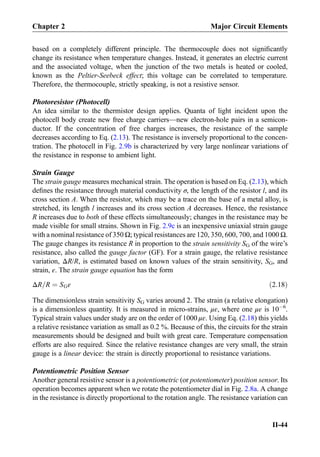
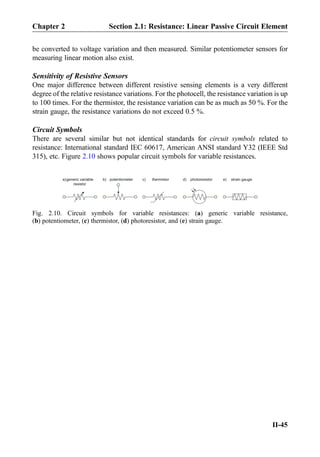
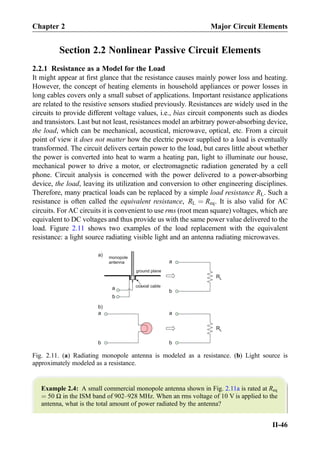
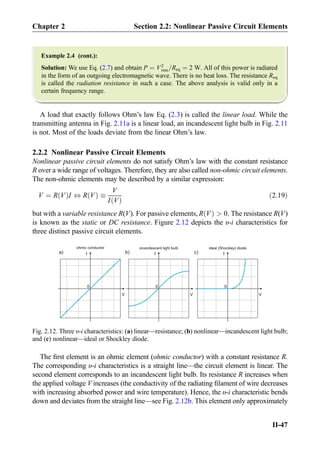
minus ( ) terminal-
voltage power
supply
y
0
+Q
-Q
+Q
-Q
0.1 V
0.2 V
0.3 V
0.4 V
-0.1 V
-0.2 V
-0.3 V
-0.4 V
A’
A
B’
B
0 V
+ + +
++ ++
B
- ---
C
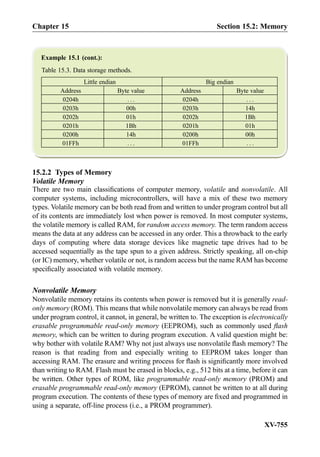
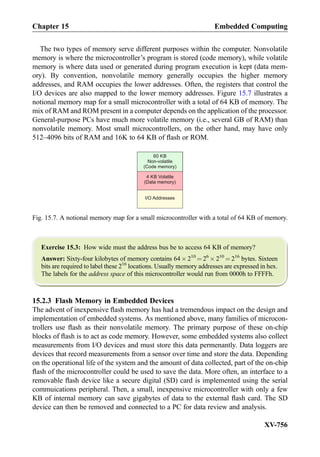
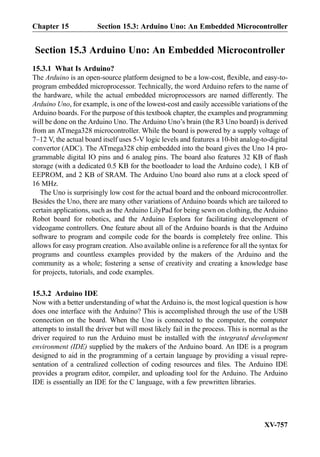
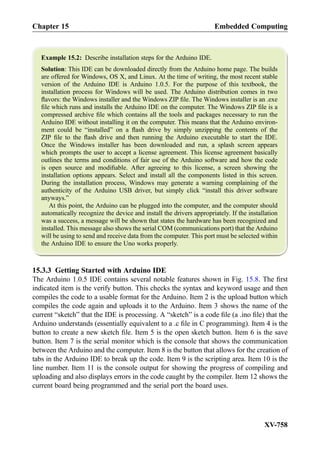
E
lines of force
equipotential lines
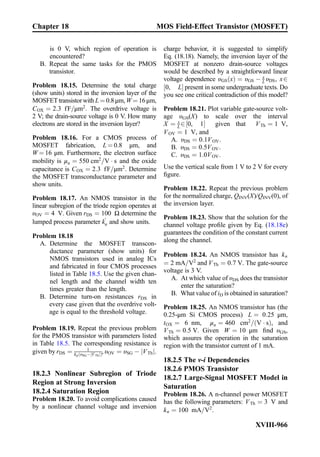
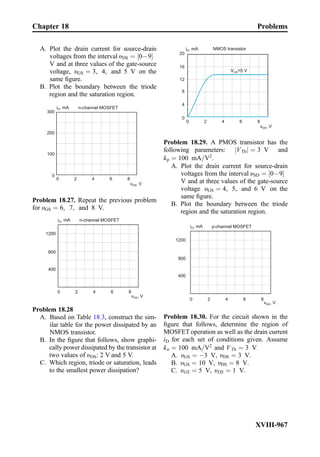
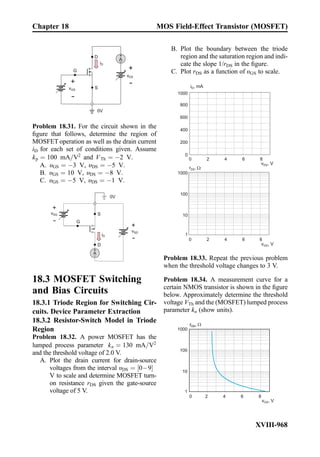
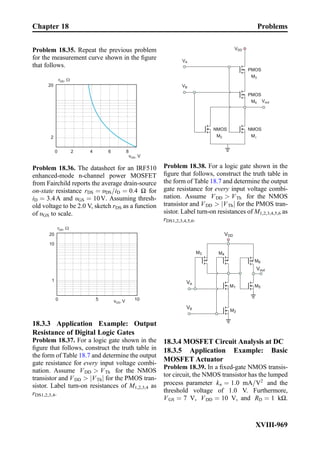
Fig. 1.2. Electric field and electric potential (electric voltage) of a 1-V voltage supply. Equipo-
tential lines are thin solid curves, while the lines of force are the thicker curves.
Chapter 1 Section 1.1: Electrostatics of Conductors
I-7
must be zero over the entire surface of the conductor too. This is seen in Figs. 1.1
and 1.2 where the lines of force are perpendicular to the conductor surface.
5. Since ~Et ¼ ~0 on the conductor surface, any line integral between two points on this
surface is zero. Consequently the potential or voltage remains the same for any point
on this surface. The conductor surface is thus an equipotential surface.
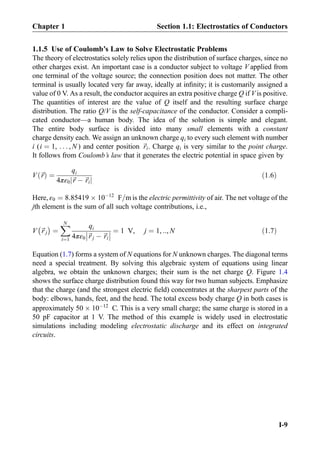
These statements have an immediate practical application. Consider two conductors
(wires) attached to the power supply terminals as seen in Fig. 1.3.
Everywhere along the upper wire, the voltage is +0.5 V with respect to ground.
Furthermore, along the lower wire, the voltage is À0.5 V with respect to ground.
Everywhere in space the voltage difference between the two wires is therefore 1 V. The
wires may be extremely long. The charge ÆQ
0
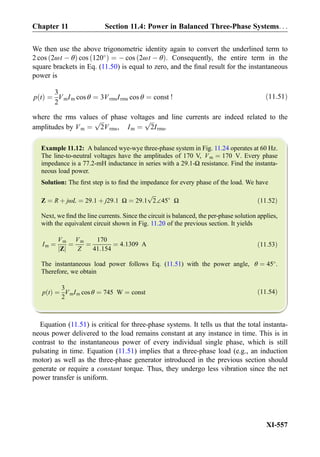
required to maintain the corresponding
voltage difference of 1 V increases when the combined area of the metal conductors
increases. The conducting wires thus “guide” the electric field to a remote point. Without
the attached wires, the field would be spread out in space as seen in Figs. 1.1 and 1.2.
Exercise 1.4: In Fig. 1.3, two wires happen to be very close to each other at a certain
location; they are separated by 1 mm. What is approximately the electric field strength at
this location?
Answer: On the order of 1000 V/m, the wire isolation has little influence.
Exercise 1.5: In Fig. 1.3, a human body is in contact with the upper wire. What is the
body’s voltage versus ground?
Answer: Since the human body is still a conductor, its voltage is +0.5 V.
0.5 V0.5 V
-0.5 V
0.5 V
-0.5 V
+
-
1 V
+
-
1 V
+
-
1 V
0.5 V
-0.5 V
0.5 V
plus (+) terminal
minus ( ) terminal-
-0.5 V
voltage power
supply
+Q’Q
-Q’-Q
Fig. 1.3. Voltage source from Fig. 1.2 with two wires connected. There is still no current flow.
Chapter 1 From Physics to Electric Circuits
I-8
1.1.5 Use of Coulomb’s Law to Solve Electrostatic Problems
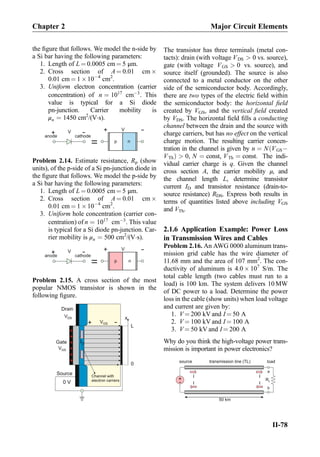
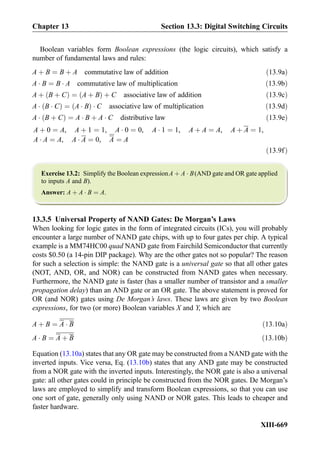
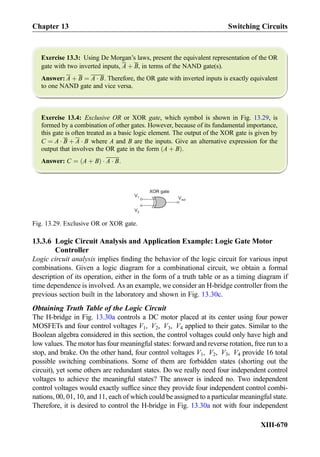
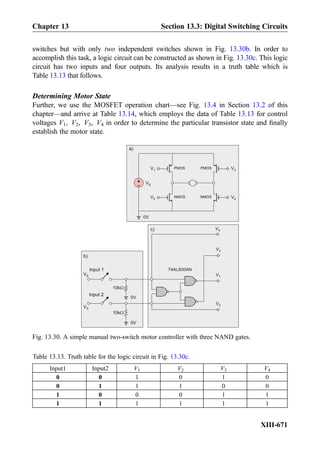
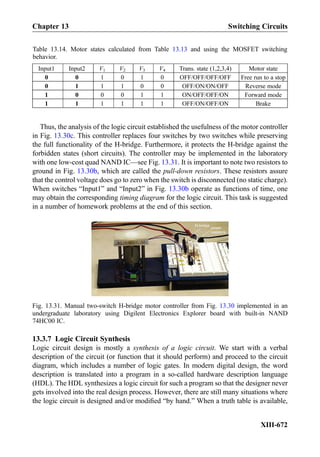
The theory of electrostatics solely relies upon the distribution of surface charges, since no
other charges exist. An important case is a conductor subject to voltage V applied from
one terminal of the voltage source; the connection position does not matter. The other
terminal is usually located very far away, ideally at infinity; it is customarily assigned a
value of 0 V. As a result, the conductor acquires an extra positive charge Q if V is positive.
The quantities of interest are the value of Q itself and the resulting surface charge
distribution. The ratio Q/V is the self-capacitance of the conductor. Consider a compli-
cated conductor—a human body. The idea of the solution is simple and elegant.
The entire body surface is divided into many small elements with a constant
charge density each. We assign an unknown charge qi to every such element with number
i (i ¼ 1, . . . , N ) and center position ~ri. Charge qi is very similar to the point charge.
It follows from Coulomb’s law that it generates the electric potential in space given by
V ~rð Þ ¼
qi
4πε0 ~r À ~rij j
ð1:6Þ
Here, ε0 ¼ 8:85419 Â 10À12
F=m is the electric permittivity of air. The net voltage of the
jth element is the sum of all such voltage contributions, i.e.,
V ~r j
À Á
¼
XN
i¼1
qi
4πε0 ~r j À ~ri


 ¼ 1 V, j ¼ 1, ::, N ð1:7Þ
Equation (1.7) forms a system of N equations for N unknown charges. The diagonal terms
need a special treatment. By solving this algebraic system of equations using linear
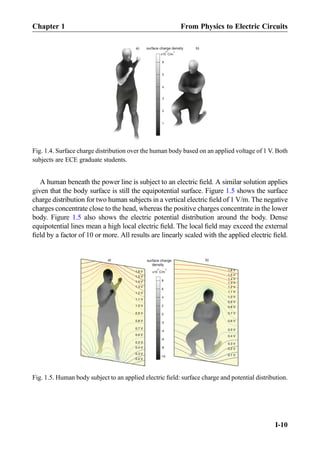
algebra, we obtain the unknown charges; their sum is the net charge Q. Figure 1.4
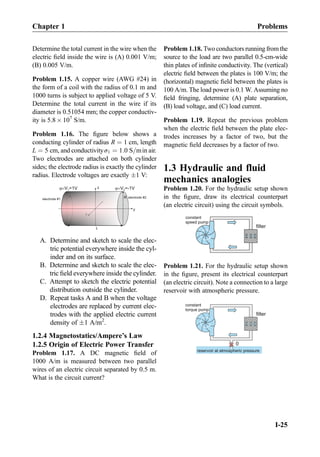
shows the surface charge distribution found this way for two human subjects. Emphasize
that the charge (and the strongest electric field) concentrates at the sharpest parts of the
body: elbows, hands, feet, and the head. The total excess body charge Q in both cases is
approximately 50 Â 10À12
C. This is a very small charge; the same charge is stored in a
50 pF capacitor at 1 V. The method of this example is widely used in electrostatic
simulations including modeling electrostatic discharge and its effect on integrated
circuits.
Chapter 1 Section 1.1: Electrostatics of Conductors
I-9
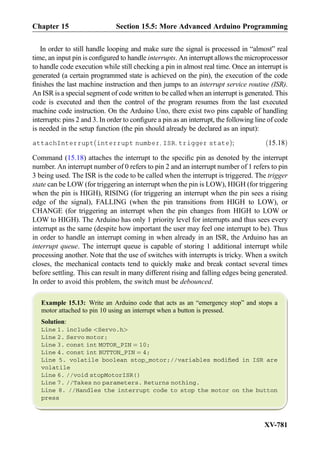
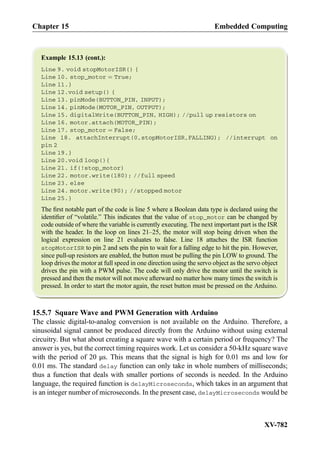
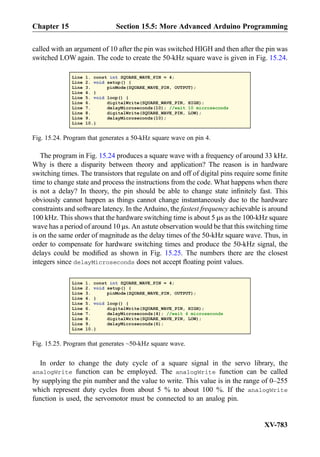
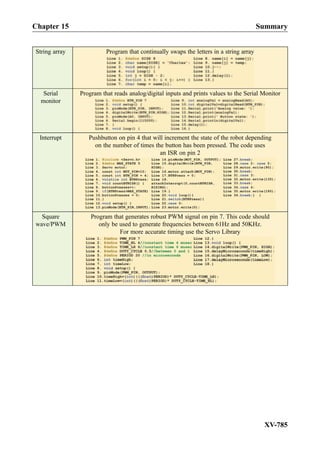
A human beneath the power line is subject to an electric field. A similar solution applies
given that the body surface is still the equipotential surface. Figure 1.5 shows the surface
charge distribution for two human subjects in a vertical electric field of 1 V/m. The negative
charges concentrate close to the head, whereas the positive charges concentrate in the lower
body. Figure 1.5 also shows the electric potential distribution around the body. Dense
equipotential lines mean a high local electric field. The local field may exceed the external
field by a factor of 10 or more. All results are linearly scaled with the applied electric field.
8
6
4
2
0
-2
-4
-6
-8
-10
x10 C/m
-11 2
0.2 V
0.3 V
0.4 V
0.5 V
0.6 V
0.7 V
0.8 V
0.9 V
1.0 V
1.1 V
1.2 V
1.3 V
1.4 V
1.5 V
1.6 V
a)
0.1 V
0.2 V
0.3 V
0.4 V
0.5 V
0.6 V
0.7 V
0.8 V
0.9 V
1.0 V
1.1 V
1.2 V
1.3 V
1.4 V
1.5 V
1.6 V
surface charge
density
b)
Fig. 1.5. Human body subject to an applied electric field: surface charge and potential distribution.
1
2
3
4
5
6
x10 C/m
-11 2
a) b)surface charge density
Fig. 1.4. Surface charge distribution over the human body based on an applied voltage of 1 V. Both
subjects are ECE graduate students.
Chapter 1 From Physics to Electric Circuits
I-10
Section 1.2 Steady-State Current Flow and Magnetostatics
1.2.1 Electric Current
An electric current in a material is the directed motion of free positive charges. Conse-
quently, the electrons, which are often the only free charges in the conductor, move in the
opposite direction. The electric current density~j everywhere in the material is a vector, and
it is measured in amperes per meter square, i.e., A/m2
. The total current I through a
conductor with the uniform current density is the product of the current density magnitude
and the conductor cross section A; I is measured in amperes. Circuits with lumped
components deal with the total currents only. The current density (and the total current)
is directly proportional to the applied electric field,
~j ~rð Þ ¼ σ ~E ~rð Þ ð1:8aÞ
at any point of interest ~r. Here, σ is the material conductivity with units of siemens/m, i.e.,
S/m. Note that 1 S ¼ 1/Ω. If there is no electric field, there is no electric current in the
material and vice versa. In metals, the conductivity σ is very high. Therefore, even a
vanishingly small electric field inside a metal conductor creates a large electric current.
Exercise 1.6: An AWG #00 (American Wire Gauge) aluminum wire has the conductivity
of 4.0 Â 107
S/m and the diameter of 9.266 mm. Determine the total current in the wire
when the electric field inside the wire is 0.01 V/m. This value is more than 10,000 times
less than the field between the terminals of a 5-V laboratory supply separated by 2 cm.
Answer: 27 A.
For steady-state current flow, an electrostatic potential exists; it is given by Eq. (1.5).
Therefore, the current density can be expressed as the gradient of the potential,
~j ~rð Þ ¼ Àσ∇V ~rð Þ ð1:8bÞ
1.2.2 Difference Between Current Flow Model and Electrostatics
In electrostatics, there are no charges and there is no electric field within conductors; only the
surface charges exist. The steady-state current problem is quite different. The volumetric
uncompensated charge density still does not exist within the conductor, but the electric field
does. Along with this, the surface charge density is always present, similar to electrostatics.
Physically, the difference arises from the different boundary conditions. The conductor
surface is divided into two distinct parts: the surface of electrodes, Se, where the voltage
(or current) is applied, and the rest of conductor surface, Sc, which is in contact with air. The
following is true for the steady-state current flow:
Chapter 1 Section 1.2: Steady-State Current Flow and Magnetostatics
I-11
1. Everywhere on the surface Sc, the current density component perpendicular to the
surface is zero, i.e., ~j Á ~n ¼ 0, where ~n is the unit normal vector to the surface, and
dot denotes the scalar product of two vectors. In other words, no current can flow
from the conductor into air.
2. On the surface of electrodes Se, the voltage is given: for example, +0.5 Von the left
electrode and À0.5 V on the right electrode. Alternatively, the inflowing current,
~j Á ~n, may be given.
How Does the Conductor “Guide” the Electric Field?
We consider the current flow in a conducting cylinder with two circular electrodes shown
in Fig. 1.6b. The electrostatic counterpart of the problem is given by the same coaxial
electrode pair in air, see Fig. 1.6a. The electrodes have the radius a; they are separated by
25a. The electrode voltages are Æ0.5 V. The exact value of the cylinder conductivity does
not matter; the same results will be obtained. The electrostatic problem and the steady-
state current problem are both solved as described in the previous section. Results of both
solutions are given in Fig. 1.6 where the equipotential lines and the electric field vectors
are plotted. Some general observations from this figure are worthy of note:
1. The current-carrying conductor “guides” the electric field as shown in Fig. 1.6a
which, otherwise, would be spread out in space; see Fig. 1.6b.
2. In the long conductor, the electric field and the electric current are both directed
along the conductor axis; they are uniform across any conductor cross section,
which is simultaneously an equipotential surface. In other words, current flow in the
long conductor is one dimensional, like water flow in a pipe. This is also true if the
conductor is bent or has a noncircular cross section
3. The voltage decreases linearly along the conductor from the most positive to the
most negative value. The voltage drop per unit length is constant; it is only a
function of the applied voltage.
It is seen from Fig. 1.6b that within in a current-carrying conductor of length l:
E ¼
V
l
ð1:9Þ
where E is the magnitude of the electric field (its direction is along the conductor axis), and
Vis the voltage across the conductor (1 Vin the present case). Equation (1.9) is a simplified
version of Eq. (1.4) for uniform fields. In many textbooks, it is used to derive Ohm’s law.
Note that the electric field in Fig. 1.6b is not continuous across the conductor-air
interface. A component of the electric field perpendicular to the conductor boundary
suddenly appears. This component is due to the surface charges on the conductor–air
interface (not shown in the figure).
Chapter 1 From Physics to Electric Circuits
I-12
Exercise 1.7: A common AWG #22 copper wire is used in the laboratory to form a coil
with the radius of 0.1 m and 100 turns. This coil is subject to an applied voltage of 0.5 V.
Determine the total current in the wire if its diameter is 0.64516 mm; the copper conduc-
tivity is 5.8 Â 107
S/m. Hint: find the electric field in the wire first.
Answer: 0.1509 A.
1.2.3 Physical Model of an Electric Circuit
Thus far, we have considered the current flow in only one wire. However, a simple
electric circuit uses two wires and it includes at least three elements:
1. A voltage power supply, which in steady-state (direct current or DC) case generates
a constant voltage between its terminals.
2. An electric load that consumes electric power. The load may be modeled as a
resistant material of a much smaller conductivity.
3. Two wires, which extend from the source to the load. Those wires form a transmis-
sion line. In laboratory settings, both wires may be arbitrarily bent.
y/a
0
5
-5
0 V0.1 V0.2 V0.3 V0.4 V -0.1 V -0.2 V -0.3 V -0.4 V
0.5 V -0.5 V
5
x/a
10 150-5-10-15
0.5 V -0.5 V
0.1 V
0.2 V
-0.1 V
-0.2 V
E E
a)
b)
E E
y/a
0
5
-5
ScSe Se
Fig. 1.6. (a) Two electrodes subject to Æ0.5 V in free space; (b) the same electrodes but with a
conducting cylinder between them. Equipotential lines and electric field vectors are shown.
Chapter 1 Section 1.2: Steady-State Current Flow and Magnetostatics
I-13
Figure 1.7 shows a physical model of the simple circuit. We study its electric part first.
In Fig. 1.7a, the highest electric field magnitude is observed exactly between the two
conducting wires, at the line connecting its centers. At the same time, the electric field in
the wires is usually very small. Still, sufficient current flows there due to the high material
conductivity; see Eq. (1.8a). However, the electric field in the load cylinder is not small.
This is indicated by denser equipotential surfaces. In Fig. 1.7a, the equipotential surfaces
are all separated by 0.05 V. There is a net voltage drop of 0.3 V along each wire and the
voltage drop of 0.4 V across the load, resulting in a total potential drop of 1 V. This
equality is KVL (Kirchhoff’s voltage law). Ideally, when the conductivity of the wires is
infinitely high, the entire source voltage appears across the load cylinder. The field in the
wires becomes vanishingly small, but enough current still flows. The wire of infinite
conductivity, or the ideal wire, is a useful abstraction.
Exercise 1.8: If the voltage drop along each wire in Fig. 1.7a were 0.01 V, what would be
the value of the voltage across the load?
Answer: 0.98 V.
Exercise 1.9: In contrast to Fig. 1.7b, the field within the wire in Fig. 1.6b is not small,
regardless of its conductivity. Why is it so?
Answer: There is no load in Fig. 1.6b; the entire voltage drop is purposely forced to occur
across the wire.
1.2.4 Magnetostatics and Ampere’s Law
We next study the magnetic part of the circuit in Fig. 1.7b. The same electric current
I flows in the entire circuit. The current in one of the conductors in Fig. 1.7b creates the
magnetic field (magnetic-field intensity) ~H with units of A/m around the conductor.
If the conductors are considered to be sufficiently long, the magnitude (absolute value)
of the field ~H ~rð Þ anywhere in space, except within the conductor, is given by
H ~rð Þ ¼
I
2π ~rj j
ð1:10Þ
Equation (1.10) is a particular form of Ampere’s law for an infinite straight wire of the
total current I. The vector ~H forms concentric circles around the wire; its direction follows
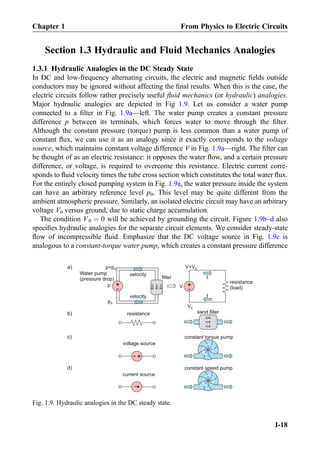
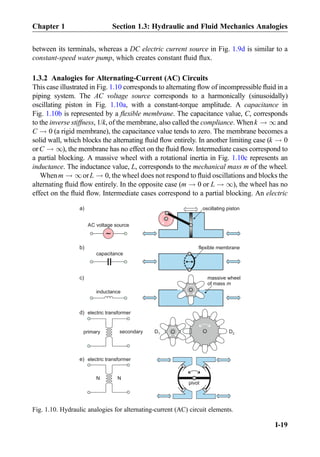
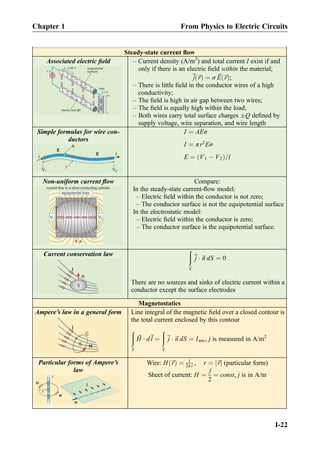
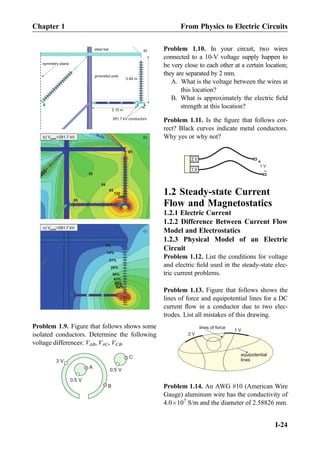
the right-hand rule. When two wires are present, as in Fig. 1.7b, the resulting combined
magnetic field is the vector sum of two solutions given by Eq. (1.10) for two conductors
Chapter 1 From Physics to Electric Circuits
I-14
+
-
1 V
lines of force ( )E
equipotential
surfaces
electric field ( )E
equipotential
surfaces
0.05 V
0.4 V
+
-
load
+
-
1 V
lines of force ( )E
lines of magnetic field ( )H
electric
current I
Poynting vector
load
lines of
magnetic
field ( )H
S’
S’
a) Electric field and equipotential surfaces
for direct current flow
b) Electric/magnetic fields and
direct current flow
Fig. 1.7. Accurate physical model of an electric circuit.
Chapter 1 Section 1.2: Steady-State Current Flow and Magnetostatics
I-15
having the opposite current directions, respectively. The lines of the combined magnetic
field are shown in Fig. 1.7b. They are always perpendicular to the lines of force for the
electric field. The magnetic-field magnitude in Fig. 1.7b also has its maximum exactly
between the two conducting wires, at the line connecting its centers.
Exercise 1.10: Determine the magnetic-field magnitude in the middle between two
parallel long wires carrying current of Æ1 A each and separated by 2 cm.
Answer: H ~rð Þ ¼ 31.8 A/m.
Another useful form of Ampere’s law is the magnetic field of an infinite “current
sheet,” i.e., when current flows in a thin conducting sheet in one direction. The sheet may
be thought of as an infinite number of parallel thin wires carrying the same current. If
j [A/m] is the current density per unit of sheet width, then the resulting constant field is
H ¼
1
2
j ¼ const ð1:11Þ
1.2.5 Origin of Electric Power Transfer
We know from physics classes that electric power P delivered to the load is given by the
product P ¼ VI where V is the voltage across the load and I is the current through it. How
exactly is this power transferred to the load? To answer this question, we assume a
transmission line in the form of two parallel sheets of width W and spacing l shown in
Fig. 1.8. Each sheet carries current density with the magnitude j per unit of sheet length.
When the material conductivity is infinite, the voltage between the two sheets is the
load voltage V. For l=W  1, Eq. (1.9) yields the electric field within the transmission
line,E ¼ V=l. The magnetic field is found using Eq. (1.11). The result isH ¼ jsince both
sheets contribute to the field within the line. Next, we define a vector
magnetic field (H)
electric field (E)
V
+
-
Poynting vector (S)
to load
W j
Fig. 1.8. Transmission line in the form of two current sheets.
Chapter 1 From Physics to Electric Circuits
I-16
~S ¼ ~E Â ~H ð1:12Þ
where the symbol  stands for the cross product or vector product. The vector ~S is called
the Poynting vector; it is shown in Fig. 1.8. The units for the Poynting vector are given by
power per unit area, i.e., 1V=m  1 A=m ¼ 1 W=m2
. Thus, the Poynting vector char-
acterizes the directional energy flux density in space. Its magnitude in Fig. 1.8 is given by
S ¼ EH ¼ V j=l ¼ VI= lWð Þ where I ¼ jW is the net current in every conductor.
Multiplying the Poynting vector by the area A ¼ lW where the fields are concentrated,
we obtain the remarkable result,
AS ¼ VI ¼ P ð1:13Þ
In other words, the power is transferred by the fields. This result is perhaps less important
for wired circuits where the fields are directly linked to charges and currents. However, it
is important for the transition from wired to wireless circuits. At a sufficiently high
frequency, significant electric and magnetic fields will be radiated by an antenna into
empty space. These fields will carry power flux density given by Eq. (1.12).
Exercise 1.11: Two conductors extending from the source to the load are parallel
1-cm-wide perfectly conducting sheets separated by 1 mm. The (vertical) electric field
between the plates is 100 V/m; the (horizontal) magnetic field is 100 A/m. Determine
electric power delivered to the load. Assume no field fringing.
Answer: P ¼ 0:1W.
Chapter 1 Section 1.2: Steady-State Current Flow and Magnetostatics
I-17
Section 1.3 Hydraulic and Fluid Mechanics Analogies
1.3.1 Hydraulic Analogies in the DC Steady State
In DC and low-frequency alternating circuits, the electric and magnetic fields outside
conductors may be ignored without affecting the final results. When this is the case, the
electric circuits follow rather precisely useful fluid mechanics (or hydraulic) analogies.
Major hydraulic analogies are depicted in Fig 1.9. Let us consider a water pump
connected to a filter in Fig. 1.9a—left. The water pump creates a constant pressure
difference p between its terminals, which forces water to move through the filter.
Although the constant pressure (torque) pump is less common than a water pump of
constant flux, we can use it as an analogy since it exactly corresponds to the voltage
source, which maintains constant voltage difference V in Fig. 1.9a—right. The filter can
be thought of as an electric resistance: it opposes the water flow, and a certain pressure
difference, or voltage, is required to overcome this resistance. Electric current corre-
sponds to fluid velocity times the tube cross section which constitutes the total water flux.
For the entirely closed pumping system in Fig. 1.9a, the water pressure inside the system
can have an arbitrary reference level p0. This level may be quite different from the
ambient atmospheric pressure. Similarly, an isolated electric circuit may have an arbitrary
voltage V0 versus ground, due to static charge accumulation.
The condition V0 ¼ 0 will be achieved by grounding the circuit. Figure 1.9b–d also
specifies hydraulic analogies for the separate circuit elements. We consider steady-state
flow of incompressible fluid. Emphasize that the DC voltage source in Fig. 1.9c is
analogous to a constant-torque water pump, which creates a constant pressure difference
+
-
sand filter
constant torque pump
constant speed pump
resistance
voltage source
current source
b)
c)
d)
+
-Vp +
-
Water pump
(pressure drop) filter
p+p0
I
V+V0
V0
resistance
(load)
velocity
Ivelocity
a)
p0
Fig. 1.9. Hydraulic analogies in the DC steady state.
Chapter 1 From Physics to Electric Circuits
I-18
between its terminals, whereas a DC electric current source in Fig. 1.9d is similar to a
constant-speed water pump, which creates constant fluid flux.
1.3.2 Analogies for Alternating-Current (AC) Circuits
This case illustrated in Fig. 1.10 corresponds to alternating flow of incompressible fluid in a
piping system. The AC voltage source corresponds to a harmonically (sinusoidally)
oscillating piston in Fig. 1.10a, with a constant-torque amplitude. A capacitance in
Fig. 1.10b is represented by a flexible membrane. The capacitance value, C, corresponds
to the inverse stiffness, 1/k, of the membrane, also called the compliance. Whenk ! 1and
C ! 0 (a rigid membrane), the capacitance value tends to zero. The membrane becomes a
solid wall, which blocks the alternating fluid flow entirely. In another limiting case (k ! 0
or C ! 1), the membrane has no effect on the fluid flow. Intermediate cases correspond to
a partial blocking. A massive wheel with a rotational inertia in Fig. 1.10c represents an
inductance. The inductance value, L, corresponds to the mechanical mass m of the wheel.
Whenm ! 1orL ! 0, the wheel does not respond to fluid oscillations and blocks the
alternating fluid flow entirely. In the opposite case (m ! 0 or L ! 1), the wheel has no
effect on the fluid flow. Intermediate cases correspond to a partial blocking. An electric
inductance
capacitance
a)
massive wheel
of mass m
AC voltage source
flexible membraneb)
c)
oscillating piston
D1
d) electric transformer
D2primary secondary
N N
e)
pivot
electric transformer
Fig. 1.10. Hydraulic analogies for alternating-current (AC) circuit elements.
Chapter 1 Section 1.3: Hydraulic and Fluid Mechanics Analogies
I-19
transformer shown in Fig. 1.10d operates with alternating currents. One mechanical
analogy is a gear transmission or gearbox. In terms of angular speed ω [rad/s] and
developed torque T N Á m½ Š, one has T2 ¼ D2=D1ð ÞT1, and ω2 ¼ D1=D2ð Þω1, where
D1,2 are pitch diameters of gear wheels. Here, torque is the voltage and speed is the
current. D1,2 are similar to the number of turns, N1,2, of the primary and secondary coils of
the transformer, respectively. This analogy ignores the field effect—magnetic coupling
between the coils. Therefore, it will fail in the DC case. A more realistic transformer
analogy is shown in Fig. 1.10e. The model with four pistons transforms power from one
circuit to another in the AC case only. It is drawn for a 1:1 transformer. When a
transformer with a turn ratio of 2:1 is required, the area of output pistons is doubled.
This doubles the output current, but the output voltage (the force) will be halved.
1.3.3 Analogies for Semiconductor Circuit Components
Semiconductor circuit components are similar to fluid valves, which are either externally
controlled or are controlled by the fluid-flow pressure itself. Figure 1.11a shows a hydraulic
analogy for a diode. This picture highlights its major function: a one-way valve. Fig. 1.11b
illustrates the operation of an n-channel metal-oxide-semiconductor field-effect transistor,
or NMOS transistor. This transistor is a valve controlled by a third voltage terminal. For
another bipolar junction transistor or BJT in Fig. 1.11c, not only the control voltage but
also the control current is important. In other words, to keep the valve open, we must also
supply a small amount of current (fluid) at the control terminal.
NMOS transistor
a)
semiconductor diode
b)
+ -
higher pressure lower pressure
flexible membrane
control pressure
control voltage
junction transistor
c) control pressure/current
control voltage/current
Fig. 1.11. Analogies for semiconductor circuit components.
Chapter 1 From Physics to Electric Circuits
I-20
Summary
Electrostatics
Electric voltage/electric potential VAA
0 ¼ 1 V )Work of 1 J is necessary to bring the 1 C of
charge from point A0
to point A against the field;
VAA
0 ¼ À
ðA
A
0
~E Á d~l for any contour 1, 2, or 3;
~E ~rð Þ ¼ ÀgradV ~rð Þ ¼ À∇V ~rð Þ for potential V ~rð Þ
everywhere in space including materials;
V ¼ lE in uniform fields (most important).
Coulomb force on charge q ~F ¼ q~E [N]
The force is directed along the field for positive charges and
against the field for negative charges
Gauss law Total flux of the electric field through closed surface S times
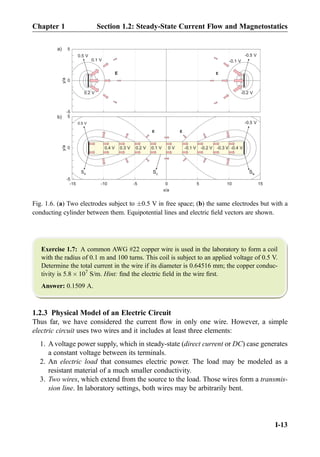
the permittivity is the total charge enclosed by S.
Q
ε0
¼
ð
S
~E Á ~n dS (ε0 =8.854Â10À12
F/m)
Equipotential conductors Within conductor(s) with applied voltage:
– Electric field is exactly zero;
– Volumetric charge density (C/m3
) is exactly zero.
On surface(s) of conductor(s) with applied voltage:
– Every point has the same voltage (conductor surface is
equipotential surface);
– Surface charge density (C/m2
) exists;
– Emanating electric field is perpendicular to the surface
(tangential field is zero: ~Et ¼ 0)
Outside conductor(s):
– Equipotential lines and lines of force are perpendicular
to each other
Voltage between two wires – Metal wires “guide” the electric field/voltage to a remote
point
– Given the same voltage, charges on wires increase when
their length increases.
Electrical induction in electrostatics – Conductors 1 and 2 are subject to applied voltages V1, V2;
– Conductor 3 has zero net charge;
– Conductor 3 acquires certain voltage V3;
– Surface charges in conductor 3 are separated as shown in
the figure.
(continued)
Chapter 1 Summary
I-21
Steady-state current flow
Associated electric field – Current density (A/m2
) and total current I exist if and
only if there is an electric field within the material;
~j ~rð Þ ¼ σ ~E ~rð Þ;
– There is little field in the conductor wires of a high
conductivity;
– The field is high in air gap between two wires;
– The field is equally high within the load;
– Both wires carry total surface charges ÆQ defined by
supply voltage, wire separation, and wire length
Simple formulas for wire con-
ductors
I ¼ AEσ
I ¼ πr2
Eσ
E ¼ V1 À V2ð Þ=l
Non-uniform current flow Compare:
In the steady-state current-flow model:
– Electric field within the conductor is not zero;
– The conductor surface is not the equipotential surface
In the electrostatic model:
– Electric field within the conductor is zero;
– The conductor surface is the equipotential surface.
Current conservation law
ð
S
~j Á ~n dS ¼ 0
There are no sources and sinks of electric current within a
conductor except the surface electrodes
Magnetostatics
Ampere’s law in a general form Line integral of the magnetic field over a closed contour is
the total current enclosed by this contour
ð
S
~H Á d~l ¼
ð
S
~j Á ~n dS ¼ Ienc, j is measured in A/m2
Particular forms of Ampere’s
law
Wire: H ~rð Þ ¼ I
2π r , r ¼ ~rj j (particular form)
Sheet of current: H ¼
j
2
¼ const, j is in A/m
Chapter 1 From Physics to Electric Circuits
I-22
Problems
1.1 Electrostatics of
Conductors
1.1.2 Electric Potential and Electric
Voltage
1.1.3 Electric Voltage Versus Ground
1.1.4 Equipotential Conductors
Problem 1.1. Determine voltage (or potential)
VAB and VBA (show units) given that the electric
field between points A and B is uniform and has
the value of 5 V/m. Point A has coordinates
(0, 0); point B has coordinates (1, 1).
E
A
B
Problem 1.2. Determine voltages VAB, VBD,
and VBC given that the electric field shown in
the figure that follows is uniform and has the
value of (A) 10 V/m, (B) 50 V/m, and
(C) 500 V/m.
0 cm
E
5 cm
10 cm
A
B
C
D
Problem 1.3. Assume that the electric field
along a line of force AA0
has the value 1Âl V/
m where 0 l 1 m is the distance along the
line. Find voltage (or potential) VAA
0 .
Problem 1.4. The electric potential versus
ground is given in Cartesian coordinates by V
~rð Þ ¼ Àx þ y À z [V]. Determine the
corresponding electric field everywhere in space.
Problem 1.5. The figure below shows the
electric potential distribution across the semi-
conductor pn-junction of a Si diode. What
kinetic energy should the positive charge
(a hole) have in order to climb the potential
hill from anode to cathode given that the hill
“height” (or the built-in voltage of the
pn-junction) is Vbi ¼ 0:7 V? The hole charge
is the opposite of the electron charge. Express
your result in joules.
Vbi
anode cathode
Problem 1.6. Is the electric field shown in the
figure that follows conservative? Justify your
answer.
0
E
1 cm
2 cm
A
B
C
D
Problem 1.7. List all conditions for voltage and
electric field used in electrostatic problems.
Problem 1.8. The figure below shows a 345 kV
power tower used in MA, USA—front view. It
also depicts electric potential/voltage and elec-
tric field distributions in space:
A. Determine which figure corresponds to
the electric potential and which to the
magnitude of the electric field.
B. Provide a detailed justification of your
answer.
Chapter 1 Problems
I-23
a)
symmetry plane
281.7 kV conductors
3.15 m
2.84 m
99%
92%
85%
78%
71%
64%
57%
50%
43%
36%
28%
21%
14%
7%
132
85
54
35
206
85
85
b) V =281.7 kVpeak
grounded pole
steel bar
c) V =281.7 kVpeak
b)
c)
Problem 1.9. Figure that follows shows some
isolated conductors. Determine the following
voltage differences: VAB, VAC, VCB.
B
A
0.5 V
3 V
C
0.5 V
Problem 1.10. In your circuit, two wires
connected to a 10-V voltage supply happen to
be very close to each other at a certain location;
they are separated by 2 mm.
A. What is the voltage between the wires at
this location?
B. What is approximately the electric field
strength at this location?
Problem 1.11. Is the figure that follows cor-
rect? Black curves indicate metal conductors.
Why yes or why not?
2 V
1 V
+
-1 V
1.2 Steady-state Current
Flow and Magnetostatics
1.2.1 Electric Current
1.2.2 Difference Between Current Flow
Model and Electrostatics
1.2.3 Physical Model of an Electric
Circuit
Problem 1.12. List the conditions for voltage
and electric field used in the steady-state elec-
tric current problems.
Problem 1.13. Figure that follows shows the
lines of force and equipotential lines for a DC
current flow in a conductor due to two elec-
trodes. List all mistakes of this drawing.
2 V
1 V
equipotential
lines
lines of force
Problem 1.14. An AWG #10 (American Wire
Gauge) aluminum wire has the conductivity of
4.0Â107
S/m and the diameter of 2.58826 mm.
Chapter 1 From Physics to Electric Circuits
I-24
Determine the total current in the wire when the
electric field inside the wire is (A) 0.001 V/m;
(B) 0.005 V/m.
Problem 1.15. A copper wire (AWG #24) in
the form of a coil with the radius of 0.1 m and
1000 turns is subject to applied voltage of 5 V.
Determine the total current in the wire if its
diameter is 0.51054 mm; the copper conductiv-
ity is 5.8 Â 107
S/m.
Problem 1.16. The figure below shows a
conducting cylinder of radius R ¼ 1 cm, length
L ¼ 5 cm, and conductivityσ1 ¼ 1:0 S=min air.
Two electrodes are attached on both cylinder
sides; the electrode radius is exactly the cylinder
radius. Electrode voltages are exactly Æ1 V:
electrode #1
V =1V1 V =-1V2
z
electrode #2R
y
L
A. Determine and sketch to scale the elec-
tric potential everywhere inside the cyl-
inder and on its surface.
B. Determine and sketch to scale the elec-
tric field everywhere inside the cylinder.
C. Attempt to sketch the electric potential
distribution outside the cylinder.
D. Repeat tasks A and B when the voltage
electrodes are replaced by current elec-
trodes with the applied electric current
density of Æ1 A/m2
.
1.2.4 Magnetostatics/Ampere’s Law
1.2.5 Origin of Electric Power Transfer
Problem 1.17. A DC magnetic field of
1000 A/m is measured between two parallel
wires of an electric circuit separated by 0.5 m.
What is the circuit current?
Problem 1.18. Two conductors running from the
source to the load are two parallel 0.5-cm-wide
thin plates of infinite conductivity. The (vertical)
electric field between the plates is 100 V/m; the
(horizontal) magnetic field between the plates is
100 A/m. The load power is 0.1 W. Assuming no
field fringing, determine (A) plate separation,
(B) load voltage, and (C) load current.
Problem 1.19. Repeat the previous problem
when the electric field between the plate elec-
trodes increases by a factor of two, but the
magnetic field decreases by a factor of two.
1.3 Hydraulic and fluid
mechanics analogies
Problem 1.20. For the hydraulic setup shown
in the figure, draw its electrical counterpart
(an electric circuit) using the circuit symbols.
constant
speed pump
filter
Problem 1.21. For the hydraulic setup shown
in the figure, present its electrical counterpart
(an electric circuit). Note a connection to a large
reservoir with atmospheric pressure.
filter
0
constant
torque pump
reservoir at atmospheric pressure
Chapter 1 Problems
I-25
Part I
DC Circuits: General Circuit
Theory—Operational Amplifier
Chapter 2: Major Circuit Elements
Overview
Prerequisites:
- Knowledge of university physics: electricity and magnetism (optional)
- Knowledge of vector calculus (optional)
Objectives of Section 2.1:
- Realize the difference between circuit elements and circuit components
- Review (derive) Ohm’s law
- Become familiar with the -i characteristic of the resistance including limiting cases
- Realize the importance of ohmic losses in long cables
- Become familiar with discrete fixed resistors and with resistive sensing elements
Objectives of Section 2.2:
- Realize the meaning of a passive nonlinear circuit element and its -i characteristic
- Define two resistance types (static and dynamic) for a nonlinear passive circuit
element
- Present two examples of nonlinear elements: ideal diode and a threshold switch
Objectives of Section 2.3:
- Introduce the concept of independent voltage and current sources and become
familiar with their -i characteristics
- Introduce the concept of practical voltage/current sources including their
-i characteristics
- Obtain initial exposure to the operation principles of voltage sources including
specific examples
Objectives of Section 2.4:
- Become familiar with the concept of a dependent source
- Become familiar with four major types of dependent sources
- Obtain initial exposure to transfer characteristics of dependent sources
- Become familiar with ideal time-varying and AC sources
Chapter 2
© Springer International Publishing Switzerland 2016
S.N. Makarov et al., Practical Electrical Engineering, DOI 10.1007/978-3-319-21173-2_2
II-29
Objectives of Section 2.5:
- Formalize the meaning of voltmeter and ammeter from the viewpoint of open and
short circuits
- Obtain a clear understanding of the circuit ground and its role in the circuit
- Review different ground types
Application Examples:
- Power loss in transmission lines and cables
- Resistive sensing elements
- DC voltage generator with permanent magnets
- Chemical battery
Keywords:
Circuit elements, Circuit components, υ-i characteristic, Resistance, Polarity, Voltage difference,
Voltage drop, Voltage polarity, Passive reference configuration, Ohm’s law, Linear passive circuit
element, Conductance, Siemens, mho, Short circuit, Open circuit, Ohmic conductor, Mobility of
charge carriers, Material conductivity, Material resistivity, Electric circuit, American Wire Gauge
(AWG), Resistor, Fixed resistors, Surface Mound Devices (SMD) (resistance value, geometry
size), Variable resistor, Potentiometer, Resistive sensors, Photoresistor, Photocell, Negative
temperature coefficient (NTC), Thermistor equation, Thermistor constant, Thermocouple,
Peltier-Seebeck effect, Strain gauge, Strain sensitivity, Gauge factor, Strain gauge equation,
Potentiometric position sensor, Nonlinear passive circuit elements, Non-ohmic circuit elements,
Radiation resistance, Ideal diode, Shockley equation, Static resistance, Dynamic resistance,
Small-signal resistance, Differential resistance, Incremental resistance, (DC) Operating point,
Quiescent point, Electronic switch, Solid-state switch, Switch threshold voltage, Two-terminal
switch, Three-terminal switch, Unidirectional switch, Bidirectional switch, Independent ideal
voltage source, Active reference configuration, Nonlinear passive circuit elements, Non-ohmic
circuit elements, Radiation resistance, Static resistance, Ideal diode, Shockley equation, Dynamic
resistance, Small-signal resistance, Differential resistance, Incremental resistance, (DC) Operating
point, Quiescent point, Electronic switch, Solid-state switch, Switch threshold voltage, Two-
terminal switch, Three-terminal switch, Unidirectional switch, Bidirectional switch, Independent
ideal voltage source, Active reference configuration, Practical voltage source, Maximum available
source current, Maximum available source power, Open-circuit source voltage, Short-circuit
circuit current, Internal source resistance, Independent ideal current source, Practical current
source, Charge separation principle, Faraday’s law of induction, Lorentz force, Instantaneous
generator voltage, Average generator voltage, Battery voltage, Battery capacity, Battery energy
storage, Dependent sources, Voltage-controlled voltage source, Current-controlled voltage source,
Voltage-controlled current source, Current-controlled current source, Open-circuit voltage gain,
Transresistance, Transconductance, Short-circuit current gain, Voltage amplifier, Current
amplifier, Transresistance amplifier, Transconductance amplifier, Transfer characteristic, AC
voltage source, Ideal voltmeter, Ideal ammeter, Earth ground, Chassis ground, Common
(neutral) terminal (ground), Forward current, Return current, Absolute voltages in a circuit
Chapter 2 Major Circuit Elements
II-30
Section 2.1 Resistance: Linear Passive Circuit Element
2.1.1 Circuit Elements Versus Circuit Components
Circuit Elements
Similar to mechanical mass, spring, and damper used in analytical dynamics, circuit
elements are simple hypothetic ideal models. Every circuit element is characterized by its
unique voltage/current dependence called the υ-i characteristic. Most of the υ-i charac-
teristics reflect general physical laws. A list of the circuit elements includes:
1. Resistance
2. Capacitance
3. Inductance
4. Ideal electric transformer
5. Voltage source (independent and dependent)
6. Current source (independent and dependent)
7. Ideal switch
8. Ideal (Shockley) diode
9. Logic gates (NOT, AND, OR).
Circuit elements may be linear (resistance) or nonlinear (ideal diode), passive (resis-
tance) or active (voltage source), static (resistance) or dynamic (capacitance/inductance),
or both. Although all circuit elements studied here are static ones, the extension to the
case of time-varying voltage and current is often trivial.
Circuit Components
Circuit components are numerous hardware counterparts of the circuit elements. Exam-
ples of the circuit components include resistor, capacitor, inductor, battery, etc. The circuit
components may be modeled as combinations of the ideal circuit elements with one
dominant desired element (e.g., resistance) and several parasitic ones (e.g., parasitic
inductance and capacitance of a physical resistor). Another example is a battery, which
is modeled as an ideal voltage source in series with a (small) resistance. In practice, we
attempt to model any existing or newly discovered circuit component as a combination of
the well-known circuit elements. The same is valid for more complicated structures
targeted by electrical, mechanical, and biomedical engineers. An example is a human
body, the response of which is modeled as a combination of resistance and capacitance.
2.1.2 Resistance
Symbols and Terminals
Figure 2.1 shows the circuit symbol for resistance with current direction and voltage
polarity: positive voltage applied to the left terminal and a negative voltage applied to the
right terminal cause a current to flow from left to right, as depicted in Fig. 2.1b. As a
circuit element, the resistance is fully symmetric: terminals 1 and 2 in Fig. 2.1 may be
interchanged without affecting its operation. Thus, the resistance does not have a polarity.
Chapter 2 Section 2.1: Resistance: Linear Passive Circuit Element
II-31
Voltage Across the Resistance
The voltage difference (or voltage drop or simply voltage) across the resistance, V, in
Fig. 2.1 is a signed quantity. The voltage is measured in volts (V), named in honor of
Italian physicist Alessandro Volta (1745–1827), who invented the first battery. Plus and
minus signs across the resistance indicate the voltage polarity. Specifically, a plus sign
denotes a (presumably) higher absolute voltage level versus ground than the minus sign;
see Fig. 2.1b. For example, let us assume that the value V in Fig. 2.1a is positive and equal
to 1 V. This means that the electric field spends positive work equal to
1V Â 1C ¼ 1J ð2:1Þ
when moving the charge of 1 C through the resistance from left to right in Fig. 2.1a.
Similarly, the positive work of one joule is to be spent by an external force to move one
coulomb of charge across a potential difference of one volt against the electric field. In
power electronics, quantities of 1 kV (1000 V), even 1 MV (106
V) for voltage, are
customary. In sensors and cellular phone circuits, for example, voltages are usually much
lower. Values of 1 mV (10À3
V) or even 1 μV (10À6
V) may be recorded. Voltage applied
to the resistance causes electric current flow.
Current Through Resistance: Passive Reference Configuration
The net current I flowing through the resistance is shown in Fig. 2.1a by an arrow.
The current is measured in amperes (A), named in honor of French physicist and mathe-
matician André-Marie Ampère (1775–1836). For example, the value of I in Fig. 2.1a is
1 A. This means that one coulomb of charges passes through the resistance in one second:
1A Â 1s ¼ 1C ð2:2Þ
The electric current flow through the resistance (and any other circuit element) is a
directed quantity; the arrow shows its direction. A useful fluid mechanics analogy for
the resistance is water (electric current) that flows down the “voltage” hill in Fig. 2.1b.
The relation between voltage polarity and current direction depicted in Fig. 2.1b is
known as the passive reference configuration. It is commonly used for all passive circuit
elements such as resistances, diodes, capacitances, and inductances. Physically, the passive
reference configuration means that the resistance consumes electric power, but does not
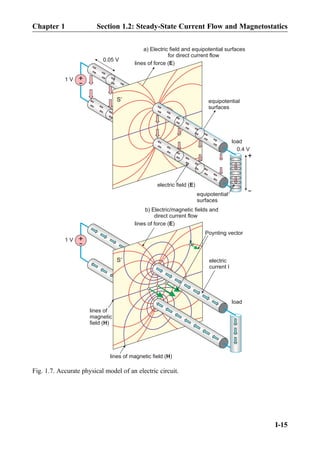
create it. In power electronics, currents of several A, even kA (1000 A), are customary.
I
+
V
+
-a) b)
1 2
-
Fig. 2.1. Resistance symbol along with the voltage and current.
Chapter 2 Major Circuit Elements
II-32
In digital and communication circuits, however, currents are usually low; therefore, units
of 1 μA (10À6
A) or 1 mA (10À3
A) are commonly used.
Ohm’s Law: Resistance and Conductance
According to Ohm’s law, the voltage Vacross the resistance and the current I through the
resistance are related by a simple linear expression
V ¼ RI ð2:3Þ
with the proportionality constant R known as the resistance. This expression was first
established by German mathematician and physicist Georg Simon Ohm (1789–1854) in
1827 but was coldly received by the scientific community at that time. It took nearly
14 years before the Royal Society of London finally recognized his work and his
discovery is now known as Ohm’s law. The unit of resistance R carries his name ohm
and the Greek symbol Ω. The unit follows from Eq. (2.3) as volt over ampere:
1 Ω ¼
1 V
1 A
ð2:4Þ
The resistance is the linear passive circuit element. Resistance values vary typically
between 1 Ω and 100 MΩ. The reciprocal of the resistance is the conductance, G:
G ¼
1
R
ð2:5Þ
The unit of conductance, ΩÀ1
, is called siemens (S) in honor of Ernst Werner von Siemens
(1816–1892), a German inventor and the founder of what is today Europe’s largest
electrical engineering company (Siemens AG). An older American equivalent of that unit
is mho (
Ω
) or ohm spelled backwards! Conductance is useful in the circuit analysis.
Exercise 2.1: A voltage of 20 V is applied to a 1-MΩ resistance. Determine the current
through the resistance.
Answer: 20 μA.
Exercise 2.2: A voltage of 20 V is applied to a 1-mS conductance. Determine current
through the conductance.
Answer: 20 mA.
Chapter 2 Section 2.1: Resistance: Linear Passive Circuit Element
II-33
2.1.3 υ-i Characteristic of the Resistance: Open and Short Circuits
Figure 2.2 plots the linear dependence given by Eq. (2.3) for two distinct resistances. The
corresponding plot is known as the υ-i characteristic (or the υ-i dependence). We use
small letters υ-i to maintain consistency with the following study of time-varying circuits.
The υ-i characteristic is the “business card” of the circuit element—every circuit element
has its own υ-i characteristic. Once the υ-i characteristic is known, the circuit element is
characterized completely. The following is true with reference to Fig. 2.2a:
1. The slope of the υ-i dependence for the resistance is equal to 1/R or G.
2. Smaller resistance leads to a stepper υ-i dependence (large currents).
3. Larger resistance leads to a flatter υ-i dependence (small currents).
4. The negative part of the υ-i dependence simply means simultaneous switching
voltage polarity and current direction, respectively, in Fig. 2.1.
Open and Short Circuits
Two limiting cases of the resistance υ-i characteristics are the short circuit and the open
circuit, as seen in Fig. 2.3.
When R ! 0, the resistance becomes a short circuit, or an ideal wire. There is no
voltage drop V across the wire, but any current I can flow through it. Therefore, the υ-i
characteristic of the short circuit is the straight vertical line in Fig. 2.2b. When R ! 1,
the resistance becomes an open circuit, or an ideal vacuum gap. There is no current
I through the gap at any value of the applied voltage V. Therefore, the υ-i characteristic of
the open circuit is the straight horizontal line in Fig. 2.2b.
I
V
0
smaller
resistance
larger
resistance
I
V
0
short
circuit
open
circuit
a) b)
Fig. 2.2. υ-i Characteristics for resistances and for the short and open circuits, respectively.
R 0
short circuit
open circuitR
Fig. 2.3. Transformation of resistance to a short and an open circuit, respectively.
Chapter 2 Major Circuit Elements
II-34
Exercise 2.3: Every vertical division in Fig. 2.2a is 0.1 A; every horizontal division is 1 V.
Find resistances for two υ-i dependencies in the figure.
Answer: R ¼ 4 Ω and R ¼ 25 Ω, respectively.
Exercise 2.4: An ideal switch is open when V  0 and is closed when V ! 0. Plot the υ-i
characteristic given that only a positive current I  0 can flow.
Answer: Horizontal line I ¼ 0 when V  0 and vertical line V ¼ 0 when I  0.
2.1.4 Power Delivered to the Resistance
Voltage V across the resistance is work in joules necessary to pass 1 C of charge through
the resistance. Since there are exactly I coulombs passing through the resistance in one
second, the power P delivered to the resistance must be the product of work per unit
charge and the number of charges passing through the element in one second: P ¼ VI.
The power P has indeed the units of watts (1 V Â 1A ¼ 1J=1 s ¼ 1W). When the υ-i
characteristic of the resistance is examined, the power is equal to the area of the shaded
rectangles in Fig. 2.4. Using Ohm’s law, Eq. (2.3) gives us three equivalent definitions of
the absorbed power by a resistance:
P ¼ VI Basic definition, valid for any passive circuit element ð2:6Þ
P ¼
V2
R
Power for resistance in terms of voltage ð2:7Þ
P ¼ RI2
Power for resistance in terms of current ð2:8Þ
I
V0
smaller
resistance
larger
resistance
P1
P2
Fig. 2.4. υ-i Characteristics for the resistances and power rectangles. P1,2 are absorbed powers.
Chapter 2 Section 2.1: Resistance: Linear Passive Circuit Element
II-35
Despite their obvious nature, all three equations are useful in practice. In particular,
Eq. (2.7) indicates that a small resistance absorbs more power than the large resistance at
the same applied voltage; this is seen in Fig. 2.4. Imagine for a moment that we know the
voltage across the resistance, but do not know the current. This happens if a number of
circuit elements are connected in parallel to a known voltage source. Then Eq. (2.7) is
used to find the power. However, if the current is known, but the voltage is not (a number
of elements connected in series to a current source), then Eq. (2.8) is employed.
Example 2.1: A voltage of 10 V is applied to a 2.5-Ω resistance. Determine the absorbed
electric power in three possible ways as stated by Eqs. (2.6) through (2.8).
Solution: To apply two of the three equations, current through the resistance is needed.
From Ohm’s law, I ¼ V=R ¼ 4 A. The electric power delivered to the resistance can
thus be determined in three ways:
P ¼ VI ¼ 40W Basic power definition, passive reference configuration
P ¼
V2
R
¼ 40W Power for resistance in terms of voltage
P ¼ RI2
¼ 40W Power for resistance in terms of current
2.1.5 Finding Resistance of Ohmic Conductors
An ohmic conductor satisfies Ohm’s law given by Eq. (2.3). Finding its resistance is
equivalent to the derivation of Ohm’s law under certain assumptions. Let us consider a
conducting circular cylinder subject to an applied voltage V in Fig. 2.5. The cylinder has
length l and a cross-sectional area A.
Finding Total Current
The net electric current in a metal or other conductor is defined as the net flux of positive
charge carriers directed along the conductor axis x:
A
equipotential
surfaces
+
electric field
E
V
+
+
+
+
+
+
-V/4
II
-
x
Fig. 2.5. Finding the resistance of a conducting cylinder.
Chapter 2 Major Circuit Elements
II-36
I ¼ Aqn υ ð2:9Þ
Here, nq is the volumetric charge density of free charges q with concentration n in
coulombs per cubic meter, C/m3
, and υ is the magnitude of the average charge velocity in
m/s. In the one-dimensional model of the current flow, the average velocity vector is
directed along the x-axis seen in Fig. 2.5. Since the electrons have been historically
assigned a negative charge, the electric current direction is opposite to the direction of
electron motion in a conductor. The electron carries an elemental charge of Àq ¼
À1.60218 Â 10À19
C. Because A and nq are constants for a given conductor, the electric
current is simply associated with the charge’s mean velocity υ.
Finding Average Carrier Velocity
In order to find υ, we use the following method. The total voltage drop V applied to a
sufficiently long, conducting cylinder is uniformly distributed along its length following
the equally spaced equipotential surfaces; this is schematically shown in Fig. 2.5. This
fact has been proved in Chapter 1. Such a voltage distribution corresponds to a constant
uniform electric field within the cylinder, which is also directed along the cylinder axis.
The magnitude of the field, E, with the units of V/m, is given by
E ¼ V=l ð2:10Þ
The electric field creates a Coulomb force acting on an individual positive charge q. The
Coulomb force is directed along the field; its magnitude F is given by
F ¼ qE ð2:11Þ
The key is a linear relation between the charge velocity υ and force F or, which is the same,
a linear relation between the charge velocity υ and the applied electric field E, i.e.,
υ ¼ μE ð2:12Þ
where μ is the so-called mobility of charge carriers, with the units of m2
/(VÁs).
Carrier mobility plays an important role in semiconductor physics. With the help
of Eqs. (2.10) and (2.12), the expression for the total current Eq. (2.9) is transformed to
V ¼
l
Aqnμ
 
I ¼
l
Aσ
 
I ¼ RI, σ ¼ qnμ, R ¼
l
Aσ
ð2:13Þ
This is the expression for the resistance of a cylindrical conductor. Material conductivity
σ is measured in S/m. Its reciprocal is the material resistivity ρ ¼ 1=σ measured in
Ω
Ám.
Chapter 2 Section 2.1: Resistance: Linear Passive Circuit Element
II-37
Example 2.2: Estimate resistance R of a small doped Si disk with the length l of 5 μm, cross
section of A ¼ 10À4
cm2
, uniform electron, concentration (carrier concentration) of
n ¼ 1017
cmÀ3
, and carrier mobility of μn ¼ 1450 cm2
/(VÁs).
Solution: Resistance calculations are usually simple when the one-dimensional model of a
conducting cylinder or a disk is used. However, one must be careful with the units. Units of
cm are customary in semiconductor physics. Therefore, one should first convert all different
units of length to meters (or to centimeters). After that, we use the definition of the resistance
given by Eq. (2.13) and obtain (units of meters are used):
R ¼
l
Aqnμn
¼
5 Â 10À6
10À8
 1:602  10À19
 1023
 0:145
¼ 0:215 Ω ð2:14Þ
Table 2.1 lists conductivities of common materials. What is the major factor that
determines the conductivity of a particular conducting material? According to
Eq. (2.13), there are two such parameters: charge concentration and charge mobility.
Table 2.1. DC conductivities of conductors, semiconductors, and insulators (25 
C, multiple
sources).
Material Class σ (S/m) Material Class σ (S/m)
Silver Conductor 6.1 Â107
Seawater Semiconductor 4
Copper Conductor 5.8 Â 107
Human/ani-
mal tissues
Semiconductor 0.1–2.0
Gold Conductor 4.1 Â107
Germanium Semiconductor 2
Aluminum Conductor 4.0 Â 107
Fresh water Semiconductor 0.01
Brass Conductor 2.6 Â 107
Wet soil Semiconductor 0.01–0.001
Tungsten Conductor 1.8 Â 107
Dry soil Semiconductor 0.001–0.0001
Zinc Conductor 1.7 Â 107
Intrinsic sili-
con (Si)
Semiconductor 4.4Â10À4
Nickel Conductor 1.5 Â 107
Gallium arse-
nide (GaAs)
Semiconductor 10À6
Iron Conductor 1.0 Â 107
Glass Insulator 10À12
Tin Conductor 0.9 Â 107
Porcelain Insulator 10À14
Lead Conductor 0.5 Â 107
Hard rubber Insulator 10À15
Graphite Conductor 0.003 Â 107
Fused quartz Insulator 10À17
Carbon Conductor 0.003 Â 107
Teflon Insulator 10À23
Magnetite Conductor 0.002 Â 107
Chapter 2 Major Circuit Elements
II-38
It is mostly the different concentration of free charge carriers n that makes the resistance
of two materials quite different. For example, n ¼ 8:46 Â 1028
mÀ3
in copper (a good
conductor), whereas it may be n ¼ 1016
mÀ3
in a moderately doped silicon crystal (doped
semiconductor). However, it is also the difference in mobility μ that represents the
“friction” experienced by the “gas” of free charges with density n that is moving through
the solid or liquid conductor under the applied voltage (electric field).
Exercise 2.5: Using Table 2.1 in chapter’s summary, determine the total resistance of an
aluminum wire having a length of 100 m and a cross-sectional area of 1 mm2
.
Answer: 2.5 Ω.
2.1.6 Application Example: Power Loss in Transmission Wires and Cables
All metal wires and cables are ohmic conductors. Electric power absorbed by an ohmic
conductor is transformed into heat. This is known as electric power loss. We can apply
Eqs. (2.6)–(2.8) and Eq. (2.13) in order to determine the loss of electric power in
transmission lines and/or cables. This question has significant practical importance.
Figure 2.6 outlines the corresponding electric circuit. The electric circuit is a closed
path for electric current. Resistance RL characterizes the load. Only Ohm’s law is used
to analyze this circuit, along with the current continuity. No other circuit laws are
necessary. We also consider a voltage source in Fig. 2.6. The voltage sources will be
studied next.
According to Eq. (2.13), the wire resistance is inversely proportional to its diameter.
In the USA, the American Wire Gauge (AWG) system was developed to classify the wire
diameters of conductors. You probably have heard an electrician refer to a gauge
12 household wiring. This implies a wire diameter of about 2 mm, or 0.0800
. Table 2.2
reports common AWG numbers and maximum current strengths.
+
-
RL
I
a
b
20 km
II
II
I
source transmission line (TL) load
+
-
V
Fig. 2.6. A long transmission power line carrying a steady-state current I to the load resistance.
Chapter 2 Section 2.1: Resistance: Linear Passive Circuit Element
II-39
Example 2.3: An AWG 0 aluminum transmission grid cable schematically shown in
Fig. 2.6 has a wire diameter of 8.25 mm and a cross-sectional area of 53.5 mm2
.
The conductivity of aluminum is 4.0 Â 107
S/m. The total cable length (two cables must
run to a load) is 40 km. The system delivers 1 MW of DC power to the load. Determine the
power loss in the cable when load voltage V and load current I are given by:
1. V ¼ 40 kV and I ¼ 25 A
2. V ¼ 20 kV and I ¼ 50 A
3. V ¼ 10 kV and I ¼ 100 A
Why is high-voltage power transmission important in power electronics?
Solution: We find the total cable resistance from Eq. (2.13):
R ¼ ρ
L
A
¼
L
σA
¼
40 Â 103
4:0 Â 107
 53:5  10À6
¼ 18:7Ω ð2:15Þ
The same load current I flows through the load modeled by a resistor RL and through the
cables in Fig. 2.6. Therefore, power loss in the cables may be found using Eq. (2.8).
Knowing the load voltage (or the voltage across the cable) is not necessary. The power
loss in the cables is thus given by P ¼ RI2
. For the three different cases corresponding to
the same load power, we obtain
Table 2.2. American Wire Gauge (AWG) wire parameters. The maximum current is given for
solid copper (Source: Handbook of Electronic Tables and Formulas for American Wire Gauge).
AWG #
Diameter
(inches)
Diameter
(mm)
Resistance per
1000 ft
or 304.8 m (Ω)
Maximum current
in (A)
for power transmission
24 0.0201 0.51054 25.67 0.577
22 0.0254 0.64516 16.14 0.92
20 0.0320 0.81280 10.15 1.50
18 0.0403 1.02362 6.385 2.30
16 0.0508 1.29032 4.016 3.70
14 0.0640 1.62814 2.525 5.90
12 0.0808 2.05232 1.588 9.30
10 0.1019 2.58826 0.999 15.0
Gauges 10 through 1 are not shown
0 (1 aught) 0.3249 8.252 0.09827 150
00 (2 aught) 0.3648 9.266 0.07793 190
000 (3 aught) 0.4096 10.404 0.06180 239
0000 (4 aught) 0.4600 11.684 0.04901 302
Chapter 2 Major Circuit Elements
II-40
Example 2.3 (cont.):
1. P ¼ RI2
¼ 11:7kW or 1.17 % of the load power
2. P ¼ RI2
¼ 46:8kW or 4.68 % of the load power (2.16)
3. P ¼ RI2
¼ 187kW or 18.7 % of the load power
Clearly, the high-voltage power transmission allows us to reduce the power loss in long
cables very significantly while transmitting the same power to the load. Therefore, the
high-voltage transmission lines passing through the country have typical voltages between
100 kV and 800 kV.
In circuit analysis in the laboratory, we usually consider ideal or perfectly conducting
wires whose resistance is zero. This is justified since the wire lengths for most practical
circuit applications are so short that the voltage drop is negligibly small.
2.1.7 Physical Component: Resistor
Fixed Resistors
Resistance is constructed intentionally, as a separate circuit component. This component
is called the resistor. A common axial leaded carbon film 0.25-W resistor deployed on a
solderless protoboard is seen in Fig. 2.7a. Those carbon film resistors are typically
manufactured by coating a homogeneous layer of pure carbon on high-grade ceramic
rods. After a helical groove is cut into the resistive layer, tinned connecting leads of
electrolytic copper are welded to the end-caps. The resistors are then coated with layers of
tan-colored lacquer. The common Surface Mount Device (SMD) thin-film resistor is
shown in Fig. 2.7b. Manufacturing process variations result in deviations from the normal
resistor values; they are known as tolerances and reported to the end user through an extra
color ring (for leaded axial resistors) or an extra digit (for SMD resistors). Typical power
ratings for the axial resistors are 1/6 W, ¼ W, ½ W, 1 W, 2 W, and 3 W. When the power
delivered to the resistor considerably exceeds the particular rating, the resistor may burn
out, releasing a prominent “carbon” smell. The axial resistors have color codes shown in
Fig. 2.7c. To find the value of the resistor depicted in Fig. 2.7a, we first encounter the
tolerance code, which will typically be gold, implying a 5 % tolerance value. Starting
from the opposite end, we identify the first band, and write down the number associated
with that color; in Fig. 2.7a it is 9 (white). Then, we read the next band (brown) and
record that number; it is 1. After this we read the multiplier black, which is 0. The resistor
value in Fig. 2.7a is consequently R ¼ 91 Â 100
¼ 91 Ω.
The surface mount resistors, also known as SMD resistors, do not have color codes.
The SMD resistors are labeled numerically as 102 ¼ 10 Â 102
¼ 1 kΩ, 271 ¼ 27Â
101
¼ 270 Ω, etc. Along with this, the SMD resistors, similar to other SMD compo-
nents, do have codes corresponding to their geometry size. Each size is described as a
four-digit number. The first two digits indicate length, and the last two digits indicate
Chapter 2 Section 2.1: Resistance: Linear Passive Circuit Element
II-41
width (in 0.0100
, or 10 mils units). Some popular SMD resistor sizes are 0603
(0.0600
 0.0300
, or 60 Â 30 mils, or 1.6 Â 0.8 mm), 0805 (0.0800
 0.0500
), and 1206
(0.1200
 0.0600
).
Variable Resistors (Potentiometers)
The simplest variable resistor is a potentiometer. A picture is shown in Fig. 2.8a along
with its equivalent electric schematic in Fig. 2.8b. The potentiometer is used either as a
voltage divider, discussed later in the text, or as a variable resistor. By rotating the
potentiometer shaft, it is possible to obtain any resistance value up to the maximum
potentiometer value. The adjustable resistance is obtained between terminals 1 and 2 or
2 and 3 of the potentiometer, respectively. You should remember that the potentiometer
is a nonpolar device. This means that it can be placed into the circuit in any orientation.
With this knowledge the joking engineer telling you that “all resistors in your circuit are
backwards” should not cause any fear.
2.1.8 Application Example: Resistive Sensors
There are a variety of sensor types—resistive sensors—which use electric resistance
variation to measure a mechanical or a thermal quantity. Some of them are shown in
Fig. 2.9. As a first example, we consider a temperature sensor based on a thermistor
(a resistor), with a resistance that varies when ambient temperature changes; see Fig. 2.9a.
a) axias leaded resistor b) SMD thin-film resistor
Black Brown Red Orange Yellow Green Blue Violet Gray White
0 1 2 3 4 5 6 7 8 9
c) Color codes for axial resistors
Fig. 2.7. (a) A leaded axial resistor, (b) a thin-film resistor, and (c) color codes for leaded resistors.
1
2
3
25 kΩ
1 2 3
a) b)
Fig. 2.8. A rotary 25-kΩ potentiometer rated at 0.25 W and its equivalent circuit schematic.
Chapter 2 Major Circuit Elements
II-42
The word thermistor is a contraction of the words “thermal” and “resistor.” As a second
example of a resistance subject to ambient conditions, we will consider a photoresistor
(photocell) shown in Fig. 2.9b. The final example is a strain gauge shown in Fig. 2.9c.
Thermistor
The thermistor changes its resistance as temperature increases or decreases. General-
purpose thermistors are made out of metal oxides or other semiconductors. Successful
semiconductor thermistors were developed almost simultaneously with the first transis-
tors (1950s). For a metal-oxide thermistor, its resistance decreases with increasing
temperature. Increasing the temperature increases the number of free carriers (electrons)
and thus increases the sample conductivity (decreases its resistance). Shown in Fig. 2.9a
is a very inexpensive NTC—negative temperature coefficient—leaded thermistor.
According to the manufacturer’s datasheet, it reduces its resistance from approximately
50 kΩ at room temperature (about 25 
C) by 4.7 % for every degree Celsius (or Kelvin)
and reaches about 30 kΩ at body temperature according to the thermistor equation:
R1 ¼ R2 exp B
1
T1
À
1
T2
 !
ð2:17Þ
where T1, T2 are two absolute temperatures always given in degrees K. Temperature T2
corresponds to a room temperature of 25 
C so that R2¼R25
C, temperature T1 is the
observation temperature, and B is the thermistor constant, which is equal to 4200 K in the
present case. Equation (2.17) is a nontrivial result of the solid-state physics theory. We
emphasize that Eq. (2.17) is more accurate than the temperature coefficient of the
thermistor—the above referenced value of À4.7 %. Typical applications include temper-
ature measurement, control, compensation, power supply fan control, and printed circuit
board (PCB) temperature monitoring. Inexpensive thermistors operate from À30 
C to
approximately +130 
C. At higher temperatures, thermocouples should be used.
Thermocouple
Figure 2.9 does not show one more important temperature sensor—the thermocouple—
which is used to measure large temperatures and large temperature differences. It operates
Fig. 2.9. Sensing elements which change their resistances when ambient conditions change.
Chapter 2 Section 2.1: Resistance: Linear Passive Circuit Element
II-43
based on a completely different principle. The thermocouple does not significantly
change its resistance when temperature changes. Instead, it generates an electric current
and the associated voltage, when the junction of the two metals is heated or cooled,
known as the Peltier-Seebeck effect; this voltage can be correlated to temperature.
Therefore, the thermocouple, strictly speaking, is not a resistive sensor.
Photoresistor (Photocell)
An idea similar to the thermistor design applies. Quanta of light incident upon the
photocell body create new free charge carriers—new electron-hole pairs in a semicon-
ductor. If the concentration of free charges increases, the resistance of the sample
decreases according to Eq. (2.13). The resistance is inversely proportional to the concen-
tration. The photocell in Fig. 2.9b is characterized by very large nonlinear variations of
the resistance in response to ambient light.
Strain Gauge
The strain gauge measures mechanical strain. The operation is based on Eq. (2.13), which
defines the resistance through material conductivity σ, the length of the resistor l, and its
cross section A. When the resistor, which may be a trace on the base of a metal alloy, is
stretched, its length l increases and its cross section A decreases. Hence, the resistance
R increases due to both of these effects simultaneously; changes in the resistance may be
made visible for small strains. Shown in Fig. 2.9c is an inexpensive uniaxial strain gauge
with a nominal resistance of 350 Ω; typical resistances are 120, 350, 600, 700, and 1000 Ω.
The gauge changes its resistance R in proportion to the strain sensitivity SG of the wire’s
resistance, also called the gauge factor (GF). For a strain gauge, the relative resistance
variation, ΔR/R, is estimated based on known values of the strain sensitivity, SG, and
strain, ε. The strain gauge equation has the form
ΔR=R ¼ SGε ð2:18Þ
The dimensionless strain sensitivity SG varies around 2. The strain (a relative elongation)
is a dimensionless quantity. It is measured in micro-strains, με, where one με is 10À6
.
Typical strain values under study are on the order of 1000 με. Using Eq. (2.18) this yields
a relative resistance variation as small as 0.2 %. Because of this, the circuits for the strain
measurements should be designed and built with great care. Temperature compensation
efforts are also required. Since the relative resistance changes are very small, the strain
gauge is a linear device: the strain is directly proportional to resistance variations.
Potentiometric Position Sensor
Another general resistive sensor is a potentiometric (or potentiometer) position sensor. Its
operation becomes apparent when we rotate the potentiometer dial in Fig. 2.8a. A change
in the resistance is directly proportional to the rotation angle. The resistance variation can
Chapter 2 Major Circuit Elements
II-44
be converted to voltage variation and then measured. Similar potentiometer sensors for
measuring linear motion also exist.
Sensitivity of Resistive Sensors
One major difference between different resistive sensing elements is a very different
degree of the relative resistance variations. For the photocell, the resistance variation is up
to 100 times. For the thermistor, the resistance variation can be as much as 50 %. For the
strain gauge, the resistance variations do not exceed 0.5 %.
Circuit Symbols
There are several similar but not identical standards for circuit symbols related to
resistance: International standard IEC 60617, American ANSI standard Y32 (IEEE Std
315), etc. Figure 2.10 shows popular circuit symbols for variable resistances.
generic variable
resistor
a) b) c) d) e)potentiometer thermistor photoresistor strain gauge
Fig. 2.10. Circuit symbols for variable resistances: (a) generic variable resistance,
(b) potentiometer, (c) thermistor, (d) photoresistor, and (e) strain gauge.
Chapter 2 Section 2.1: Resistance: Linear Passive Circuit Element
II-45
Section 2.2 Nonlinear Passive Circuit Elements
2.2.1 Resistance as a Model for the Load
It might appear at first glance that the resistance causes mainly power loss and heating.
However, the concept of heating elements in household appliances or power losses in
long cables covers only a small subset of applications. Important resistance applications
are related to the resistive sensors studied previously. Resistances are widely used in the
circuits to provide different voltage values, i.e., bias circuit components such as diodes
and transistors. Last but not least, resistances model an arbitrary power-absorbing device,
the load, which can be mechanical, acoustical, microwave, optical, etc. From a circuit
point of view it does not matter how the electric power supplied to a load is eventually
transformed. The circuit delivers certain power to the load, but cares little about whether
the power is converted into heat to warm a heating pan, light to illuminate our house,
mechanical power to drive a motor, or electromagnetic radiation generated by a cell
phone. Circuit analysis is concerned with the power delivered to a power-absorbing
device, the load, leaving its utilization and conversion to other engineering disciplines.
Therefore, many practical loads can be replaced by a simple load resistance RL. Such a
resistance is often called the equivalent resistance, RL ¼ Req. It is also valid for AC
circuits. For AC circuits it is convenient to use rms (root mean square) voltages, which are
equivalent to DC voltages and thus provide us with the same power value delivered to the
load. Figure 2.11 shows two examples of the load replacement with the equivalent
resistance: a light source radiating visible light and an antenna radiating microwaves.
Example 2.4: A small commercial monopole antenna shown in Fig. 2.11a is rated at Req
¼ 50 Ω in the ISM band of 902–928 MHz. When an rms voltage of 10 V is applied to the
antenna, what is the total amount of power radiated by the antenna?
b
a
monopole
antenna
ground plane
coaxial cable
RL
a
b
RL
a
b
a
b
a)
b)
Fig. 2.11. (a) Radiating monopole antenna is modeled as a resistance. (b) Light source is
approximately modeled as a resistance.
Chapter 2 Major Circuit Elements
II-46
Example 2.4 (cont.):
Solution: We use Eq. (2.7) and obtain P ¼ V2
rms=Req ¼ 2 W. All of this power is radiated
in the form of an outgoing electromagnetic wave. There is no heat loss. The resistance Req
is called the radiation resistance in such a case. The above analysis is valid only in a
certain frequency range.
A load that exactly follows Ohm’s law Eq. (2.3) is called the linear load. While the
transmitting antenna in Fig. 2.11a is a linear load, an incandescent light bulb in Fig. 2.11
is not. Most of the loads deviate from the linear Ohm’s law.
2.2.2 Nonlinear Passive Circuit Elements
Nonlinear passive circuit elements do not satisfy Ohm’s law with the constant resistance
R over a wide range of voltages. Therefore, they are also called non-ohmic circuit elements.
The non-ohmic elements may be described by a similar expression:
V ¼ R Vð ÞI , R Vð Þ 
V
I Vð Þ
ð2:19Þ
but with a variable resistance R(V). For passive elements, R Vð Þ  0. The resistance R(V)
is known as the static or DC resistance. Figure 2.12 depicts the υ-i characteristics for
three distinct passive circuit elements.
The first element is an ohmic element (ohmic conductor) with a constant resistance R.
The corresponding υ-i characteristics is a straight line—the circuit element is linear. The
second element corresponds to an incandescent light bulb. Its resistance R increases when
the applied voltage V increases (the conductivity of the radiating filament of wire decreases
with increasing absorbed power and wire temperature). Hence, the υ-i characteristic bends
down and deviates from the straight line—see Fig. 2.12b. This element only approximately
I
V
0
ohmic conductor
I
V
0
incandescent light bulb
b)a) c) I
V
0
ideal (Shockley) diode
Fig. 2.12. Three υ-i characteristics: (a) linear—resistance; (b) nonlinear—incandescent light bulb;
and (c) nonlinear—ideal or Shockley diode.
Chapter 2 Section 2.2: Nonlinear Passive Circuit Elements
II-47
follows Ohm’s law. It is therefore the nonlinear circuit element. The third element in
Fig. 2.12 corresponds to an ideal (Shockley) diode. The diode does not conduct at negative
applied voltages. At positive voltages, its υ-i characteristic is very sharp (exponential).
The diode is also the nonlinear circuit element. Strictly speaking, the υ-i characteristic of the
incandescent light bulb does not belong to the list of circuit elements due to its limited
applicability. However, the ideal diode is an important nonlinear circuit element. The
nonlinear elements are generally polar (non-symmetric) as Fig. 2.12c shows.
2.2.3 Static Resistance of a Nonlinear Element
Once the υ-i characteristic is known, we can find the static resistance R(V) of the nonlinear
circuit element at any given voltage V0. For example, the υ-i characteristic of the ideal
diode shown in Fig. 2.12c is described by the exponential Shockley equation:
I ¼ IS exp
V
VT
 
À 1
!
ð2:20Þ
In Eq. (2.20), the constant IS [A] is the diode saturation current. The saturation current is
very small. The constant VT [V] is called the thermal voltage.
Example 2.5: Give a general expression for the diode resistance R(V) using Eq. (2.20)
and find its terminal values atV ! 0andV ! 1, respectively. Then, calculate static diode
resistance R0 and diode current I0 when the voltage across the diode is V0 ¼ 0.55 V.
Assume that IS ¼ 1 Â 10À12
A and VT ¼ 25:7 mV.
Solution: Using Eq. (2.20) we obtain
R Vð Þ ¼
V
IS exp
V
VT
 
À 1
!
ð2:21Þ
WhenV ! 0, we can use a Taylor series expansion for the exponent. Keeping only the first
nontrivial term, one has exp V=VTð Þ % 1 þ V=VT. Therefore,
R Vð Þ !
VT
IS
when V ! 0 or V=VT  1ð Þ ð2:22Þ
This value is very large, in excess of 1 GΩ. The diode is thus the open circuit with a good
degree of accuracy.
On the other hand, at large V, the exponential factor in Eq. (2.21) greatly increases.
Therefore,
R Vð Þ ! 0 when V ! 1 ð2:23Þ
Chapter 2 Major Circuit Elements
II-48
Example 2.5 (cont.):
The diode becomes virtually a short circuit as indicated by the almost vertical slope in
Fig. 2.12c. Finally, we obtain the particular values for V0 ¼ 0:55V:
R0 ¼ 275 Ω, I0 ¼ 2:00 mA ð2:24Þ
2.2.4 Dynamic (Small-Signal) Resistance of a Nonlinear Element
Equally, and perhaps even more important, is the concept of a dynamic (or small-signal)
resistance, r, of the nonlinear circuit element. Other equivalent names include differential
resistance or incremental resistance. Quite often the voltage across the element and the
current through it are given by
V ¼ V0 þ υ, I ¼ I0 þ i ð2:25Þ
where V0 and I0 are the DC (constant-value) voltage and current related to each other
through the static resistance, V0 ¼ R0I0. These values are set with the help of an external
DC circuit. On the other hand, quite small components υ and i describe a very weak time-
varying (AC or pulse) signal. Though weak, this signal contains the major information to
be processed. A receiver circuit in your cell phone is an example. Now, how are υ and
i related to each other? The answer is still given by Ohm’s law but written in terms of the
dynamic resistance, i.e.,
υ ¼ ri, r 
dV
dI


V¼V0, I¼I0
ð2:26Þ
This derivative is to be evaluated at the operating point V0, I0 (also called the quiescent
point or Q-point). Figure 2.13 provides a graphical proof of Eq. (2.26) using the example
of an ideal diode. The zoomed-in version of Fig. 2.12c has been used. The dynamic
(small-signal) resistance is thus the inverse slope of the υ-i characteristic at the operating
point. The exact mathematical proof is performed using a Taylor series expansion.
Exercise 2.6: Determine the small-signal resistance r for the ohmic circuit element with
V ¼ RI, R ¼ const.
Answer: r ¼ R for any operating point.
The dynamic diode resistance plays a decisive role in the design of amplifiers based
on junction transistors. The ideal-diode circuit element becomes a part of the transistor
circuit model. The dynamic resistance is also critical for amplifiers which use other
transistor types. From the mathematical point of view, finding the static and dynamic
resistance is simply finding the function and its first derivative at the operating point.
Chapter 2 Section 2.2: Nonlinear Passive Circuit Elements
II-49
Example 2.6: Give a general expression for the dynamic diode resistance r using
Eq. (2.20) at an arbitrary operating point with current I0. Then, calculate the dynamic
diode resistance r when the voltage across the diode is V0 ¼0.55 V. Assume that IS ¼ 1
Â10À12
A and VT ¼ 25:7 mV.
Solution: Using Eq. (2.20) we obtain
V ¼ VTln 1 þ
I
IS
!
) r Ið Þ ¼
VT
I þ IS
) r %
VT
I0
ð2:27Þ
since the saturation current IS may be neglected. At V0 ¼ 0.55 V we obtain I0 ¼ 2.00 mA—
see Eq. (2.24). Therefore,
r ¼ 12:8 Ω when V0 ¼ 0:55 V: ð2:28Þ
2.2.5 Electronic Switch
In an electronic switch (or a solid-state switch), an electric quantity (voltage or current)
acts as a stimulus—it opens and closes the switch. The electronic switch is inherently a
nonlinear device. Figure 2.14 shows a two-terminal switch and its (idealized) υ-i charac-
teristic. The voltage across the switch Vis generated by the main circuit. When this voltage
reaches a certain switch threshold voltage VTh, the switch becomes closed, it can conduct
any current. Further, the voltage across the switch does not change. Switches of this type
usually involve pn-junction diodes. For example, the diode υ-i characteristic from
Fig. 2.12c may approximate the step function in Fig. 2.14b. The unidirectional switch
shown in Fig. 2.14 can pass the current only in one direction. Bidirectional switches can
pass current in both directions.
Operating point
or Q-point
i
0.5
0
2.5
5
1/r
tangent at Q
I0
I, mA
V, voltsv
V0
0.6
2.0
Fig. 2.13. Finding dynamic resistance for an ideal diode.
Chapter 2 Major Circuit Elements
II-50
Figure 2.15 shows another, three-terminal electronic switch. The voltage V controlling
the switch operation is now generated by a separate (control) circuit. It is still referenced
to the common circuit ground. When the control voltage reaches a certain switch
threshold voltage VTh or exceeds it, the switch closes. The switches of this type involve
transistors, either junction or field effect. A distinct feature of the switch in Fig. 2.15 is
that the control voltage may have arbitrary values, including V  VTh. Therefore, its υ-i
characteristic involves all states to the right of the vertical line in Fig. 2.14.
The switch shown in Fig. 2.15 and its pull-up counterpart are the “heart” of any digital
circuit, which is essentially a nonlinear switching circuit. Chapter 15 provides an
introduction to digital switching circuits.
Exercise 2.7: Based on conditions of example 2.5, determine when a diode switch closes.
This condition approximately corresponds to the diode current of 10 mA.
Answer: The diode voltage should be equal to 0.594 V or approximately 0.6 V.
Rest of the circuit
Open when VVTh
Closed when V=VTh
a
I
V
0
VTh
V
+
-
Rest of the circuit
b
I
I
a) b)
Fig. 2.14. (a) Two-terminal unidirectional threshold switch and (b) its ideal υ-i characteristic.
V
0V
Rest of the circuit
Open when VVTh
Closed when VVTh
a
I
I
Fig. 2.15. Three-terminal unidirectional threshold switch (pull-down switch).
Chapter 2 Section 2.2: Nonlinear Passive Circuit Elements
II-51
Section 2.3 Independent Sources
2.3.1 Independent Ideal Voltage Source
An independent ideal voltage source is an important circuit element. Figure 2.16a shows
the corresponding circuit symbol for the DC (steady-state) source. As a circuit element,
the voltage source is not symmetric: terminals 1 and 2 (commonly labeled as plus and
minus or red and black) may not be interchanged without affecting its operation. In other
words, the voltage source is a polar device. The voltage source generates a positive
voltage difference (or voltage drop or simply voltage) across its terminals, VS  0, the
polarity of which is shown in Fig. 2.16. The term independent means that voltage VS does
not vary because of different parameters of an electric circuit (not shown in the figure),
which is implied to be connected to the voltage source.
Current Through the Voltage Source: Active Reference Configuration
The current I flowing through the voltage source is shown in Fig. 2.16 by an arrow. The
relation between voltage polarity and current direction depicted in Fig. 2.16 is known as
the active reference configuration. It is commonly used for all active circuit elements such
as voltage and current sources, either dependent or independent. A useful fluid mechanics
analogy for the voltage source is water (electric current) that is pushed up the “voltage”
hill in Fig. 2.16b by external means. Alternatively, one may think of a water pump that is
characterized by a constant pressure drop. The active reference configuration means that
the voltage source supplies electric power to the circuit. This configuration is the opposite
of the passive reference configuration for the resistance.
υ-i Characteristic of the Voltage Source
Figure 2.17a plots the υ-i characteristic of the ideal voltage source. The term ideal
literally means that the υ-i characteristic is a straight vertical line: the ideal voltage source
is capable of supplying any current to any circuit while keeping the same voltage VS
across its terminals. In reality, it is not the case since the high currents mean high powers.
Therefore, a laboratory power supply—the physical counterpart of the ideal voltage
source—will be eventually overloaded as shown in Fig. 2.17b. Figure 2.17c shows a
common way of drawing the υ-i characteristic for the voltage source with the axes
interchanged. For the purposes of consistency, the x-axis will always be used as the
voltage axis throughout the text.
I
+
-
a) b)
1 2
+
-
VS
Fig. 2.16. Symbol for an ideal voltage source along with the voltage and current behavior.
Chapter 2 Major Circuit Elements
II-52
Symbols for Independent Voltage Source
Multiple symbols may be used in a circuit diagram to designate the independent ideal
voltage source—see Fig. 2.18. All these symbols are equivalent from the circuit point of
view, as long as we imply the ideal source. However, their physical counterparts are quite
different. The general symbol in Fig. 2.18a implies either an AC to DC converter (the
laboratory power source) or a battery. The symbol in Fig. 2.18b relates to a battery and
Fig. 2.18c–d depicts battery banks.
Example 2.7: Solve an electric circuit shown in Fig. 2.19—determine circuit current I and
voltage across the resistance V.
Solution: We use the graphical solution—plot the υ-i characteristic of the 2 kΩ resistance
and the υ-i characteristic of the voltage source on the same graph to scale—see Fig. 2.19b.
The intersection point is the desired solution: V ¼ 3 V, I ¼ 1:5 mA. Indeed, this simple
solution implicitly uses circuit laws (KVL and KCL) studied next.
I
V
0
a) I
V
0
b) overload
VS VS
0
c)
overload
VS
I
V
Fig. 2.17. υ-i Characteristics for (a) ideal voltage source used in the circuit analysis and (b) its
physical counterpart—a regulated laboratory power supply. (c) Typical way of drawing the υ-i
characteristic for the voltage source with the axes interchanged.
+
-
5V
+
-5V
+
-5V
+
-5V
= ==
a) b) c) d)
Fig. 2.18. (a) Generic DC voltage source, (b) single battery, and (c) and (d) battery banks. All
symbols in the circuit diagram are equivalent.
Chapter 2 Section 2.3: Independent Sources
II-53
2.3.2 Circuit Model of a Practical Voltage Source
Any practical voltage source is modeled as a combination of an ideal voltage source VS
and an ideal resistance R in series—see Fig. 2.20a. The resistance R reflects the non-ideality
of the practical source: it limits the maximum available source current and the maximum
available source power by (similar to the current-limiting resistor):
Imax ¼ VS=R, Pmax ¼ VSImax ¼ V2
S=R ð2:29Þ
Voltage VS is called the open-circuit voltage of the source for an obvious reason.
Similarly, current Imax is called the short-circuit current of the source. Once both
quantities are measured in laboratory, resistance R (called the internal source resistance)
may be found using Eq. (2.29).
Exercise 2.8: The open-circuit voltage of a voltage source is 9 V; the short-circuit current
is 2 A. Determine the internal source resistance.
Answer: 4.5 Ω.
S
I
V
+
-
+
-
3 V = VS
I
I, mA
V, volts
0
b)
V
R=2 kW
1
2
2
-1
-2
40-4 -2
a)
Fig. 2.19. Electric circuit solution in graphical form.
V
+
-
+
-VS
I
V
b)
VS
R
a)
I
practical voltage source
Fig. 2.20. Circuit model of a practical voltage source and its υ-i characteristic.
Chapter 2 Major Circuit Elements
II-54
The υ-i characteristic of the practical voltage source is the plot of source current I versus
voltage V available from the source in Fig. 2.20a. This voltage is generally less than VS
since any nonzero current I causes a voltage drop of RI across resistance R. One has
V ¼ VS À RI ) I ¼
VS À V
R
ð2:30Þ
This υ-i characteristic is plotted in Fig. 2.20b by a solid line. The deviation from the
straight vertical line characterizes the degree of non-ideality. Emphasize that any labora-
tory power supply is indeed a practical voltage source. However, using a special circuit,
its input is regulated so that the output voltage does depend on the output current, at least
over a reasonable range of currents. Therefore, instead of Fig. 2.20b we arrive at a more
reliable voltage source from Fig. 2.17b.
Exercise 2.9: Determine internal source resistance for the source illustrated in Fig. 2.20b
given that every horizontal division is 3 V and every vertical division is 1 A.
Answer: 0.6 Ω.
2.3.3 Independent Ideal Current Source
An independent ideal current source is dual of the ideal voltage source. Figure 2.21a shows
the corresponding circuit symbol for the DC (constant-current) source. As a circuit
element, the constant-current source is directional: terminals 1 and 2 indicate the direction
of the current flow. The current source generates a positive constant current, IS  0, which
flows from terminal 2 to terminal 1 in Fig. 2.21. The term independent means that current IS
does not vary because of different parameters of an electric circuit (not shown in the figure),
which is implied to be connected to the current source.
Voltage Across the Current Source: Active Reference Configuration
Once the current source is connected to a circuit, a voltage V will be created across it. The
voltage polarity is indicated in Fig. 2.21a. The relation between voltage polarity and
current direction shown in Fig. 2.21 is again the active reference configuration, similar to
the voltage source. A useful fluid mechanics analogy for the electric current source is a
+
-
a) b)
1 2
IS
V
+
-
Fig. 2.21. Symbol for the ideal current source along with voltage and current designations.
Chapter 2 Section 2.3: Independent Sources
II-55
water pump that creates a constant water supply (e.g., 0.5 ft3
/s). Indeed, this water pump
will be characterized by a certain pressure difference across its terminals, which is the
analogy of voltage V in Fig. 2.21.
υ-i Characteristic of the Current Source
Figure 2.22a plots the υ-i characteristic of an ideal current source. Compared to the ideal
voltage source, the graph is rotated by 90 degrees. The term ideal again means that the υ-i
characteristic is the straight horizontal line: the ideal current source is capable of creating
any voltage across its terminals while keeping the same current IS flowing into the circuit.
In reality, it is not the case since high voltages mean high powers. Therefore, a laboratory
current power supply—the physical counterpart of the ideal current source—will even-
tually be overloaded as shown in Fig. 2.17b. The current laboratory supplies are rarely
used (one common use relates to transistor testing); they are less common than the
voltages supplies. However, the current sources are widely used in transistor circuits,
both integrated and discrete. There, the current sources are created using dedicated
transistors. Furthermore, photovoltaic sources are essentially current sources.
Symbols for Independent Current Source
A few equivalent symbols may be used in a circuit diagram to designate the independent
ideal current source; see Fig. 2.23. All these symbols are equivalent as long as we imply the
ideal source. The symbol in Fig. 2.23a is used in North America, the symbol in Fig. 2.23b is
European, and the symbol in Fig. 2.23 may be also found in older texts.
I
V
0
a) I
V
0
b)
overload
IS IS
Fig. 2.22. υ-i Characteristics of (a) an ideal current source and (b) its physical counterpart.
a) b) c)
1 mA
=
1 mA 1 mA
=
Fig. 2.23. Equivalent symbols of the current source in the circuit diagram.
Chapter 2 Major Circuit Elements
II-56
Example 2.8: Solve an electric circuit shown in Fig. 2.24—determine voltage Vacross the
source and the resistance.
Solution: Similar to the voltage source, we use a graphical solution—plot the υ-i charac-
teristic of the 2-kΩ resistance and the υ-i characteristic of the current source on the same
graph to scale; see Fig. 2.24b. The intersection point gives us the desired solution:
V ¼ 3 V. Note that the solutions for this example and the solution for Example 2.7
coincide. This means that, under certain conditions, we can interchange both sources
without affecting the circuit performance. Indeed, the graphical solution implicitly uses
the circuit laws (KVL and KCL) studied in detail next.
2.3.4 Circuit Model of a Practical Current Source
Any practical current source is modeled as a combination of the ideal current source IS
and the ideal resistance R in parallel—see Fig. 2.25a. The resistance R reflects the
non-ideality of the practical source: it limits the maximum available source voltage and
the maximum available source power by
Vmax ¼ RIS, Pmax ¼ VmaxIS ¼ RI2
S ð2:31Þ
Voltage Vmax is again called the open-circuit voltage of the source. Similarly, current IS is
called the short-circuit current of the source. Once both the quantities are measured,
resistance R (called the internal source resistance) may be found using Eq. (2.31).
Exercise 2.10: The open-circuit voltage of a current source is 9 V; the short-circuit current
is 2 A. Determine the internal source resistance.
Answer: 4.5 Ω.
V
+
-
1.5 mA = IS
I, mA
V, volts
0
b)
IS
R=2 kW 1
2
2
-1
-2
40-4 -2
a)
V
+
-
IS
IS
Fig. 2.24. Electric circuit solution in the graphical form.
Chapter 2 Section 2.3: Independent Sources
II-57
The υ-i characteristic of the practical current source is the plot of current
I available from the source versus voltage V across the source in Fig. 2.25b. This current
is generally less than IS since a portion of IS flows through the internal resistance R, i.e.,
I ¼ IS À
V
R
ð2:32Þ
This υ-i characteristic is plotted in Fig. 2.25b by a solid line. The deviation from the
straight horizontal line characterizes the degree of non-ideality.
Exercise 2.11: Determine the internal source resistance for the source illustrated in
Fig. 2.25b given that every horizontal division is 3 V and every vertical division is 1 A.
Answer: 15 Ω.
2.3.5 Operation of the Voltage Source
Operation of a voltage power supply of any kind (an electric generator, a chemical
battery, a photovoltaic cell, etc.) might be illustrated based on the charge separation
principle very schematically depicted in Fig. 2.26. We need to deliver electric power to a
load modeled by an equivalent resistance RL. First, we consider in Fig. 2.26 a charged
capacitor with a charge Q connected to a load resistor RL at an initial time moment. The
capacitor voltage V is related to charge by V ¼ Q=C where C is the (constant) capaci-
tance. The capacitor starts to discharge and generates a certain load current IL. At small
observation times, the change in Q is small, so is the change in V. Therefore, the capacitor
initially operates as a voltage power supply with voltage V. However, when time pro-
gresses, the capacitor discharges and the voltage V eventually decreases.
V
+
-
IS
V
b)
IS
R
a)
I
practical current source
I
Fig. 2.25. Circuit model of a practical current source and its υ-i characteristic.
Chapter 2 Major Circuit Elements
II-58
How could we keep V constant, i.e., continuously charge the capacitor? A charge
separation mechanism should be introduced between the hypothetic capacitor plates to
continuously compensate for the charge leakage. That mechanism may have the forms:
1. For an electromechanical generator, this is the Lorentz force that acts on individual
electrons in a conductor and pushes them to one conductor terminal while creating
the opposite charge density on the opposite conductor terminal. The macroscopic
effect of the Lorentz force is the Faraday’s law of induction.
2. For a battery, these are chemical reactions at the electrodes which cause a charge
separation, i.e., positive metal ions dissolve in the electrolyte and leave excess
electrons in the metal electrode on the left in Fig. 2.26.
3. For the photovoltaic cell, this is a built-in potential of the semiconductor
pn-junction that separates light-generated negative carriers (electrons) and positive
carriers (holes) as shown in Fig. 2.26.
Indeed, the capacitor analogy in Fig. 2.26 is only an illustrative approach, especially for
electromechanical power generation. Below, we will consider a few specific examples.
2.3.6 Application Example: DC Voltage Generator with Permanent
Magnets
A realistic electromechanical voltage source—a basic DC generator with permanent mag-
nets—is shown in Fig. 2.27. This generator setup makes use of the Lorentz force:
~f  q ~υ Â ~B
À Á
ð2:33Þ
The Lorentz force acts on charge q moving with a velocity ~υ in an external magnetic field
with the vector flux ~B measured in tesla (T). The force itself is measured in newtons. The
cross symbol in Eq. (2.33) denotes the vector product of two vectors evaluated according
to the right-hand rule. Shown in Fig. 2.27a are two permanent magnets (stator of the
generator) responsible for creating the magnetic flux ~B emanating from the north pole
+++++++
-
-
-
-
-
-
Charge separation mechanism
+Q
-Q
+
-
RL
IL IL
IL
V
-
Fig. 2.26. Power source schematically represented as a capacitor continuously charged by a charge
separation mechanism—the charge pump.
Chapter 2 Section 2.3: Independent Sources
II-59
(N) and terminating at the south pole (S). The armature (rotor) rotates clockwise in
Fig. 2.27b with the armature velocity ~υ.
When the flux density ~B is applied, every positive charge +q in the armature segment
l will experience a Lorentz force with the magnitude f ¼ þqυB which will move this
charge toward the right terminal of the armature in Fig. 2.27b. Similarly, every negative
charge –q in the armature would experience the equal but oppositely directed Lorentz
force f ¼ ÀqυB which will move this charge toward the left terminal. Hence, a charge
separation occurs along the armature which will give rise to an induced voltage V. Total
work W of the Lorentz force on a charge q along the entire armature path in Fig. 2.27b is
given by W ¼ 2lf . This work divided by the amount of charge determines the equivalent
voltage that will be developed on the generator terminals, i.e., the instantaneous gener-
ator voltage V ¼ W=q ¼ 2lυB. If the armature rotates at an angular speed ω (rad/s), the
charge velocity perpendicular to the field is given by υ ¼ d=2ω cos θ (m/s). Plugging in
this expression and averaging over angles θ from 0 to π/2, we obtain the average
generator voltage in the form
V ¼ ldB cos θh i ¼ 2=πð ÞABω V½ Š ð2:34Þ
where A is the armature area. If the rotor has N turns, the result is multiplied by N. The
same expression for the voltage is obtained using the Faraday’s law of induction. A
regulator circuit is necessary to obtain a flat DC voltage without ripples. Any brushed DC
motor operates as a generator when its shaft is rotated with a certain speed. The generated
open-circuit voltage may be observed in laboratory with the oscilloscope.
Exercise 2.12: Determine average open-circuit generator voltage in Fig. 2.27 given
A ¼ 0:1 m2
, B ¼ 0:2 T, ω ¼ 20 rad/s (191 rpm), and the armature with 20 turns.
Answer: 5.1 V.
N S
dB v
v
B
a)
B
+
-
brushesbrushes
rotor
stator
f
+
V
+
+
++
-
-
+
-
+--
+
V-
v A= d
f
b)
Fig. 2.27. Charge separation in a DC electromechanical generator.
Chapter 2 Major Circuit Elements
II-60
2.3.7 Application Example: Chemical Battery
A chemical reaction in a battery induces a continuous charge separation. The “charge
pump” so constructed, once connected to a load, is able to create a continuous electric
current into a load and a voltage difference across it. You are probably aware of the quest
to improve the venerable battery. Extensive coverage in the media and in technical
journals frequently reports on new chemical compounds and control circuits. They target
smaller, more powerful rechargeable batteries for such diverse devices as portable
computers, cell phones, sensors, and automobiles. Specifically, it is the automotive sector
which implements hybrid vehicle technology where powerful electro motors in conjunc-
tion with high-performance batteries are supplementing, even completely replacing,
conventional combustion engines. For a standard chemical battery, the two important
parameters are battery voltage and battery capacity. The capacity, Q, is a new quantity
that is needed because of a battery’s inability to provide constant current and power for an
infinite time duration. How a battery behaves over time is illustrated in Fig. 2.28 where
we monitor the power and current as a function of time. A key time constant is the
so-called discharge time, which is critically dependent on the attached load.
When a load of resistance RL is connected to the battery, and the battery’s internal
resistance R is negligibly small compared to that resistance, the circuit current, IB, and the
power delivered by the battery, PB, are determined based on Ohm’s law:
IB ¼
VB
R
, PB ¼ VBIB ð2:35Þ
The total energy, EB, stored in the battery and then delivered to the circuit is a fixed
constant. Its value depends on the battery type and size. The total energy in joules is given
by the time integral of delivered power over time, i.e.,
EB ¼
ð1
0
PB t0
ð Þdt0
ð2:36Þ
We can assume that the total energy is a finite constant; it follows from Eq. (2.36) that the
delivered power must drop to zero at a finite time T. This is schematically shown in
t
PB
, W
t
#1
#2
a) b)
IB
, A
T1
T2
#1
#2
T1
T2
#1
#2
T1
T2
Fig. 2.28. Generic plots of delivered power, PB, and electric current, IB, for two different loads
labeled #1 and #2. The discharge times T1 and T2 correspond to the loads #1 and #2, respectively.
Chapter 2 Section 2.3: Independent Sources
II-61
Fig. 2.28 for two different load resistances, #1 and #2, which require two different circuit
currents. Even though the two power curves in Fig. 2.28a are different, the area under
those curves, denoting the total energy stored in the battery, remains the same to a
sufficient degree of accuracy. The battery’s terminal voltage VB also remains approxi-
mately constant over the entire operation cycle and even afterwards. It is the battery’s
current IB that finally sharply decreases with time and causes a drop in power, as seen in
Fig. 2.28b. Let us consider the simplest case where the current is a constant for t  T and
at t ¼ T drops to zero and stays zero for t  T. From Eq. (2.36), it follows that
EB ¼
ð1
0
PB t0
ð Þdt0
¼
ðT
0
VBIBdt0
¼ TIB½ ŠVB ð2:37Þ
The expression in the square brackets is the definition of the battery capacity, Q:
Q  TIB ¼
EB
VB
ð2:38Þ
Since the battery terminal voltage is always known, its capacity determines the total
energy stored in the battery. The capacity is measured in A·h (Ah) or for small batteries in
mA·h (mAh). The capacity rating that manufacturers print on a battery is based on the
product of 20 h multiplied by the maximum constant current that a fresh battery can
supply for 20 h at 20
C while keeping the required terminal voltage. The physical size
of batteries in the USA is regulated by the American National Standards Institute
(ANSI) and the International Electrotechnical Commission (IEC). Table 2.3 lists the
corresponding parameters of some common batteries.
Example 2.9: A 12-V battery rated at a capacity of Q ¼ 100 A·h may deliver 5 A over a
20-h period, 2.5 A over a 40-h period, or 10 A over a 10-h period. Find the total energy
delivered by the battery provided that its internal resistance is negligibly small.
Solution: The total energy delivered by the battery is equal to
EB ¼ VBQ ¼ 12 Á 100 V Á A Á h ¼ 1200 W Á h ¼ 4:32MJ ð2:39Þ
It remains constant for each case. This example shows that the electric energy can be
measured either in joules or in Wh or more often in kWh. Clearly, 1 Wh ¼ 3600 J.
Circuit Model of a Battery
As a practical voltage source, a battery always has a small, but finite internal resistance,
R. Battery’s equivalent circuit therefore includes the ideal voltage source and the internal
resistance in series—see Fig. 2.29. Even though the values of R are small, the internal
resistance has critical implications affecting both the battery’s efficiency and its ability to
provide a high instantaneous power output. In general, it is difficult to directly measure
Chapter 2 Major Circuit Elements
II-62
the internal resistance of batteries, you would need a calibrated load resistor and sophis-
ticated measurement equipment to precisely measure voltages and currents.
Exercise 2.13: A 12-V battery has an internal resistance of 10 Ω. What are the maximum
current and the maximum power that the battery can output?
Answer: Imax ¼ 1:2 A, Pmax ¼ 14:4 W
Many battery types have been developed for a wide range of applications. They differ
both in battery energy storage per kg of weight, or unit volume, and in power delivery per
kg of weight, or per unit volume. In particular, modern heavy-duty, deep-cycle batteries
may sport the following properties:
Energy storage : 150W Á h=l; ð2:40Þ
Power density : 2 kW=l: ð2:41Þ
You can compare Eqs. (2.40) and (2.41) with the last row of Table 2.3 and establish the
approximate density of the battery device.
+-
9V
= +
-9 V
R
Fig. 2.29. Circuit model of a battery: the ideal voltage source in series with an internal resistor.
Table 2.3. Characteristics of batteries (from multiple datasheets).
Battery size/type Rechargeable
Voltage
(cell) Capacity (AÁh) Resistance (R)
AAA No 1.5 1.3 100–300mΩ for
alkaline battery
per cell
AA No 1.5 2.9
C No 1.5 8.4
D No 1.5 20.5
9 V No 9.0 0.6 ~400 mΩ
Lithium batteries Yes 3.6–3.7 0.7–1.5 ~300 mΩ
Lead acid starter bat-
tery (automotive, deep
cycle)
Yes 12.6 ~600A for 30 s at 32 
F
before voltage drops to
7.20 V
100 mΩ
Deep-cycle marine,
electric vehicles
Yes Variable: ~ 30 WÁh per kg of weight,
or ~ 108 kJ per kg of weight
~200 mΩ
Chapter 2 Section 2.3: Independent Sources
II-63
Section 2.4 Dependent Sources and Time-Varying Sources
2.4.1 Dependent Versus Independent Sources
If the strength of the source (voltage or current) does not vary because of variation of the
circuit parameters, the source is an independent source. The voltage and current sources
considered previously are the independent sources. However, if the strength of the source
is controlled by some dedicated circuit parameters, the sources are called dependent
sources. Figure 2.30 shows circuit symbols (diamonds) for the dependent voltage and
current sources. The ideal dependent sources are the important circuit elements, along
with the independent sources. We explain the notations in Fig. 2.30 as follows.
1. The ideal independent and dependent sources may generate not only the steady-
state (DC) voltages and currents, but also arbitrary time-varying voltages and
currents. To underscore this fact, we will use the lowercase notations for voltages
and currents, respectively.
2. The dependent sources generate (or output) voltage or current in response to some
input voltage or current—the stimulus. To underscore this fact, we will use the
subscript OUT for the generated voltage or current strengths. This is in contrast to the
subscript S, which always denotes the independent sources.
3. The stimulus voltage and the stimulus current (not yet shown in Fig. 2.30) will be
denoted by υin and iin, respectively.
2.4.2 Definition of Dependent Sources
The stimulus voltage υin is the voltage across a certain resistance. Likewise, the stimulus
current iin is the current through a certain resistance. Figure 2.31 shows four major types
of dependent sources where the stimulus and the response are combined into one block—
the shaded rectangle. Such a combination reflects the physical reality since this block
usually corresponds to a single circuit component—a transistor or an amplifier. Empha-
size that the resistances in Fig. 2.31 may be reduced to an open circuit for dependent
voltage sources or to a short circuit for dependent current sources, respectively, if
required. Also note that another circuit element may be present in place of the resistance,
iS+
-
+
-
vS vout iout
voltage sources current sources
Fig. 2.30. Circuit symbols for ideal independent and dependent sources, respectively. Lowercase
notations for voltages and currents are used to underscore possible time variations.
Chapter 2 Major Circuit Elements
II-64
for example, the ideal diode. The bottom (ground) nodes in every circuit in Fig. 2.31 may
be interconnected to emphasize the same voltage reference.
Voltage-Controlled Voltage Source
This dependent source is shown in Fig. 2.31a. The source voltage or the output voltage
follows the input voltage according to a linear law
υout ¼ Aυin ð2:42Þ
where the dimensionless constant A is called the open-circuit voltage gain of the
dependent source. However, units of V/V or V/mV are often used. For example, the
expressions A ¼ 5 V=mV and A ¼ 5000 are equivalent. Equation (2.42) is valid
irrespective of the circuits connected to the dependent source to the right and to the left
in Fig. 2.31a. In this sense, the voltage-controlled voltage source is the ideal circuit
element. Such a source is a voltage amplifier.
Voltage-Controlled Current Source
This dependent source is shown in Fig. 2.31b. The source current or the output current
follows the input voltage according to a linear law:
iout ¼ Gυin ð2:43Þ
where the constant G with units of A=V ¼ ΩÀ1
¼ S is called the transconductance of
the dependent source, similar to the name conductance. For example, the expressions
+
-
vin +
- v =Avout in
iin
+
- v =Riout in
voltage-controlled voltage source
current-controlled voltage source
i =Gvout in
iin
i =Aiout in
voltage-controlled current source
current-controlled current source
a)
c)
b)
d)
+
-
vin
Fig. 2.31. Four major types of dependent sources.
Chapter 2 Section 2.4: Dependent Sources and Time-Varying Sources
II-65
G ¼ 0:5 A=mV and G ¼ 500 S are equivalent. Emphasize that the transconductance
has nothing in common with the conductance (inverse resistance) of a passive resistor.
Equation (2.43) is also valid irrespective of the circuits connected to the dependent source
to the right and to the left in Fig. 2.31b. In this sense, the voltage-controlled current source
is again the ideal circuit element. Such a source is a transconductance amplifier.
Current-Controlled Voltage Source
This dependent source is shown in Fig. 2.31c. The source voltage or the output voltage
follows the input current through the resistance in Fig. 2.31c according to a linear law:
υout ¼ Riin ð2:44Þ
where the constant R with units ofV=A ¼ Ωis called the transresistance of the dependent
source, similar to the name resistance. For example, the expressions R ¼ 5V=mA and
R ¼ 5000 Ω are equivalent. Emphasize that the transresistance has nothing in common
with the resistance of a passive resistor. Equation (2.44) is again valid irrespective of the
circuits connected to the dependent source to the right and to the left in Fig. 2.31c. In this
sense, the current-controlled voltage source is also an ideal circuit element. Such a source
is a transresistance amplifier.
Current-Controlled Current Source
The last dependent source is shown in Fig. 2.31d. The source current or the output current
follows the input current according to a linear law:
iout ¼ A iin ð2:45Þ
where the dimensionless constant A is called the short-circuit current gain of the
dependent source. However, units of A/A or A/mA are often used. For example, the
expressions A ¼ 0:5 A=mA and A ¼ 500 are equivalent. We repeat that Eq. (2.45) is
valid irrespective of the circuits connected to the dependent source to the right and to the
left in Fig. 2.31d—the voltage-controlled voltage source is the ideal circuit element. Such
a source is a current amplifier.
2.4.3 Transfer Characteristics
The dependent sources do not possess the υ-i characteristic. Instead, a transfer charac-
teristic of the source is used, which relates the output voltage or current to the input
voltage or current. For example, the transfer characteristic of the voltage-controlled
voltage source follows Eq. (2.42). It is a straight line in the υin, υout plane (the xy-
plane), with the slope equal to A. Other linear transfer characteristics are obtained
similarly.
Chapter 2 Major Circuit Elements
II-66
Example 2.10: Solve a circuit shown in Fig. 2.32a—determine current i through the 1-kΩ
resistance. The independent voltage source is given by υS ¼ 0:5 þ 2 cos 2t V½ Š; the open-
circuit voltage gain of the dependent voltage source is 5 V/V.
Solution: The input voltage is simply the independent-source voltage,υin ¼ υS. The output
voltage is υout ¼ 5υin ¼ 5υS. The output current follows Ohm’s law:
i ¼
υOUT
1 kΩ
¼ 2:5 þ 10 cos 2t mA½ Š ð2:46Þ
Note that all circuit parameters now become time dependent. However, this does not
change the solution compared to the steady-state case.
Exercise 2.14: Solve an electric circuit shown in Fig. 2.32b—determine current i through
the 1-kΩ resistance. The independent current source is given by iS ¼ 0:5 þ 2 cos 2t mA½ Š;
the open-circuit voltage gain of the dependent source is 5 V/V. The leftmost resistance in
Fig. 2.32b (often called the input resistance) is 1 kΩ.
Answer: i ¼ 2:5 þ 10 cos 2t mA½ Š (the same answer as in Example 2.10).
2.4.4 Time-Varying Sources
Figure 2.33 shows a number of commonly used symbols for the voltage source—the ideal
circuit element—which differentiate its time-related behavior. Figure 2.33a shows the
steady-state ideal DC voltage source. Figure 2.33b indicates an arbitrary (either steady-
state or variable) ideal voltage source. Figure 2.33c–d indicates a time-harmonic ideal AC
(alternating current) voltage source described by a cosine function in the form
υS tð Þ ¼ Vm cos ωt þ φð Þ V½ Š ð2:47Þ
where Vm is the AC source amplitude with the units of volts, ω is the AC source angular
frequency, and φ is the phase in degrees or radians. The AC current sources do not have
special symbols—the symbols from Fig. 2.30 are used. The same is valid for the
dependent AC sources, both voltage and current.
1 kW
+
-
vin +
-
iS vout i1 kW
+
-
vin +
-
vS vout i
a) b)
+
-
Fig. 2.32. Two circuits with the dependent voltage-controlled voltage source.
Chapter 2 Section 2.4: Dependent Sources and Time-Varying Sources
II-67
AC Source Polarity
Since the voltage in Eq. (2.47) is alternating, the polarity of the AC voltage source is also
variable. This circumstance is reflected in Fig. 2.33d where the source polarity is not
shown at all. However, for reference purposes, and when the multiple sources of the same
frequency are present in the circuit, it is always useful to designate the source polarity.
Reversing the AC source polarity means changing the phase in Eq. (2.47) by Æ180
.
+
-
VS
+
-
vS vS
+
- vS
a) b) c) d)
Fig. 2.33. Symbols for independent voltage source which imply (a) the DC source (capital VS), (b)
an arbitrary source (lowercase υS), and (c) and (d) AC time-harmonic sources (lowercase υS).
Chapter 2 Major Circuit Elements
II-68
Section 2.5 Ideal Voltmeter and Ammeter: Circuit Ground
2.5.1 Ideal Voltmeter and Ammeter
The ubiquitous voltmeter and ammeter are devices designed to measure voltages and
currents. Both devices are usually assembled in one unit known as a digital multimeter
(DMM). From the circuit point of view, the ideal voltmeter is an open circuit which
conducts zero current as shown in Fig. 2.34. An ideal ammeter is a short circuit which
conducts any current with zero resistance—see the same figure. In reality, the voltmeter
will conduct a small leakage current, and the ammeter will exhibit a small resistance.
These features guarantee that the connection of the measurement device will not
change the circuit operation. Figure 2.35 shows the proper connection of the voltmeter and
ammeter to measure current through circuit element A and voltage across this element.
The ammeter is always connected in series with element X. In other words, to connect
the ammeter we must break the circuit either before or after element X. Since the ammeter
has no resistance, it acts just like an ideal wire and thus does not perturb the electric
circuit. On the other hand, the voltmeter is always connected in parallel with element X.
The circuit current I in Fig. 2.35 cannot flow through the voltmeter, which acts as an open
circuit. As required, it will flow through element X. We conclude that an ideal voltmeter
does not perturb the circuit either. Generally, voltage measurements are simpler to
perform than current measurements.
Wrong Connections of Ammeter and Voltmeter
The ammeter connected in parallel will short out the element A: the current will flow
through the ammeter. If the element A were a load, there would no longer be a load
resistance in the circuit. And with no attached load, the power supply will deliver the
A+ -
V+ -
a b
a b a
a b
bopen circuit
short circuit
Fig. 2.34. Circuit equivalencies for ideal voltmeter and ammeter.
A+ -
V+ -
X
II
V
+
-
Fig. 2.35. Correct connection of voltmeter and ammeter for voltage and current measurements.
Chapter 2 Section 2.5: Ideal Voltmeter and Ammeter: Circuit Ground
II-69
largest possible current, which will likely burn out the ammeter fuses or destroy other
circuit elements. The voltmeter is an open circuit. Connecting it in series is equivalent to
physically breaking the circuit. The circuit will no longer properly function.
2.5.2 Circuit Ground: Fluid Mechanics Analogy
Consider first a fluid mechanics analogy of an ungrounded electric circuit shown in
Fig. 2.36a.
A water pump creates a constant pressure difference p between its terminals, which
forces water to move through the filter. The pressure water pump is less common than a
water pump of a constant flux; however, it exactly corresponds to the voltage power
supply of the electric circuit. For entirely closed (isolated) pumping systems, such as
those shown in Fig. 2.36a, the water pressure inside the system can in principle have an
arbitrary pressure deviation p0 from the ambient atmospheric pressure. A large p0 is in
practice undesirable since if the system breaks, then a large pressure difference with
regard to atmospheric pressure will cause high-speed water leakage. Similarly, an isolated
electric circuit may have an arbitrary voltage V0 versus ground voltage, due to static
charge accumulation. We could make the reference level equal to atmospheric pressure
(make p0 equal to zero) if we connect tubing to a large water reservoir at atmospheric
pressure as shown in Fig. 2.36b. There is indeed no water flow through such a connection;
but the pressure level is normalized. A similar situation takes place for the electric ground
shown in Fig. 2.36b. By connecting a point in the circuit to a ground, we normalize the
circuit voltage to the earth’s voltage level, which we define to be 0 V, and eliminate any
static charges. There is no current flow through the ground connection, except, maybe, for
the first time moment. Therefore, this connection is only a voltage reference point. A
similar analogy holds for a current source (pump of a constant flux).
+
-Vp +
-
Water pump
(pressure drop) filter
p+p0
I
p0
V+V0
V0
resistance
(load)
velocity
a)
0 V
I
+
-Vp +
-
Water pump
(pressure drop) filter
p
I
V
resistance
(load)
velocity
b)
I
0
Fig. 2.36. A large reservoir at atmospheric pressure attached to a pumping system serves as an
analogy to the ground connection in an electric circuit.
Chapter 2 Major Circuit Elements
II-70
2.5.3 Types of Electric Ground
Figure 2.37 shows three different types of electric ground connections. The first one is the
earth ground. A true earth ground, as defined by the National Electrical Code (USA),
physically consists of a conductive pipe or rod driven into the earth to a minimum depth
of 8 feet. Obviously, it is not always possible to physically connect the circuit directly to
the earth. Some examples include a cell phone, an automobile, or an airplane.
The second ground type is the chassis ground. It is the physical metal frame or structure
of an automobile, an airplane, a desktop computer, a cell phone, or other electrical devices;
the term case is very similar in meaning. The chassis ground primarily involves a connec-
tion to the metal case. It is implied that the case should eventually discharge due to contact
with other objects or with earth. The term ground plane for planar printed circuits, which is
usually the copper bottom of a printed circuit board, is equivalent to chassis ground. The
third ground type in Fig. 2.37 is the common terminal or common ground. The word
common is typical for many circuits including the amplifier circuits considered next, when a
dual-polarity power supply is used. Here two identical batteries are connected in series, plus
to minus. The common terminal of the dual power supply so designed serves as the
reference ground; even a metal case is not necessarily required. The AC analog of the
common ground is the neutral terminal of your wall plug. Frequently, different ground
types may be interconnected. For example, the neutral terminal of the wall plug should be
connected to earth ground at a certain location. The chassis ground of a large truck may be
connected to the physical ground by a little flexible strip nearly touching the asphalt.
2.5.4 Ground and Return Current
We have already seen that electric current in a circuit always flows in closed loops. This
is a simple and yet a very critical property of an electric circuit. The steady-state current
that flows to a load is sometimes called forward current, whereas the current that returns
to the power supply is the return current. Can the chassis ground itself be used as a part
of this loop for the return current? The answer is yes, and Fig. 2.38a depicts this
situation as an example. Here a 9 V battery is powering an incandescent light bulb.
For the chassis ground in Fig. 2.38a, the circuit is correctly drawn, but putting two wires
into the soil, as shown in Fig. 2.38b, will fail owing to the high resistance of the earth.
The use of the ground to establish a path for the return current is quite common for the
chassis ground (automotive electronics) and also for the common ground. However, it
should not be attempted for the earth ground connection. Emphasize that, in many
Earth ground
0 V 0 V
Common (neutral)
ground
Chassis ground
0 V
Fig. 2.37. Different ground types: earth ground, chassis ground, and common (neutral) ground.
Chapter 2 Section 2.5: Ideal Voltmeter and Ammeter: Circuit Ground
II-71
circuit diagrams, the difference between the chassis ground, the common ground, and
the true earth ground is often ignored. Namely, the symbol of the earth ground used in
the circuit often implies either the chassis ground or the common ground, i.e., the
(physically grounded or not) current return path.
2.5.5 Absolute Voltage and Voltage Drop Across a Circuit Element
The electric ground serves as a voltage reference point in a circuit. It allows us to use two
types of voltages in the circuit:
1. The absolute voltage at a certain circuit node
2. The voltage drop or simply the voltage across a circuit element
Figure 2.39 shows the concept. Voltages Va,b,c,d are absolute voltages measured versus
ground at nodes a, b, c, d in Fig. 2.39. Voltages VA,B,C give the voltage drop across the
circuit elements A, B, and C. Indeed, the ideal wires remain the equipotential surfaces
(have the same absolute voltage). Taking into account the polarity of the voltages VA,B,C
shown in Fig. 2.39, one has for the node voltages
Va ¼ 0 V, Vb ¼ Va þVA ¼ 10 V, Vc ¼ Vb ÀVB ¼ 5 V, Vd ¼ Vc ÀVC ¼ 0 V ð2:48Þ
Note that both voltage types—absolute voltage and voltage across a circuit element—are
often denoted by the same letter V (in the DC case) and may be easily misplaced. Both of
them are widely used in electric circuit analyses. The hint is that the voltage across a circuit
element always has the polarity labeled with Æ sign, whereas the absolute voltage often
has not.
+-
9V
0V
I
0V
+-
9V
I
open circuit
+-
9V
I
+-
9V
short circuit
physical ground (soil)
metal chassis
a)
b)
=
=
Fig. 2.38. (a) The return current path for the chassis ground is metal; it can be replaced by a wire.
(b) There is no current return path, since soil (dry or wet) is a very poor conductor. The circuit is
therefore open and not functioning.
Chapter 2 Major Circuit Elements
II-72
Exercise 2.14: Determine the absolute voltages at nodes 1 through 6 in the circuit shown
in Fig. 2.40.
Answer: Clearly, V1 ¼ 0V since node 1 is directly connected to ground. Then,
V2 ¼ V1 þ VA ¼ 6 V, V3 ¼ V2 þ VB ¼ 12 V, V4 ¼ V3 À VC ¼ 9 V,
V5 ¼ V4 À VD ¼ 3 V, V6 ¼ V5 À VE ¼ 0 V
0 V
A
B
C
V =5 VB
+
-
V =5 VC
+
-
V =10 VA
+
-
V =0 Va
V =10 Vb V =5 Vc
V =0 Vd
cb
da
Fig. 2.39. Absolute voltages measured versus ground in a grounded electric circuit and voltages
across individual circuit elements. Note that there is no voltage drop across ideal wires.
0 V
A
C
E
V =3 VC
+
-
V =3 VE
+
-
V =6 VA
+
-
1
B D V =6 VD
+
-
V =6 VB
+
-
2
3
6
5
4
Fig. 2.40. Voltages across circuit elements in a grounded electric circuit.
Chapter 2 Section 2.5: Ideal Voltmeter and Ammeter: Circuit Ground
II-73
Summary
Passive circuit elements
Name and symbol υ–i Characteristic Physical counterpart (component)
Resistance Resistor
V ¼ RI, σ ¼ qnμ, R ¼ l
Aσ
P ¼ VI ¼ RI2
¼ V2
=R
Short circuit: Short wire of almost zero
resistance
Ammeter
Open circuit: Air gap of almost infinite
resistance
Voltmeter
Ideal diode Electronic diode
Transistor junctions
Solar cell
I ¼ IS exp V
VT
 
À 1
h i
Static resistance: R0  V0=I V0ð Þ
Dynamic resist.: r  dV=dIjV0, I0
Threshold switch Diode
Transistor
Open circuit when V  VTh
Short circuit when V ¼ VTh
(continued)
Chapter 2 Major Circuit Elements
II-74
Active circuit elements
Name and symbol υ–i Characteristic Physical counterpart (component)
Independent voltage
source
Practical voltage source
Independent current
source
Practical current source
Voltage-controlled
voltage source
Transistor
Amplifier
υout ¼ Aυin
A—open-circuit voltage gain
[V/V, V/mV] (dimensionless)
Current-controlled
voltage source
Transistor
Amplifier
υout ¼ Riin
R—transresistance [V/A, V/mA]
(units of resistance, Ω)
Voltage-controlled
current source
Transistor
Amplifier
iout ¼ Gυin
G—transconductance [A/V]
(units of conductance, ΩÀ1
)
Current-controlled
current source
Transistor
Amplifier
iout ¼ Aiin
A—short-circuit current gain
[A/A, A/mA] (dimensionless)
Chapter 2 Summary
II-75
Problems
2.1 Resistance: Linear
Passive Circuit Element
2.1.2 Resistance
2.1.3 υ-i Characteristic of the Resistance:
Open and Short Circuits
2.1.4 Power Delivered to the Resistance
2.1.5 Finding Resistance of Ohmic
Conductors
Problem 2.1. Plot υ-i characteristics of the
following resistances: (A) 8 kΩ, (B) 2 kΩ,
(C) 1 kΩ, and (D) 500 Ω. Clearly label each
characteristic.
I, mA
V, volts
0
1
2
2
-1
-2
40-4 -2
Problem 2.2. Plot υ-i characteristics of the
following resistances: (A) 1.667 Ω. (B) Open
circuit on the same graph.
R=1.667 W
I, A
V, volts
0 5-5
0
5
-5
open circuit
Problem 2.3. Plot υ-i characteristics of the
following resistances: (A) 2.5 Ω. (B) Short cir-
cuit on the same graph.
I, A
V, volts
-5
0
5
-5
short circuitR=2.5 W
I, A
V, volts
0 5-5
0
5
-5
Problem 2.4. Given υ-i characteristics of a
resistance determine the corresponding con-
ductance. Show units.
I, mA
V, volts
0
3
6
2
-3
-6
40-4 -2
a)
I, mA
V, volts
0
3
6
2
-3
-6
40-4 -2
b)
Problem 2.5. An incandescent energy-saving
light bulb (“soft white”) from General Electric is
rated to have the wattage of 57 W when the
applied AC voltage is 120 V rms (root mean
square). This means that the corresponding DC
voltage providing the same power to the load is
exactly 120 V. When the bulb is modeled as a
resistance, what is theequivalent resistancevalue?
+
-
120 V
Chapter 2 Major Circuit Elements
II-76
Problem 2.6. The power absorbed by a resistor
from the ECE laboratory kit is 0.2 W. Plot the
υ-i characteristics of the corresponding resis-
tance to scale given that the DC voltage across
the resistor was 10 V.
I, mA
V, volts
0
4
8
2
-4
-8
40-4 -2
Problem 2.7. The number of free electrons in
copper per unit volume is n ¼ 8:46 Â 1028 1
m3.
The charge of the electron is À1.60218 Â 10À19
C. A copper wire of cross section 0.25 mm2
is
used to conduct 1A of electric current.
A. Sketch the wire, the current direction,
and the direction of electron motion.
B. How many coulombs per one second is
transported through the conductor?
C. How fast do the electrons really move?
In other words, what is the average elec-
tron velocity?
Problem 2.8. Repeat the above problem when
the conductor’s cross section is increased to
5 mm2
.
Problem 2.9. A copper wire having a length of
1000 ft and a diameter of 2.58826 mm is used
to conduct an electric current of 5 A.
A. What is wire’s total resistance? Compare
your answer to the corresponding result
of Table 2.2.
B. What is the power loss in the wire?
Problem 2.10
A. A copper wire having a length of 100 m
and a cross section of 0.5 mm2
is used to
conduct an electric current of 5 A. What
is the power loss in the wire? Into what is
this power loss transformed?
B. Solve task A when the wire cross section
is increased to 2.5 mm2
.
Problem 2.11. Determine the total resistance of
the following conductors:
A. A cylindrical silver rod of radius
0.1 mm, length 100 mm, and conductiv-
ity 6.1Â107
S/m.
B. A square graphite bar with the side of
1 mm, length 100 mm, and conductivity
3.0Â104
S/m.
C. A semiconductor doped Si wafer with
the thickness of 525 μm. Carrier mobility
is μ ¼ 0:15 m2
/(VÁs). Carrier concentra-
tion is n ¼ 1023
mÀ3
. Carrier charge is
1.6 Â 10À19
C. The resistance is mea-
sured between two circular electrodes
with the radius of 1 mm each, which
are attached on the opposite sides of the
wafer. Assume uniform current flow
between the electrodes.
a)
b)
c)
Problem 2.12. A setup prepared for a basic
wireless power-transfer experiment utilizes a
square multi-turn loop schematically shown in
the figure, but with 40 full turns. A #22 gauge
copper wire with the diameter of 0.645 mm is
used. Total loop resistance, R, is needed. Please
assist in finding the loop resistance (show units).
Problem 2.13. Estimate resistance, Rn (show
units), of the n-side of a Si pn-junction diode in
Chapter 2 Problems
II-77
the figure that follows. We model the n-side by
a Si bar having the following parameters:
1. Length of L ¼ 0.0005 cm ¼ 5 μm.
2. Cross section of A ¼ 0.01 cm Â
0.01 cm ¼ 1 Â10À4
cm2
.
3. Uniform electron concentration (carrier
concentration) of n ¼ 1017
cmÀ3
. This
value is typical for a Si diode
pn-junction. Carrier mobility is
μn ¼ 1450 cm2
/(VÁs).
anode cathode
V
+
-
= p n
+
-V
Problem 2.14. Estimate resistance, Rp (show
units), of the p-side of a Si pn-junction diode in
the figure that follows. We model the p-side by
a Si bar having the following parameters:
1. Length of L ¼ 0.0005 cm ¼ 5 μm.
2. Cross section of A ¼ 0.01 cm Â
0.01 cm ¼ 1 Â10À4
cm2
.
3. Uniform hole concentration (carrier con-
centration) of n ¼ 1017
cmÀ3
. This value
is typical for a Si diode pn-junction. Car-
rier mobility is μn ¼ 500 cm2
/(VÁs).
anode cathode
V
+
-
= p n
+
-V
Problem 2.15. A cross section of the most
popular NMOS transistor is shown in the
following figure.
Gate
++++++
Source
VGS
+
-
L
0
x
ID
0 V
Drain
Channel with
electron carriers
VGS
VDS
The transistor has three terminals (metal con-
tacts): drain (with voltage VDS  0 vs. source),
gate (with voltage VGS  0 vs. source), and
source itself (grounded). The source is also
connected to a metal conductor on the other
side of the semiconductor body. Accordingly,
there are two types of the electric field within
the semiconductor body: the horizontal field
created by VGS, and the vertical field created
by VDS. The horizontal field fills a conducting
channel between the drain and the source with
charge carriers, but has no effect on the vertical
charge motion. The resulting carrier concen-
tration in the channel is given by n ¼ N VGSÀð
VThÞ  0, N ¼ const, VTh ¼ const: The indi-
vidual carrier charge is q. Given the channel
cross section A, the carrier mobility μ, and
the channel length L, determine transistor
current ID and transistor resistance (drain-to-
source resistance) RDS. Express both results in
terms of quantities listed above including VGS
and VTh.
2.1.6 Application Example: Power Loss
in Transmission Wires and Cables
Problem 2.16. An AWG 0000 aluminum trans-
mission grid cable has the wire diameter of
11.68 mm and the area of 107 mm2
. The con-
ductivity of aluminum is 4.0 Â 107
S/m. The
total cable length (two cables must run to a
load) is 100 km. The system delivers 10 MW
of DC power to a load. Determine the power
loss in the cable (show units) when load voltage
and current are given by:
1. V ¼ 200 kV and I ¼ 50 A
2. V ¼ 100 kV and I ¼ 100 A
3. V ¼ 50 kV and I ¼ 200 A
Why do you think the high-voltage power trans-
mission is important in power electronics?
+
- RL
I
a
b
50 km
II
II
source transmission line (TL) load
Chapter 2 Major Circuit Elements
II-78
Problem 2.17. Solve the previous problem
when the total cable length (two cables must
run to a load) is increased to 200 km.
Problem 2.18. An AWG 00 aluminum trans-
mission grid cable has the wire diameter of
9.266 mm. The conductivity of aluminum is
4.0 Â 107
S/m. A power transmission system
that uses this cable is shown in the figure that
follows. The load power is 1 MW. Determine
the minimum necessary load voltage V that
guarantees us a 1 % relative power loss in the
cables.
V?
I
100 km
II
II
source transmission line (TL) load
+
-
+
-
Problem 2.19. An AC-direct micro-
hydropower system is illustrated in the figure
that follows.
+
-
RL
I
1 km
II
II
source transmission line (TL) to each house load
Reprinted from Micro-Hydropower Systems
Canada2004,ISBN0-662-35880-5.
The system uses a single phase induction gen-
erator with the rms voltage (equivalent DC
voltage) of 240 V. The system serves four
small houses, each connected to the generator
via a separate transmission line with the same
length of 1000 m. Each line uses AWG#10
aluminum wire with the diameter of 2.59 mm.
The conductivity of aluminum is 4.0 Â 107
S/
m. The house load is an electric range with the
resistance of 20 Ω. Determine total power
delivered by the generator, Ptotal, total power
loss in the transmission lines, Ploss, and total
useful power, Puseful (show units).
2.1.7 Physical Component: Resistor
Problem 2.20. A leaded resistor has color
bands in the following sequence: brown,
black, red, gold. What is the resistor value?
Problem 2.21. Potentiometer operation may be
schematically explained as moving sliding con-
tact #2 in the following figure along a uniform
conducting rod with the total resistance of
20 kΩ. Determine resistance between terminals
1 and 2 as well as between terminals 2 and 3 of
the potentiometer, when the sliding contact is at
one fifth of the rod length.
1
2
3
20 kW
a) 1
2
3
20 kW
b)
1/5
4/5
2.2 Nonlinear Passive Circuit
Elements
2.2.2NonlinearPassiveCircuitElements
2.2.3 Static Resistance
2.2.4Dynamic(Small-Signal)Resistance
2.2.5 Electronic Switch
Problem 2.22. A nonlinear passive circuit ele-
ment—the ideal diode—is characterized by
the υ-i characteristic in the form
I ¼ IS exp V
VT
 
À 1
h i
with IS ¼ 1Â 10À13
A
and VT ¼ 25:7 mV. Find the static diode resis-
tance R0 and the diode current I0 when
(A) V0 ¼ 0.40 V, (B) V0 ¼ 0.50 V,
(C) V0 ¼ 0.55 V, and (D) V0 ¼ 0.60 V.
Chapter 2 Problems
II-79
Problem 2.23. Find the dynamic (small-signal)
resistance r of a nonlinear passive circuit ele-
ment—the ideal diode—when the operating
DC point V0, I0 is given by the solutions to
the previous problem. Consider all four cases.
Problem 2.24. A nonlinear passive circuit ele-
ment is characterized by the υ-i characteristic in
the form I ¼ IS
V=VS
ffiffiffiffiffiffiffiffiffiffiffiffiffiffiffiffiffi
1þ V=VSð Þ2
p with IS ¼ 1 A and
VS ¼ 1 V. Plot the υ-i characteristic to scale.
Next, find the static element resistance R0, the
element current I0, and the corresponding
dynamic element resistance r when
(A) V0 ¼ 0.1 V, (B) V0 ¼ 1.0 V, and
(C) V0 ¼ 5.0 V.
I, A
V, volts
0 5-5
0
1
-1
Problem 2.25. Repeat the previous problem
when IS ¼ 0:5 A and VS ¼ 0:5 V. All other
parameters remain the same. Consider the follow-
ing DC operating points: (A) V0 ¼ 0.05 V,
(B) V0 ¼ 0.50 V, and (C) V0 ¼ 2.50 V.
Problem 2.26. A DC circuit shown in the
following figure includes two interconnected
passive elements: an ideal diode and a resis-
tance. One possible circuit solution is given by
an intersection of two υ-i characteristics marked
by a circle in the same figure. This solution pre-
dicts a non-zero circuit current and a positive
voltage across both circuit elements.
A. Is this solution an artifact (a mistake has
been made somewhere)?
B. Is this solution true (the circuit so
constructed might function)?
Justify your answer.
I
V
0
+
-
V
+
-
V
I
2.3 Independent Sources
2.3.1 Independent Ideal Voltage Source
2.3.2 Circuit Model of a Practical Volt-
age Source
Problem 2.27. In the following figure, deter-
mine if the element is a resistance or a voltage
source. Find the power delivered to element
A or taken from element A in every case.
V =20 VA
+
-
A
1 mA
V =20 VA
+
-
A
-1 mA
V =-20 VA
+
-
A
-1 mA
A)
B)
C)
Problem 2.28. Based on voltage and current
measurements, determine if the circuit element
is a resistance or a voltage source. Readings of
the ammeter and voltmeter are shown in the
following figure.
Chapter 2 Major Circuit Elements
II-80
-5 V
A+ -
V+ -
+1 A
-5 V
A+ -
V+ -
-1 A
+5 V
A+ -
V+ -
-1 A
A)
B)
C)
Problem 2.29. The figure that follows shows a
circuit with a passive nonlinear circuit element
shown by a rectangle.
I
V
+
-
+
-3 V = VS
I
a)
I, A
V, volts
0 5-5
0
1
-1
b)
+
The polarity (direction of current inflow for
passive reference configuration) of the
element is labeled by a sign plus. The υ-i
characteristic of the element is also shown in
the figure. Determine current I and voltage V.
Problem 2.30. Repeat the previous problem for
the circuit shown in the figure that follows.
I
V
+
-
+
-3 V = VS
I
a)
I, A
V, volts
0 5-5
0
1
-1
b)
+
Problem 2.31. Plot to scale the υ-i characteris-
tic of the practical voltage source shown in the
following figure.
V
+
-
+
-3 V
1 W
a)
I
practical voltage source
I, A
V, volts
0 5-5
0
1
-1
b)
Problem 2.32. The following figure shows a
circuit with a passive nonlinear circuit element
labeled by a rectangle. Element’s polarity
(direction of current inflow for passive refer-
ence configuration) of the element is indicated
by a sign plus. The υ-i characteristic of the
Chapter 2 Problems
II-81
element is also shown in the figure. Determine
circuit current I.
I
V
+
-
+
-4 V = VS
I
a)
I, A
V, volts
0 5-5
0
1
-1
b) +
R=2 W
2.3.3 Independent Ideal Current Source
2.3.4 Circuit Model of a Practical
Current Source
Problem 2.33. Readings of the ammeter and
voltmeter are shown in the following figure.
-5 V
A +-
V+ -
+2 mA
+10 V
A+ -
V+-
-0.5 A
+10 V
+1 A
A)
B)
C)
A +-
V+-
Based on voltage and current measurements,
determine if the element is a resistance or a
current source. Then, find the power delivered
to the circuit element or taken from it in
every case.
Problem 2.34. The following figure shows a
circuit with a passive nonlinear circuit element
shown by a rectangle. Element’s polarity
(direction of current inflow for passive refer-
ence configuration) of the element is labeled by
a sign plus. The υ-i characteristic of the element
is also shown in the figure. Determine current
I and voltage V.
I
I
a)
I, A
V, volts
0 5-5
0
1
-1
b)
600 mA = IS V
+
-
+
Problem 2.35. Repeat the previous problem for
the circuit shown below.
a)
I, A
V, volts
0 5-5
0
1
-1
b)
600 mA = IS V
+
-
+
Chapter 2 Major Circuit Elements
II-82
Problem 2.36. Plot to scale the υ-i characteris-
tic of the practical current source shown in the
following figure.
I, A
V, volts
0 5-5
0
1
-1
b)
V
+
-
0.8 A
a) I
practical current source
8.33 W
Review Problems
Problem 2.37. For every circuit element shown
in the following figure, plot its υ-i characteristic
on the same graph.
+
- 4 V= VS
I, A
V, volts
0 5-5
0
1
-1
R=5 W
600 mA= IS
Problem 2.38. Repeat the previous problem:
for every circuit element shown in the figure
below, plot its υ-i characteristic on the same
graph.
+
- 3 V= VS
I, A
V, volts
0 5-5
0
1
-1
R=2 W
800 mA= IS
2.3.7 Application Example: Chemical
Battery
Problem 2.39. The electronics aboard a certain
sailboat consume 96 W when operated from a
24 V source.
A. If a certain fully charged deep-cycle
marine battery is rated for 24 V and
100 A h, for how many hours can the
electronics be operated from the battery
without recharging? (The ampere-hour
rating of the battery is the battery capac-
ity—the operating time to discharge the
battery multiplied by the current).
B. How much energy in kilowatt hours is
initially stored in the battery?
Problem 2.40. A motor of a small, unmanned
electric vehicle consumes 120 W and operates
from a 24-V battery source. The source is rated
for 200 Ah.
A. For how many hours can the motor be
operated from the source (a battery bank)
without recharging?
B. How much energy in kilowatt hours is
initially stored in the battery source?
Problem 2.41. A certain sensing device
operates from a 6-V source and consumes
0.375 W of power over a 20-h time period.
The source is a combination of four fully
charged AAA batteries, 1.5 Veach, assembled
Chapter 2 Problems
II-83
in series. The batteries discharge by the end of
the 20-h period.
A. What is the expected capacity of a typ-
ical AAA battery used, in mAh?
B. How much energy in Joules was stored
in each AAA battery?
Problem 2.42. How many Joules are in 1 kWh
and how many NÁm does this correspond to?
2.4 Dependent Sources
and Time-Varying Sources
2.4.1 Dependent Versus Independent
Sources
2.4.2 Definition of Dependent sources
2.4.3 Transfer Characteristics
2.4.4 Time-Varying Sources
Problem 2.43. Draw circuit diagrams for four
major types of dependent sources, label stimu-
lus voltage/current and output voltage/current.
Describe operation of each dependent source.
Problem 2.44. Solve an electric circuit shown
in the following figure—determine current
i through the 2-kΩ resistance. The independent
current source is given by iS ¼ 0:2 À 1:5 cos 5
t mA½ Š ; the open-circuit voltage gain of the
dependent source is 12 V/V.
1 kW
+
-
vin +
-
iS vout i
3 kW
Problem 2.45. Solve an electric circuit shown
in the following figure—determine current
i through the 2-kΩ resistance. The independent
voltage source is given by υS ¼ À0:3 þ 0:7 cos
6t V½ Š ; the transresistance of the dependent
source is 250 V/A.
2 kW
+
- vout i
iin
vS +
-
40 W
Problem 2.46. Solve an electric circuit
shown in the following figure—determine volt-
age υ through the 30-Ω resistance. The inde-
pendent current source is given by
iS ¼ À0:05 À 0:2 cos 2t mA½ Š ; the transcon-
ductance of the dependent source is 10 A/V.
30 W
iout
+
-
vin
+
-
v
iS
0.1 kW
Problem 2.47. Solve an electric circuit
shown in the following figure—determine volt-
age υ through the 1-kΩ resistance. The inde-
pendent voltage source is given by
υS ¼ 0:05 þ 0:1 cos 4t V½ Š ; the short-circuit
current gain of the dependent source is 10 A/A.
1 kW
iout
+
-
v
iin
vS +
-
50 W
Problem 2.48. Solve an electric circuit
shown in the following figure—determine cur-
rent i through a nonlinear passive circuit ele-
ment shown by a rectangle. Element’s polarity
(direction of current inflow for passive
reference configuration) is labeled by a sign
plus. The υ-i characteristic of the element is
also shown in the figure. The independent
current source is given by iS ¼ 0:1 A ; the
open-circuit voltage gain of the dependent
source is 5 V/V.
Chapter 2 Major Circuit Elements
II-84
+
-
vin +
-
iS vout i
6 kW
I, mA
V, volts
0 5-5
0
1
-1
b)
+
a)
Problem 2.49. Solve the electric circuit shown
in the following figure—determine voltage υ
across the 1-kΩ resistance.
1 kW
I, mA
V, volts
0 1.5-1.5
0
0.1
-0.1
b)
+
a)
iout
-
v
iin
vS +
-
+
A nonlinear passive circuit element is shown by
a rectangle. Element’s polarity (direction of cur-
rent inflow for passive reference configuration)
of the element is labeled by a sign plus. The υ-i
characteristic of the element is also shown in the
figure. The independent voltage source is given
by υS ¼ 0:6 V; the short-circuit current gain of
the dependent source is 100 A/A.
2.5 Ideal Voltmeter
and Ammeter: Circuit
Ground
2.5.1 Ideal Voltmeter and Ammeter
2.5.3 Types of Electric Ground
2.5.4 Ground and Return Current
Problem 2.50. You attempt to measure electric
current through a resistance as part of a circuit.
Is the following figure appropriate? What is the
current across the 51-Ω resistor?
I
51 W
A+ -
Problem 2.51. You attempt to measure voltage
across a resistance in the circuit. Is the follow-
ing figure correct? What is the voltmeter’s read-
ing, assuming an ideal instrument?
I=20 mA
51 W
V+ -
Problem 2.52. Two circuits with an incandes-
cent light bulb are shown in the following
figure. Will they function? Explain.
a)
b)
+
-
5 V
+
-
5 V
Problem 2.53. A 9-V battery is connected to a
7.5-kΩ resistor shown in the following figure.
Chapter 2 Problems
II-85
Find current I in every case. (a) The negative
terminal is left disconnected; (b) the negative
terminal is connected to the positive terminal
through the resistor; (c) both terminals are
connected to chassis ground.
+-
9V
7.5 kW
0 V
I
+-
9V
7.5 kW
+-
9V
7.5 kW
a)
b)
c)
I
I
Problem 2.54. What is the voltmeters’ (amme-
ter’s) reading in the figure below?
+
-5 V A
+
-
10 W
0 V
+
-5 V
10 W
0 V
a)
b)
V+ -
V
+
-
V+ -
#1 #2
#1
#2
2.5.5 Absolute Voltage and Voltage Drop
Across a Circuit Element
Problem 2.55. Determine if the circuit element
shown in the following figure is a resistance, a
voltage source, or a wire (short circuit). Absolute
voltages at points a and b are measured versus
ground.
I
Va Vb
a b
0 V
1. Va ¼ 3V, Vb ¼ 3V, I ¼ 1A
2. Va ¼ 3V, Vb ¼ 1V, I ¼ À1A
3. Va ¼ À2V, Vb ¼ À5V, I ¼ 2A:
Problem 2.56. Determine if the circuit element
shown in the following figure is a resistance, a
voltage source, or a wire (short circuit). Absolute
voltages at points a and b are measured versus
ground.
I
Va Vb
a b
0 V
1. Va ¼ 6V, Vb ¼ 3V, I ¼ 1A
2. Va ¼ 1V, Vb ¼ 1V, I ¼ À1A
3. Va ¼ À7V, Vb ¼ À5V, I ¼ À2A:
Chapter 2 Major Circuit Elements
II-86
Problem 2.57. Determine absolute voltages at
nodes 1 through 6 in the circuit shown in the
following figure.
0 V
A
C
E
V =4 VC
+
-
V =7 VE
+
-
V =5 VA
+
-
1
B D V =4 VD
+
-
V =10 VB
+
-
2
3
6
5
4
Problem 2.58. Determine voltages across cir-
cuit elements A, B, C, D, and E in the circuit
shown in the following figure.
0 V
A
C
E
VC
+
-
VE
+
-
VA
+
-
0 V
B D VD
+
-
VB
+
-
5 V
7 V
0 V
6 V
12 V
Chapter 2 Problems
II-87
Chapter 3: Circuit Laws and Networking
Theorems
Overview
Prerequisites:
- Knowledge of circuit elements, their υ-i characteristics, and Ohm’s law (Chapter 2)
Objectives of Section 3.1:
- Understand the meaning of an electric network and its topology (nodes,
branches, loops, meshes)
- Review the Kirchhoff’s current law, its use and value
- Review the Kirchhoff’s voltage law, its use and value
- Become familiar with the Tellegen’s theorem and Maxwell’s minimum heat
theorem
Objectives of Section 3.2:
- Be able to combine sources and resistances in series and parallel
- Practice in the reduction of resistive networks using series/parallel equivalents
- Realize the function and applications of the voltage divider circuit
- Realize the function of the current divider circuit
- Understand the function and applications of the Wheatstone bridge
Objectives of Section 3.3:
- Understand the role and place of linear circuit analysis
- Learn the superposition theorem
- Understand the decisive value of superposition theorem for linear circuit analysis
- Learn about immediate applications of the superposition theorem
- Obtain the initial exposure to Y and Δ networks and to T and Π networks
Application examples:
- Voltage divider as a sensor circuit
- Voltage divider as an actuator circuit
- Superposition theorem for a cell phone
© Springer International Publishing Switzerland 2016
S.N. Makarov et al., Practical Electrical Engineering, DOI 10.1007/978-3-319-21173-2_3
III-89
Chapter 3
Keywords:
Electric network, Branches of electric network, Nodes of electric network, Loops of electric
network, Meshes of electric network, Essential mesh, Branch currents, Branch voltages, Series
connection, Parallel connection, Shunt connection, Kirchhoff’s current law, Kirchhoff’s voltage
law, Maxwell’s minimum heat theorem, Tellegen’s theorem, Power conservation law for electric
networks, One-port network, Equivalent electric networks, Equivalent electric circuits, Series
battery bank, Battery pack, Dual-polarity power supply, Common ground of the dual-polarity
power supply, Virtual ground of the dual-polarity power supply, Parallel battery bank, Series and
parallel combinations (of resistances of conductances), Equivalent resistance, Equivalent circuit
element, Reduction of resistive networks, Voltage divider circuit, Voltage division rule, Sensor
circuit sensitivity, Maximum sensitivity of the voltage divider circuit, Current limiter, Current-
limiting resistor, Current divider circuit, Current division rule, Wheatstone bridge (definition of
difference signal difference voltage balanced), Linear circuit (definition of homogeneity additivity
superposition), Nonlinear circuit (definition of linearization dynamic or small-signal resistance),
Superposition theorem, Superposition principle, Y network, Δ network, Two-terminal networks,
Three-terminal networks, Conversion between Y and Δ networks, Replacing a node by a loop, Δ
to Y transformation, Y to Δ transformation, Balanced Y network, Balanced Δ network, Star to
delta transformation, T network, T pad, Π network, Π pad, Two-terminal network (definition of
input port output port)
Chapter 3 Circuit Laws and Networking Theorems
III-90
Section 3.1 Circuit Laws: Networking Theorems
Electric components are interconnected to design functional electric circuits that can
perform specific tasks like driving a motor or monitoring a power plant. Interconnected
circuit components form an electric network. In turn, any electric network is solved using
two simple yet very general laws: Kirchhoff’s current law (KCL) and Kirchhoff’s voltage
law (KVL). Series, parallel, and other combinations of any circuit elements, whether
linear or not, can be explained and solved using these laws.1
They were established by
Gustav Kirchhoff (1824–1887), a German physicist and mathematician, in 1845, while
Kirchhoff was a 21-year-old student at the University of Koenigsberg in East Prussia. The
circuit analysis of all circuits is based on KCL and KVL.
3.1.1 Electric Network and Its Topology
An electric network can be studied from a general mathematical point of view. If the
specific electrical properties are abstracted, there remains a geometrical circuit, charac-
terized by sets of nodes, branches, and loops. These three items form the topology of an
electric network, and the interconnection of its elements can be represented as a graph.
The study of electric network topology makes it possible to:
A. Identify identical circuit blocks in electric circuits which might be drawn in a
variety of ways. Examples include series/parallel connections, as well as wye
(Y or T) and delta (Δ or Π) blocks as considered in this chapter.
B. Analyze general properties of very large electric circuits such as electric power
grids. For example, there are important relationships between the power grid
topology and risk identification and mitigation.
C. Relate electric circuits to other disciplines. For example, there is a remarkable
ability of electric networks to model the dynamical behavior of complicated
biological systems.
Nodes, Branches, Loops, and Meshes
Consider an electric network with four arbitrary circuit elements A to D shown in
Fig. 3.1a. A branch is a two-terminal circuit element. All four two-terminal elements in
Fig. 3.1a are therefore branches.
1
The KCL and KVL concepts are so powerful they even find applications in equivalent form in magnet systems such as
transformers and motors. For example, the magnetic flux in a yoke with air gaps can be modeled according to KCL
and KVL.
Chapter 3 Section 3.1: Circuit Laws: Networking Theorems
III-91
A node is a point of interconnection of two or more branches. All six circles in
Fig. 3.1a are formally identified as nodes. Every node i can be assigned a certain voltage
Vi with respect to circuit ground. If a short circuit (a connecting wire) connects two or
more nodes, these nodes constitute a single node since they have the same voltage. The
circuit may be redrawn to reduce the number of nodes and keep only the meaningful
nodes (single nodes) with the distinct voltages as shown in Fig. 3.1b. The circuits in
Fig. 3.1a and b are identical. A loop is any closed path between two or more branches.
There are three loops in Fig. 3.1b. A mesh (or essential mesh) is a loop that does not
contain any other loops within it. There are two meshes in Fig. 3.1b. A planar
(or two-dimensional) electric network with b branches, n nodes, and m meshes satisfies,
after keeping only nodes with distinct voltages (single nodes), the equality
C
B
A D
node 3
node 2
V2
V3
node 1
C
B
A D
node 3
node 2
V3
node 1
V1
V2V1
a)
b)
C
B
A E
node 3
node 2
V3
node 1
V2V1
c)
C
B
A D
node 3
node 2
V3
node 1
V2V1 IB
IA IC
ID
C
B
A E
node 3
node 2
V3
node 1
V2V1
C
B
A D
node 3
node 2
V3
node 1
V2V1 VB
VA
+
-
+
-
VC
+
-
VD
+
-
d)
original circuit
reducing nodes
assigning currents
assigning voltages
branches
nodes
loops
Fig. 3.1. An electric network and assigning branch voltages/currents.
Chapter 3 Circuit Laws and Networking Theorems
III-92
b ¼ n þ m À 1 ð3:1Þ
which is sometimes called the fundamental theorem of network topology. It is proved by
considering the electric network as a polygonal graph in two dimensions, where each
edge is a branch and each single node is a vertex.
Branch Currents and Voltages
The branch currents and their directions may be assigned arbitrarily; see Fig. 3.1c. The
physical currents either coincide with them or are directed in opposite directions. This can
easily be found by checking the sign of the current value once the analysis is complete. If
the branch voltage polarities have to be assigned afterward, they should satisfy the same
reference configuration for all branches. Let us say the passive reference configuration
with regard to the previously assigned current directions is seen in Fig. 3.1d. The branch
voltages (voltage drops) in Fig 3.1d are expressed through the node voltages according to
VA ¼ V1 À V3, VB ¼ V1 À V2, VC ¼ VD ¼ V2 À V3 ð3:2Þ
Conversely, the branch voltages may be assigned arbitrarily at first. If the directions of
the branch currents have to be assigned afterward, they should again satisfy the same
reference configuration.
Exercise 3.1: Establish whether or not the networks in Fig. 3.1a and b satisfy Eq. (3.1).
Answer: The answer is yes for both figures if we consider single nodes. However, if we
consider every small circle in Fig. 3.1a as a node, Eq. (3.1) will not be satisfied.
Series and Parallel Connections
Two or more branches (circuit element) are in series if they exclusively share a common
node. Elements A and B in Fig. 3.1d are in series. Elements B and C are not since node 2 is
also shared by element D. Two or more branches (circuit elements) are in parallel if they
are connected to the same two nodes. Elements C and D in Fig. 3.1d are in parallel. The
parallel connection is also called the shunt connection; the parallel element may be called
shunt (or shunting) elements.
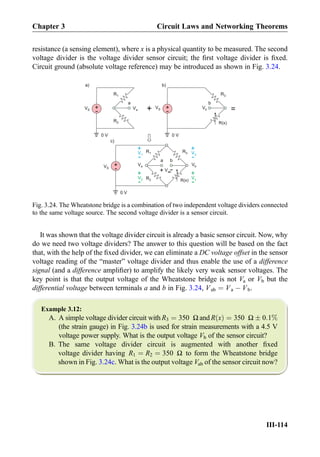
3.1.2 Kirchhoff’s Current Law
Let us begin our investigation with KCL. KCL specifically applies to the nodes in an
electric network. The Kirchhoff’s current law simply states that the net current entering
the node is zero. In other words, the sum of inflowing currents is equal to the sum of
outflowing currents. This statement is also known as the current conservation law, which
Chapter 3 Section 3.1: Circuit Laws: Networking Theorems
III-93
is the electrical counterpart of the mass conservation law in fluid mechanics. For
N currents entering a node, KCL can be cast in the form
XN
i¼1
Ii ¼ 0 ð3:3Þ
where N denotes the total number of nodal currents. The current directions may be
assigned arbitrarily; the same results will eventually be obtained. The nodal current is
taken with a plus sign if it is entering the node, i.e., the current arrow is directed toward
the node. It carries a minus sign if it is leaving the node, i.e., the current arrow points in
the opposite direction. The current value itself (positive or negative) is substituted
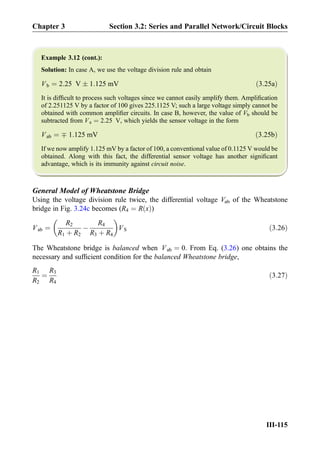
afterward. If this law did not hold, an uncompensated charge could accumulate in a
node over time. This uncompensated charge and its associated Coulomb force would
eventually destroy the operation of an underlying electric circuit. To illustrate the use of
KCL, we consider Fig. 3.2 with four different node types for a collection of branches A,
B, C, and D which could be arbitrary circuit elements.
While the node in Fig. 3.2a is simple, more complicated node configurations may
be observed in a circuit—see the following figures. You should note that, in a node, we
may move individual joints to one common joint without affecting the circuit operation.
A node transformation to a single joint is a convenient tool used when working with more
complicated nodes.
A B
C
node
I =4 AB
I =1 AC
A
I =3 AA
B
C
node I =5 AB
I =1 AC
D I =-1 AD
a)
I =3 AA
I =3 AA
A B
C
D
node
I =3 AB
I =1 AC I =5 AD
C
A
5 A
iC
B
E
2 A
iE
node
b)
c) d)
Fig. 3.2. Different types of the nodes in an electric network subject to KCL.
Chapter 3 Circuit Laws and Networking Theorems
III-94
Exercise 3.2: Write KLC for the nodes shown in Fig. 3.2.
Answer: In the case of Fig. 3.2a, IA þ IC ¼ IB for any values of IA, IB, IC. In the case of
Fig. 3.2b, IA þ IC ¼ IB þ ID for any values of IA, IB, IC, ID. In the case of Fig. 3.2c, IA
þIB ¼ IC þ ID for any values of IA, IB, IC. In the case of Fig. 3.2d, 2A þ IC ¼ 5A þ IE for
any values of IC, IE.
Example 3.1: In some cases, the use of KCL may be sufficient to determine all currents in
an electric network. Solve for the unknown currents IA, IC, ID in the network shown in
Fig. 3.3.
Solution: First, we note that the wire connection on the left states that the current along the
wire is preserved. This implies IA ¼ À1 A. KCL for node 1 gives
1A þ IC ¼ 5 A ) IC ¼ 4 A ð3:4aÞ
Next, KCL applied to node 2 yields
5 A ¼ ID þ 2A ) ID ¼ 3 A ð3:4bÞ
Thus, the circuit is solved. Node 3 has not been used; it can be employed to check the
correction of the solution: IA þ ID þ 2A ¼ IC or 4 A ¼ 4 A.
3.1.3 Kirchhoff’s Voltage Law
KVL specifically applies to the loops in an electric network. Kirchhoff’s voltage law
states that the sum of voltages for any closed loop is zero. In other words, the total amount
of work needed to move a unit electric charge one loop turn is zero.2
If this law were not
C
B
A E
5 A node2
node3
IA
1 A
IC
D
ID
node1
2 A
Fig. 3.3. Solving in a network using KCL.
2
The physical counterpart of KVL is Faraday’s law of induction in the static case. When there is a variable magnetic field
penetrating a wire loop, KVL is no longer valid.
Chapter 3 Section 3.1: Circuit Laws: Networking Theorems
III-95
applicable, a charge moving in a closed loop would constantly accelerate and eventually
escape the circuit or constantly decelerate and eventually stop moving. In order to
formulate KVL for a closed loop, we need to identify the loop direction. It is usually
chosen to be clockwise, see the dotted arrows in Figs. 3.4 and 3.5. KVL in its general
form reads
XN
i¼1
Vi ¼ 0 ð3:5Þ
where N is the total number of circuit elements in a loop. The voltage Vi is taken with a
plus sign if the loop arrow is entering the positive voltage polarity and with a minus sign
otherwise. The polarities of voltages Vi may be assigned arbitrarily; the same result will
eventually be obtained. To demonstrate this fact, we consider a simpler network with
different voltage polarities in Fig. 3.4 first. One network branch is purposely designated
as a voltage source, the rest are arbitrary circuit elements.
Example 3.2: Write KVL for the circuit shown in Fig. 3.4 which includes an ideal voltage
source and three other circuit elements.
Solution: In the case of Fig. 3.4a, we start with the source and strictly apply our convention
of positive and negative polarity based on the prescribed loop arrow direction:
À5V þ VA þ VB À VC ¼ 0 ð3:6aÞ
In the case of Fig. 3.4b, we have to change signs of VA, VB, VC, and thus obtain
À5V À VA À VB þ VC ¼ 0 ð3:6bÞ
Note that these two cases only differ by voltage polarities.
Since reversing voltage polarities in Fig. 3.4b was taken into account by changing the sign
of the voltage, both figures yield the identical result after substituting numbers:
B
A
C
+
-
5 V=VS
V =+3 VA
+
-
V =+1 VC
+
-
+
-
V =+3 VB B
A
C
+
-
5 V=VS
V =-3 VA
+
-
+
-
V =-3 VB
V =-1 VC
+
-
a) b)
Fig. 3.4. KVL applied to a closed loop with one voltage source and three passive circuit elements.
The dotted arrow indicates current flow in clockwise direction.
Chapter 3 Circuit Laws and Networking Theorems
III-96
Example 3.2 (cont.):
À5 V þ 3 V þ 3 V À 1 V ¼ 0 ð3:6cÞ
This observation highlights the fact that the voltage polarities for circuit elements may
initially be assigned arbitrarily: applying KVL will ultimately lead to the correct signs of
the voltage values.
Figure 3.5 shows another electric network with all branches now consistently labeled;
the voltages in red denote the actual values with respect to the initially assigned directions.
Exercise 3.3: Determine the number of branches, nodes, loops, and meshes in the network
in Fig. 3.5.
Answer: There are five branches, four nodes, three loops, and two meshes.
Example 3.3: In some cases, the use of KVL may be sufficient to determine all voltages in
an electric network. Solve for the unknown voltages in the network shown in Fig. 3.5.
Solution: KVL for loop 1 (mesh 1) has the form
À5V À 7V þ VC ¼ 0 ) VC ¼ 12V ð3:6dÞ
KVL for loop 2 (mesh 2) has the form (VC is already known)
À12V þ 6V þ VE ¼ 0 ) VE ¼ 6V ð3:6eÞ
KVL for loop 3 is the solution check:
À5 V À 7 V þ 6 V þ 6 V ¼ 0 ð3:6fÞ
C
B
V =-7 VB
+
-
+
-
VC E
D
V =+6 VD
+
-
VEA
+
-
V =+5 VA
loop 1 loop 2
loop 3
+
-(mesh 1) (mesh 2)
Fig. 3.5. KVL applied to a network with three loops, two meshes, and five circuit elements.
Chapter 3 Section 3.1: Circuit Laws: Networking Theorems
III-97
Example 3.3 (cont.):
If at least one of the voltages VA, VB, VD in Fig. 3.5 is unknown, then a unique solution does
not exist. Through the use of KCL, more information must be acquired.
3.1.4 Power-Related Networking Theorems
The results of this section would be incomplete without an introductory discussion of two
power-related networking theorems. The first one is Maxwell’s minimum heat theorem
formulated by James Clerk Maxwell in 1891. It states that, for a linear electric network of
resistive circuit elements and voltage/current sources, the currents distribute themselves in
such a way that the total dissipated power (generated heat) in the resistances is a minimum. If
there are NR resistive circuit elements, we can state
XNR
i¼1
ViIi ¼
XNR
i¼1
RiI2
i ¼
XNR
i¼1
V2
i
Ri
¼ min ð3:7aÞ
where voltages Vi and currents Ii must all satisfy the passive reference configuration.
Indeed, Eq. (3.7a) is equivalent to the condition that the net power generated by all
sources is also minimized. Maxwell’s minimum heat theorem can be proved using KCL,
KVL, and Ohm’s law. The second theorem is Tellegen’s theorem formulated by Bernard
D. H. Tellegen in 1952. It postulates that, for an arbitrary electric network with total
N circuit elements of arbitrary (linear or nonlinear, passive or active) nature, the equality
XN
i¼1
ViIi ¼0 ð3:7bÞ
must hold if all voltages Vi and currents Ii satisfy one (let’s say the passive) reference
configuration. Tellegen’s theorem serves as a power (or energy) conservation law for all
electric networks. It can be proved based on KCL and KVL only. Tellegen’s theorem has
other important implications and generalizations. To illustrate both theorems, we consider
two simple examples.
Example 3.4: Use Maxwell’s minimum heat theorem and determine the unknown current
x through resistance R1 in Fig. 3.6a.
Solution: Eq. (3.7a) yields
R1x2
þ R2 x À ISð Þ2
¼ min ð3:8aÞ
This function is minimized when its derivative with respect to x is zero. Therefore,
Chapter 3 Circuit Laws and Networking Theorems
III-98
Example 3.4 (cont.):
x ¼
R2
R1 þ R2
IS ð3:8bÞ
which is the current division principle studied in the next section. The voltage division
principle may be established similarly.
Example 3.5: Prove Tellegen’s theorem for the network shown in Fig. 3.6b.
Solution: Both elements follow the passive reference configuration. By KCL we conclude
IB ¼ ÀIA. By KVL, VB ¼ VA. Therefore, VAIA þ VBIB ¼ 0, which is the simple proof.
In practice, element A may be a voltage source, and element B may be a resistance. We can
also use the active reference configuration for the source but need to define its power to be
negative in such a case.
3.1.5 Port of a Network: Network Equivalence
So far we have studied only the closed electric networks. An electric network may have a
port, through which it is interconnected to another network as shown in Fig. 3.7. The
network may be active or passive. This network has two (input or output) terminals a and
b, which form a single port. The network in Fig. 3.7 is a one-port network. All series/
parallel combinations of the sources and resistances are one-port networks.
Two arbitrary one-port networks in the form of Fig. 3.7 are said to be equivalent
networks (or equivalent electric circuits) when their υ-i characteristics at terminals a and b
coincide. This means that for any given voltage, there is the same current into the network
or out of it and vice versa. Therefore, these networks are non-distinguishable.
B
+
-
VB
IBIAIS R1 R2
I -xSx
a) b)
A
+
-
VA
Fig. 3.6. Examples for Maxwell’s minimum heat theorem and Tellegen’s theorem.
a
b
I
V
+
-
I
arbitrary electric
network
Fig. 3.7. Generic system for establishing a network equivalence.
Chapter 3 Section 3.1: Circuit Laws: Networking Theorems
III-99
Section 3.2 Series and Parallel Network/Circuit Blocks
3.2.1 Sources in Series and in Parallel
Series-Connected Battery Bank
The simultaneous use of KCL and KVL allows us to analyze the behavior
of combinations of active circuit elements and establish their equivalence. The physical
counterparts are various battery banks, which are interconnections of the identical
batteries. Figure 3.8 shows a series battery bank, also called a battery pack, with two
or more batteries connected in series. The battery symbol implies an ideal voltage source.
We intend to find the resulting voltage and current of this combination. To determine
the equivalent voltage, we close the circuit loop shown in Fig. 3.8a by introducing a
virtual circuit element with terminals a and b, with an unknown voltage V between these
terminals. This element simulates the rest of the circuit, which closes the current path.
KVL for the loop shown in Fig. 3.8a results in
ÀV þ 9 V þ 9 V ¼ 0 ) V ¼ 18 V ð3:9Þ
Using KCL, we obtain the same current flows throughout the left-handed circuit of
Fig. 3.8a; this current is exactly equal to IB.
3
Therefore, the series combination of two
batteries in Fig. 3.8a is equivalent to one battery bank that provides double the voltage, or
18 V, compared to the unit cell. However, it delivers a current of a single cell. The same
+
-9 V
+
-
V
+
-9 V
IB
IB
IB
IB
a
b
+
-18 V IB
a
b
1.5 V
+
-
V
a
b
+
-6 V IB
a
b
1.5 V
1.5 V
1.5 V
a)
b)
IB
IB
Fig. 3.8. Series combinations of battery cells and their equivalent representations.
3
If the realistic battery cells are capable of delivering different currents when short circuited, then the lowest cell current
will flow under short circuit condition.
Chapter 3 Circuit Laws and Networking Theorems
III-100
method can now be applied to multiple battery cells connected in series; one such battery
bank is shown in Fig. 3.8b.
Dual-Polarity Voltage Power Supply
Two batteries, or other voltage sources, connected in series can be used as a dual-polarity
power supply as shown in Fig. 3.9. The middle terminal gives us the virtual ground for
the circuit or the common ground. Both negative and positive voltages with respect to the
common port can now be created in the circuit. Such a source is of particularly impor-
tance for operational amplifier circuits and for transistor circuits. Every multichannel
laboratory power supply may operate as a dual power supply. The common terminal may
(but does not have to) additionally be connected to the earth ground.
Parallel-Connected Battery Bank
As an alternative to the series-connected battery bank, we also investigate the parallel
battery bank shown in Fig. 3.10. To determine the equivalent voltage of the combination,
we again close the circuit loop by introducing a virtual circuit element with terminals
a and b and with an unknown voltage V between these terminals. The use of KVL gives
V ¼ 9 V ð3:10Þ
Thus, the voltage of the battery bank in Fig. 3.10 is still equal to the unit cell voltage.
However, applying KCL to both nodes shown in black in Fig. 3.10 indicates that the current
doubles. Therefore, the parallel combination of two batteries is equivalent to one battery
bank that provides the same voltage of 9 Vas one unit cell but at twice the current strength.
+
-9 V
+
-9 V
IB
IB
+
-
common
=
Fig. 3.9. A dual-polarity power supply constructed with two battery cells.
+
-9 V
2IB
a
b
+
-9 V 2IB
a
b
+
-9 V
+
-
V
IB IB
2IB
Fig. 3.10. A parallel combination of battery cells and its equivalent single battery representation.
Chapter 3 Section 3.2: Series and Parallel Network/Circuit Blocks
III-101
Series Versus Parallel Connection
What is the difference between series and parallel combinations of two 9-V batteries?
First, let us find the power delivered to the circuit. We assume IB ¼ 1 A in both cases,
even though the specific value of the current is not really important. For the series
combination in Fig. 3.8a, the delivered power is 18 V Â 1 A ¼ 18 W. For the parallel
combination in Fig. 3.10, the delivered power is again 9 V Â 2 A ¼ 18 W. Thus, as far as
the power rating is concerned, there is no difference. You should, however, remember that
we always deliver power to a load. For the series combination, the implied load resistance
is 18 V/1 A ¼ 18 Ω. For the parallel combination, the anticipated load resistance should
be 9 V/2 A ¼ 4.5 Ω. Thus, it is the load resistance that determines which combination
should be used. This question is of great practical importance.
Combinations of Current Sources
Combinations of current sources are studied similarly. They are important for photovol-
taic and thermoelectric semiconductor devices.
3.2.2 Resistances in Series and in Parallel
Series Connection
After the sources have been analyzed, we turn our attention to series and parallel
combinations of resistances (or conductances). Their physical counterparts are various
circuit loads, for example, individual households connected to the same power grid or
individual motors driven by the same source. Figure 3.11 depicts the series combination
of two resistances R1 and R2.
Note that the current direction for both resistances corresponds to a passive reference
configuration: current flows “down the voltage hill.” Again, we close the circuit loop by
introducing a virtual circuit element with terminals a and b and with an unknown voltage
V between those terminals. This virtual circuit element, which simulates the rest of the
circuit, allows us to close the current path. KVL for the loop shown in Fig. 3.11 results in
V ¼ V1 þ V2 ¼ IR1 þ IR2 ¼ I R1 þ R2ð Þ ¼ IReq ) Req ¼ R1 þ R2 ð3:11aÞ
-
V
+
R1
R2
+
-
V1
V2
+
-
a
b
I
I
Req=R1+R2
+
-
V
I
I
Fig. 3.11. Two resistances in series and their equivalent single resistance representation.
Chapter 3 Circuit Laws and Networking Theorems
III-102
Thus, two resistances can be replaced by one equivalent resistance, which is the sum of
the individual resistances. It follows from Eq. (3.11a) that the equivalent resistance gives
us the same circuit current (and the same power into the load) as the original resistance
combination does, for any applied voltage. This is the formal description of the equivalent
resistance to be generalized later. Equation (3.11a) can easily be extended to any arbitrary
number of resistances connected in series. Equation (3.11a) may also be formulated in
terms of conductances, the reciprocals of resistances,
1
Geq
¼
1
G1
þ
1
G2
ð3:11bÞ
Parallel Connection
Next, we consider the parallel combination of resistances shown in Fig. 3.12. KVL for the
loop shown in the figure and for another loop between two resistances indicates that the
voltages across every resistance are equal to V. KCL applied to either node shown in black
results in
I ¼ I1 þ I2 ¼
V
R1
þ
V
R2
¼
V
Req
)
1
Req
¼
1
R1
þ
1
R2
) Geq ¼ G1 þ G2 ð3:12Þ
Therefore, the parallel combination of two resistances is equivalent to one resistance,
which has a value equal to the reciprocal of the sum of the reciprocal values of both. The
equivalent resistance again gives us the same circuit current as the original resistance
combination does, for any applied voltage. Emphasize that the equivalent resistance is
always smaller in value than each of the resistances to be combined in parallel. Note that
the conductances simply add up for the parallel combinations. Equation (3.12) can again
easily be extended to any arbitrary number of resistances connected in parallel.
Meaning of Equivalent Circuit Element
In summary, the study of series/parallel active and passive circuit elements leads us to the
following simple definition of an equivalent circuit element, either passive or active.
The equivalent circuit element possesses the same υ-i characteristic as the υ-i
+
-
V R =R R /(R +R )eq 1 2 1 2
+
-
V
I
I
R2
+
-
V R1
+
-
V
I
I
I1 I2
Fig. 3.12. Two resistances connected in parallel and the equivalent resistance.
Chapter 3 Section 3.2: Series and Parallel Network/Circuit Blocks
III-103
characteristic of the original circuit, for which voltage and current are acquired at its
terminals a and b.
3.2.3 Reduction of Resistive Networks
The reduction of a network of many resistances to a single equivalent resistance is a topic
of practical importance. There are many examples of distributed resistive networks.
A contemporary example is a rear window defroster in an automobile, which is a
distributed resistive heater. The corresponding solution is usually based on
1. Step-by-step use of series/parallel equivalents
2. Moving, splitting, or reducing modes
3. Reliance on fluid mechanics analogies, which may be helpful for resistive networks
Although a unique solution always exists, its practical realization may be quite difficult.
The following examples outline the procedure for the reduction of resistive networks.
Example 3.6: Find the equivalent resistance between terminals a and b for the resistive
network shown in Fig. 3.13a.
Solution: We should not start with terminals a and b, but with the opposite side of the
circuit. First, the three resistances furthest to the right are combined in series in Fig. 3.13a.
The next step is the parallel combination of the resulting resistance and the 1.5 kΩ resistance
in Fig. 3.13b. The final step is another series combination; this results in the final equivalent
resistance value of 1875 Ω. We need to point out again that it is impossible to:
1. Combine in series two resistances separated by a node.
2. Move the resistance through a node or move the node through a resistance.
Those observations hold for other than resistance circuit elements.
500
400
10
1500
a
b 901 k
series
500
5001500
a
b 1 k
parallel 500
375
a
b 1 k
series
a)
b) c)
Fig. 3.13. Step-by-step circuit reduction via series and parallel resistance combinations.
Chapter 3 Circuit Laws and Networking Theorems
III-104
Example 3.7: Find the equivalent resistance between terminals a and b for the resistive
network shown in Fig. 3.14a.
Solution: First, we can split and move a node along the wire, leading to a circuit shown in
Fig. 3.14b. Next, we combine two pairs of resistances in parallel. The next step, in
Fig. 3.14c, is the series combination of three resistances. The last step is the solution of
a parallel circuit, leading to the equivalent resistance of 66.67 Ω.
Exercise 3.4: Using a fluid-mechanics analogy of identical water flow in two symmetric
channels, find the equivalent resistance of the network shown in Fig. 3.15.
Answer: 2.5 kΩ.
3.2.4 Voltage Divider Circuit
The purpose of the voltage divider circuit is to provide a voltage different from the supply
voltage. The voltage divider circuit is associated with resistances in series. It is perhaps the
50 W
150 W
150 W
300 W
300 W
150 W
150 W
50 W
50 W 50 W50 W 50 W
300 W
300 W
a
a
b
b
parallel parallel
a
100 W
100 W
b
series
a)
b) c)
Fig. 3.14. Step-by-step circuit reduction to a single equivalent resistance.
2 kW
R
2 kW
3 kW3 kW
a
b
Fig. 3.15. The resistive network discussed in Exercise 3.4.
Chapter 3 Section 3.2: Series and Parallel Network/Circuit Blocks
III-105
most important basic electric circuit or a block of another circuit. The voltage division
principle is used in sensor circuits, actuator circuits, and bias circuits. Furthermore, any
input and output port of a (transistor) amplifier is essentially a voltage divider. We consider
a particular voltage divider form, shown in Fig. 3.16, connected to a DC voltage supply.
This circuit, as with any other electric circuit, can be analyzed by using KCL and KVL
simultaneously. We prefer using this method, although the combination of two resistances
in series will provide an equivalent solution.
KCL states that the current I through both resistance and the voltage supply is the
same. Applying KVL to the circuit loop allows us to find the circuit current
ÀVS þ V1 þ V2 ¼ 0 ) VS ¼ V1 þ V2 ¼ I R1 þ R2ð Þ ) I ¼
VS
R1 þ R2
ð3:13Þ
Once the circuit current I is known, then Ohm’s laws can be used. This yields the voltage
division rule
V1 ¼
R1
R1 þ R2
VS, V2 ¼
R2
R1 þ R2
VS ð3:14Þ
Equation (3.14) says that the major function of the voltage divider is to divide the voltage
of the power source between two resistances in a direct proportion so that:
1. The larger resistance always acquires a higher voltage, and the smaller resistance
acquires a smaller voltage.
2. The individual voltages always add up to the supply voltage, i.e., V1 þ V2 ¼ VS.
Exercise 3.5: A voltage divider circuit uses a 10 V DC source and two resistances: R1
¼ 5 Ω and R2 ¼ 100 Ω. What are the voltages V1, V2 across the resistances?
Answer: V1 ¼ 0:48 V, V2 ¼ 9:52 V, V1 þ V2 ¼ 10 V.
R1
R2
+
-
V1
V
+
-
V2
I
I
+
-VS
Fig. 3.16. A conventional voltage divider consists of two resistances and an ideal voltage source.
Chapter 3 Circuit Laws and Networking Theorems
III-106
The voltage divider with multiple resistances R1, R2, . . ., RN is solved in the form
VS ¼ V1 þ V2 þ . . . þ VN ) I ¼
VS
R1 þ R2 þ . . . þ RN
and Vi ¼
Ri
R1 þ R2 þ . . . þ RN
VS
ð3:15Þ
3.2.5 Application Example: Voltage Divider as a Sensor Circuit
Consider a resistive sensing element (thermistor, strain gauge, photoresistor, etc.) denoted
by R2(x) in Fig. 3.17. The element changes its resistance R2(x) when an external
parameter x changes. Parameter x could be temperature, pressure, humidity, solar radia-
tion, or any other physical parameter that undergoes process changes. A simple sensor
configuration is a direct connection to a voltage source and to the DMM for voltage
measurements; see Fig. 3.17a. No matter how the sensor resistance changes, the sensor
will always output the source voltage. A solution to the third problem is a voltage divider
circuit shown in Fig. 3.17b. The extra resistance R1 is fixed. According to Eq. (3.14),
voltage V2 in Fig. 3.17b varies depending on the influence of R2(x);
V2 ¼ V2 xð Þ ¼
R2 xð Þ
R1 þ R2 xð Þ
VS ð3:16Þ
The variable voltage V2(x) is measured by the voltmeter. The dependence of V2 on R2 is
clearly nonlinear in Eq. (3.16). Although Eq. (3.16) can be linearized by choosing a
sufficiently large R1 to make the denominator nearly constant, we will show later that
such an operation greatly decreases device sensitivity. Let us assume that the external
parameter x in Eq. (3.16) changes from a lower limit x1 to an upper limit x2, i.e.,
x1 x x2. As a result, the sensing resistance changes monotonically, but not necessar-
ily linearly, from R0
¼ R2 x1ð Þ to R00
¼ R2 x2ð Þ. We also assume that if x1 x x2 then
R0
 R00
. The sensor circuit’s sensitivity, S, is given by
+
-
+
-
R2
+
-
V2=VS
+
- V
+
-
VS
VS +
-S
R1 V1
V2
R2
a) b)
V
+
-
Fig. 3.17. (a) Incorrect sensor circuit. (b) A sensor circuit on the basis of a resistive voltage divider
where R2(x) changes its resistance depending on the process parameter x.
Chapter 3 Section 3.2: Series and Parallel Network/Circuit Blocks
III-107
S ¼
V2 x1ð Þ À V2 x2ð Þ
x2 À x1
V
units of x
!
ð3:17Þ
The sensitivity is expressed in terms of voltage variation per one unit of x. A higher
sensitivity implies a larger voltage variation and thus provides a better sensor resolution
and improved robustness against noise.
Design of the Sensor Circuit for Maximum Sensitivity
Let us pose the following question: what value should the fixed resistance R1 assume in
order to achieve the highest sensitivity of the voltage divider sensor? It is clear that R1
cannot be very small (otherwise the voltage reading will always be VS and the sensitivity
will be zero) and that R1 cannot be very large (otherwise the voltage reading will be
always 0 Vand the sensitivity will be zero). The sensitivity is thus a positive function that
is zero at R1 ¼ 0 and at R1 ¼ 1. According to the extreme value theorem, a global
maximum should exist between these two values. We denote the unknown resistance R1
with variable t, substitute V2 from Eq. (3.14), and rewrite Eq. (3.17) in the form
S ¼
VS
x2 À x1
R0
t þ R0
À
R00
t þ R00
 
ð3:18aÞ
It is convenient to transform this result into a simpler expression S ¼ VSS0f tð Þ, where a
constant S0 is called the intrinsic sensitivity of the resistive sensing element, and f(t) is the
sole function of the first resistance, i.e.,
S0 ¼
R0
À R00
x2 À x1
!
, f tð Þ ¼
t
R0 þ tð Þ R00
þ tð Þ
ð3:18bÞ
This function f(t) is to be maximized. At the function’s maximum, the derivative of f(t)
versus t should be zero. Using the quotient rule for the differentiation of a fraction, it
follows from Eq. (3.18b) that
f 0
tð Þ ¼
R0
R00
À t2
R0 þ tð Þ2
R00
þ tð Þ
2
ð3:18cÞ
The final result following from the condition f 0
tð Þ ¼ 0 is surprisingly simple
t ¼ R1 ¼
ffiffiffiffiffiffiffiffiffi
R0R00
p
ð3:18dÞ
In other words, the fixed resistance of the voltage divider circuit should be equal to the
geometric mean of two extreme resistances of the sensing element itself.
Chapter 3 Circuit Laws and Networking Theorems
III-108
Example 3.8: For the NTC-503 thermistor sensing element, x1 ¼ 25
C (room tempera-
ture), x2 ¼ 37
C (approximate temperature of a human body), R0
¼ 50 kΩ, and
R00
¼ 30 kΩ. What is the sensitivity of the voltage divider sensor if VS ¼ 9 V and (A)
R1 ¼ 5 kΩ, (B) R1 ¼ 500 kΩ, and (C) R1 ¼
ffiffiffiffiffiffiffiffiffiffiffiffiffiffi
30 Á 50
p
% 39 kΩ?
Solution: We substitute the numbers in Eq. (3.18) and find the sensitivity.
The corresponding sensitivity plot as a function of R1 is given in Fig. 3.18a. The particular
sensitivity values are:
(A) S ¼ 39 mV/
C, (B) S ¼ 26 mV/
C, and (C) S ¼ 95 mV/
C.
Example 3.9: For the SGT-1/350-TY11 strain gauge, the nominal resistance is 350 Ω. The
resistance variation of Æ0.1 % for the tensile strain ε is observed; the intrinsic device
sensitivity is S0 ¼ 700 Ω=ε. What is the sensitivity of the voltage divider sensor if VS
¼ 4:5 V and (A) R1 ¼ 50 Ω, (B) R1 ¼ 5 kΩ, and (C) R1 ¼ 350 Ω ? For positive
sensitivity numbers, interchange x1,2 in Eq. (3.18).
Solution: In this example, R0
¼ 350:35 Ω and R00
¼ 349:65 Ω. We use Eq. (3.18b) and
plot the sensitivity as a function of R1 is in Fig. 3.18b. The particular values are (με are the
micro-strain units):
(A) S ¼ 0:24 mV/1000με, (B) S ¼ 0:55 mV/1000με, and (C) S ¼ 2:25 mV/1000με.
3.2.6 Application Example: Voltage Divider as an Actuator Circuit
The circuit shown in Fig. 3.19 contains a voltage divider circuit block with one resistive
sensing element; it is resistance R1 in the present case. The block is connected to a
three-terminal electronic switch (a transistor). A variable voltage V controlling the switch
R , k10 100
0
0.02
0.04
0.06
0.08
0.1
S, V/grad
R’R’’
200 300
thermisor sensor sensivity curve
0 1000 2000 3000
0
0.4
0.8
1.2
1.6
2
2.4
x 10
-3
S, V/1000
R ,1
strain gage sensor sensivity curve
R R’~ ’’
a) b)
Fig. 3.18. Sensitivity curves for the divider sensor circuits with a thermistor and a strain gauge.
Chapter 3 Section 3.2: Series and Parallel Network/Circuit Blocks
III-109
operation is created by the voltage divider. When the control voltage V reaches a certain
switch threshold voltage VTh or exceeds it, the switch closes. A DC motor is now
connected to the source; it starts to spin. The switches of this type involve field-effect
transistors. We emphasize that there is no current into the control switch terminal, only
the control voltage counts. If R1 is a thermistor and the DC motor is a fan motor, the entire
circuit may operate as a basic temperature controller in an enclosure or in a room. The
control voltage versus circuit ground, the reference point, is given by (cf. Eq. (3.16))
V xð Þ  V2 xð Þ ¼
R2
R1 xð Þ þ R2
VS ð3:19Þ
where variable x corresponds to the ambient temperature.
Example 3.10: The circuit in Fig. 3.19 uses the NTC-503 thermistor sensing element with
R1 ¼ 50 kΩ at 25 
C (room temperature), and R1 ¼ 30 kΩ at 37 
C. The fixed resistance
is R2 ¼ 12 kΩ. The threshold voltage of the switch is VTh ¼ 2 V. The supply voltage is
9 V. Determine circuit behavior at 25 
C and at 37 
C, respectively.
Solution: According to Eq. (3.19), the control voltage at 25 
C is equal to 1.74 V. This
value is below the threshold voltage. The switch is open; the motor is not connected to the
source. However, the control voltage at 37 
C is 2.57 V. This value is above the threshold
voltage. The switch is closed; the motor is connected to the source and is spinning.
Figure 3.20 shows the corresponding laboratory setup. Note that in reality the threshold
voltage of the transistor switch is not quite constant; it depends on the motor current.
Open when VVTh
Closed when VVTh
DC Motor
+
-
+
-
R1
R2
V1
V2
+
-
VS
+
- V
0 V
Fig. 3.19. An actuator circuit based on the voltage divider principle.
Chapter 3 Circuit Laws and Networking Theorems
III-110
3.2.7 Current Limiter
The current limiter (or simply the current-limiting resistor) is a particular case of the
voltage divider circuit with significant practical importance. Its concept is shown in
Fig. 3.21. A load resistance RL is connected to the ideal voltage source in series with
another (smaller) resistance R, the physical counterpart of which is the current-limiting
resistor.
If the load resistance is fixed at a rather high value, the circuit in Fig. 3.21 does not pose
any problem, and the current-limiting resistance of 10 Ω becomes redundant. For example,
in Fig. 3.21 the circuit current is 100 mA in the absence of the first resistance R. The power
delivered to the load resistance is P ¼ RLI2
¼ 1 W. However, the load resistance may be
variable, and it may attain really small values. When this happens, the circuit current
increases. In Fig. 3.21, it becomes equal to 10 A when the load resistance decreases to
1 Ω and the current-limiting resistor is missing. The power delivered to the load resistance
also increases:P ¼ 10 W. This large power may overheat and eventually destroy the small-
scale load (a thermistor is one example). The role of resistance R is to limit the total circuit
current when the load resistance is either variable or constant but small. For example, in the
circuit from Fig. 3.21, the maximum possible circuit current is
DC motor
IRL520 power
MOSFET
thermistor
fixed resistor
a) b)
voltage
divider
Fig. 3.20. Laboratory realization of the circuit shown in Fig. 3.19.
RL=100+
-10 V=VS
R=10 I
Fig. 3.21. Voltage divider circuit in the current-limiting configuration. The 10-Ω resistance is used
to limit the circuit current.
Chapter 3 Section 3.2: Series and Parallel Network/Circuit Blocks
III-111
I ¼
VS
R þ RL

VS
R
¼ 1A ð3:20Þ
irrespective of the value of the load resistance. Therefore, the power delivered to a
1 Ω-load becomes always less than 1 W instead of the initial value of 10 W.
3.2.8 Current Divider Circuit
The current divider circuit shown in Fig. 3.22 is associated with resistances in parallel. It
is dual to the voltage divider circuit in the sense that the roles of voltage and current are
interchanged. Figure 3.22 shows the concept.
To solve the circuit, we again prefer to use KCL and KVL simultaneously. KCL gives
IS ¼ I1 þ I2 ð3:21Þ
Based on KVL for both loop 1 and loop 2, the voltage across the current source (voltage
between its terminals a and b) is equal to the voltage across either resistor and is equal to
V. Application of Ohm’s law gives the expression for this voltage,
IS ¼
V
R1
þ
V
R2
) V ¼
IS
1
R1
þ 1
R2
¼
R1R2
R1 þ R2
IS ð3:22Þ
Therefore, we obtain the current division rule in the form:
I1 ¼
V
R1
¼
R2
R1 þ R2
IS, I2 ¼
V
R2
¼
R1
R1 þ R2
IS ð3:23Þ
Equation (3.23) teaches us that the major function of the current divider is to divide the
current of the power source between two resistances in an inverse proportion so that:
1. The larger resistance always acquires a smaller current, and the smaller resistance
acquires a larger current.
2. The individual currents add up to the source current, i.e., I1 þ I2 ¼ IS.
a
b
I2I1
R1 R2loop1 loop2
+
-
V
+
-
V
+
-
V
IS
IS
Fig. 3.22. A current divider circuit with an ideal current source.
Chapter 3 Circuit Laws and Networking Theorems
III-112
In other words, the electric current always chooses a path of least resistance. If one
resistance is replaced by a wire, the entire source current will flow through the wire; the
second resistance will be shorted out by the wire.
Exercise 3.6: A current divider uses a 3-mA current source and two resistances: R1 ¼ 200
Ω and R2 ¼ 600 Ω. What are the currents I1, I2 through the resistances?
Answer: I1 ¼ 2:25 mA, I2 ¼ 0:75 mA. The smaller resistance acquires the larger
current.
Example 3.11: The current divider circuit can be assembled with a voltage source as
shown in Fig. 3.23. Find currents I1, I2 and the total circuit current I.
Solution: The circuit in Fig. 3.23 can be analyzed in a number of ways. Perhaps the
simplest way is to recognize that, according to KVL, the voltages across all three elements
in Fig. 3.23 are equal to each other and equal to 10 V. Therefore,
I1 ¼
10V
R1
, I2 ¼
10V
R2
, I ¼ I1 þ I2 ¼
10V
Req
, Req ¼
R1R2
R1 þ R2
ð3:24Þ
Another way to solve the same circuit is to combine resistances in parallel, find the circuit
current I, and then apply the current division principle.
3.2.9 Wheatstone Bridge
The Wheatstone bridge was invented by the British scientist and mathematician, Samuel
Christie (1784–1865) and first used for resistance measurements by Sir Charles Wheat-
stone in 1843. It is shown in Fig. 3.24. From Fig. 3.24, we can recognize that the
Wheatstone bridge is, in fact, a combination of two independent voltage divider blocks:
one with two fixed resistances R1, R2 and another with one fixed resistance R3 and some
other resistance R4 denoted here by R4 ¼ R xð Þ. When the resistance measurements are
implied, R4 is the fixed unknown resistance. However, common modern applications use
the Wheatstone bridge as a part of the sensor circuit. In this case, R(x) is a variable
10 V
I
I2I1
R1 R2+
-
Fig. 3.23. A current divider circuit with the voltage source.
Chapter 3 Section 3.2: Series and Parallel Network/Circuit Blocks
III-113
resistance (a sensing element), where x is a physical quantity to be measured. The second
voltage divider is the voltage divider sensor circuit; the first voltage divider is fixed.
Circuit ground (absolute voltage reference) may be introduced as shown in Fig. 3.24.
It was shown that the voltage divider circuit is already a basic sensor circuit. Now, why
do we need two voltage dividers? The answer to this question will be based on the fact
that, with the help of the fixed divider, we can eliminate a DC voltage offset in the sensor
voltage reading of the “master” voltage divider and thus enable the use of a difference
signal (and a difference amplifier) to amplify the likely very weak sensor voltages. The
key point is that the output voltage of the Wheatstone bridge is not Va or Vb but the
differential voltage between terminals a and b in Fig. 3.24, Vab ¼ Va À Vb.
Example 3.12:
A. A simple voltage divider circuit with R3 ¼ 350 Ω and R xð Þ ¼ 350 Ω Æ 0:1%
(the strain gauge) in Fig. 3.24b is used for strain measurements with a 4.5 V
voltage power supply. What is the output voltage Vb of the sensor circuit?
B. The same voltage divider circuit is augmented with another fixed
voltage divider having R1 ¼ R2 ¼ 350 Ω to form the Wheatstone bridge
shown in Fig. 3.24c. What is the output voltage Vab of the sensor circuit now?
R1
R(x)
+
-VS
a b
R3
R2
R(x)
+
-
VS
R3R1
+
-
VS
R2
+
+
-V1
+
-V3
+
-V2
+
-Vx
=
0 V
+
-
Vab
Va Vb
a) b)
c)
0 V 0 V
a b
Va
Vb
Fig. 3.24. The Wheatstone bridge is a combination of two independent voltage dividers connected
to the same voltage source. The second voltage divider is a sensor circuit.
Chapter 3 Circuit Laws and Networking Theorems
III-114
Example 3.12 (cont.):
Solution: In case A, we use the voltage division rule and obtain
Vb ¼ 2:25 V Æ 1:125 mV ð3:25aÞ
It is difficult to process such voltages since we cannot easily amplify them. Amplification
of 2.251125 V by a factor of 100 gives 225.1125 V; such a large voltage simply cannot be
obtained with common amplifier circuits. In case B, however, the value of Vb should be
subtracted from Va ¼ 2:25 V, which yields the sensor voltage in the form
Vab ¼ Ç 1:125 mV ð3:25bÞ
If we now amplify 1.125 mV by a factor of 100, a conventional value of 0.1125 V would be
obtained. Along with this fact, the differential sensor voltage has another significant
advantage, which is its immunity against circuit noise.
General Model of Wheatstone Bridge
Using the voltage division rule twice, the differential voltage Vab of the Wheatstone
bridge in Fig. 3.24c becomes (R4 ¼ R xð Þ)
Vab ¼
R2
R1 þ R2
À
R4
R3 þ R4
 
VS ð3:26Þ
The Wheatstone bridge is balanced when Vab ¼ 0. From Eq. (3.26) one obtains the
necessary and sufficient condition for the balanced Wheatstone bridge,
R1
R2
¼
R3
R4
ð3:27Þ
Chapter 3 Section 3.2: Series and Parallel Network/Circuit Blocks
III-115
Section 3.3 Superposition Theorem and Its Use
3.3.1 Linear and Nonlinear Circuits
Linear Circuit
The superposition theorem studied in this section is only valid for linear circuits. A linear
circuit is a circuit that includes only linear circuit elements (elements with a linear or
straight υ-i characteristic):
1. Resistance
2. Capacitance (υ-i relationship is time-dependent but still linear)
3. Inductance (υ-i relationship is time-dependent but still linear)
4. Voltage source (independent and linear dependent)
5. Current source (independent and linear dependent)
Every linear circuit satisfies both the homogeneity and additivity properties. To explain
those properties, we consider a linear circuit with an input parameter x (input voltage or
current) and an output parameter f(x) (output voltage or current). A function f is the
characteristic of the circuit itself; it must be a linear function. Namely, when an input
parameter is a linear superposition ax1 þ bx2 of two individual stimuli x1, x2, the output is
also a linear superposition of two individual responses, i.e.,
f ax1 þ bx2ð Þ ¼ af x1ð Þ þ bf x2ð Þ ð3:28Þ
For example, if we double all source strengths in a linear circuit, voltages across every
passive circuit element and currents through every circuit element will also double.
Nonlinear Circuit and Circuit Linearization
A nonlinear circuit will include nonlinear circuit elements, e.g. elements with a nonlinear
υ-i characteristic. Any circuit with semiconductor components (such as diodes, transis-
tors, solar cells) is a nonlinear circuit. Since the vast majority of electronic circuits include
semiconductor components, a legitimate question to ask is what value do the linear
circuits have in this case? One answer is given by a linearization procedure, which
makes it possible to reduce the nonlinear circuit to a linear one, in a certain domain of
operating parameters. Mathematically, circuit linearization means that a nonlinear rela-
tionship V(I) is expanded into a Taylor series,
V Ið Þ ¼ V0 þ
dV
dI


V¼V0, I¼I0
I À I0ð Þ þ . . . ð3:29Þ
about a certain operating point V0, I0, where only the constant and the linear terms are
retained. The derivative in Eq. (3.29), the so-called dynamic or small-signal resistance r, is
now used in place of the familiar resistance R for the linear ohmic circuit elements.
Chapter 3 Circuit Laws and Networking Theorems
III-116
3.3.2 Superposition Theorem or Superposition Principle
The superposition theorem, often called the superposition principle, applies to circuits
with more than one voltage and/or source. It states that the complete circuit solution is
obtained as a linear superposition of particular solutions, for every power source
separately. In other words, we are zeroing (or turning off) all the power sources except
for one, find the solution, and then add up all such solutions. The following rules apply:
1. To turn off a voltage source, we replace it by a short circuit or an ideal wire—see
Fig. 3.25. The voltage across the ideal wire is exactly 0 V.
2. To turn off a current source, we replace it by an open circuit or an air gap—see
Fig. 3.26. The current through the gap is exactly 0 A.
3. The dependent sources do not need to be zeroed. They remain the same for every
particular solution and may affect every particular solution.
Example 3.13: Find current I1 in the circuit shown in Fig. 3.25.
Solution: The first step is shown in the figure; we apply the superposition theorem and
obtain two simpler circuits. Each of those circuits is solved using series/parallel equiva-
lents. For the circuit with the 15-V power source,
Req ¼ 1 kΩ þ 3 kΩ þ 0:75 kΩ ¼ 4:75 kΩ ð3:30Þ
The circuit current is 3.1579 mA; i1 is 75 % of this value (from current division). For the
circuit with the 10 V source, Req ¼ 3:8 kΩ and i2 is 2.1053 mA. Thus,
I1 ¼ i1 þ i2 ¼ 4:4737 mA ð3:31Þ
Circuit voltages across every resistance may be found by addition as well.
I1
+
-15 V 1 kW
1 kW
3 kW
+
- 10 V
1.5 kW
1.5 kW
i1
+
-15 V 1 kW
1 kW
3 kW
1.5 kW
1.5 kW
1 kW
1 kW
3 kW
+
- 10 V
1.5 kW
1.5 kW
+
i2
Fig. 3.25. Application of the superposition principle to voltage sources.
Chapter 3 Section 3.3: Superposition Theorem and Its Use
III-117
Example 3.14: Find current I1 in the circuit shown in Fig. 3.26.
Solution: The first step is shown in the figure; we apply the superposition theorem and
obtain two simpler circuits by disconnecting current sources. The first circuit predicts
i1 ¼ 15 mA, while the second circuit predicts i2 ¼ 10 mA. Therefore,
I1 ¼ i1 þ i2 ¼ 25mA ð3:32Þ
In other words, each of the currents i1, i2 flows in its own loop. The solution does not
depend on any particular resistor value.
The superposition theorem is a direct consequence of circuit linearity. Interestingly, the
superposition theorem is applicable not only to DC circuits but also to AC circuits. The
superposition theorem does not hold for electric power, since power is the product of
voltage and current. The circuit power and the power delivered to individual elements
may be correctly obtained only from the final solution.
Application Example: Superposition Theorem for a Cell Phone
Why do we ultimately need to solve circuits with multiple sources? Look at your cell
phone. There is a circuit inside, which receives a very weak radio frequency input voltage
signal from the antenna. This is the first source. The signal is processed and amplified by
transistors powered by the cell phone battery. This is the second source (or sources). The
signal is then demodulated by interaction with an internal high-frequency generator. This
is the third source. Moreover, every component in that circuit is in fact “noisy”; it creates
I1
15 mA 1 kW
1 kW
3 kW
10 mA
1.5 kW
1.5 kW
i1
1 kW
1 kW
3 kW
1.5 kW
1.5 kW
1 kW
1 kW
3 kW
1.5 kW
1.5 kW
+
i2
15 mA
10 mA
Fig. 3.26. Application of the superposition principle to current sources.
Chapter 3 Circuit Laws and Networking Theorems
III-118
a small thermal noise voltage, which is modeled by its own tiny voltage source. A careful
solution of the entire circuit with multiple voltage and current sources, including noise
sources, is done by superposition. This solution allows electrical engineers to extract the
weak input signal from otherwise overwhelming noise and properly design the cell phone
circuitry.
3.3.3 Y (Wye) and Δ (Delta) Networks: Use of Superposition
The series and parallel resistance configurations are not the only meaningful network
blocks. Situations often arise when the resistances are neither in parallel nor in series. In
Fig. 3.27a, b, we introduce two new networking blocks, which have the value second to
the series/parallel equivalents.
The first block is known as the Y (wye) network. It represents a nodal connection
of three arbitrary resistances. The second block is known as the Δ (delta) network.
It represents a loop connection of three arbitrary resistances. Both Y and Δ networks
have three terminals 1, 2, and 3; they are known as three-terminal networks. This is in
contrast to series/parallel resistance circuits, which are usually two-terminal networks.
The Y and Δ networks occur either independently or as part of a larger network.
Important applications include three-phase power electronics circuits, filter circuits,
and impedance-matching networks in high-frequency circuits. The theory that follows
holds for AC circuits too, when the resistances become general impedances.
R1 R2
R3
Ra
Rc
Rb
1 3
2
1 3
2
I3
I2I1 I2I1
R1 R2
R3
Ra
Rc
Rb
1 3
2
1 3
2
a) b)
c) d) I3
Fig. 3.27. (a) Y (wye) and (b) Δ (delta) networks; (c) and (d) applying the superposition theorem
to establish network equivalence.
Chapter 3 Section 3.3: Superposition Theorem and Its Use
III-119
Conversion Between Y and Δ Networks
A problem of significant practical importance is the conversion between the Y and Δ
networks in Fig. 3.27a, b. This conversion is equivalent to replacing a node by a loop
(strictly speaking, by a mesh) and vice versa in a more complicated circuit or network.
Such a replacement may significantly simplify the overall circuit analysis. The conver-
sion is established based on the superposition theorem. Two arbitrary networks are
equivalent if their υ-i characteristics are the same. In other words, by connecting three
arbitrary sources to terminals 1, 2, and 3 of the Y network, we must obtain terminal
voltages and currents identical to those of the Δ network with the same sources. We select
three current sources I1, I2, I3 in Fig. 3.27c, d. The solution with three sources is obtained
as a superposition of three partial solutions, with two sources open-circuited at a time.
Let’s keep the source I1 and replace I2, I3 by open circuits first. Voltages V12 for both
networks will be the same when the equivalent resistances R12 between terminals 1 and
2 will be the same. A similar treatment holds for terminals 1 and 3 (source I3 is kept)
and terminals 2 and 3 (source I2 is kept), respectively. Therefore, with reference to
Fig. 3.27c, d, we have
R12 ¼ R1 þ R3 ¼ Rb


 Ra þ Rcð Þ ¼
Rb Ra þ Rcð Þ
Ra þ Rb þ Rc
ð3:33aÞ
R13 ¼ R1 þ R2 ¼ Rc


 Ra þ Rbð Þ ¼
Rc Ra þ Rbð Þ
Ra þ Rb þ Rc
ð3:33bÞ
R23 ¼ R2 þ R3 ¼ Ra


 Rb þ Rcð Þ ¼
Ra Rb þ Rcð Þ
Ra þ Rb þ Rc
ð3:33cÞ
Next, we add Eq. (3.33a) and Eq. (3.33b) and subtract from this result Eq. (3.33c). This
gives us the expression for R1. To obtain R2, we add Eq. (3.33b) and Eq. (3.33c) and
subtract Eq. (3.33a). R3 is obtained by adding Eq. (3.33a) and Eq. (3.33c) and subtracting
Eq. (3.33b). The result has the form of Δ to Y transformation:
R1 ¼
RbRc
Ra þ Rb þ Rc
, R2 ¼
RaRc
Ra þ Rb þ Rc
, R3 ¼
RaRb
Ra þ Rb þ Rc
ð3:34Þ
The inverse transformation, Y to Δ transformation, follows
Ra ¼
R1R2 þ R1R3 þ R2R3
R1
, Rb ¼
R1R2 þ R1R3 þ R2R3
R2
,
Rc ¼
R1R2 þ R1R3 þ R2R3
R3
ð3:35Þ
Chapter 3 Circuit Laws and Networking Theorems
III-120
Balanced Y and Δ Networks
When all resistances of the Y network are equal to RY, the Y network is said to be
balanced. When all resistances of the Δ network are equal to RΔ, the Δ network is also
balanced. For balanced networks, two previous equations reduce to
RY ¼
RΔ
3
, RΔ ¼ 3RY ð3:36Þ
Example 3.15: Find equivalent resistance of a network between terminals a and b in
Fig. 3.28a.
Solution: To simplify the network, we use the Δ to Y transformation and obtain the
network shown in Fig. 3.28b. Since all resistances of the bottom Δ network are equal, we
can use the simplified Eq. (3.36) to find the new resistance values. The remaining circuit is
solved using series/parallel combinations, which give us: Req ¼ 2:2 kΩ.
The conversions between Y and Δ networks go back to Arthur E. Kennelly
(1861–1939), an Indian American engineer who established them in 1899. Note that the
transformation between Y and Δ networks is also called the star to delta transformation.
3.3.4 T and Π Networks: Two-Port Networks
The Yand Δ networks are equivalent to Tand Π networks, respectively, which are shown in
Fig. 3.29. The T and Π networks are predominantly used as two-port networks or two-port
networking blocks. Every port should have two terminals. To create the two ports with two
terminals each, we simply split terminal 2 in Fig. 3.29a, c into two terminals: 2 and 4 in
Fig. 3.29b, d, respectively. Port #1 is the input port to the network. Port #2 is the output port
of the network. Multiple two-port networks may be connected in chains. Equations (3.34),
(3.35), and (3.36) allow us to establish the connections between the Tand Π networks, which
are the same as the connections between the Y and Δ networks. Hence, any two-port
a
3 kW
a)
3 kW 3 kW
1 kW 2 kW 1 kW 2 kW
b)
b
a
b
1 kW 1 kW
1 kW
Fig. 3.28. Network simplification using Δ to Y transformations.
Chapter 3 Section 3.3: Superposition Theorem and Its Use
III-121
T network may be replaced by the two-port Π network and vice versa. The T network is
sometimes called the T pad and the Π network the Π pad. Both networks are used as
attenuators, filters, and antenna tuners. In the last two cases, capacitances and inductances
replace resistances.
Exercise 3.7: A two-port T network in Fig. 3.29c is characterized by R1 ¼ 3 kΩ,
R2 ¼ R3 ¼ 5 kΩ. Establish resistance values for the equivalent Π network in Fig. 3.29d.
Answer: Ra ¼ 18:33 kΩ, Rb ¼ Rc ¼ 11 kΩ.
3.3.5 General Character of Superposition Theorem
The superposition theorem makes it possible to analyze not only two-port
electric networks but also various networks with multiple ports such as sensor arrays,
antenna arrays, multiple-input and multiple-output (MIMO) communications systems,
arrays of magnetic resonance imaging (MRI) coils, etc. It is so widely used that, quite
often, we do not even mention its name and consider the corresponding result as
“obvious.”
R1 R2
R3
R3
R1
1
1 3
2
a) b)
Ra
Rc
Rb
R2
x
x
port #1 port #2
Ra
Rc
Rb
1 3
2
1 3
3
42
42
port #1 port #2
Y network Two-port T network
network
Two-port networkc) d)
ground connection
ground connection
Fig. 3.29. Conversion of Y and Δ three-terminal networks to equivalent T and Π two-port, four-
terminal networks.
Chapter 3 Circuit Laws and Networking Theorems
III-122
Summary
Name Circuit Meaning
Network
topology
– Any electric network consists
of b branches,
n single nodes (with distinct
voltages),
l loops,
and m (essential) meshes
(loops that do not contain any
other loops)
Network
topology
theorem
b ¼ n þ m À 1
Valid for two-dimensional
(planar) electric networks
Kirchhoff’s
Current Law
(KCL)
All currents flowing into a
circuit node add to zero:
XN
i¼1
Ii ¼ 0
Valid for all circuits: linear
and nonlinear, passive and
active
Kirchhoff’s
Voltage Law
(KVL)
All voltage drops over the ele-
ments in a loop add to zero:
XN
i¼1
Vi ¼ 0
Valid for all circuits: linear
and nonlinear, passive and
active
Maxwell’s
minimum heat
theorem
Tellegen’s
theorem
XNR
i¼1
RiI2
i ¼
XNR
i¼1
V2
i =Ri ¼ min
Valid only for lin. circuits
XN
i¼1
ViIi ¼0
Valid for all circuits
One-port
network and
network
equivalence
Two electric one-port networks
are equivalent when their
complete υ-i characteristics
coincide
Valid for all circuits: linear
and nonlinear, passive and
active
(continued)
Chapter 3 Summary
III-123
Name Circuit Meaning
Series and
parallel source
combinations
(one-port
networks)
– Voltages are added for
series combinations;
– Currents are added for
parallel combinations;
– Current sources are combined
similarly
Valid only for ideal voltage
and current sources—circuit
elements
Series and
parallel
resistance or
conductance
combinations
(one-port
networks)
Series combinations:
Req ¼ R1 þ R2 þ . . . RN
1
Geq
¼
1
G1
þ
1
G2
þ . . . þ
1
GN
Parallel combinations:
1
Req
¼
1
R1
þ
1
R2
þ . . . þ
1
RN
Geq ¼ G1 þ G2 þ . . . GN
Voltage
divider circuit
V1 ¼
R1
R1 þ R2
VS
V2 ¼
R2
R1 þ R2
VS
V1 þ V2 ¼ VS
May also be used with
arbitrary circuit elements
Voltage
divider circuit
as a sensor
Variable sensor voltage:
V2 ¼ V2 xð Þ ¼
R2 xð Þ
R1 þ R2 xð Þ
VS
Maximum sensitivity:
R1 ¼
ffiffiffiffiffiffiffiffiffi
R
0
R
00
p
, R
0
 R2  R
00
Current-
limiting
resistor
Maximum circuit current at
arbitrary load resistance:
I 
VS
R
Valid for all circuits
Current
divider circuit
I1 ¼
V
R1
¼
R2
R1 þ R2
IS
I2 ¼
V
R2
¼
R1
R1 þ R2
IS
I1 þ I2 ¼ IS
(continued)
Chapter 3 Circuit Laws and Networking Theorems
III-124
Name Circuit Meaning
Wheatstone
bridge
Bridge equation (from two
voltage dividers):
Vab ¼
R2
R1 þ R2
À
R4
R3 þ R4
 
VS
Balanced:
R1
R2
¼
R3
R4
Linear circuits Linear response:
f ax1 þ bx2ð Þ ¼ af x1ð Þ þ bf x2ð Þ
Circuits with resistances,
independent sources, and
linear dependent sources
Superposition
theorem
(central
theorem in
linear circuit
analysis)
Complete circuit solution is
obtained as a linear superposition
of particular solutions, for every
source separately. We turn off all
the sources expect for one, find
the solution, and then add up all
such solutions
Valid only for lin. circuits
Y (Wye or
star) and Δ
(Delta) three-
terminal
network
equivalence
R1 ¼
RbRc
Δ
, R2 ¼
RaRc
Δ
,
R3 ¼
RaRb
Δ
, Δ ¼ Ra þ Rb þ Rc
Ra ¼
Δ
R1
, Rb ¼
Δ
R2
, Rc ¼
Δ
R3
Δ ¼ R1R2 þ R1R3 þ R2R3
Node to loop transformation
T and Π
two-port
networks—
derivatives
of Y and Δ
networking
blocks
R1 ¼
RbRc
Δ
, R2 ¼
RaRc
Δ
,
R3 ¼
RaRb
Δ
, Δ ¼ Ra þ Rb þ Rc
Ra ¼
Δ
R1
, Rb ¼
Δ
R2
, Rc ¼
Δ
R3
Δ ¼ R1R2 þ R1R3 þ R2R3
Conversion is the same as for
Y to Δ networks
Chapter 3 Summary
III-125
Problems
3.1 Circuit Laws: Network-
ing Theorems
3.1.1 Electric Network and Its Topology
Problem 3.1. In the network graph shown in
the figure below:
A. Find the number of branches, single
nodes (nodes with distinct voltages),
and meshes.
B. Prove the equality b ¼ n þ m À 1 for the
number of branches b, meshes m, and
single nodes n.
branches
Problem 3.2. Repeat problem 3.1 for the cir-
cuits shown in the following figure:
R1
R3IS1
+
-
R2
IS2
VS
R4
R1
R3IS1
+
-
R2
IS2
VS
R4
a)
b)
Problem 3.3. Repeat problem 3.1 for the cir-
cuit shown in the following figure. Each
straight segment is now a branch.
branches
3.1.2 Kirchhoff’s Current Law
Problem 3.4. Find current IB for the node
shown in the following figure:
A
I =-3AA
B
C
node IB
I =5AC
D I =-1AD
Problem 3.5.
A. Find current ID for the node shown in the
following figure.
B. Redraw this node (and the circuit
between terminals a and b) in an equiv-
alent form eliminating the
horizontal wire.
I =-2AA
A B
C
D
node
I =3AB
I =1AC ID
a
b
Problem 3.6. Determine current iC for the cir-
cuit shown in the following figure:
Chapter 3 Circuit Laws and Networking Theorems
III-126
B E
C
DA
iA i =2AD
iC
iEi =3AB
Problem 3.7. Find a relation between currents
iC, iE for the circuit shown in the following
figure. Does the problem have a unique
solution?
C
B
A F
5A
iC
D
E
2A
iF
iE
Problem 3.8. Find currents iA, iB, iD, iH for the
circuit shown in the following figure:
iD
C F
H
A D
EB
iA
iB i =5AE
iH
i =1AFi =3AC
Problem 3.9. Determine currents iC, iF, iH for
the circuit shown in the following figure:
D G
C
EB
i =5AB i =2AE
iC
i =5AG
FA H
iF
iH
Problem 3.10. Determine currents iC, iF, iH in
the following figure:
D G
C
EB
i =5AB i =2AE
iC
i =5AG
FA H
iFiH
Problem 3.11. Find all unknown currents for
the circuit shown in the following figure:
iD
C F
H
A D
EB
iA
iB i =5AE
iH
i =1AFi =3AC
3.1.3 Kirchhoff’s Voltage Law (KVL)
Problem 3.12.
A. Find voltage VC for the circuit shown in
the following figure.
B. How would the solution change if VD
were equal to 0 V?
C. Could the value VE ¼ 0 V be used in this
problem?
Chapter 3 Problems
III-127
B E
C
DA
V =5 VA
+
-
V =7 VB
+- VE
+
-
V =2 VD
+
-
+
-
VC
Problem 3.13. Determine voltage VF in the
circuit shown in the figure below.
F
A C
D
EB
V =5 VA
+
- V =2 VC
+
-
V =8 VB
+
-
VF
+
-
Problem 3.14. Find the unknown voltages VA,
VB, VG, VH for the circuit shown in the figure
below.
C F
H
A D
G
EB
+
- V =12 VD
+
-
VB
+
-
V =-9VC
+
- V =9 VF
+
-
+
-
VH
+
-
VG
V =6 VE
+
-
VA
Problem 3.15. Determine voltage VE for the
circuit shown in the following figure.
C F
H
A D
G
EB
V =5 VA
+
- V =-16 VD
+
-
V =7 VB
+
- VE
+
-
VC
+
- V =6 VF
+
-
+
-
VH
+
-
VG
Problem 3.16. Equipotential lines for a human
body subject to a vertical electric field with the
strength of 1 V/m are shown in the following
figure.
A. Determine voltages VAB, VBC, VCA.
B. Establish the KVL loop and formulate
KVL for these three voltages.
0.1 V
0.2 V
0.3 V
0.4 V
0.5 V
0.6 V
0.7 V
0.8 V
0.9 V
1.0 V
1.1 V
1.2 V
1.3 V
1.4 V
1.5 V
1.6 V
B
A
C
3.1.4 Power-related theorems
Problem 3.17. For the circuit shown in the
following figure:
Chapter 3 Circuit Laws and Networking Theorems
III-128
1. Determine which circuit elements are the
resistances and which are the sources.
2. Find the power (delivered to the circuit or
taken from the circuit) for every circuit
element.
3. Assuming that the powers of the sources
are negative, find the sum of all powers in
the circuit.
D
C
B
V =5 VD
+
-
A E
V =3 VB
+
- 2A
3A
+
-
5V
V =3 VB
Problem 3.18. For the circuit shown in the
figure below:
1. Use KVL and KCL to solve for unknown
currents and voltages.
2. Find the power (delivered to the circuit or
taken from the circuit) for every circuit
element.
3. Assuming that the powers of the sources
are negative, find the algebraic sum of all
powers in the circuit.
V =10 VB
+
-
B
+
-
A
+
-
C
VD
+
-
D
V =5 VE
+
-
E
V =5 VCiC
iE
i =1AD
i =2AB
VA iA
Problem 3.19. For the circuit shown in the
figure below:
1. Use KVL to solve for unknown voltages.
2. Use KCL to solve for unknown currents.
3. For each of six circuit elements, deter-
mine if the element is a resistance or a
source.
4. Assuming that the source powers are
negative, find the algebraic sum of all
powers in the circuit.
V =10 VB
+
-
B
+
-
A
+
-
C
VD
+
-
D
V =5 VE
E
V =5 VCiC
iE
i =1AD
i =2AB
VA iA
+
- V =1 VF
F
iF
+
-
3.2 Series and Parallel
Network/Circuit Blocks
3.2.1 Sources in Series and in Parallel
Problem 3.20. The electronic circuits onboard
an 18-foot long Parker motor boat consume
96 W when operated from a 24-V source. The
source is a combination of two fully charged
deep-cycle batteries, each of which is rated for
12 V and 100 ampere hours:
1. Should the batteries be connected in
series or in parallel?
2. For how many hours can the electronics
be operated from the battery bank with-
out recharging?
3. How much energy in kilowatt hours is
initially stored in each battery?
Problem 3.21. A certain sensing device con-
sumes 0.375 W of power over a 20-hour period
and operates from a 6-V source. The source is a
combination of four fully charged AAA batte-
ries, 1.5 V each. The batteries discharge by the
end of the 20-h period:
Chapter 3 Problems
III-129
1. Should the batteries be connected in
series or in parallel?
2. What is a typical capacity of the AAA
battery?
3. How much energy in watt hours is ini-
tially stored in each battery?
Problem 3.22. A load has the resistance of
1.5 Ω and requires the applied voltage of 3 V.
A number of battery cells are given, each of
which is rated for 1.5 V. Each cell may deliver
no more than 1 A of current:
1. Construct and draw a battery bank that
could be used to drive the load.
2. Is the solution to the problem unique?
Problem 3.23. Repeat the previous problem
when the required load voltage is changed to
6 V.
3.2.2 Resistances in Series and in
Parallel
3.2.3 Reduction of Resistive Networks
Problem 3.24. Determine the equivalent resis-
tance between terminals a and b.
3 kW3 kW3 kW1 kW
a
b
1 kW1 kW1 kW
a
b
a)
b)
Problem 3.25. The equivalent electric
circuit for a car rear window defroster is
shown in the figure. All resistances are equal:
R1 ¼ . . . ¼ R15 ¼ 10 Ω. Determine the heat
power (power delivered to the defroster).
V+ -
R1
R2
R13
R14
R15
...
12 V
Problem 3.26. Find the equivalent resistance
between terminals a and b.
200 W
100 W
200 W
a
b
Problem 3.27. Find the equivalent resistance
between terminals a and b.
100 W150 W
100 W
100 W
a
b
Problem 3.28. Find the equivalent resistance
between terminals a and b.
1kW
1 kW
500 W
2 kW
a
b
500 W1kW
Problem 3.29. Determine the equivalent resis-
tance between terminals a and b.
Chapter 3 Circuit Laws and Networking Theorems
III-130
18 kW
50 kW
20 kW
20 kW30 kW
a
b
Problem 3.30. Find the equivalent resistance
between terminals a and b.
25 W
500 W300 W150 W
25 W
500 W
a
b
Problem 3.31. Determine the equivalent resis-
tance (resistance between ports a and b) of the
network shown in the following figure:
250 W
2 kW500 W500 W
1 kW
1 kW1 kW
a
b
Problem 3.32. Determine the equivalent resis-
tance between terminals a and b.
3 kW6 kW
4 kW4 kW
a b
Problem 3.33. Find the equivalent resistance
between terminals a and b.
30 W20 W
40 W60 W
a
b
Problem 3.34. Determine the equivalent resis-
tance of the network (resistance between termi-
nals a and b) shown in the following figure:
10 W
10 W
5 W
5 W
5 W
ba
Problem 3.35. Determine the equivalent resis-
tance between terminals a and b (show units).
1 kW
6 kW
1 kW
5 kW5 kW
a
b
Problem 3.36. A network shown in the figure
below is known as a ladder. The ladder network
includes one particular section with a series (R1
¼ 1 Ω ) and a shunt ( R2 ¼ 1 Ω ) resistance,
known as the L-section. This section is then
repeated an infinite number of times to the right.
Determine the equivalent resistance between ter-
minals a and b of the ladder network.
R1a
b
R2
R1
R2
section 1 section 2
R1
R2
...
...
Chapter 3 Problems
III-131
Hint: For the semi-infinite ladder network in
the previous figure, the equivalent resistance
Req will not change after adding a new section
up front as shown in the figure that follows:
R1a
b
R2
new section
ladder network
Req Req
Problem 3.37.
A. Repeat the previous problem for the
semi-infinite ladder network circuit
shown in the same figure when
R1 ¼ R3 ¼ 10 Ω, R2 ¼ 25 Ω.
B. How different is your result from the
equivalent resistance of the finite ladder
network with only four sections?
Problem 3.38. Another important ladder net-
work type (with the T-section) is shown in the
following figure.
A. Determine the equivalent resistance
between terminals a and b of the ladder
network when R1 ¼ 2R3 ¼ 10 Ω,
R2 ¼ 10 Ω.
B. How different is your result from the
equivalent resistance of the finite ladder
network with only four sections?
R1a
b
R2
section 1 section 2
...
...
R3 R1
R2
R3
R1
R2
R3
3.2.4 Voltage Divider Circuit
Problem 3.39. Redraw the circuit shown in the
figure below and plot the distribution of the
circuit voltage versus ground reference point
to scale between two circuit points a and b as
a function of distance x from point a.
10V
+
-
a b
0V
10V
5V
x
0
5k 5k 5k
voltage
Problem 3.40. Repeat the task of the previous
problem for the disconnected circuit shown in
the following figure:
10V
+
-
a b
0V
10V
5V
x
0
5k 5k 5k
voltage
Problem 3.41. For the circuit shown in the
following figure, use the voltage division prin-
ciple to calculate V1, V2, V3.
+
-5V
25 kW
75 kW
100 kW
V1
+
-
V2
+
-
V3
+
-
Chapter 3 Circuit Laws and Networking Theorems
III-132
Problem 3.42. For the circuit shown in the
figure below:
A. Calculate V1, V2, V3.
B. Find the voltage across the current
source.
a
40 kW
25 kW
15 kW
V1
+ -
V2
+
-
V3
+
-b
2 mA
Problem 3.43. For the circuits shown in the
following figure, determine voltages V1, V2,
absolute voltage Va at node a versus ground
(show units), and circuit current I.
1kW
+
-
V1
+
-
V2
I
I
+
-10V=VS
0V
Vaa
4kW
2kW
+
-
V1
+
-
V2
I
I
+
-9V=VS
0V
Va
a
8kW 8kW
Va
15kW
V1
+
- V2
I
0V
5kW
+
-30V=VS
+
-
I
a
a)
b)
c)
3.2.5 Application Example: Voltage
Divider as a Sensor Circuit
3.2.6 Application Example: Voltage
Divider as an Actuator Circuit
Problem 3.44. An NTC thermistor-based tem-
perature sensor should operate between 25 
C
and 65 
C from a 6-V DC power supply. The
thermistor’s resistance changes from R0
¼ 50 kΩ
to R00
¼ 20 kΩ in this temperature range:
A. Present a circuit diagram for the simple
temperature sensor.
B. Determine the value of the unknown
resistance for the maximum circuit
sensitivity.
C. Determine the maximum circuit
sensitivity.
D. What is the circuit sensitivity when the
unknown resistance is set to 1 kΩ?
Problem 3.45. In the previous problem, using
software of your choice (MATLAB is
recommended), plot the circuit sensitivity to
scale as a function of the value of the unknown
resistance in the range from 1 kΩ to 100 kΩ.
Problem 3.46. A strain gauge with nominal
resistance of 120 Ω is used in conjunction with
a 2.5-V DC voltage source. Its nominal resis-
tance changes by Æ0.2 % when the gauge
operates in the permissible strain range, which
is Æ1000με:
A. Present a circuit diagram for the simple
strain gauge sensor.
B. Determine the value of the unknown
resistance for the maximum circuit
sensitivity.
C. Determine the maximum circuit
sensitivity.
D. What is the circuit sensitivity when the
unknown resistance is set to 1 kΩ?
Problem 3.47. In the previous problem, using
software of your choice (MATLAB is
recommended), plot the circuit sensitivity to
Chapter 3 Problems
III-133
scale as a function of the value of the unknown
resistance in the range from 10 Ω to 1000 Ω.
Problem 3.48. A voltage divider circuit with R1
¼ 700 Ω (the fixed resistance) and R2 ¼ 700 Ω
Æ 0:1% (the strain gauge) is used. The voltage
power supply is rated at 4.5 V:
A. Show that voltage across the strain
gauge varies in the range 2.25 V Æ
1.125 mV.
B. Could you derive an analytical formula
that gives the voltage variation across R2
¼ R1 Æ Δ as a linear function of an
arbitrary (but very small) resistance var-
iation Δ?
[Hint: use your calculus background—the
Maclaurin series versus a small parameter].
3.2.7 Current Limiter
Problem 3.49. A thermistor is connected to an
ideal voltage power source of 9 V. Determine
the value of the current-limiting resistor
R based on the requirement that the power
delivered to the thermistor should be always
less than 0.1 W. The lowest possible value of
R should be chosen. Consider two cases:
1. Thermistor resistance is exactly 100 Ω.
2. Thermistor resistance changes from
200 Ω to 100 Ω.
R =100WL
+
-9V=VS
R
I
3.2.8 Current Divider Circuit
Problem 3.50. For the circuit shown in the
following figure:
A. Calculate the voltage between terminals
a and b. Show its polarity on the figure.
B. Use the current division principle to cal-
culate branch currents i1, i2.
3 A 1 M 1 M
a
b
i2i1
Problem 3.51. Find branch currents i1, i2 for
the circuit shown in the following figure:
i2i1
+
-10 V 1 kW 1 kW
Problem 3.52. Find branch currents i1, i2 for
the circuit shown in the following figure:
i2i1
3 kW 5 kW10mA
Problem 3.53. Find the voltage between termi-
nals a and b (voltage across the current power
source) for the circuit shown in the following
figure:
5 kW
1 W
5 kW
1 kW1 kW
3A
a
b
Problem 3.54. The voltage source in the circuit
is delivering 0.2 W of electric power. Find R.
+
-10 V
1 kW
RR
Chapter 3 Circuit Laws and Networking Theorems
III-134
3.2.9 Wheatstone Bridge
Problem 3.55. Describe in your own words the
function and the scope of the Wheatstone
bridge.
Problem 3.56. Find the voltage between termi-
nals a and b for the circuit shown in the figure
that follows:
600 W6 kW
1 kW10 kW
+
-16V
a b
Problem 3.57. Find the voltage between termi-
nals a and b for the circuits shown in the figure
that follows:
700 W6 kW
0.9 kW10 kW
+
-16V
0V
6 kW
10 kW
+
-32V
a b
a b
0V
A)
B)
700 W
0.9 kW
Problem 3.58. You are given:
1. A photoresistor that changes its resis-
tance from 20 kΩ for brightness to
500 kΩ for darkness
2. A 9-V battery
3. A voltmeter (DMM)
4. Any other necessary precise resistors
Construct (present the circuit diagram) a
Wheatstone bridge sensor circuit that:
1. Has zero voltage reading for brightness
2. Has maximum possible voltage reading
for darkness (has maximum sensitivity)
Problem 3.59. You are given:
1. A SGT-1/350-TY11 uniaxial strain gauge
with the nominal resistance of 350 Ω
(no strain)
2. A 4.5-V voltage source
3. Any number of precise resistors, of any
value
When tensile strain is applied, the resistance
variation up to +0.1 % is observed. Present
the circuit diagram for the Wheatstone bridge
sensor circuit that:
1. Has zero voltage reading at no strain
2. Has maximum possible voltage response
when strain is present (has maximum
sensitivity)
3. Outputs positive voltages when the resis-
tance of the strain gauge increases
Problem 3.60. Resistance of a strain gauge
increases when its length increases (a bended
surface under test becomes convex) and
decreases when its length decreases (a bent sur-
face under test becomes concave). The
corresponding strains are the tensile strain and
the compressive strain. You are given two strain
gauges (#1 and #2), which are attached to oppo-
site sides of a thin bent surface under test, at the
same position. The gauge resistance at normal
conditions (no bending) is R ¼ 100 Ω. You are
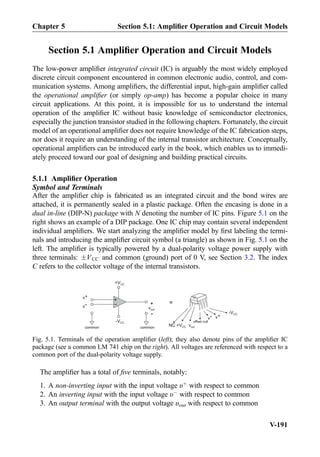
also given any number of fixed resistors, of any
value:
1. Suggest and sketch a sensor circuit which
will convert changes in the resistance into
measurable voltage changes. This circuit
should possibly have:
(a) Zero sensor output voltage at normal
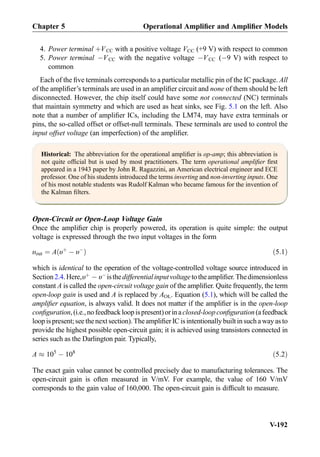
sensor conditions (no bending)
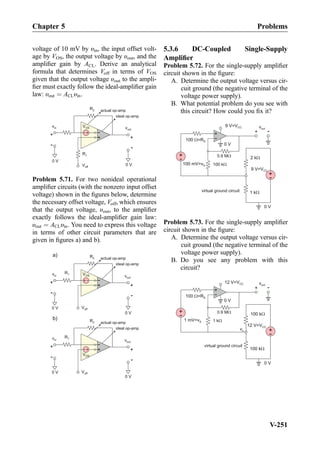
(b) Maximum voltage sensitivity to
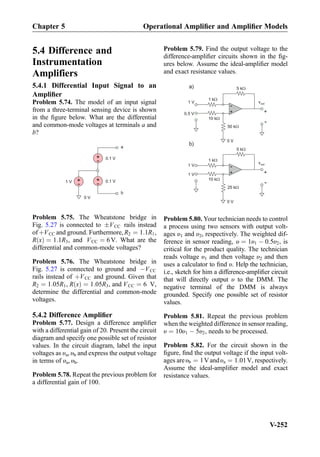
changes in resistance (sensitivity to
the strain)
2. Label one (or two) strain gauge used, and
specify the values of all used resistances.
3. Show power supply and DMM
connections.
Chapter 3 Problems
III-135
Combined Voltage and Current Dividers
Problem 3.61. For the circuit shown in the
following figure:
A. Find currents i, i1, i2 (show units).
B. Find power P delivered by the voltage
source to the circuit.
C. Find voltages V1, V2.
+
-10 V 4 kW 4 kW
8 kW
V2+
-
V1
+
-
i
i1 i2
Problem 3.62. Find voltage Vacross the 20-kΩ
resistance and current i for the circuit shown in
the following figure:
20 kW
5 kW
30 kW
5 kW
+
-
25 V
i
V
+
-
Problem 3.63. For the circuit that follows,
determine:
A. Current i2 through the 0.25 kΩ resistance
B. Power P absorbed by the 600 Ω
resistance
i2i1
+
-15 V 1 kW 0.25 kW
600 W
700 W
P=?
Problem 3.64. For the circuit shown in the
figure below, determine:
A. Current i2 through the 0.25-kΩ
resistance
B. Power P absorbed by the 0.3-kΩ
resistance
i2i1
+
-15 V 1 kW 0.25 kW
1 kW
0.3 kW
P=?
Problem 3.65. Determine current
i (show units) in the circuit that follows:
20 kW
5 kW
20 kW
5 kW6 kW
+
-
20 V
2 kW
i
Problem 3.66. Determine current i and voltage
υ for the circuit shown in the figure (show units).
3 k
5 k
10 k
1 k5 k
+
-
24 V
30 ki
+
-
3.3 Superposition Theorem
and Its Use
3.3.2 Superposition Theorem or Super-
position Principle
Problem 3.67. For the circuit shown in the
figure below, determine the absolute voltage
(versus chassis ground) and the electric current
at the circuit point a.
Chapter 3 Circuit Laws and Networking Theorems
III-136
+
-15V
+
-15V
50 kW
100 kW
10 kW
a
0V
i
Problem 3.68. Determine the absolute voltage
(versus chassis ground) and the current i at the
circuit point a.
+
-15V
+
-15V
50 kW
100 kW
10 kW
a
0V
i
Problem 3.69. For the circuit shown in the
figure below, find the current across the 10-Ω
resistance. Show its direction on the figure.
+
-
10V
1A
5 W
10 W5 W
Problem 3.70. Determine the unknown current
I in the circuit (solve by superposition).
I
+
- 15 V 1 kW
1 kW
3 kW
+
-
10 V
1.5 kW
1.5 kW
1 kW
Problem 3.71. Determine the unknown current
I in the circuit (solve by superposition).
I
1.5 mA 1 kW
1 kW
1 kW
1mA
1.5 kW
1.5 kW
1 kW
3.3.3 Y (Wye) and Δ (Delta) Networks:
Use of Superposition
3.3.4 T and Π Networks: Two-Port
Passive Networks
Problem 3.72. Convert the network shown in
the following figure from Y to Δ:
A. Draw the corresponding Δ network.
B. Label its terminals.
C. Determine and label the corresponding
resistance values in the figure.
1 3
2
10 kW 20 kW
10 kW
Problem 3.73. Convert the network shown in
the following figure from Δ to Y:
Chapter 3 Problems
III-137
A. Draw the corresponding Y network.
B. Label its terminals.
C. Determine and label the corresponding
resistance values.
1 3
2
10 kW
20 kW 10 kW
Problem 3.74. Convert the two-port network
shown in the following figure from T to Π:
1. Draw the corresponding Π network.
2. Label its terminals and ports.
3. Determine and label the corresponding
resistance values.
1 3
42
port #1 port #2
ground connection
25 kW 20 kW
10 kW
Problem 3.75. Convert the two-port network
shown in the following figure from Π to T:
A. Draw the corresponding T network.
B. Label its terminals and ports.
C. Determine and label the corresponding
resistance values.
1 3
42
port #1 port #2
ground connection
25 kW10 kW
20 kW
Problem 3.76. For the bridge network shown
below, determine the equivalent resistance
between terminals a and b.
10 kW
10 kW
20 kW
2.5 kW 5 kW
3.75 kW
a
b
Chapter 3 Circuit Laws and Networking Theorems
III-138
Chapter 4: Circuit Analysis and Power
Transfer
Overview
Prerequisites
- Knowledge of major circuit elements, their -i characteristics, and Ohm’s law
(Chapter 2)
- Knowledge of basic networking theorems (Chapter 3)
Objectives of Section 4.1:
- Become familiar with the nodal analysis and be able to apply it to solve in arbitrary
linear circuits
- Become familiar with the mesh analysis and be able to apply it to solve in arbitrary
linear circuits
Objectives of Section 4.2:
- Become familiar with the method of short/open circuit
- Establish and prove the source transformation theorem
- Establish and prove Thévenin’s and Norton’s theorems
Objectives of Section 4.3:
- Establish the maximum power theorem and become familiar with the power
efficiency concept
- Be able to apply the concepts of Thévenin and Norton’s equivalents and maximum
power theorem in practice
Objectives of Section 4.4:
- Obtain an initial exposure to nonlinear circuit analysis
- Be able to solve in a simple nonlinear circuit
Application examples:
Reading and using data for solar panels
Power radiated by a transmitting antenna
Maximum power extraction from solar panel
Solving the circuit for a generic solar cell
Chapter 4
© Springer International Publishing Switzerland 2016
S.N. Makarov et al., Practical Electrical Engineering, DOI 10.1007/978-3-319-21173-2_4
IV-139
Keywords:
Nodal analysis, Mesh analysis (mesh-current analysis), Supernode, Supermesh, Method of short/
open circuit (definition of, open-circuit network voltage, short-circuit network current), Source
transformation theorem, Circuit equivalent (see equivalent circuit), Thévenin’s theorem
(formulation, proof, special cases), Thévenin equivalent, Norton’s theorem, Norton equivalent,
R-2R ladder network, Negative equivalent (Thévenin) resistance, Maximum power theorem
(principle of maximum power transfer), Power efficiency, Analysis of nonlinear circuits, Load
line (definition, method of), Iterative method for nonlinear circuits (definition of, explicit iterative
scheme, implicit iterative scheme), Solar cell (c-Si, open-circuit voltage, short-circuit
photocurrent density, fill factor, characteristic equation of), Solar panel (series cell connection,
open-circuit voltage, short-circuit photocurrent, fill factor, maximum power load voltage,
maximum power load current)
Chapter 4 Circuit Analysis and Power Transfer
IV-140
Section 4.1 Nodal/Mesh Analysis
4.1.1 Importance of Circuit Simulators
The series and parallel equivalents along with Yand Δ transformations provide a practical
tool for solving simple circuits involving typically only a few elements. However, for
more elaborate circuits, circuit simulators such as SPICE (Simulation Program with
Integrated Circuit Emphasis) and its various modifications become indispensable tools
for the professional engineer. SPICE was developed by the Electronics Research Labo-
ratory at the University of California, Berkeley, and first presented in 1973. These circuit
simulators are quite general and allow us to model circuits with passive and active
elements including semiconductor components such as diodes, transistors, and even
solar cells. Since those elements typically exhibit nonlinear current–voltage behaviors,
elaborate solution strategies are needed. The circuit simulators use quite interesting
algorithms: they often operate in the time domain, even for DC circuits. For example, a
solution for a DC circuit is obtained as the steady-state limit of a transient solution, for
voltage and/or current sources turned on at a certain time instance. The key of the time-
domain approach is its inherent ability to solve nonlinear problems, with passive and
active circuit elements. In this section, we are unable to discuss in detail the principles of
the numerical circuit simulation. However, we will provide the foundation of the nodal
analysis (or node analysis) and the mesh analysis (or the mesh-current analysis), which
are two important features of a professional circuit simulator. The nodal and mesh
analyses in its pure form do not involve time-domain methods. They are primarily
applicable only to linear circuits, also referred to as linear networks.
4.1.2 Nodal Analysis for Linear Circuits
The nodal analysis is a general method of solving linear networks of arbitrary complex-
ity, which is based on KCL and Ohm’s law. Let us consider a circuit shown in Fig. 4.1a,
which is a resistive bridge circuit with a bridging resistance. This circuit may be solved
using Δ to Y conversion; see, for instance, example 3.15 of Chapter 3. Here, we prefer to
use the nodal analysis directly. The nodal analysis operates with the absolute values of the
node voltages in the circuit with respect to ground reference. It may be divided into a
number of distinct steps:
1. A ground reference needs to be assigned first: a node where the voltage is set to 0 V.
To this end, we ground the negative terminal of the voltage power supply.
2. Next, we select nontrivial (also called non-reference) nodes for which we do not
know the voltages. These are nodes 1 and 2 in Fig. 4.1b. The two additional nodes
are eliminated from the analysis since the voltages there are already known.
3. We label absolute node voltages versus ground reference as V1, V2—see Fig. 4.1c.
Chapter 4 Section 4.1: Nodal/Mesh Analysis
IV-141
4. We label currents for every nontrivial node, assuming that all currents are
outflowing; see Fig. 4.1c. The last condition may be replaced by all inflowing
currents.
5. Next, KCL is written for every nontrivial node. We express the currents as the
difference of two absolute voltages: the voltage at the beginning of the current arrow
(voltage at the master node) minus the voltage at the end of the current arrow
(voltage at any other node) and then divide this difference by the appropriate
resistance. Hence, we arrive at a system of linear equations for the nodal voltages.
Currents are no longer involved.
6. After the resulting system of linear equations is solved, all circuit parameters are
determined as necessary.
The following two examples will apply the nodal analysis to a circuit with a voltage
source.
1 kW
1 kW
1 kW
1 kW3 kW
0 V
+
-5 V 21
1 kW
1 kW
1 kW
1 kW3 kW
+
-5 V
5 V
0 V
1 kW
1 kW
1 kW
1 kW3 kW
0 V
+
-5 V
5 V
0 V
V1
V2
a)
b)
c)
1. Select ground reference
2. Select and label nodesnontrivial
5. Write KCL for each node
in terms of node voltages
6. Solve the resulting system
of equations
3. Label unknown node voltages
4. Label outflowing currents
for each node
Fig. 4.1. Major steps of the nodal analysis applied to a bridge circuit.
Chapter 4 Circuit Analysis and Power Transfer
IV-142
Example 4.1: Solve the circuit shown in Fig. 4.1a using the nodal analysis—find the
supply current.
Solution: Steps 1–4 are indicated in Fig. 4.1b, c. Applying KCL to node 1 and then to node
2 (order is not important), one has
V1 À 5 V
1 kΩ
þ
V1 À 0 V
3 kΩ
þ
V1 À V2
1 kΩ
¼ 0 ð4:1aÞ
V2 À 5 V
1 kΩ
þ
V2 À 0 V
1 kΩ
þ
V2 À V1
1 kΩ
¼ 0; ð4:1bÞ
i.e., a system of the linear equations for two unknown voltages. Its simplification
7=3V1 À V2 ¼ 5 V ð4:2aÞ
3V2 À V1 ¼ 5 V ð4:2bÞ
is solved via Gaussian elimination of unknowns, which yields
V1 ¼ 3:33 V and V2 ¼ 2:78 V ð4:3Þ
The circuit current (current of the voltage source) is
5 V À V1ð Þ=1 kΩ þ 5 V À V2ð Þ=1 kΩ ¼ 3:89 mA:
Example 4.2: Solve the circuit shown in Fig. 4.2a using the nodal analysis.
Solution: Steps 1–4 are indicated in Fig. 4.2b. Applying KCL to node 1 and then to node
2, one obtains a system of equations with two unknown voltages:
V1 À 10 V
1 kΩ
þ
V1 À 0 V
1 kΩ
þ
V1 À V2
1 kΩ
¼ 0 ð4:4aÞ
+
- 10 V
1 kW
1 kW
1 kW 1 kW
1 kW
a)
+
-
1 kW
1 kW
1 kW 1 kW
1 kW
0 V
V1
V210 V
0 V 0 V
21
b)
10 V
Fig. 4.2. Major steps of the nodal analysis applied to a circuit with a voltage source.
Chapter 4 Section 4.1: Nodal/Mesh Analysis
IV-143
Example 4.2 (cont.):
V2 À 10 V
1 kΩ
þ
V2 À 0 V
1 kΩ
þ
V2 À V1
1 kΩ
¼ 0 ð4:4bÞ
In setting up the equations, it does not matter which sequence of nodes are selected.
Simplifying Eq. (4.4) gives
3V1 À V2 ¼ 10 V ð4:5aÞ
3V2 À V1 ¼ 10 V ð4:5bÞ
The solution is obtained by symmetry, i.e., V1 ¼ V2 ¼ 5 V. The circuit current provided
by the power supply is 10 mA. All other branch currents can then be found using Ohm’s
law. An interesting feature of the circuit shown in Fig. 4.2a is that the marked 1-kΩ resistor
can be considered as “dead,” since there is no current flowing through it (the voltage
difference across this resistor is exactly zero). This resistor can be removed from the circuit
without affecting the behavior of the circuit in terms of voltages and currents. It might
appear at first sight that the circuits shown in Figs. 4.1 and 4.2 have a different network
topology. In fact, they do not. To prove this, attempt to redraw the circuit in Fig. 4.2a; the
result will coincide with the circuit in Fig. 4.1a.
Circuits with a Current Source
When a current source is present in a circuit, the solution becomes even simpler: one makes
use of the existing current and substitutes its value into KCL equation written for a certain
node. For example, KLC for node 1 in Fig. 4.3 includes the outflowing current of À1 mA.
The current sign must be taken into account. The same idea may be applied to circuits with
multiple current power supplies. When only the current sources are present, the ground may
be connected to the incoming terminal of a current source.
Exercise 4.1: Determine voltage across the current source in Fig. 4.3 using the nodal
analysis.
Answer: 8.6 V.
+
-10 V
1 kW
1 kW 1 kW
1 kW1 mA
21
Fig. 4.3. A circuit with a current source solved via nodal analysis.
Chapter 4 Circuit Analysis and Power Transfer
IV-144
4.1.3 Supernode
The nodal analysis requires a “good” eye to see possible simplifications when labeling the
nodes. Let us examine a particular case and point out a few useful subtleties.1
Figure 4.4a
depicts a network with two voltage sources. The property of the 5 V source is such that it
is not fixed to a particular ground connection—we therefore call it a floating source.
Setting up the node method becomes a little tricky, since we do not know the current
through this source. However, a supernode may be formed as shown in Fig. 4.4b.
KCL may be applied to any closed contour around the supernode: the net current must
still be zero in such a case. With reference to Fig. 4.4b, this yields
V1 À 10 V
1 kΩ
þ
V1 À 0 V
1 kΩ
þ
V2 À 0 V
1 kΩ
þ
V2 À 10 V
1 kΩ
¼ 0 ð4:6aÞ
What is the second equation for two unknowns V1 and V2 (just the relation between
the supernode voltages themselves)? Since V2 À V1 is the voltage of the power source,
one has
V2 ¼ V1 þ 5 V ð4:6bÞ
Equations (4.6) can now be solved even without a calculator, eliminating one of the
unknowns yields
5V
+
-10 V
1 kW
1 kW
1 kW
1 kW
a)
+
-10 V
1 kW
1 kW
1 kW
1 kW
0 V
b)
V1
V210 V
0 V 0 V
+
-
5V
supernode+
-
Fig. 4.4. A network with a floating voltage source between nodes 1 and 2.
1
Subtleties are often euphemism for “playing” around with the circuit, like redrawing the wire connections and
rearranging the circuit elements. This is done to find simpler solution approaches.
Chapter 4 Section 4.1: Nodal/Mesh Analysis
IV-145
V1 ¼ 2:5 V, V2 ¼ 7:5 V ð4:7Þ
The circuit is solved. All currents are found using the node voltages and Ohm’s law.
Example 4.3: Now, solve the circuit shown in Fig. 4.4a using the standard nodal analysis,
without the supernode concept.
Solution: We have to specify an unknown current Ix through the 5-V source, which flows,
say, from left to right in Fig. 4.4a. It results in the following two nodal equations for the two
nodes:
V1 À 10 V
1 kΩ
þ
V1 À 0 V
1 kΩ
þ Ix ¼ 0 ð4:8aÞ
V2 À 0 V
1 kΩ
þ
V2 À 0 V
1 kΩ
À Ix ¼ 0 ð4:8bÞ
Now, we can add both equations and thereby eliminate Ix. The result is exactly Eq. (4.6a)
for the supernode. We must add one more condition to solve this equation. Equation (4.6b)
is the only choice, i.e.,
V2 ¼ V1 þ 5 V ð4:8cÞ
With this in mind, we arrive at the supernode concept again but in a more complicated way.
This is why the supernode approach is a useful tool.
4.1.4 Mesh Analysis for Linear Circuits
The mesh analysis (or the mesh-current analysis) is using loops instead of nodes.
Only loops that do not contain any other loops—the meshes—are employed. The meshes
as elements of the networking topology were defined in Section 3.1. Accordingly, instead
of KCL, the mesh analysis makes use of KVL. Hence, we need to choose mesh
currents for every mesh. Figure 4.5 depicts the concept for a circuit with three meshes.
Note that this circuit is identical to the circuit from Fig. 4.1. A ground connection does
not have to be introduced for the mesh method. Let us denote the mesh current for
mesh 1 in Fig. 4.5 by I1, the mesh current for mesh 2 by I2, and the mesh current for mesh
3 by I3.
1 kW
1 kW
1 kW
1 kW3 kW
+
-5 V
mesh #1
I1
mesh #2
I2
I3
mesh #3
Fig. 4.5. Circuit solution using the mesh analysis. Circuits in Figs. 4.5 and 4.1 coincide.
Chapter 4 Circuit Analysis and Power Transfer
IV-146
KVL equations for the three meshes are based on Ohm’s law for this passive reference
configuration. We do not need the fourth (large) loop encompassing the entire circuit. For
resistances that are shared by two adjacent meshes, we combine either the difference or
the sum of the two adjacent-mesh currents. The mesh equations become
Mesh 1 : 1 kΩ Á I1 À I3ð Þ þ 1 kΩ Á I1 þ 1 kΩ Á I1 À I2ð Þ ¼ 0 ð4:9aÞ
Mesh 2 : 3 kΩ Á I2 À I3ð Þ þ 1 kΩ Á I2 À I1ð Þ þ 1 kΩ Á I2 ¼ 0 ð4:9bÞ
Mesh 3 : À5V þ 1 kΩ Á I3 À I1ð Þ þ 3 kΩ Á I3 À I2ð Þ ¼ 0 ð4:9cÞ
We have arrived at a system of three equations for the three unknown mesh currents I1, I2,
and I3. It is simplified to (after division by 1 kΩ and combining similar terms)
Mesh 1 : þ3I1 À I2 À I3 ¼ 0 ð4:10aÞ
Mesh 2 : ÀI1 þ 5I2 À 3I3 ¼ 0 ð4:10bÞ
Mesh 3 : ÀI1 À 3I2 þ 4I3 ¼ 5 mA ð4:10cÞ
In contrast, the nodal analysis applied to the same circuit requires only two
equations for two unknown node voltages; see Example 4.1. The final solution is indeed
the same. Thus, the nodal analysis is more beneficial for small networks when a voltage
source or sources are present. If, however, a current source were present in Fig. 4.5
instead of the voltage source, the nodal analysis would require three equations. At the
same time, the mesh analysis would require only two equations, because I3 is defined by
the current source. Reasoning like this gives us clues which method is most suitable.
When mixed power supplies like voltage and current sources are involved, there is
usually no real difference between the two methods. The choice often becomes a matter
of taste.
Exercise 4.2: Determine mesh currents for the circuit in Fig. 4.5.
Answer: I1 ¼ À0:833 mA, I2 ¼ þ0:833 mA, I3 ¼ þ1:667 mA.
4.1.5 Supermesh
Consider a circuit shown in Fig. 4.6. The straightforward mesh analysis should use KVL
written for meshes 1 and 2. However, KVL cannot be formulated directly since we do not
know the voltage across the current source. A solution is to combine meshes 1 and 2 into a
supermesh and write KVL around its periphery. Mesh equations become
Supermesh : 1 kΩÁ I1 ÀI3ð Þþ1 kΩÁI1 þ1 kΩÁI2 þ3 kΩÁ I2 ÀI3ð Þ ¼ 0 ð4:11aÞ
Mesh 3 : À5 V þ 1 kΩ Á I3 À I1ð Þ þ 3 kΩ Á I3 À I2ð Þ ¼ 0 ð4:11bÞ
KCL for the central branch of the source:
Chapter 4 Section 4.1: Nodal/Mesh Analysis
IV-147
I1 À I2 ¼ 1 mA ð4:11cÞ
After division by 1 kΩ and combining similar terms, the system of equations (4.11) is
simplified to
þ2I1 þ 4I2 À 4I3 ¼ 0
ÀI1 À 3I2 þ 4I3 ¼ 5 mA
þI1 À I2 ¼ 1 mA
ð4:12Þ
Exercise 4.3: Determine mesh currents for the circuit in Fig. 4.6.
Answer: I1 ¼ 2:5 mA, I2 ¼ þ2:5 mA, I3 ¼ 3:75 mA.
Example 4.4: Outline the solution approach for the circuit shown in Fig. 4.6 using the
standard mesh analysis, without the supermesh concept.
Solution: The voltage across the current source is introduced as an extra unknown, Vx.
Then, we write three KVL equations for three meshes in Fig. 4.6, which will contain four
unknowns: I1, I2, I3, and Vx. An extra equation is needed, which is KCL for the central
branch: I1 À I2 ¼ 1 mA. Now, we need to solve a system of four simultaneous equations.
This is considerably more work than in the previous case. This is why the supermesh
approach is a useful tool for the mesh analysis.
1 kW1 kW
1 kW3 kW
+
-5 V
I1
I2
I3
1 mA
mesh #1
mesh #2
mesh #3
Fig. 4.6. Circuit solved with the supermesh method.
Chapter 4 Circuit Analysis and Power Transfer
IV-148
Section 4.2 Generator Theorems
4.2.1 Equivalence of Active One-Port Networks: Method
of Short/Open Circuit
In Chapter 3, we considered passive linear networks with only resistances, and we have
transformed them into equivalent circuits. Active linear networks, which include sources
and resistances simultaneously, can undergo similar transformations. We know that two
electric single-port networks are equivalent when their terminal υ-i characteristics are
identical. For passive resistive networks studied in Chapter 3, we connected arbitrary
source(s) across the network terminals and checked the resulting υ-i characteristics. For
active networks with sources and resistances, we can use the same method. Alternatively,
we could connect arbitrary resistance(s) across the network terminals and check either the
resulting voltage or current. A test resistance to be connected will be denoted here by R. If
for two networks the voltages across the resistance R (or currents through it) coincide for
all values of R, the networks are equivalents.
Method of Short/Open Circuit
In general, testing all possible values of resistance R connected to terminals a and b of a
network in Fig. 4.7 is not necessary. Note that an active linear network may ultimately
have only two elements: a source and a resistance. To uniquely determine the two
elements (their values), only two equations are necessary. It is therefore customary to
check only two (limiting) values of the test resistance:
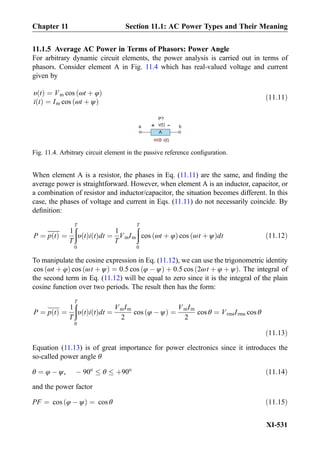
R ! 1 and R ¼ 0 ð4:13Þ
Conveniently, this corresponds to open- and short-circuit conditions. In the first case, the
voltage between terminals a and b is the open-circuit network voltage VOC. In the second
case, the current flowing from terminal a to terminal b is the short-circuit network current
ISC. The pair VOC, ISC is key for the method of short/open circuit. This method states that
two active linear circuits are equivalent when their VOC and ISC coincide. Network
equivalency relates not only to the linear active networks with two components, but, as
will be shown soon, it is valid for all active linear networks.
a
b
+
-
arbitrary electric
network
VOC
a
b
arbitrary electric
network
ISC
test of open-circuit voltage test of short-circuit current
Fig. 4.7. Method of short/open circuit for an active, one-port network.
Chapter 4 Section 4.2: Generator Theorems
IV-149
4.2.2 Application Example: Reading and Using Data for Solar Panels
The method of short/open circuit is also very useful for active nonlinear networks,
including nonlinear sources. An example is a solar cell or a combination thereof, a solar
panel. Every solar panel has the measured data for VOC and ISC listed on its backside.
The short-circuit current is simultaneously the photocurrent of the solar cell. Table 4.1
collects this data for common crystalline silicon (or c-Si) solar panels. It is organized in
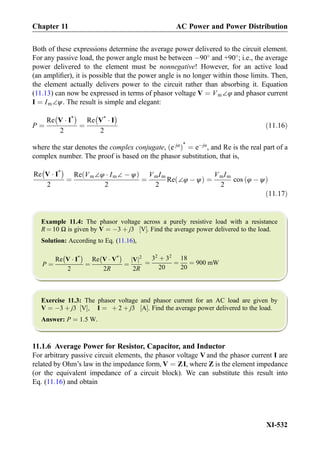
such way that VOC is given per cell in the panel and ISC is given in terms of photocurrent
density, JP, per unit cell area. The cells in the panel are connected in series.
Table 4.1 demonstrates that c-Si solar cells have approximately the same open-circuit
voltage of 0.6 V per cell. The open-circuit voltage does not depend on the area of the cell.
The short-circuit photocurrent density is also approximately the same for c-Si solar cells
from different manufacturers. On average, it is given by JP ¼ 0:03 A=cm2
. These values
correspond to an incident light intensity of 1000 W/m2
at T ¼ 25
C. The photocurrent
density does not depend on the area of the cell. However, the total photocurrent does.
Exercise 4.4: A c-Si solar panel (or solar module) has the open-circuit voltage of 23.4 V?
How many individual solar cells does it have?
Answer: Approximately 39.
Exercise 4.5: A c-Si solar panel is needed with the open-circuit voltage of 12 V and the
short-circuit current of 3 A. Design the panel: find the number of cells to be connected in
series and the required unit cell area.
Answer: 20 cells with the area of 100 cm2
(10 Â 10 cm) each.
Table 4.1. Manufacturers’ specified parameters for different c-Si solar panels from five different
manufacturers (1–230 W output power range). The cell area is either measured directly or
extracted from the datasheet.
Solar panel Cells, N VOC/N, V Cell area A, cm2
JP ¼ ISC=A
A/cm2
1-W BSPI-12 Power Up c-Si panel 36 0.59 2.36 0.030
10-W BSP-1012 Power Up c-Si panel 36 0.59 ~22.0 0.030
65-W BSP-1012 Power Up c-Si panel 36 0.61 121.7 0.032
230-W Sharp ND-U230C1 c-Si panel 60 0.62 241.0 0.034
175-W BP Solar SX3175 c-Si panel 72 0.61 156.25 0.033
6-W Global Solar GSE-6 c-Si panel 44 0.52 16.6 0.027
200-W GE Energy GEPVp-200 c-Si panel 54 0.61 249.3 0.032
Average NA 0.593 NA 0.0311
Chapter 4 Circuit Analysis and Power Transfer
IV-150
4.2.3 Source Transformation Theorem
The most fundamental transformation of active linear networks is the subject of the
source transformation theorem. The source transformation theorem is a substitution of an
independent voltage source VT in series with resistance RT for an independent current
source IN with resistance RN and vice versa; see Fig. 4.8a, b. The meaning of indexes
N and T will become apparent soon. The identical theorem applies to the dependent
sources shown in Fig. 4.8c, d.
Let us prove this theorem by establishing the circuit equivalence. The pair VOC, ISC is
to be found for every network. For the two networks in Fig. 4.8a, b, we have
VOC ¼ VT, ISC ¼
VT
RT
ð4:14aÞ
VOC ¼ RNIN, ISC ¼ IN ð4:14bÞ
Equation (4.14) has a unique solution in the form of the source transformation theorem
RN ¼ RT, IN ¼
VT
RT
ð4:15Þ
If Eq. (4.15) is satisfied, both networks in 4.8a, b have equal VOC and ISC. This ensures
that their entire υ-i characteristics are also the same. To confirm this fact, an arbitrary
resistance R could be connected across the port. The resulting voltages may be found
directly, by solving the voltage divider and the current divider circuits, respectively. Both
voltages are equal to VTR= R þ RTð Þ. Thus, the source transformation theorem is proved.
+
-
VT
a
b
IN
a
b
a) b)
a
b
a
b
c) d)
+
-
RT
RN
vT iN
RT
RN
Fig. 4.8. Transformation of dependent and independent sources.
Chapter 4 Section 4.2: Generator Theorems
IV-151
Exercise 4.6: A network has a 10-V voltage source in series with a 20-Ω resistance. It is
replaced by a current source IN in parallel with resistance RN. Find IN and RN.
Answer: IN ¼ 0:5 A, RN ¼ 20 Ω.
Exercise 4.7: A linear active circuit measures the open-circuit voltage of 5 V and the
short-circuit current of 1 mA. Determine its equivalents in the form of a voltage source in
series with a resistance and in the form of a current source in parallel with a resistance.
Answer: VT ¼ 5 V, RT ¼ 5 kΩ and IN ¼ 1 mA, RN ¼ 5 kΩ.
Often, the source transformation theorem allows us to simplify the circuit analysis
through network manipulations.
Example 4.5: Find current I1 in the circuit shown in Fig. 4.9a.
Solution: The circuit may be solved using the superposition theorem. Another way is
to use the source transformation theorem. The corresponding steps are outlined in
Fig. 4.9b, c. We use the source transformation three times and end up with the parallel
combination of two current sources and three resistances. The three resistances in parallel
are equivalent to the 0:75 kΩ resistance; the voltage across every element in parallel is then
0:75 kΩ Â 2 mA ¼ 1:5 V. Therefore, I1 ¼ 0:75 mA.
+
- 2 V
a)
6 mA0.5
2.5 kW
I1
2 kW
2 kW
2.5 kW
I1
2 kW 1 mA+
-
2 kW
0.5 kW
I1
2 kW 1 mA2 kW
3 V
1 mA 3 kW
b)
c)
kW
Fig. 4.9. Circuit modifications using the source transformation theorem.
Chapter 4 Circuit Analysis and Power Transfer
IV-152
Example 4.6: The circuit in Fig. 4.10a includes a current-controlled voltage source with
the strength of 4000ix [V]. Find current ix using the source transformation.
Solution: The corresponding circuit transformation is shown in Fig. 4.10b. The circuit with
the current-controlled current source in Fig. 4.10b is solved using KCL and KVL. KCL
written for the bottom node states that the current of 3 mA þ 3ix flows through the
rightmost 1-kΩ resistance (directed down). Since, by KVL, the voltages across both resis-
tances must be equal, one has
3 mA þ 3ix ¼ ix ) ix ¼ À1:5 mA ð4:16Þ
Alternatively, one might convert the independent current source to the independent voltage
source. However, this method would hide ix.
4.2.4 Thévenin’s and Norton’s Theorems: Proof Without Dependent
Sources
The origin of The´venin’s theorem is due to Léon Charles Thévenin, a French engineer
(1857–1926). The theorem is illustrated in Fig. 4.11a, b and can be expressed in the
following form:
1. Any linear network with independent voltage and current sources, dependent linear
sources, and resistances, as shown in Fig. 4.11a, can be replaced by a simple
equivalent network: a voltage source VT in series with resistance RT.
2. The equivalent network in Fig. 4.11b is called the The´venin equivalent.
3. Voltage VT is the open-circuit voltage VOC of the original network.
4. When dependent sources are not present, Thévenin resistance RT is an equivalent
resistance Req of the original network with all independent sources turned off
(voltage sources are replaced by short circuits and current sources by open circuits).
5. When both dependent and independent sources are present, the independent sources
are not turned off. Resistance RT is given by RT ¼ VOC=ISC, where ISC is the short-
circuit current of the original network.
a)
3 mA 1 kW
1 kW
b)
+
- 4000ix
ix
3 mA 1 kW 4ix
ix
1 kW
Fig. 4.10. Using source transformation for a circuit with dependent sources.
Chapter 4 Section 4.2: Generator Theorems
IV-153
6. When only the dependent sources are present, a current (or voltage) source is
connected to the network terminals. Thévenin or equivalent resistance is given by
RT ¼ V=I where I is the source current and V is the voltage across the source.
Thévenin voltage is, strictly speaking, not defined in this case.
The Norton’s theorem is dual to the Thévenin’s theorem. It was named in honor of
Edward L. Norton (1898–1983), an engineer at Bell Labs in New Jersey.2
Norton’s
theorem is illustrated in Fig. 4.11c, d. The equivalent circuit (Norton’s equivalent) is
now the current source in parallel with the resistance as shown in Fig. 4.11d. Since the
equivalence of both networks in Fig. 4.11b, d has already been established, the Norton’s
theorem will follow from the Thévenin’s theorem and vice versa.
Proof of The´venin’s Theorem for Active Networks Without Dependent Sources
The proof is based on circuit linearity. The υ-i characteristics of both networks will
be established using a current source of strength I connected as shown in Fig. 4.12.
+
-
VT
a
b
a
b
a)
RT
a
b
c)
any linear network of
sources (independent
and linear dependent)
and resistances
any linear network of
sources (independent
and linear dependent)
and resistances
b)
d)
IN
a
b
RN
Thevenin
Norton
Fig. 4.11. Thévenin’s and Norton’s theorems: replacing linear active circuits by its Thévenin and
Norton equivalents.
+
-
VT
a
b
a
b
a)
RTany linear network of
sources (independent
and linear dependent)
and resistances
b)
V
+
-
V
+
-
II
Fig. 4.12. Derivation of Thévenin’s theorem by establishing the υ-i characteristics.
2
The first publication that discusses this equivalent circuit concept is actually due to Hans F. Mayer (1895–1980) who
made the discovery in 1926 while a researcher at Siemens Company.
Chapter 4 Circuit Analysis and Power Transfer
IV-154
Since the entire circuit is still linear, the υ-i characteristic of the current source in
Fig. 4.12a must have the form of a linear function,
V ¼ AI þ B; ð4:17Þ
where V is the voltage across the current source. A and B are some “constant” coefficients,
which do not depend on I, but do depend on the network parameters. Our goal is to find
A and B, respectively. First, we check the value I ¼ 0 when the external current source is
turned off, i.e. replaced by an open circuit. From Eq. (4.17), voltage V equals B. On the
other hand, it equals of VOC the original network. Therefore,
B ¼ VOC ð4:18Þ
Now, let us turn off all the internal sources. The network becomes an equivalent
resistance Req. The constant B (its open-circuit voltage) is zero. Equation (4.17) therefore
yields V ¼ AI, for any value of I. On the other hand, for the current source I connected to
the resistance Req, it must be V ¼ ReqI. Comparing the two expressions, we obtain
A ¼ Req ð4:19Þ
The simpler network in Fig. 4.12b is also described by the υ-i characteristic in the form of
Eq. (4.17). In this case, B ¼ VOC ¼ VT, A ¼ Req ¼ RT. We finally compare two υ-i
characteristics,
V ¼ ReqI þ VOC for linear active network and
V ¼ RTI þ VT for Thevenin equivalent;
ð4:20Þ
and establish the Thévenin’s theorem. A test voltage source could be used in place of the
current source in Fig. 4.12, with the same result obtained. The physical background of the
Thévenin’s theorem is thus the fact that the terminal response of any linear network is a
linear υ-i characteristic—a linear function with only two independent coefficients, A and
B. A simpler network with exactly two independent parameters—VT and RT – is just right
to model this response.
Equivalence of Arbitrary Linear Networks with Identical VOC, ISC
On one hand, linear active networks with only two elements (a source and a resistance)
are equivalent when their VOC, ISC coincide. On the other hand, any active linear network
is equivalent to a linear network with only two elements. Therefore, we conclude that two
arbitrary linear networks are equivalent when their VOC and ISC coincide.
Chapter 4 Section 4.2: Generator Theorems
IV-155
Exercise 4.8: Establish Thévenin equivalent circuits for the two networks shown in
Fig. 4.13. In the first case, R1 ¼ R2 ¼ R3 ¼ 1 kΩ and VS ¼ 10 V. The second network
is a battery bank—a network of series-connected practical voltage sources—with
RB1 ¼ RB2 ¼ RB3 ¼ 1 Ω, VB1 ¼ VB2 ¼ VB3 ¼ 6 V.
Answer: VT ¼ 5 V, RT ¼ 0:5 kΩ and VT ¼ 18 V, RT ¼ 3 Ω, respectively.
Example 4.7: A two-terminal network shown in Fig. 4.14a is a two-bit R-2R ladder
network used for digital-to-analog conversion. Express
1. Thévenin (or equivalent) voltage VT
2. Thévenin (or equivalent) resistance RT
in terms of (digital) voltages D0, D1 and resistance R.
Solution: One way to solve this problem is to find VT and RT directly from the circuit in
Fig. 4.14a. While the solution for RT is straightforward, finding VT requires more work. Yet
another method is to apply the Thévenin equivalent to the leftmost section of the ladder
network first. The result is the circuit shown in Fig. 4.14b. The final Thévenin equivalent
has the form RT ¼ R, VT ¼ D1
2 þ D0
4 .
This method may be applied to ladder networks with multiple sections.
Exercise 4.9: Repeat the previous example for the ladder shown in Fig. 4.14c.
Answer: RT ¼ R, VT ¼ D2
2 þ D1
4 þ D0
8 .
R1
+
-
VS
R2
R3
a
b
+
-
RB2
+
-
RB3
+
-
VB1
RB1
a
b
VB2
VB3
a) b)
Fig. 4.13. Two active linear networks.
Chapter 4 Circuit Analysis and Power Transfer
IV-156
Example 4.8: Find Thévenin and Norton equivalent circuits for the network in Fig. 4.15a.
Solution: The network includes a voltage-controlled voltage source. Therefore, its analysis
should be performed in a general form, by finding the pair VOC, ISC. The short-circuit
current ISC is found straightforwardly. Since the rightmost resistance is shorted out,υx ¼ 0,
and ISC ¼ 10 mA. To find the open-circuit voltage, which is equal to υx, we use the source
transformation theorem and arrive at the equivalent circuit in Fig. 4.15b. Next, we solve
this circuit. By KVL, the voltage across the leftmost resistance is equal to 10V À 4υx.
By KCL, the currents through both resistances must be the same. Since the resistances are
equal, we obtain the equality 10V À 4υx ¼ υx so that υx ¼ 2 V. The open-circuit voltage
has the same value. Thévenin and Norton equivalents are
VT ¼ VOC ¼ 2 V, RT ¼
VOC
ISC
¼ 200 Ω ð4:21aÞ
IN ¼ ISC ¼ 10 mA, RN ¼
VOC
ISC
¼ 200 Ω ð4:21bÞ
D0
2R
2R
+
-
D /20
R
+
-
a
b
D1
2R
+
-
R
a
b
D1
2R
+
-
R
a)
b)
D0
2R
2R
+
-
a
b
D1
2R
+
-
Rc)
D2
2R
+
-
R
Fig. 4.14. Two-bit and three-bit R-2R ladder networks.
3vx
1 kW
a
b
a)
+
-
+
-
vx1 kW 10 mA
3vx
1 kW
a
b
b)
+
-
+
-
vx10 V+
-
1 kW
Fig. 4.15. A network with dependent sources to be converted to its equivalent forms.
Chapter 4 Section 4.2: Generator Theorems
IV-157
4.2.5 Application Example: Generating Negative Equivalent Resistance
Consider a circuit shown in Fig. 4.16a. It includes only a dependent source: the voltage-
controlled voltage source; it does not have independent sources. Therefore, the circuit
analysis has to be done by connecting a current (or voltage) source between terminals a and
b as shown in Fig. 4.16b. Quantity of interest is Thévenin (or equivalent) resistance. KVL
for the circuit in Fig. 4.16b gives ÀAυx À RI þ υx ¼ 0. Therefore, by definition,
RT 
υx
I
¼
R
1 À A
ð4:22Þ
As long as the open-circuit voltage gain of the dependent source, A, is greater than one,
Eq. (4.22) states the negative equivalent or The´venin resistance. Physically, this means
that the Thévenin equivalent circuit is delivering power instead of absorbing it.
Construction and Use of Negative Equivalent Resistance
A circuit block, which is equivalent to the negative resistance, may be constructed using the
operational amplifier studied in the next chapter. This block may be used for different
purposes including signal generation. The difference between the negative resistance and
the power source is that the negative resistance may supply power of any type (DC, AC, or
an arbitrary waveform), i.e., support the self-oscillating circuits. Figure 4.16c summarizes
Thévenin resistances generated by the basic networks with the only dependent sources. The
same method of analysis (simultaneous use of KCL and KVL) has been applied to every
network. Although all of the networks may in principle generate negative equivalent
resistance values, the realization of some particular circuits may be difficult.
a
b
a)
R
+
-
Avx
+
-
a
b
b)
R
+
-
Avx
+
-
+
-
vx
+
-
vxI
c)
R+
-
Avx
+
-
+
-
vx R
+
-
Gvx
+
-
vx
R+
-
+
- R
+
-
Aix
ixix
Zix
R =R/(1-A)T R =R/(1-GR)T
R =R-ZT R =R(1-A)T
Fig. 4.16. Thévenin equivalent circuits for basic networks with dependent sources.
Chapter 4 Circuit Analysis and Power Transfer
IV-158
4.2.6 Summary of Circuit Analysis Methods
In summary, a linear circuit can be solved using any of the methods studied in this and in
the previous chapters:
- Superposition theorem
- Nodal/mesh analysis
- Source transformation theorem
- Thévenin and Norton equivalent circuits
or a combination of those. While the nodal/mesh analysis is always applicable, other
methods may even be more useful since they often provide physical insight into the
circuit behavior.
Exercise 4.10: How could you find the open-circuit voltage Vab in Fig. 4.14a?
Answer:
A. When the superposition theorem is applied, shorting out D0 gives Vab ¼ D1=2.
Shorting out D1 gives Vab ¼ D0=4.
B. When the nodal analysis is applied, we ground negative terminals of both sources
and find the unknown voltage of the upper left node via the KCL. Only one equation
needs to be solved. This is perhaps the simplest solution method.
C. The source transformation theorem can hardly be applied.
D. The method of Thévenin equivalent circuits has been described in Example 4.7.
Chapter 4 Section 4.2: Generator Theorems
IV-159
Section 4.3 Power Transfer
4.3.1 Maximum Power Transfer
The principle of maximum power transfer from a source to a load will now be quantified.
This principle is also known as a maximum power theorem. The circuit under study is
shown in Fig. 4.17. It involves an arbitrary linear source (a battery, generator, etc.), which
is represented by its Thévenin equivalent, and a load, which is characterized by its
equivalent resistance RL. All other load parameters (dynamic, mechanical, and thermal)
are implicitly included in the load’s resistance.
The key question you have to ask yourself is this: for a given ideal voltage source VT
and a given internal resistance RT, can the electric power delivered to the load be
maximized, and at which value of RL does the maximum occur? The answer is found
by solving the circuit in Fig. 4.17. First, the current is determined from the given voltage
source VT and the total resistance using the series equivalent,
I ¼
VT
RT þ RL
ð4:23Þ
This allows us to compute the power at the load based on
PL ¼ RLI2
¼
RLV2
T
RT þ RLð Þ2
ð4:24Þ
When VT and RT are fixed, the magnitude of the load resistance determines the delivered
power PL. This power tends to zero when RL ! 0 or RL ! 1; moreover, it is always
positive. Therefore, according to Rolle’s theorem of calculus, the power must have a
maximum at a certain value of RL. For example, Fig. 4.18 shows a plot of the load power
as a function of RL when VT¼9 V and RT¼5 Ω.
+-
+
-
VT
a
b
RT
RL
Fig. 4.17. A battery (or another practical voltage source) connected to a load.
Chapter 4 Circuit Analysis and Power Transfer
IV-160
We will find the maximum of the load power analytically. We treat PL in Eq. (4.24) as a
function of RL, i.e., PL ¼ PL RLð Þ. It is known that a function has a maximum when its
first derivative is zero. Consequently, differentiating PLwith respect to RL gives
dPL
dRL
¼ V2
T
1
RT þ RLð Þ2
À 2
RL
RT þ RLð Þ3
 #
¼ V2
T
RT À RL
RT þ RLð Þ3
 #
¼ 0 ð4:25Þ
The necessary and sufficient condition for Eq. (4.25) to hold is
RL ¼ RT ) PL ¼ 0:25V2
T=RT ð4:26Þ
This result is of significant practical value despite, or maybe thanks to, its simplicity. The
maximum output power is achieved when the load resistance is equal to the internal
resistance of the power source. In other words, the load is matched to the source; it is
called the matched load. In power engineering and in RF and microwave engineering, the
problem of load matching is very important. However, it must be clearly stated that no
more than 50 % of the total circuit power can be extracted even in the best case. This
statement makes sense if we again examine the circuit in Fig. 4.17 with two equal
resistances. The power is divided equally; half of the total power is spent to heat up
the power source. The power maximum in Fig. 4.18 is relatively flat over the domain
RL  RT; however, the power drops sharply when RL  RT. This last condition should be
avoided if at all possible.
Example 4.9: An audio amplifier produces an rms output of 20 V. Amplifier’s output
resistance is rated at 4 Ω. You are given four 4-Ω speakers. How should you connect the
speakers for the maximum acoustic power—in series, parallel, or a single speaker only?
0 10 20 30 40 50
0
1
2
3
4
Loadpower,W
Load resistance, W
Fig. 4.18. Load power as a function of the load resistance for fixed VT ¼ 9 V, RT ¼ 5 Ω.
Chapter 4 Section 4.3: Power Transfer
IV-161
Example 4.9 (cont.):
Solution: The rms voltage simply means the equivalent DC voltage that provides the same
power to the load as the average power of the primary AC voltage. Hence, the sophisticated
AC audio amplifier circuit is essentially replaced by its DC Thévenin equivalent with
VT ¼ 20 V and RT ¼ 4 Ω. Similarly, the dynamic speakers are replaced by a DC load with
RL ¼ 16 Ω if connected in series combination or with RL ¼ 1 Ω if connected in parallel or
with RL ¼ 4 Ω if only a single speaker is employed. The output (audio) powers are as
follows:
PL ¼
1 Â 400
4 þ 1ð Þ2
¼ 16 W four speakers in parallel ð4:27aÞ
PL ¼
4 Â 400
4 þ 4ð Þ2
¼ 25 W single speaker ð4:27bÞ
PL ¼
16 Â 400
4 þ 16ð Þ2
¼ 16 W four speakers in series ð4:27cÞ
The best (loudest) choice would be surprisingly one single speaker.
4.3.2 Maximum Power Efficiency
A power analysis would be incomplete without discussing the efficiency of the power
transfer. Consider an electric boat driven by a marine battery. The optimization of the
battery-motor system for maximum power transfer implies that we will move fast but
perhaps not very far. Another optimization is possible for maximum power efficiency. In
this case, we could tolerate a smaller speed in order to travel a longer distance. The circuit
to be analyzed is again shown in Fig. 4.17. The useful power delivered to the load is given
by Eq. (4.24). The total power delivered by the source is
P ¼ RT þ RLð ÞI2
¼
V2
T
RT þ RL
ð4:28Þ
The power efficiency E is defined as the ratio of the useful power to the total power:
E ¼
PL
P
¼ RT þ RLð ÞI2
¼
RL
RT þ RL
ð4:29Þ
Thus, the power efficiency is a simple function of the load resistance and the source
resistance. It does not depend on the source voltage. The efficiency is zero when the load
resistance is zero. It monotonically increases and approaches maximum (the maximum
value is unity, which corresponds to an efficiency of 100 %) when the load resistance
becomes large enough when compared to the source resistance. For example,
Chapter 4 Circuit Analysis and Power Transfer
IV-162
Fig. 4.19 augments the load power graph from Fig. 4.18 with the corresponding effi-
ciency curve.
Example 4.10: A battery with the stored energy of EB ¼ 0.1 MJ, VT ¼ 12 V, and RT ¼ 5 Ω
delivers its entire energy during the time period 0 t T and discharges with a constant
output voltage/current. Two loads are used: RL ¼ 5 Ω and RL ¼ 50 Ω. Determine discharge
time T and total energy delivered to the load in each case.
Solution: The discharge time, T ¼ EB=P, is determined first where the total power
P follows Eq. (4.28). Assuming constant battery discharge rate, we obtain
T % 1:9 h for the 5 Ω load and
T % 10:6 h for the 50 Ω load
ð4:30Þ
The total energy delivered to the load, E ¼ TPL, in each case is given by
E5 Ω ¼ 50 kJ for the 5 Ω load and
E50 Ω ¼ 91 kJ for the 50 Ω load
ð4:31Þ
Thus, the total energy extracted from the battery is nearly twice as high in the second case.
However, it takes about five times longer to extract this energy.
4.3.3 Application Example: Power Radiated by a Transmitting Antenna
A transmitting antenna in a radio handset features a monopole antenna. It is connected to
a source that has the same basic form as in Fig. 4.17 but with an AC generator instead of
the DC source and with an internal (generator) resistance of 50 Ω. The antenna as a load
also has a “radiation” resistance of 50 Ω. This resistance describes power loss in terms of
0 10 20 30 40 50
0
1
2
3
4
Loadpower,W
Load resistance, W
Powerefficiency,%
0
20
40
60
80
load power
power efficiency
Fig. 4.19. Load power and power efficiency for fixed VT ¼ 9V, RT ¼ 5Ω.
Chapter 4 Section 4.3: Power Transfer
IV-163
electromagnetic radiation from the antenna. Thus, the antenna, if properly matched to the
power source, will radiate 50 % of the total power as electromagnetic waves into space.
Now a young electrical engineer decides to “modify” the handset by cutting the mono-
pole antenna and leaving only one third of its length. In this case, the antenna’s radiation
resistance is reduced to one ninth of its original value. How does this affect the radiated
signal? To answer this question, we find the instantaneous load power, which also follows
Eq. (4.24), i.e.,
PL tð Þ ¼
RLV2
T tð Þ
RT þ RLð Þ2
ð4:32Þ
The ratio of the power levels for the two antenna configurations does not depend on time:
PLÀshort
PLÀoriginal
¼
50=9
50 þ 50=9ð Þ2
=
50
50 þ 50ð Þ2
¼
0:0018
0:0050
¼ 0:36 ð4:33Þ
Thus, for the shorter antenna, we will only achieve about 36 % of the radiated power
compared to the original handset. In practice, this estimate becomes even lower due to the
appearance of a very significant antenna capacitance.
4.3.4 Application Example: Maximum Power Extraction from Solar Panel
Every solar panel has the measured data for VOC and ISC listed on its backside. For linear
circuits, VT ¼ VOC, RT ¼ VOC=ISC. If the solar panel were a linear circuit, the max-
imum extracted power would be exactly equal to 0.25VOCICS according to Eq. (4.26).
Fortunately, this is not the case. The maximum extracted power is significantly greater
than this value. However, it is still less than the “best” possible value of VOCICS. To
quantify the maximum power output, every solar panel has another set of measured data,
VMP and IMP, also listed on its backside. VMP stands for maximum power load voltage and
IMP stands for the maximum power load current. The maximum extracted power is the
product VMPIMP, which is always less than VOCICS. The ratio of these two powers,
F ¼
VMPIMP
VOCISC
 1; ð4:34Þ
is known as the fill factor of the solar panel (or solar module). We will derive the
theoretical value of the fill factor in the next section. Table 4.2 lists some experimental
data for crystalline (c-Si) solar panels. The experimental fill factor not only accounts
for the nonlinear physics of the cell, but it also includes some resistive losses in an
individual cell and in the entire solar module. Equation (4.34) approximates the fill factor
of a cell too.
Chapter 4 Circuit Analysis and Power Transfer
IV-164
Exercise 4.11: A REC SCM220 220 Watt c-Si solar panel has the following readings on
the back: the short-circuit current of 8.20 A, the open-circuit voltage VOC of 36.0 V, the
maximum power voltage of 28.7 V, and the maximum power current of 7.70 A. Estimate
the load resistance required for the maximum power transfer to the load.
Answer: 3.72 Ω.
Table 4.2 demonstrates that different c-Si solar cells have approximately the same values
of VMP/VOC, IMP/ISC, and the same fill factor. Using the photocurrent density estimate and
the open-circuit cell voltage estimate given at the beginning of this section, we may assume
approximate generic values for c-Si solar cells at normal irradiation conditions:
VMP ¼ 0:8VOC, IMP ¼ 0:9ISC, F ¼ 0:72, VOC ¼ 0:6 V cellð Þ,
JP ¼ 0:03 A=cm2 ð4:35Þ
These values are not exact; they are meant as a convenient tool for engineering estimates.
Equation (4.35) may be used to address an important task: identify the proper panel
configuration and its approximate size in order to provide enough power for a given load.
Example 4.11: A 3-Ω load (for instance, a hot plate in a camp) is rated at 23 Vand is to be
powered by a solar panel. A c-Si photovoltaic sheet material is your material of choice.
Outline parameters of a solar module that is capable of powering the load and estimate the
overall module size.
Table 4.2. Manufacturer-provided circuit parameters for twelve different c-Si solar panels from
five different manufacturers (1-W to 230-W output power range).
Solar panel Cells (series) VMP/VOC
IMP/
ISC F
$/Watt
(2010)
1-W BSPI-12 Power Up c-Si panel 36 0.81 0.86 0.70 24.00
10-W BSP-1012 Power Up c-Si panel 36 0.81 0.88 0.71 8.80
65-W BSP-1012 Power Up c-Si panel 36 0.80 0.94 0.75 6.35
80-W Sharp NE-80EJEA c-Si panel 36 0.80 0.88 0.70 4.29
176-W Sharp ND-176U1Y c-Si panel 48 0.80 0.91 0.73 4.68
230-W Sharp ND-U230C1 c-Si panel 60 0.82 0.92 0.75 3.51
5-W BP Solar SX-305M c-Si panel 36 0.80 0.90 0.72 15.00
20-W BP Solar SX-320M c-Si panel 36 0.80 0.92 0.74 8.30
175-W BP Solar SX3175N c-Si panel 72 0.83 0.92 0.76 4.19
65-W Kyocera KC65T c-Si panel 36 0.80 0.94 0.75 5.22
165-W SolarWorld SW230 c-Si panel 72 0.80 0.90 0.72 4.72
230-W SolarWorld SW230 c-Si panel 60 0.80 0.92 0.74 3.18
Average 0.806 0.908 0.73 NA
Chapter 4 Section 4.3: Power Transfer
IV-165
Example 4.11 (cont.):
Solution: First, we need to find the required load current. It is given by
I ¼ 23 V=3 Ω ¼ 7:67 A. Thus, the maximum power parameters of the module must
be equal to VMP ¼ 23 V and IMP ¼ 6:67 A. Next, we the find the measurable parameters,
VOC, ISC of the module. According to Eq. (4.35),
VOC ¼
VMP
0:8
¼ 28:75V, ISC ¼
IMP
0:9
¼ 8:52A ð4:36Þ
Then we find the number of cells N and the area of an individual cell A, assuming a series
combination of individual cells:
N ¼
VOC
0:6V
¼ round 47:9ð Þ ¼ 48, A ¼
ISC
0:03A=cm2
¼ 284cm2
ð4:37Þ
The overall module (panel) size for closely spaced cells is then 1.36 m2
.
Example 4.12: Compare the theoretical design of Example 4.11 with a real solar module
having nearly the same output power (176 W) and nearly the same maximum power
voltage (23 V).
Solution: We choose a Sharp ND-176U1Y, 176-watt solar panel from Table 4.2 for
comparison. Its maximum power voltage is 23.4 V. Table 4.3 lists the parameters of both
panels. The designs agree with the number of cells and with the size of the unit cell. The
overall panel size for closely spaced cells is also quite similar: 1.36 m2
versus 1.32 m2
.
Table 4.3. Parameters of a theoretically designed 176 W solar panel versus the
corresponding 176 W hardware prototype.
Example 4.11 (theory estimates) 176-watt Sharp ND-176U1Y panel
VMP ¼ 23:0V, PL ¼ 176W VMP ¼ 23:4V, PL ¼ 176W
No. of cells: 48 No. of cells: 48
Unit cell area: 284 cm2
Unit cell area: 275 cm2
Exercise 4.12: A 9.6 W DC motor in an autonomous robot is rated at 17 V and is to be
powered by a solar panel. A c-Si photovoltaic sheet material is your material of choice.
Outline parameters of a solar module that is capable of powering the load and estimate the
overall module size.
Answer: The module should include 36 cells in series, with the area of A ¼ 21:0cm2
each.
The overall module (panel) size for closely spaced cells is then 0.0756 m2
.
Chapter 4 Circuit Analysis and Power Transfer
IV-166
Section 4.4 Analysis of Nonlinear Circuits: Generic
Solar Cell
4.4.1 Analysis of Nonlinear Circuits: Load Line Method
Consider a nonlinear passive circuit element which possesses a particular υ-i characteristic.
It is shown in Fig. 4.20 by a rectangle. Examples of such elements were given in Chapter 2.
Element’s polarity (direction of current inflow for passive reference configuration) is labeled
by a plus sign. Figure 4.20 presents four basic nonlinear circuits (networks) encountered in
practice: a linear active network given by its Thévenin equivalent and connected to a
nonlinear load, a practical nonlinear voltage source connected to a linear load, a linear
active network in the form of the Norton equivalent connected to a nonlinear load, and a
practical nonlinear current source connected to a linear load. Interchanging the place of the
nonlinear element and resistance if necessary and using the source transformation theorem,
we can state that all four circuits in Fig. 4.20 are topologically equivalent. Therefore, only
one of them will be studied, for example, the network shown in Fig. 4.20a. The υ-i
characteristic of the practical voltage source between terminals a and b in Fig. 4.20a is
given, according to KVL, by
I ¼
VT À V
RT
ð4:38Þ
This linear function given by Eq. (4.38) is known as the load line. It is plotted in Fig. 4.21
and intersects the voltage axis at V ¼ VT and the current axis at I ¼ VT=RT. The υ-i
characteristic of a nonlinear element is plotted in the same figure. Both υ-i characteristics
must give the identical values of voltage and current. Thus, the intersection of the load line
with the υ-i characteristic is the circuit solution. This is the essence of the load line method.
+
-
VT
a
b
RT
V
+
-
v-i
I
+
-
VT
a
b
V
+
-
v-i I
+
+
RL
nonlinear load nonlinear source
IN RN
a
b
V
+
-
v-i
+
nonlinear load
IN
a
b
V
+
-
nonlinear source
v-i
+
RL
a)
b)
c)
d)I I
Fig. 4.20. Four basic nonlinear circuits.
Chapter 4 Section 4.4: Analysis of Nonlinear Circuits: Generic Solar Cell
IV-167
Though primarily graphical, the load line method provides a great insight into the
problem under study.
Example 4.13: The circuit in Fig. 4.20a is characterized by VT ¼ 3 V, RT ¼ 1 kΩ. The
υ-i characteristic of the nonlinear element (the ideal Shockley diode) is
I ¼ 1 Â 10À9
exp V
0:0257 V
À Á
À 1
 Ã
A½ Š. The goal is to solve the circuit using the load line
method.
Solution: Figure 4.22 plots two dependencies: the load line of Eq. (4.38) and the υ-i
characteristic of the ideal diode specified by the present example. Using visual inspection,
the intersection is evaluated as I % 2:6 mA, V % 0:4 V. This is the solution for the circuit
current and for the load voltage, respectively. The solution accuracy improves when the
scale of the plot is adjusted. In particular, we usually do not have to extend the voltage axis
all the way from 0 V to the supply voltage; only a small interval may be sufficient.
0
I, A
V, volts0
Load line
VT
VT
RT
v-i characteristic
Solution
Fig. 4.21. Load line method for a nonlinear circuit.
0
2.5
5.0
I, mA
0 0.5 1 1.5 2 2.5 3
v-i characteristic (Shockley equation)
Load line
Solution
3.0
V, volts
Fig. 4.22. Load line method applied to a nonlinear circuit with an ideal diode.
Chapter 4 Circuit Analysis and Power Transfer
IV-168
4.4.2 Iterative Method for Nonlinear Circuits
Assume that the nonlinear circuit element is characterized by an explicit function
I ¼ I Vð Þ. Then, according to Eq. (4.38), the load line method is equivalent to the
graphical solution of the transcendental algebraic equation in the form
VT À V
RT
¼ I Vð Þ ) V ¼ VT À RTI Vð Þ ð4:39Þ
An alternative is to solve this equation iteratively, starting with some initial guess V ¼ V0
.
The iterative method for nonlinear circuits may be formulated as follows. Two iterative
schemes (explicit and implicit) may formally be used. The first (explicit) scheme follows
from the second Eq. (4.39), and the second (implicit) scheme from the first Eq. (4.39):
Vnþ1
¼ VT À RTI Vn
ð Þ, n ¼ 0, 1, 2, . . . or
Vnþ1
¼ IÀ1 VT À Vn
RT
 
, n ¼ 0, 1, 2, . . .
ð4:40Þ
whereIÀ1
denotes the inverse function of I(V). The first (explicit) scheme is simpler when
I(V) is given. However, only the second scheme is recommended in practice since the first
scheme may not converge for typical nonlinear circuit elements, which model semicon-
ductor devices.
Example 4.14: Solve the previous example using the iterative solution of the transcen-
dental circuit equation.
Solution: We find the inverse υ-i characteristic of the nonlinear element first. It is
V ¼ 0:0257 Â ln
I
1 Â 10À9
A
þ 1
!
V½ Š, I ¼
3 V À V
1 kΩ
ð4:41Þ
The iterative scheme has the form (the second method of Eq. (4.40) is used)
Vnþ1
¼ 0:0257 Â ln
3 V À Vn
1 Â 10À6
V
þ 1
!
, n ¼ 0, 1, 2, . . . ð4:42Þ
with the initial guess V0
¼ 0 V. It converges very fast; the corresponding iterations are
V0
¼ 0 V, V1
¼ 0:3833 V, V2
¼ 0:3798 V, and V3
¼ 0:3798 V.
Therefore, only a few iterations are usually sufficient. The final result is I ¼ 2:62 mA,
V ¼ 0:380 V, which improves the solution obtained with the load line method—see the
previous example. The initial guess of the iterative solution may vary widely, but it should
not exceed the source voltage.
Chapter 4 Section 4.4: Analysis of Nonlinear Circuits: Generic Solar Cell
IV-169
4.4.3 Application Example: Solving the Circuit for a Generic Solar Cell
Figure 4.23a shows a simplified physical composition of the solar cell in the form of a
pn-junction (a junction of two semiconductor materials), which essentially forms a
semiconductor diode.
Free charge carries generated by sunlight are separated by a built-in voltage or
potential φ(x) within the diode, which is the cause of an equivalent current source—the
photocurrent of the solar cell IP. The photocurrent mostly flows through the load. At the
same time, a certain portion of it, ID, could still flow through the pn-junction diode itself
as a forward diode current. Therefore, the load current I in Fig. 4.23 is less than the
photocurrent. Figure 4.23b shows a simplified equivalent circuit of a solar cell. This
circuit coincides with the nonlinear circuit in Fig. 4.20d and can be solved in the same
way once the υ-i characteristic of the equivalent diode is known. It is often given by
ID ¼ IS exp
V
nVT
 
À 1
!
, VT ¼ 0:0257 V ð4:43Þ
with an effective ideality factor n and an effective saturation current IS of the
corresponding diode. The characteristic equation of the cell is the KCL in Fig. 4.23b:
I ¼ IP À IS exp
V
nVT
 
À 1
!
ð4:44Þ
Figure 4.24 plots the I(V) dependence of the characteristic equation (4.44). The horizontal
straight asymptote is the photocurrent IP or the short-circuit current ISC. The vertical
straight asymptote is the open-circuit voltage VOC, VOC % VTnln IP=ISð Þ when
IP=IS  1. The area of the shaded rectangle is the load power; it is clearly maximized
at a certain operating point Q, where V ¼ VMP, I ¼ IMP.
RL
anode cathodep n
IP
D
=
-R/2 +R/2
j(x)
+
-
RL
I I
ba
I I
a) b)
a b
Sun light
V
+
-
ID
Fig. 4.23. (a) Simplified physical composition of the solar cell in the form of a pn-junction—a
semiconductor diode. (b) Simplified (lossless single-diode) equivalent circuit.
Chapter 4 Circuit Analysis and Power Transfer
IV-170
Finding maximum power parameters is a straightforward but lengthy procedure. The
load power is found as a function of V; its derivative must be equal to zero to maximize
the load power. This is essentially the maximum power theorem for nonlinear circuits.
The final expressions are
VMP ¼ VOC À nVTln 1 þ
VOC
nVT
 
, IMP ¼ ISC 1 À
nVT
VMP
 
% 90% of ISC ð4:45Þ
Forn ¼ 1:75andVOC ¼ 0:6V,VMP % 80% of VOC,IMP % 90% of ISC which is close to
the data from Table 4.2 given that the fill factors for the cell and the panel are approx-
imately the same. Note that the load resistance is finally found as RL ¼ VMP=IMP.
I, A
V, Volts
PL
VOC
IP
Characteristic equation
of the cell I = I(V)
IMP
VMP
Q
0
Fig. 4.24. Finding operating point Q of the solar cell for the maximum power transfer.
Chapter 4 Section 4.4: Analysis of Nonlinear Circuits: Generic Solar Cell
IV-171
Summary
Circuit analysis techniques: nodal/mesh analysis
Nodal
analysis
Based on KCL and Ohm’s law:
V1ÀVS
R1
þ V1À0 V
R3
þ V1ÀV2
R2
¼ 0
V2ÀVS
R5
þ V2À0 V
R4
þ V2ÀV1
R2
¼ 0
Supernode
KCL for the supernode:
V1 À VS
R1
þ
V1
R3
þ
V2
R4
þ
V2 À VS
R5
¼ 0
plus KVL: V2 ¼ V1 þ V0
Mesh
analysis
Based on KVL and Ohm’s law:
R1 I1 ÀI3ð ÞþR3I1 þR5 I1 ÀI2ð Þ ¼ 0
R2 I2 ÀI3ð ÞþR5 I2 ÀI1ð ÞþR4I2 ¼ 0
ÀVS þR1 I3 ÀI1ð ÞþR2 I3 ÀI2ð Þ ¼ 0
for meshes 1, 2, and 3
Supermesh
KVL for the supermesh:
R1 I1 À I3ð Þ þ R3I1 þ R4I2þ
R2 I2 À I3ð Þ ¼ 0
plus Eq. for mesh 3 and the
KCL: I1 À I2 ¼ IS
Circuit analysis techniques: source transformation theorem
Source
transfor-
mation
theorem
Substitution of voltage source VT in
series with resistance RT for current
source IN with resistance RN:
RN ¼ RT , IN ¼
VT
RT
VOC ¼ VT , ISC ¼
VT
RT
(continued)
IV-172
Chapter 4 Circuit Analysis and Power Transfer
Circuit analysis techniques: Thévenin/Norton theorems/equivalents
Thévenin
and Norton
theorems
Any linear network with indepen-
dent sources, dependent linear
sources, and resistances can be
replaced by a simple equivalent
network in the form:
i. a voltage source VT in series
with resistance RT;
ii. a current source IN in parallel
with resistance RN
Summary of major circuit analysis methods (linear circuits)
– Superposition theorem (previous chapter);
– Nodal/mesh analysis (this chapter);
– Source transformation theorem (this chapter);
– Thévenin and Norton equivalent circuits (this chapter)
Linear networks: measurements/equivalence
Method
of short/
open
circuit
– Two arbitrary linear networks are
equivalent when their VOC and ISC
coincide.
– This method is also used for
nonlinear circuits
Linear networks: maximum power theorem
Maximum
power the-
orem (load
matching)
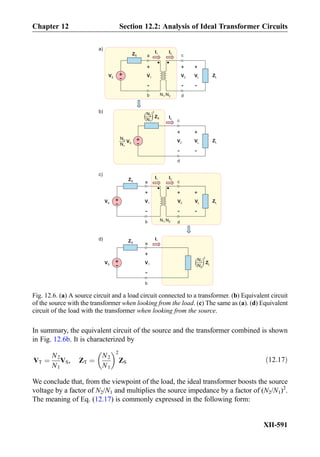
– Power delivered to the load is
maximized when RL ¼ RT;
– For high-frequency circuits it also
means no “voltage/current wave
reflection” from the load
Linear networks: maximum power efficiency
Power effi-
ciency is
maximized
when the
load resis-
tance is
very high
(load
bridging)
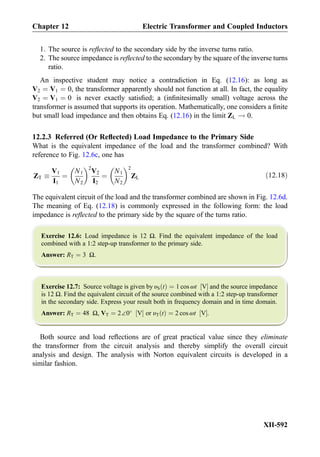
Power transfer efficiency:
E ¼
PL
P
¼
RL
RT þ RL
(continued)
Chapter 4 Summary
IV-173
Linear networks: dependent sources and negative equivalent resistance
Equivalent
resistances
of basic
linear net-
works with
dependent
sources
Case a): RT ¼ R
1ÀA
Case b): RT ¼ R À Z
Case c): RT ¼ R
1ÀGR
Case d): RT ¼ R 1 À Að Þ
Equivalent resistance may become
negative
Nonlinear networks: four basic topologies
Basic
nonlinear
circuits
– Linear voltage source connected
to a nonlinear load (diode circuit);
– Linear current source connected
to a nonlinear load;
– Nonlinear voltage source
connected to a linear load;
– Nonlinear current source
connected to a linear load
(photovoltaic circuit)
Nonlinear networks: circuit analysis via load line method
Load line
method
Solution: The load line (υ-i charac-
teristic of the linear source, which
is I ¼
VTÀV
RT
) intersects the υ-i
characteristic of the nonlinear
load, I(V)
Nonlinear networks: iterative solution
Finding the
intersection
point
iteratively
For the circuit in the previous row:
I Vð Þ ¼
VT À V
RT
) Vnþ1
¼ IÀ1 VT À Vn
RT
 
,
n ¼ 0, 1, . . .
Implicit scheme:
initial guess V0
may be 0 V
Nonlinear networks: finding resistive load for maximum power extraction
Finding
maximum
load power
for the
equivalent
model of a
solar cell
Load power is computed as
PL ¼ V Â I Vð Þ. Then, it is maxi-
mized, which is equivalent to solving
equation:
dPL
dV
Vð Þ ¼ 0
for unknown voltage V
(continued)
Chapter 4 Circuit Analysis and Power Transfer
IV-174
Some useful facts about power extraction from solar cells/modules
Typical values of open-circuit voltage VOC and
photocurrent density JP of a c-Si cell
Crystalline silicon or c-Si cell:
VOC % 0:6 V; JP % 0:03 A=cm2
– Open-circuit module voltage is N times the
cell voltage, N Á VOC
– Short-circuit module current ISC is the cell
short-circuit current ISC ¼ AJP where A is
cell area
Typical values of maximum-power parameters
and fill factor for c-Si cells/modules; the load
resistance must be RL ¼ VMP=IMP
Fjmodule ¼
VMPIMP
VOCISC
% Fjcell (for low-loss
modules)
VMP % 0:8VOC, IMP % 0:9ISC, F % 0:72
Lossless single-diode model of a solar cell:
IP ¼ AJP—photocurrent (A);
A—cell area (cm2
);
VT—thermal volt. (0.0257 V);
n—ideality factor (1  n  2);
IS % IPexp À
VOC
nVT
 
(A)
I ¼ IP À IS exp
V
nVT
 
À 1
!
Maximum-power analytical solution for loss-
less single-diode model of a solar cell
VMP % VOC À nVTln 1 þ
VOC
nVT
 
,
IMP ¼ ISC 1 À
nVT
VMP
 
Chapter 4 Summary
IV-175
Problems
4.1 Nodal/Mesh Analysis
4.1.2 Nodal analysis
Problem 4.1.
A. Using the nodal analysis, determine the
supply current I for the circuit shown in
the figure.
B. Show the current directions for every
resistance in the circuit.
1 kW
1 kW
1 kW
2 kW3 kW
+
-5 V
I
Problem 4.2.
A. Using the nodal analysis, determine the
total circuit current I for the circuit
shown in the following figure.
B. Show the current directions for every
resistance in the circuit.
+
- 10 V
1 kW
5 kW
1 kW 1 kW
1 kW
I
Problem 4.3. Introduce the ground termina-
tion, write the nodal equations, and solve for
the node voltages for the circuit shown in the
following figure. Calculate the current I shown
in the figure.
+
-10 V
1 kW
1 kW 1 kW
1 kW
1 mA
I
Problem 4.4. Introduce the ground termina-
tion, write the nodal equations, and solve for
the node voltages for the circuit shown in the
figure. Calculate the current through the resis-
tance Rx and show its direction in the figure.
1 AR =1 Wx
1 W
+
-
5 V 1 W
1 W
Problem 4.5. For the circuit shown in the
following figure,
1. Determine current ix through resistance
Rx.
2. Show its direction on the figure.
1 kW
R =1 kWx
1 kW
4 kW3 kW
0 V
+
-10 V
Problem 4.6. For the circuit shown in the
following figure,
A. Write nodal equations and solve for the
node voltages. Then, find the value of i1.
B. Could this problem be solved in another
(simpler) way?
1 A
10 W
20 W 5 W 2 A
i1
Problem 4.7.
A. Write the nodal equations and solve for
the node voltages for the circuit shown in
the following figure. Then, find the value
of i1.
B. Use MATLAB or other software of your
choice for the solution of the system of
IV-176
Chapter 4 Circuit Analysis and Power Transfer
linear equations; attach the code to the
solution.
+
-
10 V
1 kW
5 kW
1 kW 1 kW
1 kW
I
1 kW 1 kW
Problem 4.8. The following figure shows the
DC equivalent of a residential three-wire sys-
tem, which operates at 240 V rms (do not
confuse it with the three-phase system, which
carries a higher current). Two 120-V rms
power supplies are connected as one dual-
polarity power supply, i.e., in series. The
10-Ω load and the 20-Ω load are those driven
by the two-wire (and one ground) standard
wall plug with 120 V rms—the lights, a TV,
etc. The 6-Ω load consumes more power and it
is driven with 240 V rms using a separate
bigger wall plug (+/À and neutral (not
shown))—the stove, washer, dryer, etc. Deter-
mine the power delivered to each load. Hint:
Use a calculator or software of your choice for
the solution of the system of linear equations
(MATLAB is recommended).
+
- 120 V 10 W
0.1 W
+
- 120 V
0.1 W
0.1 W
20 W
6 W
neutral
hot
hot
4.1.3 Supernode
Problem 4.9. Introduce the ground terminal,
write the nodal equations, and solve for the
node voltages for the circuit shown in the fig-
ure. Calculate the current I shown in the figure.
+
-15 V
1 kW
1 kW
1 kW
1 kW
+
-
5 V
I
Problem 4.10. Introduce the ground terminal,
write the nodal equations, and solve for the node
voltages for the circuit shown in the figure.
Calculate the current I shown in the figure.
+
-10 V
1 kW
1 kW
1 kW
1 kW
+
-
5 V
I
5 kW
4.1.4 Mesh analysis
4.1.5 Supermesh
Problem 4.11. For the circuit shown in the
figure, determine current i1
A. Using the mesh analysis
B. Using the nodal analysis
Which method is simpler?
2 mA
5 W
20 W 5 W 3 mA
i1
Problem 4.12. For the circuit shown in the
figure, determine voltage Vx
A. Using the mesh analysis
B. Using the nodal analysis
Chapter 4 Problems
IV-177
Which method appears to be simpler?
2 kW
1 kW
1 kW
2 kW3 kW
1mA
+
-Vx
Problem 4.13. For the circuit shown in the
figure
A. Determine the circuit current I using
either the nodal analysis or the mesh
analysis.
B. Explain your choice for the selected
method.
1 kW
5 kW
1 kW 1 kW
1 kW
I
+
- 10 V
Problem 4.14. For the circuit shown in the
figure, determine its equivalent resistance
between terminals a and b. Hint: Connect a
power source and use a mesh-current analysis
or the nodal analysis.
1 kW
1 kW
1a kW
1 kW
1 kW 1 kWb
1 kW
Problem 4.15. For the circuit shown in the
figure, determine the current i1 of the 20-V
voltage source.
20 V
9 W
10 W 4 W 0.5 A
i1
+
-
2 W 8 W
Problem 4.16. Determine voltage across the
current source for the circuit shown in the fig-
ure that follows using the mesh analysis and the
supermesh concept.
1 kW2 kW
1 kW3 kW
+
-10 V
2 mA
1 kW
4.2 Generator Theorems
4.2.1 Equivalence of Active One-Port
Networks. Method of Short/Open
Circuit
Problem 4.17. A linear active network with
two unknown circuit elements measures
VOC ¼ 5 V, ISC ¼ 10 mA.
A. Determine parameters VT, RT and IN, RN
of two equivalent networks shown in the
figures below.
B. Could you identify which exactly net-
work is it?
+
-
VT
a
b
IN
a
b
a)
b)
RT
RN
Problem 4.18. Given two networks shown in
the figure that follows:
A. Determine their open-circuit voltage VOC
and short-circuit current ISC for each
of them.
B. Are the networks equivalent?
Chapter 4 Circuit Analysis and Power Transfer
IV-178
+
-
3 V
a
b
a
b
a)
b)
1 kW
6 mA
0.5 kW
4.2.2 Application example: reading and
using data for solar panels
Problem 4.19. The area of a single cell in the
10-W BSP-1012 Power Up c-Si panel is
~22 cm2
. Predict:
A. Open-circuit voltage of the solar cell,
VOC
B. Photocurrent density of the cell, JP
C. Short-circuit current of the cell, ISC
Compare the above value with the value ISC
¼ 0:66 A reported by the manufacturer.
Problem 4.20. The area of a single cell in the
175-W BP Solar SX3175 c-Si panel is
156.25 cm2
. Predict:
A. Open-circuit voltage of the solar cell,
VOC
B. Photocurrent density of the cell, JP
C. Short-circuit current of the cell, ISC
Compare the above value with the value ISC
¼ 5:1A reported by the manufacturer. What
value should the photocurrent density have in
order to exactly match the short-circuit current
reported by the manufacturer?
Problem 4.21. Are the solar cells in the solar
module connected in parallel or in series? Why
is one particular connection preferred?
Problem 4.22. You are given three c-Si solar
cells shown in the figure that follows, each of
area A/3. Draw wire connections for a cell
bank, which has the performance equivalent to
that of a large solar cell with the area A.
n
p
n
p
n
p
a
b
c
d
e
f
A/3
A/3
A/3
Problem 4.23. Individual solar cells in the fig-
ure to the previous problem are to be connected
into a standard solar module. Draw the
corresponding wire connections.
Problem 4.24. A 10-W BSP1012 PV c-Si mod-
ule shown in the figure has 36 unit cells
connected in series, the short-circuit current of
0.66 A, and the open-circuit voltage of 21.3 V.
Chapter 4 Problems
IV-179
A. Estimate the area of the single solar cell
using the common photocurrent density
value for c-Si solar cells.
B. Estimate the open-circuit voltage for the
single cell.
Problem 4.25. A 20-W BSP2012 PV c-Si mod-
ule shown in the figure has 36 unit cells
connected in series, the short-circuit current of
1.30 A, and the open-circuit voltage of 21.7 V.
A. Estimate the area of the single solar cell
using the common photocurrent density
value for c-Si solar cells.
B. Estimate the open-circuit voltage for the
single cell.
Problem 4.26. A c-Si solar module is needed
with the open-circuit voltage of 10 V and the
short-circuit current of 1.0 A. A number of
individual solar cells are available; each has
the area of 34 cm2
, the open-circuit voltage of
0.5 V, and the short-circuit current of 1.0 A.
Identify the proper module configuration (num-
ber of cells) and estimate the module’s
approximate size.
Problem 4.27. A c-Si solar module is needed
with the open-circuit voltage of 12 V and the
short-circuit current of 3.0 A. A number of
individual solar cells are available; each has
the area of 34 cm2
, the open-circuit voltage of
0.5 V, and the short-circuit current of 1.0 A.
Identify the proper module configuration
(number of cells) and estimate the module’s
approximate size.
4.2.3 Source Transformation Theorem
Problem 4.28. Find voltage V in the circuit
shown in the figure that follows using source
transformation.
+
- 2 V3 mA 1 kW
1 kW 2 kW
2 kW
+
-
V
Problem 4.29. The circuit shown in the follow-
ing figure includes a current-controlled voltage
source. Find current ix using source
transformation.
3 mA 1 kW
5 kW
+
- 4000ix
ix
Problem 4.30. The circuit shown in the follow-
ing figure includes a voltage-controlled voltage
source. Find voltage υx using source
transformation.
2 mA 1 kW
2 kW
+
2vx
+
-
vx
-
Problem 4.31. Repeat the previous problem for
the circuit shown in the figure below.
3 mA 1 kW
2 kW
+
- 2vx
+
-
vx
Chapter 4 Circuit Analysis and Power Transfer
IV-180
4.2.4 Thévenin’s and Norton’s Theorems
Problem 4.32. Find:
1. Thévenin (or equivalent) voltage
2. Thévenin (or equivalent) resistance
for the two-terminal network shown in the fig-
ure that follows. Assume three 9-V sources
separated by resistances of 1 Ω each.
+
-
VB1
RB1
+
-
VT
RT
+
-
RB2
+
-
RB3
a
b
a
VB2 VB3
b
Problem 4.33. Find:
1. Thévenin (or equivalent) voltage
2. Thévenin (or equivalent) resistance
for the two-terminal network shown in the fig-
ure that follows (three practical voltage sources
in series) when
RB1 ¼ 2Ω, RB2 ¼ 3 Ω, RB3 ¼ 0:5Ω,
VB1 ¼ 3 V, VB2 ¼ 6 V, VB3 ¼ 3 V:
+
-
VT
RT
a
b
+
-
RB2
+
-
RB3
+
-
VB1
RB1
a
b
VB2
VB3
Problem 4.34. Find:
1. Thévenin (or equivalent) voltage;
2. Thévenin (or equivalent) resistance
for the two-terminal networks shown in the
following figures.
+
- 48 V 20 W 16 W
5 W
a
4 W
b
a
b
1 mA
1 kW
3 kW
6 kW
b)
c)
+
-
a
b
10 V
2 kW
2 kW
6 kW1 kW
a)
+
-
a
b
10 V
1 kW
3 kW
6 kW
d)
Problem 4.35. Find:
1. Thévenin voltage
2. Thévenin resistance
for the two-terminal network shown in the fol-
lowing figure when
R1 ¼ R2 ¼ R3 ¼ 1kΩ,VS1 ¼VS2 ¼ 10 V:
R1
+
-
VS1
+
-
VS2
R2
R3
a
b
Problem 4.36. A two-terminal network shown
in the figure is a starting section of a ladder
network used for digital-to-analog conversion.
Express:
1. Thévenin (or equivalent) voltage
2. Thévenin (or equivalent) resistance
Chapter 4 Problems
IV-181
in terms of (digital) voltage D0 and
resistance R.
D0
2R
2R
+
-
a
b
Problem 4.37. A two-terminal circuit network
in the figure is a two-bit ladder network used
for digital-to-analog conversion. Express
parameters of the corresponding Norton equiv-
alent circuit in terms of (digital) voltages D0, D1
and resistance R.
D0
2R
2R
+
-
a
b
D1
2R
+
-
R
Problem 4.38. A two-terminal network shown
in the figure is a four-bit ladder network used
for digital-to-analog conversion. Express:
1. Thévenin (or equivalent) voltage
2. Thévenin (or equivalent) resistance
in terms of four (digital) voltages D0, D1, D2, D3
and resistance R.
D0
2R
D1 D2 D3
R R R
2R
+
-
2R
+
-
2R
+
-
+
-
2R
1
2
Problem 4.39. Determine the Norton equiva-
lent for the circuit shown in the figure. Express
your result in terms of I and R.
I R
a
b
I R
Problem 4.40. Each of three identical batteries
is characterized by its Thévenin equivalent cir-
cuit withVT ¼ 9 VandRT ¼ 1 Ω. The batteries
are connected in parallel. The parallel battery
bank is again replaced by its Thévenin equiva-
lent circuit with unknown VTBank and RTBank.
Find those parameters (show units). Hint:
This is a tricky problem; double-check the
connecting nodes when drawing the circuit
diagram.
Problem 4.41. Establish Thévenin and Norton
equivalent circuits for the network shown in the
following figure.
-2vx
1
a
b
+
-
+
-
vx2 kW kW0.1 mA
4.2.5 Application Example: Generating
Negative Equivalent Resistance
Problem 4.42. Establish the equivalent
(Thévenin) resistance for the network shown
in the following figure. Carefully examine the
sign of the equivalent resistance.
a
b
+
-
Avx
+
-
+
-
vx
R1
R2
Chapter 4 Circuit Analysis and Power Transfer
IV-182
Problem 4.43. Derive the equivalent
(Thévenin) resistance for the networks shown
in the figure that follows (confirm Fig. 4.16 of
the main text).
a)
R+
-
Avx
+
-
+
-
vx
R
+
-
Gvx
+
-
vx
R+
-
+
-
R
+
-
Aix
ix
ix
Zix
b)
c)
d)
4.2.6 Summary of Circuit Analysis
Methods
Problem 4.44. Solve the circuits shown in the
following figure—determine current I (show
units). You can use any of the methods studied
in class:
- Superposition theorem
- Nodal/mesh analysis
- Source transformation theorem
- Thévenin and Norton equivalent circuits
Attempt to apply two different methods of your
choice to every circuit.
1 mA 2 kW 1 kW
+
-
5 mA
3 V
I
1 mA 2 kW 1 kW
+
-
4 mA
3 V
I
a)
b)
+
-6 V
2 kW6 kW
+
- 3 V3 kW
I
c)
Problem 4.45. Solve the circuits shown in the
following figure—determine unknown voltage
V or current I (show units). You can use any of
the methods studied in class:
- Superposition theorem
- Nodal/mesh analysis
- Source transformation theorem
- Thévenin and Norton equivalent circuits
a)
b)
c)
6 mA
1 kW 2 kW
2 kW+
-
V+
- 4 V
I
+
- 70V 1 kW
0.5kW
0.5kW
+
- 14V
1.5 kW
1.5 kW
2 A1 W
1 W
+
-
10 V 1 W
1 W
I
Chapter 4 Problems
IV-183
4.3 Power Transfer
4.3.1 Maximum Power Transfer
4.3.2 Maximum Power Efficiency
Problem 4.46. A deep-cycle marine battery is
modeled by an ideal voltage source of 24 V in
series with a 1-Ω resistance shown in the figure
that follows. The battery is connected to a load,
and the load’s resistance, RL, needs to be opti-
mized. Power delivered to the load has a maxi-
mum at exactly one value of the load resistance.
Find that value and prove your answer graphi-
cally using software of your choice (MATLAB is
recommended).
+
-
RL?24V
1 W
Problem 4.47. A power supply for an electric
heater can be modeled by an ideal voltage source
of unknown voltage in series with the internal
resistance RT ¼ 4 Ω.
A. Can you still determine when the power
delivered to a load (a heating spiral with
resistance RL) is maximized?
B. Does the answer depend on the source
voltage?
Problem 4.48. For the circuit shown in the
figure, when is the power delivered to the load
maximized?
RL?
1.5 W
1.5 W
+
-12 V
Problem 4.49. A battery can be modeled by an
ideal voltage source VT in series with a resis-
tance RT.
+
-
RL?
RT
VT
1. For what value of the load resistance RL
is the power delivered to the load
maximized?
2. What percentage of the power taken from
the voltage source VT is actually deliv-
ered to a load (assuming RL is chosen to
maximize the power delivered)?
3. What percentage of the power taken from
the voltage source VT is delivered to a
load when RL ¼ 0:1RT?
Problem 4.50. A micro-power photovoltaic
device can be modeled under certain conditions
as an ideal current power source and a resistance
in parallel—see the figure that follows. At which
value of the load resistance, RL, is the power
delivered to the load maximized?
5 mA 50 kW RL
Problem 4.51. A low-cost polycrystalline
Power Up BSP1-12 1-W solar panel lists rat-
ings for the output voltage and current, which
give maximum load power: VL max ¼ 17.28 V,
IL max ¼ 0.06 A. Based on these cell specifica-
tions, which value of the equivalent resistance
should the load to be connected to the solar cell
have for maximum power output?
Problem 4.52. The solar panel from the previ-
ous problem generates a significant voltage of
~13 V in a classroom without direct sunlight,
but the resulting current is small, ~1 mA.
A. Now, what value of the equivalent resis-
tance should the load have for maximum
power output?
Chapter 4 Circuit Analysis and Power Transfer
IV-184
B. How is the maximum load power differ-
ent, compared to the previous problem?
Problem 4.53. The heating element of an elec-
tric cooktop has two resistive elements, R1 ¼
50 Ω and R2 ¼ 100 Ω, that can be operated
separately, in series, or in parallel from a certain
voltage source that has a Thévenin (rms) volt-
age of 120 Vand internal (Thévenin) resistance
of 30 Ω. For the highest power output, how
should the elements be operated? Select and
explain one of the following: 50 Ω only,
100 Ω only, series, or parallel.
Problem 4.54. You are given two speakers
(rated at 4 Ω and 16 Ω, respectively) and an
audio amplifier with the output resistance
(impedance) equal to 8 Ω.
16 W4 W8 W
A. Sketch the circuit diagram that gives the
maximum acoustic output with the avail-
able components. Explain your choice.
B. Sketch the circuit diagram for the maxi-
mum power efficiency. Explain your
choice.
4.3.4 Application Example: Maximum
Power Extraction from Solar Panel
Problem 4.55.
A. Describe in your own words the meaning
of the fill factor of a solar cell (and solar
module).
B. A 200-W GE Energy GEPVp-200 c-Si
panel has the following reading on its
back: VOC ¼ 32:9 V, ISC ¼ 8:1 A,
VMP ¼ 26:3 V, and IMP ¼ 7:6 A.
What is the module fill factor? What is
approximately the fill factor of the indi-
vidual cell?
Problem 4.56. Using two Web links
http://powerupco.com/site/
http://www.affordable-solar.com/,
identify the solar panel that has the greatest fill
factor to date.
Problem 4.57. A 10-W BSP1012 PV c-Si mod-
ule shown in the figure has 36 unit cells
connected in series, the short-circuit current of
0.66 A, and the open-circuit voltage of 21.3 V.
The maximum power parameters are
VMP ¼ 17:3 V and IMP ¼ 0:58 A.
A. Estimate the area of the single solar cell
using the common photocurrent density
value for c-Si solar cells (show units).
B. Estimate the open-circuit voltage for the
single cell.
C. Estimate the fill factor of the module and
of the cell.
D. Estimate the value of the equivalent load
resistance R required for the maximum
power transfer from the module to
the load.
Problem 4.58. A 20-W BSP2012 PV c-Si mod-
ule shown in the figure has 36 unit cells
connected in series, the short-circuit current of
1.30 A, the open-circuit voltage of 21.7 V, the
maximum power voltage VMP of 17.3 V, and
Chapter 4 Problems
IV-185
the maximum power current IMP of 1.20 A.
Repeat the four tasks of the previous problem.
Problem 4.59. A REC SCM220 220-watt 20V
c-Si solar panel shown in the figure has the
following readings on the back: the short-
circuit current ISC of ~8.20 A, the open-circuit
voltage VOC of ~36.0 V, the maximum power
voltage VMP of ~28.7 V, and the maximum
power current IMP of ~7.70 A. Repeat the four
tasks of problem 4.57.
Problem 4.60. A 14.4-W load (a DC motor)
rated at 12 V is to be driven by a solar panel. A
c-Si photovoltaic sheet material is given, which
has the open-circuit voltage of 0.6 V and the
photocurrent density of JP ¼ 0:03 A=cm2
.
Outline parameters of a solar module (number
of cells, cell area, and overall area) which is
capable of driving the motor at the above con-
ditions and estimate the overall panel size.
Problem 4.61. A custom 100-W load (a DC
motor) rated at 24 V is to be driven by a solar
panel. A c-Si photovoltaic sheet material is
given, which has the open-circuit voltage of
0.6 V and the photocurrent density of JP ¼
0:03 A=cm2
. Outline parameters of a solar mod-
ule (number of cells, cell area, and overall area)
which is capable of driving the motor at the
above conditions and estimate the overall
panel size.
Problem 4.62. You are given: the generic fill
factor F ¼ 0:72 for a c-Si solar panels, the
generic open-circuit voltage VOC ¼ 0:6V of a
c-Si cell, and the generic photocurrent density
JP ¼ 0:03 W=cm2
.
A. Derive an analytical formula that
expresses the total area Amodule in cm2
of a solar panel, which is needed to
power a load, in terms of the required
load power PL.
B. Test your result by applying it to the
previous problem.
Problem 4.63. You are given a low-cost
low-power flexible (with the thickness of
0.2 mm) a-Si laminate from PowerFilm, Inc.,
with the following parameters: a fill factor of
F ¼ 0:61, a single-cell open-circuit voltage of
VOC ¼ 0:82 V, and a photocurrent density of
JP ¼ 0:0081 A=cm2
.
A. Derive an analytical formula that expres-
ses the total module area Amodule in cm2
,
Chapter 4 Circuit Analysis and Power Transfer
IV-186
which is needed to power a load, in terms
of the required load power PL.
B. Compare your solution with the solution
to the previous problem.
4.4 Analysis of Nonlinear
Circuits. Generic Solar Cell
4.4.1 Analysis of Nonlinear Circuits:
Load Line Method
4.4.2 Iterative Solution for Nonlinear
Circuits
Problem 4.64. A circuit shown in the following
figure contains a nonlinear passive element.
Using the load line method, approximately
determine the voltage across the element and
the current through it for the two types of the υ-i
characteristic, respectively.
I, mA
V, volts
00
0
1
-1
+
-
9.5 V
a
b
10.55 kW
V
+
-
v-i
I
+
a)
I, mA
V, volts
5 1
5 100
0
1
-1
b)
Problem 4.65. A circuit shown in the following
figure contains a nonlinear passive element as
part of a current source. Using the load line
method, approximately determine the voltage
across the element and the current through it for
the υ-i characteristic of the nonlinear element
shown in the same figure.
I, mA
V, volts
5 100
0
10
-10
a
b
V
+
-
v-i
+
9 mA
667 W
Problem 4.66. Repeat the previous problem for
the circuit shown in the following figure.
I, mA
V, volts
5 100
0
10
-10
a
b
V
+
-
v-i
+
8 mA
1 kW
Problem 4.67. A circuit shown in the following
figure contains a nonlinear passive element.
The υ-i characteristic of the nonlinear element
(the ideal Shockley diode) is
Chapter 4 Problems
IV-187
I ¼ 5Â10À10
exp
V
0:025 V
 
À1
!
A½ Š:
Using the iterative solution, determine the volt-
age across the element and the current through it.
+
-
1 V
a
b
100 W
V
+
-
v-i
I
+
Problem 4.68. Repeat the previous problem
for the circuit shown in the following figure.
The υ-i characteristic of the nonlinear element
is the same.
a
b
V
+
-
v-i
+
8 mA
1 kW
4.4.3 Application Example: Solving the
Circuit for a Generic Solar Cell
Problem 4.69. The I(V) dependence for a resis-
tive load in a circuit is shown in the figure that
follows.
I, A
V, Volts
PL
10V
16A
0
A. At which value of the load voltage is the
power delivered to the load maximized?
B. What is the related value of load
resistance?
Problem 4.70. A hypothetic thermoelectric
engine developed by the US Navy has the
I(V) dependence shown in the figure that
follows.
I, A
V, Volts
PL
2V
14.1A
0
10(2-V)
1/2
I, A
V, Volts
PL
3V
17.3A
0
10(3-V)
1/2
a)
b)
1. At which value of the load voltage is the
power, PL, delivered to the load
maximized?
2. What is the related value of load resis-
tance for maximum power transfer?
Problem 4.71. Estimate the values of VMP and
IMP versus VOC and ISC for a set of generic c-Si
solar cells. Every cell has VT ¼ 0:026V (room
temperature of 25 
C) and VOC ¼ 0:6 V. The
ideality factor n in Eqs. (4.43)–(4.45) is
allowed to vary over its entire range as shown
in the table that follows.
n VMP/VOC,% IMP/IOC,% F
1.00
1.25
1.50
1.75
2.00
Chapter 4 Circuit Analysis and Power Transfer
IV-188
Chapter 5: Operational Amplifier
and Amplifier Models
Overview
Prerequisites:
- Knowledge of major circuit elements (dependent sources) and their -i
characteristics (Chapter 2)
- Knowledge of basic circuit laws (Chapter 3) and Thévenin equivalent (Chapter 4)
Objectives of Section 5.1:
- Learn and apply the model of an operational amplifier including principle
of operation, open-circuit gain, power rails, and input and output resistances
- Correlate the physical operational amplifier with the amplifier circuit model
- Establish the ideal-amplifier model
- Learn the first practical amplifier circuit—the comparator
Objectives of Section 5.2:
- Understand and apply the concept of negative feedback to an operational amplifier
circuit
- Construct three canonic amplifier circuit configurations with negative feedback: the
non-inverting amplifier, the inverting amplifier, and the voltage follower
- Understand the current flow in the amplifier circuit including the power transfer
from the power supply to the load
Objectives of Section 5.3:
- Choose the proper resistance values for the feedback loop and learn how to cascade
multiple amplifier stages
- Learn about input/output resistances of the amplifier circuit and establish load
bridging and load matching conditions important in practice
- Find ways to eliminate the DC imperfections of the amplifier that become very
apparent at high amplifier gains
- Use an amplifier IC with a single voltage supply (a battery)
Objectives of Section 5.4:
- Obtain the initial exposure to differential signals and difference amplifiers
- Build an instrumentation amplifier
- Connect an instrumentation amplifier to a resistive sensor
Chapter 5
© Springer International Publishing Switzerland 2016
S.N. Makarov et al., Practical Electrical Engineering, DOI 10.1007/978-3-319-21173-2_5
V-189
Objectives of Section 5.5:
- Learn a general feedback system including closed-loop gain and error signal
- Apply the general feedback theory to voltage amplifier circuits
- Construct current, transresistance, and transconductance amplifiers with the negative
feedback
Application Examples:
Operational amplifier comparator
Instrumentation amplifier in laboratory
Keywords:
Operational amplifier: (abbreviation op-amp, integrated circuit, dual in-line package, non-
inverting input, inverting input, output terminal, power terminals, offset-null terminals,
differential input voltage, open-circuit voltage gain, open-loop voltage gain, open-loop
configuration, closed-loop configuration, power rails, voltage transfer characteristic, rail-to-rail,
comparator, digital repeater, zero-level detector, circuit model, input resistance, output resistance,
ideal amplifier, ideal-amplifier model, marking, summing point, common-mode input signal,
differential input signal, summing-point constraints, first summing-point constraint, second
summing-point constraint, sourcing current, sinking current, DC imperfections, input offset
voltage, input bias current, input offset currents), Negative feedback, Feedback loop, Feedback
as a dynamic process, Non-inverting amplifier, Inverting amplifier, Voltage follower (buffer)
amplifier, Summing amplifier, Digital-to-analog converter, Binary counter, DC-coupled
amplifier, AC-coupled amplifier, Capacitive coupling of an amplifier, Gain tolerance of an
amplifier, Circuit model of a voltage amplifier, Input resistance of amplifier circuit, Output
resistance of amplifier circuit, Load bridging (impedance bridging), Load matching (impedance
matching), Cascading amplifier stages, Virtual-ground (integrated) circuit, Differential voltage of
a sensor, Common-mode voltage of a sensor, Differential sensor, Single-ended sensor, Difference
amplifier, Differential amplifier circuit gain, Common-mode amplifier circuit gain, Common-
mode rejection ratio (CMRR), Unity common-mode gain stage, Instrumentation amplifier, Load
cell, Current amplifier using op-amp, Transconductance amplifier using op-amp, Transresistance
amplifier using op-amp, Howland current source (Howland current pump)
Linear feedback system: (forward gain? open-loop gain, feedback gain, feedback factor,
summing node, difference node, closed-loop gain, error signal)
Chapter 5 Operational Amplifier and Amplifier Models
V-190
Section 5.1 Amplifier Operation and Circuit Models
The low-power amplifier integrated circuit (IC) is arguably the most widely employed
discrete circuit component encountered in common electronic audio, control, and com-
munication systems. Among amplifiers, the differential input, high-gain amplifier called
the operational amplifier (or simply op-amp) has become a popular choice in many
circuit applications. At this point, it is impossible for us to understand the internal
operation of the amplifier IC without basic knowledge of semiconductor electronics,
especially the junction transistor studied in the following chapters. Fortunately, the circuit
model of an operational amplifier does not require knowledge of the IC fabrication steps,
nor does it require an understanding of the internal transistor architecture. Conceptually,
operational amplifiers can be introduced early in the book, which enables us to immedi-
ately proceed toward our goal of designing and building practical circuits.
5.1.1 Amplifier Operation
Symbol and Terminals
After the amplifier chip is fabricated as an integrated circuit and the bond wires are
attached, it is permanently sealed in a plastic package. Often the encasing is done in a
dual in-line (DIP-N) package with N denoting the number of IC pins. Figure 5.1 on the
right shows an example of a DIP package. One IC chip may contain several independent
individual amplifiers. We start analyzing the amplifier model by first labeling the termi-
nals and introducing the amplifier circuit symbol (a triangle) as shown in Fig. 5.1 on the
left. The amplifier is typically powered by a dual-polarity voltage power supply with
three terminals: ÆVCC and common (ground) port of 0 V, see Section 3.2. The index
C refers to the collector voltage of the internal transistors.
The amplifier has a total of five terminals, notably:
1. A non-inverting input with the input voltage υþ
with respect to common
2. An inverting input with the input voltage υÀ
with respect to common
3. An output terminal with the output voltage υout with respect to common
+
-
vout
common
+
-
+VCC
-VCC
common
+ =
-VCC
+VCC voutNC
offset null
v+
v-
v- v+
Fig. 5.1. Terminals of the operation amplifier (left); they also denote pins of the amplifier IC
package (see a common LM 741 chip on the right). All voltages are referenced with respect to a
common port of the dual-polarity voltage supply.
Chapter 5 Section 5.1: Amplifier Operation and Circuit Models
V-191
4. Power terminal þVCC with a positive voltage VCC (+9 V) with respect to common
5. Power terminal ÀVCC with the negative voltage ÀVCC (À9 V) with respect to
common
Each of the five terminals corresponds to a particular metallic pin of the IC package. All
of the amplifier’s terminals are used in an amplifier circuit and none of them should be left
disconnected. However, the chip itself could have some not connected (NC) terminals
that maintain symmetry and which are used as heat sinks, see Fig. 5.1 on the left. Also
note that a number of amplifier ICs, including the LM74, may have extra terminals or
pins, the so-called offset or offset-null terminals. These terminals are used to control the
input offset voltage (an imperfection) of the amplifier.
Historical: The abbreviation for the operational amplifier is op-amp; this abbreviation is
not quite official but is used by most practitioners. The term operational amplifier first
appeared in a 1943 paper by John R. Ragazzini, an American electrical engineer and ECE
professor. One of his students introduced the terms inverting and non-inverting inputs. One
of his most notable students was Rudolf Kalman who became famous for the invention of
the Kalman filters.
Open-Circuit or Open-Loop Voltage Gain
Once the amplifier chip is properly powered, its operation is quite simple: the output
voltage is expressed through the two input voltages in the form
υout ¼ A υþ
À υÀ
ð Þ ð5:1Þ
which is identical to the operation of the voltage-controlled voltage source introduced in
Section2.4.Here,υþ
À υÀ
isthedifferentialinputvoltagetotheamplifier.Thedimensionless
constant A is called the open-circuit voltage gain of the amplifier. Quite frequently, the term
open-loop gain is used and A is replaced by AOL. Equation (5.1), which will be called the
amplifier equation, is always valid. It does not matter if the amplifier is in the open-loop
configuration,(i.e.,nofeedbackloopispresent)orinaclosed-loopconfiguration(afeedback
loop ispresent;see the next section).The amplifier IC isintentionally built insucha way as to
provide the highest possible open-circuit gain; it is achieved using transistors connected in
series such as the Darlington pair. Typically,
A % 105
À 108
ð5:2Þ
The exact gain value cannot be controlled precisely due to manufacturing tolerances. The
open-circuit gain is often measured in V/mV. For example, the value of 160 V/mV
corresponds to the gain value of 160,000. The open-circuit gain is difficult to measure.
Chapter 5 Operational Amplifier and Amplifier Models
V-192
Power Rails and Voltage Transfer Characteristic in the Open-Loop
Configuration
Two power interconnects of the amplifier are often called rails. The term “rail” appears
simply because the power interconnections are represented by two long horizontal wires
in the circuit diagram connected to þVCC and ÀVCC, respectively, which resemble long
metal rails. The positive rail is þVCC, and the negative rail is ÀVCC. The power rails are
interfaced to a laboratory dual-polarity voltage power supply that also provides a
common (ground) port to be used later. The output amplifier voltage can never exceed
the positive rail voltage or be less than the negative rail voltage. In other words,
ÀVCC υout VCC ð5:3Þ
Should the output voltage found in Eq. (5.1) exceed VCC, it will be forced to VCC.
Likewise, should the output voltage drop to less than ÀVCC, it will be forced to ÀVCC.
In view of these physical constraints, Eq. (5.1) may be rewritten in the form
υout ¼ A υþ
À υÀ
ð Þ, υoutj j  VCC
υout ¼ þVCC, A υþ
À υÀ
ð Þ  þVCC
υout ¼ ÀVCC, A υþ
À υÀ
ð Þ  ÀVCC
ð5:4Þ
Example 5.1: Plot to scale the output voltage of an operational amplifier with an open-
circuit gain of A ¼ 105
when the non-inverting input voltage υþ
changes from À1 mV to
+1 mVand the inverting input voltage υÀ
is set to zero. The amplifier is powered by a Æ16-
V dual voltage supply. This plot will give us the voltage transfer characteristic of the open-
loop amplifier.
Solution: Amplifier Eq. (5.4) gives the result shown in Fig. 5.2 by a thick piecewise-linear
curve. Due to the extremely high open-loop gain, the amplifier output is almost always
saturated. This means that, except for a very narrow domain of input voltages on the order
of Æ0.2 mV, the output simply follows the power rail voltage, either positive or negative.
This is a very remarkable feature of the open-loop amplifier.
Power Rails in Practice
The power rail(s) of the amplifier or the supply voltage is specified in the datasheet. For
example, the LM358 amplifier IC operates using a single supply 3 V to 32 V or dual
supplies Æ1.5 V to Æ16 V. As we can see from this data, the amplifier does not necessarily
operate using a dual voltage supply; a single supply (“single rail”) can be used as well. The
same amplifier chip (e.g., LM358) can be used either with the single voltage supply or with
a dual supply. This question, although less important in theory, is very important in practice.
Also note that, in practice, the output never exactly reaches the positive or negative rail
Chapter 5 Section 5.1: Amplifier Operation and Circuit Models
V-193
voltages; there is always a voltage offset; it can vary from a minimum value of between
0.01 Vand 0.05 V for certain special ICs (called the rail-to-rail amplifiers) all the way up to
1.8 V for common amplifiers (e.g., LM741).
5.1.2 Application Example: Operational Amplifier Comparator
A comparator is a circuit or a device that compares two input voltages and outputs a digital
voltage (e.g., Æ10 V) as an indication of which input voltage is larger. Due to a very high
gain, the operational amplifier in the open-loop configuration shown in Fig. 5.3a may
operate as a basic comparator. Figure 5.3b shows one possible application of the compar-
ator: a digital repeater. We assume that υÀ
¼ Vthreshold ¼ 0. The input voltage to the
comparator υþ
tð Þ is a weak noisy digital signal shown in Fig. 5.3b. This signal is
compared to a threshold level of zero volts (the threshold voltage in Fig. 5.3).
When the amplifier open-circuit gain tends to infinity (the transfer characteristic in Fig. 5.2
becomes a straight vertical line), Eq. (5.4) applied to the present case is reduced to
v , Vout
+VCC
-0.8 -0.4 0 0.4 0.8
-20
-10
0
10
20
-VCC
positive power rail
negative power rail
v , mV+
Fig. 5.2. Amplifier output voltage in the open-loop configuration. The open-loop gain is AOL
¼ 105
and the supply voltage is Æ16 V. Note that the scale for the input voltage is in mV.
vout
+
-
Vthreshold
A =1,000,000
Output voltage (t), Vvout
0
5
10
15
-5
-10
-15
0 10 20 30 40 50
time, μs
0 V
a) b)
V =0 Vthreshold
v (t)+
Input voltage v (t), V+
Fig. 5.3. A simple operational amplifier as a voltage comparator.
Chapter 5 Operational Amplifier and Amplifier Models
V-194
υout ¼ þVCC, υþ
tð Þ  0
υout ¼ ÀVCC, υþ
tð Þ  0
ð5:5Þ
Figure 5.3b shows the resulting output voltage for VCC ¼ 10 V. The weak input digital
signal will thus be amplified and cleaned from noise, which is one major function of a
digital repeater. In practice, dedicated comparators are used instead of this simple setup,
which are much faster and have useful additional features. The comparator amplifier may
also be employed for other purposes such as a zero-level detector.
Exercise 5.1: In Fig. 5.3, the threshold voltage of the comparator amplifier is changed to
+5 V. What will be the output of the comparator circuit?
Answer: À10 V at any time instant.
5.1.3 Amplifier Circuit Model
Circuit Model
An equivalent circuit model of an amplifier is shown in Fig. 5.4. This circuit model is a
two-port electric network. It includes three single circuit elements: an ideal voltage-
controlled voltage source A υþ
À υÀ
ð Þ (Section 2.4), input resistance Rin of the amplifier,
and output resistance Rout of the amplifier.
Analysis of the Amplifier Circuit Model: Effect of Input/Output Resistances
The input/output resistances of an amplifier in Fig. 5.4 impose rather severe limitations on
its desired operation. First, a large but finite input resistance always implies that some input
current,iin ¼ υþ
À υÀ
ð Þ=Rin, will flow into the amplifier as long as the input voltage signal
is different from zero. Consequently, the amplifier would require not only the input voltage
but also a certain amount of input power. As a result, the amplifier may appreciably load a
sensor connected to its input, i.e., require more power than (a tiny) sensor can actually
provide. Second, a finite output resistance limits the output current iout to the amplifier; this
resistance operates as a current limiting resistor which is studied in Chapter 3. Along with
+
-
vout=
Rout
Rin
+
-
+
-
Amplifier
v+
v-
-v- A(v v )-+ -
v+
A(v v )-+ -
Fig. 5.4. Equivalent circuit model of an amplifier is in the shadow box as a two-port network. No
load is connected. The ground of the output terminal is the common port.
Chapter 5 Section 5.1: Amplifier Operation and Circuit Models
V-195
this, it also leads to the fact that the voltage across any load connected to the amplifier’s
output will not be equal to the desired output voltage given by Eq. (5.1), except for an open
circuit. These limitations are quantified when we consider a circuit shown in Fig. 5.5. The
circuit includes the amplifier model, an arbitrary source represented by its Thévenin
equivalent υS, RS, and a load represented by its equivalent resistance RL.
Using the voltage division principle twice, the output voltage in Fig. 5.5 is expressed as
υout ¼ υS Â
Rin
Rin þ RS
 
|fflfflfflfflfflfflfflfflfflfflfflfflffl{zfflfflfflfflfflfflfflfflfflfflfflfflffl}
υX
ÂA Â
RL
RL þ Rout
 
ð5:6Þ
This result is quite different from the ideal behavior of the amplifier described by the
perfect amplification of the source signal
υout ¼ AυS ð5:7Þ
using the available open-circuit gain A of the amplifier.
Exercise 5.2: For the amplifier circuit in Fig. 5.5 with A ¼ 1000, determine the output
voltage given that υS ¼ 1 mV, RS ¼ 50 Ω, and RL ¼ 50 Ω for two cases:
A. Rin ¼ 1 MΩ and Rout ¼ 1 Ω.
B. Rin ¼ 50 Ω and Rout ¼ 50 Ω.
Answer:
Case A: υout ¼ 0:98 V (which is close to the ideal behavior, υout ¼ 1:00 V).
Case A: υout ¼ 0:25 V (three quarters of the voltage gain are lost).
According to Eq. (5.6),υout  AυS for any positive finite values of Rin and Rout. In order
to make use of the full available open-circuit gain A of the amplifier, we should:
Rout
Rin
+
-
Avxvx +
-
RS
vS RL
+
-
vout
iin iout
+
-
Amplifier
Fig. 5.5. Amplifier circuit model with connected source and load resistances.
Chapter 5 Operational Amplifier and Amplifier Models
V-196
1. Design Rin as large as possible, ideally an open circuit, that is,
Rin ¼ 1 ð5:8Þ
2. Design Rout as small as possible, ideally a short circuit, that is,
Rout ¼ 0 ð5:9Þ
In this and only this case, the equality υout ¼ AυS will be satisfied exactly.
5.1.4 Ideal-Amplifier Model and First Summing-Point Constraint
The amplifier IC can then be described with a high degree of accuracy by using the
so-called ideal-amplifier model. It is based on the best possible choices for input/output
resistances as described by Eqs. (5.8) and (5.9), respectively. It is also based on the
assumption that the open-loop gain in Eq. (5.1) is made as high as possible, i.e., equal to
infinity. The ideal-amplifier model is an important theoretical and practical tool for the
analysis of microelectronic amplifier circuits. This model will be used in the following
sections of this chapter and in subsequent chapters. We can summarize the model of an
ideal operational amplifier in concise form:
1. No current can flow into the amplifier (into either input terminal).
2. The open-loop gain A is infinitely high.
3. The input resistance Rin is infinitely high.
4. The output resistance Rout is zero.
Property 1 follows from property 3 and vice versa. One more condition of the ideal-
amplifier model could be added, namely, that the power rails ÆVCC are exactly reached
when operated in saturation. The ideal-amplifier model does not use the accurate internal
amplifier circuit shown in Fig. 5.4 or in Fig. 5.5, respectively. Instead, a simple triangle
symbol may be used for the ideal amplifier, which is shown in Figs. 5.1 and 5.3.
Exercise 5.3: Solve the previous exercise for the ideal-amplifier model.
Answer: Case A, B: υout ¼ 1:00 V.
First Summing-Point Constraint
The summing point of an amplifier is the connection of the two inputs to the amplifier.
The common-mode input signal is the half sum of the two input voltages, υþ
þ υÀ
ð Þ=2.
The differential input signal is the input voltage difference, υx ¼ υþ
À υÀ
. Conditions
applied to the amplifier’s input are called summing-point constraints. The first summing-
point constraint is applied to the ideal-amplifier model. It states that no current can flow
into either of the amplifier terminals as shown in Fig. 5.6.
This is consistent with an infinitely high input resistance. The condition of no input
current into the amplifier means that virtually no input power is necessary. For example,
Chapter 5 Section 5.1: Amplifier Operation and Circuit Models
V-197
a tiny sensor, which does not deliver any appreciable power, could directly be connected
to the input. The voltage from the sensor will still be accepted as the input of the amplifier.
This condition is a convenient abstraction of the ideal-amplifier model. In reality, a very
small input current does exist, typically on the order of nanoamperes (nA) for common
amplifier ICs or picoamperes (pA) for ICs with an input JFET stage.
Realistic Values of Input/Output Resistances and Output Current
How far off from reality is the assumption of infinite input resistance? A review of the
datasheets reveals that the input resistance of the common amplifier IC (e.g., LM741,
LM1458) varies from 0.3 to 6 MΩ. The input resistance of JFET-input stage amplifiers
(TL082) is on the order of 1 TΩ (1012
Ω). Now, how realistic is the assumption of zero
output resistance? Note that if the output resistance were exactly zero, the amplifier would
be able to source an infinite current (power) into a low-resistance load. Clearly, we cannot
expect a large output power from a physically small amplifier IC. Therefore, we have to
introduce a small internal output resistance, which appears to be on the order of 1–100 Ω.
The corresponding output short-circuit current of the common amplifier ICs (LM741,
LM1458, LM358) cannot exceed 40–60 mA; the current into a load is smaller. The output
current of faster amplifier ICs (TL082) is even smaller. If the load requires more current
than the chip can provide, then the output voltage will notably be clipped.
+
-
vout
summing point
v+
v-
i +
i -
Fig. 5.6. The first summing-point constraint stipulates that no current flows into the ideal amplifier.
Chapter 5 Operational Amplifier and Amplifier Models
V-198
Section 5.2 Negative Feedback
In most practical circuits, the amplifier IC is not used in open-loop configuration.
Engineers have modified the open-loop condition into a negative feedback loop in
order to set the gain to a desired value and ensure the amplifier’s stability. This section
provides you with all the essential knowledge needed to design an amplifier with negative
feedback. The mathematical model introduced in this section is based on two conditions
imposed at the amplifier’s input; we term them the summing-point constraints:
a) No electric current flows into or out of the amplifier inputs.
b) The differential voltage at the amplifier’s input is zero.
The first summing-point constraint has already been introduced in the previous section.
The second summing-point constraint has yet to be derived. We will show that the two
summing-point constraints, along with KCL and KVL, will enable us to solve any
amplifier circuit that involves a negative feedback, no matter what the specific nature
of the feedback loop is and regardless of whether it is DC, AC, or a transient circuit.
5.2.1 Idea of the Negative Feedback
The idea of the negative feedback goes way back—we may say almost to the Stone Age.
Take a wooden rod of 1–2 feet in length. Hold the rod in the vertical position at the tip of
your finger. You will probably succeed. Now, close your eyes and try to do the same. You
will most likely fail. The reason for the failure is a breakdown of the feedback loop. This
loop is created by visual control of the rod’s position; you automatically apply a
compensating acceleration to the bottom tip of the rod when it begins to fall. Another
good example is driving a car and trying to stay in the center of the lane. The negative
feedback for electronic amplifiers was first invented and realized by Harold S. Black
(1898–1983), a 29-year-old American electrical engineer at Bell Labs. To many electrical
engineers, this invention is considered perhaps the most important breakthrough of the
twentieth century in the field of electronics because of its wide applicability. We will
construct simple amplifier circuits of a given gain, using a resistive feedback loop. Being
able to perform this task is already critical from the practical point of view.
5.2.2 Amplifier Feedback Loop: Second Summing-Point Constraint
We construct the feedback loop, as shown in Fig. 5.7, by connecting the output to the
inverting input terminal. This was exactly the idea of Harold Black. The shadowed box in
the feedback loop may represent one or more circuit elements. The feedback loop may be
a simple wire, a resistance, a network of circuit elements (resistances, inductances,
capacitances), etc. The negative feedback simply means that the output voltage, or rather
a portion of it, is returned back to the inverting input.
Chapter 5 Section 5.2: Negative Feedback
V-199
Feedback as a Dynamic Process
According to Eq. (5.1) of the previous section, the output voltage is proportional to
υx ¼ υþ
in À υÀ
in ð5:10Þ
where υx is the differential input voltage. Hence, υx or υx multiplied by a constant is
returned to the input during a very short period of time. The feedback effect is inherently a
very fast dynamic process, which leads to a static solution with quite remarkable
properties. In the example that follows, we will attempt to model the effect of the
feedback loop using several very simplifying assumptions.
Example 5.2: An amplifier with a feedback loop in Fig. 5.7 has υþ
fixed at +10 V. υÀ
is
equal to 0 Vat t ¼ 0. We shall assume that 50 % of υþ
is returned back to the input in 1 μs.
How does the differential voltage υx change with time?
Solution:
1. At t ¼ 0, υx ¼ 10V À 0V ¼ 10V. Next, 50 % of 10 V is returned in 1 μs. The
voltage υÀ
becomes equal to 0V þ 5V ¼ 5V after 1 μs.
2. At t ¼ 1 μs, υx ¼ 10V À 5V ¼ 5V. Next, 50 % of 5 V is returned in 1 μs.
The voltage υÀ
becomes equal to 5V þ 2:5V ¼ 7:5V after 2 μs.
3. At t ¼ 2 μs, υx ¼ 10V À 7:5V ¼ 2:5V. Next, 50 % of 2.5 V is returned in 1 μs.
The voltage υÀ
becomes equal to 7:5V þ 1:25V ¼ 8:75V after 3 μs.
The process further continues so that voltage υx halves every microsecond. The process
dynamic is shown in Table 5.1 and visualized in Fig. 5.8.
+
-
vout
+
-
vx
v+
v-
Fig. 5.7. A feedback loop around an amplifier.
Table 5.1. Dynamics of the differential input voltage as a function of
time for Example 5.2.
Time, μs υþ
υÀ
υx ¼ υþ
À υÀ
0 10 V 0 V 10 V
1 10 V 5 V 5 V
2 10 V 7.5 V 2.5 V
3 10 V 8.75 V 1.25 V
4 10 V 9.375 V 0.625 V
Chapter 5 Operational Amplifier and Amplifier Models
V-200
Both Table 5.1 and Fig. 5.8 make clear that the differential voltage υx decays to zero
very rapidly, once the feedback loop is introduced. Hence we arrive at the second
summing-point constraint, which is valid only for the amplifiers with the negative
feedback loop: the differential input voltage to the amplifier is exactly equal to zero.
The second summing-point constraint is a close approximation to reality. Its accuracy
depends on the value of the open-loop gain of the amplifier. If the open-loop gain were
infinite, the second summing-point constraint would be exact.
5.2.3 Amplifier Circuit Analysis Using Two Summing-Point Constraints
Next, we will solve an amplifier circuit with negative feedback using the two summing-
point constraints (SPC): (i) no current into or out of the input amplifier terminals and
(ii) the differential input voltage is zero. The method of two summing-point constraints is
an accurate solution method for a wide variety of amplifier circuits with the negative
feedback. For amplifier circuits with a single input, we will denote the input voltage to the
amplifier circuit by υin. Voltage υin may be equal to υþ
or to υÀ
, depending on amplifier
type to be used.
Non-inverting Amplifier
The first amplifier configuration is the so-called non-inverting amplifier shown in
Fig. 5.9. The feedback loop contains one resistance R2. Another resistance R1 shunts
the inverting input to ground. The input voltage to the amplifier circuit is the voltage υin
with respect to ground, or common in this case, which implies the use of the dual-polarity
voltage power supply. The output voltage with respect to common is υout. We apply the
first summing-point constraint and KCL to the node “*” in Fig. 5.9 and obtain
i1 ¼ i2 ð5:11Þ
Equation (5.11) is further transformed using Ohm’s law in the form
υ* À 0
R1
¼
υout À υ*
R2
ð5:12Þ
10V
5V
0V
0 1 2
2.5V
vx
time, μs3
Fig. 5.8. Dynamics of the differential input voltage as a function of time.
Chapter 5 Section 5.2: Negative Feedback
V-201
The second summing-point constraint yields
υ* ¼ υin ð5:13Þ
since υx ¼ 0. Equation (5.12) thus reads
υin
R1
¼
υout À υin
R2
)
υout
R2
¼
υin
R1
þ
υin
R2
ð5:14Þ
As a result, we find that the voltage input-to-output relation becomes
υout ¼ 1 þ
R2
R1
 
υin ð5:15Þ
The amplifier circuit is solved: we have expressed the output voltage in terms of the input
voltage and a resistor ratio. Equation (5.15) is the basic result in amplifier theory. It shows
that the feedback loop allows us to precisely control the gain with two arbitrary resis-
tances. One chooses the proper resistance combination to achieve any finite gain between
one (setting R2 ¼ 0) and the open-loop (infinite) gain (setting R1 ¼ 0). In the last case, the
negative input terminal becomes grounded; the feedback loop is irrelevant and can be
replaced by an open circuit so that the amplifier again becomes the comparator. The gain
expression
ACL ¼ 1 þ
R2
R1
 
! 1 ð5:16Þ
is called the closed-loop gain of the amplifier; it clearly relates the output voltage to the
input voltage. Equation (5.16) is a dramatic illustration of the negative feedback. We
started with an amplifier having a very large yet loosely predictable open-loop gain.
Through applying the negative feedback, we arrived at a gain that is much smaller than
the open-loop gain; however, it is controllable and stable. Equation (5.16) can be derived
more simply using the voltage divider concept. Namely, resistors R1, R2 form a voltage
divider between 0 Vand the output voltage. Hence, the voltage at node (*) may be found.
Equating this voltage to the input voltage gives us Eq. (5.16).
vin +
-
common
R2
R1
vout
common
+
-
+
-
vx
i2
i1
v*
common
Fig. 5.9. Circuit diagram of the non-inverting amplifier. A dual power supply is not shown.
Chapter 5 Operational Amplifier and Amplifier Models
V-202
Exercise 5.4: Solve the circuit shown in Fig. 5.10, i.e., find the output voltage υout with
respect to common.
Answer: υout ¼ 1 þ
R2
R1
 
υin ¼ 1 þ
1 Â 106
5:1 Â 103
 
 1 mV ¼ 197 mV.
Inverting Amplifier
The next amplifier circuit configuration is the inverting amplifier shown in Fig. 5.11. Note
that the input terminals are now flipped. The negative feedback loop is still present; it involves
resistance R2. Another resistance, R1, shunts the non-inverting input to ground.
The input voltage to the amplifier circuit is the voltage υin with respect to ground or
common. The output voltage with respect to common is υout. To solve the amplifier
circuit, we use the same solution procedure as for the non-inverting amplifier. However,
the final result will be quite different. We apply the first summing-point constraint and
KCL to the node labeled “*” in Fig. 5.11 and again obtain
i1 ¼ i2 ð5:17Þ
Equation (5.17) is transformed using Ohm’s law,
υin À υ*
R1
¼
υ* À υout
R2
ð5:18Þ
R =1 MW2
R =5.1 kW1
+
-
1 mV
+
- vout
+
-
Fig. 5.10. A non-inverting amplifier circuit with an input voltage of 1 mV.
+
-
common
R2
R1
vout
+
-
common
+
-
vx
v*
vin
i2
i1
Fig. 5.11. Circuit diagram of the inverting amplifier; a dual power supply is used (not shown).
Chapter 5 Section 5.2: Negative Feedback
V-203
The second summing-point constraint yields υ* ¼ 0 since υx ¼ 0. Equation (5.18) then
gives
υout ¼ À
R2
R1
υin ð5:19Þ
The amplifier circuit is solved: we have expressed the output voltage in terms of the input
voltage. Equation (5.19) is another key result in amplifier theory. The expression
ACL ¼ À
R2
R1
ð5:20Þ
is also called the closed-loop gain of the inverting amplifier; the gain again relates the
output voltage to the input voltage. It is now negative, which means that the output
voltage is inverted. This circumstance is hardly important for the AC signals where the
voltage inversion is equivalent to a phase shift of π radians or 180 degrees. The feedback
loop of the inverting amplifier also enables us to control the gain of the amplifier with two
standard resistors. We can choose the proper resistance combination to achieve any finite
gain between zero (R2 ¼ 0) and negative infinity (R1 ¼ 0). In Fig. 5.11 we clearly see how
the amplifier gain is controlled by the voltage divider with resistors R1 and R2.
Exercise 5.5: Solve the inverting-amplifier circuit shown in Fig. 5.12, i.e., find the output
voltage υout with respect to common.
Answer: υout ¼ À
R2
R1
υin ¼ À
1 Â 104
51
 1 mV ¼ À196 mV.
Voltage Follower or Buffer Amplifier
The third important member of the amplifier family is the voltage follower or buffer
amplifier whose circuit is shown in Fig. 5.13. The negative feedback loop is just a wire.
R =102
R =511
+
-
1 mV
+
-
vout
+
-
Fig. 5.12. An inverting amplifier circuit with an applied input voltage of 1 mV.
Chapter 5 Operational Amplifier and Amplifier Models
V-204
The use of the second summing-point constraint immediately leads to
υout ¼ υin, ACL ¼ 1 ð5:21Þ
so that the gain of this amplifier type is simply unity. Why do we need a unity-gain
amplifier? The reason is that, while the buffer amplifier in Fig. 5.13 passes the voltage
without change, it requires virtually no current at the input (virtually no input power) but,
at the same time, could source a significant current (on the order of 20–40 mA) at the
output, i.e., provide significant output power. In order words, it becomes in a certain sense
a power amplifier. A simple example would be a capacitive sensor that cannot deliver
currents on the order of 10 mA or even smaller currents; otherwise, the corresponding
capacitor would immediately discharge. Such a sensor cannot directly be connected to an
LED indicator that requires at least 10 mA. However, this sensor may deliver significant
voltages, on the order of 1–5 V, which do not need to be amplified. The use of a buffer
amplifier can nicely solve this connection problem. The above discussion directly leads
us to the concept of input resistance of the amplifier circuit studied in the next section.
Exercise 5.6: Solve the voltage-follower circuit shown in Fig. 5.13, i.e., find the output
voltage υout with respect to common when the input voltage with respect to common is a)
1 V and b) 10 V. The amplifier is powered by a Æ6-V dual supply.
Answer: a) υout ¼ 1 V; b) υout ¼ 6 V.
5.2.4 Mathematics Behind the Second Summing-Point Constraint
The second summing-point constraint might appear to be mysterious, at least at first
sight. How does the amplifier accept the input signal if there is no current at the input
and the differential input voltage is zero? Can we avoid using the second SPC, and at
what cost? We will show that the second SPC is nothing but a handy tool to solve the
amplifier circuit with the negative feedback, with a high degree of accuracy. Mathe-
matically, the second SPC gives a leading (and usually very accurate) term of what is
known as an asymptotic expansion with regard to a small parameter, here the inverse
open-loop gain AÀ1
. Let us now ignore the second SPC and derive the gain equation for
the buffer amplifier exactly. A similar derivation for the non-inverting amplifier is given
as a homework problem. Looking at Fig. 5.13, we conclude that υÀ
¼ υout since the
+
-
vout
common
+
-
vin
+
-
vx
common
Fig. 5.13. Circuit diagram of the buffer amplifier; a dual power supply is used.
Chapter 5 Section 5.2: Negative Feedback
V-205
negative amplifier terminal is directly connected to the output. According to the
amplifier equation, Eq. (5.1) of the previous section, we have
υout ¼ A υþ
À υÀ
ð Þ ¼ A υin À υoutð Þ ð5:22Þ
Solving Eq. (5.22) for the output voltage yields
υout ¼ A υþ
in À υÀ
in
À Á
¼
A
1 þ A
υin ð5:23Þ
Using a Maclaurin series expansion, we obtain with A  1 the result
A
1 þ A
¼
1
1 þ 1=A
% 1 À 1=A % 1 ð5:24Þ
which is consistent with Eq. (5.21) and is very accurate since typically A  105
. A similar
derivation holds for the non-inverting (or the inverting) amplifier configuration. With this
in mind, the second SPC is clearly optional. Instead, the amplifier definition Eq. (5.1) may
be used, along with the condition of the high open-loop gain. However, it is rather tedious
to repeat the asymptotic analysis every time; so we prefer to use the accurate and simple
summing-point constraint. The finite value of the open-circuit gain A becomes important
for high-speed amplifiers with the feedback loop; see Chapter 10.
5.2.5 Current Flow in the Amplifier Circuit
The current flow in the complete amplifier circuit is illustrated in Fig. 5.14. The output
current through the load resistance RL of the amplifier circuit in Fig. 5.14 is provided
by the dual-polarity power supply. In this sense, the amplifier is also a “valve” (similar
to its building block, the transistor), which “opens” the power supply in response to
the low-power (or virtually no-power) input voltage signal. In Fig. 5.14, you should
note that standard resistor values (5 % or 1 % tolerance) may be slightly different from
the values used in this figure for convenience. We consider the positive input voltage
of 100 mV in Fig. 5.14a first. The non-inverting amplifier has a closed-loop gain ACL
equal to 50. The output voltage is thus +5 V, which is the push mode. The load current
of 10 mA is found from Ohm’s law. The feedback current of 0.1 mA is found using the
second SPC and Ohm’s law. The power supply current is the sum of both. The
feedback current controls the gain of the amplifier, and the load current drives the
load. The overall amplifier circuit efficiency (neglecting the loss in the IC itself)
depends on the ratio of these two currents. Therefore, we should keep the feedback
current small. The power current path is shown in Fig. 5.14a by a thick trace. The current
at node A can only enter the upper power supply. Thus, it is the upper power supply
being used. The amplifier is operating in the “push” mode, i.e., the amplifier sources
the current. When the input voltage is negative as in Fig. 5.14b, the lower power supply is
delivering power. Now, the amplifier sinks the current; it is operating in the “pull” mode.
Chapter 5 Operational Amplifier and Amplifier Models
V-206
However, the ratio of the load current and feedback loop current remains the same, at least
for the ideal amplifier. Similar results are obtained for the inverting amplifier and the
voltage follower, respectively.
5.2.6 Multiple-Input Amplifier Circuit: Summing Amplifier
Figure 5.15 shows an important amplifier type on the basis of the inverting amplifier—the
summing amplifier. A summing amplifier performs a simple mathematical operation: it sums
several weighted input voltages. The summing amplifier is a prototype of the binary-
weighted-input digital-to-analog converter studied in Chapter 14. According to the KCL
and to the first summing-point constraint, one has with reference to Fig. 5.15
iF ¼ i1 þ i2 þ i3 ð5:25Þ
On the other hand, the second summing-point constraint (the differential voltage to the
amplifier is zero and the inverting input is the common or virtual ground) yields
+
-
common
R =49 k2
R =1 k1
vout=5 V
vin
common
+
-
100 mV
+
-
common +
-
0.1mA
R =500L
not used
9V
0.1mA
100 mV
0 V
10mA
10.1mA
0.1mA
10.1mA
9V
10.1mA
10.1mA
0.1mA
A
a) positive input voltage - “push”
b) negative input voltage - “pull”
+
-
common
R =49 k2
R =1 k1
vin
common
-
+
-100 mV
+
-
common +
-
R =500L
not used
10.1mA
10mA
0.1mA
10.1mA
10.1mA0.1mA
vout=-5 V
-100 mV
9V
0 V
9V
A
Fig. 5.14. Current flow in the non-inverting amplifier circuit operating in the (a) push mode and
(b) pull mode. The path of the (relatively high) load current is marked in bold.
Chapter 5 Section 5.2: Negative Feedback
V-207
i1 ¼
υ1
R1
, i2 ¼
υ2
R2
, i3 ¼
υ3
R3
ð5:26Þ
in terms of input voltages υ1, υ2, υ3. Therefore, voltage υout in Fig. 5.15 found from
Eq. (5.25) is now written in the form
iF ¼
0 À υout
RF
¼ i1 þ i2 þ i3 ¼
υ1
R1
þ
υ2
R2
þ
υ3
R3
 
) υout ¼ À
RF
R1
υ1 À
RF
R2
υ2 À
RF
R3
υ3 ð5:27Þ
Example 5.3: An input to the amplifier circuit in Fig. 5.15a is a timing sequence shown in
Fig. 5.15b. Such a sequence is known as a binary counter; it represents all three-bit binary
numbers in an ascending order, with the time interval of 1 μs. The amplifier circuit is
characterized by RF ¼ 2 kΩ, R1 ¼ 40 kΩ, R2 ¼ 20kΩ, and R3 ¼ 10kΩ. Plot the absolute
output voltage to scale.
Solution: After plugging in the numbers, Eq. (5.27) is transformed to
υoutj j ¼ 0:05υ1 þ 0:1υ2 þ 0:2υ3 ð5:28Þ
Figure 5.15c shows the result. This is a staircase approximation of the straight line.
A large collection of practical amplifier circuits with the negative feedback exists.
Some of them are DC-coupled amplifiers (considered here), some are intended for ampli-
fication of AC voltage signals with zero mean (the so-called AC-coupled amplifiers).
+
-
RF
R2
vout
+
-R3
0 V
R1
v2
v3
v1
iFi1
i2
i3
v1
0 1 2 3 4 5 6 7 8
0 V
5 V
0 V
5 V
0 V
5 V
v2
v3
Input
time, s
b)
2 V
1 V
0 V
Output
V =2.5e5*tout
c)
0 1 2 3 4 5 6 7 8
time, s
a)
Fig. 5.15. (a) Circuit diagram of a summing amplifier. (b) and (c) Typical input and output
voltages.
Chapter 5 Operational Amplifier and Amplifier Models
V-208
Section 5.3 Amplifier Circuit Design
Now that the theory of the negative feedback loop has been established, we can turn our
attention to the laboratory. Our hope is to be immediately successful with our designs.
However, a number of questions will arise almost instantly. They raise issues such as how
to choose the resistor values, how to connect the sensor as part of the input load, and how
to use an amplifier chip with a single power supply (a battery).
5.3.1 Choosing Proper Resistance Values
There are several rules regarding how to choose resistances R1, R2 controlling the
feedback loop in both non-inverting and inverting configurations. They are:
1. Resistances R1, R2 cannot be too small. Imagine that in Fig. 5.14 of Section 5.2, the
resistor values are changed to R1 ¼ 1 Ω, R2 ¼ 49 Ω. The same non-inverting gain
will be achieved and the same output voltage will be obtained. However, the feedback
loop current now becomes 100 mA instead of 0.1 mA. The general-purpose op-amp
chips are not capable of delivering such large currents. Furthermore, the ohmic losses
in the feedback loop become high. Therefore, one should generally use
R1, R2 ! 50 À 100 Ω ð5:29aÞ
2. Resistances R1, R2 cannot be too large. Let us assume that resistance R2 equals
100 MΩ. This means that this physical resistor and the feedback loop represent almost
an “open circuit.” Unwanted electromagnetic signals may couple into such a circuit
through the related electric field difference across its terminals. This effect is known as
capacitive coupling. Furthermore, the very large resistances increase the parasitic
effect of the input offset current. Plus, very large resistances are unstable—their values
depend on moisture, temperature, etc. Therefore, one should generally use
R1, R2 1MΩ ð5:29bÞ
3. When a precision design is not warranted, inexpensive 5 % tolerance resistors may be
used. Otherwise, 1 % or even 0.1 % tolerance resistors are employed. Moreover, in lieu
of fixed resistors, we may use one or two potentiometers to make the gain adjustable.
4. The load resistance should be sufficiently large in order not to overdrive the
amplifier. A good choice is
RL ! 100Ω ð5:29cÞ
This requires an output current of 20 mA at υout ¼ 2V when RL is exactly 100 Ω.
IfRL  100 Ω, the amplifier output voltage may decrease compared to the expected
value due to amplifier’s inability to source/sink sufficient current.
Chapter 5 Section 5.3: Amplifier Circuit Design
V-209
Example 5.4: A non-inverting amplifier circuit with a gain of 11 is needed in the
configuration depicted in Fig. 5.16. Identify one set of proper resistance values.
Solution:
To satisfy Eq. (5.29), we simply choose the round numbers
R1 ¼ 1 kΩ, R2 ¼ 10 kΩ, RL ¼ 100 Ω ð5:30Þ
However, other choices are indeed possible. For example, the set
R1 ¼ 100 kΩ, R2 ¼ 1 MΩ, RL ¼ 100 Ω ð5:31Þ
will solve the problem too.
Discrete Resistance Values and Potentiometers
To achieve a proper gain, we sometimes have to use “strange” resistor values like 49 kΩ
(Fig. 5.14 of Section 5.2). Do such resistors really exist? For 5 % tolerance resistors, they do
not. However, for 1 % tolerance resistors, you can find the standard value of 48.7 kΩ, which
is close to the above value. When the exact resistor values are not available, a potentiometer
can be used as a variable resistor. Furthermore, an externally controlled potentiometer in the
feedback loop is also important when a variable-gain amplifier is needed, for example, for
applications that require automatic gain control.
Gain Tolerance
What about the gain tolerance? The feedback resistor tolerances indeed determine the
gain tolerance. If the resistor tolerance is X, then the gain tolerance is 2X. This result is
valid for both the inverting and the non-inverting amplifier. The corresponding proof uses
an asymptotic expansion for the gain about its unperturbed value. We consider the worst-
case scenario for the inverting amplifier and obtain
+
-
R2
R1
vout
+
-
-100 mV +100 mVvin
RL
+
-
Fig. 5.16. A non-inverting amplifier with unknown resistance values.
Chapter 5 Operational Amplifier and Amplifier Models
V-210
ACL ¼ À
R2 1 þ Xð Þ
R1 1 À Xð Þ
% À
R2
R1
1 þ Xð Þ 1 þ Xð Þ % À
R2
R1
1 þ 2Xð Þ for X  1 ð5:32Þ
The non-inverting gain is treated similarly. For example, if two resistors of an inverting
amplifier circuit are R1 ¼ 1 kΩ, R2 ¼ 100 kΩ and both resistors have 5 % tolerances,
then the amplifier gain is equal to À100 with tolerance of 10 %. Similarly the gain of the
non-inverting amplifier circuit becomes 101 with tolerance of slightly less than 10 %.
5.3.2 Model of a Whole Voltage Amplifier Circuit
Any voltage amplifier circuit with the negative feedback loop may be modeled in a form
similar to Fig. 5.5. The corresponding model is shown in Fig. 5.17.
First, the open-circuit gain A of the amplifier is replaced by the closed-loop gain
ACL  A. Second, the differential input voltage υx is replaced by υin. Third, resistances
Rin and Rout in Fig. 5.17 now become input and output resistances of the amplifier circuit,
not the amplifier itself. This difference may be quite important in practice.
Input/Output Resistances of Basic Amplifier Circuits Using
Ideal-Amplifier Model
The solution simplifies for the ideal-amplifier model; it is shown in Fig. 5.18. We assume
ideal operational amplifiers in all three cases. If there were no feedback loop, Rin would be
exactly equal to the input resistance of the amplifier itself; this is for an ideal operational
amplifier Rin ¼ 1. When the feedback loop is present, a more general definition should
be used, namely,
Rin 
υin
iin
; ð5:33Þ
where υin is the amplifier’s circuit input voltage and iin is now the current into the
amplifier’s circuit with the feedback loop. Figure 5.18 illustrates the corresponding
calculation for the three basic amplifier types. For both the non-inverting amplifier and
the voltage follower circuits, we have Rin ¼ 1, Rout ¼ 0. However, for the inverting
amplifier circuit, Rin ¼ R1, Rout ¼ 0, since an input current can still flow into the
Amplifier circuit
with the feedback loop
Rout
Rin
+
-
ACL invvin +
-
RS
vS RL
+
-
vout
iin iout
+
-
Fig. 5.17. Equivalent model of an amplifier circuit with a negative feedback loop.
Chapter 5 Section 5.3: Amplifier Circuit Design
V-211
feedback loop but not into the amplifier itself. Thus, the inverting amplifier circuit
potentially provides greater flexibility in the input resistance simply by varying R1. To
ensure the necessary gain, R2 has to be chosen accordingly.
5.3.3 Voltage Amplifier Versus Matched Amplifier
A sensor (input load to an amplifier circuit) “sees” an amplifier circuit as a simple
resistance Rin as depicted in Fig. 5.19. The sensor is represented by its Thévenin
equivalent circuit.
Input Load “Bridging”
The general-purpose operational amplifier is a voltage amplifier (also called a signal
amplifier) and not a power amplifier. The input voltage matters, not the input power. For
the voltage divider circuit in Fig. 5.19, the input voltage υin to the amplifier circuit is
maximized when Rin is maximized. Therefore, Rin must satisfy the inequality
vin +
-
R2
R1
vout
iin
+
-
R1
vout
+
-
vout
vin
vin
0 V
i =V /Rin in in
iin
non-inverting op-amp
inverting op-amp
voltage follower (buffer)
R =0out
R =v /i =infin in in
R =0out
R =v /i =Rin in in 1
R =0out
R =v /i =infin in in
R2
Fig. 5.18. Input and output resistances of amplifier circuits with the ideal operational amplifier.
Rin
+
-
vin
RS
vS
iin
+
-
Amplifier with the feedbackcircuit
loop as seen from the sensor
Fig. 5.19. Sensor’s equivalent circuit and amplifier’s equivalent circuit as seen from the sensor.
Chapter 5 Operational Amplifier and Amplifier Models
V-212
Rin  RS ð5:34Þ
An appropriate value would be Rin ¼ 100RS, for example. Equation (5.34) is sometimes
called load bridging (or impedance bridging) condition, where the “load” resistance Rin
seen by the Thévenin source is much larger than the source resistance RS. The load
bridging is automatically satisfied for the non-inverting amplifier or for the voltage
follower. For the inverting amplifier, one should use large values of R1, for instance,
R1 ¼ 100RS ð5:35Þ
Bridging connections are used to maximize the voltage transfer from a sensor to an
amplifier. Even more importantly, the amplifier does not appreciably load the sensor.
Example 5.5: A sensor is given by its Thévenin equivalent circuit in Fig. 5.19 where the
sensor voltage υS is small. The sensor’s equivalent resistance RS is 100 Ω. An inverting
amplifier circuit is needed to generate an amplified version of the sensor’s voltage. The
output voltage should be % À100υS.
Solution: The corresponding circuit is shown in Fig. 5.20. The input voltage to the
amplifier circuit is computed by voltage division:
υin ¼
R1
R1 þ RS
υS ð5:36Þ
If RS ¼ 100 Ω, R1 ¼ 10 kΩ, then υin % υT and there is almost no loss of voltage signal
strength across resistance RS. Therefore, a pair of resistors with R1 ¼ 10 kΩ, R2 ¼ 1 M
Ω will solve the problem, with the amplifier voltage gain of À100. If, however, we choose
R1 ¼ 0:25RS ¼ 25Ω, then υin ¼ 0:2υS and 80 % of available voltage signal strength will
be lost! Even if the remaining voltage signal is still appreciable (above the sensitivity
threshold of the amplifier), the necessary amplifier gain becomes not À100, but À500. An
increase in gain leads to an increase in additive voltage noise at the output. Therefore, in
the best case, the amplified signal will be a noisier version of the corresponding signal in
the previous design.
+
-
R2
R1 vout
vin
RL
+
-vS
RS
0 V=100
Fig. 5.20. A 100 Ω sensor connected to the inverting amplifier. Note the common connections.
Chapter 5 Section 5.3: Amplifier Circuit Design
V-213
Example 5.6: A sensor is given by its Thévenin equivalent in Fig. 5.19 where the sensor
voltage υS is small. The sensor’s equivalent resistance RS may vary in time but is always
less than 100 Ω. An inverting amplifier is needed that generates an amplified version of the
sensor’s voltage, which is % À100υS.
Solution: With reference to Fig. 5.20, the input voltage to the amplifier is again given by
Eq. (5.36). This equation is further transformed to
υin ¼
R1
R1 þ RS tð Þ
υS % υS ð5:37Þ
if we choose R1 ¼ 100max RS tð Þð Þ ¼ 10kΩ. In other words, not only have we provided
amplification but we also eliminated the effect of the sensor’s resistance variation by proper
load bridging. Therefore, a pair of resistors with R1 ¼ 10 kΩ, R2 ¼ 1 MΩ will solve the
problem, with the amplifier output of % À100υS, irrespective of the specific value of RS.
Input Load Matching
And yet, in many modern applications related to radio-frequency (RF) circuits, the load
matching (but not the load bridging) may be a critical condition. RF amplifiers are internally
designed for matching to a precise 50 Ω load at both the input and the output—see Fig. 5.21.
The reason is that voltage and current signals in conductors behave like propagating
electromagnetic waves at high frequencies. If there is no matching, then multiple wave
reflections between the amplifier and its input and/or output loads can occur, resulting in
superimposing the previous signal onto the next signal.
Therefore, the amplifier circuit optimized for proper load matching (which also
achieves maximum power transfer from the input load to the amplifier circuit, see the
generator theorems) may still be critical in many high-frequency applications.
Example 5.7: Construct an amplifier circuit matched to an input source with RS ¼ 50 Ω.
The amplifier’s voltage gain is ACLj j ¼ 20. The sign of ACL (either positive or negative) is
not important since an AC input signal is assumed.
Fig. 5.21. A RF amplifier to be matched to a 50 Ω at both the input and output.
Chapter 5 Operational Amplifier and Amplifier Models
V-214
Example 5.7 (cont.):
Solution: Two possible solutions are shown in Fig. 5.22. In the first case, we use the
inverting amplifier; in the second case, a smart trick is employed: a non-inverting amplifier
with a 50-Ω shunt resistor. You should note that the maximum power transfer will be
achieved for the entire amplifier circuit, including the shunt resistor.
5.3.4 Cascading Amplifier Stages
Assume that we need an inverting amplifier with an overall gain of À1000. The input to
the amplifier is a sensor as in Fig. 5.19 with the equivalent resistance given by RS ¼ 1kΩ.
If we require load bridging according to Eq. (5.35), we arrive at
R1 ¼ 100RS ¼ 100kΩ ð5:38Þ
This yields
R1 ¼ 100 kΩ ) R2 ¼ 100 MΩ ð5:39Þ
Such a resistance value is too large to satisfy Eq. (5.29b); it perhaps will not even be
included in your laboratory kit (although the ECE shop may still have such resistors).
What should we do? The answer lies in cascading the amplifier stages as shown in
Fig. 5.23. We use the non-inverting amplifier with a gain of 10 as the first stage; this
simultaneously provides the load bridging condition. We use the inverting amplifier with
a gain of À100 and with the reasonable resistor values as the second stage. The key point
of cascading is to realize that the overall gain of the cascade amplifier is given by the
product (not the sum!) of the individual stage gains, i.e.,
ACL ¼ ACL1 Â ACL2 ¼ 10 Â À100ð Þ ¼ À1000 ð5:40Þ
a) b)
vin
+
-
vout
50
1 k
19 k
+
-vin
50 1 k
vout
Fig. 5.22. Two possible amplifier configurations matched to a 50-Ω input resistance.
Chapter 5 Section 5.3: Amplifier Circuit Design
V-215
The same result is valid for more than two stages. The proof for two stages is simple:
ACL 
υout
υin
¼
ACL2υ1
out
υin
¼
ACL1ACL2υin
υin
¼ ACL1ACL2 ð5:41Þ
The cascading of individual amplifier stages is a simple and powerful tool to build high-
gain amplifier circuits. Cascading has a number of remarkable features, some of which
are studied here:
1. The gains of the individual stages multiply.
2. The gain per stage generally should not exceed 100 (absolute value) in order to
avoid instability.
3. The first stage in Fig. 5.23 sees R1 of the second stage as its output load resistance.
Therefore, R1 should be large enough.
4. The amplifier ICs usually include two (dual op-amp) or even four (quad op-amp)
individual amplifiers in one package. Therefore, they are ideally suited for building
multistage amplifiers.
5. The effect of an input offset voltage (an amplifier imperfection studied next) is
primarily important for the first stage, but it then loses its significance with every
subsequent stage.
Note that cascading is equivalent to a series combination of individual amplifiers.
Parallel configurations also exist, particularly in analog-to-digital converters.
Example 5.8: The input to the amplifier is a sensor in Fig. 5.19 with an equivalent
resistance given by RS ¼ 100 Ω and an equivalent sensor voltage, υS. An amplifier circuit
is needed that generates ~10,000 υS at its output. The load bridging condition must be
satisfied.
+
-
9 k =R21 k =R1
vin
+
-
100 k =R21 k =R1
vout
+
-
Stage 1 A =10CL
vout
1
Stage 2 A =-100CL
Fig. 5.23. Cascading two amplifier stages into a high-gain circuit. The first stage is a non-inverting
amplifier with a gain of 10; the second stage is an inverting amplifier with a gain of À100. The
overall gain is therefore À1000.
Chapter 5 Operational Amplifier and Amplifier Models
V-216
Example 5.8 (cont.):
Solution:
A. A single-stage, non-inverting amplifier with R1 ¼ 100 Ω, R2 ¼ 1 MΩ might do
the job, including load bridging. However, the gain per stage (10,000) is far too high
for stable operation.
B. A series combination of two inverting stages will do a much better job: the first
inverting op-amp assures load bridging, and it consists of
R1 ¼ 10 kΩ, R2 ¼ 1 MΩ. The second inverting amplifier has exactly the same
resistor values: R1 ¼ 10 kΩ, R2 ¼ 1 MΩ. And the overall gain is given by
ACL ¼ À100ð Þ Â À100ð Þ ¼ 10, 000.
C. A series combination of two non-inverting stages will perform equally well: we
choose R1 ¼ 10 kΩ, R2 ¼ 1 MΩ for the first stage and R1 ¼ 10 kΩ, R2 ¼ 1 M
Ω for the second stage. The overall gain then yields ACL ¼
101 Â 101 ¼ 10, 201 % 10, 000.
5.3.5 Amplifier DC Imperfections and Their Cancellation
In general, DC imperfections of the operational amplifier can have a severe influence on
its performance for high-gain amplifiers. Below, we study two types of imperfections, the
input offset voltage VOS and the input (bias and offset) currents, and provide a simple way
of how to cancel the corresponding output offset voltage.
Input Offset Voltage
The input offset voltage results in a nonzero output voltage when the two input terminals
of the amplifier are shorted out. It arises due to a small asymmetry in the input differential
transistor stage inside the amplifier chip. It is fixed for a certain chip but varies from chip
to chip. General-purpose amplifiers have the input offset voltage VOS in the range of
1 mV À 6 mV. The offset can be modeled as a small DC source of strength, VOS, in
series with one of the input terminals to the amplifier as shown in Fig. 5.24. The input
offset voltage produces a similar effect for any amplifier configuration, including the
comparator where its effect becomes most dramatic. A large triangle in Fig. 5.24 indicates
the actual amplifier chip, whereas the small triangle is the ideal amplifier without DC
imperfections. The circuit in Fig. 5.24 is analyzed using the two summing-point con-
straints. Since the negative feedback is present, υx must be zero, which yields
υin þ VOS ¼ υ* ¼
R1
R1 þ R2
υout ) υout ¼ ACL υin þ VOSð Þ, ACL ¼ 1 þ
R2
R1
ð5:42Þ
Chapter 5 Section 5.3: Amplifier Circuit Design
V-217
Exercise 5.7: The amplifier circuit in Fig. 5.24 has the closed-loop gain of ACL ¼ 100 and
an input offset voltage of VOS ¼ 5 mV. What is the general expression for the output
voltage?
Answer:
υout ¼ 100υin þ 0:5 V ð5:43Þ
where 0.5 V is the resulting output offset voltage to the amplifier.
Canceling the Output Offset Voltage
In some amplifiers like the LM741, special offset-null terminals are available for trim-
ming the output DC voltage to zero. Figure 5.25a shows the concept. The wiper of the
potentiometer is to be connected to the negative supply rail. Both inputs to the amplifier
should be connected to the common port during the adjusting procedure, which implies
that the output voltage is trimmed to zero. If the offset-null terminals are not available, the
voltage at the common port, which controls the feedback loop, might be subject to a small
offset. Figure 5.25b shows a circuit that can be used to eliminate the DC imperfections for
a particular non-inverting amplifier in the laboratory. A compensating voltage offset is
introduced by means of an adjustable voltage divider with a potentiometer. To achieve a
good degree of accuracy, one should set
RP  R ð5:44Þ
Furthermore, R1 should be considerably larger than R. This condition can be avoided by a
further modification of the present voltage divider. The output offset voltage is trimmed to
zero when the input to the amplifier in Fig 5.26b is connected to the common port (circuit
ground). This ensures that the effect of the input offset voltage will be eliminated entirely, for
any value of the input voltage. Note that such an adjustment has to be done for every discrete
temperature point, since VOS depends on temperature.
actual op-amp
R2
R1
vout
+
-
+
-
Vx
v*
+
-
+
-
ideal op-amp
VOS
vin
Fig. 5.24. Circuit for the non-inverting amplifier with an input offset voltage.
Chapter 5 Operational Amplifier and Amplifier Models
V-218
Input Bias and Offset Currents
In reality, for the op-amp to operate, there will be very small currents into the input
terminals (into transistor bases), typically on the order of 100 nA. When those currents
flow through the feedback resistances, they create corresponding voltages which appear
as an output offset voltage as well. Let a current of 100 nA flow into the negative terminal
of the amplifier in Fig. 5.24. If the input to the amplifier is grounded, this current must
flow through resistance R2. Therefore, it will create the extra output DC voltage of
υout ¼ þ 100 nA Â R2 ð5:45Þ
when the input voltage to the amplifier υin is exactly zero. To appreciate its value, we can
use a resistance R2 ¼ 1 MΩ as an example. This yields
υout ¼ 0:1 V ð5:46Þ
at the output. Fortunately, the currents flowing into the amplifier are nearly the same for
either terminal. Therefore, their average (the input bias current) considerably exceeds their
difference (the input offset current). There is a way to eliminate the larger effect of the
input bias current. It consists of modifying the circuits for the non-inverting and inverting
amplifier by adding one extra resistance R ¼ R1


R2 as shown in Fig. 5.26.
+
-
-VCC
+VCC
10 k
1
5
vin +
-
R2
R1
vout
+
-
-VCC +VCC
RP RR
)b)a
LM741
Fig. 5.25. (a) Output DC offset voltage for the LM741 is reduced to zero by adjusting the
potentiometer placed between its offset-null pins and (b) a similar operation performed with the
virtual ground of the feedback loop.
vin
+
-
R2
R1
vout
+
-
R=R ||R1 2
+
-
R2R1
vout
+
-
vin
R=R ||R1 2
a) b)
Fig. 5.26. Cancellation of the effect of input bias currents.
Chapter 5 Section 5.3: Amplifier Circuit Design
V-219
From the amplifier’s gain point of view, the resistance R has a negligible, if any, effect.
The proof of the cancellation effect for the non-inverting amplifier circuit is as follows.
When both the input and output to the amplifier in Fig. 5.26a are grounded (connected to
the common port), the input current source at the non-inverting input sees resistance
R and the input current source at the inverting input sees the parallel combination of R1,
R2, respectively. Making R equal toR1


R2 yields an offset differential voltage that is zero.
5.3.6 DC-Coupled Single-Supply Amplifier: Virtual-Ground Circuit
A single voltage supply is a battery. We consider the non-inverting amplifier circuit
driven by a 9-V battery. To handle the problem of not being able to generate negative
voltages, a virtual-ground circuit may be used as shown in Fig. 5.27. We simply divide
the voltage of the battery by two, with two large, equal resistances R, and assign this
voltage of 4.5 V to the common port. The battery terminal voltages then formally become
Æ4.5 V versus the common port. The power supply so constructed is unfortunately not
exactly the dual-polarity voltage power supply. Namely, both resistances R have to be
large to avoid ohmic losses in the virtual-ground circuit. If they are, we cannot source/
sink an appreciable output current into the common terminal since these resistances
simultaneously operate as current limiters. An alternative solution is to reference the
output to ground (which is the negative terminal of the battery), but not to the virtual
ground of 4.5 V. When referenced to ground, the circuit in Fig. 5.27 has one remarkable
property. Namely, if the input vs. ground is the (small) sensor voltage υin plus 4.5 V, then
the output vs. ground is the amplified sensor voltage, ACLυin, plus the same 4.5 Voffset.
In other words, the offset voltage of the virtual ground is not amplified! This statement is
proved in the following example.
0 V
+
-
4.5 V+vin
+
-
R2
R1
+
-
9 V=VCC
R
sensor
virtual-ground circuit
R
0 V
4.5 V 4.5 V
out CL in=4.5 V+A9 V=VCC
v*
0 V
RS
vS
vv
Fig. 5.27. A non-inverting amplifier driven by a single voltage supply, a battery. Absolute voltages
versus ground (negative terminal of the battery) are shown.
Chapter 5 Operational Amplifier and Amplifier Models
V-220
Example 5.9: Solve the circuit in Fig. 5.27.
Solution: The solution is based on the two summing-point constraints. There is no current
into the input terminals so that resistances R1 and R2 again form a voltage divider but now
between υout and 4.5 V. By voltage division, the voltage at node (*) becomes
υ* ¼ 4:5 V þ
R1
R1 þ R2
υout À 4:5 Vð Þ ð5:47Þ
At the same time, using the second summing-point constraint for the amplifier with
negative feedback, we obtain:
υ* ¼ 4:5 V þ υin ð5:48Þ
Equating Eqs. (5.47) and (5.48), we arrive at the expected result:
υout ¼ 4:5 V þ ACLυin, ACL ¼ 1 þ
R2
R1
ð5:49Þ
Feedback resistances R1, R2 should be much larger than resistance R in Fig. 5.27, in order
to assure a flawless circuit operation. Yet another solution is to use (Zener) diodes in the
bias circuit. Special virtual-ground integrated circuits exist that support single-supply
amplifier operation. They generate an output precisely midway between the two supply
rails.
Chapter 5 Section 5.3: Amplifier Circuit Design
V-221
Section 5.4 Difference and Instrumentation Amplifiers
5.4.1 Differential Input Signal to an Amplifier
Consider a sensing element that is a variable resistance. The sensor configuration is a
Wheatstone bridge (Section 3.3) as seen in Fig. 5.28. Since the amplifier is powered by a
dual supply with three terminals, ÆVCC, and common (ground) port, the same power
supply is connected to the bridge. We will use the positive rail and the ground rail in
Fig. 5.28 since the sensor (e.g., the strain gauge) may require lower voltages than the
amplifier chip itself.
Both voltages υa, υb have to be used when reading sensor information. They may be
written in terms of the other two voltages υD, υCM:
υa ¼ υCM þ
1
2
υD, υb ¼ υCM À
1
2
υD ð5:50aÞ
υD ¼ υa À υb, υCM ¼ 0:5 υa þ υbð Þ ð5:50bÞ
Here, υD is the differential component of the combined input signal or the differential
voltage and υCM is the sum component of the combined input signal or the common-mode
voltage. Only the differential voltage is usually important for sensor reading; the
common-mode voltage does not carry any information. When the bridge is exactly
balanced, i.e., when
R1
R2
¼
R3
R xð Þ
; ð5:51aÞ
the differential voltage is exactly zero:
υD ¼ 0 ð5:51bÞ
Still, the common-mode DC voltage given by
R1
R(x)
a b
R3
R2
+
-
+VCC
0 V
va vb
vD
Fig. 5.28. A Wheatstone bridge sensor to be connected to an amplifier circuit.
Chapter 5 Operational Amplifier and Amplifier Models
V-222
υCM ¼ υCC
R2
R2 þ R1
 
ð5:51cÞ
can have any large positive value. For example, it is υCC/2 when all resistances are equal.
Even if the bridge in Fig. 5.28 uses ÆVCC power rails, it is hardly possible that the
common-mode voltage is set to zero since absolutely identical resistors do not exist.
Exercise 5.8: In the Wheatstone bridge in Fig. 5.28, we assume R2 ¼ 1:1R1,
R xð Þ ¼ 1:1R3, and VCC ¼ 6 V. What are the differential and common-mode voltages?
Answer: υD ¼ 0, υCM ¼ 3:14V.
5.4.2 Difference Amplifier: Differential Gain and Common-Mode Gain
The sensor in Fig. 5.28 is the differential sensor with three terminals: a, b, and ground.
How do we amplify the differential voltage? Reviewing the inverting and non-inverting
amplifier types reveals that they are not appropriate for this purpose: we simply do not
have two input terminals to be connected to nodes a and b in Fig. 5.28. Only one input
terminal referenced to common (ground) is available. Note that single-ended sensors
with two terminals (plus and ground) indeed exist and may be used. In that case, inverting
or non-inverting amplifiers will function well. However, the overall design accuracy
may deteriorate compared to the differential design. Therefore, a new amplifier type
with two input terminals should be introduced. It is the difference amplifier shown in
Fig. 5.29.
Both inputs to this amplifier are referenced to common (ground) port. First, we see that
the difference amplifier is an inverting amplifier with the negative feedback loop. However,
the second input signal is now added to its positive terminal through a voltage divider. The
analysis of this amplifier type is done using two summing-point constraints. A shortcut is to
recognize, with the help of the first SPC, that in Fig. 5.29 we have two voltage dividers: one
between resistances R1, R2 and another between resistances R3, R4. Therefore, for the
voltage at node (*), one has, using the first voltage divider,
+
-
R2R1
vout
+
-
v*
0 V
vb
v*
va
R3
R4
0 V
0 V
Fig. 5.29. A difference amplifier.
Chapter 5 Section 5.4: Difference and Instrumentation Amplifiers
V-223
υ* ¼ υb þ
R1
R1 þ R2
υout À υbð Þ ð5:52aÞ
and, according to the second voltage divider,
υ* ¼ υa þ
R3
R3 þ R4
0 V À υað Þ ð5:52bÞ
Both expressions must be equal to each other due to the second SPC (the differential input
voltage in a negative feedback amplifier is zero). Therefore,
υb þ
R1
R1 þ R2
υout À υbð Þ ¼ υa À
R3
R3 þ R4
υa )
R1
R1 þ R2
υout ¼
R1
R1 þ R2
À 1
 
υb À
R3
R3 þ R4
À 1
 
υa
ð5:52cÞ
To create a voltage difference, i.e., υa À υb, between the input voltages on the right-hand
side of Eq. (5.52c), we select
R2
R1
¼
R4
R3
ð5:52dÞ
as the necessary condition. Then, both factors in parentheses on the right-hand side of
Eq. (5.52c) become equal. This yields the basic equation of the difference amplifier,
υout ¼
R2
R1
υa À υbð Þ ¼
R2
R1
υD ð5:53Þ
Equation (5.53) is a simple, yet highly useful result for amplifier circuit design. Namely,
once the amplifier in Fig. 5.29 is connected to the sensor in Fig. 5.28, the differential
voltage υD ¼ υa À υb is amplified with the gain of R2/R1 (the differential amplifier circuit
gain). At the same time, the undesired common-mode voltage υCM ¼ 0:5 υa þ υbð Þ is
completely rejected, i.e., amplified with a gain of 0, no matter what specific values the
input voltages have versus ground. In other words, the common-mode amplifier circuit
gain is zero. Note that the ratio of two gains (differential gain versus common-mode gain)
is an important characteristic of the difference-amplifier circuit. It is called the common-
mode rejection ratio (CMRR). In our case, this ratio is clearly infinity. Unfortunately, in
reality, this value is finite though quite large. One obvious reason is a possible mismatch
in resistance ratios in Eq. (5.52d), which will not allow us to obtain Eq. (5.53) exactly.
A certain portion of υCM ¼ 0:5 υa þ υbð Þ will be present at the output.
Chapter 5 Operational Amplifier and Amplifier Models
V-224
Example 5.10: Find the output voltage of the amplifier circuits shown in Fig. 5.30 below.
Assume the ideal amplifier and exact resistance values.
Solution: We check Eq. (5.52d) first and conclude that the circuit in Fig. 5.30 is a true
difference amplifier: it rejects the common-mode voltage. The differential voltage to the
amplifier is À0.01 V. Using Eq. (5.53) gives us an output voltage of υout ¼ À0:1 V. If the
resistance ratios were not equal to each other, a common-mode signal would be present at
the output. In that case, the complete amplifier equation (5.52c) should to be used.
To minimize the effect of bias currents (Section 5.3), we should choose
R1 ¼ R3, R2 ¼ R4 ð5:54Þ
5.4.3 Application Example: Instrumentation Amplifier
Motivation for an Instrumentation Amplifier
Figure 5.31 shows a 700-Ω uniaxial strain gauge. The strain gauge is attached to an
aluminum slab. Figure 5.31 also shows a Wheatstone bridge intended for strain measure-
ment with the present device. The dual-polarity supply voltage is Æ7.5 V. You may build
the Wheatstone bridge according to Fig. 5.31a and connect it to a DMM, with the DMM
leads attached to terminals a and b, respectively. In this configuration, the DMM
measures the differential voltage υD. Using the potentiometer, you may balance the
bridge, i.e., reduce voltage υD at no strain to a minimum, which should be within the
range 0 V Æ 3 mV. The highest DMM resolution should be used. Now, by applying a
strong bending force to the slab with two hands, you probably could obtain a maximum
voltage change of Æ2 mV.
+
-
10 k
+
-
1 V
1.01 V
10 k
100 k
100 k
vout
0 V
0 V
0 V
Fig. 5.30. Difference amplifier for Example 5.10.
Chapter 5 Section 5.4: Difference and Instrumentation Amplifiers
V-225
The positive voltage change corresponds to one bending direction, the negative change,
to the opposite direction. Next, you may connect an oscilloscope instead of the DMM and
use the DC-coupled settings and the highest voltage resolution of 20 mV per division. You
will find that the noisy signal line on the screen hardly changes when you try your best. So
are you not strong enough? Well, no. These are the realistic differential voltages for strain
gauges which correspond to gauge resistance changes on the order of 1 Ω. Even smaller
voltage changes are often encountered in practice. Therefore, an accurate amplification of
an extremely small differential voltage should be done while rejecting the large common-
mode voltage (3.75 V in the present case). This nontrivial task is accomplished by an
instrumentation amplifier.
How to Build an Instrumentation Amplifier?
The initial guess is probably to use the difference amplifier from Fig. 5.30. For this
amplifier, R1 ¼ R3 ¼ 10 kΩ, R2 ¼ R4 ¼ 100 kΩ. However, we encounter two prob-
lems. The first one is that the amplifier should not perturb the sensor operation. In other
words, the amplifier’s input resistance must be large compared to any of the resistances in
the Wheatstone bridge. The differential-mode input resistance to the amplifier in Fig. 5.30
is Rin ¼ 2R1 ¼ 2R3 (check problem 5.82 at the end of this chapter). Therefore, we may
wish to increase R1 ¼ R3 by a factor of 10, i.e., choose R1 ¼ R3 ¼ 100 kΩ. The second
problem is the amplifier gain. An overall gain of 1000 is required in Eq. (5.53) in order to
obtain appreciable output voltages on the order of Æ 2 V. This gain is too high;
prohibitively large resistor values R2 ¼ R4 ¼ 100 MΩ would be needed in Fig. 5.30.
Concept of an Instrumentation Amplifier
Thus, the solution for at least one problem is clear: we need to add an extra amplifier
stage. One way of doing so is shown in Fig. 5.32. Two non-inverting amplifiers are added
to both inputs of the difference amplifier. This design achieves two goals simultaneously.
First, it isolates the amplifier circuit from the Wheatstone bridge since the non-inverting
amplifiers have an infinite input resistance and do not sink any current from the bridge.
Second, it adds the extra gain; in other words, it eases the burden on the difference
10 k
700 strain gage
a b
1 k
potentiometer
10 k
va vb
+
-
vD
7.5 V=VCC
0 V
Fig. 5.31. A Wheatstone bridge sensor where the strain gauge forms one of the four resistors.
Chapter 5 Operational Amplifier and Amplifier Models
V-226
amplifier in the second stage. The difference amplifier becomes mainly responsible for
rejecting the common-mode signal and the amplification of the differential signal.
However, another problem arises there. The two non-inverting amplifiers amplify
voltages υa, υb (close to 3.75 V in the present case). Therefore, at any appreciable gain
(say, ACL ¼ 1 þ R4=R3 ¼ 10), they simply saturate and will not function! To avoid this
issue, we use a simple yet critical change shown in Fig. 5.33 where we remove the
common-port connection from the non-inverting stage. The circuit in Fig. 5.33 behaves
completely differently compared to the original circuit in Fig. 5.32. We no longer have the
output voltages υÃ
a, υÃ
b given by
υa* ¼ ACLυa, υa* ¼ ACLυa, ACL ¼ 1 þ
R4
R3
ð5:55Þ
Instead, those voltages now become
υa* ¼ υa þ
R4
2R3
υa À υbð Þ, υb* ¼ υb À
R4
2R3
υa À υbð Þ ð5:56Þ
The details of the derivation are seen in Fig. 5.33. The currents and voltages labeled in
this figure are obtained using two summing-point constraints. The key observation is that
the absolute voltages υa, υb are no longer amplified but are simply passed through. Only
the differential voltage υD ¼ υa À υb is amplified. The circuit in Fig. 5.33 is also a
“difference amplifier,” and it may be called the unity common-mode gain stage. The
final step in the construction of the instrumentation amplifier is to connect both stages
together. Figure 5.34 gives the final circuit that can be employed in conjunction with the
Wheatstone bridge for the strain gauge shown in Fig. 5.31. Here, a quad op-amp chip
(LM148 series) is used; it has four individual amplifiers inside the chip. For our circuit,
we need three of them. The circuit is powered by a Æ7:5 À V dual supply. According to
Eqs. (5.53) and (5.56), the overall (differential) gain in Fig. 5.34 becomes
+
-
vout
+
-
0 V
+
-
R4
R3
+
-
R4
R3
R1
R1
R2
R2
vb
va
0 V
vb
va
*
*
Fig. 5.32. An important step toward the instrumentation amplifier: we add non-inverting ampli-
fication stages at the input.
Chapter 5 Section 5.4: Difference and Instrumentation Amplifiers
V-227
υout ¼
R2
R1
1 þ
R4
R3
 
υa À υbð Þ ¼
R2
R1
1 þ
R4
R3
 
υD, ACL ¼
R2
R1
1 þ
R4
R3
 
ð5:57Þ
The overall common-mode gain is exactly zero (ideal resistances). Choosing resistance
values from Fig. 5.34 gives us an overall differential gain of 1010. We retain a certain
gain (10) of the differential stage in order to have the gain of no more than 100 per stage.
5.4.4 Instrumentation Amplifier in Laboratory
The operation of the circuit in Fig. 5.34 is shown in Fig. 5.35. The oscilloscope resolution
is 1 V per division. At no applied strain, the oscilloscope connected to the amplifier
output (the ground terminal of the oscilloscope is connected to circuit ground) shows a
relatively small output voltage signal. When a bending moment is applied, as shown in
Fig. 5.35a, the output voltage rises to approximately 2 V. This voltage is sufficient to light
up a yellow LED (light-emitting diode) indicator connected between the output port and
common port. When the opposite bending moment is applied, as in Fig. 5.35b, the output
voltage drops to approximately –2 V. This voltage, taken with a negative sign, is again
sufficient to light up a red LED connected from the common port to the output port.
+
-
R4
R3
+
-
R4
R3
vb
va
vb
va
*
*
vb
va
v -R ib 4
v +R ia 4
+ -
+-
v -va b
2R3
= i
Fig. 5.33. Next step toward the instrumentation amplifier: we convert the non-inverting stage to a
unity common-mode gain amplifier.
+
- vout
+
-
+
-
100 k
1 k
+
-
100 k
1 k
10 k
10 k
100 k
100 k
vb
va
3
2
1
6
5
7
9
10
8
pin assembly:
LM148/LM248/LM348
10 k
700 straing gage
a b
1 k
potentiometer
10 k
va vb
+
-
vD
7.5 V=VCC
0 V
Fig. 5.34. The complete instrumentation amplifier for the strain gauge testing.
Chapter 5 Operational Amplifier and Amplifier Models
V-228
The states in Fig. 5.35 have been achieved by a proper tuning of the potentiometer in
the Wheatstone bridge. Thus, we have built a simple, yet useful, uncalibrated, uniaxial,
stress-monitoring system. Frequently, the output of an instrumentation amplifier is
connected to an analog-to-digital converter (ADC) and then to a computer system.
Load Cell and Other Uses
The circuit in Fig. 5.34 gives us the idea of a commercial load cell. Strain gauges are
commercially available in prefabricated modules such as load cells that measure force,
tension, compression, and torque. All four resistors of the Wheatstone bridge may be
strain gauges. Load cells typically use a full-bridge configuration and contain four leads
for bridge excitation and measurement. The manufacturers provide calibration and
accuracy information. However, the load cells do not normally include the instrumenta-
tion amplifier itself. Another mechanical engineering example where the differential
amplifier is quite useful is a thermocouple. When measuring a thermocouple in a noisy
environment, the noise from the environment appears as an offset on both input leads,
making it a common-mode voltage signal. Many other examples indeed exist, particularly
in biomedical engineering. The instrumentation amplifier is used to amplify an output
signal from virtually any analog differential sensor instrument. Also note that instrumen-
tation amplifiers with precision resistors are available as separate integrated circuits.
Those ICs have a much better performance than an instrumentation amplifier wired on
the protoboard. Other instrumentation amplifier types exist, which are different from the
topology of the instrumentation amplifier circuit in Fig. 5.34. In principle, it is possible
to design an instrumentation amplifier circuit with only two amplifier gain stages. The
summary to this chapter provides an example used in practice.
Fig. 5.35. Operation of the instrumentation amplifier with the strain gauge attached to a metal slab.
(a) A “positive” bending moment is applied and (b) a “negative” bending moment is applied. The
oscilloscope resolution is 1 V per division in every case.
Chapter 5 Section 5.4: Difference and Instrumentation Amplifiers
V-229
Section 5.5 General Feedback Systems
5.5.1 Signal-Flow Diagram of a Feedback System
Although the negative feedback was first quantified by electrical engineers, it is extensively
observed, studied, and employed in many mechanical, biomedical, chemical, and other
systems. Figure 5.36 shows a generic structure of a linear feedback system.
Figure 5.36 is a simplified signal-flow diagram or controls block diagram. The
variable x is a signal; it may be voltage, current (electrical engineering) or displacement,
velocity (mechanical engineering), etc. These three blocks have special names in control
theory:
1. The first block (basic voltage amplifier in terms of ECE) is called the forward or
open-loop gain A (often denoted by AOL). It operates according to the ideal-
amplifier rule
xo ¼ Axe, A ¼ const  0 ð5:58Þ
2. The second block is called the feedback gain. It operates according to a linear rule
xf ¼ βxout, β ¼ const  0 ð5:59Þ
where β is called the feedback factor.
3. The block where the input signal and feedback signal are compared and subtracted
from one another is called the summing (or difference) node.
5.5.2 Closed-Loop Gain and Error Signal
Mathematically, from Eq.(5.59), one has
xe ¼ xin À xf ¼ xin À βxout ð5:60Þ
According to Eqs. (5.58) and (5.60), we obtain
xout ¼ Axe ¼ A xin À βxoutð Þ ð5:61Þ
Solving for xout gives us the closed-loop gain ACL (sometimes denoted by G or Af)
Source A
+
-
xin xe xout
xoutxf
Fig. 5.36. A negative feedback loop for an arbitrary system (signal-flow diagram).
Chapter 5 Operational Amplifier and Amplifier Models
V-230
xout ¼
A
1 þ Aβ
xin ) ACL ¼
A
1 þ Aβ
ð5:62Þ
If the open-loop gain A is made arbitrarily large (ideally approaching 1), then the closed-
loop gain approaches
ACL %
1
β
ð5:63Þ
The significance of Eq. (5.63) cannot be overstated. It means that as long as the open-loop
gain A is large enough, the closed-loop gain ACL will approach the constant value 1/β,
which is precisely controlled by an external passive feedback network. In other words,
manufacturing uncertainties in A and the potential nonlinear behavior of A are eliminated
since A itself is eliminated. The price for this operation is a significant reduction of the
overall system gain. Equation (5.63) implies that
Aβ  1 ) ACL ¼
1
β
 A ð5:64Þ
Clearly, the feedback loop reduces the initial gain substantially. And yet, despite this
drawback, the closed-loop gain ACL may still be large enough and sufficient for ampli-
fication as long as A is made very large. Thus, the feedback loop in Fig. 5.36 is a simple
and powerful means to control the operation of an arbitrary high-gain system.
Exercise 5.9: The open-loop gain A in Fig. 5.36 varies between two extreme values of
A ¼ 1000 Æ 200(Æ20 % gain variation) depending on the system parameters. The forward
gain block is used in the closed-loop configuration with the feedback factor β of 0.1.
Approximate the two extreme values of the closed-loop gain, ACL.
Answer: ACL ¼ A= 1 þ Aβð Þ ¼ 9:90 Æ 0:02 or Æ 0:2% closed-loop gain variation.
Error Signal
The second question of interest is finding the error signal, xe, in Fig. 5.36, which
corresponds to the differential input voltage for an amplifier circuit with the negative
feedback. Substitution of Eq. (5.62) into Eq. (5.60) yields
xe ¼ xin À β
A
1 þ Aβ
xin ¼
1
1 þ Aβ
xin ð5:65Þ
When the open-loop gain A is large and furthermore Aβ  1, one obtains
xe % 0 ð5:66Þ
Chapter 5 Section 5.5: General Feedback Systems
V-231
As applied to the amplifier circuits, Eq. (5.66) is exactly the second summing-point
constraint or the condition of the zero differential input amplifier voltage under presence
of the negative feedback.
Exercise 5.10: The open-loop gain A in Fig. 5.36 is 10,000. The forward gain block is
used in the closed-loop configuration with the feedback factor β of 0.1. Determine the error
signal xe if the input voltage signal is 1 mV.
Answer: xe ¼ 0:999 μV % 1 μV.
5.5.3 Application of General Theory to Voltage Amplifiers with Negative
Feedback
Two circuits shown in Fig. 5.37 are the buffer amplifier circuit and the non-inverting
amplifier circuit, respectively. The goal is to find the closed-loop gain ACL of the amplifier
circuit when the given open-circuit voltage gain A is large but finite. In this case, the
second summing-point constraint cannot be applied. Therefore, simple Eqs. (5.16) and
(5.21) obtained previously need to be modified.
Both circuits from Fig. 5.37 have the form of the feedback system as in Fig. 5.36. The
feedback network is indicated by a shaded rectangle. The signal x is now the voltage.
Since A is given, the only problem is to find the feedback factor, β. For the buffer
amplifier, the feedback factor is clearly one. For the non-inverting amplifier circuit, the
feedback loop is the voltage divider, where β is determined by the resistance ratio. Note
that the voltage divider model implies no current into amplifier’s input terminals.
Specifically, βυout is equal to R1= R1 þ R2ð Þυout. Therefore,
β ¼ 1 À buffer ampl: circuit; β ¼
R1
R1 þ R2
À non-inv: ampl: circuit ð5:67Þ
Substitution into Eq. (5.62) gives us two expressions for the closed-loop gain:
ACL ¼
A
1þA
À buffer ampl: circuit; ACL ¼
A
1þA R1
R1þR2
À non-inv: ampl: circuit ð5:68Þ
R2
R1
+
- vout
vin vout
+
- vout
vin vout
)b)a
Fig. 5.37. Two amplifier circuits with negative feedback networks indicated by a shaded rectangle.
Chapter 5 Operational Amplifier and Amplifier Models
V-232
The first equation (5.68) coincides with Eq. (5.23) obtained in Section 5.2 using the
accurate circuit analysis. So does second equation (5.68) when we repeat the same
analysis for the non-inverting amplifier configuration. If A ! 1, then the simple gain
expressions—Eqs. (5.16) and (5.21)—derived with the help of the second summing-point
constraint are obtained from Eqs. (5.68). The analysis of the inverting amplifier requires
more efforts since this amplifier type is not exactly the voltage amplifier but rather a
transresistance amplifier considered next.
Exercise 5.11: The open-loop (open-circuit) gain A of a non-inverting amplifier circuit
with R1 ¼ 1kΩ, R2 ¼ 9kΩ is 10,000. Determine the closed-loop gain.
Answer: ACL ¼ 9:99, which is by 0.1 % different from ACL ¼ 1 þ R2
R1
¼ 10.
Last but not least, we emphasize another significant advantage of the negative feed-
back. When the input and output resistances of the amplifier model in Fig. 5.5 have finite
values (which occurs in practice), the negative feedback loop effectively increases the
input resistance and decreases the output resistance, i.e., makes the entire amplifier circuit
look closer to the ideal-amplifier model.
5.5.4 Voltage, Current, Transresistance, and Transconductance Amplifiers
with the Negative Feedback
At the end of this short section, we consider four basic amplifier circuits with negative
feedback, which correspond to the four basic dependent sources studied in Chapter 2:
voltage amplifier, transconductance amplifier, transresistance amplifier, and current
amplifier. Figure 5.38 shows the corresponding circuit diagrams. Load resistance RL is
introduced for the transconductance amplifier and the current amplifier, respectively,
where the output is the load current. Although every amplifier circuit may be represented
in the form similar to the feedback diagram in Fig. 5.36 and analyzed accordingly, only a
simplified treatment will be given here. It utilizes the condition A ! 1 and the resulting
second summing-point constraint. Using the both summing-point constraints, we may
obtain, with reference to Fig. 5.38,
υout ¼ 1 þ
R2
R1
 
υin voltage amplifier ð5:69aÞ
iout ¼ GFυin, GF ¼ 1=RF transconductance amplifier ð5:69bÞ
υout ¼ ÀRFiin transresistance amplifier ð5:69cÞ
Chapter 5 Section 5.5: General Feedback Systems
V-233
iout ¼ 1 þ
R2
R1
 
iin current amplifier ð5:69dÞ
Note that other more elaborate circuits may be considered; some of them are analyzed in
the corresponding homework problems.
R2
R1
+
- vout
vin
a)
+
-
RF
+
-
iout
vin
b)
+
-
RL
+
-
iin
RF
vout
+
-
iin
R2
RL
R1
iout
c) d)
voltage amplifier
transresistance amplifier
transconductance amplifier
current amplifier
Fig. 5.38. Four basic amplifier types with negative feedback.
Chapter 5 Operational Amplifier and Amplifier Models
V-234
Summary
Amplifier circuit Operation Formulas
Open-loop operational amplifier
(comparator)
Operation with ÆVCC power rails:
υout ¼ A υþ
À υÀ
ð Þ, υoutj j  VCC
Open-circuit (open-loop) gain A is
very high
Amplifier circuit model – Valid for any voltage amplifier or
voltage amplifier circuit, but Rin,
Rout, A are different in every case;
– Ideal amplifier model (useful sim-
plification):
Rin ¼ 1, Rout ¼ 0, A ¼ 1
Negative feedback for the ideal-amplifier model: differential input voltage is zero (2nd SPC)
Non-inverting amplifier For ideal-amplifier model:
υout ¼ ACLυin, ACL ¼ 1 þ
R2
R1
Rin ¼ 1, Rout ¼ 0
Exact: ACL ¼ A 1 þ A
R1
R1 þ R2
 À1
Voltage follower (buffer)
amplifier
For ideal-amplifier model:
υout ¼ ACLυin, ACL ¼ 1
Rin ¼ 1, Rout ¼ 0
Exact: ACL ¼
A
1 þ A
Inverting amplifier For ideal-amplifier model:
υout ¼ ACLυin, ACL ¼ À
R2
R1
Rin ¼ R1, Rout ¼ 0
Exact: ACL ¼ À
R2
R1
A A þ 1 þ
R2
R1
 À1
(continued)
Chapter 5 Summary
V-235
Cascaded amplifier – Gains of individual stages multiply;
– Input resistance of the amplifier cir-
cuit is the input resistance of stage 1;
– Individual stage gain should not
exceed 100
Input load bridging versus input load matching
Load bridging – Source (sensor) sees the amplifier as
an open circuit:
υout ¼ υS Â ACL
– No current from the source can flow
into amplifier circuit
Load matching – Source (sensor) sees the amplifier as
resistance Rin ¼ R1:
υout ¼
Rin
RS þ Rin
υS Â ACL
– Matching condition RS ¼ Rin is
important for high-freq. circuits
DC imperfections and their cancellation
Non-inverting amplifier – Short-circuited output voltage may
be trimmed to zero using the offset
null terminal
– Short-circuited output voltage may
be trimmed to zero by adjusting
common-terminal voltage;
– Extra resistance R eliminates the
effect of the input bias current
Inverting amplifier The same as above
(continued)
Chapter 5 Operational Amplifier and Amplifier Models
V-236
Multiple-input amplifier circuits
Summing amplifier – The summing amplifier sums several
weighted input voltages:
υout ¼ À
RF
R1
υ1 À
RF
R2
υ2 À
RF
R3
υ3
– Used as a prototype of the digital
to analog converter
Difference amplifier – True difference amplifier:
R2
R1
¼
R4
R3
, υout ¼
R2
R1
υa À υbð Þ
– Rejects common-mode voltage
– For the general difference amplifier
circuit see Eq. (5.52c)
Unity common-mode gain stage – Differential gain:
υa* À υb* ¼ AD υa À υbð Þ
AD ¼ 1 þ
R4
R3
– Common-mode gain:
υa* þ υb* ¼ ACM υa þ υbð Þ
ACM ¼ 1
Instrumentation amplifier Output voltage:
υout ¼
R2
R1
1 þ
R4
R3
 
υa À υbð Þ
Closed-loop differential gain:
ACL ¼
R2
R1
1 þ
R4
R3
 
– Rejects common-mode voltage
Simpler instrumentation
amplifier
Output voltage:
υout ¼ 2
R2
RG
þ 1 þ
R2
R1
  
υa À υbð Þ
– Closed-loop differential gain:
ACL ¼ 2
R2
RG
þ 1 þ
R2
R1
 
– Rejects common-mode voltage
(continued)
Chapter 5 Summary
V-237
General feedback systems and amplifiers with negative feedback
Signal—flow diagram Closed-loop gain:
xout ¼ ACLxin, ACL ¼
A
1 þ Aβ
%
1
β
Error signal:
xe ¼
1
1 þ Aβ
xin % 0
Transconductance amplifier Closed-loop operation:
iout ¼ GFυin, GF ¼ 1=RF
Variations of this simple circuit are
possible
Transresistance amplifier Closed-loop operation:
υout ¼ ÀRFiin
Variations of this simple circuit
are possible
Current amplifier Closed-loop operation:
iout ¼ 1 þ
R2
R1
 
iin
Variations of this simple circuit
are possible
Howland amplifier (current
pump)
Closed-loop operation:
(R1=R3 ¼ R2=R4)
iout ¼ GF υa À υbð Þ, GF ¼ 1=R2
Variations of this clever circuit
are possible
Chapter 5 Operational Amplifier and Amplifier Models
V-238
Problems
5.1 Amplifier operation
and circuit models
5.1.1 Amplifier Operation
Problem 5.1. An operational amplifier has five
terminals.
A. Sketch the amplifier symbol.
B. Name each of the op-amp terminals and
describe its function in one sentence per
terminal.
C. Can the amplifier IC have more than five
terminals? Explain.
Problem 5.2. You may wonder about the mean-
ing of the two letters preceding amplifier mark-
ing, e.g., LM741. Each of the semiconductor
companies has its own abbreviation, e.g., LM
for an amplifier designed and manufactured by
the National Semiconductor Corporation
(acquired by Texas Instruments in 2011), AD
for an amplifier manufactured by Analog
Devices, MC for STMicroelectronics, TL for
Texas Instruments, etc. The same chip, e.g.,
LM741, may be manufactured by several semi-
conductor chip makers. The part number is
given by a numerical code that is imprinted on
the top of the package. An MC1458 amplifier
IC chip is shown in the figure below. This IC is
a dual operational amplifier. In other words,
one such IC package contains two separate
operational amplifiers.
A. Download the amplifier’s datasheet from
http://www.datasheetcatalog.com
B. Redraw the figure to this problem in
your notes and label the pins for the
non-inverting input, the inverting input,
and the output of the operational amplifier
#1.
C. Label pins for þVCC and ÀVCC.
Problem 5.3. What is the minimum number of
pins required for:
A. The dual operational amplifier (the
corresponding IC package contains two
separate operational amplifiers)?
B. The quad operational amplifier (the
corresponding IC package contains four
separate operational amplifiers)?
Problem 5.4. An operational amplifier has an
open-circuit gain ofA ¼ 2 Â 105
and is powered
by a dual source of Æ10 V. It is operated in the
open-circuit configuration. What is the ampli-
fier’s open-circuit output voltage υout if
A. υþ
¼ 0V, υÀ
¼ 0V
B. υþ
¼ þ1V, υÀ
¼ þ1V
C. υþ
¼ þ1V, υÀ
¼ 0V
D. υþ
¼ 0V, υÀ
¼ À1V
E. υþ
¼ þ1mV, υÀ
¼ 0V
F. υþ
¼ À1mV, υÀ
¼ 0V
G. υþ
¼ 10μV, υÀ
¼ 0V
H. υþ
¼ 0V, υÀ
¼ 10μV
Problem 5.5. Based on the solution to Problem
5.4, why do you think the operational amplifier
is seldom used in the open-loop configuration,
at least in analog electronics?
Problem 5.6. Using the website of the National
Semiconductor Corporation, determine the
maximum and minimum supply voltages (oper-
ating with the dual-polarity power supply) for
the following amplifier’s ICs:
A. LM358
B. LM1458
C. LM741
Which amplifier IC from the list may be
powered by two AAA batteries?
Problem 5.7. Plot to scale the output voltage of
the operation amplifier with an open-circuit gain
A ¼ 5 Â 104
when the non-inverting input volt-
age υþ
changes from À2 mV to +2 mV and the
inverting input voltageυÀ
is equal to À1 mV. The
amplifier is powered by a Æ12-V dual voltage
supply. Label the axes.
Chapter 5 Problems
V-239
Problem 5.8. Repeat the previous problem for
A ¼ 5 Â 105
.
5.1.2 Operational Amplifier
Comparator
Problem 5.9. In a circuit shown in the figure
below, an operational amplifier is driven by a
Æ10-V dual power supply (not shown). The
open-circuit DC gain of the amplifier is
A ¼ 1, 000, 000. Sketch to scale the output
voltage to the amplifier when
a) Vthreshold ¼ À30 mV
b) Vthreshold ¼ þ30 mV
Assume that the amplifier hits the power rails in
saturation.
vout
+
-
Vthreshold
0 10 20 30 40 50
Input voltage , mV
time, ms
0
20
40
60
80
-20
-40
A=1,000,000
Output voltage v , Vout
0
5
10
15
-5
-10
-15
0 10 20 30 40 50
time, ms
a)
Output voltage v , Vout
0
5
10
15
-5
-10
-15
0 10 20 30 40 50
time, ms
b)
V =-30mVthreshold
V =+30mVthreshold
0 V
v+
v+
Problem 5.10. Based on the solution to the
previous problem, why do you think the oper-
ational amplifier in the open-loop configuration
may be useful for digital circuits?
Problem 5.11. Solve Problem 5.9 when the
input voltage is applied to the inverting input
and the threshold voltage is applied to the
non-inverting input.
Problem 5.12. The circuit shown in the figure
is a zero-level detector. An operational ampli-
fier in the open-loop configuration is driven by
a Æ10-V dual power supply (not shown). The
open-circuit amplifier gain is 100,000. Sketch
the output voltage to scale. Assume that the
amplifier hits the power rails in saturation.
vout
vin
+
-
A =100,000
Input and output voltages, V
0
5
10
15
-5
-10
-15
0 10 20 30 40 50
time, ms
vin
Problem 5.13. In a circuit shown in the figure
below, an operational amplifier is driven by a
Æ15-V dual power supply (not shown). The
open-circuit gain of the amplifier is
A ¼ 100, 000. Sketch to scale the output volt-
age to the amplifier when
a) Vthreshold ¼ 0 mV
b) Vthreshold ¼ þ4 mV
Chapter 5 Operational Amplifier and Amplifier Models
V-240
Assume that the amplifier hits the power rails in
saturation.
vout
+
-Vthreshold
0 10 20 30 40 50
time, ms
0
2
4
6
8
-2
-4
A =100,000
Output voltage v , Vout
0
5
10
15
-5
-10
-15
time, ms
a)
Output voltage v , Vout
0
0
10 20 30 40 50
10 20 30 40 50
time, ms
b)
V =0 mVthreshold
V =+4 mVthreshold
0 V
0
5
10
15
-5
-10
-15
Input voltage , mV
v+
v+
5.1.3 Amplifier Circuit Model
5.1.4 Ideal-Amplifier Model
Problem 5.14
A. Draw the circuit model of an operational
amplifier.
B. Describe the meaning of the amplifier as
the voltage-controlled voltage source in
your own words.
Problem 5.15. For an equivalent amplifier cir-
cuit with A ¼ 1500 shown in the figure below,
determine the output voltage given that
υS tð Þ ¼ 1 cos ωt mV½ Š, RS ¼ 50 Ω, RL ¼ 50
Ω for three cases:
A. Rin ¼ 100 kΩ and Rout ¼ 2 Ω.
B. Rin ¼ 50 Ω and Rout ¼ 25 Ω.
C. Rin ¼ 1 and Rout ¼ 0.
Rout
Rin
+
-
Avxvx +
-
+
-
RS
vS
RL
+
-
vout
iin iout
Problem 5.16. Name one reason why we
should attempt to:
A. Make the input resistance (impedance)
to the amplifier as high as possible.
B. Make the output resistance (impedance)
to the amplifier as low as possible.
Problem 5.17
A. List all conditions of the ideal-amplifier
model.
B. What is the short-circuit output current
of the ideal amplifier?
Problem 5.18
A. What is the first summing-point constraint?
B. What is the equivalent formulation of the
first summing-point constraint in terms
of the input resistance (impedance) to the
amplifier?
Problem 5.19. An amplifier circuit is shown in
the figure below. The first summing-point con-
straint applies. Determine current i2.
+
-
common
R =500 W2
R =100 W1
vout
0 V1 V
i2
Problem 5.20. An amplifier circuit is shown in
the figure below. The first summing-point con-
straint applies. An ideal operational amplifier
has an open-circuit gain of A ¼ 2 Â 105
.
Chapter 5 Problems
V-241
Determine the output voltage, Vout. You are not
allowed to use any of the materials of the next
section!
Hint: Denote the unknown voltage at node * by
υ*, express υ* in terms of υout, and then solve
for υout.
+
-
common
R =5002
R =1001
vout
1 V
i2
i1
Problem 5.21. An ECE laboratory project uses
the LM358 amplifier IC.
A. What semiconductor company has
developed this chip?
B. Is the chip from the lab project necessarily
manufactured by this company? (See
http://www.datasheetcatalog.com/ for
manufacturers’ datasheets related to this
product.)
C. Use the Digi-Key distributor’s website and
estimate average cost for this amplifier
chip (DIP-8 package) in today’s market.
Problem 5.22. An ECE laboratory project uses
the TL082 amplifier IC.
A. What semiconductor company has
developed this chip?
B. Is the chip from the lab project necessarily
manufactured by this company? (See
http://www.datasheetcatalog.com/ for
manufacturers' datasheets related to this
product.)
C. Use the Digi-Key distributor’s website to
estimate the average cost for this amplifier
chip (DIP-8 package) in today’s market.
5.2 Negative Feedback
5.2.2 Amplifier Feedback Loop. Second
Summing-Point Constraint
5.2.3 Amplifier Circuit Analysis Using
Two Summing-point Constraints
Problem 5.23
A. Name the two summing-point con-
straints used to solve an amplifier circuit.
B. Which summing-point constraint remains
valid without the negative feedback?
Non-inverting Amplifier
Problem 5.24
A. Draw the circuit diagram of the basic
non-inverting amplifier configuration.
B. Accurately derive the expression for the
amplifier gain in terms of the resistances,
assuming an ideal operational amplifier.
Problem 5.25. Using the two summing-point
constraints, solve the ideal-amplifier circuit
shown in the figure if the input voltage has the
value of 2 mV.
A. Label and determine the currents in the
feedback loop.
B. Determine the output voltage of the
amplifier versus the common port.
vin
+
-
common
R =51 kW2
R =100 W1
vout
common
+
-
2 mV +
-
+
-
vx
pin 5
pin 7
pin 6
pin layout - LM1458(#2)
Chapter 5 Operational Amplifier and Amplifier Models
V-242
Problem 5.26. Determine the output voltage
of the ideal operational amplifier shown in the
figure. The amplifier is driven by a Æ10-V dual
power supply.
vin
+
-
common
R =100 kW2
R =1 kW1
vout
common
+
-
0.5 V +
-
+
-
vx
pin 3
pin 1
pin 2
pin layout - LM1458 (#1)
Inverting Amplifier
Problem 5.27
A. Draw the circuit diagram of the basic
inverting amplifier configuration.
B. Give the expression for the amplifier
gain in terms of the resistances, assum-
ing an ideal operational amplifier.
Problem 5.28. Using the two summing-point
constraints, solve the ideal-amplifier circuit
shown in the figure that follows if the input
voltage is 1 mV.
A. Label and determine the currents in the
feedback loop.
B. Determine the output voltage of the
amplifier versus the common port.
+
-
common
R =10 kW2
R =100 W1
vout
+
-
common
+
-
1 mV
vin
pin 6
pin 7
pin 5
pin layout - LM1458 (#2)
Problem 5.29. Determine the output voltage of
the ideal operational amplifier shown in the
figure. The amplifier is driven by a Æ10-V
dual power supply.
+
-
common
R =33 kW2
R =1 kW1 vout
+
-
common
+
-
0.5V
vin
pin 2
pin 1
pin 3
pin layout - LM1458 (#1)
Voltage Follower
Problem 5.30
A. Using only the first summing-point con-
straint (SPC), solve the circuit shown
in the figure, i.e., determine the output
voltage of the amplifier versus the
common port.
B. What function does this amplifier have?
Why is it important?
+
-
vout
common
+
-
1 mV
+
-
vin
pin 3
pin 1
pin 2
pin layout - LM1458 (#1)
Exercises on the Use of the Negative
Feedback
Problem 5.31. (A review problem) For three
basic ideal-amplifier circuits:
Inverting amplifier
Non-inverting amplifier
Voltage follower
(each includes negative feedback) present
1. A circuit diagram
2. Expression for the amplifier gain
Problem 5.32. Determine the output voltage of
amplifier configurations shown in the figure
that follows. The amplifier is powered by a
Æ9-V dual-polarity voltage power supply.
Assume an ideal operational amplifier.
Chapter 5 Problems
V-243
+
-
common
voutvin
common
+
-
1 mV
+
-
+
-
common
common
+
-
-1 mV
+
-
b)
a)
voutvin
Problem 5.33. Each of the circuits shown in the
figures below employs negative feedback. Find
the output voltage υout vs. ground (or common).
Hint: The ground symbol in an amplifier circuit
usually has the same meaning as the common
port.
1 kW
+
- 3 V
3 mA
3 kWa)
2 mA
b)
c)
2 mA 3 kW
1 V
d)
2 kW 1 kW
5 kW
+
-
+
-
+
-
+
-
vout
+
-
vout
+
-
vout
+
-
vout
+
-
Problem 5.34. Each of the circuits shown in the
figures below employs negative feedback. Find
the output voltage Vout vs. ground
(or common). Hint: The ground symbol in the
amplifier circuit usually has the same meaning
as the common port.
1 kW
+
- 7V
2 mA
4 kWa)
1 V
b)
c)
3.5 mA 2 kW
1 V
d)
50 W 1 kW
5 kW
+
-
+
-
+
-
+
-
+
-
1 kW
vout
+
-
vout
+
-
vout
+
-
vout
+
-
Problem 5.35. Each of the circuits shown in the
figures below employs an inverting amplifier.
1. Solve each circuit (find υout) with an
input voltage of 1 mV.
2. Based on this solution, find the closed-
loop voltage gain ACL of the
corresponding amplifier circuit.
Chapter 5 Operational Amplifier and Amplifier Models
V-244
+
-
R =5.1 kW2
R =100 W1 voutvin
+
-
R =5.1 kW2
R =100 W1
+
-
R =5.1 kW2
R =100 W1
R =100 W1
+
-
R =5.1 kW2
R =100 W1
R =100 W1
R =51 WL
R =51 WL
R =51 WL
a)
b)
c)
d)
voutvin
voutvin
voutvin
Problem 5.36. An inverting amplifier that
achieves high-gain magnitude with a smaller
range of resistance values is shown in the figure
below. Find its output voltage υout vs. ground
(or common port) and the resulting amplifier
gain.
1 kW
1 kW
10 kW 10 kW
+
-
v =1 mVin
vout
Problem 5.37. The amplifier circuit shown in
the figure employs negative feedback.
A. Find the value of the output current iout if
the input current is 1 mA,
R1 ¼ 9 kΩ, R2 ¼ 1 kΩ.
B. Why do you think this amplifier type is
known as the current amplifier? To
answer this question quantitatively, ana-
lytically express the output current iout
(current through the load) in terms of
the unknown input current iout and two
arbitrary resistor values, R1,2.
iin
R1
R2
RL iout
+
-
5.2.4 Mathematics Behind the Second
Summing-Point Constraint
Problem 5.38
A. Derive an expression for the closed-loop
gain of the non-inverting amplifier based
only on the definition of the output voltage
υout ¼ A υþ
in À υÀ
in
À Á
, without using the sec-
ond summing-point constraint.
B. Determine the exact gain value when
A ¼ 2Â105
R1 ¼ 1 kΩ,R2 ¼ 9 kΩ
+
-
R2
R1
vout
+
-v*
vin
*
Problem 5.39
A. Derive an expression for the closed-loop
gain of the inverting amplifier based only
on the definition of the output voltageυout
Chapter 5 Problems
V-245
¼ A υþ
in À υÀ
in
À Á
, without using the second
summing-point constraint.
B. Determine the exact gain value when
A ¼ 2Â105
R1 ¼ 1 kΩ,R2 ¼ 10 kΩ
5.2.5 Current Flow in the Amplifier
Circuit
Problem 5.40. The amplifier circuit shown in
the figure below is powered by a Æ9-V dual-
polarity voltage power supply.
A. Redraw the amplifier schematic in your
notes.
B. Show the current direction in every wire
of the circuit by an arrow and write the
corresponding current value close to
each arrow.
Hint: Change the polarity of the input voltage
and the voltage sign if you have trouble oper-
ating with negative values.
+
-
R =49 kW2
R =1 kW1
vout
+
-
-100 mV
+
-
+
-
R =500 WL
common 0 V
Problem 5.41. Repeat the previous problem for
the circuit shown in the figure below.
+
-
R =4 kW2
R =1 kW1
vout
v =1 Vin
+
-
+
-
R =100 WL
common 0 V
Problem 5.42. The amplifier shown in the fig-
ure below is powered by a Æ9-V dual-polarity
voltage power supply.
A. Redraw the amplifier schematic in your
notes.
B. Show the current direction in every wire
of the circuit by an arrow and write the
corresponding current value close to
each arrow.
+
-R =1 kW1
vout
vin
+100 mV
+
-
+
-
R =100 WL
R =10 kW2
Problem 5.43. Repeat the previous problem
when the input voltage to the amplifier is
À100 mV.
Chapter 5 Operational Amplifier and Amplifier Models
V-246
5.2.6 Multiple-Input Amplifier Circuit:
Summing Amplifier
Problem 5.44. By solving the amplifier circuit
shown in the figure, fill out the table that fol-
lows. Assume that R0 ¼ RF, R1 ¼ RF=2, and
R2 ¼ RF=4.
+
-
RF
R1
vout
+
-
R2
0 V
R0
D1
D2
D0
common common
D2, V D1, V D0, V υout, V
0 0 0
0 0 5
0 5 0
0 5 5
5 0 0
5 0 5
5 5 0
5 5 5
Problem 5.45. The amplifier circuit shown
in the figure below employs negative feedback.
This configuration is known as a three-bit dig-
ital-to-analog converter (DAC) on the base of
an R/2R ladder. By solving the amplifier cir-
cuit, determine its output voltage in terms of
resistances R, RF, given the input voltages D0
¼ 0 V, D1 ¼ 0 V, D2 ¼ 5 V.
vout
D =0 V0
+
-
RF
0 V
0V
iF
2R 2R2R
D =0 V1 D =5 V2
0 V
2R R R
a b c
Problem 5.46. By solving the amplifier
circuit shown in the following figure,
determine its output voltage in terms of resis-
tances R, RF, given the input voltages
D0 ¼ 0 V, D1 ¼ 5 V, D2 ¼ 0 V.
vout
D0
+
-
RF
0 V
0V
iF
2R 2R2R
D1 D2
0 V
2R R R
a b c
5.3 Amplifier Circuit Design
5.3.1 Choosing Proper Resistance Values
Problem 5.47. State the limitations on the feed-
back resistances and the output load resistance
of an amplifier circuit.
Problem 5.48. The non-inverting amplifier
shown in the figure below has been wired in
laboratory.
A. Do you have any concerns with regard to
this circuit?
B. If you do, draw the corrected circuit
diagram.
+
-
10
vout
+
-
common
vin=100mV
10
1
5.3.2 Model of a Whole Amplifier Circuit
5.3.3 Input Load Bridging or Matching
Problem 5.49. For three basic amplifier circuits
Inverting amplifier
Non-inverting amplifier
Voltage follower
Chapter 5 Problems
V-247
(each includes negative feedback), present
1. A circuit diagram
2. An expression for the closed-loop ampli-
fier circuit gain
3. An expression for the input resistance
(impedance)
4. An expression for output resistance
(impedance)
Problem 5.50
A. Explain in your own words the concept
of load bridging (impedance bridging).
B. Which amplifier, the non-inverting or
inverting, should be subject to load
bridging?
Problem 5.51. An electromechanical sensor is
given by its Thévenin equivalent wherein the
sensor voltage υS is small. The sensor’s equiv-
alent resistance RS may vary in time; but it is
always less than 1 kΩ. An inverting amplifier is
needed that generates an amplified version of
the sensor’s voltage. The output voltage should
be % À100υS. Draw the corresponding circuit
diagram and specify one possible set of resistor
values.
Problem 5.52. Construct an amplifier circuit
matched to a 100-Ω load. The amplifier’s gain
is ACLj j ¼ 100. The sign of the gain (positive or
negative) is not important and the input AC
signal.
Hint: Multiple solutions many exist. Present at
least two solutions.
Problem 5.53. Find the input resistance
(impedance) to the amplifier circuit shown in
the figure below.
vin
+
-
200
200
R =51 k2
R =1 k1
Problem 5.54. Find the input resistance
(impedance) to the amplifier circuit shown in
the figure below.
+
-
R =5.1 kW2
R =100 W1 voutvin
R*=100 W R =51 WL
5.3.4 Cascading Amplifier Stages
Problem 5.55. For the amplifier circuit shown
in the figure, find the output voltage and the
input resistance (show units).
+
-
R =1001
1 mV=vin
R =10 k2
+
-
+
-
R =1 k3
vout
R =10 k4
+
-
Problem 5.56. A sensor with Thévenin
voltage (source voltage) υS ¼ 2:5 mV shown
in the figure is to be connected to an amplifier
circuit. An amplified replica of the sensor’s
voltage, υout % 1000 υS, is needed at the cir-
cuit’s output.
A. Present one possible circuit diagram and
specify all necessary resistor values.
B. Present another (distinct) circuit diagram
and specify all necessary resistor values.
+
-vS
RS=25 kW
0 V
Problem 5.57. An amplifier in the configura-
tion shown in the figure below is connected to a
Chapter 5 Operational Amplifier and Amplifier Models
V-248
sensor with Thévenin (source) voltage
υS ¼ 25 mV. An amplified replica of the sen-
sor’s voltage, υout % À100υS, is needed at the
output.
A. Do you have any concerns with regard to
this circuit?
B. If you do, draw an appropriate circuit
diagram.
+
-100 k
vout
1
10 M
+
-
vS
RS=50 k
0 V
vin
Problem 5.58. An amplifier circuit is needed
with the closed-loop gain ACL ¼ þ1000. The
input resistance (impedance) to the circuit should
be 5 kΩ. Present two alternative circuit dia-
grams and specify the necessary resistor values.
The first circuit must use inverting amplifiers
and the second circuit-non-inverting amplifiers.
Problem 5.59. An amplifier circuit is needed
with the closed-loop gain ACL ¼ þ10, 000. The
input resistance (impedance) to the circuit
should be as high as possible. Present the
corresponding circuit diagram and specify the
necessary resistor values.
Problem 5.60. An amplifier circuit is needed
with a positive gain of 1000Æ 20 %. The input
resistance (impedance) to the circuit should be
1 kΩ. Present the circuit diagram and specify the
necessary resistor values including tolerance.
Problem 5.61. An amplifier circuit is needed
with a positive gain of 5000 Æ 5 %. The input
resistance (impedance) should be as high as
possible. Present one possible circuit diagram
and specify the necessary resistor values
including tolerance.
5.3.5 Amplifier DC Imperfections and
Their Cancellation
Problem 5.62. Determine the output voltage to
nonideal operational amplifier circuits (with
the nonzero input offset voltage) shown in the
figures below.
actual op-amp
5 kW=R2
1 kW=R1
vout
+
-
+
-
+
-
ideal op-amp
-1mV10mV
+
-
a)
actual op-amp
5 R2
1
kW=
kW=R1
vout
+
-
+
-
+
-
ideal op-amp
5mV
10mV
+
-
b)
Problem 5.63. Determine the output voltage to
nonideal operational amplifier circuits (with
nonzero input currents) shown in the figures
below. The input terminal is connected directly
to the common terminal (grounded). The
strength of every bias current source is 100 nA.
Hint: The upper bias current source does not
contribute to the solution.
Chapter 5 Problems
V-249
actual op-amp
10 k
2 kW
vout
+
-
+
-
ideal op-amp
0 V
actual op-amp
10 kW
2 kW
vout
+
-
+
-
ideal op-amp
0 V 5/3 kW
a)
b)
Problem 5.64. For the amplifier circuit shown
in the figure below, determine the output volt-
age. Use R1 ¼ R2 ¼ 1 kΩ.
1 mV=vin
+
-
R2
R1
vout
+
-
0 V
0 V
2mV
+
-
Problem 5.65. In the previous problem, denote
the terminal voltage of 2 mV by Voff, the input
voltage of 1 mV by υin, the output voltage by
υout, and the amplifier gain by ACL. Derive an
analytical formula that determines Voff in terms
of Vin given that the output voltage υout to the
amplifier is exactly zero.
Problem 5.66. For the amplifier circuit
shown in the figure below, determine
the output voltage. Use R1 ¼ 1 kΩ and
R2 ¼ 4 kΩ.
R15 mV=vin
+
-
R2
vout
+
-
0 V
0 V4 mV
Problem 5.67. In the previous problem, denote
the terminal voltage of 4 mV by Voff, the input
voltage of 5 mV by υin, the output voltage by
υout, and the amplifier gain by ACL. Derive an
analytical formula that determines Voff in terms
of υin given that the output voltage to the ampli-
fier is exactly zero.
Problem 5.68. For the circuit shown in the
figure below:
A. Determine the output voltage of the
nonideal operational amplifier circuit
(with the nonzero input offset voltage).
B. Does the amplifier circuit really follow
the ideal-amplifier circuit law:
υout ¼ ACLυin?
C. What happens if the input voltage
changes from 10 mV to 20 mV?
actual op-amp
5kW=R2
1 kW=R1
vout
+
-
+
-
+
-
ideal op-amp
5mV10 mV
0 V
+
-
6 mV
0 V
Problem 5.69. Solve the previous problem
with the offset voltage in the feedback loop
changed from 6 mV to 5 mV.
Problem 5.70. In problem 5.68, denote the
terminal voltage of 6 mV by Voff, the input
Chapter 5 Operational Amplifier and Amplifier Models
V-250
voltage of 10 mV by υin, the input offset volt-
age by VOS, the output voltage by υout, and the
amplifier gain by ACL. Derive an analytical
formula that determines Voff in terms of VOS
given that the output voltage υout to the ampli-
fier must exactly follow the ideal-amplifier gain
law: υout ¼ ACLυin.
actual op-ampR2
R1
vout
+
-
+
-
ideal op-amp
0 V
+
-
+
-
vin
Voff
VOS
0 V
Problem 5.71. For two nonideal operational
amplifier circuits (with the nonzero input offset
voltage) shown in the figures below, determine
the necessary offset voltage, Voff, which ensures
that the output voltage, υout, to the amplifier
exactly follows the ideal-amplifier gain law:
υout ¼ ACLυin. You need to express this voltage
in terms of other circuit parameters that are
given in figures a) and b).
actual op-ampR2
R1
vout
+
-
+
-
ideal op-amp
+
-
+
-
vin VOS
actual op-ampR2
R1
vout
+
-
+
-
ideal op-amp
0 V
+
-
+
-
vin
Voff
VOS
a)
b)
0 V
0 V
Voff0 V
5.3.6 DC-Coupled Single-Supply
Amplifier
Problem 5.72. For the single-supply amplifier
circuit shown in the figure:
A. Determine the output voltage versus cir-
cuit ground (the negative terminal of the
voltage power supply).
B. What potential problem do you see with
this circuit? How could you fix it?
0 V
+
-
100 mV=vS
100 =RS
+
-
0.9 M
100 k
+
-
9 V=VCC
2 k
virtual ground circuit 1 k
0 V
9 V=VCC vout
+ -
Problem 5.73. For the single-supply amplifier
circuit shown in the figure:
A. Determine the output voltage versus cir-
cuit ground (the negative terminal of the
voltage power supply).
B. Do you see any problem with this
circuit?
0 V
+
-
1 mV=vS
100 =RS
+
-
0.9 M
1 k
+
-
12 V=VCC
100 k
virtual ground circuit
100 k
0 V
12 V=VCC vout
+ -
vx
Chapter 5 Problems
V-251
5.4 Difference and
Instrumentation
Amplifiers
5.4.1 Differential Input Signal to an
Amplifier
Problem 5.74. The model of an input signal
from a three-terminal sensing device is shown
in the figure below. What are the differential
and common-mode voltages at terminals a and
b?
0 V
+
-1 V
0.1 V
+
-
+
-
0.1 V
a
b
Problem 5.75. The Wheatstone bridge in
Fig. 5.27 is connected to ÆVCC rails instead
ofþVCC and ground. Furthermore,R2 ¼ 1:1R1,
R xð Þ ¼ 1:1R3, and VCC ¼ 6V. What are the
differential and common-mode voltages?
Problem 5.76. The Wheatstone bridge in
Fig. 5.27 is connected to ground and ÀVCC
rails instead of þVCC and ground. Given that
R2 ¼ 1:05R1, R xð Þ ¼ 1:05R3, and VCC ¼ 6 V,
determine the differential and common-mode
voltages.
5.4.2 Difference Amplifier
Problem 5.77. Design a difference amplifier
with a differential gain of 20. Present the circuit
diagram and specify one possible set of resistor
values. In the circuit diagram, label the input
voltages as υa, υb and express the output voltage
in terms of υa, υb.
Problem 5.78. Repeat the previous problem for
a differential gain of 100.
Problem 5.79. Find the output voltage to the
difference-amplifier circuits shown in the fig-
ures below. Assume the ideal-amplifier model
and exact resistance values.
+
-
5 kW
1 kW
vout
+
-
1 V
0.5 V
0 V
10 kW
50 kW
+
-
5 kW
1 kW
+
-
1 V
10 kW
25 kW
a)
b)
1 V
0 V
vout
Problem 5.80. Your technician needs to control
a process using two sensors with output volt-
ages υ1 and υ2, respectively. The weighted dif-
ference in sensor reading, υ ¼ 1υ1 À 0:5υ2, is
critical for the product quality. The technician
reads voltage υ1 and then voltage υ2 and then
uses a calculator to find υ. Help the technician,
i.e., sketch for him a difference-amplifier circuit
that will directly output υ to the DMM. The
negative terminal of the DMM is always
grounded. Specify one possible set of resistor
values.
Problem 5.81. Repeat the previous problem
when the weighted difference in sensor reading,
υ ¼ 10υ1 À 5υ2, needs to be processed.
Problem 5.82. For the circuit shown in the
figure, find the output voltage if the input volt-
ages areυb ¼ 1Vandυa ¼ 1:01V, respectively.
Assume the ideal-amplifier model and exact
resistance values.
Chapter 5 Operational Amplifier and Amplifier Models
V-252
+
-
10RR
vb
10RR
va
+
-
0 V
vout
Problem 5.83
A. For the circuits shown in the figures
below, find the output voltage if the
input voltages are υa ¼ 1V and
υb ¼ 1V, respectively Assume the ideal
amplifier and exact resistance values.
B. What is the value of the common-mode
gain in every case?
+
-
2RR
2R1.05R
+
-
a)
+
-
2R1.05R
2RR
+
-
b)
0 V
vb
va
vb
va
vout
vout
0 V
Problem 5.84. For the difference-amplifier cir-
cuit shown in the figure below, find the differ-
ential-mode resistance (impedance) to the
amplifier. The differential-mode resistance is
defined as the ratio of a voltage of a power
supply placed between terminals a and b to
the current that flows through this power
supply.
+
-
XRR
XRR
vout
+
-
0 V
5.4.3 Instrumentation Amplifier
Problem 5.85
A. Why is the original difference amplifier
not used as an instrumentation amplifier?
B. Why is the circuit in Fig. 5.31 not used as
the instrumentation amplifier?
Problem 5.86
A. Find the differential gain and the
common-mode gain for the amplifier cir-
cuit shown in Fig. 5.32. The differential
output voltage is υa* À υb*, and the
common-mode output voltage is
0:5 υa* þ υb*ð Þ.
B. Find the differential gain and the
common-mode gain for the amplifier cir-
cuit shown in Fig. 5.31.
Problem 5.87. Design an instrumentation
amplifier with a differential gain of 210. Present
the corresponding circuit diagram and specify
one possible set of resistance values. In the
circuit diagram, label the input voltages as
υa, υb and express the output voltage in terms
of υa, υb.
Problem 5.88. Design an instrumentation
amplifier with a differential gain of 1010. Present
the corresponding circuit diagram and specify
one possible set of resistor values. In the circuit
diagram, label the input voltages as υa, υb and
express the output voltage in terms of υa, υb.
Problem 5.89. The following voltages are mea-
sured: υa ¼ 3:750 V and υb ¼ 3:748 V. Find
voltages versus circuit ground (common port of
the dual supply) for every labeled node in the
circuit shown in the figure below. The amplifier
circuit is powered by a Æ10 À V dual supply.
Assume exact resistance values and the ideal-
amplifier model.
Chapter 5 Problems
V-253
+
-
+
-
100 kW
1 kW
+
-
100 kW
1 kW
10 kW
10 kW
100 kW
100 kW
vb
va
1
2
3
4
5
6
Problem 5.90. Repeat the previous problem
when node 1 is grounded.
Problem 5.91. The following voltages are mea-
sured: υa ¼ 5:000V and υb ¼ 5:001 V. Find
voltages versus circuit ground (common port of
the dual supply) for every labeled node in the
circuit shown in the figure below. The amplifier
circuit is powered by a Æ10 À V dual supply.
Assume exact resistance values and the ideal-
amplifier model.
+
-
100 kW
1 kW
+
-
100kW
1 kW
1
3
+
-
2
5
4
6
1 kW
1 kW
25 kW
25 kW
vb
va
Problem 5.92. Repeat the previous problem
when node 1 is grounded.
Problem 5.93. The following voltages are mea-
sured: υa ¼ 5:000 V and υb ¼ 5:001 V. Find
voltages versus circuit ground (common port of
the dual supply) for every labeled node in the
circuit shown in the figure below. The amplifier
circuit is powered by a Æ10 À V dual supply.
Assume exact resistance values and the ideal-
amplifier model.
+
-
100 kW
0.95 kW
+
-
100kW
1.05 kW
1
3
+
-
2
5
4
6
1 kW
1 kW
25 kW
25 kW
vb
va
Problem 5.94
A. Find the output voltage for the amplifier
circuit shown in the figure below.
B. Denote the input voltage of 0.1 V by υa,
the input voltage of 0.08 V by υb, the
10-kΩ resistor by R1, the 40-kΩ resistor
by R2, and the 10-kΩ resistor by RG.
Express the output voltage in the general
form, in terms of two input voltages and
the resistances.
+
-
+
-
0.1 V vout
40 kW
10 kW
10 kW40 kW
4 kW
0.08 V
5.5 General Feedback
Systems
5.5.1 Signal-flow Diagram of a Feedback
System
5.5.2 Closed-Loop Gain and Error
Signal
Problem 5.95. The block diagram of Fig. 5.35
is applied to a voltage amplifier.
Chapter 5 Operational Amplifier and Amplifier Models
V-254
A. Given the input signal xin ¼ 10 mV, the
error signal xe ¼ 1 μV, and the output
signal xout ¼ 1 V, determine the open-
loop gain and the feedback factor.
B. Given the ratio of input to error signal xin
=xe ¼ 100and the feedback factor of 0.1,
determine the open-loop gain.
Problem 5.96. The open-loop gain A in
Fig. 5.35 varies between two extreme values
of A ¼ 10, 000 Æ 2, 000(Æ20 % gain variation)
depending on the system parameters. The for-
ward gain block is used in the closed-loop
configuration with the feedback factor β of
0.1. Determine the two extreme values of the
closed-loop gain, ACL.
Problem 5.97. The open-loop gain A in
Fig. 5.35 is 100,000. The forward gain
block is used in the closed-loop configuration
with the feedback factor β of 1. Determine
the error signal, xe, if the input voltage signal
is 1 mV.
Problem 5.98. The closed-loop gain of a
non-inverting amplifier circuit with R1 ¼ 1kΩ,
R2 ¼ 100 kΩis 99. Determine the open-circuit
gain A of the amplifier chip.
5.5.3 Application of General Theory to
Voltage Amplifiers with Negative
Feedback
5.5.4 Voltage, Current, Transresistance,
and Transconductance Amplifiers with
the Negative Feedback
Problem 5.99. Derive the gain Eq. (5.69) for
the amplifier circuits shown in Fig. 5.37.
Problem 5.100. The circuit shown in the figure
that follows is a feedback transconductance
amplifier. Express iout in terms of υin.
RF
+
-
iout
vin +
-
RL
R2
transconductance amplifier
R1
Problem 5.101. The amplifier circuit shown in
the figure that follows is the Howland current
source widely used in biomedical instrumenta-
tion; its output is the current through the load
resistance.
A. Classify the amplifier circuit in terms
of four basic amplifier topologies and
mention the most important circuit
features.
B. Derive its gain equation iout ¼ υa À υbð Þ
=R2 given that R1=R3 ¼ R2=R4.
+
-
R1
R2
R3
RL
vb
va
R4i =iout L
Chapter 5 Problems
V-255
Part II
Transient Circuits
Chapter 6: Dynamic Circuit Elements
Overview
Prerequisites:
- Knowledge of basic circuit theory (Chapters 2 and 3)
- Knowledge of operational amplifiers with negative feedback (Chapter 5)
Objectives of Section 6.1:
- Define types of capacitance encountered in electric circuits
- Define self-inductance and mutual inductance from the first principles
- Define field energy stored in a capacitor/inductor
- Be able to combine capacitances/inductances in series and in parallel
- Understand construction of practical capacitors/inductors
- Understand fringing effect and its use in sensor circuits
Objectives of Section 6.2:
- Derive dynamic equations for capacitance/inductance from the first principles
- Establish how the capacitance may create large transient currents
- Establish how the inductance may create large transient voltages
- Define instantaneous energy and power of dynamic circuit elements
- Establish the behavior of dynamic circuit elements in the DC steady state and at a
very high frequency
Objectives of Section 6.3:
- Obtain initial exposure to bypass/blocking capacitor and decoupling inductor
- Obtain initial exposure to amplifier circuits with dynamic circuit elements
Application Examples:
Electrostatic discharge and its effect on integrated circuits
How to design a 1-F capacitor? How to design a 1-mH inductor?
Capacitive touchscreens
Bypassing a DC motor
Chapter 6
© Springer International Publishing Switzerland 2016
S.N. Makarov et al., Practical Electrical Engineering, DOI 10.1007/978-3-319-21173-2_6
VI-259
Keywords:
Capacitance, Capacitance of two conductors, Self-capacitance, Capacitance to ground,
Capacitance of two equal conductors separated by large distances, Energy stored in a
capacitance, Electrostatic discharge (ESD), ESD effect on integrated circuits, Device under test
(DUT), Parallel-plate capacitor (base formulas, fringing effect, fringing fields), Capacitor
(absolute dielectric permittivity, relative dielectric permittivity, dielectric strength, normalized
breakdown voltage, electrolytic, tantalum, ceramic, marking, set of base values), Capacitive touch
screens (self-capacitance method, mutual-capacitance method), Magnetic flux density, Magnetic
field, Absolute magnetic permeability, Relative magnetic permeability, Magnetic induction,
Magnetic flux, Self-inductance, Inductance, Mutual inductance, Energy stored in an inductance,
Solenoid (air core, toroidal magnetic core, straight magnetic core, short, fringing fields), Inductor
(marking, set of base values, also see solenoid), Dynamic equation for capacitance (definition,
derivation, fluid mechanics analogy), Capacitance (instantaneous energy, instantaneous power,
behavior in the DC steady state, behavior at very high frequencies), Dynamic equation for
inductance (definition, derivation, fluid mechanics analogy), Inductance (instantaneous energy,
instantaneous power, behavior in the DC steady state, behavior at very high frequencies), Bypass
capacitor, Decoupling capacitor, Shunt capacitor, Snubber RC circuit, Decoupling inductor,
Inductor choke, Transient circuit, Amplifier circuits with dynamic circuit elements, Active
filters, Miller integrator (circuit, DC gain, compensation, time constant), Analog pulse counter,
Analog computer, Differentiator amplifier (circuit, gain at very high frequencies), Active
differentiator
Chapter 6 Dynamic Circuit Elements
VI-260
Section 6.1 Static Capacitance and Inductance
6.1.1 Capacitance, Self-Capacitance, and Capacitance to Ground
Capacitance reflects the ability of arbitrary conductors to store electric charge and,
simultaneously, the store energy of the electric field in the surrounding space. When no
dielectric is present, capacitance is determined entirely by the geometry of conductors.
When a dielectric material is present, its permittivity becomes important. Capacitance
definitions will be given with reference to Fig. 6.1.
1. Capacitance, C, of Two Conductors. Two arbitrary insulated conductors near together
in Fig. 6.1a constitute a simple capacitor. Its capacitance, C, is found with the help of
electrostatic theory. Further, it is used in various dynamic models. Capacitance C of
two insulated conductors 1 and 2 is defined by the ratio
C 
Q
V
 0 ð6:1aÞ
where Q  0 is the (absolute) net charge of either conductor given that the net
charge of the system with both conductors is zero and V is the potential difference or
voltage between two conductors 1 and 2, i.e., V ¼ V1 À V2. This ratio does not
depend on V; it is always taken so as to make the capacitance positive.
2. Self-Capacitance, Cself, of a Conductor. When an electric charge Q is added to a
single isolated conductor in Fig. 6.1b, its surface will possess a certain absolute
voltage V versus 0 V at infinity. The ratio
Cself 
Q
V
 0 ð6:1bÞ
is the self-capacitance of the conductor. The self-capacitance is the capacitance
when the second conductor is a hollow conducting sphere of infinite radius subject
to 0 V.
3. Capacitance to Ground, C, of a Conductor. For conductor 1 in Fig. 6.1c with charge
þQ, its capacitance to ground is the capacitance when the second conductor is an
infinite conducting ground plane in Fig. 6.1c subject to 0 V (and charged to –Q).
+Q
-Q
a)
+
V
-
+Q
b)
V
V1
V2
V=0
+Q
V
V=0
d
-Q
- - - - - - - - - - -
c) +Q
-Q
d
+V
-V
d)
1
2
1
1
1
2
Fig. 6.1. Conductor geometry for capacitance definitions.
Chapter 6 Section 6.1: Static Capacitance and Inductance
VI-261
Capacitance to ground, C, is always greater than the self-capacitance, Cself; their
ratio becomes quite large when the separation distance d from the plane is small. On
the other hand,
C ! Cself when d ! 1 in Fig: 6:1c: ð6:1cÞ
4. Capacitance, C, of Two Equal Conductors Separated by Large Distances. For
conductors 1 and 2 in Fig. 6.1d, the capacitance approaches
C !
1
2
Cself when d ! 1 in Fig: 6:1d: ð6:1dÞ
The separation distance d must be large compared to the conductor’s size.
Equation (6.1d) will be proved shortly.
The capacitance is recorded in units of farads or F. This unit is named in honor of
Michael Faraday (1791–1867), a British physicist and chemist, who was known to many
as “the best experimentalist in the history of science.” Typical capacitance values in
electronics are pF (picofarad or simply paf), nF (nanofarad), and μF (microfarad). In
power electronic circuits, larger capacitances might be used. The capacitance unit is
linked to other MKS units as follows:
1 F ¼ 1
A Á s
V
¼ 1
J
V2
¼ 1
C
V
ð6:2Þ
where C is the unit of coulomb. The total electric field energy stored between two
conductors and in the surrounding space is given by
E ¼
1
2
CV2 ð6:3Þ
This result can be derived from the definition of the electric potential (voltage). The
energy is equal to work, which is necessary to put all charges of the capacitor in place.
Equation (6.3) is valid for any configuration shown in Fig. 6.1.
Example 6.1: Prove Eq. (6.1d).
Solution: For a conductor in Fig. 6.1b, the stored electric energy is given by
Eself ¼
1
2
Cself V2 ð6:4aÞ
For two conductors in Fig. 6.1d separated by a very large distance d, the stored electric
energy is approximately given by
Chapter 6 Dynamic Circuit Elements
VI-262
Example 6.1 (cont.):
E ¼ 2Eself ¼
1
2
C 2Vð Þ2
ð6:4bÞ
Comparing Eqs. (6.4a) and (6.4b) we obtain the necessary result.
Exercise 6.1: A metal circle or radius r ¼ 0:1 m has the self-capacitance Cself ¼ 8ε0 r
whereε0 ¼ 8:85419 Â 10À12
F=mis the permittivity of vacuum. Estimate capacitance of a
capacitor formed by two coaxial circles separated by 1 m.
Answer: ~3.54 pF from Eq. (6.1d). A precise numerical solution predicts 3.77 pF.
Exercise 6.2: How large is the stored energy in a 100-μF laboratory capacitor at 10 V?
Answer: 0.005 J or, which is the same on the power basis, 5 mWof power delivered during
one second. However, this power will not be delivered uniformly.
Exercise 6.3: How large is the stored energy in a 20-F ultracapacitor charged to 25 V?
Answer: 6250 J or 6.25 kJ. This is certainly a significant value. At the same time, the
discharge rate (available current or power) is much less in this case than the current or
power delivered by laboratory electrolytic capacitors.
6.1.2 Application Example: ESD
Self-capacitance results may be applied for the prediction of ESD (electrostatic dis-
charge) effects on integrated circuits (ICs). One of the most common causes of electro-
static damage is the direct transfer of electrostatic charge through a significant series
resistor from the human body or from a charged material to the electrostatic discharge-
sensitive (ESDS) device. The concept is shown in Fig. 6.2a. A metal ground plane and the
highly conducting human body naturally form a capacitor. The body capacitance C in
Fig. 6.2b is defined as the capacitance between the body, assumed to be a conductor, and
the large (ideally infinite) ground plane. Its value depends significantly on the posture of
the body with respect to the ground surface. The typical separation distance is 2 cm. It may
be shown that, at such distances, C % 2Cself . Therefore, instead of calculating C directly,
we can find the self-capacitance of the human body, Cself, and then multiply it by 2.
Chapter 6 Section 6.1: Static Capacitance and Inductance
VI-263
Typical self-capacitances of a 177-cm-tall male student are indicated in Fig. 6.3. These
values were obtained by the method described in Chapter 1.
The simplifying assumption C % 2Cself and Fig. 6.3 predict body capacitances in the
range 86–95 pF. These values are in a good agreement with the generally accepted human
body model (HBM), which, with reference to Fig. 6.2b, uses
R ¼ 1:5 kΩ, C ¼ 100 pF ð6:5Þ
6.1.3 Parallel-Plate Capacitor
Consider a parallel-plate capacitor shown in Fig. 6.4a, b. Both infinitely thin conducting
square plates with the side a and area A ¼ a2
are separated by distance d. The upper plate
has a total charge +Q; the lower plate has the opposite charge –Q; the net charge of the
capacitor is zero. Feeding conductors are implied to be disconnected; they are excluded
from consideration. Assuming that the entire electric field is concentrated only within the
capacitor and that it is uniform in space (equal to V/d), the approximate capacitance is
established as
=
t=0
series body
resistance
charged body to
ground capacitance
a) b)
t=0
DUT
C
R
Fig 6.2. Equivalent circuit for understanding ESD and its effect on a device under test (DUT).
C =47.2 pFself C =43.4 pFselfC =44.3 pFself C =43.2 pFself
Fig 6.3. Typical self-capacitance values for a 177-cm-tall male person. Note how the self-
capacitance changes when the body poses change.
Chapter 6 Dynamic Circuit Elements
VI-264
C ¼
ε0A
d
ð6:6Þ
where ε0 is the dielectric permittivity of vacuum if the capacitor is situated in vacuum. For
Eq. (6.6) to hold, the plates do not have to be square. If the capacitor does not have a high-ε
dielectric inside, Eq. (6.6) is a good approximation only if d is very small compared to the
dimensions of the plates. Otherwise, the fringing effect must be taken into account. The
fringing effect is illustrated in Fig. 6.4a, b. Fringing means that the electric field extends
outside the physical capacitor. The electric field outside the capacitor possesses certain
extra energy. Therefore, according to Eq. (6.3) where voltage V is fixed, the capacitance
must increase compared to the non-fringing case. Figure 6.4c in the summary of this
chapter present numerically found capacitance values Cexact for the parallel-plate capacitor
with fringing. These values have been accurately computed using a rigorous numerical
adaptive procedure. Figure 6.4c predicts a nearly linear increase of the ratio Cexact/C as
a function of the separation distance. Therefore, the wrong result, C ! 0 when d ! 1,
which is predicted by Eq. (6.6), is corrected. Instead, one will have
C ! 0:5Cself when d ! 1.
The fringing field of capacitors is utilized in capacitive touch screens. In this case, the
significant fringing field is a desired effect. Therefore, configurations other than the
parallel-plate capacitor are used. These configurations will be studied later in this section.
lines of force
( -field)E
0.5
0.4
0.6
0.7
0.8
0.9
0.3
-0.5
-0.4
-0.3
-0.6
-0.7
-0.8
-0.9
equipotential
lines
Potential (voltage) distribution, V
a)
0 0.2 0.4 0.6 0.8 1
1
1.5
2
2.5
3
3.5
d/a
C /Cexact
+1 V
-1 V
b)
c)
Fig. 6.4. (a) Equipotential lines and lines of force for a capacitor with d=a ¼ 0:2 in the central
cross-sectional plane (the plates are at Æ1 V). (b) Fringing electric field for the same capacitor
observed in the central cross-sectional plane (the plates are at Æ1 V). (c) Ratio of the accurate
capacitance values (found numerically) to the values predicted by Eq. (6.6).
Chapter 6 Section 6.1: Static Capacitance and Inductance
VI-265
When a dielectric material of relative permittivity εr  1 is inserted between the
capacitor plates, a substitution ε0 ! εrε0 has to be made in Eq. (6.6). The fringing effect
is less apparent for higher values of εr.
Exercise 6.4: Estimate the static capacitance of a parallel-plate capacitor with a ¼ 1 cm2
and d ¼ 1:57 mm using the basic formula. The substrate material is Rogers 4003 laminate
with εr ¼ 3:55.
Answer: 2.00 pF.
6.1.4 Circuit Symbol: Capacitances in Parallel and in Series
Figure 6.5 shows the capacitances in parallel and in series, along with the capacitance
circuit symbol. This symbol is reserved for the capacitance as a circuit element. Such an
element is an ideal capacitor excluding manufacturing imperfections (parasitic resistance
and inductance). In the following text, we will frequently employ both words—capaci-
tance and capacitor—to denote the same ideal circuit element. The parallel and series
connections of capacitances are opposite when compared to the resistances. To establish
this fact we consider two combinations in Fig. 6.5.
For the parallel configuration in Fig. 6.5a, the same voltage VC is applied to every
capacitance. One has for the charges on the capacitor plates,
Q1 ¼ C1VC, Q2 ¼ C2VC, Q3 ¼ C3VC ) Q1 þ Q2 þ Q3 ¼ Qtotal
¼ C1 þ C2 þ C3ð Þ VC ð6:7Þ
a) C1
C2
C3
+ -vC1
b)
C2C1 C3
+ -vC2 + -vC3
BA BA
+ -VC
+ -VC
+Q1 -Q1 +Q2 -Q2 +Q3 -Q3
Fig. 6.5. Capacitances in parallel and in series: (a) capacitances in parallel are added; they behave
similarly to resistances in series and (b) capacitances in series are combined in the same way as
resistances in parallel.
Chapter 6 Dynamic Circuit Elements
VI-266
Thus, the capacitances connected in parallel behave like a single capacitance Ceq,
Ceq ¼ C1 þ C2 þ C3 ð6:8Þ
Equation (6.8) also makes intuitive sense if we take a closer look at Fig. 6.5a where the
three individual capacitors visually form a bigger capacitor comprised of larger plate
areas. This clearly increases the capacitance accordingly. In Fig. 6.5b, however, the
situation is different. The thicknesses of each capacitor add together, which decreases
the overall capacitance since thickness varies inversely with capacitance. Assume that
every capacitor was initially uncharged and apply voltage VC between terminals A and B.
Since each pair of inner conductors in Fig. 6.5b has remained insulated,
Q1 ¼ Q2 ¼ Q3 ¼ Q. Next, by KVL,
VC ¼ V1 þ V2 þ V3 ¼
Q1
C1
þ
Q2
C2
þ
Q3
C3
¼
1
C1
þ
1
C2
þ
1
C3
 
Q ¼
Q
Ceq
ð6:9Þ
and for the series combination of the capacitances, one has
1
Ceq
¼
1
C1
þ
1
C2
þ
1
C3
ð6:10Þ
Exercise 6.5: Find the equivalent capacitance of the circuit shown in Fig. 6.6.
Answer: Ceq ¼ 44 μF
6.1.5 Application Example: How to Design a 1-μF Capacitor?
Let us to design a capacitor. Our modest goal is a 1-μF capacitor. We consider two
aluminum plates separated by 1 mm. Equation (6.6) then allows us to predict the required
plate area:
A ¼
dC
ε0
¼
10À3
 10À6
8:854 Â 10À12
¼ 113 m2
! ð6:11aÞ
a
b
33 F
33 F
33 F33 F
Fig. 6.6. A capacitive network which includes series and parallel combinations of capacitances.
Chapter 6 Section 6.1: Static Capacitance and Inductance
VI-267
Well, such a capacitor will certainly occupy a significant fraction of a lecture hall and is
hardly practical. How, then, do manufactures design a capacitor of 1 μF? The first step
is to use a dielectric material sandwiched within the capacitor. A dielectric medium
increases charges stored on the two metal capacitor plates depending on εr ! 1, the
relative dielectric permittivity of the dielectric medium. Table 6.1 gives us a list of
permittivities for a number of dielectric materials. For each material, a dielectric strength,
or normalized breakdown voltage, is also given. This is actually the maximum electric
field (notice the unit of V/m) that the capacitor can handle. It is for this reason that
capacitors carry a voltage rating that you should not exceed in your circuit. From a
practical point of view, the higher the capacitance, the lower the voltage rating. The well-
known dilemma with the capacitor is that a decrease in the separation distance increases
the capacitance and the stored energy. However, as already mentioned, it simultaneously
decreases the maximum applied voltage due to the dielectric breakdown effect. For our
capacitor, we will again use the mica dielectric material listed in Table 6.1. Equation (6.6)
now transforms to
A ¼
dC
ε0εr
¼
10À3
 10À6
8:854 Â 10À12
 7
¼ 16 m2
ð6:11bÞ
Even though the result looks a bit better, it is still far from practical. However, what if we
try to make the dielectric layer very thin? An oxide is a dielectric, so could we just oxidize
one top aluminum plate with a very thin (i.e., d ¼ 10 μm) oxide layer and press-fit it to
Table 6.1. Relative dielectric permittivity and dielectric strength of some common materials.
Material Relative permittivity Dielectric strength in V/m
Air 1.0 0.4–3.0 Â 106
Aluminum oxide 8.5 Up to 1000 Â 106
Fused silica (glass) 3.8 470–670 Â 106
(or lower)
Gallium arsenide (GaAs) 13
Germanium (Ge) crystal 16 ~10 Â 106
Mica 7.0 Up to 400 Â 106
Nylon 3.8 ~20 Â 106
Plexiglas 3.4 ~30 Â 106
Polyester 3.4
Quartz 4.3 8 Â 106
(fused quartz)
Rutile (titanium dioxide) 100–200 10–25 Â 106
Silicon (Si) crystal 12 ~30 Â 106
Styrofoam 1.03–1.05
Teflon 2.2 87–173 Â 106
Water (distilled, deionized) ~80 65–70 Â 106
Chapter 6 Dynamic Circuit Elements
VI-268
the second plate? The result becomes (the relative dielectric constant of 8.5 is now that
for aluminum oxide from Table 6.1)
A ¼
hC
ε0εr
¼
10À5
 10À6
8:854 Â 10À12
 8:5
¼ 13 cm2
ð6:11cÞ
Electrolytic Capacitors
Once such a thin film is rolled into a cylinder, it will clearly become a compact design,
similar in size to a 1-μF electrolytic capacitor routinely used in the laboratory. Unfortu-
nately, one problem still remains: the permanent oxide layer is fragile and rough in shape.
A better idea is to chemically grow such a layer using a so-called anodization process.
This process occurs when the aluminum foil is in contact with an electrolyte as a second
conductor and an appropriate voltage is applied between them. This is the smart idea
behind an electrolytic capacitor. And this is also the reason why an electrolytic capacitor
is polarized. The term electrolytic capacitor is applied to any capacitor in which the
dielectric material is formed by an electrolytic method; the capacitor itself does not
necessarily contain an electrolyte. Along with aluminum capacitors, tantalum capacitors
(both wet and dry) are also electrolytic capacitors.
Ceramic Capacitors
A competitor to the electrolytic capacitor is a non-polarized ceramic capacitor. Ceramic
capacitors consist of a sandwich of conductor sheets alternated with ceramic material. In
these capacitors the dielectric material is a ceramic agglomerate whose relative static
dielectric permittivity, εr, can be changed over a very wide range from 10 to 10,000 by
dedicated compositions. The ceramic capacitors with lower εr values have a stable
capacitance and very low losses, so they are preferred in high-precision circuits and in
high-frequency and RF electronic circuits. Typically, these “fast” ceramic capacitors have
very small capacitances, on the order of pF and nF, and they can hold a high voltage. At
the same time, the “slow” ceramic capacitors may have values as high as 1 μF. Therefore,
the task of the above example can be solved with the ceramic capacitor as well.
Capacitor Marking
Figure 6.7 shows two examples of ceramic capacitors, with 100-pF and 1.0-μF capa-
citance from two different companies. To read the capacitance in the figure, we use the
following rule: 101 ¼ 10 Â 101
pF ¼ 100 pF, and 105 ¼ 10 Â 105
pF ¼ 1 μF. Indeed,
473 ¼ 47 Â 103
pF ¼ 47 nF, and so forth. The tolerance letters may be present:
F ¼ 1 %, G ¼ 2 %, J ¼ 5%, K ¼ 10 %, and M ¼ 20 %. Also, the voltage rating should
be given.
Chapter 6 Section 6.1: Static Capacitance and Inductance
VI-269
A standardized set of capacitance base values is defined in the industry. The capacitance
of any (electrolytic or not) capacitor can then be derived by multiplying one of the base
numbers 1.0, 1.5, 2.2, 3.3, 4.7, or 6.8 by powers of ten. Therefore, it is common to find
capacitors with capacitances of 10, 15, 22, 33, 47, 68, 100, 220 μF, and so on. Using this
method, values ranging from 0.01 to 4700 μF are customary in most applications. The
value of the capacitance and the allowed maximum voltage are prominently written on the
case of the electrolytic capacitor so reading those does not constitute any difficulties.
6.1.6 Application Example: Capacitive Touchscreens
Capacitive touchscreens use the fringing field of a capacitor studied previously. Many
small capacitors with a significant fringing field are involved. If a conducting finger
(an extra conductor) is placed in the fringing field, the corresponding capacitance
changes. There are two possible solutions called the self-capacitance method and the
mutual-capacitance method, respectively. The difference is in the measurement nodes for
the capacitance. In the first case, the capacitance is measured between the touch pad
electrode and a ground. In the second case, the capacitance is measured between two pad
electrodes, neither of which is grounded. Both methods may be combined.
Self-Capacitance Method
Consider a human finger in the proximity of a touchscreen as shown in Fig. 6.8a. The
touchscreen itself may be a lattice of circular touch pads surrounded by a ground plane
and separated from it by an air-gap ring—see Fig. 6.8b. When the finger is not present,
each pad has capacitance CP to ground, which is called a parasitic capacitance. When the
(grounded) finger appears in the vicinity of the touchpad, there appears another capacitance,
CF, which is called the finger capacitance. Figure 6.8a indicates that both capacitances are
in parallel so that the resulting ground capacitance increases as
CP ! CP þ CF  CP ð6:12Þ
Fig. 6.7. Left, ceramic capacitors of 100 pF. Right, radial leaded ceramic capacitors of 1.0 μF.
Chapter 6 Dynamic Circuit Elements
VI-270
This change in capacitance is recorded. Physically, the presence of the finger (or hand)
increases the size of the ground conductor and thus increases the resulting capacitance.
Typical values of CP are on the order of 100 pF; CF is on the order of 1–0.1 pF. Now
assume that the desired resolution along one dimension of the screen is N. Then, N2
individual touch pads are needed including the corresponding sensing circuitry. This may
be a significant disadvantage of the self-capacitance method.
Mutual-Capacitance Method
The electrodes are typically interleaving rows and columns of interconnected square
patches, which are shown in Fig. 6.9. Neither of them is connected to circuit ground (the
third conductor) or to each other. When a finger touches the panel, the mutual capacitance
CM between the row and column, which mostly concentrates at the intersection, decreases,
in contrast to the previous case. This change in capacitance is recorded. Assume again that
the desired resolution along one dimension of the screen is N. Then, only 2N individual
touch pads (electrodes) are needed including the corresponding sensing circuitry. This is a
significant advantage of the mutual-capacitance method.
b)
0 V
CP
CF
CP CP CP CP
a)
o
v
e
r
l
a
y
ground plane
pad
0 V
Fig. 6.8. Self-capacitance method for a capacitive touchscreen. The touchscreen is enlarged.
driven row
CM
sensing column
finger position
Fig. 6.9. Mutual-capacitance method for a capacitive touchscreen. Surface charge distribution is
illustrated when the driven row is subject to an applied voltage. Finger projection is a circle.
Chapter 6 Section 6.1: Static Capacitance and Inductance
VI-271
6.1.7 Self-Inductance (Inductance) and Mutual Inductance
As long as the physical capacitor stores energy of the electric field, a physical inductor
stores energy of the magnetic field. The inductor stores magnetic-field energy only when
an electric current I flows through it. This is in contrast to a capacitor, which, once
charged, stores the electric field energy in vacuum indefinitely, even when disconnected
from the charging circuit. To use the inductor as an energy-storage element, one therefore
needs to maintain a current in the circuit. The primary quantity is the magnetic flux
density, ~B, which is measured in webers per m2
, or tesla (1 T ¼ 1 Wb=m2
¼ 1 V Á s=m2
).
The magnetic flux density is related to the magnetic field, ~H, by ~B ¼ μ ~H where μ is
magnetic permeability. In older power electronics texts, ~B, may be called magnetic
induction. In Fig. 6.10, the magnetic flux density ~B is created by circuit #1 (a closed loop
of current I). Instead of the vector field ~B, it is convenient to use a simpler scalar quantity
known as magnetic flux or simply flux, Φ. For a constant ~B, which is strictly perpendicular
to the plane of circuit #1 with area A, the magnetic flux would be equal to
Φ ¼ AB ð6:13Þ
where B is the magnitude (length) of vector ~B. The flux is measured in webers or in V Á s
(1 Wb ¼ 1 V Á s).
Generally, Eq. (6.13) is only approximately valid for circuit #1 in Fig. 6.10. The exact
flux is given by a surface integral over the area of the circuit,
Φ ¼
ð ð
A
~B Á ~nda ð6:14Þ
where ~n is a unit normal to the surface A. Flux is an algebraic quantity and hence could be
positive or negative depending on the chosen direction of ~n. We assume that positive
current in the circuit produces positive flux—see Fig. 6.10. The self-inductance of circuit
lines of magnetic flux ( )B= H
circuit #1
I
A
circuit #2
Fig. 6.10. Magnetic flux density generated by circuit #1.
Chapter 6 Dynamic Circuit Elements
VI-272
#1 in Fig. 6.1 is its inductance; both terms have the same meaning. The inductance, L, of
circuit #1 is given by
L 
Φ
I
 0 ð6:15Þ
Thus, the inductance is the magnetic flux through circuit #1 produced by a unit current
in the same circuit. The mutual inductance, M, between circuits #2 and #1 in Fig. 6.10 is
the magnetic flux, Φ0
, through circuit #2 produced by unit current in circuit #1, i.e.,
M 
Φ
0
I
ð6:16Þ
Both L and M have the units of henry, or H. This unit is named in honor of Joseph Henry
(1797–1878), an American scientist. Typical inductance values in electronics are nH
(nanohenries) and μH (microhenries). In power electronics, larger inductances may be
used. Henry is converted to V, A, and energy, J, as follows:
1 H ¼ 1
V Á s
A
¼ 1
J
A2
ð6:17Þ
One may observe a close similarity between Eqs. (6.17) and (6.2). Both equations
become identical if we interchange Vand A. Equation (6.17) also has a number of simple
and important implications related to energy and power. Total magnetic-field energy
stored in space surrounding circuit #1 in Fig. 6.10 is given by
E ¼
1
2
LI2 ð6:18Þ
Equation (6.18) may be considered as another definition of self-inductance
(or inductance). As such, it is frequently used in practice.
Exercise 6.6: A flux linking the circuit is 0.1 Wb. Find the circuit’s inductance and
magnetic-field energy stored if the circuit current is 1 A.
Answer: L ¼ 100 mH, E ¼ 0:05 J.
6.1.8 Inductance of a Solenoid With and Without Magnetic Core
Consider a solenoid (a long helical coil of length l) with applied current I shown in Fig. 6.11.
The case of air-filled coil in Fig. 6.11a is studied first. Magnetic flux density ~B within the
solenoid is nearly uniform and is directed along its axis. Therefore, the flux through one turn
of the coil (one loop) is given by Eq. (6.13). It is equal to AB, where A is the loop area. The
net flux Φ through the entire solenoid is AB times the number of turns comprising the coil, N.
The inductance is therefore obtained from Eq. (6.15) as
Chapter 6 Section 6.1: Static Capacitance and Inductance
VI-273
L ¼ N
AB
I
ð6:19Þ
The magnetic flux, B, within the solenoid is found in physics courses:
B ¼
μ0N I
l
ð6:20Þ
where the natural constant μ0 ¼ 4π Â 10À7
H=m is the magnetic permeability of
vacuum (or air, which is very close to a vacuum with regard to magnetic properties).
Substitution of Eq. (6.20) into Eq. (6.19) yields a simple equation for the inductance
L ¼
μ0AN2
l
H½ Š ð6:21Þ
Thus, strong inductances can be created by a large number of turns (a quadratic depen-
dence), a large coil cross section, and a smaller coil length. Equation (6.21) also holds for
various bent solenoids (such as toroidal coils). Equation (6.21) makes clear that the
inductance, like capacitance and resistance, is independent of externally applied circuit
conditions.
The above derivation is only valid for a solenoid that is long compared to its diameter.
When this is not the case, a modification to Eq. (6.22) is made, namely,
L ¼
μ0AN2
l
1 À
8w
3π
þ
w2
2
À
w4
4
 
, w ¼
r
l
 1 ð6:22Þ
where r is the radius of the coil. Other handy formulas for short solenoids exist. Equation
(6.22) describes the fringing effect in practical inductors, which may also be used for
sensor purposes, similar to the fringing fields for the capacitor. The inductance of the
solenoid increases when it has a core with a magnetic material within the coil, as shown in
Fig. 6.11b, c. This material is called a magnetic core and inserting it into the coil increases
the magnetic-field energy stored in the inductor. When the magnetic core is closed, i.e.,
has the form of a toroid as in Fig. 6.11b, Eq. (6.21) is transformed to
I
magnetic core ( )r
a)
N
B= H0 r
A
I
B= H0 I
I
N
A
magnetic core ( )r
b) c)I
Fig. 6.11. Three types of a solenoid.
Chapter 6 Dynamic Circuit Elements
VI-274
L ¼
μ0μrAN2
l
ð6:23Þ
where μr ! 1 is known as the relative magnetic permeability of a magnetic material.
Emphasize that Eq. (6.23) is not valid for the straight cylindrical core in Fig. 6.11c. The
calculation of inductance for the straight core becomes a nontrivial theoretical exercise.
We present here a useful theoretical result, which is only valid for a high-permeability
magnetic core, with approximately μr ! 100. The resulting inductance has the form
L %
0:5πμ0l*
N2
ln l*
r À 1
h i 1 À
l
2l*
 
H½ Š ð6:24Þ
where l, l* are indicated in Fig. 6.11c and r is the radius of the coil (core). The resulting
inductance does not explicitly depend on the specific value of μr as long as this value is
sufficiently large. Equation (6.24) holds only for the situations where the core length-to-
diameter ratio is considerably smaller than the relative magnetic permeability, μr. It
predicts inductances that are much lower than those found by using Eq. (6.23).
Exercise 6.7: A solenoid coil in Fig. 6.11a, b, and c has r ¼ 0:45cm, N ¼ 110,
l ¼ 2:15 cm. Determine the coil inductance in all three cases. In cases b and c, respectively,
μr ¼ 100. Furthermore, l* ¼ 8:90 cm in Fig. 6.11c.
Answer: L ¼ 45 μH (air-core coil); L ¼ 4500 μH (toroidal coil); L ¼ 640 μH (straight-
magnetic-core coil).
6.1.9 Circuit Symbol: Inductances in Series and in Parallel
Figure 6.12 shows the inductances in series and in parallel, along with inductance circuit
symbol. This symbol is reserved for the inductance as a circuit element. Such an element
is an ideal inductor excluding manufacturing imperfections (parasitic resistance and
capacitance). In the following text, we will frequently employ both words—inductance
and inductor—to denote the same ideal circuit element. The series and parallel connec-
tions of inductances are identical when compared to the connections of resistances. To
establish this fact we consider two combinations shown in Fig. 6.12.
b) L1a)
L2L1 L3 BABA
II
L2
L3
I I
Fig. 6.12. Inductances in series and in parallel.
Chapter 6 Section 6.1: Static Capacitance and Inductance
VI-275
For the series configuration in Fig. 6.12a, the same current I is applied to every
inductance. Given that the equivalent inductance is also subject to current I and must
possess the same magnetic-field energy defined by Eq. (6.18), one has
E ¼
1
2
LeqI2
¼
1
2
L1I2
þ
1
2
L2I2
þ
1
2
L3I2
) Leq ¼ L1 þ L2 þ L3 ð6:25Þ
The parallel configuration in Fig. 6.12b may be analyzed given the condition of equal
magnetic flux through each inductance. Since this condition is related to Faraday’s law of
induction, we postpone the corresponding discussion until the next section.
6.1.10 Application Example: How to Design a 1-mH Inductor?
Again, after this theoretical excursion, let us design a practical inductor. Our goal is to
construct a 1-mH inductance. According to Eq. (6.21) the required number of turns is
N ¼
ffiffiffiffiffiffiffiffi
Ll
μ0A
s
ð6:26Þ
We will select a coil length of l ¼ 5 cm and an (average) coil radius of r ¼ 1 cm.
Equation (6.26) then yields
N ¼
ffiffiffiffiffiffiffiffiffiffiffiffiffiffiffiffiffiffiffiffiffiffiffiffiffiffiffiffiffiffiffiffiffiffiffiffiffiffi
10À3
 5  10À2
4π2 Â 10À7
 10À4
s
¼ 356 ð6:27Þ
Such a coil can be wound on a former in the laboratory with a sufficiently thin wire, say
AWG 28. A different approach to reducing the number of turns while maintaining, or
even increasing, the inductance is to use a magnetic material within the coil, as shown in
Fig. 6.11. Table 6.2 lists the magnetic permeability for a number of magnetic materials.
The simplest magnetic core is an iron core. However, it is lossy since an alternating
magnetic field creates so-called eddy currents in the conducting core, which are dissi-
pated into heat. One solution to this problem is to use thin insulated sheets of iron, or
laminations. Various ferrites (oxides of iron, or other metals) are an alternative to iron,
which are ceramics and known as good electric insulators. Other types of losses may
occur there, explanations of which go beyond the scope of our text. Once a soft ferrite
with μr $ 100 is used in the design of the 1-mH inductor, the number of turns necessary
to achieve the same inductance decreases by
ffiffiffiffi
μr
p
¼ 10. In our example, it becomes
equal to 36 turns instead of over 300 turns. However, the magnetic core cannot be a short
rod like that shown in Fig. 6.11c; it must form a closed loop shown in Fig. 6.11b.
Chapter 6 Dynamic Circuit Elements
VI-276
Inductor Marking
Leaded inductors have color codes, similar to resistors. A standardized set of inductance
base values is defined in the industry. The inductance of any inductor can then be derived
by multiplying one of the base numbers 1.0, 1.1, 1.3, 1.5, 1.9, 2.2, 2.7, 3.3, 3.9, 4.7, 5.8,
6.8, or 8.2 by powers of ten. Therefore, it is common to find inductances with values of
1.0, 2.7, 6.8 μH, and so on. Using this method, values ranging from 0.01 to 100 μH are
customary in most applications.
Table 6.2. Relative permeability of some common materials.
Material Relative static permeability
Air 1.0
Magnetic iron 200
Iron powder 2–75
Nickel 100
Permalloy (78.5 % nickel + 21.5 % iron) 8000
Soft ferrites with low losses at frequencies up to 100 MHz 20–800
Hard ferrites with low losses up to 1 MHz 1000–15,000
Chapter 6 Section 6.1: Static Capacitance and Inductance
VI-277
Section 6.2 Dynamic Behavior of Capacitance
and Inductance
6.2.1 Set of Passive Linear Circuit Elements
The three elements, resistance, capacitance, and inductance, constitute the fundamental
set of passive circuit elements for any linear electric circuit. This is very similar to a
mechanical system consisting of dashpot, spring, and mass, which form the basic set of
any linear kinematic system. Having discussed the underlying DC concepts of capaci-
tance and inductance, we now turn our attention to their dynamics. A simple example of
dynamic behavior is given by a vacuum cleaner. If one manually unplugs the working
vacuum cleaner from the wall outlet (please avoid doing so), a profound spark may
appear. On the other hand, turning off the vacuum cleaner normally produces no spark.
The reason for the spark is that breaking the current through a dynamic circuit element—
an inductance—which models the coil of the motor, creates very large transient voltages.
One reason for studying transients is the wish to avoid such sparks and to properly design
the electric switch. The use of two dynamic circuit elements—the capacitance and
inductance—is enormous, especially in power systems. Every electric motor is basically
an inductance; most power motors need a power correction circuit that in turn requires a
shunt capacitance. Some motors need starting capacitors or surge capacitors for large
motors. On the other hand, the capacitance of logic gates is responsible for the so-called
propagation delay. This delay determines a very important measure of the performance of
a digital system, such as a computer, which is the maximum speed of operation. Thus, the
capacitances and inductances are just everywhere, like mass and spring systems present
everywhere in mechanical engineering. However, they are becoming most apparent when
we consider a transient behavior, an alternating current, or high-frequency digital and
communication circuits.
6.2.2 Dynamic Behavior of Capacitance
Both capacitance and inductance are passive circuit elements, which means that, like
resistance, they do not deliver a net power increase to the circuit. Indeed, after charging,
the capacitor is able to power a circuit, usually for a short period of time. At the end of the
discharge cycle, it needs to be recharged. Therefore, we use the passive reference
configuration for the capacitance in Fig. 6.13a. Lowercase letters denote time-varying
voltage and current. The dynamic behavior of the capacitance is described by the well-
known voltage-to-current relation (dynamic equation), which plays the role of “Ohm’s
law” for the capacitance
iC ¼ C
dυC
dt
ð6:28Þ
Chapter 6 Dynamic Circuit Elements
VI-278
Equation (6.28) follows from the capacitance definition, qC ¼ CυC, given in the previous
section. It is obtained after differentiation and using the equality
dqC
dt
¼ iC ð6:29Þ
A fluid mechanics analogy of the dynamic capacitance effect corresponds to alternating
fluid motion in Fig. 6.13b. A capacitance is represented by a flexible membrane. The
capacitance value, C, corresponds to the inverse stiffness, 1/k, of the membrane. When
k ! 1 and C ! 0 (a rigid membrane), the capacitance value tends to zero. The
membrane becomes a solid wall, which blocks the alternating flow entirely. In another
limiting case (k ! 0 or C ! 1), the membrane moves with fluid and has no effect on the
fluid flow. Intermediate cases correspond to a partial blocking. The electric current in
Eq. (6.28) is not the DC conduction current, but the displacement current which was first
introduced by Sir James Clerk Maxwell to complete Maxwell’s equations. This current
can flow through empty (or free) space between two capacitor plates. It is not supported by
directional motion of free charges, in contrast to the DC conduction current. The capacitor
itself was invented yet in 1745 by Ewald Georg von Kleist (1700–1748), German lawyer
and physicist, and by Dutch scientist Pieter Van Musschenbroek (1692–1761). Some also
believe the Biblical Ark of the Covenant was protected by a first capacitor—the Leyden
jar—capable of producing thousands of volts of static electricity.
Example 6.2: The voltage across a 100-μF capacitor is shown in Fig. 6.14 that follows by
a solid curve. At t ¼ 0, the voltage is zero. Sketch the current through the capacitor to scale
versus time.
Solution: We use Eq. (6.28) to find the current. In Fig. 6.14, υC tð Þ ¼ 105
t À 10À6
À Á
V
when t changes from 1 to 2 μs, and υC tð Þ ¼ 0 at t  1 μs. At t  2 μs, the voltage is
100 mV. Therefore, the current is found in the form: iC tð Þ ¼ 10À4
 105
¼ 10 A when
t changes from 1 to 2 μs and iC tð Þ ¼ 0 otherwise. The result is shown in Fig. 6.14 by a dashed
curve. We observe a strong current spike when the voltage across the capacitor changes rapidly,
and we observe no current flow when the voltage across the capacitor remains constant.
Note that the relatively small voltage on the order of 100 mVin Fig. 6.14 leads to a very
large current spike of 10 A(!) through the capacitance. The key point here is that the current
iC
vC+ -
capacitance C
flexible membranea) b)
Fig. 6.13. Passive reference configuration for capacitance and its fluid mechanics analogy.
Chapter 6 Section 6.2: Dynamic Behavior of Capacitance and Inductance
VI-279
increase is due to the rapid change in voltage. Such a change can be created when the
capacitor discharges through a small resistance. This is the reason why capacitors are
routinely employed to deliver large currents, or high power levels, for a very short period
of time. The high currents are common in motor starting circuits, in electronic flashes, in
solenoids, and in various electromagnetic propulsion systems.
The capacitor is charged with an electric current. The voltage across the capacitor, from
Eqs. (6.28) and (6.29), is given by
υC ¼
1
C
ðt
0
iC t0
ð Þdt0
¼
qC tð Þ
C
ð6:30Þ
Equation (6.30) tells us that the capacitor voltage is equal to zero at the initial time, i.e., at
t ¼ 0. Once the current iC(t) is known, the voltage at any point in time is obtained by
carrying out the integration in Eq. (6.30). At any time instant, the voltage is equal to the
instantaneous stored charge qC(t) divided by capacitance. The current in Eq. (6.30) is
either predefined or found from circuit considerations. The example that follows illus-
trates voltage calculations.
Example 6.3: A 1-μF capacitor is charged with an electric current,iC tð Þ ¼ 1 Á t mA½ Š. The
capacitance voltage is equal to zero at the initial time instance t ¼ 0. When will the
capacitor be charged to 10 V?
Solution: The integration yields
υC ¼
1
C
ðt
0
iC t0
ð Þdt0
¼
0:001
C
t2
¼ 10 ) t ¼ 0:1 s ð6:31Þ
100 F capacitance
+ -
iC
vC
v , VC
t, s
0 1 2
0.1
0.2
i , AC
5
10
3
Fig. 6.14. Applied voltage across the capacitor (solid curve) and resulting current (dashed curve).
Chapter 6 Dynamic Circuit Elements
VI-280
6.2.3 Dynamic Behavior of Inductance
We use the passive reference configuration for the inductance in Fig. 6.15a. Lowercase
letters denote time-varying voltage and current. The dynamic behavior of the inductance
is described by the well-known voltage-to-current relation (dynamic equation), which
plays the role of “Ohm’s law” for the inductance:
υL ¼ L
diL
dt
ð6:32Þ
Equation (6.32) follows from the inductance definition, Φ ¼ LiL, given in the previous
section. We obtain Eq. (6.32) after differentiation and using the Faraday’s law of
induction for the time derivative of the magnetic flux (the plus sign is used in Faraday’s
law to be consistent with the passive reference configuration):
dΦ tð Þ
dt
¼ υL ð6:33Þ
A fluid mechanics analogy of the dynamic inductance effect is given here in terms
of alternating current, which corresponds to alternating fluid motion in Fig. 6.15b.
A massive wheel with rotational inertia in Fig. 6.15b represents inductance.
The inductance value, L, corresponds to the mechanical mass m of the wheel. When
m ! 1 or L ! 0, the wheel does not responds to fluid oscillations and blocks
the alternating fluid flow entirely. In the opposite case (m ! 0 or L ! 1), the wheel
has no effect on the fluid flow. Intermediate cases correspond to a partial blocking.
Example 6.4: The current through a 2-mH inductor is shown in Fig. 6.16 by a solid curve.
At t ¼ 0, the current is zero. Sketch the voltage across the inductance to scale versus time.
Solution: We use Eq. (6.32) to find the voltage across the inductance. In Fig. 6.16, iL tð Þ
¼ 103
t À 10À6
À Á
A when t changes from 1 to 2 μs and iL tð Þ ¼ 0 at t  1 μs. At t  2 μs,
the current is 1 mA. Therefore, the voltage is found in the form: υL tð Þ ¼ 2 Â 10À3
 103
¼ 2 V when t changes from 1 to 2 μs and υL tð Þ ¼ 0 otherwise. The result is shown in
Fig. 6.16 by a dashed curve.
inductance L
massive wheel
of mass m
iL
vL+ -
b)a)
Fig. 6.15. Passive reference configuration for inductance and its fluid mechanics analogy.
Chapter 6 Section 6.2: Dynamic Behavior of Capacitance and Inductance
VI-281
Note that relatively small current, on the order of 1 mA, leads to a large voltage spike
of 2 Vacross the inductance in Fig. 6.16. The key point here is again the rapid change in
the current. If the current in the present example were on the order of 1 A, a voltage spike
of 2000 V would be observed. This is the reason why inductors are routinely used to
boost the voltage to a higher level. These high voltages are common in electric and
electronic ignition systems including the most common car ignition plug. From
Eqs. (6.32) and (6.33) the current through the inductance is given by
iL ¼
1
L
ðt
0
υL t0
ð Þdt0
¼
Φ tð Þ
L
ð6:34Þ
Equation (6.34) implies that the current is equal to zero at the initial time, i.e., at t ¼ 0.
Once the voltage is known as a function of time, the current through the inductance at any
time moment is obtained by the calculation of the integral in Eq. (6.34). At any time
instant, the current is equal to the instantaneous magnetic flux Φ(t) divided by inductance.
Example 6.5: A 1-mH inductor is subject to applied voltage, υL tð Þ ¼ 1 Á t mV½ Š. The
inductance current is equal to zero at the initial time instance t ¼ 0. When will the
magnetic-field energy stored in the inductance reach 1 J?
Solution: The integration in Eq. (6.34) and using Eq. (6.18) for the energy stored in the
inductor yield
iL ¼
1
L
ðt
0
υC t0
ð Þdt0
¼
0:001
L
t2
¼ t2
A½ Š )
1
2
L t2
À Á2
¼ 1 J ) t ¼ 6:7 s ð6:35Þ
v , VL
t, μs
0 1 2
1
2
i , mAL
1
2
3
+ -
iL
vL
2 mH inductance
Fig. 6.16. Impressed current through an inductance (solid curve) and resulting voltage across the
inductance (dashed curve).
Chapter 6 Dynamic Circuit Elements
VI-282
So, if the capacitance is associated with a spring, the inductance is associated with the
mass, and the resistance is associated with a dash pot (damping element), then the entire
electric circuit containing dynamic elements is nothing else but a mechanical system. Is
this correct? Clearly the same analysis methods are applicable to both systems, electrical
and mechanical! The model of an entire building in terms of lumped mechanical elements
is in theory the same as the model of a complicated electric circuit. Both models can be
analyzed by using the theory of linear systems, and both models follow the same control
theory. A more difficult issue is related to nonlinear circuit elements.
6.2.4 Instantaneous Energy and Power of Dynamic Circuit Elements
An elegant derivation of the energy stored in a capacitance can also be obtained by
integrating the power delivered (or taken) by the capacitance. The instantaneous electric
power pC(t) can be written in the form
pC tð Þ ¼ υCiC ¼ υCC
dυC
dt
¼
1
2
C
dυ2
C
dt
ð6:36Þ
The stored energy is then the time integration of the power, i.e.,
EC tð Þ ¼
ðt
0
pC t0
ð Þdt0
¼
ðt
0
1
2
C
dυ2
C
dt0
dt0
¼
1
2
C υ2
C tð Þ À υ2
C 0ð Þ
 Ã
ð6:37Þ
where the lower limit, υC(0), is the initial state of the capacitance. Suppose thatυC 0ð Þ ¼ 0,
i.e., the capacitance is initially uncharged and has zero stored energy. Then,
EC tð Þ ¼
1
2
Cυ2
C tð Þ ð6:38Þ
Equation (6.38) is the formal proof of the corresponding static result, Eq. (6.3), postulated
in the previous section. We can derive the energy stored in the inductance using the same
method—by integrating the power. The instantaneous power supplied to or obtained from
the inductance has the form
pL tð Þ ¼ υLiL ¼ iLL
diL
dt
¼
1
2
L
di2
L
dt
ð6:39Þ
The energy stored in the inductance is the integral of Eq. (6.39), i.e.,
EL tð Þ ¼
ðt
0
pL t0
ð Þdt0
¼
ðt
0
1
2
L
di2
L
dt0
dt0
¼
1
2
L i2
L tð Þ À i2
L 0ð Þ
 Ã
ð6:40Þ
Suppose that iL 0ð Þ ¼ 0, i.e., the inductance is initially “uncharged” or has no stored
energy. Then,
Chapter 6 Section 6.2: Dynamic Behavior of Capacitance and Inductance
VI-283
EL tð Þ ¼
1
2
Li2
L tð Þ ð6:41Þ
Equation (6.41) is the formal proof of the corresponding static result, Eq. (6.18), postu-
lated in the previous section. The series and parallel combinations of inductances and
capacitances may also be analyzed using the dynamic element equations; the laws
obtained in the previous section will be confirmed.
Exercise 6.8: Determine instantaneous power supplied to the capacitance in Fig. 6.14 at
A. t ¼ 2 μs and B. t ¼ 1 μs.
Answer: 1 W and 0 W, respectively.
Exercise 6.9: Repeat the previous exercise for the inductance shown in Fig. 6.16.
Answer: 0.002 W and 0 W, respectively.
6.2.5 DC Steady State
According to Eq. (6.28) when voltage across the capacitance does not change with
time, the capacitance becomes an open circuit (no current) under DC steady-state
condition, i.e.,
dυC
dt
¼ 0 ) iC ¼ C
dυC
dt
¼ 0 ð6:42Þ
This is to be expected since a DC current cannot flow through empty space between two
capacitor plates. Similarly, according to Eq. (6.32) the inductance becomes a short circuit
for the DC steady state when current across the inductance does not change in time, i.e.,
diL
dt
¼ 0 ) υL ¼ L
diL
dt
¼ 0 ð6:43Þ
In other words, there is no voltage drop across a (long) bent piece of wire, which is the
inductor, for DC currents. Equations (6.36) and (6.37) allow us to establish the behavior
of any transient electric circuit in the long run, after the circuit behavior has been
stabilized. The transient circuit is a circuit with dynamic elements and a switch.
Figure 6.17 shows one such circuit that consists of a number of dynamic (and static)
elements and a switch. The switch connects the voltage source to the rest of the circuit as
the switch closes at t ! 0.
Chapter 6 Dynamic Circuit Elements
VI-284
Example 6.6: Find current I in Fig. 6.17 at t ! 1, i.e., under DC steady state.
Solution: Immediately after the switch in Fig. 6.17 closes, the voltages and currents in the
circuit may be subject to a complicated response. In particular the voltage across certain
dynamic elements may be higher than the voltage of the power supply of 5 V. However, in
the long run ast ! 1, the circuit behavior stabilizes and we reach the DC steady state. The
capacitance in Fig. 6.17 becomes an open circuit and may be ignored. Both inductances
can be replaced by a wire (short circuit). The resulting DC circuit is shown in Fig. 6.18.
Thus, we obtain
I ¼
5 V
40 Ω
¼ 125 mA ð6:44Þ
Other more complicated circuits can be analyzed in exactly the same way.
6.2.6 Behavior at Very High Frequencies
At very high frequencies, the behavior of the two dynamic circuit elements is exactly the
opposite: the capacitance becomes a short circuit, whereas the inductance becomes an
open circuit. To establish this fact, we can either use the fluid mechanics analogies or the
dynamic equations themselves. For example, the inertia of a massive wheel (inductance)
will prevent any very fast movements of it so that the oscillating fluid flow will be entirely
blocked when the oscillation frequency tends to infinity. On the other hand, the forces on
a flexible membrane of zero mass will be so high for a rapidly oscillating fluid flow that
its finite stiffness no longer matters. The membrane will simply be moving along with
the fluid, which means the full transmission through its counterpart—the capacitance.
I
1 H
40
+
-5 V
t=0
1 F
10 H
Fig. 6.17. A circuit is used to study the DC steady state. The switch closes at t ¼ 0. The behavior
of the circuit at t ! 1 is sought after the circuit has stabilized.
I 40+
-5 V
Fig. 6.18. A DC equivalent of the circuit in Fig. 6.17 under steady-state conditions.
Chapter 6 Section 6.2: Dynamic Behavior of Capacitance and Inductance
VI-285
The behavior of dynamic elements at very high frequencies is exactly as important as the
behavior at DC; it will be studied quantitatively in Chapter 9.
Example 6.7: Illustrate how is the capacitance becoming a short circuit at very high
frequencies using the capacitor’s dynamic equation as a starting point.
Solution: Assume that there is a periodic current with the amplitude of 1 A,
iC tð Þ ¼ 1 A cos ωt through a 10-μF capacitance. The resulting capacitor voltage is given
by Eq. (6.30), υC tð Þ ¼ 1= ωCð Þ sin ωt. When ω ¼ 108
rad=s, the capacitor voltage has the
amplitude of 1 mV. This small voltage approximately corresponds to a short circuit. When
ω increases, the voltage amplitude is reduced even further.
Chapter 6 Dynamic Circuit Elements
VI-286
Section 6.3 Application Circuits Highlighting Dynamic
Behavior
6.3.1 Bypass Capacitor
Let us consider the circuit shown in Fig. 6.19a. It includes a voltage source represented by
its Thévenin equivalent and a load represented by its equivalent resistance RL. The source
generates a voltage in the form of a (large) DC component VS and superimposed (small)
AC signal υS(t). This setup could model a nonideal DC voltage power supply, which does
not create the exactly DC voltage. In fact, a weak AC component may be present. This
AC component (also called the noise component) has a frequency of either 60 Â n Hz,
where n is an integer (USA, Canada, parts of South America, Saudi Arabia, etc.), or
50 Â n Hz (the rest of the world) and appears due to a not quite perfect rectification of the
primary AC power. As an aside, switching power supplies create noise spikes at much
higher frequencies. The weak AC component may lead to circuit oscillations, especially
when dealing with high-gain amplifiers. It therefore should be removed from the load, or
“filtered out” as engineers often say. The idea is to use a capacitor C in parallel with the
(imperfect) power supply and in parallel with the load, the so-called bypass capacitor.
This capacitor ideally becomes a short circuit for the high-frequency noise component of
the source and shorts it out (or bypasses). The corresponding circuit diagram is shown in
Fig. 6.19b. An electrolytic capacitor is typically used as the bypass capacitor.
In many cases, the undesired noise source in a circuit is not a low-frequency noise
source of a nonideal power supply, but rather a high-frequency noise generator. Examples
include high-speed DC motors, analog-to-digital converters, and other digital circuits.
Radio-frequency (RF) high-speed amplifiers are also very sensitive to RF noise that is
created by connectors and wires which can act like antennas. By placing a bypass
capacitor as closely as possible to the power supply pins of every chip, such RF noise
sources may be eliminated. Bypass capacitors are so prevalent that they are encountered
in virtually every working piece of electronic equipment.
RL
RS
source
load
+
-
v (t)S
+
-
VS
CDC
AC RL
RS
source
load
+
-
v (t)S
+
-
VS
DC
AC
a) b)
Fig. 6.19. Model of a voltage source connected to a load with a bypass capacitor.
Chapter 6 Section 6.3: Application Circuits Highlighting Dynamic Behavior
VI-287
Example 6.8: Explain the operation of bypassing a DC motor.
Solution: A DC motor with a bypass capacitor is also described by the model shown in
Fig. 6.19b. In this case, the source voltage VS þ υS tð Þ becomes the induced electromotive
force (emf), E, of the motor, The induced emf is still a DC voltage but with quite a significant
high-frequency noise component created by the spinning rotor comprised of a finite number
of individual switched coils. The source resistance becomes the armature and brush resis-
tance RM, that is, RS ¼ RM. The load resistance RL may, for example, be the oscilloscope
resistance. We consider a small DC fan motor directly connected to a 5-V power supply
shown in Fig. 6.20. The motor creates a substantial high-frequency noise seen on the
oscilloscope in Fig. 6.20, left (with 100 mV per division resolution). The oscilloscope
measures the voltage across the motor, which is the 5-V DC component plus the noise
component. Once a 1000-μF capacitor is connected in parallel with the motor (one may call it
a shunt capacitor), the resulting voltage becomes a highly stable 5-V DC (see Fig. 6.20,
right).
The bypass capacitor in Fig. 6.20 may be considered as a part of the snubber RC
circuit, which includes a capacitance and a small series resistance. The snubber circuits
are used to suppress high-voltage spikes in inductive switching systems like electric
motors.
Fig. 6.20. Effect of bypass capacitor on the high-frequency noise created by a DC motor.
Chapter 6 Dynamic Circuit Elements
VI-288
6.3.2 Blocking Capacitor
Quite often, an opposite scenario is desired—we want to block a DC component at the
load—see Fig. 6.21. An example is an audio amplifier (the source) connected to a speaker
(the load). The audio amplifier may generate an unwanted DC component, which may
overheat the speaker coil made of a very thin wire. The idea is to use a capacitor C in
series with the (imperfect) amplifier and in series with the load. This blocking or
decoupling capacitor will block the DC current at the load as shown in Fig. 6.21b.
6.3.3 Decoupling Inductor
A decoupling inductor is the complement of the bypass capacitor. Consider the circuit
shown in Fig. 6.22a. It includes a source represented by its Norton equivalent IS þ iS tð Þ,
RS and a load with an equivalent resistance RL. The source generates an electric current
in the form of a DC component and a superimposed AC signal. Assume that we would
like to have only the direct current at the load. The idea is to use an inductor L in series
with the load, the so-called decoupling inductor as shown in Fig. 6.22b. At a sufficiently
high frequency, this inductor will block the AC component at the load.
A common application of the decoupling inductor is the so-called radio-frequency
(RF) inductor choke. Here, we’d rather intend to redirect the alternating current. The
inductor choke prevents the very weak alternating current received by an antenna to be
lost in the low-resistance DC power supply, which powers an amplifier. Instead, it forces
the current to flow directly into the input port of the amplifier. In order to model the choke
effect in Fig. 6.22, we should in fact interchange the role of two resistances: we consider
the load resistance as the DC supply resistance and the source resistance as the desired
input resistance of the amplifier.
RL
RS
source
load
+
-
v (t)S
+
-
VS
C
DC
AC RL
RS
source
load
+
-
v (t)S
+
-
VS
AC
a) b)
Fig. 6.21. Model of a voltage source connected to a load with a blocking capacitor.
source load
i (t)S
RS RL
AC
a) b)
IS
source load
i (t)S
RS RL
L
AC
IS
Fig. 6.22. Model of a current source connected to a load with a decoupling inductor.
Chapter 6 Section 6.3: Application Circuits Highlighting Dynamic Behavior
VI-289
6.3.4 Amplifier Circuits With Dynamic Elements: Miller Integrator
Amplifier circuits with the dynamic elements in the negative feedback loop can serve
different purposes. In particular, they operate as active filters. Here, we will introduce the
operation concept and present simple examples. The Miller integrator circuit is an
inverting-amplifier circuit considered in Chapter 5, but with the feedback resistance R2
replaced by a capacitance C—see Fig. 6.23. Given a time-varying input voltage signal, the
capacitor will conduct a current. Therefore, the negative feedback is still present, even
though we now have a capacitance instead of the resistance in the feedback loop.
The circuit analysis uses two summing-point constraints: no current into the amplifier
and zero differential input voltage. Therefore, the node voltage υ * in Fig. 6.23 is also
zero. The currents i1 ¼ iR and i2 ¼ iC in Fig. 6.23 are equal to each other. This yields
C
dυC
dt
zfflffl}|fflffl{
iC
¼ C
d υ* À υoutð Þ
dt
¼ ÀC
dυout
dt
¼
υR
R
z}|{
iR
¼
υin À υ*
R
¼
υin
R
)
ÀC
dυout
dt
¼
υin
R
) υout ¼ À
1
RC
ðt
0
υin t0
ð Þdt0
À VC ð6:45Þ
where VC is a constant (the initial voltage across the capacitor at t ¼ 0). Thus, an integral
of the input voltage (weighted by À1= RCð Þ) is provided at the output. Interestingly, the
time constant τ of the integrator, τ ¼ RC, has the unit of seconds.
Example 6.9: The analog pulse counter is an integrator circuit shown in Fig. 6.23 that
counts monopolar voltage pulses simply by integrating the input voltage as time pro-
gresses. Assume that the input to the amplifier is the voltage shown in Fig. 6.24, where
every rectangular voltage pulse of 10-ms duration corresponds to a car passing through a
gate. Given that R ¼ 10 kΩ, C ¼ 0:1 μF, and that the initial value of the output voltage is
reset to zero, how many cars should pass the gate in order to reach the output voltage
threshold of À6 V?
Solution: The time constant τ of the integrator, τ ¼ RC, is equal to 1 ms.
+
-R vout
+
-
+
-
vx
v*
vin i2
i1
+ -
+
-
vC
Fig. 6.23. Miller integrator circuit.
Chapter 6 Dynamic Circuit Elements
VI-290
Example 6.9 (cont.):
According to Eq. (6.45),
υout ¼ À1000 sÀ1
XN
n¼1
À
0:06 V Â 0:01 s
Á
¼ ÀN Â 0:6 V ð6:46Þ
where N is the number of pulses (cars). Equating the above expression to À6 V gives
N ¼ 10. The time interval between passing cars is not important.
Along with Example 6.9, other applications of the Miller integrator include various
wave-shaping circuits.
6.3.5 Compensated Miller Integrator
The circuit in Fig. 6.23 will not function in the laboratory, when a realistic amplifier chip
is used that is different from the ideal-amplifier model. The reason is that the capacitance
is equivalent to an open circuit at DC. Therefore, the feedback loop is simply missing in
the Miller integrator at DC, and the entire amplifier circuit becomes a comparator with a
very high open-loop gain. A small random input offset voltage, VOS, which is present for
0 10 20 30 40 50
Input voltage, mV
time, ms
0
20
40
60
80
Fig. 6.24. Input signal to the amplifier in Example 6.9.
actual op-amp
vout
+
-
+
-
ideal op-amp
+
-
VOS
R
open circuit
Fig. 6.25. Effect of the input offset voltage on the integrator circuit at DC.
Chapter 6 Section 6.3: Application Circuits Highlighting Dynamic Behavior
VI-291
any realistic amplifier IC, will saturate the amplifier toward one of the power rails
(depending on the sign of VOS) even if its input is at zero volts (grounded)—see Fig. 6.25.
Note that the input offset voltage source, VOS, may be added to either amplifier
terminal. Hence, the voltage across the capacitance will approach the rail voltage and
the capacitance itself will become permanently charged. The dynamics of this process
can be analyzed explicitly, starting with some initial voltage value, say υC ¼ 0 V.
In this case, we are allowed to use the negative feedback. For example, given that
R ¼ 10 kΩ, C ¼ 0:1 μF, VOS ¼ 5 mV; it takes exactly 1 s to reach the output voltage
of 5 V! A similar effect is created by input bias currents to the amplifier. To overcome
this issue, a large resistance, RF, is introduced in parallel with C in order to maintain the
negative feedback at DC and discharge the capacitance as needed—see Fig. 6.26. If, for
example, RF ¼ 10 MΩ, then the capacitance will discharge over time on the order of
RFC ¼ 1 s. This estimate is comparable with the estimate for the charging time. As a
result, a balance will be established that results in a certain nonzero υout with the output
of the amplifier grounded. A further quantitative discussion may be carried out.
6.3.6 Differentiator and Other Circuits
When the resistance and the capacitance in Fig. 6.23 are interchanged, a differentiator
amplifier circuit (or active differentiator) is obtained; its output signal is a derivative of
the input signal. The corresponding solution is studied in one of the homework problems.
The differentiators are rarely used in practice since they attempt to amplify any input
noise (they become “noise magnifiers”). The reason for this is an infinitely high gain of
the amplifier circuit at high frequencies, when the capacitance becomes a short circuit.
A small resistance added in series with the capacitance reduces this effect and assures the
finite gain similar to the standard inverting amplifier.
Exercise 6.10: Draw an integrator circuit with an inductance instead of the capacitance.
Answer: The circuit in Fig. 6.23 but with the resistance replaced by an inductance and with
the capacitance replaced by the resistance.
+
-R vout
+
-
v*
vin
+
-
RF
C
Fig. 6.26. Miller integrator improved with a large resistance, RF, in the feedback loop.
Chapter 6 Dynamic Circuit Elements
VI-292
Inductances might be used instead of capacitances; the amplifier circuits so constructed
will be either a differentiator or an integrator. We again pass the corresponding analysis to
the homework exercises. However, the physical inductors tend to have a significant series
resistance and are more bulky. Last but not least, we may ask ourselves a question: as
long as the amplifier circuits can perform multiplication, addition (or subtraction), and
integration (or differentiation), can we now build an analog computer, which operates
with analog voltages and replaces its digital counterpart at least for simple computational
tasks? The answer is yes, we can. In fact, this was done a long time ago, in the mid-1960s.
Chapter 6 Section 6.3: Application Circuits Highlighting Dynamic Behavior
VI-293
Summary
Static capacitance and inductance
Property Capacitance Inductance
Definition
C ¼
Q
V
 0
Q—charge of either conductor;
V—volt. between two conductors
Units: F ¼ C=V
L ¼
Φ
I
 0
Φ—magnetic flux through the
circuit; I—circuit current
Units: H ¼ V Á sð Þ=A
Physical meaning Charge on either conductor
produced by 1 V voltage difference
between the two conductors
Magnetic flux through the
circuit produced by 1 A of
current in the same circuit
Stored energy,
J (static or dyn.)
E ¼
1
2
CV2
or E tð Þ ¼
1
2
Cυ tð Þ2
E ¼
1
2
LI2
or E tð Þ ¼
1
2
Li tð Þ2
Series/parallel
combinations
1
Ceq
¼
1
C1
þ
1
C2
þ
1
C3
in series
Ceq ¼ C1 þ C2 þ C3 in parallel
Leq ¼ L1 þ L2 þ L3 in series
1
Leq
¼
1
L1
þ
1
L2
þ
1
L3
in parallel
Basic models
(no fringing fields)
C ¼
ε0A
d
or C ¼
εrε0A
d
(diel.
material inside)
A ¼ ab, ε0 ¼ 8:854187 Â 10À12
F=m
L ¼
μ0AN2
l
or L ¼
μ0μrAN2
l
(closed magnetic core )
μ0 ¼ 4π Â 10À7
H=m
Models with fringing
Capacitance of a
parallel-plate
square capacitor
(Table 6.1)
Inductance of a
finite-radius
solenoid
Lexact ¼ L 1 À
8w
3π
þ
w2
2
À
w4
4
 
, w ¼
r
l
 1; r is the radius of the coil
Inductance of a
solenoid with a
finite core
L %
0:5πμ0l*
N2
ln l*
r À 1
h i 1 À
l
2l*
 
, μr ! 100, see Fig. 6.12c
(continued)
Chapter 6 Dynamic Circuit Elements
VI-294
Dynamic behavior
Property Capacitance Inductance
Dynamic model-
Passive ref. conf.
Dynamic model-
υ–i characteristic
iC ¼ C
dυC
dt
υL ¼ L
diL
dt
Dynamic model-
charge and flux
dqC
dt
¼ iC
dΦ tð Þ
dt
¼ υL (passive ref. conf.)
Behavior at DC
Behavior at very
high frequencies
Bypassing/Decoupling
Bypass capacitor
Blocking
capacitor
Decoupling
inductor
Amplifier circuits with capacitor/inductor
Property Capacitance Inductance
Miller Integrator
(open-loop
amplifier at DC)
Time-domain
operation
dυout
dt
¼ À
υin
τ
, τ ¼ RC
dυout
dt
¼ À
υin
τ
, τ ¼
L
R
(continued)
Chapter 6 Summary
VI-295
Compensated
integrator with a
finite gain at DC
Time-domain
operation
dυout
dt
þ
υout
Rf C
¼ À
υin
τ
, τ ¼ RC
dυout
dt
þ
Rin
L
υout ¼ À
υin
τ
, τ ¼
L
R
Differentiator cir-
cuit (infinite gain
at very high
frequencies)
Time-domain
operation
υout ¼ Àτ
dυin
dt
, τ ¼ RC υout ¼ Àτ
dυin
dt
, τ ¼
L
R
Differentiator with
a finite gain at very
high frequencies
Time-domain
operation
RinC
dυout
dt
þ υout ¼ Àτ
dυin
dt
, τ ¼ RC
L
Rf
dυout
dt
þ υout ¼ Àτ
dυin
dt
, τ ¼ L=R
Chapter 6 Dynamic Circuit Elements
VI-296
Problems
6.1 Static Capacitance
and Inductance
6.1.1 Capacitance, Self-capacitance, and
Capacitance to Ground
6.1.2 Application Example: ESD
Problem 6.1.
A. Describe in your own words the physical
meaning of capacitance.
B. Suggest a way to memorize the expres-
sion for the capacitance of two
conductors.
C. What is approximately the self-
capacitance of a human body?
D. What is approximately the capacitance
of a human body (to ground)?
E. How does the human-body self-capaci-
tance change in embryo pose (yoga)?
Problem 6.2. A metal square plate with the
side of 10 mm has the self-capacitance
Cself ¼ 0:41 pF.
A. Estimate the capacitance of a capacitor
formed by two such parallel plates sepa-
rated by 30 mm. Compare this value to
the exact result of 0.23 pF.
B. Estimate the capacitance of the plate to
ground when the separation distance is
30 mm. Compare this value to the exact
result of 0.43 pF.
Problem 6.3. Draw the basic electric-circuit
model of a human body and specify the generic
element values.
6.1.3 Parallel-Plate Capacitor
6.1.4 Capacitances in Parallel and
in Series
Problem 6.4. For the parallel-plate capacitor
schematically shown in the figure,
a ¼ 10 cm, b ¼ 20 cm,
h ¼ 1 mm, εr ¼ 12
a
b+
h
E
vC
0 r
A. Determine capacitance of the
capacitor, C.
B. Determine the electric field strength,
E (in V/m), within the capacitor volume
and total charge, Q, on either capacitor
plate if the applied voltage is 25 V.
C. Determine the electric field energy stored
in the capacitor if the applied voltage is
25 V.
Problem 6.5. Solve the previous problem when
the separation distance, h, between the plates is
reduced to 100 μm.
Problem 6.6. For the enclosed-cylinder capac-
itor shown in the figure, a ¼ 10cm, b ¼ 9:99
cm, H ¼ 5cm, εr ¼ 16, the electrodes are the
inner and outer cylinder surfaces, respectively.
A. Determine the capacitance of the
capacitor, C.
B. Determine the electric field strength,
E (in V/m), within the capacitor volume
and total charge, Q, on either capacitor
plate if the applied voltage is 50 V.
C. Determine the electric field energy stored
in the capacitor if the applied voltage is
25 V.
Hint: The capacitance per unit area of the
device is that of the parallel-plate capacitor.
+ VC
H
-
a
b
0 r
Chapter 6 Problems
VI-297
Problem 6.7. Solve the previous problem when
the separation distance between the two elec-
trodes is reduced to 25 μm.
Problem 6.8. A cross section of the rolled
capacitor is approximated by a rational spiral
shown in the figure. Here,
a ¼ 0:25 cm, εr ¼ 10, the separation distance
between the two conductors is 20 μm, and the
height of the entire roll is 1.5 cm.
A. Determine capacitance of the
capacitor, C.
B. Determine the electric field strength,
E (in V/m), within the capacitor and
total charge, Q, on either capacitor plate
if the applied voltage is 12 V.
C. Determine the electric field energy stored
in the capacitor if the applied voltage is
12 V.
Hint: The capacitance per unit area of the
device is that of the parallel-plate capacitor.
+
VC
a
-
0 r
Problem 6.9. Determine the capacitance of the
three leaded capacitors shown in the figure
(from left to right).
Problem 6.10. Find the equivalent capacitance
for the circuit shown in the following figure.
a
b
47 F
47 F
47 F47 F
Problem 6.11. Find the equivalent capacitance
for each circuit shown in the figure below.
10 Fa
b
a
b
a)
b)
10 F
15 F
15 F47 F
10 F 10 F
47 F
15 F
15 F15 F
Problem 6.12. Find the equivalent capacitance
for each circuit shown in the following figure.
a b
a
b
a)
b)
33 nF 33 nF
33 nF 33 nF
2.2 pF 2.2 pF
2.2 pF 2.2 pF
Problem 6.13. Two 1-μF capacitances have an
initial voltage of 10 V and 0 V, respectively
(before the switch is closed), as shown in the
figure. Find the total electric energy stored in
the system before the switch is closed. Find the
Chapter 6 Dynamic Circuit Elements
VI-298
voltage across each capacitance and the total
stored energy after the switch is closed. What
could have happened to the missing energy?
t=0
1 F1 F
+
-
10 V
+
-
0V
6.1.7 Self-inductance (Inductance) and
Mutual Inductance
6.1.8 Inductance of a Solenoid With and
Without Magnetic Core
6.1.9 Circuit Symbol. Inductances in
Series and in Parallel
Problem 6.14.
A. Describe in your own words the physical
meaning of inductance.
B. Do you think a straight wire has a certain
inductance per unit length? You might
want to ask the TA and/or browse the
Web and present the corresponding
expression (if any).
Problem 6.15. Three air-core inductors of the
same cross section are shown in the following
figure. The inductor length is proportional to
the number of turns. Find the ratios of induc-
tances: L2/L1, L3/L2, L3/L1.
+
-
+
-
+
-
L1 L2 L3
Problem 6.16. The solenoid shown in the fig-
ure has a diameter d ¼ 1 cm and a length
l ¼ 10 cm.
A. Find the solenoid’s inductance, L, using
the common assumption d=l  1.
B. Determine the magnetic field energy
stored within the inductance and in the
surrounding space if the applied current,
IL, is 0.5 A.
Problem 6.17.
A. Obtain more accurate answers to the pre-
vious problem using the precise expres-
sion for the inductance of a solenoid,
which is Eq. (6.22).
B. Estimate the relative error of the com-
mon expression for solenoid’s induc-
tance, Eq. (6.21).
Problem 6.18.
A. Design a 100-μH air-core inductor (deter-
mine the necessary number of turns) with
a radius of 1 cm and a length of 10 cm.
B. Determine the magnetic field energy
stored in the inductor if the applied cur-
rent, IL, is 1.0 A.
Problem 6.19.
A. Design a 0.5-mH air-core inductor
(determine the necessary number of
turns) having a radius of 0.5 cm and a
length of 10 cm.
B. Determine the magnetic field energy
stored in the inductor if the applied cur-
rent, IL, is 1.0 A.
Problem 6.20. The solenoid shown in the
figure has diameter, d ¼ 1 cm, length,
l ¼ 10 cm, and a closed magnetic core of the
same circular cross section with μr ¼ 1000.
A. Find the solenoid’s inductance, L, using
the common assumption d=l  1.
B. Determine the magnetic field energy
stored in the inductor if the applied cur-
rent, IL, is 0.5 A.
C. Compare two of your answers to the
answers in Problem 6.16.
D. Determine voltage across the inductor
assuming the ideal (zero-resistance) wire.
Chapter 6 Problems
VI-299
0 r
IL
vL
+
N
B= H0 r
A
Problem 6.21.
A. Obtain a more accurate solution to
the previous problem using the precise
expression for the inductance of a
solenoid, Eq. (6.22). To do so, propose
your own modification of this expression
to include the effect of the
magnetic core.
B. Estimate the relative error of the simpli-
fied expression for the inductance,
Eq. (6.21).
Problem 6.22. Find the equivalent inductance
for the circuit shown in the following figure.
a
b
10 H
10 H
10 H10 H
Problem 6.23. Find the equivalent inductance
for circuits shown in the figure that follows.
5 H
a
b
a
b
a)
b)
5 H
10 H 5 H5 H
5 H 5 H
5 H15 H2000 nH5 H
Problem 6.24. Find the equivalent inductance
for circuits shown in the figure.
b)
a b
a
b
10 nH 10 nH
20 nH 20 nH
10 nH 20 nH
20 nH 10 nH
a)
Problem 6.25. For the inductor shown in
Fig. 6.11, l*
¼ 2l ¼ 10 cm and r ¼ 0:75 cm.
How do the inductances with the magnetic core
(with μr ! 100) and without the core compare
to each other?
Problem 6.26. Repeat the previous problem
with l*
¼ 15 cm, but still 2l ¼ 10cm. The
other parameters are the same.
6.2 Dynamic Behavior
of Capacitance
and Inductance
6.2.2 Dynamic Behavior of Capacitance
6.2.3 Dynamic Behavior of Inductance
6.2.4 Instantaneous Energy and Power
of Dynamic Circuit Elements
Problem 6.27.
A. Sketch the circuit symbol for the capac-
itance and the inductance; label the
corresponding voltages and currents.
B. Write two dynamic equations for the
capacitance and the inductance which
relate the voltages and currents.
C. Express the units for the inductance and
capacitance through volts and amperes.
Chapter 6 Dynamic Circuit Elements
VI-300
D. Which capacitance and inductance
values are typical in electronic circuits?
Problem 6.28.
A. Sketch the hydrodynamic analogies for
the capacitance and the inductance.
B. Which mechanical quantities are associ-
ated with the capacitance and inductance?
Problem 6.29. The voltage across a 10-μF
capacitance is shown in the following figure.
At t ¼ 0, the voltage is zero. Sketch the current
through the capacitance to scale versus time.
10 F capacitance
+ -
iC
vC
v , VC
t, s0 1 2
1
2
Problem 6.30. Repeat the previous problem for
the voltage shown in the following figure.
A. How is the solution different from the
previous problem?
B. For creating large currents, should the
voltage across the capacitance change
slowly or quickly?
10 F capacitance
+ -
iC
vC
v , VC
t, ms0 1 2
1
2
Problem 6.31. A 10-μF capacitance is charged
by the current iC ¼ 1mA Á cos 2
1000tð Þ. At
t ¼ 0, the capacitance voltage is zero.
A. Using software of your choice
(MATLAB is recommended), sketch
the capacitance voltage to scale versus
time over the interval from 0 to 0.05sec.
B. How much time is approximately neces-
sary to charge the capacitance to 1.5 V?
C. Solve the same problem analytically.
Problem 6.32. Repeat the previous problem
with the capacitance changed to 1 μF. Does
the 10-V charging time increase or decrease?
Problem 6.33. The current through a 5-mH
inductance is shown in the following figure.
At t ¼ 0, the current is zero. Sketch the voltage
across the inductance to scale versus time.
t, s
0 1 2
1
2
i , mAL
3
+ -
iL
vL
5 mH inductance
Problem 6.34. Repeat the previous problem for
the current shown in the figure.
A. How is the solution different from the
previous problem?
B. For creating large voltages, should the
current through the inductance change
slowly or quickly?
t, ms
0 1 2
1
2
i , mAL
3
+ -
iL
vL
5 mH inductance
Problem 6.35. The voltage across a 3-mH
inductance is given by υL tð Þ ¼
10mV Á cos 2
1000tð Þ. The current through the
Chapter 6 Problems
VI-301
inductance is equal to zero at the initial time
t ¼ 0. Using software of your choice
(MATLAB is recommended), plot the current
through the inductance for t 50ms.
6.2.5 DC Steady State
Problem 6.36.
A. Draw the equivalent circuit for the
inductance shown in the figure at DC.
B. Repeat for the capacitance.
a b
a b
Problem 6.37. Find current I in the circuit
shown in the figure that follows at t ! 1, in
the DC steady state. The switch closes at t ¼ 0.
10 H
100
100I
+
-
10 V
t=0 10 H
10 F
Problem 6.38. Find current I in the circuit
shown in the figure at t ! 1, in the DC steady
state. The switch closes at t ¼ 0.
I
10 H
50
+
-
10 V
t=0
50
10 mH
Problem 6.39. Find current I in the circuit
shown in the following figure at t ! 1, in
the DC steady state. The switch closes at t ¼ 0.
I
10 H
50
+
-
10 V
t=0
50
10 mH
10 F
Problem 6.40.
A. Find current I in the circuit shown in the
figure at t ! 1, in the DC steady state.
The switch closes at t ¼ 0.
B. Find voltage across the capacitance in
the DC steady state and label its polarity
in the figure.
10 H
50
50
50
3 A
1 F
0.01 H
I
t=0
Problem 6.41. Find the voltage across the
capacitance in the DC steady state and label
its polarity in the figure at t ! 1, in the DC
steady state. The switch opens at t ¼ 0.
10 H
100
50
50
3 A
1 nF
0.01 H
I
t=0
Chapter 6 Dynamic Circuit Elements
VI-302
Problem 6.42. Determine the equivalent resis-
tance between terminals a and b for the circuit
shown in the following figure in the DC steady
state.
10 H
50
50
50
10 F
a
b
Problem 6.43. Determine the equivalent resis-
tance between terminals a and b for the circuit
shown in the following figure in the DC steady
state.
10 H
100
100
100
10 F
a
b
10 H
6.3 Application Circuits
Highlighting Dynamic
Behavior
6.3.1 Bypass Capacitor
6.3.2 Blocking Capacitor
6.3.3 Decoupling Inductor
Problem 6.44. Describe the purpose of a
A. Bypass capacitor
B. Blocking capacitor
C. Decoupling inductor
in your own words. Specify the placement of
each component: in series or in parallel with the
source.
6.3.4 Amplifier Circuits with Dynamic
Elements: Miller Integrator
6.3.5 Compensated Miller Integrator
6.3.6 Differentiator and Other Circuits
Problem 6.45. The input voltage to the Miller
integrator circuit with the ideal amplifier
shown in the figure is a series of rectangular
voltage pulses. Each is 50 mV tall and 8 ms
wide. Given that the initial value of the output
voltage is zero, how many voltage pulses are
necessary to reach the negative output voltage
threshold of À8 V?
+
-100k v (t)out
+
-
v (t)in
+
-
10nF
Problem 6.46. The input voltage to the Miller
integrator circuit with the ideal amplifier shown
in the figure is a series of rectangular voltage
pulses. Each is 50 mV tall and 16 ms wide.
Given that the initial value of the output voltage
is zero, how many voltage pulses are necessary
to reach the negative output voltage threshold
of À9.2 V?
+
-200k v (t)out
+
-
v (t)in
+
-
10nF
Problem 6.47. How would you modify the
circuit to the previous problem when the posi-
tive threshold voltage of +9.2 V should be
reached at the output?
Problem 6.48. For the circuit shown in the
following figure, express the output voltage,
υout(t), as a function of time in terms of the
input voltage, υin(t), and circuit parameters
R, C. Assume the ideal amplifier.
Chapter 6 Problems
VI-303
+
-
R
v (t)in
+
-
C
+
-
R
v (t)out
+
-
C
Problem 6.49. For the circuit shown in the
following figure, express the output voltage,
υout(t), as a function of time in terms of the
input voltage, υin(t), and circuit parameters R,
C. Assume ideal amplifiers.
+
-
R
v (t)out
+
-
v (t)in
+
-
C
Problem 6.50. For the circuit shown in the
following figure, express the output voltage,
υout(t), as a function of time in terms of the
input voltage, υin(t), and circuit parameters R,
L. Assume ideal amplifier.
+
-
R
v (t)out
+
-
v (t)in
+
-
L
Problem 6.51. For the circuit shown in the
following figure, express the output voltage,
υout(t), as a function of time in terms of the
input voltage, υin(t), and circuit parameters R,
L. Assume ideal amplifier.
+
-
L
v (t)out
+
-
v (t)in
+
-
R
Problem 6.52. Explain why is the Miller inte-
grator typically used with a shunt resistance,
RF.
Problem 6.53. For the circuit shown in the
figure, assume that the voltage across the
capacitance at t ¼ 0 is zero. Also assume that
the negative feedback is present. Derive the
dynamic expression for υC(t) at any positive
time instance.
actual op-amp
vout
+
-
+
-
ideal op-amp
0 V
+
-
VOS
0 V
0 V
+ -vC
R
V /ROS
VOS
Problem 6.54. Establish the gain of amplifier
circuits shown in the figure that follows.
Chapter 6 Dynamic Circuit Elements
VI-304
+
-
R
vout
vin CRin
+
-
L
vout
vin R
Rf
+
-L vout
vin
R
Rin
+
-R vout
vin C
Rf
DC,0a)
DC,0b)
c)
d)
Problem 6.55. For two circuits shown in the
figure that follows, obtain an analytical expres-
sion for the output voltage as a function of time
and circuit parameters when the input voltage
has the form υin tð Þ ¼ 1exp Àαtð Þ mV½ Š.
+
-R vout
vin
C
Rf
+
-L vout
vin
R
Rin
a)
b)
Chapter 6 Problems
VI-305
Chapter 7: Transient Circuit Fundamentals
Overview
Prerequisites:
- Knowledge of first-order ordinary differential equations (calculus)
- Knowledge of Thévenin/Norton equivalent circuits (Chapter 4)
- Knowledge of constitutive relations for dynamic circuit elements (Chapter 6)
- Knowledge of basic amplifier theory (Chapter 5)
Objectives of Section 7.1:
- Demonstrate the universal character of the KVL/KCL as applied to any electric
circuit including transient circuits
- Establish the general character of the time constant τ ¼ RC for RC circuits
- Establish the continuity of the capacitor voltage and its role in circuit ODEs
- Solve any first-order transient RC circuit configuration and understand the
practical meaning of the RC circuit using different application examples
Objectives of Section 7.2:
- Demonstrate the universal character of the KVL/KCL as applicable to any
electric circuit including transient circuits
- Establish the general character of the time constant τ ¼ L=R for RL circuits
- Establish the continuity of the inductor current and its role in circuit ODEs
- Solve any first-order transient RL circuit configuration and understand the
practical meaning of the RL circuit using an application example
Objectives of Section 7.3:
- Obtain initial exposure to a bistable amplifier circuit with positive feedback
- Understand the principle of operation of a relaxation oscillator—RC timer—on
the base of the bistable amplifier circuit
- Establish oscillation frequency and voltage amplitudes from the relaxation
oscillator; demonstrate the corresponding laboratory setup
- Briefly discuss the 555 timer IC
Chapter 7
© Springer International Publishing Switzerland 2016
S.N. Makarov et al., Practical Electrical Engineering, DOI 10.1007/978-3-319-21173-2_7
VII-307
Objectives of Section 7.4:
- Define the single-time-constant (STC) transient circuit
- Be able to classify any transient circuit with dynamic elements of the same type
as either a single-time-constant circuit or a more complicated circuit
- Solve an example of a non-STC circuit
- Convert an arbitrary transient circuit with one capacitance or one inductance to
the basic RC/RL first-order circuit
- Solve a first-order transient circuit with a harmonic forcing function
Objectives of Section 7.5:
- Understand topology and classification for the second-order transient circuits
- Convert a transient circuit with a series/parallel LC block to the standard second-
order RLC series/parallel transient circuits
- Introduce two major RLC circuit parameters: damping coefficient and undamped
resonant frequency
- Introduce the step response of a second-order transient circuit as a solution with a
DC source and a switch. Understand the general value of the step response
- Properly select the independent function (capacitor voltage or inductor current)
for the standard form of the step response with zero initial conditions
Objectives of Section 7.6:
- Use the method of characteristic equation for second-order transient circuits
- Understand the meaning of overdamped, critically damped, and underdamped
circuits
- Use the value of damping ratio ς to distinguish between three different cases of
circuit behavior
- Obtain the complete analytical solution for the step response of the RLC circuit
- Apply this solution for modeling a nonideal (realistic) digital waveform
Application Examples:
- Electromagnetic railgun
- Electromagnetic material processing
- Digital memory cell
- Laboratory ignition system
- RC timer or clock circuit in laboratory
- Transient circuit with a bypass capacitor
- Modeling and origin of the nonideal digital waveform
Chapter 7 Transient Circuit Fundamentals
VII-308
Keywords:
Transient RC circuit, Transient RL circuit, Energy-release RC/RL circuit, Energy-accumulating
RC/RL circuit, Time constant of RC circuit, Time constant of RL circuit, Relaxation time, Voltage
continuity across the capacitor, Fluid mechanics analogy of transient RC circuit, Lorentz force,
Self-induced Lorentz force, Railgun, Electromagnetic material processing, Electromagnetic
forming, Current continuity through the inductor, Fluid mechanics analogy of transient RL
circuit, Forced response, Electronic ignition system, Piezoelectric effect, Clock frequency,
Clock signal, Positive feedback, Linear oscillators, Switching oscillators, Switching RC
oscillator, Astable multivibrator, Relaxation oscillator, Bistable amplifier circuit (operation,
threshold voltage, mechanical analogy, triggering, trigger signal), Digital memory element,
Inverting Schmitt trigger, Non-inverting Schmitt trigger, 555 timer IC, Single-time-constant
circuits (definition, classification of, examples of, with general sources), STC circuits, Non-
STC circuits (definition, examples of), Series RLC circuit (generic representation, qualitative
description, mechanical analogy, step response, duality), Parallel RLC circuit (generic
representation, qualitative description, mechanical analogy, step response, duality), Second-
order ODE (homogeneous, nonhomogeneous, initial conditions, in terms of current, in terms of
voltage, forcing function, general solution, forced response, particular solution, complementary
solution natural response, step response), Damping coefficient, Neper, Time constant of the decay
envelope, Undamped resonant frequency, Step response, Impulse response, Damping ratio,
Natural frequency, Overdamped circuit, Critically damped circuit, Underdamped circuit,
Overshoot, Undershoot, Rise time, Fall time, Ringing, Nonideal digital waveform
Chapter 7 Transient Circuit Fundamentals
VII-309
Section 7.1 RC Circuits
The first-order RC circuits explored in this section involve the process of discharging or
charging a capacitor. This is a time-dependent, or transient, circuit behavior, and to
understand it, we are required to solve dynamic circuit equations. Mathematically, this
implies the solution of first-order ordinary differential equations (ODEs) with time as one
independent variable. Fortunately, KVL and KCL remain valid for any static or dynamic
circuit. These laws can be employed to derive the circuit equations. After that, it is either
solved analytically for simple circuits or numerically for realistic RC circuits.
7.1.1 Energy-Release Capacitor Circuit
The circuit in Fig. 7.1 depicts a capacitor, C, that has been charged to a certain voltage
V0 ¼ υC t 0ð Þ ð7:1Þ
prior to use. Through a switch, the capacitor is connected to a load, represented by a
resistor R ¼ 10 Ω. The switch shown in Fig. 7.1 may be a transistor switch. We assume
that the switch closes and thereby connects the load to the capacitor at t ¼ 0. Our goal is
to find all circuit parameters, plus the power delivered to the load as functions of time.
The solution to this dynamic circuit is based on applying KVL and KCL, which are
valid for all electric circuits. Using KCL gives the result:
iC ¼ ÀiR ð7:2Þ
at any instance of time, t. Since both circuit elements in Fig. 7.1 are passive, we can apply the
constitutive relations between currents and voltages without changing the sign:
C
dυC
dt
zfflffl}|fflffl{
iC
¼ À
υR
R
z}|{
iR
¼ À
υC
R
ð7:3Þ
This is true because KVL states for any positive time, t  0,
iC
t=0
C=10 F iR R=10vC
+
-
vR
+
-
Fig. 7.1. Discharging a capacitor through a load resistor.
Chapter 7 Transient Circuit Fundamentals
VII-310
υR ¼ υC ð7:4Þ
Equation (7.3) therefore yields
C
dυC
dt
þ
υC
R
¼ 0 )
dυC
dt
þ
υC
τ
¼ 0, τ ¼ RC ð7:5Þ
This is the famous first-order transient circuit equation. Here, τ carries units of seconds
since R is recorded in Ω and C is given in F ¼A Â s/Vand is called the time constant or the
relaxation constant of the circuit. It is the only constant that is present in the first-order
differential equation. The solution of an ODE of this type has the generic form
υC tð Þ ¼ Kexp À
t
τ
 
ð7:6Þ
This fact is proven by direct substitution. The constant K is determined from the initial
condition, Eq. (7.1), which yields
K ¼ V0 ð7:7Þ
Thus, the circuit voltages have the same form
υC tð Þ ¼ υR tð Þ ¼ V0exp À
t
τ
 
; t ! 0 ð7:8aÞ
for nonnegative values of t. However, although the capacitor voltage is equal to V0 at
t  0, the resistor voltage is exactly zero at t  0, since the switch was open. The current
through the load resistor is
iR tð Þ ¼
υR tð Þ
R
¼
V0
R
exp À
t
τ
 
; t ! 0 ð7:8bÞ
and is zero for negative t. We recall that the capacitor current is the negative of the load
current. The instantaneous power delivered to the load resistance is expressed in the form
pR tð Þ ¼ υR tð ÞiR tð Þ ¼
V0
2
R
exp À2
t
τ
 
; t ! 0 ð7:8cÞ
Equations (7.8a–c) provide the complete solution of the circuit shown in Fig. 7.1. What is
the most remarkable and perhaps most important property of the solution? The answer to
this question is linked to the amount of power that can be discharged in a finite amount of
time. Let us examine Eq. (7.8c) more closely. When the load resistance, R, becomes
small, the delivered power can reach an arbitrarily high value at small positive t.
Expressed in another way, when discharged through a small resistance, the (ideal)
capacitor delivers an extremely high power pulse during a short period of time!
Chapter 7 Section 7.1: RC Circuits
VII-311
This conclusion is not affected by the specific capacitance value; the capacitance value
only affects the discharge duration. In reality, however, an infinitely small resistance
cannot be achieved. How can we use the ability of the charged capacitor to create a large
current and, consequently, supply a large power for a short period of time? There are a
number of well-known applications such as an electronic photoflash or drivers for the
light-emitting diodes (LEDs) or even electromagnetic material processing.
7.1.2 Time Constant of the RC Circuit and Its Meaning
To appreciate the value of the time constant as a fundamental property of an RC circuit, we
consider two examples with explicit component values. Our objective is to find the
dynamic voltage and current responses of the circuit as the capacitor discharges. You
should note that the time constant τ determines the duration at which the capacitor voltage
will have dropped to 1/e or 0.368 (36.8 %) of the initial voltage V0. This number arises
from the fact that, at the time instance t ¼ τ, we obtain from Eq. (7.8a)
υC tð Þ ¼ υR tð Þ ¼ V0exp À
τ
τ
 
¼ V0eÀ1
¼ V0=e ¼ 0:368 V0 ð7:9aÞ
It is sometimes useful to study the dynamic response at t ¼ 2τ, in which case we obtain
υC tð Þ ¼ υR tð Þ ¼ V0eÀ2
¼ 0:135 V0 ð7:9bÞ
or 13.5 % of its original value, V0. At 3 τ, we already see the voltage drop less than 5 %.
Example 7.1: In Fig. 7.1, a 10-μF capacitor discharges into a 10-Ω load. The capacitor is
initially charged to V0 ¼ 10 V. Plot the capacitor voltage υC, load current iR, load voltage
υR, and load power pR, over the interval from À0.2 ms to 0.5 ms.
Solution: First, we determine the time constant τ. According to Eq. (7.5),
τ ¼ RC ¼ 10À5
F Â 10Ω ¼ 10À4
s ¼ 0:1 ms ð7:9cÞ
The solution then relies on Eqs. (7.8a) through (7.8c) based on V0 ¼ 10 V. Figure 7.2
shows the behavior of voltage, load current, and load power. The vertical line is the time
constant τ. This constant determines how fast the capacitor discharges. At t ¼ τ, the voltage
is equal to 1/e or 0.368 of the initial capacitor voltage, V0. Note that a rather low
capacitance value of 10 μF is used. We can purchase a 10-μF electrolytic capacitor of
5 mm diameter and 12 mm height and rated at 25 V or 50 V. As seen in Fig. 7.2c, an
appreciable load power of 10 W (!) can be created. Unfortunately, it is created for only a
very short period of time, on the order of τ.
Chapter 7 Transient Circuit Fundamentals
VII-312
Exercise 7.1: The capacitor in Fig. 7.1 is initially charged to V0 ¼ 20 V. Determine the
capacitor voltage and the instantaneous power delivered to the load resistance at (i) t ¼ 50
μs and (ii) t ¼ 1 ms.
Answer: (i) –12.13 V and 1472 W; (ii) –0.9 mV and 8.2 μW.
7.1.3 Continuity of the Capacitor Voltage
Energy Consideration
The voltage across the discharging capacitor remains a continuous function of time over
the breakpoint t ¼ 0. On the other hand, all other quantities in Fig. 7.2 such as the circuit
current, the load voltage, and the load power are subject to a sudden jump when the
switch closes. Why is that so? The electric field energy stored in the capacitor is given by
EC ¼
1
2
Cυ2
C tð Þ ð7:10aÞ
-0.2 -0.1 0 0.1 0.2 0.3 0.4 0.5
0
2
4
6
8
10
τ
t0
-0.2 -0.1 0 0.1 0.2 0.3 0.4 0.5
0
0.2
0.4
0.6
0.8
1
τ
t0
-0.2 -0.1 0 0.1 0.2 0.3 0.4 0.5
time, ms
0
2
4
6
8
10
τ
t0
a) b)
d)
-0.2 -0.1 0 0.1 0.2 0.3 0.4 0.5
0
2
4
6
8
10
time, ms
load power p
R
, Wload voltage v
R
, V
load current i
R
, Acapacitor voltage v
C
, V
τ
t0c)
Fig. 7.2. (a) Capacitor voltage, (b) load current (c) load voltage, and (d) load power for a 10-μF
capacitor discharging into a 10-Ω load resistor.
Chapter 7 Section 7.1: RC Circuits
VII-313
at any time instant. Any energy cannot be released instantaneously. For instance, a
vehicle with mass m and speed υ possesses the kinetic energy
ET ¼
1
2
mυ2
ð7:10bÞ
and cannot be stopped instantaneously. The kinetic energy must be a continuous function
of time, as does the vehicle speed. Similarly, the capacitor energy must be a continuous
function of time and so does the capacitor voltage. Such an effect might be called the
“capacitor inertia” in reference to mechanical inertia. Thus, the capacitor voltage υC(t) is
the only variable which is always a continuous function of time in an RC circuit.
Therefore, it must be used as an independent function in the ODEs for RC circuits.
Using any other function (circuit current or resistor voltage) is prohibited since we cannot
specify the initial conditions for a noncontinuous function.
Fluid Mechanics Analogy
The continuity of the capacitor voltage may be illustrated by a fluid-flow analogy of the
discharging capacitor shown in Fig. 7.3. The voltage corresponds to the fluid level in the
water-filled tank, which gradually decreases, but cannot jump instantaneously. On the
other hand, the fluid acquires a certain velocity (the equivalence to electric current)
immediately after the switch in Fig. 7.3 opens. Interestingly, the value of the load
resistance in Fig. 7.1 is the reciprocal of the cross section of the pipe in Fig. 7.3. The
smaller the cross section of the pipe (i.e., the greater the resistance), the slower the
observed fluid flow from the tank (i.e., the smaller load current). At the same time, the
leakage time (or the discharge time) increases accordingly. In Fig. 7.3, we actually need to
open the mechanical valve, whereas in Fig. 7.1 we close the electric switch. There is no
real contradiction though since both operations really enable the flow of a substance:
either the flow of electric current in Fig. 7.1 or the water flow in Fig. 7.3.
7.1.4 Application Example: Electromagnetic Railgun
Figure 7.4 shows a generic structure of an electromagnetic accelerator, sometimes called
an electromagnetic railgun. Apart from potential high-power applications, this setup
helps us to visualize the operation of linear motors and generators. The discharging
t=0
Fig. 7.3. A fluid-flow analogy for the circuit shown in Fig. 7.1.
Chapter 7 Transient Circuit Fundamentals
VII-314
capacitor is connected via a resistor to the rails, as shown on the left in Fig. 7.4. Resistor
R models ohmic losses in the metal rails and a (typically small) series resistance of the
capacitor. The capacitor current flows through two metal rails and through a sliding or
rolling metal rod to be accelerated. Also shown in Fig. 7.4 are two permanent magnets
responsible for creating a magnetic flux emanating from the north pole (N) and termi-
nating at the south pole (S). When this perpendicular magnetic flux density B, measured
in tesla (T), is applied between the rails, the Lorentz force will act on the moving object of
length l ¼

~l

 and accelerate this object in the direction of the rails. This force is given by
~F ¼ iC
~l  ~B
 
N½ Š ð7:11Þ
The Lorentz force was named after Hendrik Antoon Lorentz (1853–1928), a Dutch
physicist and Nobel Prize laureate. Only 24 years of age, Lorentz was appointed to the
newly established chair in theoretical physics at the University of Leiden, the oldest
university in the Netherlands founded by William, Prince of Orange. Lorentz made
significant contributions to field theory ranging from hydrodynamics to general relativity.
The Lorentz force is the driving force of any electric motor you are using. The cross
product in Eq. (7.11) is consistent with the right-hand rule: the current direction of the
moving object represents the fingers of your right hand, and they are turned into the
magnetic flux direction so that the thumb points in the direction of the Lorentz force.
Another way is to picture a screw whose body points along the force and which is turned
in the plane spanned by~l and ~B such that~l is rotated into ~B. From a circuit point of view,
N
S
B
iC
F
l
conductive moving metal rod
ll
iC
metal rails
R
V0
iC
+
t=0
Fig. 7.4. An electromagnetic accelerator based on the Lorentz force effect in the magnetic field
created by two permanent magnets and the capacitor discharge current.
Chapter 7 Section 7.1: RC Circuits
VII-315
the construction in Fig. 7.4 could be replaced by an RC circuit, with the capacitor
connected to the rails through a switch. Resistance R in Fig. 7.4 is formed by the rail
resistance combined with the object’s resistance and with the contact resistance between
the object and the rails. The force is directly proportional to the discharge current iC.
Example 7.2: The capacitor in Fig. 7.4 is initially charged to a voltage V0 ¼ 100 V and
has a capacitance of 1000 μF. The total system resistance R is 1 Ω. For the above example,
what force in N is to be expected and for how long?
Solution: According to Eq. (7.8b), the maximum current value, which occurs when the
switch has just closed, is V0=R ¼ 100 A. Using Eq. (7.11), we calculate the initial force
value, which is 0.6 N.
As time progresses, the current and the force both quickly decrease. Over a time duration
of τ ¼ RC ¼ 1ms, both of these values decrease to 36.8 % of their initial values. For
simplicity, we assume that an average force acts over the time duration τ. Its value is
estimated as approximately 60 % of the initial force value. We then obtain an average of
0.36 N over the time interval τ ¼ 1 ms, which is a rather modest result. Realistic capacitors
used for electromagnetic (EM) acceleration are the so-called pulsed capacitors. They have
a high charge voltage of V0 ! 10,000 V and capacitances on the order of 100 μF.
Therefore, a high-voltage power supply is needed. A number of capacitors are put in
parallel to increase the overall capacitance. Large currents, on the order of 10,000 A, into
the 1-Ω load may then produce much higher force values.
7.1.5 Application Example: Electromagnetic Material Processing
Electromagnetic Forming
The moving object in Fig. 7.4 may be implemented in various forms. For example, it
could be replaced by a liquid metal such as molten aluminum. In principle, an electro-
magnetic “die casting” machine could be constructed that creates a high-speed liquid
metal jet. The key point is the small mass of the object in order to enable a fast
acceleration. Electromagnetic forming is used to accelerate solid metal sheets at velocities
up to a few hundred meters per second, which are 100–1000 times greater than the
deformation rates of conventional forming such as sheet metal stamping. The noncontact
electromagnetic forming of metals is a process that has been applied since the 1960s but
has not seen extensive use. Its common application is to expand, or compress, axisym-
metric metal parts as shown in Fig. 7.5a. It has been commercially applied for the joining
and assembly of concentric parts and compression crimp seals. Figure 7.5b shows a more
recent experiment at the Ohio State University and made with aluminum car door panels.
Chapter 7 Transient Circuit Fundamentals
VII-316
Self-Induced Lorentz Force
Electromagnetic forming processes shown in Fig. 7.5 do not use permanent magnets.
Instead, the so-called self-induced Lorentz force is employed. The idea is to generate the
magnetic flux B with the same current iC. Figure 7.5a shows the related concept used in
noncontact electromagnetic forming of metal joints. The high discharge current, iC, creates a
strong time-varying magnetic field, both inside and outside of the coils in Fig. 7.5a. In turn,
the time-varying magnetic field induces so-called eddy currents in the metal sample. The
product of these eddy currents and the magnetic field gives rise to a Lorentz force according
to Eq. (7.11). This force is strong enough to deform the joints.
7.1.6 Application Example: Digital Memory Cell
This completely different example investigates a digital circuit that stores binary infor-
mation. Figure 7.6 shows a schematic of a dynamic random-access memory (DRAM)
memory cell. The cell stores its bit of information as charge deposited on the cell
capacitor C. When the cell is storing a logic 1, the capacitor is charged to a positive
voltage V0; when a logic zero is stored, the capacitor is discharged to a zero voltage.
Because of leakage effects, there is always a nonzero resistance R to ground (not shown in
the figure). Thus, the cell circuit becomes that of Fig. 7.1. The capacitor will discharge
and must be refreshed periodically. During refresh, the capacitor voltage is restored to V0
if necessary. The refresh operation is in fact performed every 5–10 ms!
Fig. 7.5. (a) Electromagnetic forming of metal joints. The current in the windings generates a
magnetic flux that induces eddy currents in the metal. Their product is the Lorentz force.
(b) Electromagnetically reformed door panel compared with the production geometry.
Chapter 7 Section 7.1: RC Circuits
VII-317
7.1.7 Energy-Accumulating Capacitor Circuit
Charging is the inverse process of discharging a capacitor and it involves a power supply.
The corresponding circuit is shown in Fig. 7.7. The switch closes at t ¼ 0. The resistor
R can be either the Thévenin resistance of the practical voltage source or the series
parasitic resistance of the capacitor itself or even a combination of both.
To support this conclusion, we note that the positions of the switch and the resistor in
Fig. 7.7 may be interchanged without affecting the circuit analysis. Similarly, two resistors
may be placed on both sides of the switch; the circuit solution will display their series
equivalent. The solution to the circuit is once again based on KVL and KCL. By KCL,
iC ¼ iR ð7:12Þ
at any time instance t. Since both R and C in Fig. 7.7 are passive elements, we can apply
the constitutive relations between currents and voltages without changing the sign:
C
dυC
dt
zfflffl}|fflffl{
iC
¼
υR
R
z}|{
iR
¼
VS À υC
R
ð7:13Þ
Next, KVL states
υR ¼ VS À υC ð7:14Þ
C
Cell0V
Bit line
Word line
Fig. 7.6. Dynamic RAM memory cell. The bit line carries either logic 1 or 0 information.
iC
t=0
C=10 F
iR
R=10
vC
+
-
vR
+
-
+
-
VS
Fig. 7.7. Charging a capacitor with a DC voltage source as an example of another RC circuit.
Chapter 7 Transient Circuit Fundamentals
VII-318
at any positive time instance t. Therefore, Eq. (7.13) yields
C
dυC
dt
þ
υC
R
¼
VS
R
)
dυC
dt
þ
υC
τ
¼
VS
τ
, τ ¼ RC ð7:15Þ
Equation (7.15) has now an excitation term (the power supply voltage) on its right-hand
side. Consequently, the solution to this equation is called a forced response. Equation
(7.15) is known as an inhomogeneous first-order differential equation. This is in contrast to
the homogeneous differential equation (7.5). Nonetheless, Eq. (7.15) still remains a first-
order transient equation with the same time constant τ. The solution to any first-order
ordinary differential equation of that type has the generic form
υC tð Þ ¼ K1exp À
t
τ
 
þ K2 ð7:16aÞ
This fact can be checked by direct substitution. The two terms containing the exponential
factor will cancel out after differentiation. The remaining terms in Eq. (7.15) yield
K2
τ
¼
VS
τ
) K2 ¼ VS ð7:16bÞ
The constant parameter K1 can be determined from the initial condition, υC t ¼ 0ð Þ ¼ 0.
Since exp(0) ¼ 1 in Eq. (7.16a), we conclude
K1 þ K2 ¼ 0 ) K1 ¼ ÀVS ð7:16cÞ
Thus, the circuit voltages have the form
υC tð Þ ¼ VS 1 À exp À
t
τ
 h i
, υR tð Þ ¼ VSexp À
t
τ
 
ð7:16dÞ
The resistor voltage has the same form as the resistor voltage in Eq. (7.8a) for the
discharging capacitor. However, the capacitor voltage has not. The capacitor current is
iC tð Þ ¼ C
dυC tð Þ
dt
¼
VS
R
exp À
t
τ
 
ð7:16eÞ
It is equivalent to Eq. (7.8b), the discharge current for the RC circuit. What is the most
remarkable property of the solution given? According to Eq. (7.16d), we always need a
certain amount of time to charge the capacitor. It is clear that this time will be on the order
of the time constant τ. Moreover, from a formal point of view, the capacitor voltage will
never exactly reach the source voltage (the exact equality only occurs at t ! 1), see
Fig. 7.8.
Chapter 7 Section 7.1: RC Circuits
VII-319
Example 7.3: A 10-μF capacitor in Fig. 7.7 is charged by a 10-V voltage source. The
switch closes at t ¼ 0, and the system resistance is 10 Ω. Plot capacitor voltage υC and
capacitor current iC to scale over the time interval from À0.2 ms to 0.5 ms.
Solution: First, we find the time constant τ. According to Eq. (7.15) or (7.5),
τ ¼ RC ¼ 10À5
F Â 10 Ω ¼ 0:1ms. The solutions for this example are given by
Eqs. (7.16d) and (7.16e) with VS ¼ 10V. Solutions for the capacitor voltage and capacitor
current are plotted in Fig. 7.29. The vertical line denotes the time constant τ so that you can
see how fast the capacitor charges. At one time constant, i.e., τ ¼ 0.1 ms, the capacitor is
charged to 1 À 1=eð ÞVS or to 63.2 % of the source voltage VS.
Exercise 7.2: The source voltage in Fig. 7.7 is 20 V. Determine the capacitor voltage and
the circuit current at (i) t ¼ 5 μs and (ii) t ¼ 1 ms.
Answer: (i) –0.98 V and 1.90 A; (ii) –19.999 V and 90 μA.
0
2
4
6
8
10
τ
capacitor voltage v C
, Vt0
0
0.2
0.4
0.6
0.8
1
τ
capacitor current iC
, At0a) b)
-0.2 -0.1 0 0.1 0.2 0.3 0.4 0.5
time, ms
-0.2 -0.1 0 0.1 0.2 0.3 0.4 0.5
time, ms
Fig. 7.8. Voltage/current plots for charging a 10-μF capacitor in series with a 10-Ω resistor. We
again observe continuity of the capacitor voltage (the “capacitor inertia”).
Chapter 7 Transient Circuit Fundamentals
VII-320
Section 7.2 RL Circuits
The first-order RL circuits studied in this section lay the foundation of understanding the
behavior of any transient circuit containing inductances. The transient circuit response is
a dynamic process; we are once again required to solve dynamic circuit equations that can
be formulated as ordinary differential equations. You can again rely on KVL and KCL
since they apply to any static (DC) or dynamic (transient and AC) circuit. Along with the
inductor’s voltage/current relation, they are used to derive the circuit ODE.
7.2.1 Energy-Release Inductor Circuit
The inductor stores the magnetic-field energy created by an electric current. Thus, in
order to be “charged,” the inductor must carry some current. A natural choice is therefore
a circuit with the current source shown in Fig. 7.9a. This is in contrast to the charged
capacitor, which does not need a voltage supply to stay charged. If the switch in Fig. 7.9a
is open (t  0), the entire current IS flows through the inductor. The inductor is thus
“charged.” When the switch closes at t ¼ 0, the current source still generates the same
current IS at its terminals. However, the supply is now shorted out, i.e., no current flows
into the circuit. In other words, the current supply is effectively disconnected so that the
RL circuit becomes a stand-alone circuit in Fig. 7.9b, with the initial current IS still
flowing in the inductor. As time progresses, the inductor releases its energy to the load.
The solution of the dynamic circuit in Fig. 7.9b is again based on KVL and KCL. With
the voltage polarities shown in Fig. 7.9b, the use of KVL yields
υL ¼ υR ð7:17Þ
at any time instance, t. Since both circuit elements in Fig. 7.9b are passive, we can directly
apply the constitutive relations between voltages and currents without changing the sign:
L
diL
dt
zffl}|ffl{
υL
¼ RiR
z}|{
υR
¼ ÀRiL ð7:18Þ
IS R L
t=0
IS
+
-
v R L
+
-
+
-
iL
t0 t 0
vR
a) b)
iR
vL
Fig. 7.9. The concept of “discharging” the previously charged inductor through a load resistor R.
Chapter 7 Section 7.2: RL Circuits
VII-321
According to KCL, iR ¼ ÀiL, at any positive time instance t, and Eq. (7.18) yields
L
diL
dt
þ RiL ¼ 0 )
diL
dt
þ
iL
τ
¼ 0, τ ¼ L=R ð7:19Þ
Here again we encounter a first-order transient equation. The constant τ carries the unit of
seconds (since R is in ohms and L is in henrys) and is known as the time constant, or
relaxation constant, of the RL circuit. It is the only constant that is present in the first-
order transient differential equation. We can observe a remarkable similarity between the
transient RL circuit and the RC circuit of discharging a capacitor. The mathematics is
the same, but the capacitor voltage is replaced by the inductor current, and the value of the
time constant changes from RC to L/R. The initial condition iL t ¼ 0ð Þ ¼ IS includes the
past inductor current instead of the past capacitor voltage. The solution of Eq. (7.19) is
iL tð Þ ¼ Kexp À
t
τ
 
, t ! 0 ð7:20Þ
The validity of Eq. (7.20) is seen by direct substitution. The constant K is determined
from the initial condition. Setting t ¼ 0 yields K ¼ IS. Both currents in Fig. 7.9b are
iL tð Þ ¼ ÀiR tð Þ ¼ ISexp À
t
τ
 
t ! 0 ð7:21aÞ
At t  0, the inductor current maintains its value IS but the resistor current is zero, as
shown in Fig. 7.9a. The resistor (or load) voltage is given by
υR tð Þ ¼ RiR tð Þ ¼ ÀRISexp À
t
τ
 
ð7:21bÞ
At t  0, the load voltage is zero. The instantaneous power delivered to the load is
pR tð Þ ¼ υR tð ÞiR tð Þ ¼ RIS
2
exp À2
t
τ
 
ð7:21cÞ
Equations (7.21a)–(7.21c) provide the complete solutions for the circuit depicted in
Fig. 7.9.
Example 7.4: A 1-mH inductor in Fig. 7.9 is connected to a 1-kΩ load. The supply current
(disconnected at t ¼ 0) is 1 A. Plot inductor current iL, inductor (or load) voltage υR, load
current, iR, and load power, pR, over the interval from –2τ to 5τ.
Chapter 7 Transient Circuit Fundamentals
VII-322
Example 7.4 (cont.):
Solution: First, we find the time constant τ. According to Eq. (7.19),
τ ¼ L=R ¼ 10À3
H=1000 Ω ¼ 10À6
s ¼ 1 μs ð7:22Þ
which is a rather small value. The solution for this example is given by Eqs. (7.21a)
through (7.21c), with IS ¼ 1 A, and is shown in Fig. 7.10. The vertical line in all plots is
the time constant τ. One can see that the time constant determines how quickly the inductor
current and the load voltage decrease. At 1τ, the load voltage is equal to 1/e or 0.368
(36.8 %) of the initial voltage RIS.
load current iR
, A
L
, A
-2 -1 0 1 2 3 4 5
0
0.2
0.4
0.6
0.8
1
inductor current i
t0 t0
0
200
400
600
800
1000
t0 t0 R
, W
a)
d)
load voltage v
R
, V
c)
b)
-1000
-800
-600
-400
-200
0
-1.0
-0.8
-0.6
-0.4
-0.2
0
-2 -1 0 1 3 4 52
-2 -1 0 1 2 3 4 5
time, s
-2 -1 0 1 3 4 5
stime,
Fig. 7.10. (a) Inductor current, (b) load voltage, (c) load current, and (d) load power for a 1-mH
inductor connected to a 10-Ω load resistor.
Chapter 7 Section 7.2: RL Circuits
VII-323
Exercise 7.4: The supply current in Fig. 7.9 is 0.5 A. Given L ¼ 1 mH and R ¼ 1 kΩ,
determine the load voltage and the instantaneous power delivered to the load resistance at
(i) t ¼ 0:2 μs and (ii) t ¼ 10 μs.
Answer: (i) –409.4 V and 167.6 W; (ii) –23 mV and 0.52 μW.
What is the most remarkable property of the solution? According to Fig. 7.10, the high
voltage spike across the inductor is created in an RL switching circuit when the load
resistance, R, is large. For example, an air gap has a very high resistance. When used as a
load, it may possess a very high voltage drop of several kVand more. This is the idea behind
any medium-to-high-power electronic ignition system, including the 12-V-powered car
ignition system, a missile ignition system, etc. Such a circuit must include at least three
basic elements: (a) a voltage or current power supply, (b) a switch, and (c) an inductor (coil).
The switch can be a transistor switch controlled by a sensor.
7.2.2 Continuity of the Inductor Current
The current through the inductor remains a continuous function of time over the
breakpoint t ¼ 0. However, all other quantities in Fig. 7.10, the load voltage, the load
current, and the load power are subject to a sudden jump when the switch closes. The
reason for such a continuity is the finite magnetic-field energy stored in the inductor:
EL ¼
1
2
Li2
L tð Þ; ð7:23Þ
at any time instant. This energy cannot be released instantaneously. Such an effect might
be called “inductor inertia” in reference to mechanical inertia of a vehicle with mass
m and speed υ and kinetic energyET ¼ 0:5mυ2
, which cannot be stopped instantaneously.
The kinetic energy is a continuous function of time, as is the vehicle speed. Similarly, the
inductor energy is a continuous function of time, as is the inductor current. The inductor
current is the only variable which is always a continuous function. Therefore, it must be
used as an independent function in the ODEs for RL circuits. Using any other function is
prohibited since we cannot state the initial conditions for a noncontinuous function.
Fluid Mechanics Analogy
The continuity of the inductor current may be illustrated by a fluid-flow analogy of the
energy-releasing inductor circuit shown in Fig. 7.11. The electric current corresponds to
the velocity of the fluid. The inductance is a massive wheel of mass m. When subject to a
DC current (constant water flow), it acquires a certain angular velocity. This is the case of
Fig. 7.9a at t  0. When the water pump is suddenly turned off, the wheel inertia will still
support the same water flow, at least at the initial time moment. After that, the wheel
slowly decelerates. This is the case of Fig. 7.9b.
Chapter 7 Transient Circuit Fundamentals
VII-324
7.2.3 Energy-Accumulating Inductor Circuit
The circuit behavior is now exactly the opposite of the circuit shown in Fig. 7.9. For
instance, when the switch in Fig. 7.12 is closed, the current supply is shorted out. No
current flows into the circuit. However, when the switch opens, the supply current IS starts
to flow into the circuit, and as time approaches infinity, the entire supply current IS flows
through the inductor. Thus, the inductor becomes “charged.”
The solution of the dynamic circuit in Fig. 7.12 is based on KVL and KCL. With the
voltage polarities in Fig. 7.12, the use of KVL yields
υL ¼ υR ð7:24Þ
at any time instance, t. Since both circuit elements in Fig. 7.12 are passive, we can apply
the constitutive relations between voltages and currents without changing the sign:
L
diL
dt
zffl}|ffl{
υL
¼ RiR
z}|{
υR
¼ RIS À RiL ð7:25Þ
because, according to KCL, iR ¼ IS À iL, at any positive time instance, t. Equation (7.25)
yields
diL
dt
þ
iL
τ
¼
IS
τ
, τ ¼ L=R ð7:26Þ
which is the inhomogeneous first-order transient equation with the forcing function
(right-hand side) equal to IS/τ. Here, τ is the generic time constant of the RL circuit.
Once again, there is a close similarity between the present RL circuit and the series RC
circuit for charging the capacitor. The mathematics is the same, but the capacitor voltage
is replaced by an inductor current and the voltage supply is replaced by the current supply.
a)
DC current
massive wheel
of mass m
DC circuit Transient current
DC current DC current
b)
Fig. 7.11. A fluid-flow analogy for the two circuits shown in Fig. 7.9.
IS R L
t=0
+
-
v
+
-
+
-
iL
vR
iR
vL
Fig. 7.12. The concept of “charging” an inductor using a current source.
Chapter 7 Section 7.2: RL Circuits
VII-325
The initial condition for Eq. (7.26) now includes the past inductor current of 0 A instead
of the past capacitor voltage, which is 0 V. Equation (7.26) has the solution
iL tð Þ ¼ K1exp À
t
τ
 
þ K2, K2 ¼ IS ð7:27Þ
This fact is seen by direct substitution. The constant K1 is found from the initial condition
of zero inductor current at t ¼ 0, which yields K1 ¼ ÀK2. Therefore,
iL tð Þ ¼ IS 1 À exp À
t
τ
 h i
, iR tð Þ ¼ ISexp À
t
τ
 
, t ! 0 ð7:28aÞ
Both currents are zero at t  0. However, the inductor current is continuous over the
breakpoint while the resistor current is not. The inductor/resistor voltages are given by
υL tð Þ ¼ L
diL tð Þ
dt
¼ RISexp À
t
τ
 
, υR tð Þ ¼ υL tð Þ t ! 0 ð7:28bÞ
Both voltages are zero at t  0. This completes our circuit analysis.
Example 7.5: A 1-mH inductor in Fig. 7.12 is connected to a 1-A current power supply.
The resistor value is R ¼ 1kΩ. Plot the inductor current, iL, and the inductor voltage, υL, to
scale versus time over the interval from –2τ to 5τ.
Solution: First, we find the time constant τ. According to Eq. (7.26), we get
τ ¼ L=R ¼ 10À3
H=1kΩ ¼ 10À6
s ¼ 1μs. The solution to the example is given by
Eqs. (7.28a, b) with IS ¼ 1 A; see Fig. 7.13. The vertical line in both plots is the time
constant τ. One can see that this time constant determines how fast the circuit stabilizes.
At 1τ, the inductor current reaches 1 À 1=eð ÞIS, i.e., 63.2 % of the expected DC value.
Note that Fig. 7.13 of this section and Fig. 7.8 of the previous section are identical to within
interchanging voltage and current terms!
L
, A
-2 -1 0 1 2 3 4 5
0
0.2
0.4
0.6
0.8
1
time, s
-2 -1 0 1 3 4 5
time, s
inductor current i
t0
a)
2
200
400
600
800
inductor voltage v L
, V
t0b)
1000
0
Fig. 7.13. Voltage/current plots for “charging” the 1-mH inductor in parallel with the 1-kΩ resistor.
Chapter 7 Transient Circuit Fundamentals
VII-326
Exercise 7.5: The supply current in Fig. 7.12 is 0.5 A. Given L ¼ 1 mH and R ¼ 1 kΩ,
determine the inductor voltage and the inductor current at (i) t ¼ 0:2 μs and (ii) t ¼ 10 μs.
Answer: (i) –409.4 V and 91 mA; (ii) –23 mV and 0.49999 A.
The final question to ask is what is the most remarkable property of the solutions
given by Eqs. (7.28a, b)? According to Eq. (7.28a), we always need a certain period
of time to create a given current through the inductor. The elapsed time will be on the
order of the time constant τ. Moreover, the inductor current will never exactly reach
the supply current (the exact equality only occurs as t ! 1). In practice, this effect is
masked by noise and by other factors. Interestingly, the resistor carries most of the circuit
current when the solution changes rapidly, i.e., close to the initial time t ¼ 0. At the
same time, when the circuit stabilizes, i.e., when t becomes large compared to τ, the
influence of the inductor dominates. This observation leads us to the concept of imped-
ance (the “resistance” of dynamic circuit elements) that is considered next. The imped-
ance is similar to a resistance (and has the same unit), but it depends on how fast circuit
current and voltage change. When the changes are very fast, the inductor exhibits a
much greater “resistance” than the resistor; it becomes virtually an open circuit with no
current flow.
7.2.4 Energy-Release RL Circuit with the Voltage Supply
The combination of the current supply IS and resistor R in Figs. 7.9 and 7.12 is in fact the
Norton equivalent circuit of any network of power supplies and resistors. The RL circuit
may be modeled a Thévenin equivalent too. The concept is shown in Fig. 7.14.
Prior to opening the switch in Fig. 7.14a, the inductor current is found to be VS/R0.
When the switch opens, the supply is disconnected from the RL circuit; see Fig. 7.14b. As
time progresses, the inductor releases its energy into the load. The circuit in Fig. 7.14b is
identical to the circuit in Fig. 7.9b. Therefore, all prior results related to the energy-release
RL circuit will remain valid if we replace the initial inductor current IS by VS/R0.
According to Eq. (7.21b), the load voltage is given by
t=0
L=1 mH R=1 kΩ+
-
VS
R =100
iL
L=1 mH R=1 kΩ
vL
+
-
vR
+
-
iR
a) b)
at t0
original circuit
Ω
Fig. 7.14. “Discharging” an inductor with a voltage supply, as an example of an RL circuit.
Chapter 7 Section 7.2: RL Circuits
VII-327
υR tð Þ ¼ RiR tð Þ ¼ À
R
R0
VSexp À
t
τ
 
ð7:29Þ
If the ratio R/R0 is large, the initial voltage spike of the inductor is large too. The
magnitude of the initial voltage spike for the circuit in Fig. 7.14 is a hundred times the
supply voltage VS! Can we model an electronic ignition system in the laboratory? Yes,
according to Fig. 7.14 this can be accomplished relatively easily. The key, however, is the
construction of a fast switch. A proper choice may be a power transistor switch.
7.2.5 Application Example: Laboratory Ignition Circuit
A circuit rated at 6 V for safety purposes is shown in Fig. 7.15. The laboratory DC voltage
source usually delivers up to 3 A of current, if not current limited. The electric step-up
transformer with two coils is a 6-V car ignition coil. Instead of a simple coil, a transformer
is used to further boost the inductor voltage spike of the RL circuit. The small resistance R0
is the transistor/wire resistance. The very large resistance R is the resistance of the spark
plug in series with the large resistance of the spark plug cable RCABLE, which is a carbon
core wire. This carbon core wire is used to prevent higher EM radiation and its possible
influence (we would hear it as noise) on the car audio receiving equipment. Figure 7.16
shows the operating circuit. The sparking frequency ranges from 2 Hz to 100 Hz.
transistor switch
+
-
6V=VS
R0 RCABLE
ignition coil
(transformer)
spark plug cable
spark plug
0V
Fig. 7.15. Modeling the ignition system as in a laboratory. The spark plug voltage is about 3–10 kV.
555 timer and control circuitry
Transistor switch
Spark
plug
6V DC supply
Ignition coil
Fig. 7.16. A constructed ignition system.
Chapter 7 Transient Circuit Fundamentals
VII-328
Spark Gap Radio
The spark gap in the circuit in Fig. 7.15 and in Fig. 7.16 is a powerful and broadband
source of electromagnetic radiation. One favorite story in science fiction novels is that,
after crashing his or her spaceship on an inhabited planet, the commander can quickly
construct a spark generator out of remaining parts of the ship and send an SOS signal out
to space. An AM radio can “listen” to the circuit shown in Fig. 7.16 over the entire AM
band from 540 to 1610 kHz used in the USA. Even better results are observed for the
long-wave AM band from 153 to 279 kHz used in Europe, Africa, and parts of Asia.
Exercise 7.6: The supply voltage in Fig. 7.14 is 10 V. Determine the inductor voltage and
the inductor current at (i) t ¼ 0:2 μs and (ii) t ¼ 10 μs.
Answer: (i) –818.7 V and 0.82 A; (ii) –45 mV and 45 μA.
Chapter 7 Section 7.2: RL Circuits
VII-329
Section 7.3 Switching RC Oscillator
The time constant τ of an RC circuit provides a natural time scale. It is widely employed
for timing purposes. Some of you may have already used microcontroller starter kits. The
microcontroller manual discussing the various settings will likely feature a topic entitled
“RC oscillator.” Here you will discover that the microcontroller clock frequency can be
controlled by an external resistor R and capacitor C. How is this possible? We have just
seen that the RC circuit discharges the capacitor through the resistor, but how can it be
used to create a periodic clock signal at a given frequency? The present section aims to
augment an RC circuit with an amplifier circuit and establish a clock circuit.
7.3.1 About Electronic Oscillators
An electronic oscillator is a circuit that has an output, but no input in the common sense.
It generates a certain periodic waveform at the output. The period, amplitude, and shape
of this waveform are determined by the circuit topology. The “heart” of any oscillator
circuit is an amplifier block with some sort of a positive feedback. The positive feedback
is the opposite of the negative feedback. A part of the output amplifier’s voltage is fed
back into the input with the sign plus. All oscillator circuits may be divided into linear
oscillators, which create sinusoidal waveforms, and switching oscillators, which create
square and other periodic nonharmonic waveforms. The subject of this section is a
switching oscillator circuit, which is called an astable multivibrator or a relaxation
oscillator. This circuit uses the comparator amplifier but with a positive feedback loop
and a transient RC block. It is perhaps the simplest and yet efficient oscillator circuit.
7.3.2 Bistable Amplifier Circuit with the Positive Feedback
Saturation Mechanism
Consider the circuit shown in Fig. 7.17. At first sight, it is similar to the inverting
amplifier configuration. However, the amplifier polarity is interchanged, which means
that the feedback is now positive. The circuit has no input: both potential inputs are
grounded. Since there is no current into the amplifier itself (the first summing-point
constraint still applies), two resistors of the feedback loop form a voltage divider between
the output voltage υout and ground. Therefore, the voltage at node (+) becomes
υþ
¼
R1
R1 þ R2
υout ð7:30Þ
Chapter 7 Transient Circuit Fundamentals
VII-330
To analyze the circuit in Fig. 7.17, we again consider the feedback as a fast dynamic
process with a very short delay in the feedback loop. We assume that R1 ¼ R2 for
simplicity. It means that 50 % of υout is returned back to the non-inverting input in, say,
1 μs. The open-loop amplifier’s gain will be A ¼ 106
; the amplifier hits the power rails
υout ¼ ÆVCC in saturation. The initial value of υþ
will be 0 V, and the initial value of υout
will be 1 μV (at the noise level). Table 7.1 shows the dynamics of the feedback process
where the amplifier operates as υout ¼ Aυþ
, but it takes 1 μs to return 50 % of υout. It
follows from Table 7.1 that the amplifier will be very quickly saturated; its output will be
the positive rail voltage υout ¼ þVCC. All other positive initial values of υout will lead to
the same result. Simultaneously, all negative initial values of υout will lead to the
saturation at the negative rail υout ¼ ÀVCC.
Two Stable States
The key point is that once the saturation state
υout ¼ þVCC, υþ
¼ þ
R1
R1 þ R2
VCC ð7:31Þ
has been reached, the amplifier circuit will exist in this state indefinitely, despite all the
subsequent electric noise. To prove this fact, we may introduce a small perturbation in υout
and/or in υþ
; the circuit will quickly return to the solution given by Eq. (7.31). Quite
similarly, once the opposite saturation state
υout ¼ ÀVCC υþ
¼ À
R1
R1 þ R2
VCC ð7:32Þ
Table 7.1. Dynamics of the output voltage for the bistable amplifier
circuit.
Time, μs υþ υout
0 0 V 10À6
V
1 0:5 Â 10À6
V 0.5 V
2 0.25 V þVCC
+
-
+
-
vout
R1
R2
0 V
0 V
R +R1 2
R1 voutv =
+
+
a
b
Fig. 7.17. A bistable amplifier circuit.
Chapter 7 Section 7.3: Switching RC Oscillator
VII-331
has been reached, the amplifier circuit will exist in this state indefinitely. Thus, the
positive feedback always forces the comparator to operate in saturation, i.e., in either of
the two stable states, υout ¼ ÆVCC, where ÆVCC is the supply voltage of the amplifier.
This result is valid for any pair of the resistances R1, R2. The resistance pair specifies
values of υþ
in Eqs. (7.31) and (7.32), respectively, known as threshold voltages.
Figure 7.18 shows the corresponding mechanical analogy of the bistable amplifier
circuit. Note that a grounded comparator amplifier without the positive feedback loop
would also be always saturated due to inherent electric noise. However, there are no
stable states whatsoever; the switching between the rails is random; it is controlled by
random noise.
7.3.3 Triggering
The amplifier circuit in Fig. 7.17 can be in either of two stable states defined by the initial
conditions. As such, it is useless as long as we do not have a mean to change the state.
A trigger signal (an input voltage signal) may be applied to switch between the states.
After introducing an external trigger signal in the form of short pulses, the bistable
amplifier circuit becomes a basic digital memory element capable of saving and retrieving
one bit of data. When the input voltage signal is applied to node (a) in Fig. 7.17 instead of
grounding it, the corresponding circuit becomes the non-inverting Schmitt trigger. When
the input voltage is applied to node (b) in Fig. 7.17 instead of grounding it, the
corresponding circuit becomes the inverting Schmitt trigger. The Schmitt triggers are
used as zero-level detectors in analog electronics and for many other purposes. When
triggered, the bistable amplifier circuit operates as a comparator.
Exercise 7.7: The bistable amplifier circuit with R1 ¼ R2 in Fig. 7.17 exists in the positive
stable state with υout ¼ þVCC. A trigger signal is applied to node (b) in Fig. 7.17.
Determine output voltage when the applied trigger signal is (i) ÀVCC, (ii) þ0:4VCC, and
(iii) þ0:6VCC, where ÆVCC is the supply voltage of the amplifier.
Answer: (i) þVCC; (ii) þVCC; (iii) ÀVCC.
v =Vout CCv =-Vout CC v = 0 Vout
Fig. 7.18. Mechanical analogy of two stable states for the bistable amplifier circuit.
Chapter 7 Transient Circuit Fundamentals
VII-332
7.3.4 Switching RC Oscillator
The idea of the switching RC oscillator (or the relaxation oscillator) is not to use an
external trigger, but rather to derive the trigger signal from an RC circuit connected to the
output of the amplifier itself. The circuit diagram of the relaxation oscillator is shown in
Fig. 7.19. The RC circuit with the source voltage υout forms a negative feedback loop. The
capacitor may either charge or discharge depending on the source voltage.
To analyze the amplifier circuit in Fig 7.19, we assume an infinitely high open-loop DC
gain A and use basic amplifier equations 5.4 with υÀ
¼ υC. This yields
υout ¼ þVCC if
R1
R1 þ R2
υout  υC ð7:33aÞ
υout ¼ ÀVCC if
R1
R1 þ R2
υout  υC ð7:33bÞ
Thus, the circuit in Fig. 7.19 becomes equivalent to a simple RC circuit given in Fig. 7.20
where the dependent (or rather switching) voltage source is defined by Eqs. (7.33a, b).
The corresponding transient analysis is performed starting with some initial conditions.
R
C
+
vC
-
+
-
vout
Fig. 7.20. Equivalent circuit for finding oscillation behavior. The dependent voltage source is
controlled by the capacitor voltage.
+
-
+
-
vout
R1
R2
0 V
0 V
R +R1 2
R1 vout=
+
R
C
trigger
signal
vC
+
-
v+
Fig. 7.19. Bistable amplifier circuit with an RC circuit in the negative feedback loop.
Chapter 7 Section 7.3: Switching RC Oscillator
VII-333
Example 7.6: Given initial conditions υout ¼ 10 V and υC ¼ 0 V at t ¼ 0, solve the
circuit in Fig. 7.19 and Fig. 7.20. Assume that VCC ¼ 10 V and R1 ¼ R2.
Solution: Step 1. The source voltage in Fig. 7.20 is υout ¼ 10 V and the capacitor voltage
is zero, i.e., υC ¼ 0 V at the initial time moment t ¼ 0.
Step 2. The capacitor starts to charge. When its voltage reaches υC ¼ 5 V, the differential
voltage at the amplifier’s input becomes negative so that Eq. (7.33a) is no longer valid. The
source voltage in Fig. 7.20 switches to
υout ¼ À10 V according to Eq. (7.33b).
Step 3. The capacitor starts to discharge. When it reaches υC ¼ À5 V, the differential
voltage at the amplifier’s input becomes positive, and the output voltage therefore switches
back to υout ¼ 10 V according to Eq.(7.33a).
After Step 3, the circuit returns to Step 1, and the process continues periodically. This
results in the output voltage shown in Fig. 7.21.
Exercise 7.8: The relaxation oscillator circuit in Fig. 7.19 uses R1 ¼ 1 kΩ and
R2 ¼ 4 kΩ. The supply voltage of the amplifier is Æ15 V. Determine the amplitude
(peak value) of the oscillating capacitor voltage and the oscillating output voltage.
Answer: 15 V and 3 V, respectively.
7.3.5 Oscillation Frequency
Consider the positive half cycle in Fig. 7.21. The solution for the RC circuit in Fig. 7.20 is
given by Eqs. (7.16a, b) with VS ¼ VCC. The constant K1 is found from the initial
condition of υC t ¼ 0ð Þ ¼ Àβ VCC where β ¼ R1= R1 þ R2ð Þ is the amount of the positive
0 0.1 0.2 0.3 0.4 0.5
-10
-5
0
5
10
time, s
Voltage, V
charge discharge chargedischarge
vC
vout
Fig. 7.21. Relaxation oscillator operation for the idealized amplifier model (amplifier hits the rails
in saturation); the amplifier supply voltage is 10 V.
Chapter 7 Transient Circuit Fundamentals
VII-334
feedback. We assume that the initial time instance has been switched to the start of the
half cycle. Therefore, during the entire positive half cycle
υC tð Þ ¼ VCC À 1 þ βð ÞVCCexp À
t
τ
 
, τ ¼ RC ð7:34Þ
At the end of the positive half cycle, the capacitor voltage becomes β VCC. This allows us
to find the half cycle duration T/2 and the oscillation period T. Solving Eq. (7.34) with
υC ¼ β VCC and t ¼ T=2, one has ( f is the oscillation frequency in hertz)
T ¼ 2τln
1 þ β
1 À β
, f ¼
1
T
¼
1
2τ
ln
1 þ β
1 À β
 À1
ð7:35Þ
Exercise 7.9: For the relaxation oscillator with R1 ¼ R2, express the oscillation frequency
in terms of its time constant τ.
Answer: f ¼ 0:455
τ Hz½ Š.
7.3.6 Circuit Implementation: 555 Timer
Figure 7.22 shows the relaxation oscillator circuit implemented in a laboratory and its
output voltages when the supply voltages are Æ5V. Since the realistic amplifier never
reaches the supply rails, the peak-to-peak (Pk-Pk) value of the output voltage is now less
than 10 V. The output current limitations of the amplifier IC may severely affect circuit
performance. Also, the oscillation frequency only approximately follows Eq. (7.35).
C: Two 10 F
capacitors
in parallel
Lm348 quad op-amp
R: potentiomer in series
with a fixed resistor
LED
a) b)
Fig. 7.22. (a) Timer circuit operation in laboratory. The square waveform is the output voltage
υout(t). The curved waveform is the capacitor voltage υC(t). A variable resistance R makes it
possible to visually control the oscillation frequency using an LED connected to the output
through a buffer amplifier . The oscillation frequency changes from 0.5 to about 100 Hz.
Chapter 7 Section 7.3: Switching RC Oscillator
VII-335
555 Timer Integrated Circuit
Rectangular pulse forms at lower frequencies are routinely created by the well-known
555 timer IC (integrated circuit). The 555 timer operates conceptually similarly to the
relaxation oscillator circuit described above; it is more versatile though. The 555 timer
creates a waveform of relatively sharp and clean rectangular voltage pulses whose
frequency is controlled by an external capacitor and resistor. The duty cycle (ratio of
the positive phase duration to the signal period) can also be controlled. The 555 timer is
perhaps one of the most popular integrated circuits ever built.
Chapter 7 Transient Circuit Fundamentals
VII-336
Section 7.4 Single-Time-Constant (STC) Transient Circuits
7.4.1 Circuits with Resistances and Capacitances
Consider a transient circuit with an arbitrary number of capacitances and resistances. The
circuit has an independent voltage source (or sources) and a switch. Instead of the voltage
source, some capacitors may be charged prior to closing the switch. A single-time-
constant transient circuit (STC circuit) is that which solution has the form
υ tð Þ ¼ K1exp À
t
τ
 
þ K2 ð7:36Þ
for any branch voltage in the circuit. In other words, only one exponential function is
involved, similar to the basic RC circuits studied previously. Here, τ is the only time constant
of the circuit. The STC transient circuits are frequently encountered in practice, in particular,
in the study of transistor amplifiers. The STC transient circuits include:
1. Transient circuits with only one capacitance C. According to Thévenin’s theorem,
the network of resistances and source(s) seen by the capacitor is reduced to its
Thévenin equivalent. As a result, we obtain the circuit shown in Fig. 7.7. Its time
constant is given by
τ ¼ RTC ð7:37Þ
where RT is Thévenin resistance – the equivalent resistance of the network with the
independent voltage source(s) shorted out.
2. Transient circuits with only one resistance R. Thévenin’s theorem may be applied
again, this time to the network of capacitances and source(s) seen by the resistance.
As a result, we again obtain the circuit from Fig. 7.7. Its time constant is given by
τ ¼ RCT ð7:38Þ
where CT is the equivalent capacitance of the network with the independent voltage
source(s) shorted out.
3. Transient circuits with an arbitrary number of capacitances and resistances given
that the solutions for different capacitor voltages obtained by the simultaneous use
of KVL and KCL are all linear functions of each other. Consider a circuit with
multiple capacitances. Assume that N is the final number of capacitances after all
possible series/parallel combinations. For the STC condition to hold, there should
be N À 1 independent closed loops that include only capacitances (and possibly
independent voltage source(s)) but do not include resistances. This useful result has
been confirmed by the authors based on an extensive circuit analysis.
Chapter 7 Section 7.4: Single-Time-Constant (STC) Transient Circuits
VII-337
As an example, we consider here simple transient circuits shown in Fig. 7.23.
Exercise 7.10: For the circuits in Fig. 7.23, establish the number of independent closed
loops that include only capacitance(s) and independent voltage source but do not include
resistances.
Answer: (a) Zero; (b) zero; (c) one; (d) zero.
The first case in Fig. 7.23 is the transient circuit of Fig. 7.7. The positions of the switch
and the resistor may be interchanged without affecting the circuit solution, which has the
form of Eq. (7.36)—see also Eqs. (7.16). The second case is again the STC circuit; the
solution for the capacitor voltage (and any other voltage in the circuit) is given by
Eq. (7.36) with τ ¼ R1


R2
À Á
C. The constants K1 and K2 in this equation will be different
for voltages across different circuit elements. The third case is also the STC circuit; the
solution for the capacitor voltage (and any other voltage in the circuit) is still given by
Eq. (7.36) with τ ¼ R C1 þ C2ð Þ. This case requires extra care since two capacitances and
the source form a closed loop. Therefore, according to KVL, capacitor voltages cannot be
both equal to zero at the initial time moment (and at any other time moment). Finally,
consider the last case in Fig. 7.23. For this circuit with two capacitances and two
resistances, there is no closed loop that includes only the capacitances but does not
+
-
VS C2
C1R1
R2
t=0
+
-
VS C
R1
R2
t=0
+
-
VS C2
C1
R
t=0
b)
c)
d)
+
-
VS C
Rt=0a)
Fig. 7.23. Transient circuits with multiple resistances and capacitances.
Chapter 7 Transient Circuit Fundamentals
VII-338
include resistances. Therefore, this circuit is not a STC circuit. This result will be
confirmed shortly.
Exercise 7.11: Given initially uncharged capacitor(s), write solutions for the capacitor
voltage for the circuits shown in Fig. 7.23a–c. For the circuit in Fig. 7.23c, assume that that
C1 was initially uncharged but C2 was initially charged to VS and connected to the rest of
the circuit at t ¼ 0 via a second switch.
Answer:
υC tð Þ ¼ VS 1 À exp À
t
τ
 h i
, τ ¼ RC in Fig: 7:23a ð7:39Þ
υC tð Þ ¼ VS
R2
R1 þ R2
1 À exp À
t
τ
 h i
, τ ¼ R1


R2
À Á
C in Fig: 7:23b ð7:40Þ
υC1 tð Þ ¼ VS 1 À exp À
t
τ
 h i
, υC2 tð Þ ¼ VSexp À
t
τ
 
,
τ ¼ R C1 þ C2ð Þ in Fig: 7:23c
ð7:41Þ
7.4.2 Circuits with Resistances and Inductances
The forthcoming analysis is quite similar to the analysis performed previously for the
capacitances and resistances. The single-time-constant transient circuit (STC circuit) with
resistances and inductances is that which solution has the form
i tð Þ ¼ K1exp À
t
τ
 
þ K2 ð7:42Þ
for any branch current in the circuit. The list of the corresponding STC circuits also
becomes identical to the previous case with a few modifications:
1. Capacitances are replaced by inductances.
2. Independent current source(s) will be used. They may be converted to voltage
sources according to the source transformation theorem.
3. In condition #3, instead of loops, we use circuit nodes. This condition is now
formulated as follows. Consider a circuit with multiple inductances. Assume that
N is the final number of inductances after all possible series/parallel combinations.
For the STC condition to hold, there should be N À 1 independent (single) nodes,
every branch of which is either an inductance or an independent current source.
Chapter 7 Section 7.4: Single-Time-Constant (STC) Transient Circuits
VII-339
As an example, we consider here simple transient circuits shown in Fig. 7.24.
Exercise 7.12: For the circuits in Fig. 7.24, establish the number of independent nodes,
every branch of which is either an inductance or an independent current source.
Answer: (a) Zero; (b) zero; (c) one; (d) zero.
The first case in Fig. 7.24 is the transient circuit of Fig. 7.12. The corresponding solution
for the inductor current is given by Eq. (7.42); see also Eqs. (7.28). The second case is
again the STC circuit; the solution for the inductor current (and any other current in the
circuit) is given by Eq. (7.42) with τ ¼ L= R1 þ R2ð Þ. The constants K1 and K2 in this
equation will be different for voltages across different circuit elements. The third case is
also the STC circuit; the solution for the inductor current (and any other current in the
circuit) is still given by Eq. (7.42) with τ ¼ L1 þ L2ð Þ=R. This case requires extra care
since two inductances and the current source are three branches of the same node.
Therefore, according to KCL, inductance currents cannot be both equal to zero at the
initial time moment (and at any other time moment). We may assume, for example, that
inductance L2 carried initial current IS and employs a second switch. Finally, consider
the last case in Fig. 7.24. For this circuit with two inductances and two resistances, there is
no nontrivial single node that includes only the inductances but does not include resis-
tances. Therefore, this circuit is not the STC circuit.
IS
t=0
R2
L1R1
d)
L2
IS
t=0
R2
R1
b)
IS
L
IS
t=0
R
L1
c)
L2
IS
t=0
LR
a)
Fig. 7.24. Transient circuits with multiple resistances and inductances.
Chapter 7 Transient Circuit Fundamentals
VII-340
Exercise 7.13: Given zero inductor current at the initial time moment, write solutions for
the inductor current for the circuits shown in Fig. 7.24a–c. For the circuit in Fig. 7.24c,
additionally assume that that inductor L1 was carrying zero initial current but inductor L2
was initially carrying current IS and connected to the rest of the circuit at t ¼ 0 via a second
switch.
Answer:
iL tð Þ ¼ IS 1 À exp À
t
τ
 h i
, τ ¼ L=R in Fig: 7:24a ð7:43Þ
iL tð Þ ¼ IS
R1
R1 þ R2
1 À exp À
t
τ
 h i
, τ ¼ L= R1 þ R2ð Þ in Fig: 7:24b ð7:44Þ
iL1 tð Þ ¼ IS 1 À exp À
t
τ
 h i
, iL2 tð Þ ¼ ISexp À
t
τ
 
,
τ ¼ L1 þ L2ð Þ=R in Fig: 7:24c
ð7:45Þ
7.4.3 Example of a Non-STC Transient Circuit
Figure 7.25a shows the last circuit from Fig. 7.23 to be analyzed here in detail. With
reference to Fig. 7.25a, KCL and KVL give
i ¼ i1 þ i2 ) C1
dυ1
dt
¼ C2
dυ2
dt
þ
υ2
R2
;
À VS þ υ1 þ υ2 ¼ 0 ) R1C1
dυ1
dt
¼ VS À υ1 À υ2
ð7:46Þ
Expressing either υ1 in terms of υ2 or vice versa, we obtain from Eq. (7.46) a second-
order ODE for either of the capacitor voltages. For simplicity, we will assume that
C1 ¼ C2 ¼ C, R1 ¼ R2 ¼ R, and τ0 ¼ RC. Then, the corresponding ODE for υ1 has
the form
d2
υ1
dt2
þ
3
τ0
dυ1
dt
þ
υ1
τ2
0
¼
VS
τ2
0
ð7:47Þ
The analysis of the second-order ODEs like Eq. (7.47) is thoroughly explained in the
last section of this chapter. Here, we present its succinct version suitable for our
immediate purposes. The solution of the homogeneous second-order ODE is sought in
the form exp Àαt=τ0ð Þ with α being a dimensionless constant. Substitution of
this expression into the homogeneous ODE gives a quadratic equation for α,
α2
þ 3α þ 1 ¼ 0, with the two positive roots α1 ¼ 2:62 and α2 ¼ 0:38. Therefore, the
solution for Eq. (7.47) should have the form
Chapter 7 Section 7.4: Single-Time-Constant (STC) Transient Circuits
VII-341
υ1 tð Þ ¼ VS þ K1exp À
α1t
τ0
 
þ K2exp À
α2t
τ0
 
ð7:48Þ
where K1, K2 are two constants determined by the initial conditions The solution for
voltage υ2(t) is found using the second of equations (7.46):
υ2 tð Þ ¼ 1 þ α1ð ÞK1exp À
α1t
τ0
 
þ 1 þ α2ð ÞK2exp À
α2t
τ0
 
ð7:49Þ
The initial conditions imply that both capacitors are uncharged prior to closing the switch.
This gives K1 ¼ 1 þ α2ð Þ= α1 À α2ð ÞVS and K2 ¼ 1 þ α1ð Þ= α2 À α1ð ÞVS. With this in
mind, the solution is complete. Figure 7.25b, c shows the behavior of the two capacitor
voltages. A truly remarkable point is that instantaneous voltage across the second capacitor
in Fig. 7.25b exceeds the (absolute) source voltage. Moreover, the instantaneous circuit
current in Fig. 7.25c exceeds the initial circuit current I0 ¼ VS=R1 by 2.5 times. Those
distinct features are observed for other second-order transient circuits studied further.
7.4.4 Example of an STC Transient Circuit
In Fig. 7.26, we present an example of a rather complicated circuit, which still follows the
STC circuit model. The proof is based on the observation that node (*) in Fig. 7.26
connects three branches: two of which are exactly the inductances and the remaining one
is the current source. According to KCL, this circuit again implies that both inductances
cannot have zero current simultaneously prior to closing the switch.
+
-
VS C2
C1R1
R2
t=0
time in terms of 0
0 5 0 10 0 0 5 0 10 00
time in terms of 0
capacitor voltages andv (t) v (t)1 2 circuit current and currenti(t) I0
v1
v2
a)
)c)b
v1+ -
v2
+
-
i1 i2
i
1.0VS
0.0VS
-1.0VS
-1.5VS
I0
2I0
0
Fig. 7.25. A non-STC circuit with two resistances and two capacitances and its solution behavior.
Chapter 7 Transient Circuit Fundamentals
VII-342
7.4.5 Method of Thévenin Equivalent and Application Example:
Circuit with a Bypass Capacitor
Let us consider a transient circuit with a bypass capacitor shown in Fig. 7.27a. It includes
a voltage source represented by its Thévenin equivalent υS(t), RS and a load represented
by its equivalent resistance RL. The source is turned on at t ¼ 0 and it generates a voltage
in the form of a (large) DC component VS and a superimposed (small) AC signal:
υS tð Þ ¼ VS þ Vm cos ωt, ω ¼ 2πf ð7:50Þ
where f is frequency in Hz. Generally, VS  Vm.
We first interchange positions of capacitance C and resistance RL in Fig. 7.27. With the
switch closed, the voltage source υS(t) with two resistances RS, RL is then converted to its
Thévenin equivalent circuit with
υT tð Þ ¼
RL
RS þ RL
υS tð Þ, RT ¼ RS


RL ð7:51Þ
The resulting circuit is the simple RC circuit shown in Fig. 7.27b. The method of a
Thévenin (or Norton) equivalent circuit is common for all transient circuits with one
capacitor or inductor as explained in the previous section. According to this method, a
circuit with one capacitance or one inductance is always converted to the basic RC or RL
transient circuit. Therefore, it is always a first-order transient circuit which is described
by a first-order ODE. Once the solution for the capacitor voltage υC(t) in Fig. 7.27a is
found, the voltage across the load resistor is then simply expressed as υL tð Þ ¼ υC tð Þ.
R1
IS
t=0
L1
R2
L2
*
Fig. 7.26. An STC circuit with two inductances and two resistances.
RL
RS
C+
-v (t)S
+
-
vC
source loadt=0 RT
C+
-v (t)T
t=0
+
-
vC
a) b)
Fig. 7.27. Model of a voltage source connected to a load with a bypass capacitor.
Chapter 7 Section 7.4: Single-Time-Constant (STC) Transient Circuits
VII-343
Forced Response and Natural Response
Using KVL, KCL, and the capacitor equation, we obtain the first-order ODE for the
circuit in Fig. 7.27b in the form
dυC tð Þ
dt
þ
υC tð Þ
τ
¼ f tð Þ, f tð Þ ¼
1
τ
RL
RS þ RL
VS þ Vm cos ωtð Þ, τ ¼ RTC ð7:52Þ
at any positive time instance, t  0. The initial condition is υC t ¼ 0ð Þ ¼ 0. The time-
dependent source term f(t) is called a forcing function, whether or not the switch is
present. The action of the switch may always be included into f(t) by setting f tð Þ ¼ 0 at
t  0. A general solution of the homogeneous Eq. (7.52), let us call it xc(t), is known
as the complementary solution (or natural response). The natural response is given by
xc tð Þ ¼ Kexp Àt=τð Þ where K is an arbitrary constant. The natural response carries
information about the circuit. A particular solution of the inhomogeneous Eq. (7.52),
let us call it xp(t), is known as the forced response. The forced response carries informa-
tion about the excitation f(t). It does not need to contain an arbitrary integration constant.
By linearity, the complete solution for Eq. (7.53) is the sum of both responses, i.e.,
υC tð Þ ¼ xp tð Þ þ xc tð Þ ð7:53Þ
We already know the natural response. The forced response is sought in the form
xp tð Þ ¼ a cos ωt þ b sin ωt þ c ð7:54Þ
where constants a, b, c are to be uniquely determined. If the function f(t) is sinusoidal, a
combination of sine and cosine would suffice under certain conditions for any linear
differential equation, not necessarily of the first order. The particular solution in the form
of Eq. (7.54) is even useable for second-order circuits considered next.
Example 7.7: Find the forced response for Eq. (7.52).
Solution: Equation (7.54) is substituted into Eq. (7.52); then all terms are pulled to the left-
hand side, and all terms with cos ωt and cos ωt are combined. We obtain:
cos ωt
a
τ
þ bω À
Vm
τ
RL
RS þ RL
!
þ sin ωt
b
τ
À aω
!
þ
c
τ
À
VS
τ
RL
RS þ RL
!
¼ 0 ð7:55Þ
In order to satisfy Eq. (7.55), we require all three expressions in the square brackets to be
zero. This operation yields a system of two equations for a and b, while the constant c is
found directly. Working out the algebra produces the results
a ¼
RLVm
RS þ RL
1
1 þ ωτð Þ2
, b ¼
RLVm
RS þ RL
ωτ
1 þ ωτð Þ2
, c ¼
RLVS
RS þ RL
ð7:56Þ
Chapter 7 Transient Circuit Fundamentals
VII-344
Example 7.8: Obtain the complete solution for Eq. (7.52) and plot it to scale.
Solution: The final solution is based on Eqs. (7.54)–(7.56). The initial condition υC t ¼ 0ð Þ
¼ 0 is satisfied if K ¼ Àa À c. The required load voltage has the form
υL tð Þ ¼ υC tð Þ ¼
RLVS
RS þ RL
1 À exp Àt=τð Þð Þ
þ
RLVm
RS þ RL
1
1 þ ωτð Þ2
cos ωt þ ωτ sin ωt À exp Àt=τð Þ½ Š
ð7:57Þ
This solution is compared with the load voltage without bypass capacitor:
υL tð Þ ¼
RLVS
RS þ RL
þ
RLVm
RS þ RL
cos ωt ð7:58Þ
Given that ωτ and t/τ are both large, the dominant AC term in Eq. (7.57) is the sine
function. Comparing Eqs. (7.57) and (7.58) with each other, we can therefore state that
the bypass capacitor reduces the amplitude of the unwanted AC component at the load by a
factor 1/(ωτ) while keeping the DC component unchanged! Figure 7.28 plots the load
voltage with and without the bypass capacitor. The circuit parameters are RS ¼ 5 Ω,
RL ¼ 1 kΩ, C ¼ 1000 μF. The source parameters are VS ¼ 10 V, Vm ¼ 1 V,
f ¼ 500 Hz. One hidden yet critical solution parameter is the source resistance RS.
When this parameter is very small, the bypass capacitor has little if any effect on the
solution.
0 5 10 15 20 25 30 35 40 45
0
2
4
6
8
10
12
load voltage with bypass capacitor
load voltage without bypass capacitor
t, ms
Load voltage, V
Fig. 7.28. Load voltage with and without the bypass capacitor predicted by Eqs. (7.57) and (7.58).
Chapter 7 Section 7.4: Single-Time-Constant (STC) Transient Circuits
VII-345
Section 7.5 Description of the Second-Order
Transient Circuits
7.5.1 Types of Second-Order Transient Circuits
A first-order transient circuit is described by a first-order differential equation. All
single-time-constant (STC) circuits considered thus far are the first-order transient cir-
cuits. A second-order transient circuit is described by a second-order differential equa-
tion. Figure 7.29 outlines two major types of the second-order order transient circuits.
The first type involves two nonidentical dynamic elements (capacitance and induc-
tance) assembled as a series or parallel two-terminal LC network—see Fig. 7.29a. This
figure shows two such connections. The number of resistances may be arbitrary. As long
as the LC network sees only the combination of source(s) and resistances, the equi-
valent circuit (obtained with the help of Thévenin or Norton equivalents) will have the
form shown in Fig. 7.29a. The second type includes non-STC circuits with two capac-
itances or two inductances—see Fig. 7.29b. In this section, we will study the second-
order circuits on the base of the LC networks.
7.5.2 Series-Connected Second-Order RLC Circuit
Generic Representation of a Series RLC Circuit and Qualitative Operation
Consider a series LC network shown in the shaded box of Fig. 7.30. Using Thévenin’s
theorem, any network of resistances/independent DC sources connected to this block may
be represented as the series combination of the voltage source and the resistance R. This is
RIS
Non-STC circuits with capacitances or inductances andtwo two
at least two resistances - second-order transient circuits
Circuits with a capacitance and an inductance in series or in parallel and
an arbitrary number of resistances- second-order transient circuits
L C
b)
a)
+
-VS L
C
Rt=0
t=0
+
-
VS C2
R1
R2
t=0
IS
t=0
R2
L1R1
L2
C1
Fig. 7.29. Classification of second-order transient circuits.
Chapter 7 Transient Circuit Fundamentals
VII-346
why we arrive at the very generic series RLC circuit shown in Fig. 7.30. The switch
implies that the ideal voltage source is to be connected to the circuit at time t ¼ 0. Prior to
t ¼ 0, this source has no effect, it is disconnected. Qualitatively, just after closing the
switch the entire voltage drop will be acquired by the inductance. Then, the capacitor
voltage will increase. Finally, the capacitor voltage will assume the supply voltage VS,
and no current will flow in the circuit under DC steady-state condition.
Mechanical Analogy
Figure 7.31 shows an intuitive analogy between a mechanical mass-spring-damping
system and an electric (or electronic) RLC transient circuit depicted in Fig. 7.30.
The inductance L corresponds to the mechanical mass m. The capacitance C is the
inverse stiffness, 1/k, of the spring. The resistance R corresponds to viscous damping. At
t ¼ 0, the gravity force is applied to mass m in Fig. 7.31 initially located at x ¼ 0. As a
result, the mass reaches a new equilibrium position x t ! 1ð Þ with or without interme-
diate oscillations depending on damping. The following correspondences may be
established between mechanical and electrical quantities (q(t) is the capacitor charge):
i ið Þ ! dx tð Þ=dt, q tð Þ ! x tð Þ, mg ! VS ð7:59Þ
+- vC
+
-VS L
C
Rt=0
+
-
vL
i(t)
i(t)
LC network
Fig. 7.30. Series RLC second-order transient circuit; the switch closes at t ¼ 0.
x(t=0)=0
k
a)
viscous
damping
m
viscous
damping
x(t) equilibrium
transient behavior
t
x
b)
m
Fig. 7.31. Mechanical counterpart of an RLC circuit; at t ¼ 0 the gravity force is applied.
Chapter 7 Section 7.5: Description of the Second-Order Transient Circuits
VII-347
Solution in Terms of Circuit Current
A solution to the dynamic circuit in Fig. 7.30 is based on KVL and KCL. KCL prescribes
the same current i(t) through every circuit element at any time instant t. KVL states
υL þ υR þ υC ¼ VS ð7:60Þ
at any positive time t  0. Indeed, υL, υR, υC are all functions of time. Using constitutive
relations for the inductance, resistance, and capacitance (integral form), we obtain
L
di tð Þ
dt
þ Ri tð Þ þ
1
C
ðt
0
i t0
ð Þdt0
¼ VS ð7:61Þ
where we assumed that the initial capacitor voltage is zero. Differentiation over time
yields the expected homogeneous second-order ODE:
L
d2
i tð Þ
dt2
þ R
di tð Þ
dt
þ
1
C
i tð Þ ¼ 0 ð7:62Þ
which, after division by L, can be cast in the standard form:
d2
i tð Þ
dt2
þ 2α
di tð Þ
dt
þ ω2
0i tð Þ ¼ 0 ð7:63Þ
The two constants present in this equation are given by
α ¼
R
2L
, ω0 ¼
1
ffiffiffiffiffiffiffi
LC
p ð7:64Þ
Both constants in Eq. (7.64) have a general mathematical meaning that should be
remembered. The first constant α with the units of neper/sec is the damping coefficient.
It generally characterizes how fast oscillations in Fig. 7.31 decay and reach a steady state.
The neper (Np) is a dimensionless unit named after John Napier (1550–1617), a Scottish
mathematician. The constant α is similar to the inverse time constant 1/τ for the first-order
transient circuits. The second constant ω0 with the units of rad/s is the undamped resonant
frequency of the RLC circuit. This constant characterizes frequency of oscillations—see
again the mechanical analogy in Fig. 7.31. The meaning of the undamped resonant
frequency remains the same for any LC circuit block, either in transient analysis or in
the AC circuit analysis, either for series or parallel configurations.
Exercise 7.14: When is i tð Þ ¼ K cos ω0t a solution to Eq. (7.63)?
Answer: At R ¼ 0.
Chapter 7 Transient Circuit Fundamentals
VII-348
7.5.3 Initial Conditions in Terms of Circuit Current and Capacitor Voltage
In contrast to the first-order transient circuits, there are two equally possible choices of the
independent function for the RLC circuit in Fig. 7.30:
- Circuit (or inductor) current i(t)
- Capacitor voltage, υC(t)
The circuit current remains continuous over time (inductor “inertia”) and so does
the capacitor voltage (capacitor “inertia”). We have chosen the circuit current and
obtained the second-order ODE Eq. (7.53). You may wonder if this is really the best
choice. The answer is nontrivial and is hidden in the initial conditions. Any first-order
ODE needs one initial condition. Any second-order ODE needs two initial conditions.
Let us establish these initial conditions for the circuit current first. Following the current
continuity through the inductor, the circuit current must be zero at t ¼ 0, that is,
i t ¼ 0ð Þ ¼ 0 ð7:65aÞ
Hence, the first initial condition is established. The second one is that of the initial
capacitor voltage equal to zero. According to Eq. (7.60) and Eq. (7.65a),
υL t ¼ 0ð Þ þ υR t ¼ 0ð Þ
|fflfflfflfflfflffl{zfflfflfflfflfflffl}
Ri t¼0ð Þ¼0
þ υC t ¼ 0ð Þ
|fflfflfflfflfflffl{zfflfflfflfflfflffl}
0
¼ VS ) L
di
dt
t ¼ 0ð Þ ¼ VS )
di
dt
t ¼ 0ð Þ ¼
VS
L
ð7:65bÞ
Thus, the initial circuit current is zero, whereas its first derivative is not. This is a
drawback of the electric current formulation given by Eq. (7.63) for the series RLC
circuit. On the other hand, the capacitor voltage and its derivative (which is proportional
to the capacitor/inductor/circuit current) are both zero at t ¼ 0, which leads to a simpler
“universal” homogeneous formulation of the initial conditions, i.e.,
υC t ¼ 0ð Þ ¼ 0,
dυC t ¼ 0ð Þ
dt
¼ 0 ð7:66Þ
At the same time, the second-order ODE for the capacitor voltage becomes inhomoge-
neous, i.e., at t ! 0
d2
υC tð Þ
dt2
þ 2α
dυC tð Þ
dt
þ ω2
0υC tð Þ ¼ ω2
0VS ð7:67Þ
It is worth noting that this equation has exactly the same form as Eq. (7.63), but with the
nonzero right-hand side. The derivation of Eq. (7.67) is similar to the derivation of
Eq. (7.63); it is suggested as a homework problem.
Chapter 7 Section 7.5: Description of the Second-Order Transient Circuits
VII-349
7.5.4 Step Response and Choice of the Independent Function
The selection between current and voltage formulations reflects our desire to convert the
circuit differential equation into a standard form, which will allow us to use powerful
tools of signals and systems theory. What should be preferred: the homogeneous second-
order ODE Eq. (7.63) for the circuit current augmented with inhomogeneous initial
conditions Eqs. (7.65a, b), or the inhomogeneous second-order ODE Eq. (7.67) for the
capacitor voltage augmented with the homogeneous initial conditions Eq. (7.66)? The
answer is as follows. If the initial conditions are all zero, the only remaining excitation is
the forcing function: the right-hand side of Eq. (7.67). We consider a unit step function,
u(t), defined by (see Fig. 7.32a)
u tð Þ ¼
0 t  0
1 t ! 0

ð7:68Þ
Equation (7.67) may be conveniently written in the form
d2
υC tð Þ
dt2
þ 2α
dυC tð Þ
dt
þ ω2
0υC tð Þ ¼ Au tð Þ ð7:69Þ
at any time instant where A ¼ ω2
0VS. The forcing function is thus the product of the
constant A and the unit step function u(t), as seen in Fig. 7.32b. The solution to Eq. (7.67)
or Eq. (7.69), after division by A, is the normalized step response of a second-order
system. We call it the response to a unit step voltage excitation. It is generally accepted in
signals and systems theory that for the unit step response the initial conditions should be
homogeneous or zero. Therefore, Eq. (7.67) or Eq. (7.69) with zero initial conditions
Eq. (7.66) is preferred when dealing with future applications of the unit step response.
The step response is the “business card” of the circuit, which actually contains the
complete information about its behavior. If the circuit in Fig. 7.30 with an arbitrary time-
varying voltage source VS ! υS tð Þ is considered, this source may be represented as a
number of “steps” in time. Hence, the complete solution may be constructed as a sum
(or integral) of the elementary unit step response solutions, properly scaled and shifted in
time. As an example, we consider a voltage source υS(t) in Fig. 7.30, which generates a
pulse (think of one bit) with the duration T and a 5-V peak value, as depicted in Fig. 7.33.
u(t)
1
t
Au(t)
t
A
a) b)
00
Fig. 7.32. (a) Unit step function u(t) and (b) the scaled right-hand side of Eq. (7.59).
Chapter 7 Transient Circuit Fundamentals
VII-350
The switch in Fig. 7.30 is replaced by a short circuit. According to Fig. 7.33, υS tð Þ ¼
5u tð Þ À 5u t À Tð Þ. By linearity, the solution for the bit excitation is simply the sum 5υC tð Þ
À5υC t À Tð Þ in Fig. 7.33 where υC(t) is the solution of Eq. (7.69) with VS ¼ 1 V.
7.5.5 Parallel Connected Second-Order RLC Circuit
Generic Representation of the Parallel RLC Circuit and Qualitative Operation
Consider a parallel connected LC block in the shaded box in Fig. 7.34. Using Norton’s
theorem, any network of resistors and power supplies connected to this block is
represented as the parallel combination of a current source and a resistor R, as seen in
Fig. 7.34. This is why we arrive at the very generic parallel RLC circuit shown in
Fig. 7.34. The switch implies that the ideal current power supply is to be connected to
the circuit at time instant t ¼ 0. Qualitatively, just after closing the switch, the entire
circuit current will flow through the capacitor. As time progresses, the capacitor current
will decrease. Finally, the entire current will flow through the inductor, which becomes
the short circuit under DC conditions.
Circuit Equation in Terms of Voltage
The same reasoning as mentioned for the series RLC circuit applies. There are two
possible choices of the independent function for the RLC circuit in Fig. 7.34:
- Circuit (or capacitor) voltage, υ(t)
- Inductor current iL(t)
v (t)S
5V
t
0
5u(t)
t
0T
=
-5u(t-T)
t
0 T
+
5V
-5V
Fig. 7.33. A one-bit excitation voltage constructed as the sum of two step responses.
LC network
IS
+
-
v
+
-
v
iL
RIS L C
t=0
Fig. 7.34. Generic representation of any network of sources and resistances connected to the
parallel LC circuit: the standard parallel LCR circuit.
Chapter 7 Section 7.5: Description of the Second-Order Transient Circuits
VII-351
The capacitor voltage remains continuous over time (inductor “inertia”) and so does the
inductor current (inductor “inertia”). We use for derivation υ(t) first. KCL yields
C
dυ tð Þ
dt
þ
υ tð Þ
R
þ
1
L
ðt
0
υ t0
ð Þdt0
¼ IS ð7:70Þ
at any positive time t  0. Differentiation over time and division by C yield the expected
homogeneous second-order ODE:
d2
υ tð Þ
dt2
þ
1
RC
dυ tð Þ
dt
þ
1
LC
υ tð Þ ¼ 0 ð7:71Þ
Eq. (7.71) is written in the form of Eq. (7.63):
d2
υ tð Þ
dt2
þ 2α
dυ tð Þ
dt
þ ω2
0υ tð Þ ¼ 0 ð7:72Þ
if we define the damping coefficient α and the undamped resonant frequency ω0 as
α ¼
1
2RC
, ω0 ¼
1
ffiffiffiffiffiffiffi
LC
p ð7:73Þ
Initial Conditions and Choice of Independent Function
The initial conditions for Eq. (7.72) are that the voltage across the capacitor and the
inductor current must be continuous. Therefore, they must have the form
υ t ¼ 0ð Þ ¼ 0,
dυ
dt
t ¼ 0ð Þ ¼
IS
C
ð7:74Þ
The voltage derivative is not zero at the initial time moment. Eq. (7.74) is similar to
Eqs. (7.65a, b). It has been stated that the step response of the second-order system is
generally calculated with the homogeneous (zero) initial conditions. The second-order
circuit ODE written in terms of the inductor current
d2
iL tð Þ
dt2
þ 2α
diL tð Þ
dt
þ ω2
0υL tð Þ ¼ ω2
0IS ð7:75Þ
possesses zero initial conditions, i.e.,
iL t ¼ 0ð Þ ¼ 0,
diL t ¼ 0ð Þ
dt
¼ 0 ð7:76Þ
Those are the preferred conditions for the step response calculations. The derivation of
Eq. (7.75) is similar to the derivation of Eq. (7.72); it is left as a homework problem.
Chapter 7 Transient Circuit Fundamentals
VII-352
Duality
Comparing Eqs. (7.66) and (7.67) for the series LCR circuit with Eqs. (7.76) and (7.75)
for the parallel LCR circuit, we can establish the following substitutions:
VS $ RIS, υC $ RiL,
L
R
$ RC ð7:77Þ
These substitutions make both sets of equations including all the constants mathemati-
cally identical. This fact reflects the duality of series/parallel RLC electric circuits. A
similar duality is established for the steady-state RLC resonator circuits. Since the initial
conditions are also the same, we conclude that the step response of the parallel RLC
circuit is equivalent to the step response of the series RLC circuit.
Exercise 7.15: The damping coefficient of a second-order RLC circuit (i) does not depend
on capacitance, (ii) decreases when resistance increases, and (iii) equals zero.
Determine the circuit topology in every case.
Answer: (i) Series RLC circuit, (ii) parallel RLC circuit, (iii) series LC circuit.
Chapter 7 Section 7.5: Description of the Second-Order Transient Circuits
VII-353
Section 7.6 Step Response of the Series RLC Circuit
7.6.1 General Solution of the Second-order ODE
Solution for Step Response
The starting point is Eq. (7.69) of the previous section for the capacitor voltage of the
series RLC circuit augmented with the homogeneous initial conditions, i.e.,
d2
υC tð Þ
dt2
þ 2α
dυC tð Þ
dt
þ ω2
0υC tð Þ ¼ Au tð Þ, A ¼ ω2
0VS ð7:78aÞ
υC t ¼ 0ð Þ ¼ 0,
dυC t ¼ 0ð Þ
dt
¼ 0 ð7:78bÞ
Similar to the first-order transient circuits with arbitrary sources, the general solution is
also given by the sum of two parts: a particular solution of the inhomogeneous equation
(7.78a), let us call it xp(t), and a complementary solution, let us call it xc(t), of
the homogeneous equation (7.78a). Homogeneous implies that the right-hand side of the
ODE equals zero. The particular solution is known as the forced response and the
complementary solution is known as the natural response. As a result, the total solution is
υC tð Þ ¼ xp tð Þ þ xc tð Þ ð7:79Þ
For the circuit with the DC voltage source and the switch acting as a step excitation, the
particular solution is trivial. It is proved by direct substitution:
xp tð Þ ¼ VS ) υC tð Þ ¼ VS þ xc tð Þ ð7:80Þ
The complementary solution carries information about the entire circuit and requires care.
Solution in Arbitrary Case
What if the right-hand side of Eq. (7.78a) is an arbitrary function of time? How is the
solution obtained? We have already established that any such solution can be obtained on
the basis of the step response. In general, the solution is expressed in terms of a
convolution integral, which involves an arbitrary right-hand side of the second-order
ODE and the time derivative of the step response. This interesting and fundamental
question is studied further in signals and systems theory.
7.6.2 Derivation of the Complementary Solution: Method
of Characteristic Equation
Similar to the first-order transient circuits, we seek a complementary solution (natural
response) of the homogeneous Eq. (7.78a) in the most general exponential form
Chapter 7 Transient Circuit Fundamentals
VII-354
xp tð Þ ¼ Kexp stð Þ ð7:81Þ
where K and s are two arbitrary constants. The substitution yields
s2
þ 2αs þ ω2
0
À Á
Kexp stð Þ ¼ 0 ð7:82Þ
For a nontrivial solution, the characteristic equation s2
þ 2αs þ ω2
0 ¼ 0 must be satis-
fied, that is,
s2
þ2αsþω2
0 ¼ 0 ) s1,2 ¼
Àαþ
ffiffiffiffiffiffiffiffiffiffiffiffiffiffiffi
α2 Àω2
0
p
ÀαÀ
ffiffiffiffiffiffiffiffiffiffiffiffiffiffiffi
α2 Àω2
0
p

or s1,2 ¼
Àα 1À
ffiffiffiffiffiffiffiffiffiffiffiffi
ς2
À1
ς2
s !
Àα 1þ
ffiffiffiffiffiffiffiffiffiffiffiffi
ς2
À1
ς2
s !
8

:
ð7:83Þ
where the new constant ζ ¼ α=ω0 is the damping ratio of the RLC circuit. Formally, this
constant has units of 1/rad; it is often considered dimensionless. We must distinguish
between three separate cases depending on the value of the damping ratio:
Case A This situation (overdamping) corresponds to ς  1. In this case, s1,2 are both real and
negative. Since the original ODE is linear, the general solution is simply the combination of two
independent decaying exponential functions:
xc tð Þ ¼ K1exp s1tð Þ þ K2exp s2tð Þ ð7:84aÞ
Case B This case (critical damping) corresponds to ς ¼ 1. Both roots s1,2 become identical.
Therefore, a solution in the form of Eq. (7.84a) with two independent constants can no longer be
formed. Only one independent constant may be available. Fortunately, another solution in the
form t exp(s1t) exists in this special case. This fact is proved by direct substitution. Thus, the
general solution becomes
xc tð Þ ¼ K1exp s1tð Þ þ K2texp s1tð Þ ð7:84bÞ
Case C This case (underdamping) corresponds to ς  1. Both roots s1,2 become complex. This
means that our initial simple guess Eq. (7.81) is no longer correct. One can prove by direct
substitution that the general solution now has the oscillating form
xc tð Þ ¼ K1exp Àαtð Þ cos ωnt þ K2exp Àαtð Þ sin ωnt ð7:84cÞ
where ωn ¼
ffiffiffiffiffiffiffiffiffiffiffiffiffiffiffiffi
ω2
0 À α2
p
is the (radian) natural frequency of the circuit. 1/α is also called the time
constant or the time constant of the decay envelope. The complementary solution in the form of
Eqs. (7.84) always contains two independent integration constants. They should be used to satisfy
the initial conditions, which complete the solution.
Chapter 7 Section 7.6: Step Response of the Series RLC Circuit
VII-355
7.6.3 Finding Integration Constants
According to Eqs. (7.79) and (7.80), the capacitor voltage is υC tð Þ ¼ xc tð Þ þ VS where
xc(t) is given by Eqs. (7.84). The integration constants may be found using Eq. (7.78b),
which dictates that both the capacitor voltage and its derivative must vanish at the initial
time t ¼ 0. We then have from Eqs. (7.84)
Case A: K1 þ K2 þ VS ¼ 0, s1K1 þ s2K2 ¼ 0 ð7:85aÞ
Case B: K1 þ VS ¼ 0, s1K1 þ K2 ¼ 0 ð7:85bÞ
Case C: K1 þ VS ¼ 0, À αK1 þ ωnK2 ¼ 0 ð7:85cÞ
The solution of Eqs. (7.85) has the form
Case A: K1 ¼
s2VS
s1 À s2
, K2 ¼
s1VS
s2 À s1
ð7:86aÞ
Case B: K1 ¼ ÀVS, K2 ¼ s1VS ð7:86bÞ
Case C: K1 ¼ ÀVS, K2 ¼ À
α
ωn
VS ð7:86cÞ
Equations (7.83) through (7.86) complete the step response solution for the series RLC
circuit. The circuit may behave quite differently depending on the value of the damping
ratio ς.
7.6.4 Solution Behavior for Different Damping Ratios
We consider the series RLC circuit shown in Fig. 7.35. We will choose round numbers
L ¼ 1mH, C ¼ 1nF. These values approximately correspond to an RLC transient circuit
operating in the 100 kHz–1 MHz frequency band.
+
-
10 V=VS 1 mH
1 nF
+- vC
R
i(t)
t=0
+ -vR
+
-
vL
Fig. 7.35. RLC series circuit; the resistance value R may be varied.
Chapter 7 Transient Circuit Fundamentals
VII-356
Example 7.9: Determine the solution for the capacitor voltage for the circuit shown in
Fig. 7.35 over a time interval from 0 to 25 μs for R ¼ 200 Ω, 1 kΩ, 2 kΩ, and 20 kΩ.
Solution: Equations (7.83) through (7.86) give
R ¼ 200 Ω ) α ¼ 105
, ω0 ¼ 106
) ζ ¼ 0:1 (Case C—underdamped circuit)
) υC tð Þ ¼ 10 À 10exp À105
t
À Á
cos 9:95 Â 105
t À 1:005exp À105
t
À Á
sin 9:95
 105
t ð7:87aÞ
R ¼ 1 kΩ ) α ¼ 5 Â 105
, ω0 ¼ 106
) ζ ¼ 0:5 (Case C—underdamped circuit)
) υC tð Þ ¼ 10 À 10exp À5 Â 105
t
À Á
cos 8:66 Â 105
t
À 5:77exp À5 Â 105
t
À Á
sin 8:66 Â 105
t ð7:87bÞ
R ¼ 2 kΩ ) α ¼ 106
, ω0 ¼ 106
) ζ ¼ 1 (Case B—critically damped circuit)
) υC tð Þ ¼ 10 À 10exp À106
t
À Á
À 107
texp À106
t
À Á
ð7:87cÞ
R ¼ 20 kΩ ) α ¼ 107
, ω0 ¼ 106
) ζ ¼ 10 (Case A—overdamped circuit)
) υC tð Þ ¼ 10 À 10:0252exp À 5:013 Â 104
t
À Á
þ 0:0252exp À 1:995 Â 107
t
À Á
ð7:87dÞ
Equations (7.87) satisfy both the initial conditions to within numerical rounding error.
Figure 7.36 shows the solution behavior for four distinct cases.
The first person who discovered and documented the oscillatory transient response of
an electric circuit similar to that depicted in Fig. 7.36 was probably Félix Savary (1797–
1841). A renowned astronomer and French academician, he worked with Ampère and
discovered an oscillatory discharge of a Leyden jar (an early prototype of the battery) in
1823–1826. Some fifteen years later, the similar observation has been made by Joseph
Henry.
7.6.5 Overshoot and Rise Time
One important result seen in Fig. 7.36a, b is the so-called dynamic overshoot caused by a
sudden application of a voltage pulse and the associated voltage ringing. The dimension-
less overshoot (overshoot percentage after multiplying by 100) Mp is the maximum
voltage value minus the supply voltage divided by the supply voltage. For a slightly
Chapter 7 Section 7.6: Step Response of the Series RLC Circuit
VII-357
damped circuit, the overshoot may be quite large—see Fig. 7.36a, b. The rise time tr
(which is sometimes called the “transition time”) in digital circuits is the time taken for
the voltage to rise from 0.1VS to 0.9VS (T. L. Floyd, Digital Fundamentals, 9th
, p. 8);
see Figs. 8.14a–c. The circuit designer typically attempts to minimize both the rise
time and the overshoot. An important example considered later in our text is a pulse
train to be transmitted at a maximum speed (which requires minimum rise time) and
with minimum distortion (which requires minimum overshoot). Figure 7.36 indicates
that those goals are in fact conflicting. Decreasing the rise time increases the overshoot
and vice versa. Designing the damping ratio close to unity, or slightly below it, is a
reasonable compromise to quickly achieve the desired voltage level without a significant
overshoot and ringing. The overshoot and rise time may be estimated analytically. We
present here the estimates found in common control theory textbooks:
Mp ¼
exp Àπζð Þ
ffiffiffiffiffiffiffiffiffiffiffiffiffi
1 À ζ2
p for ζ  1, Mp ¼ 0 for ζ ! 1 ð7:88aÞ
tr ¼ 1 À 0:4167ζ þ 2:917ζ2
À Á
=ωn for ζ  1 ð7:88bÞ
Exercise 7.16: The damping coefficient of 15,000 neper/s and the natural frequency of
10 kHz are measured for an unknown series RLC circuit in laboratory via its step response.
Given R ¼ 10 Ω, determine L and C.
Answer: L ¼ 0:333 mH, C ¼ 0:719 μF.
As to mechanical engineering, it is interesting to note that an automotive suspension
system is described by the same step response model and behaves quite similarly to the
RLC circuit in Fig. 7.36. Well, driving a car everyday should certainly be a motivation for
studying this topic.
7.6.6 Application Example: Nonideal Digital Waveform
Modeling Circuit
The series RLC block is an appropriate model to study the voltage pulse as it realistically
occurs in digital circuits and in power electronic circuits involving pulse width modula-
tion (PWM). The ideal square voltage pulse, shown in Fig. 7.33 of the previous section, is
a crude approximation of reality. Parasitic capacitance, resistance, and inductance are
always present in the circuit. As a result, the pulse form is distorted. To model the pulse
form distortion, we consider the circuit shown in Fig. 7.37.
Chapter 7 Transient Circuit Fundamentals
VII-358
0 5.0 10 15 20
0
4
8
12
16
20
25
0
4
8
12
16
20
0
4
8
12
16
20
0
4
8
12
16
20
Capacitorvoltage,V
R=200 , =0.1
Case C
underdamped circuit
R= k , =0.5
Case C
underdamped circuit
R=2k , =1.0
Case B
critically damped
circuit
R=20k , =10
Case A
overdamped circuit
overshoot
overshoot
no overshoot
rise time
rise time
rise time
no overshoot
t, s
VS
VS
VS
VS
Capacitorvoltage,VCapacitorvoltage,VCapacitorvoltage,V
rise time
Fig. 7.36. Circuit responses in terms of capacitor voltages for different damping factors.
Chapter 7 Section 7.6: Step Response of the Series RLC Circuit
VII-359
The switch is now removed and a time-varying voltage source υS(t) is introduced; it
generates the voltage pulse (one bit) of duration Twith amplitude VS as seen in Fig. 7.37b.
One may think of the source voltage as an “ideal” digital waveform and, for example, of
the capacitor voltage as a nonideal (realistic) waveform influenced by parasitic capaci-
tance, resistance, and inductance.
Solution
The solution to the pulse problem is derived as described at the end of the previous
section. We know that Eqs. (7.83) through (7.86) determine the step response—the
capacitor voltage υC(t) for the circuit with the DC voltage source shown in Fig. 7.35
after closing the switch. To obtain the solution υpulse
C (t) for the voltage pulse shown in
Fig. 7.37, we simply combine two such step responses, i.e.,
υpulse
C tð Þ ¼ υC tð Þ À υC t À Tð Þ ð7:89Þ
This operation again underscores the importance of the fundamental step response
solution. Close inspection of Eq. (7.89) shows that the pulse will possess the dynamic
overshoot and the nonzero rise time similar to the step response solution. This happens at
the rising (or leading) edge of the pulse. At the same time, a dynamic undershoot and a
nonzero settling time will happen at the falling or trailing edge as depicted in Fig. 7.38.
Example 7.10: Determine the solution for the capacitor voltage, υpulse
C (t), for the circuit
shown in Fig. 7.37 with L ¼ 1 μH, C ¼ 1 nF, VS ¼ 10 V, T ¼ 0:5 μs over the time
interval from 0 to 1 μs for R ¼ 15 Ω, 30 Ω, and 60 Ω.
Solution: We find the step response υC(t) following Eqs. (7.83) through (7.86) first and
then obtain the final solution using Eq. (7.89). For the step response, we obtain
R ¼ 15 Ω ) ζ ¼ 0:24 (Case C—underdamped circuit) )
υC tð Þ ¼ 10 À 10exp À7:5 Â 106
t
À Á
cos 3:07 Â 107
t
À 2:44exp À7:5 Â 106
t
À Á
sin 3:07 Â 107
t ð7:90aÞ
v (t)S
t0 T
v (t)S
a) b)
VS
Rising (leading)
edge
Falling (trailing)
edge+
- L
C
+- vC
R
Fig. 7.37. The RLC circuit for studying the nonideal digital (pulse) waveform.
Chapter 7 Transient Circuit Fundamentals
VII-360
Example 7.10 (cont.):
R ¼ 30 Ω ) ζ ¼ 0:47 (Case C—underdamped circuit) )
υC tð Þ ¼ 10 À 10exp À1:5 Â 107
t
À Á
cos 2:78 Â 107
t
À 5:39exp À1:5 Â 107
t
À Á
sin 2:78 Â 107
t ð7:90bÞ
R ¼ 60 Ω ) ζ ¼ 0:95 (Case C—underdamped circuit) )
υC tð Þ ¼ 10 À 10exp À3:0 Â 107
t
À Á
cos 1:0 Â 107
t
À 30exp À3:0 Â 107
t
À Á
sin 1:0 Â 107
t ð7:90cÞ
Figure 7.38a–c shows the distorted pulse forms for three particular cases. Figure 7.38a
outlines the major pulse parameters: rise time, fall time, overshoot, undershoot, and pulse
width. One can see that there is again a conflict between the desire to simultaneously
decrease the rise time and the overshoot.
The overshoot and undershoot in Fig. 7.38 approximately coincide, and so do the rise
time and the fall or settling time. Note that this is not always the case. The voltage pulse
may be very significantly and unsymmetrically distorted when the initial pulse width, T,
is comparable with the rise time. A good illustration is the previous example solved for
R ¼ 15 Ω when T ¼ 0:25μs or less.
Exercise 7.17: Using a theoretical approximation, find the overshoot for the case of
Fig. 7.38a and compare this value with value observed on the figure.
Answer: 48 % (theory) versus 50 % (observation).
Chapter 7 Section 7.6: Step Response of the Series RLC Circuit
VII-361
The solution for the second-order circuits with arbitrary sources and arbitrary initial
conditions can quite simply be obtained numerically. A straightforward finite-difference
second-order method may be implemented in MATLAB or in other software packages
with a few lines of the code. This method is the extension of the Euler method used for
first-order transient circuits. Interestingly, the same method may be applied to radio-
frequency pulse propagation in transmission lines and in free space, including problems
such as signal penetration through walls.
Capacitorvoltage,V
R=15W, ␨=0.24
Case C
underdamped circuit
R=30W, ␨=0.47
Case C
underdamped circuit
R=60W, ␨=0.95
Case C
underdamped circuit
overshoot
t, ms
-10
-5
0
5
10
0 0.2 0.4 0.6 0.8
VS
VS
VS
undershoot
ringing
ringing
rise time fall time
pulse width
90%
50%
10%
rise time
rise time
a)
b)
c)
Capacitorvoltage,V
-10
-5
0
5
10
Capacitorvoltage,V
-10
-5
0
5
10
90%
50%
10%
90%
50%
10%
90%
50%
10%
overshoot
undershoot
Fig. 7.38. Distorted pulse forms for three different values of the damping ratio. When the damping
ratio increases, the overshoot decreases but the rise time increases.
Chapter 7 Transient Circuit Fundamentals
VII-362
Summary
General facts about transient circuits
Voltage across the capacitor(s) remains continuous for all times—use this voltage as an unknown
function
Current through the inductor(s) remains continuous for all times—use this current as an unknown
function
When discharged through a small resistance, the (ideal) capacitor is able to deliver an extremely
high power (and current) during a very short period of time
When disconnected from the source, the (ideal) inductor in series with a large resistance is able to
deliver an extremely high power (and voltage) during a very short period of time
Transient circuit Generic circuit diagram Solution plot
Energy-release RC circuit
υC tð Þ ¼ V0exp À
t
τ
 
τ ¼ RC
ODE:
dυC
dt
þ
υC
τ
¼ 0
Energy-accumulating RC circuit
υC tð Þ ¼ VS 1 À exp À
t
τ
 h i
τ ¼ RC
ODE:
dυC
dt
þ
υC
τ
¼
VS
τ
Energy-release RL circuit
iL tð Þ ¼ ISexp À
t
τ
 
τ ¼ L=R
ODE:
diL
dt
þ
iL
τ
¼ 0
Energy-accumulating RL circuit
iL tð Þ ¼ IS 1 À exp À
t
τ
 h i
τ ¼ L=R
ODE:
diL
dt
þ
iL
τ
¼
IS
τ
Energy-release RL circuit
iL tð Þ ¼ I0exp À
t
τ
 
τ ¼ L=R, I0 ¼ VS=R0
ODE:
diL
dt
þ
iL
τ
¼
VS
R0τ
(continued)
Chapter 7 Summary
VII-363
Generic energy-release curves
for either dynamic element
Voltage or current Power
Switching RC oscillator (relaxation oscillator)—RC timer
Bistable amplifier circuit
with positive feedback.
Two stable states:
υout ¼ þVCC
υout ¼ ÀVCC
Threshold voltage(s):
υ* ¼
R1
R1 þ R2
υout
Relaxation oscillator with
positive feedback:
υout ¼ þVCC if υ*  υC
υout ¼ ÀVCC if υ*  υC
Threshold voltage(s):
υ* ¼
R1
R1 þ R2
υout
Period and frequency of the
relaxation oscillator
β ¼ R1= R1 þ R2ð Þð Þ
T ¼ 2τln
1 þ β
1 À β f ¼
1
T
¼
1
2τ
ln
1 þ β
1 À β
 À1
Single-time-constant (STC) transient circuits
τ ¼ RC
or
τ ¼
L
R
τ ¼ R1


R2
À Á
C or
τ ¼
L
R1 þ R2
τ ¼ R C1 þ C2ð Þ
or
τ ¼
L1 þ L2
R
(continued)
Chapter 7 Transient Circuit Fundamentals
VII-364
τ ¼
L1 þ L2
R1 þ R2
τ ¼ R1


R2Â
C1 þ C2ð Þ
Arbtr. initial conditions are not
allowed
Arbtr. initial conditions are not allowed
STC circuits with general sources
Bypass capacitor
and decoupling
inductor
υS tð Þ ¼ VS þ Vm cos ωt, τ ¼
RS


RL
À Á
C
iS tð Þ ¼ IS þ Im cos ωt, τ ¼
L= RS þ RLð Þ
Solution for load
voltage or load
current
υL ¼
RLVS
RS þRL
1Àexp À
t
τ
  
þ
RLVm
RS þRL
Â
1
1þ ωτð Þ2
cosωtþωτsinωtÀexp À
t
τ
 h i
iL ¼
RSIS
RS þRL
1Àexp À
t
τ
  
þ
RSIm
RS þRL
Â
1
1þ ωτð Þ2
cosωtþωτsinωtÀexp À
t
τ
 h i
Second-order transient circuits
With two
identical dynamic
elements
With series LC
network
• Step response with zero initial con-
ditions: use capacitor voltage υC(t)
• Damping coefficient: α ¼ R= 2Lð Þ
• Undamped res. freq.: ω0 ¼ 1=
ffiffiffiffiffiffiffi
LC
p
• Damping ratio: ζ ¼ α=ω0
• Natural freq.: ωn ¼
ffiffiffiffiffiffiffiffiffiffiffiffiffiffiffiffi
ω2
0 À α2
p
Characteristic Eq.: s2
þ 2αs þ ω2
0 ¼ 0
With parallel LC
network • Step response with zero initial con-
ditions: use inductor current iL(t)
• Damping coefficient: α ¼ 1= 2RCð Þ
• Undamped res. freq.: ω0 ¼ 1=
ffiffiffiffiffiffiffi
LC
p
• Damping ratio: ζ ¼ α=ω0
• Natural freq.: ωn ¼
ffiffiffiffiffiffiffiffiffiffiffiffiffiffiffiffi
ω2
0 À α2
p
Characteristic Eq.: s2
þ 2αs þ ω2
0 ¼ 0
(continued)
Chapter 7 Summary
VII-365
Overdamped,
critically-damped,
and underdamped
RLC circuits
• Overdamped (ζ  1):
xc tð Þ ¼ K1exp s1tð Þ þ K2exp s2tð Þ
K1 ¼
s2VS
s1 À s2
, K2 ¼
s1VS
s2 À s1
• Critically damped (ζ ¼ 1):
xc tð Þ ¼ K1exp s1tð Þ þ K2t exp s1tð Þ
K1 ¼ ÀVS, K2 ¼ s1VS
• Underdamped (ζ  1):
xc tð Þ ¼ K1exp Àαtð Þ cos ωntþ
K2exp Àαtð Þ sin ωnt
K1 ¼ ÀVS, K2 ¼ À α
ωn
VS
Non-ideal digital
waveform:
second-order
circuit
• Overshoot
Mp ¼
exp Àπζð Þ
ffiffiffiffiffiffiffiffiffiffiffiffiffi
1 À ζ2
p for ζ  1
• Undershoot is approximately over-
shoot for rise times small compared
to pulse width
• Rise time
tr ¼ 1À0:4167ζþ2:917ζ2
À Á
=ωn
for ζ1
Fall time is approximately rise time
for rise times small compared to
pulse width
Chapter 7 Transient Circuit Fundamentals
VII-366
Problems
7.1 RC Circuits
7.1.1 Energy-Release Capacitor Circuit
7.1.2 Time Constant of an RC Circuit
and Its Meaning
7.1.3 Continuity of the Capacitor
Voltage
Problem 7.1. For the capacitor as a dynamic
circuit element, develop:
1. Equivalent circuit at DC
2. Relation between voltage and current
3. Expression for the time constant of a
transient circuit that includes the dynamic
element and a resistor R
Dynamic circuit element
iC
vC
+ -
Equivalent circuit at DC (short or
open)
Relation between voltage and
current (passive reference
configuration)
Expression for the time constant
of a transient circuit that includes
the dynamic element (C) and a
resistor R.
τ ¼
Problem 7.2. Using KCL and KVL, derive the
differential equation for the circuit shown in the
following figure, keeping the same labeling for
the voltages and the currents.
A. Is the final result different from Eq. (7.5)
of Section 7.1?
B. Could you give an example of a certain
voltage and/or current labeling
(by arbitrarily changing polarities and
directions in the figure) that causes the
differential equations to change?
iC
t=0
C=10 F
iR
R=100
vC
+
-
vR
+
-
Problem 7.3. Prove that Eq. (7.6) is the solu-
tion to Eq. (7.5) (both from Section 7.1) using
direct substitution and the differentiation that
follows.
Problem 7.4.
A. Show that the time constant, τ, of an RC
circuit has the units of seconds.
B. To obtain the slow discharge rate of lesser
instantaneous power into the load, should
the load resistance be small or large?
Problem 7.5. A 100-μF capacitor discharges
into a load as shown in the following figure.
The load resistance may have values of 100 Ω,
10 Ω, and 1 Ω. The capacitor is charged to 20 V
prior to t ¼ 0.
t=0
C=100 F
vC
+
-
RL
μ
A. Find time constant τ and the maximum
instantaneous power delivered to the load
resistor in the very first moment for every
resistor value—fill out the Table that
follows.
Instantaneous load power right after the switch
closes
RL τ, s pL t ¼ þ0ð Þ, W
100 Ω
10 Ω
1 Ω
B. Do the instantaneous power values from
the Table depend on the capacitance
value?
Chapter 7 Problems
VII-367
Problem 7.6. A 100-μF capacitor, shown in the
following figure, discharges into a 10-Ω load
resistor. The capacitor is charged to 15 V prior
to t ¼ 0.
A. Find the time constant of the circuit
(show units).
B. Express the voltage across the capacitor
as a function of time and sketch it to
scale versus time over time interval
from À2 ms to 5 ms.
t=0
C=100 F R=10
vC
+
-
vR
+
-
t, ms
v (t), VC
0 1 2 3 4-1-2
5
10
15
20
Problem 7.7. A 100-μF capacitor, shown in the
following figure, discharges into a 5-Ω load
resistor. The capacitor is charged to 20 V prior
to t ¼ 0.
A. Find an expression for the voltage across
the capacitor as a function of time and
sketch it to scale versus time over the
interval from –2τ to 5τ.
B. Repeat the exercise for instantaneous
power delivered to the resistor.
t=0
C=100 F
vC
+
-
vR
+
-
R=5
t, ms
v (t), VC
0 0.5 1.0 1.5 2.0-0.5-1.0
5
10
15
20
2.5
p (t), WR
20
40
60
80
t, ms0 0.5 1.0 1.5 2.0-0.5-1.0 2.5
Problem 7.8. In the circuit shown in the fol-
lowing figure, the capacitor is charged to 20 V
prior to t ¼ 0.
A. Find an expression for the voltage across
the capacitor as a function of time and
sketch it to scale versus time over the
interval from –2τ to 5τ.
B. Repeat for instantaneous power deliv-
ered to the rightmost resistor.
t=0
C=1 FvC
+
- R=50
R=50
Problem 7.9. Present the text of a MATLAB
script (or of any software of your choice) in
order to generate Fig. 7.2d of Section 7.1.
Attach the figure so generated to the homework
report.
Chapter 7 Transient Circuit Fundamentals
VII-368
Problem 7.10. Prove that the integral of the
load power in Fig. 7.2d given by Eq.(7.8c) is
exactly equal to the energy stored in the
charged capacitor, EC ¼ 1
2 CV2
0 prior to t ¼ 0.
Problem 7.11.
A. Create the generic capacitor voltage dis-
charge curve similar to Fig. 7.2a but for an
arbitrary capacitor powering an arbitrary
load resistor over the time interval from –
2τ to 5τ. The capacitor is charged to V0
prior to t ¼ 0. To do so, find the capacitor
voltage as a fraction of V0 for every unit
of τ and fill out the Table that follows.
Capacitor voltage in terms of V0
t À2τ -τ 0 τ 2τ 3τ 4τ 5τ
υC(t)
B. Repeat the same task for Fig. 7.2d related
to load power. Find the load power in
terms of the maximum power just after
closing the switch.
Problem 7.12. For an unknown energy-release
RC circuit, capacitor voltage and capacitor cur-
rent were measured in laboratory before and
after closing the switch at t ¼ 0 as shown in
the figure that follows. Approximate R and C.
-2 -1 0 1 2 3 4 5
0
5
10
15
20
25
time, ms
0
1
2
3
4
5
Capacitorvoltage,V
Capacitorcurrent,A
7.1.4 Application Example:
Electromagnetic Railgun
7.1.5 Application Example:
Electromagnetic Material Processing
Problem 7.13. An electromagnetic capacitor
accelerator with permanent magnets has
B ¼ 0:3 T. The accelerating object has a length
of 2 cm. Plot to scale the Lorentz force as a
function of discharge current over the interval
0  iC  1000 A.
Problem 7.14. An electromagnetic capacitor
accelerator needs to create an average force of
5 N over 2 ms on a moving object with length
of 1 cm. The load (armature plus object) resis-
tance is 1 Ω, and the external magnetic field is
B ¼ 0:25 T. Determine:
A. The required capacitor voltage prior to
discharge
B. The required capacitance of the capacitor
(bank of capacitors)
Hint: Assume that the average force acts over
the time interval τ. Its value is approximately
equal to 60 % of the initial force value.
Problem 7.15. Solve the previous problem
when:
A. The average force increases to 50 N
B. The average force increases to 500 N
Problem 7.16. The world's largest capacitor
bank is located in Dresden, Germany. The
pulsed, capacitive power supply system was
designed and installed for studying high mag-
netic fields by experts from Rheinmetall Waffe
Munition. The bank delivers 200 kA of dis-
charge current in the initial time moment (just
after the switch closes). The time constant is
100 ms. Estimate the bank capacitance if the
charging voltage is 200 kV.
Chapter 7 Problems
VII-369
7.1.7 Energy-Accumulating Capacitor
Circuit
Problem 7.17. A 1-μF capacitor shown in the
following figure is charged through the 1-kΩ
load resistor. The initial capacitor voltage is
zero.
A. Find the time constant of the circuit
(show units).
B. Express the voltage across the capacitor
as a function of time and sketch it to
scale versus time over the interval from
À2 ms to 5 ms.
iC
t=0
C=1 F
iR
R=1 k
vC
+
-
vR
+
-
+
-
15 V=VS
t, ms
v (t), VC
0 1 2 3 4-1-2
5
10
15
20
Problem 7.18. For the circuit shown in the
following figure:
A. Find an expression for the capacitor volt-
age, υC, and the capacitor current, iC,
including the value of time constant.
B. Sketch the capacitor voltage, υC, and the
capacitor current, iC, to scale versus time
over the interval from –2τ to 5τ.
iC
t=0
C=47 F
R=1
vC
+
-
+
-
25 V=VS
Problem 7.19. For the circuit shown in the
following figure:
A. Find an expression for the capacitor volt-
age, υC, and the capacitor current, iC,
including the value of time constant.
B. Sketch the capacitor voltage, υC, and the
capacitor current, iC, to scale versus time
over the time interval from –2τ to 5τ.
iC
t=0
C=33 F
R=0.5
vC
+
-
+
- 50 V=VS
C=33 F
iC
Problem 7.20. Sketch your own fluid-flow
counterpart of the charging circuit shown in
the figure and establish as many analogies
between electrical (R, C, VS) and mechanical
parameters of your drawing as possible.
t=0
C
R
+
-
VS
Problem 7.21. For the circuit shown in the
following figure:
A. How much time does it take to charge
the capacitor to 10 V?
B. To 25 V?
iC
t=0
C=47 F
R=50
vC
+
-
+
-
25 V=VS
Problem 7.22. For the circuit shown in the
figure, how much time does it take to charge
Chapter 7 Transient Circuit Fundamentals
VII-370
the capacitor, C1, to 10 V? Assume that the
initial voltages of both capacitors are zero.
t=0 R=50
+
-
25 V=VS
C =47 F1
C =47 F2
Problem 7.23. For an unknown energy-
accumulating RC circuit, capacitor voltage
and capacitor current were measured in labora-
tory before and after closing the switch at t ¼ 0
as shown in the figure that follows. Approxi-
mate R and C.
-2 -1 0 1 2 3 4 5
0
5
10
15
20
25
time, ms
0
1
2
3
4
5
Capacitorvoltage,V
Capacitorcurrent,A
Problem 7.24.
A. Obtain an analytical solution for the
capacitor voltage in the circuit shown
in the following figure. When the switch
is closed, the current source still gener-
ates current IS at its terminals. However,
the supply is shorted out – no current
flows into the circuit. When the switch
is open, the current flows into the circuit.
B. Could you convert this circuit to an
equivalent RC transient circuit with the
voltage source?
C. Plot the voltage across the resistor versus
time over the time interval from -2τ to 5τ.
C=10 F
iR
R=100
vR
+
-
1 A=IS
t=0
vC
+
-
Problem 7.25. Repeat the previous problem for
the circuit shown in the following figure.
t=0 C=47 F
iR
R=100
vR
+
-
1 A=IS iC +
-
vC
Problem 7.26. Obtain an analytical solution
for the capacitor voltage in the circuit shown
in the following figure at any time and express
it in terms of Is, R1, R2, C. Find
the time constant of the circuit when
R1 ¼ R2 ¼ 100 Ω, C ¼ 47 μF.
C
1 A=IS
t=0
R1 R2
Problem 7.27. For the circuit shown in the
figure:
A. Derive and solve the dynamic circuit
equation after the switch opens. Assume
the initial capacitor voltage equal to zero.
B. Plot the capacitor voltage to scale versus
time over the time interval from –2τ to 5τ.
t=0
C=10 F
R=100
10 V=VS
R=100
+
-
Chapter 7 Problems
VII-371
Problem 7.28. In the circuit that follows, the
capacitor, C1, is initially uncharged. The switch
is closed at t ¼ 0.
t=0
VS
+
-
R1
C1
R2
Give answers to the following questions based
on known circuit parameters C1, R1, R2, VS:
A. What is the current through resistor R2 as
a function of time?
B. What is the maximum current through
resistor R1?
C. What is the current through resistor R1 at
a time long after the switch closes?
D. What is the charge, Qþ
tð Þ, of the capac-
itor, C1, as a function of time?
The switch is then opened a very long time after
it has been closed – reset the time to t ¼ 0.
A. What is the charge Qþ
tð Þ of the capaci-
tor, C1, as a function of time?
B. What is the current through resistor R2 as
a function of time? Specify the current
direction in the figure.
7.2 RL Circuits
7.2.1 Energy-Release Inductor Circuit
7.2.2 Continuity of the Inductor Current
Problem 7.29. For the inductor as a dynamic
circuit element, present:
1. Equivalent circuit at DC
2. Relation between voltage and current
3. Expression for the time constant of a
transient circuit that includes the dynamic
element and a resistor, R
Dynamic circuit element
+ -
iL
vL
Equivalent circuit at DC (short or
open)
Relation between voltage and
current (passive reference
configuration)
Expression for the time constant
of a transient circuit that includes
the dynamic element (L) and a
resistor R
τ ¼
Problem 7.30.
A. Using KCL and KVL, derive the differ-
ential equation for the inductor current in
the circuit shown in the figure that fol-
lows, keeping the same labeling for the
voltages and the currents.
B. Is the final result different from
Eq. (7.19) of Section 7.2?
iL
L=1 mH R=1 k
vL
+
-
vR
+
-
iR
Ω
Problem 7.31. Prove that Eq. (7.20) is the
solution to Eq. (7.19) using direct substitution
and the corresponding differentiation.
Problem 7.32.
A. Show that the time constant τ has units
of seconds for the RL circuit.
B. To ensure a slower energy release rate of
the inductor, should the load resistance
be small or large?
C. To ensure a faster energy release rate of
the inductor, should the load resistance
be small or large?
Chapter 7 Transient Circuit Fundamentals
VII-372
Problem 7.33. A 6.8-μH inductor releases its
energy into a load resistor as shown in the
following figure. The load resistance may
have values of 10 Ω, 100 Ω, and 1 kΩ. The
inductor current is 1 A prior to t ¼ 0.
IS
R Lt=0
A. Find time constant τ and the maximum
instantaneous power delivered to the
load resistor in the very first moment
for every resistor value—fill out the
Table that follows.
Instantaneous load power just after the switch
closes
R τ, s pR t ¼ þ0ð Þ, W
10 Ω
100 Ω
1 kΩ
B. Do those instantaneous power values
from the Table depend on the inductance
value?
Problem 7.34. Prove that the integral from 0 to
1 of the load power in Fig. 7.10d is exactly
equal to the energy stored in the inductor EL
¼ 1
2 LI2
S prior to t ¼ 0. Hint: The proof should
include analytical integration of the instanta-
neous power in Eq. (7.21c).
Problem 7.35. A 2-mH inductor, shown in the
following figure, releases its energy into the
2-kΩ load resistor. The supply current is 0.8 A.
A. Find the time constant of the RL circuit
(show units).
B. Express the current through the inductor
as a function of time and sketch it to
scale versus time over time interval
from À2 μs to 5 μs.
IS
R Lt=0
i (t), AL
-2 -1 0 1 2 3 4
0.2
0.4
0.6
0.8
1
time,ms
Problem 7.36. A 270-μH inductor, shown in
the following figure, releases its energy into the
510-Ω load resistor. The supply current is
0.8 A.
A. Find the time constant of the RL circuit
(show units).
B. Express the current through the inductor
as a function of time and sketch it to
scale versus time over time interval
from À1 μs to 2.5 μs.
C. Express the resistor voltage as a function
of time and sketch it to scale versus time
over time interval from À1 μs to 2.5 μs.
IS
R Lt=0
Chapter 7 Problems
VII-373
i (t), AL
time,ms-1 -0.5 0 0.5 1 1.5 2
0.2
0.4
0.6
0.8
1
v (t), VR
time, s-1 -0.5 0 0.5 1 1.5 2
-400
-300
-200
-100
0
m
Problem 7.37. For an unknown energy-release
RL circuit, inductor current and resistor voltage
were measured before and after closing the
switch at t ¼ 0 as shown in the figure that
follows. Approximate R and L.
time, s
-0.1 0 0.1 0.2
0
0.1
0.2
inductorcurrentiL
,A
-50
-40
-30
-20
-10
0
loadvoltagevR
,V
m
Problem 7.38. A 2-mH inductor, shown in the
following figure, releases its energy into two
1-kΩ load resistors. The supply current is
100 mA.
A. Find the time constant of the RL circuit
(show units).
B. Express the current through the inductor
as a function of time and sketch it to
scale versus time over time interval
from À2 μs to 10 μs.
IS
1 kW 2 mHt=0 1 kW
i (t), AL
time,ms-2 0 2 4 6 8
0.02
0.04
0.06
0.08
0.1
Problem 7.39.
A. Obtain the solution for the inductor cur-
rent in the circuit shown in the figure at
any time.
B. Plot to scale the current through the
inductor versus time over the interval
from –2τ to 10τ.
t=0
L=1 mH
R=1kW
1 A=IS
R=1kW
7.2.3 Energy-Accumulating Inductor
Circuit
Problem 7.40. In the energy-accumulating RL
circuit shown in the following figure, R ¼ 2 kΩ
and L ¼ 2 mH. The supply current is 1 A.
Chapter 7 Transient Circuit Fundamentals
VII-374
IS
R Lt=0
iLiR
A. Find the time constant of the RL circuit
(show units).
B. Express the current through the inductor
as a function of time and sketch it to
scale versus time over time interval
from À2 μs to 5 μs.
i (t), AL
-2 -1 0 1 2 3 4
0.2
0.4
0.6
0.8
1
time, sm
Problem 7.41. In the energy-accumulating RL
circuit shown in the following figure, R ¼ 510
ΩandL ¼ 270 μH. The supply current is 1 A.
A. Find the time constant of the RL circuit
(show units).
B. Express the current through the inductor
as a function of time and sketch it to
scale versus time over time interval
from À1 μs to 2.5 μs.
C. Express the resistor voltage as a function
of time and sketch it to scale versus
time over time interval from À1 μs to
2.5 μs.
IS
R Lt=0
iLiR
+
-
+
-
vR vL
i (t), AL
time, s-1 -0.5 0 0.5 1 1.5 2
0.2
0.4
0.6
0.8
1
m
v (t), VR
time, s-1 -0.5 0 0.5 1 1.5 2
200
400
600
800
1000
m
Problem 7.42.
A. Obtain the solution for the inductor cur-
rent in the circuit shown in the figure at
any time.
B. Plot the voltage across the rightmost
resistor versus time over the interval
from –2τ to 5τ.
t=0
L=1 mH
R=100
1 A=IS
R=100
Chapter 7 Problems
VII-375
7.2.4 Energy-Release RL Circuit with
the Voltage Supply
7.2.5 Application Example: Laboratory
Ignition Circuit
Problem 7.43. A 270-μH inductor shown in the
following figure releases its energy into the
510-Ω load resistor. The power supply voltage
is 20 V. The switch opens at t ¼ 0.
A. Present an expression for the inductor
current as a function of time and sketch
it to scale versus time over the interval
from À1 μs to 2.5 μs.
B. Repeat the same task for the resistor
voltage.
t=0
L=270 H R=510
+
-
20 V=VS
R =510
Problem 7.44. The circuit for the previous
problem is converted to the energy-
accumulating RL circuit by inversing the
switch operation. Assume that the switch was
open prior to t ¼ 0. The switch closes at t ¼ 0.
A. Derive an expression for the inductor
current as a function of time.
B. Repeat the same task for the voltage
across resistor R.
C. Could this circuit generate large voltage
spikes, similar to the circuit from the
previous problem?
t=0
L=270 H R=510
+
-
20 V=VS
R =510
7.3 Switching RC Oscillator
7.3.2 Bistable Amplifier Circuit with the
Positive Feedback
7.3.3 Triggering
Problem 7.45. The bistable amplifier circuit
shown in the following figure (inverting
Schmitt trigger) exists in the positive stable
state. Amplifier’s power supply rails are
Æ12 V. Determine output voltage when the
applied trigger signal is
1. υin ¼ 6 V
2. υin ¼ 2 V
3. υin ¼ À4 V
Assume that the amplifier hits the power rails in
saturation.
+
-
+
-
vout
1 kW
0 V
vin
3 kW
Problem 7.46. Repeat the previous problem
when the initial stable state of the amplifier
circuit is negative.
Problem 7.47. The bistable amplifier circuit
shown in the following figure (non-inverting
Schmitt trigger) exists in the positive stable
state. Amplifier’s power supply rails are
Æ15 V. Determine output voltage when the
applied trigger signal is
A. υin ¼ À1 V
B. υin ¼ À2 V
C. υin ¼ À4 V
Assume that the amplifier hits the power rails in
saturation.
+
-
+
-
vout
1 kW
0 V
vin
3 kW
Chapter 7 Transient Circuit Fundamentals
VII-376
Problem 7.48. Repeat the previous problem
when the initial stable state of the amplifier
circuit is negative.
7.3.4 Switching RC Oscillator
7.3.5 Oscillation Frequency
Problem 7.49. A clock circuit (relaxation oscil-
lator circuit) shown in the following figure is
powered by a Æ10-V power supply.
+
-
100 kW
vout
+
-R
CvC
+
- 0V
300 kW
Vout
7.5V
2.5V
0V
-2.5V
-7.5V
t
5.0V
10V
-5.0V
-10V
Sketch to scale the capacitor voltage, υC, as a
function of time. Assume that υC t ¼ 0ð Þ ¼ 0.
Assume the ideal amplifier model. The specific
values of R and C do not matter; they are
already included in the time scale.
Problem 7.50. An RC clock circuit is needed
with the oscillation frequency of 1 kHz and
amplitude of the capacitor voltage of 4 V.
Determine one possible set of circuit parame-
ters R1, R2, R given that the capacitance of
100 nF is used. The power supply voltage of
the amplifier is Æ12 V. Assume that the ampli-
fier hits the power rails in saturation.
Problem 7.51. A relaxation oscillator circuit
may generate nearly triangular waveforms at
the capacitor. Which values should the feed-
back factor β ¼ R1
R1þR2
attain to make it possible?
7.4 Single-Time-Constant
(STC) Transient Circuits
7.4.1 Circuits with Resistances and
Capacitances
7.4.2 Circuits with Resistances and
Inductances
Problem 7.52. Determine whether or not the
transient circuits shown in the following figure
are the STC circuits. If this is the case, express
the corresponding time constant in terms of the
circuit parameters.
+
-
VS
R1
t=0
C1
+
- VS C
t=0 R3
R2 R4
C2 R1
+
-
VS
R2
t=0
C1
C2
R1
+
-
VS
R2
t=0
C1
B)
A)
C)
D)
C2
R1
Problem 7.53. Repeat the previous problem for
the circuits shown in the following figure.
Chapter 7 Problems
VII-377
t=0
R2
R1
IS
L
IS
t=0
L1
A)
B)
L2
R3
R1
R2
7.4.3 Example of a Non-STC Transient
Circuit
Problem 7.54. Using software of your choice,
generate the solution for the non-STC circuit
in Fig. 7.25a over the time interval from 0 to
15τ0 where τ0 ¼ RC with C1 ¼ C2 ¼ C,
R1 ¼ R2 ¼ R. Use R ¼ 1 kΩ, C ¼ 1 μF, and
VS ¼ 10 V. Plot two capacitor voltages and
the circuit current as functions of time to scale.
Problem 7.55.
A. Derive the general ODE for the non-STC
circuit in Fig. 7.25a in terms of υ1 for
arbitrary circuit parameters.
B. Present its particular form whenC1 ¼ C2
¼ C and R1 ¼ 2R2 ¼ R. Express all
coefficients in terms of τ0 ¼ RC.
C. Given that the solution for the homoge-
neous ODE has the form exp Àαt=τ0ð Þ,
determine two possible solutions for the
dimensionless coefficient α.
D. Using software of your choice, generate
the circuit solution over the time interval
from 0 to 15τ0. Use R ¼ 1 kΩ,
C ¼ 1 μF, and VS ¼ 10 V. Plot two
capacitor voltages and the circuit current
as functions of time to scale.
+
-
VS C2
C1R1
R2
t=0
v1+ -
v2
+
-
i1 i2
i
7.4.4 Example of a STC Circuit
Problem 7.56. For the circuit shown in
Fig. 7.26, derive ODEs for inductor currents
i1, i2.
7.4.5 Method of Thévenin Equivalent.
Application Example: Circuit with a
Bypass Capacitor
Problem 7.57. In the circuit from Fig. 7.27a,
another resistance R0 is present in series with
the capacitance C. Determine the natural
response of the circuit and find the
corresponding time constant, τ.
Problem 7.58. A transient circuit with the DC
voltage source VS is shown in the following
figure. Given that VS ¼ 10 V and
R1 ¼ 1 kΩ, R2 ¼ 1 kΩ, and C ¼ 1 μF:
A. Present the ODE for the capacitor volt-
age υC(t).
B. Determine the value of the time constant
τ and the ODE right-hand side (the forc-
ing function).
C. Present the solution for the capacitor
voltage as a function of time assuming
an initially uncharged capacitor
R1
C+
-
VS
+
-
vC
t=0
R2
Problem 7.59. A transient circuit with the DC
voltage source VS is shown in the following
figure. Given that VS ¼ 10 V and
R1 ¼ R2 ¼ 1 kΩ, R3 ¼ 2 kΩ, and C ¼ 1 μF:
A. Present the ODE for the capacitor volt-
age υC(t).
B. Determine the value of the time constant
τ and the ODE right-hand side (the forc-
ing function).
C. Present the solution for the capacitor
voltage as a function of time assuming
an initially uncharged capacitor.
Chapter 7 Transient Circuit Fundamentals
VII-378
R1
C
+
-
+
-
vC
t=0
R2VS
R3
Problem 7.60. A transient circuit with the
DC voltage source VS is shown in the
following figure. Given that VS ¼ 10V and
R1 ¼R2 ¼1kΩ, R3 ¼ R4 ¼ 2 kΩ, and C ¼ 1 μF:
A. Present the ODE for the capacitor volt-
age υC(t).
B. Determine the value of the time constant
τ and the ODE right-hand side (the forc-
ing function).
C. Present the solution for the capacitor
voltage as a function of time assuming
an initially uncharged capacitor.
R1
C
+
-
+
-
vC
t=0
R2
R4
R3
VS
Problem 7.61. A transient circuit with the cur-
rent source IS is shown in the following figure.
Given that IS ¼ 10 mA and R1 ¼ R2 ¼ 1 kΩ
and L ¼ 1 mH:
A. Present the ODE for the inductor current
iL(t).
B. Determine the value of the time constant
τ and the ODE right-hand side (the forc-
ing function).
C. Present the solution for the inductor cur-
rent as a function of time assuming the
initial current equal to zero.
IS R1
L
t=0
R2
Problem 7.62. A transient circuit with the DC
voltage source VS is shown in the figure below.
Given that VS ¼ 10 V and R1 ¼ R2 ¼ 1 kΩ,
L ¼ 1 mH:
A. Present the ODE for the inductor current
iL(t).
B. Determine the value of the time constant
τ and the ODE right-hand side (the forc-
ing function).
C. Present the solution for the inductor cur-
rent as a function of time assuming the
initial current equal to zero.
L
R1
+
-
VS
R2
iL
t=0
Problem 7.63. Consider the circuits in two
previous problems at arbitrary values of R1, R2,
L, IS, VS. What should be the relation between
these parameters to guarantee the same solution
for the inductor current in every case?
Problem 7.64. Describe the mathematical
meaning of
A. Natural response
B. Forced response
for a first-order transient circuit in your own
words. Do you think that this concept can be
applied to any transient circuit?
Problem 7.65. If a transient circuit uses a DC
supply (either voltage or current) and a switch,
what is a general form of the forcing function?
Problem 7.66. If the forcing function of a first-
order transient circuit is a combination of sine/
cosine function and a constant, what is the
general form of the forced response?
Problem 7.67. In the transient circuit shown in
the figure below, υS tð Þ ¼ VS þ Vm sin ωt.
A. Write the solution for the voltage across
the load resistor RL in terms of the circuit
Chapter 7 Problems
VII-379
parameters assuming an initially
uncharged capacitor.
B. Write the solution for the voltage across
the load resistor RL when the bypass
capacitor is absent.
RS
RLC+
-
v (t)S
+
-
vL
t=0
Problem 7.68. Plot to scale the load voltage for
the circuit shown in Fig. 7.27a with and without
the bypass capacitor over time interval from 0 to
50 ms. The circuit parameters are RS ¼ 5 Ω,
RL ¼ 1 kΩ, C ¼ 500 μF. The source given
by Eq. (7.50) is the superposition of the DC
and AC components. The source parameters are
VS ¼ 10 V, Vm ¼ 1V, f ¼ 250 Hz.
Problem 7.69. What is the asymptotic form of
the solution given by Eqs. (7.57)–(7.58) when
the source resistance, RS, tends to zero?
Problem 7.70. In the transient circuit shown in
the figure below, assumeiS tð Þ ¼ IS þ Im sin ωt.
A. Write the solution for the current through
the load resistor RL in terms of the circuit
parameters assuming that the initial
inductor current is equal to zero.
B. Write the solution for the current through
the load resistor RL when the decoupling
inductor is absent
i (t)S
RS RL
L
t=0
Problem 7.71. In the circuit for the previous
problem, another resistor R0 is present in par-
allel with the inductance L. Determine the nat-
ural response of the circuit and find the time
constant, τ.
7.5 Description
of the Second-Order Transi-
ent Circuits
7.5.1 First-order Transient Circuits Ver-
sus Second-order Transient Circuits
Problem 7.72. A transient circuit is shown in
the following figure. Is it a first- or second-
order transient circuit? Justify your answer.
+
-
VS
C1R1
R2
C2
t=0
Problem 7.73. A transient circuit is shown in
the figure below. Is it a first- or second-order
transient circuit? Justify your answer.
L2IS
R1
R2L1
t=0
Problem 7.74. Establish the ODE for the tran-
sient circuit shown in the figure below. Both
capacitors have zero voltage prior to closing the
switch.
A. Assume R1 ¼ R2 ¼ R, C1 ¼ C2 ¼ C.
B. Assume arbitrary values of R1,2, C1,2.
+
-
VS C2
C1
R1
R2
t=0
Problem 7.75. Establish the ODE for the tran-
sient circuit shown in the figure below. Inductor
currents are zero prior opening the switch.
A. Assume R1 ¼ R2 ¼ R, L1 ¼ L2 ¼ L.
B. Assume arbitrary values of R1,2, L1,2.
Chapter 7 Transient Circuit Fundamentals
VII-380
L2
L1
IS
R1
R2
t=0
Problem 7.76. In the previous problem, add
resistance R3 as shown in the figure that follows
and solve task B.
L2
L1
IS
R1
R2
t=0
R3
7.5.2 Series Connected Second-order
RLC Circuit
Problem 7.77. Describe in your own words the
mechanical counterpart of the series RLC
circuit.
Problem 7.78. An RLC circuit in Fig. 7.30 has
R ¼ 1 kΩ, C ¼ 1 μF, L ¼ 1 mH.
A. Find the value of the damping coeffi-
cient, α (show units).
B. Find the value of undamped resonant
frequency, ω0.
Problem 7.79. How does the second-order
ODE Eq. (7.63) for the circuit current in the
series RLC circuit from Fig. 7.30 change if the
capacitor was charged to VS/2 prior to t ¼ 0?
Problem 7.80. In the circuit shown in Fig. 7.30,
the switch is replaced by a short circuit. The
constant voltage source is replaced by an arbi-
trary time-varying voltage source VS ! υS tð Þ
as shown in the figure that follows. Derive the
dynamic circuit equation for the circuit current
similar to Eq. (7.63) of this section. Present
your result in terms of damping coefficient α
and undamped resonant frequency ω0.
v (t)S
+
- L
C
+- vC
R
i(t)
+ -vR
+
-
vL
i(t)
7.5.3 Choice of Independent Function:
Initial Conditions
7.5.4 Step Response
Problem 7.81. The RLC circuit shown in
Fig. 7.30 is described by dynamic equation
(7.63) written in terms of the electric current.
How do the initial conditions to this equation
change if the capacitor was charged to VS/2
prior to t ¼ 0?
Problem 7.82. For the circuit shown in
Fig. 7.30:
A. Derive the dynamic circuit equation
(7.67) in terms of the capacitor voltage
υC(t).
B. How does this equation change if
the capacitor was charged to VS/2 prior
to t ¼ 0?
Problem 7.83. For the series RLC circuit with
the switch and the DC supply shown in
Fig. 7.30, we know the solution, υC(t), of
Eq. (7.67) or Eq. (7.69) for VS ¼ 1 V. The
circuit shown in the following figure is now
considered, with the voltage source in the
form of a voltage pulse (one bit) centered
about t ¼ 0. Express the solution to the present
problem in terms of υC(t).
Chapter 7 Problems
VII-381
v (t)S
10V
t0 T/2-T/2
+
-
v (t)S L
C
+- vC
R
Problem 7.84. Repeat the previous problem for
the voltage source shown in the figure that
follows (a voltage pulse train of two bits).
v (t)S
5V
t0
T T T
Problem 7.85. Repeat Problem 7.83 for the
voltage source shown in the figure that follows
(a bipolar voltage pulse).
v (t)S
10V
t
T/2-T/2
-10V
7.5.5 Parallel Connected Second-Order
RLC Circuit
Problem 7.86. For the circuit shown in
Fig. 7.34:
A. Derive the dynamic circuit equation
(7.75) written in terms of the inductor
current iL(t).
B. How does this equation change if
the switch in Fig. 7.34 was open prior
to t ¼ 0 and closes at t ¼ 0?
C. How do the initial conditions change in
this case?
Problem 7.87. Describe the duality between
series and parallel RLC circuits in your own
words.
Problem 7.88. For the parallel RLC circuit
with the switch and the DC current source
shown in Fig. 7.34, we know the solution,
iL(t), of Eq. (7.75) for IS ¼ 1 mA. The circuit
shown in the following figure is now consid-
ered, with the current source in the form of a
pulse (one bit) centered about t ¼ 0. Express
the solution to in terms of iL(t).
i (t)S
10mA
t0 T/2-T/2
i (t)S
R CL
iL
7.6. Step Response of the
Series RLC Circuit
7.6.1 General Solution of the
Second-order ODE
7.6.2 Derivation of Complementary
Solution
Problem 7.89.
A. The complete solution to a second-order
homogeneous ODE is a sum of two dis-
tinct components. Describe each
of them.
B. Write three forms of the complementary
solution (natural response) for the second-
order homogeneous ODE.
C. What is a new parameter to be intro-
duced for the underdamped circuit?
Problem 7.90. For the series RLC circuit
shown in the following figure:
A. Find the value of the damping coeffi-
cient, α (show units).
Chapter 7 Transient Circuit Fundamentals
VII-382
B. Find the value of the undamped resonant
frequency, ω0 (show units).
C. Find the value of the damping ratio, ζ
(show units).
D. Find the particular solution (forced
response).
E. Outline the form of the complementary
solution (natural response).
F. Which value should the circuit resistance
have for a critically damped circuit?
5V=VS
1 mH
1 nF
300
+
-
t=0
Problem 7.91. Repeat the previous problem for
the series RLC circuit shown in the figure
below.
10 mH
1 F
5V=VS
300
+
-
t=0
Problem 7.92. For the series RLC circuit
shown in the following figure, fill out the
table of circuit parameters.
1 F
10V=VS
1 mH
R
+
-
t=0
Table of circuit parameters
R,
Ω
ζ Circuit type (overdamped, critically
damped, underdamped)
25
50
75
100
Given fixed L and C, which values of resistance
(large or small) lead to the overdamped circuit?
Problem 7.93. For the series RLC circuit
shown in the figure below, fill out the table of
circuit parameters.
C
10V=VS
1 mH
100
+
-
t=0
Table of circuit parameters
C,
μF
ζ Circuit type (overdamped, criti-
cally damped, underdamped)
0.01
0.1
0.4
1.0
Given fixed L and R, which values of capaci-
tance (large or small) lead to the overdamped
circuit?
Problem 7.94. For the series RLC circuit
shown in the following figure, fill out the
table of circuit parameters.
L10V=VS
1 nF
100
+
-
t=0
Table of circuit parameters
L,
μH
ζ Circuit type (overdamped, criti-
cally damped, underdamped)
0.1
1
2.5
10
Chapter 7 Problems
VII-383
Given fixed R and C, which values of induc-
tance (large or small) lead to the overdamped
circuit?
Problem 7.95. Show that underdamped solu-
tion and critically damped solutions coincide
with each other when ς ! 1.
7.6.3 Finding Integration Constants
7.6.4 Solution Behavior for Different
Damping Ratios
Problem 7.96. For the circuit shown in the
figure below:
5V=VS
1 H
1 nF
60
+
-
t=0
A. Determine damping coefficient α,
undamped resonant frequency ω0, and
damping ratio ζ.
B. Determine constants K1, K2.
C. Write solution for the capacitor voltage
with all constants defined.
D. Calculate and plot to scale capacitor
voltage at 0, 0.05, 0.1, 0.2, and 0.3 μs.
Problem 7.97. For the circuit shown in the
following figure:
A. Determine damping coefficient α,
undamped resonant frequency ω0, and
damping ratio ζ.
B. Determine constants K1, K2.
C. Write the solution for the capacitor volt-
age with all constants defined.
D. Calculate capacitor voltage at 0, 1, 2, 3,
4, and 5 ms and plot it to scale
versus time.
+
-
1V=VS
1 mH
t=0
10
100 F
Problem 7.98. Repeat the previous problem for
the circuit shown in the following figure.
+
-
10V=VS
1 mHt=0
100 F
6
Problem 7.99. In the circuit shown in the figure
below, the capacitor was charged to 10 V prior
to closing the switch.
+- vC
100 F
1 mH
6t=0
A. How are the circuit equation and initial
conditions different from Eqs. (7.78a, b)?
B. Determine damping coefficient α,
undamped resonant frequency ω0, and
damping ratio ζ.
C. Determine constants K1, K2.
D. Write the solution for capacitor voltage
with all constants defined.
E. Calculate the capacitor voltage at 0, 1,
2, 3, 4, and 5 ms and plot it to scale
versus time.
7.6.5 Overshoot and Rise Time
7.6.6 Application: Non-ideal Digital
Waveform
Problem 7.100. The following figure shows
the underdamped step response for a series
RLC circuit. The DC source has the voltage
of 10 V. Using the figure:
A. Estimate the overshoot percentage.
B. Estimate the rise time.
C. Do these estimates (approximately)
agree with Eqs. (7.88a, b)?
Chapter 7 Transient Circuit Fundamentals
VII-384
0 0.5 1 1.5 2 2.5 3 3.5 4 4.5
0
2
4
6
8
10
12
14
16
Capacitor voltage, V
t, ms
Problem 7.101. Capacitor voltage is measured
in a series RLC circuit as shown in the figure to
the previous problem. Given R ¼ 2Ω, estimate
circuit inductance L and circuit capacitance C.
Problem 7.102. The figure that follows shows
the distorted rectangular waveform (capacitor
voltage) for the circuit shown in Fig. 7.33. The
DC source has the voltage of 10 V.
A. Using the figure, estimate the overshoot
and undershoot percentages.
B. Using the figure, estimate the rise time
and the fall time.
C. Do these estimates (approximately)
agree with Eqs. (7.88a, 7.88b)?
Capacitor voltage, V
t, s0 1 2 3 4 5 6 7 8 9
-10
-5
0
5
10
15
Problem 7.103. For the circuit shown in the
following figure:
v (t)S
t
0 T
v (t)S
R
C
+- vC
a)
b)
VS
L+
-
A. Determine the step response υC(t)
for the circuit shown in figure (a) given
that L ¼ 1 μH, C ¼ 1 nF;VS ¼ 10 V,
and R ¼ 75 Ω.
B. Express the solution υpulse
C (t) for the volt-
age pulse shown in figure (b) in terms of
the step response.
C. Given T ¼ 0:5 μs, calculate the solution
for the voltage pulse over the time inter-
val from 0 to 0.7 μs in steps of 0.1 μs and
plot it to scale.
Problem 7.104. Repeat the previous problem
assuming T ¼ 0:2 μs. Calculate the solution
for the voltage pulse over the time interval
from 0 to 0.5 μs in steps of 0.05 μs and plot it
to scale versus time.
Chapter 7 Problems
VII-385
Part III
AC Circuits
Chapter 8: Steady-State AC Circuit
Fundamentals
Overview
Prerequisites:
- Knowledge of DC circuit analysis (Chapters 2, 3, and 4)
- Knowledge of dynamic circuit elements (Chapter 6, optionally Chapter 7)
- Knowledge of complex arithmetic and calculus
Objectives of Section 8.1:
- Apply and work with the major parameters of the steady-state AC signals:
amplitude, frequency, and phase
- Establish the concept of phase leading or lagging for AC voltages and currents
- Become familiar with the major function of the oscilloscope—measure periodic
(AC) voltages in a circuit
- Understand the meaning of the phasor as a representation of the real signal
- Convert real signals to phasors and vice versa
- Perform basic operations with phasors
- Be able to construct the phasor diagram for real signals and restore the real signals
from the phasor diagram
- Become familiar with the phasor (angle) notation
Objectives of Section 8.2:
- Provide the complete mathematical derivation of complex impedances
- Apply the impedance concept to resistor, capacitor, and inductor
- Understand the meaning of magnitude and phase of the complex impedance
Objectives of Section 8.3:
- Understand and apply the AC circuit analysis with phasors and impedances
- Appreciate the value of the phasor diagram as a tool for AC circuit analysis
- Transfer major circuit theorems to steady-state AC circuits
- Be able to solve multifrequency AC circuits using superposition principle
Application examples:
- Measurements of amplitude, frequency, and phase
- Impedance of a human body
Chapter 8
© Springer International Publishing Switzerland 2016
S.N. Makarov et al., Practical Electrical Engineering, DOI 10.1007/978-3-319-21173-2_8
VIII-389
Keywords:
Steady-state AC circuit, Signals, Harmonic, Amplitude, Pk-Pk value, Angular frequency, Phase,
Period, Steady-state AC voltage, Steady-state alternating current, Leading signal, Lagging signal,
Oscilloscope, Phasor, Phasor voltage, Phasor current, Phasor diagram, Phasor notation, Angle
notation, Complex impedance, Impedance of the resistor, Impedance of the capacitor, Impedance
of the inductor, Reactance, KVL in phasor form, KCL in phasor form, Source transformation in
the frequency domain, Thévenin’s theorem for steady-state AC circuits, Norton theorem for
steady-state AC circuits, Superposition principle for multifrequency AC circuits
Chapter 8 Steady-State AC Circuit Fundamentals
VIII-390
Section 8.1 Harmonic Voltage and Current: Phasor
Whether you use a kitchen appliance or operate a piece of industrial machinery, they are
powered by alternating current (AC) power supplies. It may seem odd at first to create
power sources with alternating polarities that result in fluctuating voltage and current
directions through resistors, inductors, and capacitors. Consider the following situation:
current flows through a coil from left to right with increasing and then decreasing
magnitude, then changing direction, and again increasing and decreasing in magnitude
before the process repeats itself. A benefit of using periodic, sinusoidal waveforms is
related to the relative ease of stepping up or down AC voltages and currents with little,
ideally no, power losses via a transformer. The economic importance of AC circuits can
hardly be overstated; the bulk of the residential and industrial power demand is produced,
transformed, and distributed via AC circuits. To understand the basics of AC circuit
analysis, we start with the key characteristics of sinusoidal waveforms such as frequency,
phase, and amplitude. Special attention is paid to the phase. We define the meaning of
leading and lagging phase for two steady-state AC voltages or currents. We note that in
electrical engineering, AC voltages are often called signals.
8.1.1 Harmonic Voltages and Currents
In steady-state AC circuits, all voltages and currents measured across or through the
elements are periodic and in the ideal case harmonic (i.e., sine or cosine) functions of
time. These voltages and currents have the same frequency but different phases and
amplitudes. Interestingly, the word harmonic originates from the reference to music
sounds of pure, single tones, pitches, or frequencies. The word steady-state means that
the circuit frequency, phases of all voltages and currents, and amplitudes of all voltages
and currents do not change over time. Transient effects are entirely excluded from our
consideration. Similarly, the AC voltage and currents are called steady-state AC voltage
and steady-state alternating current. It is common to use terms AC voltage and AC
power, but the term AC current does not make much sense, even though it might be a part
of the electrical engineering jargon. Figure 8.1 shows an AC harmonic signal. All
voltages and currents in an AC circuit will have exactly this form, regardless of whether
they are measured over a resistor, capacitor, or inductor. For this figure we consider the
voltage υ(t). The current i(t) could be treated in an identical manner. As a harmonic
function, the steady-state AC voltage can be written in the form
υ tð Þ ¼ Vm cos ωt þ φð Þ ð8:1aÞ
where
Vm is the voltage amplitude (maximum absolute voltage), with the unit of volts.
ω is the angular frequency, with the unit of rad/s.
φ is the phase, with the unit of radians.
Chapter 8 Section 8.1: Harmonic Voltage and Current: Phasor
VIII-391
The use of a cosine function rather than a sine function, as a basis for any AC signal in
Eq. (8.1a), is common. The angular frequency relates to the frequency f and period T by
ω ¼ 2πf , T ¼ 1=f ð8:1bÞ
where f is measured in hertz or Hz (1 Hz ¼ 1 sÀ1
) and the period is recorded in seconds.
As the name implies, the frequency f defines the number of cycles (positive-to-negative
AC voltage transitions) per second. For example, the frequency of the AC wall plug in the
USA is 60 cycles per second and is recorded as
f ¼ 60
1
s
¼ 60 Hz ð8:1cÞ
The angular frequency ω is essentially a replica of the frequency f; its use is primarily a
matter of convenience. Virtually all frequencies in electrical engineering are measured in
terms of f and not in terms of angular frequency ω. For example, we say that the AC
frequency in the USA is 60 Hz, or 50 Hz in Europe and other countries and not 377 rad/s
or 314 rad/s. The frequency unit hertz honors Heinrich Hertz (1857–1894), a German
scientist, who, at the age of 29, built the first radio-frequency transmitter based on a spark
gap circuit and a receiver (a loop antenna). He thus confirmed Maxwell’s theory of
electromagnetic wave propagation.
Example 8.1: Determine the frequency in Hz, the angular frequency in rad/s, and the
amplitude of the harmonic voltage signal shown in Fig. 8.1.
Solution: The amplitude is the simplest parameter to find. By inspection, the maximum
voltage value is 0.6 V. It is exactly the amplitude value, Vm ¼ 0:6 V, and therefore is the
absolute minimum voltage. The period is determined as the interval between two similar zero
0 0.5 1 1.5 2 2.5 3
time, ms
-1
-0.8
-0.4
0
0.4
0.8
voltage,V
period
amplitude
amplitude
phase zero
Pk-Pk
1
Fig. 8.1. Harmonic voltage signal of Eq. (8.1a) and its parameters. The phase is zero.
Chapter 8 Steady-State AC Circuit Fundamentals
VIII-392
Example 8.1 (cont.): crossings in Fig. 8.1; it is measured as ejωt
. Another (sometimes
more accurate) way to measure the period is to observe that there are exactly three
periods in the figure, recorded over the time interval from 0 to 3 ms. Dividing the time
interval over the number of periods, we obtain the duration of one period. The
frequency of the voltage is f ¼ 1=T ¼ 1000Hz ¼ 1kHz. The angular frequency results
in ω ¼ 2πf ¼ 6283:1 rad=s, and the voltage in Fig. 8.1 is υ tð Þ ¼ 0:6 cos 2π1000tð Þ V½ Š.
In real circuits, you should avoid measuring the period by using two consecutive
maxima or minima of the sinusoidal signal. Although the same result is obtained on
paper, in reality the flat maximum plateau is frequently corrupted by noise. As a
result, rather inaccurate maxima positions are acquired.
Note that the amplitude is well defined for a pure harmonic in Fig. 8.1. It is symmetric
about the axis, i.e., does not have a DC offset. But what about other periodic signals that
have a significant DC offset? How can we define their amplitudes? The key is the peak-to-
peak (or in short: Pk-Pk) shown in Fig. 8.1. For a harmonic AC voltage and current, the
peak-to-peak value is simply twice the amplitude value. For non-sinusoidal periodic
signals or sinusoidal signals with a DC offset, the peak-to-peak value is the only mean-
ingful measure of the alternating signal strength. Therefore, an oscilloscope always uses
the peak-to-peak value, instead of the amplitude.
8.1.2 Phase: Leading and Lagging
Perhaps the most confusing constant in Eq. (8.1a) is the phase φ. A nonzero phase means
that the cosine function is shifted with respect to a zero-phase cosine in Fig. 8.1 either to the
left or to the right. Let us ask the following question: if the phase in Eq. (8.1a) is positive, say
φ ¼ þπ=2, is the cosine function shifted to the left or to the right versus the base cosine
signal on the time axis? The answer might be somewhat unexpected: the positive phase
means a shift to the left. Why? Because the given value of the cosine function occurs earlier
in time than without the phase. Figure 8.2a shows a phase-shifted voltage signal υ tð Þ ¼ 0:6
cos 2π1000t þ π=2ð Þ V½ Š; see the dashed curve; the base signal of zero phase is shown by
the solid curve. At t ¼ 0, the argument is already ahead by þπ=2 and the cosine function is
zero, whereas with zero phase the zero occurs later att ¼ 0:5T. A shift to the left means that
all events (e.g., the peaks or zero crossings) happen earlier in time than for the base cosine
with the phase zero. Therefore, the cosine with the positive phase always leads the cosine
with the zero phase. In the present case, it leads the base cosine by 90
. In contrast, the cosine
with the negative phase is shifted to the right. Figure 8.2b depicts the example ofφ ¼ Àπ=2.
A shift to the right means that all events (e.g., the peaks or zero crossings) happen later in
time than for the base cosine with zero phase. The voltage with the negative phase lags the
cosine with the zero phase (in fact, it lags by 90
or π/2 in Fig. 8.2b). The concept of leading
and lagging plays a prominent role in power electronics.
Chapter 8 Section 8.1: Harmonic Voltage and Current: Phasor
VIII-393
Exercise 8.1: Determine frequency in Hz, angular frequency in rad/s, and the amplitude of
the harmonic voltage signals shown in Fig. 8.2.
Answer: All four signals in Fig. 8.2 have the same amplitude of 0.6 V, the same frequency
of 1 kHz, and the same radian frequency of ω ¼ 2πf ¼ 6283:1 rad=s.
The most useful facts related to phase measurements are:
1. The phase in electrical engineering applications ranges from Àπ to +π radians; this
corresponds in degrees to À180
to +180
. The phase in degrees should be divided
by 180 and multiplied by π to obtain the phase in radians. The phase in radians
should be divided by π and then multiplied by 180 to obtain the phase in degrees.
2. The phase is a relative measure, with reference to a base signal. If the base signal is
not present, the phase cannot be defined uniquely. By default the base signal is the
cosine signal of the same frequency, that is, cos(ω t).
3. If a measured phase for some reason exceeds π, we need to subtract its value from
2π. If it is less than Àπ, then we need to add 2π to its value. This will ensure that the
phase will stay in the range from Àπ to +π radians.
-0.8
-0.4
0
0.4
0.8
0 0.5 1 1.5 2 2.5 3
-0.8
-0.4
0
0.4
0.8
time, ms
a)
b)
voltage,Vvoltage,V
phase =+ /2
phase =- /2
dashed voltage curve leads
solid voltage curve
dashed voltage curve lags
solid voltage curve
Fig. 8.2. Phase-shifted AC voltages υ tð Þ ¼ 0:6 cos 2π1000t Æ π=2ð Þ V½ Š versus the zero-phase
voltageυ tð Þ ¼ 0:6 cos 2π1000tð Þ V½ Šshown by a solid curve. In Fig. 8.2a the dashed voltage leads
the base signal, whereas in Fig. 8.2b it lags the base signal.
Chapter 8 Steady-State AC Circuit Fundamentals
VIII-394
Example 8.2: Determine the frequency, amplitude, and phase of the harmonic voltage
signal shown in Fig. 8.3 versus the base cosine signal.
Solution: The amplitude is determined first: by inspection it is clear that Vm ¼ 1:0V. Next
the frequency is determined: the entire interval from 0 to 3 ms contains three full periods;
hence T ¼ 1 ms, and f ¼ 1=T ¼ 1000 Hz ¼ 1 kHz. For the phase determination, we note
that the first maximum in Fig. 8.3 occurs later in time than for the base cosine, which already
peaks att ¼ 0. Therefore, the phase must be negative, that is,φ  0. The absolute value of the
phase in Fig. 8.3 is
φj j ¼ 2π
ΔT
T
ð8:2Þ
which gives φ ¼ Àπ=3 after measuring T and ΔT with a scale. A smarter way to obtain the
same result is to note that the cosine function is equal to 0.5Vm at t ¼ 0, so that
φ ¼ À cos À1
0:5ð Þ ¼ Àπ=3. And an even “smarter” way is to use a calculator to plot the
cosine function with all possible phases until it matches Fig. 8.3. This method only works
well during an exam if enough time is available.
Example 8.3: Assume that an AC signal is given by υ tð Þ ¼ Vm sin ωt þ ψð Þ V½ Š. How do
we convert it to a cosine function?
Solution: The single most important trigonometric identity worth remembering is proba-
bly sin α ¼ cos α À π=2ð Þ. If you forget this identity, you may recall a visual picture: at
t ¼ 0the sine with zero phase lags the cosine with zero phase by π/2 or by 90
. The result is
then υ tð Þ ¼ Vm cos ωt þ ψ À π=2ð Þ V½ Š.
0 0.5 1 1.5 2 2.5 3
-1
-0.8
-0.6
-0.4
-0.2
0
0.2
0.4
0.6
0.8
1
time, ms
T
T=T/6
T
= 2 * T/T= /3
voltage,V
Fig. 8.3. A phase-shifted AC voltage υ tð Þ ¼ 1 cos 2π1000t À π=3ð Þ V½ Š.
Chapter 8 Section 8.1: Harmonic Voltage and Current: Phasor
VIII-395
8.1.3 Application Example: Measurements of Amplitude, Frequency,
and Phase
Different parameters of the steady-state AC voltage or of a general periodic voltage
studied in the section are readily measured with the oscilloscope. The oscilloscope always
measures the time-amplitude response of the voltage, not the current. Parameters include
frequency, amplitude (or peak-to-peak value), the rms voltage, the mean voltage (voltage
averaged over a period), etc. Figure 8.4 provides a practical measurement example.
Several voltage signals can be measured simultaneously with several oscilloscope chan-
nels. The phase is not measured for a single signal, only the phase difference between two
and more signals can be measured. The oscilloscope has two commonly used settings. In
the first setting called DC coupled, any voltage supplied to the channel will cause a
deflection of the trace. As a result, the actual value of the input voltage with respect to
oscilloscope ground can be measured. In the second setting called AC Coupled, any DC
offset to the periodic signal is eliminated via an internal coupling capacitor. The result,
after a short transient period, is that the trace will settle at 0 V regardless of the magnitude
of an applied DC voltage. This configuration is used whenever it is desired to ignore the
constant DC component of an applied voltage waveform and only observe the AC
component of the waveform with zero mean.
8.1.4 Definition of a Phasor
This topic is critical for the steady-state AC circuit analysis. We are about to introduce the
method of solving AC circuits based on the use of so-called phasors or complex numbers.
Working with phasors allows us to “cancel” out the frequency dependence and the time
dependence. This is possible because in a linear system the harmonic behavior is the same
for all circuit components, we only need to keep the amplitude and phase information for
every sinusoid. The application of phasors will eventually allow us to reduce the AC
circuit to an equivalent “DC” circuit that is solved using standard tools. However, there is
no “free lunch”; the voltages and currents in the resulting “DC” circuit appear to be
Fig. 8.4. Front panel of an inexpensive dual-channel digital-storage oscilloscope. Note the
measured signal parameters.
Chapter 8 Steady-State AC Circuit Fundamentals
VIII-396
complex numbers. They carry information of two parameters: the phase and the ampli-
tude of a sinusoid. The use of a complex number relies on two independent parameters,
real and imaginary parts (or magnitude and phase); it is ideally suited to represent AC
signals while entirely eliminating time-domain harmonics. The starting point of the
phasor concept is rooted in Euler’s formula in the form
e jα
¼ cos α þ j sin α ð8:3aÞ
The identity expresses the complex exponent in terms of the real-valued cosine and sine
functions. Here, j ¼
ffiffiffiffiffiffiffi
À1
p
is the imaginary unit and α is an arbitrary, real number. Note
that α can be equal to ωt or to ωt þ φ. In electrical engineering, the symbol j ¼
ffiffiffiffiffiffiffi
À1
p
is
preferred over the mathematical symbol i which may be confused with the electric
current. In terms of real and imaginary parts, we obtain
cos α ¼ Re ejα
À Á
, sin α ¼ Im e jα
À Á
ð8:3bÞ
Why do we need the complex exponent instead of cosine and sine? To answer this
question, let us study the following identity:
e j ωtþφð Þ
¼ e jωt
Á e jφ
ð8:3cÞ
We will write the current or the voltage in the form of Eq. (8.3c) and use the multiplicative
property of the exponent. Then, the factor ejωt
can be exactly canceled out in every term in
the underlying differential equation. This is a major simplification, because the ODE
becomes an algebraic equation. The key is the function Re(Á) or the real part of a complex
number:
υ tð Þ ¼ Vm cos ωt þ φð Þ ¼ Re Vme j ωtþφð Þ
À Á
i tð Þ ¼ Im cos ωt þ ψð Þ ¼ Re Ime j ωtþψð Þ
À Á ð8:4Þ
The remaining complex number available after cancellation of the time factor ejωt
is
called a phasor: the phasor voltage V and the phasor current I:
V ¼ Vme jφ
, I ¼ Ime jψ
ð8:5Þ
Equation (8.5) as a definition tells us that the phasor is a complex number comprised of
two parameters: amplitude and phase. For related operations with complex numbers, you
can see the chapter summary. You should notice that frequency is no longer present since
it remains the same for all circuit elements, and it is equal to the known frequency of the
voltage power supply. The phasor has the same units as the original quantity: the phasor
voltage has units of volts, and the phasor current has units of amperes. The theory and
Chapter 8 Section 8.1: Harmonic Voltage and Current: Phasor
VIII-397
application of the symbolic method of alternating currents by means of complex number
algebra was started along with the famous book of C. P. Steinmetz, Theory and Calcu-
lation of Alternating Current Phenomena, New York, McGraw Hill Publishing Co.,
1897. It happened only four years after the 1893 World’s Fair, the World’s Columbian
Exposition in Chicago, where Nikola Tesla and George Westinghouse introduced visitors
to AC power by using it to illuminate the exposition. Further, those methods received
wide attention in control theory, in communications and signal processing, and in RF
engineering.
8.1.5 From Real Signals to Phasors
Every AC voltage or current has its own phasor. The conversion from real-valued
voltages and currents to phasors is performed exactly according to the phasor definition
Eqs. (8.4) and (8.5).
Example 8.4: Determine the phasors for the real-valued AC voltages and currents:
υ tð Þ ¼ 3 cos ωt À π=3ð Þ V½ Š
i tð Þ ¼ 1 cos ωt þ π=6ð Þ A½ Š
ð8:6aÞ
Solution: To construct the phasor, we only need the amplitude (Vm or Im) and the
phase (φ or ψ) for every signal in Eq. (8.6a). The result then uses the phasor
definition given by Eqs. (8.4) and (8.5):
V ¼ 3eÀjπ=3
¼ 3 cos
π
3
À j sin
π
3
 
¼
3
2
À j
3
ffiffiffi
3
p
2
V½ Š
I ¼ 1e jπ=6
¼ 1 cos
π
6
þ j sin
π
6
 
¼
ffiffiffi
3
p
2
þ j
1
2
A½ Š
ð8:6bÞ
All results are a direct consequence of using Euler’s formula. The phasors are complex
numbers that can be plotted in the complex plane as dots or vectors; we will provide an
example of this later in this section. Moreover, we can add, subtract, multiply, and divide
phasors, and the results are again phasors. However, the addition and subtraction of real
signals is difficult, and the multiplication and division is practically impossible. Just
imagine how you would divide a sine by a cosine and then convert the result into a
cosine form.
To assure the uniqueness of phasor definition, the real signal must always be written in
the standard form of the cosine function with the positive amplitude. For example, voltage
υ tð Þ ¼ À3 cos ωtð Þ is to be converted to υ tð Þ ¼ 3 cos ωt þ πð Þ and then to the phasor
V ¼ 3e jπ
.
Chapter 8 Steady-State AC Circuit Fundamentals
VIII-398
Exercise 8.2: Determine the phasor for the real-valued alternating current
i tð Þ ¼ À1 sin ωt À π=2ð Þ A½ Š.
Answer: I ¼ 1e j0
¼ 1 A½ Š.
8.1.6 From Phasors to Real Signals
If the phasors of the voltage and current are given, and the angular frequency of the AC
source is known, the real-valued AC voltages and currents can be restored using the
phasor definition given by Eqs. (8.4) and (8.5).
Example 8.5: The phasors of the AC voltage and current are given by
V ¼ 12∠π=3 ¼ 12e jπ=3
V½ Š
I ¼ 0:1∠60
¼ 0:1e j60
A½ Š
ð8:7aÞ
An AC source has the angular frequency ω. Restore the corresponding real-valued voltages
and currents.
Solution: We construct the real signals in the form of Eq. (8.4) where the amplitude
(Vm or Im) and the phase (φ or ψ) of the corresponding sinusoidal function are extracted
from the phasors in Eq. (8.7a):
υ tð Þ ¼ 12 cos ωt þ π=3ð Þ V½ Š
i tð Þ ¼ 0:1 cos ωt þ π=3ð Þ A½ Š
ð8:7bÞ
Exercise 8.3: The phasor voltage is given by V ¼ À2∠π=3 V½ Š. Restore the
corresponding real-valued voltage signal.
Answer: υ tð Þ ¼ 2 cos ωt À 2π=3ð Þ V½ Š:
8.1.7 Polar and Rectangular Forms: Phasor Magnitude
The phasor as a complex number has two forms: the polar form and the rectangular form.
Equation (8.8a) includes both forms:
V ¼ Vme jφ
|fflfflffl{zfflfflffl}
polar form
¼ Vm cos φ þ jVm sin φ
|fflfflfflfflfflfflfflfflfflfflfflfflfflfflfflfflffl{zfflfflfflfflfflfflfflfflfflfflfflfflfflfflfflfflffl}
rectangular form
¼ x þ jy
|fflffl{zfflffl}
rectangular form
ð8:8aÞ
In general, the conversion from polar form to rectangular form uses Euler’s identity. We
emphasize that Vm  0 is the magnitude of a complex number—the phasor. It is always
Chapter 8 Section 8.1: Harmonic Voltage and Current: Phasor
VIII-399
positive and equals the amplitude of the corresponding real signal. As mentioned before,
φ is the phase; it changes from Àπ to þπ and equals the phase of the corresponding real
signal. The phasor may be initially given in a rectangular form, say as V ¼ x þ jy. In that
case, we may convert the phasor to polar form as follows:
V ¼ Vme jφ
, Vm ¼
ffiffiffiffiffiffiffiffiffiffiffiffiffiffi
x2 þ y2
p
, φ ¼ tan À1 y
x
 
ð8:8bÞ
Equation (8.8b) is only valid when x is positive. Otherwise, a factor of Æπ must be added
as explained in Fig. 8.5. The conversion to the polar form and vice versa is routinely done
using a calculator, or MATLAB (function angle), or other software of your choice. For
other operations with complex numbers, please refer to the Appendix section. Figure 8.5
plots a complex number (phasor) as given by Eqs. (8.8a,b) in the complex plane. The x-
axis of the complex plane is the real part of the complex number, and the y-axis is the
imaginary part. The complex number is either represented by a dot with the coordinates x,
y or by a vector drawn from the origin to that dot. The magnitude of the complex number
(phasor), Vj j ¼ Vm ¼
ffiffiffiffiffiffiffiffiffiffiffiffiffiffi
x2 þ y2
p
, is the length of this vector; the phase φ is the angle with
the positive x-axis. It is straightforward to add two phasors; this operation corresponds to
vector addition in Fig. 8.5.
Example 8.6: The phasors of AC voltage and current are given in rectangular form
V ¼ 5 þ j5 V½ Š
I ¼ À0:1 À j0:2 A½ Š
ð8:9Þ
0 Re
Im
y
x
x+jy
arctan(y/x)arctan(y/x)+
arctan(y/x)- arctan(y/x)
quadrant Iquadrant II
quadrant III quadrant IV
Fig. 8.5. A phasor in rectangular, or polar, form in the complex plane and the corresponding phase
conversion. The phase of the complex number φ is given for different quadrants.
Chapter 8 Steady-State AC Circuit Fundamentals
VIII-400
Example 8.6 (cont.): An AC source has the angular frequency ω. Restore the
corresponding real voltages and currents.
Solution: We convert the phasors to the polar form using Eq. (8.8b) and Fig. 8.5:
V ¼ 7:07e j0:785
V½ Š
I ¼ 0:224eÀj2:03
A½ Š
ð8:10Þ
After that, we restore the real signals exactly following Example 8.6:
υ tð Þ ¼ 7:07 cos ωt þ 0:785ð Þ V½ Š
i tð Þ ¼ 0:224 cos ωt À 2:03ð Þ A½ Š
ð8:11Þ
The phase in Eq. (8.11) is given in radians. Another equivalent form of the solution that
should please your engineering professor implies replacing 0.785 by π/4 or 45
and 2.03 by
π/1.54 or 117
.
8.1.8 Operations with Phasors and Phasor Diagram
Phasors allow us to perform a number of basic operations in AC circuits rather quickly.
Let us consider a part of an AC circuit with two arbitrary series circuit elements, shown in
Fig. 8.6. The AC voltages υ1(t) and υ2(t) across each element are known. How can we find
the AC voltage υ(t) for the series combinations?
According to KVL we conclude υ tð Þ ¼ υ1 tð Þ À υ2 tð Þ, where the second voltage has
opposite polarity. There are two ways to proceed from here. The first way in the time
domain is to add two cosine functions directly and convert them into another cosine
function. Unfortunately, if these cosine functions have different phases and amplitudes,
the operation is not straightforward. It requires a search for the corresponding trigonometric
formulas and the accurate use of this formula, keeping in mind proper phase definition.
v (t)1
+
-
A B
v (t)2
+
-
-
+
v(t)?
ba
Fig. 8.6. A series combination of two AC circuit elements. The voltage across the series
combination (voltage between terminals a and b) is desired. You should note the voltage
polarities.
Chapter 8 Section 8.1: Harmonic Voltage and Current: Phasor
VIII-401
The second way is to use phasors. We will see that this approach has a clear intuitive
background and is actually simpler to apply.
Example 8.7: Find the total voltage between terminals a and b in Fig. 8.6 if the element
voltages are given by:
υ1 tð Þ ¼ 6:08 cos ωt þ 80:5
ð Þ V½ Š
υ2 tð Þ ¼ 5:00 cos ωt þ 36:9
ð Þ V½ Š
ð8:12aÞ
Solution: We construct the phasors first:
V1 ¼ 6:08∠80:5
V½ Š
V2 ¼ 5:00∠36:9
V½ Š
ð8:12bÞ
Convert them into rectangular form using Euler’s formula next:
V1 ¼ 1:00 þ j6:00 V½ Š
V2 ¼ 4:00 þ j3:00 V½ Š
ð8:12cÞ
Both phasors are plotted in Fig. 8.7a. Such a plot is known as a phasor diagram. It is quite
useful since it provides us with a visual picture of magnitude and phase. We subtract the
phasors as complex numbers and obtain the resulting phasor for the desired voltage υ(t)
υ tð Þ ¼ υ1 tð Þ À υ2 tð Þ ) V ¼ V1 À V2 ¼ 1 þ j6 À 4 À j3 ¼ À3 þ j3 V½ Š ð8:13aÞ
The same subtraction operation is done in the vector form in the phasor diagram of
Fig. 8.7a. The resulting phasor V is shown by a dashed arrow. We need to center it at the
origin to obtain agreement with Eq. (8.13a). Next, we convert the phasor V into polar form
using either Eq. (8.8b) or by just looking at the phasor diagram itself,
V ¼ À3 þ j3 ¼ 3
ffiffiffi
2
p
e j135
¼ 4:23e j135
¼ 4:23∠135
V½ Š ð8:13bÞ
Finally, we restore the voltage υ(t) from its phasor: υ tð Þ ¼ 4:23 cos ωt þ 135
ð Þ.
Using the same method, we could find the terminal voltage for a series combination of any
number of circuit elements with arbitrary polarities.
Chapter 8 Steady-State AC Circuit Fundamentals
VIII-402
The phasor diagram introduced in Fig. 8.7a also allows us to find the relative lag or
lead for two or more AC voltages and/or currents, a topic you may recall from the
previous section. As an example, in Fig. 8.8 we show the phasor diagram for three
different time-domain voltages υ1(t), υ2(t), υ3(t). Irrespective of the specific values of
the amplitudes and phases, we may conclude that voltage υ2(t) leads voltage υ1(t) by 90
,
but lags voltage υ3(t).
0
Re
Im V1
V2
V
V=V -V1 2
0 0.5 1 1.5 2 2.5 3
-8
-4
0
4
8
time, ms
0 0.5 1 1.5 2 2.5 3
time, ms
0 0.5 1 1.5 2 2.5 3
time, ms
Voltage v (t), V1
Voltage v(t), VVoltage v (t), V2
-8
-4
4
8
-8
-4
4
8
- =
phasor diagram a)
is equivalent to time-domain voltage subtraction b):
5
5
Fig. 8.7. (a) Finding series voltage for two circuit elements using phasors and (b) the time-domain
representation of the same result.
0
Re
Im
V2
V1
V3
Fig. 8.8. Phasor diagram for three time-domain voltages υ1(t), υ2(t), υ3(t). Voltage υ2(t) leads
voltage υ1(t) by 90
, but lags voltage υ3(t).
Chapter 8 Section 8.1: Harmonic Voltage and Current: Phasor
VIII-403
Exercise 8.4: Does the voltage signal υ tð Þ ¼ 6:08 cos ωt þ 80:5
ð Þ lead or lag the voltage
signal υ tð Þ ¼ 4:23 cos ωt þ 135
ð Þ?
Answer: It lags by 54.5
.
At this point a legitimate question arises: is adding sinusoids the only application of
phasors? What will be the next step? Obviously, our goal now is to reduce an AC circuit
to the equivalent “DC” circuit. This step requires a new concept known as impedance. It
will be considered in the next section.
8.1.9 Shorthand Notation for the Complex Exponent
In electrical engineering and electronics, the shorthand notation (phasor notation or angle
notation) e jφ
¼ ∠φ is commonly used to simplify the notation of the complex exponent.
We will frequently use this shorthand notation in the following sections. All operations
with phasors remain the same. For example, the multiplicative operations are written in
the forms
V1e jφ
V2e jψ
¼ V1V2e j φþψð Þ
) V1∠φ V2∠ψ ¼ V1V2∠ φ þ ψð Þ ð8:14Þ
Chapter 8 Steady-State AC Circuit Fundamentals
VIII-404
Section 8.2 Impedance
8.2.1 The Concept of Impedance
We can avoid solving ODEs for the AC circuits entirely if we establish a relation between
the phasor voltage and the phasor current for the inductor and capacitor, similar to Ohm’s
law for the resistor. We consider three basic AC circuit elements shown in Fig. 8.9 in a
passive reference configuration and determine their phasor voltages and phasor currents.
Resistance For the resistance, voltage will be given by a cosine function shown in
Fig. 8.10a. One has
υ ¼ Ri, υ tð Þ ¼ Vm cos ωt þ φð Þ ) i tð Þ ¼
Vm
R
cos ωt þ φð Þ
V ¼ Vme jφ
I ¼
Vm
R
e jφ
ð8:15Þ
Capacitance For the capacitance, voltage will again be given by a cosine function shown
in Fig. 8.10b. One has
i ¼ C
dυ
dt
, υ tð Þ ¼ Vm cos ωt þ φð Þ
) i tð Þ ¼ ÀωCVm sin ωt þ φð Þ ¼ ωCVm cos ωt þ φ þ π=2ð Þ
V ¼ Vme jφ
I ¼ ωCVme jφþjπ=2
ð8:16Þ
Inductance For the inductance, current will be given by a cosine function shown in
Fig. 8.10c. One has
υ ¼ L
di
dt
, i tð Þ ¼ Im cos ωt þ φð Þ
) υ tð Þ ¼ ÀωLIm sin ωt þ φð Þ ¼ ωLIm cos ωt þ φ þ π=2ð Þ
I ¼ Ime jφ
V ¼ ωLImejφþjπ=2
ð8:17Þ
Impedance Z of an arbitrary linear circuit element or of an arbitrary one-port network
comprised of such elements is defined by
Z 
V
I
ð8:18Þ
capacitanceinductanceresistance
+ -
i(t)i(t)
+ -
i(t)
v(t)
+ -
v(t) v(t)
Fig. 8.9. Three AC circuit elements.
Chapter 8 Section 8.2: Impedance
VIII-405
Thus, the phasors for voltage and current are linked via a constant, which can be real or
complex. In order to emphasize that this constant is not exactly a resistance, the constant
is called the impedance. Substituting Eqs. (8.15), (8.16), and (8.17) into Eq. (8.18), we
obtain:
Resistance : ZR 
V
I
¼ R Ω½ Š
Capacitance : ZC 
V
I
¼
1
e jπ=2ωC
¼
1
ωC
∠ À 90
¼
1
jωC
Ω½ Š
Inductance : ZL 
V
I
¼ e jπ=2
ωL ¼ ωL∠90
¼ jωL Ω½ Š
ð8:19Þ
-2
-1
0
1
2
-2
-1
0
1
2
-2
-1
0
1
2
Voltage(V) - dashed curve and current(A) - solid curve
capacitance
inductance
resistance
0RRZ
90LLZ
90
1
C
C
Z
0 2 3 4 t
voltage and current are in phase
voltage leads current by 90 deg
voltage lags current by 90 deg
a)
b)
c)
Fig. 8.10. Voltage and current sinusoids for resistor, inductor, and capacitor (at phase zero).
Chapter 8 Steady-State AC Circuit Fundamentals
VIII-406
The impedance has units of ohms, exactly as the resistance does. The impedance is an
extension of the familiar DC resistance concept for dynamic AC circuit elements or any
combination of them. The term “impedance” (along with “inductance,” “permeability,”
etc.) belongs to Oliver Heaviside (1850–1925), a brilliant self-taught English electrical
engineer and mathematician. We note that the method of solving differential equations
with phasors (or using Laplace transforms) originates from him. Heaviside invented and
patented in England the first coaxial cable in 1880. His uncle was Sir Charles Wheatstone
(1802–1875); do you remember the Wheatstone bridge?
8.2.2 Physical Meaning of Impedance
The problem with the impedance definition is that in general it is a complex number.
What exactly is the physical meaning? For the resistor in Fig. 8.10a, we only need to
stretch the current sinusoid in order to obtain the voltage sinusoid. Therefore, we only
need one independent “stretching” parameter R to express voltage in terms of current.
However, for the capacitor in Fig. 8.10b, we need not only stretch, but also shift the
current sinusoid to the right in order to obtain the voltage sinusoid. To accomplish this,
we need two independent parameters. The impedance as a complex number has exactly
those two independent parameters. In polar form, it is the magnitude (responsible for
stretching) and the phase (responsible for shifting). Thus, only a complex number can be
used to express voltage in terms of current for the capacitor. Similarly, for the inductor in
Fig. 8.10c, we need not only stretch, but also shift to the left the current sinusoid in order
to obtain the voltage sinusoid. Therefore, we again need two independent parameters to
express the voltage in terms of current; we need the complex impedance with two
required independent parameters: the magnitude and the phase. In light of this reasoning,
it is useful to express the impedances given by Eq. (8.20) in polar form. For the imaginary
number, we use the equalities j ¼ ∠90
and 1=j ¼ ∠ À 90
and obtain
ZR ¼ R∠0
, ZC ¼
1
ωC
∠ À 90
, ZL ¼ ωL∠90 ð8:20Þ
Example 8.8: Find impedances of resistor, capacitor, and inductor in Fig. 8.10.
Solution: In Fig. 8.10a,
iR tð Þ ¼ 1 cos ωtð Þ A½ Š
υR tð Þ ¼ 2 cos ωtð Þ V½ Š
) ZR ¼ R ¼ 2 Ω½ Š ð8:21aÞ
The resistor’s impedance is frequency independent. It is just the resistance R. In Fig. 8.10b,
Chapter 8 Section 8.2: Impedance
VIII-407
Example 8.8 (cont.):
iC tð Þ ¼ 1 cos ωt þ π=2ð Þ A½ Š
υC tð Þ ¼ 2 cos ωtð Þ V½ Š
) ZC ¼ 2eÀjπ=2
¼ Àj2 Ω½ Š ð8:21bÞ
The capacitor’s impedance is thus an imaginary negative number. This is always true. In
Fig. 8.10c,
iL tð Þ ¼ 1 cos ωtð Þ A½ Š
υL tð Þ ¼ 2 cos ωt þ π=2ð Þ V½ Š
) ZL ¼ 2eþjπ=2
¼ þj2 Ω½ Š ð8:21cÞ
The inductor’s impedance is thus an imaginary positive number. This is always true.
8.2.3 Magnitude and Phase of Complex Impedance
With reference to Fig. 8.10, the magnitude of the impedance is a factor by which we
should multiply (or stretch) the current sinusoid in order to obtain the voltage sinusoid.
The phase (or the polar angle) of the impedance is a factor by which we should shift to the
left the current sinusoid in order to obtain the voltage sinusoid.
1. For the resistor, we multiply the current by ZRj j ¼ R ¼ 2 Ω and do not shift.
2. For the capacitor, we multiply the current by ZCj j ¼ 1
ωC ¼ 2 Ω and shift it by À90
(or by a quarter of the period) to the right in Fig. 8.10b.
3. For the inductor, we multiply the current by ZLj j ¼ ωL ¼ 2 Ω and shift by +90
(or by a quarter of the period) to the left in Fig. 8.10c.
The above operations hold for any resistor, inductor, and capacitor. Thus, the imped-
ance concept extends Ohm’s law to dynamic circuit elements in steady-state AC circuits.
Exercise 8.5: Establish phase relationships for voltages and currents in Fig. 8.10.
Answer: For the resistor, current and voltage are in phase. For the capacitor, current leads
voltage by 90
(or voltage lags current by 90
). For the inductor, voltage leads current by
90
(or current lags voltage by 90
).
Example 8.9: For two AC circuits shown in Fig. 8.11, find the impedance of the resistor,
capacitor, and inductor.
Solution: The resistor’s impedance is frequency independent. It is just the resistance R,
Chapter 8 Steady-State AC Circuit Fundamentals
VIII-408
Example 8.9 (cont.):
ZR ¼ R ¼ 2 Ω½ Š ð8:22aÞ
The capacitor’s impedance does depend on frequency. In Fig. 8.10a, ω ¼ 5000 rad/s.
Therefore,
ZC ¼
1
jωC
¼
1
j5000 Á 10À4
¼
1
j0:5
¼
2
j
¼ Àj2 Ω½ Š ð8:22bÞ
The inductor’s impedance also depends on frequency. In Fig. 8.10b, ω ¼ 20 rad/s.
Therefore,
ZL ¼ jωL ¼ j20 Á 0:1 ¼ j2 Ω½ Š ð8:22cÞ
An equivalent representation of impedances in Eqs. (8.22a, b, c) is the impedance phasor
diagram shown in Fig. 8.12 where we plot the corresponding complex numbers.
+
-
v (t)=V cos(20t)S m
L=100mH
R=2
+
-
v (t)=V cos(5000t)S m
C=100 F
R=2 b)a)
Fig. 8.11. Two types of a series AC circuit with a voltage supply.
0 Re( )1
ZR
2
1
2
Im( )
-1
-2
-1-2
ZL
ZC
Fig. 8.12. Complex impedances displayed in the phasor diagram.
Chapter 8 Section 8.2: Impedance
VIII-409
Note that the magnitudes of complex impedances in Fig. 8.12 are all equal to 2 Ω:
ZRj j ¼ ZRj j ¼ ZRj j ¼ 2 Ω ð8:23Þ
8.2.4 Application Example: Impedance of a Human Body
The impedance is not only the characteristic of an electric circuit but also of an arbitrary
conducting object, which may be modeled as a combination of ideal resistance, induc-
tance, and capacitance. They can be connected in series, in parallel, or a combination of
series and parallel. As an example, we consider here the impedance of a human body in
the frequency range from 10 kHz to 3 MHz. The impedance magnitude is shown in
Fig. 8.13. It was measured for about 400 human subjects of ages between 18 and 70 years
and then averaged. The subject stood on a large aluminum sheet as a ground plane. The
electrode was a cylindrical brass rod for making a grasping contact with the hand. In its
simplest form, the concept of impedance measurement implies the simultaneous mea-
surements of harmonic voltage and current and then the extraction of the amplitude ratio
(magnitude of the impedance) and the phase difference (impedance phase).
Figure 8.13 indicates that the impedance magnitude decreases with frequency.
Therefore, the human body impedance, at least at relatively low frequencies, behaves
similarly to the impedance of a capacitor, where the magnitude also decreases with
frequency. A purely resistive component is also present. The impedance measurements
have been used for the extraction of various biomedical data such as assessment of a
fat-free mass.
300
360
420
480
540
600
660
10
1
10
2
10
3
10
4
frequency, kHz
Male
Female
Ten-year-old child
Impedance magnitude,
Fig. 8.13. Magnitude of the average impedance of the human body. From: I. Chatterjee et al.,
“Human Body Impedance and Threshold Currents for Perception and Pain for Contact Hazard
Analysis in the VLF-MF Band,” IEEE Trans Biomedical Eng., May 1986.
Chapter 8 Steady-State AC Circuit Fundamentals
VIII-410
Section 8.3 Principles of AC Circuit Analysis
8.3.1 AC Circuit Analysis: KVL, KCL, and Equivalent Impedances
The generic process of conducting an AC circuit analysis is outlined in Fig. 8.14 for a
steady-state circuit with a capacitor and a resistor. We replace the circuit components by
their impedances and replace the voltages and currents by their phasors. Hence, the “real”
time-domain AC circuit in Fig. 8.14a becomes an “imaginary” circuit with complex
phasor voltages VS, VR, VC and a complex phasor current I “flowing” through the
circuit; see Fig. 8.14b. However, the phasor VS is a constant and the resulting circuit is
the “DC” circuit.
KVL for the circuit in Fig. 8.14a in the time domain reads
ÀυS tð Þ þ υR tð Þ þ υC tð Þ ¼ 0 ð8:24Þ
Its phasor counterpart, Fig. 8.14b, in the frequency domain has exactly the same algebraic
form
ÀVS þ VR þ VC ¼ 0 ð8:25Þ
This result can be proven using the method described in the Chapter’s summary. KCL
is formulated in terms of phasors exactly in the same manner. According to KCL,
the same phasor current I flows through all the elements in the circuit of Fig. 8.14b.
This results in
ÀVS þ ZRI þ ZCI ¼ 0 ) I ¼
VS
ZR þ ZC
¼
VS
Zeq
ð8:26Þ
where phasor voltages are related to phasor currents though the concept of impedances. Thus,
once the AC circuit has been transformed to phasors and impedances (frequency domain),
vR
+
-
R
C
RZ
CZ
+
-v (t)S vC
+
-
VR
+
-
+
-VS VC
+
-
i(t) I
b)a)
Fig. 8.14. Transformation of an AC circuit to phasor/impedance form.
Chapter 8 Section 8.3: Principles of AC Circuit Analysis
VIII-411
the impedances may be combined as if they were simple resistors. The series/parallel
equivalents for the impedances are equally applicable. After plugging in numbers for
ω, R, C, VS, the phasor current and phasor voltages can be found and converted back
to time domain. This is the method of solving in AC circuits.
8.3.2 Complete Solution for an AC Circuit: KVL and KCL
on Phasor Diagram
Let us assume that the power supply voltage in Fig. 8.14a has the formυS tð Þ ¼ Vm cos ωt,
and its amplitude and frequency are given by Vm ¼ 5 V, ω ¼ 1000 rad=s. Further we
know that C ¼ 1 μF, R ¼ 1 kΩ in Fig. 8.14a. The solution to this AC circuit includes
several steps as discussed above. First, we convert the circuit to the phasor/impedance
form as shown in Fig. 8.14b. All currents/voltages are replaced by their phasors, and all
circuit elements are replaced by their impedances. Next, we solve the phasor circuit in
Fig. 8.14b as if it were a “DC” circuit. The element impedances are
ZR ¼ 1000 Ω½ Š, ZC ¼
1
jωC
¼
1
j1000 Á 1 Â 10À6
¼ Àj1000 Ω½ Š ð8:27Þ
Note that the impedances here are written in rectangular instead of polar form. We must
now find the equivalent impedance. From the series impedance combination:
Zeq ¼ ZR þ ZC ¼ 1000 À j1000 ¼
ffiffiffiffiffiffiffiffiffiffiffiffiffiffiffiffiffiffiffiffiffiffiffiffiffiffiffiffiffi
10002
þ 10002
p
∠ À arctan 1ð Þ
% 1414∠ À 45
Ω½ Š ð8:28Þ
The phasor current (circuit current) has the form
I ¼
VS
Zeq
¼
5
1414∠ À 45
% 3:54∠45
mA½ Š ð8:29Þ
The phasor voltages across the resistor and the capacitor are found according to Ohm’s
law, that is:
VR ¼ ZRI ¼ 1000 Â 0:00354∠45
¼ 3:54∠45
V½ Š ð8:30Þ
VC ¼ ZCI ¼ Àj1000Â0:00354∠45
¼ 3:54∠À90
∠45
¼ 3:54∠À45
V½ Š ð8:31Þ
The phasor voltages are plotted in the phasor diagram as depicted in Fig. 8.15.
Chapter 8 Steady-State AC Circuit Fundamentals
VIII-412
We may conclude that KVL in phasor form is equivalent to the addition of two
vectors VR, VC, which equals the supply phasor voltage VS. For an AC circuit in
the form of a current divider, KCL in phasor form will have exactly the same
representation.
As a final step to arrive at the solution, we convert the phasors in Eqs. (8.30) and (8.31)
to real-valued voltages:
υR tð Þ ¼ 3:54 cos ωt þ 45
ð Þ V½ Š
υC tð Þ ¼ 3:54 cos ωt À 45
ð Þ V½ Š
ð8:32Þ
The AC circuit is thus solved. We note that the amplitudes of both voltages are the same;
in this particular case the voltage divider splits the power supply voltage “equally.” In
fact,
ffiffiffiffiffiffiffiffiffiffiffiffiffiffiffiffiffiffiffiffiffiffiffiffiffiffiffi
3:542
þ 3:542
p
¼ 5V, which is KVL in terms of the voltage amplitudes.
Exercise 8.6: How does the phasor diagram in Fig. 8.15 change if the voltage source in
Fig. 8.14 is given by υS tð Þ ¼ Vm cos ωt À 45
ð Þ?
Answer: The entire phasor diagram rotates clockwise by 45
.
8.3.3 Source Transformation
After KVL and KCL in terms of phasors (in the frequency domain) have been
established, the circuit laws and principles from Chapters 3 and 4 are straightforwardly
extended to the steady-state AC circuits operating at a single frequency. The first example
is the source transformation in the frequency domain shown in Fig. 8.16.
0 2
VR
4
2
4
Im(V)
-2
-4
-2-4 Re(V)
VC
VS
Fig. 8.15. Phasor diagram for the circuit in Fig. 8.14 and KVL in the vector form.
Chapter 8 Section 8.3: Principles of AC Circuit Analysis
VIII-413
Avoltage source with the phasor voltage VT and in series with a passive circuit element
having impedance ZT is equivalent to a current source with the phasor current IN and in
parallel with impedance ZN given that
ZT ¼ ZN, VT ¼ ZTIN , IN ¼
VT
ZT
ð8:33Þ
Equation (8.33) is the direct extension of the source transformation principle established
in Chapter 4 for DC circuits.
Example 8.10: Determine phasor voltage V1 in the AC circuit shown in Fig. 8.17 using
the method of source transformation. The impedance values are given at the frequency of
interest. Note that, for every impedance box in Fig. 8.17, its physical counterpart is shown
inside this box.
Solution: The source transformation follows Eq. (8.33) and leads to the AC circuit shown in
Fig. 8.18. This circuit is easier to solve. We can see that the circuit in Fig. 8.18 becomes the
current divider between the 10Ω


10Ω ¼ 5Ω impedance and the j10Ω À j5Ω ¼ j5Ω
impedance, respectively. Therefore, the phasor current through the impedance of interest
is given by current division
I ¼
5
5 þ j5
 1∠90
¼
5
5
ffiffiffi
2
p
∠45
 1∠90
¼
1
ffiffiffi
2
p ∠45
A½ Š ð8:34Þ
Thus, the resulting voltage is given by
V1 ¼ Àj5 Â I ¼ 5∠ À 90
Â
1
ffiffiffi
2
p ∠45
¼
5
ffiffiffi
2
p ∠ À 45
V½ Š ð8:35Þ
+
-
VT
ZT
a
b
IN ZN
a
b
Fig. 8.16. Source transformation in the frequency domain.
Chapter 8 Steady-State AC Circuit Fundamentals
VIII-414
Exercise 8.7: Three impedances j5Ω, 10Ω, 10Ω are combined in parallel. What is the
equivalent impedance?
Answer: 2:5 þ j2:5 Ω.
Exercise 8.8: In Fig. 8.18, the impedance of the capacitor changes toÀj10Ω. What will be
the phasor current, I, through the capacitor?
Answer: I ¼ 1∠90
A½ Š
8.3.4 Thévenin and Norton Equivalent Circuits
The The´venin’s theorem for steady-state AC circuits is formulated as follows. Any linear
AC network of resistors/capacitors/inductors and voltage/current power sources operat-
ing at the same frequency can be represented in the form of a Thévenin
equivalent network shown in Fig. 8.19b (phasor form). This result is a direct extension
of Thévenin’s theorem for DC circuits stated in Chapter 4. Thévenin’s theorem allows us
to reduce complicated AC circuits to a simple source and the impedance configuration,
with the same power output to a load. The AC frequency remains the same. Phasor
voltage VT is known as The´venin voltage or simply the source voltage; impedance ZT is
called The´venin impedance or source impedance. The phasor voltage may have
10
I
V1
+
-
j10
10 - 5j[A]90
Fig. 8.18. Source transformation applied to the AC circuit from the previous figure.
+
-
10
V1
+
-
j10
10 - 5j[V]9010
Fig. 8.17. An AC circuit solved with the help of source transformation. Note that every impedance
box has a physical counterpart shown within this box.
Chapter 8 Section 8.3: Principles of AC Circuit Analysis
VIII-415
amplitude and phase that is different from the original AC sources. The Norton theorem
for steady-state AC circuits replaces the Thévenin equivalent circuit by the Norton
equivalent circuit from Fig. 8.16. As in resistive circuits, the Thévenin phasor voltage
is equal to the open-circuit phasor voltage of the original circuit in Fig. 8.19a:
VT ¼ Vab ¼ VOC ð8:36Þ
To find the Thévenin impedance ZT, we need to know the phasor, ISC, for the short-circuit
current of the network. The short-circuit current is obtained by shorting out the output
terminals a and b. This results in the source impedance:
ZT ¼
VOC
ISC
¼
VT
ISC
ð8:37Þ
To find ZT we often use another, somewhat simpler, approach. We short out the voltage
source(s), i.e., replace them by wires. Then we zero the current sources (if present), i.e.,
replace them by an open circuit. This enables us to find the equivalent impedance of the
resulting purely passive circuit, which is equal to ZT.
Example 8.11: Find the Thévenin equivalent, i.e., VT and ZT, for the circuit shown in
Fig. 8.19a when ω ¼ 377 rad=s, L ¼ 26:5 mH, R ¼ 10 Ω, C ¼ 220 μF, and VS tð Þ ¼
10 cos ωt V½ Š.
Solution: We convert the circuit in Fig. 8.19a into phasor form first. VT is the phasor voltage
between terminals a and b, i.e., the phasor voltage across the inductor. The resistor and the
inductor form a voltage divider with regard to the supply phasor voltage of 10 V. According
to the voltage division principle:
+
-
VT
ZT
a
b
a
b
a)
+
-v (t)S
b)
Fig. 8.19. Representation of a Thévenin equivalent circuit. The original AC circuit in (a) is
transformed into its Thévenin equivalent circuit (b) by providing the same voltage and current
to a load. Both circuits are indistinguishable when looking from the load.
Chapter 8 Steady-State AC Circuit Fundamentals
VIII-416
Example 8.11 (cont.):
VT ¼ VL ¼
ZL
ZL þ ZR
10 ¼
j10
10 þ j10
10 ¼
10∠90
14:14∠45
10 ¼ 7:07∠45
V½ Š ð8:38Þ
To find the Thévenin resistance, we short out the voltage source (by using the second
approach). This operation simultaneously shorts out the capacitor, with the result that the
resistor and the inductor are now in parallel. This gives
ZT ¼ ZL


ZR ¼
j10 Â 10
10 þ j10
¼
100∠90
14:14∠45
¼ 7:07∠45
Ω½ Š ð8:39Þ
8.3.5 Summary of AC Circuit Analysis at a Single Frequency
As long as an AC circuit includes a single AC source or sources which all operate at the
same frequency, it can always be directly analyzed in terms of phasors/complex imped-
ances. All DC analysis techniques:
- Series/parallel equivalents and voltage/current dividers
- Superposition principle
- Source transformation; Thévenin and Norton equivalent circuits
- Nodal and mesh analyses
are equally applicable to steady-state AC circuits. The specific frequency value does not
matter. Indeed, we simply need to perform calculations with complex numbers instead of
real ones.
8.3.6 Multifrequency AC Circuit Analysis: Superposition Theorem
Unfortunately, when an AC circuit includes sources operating at different frequencies
and/or includes the DC sources, the situation is no longer straightforward. The key to the
circuit analysis in this case is the general superposition theorem, which is applicable to all
linear circuits with arbitrary independent and linear-dependent sources. The superposi-
tion theorem for multifrequency AC circuits is explained in Fig. 8.20. The original circuit
with two AC voltage sources of different frequencies and with one DC source is replaced
by three partial circuits, with two of three voltage sources shorted out at a time. Every
partial circuit is solved independently, either using the phasor/impedance method (for
single-frequency AC circuits) or the DC circuit analysis. Finally, the complete solution is
obtained as a sum of three real-valued contributions.
Chapter 8 Section 8.3: Principles of AC Circuit Analysis
VIII-417
Example 8.12: Find real-valued voltage υR(t) across the resistor for the circuit in Fig. 8.20
using the superposition principle. You are given R ¼ 10 Ω, V1 ¼ 10 V, V2 ¼ 1 V.
The impedance of the inductor is j2 Ω at frequency ω1 and j6 Ω at frequency ω2,
respectively.
Solution: Three partial equivalent circuits are shown in Fig. 8.20a,b,c. We solve the AC
circuits in Fig. 8.20a,c using the phasor/impedance method. Applying voltage division for
the circuits in frequency domain gives
VR1 ¼ þ
10
10 þ j2
10 ¼ 9:81∠ À 11
V ð8:40Þ
VR2 ¼ À
10
10 þ j6
1 ¼ 0:86∠ þ 149
V ð8:41Þ
The DC circuit in Fig. 8.20b gives VR3 ¼ 10 V since the inductor is the short circuit in the
DC steady state. Combining the solutions yields the resistor voltage,
υR tð Þ ¼ 10 þ 9:81 cos ω1t À 11
ð Þ þ 0:86 cos ω2t þ 149
ð Þ V ð8:42Þ
Exercise 8.9: How does the solution for the previous example change when a 20 Ω
resistor is placed in series with the DC source?
Answer: The solution becomes
υR tð Þ ¼ 3:33 þ 3:33 cos ω1t À 4
ð Þ þ 0:33 cos ω2t þ 169
ð Þ V:
+
-V cos t1 1
+
+
-
V =10 V DC3
V cos t2 2
+
-
V cos t1 1
+
-
V cos t2 2
+
-
V =10 V DC3
+
)c)b)a
vR
+
-
vR2
+
-vR3
+
-vR1
+
-
+
-
Fig. 8.20. Superposition theorem for a circuit with sources operating at different frequencies
(including a DC source).
Chapter 8 Steady-State AC Circuit Fundamentals
VIII-418
Summary
Term Meaning/Figure
Steady-state AC
voltage (steady-state
alternating current)
υ tð Þ ¼ Vm cos ωt þ φð Þ
Vm  0 is the voltage
amplitude [V]
ω ¼ 2πf  0 is the angular
frequency [rad/s]
f  0 is the frequency [Hz]
T ¼ 1=f  0 is the period [s]
Àπ φ π is the phase
[rad] or [deg]
Leading/lagging
Euler’s identity e jα
¼ cos α þ j sin α, e jπ=2
¼ j, eÀjπ=2
¼ Àj
Time-domain
signal υ(t) versus
its phasor V; phasor
diagram
Complex phasors
and impedances
ZR ¼ R
ZC ¼
1
jωC
ZL ¼ jωL
(continued)
Chapter 8 Summary
VIII-419
Term Meaning/Figure
Meaning of
complex
impedance
Solution for
an AC circuit
Proof of the
conversion
from time
domain to
frequency
domain
ÀυS tð Þ þ υR tð Þ þ υC tð Þ ¼ 0 )
ÀRe VSe jωt
ð Þ þ Re VRejωt
ð Þ þ Re VCejωt
ð Þ ¼ 0 )
Re ÀVSe jωt
þ VRejωt
þ VCejωt
ð Þ ¼ 0 )
ÀVSe jωt
þ VRejωt
þ VCejωt
¼ 0 )
ÀVS þ VR þ VC ¼ 0
Analytical
solution
method
(calculator)
Numerical
solution
method
(MATLAB)
Source
transformation;
Thévenin and
Norton
equivalent
circuits ZT ¼ ZN , VT ¼ ZT IN , IN ¼ VT
ZT
Chapter 8 Steady-State AC Circuit Fundamentals
VIII-420
Table 1. Some basic operations with complex numbers.
e j0
¼ 1, e jπ=2
¼ j, eÀjπ=2
¼ Àj, e jπ
¼ À1, eÀjπ
¼ À1, e jα
j j ¼ 1
j ¼ ∠90
, 1
j ¼ ∠ À 90
, j2
¼ À1, 1
j ¼ Àj, jj j ¼ 1
Vme jφ
¼ Vm∠φ ¼ Vm cos φ þ j sin φð Þ, VmeÀjφ
¼ Vm∠ À ϕ ¼ Vm cos φ À j sin φð Þ
Vme jφ
j j ¼ VmeÀjφ
j j ¼ Vm
x þ jy ¼ Vme jφ
, Vm ¼
ffiffiffiffiffiffiffiffiffiffiffiffiffiffi
x2 þ y2
p
, φ ¼ arctan y
x
À Á
, x ! 0
1
xþjy ¼ x
x2þy2 À j y
x2þy2
1
xþjy ¼ 1
Vm
eÀjφ
, Vm ¼
ffiffiffiffiffiffiffiffiffiffiffiffiffiffi
x2 þ y2
p
, φ ¼ arctan y
x
À Á
, x ! 0
x þ jyð Þ*
¼ x À jy, Vme jφ
ð Þ
*
¼ VmeÀjφ
, Vm∠φð Þ*
¼ Vm∠ À φ
Vm∠φ Á Im∠ψ ¼ Vme jφ
ð Þ Ime jψ
ð Þ ¼ VmIme j φþψð Þ
¼ VmIm∠ φ þ ψð Þ
Vm∠φ
Im∠ψ ¼ Vme jφ
Ime jψ ¼ Vm
Im
e j φÀψð Þ
¼ Vm
Im
∠ φ À ψð Þ
Table 2. Selected trigonometric identities.
sin α ¼ cos α À π=2ð Þ, À sin α ¼ cos α þ π=2ð Þ, cos 2α ¼ 2 cos 2
α À 1, sin 2α ¼ 2 sin α cos α
cos α þ βð Þ ¼ cos α cos β À sin α sin β cos α cos β ¼ 0:5 cos α þ βð Þ þ cos α À βð Þð Þ
sin α þ βð Þ ¼ sin α cos β þ cos α sin β sin α sin β ¼ 0:5 cos α À βð Þ À cos α þ βð Þð Þ
sin α cos β ¼ 0:5 sin α þ βð Þ þ sin α À βð Þð Þ
cos α þ cos β ¼ 2 cos αþβ
2
À Á
cos αÀβ
2
À Á
sin α þ sin β ¼ 2 sin αþβ
2
À Á
cos αÀβ
2
À Á
arctanφ ¼ π
2 À arctan1
φ , φ  0 arctanφ ¼ Àπ
2 À arctan1
φ , φ  0
C1 cos ωt þ C2 sin ωt ¼
ffiffiffiffiffiffiffiffiffiffiffiffiffiffiffiffiffi
C2
1 þ C2
2
q
cos ωt þ φð Þ, φ ¼ Àarctan C2
C1
 
C1, C2  0
C1 cos ωt þ φð Þ Á C2 cos ωt þ ψð Þ ¼ 0:5C1C2 cos φ À ψð Þ þ cos 2ωt þ φ þ ψð Þð Þ
C1 cos ωt þ φð Þ þ C2 cos ωt þ ψð Þ ¼ C cos ωt þ φð Þ
C ¼
ffiffiffiffiffiffiffiffiffiffiffiffiffiffiffiffiffiffiffiffiffiffiffiffiffiffiffiffiffiffiffiffiffiffiffiffiffiffiffiffiffiffiffiffiffiffiffiffiffiffiffiffiffiffiffiffiffiffiffi
C2
1 þ C2
2 þ 2C1C2 cos φ À ψð Þ
q
ϕ ¼ φ À arctan
C2 sin φ À ψð Þ
C1 þ C2 cos φ À ψð Þ
 
þ
0 C1 þ C2 cos φ À ψð Þ  0
π C1 þ C2 cos φ À ψð Þ  0

Chapter 8 Summary
VIII-421
Problems
8.1 Harmonic Voltage
and Current: Phasor
8.1.1 Harmonic Voltages and Currents
8.1.2 Phase: Leading and Lagging
Problem 8.1
A. Write a general expression for the AC
harmonic voltage signal (steady-state AC
voltage) using the cosine function.
B. Identify amplitude, angular frequency,
and phase.
C. Write relations between the angular fre-
quency, frequency, and the period.
Problem 8.2
A. Determine frequency in Hz, angular fre-
quency in rad/s, and amplitude of the
harmonic voltage signal shown in the
figure below (show units for every
quantity).
B. Write the AC voltage in the form of a
cosine function with the corresponding
amplitude, frequency, and phase.
-2
-1
0
1
2
voltage, V
time, s
0 15 30 45 60 75 90
Problem 8.3. Repeat problem 8.2 for the volt-
age signal shown in the figure below.
0 0.5 1 1.5 2 2.5 3
-0.8
-0.4
0
0.4
0.8
time, ms
voltage,V
Problem 8.4. Repeat problem 8.2 for a har-
monic voltage signal with a DC offset shown
in the figure below.
-10.0
-5.0
0
5.0
10.0
voltage, V
time, s
0 5 10 15 20 25 30
Problem 8.5
A. Determine frequency in Hz, angular fre-
quency in rad/s, amplitude, and phase
(versus the base cos ωt signal) of the
harmonic voltage shown in the figure
below (show units for every quantity).
B. Write the AC voltage in the form of a
cosine function with the corresponding
amplitude, frequency, and phase.
Chapter 8 Steady-State AC Circuit Fundamentals
VIII-422
-2
-1
0
1
2
voltage, V
time, s
0 15 30 45 60 75 90
Problem 8.6. Repeat problem 8.5 for the volt-
age signal shown in the figure below.
-2
-1
0
1
2
voltage, V
time, s
0 15 30 45 60 75 90
Problem 8.7. Repeat problem 8.5 for the volt-
age signal shown in the figure below.
voltage, V
0 5 10 15 20 25 30 35 40
-3
-2
-1
0
1
2
3
time, ms
Problem 8.8. Repeat problem 8.5 for the volt-
age signal shown in the figure below.
voltage, V
0 5 10 15 20 25 30 35 40
-3
-2
-1
0
1
2
3
time, ms
Problem 8.9. An AC voltage in a circuit is
given byυ tð Þ ¼ 10 cos 2π50tð Þ V½ Š. Using soft-
ware of your choice, plot the voltage to scale
over the time interval of two periods, i.e.,
0 t 2T. Label the axes.
Problem 8.10. An AC voltage in a
circuit is given by the voltage expression
υ tð Þ ¼ 10 cos 1000t À π=3ð Þ V½ Š. Using soft-
ware of your choice, plot the voltage to scale
over the time interval of four periods, i.e.,
0 t 4T. Label the axes.
Problem 8.11. The reference voltage is shown
by a solid curve in the figure; the AC voltage
under study is shown by a dashed curve. Deter-
mine if the AC voltage under study leads or
lags the reference voltage, and, if so, by how
many degrees.
voltage, V
0 5 10 15 20 25 30 35 40
-3
-2
-1
0
1
2
3
time, ms
Chapter 8 Problems
VIII-423
Problem 8.12. Repeat problem 8.11 for the
voltage signal shown in the figure below.
voltage, V
0 5 10 15 20 25 30 35 40
-3
-2
-1
0
1
2
3
time, ms
Problem 8.13. Repeat problem 8.11 for the
voltage signal shown in the figure below.
voltage, V
0 5 10 15 20 25 30 35 40
-3
-2
-1
0
1
2
3
time, s
Problem 8.14. Determine the frequency in
Hz, period in s, amplitude in V, and phase
in degrees (versus the base cosine signal)
of the voltage signal in the form
υ tð Þ ¼ 15 sin 100t þ 45
ð Þ V½ Š. Hint: Convert
the signal to the base cosine form first.
Problem 8.15. Determine the frequency in Hz,
period in s, amplitude in V, and phase in
radians (versus the base cosine signal) of the
voltage signal in the form υ tð Þ ¼
15 sin 1000t À 35
ð Þ V½ Š. Hint: Convert the
signal to the base cosine form first.
Problem 8.16. Determine the frequency in Hz,
period in s, amplitude in V, peak-to-peak value
in V, and phase in radians (versus the base
cosine signal) of the voltage signal in the form
υ tð Þ ¼ 5 sin 100t þ 225
ð Þ V½ Š. Hint: Convert
the signal to the base cosine form first.
Problem 8.17. The AC voltage is given by a
combination of two sinusoids:
A. υ tð Þ ¼ 1sin ωt þπ=2ð ÞÀ2sin ωtÀð π=2Þ
B. υ tð Þ¼ 1 sin ωt þ π=2ð Þ À 2 sin ωtÀð π=3Þ
Convert this voltage to the basic cosine form
υ tð Þ ¼ Vm cos ωt þ φð Þ and determine the
amplitude and the phase (versus the base cosine
signal).
Hint: Trigonometric identities may be found in
the summary to this chapter.
8.1.4 Definition of a Phasor
8.1.5 From Real Signals to Phasors
8.1.6 From Phasors to Real Signals
Problem 8.18. Determine the phasors for the
real-valued AC voltages and currents. Show
units. Express all phase angles in radians.
υ tð Þ ¼ 10 cos ωt þ π=3ð Þ V½ Š
υ tð Þ ¼ 3 cos ωt À 30
ð Þ V½ Š
i tð Þ ¼ 12 cos ωt þ π=6ð Þ A½ Š
i tð Þ ¼ À1 cos ωt À π=2ð Þ A½ Š
Problem 8.19. Determine the phasors for the
real-valued AC voltages and currents. Use the
shorthand notation ∠ for the complex exponent.
Show units. Express all phase angles in degrees.
υ tð Þ ¼ 10 sin ωt þ π=3ð Þ V½ Š
υ tð Þ ¼ 3 cos 100t À 30
ð Þ V½ Š
i tð Þ ¼ À12 sin ωt þ π=6ð Þ A½ Š
i tð Þ ¼ cos ωtð Þ þ sin ωtð Þ A½ Š
Problem 8.20. The phasors of the AC voltage
and current are given by
V ¼ 5∠π=3 V½ Š
V ¼ 3∠π V½ Š
I ¼ 2:1∠45
A½ Š
I ¼ 1∠ À 180
A½ Š
Chapter 8 Steady-State AC Circuit Fundamentals
VIII-424
The AC source has the angular frequency ω.
Restore the corresponding real-valued voltages
and currents. Show units; express all phase
angles in radians.
Problem 8.21. The phasors of the AC voltage
and current are given by
V ¼ 10∠π=2 V½ Š
V ¼ 15∠ À π=3 V½ Š
I ¼ À20∠ À 16
A½ Š
I ¼ j∠45
A½ Š
The AC source has the angular frequency ω.
Restore the corresponding real-valued voltages
and currents as functions of time. Show units.
Express all phase angles in radians.
Problem 8.22. The phasors of the AC voltage
and current are given by
V ¼ À1 V½ Š
V ¼ ∠π þ ∠ À π V½ Š
I ¼ À2∠45
A½ Š
I ¼ ∠45
þ ∠ À 45
A½ Š
The AC source has the angular frequency ω.
Restore the corresponding real-valued voltages
and currents. Show units; express all phase
angles in degrees.
8.1.7 Polar and Rectangular Forms:
Phasor Magnitude
8.1.8 Operations with Phasors and Phasor
Diagram
Problem 8.23. A complex number V is given
by V ¼ 4 þ j2.
A. Convert it into polar form; express the
phase angle in degrees.
B. Plot the number on the phasor diagram.
C. If this number is a phasor of a voltage
signal with the units of volts, what is the
voltage signal in time domain? Assume
the angular frequency ω.
0
Re
Im
2 4
2
4
6
6-2-4-6
-2
-4
-6
Problem 8.24. Repeat problem 8.23 for
V ¼ 4exp Àjπ=6ð Þ, but convert this number to
the rectangular form.
Problem 8.25. Repeat problem 8.23 for
V ¼ 25= 3 þ j4ð Þ.
Problem 8.26. Phasors of three AC voltage
signals are shown in Fig. 8.8. Every division in
the figure corresponds to 1 V. The AC source
has the angular frequency ω. Restore the corres-
ponding real-valued voltages in time domain.
Show units. Express all phase angles in radians.
Problem 8.27. The phasors of the AC voltage
and current are given in the rectangular form:
V ¼ 3 þ j2 V½ Š
I ¼ À2 þ j3 A½ Š
The AC source has the angular frequency ω.
Restore the corresponding real-valued voltages
and currents. Show units, express all phase angles
in radians.
Problem 8.28*. Solve the previous problem
using MATLAB. Present the corresponding
MATLAB script.
Problem 8.29. The phasors of the AC voltage
and current are given in the rectangular form:
V ¼ 3 þ j2ð Þ2
V½ Š
V ¼ À2 þ j3ð Þ 7 þ jð Þ V½ Š
V ¼
1
À0:2 þ j0:1
V½ Š
Chapter 8 Problems
VIII-425
The AC source has the angular frequency ω.
Restore the corresponding real-valued voltages
and currents. Show units; express all phase
angles in radians.
Problem 8.30. Solve the previous problem
using MATLAB. Present the corresponding
MATLAB script.
Problem 8.31. Two phasor voltages are shown
in the phasor diagram. The AC source has the
angular frequency ω. Restore the corresponding
real-valued voltages. Show units. Express all
phase angles in radians.
0
Re(V)
Im(V)
2
V2
V1
4 6
2
4
6
Problem 8.32. Phasors of two AC current sig-
nals are shown in the following figure. The AC
source has the angular frequency ω. A sum of
two current signals is desired. Restore the real-
valued current corresponding to the sum of
three signals in time domain. Express the
phase angle in degrees.
0
Re(A)
Im(A)
2
I2
I1
4 6
2
4
6
Problem 8.33. Phasors of three AC voltage
signals are shown in Fig. 8.8. Every division in
the figure corresponds to 1 V. The AC source has
the angular frequency ω. A sum of three voltage
signals is desired. Restore the real-valued voltage
corresponding to the sum of three signals in time
domain. Express the phase angle in degrees.
Problem 8.34. Solve the previous problem
using MATLAB. Present the corresponding
MATLAB script.
Problem 8.35. Voltages of two series elements,
shown in the figure below,
v (t)1
+
-
A B
v (t)2
+
-
-
+
v(t)?
ba
are given by
υ1 tð Þ ¼ 5 cos ωt þ 45
ð Þ V½ Š
υ2 tð Þ ¼ 5 cos ωt À 45
ð Þ V½ Š
A. Draw the phasor diagram and
show phasors V1, V2 to scale as two vec-
tors in the complex plane.
B. Show the sum V ¼ V1 þ V2 as a vector
in the complex plane.
A. Find voltage υ(t) between terminals a and
b using the phasor method. Express the
phase angle in degrees.
C. Does voltage υ1(t) lag or lead voltage
υ2(t)?
Problem 8.36. Repeat the previous problem for:
υ1 tð Þ ¼ 1 cos ωt þ 60
ð Þ V½ Š
υ2 tð Þ ¼ 2 cos ωt À 30
ð Þ V½ Š
Problem 8.37. Electric currents through two
parallel circuit elements are shown in the fol-
lowing figure:
i (t)1
A
B
i (t)2
i(t)?
Chapter 8 Steady-State AC Circuit Fundamentals
VIII-426
The current expressions are given by
i1 tð Þ ¼ 4 cos ωt þ 45
ð Þ A½ Š
i2 tð Þ ¼ 2 cos ωt À 60
ð Þ A½ Š
A. Draw the phasor diagram and
show phasors I1, I2 to scale as two vec-
tors in the complex plane.
B. Show the difference I ¼ I1 À I2 as a
vector in the complex plane.
C. Find the net current i(t) of the parallel
combination using the phasor method.
Express the phase angle in degrees.
D. Does the net current i(t) lag or lead cur-
rent i1(t)?
8.2 Impedance
8.2.1 The Concept of Impedance
8.2.2 Physical Meaning of the Impedance
Problem 8.38. Prove that the impedance of the
inductor, ZL ¼ jωL, has units of ohms.
Hint: The imaginary unit j is dimensionless.
However, in the context of phasors, it may be
assigned the units of radÀ1
.
Problem 8.39. Prove that the impedance of the
capacitor, ZC ¼ 1
jωC has units of ohms.
Hint: The imaginary unit j is dimensionless.
However, in the context of phasors, it may be
assigned the units of radÀ1
.
Problem 8.40. An ECE student discovers a
“new” dynamic passive circuit element
N (in addition to the inductor and the capacitor)
that is described by the voltage-to-current rela-
tion υN ¼ N d2
iN
dt2 where N is a positive constant:
A. Obtain the impedance for this circuit
element.
B. Do you think such a circuit element may
exist? Why or why not? Hint: The real
part of the impedance is the element
resistance. If the resistance is negative,
the element delivers power instead of
absorbing it.
Problem 8.41. Another ECE student discovers
a “truly new” dynamic passive circuit element
N (in addition to the inductor and the capacitor)
that is described by the voltage-to-current rela-
tion υN ¼ N d3
iN
dt3 where N is a constant:
A. Obtain the impedance for this circuit
element.
B. Do you think such a circuit element may
exist? Why or why not? Hint: The real
part of the impedance is the element
resistance. If the resistance is negative,
the element delivers power instead of
absorbing it.
Problem 8.42. For three AC circuits shown in
the following figure, find the impedance of the
resistor, inductor, and capacitor (when present).
Show units. Express the result in rectangular
form. Also express the result in polar form
using the shorthand notation ∠. Determine the
magnitude of the impedance. Does the strength
of the power supply have an effect on the
obtained impedance values?
+
-
10cos(1000t)=V (t)S
L=33 mH
R=25 k
+
-
2cos(50000t)=V (t)S
C=47 F
R=10
a)
b)
+
-
2cos(50000t)=V (t)S
C=68 F
R=10
c)
L=10 nH
Problem 8.43. Repeat problem 8.42 if the AC
voltage power supply in every figure is
replaced by an alternating current power supply
with the same frequency and amplitude of
0.5 A.
Problem 8.44. Voltages (dashed curves) and
the corresponding currents (solid curves) for
Chapter 8 Problems
VIII-427
three unknown circuit elements are shown in
the figure below.
-2
-1.5
-1
-0.5
0
0.5
1
1.5
2
voltage(V)orcurrent(A)voltage(V)orcurrent(A)voltage(V)orcurrent(A)
-2
-1.5
-1
-0.5
0
0.5
1
1.5
2
-2
-1.5
-1
-0.5
0
0.5
1
1.5
2
a)
b)
c)
=1000 rad/sec
=100 rad/sec
=10000 rad/sec
0 2 3 4 t
0 2 3 4 t
0 2 3 4 t
Determine:
A. The type of the element (resistor, capac-
itor, or inductor)
B. The value of the corresponding resis-
tance, inductance, or capacitance
Note that the angular frequency is different in
every case.
Problem 8.45. Voltages (dashed curves) and
currents (solid curves) for three unknown cir-
cuit elements are shown in the figure below.
-2
-1.5
-1
-0.5
0
0.5
1
1.5
2
-2
-1.5
-1
-0.5
0
0.5
1
1.5
2
-2
-1.5
-1
-0.5
0
0.5
1
1.5
2
a)
b)
c)
=1000 rad/sec
=100 rad/sec
=10000 rad/sec
0 2 3 4 t
0 2 3 4 t
0 2 3 4 t
voltage(V)orcurrent(A)voltage(V)orcurrent(A)voltage(V)orcurrent(A)
Determine:
A. The type of the element (resistor, capac-
itor, or inductor)
B. The value of the corresponding resis-
tance, inductance, or capacitance
Chapter 8 Steady-State AC Circuit Fundamentals
VIII-428
Problem 8.46. Phasor voltages and currents
for three unknown circuit elements are shown
in the figure below. Determine the type of
the element (R, L, or C) and the value of R,
L, or C.
0 1
I
V
2
1
2
3
a)
0 1
I
V
2
1
2
3
b)
=1000 rad/sec
=3000 rad/sec
0 1
I
V
2
1
2
3
c) =20000 rad/sec
Re (V or A)
Im (V or A)
Re (V or A)
Im (V or A)
Re (V or A)
Im (V or A)
Problem 8.47. Phasor voltages and phasor cur-
rents for three unknown circuit elements are
shown in the figure below. Determine the type of
the element (R, L, or C) and the value of R, L, or
C when appropriate.
0
Re (V or A)
1I
V
2
1
2
3
a)
0 1
I
V
2
1
2
3
b)
=1000 rad/sec
=3000 rad/sec
0 1I V2
1
2
3
c) =20000 rad/sec
Im (V or A)
Re (V or A)
Im (V or A)
Re (V or A)
Im (V or A)
Problem 8.48*. The following MATLAB
script plots the real-valued signals in
time domain corresponding to the phasor
voltage V ¼ 5∠30
V½ Š and to the phasor
current I ¼ 2∠ À 60
A½ Š for an inductor.
clear all
f ¼ 2e6; % frequency, Hz
T ¼ 1/f; % period, sec
dt ¼ T/100; % sampling int.
t ¼ [0:dt:2.5*T]; % time vector
vL ¼ 5*cos(2*pi*f*t+pi/6); % voltage
iL ¼ 2*cos(2*pi*f*t-pi/3); % current
t ¼ t/T; % time in periods
Chapter 8 Problems
VIII-429
plot(t, vL, ’b’);
grid on; hold on;
plot(t, iL, ’r’);
xlabel(’t/T’);
ylabel(’voltage/current’)
Modify the script and plot the real-valued volt-
ages and currents corresponding to the phasors
shown in the phasor diagrams for Problem 8.46.
Problem 8.49. Repeat the previous problem for
the phasors shown in the phasor diagrams for
Problem 8.47.
8.3 Principles of AC Circuit
Analysis
8.3.1 AC Circuit Analysis: KVL, KCL,
and Equivalent Impedances
8.3.2 Complete Solution for an AC
Circuit: KVL and KCL on Phasor
Diagram
Problem 8.50. For the AC circuit element com-
binations shown in the figure that follows,
R
C
R
LeqZ eqZ
a)
R
LeqZ
c)
C
b)
A. Find the equivalent impedance Zeq in
polar form given that
ω ¼ 10000 rad=s, C ¼ 0:1 μF,
L ¼ 100 mH, R ¼ 1 kΩ.
B. Plot the result for the partial impedances
and for Zeq on the corresponding phasor
diagram.
Problem 8.51. Find Zeq in the polar form for
the circuit element combination shown in the
figure below when ω ¼ 100, 000 rad=s,
C ¼ 100 nF, L ¼ 1 mH, R ¼ 100 Ω.
R CeqZ L
Problem 8.52. For three circuit element com-
binations shown in the figure below,
find Zeq given thatω ¼ 2000 rad=s,C ¼ 5 μF,
L ¼ 50 mH, R ¼ 1 kΩ.
R CeqZ
a)
L
R
CeqZ
b)
L
C
eqZ
c)
LR
Problem 8.53. A complex impedance of any
circuit may be written in the form Z ¼ R þ jX
where R is called the resistance and X is called
the electrical reactance or simply the reac-
tance. An engineer measures a reactance of
2 Ω over an inductor at 60 Hz. What is the
inductance?
Problem 8.54. The same engineer measures a
reactance of À1 kΩ over a capacitor at 60 Hz.
What is the capacitance?
Problem 8.55. For the circuit shown
in the figure below, υS tð Þ ¼ 10 cos ωt V½ Š,
ω ¼ 10, 000 rad=s, C ¼ 1 μF, R ¼ 100 Ω:
A. Find phasor current I and phasor volt-
ages, VR, VC, and construct the voltage
phasor diagram for phasors VR, VC, VS.
Chapter 8 Steady-State AC Circuit Fundamentals
VIII-430
B. Find voltages across the resistor and
capacitor, υR(t) and υC(t), as functions
of time.
vR
+
-
R
C
+
-v (t)S vC
+
-
i(t)
Problem 8.56. For the circuit shown in
the figure below, iS tð Þ ¼ 1 cos ωt A½ Š and
ω ¼ 10, 000 rad=s, C ¼ 1 μF, R ¼ 100Ω.
A. Find phasor voltages VR, VC, Vand con-
struct the voltage phasor diagram for
phasors V, VR, VC.
B. Find voltages across the resistor and
capacitor, υR(t) and υC(t), as functions
of time.
vR
+
-
R
CvC
+
-
i(t)
i (t)S v(t)
+
-
Problem 8.57. Repeat problem 8.55 when
C ¼ 2:2 μF. The rest of the parameters are
the same.
Problem 8.58. Repeat problem 8.55 when C
¼ 2:2 μF and f ¼ 500 Hz. The rest of the
parameters are the same.
Problem 8.59. In the circuit shown in the figure
below, υS tð Þ ¼ 12 cos ωt V½ Š, ω ¼ 10, 000 rad=s,
L ¼ 1 mH, R ¼ 10 Ω:
A. Find phasor current I and phasor volt-
ages, VR, VL, and construct the voltage
phasor diagram for phasors VR, VC, VS.
B. Find voltages across the resistor and
inductor, υR(t) and υL(t), as functions
of time.
vL
+
-
L
R
+
-v (t)S vR
+
-
i(t)
Problem 8.60. For the circuit shown in the fig-
ure, iS tð Þ ¼ 1 cos ωt A½ Š and ω ¼ 10, 000 rad=s,
L ¼ 10 mH, R ¼ 100 Ω:
A. Find phasor voltages, VR, VL, V and
construct the voltage phasor diagram
for phasors V, VR, VC.
B. Find voltages across the resistor and
inductor, υR(t) and υL(t), as functions
of time.
L
vL
+
-
RvR
+
-
i(t)
i (t)S v(t)
+
-
Problem 8.61. Repeat Problem 8.59 when
L ¼ 1:9 mH. Assume the other parameters to
be the same.
Problem 8.62. Repeat Problem 8.59 when
L ¼ 6:8 mH and f ¼ 1000 Hz. The rest of
the parameters are the same.
8.3.3 Source Transformation
8.3.4 Thévenin and Norton Equivalent
Circuits
8.3.5 Summary of AC Circuit Analysis at
a Single Frequency
8.3.6 Multi-frequency AC Circuit Anal-
ysis: Superposition Principle
Problem 8.64. A current source with the
phasor current IN and in parallel with the
impedance ZN shown in the following figure
is equivalent to a voltage source with the phasor
Chapter 8 Problems
VIII-431
voltage VT and in series with the impedance
ZT. Determine VT and ZT given that
IN ¼ 2 þ j3 A, ZN ¼ 2 À j3 Ω. Express your
result in the polar form.
IN ZN
a
b
Problem 8.65. Determine phasor voltage V1 in
the AC circuit shown in the following figure
using the method of source transformation.
The impedance values are given at the fre-
quency of interest.
V1
+
-
j10
3 - 5j
2A905
Problem 8.66. Find the Thévenin equivalent
circuit, i.e., VT and ZT, for the circuit shown in
the figure when ω ¼ 377 rad=s, L ¼ 26:5 mH,
R ¼ 10 Ω, C ¼ 220 μF, υS tð Þ ¼ 10 cos ωt V½ Š:
a
b
+
-v (t)S
Problem 8.67. Find the Thévenin equivalent
circuit, i.e., VT and ZT, for the circuit shown in
the figure when ω ¼ 377 rad=s, L ¼ 26:5 mH,
R ¼ 10 Ω, C ¼ 500 μF, and VS tð Þ ¼ 10 cos
ωt V½ Š:
a
b
+
-v (t)S
Problem 8.68. Describe the meaning of the
superposition principle for multifrequency AC
circuits in your own words.
Problem 8.69. Find real-valued voltage υR(t)
across the resistor for the circuit in the follow-
ing figure using the superposition principle.
You are given V1 ¼ 10 V, V2 ¼ 1 V. The
AC frequencies are ω1 ¼ 377 rad=s and
ω2 ¼ 3ω1, respectively.
+
- V cos t1 1
+
-
+
-
V =10 V DC3
V cos t2 2
vR
+
-
10
1010
L=10 mH
Chapter 8 Steady-State AC Circuit Fundamentals
VIII-432
Chapter 9: Filter Circuits: Frequency
Response, Bode Plots, and Fourier
Transform
Overview
Prerequisites:
- Knowledge of complex arithmetic
- Knowledge of superposition principle for linear circuits (Chapter 3)
- Knowledge of harmonic voltage and current behavior (Chapter 8)
- Knowledge of phasor/impedance method for AC circuit analysis (Chapter 8)
- Knowledge of an operational amplifier with negative feedback (Chapter 5)
Objectives of Section 9.1:
- Establish the concept of a first-order analog filter as a two-port network
- Understand the difference between high-pass and low-pass filters
- Understand the effect of filter termination
- Become familiar with the fundamental filter characteristics including transfer
function, break frequency, roll-off, and high-/low-frequency asymptotes
- Understand the construction of the Bode plot including decibels; become familiar
with some of the jargon used by electrical engineers
- Establish the close agreement between first-order RC and RL filters; become
familiar with the concept of cascaded filter networks
Objectives of Section 9.2:
- Establish the model for the open-loop gain of an operational amplifier as a function
of frequency
- Understand the meaning of datasheet parameters such as unity-gain bandwidth and
gain-bandwidth product
- Establish the model for the closed-loop gain of an operational amplifier as a function
of frequency from first principles
- Find the frequency bandwidth for any practical operational amplifier circuit using
the datasheet
Chapter 9
© Springer International Publishing Switzerland 2016
S.N. Makarov et al., Practical Electrical Engineering, DOI 10.1007/978-3-319-21173-2_9
IX-433
Objectives of Section 9.3:
- Obtain an introductory exposure to the continuous Fourier transform and be able to
compute the transform for simple examples including the meaning of a sinc function
- Be able to relate continuous and discrete Fourier transform via the Riemann sum
approximation
- Be able to define sampling points of the DFT in both time and frequency domain
- Understand the structure and ordering of the DFT frequency spectrum including its
relation to negative frequencies
- Apply the DFT to a filter with a given transfer function and generate the discrete
frequency spectrum of the output signal
- Apply the DFT to filter operation with input pulse or nonperiodic signals
- Apply the DFT (FFT and IFFT) in MATLAB
Application examples:
- Effect of a load connected to the filter
- Effect of next-stage filter load
- Finding bandwidth of an amplifier circuit using the datasheet
- Selection of an amplifier IC for proper frequency bandwidth
- Numerical differentiation via the FFT
- Filter operation for an input pulse signal
- Converting computational electromagnetic solution from frequency domain to time
domain
Keywords:
Analog filter, RC filter, RL filter, Port, Two-port network, First-order high-pass filter, First-order
low-pass filter, Filter termination, Amplitude transfer function, Phase transfer function, Power
transfer function, Complex transfer function, Frequency response, Break frequency, Half-power
frequency, 3-dB frequency, Corner frequency, Bode plot, Decibel, Roll-off, High-frequency
asymptote, Low-frequency asymptote, Frequency band, Passband, Stopband, Decade, Octave,
Power gain, Open-loop amplifier gain, Unity-gain bandwidth, Gain-bandwidth product, Internal
compensation, Open-loop AC gain, Closed-loop AC gain, Amplifier circuit bandwidth, Fourier
transform continuous (direct inverse Fourier spectrum, direct inverse Fourier spectrum,
bandlimited spectrum, reversal property, sinc function, mathematical properties, amplitude-
modulated signal, Parseval’s theorem, energy spectral density), Fourier transform discrete
(Fast digital signal processing (DSP), sampling points, sampling interval, sampling frequency,
sampling theorem, Riemann sum approximation, rectangle rule, fundamental frequency, direct
(DFT), inverse (IDFT), standard form, reversal property, structure of discrete spectrum, numerical
differentiation, filter operation for pulse signals)
IX-434
Chapter 9 Filter Circuits: Frequency Response, Bode Plots. . .
Section 9.1 First-Order Filter Circuits and Their
Combinations
AC voltage divider circuits (either RC or RL) generally operate as analog filters. They
pass certain voltage signals but stop or cut out other signals, depending on the signal’s
frequency content. The analog filters studied in this section are first-order filters since
they may be described by first-order differential equations—we discussed them in
Chapter 7. The phasor/impedance method is applied to solve the AC circuit, both in
analytical and in numerical form. Although over the years the value of the numerical
analysis has greatly increased in engineering, the analytical method remains important if
we are interested in a parametric study such as a rigorous filter analysis. The analytical
method involves (multiple) conversions of complex numbers or expressions from the
rectangular to polar form and vice versa. Generally, division and multiplication are better
carried out in polar form, whereas addition and subtraction require a rectangular form.
9.1.1 RC Voltage Divider as an Analog Filter
The RC voltage divider circuit shown in Fig. 9.1a is perhaps the oldest and best-known
version of an analog filter. In order to understand its operation, we must obtain a general
solution to the RC circuit in Fig. 9.1a. Even though the solution has to work at any
frequency f or angular frequency ω of interest, it is not difficult to find.
What is an analog filter? The goal of the filter is to accept an AC voltage signal at its input
and either pass the signal to the next circuit block or to stop (or “cut out”) the signal,
depending on its particular frequency. Imagine a human voice that is mixed with white noise
with a spectrum extended over all frequencies. If the noise level is high, we will probably
only hear screaming at high frequencies. However, if we only pass the voltage signals with
frequencies below 3 kHz, where most of the voice power is concentrated, the resulting total
signal will be much clearer for listening. The analog filter is an electric circuit which, in its
simplest form, is identical to the circuit in Fig. 9.1.
vR
+
-
R
C
RZ
CZ
+
- vC
+
-
VR
+
-
+
-VS VC
+
-
i(t) I
a) b)
v (t)=v (t)in S
Fig. 9.1. RC voltage divider circuit and its solution by the phasor method. We note the phasors for
the voltages VS, VR, VC and the phasor for the circuit current I.
Chapter 9 Section 9.1: First-Order Filter Circuits and Their Combinations
IX-435
General Solution
Let us first convert the circuit in Fig. 9.1a to a phasor form as shown in Fig. 9.1b. We
assume that υS tð Þ ¼ Vm cos ωt; therefore VS ¼ Vm. Next, we solve the resulting “DC
circuit” in the complex domain. The voltage division yields
VC ¼
ZC
ZR þ ZC
Vm ¼
1
jωC
R þ 1
jωC
Vm ¼
1
1 þ jωRC
Vm ¼
1
1 þ jωτ
Vm V½ Š ð9:1aÞ
VR ¼
ZR
ZR þ ZC
Vm ¼
R
R þ 1
jωC
Vm ¼
jωRC
1 þ jωRC
Vm ¼
jωτ
1 þ jωτ
Vm V½ Š ð9:1bÞ
where τ ¼ RC is exactly the same time constant that appears for transient circuits in
Chapter 7. Converting Eq. (9.1a) and (9.1b) into polar form gives
VC ¼
1
ffiffiffiffiffiffiffiffiffiffiffiffiffiffiffiffiffiffiffiffi
1 þ ωτð Þ2
q Vm∠φC, φC ¼ À tan À1
ωτð Þ ð9:1cÞ
VR ¼
ωτ
ffiffiffiffiffiffiffiffiffiffiffiffiffiffiffiffiffiffiffiffi
1 þ ωτð Þ2
q Vm∠φR, φR ¼
π
2
À tan À1
ωτð Þ ð9:1dÞ
After the polar form has been obtained, the real-valued voltages are found in the form
υC tð Þ ¼ VmC cos ωt þ φCð Þ V½ Š, VmC ¼
1
ffiffiffiffiffiffiffiffiffiffiffiffiffiffiffiffiffiffiffiffi
1 þ ωτð Þ2
q Vm V½ Š
υR tð Þ ¼ VmR cos ωt þ φRð Þ V½ Š, VmR ¼
ωτ
ffiffiffiffiffiffiffiffiffiffiffiffiffiffiffiffiffiffiffiffi
1 þ ωτð Þ2
q Vm V½ Š
ð9:1eÞ
The general solution of the RC circuit in Fig. 9.1a is now complete. The key observations
are that the amplitudes of the resistor voltage and the capacitor voltage now become
functions of frequency.
Qualitative Analysis
The circuit in Fig. 9.1 is a voltage divider. The supply voltage (or the input voltage to the
filter) is divided between the capacitor and the resistor. Which voltage dominates at low
frequencies and which at high frequencies? To answer those questions, we consider
Eq. (9.1e). When ω ! 0,
Chapter 9 Filter Circuits: Frequency Response, Bode Plots. . .
IX-436
VmC ¼
1
ffiffiffiffiffiffiffiffiffiffiffiffiffiffiffiffiffiffiffiffi
1 þ ωτð Þ2
q Vm ! Vm
VmR ¼
ωτ
ffiffiffiffiffiffiffiffiffiffiffiffiffiffiffiffiffiffiffiffi
1 þ ωτð Þ2
q Vm ! 0
ð9:2aÞ
Therefore, at low frequencies, the capacitor voltage dominates; it is approximately equal
to the supply voltage. This fact is quite clear because the capacitor acts like an open
circuit for DC, implying that the capacitor voltage “sees” nearly all the supply voltage.
On the other hand, when ω ! 1,
VmC ¼
1
ffiffiffiffiffiffiffiffiffiffiffiffiffiffiffiffiffiffiffiffi
1 þ ωτð Þ2
q Vm ! 0
VmR ¼
ωτ
ffiffiffiffiffiffiffiffiffiffiffiffiffiffiffiffiffiffiffiffi
1 þ ωτð Þ2
q Vm ! Vm
ð9:2bÞ
Therefore, at high frequencies, the resistor voltage dominates; it approximately equals the
supply voltage. This fact is also easy to understand because the capacitor acts like a short
circuit for a high-frequency AC, ZCj j ¼ 1= ωCð Þ ! 0, so that the capacitor voltage is
nearly zero and all the supply voltage is “seen” by the resistor.
Filter Concept: Two-Port Network
Now, we will explore the concept of an analog low-pass RC filter. We consider the power
supply AC voltage as the input voltage υin(t) into the filter. We consider the capacitor voltage
as the output voltage υout(t) of the filter. According to Eq. (9.2a, 9.2b),
υout tð Þ % υin tð Þ at low frequencies
υout tð Þ % 0 at high frequencies
The circuit so constructed passes voltage signals with lower frequencies (like the human
voice) but cuts out voltage signals with higher frequencies (like noise). Figure 9.2 on the
left depicts the corresponding circuit transformation. This transformation implies that the
input voltage is acquired from another circuit block and the output voltage is passed to
another circuit block. The qualitative filter description is complete. You should note that
both circuits on the right of Fig. 9.2 are called two-port networks. A port is nothing else
but a pair of voltage terminals, either related to the input voltage or to the output voltage,
respectively. Can we construct an RC filter that passes high frequencies but cuts out low
frequencies? In other words, can we create a so-called high-pass filter? The solution is
simple and elegant; the output voltage is now the resistor voltage, not the capacitor
voltage. Figure 9.2b shows the corresponding circuit transformation.
Chapter 9 Section 9.1: First-Order Filter Circuits and Their Combinations
IX-437
Example 9.1: The input voltage to the low-pass filter in Fig. 9.2a is a combination of three
harmonics: υin tð Þ ¼ 10 cos ω1 t þ 10 cos ω2 t þ 10 cos ω3 t V½ Š, each with an amplitude of
10 V. The filter has the following parameters: C ¼ 530 nF, R ¼ 100 Ω. Determine the
output voltage υout(t) given that:
1. f 1 ¼ 20 Hz (lower frequency of the acoustic range)
2. f 2 ¼ 3000 Hz (frequency below which most of the acoustic power is present)
3. f 3 ¼ 20, 000 Hz (higher frequency of the acoustic range)
Solution: The key is the superposition principle, which is based on circuit linearity. Using
the superposition principle, we apply Eq. (9.1e) (and Eq. (9.1d) reporting the phases) for
the capacitor voltage (the output voltage to the filter) to each harmonic separately and
then find the sum of three partial solutions. This will be the filter output voltage, which is
given by
υout tð Þ ¼ 10:00 cos ω1 t À 0:4
ð Þ þ 7:07 cos ω2 t À 45:0
ð Þ
þ 1:48 cos ω3 t À 81:5
ð Þ V½ Š ð9:3Þ
The filter reduces the amplitudes of higher-frequency harmonics and simultaneously
creates a certain phase shift. The high-pass filter operates in an opposite manner. The
phase shift becomes positive.
Example 9.2: Solve Example 9.1 using MATLAB.
Solution: The text of the corresponding MATLAB is listed below. It is vectorized in the
sense that any number of input harmonics may be taken into consideration:
R
C
+
-v (t)=v (t)in S vC
+
-
R
C
+
-
v (t)outv (t)in
+
-
low-pass analog RC filter
C
R+
-v (t)=v (t)in S vR
+
-
C
R
+
-
v (t)in
+
-
high-pass analog RC filter
v (t)out
a)
b)
Fig. 9.2. (a) Transformation of the series RC circuit into the low-pass analog RC filter.
(b) A similar transformation into the high-pass RC filter.
Chapter 9 Filter Circuits: Frequency Response, Bode Plots. . .
IX-438
Example 9.2 (cont.):
Vm = [10 10 10]; % input voltage amplitudes, V
f = [20 3000 20000]; % input voltage frequencies, Hz
omega = 2*pi*f; % angular frequencies, rad/sec
R = 100; % resistance, Ohm
C = 530e-9; % capacitance, F
tau = R*C;
VmC = 1./sqrt(1+(omega*tau).^2).*Vm % output voltage ampl., V
phiC = - atan(omega*tau)*180/pi % output phases in deg
Exercise 9.1: The input voltage to a high-pass filter circuit is a combination of two
harmonics, υin tð Þ ¼ 2 cos ω1 t þ 2 cos ω2 t, with the amplitude of 2 V each. The filter has
the following parameters: R ¼ 100 kΩ and C ¼ 1:59 nF. Determine the output voltage
υout(t) to the filter given that f 1 ¼ 100 Hz and f 2 ¼ 100 kHz.
Answer: υout tð Þ ¼ 1:99 cos ω1 t À 5:7
ð Þ þ 0:02 cos ω2 t À 89:4
ð Þ V½ Š.
Application Example: Effect of a Load Connected to the Filter
The initial excitement about the simplicity of the theoretical filter model often fades
quickly once we try to construct the filter circuit of Fig. 9.2a or Fig. 9.2b in the laboratory.
And the circuit does not work. The major reason for this is the effect of a load connected
to the filter. We consider the low-pass filter in Fig. 9.3.
To solve the circuit with the load, we need to apply the phasor method. The input
voltage is now divided between the resistance R and the parallel combination of the
capacitor impedance and the load resistance, RL. Instead of Eq. (9.1c), we will have
VC ¼
1
ffiffiffiffiffiffiffiffiffiffiffiffiffiffiffiffiffiffiffiffiffiffiffiffiffiffiffiffiffiffiffiffiffiffiffiffiffiffiffiffiffi
1 þ R=RLð Þ2
þ ωτð Þ2
q Vm∠φC V½ Š, φC ¼ À tan À1 ωτ
1 þ R=RL
 
ð9:4Þ
The proof of this result is suggested in Problems 9.5 and 9.6. The necessary condition for
proper filter operation (both high pass or low pass) is that the filter termination resistance
R
C
+
-
v (t)outv (t)in
+
-
Load
Fig. 9.3. A generic load connected to the low-pass RC filter.
Chapter 9 Section 9.1: First-Order Filter Circuits and Their Combinations
IX-439
should be much greater than the filter’s resistance R. Put in approximate mathematical
terms: R=RL ( 1. The low-resistance load (e.g., a loudspeaker) would simply short out
the capacitor! To avoid this effect, a buffer amplifier may have to be inserted between the
load and the filter.
9.1.2 Half-Power Frequency and Amplitude Transfer Function
Low-Pass Filter
We are going to show how to construct a low-pass RC filter for a particular application.
The design engineer needs to know at approximately which frequency the signal should
be cut out. It is a common agreement to choose this frequency so that the amplitude of the
output voltage is exactly 1=
ffiffiffi
2
p
% 0:707 of the input voltage amplitude Vm. In other
words, the output filter power, which is proportional to the square of the output voltage,
becomes exactly half of the input power. The corresponding frequency is called the break
frequency or half-power frequency of the low-pass filter. According to Eq. (9.1e), the
break frequency ωb ¼ fb is found using the amplitude of the output (capacitor) voltage in
the following way:
1
ffiffiffiffiffiffiffiffiffiffiffiffiffiffiffiffiffiffiffiffiffiffi
1 þ ωb τð Þ2
q ¼
1
ffiffiffi
2
p ) ωb τ ¼ 1 ) ωb ¼
1
τ
) fb ¼
ωb
2π
¼
1
2πτ
¼
1
2πRC
Hz½ Š ð9:5Þ
Expressed in terms of the break frequency, the amplitude of the output voltage to the
voltage across the capacitor in Eq. (9.1e), has the form Vm=
ffiffiffiffiffiffiffiffiffiffiffiffiffiffiffiffiffiffiffiffiffiffiffiffi
1 þ f =fbð Þ2
q
since
ωτ ¼ f =fb. With the input voltage amplitude to the filter being Vm, the ratio of the two
amplitudes is the amplitude transfer function of the low-pass filter Hm. This transfer
function is given by
Hm fð Þ ¼
1
ffiffiffiffiffiffiffiffiffiffiffiffiffiffiffiffiffiffiffiffiffiffiffiffi
1 þ f =fbð Þ2
q 1 ð9:6aÞ
We note that the transfer function is dimensionless (or has the units of V/V). For a
given input voltage, the amplitude transfer function allows us to determine the output
voltage amplitude. The behavior of Eq. (9.6a) is such that the amplitude transfer function
is always less than one: the output voltage cannot exceed the input voltage.
High-Pass Filter
The break frequency, ωb or fb, of the high-pass filter has the meaning of reducing the
voltage amplitude by a factor of 1=
ffiffiffi
2
p
and reducing the signal power by the factor of ½.
According to Eq. (9.1e) for the resistor voltage, it is found using the equality
ωb τ=
ffiffiffiffiffiffiffiffiffiffiffiffiffiffiffiffiffiffiffiffiffiffi
1 þ ωb τð Þ2
q
¼ 1=
ffiffiffi
2
p
, which gives us exactly the same value as the break
Chapter 9 Filter Circuits: Frequency Response, Bode Plots. . .
IX-440
frequency for the low-pass filter; see Eq. (9.5). In other words, the definitions of the break
frequency and the half-power frequency coincide for the first-order low-pass filter and the
first-order high-pass filter, respectively. In terms of the break frequency, the amplitude of
the output voltage to the high-pass filter, the voltage across the resistor in Eq. (9.1e), has
the form Vmf =fb=
ffiffiffiffiffiffiffiffiffiffiffiffiffiffiffiffiffiffiffiffiffiffiffiffi
1 þ f =fbð Þ2
q
, whereas the input voltage amplitude to the filter is still
Vm. The ratio of the two amplitudes is the amplitude transfer function of the high-pass
filter, denoted here by the same letter Hm. This transfer function is given by
Hm fð Þ ¼
f =fb
ffiffiffiffiffiffiffiffiffiffiffiffiffiffiffiffiffiffiffiffiffiffiffiffi
1 þ f =fbð Þ2
q 1 ð9:6bÞ
We note again that Hm cannot exceed 1. The implication is that the output voltage is
always less than or equal to the input voltage; the filter cannot amplify the input.
Example 9.3: With the values of C ¼ 530nF, R ¼ 100Ω, determine the break frequency
of both the low-pass RC filter and the high-pass RC filter, respectively.
Solution: We utilize the definition of Eq. (9.5), fb ¼ 1
2πRC Hz½ Š, and obtain fb ¼ 3:00 kHz
for either case. This is exactly why the particular signal at 3 kHz in Eq. (9.3) of Example
9.1 (the example uses the same parameters) was reduced by a factor of 0.707 at the output
of the low-pass filter. If a high-pass filter were used, the corresponding output signal would
have exactly the same form but with the phase shift of +45
instead of À45
.
Exercise 9.2: The input signal to a high-pass RC filter includes a 180-Hz component. Its
amplitude is to be reduced by a factor of 10. What break frequency should the filter have?
Answer: 1791 Hz.
9.1.3 Bode Plot, Decibel, and Roll-Off
The Bode plot displays the amplitude transfer function defined by Eq. (9.6a, 9.6b) as a
function of frequency on a logarithmic scale. It was first suggested by an electrical
engineer and mathematician Hendrik Wade Bode (1905–1982), Bell Labs, NJ, USA.
The advantage of the logarithmic scale is the ability to simultaneously observe the (very
large) function variations at small and large frequencies. Furthermore, you can more
clearly see the roll-off of the transfer function as a straight line (asymptote). This is
impossible to see when using the linear scale. As the x-variable, we will always choose
frequency f (and avoid the angular frequency ω). As the y-variable, we plot the logarith-
mic function
Chapter 9 Section 9.1: First-Order Filter Circuits and Their Combinations
IX-441
Hm fð ÞdB ¼ 20log10Hm fð Þ dB½ Š ð9:7Þ
The dimensionless units for the amplitude transfer function in Eq. (9.7) are decibels or
dB. Figure 9.4 shows the Bode plot for transfer function Eq. (9.6a) with fb ¼ 100 Hz.
The selected values of the transfer function are given in Table 9.1 and where the last row is
given in dB. The particular values of the resistance and capacitance are yet to be found;
only their combination τ ¼ RC ¼ 1= 2πfbð Þ ¼ 1:6 ms is really important for the Bode plot.
Despite the apparent simplicity of this operation, the Bode plot for an RC filter is a very
likely question on the entrance exam for an industrial position in electrical engineering.
Historical: The decibel is named in honor of Alexander Graham Bell (1847–1922), a
Scottish scientist and inventor who later became a professor at Boston University,
MA. Bell invented the first practical telephone at the age of 28 (US Patent 174,465) and
very quickly became a millionaire. His father-in-law Gardiner Greene Hubbard founded
the Bell Telephone Company in 1878, which subsequently transformed into American
Telephone  Telegraph Company (ATT).
A legitimate question to ask is what is the meaning of the factor 20 in Eq. (9.7)? The
answer is based on the equality 20log10Hm fð Þ ¼ 10log10H2
m fð Þ where H2
m( f ) is not the
Table 9.1. Values of amplitude transfer function for a low-pass filter with f b ¼ 100 Hz.
f, Hz 1 10 100 1000 104
105
106
107
Hm( f ) 1.000 0.995 0.707 1.0 Â 10À1
1.0 Â 10À2
1.0 Â 10À3
1.0 Â 10À4
1.0 Â 10À5
20 log10Hm( f ) À0.0004 À0.0432 À3.0103 À20.043 À40.000 À60.000 À80.000 À100.00
101
102
103
104
105
106
107
-100
-80
-60
-40
-20
0
Bode plot
Frequency of input voltage, Hz
roll-of f of 20dB
per decade
fb
decade
H , dBm
passband
100
3dB or 70.7% amplitude
attenuation
Fig. 9.4. Construction of a Bode plot for the amplitude transfer function of a low-pass RC filter
with break frequency of f b ¼ 100 Hz.
Chapter 9 Filter Circuits: Frequency Response, Bode Plots. . .
IX-442
amplitude transfer function but rather attempts to represent power, which is proportional
to voltage squared for a resistor. Therefore, Eq. (9.7) in fact attempts to plot the power
transfer function even though the capacitor in Fig. 9.2a does not consume any power in the
average sense, see Chapter 11. Also note that, when f ¼ fb, the transfer function in Table 9.1
is approximately À3 dB. Therefore, the break frequency is also called the 3-dB frequency
for obvious reasons. Another name, the corner frequency, will be explained shortly.
The interval on the Bode plot for which the frequencies differ by a factor of 10 is called
a decade. Every division on the x-axis in Fig. 9.4 is one decade. The transfer function for
any first-order low-pass filter decreases by 20 dB per decade or has the 20-dB-per-decade
roll-off as seen in Fig. 9.4. This not only occurs away from the break frequency, i.e., when
f ) fb, but it is also approximately valid in the interval from fb to 10fb; see Table 9.1.
Note that an interval of frequencies is called the frequency band. The roll-off of 20 dB per
decade (or equivalently, the slope of -20 dB per decade) means that the output amplitude
of the filter decreases by a factor of 10 per decade (see Table 9.1), whereas the output
power decreases by the factor of 100. Figure 9.4 shows a frequency band from 0 to fb,
which is the passband of the low-pass filter. The passband is the range of frequencies that
are passed through a filter without being (significantly) attenuated. The opposite of the
passband is the stopband. The required attenuation within the stopband may be specified
between 20 and 120 dB as compared to the value of 0 dB, which means no attenuation.
Besides the decade, the relative frequency interval of one octave is sometimes used. In
this interval, the frequencies differ by the factor of 2, not 10. For example, a TV antenna
that has the bandwidth of one octave (400–800 MHz) may be used to receive most of the
(digital) commercial TV channels in the USA. It can be shown that the RC filter has a
6-dB-per-octave roll-off, away from the break frequency.
Historical: The career of Hendrik Wade Bode (1905–1982), a pioneer of modern control
theory and electronic telecommunications, gives us an example of how important it is to
have a comprehensive education in calculus and a solid background in electrical engineer-
ing. A graduate of the Ohio State University (BS in mathematics at the age of 19 and then
MS in mathematics two years later), Hendrik Bode started his job at Bell Labs as a designer
of electronic filters and invented the asymptotic plots we now call them Bode plots in 1938.
These plots have proven to be extremely useful in feedback control theory. Today, any
electrical engineer who works with amplifiers and their frequency responses is relying on
Bode plots. Some consider Bode a pioneer of robotics as well, based on his invention of
robotic antiaircraft artillery during WWII.
Exercise 9.3: The following values of the amplitude transfer function are given:
Hm fð Þ ¼ 0:707, 0:0707, and 0:00707. Find the corresponding values of Hm( f )dB.
Answer: À3.01 dB, À20.00 dB, and À40.00 dB.
Chapter 9 Section 9.1: First-Order Filter Circuits and Their Combinations
IX-443
Example 9.4: Design a medium-frequency-range RC low-pass filter (LPF) that has a break
frequency of 1 kHz. The filter load has the resistance of R ¼ 100 kΩ. Create the amplitude
Bode plot in the range from 10 Hz to 100 kHz. Label the filter passband. Repeat the same task
for the high-pass filter (HPF).
Solution: The condition fb ¼ 1= 2πRCð Þ yields C ¼ 1= 2πRfbð Þ ¼ 1:6 nF. The Bode plot
may be generated by finding transfer function values for (at least) every decade and filling
out a table similar to Table 9.1. The result is shown in Fig. 9.5a. The passband is the
frequency band from 0 to fb. For the high-pass filter, we repeat the same steps but replace
the transfer function given by Eq. (9.6a) by the transfer function given by Eq. (9.6b).
The result is shown in Fig. 9.5b. The passband extends from fb to infinity and is only
limited by the upper frequency of the Bode plot. Note that the Bode plot for the high-pass
filter has the same form, but it is mirror reflected about the break frequency. This is another
advantage of the logarithmic scale.
Figure 9.5 indicates that the amplitude response of both the low-pass filter and the high-
pass filter follows two straight lines, which are known as high-frequency and low-frequency
asymptotes. The corner between them is the break frequency, also called the corner fre-
quency. Note that, for the high-pass filter, the meaning of high-frequency and low-frequency
asymptotes is interchanged in Fig. 9.5b.
9.1.4 Phase Transfer Function and Its Bode Plot
According to Eq. (9.1e), it is not only the amplitude but also the phase of the input signal
that undergoes a transformation when the signal is passed through the filter. The phase
transformation is important since different frequencies (or harmonics) of the input signal
may have a certain phase relation that is distorted by the filter. The phase transfer function is
101
102
103
104
105
frequency, Hz
Bode plot - low-pass filter
-45
-40
-35
-30
-25
-20
-15
-10
-5
Bode plot - high-pass filter
101
102
103
104
105
frequency, Hz
fbfb
b)a)
H , dBmH , dBm
0
high-frequency
asymptote
low-frequency
asymptote
passband
high-frequency
asymptote
passband
low-frequency
asymptote
Fig. 9.5. (a) Bode plot for the amplitude transfer function of the low-pass RC filter with the break
frequency f b ¼ 1 kHz. (b) The same Bode plot but for the high-pass RC filter. Note high-
frequency and low-frequency asymptotes.
Chapter 9 Filter Circuits: Frequency Response, Bode Plots. . .
IX-444
given by the phase variation of the filter’s output voltage, which is either the capacitor
voltage for the low-pass filter or the resistor voltage for the high-pass filter. From Eq. (9.1c)
for the low-pass filter, the phase transfer function has the form
φH fð Þ ¼ À tan À1
ωτð Þ ¼ À tan À1 f
fb
 
low-pass RC filter ð9:8aÞ
From Eq. (9.1d) for the high-pass filter, the phase transfer function has the form
φH fð Þ ¼
π
2
À tan À1
ωτð Þ ¼
π
2
À tan À1 f
fb
 
high-pass RC filter ð9:8bÞ
where the break frequency is given by Eq. (9.5).
Example 9.5: Generate the phase Bode plots for the low-pass filter and the high-pass
filter, respectively, with the same break frequency fb ¼ 1kHz. The frequency band is from
10 Hz to 100 kHz.
Solution: The phase Bode plots in Fig. 9.6 may be generated by calculating the phase
transfer function according to Eq. (9.8a, 9.8b) for (at least) every decade. The result is
shown in Fig. 9.6. You can see that the Bode plots only differ by a phase shift of 90
.
Alternatively, a MATLAB script may be used:
f = logspace(1, 5); % frequency vector, Hz (from 10^1 to 10^5 Hz)
fb = 1000; % break frequency, Hz
phiH1 = -atan(f/fb); % low-pass filter phase transfer function
phiH2 = pi/2-atan(f/fb); % high-pass filter phase transfer function
semilogx(f, phiH1/pi*180); grid on;
title('Bode plot'); ylabel('phase transfer function, deg'); xlabel('f, Hz')
9.1.5 Complex Transfer Function: Cascading Filter Circuits
The complex transfer function of the filter, H( f ), is often called the frequency response of the
filter. It describes not only the amplitude transformation but also the phase transformation.
The transfer function now becomes a complex expression. It is equal to the ratio of two
phasors; specifically, it denotes the ratio of the output phasor voltage to the input phasor
voltage. The low-pass filter has the form of Fig. 9.1 with the input voltage equal to the supply
voltage and the output voltage equal to the capacitor voltage. Its complex transfer function is
given by Eq. (9.1c) divided by Vm. The high-pass filter also has the form of Fig. 9.1 with the
input voltage equal to the supply voltage and the output voltage equal to the resistor voltage.
Its complex transfer function is given by Eq. (9.1d) divided by Vm. Thus, we obtain
Chapter 9 Section 9.1: First-Order Filter Circuits and Their Combinations
IX-445
H fð ÞHm fð Þ∠φH ¼
1
1þj f =fbð Þ
¼
1
ffiffiffiffiffiffiffiffiffiffiffiffiffiffiffiffiffiffiffiffiffiffiffi
1þ f =fbð Þ2
q ∠À tanÀ1 f
fb
 
; low-pass RC filter
f =fbð Þ
1þj f =fbð Þ
¼
f =fb
ffiffiffiffiffiffiffiffiffiffiffiffiffiffiffiffiffiffiffiffiffiffiffi
1þ f =fbð Þ2
q ∠
π
2
À tanÀ1 f
fb
 
; high-pass RC filter
8

:
ð9:9aÞ
This is consistent with Eqs. (9.6a, b) and (9.8a, b), respectively. Given the phasor of input
voltage Vin, the phasor of the output voltage is simply expressed by
Vout ¼ H fð ÞVin ð9:9bÞ
Equation (9.9b), which is valid for any linear electronic filter and other linear systems,
fully describes the filter operation and has great practical value.
Example 9.6: For a low-pass RC filter with the values C ¼ 530 nF, R ¼ 100 Ω,
determine the output voltage in time domain when the input voltage is given by
υin tð Þ ¼ 1 cos ωt þ 30
ð Þ V½ Š where ω ¼ 2π Â 3000 rad=s.
Solution: The break frequency of the low-pass filter is fb ¼ 3:00 kHz, which coincides
with the signal frequency in this particular case. According to the first Eq. (9.9a) and
Fig. 9.6a, at that frequency, H fð Þ ¼ 1ffiffi
2
p ∠ À 45
; therefore, the output voltage has the form
Vout ¼ 1ffiffi
2
p ∠À15
or υout tð Þ ¼ 0:71 cos ωt À 15
ð Þ V½ Š. The same analysis may be applied
at any frequency and phase of the input harmonic voltage signal.
Another advantage of the complex transfer function lies in the fact that the series or
cascade combination of any number of filters (or two-port networks) shown in Fig. 9.7
has a transfer function that is simply the product of the corresponding transfer functions:
Bode plot - low-pass filter Bode plot - high-pass filter
b)a)
0
10
20
30
40
50
60
70
80
90
φH, deg
-90
-80
-70
-60
-50
-40
-30
-20
-10
0
fbfb
φH, deg
10
1
10
2
10
3
10
4
10
5
frequency, Hz
10
1
10
2
10
3
10
4
10
5
frequency, Hz
Fig. 9.6. Comparison of the phase Bode plots for (a) the low-pass-filter and (b) for the high-pass filter
with the same break frequency f b ¼ 1 kHz. Both plots are identical to within a phase shift.
Chapter 9 Filter Circuits: Frequency Response, Bode Plots. . .
IX-446
H fð Þ ¼ H1 fð ÞH2 fð Þ ) Hm fð Þ ¼ Hm1 fð ÞHm1 fð Þ ð9:10Þ
In this manner, a more advanced filter may be constructed from the individual filter
blocks. To prove Eq. (9.10), we state that the phasor for the intermediate output voltage
υout1(t) in Fig. 9.7 is given by Vout1 ¼ H1 fð ÞVin. Hence, the phasor for the output voltage
υout(t) in Fig. 9.7 becomes Vout ¼ H1 fð ÞVout1 ¼ H1 fð ÞH2 fð ÞVin which is equivalent to
Eq. (9.10). Due to the logarithmic scale of the Bode plot, the product in Eq. (9.10) is
replaced by the sum of two contributions when the decibel scale is used:
Hm fð ÞdB ¼ Hm1 fð ÞdB þ Hm1 fð ÞdB ð9:11Þ
Thus, we simply add up two magnitude transfer functions in dB and obtain the resulting
magnitude transfer function also in dB.
Application Example: Effect of Next-Stage Filter Load
Equation (9.10) requires great care. For example, the equivalent impedance seen by the
leftmost high-pass filter stage in Fig. 9.7 should be much greater than R1; otherwise this
stage will not operate as expected, and Eq. (9.10) will be inaccurate. In other words, a
following filter stage should not appreciably load the previous one.
Example 9.7: For the combined circuit in Fig. 9.7, create the Bode plot for the transfer
function of the cascade connection in the frequency band from 1 Hz to 1 MHz You are
given R1 ¼ 159:1 Ω, C1 ¼ 10 μF and R2 ¼ 159:1 Ω, C2 ¼ 0:1 μF.
Solution: The break frequency of the high-pass filter is calculated as 100.0 Hz, and the
break frequency of the low-pass filter is found to be 10.0 kHz. The combined Bode plot is
generated using Eqs. (9.6a, 9.6b) and (9.10). Alternatively, the transfer functions in dB,
specified by Eq. (9.7), may be added. The result is a band-pass filter as shown in Fig. 9.8
by the solid curve. This result is expected to be accurate only if R2 þ ZC2j j ) R1. Though
valid at low frequencies below 1 kHz, this inequality is violated above 1 kHz. The exact
transfer function is obtained by solving the complete AC circuit in Fig. 9.7 with the open-
circuited capacitor C2. It is plotted in Fig. 9.8 by a dashed curve. There is clearly a
significant deviation from the solution given by Eq. (9.10) at higher frequencies above
1 kHz. To avoid the loading effect seen in Fig. 9.8, a buffer amplifier may be inserted
between the filter stages shown in Fig. 9.7.
R1
C1
+
-
v (t)in
R2
C2
+
-
v (t)out
+
-
v (t)out1
H1(f) H2(f)
Fig. 9.7. Cascading a high-pass and a low-pass filter into a more complex filter structure.
Chapter 9 Section 9.1: First-Order Filter Circuits and Their Combinations
IX-447
In Fig. 9.8, the exact transfer function may exceed 0 dB. In other words, the voltage
gain of the combined (still passive) filter may be greater than one. How is it possible? The
answer is that, in contrast to the circuits in Fig. 9.2, the circuit in Fig. 9.7 is in fact already
a second-order circuit. Second-order circuits may experience a resonance behavior where
the circuit voltages across individual elements may (very considerably) exceed the
original supply voltage. This effect, called voltage multiplication, is of great practical
importance and will be considered in detail in Chapter 10 devoted to second-order AC
circuits. Note that that the true power gain of a passive filter of any order and any
topology is always less than one (less than 0 dB). Only electronic amplifiers may have a
positive, and often high, power gain; this is discussed in the next section.
9.1.6 RL Filter Circuits
The RL circuits are used for the same filtering purposes as the RC circuits. Figure 9.9
depicts the concept. It may be demonstrated that the corresponding circuit theory and
Eqs. (9.6a, 9.6b) for the transfer functions become equivalent to first-order RC filter
circuits under the following conditions:
1. The time constant τ ¼ RC is replaced by the time constant τ ¼ L=R, similar to the
corresponding operation for the first-order transient circuits. The break frequency
f b ¼ 1= 2πτð Þ remains the same.
2. The role of the capacitor and inductor are interchanged. For example, the RL circuit
in Fig. 9.9a is a first-order high-pass filter because the inductor voltage, which is
the output filter voltage, is exactly zero for a DC signal. However, it becomes a
first-order low-pass filter if the inductor is replaced by a capacitor, as shown in
Fig. 9.9a.
-45
-40
-35
-30
-25
-20
-15
-10
-5
0
5
101
102
103
104
frequency, Hz
105
106
100
Amplitude Bode plot - combined filterHm, dB
Fig. 9.8. Solid curve: Eq. (9.10) for the cascaded filters. Dashed curve: the exact solution with the
open-circuited capacitor C2.
Chapter 9 Filter Circuits: Frequency Response, Bode Plots. . .
IX-448
3. Similarly, the RL circuit in Fig. 9.9b is a first-order low-pass filter simply because
the inductor becomes a short circuit at DC and the DC signal will pass through.
However, it becomes a first-order high-pass filter if the inductor is replaced by a
capacitor, as shown in Fig. 9.9b.
Furthermore, the filter specifications might require large inductance values, which lead
to physically large inductor sizes.
Example 9.8: For the two filter circuits in Fig. 9.9, create the amplitude Bode plots in the
frequency band from 10 Hz to 100 kHz. You are given R ¼ 31:4 Ω, L ¼ 5 mH.
Solution: The break frequencies of the high-pass filter and the low-pass filter in Fig. 9.9
coincide. In either case, we obtain fb ¼ 1= 2πτð Þ, τ ¼ L=R ¼ 1:59Â 10À4
s. Thus,
fb ¼ 1:00 kHz. The Bode plots may be generated by finding transfer function values
based on Eq. (9.6) for (at least) every decade and filling out a table similar to Table 9.1.
The result is shown in Fig. 9.10 along with high- and low-frequency asymptotes. We
again observe the 20-dB roll-off per decade. The Bode plots given in Fig. 9.10 coincide
with the Bode plots for RC filters having the same break frequency, see Fig. 9.5.
However, given an identical component topology, the filter function is interchanged.
L
R
+
-v (t)=v (t)in S vR
+
-
L
R
+-
v (t)in
+
-
low-pass analog RL filter
v (t)out
R
L
+
-v (t)=v (t)in S vC
+
-
R
L
+
-
v (t)outv (t)in
+
-
high-pass analog RL filter
b)
a)
Fig. 9.9. (a) Transformation of a series RL circuit into a high-pass analog RL filter. (b) Similar
transformation into the low-pass RL filter.
Chapter 9 Section 9.1: First-Order Filter Circuits and Their Combinations
IX-449
Exercise 9.4: An RL filter circuit in Fig. 9.9a has R ¼ 100Ω and L ¼ 1mH. Establish
the capacitance value of an equivalent RC filter, given that the resistances are the same in
both cases.
Answer: 100 nF.
101
102
103
104
105
frequency, Hz
Bode plot - low-pass RL filter
-45
-40
-35
-30
-25
-20
-15
-10
-5
Bode plot - high-pass RL filter
101
102
103
104
105
frequency, Hz
fb fb
a) b)
Hm, dB Hm, dB
0
high-frequency
asymptote
low-frequency
asymptote
passband
high-frequency
asymptote
passband
low-frequency
asymptote
Fig. 9.10. (a) Bode plot for the amplitude transfer function of the high-pass RL filter with break
frequency f b ¼ 1 kHz. (b) The same Bode plot but for the low-pass RL filter.
Chapter 9 Filter Circuits: Frequency Response, Bode Plots. . .
IX-450
Section 9.2 Bandwidth of an Operational Amplifier
The operational amplifier circuits introduced earlier are implicitly assumed to operate
equally well for any frequency of the input signal. In reality this is not true. An
operational amplifier may operate only over a certain frequency band, and the associated
frequency bandwidth is perhaps the most critical device parameter. Frequently we do not
realize how severe this limitation can be and how difficult it is to build a high-frequency
or radio-frequency amplifier. As an example, we should point out that none of the
common amplifier ICs studied in introductory ECE classes can be used as a front-end
amplifier for an AM radio receiver (520–1610 kHz), even if the noise levels were low.
Indeed, high-frequency amplifiers with larger frequency bandwidths exist. A case in point
is the accessible LM7171 chip. Key to understanding the amplifier frequency behavior is
the theory of the first-order RC filters developed in the previous section.
9.2.1 Bode Plot of the Open-Loop Amplifier Gain
Open-Loop Amplifier Gain and Its Relation to the Previous Results
The (amplitude) frequency response of an operational amplifier is simply a plot of its gain
magnitude versus frequency of the input AC voltage signal. This response is usually a
Bode plot. The problem is that the gain of the amplifier (both open loop and closed loop)
generally decreases with increasing frequency. We consider the open-loop gain (gain
without the feedback loop) first. The open-loop gain magnitude will be denoted here by
AOL ¼ AOL fð Þ. Note that in Chapter 5 we have already introduced the open-circuit gain,
A, of an amplifier at DC without the feedback loop. What is the relation between AOL and
A introduced previously? The answer is given by the equality A ¼ AOL f ¼ 0ð Þ as long as
the amplifier is open circuited.
Open-Loop Gain Behavior
The open-loop gain decreases with increasing frequency of the input signal. Figure 9.11
shows the frequency response of an open-loop amplifier on a log-log scale. You may
recall that the log-log scale used in this figure is simply the Bode plot introduced in the
previous section. This figure is typical for the LM741 amplifier IC and similar general-
purpose devices. Comparing the Bode plot in Fig. 9.11 with the Bode plot of the RC filter
in Fig. 9.4 of the previous section, we discover that the amplifier’s gain as a function of
frequency is virtually identical to the transfer function of the RC filter for the same break
frequency of 10 Hz, as seen in Fig. 9.11! In both cases, we have a roll-off of 20 dB per
decade. Obviously, the scale is different. Why is this so? This occurs because the
amplifier ICs are usually internally compensated, which means incorporating a simple
RC filter network (in practice, it may be a single capacitor C) into the IC chip itself. This
process is called internal compensation of the amplifier. The goal of such a modification
is to ensure that the amplifier circuit will be stable. Stability refers to the amplifier’s
immunity to spontaneous oscillations. These undesired oscillations occur when the input
Chapter 9 Section 9.2: Bandwidth of an Operational Amplifier
IX-451
frequency excites internal resonances, similar to a mechanical mass-spring system, that
continue ad infinitum.
9.2.2 Unity-Gain Bandwidth Versus Gain-Bandwidth Product
The amplifier gain in Fig. 9.11 decreases by a factor of 0.1 (or 20 dB) gain roll-off per
frequency decade. The decay already starts at a relatively low break frequency of 10 Hz
where the DC open-loop gain drops by the factor of 0.707 or 1=
ffiffiffi
2
p
. The corresponding
value in dB is 20log101=
ffiffiffi
2
p
¼ À3 dB. The gain continues to decrease further and
reaches unity at the frequency of 1 MHz. This frequency is equal to the unity-gain
bandwidth (BW) of the amplifier, i.e., for the amplifier IC depicted in Fig. 9.11:
BW ¼ 1 MHz ð9:12Þ
A remarkable observation from Fig. 9.11 is that the gain-bandwidth product (sometimes
denoted by GBWor GB in datasheets) remains constant over the band for every particular
gain value. The gain-bandwidth product is equal to the length of every single arrow
(in Hz) in Fig. 9.11 times the corresponding gain value (dimensionless), that is,
f ¼ 102
Hz ) GBW ¼ 102
 104
¼ 106
Hz ¼ BW,
f ¼ 103
Hz ) GBW ¼ 103
 103
¼ 106
Hz ¼ BW,
f ¼ 104
Hz ) GBW ¼ 104
 102
¼ 106
Hz ¼ BW;
ð9:13Þ
etc. Thus, the gain-bandwidth product is exactly equal to the unity-gain bandwidth BW;
it is frequently specified in the manufacturer datasheet. In what follows, we will use the
unity-gain bandwidth as the major parameter of interest. Note that instead of, or along
Open-loopgain,AOL
105
104
103
102
101
1
106
1 102
103
101
104
105
106
107
Frequency of input voltage, Hz
Open-loopgain[dB],20log10
(AOL)
100
80
60
40
120
20
0
3dB or 0.707A (0)OL
20 dB per decade
roll-off
BWfb
Fig. 9.11. Bode plot of the open-loop gain magnitude for the LM741-type amplifier IC. Note the
logarithmic scale on the left and the corresponding scale in dB on the right. The frequency
bandwidth given by the break frequency fb is only 10 Hz.
Chapter 9 Filter Circuits: Frequency Response, Bode Plots. . .
IX-452
with, the unity-gain bandwidth, the rise time of an amplifier may be specified in the
datasheet. Approximately, we can state that BW ¼ 0:35=rise time Hz½ Š.
9.2.3 Model of the Open-Loop AC Gain
The open-loop gain dependence on the frequency has the form of a low-pass filter. We
could therefore describe the open-loop gain in a complex form that is identical to the
complex transfer function of the low-pass filter given, for example, by Eqs. (9.9a, b) of
the previous section. The open-loop AC gain in complex phasor form states
AOL fð Þ ¼
AOL 0ð Þ
1 þ j f =fbð Þ
, AOL 0ð Þ is the open-loop DC gain ð9:14Þ
For example, AOL 0ð Þ ¼ 105
in Fig. 9.11. According to Eq. (9.14), the open-loop AC gain
is a complex-valued frequency-dependent transfer function. This circumstance is
reflected in a phase difference between the output and input voltages. To be consistent
with Fig. 9.11 and with the previous DC amplifier analysis, the magnitude of the complex
gain function in Eq. (9.14) is denoted by the same symbol, AOL, i.e.,
AOLj j ¼ AOL fð Þ ¼
AOL 0ð Þ
ffiffiffiffiffiffiffiffiffiffiffiffiffiffiffiffiffiffiffiffiffiffiffiffi
1 þ f =fbð Þ2
q ð9:15Þ
The Bode plot applied to Eq. (9.15) will give us exactly the dependence shown in
Fig. 9.11. According to Eq. (9.15), the unity-gain bandwidth satisfies the equality
1 ¼
AOL 0ð Þ
ffiffiffiffiffiffiffiffiffiffiffiffiffiffiffiffiffiffiffiffiffiffiffiffiffiffiffiffi
1 þ BW=fbð Þ2
q ð9:16Þ
Since BW=fb ) 1, one has
ffiffiffiffiffiffiffiffiffiffiffiffiffiffiffiffiffiffiffiffiffiffiffiffiffiffiffiffi
1 þ BW=fbð Þ2
q
% BW=fb with a high degree of accuracy.
Therefore, according to Eq. (9.16),
BW ¼ AOL 0ð Þfb ð9:17Þ
Looking at Fig. 9.11, we observe a very significant decrease of the open-loop gain, even
in the audio frequency range. For example, the open-loop gain decreases by a factor of
1000 in the audio range from 10 Hz to 10 kHz. Does it mean that the LM741 or any
general-purpose amplifier cannot be used in this range? The general answer is that the
operational amplifier is mostly used with a negative feedback loop. When the closed-loop
DC gain is not very high (say 10), the corresponding closed-loop AC gain appears to be
nearly constant over a much wider bandwidth (say up to 100 kHz). This critical result will
be proved mathematically shortly.
Chapter 9 Section 9.2: Bandwidth of an Operational Amplifier
IX-453
Example 9.9: The internally compensated LM148-series amplifiers (LM148/248/348)
have a unity-gain bandwidth BW of 1 MHz. The typical large-signal voltage gain at
room temperature reported in the datasheet is 160 V/mV.
A. Find the open-loop DC gain in dB and the open-loop break frequency fb.
B. Find the open-loop gain at 100 Hz, 1 kHz, and 10 kHz.
Solution: The open-loop DC gain is AOL 0ð Þ ¼ 160, 000 or 20log10 160; 000ð Þ ¼ 104 dB.
The break frequency may be found from Eq. (9.17):
fb ¼
BW
160, 000
¼ 6:25 Hz ð9:18Þ
According to Eq. (9.15), the open-loop gain at 100 Hz, 1 kHz, and 10 kHz becomes 104
,
103
, and 100, which corresponds to 80 dB, 60 dB, and 40 dB.
Exercise 9.5: For an internally compensated amplifier IC, the open-loop DC gain is
120 dB. The break frequency is 100 Hz. Determine the unity-gain bandwidth.
Answer: BW ¼ 100 MHz.
9.2.4 Model of the Closed-Loop AC Gain
Consider a negative feedback amplifier in an inverting configuration, as shown in
Fig. 9.12. Since the open-loop gain significantly decreases with frequency, we can no
longer apply the second summing-point constraint (the differential input voltage is zero),
which was justified based on the condition of the very high (ideally infinite) open-loop
gain. However, the first summing-point constraint of no current into the amplifier is still
valid. Therefore, a direct theoretical derivation of the closed-loop gain can be performed.
We use the complex open-loop gain given by Eq. (9.14) and employ phasor voltages.
Looking at Fig. 9.12, we conclude that AOL 0V À V*
À Á
¼ Vout, based on the amplifier
definition. This definition is valid for either real (time-dependent) voltages or complex
phasors. By KCL at the node associated with V*, we can develop
+
-
R2
R1
Vout
+
-
+
-
Vx
V*
Vin
I2
I1
Fig. 9.12. Circuit configuration for deriving the frequency-dependent closed-loop gain.
Chapter 9 Filter Circuits: Frequency Response, Bode Plots. . .
IX-454
Vin À V*
R1
¼
V*
À Vout
R2
)
Vin þ Vout=AOL
R1
¼
ÀVout=AOL À Vout
R2
)
Vin
R1
¼ À
1
AOLR1
À
1
AOLR2
À
1
R2
 
Vout
ð9:19Þ
It follows from Eq. (9.19) that the output phasor voltage to the amplifier and the closed-
loop amplifier phasor gain ACL become
Vout ¼ À
R2
R1
Vin
1 þ 1
AOL
1 þ R2
R1
  ) ACL 
Vout
Vin
¼ À
R2
R1
1
1 þ 1
AOL
1 þ R2
R1
  ð9:20Þ
Next, we substitute Eq. (9.15) into Eq. (9.20) and rearrange terms to obtain the form
ACL fð Þ ¼ À
R2
R1
1
1 þ 1
AOL 0ð Þ 1 þ R2
R1
 h i
þ 1
AOL 0ð Þ 1 þ R2
R1
 
jf
fb
ð9:21Þ
The first term in the denominator on the right-hand side of Eq. (9.20) is one with a high
degree of accuracy since AOL 0ð Þ % 105
À 108
. This approximation is valid for any
realistic resistor values. Therefore, we again arrive at the first-order low-pass filter
response:
ACL fð Þ ¼
ACL 0ð Þ
1 þ j f =f closed loop
b
  ,
ACL 0ð Þ ¼ À
R2
R1
, f closed loop
b ¼
AOL 0ð Þfb
1 þ R2=R1
¼
BW
1 þ R2=R1
ð9:22Þ
but with a very different break frequency fb
closed loop
. A similar treatment holds for the
non-inverting amplifier configuration. The result is identical to Eq. (9.22); however, the
closed-loop DC gain ACL(0) is now given by
ACL 0ð Þ ¼ 1 þ
R2
R1
ð9:23Þ
9.2.5 Application Example: Finding Bandwidth of an Amplifier Circuit
The relation reported in Eq. (9.22) is perhaps the most important single result with regard
to the AC behavior of operational amplifiers. It reveals that the closed-loop AC gain has
conceptually the same RC filter response as the open-loop gain; see Eq. (9.15). However,
Chapter 9 Section 9.2: Bandwidth of an Operational Amplifier
IX-455
the corresponding break frequency fb
closed loop
is much larger, namely, by a factor of
AOL 0ð Þ= 1 þ R2=R1ð Þ. This implies that the frequency response remains flat up to a very
high frequency. The amplifier bandwidth in the closed-loop configuration coincides with
the break frequency fb
closed loop
determined by Eq. (9.22). Therefore, the bandwidth is
directly proportional to the unity-gain bandwidth BW reported in the datasheet and
inversely proportional to the factor 1 þ R2=R1, which is straightforwardly calculated
using the known values of the feedback resistances.
Example 9.10: An amplifier with the open-loop gainof Fig. 9.11 (AOL 0ð Þ ¼ 105
, fb ¼ 10Hz)
is used in the closed-loop inverting configuration with R2=R1 ¼ 9 (the DC inverting gain
is À9). Create the Bode plot for the gain magnitude ACL( f ), compare this result with
the open-loop gain, and determine the bandwidth of the amplifier.
Solution: According to Eq. (9.22), the gain magnitude is given by
ACL fð Þ ¼
R2
R1
1
ffiffiffiffiffiffiffiffiffiffiffiffiffiffiffiffiffiffiffiffiffiffiffiffiffiffiffiffiffiffiffiffiffiffiffiffiffiffiffiffi
1 þ f =f closed loop
b
 2
r , f closed loop
b ¼
105
10
 10 Hz ¼ 100 kHz ð9:24Þ
In Fig. 9.13, we plot the closed-loop gain versus the open-loop gain given by Eq. (9.15).
The amplifier bandwidth in the closed-loop configuration is now a respectable 100 kHz.
Exercise 9.6: The unity-gain bandwidth of an amplifier IC is 1 MHz. Determine the
bandwidth of the non-inverting amplifier circuit with a gain of 200.
Answer: 5 kHz.
9.2.6 Application Example: Selection of an Amplifier IC for Proper
Frequency Bandwidth
The required bandwidth and closed-loop gain usually are known to the circuit designer.
Using Eq. (9.22), we can estimate whether or not a specific amplifier IC will meet those
requirements. There is clearly a trade-off between the closed-loop gain and bandwidth
according to Fig. 9.13 and Eq. (9.22). For a given amplifier IC, the lower the closed-loop
gain requirement, the wider the achievable bandwidth.
Chapter 9 Filter Circuits: Frequency Response, Bode Plots. . .
IX-456
Example 9.11: An inverting amplifier with a gain of À20 and bandwidth of at least
20 kHz is needed. Is the LM348 chip appropriate for this purpose?
Solution: From the LM348 datasheet, we obtain BW ¼ 1 MHz. Because the inverting
gain is À20, we should use a ratio of R2=R1 ¼ 20. According to Eq. (9.22), this gives
f closed loop
b ¼ 47:6 kHz. The closed-loop 3-dB bandwidth of the amplifier coincides with
this value. Therefore, the LM348 chip is sufficient for our purposes. However, if its gain is
forced to a higher value, say to 100, then the useful bandwidth reduces to 10 kHz.
Exercise 9.7: A non-inverting amplifier with a gain of 31 and a bandwidth of at least
90 kHz is needed. Is an LM741-based amplifier IC appropriate for this circuit?
Answer: No.
10
5
10
4
10
3
10
2
10
1
1
10
6
1 10
2
10
3
10
1
10
4
10
5
10
6
10
7
Frequency of input voltage, Hz
Open-loopgainvs.closed-loopgain[dB]
100
80
60
40
120
20
0
20 dB per decade
roll-off
fb
3dB or 0.707G
Open-loopgainvs.closed-loopgain
3dB or 0.707A (0)OL
open-loop gain
closed-loop gain
closed-loop bandwidth
fb
closed loop
a)
b)
Fig. 9.13. Closed-loop AC gain ACL( f ) (lower curve) versus open-loop AC gain AOL( f ) (upper
curve) for an inverting amplifier with AOL 0ð Þ ¼ 105
and 1 þ R2=R1 ¼ 10 (the amplifier DC gain
is À9).
Chapter 9 Section 9.2: Bandwidth of an Operational Amplifier
IX-457
Section 9.3 Introduction to Continuous
and Discrete Fourier Transform
9.3.1 Meaning and Definition of Fourier Transform
Consider a phasor as introduced in the previous chapter. This phasor is in fact a
transform. It converts a harmonic sinusoidal time-domain signal into a complex number
for easier, algebraic computation of circuit values. After determining the phasor value of a
voltage or current signal, we transform it back to the time-domain expression. What if we
do not have a pure sinusoidal tone, but an arbitrary voltage pulse υ(t) in the time domain?
Another important example is a bit stream of arbitrary data, which can also be described
by a certain voltage function f(t). Could we still introduce a “phasor” for an arbitrary
signal f(t) in the time domain? The answer is yes; however, instead of a single complex
number, we will have an entire complex function F(ω) of angular frequency ω. This
function essentially consists of individual phasors, corresponding to all possible har-
monic signals, which form the time-domain signal f(t). Mathematically, the direct Fourier
transform (from time domain to frequency domain) is given by
F ωð Þ 
ð1
À1
f tð ÞeÀjωt
dt; ð9:25aÞ
whereas the inverse Fourier transform (from frequency domain to time domain) is given
by a similar integral
f tð Þ 
1
2π
ð1
À1
F ωð Þejωt
dω ð9:25bÞ
The pair of integrals in Eqs. (9.25a, 9.25b) completely describes the Fourier transform.
Function F(ω) is called the Fourier spectrum (or simply the spectrum) of the signal f(t).
This function is generally complex; however, in contrast to the previous convention, we
will not use boldface here in order to preserve the most common mathematical notations.
Exercise 9.8: Establish a relation between F Àωð Þ and F(ω) for a real signal f(t), which is
called a reversal property of the Fourier transform.
Answer:
F Àωð Þ ¼ F*
ωð Þ ð9:26Þ
where the star denotes complex conjugate.
Chapter 9 Filter Circuits: Frequency Response, Bode Plots. . .
IX-458
The spectrum is said to be bandlimited if F(ω) is zero above a certain angular
frequency ωmax. According to Eq. (9.26), this simultaneously means that F(ω) is zero
below Àωmax. Many useful signals are approximately bandlimited.
Example 9.12: Derive the Fourier transform of a rectangular pulse in the form of one bit
of data shown in Fig. 9.14a.
Solution: The integral in Eq. (9.25a) is reduced to
F ωð Þ ¼ Vm
ðT=2
ÀT=2
eÀjωt
dt ¼
Vm
Àjω
eÀjωt


T=2
ÀT=2
¼ VmT
sin ωT=2
ωT=2
ð9:27Þ
The function sinc xð Þ sin πx= πxð Þ is called a sinc function. Using its definition, the final
result for the spectrum has the form
F ωð Þ ¼ VmTsinc
ωT
2π
 
ð9:28Þ
and is plotted in Fig. 9.14b using a few lines of MATLAB code:
Vm = 1; % input voltage amplitude, V
T = 1e-6; % pulse duration, s
omega = linspace(-12*pi/T, 12*pi/T); % angular frequency, rad/s
F = Vm*T*sinc(omega*T/(2*pi)); % inverse Fourier transform
plot(omega, F); grid on;
In contrast to the original signal, the pulse spectrum is not bounded and extends to infinity.
This is due to the fact that the original pulse has sharp edges, which are described by
higher-frequency harmonics. The pulse spectrum in the form of a sinc function is famous in
communications theory. Figure 9.15 shows the shape of the sinc function depicted on an
electronics store in Silicon Valley, CA.
f(t)
t0 T/2
a)
Vm
-4 -2 0 2 4
-0.4
0
1
F(w)/(V T)m
w, 10 rad/s
7-T/2
b)
Fig. 9.14. (a) Rectangular pulse f(t) of duration T ¼ 1 μs and (b) its Fourier spectrum in the form
of a sinc function.
Chapter 9 Section 9.3: Introduction to Continuous and Discrete. . .
IX-459
9.3.2 Mathematical Properties of Fourier Transform
Major mathematical properties of the Fourier transform follow from its definition and are
listed in Table 9.2.
The two first properties follow from Fourier transform linearity. Multiplication of f(t)
by a constant corresponds to multiplying F(ω) by the same constant. Also, addition
(subtraction) in the time domain corresponds to addition (subtraction) in the frequency
domain. The next two properties (differentiation and integration) make the Fourier
transform useful for solving ODEs since the time-domain derivatives and integrals will
correspond to multiplication and division by jω in the frequency domain. The two last
properties (scaling and translation) directly follow from Eq. (9.25a).
Exercise 9.9: The Fourier transform of f(t) is F(ω). What is the Fourier transform of df
tð Þ=dt þ 5f tð Þ?
Answer: 5 þ jωð ÞF ωð Þ.
Fig. 9.15. Fry’s Electronics store in Sunnyvale, Silicon Valley, with an emblem depicting the sinc
function.
Table 9.2. Major mathematical properties of Fourier transform.
f(t) F(ω)
Kf(t) KF(ω)
f 1 tð Þ À f 2 tð Þ þ f 3 tð Þ F1 ωð Þ À F2 ωð Þ þ F3 ωð Þ
dn
f(t)/dtn
( jω)n
F(ω)
ðt
À1
f τð Þdτ,
ð1
À1
f tð Þdt ¼ 0
1
jω
F ωð Þ
f(at) 1=að ÞF ω=að Þ, a  0
f t À að Þ eÀjωa
F ωð Þ
Chapter 9 Filter Circuits: Frequency Response, Bode Plots. . .
IX-460
We emphasize that the properties listed in Table 9.2 also apply to the discrete Fourier
transform studied below, but the corresponding indexing of discrete frequencies has to be
carefully arranged.
9.3.3 Discrete Fourier Transform and Its Implementation
Direct Discrete Fourier Transform
Present and future demands are such that we must process continuous signals by discrete
methods. Perhaps the most important method is the discrete Fourier transform (DFT) and
its fast versions: fast Fourier transform (FFT) and inverse fast Fourier transform (IFFT).
Let f(t) be a continuous pulse signal which is the source of the data. We assume that f(t) is
zero outside of the interval 0 t  T. Let f tnð Þ, n ¼ 0, . . . , N À 1 be its values at
N uniformly distributed sampling points tn ¼ ΔTn, n ¼ 0, . . . , N À 1 within the
interval of interest. Here
ΔT ¼
T
N
ð9:29Þ
is the sampling interval. Then, the integral of the direct Fourier transform in Eq. (9.25a)
may be found using the rectangle rule (or the Riemann sum approximation)
F ωð Þ ¼ ΔT
XNÀ1
n¼0
eÀjωnΔT
f tnð Þ ð9:30Þ
We could in principle evaluate this expression at any value of ω. However, with only N data
points to start with, only N final outputs will be significant. We choose those N uniformly
distributed frequency sampling points as ωm ¼ ω0m, m ¼ 0, . . . , N À 1, where
ω0 ¼
2π
T
ð9:31Þ
is the fundamental frequency (with one period over the interval T). Let F ωmð Þ, m ¼ 0,
. . . , N À 1 be the values of F(ω) at the frequency sampling points. Then, Eq. (9.30) gives
F ωmð Þ ¼ ΔT
XNÀ1
n¼0
eÀj
2π
N mnf tnð Þ, m ¼ 0, . . . , N À 1 ð9:32Þ
Inverse Discrete Fourier Transform (IDFT)
A very similar operation is applied to the integral of the inverse Fourier transform given
by Eq. (9.25b). We first assume that F(ω) is zero outside of the interval 0 ω  Nω0; in
other words, it is bandlimited. Then, the corresponding integral in Eq. (9.25b) is again
approximated using the rectangle rule so that the final result has the form
Chapter 9 Section 9.3: Introduction to Continuous and Discrete. . .
IX-461
f tnð Þ ¼
1
NΔT
XNÀ1
m¼0
e j
2π
N mnF ωmð Þ, n ¼ 0, . . . , N À 1 ð9:33Þ
Definition of Discrete Fourier Transform
It is rather inconvenient to keep the factor ΔT in both Eqs. (9.32) and (9.33), respectively.
Therefore, we may introduce the notation
f n½ Š  ΔTf tnð Þ, F m½ Š  F ωmð Þ ð9:34Þ
and obtain the standard form of the discrete Fourier transform
F m½ Š ¼
XNÀ1
n¼0
eÀj
2π
N mnf n½ Š, m ¼ 0, . . . , N À 1 ð9:35aÞ
f n½ Š ¼
1
N
XNÀ1
m¼0
e j
2π
N mnF m½ Š, n ¼ 0, . . . , N À 1 ð9:35bÞ
Here, f [n] may be treated as an impulse having the area of ΔTf(tn).
Exercise 9.10: Establish a relation betweenF N À m½ Šand F[m] for a real signal f(t), which
is called a reversal property of the discrete Fourier transform.
Answer:
F*
N À m½ Š ¼ F m½ Š ð9:36Þ
where the star again denotes complex conjugate.
Example 9.13: It is possible to very significantly minimize the actual number of multi-
plications necessary to compute a given DFT in Eqs. (9.35a, b). The DFT so constructed is
the fast Fourier transform (FFT) and inverse fast Fourier transform (IFFT). It works best
when N is a power of two. For a pulse f tð Þ ¼ exp À2 t À 5ð Þ2
 
, 0 s t  10 s, compute
its FFT and then the IFFT and finally compare the end result with the original pulse form
given that N ¼ 64.
Solution: The solution is conveniently programmed using a few lines of a self-explanatory
MATLAB code, which uses Eq. (9.29) and plots two final curves:
Chapter 9 Filter Circuits: Frequency Response, Bode Plots. . .
IX-462
Example 9.13 (cont.):
T = 10; N = 64;
dT = T/N; t = dT*(0:N-1);
f0 = exp(-2*(t-5).^2);
F = fft(f0); f = ifft(F);
plot(t, f, t, f0, '*');
Both curves are virtually identical: the relative integral error (integral of signal difference
magnitude over the integral of signal magnitude) does not exceed 10À16
.
Structure of Discrete Fourier Spectrum
The set of spectrum values F[m], m ¼ 0, . . . , N À 1, of the DFT has an important
redundancy property illustrated in the following example.
Example 9.14: Express all discrete Fourier spectrum values F[m] present in Eq. (9.35a)
through N/2 first values of F[m] only. Hint: Use Eq. (9.36).
Solution:
F 0½ Š, F 1½ Š, . . . , F
N
2
À 1
!
, F
N
2
!
, F
N
2
þ 1
!
, . . . , F N À 1½ Š ¼
F 0½ Š, F 1½ Š, . . . , F
N
2
À 1
!
, F
N
2
!
, F* N
2
À 1
!
, . . . , F*
1½ Š
ð9:37Þ
Equation (9.37) demonstrates how the output of the DFT (and of the FFT, in particular in
MATLAB) is arranged in reality. It is a symmetric conjugate aboutm ¼ N=2. Equation (9.37)
is a key to finding derivatives and arbitrary filter transformations of the input signal with the
FFT. Only a frequency with m N=2 is considered to be valid; its mirror reflection about
m ¼ N=2 is a higher “aliasing frequency.” We emphasize that, according to Eq. (9.26), the
complex conjugates may be replaced by spectrum values at a negative frequency, i.e.,
F*
1½ Š ¼ F À1½ Š. Thus, the spectrum above m ¼ N=2 corresponds to negative frequencies
with m  ÀN=2.
9.3.4 Sampling Theorem
It follows from Example 9.14 that only frequency samples with ωm
N
2 ω0 are really
needed. This fact is a consequence of the sampling theorem, which states that any signal
bandlimited to ωmax can be reproduced exactly using the discrete Fourier transform if
ωmax
N
2
ω0 ð9:38aÞ
Chapter 9 Section 9.3: Introduction to Continuous and Discrete. . .
IX-463
Accordingly, the maximum possible sampling interval may be found from inequality
ΔT
1
2
1
f max
, f max ¼
ωmax
2π
ð9:38bÞ
Exercise 9.11: Examples of the maximum frequency of interest for some biomedical
signals are:
1. Electrocardiogram (ECG) where f max % 250 Hz
2. Blood flow where f max % 25 Hz
3. Respiratory rate where f max % 10 Hz
4. Electromyogram where f max % 10 kHz
Establish the maximum possible sampling interval of the DFT and the minimum possible
sampling frequency, which is equal to 1/ΔT.
Answer: (1) 2 ms and 500 Hz; (2) 20 ms and 50 Hz; (3) 50 ms and 20 Hz; (4) 50 μs and
20 kHz.
9.3.5 Applications of Discrete Fourier Transform
The DFT is one of the most important tools in digital signal processing (DSP). In
particular, the DFT can calculate a signal’s frequency spectrum. This is a direct exami-
nation of information encoded in the frequency, phase, and amplitude of the component
sinusoids. For example, human speech and hearing use signals with this type of encoding.
Second, the DFT or rather its variation, the discrete cosine transform, is used in sound
compression; the MP3 format is one such example. The DFT is also an important image
processing tool which is used to decompose an image into its sine and cosine compo-
nents. The output of the transformation represents the image in the Fourier or frequency
domain, while the input image is the spatial domain equivalent. In the Fourier domain
image, each point represents a particular frequency contained in the spatial domain
image. In particular, the JPEG format is using a modification of the DFT for image
compression; the DFT is also used for image filtering and reconstruction. Along with this,
the DFT is used widely in bioinformatics/computational biology to analyze DNA
sequences. Last but not least, many computational modeling tools, such as antenna and
high-speed circuit simulators, typically operate at one particular signal frequency (in the
frequency domain). Collecting the solutions at many such frequencies makes it possible
to establish evolution of an arbitrary signal or wave field in time.
9.3.6 Application Example: Numerical Differentiation via the FFT
We have established that a filter is characterized by its transfer function H( f ) or H(ω) and
found this transfer function for simple cases. Given the input sinusoidal signal, we have
also shown how to evaluate the filter’s output when its transfer function is known.
But what if the input signal is an arbitrary pulse? How could the solution for the output
Chapter 9 Filter Circuits: Frequency Response, Bode Plots. . .
IX-464
pulse be obtained? The answer relies upon an observation that the transfer function given
by Eq. (9.9b) may be applied to every harmonic component of the input signal fin(t)
separately. Those harmonics are all described by the Fourier spectrum of the pulse, F(ω).
Therefore, the output Fourier pulse spectrum is given by
Fout ωð Þ ¼ H ωð ÞFin ωð Þ ð9:39Þ
The remaining part is to find the output pulse itself, which is clearly the inverse Fourier
transform:
f out tð Þ
1
2π
ð1
À1
Fout ωð Þejωt
dω ð9:40Þ
When moving from continuous toward discrete Fourier transform and toward digital
signal processing, Eq. (9.39) becomes a somewhat tricky operation. According to
Eq. (9.37), the discrete version of Eq. (9.39) must have the form
HF ! H 0½ ŠF 0½ Š, H 1½ ŠF 1½ Š, . . . , H
N
2
À 1
!
F
N
2
À 1
!
, H
N
2
!
F
N
2
!
,
H* N
2
À 1
!
F
N
2
þ 1
!
, . . . H*
1½ ŠF N À 1½ Š
ð9:41Þ
This version corresponds to the full list of monotonic frequency data
ωm ¼ ω0m, m ¼ 0, . . . , N À 1. Also note that, in all realistic linear systems,
H*
mð Þ ¼ H Àmð Þ ð9:42Þ
Therefore, Eq. (9.41) simultaneously describes a set of data for the following
non-monotonic frequency list 0, ωm, . . . , N
2 ω0, 1 À N
2
À Á
ω0, 2 À N
2
À Á
, . . . , À ω0, which
also includes the negative frequencies.
Example 9.15 (numerical differentiation via the FFT): Prove Eq. (9.41) for a pulse
f tð Þ ¼ exp À2 t À 5ð Þ2
 
, 0 s t  10 s and for H ωð Þ ¼ jω. Such a transfer function
corresponds to numerical differentiation via the FFT. Use the FFT and IFFT with N ¼ 64.
Solution: The solution is conveniently programmed in a self-explanatory MATLAB code,
which uses Eq. (9.41) and plots two final results in Fig. 9.16, the numerical pulse derivative
and the analytical derivative, respectively:
Chapter 9 Section 9.3: Introduction to Continuous and Discrete. . .
IX-465
Example 9.15 (numerical differentiation via the FFT) (cont.):
T = 10; N = 64;
dT = T/N; t = dT*(0:N-1);
f = exp(-2*(t-5).^2); % input pulse
omega = (2*pi/T)*[0:N/2]; % non-aliasing frequencies
H = j*omega; % H at non-aliasing frequencies
F = fft(f); % FFT spectrum
HF = F.*[H, conj(H(end-1:-1:2))]; % HF according to Eq. (9.40)
fder = real(ifft(HF)); % numerical derivative
fder0 = -4*(t-5).*f; % analytical derivative
plot(t, fder0, t, fder, 'd'); % compare both derivatives
Both curves are virtually identical: the relative integral error (integral of signal difference
magnitude over the integral of analytical signal magnitude) does not exceed 1.3 Â 10À15
.
9.3.7 Application Example: Filter Operation for an Input Pulse Signal
The filter operation for an input pulse signal exactly follows Example 9.15 but with a
different transfer function H(ω).
Example 9.16: A pulse f tð Þ ¼ exp À2 t À 5ð Þ2
 
, 0 s t  10 s is an input to a first-
order high-pass filter. Find the filter output when its (angular) break frequency is given by
a) ω0 ¼ 1 rad=s and b) ω0 ¼ 10 rad=s. Use the FFT and IFFT with N ¼ 64.
Solution: The solution is performed and programmed exactly described in the previous
example, but the transfer function is now given by Eq. (9.1b):
H ¼ j*omega/omega0./(1+j*omega/omega0);
t, s 10
-1.5
-1
-0.5
0
0.5
1
1.5
df(t)/dt
0 5
Fig. 9.16. Analytical (solid curve) and numerical (diamonds) differentiation of the original
Gaussian pulse.
Chapter 9 Filter Circuits: Frequency Response, Bode Plots. . .
IX-466
Example 9.16 (cont.):
Figure 9.17 plots two output pulse forms corresponding to two different values of the break
frequency. Note that the value ω0 ¼ 10 rad=s approximately corresponds to a mean value for
non-aliasing frequencies of the FFT. Also note that when the break frequency becomes
sufficiently high, the HPF behaves as an ideal differentiator but with a significant amplitude
decay.
9.3.8 Application Example: Converting Computational Electromagnetic
Solution from Frequency Domain to Time Domain
Many computational modeling tools operate at one particular signal frequency or at a set of
those (in frequency domain). To obtain the solution for an arbitrary pulse at an arbitrary
point in space, we can again use the method of the transfer function and the FFT described
previously. As an example, we consider a TMS (transcranial magnetic stimulation) coil
above the head of a computational human phantom in Fig. 9.18a. Once a current pulse is
applied to the coil, an electric field will be excited in the brain according to Faraday’s law of
induction. This field may help to reestablish some neuron connections lost, for example, in
Parkinson’s disease. For safety considerations, the field at arbitrary locations within the
body needs to be evaluated, let’s say at node 2 in Fig. 9.18a. In order to do so, the problem
is first solved for about 40 single-frequency excitations, which will presumably cover the
spectrum content of the desired TMS pulse in Fig. 9.18b well. The ratio of the electric field
phasor at the observation point to the coil current phasor is the transfer function value at a
desired frequency, H(ω). This ratio does not depend on particular amplitude of the coil
current. Next, we introduce the DFT of size N for the original pulse shown in Fig. 9.18b,
interpolate the transfer function over N=2 þ 1 required frequency points, and apply the
method of Examples 91.5 and 9.16 with this new transfer function. The result is an electric
field pulse at node 2 shown in Fig. 9.18c (the dominant z-component has been plotted),
which is excited by the coil current shown in Fig. 9.18b.
t, s 10
-1.5
-1
-0.5
0
0.5
1
1.5
-1.5
-1
-0.5
0
0.5
1
1.5
t, s 10
a) b)
0 5 0 5
Fig. 9.17. Diamonds: HPF output for (a) ω0 ¼ 1 rad=s and (b) ω0 ¼ 10 rad=s, respectively. Solid
curve: analytical derivative of the input Gaussian pulse.
Chapter 9 Section 9.3: Introduction to Continuous and Discrete. . .
IX-467
-0.5
0
0.5
1
1.5
2
2.5
3
3.5
0 0.1 0.2 0.3 0.4 0.5 0.6 0.7 0.8 0.9 1
0
0.5
1
Coil current, kA
Electric field (Ez), mV/m
a) b)
c) time, ms
0 0.1 0.2 0.3 0.4 0.5 0.6 0.7 0.8 0.9
time, ms
1
Fig. 9.18. Time-domain computational solution for the induced electric field within a human body
obtained from the frequency-domain data via the FFT.
Chapter 9 Filter Circuits: Frequency Response, Bode Plots. . .
IX-468
Summary
Property First-order low-pass filter First-order high-pass filter
Circuit schematic
Transmission at
f ¼ 0 (DC)
1
(DC path through the resistor)
0
(No DC path)
Transmission at
f ! 1
0
(Inductor is an open circuit
at f ! 1)
1
(DC path through the resistor)
Transfer function
H( f )
1
1 þ j f =f bð Þ
f =f bð Þ
1 þ j f =f bð Þ
Decibels of H ¼ Hj j 20 log10H [dB] 20 log10H [dB]
Decibels of 1 and 0.1 0 dB and À20 dB 0 dB and À20 dB
Transfer function
magnitude Hm( f )
1
ffiffiffiffiffiffiffiffiffiffiffiffiffiffiffiffiffiffiffiffiffiffiffiffiffi
1 þ f =f bð Þ2
q
f =f b
ffiffiffiffiffiffiffiffiffiffiffiffiffiffiffiffiffiffiffiffiffiffiffiffiffi
1 þ f =f bð Þ2
q
Transfer function
phase ∠φH
∠ À tan À1 f
f b
 
π
2
À tan À1 f
f b
 
Break frequency,
(half-power fre-
quency, 3-dB
frequency, corner
frequency)
f b ¼
1
2πτ
Hz½ Š
τ ¼ RC or
L
R
s½ Š
f b ¼
1
2πτ
Hz½ Š
τ ¼ RC or
L
R
s½ Š
Passband (3 dB
bandwidth), Hz
From 0 to fb From fb to 1
Filter with a resistive
load RL
(continued)
Chapter 9 Summary
IX-469
Transfer function
with the load H( f )
H fð Þ ¼
1
1 þ R=RL þ j f =f bð Þ
f b ¼
1
2πτ
, τ ¼ RC
H fð Þ ¼
f =f bð Þ
1 þ j f =f bð Þ
f b ¼
1
2πτ
, τ ¼ R


RL
À Á
C
Amplitude Bode
plots
Phase Bode plots
Meaning of the
transfer function for
harmonic signals
represented by
phasors
Vout ¼ H fð ÞVin
where Vin is the input voltage phasor and Vout is the output voltage phasor
Cascading filters
and linear systems
(series combination)
H fð Þ ¼ H1 fð ÞH2 fð Þ
only if the loading effect of individual blocks is minimized
3-dB bandwidth
of an operational
amplifier circuit
(inverting or non-
inverting amplifier
configuration)
From 0 to fb
closed loop
(closed-loop 3-dB frequency) where
f closed loop
b ¼
BW
1 þ R2=R1
BW is the unity-gain bandwidth reported in the datasheet
(continued)
Chapter 9 Filter Circuits: Frequency Response, Bode Plots. . .
IX-470
Property Continuous and discrete Fourier transform
Fourier transform
definition
F ωð Þ
ð1
À1
f tð ÞeÀjωt
dt f tð Þ
1
2π
ð1
À1
F ωð Þejωt
dω
F Àωð Þ ¼ F*
ωð Þ if f(t) is real
Fourier transform
of a rectangular pulse
F ωð Þ ¼ VmT sinc
ωT
2π
 
Fourier transform
of a Gaussian pulse f tð Þ ¼ eÀat2
, F ωð Þ ¼
ffiffiffiffiffiffiffiffiffiffiffiffiffiffiffiffiffiffiffiffi
π
a
eÀω2
= 4að Þ
r
Major properties of
Fourier transform
Definition of sam-
pling points: discrete
Fourier transform
tn ¼ ΔTn, n ¼ 0, . . . , N À 1, T ¼ NΔT
ωm ¼ ω0m, m ¼ 0, . . . , N À 1, ω0 ¼
2π
T
Definition of
samples: discrete
Fourier transform
f n½ Š  ΔTf tnð Þ, n ¼ 0, . . . , N À 1
F m½ Š  F ωmð Þ, m ¼ 0, . . . , N À 1
Discrete/fast Fourier
transform
F m½ Š ¼
XNÀ1
n¼0
e
Àj
2π
N
mn
f n½ Š, m ¼ 0, . . . , N À 1
f n½ Š ¼ 1
N
XNÀ1
m¼0
e
j
2π
N
mn
F m½ Š, n ¼ 0, . . . , N À 1
(continued)
Chapter 9 Summary
IX-471
Sampling theorem
1. Any signal bandlimited to ωmax can be reproduced exactly using the
discrete Fourier transform if ωmax
N
2
ω0
2. Alternatively, the sampling interval must satisfy inequality
ΔT
1
2
1
f max
, f max ¼
ωmax
2π
Structure of discrete
Fourier spectrum
F*
N À m½ Š ¼ F m½ Š
+
F 0½ Š, F 1½ Š, . . . , F
N
2
À 1
!
, F
N
2
!
, F
N
2
þ 1
!
, . . . , F N À 1½ Š ¼
F 0½ Š, F 1½ Š, . . . , F
N
2
À 1
!
, F
N
2
!
, F* N
2
À 1
!
, . . . , F*
1½ Š
Equivalent frequency
samples for negative
frequencies
0, ωm, . . . ,
N
2
ω0, 1 À
N
2
 
ω0, 2 À
N
2
 
, . . . , À ω0
Transfer function
multiplication
HF ! H 0½ ŠF 0½ Š, H 1½ ŠF 1½ Š, . . . , H
N
2
À 1
!
F
N
2
À 1
!
, H
N
2
!
F
N
2
!
,
H* N
2
À 1
!
F
N
2
þ 1
!
, . . . , H*
1½ ŠF N À 1½ Š
Chapter 9 Filter Circuits: Frequency Response, Bode Plots. . .
IX-472
Problems
9.1 First-Order Filter
Circuits and Their
Combinations
9.1.1 RC Voltage Divider as an Analog
Filter
Problem 9.1
A. Explain the function of an analog RC
filter.
B. Write the capacitor and resistor voltages
υR(t) and υC(t) of the series RC circuits
in the general form, as functions of the
AC angular frequency.
C. Which circuit element (or which voltage)
dominates at low frequencies? At high
frequencies?
Problem 9.2
A. Draw a schematic of the low-pass analog
RC filter. Show the input and output
ports.
B. Repeat the same task for the high-pass
analog RC filter.
Problem 9.3. The input voltage to the filter
circuit shown in the following figure is a com-
bination of two harmonics,
υin tð Þ ¼ 1 cos ω1 t þ 1 cos ω2 t, with the ampli-
tude of 1 V each. The filter has the following
parameters: R ¼ 100 kΩ and C ¼ 1:59 nF.
Determine the output voltage υout(t) to the filter
given that f 1 ¼ 100 Hz and f 2 ¼ 100 kHz.
Express all phase angles in degrees.
R
C
+
-
v (t)outv (t)in
+
-
Problem 9.4. Repeat the previous problem
for the filter circuit shown in the
following figure. All other parameters remain
the same.
C
R
+
-
v (t)in
+
-
v (t)out
Problem 9.5. The input voltage to the RC
filter circuit shown in the figure is
Vin tð Þ ¼ 5 cos ωt V½ Š. The filter has the fol-
lowing parameters: C ¼ 1 μF and
R ¼ 100 Ω. The filter operates in the fre-
quency band from 100 Hz to 50 kHz. The filter
is connected to a load with the load resistance
of 1 MΩ. By solving the corresponding AC
circuit, determine the output voltage amplitude
across the load (and its percentage versus the
input voltage amplitude) with and without the
load at f ¼ 100 Hz, f ¼ 1592 Hz, and
f ¼ 50 kHz.
R
C
+
-
v (t)outv (t)=5cos(wt) [V]in
+
-
Load
Problem 9.6. Repeat the previous problem
when the load resistance changes from 1 MΩ
to 100 Ω (decreases).
Problem 9.7. Repeat Problem 9.5 for the filter
circuit shown in the following figure. Assume
the load resistance of 100 Ω.
R
C
+
-
v (t)outv (t)=5cos( t) [V]in w
+
-
Load
Chapter 9 Problems
IX-473
9.1.2 Half-Power Frequency and Ampli-
tude Transfer Function
9.1.3 Bode Plot, Decibel, and Roll-off
Problem 9.8.
A. Describe the physical meaning of the
(half-power) break frequency in your
own words.
B. Give the expression for the break fre-
quency in terms of circuit parameters of
an RC filter. Is it different for low-pass
and high-pass filters?
Problem 9.9. Given R ¼ 100 kΩ and
C ¼ 1:59 nF, determine the break frequency
of the low-pass RC filter and of the high-pass
RC filter, respectively.
Problem 9.10. List all possible alternative
names for the break frequency.
Problem 9.11. Write the amplitude transfer
function for the low-pass RC filter. Repeat for
the high-pass RC filter. Indicate units (if any).
Problem 9.12. The input signal to a high-pass
RC filter includes a 60-Hz component. Its
amplitude is to be reduced by a factor of 10.
What break frequency should the filter have?
Problem 9.13. The input signal to a low-pass
RC filter includes a 10-kHz component. Its
amplitude is to be reduced by a factor of
5. What break frequency should the filter have?
Problem 9.14. Describe the meaning of the
Bode plot in your own words.
Problem 9.15. It is known that
Hm fð ÞdB ¼ 0, À 6, À 20 dB½ Š. Find the
corresponding values of Hm( f ).
Problem 9.16. The following values are given
Hm fð Þ ¼ 1, 0:707, 0:1, and 100. Find the
corresponding values of Hm( f )dB.
Problem 9.17
A. When the ratio of the amplitudes of two
signals is
ffiffiffi
2
p
, what is the difference
between the two corresponding decibel
measures in dB?
B. When the ratio of the amplitudes of two
signals is 1/
ffiffiffi
2
p
, what is the difference
between the two corresponding decibel
measures in dB?
C. When the ratio of the amplitudes of two
signals is
ffiffiffiffiffi
20
p
, what is the difference
between the two corresponding decibel
measures in dB?
D. When the ratio of the powers of two
signals is 1000, what is the difference
between the two corresponding decibel
measures in dB?
Problem 9.18. What do engineers mean by one
decade? One octave?
Problem 9.19. For the filter circuit shown in
the following figure, given that R ¼ 100 kΩ
and C ¼ 159 pF:
A. Create the amplitude Bode plot by find-
ing transfer function values for (at least)
every decade.
B. Label the break frequency.
C. Label the filter passband.
-45
-40
-35
-30
-25
-20
-15
-10
-5
10
2
10
3
10
4
10
5
10
6
frequency, Hz
H , dBm
0
C
R
+
-
v (t)in
+
-
v (t)out
Problem 9.20. Repeat the previous problem
with R ¼ 100 kΩ and C ¼ 53 pF.
Chapter 9 Filter Circuits: Frequency Response, Bode Plots. . .
IX-474
Problem 9.21. For the filter circuit
shown in the following figure, assume the
values R ¼ 10 kΩ and C ¼ 1:59 nF.
A. Create the amplitude Bode plot by finding
the transfer function values for (at least)
every decade.
B. Label the break frequency.
C. Label the filter passband.
-45
-40
-35
-30
-25
-20
-15
-10
-5
10
2
10
3
10
4
10
5
10
6
frequency, Hz
H , dBm
0
R
C
+
-
v (t)outv (t)in
+-
Problem 9.22. Repeat the previous problem
with R ¼ 100 kΩ and C ¼ 53 pF.
Problem 9.23. An amplitude Bode plot for a
certain RC filter is shown in the figure below.
A. Approximately determine the filter’s resis-
tance R if it is known that C ¼ 265 pF.
Describe each step of your approach.
B. Suggest a way to verify your solution.
10
2
10
3
10
4
10
5
frequency, Hz
H , dBm
Problem 9.24. An amplitude Bode plot for a
certain RC filter is shown in the figure below.
A. Approximately determine the filter’s
capacitance, C, for a given
R ¼ 100 kΩ. Describe each step of
your approach.
B. Suggest a way to verify your solution.
10
2
10
3
10
4
10
5
frequency, Hz
Problem 9.25. Prove analytically that the ampli-
tude transfer functions of the low-pass filter and
the high-pass filter are the mirror reflections of
each other about the break frequency in the
Bode plot.
9.1.4 Phase Transfer Function and Its
Bode Plot
Problem 9.26. Write the phase transfer function
for the low-pass RC filter. Repeat for the high-
pass RC filter. Show units.
Problem 9.27. The input voltage to a low-pass
RC filter has a zero phase. At what frequency in
terms of the break frequency fb is the phase shift
at the output equal to À1
, À45
, and À89
?
Problem 9.28. The input voltage to a high-pass
RC filter has a zero phase. At what frequency in
terms of the break frequency fb is the phase shift
at the output equal to 5
, 45
, and 85
?
Problem 9.29. A low-pass RC filter has the
break frequency of 10 kHz. Create the phase
Bode plot by finding the transfer function values
for (at least) every decade.
Chapter 9 Problems
IX-475
-90
-80
-70
-60
-50
-40
-30
-20
-10
0
fb
φH, deg
10
2
10
3
10
4
10
5
10
6
frequency, Hz
Problem 9.30. Repeat the previous problem for
a high-pass RC filter with the same break fre-
quency.
9.1.5 Complex Transfer Function: Cas-
cading Filter Circuits
9.1.6 RL Filter Circuits
Problem 9.31. For the filter circuit shown in
the figure below, create the amplitude response
of the Bode plot by finding transfer function
values for (at least) every decade. The two
individual filter blocks both have the break
frequency of 1 kHz. Assume that the loading
effect of the filter stages is negligibly small; in
practice, a buffer amplifier stage could be used.
R1
C1
+
-
v (t)in
R2
C2
+
-
v (t)out
+
-
v (t)out1
10
1
10
2
10
3
10
4
10
5
-50
-40
-30
-20
-10
0
frequency, Hz
H , dBm
Problem 9.32
A. Repeat the previous problem for the filter
circuit shown in the figure below.
B. Analytically determine the roll-off per
decade in dB.
R1
C1
+
-
v (t)in
+
-
v (t)out
+
-
v (t)out1
C1
R1
10
1
10
2
10
3
10
4
10
5
-100
-80
-60
-40
-20
0
frequency, Hz
H , dBm
Problem 9.33. For two RL filter circuits with
R ¼ 31:4 ΩandL ¼ 1 mHshown in the figure
below:
A. Determine the break frequency.
B. Draw the corresponding RC counterpart.
C. Establish the capacitance values of the
RC filters, which assure the equivalent
transfer functions, given that the resis-
tances of the RC filters are 100 kΩ in
both cases.
a)
L
R
+
-
v (t)in
+
-
v (t)out
R
L
+
-
v (t)outv (t)in
+
-
b)
Chapter 9 Filter Circuits: Frequency Response, Bode Plots. . .
IX-476
Problem 9.34. For the filter circuit shown in
the figure below, assume the values R1 ¼ 628
Ω and L1 ¼ 10 mH.
A. Create the amplitude Bode plot by find-
ing transfer function values for (at least)
every decade.
B. Determine the roll-off per decade in dB.
Assume that the loading effect of the filter
stages is negligibly small (e.g., a buffer ampli-
fier stage is used).
R1
L1
+
-
v (t)in
+
-
v (t)out
+
-
v (t)out1 R1
L1
10
2
10
3
10
4
10
5
10
6
-100
-80
-60
-40
-20
0
frequency, Hz
H , dBm
Problem 9.35. The transfer function of a filter
circuit is given byH fð Þ ¼ 1þj f =1000ð Þ
1þ f =1000ð Þ2. Create its
amplitude and phase Bode plots in the frequency
band from 10 Hz to 100 kHz by finding transfer
function values for (at least) every decade.
9.2 Bandwidth of an Opera-
tional Amplifier
9.2.1 Bode Plot of the Open-loop Ampli-
fier Gain
9.2.2 Unity-gain Bandwidth Versus
Gain-Bandwidth Product
Problem 9.36. An amplifier has the unity-gain
bandwidth BW of 5 MHz. What exactly does
this mean? Explain and provide equations.
Problem 9.37. Using a manufacturing
company’s website (usually it is a more accu-
rate frequently updated source) or the
corresponding datasheet, find the unity-gain
bandwidth for the following amplifier ICs:
A. TL082
B. LM741
C. LM7171
Problem 9.38. Frequency response of an
amplifier is characterized by the open-loop DC
gain AOL 0ð Þ ¼ 1:41 Â 106
and the break fre-
quency of fb ¼ 20 Hz. Numerically calculate
the gain-bandwidth product for the amplifier at:
A. 20 Hz,
B. 2 kHz,
C. 2 MHz.
9.2.3 Model of the Open-Loop AC Gain
Problem 9.39. Frequency response of an
amplifier is characterized by the open-loop
DC gain AOL 0ð Þ ¼ 106
and the break frequency
of fb ¼ 20 Hz. Plot the open-loop gain magni-
tude in dB over the range of frequencies (the
frequency band) from 1 Hz to 10 MHz on the
log-log scale (the Bode plot) and label the axes.
Problem 9.40. In the previous problem, find
the unity-gain bandwidth BW of the amplifier.
Problem 9.41. Internally compensated
LM358-series amplifiers have the unity-gain
bandwidth (BW) of 1 MHz. The typical large-
signal DC voltage gain at room temperature is
100 V/mV.
A. Find the open-loop DC gain in dB and the
open-loop break frequency fb.
B. Find the open-loop gain at 100 Hz,
1 kHz, and 10 kHz.
Problem 9.42. The open-loop gain magnitude
of an internally compensated high-frequency
amplifier has been given as
AOL 100 Hzð Þ ¼ 0:9 Â 106
,
AOL 1 MHzð Þ ¼ 1:0 Â 102
Chapter 9 Problems
IX-477
at room temperature. Determine:
A. 3-dB break frequency,
B. DC open-loop gain,
C. Unity-gain bandwidth BWof the amplifier.
Problem 9.43. Repeat the previous problem for
AOL 100 Hzð Þ ¼ 0:5 Â 106
,
AOL 1 MHzð Þ ¼ 1:0 Â 102
:
9.2.4 Model of the Closed-loop AC Gain
9.2.5 Application Example: Finding
Bandwidth of an Amplifier Circuit
Problem 9.44. An amplifier with the open-loop
gain described by the first-order RC circuit
response with AOL 0ð Þ ¼ 105
and fb ¼ 20 Hz
is used in a closed-loop inverting configuration
with R2=R1 ¼ 9 and R2=R1 ¼ 99, respectively.
A. Using the template that follows, create
the Bode plots for the corresponding
frequency response (closed-loop gain),
G( f ), in the band from 10 Hz to
10 MHz on the same graph. Plot the
gain values for (at least) every decade.
B. Also on the same graph, plot the open-
loop gain as a function of frequency.
C. Determine the bandwidth of the closed-
loop amplifier so constructed in
every case.
10
1
10
2
10
3
10
4
10
5
10
6
10
7
-20
0
20
40
60
80
100
Bode plot
frequency, Hz
gain,dB
Problem 9.45. The unity-gain bandwidth of an
amplifier IC is 1 MHz. Determine the band-
width of the following amplifier circuits:
A. An inverting amplifier with the gain of
À1,
B. An inverting amplifier with the gain of
À10,
C. A non-inverting amplifier with the gain
of 100,
D. A voltage follower (buffer amplifier).
constructed using the same IC.
9.2.6 Application Example: Selection of
an Amplifier IC for Proper Frequency
Bandwidth
Problem 9.46. An inverting amplifier with a
gain of À20 and a bandwidth of at least
200 kHz is needed. Which amplifier chip is
appropriate for this circuit (and which is not)?
A. LM358
B. TL082
C. LM741
D. LM7171
E. LM8272
Problem 9.47. A non-inverting amplifier with a
gain of 31 and a bandwidth of at least 90 kHz is
needed. Which amplifier chip is appropriate for
this circuit (and which is not)?
A. TL082
B. LM7171
C. LM8272
9.3 Introduction
to Continuous and Discrete
Fourier Transform
9.3.1 Meaning and Definition of Fourier
Transform
Problem 9.48. Establish all values of the angu-
lar frequency ω in Fig. 9.14b at which the
Fourier spectrum F(ω) of a rectangular pulse
crosses the frequency axis (becomes zero).
Express your result in terms of pulse duration T.
Problem 9.49
A. Establish the value of the Fourier trans-
form F(ω) for the pulse shown in the
following figure at ω ¼ 0.
Chapter 9 Filter Circuits: Frequency Response, Bode Plots. . .
IX-478
B. Establish the complete pulse spectrum
F(ω) at all values of angular frequency ω.
f(t)
t0 T/2
Vm
-T/2
Problem 9.50
Establish the Fourier transform F(ω) for the
following voltage signals in time domain:
A.
f tð Þ ¼ A sin
π
2
t
 
, À2 t  2
f tð Þ ¼ 0, otherwise
B.
f tð Þ ¼ A cos
π
2
t
 
, À2 t  2
f tð Þ ¼ 0, otherwise
Problem 9.51
Show that for an arbitrary real voltage signal
f(t):
A. The real part of F(ω) is an even function
of angular frequency ω.
B. The imaginary part of F(ω) is an odd
function of angular frequency ω.
C. The magnitude of F(ω) is an even func-
tion of angular frequency ω.
D. Replacing ω by Àω generates the com-
plex conjugate of F(ω); in other words,
F Àωð Þ ¼ F*
ωð Þ.
9.3.2 Mathematical Properties of Fou-
rier Transform
Problem 9.52. The Fourier transform of
f(t) is F(ω). What is the Fourier transform of
d2
f tð Þ=dt2
À 2
ðt
À1
f τð Þdτ?
Problem 9.53. The Fourier transform of f(t) is
F(ω). What is the Fourier transform of f Àtð Þ?
Problem 9.54. The function f(t)cos ω0t is an
amplitude-modulated signal: a high-frequency
carrier cos ω0t, which is transmitted wirelessly,
has a low-frequency envelope f(t), which
carries information and is being demodulated
at the receiver. If the Fourier transform of f(t)
is F(ω), what is the Fourier transform of
f(t)cos ω0t?
Problem 9.55. If f(t) represents the voltage
across a 1-Ω load, then f2
(t) is the power deliv-
ered to the load and
ð1
À1
f 2
tð Þdt is the total
energy delivered to the load. Prove Parseval’s
theorem,
ð1
À1
f 2
tð Þdt ¼
1
2π
ð1
À1
F ωð Þj j2
dω;
which relates the total energy to an inte-
gral of the energy spectral density,
F ωð Þj j2
¼ F ωð ÞF*
ωð Þ, of the signal.
Hint: Use the reversal property of the Fourier
transform given by Eq. (9.26).
Problem 9.56. Based on Parseval’s theorem
established in the previous problem, find the
value of the integral
ð1
À1
sinc2
tð Þdt.
9.3.3 Discrete Fourier Transform and Its
Implementation
Problem 9.57. You are using the discrete Fou-
rier transform of length 8 (N ¼ 8) for a signal
f tð Þ ¼ sin t over a time interval from 0 to 2π s.
A. Compute all sampling points in the time
domain.
B. Compute all sampling points in the fre-
quency domain.
Chapter 9 Problems
IX-479
C. Compute equivalent frequency samples
using negative frequencies.
D. Compute all discrete samples f [n].
E. Compute all discrete samples F[m] using
the definition of the discrete Fourier
transform. Explain the physical meaning
of their values.
F. Repeat the previous step using function
fft of MATLAB. Compare both sets of
F[m].
G. Restore all discrete samples f [n] using
the definition of the inverse discrete Fou-
rier transform. Compare them with the
exact function values.
H. Repeat the previous step using function
ifft of MATLAB. Compare both sets of
f [n].
Problem 9.58. Repeat the previous problem for
the signal f tð Þ ¼ cos t. All other parameters
remain the same.
Problem 9.59. For Problem 9.57, establish and
prove a discrete version of Parseval’s theorem
formulated in Problem 9.55.
Problem 9.60. An input signal to a filter has a
discrete frequency spectrum
F m½ Š, m ¼ 0, . . . , N À 1 computed via the
FFT. You are given filter transfer function
H computed at N
2 þ 1 frequency points of the
FFT, H m½ Š, m ¼ 0, . . . , N=2. Compute the
discrete spectrum of the filter’s output to be
fed into the IFFT.
9.3.6 Application Example: Numerical
Differentiation via the FFT
9.3.7 Application Example: Filter Oper-
ation for an Input Pulse Signal
Problem 9.61*. Present the text of a MATLAB
script that numerically differentiates the input
signal f tð Þ ¼ sin t over the time interval from
0 to 4π s using the FFT with 4096 sampling
points and plot the resulting signal derivative.
Problem 9.62. Repeat the previous problem for
the signal f tð Þ ¼ exp À t À 2πð Þ2
 
. All other
parameters remain the same.
Problem 9.63. A monopolar pulse
f tð Þ ¼ exp À2 t À 5ð Þ2
 
, 0 t  10 s is
an input to a series combination of two identical
first-order high-pass filters. Find the output of
the filter combination when the (angular) break
frequency is given by:
A. ω0 ¼ 0:5 rad=s
B. ω0 ¼ 10 rad=s
Use the FFT and IFFT with N ¼ 64. Plot the
filter output and explain the output signal
behavior in every case.
Problem 9.64. A bipolar pulse
f tð Þ ¼ 5Àtð Þexp À2 t À5ð Þ2
 
, 0 t  10s is
an input to a first-order low-pass filter. Find the
filter output when its (angular) break frequency
is given by:
A. ω0 ¼ 0:5 rad=s
B. ω0 ¼ 5 rad=s
Use the FFT and IFFT with N ¼ 64. Plot the
filter output along with the input signal on the
same graph and explain the output signal
behavior in both cases.
Chapter 9 Filter Circuits: Frequency Response, Bode Plots. . .
IX-480
Chapter 10: Second-Order RLC Circuits
Overview
Prerequisites:
- Knowledge of complex arithmetic
- Knowledge of phasor/impedance method for AC circuit analysis (Chapter 8)
Objectives of Section 10.1:
- Learn the concept of a resonant circuit and its relation to other engineering
disciplines
- Understand the internal dynamics of the series/parallel RLC resonator including
voltage and current behavior near the resonant frequency
- Establish the meaning and be able to calculate resonant frequency, quality factor, and
bandwidth of the second-order resonant circuits
- Establish and quantify the duality between series and parallel RLC resonators
Objectives of Section 10.2:
- Construct four major types of the second-order RLC filters
- Relate all filter concepts to the corresponding circuit diagrams
- Specify two filter design parameters: the undamped resonant frequency and the
quality factor
- Realize the advantages of the second-order filters versus the first-order filters
Objectives of Section 10.3:
- Become familiar with the concept of the near-field wireless link
- Apply the theory of the series resonant RLC circuit to the basic design of the near-
field wireless transmitter and receiver
- Understand the operation of proximity sensors based on resonant RLC circuits
Application examples:
- Near-field wireless link in undergraduate laboratory
- Proximity sensors
© Springer International Publishing Switzerland 2016
S.N. Makarov et al., Practical Electrical Engineering, DOI 10.1007/978-3-319-21173-2_10
X-481
Chapter 10
Keywords:
Self-oscillating LC circuit, Series resonant RLC circuit, Parallel resonant RLC circuit, Series RLC
tank circuit, Parallel RLC tank circuit, Undamped resonant frequency, Resonant frequency,
Quality factor of the series resonant RLC circuit, Quality factor of the parallel resonant RLC
circuit, Quality factor (general definition, interpretation, mechanical analogy, trade-off between
Q-factor and inductance value), Bandwidth of the series resonant RLC circuit, Bandwidth of the
parallel resonant RLC circuit, Half-power bandwidth, Upper half-power frequency, Lower
half-power frequency, Duality of series/parallel RLC circuits, Ideal filter, Cutoff frequency,
Second-order band-pass RLC filter, Second-order low-pass RLC filter, Second-order band-
reject (or band-stop or notch) RLC filter, Second-order high-pass RLC filter, Quality factor of
the filter circuit, Center frequency of the band-pass filter, Lower and upper half-power
frequencies, Butterworth response, Quality factor of the nonideal inductor, Voltage multiplier
circuit, Voltage multiplication, Near-field wireless link, Horseshoe coil
Chapter 10 Second-Order RLC Circuits
X-482
Section 10.1 Theory of Second-Order Resonant
RLC Circuits
In this section, we study the last group of standard AC circuits—the resonators. They are
second-order AC circuits in LC or LCR configuration. The term second order means that
the circuits will be described by second-order differential equations if we work in the time
domain. The value of a resonator circuit in electronics cannot be overstated. In order to
proceed with any type of wireless communication, we first need to create a high-
frequency AC signal as part of a resonator circuit. Beyond high-frequency circuits,
resonators are often used in power electronics and as sensors. In this section, we apply
the phasor/impedance method to analyze resonator circuits. We will discover that the
most important characteristic is the resonant frequency. Another important parameter is
the quality factor, which also determines the resonator bandwidth.
10.1.1 Self-Oscillating Ideal LC Circuit
The circuit shown in Fig. 10.1a includes an inductor and a capacitor and there is no power
source connected to the circuit. The circuit is also ideal, which means that there is no
resistance. In other words, the parasitic resistance of the inductor, parasitic resistance of
the capacitor, and the wire resistance are all neglected. We assume that the power supply
(voltage or current) was disconnected at t ¼ 0, after the resonator was excited. The
steady-state alternating current and the AC voltages across the circuit elements are sought
once the oscillation process has been stabilized, i.e., at t ! 1.
When we apply the phasor/impedance method to the circuit in Fig. 10.1a, we obtain the
circuit shown in Fig. 10.1b. KVL in phasor form yields (note the passive reference
configuration)
VL þ VC ¼ 0 ) ZL I þ ZCI ¼ 0 ) ZL þ ZCð ÞI ¼ 0 ð10:1Þ
Generally, Eq. (10.1) requires the phasor current I to be zero. Obviously, if the phasor
current is zero, then the real current is also zero and so are the voltages across the inductor
and the capacitor. The circuit is not functioning. However, you should note that, if
Fig. 10.1. Self-oscillating ideal LC circuit and its phasor representation.
Chapter 10 Section 10.1: Theory of Second-Order Resonant RLC Circuits
X-483
ZL þ ZC ¼ 0 ð10:2Þ
in Eq. (10.1), the phasor current does not have to be zero and may have any value
depending on the initial excitation. Equation (10.2) is satisfied at only one single
frequency f0:
jω0L þ
1
jω0C
¼ 0 ) multiply by jð Þ ) Àω0L þ
1
ω0 C
¼ 0 )
ω0 ¼
1
ffiffiffiffiffiffiffi
LC
p ) f 0 ¼
1
2π
ffiffiffiffiffiffiffi
LC
p
ð10:3Þ
which is the undamped resonant frequency of the LC circuit. Equation (10.3) is perhaps
the most important result of resonator theory. Once Eq. (10.3) is satisfied, the solution for
the circuit current is obtained in the form:
I ¼ I0 ) i tð Þ ¼ Im cos ω0 t ð10:4aÞ
The current amplitude Im may be arbitrary; it is determined by the initial excitation. The
voltages are found accordingly:
VL ¼ ZLI ) υL tð Þ ¼ ω0LIm cos ω0t þ 90
ð Þ
VC ¼ ZCI ) υC tð Þ ¼ 1= ω0Cð ÞIm cos ω0t À 90
ð Þ
ð10:4bÞ
The ideal self-oscillating LC circuit in Fig. 10.1 can oscillate indefinitely long. What is the
physical basis of self-oscillations in an LC circuit? To answer this question, let us take a
closer look at Eqs. (10.4). When the circuit current is at its maximum, the magnetic field
energy stored in the inductor also has reached its maximum. Since the voltages are shifted
by Æ π/2 versus the current, they are exactly zero at that time instance. The zero capacitor
voltage means that no energy of the electric field is stored in the capacitor. All of the energy
stored in the circuit is concentrated in the inductor. When the circuit current reaches zero,
the situation becomes the opposite: the capacitor stores the entire circuit energy, and the
inductor does not have any stored energy. As time progresses, the process continues so that
the current flows back and forth in the circuit charging and discharging the capacitor (and in
certain sense the inductor) periodically. Figure 10.2 shows the ideal mechanical counterpart
of the circuit in Fig. 10.1. A massive wheel with a rotational inertia represents the inductor
and the flexible membrane, the capacitor. The fluid flows back and forth either rotating the
wheel (increasing its rotational energy) or bending the membrane (increasing its release
energy).
Chapter 10 Second-Order RLC Circuits
X-484
Example 10.1: An LC circuit in Fig. 10.1 has the circuit parameters L ¼ 1 μH,
C ¼ 1 μF. Determine its resonant frequency, also known as the self-oscillation frequency.
Solution: Equation (10.3) is applied, which gives ω0 ¼ 106
rad=s ) f 0 ¼ 159 kHz. For
practical reasons, the resonant frequency is most often measured and reported in Hz,
instead of rad/s.
10.1.2 Series Resonant Ideal LC Circuit
What if an alternating pressure pump is connected to the oscillating mechanical system in
Fig. 10.2, which will add a small pressure “push” at every period of oscillation? Since there
is no friction, the oscillations may grow up indefinitely. This phenomenon is known as
resonance. The corresponding electrical counterpart is the circuit shown in Fig. 10.3a. The
circuit in Fig 10.3a is solved using the phasor method, see Fig. 10.3b. We assume
υS tð Þ ¼ Vm cos ωt. The equivalent impedance is given by,
Zeq ¼ ZL þ ZC ¼ jωL þ
1
jωC
¼ j ωL À
1
ωC
 
¼ Àj
1 À LCω2
ωC
Ω½ Š ð10:5aÞ
massive wheel
flexible membrane
Fig. 10.2. Self-oscillating mechanical counterpart of the LC circuit shown in Fig. 10.1.
Fig. 10.3. Series resonant ideal LC circuit and its phasor representation.
Chapter 10 Section 10.1: Theory of Second-Order Resonant RLC Circuits
X-485
The phasor voltages and phasor current become
I ¼ Vm=Zeq ¼
VmωC
1 À LCω2
∠90
, VL ¼ ZLI ¼
VmLCω2
1 À LCω2
∠180
,
VC ¼ ZCI ¼
Vm
1 À LCω2
∠0
ð10:5bÞ
The real-valued circuit parameters are given by
i tð Þ ¼
VmωC
1 À LCω2
cos ωt þ 90
ð Þ, υL tð Þ ¼
VmLCω2
1 À LCω2
cos ωt þ 180
ð Þ,
υC tð Þ ¼
Vm
1 À LCω2
cos ωtð Þ
ð10:5cÞ
The solution remains finite at any source frequency except the undamped resonant
frequency ω0 ¼ 1=
ffiffiffiffiffiffiffi
LC
p
or f 0 ¼ ω0= 2πð Þ. The closer the source frequency approaches
the undamped resonant frequency, the higher the circuit current, capacitor voltage, and
the inductor voltage become. Eventually, at the exact undamped resonant frequency, they
all become infinitely high! The denominator in Eq. (10.5c) approaches zero and the
circuit starts to “resonate.” At the undamped resonant frequency, the impedances of the
inductor and capacitor cancel out and their combination is a short circuit: an ideal wire of
zero resistance. Moreover, the voltage source is shorted out. Note that the resonant
frequency of an LC circuit was first derived by James Clerk Maxwell in 1868. A young
man at this point, he spent a night working over this problem, which arose from an
experiment of Sir William Grove, and wrote a report to him the next morning.
Example 10.2: Find the sum of the real-valued voltages υL(t), υC(t) in Fig. 10.3a.
Solution: The capacitor and inductor voltages are in antiphase (the phases differ by 180
).
Therefore, they largely cancel out. According to Eq. (10.5c), the sum of the voltages is
exactly the supply voltage υS(t), irrespective of how high the individual voltages are.
Exercise 10.1: For the ideal series resonant ideal LC circuit in Fig. 10.3, determine the
phasor voltages across the inductor and capacitor given that Vm ¼ 1 V and ω2
¼ 0:9ω2
0.
Answer: VL ¼ 9∠180
V½ Š, VC ¼ 10∠0
V½ Š
10.1.3 Series Resonant RLC Circuit: Resonance Condition
The ideal LC circuit shown in Fig. 10.1a, or the series LC resonator shown in Fig. 10.3a,
never exists in practice. Internal power supply resistance, wire resistance, or parasitic
resistances of realistic capacitors and inductors lead to the realistic resonant RLC circuit
Chapter 10 Second-Order RLC Circuits
X-486
model shown in Fig. 10.4a. Here, the resistance R models the combined resistances
present in the circuit. The resistance reduces the resonant effect and leads to finite
voltages/currents at the resonance.
The circuit in Fig 10.4a is solved using the phasor method, see Fig. 10.4b. We again
assume υS tð Þ ¼ Vm cos ωt. The equivalent impedance is given by
Zeq ¼ ZR þ ZL þ ZC ¼ R þ jωL þ
1
jωC
¼ R þ j ωL À
1
ωC
 
Ω½ Š ð10:6aÞ
The resonance condition for any AC circuit, and not necessarily the circuit shown in
Fig. 10.4, states that the imaginary part (the reactance X) of the equivalent circuit
impedance seen by the power source must be equal to zero:
Im Zeq
À Á
¼ X ¼ 0 Ω½ Š ð10:6bÞ
When applied to Eq. (10.6a), this condition defines the circuit’s resonant frequency in the
form ω0 ¼ 1=
ffiffiffiffiffiffiffi
LC
p
, f 0 ¼ 1= 2π
ffiffiffiffiffiffiffi
LC
pÀ Á
. For the series RLC circuit, the resonant fre-
quency clearly coincides with the undamped resonant frequency of the ideal LC circuit.
Unfortunately, this is not always the case for general RLC circuits. This important
question is addressed in the homework problems.
At the resonant frequency, the impedances of the inductor and capacitor in Eq. (10.6a)
cancel out; their combination is a short circuit since only the resistance R remains. The
real-valued circuit current and the real-valued voltages are given by
i tð Þ ¼
Vm
R
cos ω0tð Þ, υL tð Þ ¼
Vm
R
ω0L cos ω0t þ 90
ð Þ, υC tð Þ ¼
Vm
R
1
ω0C
cos ω0t À 90
ð Þ
ð10:6cÞ
at resonance. Those are the highest amplitudes of the circuit current and the individual
voltages that could be achieved in the series RLC circuit. If the frequency deviates from
the resonant frequency, smaller amplitude values are obtained. When the circuit
vL
+
-
L
R+
-v (t)S vR
+
-
i(t)
vC
+
-
C
LZ
CZ
VL
+
-
+
-VS VR
+
-
Ib)a)
VC
+
-
RZ
Fig. 10.4. Realistic series resonant RLC circuit and its phasor representation.
Chapter 10 Section 10.1: Theory of Second-Order Resonant RLC Circuits
X-487
resistance is small, large circuit current and large capacitor and inductor voltages may be
achieved at the resonance. You have to be aware of the fact that it is not uncommon to
measure voltage amplitudes of 50–500 Vacross the individual elements in the laboratory,
whereas the driving source voltage may only have an amplitude of 10 V. The circuit in
Fig. 10.4 is also called the series RLC tank circuit.
Exercise 10.2: In the series resonant RLC circuit shown in Fig. 10.4, Vm ¼ 10 V,
L ¼ 50 μH, C ¼ 0:5 nF, R ¼ 50 Ω. Determine the real-valued circuit current and the
inductor/capacitor voltages at the resonance.
Answer:
i tð Þ ¼ 0:2 cos ωtð Þ A½ Š, υL tð Þ ¼ 63:3 cos ωt þ 90
ð Þ V½ Š,
υC tð Þ ¼ 63:3 cos ωt À 90
ð Þ V½ Š:
ð10:7Þ
Could we increase the resonant voltage amplitudes of the series RLC circuit in
Fig. 10.4a [see Eq. (10.6c)] while keeping the voltage source and the circuit resistance
unaltered? Yes we can. However, one more concept is required for this and similar
problems: the concept of the quality factor of a resonator.
10.1.4 Quality Factor Q of the Series Resonant RLC Circuit
Multiple factors in front of resonant voltages and currents expressions can be reduced to
one single factor. Using the definition of the resonant frequency ω0, Eq. (10.6c) at the
resonance may be rewritten in the simple form
i tð Þ ¼
Vm
R
cos ω0tð Þ, υL tð Þ ¼ QVm cos ω0t þ90
ð Þ, υC tð Þ ¼ QVm cos ω0t À 90
ð Þ
ð10:8Þ
where the dimensionless constant
Q ¼
ffiffiffiffiffiffiffiffi
L=R
p
ffiffiffiffiffiffiffi
RC
p ¼
ffiffiffiffiffiffiffiffiffi
L=C
p
R
ð10:9Þ
is called the quality factor of the series resonant RLC circuit. The equivalent forms are
Q ¼
1
ω0RC
¼ ω0
L
R
ð10:10Þ
Thus, in order to increase the resonant voltage amplitudes in Eq. (10.8), we should simply
increase the quality factor of the resonator. Even if the circuit resistance remains the same,
we can still improve Q by increasing the ratio of L/C in Eq. (10.9). This observation
Chapter 10 Second-Order RLC Circuits
X-488
provides one physical interpretation of the quality factor: it determines the maximum
amplitude of the resonant oscillations. A higher Q-factor results in larger amplitudes. Yet
another, perhaps even more important, interpretation is related to the “sharpness” of the
resonance at frequencies close to ω0. What is the physical meaning of Eq. (10.9)? Why
does the Q-factor increase with increasing the inductance but not the capacitance? To
answer these questions, consider the fluid mechanics analogy in Fig. 10.2. The high
Q implies a massive wheel (note: high inductance is equivalent to high wheel mass).
Simultaneously, it implies a large membrane stiffness (the small capacitance, which is
inversely proportional to the stiffness). The mechanical resonator so constructed will be
less susceptible to losses at resonance but will not resonate at all if the driving force has a
frequency far away from the resonance.
A general definition of the quality factor also applicable to mechanical engineering and
physics is as follows. The quality factor is 2π times the ratio per cycle of the energy stored
in the resonator to the energy supplied by a source, while keeping the signal amplitudes
constant at the resonant frequency. According to Eq. (10.6c), the instantaneous energies
stored in the inductor and capacitor are given by
EL tð Þ ¼
1
2
Li2
tð Þ ¼
Vm
R
 2
L
2
cos 2
ω0 tð Þ,
EC tð Þ ¼
1
2
Cυ2
C tð Þ ¼
Vm
R
 2
1
2ω2
0C
sin 2
ω0tð Þ
ð10:11Þ
Since1= ω2
0C
À Á
¼ L, the coefficients in front of the cosine squared and sine squared terms
are equal. It means that even though both energies vary over time, their sum is a constant:
EL tð Þ þ EC tð Þ ¼
Vm
R
 2
L
2
ð10:12aÞ
The energy dissipated in the resistance is the integral of the instantaneous absorbed power
over the period; this integral is equal to
Ediss ¼
ð2π=ω0
0
V2
m
R
cos 2
ω0tð Þdt ¼
V2
m
2R
ð2π=ω0
0
1 þ cos 2ω0 tð Þð Þdt ¼
πV2
m
ω0R
ð10:12bÞ
The ratio of the two energies times 2π precisely equals Eq. (10.9).
Chapter 10 Section 10.1: Theory of Second-Order Resonant RLC Circuits
X-489
Example 10.3: A series resonant LC circuit is driven by a laboratory AC voltage source
with amplitude Vm ¼ 10 V and an internal resistance of 50 Ω (a function generator).
Which value should the ratio L/C have to obtain the amplitude of the capacitor voltage to
be equal to 50 V at resonance?
Solution: We replace the realistic voltage source by its Thévenin equivalent: the ideal
voltage source with the amplitude of 10 Vand the series resistance of 50 Ω. Here, we again
arrive at the standard RLC circuit shown in Fig. 10.4a. According to Eq. (10.8), the
Q-factor of the RLC circuit should be equal to 5. From the definition of the Q-factor
given by Eq. (10.9), one has
ffiffiffiffiffiffiffiffiffi
L=C
p
¼ RQ ¼ 250 ) L=C ¼ 62, 500 Ω2
ð10:13Þ
This result is valid for any resonant frequency. For example, the set L ¼ 1 mH, C ¼ 16
nF will give us the desired amplitude value.
Note that large Q-factors usually imply large inductances which increase the
series resistance of the inductor coil and thus increase the net circuit resistance (increase
circuit loss). Therefore, there is a trade-off between the circuit Q and the inductance
value.
Example 10.4: A series resonant RLC circuit is needed with the resonant frequency of
100 kHz and a Q-factor of 50. The circuit resistance is 10 Ω. Determine the necessary
values of L and C.
Solution: From the definition of the resonant frequency and the Q-factor, we obtain
1=
ffiffiffiffiffiffiffi
LC
p
¼ 2π Â 105
,
ffiffiffiffiffiffiffiffiffi
L=C
p
¼ RQ ¼ 500 )
1
C
¼ 2π Â 105
 500 ) C ¼ 3:2 nF
ð10:14Þ
Consequently, L ¼ 0:80 mH.
10.1.5 Bandwidth of the Series Resonant RLC Circuit
The bandwidth of the series resonant RLC circuit is obtained by analyzing the behavior of
the amplitude of the circuit current as a function of source frequency. An alternative
definition implies analyzing the behavior of the amplitude of the resistor voltage;
however, both quantities are equal to within a constant R. The phasor current at any
frequency is obtained from Eq. (10.6a). It will be written here in terms of quality factor Q,
frequency f, and resonant frequency f0 in the form:
Chapter 10 Second-Order RLC Circuits
X-490
I ¼
Vm
Zeq
¼
Vm
R þ j ωL À 1
ωC
À Á ¼ Im
1
1 þ jQ f
f 0
À f 0
f
  ð10:15aÞ
Here, Im ¼ Vm=R is the maximum (resonant) current amplitude in the series RLC circuit;
f 0 ¼ 1= 2π
ffiffiffiffiffiffiffi
LC
pÀ Á
is the resonant frequency in Hz. The real-valued circuit current and the
real-valued resistor voltage are both found from the phasor current given by Eq. (10.15a):
i tð Þ ¼ ImH cos ωt þ φð Þ A½ Š
υR tð Þ ¼ VmH cos ωt þ φð Þ V½ Š
'
, H fð Þ ¼
1
ffiffiffiffiffiffiffiffiffiffiffiffiffiffiffiffiffiffiffiffiffiffiffiffiffiffiffiffiffiffiffiffiffiffi
1 þ Q2 f
f 0
À f 0
f
 2
r ð10:15bÞ
Here, H( f ) is the dimensionless function of frequency that peaks at the resonant frequency
f ¼ f 0, H f 0ð Þ ¼ 1. One may treat H( f ) as an amplitude transfer function of an associated
RLC filter with the input voltage being the source voltage and the output voltage being the
resistor voltage. In this case, H( f ) is equal to the amplitude ratio of the two voltages.
Simultaneously, H( f ) characterizes how fast the circuit current amplitude decays when
the circuit frequency deviates from the resonant frequency f0. To be specific, we assume
f 0 ¼ 10 kHz and Q ¼ 1, 2, 5 in Eq. (10.15b). Figure 10.5 plots the function H( f ) in
decibels, H fð ÞdB ¼ 20log10 H fð Þð Þ dB½ Š, using a log-log scale, i.e., creates its Bode plot.
The bandwidth B of the series resonant RLC circuit is defined as the interval of
frequencies over which the function H( f ) is greater than or equal to 1=
ffiffiffi
2
p
¼ 0:707.
In other words, the signal power at the resistor (which is proportional to the square of
H( f )) is no less than 50 % of the maximum power at the exact resonance. We call
the bandwidth so defined the half-power bandwidth. In terms of the transfer function
H( f )dB in decibels, this condition corresponds to the inequality H fð ÞdB ! À3 dB.
10
3
10
4
10
5
-30
-25
-20
-15
-10
-5
0
Bode plot
frequency, Hz
H(f), dB
Q=1
Q=2
Q=5
-3 dB -3 dB
B(Q=5)
B(Q=2)
B(Q=1)
f0
fL fU
Fig. 10.5. Amplitude of the circuit current (or the amplitude of the resistor voltage) normalized by
its peak value at resonance. The resulting graph is the Bode plot.
Chapter 10 Section 10.1: Theory of Second-Order Resonant RLC Circuits
X-491
The first resonant curve in the form of Fig. 10.5 was published by Heinrich Hertz in
1887 although he used a linear, not a logarithmic, frequency scale so that the curve did not
look quite symmetric. Figure 10.5 indicates that the bandwidth increases when the quality
factor decreases and vice versa. In other words, the low-Q resonant circuit has a large
bandwidth; we may say it resonates “equally bad” over a wider band of frequencies.
However, the high-Q circuit has a small bandwidth; it resonates well but only over a small
band of frequencies. The lower and upper half-power frequencies, fL, fU, are obtained by
setting H fð Þ ¼ 1=
ffiffiffi
2
p
in Eq. (10.15b) and solving for f. The resulting quadratic equation
has two roots:
f L ¼ f 0
ffiffiffiffiffiffiffiffiffiffiffiffiffiffiffiffiffiffiffiffiffiffiffiffiffi
1 þ 1= 2Qð Þ2
q
À 1= 2Qð Þ
 
,
f U ¼ f 0
ffiffiffiffiffiffiffiffiffiffiffiffiffiffiffiffiffiffiffiffiffiffiffiffiffi
1 þ 1= 2Qð Þ2
q
þ 1= 2Qð Þ
 
Hz½ Š
ð10:16Þ
Despite the complexity of those expressions, the final result for the half-power bandwidth
is surprisingly simple and understandable:
B  f U À f L ¼
f 0
Q
¼
R
2πL
Hz½ Š ð10:17Þ
Exercise 10.3: Determine the bandwidth B of the series resonant RLC circuit with the
resonant frequency of 1 MHz and a Q-factor of 10.
Answer: B ¼ 100 kHz.
Example 10.5: A series resonant RLC circuit is needed with a resonant frequency of
500 kHz and a bandwidth of 20 kHz. Given the circuit resistance of 15 Ω, determine
L and C.
Solution: From the bandwidth definition, the required Q-factor is equal to 500=20 ¼ 25.
Further, we may follow the solution developed in Example 10.4. From the definition of the
resonant frequency and the Q-factor, we subsequently obtain
1=
ffiffiffiffiffiffiffi
LC
p
¼ 2π Â5Â105
,
ffiffiffiffiffiffiffiffiffi
L=C
p
¼ RQ ¼ 375 ) C % 0:85 nF. Next, we determine
L ¼ C RQð Þ2
% 0:12 mH. Alternatively, one could find the inductance L directly from
Eq. (10.16), that is, L ¼ R= 2πBð Þ ¼ 0:12 mH.
Chapter 10 Second-Order RLC Circuits
X-492
Example 10.6: Create Bode plots as seen in Fig. 10.5 using MATLAB.
Solution: We create only one bandwidth curve, for Q ¼ 2. Other curves are obtained
similarly, using the command hold on.
f = logspace(3, 5, 101); % frequency vector, Hz(from 10^3 to 10^5 Hz)
f0 = 1e4; % resonant frequency, Hz
Q = 2; % quality factor, dimensionless
H = 1./sqrt(1+Q^2*(f/f0-f0./f).^2);
HdB = 20*log10(H);
semilogx(f, HdB, 'r'); grid on;
title('Bode plot');
xlabel('frequency, Hz'); ylabel('H, dB')
axis([min(f) max(f) -30 0])
10.1.6 Parallel Resonant RLC Circuit: Duality
The parallel resonant RLC circuit is shown in Fig. 10.6. It is driven by an alternating
current source iS tð Þ ¼ Im cos ωt. The parallel RLC resonator is a current divider circuit,
which is the dual to the series RLC resonator (which is a voltage divider) in Fig. 10.4.
While the series RLC resonator is capable of creating large voltages (or “amplifying” the
supply voltage), the parallel RLC resonator circuit is capable of producing large currents.
The amplitudes of the currents through the inductor and the capacitor may be large, much
larger than the supply current itself. The circuit in Fig. 10.6 is also called the parallel RLC
tank circuit.
The circuit in Fig 10.6a is solved by using the phasor method; see Fig. 10.6b. The
equivalent impedance is given by
1
Zeq
¼
1
ZR
þ
1
ZL
þ
1
ZC
¼
1
R
þ
1
jωL
þ jωC ¼
1
R
À j
1 À LCω2
ωL
Ω½ Š ð10:18Þ
The resonance condition for any AC circuit states that the impedance Zeq must be a
purely real number at resonance. If the impedance is real, its reciprocal, the admittance, is
also real and vice versa. Therefore, from Eq. (10.18), we obtain the resonant frequency
R
i (t)S
LZ CZIS
V
+
-
b)a)
RZL C
i (t)S
+
-
v
+
-
v
+
-
v
+
-
v
IS
V
+
-V
+
-
Fig. 10.6. Parallel resonant RLC circuit and its phasor representation.
Chapter 10 Section 10.1: Theory of Second-Order Resonant RLC Circuits
X-493
ω0 ¼
1
ffiffiffiffiffiffiffi
LC
p , f 0 ¼
1
2π
ffiffiffiffiffiffiffi
LC
p ð10:19Þ
which coincides with the resonant frequency of the series RLC tank circuit and with the
undamped resonant frequency of the LC circuit. Thus, at resonance, Zeq ¼ R and one has
V ¼ RIm for the phasor voltage in Fig. 10.6b. Knowing the phasor voltage, we can
establish the phasor currents. The corresponding real-valued voltage and currents at
resonance take on the forms
υ tð Þ ¼ RIm cos ω0tð Þ, iL tð Þ ¼
RIm
ω0L
cos ω0t À 90
ð Þ,
iC tð Þ ¼ RIm ω0Cð Þ cos ω0t þ 90
ð Þ
ð10:20Þ
The amplitude of the circuit voltage, along with the amplitudes of inductor and capacitor
currents in Eq. (10.20), reaches a maximum at resonance. Next, we wish to introduce the
Q-factor of the circuit, similar to Eq. (10.8) for the series resonator, that is,
υ tð Þ ¼ RIm cos ω0tð Þ, iL tð Þ ¼ ImQ cos ω0t À 90
ð Þ,
iC tð Þ ¼ ImQ cos ω0t þ 90
ð Þ
ð10:21Þ
Comparing Eq. (10.20) with Eq. (10.21), we obtain a different expression:
Q ¼
ffiffiffiffiffiffiffi
RC
p
ffiffiffiffiffiffiffiffi
L=R
p ¼ ω0RC ¼
R
ω0L
ð10:22Þ
which is exactly the reciprocal of the Q-factor of the series RLC circuit. This means that a
high-Q parallel resonant circuit will require higher capacitances than inductances.
Fortunately, all the results related to the series resonant RLC circuit can directly be
converted to the parallel RLC resonant circuit using the substitutions:
υ tð Þ ! Ri tð Þ, iL tð Þ ! υC tð Þ=R, iC ! υL tð Þ=R ð10:23aÞ
Here, the left-hand side corresponds to the parallel RLC circuit, whereas the right-hand
side corresponds to the series RLC circuit. Furthermore, we need to replace Vm by RIm
and interchange the role of two partial time constants:
L
R
$ RC ð10:23bÞ
in the original solution for the series RLC circuit; see Eq. (10.22). The solution so
constructed will match exactly the solution of the parallel RLC circuit depicted in
Chapter 10 Second-Order RLC Circuits
X-494
Fig. 10.6. This fact is proved by direct substitution. Thus, Eqs. (10.23) reflects the duality
of the series/parallel RLC AC steady-state electric circuits driven by voltage and current
sources, respectively. It means that the results established for one circuit may be applied
to the other circuit and vice versa. A similar duality is established for the transient RLC
circuits. Consequently, we can concentrate our study on the series RLC circuit.
Exercise 10.4: For the parallel resonant RLC circuit in Fig. 10.6, determine resonant
phasor currents IR, IL, and IC if Im ¼ 100 mA, L ¼ 30 μH, C ¼ 1 μF, and R ¼ 100 Ω.
Answer: IR ¼ IS ¼ 0:1∠0
, IL ¼ 1:83∠À90
, IC ¼ 1:83∠þ90
A½ Š.
Example 10.7: The circuit voltage for the parallel RLC circuit in Fig. 10.6 at any
frequency may be written in the form υ tð Þ ¼ RImH fð Þ cos 2πf t þ φð Þ where H( f ) is a
dimensionless amplitude transfer function, which peaks at the resonant frequency,
H f 0ð Þ ¼ 1. Create the Bode plot of H( f ) at f 0 ¼ 10 kHz and for Q ¼ 1, 2, 5.
Solution: The amplitude transfer function H( f ) for the parallel RLC circuit coincides with
the expression (10.15b) for the series RLC circuit. The Bode plot also coincides with the
corresponding result for the series RLC circuit shown in Fig. 10.5. However, the Q-factor
is now given by Eq. (10.22). The bandwidth of the parallel resonant circuit is still given by
the expression B ¼ f 0=Q Hz½ Š but with the modified Q-factor. This results in
B ¼ 1= 2πRCð Þ Hz½ Š.
Chapter 10 Section 10.1: Theory of Second-Order Resonant RLC Circuits
X-495
Section 10.2 Construction of Second-Order RLC Filters
An immediate application of the RLC resonant circuits relates to the concept of filter
design. We have already studied the first-order low-pass and high-pass filters on the basis
of RC and RL steady-state AC circuits. In fact, the RLC circuits could also be used as
low-pass and high-pass filters. They perform even better, i.e., more closely linked to the
frequency response of the ideal filter, which implies passing all the frequency compo-
nents below (or above) a certain cutoff frequency and rejecting all other frequency
components. In other words, the frequency responses of the RLC low-pass and high-
pass filters are “steeper” than first-order filters. Not only that, resonant RLC circuits can
form band-pass and band-reject (or band-stop or notch) filters, a task which is impossible
with first-order RC or RL circuits.
10.2.1 Second-Order Band-Pass RLC Filter
A series RLC circuit is shown in Fig. 10.7a. We consider the supply voltage as the input
voltage υin(t) into the filter and the resistor voltage υR(t) as the output voltage υout(t).
Figure 10.7b depicts the corresponding circuit transformation. This transformation
implies that the input voltage is provided by another circuit block and the output voltage
is passed to another circuit block. The circuit in Fig. 10.7b is thus a two-port network.
Qualitatively then, when the frequency of the input voltage is the resonant frequency of
the RLC circuit, the LC block in Fig. 10.7 is replaced by a short circuit (a wire). The
input voltage passes through unchanged. However, if the frequency differs from the
resonant one, the LC block exhibits a large finite impedance that is added to the
resistance R. As a result, the circuit current decreases in amplitude, as does the output
voltage (voltage across the resistor), which is proportional to the current. Those frequen-
cies are thus rejected. The filter so constructed is known as a second-order band-pass
RLC filter.
We assume the source voltage (the input filter voltage) is given in the form
υS tð Þ ¼ Vm cos ωt. The phasor current for the corresponding series RLC circuit was
found in the previous section (see Eq. (10.15a)):
C
+
-v (t)=v (t)in S vR
+
- R
+
-
v (t)in
+
-
second-order band-pass RLC filter
v (t)out
CLL
R
a) b)
Fig. 10.7. Transformation of the series RLC circuit into the band-pass analog RLC filter.
Chapter 10 Second-Order RLC Circuits
X-496
I ¼
Vm=R
1 þ jQ f
f 0
À f 0
f
  ð10:24aÞ
Here, Q ¼
ffiffiffiffiffiffiffiffiffi
L=C
p
=R is the corresponding quality factor of the series RLC circuit (quality
factor of the filter circuit), and f 0 ¼ 1=
ffiffiffiffiffiffiffi
LC
p
is its resonant frequency. The complex filter
transfer function is defined by the ratio of the corresponding phasors:
H fð Þ 
VR
VS
¼
RI
Vm
ð10:24bÞ
Substitution of Eq. (10.24a) into Eq. (10.24b) gives the transfer function in the form:
H fð Þ ¼
1
ffiffiffiffiffiffiffiffiffiffiffiffiffiffiffiffiffiffiffiffiffiffiffiffiffiffiffiffiffiffiffiffiffiffi
1 þ Q2 f
f 0
À f 0
f
 2
r ∠ À tan À1
Q
f
f 0
À
f 0
f
  
ð10:24cÞ
which is equivalent to Eq. (10.15b) of the previous section. Therefore, the results
derived for the series resonant RLC circuit are also valid for the band-pass RLC filter
in Fig. 10.7. In particular, the center frequency of the band-pass filter is the circuit
resonant frequency. The half-power bandwidth of the filter is given by Eq. (10.17),
i.e., B ¼ f 0=Q ¼ R= 2πLð Þ, and the lower and upper half-power frequencies are known
from Eq. (10.16) of the previous section. Second-order filter circuits are designed
by choosing the values of R, L, C in such a way as to obtain the required values of
Q and f0 (the filter center frequency and the required bandwidth). Thus, we have two
equations for three unknowns. The remaining degree of freedom is used to match the filter
impedances.
Example 10.8: A band-pass RLC filter is required with the center (resonant) frequency of
1 MHz and a half-power bandwidth B of 100 kHz. Create amplitude and phase Bode plots
for the filter in the frequency band from 100 kHz to 10 MHz.
Solution: Clearly, f 0 ¼ 1 MHz. The quality factor of the RLC circuit is found to be
Q ¼ f 0=B ¼ 10. We plot the magnitude of the transfer function, H( f ), in decibels and its
phase in degrees according to Eq. (10.24c). The result is shown in Fig. 10.8. You should
note that far away from the passband, the filter follows a 20-dB-per-decade roll-off.
Chapter 10 Section 10.2: Construction of Second-Order RLC Filters
X-497
Exercise 10.5: In the band-pass filter circuit of Fig.10.7, L ¼ 100 μH, C ¼ 15:9 μF, and
R ¼ 10 Ω. What is the filter bandwidth?
Answer: 15.9 kHz.
Example 10.9: In the previous example, determine the necessary values of L and C given
R ¼ 20 Ω.
Solution: From the definition of the resonant frequency and the Q-factor, we obtain
1=
ffiffiffiffiffiffiffi
LC
p
¼ 2π Â 106
,
ffiffiffiffiffiffiffiffiffi
L=C
p
¼ RQ ¼ 200 ) C % 796 pF. Then, we find the required
inductance, L ¼ C RQð Þ2
% 31:8 μH. Alternatively, one could find the inductance
L directly from the definition of the bandwidth for the series RLC resonator, that is,
L ¼ R= 2πBð Þ ¼ 31:8 μH.
Bode plotH(f), dB
-3 dB
-40
-30
-20
-10
0
-80
-60
-40
-20
0
20
40
60
80
10
5
10
6
10
7
half-power bandwidth
(passband)
roll-of f of 20 dB
per decade
Phasetransferfunction,degrees
roll-of f of 20 dB
per decade
f, Hz
Fig. 10.8. Amplitude and phase Bode plot of a band-pass series RLC filter with Q ¼ 10.
Chapter 10 Second-Order RLC Circuits
X-498
10.2.2 Second-Order Low-Pass RLC Filter
A series RLC circuit is again shown in Fig. 10.9a. We consider the power supply AC
voltage as the input voltage υin(t) into the filter. We monitor the capacitor voltage υC(t) as
the output voltage υout(t) of the filter. Figure 10.9b depicts the corresponding circuit.
The filter so constructed is a second-order low-pass RLC filter. Qualitatively then,
when the frequency of the input voltage is low, the inductor behaves as a short circuit and
the capacitor as an open circuit. The input voltage passes through unchanged. However, if
the frequency is higher than the resonant frequency, both the inductor and the capacitor
prevent transmission: the capacitor shorts out the output voltage, whereas the inductor
reduces the circuit current. The complex filter transfer function is defined by the ratio of
the corresponding phasors:
H fð Þ 
VC
VS
¼
I
jωCVm
ð10:25aÞ
We substitute the expression for the phasor current of the series RLC circuit from
Eq. (10.24a) and obtain the transfer function in the form:
H fð Þ ¼ Q
f 0
f
1
ffiffiffiffiffiffiffiffiffiffiffiffiffiffiffiffiffiffiffiffiffiffiffiffiffiffiffiffiffiffiffiffiffiffi
1 þ Q2 f
f 0
À f 0
f
 2
r ∠ À
π
2
À tan À1
Q
f
f 0
À
f 0
f
  
ð10:25bÞ
Example 10.10: A low-pass RLC filter is required with a passband from 0 to 1 MHz. In
other words, the low-pass filter bandwidth, which extends from zero hertz to the half-
power frequency, should be 1 MHz. Create amplitude and phase Bode plots for the filter
in the frequency band from 100 kHz to 10 MHz.
Solution: The critical point for the low-pass RLC filter design is the proper selection of
the quality factor. The amplitude transfer function in Eq. (10.25b) can exhibit a sharp
peak in the passband with its value higher than one. Such a peak (further investigated
in the homework problems) occurs only for Q ¼ 1=
ffiffiffi
2
p
. The value Q ¼ 1=
ffiffiffi
2
p
corre-
sponds to the maximally flat but still steep transfer function (maximally flat Butterworth
C+
-v (t)=v (t)in S vC
+
-
+
-
v (t)in
+
-
second-order low-pass RLC filter
v (t)out
R L
C
R La) b)
Fig. 10.9. Transformation of the series RLC circuit into the low-pass analog RLC filter.
Chapter 10 Section 10.2: Construction of Second-Order RLC Filters
X-499
Example 10.10 (cont.): response). We will use this value in Eq. (10.25b). Then, the half-
power or 3-dB frequency of the filter will be exactly the resonant frequency f0.
The resulting Bode plots are shown in Fig. 10.10. The transfer function of the filter has
40-dB-per-decade roll-off.
Figure 10.10 shows three amplitude responses: for an ideal filter with the cutoff
frequency of 1 MHz, for a second-order RLC filter with the 3-dB frequency which
coincides with f 0 ¼ 1 MHz, and for a first-order RC (or RL) filter with the break
(half-power) frequency f b ¼ f 0 ¼ 1 MHz. Clearly, the second-order filter better
approaches the desired ideal response. This observation encourages us to consider filters
of higher order.
10.2.3 Second-Order High-Pass RLC Filter
A series RLC circuit is again shown in Fig. 10.11a. We consider the power supply AC
voltage as the input voltage υin(t) into the filter. We next consider the inductor voltage
υL(t) as the output voltage υout(t) of the filter, see Fig. 10.11b. The constructed circuit is a
H(f), dB
first-order RC
roll-off of 20 dB
per decade
Phasetransferfunction,degrees
-80
-70
-60
-50
-40
-30
-20
-10
0
10
4
10
5
10
6
10
7
10
8
passband
second-order RLC
roll-off of 40 dB
per decade
-3 dB
ideal filter
f =fb 0
-180
-160
-140
-120
-100
-80
-60
-40
-20
0
f, Hz
Fig. 10.10. Amplitude and phase Bode plots for the low-pass RLC filter (solid curves) compared
with a first-order RC filter (dotted curve).
Chapter 10 Second-Order RLC Circuits
X-500
second-order high-pass RLC filter. Qualitatively, when the frequency of the input voltage
is low, the capacitor behaves like an open circuit, while the inductor behaves like a short
circuit. Both the inductor and the capacitor prevent transmission. However, if the
frequency is higher than the resonant frequency, the capacitor becomes a short circuit
and the inductor becomes an open circuit. The input voltage is passed through the filter
nearly unchanged. The complex filter transfer function is defined by the ratio of the
corresponding phasors:
H fð Þ 
VL
VS
¼
jωLI
Vm
ð10:26aÞ
We substitute the expression for the phasor current of the series RLC circuit from
Eq. (10.24a) and obtain the transfer function in the form:
H fð Þ ¼ Q
f
f 0
1
ffiffiffiffiffiffiffiffiffiffiffiffiffiffiffiffiffiffiffiffiffiffiffiffiffiffiffiffiffiffiffiffiffiffi
1 þ Q2 f
f 0
À f 0
f
 2
r ∠
π
2
À tan À1
Q
f
f 0
À
f 0
f
  
ð10:26bÞ
The amplitude transfer function of the high-pass filter in Eq. (10.26b) is the mirror
reflection of the amplitude transfer function for the low-pass filter in Eq. (10.25b) if a
logarithmic frequency scale is used. This fact is seen by substitutingf $ 1=f , f 0 $ 1=f 0,
which makes both expressions identical.
Example 10.11: A high-pass RLC filter is required with the passband from 0 to 1 MHz.
The high-pass filter half-power frequency should be 1 MHz. Create amplitude and phase
Bode plots for the filter in the band from 100 kHz to 10 MHz.
Solution: The important point for the high-pass RLC filter design is again the proper
selection of the quality factor. Similar to the low-pass filter, we choose the value
Q ¼ 1=
ffiffiffi
2
p
, which corresponds to the maximally flat transfer function (Butterworth
response). Then, the half-power or 3-dB frequency of the filter will be exactly the resonant
frequency f0. The resulting Bode plots are shown in Fig. 10.12 in comparison with
the transfer function of the first-order high-pass filter. The amplitude transfer function of
the filter again has the 40-dB-per-decade roll-off.
L+
-v (t)=v (t)in S vL
+
-
+
-
v (t)in
+
-
second-order high-pass RLC filter
v (t)out
R C
L
R Ca) b)
Fig. 10.11. Transformation of the series RLC circuit into the high-pass analog RLC filter.
Chapter 10 Section 10.2: Construction of Second-Order RLC Filters
X-501
Exercise 10.6: A band-pass filter is as a series combination of the second-order low-pass
RLC filter and the second-order high-pass RLC filter, respectively. Both filters have the
same half-power frequency. What is the transfer function roll-off far away from the
passband per one octave?
Answer: 12 dB.
10.2.4 Second-Order Band-Reject RLC Filter
A series RLC circuit is again shown in Fig. 10.13a. We consider the power supply
AC voltage as the input voltage υin(t) into the filter, and the voltage υLC(t) across the LC
block is recorded as the output voltage υout(t). Figure 10.13b depicts the corresponding
filter circuit.
H(f), dB
first-order RC
roll-off of 20 dB
per decade
-80
-70
-60
-50
-40
-30
-20
-10
0
passband
second-order RLC
roll-off of 40 dB
per decade
-3 dB
ideal filter
f =fb 0
f, Hz
Phasetransferfunction,degrees
10
4
10
5
10
6
10
7
10
8
0
20
40
60
80
100
120
140
160
Fig. 10.12. Amplitude and phase Bode plots for the high-pass RLC filter (solid curves) and
amplitude comparison with a first-order RC filter (dotted curve).
Chapter 10 Second-Order RLC Circuits
X-502
The filter so constructed is a second-order band-reject (known as band-stop or notch)
RLC filter. At resonance, the LC block forms a short circuit: the output filter voltage is
thus shorted out. All other frequencies pass through. This filter is useful when a single
tone (e.g., 60 Hz) needs to be rejected. By KVL, its transfer function is equal to one minus
the transfer function of the band-pass filter in Eq. (10.24c), i.e.,
H fð Þ ¼ 1À
1
1þjQ f
f 0
Àf 0
f
  ¼ Q
f
f 0
À
f 0
f


1
ffiffiffiffiffiffiffiffiffiffiffiffiffiffiffiffiffiffiffiffiffiffiffiffiffiffiffiffiffiffiffiffi
1þQ2 f
f 0
Àf 0
f
 2
r ∠
π
2
À tanÀ1
Q
f
f 0
À
f 0
f
  
ð10:27Þ
Therefore, the filter behavior is the opposite of the band-pass filter previously analyzed.
Example 10.12: A band-reject RLC filter is required with the center frequency of 1 MHz
and the half-power bandwidth, B, of 100 kHz. Create amplitude and phase Bode plots for
the filter in the frequency band from 100 kHz to 10 MHz.
Solution: The quality factor of the RLC circuit is found to be Q ¼ f 0=B ¼ 10. We plot the
magnitude of the transfer function H( f ) in decibels and its phase in degrees according to
Eq. (10.27). The result is shown in Fig. 10.14. The filter response is very steep over the
specified frequency range. We can lower the Q-factor, which will lead to a wider band-
width. Note that the amplitude transfer function formally equals zero at the exact resonant
frequency. This result is physically unrealizable since real inductors have a small parasitic
series resistance.
L+
-v (t)=v (t)in S vLC
+
-
+
-
v (t)in
+
-
second-order band-reject RLC filter
v (t)out
R
C
R
L
C
a) b)
Fig. 10.13. Transformation of the series RLC circuit into the band-reject analog RLC filter.
Chapter 10 Section 10.2: Construction of Second-Order RLC Filters
X-503
10.2.5 Second-Order RLC Filters Derived from the Parallel RLC Circuit
All second-order filters considered so far are derived from the series RLC circuit, with the
same quality factor given by Q ¼ ω0L=R. The natural structure after shorting out the
input voltage source is shown in Fig. 10.15a. A complementary group of these filter
circuits exists; after shorting out the input voltage source, its natural structure is that of the
parallel RLC circuit seen in Fig. 10.15b. These circuits operate quite similarly, but all of
them have the quality factor of the parallel RLC resonator, that is, Q ¼ ω0RC.
Bode plotH(f), dB
-3 dB
10
5
10
6
10
7
Phasetransferfunction,degrees
f, Hz
-10
-9
-8
-7
-6
-5
-4
-3
-2
-1
0
0
20
40
60
80
100
120
140
160
half-power bandwidth
(stopband)
Fig. 10.14. Amplitude and phase Bode plots for the band-reject series RLC filter.
R L C
L
R
C
a) b)
Fig. 10.15. (a) Series RLC circuit with no excitation and (b) parallel RLC circuit with no
excitation.
Chapter 10 Second-Order RLC Circuits
X-504
For the filter circuits derived from the parallel RLC circuit, the resonant frequency
still has to satisfy the condition that a real circuit impedance is “seen” by the voltage
source. The resonant frequency found this way either does not equal the undamped
resonant frequency f 0 ¼ 1= 2π
ffiffiffiffiffiffiffi
LC
pÀ Á
or does not exist at all. However, the structure of
the filter equations is not affected by this result. Only the undamped resonant frequency
f0 appears to be important for the voltage transfer function, which indeed remains the
same for any filter circuit containing one inductance and one capacitance.
Chapter 10 Section 10.2: Construction of Second-Order RLC Filters
X-505
Section 10.3 RLC Circuits for Near-Field
Communications and Proximity Sensors
10.3.1 Near-Field Wireless Link
Near-field wireless communication can transfer data, power, or both of them simulta-
neously. Common data-related applications include radio-frequency identification (RFID)
systems of 125/134 kHz and 13.56 MHz, electronic article surveillance (EAS) for
electronic anti-theft devices in shops, and mobile and other portable device near-field
communication (NFC). Promising applications in biomedical engineering have also been
explored. Figure 10.16 shows the key concept of a near-field wireless link. The transmitter
and the receiver inductor coils share a common magnetic flux density ~B in the near field.
The transmitter/receiver system in Fig. 10.16 is known as an inductively coupled system.
In contrast to the radio-frequency radiating fields, the near field ~B is very strong in the
vicinity of the coil antenna. However, this field very rapidly decays at larger distances
from the transmitter. For example, consider a transmitter coil with N loops of area A each.
The corresponding near field of the transmitter coil in Fig. 10.16 with current i(t) on the
coil axis at the axial distances z much greater than the coil length (and the loop radius)
may be found in the form:
B ¼ N
μ0A
2π
i tð Þ
z3
!
T½ Š, μ0 ¼ 4π Â 10À7
H=m ð10:28Þ
where B is recorded in tesla T. The expression in square brackets is the contribution of a
single loop. Thus, the near-field decay is inversely proportional to the third degree of the
separation distance. This observation (obtained via an asymptotic analysis of the related
magnetostatic expressions) is also valid for any quasi-static magnetic (and electric)
dipole. Such a short-range wireless communication is both safe and effective.
+
-v (t)S
Transmitter
R
Processing
device
Receiver
Inductive
couplingPower, data
Feedback, data
B
L
z
Fig. 10.16. The concept of the near-field wireless link; the magnetic flux density is shared between
receiver and transmitter coils.
Chapter 10 Second-Order RLC Circuits
X-506
10.3.2 Transmitter Circuit
In a transmitter circuit shown in Fig. 10.17a, the function generator is modeled by an ideal
voltage source υS tð Þ ¼ Vm cos ωt in series with resistance R. The function generator is
connected to the transmitter coil modeled by the inductance L. The goal is to increase the
magnetic flux density ~Bof the transmitter. According to Eq. (10.28), the obvious choice is
to increase the inductance of the transmitter. However, this operation would decrease the
circuit current i(t) due to an increase of the impedance magnitude. We will attempt to
solve this problem with the series resonant RLC circuit shown in Fig. 10.17b.
The original and the modified circuits in Fig. 10.2 are both solved by using the phasor
method. We denote the desired operating frequency by f0. For the original circuit in
Fig. 10.17a, the phasor current may then be written in the form:
I ¼
Vm
Zeq
¼
Vm
RþjωL
¼
Vm
R
1
ffiffiffiffiffiffiffiffiffiffiffiffiffiffiffiffiffiffiffiffiffiffiffiffi
1þQ2 f
f 0
 2
r ∠À tanÀ1
Q
f
f 0
 
, Q ¼ ω0 L=Rð Þ ð10:29Þ
For the series RLC circuit in Fig. 10.17b, the capacitance is chosen in such a way that the
resonant frequency of the circuit coincides with the operation frequency f0. The phasor
current for the RLC circuit has been derived in the previous sections. It has the form:
I ¼
Vm
Zeq
¼
Vm
Rþj ωLÀ 1
ωC
À Á ¼
Vm
R
1
ffiffiffiffiffiffiffiffiffiffiffiffiffiffiffiffiffiffiffiffiffiffiffiffiffiffiffiffiffiffiffiffi
1þQ2 f
f 0
Àf 0
f
 2
r ∠À tanÀ1
Q
f
f 0
À
f 0
f
  
ð10:30Þ
Note the presence of the quality factor, Q ¼ ω0 L=Rð Þ, for the series RLC circuit in both
Eqs. (10.29) and (10.30). At exactly the operation frequency, f ¼ f 0, the ratio of current
magnitudes (both phasors ∠Á have the magnitude of one) becomes
Im circuit with series capacitor
Im original circuit
¼
ffiffiffiffiffiffiffiffiffiffiffiffiffiffi
1 þ Q2
q
% Q for Q ) 1 ð10:31Þ
This ratio may significantly exceed one for high Q values. Thus, the series RLC circuit
may considerably increase the circuit current and the associated magnetic field.
+
-v (t)S
R
B
C
+
-v (t)S
R
B
a) b)
LL
Fig. 10.17. Using a series capacitor in order to increase the circuit current.
Chapter 10 Section 10.3: RLC Circuits for Near-Field Communications. . .
X-507
Exercise 10.7: It is suggested to increase the magnetic field for the circuit without the
capacitor in Fig. 10.7a by simply doubling the number of coil turns and increasing the coil
length by the factor of two. Given that:
1. Q ¼ ω0 L=Rð Þ ) 1 at the operation frequency
2. Q ¼ ω0 L=Rð Þ ( 1 at the operation frequency
how does the magnetic field B change?
Answer: (i) B remains the same. (ii) B doubles.
Example 10.13: Given the operation frequency (center band frequency) of f 0 ¼ 1 MHz
and Vm ¼ 10 V, L ¼ 50 μH, R ¼ 50 Ω, plot the amplitude of the circuit current as a
function of source frequency for the original (RL) and modified (resonant RLC) circuits in
in Fig. 10.17 over the frequency band from 0.5 to 1.5 MHz.
Solution: The quality factor is found to be Q ¼ 6:283. Next, we plot both current
amplitudes based on Eqs. (10.29) and (10.30) using a linear scale. The result is shown in
Fig. 10.18. The amplitude of the circuit current increases from 31.4 to 200 mA at the
operation frequency f0 (resonant frequency of the RLC circuit).
10.3.3 Receiver Circuit
Consider the receiver coil in Fig. 10.19a. Its equivalent circuit includes the ideal inductor
L in series with R, which is the resistance of the coil winding. It also includes an induced
emf (electromotive force) voltage source υemf(t), which follows Faraday’s law of induction:
0.5 0.6 0.7 0.8 0.9 1 1.1 1.2 1.3 1.4 1.5
0
40
80
120
160
200
Amplitude of the circuit current, mA
source frequency, MHz
f0
I0
~QI0
with series capacitor C
without capacitor C
Fig. 10.18. Amplitudes of the circuit current for the original and modified circuits in Fig. 10.17.
Chapter 10 Second-Order RLC Circuits
X-508
υemf tð Þ  AN
dB tð Þ
dt
¼ Vm cos ωtð Þ, B tð Þ ¼ Bm sin ωtð Þ ð10:32Þ
Here, B(t) is the coaxial component of the external, time-varying magnetic flux
density of the transmitter at the receiver location. The source voltage amplitude is
given by Vm ¼ ANωBm where A is the area of the receiver coil and N is the number
of coil turns. The major parameter of interest is the (small) open-circuit voltage of
the receiver coil, υout(t). It is desired to increase this voltage. For the circuit shown
in Fig. 10.19a, υout(t) is always equal to υemf(t). However, the situation will change if
we create a series RLC circuit as shown in Fig. 10.19b. The output voltage becomes the
capacitor voltage. We will attempt to increase υout(t) by using the resonance condition.
The circuit in Fig. 10.19b is solved using the phasor method. The desired resonant
frequency (operating frequency) is f0. The phasor for the output voltage has the form:
Vout ¼ VC ¼
Vm= jωCð Þ
RþjωLþ 1
jωC
¼ Q
f 0
f
Vm
ffiffiffiffiffiffiffiffiffiffiffiffiffiffiffiffiffiffiffiffiffiffiffiffiffiffiffiffiffiffiffiffi
1þQ2 f
f 0
Àf 0
f
 2
r ∠À
π
2
À tanÀ1
Q
f
f 0
À
f 0
f
   '
ð10:33Þ
where Q ¼ ω0 L=Rð Þ is again the quality factor of the series RLC resonant circuit (and
simultaneously the quality factor of the nonideal inductor with series resistance R). At the
exact resonant frequency, the output voltage amplitude becomes
Vout ¼ QVm ð10:34Þ
B
v (t)emf
+
-
R La)
v (t)out
+
-
v (t)out
+
-
B
v (t)emf
C
+
-
R Lb)
v (t)out
+
-
v (t)out
+
-
C
Fig. 10.19. (a) Receiver coil and (b) receiver coil with capacitance to increase the open-circuit
voltage.
Chapter 10 Section 10.3: RLC Circuits for Near-Field Communications. . .
X-509
This value may significantly exceed Vm given a high value of Q. Thus, the series RLC
circuit formed with the help of the shunt capacitor C in Fig. 10.19b may considerably
increase the received voltage.
Example 10.14: Given the operating frequency (center band frequency) of f 0 ¼ 1 MHz
and Vm ¼ 10 mV, L ¼ 78 μH, R ¼ 10 Ω, plot the amplitude of the output voltage for
the original and modified circuits in Fig. 10.19 as a function of source frequency over the
band from 0.5 to 1.5 MHz.
Solution: We find the required capacitance value first. Specifically,
C ¼ 1= L 2πf 0ð Þ2
 
% 325 pF. The quality factor is given by Q % 49:0. Next, we plot
both voltage amplitudes. The first one is simply Vm. The second plot is based on
Eq. (10.33). The results are shown in Fig. 10.20. The amplitude of the output voltage
increases from 10 to 490 mVat the operating frequency f0 (resonant frequency of the series
RLC circuit).
The circuit in Fig. 10.19b is the low-pass second-order RLC filter studied in the
previous section, right? Why is it boosting the source voltage instead of just passing it
through? The key is the Q-factor. The present circuit operates as a filter at relatively small
values of the quality factors, i.e., Q 1. At higher Q values, the circuit generates a
voltage spike close to the resonant frequency and operates as a voltage multiplier. This
operation is similar to the operation of an electric transformer.
10.3.4 Application Example: Near-Field Wireless Link in Laboratory
Figure 10.21 shows a prototype of the near-field link implemented in an undergraduate
laboratory. The operating frequency of the transmitter is tunable; it ranges from 400 kHz
to 1.2 MHz. Despite this relatively high frequencies, the circuitry can still be implemented
0.5 0.6 0.7 0.8 0.9 1 1.1 1.2 1.3 1.4 1.5
source frequency, MHz
0
100
200
300
400
500
f0
V0
Amplitude of the open-circuit voltage, mV
~QV0
with shunt capacitor C
without capacitor C
Fig. 10.20. Amplitudes of the output voltage for the original and modified circuits in Fig. 10.19.
Chapter 10 Second-Order RLC Circuits
X-510
on standard protoboards. The key is the tunability of both the transmitter and the receiver,
which simultaneously accounts for the parasitic capacitance of the board.
The transmitter is driven by a function generator; the tuning is made by a bank of fixed
capacitors from a laboratory kit. The receiver uses a single-ended magnetic-core coil
(a loopstick antenna) with an inductance of approximately 1 mH and a series resistance of
about 10 Ω. The RLC circuit at the receiver uses a trimmer capacitor of 10–180 pF range for
tuning. When the transmitter is sending an amplitude-modulated signal from the function
generator, the receiver operates as an AM radio given the subsequent rectifying circuit with a
germanium diode and an audio amplifier IC (LM386). Frequency modulation is also
possible; however, the receiver circuit has to be modified accordingly. The system operating
range is up to two feet on average. When an external modulation input of the function
generator is used, an audio clip may be transmitted.
10.3.5 Application Example: Proximity Sensors
The idea of the resonant RLC proximity sensor is quite simple. Assume that the
inductance is a large coil or simply a loop of wire. When a metal object to be detected
is brought in proximity to the loop, its (self) inductance changes. This causes a detectable
change in the resonant frequency f0 of an RLC tank circuit. After encoding, information
may be extracted about the presence of the object and sometimes of its size. This is the
well-known principle of a metal detector. A large variety of metal-detecting circuits
already exist, and more are still awaiting discovery. Another idea is to change the
capacitance by putting a dielectric object (such as a medical pill) inside the capacitor.
A similar change in the resonant frequency may be observed and detected. Such a device
may be used, for example, as an automatic pill counter.
The detector circuit itself can operate based on three different principles. First, a simple
method is to use the series RLC tank circuit with the external AC power supply.
The measured parameter is the amplitude of the circuit current (resistor voltage) at the
transmitter coil
tuning capacitance made of fixed
capacitors
function
generator
receiver coil
trimmer capacitor LM386 audio amplifier chip
and associated circuitry
Fig. 10.21. Prototype of the near-field link implemented in laboratory.
Chapter 10 Section 10.3: RLC Circuits for Near-Field Communications. . .
X-511
frequency of the AC source. When the resonant frequency is close to the AC frequency,
the circuit voltage is large. However, when the resonant frequency deviates from the
source frequency, the circuit voltage becomes smaller. The change in the circuit voltage is
detected. A second method is to make the tank circuit self-resonant, by using an amplifier
with a positive feedback. A resonant circuit so built does not need an AC power supply. It
oscillates exactly at f0 when there is no object to be detected. When the object is present
the oscillation frequency changes. The change in the AC frequency is encoded by another
electronic circuit. Using self-resonant tank circuits is perhaps the most common method
in practice. A third method is based on the effect of the resistance in the tank circuit.
When a metal object is placed close to the coil, the coil’s series resistance significantly
increases, due to the so-called eddy current losses (for all metals) and, possibly, hysteresis
losses (for magnetic metals such as iron, nickel, steel alloys, etc.). The increase in the
resistance leads to smaller voltage oscillations in the self-resonant circuit. The circuit may
be tuned in such a way as to stop oscillating at a given value of the extra resistance. Great
sensitivity may be achieved with this method.
Figure 10.22 shows the inductor assembly in a resonant sensor for an automatic traffic
light. The inductor now is a single-turn (or multi-turn) pavement loop. When a vehicle is
located above the loop, its (self) inductance L decreases. This leads to an increase in the
resonance frequency. The change in frequency, not the change in the amplitude, is
typically detected and encoded. The latter is used to indicate the presence of a vehicle
and to adjust the traffic light control. Most vehicle detectors based on loop inductors
operate with frequencies from 10 to 100 kHz. A (simplified) equivalent tank circuit for
the traffic light control is shown in Fig. 10.23b. We note the series resistance R, which is
the parasitic resistance of the loop. The parasitic resistance includes both the effect of the
passing vehicle and of the ground.
Fig. 10.22. Multiple vehicle detection loops after installation at an intersection. Courtesy of the US
Traffic Corporation, Loop Application Note of 3/10/03.
X-512
Chapter 10 Second-Order RLC Circuits
The circuit in Fig. 10.23b may be analyzed exactly in the same way as the series/
parallel RLC tank circuits in Section 10.1. The tricky part for the tank circuit block in
Fig. 10.23b is that its resonant angular frequency is no longer 1=
ffiffiffiffiffiffiffi
LC
p
. However, it can
still be found from the condition of a purely real equivalent impedance Zeq, see the
summary of this chapter.
Single coils of special shapes—the horseshoe shape—may be used to detect the level
and the presence of molten metals through the walls of (large) casting molds and for other
purposes. The equivalent circuit is the parallel RLC tank circuit. When properly tuned,
the self-resonating circuit quantitatively detects variations in molten metal level through
4–500
thick walls, see Fig. 10.24.
Vehicle detecting
loop (L+R)
Parallel fixed
capacitor C
a
b
C
R
L
a
b
Detector
a)
b)
Fig. 10.23. (a) Simplified schematic of the vehicle detecting system and (b) equivalent resonant
circuit.
Fig. 10.24. A half-toroidal (horseshoe) coil used to concentrate the magnetic field between its tips
in a molten metal detector (Foley, Biederman, Ludwig, and Makarov, US Patent 7,828,043 Nov.
9th 2010).
Chapter 10 Section 10.3: RLC Circuits for Near-Field Communications. . .
X-513
Summary
TERM Series RLC circuit Parallel RLC circuit
Series and
parallel RLC
resonators
Resonant
frequency
ω0 ¼ 1=
ffiffiffiffiffiffiffi
LC
p
, f 0 ¼ 1= 2π
ffiffiffiffiffiffiffi
LC
pÀ Á
Coincides with the undamped resonant
frequency
ω0 ¼ 1=
ffiffiffiffiffiffiffi
LC
p
, f 0 ¼ 1= 2π
ffiffiffiffiffiffiffi
LC
pÀ Á
Coincides with the undamped resonant
frequency
Quality factor
of the
resonant
circuit
Q ¼
ffiffiffiffiffiffiffiffi
L=R
p
ffiffiffiffiffiffiffi
RC
p ¼
1
ω0RC
¼ ω0 L=Rð Þ
dimensionless
Q ¼
ffiffiffiffiffiffiffi
RC
p
ffiffiffiffiffiffiffiffi
L=R
p ¼ ω0RC ¼
1
ω0 L=Rð Þ
dimensionless
Bandwidth of
the resonant
circuit
B  f U À f L ¼
f 0
Q
¼
1
2π L=Rð Þ
Hz½ Š B  f U À f L ¼
f 0
Q
¼
1
2πRC
Hz½ Š
Half-power
lower and
upper
frequencies
f L,U ¼ f 0
ffiffiffiffiffiffiffiffiffiffiffiffiffiffiffiffiffiffiffiffi
1 þ
1
2Qð Þ2
s
Ç
1
2Q
!
Hz½ Š f L,U ¼ f 0
ffiffiffiffiffiffiffiffiffiffiffiffiffiffiffiffiffiffiffiffi
1 þ
1
2Qð Þ2
s
Ç
1
2Q
!
Hz½ Š
Other RLC
resonators
Circuit diagram Resonant frequency
L+R||C
ω0 ¼
1
RCð Þ
ffiffiffiffiffiffiffiffiffiffiffiffiffiffiffiffiffi
RC
L=R
À 1
s
Different from the undamped resonant
frequency
C+L||R
ω0 ¼
1
L=Rð Þ
1
ffiffiffiffiffiffiffiffiffiffiffiffiffiffiffiffiffi
RC
L=R
À 1
r
Different from the undamped resonant
frequency
(R+L)||C
ω0 ¼
1
L=Rð Þ
ffiffiffiffiffiffiffiffiffiffiffiffiffiffiffiffiffi
L=R
RC
À 1
r
Different from the undamped resonant
frequency
(continued)
Chapter 10 Second-Order RLC Circuits
X-514
RLC filter circuits derived from the series RLC circuit: f 0 ¼ 1= 2π
ffiffiffiffiffiffiffi
LC
pÀ Á
, Q ¼ 1= ω0RCð Þ
Band-pass
filter H0 fð Þ ¼
1
1 þ jQ
f
f 0
À
f 0
f
 
Low-pass
filter
H fð Þ ¼ Q
f 0
f
H0 fð Þ
High-pass
filter
H fð Þ ¼ Q
f
f 0
H0 fð Þ
Band-reject
filter
H fð Þ ¼ jQ
f
f 0
À
f 0
f
 
H0 fð Þ
RLC filter circuits derived from the parallel RLC circuit: f 0 ¼ 1= 2π
ffiffiffiffiffiffiffi
LC
pÀ Á
, Q ¼ ω0RC
Band-pass
filter based
on parallel
RLC circuit
H0 fð Þ ¼
1
1 þ jQ
f
f 0
À
f 0
f
 
Low-pass
filter based
on parallel
RLC circuit
H fð Þ ¼ Q
f 0
f
H0 fð Þ
High-pass
filter based
on parallel
RLC circuit
H fð Þ ¼ Q
f
f 0
H0 fð Þ
Band-reject
filter based
on parallel
RLC circuit
H fð Þ ¼ jQ
f
f 0
À
f 0
f
 
H0 fð Þ
(continued)
Chapter 10 Summary
X-515
Near-field wireless transmitter/receiver
Resonant
circuit at the
transmitter
(TX)
The series capacitor forms the series RLC circuit and increases the amplitude of the
magnetic flux density anywhere in space by the factor
ffiffiffiffiffiffiffiffiffiffiffiffiffiffi
1 þ Q2
p
, Q ¼ ω0 L=Rð Þ
Resonant
circuit at the
receiver (RX)
The shunt capacitor again forms the series RLC circuit and increases the amplitude
of the output voltage by the factor Q, Q ¼ ω0 L=Rð Þ
Chapter 10 Second-Order RLC Circuits
X-516
Problems
10.1. Theory of the Second-
Order RLC Resonator
10.1.1 Self-Oscillating Ideal LC Circuit
10.1.2 Series Resonant Ideal LC Circuit
Problem 10.1. Give an example of a self-
oscillating (resonant) mechanical system differ-
ent from that in Fig. 10.2 of this section.
Problem 10.2. For the self-oscillating circuit
shown in the figure below, the circuit current
is specified by i tð Þ ¼ Im cos ωt. Given
Im ¼ 200 mA, L ¼ 0:63 mH, C ¼ 1 μF:
A. Determine the undamped resonant fre-
quency f0.
B. Construct the phasor diagram for phasor
voltages VL and VC and phasor
current I on the same plot. Assume that
every plot division corresponds to 1 Vor
to 100 mA.
vL
+
-
L
i(t)
vC
+
-
C
i(t)
0
Re
Im
2 4
2
4
6
6-2-4-6
-2
-4
-6
Problem 10.3. For a series ideal LC circuit
shown in the figure below, the voltage source
has the form υS tð Þ ¼ Vm cos ωt. Given
Vm ¼ 5 V, L ¼ 0:5 mH, C ¼ 1 μF:
A. Determine the undamped resonant fre-
quency f0 of the circuit.
B. Construct the phasor diagram for phasor
voltages VS, VL, and VC when the source
frequency is 90 % of the resonant
frequency.
C. Describe how your phasor diagram
would change if the inductance becomes
1 mH instead of 0.5 mH.
vL
+
-
L
+
-v (t)S
i(t)
vC
+
-
C
0
Re
Im
10 20
10
20
30
30-10-20-30
-10
-20
-30
Problem 10.4. For a series ideal LC circuit
shown in the figure below, the voltage
source has the form υS tð Þ ¼ Vm cos ωt. Given
Vm ¼ 5 V, L ¼ 1 mH, C ¼ 0:5μF:
A. Determine the undamped resonant fre-
quency f0 of the circuit.
B. Construct the phasor diagram for phasor
voltages VS, VL, and VC when the source
frequency is 111 % of the resonant
frequency.
C. Describe how your phasor diagram
would change if the capacitance
becomes 1 μF instead of 0.5 μF.
Chapter 10 Problems
X-517
vC
+
-
C
+
-v (t)S
i(t)
vL
+
-
L
0
Re
Im
10 20
10
20
30
30-10-20-30
-10
-20
-30
10.1.3 Series Resonant RLC Circuit:
Resonance Condition
10.1.4 Quality Factor Q of the Series
Resonant RLC Circuit
10.1.5 Bandwidth of the Series Resonant
RLC Circuit
Problem 10.5. For a genericseries resonant RLC
circuit with the supply voltage υS tð Þ ¼
Vm cos ωt, resistance R, inductance L, and capac-
itance C, give the expressions (show units) for:
A. Equivalent circuit impedance at the
resonance
B. Resonant frequency
C. Quality factor of the resonant circuit
Problem 10.6. Describe the physical meaning
of the quality factor of the series RLC resonator
circuit in your own words.
Problem 10.7. In the series resonant RLC
circuit shown in the figure that follows, given
Vm ¼ 1 V, L ¼ 1 mH, C ¼ 80 pF, R ¼ 10 Ω:
A. Determine resonant frequency and the
Q-factor.
B. Determine resonant phasor current and
phasor voltages VR, VL, and VC; con-
struct the phasor diagram. Assume volt-
age scale in volts and current scale in
milliamperes.
C. Determine the real-valued circuit current
i(t) and the inductor/capacitor voltages
υL(t), υC(t) at resonance.
vL
+
-
L
R+
-v (t)S vR
+
-
i(t)
vC
+
-
C
0
Re
Im
200 400
200
400
600
600-200-400-600
-200
-400
-600
Problem 10.8. In the series resonant RLC
circuit shown in the figure below, given Vm ¼
5 V, L ¼ 30 μH, C ¼ 0:48 nF, R ¼ 50 Ω:
A. Determine resonant frequency and the
Q-factor.
B. Determine resonant phasor voltages VR,
VL, and VC; construct the phasor diagram.
C. Determine the real-valued resistor
voltage υR(t) and the inductor/capacitor
voltages υL(t), υC(t) at the resonance.
vL
+
-
L
R
+
-v (t)S
vR
+
-
i(t)
vC
+
-
C
0
Re
Im
10 20
10
20
30
30-10-20-30
-10
-20
-30
Chapter 10 Second-Order RLC Circuits
X-518
Problem 10.9. A series resonant LC circuit is
driven by a laboratory AC voltage source with
an amplitude Vm ¼ 12 V and an internal resis-
tance of 50 Ω (a function generator). Which
value should the ratio L/C have to obtain the
amplitude of the capacitor voltage equal to
200 V at the resonance?
Problem 10.10. A series resonant RLC circuit
is needed with the resonant frequency of 1 MHz
and a Q-factor of 100. The circuit resistance is
10 Ω. Determine the necessary values of
L and C.
Problem 10.11. Describe the physical meaning
of the resonance bandwidth of the series reso-
nant RLC circuit in your own words.
Problem 10.12. A series resonant RLC circuit
has the resonant frequency of 1 MHz and the
quality factor of 10. Create the Bode plot for the
amplitude of the circuit current normalized by
its maximum value at the resonance over fre-
quency band from 0.5 to 2 MHz.
Bode plotH(f), dB
1MHz
-25
-20
-15
-10
-5
0
2MHz0.5MHz
Problem 10.13. Determine the bandwidth, B,
of the series resonant RLC circuit with the
resonant frequency of 1 MHz and a Q-factor
of 100.
Problem 10.14. A series resonant RLC circuit
is needed with the resonant frequency of 1 MHz
and the bandwidth of 10 kHz. Given the circuit
resistance of 10 Ω, determine L and C.
Problem 10.15. For the RLC circuit block
shown in the figure, establish the resonant fre-
quency in terms of component values.
Hint: The resonance is defined by the con-
dition of the purely real equivalent impedance
between terminals a and b. In other words, Im
Zeq
À Á
¼ 0 at the resonance.
L
R C
a
b
Problem 10.16. Repeat the previous problem
for the circuit shown in the figure that follows.
R
C
a
b
L
10.1.6 Parallel Resonant RLC Circuit:
Duality
Problem 10.17. For a generic parallel RLC
resonant circuit with the supply current
iS tð Þ ¼ Im cos ωt, resistance R, inductance L,
and capacitance C, give the expressions (show
units) for:
A. Equivalent circuit impedance at the
resonance
B. Resonant frequency
C. Quality factor of the resonant circuit
Problem 10.18. In the parallel resonant RLC
circuit shown in the figure that follows, given
Im ¼ 0:5 A, L ¼ 30 μH,C ¼ 0:43 μF, R ¼ 50 Ω:
A. Determine the resonant frequency and
the Q-factor.
B. Determine resonant phasor currents IR,
IL, and IC; construct the phasor diagram.
C. Determine the real-valued resistor cur-
rent iR(t) and the inductor/capacitor cur-
rents iL(t), iC(t) at the resonance.
Chapter 10 Problems
X-519
0
Re
Im
1 2
1
2
3
3-1-2-3
-1
-2
-3
R
i (t)S
L C
+
-
v
+
-
v
+
-
v
+
-
v
Problem 10.19. Determine the bandwidth, B,
of the parallel resonant RLC circuit with the
resonant frequency of 0.5 MHz and a Q-factor
of 50.
Problem 10.20. A parallel resonant RLC cir-
cuit is needed with the resonant frequency of
1 MHz and the bandwidth of 10 kHz. Given the
circuit resistance of 100 Ω, determine L and C.
10.2: Construction of
Second-Order RLC Filters
10.2.1 Second-Order Band-Pass RLC
Filter
10.2.2 Second-Order Low-Pass RLC
Filter
10.2.3 Second-Order High-Pass RLC
Filter
10.2.4 Second-Order Band-Reject RLC
Filter
Problem 10.21
A. Draw the circuit diagram of the second-
order RLC band-pass filter. Label R, L,
and C.
B. Show the input and output ports (input
and output voltages)
C. Define the resonant frequency and the Q-
factor of the filter circuit.
Problem 10.22. A band-pass RLC filter is
required with the center (resonant) frequency
of 100 kHz and the half-power bandwidth, B, of
20 kHz.
A. Create its amplitude Bode plot in the
frequency band from 10 kHz to 1 MHz.
B. Label the filter passband.
C. Determine the necessary values of L and
C given R ¼ 20 Ω.
Bode plotH(f), dB
-3 dB
-40
-30
-20
-10
0
10
4
10
5
10
6
f, Hz
Problem 10.23
A. Draw the circuit diagram of the second-
order RLC low-pass filter. Label R, L,
and C.
B. Show the input and output ports (input
and output voltages)
C. Define the resonant frequency and the
Q-factor of the filter circuit.
D. Which Q-factor is required for the max-
imally flat response?
E. What is the filter’s half-power frequency
for the maximally flat response?
Problem 10.24. Alow-passRLCfilterisrequired
with the passband from 0 to 1 MHz. Create ampli-
tude Bode plots for the filter in the frequency band
from 100 kHz to 10 MHz given the resonant
frequency of the filter circuit of 1 MHz and
A. Q ¼ 5
B. Q ¼ 1=
ffiffiffi
2
p
C. Q ¼ 0:2
H(f), dB
-60
-50
-40
-30
-20
-10
0
10
104
105
108
107
106
f0
f, Hz
20
f, Hz
Chapter 10 Second-Order RLC Circuits
X-520
Problem 10.25*. Generate Fig. 10.4 of this
section, the Bode plots for the low-pass filter
using MATLAB.
Problem 10.26
A. Draw the circuit diagram of the second-
order RLC high-pass filter. Label R, L,
and C.
B. Show the input and output ports (input
and output voltages)
C. Define the resonant frequency and the Q-
factor of the filter circuit.
D. Which Q-factor is required for the max-
imally flat response?
E. What is the filter’s half-power frequency
for the maximally flat response?
Problem 10.27. A high-pass RLC filter is
required with the passband from 0 to 1 MHz.
Create amplitude Bode plots for the filter in the
frequency band from 100 kHz to 10 MHz given
the resonant frequency of the filter circuit of
1 MHz and
A. Q ¼ 10
B. Q ¼ 1=
ffiffiffi
2
p
C. Q ¼ 0:1
Problem 10.28
A. Draw the circuit diagram of the second-
order RLC band-reject filter. Label R, L,
and C.
B. Show the input and output ports (input
and output voltages)
C. Define the resonant frequency and the
Q-factor of the filter circuit.
Problem 10.29. A band-reject RLC filter is
required with the center (resonant) frequency
of 100 kHz and the half-power bandwidth, B,
of 20 kHz.
A. Create its amplitude Bode plot in the
frequency band from 10 kHz to 1 MHz.
B. Label the filter passband.
C. Determine the necessary values of L and
C given R ¼ 20 Ω.
Bode plotH(f), dB
-3 dB
-10
-9
-8
-7
-6
-5
-4
-3
-2
-1
0
104
105
106f, Hz
10.2.6. Second-Order RLC Filters
Derived from the Parallel RLC Circuit
Problem 10.30. Second-order RLC filters may
be constructed either on the basis of the series
RLC circuit or on the basis of the parallel RLC
circuit. The undamped resonant frequency,
f 0 ¼ 1= 2π
ffiffiffiffiffiffiffi
LC
pÀ Á
, which is present in the filter
equations, remains the same in either case. How-
ever, the quality factor does not. Three unknown
second-order RLC filter circuits are shown in the
figure that follows.
A. Determine the filter function (band-pass,
low-pass, high-pass, or band-reject).
B. By analyzing filter’s natural structure (after
shorting out the input voltage source),
determine the expression for the filter qual-
ity factor.
R
+
-
v (t)in
+
-
v (t)outC
L
L
+
-
v (t)in
+
-
v (t)outR
C
R
+
-
v (t)in
+
-
v (t)out
CL a)
b)
c)
Chapter 10 Problems
X-521
10.3. RLC Circuits for Near-
Field Communications
and Proximity Sensors
10.3.1 Near-Field Wireless Link
10.3.2 Transmitter Circuit
10.3.3 Receiver Circuit
10.3.4 Application Example: Near-Field
Wireless Link in Laboratory
10.3.5 Application Example: Proximity
Sensors
Problem 10.31. Describe the concept and pur-
pose of the near-field wireless link in your own
words. Think of an example where the link may
be used solely for the power transfer.
Problem 10.32. In the circuit shown in the
following figure, a capacitor C is introduced in
series with an ideal coil having inductance L in
order to set up a series resonant RLC circuit and
increase the amplitude of the magnetic flux den-
sity ~B oscillating at 1 MHz. Determine the ratio
of the magnetic flux amplitudes
Bm circuit with series capacitor
Bm original circuit
with and without the capacitor anywhere in
space given that L ¼ 100 μH, R ¼ 25 Ω.
C
+
-
vS(t)
R
B
L
Problem 10.33. Given the operation frequency
(center band frequency) of f 0 ¼ 1 MHz and
Vm ¼ 1 V, L ¼ 100 μH, R ¼ 20 Ω, plot to
scale the amplitude of the circuit current as a
function of source frequency for the original
(RL) and modified (resonant RLC) circuits in
the figure to the previous problem over the fre-
quency band from 0.5 to 1.5 MHz. Label the
amplitude values at the operation frequency.
Problem 10.34. In the circuit shown in the
figure that follows, a receiver coil antenna is
subject to an external magnetic field oscillating
at 1 MHz. A capacitor C is introduced in parallel
with the coil having inductance L and series
resistance R in order to set up a series resonant
RLC circuit and increase the amplitude of the
output voltage υout(t). Determine the ratio of the
output voltage amplitudes with and without the
capacitor given that L ¼ 1000 μH, R ¼ 10 Ω.
C
+
-
R L
vout(t)vout(t)
vemf(t)
+
-
+
-
C
Problem 10.35. Given the operation frequency
(center band frequency) of f 0 ¼ 1 MHz and
υemf tð Þ ¼ Vm cos ωtð Þ, Vm ¼ 1 mV, L ¼
500 μH, R ¼ 50 Ω, plot to scale the ampli-
tude of the output voltage as a function of
source frequency for the original (RL) and
modified (resonant series RLC) circuits in the
figure to the previous problem over the fre-
quency band from 0.5 to 1.5 MHz. Label the
amplitude values at the operation frequency.
Problem 10.36. In the circuit shown in the
figure below, a receive coil antenna is subject
to an external magnetic field oscillating at
1 MHz. A capacitor C is introduced in parallel
with the coil having inductance L and series
resistance R in order to set up a series resonant
RLC circuit and increase the amplitude of
the output voltage υout(t). Determine the output
voltage amplitudes with and without the capac-
itor given that υemf tð Þ ¼ 1 cos ωtð Þ mV½ Š and
that L ¼ 1000 μH, R ¼ 10 Ω, Rf ¼ 100 Ω.
+
-
L R
vemf
receiving coil antenna
i(t)
C
+
-
Rf
0V
vout
+
-
a
b
Chapter 10 Second-Order RLC Circuits
X-522
Chapter 11: AC Power and Power
Distribution
Overview
Prerequisites:
- Knowledge of complex arithmetic
- Knowledge of basic circuit analysis (Chapters 3 and 4)
- Knowledge of phasor/impedance method for AC circuit analysis (Chapter 8)
Objectives of Section 11.1:
- Find average AC power for a resistive load and understand the rms values
- Express average power for any AC load in terms of power angle and power factor
- Express average power in terms of phasors/impedances
- Define major AC power types: average power, reactive power, complex power, and
apparent power
- Be able to construct the power triangle and classify the load power factor
Objectives of Section 11.2:
- Be able to perform power factor correction of an inductive load (AC motor)
- Learn about maximum power efficiency technique in general
- Derive and test a simple condition for maximum power transfer to a load from an
arbitrary AC source
Objectives of Section 11.3:
- Learn the structure of power distribution systems
- Establish the concept of the three-phase power transmission system
- Understand the meaning and realization of three-phase source and three-phase load
- Solve for phase and line voltages and line currents in the three-phase balanced
wye-wye system
- Establish the meaning and the role of the neutral conductor in the wye-wye power
distribution system
Objectives of Section 11.4:
- Establish that the instantaneous power in balanced three-phase systems is constant
- Extend the concepts of reactive power, complex power, and apparent power to the
three-phase systems
- Compare conductor material consumption in single-phase and three-phase systems
- Become familiar with delta-connected three-phase sources and loads
- Establish equivalency between delta and wye topologies with no ground
Chapter 11
© Springer International Publishing Switzerland 2016
S.N. Makarov et al., Practical Electrical Engineering, DOI 10.1007/978-3-319-21173-2_11
XI-523
Application Examples:
- rms voltages and AC frequencies around the world
- Wattmeter
- Automatic power factor correction system
- Examples of three-phase source and the load
- Conductor material consumption in three-phase systems
Keywords:
Time averaging, Average power, rms voltage, rms current, AC fuse, Root mean square, Sawtooth
wave, Triangular wave, Noise signals, Power angle, Power factor, Reactance, Capacitive
reactance, Inductive reactance, Active power, True power, Reactive power, Complex power,
Apparent power, VAR (volt-amperes reactive), VA (volt-amperes), Power triangle, Lagging
power factor, Leading power factor, Wattmeter, Wattmeter current coil, Wattmeter potential
coil, AC power conservation laws, Power factor correction, Power factor correction capacitor,
PFC capacitor, Principle of maximum power efficiency for AC circuits, Principle of maximum
power transfer for AC circuits, Impedance matching, Single-phase two-wire power distribution
system, Single-phase three-wire power distribution system, Neutral conductor, Neutral wire,
Split-phase distribution system, Polyphase distribution systems, Three-phase four-wire power
distribution system, Phase voltages, Line-to-neutral voltages, abc phase sequence, Positive phase
sequence, acb phase sequence, Negative phase sequence, Balanced phase voltages, Wye (or Y)
configuration, Balanced three-phase source, Wye-connected source, Wye-connected load, Wye-
wye distribution system, Phase impedances, Load impedances per phase, Balanced three-phase
load, Synchronous three-phase AC generator, Alternator, Rotor, Stator, Synchronous AC motor,
Rotating magnetic field, Line-to-line voltages, Line voltages, Line currents, Superposition
principle for three-phase circuits, Per-phase solution, Total instantaneous load power of the
three-phase system, Average load power of the balanced three-phase system, Reactive load
power of the balanced three-phase system, Complex load power of the balanced three-phase
system, Balanced delta-connected load, Balanced delta-connected source, Delta-delta distribution
system
Chapter 11 AC Power and Power Distribution
XI-524
Section 11.1 AC Power Types and Their Meaning
The present section studies the basics of AC power. We begin with the root-mean-square
(rms) representation of AC voltages and currents. The rms concept enables us to develop a
DC equivalent representation, which compares AC to DC conditions in terms of power
delivered to the load. It is important to understand that the rms concept is a general power
concept; it applies not only to periodic AC circuits but virtually to any circuits, even with
nonperiodic power sources, like noise power sources. Further results presented in this
section are primarily intended for power electronic circuits; they have an equal applica-
bility to radio-frequency communication circuits.
11.1.1 Instantaneous AC Power
We consider an arbitrary load with resistance R, load current i(t), and load voltage υ(t), in
the passive reference configuration. The instantaneous power delivered into the load is
given by
p tð Þ ¼ υ tð Þi tð Þ ¼
υ2
tð Þ
R
ð11:1Þ
according to Ohm’s law. If we use the load voltage in the form υ tð Þ ¼ Vm cos ωt V½ Š,
then
p tð Þ ¼ υ tð Þi tð Þ ¼
V2
m
R
cos 2
ωt ¼
V2
m
2R
1 þ cos 2ωtð Þ ð11:2Þ
where we applied the trigonometric identity cos 2
ωt ¼ 0:5 1 þ cos 2ωtð Þ. Interestingly,
the load power is not constant; it varies in time, and the behavior is shown in Fig. 11.1 for
a load voltage amplitude Vm ¼ 3V, frequency f ¼ 50 Hz, and load resistance R ¼ 5 Ω.
voltage,V
0 5 10 15 20 25 30 35 40
-6
-4
-2
0
2
4
6
time, ms
-6
-4
-2
0
2
4
6
loadpower,W
AC voltage
instantaneous
AC power
T
Fig. 11.1. Power (solid line) for a load voltage υ tð Þ ¼ 3 cos 2π50tð Þ V½ Š (dotted line).
XI-525
Chapter 11 Section 11.1: AC Power Types and Their Meaning
11.1.2 Time-averaged AC Power
An interesting question arises when we have to determine the bill for the variable AC
power in Fig. 11.1. As far as the utility power is concerned, a consumer would prefer to
pay for the minimum amount of power. The power minima in Fig. 11.1 occur at t ¼ 0:25T,
0:75T, 1:25T, etc:; here T is the period of the AC voltage signal. Since the power is exactly
zero at its minima, we would pay nothing. On the other hand, a utility would prefer to charge
for the maxima of the power, which occur at t ¼ 0, 0:5T, 1:0T, 1:5T, etc: A fair solution
is clearly somewhere in the middle. It is based on time averaging the load power and then
charging the consumer for the average (or mean) power as indicated in Fig. 11.1 by the
shaded rectangle. Thus, we are interested in the averaged instantaneous power of Eq. (11.2).
The time averaging is always done over a full period T of the AC voltage signal. The
notation for the time-average value is often denoted by an overbar. Thus, the definition
reads:
P ¼ p tð Þ 
1
T
ðT
0
p tð Þdt ð11:3Þ
where P is now the average power delivered to the load. We note that the average power
times the period T gives us the energy E (in J or more often in WÁh, 1 WÁh ¼ 3600 J)
delivered to the load per period, i.e., E ¼ TP:
rms Voltage and rms Current
Using Eq. (11.2) we obtain from Eq. (11.3)
P ¼
1
T
ðT
0
V2
m
2R
1 þ cos 2ω tð Þ dt ¼
1
T
V2
m
2R
ðT
0
1 Á dt þ
ðT
0
cos 2ω tdt
0
@
1
A ð11:4Þ
The first integral yields a nonzero contribution, whereas the second integral is exactly
equal to zero, due to fact that the average of the sine or cosine functions over a period, or
multiple periods, is zero. Thus,
ðT
0
1 Á dt ¼ T,
ðT
0
cos 2ωtdt ¼
1
2ω
sin 2ωtjT
0 ¼
1
2ω
sin 4πt=Tð ÞjT
0 ¼ 0 ð11:5Þ
Inserting these values into Eq. (11.4) results in
P ¼
V2
m
2R
¼
V2
rms
R
, Vrms ¼
Vm
ffiffiffi
2
p ð11:6Þ
Chapter 11 AC Power and Power Distribution
XI-526
where Vrms is the rms (root-mean-square) value for the load voltage υ tð Þ ¼ Vm cos ωt or
simply the rms voltage. According to Eq. (11.6), the rms voltage is the equivalent DC
voltage that provides the same power into the load. Once we know the rms voltage, the
average power is given by the “DC” formula V 2
rms/R. The rms voltage is always less than
the voltage amplitude by a factor of 0.707 (or 71 %). You should notice that Fig. 11.2 is a
replica of Fig. 11.1; additionally, it shows the rms voltage and the averaged power for the
load voltage υ tð Þ ¼ 3 cos 2π50tð Þ V½ Š. If a nonzero phase is present in this expression, the
result will not change. The signal will be shifted but all averages over the period will
remain the same. The corresponding mathematical proof is suggested as one of the
homework problems.
A similar expression is obtained for the alternating current i tð Þ ¼ Im cos ωt across the
load. The rms current is given by
Irms ¼
Im
ffiffiffi
2
p , Vrms ¼ RIrms, P ¼ R
I2
m
2
¼ RI2
rms ð11:7Þ
Example 11.1: Determine average power delivered to a 10-Ω load when the applied AC
voltage is given by υ tð Þ ¼ 170 cos 2π60tð Þ V½ Š (US).
Solution: We find the rms voltage first:
Vrms ¼ 170=
ffiffiffi
2
p
% 120:21 V ð11:8Þ
0 5 10 15 20 25 30 35 40
time, ms
-6
-4
-2
0
2
4
6
loadpower,W
instantaneous
AC power p(t)
average
AC power P
voltage,V
-6
-4
-2
0
2
4
6
AC voltage
rms voltage
a) b)
71%
0 5 10 15 20 25 30 35 40
time, ms
Fig. 11.2. (a) Load voltage υ tð Þ ¼ 3 cos 2π50tð Þ V½ Š (dotted line) and its rms DC voltage, which
delivers the same power into the load and (b) instantaneous power and the average power for the
load voltage υ tð Þ ¼ 3 cos 2π50tð Þ V½ Š.
Chapter 11 Section 11.1: AC Power Types and Their Meaning
XI-527
Example 11.1 (cont.): The average power is then given by P ¼
V2
rms
R ¼ 1:445 kW. Note
that the rms current is equal to 11.02 A. Therefore, a 15-A or a 20-A AC fuse should be
used. The fuse rating is based on the rms electric current value.
Exercise 11.1: Determine average power delivered to a 10-Ω load when the alternating
load current is given by i tð Þ ¼ 5 cos 2π60tð Þ A½ Š.
Answer: 125 W.
11.1.3 Application Example: rms Voltages and AC Frequencies
Around the World
The AC voltage reported for the wall plug is an rms voltage. In the USA, the rms voltage
typically ranges from 110 V to 127 V. Variations are caused by a specific type of a three-
phase secondary distribution system studied later in this chapter. In this text we assume an
average nominal value of Vrms ¼ 120 V, perhaps a safe estimate. Using this value we
obtain the voltage amplitude (the peak voltage value) ofVm ¼
ffiffiffi
2
p
Á 120 V % 170 V. This
number is considerably greater than the reported 120 V AC. In other countries, the
nominal rms wall plug voltage ranges from 220 V to 240 V, depending on the country.
Using the nominal rms value of 220 V (People’s Republic of China, Russia, France,
Argentina, etc.), we obtain a voltage amplitude of Vm ¼
ffiffiffi
2
p
Á 220 V ¼ 311 V. This
number is again greater than the reported 220 V AC. India uses the nominal rms value
of 230 V at 50 Hz, as do the European Union and Great Britain. This yields a voltage
amplitude of Vm ¼
ffiffiffi
2
p
Á 230 V ¼ 325 V. Depending on the country you live in, the AC
frequency is either 50 Hz or 60 Hz; for instance, it is 60 Hz in the USA.
Historical: From the IEEE Historical FAQ’s and other sources: The person responsible
for adopting 60 Hz was probably Nikola Tesla who figured that for the Westinghouse-
designed central stations for incandescent lamps, the efficient distribution was 59 Hz, and it
was then rounded to 60 Hz. The German company AEG (Allgemeine Elektrizitäts-
Gesellschaft), originally influenced by Thomas Edison, started using 50 Hz as a more
“metric” number. Their standard spread to the rest of Europe and to other countries.
Figure 11.3 shows the rms voltage (and frequency) world map. Some countries have a
dual distribution system that operates at 120 V and 220 V simultaneously. With the help
of an electric transformer, studied in the following text, we can convert the voltages to
higher or lower values. However, we cannot convert frequency with a linear circuit or a
transformer. Some transformers are designed for both 50 Hz and 60 Hz but unfortunately
not all. As time progresses, the frequency difference between the load and the source may
Chapter 11 AC Power and Power Distribution
XI-528
have a severe effect on motorized applications and their transformers (power loss,
overheating, and even eventual burnout).
Example 11.2: Determine average power delivered to a 100-Ω load when the applied AC
voltage has an rms value of 220 V (People’s Republic of China).
Solution: The average power is given by
P ¼
V2
rms
R
¼ 484 W ð11:9Þ
Note that the rms current is equal to 2.2 A. Therefore, a 5-A AC fuse (but not the 2-A fuse)
is sufficient in the present case. The fuse is an overcurrent protective device; a soldered
joint within the fuse is melted when the rms current exceeds a threshold.
Exercise 11.2: The load from Example 11.2 is connected to a wall plug in the USA. How
would the average load power change?
Answer: The average load power will be 144 W.
11.1.4 rms Voltages for Arbitrary Periodic AC Signals
Analytical expressions given by Eqs. (11.6) and (11.7) are quite sufficient for finding the
mean power but only for single-frequency AC signals. In certain cases, the signal may
still be periodic with a period of T but may contain multiple frequency components. One
Fig. 11.3. The rms voltage world map, courtesy of Mr. Conrad H. McGregor, UK, and reproduced
with the author’s permission.
Chapter 11 Section 11.1: AC Power Types and Their Meaning
XI-529
such example is the clock signal for which we estimate the average electric power. In this
case, we return to the definition Eq. (11.3) and rewrite it in the form, which literally
explains the meaning of the root-mean-square value:
P ¼
1
T
ðT
0
p tð Þdt ¼
1
R
1
T
ðT
0
υ2
tð Þdt ¼
ffiffiffiffiffiffiffiffiffiffiffiffiffiffiffiffiffiffiffiffi
1
T
ðT
0
υ2
tð Þ dt
v
u
u
u
t
0
B
@
1
C
A
2
R
ð11:10aÞ
We again wish to define the rms voltage as the DC voltage that gives the same power into
the load resistance R. Therefore, it should be
Vrms ¼
ffiffiffiffiffiffiffiffiffiffiffiffiffiffiffiffiffiffiffiffi
1
T
ðT
0
υ2
tð Þ dt
v
u
u
u
t ) P ¼
V2
rms
R
ð11:10bÞ
For single-frequency voltage signals, this result reduces to Eq. (11.6). For more compli-
cated voltages or for voltages measured directly, the calculation of the integral in
Eq. (11.10b) may constitute some difficulties. At the end of this chapter, we provide a
few homework problems tasking you to calculate the integral in Eq. (11.10b) directly.
Once the rms voltage is found, the rms current across the resistive load is expressed by
Irms ¼ Vrms=R, irrespective of the particular signal type.
Example 11.3: Determine the average power delivered to a 100-Ω load when the applied
periodic voltage has the form υ tð Þ ¼ 10t=T V½ Š over a period T ¼ 10 ms. This signal is
known as a sawtooth or a triangular wave.
Solution: We find the rms voltage first:
Vrms ¼
ffiffiffiffiffiffiffiffiffiffiffiffiffiffiffiffiffiffiffiffiffiffi
1
T
ðT
0
υ2
tð Þ dt
v
u
u
u
t ¼
ffiffiffiffiffiffiffiffiffiffiffiffiffiffiffiffiffiffiffiffiffiffiffiffiffiffiffiffiffiffiffiffiffiffiffiffiffiffiffiffiffiffiffiffiffiffiffiffiffiffiffiffiffiffiffiffiffiffiffiffiffiffiffiffiffiffiffiffiffiffiffiffiffiffiffi
1
T
ðT
0
100t2
=T2
dt ¼
ffiffiffiffiffiffiffiffiffiffiffiffi
100=3
p
% 5:77 V
v
u
u
u
t ð11:10cÞ
The average power is thus given by P ¼ V2
rms=R % 333 mW.
Frequently encountered voltage signals in microelectronic circuits are noise signals,
which are neither sinusoidal nor periodic. In this case, Eq. (11.10b) applies again, but
only in the limit as T ! 1. Advanced analog electronics deals with certain electronic
circuits where such noise sources become important and even critical.
Chapter 11 AC Power and Power Distribution
XI-530
11.1.5 Average AC Power in Terms of Phasors: Power Angle
For arbitrary dynamic circuit elements, the power analysis is carried out in terms of
phasors. Consider element A in Fig. 11.4 which has real-valued voltage and current
given by
υ tð Þ ¼ Vm cos ωt þ φð Þ
i tð Þ ¼ Im cos ωt þ ψð Þ
ð11:11Þ
When element A is a resistor, the phases in Eq. (11.11) are the same, and finding the
average power is straightforward. However, when element A is an inductor, capacitor, or
a combination of resistor and inductor/capacitor, the situation becomes different. In this
case, the phases of voltage and current in Eqs. (11.11) do not necessarily coincide. By
definition:
P ¼ p tð Þ ¼
1
T
ðT
0
υ tð Þi tð Þdt ¼
1
T
VmIm
ðT
0
cos ωt þ φð Þ cos ωt þ ψð Þdt ð11:12Þ
To manipulate the cosine expression in Eq. (11.12), we can use the trigonometric identity
cos ωt þ φð Þ cos ωt þ ψð Þ ¼ 0:5 cos φ À ψð Þ þ 0:5 cos 2ωt þ φ þ ψð Þ. The integral of
the second term in Eq. (11.12) will be equal to zero since it is the integral of the plain
cosine function over two periods. The result then has the form:
P ¼ p tð Þ ¼
1
T
ðT
0
υ tð Þi tð Þdt ¼
VmIm
2
cos φ À ψð Þ ¼
VmIm
2
cos θ ¼ VrmsIrms cos θ
ð11:13Þ
Equation (11.13) is of great importance for power electronics since it introduces the
so-called power angle θ
θ ¼ φ À ψ, À 90o
θ þ90o
ð11:14Þ
and the power factor
PF ¼ cos φ À ψð Þ ¼ cos θ ð11:15Þ
v(t)
-
A
+
P?
a b
i(t)
Fig. 11.4. Arbitrary circuit element in the passive reference configuration.
Chapter 11 Section 11.1: AC Power Types and Their Meaning
XI-531
Both of these expressions determine the average power delivered to the circuit element.
For any passive load, the power angle must be between À90
and +90
; i.e., the average
power delivered to the element must be nonnegative! However, for an active load
(an amplifier), it is possible that the power angle is no longer within those limits. Then,
the element actually delivers power to the circuit rather than absorbing it. Equation
(11.13) can now be expressed in terms of phasor voltage V ¼ Vm∠φ and phasor current
I ¼ Im∠ψ. The result is simple and elegant:
P ¼
Re V Á I*
À Á
2
¼
Re V*
Á I
À Á
2
ð11:16Þ
where the star denotes the complex conjugate, e jα
ð Þ
*
¼ eÀjα
, and Re is the real part of a
complex number. The proof is based on the phasor substitution, that is,
Re V Á I*
À Á
2
¼
Re Vm∠φ Á Im∠ À ψð Þ
2
¼
VmIm
2
Re ∠φ À ψð Þ ¼
VmIm
2
cos φ À ψð Þ
ð11:17Þ
Example 11.4: The phasor voltage across a purely resistive load with a resistance
R ¼ 10 Ω is given by V ¼ À3 þ j3 V½ Š. Find the average power delivered to the load.
Solution: According to Eq. (11.16),
P ¼
Re V Á I*
À Á
2
¼
Re V Á V*
À Á
2R
¼
Vj j2
2R
¼
32
þ 32
20
¼
18
20
¼ 900 mW
Exercise 11.3: The phasor voltage and phasor current for an AC load are given by
V ¼ À3 þ j3 V½ Š, I ¼ þ 2 þ j3 A½ Š. Find the average power delivered to the load.
Answer: P ¼ 1:5 W.
11.1.6 Average Power for Resistor, Capacitor, and Inductor
For arbitrary passive circuit elements, the phasor voltage V and the phasor current I are
related by Ohm’s law in the impedance form, V ¼ ZI, where Z is the element impedance
(or the equivalent impedance of a circuit block). We can substitute this result into
Eq. (11.16) and obtain
Chapter 11 AC Power and Power Distribution
XI-532
P ¼
Re V Á I*
À Á
2
¼
Re Z Á I Á I*
À Á
2
¼
Re Z Á Ij j2
 
2
¼
Re Zð Þ Ij j2
2
ð11:18Þ
since for any complex number I, the following equality holds: I Á I*
¼ Im∠ψ Á Im∠ À ψ ¼
I2
m ¼ Ij j2
 0. Equation (11.18) is a remarkable result: if the impedance of an element is
purely imaginary, the average power delivered to the circuit element must be zero.
Indeed, so are the impedances for the inductor and the capacitor. Therefore, the average
power delivered to either the inductor or the capacitor must be zero! The same result
may be explained using Eq. (11.13). We put the phase of the current, ψ, equal to zero for
simplicity. The voltage phase φ will then be +90
for the inductor and À90
for the
capacitor. As the cosine of Æ90
is zero, Eq. (11.13) will also give zero average power.
An additional explanation is related to the phasor diagrams for voltages and currents
shown in Fig. 11.5. The average power is half of the dot products of two vectors (phasor
voltage and phasor current) in the complex plane. The dot product of two perpendicular
vectors is exactly zero.
11.1.7 Average Power, Reactive Power, and Apparent Power
We have just seen that the impedance of a load, Z, is most important for the average AC
power delivered to the load. If the impedance is a pure resistance, there is no problem.
Otherwise, almost no power may be delivered to the load even though large currents can
flow in the circuit and large AC voltages are observed. For example, if the load is a pure
inductance or capacitance, then no average power will be delivered to the load, no matter
which voltages and currents we use. Instead, we will only heat up wires and other circuit
components. We write the impedance for an arbitrary load both in rectangular and in polar
form:
Z ¼ R þ jX Ω½ Š, Z ¼ Zj j∠θ Ω½ Š, R ¼ Zj j cos θ, X ¼ Zj j sin θ ð11:19aÞ
0
Re
Im VR
capacitorinductorresistor
IR
0
Re
Im VL
IL
0
Re
Im
VC
IC
90
o
90
o
Fig. 11.5. Average power for a resistor, inductor, and capacitor and the related phasor diagrams.
Chapter 11 Section 11.1: AC Power Types and Their Meaning
XI-533
Zj j ¼
ffiffiffiffiffiffiffiffiffiffiffiffiffiffiffiffiffi
R2
þ X2
p
Ω½ Š, θ ¼ tan À1 X
R
 
ð11:19bÞ
The real part of the impedance, R, is the resistance of the load, and the imaginary part, X,
is the load reactance. For example, the inductor and the capacitor are purely reactive
loads (have only X but not R), whereas the resistor is purely “resistive”. The angle θ is the
power angle of the load; the power angle has already been introduced in Eqs. (11.13),
(11.14), and (11.15). Thus, the power factor PF is simply the cosine of the angle of the
load impedance.
Example 11.5: Determine the resistance and the reactance of an RLC series load shown in
Fig. 11.6. The AC angular frequency is 1000 rad/s.
Solution: The three impedances are combined in series (added to each other),
Z ¼ 100 þ jωL À j
1
ωC
¼ 100 þ j1 À j100 ¼ 100 À j99 Ω½ Š ð11:20Þ
The resistance is 100 Ω and the reactance is equal to À99 Ω. The reactance is
negative, i.e., capacitive. In other words, the capacitive reactance dominates.
Using resistance R and reactance X of the load, we now introduce three different AC
power types for that load. The first type is the average or active power P studied before in
this section. The active power is expressed by
P ¼
Re V Á I*
À Á
2
¼
R Ij j2
2
¼
Zj j Ij j2
2
cos θ ¼
Vj j Ij j
2
cos θ ¼ VrmsIrms cos θ W½ Š
ð11:21aÞ
since Vj j ¼ Vm ¼
ffiffiffi
2
p
Vrms, Ij j ¼ Im ¼
ffiffiffi
2
p
Irms. This is the true or useful power deliv-
ered to the load, with the units of watts. Note the operations with complex magnitudes:
abj j ¼ aj j bj j, a=bj j ¼ aj j= bj j, a*


 ¼ aj j, which directly follow from the complex
number definition in polar form. The second power type is the reactive power Q that is
1 mH
10 F
a
b
100
Fig. 11.6. A RLC series load.
Chapter 11 AC Power and Power Distribution
XI-534
Q ¼
Im V Á I*
À Á
2
¼
X Ij j2
2
¼
Zj j Ij j2
2
sin θ ¼
Vj j Ij j
2
sin θ ¼ VrmsIrms sin θ VAR½ Š
ð11:21bÞ
The physical units of the reactive power are also watts. However, to underscore the fact
that this power is not an active useful power, the units of VAR (volt-amperes reactive) are
used. The reactive power flows back and forth from the source to the load, through an
electric line but does not do real work. The last power type is the complex power S that is
simply
S ¼
V Á I*
2
¼ P þ jQ VA½ Š ð11:21cÞ
The complex power is measured in volt-amperes (VA). The magnitude of the complex
powerS ¼ Sj jis called the apparent power. We can see that the apparent power is given by
S ¼ Sj j ¼
Zj j Ij j2
2
¼
Vj j Ij j
2
¼ VrmsIrms VAR½ Š ð11:21dÞ
The apparent power is the “best possible” load power that can be obtained if one
measures current and voltage and ignores the phase shift between them. Equations
(11.21) and (11.22) raise the obvious question: why do we need so many AC power
types? The answer is that a purely resistive load (the power angle θ equals zero) is merely
a dream and not realistic. Any AC load generally has a significant reactive impedance
part. So does an electric motor, a small antenna in your cellphone, and even a household
electric heater whose heating spiral is a series combination of a resistance and a small, but
often visible, inductance. Therefore, we always deal with active and reactive power; the
sum of their squares is the square magnitude of the apparent power. The reactive power
increases the electric current flowing in the circuit and thus increases the unrecoverable
losses in (sometimes very long) power lines, which have a finite resistance. Therefore, our
goal is to decrease the percentage of the reactive power and thus decrease the net power
loss. The three power definitions show us how to accomplish this task. In the next section,
we will need to decrease the power angle θ by modifying the load through adding other
circuit components; in other words, we are attempting to load match the circuit.
11.1.8 Power Triangle
Since cos 2
θ þ sin 2
θ ¼ 1, the three powers (average, reactive, and apparent) are
interconnected by the relation
S2
¼ P2
avg þ Q2
W½ Š ð11:22Þ
Chapter 11 Section 11.1: AC Power Types and Their Meaning
XI-535
This relation is also called the power triangle.
Example 11.6: Determine the average (or true) power and the reactive power for the
inductive load shown in Fig 11.7a. Construct the corresponding power triangle. The circuit
parameters are as follows:
Vm ¼ 170 V, ω ¼ 377 rad=s, L ¼ 25:7 mH, R ¼ 9:7 Ω.
Solution: We need to find active and reactive powers according to Eq. (11.21). To do so,
we need the load impedance and the load or circuit current. We convert the circuit to the
phasor/impedance form. The equivalent impedance is given by
Z ¼ ZR þ ZL ¼ R þ jωL ¼ 9:7 þ j9:7 ¼ 9:7
ffiffiffi
2
p
∠45
Ω½ Š ð11:23Þ
The power angle (the phase of the complex impedance) is 45
. The phasor voltage Vacross
the load is equal to Vm ¼ 170V. The load phasor current is given by I ¼ Vm=Z ¼
170= 9:7
ffiffiffi
2
p
∠45
À Á
¼ 12:39∠ À 45
A½ Š. According to Eq. (11.21),
P ¼ 0:5 Â 170 Â 12:39 Â cos 45
¼ 745 W½ Š
Q ¼ 0:5 Â 170 Â 12:39 Â sin 45
¼ 745 VAR½ Š
ð11:24Þ
The corresponding power triangle is plotted in Fig. 11.8a.
The power angle (the phase of the load impedance) of the power triangle in Fig. 11.8a
is +45
. When the power angle θ is positive, as in the present case, the corresponding
power factor is said to be lagging. The lagging power factor means that the load current
lags the load voltage. Thus, the power factor in Fig. 11.8a is 0.707 lagging or, which is the
same, is 70.7 % lagging. Similarly, the power factor in Fig. 11.8b is 44.8 % lagging.
However, the power angle (the phase of the load impedance) in Fig. 11.8c is À45
.
LZ
R
L
RZ
+
-v (t)S
+
-VS
VL
+
-
Iload
VR
+
-
R
C
RZ
+
-v (t)S
+
-VS
VC
+
-
Iload
VR
+
-
CZ
a)
b)
Fig. 11.7. Two circuits for power calculation of (a) inductive load and (b) capacitive load.
Chapter 11 AC Power and Power Distribution
XI-536
When the power angle θ is negative, as is the case here, the corresponding power factor is
said to be leading. The leading power factor means that the load current leads the load
voltage. The power factor in Fig. 11.8c is 70.7 % leading. The lagging occurs for a
predominantly inductive load, whereas the leading occurs for a predominantly capacitive
load; see Fig. 11.7.
Exercise 11.4: Determinetheaverage(ortrue)powerandthereactivepowerfortheinductive
load shown in Fig 11.7a. Construct the corresponding power triangle. You are given Vm ¼
170 V, ω ¼ 377 rad=s, L ¼ 26:5 mH, R ¼ 5 Ω.
Solution: P ¼ 578:9 W½ Š, Q ¼ 1156:7 VAR½ Š, θ ¼ 63:4
. The power triangle is
plotted in Fig. 11.8b. The power factor is 44.8 % lagging.
Exercise 11.5: Determine the average (or true) power and the reactive power for the
capacitive load shown in Fig 11.7b. Construct the corresponding power triangle. The
circuit parameters are Vm ¼ 170 V, ω ¼ 377 rad=s, C ¼ 265 μF, R ¼ 10 Ω.
Answer: P ¼ 722:5 W½ Š, Q ¼ À722:5 VAR½ Š, θ ¼ À45
. Note that the reactive
power becomes negative for the capacitive load. The corresponding power triangle is
plotted in Fig. 11.8c. The power factor is 70.7 % leading.
It might be interesting to mention that the circuit in Fig. 11.7b is an equivalent circuit
model of a short dipole or monopole antenna, the so-called whip antenna; it represents
predominantly a capacitive load. Indeed, much higher frequencies are employed, but the
concept remains the same. Whip antennas are common on ships, trucks, and other
vehicles. Many radio amateurs use whip antennas as well.
0
Re (W)
Im (VAR)
1000
1000
Q
o
0
Q
θ=63.4
o
0
Q
θ=-45
o
S
Re (W)
Im (VAR)
1000
1000
Re (W)
Im (VAR)
1000
1000
a) b) c)70.7% lagging 44.8% lagging 70.7% leading
P
S
P
S
Pθ=45
Fig. 11.8. Power triangles for inductive loads (a, b), and for a capacitive load (c). The real axis
corresponds to the average (true) power; the imaginary axis is the reactive power.
Chapter 11 Section 11.1: AC Power Types and Their Meaning
XI-537
11.1.9 Application Example: Wattmeter
AC power is measured with a wattmeter. The idea of an analog wattmeter operation is
schematically illustrated in Fig. 11.9a. The wattmeter includes at least two coils: the massive
immovable current coil and the lighter suspended, or pivoted, voltage (or potential) coil. The
current coil has a very low impedance; it is connected in series with the load in Fig. 11.9b.
The voltage coil has a very high impedance; it is connected in parallel with the load in
Fig. 11.9b. The voltage coil typically has a high-value resistor connected in series to increase
the impedance. The voltage coil is constructed of a fine wire, whereas the fixed (current) coil
uses a thicker wire to carry the load current. When the current and voltage are in phase, the
magnetic fluxes in both coils attempt to align with each other so that the arrow in Fig. 11.9a
will move to the right. When the current and voltage are out of phase (phase difference of
180
; the load is in fact an AC source), the arrow in Fig. 11.9a would move to the left. When
the phase difference is 90
, the arrow stays at the center. Thus, the power angle could be
measured, and the average and reactive powers could be reported in an analog or digital way.
i(t)
R
+
-v(t)
wattmeter
voltage
coil
i(t)
current
coil
+
-
v(t)B
a) b)
i(t)
current coil
voltage coil
Fig. 11.9. (a) Wattmeter concept and (b) wattmeter coil connection to the load.
Chapter 11 AC Power and Power Distribution
XI-538
Section 11.2 Power Factor Correction: Maximum Power
Efficiency and Maximum Power Transfer
11.2.1 Power Factor Correction
We are about to proceed with the correction of the power factor PF ¼ cos θ for an
arbitrary AC load. The correction has several equivalent definitions make:
1. the power angle exactly equal to zero.
2. the power factor equal to one.
3. the reactive power equal to zero.
4. the load impedance purely resistive.
5. the imaginary part of the load impedance (reactance) equal to zero.
The last definition is perhaps most useful from a practical point of view. We attempt to
modify the load by adding extra circuit elements so that the impedance of the modified
load becomes purely resistive (the imaginary part of the impedance is zero). It is worth
noting that the condition of zero reactance is simultaneously the resonance condition for
the various RLC tank circuits studied in the previous chapter. It means that we need to
make the load “resonant” in order to correct the power factor! This is often achieved by
converting the load to an RLC circuit: adding a capacitor to the inductive load or an
inductor to a capacitive load. Most residential loads (washer, dryer, air conditioner,
refrigerator, etc.) and industrial loads are powered by an induction motor. A simplified
equivalent circuit of it is an inductive load shown in Fig. 11.10a. We intend to add a
capacitor in parallel with the load as in Fig. 11.10b. We attempt to choose the capacitance
value in such a fashion as to make the power factor of the modified load equal to one. The
capacitor in Fig. 11.10b is called the power factor correction capacitor or the PFC
capacitor.
We solve both circuits in Fig. 11.10 in the phasor form. The equivalent impedance
(or better its reciprocal, the admittance) for the modified load in Fig. 11.10b is found first,
that is,
R
L
+
-v (t)S
inductive load with a power factor
correction capacitor
C
R
L
+
-v (t)S
a) b)inductive load
Fig. 11.10. Power correction for an inductive load with the shunt capacitor (capacitor in parallel).
XI-539
Chapter 11 Section 11.2: Power Factor Correction: Maximum Power. . .
1
Z
¼
1
ZC
þ
1
ZL þ ZR
¼ jωC þ
R À jωL
R2
þ ωLð Þ2 ð11:25Þ
If the impedance is a real number, then the admittance is a real number and vice versa.
Therefore, the condition of a real impedance is equivalent to the condition of a real
admittance. From Eq. (11.25), one has
jωC þ
ÀjωL
R2
þ ωLð Þ2
¼ 0 ) R2
þ ωLð Þ2
¼
L
C
) C ¼
L
ω2L2
þ R2 ð11:26Þ
The capacitance value is thus found from the equation
C ¼
L
ω2L2
þ R2
ð11:27Þ
Equation (11.27) is a mathematical statement for the power factor correction capacitor. Its
practical value will become apparent from the example that follows. The equivalent
impedance of the load with the matching capacitor is then found using the real part of
Eq. (11.25), i.e.,
1
Z
¼
R
R2
þ ωLð Þ2
) Z ¼ R þ
ωLð Þ2
R
ð11:28Þ
We are interested in the phasor circuit current I with and without the PFC capacitor. Given
the voltage source υS tð Þ ¼ Vm cos ωt, one obtains for the circuits in Fig. 11.10:
I ¼
RVm
R2
þ ωLð Þ2
|fflfflfflfflfflfflfflffl{zfflfflfflfflfflfflfflffl}
with capacitor
À
jωLVm
R2
þ ωLð Þ2
zfflfflfflfflfflfflfflfflfflfflfflfflfflfflfflfflfflfflfflfflfflffl}|fflfflfflfflfflfflfflfflfflfflfflfflfflfflfflfflfflfflfflfflfflffl{
without capacitor
ð11:29Þ
As you can see, the two terms of the expression without capacitor are reduced to the first
term when the power correction capacitor is included. This completes the analysis of the
circuits in Fig. 11.10.
Example 11.7: For the circuit in Fig. 11.10, find the average (or true) load power and the
reactive load power with and without the power correction factor capacitor. You are given
Vm ¼ 170 V, ω ¼ 377 rad=s, L ¼ 25:7 mH, R ¼ 9:7 Ω.
Chapter 11 AC Power and Power Distribution
XI-540
Example 11.7 (cont.):
Solution: To find the power expressions, we need the phasor voltage across the load,
which is simply Vm. We also need the phasor current, which is given by Eq. (11.29) in
either case. Plugging in the numbers we obtain,
I ¼ 8:77 A or I ¼ 8:77 À j8:77 A ð11:30Þ
with and without the PFC capacitor, respectively. Now, we use the power
definitions:
P ¼
Re V Á I*
À Á
2
) P ¼ 745 W or P ¼ 745 W ð11:31Þ
Q ¼
Im V Á I*
À Á
2
) Q ¼ 0 VAR or Q ¼ 745 VAR ð11:32Þ
with and without the PFC capacitor, respectively.
In summary, we have found the following information from this example:
No power factor correction:
- Average (active or true) power: P ¼ 745 W
- Reactive power: Q ¼ 745 VAR
- Amplitude of the circuit current: 12.41 A
Power factor correction:
- Average (active or true) power: P ¼ 745 W
- Reactive power: 0
- Amplitude of the circuit current: 8.77 A
By correcting the load power factor with the capacitor in parallel, we did not change
the average power (power delivered to the load), but we eliminated the reactive power and
decreased the amplitude of the circuit current by 70.7 % (1=
ffiffiffi
2
p
). This means that the ohmic
losses in the electric line connecting load and generator will decrease by 50 %, since these
losses are proportional to the square of the current amplitude. In other examples, the loss
reduction factor may be even more significant. Is it worth doing a power factor correction?
Well, if the electric power line is long enough or the initial power factor is not high enough,
it is definitely a very useful and professional task. To support this conclusion, we mention a
citation from IEEE Transactions on Power Electronics: “Everyone knows that correcting
power factor is the easiest and fastest way to save energy dollars.”
XI-541
Chapter 11 Section 11.2: Power Factor Correction: Maximum Power. . .
Exercise 11.6: Find the value of the power factor correction capacitor in Example 11.7.
Answer: C ¼ 136:73 μF:
Exercise 11.7: Find the value of the load impedance in Example 11.7 with and without the
power factor correction capacitor. Express your result in polar form.
Answer: Z ¼ 13:7∠45
Ω and Z ¼ 19:4∠0
Ω, respectively.
11.2.2 Application Example: Automatic Power Factor Correction System
The power factor correction capacitors are frequently seen on residential power poles in
the form of pole-mounted capacitor banks. Figure 11.11 shows an automatically switched
power factor correction system that measures all three power types (active, reactive, and
apparent power) using the same wattmeter principle described in the previous section.
Based on the recorded measurements, the required capacitor value is selected, which
assures the targeted power factor.
11.2.3 Principle of Maximum Power Efficiency for AC Circuits
Why is the power correction capacitor placed in parallel, not in series with the load? To
answer this question, we should establish and understand the principle of maximum
power efficiency for AC circuits. Consider a generic source-load AC circuit depicted in
Fig. 11.12a in phasor form. It is based on a Thévenin equivalent circuit for an AC source
with the source impedance ZT connected to the load impedance ZL (note: load is
subscribed as L, not L). The source impedance will also include the loss resistance of
power lines. Figure 11.12b shows the corresponding DC counterpart, which is useful for
Fig. 11.11. Automatically switched power factor correction systems for low-voltage applications. Six
capacitor cells are seen on the bottom. Technical Data TD02607001E Cutler-Hammer.
Chapter 11 AC Power and Power Distribution
XI-542
the subsequent analysis. The source resistance RT will include the loss resistance of power
lines as well.
In the DC case, the source-load configuration of Fig. 11.12b is maximally efficient
when the load resistance is much greater than the source (loss) resistance. This fact has
been established in Chapter 4. When RL ) RT, the useful power delivered to the load
resistance RL is much larger than the power loss in RT. We emphasize that the load power
itself could be relatively small in this case as compared to the maximum available load
power atRL ¼ RT. The same situation occurs for the AC system shown in Fig. 11.12a. Do
we wish to deliver the maximum available power of a remote megawatt AC source to the
household? No, this is not our goal. We would rather deliver a reasonable amount of
power but in a most efficient way. It means that not only do we need to make ZL real but
also as high as possible. This operation would further reduce the circuit current and the
associated loss. Exactly this goal is accomplished by the shunt PFC capacitor in
Fig. 11.10. If we consider the series-connected PFC capacitor as an alternative, we will
obtain
ZL ¼ R for series connection versus ZL ¼ R þ
ωLð Þ2
R
for shunt connection:
ð11:33Þ
Both impedances in Eq. (11.33) are real; there is no reactive power in either case.
However, the second impedance is considerably greater than the first one for poor power
factors, i.e., for ωL ) R! Hence, considerably smaller circuit currents and considerably
better efficiencies are achieved. Moreover, the parallel connection is easier to accomplish
in practice—we remember how easy it is to connect a voltmeter as opposed to an ammeter
Exercise 11.8: Find the amplitude of the circuit current in Example 11.7 if the power
correction capacitor were in series.
Answer: Im ¼ 17:53 A.
+
-
VT
ZT
ZL +
-
VT
RT
a)
RL
II
b)
Fig. 11.12. Thévenin equivalent circuit for an AC source with the load impedance ZL and its DC
counterpart with the load resistance RL.
Chapter 11 Section 11.2: Power Factor Correction: Maximum Power. . .
XI-543
11.2.4 Principle of Maximum Power Transfer for AC Circuits
The principle of maximum power transfer is perhaps less important for residential power
distribution systems where efficiency counts. However, it is critical for radio-frequency
and communication circuits, which are conceptually the same AC circuits but operating
at much higher frequencies. With reference to Fig. 11.12a, the following question should
now be asked: at which value of the load impedance ZL ¼ RL þ jXL is the average
(true) power delivered to the load maximized? The phasor current in Fig. 11.12a is
given by
I ¼
VT
ZL þ ZT
A½ Š ð11:34Þ
so that the average power delivered to the load becomes
P ¼
RL Ij j2
2
¼
RL VTj j2
2 ZL þ ZTj j2
¼
0:5RL VTj j2
RL þ RTð Þ2
þ XL þ XTð Þ2
W½ Š ð11:35Þ
Let us take a closer look at Eq. (11.35); in order to reach the maximum true power, the
load reactance XL should be equal to the generator reactance XT taken with the opposite
sign so that XL þ XT ¼ 0. This yields for the average load power
P ¼
0:5RL VTj j2
RL þ RTð Þ2
W½ Š ð11:36Þ
Consequently, the problem reduces to the maximum power transfer of a DC circuit as
studied in Chapter 2. The corresponding condition for the maximum load power is
RL ¼ RT ð11:37Þ
This condition, augmented by the equality for the reactances
XL ¼ ÀXT ð11:38Þ
leads to a simple, yet very useful result for the maximum power transfer to the load:
ZL ¼ Z*
T ) Pmax ¼
1
8
VTj j2
RT
W½ Š ð11:39Þ
We note that the load impedance should be the complex conjugate of the generator
impedance. Along with the maximum power transfer, Eq. (11.39) assures that there is no
reflection of radio-frequency waves propagating along the circuit transmission lines from
Chapter 11 AC Power and Power Distribution
XI-544
the source to the load, which may even be a more important factor. A process of
modifying the load impedance in order to satisfy Eq. (11.39) is called impedance
matching.
Example 11.8: A generator impedance is 50 Ω. The load impedance is 10 + j100 Ω. What
percentage of maximum available power (at a load impedance of 50 Ω) is transferred to the
load?
Solution: According to Eq. (11.36), when the load impedance is exactly 50 Ω,
P ¼
0:5 Â 50 VTj j2
50 þ 50ð Þ2
¼
VTj j2
8 Â 50
¼ 0:0025 VTj j2
W½ Š ð11:40aÞ
When the load impedance is 10 + j100Ω, the same equation gives
P ¼
0:5 Â 10 VTj j2
50 þ 10ð Þ2
þ 1002
¼
VTj j2
2720
¼ 0:00037 VTj j2
W½ Š ð11:40bÞ
The ratio of the two power expressions is 0.147, or 14.7%. In other words, 85.3% of
available power is lost!
Exercise 11.9: A generator’s impedance is 50 À j100 Ω. What should the load impedance
be for maximum power transfer?
Answer: 50 + j100 Ω.
Exercise 11.10: Solve Example 11.8 when the load impedance is 10 À j100 Ω.
Answer: The same result of 14.7 % is obtained.
Chapter 11 Section 11.2: Power Factor Correction: Maximum Power. . .
XI-545
Section 11.3 AC Power Distribution: Balanced Three-Phase
Power Distribution System
11.3.1 AC Power Distribution Systems
Representative AC power distribution systems are shown in Fig. 11.13. A single-phase
two-wire power distribution system is depicted in Fig. 11.13a. It consists of a generator
with a voltage amplitude of Vm, an rms value ofVrms ¼ Vm=
ffiffiffi
2
p
, and a phase φ connected
through two conductors to a load with impedance Z. The previous analysis of AC power
was solely restricted to this configuration. An extension is the single-phase three-wire
power distribution system shown in Fig. 11.13b. Such a system contains two identical AC
sources of the same amplitude and phase connected to two (Z1, Z2) loads or to one (Z)
load through two outer conductors and the neutral conductor (or neutral wire). This
system is the common household distribution system. It allows us to connect both 120-V
and 240-V appliances as shown in Fig. 11.13b; we sometimes called it the split-phase
distribution system. The neutral wire is usually physically grounded. In contrast to those
two cases, the power distribution systems shown in Fig. 11.13c, d are the polyphase
distribution systems in the sense that they use AC sources with different phases. For
example, Fig. 11.13c illustrates a two-phase three-wire distribution system with two
voltage sources; the second one lags the former by 90
. Finally, Fig. 11.13d shows the
most important and practical three-phase four-wire power distribution system with three
sources and three load impedances Z1, Z2, and Z3. Generally, the three-phase system also
uses a (grounded) neutral wire. We will show that this wire may be omitted for balanced
power distribution circuits, with the earth itself acting as the neutral conductor. This is
important for long-distance, high-power transmissions. Power systems designed in this
way are grounded at critical points to ensure safety.
Today, a vast majority of electric power is generated and distributed via the three-phase
power systems. Why is this so? You will soon learn that in contrast to the single-phase
systems, the instantaneous power in balanced three-phase systems is constant or inde-
pendent of time rather than pulsating. This circumstance results in more uniform power
transmission and less vibration of electric machines. Furthermore, three-phase AC motors
have a nonzero starting torque in contrast to the single-phase motors. Last but not least, it
will be shown that the three-phase system surprisingly requires a lesser amount of wire
compared to the single-phase system.
Chapter 11 AC Power and Power Distribution
XI-546
11.3.2 Phase Voltages: Phase Sequence
The voltage sources in the three-phase system in Fig. 11.13d are set between lines a, b,
c and the neutral line n. Those voltages are called phase voltages or line-to-neutral
voltages. The phase voltages are 120
out of phase. One possible scenario for the real-
valued phase voltages is
υan tð Þ ¼ Vm cos ωtð Þ, υbn tð Þ ¼ Vm cos ωt À 120
ð Þ,
υcn tð Þ ¼ Vm cos ωt þ 120
ð Þ
ð11:41aÞ
Van ¼ Vm, Vbn ¼ Vm∠ À 120
, Vcn ¼ Vm∠ þ 120
ð11:41bÞ
Phase voltage υan leads phase voltage υbn, which in turn leads υcn. This set of voltages is
shown in Fig. 11.14. It has a positive or abc phase sequence since the voltages reach their
peak values in the order abc as seen in Fig. 11.14. Simultaneously, the phasor voltages are
obtained from each other by clockwise rotation in the phasor diagram. This is shown in
Fig. 11.15a.
+
-
+
-
+
-
mV mV
mV
a
n
b
A
N
B
+
-
+
-
a
n
b
A
N
B
0mV
90mV
a
b
b
A
B
C
0mV
120mV
c
n N
120mV
single-phase two-wire system single-phase three-wire system
two-phase three-wire system
three-phase four-wire system
+
-
+
-
+
-
a) b)
c) d)
neutral
neutral
2Z
Z
1Z
Z
2Z
1Z
2Z
1Z
3Z
Fig. 11.13. Various AC power distribution systems. N or n indicates the neutral line.
Chapter 11 Section 11.3: AC Power Distribution: Balanced Three-Phase. . .
XI-547
An alternative is the negative or acb phase sequence, which corresponds to
0, þ120
, À120
phases in Eqs. (11.41a, b). In this case, the phasor voltages are
obtained from each other by counterclockwise rotation in the phasor diagram of
Fig. 11.15a. Thus, the balanced phase voltages are those which have equal amplitudes
and are out of phase with each other by 120
(either in positive 0, À120
, þ120
or in
negative 0, þ120
, À120
phase sequence). An example of balanced voltages is given
by Eqs. (11.41a, b). The concept of balanced phase voltages is critical for the subsequent
analysis.
Example 11.9: Determine whether the phase voltages
υan tð Þ ¼ 3cos ωt À 90
ð Þ, υbn tð Þ ¼ 3cos ωt þ 150
ð Þ, υcn tð Þ ¼ 3cos ωt þ 30
ð Þ ð11:42Þ
of a three-phase system are balanced or not. If yes, determine the corresponding
phase sequence.
Solution: The amplitudes of the phase voltages are equal, which is the first necessary
condition of the balanced sources. To analyze the phases, we plot the voltages in the phasor
diagram and obtain Fig. 11.15b. Despite the common phase shift of À90
as compared to
Eqs. (11.41a, b), the phase voltages are still out of phase with each other by 120
and form
the same positive phase sequence; see Fig. 11.15b.
Exercise 11.11: The phase voltage Vbn is given by Vm∠ þ 45
. Determine the remaining
phase voltages Van, Vcn of the balanced three-phase system for the positive phase
sequence. Express your result in phasor form.
Answer: Van ¼ Vm∠165
, Vcn ¼ Vm∠À75
.
0
t120 240
Vm
v (t)an v (t)bn v (t)cn
Fig. 11.14. Balanced phase voltages in positive phase sequence.
Chapter 11 AC Power and Power Distribution
XI-548
11.3.3 Wye (Y) Source and Load Configurations for Three-Phase Circuits
The voltage sources in the three-phase system in Fig. 11.13d are now rearranged as
shown in Fig. 11.16a. This configuration is indeed equivalent to the original one; it is
known as the wye (or Y) configuration. Accordingly, the balanced three-phase source in
Fig. 11.16a is the wye-connected source, and the load in Fig. 11.16b is the wye-connected
load.
The AC voltage source in Fig. 11.16a has four terminals. The corresponding load
should also have four terminals. The concept is shown in Fig. 11.16b. This load assembly
is also identical with the topology of Fig. 11.16d. The load includes three impedance
elements (phase impedances or load impedances per phase) Z ¼ Z∠θ with impedance
magnitude Z and phasor angle (power angle) θ each. The load so assembled is the
balanced three-phase load. In the balanced load, the phase impedances are equal in
magnitude and phase. The source and the load are typically connected by (long) wire
transmission lines. When necessary, the wire resistance may be added to each individual
load impedance.
+
-
+
-
anV bnV
cnV
a
b
n
c
A
B
N
C
Z Z
Z
a) b)
transmission line
+
-
Fig. 11.16. Wye configuration for the three-phase source connected to a three-phase load.
0
Re
Im
Vbn
1 2 3
1
2
Van
Vcn
0
Re
Im
Vbn
1 2 3
1
2
Van
Vcn
a) b)
Fig. 11.15. (a) Phasor diagram for the phase sequence0, þ120
, À120
and (b) phasor diagram
for individual phase voltages from Eq. (11.42). Both three-phase sources are equivalent.
Chapter 11 Section 11.3: AC Power Distribution: Balanced Three-Phase. . .
XI-549
11.3.4 Application: Examples of Three-Phase Source and the Load
Synchronous Three-Phase AC Generator
Despite the apparent complexity, the three-phase source and the three-phase loads are
relatively simple to realize in practice. Figure 11.17 shows a synchronous three-phase AC
generator (or alternator), which is equivalent to the three-phase source in Fig. 11.16a.
Consider first the generator cross section shown in Fig. 11.17a. The generator’s rotor is
a permanent magnet (small scale) or an electromagnet (industrial scale) rotated by a
mechanical torque (a turbine). Three individual coil windings aa0
, bb0
, and cc0
in the
stator are spaced exactly 120
apart around the stator. When the rotor moves, an induced
emf (induced voltage) will be created in every individual winding according to Faraday’s
law of induction—see Fig. 11.17b. From the geometry considerations, the induced
voltages are equal in magnitude and out of phase by 120
. When the coil terminals a0
,
b0
, and c0
are all connected to the neutral wire, see Fig. 11.17a, we obtain exactly the
three-phase source with the neutral wire in Fig. 11.16a.
Automotive Alternator
The automotive alternator operates based on the same principle. However, the resulting
three-phase voltage is further converted to the DC voltage (rectified, see Chapter 16).
Synchronous Three-Phase AC Motor
The counterpart of the three-phase generator is the three-phase AC motor (the synchro-
nous AC motor). The stator, which is subject to the three-phase voltage source, creates a
rotating magnetic field; the rotor magnet is aligned with this field at every time moment
and rotates accordingly. The stator’s circuit model is similar to the three-phase load model
in Fig. 11.16b where each load impedance Z includes resistance and inductance of the
individual (identical) coil windings. The induced emf should be included into our
consideration as well. Why is the phase sequence important for power distribution?
There is a simple answer to this question. Assume that the machine in Fig. 11.17 operates
c’
b
n
c
N
Sc b
b’
a’
a
a
N
S
a a’a) b)
Fig. 11.17. Structure of the three-phase AC generator. (a) Cross-section view. (b) Simplified
outline of one of the three windings.
Chapter 11 AC Power and Power Distribution
XI-550
in the motor mode. Changing the phase sequence from abc to acb will reverse the
direction of the magnetic field rotation and thus reverse the direction of the motor
rotation! This method is used in practice since it requires interchanging only two
connections.
Residential Household
Another example of the load impedance per phase is related to a typical residential
household in the USA. A single phase of a three-phase residential distribution system
is normally used to power them up; see Fig. 11.18. This single phase still has a high rms
voltage (4800 Vor 7200 V). A step-down center-tap transformer is used to decrease this
voltage level to the desired level of 120–240 Vand provide the neutral contact necessary
for the three-wire single-phase residential system shown in Fig. 11.13b. This transformer
case is also seen in Fig. 11.18. In the USA, a pole-mounted transformer in a suburban
setting may supply one to three houses.
11.3.5 Solution for the Balanced Three-Phase Wye-Wye Circuit
Phase Voltages and Line Voltages
A three-phase balanced circuit (wye-wye configuration) which includes the source and the
load is shown in Fig. 11.19. We place the nodes n and N at the originally anticipated
center positions. The positive phase sequence of 0, À120
, þ120
is assumed. The
sum of phase voltages is to be found first. In the phasor form,
Van þ Vbn þ Vcn ¼ Vm 1 þ 1∠À120
þ 1∠þ120
ð Þ ¼ Vm 1 þ 2 cos 120
ð Þ
¼ Vm 1 À 1ð Þ ¼ 0
ð11:43Þ
Fig. 11.18. Three-phase to three-wire residential system connected via a step-down transformer.
From the pole transformer, the residential power system serving two houses is run down the pole
underground. Cape Cod, MA.
Chapter 11 Section 11.3: AC Power Distribution: Balanced Three-Phase. . .
XI-551
Thus, the sum of the balanced phase voltages is exactly zero, either in the phasor form or
in the time domain. Now, along with the phase (line-to-neutral) voltages, we define line-
to-line voltages (or just line voltages) Vab, Vbc, Vca between nodes a–b, b–c, and c–a, as
indicated in Fig. 11.19. These voltages are expressed through the phase voltages using
KVL. Using the trigonometric identity 1 À 1∠À120
¼
ffiffiffi
3
p
∠30
three times, it can be
shown that
Vab ¼ Van À Vbn ¼
ffiffiffi
3
p
Van∠30
,
Vbc ¼ Vbn À Vcn ¼
ffiffiffi
3
p
Vbn∠30
,
Vca ¼ Vcn À Van ¼
ffiffiffi
3
p
Vcn∠30
ð11:44Þ
It is seen that the line voltages are higher in amplitude than the phasor voltages by a factor
of
ffiffiffi
3
p
% 1:73. Furthermore, they lead their corresponding phase voltages by 30
.
According to Eqs. (11.43) and (11.44), the sum of the line voltages is also equal to
zero. Both the phase voltages and the line voltages may be used in the three-phase system.
Exercise 11.12: Is Eq. (11.44) also valid for the negative phase sequence?
Answer: Not exactly. A substitution 30
! À30
has to be made.
Example 11.10: The electric service for commercial buildings (university campus build-
ings) in the USA is a three-phase, four-wire wye system schematically shown in Fig. 11.19.
Determine rms phase voltages if the line voltages are all equal to 208 V rms.
Solution: According to Eq. (11.44), we should divide the line voltage of 208 V rms by
ffiffiffi
3
p
.
This gives us exactly 120 V rms voltage per phase. Thus, the present wye system is also
powering common 120 V wall plugs with any of the line-to-neutral voltages. Note that the
source in Fig. 11.19 typically models an output of a three-phase transformer.
+
-
+
-
anV bnV
cnV
b
n
Z Z
Z
+
-
aI
bI
cI
nI
N
a
c
Fig. 11.19. Three-phase, four-wire balanced wye-wye distribution system. Ground connection is
implied for the neutral wire.
Chapter 11 AC Power and Power Distribution
XI-552
Line Currents: Per-Phase Solution
The currents Ia,b,c in Fig. 11.19 are called line currents. To find the line currents, the circuit
may be solved separately for every phase using the superposition principle. The superpo-
sition principle implies shorting out two of the three voltage sources at a time. This method
applies to both balanced and unbalanced circuits. Shorting out voltage sources Vbn and Vcn
leads to a single-phase equivalent circuit, shown in Fig. 11.20, since the two remaining
source impedances will be shorted out by the neutral wire. As long as the system is balanced,
the same equivalent circuit will be derived for every other phase.
Applying this method to every phase, we obtain
Ia ¼ Van=Z ¼ Im∠ À θ, Ib ¼ Vbn=Z ¼ Im∠À120
À θ,
Ic ¼ Vcn=Z ¼ Im∠120
Àθ
ð11:45Þ
where Im ¼ Vm=Z. The sum of the line currents is given by
Ia þ Ib þ Ic ¼ Van þ Vbn þ Vcnð Þ=Z ¼ 0 ð11:46Þ
according to Eq. (11.43). Thus, the sum of the balanced line currents is also exactly zero,
either in phasor form or in the time domain. Equations (11.43), (11.44), (11.45), and
(11.46) hold for any phase sequence, with or without the common phase shift.
11.3.6 Removing the Neutral Wire in Long-Distance Power Transmission
Equation (11.46) for the line currents has an important implication. By taking into
account Eq. (11.46), KCL for node n in Fig. 11.19 yields
In ¼ À Ia þ Ib þ Icð Þ ¼ 0 ð11:47Þ
Equation (11.47) states that the neutral conductor in the balanced circuit carries no
current. Such a wire could in principle be removed from the balanced circuit without
affecting the rest of it. Removing the neutral conductor is economically beneficial in long-
distance high-voltage power transmission, which utilizes the balanced circuits. In high-
voltage power lines, the conductors in multiples of three are used; see Fig. 11.21.
anV
aI
+
-
a
n
LZ
Fig. 11.20. A single-phase equivalent circuit by shorting out Vbn and Vcn.
Chapter 11 Section 11.3: AC Power Distribution: Balanced Three-Phase. . .
XI-553
In fact, the neutral wire is not removed entirely since the earth ground itself plays the
role of the neutral conductor. We will not draw the neutral wire in the three-phase
balanced wye-wye circuit; in Fig. 11.22 only three wires are drawn. However, the
meaning of the phase voltage or the phase-to-neutral voltage still remains unchanged—
this voltage is simply defined with regard to the reference node n in Fig. 11.22.
If a three-phase circuit is unbalanced, like having different individual loads in
Fig. 11.19, then a significant current may flow in the neutral wire. The neutral wire is
thus meant to carry unbalanced currents in the electrical system. It should be kept in place
for potentially unbalanced systems.
Example 11.11: Determine line currents in the balanced three-phase wye-wye circuit
shown in Fig. 11.22 given the acb sequence of phase voltages Van ¼ 325∠0
, Vbn
¼ 325∠120
, Vcn ¼ 325∠À120
V½ Š and load impedance per phase Z ¼ 8:333 þ
j14:434 Ω.
Solution: The three-phase circuit in Fig. 11.22 is balanced; hence, the single-phase circuit
in Fig. 11.20 applies to every phase (to visualize the per-phase method, we can still imagine
the neural wire present). We convert the load impedance to polar form first, i.e.,
Z ¼ 16:667∠60
Ω. Then, we solve the circuit in Fig. 11.20 for every phase and obtain
Ia ¼ 19:5∠À60
, Ib ¼ 19:5∠60
, Ic ¼ 19:5∠180
A½ Š. The solution is shown in the
phasor diagram in Fig. 11.23. Note that the phasor voltages/currents are obtained from each
other by counter clockwise rotation in the phasor diagram, which corresponds to the
negative or acb phase sequence. Also note that the rms values for the phase voltages in
this example are 230 V, which corresponds to the European residential power distribution
system.
x
x
x
a) b)
Fig. 11.21. (a) Three-phase single-circuit high-voltage overhead power transmission line and (b)
three-phase double-circuit, high-voltage overhead line. Both lines include (thinner) shielding wire
(s) on top of it to protect against lightning strikes (F. Kiessling, et al., “Overhead Power Lines:
Planning, Design, Construction,” Springer 2003).
Chapter 11 AC Power and Power Distribution
XI-554
The wye-wye circuit in Fig. 11.22, along with the similar circuits in Figs. 11.13 and
11.19, may contain extra impedances. Those are line impedance, which characterizes
transmission line loss and inductance, and source impedances, which are present for
nonideal voltage sources. Fortunately, all those (equal) impedances are combined in
series along the line into one impedance Z which is called the total load impedance
per phase. In this sense, Fig. 11.22 represents this general case as well.
+
-
+
-
anV bnV
cnV
a
b
c
Z Z
Z
+
-
aI
bI
cI
n N
Fig. 11.22. Three-phase balanced wye-wye system with the neutral conductor removed. The
neutral conductor may still be implied for the solution using the per-phase method.
Re
ImVbn 325 V
Van
Vcn
Ia
Ic
Ib
19.5 A
Fig. 11.23. Phasor diagram for the three-phase circuit of Example 11.11. Note the separate scales
for the phasors of voltages and phasors of currents.
Chapter 11 Section 11.3: AC Power Distribution: Balanced Three-Phase. . .
XI-555
Section 11.4 Power in Balanced Three-Phase Systems:
Delta-connected Three-Phase Circuits
11.4.1 Instantaneous Power
The analysis of the instantaneous power requires a source-load circuit in terms of real-
value expressions of voltages and currents. This is shown in Fig. 11.24 for the wye-wye
configuration. We assume a balanced source and a balanced load. This means that
individual loads a, b, and c in Fig. 11.24 are identical. Each of them can be a mixed
RLC load, with an arbitrary impedance Z ¼ Z∠θ.
We consider the positive phase sequence. According to Eqs. (11.41) and (11.45) of the
previous section, the phase voltages and line currents in Fig. 11.24 are given by
υan tð Þ ¼ Vm cos ωtð Þ, υbn tð Þ ¼ Vm cos ωt À 120
ð Þ, υcn tð Þ ¼ Vm cos ωt þ 120
ð Þ
ð11:48aÞ
ia tð Þ ¼ Im cos ωt À θð Þ, ib tð Þ ¼ Im cos ωt À 120
À θð Þ,
ic tð Þ ¼ Im cos ωt þ 120
À θð Þ
ð11:48bÞ
The total instantaneous load power of the three-phase system is the sum of the three
power contributions for each phase voltage, that is,
p tð Þ ¼ υan tð Þia tð Þ þ υbn tð Þib tð Þ þ υcn tð Þic tð Þ ð11:49Þ
Every summand on the right-hand side of Eq. (11.49) is the product of two cosines. To
transform this product back to cosines, we use the trigonometric identity cos α cos β
¼ 1
2 cos α þ βð Þ þ cos α À βð Þð Þ and obtain
p tð Þ ¼
3
2
VmIm cos θ þ
1
2
VmIm cos 2ωt À θð Þ þ cos 2ωt À θ þ 120
ð Þ þ cos 2ωt À θ À 120
ð Þ
|fflfflfflfflfflfflfflfflfflfflfflfflfflfflfflfflfflfflfflfflfflfflfflfflfflfflfflfflfflfflfflfflfflfflfflfflfflfflfflfflffl{zfflfflfflfflfflfflfflfflfflfflfflfflfflfflfflfflfflfflfflfflfflfflfflfflfflfflfflfflfflfflfflfflfflfflfflfflfflfflfflfflffl}
!
ð11:50Þ
Fig. 11.24. Three-phase balanced wye-wye circuit in the time domain. Three individual loads are
identical. Each of them is characterized by the impedance Z ¼ Z∠θ in the frequency domain.
Chapter 11 AC Power and Power Distribution
XI-556
We then use the above trigonometric identity again to convert the underlined term to
2 cos 2ωt À θð Þ cos 120
ð Þ ¼ À cos 2ωt À θð Þ. Consequently, the entire term in the
square brackets in Eq. (11.50) is equal to zero, and the final result for the instantaneous
power is
p tð Þ ¼
3
2
VmIm cos θ ¼ 3VrmsIrms cos θ ¼ const ! ð11:51Þ
where the rms values of phase voltages and line currents are indeed related to the
amplitudes by Vm ¼
ffiffiffi
2
p
Vrms, Im ¼
ffiffiffi
2
p
Irms.
Example 11.12: A balanced wye-wye three-phase system in Fig. 11.24 operates at 60 Hz.
The
Practical electrical engineering

Practical electrical engineering

  • 1.
    Practical Electrical Engineering Sergey N.Makarov Reinhold Ludwig Stephen J. Bitar
  • 2.
  • 4.
    Sergey N. Makarov• Reinhold Ludwig • Stephen J. Bitar Practical Electrical Engineering
  • 5.
    Sergey N. Makarov ECEDepartment Worcester Polytechnic Institute Worcester, Washington, USA Reinhold Ludwig ECE Department Worcester Polytechnic Institute Worcester, Massachusetts, USA Stephen J. Bitar Worcester Polytechnic Institute Worcester, Massachusetts, USA ISBN 978-3-319-21172-5 ISBN 978-3-319-21173-2 (eBook) DOI 10.1007/978-3-319-21173-2 Library of Congress Control Number: 2015950619 © Springer International Publishing Switzerland 2016 This work is subject to copyright. All rights are reserved by the Publisher, whether the whole or part of the material is concerned, specifically the rights of translation, reprinting, reuse of illustrations, recitation, broadcasting, reproduction on microfilms or in any other physical way, and transmission or information storage and retrieval, electronic adaptation, computer software, or by similar or dissimilar methodology now known or hereafter developed. The use of general descriptive names, registered names, trademarks, service marks, etc. in this publication does not imply, even in the absence of a specific statement, that such names are exempt from the relevant protective laws and regulations and therefore free for general use. The publisher, the authors and the editors are safe to assume that the advice and information in this book are believed to be true and accurate at the date of publication. Neither the publisher nor the authors or the editors give a warranty, express or implied, with respect to the material contained herein or for any errors or omissions that may have been made. Printed on acid-free paper This Springer imprint is published by Springer Nature The registered company is Springer International Publishing AG Switzerland
  • 6.
  • 8.
    Contents 1 From Physicsto Electric Circuits . . . . . . . . . . . . . . . . . . . . . . 1 1.1 Electrostatics of Conductors . . . . . . . . . . . . . . . . . . . . . . 3 1.1.1 Charges, Coulomb Force, and Electric Field . . . . 3 1.1.2 Electric Potential and Electric Voltage . . . . . . . . . 4 1.1.3 Electric Voltage Versus Ground . . . . . . . . . . . . . 5 1.1.4 Equipotential Conductors . . . . . . . . . . . . . . . . . . 7 1.1.5 Use of Coulomb’s Law to Solve Electrostatic Problems . . . . . . . . . . . . . . . . . . . . 9 1.2 Steady-State Current Flow and Magnetostatics . . . . . . . . . 11 1.2.1 Electric Current . . . . . . . . . . . . . . . . . . . . . . . . . 11 1.2.2 Difference Between Current Flow Model and Electrostatics . . . . . . . . . . . . . . . . . . . . . . . 11 1.2.3 Physical Model of an Electric Circuit . . . . . . . . . 13 1.2.4 Magnetostatics and Ampere’s Law . . . . . . . . . . . 14 1.2.5 Origin of Electric Power Transfer . . . . . . . . . . . . 16 1.3 Hydraulic and Fluid Mechanics Analogies . . . . . . . . . . . . 18 1.3.1 Hydraulic Analogies in the DC Steady State . . . . 18 1.3.2 Analogies for Alternating-Current (AC) Circuits . . . . . . . . . . . . . . . . . . . . . . . . . . . . . . 19 1.3.3 Analogies for Semiconductor Circuit Components . . . . . . . . . . . . . . . . . . . . . 20 Part I DC Circuits: General Circuit Theory—Operational Amplifier 2 Major Circuit Elements . . . . . . . . . . . . . . . . . . . . . . . . . . . . . 29 2.1 Resistance: Linear Passive Circuit Element . . . . . . . . . . . 31 2.1.1 Circuit Elements Versus Circuit Components . . . 31 2.1.2 Resistance . . . . . . . . . . . . . . . . . . . . . . . . . . . . 31 2.1.3 υ-i Characteristic of the Resistance: Open and Short Circuits . . . . . . . . . . . . . . . . . . 34 2.1.4 Power Delivered to the Resistance . . . . . . . . . . . 35 2.1.5 Finding Resistance of Ohmic Conductors . . . . . . 36 vii
  • 9.
    2.1.6 Application Example:Power Loss in Transmission Wires and Cables . . . . . . . . . . . . . 39 2.1.7 Physical Component: Resistor . . . . . . . . . . . . . . 41 2.1.8 Application Example: Resistive Sensors . . . . . . . 42 2.2 Nonlinear Passive Circuit Elements . . . . . . . . . . . . . . . . . 46 2.2.1 Resistance as a Model for the Load . . . . . . . . . . 46 2.2.2 Nonlinear Passive Circuit Elements . . . . . . . . . . 47 2.2.3 Static Resistance of a Nonlinear Element . . . . . . 48 2.2.4 Dynamic (Small-Signal) Resistance of a Nonlinear Element . . . . . . . . . . . . . . . . . . . 49 2.2.5 Electronic Switch . . . . . . . . . . . . . . . . . . . . . . . 50 2.3 Independent Sources . . . . . . . . . . . . . . . . . . . . . . . . . . . 52 2.3.1 Independent Ideal Voltage Source . . . . . . . . . . . . 52 2.3.2 Circuit Model of a Practical Voltage Source . . . . 54 2.3.3 Independent Ideal Current Source . . . . . . . . . . . . 55 2.3.4 Circuit Model of a Practical Current Source . . . . 57 2.3.5 Operation of the Voltage Source . . . . . . . . . . . . . 58 2.3.6 Application Example: DC Voltage Generator with Permanent Magnets . . . . . . . . . . 59 2.3.7 Application Example: Chemical Battery . . . . . . . 61 2.4 Dependent Sources and Time-Varying Sources . . . . . . . . . 64 2.4.1 Dependent Versus Independent Sources . . . . . . . 64 2.4.2 Definition of Dependent Sources . . . . . . . . . . . . 64 2.4.3 Transfer Characteristics . . . . . . . . . . . . . . . . . . . 66 2.4.4 Time-Varying Sources . . . . . . . . . . . . . . . . . . . . 67 2.5 Ideal Voltmeter and Ammeter: Circuit Ground . . . . . . . . . 69 2.5.1 Ideal Voltmeter and Ammeter . . . . . . . . . . . . . . . 69 2.5.2 Circuit Ground: Fluid Mechanics Analogy . . . . . 70 2.5.3 Types of Electric Ground . . . . . . . . . . . . . . . . . . 71 2.5.4 Ground and Return Current . . . . . . . . . . . . . . . . 71 2.5.5 Absolute Voltage and Voltage Drop Across a Circuit Element . . . . . . . . . . . . . . . . . . 72 3 Circuit Laws and Networking Theorems . . . . . . . . . . . . . . . . 89 3.1 Circuit Laws: Networking Theorems . . . . . . . . . . . . . . . . 91 3.1.1 Electric Network and Its Topology . . . . . . . . . . . 91 3.1.2 Kirchhoff’s Current Law . . . . . . . . . . . . . . . . . . 93 3.1.3 Kirchhoff’s Voltage Law . . . . . . . . . . . . . . . . . . 95 3.1.4 Power-Related Networking Theorems . . . . . . . . . 98 3.1.5 Port of a Network: Network Equivalence . . . . . . 99 3.2 Series and Parallel Network/Circuit Blocks . . . . . . . . . . . 100 3.2.1 Sources in Series and in Parallel . . . . . . . . . . . . . 100 3.2.2 Resistances in Series and in Parallel . . . . . . . . . . 102 3.2.3 Reduction of Resistive Networks . . . . . . . . . . . . 104 3.2.4 Voltage Divider Circuit . . . . . . . . . . . . . . . . . . . 105 3.2.5 Application Example: Voltage Divider as a Sensor Circuit . . . . . . . . . . . . . . . . . . . . . . 107 Contents viii
  • 10.
    3.2.6 Application Example:Voltage Divider as an Actuator Circuit . . . . . . . . . . . . . . . . . . . . 109 3.2.7 Current Limiter . . . . . . . . . . . . . . . . . . . . . . . . . 111 3.2.8 Current Divider Circuit . . . . . . . . . . . . . . . . . . . 112 3.2.9 Wheatstone Bridge . . . . . . . . . . . . . . . . . . . . . . 113 3.3 Superposition Theorem and Its Use . . . . . . . . . . . . . . . . . 116 3.3.1 Linear and Nonlinear Circuits . . . . . . . . . . . . . . 116 3.3.2 Superposition Theorem or Superposition Principle . . . . . . . . . . . . . . . . . . . . . . . . . . . . . . 117 3.3.3 Y (Wye) and Δ (Delta) Networks: Use of Superposition . . . . . . . . . . . . . . . . . . . . . 119 3.3.4 T and Π Networks: Two-Port Networks . . . . . . . 121 3.3.5 General Character of Superposition Theorem . . . 122 4 Circuit Analysis and Power Transfer . . . . . . . . . . . . . . . . . . . 139 4.1 Nodal/Mesh Analysis . . . . . . . . . . . . . . . . . . . . . . . . . . . 141 4.1.1 Importance of Circuit Simulators . . . . . . . . . . . . 141 4.1.2 Nodal Analysis for Linear Circuits . . . . . . . . . . . 141 4.1.3 Supernode . . . . . . . . . . . . . . . . . . . . . . . . . . . . 145 4.1.4 Mesh Analysis for Linear Circuits . . . . . . . . . . . 146 4.1.5 Supermesh . . . . . . . . . . . . . . . . . . . . . . . . . . . . 147 4.2 Generator Theorems . . . . . . . . . . . . . . . . . . . . . . . . . . . . 149 4.2.1 Equivalence of Active One-Port Networks: Method of Short/Open Circuit . . . . . . . . . . . . . . 149 4.2.2 Application Example: Reading and Using Data for Solar Panels . . . . . . . . . . . . . . . . . . . . . 150 4.2.3 Source Transformation Theorem . . . . . . . . . . . . 151 4.2.4 Thévenin’s and Norton’s Theorems: Proof Without Dependent Sources . . . . . . . . . . . 153 4.2.5 Application Example: Generating Negative Equivalent Resistance . . . . . . . . . . . . . . . . . . . . 158 4.2.6 Summary of Circuit Analysis Methods . . . . . . . . 159 4.3 Power Transfer . . . . . . . . . . . . . . . . . . . . . . . . . . . . . . . 160 4.3.1 Maximum Power Transfer . . . . . . . . . . . . . . . . . 160 4.3.2 Maximum Power Efficiency . . . . . . . . . . . . . . . . 162 4.3.3 Application Example: Power Radiated by a Transmitting Antenna . . . . . . . . . . . . . . . . . 163 4.3.4 Application Example: Maximum Power Extraction from Solar Panel . . . . . . . . . . . . . . . . 164 4.4 Analysis of Nonlinear Circuits: Generic Solar Cell . . . . . . 167 4.4.1 Analysis of Nonlinear Circuits: Load Line Method . . . . . . . . . . . . . . . . . . . . . . . . . . . 167 4.4.2 Iterative Method for Nonlinear Circuits . . . . . . . . 169 4.4.3 Application Example: Solving the Circuit for a Generic Solar Cell . . . . . . . . . . . . . . . . . . . 170 Contents ix
  • 11.
    5 Operational Amplifierand Amplifier Models . . . . . . . . . . . . . 189 5.1 Amplifier Operation and Circuit Models . . . . . . . . . . . . . 191 5.1.1 Amplifier Operation . . . . . . . . . . . . . . . . . . . . . 191 5.1.2 Application Example: Operational Amplifier Comparator . . . . . . . . . . . . . . . . . . . . 194 5.1.3 Amplifier Circuit Model . . . . . . . . . . . . . . . . . . 195 5.1.4 Ideal-Amplifier Model and First Summing-Point Constraint . . . . . . . . . . . . . . . . . 197 5.2 Negative Feedback . . . . . . . . . . . . . . . . . . . . . . . . . . . . . 199 5.2.1 Idea of the Negative Feedback . . . . . . . . . . . . . . 199 5.2.2 Amplifier Feedback Loop: Second Summing-Point Constraint . . . . . . . . . . . . . . . . . 199 5.2.3 Amplifier Circuit Analysis Using Two Summing-Point Constraints . . . . . . . . . . . . . . . . 201 5.2.4 Mathematics Behind the Second Summing-Point Constraint . . . . . . . . . . . . . . . . . 205 5.2.5 Current Flow in the Amplifier Circuit . . . . . . . . . 206 5.2.6 Multiple-Input Amplifier Circuit: Summing Amplifier . . . . . . . . . . . . . . . . . . . . . . 207 5.3 Amplifier Circuit Design . . . . . . . . . . . . . . . . . . . . . . . . 209 5.3.1 Choosing Proper Resistance Values . . . . . . . . . . 209 5.3.2 Model of a Whole Voltage Amplifier Circuit . . . . 211 5.3.3 Voltage Amplifier Versus Matched Amplifier . . . 212 5.3.4 Cascading Amplifier Stages . . . . . . . . . . . . . . . . 215 5.3.5 Amplifier DC Imperfections and Their Cancellation . . . . . . . . . . . . . . . . . . . . . . . 217 5.3.6 DC-Coupled Single-Supply Amplifier: Virtual-Ground Circuit . . . . . . . . . . . . . . . . . . . . 220 5.4 Difference and Instrumentation Amplifiers . . . . . . . . . . . . 222 5.4.1 Differential Input Signal to an Amplifier . . . . . . . 222 5.4.2 Difference Amplifier: Differential Gain and Common-Mode Gain . . . . . . . . . . . . . . . . . 223 5.4.3 Application Example: Instrumentation Amplifier . . . . . . . . . . . . . . . . . . . . . . . . . . . . . 225 5.4.4 Instrumentation Amplifier in Laboratory . . . . . . . 228 5.5 General Feedback Systems . . . . . . . . . . . . . . . . . . . . . . . 230 5.5.1 Signal-Flow Diagram of a Feedback System . . . . 230 5.5.2 Closed-Loop Gain and Error Signal . . . . . . . . . . 230 5.5.3 Application of General Theory to Voltage Amplifiers with Negative Feedback . . . . . . . . . . 232 5.5.4 Voltage, Current, Transresistance, and Transconductance Amplifiers with the Negative Feedback . . . . . . . . . . . . . . . . . . . . . . 233 Contents x
  • 12.
    Part II TransientCircuits 6 Dynamic Circuit Elements . . . . . . . . . . . . . . . . . . . . . . . . . . . 259 6.1 Static Capacitance and Inductance . . . . . . . . . . . . . . . . . . 261 6.1.1 Capacitance, Self-Capacitance, and Capacitance to Ground . . . . . . . . . . . . . . . . . . . 261 6.1.2 Application Example: ESD . . . . . . . . . . . . . . . . 263 6.1.3 Parallel-Plate Capacitor . . . . . . . . . . . . . . . . . . . 264 6.1.4 Circuit Symbol: Capacitances in Parallel and in Series . . . . . . . . . . . . . . . . . . . . . . . . . . . 266 6.1.5 Application Example: How to Design a 1-μF Capacitor? . . . . . . . . . . . . . . . . . . . . . . . 267 6.1.6 Application Example: Capacitive Touchscreens . . . . . . . . . . . . . . . . . . . . . . . . . . 270 6.1.7 Self-Inductance (Inductance) and Mutual Inductance . . . . . . . . . . . . . . . . . . . . . . . . . . . . 272 6.1.8 Inductance of a Solenoid With and Without Magnetic Core . . . . . . . . . . . . . . . . . . . 273 6.1.9 Circuit Symbol: Inductances in Series and in Parallel . . . . . . . . . . . . . . . . . . . . . . . . . . 275 6.1.10 Application Example: How to Design a 1-mH Inductor? . . . . . . . . . . . . . . . . . . . . . . . 276 6.2 Dynamic Behavior of Capacitance and Inductance . . . . . . 278 6.2.1 Set of Passive Linear Circuit Elements . . . . . . . . 278 6.2.2 Dynamic Behavior of Capacitance . . . . . . . . . . . 278 6.2.3 Dynamic Behavior of Inductance . . . . . . . . . . . . 281 6.2.4 Instantaneous Energy and Power of Dynamic Circuit Elements . . . . . . . . . . . . . . . 283 6.2.5 DC Steady State . . . . . . . . . . . . . . . . . . . . . . . . 284 6.2.6 Behavior at Very High Frequencies . . . . . . . . . . 285 6.3 Application Circuits Highlighting Dynamic Behavior . . . . 287 6.3.1 Bypass Capacitor . . . . . . . . . . . . . . . . . . . . . . . 287 6.3.2 Blocking Capacitor . . . . . . . . . . . . . . . . . . . . . . 289 6.3.3 Decoupling Inductor . . . . . . . . . . . . . . . . . . . . . 289 6.3.4 Amplifier Circuits With Dynamic Elements: Miller Integrator . . . . . . . . . . . . . . . . . . . . . . . . 290 6.3.5 Compensated Miller Integrator . . . . . . . . . . . . . . 291 6.3.6 Differentiator and Other Circuits . . . . . . . . . . . . 292 7 Transient Circuit Fundamentals . . . . . . . . . . . . . . . . . . . . . . . 307 7.1 RC Circuits . . . . . . . . . . . . . . . . . . . . . . . . . . . . . . . . . . 310 7.1.1 Energy-Release Capacitor Circuit . . . . . . . . . . . . 310 7.1.2 Time Constant of the RC Circuit and Its Meaning . . . . . . . . . . . . . . . . . . . . . . . . 312 7.1.3 Continuity of the Capacitor Voltage . . . . . . . . . . 313 7.1.4 Application Example: Electromagnetic Railgun . . . . . . . . . . . . . . . . . . . . . . . . . . . . . . 314 Contents xi
  • 13.
    7.1.5 Application Example:Electromagnetic Material Processing . . . . . . . . . . . . . . . . . . . . . . 316 7.1.6 Application Example: Digital Memory Cell . . . . 317 7.1.7 Energy-Accumulating Capacitor Circuit . . . . . . . 318 7.2 RL Circuits . . . . . . . . . . . . . . . . . . . . . . . . . . . . . . . . . . 321 7.2.1 Energy-Release Inductor Circuit . . . . . . . . . . . . . 321 7.2.2 Continuity of the Inductor Current . . . . . . . . . . . 324 7.2.3 Energy-Accumulating Inductor Circuit . . . . . . . . 325 7.2.4 Energy-Release RL Circuit with the Voltage Supply . . . . . . . . . . . . . . . . . . . . . . . . . . . . . . . 327 7.2.5 Application Example: Laboratory Ignition Circuit . . . . . . . . . . . . . . . . . . . . . . . . . . . . . . . 328 7.3 Switching RC Oscillator . . . . . . . . . . . . . . . . . . . . . . . . . 330 7.3.1 About Electronic Oscillators . . . . . . . . . . . . . . . 330 7.3.2 Bistable Amplifier Circuit with the Positive Feedback . . . . . . . . . . . . . . . . . . . . . . . . . . . . . 330 7.3.3 Triggering . . . . . . . . . . . . . . . . . . . . . . . . . . . . 332 7.3.4 Switching RC Oscillator . . . . . . . . . . . . . . . . . . 333 7.3.5 Oscillation Frequency . . . . . . . . . . . . . . . . . . . . 334 7.3.6 Circuit Implementation: 555 Timer . . . . . . . . . . . 335 7.4 Single-Time-Constant (STC) Transient Circuits . . . . . . . . 337 7.4.1 Circuits with Resistances and Capacitances . . . . . 337 7.4.2 Circuits with Resistances and Inductances . . . . . . 339 7.4.3 Example of a Non-STC Transient Circuit . . . . . . 341 7.4.4 Example of an STC Transient Circuit . . . . . . . . . 342 7.4.5 Method of Thévenin Equivalent and Application Example: Circuit with a Bypass Capacitor . . . . . 343 7.5 Description of the Second-Order Transient Circuits . . . . . 346 7.5.1 Types of Second-Order Transient Circuits . . . . . . 346 7.5.2 Series-Connected Second-Order RLC Circuit . . . 346 7.5.3 Initial Conditions in Terms of Circuit Current and Capacitor Voltage . . . . . . . . . . . . . . 349 7.5.4 Step Response and Choice of the Independent Function . . . . . . . . . . . . . . . . . . . . 350 7.5.5 Parallel Connected Second-Order RLC Circuit . . . . . . . . . . . . . . . . . . . . . . . . . . . 351 7.6 Step Response of the Series RLC Circuit . . . . . . . . . . . . . 354 7.6.1 General Solution of the Second-order ODE . . . . . 354 7.6.2 Derivation of the Complementary Solution: Method of Characteristic Equation . . . . . . . . . . . 354 7.6.3 Finding Integration Constants . . . . . . . . . . . . . . 356 7.6.4 Solution Behavior for Different Damping Ratios . . . . . . . . . . . . . . . . . . . . . . . . 356 7.6.5 Overshoot and Rise Time . . . . . . . . . . . . . . . . . . 357 7.6.6 Application Example: Nonideal Digital Waveform . . . . . . . . . . . . . . . . . . . . . . . . . . . . . 358 Contents xii
  • 14.
    Part III ACCircuits 8 Steady-State AC Circuit Fundamentals . . . . . . . . . . . . . . . . . 389 8.1 Harmonic Voltage and Current: Phasor . . . . . . . . . . . . . . 391 8.1.1 Harmonic Voltages and Currents . . . . . . . . . . . . 391 8.1.2 Phase: Leading and Lagging . . . . . . . . . . . . . . . 393 8.1.3 Application Example: Measurements of Amplitude, Frequency, and Phase . . . . . . . . . . 396 8.1.4 Definition of a Phasor . . . . . . . . . . . . . . . . . . . . 396 8.1.5 From Real Signals to Phasors . . . . . . . . . . . . . . . 398 8.1.6 From Phasors to Real Signals . . . . . . . . . . . . . . . 399 8.1.7 Polar and Rectangular Forms: Phasor Magnitude . . . . . . . . . . . . . . . . . . . . . . . 399 8.1.8 Operations with Phasors and Phasor Diagram . . . 401 8.1.9 Shorthand Notation for the Complex Exponent . . . . . . . . . . . . . . . . . . . . . . . . . . . . . 404 8.2 Impedance . . . . . . . . . . . . . . . . . . . . . . . . . . . . . . . . . . . 405 8.2.1 The Concept of Impedance . . . . . . . . . . . . . . . . 405 8.2.2 Physical Meaning of Impedance . . . . . . . . . . . . . 407 8.2.3 Magnitude and Phase of Complex Impedance . . . 408 8.2.4 Application Example: Impedance of a Human Body . . . . . . . . . . . . . . . . . . . . . . . 410 8.3 Principles of AC Circuit Analysis . . . . . . . . . . . . . . . . . . 411 8.3.1 AC Circuit Analysis: KVL, KCL, and Equivalent Impedances . . . . . . . . . . . . . . . . 411 8.3.2 Complete Solution for an AC Circuit: KVL and KCL on Phasor Diagram . . . . . . . . . . . 412 8.3.3 Source Transformation . . . . . . . . . . . . . . . . . . . 413 8.3.4 Thévenin and Norton Equivalent Circuits . . . . . . 415 8.3.5 Summary of AC Circuit Analysis at a Single Frequency . . . . . . . . . . . . . . . . . . . . 417 8.3.6 Multifrequency AC Circuit Analysis: Superposition Theorem . . . . . . . . . . . . . . . . . . . 417 9 Filter Circuits: Frequency Response, Bode Plots, and Fourier Transform . . . . . . . . . . . . . . . . . . . . . . . . . . . . . 433 9.1 First-Order Filter Circuits and Their Combinations . . . . . . 435 9.1.1 RC Voltage Divider as an Analog Filter . . . . . . . 435 9.1.2 Half-Power Frequency and Amplitude Transfer Function . . . . . . . . . . . . . . . . . . . . . . . 440 9.1.3 Bode Plot, Decibel, and Roll-Off . . . . . . . . . . . . 441 9.1.4 Phase Transfer Function and Its Bode Plot . . . . . 444 9.1.5 Complex Transfer Function: Cascading Filter Circuits . . . . . . . . . . . . . . . . . . . . . . . . . . 445 9.1.6 RL Filter Circuits . . . . . . . . . . . . . . . . . . . . . . . 448 9.2 Bandwidth of an Operational Amplifier . . . . . . . . . . . . . . 451 9.2.1 Bode Plot of the Open-Loop Amplifier Gain . . . . 451 Contents xiii
  • 15.
    9.2.2 Unity-Gain BandwidthVersus Gain-Bandwidth Product . . . . . . . . . . . . . . . . . . 452 9.2.3 Model of the Open-Loop AC Gain . . . . . . . . . . . 453 9.2.4 Model of the Closed-Loop AC Gain . . . . . . . . . . 454 9.2.5 Application Example: Finding Bandwidth of an Amplifier Circuit . . . . . . . . . . . . . . . . . . . 455 9.2.6 Application Example: Selection of an Amplifier IC for Proper Frequency Bandwidth . . . . . . . . . . 456 9.3 Introduction to Continuous and Discrete Fourier Transform . . . . . . . . . . . . . . . . . . . . . . . . . . . . . 458 9.3.1 Meaning and Definition of Fourier Transform . . . 458 9.3.2 Mathematical Properties of Fourier Transform . . . 460 9.3.3 Discrete Fourier Transform and Its Implementation . . . . . . . . . . . . . . . . . . . . . . 461 9.3.4 Sampling Theorem . . . . . . . . . . . . . . . . . . . . . . 463 9.3.5 Applications of Discrete Fourier Transform . . . . . 464 9.3.6 Application Example: Numerical Differentiation via the FFT . . . . . . . . . . . . . . . . 464 9.3.7 Application Example: Filter Operation for an Input Pulse Signal . . . . . . . . . . . . . . . . . . 466 9.3.8 Application Example: Converting Computational Electromagnetic Solution from Frequency Domain to Time Domain . . . . . . 467 10 Second-Order RLC Circuits . . . . . . . . . . . . . . . . . . . . . . . . . . 481 10.1 Theory of Second-Order Resonant RLC Circuits . . . . . . . 483 10.1.1 Self-Oscillating Ideal LC Circuit . . . . . . . . . . . . 483 10.1.2 Series Resonant Ideal LC Circuit . . . . . . . . . . . . 485 10.1.3 Series Resonant RLC Circuit: Resonance Condition . . . . . . . . . . . . . . . . . . . . . . . . . . . . . 486 10.1.4 Quality Factor Q of the Series Resonant RLC Circuit . . . . . . . . . . . . . . . . . . . . . . . . . . . 488 10.1.5 Bandwidth of the Series Resonant RLC Circuit . . . . . . . . . . . . . . . . . . . . . . . . . . . 490 10.1.6 Parallel Resonant RLC Circuit: Duality . . . . . . . 493 10.2 Construction of Second-Order RLC Filters . . . . . . . . . . . 496 10.2.1 Second-Order Band-Pass RLC Filter . . . . . . . . . 496 10.2.2 Second-Order Low-Pass RLC Filter . . . . . . . . . . 499 10.2.3 Second-Order High-Pass RLC Filter . . . . . . . . . . 500 10.2.4 Second-Order Band-Reject RLC Filter . . . . . . . . 502 10.2.5 Second-Order RLC Filters Derived from the Parallel RLC Circuit . . . . . . . . . . . . . . 504 10.3 RLC Circuits for Near-Field Communications and Proximity Sensors . . . . . . . . . . . . . . . . . . . . . . . . . . 506 10.3.1 Near-Field Wireless Link . . . . . . . . . . . . . . . . . . 506 10.3.2 Transmitter Circuit . . . . . . . . . . . . . . . . . . . . . . 507 10.3.3 Receiver Circuit . . . . . . . . . . . . . . . . . . . . . . . . 508 Contents xiv
  • 16.
    10.3.4 Application Example:Near-Field Wireless Link in Laboratory . . . . . . . . . . . . . . . . . . . . . . 510 10.3.5 Application Example: Proximity Sensors . . . . . . 511 11 AC Power and Power Distribution . . . . . . . . . . . . . . . . . . . . . 523 11.1 AC Power Types and Their Meaning . . . . . . . . . . . . . . . . 525 11.1.1 Instantaneous AC Power . . . . . . . . . . . . . . . . . . 525 11.1.2 Time-averaged AC Power . . . . . . . . . . . . . . . . . 526 11.1.3 Application Example: rms Voltages and AC Frequencies Around the World . . . . . . . . 528 11.1.4 rms Voltages for Arbitrary Periodic AC Signals . . . . . . . . . . . . . . . . . . . . . . . . . . . . 529 11.1.5 Average AC Power in Terms of Phasors: Power Angle . . . . . . . . . . . . . . . . . . . . . . . . . . . 531 11.1.6 Average Power for Resistor, Capacitor, and Inductor . . . . . . . . . . . . . . . . . . . . . . . . . . . 532 11.1.7 Average Power, Reactive Power, and Apparent Power . . . . . . . . . . . . . . . . . . . . . 533 11.1.8 Power Triangle . . . . . . . . . . . . . . . . . . . . . . . . . 535 11.1.9 Application Example: Wattmeter . . . . . . . . . . . . 538 11.2 Power Factor Correction: Maximum Power Efficiency and Maximum Power Transfer . . . . . . . . . . . . . . . . . . . . 539 11.2.1 Power Factor Correction . . . . . . . . . . . . . . . . . . 539 11.2.2 Application Example: Automatic Power Factor Correction System . . . . . . . . . . . . . . . . . . 542 11.2.3 Principle of Maximum Power Efficiency for AC Circuits . . . . . . . . . . . . . . . . . . . . . . . . . 542 11.2.4 Principle of Maximum Power Transfer for AC Circuits . . . . . . . . . . . . . . . . . . . . . . . . . 544 11.3 AC Power Distribution: Balanced Three-Phase Power Distribution System . . . . . . . . . . . . . . . . . . . . . . . . . . . . 546 11.3.1 AC Power Distribution Systems . . . . . . . . . . . . . 546 11.3.2 Phase Voltages: Phase Sequence . . . . . . . . . . . . . 547 11.3.3 Wye (Y) Source and Load Configurations for Three-Phase Circuits . . . . . . . . . . . . . . . . . . . 549 11.3.4 Application: Examples of Three-Phase Source and the Load . . . . . . . . . . . . . . . . . . . . . 550 11.3.5 Solution for the Balanced Three-Phase Wye-Wye Circuit . . . . . . . . . . . . . . . . . . . . . . . . 551 11.3.6 Removing the Neutral Wire in Long-Distance Power Transmission . . . . . . . . . . . . . . . . . . . . . . 553 11.4 Power in Balanced Three-Phase Systems: Delta-connected Three-Phase Circuits . . . . . . . . . . . . . . . 556 11.4.1 Instantaneous Power . . . . . . . . . . . . . . . . . . . . . 556 11.4.2 Average Power, Reactive Power, and Apparent Power . . . . . . . . . . . . . . . . . . . . . 558 Contents xv
  • 17.
    11.4.3 Application Example:Material Consumption in Three-Phase Systems . . . . . . . . . . . . . . . . . . . 558 11.4.4 Balanced Delta-Connected Load . . . . . . . . . . . . . 560 11.4.5 Balanced Delta-Connected Source . . . . . . . . . . . 560 12 Electric Transformer and Coupled Inductors . . . . . . . . . . . . . 577 12.1 Ideal Transformer as a Linear Passive Circuit Element . . . 579 12.1.1 Electric Transformer . . . . . . . . . . . . . . . . . . . . . 579 12.1.2 Ideal Open-Circuited Transformer: Faraday’s Law of Induction . . . . . . . . . . . . . . . . 579 12.1.3 Appearance of Transformer Currents . . . . . . . . . 583 12.1.4 Ampere’s Law . . . . . . . . . . . . . . . . . . . . . . . . . 583 12.1.5 Ideal Loaded Transformer . . . . . . . . . . . . . . . . . 584 12.1.6 Ideal Transformer Versus Real Transformer: Transformer Terminology . . . . . . . . . . . . . . . . . 586 12.1.7 Mechanical Analogies of a Transformer . . . . . . . 589 12.2 Analysis of Ideal Transformer Circuits . . . . . . . . . . . . . . 590 12.2.1 Circuit with a Transformer in the Phasor Form . . . . . . . . . . . . . . . . . . . . . . . . . . . . . . . . 590 12.2.2 Referred (Or Reflected) Source Network in the Secondary Side . . . . . . . . . . . . . . . . . . . . 590 12.2.3 Referred (Or Reflected) Load Impedance to the Primary Side . . . . . . . . . . . . . . . . . . . . . . 592 12.2.4 Transformer as a Matching Circuit . . . . . . . . . . . 593 12.2.5 Application Example: Electric Power Transfer via Transformers . . . . . . . . . . . . . . . . . 595 12.3 Some Useful Transformers . . . . . . . . . . . . . . . . . . . . . . . 598 12.3.1 Autotransformer . . . . . . . . . . . . . . . . . . . . . . . . 598 12.3.2 Multiwinding Transformer . . . . . . . . . . . . . . . . . 599 12.3.3 Center-Tapped Transformer: Single-Ended to Differential Transformation . . . . . . . . . . . . . . 600 12.3.4 Current Transformer . . . . . . . . . . . . . . . . . . . . . 602 12.4 Real-Transformer Model . . . . . . . . . . . . . . . . . . . . . . . . 604 12.4.1 Model of a Nonideal Low-Frequency Transformer . . . . . . . . . . . . . . . . . . . . . . . . . . . 604 12.4.2 Model Parameters and Their Extraction . . . . . . . 604 12.4.3 Analysis of Nonideal Transformer Model . . . . . . 606 12.4.4 Voltage Regulation and Transformer Efficiency . . . . . . . . . . . . . . . . . . . . . . . . . . . . . 609 12.4.5 About High-Frequency Transformer Model . . . . . 610 12.5 Model of Coupled Inductors . . . . . . . . . . . . . . . . . . . . . . 612 12.5.1 Model of Two Coupled Inductors . . . . . . . . . . . . 612 12.5.2 Analysis of Circuits with Coupled Inductors . . . . 613 12.5.3 Coupling Coefficient . . . . . . . . . . . . . . . . . . . . . 616 12.5.4 Application Example: Wireless Inductive Power Transfer . . . . . . . . . . . . . . . . . . . . . . . . . 618 12.5.5 Application Example: Coupling of Nearby Magnetic Radiators . . . . . . . . . . . . . . 622 Contents xvi
  • 18.
    Part IV DigitalCircuits 13 Switching Circuits . . . . . . . . . . . . . . . . . . . . . . . . . . . . . . . . . 641 13.1 Principle of Operation . . . . . . . . . . . . . . . . . . . . . . . . . . 643 13.1.1 Switch Concept . . . . . . . . . . . . . . . . . . . . . . . . . 643 13.1.2 Switch Position in a Circuit . . . . . . . . . . . . . . . . 644 13.1.3 MOSFET Switches and Threshold Voltage . . . . . 645 13.1.4 Sketch of Transistor Physics . . . . . . . . . . . . . . . 647 13.2 Power Switching Circuits . . . . . . . . . . . . . . . . . . . . . . . . 650 13.2.1 Switching Quadrants . . . . . . . . . . . . . . . . . . . . . 650 13.2.2 Switching a Resistive Load . . . . . . . . . . . . . . . . 651 13.2.3 Switching a DC Motor . . . . . . . . . . . . . . . . . . . 651 13.2.4 One-Quadrant Switch for a DC Motor . . . . . . . . 652 13.2.5 Half H-Bridge for a DC Motor . . . . . . . . . . . . . . 653 13.2.6 Full H-Bridge for a DC Motor . . . . . . . . . . . . . . 655 13.2.7 Application Example: Pulse-Width Modulation (PWM) Motor Controller PWM Voltage Form . . . . . . . . . . . . . . . . . . . . . 657 13.3 Digital Switching Circuits . . . . . . . . . . . . . . . . . . . . . . . 660 13.3.1 NOT Gate or Logic Inverter . . . . . . . . . . . . . . . . 660 13.3.2 NOR Gate and OR Gate . . . . . . . . . . . . . . . . . . 661 13.3.3 NAND Gate and AND Gate . . . . . . . . . . . . . . . . 664 13.3.4 Simple Combinational Logic Circuits: Switching Algebra . . . . . . . . . . . . . . . . . . . . . . 668 13.3.5 Universal Property of NAND Gates: De Morgan’s Laws . . . . . . . . . . . . . . . . . . . . . . 669 13.3.6 Logic Circuit Analysis and Application Example: Logic Gate Motor Controller . . . . . . . . 670 13.3.7 Logic Circuit Synthesis . . . . . . . . . . . . . . . . . . . 672 13.3.8 The Latch . . . . . . . . . . . . . . . . . . . . . . . . . . . . . 673 14 Analog-to-Digital Conversion . . . . . . . . . . . . . . . . . . . . . . . . . 689 14.1 Digital Voltage and Binary Numbers . . . . . . . . . . . . . . . . 691 14.1.1 Introduction: ADC and DAC Circuits . . . . . . . . . 691 14.1.2 Analog Voltage Versus Digital Voltage . . . . . . . . 692 14.1.3 Bit Rate, Clock Frequency: Timing Diagram . . . . 695 14.1.4 Binary Numbers . . . . . . . . . . . . . . . . . . . . . . . . 698 14.1.5 Hexadecimal Numbers . . . . . . . . . . . . . . . . . . . . 700 14.1.6 ASCII Codes and Binary Words . . . . . . . . . . . . . 702 14.1.7 Tri-state Digital Voltage . . . . . . . . . . . . . . . . . . . 704 14.2 Digital-to-Analog Converter . . . . . . . . . . . . . . . . . . . . . . 707 14.2.1 Digital-to-Analog Converter . . . . . . . . . . . . . . . . 707 14.2.2 Circuit (A Binary-Weighted-Input DAC) . . . . . . . 707 14.2.3 Underlying Math and Resolution Voltage . . . . . . 708 14.2.4 DAC Full-Scale Output Voltage Range, Resolution, and Accuracy . . . . . . . . . . . . . . . . . 711 14.2.5 Other DAC Circuits . . . . . . . . . . . . . . . . . . . . . 714 Contents xvii
  • 19.
    14.3 Sample-and-Hold Circuit:Nyquist Rate . . . . . . . . . . . . . . 717 14.3.1 Analog-to-Digital Converter . . . . . . . . . . . . . . . . 717 14.3.2 A Quick Look at an Analog Sinusoidal Voltage . . . . . . . . . . . . . . . . . . . . . . . . . . . . . . . 717 14.3.3 Sample-and-Hold Voltage . . . . . . . . . . . . . . . . . 719 14.3.4 Sample-and-Hold Circuit (SH Circuit) . . . . . . . . 720 14.3.5 Nyquist Rate . . . . . . . . . . . . . . . . . . . . . . . . . . . 721 14.4 Analog-to-Digital Converter . . . . . . . . . . . . . . . . . . . . . . 724 14.4.1 Flash ADC . . . . . . . . . . . . . . . . . . . . . . . . . . . . 724 14.4.2 ADC Resolution in Bits, Full-Scale Input Voltage Range, and Voltage Resolution . . . 726 14.4.3 ADC Equation and Quantization Error . . . . . . . . 726 14.4.4 Successive-Approximation ADC . . . . . . . . . . . . 728 15 Embedded Computing . . . . . . . . . . . . . . . . . . . . . . . . . . . . . . 745 15.1 Architecture of Microcontrollers . . . . . . . . . . . . . . . . . . . 747 15.1.1 A Generic Microcontroller . . . . . . . . . . . . . . . . . 747 15.1.2 Central Processing Unit . . . . . . . . . . . . . . . . . . . 748 15.1.3 Memory . . . . . . . . . . . . . . . . . . . . . . . . . . . . . . 749 15.1.4 Input and Output Devices . . . . . . . . . . . . . . . . . 750 15.1.5 Timers . . . . . . . . . . . . . . . . . . . . . . . . . . . . . . . 750 15.1.6 Buses . . . . . . . . . . . . . . . . . . . . . . . . . . . . . . . . 750 15.1.7 Universal Synchronous/Asynchronous Receiver/Transmitter (USART) . . . . . . . . . . . . . 751 15.2 Memory . . . . . . . . . . . . . . . . . . . . . . . . . . . . . . . . . . . . 753 15.2.1 Organization of Memory . . . . . . . . . . . . . . . . . . 753 15.2.2 Types of Memory . . . . . . . . . . . . . . . . . . . . . . . 755 15.2.3 Flash Memory in Embedded Devices . . . . . . . . . 756 15.3 Arduino Uno: An Embedded Microcontroller . . . . . . . . . 757 15.3.1 What Is Arduino? . . . . . . . . . . . . . . . . . . . . . . . 757 15.3.2 Arduino IDE . . . . . . . . . . . . . . . . . . . . . . . . . . . 757 15.3.3 Getting Started with Arduino IDE . . . . . . . . . . . 758 15.3.4 Arduino Language, Program Storage, and Basic Program Setup . . . . . . . . . . . . . . . . . . 759 15.3.5 Compiling and Uploading Code to Arduino Uno . . . . . . . . . . . . . . . . . . . . . . . . . 761 15.4 Basic Arduino Syntax . . . . . . . . . . . . . . . . . . . . . . . . . . 762 15.4.1 Data Types . . . . . . . . . . . . . . . . . . . . . . . . . . . . 762 15.4.2 Assignment Statements and Their Features . . . . . 763 15.4.3 Arithmetic Operations . . . . . . . . . . . . . . . . . . . . 764 15.4.4 Functions . . . . . . . . . . . . . . . . . . . . . . . . . . . . . 765 15.4.5 Libraries . . . . . . . . . . . . . . . . . . . . . . . . . . . . . . 767 15.4.6 Objects. Application Example: A Servomotor . . . 768 15.4.7 Interfacing with IO Pins . . . . . . . . . . . . . . . . . . . 769 15.5 More Advanced Arduino Programming . . . . . . . . . . . . . . 771 15.5.1 Conditional Statements . . . . . . . . . . . . . . . . . . . 771 15.5.2 Switch Statements . . . . . . . . . . . . . . . . . . . . . . . 773 Contents xviii
  • 20.
    15.5.3 Loops .. . . . . . . . . . . . . . . . . . . . . . . . . . . . . . . 774 15.5.4 Arrays and Strings . . . . . . . . . . . . . . . . . . . . . . . 777 15.5.5 Serial Communication . . . . . . . . . . . . . . . . . . . . 779 15.5.6 Interrupts. Application Example: Emergency Motor Stop . . . . . . . . . . . . . . . . . . . 780 15.5.7 Square Wave and PWM Generation with Arduino . . . . . . . . . . . . . . . . . . . . . . . . . . 782 Part V Diode and Transistor Circuits 16 Electronic Diode and Diode Circuits . . . . . . . . . . . . . . . . . . . 795 16.1 Diode Operation and Classification . . . . . . . . . . . . . . . . . 797 16.1.1 Circuit Symbol and Terminals . . . . . . . . . . . . . . 797 16.1.2 Three Regions of Operation . . . . . . . . . . . . . . . . 797 16.1.3 Mechanical Analogy of Diode Operation . . . . . . 798 16.1.4 Forward-Bias Region: Switching Diode . . . . . . . 798 16.1.5 Reverse-Bias Region: Varactor Diode . . . . . . . . . 800 16.1.6 Breakdown Region: Zener Diode . . . . . . . . . . . . 801 16.1.7 Other Common Diode Types . . . . . . . . . . . . . . . 801 16.2 Diode Models . . . . . . . . . . . . . . . . . . . . . . . . . . . . . . . . 804 16.2.1 Ideal-Diode Model: Method of Assumed States . . . . . . . . . . . . . . . . . . . . . . . . . . . . . . . . 804 16.2.2 Constant-Voltage-Drop Model . . . . . . . . . . . . . . 808 16.2.3 Exponential Model in the Forward-Bias Region and Its Use . . . . . . . . . . . . . . . . . . . . . . 809 16.2.4 Load-Line Analysis . . . . . . . . . . . . . . . . . . . . . . 810 16.2.5 Iterative Solution . . . . . . . . . . . . . . . . . . . . . . . . 811 16.2.6 Linearization About a Bias Point: Small-Signal Diode Model . . . . . . . . . . . . . . . . . 811 16.2.7 Superposition Principle for Small-Signal Diode Model . . . . . . . . . . . . . . . . . . . . . . . . . . 813 16.3 Diode Voltage Regulators and Rectifiers . . . . . . . . . . . . . 814 16.3.1 Voltage Reference and Voltage Regulator . . . . . . 814 16.3.2 Voltage Regulator with Zener Diode . . . . . . . . . . 815 16.3.3 Half-Wave Rectifier . . . . . . . . . . . . . . . . . . . . . . 817 16.3.4 Full-Wave Rectifier with a Dual Supply . . . . . . . 819 16.3.5 Diode Bridge Rectifier . . . . . . . . . . . . . . . . . . . . 820 16.3.6 Application Example: Automotive Battery-Charging System . . . . . . . . . . . . . . . . . . 821 16.3.7 Application Example: Envelope (or Peak) Detector Circuit . . . . . . . . . . . . . . . . . . . . . . . . 823 16.4 Diode Wave-Shaping Circuits . . . . . . . . . . . . . . . . . . . . . 827 16.4.1 Diode Clamper Circuit (DC Restorer) . . . . . . . . . 827 16.4.2 Diode Voltage Doubler and Multiplier . . . . . . . . 828 16.4.3 Positive, Negative, and Double Clipper . . . . . . . . 830 16.4.4 Transfer Characteristic of a Diode Circuit . . . . . . 832 Contents xix
  • 21.
    17 Bipolar JunctionTransistor and BJT Circuits . . . . . . . . . . . . 851 17.1 Physical Principles and Operation Laws . . . . . . . . . . . . . 853 17.1.1 Physical Structure: Terminal Voltages and Currents . . . . . . . . . . . . . . . . . . . . . . . . . . . 853 17.1.2 Principle of Operation . . . . . . . . . . . . . . . . . . . . 854 17.1.3 Operating Regions . . . . . . . . . . . . . . . . . . . . . . 856 17.1.4 Active Region . . . . . . . . . . . . . . . . . . . . . . . . . . 857 17.1.5 Saturation Region and Cutoff Region . . . . . . . . . 859 17.1.6 Transistor v–i Dependencies . . . . . . . . . . . . . . . . 861 17.1.7 Early Effect . . . . . . . . . . . . . . . . . . . . . . . . . . . 863 17.1.8 The pnp Transistor . . . . . . . . . . . . . . . . . . . . . . 863 17.2 Large-Signal Circuit Models of a BJT . . . . . . . . . . . . . . . 866 17.2.1 Large-Signal Circuit Model of a BJT . . . . . . . . . 866 17.2.2 Large-Signal DC Circuit Model of a BJT . . . . . . 868 17.2.3 Method of Assumed States . . . . . . . . . . . . . . . . 870 17.2.4 Transistor Circuit Analysis Using the Method of Assumed States . . . . . . . . . . . . . . 871 17.2.5 DC Transistor Bias Circuits . . . . . . . . . . . . . . . . 873 17.2.6 β-Independent Biasing and Negative Feedback . . . . . . . . . . . . . . . . . . . . . . . . . . . . . 874 17.2.7 Common Discrete-Circuit Bias Arrangement . . . . 876 17.2.8 Other Bias Circuits . . . . . . . . . . . . . . . . . . . . . . 878 17.3 Practical BJT Circuits at DC . . . . . . . . . . . . . . . . . . . . . . 880 17.3.1 Constant-Current Sources: Active Region of Operation . . . . . . . . . . . . . . . . . . . . . . . . . . . 880 17.3.2 Voltage Follower (Voltage Buffer): Active Region of Operation . . . . . . . . . . . . . . . . 882 17.3.3 BJT Switches: Saturation Region . . . . . . . . . . . . 884 17.3.4 Application Example: Automotive BJT Dome Light Switch . . . . . . . . . . . . . . . . . . 886 17.3.5 Application Example: Door Lock BJT Switch and Darlington Pair . . . . . . . . . . . . . . . . 887 17.4 Small-Signal Transistor Amplifier . . . . . . . . . . . . . . . . . . 889 17.4.1 Generic Voltage-Gain Amplifier . . . . . . . . . . . . . 889 17.4.2 Simplified Model of the BJT Common-Emitter Amplifier . . . . . . . . . . . . . . . . . . . . . . . . . . . . . 890 17.4.3 Small-Signal BJT Analysis and Superposition . . . 892 17.4.4 Analysis of Small-Signal Common-Emitter Amplifiers . . . . . . . . . . . . . . . . . . . . . . . . . . . . 894 17.4.5 Application Example: Transistor Amplifier Bandwidth . . . . . . . . . . . . . . . . . . . . . . . . . . . . 898 18 MOS Field-Effect Transistor (MOSFET) . . . . . . . . . . . . . . . . 919 18.1 Principle of Operation and Threshold Voltage . . . . . . . . . 921 18.1.1 Physical Structure: Terminal Voltages and Currents . . . . . . . . . . . . . . . . . . . . . . . . . . . 921 18.1.2 Simplified Principle of Operation . . . . . . . . . . . . 923 18.1.3 NMOS Capacitor . . . . . . . . . . . . . . . . . . . . . . . 924 Contents xx
  • 22.
    18.1.4 Voltage Acrossthe Oxide Layer Before and at the Onset of Strong Inversion . . . . . . . . . . 925 18.1.5 Voltage Across the Semiconductor Body . . . . . . . 926 18.1.6 Threshold Voltage . . . . . . . . . . . . . . . . . . . . . . . 928 18.1.7 PMOS Transistor . . . . . . . . . . . . . . . . . . . . . . . 929 18.1.8 Oxide Thicknesses and Capacitances in CMOS Processes . . . . . . . . . . . . . . . . . . . . . . 930 18.1.9 Family Tree of FETs . . . . . . . . . . . . . . . . . . . . . 931 18.2 Theoretical Model of a MOSFET . . . . . . . . . . . . . . . . . . 932 18.2.1 Test Circuit and Operating Regions . . . . . . . . . . 932 18.2.2 Linear Subregion of Triode Region at Strong Inversion . . . . . . . . . . . . . . . . . . . . . . 933 18.2.3 Nonlinear Subregion of Triode Region at Strong Inversion . . . . . . . . . . . . . . . . . . . . . . 934 18.2.4 Saturation Region . . . . . . . . . . . . . . . . . . . . . . . 935 18.2.5 The v-i Dependencies . . . . . . . . . . . . . . . . . . . . 937 18.2.6 PMOS Transistor . . . . . . . . . . . . . . . . . . . . . . . 939 18.2.7 Large-Signal MOSFET Model in Saturation . . . . 939 18.2.8 Device Parameters in CMOS Processes . . . . . . . 940 18.3 MOSFET Switching and Bias Circuits . . . . . . . . . . . . . . . 942 18.3.1 Triode Region for Switching Circuits: Device Parameter Extraction . . . . . . . . . . . . . . . 942 18.3.2 Resistor-Switch Model in Triode Region . . . . . . . 944 18.3.3 Application Example: Output Resistance of Digital Logic Gates . . . . . . . . . . . . . . . . . . . . 945 18.3.4 MOSFET Circuit Analysis at DC . . . . . . . . . . . . 947 18.3.5 Application Example: Basic MOSFET Actuator . . . . . . . . . . . . . . . . . . . . . . . . . . . . . . 951 18.4 MOSFET Amplifier . . . . . . . . . . . . . . . . . . . . . . . . . . . . 953 18.4.1 MOSFET Common-Source Amplifier . . . . . . . . . 953 18.4.2 Voltage Transfer Characteristic . . . . . . . . . . . . . . 953 18.4.3 Principle of Operation and Q-Point . . . . . . . . . . . 955 18.4.4 MOSFET Biasing for Amplifier Operation . . . . . 956 18.4.5 Small-Signal MOSFET Model and Superposition . . . . . . . . . . . . . . . . . . . . . . . 956 18.4.6 MOSFET Transconductance . . . . . . . . . . . . . . . 957 18.4.7 Analysis of Common-Source MOSFET Amplifier . . . . . . . . . . . . . . . . . . . . . . 958 Index . . . . . . . . . . . . . . . . . . . . . . . . . . . . . . . . . . . . . . . . . . . . . . . 973 Contents xxi
  • 23.
    Chapter 1: FromPhysics to Electric Circuits Overview Prerequisites: - Knowledge of university physics: electricity and magnetism Objectives of Section 1.1: - Show that the electric voltage and the electric potential may be treated as two equivalent quantities - Define the electric voltage—work per unit charge—in the form of a line integral and show its independence on the integration path for conservative fields - Relate voltage to the potential energy of the electric field - Introduce three-dimensional potential distributions and realize the guiding function of metal wires - Formulate and understand major conditions of electrostatics of conductors - Visualize surface charge distributions in the electrostatic case Objectives of Section 1.2: - Introduce electric current density as a function of the applied electric field - Visualize steady-state current flow in a single conductor along with the associated electric potential/voltage distribution - Visualize electric and magnetic-field distributions for a two-wire DC transmission line - Obtain initial exposure to the Poynting vector - Realize that electric power is transferred via Poynting vector even in DC circuits - Indicate a path toward circuit problems where the field effects become important Objectives of Section 1.3: - Review basic hydraulic (fluid mechanics) analogies for DC circuit elements - Present major hydraulic analogies for dynamic circuit elements in AC circuits - Briefly discuss hydraulic analogies for semiconductor components Application Examples: - Human body subject to applied voltage - Human body in an external electric field © Springer International Publishing Switzerland 2016 S.N. Makarov et al., Practical Electrical Engineering, DOI 10.1007/978-3-319-21173-2_1 I-1 Chapter 1
  • 24.
    Keywords: Electricity, Electric fieldintensity, Electric field, Electric field magnitude, Lines of force, Electric potential, Electric voltage, Line integral, Contour integral, Conservative field, Potential energy of the electric field, Voltage drop, Voltage difference, Ground reference, Neutral conductor, Common conductor, Voltage versus ground, Equipotential lines, Volumetric charge density, Surface charge density, Gauss’ theorem, Equipotential surface, Self-capacitance, Electrostatic discharge, Effect of electrostatic discharge on integrated circuits, Boundary element method, Electric current density, Material conductivity, Transmission line, Direct current (DC), Electric load, Ideal wire, Kirchhoff’s voltage law (KVL), Magnetic field, Magnetic-field intensity, Ampere’s law, Cross (vector) product, Poynting vector, Poynting theorem, Wireless communications, Wireless power transfer, Fluid mechanics analogy of an electric circuit, Hydraulic analogy of an electric circuit, Voltage source (hydraulic analogy), Resistance (hydraulic analogy), Current source (hydraulic analogy), Capacitance (hydraulic analogy), Inductance (hydraulic analogy), Electric transformer (hydraulic analogy), NMOS transistor (hydraulic analogy), Bipolar junction transistor (hydraulic analogy) Chapter 1 From Physics to Electric Circuits I-2
  • 25.
    Section 1.1 Electrostaticsof Conductors This introductory chapter is optional in the sense that the reader does not need its content as a prerequisite for the subsequent chapters. The aim of this chapter is to illustrate why electric circuits trace their origin to electromagnetic fields. The chapter highlights several field concepts which form the theoretical foundation of electric circuits. At the same time it makes clear why, for the majority of electric circuits, the electric and magnetic fields are often ignored without affecting the final results. When this is the case, the electric circuits and components follow useful and simple hydraulic analogies discussed below. 1.1.1 Charges, Coulomb Force, and Electric Field Electric Charges The smallest electric charge is known as the elemental charge of an electron, q ¼À1:60218  10À19 C (coulombs). In electrical engineering, we deal with much larger charges, which, for this reason, are assumed to be infinitely divisible. There are no positive movable charges in metal conductors. Therefore, when we talk about positive charges, it is implied that we have a lack of electrons at acertainlocation, e.g., atthe surface. Oppositely, the negative charge is the excess of electrons at a certain location. Definition of the Electric Field Electrostatics plays a key role in explaining the operations of electric capacitors and all semiconductor devices. The word electricity is derived from the Greek word for amber. Probably Thales of Miletus was the first who discovered, about 600 B.C., that amber, when rubbed, attracts light objects. An electrostatic force acting on a charge q is known as the Coulomb force. This Coulomb force is a vector; it is measured in newtons (or N) ~F ¼ q~E N½ Š ð1:1Þ Equation (1.1) is the definition of the electric field intensity vector, ~E, often called the electric field. This electric field is created by other (remote or nearby) charges. In the general case, the electric field exists both in free space and within material objects, whether conductors or dielectrics. The electric field ~E is measured in volts (V) per meter (V/m). The field magnitude, E ¼ ffiffiffiffiffiffiffiffiffiffiffiffiffiffiffiffiffiffiffiffiffiffiffiffiffiffiffi E2 x þ E2 y þ E2 z q ¼ ~E , has the same units. From Eq. (1.1), 1V ¼ 1 N  1m 1 C ¼ 1 J 1 C ð1:2Þ Chapter 1 Section 1.1: Electrostatics of Conductors I-3
  • 26.
    Electric Field ofa Laboratory Power Source As an example, we consider an electric field generated by a laboratory voltage source turned on. Figure 1.1 shows the realistic electric field distribution modeled numerically. The power supply has two output terminals shaped as two metal cylinders. The plastic cover is ignored. Nothing is connected to the terminals yet. Still, the power supply already performs a “charge separation”: the plus (+) terminal is charged positively (total charge is +Q), whereas the minus (À) terminal is charged negatively (total charge is ÀQ). Those charges are schematically shown in Fig. 1.1. As a result, an electric field is created. The electric field in Fig. 1.1 is directed along particular lines, which we call lines of force. This electric field surrounds the power supply terminals. Every line of force starts at the positive terminal and ends at the negative terminal. The strength of the electric field everywhere in space is linearly proportional to the supply voltage as studied next. However, the field shape always remains exactly the same. 1.1.2 Electric Potential and Electric Voltage The electric potential φ measured in volts (V) and electric voltage V measured in volts (V) are two identical quantities once they refer to the same observation point A and to the same reference point A0 . Both terms may be used; the electric potential is frequently denoted by V. The potential is more common in physics. Work is done against the electric forces when a charge is moved in an electric field. The electric potential or electric voltage VAA 0 between points A (#1) and A0 (#2) is work in joules per coulomb (per unit charge) to bring a positive charge from reference point A0 (#2) to observation point A (#1), i.e., against the electric field—see Fig. 1.1. The work per unit charge over a short straight vector distance d~l is plus (+) terminal minus ( ) terminal- A’ A voltage power supply + + + ++ ++ - - - - --- y 0 +Q -Q + - VAA’ E +Q -Q x lines of force Fig. 1.1. Electric field emanating from a voltage supply with open-circuit output terminals. Chapter 1 From Physics to Electric Circuits I-4
  • 27.
    À 1 q ~F Á d~l¼ À~E Á d~l ¼ ÀEdl cos θ ð1:3Þ where θ is the angle between ~E and d~l, E ¼ ~E , and dl ¼ d~l . The total work or VAA 0 is the sum of all such small contributions conventionally written in the form of an integral VAA 0 ¼ À ðA A 0 ~E Á d~l ¼ ðA 0 A ~E Á d~l ð1:4Þ The integral in Eq. (1.4) is a line integral, also called a contour integral. In the general case, it is evaluated along a curve connecting points A and A0 . In the particular case of Fig. 1.1, this curve is just a straight line. Exercise 1.1: Assume for simplicity that the electric field along the line of force from A to A0 in Fig. 1.1 is strictly uniform and has the magnitude of 50 V/m. The line length is 0.02 m. Find voltage (or potential) VAA 0 . Answer: VAA 0 ¼ À ðA A 0 ~E Á d~l ¼ À ð0:02m 0 50  cos π  dl ¼ 50 V m  0:02 m ¼ 1 V. The electrostatic field (and any slowly varying electric field) is called a conservative field. There are two equivalent definitions of a conservative field: 1. Electric voltage or electric potentialVAA 0 is path independent; it only depends on the position of A and A0 , but not on the shape of the curve between A and A0 . 2. The line integral in Eq. (1.4) over any closed contour is zero. The equivalence of these definitions is proved by treating two different integration contours between A and A0 as two parts of one closed contour. The independence of the integration path suggests that the voltage is equal to the potential energy of a unit charge in the electric field. Strictly speaking, it is the change in the potential energy. 1.1.3 Electric Voltage Versus Ground The voltage between two arbitrary points VAA 0 (e.g., between two terminals of a resistor) is a convenient measure when analyzing electric circuits with discrete circuit components. In this case, it is called the voltage drop (or voltage difference) across a circuit element. At the same time, it is equally convenient to define the “global” or absolute voltage between an arbitrary point in space A and some fixed point A0 , which is assigned the voltage value zero. This fixed point (or the set of points) is called the ground reference. In general, the ground reference may be chosen arbitrarily. In physics of localized conductors, it is Chapter 1 Section 1.1: Electrostatics of Conductors I-5
  • 28.
    customary to choosethe ground at infinity. In electrical engineering, the ground reference is either the physical (earth) ground or some neutral (common) conductor assigned to zero volts. Thus, the absolute voltage versus ground denoted byV ~rð Þis still defined by Eq. (1.4) where point A is now characterized by the position vector~r. By definition, it becomes zero when ~r approaches ground, i.e., A0 . The equivalent representation of Eq. (1.4) for conservative fields may be shown to be ~E ~rð Þ ¼ ÀgradV ~rð Þ ¼ À∇V ~rð Þ ð1:5Þ Thus, the electrostatic field is expressed as the gradient of the electric potential or of the (absolute) electric voltage everywhere in space. In other words, it means the electric field does not have closed loops, but starts and ends at the charges. Equation (1.5) is of significant value since it replaces a complicated vector ~E by the single scalar voltage V. Exercise 1.2: Electric voltage/potential with respect to ground is given in Cartesian coordinates by V ~rð Þ ¼ Ày V½ Š. Determine the electric field everywhere in space. Answer: Ey ¼ 1V=m, Ex ¼ Ez ¼ 0. As an example, we choose the x-axis in Fig. 1.1 as the ground reference. The positive supply terminal is chosen to have a voltage equal to +0.5 V versus ground, and the negative terminal is assigned a voltage equal to À0.5 V versus ground. Those values will uniquely determine charges ÆQ in Fig. 1.1. The function V ~rð Þ is now plotted using the lines of equal potential, or equipotential lines. The result is shown in Fig. 1.2. It will be proved next that the surface of any metal (or other) conductor in electrostatics is an equipotential surface. All points on this surface have the same value of the electric potential: +0.5 V for the plus terminal and À0.5 V for the minus terminal in Fig. 1.2. Using Eq. (1.5) it can be verified that the equipotential lines and the lines of force are always perpendicular to each other; you can see this in Fig. 1.2. Chapter 1 From Physics to Electric Circuits I-6
  • 29.
    Exercise 1.3: InFig. 1.2, determine voltage differences: VBB 0 , VA 0 A , VAB, VAC, VB 0 C. Answer: VBB 0 ¼ 1 V, VA 0 A ¼ À1 V, VAB ¼ 0 V, VAC ¼ 0:5 V, VB 0 C ¼ À0:5 V. 1.1.4 Equipotential Conductors Consider a conductor, which is characterized by a sufficient number of free charges. The conductor is subject to an applied electric voltage, or to an applied electric field, or to those effects combined. The charge density in the conductor is the difference between the concentration of ions (positive charges) and electrons (negative charges) multiplied by the charge of an electron. The charge density can be either volumetric, measured in C/m3 , or surface, measured in C/m2 . The following is true when dealing with electrostatics: 1. The electric field everywhere within the conductor is zero, ~E ¼ ~0. Otherwise, the Coulomb force given by Eq. (1.1) will act on free charges and cause permanent charge motion (current flow), which is impossible. 2. The volumetric charge density everywhere within the conductor is zero. If this were not true, then according to Gauss’ theorem, there would be a nonzero electric field within the conductor, which is impossible based on statement #1. 3. The surface charge density is not zero. In fact, the surface charge is distributed so as to assure that statement #1 is satisfied. 4. For the electric field given by Eq. (1.5), the tangential component of the electric field ~Et is continuous across an interface. Since ~Et ¼ ~0 inside the conductor, ~Et x plus (+) terminal minus ( ) terminal- voltage power supply y 0 +Q -Q +Q -Q 0.1 V 0.2 V 0.3 V 0.4 V -0.1 V -0.2 V -0.3 V -0.4 V A’ A B’ B 0 V + + + ++ ++ B - --- C E lines of force equipotential lines Fig. 1.2. Electric field and electric potential (electric voltage) of a 1-V voltage supply. Equipo- tential lines are thin solid curves, while the lines of force are the thicker curves. Chapter 1 Section 1.1: Electrostatics of Conductors I-7
  • 30.
    must be zeroover the entire surface of the conductor too. This is seen in Figs. 1.1 and 1.2 where the lines of force are perpendicular to the conductor surface. 5. Since ~Et ¼ ~0 on the conductor surface, any line integral between two points on this surface is zero. Consequently the potential or voltage remains the same for any point on this surface. The conductor surface is thus an equipotential surface. These statements have an immediate practical application. Consider two conductors (wires) attached to the power supply terminals as seen in Fig. 1.3. Everywhere along the upper wire, the voltage is +0.5 V with respect to ground. Furthermore, along the lower wire, the voltage is À0.5 V with respect to ground. Everywhere in space the voltage difference between the two wires is therefore 1 V. The wires may be extremely long. The charge ÆQ 0 required to maintain the corresponding voltage difference of 1 V increases when the combined area of the metal conductors increases. The conducting wires thus “guide” the electric field to a remote point. Without the attached wires, the field would be spread out in space as seen in Figs. 1.1 and 1.2. Exercise 1.4: In Fig. 1.3, two wires happen to be very close to each other at a certain location; they are separated by 1 mm. What is approximately the electric field strength at this location? Answer: On the order of 1000 V/m, the wire isolation has little influence. Exercise 1.5: In Fig. 1.3, a human body is in contact with the upper wire. What is the body’s voltage versus ground? Answer: Since the human body is still a conductor, its voltage is +0.5 V. 0.5 V0.5 V -0.5 V 0.5 V -0.5 V + - 1 V + - 1 V + - 1 V 0.5 V -0.5 V 0.5 V plus (+) terminal minus ( ) terminal- -0.5 V voltage power supply +Q’Q -Q’-Q Fig. 1.3. Voltage source from Fig. 1.2 with two wires connected. There is still no current flow. Chapter 1 From Physics to Electric Circuits I-8
  • 31.
    1.1.5 Use ofCoulomb’s Law to Solve Electrostatic Problems The theory of electrostatics solely relies upon the distribution of surface charges, since no other charges exist. An important case is a conductor subject to voltage V applied from one terminal of the voltage source; the connection position does not matter. The other terminal is usually located very far away, ideally at infinity; it is customarily assigned a value of 0 V. As a result, the conductor acquires an extra positive charge Q if V is positive. The quantities of interest are the value of Q itself and the resulting surface charge distribution. The ratio Q/V is the self-capacitance of the conductor. Consider a compli- cated conductor—a human body. The idea of the solution is simple and elegant. The entire body surface is divided into many small elements with a constant charge density each. We assign an unknown charge qi to every such element with number i (i ¼ 1, . . . , N ) and center position ~ri. Charge qi is very similar to the point charge. It follows from Coulomb’s law that it generates the electric potential in space given by V ~rð Þ ¼ qi 4πε0 ~r À ~rij j ð1:6Þ Here, ε0 ¼ 8:85419 Â 10À12 F=m is the electric permittivity of air. The net voltage of the jth element is the sum of all such voltage contributions, i.e., V ~r j À Á ¼ XN i¼1 qi 4πε0 ~r j À ~ri ¼ 1 V, j ¼ 1, ::, N ð1:7Þ Equation (1.7) forms a system of N equations for N unknown charges. The diagonal terms need a special treatment. By solving this algebraic system of equations using linear algebra, we obtain the unknown charges; their sum is the net charge Q. Figure 1.4 shows the surface charge distribution found this way for two human subjects. Emphasize that the charge (and the strongest electric field) concentrates at the sharpest parts of the body: elbows, hands, feet, and the head. The total excess body charge Q in both cases is approximately 50 Â 10À12 C. This is a very small charge; the same charge is stored in a 50 pF capacitor at 1 V. The method of this example is widely used in electrostatic simulations including modeling electrostatic discharge and its effect on integrated circuits. Chapter 1 Section 1.1: Electrostatics of Conductors I-9
  • 32.
    A human beneaththe power line is subject to an electric field. A similar solution applies given that the body surface is still the equipotential surface. Figure 1.5 shows the surface charge distribution for two human subjects in a vertical electric field of 1 V/m. The negative charges concentrate close to the head, whereas the positive charges concentrate in the lower body. Figure 1.5 also shows the electric potential distribution around the body. Dense equipotential lines mean a high local electric field. The local field may exceed the external field by a factor of 10 or more. All results are linearly scaled with the applied electric field. 8 6 4 2 0 -2 -4 -6 -8 -10 x10 C/m -11 2 0.2 V 0.3 V 0.4 V 0.5 V 0.6 V 0.7 V 0.8 V 0.9 V 1.0 V 1.1 V 1.2 V 1.3 V 1.4 V 1.5 V 1.6 V a) 0.1 V 0.2 V 0.3 V 0.4 V 0.5 V 0.6 V 0.7 V 0.8 V 0.9 V 1.0 V 1.1 V 1.2 V 1.3 V 1.4 V 1.5 V 1.6 V surface charge density b) Fig. 1.5. Human body subject to an applied electric field: surface charge and potential distribution. 1 2 3 4 5 6 x10 C/m -11 2 a) b)surface charge density Fig. 1.4. Surface charge distribution over the human body based on an applied voltage of 1 V. Both subjects are ECE graduate students. Chapter 1 From Physics to Electric Circuits I-10
  • 33.
    Section 1.2 Steady-StateCurrent Flow and Magnetostatics 1.2.1 Electric Current An electric current in a material is the directed motion of free positive charges. Conse- quently, the electrons, which are often the only free charges in the conductor, move in the opposite direction. The electric current density~j everywhere in the material is a vector, and it is measured in amperes per meter square, i.e., A/m2 . The total current I through a conductor with the uniform current density is the product of the current density magnitude and the conductor cross section A; I is measured in amperes. Circuits with lumped components deal with the total currents only. The current density (and the total current) is directly proportional to the applied electric field, ~j ~rð Þ ¼ σ ~E ~rð Þ ð1:8aÞ at any point of interest ~r. Here, σ is the material conductivity with units of siemens/m, i.e., S/m. Note that 1 S ¼ 1/Ω. If there is no electric field, there is no electric current in the material and vice versa. In metals, the conductivity σ is very high. Therefore, even a vanishingly small electric field inside a metal conductor creates a large electric current. Exercise 1.6: An AWG #00 (American Wire Gauge) aluminum wire has the conductivity of 4.0 Â 107 S/m and the diameter of 9.266 mm. Determine the total current in the wire when the electric field inside the wire is 0.01 V/m. This value is more than 10,000 times less than the field between the terminals of a 5-V laboratory supply separated by 2 cm. Answer: 27 A. For steady-state current flow, an electrostatic potential exists; it is given by Eq. (1.5). Therefore, the current density can be expressed as the gradient of the potential, ~j ~rð Þ ¼ Àσ∇V ~rð Þ ð1:8bÞ 1.2.2 Difference Between Current Flow Model and Electrostatics In electrostatics, there are no charges and there is no electric field within conductors; only the surface charges exist. The steady-state current problem is quite different. The volumetric uncompensated charge density still does not exist within the conductor, but the electric field does. Along with this, the surface charge density is always present, similar to electrostatics. Physically, the difference arises from the different boundary conditions. The conductor surface is divided into two distinct parts: the surface of electrodes, Se, where the voltage (or current) is applied, and the rest of conductor surface, Sc, which is in contact with air. The following is true for the steady-state current flow: Chapter 1 Section 1.2: Steady-State Current Flow and Magnetostatics I-11
  • 34.
    1. Everywhere onthe surface Sc, the current density component perpendicular to the surface is zero, i.e., ~j Á ~n ¼ 0, where ~n is the unit normal vector to the surface, and dot denotes the scalar product of two vectors. In other words, no current can flow from the conductor into air. 2. On the surface of electrodes Se, the voltage is given: for example, +0.5 Von the left electrode and À0.5 V on the right electrode. Alternatively, the inflowing current, ~j Á ~n, may be given. How Does the Conductor “Guide” the Electric Field? We consider the current flow in a conducting cylinder with two circular electrodes shown in Fig. 1.6b. The electrostatic counterpart of the problem is given by the same coaxial electrode pair in air, see Fig. 1.6a. The electrodes have the radius a; they are separated by 25a. The electrode voltages are Æ0.5 V. The exact value of the cylinder conductivity does not matter; the same results will be obtained. The electrostatic problem and the steady- state current problem are both solved as described in the previous section. Results of both solutions are given in Fig. 1.6 where the equipotential lines and the electric field vectors are plotted. Some general observations from this figure are worthy of note: 1. The current-carrying conductor “guides” the electric field as shown in Fig. 1.6a which, otherwise, would be spread out in space; see Fig. 1.6b. 2. In the long conductor, the electric field and the electric current are both directed along the conductor axis; they are uniform across any conductor cross section, which is simultaneously an equipotential surface. In other words, current flow in the long conductor is one dimensional, like water flow in a pipe. This is also true if the conductor is bent or has a noncircular cross section 3. The voltage decreases linearly along the conductor from the most positive to the most negative value. The voltage drop per unit length is constant; it is only a function of the applied voltage. It is seen from Fig. 1.6b that within in a current-carrying conductor of length l: E ¼ V l ð1:9Þ where E is the magnitude of the electric field (its direction is along the conductor axis), and Vis the voltage across the conductor (1 Vin the present case). Equation (1.9) is a simplified version of Eq. (1.4) for uniform fields. In many textbooks, it is used to derive Ohm’s law. Note that the electric field in Fig. 1.6b is not continuous across the conductor-air interface. A component of the electric field perpendicular to the conductor boundary suddenly appears. This component is due to the surface charges on the conductor–air interface (not shown in the figure). Chapter 1 From Physics to Electric Circuits I-12
  • 35.
    Exercise 1.7: Acommon AWG #22 copper wire is used in the laboratory to form a coil with the radius of 0.1 m and 100 turns. This coil is subject to an applied voltage of 0.5 V. Determine the total current in the wire if its diameter is 0.64516 mm; the copper conduc- tivity is 5.8 Â 107 S/m. Hint: find the electric field in the wire first. Answer: 0.1509 A. 1.2.3 Physical Model of an Electric Circuit Thus far, we have considered the current flow in only one wire. However, a simple electric circuit uses two wires and it includes at least three elements: 1. A voltage power supply, which in steady-state (direct current or DC) case generates a constant voltage between its terminals. 2. An electric load that consumes electric power. The load may be modeled as a resistant material of a much smaller conductivity. 3. Two wires, which extend from the source to the load. Those wires form a transmis- sion line. In laboratory settings, both wires may be arbitrarily bent. y/a 0 5 -5 0 V0.1 V0.2 V0.3 V0.4 V -0.1 V -0.2 V -0.3 V -0.4 V 0.5 V -0.5 V 5 x/a 10 150-5-10-15 0.5 V -0.5 V 0.1 V 0.2 V -0.1 V -0.2 V E E a) b) E E y/a 0 5 -5 ScSe Se Fig. 1.6. (a) Two electrodes subject to Æ0.5 V in free space; (b) the same electrodes but with a conducting cylinder between them. Equipotential lines and electric field vectors are shown. Chapter 1 Section 1.2: Steady-State Current Flow and Magnetostatics I-13
  • 36.
    Figure 1.7 showsa physical model of the simple circuit. We study its electric part first. In Fig. 1.7a, the highest electric field magnitude is observed exactly between the two conducting wires, at the line connecting its centers. At the same time, the electric field in the wires is usually very small. Still, sufficient current flows there due to the high material conductivity; see Eq. (1.8a). However, the electric field in the load cylinder is not small. This is indicated by denser equipotential surfaces. In Fig. 1.7a, the equipotential surfaces are all separated by 0.05 V. There is a net voltage drop of 0.3 V along each wire and the voltage drop of 0.4 V across the load, resulting in a total potential drop of 1 V. This equality is KVL (Kirchhoff’s voltage law). Ideally, when the conductivity of the wires is infinitely high, the entire source voltage appears across the load cylinder. The field in the wires becomes vanishingly small, but enough current still flows. The wire of infinite conductivity, or the ideal wire, is a useful abstraction. Exercise 1.8: If the voltage drop along each wire in Fig. 1.7a were 0.01 V, what would be the value of the voltage across the load? Answer: 0.98 V. Exercise 1.9: In contrast to Fig. 1.7b, the field within the wire in Fig. 1.6b is not small, regardless of its conductivity. Why is it so? Answer: There is no load in Fig. 1.6b; the entire voltage drop is purposely forced to occur across the wire. 1.2.4 Magnetostatics and Ampere’s Law We next study the magnetic part of the circuit in Fig. 1.7b. The same electric current I flows in the entire circuit. The current in one of the conductors in Fig. 1.7b creates the magnetic field (magnetic-field intensity) ~H with units of A/m around the conductor. If the conductors are considered to be sufficiently long, the magnitude (absolute value) of the field ~H ~rð Þ anywhere in space, except within the conductor, is given by H ~rð Þ ¼ I 2π ~rj j ð1:10Þ Equation (1.10) is a particular form of Ampere’s law for an infinite straight wire of the total current I. The vector ~H forms concentric circles around the wire; its direction follows the right-hand rule. When two wires are present, as in Fig. 1.7b, the resulting combined magnetic field is the vector sum of two solutions given by Eq. (1.10) for two conductors Chapter 1 From Physics to Electric Circuits I-14
  • 37.
    + - 1 V lines offorce ( )E equipotential surfaces electric field ( )E equipotential surfaces 0.05 V 0.4 V + - load + - 1 V lines of force ( )E lines of magnetic field ( )H electric current I Poynting vector load lines of magnetic field ( )H S’ S’ a) Electric field and equipotential surfaces for direct current flow b) Electric/magnetic fields and direct current flow Fig. 1.7. Accurate physical model of an electric circuit. Chapter 1 Section 1.2: Steady-State Current Flow and Magnetostatics I-15
  • 38.
    having the oppositecurrent directions, respectively. The lines of the combined magnetic field are shown in Fig. 1.7b. They are always perpendicular to the lines of force for the electric field. The magnetic-field magnitude in Fig. 1.7b also has its maximum exactly between the two conducting wires, at the line connecting its centers. Exercise 1.10: Determine the magnetic-field magnitude in the middle between two parallel long wires carrying current of Æ1 A each and separated by 2 cm. Answer: H ~rð Þ ¼ 31.8 A/m. Another useful form of Ampere’s law is the magnetic field of an infinite “current sheet,” i.e., when current flows in a thin conducting sheet in one direction. The sheet may be thought of as an infinite number of parallel thin wires carrying the same current. If j [A/m] is the current density per unit of sheet width, then the resulting constant field is H ¼ 1 2 j ¼ const ð1:11Þ 1.2.5 Origin of Electric Power Transfer We know from physics classes that electric power P delivered to the load is given by the product P ¼ VI where V is the voltage across the load and I is the current through it. How exactly is this power transferred to the load? To answer this question, we assume a transmission line in the form of two parallel sheets of width W and spacing l shown in Fig. 1.8. Each sheet carries current density with the magnitude j per unit of sheet length. When the material conductivity is infinite, the voltage between the two sheets is the load voltage V. For l=W 1, Eq. (1.9) yields the electric field within the transmission line,E ¼ V=l. The magnetic field is found using Eq. (1.11). The result isH ¼ jsince both sheets contribute to the field within the line. Next, we define a vector magnetic field (H) electric field (E) V + - Poynting vector (S) to load W j Fig. 1.8. Transmission line in the form of two current sheets. Chapter 1 From Physics to Electric Circuits I-16
  • 39.
    ~S ¼ ~E ~H ð1:12Þ where the symbol  stands for the cross product or vector product. The vector ~S is called the Poynting vector; it is shown in Fig. 1.8. The units for the Poynting vector are given by power per unit area, i.e., 1V=m  1 A=m ¼ 1 W=m2 . Thus, the Poynting vector char- acterizes the directional energy flux density in space. Its magnitude in Fig. 1.8 is given by S ¼ EH ¼ V j=l ¼ VI= lWð Þ where I ¼ jW is the net current in every conductor. Multiplying the Poynting vector by the area A ¼ lW where the fields are concentrated, we obtain the remarkable result, AS ¼ VI ¼ P ð1:13Þ In other words, the power is transferred by the fields. This result is perhaps less important for wired circuits where the fields are directly linked to charges and currents. However, it is important for the transition from wired to wireless circuits. At a sufficiently high frequency, significant electric and magnetic fields will be radiated by an antenna into empty space. These fields will carry power flux density given by Eq. (1.12). Exercise 1.11: Two conductors extending from the source to the load are parallel 1-cm-wide perfectly conducting sheets separated by 1 mm. The (vertical) electric field between the plates is 100 V/m; the (horizontal) magnetic field is 100 A/m. Determine electric power delivered to the load. Assume no field fringing. Answer: P ¼ 0:1W. Chapter 1 Section 1.2: Steady-State Current Flow and Magnetostatics I-17
  • 40.
    Section 1.3 Hydraulicand Fluid Mechanics Analogies 1.3.1 Hydraulic Analogies in the DC Steady State In DC and low-frequency alternating circuits, the electric and magnetic fields outside conductors may be ignored without affecting the final results. When this is the case, the electric circuits follow rather precisely useful fluid mechanics (or hydraulic) analogies. Major hydraulic analogies are depicted in Fig 1.9. Let us consider a water pump connected to a filter in Fig. 1.9a—left. The water pump creates a constant pressure difference p between its terminals, which forces water to move through the filter. Although the constant pressure (torque) pump is less common than a water pump of constant flux, we can use it as an analogy since it exactly corresponds to the voltage source, which maintains constant voltage difference V in Fig. 1.9a—right. The filter can be thought of as an electric resistance: it opposes the water flow, and a certain pressure difference, or voltage, is required to overcome this resistance. Electric current corre- sponds to fluid velocity times the tube cross section which constitutes the total water flux. For the entirely closed pumping system in Fig. 1.9a, the water pressure inside the system can have an arbitrary reference level p0. This level may be quite different from the ambient atmospheric pressure. Similarly, an isolated electric circuit may have an arbitrary voltage V0 versus ground, due to static charge accumulation. The condition V0 ¼ 0 will be achieved by grounding the circuit. Figure 1.9b–d also specifies hydraulic analogies for the separate circuit elements. We consider steady-state flow of incompressible fluid. Emphasize that the DC voltage source in Fig. 1.9c is analogous to a constant-torque water pump, which creates a constant pressure difference + - sand filter constant torque pump constant speed pump resistance voltage source current source b) c) d) + -Vp + - Water pump (pressure drop) filter p+p0 I V+V0 V0 resistance (load) velocity Ivelocity a) p0 Fig. 1.9. Hydraulic analogies in the DC steady state. Chapter 1 From Physics to Electric Circuits I-18
  • 41.
    between its terminals,whereas a DC electric current source in Fig. 1.9d is similar to a constant-speed water pump, which creates constant fluid flux. 1.3.2 Analogies for Alternating-Current (AC) Circuits This case illustrated in Fig. 1.10 corresponds to alternating flow of incompressible fluid in a piping system. The AC voltage source corresponds to a harmonically (sinusoidally) oscillating piston in Fig. 1.10a, with a constant-torque amplitude. A capacitance in Fig. 1.10b is represented by a flexible membrane. The capacitance value, C, corresponds to the inverse stiffness, 1/k, of the membrane, also called the compliance. Whenk ! 1and C ! 0 (a rigid membrane), the capacitance value tends to zero. The membrane becomes a solid wall, which blocks the alternating fluid flow entirely. In another limiting case (k ! 0 or C ! 1), the membrane has no effect on the fluid flow. Intermediate cases correspond to a partial blocking. A massive wheel with a rotational inertia in Fig. 1.10c represents an inductance. The inductance value, L, corresponds to the mechanical mass m of the wheel. Whenm ! 1orL ! 0, the wheel does not respond to fluid oscillations and blocks the alternating fluid flow entirely. In the opposite case (m ! 0 or L ! 1), the wheel has no effect on the fluid flow. Intermediate cases correspond to a partial blocking. An electric inductance capacitance a) massive wheel of mass m AC voltage source flexible membraneb) c) oscillating piston D1 d) electric transformer D2primary secondary N N e) pivot electric transformer Fig. 1.10. Hydraulic analogies for alternating-current (AC) circuit elements. Chapter 1 Section 1.3: Hydraulic and Fluid Mechanics Analogies I-19
  • 42.
    transformer shown inFig. 1.10d operates with alternating currents. One mechanical analogy is a gear transmission or gearbox. In terms of angular speed ω [rad/s] and developed torque T N Á m½ Š, one has T2 ¼ D2=D1ð ÞT1, and ω2 ¼ D1=D2ð Þω1, where D1,2 are pitch diameters of gear wheels. Here, torque is the voltage and speed is the current. D1,2 are similar to the number of turns, N1,2, of the primary and secondary coils of the transformer, respectively. This analogy ignores the field effect—magnetic coupling between the coils. Therefore, it will fail in the DC case. A more realistic transformer analogy is shown in Fig. 1.10e. The model with four pistons transforms power from one circuit to another in the AC case only. It is drawn for a 1:1 transformer. When a transformer with a turn ratio of 2:1 is required, the area of output pistons is doubled. This doubles the output current, but the output voltage (the force) will be halved. 1.3.3 Analogies for Semiconductor Circuit Components Semiconductor circuit components are similar to fluid valves, which are either externally controlled or are controlled by the fluid-flow pressure itself. Figure 1.11a shows a hydraulic analogy for a diode. This picture highlights its major function: a one-way valve. Fig. 1.11b illustrates the operation of an n-channel metal-oxide-semiconductor field-effect transistor, or NMOS transistor. This transistor is a valve controlled by a third voltage terminal. For another bipolar junction transistor or BJT in Fig. 1.11c, not only the control voltage but also the control current is important. In other words, to keep the valve open, we must also supply a small amount of current (fluid) at the control terminal. NMOS transistor a) semiconductor diode b) + - higher pressure lower pressure flexible membrane control pressure control voltage junction transistor c) control pressure/current control voltage/current Fig. 1.11. Analogies for semiconductor circuit components. Chapter 1 From Physics to Electric Circuits I-20
  • 43.
    Summary Electrostatics Electric voltage/electric potentialVAA 0 ¼ 1 V )Work of 1 J is necessary to bring the 1 C of charge from point A0 to point A against the field; VAA 0 ¼ À ðA A 0 ~E Á d~l for any contour 1, 2, or 3; ~E ~rð Þ ¼ ÀgradV ~rð Þ ¼ À∇V ~rð Þ for potential V ~rð Þ everywhere in space including materials; V ¼ lE in uniform fields (most important). Coulomb force on charge q ~F ¼ q~E [N] The force is directed along the field for positive charges and against the field for negative charges Gauss law Total flux of the electric field through closed surface S times the permittivity is the total charge enclosed by S. Q ε0 ¼ ð S ~E Á ~n dS (ε0 =8.854Â10À12 F/m) Equipotential conductors Within conductor(s) with applied voltage: – Electric field is exactly zero; – Volumetric charge density (C/m3 ) is exactly zero. On surface(s) of conductor(s) with applied voltage: – Every point has the same voltage (conductor surface is equipotential surface); – Surface charge density (C/m2 ) exists; – Emanating electric field is perpendicular to the surface (tangential field is zero: ~Et ¼ 0) Outside conductor(s): – Equipotential lines and lines of force are perpendicular to each other Voltage between two wires – Metal wires “guide” the electric field/voltage to a remote point – Given the same voltage, charges on wires increase when their length increases. Electrical induction in electrostatics – Conductors 1 and 2 are subject to applied voltages V1, V2; – Conductor 3 has zero net charge; – Conductor 3 acquires certain voltage V3; – Surface charges in conductor 3 are separated as shown in the figure. (continued) Chapter 1 Summary I-21
  • 44.
    Steady-state current flow Associatedelectric field – Current density (A/m2 ) and total current I exist if and only if there is an electric field within the material; ~j ~rð Þ ¼ σ ~E ~rð Þ; – There is little field in the conductor wires of a high conductivity; – The field is high in air gap between two wires; – The field is equally high within the load; – Both wires carry total surface charges ÆQ defined by supply voltage, wire separation, and wire length Simple formulas for wire con- ductors I ¼ AEσ I ¼ πr2 Eσ E ¼ V1 À V2ð Þ=l Non-uniform current flow Compare: In the steady-state current-flow model: – Electric field within the conductor is not zero; – The conductor surface is not the equipotential surface In the electrostatic model: – Electric field within the conductor is zero; – The conductor surface is the equipotential surface. Current conservation law ð S ~j Á ~n dS ¼ 0 There are no sources and sinks of electric current within a conductor except the surface electrodes Magnetostatics Ampere’s law in a general form Line integral of the magnetic field over a closed contour is the total current enclosed by this contour ð S ~H Á d~l ¼ ð S ~j Á ~n dS ¼ Ienc, j is measured in A/m2 Particular forms of Ampere’s law Wire: H ~rð Þ ¼ I 2π r , r ¼ ~rj j (particular form) Sheet of current: H ¼ j 2 ¼ const, j is in A/m Chapter 1 From Physics to Electric Circuits I-22
  • 45.
    Problems 1.1 Electrostatics of Conductors 1.1.2Electric Potential and Electric Voltage 1.1.3 Electric Voltage Versus Ground 1.1.4 Equipotential Conductors Problem 1.1. Determine voltage (or potential) VAB and VBA (show units) given that the electric field between points A and B is uniform and has the value of 5 V/m. Point A has coordinates (0, 0); point B has coordinates (1, 1). E A B Problem 1.2. Determine voltages VAB, VBD, and VBC given that the electric field shown in the figure that follows is uniform and has the value of (A) 10 V/m, (B) 50 V/m, and (C) 500 V/m. 0 cm E 5 cm 10 cm A B C D Problem 1.3. Assume that the electric field along a line of force AA0 has the value 1Âl V/ m where 0 l 1 m is the distance along the line. Find voltage (or potential) VAA 0 . Problem 1.4. The electric potential versus ground is given in Cartesian coordinates by V ~rð Þ ¼ Àx þ y À z [V]. Determine the corresponding electric field everywhere in space. Problem 1.5. The figure below shows the electric potential distribution across the semi- conductor pn-junction of a Si diode. What kinetic energy should the positive charge (a hole) have in order to climb the potential hill from anode to cathode given that the hill “height” (or the built-in voltage of the pn-junction) is Vbi ¼ 0:7 V? The hole charge is the opposite of the electron charge. Express your result in joules. Vbi anode cathode Problem 1.6. Is the electric field shown in the figure that follows conservative? Justify your answer. 0 E 1 cm 2 cm A B C D Problem 1.7. List all conditions for voltage and electric field used in electrostatic problems. Problem 1.8. The figure below shows a 345 kV power tower used in MA, USA—front view. It also depicts electric potential/voltage and elec- tric field distributions in space: A. Determine which figure corresponds to the electric potential and which to the magnitude of the electric field. B. Provide a detailed justification of your answer. Chapter 1 Problems I-23
  • 46.
    a) symmetry plane 281.7 kVconductors 3.15 m 2.84 m 99% 92% 85% 78% 71% 64% 57% 50% 43% 36% 28% 21% 14% 7% 132 85 54 35 206 85 85 b) V =281.7 kVpeak grounded pole steel bar c) V =281.7 kVpeak b) c) Problem 1.9. Figure that follows shows some isolated conductors. Determine the following voltage differences: VAB, VAC, VCB. B A 0.5 V 3 V C 0.5 V Problem 1.10. In your circuit, two wires connected to a 10-V voltage supply happen to be very close to each other at a certain location; they are separated by 2 mm. A. What is the voltage between the wires at this location? B. What is approximately the electric field strength at this location? Problem 1.11. Is the figure that follows cor- rect? Black curves indicate metal conductors. Why yes or why not? 2 V 1 V + -1 V 1.2 Steady-state Current Flow and Magnetostatics 1.2.1 Electric Current 1.2.2 Difference Between Current Flow Model and Electrostatics 1.2.3 Physical Model of an Electric Circuit Problem 1.12. List the conditions for voltage and electric field used in the steady-state elec- tric current problems. Problem 1.13. Figure that follows shows the lines of force and equipotential lines for a DC current flow in a conductor due to two elec- trodes. List all mistakes of this drawing. 2 V 1 V equipotential lines lines of force Problem 1.14. An AWG #10 (American Wire Gauge) aluminum wire has the conductivity of 4.0Â107 S/m and the diameter of 2.58826 mm. Chapter 1 From Physics to Electric Circuits I-24
  • 47.
    Determine the totalcurrent in the wire when the electric field inside the wire is (A) 0.001 V/m; (B) 0.005 V/m. Problem 1.15. A copper wire (AWG #24) in the form of a coil with the radius of 0.1 m and 1000 turns is subject to applied voltage of 5 V. Determine the total current in the wire if its diameter is 0.51054 mm; the copper conductiv- ity is 5.8 Â 107 S/m. Problem 1.16. The figure below shows a conducting cylinder of radius R ¼ 1 cm, length L ¼ 5 cm, and conductivityσ1 ¼ 1:0 S=min air. Two electrodes are attached on both cylinder sides; the electrode radius is exactly the cylinder radius. Electrode voltages are exactly Æ1 V: electrode #1 V =1V1 V =-1V2 z electrode #2R y L A. Determine and sketch to scale the elec- tric potential everywhere inside the cyl- inder and on its surface. B. Determine and sketch to scale the elec- tric field everywhere inside the cylinder. C. Attempt to sketch the electric potential distribution outside the cylinder. D. Repeat tasks A and B when the voltage electrodes are replaced by current elec- trodes with the applied electric current density of Æ1 A/m2 . 1.2.4 Magnetostatics/Ampere’s Law 1.2.5 Origin of Electric Power Transfer Problem 1.17. A DC magnetic field of 1000 A/m is measured between two parallel wires of an electric circuit separated by 0.5 m. What is the circuit current? Problem 1.18. Two conductors running from the source to the load are two parallel 0.5-cm-wide thin plates of infinite conductivity. The (vertical) electric field between the plates is 100 V/m; the (horizontal) magnetic field between the plates is 100 A/m. The load power is 0.1 W. Assuming no field fringing, determine (A) plate separation, (B) load voltage, and (C) load current. Problem 1.19. Repeat the previous problem when the electric field between the plate elec- trodes increases by a factor of two, but the magnetic field decreases by a factor of two. 1.3 Hydraulic and fluid mechanics analogies Problem 1.20. For the hydraulic setup shown in the figure, draw its electrical counterpart (an electric circuit) using the circuit symbols. constant speed pump filter Problem 1.21. For the hydraulic setup shown in the figure, present its electrical counterpart (an electric circuit). Note a connection to a large reservoir with atmospheric pressure. filter 0 constant torque pump reservoir at atmospheric pressure Chapter 1 Problems I-25
  • 48.
    Part I DC Circuits:General Circuit Theory—Operational Amplifier
  • 49.
    Chapter 2: MajorCircuit Elements Overview Prerequisites: - Knowledge of university physics: electricity and magnetism (optional) - Knowledge of vector calculus (optional) Objectives of Section 2.1: - Realize the difference between circuit elements and circuit components - Review (derive) Ohm’s law - Become familiar with the -i characteristic of the resistance including limiting cases - Realize the importance of ohmic losses in long cables - Become familiar with discrete fixed resistors and with resistive sensing elements Objectives of Section 2.2: - Realize the meaning of a passive nonlinear circuit element and its -i characteristic - Define two resistance types (static and dynamic) for a nonlinear passive circuit element - Present two examples of nonlinear elements: ideal diode and a threshold switch Objectives of Section 2.3: - Introduce the concept of independent voltage and current sources and become familiar with their -i characteristics - Introduce the concept of practical voltage/current sources including their -i characteristics - Obtain initial exposure to the operation principles of voltage sources including specific examples Objectives of Section 2.4: - Become familiar with the concept of a dependent source - Become familiar with four major types of dependent sources - Obtain initial exposure to transfer characteristics of dependent sources - Become familiar with ideal time-varying and AC sources Chapter 2 © Springer International Publishing Switzerland 2016 S.N. Makarov et al., Practical Electrical Engineering, DOI 10.1007/978-3-319-21173-2_2 II-29
  • 50.
    Objectives of Section2.5: - Formalize the meaning of voltmeter and ammeter from the viewpoint of open and short circuits - Obtain a clear understanding of the circuit ground and its role in the circuit - Review different ground types Application Examples: - Power loss in transmission lines and cables - Resistive sensing elements - DC voltage generator with permanent magnets - Chemical battery Keywords: Circuit elements, Circuit components, υ-i characteristic, Resistance, Polarity, Voltage difference, Voltage drop, Voltage polarity, Passive reference configuration, Ohm’s law, Linear passive circuit element, Conductance, Siemens, mho, Short circuit, Open circuit, Ohmic conductor, Mobility of charge carriers, Material conductivity, Material resistivity, Electric circuit, American Wire Gauge (AWG), Resistor, Fixed resistors, Surface Mound Devices (SMD) (resistance value, geometry size), Variable resistor, Potentiometer, Resistive sensors, Photoresistor, Photocell, Negative temperature coefficient (NTC), Thermistor equation, Thermistor constant, Thermocouple, Peltier-Seebeck effect, Strain gauge, Strain sensitivity, Gauge factor, Strain gauge equation, Potentiometric position sensor, Nonlinear passive circuit elements, Non-ohmic circuit elements, Radiation resistance, Ideal diode, Shockley equation, Static resistance, Dynamic resistance, Small-signal resistance, Differential resistance, Incremental resistance, (DC) Operating point, Quiescent point, Electronic switch, Solid-state switch, Switch threshold voltage, Two-terminal switch, Three-terminal switch, Unidirectional switch, Bidirectional switch, Independent ideal voltage source, Active reference configuration, Nonlinear passive circuit elements, Non-ohmic circuit elements, Radiation resistance, Static resistance, Ideal diode, Shockley equation, Dynamic resistance, Small-signal resistance, Differential resistance, Incremental resistance, (DC) Operating point, Quiescent point, Electronic switch, Solid-state switch, Switch threshold voltage, Two- terminal switch, Three-terminal switch, Unidirectional switch, Bidirectional switch, Independent ideal voltage source, Active reference configuration, Practical voltage source, Maximum available source current, Maximum available source power, Open-circuit source voltage, Short-circuit circuit current, Internal source resistance, Independent ideal current source, Practical current source, Charge separation principle, Faraday’s law of induction, Lorentz force, Instantaneous generator voltage, Average generator voltage, Battery voltage, Battery capacity, Battery energy storage, Dependent sources, Voltage-controlled voltage source, Current-controlled voltage source, Voltage-controlled current source, Current-controlled current source, Open-circuit voltage gain, Transresistance, Transconductance, Short-circuit current gain, Voltage amplifier, Current amplifier, Transresistance amplifier, Transconductance amplifier, Transfer characteristic, AC voltage source, Ideal voltmeter, Ideal ammeter, Earth ground, Chassis ground, Common (neutral) terminal (ground), Forward current, Return current, Absolute voltages in a circuit Chapter 2 Major Circuit Elements II-30
  • 51.
    Section 2.1 Resistance:Linear Passive Circuit Element 2.1.1 Circuit Elements Versus Circuit Components Circuit Elements Similar to mechanical mass, spring, and damper used in analytical dynamics, circuit elements are simple hypothetic ideal models. Every circuit element is characterized by its unique voltage/current dependence called the υ-i characteristic. Most of the υ-i charac- teristics reflect general physical laws. A list of the circuit elements includes: 1. Resistance 2. Capacitance 3. Inductance 4. Ideal electric transformer 5. Voltage source (independent and dependent) 6. Current source (independent and dependent) 7. Ideal switch 8. Ideal (Shockley) diode 9. Logic gates (NOT, AND, OR). Circuit elements may be linear (resistance) or nonlinear (ideal diode), passive (resis- tance) or active (voltage source), static (resistance) or dynamic (capacitance/inductance), or both. Although all circuit elements studied here are static ones, the extension to the case of time-varying voltage and current is often trivial. Circuit Components Circuit components are numerous hardware counterparts of the circuit elements. Exam- ples of the circuit components include resistor, capacitor, inductor, battery, etc. The circuit components may be modeled as combinations of the ideal circuit elements with one dominant desired element (e.g., resistance) and several parasitic ones (e.g., parasitic inductance and capacitance of a physical resistor). Another example is a battery, which is modeled as an ideal voltage source in series with a (small) resistance. In practice, we attempt to model any existing or newly discovered circuit component as a combination of the well-known circuit elements. The same is valid for more complicated structures targeted by electrical, mechanical, and biomedical engineers. An example is a human body, the response of which is modeled as a combination of resistance and capacitance. 2.1.2 Resistance Symbols and Terminals Figure 2.1 shows the circuit symbol for resistance with current direction and voltage polarity: positive voltage applied to the left terminal and a negative voltage applied to the right terminal cause a current to flow from left to right, as depicted in Fig. 2.1b. As a circuit element, the resistance is fully symmetric: terminals 1 and 2 in Fig. 2.1 may be interchanged without affecting its operation. Thus, the resistance does not have a polarity. Chapter 2 Section 2.1: Resistance: Linear Passive Circuit Element II-31
  • 52.
    Voltage Across theResistance The voltage difference (or voltage drop or simply voltage) across the resistance, V, in Fig. 2.1 is a signed quantity. The voltage is measured in volts (V), named in honor of Italian physicist Alessandro Volta (1745–1827), who invented the first battery. Plus and minus signs across the resistance indicate the voltage polarity. Specifically, a plus sign denotes a (presumably) higher absolute voltage level versus ground than the minus sign; see Fig. 2.1b. For example, let us assume that the value V in Fig. 2.1a is positive and equal to 1 V. This means that the electric field spends positive work equal to 1V Â 1C ¼ 1J ð2:1Þ when moving the charge of 1 C through the resistance from left to right in Fig. 2.1a. Similarly, the positive work of one joule is to be spent by an external force to move one coulomb of charge across a potential difference of one volt against the electric field. In power electronics, quantities of 1 kV (1000 V), even 1 MV (106 V) for voltage, are customary. In sensors and cellular phone circuits, for example, voltages are usually much lower. Values of 1 mV (10À3 V) or even 1 μV (10À6 V) may be recorded. Voltage applied to the resistance causes electric current flow. Current Through Resistance: Passive Reference Configuration The net current I flowing through the resistance is shown in Fig. 2.1a by an arrow. The current is measured in amperes (A), named in honor of French physicist and mathe- matician André-Marie Ampère (1775–1836). For example, the value of I in Fig. 2.1a is 1 A. This means that one coulomb of charges passes through the resistance in one second: 1A Â 1s ¼ 1C ð2:2Þ The electric current flow through the resistance (and any other circuit element) is a directed quantity; the arrow shows its direction. A useful fluid mechanics analogy for the resistance is water (electric current) that flows down the “voltage” hill in Fig. 2.1b. The relation between voltage polarity and current direction depicted in Fig. 2.1b is known as the passive reference configuration. It is commonly used for all passive circuit elements such as resistances, diodes, capacitances, and inductances. Physically, the passive reference configuration means that the resistance consumes electric power, but does not create it. In power electronics, currents of several A, even kA (1000 A), are customary. I + V + -a) b) 1 2 - Fig. 2.1. Resistance symbol along with the voltage and current. Chapter 2 Major Circuit Elements II-32
  • 53.
    In digital andcommunication circuits, however, currents are usually low; therefore, units of 1 μA (10À6 A) or 1 mA (10À3 A) are commonly used. Ohm’s Law: Resistance and Conductance According to Ohm’s law, the voltage Vacross the resistance and the current I through the resistance are related by a simple linear expression V ¼ RI ð2:3Þ with the proportionality constant R known as the resistance. This expression was first established by German mathematician and physicist Georg Simon Ohm (1789–1854) in 1827 but was coldly received by the scientific community at that time. It took nearly 14 years before the Royal Society of London finally recognized his work and his discovery is now known as Ohm’s law. The unit of resistance R carries his name ohm and the Greek symbol Ω. The unit follows from Eq. (2.3) as volt over ampere: 1 Ω ¼ 1 V 1 A ð2:4Þ The resistance is the linear passive circuit element. Resistance values vary typically between 1 Ω and 100 MΩ. The reciprocal of the resistance is the conductance, G: G ¼ 1 R ð2:5Þ The unit of conductance, ΩÀ1 , is called siemens (S) in honor of Ernst Werner von Siemens (1816–1892), a German inventor and the founder of what is today Europe’s largest electrical engineering company (Siemens AG). An older American equivalent of that unit is mho ( Ω ) or ohm spelled backwards! Conductance is useful in the circuit analysis. Exercise 2.1: A voltage of 20 V is applied to a 1-MΩ resistance. Determine the current through the resistance. Answer: 20 μA. Exercise 2.2: A voltage of 20 V is applied to a 1-mS conductance. Determine current through the conductance. Answer: 20 mA. Chapter 2 Section 2.1: Resistance: Linear Passive Circuit Element II-33
  • 54.
    2.1.3 υ-i Characteristicof the Resistance: Open and Short Circuits Figure 2.2 plots the linear dependence given by Eq. (2.3) for two distinct resistances. The corresponding plot is known as the υ-i characteristic (or the υ-i dependence). We use small letters υ-i to maintain consistency with the following study of time-varying circuits. The υ-i characteristic is the “business card” of the circuit element—every circuit element has its own υ-i characteristic. Once the υ-i characteristic is known, the circuit element is characterized completely. The following is true with reference to Fig. 2.2a: 1. The slope of the υ-i dependence for the resistance is equal to 1/R or G. 2. Smaller resistance leads to a stepper υ-i dependence (large currents). 3. Larger resistance leads to a flatter υ-i dependence (small currents). 4. The negative part of the υ-i dependence simply means simultaneous switching voltage polarity and current direction, respectively, in Fig. 2.1. Open and Short Circuits Two limiting cases of the resistance υ-i characteristics are the short circuit and the open circuit, as seen in Fig. 2.3. When R ! 0, the resistance becomes a short circuit, or an ideal wire. There is no voltage drop V across the wire, but any current I can flow through it. Therefore, the υ-i characteristic of the short circuit is the straight vertical line in Fig. 2.2b. When R ! 1, the resistance becomes an open circuit, or an ideal vacuum gap. There is no current I through the gap at any value of the applied voltage V. Therefore, the υ-i characteristic of the open circuit is the straight horizontal line in Fig. 2.2b. I V 0 smaller resistance larger resistance I V 0 short circuit open circuit a) b) Fig. 2.2. υ-i Characteristics for resistances and for the short and open circuits, respectively. R 0 short circuit open circuitR Fig. 2.3. Transformation of resistance to a short and an open circuit, respectively. Chapter 2 Major Circuit Elements II-34
  • 55.
    Exercise 2.3: Everyvertical division in Fig. 2.2a is 0.1 A; every horizontal division is 1 V. Find resistances for two υ-i dependencies in the figure. Answer: R ¼ 4 Ω and R ¼ 25 Ω, respectively. Exercise 2.4: An ideal switch is open when V 0 and is closed when V ! 0. Plot the υ-i characteristic given that only a positive current I 0 can flow. Answer: Horizontal line I ¼ 0 when V 0 and vertical line V ¼ 0 when I 0. 2.1.4 Power Delivered to the Resistance Voltage V across the resistance is work in joules necessary to pass 1 C of charge through the resistance. Since there are exactly I coulombs passing through the resistance in one second, the power P delivered to the resistance must be the product of work per unit charge and the number of charges passing through the element in one second: P ¼ VI. The power P has indeed the units of watts (1 V Â 1A ¼ 1J=1 s ¼ 1W). When the υ-i characteristic of the resistance is examined, the power is equal to the area of the shaded rectangles in Fig. 2.4. Using Ohm’s law, Eq. (2.3) gives us three equivalent definitions of the absorbed power by a resistance: P ¼ VI Basic definition, valid for any passive circuit element ð2:6Þ P ¼ V2 R Power for resistance in terms of voltage ð2:7Þ P ¼ RI2 Power for resistance in terms of current ð2:8Þ I V0 smaller resistance larger resistance P1 P2 Fig. 2.4. υ-i Characteristics for the resistances and power rectangles. P1,2 are absorbed powers. Chapter 2 Section 2.1: Resistance: Linear Passive Circuit Element II-35
  • 56.
    Despite their obviousnature, all three equations are useful in practice. In particular, Eq. (2.7) indicates that a small resistance absorbs more power than the large resistance at the same applied voltage; this is seen in Fig. 2.4. Imagine for a moment that we know the voltage across the resistance, but do not know the current. This happens if a number of circuit elements are connected in parallel to a known voltage source. Then Eq. (2.7) is used to find the power. However, if the current is known, but the voltage is not (a number of elements connected in series to a current source), then Eq. (2.8) is employed. Example 2.1: A voltage of 10 V is applied to a 2.5-Ω resistance. Determine the absorbed electric power in three possible ways as stated by Eqs. (2.6) through (2.8). Solution: To apply two of the three equations, current through the resistance is needed. From Ohm’s law, I ¼ V=R ¼ 4 A. The electric power delivered to the resistance can thus be determined in three ways: P ¼ VI ¼ 40W Basic power definition, passive reference configuration P ¼ V2 R ¼ 40W Power for resistance in terms of voltage P ¼ RI2 ¼ 40W Power for resistance in terms of current 2.1.5 Finding Resistance of Ohmic Conductors An ohmic conductor satisfies Ohm’s law given by Eq. (2.3). Finding its resistance is equivalent to the derivation of Ohm’s law under certain assumptions. Let us consider a conducting circular cylinder subject to an applied voltage V in Fig. 2.5. The cylinder has length l and a cross-sectional area A. Finding Total Current The net electric current in a metal or other conductor is defined as the net flux of positive charge carriers directed along the conductor axis x: A equipotential surfaces + electric field E V + + + + + + -V/4 II - x Fig. 2.5. Finding the resistance of a conducting cylinder. Chapter 2 Major Circuit Elements II-36
  • 57.
    I ¼ Aqnυ ð2:9Þ Here, nq is the volumetric charge density of free charges q with concentration n in coulombs per cubic meter, C/m3 , and υ is the magnitude of the average charge velocity in m/s. In the one-dimensional model of the current flow, the average velocity vector is directed along the x-axis seen in Fig. 2.5. Since the electrons have been historically assigned a negative charge, the electric current direction is opposite to the direction of electron motion in a conductor. The electron carries an elemental charge of Àq ¼ À1.60218 Â 10À19 C. Because A and nq are constants for a given conductor, the electric current is simply associated with the charge’s mean velocity υ. Finding Average Carrier Velocity In order to find υ, we use the following method. The total voltage drop V applied to a sufficiently long, conducting cylinder is uniformly distributed along its length following the equally spaced equipotential surfaces; this is schematically shown in Fig. 2.5. This fact has been proved in Chapter 1. Such a voltage distribution corresponds to a constant uniform electric field within the cylinder, which is also directed along the cylinder axis. The magnitude of the field, E, with the units of V/m, is given by E ¼ V=l ð2:10Þ The electric field creates a Coulomb force acting on an individual positive charge q. The Coulomb force is directed along the field; its magnitude F is given by F ¼ qE ð2:11Þ The key is a linear relation between the charge velocity υ and force F or, which is the same, a linear relation between the charge velocity υ and the applied electric field E, i.e., υ ¼ μE ð2:12Þ where μ is the so-called mobility of charge carriers, with the units of m2 /(VÁs). Carrier mobility plays an important role in semiconductor physics. With the help of Eqs. (2.10) and (2.12), the expression for the total current Eq. (2.9) is transformed to V ¼ l Aqnμ I ¼ l Aσ I ¼ RI, σ ¼ qnμ, R ¼ l Aσ ð2:13Þ This is the expression for the resistance of a cylindrical conductor. Material conductivity σ is measured in S/m. Its reciprocal is the material resistivity ρ ¼ 1=σ measured in Ω Ám. Chapter 2 Section 2.1: Resistance: Linear Passive Circuit Element II-37
  • 58.
    Example 2.2: Estimateresistance R of a small doped Si disk with the length l of 5 μm, cross section of A ¼ 10À4 cm2 , uniform electron, concentration (carrier concentration) of n ¼ 1017 cmÀ3 , and carrier mobility of μn ¼ 1450 cm2 /(VÁs). Solution: Resistance calculations are usually simple when the one-dimensional model of a conducting cylinder or a disk is used. However, one must be careful with the units. Units of cm are customary in semiconductor physics. Therefore, one should first convert all different units of length to meters (or to centimeters). After that, we use the definition of the resistance given by Eq. (2.13) and obtain (units of meters are used): R ¼ l Aqnμn ¼ 5 Â 10À6 10À8 Â 1:602 Â 10À19 Â 1023 Â 0:145 ¼ 0:215 Ω ð2:14Þ Table 2.1 lists conductivities of common materials. What is the major factor that determines the conductivity of a particular conducting material? According to Eq. (2.13), there are two such parameters: charge concentration and charge mobility. Table 2.1. DC conductivities of conductors, semiconductors, and insulators (25 C, multiple sources). Material Class σ (S/m) Material Class σ (S/m) Silver Conductor 6.1 Â107 Seawater Semiconductor 4 Copper Conductor 5.8 Â 107 Human/ani- mal tissues Semiconductor 0.1–2.0 Gold Conductor 4.1 Â107 Germanium Semiconductor 2 Aluminum Conductor 4.0 Â 107 Fresh water Semiconductor 0.01 Brass Conductor 2.6 Â 107 Wet soil Semiconductor 0.01–0.001 Tungsten Conductor 1.8 Â 107 Dry soil Semiconductor 0.001–0.0001 Zinc Conductor 1.7 Â 107 Intrinsic sili- con (Si) Semiconductor 4.4Â10À4 Nickel Conductor 1.5 Â 107 Gallium arse- nide (GaAs) Semiconductor 10À6 Iron Conductor 1.0 Â 107 Glass Insulator 10À12 Tin Conductor 0.9 Â 107 Porcelain Insulator 10À14 Lead Conductor 0.5 Â 107 Hard rubber Insulator 10À15 Graphite Conductor 0.003 Â 107 Fused quartz Insulator 10À17 Carbon Conductor 0.003 Â 107 Teflon Insulator 10À23 Magnetite Conductor 0.002 Â 107 Chapter 2 Major Circuit Elements II-38
  • 59.
    It is mostlythe different concentration of free charge carriers n that makes the resistance of two materials quite different. For example, n ¼ 8:46 Â 1028 mÀ3 in copper (a good conductor), whereas it may be n ¼ 1016 mÀ3 in a moderately doped silicon crystal (doped semiconductor). However, it is also the difference in mobility μ that represents the “friction” experienced by the “gas” of free charges with density n that is moving through the solid or liquid conductor under the applied voltage (electric field). Exercise 2.5: Using Table 2.1 in chapter’s summary, determine the total resistance of an aluminum wire having a length of 100 m and a cross-sectional area of 1 mm2 . Answer: 2.5 Ω. 2.1.6 Application Example: Power Loss in Transmission Wires and Cables All metal wires and cables are ohmic conductors. Electric power absorbed by an ohmic conductor is transformed into heat. This is known as electric power loss. We can apply Eqs. (2.6)–(2.8) and Eq. (2.13) in order to determine the loss of electric power in transmission lines and/or cables. This question has significant practical importance. Figure 2.6 outlines the corresponding electric circuit. The electric circuit is a closed path for electric current. Resistance RL characterizes the load. Only Ohm’s law is used to analyze this circuit, along with the current continuity. No other circuit laws are necessary. We also consider a voltage source in Fig. 2.6. The voltage sources will be studied next. According to Eq. (2.13), the wire resistance is inversely proportional to its diameter. In the USA, the American Wire Gauge (AWG) system was developed to classify the wire diameters of conductors. You probably have heard an electrician refer to a gauge 12 household wiring. This implies a wire diameter of about 2 mm, or 0.0800 . Table 2.2 reports common AWG numbers and maximum current strengths. + - RL I a b 20 km II II I source transmission line (TL) load + - V Fig. 2.6. A long transmission power line carrying a steady-state current I to the load resistance. Chapter 2 Section 2.1: Resistance: Linear Passive Circuit Element II-39
  • 60.
    Example 2.3: AnAWG 0 aluminum transmission grid cable schematically shown in Fig. 2.6 has a wire diameter of 8.25 mm and a cross-sectional area of 53.5 mm2 . The conductivity of aluminum is 4.0 Â 107 S/m. The total cable length (two cables must run to a load) is 40 km. The system delivers 1 MW of DC power to the load. Determine the power loss in the cable when load voltage V and load current I are given by: 1. V ¼ 40 kV and I ¼ 25 A 2. V ¼ 20 kV and I ¼ 50 A 3. V ¼ 10 kV and I ¼ 100 A Why is high-voltage power transmission important in power electronics? Solution: We find the total cable resistance from Eq. (2.13): R ¼ ρ L A ¼ L σA ¼ 40 Â 103 4:0 Â 107 Â 53:5 Â 10À6 ¼ 18:7Ω ð2:15Þ The same load current I flows through the load modeled by a resistor RL and through the cables in Fig. 2.6. Therefore, power loss in the cables may be found using Eq. (2.8). Knowing the load voltage (or the voltage across the cable) is not necessary. The power loss in the cables is thus given by P ¼ RI2 . For the three different cases corresponding to the same load power, we obtain Table 2.2. American Wire Gauge (AWG) wire parameters. The maximum current is given for solid copper (Source: Handbook of Electronic Tables and Formulas for American Wire Gauge). AWG # Diameter (inches) Diameter (mm) Resistance per 1000 ft or 304.8 m (Ω) Maximum current in (A) for power transmission 24 0.0201 0.51054 25.67 0.577 22 0.0254 0.64516 16.14 0.92 20 0.0320 0.81280 10.15 1.50 18 0.0403 1.02362 6.385 2.30 16 0.0508 1.29032 4.016 3.70 14 0.0640 1.62814 2.525 5.90 12 0.0808 2.05232 1.588 9.30 10 0.1019 2.58826 0.999 15.0 Gauges 10 through 1 are not shown 0 (1 aught) 0.3249 8.252 0.09827 150 00 (2 aught) 0.3648 9.266 0.07793 190 000 (3 aught) 0.4096 10.404 0.06180 239 0000 (4 aught) 0.4600 11.684 0.04901 302 Chapter 2 Major Circuit Elements II-40
  • 61.
    Example 2.3 (cont.): 1.P ¼ RI2 ¼ 11:7kW or 1.17 % of the load power 2. P ¼ RI2 ¼ 46:8kW or 4.68 % of the load power (2.16) 3. P ¼ RI2 ¼ 187kW or 18.7 % of the load power Clearly, the high-voltage power transmission allows us to reduce the power loss in long cables very significantly while transmitting the same power to the load. Therefore, the high-voltage transmission lines passing through the country have typical voltages between 100 kV and 800 kV. In circuit analysis in the laboratory, we usually consider ideal or perfectly conducting wires whose resistance is zero. This is justified since the wire lengths for most practical circuit applications are so short that the voltage drop is negligibly small. 2.1.7 Physical Component: Resistor Fixed Resistors Resistance is constructed intentionally, as a separate circuit component. This component is called the resistor. A common axial leaded carbon film 0.25-W resistor deployed on a solderless protoboard is seen in Fig. 2.7a. Those carbon film resistors are typically manufactured by coating a homogeneous layer of pure carbon on high-grade ceramic rods. After a helical groove is cut into the resistive layer, tinned connecting leads of electrolytic copper are welded to the end-caps. The resistors are then coated with layers of tan-colored lacquer. The common Surface Mount Device (SMD) thin-film resistor is shown in Fig. 2.7b. Manufacturing process variations result in deviations from the normal resistor values; they are known as tolerances and reported to the end user through an extra color ring (for leaded axial resistors) or an extra digit (for SMD resistors). Typical power ratings for the axial resistors are 1/6 W, ¼ W, ½ W, 1 W, 2 W, and 3 W. When the power delivered to the resistor considerably exceeds the particular rating, the resistor may burn out, releasing a prominent “carbon” smell. The axial resistors have color codes shown in Fig. 2.7c. To find the value of the resistor depicted in Fig. 2.7a, we first encounter the tolerance code, which will typically be gold, implying a 5 % tolerance value. Starting from the opposite end, we identify the first band, and write down the number associated with that color; in Fig. 2.7a it is 9 (white). Then, we read the next band (brown) and record that number; it is 1. After this we read the multiplier black, which is 0. The resistor value in Fig. 2.7a is consequently R ¼ 91 Â 100 ¼ 91 Ω. The surface mount resistors, also known as SMD resistors, do not have color codes. The SMD resistors are labeled numerically as 102 ¼ 10 Â 102 ¼ 1 kΩ, 271 ¼ 27Â 101 ¼ 270 Ω, etc. Along with this, the SMD resistors, similar to other SMD compo- nents, do have codes corresponding to their geometry size. Each size is described as a four-digit number. The first two digits indicate length, and the last two digits indicate Chapter 2 Section 2.1: Resistance: Linear Passive Circuit Element II-41
  • 62.
    width (in 0.0100 ,or 10 mils units). Some popular SMD resistor sizes are 0603 (0.0600 Â 0.0300 , or 60 Â 30 mils, or 1.6 Â 0.8 mm), 0805 (0.0800 Â 0.0500 ), and 1206 (0.1200 Â 0.0600 ). Variable Resistors (Potentiometers) The simplest variable resistor is a potentiometer. A picture is shown in Fig. 2.8a along with its equivalent electric schematic in Fig. 2.8b. The potentiometer is used either as a voltage divider, discussed later in the text, or as a variable resistor. By rotating the potentiometer shaft, it is possible to obtain any resistance value up to the maximum potentiometer value. The adjustable resistance is obtained between terminals 1 and 2 or 2 and 3 of the potentiometer, respectively. You should remember that the potentiometer is a nonpolar device. This means that it can be placed into the circuit in any orientation. With this knowledge the joking engineer telling you that “all resistors in your circuit are backwards” should not cause any fear. 2.1.8 Application Example: Resistive Sensors There are a variety of sensor types—resistive sensors—which use electric resistance variation to measure a mechanical or a thermal quantity. Some of them are shown in Fig. 2.9. As a first example, we consider a temperature sensor based on a thermistor (a resistor), with a resistance that varies when ambient temperature changes; see Fig. 2.9a. a) axias leaded resistor b) SMD thin-film resistor Black Brown Red Orange Yellow Green Blue Violet Gray White 0 1 2 3 4 5 6 7 8 9 c) Color codes for axial resistors Fig. 2.7. (a) A leaded axial resistor, (b) a thin-film resistor, and (c) color codes for leaded resistors. 1 2 3 25 kΩ 1 2 3 a) b) Fig. 2.8. A rotary 25-kΩ potentiometer rated at 0.25 W and its equivalent circuit schematic. Chapter 2 Major Circuit Elements II-42
  • 63.
    The word thermistoris a contraction of the words “thermal” and “resistor.” As a second example of a resistance subject to ambient conditions, we will consider a photoresistor (photocell) shown in Fig. 2.9b. The final example is a strain gauge shown in Fig. 2.9c. Thermistor The thermistor changes its resistance as temperature increases or decreases. General- purpose thermistors are made out of metal oxides or other semiconductors. Successful semiconductor thermistors were developed almost simultaneously with the first transis- tors (1950s). For a metal-oxide thermistor, its resistance decreases with increasing temperature. Increasing the temperature increases the number of free carriers (electrons) and thus increases the sample conductivity (decreases its resistance). Shown in Fig. 2.9a is a very inexpensive NTC—negative temperature coefficient—leaded thermistor. According to the manufacturer’s datasheet, it reduces its resistance from approximately 50 kΩ at room temperature (about 25 C) by 4.7 % for every degree Celsius (or Kelvin) and reaches about 30 kΩ at body temperature according to the thermistor equation: R1 ¼ R2 exp B 1 T1 À 1 T2 ! ð2:17Þ where T1, T2 are two absolute temperatures always given in degrees K. Temperature T2 corresponds to a room temperature of 25 C so that R2¼R25 C, temperature T1 is the observation temperature, and B is the thermistor constant, which is equal to 4200 K in the present case. Equation (2.17) is a nontrivial result of the solid-state physics theory. We emphasize that Eq. (2.17) is more accurate than the temperature coefficient of the thermistor—the above referenced value of À4.7 %. Typical applications include temper- ature measurement, control, compensation, power supply fan control, and printed circuit board (PCB) temperature monitoring. Inexpensive thermistors operate from À30 C to approximately +130 C. At higher temperatures, thermocouples should be used. Thermocouple Figure 2.9 does not show one more important temperature sensor—the thermocouple— which is used to measure large temperatures and large temperature differences. It operates Fig. 2.9. Sensing elements which change their resistances when ambient conditions change. Chapter 2 Section 2.1: Resistance: Linear Passive Circuit Element II-43
  • 64.
    based on acompletely different principle. The thermocouple does not significantly change its resistance when temperature changes. Instead, it generates an electric current and the associated voltage, when the junction of the two metals is heated or cooled, known as the Peltier-Seebeck effect; this voltage can be correlated to temperature. Therefore, the thermocouple, strictly speaking, is not a resistive sensor. Photoresistor (Photocell) An idea similar to the thermistor design applies. Quanta of light incident upon the photocell body create new free charge carriers—new electron-hole pairs in a semicon- ductor. If the concentration of free charges increases, the resistance of the sample decreases according to Eq. (2.13). The resistance is inversely proportional to the concen- tration. The photocell in Fig. 2.9b is characterized by very large nonlinear variations of the resistance in response to ambient light. Strain Gauge The strain gauge measures mechanical strain. The operation is based on Eq. (2.13), which defines the resistance through material conductivity σ, the length of the resistor l, and its cross section A. When the resistor, which may be a trace on the base of a metal alloy, is stretched, its length l increases and its cross section A decreases. Hence, the resistance R increases due to both of these effects simultaneously; changes in the resistance may be made visible for small strains. Shown in Fig. 2.9c is an inexpensive uniaxial strain gauge with a nominal resistance of 350 Ω; typical resistances are 120, 350, 600, 700, and 1000 Ω. The gauge changes its resistance R in proportion to the strain sensitivity SG of the wire’s resistance, also called the gauge factor (GF). For a strain gauge, the relative resistance variation, ΔR/R, is estimated based on known values of the strain sensitivity, SG, and strain, ε. The strain gauge equation has the form ΔR=R ¼ SGε ð2:18Þ The dimensionless strain sensitivity SG varies around 2. The strain (a relative elongation) is a dimensionless quantity. It is measured in micro-strains, με, where one με is 10À6 . Typical strain values under study are on the order of 1000 με. Using Eq. (2.18) this yields a relative resistance variation as small as 0.2 %. Because of this, the circuits for the strain measurements should be designed and built with great care. Temperature compensation efforts are also required. Since the relative resistance changes are very small, the strain gauge is a linear device: the strain is directly proportional to resistance variations. Potentiometric Position Sensor Another general resistive sensor is a potentiometric (or potentiometer) position sensor. Its operation becomes apparent when we rotate the potentiometer dial in Fig. 2.8a. A change in the resistance is directly proportional to the rotation angle. The resistance variation can Chapter 2 Major Circuit Elements II-44
  • 65.
    be converted tovoltage variation and then measured. Similar potentiometer sensors for measuring linear motion also exist. Sensitivity of Resistive Sensors One major difference between different resistive sensing elements is a very different degree of the relative resistance variations. For the photocell, the resistance variation is up to 100 times. For the thermistor, the resistance variation can be as much as 50 %. For the strain gauge, the resistance variations do not exceed 0.5 %. Circuit Symbols There are several similar but not identical standards for circuit symbols related to resistance: International standard IEC 60617, American ANSI standard Y32 (IEEE Std 315), etc. Figure 2.10 shows popular circuit symbols for variable resistances. generic variable resistor a) b) c) d) e)potentiometer thermistor photoresistor strain gauge Fig. 2.10. Circuit symbols for variable resistances: (a) generic variable resistance, (b) potentiometer, (c) thermistor, (d) photoresistor, and (e) strain gauge. Chapter 2 Section 2.1: Resistance: Linear Passive Circuit Element II-45
  • 66.
    Section 2.2 NonlinearPassive Circuit Elements 2.2.1 Resistance as a Model for the Load It might appear at first glance that the resistance causes mainly power loss and heating. However, the concept of heating elements in household appliances or power losses in long cables covers only a small subset of applications. Important resistance applications are related to the resistive sensors studied previously. Resistances are widely used in the circuits to provide different voltage values, i.e., bias circuit components such as diodes and transistors. Last but not least, resistances model an arbitrary power-absorbing device, the load, which can be mechanical, acoustical, microwave, optical, etc. From a circuit point of view it does not matter how the electric power supplied to a load is eventually transformed. The circuit delivers certain power to the load, but cares little about whether the power is converted into heat to warm a heating pan, light to illuminate our house, mechanical power to drive a motor, or electromagnetic radiation generated by a cell phone. Circuit analysis is concerned with the power delivered to a power-absorbing device, the load, leaving its utilization and conversion to other engineering disciplines. Therefore, many practical loads can be replaced by a simple load resistance RL. Such a resistance is often called the equivalent resistance, RL ¼ Req. It is also valid for AC circuits. For AC circuits it is convenient to use rms (root mean square) voltages, which are equivalent to DC voltages and thus provide us with the same power value delivered to the load. Figure 2.11 shows two examples of the load replacement with the equivalent resistance: a light source radiating visible light and an antenna radiating microwaves. Example 2.4: A small commercial monopole antenna shown in Fig. 2.11a is rated at Req ¼ 50 Ω in the ISM band of 902–928 MHz. When an rms voltage of 10 V is applied to the antenna, what is the total amount of power radiated by the antenna? b a monopole antenna ground plane coaxial cable RL a b RL a b a b a) b) Fig. 2.11. (a) Radiating monopole antenna is modeled as a resistance. (b) Light source is approximately modeled as a resistance. Chapter 2 Major Circuit Elements II-46
  • 67.
    Example 2.4 (cont.): Solution:We use Eq. (2.7) and obtain P ¼ V2 rms=Req ¼ 2 W. All of this power is radiated in the form of an outgoing electromagnetic wave. There is no heat loss. The resistance Req is called the radiation resistance in such a case. The above analysis is valid only in a certain frequency range. A load that exactly follows Ohm’s law Eq. (2.3) is called the linear load. While the transmitting antenna in Fig. 2.11a is a linear load, an incandescent light bulb in Fig. 2.11 is not. Most of the loads deviate from the linear Ohm’s law. 2.2.2 Nonlinear Passive Circuit Elements Nonlinear passive circuit elements do not satisfy Ohm’s law with the constant resistance R over a wide range of voltages. Therefore, they are also called non-ohmic circuit elements. The non-ohmic elements may be described by a similar expression: V ¼ R Vð ÞI , R Vð Þ V I Vð Þ ð2:19Þ but with a variable resistance R(V). For passive elements, R Vð Þ 0. The resistance R(V) is known as the static or DC resistance. Figure 2.12 depicts the υ-i characteristics for three distinct passive circuit elements. The first element is an ohmic element (ohmic conductor) with a constant resistance R. The corresponding υ-i characteristics is a straight line—the circuit element is linear. The second element corresponds to an incandescent light bulb. Its resistance R increases when the applied voltage V increases (the conductivity of the radiating filament of wire decreases with increasing absorbed power and wire temperature). Hence, the υ-i characteristic bends down and deviates from the straight line—see Fig. 2.12b. This element only approximately I V 0 ohmic conductor I V 0 incandescent light bulb b)a) c) I V 0 ideal (Shockley) diode Fig. 2.12. Three υ-i characteristics: (a) linear—resistance; (b) nonlinear—incandescent light bulb; and (c) nonlinear—ideal or Shockley diode. Chapter 2 Section 2.2: Nonlinear Passive Circuit Elements II-47
  • 68.
    follows Ohm’s law.It is therefore the nonlinear circuit element. The third element in Fig. 2.12 corresponds to an ideal (Shockley) diode. The diode does not conduct at negative applied voltages. At positive voltages, its υ-i characteristic is very sharp (exponential). The diode is also the nonlinear circuit element. Strictly speaking, the υ-i characteristic of the incandescent light bulb does not belong to the list of circuit elements due to its limited applicability. However, the ideal diode is an important nonlinear circuit element. The nonlinear elements are generally polar (non-symmetric) as Fig. 2.12c shows. 2.2.3 Static Resistance of a Nonlinear Element Once the υ-i characteristic is known, we can find the static resistance R(V) of the nonlinear circuit element at any given voltage V0. For example, the υ-i characteristic of the ideal diode shown in Fig. 2.12c is described by the exponential Shockley equation: I ¼ IS exp V VT À 1 ! ð2:20Þ In Eq. (2.20), the constant IS [A] is the diode saturation current. The saturation current is very small. The constant VT [V] is called the thermal voltage. Example 2.5: Give a general expression for the diode resistance R(V) using Eq. (2.20) and find its terminal values atV ! 0andV ! 1, respectively. Then, calculate static diode resistance R0 and diode current I0 when the voltage across the diode is V0 ¼ 0.55 V. Assume that IS ¼ 1 Â 10À12 A and VT ¼ 25:7 mV. Solution: Using Eq. (2.20) we obtain R Vð Þ ¼ V IS exp V VT À 1 ! ð2:21Þ WhenV ! 0, we can use a Taylor series expansion for the exponent. Keeping only the first nontrivial term, one has exp V=VTð Þ % 1 þ V=VT. Therefore, R Vð Þ ! VT IS when V ! 0 or V=VT 1ð Þ ð2:22Þ This value is very large, in excess of 1 GΩ. The diode is thus the open circuit with a good degree of accuracy. On the other hand, at large V, the exponential factor in Eq. (2.21) greatly increases. Therefore, R Vð Þ ! 0 when V ! 1 ð2:23Þ Chapter 2 Major Circuit Elements II-48
  • 69.
    Example 2.5 (cont.): Thediode becomes virtually a short circuit as indicated by the almost vertical slope in Fig. 2.12c. Finally, we obtain the particular values for V0 ¼ 0:55V: R0 ¼ 275 Ω, I0 ¼ 2:00 mA ð2:24Þ 2.2.4 Dynamic (Small-Signal) Resistance of a Nonlinear Element Equally, and perhaps even more important, is the concept of a dynamic (or small-signal) resistance, r, of the nonlinear circuit element. Other equivalent names include differential resistance or incremental resistance. Quite often the voltage across the element and the current through it are given by V ¼ V0 þ υ, I ¼ I0 þ i ð2:25Þ where V0 and I0 are the DC (constant-value) voltage and current related to each other through the static resistance, V0 ¼ R0I0. These values are set with the help of an external DC circuit. On the other hand, quite small components υ and i describe a very weak time- varying (AC or pulse) signal. Though weak, this signal contains the major information to be processed. A receiver circuit in your cell phone is an example. Now, how are υ and i related to each other? The answer is still given by Ohm’s law but written in terms of the dynamic resistance, i.e., υ ¼ ri, r dV dI V¼V0, I¼I0 ð2:26Þ This derivative is to be evaluated at the operating point V0, I0 (also called the quiescent point or Q-point). Figure 2.13 provides a graphical proof of Eq. (2.26) using the example of an ideal diode. The zoomed-in version of Fig. 2.12c has been used. The dynamic (small-signal) resistance is thus the inverse slope of the υ-i characteristic at the operating point. The exact mathematical proof is performed using a Taylor series expansion. Exercise 2.6: Determine the small-signal resistance r for the ohmic circuit element with V ¼ RI, R ¼ const. Answer: r ¼ R for any operating point. The dynamic diode resistance plays a decisive role in the design of amplifiers based on junction transistors. The ideal-diode circuit element becomes a part of the transistor circuit model. The dynamic resistance is also critical for amplifiers which use other transistor types. From the mathematical point of view, finding the static and dynamic resistance is simply finding the function and its first derivative at the operating point. Chapter 2 Section 2.2: Nonlinear Passive Circuit Elements II-49
  • 70.
    Example 2.6: Givea general expression for the dynamic diode resistance r using Eq. (2.20) at an arbitrary operating point with current I0. Then, calculate the dynamic diode resistance r when the voltage across the diode is V0 ¼0.55 V. Assume that IS ¼ 1 Â10À12 A and VT ¼ 25:7 mV. Solution: Using Eq. (2.20) we obtain V ¼ VTln 1 þ I IS ! ) r Ið Þ ¼ VT I þ IS ) r % VT I0 ð2:27Þ since the saturation current IS may be neglected. At V0 ¼ 0.55 V we obtain I0 ¼ 2.00 mA— see Eq. (2.24). Therefore, r ¼ 12:8 Ω when V0 ¼ 0:55 V: ð2:28Þ 2.2.5 Electronic Switch In an electronic switch (or a solid-state switch), an electric quantity (voltage or current) acts as a stimulus—it opens and closes the switch. The electronic switch is inherently a nonlinear device. Figure 2.14 shows a two-terminal switch and its (idealized) υ-i charac- teristic. The voltage across the switch Vis generated by the main circuit. When this voltage reaches a certain switch threshold voltage VTh, the switch becomes closed, it can conduct any current. Further, the voltage across the switch does not change. Switches of this type usually involve pn-junction diodes. For example, the diode υ-i characteristic from Fig. 2.12c may approximate the step function in Fig. 2.14b. The unidirectional switch shown in Fig. 2.14 can pass the current only in one direction. Bidirectional switches can pass current in both directions. Operating point or Q-point i 0.5 0 2.5 5 1/r tangent at Q I0 I, mA V, voltsv V0 0.6 2.0 Fig. 2.13. Finding dynamic resistance for an ideal diode. Chapter 2 Major Circuit Elements II-50
  • 71.
    Figure 2.15 showsanother, three-terminal electronic switch. The voltage V controlling the switch operation is now generated by a separate (control) circuit. It is still referenced to the common circuit ground. When the control voltage reaches a certain switch threshold voltage VTh or exceeds it, the switch closes. The switches of this type involve transistors, either junction or field effect. A distinct feature of the switch in Fig. 2.15 is that the control voltage may have arbitrary values, including V VTh. Therefore, its υ-i characteristic involves all states to the right of the vertical line in Fig. 2.14. The switch shown in Fig. 2.15 and its pull-up counterpart are the “heart” of any digital circuit, which is essentially a nonlinear switching circuit. Chapter 15 provides an introduction to digital switching circuits. Exercise 2.7: Based on conditions of example 2.5, determine when a diode switch closes. This condition approximately corresponds to the diode current of 10 mA. Answer: The diode voltage should be equal to 0.594 V or approximately 0.6 V. Rest of the circuit Open when VVTh Closed when V=VTh a I V 0 VTh V + - Rest of the circuit b I I a) b) Fig. 2.14. (a) Two-terminal unidirectional threshold switch and (b) its ideal υ-i characteristic. V 0V Rest of the circuit Open when VVTh Closed when VVTh a I I Fig. 2.15. Three-terminal unidirectional threshold switch (pull-down switch). Chapter 2 Section 2.2: Nonlinear Passive Circuit Elements II-51
  • 72.
    Section 2.3 IndependentSources 2.3.1 Independent Ideal Voltage Source An independent ideal voltage source is an important circuit element. Figure 2.16a shows the corresponding circuit symbol for the DC (steady-state) source. As a circuit element, the voltage source is not symmetric: terminals 1 and 2 (commonly labeled as plus and minus or red and black) may not be interchanged without affecting its operation. In other words, the voltage source is a polar device. The voltage source generates a positive voltage difference (or voltage drop or simply voltage) across its terminals, VS 0, the polarity of which is shown in Fig. 2.16. The term independent means that voltage VS does not vary because of different parameters of an electric circuit (not shown in the figure), which is implied to be connected to the voltage source. Current Through the Voltage Source: Active Reference Configuration The current I flowing through the voltage source is shown in Fig. 2.16 by an arrow. The relation between voltage polarity and current direction depicted in Fig. 2.16 is known as the active reference configuration. It is commonly used for all active circuit elements such as voltage and current sources, either dependent or independent. A useful fluid mechanics analogy for the voltage source is water (electric current) that is pushed up the “voltage” hill in Fig. 2.16b by external means. Alternatively, one may think of a water pump that is characterized by a constant pressure drop. The active reference configuration means that the voltage source supplies electric power to the circuit. This configuration is the opposite of the passive reference configuration for the resistance. υ-i Characteristic of the Voltage Source Figure 2.17a plots the υ-i characteristic of the ideal voltage source. The term ideal literally means that the υ-i characteristic is a straight vertical line: the ideal voltage source is capable of supplying any current to any circuit while keeping the same voltage VS across its terminals. In reality, it is not the case since the high currents mean high powers. Therefore, a laboratory power supply—the physical counterpart of the ideal voltage source—will be eventually overloaded as shown in Fig. 2.17b. Figure 2.17c shows a common way of drawing the υ-i characteristic for the voltage source with the axes interchanged. For the purposes of consistency, the x-axis will always be used as the voltage axis throughout the text. I + - a) b) 1 2 + - VS Fig. 2.16. Symbol for an ideal voltage source along with the voltage and current behavior. Chapter 2 Major Circuit Elements II-52
  • 73.
    Symbols for IndependentVoltage Source Multiple symbols may be used in a circuit diagram to designate the independent ideal voltage source—see Fig. 2.18. All these symbols are equivalent from the circuit point of view, as long as we imply the ideal source. However, their physical counterparts are quite different. The general symbol in Fig. 2.18a implies either an AC to DC converter (the laboratory power source) or a battery. The symbol in Fig. 2.18b relates to a battery and Fig. 2.18c–d depicts battery banks. Example 2.7: Solve an electric circuit shown in Fig. 2.19—determine circuit current I and voltage across the resistance V. Solution: We use the graphical solution—plot the υ-i characteristic of the 2 kΩ resistance and the υ-i characteristic of the voltage source on the same graph to scale—see Fig. 2.19b. The intersection point is the desired solution: V ¼ 3 V, I ¼ 1:5 mA. Indeed, this simple solution implicitly uses circuit laws (KVL and KCL) studied next. I V 0 a) I V 0 b) overload VS VS 0 c) overload VS I V Fig. 2.17. υ-i Characteristics for (a) ideal voltage source used in the circuit analysis and (b) its physical counterpart—a regulated laboratory power supply. (c) Typical way of drawing the υ-i characteristic for the voltage source with the axes interchanged. + - 5V + -5V + -5V + -5V = == a) b) c) d) Fig. 2.18. (a) Generic DC voltage source, (b) single battery, and (c) and (d) battery banks. All symbols in the circuit diagram are equivalent. Chapter 2 Section 2.3: Independent Sources II-53
  • 74.
    2.3.2 Circuit Modelof a Practical Voltage Source Any practical voltage source is modeled as a combination of an ideal voltage source VS and an ideal resistance R in series—see Fig. 2.20a. The resistance R reflects the non-ideality of the practical source: it limits the maximum available source current and the maximum available source power by (similar to the current-limiting resistor): Imax ¼ VS=R, Pmax ¼ VSImax ¼ V2 S=R ð2:29Þ Voltage VS is called the open-circuit voltage of the source for an obvious reason. Similarly, current Imax is called the short-circuit current of the source. Once both quantities are measured in laboratory, resistance R (called the internal source resistance) may be found using Eq. (2.29). Exercise 2.8: The open-circuit voltage of a voltage source is 9 V; the short-circuit current is 2 A. Determine the internal source resistance. Answer: 4.5 Ω. S I V + - + - 3 V = VS I I, mA V, volts 0 b) V R=2 kW 1 2 2 -1 -2 40-4 -2 a) Fig. 2.19. Electric circuit solution in graphical form. V + - + -VS I V b) VS R a) I practical voltage source Fig. 2.20. Circuit model of a practical voltage source and its υ-i characteristic. Chapter 2 Major Circuit Elements II-54
  • 75.
    The υ-i characteristicof the practical voltage source is the plot of source current I versus voltage V available from the source in Fig. 2.20a. This voltage is generally less than VS since any nonzero current I causes a voltage drop of RI across resistance R. One has V ¼ VS À RI ) I ¼ VS À V R ð2:30Þ This υ-i characteristic is plotted in Fig. 2.20b by a solid line. The deviation from the straight vertical line characterizes the degree of non-ideality. Emphasize that any labora- tory power supply is indeed a practical voltage source. However, using a special circuit, its input is regulated so that the output voltage does depend on the output current, at least over a reasonable range of currents. Therefore, instead of Fig. 2.20b we arrive at a more reliable voltage source from Fig. 2.17b. Exercise 2.9: Determine internal source resistance for the source illustrated in Fig. 2.20b given that every horizontal division is 3 V and every vertical division is 1 A. Answer: 0.6 Ω. 2.3.3 Independent Ideal Current Source An independent ideal current source is dual of the ideal voltage source. Figure 2.21a shows the corresponding circuit symbol for the DC (constant-current) source. As a circuit element, the constant-current source is directional: terminals 1 and 2 indicate the direction of the current flow. The current source generates a positive constant current, IS 0, which flows from terminal 2 to terminal 1 in Fig. 2.21. The term independent means that current IS does not vary because of different parameters of an electric circuit (not shown in the figure), which is implied to be connected to the current source. Voltage Across the Current Source: Active Reference Configuration Once the current source is connected to a circuit, a voltage V will be created across it. The voltage polarity is indicated in Fig. 2.21a. The relation between voltage polarity and current direction shown in Fig. 2.21 is again the active reference configuration, similar to the voltage source. A useful fluid mechanics analogy for the electric current source is a + - a) b) 1 2 IS V + - Fig. 2.21. Symbol for the ideal current source along with voltage and current designations. Chapter 2 Section 2.3: Independent Sources II-55
  • 76.
    water pump thatcreates a constant water supply (e.g., 0.5 ft3 /s). Indeed, this water pump will be characterized by a certain pressure difference across its terminals, which is the analogy of voltage V in Fig. 2.21. υ-i Characteristic of the Current Source Figure 2.22a plots the υ-i characteristic of an ideal current source. Compared to the ideal voltage source, the graph is rotated by 90 degrees. The term ideal again means that the υ-i characteristic is the straight horizontal line: the ideal current source is capable of creating any voltage across its terminals while keeping the same current IS flowing into the circuit. In reality, it is not the case since high voltages mean high powers. Therefore, a laboratory current power supply—the physical counterpart of the ideal current source—will even- tually be overloaded as shown in Fig. 2.17b. The current laboratory supplies are rarely used (one common use relates to transistor testing); they are less common than the voltages supplies. However, the current sources are widely used in transistor circuits, both integrated and discrete. There, the current sources are created using dedicated transistors. Furthermore, photovoltaic sources are essentially current sources. Symbols for Independent Current Source A few equivalent symbols may be used in a circuit diagram to designate the independent ideal current source; see Fig. 2.23. All these symbols are equivalent as long as we imply the ideal source. The symbol in Fig. 2.23a is used in North America, the symbol in Fig. 2.23b is European, and the symbol in Fig. 2.23 may be also found in older texts. I V 0 a) I V 0 b) overload IS IS Fig. 2.22. υ-i Characteristics of (a) an ideal current source and (b) its physical counterpart. a) b) c) 1 mA = 1 mA 1 mA = Fig. 2.23. Equivalent symbols of the current source in the circuit diagram. Chapter 2 Major Circuit Elements II-56
  • 77.
    Example 2.8: Solvean electric circuit shown in Fig. 2.24—determine voltage Vacross the source and the resistance. Solution: Similar to the voltage source, we use a graphical solution—plot the υ-i charac- teristic of the 2-kΩ resistance and the υ-i characteristic of the current source on the same graph to scale; see Fig. 2.24b. The intersection point gives us the desired solution: V ¼ 3 V. Note that the solutions for this example and the solution for Example 2.7 coincide. This means that, under certain conditions, we can interchange both sources without affecting the circuit performance. Indeed, the graphical solution implicitly uses the circuit laws (KVL and KCL) studied in detail next. 2.3.4 Circuit Model of a Practical Current Source Any practical current source is modeled as a combination of the ideal current source IS and the ideal resistance R in parallel—see Fig. 2.25a. The resistance R reflects the non-ideality of the practical source: it limits the maximum available source voltage and the maximum available source power by Vmax ¼ RIS, Pmax ¼ VmaxIS ¼ RI2 S ð2:31Þ Voltage Vmax is again called the open-circuit voltage of the source. Similarly, current IS is called the short-circuit current of the source. Once both the quantities are measured, resistance R (called the internal source resistance) may be found using Eq. (2.31). Exercise 2.10: The open-circuit voltage of a current source is 9 V; the short-circuit current is 2 A. Determine the internal source resistance. Answer: 4.5 Ω. V + - 1.5 mA = IS I, mA V, volts 0 b) IS R=2 kW 1 2 2 -1 -2 40-4 -2 a) V + - IS IS Fig. 2.24. Electric circuit solution in the graphical form. Chapter 2 Section 2.3: Independent Sources II-57
  • 78.
    The υ-i characteristicof the practical current source is the plot of current I available from the source versus voltage V across the source in Fig. 2.25b. This current is generally less than IS since a portion of IS flows through the internal resistance R, i.e., I ¼ IS À V R ð2:32Þ This υ-i characteristic is plotted in Fig. 2.25b by a solid line. The deviation from the straight horizontal line characterizes the degree of non-ideality. Exercise 2.11: Determine the internal source resistance for the source illustrated in Fig. 2.25b given that every horizontal division is 3 V and every vertical division is 1 A. Answer: 15 Ω. 2.3.5 Operation of the Voltage Source Operation of a voltage power supply of any kind (an electric generator, a chemical battery, a photovoltaic cell, etc.) might be illustrated based on the charge separation principle very schematically depicted in Fig. 2.26. We need to deliver electric power to a load modeled by an equivalent resistance RL. First, we consider in Fig. 2.26 a charged capacitor with a charge Q connected to a load resistor RL at an initial time moment. The capacitor voltage V is related to charge by V ¼ Q=C where C is the (constant) capaci- tance. The capacitor starts to discharge and generates a certain load current IL. At small observation times, the change in Q is small, so is the change in V. Therefore, the capacitor initially operates as a voltage power supply with voltage V. However, when time pro- gresses, the capacitor discharges and the voltage V eventually decreases. V + - IS V b) IS R a) I practical current source I Fig. 2.25. Circuit model of a practical current source and its υ-i characteristic. Chapter 2 Major Circuit Elements II-58
  • 79.
    How could wekeep V constant, i.e., continuously charge the capacitor? A charge separation mechanism should be introduced between the hypothetic capacitor plates to continuously compensate for the charge leakage. That mechanism may have the forms: 1. For an electromechanical generator, this is the Lorentz force that acts on individual electrons in a conductor and pushes them to one conductor terminal while creating the opposite charge density on the opposite conductor terminal. The macroscopic effect of the Lorentz force is the Faraday’s law of induction. 2. For a battery, these are chemical reactions at the electrodes which cause a charge separation, i.e., positive metal ions dissolve in the electrolyte and leave excess electrons in the metal electrode on the left in Fig. 2.26. 3. For the photovoltaic cell, this is a built-in potential of the semiconductor pn-junction that separates light-generated negative carriers (electrons) and positive carriers (holes) as shown in Fig. 2.26. Indeed, the capacitor analogy in Fig. 2.26 is only an illustrative approach, especially for electromechanical power generation. Below, we will consider a few specific examples. 2.3.6 Application Example: DC Voltage Generator with Permanent Magnets A realistic electromechanical voltage source—a basic DC generator with permanent mag- nets—is shown in Fig. 2.27. This generator setup makes use of the Lorentz force: ~f q ~υ Â ~B À Á ð2:33Þ The Lorentz force acts on charge q moving with a velocity ~υ in an external magnetic field with the vector flux ~B measured in tesla (T). The force itself is measured in newtons. The cross symbol in Eq. (2.33) denotes the vector product of two vectors evaluated according to the right-hand rule. Shown in Fig. 2.27a are two permanent magnets (stator of the generator) responsible for creating the magnetic flux ~B emanating from the north pole +++++++ - - - - - - Charge separation mechanism +Q -Q + - RL IL IL IL V - Fig. 2.26. Power source schematically represented as a capacitor continuously charged by a charge separation mechanism—the charge pump. Chapter 2 Section 2.3: Independent Sources II-59
  • 80.
    (N) and terminatingat the south pole (S). The armature (rotor) rotates clockwise in Fig. 2.27b with the armature velocity ~υ. When the flux density ~B is applied, every positive charge +q in the armature segment l will experience a Lorentz force with the magnitude f ¼ þqυB which will move this charge toward the right terminal of the armature in Fig. 2.27b. Similarly, every negative charge –q in the armature would experience the equal but oppositely directed Lorentz force f ¼ ÀqυB which will move this charge toward the left terminal. Hence, a charge separation occurs along the armature which will give rise to an induced voltage V. Total work W of the Lorentz force on a charge q along the entire armature path in Fig. 2.27b is given by W ¼ 2lf . This work divided by the amount of charge determines the equivalent voltage that will be developed on the generator terminals, i.e., the instantaneous gener- ator voltage V ¼ W=q ¼ 2lυB. If the armature rotates at an angular speed ω (rad/s), the charge velocity perpendicular to the field is given by υ ¼ d=2ω cos θ (m/s). Plugging in this expression and averaging over angles θ from 0 to π/2, we obtain the average generator voltage in the form V ¼ ldB cos θh i ¼ 2=πð ÞABω V½ Š ð2:34Þ where A is the armature area. If the rotor has N turns, the result is multiplied by N. The same expression for the voltage is obtained using the Faraday’s law of induction. A regulator circuit is necessary to obtain a flat DC voltage without ripples. Any brushed DC motor operates as a generator when its shaft is rotated with a certain speed. The generated open-circuit voltage may be observed in laboratory with the oscilloscope. Exercise 2.12: Determine average open-circuit generator voltage in Fig. 2.27 given A ¼ 0:1 m2 , B ¼ 0:2 T, ω ¼ 20 rad/s (191 rpm), and the armature with 20 turns. Answer: 5.1 V. N S dB v v B a) B + - brushesbrushes rotor stator f + V + + ++ - - + - +-- + V- v A= d f b) Fig. 2.27. Charge separation in a DC electromechanical generator. Chapter 2 Major Circuit Elements II-60
  • 81.
    2.3.7 Application Example:Chemical Battery A chemical reaction in a battery induces a continuous charge separation. The “charge pump” so constructed, once connected to a load, is able to create a continuous electric current into a load and a voltage difference across it. You are probably aware of the quest to improve the venerable battery. Extensive coverage in the media and in technical journals frequently reports on new chemical compounds and control circuits. They target smaller, more powerful rechargeable batteries for such diverse devices as portable computers, cell phones, sensors, and automobiles. Specifically, it is the automotive sector which implements hybrid vehicle technology where powerful electro motors in conjunc- tion with high-performance batteries are supplementing, even completely replacing, conventional combustion engines. For a standard chemical battery, the two important parameters are battery voltage and battery capacity. The capacity, Q, is a new quantity that is needed because of a battery’s inability to provide constant current and power for an infinite time duration. How a battery behaves over time is illustrated in Fig. 2.28 where we monitor the power and current as a function of time. A key time constant is the so-called discharge time, which is critically dependent on the attached load. When a load of resistance RL is connected to the battery, and the battery’s internal resistance R is negligibly small compared to that resistance, the circuit current, IB, and the power delivered by the battery, PB, are determined based on Ohm’s law: IB ¼ VB R , PB ¼ VBIB ð2:35Þ The total energy, EB, stored in the battery and then delivered to the circuit is a fixed constant. Its value depends on the battery type and size. The total energy in joules is given by the time integral of delivered power over time, i.e., EB ¼ ð1 0 PB t0 ð Þdt0 ð2:36Þ We can assume that the total energy is a finite constant; it follows from Eq. (2.36) that the delivered power must drop to zero at a finite time T. This is schematically shown in t PB , W t #1 #2 a) b) IB , A T1 T2 #1 #2 T1 T2 #1 #2 T1 T2 Fig. 2.28. Generic plots of delivered power, PB, and electric current, IB, for two different loads labeled #1 and #2. The discharge times T1 and T2 correspond to the loads #1 and #2, respectively. Chapter 2 Section 2.3: Independent Sources II-61
  • 82.
    Fig. 2.28 fortwo different load resistances, #1 and #2, which require two different circuit currents. Even though the two power curves in Fig. 2.28a are different, the area under those curves, denoting the total energy stored in the battery, remains the same to a sufficient degree of accuracy. The battery’s terminal voltage VB also remains approxi- mately constant over the entire operation cycle and even afterwards. It is the battery’s current IB that finally sharply decreases with time and causes a drop in power, as seen in Fig. 2.28b. Let us consider the simplest case where the current is a constant for t T and at t ¼ T drops to zero and stays zero for t T. From Eq. (2.36), it follows that EB ¼ ð1 0 PB t0 ð Þdt0 ¼ ðT 0 VBIBdt0 ¼ TIB½ ŠVB ð2:37Þ The expression in the square brackets is the definition of the battery capacity, Q: Q TIB ¼ EB VB ð2:38Þ Since the battery terminal voltage is always known, its capacity determines the total energy stored in the battery. The capacity is measured in A·h (Ah) or for small batteries in mA·h (mAh). The capacity rating that manufacturers print on a battery is based on the product of 20 h multiplied by the maximum constant current that a fresh battery can supply for 20 h at 20 C while keeping the required terminal voltage. The physical size of batteries in the USA is regulated by the American National Standards Institute (ANSI) and the International Electrotechnical Commission (IEC). Table 2.3 lists the corresponding parameters of some common batteries. Example 2.9: A 12-V battery rated at a capacity of Q ¼ 100 A·h may deliver 5 A over a 20-h period, 2.5 A over a 40-h period, or 10 A over a 10-h period. Find the total energy delivered by the battery provided that its internal resistance is negligibly small. Solution: The total energy delivered by the battery is equal to EB ¼ VBQ ¼ 12 Á 100 V Á A Á h ¼ 1200 W Á h ¼ 4:32MJ ð2:39Þ It remains constant for each case. This example shows that the electric energy can be measured either in joules or in Wh or more often in kWh. Clearly, 1 Wh ¼ 3600 J. Circuit Model of a Battery As a practical voltage source, a battery always has a small, but finite internal resistance, R. Battery’s equivalent circuit therefore includes the ideal voltage source and the internal resistance in series—see Fig. 2.29. Even though the values of R are small, the internal resistance has critical implications affecting both the battery’s efficiency and its ability to provide a high instantaneous power output. In general, it is difficult to directly measure Chapter 2 Major Circuit Elements II-62
  • 83.
    the internal resistanceof batteries, you would need a calibrated load resistor and sophis- ticated measurement equipment to precisely measure voltages and currents. Exercise 2.13: A 12-V battery has an internal resistance of 10 Ω. What are the maximum current and the maximum power that the battery can output? Answer: Imax ¼ 1:2 A, Pmax ¼ 14:4 W Many battery types have been developed for a wide range of applications. They differ both in battery energy storage per kg of weight, or unit volume, and in power delivery per kg of weight, or per unit volume. In particular, modern heavy-duty, deep-cycle batteries may sport the following properties: Energy storage : 150W Á h=l; ð2:40Þ Power density : 2 kW=l: ð2:41Þ You can compare Eqs. (2.40) and (2.41) with the last row of Table 2.3 and establish the approximate density of the battery device. +- 9V = + -9 V R Fig. 2.29. Circuit model of a battery: the ideal voltage source in series with an internal resistor. Table 2.3. Characteristics of batteries (from multiple datasheets). Battery size/type Rechargeable Voltage (cell) Capacity (AÁh) Resistance (R) AAA No 1.5 1.3 100–300mΩ for alkaline battery per cell AA No 1.5 2.9 C No 1.5 8.4 D No 1.5 20.5 9 V No 9.0 0.6 ~400 mΩ Lithium batteries Yes 3.6–3.7 0.7–1.5 ~300 mΩ Lead acid starter bat- tery (automotive, deep cycle) Yes 12.6 ~600A for 30 s at 32 F before voltage drops to 7.20 V 100 mΩ Deep-cycle marine, electric vehicles Yes Variable: ~ 30 WÁh per kg of weight, or ~ 108 kJ per kg of weight ~200 mΩ Chapter 2 Section 2.3: Independent Sources II-63
  • 84.
    Section 2.4 DependentSources and Time-Varying Sources 2.4.1 Dependent Versus Independent Sources If the strength of the source (voltage or current) does not vary because of variation of the circuit parameters, the source is an independent source. The voltage and current sources considered previously are the independent sources. However, if the strength of the source is controlled by some dedicated circuit parameters, the sources are called dependent sources. Figure 2.30 shows circuit symbols (diamonds) for the dependent voltage and current sources. The ideal dependent sources are the important circuit elements, along with the independent sources. We explain the notations in Fig. 2.30 as follows. 1. The ideal independent and dependent sources may generate not only the steady- state (DC) voltages and currents, but also arbitrary time-varying voltages and currents. To underscore this fact, we will use the lowercase notations for voltages and currents, respectively. 2. The dependent sources generate (or output) voltage or current in response to some input voltage or current—the stimulus. To underscore this fact, we will use the subscript OUT for the generated voltage or current strengths. This is in contrast to the subscript S, which always denotes the independent sources. 3. The stimulus voltage and the stimulus current (not yet shown in Fig. 2.30) will be denoted by υin and iin, respectively. 2.4.2 Definition of Dependent Sources The stimulus voltage υin is the voltage across a certain resistance. Likewise, the stimulus current iin is the current through a certain resistance. Figure 2.31 shows four major types of dependent sources where the stimulus and the response are combined into one block— the shaded rectangle. Such a combination reflects the physical reality since this block usually corresponds to a single circuit component—a transistor or an amplifier. Empha- size that the resistances in Fig. 2.31 may be reduced to an open circuit for dependent voltage sources or to a short circuit for dependent current sources, respectively, if required. Also note that another circuit element may be present in place of the resistance, iS+ - + - vS vout iout voltage sources current sources Fig. 2.30. Circuit symbols for ideal independent and dependent sources, respectively. Lowercase notations for voltages and currents are used to underscore possible time variations. Chapter 2 Major Circuit Elements II-64
  • 85.
    for example, theideal diode. The bottom (ground) nodes in every circuit in Fig. 2.31 may be interconnected to emphasize the same voltage reference. Voltage-Controlled Voltage Source This dependent source is shown in Fig. 2.31a. The source voltage or the output voltage follows the input voltage according to a linear law υout ¼ Aυin ð2:42Þ where the dimensionless constant A is called the open-circuit voltage gain of the dependent source. However, units of V/V or V/mV are often used. For example, the expressions A ¼ 5 V=mV and A ¼ 5000 are equivalent. Equation (2.42) is valid irrespective of the circuits connected to the dependent source to the right and to the left in Fig. 2.31a. In this sense, the voltage-controlled voltage source is the ideal circuit element. Such a source is a voltage amplifier. Voltage-Controlled Current Source This dependent source is shown in Fig. 2.31b. The source current or the output current follows the input voltage according to a linear law: iout ¼ Gυin ð2:43Þ where the constant G with units of A=V ¼ ΩÀ1 ¼ S is called the transconductance of the dependent source, similar to the name conductance. For example, the expressions + - vin + - v =Avout in iin + - v =Riout in voltage-controlled voltage source current-controlled voltage source i =Gvout in iin i =Aiout in voltage-controlled current source current-controlled current source a) c) b) d) + - vin Fig. 2.31. Four major types of dependent sources. Chapter 2 Section 2.4: Dependent Sources and Time-Varying Sources II-65
  • 86.
    G ¼ 0:5A=mV and G ¼ 500 S are equivalent. Emphasize that the transconductance has nothing in common with the conductance (inverse resistance) of a passive resistor. Equation (2.43) is also valid irrespective of the circuits connected to the dependent source to the right and to the left in Fig. 2.31b. In this sense, the voltage-controlled current source is again the ideal circuit element. Such a source is a transconductance amplifier. Current-Controlled Voltage Source This dependent source is shown in Fig. 2.31c. The source voltage or the output voltage follows the input current through the resistance in Fig. 2.31c according to a linear law: υout ¼ Riin ð2:44Þ where the constant R with units ofV=A ¼ Ωis called the transresistance of the dependent source, similar to the name resistance. For example, the expressions R ¼ 5V=mA and R ¼ 5000 Ω are equivalent. Emphasize that the transresistance has nothing in common with the resistance of a passive resistor. Equation (2.44) is again valid irrespective of the circuits connected to the dependent source to the right and to the left in Fig. 2.31c. In this sense, the current-controlled voltage source is also an ideal circuit element. Such a source is a transresistance amplifier. Current-Controlled Current Source The last dependent source is shown in Fig. 2.31d. The source current or the output current follows the input current according to a linear law: iout ¼ A iin ð2:45Þ where the dimensionless constant A is called the short-circuit current gain of the dependent source. However, units of A/A or A/mA are often used. For example, the expressions A ¼ 0:5 A=mA and A ¼ 500 are equivalent. We repeat that Eq. (2.45) is valid irrespective of the circuits connected to the dependent source to the right and to the left in Fig. 2.31d—the voltage-controlled voltage source is the ideal circuit element. Such a source is a current amplifier. 2.4.3 Transfer Characteristics The dependent sources do not possess the υ-i characteristic. Instead, a transfer charac- teristic of the source is used, which relates the output voltage or current to the input voltage or current. For example, the transfer characteristic of the voltage-controlled voltage source follows Eq. (2.42). It is a straight line in the υin, υout plane (the xy- plane), with the slope equal to A. Other linear transfer characteristics are obtained similarly. Chapter 2 Major Circuit Elements II-66
  • 87.
    Example 2.10: Solvea circuit shown in Fig. 2.32a—determine current i through the 1-kΩ resistance. The independent voltage source is given by υS ¼ 0:5 þ 2 cos 2t V½ Š; the open- circuit voltage gain of the dependent voltage source is 5 V/V. Solution: The input voltage is simply the independent-source voltage,υin ¼ υS. The output voltage is υout ¼ 5υin ¼ 5υS. The output current follows Ohm’s law: i ¼ υOUT 1 kΩ ¼ 2:5 þ 10 cos 2t mA½ Š ð2:46Þ Note that all circuit parameters now become time dependent. However, this does not change the solution compared to the steady-state case. Exercise 2.14: Solve an electric circuit shown in Fig. 2.32b—determine current i through the 1-kΩ resistance. The independent current source is given by iS ¼ 0:5 þ 2 cos 2t mA½ Š; the open-circuit voltage gain of the dependent source is 5 V/V. The leftmost resistance in Fig. 2.32b (often called the input resistance) is 1 kΩ. Answer: i ¼ 2:5 þ 10 cos 2t mA½ Š (the same answer as in Example 2.10). 2.4.4 Time-Varying Sources Figure 2.33 shows a number of commonly used symbols for the voltage source—the ideal circuit element—which differentiate its time-related behavior. Figure 2.33a shows the steady-state ideal DC voltage source. Figure 2.33b indicates an arbitrary (either steady- state or variable) ideal voltage source. Figure 2.33c–d indicates a time-harmonic ideal AC (alternating current) voltage source described by a cosine function in the form υS tð Þ ¼ Vm cos ωt þ φð Þ V½ Š ð2:47Þ where Vm is the AC source amplitude with the units of volts, ω is the AC source angular frequency, and φ is the phase in degrees or radians. The AC current sources do not have special symbols—the symbols from Fig. 2.30 are used. The same is valid for the dependent AC sources, both voltage and current. 1 kW + - vin + - iS vout i1 kW + - vin + - vS vout i a) b) + - Fig. 2.32. Two circuits with the dependent voltage-controlled voltage source. Chapter 2 Section 2.4: Dependent Sources and Time-Varying Sources II-67
  • 88.
    AC Source Polarity Sincethe voltage in Eq. (2.47) is alternating, the polarity of the AC voltage source is also variable. This circumstance is reflected in Fig. 2.33d where the source polarity is not shown at all. However, for reference purposes, and when the multiple sources of the same frequency are present in the circuit, it is always useful to designate the source polarity. Reversing the AC source polarity means changing the phase in Eq. (2.47) by Æ180 . + - VS + - vS vS + - vS a) b) c) d) Fig. 2.33. Symbols for independent voltage source which imply (a) the DC source (capital VS), (b) an arbitrary source (lowercase υS), and (c) and (d) AC time-harmonic sources (lowercase υS). Chapter 2 Major Circuit Elements II-68
  • 89.
    Section 2.5 IdealVoltmeter and Ammeter: Circuit Ground 2.5.1 Ideal Voltmeter and Ammeter The ubiquitous voltmeter and ammeter are devices designed to measure voltages and currents. Both devices are usually assembled in one unit known as a digital multimeter (DMM). From the circuit point of view, the ideal voltmeter is an open circuit which conducts zero current as shown in Fig. 2.34. An ideal ammeter is a short circuit which conducts any current with zero resistance—see the same figure. In reality, the voltmeter will conduct a small leakage current, and the ammeter will exhibit a small resistance. These features guarantee that the connection of the measurement device will not change the circuit operation. Figure 2.35 shows the proper connection of the voltmeter and ammeter to measure current through circuit element A and voltage across this element. The ammeter is always connected in series with element X. In other words, to connect the ammeter we must break the circuit either before or after element X. Since the ammeter has no resistance, it acts just like an ideal wire and thus does not perturb the electric circuit. On the other hand, the voltmeter is always connected in parallel with element X. The circuit current I in Fig. 2.35 cannot flow through the voltmeter, which acts as an open circuit. As required, it will flow through element X. We conclude that an ideal voltmeter does not perturb the circuit either. Generally, voltage measurements are simpler to perform than current measurements. Wrong Connections of Ammeter and Voltmeter The ammeter connected in parallel will short out the element A: the current will flow through the ammeter. If the element A were a load, there would no longer be a load resistance in the circuit. And with no attached load, the power supply will deliver the A+ - V+ - a b a b a a b bopen circuit short circuit Fig. 2.34. Circuit equivalencies for ideal voltmeter and ammeter. A+ - V+ - X II V + - Fig. 2.35. Correct connection of voltmeter and ammeter for voltage and current measurements. Chapter 2 Section 2.5: Ideal Voltmeter and Ammeter: Circuit Ground II-69
  • 90.
    largest possible current,which will likely burn out the ammeter fuses or destroy other circuit elements. The voltmeter is an open circuit. Connecting it in series is equivalent to physically breaking the circuit. The circuit will no longer properly function. 2.5.2 Circuit Ground: Fluid Mechanics Analogy Consider first a fluid mechanics analogy of an ungrounded electric circuit shown in Fig. 2.36a. A water pump creates a constant pressure difference p between its terminals, which forces water to move through the filter. The pressure water pump is less common than a water pump of a constant flux; however, it exactly corresponds to the voltage power supply of the electric circuit. For entirely closed (isolated) pumping systems, such as those shown in Fig. 2.36a, the water pressure inside the system can in principle have an arbitrary pressure deviation p0 from the ambient atmospheric pressure. A large p0 is in practice undesirable since if the system breaks, then a large pressure difference with regard to atmospheric pressure will cause high-speed water leakage. Similarly, an isolated electric circuit may have an arbitrary voltage V0 versus ground voltage, due to static charge accumulation. We could make the reference level equal to atmospheric pressure (make p0 equal to zero) if we connect tubing to a large water reservoir at atmospheric pressure as shown in Fig. 2.36b. There is indeed no water flow through such a connection; but the pressure level is normalized. A similar situation takes place for the electric ground shown in Fig. 2.36b. By connecting a point in the circuit to a ground, we normalize the circuit voltage to the earth’s voltage level, which we define to be 0 V, and eliminate any static charges. There is no current flow through the ground connection, except, maybe, for the first time moment. Therefore, this connection is only a voltage reference point. A similar analogy holds for a current source (pump of a constant flux). + -Vp + - Water pump (pressure drop) filter p+p0 I p0 V+V0 V0 resistance (load) velocity a) 0 V I + -Vp + - Water pump (pressure drop) filter p I V resistance (load) velocity b) I 0 Fig. 2.36. A large reservoir at atmospheric pressure attached to a pumping system serves as an analogy to the ground connection in an electric circuit. Chapter 2 Major Circuit Elements II-70
  • 91.
    2.5.3 Types ofElectric Ground Figure 2.37 shows three different types of electric ground connections. The first one is the earth ground. A true earth ground, as defined by the National Electrical Code (USA), physically consists of a conductive pipe or rod driven into the earth to a minimum depth of 8 feet. Obviously, it is not always possible to physically connect the circuit directly to the earth. Some examples include a cell phone, an automobile, or an airplane. The second ground type is the chassis ground. It is the physical metal frame or structure of an automobile, an airplane, a desktop computer, a cell phone, or other electrical devices; the term case is very similar in meaning. The chassis ground primarily involves a connec- tion to the metal case. It is implied that the case should eventually discharge due to contact with other objects or with earth. The term ground plane for planar printed circuits, which is usually the copper bottom of a printed circuit board, is equivalent to chassis ground. The third ground type in Fig. 2.37 is the common terminal or common ground. The word common is typical for many circuits including the amplifier circuits considered next, when a dual-polarity power supply is used. Here two identical batteries are connected in series, plus to minus. The common terminal of the dual power supply so designed serves as the reference ground; even a metal case is not necessarily required. The AC analog of the common ground is the neutral terminal of your wall plug. Frequently, different ground types may be interconnected. For example, the neutral terminal of the wall plug should be connected to earth ground at a certain location. The chassis ground of a large truck may be connected to the physical ground by a little flexible strip nearly touching the asphalt. 2.5.4 Ground and Return Current We have already seen that electric current in a circuit always flows in closed loops. This is a simple and yet a very critical property of an electric circuit. The steady-state current that flows to a load is sometimes called forward current, whereas the current that returns to the power supply is the return current. Can the chassis ground itself be used as a part of this loop for the return current? The answer is yes, and Fig. 2.38a depicts this situation as an example. Here a 9 V battery is powering an incandescent light bulb. For the chassis ground in Fig. 2.38a, the circuit is correctly drawn, but putting two wires into the soil, as shown in Fig. 2.38b, will fail owing to the high resistance of the earth. The use of the ground to establish a path for the return current is quite common for the chassis ground (automotive electronics) and also for the common ground. However, it should not be attempted for the earth ground connection. Emphasize that, in many Earth ground 0 V 0 V Common (neutral) ground Chassis ground 0 V Fig. 2.37. Different ground types: earth ground, chassis ground, and common (neutral) ground. Chapter 2 Section 2.5: Ideal Voltmeter and Ammeter: Circuit Ground II-71
  • 92.
    circuit diagrams, thedifference between the chassis ground, the common ground, and the true earth ground is often ignored. Namely, the symbol of the earth ground used in the circuit often implies either the chassis ground or the common ground, i.e., the (physically grounded or not) current return path. 2.5.5 Absolute Voltage and Voltage Drop Across a Circuit Element The electric ground serves as a voltage reference point in a circuit. It allows us to use two types of voltages in the circuit: 1. The absolute voltage at a certain circuit node 2. The voltage drop or simply the voltage across a circuit element Figure 2.39 shows the concept. Voltages Va,b,c,d are absolute voltages measured versus ground at nodes a, b, c, d in Fig. 2.39. Voltages VA,B,C give the voltage drop across the circuit elements A, B, and C. Indeed, the ideal wires remain the equipotential surfaces (have the same absolute voltage). Taking into account the polarity of the voltages VA,B,C shown in Fig. 2.39, one has for the node voltages Va ¼ 0 V, Vb ¼ Va þVA ¼ 10 V, Vc ¼ Vb ÀVB ¼ 5 V, Vd ¼ Vc ÀVC ¼ 0 V ð2:48Þ Note that both voltage types—absolute voltage and voltage across a circuit element—are often denoted by the same letter V (in the DC case) and may be easily misplaced. Both of them are widely used in electric circuit analyses. The hint is that the voltage across a circuit element always has the polarity labeled with Æ sign, whereas the absolute voltage often has not. +- 9V 0V I 0V +- 9V I open circuit +- 9V I +- 9V short circuit physical ground (soil) metal chassis a) b) = = Fig. 2.38. (a) The return current path for the chassis ground is metal; it can be replaced by a wire. (b) There is no current return path, since soil (dry or wet) is a very poor conductor. The circuit is therefore open and not functioning. Chapter 2 Major Circuit Elements II-72
  • 93.
    Exercise 2.14: Determinethe absolute voltages at nodes 1 through 6 in the circuit shown in Fig. 2.40. Answer: Clearly, V1 ¼ 0V since node 1 is directly connected to ground. Then, V2 ¼ V1 þ VA ¼ 6 V, V3 ¼ V2 þ VB ¼ 12 V, V4 ¼ V3 À VC ¼ 9 V, V5 ¼ V4 À VD ¼ 3 V, V6 ¼ V5 À VE ¼ 0 V 0 V A B C V =5 VB + - V =5 VC + - V =10 VA + - V =0 Va V =10 Vb V =5 Vc V =0 Vd cb da Fig. 2.39. Absolute voltages measured versus ground in a grounded electric circuit and voltages across individual circuit elements. Note that there is no voltage drop across ideal wires. 0 V A C E V =3 VC + - V =3 VE + - V =6 VA + - 1 B D V =6 VD + - V =6 VB + - 2 3 6 5 4 Fig. 2.40. Voltages across circuit elements in a grounded electric circuit. Chapter 2 Section 2.5: Ideal Voltmeter and Ammeter: Circuit Ground II-73
  • 94.
    Summary Passive circuit elements Nameand symbol υ–i Characteristic Physical counterpart (component) Resistance Resistor V ¼ RI, σ ¼ qnμ, R ¼ l Aσ P ¼ VI ¼ RI2 ¼ V2 =R Short circuit: Short wire of almost zero resistance Ammeter Open circuit: Air gap of almost infinite resistance Voltmeter Ideal diode Electronic diode Transistor junctions Solar cell I ¼ IS exp V VT À 1 h i Static resistance: R0 V0=I V0ð Þ Dynamic resist.: r dV=dIjV0, I0 Threshold switch Diode Transistor Open circuit when V VTh Short circuit when V ¼ VTh (continued) Chapter 2 Major Circuit Elements II-74
  • 95.
    Active circuit elements Nameand symbol υ–i Characteristic Physical counterpart (component) Independent voltage source Practical voltage source Independent current source Practical current source Voltage-controlled voltage source Transistor Amplifier υout ¼ Aυin A—open-circuit voltage gain [V/V, V/mV] (dimensionless) Current-controlled voltage source Transistor Amplifier υout ¼ Riin R—transresistance [V/A, V/mA] (units of resistance, Ω) Voltage-controlled current source Transistor Amplifier iout ¼ Gυin G—transconductance [A/V] (units of conductance, ΩÀ1 ) Current-controlled current source Transistor Amplifier iout ¼ Aiin A—short-circuit current gain [A/A, A/mA] (dimensionless) Chapter 2 Summary II-75
  • 96.
    Problems 2.1 Resistance: Linear PassiveCircuit Element 2.1.2 Resistance 2.1.3 υ-i Characteristic of the Resistance: Open and Short Circuits 2.1.4 Power Delivered to the Resistance 2.1.5 Finding Resistance of Ohmic Conductors Problem 2.1. Plot υ-i characteristics of the following resistances: (A) 8 kΩ, (B) 2 kΩ, (C) 1 kΩ, and (D) 500 Ω. Clearly label each characteristic. I, mA V, volts 0 1 2 2 -1 -2 40-4 -2 Problem 2.2. Plot υ-i characteristics of the following resistances: (A) 1.667 Ω. (B) Open circuit on the same graph. R=1.667 W I, A V, volts 0 5-5 0 5 -5 open circuit Problem 2.3. Plot υ-i characteristics of the following resistances: (A) 2.5 Ω. (B) Short cir- cuit on the same graph. I, A V, volts -5 0 5 -5 short circuitR=2.5 W I, A V, volts 0 5-5 0 5 -5 Problem 2.4. Given υ-i characteristics of a resistance determine the corresponding con- ductance. Show units. I, mA V, volts 0 3 6 2 -3 -6 40-4 -2 a) I, mA V, volts 0 3 6 2 -3 -6 40-4 -2 b) Problem 2.5. An incandescent energy-saving light bulb (“soft white”) from General Electric is rated to have the wattage of 57 W when the applied AC voltage is 120 V rms (root mean square). This means that the corresponding DC voltage providing the same power to the load is exactly 120 V. When the bulb is modeled as a resistance, what is theequivalent resistancevalue? + - 120 V Chapter 2 Major Circuit Elements II-76
  • 97.
    Problem 2.6. Thepower absorbed by a resistor from the ECE laboratory kit is 0.2 W. Plot the υ-i characteristics of the corresponding resis- tance to scale given that the DC voltage across the resistor was 10 V. I, mA V, volts 0 4 8 2 -4 -8 40-4 -2 Problem 2.7. The number of free electrons in copper per unit volume is n ¼ 8:46 Â 1028 1 m3. The charge of the electron is À1.60218 Â 10À19 C. A copper wire of cross section 0.25 mm2 is used to conduct 1A of electric current. A. Sketch the wire, the current direction, and the direction of electron motion. B. How many coulombs per one second is transported through the conductor? C. How fast do the electrons really move? In other words, what is the average elec- tron velocity? Problem 2.8. Repeat the above problem when the conductor’s cross section is increased to 5 mm2 . Problem 2.9. A copper wire having a length of 1000 ft and a diameter of 2.58826 mm is used to conduct an electric current of 5 A. A. What is wire’s total resistance? Compare your answer to the corresponding result of Table 2.2. B. What is the power loss in the wire? Problem 2.10 A. A copper wire having a length of 100 m and a cross section of 0.5 mm2 is used to conduct an electric current of 5 A. What is the power loss in the wire? Into what is this power loss transformed? B. Solve task A when the wire cross section is increased to 2.5 mm2 . Problem 2.11. Determine the total resistance of the following conductors: A. A cylindrical silver rod of radius 0.1 mm, length 100 mm, and conductiv- ity 6.1Â107 S/m. B. A square graphite bar with the side of 1 mm, length 100 mm, and conductivity 3.0Â104 S/m. C. A semiconductor doped Si wafer with the thickness of 525 μm. Carrier mobility is μ ¼ 0:15 m2 /(VÁs). Carrier concentra- tion is n ¼ 1023 mÀ3 . Carrier charge is 1.6 Â 10À19 C. The resistance is mea- sured between two circular electrodes with the radius of 1 mm each, which are attached on the opposite sides of the wafer. Assume uniform current flow between the electrodes. a) b) c) Problem 2.12. A setup prepared for a basic wireless power-transfer experiment utilizes a square multi-turn loop schematically shown in the figure, but with 40 full turns. A #22 gauge copper wire with the diameter of 0.645 mm is used. Total loop resistance, R, is needed. Please assist in finding the loop resistance (show units). Problem 2.13. Estimate resistance, Rn (show units), of the n-side of a Si pn-junction diode in Chapter 2 Problems II-77
  • 98.
    the figure thatfollows. We model the n-side by a Si bar having the following parameters: 1. Length of L ¼ 0.0005 cm ¼ 5 μm. 2. Cross section of A ¼ 0.01 cm  0.01 cm ¼ 1 Â10À4 cm2 . 3. Uniform electron concentration (carrier concentration) of n ¼ 1017 cmÀ3 . This value is typical for a Si diode pn-junction. Carrier mobility is μn ¼ 1450 cm2 /(VÁs). anode cathode V + - = p n + -V Problem 2.14. Estimate resistance, Rp (show units), of the p-side of a Si pn-junction diode in the figure that follows. We model the p-side by a Si bar having the following parameters: 1. Length of L ¼ 0.0005 cm ¼ 5 μm. 2. Cross section of A ¼ 0.01 cm  0.01 cm ¼ 1 Â10À4 cm2 . 3. Uniform hole concentration (carrier con- centration) of n ¼ 1017 cmÀ3 . This value is typical for a Si diode pn-junction. Car- rier mobility is μn ¼ 500 cm2 /(VÁs). anode cathode V + - = p n + -V Problem 2.15. A cross section of the most popular NMOS transistor is shown in the following figure. Gate ++++++ Source VGS + - L 0 x ID 0 V Drain Channel with electron carriers VGS VDS The transistor has three terminals (metal con- tacts): drain (with voltage VDS 0 vs. source), gate (with voltage VGS 0 vs. source), and source itself (grounded). The source is also connected to a metal conductor on the other side of the semiconductor body. Accordingly, there are two types of the electric field within the semiconductor body: the horizontal field created by VGS, and the vertical field created by VDS. The horizontal field fills a conducting channel between the drain and the source with charge carriers, but has no effect on the vertical charge motion. The resulting carrier concen- tration in the channel is given by n ¼ N VGSÀð VThÞ 0, N ¼ const, VTh ¼ const: The indi- vidual carrier charge is q. Given the channel cross section A, the carrier mobility μ, and the channel length L, determine transistor current ID and transistor resistance (drain-to- source resistance) RDS. Express both results in terms of quantities listed above including VGS and VTh. 2.1.6 Application Example: Power Loss in Transmission Wires and Cables Problem 2.16. An AWG 0000 aluminum trans- mission grid cable has the wire diameter of 11.68 mm and the area of 107 mm2 . The con- ductivity of aluminum is 4.0  107 S/m. The total cable length (two cables must run to a load) is 100 km. The system delivers 10 MW of DC power to a load. Determine the power loss in the cable (show units) when load voltage and current are given by: 1. V ¼ 200 kV and I ¼ 50 A 2. V ¼ 100 kV and I ¼ 100 A 3. V ¼ 50 kV and I ¼ 200 A Why do you think the high-voltage power trans- mission is important in power electronics? + - RL I a b 50 km II II source transmission line (TL) load Chapter 2 Major Circuit Elements II-78
  • 99.
    Problem 2.17. Solvethe previous problem when the total cable length (two cables must run to a load) is increased to 200 km. Problem 2.18. An AWG 00 aluminum trans- mission grid cable has the wire diameter of 9.266 mm. The conductivity of aluminum is 4.0 Â 107 S/m. A power transmission system that uses this cable is shown in the figure that follows. The load power is 1 MW. Determine the minimum necessary load voltage V that guarantees us a 1 % relative power loss in the cables. V? I 100 km II II source transmission line (TL) load + - + - Problem 2.19. An AC-direct micro- hydropower system is illustrated in the figure that follows. + - RL I 1 km II II source transmission line (TL) to each house load Reprinted from Micro-Hydropower Systems Canada2004,ISBN0-662-35880-5. The system uses a single phase induction gen- erator with the rms voltage (equivalent DC voltage) of 240 V. The system serves four small houses, each connected to the generator via a separate transmission line with the same length of 1000 m. Each line uses AWG#10 aluminum wire with the diameter of 2.59 mm. The conductivity of aluminum is 4.0 Â 107 S/ m. The house load is an electric range with the resistance of 20 Ω. Determine total power delivered by the generator, Ptotal, total power loss in the transmission lines, Ploss, and total useful power, Puseful (show units). 2.1.7 Physical Component: Resistor Problem 2.20. A leaded resistor has color bands in the following sequence: brown, black, red, gold. What is the resistor value? Problem 2.21. Potentiometer operation may be schematically explained as moving sliding con- tact #2 in the following figure along a uniform conducting rod with the total resistance of 20 kΩ. Determine resistance between terminals 1 and 2 as well as between terminals 2 and 3 of the potentiometer, when the sliding contact is at one fifth of the rod length. 1 2 3 20 kW a) 1 2 3 20 kW b) 1/5 4/5 2.2 Nonlinear Passive Circuit Elements 2.2.2NonlinearPassiveCircuitElements 2.2.3 Static Resistance 2.2.4Dynamic(Small-Signal)Resistance 2.2.5 Electronic Switch Problem 2.22. A nonlinear passive circuit ele- ment—the ideal diode—is characterized by the υ-i characteristic in the form I ¼ IS exp V VT À 1 h i with IS ¼ 1Â 10À13 A and VT ¼ 25:7 mV. Find the static diode resis- tance R0 and the diode current I0 when (A) V0 ¼ 0.40 V, (B) V0 ¼ 0.50 V, (C) V0 ¼ 0.55 V, and (D) V0 ¼ 0.60 V. Chapter 2 Problems II-79
  • 100.
    Problem 2.23. Findthe dynamic (small-signal) resistance r of a nonlinear passive circuit ele- ment—the ideal diode—when the operating DC point V0, I0 is given by the solutions to the previous problem. Consider all four cases. Problem 2.24. A nonlinear passive circuit ele- ment is characterized by the υ-i characteristic in the form I ¼ IS V=VS ffiffiffiffiffiffiffiffiffiffiffiffiffiffiffiffiffi 1þ V=VSð Þ2 p with IS ¼ 1 A and VS ¼ 1 V. Plot the υ-i characteristic to scale. Next, find the static element resistance R0, the element current I0, and the corresponding dynamic element resistance r when (A) V0 ¼ 0.1 V, (B) V0 ¼ 1.0 V, and (C) V0 ¼ 5.0 V. I, A V, volts 0 5-5 0 1 -1 Problem 2.25. Repeat the previous problem when IS ¼ 0:5 A and VS ¼ 0:5 V. All other parameters remain the same. Consider the follow- ing DC operating points: (A) V0 ¼ 0.05 V, (B) V0 ¼ 0.50 V, and (C) V0 ¼ 2.50 V. Problem 2.26. A DC circuit shown in the following figure includes two interconnected passive elements: an ideal diode and a resis- tance. One possible circuit solution is given by an intersection of two υ-i characteristics marked by a circle in the same figure. This solution pre- dicts a non-zero circuit current and a positive voltage across both circuit elements. A. Is this solution an artifact (a mistake has been made somewhere)? B. Is this solution true (the circuit so constructed might function)? Justify your answer. I V 0 + - V + - V I 2.3 Independent Sources 2.3.1 Independent Ideal Voltage Source 2.3.2 Circuit Model of a Practical Volt- age Source Problem 2.27. In the following figure, deter- mine if the element is a resistance or a voltage source. Find the power delivered to element A or taken from element A in every case. V =20 VA + - A 1 mA V =20 VA + - A -1 mA V =-20 VA + - A -1 mA A) B) C) Problem 2.28. Based on voltage and current measurements, determine if the circuit element is a resistance or a voltage source. Readings of the ammeter and voltmeter are shown in the following figure. Chapter 2 Major Circuit Elements II-80
  • 101.
    -5 V A+ - V+- +1 A -5 V A+ - V+ - -1 A +5 V A+ - V+ - -1 A A) B) C) Problem 2.29. The figure that follows shows a circuit with a passive nonlinear circuit element shown by a rectangle. I V + - + -3 V = VS I a) I, A V, volts 0 5-5 0 1 -1 b) + The polarity (direction of current inflow for passive reference configuration) of the element is labeled by a sign plus. The υ-i characteristic of the element is also shown in the figure. Determine current I and voltage V. Problem 2.30. Repeat the previous problem for the circuit shown in the figure that follows. I V + - + -3 V = VS I a) I, A V, volts 0 5-5 0 1 -1 b) + Problem 2.31. Plot to scale the υ-i characteris- tic of the practical voltage source shown in the following figure. V + - + -3 V 1 W a) I practical voltage source I, A V, volts 0 5-5 0 1 -1 b) Problem 2.32. The following figure shows a circuit with a passive nonlinear circuit element labeled by a rectangle. Element’s polarity (direction of current inflow for passive refer- ence configuration) of the element is indicated by a sign plus. The υ-i characteristic of the Chapter 2 Problems II-81
  • 102.
    element is alsoshown in the figure. Determine circuit current I. I V + - + -4 V = VS I a) I, A V, volts 0 5-5 0 1 -1 b) + R=2 W 2.3.3 Independent Ideal Current Source 2.3.4 Circuit Model of a Practical Current Source Problem 2.33. Readings of the ammeter and voltmeter are shown in the following figure. -5 V A +- V+ - +2 mA +10 V A+ - V+- -0.5 A +10 V +1 A A) B) C) A +- V+- Based on voltage and current measurements, determine if the element is a resistance or a current source. Then, find the power delivered to the circuit element or taken from it in every case. Problem 2.34. The following figure shows a circuit with a passive nonlinear circuit element shown by a rectangle. Element’s polarity (direction of current inflow for passive refer- ence configuration) of the element is labeled by a sign plus. The υ-i characteristic of the element is also shown in the figure. Determine current I and voltage V. I I a) I, A V, volts 0 5-5 0 1 -1 b) 600 mA = IS V + - + Problem 2.35. Repeat the previous problem for the circuit shown below. a) I, A V, volts 0 5-5 0 1 -1 b) 600 mA = IS V + - + Chapter 2 Major Circuit Elements II-82
  • 103.
    Problem 2.36. Plotto scale the υ-i characteris- tic of the practical current source shown in the following figure. I, A V, volts 0 5-5 0 1 -1 b) V + - 0.8 A a) I practical current source 8.33 W Review Problems Problem 2.37. For every circuit element shown in the following figure, plot its υ-i characteristic on the same graph. + - 4 V= VS I, A V, volts 0 5-5 0 1 -1 R=5 W 600 mA= IS Problem 2.38. Repeat the previous problem: for every circuit element shown in the figure below, plot its υ-i characteristic on the same graph. + - 3 V= VS I, A V, volts 0 5-5 0 1 -1 R=2 W 800 mA= IS 2.3.7 Application Example: Chemical Battery Problem 2.39. The electronics aboard a certain sailboat consume 96 W when operated from a 24 V source. A. If a certain fully charged deep-cycle marine battery is rated for 24 V and 100 A h, for how many hours can the electronics be operated from the battery without recharging? (The ampere-hour rating of the battery is the battery capac- ity—the operating time to discharge the battery multiplied by the current). B. How much energy in kilowatt hours is initially stored in the battery? Problem 2.40. A motor of a small, unmanned electric vehicle consumes 120 W and operates from a 24-V battery source. The source is rated for 200 Ah. A. For how many hours can the motor be operated from the source (a battery bank) without recharging? B. How much energy in kilowatt hours is initially stored in the battery source? Problem 2.41. A certain sensing device operates from a 6-V source and consumes 0.375 W of power over a 20-h time period. The source is a combination of four fully charged AAA batteries, 1.5 Veach, assembled Chapter 2 Problems II-83
  • 104.
    in series. Thebatteries discharge by the end of the 20-h period. A. What is the expected capacity of a typ- ical AAA battery used, in mAh? B. How much energy in Joules was stored in each AAA battery? Problem 2.42. How many Joules are in 1 kWh and how many NÁm does this correspond to? 2.4 Dependent Sources and Time-Varying Sources 2.4.1 Dependent Versus Independent Sources 2.4.2 Definition of Dependent sources 2.4.3 Transfer Characteristics 2.4.4 Time-Varying Sources Problem 2.43. Draw circuit diagrams for four major types of dependent sources, label stimu- lus voltage/current and output voltage/current. Describe operation of each dependent source. Problem 2.44. Solve an electric circuit shown in the following figure—determine current i through the 2-kΩ resistance. The independent current source is given by iS ¼ 0:2 À 1:5 cos 5 t mA½ Š ; the open-circuit voltage gain of the dependent source is 12 V/V. 1 kW + - vin + - iS vout i 3 kW Problem 2.45. Solve an electric circuit shown in the following figure—determine current i through the 2-kΩ resistance. The independent voltage source is given by υS ¼ À0:3 þ 0:7 cos 6t V½ Š ; the transresistance of the dependent source is 250 V/A. 2 kW + - vout i iin vS + - 40 W Problem 2.46. Solve an electric circuit shown in the following figure—determine volt- age υ through the 30-Ω resistance. The inde- pendent current source is given by iS ¼ À0:05 À 0:2 cos 2t mA½ Š ; the transcon- ductance of the dependent source is 10 A/V. 30 W iout + - vin + - v iS 0.1 kW Problem 2.47. Solve an electric circuit shown in the following figure—determine volt- age υ through the 1-kΩ resistance. The inde- pendent voltage source is given by υS ¼ 0:05 þ 0:1 cos 4t V½ Š ; the short-circuit current gain of the dependent source is 10 A/A. 1 kW iout + - v iin vS + - 50 W Problem 2.48. Solve an electric circuit shown in the following figure—determine cur- rent i through a nonlinear passive circuit ele- ment shown by a rectangle. Element’s polarity (direction of current inflow for passive reference configuration) is labeled by a sign plus. The υ-i characteristic of the element is also shown in the figure. The independent current source is given by iS ¼ 0:1 A ; the open-circuit voltage gain of the dependent source is 5 V/V. Chapter 2 Major Circuit Elements II-84
  • 105.
    + - vin + - iS vouti 6 kW I, mA V, volts 0 5-5 0 1 -1 b) + a) Problem 2.49. Solve the electric circuit shown in the following figure—determine voltage υ across the 1-kΩ resistance. 1 kW I, mA V, volts 0 1.5-1.5 0 0.1 -0.1 b) + a) iout - v iin vS + - + A nonlinear passive circuit element is shown by a rectangle. Element’s polarity (direction of cur- rent inflow for passive reference configuration) of the element is labeled by a sign plus. The υ-i characteristic of the element is also shown in the figure. The independent voltage source is given by υS ¼ 0:6 V; the short-circuit current gain of the dependent source is 100 A/A. 2.5 Ideal Voltmeter and Ammeter: Circuit Ground 2.5.1 Ideal Voltmeter and Ammeter 2.5.3 Types of Electric Ground 2.5.4 Ground and Return Current Problem 2.50. You attempt to measure electric current through a resistance as part of a circuit. Is the following figure appropriate? What is the current across the 51-Ω resistor? I 51 W A+ - Problem 2.51. You attempt to measure voltage across a resistance in the circuit. Is the follow- ing figure correct? What is the voltmeter’s read- ing, assuming an ideal instrument? I=20 mA 51 W V+ - Problem 2.52. Two circuits with an incandes- cent light bulb are shown in the following figure. Will they function? Explain. a) b) + - 5 V + - 5 V Problem 2.53. A 9-V battery is connected to a 7.5-kΩ resistor shown in the following figure. Chapter 2 Problems II-85
  • 106.
    Find current Iin every case. (a) The negative terminal is left disconnected; (b) the negative terminal is connected to the positive terminal through the resistor; (c) both terminals are connected to chassis ground. +- 9V 7.5 kW 0 V I +- 9V 7.5 kW +- 9V 7.5 kW a) b) c) I I Problem 2.54. What is the voltmeters’ (amme- ter’s) reading in the figure below? + -5 V A + - 10 W 0 V + -5 V 10 W 0 V a) b) V+ - V + - V+ - #1 #2 #1 #2 2.5.5 Absolute Voltage and Voltage Drop Across a Circuit Element Problem 2.55. Determine if the circuit element shown in the following figure is a resistance, a voltage source, or a wire (short circuit). Absolute voltages at points a and b are measured versus ground. I Va Vb a b 0 V 1. Va ¼ 3V, Vb ¼ 3V, I ¼ 1A 2. Va ¼ 3V, Vb ¼ 1V, I ¼ À1A 3. Va ¼ À2V, Vb ¼ À5V, I ¼ 2A: Problem 2.56. Determine if the circuit element shown in the following figure is a resistance, a voltage source, or a wire (short circuit). Absolute voltages at points a and b are measured versus ground. I Va Vb a b 0 V 1. Va ¼ 6V, Vb ¼ 3V, I ¼ 1A 2. Va ¼ 1V, Vb ¼ 1V, I ¼ À1A 3. Va ¼ À7V, Vb ¼ À5V, I ¼ À2A: Chapter 2 Major Circuit Elements II-86
  • 107.
    Problem 2.57. Determineabsolute voltages at nodes 1 through 6 in the circuit shown in the following figure. 0 V A C E V =4 VC + - V =7 VE + - V =5 VA + - 1 B D V =4 VD + - V =10 VB + - 2 3 6 5 4 Problem 2.58. Determine voltages across cir- cuit elements A, B, C, D, and E in the circuit shown in the following figure. 0 V A C E VC + - VE + - VA + - 0 V B D VD + - VB + - 5 V 7 V 0 V 6 V 12 V Chapter 2 Problems II-87
  • 108.
    Chapter 3: CircuitLaws and Networking Theorems Overview Prerequisites: - Knowledge of circuit elements, their υ-i characteristics, and Ohm’s law (Chapter 2) Objectives of Section 3.1: - Understand the meaning of an electric network and its topology (nodes, branches, loops, meshes) - Review the Kirchhoff’s current law, its use and value - Review the Kirchhoff’s voltage law, its use and value - Become familiar with the Tellegen’s theorem and Maxwell’s minimum heat theorem Objectives of Section 3.2: - Be able to combine sources and resistances in series and parallel - Practice in the reduction of resistive networks using series/parallel equivalents - Realize the function and applications of the voltage divider circuit - Realize the function of the current divider circuit - Understand the function and applications of the Wheatstone bridge Objectives of Section 3.3: - Understand the role and place of linear circuit analysis - Learn the superposition theorem - Understand the decisive value of superposition theorem for linear circuit analysis - Learn about immediate applications of the superposition theorem - Obtain the initial exposure to Y and Δ networks and to T and Π networks Application examples: - Voltage divider as a sensor circuit - Voltage divider as an actuator circuit - Superposition theorem for a cell phone © Springer International Publishing Switzerland 2016 S.N. Makarov et al., Practical Electrical Engineering, DOI 10.1007/978-3-319-21173-2_3 III-89 Chapter 3
  • 109.
    Keywords: Electric network, Branchesof electric network, Nodes of electric network, Loops of electric network, Meshes of electric network, Essential mesh, Branch currents, Branch voltages, Series connection, Parallel connection, Shunt connection, Kirchhoff’s current law, Kirchhoff’s voltage law, Maxwell’s minimum heat theorem, Tellegen’s theorem, Power conservation law for electric networks, One-port network, Equivalent electric networks, Equivalent electric circuits, Series battery bank, Battery pack, Dual-polarity power supply, Common ground of the dual-polarity power supply, Virtual ground of the dual-polarity power supply, Parallel battery bank, Series and parallel combinations (of resistances of conductances), Equivalent resistance, Equivalent circuit element, Reduction of resistive networks, Voltage divider circuit, Voltage division rule, Sensor circuit sensitivity, Maximum sensitivity of the voltage divider circuit, Current limiter, Current- limiting resistor, Current divider circuit, Current division rule, Wheatstone bridge (definition of difference signal difference voltage balanced), Linear circuit (definition of homogeneity additivity superposition), Nonlinear circuit (definition of linearization dynamic or small-signal resistance), Superposition theorem, Superposition principle, Y network, Δ network, Two-terminal networks, Three-terminal networks, Conversion between Y and Δ networks, Replacing a node by a loop, Δ to Y transformation, Y to Δ transformation, Balanced Y network, Balanced Δ network, Star to delta transformation, T network, T pad, Π network, Π pad, Two-terminal network (definition of input port output port) Chapter 3 Circuit Laws and Networking Theorems III-90
  • 110.
    Section 3.1 CircuitLaws: Networking Theorems Electric components are interconnected to design functional electric circuits that can perform specific tasks like driving a motor or monitoring a power plant. Interconnected circuit components form an electric network. In turn, any electric network is solved using two simple yet very general laws: Kirchhoff’s current law (KCL) and Kirchhoff’s voltage law (KVL). Series, parallel, and other combinations of any circuit elements, whether linear or not, can be explained and solved using these laws.1 They were established by Gustav Kirchhoff (1824–1887), a German physicist and mathematician, in 1845, while Kirchhoff was a 21-year-old student at the University of Koenigsberg in East Prussia. The circuit analysis of all circuits is based on KCL and KVL. 3.1.1 Electric Network and Its Topology An electric network can be studied from a general mathematical point of view. If the specific electrical properties are abstracted, there remains a geometrical circuit, charac- terized by sets of nodes, branches, and loops. These three items form the topology of an electric network, and the interconnection of its elements can be represented as a graph. The study of electric network topology makes it possible to: A. Identify identical circuit blocks in electric circuits which might be drawn in a variety of ways. Examples include series/parallel connections, as well as wye (Y or T) and delta (Δ or Π) blocks as considered in this chapter. B. Analyze general properties of very large electric circuits such as electric power grids. For example, there are important relationships between the power grid topology and risk identification and mitigation. C. Relate electric circuits to other disciplines. For example, there is a remarkable ability of electric networks to model the dynamical behavior of complicated biological systems. Nodes, Branches, Loops, and Meshes Consider an electric network with four arbitrary circuit elements A to D shown in Fig. 3.1a. A branch is a two-terminal circuit element. All four two-terminal elements in Fig. 3.1a are therefore branches. 1 The KCL and KVL concepts are so powerful they even find applications in equivalent form in magnet systems such as transformers and motors. For example, the magnetic flux in a yoke with air gaps can be modeled according to KCL and KVL. Chapter 3 Section 3.1: Circuit Laws: Networking Theorems III-91
  • 111.
    A node isa point of interconnection of two or more branches. All six circles in Fig. 3.1a are formally identified as nodes. Every node i can be assigned a certain voltage Vi with respect to circuit ground. If a short circuit (a connecting wire) connects two or more nodes, these nodes constitute a single node since they have the same voltage. The circuit may be redrawn to reduce the number of nodes and keep only the meaningful nodes (single nodes) with the distinct voltages as shown in Fig. 3.1b. The circuits in Fig. 3.1a and b are identical. A loop is any closed path between two or more branches. There are three loops in Fig. 3.1b. A mesh (or essential mesh) is a loop that does not contain any other loops within it. There are two meshes in Fig. 3.1b. A planar (or two-dimensional) electric network with b branches, n nodes, and m meshes satisfies, after keeping only nodes with distinct voltages (single nodes), the equality C B A D node 3 node 2 V2 V3 node 1 C B A D node 3 node 2 V3 node 1 V1 V2V1 a) b) C B A E node 3 node 2 V3 node 1 V2V1 c) C B A D node 3 node 2 V3 node 1 V2V1 IB IA IC ID C B A E node 3 node 2 V3 node 1 V2V1 C B A D node 3 node 2 V3 node 1 V2V1 VB VA + - + - VC + - VD + - d) original circuit reducing nodes assigning currents assigning voltages branches nodes loops Fig. 3.1. An electric network and assigning branch voltages/currents. Chapter 3 Circuit Laws and Networking Theorems III-92
  • 112.
    b ¼ nþ m À 1 ð3:1Þ which is sometimes called the fundamental theorem of network topology. It is proved by considering the electric network as a polygonal graph in two dimensions, where each edge is a branch and each single node is a vertex. Branch Currents and Voltages The branch currents and their directions may be assigned arbitrarily; see Fig. 3.1c. The physical currents either coincide with them or are directed in opposite directions. This can easily be found by checking the sign of the current value once the analysis is complete. If the branch voltage polarities have to be assigned afterward, they should satisfy the same reference configuration for all branches. Let us say the passive reference configuration with regard to the previously assigned current directions is seen in Fig. 3.1d. The branch voltages (voltage drops) in Fig 3.1d are expressed through the node voltages according to VA ¼ V1 À V3, VB ¼ V1 À V2, VC ¼ VD ¼ V2 À V3 ð3:2Þ Conversely, the branch voltages may be assigned arbitrarily at first. If the directions of the branch currents have to be assigned afterward, they should again satisfy the same reference configuration. Exercise 3.1: Establish whether or not the networks in Fig. 3.1a and b satisfy Eq. (3.1). Answer: The answer is yes for both figures if we consider single nodes. However, if we consider every small circle in Fig. 3.1a as a node, Eq. (3.1) will not be satisfied. Series and Parallel Connections Two or more branches (circuit element) are in series if they exclusively share a common node. Elements A and B in Fig. 3.1d are in series. Elements B and C are not since node 2 is also shared by element D. Two or more branches (circuit elements) are in parallel if they are connected to the same two nodes. Elements C and D in Fig. 3.1d are in parallel. The parallel connection is also called the shunt connection; the parallel element may be called shunt (or shunting) elements. 3.1.2 Kirchhoff’s Current Law Let us begin our investigation with KCL. KCL specifically applies to the nodes in an electric network. The Kirchhoff’s current law simply states that the net current entering the node is zero. In other words, the sum of inflowing currents is equal to the sum of outflowing currents. This statement is also known as the current conservation law, which Chapter 3 Section 3.1: Circuit Laws: Networking Theorems III-93
  • 113.
    is the electricalcounterpart of the mass conservation law in fluid mechanics. For N currents entering a node, KCL can be cast in the form XN i¼1 Ii ¼ 0 ð3:3Þ where N denotes the total number of nodal currents. The current directions may be assigned arbitrarily; the same results will eventually be obtained. The nodal current is taken with a plus sign if it is entering the node, i.e., the current arrow is directed toward the node. It carries a minus sign if it is leaving the node, i.e., the current arrow points in the opposite direction. The current value itself (positive or negative) is substituted afterward. If this law did not hold, an uncompensated charge could accumulate in a node over time. This uncompensated charge and its associated Coulomb force would eventually destroy the operation of an underlying electric circuit. To illustrate the use of KCL, we consider Fig. 3.2 with four different node types for a collection of branches A, B, C, and D which could be arbitrary circuit elements. While the node in Fig. 3.2a is simple, more complicated node configurations may be observed in a circuit—see the following figures. You should note that, in a node, we may move individual joints to one common joint without affecting the circuit operation. A node transformation to a single joint is a convenient tool used when working with more complicated nodes. A B C node I =4 AB I =1 AC A I =3 AA B C node I =5 AB I =1 AC D I =-1 AD a) I =3 AA I =3 AA A B C D node I =3 AB I =1 AC I =5 AD C A 5 A iC B E 2 A iE node b) c) d) Fig. 3.2. Different types of the nodes in an electric network subject to KCL. Chapter 3 Circuit Laws and Networking Theorems III-94
  • 114.
    Exercise 3.2: WriteKLC for the nodes shown in Fig. 3.2. Answer: In the case of Fig. 3.2a, IA þ IC ¼ IB for any values of IA, IB, IC. In the case of Fig. 3.2b, IA þ IC ¼ IB þ ID for any values of IA, IB, IC, ID. In the case of Fig. 3.2c, IA þIB ¼ IC þ ID for any values of IA, IB, IC. In the case of Fig. 3.2d, 2A þ IC ¼ 5A þ IE for any values of IC, IE. Example 3.1: In some cases, the use of KCL may be sufficient to determine all currents in an electric network. Solve for the unknown currents IA, IC, ID in the network shown in Fig. 3.3. Solution: First, we note that the wire connection on the left states that the current along the wire is preserved. This implies IA ¼ À1 A. KCL for node 1 gives 1A þ IC ¼ 5 A ) IC ¼ 4 A ð3:4aÞ Next, KCL applied to node 2 yields 5 A ¼ ID þ 2A ) ID ¼ 3 A ð3:4bÞ Thus, the circuit is solved. Node 3 has not been used; it can be employed to check the correction of the solution: IA þ ID þ 2A ¼ IC or 4 A ¼ 4 A. 3.1.3 Kirchhoff’s Voltage Law KVL specifically applies to the loops in an electric network. Kirchhoff’s voltage law states that the sum of voltages for any closed loop is zero. In other words, the total amount of work needed to move a unit electric charge one loop turn is zero.2 If this law were not C B A E 5 A node2 node3 IA 1 A IC D ID node1 2 A Fig. 3.3. Solving in a network using KCL. 2 The physical counterpart of KVL is Faraday’s law of induction in the static case. When there is a variable magnetic field penetrating a wire loop, KVL is no longer valid. Chapter 3 Section 3.1: Circuit Laws: Networking Theorems III-95
  • 115.
    applicable, a chargemoving in a closed loop would constantly accelerate and eventually escape the circuit or constantly decelerate and eventually stop moving. In order to formulate KVL for a closed loop, we need to identify the loop direction. It is usually chosen to be clockwise, see the dotted arrows in Figs. 3.4 and 3.5. KVL in its general form reads XN i¼1 Vi ¼ 0 ð3:5Þ where N is the total number of circuit elements in a loop. The voltage Vi is taken with a plus sign if the loop arrow is entering the positive voltage polarity and with a minus sign otherwise. The polarities of voltages Vi may be assigned arbitrarily; the same result will eventually be obtained. To demonstrate this fact, we consider a simpler network with different voltage polarities in Fig. 3.4 first. One network branch is purposely designated as a voltage source, the rest are arbitrary circuit elements. Example 3.2: Write KVL for the circuit shown in Fig. 3.4 which includes an ideal voltage source and three other circuit elements. Solution: In the case of Fig. 3.4a, we start with the source and strictly apply our convention of positive and negative polarity based on the prescribed loop arrow direction: À5V þ VA þ VB À VC ¼ 0 ð3:6aÞ In the case of Fig. 3.4b, we have to change signs of VA, VB, VC, and thus obtain À5V À VA À VB þ VC ¼ 0 ð3:6bÞ Note that these two cases only differ by voltage polarities. Since reversing voltage polarities in Fig. 3.4b was taken into account by changing the sign of the voltage, both figures yield the identical result after substituting numbers: B A C + - 5 V=VS V =+3 VA + - V =+1 VC + - + - V =+3 VB B A C + - 5 V=VS V =-3 VA + - + - V =-3 VB V =-1 VC + - a) b) Fig. 3.4. KVL applied to a closed loop with one voltage source and three passive circuit elements. The dotted arrow indicates current flow in clockwise direction. Chapter 3 Circuit Laws and Networking Theorems III-96
  • 116.
    Example 3.2 (cont.): À5V þ 3 V þ 3 V À 1 V ¼ 0 ð3:6cÞ This observation highlights the fact that the voltage polarities for circuit elements may initially be assigned arbitrarily: applying KVL will ultimately lead to the correct signs of the voltage values. Figure 3.5 shows another electric network with all branches now consistently labeled; the voltages in red denote the actual values with respect to the initially assigned directions. Exercise 3.3: Determine the number of branches, nodes, loops, and meshes in the network in Fig. 3.5. Answer: There are five branches, four nodes, three loops, and two meshes. Example 3.3: In some cases, the use of KVL may be sufficient to determine all voltages in an electric network. Solve for the unknown voltages in the network shown in Fig. 3.5. Solution: KVL for loop 1 (mesh 1) has the form À5V À 7V þ VC ¼ 0 ) VC ¼ 12V ð3:6dÞ KVL for loop 2 (mesh 2) has the form (VC is already known) À12V þ 6V þ VE ¼ 0 ) VE ¼ 6V ð3:6eÞ KVL for loop 3 is the solution check: À5 V À 7 V þ 6 V þ 6 V ¼ 0 ð3:6fÞ C B V =-7 VB + - + - VC E D V =+6 VD + - VEA + - V =+5 VA loop 1 loop 2 loop 3 + -(mesh 1) (mesh 2) Fig. 3.5. KVL applied to a network with three loops, two meshes, and five circuit elements. Chapter 3 Section 3.1: Circuit Laws: Networking Theorems III-97
  • 117.
    Example 3.3 (cont.): Ifat least one of the voltages VA, VB, VD in Fig. 3.5 is unknown, then a unique solution does not exist. Through the use of KCL, more information must be acquired. 3.1.4 Power-Related Networking Theorems The results of this section would be incomplete without an introductory discussion of two power-related networking theorems. The first one is Maxwell’s minimum heat theorem formulated by James Clerk Maxwell in 1891. It states that, for a linear electric network of resistive circuit elements and voltage/current sources, the currents distribute themselves in such a way that the total dissipated power (generated heat) in the resistances is a minimum. If there are NR resistive circuit elements, we can state XNR i¼1 ViIi ¼ XNR i¼1 RiI2 i ¼ XNR i¼1 V2 i Ri ¼ min ð3:7aÞ where voltages Vi and currents Ii must all satisfy the passive reference configuration. Indeed, Eq. (3.7a) is equivalent to the condition that the net power generated by all sources is also minimized. Maxwell’s minimum heat theorem can be proved using KCL, KVL, and Ohm’s law. The second theorem is Tellegen’s theorem formulated by Bernard D. H. Tellegen in 1952. It postulates that, for an arbitrary electric network with total N circuit elements of arbitrary (linear or nonlinear, passive or active) nature, the equality XN i¼1 ViIi ¼0 ð3:7bÞ must hold if all voltages Vi and currents Ii satisfy one (let’s say the passive) reference configuration. Tellegen’s theorem serves as a power (or energy) conservation law for all electric networks. It can be proved based on KCL and KVL only. Tellegen’s theorem has other important implications and generalizations. To illustrate both theorems, we consider two simple examples. Example 3.4: Use Maxwell’s minimum heat theorem and determine the unknown current x through resistance R1 in Fig. 3.6a. Solution: Eq. (3.7a) yields R1x2 þ R2 x À ISð Þ2 ¼ min ð3:8aÞ This function is minimized when its derivative with respect to x is zero. Therefore, Chapter 3 Circuit Laws and Networking Theorems III-98
  • 118.
    Example 3.4 (cont.): x¼ R2 R1 þ R2 IS ð3:8bÞ which is the current division principle studied in the next section. The voltage division principle may be established similarly. Example 3.5: Prove Tellegen’s theorem for the network shown in Fig. 3.6b. Solution: Both elements follow the passive reference configuration. By KCL we conclude IB ¼ ÀIA. By KVL, VB ¼ VA. Therefore, VAIA þ VBIB ¼ 0, which is the simple proof. In practice, element A may be a voltage source, and element B may be a resistance. We can also use the active reference configuration for the source but need to define its power to be negative in such a case. 3.1.5 Port of a Network: Network Equivalence So far we have studied only the closed electric networks. An electric network may have a port, through which it is interconnected to another network as shown in Fig. 3.7. The network may be active or passive. This network has two (input or output) terminals a and b, which form a single port. The network in Fig. 3.7 is a one-port network. All series/ parallel combinations of the sources and resistances are one-port networks. Two arbitrary one-port networks in the form of Fig. 3.7 are said to be equivalent networks (or equivalent electric circuits) when their υ-i characteristics at terminals a and b coincide. This means that for any given voltage, there is the same current into the network or out of it and vice versa. Therefore, these networks are non-distinguishable. B + - VB IBIAIS R1 R2 I -xSx a) b) A + - VA Fig. 3.6. Examples for Maxwell’s minimum heat theorem and Tellegen’s theorem. a b I V + - I arbitrary electric network Fig. 3.7. Generic system for establishing a network equivalence. Chapter 3 Section 3.1: Circuit Laws: Networking Theorems III-99
  • 119.
    Section 3.2 Seriesand Parallel Network/Circuit Blocks 3.2.1 Sources in Series and in Parallel Series-Connected Battery Bank The simultaneous use of KCL and KVL allows us to analyze the behavior of combinations of active circuit elements and establish their equivalence. The physical counterparts are various battery banks, which are interconnections of the identical batteries. Figure 3.8 shows a series battery bank, also called a battery pack, with two or more batteries connected in series. The battery symbol implies an ideal voltage source. We intend to find the resulting voltage and current of this combination. To determine the equivalent voltage, we close the circuit loop shown in Fig. 3.8a by introducing a virtual circuit element with terminals a and b, with an unknown voltage V between these terminals. This element simulates the rest of the circuit, which closes the current path. KVL for the loop shown in Fig. 3.8a results in ÀV þ 9 V þ 9 V ¼ 0 ) V ¼ 18 V ð3:9Þ Using KCL, we obtain the same current flows throughout the left-handed circuit of Fig. 3.8a; this current is exactly equal to IB. 3 Therefore, the series combination of two batteries in Fig. 3.8a is equivalent to one battery bank that provides double the voltage, or 18 V, compared to the unit cell. However, it delivers a current of a single cell. The same + -9 V + - V + -9 V IB IB IB IB a b + -18 V IB a b 1.5 V + - V a b + -6 V IB a b 1.5 V 1.5 V 1.5 V a) b) IB IB Fig. 3.8. Series combinations of battery cells and their equivalent representations. 3 If the realistic battery cells are capable of delivering different currents when short circuited, then the lowest cell current will flow under short circuit condition. Chapter 3 Circuit Laws and Networking Theorems III-100
  • 120.
    method can nowbe applied to multiple battery cells connected in series; one such battery bank is shown in Fig. 3.8b. Dual-Polarity Voltage Power Supply Two batteries, or other voltage sources, connected in series can be used as a dual-polarity power supply as shown in Fig. 3.9. The middle terminal gives us the virtual ground for the circuit or the common ground. Both negative and positive voltages with respect to the common port can now be created in the circuit. Such a source is of particularly impor- tance for operational amplifier circuits and for transistor circuits. Every multichannel laboratory power supply may operate as a dual power supply. The common terminal may (but does not have to) additionally be connected to the earth ground. Parallel-Connected Battery Bank As an alternative to the series-connected battery bank, we also investigate the parallel battery bank shown in Fig. 3.10. To determine the equivalent voltage of the combination, we again close the circuit loop by introducing a virtual circuit element with terminals a and b and with an unknown voltage V between these terminals. The use of KVL gives V ¼ 9 V ð3:10Þ Thus, the voltage of the battery bank in Fig. 3.10 is still equal to the unit cell voltage. However, applying KCL to both nodes shown in black in Fig. 3.10 indicates that the current doubles. Therefore, the parallel combination of two batteries is equivalent to one battery bank that provides the same voltage of 9 Vas one unit cell but at twice the current strength. + -9 V + -9 V IB IB + - common = Fig. 3.9. A dual-polarity power supply constructed with two battery cells. + -9 V 2IB a b + -9 V 2IB a b + -9 V + - V IB IB 2IB Fig. 3.10. A parallel combination of battery cells and its equivalent single battery representation. Chapter 3 Section 3.2: Series and Parallel Network/Circuit Blocks III-101
  • 121.
    Series Versus ParallelConnection What is the difference between series and parallel combinations of two 9-V batteries? First, let us find the power delivered to the circuit. We assume IB ¼ 1 A in both cases, even though the specific value of the current is not really important. For the series combination in Fig. 3.8a, the delivered power is 18 V Â 1 A ¼ 18 W. For the parallel combination in Fig. 3.10, the delivered power is again 9 V Â 2 A ¼ 18 W. Thus, as far as the power rating is concerned, there is no difference. You should, however, remember that we always deliver power to a load. For the series combination, the implied load resistance is 18 V/1 A ¼ 18 Ω. For the parallel combination, the anticipated load resistance should be 9 V/2 A ¼ 4.5 Ω. Thus, it is the load resistance that determines which combination should be used. This question is of great practical importance. Combinations of Current Sources Combinations of current sources are studied similarly. They are important for photovol- taic and thermoelectric semiconductor devices. 3.2.2 Resistances in Series and in Parallel Series Connection After the sources have been analyzed, we turn our attention to series and parallel combinations of resistances (or conductances). Their physical counterparts are various circuit loads, for example, individual households connected to the same power grid or individual motors driven by the same source. Figure 3.11 depicts the series combination of two resistances R1 and R2. Note that the current direction for both resistances corresponds to a passive reference configuration: current flows “down the voltage hill.” Again, we close the circuit loop by introducing a virtual circuit element with terminals a and b and with an unknown voltage V between those terminals. This virtual circuit element, which simulates the rest of the circuit, allows us to close the current path. KVL for the loop shown in Fig. 3.11 results in V ¼ V1 þ V2 ¼ IR1 þ IR2 ¼ I R1 þ R2ð Þ ¼ IReq ) Req ¼ R1 þ R2 ð3:11aÞ - V + R1 R2 + - V1 V2 + - a b I I Req=R1+R2 + - V I I Fig. 3.11. Two resistances in series and their equivalent single resistance representation. Chapter 3 Circuit Laws and Networking Theorems III-102
  • 122.
    Thus, two resistancescan be replaced by one equivalent resistance, which is the sum of the individual resistances. It follows from Eq. (3.11a) that the equivalent resistance gives us the same circuit current (and the same power into the load) as the original resistance combination does, for any applied voltage. This is the formal description of the equivalent resistance to be generalized later. Equation (3.11a) can easily be extended to any arbitrary number of resistances connected in series. Equation (3.11a) may also be formulated in terms of conductances, the reciprocals of resistances, 1 Geq ¼ 1 G1 þ 1 G2 ð3:11bÞ Parallel Connection Next, we consider the parallel combination of resistances shown in Fig. 3.12. KVL for the loop shown in the figure and for another loop between two resistances indicates that the voltages across every resistance are equal to V. KCL applied to either node shown in black results in I ¼ I1 þ I2 ¼ V R1 þ V R2 ¼ V Req ) 1 Req ¼ 1 R1 þ 1 R2 ) Geq ¼ G1 þ G2 ð3:12Þ Therefore, the parallel combination of two resistances is equivalent to one resistance, which has a value equal to the reciprocal of the sum of the reciprocal values of both. The equivalent resistance again gives us the same circuit current as the original resistance combination does, for any applied voltage. Emphasize that the equivalent resistance is always smaller in value than each of the resistances to be combined in parallel. Note that the conductances simply add up for the parallel combinations. Equation (3.12) can again easily be extended to any arbitrary number of resistances connected in parallel. Meaning of Equivalent Circuit Element In summary, the study of series/parallel active and passive circuit elements leads us to the following simple definition of an equivalent circuit element, either passive or active. The equivalent circuit element possesses the same υ-i characteristic as the υ-i + - V R =R R /(R +R )eq 1 2 1 2 + - V I I R2 + - V R1 + - V I I I1 I2 Fig. 3.12. Two resistances connected in parallel and the equivalent resistance. Chapter 3 Section 3.2: Series and Parallel Network/Circuit Blocks III-103
  • 123.
    characteristic of theoriginal circuit, for which voltage and current are acquired at its terminals a and b. 3.2.3 Reduction of Resistive Networks The reduction of a network of many resistances to a single equivalent resistance is a topic of practical importance. There are many examples of distributed resistive networks. A contemporary example is a rear window defroster in an automobile, which is a distributed resistive heater. The corresponding solution is usually based on 1. Step-by-step use of series/parallel equivalents 2. Moving, splitting, or reducing modes 3. Reliance on fluid mechanics analogies, which may be helpful for resistive networks Although a unique solution always exists, its practical realization may be quite difficult. The following examples outline the procedure for the reduction of resistive networks. Example 3.6: Find the equivalent resistance between terminals a and b for the resistive network shown in Fig. 3.13a. Solution: We should not start with terminals a and b, but with the opposite side of the circuit. First, the three resistances furthest to the right are combined in series in Fig. 3.13a. The next step is the parallel combination of the resulting resistance and the 1.5 kΩ resistance in Fig. 3.13b. The final step is another series combination; this results in the final equivalent resistance value of 1875 Ω. We need to point out again that it is impossible to: 1. Combine in series two resistances separated by a node. 2. Move the resistance through a node or move the node through a resistance. Those observations hold for other than resistance circuit elements. 500 400 10 1500 a b 901 k series 500 5001500 a b 1 k parallel 500 375 a b 1 k series a) b) c) Fig. 3.13. Step-by-step circuit reduction via series and parallel resistance combinations. Chapter 3 Circuit Laws and Networking Theorems III-104
  • 124.
    Example 3.7: Findthe equivalent resistance between terminals a and b for the resistive network shown in Fig. 3.14a. Solution: First, we can split and move a node along the wire, leading to a circuit shown in Fig. 3.14b. Next, we combine two pairs of resistances in parallel. The next step, in Fig. 3.14c, is the series combination of three resistances. The last step is the solution of a parallel circuit, leading to the equivalent resistance of 66.67 Ω. Exercise 3.4: Using a fluid-mechanics analogy of identical water flow in two symmetric channels, find the equivalent resistance of the network shown in Fig. 3.15. Answer: 2.5 kΩ. 3.2.4 Voltage Divider Circuit The purpose of the voltage divider circuit is to provide a voltage different from the supply voltage. The voltage divider circuit is associated with resistances in series. It is perhaps the 50 W 150 W 150 W 300 W 300 W 150 W 150 W 50 W 50 W 50 W50 W 50 W 300 W 300 W a a b b parallel parallel a 100 W 100 W b series a) b) c) Fig. 3.14. Step-by-step circuit reduction to a single equivalent resistance. 2 kW R 2 kW 3 kW3 kW a b Fig. 3.15. The resistive network discussed in Exercise 3.4. Chapter 3 Section 3.2: Series and Parallel Network/Circuit Blocks III-105
  • 125.
    most important basicelectric circuit or a block of another circuit. The voltage division principle is used in sensor circuits, actuator circuits, and bias circuits. Furthermore, any input and output port of a (transistor) amplifier is essentially a voltage divider. We consider a particular voltage divider form, shown in Fig. 3.16, connected to a DC voltage supply. This circuit, as with any other electric circuit, can be analyzed by using KCL and KVL simultaneously. We prefer using this method, although the combination of two resistances in series will provide an equivalent solution. KCL states that the current I through both resistance and the voltage supply is the same. Applying KVL to the circuit loop allows us to find the circuit current ÀVS þ V1 þ V2 ¼ 0 ) VS ¼ V1 þ V2 ¼ I R1 þ R2ð Þ ) I ¼ VS R1 þ R2 ð3:13Þ Once the circuit current I is known, then Ohm’s laws can be used. This yields the voltage division rule V1 ¼ R1 R1 þ R2 VS, V2 ¼ R2 R1 þ R2 VS ð3:14Þ Equation (3.14) says that the major function of the voltage divider is to divide the voltage of the power source between two resistances in a direct proportion so that: 1. The larger resistance always acquires a higher voltage, and the smaller resistance acquires a smaller voltage. 2. The individual voltages always add up to the supply voltage, i.e., V1 þ V2 ¼ VS. Exercise 3.5: A voltage divider circuit uses a 10 V DC source and two resistances: R1 ¼ 5 Ω and R2 ¼ 100 Ω. What are the voltages V1, V2 across the resistances? Answer: V1 ¼ 0:48 V, V2 ¼ 9:52 V, V1 þ V2 ¼ 10 V. R1 R2 + - V1 V + - V2 I I + -VS Fig. 3.16. A conventional voltage divider consists of two resistances and an ideal voltage source. Chapter 3 Circuit Laws and Networking Theorems III-106
  • 126.
    The voltage dividerwith multiple resistances R1, R2, . . ., RN is solved in the form VS ¼ V1 þ V2 þ . . . þ VN ) I ¼ VS R1 þ R2 þ . . . þ RN and Vi ¼ Ri R1 þ R2 þ . . . þ RN VS ð3:15Þ 3.2.5 Application Example: Voltage Divider as a Sensor Circuit Consider a resistive sensing element (thermistor, strain gauge, photoresistor, etc.) denoted by R2(x) in Fig. 3.17. The element changes its resistance R2(x) when an external parameter x changes. Parameter x could be temperature, pressure, humidity, solar radia- tion, or any other physical parameter that undergoes process changes. A simple sensor configuration is a direct connection to a voltage source and to the DMM for voltage measurements; see Fig. 3.17a. No matter how the sensor resistance changes, the sensor will always output the source voltage. A solution to the third problem is a voltage divider circuit shown in Fig. 3.17b. The extra resistance R1 is fixed. According to Eq. (3.14), voltage V2 in Fig. 3.17b varies depending on the influence of R2(x); V2 ¼ V2 xð Þ ¼ R2 xð Þ R1 þ R2 xð Þ VS ð3:16Þ The variable voltage V2(x) is measured by the voltmeter. The dependence of V2 on R2 is clearly nonlinear in Eq. (3.16). Although Eq. (3.16) can be linearized by choosing a sufficiently large R1 to make the denominator nearly constant, we will show later that such an operation greatly decreases device sensitivity. Let us assume that the external parameter x in Eq. (3.16) changes from a lower limit x1 to an upper limit x2, i.e., x1 x x2. As a result, the sensing resistance changes monotonically, but not necessar- ily linearly, from R0 ¼ R2 x1ð Þ to R00 ¼ R2 x2ð Þ. We also assume that if x1 x x2 then R0 R00 . The sensor circuit’s sensitivity, S, is given by + - + - R2 + - V2=VS + - V + - VS VS + -S R1 V1 V2 R2 a) b) V + - Fig. 3.17. (a) Incorrect sensor circuit. (b) A sensor circuit on the basis of a resistive voltage divider where R2(x) changes its resistance depending on the process parameter x. Chapter 3 Section 3.2: Series and Parallel Network/Circuit Blocks III-107
  • 127.
    S ¼ V2 x1ðÞ À V2 x2ð Þ x2 À x1 V units of x ! ð3:17Þ The sensitivity is expressed in terms of voltage variation per one unit of x. A higher sensitivity implies a larger voltage variation and thus provides a better sensor resolution and improved robustness against noise. Design of the Sensor Circuit for Maximum Sensitivity Let us pose the following question: what value should the fixed resistance R1 assume in order to achieve the highest sensitivity of the voltage divider sensor? It is clear that R1 cannot be very small (otherwise the voltage reading will always be VS and the sensitivity will be zero) and that R1 cannot be very large (otherwise the voltage reading will be always 0 Vand the sensitivity will be zero). The sensitivity is thus a positive function that is zero at R1 ¼ 0 and at R1 ¼ 1. According to the extreme value theorem, a global maximum should exist between these two values. We denote the unknown resistance R1 with variable t, substitute V2 from Eq. (3.14), and rewrite Eq. (3.17) in the form S ¼ VS x2 À x1 R0 t þ R0 À R00 t þ R00 ð3:18aÞ It is convenient to transform this result into a simpler expression S ¼ VSS0f tð Þ, where a constant S0 is called the intrinsic sensitivity of the resistive sensing element, and f(t) is the sole function of the first resistance, i.e., S0 ¼ R0 À R00 x2 À x1 ! , f tð Þ ¼ t R0 þ tð Þ R00 þ tð Þ ð3:18bÞ This function f(t) is to be maximized. At the function’s maximum, the derivative of f(t) versus t should be zero. Using the quotient rule for the differentiation of a fraction, it follows from Eq. (3.18b) that f 0 tð Þ ¼ R0 R00 À t2 R0 þ tð Þ2 R00 þ tð Þ 2 ð3:18cÞ The final result following from the condition f 0 tð Þ ¼ 0 is surprisingly simple t ¼ R1 ¼ ffiffiffiffiffiffiffiffiffi R0R00 p ð3:18dÞ In other words, the fixed resistance of the voltage divider circuit should be equal to the geometric mean of two extreme resistances of the sensing element itself. Chapter 3 Circuit Laws and Networking Theorems III-108
  • 128.
    Example 3.8: Forthe NTC-503 thermistor sensing element, x1 ¼ 25 C (room tempera- ture), x2 ¼ 37 C (approximate temperature of a human body), R0 ¼ 50 kΩ, and R00 ¼ 30 kΩ. What is the sensitivity of the voltage divider sensor if VS ¼ 9 V and (A) R1 ¼ 5 kΩ, (B) R1 ¼ 500 kΩ, and (C) R1 ¼ ffiffiffiffiffiffiffiffiffiffiffiffiffiffi 30 Á 50 p % 39 kΩ? Solution: We substitute the numbers in Eq. (3.18) and find the sensitivity. The corresponding sensitivity plot as a function of R1 is given in Fig. 3.18a. The particular sensitivity values are: (A) S ¼ 39 mV/ C, (B) S ¼ 26 mV/ C, and (C) S ¼ 95 mV/ C. Example 3.9: For the SGT-1/350-TY11 strain gauge, the nominal resistance is 350 Ω. The resistance variation of Æ0.1 % for the tensile strain ε is observed; the intrinsic device sensitivity is S0 ¼ 700 Ω=ε. What is the sensitivity of the voltage divider sensor if VS ¼ 4:5 V and (A) R1 ¼ 50 Ω, (B) R1 ¼ 5 kΩ, and (C) R1 ¼ 350 Ω ? For positive sensitivity numbers, interchange x1,2 in Eq. (3.18). Solution: In this example, R0 ¼ 350:35 Ω and R00 ¼ 349:65 Ω. We use Eq. (3.18b) and plot the sensitivity as a function of R1 is in Fig. 3.18b. The particular values are (με are the micro-strain units): (A) S ¼ 0:24 mV/1000με, (B) S ¼ 0:55 mV/1000με, and (C) S ¼ 2:25 mV/1000με. 3.2.6 Application Example: Voltage Divider as an Actuator Circuit The circuit shown in Fig. 3.19 contains a voltage divider circuit block with one resistive sensing element; it is resistance R1 in the present case. The block is connected to a three-terminal electronic switch (a transistor). A variable voltage V controlling the switch R , k10 100 0 0.02 0.04 0.06 0.08 0.1 S, V/grad R’R’’ 200 300 thermisor sensor sensivity curve 0 1000 2000 3000 0 0.4 0.8 1.2 1.6 2 2.4 x 10 -3 S, V/1000 R ,1 strain gage sensor sensivity curve R R’~ ’’ a) b) Fig. 3.18. Sensitivity curves for the divider sensor circuits with a thermistor and a strain gauge. Chapter 3 Section 3.2: Series and Parallel Network/Circuit Blocks III-109
  • 129.
    operation is createdby the voltage divider. When the control voltage V reaches a certain switch threshold voltage VTh or exceeds it, the switch closes. A DC motor is now connected to the source; it starts to spin. The switches of this type involve field-effect transistors. We emphasize that there is no current into the control switch terminal, only the control voltage counts. If R1 is a thermistor and the DC motor is a fan motor, the entire circuit may operate as a basic temperature controller in an enclosure or in a room. The control voltage versus circuit ground, the reference point, is given by (cf. Eq. (3.16)) V xð Þ V2 xð Þ ¼ R2 R1 xð Þ þ R2 VS ð3:19Þ where variable x corresponds to the ambient temperature. Example 3.10: The circuit in Fig. 3.19 uses the NTC-503 thermistor sensing element with R1 ¼ 50 kΩ at 25 C (room temperature), and R1 ¼ 30 kΩ at 37 C. The fixed resistance is R2 ¼ 12 kΩ. The threshold voltage of the switch is VTh ¼ 2 V. The supply voltage is 9 V. Determine circuit behavior at 25 C and at 37 C, respectively. Solution: According to Eq. (3.19), the control voltage at 25 C is equal to 1.74 V. This value is below the threshold voltage. The switch is open; the motor is not connected to the source. However, the control voltage at 37 C is 2.57 V. This value is above the threshold voltage. The switch is closed; the motor is connected to the source and is spinning. Figure 3.20 shows the corresponding laboratory setup. Note that in reality the threshold voltage of the transistor switch is not quite constant; it depends on the motor current. Open when VVTh Closed when VVTh DC Motor + - + - R1 R2 V1 V2 + - VS + - V 0 V Fig. 3.19. An actuator circuit based on the voltage divider principle. Chapter 3 Circuit Laws and Networking Theorems III-110
  • 130.
    3.2.7 Current Limiter Thecurrent limiter (or simply the current-limiting resistor) is a particular case of the voltage divider circuit with significant practical importance. Its concept is shown in Fig. 3.21. A load resistance RL is connected to the ideal voltage source in series with another (smaller) resistance R, the physical counterpart of which is the current-limiting resistor. If the load resistance is fixed at a rather high value, the circuit in Fig. 3.21 does not pose any problem, and the current-limiting resistance of 10 Ω becomes redundant. For example, in Fig. 3.21 the circuit current is 100 mA in the absence of the first resistance R. The power delivered to the load resistance is P ¼ RLI2 ¼ 1 W. However, the load resistance may be variable, and it may attain really small values. When this happens, the circuit current increases. In Fig. 3.21, it becomes equal to 10 A when the load resistance decreases to 1 Ω and the current-limiting resistor is missing. The power delivered to the load resistance also increases:P ¼ 10 W. This large power may overheat and eventually destroy the small- scale load (a thermistor is one example). The role of resistance R is to limit the total circuit current when the load resistance is either variable or constant but small. For example, in the circuit from Fig. 3.21, the maximum possible circuit current is DC motor IRL520 power MOSFET thermistor fixed resistor a) b) voltage divider Fig. 3.20. Laboratory realization of the circuit shown in Fig. 3.19. RL=100+ -10 V=VS R=10 I Fig. 3.21. Voltage divider circuit in the current-limiting configuration. The 10-Ω resistance is used to limit the circuit current. Chapter 3 Section 3.2: Series and Parallel Network/Circuit Blocks III-111
  • 131.
    I ¼ VS R þRL VS R ¼ 1A ð3:20Þ irrespective of the value of the load resistance. Therefore, the power delivered to a 1 Ω-load becomes always less than 1 W instead of the initial value of 10 W. 3.2.8 Current Divider Circuit The current divider circuit shown in Fig. 3.22 is associated with resistances in parallel. It is dual to the voltage divider circuit in the sense that the roles of voltage and current are interchanged. Figure 3.22 shows the concept. To solve the circuit, we again prefer to use KCL and KVL simultaneously. KCL gives IS ¼ I1 þ I2 ð3:21Þ Based on KVL for both loop 1 and loop 2, the voltage across the current source (voltage between its terminals a and b) is equal to the voltage across either resistor and is equal to V. Application of Ohm’s law gives the expression for this voltage, IS ¼ V R1 þ V R2 ) V ¼ IS 1 R1 þ 1 R2 ¼ R1R2 R1 þ R2 IS ð3:22Þ Therefore, we obtain the current division rule in the form: I1 ¼ V R1 ¼ R2 R1 þ R2 IS, I2 ¼ V R2 ¼ R1 R1 þ R2 IS ð3:23Þ Equation (3.23) teaches us that the major function of the current divider is to divide the current of the power source between two resistances in an inverse proportion so that: 1. The larger resistance always acquires a smaller current, and the smaller resistance acquires a larger current. 2. The individual currents add up to the source current, i.e., I1 þ I2 ¼ IS. a b I2I1 R1 R2loop1 loop2 + - V + - V + - V IS IS Fig. 3.22. A current divider circuit with an ideal current source. Chapter 3 Circuit Laws and Networking Theorems III-112
  • 132.
    In other words,the electric current always chooses a path of least resistance. If one resistance is replaced by a wire, the entire source current will flow through the wire; the second resistance will be shorted out by the wire. Exercise 3.6: A current divider uses a 3-mA current source and two resistances: R1 ¼ 200 Ω and R2 ¼ 600 Ω. What are the currents I1, I2 through the resistances? Answer: I1 ¼ 2:25 mA, I2 ¼ 0:75 mA. The smaller resistance acquires the larger current. Example 3.11: The current divider circuit can be assembled with a voltage source as shown in Fig. 3.23. Find currents I1, I2 and the total circuit current I. Solution: The circuit in Fig. 3.23 can be analyzed in a number of ways. Perhaps the simplest way is to recognize that, according to KVL, the voltages across all three elements in Fig. 3.23 are equal to each other and equal to 10 V. Therefore, I1 ¼ 10V R1 , I2 ¼ 10V R2 , I ¼ I1 þ I2 ¼ 10V Req , Req ¼ R1R2 R1 þ R2 ð3:24Þ Another way to solve the same circuit is to combine resistances in parallel, find the circuit current I, and then apply the current division principle. 3.2.9 Wheatstone Bridge The Wheatstone bridge was invented by the British scientist and mathematician, Samuel Christie (1784–1865) and first used for resistance measurements by Sir Charles Wheat- stone in 1843. It is shown in Fig. 3.24. From Fig. 3.24, we can recognize that the Wheatstone bridge is, in fact, a combination of two independent voltage divider blocks: one with two fixed resistances R1, R2 and another with one fixed resistance R3 and some other resistance R4 denoted here by R4 ¼ R xð Þ. When the resistance measurements are implied, R4 is the fixed unknown resistance. However, common modern applications use the Wheatstone bridge as a part of the sensor circuit. In this case, R(x) is a variable 10 V I I2I1 R1 R2+ - Fig. 3.23. A current divider circuit with the voltage source. Chapter 3 Section 3.2: Series and Parallel Network/Circuit Blocks III-113
  • 133.
    resistance (a sensingelement), where x is a physical quantity to be measured. The second voltage divider is the voltage divider sensor circuit; the first voltage divider is fixed. Circuit ground (absolute voltage reference) may be introduced as shown in Fig. 3.24. It was shown that the voltage divider circuit is already a basic sensor circuit. Now, why do we need two voltage dividers? The answer to this question will be based on the fact that, with the help of the fixed divider, we can eliminate a DC voltage offset in the sensor voltage reading of the “master” voltage divider and thus enable the use of a difference signal (and a difference amplifier) to amplify the likely very weak sensor voltages. The key point is that the output voltage of the Wheatstone bridge is not Va or Vb but the differential voltage between terminals a and b in Fig. 3.24, Vab ¼ Va À Vb. Example 3.12: A. A simple voltage divider circuit with R3 ¼ 350 Ω and R xð Þ ¼ 350 Ω Æ 0:1% (the strain gauge) in Fig. 3.24b is used for strain measurements with a 4.5 V voltage power supply. What is the output voltage Vb of the sensor circuit? B. The same voltage divider circuit is augmented with another fixed voltage divider having R1 ¼ R2 ¼ 350 Ω to form the Wheatstone bridge shown in Fig. 3.24c. What is the output voltage Vab of the sensor circuit now? R1 R(x) + -VS a b R3 R2 R(x) + - VS R3R1 + - VS R2 + + -V1 + -V3 + -V2 + -Vx = 0 V + - Vab Va Vb a) b) c) 0 V 0 V a b Va Vb Fig. 3.24. The Wheatstone bridge is a combination of two independent voltage dividers connected to the same voltage source. The second voltage divider is a sensor circuit. Chapter 3 Circuit Laws and Networking Theorems III-114
  • 134.
    Example 3.12 (cont.): Solution:In case A, we use the voltage division rule and obtain Vb ¼ 2:25 V Æ 1:125 mV ð3:25aÞ It is difficult to process such voltages since we cannot easily amplify them. Amplification of 2.251125 V by a factor of 100 gives 225.1125 V; such a large voltage simply cannot be obtained with common amplifier circuits. In case B, however, the value of Vb should be subtracted from Va ¼ 2:25 V, which yields the sensor voltage in the form Vab ¼ Ç 1:125 mV ð3:25bÞ If we now amplify 1.125 mV by a factor of 100, a conventional value of 0.1125 V would be obtained. Along with this fact, the differential sensor voltage has another significant advantage, which is its immunity against circuit noise. General Model of Wheatstone Bridge Using the voltage division rule twice, the differential voltage Vab of the Wheatstone bridge in Fig. 3.24c becomes (R4 ¼ R xð Þ) Vab ¼ R2 R1 þ R2 À R4 R3 þ R4 VS ð3:26Þ The Wheatstone bridge is balanced when Vab ¼ 0. From Eq. (3.26) one obtains the necessary and sufficient condition for the balanced Wheatstone bridge, R1 R2 ¼ R3 R4 ð3:27Þ Chapter 3 Section 3.2: Series and Parallel Network/Circuit Blocks III-115
  • 135.
    Section 3.3 SuperpositionTheorem and Its Use 3.3.1 Linear and Nonlinear Circuits Linear Circuit The superposition theorem studied in this section is only valid for linear circuits. A linear circuit is a circuit that includes only linear circuit elements (elements with a linear or straight υ-i characteristic): 1. Resistance 2. Capacitance (υ-i relationship is time-dependent but still linear) 3. Inductance (υ-i relationship is time-dependent but still linear) 4. Voltage source (independent and linear dependent) 5. Current source (independent and linear dependent) Every linear circuit satisfies both the homogeneity and additivity properties. To explain those properties, we consider a linear circuit with an input parameter x (input voltage or current) and an output parameter f(x) (output voltage or current). A function f is the characteristic of the circuit itself; it must be a linear function. Namely, when an input parameter is a linear superposition ax1 þ bx2 of two individual stimuli x1, x2, the output is also a linear superposition of two individual responses, i.e., f ax1 þ bx2ð Þ ¼ af x1ð Þ þ bf x2ð Þ ð3:28Þ For example, if we double all source strengths in a linear circuit, voltages across every passive circuit element and currents through every circuit element will also double. Nonlinear Circuit and Circuit Linearization A nonlinear circuit will include nonlinear circuit elements, e.g. elements with a nonlinear υ-i characteristic. Any circuit with semiconductor components (such as diodes, transis- tors, solar cells) is a nonlinear circuit. Since the vast majority of electronic circuits include semiconductor components, a legitimate question to ask is what value do the linear circuits have in this case? One answer is given by a linearization procedure, which makes it possible to reduce the nonlinear circuit to a linear one, in a certain domain of operating parameters. Mathematically, circuit linearization means that a nonlinear rela- tionship V(I) is expanded into a Taylor series, V Ið Þ ¼ V0 þ dV dI V¼V0, I¼I0 I À I0ð Þ þ . . . ð3:29Þ about a certain operating point V0, I0, where only the constant and the linear terms are retained. The derivative in Eq. (3.29), the so-called dynamic or small-signal resistance r, is now used in place of the familiar resistance R for the linear ohmic circuit elements. Chapter 3 Circuit Laws and Networking Theorems III-116
  • 136.
    3.3.2 Superposition Theoremor Superposition Principle The superposition theorem, often called the superposition principle, applies to circuits with more than one voltage and/or source. It states that the complete circuit solution is obtained as a linear superposition of particular solutions, for every power source separately. In other words, we are zeroing (or turning off) all the power sources except for one, find the solution, and then add up all such solutions. The following rules apply: 1. To turn off a voltage source, we replace it by a short circuit or an ideal wire—see Fig. 3.25. The voltage across the ideal wire is exactly 0 V. 2. To turn off a current source, we replace it by an open circuit or an air gap—see Fig. 3.26. The current through the gap is exactly 0 A. 3. The dependent sources do not need to be zeroed. They remain the same for every particular solution and may affect every particular solution. Example 3.13: Find current I1 in the circuit shown in Fig. 3.25. Solution: The first step is shown in the figure; we apply the superposition theorem and obtain two simpler circuits. Each of those circuits is solved using series/parallel equiva- lents. For the circuit with the 15-V power source, Req ¼ 1 kΩ þ 3 kΩ þ 0:75 kΩ ¼ 4:75 kΩ ð3:30Þ The circuit current is 3.1579 mA; i1 is 75 % of this value (from current division). For the circuit with the 10 V source, Req ¼ 3:8 kΩ and i2 is 2.1053 mA. Thus, I1 ¼ i1 þ i2 ¼ 4:4737 mA ð3:31Þ Circuit voltages across every resistance may be found by addition as well. I1 + -15 V 1 kW 1 kW 3 kW + - 10 V 1.5 kW 1.5 kW i1 + -15 V 1 kW 1 kW 3 kW 1.5 kW 1.5 kW 1 kW 1 kW 3 kW + - 10 V 1.5 kW 1.5 kW + i2 Fig. 3.25. Application of the superposition principle to voltage sources. Chapter 3 Section 3.3: Superposition Theorem and Its Use III-117
  • 137.
    Example 3.14: Findcurrent I1 in the circuit shown in Fig. 3.26. Solution: The first step is shown in the figure; we apply the superposition theorem and obtain two simpler circuits by disconnecting current sources. The first circuit predicts i1 ¼ 15 mA, while the second circuit predicts i2 ¼ 10 mA. Therefore, I1 ¼ i1 þ i2 ¼ 25mA ð3:32Þ In other words, each of the currents i1, i2 flows in its own loop. The solution does not depend on any particular resistor value. The superposition theorem is a direct consequence of circuit linearity. Interestingly, the superposition theorem is applicable not only to DC circuits but also to AC circuits. The superposition theorem does not hold for electric power, since power is the product of voltage and current. The circuit power and the power delivered to individual elements may be correctly obtained only from the final solution. Application Example: Superposition Theorem for a Cell Phone Why do we ultimately need to solve circuits with multiple sources? Look at your cell phone. There is a circuit inside, which receives a very weak radio frequency input voltage signal from the antenna. This is the first source. The signal is processed and amplified by transistors powered by the cell phone battery. This is the second source (or sources). The signal is then demodulated by interaction with an internal high-frequency generator. This is the third source. Moreover, every component in that circuit is in fact “noisy”; it creates I1 15 mA 1 kW 1 kW 3 kW 10 mA 1.5 kW 1.5 kW i1 1 kW 1 kW 3 kW 1.5 kW 1.5 kW 1 kW 1 kW 3 kW 1.5 kW 1.5 kW + i2 15 mA 10 mA Fig. 3.26. Application of the superposition principle to current sources. Chapter 3 Circuit Laws and Networking Theorems III-118
  • 138.
    a small thermalnoise voltage, which is modeled by its own tiny voltage source. A careful solution of the entire circuit with multiple voltage and current sources, including noise sources, is done by superposition. This solution allows electrical engineers to extract the weak input signal from otherwise overwhelming noise and properly design the cell phone circuitry. 3.3.3 Y (Wye) and Δ (Delta) Networks: Use of Superposition The series and parallel resistance configurations are not the only meaningful network blocks. Situations often arise when the resistances are neither in parallel nor in series. In Fig. 3.27a, b, we introduce two new networking blocks, which have the value second to the series/parallel equivalents. The first block is known as the Y (wye) network. It represents a nodal connection of three arbitrary resistances. The second block is known as the Δ (delta) network. It represents a loop connection of three arbitrary resistances. Both Y and Δ networks have three terminals 1, 2, and 3; they are known as three-terminal networks. This is in contrast to series/parallel resistance circuits, which are usually two-terminal networks. The Y and Δ networks occur either independently or as part of a larger network. Important applications include three-phase power electronics circuits, filter circuits, and impedance-matching networks in high-frequency circuits. The theory that follows holds for AC circuits too, when the resistances become general impedances. R1 R2 R3 Ra Rc Rb 1 3 2 1 3 2 I3 I2I1 I2I1 R1 R2 R3 Ra Rc Rb 1 3 2 1 3 2 a) b) c) d) I3 Fig. 3.27. (a) Y (wye) and (b) Δ (delta) networks; (c) and (d) applying the superposition theorem to establish network equivalence. Chapter 3 Section 3.3: Superposition Theorem and Its Use III-119
  • 139.
    Conversion Between Yand Δ Networks A problem of significant practical importance is the conversion between the Y and Δ networks in Fig. 3.27a, b. This conversion is equivalent to replacing a node by a loop (strictly speaking, by a mesh) and vice versa in a more complicated circuit or network. Such a replacement may significantly simplify the overall circuit analysis. The conver- sion is established based on the superposition theorem. Two arbitrary networks are equivalent if their υ-i characteristics are the same. In other words, by connecting three arbitrary sources to terminals 1, 2, and 3 of the Y network, we must obtain terminal voltages and currents identical to those of the Δ network with the same sources. We select three current sources I1, I2, I3 in Fig. 3.27c, d. The solution with three sources is obtained as a superposition of three partial solutions, with two sources open-circuited at a time. Let’s keep the source I1 and replace I2, I3 by open circuits first. Voltages V12 for both networks will be the same when the equivalent resistances R12 between terminals 1 and 2 will be the same. A similar treatment holds for terminals 1 and 3 (source I3 is kept) and terminals 2 and 3 (source I2 is kept), respectively. Therefore, with reference to Fig. 3.27c, d, we have R12 ¼ R1 þ R3 ¼ Rb Ra þ Rcð Þ ¼ Rb Ra þ Rcð Þ Ra þ Rb þ Rc ð3:33aÞ R13 ¼ R1 þ R2 ¼ Rc Ra þ Rbð Þ ¼ Rc Ra þ Rbð Þ Ra þ Rb þ Rc ð3:33bÞ R23 ¼ R2 þ R3 ¼ Ra Rb þ Rcð Þ ¼ Ra Rb þ Rcð Þ Ra þ Rb þ Rc ð3:33cÞ Next, we add Eq. (3.33a) and Eq. (3.33b) and subtract from this result Eq. (3.33c). This gives us the expression for R1. To obtain R2, we add Eq. (3.33b) and Eq. (3.33c) and subtract Eq. (3.33a). R3 is obtained by adding Eq. (3.33a) and Eq. (3.33c) and subtracting Eq. (3.33b). The result has the form of Δ to Y transformation: R1 ¼ RbRc Ra þ Rb þ Rc , R2 ¼ RaRc Ra þ Rb þ Rc , R3 ¼ RaRb Ra þ Rb þ Rc ð3:34Þ The inverse transformation, Y to Δ transformation, follows Ra ¼ R1R2 þ R1R3 þ R2R3 R1 , Rb ¼ R1R2 þ R1R3 þ R2R3 R2 , Rc ¼ R1R2 þ R1R3 þ R2R3 R3 ð3:35Þ Chapter 3 Circuit Laws and Networking Theorems III-120
  • 140.
    Balanced Y andΔ Networks When all resistances of the Y network are equal to RY, the Y network is said to be balanced. When all resistances of the Δ network are equal to RΔ, the Δ network is also balanced. For balanced networks, two previous equations reduce to RY ¼ RΔ 3 , RΔ ¼ 3RY ð3:36Þ Example 3.15: Find equivalent resistance of a network between terminals a and b in Fig. 3.28a. Solution: To simplify the network, we use the Δ to Y transformation and obtain the network shown in Fig. 3.28b. Since all resistances of the bottom Δ network are equal, we can use the simplified Eq. (3.36) to find the new resistance values. The remaining circuit is solved using series/parallel combinations, which give us: Req ¼ 2:2 kΩ. The conversions between Y and Δ networks go back to Arthur E. Kennelly (1861–1939), an Indian American engineer who established them in 1899. Note that the transformation between Y and Δ networks is also called the star to delta transformation. 3.3.4 T and Π Networks: Two-Port Networks The Yand Δ networks are equivalent to Tand Π networks, respectively, which are shown in Fig. 3.29. The T and Π networks are predominantly used as two-port networks or two-port networking blocks. Every port should have two terminals. To create the two ports with two terminals each, we simply split terminal 2 in Fig. 3.29a, c into two terminals: 2 and 4 in Fig. 3.29b, d, respectively. Port #1 is the input port to the network. Port #2 is the output port of the network. Multiple two-port networks may be connected in chains. Equations (3.34), (3.35), and (3.36) allow us to establish the connections between the Tand Π networks, which are the same as the connections between the Y and Δ networks. Hence, any two-port a 3 kW a) 3 kW 3 kW 1 kW 2 kW 1 kW 2 kW b) b a b 1 kW 1 kW 1 kW Fig. 3.28. Network simplification using Δ to Y transformations. Chapter 3 Section 3.3: Superposition Theorem and Its Use III-121
  • 141.
    T network maybe replaced by the two-port Π network and vice versa. The T network is sometimes called the T pad and the Π network the Π pad. Both networks are used as attenuators, filters, and antenna tuners. In the last two cases, capacitances and inductances replace resistances. Exercise 3.7: A two-port T network in Fig. 3.29c is characterized by R1 ¼ 3 kΩ, R2 ¼ R3 ¼ 5 kΩ. Establish resistance values for the equivalent Π network in Fig. 3.29d. Answer: Ra ¼ 18:33 kΩ, Rb ¼ Rc ¼ 11 kΩ. 3.3.5 General Character of Superposition Theorem The superposition theorem makes it possible to analyze not only two-port electric networks but also various networks with multiple ports such as sensor arrays, antenna arrays, multiple-input and multiple-output (MIMO) communications systems, arrays of magnetic resonance imaging (MRI) coils, etc. It is so widely used that, quite often, we do not even mention its name and consider the corresponding result as “obvious.” R1 R2 R3 R3 R1 1 1 3 2 a) b) Ra Rc Rb R2 x x port #1 port #2 Ra Rc Rb 1 3 2 1 3 3 42 42 port #1 port #2 Y network Two-port T network network Two-port networkc) d) ground connection ground connection Fig. 3.29. Conversion of Y and Δ three-terminal networks to equivalent T and Π two-port, four- terminal networks. Chapter 3 Circuit Laws and Networking Theorems III-122
  • 142.
    Summary Name Circuit Meaning Network topology –Any electric network consists of b branches, n single nodes (with distinct voltages), l loops, and m (essential) meshes (loops that do not contain any other loops) Network topology theorem b ¼ n þ m À 1 Valid for two-dimensional (planar) electric networks Kirchhoff’s Current Law (KCL) All currents flowing into a circuit node add to zero: XN i¼1 Ii ¼ 0 Valid for all circuits: linear and nonlinear, passive and active Kirchhoff’s Voltage Law (KVL) All voltage drops over the ele- ments in a loop add to zero: XN i¼1 Vi ¼ 0 Valid for all circuits: linear and nonlinear, passive and active Maxwell’s minimum heat theorem Tellegen’s theorem XNR i¼1 RiI2 i ¼ XNR i¼1 V2 i =Ri ¼ min Valid only for lin. circuits XN i¼1 ViIi ¼0 Valid for all circuits One-port network and network equivalence Two electric one-port networks are equivalent when their complete υ-i characteristics coincide Valid for all circuits: linear and nonlinear, passive and active (continued) Chapter 3 Summary III-123
  • 143.
    Name Circuit Meaning Seriesand parallel source combinations (one-port networks) – Voltages are added for series combinations; – Currents are added for parallel combinations; – Current sources are combined similarly Valid only for ideal voltage and current sources—circuit elements Series and parallel resistance or conductance combinations (one-port networks) Series combinations: Req ¼ R1 þ R2 þ . . . RN 1 Geq ¼ 1 G1 þ 1 G2 þ . . . þ 1 GN Parallel combinations: 1 Req ¼ 1 R1 þ 1 R2 þ . . . þ 1 RN Geq ¼ G1 þ G2 þ . . . GN Voltage divider circuit V1 ¼ R1 R1 þ R2 VS V2 ¼ R2 R1 þ R2 VS V1 þ V2 ¼ VS May also be used with arbitrary circuit elements Voltage divider circuit as a sensor Variable sensor voltage: V2 ¼ V2 xð Þ ¼ R2 xð Þ R1 þ R2 xð Þ VS Maximum sensitivity: R1 ¼ ffiffiffiffiffiffiffiffiffi R 0 R 00 p , R 0 R2 R 00 Current- limiting resistor Maximum circuit current at arbitrary load resistance: I VS R Valid for all circuits Current divider circuit I1 ¼ V R1 ¼ R2 R1 þ R2 IS I2 ¼ V R2 ¼ R1 R1 þ R2 IS I1 þ I2 ¼ IS (continued) Chapter 3 Circuit Laws and Networking Theorems III-124
  • 144.
    Name Circuit Meaning Wheatstone bridge Bridgeequation (from two voltage dividers): Vab ¼ R2 R1 þ R2 À R4 R3 þ R4 VS Balanced: R1 R2 ¼ R3 R4 Linear circuits Linear response: f ax1 þ bx2ð Þ ¼ af x1ð Þ þ bf x2ð Þ Circuits with resistances, independent sources, and linear dependent sources Superposition theorem (central theorem in linear circuit analysis) Complete circuit solution is obtained as a linear superposition of particular solutions, for every source separately. We turn off all the sources expect for one, find the solution, and then add up all such solutions Valid only for lin. circuits Y (Wye or star) and Δ (Delta) three- terminal network equivalence R1 ¼ RbRc Δ , R2 ¼ RaRc Δ , R3 ¼ RaRb Δ , Δ ¼ Ra þ Rb þ Rc Ra ¼ Δ R1 , Rb ¼ Δ R2 , Rc ¼ Δ R3 Δ ¼ R1R2 þ R1R3 þ R2R3 Node to loop transformation T and Π two-port networks— derivatives of Y and Δ networking blocks R1 ¼ RbRc Δ , R2 ¼ RaRc Δ , R3 ¼ RaRb Δ , Δ ¼ Ra þ Rb þ Rc Ra ¼ Δ R1 , Rb ¼ Δ R2 , Rc ¼ Δ R3 Δ ¼ R1R2 þ R1R3 þ R2R3 Conversion is the same as for Y to Δ networks Chapter 3 Summary III-125
  • 145.
    Problems 3.1 Circuit Laws:Network- ing Theorems 3.1.1 Electric Network and Its Topology Problem 3.1. In the network graph shown in the figure below: A. Find the number of branches, single nodes (nodes with distinct voltages), and meshes. B. Prove the equality b ¼ n þ m À 1 for the number of branches b, meshes m, and single nodes n. branches Problem 3.2. Repeat problem 3.1 for the cir- cuits shown in the following figure: R1 R3IS1 + - R2 IS2 VS R4 R1 R3IS1 + - R2 IS2 VS R4 a) b) Problem 3.3. Repeat problem 3.1 for the cir- cuit shown in the following figure. Each straight segment is now a branch. branches 3.1.2 Kirchhoff’s Current Law Problem 3.4. Find current IB for the node shown in the following figure: A I =-3AA B C node IB I =5AC D I =-1AD Problem 3.5. A. Find current ID for the node shown in the following figure. B. Redraw this node (and the circuit between terminals a and b) in an equiv- alent form eliminating the horizontal wire. I =-2AA A B C D node I =3AB I =1AC ID a b Problem 3.6. Determine current iC for the cir- cuit shown in the following figure: Chapter 3 Circuit Laws and Networking Theorems III-126
  • 146.
    B E C DA iA i=2AD iC iEi =3AB Problem 3.7. Find a relation between currents iC, iE for the circuit shown in the following figure. Does the problem have a unique solution? C B A F 5A iC D E 2A iF iE Problem 3.8. Find currents iA, iB, iD, iH for the circuit shown in the following figure: iD C F H A D EB iA iB i =5AE iH i =1AFi =3AC Problem 3.9. Determine currents iC, iF, iH for the circuit shown in the following figure: D G C EB i =5AB i =2AE iC i =5AG FA H iF iH Problem 3.10. Determine currents iC, iF, iH in the following figure: D G C EB i =5AB i =2AE iC i =5AG FA H iFiH Problem 3.11. Find all unknown currents for the circuit shown in the following figure: iD C F H A D EB iA iB i =5AE iH i =1AFi =3AC 3.1.3 Kirchhoff’s Voltage Law (KVL) Problem 3.12. A. Find voltage VC for the circuit shown in the following figure. B. How would the solution change if VD were equal to 0 V? C. Could the value VE ¼ 0 V be used in this problem? Chapter 3 Problems III-127
  • 147.
    B E C DA V =5VA + - V =7 VB +- VE + - V =2 VD + - + - VC Problem 3.13. Determine voltage VF in the circuit shown in the figure below. F A C D EB V =5 VA + - V =2 VC + - V =8 VB + - VF + - Problem 3.14. Find the unknown voltages VA, VB, VG, VH for the circuit shown in the figure below. C F H A D G EB + - V =12 VD + - VB + - V =-9VC + - V =9 VF + - + - VH + - VG V =6 VE + - VA Problem 3.15. Determine voltage VE for the circuit shown in the following figure. C F H A D G EB V =5 VA + - V =-16 VD + - V =7 VB + - VE + - VC + - V =6 VF + - + - VH + - VG Problem 3.16. Equipotential lines for a human body subject to a vertical electric field with the strength of 1 V/m are shown in the following figure. A. Determine voltages VAB, VBC, VCA. B. Establish the KVL loop and formulate KVL for these three voltages. 0.1 V 0.2 V 0.3 V 0.4 V 0.5 V 0.6 V 0.7 V 0.8 V 0.9 V 1.0 V 1.1 V 1.2 V 1.3 V 1.4 V 1.5 V 1.6 V B A C 3.1.4 Power-related theorems Problem 3.17. For the circuit shown in the following figure: Chapter 3 Circuit Laws and Networking Theorems III-128
  • 148.
    1. Determine whichcircuit elements are the resistances and which are the sources. 2. Find the power (delivered to the circuit or taken from the circuit) for every circuit element. 3. Assuming that the powers of the sources are negative, find the sum of all powers in the circuit. D C B V =5 VD + - A E V =3 VB + - 2A 3A + - 5V V =3 VB Problem 3.18. For the circuit shown in the figure below: 1. Use KVL and KCL to solve for unknown currents and voltages. 2. Find the power (delivered to the circuit or taken from the circuit) for every circuit element. 3. Assuming that the powers of the sources are negative, find the algebraic sum of all powers in the circuit. V =10 VB + - B + - A + - C VD + - D V =5 VE + - E V =5 VCiC iE i =1AD i =2AB VA iA Problem 3.19. For the circuit shown in the figure below: 1. Use KVL to solve for unknown voltages. 2. Use KCL to solve for unknown currents. 3. For each of six circuit elements, deter- mine if the element is a resistance or a source. 4. Assuming that the source powers are negative, find the algebraic sum of all powers in the circuit. V =10 VB + - B + - A + - C VD + - D V =5 VE E V =5 VCiC iE i =1AD i =2AB VA iA + - V =1 VF F iF + - 3.2 Series and Parallel Network/Circuit Blocks 3.2.1 Sources in Series and in Parallel Problem 3.20. The electronic circuits onboard an 18-foot long Parker motor boat consume 96 W when operated from a 24-V source. The source is a combination of two fully charged deep-cycle batteries, each of which is rated for 12 V and 100 ampere hours: 1. Should the batteries be connected in series or in parallel? 2. For how many hours can the electronics be operated from the battery bank with- out recharging? 3. How much energy in kilowatt hours is initially stored in each battery? Problem 3.21. A certain sensing device con- sumes 0.375 W of power over a 20-hour period and operates from a 6-V source. The source is a combination of four fully charged AAA batte- ries, 1.5 V each. The batteries discharge by the end of the 20-h period: Chapter 3 Problems III-129
  • 149.
    1. Should thebatteries be connected in series or in parallel? 2. What is a typical capacity of the AAA battery? 3. How much energy in watt hours is ini- tially stored in each battery? Problem 3.22. A load has the resistance of 1.5 Ω and requires the applied voltage of 3 V. A number of battery cells are given, each of which is rated for 1.5 V. Each cell may deliver no more than 1 A of current: 1. Construct and draw a battery bank that could be used to drive the load. 2. Is the solution to the problem unique? Problem 3.23. Repeat the previous problem when the required load voltage is changed to 6 V. 3.2.2 Resistances in Series and in Parallel 3.2.3 Reduction of Resistive Networks Problem 3.24. Determine the equivalent resis- tance between terminals a and b. 3 kW3 kW3 kW1 kW a b 1 kW1 kW1 kW a b a) b) Problem 3.25. The equivalent electric circuit for a car rear window defroster is shown in the figure. All resistances are equal: R1 ¼ . . . ¼ R15 ¼ 10 Ω. Determine the heat power (power delivered to the defroster). V+ - R1 R2 R13 R14 R15 ... 12 V Problem 3.26. Find the equivalent resistance between terminals a and b. 200 W 100 W 200 W a b Problem 3.27. Find the equivalent resistance between terminals a and b. 100 W150 W 100 W 100 W a b Problem 3.28. Find the equivalent resistance between terminals a and b. 1kW 1 kW 500 W 2 kW a b 500 W1kW Problem 3.29. Determine the equivalent resis- tance between terminals a and b. Chapter 3 Circuit Laws and Networking Theorems III-130
  • 150.
    18 kW 50 kW 20kW 20 kW30 kW a b Problem 3.30. Find the equivalent resistance between terminals a and b. 25 W 500 W300 W150 W 25 W 500 W a b Problem 3.31. Determine the equivalent resis- tance (resistance between ports a and b) of the network shown in the following figure: 250 W 2 kW500 W500 W 1 kW 1 kW1 kW a b Problem 3.32. Determine the equivalent resis- tance between terminals a and b. 3 kW6 kW 4 kW4 kW a b Problem 3.33. Find the equivalent resistance between terminals a and b. 30 W20 W 40 W60 W a b Problem 3.34. Determine the equivalent resis- tance of the network (resistance between termi- nals a and b) shown in the following figure: 10 W 10 W 5 W 5 W 5 W ba Problem 3.35. Determine the equivalent resis- tance between terminals a and b (show units). 1 kW 6 kW 1 kW 5 kW5 kW a b Problem 3.36. A network shown in the figure below is known as a ladder. The ladder network includes one particular section with a series (R1 ¼ 1 Ω ) and a shunt ( R2 ¼ 1 Ω ) resistance, known as the L-section. This section is then repeated an infinite number of times to the right. Determine the equivalent resistance between ter- minals a and b of the ladder network. R1a b R2 R1 R2 section 1 section 2 R1 R2 ... ... Chapter 3 Problems III-131
  • 151.
    Hint: For thesemi-infinite ladder network in the previous figure, the equivalent resistance Req will not change after adding a new section up front as shown in the figure that follows: R1a b R2 new section ladder network Req Req Problem 3.37. A. Repeat the previous problem for the semi-infinite ladder network circuit shown in the same figure when R1 ¼ R3 ¼ 10 Ω, R2 ¼ 25 Ω. B. How different is your result from the equivalent resistance of the finite ladder network with only four sections? Problem 3.38. Another important ladder net- work type (with the T-section) is shown in the following figure. A. Determine the equivalent resistance between terminals a and b of the ladder network when R1 ¼ 2R3 ¼ 10 Ω, R2 ¼ 10 Ω. B. How different is your result from the equivalent resistance of the finite ladder network with only four sections? R1a b R2 section 1 section 2 ... ... R3 R1 R2 R3 R1 R2 R3 3.2.4 Voltage Divider Circuit Problem 3.39. Redraw the circuit shown in the figure below and plot the distribution of the circuit voltage versus ground reference point to scale between two circuit points a and b as a function of distance x from point a. 10V + - a b 0V 10V 5V x 0 5k 5k 5k voltage Problem 3.40. Repeat the task of the previous problem for the disconnected circuit shown in the following figure: 10V + - a b 0V 10V 5V x 0 5k 5k 5k voltage Problem 3.41. For the circuit shown in the following figure, use the voltage division prin- ciple to calculate V1, V2, V3. + -5V 25 kW 75 kW 100 kW V1 + - V2 + - V3 + - Chapter 3 Circuit Laws and Networking Theorems III-132
  • 152.
    Problem 3.42. Forthe circuit shown in the figure below: A. Calculate V1, V2, V3. B. Find the voltage across the current source. a 40 kW 25 kW 15 kW V1 + - V2 + - V3 + -b 2 mA Problem 3.43. For the circuits shown in the following figure, determine voltages V1, V2, absolute voltage Va at node a versus ground (show units), and circuit current I. 1kW + - V1 + - V2 I I + -10V=VS 0V Vaa 4kW 2kW + - V1 + - V2 I I + -9V=VS 0V Va a 8kW 8kW Va 15kW V1 + - V2 I 0V 5kW + -30V=VS + - I a a) b) c) 3.2.5 Application Example: Voltage Divider as a Sensor Circuit 3.2.6 Application Example: Voltage Divider as an Actuator Circuit Problem 3.44. An NTC thermistor-based tem- perature sensor should operate between 25 C and 65 C from a 6-V DC power supply. The thermistor’s resistance changes from R0 ¼ 50 kΩ to R00 ¼ 20 kΩ in this temperature range: A. Present a circuit diagram for the simple temperature sensor. B. Determine the value of the unknown resistance for the maximum circuit sensitivity. C. Determine the maximum circuit sensitivity. D. What is the circuit sensitivity when the unknown resistance is set to 1 kΩ? Problem 3.45. In the previous problem, using software of your choice (MATLAB is recommended), plot the circuit sensitivity to scale as a function of the value of the unknown resistance in the range from 1 kΩ to 100 kΩ. Problem 3.46. A strain gauge with nominal resistance of 120 Ω is used in conjunction with a 2.5-V DC voltage source. Its nominal resis- tance changes by Æ0.2 % when the gauge operates in the permissible strain range, which is Æ1000με: A. Present a circuit diagram for the simple strain gauge sensor. B. Determine the value of the unknown resistance for the maximum circuit sensitivity. C. Determine the maximum circuit sensitivity. D. What is the circuit sensitivity when the unknown resistance is set to 1 kΩ? Problem 3.47. In the previous problem, using software of your choice (MATLAB is recommended), plot the circuit sensitivity to Chapter 3 Problems III-133
  • 153.
    scale as afunction of the value of the unknown resistance in the range from 10 Ω to 1000 Ω. Problem 3.48. A voltage divider circuit with R1 ¼ 700 Ω (the fixed resistance) and R2 ¼ 700 Ω Æ 0:1% (the strain gauge) is used. The voltage power supply is rated at 4.5 V: A. Show that voltage across the strain gauge varies in the range 2.25 V Æ 1.125 mV. B. Could you derive an analytical formula that gives the voltage variation across R2 ¼ R1 Æ Δ as a linear function of an arbitrary (but very small) resistance var- iation Δ? [Hint: use your calculus background—the Maclaurin series versus a small parameter]. 3.2.7 Current Limiter Problem 3.49. A thermistor is connected to an ideal voltage power source of 9 V. Determine the value of the current-limiting resistor R based on the requirement that the power delivered to the thermistor should be always less than 0.1 W. The lowest possible value of R should be chosen. Consider two cases: 1. Thermistor resistance is exactly 100 Ω. 2. Thermistor resistance changes from 200 Ω to 100 Ω. R =100WL + -9V=VS R I 3.2.8 Current Divider Circuit Problem 3.50. For the circuit shown in the following figure: A. Calculate the voltage between terminals a and b. Show its polarity on the figure. B. Use the current division principle to cal- culate branch currents i1, i2. 3 A 1 M 1 M a b i2i1 Problem 3.51. Find branch currents i1, i2 for the circuit shown in the following figure: i2i1 + -10 V 1 kW 1 kW Problem 3.52. Find branch currents i1, i2 for the circuit shown in the following figure: i2i1 3 kW 5 kW10mA Problem 3.53. Find the voltage between termi- nals a and b (voltage across the current power source) for the circuit shown in the following figure: 5 kW 1 W 5 kW 1 kW1 kW 3A a b Problem 3.54. The voltage source in the circuit is delivering 0.2 W of electric power. Find R. + -10 V 1 kW RR Chapter 3 Circuit Laws and Networking Theorems III-134
  • 154.
    3.2.9 Wheatstone Bridge Problem3.55. Describe in your own words the function and the scope of the Wheatstone bridge. Problem 3.56. Find the voltage between termi- nals a and b for the circuit shown in the figure that follows: 600 W6 kW 1 kW10 kW + -16V a b Problem 3.57. Find the voltage between termi- nals a and b for the circuits shown in the figure that follows: 700 W6 kW 0.9 kW10 kW + -16V 0V 6 kW 10 kW + -32V a b a b 0V A) B) 700 W 0.9 kW Problem 3.58. You are given: 1. A photoresistor that changes its resis- tance from 20 kΩ for brightness to 500 kΩ for darkness 2. A 9-V battery 3. A voltmeter (DMM) 4. Any other necessary precise resistors Construct (present the circuit diagram) a Wheatstone bridge sensor circuit that: 1. Has zero voltage reading for brightness 2. Has maximum possible voltage reading for darkness (has maximum sensitivity) Problem 3.59. You are given: 1. A SGT-1/350-TY11 uniaxial strain gauge with the nominal resistance of 350 Ω (no strain) 2. A 4.5-V voltage source 3. Any number of precise resistors, of any value When tensile strain is applied, the resistance variation up to +0.1 % is observed. Present the circuit diagram for the Wheatstone bridge sensor circuit that: 1. Has zero voltage reading at no strain 2. Has maximum possible voltage response when strain is present (has maximum sensitivity) 3. Outputs positive voltages when the resis- tance of the strain gauge increases Problem 3.60. Resistance of a strain gauge increases when its length increases (a bended surface under test becomes convex) and decreases when its length decreases (a bent sur- face under test becomes concave). The corresponding strains are the tensile strain and the compressive strain. You are given two strain gauges (#1 and #2), which are attached to oppo- site sides of a thin bent surface under test, at the same position. The gauge resistance at normal conditions (no bending) is R ¼ 100 Ω. You are also given any number of fixed resistors, of any value: 1. Suggest and sketch a sensor circuit which will convert changes in the resistance into measurable voltage changes. This circuit should possibly have: (a) Zero sensor output voltage at normal sensor conditions (no bending) (b) Maximum voltage sensitivity to changes in resistance (sensitivity to the strain) 2. Label one (or two) strain gauge used, and specify the values of all used resistances. 3. Show power supply and DMM connections. Chapter 3 Problems III-135
  • 155.
    Combined Voltage andCurrent Dividers Problem 3.61. For the circuit shown in the following figure: A. Find currents i, i1, i2 (show units). B. Find power P delivered by the voltage source to the circuit. C. Find voltages V1, V2. + -10 V 4 kW 4 kW 8 kW V2+ - V1 + - i i1 i2 Problem 3.62. Find voltage Vacross the 20-kΩ resistance and current i for the circuit shown in the following figure: 20 kW 5 kW 30 kW 5 kW + - 25 V i V + - Problem 3.63. For the circuit that follows, determine: A. Current i2 through the 0.25 kΩ resistance B. Power P absorbed by the 600 Ω resistance i2i1 + -15 V 1 kW 0.25 kW 600 W 700 W P=? Problem 3.64. For the circuit shown in the figure below, determine: A. Current i2 through the 0.25-kΩ resistance B. Power P absorbed by the 0.3-kΩ resistance i2i1 + -15 V 1 kW 0.25 kW 1 kW 0.3 kW P=? Problem 3.65. Determine current i (show units) in the circuit that follows: 20 kW 5 kW 20 kW 5 kW6 kW + - 20 V 2 kW i Problem 3.66. Determine current i and voltage υ for the circuit shown in the figure (show units). 3 k 5 k 10 k 1 k5 k + - 24 V 30 ki + - 3.3 Superposition Theorem and Its Use 3.3.2 Superposition Theorem or Super- position Principle Problem 3.67. For the circuit shown in the figure below, determine the absolute voltage (versus chassis ground) and the electric current at the circuit point a. Chapter 3 Circuit Laws and Networking Theorems III-136
  • 156.
    + -15V + -15V 50 kW 100 kW 10kW a 0V i Problem 3.68. Determine the absolute voltage (versus chassis ground) and the current i at the circuit point a. + -15V + -15V 50 kW 100 kW 10 kW a 0V i Problem 3.69. For the circuit shown in the figure below, find the current across the 10-Ω resistance. Show its direction on the figure. + - 10V 1A 5 W 10 W5 W Problem 3.70. Determine the unknown current I in the circuit (solve by superposition). I + - 15 V 1 kW 1 kW 3 kW + - 10 V 1.5 kW 1.5 kW 1 kW Problem 3.71. Determine the unknown current I in the circuit (solve by superposition). I 1.5 mA 1 kW 1 kW 1 kW 1mA 1.5 kW 1.5 kW 1 kW 3.3.3 Y (Wye) and Δ (Delta) Networks: Use of Superposition 3.3.4 T and Π Networks: Two-Port Passive Networks Problem 3.72. Convert the network shown in the following figure from Y to Δ: A. Draw the corresponding Δ network. B. Label its terminals. C. Determine and label the corresponding resistance values in the figure. 1 3 2 10 kW 20 kW 10 kW Problem 3.73. Convert the network shown in the following figure from Δ to Y: Chapter 3 Problems III-137
  • 157.
    A. Draw thecorresponding Y network. B. Label its terminals. C. Determine and label the corresponding resistance values. 1 3 2 10 kW 20 kW 10 kW Problem 3.74. Convert the two-port network shown in the following figure from T to Π: 1. Draw the corresponding Π network. 2. Label its terminals and ports. 3. Determine and label the corresponding resistance values. 1 3 42 port #1 port #2 ground connection 25 kW 20 kW 10 kW Problem 3.75. Convert the two-port network shown in the following figure from Π to T: A. Draw the corresponding T network. B. Label its terminals and ports. C. Determine and label the corresponding resistance values. 1 3 42 port #1 port #2 ground connection 25 kW10 kW 20 kW Problem 3.76. For the bridge network shown below, determine the equivalent resistance between terminals a and b. 10 kW 10 kW 20 kW 2.5 kW 5 kW 3.75 kW a b Chapter 3 Circuit Laws and Networking Theorems III-138
  • 158.
    Chapter 4: CircuitAnalysis and Power Transfer Overview Prerequisites - Knowledge of major circuit elements, their -i characteristics, and Ohm’s law (Chapter 2) - Knowledge of basic networking theorems (Chapter 3) Objectives of Section 4.1: - Become familiar with the nodal analysis and be able to apply it to solve in arbitrary linear circuits - Become familiar with the mesh analysis and be able to apply it to solve in arbitrary linear circuits Objectives of Section 4.2: - Become familiar with the method of short/open circuit - Establish and prove the source transformation theorem - Establish and prove Thévenin’s and Norton’s theorems Objectives of Section 4.3: - Establish the maximum power theorem and become familiar with the power efficiency concept - Be able to apply the concepts of Thévenin and Norton’s equivalents and maximum power theorem in practice Objectives of Section 4.4: - Obtain an initial exposure to nonlinear circuit analysis - Be able to solve in a simple nonlinear circuit Application examples: Reading and using data for solar panels Power radiated by a transmitting antenna Maximum power extraction from solar panel Solving the circuit for a generic solar cell Chapter 4 © Springer International Publishing Switzerland 2016 S.N. Makarov et al., Practical Electrical Engineering, DOI 10.1007/978-3-319-21173-2_4 IV-139
  • 159.
    Keywords: Nodal analysis, Meshanalysis (mesh-current analysis), Supernode, Supermesh, Method of short/ open circuit (definition of, open-circuit network voltage, short-circuit network current), Source transformation theorem, Circuit equivalent (see equivalent circuit), Thévenin’s theorem (formulation, proof, special cases), Thévenin equivalent, Norton’s theorem, Norton equivalent, R-2R ladder network, Negative equivalent (Thévenin) resistance, Maximum power theorem (principle of maximum power transfer), Power efficiency, Analysis of nonlinear circuits, Load line (definition, method of), Iterative method for nonlinear circuits (definition of, explicit iterative scheme, implicit iterative scheme), Solar cell (c-Si, open-circuit voltage, short-circuit photocurrent density, fill factor, characteristic equation of), Solar panel (series cell connection, open-circuit voltage, short-circuit photocurrent, fill factor, maximum power load voltage, maximum power load current) Chapter 4 Circuit Analysis and Power Transfer IV-140
  • 160.
    Section 4.1 Nodal/MeshAnalysis 4.1.1 Importance of Circuit Simulators The series and parallel equivalents along with Yand Δ transformations provide a practical tool for solving simple circuits involving typically only a few elements. However, for more elaborate circuits, circuit simulators such as SPICE (Simulation Program with Integrated Circuit Emphasis) and its various modifications become indispensable tools for the professional engineer. SPICE was developed by the Electronics Research Labo- ratory at the University of California, Berkeley, and first presented in 1973. These circuit simulators are quite general and allow us to model circuits with passive and active elements including semiconductor components such as diodes, transistors, and even solar cells. Since those elements typically exhibit nonlinear current–voltage behaviors, elaborate solution strategies are needed. The circuit simulators use quite interesting algorithms: they often operate in the time domain, even for DC circuits. For example, a solution for a DC circuit is obtained as the steady-state limit of a transient solution, for voltage and/or current sources turned on at a certain time instance. The key of the time- domain approach is its inherent ability to solve nonlinear problems, with passive and active circuit elements. In this section, we are unable to discuss in detail the principles of the numerical circuit simulation. However, we will provide the foundation of the nodal analysis (or node analysis) and the mesh analysis (or the mesh-current analysis), which are two important features of a professional circuit simulator. The nodal and mesh analyses in its pure form do not involve time-domain methods. They are primarily applicable only to linear circuits, also referred to as linear networks. 4.1.2 Nodal Analysis for Linear Circuits The nodal analysis is a general method of solving linear networks of arbitrary complex- ity, which is based on KCL and Ohm’s law. Let us consider a circuit shown in Fig. 4.1a, which is a resistive bridge circuit with a bridging resistance. This circuit may be solved using Δ to Y conversion; see, for instance, example 3.15 of Chapter 3. Here, we prefer to use the nodal analysis directly. The nodal analysis operates with the absolute values of the node voltages in the circuit with respect to ground reference. It may be divided into a number of distinct steps: 1. A ground reference needs to be assigned first: a node where the voltage is set to 0 V. To this end, we ground the negative terminal of the voltage power supply. 2. Next, we select nontrivial (also called non-reference) nodes for which we do not know the voltages. These are nodes 1 and 2 in Fig. 4.1b. The two additional nodes are eliminated from the analysis since the voltages there are already known. 3. We label absolute node voltages versus ground reference as V1, V2—see Fig. 4.1c. Chapter 4 Section 4.1: Nodal/Mesh Analysis IV-141
  • 161.
    4. We labelcurrents for every nontrivial node, assuming that all currents are outflowing; see Fig. 4.1c. The last condition may be replaced by all inflowing currents. 5. Next, KCL is written for every nontrivial node. We express the currents as the difference of two absolute voltages: the voltage at the beginning of the current arrow (voltage at the master node) minus the voltage at the end of the current arrow (voltage at any other node) and then divide this difference by the appropriate resistance. Hence, we arrive at a system of linear equations for the nodal voltages. Currents are no longer involved. 6. After the resulting system of linear equations is solved, all circuit parameters are determined as necessary. The following two examples will apply the nodal analysis to a circuit with a voltage source. 1 kW 1 kW 1 kW 1 kW3 kW 0 V + -5 V 21 1 kW 1 kW 1 kW 1 kW3 kW + -5 V 5 V 0 V 1 kW 1 kW 1 kW 1 kW3 kW 0 V + -5 V 5 V 0 V V1 V2 a) b) c) 1. Select ground reference 2. Select and label nodesnontrivial 5. Write KCL for each node in terms of node voltages 6. Solve the resulting system of equations 3. Label unknown node voltages 4. Label outflowing currents for each node Fig. 4.1. Major steps of the nodal analysis applied to a bridge circuit. Chapter 4 Circuit Analysis and Power Transfer IV-142
  • 162.
    Example 4.1: Solvethe circuit shown in Fig. 4.1a using the nodal analysis—find the supply current. Solution: Steps 1–4 are indicated in Fig. 4.1b, c. Applying KCL to node 1 and then to node 2 (order is not important), one has V1 À 5 V 1 kΩ þ V1 À 0 V 3 kΩ þ V1 À V2 1 kΩ ¼ 0 ð4:1aÞ V2 À 5 V 1 kΩ þ V2 À 0 V 1 kΩ þ V2 À V1 1 kΩ ¼ 0; ð4:1bÞ i.e., a system of the linear equations for two unknown voltages. Its simplification 7=3V1 À V2 ¼ 5 V ð4:2aÞ 3V2 À V1 ¼ 5 V ð4:2bÞ is solved via Gaussian elimination of unknowns, which yields V1 ¼ 3:33 V and V2 ¼ 2:78 V ð4:3Þ The circuit current (current of the voltage source) is 5 V À V1ð Þ=1 kΩ þ 5 V À V2ð Þ=1 kΩ ¼ 3:89 mA: Example 4.2: Solve the circuit shown in Fig. 4.2a using the nodal analysis. Solution: Steps 1–4 are indicated in Fig. 4.2b. Applying KCL to node 1 and then to node 2, one obtains a system of equations with two unknown voltages: V1 À 10 V 1 kΩ þ V1 À 0 V 1 kΩ þ V1 À V2 1 kΩ ¼ 0 ð4:4aÞ + - 10 V 1 kW 1 kW 1 kW 1 kW 1 kW a) + - 1 kW 1 kW 1 kW 1 kW 1 kW 0 V V1 V210 V 0 V 0 V 21 b) 10 V Fig. 4.2. Major steps of the nodal analysis applied to a circuit with a voltage source. Chapter 4 Section 4.1: Nodal/Mesh Analysis IV-143
  • 163.
    Example 4.2 (cont.): V2À 10 V 1 kΩ þ V2 À 0 V 1 kΩ þ V2 À V1 1 kΩ ¼ 0 ð4:4bÞ In setting up the equations, it does not matter which sequence of nodes are selected. Simplifying Eq. (4.4) gives 3V1 À V2 ¼ 10 V ð4:5aÞ 3V2 À V1 ¼ 10 V ð4:5bÞ The solution is obtained by symmetry, i.e., V1 ¼ V2 ¼ 5 V. The circuit current provided by the power supply is 10 mA. All other branch currents can then be found using Ohm’s law. An interesting feature of the circuit shown in Fig. 4.2a is that the marked 1-kΩ resistor can be considered as “dead,” since there is no current flowing through it (the voltage difference across this resistor is exactly zero). This resistor can be removed from the circuit without affecting the behavior of the circuit in terms of voltages and currents. It might appear at first sight that the circuits shown in Figs. 4.1 and 4.2 have a different network topology. In fact, they do not. To prove this, attempt to redraw the circuit in Fig. 4.2a; the result will coincide with the circuit in Fig. 4.1a. Circuits with a Current Source When a current source is present in a circuit, the solution becomes even simpler: one makes use of the existing current and substitutes its value into KCL equation written for a certain node. For example, KLC for node 1 in Fig. 4.3 includes the outflowing current of À1 mA. The current sign must be taken into account. The same idea may be applied to circuits with multiple current power supplies. When only the current sources are present, the ground may be connected to the incoming terminal of a current source. Exercise 4.1: Determine voltage across the current source in Fig. 4.3 using the nodal analysis. Answer: 8.6 V. + -10 V 1 kW 1 kW 1 kW 1 kW1 mA 21 Fig. 4.3. A circuit with a current source solved via nodal analysis. Chapter 4 Circuit Analysis and Power Transfer IV-144
  • 164.
    4.1.3 Supernode The nodalanalysis requires a “good” eye to see possible simplifications when labeling the nodes. Let us examine a particular case and point out a few useful subtleties.1 Figure 4.4a depicts a network with two voltage sources. The property of the 5 V source is such that it is not fixed to a particular ground connection—we therefore call it a floating source. Setting up the node method becomes a little tricky, since we do not know the current through this source. However, a supernode may be formed as shown in Fig. 4.4b. KCL may be applied to any closed contour around the supernode: the net current must still be zero in such a case. With reference to Fig. 4.4b, this yields V1 À 10 V 1 kΩ þ V1 À 0 V 1 kΩ þ V2 À 0 V 1 kΩ þ V2 À 10 V 1 kΩ ¼ 0 ð4:6aÞ What is the second equation for two unknowns V1 and V2 (just the relation between the supernode voltages themselves)? Since V2 À V1 is the voltage of the power source, one has V2 ¼ V1 þ 5 V ð4:6bÞ Equations (4.6) can now be solved even without a calculator, eliminating one of the unknowns yields 5V + -10 V 1 kW 1 kW 1 kW 1 kW a) + -10 V 1 kW 1 kW 1 kW 1 kW 0 V b) V1 V210 V 0 V 0 V + - 5V supernode+ - Fig. 4.4. A network with a floating voltage source between nodes 1 and 2. 1 Subtleties are often euphemism for “playing” around with the circuit, like redrawing the wire connections and rearranging the circuit elements. This is done to find simpler solution approaches. Chapter 4 Section 4.1: Nodal/Mesh Analysis IV-145
  • 165.
    V1 ¼ 2:5V, V2 ¼ 7:5 V ð4:7Þ The circuit is solved. All currents are found using the node voltages and Ohm’s law. Example 4.3: Now, solve the circuit shown in Fig. 4.4a using the standard nodal analysis, without the supernode concept. Solution: We have to specify an unknown current Ix through the 5-V source, which flows, say, from left to right in Fig. 4.4a. It results in the following two nodal equations for the two nodes: V1 À 10 V 1 kΩ þ V1 À 0 V 1 kΩ þ Ix ¼ 0 ð4:8aÞ V2 À 0 V 1 kΩ þ V2 À 0 V 1 kΩ À Ix ¼ 0 ð4:8bÞ Now, we can add both equations and thereby eliminate Ix. The result is exactly Eq. (4.6a) for the supernode. We must add one more condition to solve this equation. Equation (4.6b) is the only choice, i.e., V2 ¼ V1 þ 5 V ð4:8cÞ With this in mind, we arrive at the supernode concept again but in a more complicated way. This is why the supernode approach is a useful tool. 4.1.4 Mesh Analysis for Linear Circuits The mesh analysis (or the mesh-current analysis) is using loops instead of nodes. Only loops that do not contain any other loops—the meshes—are employed. The meshes as elements of the networking topology were defined in Section 3.1. Accordingly, instead of KCL, the mesh analysis makes use of KVL. Hence, we need to choose mesh currents for every mesh. Figure 4.5 depicts the concept for a circuit with three meshes. Note that this circuit is identical to the circuit from Fig. 4.1. A ground connection does not have to be introduced for the mesh method. Let us denote the mesh current for mesh 1 in Fig. 4.5 by I1, the mesh current for mesh 2 by I2, and the mesh current for mesh 3 by I3. 1 kW 1 kW 1 kW 1 kW3 kW + -5 V mesh #1 I1 mesh #2 I2 I3 mesh #3 Fig. 4.5. Circuit solution using the mesh analysis. Circuits in Figs. 4.5 and 4.1 coincide. Chapter 4 Circuit Analysis and Power Transfer IV-146
  • 166.
    KVL equations forthe three meshes are based on Ohm’s law for this passive reference configuration. We do not need the fourth (large) loop encompassing the entire circuit. For resistances that are shared by two adjacent meshes, we combine either the difference or the sum of the two adjacent-mesh currents. The mesh equations become Mesh 1 : 1 kΩ Á I1 À I3ð Þ þ 1 kΩ Á I1 þ 1 kΩ Á I1 À I2ð Þ ¼ 0 ð4:9aÞ Mesh 2 : 3 kΩ Á I2 À I3ð Þ þ 1 kΩ Á I2 À I1ð Þ þ 1 kΩ Á I2 ¼ 0 ð4:9bÞ Mesh 3 : À5V þ 1 kΩ Á I3 À I1ð Þ þ 3 kΩ Á I3 À I2ð Þ ¼ 0 ð4:9cÞ We have arrived at a system of three equations for the three unknown mesh currents I1, I2, and I3. It is simplified to (after division by 1 kΩ and combining similar terms) Mesh 1 : þ3I1 À I2 À I3 ¼ 0 ð4:10aÞ Mesh 2 : ÀI1 þ 5I2 À 3I3 ¼ 0 ð4:10bÞ Mesh 3 : ÀI1 À 3I2 þ 4I3 ¼ 5 mA ð4:10cÞ In contrast, the nodal analysis applied to the same circuit requires only two equations for two unknown node voltages; see Example 4.1. The final solution is indeed the same. Thus, the nodal analysis is more beneficial for small networks when a voltage source or sources are present. If, however, a current source were present in Fig. 4.5 instead of the voltage source, the nodal analysis would require three equations. At the same time, the mesh analysis would require only two equations, because I3 is defined by the current source. Reasoning like this gives us clues which method is most suitable. When mixed power supplies like voltage and current sources are involved, there is usually no real difference between the two methods. The choice often becomes a matter of taste. Exercise 4.2: Determine mesh currents for the circuit in Fig. 4.5. Answer: I1 ¼ À0:833 mA, I2 ¼ þ0:833 mA, I3 ¼ þ1:667 mA. 4.1.5 Supermesh Consider a circuit shown in Fig. 4.6. The straightforward mesh analysis should use KVL written for meshes 1 and 2. However, KVL cannot be formulated directly since we do not know the voltage across the current source. A solution is to combine meshes 1 and 2 into a supermesh and write KVL around its periphery. Mesh equations become Supermesh : 1 kΩÁ I1 ÀI3ð Þþ1 kΩÁI1 þ1 kΩÁI2 þ3 kΩÁ I2 ÀI3ð Þ ¼ 0 ð4:11aÞ Mesh 3 : À5 V þ 1 kΩ Á I3 À I1ð Þ þ 3 kΩ Á I3 À I2ð Þ ¼ 0 ð4:11bÞ KCL for the central branch of the source: Chapter 4 Section 4.1: Nodal/Mesh Analysis IV-147
  • 167.
    I1 À I2¼ 1 mA ð4:11cÞ After division by 1 kΩ and combining similar terms, the system of equations (4.11) is simplified to þ2I1 þ 4I2 À 4I3 ¼ 0 ÀI1 À 3I2 þ 4I3 ¼ 5 mA þI1 À I2 ¼ 1 mA ð4:12Þ Exercise 4.3: Determine mesh currents for the circuit in Fig. 4.6. Answer: I1 ¼ 2:5 mA, I2 ¼ þ2:5 mA, I3 ¼ 3:75 mA. Example 4.4: Outline the solution approach for the circuit shown in Fig. 4.6 using the standard mesh analysis, without the supermesh concept. Solution: The voltage across the current source is introduced as an extra unknown, Vx. Then, we write three KVL equations for three meshes in Fig. 4.6, which will contain four unknowns: I1, I2, I3, and Vx. An extra equation is needed, which is KCL for the central branch: I1 À I2 ¼ 1 mA. Now, we need to solve a system of four simultaneous equations. This is considerably more work than in the previous case. This is why the supermesh approach is a useful tool for the mesh analysis. 1 kW1 kW 1 kW3 kW + -5 V I1 I2 I3 1 mA mesh #1 mesh #2 mesh #3 Fig. 4.6. Circuit solved with the supermesh method. Chapter 4 Circuit Analysis and Power Transfer IV-148
  • 168.
    Section 4.2 GeneratorTheorems 4.2.1 Equivalence of Active One-Port Networks: Method of Short/Open Circuit In Chapter 3, we considered passive linear networks with only resistances, and we have transformed them into equivalent circuits. Active linear networks, which include sources and resistances simultaneously, can undergo similar transformations. We know that two electric single-port networks are equivalent when their terminal υ-i characteristics are identical. For passive resistive networks studied in Chapter 3, we connected arbitrary source(s) across the network terminals and checked the resulting υ-i characteristics. For active networks with sources and resistances, we can use the same method. Alternatively, we could connect arbitrary resistance(s) across the network terminals and check either the resulting voltage or current. A test resistance to be connected will be denoted here by R. If for two networks the voltages across the resistance R (or currents through it) coincide for all values of R, the networks are equivalents. Method of Short/Open Circuit In general, testing all possible values of resistance R connected to terminals a and b of a network in Fig. 4.7 is not necessary. Note that an active linear network may ultimately have only two elements: a source and a resistance. To uniquely determine the two elements (their values), only two equations are necessary. It is therefore customary to check only two (limiting) values of the test resistance: R ! 1 and R ¼ 0 ð4:13Þ Conveniently, this corresponds to open- and short-circuit conditions. In the first case, the voltage between terminals a and b is the open-circuit network voltage VOC. In the second case, the current flowing from terminal a to terminal b is the short-circuit network current ISC. The pair VOC, ISC is key for the method of short/open circuit. This method states that two active linear circuits are equivalent when their VOC and ISC coincide. Network equivalency relates not only to the linear active networks with two components, but, as will be shown soon, it is valid for all active linear networks. a b + - arbitrary electric network VOC a b arbitrary electric network ISC test of open-circuit voltage test of short-circuit current Fig. 4.7. Method of short/open circuit for an active, one-port network. Chapter 4 Section 4.2: Generator Theorems IV-149
  • 169.
    4.2.2 Application Example:Reading and Using Data for Solar Panels The method of short/open circuit is also very useful for active nonlinear networks, including nonlinear sources. An example is a solar cell or a combination thereof, a solar panel. Every solar panel has the measured data for VOC and ISC listed on its backside. The short-circuit current is simultaneously the photocurrent of the solar cell. Table 4.1 collects this data for common crystalline silicon (or c-Si) solar panels. It is organized in such way that VOC is given per cell in the panel and ISC is given in terms of photocurrent density, JP, per unit cell area. The cells in the panel are connected in series. Table 4.1 demonstrates that c-Si solar cells have approximately the same open-circuit voltage of 0.6 V per cell. The open-circuit voltage does not depend on the area of the cell. The short-circuit photocurrent density is also approximately the same for c-Si solar cells from different manufacturers. On average, it is given by JP ¼ 0:03 A=cm2 . These values correspond to an incident light intensity of 1000 W/m2 at T ¼ 25 C. The photocurrent density does not depend on the area of the cell. However, the total photocurrent does. Exercise 4.4: A c-Si solar panel (or solar module) has the open-circuit voltage of 23.4 V? How many individual solar cells does it have? Answer: Approximately 39. Exercise 4.5: A c-Si solar panel is needed with the open-circuit voltage of 12 V and the short-circuit current of 3 A. Design the panel: find the number of cells to be connected in series and the required unit cell area. Answer: 20 cells with the area of 100 cm2 (10 Â 10 cm) each. Table 4.1. Manufacturers’ specified parameters for different c-Si solar panels from five different manufacturers (1–230 W output power range). The cell area is either measured directly or extracted from the datasheet. Solar panel Cells, N VOC/N, V Cell area A, cm2 JP ¼ ISC=A A/cm2 1-W BSPI-12 Power Up c-Si panel 36 0.59 2.36 0.030 10-W BSP-1012 Power Up c-Si panel 36 0.59 ~22.0 0.030 65-W BSP-1012 Power Up c-Si panel 36 0.61 121.7 0.032 230-W Sharp ND-U230C1 c-Si panel 60 0.62 241.0 0.034 175-W BP Solar SX3175 c-Si panel 72 0.61 156.25 0.033 6-W Global Solar GSE-6 c-Si panel 44 0.52 16.6 0.027 200-W GE Energy GEPVp-200 c-Si panel 54 0.61 249.3 0.032 Average NA 0.593 NA 0.0311 Chapter 4 Circuit Analysis and Power Transfer IV-150
  • 170.
    4.2.3 Source TransformationTheorem The most fundamental transformation of active linear networks is the subject of the source transformation theorem. The source transformation theorem is a substitution of an independent voltage source VT in series with resistance RT for an independent current source IN with resistance RN and vice versa; see Fig. 4.8a, b. The meaning of indexes N and T will become apparent soon. The identical theorem applies to the dependent sources shown in Fig. 4.8c, d. Let us prove this theorem by establishing the circuit equivalence. The pair VOC, ISC is to be found for every network. For the two networks in Fig. 4.8a, b, we have VOC ¼ VT, ISC ¼ VT RT ð4:14aÞ VOC ¼ RNIN, ISC ¼ IN ð4:14bÞ Equation (4.14) has a unique solution in the form of the source transformation theorem RN ¼ RT, IN ¼ VT RT ð4:15Þ If Eq. (4.15) is satisfied, both networks in 4.8a, b have equal VOC and ISC. This ensures that their entire υ-i characteristics are also the same. To confirm this fact, an arbitrary resistance R could be connected across the port. The resulting voltages may be found directly, by solving the voltage divider and the current divider circuits, respectively. Both voltages are equal to VTR= R þ RTð Þ. Thus, the source transformation theorem is proved. + - VT a b IN a b a) b) a b a b c) d) + - RT RN vT iN RT RN Fig. 4.8. Transformation of dependent and independent sources. Chapter 4 Section 4.2: Generator Theorems IV-151
  • 171.
    Exercise 4.6: Anetwork has a 10-V voltage source in series with a 20-Ω resistance. It is replaced by a current source IN in parallel with resistance RN. Find IN and RN. Answer: IN ¼ 0:5 A, RN ¼ 20 Ω. Exercise 4.7: A linear active circuit measures the open-circuit voltage of 5 V and the short-circuit current of 1 mA. Determine its equivalents in the form of a voltage source in series with a resistance and in the form of a current source in parallel with a resistance. Answer: VT ¼ 5 V, RT ¼ 5 kΩ and IN ¼ 1 mA, RN ¼ 5 kΩ. Often, the source transformation theorem allows us to simplify the circuit analysis through network manipulations. Example 4.5: Find current I1 in the circuit shown in Fig. 4.9a. Solution: The circuit may be solved using the superposition theorem. Another way is to use the source transformation theorem. The corresponding steps are outlined in Fig. 4.9b, c. We use the source transformation three times and end up with the parallel combination of two current sources and three resistances. The three resistances in parallel are equivalent to the 0:75 kΩ resistance; the voltage across every element in parallel is then 0:75 kΩ Â 2 mA ¼ 1:5 V. Therefore, I1 ¼ 0:75 mA. + - 2 V a) 6 mA0.5 2.5 kW I1 2 kW 2 kW 2.5 kW I1 2 kW 1 mA+ - 2 kW 0.5 kW I1 2 kW 1 mA2 kW 3 V 1 mA 3 kW b) c) kW Fig. 4.9. Circuit modifications using the source transformation theorem. Chapter 4 Circuit Analysis and Power Transfer IV-152
  • 172.
    Example 4.6: Thecircuit in Fig. 4.10a includes a current-controlled voltage source with the strength of 4000ix [V]. Find current ix using the source transformation. Solution: The corresponding circuit transformation is shown in Fig. 4.10b. The circuit with the current-controlled current source in Fig. 4.10b is solved using KCL and KVL. KCL written for the bottom node states that the current of 3 mA þ 3ix flows through the rightmost 1-kΩ resistance (directed down). Since, by KVL, the voltages across both resis- tances must be equal, one has 3 mA þ 3ix ¼ ix ) ix ¼ À1:5 mA ð4:16Þ Alternatively, one might convert the independent current source to the independent voltage source. However, this method would hide ix. 4.2.4 Thévenin’s and Norton’s Theorems: Proof Without Dependent Sources The origin of The´venin’s theorem is due to Léon Charles Thévenin, a French engineer (1857–1926). The theorem is illustrated in Fig. 4.11a, b and can be expressed in the following form: 1. Any linear network with independent voltage and current sources, dependent linear sources, and resistances, as shown in Fig. 4.11a, can be replaced by a simple equivalent network: a voltage source VT in series with resistance RT. 2. The equivalent network in Fig. 4.11b is called the The´venin equivalent. 3. Voltage VT is the open-circuit voltage VOC of the original network. 4. When dependent sources are not present, Thévenin resistance RT is an equivalent resistance Req of the original network with all independent sources turned off (voltage sources are replaced by short circuits and current sources by open circuits). 5. When both dependent and independent sources are present, the independent sources are not turned off. Resistance RT is given by RT ¼ VOC=ISC, where ISC is the short- circuit current of the original network. a) 3 mA 1 kW 1 kW b) + - 4000ix ix 3 mA 1 kW 4ix ix 1 kW Fig. 4.10. Using source transformation for a circuit with dependent sources. Chapter 4 Section 4.2: Generator Theorems IV-153
  • 173.
    6. When onlythe dependent sources are present, a current (or voltage) source is connected to the network terminals. Thévenin or equivalent resistance is given by RT ¼ V=I where I is the source current and V is the voltage across the source. Thévenin voltage is, strictly speaking, not defined in this case. The Norton’s theorem is dual to the Thévenin’s theorem. It was named in honor of Edward L. Norton (1898–1983), an engineer at Bell Labs in New Jersey.2 Norton’s theorem is illustrated in Fig. 4.11c, d. The equivalent circuit (Norton’s equivalent) is now the current source in parallel with the resistance as shown in Fig. 4.11d. Since the equivalence of both networks in Fig. 4.11b, d has already been established, the Norton’s theorem will follow from the Thévenin’s theorem and vice versa. Proof of The´venin’s Theorem for Active Networks Without Dependent Sources The proof is based on circuit linearity. The υ-i characteristics of both networks will be established using a current source of strength I connected as shown in Fig. 4.12. + - VT a b a b a) RT a b c) any linear network of sources (independent and linear dependent) and resistances any linear network of sources (independent and linear dependent) and resistances b) d) IN a b RN Thevenin Norton Fig. 4.11. Thévenin’s and Norton’s theorems: replacing linear active circuits by its Thévenin and Norton equivalents. + - VT a b a b a) RTany linear network of sources (independent and linear dependent) and resistances b) V + - V + - II Fig. 4.12. Derivation of Thévenin’s theorem by establishing the υ-i characteristics. 2 The first publication that discusses this equivalent circuit concept is actually due to Hans F. Mayer (1895–1980) who made the discovery in 1926 while a researcher at Siemens Company. Chapter 4 Circuit Analysis and Power Transfer IV-154
  • 174.
    Since the entirecircuit is still linear, the υ-i characteristic of the current source in Fig. 4.12a must have the form of a linear function, V ¼ AI þ B; ð4:17Þ where V is the voltage across the current source. A and B are some “constant” coefficients, which do not depend on I, but do depend on the network parameters. Our goal is to find A and B, respectively. First, we check the value I ¼ 0 when the external current source is turned off, i.e. replaced by an open circuit. From Eq. (4.17), voltage V equals B. On the other hand, it equals of VOC the original network. Therefore, B ¼ VOC ð4:18Þ Now, let us turn off all the internal sources. The network becomes an equivalent resistance Req. The constant B (its open-circuit voltage) is zero. Equation (4.17) therefore yields V ¼ AI, for any value of I. On the other hand, for the current source I connected to the resistance Req, it must be V ¼ ReqI. Comparing the two expressions, we obtain A ¼ Req ð4:19Þ The simpler network in Fig. 4.12b is also described by the υ-i characteristic in the form of Eq. (4.17). In this case, B ¼ VOC ¼ VT, A ¼ Req ¼ RT. We finally compare two υ-i characteristics, V ¼ ReqI þ VOC for linear active network and V ¼ RTI þ VT for Thevenin equivalent; ð4:20Þ and establish the Thévenin’s theorem. A test voltage source could be used in place of the current source in Fig. 4.12, with the same result obtained. The physical background of the Thévenin’s theorem is thus the fact that the terminal response of any linear network is a linear υ-i characteristic—a linear function with only two independent coefficients, A and B. A simpler network with exactly two independent parameters—VT and RT – is just right to model this response. Equivalence of Arbitrary Linear Networks with Identical VOC, ISC On one hand, linear active networks with only two elements (a source and a resistance) are equivalent when their VOC, ISC coincide. On the other hand, any active linear network is equivalent to a linear network with only two elements. Therefore, we conclude that two arbitrary linear networks are equivalent when their VOC and ISC coincide. Chapter 4 Section 4.2: Generator Theorems IV-155
  • 175.
    Exercise 4.8: EstablishThévenin equivalent circuits for the two networks shown in Fig. 4.13. In the first case, R1 ¼ R2 ¼ R3 ¼ 1 kΩ and VS ¼ 10 V. The second network is a battery bank—a network of series-connected practical voltage sources—with RB1 ¼ RB2 ¼ RB3 ¼ 1 Ω, VB1 ¼ VB2 ¼ VB3 ¼ 6 V. Answer: VT ¼ 5 V, RT ¼ 0:5 kΩ and VT ¼ 18 V, RT ¼ 3 Ω, respectively. Example 4.7: A two-terminal network shown in Fig. 4.14a is a two-bit R-2R ladder network used for digital-to-analog conversion. Express 1. Thévenin (or equivalent) voltage VT 2. Thévenin (or equivalent) resistance RT in terms of (digital) voltages D0, D1 and resistance R. Solution: One way to solve this problem is to find VT and RT directly from the circuit in Fig. 4.14a. While the solution for RT is straightforward, finding VT requires more work. Yet another method is to apply the Thévenin equivalent to the leftmost section of the ladder network first. The result is the circuit shown in Fig. 4.14b. The final Thévenin equivalent has the form RT ¼ R, VT ¼ D1 2 þ D0 4 . This method may be applied to ladder networks with multiple sections. Exercise 4.9: Repeat the previous example for the ladder shown in Fig. 4.14c. Answer: RT ¼ R, VT ¼ D2 2 þ D1 4 þ D0 8 . R1 + - VS R2 R3 a b + - RB2 + - RB3 + - VB1 RB1 a b VB2 VB3 a) b) Fig. 4.13. Two active linear networks. Chapter 4 Circuit Analysis and Power Transfer IV-156
  • 176.
    Example 4.8: FindThévenin and Norton equivalent circuits for the network in Fig. 4.15a. Solution: The network includes a voltage-controlled voltage source. Therefore, its analysis should be performed in a general form, by finding the pair VOC, ISC. The short-circuit current ISC is found straightforwardly. Since the rightmost resistance is shorted out,υx ¼ 0, and ISC ¼ 10 mA. To find the open-circuit voltage, which is equal to υx, we use the source transformation theorem and arrive at the equivalent circuit in Fig. 4.15b. Next, we solve this circuit. By KVL, the voltage across the leftmost resistance is equal to 10V À 4υx. By KCL, the currents through both resistances must be the same. Since the resistances are equal, we obtain the equality 10V À 4υx ¼ υx so that υx ¼ 2 V. The open-circuit voltage has the same value. Thévenin and Norton equivalents are VT ¼ VOC ¼ 2 V, RT ¼ VOC ISC ¼ 200 Ω ð4:21aÞ IN ¼ ISC ¼ 10 mA, RN ¼ VOC ISC ¼ 200 Ω ð4:21bÞ D0 2R 2R + - D /20 R + - a b D1 2R + - R a b D1 2R + - R a) b) D0 2R 2R + - a b D1 2R + - Rc) D2 2R + - R Fig. 4.14. Two-bit and three-bit R-2R ladder networks. 3vx 1 kW a b a) + - + - vx1 kW 10 mA 3vx 1 kW a b b) + - + - vx10 V+ - 1 kW Fig. 4.15. A network with dependent sources to be converted to its equivalent forms. Chapter 4 Section 4.2: Generator Theorems IV-157
  • 177.
    4.2.5 Application Example:Generating Negative Equivalent Resistance Consider a circuit shown in Fig. 4.16a. It includes only a dependent source: the voltage- controlled voltage source; it does not have independent sources. Therefore, the circuit analysis has to be done by connecting a current (or voltage) source between terminals a and b as shown in Fig. 4.16b. Quantity of interest is Thévenin (or equivalent) resistance. KVL for the circuit in Fig. 4.16b gives ÀAυx À RI þ υx ¼ 0. Therefore, by definition, RT υx I ¼ R 1 À A ð4:22Þ As long as the open-circuit voltage gain of the dependent source, A, is greater than one, Eq. (4.22) states the negative equivalent or The´venin resistance. Physically, this means that the Thévenin equivalent circuit is delivering power instead of absorbing it. Construction and Use of Negative Equivalent Resistance A circuit block, which is equivalent to the negative resistance, may be constructed using the operational amplifier studied in the next chapter. This block may be used for different purposes including signal generation. The difference between the negative resistance and the power source is that the negative resistance may supply power of any type (DC, AC, or an arbitrary waveform), i.e., support the self-oscillating circuits. Figure 4.16c summarizes Thévenin resistances generated by the basic networks with the only dependent sources. The same method of analysis (simultaneous use of KCL and KVL) has been applied to every network. Although all of the networks may in principle generate negative equivalent resistance values, the realization of some particular circuits may be difficult. a b a) R + - Avx + - a b b) R + - Avx + - + - vx + - vxI c) R+ - Avx + - + - vx R + - Gvx + - vx R+ - + - R + - Aix ixix Zix R =R/(1-A)T R =R/(1-GR)T R =R-ZT R =R(1-A)T Fig. 4.16. Thévenin equivalent circuits for basic networks with dependent sources. Chapter 4 Circuit Analysis and Power Transfer IV-158
  • 178.
    4.2.6 Summary ofCircuit Analysis Methods In summary, a linear circuit can be solved using any of the methods studied in this and in the previous chapters: - Superposition theorem - Nodal/mesh analysis - Source transformation theorem - Thévenin and Norton equivalent circuits or a combination of those. While the nodal/mesh analysis is always applicable, other methods may even be more useful since they often provide physical insight into the circuit behavior. Exercise 4.10: How could you find the open-circuit voltage Vab in Fig. 4.14a? Answer: A. When the superposition theorem is applied, shorting out D0 gives Vab ¼ D1=2. Shorting out D1 gives Vab ¼ D0=4. B. When the nodal analysis is applied, we ground negative terminals of both sources and find the unknown voltage of the upper left node via the KCL. Only one equation needs to be solved. This is perhaps the simplest solution method. C. The source transformation theorem can hardly be applied. D. The method of Thévenin equivalent circuits has been described in Example 4.7. Chapter 4 Section 4.2: Generator Theorems IV-159
  • 179.
    Section 4.3 PowerTransfer 4.3.1 Maximum Power Transfer The principle of maximum power transfer from a source to a load will now be quantified. This principle is also known as a maximum power theorem. The circuit under study is shown in Fig. 4.17. It involves an arbitrary linear source (a battery, generator, etc.), which is represented by its Thévenin equivalent, and a load, which is characterized by its equivalent resistance RL. All other load parameters (dynamic, mechanical, and thermal) are implicitly included in the load’s resistance. The key question you have to ask yourself is this: for a given ideal voltage source VT and a given internal resistance RT, can the electric power delivered to the load be maximized, and at which value of RL does the maximum occur? The answer is found by solving the circuit in Fig. 4.17. First, the current is determined from the given voltage source VT and the total resistance using the series equivalent, I ¼ VT RT þ RL ð4:23Þ This allows us to compute the power at the load based on PL ¼ RLI2 ¼ RLV2 T RT þ RLð Þ2 ð4:24Þ When VT and RT are fixed, the magnitude of the load resistance determines the delivered power PL. This power tends to zero when RL ! 0 or RL ! 1; moreover, it is always positive. Therefore, according to Rolle’s theorem of calculus, the power must have a maximum at a certain value of RL. For example, Fig. 4.18 shows a plot of the load power as a function of RL when VT¼9 V and RT¼5 Ω. +- + - VT a b RT RL Fig. 4.17. A battery (or another practical voltage source) connected to a load. Chapter 4 Circuit Analysis and Power Transfer IV-160
  • 180.
    We will findthe maximum of the load power analytically. We treat PL in Eq. (4.24) as a function of RL, i.e., PL ¼ PL RLð Þ. It is known that a function has a maximum when its first derivative is zero. Consequently, differentiating PLwith respect to RL gives dPL dRL ¼ V2 T 1 RT þ RLð Þ2 À 2 RL RT þ RLð Þ3 # ¼ V2 T RT À RL RT þ RLð Þ3 # ¼ 0 ð4:25Þ The necessary and sufficient condition for Eq. (4.25) to hold is RL ¼ RT ) PL ¼ 0:25V2 T=RT ð4:26Þ This result is of significant practical value despite, or maybe thanks to, its simplicity. The maximum output power is achieved when the load resistance is equal to the internal resistance of the power source. In other words, the load is matched to the source; it is called the matched load. In power engineering and in RF and microwave engineering, the problem of load matching is very important. However, it must be clearly stated that no more than 50 % of the total circuit power can be extracted even in the best case. This statement makes sense if we again examine the circuit in Fig. 4.17 with two equal resistances. The power is divided equally; half of the total power is spent to heat up the power source. The power maximum in Fig. 4.18 is relatively flat over the domain RL RT; however, the power drops sharply when RL RT. This last condition should be avoided if at all possible. Example 4.9: An audio amplifier produces an rms output of 20 V. Amplifier’s output resistance is rated at 4 Ω. You are given four 4-Ω speakers. How should you connect the speakers for the maximum acoustic power—in series, parallel, or a single speaker only? 0 10 20 30 40 50 0 1 2 3 4 Loadpower,W Load resistance, W Fig. 4.18. Load power as a function of the load resistance for fixed VT ¼ 9 V, RT ¼ 5 Ω. Chapter 4 Section 4.3: Power Transfer IV-161
  • 181.
    Example 4.9 (cont.): Solution:The rms voltage simply means the equivalent DC voltage that provides the same power to the load as the average power of the primary AC voltage. Hence, the sophisticated AC audio amplifier circuit is essentially replaced by its DC Thévenin equivalent with VT ¼ 20 V and RT ¼ 4 Ω. Similarly, the dynamic speakers are replaced by a DC load with RL ¼ 16 Ω if connected in series combination or with RL ¼ 1 Ω if connected in parallel or with RL ¼ 4 Ω if only a single speaker is employed. The output (audio) powers are as follows: PL ¼ 1 Â 400 4 þ 1ð Þ2 ¼ 16 W four speakers in parallel ð4:27aÞ PL ¼ 4 Â 400 4 þ 4ð Þ2 ¼ 25 W single speaker ð4:27bÞ PL ¼ 16 Â 400 4 þ 16ð Þ2 ¼ 16 W four speakers in series ð4:27cÞ The best (loudest) choice would be surprisingly one single speaker. 4.3.2 Maximum Power Efficiency A power analysis would be incomplete without discussing the efficiency of the power transfer. Consider an electric boat driven by a marine battery. The optimization of the battery-motor system for maximum power transfer implies that we will move fast but perhaps not very far. Another optimization is possible for maximum power efficiency. In this case, we could tolerate a smaller speed in order to travel a longer distance. The circuit to be analyzed is again shown in Fig. 4.17. The useful power delivered to the load is given by Eq. (4.24). The total power delivered by the source is P ¼ RT þ RLð ÞI2 ¼ V2 T RT þ RL ð4:28Þ The power efficiency E is defined as the ratio of the useful power to the total power: E ¼ PL P ¼ RT þ RLð ÞI2 ¼ RL RT þ RL ð4:29Þ Thus, the power efficiency is a simple function of the load resistance and the source resistance. It does not depend on the source voltage. The efficiency is zero when the load resistance is zero. It monotonically increases and approaches maximum (the maximum value is unity, which corresponds to an efficiency of 100 %) when the load resistance becomes large enough when compared to the source resistance. For example, Chapter 4 Circuit Analysis and Power Transfer IV-162
  • 182.
    Fig. 4.19 augmentsthe load power graph from Fig. 4.18 with the corresponding effi- ciency curve. Example 4.10: A battery with the stored energy of EB ¼ 0.1 MJ, VT ¼ 12 V, and RT ¼ 5 Ω delivers its entire energy during the time period 0 t T and discharges with a constant output voltage/current. Two loads are used: RL ¼ 5 Ω and RL ¼ 50 Ω. Determine discharge time T and total energy delivered to the load in each case. Solution: The discharge time, T ¼ EB=P, is determined first where the total power P follows Eq. (4.28). Assuming constant battery discharge rate, we obtain T % 1:9 h for the 5 Ω load and T % 10:6 h for the 50 Ω load ð4:30Þ The total energy delivered to the load, E ¼ TPL, in each case is given by E5 Ω ¼ 50 kJ for the 5 Ω load and E50 Ω ¼ 91 kJ for the 50 Ω load ð4:31Þ Thus, the total energy extracted from the battery is nearly twice as high in the second case. However, it takes about five times longer to extract this energy. 4.3.3 Application Example: Power Radiated by a Transmitting Antenna A transmitting antenna in a radio handset features a monopole antenna. It is connected to a source that has the same basic form as in Fig. 4.17 but with an AC generator instead of the DC source and with an internal (generator) resistance of 50 Ω. The antenna as a load also has a “radiation” resistance of 50 Ω. This resistance describes power loss in terms of 0 10 20 30 40 50 0 1 2 3 4 Loadpower,W Load resistance, W Powerefficiency,% 0 20 40 60 80 load power power efficiency Fig. 4.19. Load power and power efficiency for fixed VT ¼ 9V, RT ¼ 5Ω. Chapter 4 Section 4.3: Power Transfer IV-163
  • 183.
    electromagnetic radiation fromthe antenna. Thus, the antenna, if properly matched to the power source, will radiate 50 % of the total power as electromagnetic waves into space. Now a young electrical engineer decides to “modify” the handset by cutting the mono- pole antenna and leaving only one third of its length. In this case, the antenna’s radiation resistance is reduced to one ninth of its original value. How does this affect the radiated signal? To answer this question, we find the instantaneous load power, which also follows Eq. (4.24), i.e., PL tð Þ ¼ RLV2 T tð Þ RT þ RLð Þ2 ð4:32Þ The ratio of the power levels for the two antenna configurations does not depend on time: PLÀshort PLÀoriginal ¼ 50=9 50 þ 50=9ð Þ2 = 50 50 þ 50ð Þ2 ¼ 0:0018 0:0050 ¼ 0:36 ð4:33Þ Thus, for the shorter antenna, we will only achieve about 36 % of the radiated power compared to the original handset. In practice, this estimate becomes even lower due to the appearance of a very significant antenna capacitance. 4.3.4 Application Example: Maximum Power Extraction from Solar Panel Every solar panel has the measured data for VOC and ISC listed on its backside. For linear circuits, VT ¼ VOC, RT ¼ VOC=ISC. If the solar panel were a linear circuit, the max- imum extracted power would be exactly equal to 0.25VOCICS according to Eq. (4.26). Fortunately, this is not the case. The maximum extracted power is significantly greater than this value. However, it is still less than the “best” possible value of VOCICS. To quantify the maximum power output, every solar panel has another set of measured data, VMP and IMP, also listed on its backside. VMP stands for maximum power load voltage and IMP stands for the maximum power load current. The maximum extracted power is the product VMPIMP, which is always less than VOCICS. The ratio of these two powers, F ¼ VMPIMP VOCISC 1; ð4:34Þ is known as the fill factor of the solar panel (or solar module). We will derive the theoretical value of the fill factor in the next section. Table 4.2 lists some experimental data for crystalline (c-Si) solar panels. The experimental fill factor not only accounts for the nonlinear physics of the cell, but it also includes some resistive losses in an individual cell and in the entire solar module. Equation (4.34) approximates the fill factor of a cell too. Chapter 4 Circuit Analysis and Power Transfer IV-164
  • 184.
    Exercise 4.11: AREC SCM220 220 Watt c-Si solar panel has the following readings on the back: the short-circuit current of 8.20 A, the open-circuit voltage VOC of 36.0 V, the maximum power voltage of 28.7 V, and the maximum power current of 7.70 A. Estimate the load resistance required for the maximum power transfer to the load. Answer: 3.72 Ω. Table 4.2 demonstrates that different c-Si solar cells have approximately the same values of VMP/VOC, IMP/ISC, and the same fill factor. Using the photocurrent density estimate and the open-circuit cell voltage estimate given at the beginning of this section, we may assume approximate generic values for c-Si solar cells at normal irradiation conditions: VMP ¼ 0:8VOC, IMP ¼ 0:9ISC, F ¼ 0:72, VOC ¼ 0:6 V cellð Þ, JP ¼ 0:03 A=cm2 ð4:35Þ These values are not exact; they are meant as a convenient tool for engineering estimates. Equation (4.35) may be used to address an important task: identify the proper panel configuration and its approximate size in order to provide enough power for a given load. Example 4.11: A 3-Ω load (for instance, a hot plate in a camp) is rated at 23 Vand is to be powered by a solar panel. A c-Si photovoltaic sheet material is your material of choice. Outline parameters of a solar module that is capable of powering the load and estimate the overall module size. Table 4.2. Manufacturer-provided circuit parameters for twelve different c-Si solar panels from five different manufacturers (1-W to 230-W output power range). Solar panel Cells (series) VMP/VOC IMP/ ISC F $/Watt (2010) 1-W BSPI-12 Power Up c-Si panel 36 0.81 0.86 0.70 24.00 10-W BSP-1012 Power Up c-Si panel 36 0.81 0.88 0.71 8.80 65-W BSP-1012 Power Up c-Si panel 36 0.80 0.94 0.75 6.35 80-W Sharp NE-80EJEA c-Si panel 36 0.80 0.88 0.70 4.29 176-W Sharp ND-176U1Y c-Si panel 48 0.80 0.91 0.73 4.68 230-W Sharp ND-U230C1 c-Si panel 60 0.82 0.92 0.75 3.51 5-W BP Solar SX-305M c-Si panel 36 0.80 0.90 0.72 15.00 20-W BP Solar SX-320M c-Si panel 36 0.80 0.92 0.74 8.30 175-W BP Solar SX3175N c-Si panel 72 0.83 0.92 0.76 4.19 65-W Kyocera KC65T c-Si panel 36 0.80 0.94 0.75 5.22 165-W SolarWorld SW230 c-Si panel 72 0.80 0.90 0.72 4.72 230-W SolarWorld SW230 c-Si panel 60 0.80 0.92 0.74 3.18 Average 0.806 0.908 0.73 NA Chapter 4 Section 4.3: Power Transfer IV-165
  • 185.
    Example 4.11 (cont.): Solution:First, we need to find the required load current. It is given by I ¼ 23 V=3 Ω ¼ 7:67 A. Thus, the maximum power parameters of the module must be equal to VMP ¼ 23 V and IMP ¼ 6:67 A. Next, we the find the measurable parameters, VOC, ISC of the module. According to Eq. (4.35), VOC ¼ VMP 0:8 ¼ 28:75V, ISC ¼ IMP 0:9 ¼ 8:52A ð4:36Þ Then we find the number of cells N and the area of an individual cell A, assuming a series combination of individual cells: N ¼ VOC 0:6V ¼ round 47:9ð Þ ¼ 48, A ¼ ISC 0:03A=cm2 ¼ 284cm2 ð4:37Þ The overall module (panel) size for closely spaced cells is then 1.36 m2 . Example 4.12: Compare the theoretical design of Example 4.11 with a real solar module having nearly the same output power (176 W) and nearly the same maximum power voltage (23 V). Solution: We choose a Sharp ND-176U1Y, 176-watt solar panel from Table 4.2 for comparison. Its maximum power voltage is 23.4 V. Table 4.3 lists the parameters of both panels. The designs agree with the number of cells and with the size of the unit cell. The overall panel size for closely spaced cells is also quite similar: 1.36 m2 versus 1.32 m2 . Table 4.3. Parameters of a theoretically designed 176 W solar panel versus the corresponding 176 W hardware prototype. Example 4.11 (theory estimates) 176-watt Sharp ND-176U1Y panel VMP ¼ 23:0V, PL ¼ 176W VMP ¼ 23:4V, PL ¼ 176W No. of cells: 48 No. of cells: 48 Unit cell area: 284 cm2 Unit cell area: 275 cm2 Exercise 4.12: A 9.6 W DC motor in an autonomous robot is rated at 17 V and is to be powered by a solar panel. A c-Si photovoltaic sheet material is your material of choice. Outline parameters of a solar module that is capable of powering the load and estimate the overall module size. Answer: The module should include 36 cells in series, with the area of A ¼ 21:0cm2 each. The overall module (panel) size for closely spaced cells is then 0.0756 m2 . Chapter 4 Circuit Analysis and Power Transfer IV-166
  • 186.
    Section 4.4 Analysisof Nonlinear Circuits: Generic Solar Cell 4.4.1 Analysis of Nonlinear Circuits: Load Line Method Consider a nonlinear passive circuit element which possesses a particular υ-i characteristic. It is shown in Fig. 4.20 by a rectangle. Examples of such elements were given in Chapter 2. Element’s polarity (direction of current inflow for passive reference configuration) is labeled by a plus sign. Figure 4.20 presents four basic nonlinear circuits (networks) encountered in practice: a linear active network given by its Thévenin equivalent and connected to a nonlinear load, a practical nonlinear voltage source connected to a linear load, a linear active network in the form of the Norton equivalent connected to a nonlinear load, and a practical nonlinear current source connected to a linear load. Interchanging the place of the nonlinear element and resistance if necessary and using the source transformation theorem, we can state that all four circuits in Fig. 4.20 are topologically equivalent. Therefore, only one of them will be studied, for example, the network shown in Fig. 4.20a. The υ-i characteristic of the practical voltage source between terminals a and b in Fig. 4.20a is given, according to KVL, by I ¼ VT À V RT ð4:38Þ This linear function given by Eq. (4.38) is known as the load line. It is plotted in Fig. 4.21 and intersects the voltage axis at V ¼ VT and the current axis at I ¼ VT=RT. The υ-i characteristic of a nonlinear element is plotted in the same figure. Both υ-i characteristics must give the identical values of voltage and current. Thus, the intersection of the load line with the υ-i characteristic is the circuit solution. This is the essence of the load line method. + - VT a b RT V + - v-i I + - VT a b V + - v-i I + + RL nonlinear load nonlinear source IN RN a b V + - v-i + nonlinear load IN a b V + - nonlinear source v-i + RL a) b) c) d)I I Fig. 4.20. Four basic nonlinear circuits. Chapter 4 Section 4.4: Analysis of Nonlinear Circuits: Generic Solar Cell IV-167
  • 187.
    Though primarily graphical,the load line method provides a great insight into the problem under study. Example 4.13: The circuit in Fig. 4.20a is characterized by VT ¼ 3 V, RT ¼ 1 kΩ. The υ-i characteristic of the nonlinear element (the ideal Shockley diode) is I ¼ 1 Â 10À9 exp V 0:0257 V À Á À 1 Â Ã A½ Š. The goal is to solve the circuit using the load line method. Solution: Figure 4.22 plots two dependencies: the load line of Eq. (4.38) and the υ-i characteristic of the ideal diode specified by the present example. Using visual inspection, the intersection is evaluated as I % 2:6 mA, V % 0:4 V. This is the solution for the circuit current and for the load voltage, respectively. The solution accuracy improves when the scale of the plot is adjusted. In particular, we usually do not have to extend the voltage axis all the way from 0 V to the supply voltage; only a small interval may be sufficient. 0 I, A V, volts0 Load line VT VT RT v-i characteristic Solution Fig. 4.21. Load line method for a nonlinear circuit. 0 2.5 5.0 I, mA 0 0.5 1 1.5 2 2.5 3 v-i characteristic (Shockley equation) Load line Solution 3.0 V, volts Fig. 4.22. Load line method applied to a nonlinear circuit with an ideal diode. Chapter 4 Circuit Analysis and Power Transfer IV-168
  • 188.
    4.4.2 Iterative Methodfor Nonlinear Circuits Assume that the nonlinear circuit element is characterized by an explicit function I ¼ I Vð Þ. Then, according to Eq. (4.38), the load line method is equivalent to the graphical solution of the transcendental algebraic equation in the form VT À V RT ¼ I Vð Þ ) V ¼ VT À RTI Vð Þ ð4:39Þ An alternative is to solve this equation iteratively, starting with some initial guess V ¼ V0 . The iterative method for nonlinear circuits may be formulated as follows. Two iterative schemes (explicit and implicit) may formally be used. The first (explicit) scheme follows from the second Eq. (4.39), and the second (implicit) scheme from the first Eq. (4.39): Vnþ1 ¼ VT À RTI Vn ð Þ, n ¼ 0, 1, 2, . . . or Vnþ1 ¼ IÀ1 VT À Vn RT , n ¼ 0, 1, 2, . . . ð4:40Þ whereIÀ1 denotes the inverse function of I(V). The first (explicit) scheme is simpler when I(V) is given. However, only the second scheme is recommended in practice since the first scheme may not converge for typical nonlinear circuit elements, which model semicon- ductor devices. Example 4.14: Solve the previous example using the iterative solution of the transcen- dental circuit equation. Solution: We find the inverse υ-i characteristic of the nonlinear element first. It is V ¼ 0:0257 Â ln I 1 Â 10À9 A þ 1 ! V½ Š, I ¼ 3 V À V 1 kΩ ð4:41Þ The iterative scheme has the form (the second method of Eq. (4.40) is used) Vnþ1 ¼ 0:0257 Â ln 3 V À Vn 1 Â 10À6 V þ 1 ! , n ¼ 0, 1, 2, . . . ð4:42Þ with the initial guess V0 ¼ 0 V. It converges very fast; the corresponding iterations are V0 ¼ 0 V, V1 ¼ 0:3833 V, V2 ¼ 0:3798 V, and V3 ¼ 0:3798 V. Therefore, only a few iterations are usually sufficient. The final result is I ¼ 2:62 mA, V ¼ 0:380 V, which improves the solution obtained with the load line method—see the previous example. The initial guess of the iterative solution may vary widely, but it should not exceed the source voltage. Chapter 4 Section 4.4: Analysis of Nonlinear Circuits: Generic Solar Cell IV-169
  • 189.
    4.4.3 Application Example:Solving the Circuit for a Generic Solar Cell Figure 4.23a shows a simplified physical composition of the solar cell in the form of a pn-junction (a junction of two semiconductor materials), which essentially forms a semiconductor diode. Free charge carries generated by sunlight are separated by a built-in voltage or potential φ(x) within the diode, which is the cause of an equivalent current source—the photocurrent of the solar cell IP. The photocurrent mostly flows through the load. At the same time, a certain portion of it, ID, could still flow through the pn-junction diode itself as a forward diode current. Therefore, the load current I in Fig. 4.23 is less than the photocurrent. Figure 4.23b shows a simplified equivalent circuit of a solar cell. This circuit coincides with the nonlinear circuit in Fig. 4.20d and can be solved in the same way once the υ-i characteristic of the equivalent diode is known. It is often given by ID ¼ IS exp V nVT À 1 ! , VT ¼ 0:0257 V ð4:43Þ with an effective ideality factor n and an effective saturation current IS of the corresponding diode. The characteristic equation of the cell is the KCL in Fig. 4.23b: I ¼ IP À IS exp V nVT À 1 ! ð4:44Þ Figure 4.24 plots the I(V) dependence of the characteristic equation (4.44). The horizontal straight asymptote is the photocurrent IP or the short-circuit current ISC. The vertical straight asymptote is the open-circuit voltage VOC, VOC % VTnln IP=ISð Þ when IP=IS 1. The area of the shaded rectangle is the load power; it is clearly maximized at a certain operating point Q, where V ¼ VMP, I ¼ IMP. RL anode cathodep n IP D = -R/2 +R/2 j(x) + - RL I I ba I I a) b) a b Sun light V + - ID Fig. 4.23. (a) Simplified physical composition of the solar cell in the form of a pn-junction—a semiconductor diode. (b) Simplified (lossless single-diode) equivalent circuit. Chapter 4 Circuit Analysis and Power Transfer IV-170
  • 190.
    Finding maximum powerparameters is a straightforward but lengthy procedure. The load power is found as a function of V; its derivative must be equal to zero to maximize the load power. This is essentially the maximum power theorem for nonlinear circuits. The final expressions are VMP ¼ VOC À nVTln 1 þ VOC nVT , IMP ¼ ISC 1 À nVT VMP % 90% of ISC ð4:45Þ Forn ¼ 1:75andVOC ¼ 0:6V,VMP % 80% of VOC,IMP % 90% of ISC which is close to the data from Table 4.2 given that the fill factors for the cell and the panel are approx- imately the same. Note that the load resistance is finally found as RL ¼ VMP=IMP. I, A V, Volts PL VOC IP Characteristic equation of the cell I = I(V) IMP VMP Q 0 Fig. 4.24. Finding operating point Q of the solar cell for the maximum power transfer. Chapter 4 Section 4.4: Analysis of Nonlinear Circuits: Generic Solar Cell IV-171
  • 191.
    Summary Circuit analysis techniques:nodal/mesh analysis Nodal analysis Based on KCL and Ohm’s law: V1ÀVS R1 þ V1À0 V R3 þ V1ÀV2 R2 ¼ 0 V2ÀVS R5 þ V2À0 V R4 þ V2ÀV1 R2 ¼ 0 Supernode KCL for the supernode: V1 À VS R1 þ V1 R3 þ V2 R4 þ V2 À VS R5 ¼ 0 plus KVL: V2 ¼ V1 þ V0 Mesh analysis Based on KVL and Ohm’s law: R1 I1 ÀI3ð ÞþR3I1 þR5 I1 ÀI2ð Þ ¼ 0 R2 I2 ÀI3ð ÞþR5 I2 ÀI1ð ÞþR4I2 ¼ 0 ÀVS þR1 I3 ÀI1ð ÞþR2 I3 ÀI2ð Þ ¼ 0 for meshes 1, 2, and 3 Supermesh KVL for the supermesh: R1 I1 À I3ð Þ þ R3I1 þ R4I2þ R2 I2 À I3ð Þ ¼ 0 plus Eq. for mesh 3 and the KCL: I1 À I2 ¼ IS Circuit analysis techniques: source transformation theorem Source transfor- mation theorem Substitution of voltage source VT in series with resistance RT for current source IN with resistance RN: RN ¼ RT , IN ¼ VT RT VOC ¼ VT , ISC ¼ VT RT (continued) IV-172 Chapter 4 Circuit Analysis and Power Transfer
  • 192.
    Circuit analysis techniques:Thévenin/Norton theorems/equivalents Thévenin and Norton theorems Any linear network with indepen- dent sources, dependent linear sources, and resistances can be replaced by a simple equivalent network in the form: i. a voltage source VT in series with resistance RT; ii. a current source IN in parallel with resistance RN Summary of major circuit analysis methods (linear circuits) – Superposition theorem (previous chapter); – Nodal/mesh analysis (this chapter); – Source transformation theorem (this chapter); – Thévenin and Norton equivalent circuits (this chapter) Linear networks: measurements/equivalence Method of short/ open circuit – Two arbitrary linear networks are equivalent when their VOC and ISC coincide. – This method is also used for nonlinear circuits Linear networks: maximum power theorem Maximum power the- orem (load matching) – Power delivered to the load is maximized when RL ¼ RT; – For high-frequency circuits it also means no “voltage/current wave reflection” from the load Linear networks: maximum power efficiency Power effi- ciency is maximized when the load resis- tance is very high (load bridging) Power transfer efficiency: E ¼ PL P ¼ RL RT þ RL (continued) Chapter 4 Summary IV-173
  • 193.
    Linear networks: dependentsources and negative equivalent resistance Equivalent resistances of basic linear net- works with dependent sources Case a): RT ¼ R 1ÀA Case b): RT ¼ R À Z Case c): RT ¼ R 1ÀGR Case d): RT ¼ R 1 À Að Þ Equivalent resistance may become negative Nonlinear networks: four basic topologies Basic nonlinear circuits – Linear voltage source connected to a nonlinear load (diode circuit); – Linear current source connected to a nonlinear load; – Nonlinear voltage source connected to a linear load; – Nonlinear current source connected to a linear load (photovoltaic circuit) Nonlinear networks: circuit analysis via load line method Load line method Solution: The load line (υ-i charac- teristic of the linear source, which is I ¼ VTÀV RT ) intersects the υ-i characteristic of the nonlinear load, I(V) Nonlinear networks: iterative solution Finding the intersection point iteratively For the circuit in the previous row: I Vð Þ ¼ VT À V RT ) Vnþ1 ¼ IÀ1 VT À Vn RT , n ¼ 0, 1, . . . Implicit scheme: initial guess V0 may be 0 V Nonlinear networks: finding resistive load for maximum power extraction Finding maximum load power for the equivalent model of a solar cell Load power is computed as PL ¼ V Â I Vð Þ. Then, it is maxi- mized, which is equivalent to solving equation: dPL dV Vð Þ ¼ 0 for unknown voltage V (continued) Chapter 4 Circuit Analysis and Power Transfer IV-174
  • 194.
    Some useful factsabout power extraction from solar cells/modules Typical values of open-circuit voltage VOC and photocurrent density JP of a c-Si cell Crystalline silicon or c-Si cell: VOC % 0:6 V; JP % 0:03 A=cm2 – Open-circuit module voltage is N times the cell voltage, N Á VOC – Short-circuit module current ISC is the cell short-circuit current ISC ¼ AJP where A is cell area Typical values of maximum-power parameters and fill factor for c-Si cells/modules; the load resistance must be RL ¼ VMP=IMP Fjmodule ¼ VMPIMP VOCISC % Fjcell (for low-loss modules) VMP % 0:8VOC, IMP % 0:9ISC, F % 0:72 Lossless single-diode model of a solar cell: IP ¼ AJP—photocurrent (A); A—cell area (cm2 ); VT—thermal volt. (0.0257 V); n—ideality factor (1 n 2); IS % IPexp À VOC nVT (A) I ¼ IP À IS exp V nVT À 1 ! Maximum-power analytical solution for loss- less single-diode model of a solar cell VMP % VOC À nVTln 1 þ VOC nVT , IMP ¼ ISC 1 À nVT VMP Chapter 4 Summary IV-175
  • 195.
    Problems 4.1 Nodal/Mesh Analysis 4.1.2Nodal analysis Problem 4.1. A. Using the nodal analysis, determine the supply current I for the circuit shown in the figure. B. Show the current directions for every resistance in the circuit. 1 kW 1 kW 1 kW 2 kW3 kW + -5 V I Problem 4.2. A. Using the nodal analysis, determine the total circuit current I for the circuit shown in the following figure. B. Show the current directions for every resistance in the circuit. + - 10 V 1 kW 5 kW 1 kW 1 kW 1 kW I Problem 4.3. Introduce the ground termina- tion, write the nodal equations, and solve for the node voltages for the circuit shown in the following figure. Calculate the current I shown in the figure. + -10 V 1 kW 1 kW 1 kW 1 kW 1 mA I Problem 4.4. Introduce the ground termina- tion, write the nodal equations, and solve for the node voltages for the circuit shown in the figure. Calculate the current through the resis- tance Rx and show its direction in the figure. 1 AR =1 Wx 1 W + - 5 V 1 W 1 W Problem 4.5. For the circuit shown in the following figure, 1. Determine current ix through resistance Rx. 2. Show its direction on the figure. 1 kW R =1 kWx 1 kW 4 kW3 kW 0 V + -10 V Problem 4.6. For the circuit shown in the following figure, A. Write nodal equations and solve for the node voltages. Then, find the value of i1. B. Could this problem be solved in another (simpler) way? 1 A 10 W 20 W 5 W 2 A i1 Problem 4.7. A. Write the nodal equations and solve for the node voltages for the circuit shown in the following figure. Then, find the value of i1. B. Use MATLAB or other software of your choice for the solution of the system of IV-176 Chapter 4 Circuit Analysis and Power Transfer
  • 196.
    linear equations; attachthe code to the solution. + - 10 V 1 kW 5 kW 1 kW 1 kW 1 kW I 1 kW 1 kW Problem 4.8. The following figure shows the DC equivalent of a residential three-wire sys- tem, which operates at 240 V rms (do not confuse it with the three-phase system, which carries a higher current). Two 120-V rms power supplies are connected as one dual- polarity power supply, i.e., in series. The 10-Ω load and the 20-Ω load are those driven by the two-wire (and one ground) standard wall plug with 120 V rms—the lights, a TV, etc. The 6-Ω load consumes more power and it is driven with 240 V rms using a separate bigger wall plug (+/À and neutral (not shown))—the stove, washer, dryer, etc. Deter- mine the power delivered to each load. Hint: Use a calculator or software of your choice for the solution of the system of linear equations (MATLAB is recommended). + - 120 V 10 W 0.1 W + - 120 V 0.1 W 0.1 W 20 W 6 W neutral hot hot 4.1.3 Supernode Problem 4.9. Introduce the ground terminal, write the nodal equations, and solve for the node voltages for the circuit shown in the fig- ure. Calculate the current I shown in the figure. + -15 V 1 kW 1 kW 1 kW 1 kW + - 5 V I Problem 4.10. Introduce the ground terminal, write the nodal equations, and solve for the node voltages for the circuit shown in the figure. Calculate the current I shown in the figure. + -10 V 1 kW 1 kW 1 kW 1 kW + - 5 V I 5 kW 4.1.4 Mesh analysis 4.1.5 Supermesh Problem 4.11. For the circuit shown in the figure, determine current i1 A. Using the mesh analysis B. Using the nodal analysis Which method is simpler? 2 mA 5 W 20 W 5 W 3 mA i1 Problem 4.12. For the circuit shown in the figure, determine voltage Vx A. Using the mesh analysis B. Using the nodal analysis Chapter 4 Problems IV-177
  • 197.
    Which method appearsto be simpler? 2 kW 1 kW 1 kW 2 kW3 kW 1mA + -Vx Problem 4.13. For the circuit shown in the figure A. Determine the circuit current I using either the nodal analysis or the mesh analysis. B. Explain your choice for the selected method. 1 kW 5 kW 1 kW 1 kW 1 kW I + - 10 V Problem 4.14. For the circuit shown in the figure, determine its equivalent resistance between terminals a and b. Hint: Connect a power source and use a mesh-current analysis or the nodal analysis. 1 kW 1 kW 1a kW 1 kW 1 kW 1 kWb 1 kW Problem 4.15. For the circuit shown in the figure, determine the current i1 of the 20-V voltage source. 20 V 9 W 10 W 4 W 0.5 A i1 + - 2 W 8 W Problem 4.16. Determine voltage across the current source for the circuit shown in the fig- ure that follows using the mesh analysis and the supermesh concept. 1 kW2 kW 1 kW3 kW + -10 V 2 mA 1 kW 4.2 Generator Theorems 4.2.1 Equivalence of Active One-Port Networks. Method of Short/Open Circuit Problem 4.17. A linear active network with two unknown circuit elements measures VOC ¼ 5 V, ISC ¼ 10 mA. A. Determine parameters VT, RT and IN, RN of two equivalent networks shown in the figures below. B. Could you identify which exactly net- work is it? + - VT a b IN a b a) b) RT RN Problem 4.18. Given two networks shown in the figure that follows: A. Determine their open-circuit voltage VOC and short-circuit current ISC for each of them. B. Are the networks equivalent? Chapter 4 Circuit Analysis and Power Transfer IV-178
  • 198.
    + - 3 V a b a b a) b) 1 kW 6mA 0.5 kW 4.2.2 Application example: reading and using data for solar panels Problem 4.19. The area of a single cell in the 10-W BSP-1012 Power Up c-Si panel is ~22 cm2 . Predict: A. Open-circuit voltage of the solar cell, VOC B. Photocurrent density of the cell, JP C. Short-circuit current of the cell, ISC Compare the above value with the value ISC ¼ 0:66 A reported by the manufacturer. Problem 4.20. The area of a single cell in the 175-W BP Solar SX3175 c-Si panel is 156.25 cm2 . Predict: A. Open-circuit voltage of the solar cell, VOC B. Photocurrent density of the cell, JP C. Short-circuit current of the cell, ISC Compare the above value with the value ISC ¼ 5:1A reported by the manufacturer. What value should the photocurrent density have in order to exactly match the short-circuit current reported by the manufacturer? Problem 4.21. Are the solar cells in the solar module connected in parallel or in series? Why is one particular connection preferred? Problem 4.22. You are given three c-Si solar cells shown in the figure that follows, each of area A/3. Draw wire connections for a cell bank, which has the performance equivalent to that of a large solar cell with the area A. n p n p n p a b c d e f A/3 A/3 A/3 Problem 4.23. Individual solar cells in the fig- ure to the previous problem are to be connected into a standard solar module. Draw the corresponding wire connections. Problem 4.24. A 10-W BSP1012 PV c-Si mod- ule shown in the figure has 36 unit cells connected in series, the short-circuit current of 0.66 A, and the open-circuit voltage of 21.3 V. Chapter 4 Problems IV-179
  • 199.
    A. Estimate thearea of the single solar cell using the common photocurrent density value for c-Si solar cells. B. Estimate the open-circuit voltage for the single cell. Problem 4.25. A 20-W BSP2012 PV c-Si mod- ule shown in the figure has 36 unit cells connected in series, the short-circuit current of 1.30 A, and the open-circuit voltage of 21.7 V. A. Estimate the area of the single solar cell using the common photocurrent density value for c-Si solar cells. B. Estimate the open-circuit voltage for the single cell. Problem 4.26. A c-Si solar module is needed with the open-circuit voltage of 10 V and the short-circuit current of 1.0 A. A number of individual solar cells are available; each has the area of 34 cm2 , the open-circuit voltage of 0.5 V, and the short-circuit current of 1.0 A. Identify the proper module configuration (num- ber of cells) and estimate the module’s approximate size. Problem 4.27. A c-Si solar module is needed with the open-circuit voltage of 12 V and the short-circuit current of 3.0 A. A number of individual solar cells are available; each has the area of 34 cm2 , the open-circuit voltage of 0.5 V, and the short-circuit current of 1.0 A. Identify the proper module configuration (number of cells) and estimate the module’s approximate size. 4.2.3 Source Transformation Theorem Problem 4.28. Find voltage V in the circuit shown in the figure that follows using source transformation. + - 2 V3 mA 1 kW 1 kW 2 kW 2 kW + - V Problem 4.29. The circuit shown in the follow- ing figure includes a current-controlled voltage source. Find current ix using source transformation. 3 mA 1 kW 5 kW + - 4000ix ix Problem 4.30. The circuit shown in the follow- ing figure includes a voltage-controlled voltage source. Find voltage υx using source transformation. 2 mA 1 kW 2 kW + 2vx + - vx - Problem 4.31. Repeat the previous problem for the circuit shown in the figure below. 3 mA 1 kW 2 kW + - 2vx + - vx Chapter 4 Circuit Analysis and Power Transfer IV-180
  • 200.
    4.2.4 Thévenin’s andNorton’s Theorems Problem 4.32. Find: 1. Thévenin (or equivalent) voltage 2. Thévenin (or equivalent) resistance for the two-terminal network shown in the fig- ure that follows. Assume three 9-V sources separated by resistances of 1 Ω each. + - VB1 RB1 + - VT RT + - RB2 + - RB3 a b a VB2 VB3 b Problem 4.33. Find: 1. Thévenin (or equivalent) voltage 2. Thévenin (or equivalent) resistance for the two-terminal network shown in the fig- ure that follows (three practical voltage sources in series) when RB1 ¼ 2Ω, RB2 ¼ 3 Ω, RB3 ¼ 0:5Ω, VB1 ¼ 3 V, VB2 ¼ 6 V, VB3 ¼ 3 V: + - VT RT a b + - RB2 + - RB3 + - VB1 RB1 a b VB2 VB3 Problem 4.34. Find: 1. Thévenin (or equivalent) voltage; 2. Thévenin (or equivalent) resistance for the two-terminal networks shown in the following figures. + - 48 V 20 W 16 W 5 W a 4 W b a b 1 mA 1 kW 3 kW 6 kW b) c) + - a b 10 V 2 kW 2 kW 6 kW1 kW a) + - a b 10 V 1 kW 3 kW 6 kW d) Problem 4.35. Find: 1. Thévenin voltage 2. Thévenin resistance for the two-terminal network shown in the fol- lowing figure when R1 ¼ R2 ¼ R3 ¼ 1kΩ,VS1 ¼VS2 ¼ 10 V: R1 + - VS1 + - VS2 R2 R3 a b Problem 4.36. A two-terminal network shown in the figure is a starting section of a ladder network used for digital-to-analog conversion. Express: 1. Thévenin (or equivalent) voltage 2. Thévenin (or equivalent) resistance Chapter 4 Problems IV-181
  • 201.
    in terms of(digital) voltage D0 and resistance R. D0 2R 2R + - a b Problem 4.37. A two-terminal circuit network in the figure is a two-bit ladder network used for digital-to-analog conversion. Express parameters of the corresponding Norton equiv- alent circuit in terms of (digital) voltages D0, D1 and resistance R. D0 2R 2R + - a b D1 2R + - R Problem 4.38. A two-terminal network shown in the figure is a four-bit ladder network used for digital-to-analog conversion. Express: 1. Thévenin (or equivalent) voltage 2. Thévenin (or equivalent) resistance in terms of four (digital) voltages D0, D1, D2, D3 and resistance R. D0 2R D1 D2 D3 R R R 2R + - 2R + - 2R + - + - 2R 1 2 Problem 4.39. Determine the Norton equiva- lent for the circuit shown in the figure. Express your result in terms of I and R. I R a b I R Problem 4.40. Each of three identical batteries is characterized by its Thévenin equivalent cir- cuit withVT ¼ 9 VandRT ¼ 1 Ω. The batteries are connected in parallel. The parallel battery bank is again replaced by its Thévenin equiva- lent circuit with unknown VTBank and RTBank. Find those parameters (show units). Hint: This is a tricky problem; double-check the connecting nodes when drawing the circuit diagram. Problem 4.41. Establish Thévenin and Norton equivalent circuits for the network shown in the following figure. -2vx 1 a b + - + - vx2 kW kW0.1 mA 4.2.5 Application Example: Generating Negative Equivalent Resistance Problem 4.42. Establish the equivalent (Thévenin) resistance for the network shown in the following figure. Carefully examine the sign of the equivalent resistance. a b + - Avx + - + - vx R1 R2 Chapter 4 Circuit Analysis and Power Transfer IV-182
  • 202.
    Problem 4.43. Derivethe equivalent (Thévenin) resistance for the networks shown in the figure that follows (confirm Fig. 4.16 of the main text). a) R+ - Avx + - + - vx R + - Gvx + - vx R+ - + - R + - Aix ix ix Zix b) c) d) 4.2.6 Summary of Circuit Analysis Methods Problem 4.44. Solve the circuits shown in the following figure—determine current I (show units). You can use any of the methods studied in class: - Superposition theorem - Nodal/mesh analysis - Source transformation theorem - Thévenin and Norton equivalent circuits Attempt to apply two different methods of your choice to every circuit. 1 mA 2 kW 1 kW + - 5 mA 3 V I 1 mA 2 kW 1 kW + - 4 mA 3 V I a) b) + -6 V 2 kW6 kW + - 3 V3 kW I c) Problem 4.45. Solve the circuits shown in the following figure—determine unknown voltage V or current I (show units). You can use any of the methods studied in class: - Superposition theorem - Nodal/mesh analysis - Source transformation theorem - Thévenin and Norton equivalent circuits a) b) c) 6 mA 1 kW 2 kW 2 kW+ - V+ - 4 V I + - 70V 1 kW 0.5kW 0.5kW + - 14V 1.5 kW 1.5 kW 2 A1 W 1 W + - 10 V 1 W 1 W I Chapter 4 Problems IV-183
  • 203.
    4.3 Power Transfer 4.3.1Maximum Power Transfer 4.3.2 Maximum Power Efficiency Problem 4.46. A deep-cycle marine battery is modeled by an ideal voltage source of 24 V in series with a 1-Ω resistance shown in the figure that follows. The battery is connected to a load, and the load’s resistance, RL, needs to be opti- mized. Power delivered to the load has a maxi- mum at exactly one value of the load resistance. Find that value and prove your answer graphi- cally using software of your choice (MATLAB is recommended). + - RL?24V 1 W Problem 4.47. A power supply for an electric heater can be modeled by an ideal voltage source of unknown voltage in series with the internal resistance RT ¼ 4 Ω. A. Can you still determine when the power delivered to a load (a heating spiral with resistance RL) is maximized? B. Does the answer depend on the source voltage? Problem 4.48. For the circuit shown in the figure, when is the power delivered to the load maximized? RL? 1.5 W 1.5 W + -12 V Problem 4.49. A battery can be modeled by an ideal voltage source VT in series with a resis- tance RT. + - RL? RT VT 1. For what value of the load resistance RL is the power delivered to the load maximized? 2. What percentage of the power taken from the voltage source VT is actually deliv- ered to a load (assuming RL is chosen to maximize the power delivered)? 3. What percentage of the power taken from the voltage source VT is delivered to a load when RL ¼ 0:1RT? Problem 4.50. A micro-power photovoltaic device can be modeled under certain conditions as an ideal current power source and a resistance in parallel—see the figure that follows. At which value of the load resistance, RL, is the power delivered to the load maximized? 5 mA 50 kW RL Problem 4.51. A low-cost polycrystalline Power Up BSP1-12 1-W solar panel lists rat- ings for the output voltage and current, which give maximum load power: VL max ¼ 17.28 V, IL max ¼ 0.06 A. Based on these cell specifica- tions, which value of the equivalent resistance should the load to be connected to the solar cell have for maximum power output? Problem 4.52. The solar panel from the previ- ous problem generates a significant voltage of ~13 V in a classroom without direct sunlight, but the resulting current is small, ~1 mA. A. Now, what value of the equivalent resis- tance should the load have for maximum power output? Chapter 4 Circuit Analysis and Power Transfer IV-184
  • 204.
    B. How isthe maximum load power differ- ent, compared to the previous problem? Problem 4.53. The heating element of an elec- tric cooktop has two resistive elements, R1 ¼ 50 Ω and R2 ¼ 100 Ω, that can be operated separately, in series, or in parallel from a certain voltage source that has a Thévenin (rms) volt- age of 120 Vand internal (Thévenin) resistance of 30 Ω. For the highest power output, how should the elements be operated? Select and explain one of the following: 50 Ω only, 100 Ω only, series, or parallel. Problem 4.54. You are given two speakers (rated at 4 Ω and 16 Ω, respectively) and an audio amplifier with the output resistance (impedance) equal to 8 Ω. 16 W4 W8 W A. Sketch the circuit diagram that gives the maximum acoustic output with the avail- able components. Explain your choice. B. Sketch the circuit diagram for the maxi- mum power efficiency. Explain your choice. 4.3.4 Application Example: Maximum Power Extraction from Solar Panel Problem 4.55. A. Describe in your own words the meaning of the fill factor of a solar cell (and solar module). B. A 200-W GE Energy GEPVp-200 c-Si panel has the following reading on its back: VOC ¼ 32:9 V, ISC ¼ 8:1 A, VMP ¼ 26:3 V, and IMP ¼ 7:6 A. What is the module fill factor? What is approximately the fill factor of the indi- vidual cell? Problem 4.56. Using two Web links http://powerupco.com/site/ http://www.affordable-solar.com/, identify the solar panel that has the greatest fill factor to date. Problem 4.57. A 10-W BSP1012 PV c-Si mod- ule shown in the figure has 36 unit cells connected in series, the short-circuit current of 0.66 A, and the open-circuit voltage of 21.3 V. The maximum power parameters are VMP ¼ 17:3 V and IMP ¼ 0:58 A. A. Estimate the area of the single solar cell using the common photocurrent density value for c-Si solar cells (show units). B. Estimate the open-circuit voltage for the single cell. C. Estimate the fill factor of the module and of the cell. D. Estimate the value of the equivalent load resistance R required for the maximum power transfer from the module to the load. Problem 4.58. A 20-W BSP2012 PV c-Si mod- ule shown in the figure has 36 unit cells connected in series, the short-circuit current of 1.30 A, the open-circuit voltage of 21.7 V, the maximum power voltage VMP of 17.3 V, and Chapter 4 Problems IV-185
  • 205.
    the maximum powercurrent IMP of 1.20 A. Repeat the four tasks of the previous problem. Problem 4.59. A REC SCM220 220-watt 20V c-Si solar panel shown in the figure has the following readings on the back: the short- circuit current ISC of ~8.20 A, the open-circuit voltage VOC of ~36.0 V, the maximum power voltage VMP of ~28.7 V, and the maximum power current IMP of ~7.70 A. Repeat the four tasks of problem 4.57. Problem 4.60. A 14.4-W load (a DC motor) rated at 12 V is to be driven by a solar panel. A c-Si photovoltaic sheet material is given, which has the open-circuit voltage of 0.6 V and the photocurrent density of JP ¼ 0:03 A=cm2 . Outline parameters of a solar module (number of cells, cell area, and overall area) which is capable of driving the motor at the above con- ditions and estimate the overall panel size. Problem 4.61. A custom 100-W load (a DC motor) rated at 24 V is to be driven by a solar panel. A c-Si photovoltaic sheet material is given, which has the open-circuit voltage of 0.6 V and the photocurrent density of JP ¼ 0:03 A=cm2 . Outline parameters of a solar mod- ule (number of cells, cell area, and overall area) which is capable of driving the motor at the above conditions and estimate the overall panel size. Problem 4.62. You are given: the generic fill factor F ¼ 0:72 for a c-Si solar panels, the generic open-circuit voltage VOC ¼ 0:6V of a c-Si cell, and the generic photocurrent density JP ¼ 0:03 W=cm2 . A. Derive an analytical formula that expresses the total area Amodule in cm2 of a solar panel, which is needed to power a load, in terms of the required load power PL. B. Test your result by applying it to the previous problem. Problem 4.63. You are given a low-cost low-power flexible (with the thickness of 0.2 mm) a-Si laminate from PowerFilm, Inc., with the following parameters: a fill factor of F ¼ 0:61, a single-cell open-circuit voltage of VOC ¼ 0:82 V, and a photocurrent density of JP ¼ 0:0081 A=cm2 . A. Derive an analytical formula that expres- ses the total module area Amodule in cm2 , Chapter 4 Circuit Analysis and Power Transfer IV-186
  • 206.
    which is neededto power a load, in terms of the required load power PL. B. Compare your solution with the solution to the previous problem. 4.4 Analysis of Nonlinear Circuits. Generic Solar Cell 4.4.1 Analysis of Nonlinear Circuits: Load Line Method 4.4.2 Iterative Solution for Nonlinear Circuits Problem 4.64. A circuit shown in the following figure contains a nonlinear passive element. Using the load line method, approximately determine the voltage across the element and the current through it for the two types of the υ-i characteristic, respectively. I, mA V, volts 00 0 1 -1 + - 9.5 V a b 10.55 kW V + - v-i I + a) I, mA V, volts 5 1 5 100 0 1 -1 b) Problem 4.65. A circuit shown in the following figure contains a nonlinear passive element as part of a current source. Using the load line method, approximately determine the voltage across the element and the current through it for the υ-i characteristic of the nonlinear element shown in the same figure. I, mA V, volts 5 100 0 10 -10 a b V + - v-i + 9 mA 667 W Problem 4.66. Repeat the previous problem for the circuit shown in the following figure. I, mA V, volts 5 100 0 10 -10 a b V + - v-i + 8 mA 1 kW Problem 4.67. A circuit shown in the following figure contains a nonlinear passive element. The υ-i characteristic of the nonlinear element (the ideal Shockley diode) is Chapter 4 Problems IV-187
  • 207.
    I ¼ 5Â10À10 exp V 0:025V À1 ! A½ Š: Using the iterative solution, determine the volt- age across the element and the current through it. + - 1 V a b 100 W V + - v-i I + Problem 4.68. Repeat the previous problem for the circuit shown in the following figure. The υ-i characteristic of the nonlinear element is the same. a b V + - v-i + 8 mA 1 kW 4.4.3 Application Example: Solving the Circuit for a Generic Solar Cell Problem 4.69. The I(V) dependence for a resis- tive load in a circuit is shown in the figure that follows. I, A V, Volts PL 10V 16A 0 A. At which value of the load voltage is the power delivered to the load maximized? B. What is the related value of load resistance? Problem 4.70. A hypothetic thermoelectric engine developed by the US Navy has the I(V) dependence shown in the figure that follows. I, A V, Volts PL 2V 14.1A 0 10(2-V) 1/2 I, A V, Volts PL 3V 17.3A 0 10(3-V) 1/2 a) b) 1. At which value of the load voltage is the power, PL, delivered to the load maximized? 2. What is the related value of load resis- tance for maximum power transfer? Problem 4.71. Estimate the values of VMP and IMP versus VOC and ISC for a set of generic c-Si solar cells. Every cell has VT ¼ 0:026V (room temperature of 25 C) and VOC ¼ 0:6 V. The ideality factor n in Eqs. (4.43)–(4.45) is allowed to vary over its entire range as shown in the table that follows. n VMP/VOC,% IMP/IOC,% F 1.00 1.25 1.50 1.75 2.00 Chapter 4 Circuit Analysis and Power Transfer IV-188
  • 208.
    Chapter 5: OperationalAmplifier and Amplifier Models Overview Prerequisites: - Knowledge of major circuit elements (dependent sources) and their -i characteristics (Chapter 2) - Knowledge of basic circuit laws (Chapter 3) and Thévenin equivalent (Chapter 4) Objectives of Section 5.1: - Learn and apply the model of an operational amplifier including principle of operation, open-circuit gain, power rails, and input and output resistances - Correlate the physical operational amplifier with the amplifier circuit model - Establish the ideal-amplifier model - Learn the first practical amplifier circuit—the comparator Objectives of Section 5.2: - Understand and apply the concept of negative feedback to an operational amplifier circuit - Construct three canonic amplifier circuit configurations with negative feedback: the non-inverting amplifier, the inverting amplifier, and the voltage follower - Understand the current flow in the amplifier circuit including the power transfer from the power supply to the load Objectives of Section 5.3: - Choose the proper resistance values for the feedback loop and learn how to cascade multiple amplifier stages - Learn about input/output resistances of the amplifier circuit and establish load bridging and load matching conditions important in practice - Find ways to eliminate the DC imperfections of the amplifier that become very apparent at high amplifier gains - Use an amplifier IC with a single voltage supply (a battery) Objectives of Section 5.4: - Obtain the initial exposure to differential signals and difference amplifiers - Build an instrumentation amplifier - Connect an instrumentation amplifier to a resistive sensor Chapter 5 © Springer International Publishing Switzerland 2016 S.N. Makarov et al., Practical Electrical Engineering, DOI 10.1007/978-3-319-21173-2_5 V-189
  • 209.
    Objectives of Section5.5: - Learn a general feedback system including closed-loop gain and error signal - Apply the general feedback theory to voltage amplifier circuits - Construct current, transresistance, and transconductance amplifiers with the negative feedback Application Examples: Operational amplifier comparator Instrumentation amplifier in laboratory Keywords: Operational amplifier: (abbreviation op-amp, integrated circuit, dual in-line package, non- inverting input, inverting input, output terminal, power terminals, offset-null terminals, differential input voltage, open-circuit voltage gain, open-loop voltage gain, open-loop configuration, closed-loop configuration, power rails, voltage transfer characteristic, rail-to-rail, comparator, digital repeater, zero-level detector, circuit model, input resistance, output resistance, ideal amplifier, ideal-amplifier model, marking, summing point, common-mode input signal, differential input signal, summing-point constraints, first summing-point constraint, second summing-point constraint, sourcing current, sinking current, DC imperfections, input offset voltage, input bias current, input offset currents), Negative feedback, Feedback loop, Feedback as a dynamic process, Non-inverting amplifier, Inverting amplifier, Voltage follower (buffer) amplifier, Summing amplifier, Digital-to-analog converter, Binary counter, DC-coupled amplifier, AC-coupled amplifier, Capacitive coupling of an amplifier, Gain tolerance of an amplifier, Circuit model of a voltage amplifier, Input resistance of amplifier circuit, Output resistance of amplifier circuit, Load bridging (impedance bridging), Load matching (impedance matching), Cascading amplifier stages, Virtual-ground (integrated) circuit, Differential voltage of a sensor, Common-mode voltage of a sensor, Differential sensor, Single-ended sensor, Difference amplifier, Differential amplifier circuit gain, Common-mode amplifier circuit gain, Common- mode rejection ratio (CMRR), Unity common-mode gain stage, Instrumentation amplifier, Load cell, Current amplifier using op-amp, Transconductance amplifier using op-amp, Transresistance amplifier using op-amp, Howland current source (Howland current pump) Linear feedback system: (forward gain? open-loop gain, feedback gain, feedback factor, summing node, difference node, closed-loop gain, error signal) Chapter 5 Operational Amplifier and Amplifier Models V-190
  • 210.
    Section 5.1 AmplifierOperation and Circuit Models The low-power amplifier integrated circuit (IC) is arguably the most widely employed discrete circuit component encountered in common electronic audio, control, and com- munication systems. Among amplifiers, the differential input, high-gain amplifier called the operational amplifier (or simply op-amp) has become a popular choice in many circuit applications. At this point, it is impossible for us to understand the internal operation of the amplifier IC without basic knowledge of semiconductor electronics, especially the junction transistor studied in the following chapters. Fortunately, the circuit model of an operational amplifier does not require knowledge of the IC fabrication steps, nor does it require an understanding of the internal transistor architecture. Conceptually, operational amplifiers can be introduced early in the book, which enables us to immedi- ately proceed toward our goal of designing and building practical circuits. 5.1.1 Amplifier Operation Symbol and Terminals After the amplifier chip is fabricated as an integrated circuit and the bond wires are attached, it is permanently sealed in a plastic package. Often the encasing is done in a dual in-line (DIP-N) package with N denoting the number of IC pins. Figure 5.1 on the right shows an example of a DIP package. One IC chip may contain several independent individual amplifiers. We start analyzing the amplifier model by first labeling the termi- nals and introducing the amplifier circuit symbol (a triangle) as shown in Fig. 5.1 on the left. The amplifier is typically powered by a dual-polarity voltage power supply with three terminals: ÆVCC and common (ground) port of 0 V, see Section 3.2. The index C refers to the collector voltage of the internal transistors. The amplifier has a total of five terminals, notably: 1. A non-inverting input with the input voltage υþ with respect to common 2. An inverting input with the input voltage υÀ with respect to common 3. An output terminal with the output voltage υout with respect to common + - vout common + - +VCC -VCC common + = -VCC +VCC voutNC offset null v+ v- v- v+ Fig. 5.1. Terminals of the operation amplifier (left); they also denote pins of the amplifier IC package (see a common LM 741 chip on the right). All voltages are referenced with respect to a common port of the dual-polarity voltage supply. Chapter 5 Section 5.1: Amplifier Operation and Circuit Models V-191
  • 211.
    4. Power terminalþVCC with a positive voltage VCC (+9 V) with respect to common 5. Power terminal ÀVCC with the negative voltage ÀVCC (À9 V) with respect to common Each of the five terminals corresponds to a particular metallic pin of the IC package. All of the amplifier’s terminals are used in an amplifier circuit and none of them should be left disconnected. However, the chip itself could have some not connected (NC) terminals that maintain symmetry and which are used as heat sinks, see Fig. 5.1 on the left. Also note that a number of amplifier ICs, including the LM74, may have extra terminals or pins, the so-called offset or offset-null terminals. These terminals are used to control the input offset voltage (an imperfection) of the amplifier. Historical: The abbreviation for the operational amplifier is op-amp; this abbreviation is not quite official but is used by most practitioners. The term operational amplifier first appeared in a 1943 paper by John R. Ragazzini, an American electrical engineer and ECE professor. One of his students introduced the terms inverting and non-inverting inputs. One of his most notable students was Rudolf Kalman who became famous for the invention of the Kalman filters. Open-Circuit or Open-Loop Voltage Gain Once the amplifier chip is properly powered, its operation is quite simple: the output voltage is expressed through the two input voltages in the form υout ¼ A υþ À υÀ ð Þ ð5:1Þ which is identical to the operation of the voltage-controlled voltage source introduced in Section2.4.Here,υþ À υÀ isthedifferentialinputvoltagetotheamplifier.Thedimensionless constant A is called the open-circuit voltage gain of the amplifier. Quite frequently, the term open-loop gain is used and A is replaced by AOL. Equation (5.1), which will be called the amplifier equation, is always valid. It does not matter if the amplifier is in the open-loop configuration,(i.e.,nofeedbackloopispresent)orinaclosed-loopconfiguration(afeedback loop ispresent;see the next section).The amplifier IC isintentionally built insucha way as to provide the highest possible open-circuit gain; it is achieved using transistors connected in series such as the Darlington pair. Typically, A % 105 À 108 ð5:2Þ The exact gain value cannot be controlled precisely due to manufacturing tolerances. The open-circuit gain is often measured in V/mV. For example, the value of 160 V/mV corresponds to the gain value of 160,000. The open-circuit gain is difficult to measure. Chapter 5 Operational Amplifier and Amplifier Models V-192
  • 212.
    Power Rails andVoltage Transfer Characteristic in the Open-Loop Configuration Two power interconnects of the amplifier are often called rails. The term “rail” appears simply because the power interconnections are represented by two long horizontal wires in the circuit diagram connected to þVCC and ÀVCC, respectively, which resemble long metal rails. The positive rail is þVCC, and the negative rail is ÀVCC. The power rails are interfaced to a laboratory dual-polarity voltage power supply that also provides a common (ground) port to be used later. The output amplifier voltage can never exceed the positive rail voltage or be less than the negative rail voltage. In other words, ÀVCC υout VCC ð5:3Þ Should the output voltage found in Eq. (5.1) exceed VCC, it will be forced to VCC. Likewise, should the output voltage drop to less than ÀVCC, it will be forced to ÀVCC. In view of these physical constraints, Eq. (5.1) may be rewritten in the form υout ¼ A υþ À υÀ ð Þ, υoutj j VCC υout ¼ þVCC, A υþ À υÀ ð Þ þVCC υout ¼ ÀVCC, A υþ À υÀ ð Þ ÀVCC ð5:4Þ Example 5.1: Plot to scale the output voltage of an operational amplifier with an open- circuit gain of A ¼ 105 when the non-inverting input voltage υþ changes from À1 mV to +1 mVand the inverting input voltage υÀ is set to zero. The amplifier is powered by a Æ16- V dual voltage supply. This plot will give us the voltage transfer characteristic of the open- loop amplifier. Solution: Amplifier Eq. (5.4) gives the result shown in Fig. 5.2 by a thick piecewise-linear curve. Due to the extremely high open-loop gain, the amplifier output is almost always saturated. This means that, except for a very narrow domain of input voltages on the order of Æ0.2 mV, the output simply follows the power rail voltage, either positive or negative. This is a very remarkable feature of the open-loop amplifier. Power Rails in Practice The power rail(s) of the amplifier or the supply voltage is specified in the datasheet. For example, the LM358 amplifier IC operates using a single supply 3 V to 32 V or dual supplies Æ1.5 V to Æ16 V. As we can see from this data, the amplifier does not necessarily operate using a dual voltage supply; a single supply (“single rail”) can be used as well. The same amplifier chip (e.g., LM358) can be used either with the single voltage supply or with a dual supply. This question, although less important in theory, is very important in practice. Also note that, in practice, the output never exactly reaches the positive or negative rail Chapter 5 Section 5.1: Amplifier Operation and Circuit Models V-193
  • 213.
    voltages; there isalways a voltage offset; it can vary from a minimum value of between 0.01 Vand 0.05 V for certain special ICs (called the rail-to-rail amplifiers) all the way up to 1.8 V for common amplifiers (e.g., LM741). 5.1.2 Application Example: Operational Amplifier Comparator A comparator is a circuit or a device that compares two input voltages and outputs a digital voltage (e.g., Æ10 V) as an indication of which input voltage is larger. Due to a very high gain, the operational amplifier in the open-loop configuration shown in Fig. 5.3a may operate as a basic comparator. Figure 5.3b shows one possible application of the compar- ator: a digital repeater. We assume that υÀ ¼ Vthreshold ¼ 0. The input voltage to the comparator υþ tð Þ is a weak noisy digital signal shown in Fig. 5.3b. This signal is compared to a threshold level of zero volts (the threshold voltage in Fig. 5.3). When the amplifier open-circuit gain tends to infinity (the transfer characteristic in Fig. 5.2 becomes a straight vertical line), Eq. (5.4) applied to the present case is reduced to v , Vout +VCC -0.8 -0.4 0 0.4 0.8 -20 -10 0 10 20 -VCC positive power rail negative power rail v , mV+ Fig. 5.2. Amplifier output voltage in the open-loop configuration. The open-loop gain is AOL ¼ 105 and the supply voltage is Æ16 V. Note that the scale for the input voltage is in mV. vout + - Vthreshold A =1,000,000 Output voltage (t), Vvout 0 5 10 15 -5 -10 -15 0 10 20 30 40 50 time, μs 0 V a) b) V =0 Vthreshold v (t)+ Input voltage v (t), V+ Fig. 5.3. A simple operational amplifier as a voltage comparator. Chapter 5 Operational Amplifier and Amplifier Models V-194
  • 214.
    υout ¼ þVCC,υþ tð Þ 0 υout ¼ ÀVCC, υþ tð Þ 0 ð5:5Þ Figure 5.3b shows the resulting output voltage for VCC ¼ 10 V. The weak input digital signal will thus be amplified and cleaned from noise, which is one major function of a digital repeater. In practice, dedicated comparators are used instead of this simple setup, which are much faster and have useful additional features. The comparator amplifier may also be employed for other purposes such as a zero-level detector. Exercise 5.1: In Fig. 5.3, the threshold voltage of the comparator amplifier is changed to +5 V. What will be the output of the comparator circuit? Answer: À10 V at any time instant. 5.1.3 Amplifier Circuit Model Circuit Model An equivalent circuit model of an amplifier is shown in Fig. 5.4. This circuit model is a two-port electric network. It includes three single circuit elements: an ideal voltage- controlled voltage source A υþ À υÀ ð Þ (Section 2.4), input resistance Rin of the amplifier, and output resistance Rout of the amplifier. Analysis of the Amplifier Circuit Model: Effect of Input/Output Resistances The input/output resistances of an amplifier in Fig. 5.4 impose rather severe limitations on its desired operation. First, a large but finite input resistance always implies that some input current,iin ¼ υþ À υÀ ð Þ=Rin, will flow into the amplifier as long as the input voltage signal is different from zero. Consequently, the amplifier would require not only the input voltage but also a certain amount of input power. As a result, the amplifier may appreciably load a sensor connected to its input, i.e., require more power than (a tiny) sensor can actually provide. Second, a finite output resistance limits the output current iout to the amplifier; this resistance operates as a current limiting resistor which is studied in Chapter 3. Along with + - vout= Rout Rin + - + - Amplifier v+ v- -v- A(v v )-+ - v+ A(v v )-+ - Fig. 5.4. Equivalent circuit model of an amplifier is in the shadow box as a two-port network. No load is connected. The ground of the output terminal is the common port. Chapter 5 Section 5.1: Amplifier Operation and Circuit Models V-195
  • 215.
    this, it alsoleads to the fact that the voltage across any load connected to the amplifier’s output will not be equal to the desired output voltage given by Eq. (5.1), except for an open circuit. These limitations are quantified when we consider a circuit shown in Fig. 5.5. The circuit includes the amplifier model, an arbitrary source represented by its Thévenin equivalent υS, RS, and a load represented by its equivalent resistance RL. Using the voltage division principle twice, the output voltage in Fig. 5.5 is expressed as υout ¼ υS Â Rin Rin þ RS |fflfflfflfflfflfflfflfflfflfflfflfflffl{zfflfflfflfflfflfflfflfflfflfflfflfflffl} υX ÂA Â RL RL þ Rout ð5:6Þ This result is quite different from the ideal behavior of the amplifier described by the perfect amplification of the source signal υout ¼ AυS ð5:7Þ using the available open-circuit gain A of the amplifier. Exercise 5.2: For the amplifier circuit in Fig. 5.5 with A ¼ 1000, determine the output voltage given that υS ¼ 1 mV, RS ¼ 50 Ω, and RL ¼ 50 Ω for two cases: A. Rin ¼ 1 MΩ and Rout ¼ 1 Ω. B. Rin ¼ 50 Ω and Rout ¼ 50 Ω. Answer: Case A: υout ¼ 0:98 V (which is close to the ideal behavior, υout ¼ 1:00 V). Case A: υout ¼ 0:25 V (three quarters of the voltage gain are lost). According to Eq. (5.6),υout AυS for any positive finite values of Rin and Rout. In order to make use of the full available open-circuit gain A of the amplifier, we should: Rout Rin + - Avxvx + - RS vS RL + - vout iin iout + - Amplifier Fig. 5.5. Amplifier circuit model with connected source and load resistances. Chapter 5 Operational Amplifier and Amplifier Models V-196
  • 216.
    1. Design Rinas large as possible, ideally an open circuit, that is, Rin ¼ 1 ð5:8Þ 2. Design Rout as small as possible, ideally a short circuit, that is, Rout ¼ 0 ð5:9Þ In this and only this case, the equality υout ¼ AυS will be satisfied exactly. 5.1.4 Ideal-Amplifier Model and First Summing-Point Constraint The amplifier IC can then be described with a high degree of accuracy by using the so-called ideal-amplifier model. It is based on the best possible choices for input/output resistances as described by Eqs. (5.8) and (5.9), respectively. It is also based on the assumption that the open-loop gain in Eq. (5.1) is made as high as possible, i.e., equal to infinity. The ideal-amplifier model is an important theoretical and practical tool for the analysis of microelectronic amplifier circuits. This model will be used in the following sections of this chapter and in subsequent chapters. We can summarize the model of an ideal operational amplifier in concise form: 1. No current can flow into the amplifier (into either input terminal). 2. The open-loop gain A is infinitely high. 3. The input resistance Rin is infinitely high. 4. The output resistance Rout is zero. Property 1 follows from property 3 and vice versa. One more condition of the ideal- amplifier model could be added, namely, that the power rails ÆVCC are exactly reached when operated in saturation. The ideal-amplifier model does not use the accurate internal amplifier circuit shown in Fig. 5.4 or in Fig. 5.5, respectively. Instead, a simple triangle symbol may be used for the ideal amplifier, which is shown in Figs. 5.1 and 5.3. Exercise 5.3: Solve the previous exercise for the ideal-amplifier model. Answer: Case A, B: υout ¼ 1:00 V. First Summing-Point Constraint The summing point of an amplifier is the connection of the two inputs to the amplifier. The common-mode input signal is the half sum of the two input voltages, υþ þ υÀ ð Þ=2. The differential input signal is the input voltage difference, υx ¼ υþ À υÀ . Conditions applied to the amplifier’s input are called summing-point constraints. The first summing- point constraint is applied to the ideal-amplifier model. It states that no current can flow into either of the amplifier terminals as shown in Fig. 5.6. This is consistent with an infinitely high input resistance. The condition of no input current into the amplifier means that virtually no input power is necessary. For example, Chapter 5 Section 5.1: Amplifier Operation and Circuit Models V-197
  • 217.
    a tiny sensor,which does not deliver any appreciable power, could directly be connected to the input. The voltage from the sensor will still be accepted as the input of the amplifier. This condition is a convenient abstraction of the ideal-amplifier model. In reality, a very small input current does exist, typically on the order of nanoamperes (nA) for common amplifier ICs or picoamperes (pA) for ICs with an input JFET stage. Realistic Values of Input/Output Resistances and Output Current How far off from reality is the assumption of infinite input resistance? A review of the datasheets reveals that the input resistance of the common amplifier IC (e.g., LM741, LM1458) varies from 0.3 to 6 MΩ. The input resistance of JFET-input stage amplifiers (TL082) is on the order of 1 TΩ (1012 Ω). Now, how realistic is the assumption of zero output resistance? Note that if the output resistance were exactly zero, the amplifier would be able to source an infinite current (power) into a low-resistance load. Clearly, we cannot expect a large output power from a physically small amplifier IC. Therefore, we have to introduce a small internal output resistance, which appears to be on the order of 1–100 Ω. The corresponding output short-circuit current of the common amplifier ICs (LM741, LM1458, LM358) cannot exceed 40–60 mA; the current into a load is smaller. The output current of faster amplifier ICs (TL082) is even smaller. If the load requires more current than the chip can provide, then the output voltage will notably be clipped. + - vout summing point v+ v- i + i - Fig. 5.6. The first summing-point constraint stipulates that no current flows into the ideal amplifier. Chapter 5 Operational Amplifier and Amplifier Models V-198
  • 218.
    Section 5.2 NegativeFeedback In most practical circuits, the amplifier IC is not used in open-loop configuration. Engineers have modified the open-loop condition into a negative feedback loop in order to set the gain to a desired value and ensure the amplifier’s stability. This section provides you with all the essential knowledge needed to design an amplifier with negative feedback. The mathematical model introduced in this section is based on two conditions imposed at the amplifier’s input; we term them the summing-point constraints: a) No electric current flows into or out of the amplifier inputs. b) The differential voltage at the amplifier’s input is zero. The first summing-point constraint has already been introduced in the previous section. The second summing-point constraint has yet to be derived. We will show that the two summing-point constraints, along with KCL and KVL, will enable us to solve any amplifier circuit that involves a negative feedback, no matter what the specific nature of the feedback loop is and regardless of whether it is DC, AC, or a transient circuit. 5.2.1 Idea of the Negative Feedback The idea of the negative feedback goes way back—we may say almost to the Stone Age. Take a wooden rod of 1–2 feet in length. Hold the rod in the vertical position at the tip of your finger. You will probably succeed. Now, close your eyes and try to do the same. You will most likely fail. The reason for the failure is a breakdown of the feedback loop. This loop is created by visual control of the rod’s position; you automatically apply a compensating acceleration to the bottom tip of the rod when it begins to fall. Another good example is driving a car and trying to stay in the center of the lane. The negative feedback for electronic amplifiers was first invented and realized by Harold S. Black (1898–1983), a 29-year-old American electrical engineer at Bell Labs. To many electrical engineers, this invention is considered perhaps the most important breakthrough of the twentieth century in the field of electronics because of its wide applicability. We will construct simple amplifier circuits of a given gain, using a resistive feedback loop. Being able to perform this task is already critical from the practical point of view. 5.2.2 Amplifier Feedback Loop: Second Summing-Point Constraint We construct the feedback loop, as shown in Fig. 5.7, by connecting the output to the inverting input terminal. This was exactly the idea of Harold Black. The shadowed box in the feedback loop may represent one or more circuit elements. The feedback loop may be a simple wire, a resistance, a network of circuit elements (resistances, inductances, capacitances), etc. The negative feedback simply means that the output voltage, or rather a portion of it, is returned back to the inverting input. Chapter 5 Section 5.2: Negative Feedback V-199
  • 219.
    Feedback as aDynamic Process According to Eq. (5.1) of the previous section, the output voltage is proportional to υx ¼ υþ in À υÀ in ð5:10Þ where υx is the differential input voltage. Hence, υx or υx multiplied by a constant is returned to the input during a very short period of time. The feedback effect is inherently a very fast dynamic process, which leads to a static solution with quite remarkable properties. In the example that follows, we will attempt to model the effect of the feedback loop using several very simplifying assumptions. Example 5.2: An amplifier with a feedback loop in Fig. 5.7 has υþ fixed at +10 V. υÀ is equal to 0 Vat t ¼ 0. We shall assume that 50 % of υþ is returned back to the input in 1 μs. How does the differential voltage υx change with time? Solution: 1. At t ¼ 0, υx ¼ 10V À 0V ¼ 10V. Next, 50 % of 10 V is returned in 1 μs. The voltage υÀ becomes equal to 0V þ 5V ¼ 5V after 1 μs. 2. At t ¼ 1 μs, υx ¼ 10V À 5V ¼ 5V. Next, 50 % of 5 V is returned in 1 μs. The voltage υÀ becomes equal to 5V þ 2:5V ¼ 7:5V after 2 μs. 3. At t ¼ 2 μs, υx ¼ 10V À 7:5V ¼ 2:5V. Next, 50 % of 2.5 V is returned in 1 μs. The voltage υÀ becomes equal to 7:5V þ 1:25V ¼ 8:75V after 3 μs. The process further continues so that voltage υx halves every microsecond. The process dynamic is shown in Table 5.1 and visualized in Fig. 5.8. + - vout + - vx v+ v- Fig. 5.7. A feedback loop around an amplifier. Table 5.1. Dynamics of the differential input voltage as a function of time for Example 5.2. Time, μs υþ υÀ υx ¼ υþ À υÀ 0 10 V 0 V 10 V 1 10 V 5 V 5 V 2 10 V 7.5 V 2.5 V 3 10 V 8.75 V 1.25 V 4 10 V 9.375 V 0.625 V Chapter 5 Operational Amplifier and Amplifier Models V-200
  • 220.
    Both Table 5.1and Fig. 5.8 make clear that the differential voltage υx decays to zero very rapidly, once the feedback loop is introduced. Hence we arrive at the second summing-point constraint, which is valid only for the amplifiers with the negative feedback loop: the differential input voltage to the amplifier is exactly equal to zero. The second summing-point constraint is a close approximation to reality. Its accuracy depends on the value of the open-loop gain of the amplifier. If the open-loop gain were infinite, the second summing-point constraint would be exact. 5.2.3 Amplifier Circuit Analysis Using Two Summing-Point Constraints Next, we will solve an amplifier circuit with negative feedback using the two summing- point constraints (SPC): (i) no current into or out of the input amplifier terminals and (ii) the differential input voltage is zero. The method of two summing-point constraints is an accurate solution method for a wide variety of amplifier circuits with the negative feedback. For amplifier circuits with a single input, we will denote the input voltage to the amplifier circuit by υin. Voltage υin may be equal to υþ or to υÀ , depending on amplifier type to be used. Non-inverting Amplifier The first amplifier configuration is the so-called non-inverting amplifier shown in Fig. 5.9. The feedback loop contains one resistance R2. Another resistance R1 shunts the inverting input to ground. The input voltage to the amplifier circuit is the voltage υin with respect to ground, or common in this case, which implies the use of the dual-polarity voltage power supply. The output voltage with respect to common is υout. We apply the first summing-point constraint and KCL to the node “*” in Fig. 5.9 and obtain i1 ¼ i2 ð5:11Þ Equation (5.11) is further transformed using Ohm’s law in the form υ* À 0 R1 ¼ υout À υ* R2 ð5:12Þ 10V 5V 0V 0 1 2 2.5V vx time, μs3 Fig. 5.8. Dynamics of the differential input voltage as a function of time. Chapter 5 Section 5.2: Negative Feedback V-201
  • 221.
    The second summing-pointconstraint yields υ* ¼ υin ð5:13Þ since υx ¼ 0. Equation (5.12) thus reads υin R1 ¼ υout À υin R2 ) υout R2 ¼ υin R1 þ υin R2 ð5:14Þ As a result, we find that the voltage input-to-output relation becomes υout ¼ 1 þ R2 R1 υin ð5:15Þ The amplifier circuit is solved: we have expressed the output voltage in terms of the input voltage and a resistor ratio. Equation (5.15) is the basic result in amplifier theory. It shows that the feedback loop allows us to precisely control the gain with two arbitrary resis- tances. One chooses the proper resistance combination to achieve any finite gain between one (setting R2 ¼ 0) and the open-loop (infinite) gain (setting R1 ¼ 0). In the last case, the negative input terminal becomes grounded; the feedback loop is irrelevant and can be replaced by an open circuit so that the amplifier again becomes the comparator. The gain expression ACL ¼ 1 þ R2 R1 ! 1 ð5:16Þ is called the closed-loop gain of the amplifier; it clearly relates the output voltage to the input voltage. Equation (5.16) is a dramatic illustration of the negative feedback. We started with an amplifier having a very large yet loosely predictable open-loop gain. Through applying the negative feedback, we arrived at a gain that is much smaller than the open-loop gain; however, it is controllable and stable. Equation (5.16) can be derived more simply using the voltage divider concept. Namely, resistors R1, R2 form a voltage divider between 0 Vand the output voltage. Hence, the voltage at node (*) may be found. Equating this voltage to the input voltage gives us Eq. (5.16). vin + - common R2 R1 vout common + - + - vx i2 i1 v* common Fig. 5.9. Circuit diagram of the non-inverting amplifier. A dual power supply is not shown. Chapter 5 Operational Amplifier and Amplifier Models V-202
  • 222.
    Exercise 5.4: Solvethe circuit shown in Fig. 5.10, i.e., find the output voltage υout with respect to common. Answer: υout ¼ 1 þ R2 R1 υin ¼ 1 þ 1 Â 106 5:1 Â 103 Â 1 mV ¼ 197 mV. Inverting Amplifier The next amplifier circuit configuration is the inverting amplifier shown in Fig. 5.11. Note that the input terminals are now flipped. The negative feedback loop is still present; it involves resistance R2. Another resistance, R1, shunts the non-inverting input to ground. The input voltage to the amplifier circuit is the voltage υin with respect to ground or common. The output voltage with respect to common is υout. To solve the amplifier circuit, we use the same solution procedure as for the non-inverting amplifier. However, the final result will be quite different. We apply the first summing-point constraint and KCL to the node labeled “*” in Fig. 5.11 and again obtain i1 ¼ i2 ð5:17Þ Equation (5.17) is transformed using Ohm’s law, υin À υ* R1 ¼ υ* À υout R2 ð5:18Þ R =1 MW2 R =5.1 kW1 + - 1 mV + - vout + - Fig. 5.10. A non-inverting amplifier circuit with an input voltage of 1 mV. + - common R2 R1 vout + - common + - vx v* vin i2 i1 Fig. 5.11. Circuit diagram of the inverting amplifier; a dual power supply is used (not shown). Chapter 5 Section 5.2: Negative Feedback V-203
  • 223.
    The second summing-pointconstraint yields υ* ¼ 0 since υx ¼ 0. Equation (5.18) then gives υout ¼ À R2 R1 υin ð5:19Þ The amplifier circuit is solved: we have expressed the output voltage in terms of the input voltage. Equation (5.19) is another key result in amplifier theory. The expression ACL ¼ À R2 R1 ð5:20Þ is also called the closed-loop gain of the inverting amplifier; the gain again relates the output voltage to the input voltage. It is now negative, which means that the output voltage is inverted. This circumstance is hardly important for the AC signals where the voltage inversion is equivalent to a phase shift of π radians or 180 degrees. The feedback loop of the inverting amplifier also enables us to control the gain of the amplifier with two standard resistors. We can choose the proper resistance combination to achieve any finite gain between zero (R2 ¼ 0) and negative infinity (R1 ¼ 0). In Fig. 5.11 we clearly see how the amplifier gain is controlled by the voltage divider with resistors R1 and R2. Exercise 5.5: Solve the inverting-amplifier circuit shown in Fig. 5.12, i.e., find the output voltage υout with respect to common. Answer: υout ¼ À R2 R1 υin ¼ À 1 Â 104 51 Â 1 mV ¼ À196 mV. Voltage Follower or Buffer Amplifier The third important member of the amplifier family is the voltage follower or buffer amplifier whose circuit is shown in Fig. 5.13. The negative feedback loop is just a wire. R =102 R =511 + - 1 mV + - vout + - Fig. 5.12. An inverting amplifier circuit with an applied input voltage of 1 mV. Chapter 5 Operational Amplifier and Amplifier Models V-204
  • 224.
    The use ofthe second summing-point constraint immediately leads to υout ¼ υin, ACL ¼ 1 ð5:21Þ so that the gain of this amplifier type is simply unity. Why do we need a unity-gain amplifier? The reason is that, while the buffer amplifier in Fig. 5.13 passes the voltage without change, it requires virtually no current at the input (virtually no input power) but, at the same time, could source a significant current (on the order of 20–40 mA) at the output, i.e., provide significant output power. In order words, it becomes in a certain sense a power amplifier. A simple example would be a capacitive sensor that cannot deliver currents on the order of 10 mA or even smaller currents; otherwise, the corresponding capacitor would immediately discharge. Such a sensor cannot directly be connected to an LED indicator that requires at least 10 mA. However, this sensor may deliver significant voltages, on the order of 1–5 V, which do not need to be amplified. The use of a buffer amplifier can nicely solve this connection problem. The above discussion directly leads us to the concept of input resistance of the amplifier circuit studied in the next section. Exercise 5.6: Solve the voltage-follower circuit shown in Fig. 5.13, i.e., find the output voltage υout with respect to common when the input voltage with respect to common is a) 1 V and b) 10 V. The amplifier is powered by a Æ6-V dual supply. Answer: a) υout ¼ 1 V; b) υout ¼ 6 V. 5.2.4 Mathematics Behind the Second Summing-Point Constraint The second summing-point constraint might appear to be mysterious, at least at first sight. How does the amplifier accept the input signal if there is no current at the input and the differential input voltage is zero? Can we avoid using the second SPC, and at what cost? We will show that the second SPC is nothing but a handy tool to solve the amplifier circuit with the negative feedback, with a high degree of accuracy. Mathe- matically, the second SPC gives a leading (and usually very accurate) term of what is known as an asymptotic expansion with regard to a small parameter, here the inverse open-loop gain AÀ1 . Let us now ignore the second SPC and derive the gain equation for the buffer amplifier exactly. A similar derivation for the non-inverting amplifier is given as a homework problem. Looking at Fig. 5.13, we conclude that υÀ ¼ υout since the + - vout common + - vin + - vx common Fig. 5.13. Circuit diagram of the buffer amplifier; a dual power supply is used. Chapter 5 Section 5.2: Negative Feedback V-205
  • 225.
    negative amplifier terminalis directly connected to the output. According to the amplifier equation, Eq. (5.1) of the previous section, we have υout ¼ A υþ À υÀ ð Þ ¼ A υin À υoutð Þ ð5:22Þ Solving Eq. (5.22) for the output voltage yields υout ¼ A υþ in À υÀ in À Á ¼ A 1 þ A υin ð5:23Þ Using a Maclaurin series expansion, we obtain with A 1 the result A 1 þ A ¼ 1 1 þ 1=A % 1 À 1=A % 1 ð5:24Þ which is consistent with Eq. (5.21) and is very accurate since typically A 105 . A similar derivation holds for the non-inverting (or the inverting) amplifier configuration. With this in mind, the second SPC is clearly optional. Instead, the amplifier definition Eq. (5.1) may be used, along with the condition of the high open-loop gain. However, it is rather tedious to repeat the asymptotic analysis every time; so we prefer to use the accurate and simple summing-point constraint. The finite value of the open-circuit gain A becomes important for high-speed amplifiers with the feedback loop; see Chapter 10. 5.2.5 Current Flow in the Amplifier Circuit The current flow in the complete amplifier circuit is illustrated in Fig. 5.14. The output current through the load resistance RL of the amplifier circuit in Fig. 5.14 is provided by the dual-polarity power supply. In this sense, the amplifier is also a “valve” (similar to its building block, the transistor), which “opens” the power supply in response to the low-power (or virtually no-power) input voltage signal. In Fig. 5.14, you should note that standard resistor values (5 % or 1 % tolerance) may be slightly different from the values used in this figure for convenience. We consider the positive input voltage of 100 mV in Fig. 5.14a first. The non-inverting amplifier has a closed-loop gain ACL equal to 50. The output voltage is thus +5 V, which is the push mode. The load current of 10 mA is found from Ohm’s law. The feedback current of 0.1 mA is found using the second SPC and Ohm’s law. The power supply current is the sum of both. The feedback current controls the gain of the amplifier, and the load current drives the load. The overall amplifier circuit efficiency (neglecting the loss in the IC itself) depends on the ratio of these two currents. Therefore, we should keep the feedback current small. The power current path is shown in Fig. 5.14a by a thick trace. The current at node A can only enter the upper power supply. Thus, it is the upper power supply being used. The amplifier is operating in the “push” mode, i.e., the amplifier sources the current. When the input voltage is negative as in Fig. 5.14b, the lower power supply is delivering power. Now, the amplifier sinks the current; it is operating in the “pull” mode. Chapter 5 Operational Amplifier and Amplifier Models V-206
  • 226.
    However, the ratioof the load current and feedback loop current remains the same, at least for the ideal amplifier. Similar results are obtained for the inverting amplifier and the voltage follower, respectively. 5.2.6 Multiple-Input Amplifier Circuit: Summing Amplifier Figure 5.15 shows an important amplifier type on the basis of the inverting amplifier—the summing amplifier. A summing amplifier performs a simple mathematical operation: it sums several weighted input voltages. The summing amplifier is a prototype of the binary- weighted-input digital-to-analog converter studied in Chapter 14. According to the KCL and to the first summing-point constraint, one has with reference to Fig. 5.15 iF ¼ i1 þ i2 þ i3 ð5:25Þ On the other hand, the second summing-point constraint (the differential voltage to the amplifier is zero and the inverting input is the common or virtual ground) yields + - common R =49 k2 R =1 k1 vout=5 V vin common + - 100 mV + - common + - 0.1mA R =500L not used 9V 0.1mA 100 mV 0 V 10mA 10.1mA 0.1mA 10.1mA 9V 10.1mA 10.1mA 0.1mA A a) positive input voltage - “push” b) negative input voltage - “pull” + - common R =49 k2 R =1 k1 vin common - + -100 mV + - common + - R =500L not used 10.1mA 10mA 0.1mA 10.1mA 10.1mA0.1mA vout=-5 V -100 mV 9V 0 V 9V A Fig. 5.14. Current flow in the non-inverting amplifier circuit operating in the (a) push mode and (b) pull mode. The path of the (relatively high) load current is marked in bold. Chapter 5 Section 5.2: Negative Feedback V-207
  • 227.
    i1 ¼ υ1 R1 , i2¼ υ2 R2 , i3 ¼ υ3 R3 ð5:26Þ in terms of input voltages υ1, υ2, υ3. Therefore, voltage υout in Fig. 5.15 found from Eq. (5.25) is now written in the form iF ¼ 0 À υout RF ¼ i1 þ i2 þ i3 ¼ υ1 R1 þ υ2 R2 þ υ3 R3 ) υout ¼ À RF R1 υ1 À RF R2 υ2 À RF R3 υ3 ð5:27Þ Example 5.3: An input to the amplifier circuit in Fig. 5.15a is a timing sequence shown in Fig. 5.15b. Such a sequence is known as a binary counter; it represents all three-bit binary numbers in an ascending order, with the time interval of 1 μs. The amplifier circuit is characterized by RF ¼ 2 kΩ, R1 ¼ 40 kΩ, R2 ¼ 20kΩ, and R3 ¼ 10kΩ. Plot the absolute output voltage to scale. Solution: After plugging in the numbers, Eq. (5.27) is transformed to υoutj j ¼ 0:05υ1 þ 0:1υ2 þ 0:2υ3 ð5:28Þ Figure 5.15c shows the result. This is a staircase approximation of the straight line. A large collection of practical amplifier circuits with the negative feedback exists. Some of them are DC-coupled amplifiers (considered here), some are intended for ampli- fication of AC voltage signals with zero mean (the so-called AC-coupled amplifiers). + - RF R2 vout + -R3 0 V R1 v2 v3 v1 iFi1 i2 i3 v1 0 1 2 3 4 5 6 7 8 0 V 5 V 0 V 5 V 0 V 5 V v2 v3 Input time, s b) 2 V 1 V 0 V Output V =2.5e5*tout c) 0 1 2 3 4 5 6 7 8 time, s a) Fig. 5.15. (a) Circuit diagram of a summing amplifier. (b) and (c) Typical input and output voltages. Chapter 5 Operational Amplifier and Amplifier Models V-208
  • 228.
    Section 5.3 AmplifierCircuit Design Now that the theory of the negative feedback loop has been established, we can turn our attention to the laboratory. Our hope is to be immediately successful with our designs. However, a number of questions will arise almost instantly. They raise issues such as how to choose the resistor values, how to connect the sensor as part of the input load, and how to use an amplifier chip with a single power supply (a battery). 5.3.1 Choosing Proper Resistance Values There are several rules regarding how to choose resistances R1, R2 controlling the feedback loop in both non-inverting and inverting configurations. They are: 1. Resistances R1, R2 cannot be too small. Imagine that in Fig. 5.14 of Section 5.2, the resistor values are changed to R1 ¼ 1 Ω, R2 ¼ 49 Ω. The same non-inverting gain will be achieved and the same output voltage will be obtained. However, the feedback loop current now becomes 100 mA instead of 0.1 mA. The general-purpose op-amp chips are not capable of delivering such large currents. Furthermore, the ohmic losses in the feedback loop become high. Therefore, one should generally use R1, R2 ! 50 À 100 Ω ð5:29aÞ 2. Resistances R1, R2 cannot be too large. Let us assume that resistance R2 equals 100 MΩ. This means that this physical resistor and the feedback loop represent almost an “open circuit.” Unwanted electromagnetic signals may couple into such a circuit through the related electric field difference across its terminals. This effect is known as capacitive coupling. Furthermore, the very large resistances increase the parasitic effect of the input offset current. Plus, very large resistances are unstable—their values depend on moisture, temperature, etc. Therefore, one should generally use R1, R2 1MΩ ð5:29bÞ 3. When a precision design is not warranted, inexpensive 5 % tolerance resistors may be used. Otherwise, 1 % or even 0.1 % tolerance resistors are employed. Moreover, in lieu of fixed resistors, we may use one or two potentiometers to make the gain adjustable. 4. The load resistance should be sufficiently large in order not to overdrive the amplifier. A good choice is RL ! 100Ω ð5:29cÞ This requires an output current of 20 mA at υout ¼ 2V when RL is exactly 100 Ω. IfRL 100 Ω, the amplifier output voltage may decrease compared to the expected value due to amplifier’s inability to source/sink sufficient current. Chapter 5 Section 5.3: Amplifier Circuit Design V-209
  • 229.
    Example 5.4: Anon-inverting amplifier circuit with a gain of 11 is needed in the configuration depicted in Fig. 5.16. Identify one set of proper resistance values. Solution: To satisfy Eq. (5.29), we simply choose the round numbers R1 ¼ 1 kΩ, R2 ¼ 10 kΩ, RL ¼ 100 Ω ð5:30Þ However, other choices are indeed possible. For example, the set R1 ¼ 100 kΩ, R2 ¼ 1 MΩ, RL ¼ 100 Ω ð5:31Þ will solve the problem too. Discrete Resistance Values and Potentiometers To achieve a proper gain, we sometimes have to use “strange” resistor values like 49 kΩ (Fig. 5.14 of Section 5.2). Do such resistors really exist? For 5 % tolerance resistors, they do not. However, for 1 % tolerance resistors, you can find the standard value of 48.7 kΩ, which is close to the above value. When the exact resistor values are not available, a potentiometer can be used as a variable resistor. Furthermore, an externally controlled potentiometer in the feedback loop is also important when a variable-gain amplifier is needed, for example, for applications that require automatic gain control. Gain Tolerance What about the gain tolerance? The feedback resistor tolerances indeed determine the gain tolerance. If the resistor tolerance is X, then the gain tolerance is 2X. This result is valid for both the inverting and the non-inverting amplifier. The corresponding proof uses an asymptotic expansion for the gain about its unperturbed value. We consider the worst- case scenario for the inverting amplifier and obtain + - R2 R1 vout + - -100 mV +100 mVvin RL + - Fig. 5.16. A non-inverting amplifier with unknown resistance values. Chapter 5 Operational Amplifier and Amplifier Models V-210
  • 230.
    ACL ¼ À R21 þ Xð Þ R1 1 À Xð Þ % À R2 R1 1 þ Xð Þ 1 þ Xð Þ % À R2 R1 1 þ 2Xð Þ for X 1 ð5:32Þ The non-inverting gain is treated similarly. For example, if two resistors of an inverting amplifier circuit are R1 ¼ 1 kΩ, R2 ¼ 100 kΩ and both resistors have 5 % tolerances, then the amplifier gain is equal to À100 with tolerance of 10 %. Similarly the gain of the non-inverting amplifier circuit becomes 101 with tolerance of slightly less than 10 %. 5.3.2 Model of a Whole Voltage Amplifier Circuit Any voltage amplifier circuit with the negative feedback loop may be modeled in a form similar to Fig. 5.5. The corresponding model is shown in Fig. 5.17. First, the open-circuit gain A of the amplifier is replaced by the closed-loop gain ACL A. Second, the differential input voltage υx is replaced by υin. Third, resistances Rin and Rout in Fig. 5.17 now become input and output resistances of the amplifier circuit, not the amplifier itself. This difference may be quite important in practice. Input/Output Resistances of Basic Amplifier Circuits Using Ideal-Amplifier Model The solution simplifies for the ideal-amplifier model; it is shown in Fig. 5.18. We assume ideal operational amplifiers in all three cases. If there were no feedback loop, Rin would be exactly equal to the input resistance of the amplifier itself; this is for an ideal operational amplifier Rin ¼ 1. When the feedback loop is present, a more general definition should be used, namely, Rin υin iin ; ð5:33Þ where υin is the amplifier’s circuit input voltage and iin is now the current into the amplifier’s circuit with the feedback loop. Figure 5.18 illustrates the corresponding calculation for the three basic amplifier types. For both the non-inverting amplifier and the voltage follower circuits, we have Rin ¼ 1, Rout ¼ 0. However, for the inverting amplifier circuit, Rin ¼ R1, Rout ¼ 0, since an input current can still flow into the Amplifier circuit with the feedback loop Rout Rin + - ACL invvin + - RS vS RL + - vout iin iout + - Fig. 5.17. Equivalent model of an amplifier circuit with a negative feedback loop. Chapter 5 Section 5.3: Amplifier Circuit Design V-211
  • 231.
    feedback loop butnot into the amplifier itself. Thus, the inverting amplifier circuit potentially provides greater flexibility in the input resistance simply by varying R1. To ensure the necessary gain, R2 has to be chosen accordingly. 5.3.3 Voltage Amplifier Versus Matched Amplifier A sensor (input load to an amplifier circuit) “sees” an amplifier circuit as a simple resistance Rin as depicted in Fig. 5.19. The sensor is represented by its Thévenin equivalent circuit. Input Load “Bridging” The general-purpose operational amplifier is a voltage amplifier (also called a signal amplifier) and not a power amplifier. The input voltage matters, not the input power. For the voltage divider circuit in Fig. 5.19, the input voltage υin to the amplifier circuit is maximized when Rin is maximized. Therefore, Rin must satisfy the inequality vin + - R2 R1 vout iin + - R1 vout + - vout vin vin 0 V i =V /Rin in in iin non-inverting op-amp inverting op-amp voltage follower (buffer) R =0out R =v /i =infin in in R =0out R =v /i =Rin in in 1 R =0out R =v /i =infin in in R2 Fig. 5.18. Input and output resistances of amplifier circuits with the ideal operational amplifier. Rin + - vin RS vS iin + - Amplifier with the feedbackcircuit loop as seen from the sensor Fig. 5.19. Sensor’s equivalent circuit and amplifier’s equivalent circuit as seen from the sensor. Chapter 5 Operational Amplifier and Amplifier Models V-212
  • 232.
    Rin RSð5:34Þ An appropriate value would be Rin ¼ 100RS, for example. Equation (5.34) is sometimes called load bridging (or impedance bridging) condition, where the “load” resistance Rin seen by the Thévenin source is much larger than the source resistance RS. The load bridging is automatically satisfied for the non-inverting amplifier or for the voltage follower. For the inverting amplifier, one should use large values of R1, for instance, R1 ¼ 100RS ð5:35Þ Bridging connections are used to maximize the voltage transfer from a sensor to an amplifier. Even more importantly, the amplifier does not appreciably load the sensor. Example 5.5: A sensor is given by its Thévenin equivalent circuit in Fig. 5.19 where the sensor voltage υS is small. The sensor’s equivalent resistance RS is 100 Ω. An inverting amplifier circuit is needed to generate an amplified version of the sensor’s voltage. The output voltage should be % À100υS. Solution: The corresponding circuit is shown in Fig. 5.20. The input voltage to the amplifier circuit is computed by voltage division: υin ¼ R1 R1 þ RS υS ð5:36Þ If RS ¼ 100 Ω, R1 ¼ 10 kΩ, then υin % υT and there is almost no loss of voltage signal strength across resistance RS. Therefore, a pair of resistors with R1 ¼ 10 kΩ, R2 ¼ 1 M Ω will solve the problem, with the amplifier voltage gain of À100. If, however, we choose R1 ¼ 0:25RS ¼ 25Ω, then υin ¼ 0:2υS and 80 % of available voltage signal strength will be lost! Even if the remaining voltage signal is still appreciable (above the sensitivity threshold of the amplifier), the necessary amplifier gain becomes not À100, but À500. An increase in gain leads to an increase in additive voltage noise at the output. Therefore, in the best case, the amplified signal will be a noisier version of the corresponding signal in the previous design. + - R2 R1 vout vin RL + -vS RS 0 V=100 Fig. 5.20. A 100 Ω sensor connected to the inverting amplifier. Note the common connections. Chapter 5 Section 5.3: Amplifier Circuit Design V-213
  • 233.
    Example 5.6: Asensor is given by its Thévenin equivalent in Fig. 5.19 where the sensor voltage υS is small. The sensor’s equivalent resistance RS may vary in time but is always less than 100 Ω. An inverting amplifier is needed that generates an amplified version of the sensor’s voltage, which is % À100υS. Solution: With reference to Fig. 5.20, the input voltage to the amplifier is again given by Eq. (5.36). This equation is further transformed to υin ¼ R1 R1 þ RS tð Þ υS % υS ð5:37Þ if we choose R1 ¼ 100max RS tð Þð Þ ¼ 10kΩ. In other words, not only have we provided amplification but we also eliminated the effect of the sensor’s resistance variation by proper load bridging. Therefore, a pair of resistors with R1 ¼ 10 kΩ, R2 ¼ 1 MΩ will solve the problem, with the amplifier output of % À100υS, irrespective of the specific value of RS. Input Load Matching And yet, in many modern applications related to radio-frequency (RF) circuits, the load matching (but not the load bridging) may be a critical condition. RF amplifiers are internally designed for matching to a precise 50 Ω load at both the input and the output—see Fig. 5.21. The reason is that voltage and current signals in conductors behave like propagating electromagnetic waves at high frequencies. If there is no matching, then multiple wave reflections between the amplifier and its input and/or output loads can occur, resulting in superimposing the previous signal onto the next signal. Therefore, the amplifier circuit optimized for proper load matching (which also achieves maximum power transfer from the input load to the amplifier circuit, see the generator theorems) may still be critical in many high-frequency applications. Example 5.7: Construct an amplifier circuit matched to an input source with RS ¼ 50 Ω. The amplifier’s voltage gain is ACLj j ¼ 20. The sign of ACL (either positive or negative) is not important since an AC input signal is assumed. Fig. 5.21. A RF amplifier to be matched to a 50 Ω at both the input and output. Chapter 5 Operational Amplifier and Amplifier Models V-214
  • 234.
    Example 5.7 (cont.): Solution:Two possible solutions are shown in Fig. 5.22. In the first case, we use the inverting amplifier; in the second case, a smart trick is employed: a non-inverting amplifier with a 50-Ω shunt resistor. You should note that the maximum power transfer will be achieved for the entire amplifier circuit, including the shunt resistor. 5.3.4 Cascading Amplifier Stages Assume that we need an inverting amplifier with an overall gain of À1000. The input to the amplifier is a sensor as in Fig. 5.19 with the equivalent resistance given by RS ¼ 1kΩ. If we require load bridging according to Eq. (5.35), we arrive at R1 ¼ 100RS ¼ 100kΩ ð5:38Þ This yields R1 ¼ 100 kΩ ) R2 ¼ 100 MΩ ð5:39Þ Such a resistance value is too large to satisfy Eq. (5.29b); it perhaps will not even be included in your laboratory kit (although the ECE shop may still have such resistors). What should we do? The answer lies in cascading the amplifier stages as shown in Fig. 5.23. We use the non-inverting amplifier with a gain of 10 as the first stage; this simultaneously provides the load bridging condition. We use the inverting amplifier with a gain of À100 and with the reasonable resistor values as the second stage. The key point of cascading is to realize that the overall gain of the cascade amplifier is given by the product (not the sum!) of the individual stage gains, i.e., ACL ¼ ACL1 Â ACL2 ¼ 10 Â À100ð Þ ¼ À1000 ð5:40Þ a) b) vin + - vout 50 1 k 19 k + -vin 50 1 k vout Fig. 5.22. Two possible amplifier configurations matched to a 50-Ω input resistance. Chapter 5 Section 5.3: Amplifier Circuit Design V-215
  • 235.
    The same resultis valid for more than two stages. The proof for two stages is simple: ACL υout υin ¼ ACL2υ1 out υin ¼ ACL1ACL2υin υin ¼ ACL1ACL2 ð5:41Þ The cascading of individual amplifier stages is a simple and powerful tool to build high- gain amplifier circuits. Cascading has a number of remarkable features, some of which are studied here: 1. The gains of the individual stages multiply. 2. The gain per stage generally should not exceed 100 (absolute value) in order to avoid instability. 3. The first stage in Fig. 5.23 sees R1 of the second stage as its output load resistance. Therefore, R1 should be large enough. 4. The amplifier ICs usually include two (dual op-amp) or even four (quad op-amp) individual amplifiers in one package. Therefore, they are ideally suited for building multistage amplifiers. 5. The effect of an input offset voltage (an amplifier imperfection studied next) is primarily important for the first stage, but it then loses its significance with every subsequent stage. Note that cascading is equivalent to a series combination of individual amplifiers. Parallel configurations also exist, particularly in analog-to-digital converters. Example 5.8: The input to the amplifier is a sensor in Fig. 5.19 with an equivalent resistance given by RS ¼ 100 Ω and an equivalent sensor voltage, υS. An amplifier circuit is needed that generates ~10,000 υS at its output. The load bridging condition must be satisfied. + - 9 k =R21 k =R1 vin + - 100 k =R21 k =R1 vout + - Stage 1 A =10CL vout 1 Stage 2 A =-100CL Fig. 5.23. Cascading two amplifier stages into a high-gain circuit. The first stage is a non-inverting amplifier with a gain of 10; the second stage is an inverting amplifier with a gain of À100. The overall gain is therefore À1000. Chapter 5 Operational Amplifier and Amplifier Models V-216
  • 236.
    Example 5.8 (cont.): Solution: A.A single-stage, non-inverting amplifier with R1 ¼ 100 Ω, R2 ¼ 1 MΩ might do the job, including load bridging. However, the gain per stage (10,000) is far too high for stable operation. B. A series combination of two inverting stages will do a much better job: the first inverting op-amp assures load bridging, and it consists of R1 ¼ 10 kΩ, R2 ¼ 1 MΩ. The second inverting amplifier has exactly the same resistor values: R1 ¼ 10 kΩ, R2 ¼ 1 MΩ. And the overall gain is given by ACL ¼ À100ð Þ Â À100ð Þ ¼ 10, 000. C. A series combination of two non-inverting stages will perform equally well: we choose R1 ¼ 10 kΩ, R2 ¼ 1 MΩ for the first stage and R1 ¼ 10 kΩ, R2 ¼ 1 M Ω for the second stage. The overall gain then yields ACL ¼ 101 Â 101 ¼ 10, 201 % 10, 000. 5.3.5 Amplifier DC Imperfections and Their Cancellation In general, DC imperfections of the operational amplifier can have a severe influence on its performance for high-gain amplifiers. Below, we study two types of imperfections, the input offset voltage VOS and the input (bias and offset) currents, and provide a simple way of how to cancel the corresponding output offset voltage. Input Offset Voltage The input offset voltage results in a nonzero output voltage when the two input terminals of the amplifier are shorted out. It arises due to a small asymmetry in the input differential transistor stage inside the amplifier chip. It is fixed for a certain chip but varies from chip to chip. General-purpose amplifiers have the input offset voltage VOS in the range of 1 mV À 6 mV. The offset can be modeled as a small DC source of strength, VOS, in series with one of the input terminals to the amplifier as shown in Fig. 5.24. The input offset voltage produces a similar effect for any amplifier configuration, including the comparator where its effect becomes most dramatic. A large triangle in Fig. 5.24 indicates the actual amplifier chip, whereas the small triangle is the ideal amplifier without DC imperfections. The circuit in Fig. 5.24 is analyzed using the two summing-point con- straints. Since the negative feedback is present, υx must be zero, which yields υin þ VOS ¼ υ* ¼ R1 R1 þ R2 υout ) υout ¼ ACL υin þ VOSð Þ, ACL ¼ 1 þ R2 R1 ð5:42Þ Chapter 5 Section 5.3: Amplifier Circuit Design V-217
  • 237.
    Exercise 5.7: Theamplifier circuit in Fig. 5.24 has the closed-loop gain of ACL ¼ 100 and an input offset voltage of VOS ¼ 5 mV. What is the general expression for the output voltage? Answer: υout ¼ 100υin þ 0:5 V ð5:43Þ where 0.5 V is the resulting output offset voltage to the amplifier. Canceling the Output Offset Voltage In some amplifiers like the LM741, special offset-null terminals are available for trim- ming the output DC voltage to zero. Figure 5.25a shows the concept. The wiper of the potentiometer is to be connected to the negative supply rail. Both inputs to the amplifier should be connected to the common port during the adjusting procedure, which implies that the output voltage is trimmed to zero. If the offset-null terminals are not available, the voltage at the common port, which controls the feedback loop, might be subject to a small offset. Figure 5.25b shows a circuit that can be used to eliminate the DC imperfections for a particular non-inverting amplifier in the laboratory. A compensating voltage offset is introduced by means of an adjustable voltage divider with a potentiometer. To achieve a good degree of accuracy, one should set RP R ð5:44Þ Furthermore, R1 should be considerably larger than R. This condition can be avoided by a further modification of the present voltage divider. The output offset voltage is trimmed to zero when the input to the amplifier in Fig 5.26b is connected to the common port (circuit ground). This ensures that the effect of the input offset voltage will be eliminated entirely, for any value of the input voltage. Note that such an adjustment has to be done for every discrete temperature point, since VOS depends on temperature. actual op-amp R2 R1 vout + - + - Vx v* + - + - ideal op-amp VOS vin Fig. 5.24. Circuit for the non-inverting amplifier with an input offset voltage. Chapter 5 Operational Amplifier and Amplifier Models V-218
  • 238.
    Input Bias andOffset Currents In reality, for the op-amp to operate, there will be very small currents into the input terminals (into transistor bases), typically on the order of 100 nA. When those currents flow through the feedback resistances, they create corresponding voltages which appear as an output offset voltage as well. Let a current of 100 nA flow into the negative terminal of the amplifier in Fig. 5.24. If the input to the amplifier is grounded, this current must flow through resistance R2. Therefore, it will create the extra output DC voltage of υout ¼ þ 100 nA Â R2 ð5:45Þ when the input voltage to the amplifier υin is exactly zero. To appreciate its value, we can use a resistance R2 ¼ 1 MΩ as an example. This yields υout ¼ 0:1 V ð5:46Þ at the output. Fortunately, the currents flowing into the amplifier are nearly the same for either terminal. Therefore, their average (the input bias current) considerably exceeds their difference (the input offset current). There is a way to eliminate the larger effect of the input bias current. It consists of modifying the circuits for the non-inverting and inverting amplifier by adding one extra resistance R ¼ R1 R2 as shown in Fig. 5.26. + - -VCC +VCC 10 k 1 5 vin + - R2 R1 vout + - -VCC +VCC RP RR )b)a LM741 Fig. 5.25. (a) Output DC offset voltage for the LM741 is reduced to zero by adjusting the potentiometer placed between its offset-null pins and (b) a similar operation performed with the virtual ground of the feedback loop. vin + - R2 R1 vout + - R=R ||R1 2 + - R2R1 vout + - vin R=R ||R1 2 a) b) Fig. 5.26. Cancellation of the effect of input bias currents. Chapter 5 Section 5.3: Amplifier Circuit Design V-219
  • 239.
    From the amplifier’sgain point of view, the resistance R has a negligible, if any, effect. The proof of the cancellation effect for the non-inverting amplifier circuit is as follows. When both the input and output to the amplifier in Fig. 5.26a are grounded (connected to the common port), the input current source at the non-inverting input sees resistance R and the input current source at the inverting input sees the parallel combination of R1, R2, respectively. Making R equal toR1 R2 yields an offset differential voltage that is zero. 5.3.6 DC-Coupled Single-Supply Amplifier: Virtual-Ground Circuit A single voltage supply is a battery. We consider the non-inverting amplifier circuit driven by a 9-V battery. To handle the problem of not being able to generate negative voltages, a virtual-ground circuit may be used as shown in Fig. 5.27. We simply divide the voltage of the battery by two, with two large, equal resistances R, and assign this voltage of 4.5 V to the common port. The battery terminal voltages then formally become Æ4.5 V versus the common port. The power supply so constructed is unfortunately not exactly the dual-polarity voltage power supply. Namely, both resistances R have to be large to avoid ohmic losses in the virtual-ground circuit. If they are, we cannot source/ sink an appreciable output current into the common terminal since these resistances simultaneously operate as current limiters. An alternative solution is to reference the output to ground (which is the negative terminal of the battery), but not to the virtual ground of 4.5 V. When referenced to ground, the circuit in Fig. 5.27 has one remarkable property. Namely, if the input vs. ground is the (small) sensor voltage υin plus 4.5 V, then the output vs. ground is the amplified sensor voltage, ACLυin, plus the same 4.5 Voffset. In other words, the offset voltage of the virtual ground is not amplified! This statement is proved in the following example. 0 V + - 4.5 V+vin + - R2 R1 + - 9 V=VCC R sensor virtual-ground circuit R 0 V 4.5 V 4.5 V out CL in=4.5 V+A9 V=VCC v* 0 V RS vS vv Fig. 5.27. A non-inverting amplifier driven by a single voltage supply, a battery. Absolute voltages versus ground (negative terminal of the battery) are shown. Chapter 5 Operational Amplifier and Amplifier Models V-220
  • 240.
    Example 5.9: Solvethe circuit in Fig. 5.27. Solution: The solution is based on the two summing-point constraints. There is no current into the input terminals so that resistances R1 and R2 again form a voltage divider but now between υout and 4.5 V. By voltage division, the voltage at node (*) becomes υ* ¼ 4:5 V þ R1 R1 þ R2 υout À 4:5 Vð Þ ð5:47Þ At the same time, using the second summing-point constraint for the amplifier with negative feedback, we obtain: υ* ¼ 4:5 V þ υin ð5:48Þ Equating Eqs. (5.47) and (5.48), we arrive at the expected result: υout ¼ 4:5 V þ ACLυin, ACL ¼ 1 þ R2 R1 ð5:49Þ Feedback resistances R1, R2 should be much larger than resistance R in Fig. 5.27, in order to assure a flawless circuit operation. Yet another solution is to use (Zener) diodes in the bias circuit. Special virtual-ground integrated circuits exist that support single-supply amplifier operation. They generate an output precisely midway between the two supply rails. Chapter 5 Section 5.3: Amplifier Circuit Design V-221
  • 241.
    Section 5.4 Differenceand Instrumentation Amplifiers 5.4.1 Differential Input Signal to an Amplifier Consider a sensing element that is a variable resistance. The sensor configuration is a Wheatstone bridge (Section 3.3) as seen in Fig. 5.28. Since the amplifier is powered by a dual supply with three terminals, ÆVCC, and common (ground) port, the same power supply is connected to the bridge. We will use the positive rail and the ground rail in Fig. 5.28 since the sensor (e.g., the strain gauge) may require lower voltages than the amplifier chip itself. Both voltages υa, υb have to be used when reading sensor information. They may be written in terms of the other two voltages υD, υCM: υa ¼ υCM þ 1 2 υD, υb ¼ υCM À 1 2 υD ð5:50aÞ υD ¼ υa À υb, υCM ¼ 0:5 υa þ υbð Þ ð5:50bÞ Here, υD is the differential component of the combined input signal or the differential voltage and υCM is the sum component of the combined input signal or the common-mode voltage. Only the differential voltage is usually important for sensor reading; the common-mode voltage does not carry any information. When the bridge is exactly balanced, i.e., when R1 R2 ¼ R3 R xð Þ ; ð5:51aÞ the differential voltage is exactly zero: υD ¼ 0 ð5:51bÞ Still, the common-mode DC voltage given by R1 R(x) a b R3 R2 + - +VCC 0 V va vb vD Fig. 5.28. A Wheatstone bridge sensor to be connected to an amplifier circuit. Chapter 5 Operational Amplifier and Amplifier Models V-222
  • 242.
    υCM ¼ υCC R2 R2þ R1 ð5:51cÞ can have any large positive value. For example, it is υCC/2 when all resistances are equal. Even if the bridge in Fig. 5.28 uses ÆVCC power rails, it is hardly possible that the common-mode voltage is set to zero since absolutely identical resistors do not exist. Exercise 5.8: In the Wheatstone bridge in Fig. 5.28, we assume R2 ¼ 1:1R1, R xð Þ ¼ 1:1R3, and VCC ¼ 6 V. What are the differential and common-mode voltages? Answer: υD ¼ 0, υCM ¼ 3:14V. 5.4.2 Difference Amplifier: Differential Gain and Common-Mode Gain The sensor in Fig. 5.28 is the differential sensor with three terminals: a, b, and ground. How do we amplify the differential voltage? Reviewing the inverting and non-inverting amplifier types reveals that they are not appropriate for this purpose: we simply do not have two input terminals to be connected to nodes a and b in Fig. 5.28. Only one input terminal referenced to common (ground) is available. Note that single-ended sensors with two terminals (plus and ground) indeed exist and may be used. In that case, inverting or non-inverting amplifiers will function well. However, the overall design accuracy may deteriorate compared to the differential design. Therefore, a new amplifier type with two input terminals should be introduced. It is the difference amplifier shown in Fig. 5.29. Both inputs to this amplifier are referenced to common (ground) port. First, we see that the difference amplifier is an inverting amplifier with the negative feedback loop. However, the second input signal is now added to its positive terminal through a voltage divider. The analysis of this amplifier type is done using two summing-point constraints. A shortcut is to recognize, with the help of the first SPC, that in Fig. 5.29 we have two voltage dividers: one between resistances R1, R2 and another between resistances R3, R4. Therefore, for the voltage at node (*), one has, using the first voltage divider, + - R2R1 vout + - v* 0 V vb v* va R3 R4 0 V 0 V Fig. 5.29. A difference amplifier. Chapter 5 Section 5.4: Difference and Instrumentation Amplifiers V-223
  • 243.
    υ* ¼ υbþ R1 R1 þ R2 υout À υbð Þ ð5:52aÞ and, according to the second voltage divider, υ* ¼ υa þ R3 R3 þ R4 0 V À υað Þ ð5:52bÞ Both expressions must be equal to each other due to the second SPC (the differential input voltage in a negative feedback amplifier is zero). Therefore, υb þ R1 R1 þ R2 υout À υbð Þ ¼ υa À R3 R3 þ R4 υa ) R1 R1 þ R2 υout ¼ R1 R1 þ R2 À 1 υb À R3 R3 þ R4 À 1 υa ð5:52cÞ To create a voltage difference, i.e., υa À υb, between the input voltages on the right-hand side of Eq. (5.52c), we select R2 R1 ¼ R4 R3 ð5:52dÞ as the necessary condition. Then, both factors in parentheses on the right-hand side of Eq. (5.52c) become equal. This yields the basic equation of the difference amplifier, υout ¼ R2 R1 υa À υbð Þ ¼ R2 R1 υD ð5:53Þ Equation (5.53) is a simple, yet highly useful result for amplifier circuit design. Namely, once the amplifier in Fig. 5.29 is connected to the sensor in Fig. 5.28, the differential voltage υD ¼ υa À υb is amplified with the gain of R2/R1 (the differential amplifier circuit gain). At the same time, the undesired common-mode voltage υCM ¼ 0:5 υa þ υbð Þ is completely rejected, i.e., amplified with a gain of 0, no matter what specific values the input voltages have versus ground. In other words, the common-mode amplifier circuit gain is zero. Note that the ratio of two gains (differential gain versus common-mode gain) is an important characteristic of the difference-amplifier circuit. It is called the common- mode rejection ratio (CMRR). In our case, this ratio is clearly infinity. Unfortunately, in reality, this value is finite though quite large. One obvious reason is a possible mismatch in resistance ratios in Eq. (5.52d), which will not allow us to obtain Eq. (5.53) exactly. A certain portion of υCM ¼ 0:5 υa þ υbð Þ will be present at the output. Chapter 5 Operational Amplifier and Amplifier Models V-224
  • 244.
    Example 5.10: Findthe output voltage of the amplifier circuits shown in Fig. 5.30 below. Assume the ideal amplifier and exact resistance values. Solution: We check Eq. (5.52d) first and conclude that the circuit in Fig. 5.30 is a true difference amplifier: it rejects the common-mode voltage. The differential voltage to the amplifier is À0.01 V. Using Eq. (5.53) gives us an output voltage of υout ¼ À0:1 V. If the resistance ratios were not equal to each other, a common-mode signal would be present at the output. In that case, the complete amplifier equation (5.52c) should to be used. To minimize the effect of bias currents (Section 5.3), we should choose R1 ¼ R3, R2 ¼ R4 ð5:54Þ 5.4.3 Application Example: Instrumentation Amplifier Motivation for an Instrumentation Amplifier Figure 5.31 shows a 700-Ω uniaxial strain gauge. The strain gauge is attached to an aluminum slab. Figure 5.31 also shows a Wheatstone bridge intended for strain measure- ment with the present device. The dual-polarity supply voltage is Æ7.5 V. You may build the Wheatstone bridge according to Fig. 5.31a and connect it to a DMM, with the DMM leads attached to terminals a and b, respectively. In this configuration, the DMM measures the differential voltage υD. Using the potentiometer, you may balance the bridge, i.e., reduce voltage υD at no strain to a minimum, which should be within the range 0 V Æ 3 mV. The highest DMM resolution should be used. Now, by applying a strong bending force to the slab with two hands, you probably could obtain a maximum voltage change of Æ2 mV. + - 10 k + - 1 V 1.01 V 10 k 100 k 100 k vout 0 V 0 V 0 V Fig. 5.30. Difference amplifier for Example 5.10. Chapter 5 Section 5.4: Difference and Instrumentation Amplifiers V-225
  • 245.
    The positive voltagechange corresponds to one bending direction, the negative change, to the opposite direction. Next, you may connect an oscilloscope instead of the DMM and use the DC-coupled settings and the highest voltage resolution of 20 mV per division. You will find that the noisy signal line on the screen hardly changes when you try your best. So are you not strong enough? Well, no. These are the realistic differential voltages for strain gauges which correspond to gauge resistance changes on the order of 1 Ω. Even smaller voltage changes are often encountered in practice. Therefore, an accurate amplification of an extremely small differential voltage should be done while rejecting the large common- mode voltage (3.75 V in the present case). This nontrivial task is accomplished by an instrumentation amplifier. How to Build an Instrumentation Amplifier? The initial guess is probably to use the difference amplifier from Fig. 5.30. For this amplifier, R1 ¼ R3 ¼ 10 kΩ, R2 ¼ R4 ¼ 100 kΩ. However, we encounter two prob- lems. The first one is that the amplifier should not perturb the sensor operation. In other words, the amplifier’s input resistance must be large compared to any of the resistances in the Wheatstone bridge. The differential-mode input resistance to the amplifier in Fig. 5.30 is Rin ¼ 2R1 ¼ 2R3 (check problem 5.82 at the end of this chapter). Therefore, we may wish to increase R1 ¼ R3 by a factor of 10, i.e., choose R1 ¼ R3 ¼ 100 kΩ. The second problem is the amplifier gain. An overall gain of 1000 is required in Eq. (5.53) in order to obtain appreciable output voltages on the order of Æ 2 V. This gain is too high; prohibitively large resistor values R2 ¼ R4 ¼ 100 MΩ would be needed in Fig. 5.30. Concept of an Instrumentation Amplifier Thus, the solution for at least one problem is clear: we need to add an extra amplifier stage. One way of doing so is shown in Fig. 5.32. Two non-inverting amplifiers are added to both inputs of the difference amplifier. This design achieves two goals simultaneously. First, it isolates the amplifier circuit from the Wheatstone bridge since the non-inverting amplifiers have an infinite input resistance and do not sink any current from the bridge. Second, it adds the extra gain; in other words, it eases the burden on the difference 10 k 700 strain gage a b 1 k potentiometer 10 k va vb + - vD 7.5 V=VCC 0 V Fig. 5.31. A Wheatstone bridge sensor where the strain gauge forms one of the four resistors. Chapter 5 Operational Amplifier and Amplifier Models V-226
  • 246.
    amplifier in thesecond stage. The difference amplifier becomes mainly responsible for rejecting the common-mode signal and the amplification of the differential signal. However, another problem arises there. The two non-inverting amplifiers amplify voltages υa, υb (close to 3.75 V in the present case). Therefore, at any appreciable gain (say, ACL ¼ 1 þ R4=R3 ¼ 10), they simply saturate and will not function! To avoid this issue, we use a simple yet critical change shown in Fig. 5.33 where we remove the common-port connection from the non-inverting stage. The circuit in Fig. 5.33 behaves completely differently compared to the original circuit in Fig. 5.32. We no longer have the output voltages υà a, υà b given by υa* ¼ ACLυa, υa* ¼ ACLυa, ACL ¼ 1 þ R4 R3 ð5:55Þ Instead, those voltages now become υa* ¼ υa þ R4 2R3 υa À υbð Þ, υb* ¼ υb À R4 2R3 υa À υbð Þ ð5:56Þ The details of the derivation are seen in Fig. 5.33. The currents and voltages labeled in this figure are obtained using two summing-point constraints. The key observation is that the absolute voltages υa, υb are no longer amplified but are simply passed through. Only the differential voltage υD ¼ υa À υb is amplified. The circuit in Fig. 5.33 is also a “difference amplifier,” and it may be called the unity common-mode gain stage. The final step in the construction of the instrumentation amplifier is to connect both stages together. Figure 5.34 gives the final circuit that can be employed in conjunction with the Wheatstone bridge for the strain gauge shown in Fig. 5.31. Here, a quad op-amp chip (LM148 series) is used; it has four individual amplifiers inside the chip. For our circuit, we need three of them. The circuit is powered by a Æ7:5 À V dual supply. According to Eqs. (5.53) and (5.56), the overall (differential) gain in Fig. 5.34 becomes + - vout + - 0 V + - R4 R3 + - R4 R3 R1 R1 R2 R2 vb va 0 V vb va * * Fig. 5.32. An important step toward the instrumentation amplifier: we add non-inverting ampli- fication stages at the input. Chapter 5 Section 5.4: Difference and Instrumentation Amplifiers V-227
  • 247.
    υout ¼ R2 R1 1 þ R4 R3 υa À υbð Þ ¼ R2 R1 1 þ R4 R3 υD, ACL ¼ R2 R1 1 þ R4 R3 ð5:57Þ The overall common-mode gain is exactly zero (ideal resistances). Choosing resistance values from Fig. 5.34 gives us an overall differential gain of 1010. We retain a certain gain (10) of the differential stage in order to have the gain of no more than 100 per stage. 5.4.4 Instrumentation Amplifier in Laboratory The operation of the circuit in Fig. 5.34 is shown in Fig. 5.35. The oscilloscope resolution is 1 V per division. At no applied strain, the oscilloscope connected to the amplifier output (the ground terminal of the oscilloscope is connected to circuit ground) shows a relatively small output voltage signal. When a bending moment is applied, as shown in Fig. 5.35a, the output voltage rises to approximately 2 V. This voltage is sufficient to light up a yellow LED (light-emitting diode) indicator connected between the output port and common port. When the opposite bending moment is applied, as in Fig. 5.35b, the output voltage drops to approximately –2 V. This voltage, taken with a negative sign, is again sufficient to light up a red LED connected from the common port to the output port. + - R4 R3 + - R4 R3 vb va vb va * * vb va v -R ib 4 v +R ia 4 + - +- v -va b 2R3 = i Fig. 5.33. Next step toward the instrumentation amplifier: we convert the non-inverting stage to a unity common-mode gain amplifier. + - vout + - + - 100 k 1 k + - 100 k 1 k 10 k 10 k 100 k 100 k vb va 3 2 1 6 5 7 9 10 8 pin assembly: LM148/LM248/LM348 10 k 700 straing gage a b 1 k potentiometer 10 k va vb + - vD 7.5 V=VCC 0 V Fig. 5.34. The complete instrumentation amplifier for the strain gauge testing. Chapter 5 Operational Amplifier and Amplifier Models V-228
  • 248.
    The states inFig. 5.35 have been achieved by a proper tuning of the potentiometer in the Wheatstone bridge. Thus, we have built a simple, yet useful, uncalibrated, uniaxial, stress-monitoring system. Frequently, the output of an instrumentation amplifier is connected to an analog-to-digital converter (ADC) and then to a computer system. Load Cell and Other Uses The circuit in Fig. 5.34 gives us the idea of a commercial load cell. Strain gauges are commercially available in prefabricated modules such as load cells that measure force, tension, compression, and torque. All four resistors of the Wheatstone bridge may be strain gauges. Load cells typically use a full-bridge configuration and contain four leads for bridge excitation and measurement. The manufacturers provide calibration and accuracy information. However, the load cells do not normally include the instrumenta- tion amplifier itself. Another mechanical engineering example where the differential amplifier is quite useful is a thermocouple. When measuring a thermocouple in a noisy environment, the noise from the environment appears as an offset on both input leads, making it a common-mode voltage signal. Many other examples indeed exist, particularly in biomedical engineering. The instrumentation amplifier is used to amplify an output signal from virtually any analog differential sensor instrument. Also note that instrumen- tation amplifiers with precision resistors are available as separate integrated circuits. Those ICs have a much better performance than an instrumentation amplifier wired on the protoboard. Other instrumentation amplifier types exist, which are different from the topology of the instrumentation amplifier circuit in Fig. 5.34. In principle, it is possible to design an instrumentation amplifier circuit with only two amplifier gain stages. The summary to this chapter provides an example used in practice. Fig. 5.35. Operation of the instrumentation amplifier with the strain gauge attached to a metal slab. (a) A “positive” bending moment is applied and (b) a “negative” bending moment is applied. The oscilloscope resolution is 1 V per division in every case. Chapter 5 Section 5.4: Difference and Instrumentation Amplifiers V-229
  • 249.
    Section 5.5 GeneralFeedback Systems 5.5.1 Signal-Flow Diagram of a Feedback System Although the negative feedback was first quantified by electrical engineers, it is extensively observed, studied, and employed in many mechanical, biomedical, chemical, and other systems. Figure 5.36 shows a generic structure of a linear feedback system. Figure 5.36 is a simplified signal-flow diagram or controls block diagram. The variable x is a signal; it may be voltage, current (electrical engineering) or displacement, velocity (mechanical engineering), etc. These three blocks have special names in control theory: 1. The first block (basic voltage amplifier in terms of ECE) is called the forward or open-loop gain A (often denoted by AOL). It operates according to the ideal- amplifier rule xo ¼ Axe, A ¼ const 0 ð5:58Þ 2. The second block is called the feedback gain. It operates according to a linear rule xf ¼ βxout, β ¼ const 0 ð5:59Þ where β is called the feedback factor. 3. The block where the input signal and feedback signal are compared and subtracted from one another is called the summing (or difference) node. 5.5.2 Closed-Loop Gain and Error Signal Mathematically, from Eq.(5.59), one has xe ¼ xin À xf ¼ xin À βxout ð5:60Þ According to Eqs. (5.58) and (5.60), we obtain xout ¼ Axe ¼ A xin À βxoutð Þ ð5:61Þ Solving for xout gives us the closed-loop gain ACL (sometimes denoted by G or Af) Source A + - xin xe xout xoutxf Fig. 5.36. A negative feedback loop for an arbitrary system (signal-flow diagram). Chapter 5 Operational Amplifier and Amplifier Models V-230
  • 250.
    xout ¼ A 1 þAβ xin ) ACL ¼ A 1 þ Aβ ð5:62Þ If the open-loop gain A is made arbitrarily large (ideally approaching 1), then the closed- loop gain approaches ACL % 1 β ð5:63Þ The significance of Eq. (5.63) cannot be overstated. It means that as long as the open-loop gain A is large enough, the closed-loop gain ACL will approach the constant value 1/β, which is precisely controlled by an external passive feedback network. In other words, manufacturing uncertainties in A and the potential nonlinear behavior of A are eliminated since A itself is eliminated. The price for this operation is a significant reduction of the overall system gain. Equation (5.63) implies that Aβ 1 ) ACL ¼ 1 β A ð5:64Þ Clearly, the feedback loop reduces the initial gain substantially. And yet, despite this drawback, the closed-loop gain ACL may still be large enough and sufficient for ampli- fication as long as A is made very large. Thus, the feedback loop in Fig. 5.36 is a simple and powerful means to control the operation of an arbitrary high-gain system. Exercise 5.9: The open-loop gain A in Fig. 5.36 varies between two extreme values of A ¼ 1000 Æ 200(Æ20 % gain variation) depending on the system parameters. The forward gain block is used in the closed-loop configuration with the feedback factor β of 0.1. Approximate the two extreme values of the closed-loop gain, ACL. Answer: ACL ¼ A= 1 þ Aβð Þ ¼ 9:90 Æ 0:02 or Æ 0:2% closed-loop gain variation. Error Signal The second question of interest is finding the error signal, xe, in Fig. 5.36, which corresponds to the differential input voltage for an amplifier circuit with the negative feedback. Substitution of Eq. (5.62) into Eq. (5.60) yields xe ¼ xin À β A 1 þ Aβ xin ¼ 1 1 þ Aβ xin ð5:65Þ When the open-loop gain A is large and furthermore Aβ 1, one obtains xe % 0 ð5:66Þ Chapter 5 Section 5.5: General Feedback Systems V-231
  • 251.
    As applied tothe amplifier circuits, Eq. (5.66) is exactly the second summing-point constraint or the condition of the zero differential input amplifier voltage under presence of the negative feedback. Exercise 5.10: The open-loop gain A in Fig. 5.36 is 10,000. The forward gain block is used in the closed-loop configuration with the feedback factor β of 0.1. Determine the error signal xe if the input voltage signal is 1 mV. Answer: xe ¼ 0:999 μV % 1 μV. 5.5.3 Application of General Theory to Voltage Amplifiers with Negative Feedback Two circuits shown in Fig. 5.37 are the buffer amplifier circuit and the non-inverting amplifier circuit, respectively. The goal is to find the closed-loop gain ACL of the amplifier circuit when the given open-circuit voltage gain A is large but finite. In this case, the second summing-point constraint cannot be applied. Therefore, simple Eqs. (5.16) and (5.21) obtained previously need to be modified. Both circuits from Fig. 5.37 have the form of the feedback system as in Fig. 5.36. The feedback network is indicated by a shaded rectangle. The signal x is now the voltage. Since A is given, the only problem is to find the feedback factor, β. For the buffer amplifier, the feedback factor is clearly one. For the non-inverting amplifier circuit, the feedback loop is the voltage divider, where β is determined by the resistance ratio. Note that the voltage divider model implies no current into amplifier’s input terminals. Specifically, βυout is equal to R1= R1 þ R2ð Þυout. Therefore, β ¼ 1 À buffer ampl: circuit; β ¼ R1 R1 þ R2 À non-inv: ampl: circuit ð5:67Þ Substitution into Eq. (5.62) gives us two expressions for the closed-loop gain: ACL ¼ A 1þA À buffer ampl: circuit; ACL ¼ A 1þA R1 R1þR2 À non-inv: ampl: circuit ð5:68Þ R2 R1 + - vout vin vout + - vout vin vout )b)a Fig. 5.37. Two amplifier circuits with negative feedback networks indicated by a shaded rectangle. Chapter 5 Operational Amplifier and Amplifier Models V-232
  • 252.
    The first equation(5.68) coincides with Eq. (5.23) obtained in Section 5.2 using the accurate circuit analysis. So does second equation (5.68) when we repeat the same analysis for the non-inverting amplifier configuration. If A ! 1, then the simple gain expressions—Eqs. (5.16) and (5.21)—derived with the help of the second summing-point constraint are obtained from Eqs. (5.68). The analysis of the inverting amplifier requires more efforts since this amplifier type is not exactly the voltage amplifier but rather a transresistance amplifier considered next. Exercise 5.11: The open-loop (open-circuit) gain A of a non-inverting amplifier circuit with R1 ¼ 1kΩ, R2 ¼ 9kΩ is 10,000. Determine the closed-loop gain. Answer: ACL ¼ 9:99, which is by 0.1 % different from ACL ¼ 1 þ R2 R1 ¼ 10. Last but not least, we emphasize another significant advantage of the negative feed- back. When the input and output resistances of the amplifier model in Fig. 5.5 have finite values (which occurs in practice), the negative feedback loop effectively increases the input resistance and decreases the output resistance, i.e., makes the entire amplifier circuit look closer to the ideal-amplifier model. 5.5.4 Voltage, Current, Transresistance, and Transconductance Amplifiers with the Negative Feedback At the end of this short section, we consider four basic amplifier circuits with negative feedback, which correspond to the four basic dependent sources studied in Chapter 2: voltage amplifier, transconductance amplifier, transresistance amplifier, and current amplifier. Figure 5.38 shows the corresponding circuit diagrams. Load resistance RL is introduced for the transconductance amplifier and the current amplifier, respectively, where the output is the load current. Although every amplifier circuit may be represented in the form similar to the feedback diagram in Fig. 5.36 and analyzed accordingly, only a simplified treatment will be given here. It utilizes the condition A ! 1 and the resulting second summing-point constraint. Using the both summing-point constraints, we may obtain, with reference to Fig. 5.38, υout ¼ 1 þ R2 R1 υin voltage amplifier ð5:69aÞ iout ¼ GFυin, GF ¼ 1=RF transconductance amplifier ð5:69bÞ υout ¼ ÀRFiin transresistance amplifier ð5:69cÞ Chapter 5 Section 5.5: General Feedback Systems V-233
  • 253.
    iout ¼ 1þ R2 R1 iin current amplifier ð5:69dÞ Note that other more elaborate circuits may be considered; some of them are analyzed in the corresponding homework problems. R2 R1 + - vout vin a) + - RF + - iout vin b) + - RL + - iin RF vout + - iin R2 RL R1 iout c) d) voltage amplifier transresistance amplifier transconductance amplifier current amplifier Fig. 5.38. Four basic amplifier types with negative feedback. Chapter 5 Operational Amplifier and Amplifier Models V-234
  • 254.
    Summary Amplifier circuit OperationFormulas Open-loop operational amplifier (comparator) Operation with ÆVCC power rails: υout ¼ A υþ À υÀ ð Þ, υoutj j VCC Open-circuit (open-loop) gain A is very high Amplifier circuit model – Valid for any voltage amplifier or voltage amplifier circuit, but Rin, Rout, A are different in every case; – Ideal amplifier model (useful sim- plification): Rin ¼ 1, Rout ¼ 0, A ¼ 1 Negative feedback for the ideal-amplifier model: differential input voltage is zero (2nd SPC) Non-inverting amplifier For ideal-amplifier model: υout ¼ ACLυin, ACL ¼ 1 þ R2 R1 Rin ¼ 1, Rout ¼ 0 Exact: ACL ¼ A 1 þ A R1 R1 þ R2 À1 Voltage follower (buffer) amplifier For ideal-amplifier model: υout ¼ ACLυin, ACL ¼ 1 Rin ¼ 1, Rout ¼ 0 Exact: ACL ¼ A 1 þ A Inverting amplifier For ideal-amplifier model: υout ¼ ACLυin, ACL ¼ À R2 R1 Rin ¼ R1, Rout ¼ 0 Exact: ACL ¼ À R2 R1 A A þ 1 þ R2 R1 À1 (continued) Chapter 5 Summary V-235
  • 255.
    Cascaded amplifier –Gains of individual stages multiply; – Input resistance of the amplifier cir- cuit is the input resistance of stage 1; – Individual stage gain should not exceed 100 Input load bridging versus input load matching Load bridging – Source (sensor) sees the amplifier as an open circuit: υout ¼ υS Â ACL – No current from the source can flow into amplifier circuit Load matching – Source (sensor) sees the amplifier as resistance Rin ¼ R1: υout ¼ Rin RS þ Rin υS Â ACL – Matching condition RS ¼ Rin is important for high-freq. circuits DC imperfections and their cancellation Non-inverting amplifier – Short-circuited output voltage may be trimmed to zero using the offset null terminal – Short-circuited output voltage may be trimmed to zero by adjusting common-terminal voltage; – Extra resistance R eliminates the effect of the input bias current Inverting amplifier The same as above (continued) Chapter 5 Operational Amplifier and Amplifier Models V-236
  • 256.
    Multiple-input amplifier circuits Summingamplifier – The summing amplifier sums several weighted input voltages: υout ¼ À RF R1 υ1 À RF R2 υ2 À RF R3 υ3 – Used as a prototype of the digital to analog converter Difference amplifier – True difference amplifier: R2 R1 ¼ R4 R3 , υout ¼ R2 R1 υa À υbð Þ – Rejects common-mode voltage – For the general difference amplifier circuit see Eq. (5.52c) Unity common-mode gain stage – Differential gain: υa* À υb* ¼ AD υa À υbð Þ AD ¼ 1 þ R4 R3 – Common-mode gain: υa* þ υb* ¼ ACM υa þ υbð Þ ACM ¼ 1 Instrumentation amplifier Output voltage: υout ¼ R2 R1 1 þ R4 R3 υa À υbð Þ Closed-loop differential gain: ACL ¼ R2 R1 1 þ R4 R3 – Rejects common-mode voltage Simpler instrumentation amplifier Output voltage: υout ¼ 2 R2 RG þ 1 þ R2 R1 υa À υbð Þ – Closed-loop differential gain: ACL ¼ 2 R2 RG þ 1 þ R2 R1 – Rejects common-mode voltage (continued) Chapter 5 Summary V-237
  • 257.
    General feedback systemsand amplifiers with negative feedback Signal—flow diagram Closed-loop gain: xout ¼ ACLxin, ACL ¼ A 1 þ Aβ % 1 β Error signal: xe ¼ 1 1 þ Aβ xin % 0 Transconductance amplifier Closed-loop operation: iout ¼ GFυin, GF ¼ 1=RF Variations of this simple circuit are possible Transresistance amplifier Closed-loop operation: υout ¼ ÀRFiin Variations of this simple circuit are possible Current amplifier Closed-loop operation: iout ¼ 1 þ R2 R1 iin Variations of this simple circuit are possible Howland amplifier (current pump) Closed-loop operation: (R1=R3 ¼ R2=R4) iout ¼ GF υa À υbð Þ, GF ¼ 1=R2 Variations of this clever circuit are possible Chapter 5 Operational Amplifier and Amplifier Models V-238
  • 258.
    Problems 5.1 Amplifier operation andcircuit models 5.1.1 Amplifier Operation Problem 5.1. An operational amplifier has five terminals. A. Sketch the amplifier symbol. B. Name each of the op-amp terminals and describe its function in one sentence per terminal. C. Can the amplifier IC have more than five terminals? Explain. Problem 5.2. You may wonder about the mean- ing of the two letters preceding amplifier mark- ing, e.g., LM741. Each of the semiconductor companies has its own abbreviation, e.g., LM for an amplifier designed and manufactured by the National Semiconductor Corporation (acquired by Texas Instruments in 2011), AD for an amplifier manufactured by Analog Devices, MC for STMicroelectronics, TL for Texas Instruments, etc. The same chip, e.g., LM741, may be manufactured by several semi- conductor chip makers. The part number is given by a numerical code that is imprinted on the top of the package. An MC1458 amplifier IC chip is shown in the figure below. This IC is a dual operational amplifier. In other words, one such IC package contains two separate operational amplifiers. A. Download the amplifier’s datasheet from http://www.datasheetcatalog.com B. Redraw the figure to this problem in your notes and label the pins for the non-inverting input, the inverting input, and the output of the operational amplifier #1. C. Label pins for þVCC and ÀVCC. Problem 5.3. What is the minimum number of pins required for: A. The dual operational amplifier (the corresponding IC package contains two separate operational amplifiers)? B. The quad operational amplifier (the corresponding IC package contains four separate operational amplifiers)? Problem 5.4. An operational amplifier has an open-circuit gain ofA ¼ 2  105 and is powered by a dual source of Æ10 V. It is operated in the open-circuit configuration. What is the ampli- fier’s open-circuit output voltage υout if A. υþ ¼ 0V, υÀ ¼ 0V B. υþ ¼ þ1V, υÀ ¼ þ1V C. υþ ¼ þ1V, υÀ ¼ 0V D. υþ ¼ 0V, υÀ ¼ À1V E. υþ ¼ þ1mV, υÀ ¼ 0V F. υþ ¼ À1mV, υÀ ¼ 0V G. υþ ¼ 10μV, υÀ ¼ 0V H. υþ ¼ 0V, υÀ ¼ 10μV Problem 5.5. Based on the solution to Problem 5.4, why do you think the operational amplifier is seldom used in the open-loop configuration, at least in analog electronics? Problem 5.6. Using the website of the National Semiconductor Corporation, determine the maximum and minimum supply voltages (oper- ating with the dual-polarity power supply) for the following amplifier’s ICs: A. LM358 B. LM1458 C. LM741 Which amplifier IC from the list may be powered by two AAA batteries? Problem 5.7. Plot to scale the output voltage of the operation amplifier with an open-circuit gain A ¼ 5  104 when the non-inverting input volt- age υþ changes from À2 mV to +2 mV and the inverting input voltageυÀ is equal to À1 mV. The amplifier is powered by a Æ12-V dual voltage supply. Label the axes. Chapter 5 Problems V-239
  • 259.
    Problem 5.8. Repeatthe previous problem for A ¼ 5 Â 105 . 5.1.2 Operational Amplifier Comparator Problem 5.9. In a circuit shown in the figure below, an operational amplifier is driven by a Æ10-V dual power supply (not shown). The open-circuit DC gain of the amplifier is A ¼ 1, 000, 000. Sketch to scale the output voltage to the amplifier when a) Vthreshold ¼ À30 mV b) Vthreshold ¼ þ30 mV Assume that the amplifier hits the power rails in saturation. vout + - Vthreshold 0 10 20 30 40 50 Input voltage , mV time, ms 0 20 40 60 80 -20 -40 A=1,000,000 Output voltage v , Vout 0 5 10 15 -5 -10 -15 0 10 20 30 40 50 time, ms a) Output voltage v , Vout 0 5 10 15 -5 -10 -15 0 10 20 30 40 50 time, ms b) V =-30mVthreshold V =+30mVthreshold 0 V v+ v+ Problem 5.10. Based on the solution to the previous problem, why do you think the oper- ational amplifier in the open-loop configuration may be useful for digital circuits? Problem 5.11. Solve Problem 5.9 when the input voltage is applied to the inverting input and the threshold voltage is applied to the non-inverting input. Problem 5.12. The circuit shown in the figure is a zero-level detector. An operational ampli- fier in the open-loop configuration is driven by a Æ10-V dual power supply (not shown). The open-circuit amplifier gain is 100,000. Sketch the output voltage to scale. Assume that the amplifier hits the power rails in saturation. vout vin + - A =100,000 Input and output voltages, V 0 5 10 15 -5 -10 -15 0 10 20 30 40 50 time, ms vin Problem 5.13. In a circuit shown in the figure below, an operational amplifier is driven by a Æ15-V dual power supply (not shown). The open-circuit gain of the amplifier is A ¼ 100, 000. Sketch to scale the output volt- age to the amplifier when a) Vthreshold ¼ 0 mV b) Vthreshold ¼ þ4 mV Chapter 5 Operational Amplifier and Amplifier Models V-240
  • 260.
    Assume that theamplifier hits the power rails in saturation. vout + -Vthreshold 0 10 20 30 40 50 time, ms 0 2 4 6 8 -2 -4 A =100,000 Output voltage v , Vout 0 5 10 15 -5 -10 -15 time, ms a) Output voltage v , Vout 0 0 10 20 30 40 50 10 20 30 40 50 time, ms b) V =0 mVthreshold V =+4 mVthreshold 0 V 0 5 10 15 -5 -10 -15 Input voltage , mV v+ v+ 5.1.3 Amplifier Circuit Model 5.1.4 Ideal-Amplifier Model Problem 5.14 A. Draw the circuit model of an operational amplifier. B. Describe the meaning of the amplifier as the voltage-controlled voltage source in your own words. Problem 5.15. For an equivalent amplifier cir- cuit with A ¼ 1500 shown in the figure below, determine the output voltage given that υS tð Þ ¼ 1 cos ωt mV½ Š, RS ¼ 50 Ω, RL ¼ 50 Ω for three cases: A. Rin ¼ 100 kΩ and Rout ¼ 2 Ω. B. Rin ¼ 50 Ω and Rout ¼ 25 Ω. C. Rin ¼ 1 and Rout ¼ 0. Rout Rin + - Avxvx + - + - RS vS RL + - vout iin iout Problem 5.16. Name one reason why we should attempt to: A. Make the input resistance (impedance) to the amplifier as high as possible. B. Make the output resistance (impedance) to the amplifier as low as possible. Problem 5.17 A. List all conditions of the ideal-amplifier model. B. What is the short-circuit output current of the ideal amplifier? Problem 5.18 A. What is the first summing-point constraint? B. What is the equivalent formulation of the first summing-point constraint in terms of the input resistance (impedance) to the amplifier? Problem 5.19. An amplifier circuit is shown in the figure below. The first summing-point con- straint applies. Determine current i2. + - common R =500 W2 R =100 W1 vout 0 V1 V i2 Problem 5.20. An amplifier circuit is shown in the figure below. The first summing-point con- straint applies. An ideal operational amplifier has an open-circuit gain of A ¼ 2 Â 105 . Chapter 5 Problems V-241
  • 261.
    Determine the outputvoltage, Vout. You are not allowed to use any of the materials of the next section! Hint: Denote the unknown voltage at node * by υ*, express υ* in terms of υout, and then solve for υout. + - common R =5002 R =1001 vout 1 V i2 i1 Problem 5.21. An ECE laboratory project uses the LM358 amplifier IC. A. What semiconductor company has developed this chip? B. Is the chip from the lab project necessarily manufactured by this company? (See http://www.datasheetcatalog.com/ for manufacturers’ datasheets related to this product.) C. Use the Digi-Key distributor’s website and estimate average cost for this amplifier chip (DIP-8 package) in today’s market. Problem 5.22. An ECE laboratory project uses the TL082 amplifier IC. A. What semiconductor company has developed this chip? B. Is the chip from the lab project necessarily manufactured by this company? (See http://www.datasheetcatalog.com/ for manufacturers' datasheets related to this product.) C. Use the Digi-Key distributor’s website to estimate the average cost for this amplifier chip (DIP-8 package) in today’s market. 5.2 Negative Feedback 5.2.2 Amplifier Feedback Loop. Second Summing-Point Constraint 5.2.3 Amplifier Circuit Analysis Using Two Summing-point Constraints Problem 5.23 A. Name the two summing-point con- straints used to solve an amplifier circuit. B. Which summing-point constraint remains valid without the negative feedback? Non-inverting Amplifier Problem 5.24 A. Draw the circuit diagram of the basic non-inverting amplifier configuration. B. Accurately derive the expression for the amplifier gain in terms of the resistances, assuming an ideal operational amplifier. Problem 5.25. Using the two summing-point constraints, solve the ideal-amplifier circuit shown in the figure if the input voltage has the value of 2 mV. A. Label and determine the currents in the feedback loop. B. Determine the output voltage of the amplifier versus the common port. vin + - common R =51 kW2 R =100 W1 vout common + - 2 mV + - + - vx pin 5 pin 7 pin 6 pin layout - LM1458(#2) Chapter 5 Operational Amplifier and Amplifier Models V-242
  • 262.
    Problem 5.26. Determinethe output voltage of the ideal operational amplifier shown in the figure. The amplifier is driven by a Æ10-V dual power supply. vin + - common R =100 kW2 R =1 kW1 vout common + - 0.5 V + - + - vx pin 3 pin 1 pin 2 pin layout - LM1458 (#1) Inverting Amplifier Problem 5.27 A. Draw the circuit diagram of the basic inverting amplifier configuration. B. Give the expression for the amplifier gain in terms of the resistances, assum- ing an ideal operational amplifier. Problem 5.28. Using the two summing-point constraints, solve the ideal-amplifier circuit shown in the figure that follows if the input voltage is 1 mV. A. Label and determine the currents in the feedback loop. B. Determine the output voltage of the amplifier versus the common port. + - common R =10 kW2 R =100 W1 vout + - common + - 1 mV vin pin 6 pin 7 pin 5 pin layout - LM1458 (#2) Problem 5.29. Determine the output voltage of the ideal operational amplifier shown in the figure. The amplifier is driven by a Æ10-V dual power supply. + - common R =33 kW2 R =1 kW1 vout + - common + - 0.5V vin pin 2 pin 1 pin 3 pin layout - LM1458 (#1) Voltage Follower Problem 5.30 A. Using only the first summing-point con- straint (SPC), solve the circuit shown in the figure, i.e., determine the output voltage of the amplifier versus the common port. B. What function does this amplifier have? Why is it important? + - vout common + - 1 mV + - vin pin 3 pin 1 pin 2 pin layout - LM1458 (#1) Exercises on the Use of the Negative Feedback Problem 5.31. (A review problem) For three basic ideal-amplifier circuits: Inverting amplifier Non-inverting amplifier Voltage follower (each includes negative feedback) present 1. A circuit diagram 2. Expression for the amplifier gain Problem 5.32. Determine the output voltage of amplifier configurations shown in the figure that follows. The amplifier is powered by a Æ9-V dual-polarity voltage power supply. Assume an ideal operational amplifier. Chapter 5 Problems V-243
  • 263.
    + - common voutvin common + - 1 mV + - + - common common + - -1 mV + - b) a) voutvin Problem5.33. Each of the circuits shown in the figures below employs negative feedback. Find the output voltage υout vs. ground (or common). Hint: The ground symbol in an amplifier circuit usually has the same meaning as the common port. 1 kW + - 3 V 3 mA 3 kWa) 2 mA b) c) 2 mA 3 kW 1 V d) 2 kW 1 kW 5 kW + - + - + - + - vout + - vout + - vout + - vout + - Problem 5.34. Each of the circuits shown in the figures below employs negative feedback. Find the output voltage Vout vs. ground (or common). Hint: The ground symbol in the amplifier circuit usually has the same meaning as the common port. 1 kW + - 7V 2 mA 4 kWa) 1 V b) c) 3.5 mA 2 kW 1 V d) 50 W 1 kW 5 kW + - + - + - + - + - 1 kW vout + - vout + - vout + - vout + - Problem 5.35. Each of the circuits shown in the figures below employs an inverting amplifier. 1. Solve each circuit (find υout) with an input voltage of 1 mV. 2. Based on this solution, find the closed- loop voltage gain ACL of the corresponding amplifier circuit. Chapter 5 Operational Amplifier and Amplifier Models V-244
  • 264.
    + - R =5.1 kW2 R=100 W1 voutvin + - R =5.1 kW2 R =100 W1 + - R =5.1 kW2 R =100 W1 R =100 W1 + - R =5.1 kW2 R =100 W1 R =100 W1 R =51 WL R =51 WL R =51 WL a) b) c) d) voutvin voutvin voutvin Problem 5.36. An inverting amplifier that achieves high-gain magnitude with a smaller range of resistance values is shown in the figure below. Find its output voltage υout vs. ground (or common port) and the resulting amplifier gain. 1 kW 1 kW 10 kW 10 kW + - v =1 mVin vout Problem 5.37. The amplifier circuit shown in the figure employs negative feedback. A. Find the value of the output current iout if the input current is 1 mA, R1 ¼ 9 kΩ, R2 ¼ 1 kΩ. B. Why do you think this amplifier type is known as the current amplifier? To answer this question quantitatively, ana- lytically express the output current iout (current through the load) in terms of the unknown input current iout and two arbitrary resistor values, R1,2. iin R1 R2 RL iout + - 5.2.4 Mathematics Behind the Second Summing-Point Constraint Problem 5.38 A. Derive an expression for the closed-loop gain of the non-inverting amplifier based only on the definition of the output voltage υout ¼ A υþ in À υÀ in À Á , without using the sec- ond summing-point constraint. B. Determine the exact gain value when A ¼ 2Â105 R1 ¼ 1 kΩ,R2 ¼ 9 kΩ + - R2 R1 vout + -v* vin * Problem 5.39 A. Derive an expression for the closed-loop gain of the inverting amplifier based only on the definition of the output voltageυout Chapter 5 Problems V-245
  • 265.
    ¼ A υþ inÀ υÀ in À Á , without using the second summing-point constraint. B. Determine the exact gain value when A ¼ 2Â105 R1 ¼ 1 kΩ,R2 ¼ 10 kΩ 5.2.5 Current Flow in the Amplifier Circuit Problem 5.40. The amplifier circuit shown in the figure below is powered by a Æ9-V dual- polarity voltage power supply. A. Redraw the amplifier schematic in your notes. B. Show the current direction in every wire of the circuit by an arrow and write the corresponding current value close to each arrow. Hint: Change the polarity of the input voltage and the voltage sign if you have trouble oper- ating with negative values. + - R =49 kW2 R =1 kW1 vout + - -100 mV + - + - R =500 WL common 0 V Problem 5.41. Repeat the previous problem for the circuit shown in the figure below. + - R =4 kW2 R =1 kW1 vout v =1 Vin + - + - R =100 WL common 0 V Problem 5.42. The amplifier shown in the fig- ure below is powered by a Æ9-V dual-polarity voltage power supply. A. Redraw the amplifier schematic in your notes. B. Show the current direction in every wire of the circuit by an arrow and write the corresponding current value close to each arrow. + -R =1 kW1 vout vin +100 mV + - + - R =100 WL R =10 kW2 Problem 5.43. Repeat the previous problem when the input voltage to the amplifier is À100 mV. Chapter 5 Operational Amplifier and Amplifier Models V-246
  • 266.
    5.2.6 Multiple-Input AmplifierCircuit: Summing Amplifier Problem 5.44. By solving the amplifier circuit shown in the figure, fill out the table that fol- lows. Assume that R0 ¼ RF, R1 ¼ RF=2, and R2 ¼ RF=4. + - RF R1 vout + - R2 0 V R0 D1 D2 D0 common common D2, V D1, V D0, V υout, V 0 0 0 0 0 5 0 5 0 0 5 5 5 0 0 5 0 5 5 5 0 5 5 5 Problem 5.45. The amplifier circuit shown in the figure below employs negative feedback. This configuration is known as a three-bit dig- ital-to-analog converter (DAC) on the base of an R/2R ladder. By solving the amplifier cir- cuit, determine its output voltage in terms of resistances R, RF, given the input voltages D0 ¼ 0 V, D1 ¼ 0 V, D2 ¼ 5 V. vout D =0 V0 + - RF 0 V 0V iF 2R 2R2R D =0 V1 D =5 V2 0 V 2R R R a b c Problem 5.46. By solving the amplifier circuit shown in the following figure, determine its output voltage in terms of resis- tances R, RF, given the input voltages D0 ¼ 0 V, D1 ¼ 5 V, D2 ¼ 0 V. vout D0 + - RF 0 V 0V iF 2R 2R2R D1 D2 0 V 2R R R a b c 5.3 Amplifier Circuit Design 5.3.1 Choosing Proper Resistance Values Problem 5.47. State the limitations on the feed- back resistances and the output load resistance of an amplifier circuit. Problem 5.48. The non-inverting amplifier shown in the figure below has been wired in laboratory. A. Do you have any concerns with regard to this circuit? B. If you do, draw the corrected circuit diagram. + - 10 vout + - common vin=100mV 10 1 5.3.2 Model of a Whole Amplifier Circuit 5.3.3 Input Load Bridging or Matching Problem 5.49. For three basic amplifier circuits Inverting amplifier Non-inverting amplifier Voltage follower Chapter 5 Problems V-247
  • 267.
    (each includes negativefeedback), present 1. A circuit diagram 2. An expression for the closed-loop ampli- fier circuit gain 3. An expression for the input resistance (impedance) 4. An expression for output resistance (impedance) Problem 5.50 A. Explain in your own words the concept of load bridging (impedance bridging). B. Which amplifier, the non-inverting or inverting, should be subject to load bridging? Problem 5.51. An electromechanical sensor is given by its Thévenin equivalent wherein the sensor voltage υS is small. The sensor’s equiv- alent resistance RS may vary in time; but it is always less than 1 kΩ. An inverting amplifier is needed that generates an amplified version of the sensor’s voltage. The output voltage should be % À100υS. Draw the corresponding circuit diagram and specify one possible set of resistor values. Problem 5.52. Construct an amplifier circuit matched to a 100-Ω load. The amplifier’s gain is ACLj j ¼ 100. The sign of the gain (positive or negative) is not important and the input AC signal. Hint: Multiple solutions many exist. Present at least two solutions. Problem 5.53. Find the input resistance (impedance) to the amplifier circuit shown in the figure below. vin + - 200 200 R =51 k2 R =1 k1 Problem 5.54. Find the input resistance (impedance) to the amplifier circuit shown in the figure below. + - R =5.1 kW2 R =100 W1 voutvin R*=100 W R =51 WL 5.3.4 Cascading Amplifier Stages Problem 5.55. For the amplifier circuit shown in the figure, find the output voltage and the input resistance (show units). + - R =1001 1 mV=vin R =10 k2 + - + - R =1 k3 vout R =10 k4 + - Problem 5.56. A sensor with Thévenin voltage (source voltage) υS ¼ 2:5 mV shown in the figure is to be connected to an amplifier circuit. An amplified replica of the sensor’s voltage, υout % 1000 υS, is needed at the cir- cuit’s output. A. Present one possible circuit diagram and specify all necessary resistor values. B. Present another (distinct) circuit diagram and specify all necessary resistor values. + -vS RS=25 kW 0 V Problem 5.57. An amplifier in the configura- tion shown in the figure below is connected to a Chapter 5 Operational Amplifier and Amplifier Models V-248
  • 268.
    sensor with Thévenin(source) voltage υS ¼ 25 mV. An amplified replica of the sen- sor’s voltage, υout % À100υS, is needed at the output. A. Do you have any concerns with regard to this circuit? B. If you do, draw an appropriate circuit diagram. + -100 k vout 1 10 M + - vS RS=50 k 0 V vin Problem 5.58. An amplifier circuit is needed with the closed-loop gain ACL ¼ þ1000. The input resistance (impedance) to the circuit should be 5 kΩ. Present two alternative circuit dia- grams and specify the necessary resistor values. The first circuit must use inverting amplifiers and the second circuit-non-inverting amplifiers. Problem 5.59. An amplifier circuit is needed with the closed-loop gain ACL ¼ þ10, 000. The input resistance (impedance) to the circuit should be as high as possible. Present the corresponding circuit diagram and specify the necessary resistor values. Problem 5.60. An amplifier circuit is needed with a positive gain of 1000Æ 20 %. The input resistance (impedance) to the circuit should be 1 kΩ. Present the circuit diagram and specify the necessary resistor values including tolerance. Problem 5.61. An amplifier circuit is needed with a positive gain of 5000 Æ 5 %. The input resistance (impedance) should be as high as possible. Present one possible circuit diagram and specify the necessary resistor values including tolerance. 5.3.5 Amplifier DC Imperfections and Their Cancellation Problem 5.62. Determine the output voltage to nonideal operational amplifier circuits (with the nonzero input offset voltage) shown in the figures below. actual op-amp 5 kW=R2 1 kW=R1 vout + - + - + - ideal op-amp -1mV10mV + - a) actual op-amp 5 R2 1 kW= kW=R1 vout + - + - + - ideal op-amp 5mV 10mV + - b) Problem 5.63. Determine the output voltage to nonideal operational amplifier circuits (with nonzero input currents) shown in the figures below. The input terminal is connected directly to the common terminal (grounded). The strength of every bias current source is 100 nA. Hint: The upper bias current source does not contribute to the solution. Chapter 5 Problems V-249
  • 269.
    actual op-amp 10 k 2kW vout + - + - ideal op-amp 0 V actual op-amp 10 kW 2 kW vout + - + - ideal op-amp 0 V 5/3 kW a) b) Problem 5.64. For the amplifier circuit shown in the figure below, determine the output volt- age. Use R1 ¼ R2 ¼ 1 kΩ. 1 mV=vin + - R2 R1 vout + - 0 V 0 V 2mV + - Problem 5.65. In the previous problem, denote the terminal voltage of 2 mV by Voff, the input voltage of 1 mV by υin, the output voltage by υout, and the amplifier gain by ACL. Derive an analytical formula that determines Voff in terms of Vin given that the output voltage υout to the amplifier is exactly zero. Problem 5.66. For the amplifier circuit shown in the figure below, determine the output voltage. Use R1 ¼ 1 kΩ and R2 ¼ 4 kΩ. R15 mV=vin + - R2 vout + - 0 V 0 V4 mV Problem 5.67. In the previous problem, denote the terminal voltage of 4 mV by Voff, the input voltage of 5 mV by υin, the output voltage by υout, and the amplifier gain by ACL. Derive an analytical formula that determines Voff in terms of υin given that the output voltage to the ampli- fier is exactly zero. Problem 5.68. For the circuit shown in the figure below: A. Determine the output voltage of the nonideal operational amplifier circuit (with the nonzero input offset voltage). B. Does the amplifier circuit really follow the ideal-amplifier circuit law: υout ¼ ACLυin? C. What happens if the input voltage changes from 10 mV to 20 mV? actual op-amp 5kW=R2 1 kW=R1 vout + - + - + - ideal op-amp 5mV10 mV 0 V + - 6 mV 0 V Problem 5.69. Solve the previous problem with the offset voltage in the feedback loop changed from 6 mV to 5 mV. Problem 5.70. In problem 5.68, denote the terminal voltage of 6 mV by Voff, the input Chapter 5 Operational Amplifier and Amplifier Models V-250
  • 270.
    voltage of 10mV by υin, the input offset volt- age by VOS, the output voltage by υout, and the amplifier gain by ACL. Derive an analytical formula that determines Voff in terms of VOS given that the output voltage υout to the ampli- fier must exactly follow the ideal-amplifier gain law: υout ¼ ACLυin. actual op-ampR2 R1 vout + - + - ideal op-amp 0 V + - + - vin Voff VOS 0 V Problem 5.71. For two nonideal operational amplifier circuits (with the nonzero input offset voltage) shown in the figures below, determine the necessary offset voltage, Voff, which ensures that the output voltage, υout, to the amplifier exactly follows the ideal-amplifier gain law: υout ¼ ACLυin. You need to express this voltage in terms of other circuit parameters that are given in figures a) and b). actual op-ampR2 R1 vout + - + - ideal op-amp + - + - vin VOS actual op-ampR2 R1 vout + - + - ideal op-amp 0 V + - + - vin Voff VOS a) b) 0 V 0 V Voff0 V 5.3.6 DC-Coupled Single-Supply Amplifier Problem 5.72. For the single-supply amplifier circuit shown in the figure: A. Determine the output voltage versus cir- cuit ground (the negative terminal of the voltage power supply). B. What potential problem do you see with this circuit? How could you fix it? 0 V + - 100 mV=vS 100 =RS + - 0.9 M 100 k + - 9 V=VCC 2 k virtual ground circuit 1 k 0 V 9 V=VCC vout + - Problem 5.73. For the single-supply amplifier circuit shown in the figure: A. Determine the output voltage versus cir- cuit ground (the negative terminal of the voltage power supply). B. Do you see any problem with this circuit? 0 V + - 1 mV=vS 100 =RS + - 0.9 M 1 k + - 12 V=VCC 100 k virtual ground circuit 100 k 0 V 12 V=VCC vout + - vx Chapter 5 Problems V-251
  • 271.
    5.4 Difference and Instrumentation Amplifiers 5.4.1Differential Input Signal to an Amplifier Problem 5.74. The model of an input signal from a three-terminal sensing device is shown in the figure below. What are the differential and common-mode voltages at terminals a and b? 0 V + -1 V 0.1 V + - + - 0.1 V a b Problem 5.75. The Wheatstone bridge in Fig. 5.27 is connected to ÆVCC rails instead ofþVCC and ground. Furthermore,R2 ¼ 1:1R1, R xð Þ ¼ 1:1R3, and VCC ¼ 6V. What are the differential and common-mode voltages? Problem 5.76. The Wheatstone bridge in Fig. 5.27 is connected to ground and ÀVCC rails instead of þVCC and ground. Given that R2 ¼ 1:05R1, R xð Þ ¼ 1:05R3, and VCC ¼ 6 V, determine the differential and common-mode voltages. 5.4.2 Difference Amplifier Problem 5.77. Design a difference amplifier with a differential gain of 20. Present the circuit diagram and specify one possible set of resistor values. In the circuit diagram, label the input voltages as υa, υb and express the output voltage in terms of υa, υb. Problem 5.78. Repeat the previous problem for a differential gain of 100. Problem 5.79. Find the output voltage to the difference-amplifier circuits shown in the fig- ures below. Assume the ideal-amplifier model and exact resistance values. + - 5 kW 1 kW vout + - 1 V 0.5 V 0 V 10 kW 50 kW + - 5 kW 1 kW + - 1 V 10 kW 25 kW a) b) 1 V 0 V vout Problem 5.80. Your technician needs to control a process using two sensors with output volt- ages υ1 and υ2, respectively. The weighted dif- ference in sensor reading, υ ¼ 1υ1 À 0:5υ2, is critical for the product quality. The technician reads voltage υ1 and then voltage υ2 and then uses a calculator to find υ. Help the technician, i.e., sketch for him a difference-amplifier circuit that will directly output υ to the DMM. The negative terminal of the DMM is always grounded. Specify one possible set of resistor values. Problem 5.81. Repeat the previous problem when the weighted difference in sensor reading, υ ¼ 10υ1 À 5υ2, needs to be processed. Problem 5.82. For the circuit shown in the figure, find the output voltage if the input volt- ages areυb ¼ 1Vandυa ¼ 1:01V, respectively. Assume the ideal-amplifier model and exact resistance values. Chapter 5 Operational Amplifier and Amplifier Models V-252
  • 272.
    + - 10RR vb 10RR va + - 0 V vout Problem 5.83 A.For the circuits shown in the figures below, find the output voltage if the input voltages are υa ¼ 1V and υb ¼ 1V, respectively Assume the ideal amplifier and exact resistance values. B. What is the value of the common-mode gain in every case? + - 2RR 2R1.05R + - a) + - 2R1.05R 2RR + - b) 0 V vb va vb va vout vout 0 V Problem 5.84. For the difference-amplifier cir- cuit shown in the figure below, find the differ- ential-mode resistance (impedance) to the amplifier. The differential-mode resistance is defined as the ratio of a voltage of a power supply placed between terminals a and b to the current that flows through this power supply. + - XRR XRR vout + - 0 V 5.4.3 Instrumentation Amplifier Problem 5.85 A. Why is the original difference amplifier not used as an instrumentation amplifier? B. Why is the circuit in Fig. 5.31 not used as the instrumentation amplifier? Problem 5.86 A. Find the differential gain and the common-mode gain for the amplifier cir- cuit shown in Fig. 5.32. The differential output voltage is υa* À υb*, and the common-mode output voltage is 0:5 υa* þ υb*ð Þ. B. Find the differential gain and the common-mode gain for the amplifier cir- cuit shown in Fig. 5.31. Problem 5.87. Design an instrumentation amplifier with a differential gain of 210. Present the corresponding circuit diagram and specify one possible set of resistance values. In the circuit diagram, label the input voltages as υa, υb and express the output voltage in terms of υa, υb. Problem 5.88. Design an instrumentation amplifier with a differential gain of 1010. Present the corresponding circuit diagram and specify one possible set of resistor values. In the circuit diagram, label the input voltages as υa, υb and express the output voltage in terms of υa, υb. Problem 5.89. The following voltages are mea- sured: υa ¼ 3:750 V and υb ¼ 3:748 V. Find voltages versus circuit ground (common port of the dual supply) for every labeled node in the circuit shown in the figure below. The amplifier circuit is powered by a Æ10 À V dual supply. Assume exact resistance values and the ideal- amplifier model. Chapter 5 Problems V-253
  • 273.
    + - + - 100 kW 1 kW + - 100kW 1 kW 10 kW 10 kW 100 kW 100 kW vb va 1 2 3 4 5 6 Problem 5.90. Repeat the previous problem when node 1 is grounded. Problem 5.91. The following voltages are mea- sured: υa ¼ 5:000V and υb ¼ 5:001 V. Find voltages versus circuit ground (common port of the dual supply) for every labeled node in the circuit shown in the figure below. The amplifier circuit is powered by a Æ10 À V dual supply. Assume exact resistance values and the ideal- amplifier model. + - 100 kW 1 kW + - 100kW 1 kW 1 3 + - 2 5 4 6 1 kW 1 kW 25 kW 25 kW vb va Problem 5.92. Repeat the previous problem when node 1 is grounded. Problem 5.93. The following voltages are mea- sured: υa ¼ 5:000 V and υb ¼ 5:001 V. Find voltages versus circuit ground (common port of the dual supply) for every labeled node in the circuit shown in the figure below. The amplifier circuit is powered by a Æ10 À V dual supply. Assume exact resistance values and the ideal- amplifier model. + - 100 kW 0.95 kW + - 100kW 1.05 kW 1 3 + - 2 5 4 6 1 kW 1 kW 25 kW 25 kW vb va Problem 5.94 A. Find the output voltage for the amplifier circuit shown in the figure below. B. Denote the input voltage of 0.1 V by υa, the input voltage of 0.08 V by υb, the 10-kΩ resistor by R1, the 40-kΩ resistor by R2, and the 10-kΩ resistor by RG. Express the output voltage in the general form, in terms of two input voltages and the resistances. + - + - 0.1 V vout 40 kW 10 kW 10 kW40 kW 4 kW 0.08 V 5.5 General Feedback Systems 5.5.1 Signal-flow Diagram of a Feedback System 5.5.2 Closed-Loop Gain and Error Signal Problem 5.95. The block diagram of Fig. 5.35 is applied to a voltage amplifier. Chapter 5 Operational Amplifier and Amplifier Models V-254
  • 274.
    A. Given theinput signal xin ¼ 10 mV, the error signal xe ¼ 1 μV, and the output signal xout ¼ 1 V, determine the open- loop gain and the feedback factor. B. Given the ratio of input to error signal xin =xe ¼ 100and the feedback factor of 0.1, determine the open-loop gain. Problem 5.96. The open-loop gain A in Fig. 5.35 varies between two extreme values of A ¼ 10, 000 Æ 2, 000(Æ20 % gain variation) depending on the system parameters. The for- ward gain block is used in the closed-loop configuration with the feedback factor β of 0.1. Determine the two extreme values of the closed-loop gain, ACL. Problem 5.97. The open-loop gain A in Fig. 5.35 is 100,000. The forward gain block is used in the closed-loop configuration with the feedback factor β of 1. Determine the error signal, xe, if the input voltage signal is 1 mV. Problem 5.98. The closed-loop gain of a non-inverting amplifier circuit with R1 ¼ 1kΩ, R2 ¼ 100 kΩis 99. Determine the open-circuit gain A of the amplifier chip. 5.5.3 Application of General Theory to Voltage Amplifiers with Negative Feedback 5.5.4 Voltage, Current, Transresistance, and Transconductance Amplifiers with the Negative Feedback Problem 5.99. Derive the gain Eq. (5.69) for the amplifier circuits shown in Fig. 5.37. Problem 5.100. The circuit shown in the figure that follows is a feedback transconductance amplifier. Express iout in terms of υin. RF + - iout vin + - RL R2 transconductance amplifier R1 Problem 5.101. The amplifier circuit shown in the figure that follows is the Howland current source widely used in biomedical instrumenta- tion; its output is the current through the load resistance. A. Classify the amplifier circuit in terms of four basic amplifier topologies and mention the most important circuit features. B. Derive its gain equation iout ¼ υa À υbð Þ =R2 given that R1=R3 ¼ R2=R4. + - R1 R2 R3 RL vb va R4i =iout L Chapter 5 Problems V-255
  • 275.
  • 276.
    Chapter 6: DynamicCircuit Elements Overview Prerequisites: - Knowledge of basic circuit theory (Chapters 2 and 3) - Knowledge of operational amplifiers with negative feedback (Chapter 5) Objectives of Section 6.1: - Define types of capacitance encountered in electric circuits - Define self-inductance and mutual inductance from the first principles - Define field energy stored in a capacitor/inductor - Be able to combine capacitances/inductances in series and in parallel - Understand construction of practical capacitors/inductors - Understand fringing effect and its use in sensor circuits Objectives of Section 6.2: - Derive dynamic equations for capacitance/inductance from the first principles - Establish how the capacitance may create large transient currents - Establish how the inductance may create large transient voltages - Define instantaneous energy and power of dynamic circuit elements - Establish the behavior of dynamic circuit elements in the DC steady state and at a very high frequency Objectives of Section 6.3: - Obtain initial exposure to bypass/blocking capacitor and decoupling inductor - Obtain initial exposure to amplifier circuits with dynamic circuit elements Application Examples: Electrostatic discharge and its effect on integrated circuits How to design a 1-F capacitor? How to design a 1-mH inductor? Capacitive touchscreens Bypassing a DC motor Chapter 6 © Springer International Publishing Switzerland 2016 S.N. Makarov et al., Practical Electrical Engineering, DOI 10.1007/978-3-319-21173-2_6 VI-259
  • 277.
    Keywords: Capacitance, Capacitance oftwo conductors, Self-capacitance, Capacitance to ground, Capacitance of two equal conductors separated by large distances, Energy stored in a capacitance, Electrostatic discharge (ESD), ESD effect on integrated circuits, Device under test (DUT), Parallel-plate capacitor (base formulas, fringing effect, fringing fields), Capacitor (absolute dielectric permittivity, relative dielectric permittivity, dielectric strength, normalized breakdown voltage, electrolytic, tantalum, ceramic, marking, set of base values), Capacitive touch screens (self-capacitance method, mutual-capacitance method), Magnetic flux density, Magnetic field, Absolute magnetic permeability, Relative magnetic permeability, Magnetic induction, Magnetic flux, Self-inductance, Inductance, Mutual inductance, Energy stored in an inductance, Solenoid (air core, toroidal magnetic core, straight magnetic core, short, fringing fields), Inductor (marking, set of base values, also see solenoid), Dynamic equation for capacitance (definition, derivation, fluid mechanics analogy), Capacitance (instantaneous energy, instantaneous power, behavior in the DC steady state, behavior at very high frequencies), Dynamic equation for inductance (definition, derivation, fluid mechanics analogy), Inductance (instantaneous energy, instantaneous power, behavior in the DC steady state, behavior at very high frequencies), Bypass capacitor, Decoupling capacitor, Shunt capacitor, Snubber RC circuit, Decoupling inductor, Inductor choke, Transient circuit, Amplifier circuits with dynamic circuit elements, Active filters, Miller integrator (circuit, DC gain, compensation, time constant), Analog pulse counter, Analog computer, Differentiator amplifier (circuit, gain at very high frequencies), Active differentiator Chapter 6 Dynamic Circuit Elements VI-260
  • 278.
    Section 6.1 StaticCapacitance and Inductance 6.1.1 Capacitance, Self-Capacitance, and Capacitance to Ground Capacitance reflects the ability of arbitrary conductors to store electric charge and, simultaneously, the store energy of the electric field in the surrounding space. When no dielectric is present, capacitance is determined entirely by the geometry of conductors. When a dielectric material is present, its permittivity becomes important. Capacitance definitions will be given with reference to Fig. 6.1. 1. Capacitance, C, of Two Conductors. Two arbitrary insulated conductors near together in Fig. 6.1a constitute a simple capacitor. Its capacitance, C, is found with the help of electrostatic theory. Further, it is used in various dynamic models. Capacitance C of two insulated conductors 1 and 2 is defined by the ratio C Q V 0 ð6:1aÞ where Q 0 is the (absolute) net charge of either conductor given that the net charge of the system with both conductors is zero and V is the potential difference or voltage between two conductors 1 and 2, i.e., V ¼ V1 À V2. This ratio does not depend on V; it is always taken so as to make the capacitance positive. 2. Self-Capacitance, Cself, of a Conductor. When an electric charge Q is added to a single isolated conductor in Fig. 6.1b, its surface will possess a certain absolute voltage V versus 0 V at infinity. The ratio Cself Q V 0 ð6:1bÞ is the self-capacitance of the conductor. The self-capacitance is the capacitance when the second conductor is a hollow conducting sphere of infinite radius subject to 0 V. 3. Capacitance to Ground, C, of a Conductor. For conductor 1 in Fig. 6.1c with charge þQ, its capacitance to ground is the capacitance when the second conductor is an infinite conducting ground plane in Fig. 6.1c subject to 0 V (and charged to –Q). +Q -Q a) + V - +Q b) V V1 V2 V=0 +Q V V=0 d -Q - - - - - - - - - - - c) +Q -Q d +V -V d) 1 2 1 1 1 2 Fig. 6.1. Conductor geometry for capacitance definitions. Chapter 6 Section 6.1: Static Capacitance and Inductance VI-261
  • 279.
    Capacitance to ground,C, is always greater than the self-capacitance, Cself; their ratio becomes quite large when the separation distance d from the plane is small. On the other hand, C ! Cself when d ! 1 in Fig: 6:1c: ð6:1cÞ 4. Capacitance, C, of Two Equal Conductors Separated by Large Distances. For conductors 1 and 2 in Fig. 6.1d, the capacitance approaches C ! 1 2 Cself when d ! 1 in Fig: 6:1d: ð6:1dÞ The separation distance d must be large compared to the conductor’s size. Equation (6.1d) will be proved shortly. The capacitance is recorded in units of farads or F. This unit is named in honor of Michael Faraday (1791–1867), a British physicist and chemist, who was known to many as “the best experimentalist in the history of science.” Typical capacitance values in electronics are pF (picofarad or simply paf), nF (nanofarad), and μF (microfarad). In power electronic circuits, larger capacitances might be used. The capacitance unit is linked to other MKS units as follows: 1 F ¼ 1 A Á s V ¼ 1 J V2 ¼ 1 C V ð6:2Þ where C is the unit of coulomb. The total electric field energy stored between two conductors and in the surrounding space is given by E ¼ 1 2 CV2 ð6:3Þ This result can be derived from the definition of the electric potential (voltage). The energy is equal to work, which is necessary to put all charges of the capacitor in place. Equation (6.3) is valid for any configuration shown in Fig. 6.1. Example 6.1: Prove Eq. (6.1d). Solution: For a conductor in Fig. 6.1b, the stored electric energy is given by Eself ¼ 1 2 Cself V2 ð6:4aÞ For two conductors in Fig. 6.1d separated by a very large distance d, the stored electric energy is approximately given by Chapter 6 Dynamic Circuit Elements VI-262
  • 280.
    Example 6.1 (cont.): E¼ 2Eself ¼ 1 2 C 2Vð Þ2 ð6:4bÞ Comparing Eqs. (6.4a) and (6.4b) we obtain the necessary result. Exercise 6.1: A metal circle or radius r ¼ 0:1 m has the self-capacitance Cself ¼ 8ε0 r whereε0 ¼ 8:85419 Â 10À12 F=mis the permittivity of vacuum. Estimate capacitance of a capacitor formed by two coaxial circles separated by 1 m. Answer: ~3.54 pF from Eq. (6.1d). A precise numerical solution predicts 3.77 pF. Exercise 6.2: How large is the stored energy in a 100-μF laboratory capacitor at 10 V? Answer: 0.005 J or, which is the same on the power basis, 5 mWof power delivered during one second. However, this power will not be delivered uniformly. Exercise 6.3: How large is the stored energy in a 20-F ultracapacitor charged to 25 V? Answer: 6250 J or 6.25 kJ. This is certainly a significant value. At the same time, the discharge rate (available current or power) is much less in this case than the current or power delivered by laboratory electrolytic capacitors. 6.1.2 Application Example: ESD Self-capacitance results may be applied for the prediction of ESD (electrostatic dis- charge) effects on integrated circuits (ICs). One of the most common causes of electro- static damage is the direct transfer of electrostatic charge through a significant series resistor from the human body or from a charged material to the electrostatic discharge- sensitive (ESDS) device. The concept is shown in Fig. 6.2a. A metal ground plane and the highly conducting human body naturally form a capacitor. The body capacitance C in Fig. 6.2b is defined as the capacitance between the body, assumed to be a conductor, and the large (ideally infinite) ground plane. Its value depends significantly on the posture of the body with respect to the ground surface. The typical separation distance is 2 cm. It may be shown that, at such distances, C % 2Cself . Therefore, instead of calculating C directly, we can find the self-capacitance of the human body, Cself, and then multiply it by 2. Chapter 6 Section 6.1: Static Capacitance and Inductance VI-263
  • 281.
    Typical self-capacitances ofa 177-cm-tall male student are indicated in Fig. 6.3. These values were obtained by the method described in Chapter 1. The simplifying assumption C % 2Cself and Fig. 6.3 predict body capacitances in the range 86–95 pF. These values are in a good agreement with the generally accepted human body model (HBM), which, with reference to Fig. 6.2b, uses R ¼ 1:5 kΩ, C ¼ 100 pF ð6:5Þ 6.1.3 Parallel-Plate Capacitor Consider a parallel-plate capacitor shown in Fig. 6.4a, b. Both infinitely thin conducting square plates with the side a and area A ¼ a2 are separated by distance d. The upper plate has a total charge +Q; the lower plate has the opposite charge –Q; the net charge of the capacitor is zero. Feeding conductors are implied to be disconnected; they are excluded from consideration. Assuming that the entire electric field is concentrated only within the capacitor and that it is uniform in space (equal to V/d), the approximate capacitance is established as = t=0 series body resistance charged body to ground capacitance a) b) t=0 DUT C R Fig 6.2. Equivalent circuit for understanding ESD and its effect on a device under test (DUT). C =47.2 pFself C =43.4 pFselfC =44.3 pFself C =43.2 pFself Fig 6.3. Typical self-capacitance values for a 177-cm-tall male person. Note how the self- capacitance changes when the body poses change. Chapter 6 Dynamic Circuit Elements VI-264
  • 282.
    C ¼ ε0A d ð6:6Þ where ε0is the dielectric permittivity of vacuum if the capacitor is situated in vacuum. For Eq. (6.6) to hold, the plates do not have to be square. If the capacitor does not have a high-ε dielectric inside, Eq. (6.6) is a good approximation only if d is very small compared to the dimensions of the plates. Otherwise, the fringing effect must be taken into account. The fringing effect is illustrated in Fig. 6.4a, b. Fringing means that the electric field extends outside the physical capacitor. The electric field outside the capacitor possesses certain extra energy. Therefore, according to Eq. (6.3) where voltage V is fixed, the capacitance must increase compared to the non-fringing case. Figure 6.4c in the summary of this chapter present numerically found capacitance values Cexact for the parallel-plate capacitor with fringing. These values have been accurately computed using a rigorous numerical adaptive procedure. Figure 6.4c predicts a nearly linear increase of the ratio Cexact/C as a function of the separation distance. Therefore, the wrong result, C ! 0 when d ! 1, which is predicted by Eq. (6.6), is corrected. Instead, one will have C ! 0:5Cself when d ! 1. The fringing field of capacitors is utilized in capacitive touch screens. In this case, the significant fringing field is a desired effect. Therefore, configurations other than the parallel-plate capacitor are used. These configurations will be studied later in this section. lines of force ( -field)E 0.5 0.4 0.6 0.7 0.8 0.9 0.3 -0.5 -0.4 -0.3 -0.6 -0.7 -0.8 -0.9 equipotential lines Potential (voltage) distribution, V a) 0 0.2 0.4 0.6 0.8 1 1 1.5 2 2.5 3 3.5 d/a C /Cexact +1 V -1 V b) c) Fig. 6.4. (a) Equipotential lines and lines of force for a capacitor with d=a ¼ 0:2 in the central cross-sectional plane (the plates are at Æ1 V). (b) Fringing electric field for the same capacitor observed in the central cross-sectional plane (the plates are at Æ1 V). (c) Ratio of the accurate capacitance values (found numerically) to the values predicted by Eq. (6.6). Chapter 6 Section 6.1: Static Capacitance and Inductance VI-265
  • 283.
    When a dielectricmaterial of relative permittivity εr 1 is inserted between the capacitor plates, a substitution ε0 ! εrε0 has to be made in Eq. (6.6). The fringing effect is less apparent for higher values of εr. Exercise 6.4: Estimate the static capacitance of a parallel-plate capacitor with a ¼ 1 cm2 and d ¼ 1:57 mm using the basic formula. The substrate material is Rogers 4003 laminate with εr ¼ 3:55. Answer: 2.00 pF. 6.1.4 Circuit Symbol: Capacitances in Parallel and in Series Figure 6.5 shows the capacitances in parallel and in series, along with the capacitance circuit symbol. This symbol is reserved for the capacitance as a circuit element. Such an element is an ideal capacitor excluding manufacturing imperfections (parasitic resistance and inductance). In the following text, we will frequently employ both words—capaci- tance and capacitor—to denote the same ideal circuit element. The parallel and series connections of capacitances are opposite when compared to the resistances. To establish this fact we consider two combinations in Fig. 6.5. For the parallel configuration in Fig. 6.5a, the same voltage VC is applied to every capacitance. One has for the charges on the capacitor plates, Q1 ¼ C1VC, Q2 ¼ C2VC, Q3 ¼ C3VC ) Q1 þ Q2 þ Q3 ¼ Qtotal ¼ C1 þ C2 þ C3ð Þ VC ð6:7Þ a) C1 C2 C3 + -vC1 b) C2C1 C3 + -vC2 + -vC3 BA BA + -VC + -VC +Q1 -Q1 +Q2 -Q2 +Q3 -Q3 Fig. 6.5. Capacitances in parallel and in series: (a) capacitances in parallel are added; they behave similarly to resistances in series and (b) capacitances in series are combined in the same way as resistances in parallel. Chapter 6 Dynamic Circuit Elements VI-266
  • 284.
    Thus, the capacitancesconnected in parallel behave like a single capacitance Ceq, Ceq ¼ C1 þ C2 þ C3 ð6:8Þ Equation (6.8) also makes intuitive sense if we take a closer look at Fig. 6.5a where the three individual capacitors visually form a bigger capacitor comprised of larger plate areas. This clearly increases the capacitance accordingly. In Fig. 6.5b, however, the situation is different. The thicknesses of each capacitor add together, which decreases the overall capacitance since thickness varies inversely with capacitance. Assume that every capacitor was initially uncharged and apply voltage VC between terminals A and B. Since each pair of inner conductors in Fig. 6.5b has remained insulated, Q1 ¼ Q2 ¼ Q3 ¼ Q. Next, by KVL, VC ¼ V1 þ V2 þ V3 ¼ Q1 C1 þ Q2 C2 þ Q3 C3 ¼ 1 C1 þ 1 C2 þ 1 C3 Q ¼ Q Ceq ð6:9Þ and for the series combination of the capacitances, one has 1 Ceq ¼ 1 C1 þ 1 C2 þ 1 C3 ð6:10Þ Exercise 6.5: Find the equivalent capacitance of the circuit shown in Fig. 6.6. Answer: Ceq ¼ 44 μF 6.1.5 Application Example: How to Design a 1-μF Capacitor? Let us to design a capacitor. Our modest goal is a 1-μF capacitor. We consider two aluminum plates separated by 1 mm. Equation (6.6) then allows us to predict the required plate area: A ¼ dC ε0 ¼ 10À3 Â 10À6 8:854 Â 10À12 ¼ 113 m2 ! ð6:11aÞ a b 33 F 33 F 33 F33 F Fig. 6.6. A capacitive network which includes series and parallel combinations of capacitances. Chapter 6 Section 6.1: Static Capacitance and Inductance VI-267
  • 285.
    Well, such acapacitor will certainly occupy a significant fraction of a lecture hall and is hardly practical. How, then, do manufactures design a capacitor of 1 μF? The first step is to use a dielectric material sandwiched within the capacitor. A dielectric medium increases charges stored on the two metal capacitor plates depending on εr ! 1, the relative dielectric permittivity of the dielectric medium. Table 6.1 gives us a list of permittivities for a number of dielectric materials. For each material, a dielectric strength, or normalized breakdown voltage, is also given. This is actually the maximum electric field (notice the unit of V/m) that the capacitor can handle. It is for this reason that capacitors carry a voltage rating that you should not exceed in your circuit. From a practical point of view, the higher the capacitance, the lower the voltage rating. The well- known dilemma with the capacitor is that a decrease in the separation distance increases the capacitance and the stored energy. However, as already mentioned, it simultaneously decreases the maximum applied voltage due to the dielectric breakdown effect. For our capacitor, we will again use the mica dielectric material listed in Table 6.1. Equation (6.6) now transforms to A ¼ dC ε0εr ¼ 10À3 Â 10À6 8:854 Â 10À12 Â 7 ¼ 16 m2 ð6:11bÞ Even though the result looks a bit better, it is still far from practical. However, what if we try to make the dielectric layer very thin? An oxide is a dielectric, so could we just oxidize one top aluminum plate with a very thin (i.e., d ¼ 10 μm) oxide layer and press-fit it to Table 6.1. Relative dielectric permittivity and dielectric strength of some common materials. Material Relative permittivity Dielectric strength in V/m Air 1.0 0.4–3.0 Â 106 Aluminum oxide 8.5 Up to 1000 Â 106 Fused silica (glass) 3.8 470–670 Â 106 (or lower) Gallium arsenide (GaAs) 13 Germanium (Ge) crystal 16 ~10 Â 106 Mica 7.0 Up to 400 Â 106 Nylon 3.8 ~20 Â 106 Plexiglas 3.4 ~30 Â 106 Polyester 3.4 Quartz 4.3 8 Â 106 (fused quartz) Rutile (titanium dioxide) 100–200 10–25 Â 106 Silicon (Si) crystal 12 ~30 Â 106 Styrofoam 1.03–1.05 Teflon 2.2 87–173 Â 106 Water (distilled, deionized) ~80 65–70 Â 106 Chapter 6 Dynamic Circuit Elements VI-268
  • 286.
    the second plate?The result becomes (the relative dielectric constant of 8.5 is now that for aluminum oxide from Table 6.1) A ¼ hC ε0εr ¼ 10À5 Â 10À6 8:854 Â 10À12 Â 8:5 ¼ 13 cm2 ð6:11cÞ Electrolytic Capacitors Once such a thin film is rolled into a cylinder, it will clearly become a compact design, similar in size to a 1-μF electrolytic capacitor routinely used in the laboratory. Unfortu- nately, one problem still remains: the permanent oxide layer is fragile and rough in shape. A better idea is to chemically grow such a layer using a so-called anodization process. This process occurs when the aluminum foil is in contact with an electrolyte as a second conductor and an appropriate voltage is applied between them. This is the smart idea behind an electrolytic capacitor. And this is also the reason why an electrolytic capacitor is polarized. The term electrolytic capacitor is applied to any capacitor in which the dielectric material is formed by an electrolytic method; the capacitor itself does not necessarily contain an electrolyte. Along with aluminum capacitors, tantalum capacitors (both wet and dry) are also electrolytic capacitors. Ceramic Capacitors A competitor to the electrolytic capacitor is a non-polarized ceramic capacitor. Ceramic capacitors consist of a sandwich of conductor sheets alternated with ceramic material. In these capacitors the dielectric material is a ceramic agglomerate whose relative static dielectric permittivity, εr, can be changed over a very wide range from 10 to 10,000 by dedicated compositions. The ceramic capacitors with lower εr values have a stable capacitance and very low losses, so they are preferred in high-precision circuits and in high-frequency and RF electronic circuits. Typically, these “fast” ceramic capacitors have very small capacitances, on the order of pF and nF, and they can hold a high voltage. At the same time, the “slow” ceramic capacitors may have values as high as 1 μF. Therefore, the task of the above example can be solved with the ceramic capacitor as well. Capacitor Marking Figure 6.7 shows two examples of ceramic capacitors, with 100-pF and 1.0-μF capa- citance from two different companies. To read the capacitance in the figure, we use the following rule: 101 ¼ 10 Â 101 pF ¼ 100 pF, and 105 ¼ 10 Â 105 pF ¼ 1 μF. Indeed, 473 ¼ 47 Â 103 pF ¼ 47 nF, and so forth. The tolerance letters may be present: F ¼ 1 %, G ¼ 2 %, J ¼ 5%, K ¼ 10 %, and M ¼ 20 %. Also, the voltage rating should be given. Chapter 6 Section 6.1: Static Capacitance and Inductance VI-269
  • 287.
    A standardized setof capacitance base values is defined in the industry. The capacitance of any (electrolytic or not) capacitor can then be derived by multiplying one of the base numbers 1.0, 1.5, 2.2, 3.3, 4.7, or 6.8 by powers of ten. Therefore, it is common to find capacitors with capacitances of 10, 15, 22, 33, 47, 68, 100, 220 μF, and so on. Using this method, values ranging from 0.01 to 4700 μF are customary in most applications. The value of the capacitance and the allowed maximum voltage are prominently written on the case of the electrolytic capacitor so reading those does not constitute any difficulties. 6.1.6 Application Example: Capacitive Touchscreens Capacitive touchscreens use the fringing field of a capacitor studied previously. Many small capacitors with a significant fringing field are involved. If a conducting finger (an extra conductor) is placed in the fringing field, the corresponding capacitance changes. There are two possible solutions called the self-capacitance method and the mutual-capacitance method, respectively. The difference is in the measurement nodes for the capacitance. In the first case, the capacitance is measured between the touch pad electrode and a ground. In the second case, the capacitance is measured between two pad electrodes, neither of which is grounded. Both methods may be combined. Self-Capacitance Method Consider a human finger in the proximity of a touchscreen as shown in Fig. 6.8a. The touchscreen itself may be a lattice of circular touch pads surrounded by a ground plane and separated from it by an air-gap ring—see Fig. 6.8b. When the finger is not present, each pad has capacitance CP to ground, which is called a parasitic capacitance. When the (grounded) finger appears in the vicinity of the touchpad, there appears another capacitance, CF, which is called the finger capacitance. Figure 6.8a indicates that both capacitances are in parallel so that the resulting ground capacitance increases as CP ! CP þ CF CP ð6:12Þ Fig. 6.7. Left, ceramic capacitors of 100 pF. Right, radial leaded ceramic capacitors of 1.0 μF. Chapter 6 Dynamic Circuit Elements VI-270
  • 288.
    This change incapacitance is recorded. Physically, the presence of the finger (or hand) increases the size of the ground conductor and thus increases the resulting capacitance. Typical values of CP are on the order of 100 pF; CF is on the order of 1–0.1 pF. Now assume that the desired resolution along one dimension of the screen is N. Then, N2 individual touch pads are needed including the corresponding sensing circuitry. This may be a significant disadvantage of the self-capacitance method. Mutual-Capacitance Method The electrodes are typically interleaving rows and columns of interconnected square patches, which are shown in Fig. 6.9. Neither of them is connected to circuit ground (the third conductor) or to each other. When a finger touches the panel, the mutual capacitance CM between the row and column, which mostly concentrates at the intersection, decreases, in contrast to the previous case. This change in capacitance is recorded. Assume again that the desired resolution along one dimension of the screen is N. Then, only 2N individual touch pads (electrodes) are needed including the corresponding sensing circuitry. This is a significant advantage of the mutual-capacitance method. b) 0 V CP CF CP CP CP CP a) o v e r l a y ground plane pad 0 V Fig. 6.8. Self-capacitance method for a capacitive touchscreen. The touchscreen is enlarged. driven row CM sensing column finger position Fig. 6.9. Mutual-capacitance method for a capacitive touchscreen. Surface charge distribution is illustrated when the driven row is subject to an applied voltage. Finger projection is a circle. Chapter 6 Section 6.1: Static Capacitance and Inductance VI-271
  • 289.
    6.1.7 Self-Inductance (Inductance)and Mutual Inductance As long as the physical capacitor stores energy of the electric field, a physical inductor stores energy of the magnetic field. The inductor stores magnetic-field energy only when an electric current I flows through it. This is in contrast to a capacitor, which, once charged, stores the electric field energy in vacuum indefinitely, even when disconnected from the charging circuit. To use the inductor as an energy-storage element, one therefore needs to maintain a current in the circuit. The primary quantity is the magnetic flux density, ~B, which is measured in webers per m2 , or tesla (1 T ¼ 1 Wb=m2 ¼ 1 V Á s=m2 ). The magnetic flux density is related to the magnetic field, ~H, by ~B ¼ μ ~H where μ is magnetic permeability. In older power electronics texts, ~B, may be called magnetic induction. In Fig. 6.10, the magnetic flux density ~B is created by circuit #1 (a closed loop of current I). Instead of the vector field ~B, it is convenient to use a simpler scalar quantity known as magnetic flux or simply flux, Φ. For a constant ~B, which is strictly perpendicular to the plane of circuit #1 with area A, the magnetic flux would be equal to Φ ¼ AB ð6:13Þ where B is the magnitude (length) of vector ~B. The flux is measured in webers or in V Á s (1 Wb ¼ 1 V Á s). Generally, Eq. (6.13) is only approximately valid for circuit #1 in Fig. 6.10. The exact flux is given by a surface integral over the area of the circuit, Φ ¼ ð ð A ~B Á ~nda ð6:14Þ where ~n is a unit normal to the surface A. Flux is an algebraic quantity and hence could be positive or negative depending on the chosen direction of ~n. We assume that positive current in the circuit produces positive flux—see Fig. 6.10. The self-inductance of circuit lines of magnetic flux ( )B= H circuit #1 I A circuit #2 Fig. 6.10. Magnetic flux density generated by circuit #1. Chapter 6 Dynamic Circuit Elements VI-272
  • 290.
    #1 in Fig.6.1 is its inductance; both terms have the same meaning. The inductance, L, of circuit #1 is given by L Φ I 0 ð6:15Þ Thus, the inductance is the magnetic flux through circuit #1 produced by a unit current in the same circuit. The mutual inductance, M, between circuits #2 and #1 in Fig. 6.10 is the magnetic flux, Φ0 , through circuit #2 produced by unit current in circuit #1, i.e., M Φ 0 I ð6:16Þ Both L and M have the units of henry, or H. This unit is named in honor of Joseph Henry (1797–1878), an American scientist. Typical inductance values in electronics are nH (nanohenries) and μH (microhenries). In power electronics, larger inductances may be used. Henry is converted to V, A, and energy, J, as follows: 1 H ¼ 1 V Á s A ¼ 1 J A2 ð6:17Þ One may observe a close similarity between Eqs. (6.17) and (6.2). Both equations become identical if we interchange Vand A. Equation (6.17) also has a number of simple and important implications related to energy and power. Total magnetic-field energy stored in space surrounding circuit #1 in Fig. 6.10 is given by E ¼ 1 2 LI2 ð6:18Þ Equation (6.18) may be considered as another definition of self-inductance (or inductance). As such, it is frequently used in practice. Exercise 6.6: A flux linking the circuit is 0.1 Wb. Find the circuit’s inductance and magnetic-field energy stored if the circuit current is 1 A. Answer: L ¼ 100 mH, E ¼ 0:05 J. 6.1.8 Inductance of a Solenoid With and Without Magnetic Core Consider a solenoid (a long helical coil of length l) with applied current I shown in Fig. 6.11. The case of air-filled coil in Fig. 6.11a is studied first. Magnetic flux density ~B within the solenoid is nearly uniform and is directed along its axis. Therefore, the flux through one turn of the coil (one loop) is given by Eq. (6.13). It is equal to AB, where A is the loop area. The net flux Φ through the entire solenoid is AB times the number of turns comprising the coil, N. The inductance is therefore obtained from Eq. (6.15) as Chapter 6 Section 6.1: Static Capacitance and Inductance VI-273
  • 291.
    L ¼ N AB I ð6:19Þ Themagnetic flux, B, within the solenoid is found in physics courses: B ¼ μ0N I l ð6:20Þ where the natural constant μ0 ¼ 4π Â 10À7 H=m is the magnetic permeability of vacuum (or air, which is very close to a vacuum with regard to magnetic properties). Substitution of Eq. (6.20) into Eq. (6.19) yields a simple equation for the inductance L ¼ μ0AN2 l H½ Š ð6:21Þ Thus, strong inductances can be created by a large number of turns (a quadratic depen- dence), a large coil cross section, and a smaller coil length. Equation (6.21) also holds for various bent solenoids (such as toroidal coils). Equation (6.21) makes clear that the inductance, like capacitance and resistance, is independent of externally applied circuit conditions. The above derivation is only valid for a solenoid that is long compared to its diameter. When this is not the case, a modification to Eq. (6.22) is made, namely, L ¼ μ0AN2 l 1 À 8w 3π þ w2 2 À w4 4 , w ¼ r l 1 ð6:22Þ where r is the radius of the coil. Other handy formulas for short solenoids exist. Equation (6.22) describes the fringing effect in practical inductors, which may also be used for sensor purposes, similar to the fringing fields for the capacitor. The inductance of the solenoid increases when it has a core with a magnetic material within the coil, as shown in Fig. 6.11b, c. This material is called a magnetic core and inserting it into the coil increases the magnetic-field energy stored in the inductor. When the magnetic core is closed, i.e., has the form of a toroid as in Fig. 6.11b, Eq. (6.21) is transformed to I magnetic core ( )r a) N B= H0 r A I B= H0 I I N A magnetic core ( )r b) c)I Fig. 6.11. Three types of a solenoid. Chapter 6 Dynamic Circuit Elements VI-274
  • 292.
    L ¼ μ0μrAN2 l ð6:23Þ where μr! 1 is known as the relative magnetic permeability of a magnetic material. Emphasize that Eq. (6.23) is not valid for the straight cylindrical core in Fig. 6.11c. The calculation of inductance for the straight core becomes a nontrivial theoretical exercise. We present here a useful theoretical result, which is only valid for a high-permeability magnetic core, with approximately μr ! 100. The resulting inductance has the form L % 0:5πμ0l* N2 ln l* r À 1 h i 1 À l 2l* H½ Š ð6:24Þ where l, l* are indicated in Fig. 6.11c and r is the radius of the coil (core). The resulting inductance does not explicitly depend on the specific value of μr as long as this value is sufficiently large. Equation (6.24) holds only for the situations where the core length-to- diameter ratio is considerably smaller than the relative magnetic permeability, μr. It predicts inductances that are much lower than those found by using Eq. (6.23). Exercise 6.7: A solenoid coil in Fig. 6.11a, b, and c has r ¼ 0:45cm, N ¼ 110, l ¼ 2:15 cm. Determine the coil inductance in all three cases. In cases b and c, respectively, μr ¼ 100. Furthermore, l* ¼ 8:90 cm in Fig. 6.11c. Answer: L ¼ 45 μH (air-core coil); L ¼ 4500 μH (toroidal coil); L ¼ 640 μH (straight- magnetic-core coil). 6.1.9 Circuit Symbol: Inductances in Series and in Parallel Figure 6.12 shows the inductances in series and in parallel, along with inductance circuit symbol. This symbol is reserved for the inductance as a circuit element. Such an element is an ideal inductor excluding manufacturing imperfections (parasitic resistance and capacitance). In the following text, we will frequently employ both words—inductance and inductor—to denote the same ideal circuit element. The series and parallel connec- tions of inductances are identical when compared to the connections of resistances. To establish this fact we consider two combinations shown in Fig. 6.12. b) L1a) L2L1 L3 BABA II L2 L3 I I Fig. 6.12. Inductances in series and in parallel. Chapter 6 Section 6.1: Static Capacitance and Inductance VI-275
  • 293.
    For the seriesconfiguration in Fig. 6.12a, the same current I is applied to every inductance. Given that the equivalent inductance is also subject to current I and must possess the same magnetic-field energy defined by Eq. (6.18), one has E ¼ 1 2 LeqI2 ¼ 1 2 L1I2 þ 1 2 L2I2 þ 1 2 L3I2 ) Leq ¼ L1 þ L2 þ L3 ð6:25Þ The parallel configuration in Fig. 6.12b may be analyzed given the condition of equal magnetic flux through each inductance. Since this condition is related to Faraday’s law of induction, we postpone the corresponding discussion until the next section. 6.1.10 Application Example: How to Design a 1-mH Inductor? Again, after this theoretical excursion, let us design a practical inductor. Our goal is to construct a 1-mH inductance. According to Eq. (6.21) the required number of turns is N ¼ ffiffiffiffiffiffiffiffi Ll μ0A s ð6:26Þ We will select a coil length of l ¼ 5 cm and an (average) coil radius of r ¼ 1 cm. Equation (6.26) then yields N ¼ ffiffiffiffiffiffiffiffiffiffiffiffiffiffiffiffiffiffiffiffiffiffiffiffiffiffiffiffiffiffiffiffiffiffiffiffiffiffi 10À3 Â 5 Â 10À2 4π2 Â 10À7 Â 10À4 s ¼ 356 ð6:27Þ Such a coil can be wound on a former in the laboratory with a sufficiently thin wire, say AWG 28. A different approach to reducing the number of turns while maintaining, or even increasing, the inductance is to use a magnetic material within the coil, as shown in Fig. 6.11. Table 6.2 lists the magnetic permeability for a number of magnetic materials. The simplest magnetic core is an iron core. However, it is lossy since an alternating magnetic field creates so-called eddy currents in the conducting core, which are dissi- pated into heat. One solution to this problem is to use thin insulated sheets of iron, or laminations. Various ferrites (oxides of iron, or other metals) are an alternative to iron, which are ceramics and known as good electric insulators. Other types of losses may occur there, explanations of which go beyond the scope of our text. Once a soft ferrite with μr $ 100 is used in the design of the 1-mH inductor, the number of turns necessary to achieve the same inductance decreases by ffiffiffiffi μr p ¼ 10. In our example, it becomes equal to 36 turns instead of over 300 turns. However, the magnetic core cannot be a short rod like that shown in Fig. 6.11c; it must form a closed loop shown in Fig. 6.11b. Chapter 6 Dynamic Circuit Elements VI-276
  • 294.
    Inductor Marking Leaded inductorshave color codes, similar to resistors. A standardized set of inductance base values is defined in the industry. The inductance of any inductor can then be derived by multiplying one of the base numbers 1.0, 1.1, 1.3, 1.5, 1.9, 2.2, 2.7, 3.3, 3.9, 4.7, 5.8, 6.8, or 8.2 by powers of ten. Therefore, it is common to find inductances with values of 1.0, 2.7, 6.8 μH, and so on. Using this method, values ranging from 0.01 to 100 μH are customary in most applications. Table 6.2. Relative permeability of some common materials. Material Relative static permeability Air 1.0 Magnetic iron 200 Iron powder 2–75 Nickel 100 Permalloy (78.5 % nickel + 21.5 % iron) 8000 Soft ferrites with low losses at frequencies up to 100 MHz 20–800 Hard ferrites with low losses up to 1 MHz 1000–15,000 Chapter 6 Section 6.1: Static Capacitance and Inductance VI-277
  • 295.
    Section 6.2 DynamicBehavior of Capacitance and Inductance 6.2.1 Set of Passive Linear Circuit Elements The three elements, resistance, capacitance, and inductance, constitute the fundamental set of passive circuit elements for any linear electric circuit. This is very similar to a mechanical system consisting of dashpot, spring, and mass, which form the basic set of any linear kinematic system. Having discussed the underlying DC concepts of capaci- tance and inductance, we now turn our attention to their dynamics. A simple example of dynamic behavior is given by a vacuum cleaner. If one manually unplugs the working vacuum cleaner from the wall outlet (please avoid doing so), a profound spark may appear. On the other hand, turning off the vacuum cleaner normally produces no spark. The reason for the spark is that breaking the current through a dynamic circuit element— an inductance—which models the coil of the motor, creates very large transient voltages. One reason for studying transients is the wish to avoid such sparks and to properly design the electric switch. The use of two dynamic circuit elements—the capacitance and inductance—is enormous, especially in power systems. Every electric motor is basically an inductance; most power motors need a power correction circuit that in turn requires a shunt capacitance. Some motors need starting capacitors or surge capacitors for large motors. On the other hand, the capacitance of logic gates is responsible for the so-called propagation delay. This delay determines a very important measure of the performance of a digital system, such as a computer, which is the maximum speed of operation. Thus, the capacitances and inductances are just everywhere, like mass and spring systems present everywhere in mechanical engineering. However, they are becoming most apparent when we consider a transient behavior, an alternating current, or high-frequency digital and communication circuits. 6.2.2 Dynamic Behavior of Capacitance Both capacitance and inductance are passive circuit elements, which means that, like resistance, they do not deliver a net power increase to the circuit. Indeed, after charging, the capacitor is able to power a circuit, usually for a short period of time. At the end of the discharge cycle, it needs to be recharged. Therefore, we use the passive reference configuration for the capacitance in Fig. 6.13a. Lowercase letters denote time-varying voltage and current. The dynamic behavior of the capacitance is described by the well- known voltage-to-current relation (dynamic equation), which plays the role of “Ohm’s law” for the capacitance iC ¼ C dυC dt ð6:28Þ Chapter 6 Dynamic Circuit Elements VI-278
  • 296.
    Equation (6.28) followsfrom the capacitance definition, qC ¼ CυC, given in the previous section. It is obtained after differentiation and using the equality dqC dt ¼ iC ð6:29Þ A fluid mechanics analogy of the dynamic capacitance effect corresponds to alternating fluid motion in Fig. 6.13b. A capacitance is represented by a flexible membrane. The capacitance value, C, corresponds to the inverse stiffness, 1/k, of the membrane. When k ! 1 and C ! 0 (a rigid membrane), the capacitance value tends to zero. The membrane becomes a solid wall, which blocks the alternating flow entirely. In another limiting case (k ! 0 or C ! 1), the membrane moves with fluid and has no effect on the fluid flow. Intermediate cases correspond to a partial blocking. The electric current in Eq. (6.28) is not the DC conduction current, but the displacement current which was first introduced by Sir James Clerk Maxwell to complete Maxwell’s equations. This current can flow through empty (or free) space between two capacitor plates. It is not supported by directional motion of free charges, in contrast to the DC conduction current. The capacitor itself was invented yet in 1745 by Ewald Georg von Kleist (1700–1748), German lawyer and physicist, and by Dutch scientist Pieter Van Musschenbroek (1692–1761). Some also believe the Biblical Ark of the Covenant was protected by a first capacitor—the Leyden jar—capable of producing thousands of volts of static electricity. Example 6.2: The voltage across a 100-μF capacitor is shown in Fig. 6.14 that follows by a solid curve. At t ¼ 0, the voltage is zero. Sketch the current through the capacitor to scale versus time. Solution: We use Eq. (6.28) to find the current. In Fig. 6.14, υC tð Þ ¼ 105 t À 10À6 À Á V when t changes from 1 to 2 μs, and υC tð Þ ¼ 0 at t 1 μs. At t 2 μs, the voltage is 100 mV. Therefore, the current is found in the form: iC tð Þ ¼ 10À4 Â 105 ¼ 10 A when t changes from 1 to 2 μs and iC tð Þ ¼ 0 otherwise. The result is shown in Fig. 6.14 by a dashed curve. We observe a strong current spike when the voltage across the capacitor changes rapidly, and we observe no current flow when the voltage across the capacitor remains constant. Note that the relatively small voltage on the order of 100 mVin Fig. 6.14 leads to a very large current spike of 10 A(!) through the capacitance. The key point here is that the current iC vC+ - capacitance C flexible membranea) b) Fig. 6.13. Passive reference configuration for capacitance and its fluid mechanics analogy. Chapter 6 Section 6.2: Dynamic Behavior of Capacitance and Inductance VI-279
  • 297.
    increase is dueto the rapid change in voltage. Such a change can be created when the capacitor discharges through a small resistance. This is the reason why capacitors are routinely employed to deliver large currents, or high power levels, for a very short period of time. The high currents are common in motor starting circuits, in electronic flashes, in solenoids, and in various electromagnetic propulsion systems. The capacitor is charged with an electric current. The voltage across the capacitor, from Eqs. (6.28) and (6.29), is given by υC ¼ 1 C ðt 0 iC t0 ð Þdt0 ¼ qC tð Þ C ð6:30Þ Equation (6.30) tells us that the capacitor voltage is equal to zero at the initial time, i.e., at t ¼ 0. Once the current iC(t) is known, the voltage at any point in time is obtained by carrying out the integration in Eq. (6.30). At any time instant, the voltage is equal to the instantaneous stored charge qC(t) divided by capacitance. The current in Eq. (6.30) is either predefined or found from circuit considerations. The example that follows illus- trates voltage calculations. Example 6.3: A 1-μF capacitor is charged with an electric current,iC tð Þ ¼ 1 Á t mA½ Š. The capacitance voltage is equal to zero at the initial time instance t ¼ 0. When will the capacitor be charged to 10 V? Solution: The integration yields υC ¼ 1 C ðt 0 iC t0 ð Þdt0 ¼ 0:001 C t2 ¼ 10 ) t ¼ 0:1 s ð6:31Þ 100 F capacitance + - iC vC v , VC t, s 0 1 2 0.1 0.2 i , AC 5 10 3 Fig. 6.14. Applied voltage across the capacitor (solid curve) and resulting current (dashed curve). Chapter 6 Dynamic Circuit Elements VI-280
  • 298.
    6.2.3 Dynamic Behaviorof Inductance We use the passive reference configuration for the inductance in Fig. 6.15a. Lowercase letters denote time-varying voltage and current. The dynamic behavior of the inductance is described by the well-known voltage-to-current relation (dynamic equation), which plays the role of “Ohm’s law” for the inductance: υL ¼ L diL dt ð6:32Þ Equation (6.32) follows from the inductance definition, Φ ¼ LiL, given in the previous section. We obtain Eq. (6.32) after differentiation and using the Faraday’s law of induction for the time derivative of the magnetic flux (the plus sign is used in Faraday’s law to be consistent with the passive reference configuration): dΦ tð Þ dt ¼ υL ð6:33Þ A fluid mechanics analogy of the dynamic inductance effect is given here in terms of alternating current, which corresponds to alternating fluid motion in Fig. 6.15b. A massive wheel with rotational inertia in Fig. 6.15b represents inductance. The inductance value, L, corresponds to the mechanical mass m of the wheel. When m ! 1 or L ! 0, the wheel does not responds to fluid oscillations and blocks the alternating fluid flow entirely. In the opposite case (m ! 0 or L ! 1), the wheel has no effect on the fluid flow. Intermediate cases correspond to a partial blocking. Example 6.4: The current through a 2-mH inductor is shown in Fig. 6.16 by a solid curve. At t ¼ 0, the current is zero. Sketch the voltage across the inductance to scale versus time. Solution: We use Eq. (6.32) to find the voltage across the inductance. In Fig. 6.16, iL tð Þ ¼ 103 t À 10À6 À Á A when t changes from 1 to 2 μs and iL tð Þ ¼ 0 at t 1 μs. At t 2 μs, the current is 1 mA. Therefore, the voltage is found in the form: υL tð Þ ¼ 2 Â 10À3 Â 103 ¼ 2 V when t changes from 1 to 2 μs and υL tð Þ ¼ 0 otherwise. The result is shown in Fig. 6.16 by a dashed curve. inductance L massive wheel of mass m iL vL+ - b)a) Fig. 6.15. Passive reference configuration for inductance and its fluid mechanics analogy. Chapter 6 Section 6.2: Dynamic Behavior of Capacitance and Inductance VI-281
  • 299.
    Note that relativelysmall current, on the order of 1 mA, leads to a large voltage spike of 2 Vacross the inductance in Fig. 6.16. The key point here is again the rapid change in the current. If the current in the present example were on the order of 1 A, a voltage spike of 2000 V would be observed. This is the reason why inductors are routinely used to boost the voltage to a higher level. These high voltages are common in electric and electronic ignition systems including the most common car ignition plug. From Eqs. (6.32) and (6.33) the current through the inductance is given by iL ¼ 1 L ðt 0 υL t0 ð Þdt0 ¼ Φ tð Þ L ð6:34Þ Equation (6.34) implies that the current is equal to zero at the initial time, i.e., at t ¼ 0. Once the voltage is known as a function of time, the current through the inductance at any time moment is obtained by the calculation of the integral in Eq. (6.34). At any time instant, the current is equal to the instantaneous magnetic flux Φ(t) divided by inductance. Example 6.5: A 1-mH inductor is subject to applied voltage, υL tð Þ ¼ 1 Á t mV½ Š. The inductance current is equal to zero at the initial time instance t ¼ 0. When will the magnetic-field energy stored in the inductance reach 1 J? Solution: The integration in Eq. (6.34) and using Eq. (6.18) for the energy stored in the inductor yield iL ¼ 1 L ðt 0 υC t0 ð Þdt0 ¼ 0:001 L t2 ¼ t2 A½ Š ) 1 2 L t2 À Á2 ¼ 1 J ) t ¼ 6:7 s ð6:35Þ v , VL t, μs 0 1 2 1 2 i , mAL 1 2 3 + - iL vL 2 mH inductance Fig. 6.16. Impressed current through an inductance (solid curve) and resulting voltage across the inductance (dashed curve). Chapter 6 Dynamic Circuit Elements VI-282
  • 300.
    So, if thecapacitance is associated with a spring, the inductance is associated with the mass, and the resistance is associated with a dash pot (damping element), then the entire electric circuit containing dynamic elements is nothing else but a mechanical system. Is this correct? Clearly the same analysis methods are applicable to both systems, electrical and mechanical! The model of an entire building in terms of lumped mechanical elements is in theory the same as the model of a complicated electric circuit. Both models can be analyzed by using the theory of linear systems, and both models follow the same control theory. A more difficult issue is related to nonlinear circuit elements. 6.2.4 Instantaneous Energy and Power of Dynamic Circuit Elements An elegant derivation of the energy stored in a capacitance can also be obtained by integrating the power delivered (or taken) by the capacitance. The instantaneous electric power pC(t) can be written in the form pC tð Þ ¼ υCiC ¼ υCC dυC dt ¼ 1 2 C dυ2 C dt ð6:36Þ The stored energy is then the time integration of the power, i.e., EC tð Þ ¼ ðt 0 pC t0 ð Þdt0 ¼ ðt 0 1 2 C dυ2 C dt0 dt0 ¼ 1 2 C υ2 C tð Þ À υ2 C 0ð Þ Â Ã ð6:37Þ where the lower limit, υC(0), is the initial state of the capacitance. Suppose thatυC 0ð Þ ¼ 0, i.e., the capacitance is initially uncharged and has zero stored energy. Then, EC tð Þ ¼ 1 2 Cυ2 C tð Þ ð6:38Þ Equation (6.38) is the formal proof of the corresponding static result, Eq. (6.3), postulated in the previous section. We can derive the energy stored in the inductance using the same method—by integrating the power. The instantaneous power supplied to or obtained from the inductance has the form pL tð Þ ¼ υLiL ¼ iLL diL dt ¼ 1 2 L di2 L dt ð6:39Þ The energy stored in the inductance is the integral of Eq. (6.39), i.e., EL tð Þ ¼ ðt 0 pL t0 ð Þdt0 ¼ ðt 0 1 2 L di2 L dt0 dt0 ¼ 1 2 L i2 L tð Þ À i2 L 0ð Þ Â Ã ð6:40Þ Suppose that iL 0ð Þ ¼ 0, i.e., the inductance is initially “uncharged” or has no stored energy. Then, Chapter 6 Section 6.2: Dynamic Behavior of Capacitance and Inductance VI-283
  • 301.
    EL tð Þ¼ 1 2 Li2 L tð Þ ð6:41Þ Equation (6.41) is the formal proof of the corresponding static result, Eq. (6.18), postu- lated in the previous section. The series and parallel combinations of inductances and capacitances may also be analyzed using the dynamic element equations; the laws obtained in the previous section will be confirmed. Exercise 6.8: Determine instantaneous power supplied to the capacitance in Fig. 6.14 at A. t ¼ 2 μs and B. t ¼ 1 μs. Answer: 1 W and 0 W, respectively. Exercise 6.9: Repeat the previous exercise for the inductance shown in Fig. 6.16. Answer: 0.002 W and 0 W, respectively. 6.2.5 DC Steady State According to Eq. (6.28) when voltage across the capacitance does not change with time, the capacitance becomes an open circuit (no current) under DC steady-state condition, i.e., dυC dt ¼ 0 ) iC ¼ C dυC dt ¼ 0 ð6:42Þ This is to be expected since a DC current cannot flow through empty space between two capacitor plates. Similarly, according to Eq. (6.32) the inductance becomes a short circuit for the DC steady state when current across the inductance does not change in time, i.e., diL dt ¼ 0 ) υL ¼ L diL dt ¼ 0 ð6:43Þ In other words, there is no voltage drop across a (long) bent piece of wire, which is the inductor, for DC currents. Equations (6.36) and (6.37) allow us to establish the behavior of any transient electric circuit in the long run, after the circuit behavior has been stabilized. The transient circuit is a circuit with dynamic elements and a switch. Figure 6.17 shows one such circuit that consists of a number of dynamic (and static) elements and a switch. The switch connects the voltage source to the rest of the circuit as the switch closes at t ! 0. Chapter 6 Dynamic Circuit Elements VI-284
  • 302.
    Example 6.6: Findcurrent I in Fig. 6.17 at t ! 1, i.e., under DC steady state. Solution: Immediately after the switch in Fig. 6.17 closes, the voltages and currents in the circuit may be subject to a complicated response. In particular the voltage across certain dynamic elements may be higher than the voltage of the power supply of 5 V. However, in the long run ast ! 1, the circuit behavior stabilizes and we reach the DC steady state. The capacitance in Fig. 6.17 becomes an open circuit and may be ignored. Both inductances can be replaced by a wire (short circuit). The resulting DC circuit is shown in Fig. 6.18. Thus, we obtain I ¼ 5 V 40 Ω ¼ 125 mA ð6:44Þ Other more complicated circuits can be analyzed in exactly the same way. 6.2.6 Behavior at Very High Frequencies At very high frequencies, the behavior of the two dynamic circuit elements is exactly the opposite: the capacitance becomes a short circuit, whereas the inductance becomes an open circuit. To establish this fact, we can either use the fluid mechanics analogies or the dynamic equations themselves. For example, the inertia of a massive wheel (inductance) will prevent any very fast movements of it so that the oscillating fluid flow will be entirely blocked when the oscillation frequency tends to infinity. On the other hand, the forces on a flexible membrane of zero mass will be so high for a rapidly oscillating fluid flow that its finite stiffness no longer matters. The membrane will simply be moving along with the fluid, which means the full transmission through its counterpart—the capacitance. I 1 H 40 + -5 V t=0 1 F 10 H Fig. 6.17. A circuit is used to study the DC steady state. The switch closes at t ¼ 0. The behavior of the circuit at t ! 1 is sought after the circuit has stabilized. I 40+ -5 V Fig. 6.18. A DC equivalent of the circuit in Fig. 6.17 under steady-state conditions. Chapter 6 Section 6.2: Dynamic Behavior of Capacitance and Inductance VI-285
  • 303.
    The behavior ofdynamic elements at very high frequencies is exactly as important as the behavior at DC; it will be studied quantitatively in Chapter 9. Example 6.7: Illustrate how is the capacitance becoming a short circuit at very high frequencies using the capacitor’s dynamic equation as a starting point. Solution: Assume that there is a periodic current with the amplitude of 1 A, iC tð Þ ¼ 1 A cos ωt through a 10-μF capacitance. The resulting capacitor voltage is given by Eq. (6.30), υC tð Þ ¼ 1= ωCð Þ sin ωt. When ω ¼ 108 rad=s, the capacitor voltage has the amplitude of 1 mV. This small voltage approximately corresponds to a short circuit. When ω increases, the voltage amplitude is reduced even further. Chapter 6 Dynamic Circuit Elements VI-286
  • 304.
    Section 6.3 ApplicationCircuits Highlighting Dynamic Behavior 6.3.1 Bypass Capacitor Let us consider the circuit shown in Fig. 6.19a. It includes a voltage source represented by its Thévenin equivalent and a load represented by its equivalent resistance RL. The source generates a voltage in the form of a (large) DC component VS and superimposed (small) AC signal υS(t). This setup could model a nonideal DC voltage power supply, which does not create the exactly DC voltage. In fact, a weak AC component may be present. This AC component (also called the noise component) has a frequency of either 60 Â n Hz, where n is an integer (USA, Canada, parts of South America, Saudi Arabia, etc.), or 50 Â n Hz (the rest of the world) and appears due to a not quite perfect rectification of the primary AC power. As an aside, switching power supplies create noise spikes at much higher frequencies. The weak AC component may lead to circuit oscillations, especially when dealing with high-gain amplifiers. It therefore should be removed from the load, or “filtered out” as engineers often say. The idea is to use a capacitor C in parallel with the (imperfect) power supply and in parallel with the load, the so-called bypass capacitor. This capacitor ideally becomes a short circuit for the high-frequency noise component of the source and shorts it out (or bypasses). The corresponding circuit diagram is shown in Fig. 6.19b. An electrolytic capacitor is typically used as the bypass capacitor. In many cases, the undesired noise source in a circuit is not a low-frequency noise source of a nonideal power supply, but rather a high-frequency noise generator. Examples include high-speed DC motors, analog-to-digital converters, and other digital circuits. Radio-frequency (RF) high-speed amplifiers are also very sensitive to RF noise that is created by connectors and wires which can act like antennas. By placing a bypass capacitor as closely as possible to the power supply pins of every chip, such RF noise sources may be eliminated. Bypass capacitors are so prevalent that they are encountered in virtually every working piece of electronic equipment. RL RS source load + - v (t)S + - VS CDC AC RL RS source load + - v (t)S + - VS DC AC a) b) Fig. 6.19. Model of a voltage source connected to a load with a bypass capacitor. Chapter 6 Section 6.3: Application Circuits Highlighting Dynamic Behavior VI-287
  • 305.
    Example 6.8: Explainthe operation of bypassing a DC motor. Solution: A DC motor with a bypass capacitor is also described by the model shown in Fig. 6.19b. In this case, the source voltage VS þ υS tð Þ becomes the induced electromotive force (emf), E, of the motor, The induced emf is still a DC voltage but with quite a significant high-frequency noise component created by the spinning rotor comprised of a finite number of individual switched coils. The source resistance becomes the armature and brush resis- tance RM, that is, RS ¼ RM. The load resistance RL may, for example, be the oscilloscope resistance. We consider a small DC fan motor directly connected to a 5-V power supply shown in Fig. 6.20. The motor creates a substantial high-frequency noise seen on the oscilloscope in Fig. 6.20, left (with 100 mV per division resolution). The oscilloscope measures the voltage across the motor, which is the 5-V DC component plus the noise component. Once a 1000-μF capacitor is connected in parallel with the motor (one may call it a shunt capacitor), the resulting voltage becomes a highly stable 5-V DC (see Fig. 6.20, right). The bypass capacitor in Fig. 6.20 may be considered as a part of the snubber RC circuit, which includes a capacitance and a small series resistance. The snubber circuits are used to suppress high-voltage spikes in inductive switching systems like electric motors. Fig. 6.20. Effect of bypass capacitor on the high-frequency noise created by a DC motor. Chapter 6 Dynamic Circuit Elements VI-288
  • 306.
    6.3.2 Blocking Capacitor Quiteoften, an opposite scenario is desired—we want to block a DC component at the load—see Fig. 6.21. An example is an audio amplifier (the source) connected to a speaker (the load). The audio amplifier may generate an unwanted DC component, which may overheat the speaker coil made of a very thin wire. The idea is to use a capacitor C in series with the (imperfect) amplifier and in series with the load. This blocking or decoupling capacitor will block the DC current at the load as shown in Fig. 6.21b. 6.3.3 Decoupling Inductor A decoupling inductor is the complement of the bypass capacitor. Consider the circuit shown in Fig. 6.22a. It includes a source represented by its Norton equivalent IS þ iS tð Þ, RS and a load with an equivalent resistance RL. The source generates an electric current in the form of a DC component and a superimposed AC signal. Assume that we would like to have only the direct current at the load. The idea is to use an inductor L in series with the load, the so-called decoupling inductor as shown in Fig. 6.22b. At a sufficiently high frequency, this inductor will block the AC component at the load. A common application of the decoupling inductor is the so-called radio-frequency (RF) inductor choke. Here, we’d rather intend to redirect the alternating current. The inductor choke prevents the very weak alternating current received by an antenna to be lost in the low-resistance DC power supply, which powers an amplifier. Instead, it forces the current to flow directly into the input port of the amplifier. In order to model the choke effect in Fig. 6.22, we should in fact interchange the role of two resistances: we consider the load resistance as the DC supply resistance and the source resistance as the desired input resistance of the amplifier. RL RS source load + - v (t)S + - VS C DC AC RL RS source load + - v (t)S + - VS AC a) b) Fig. 6.21. Model of a voltage source connected to a load with a blocking capacitor. source load i (t)S RS RL AC a) b) IS source load i (t)S RS RL L AC IS Fig. 6.22. Model of a current source connected to a load with a decoupling inductor. Chapter 6 Section 6.3: Application Circuits Highlighting Dynamic Behavior VI-289
  • 307.
    6.3.4 Amplifier CircuitsWith Dynamic Elements: Miller Integrator Amplifier circuits with the dynamic elements in the negative feedback loop can serve different purposes. In particular, they operate as active filters. Here, we will introduce the operation concept and present simple examples. The Miller integrator circuit is an inverting-amplifier circuit considered in Chapter 5, but with the feedback resistance R2 replaced by a capacitance C—see Fig. 6.23. Given a time-varying input voltage signal, the capacitor will conduct a current. Therefore, the negative feedback is still present, even though we now have a capacitance instead of the resistance in the feedback loop. The circuit analysis uses two summing-point constraints: no current into the amplifier and zero differential input voltage. Therefore, the node voltage υ * in Fig. 6.23 is also zero. The currents i1 ¼ iR and i2 ¼ iC in Fig. 6.23 are equal to each other. This yields C dυC dt zfflffl}|fflffl{ iC ¼ C d υ* À υoutð Þ dt ¼ ÀC dυout dt ¼ υR R z}|{ iR ¼ υin À υ* R ¼ υin R ) ÀC dυout dt ¼ υin R ) υout ¼ À 1 RC ðt 0 υin t0 ð Þdt0 À VC ð6:45Þ where VC is a constant (the initial voltage across the capacitor at t ¼ 0). Thus, an integral of the input voltage (weighted by À1= RCð Þ) is provided at the output. Interestingly, the time constant τ of the integrator, τ ¼ RC, has the unit of seconds. Example 6.9: The analog pulse counter is an integrator circuit shown in Fig. 6.23 that counts monopolar voltage pulses simply by integrating the input voltage as time pro- gresses. Assume that the input to the amplifier is the voltage shown in Fig. 6.24, where every rectangular voltage pulse of 10-ms duration corresponds to a car passing through a gate. Given that R ¼ 10 kΩ, C ¼ 0:1 μF, and that the initial value of the output voltage is reset to zero, how many cars should pass the gate in order to reach the output voltage threshold of À6 V? Solution: The time constant τ of the integrator, τ ¼ RC, is equal to 1 ms. + -R vout + - + - vx v* vin i2 i1 + - + - vC Fig. 6.23. Miller integrator circuit. Chapter 6 Dynamic Circuit Elements VI-290
  • 308.
    Example 6.9 (cont.): Accordingto Eq. (6.45), υout ¼ À1000 sÀ1 XN n¼1 À 0:06 V Â 0:01 s Á ¼ ÀN Â 0:6 V ð6:46Þ where N is the number of pulses (cars). Equating the above expression to À6 V gives N ¼ 10. The time interval between passing cars is not important. Along with Example 6.9, other applications of the Miller integrator include various wave-shaping circuits. 6.3.5 Compensated Miller Integrator The circuit in Fig. 6.23 will not function in the laboratory, when a realistic amplifier chip is used that is different from the ideal-amplifier model. The reason is that the capacitance is equivalent to an open circuit at DC. Therefore, the feedback loop is simply missing in the Miller integrator at DC, and the entire amplifier circuit becomes a comparator with a very high open-loop gain. A small random input offset voltage, VOS, which is present for 0 10 20 30 40 50 Input voltage, mV time, ms 0 20 40 60 80 Fig. 6.24. Input signal to the amplifier in Example 6.9. actual op-amp vout + - + - ideal op-amp + - VOS R open circuit Fig. 6.25. Effect of the input offset voltage on the integrator circuit at DC. Chapter 6 Section 6.3: Application Circuits Highlighting Dynamic Behavior VI-291
  • 309.
    any realistic amplifierIC, will saturate the amplifier toward one of the power rails (depending on the sign of VOS) even if its input is at zero volts (grounded)—see Fig. 6.25. Note that the input offset voltage source, VOS, may be added to either amplifier terminal. Hence, the voltage across the capacitance will approach the rail voltage and the capacitance itself will become permanently charged. The dynamics of this process can be analyzed explicitly, starting with some initial voltage value, say υC ¼ 0 V. In this case, we are allowed to use the negative feedback. For example, given that R ¼ 10 kΩ, C ¼ 0:1 μF, VOS ¼ 5 mV; it takes exactly 1 s to reach the output voltage of 5 V! A similar effect is created by input bias currents to the amplifier. To overcome this issue, a large resistance, RF, is introduced in parallel with C in order to maintain the negative feedback at DC and discharge the capacitance as needed—see Fig. 6.26. If, for example, RF ¼ 10 MΩ, then the capacitance will discharge over time on the order of RFC ¼ 1 s. This estimate is comparable with the estimate for the charging time. As a result, a balance will be established that results in a certain nonzero υout with the output of the amplifier grounded. A further quantitative discussion may be carried out. 6.3.6 Differentiator and Other Circuits When the resistance and the capacitance in Fig. 6.23 are interchanged, a differentiator amplifier circuit (or active differentiator) is obtained; its output signal is a derivative of the input signal. The corresponding solution is studied in one of the homework problems. The differentiators are rarely used in practice since they attempt to amplify any input noise (they become “noise magnifiers”). The reason for this is an infinitely high gain of the amplifier circuit at high frequencies, when the capacitance becomes a short circuit. A small resistance added in series with the capacitance reduces this effect and assures the finite gain similar to the standard inverting amplifier. Exercise 6.10: Draw an integrator circuit with an inductance instead of the capacitance. Answer: The circuit in Fig. 6.23 but with the resistance replaced by an inductance and with the capacitance replaced by the resistance. + -R vout + - v* vin + - RF C Fig. 6.26. Miller integrator improved with a large resistance, RF, in the feedback loop. Chapter 6 Dynamic Circuit Elements VI-292
  • 310.
    Inductances might beused instead of capacitances; the amplifier circuits so constructed will be either a differentiator or an integrator. We again pass the corresponding analysis to the homework exercises. However, the physical inductors tend to have a significant series resistance and are more bulky. Last but not least, we may ask ourselves a question: as long as the amplifier circuits can perform multiplication, addition (or subtraction), and integration (or differentiation), can we now build an analog computer, which operates with analog voltages and replaces its digital counterpart at least for simple computational tasks? The answer is yes, we can. In fact, this was done a long time ago, in the mid-1960s. Chapter 6 Section 6.3: Application Circuits Highlighting Dynamic Behavior VI-293
  • 311.
    Summary Static capacitance andinductance Property Capacitance Inductance Definition C ¼ Q V 0 Q—charge of either conductor; V—volt. between two conductors Units: F ¼ C=V L ¼ Φ I 0 Φ—magnetic flux through the circuit; I—circuit current Units: H ¼ V Á sð Þ=A Physical meaning Charge on either conductor produced by 1 V voltage difference between the two conductors Magnetic flux through the circuit produced by 1 A of current in the same circuit Stored energy, J (static or dyn.) E ¼ 1 2 CV2 or E tð Þ ¼ 1 2 Cυ tð Þ2 E ¼ 1 2 LI2 or E tð Þ ¼ 1 2 Li tð Þ2 Series/parallel combinations 1 Ceq ¼ 1 C1 þ 1 C2 þ 1 C3 in series Ceq ¼ C1 þ C2 þ C3 in parallel Leq ¼ L1 þ L2 þ L3 in series 1 Leq ¼ 1 L1 þ 1 L2 þ 1 L3 in parallel Basic models (no fringing fields) C ¼ ε0A d or C ¼ εrε0A d (diel. material inside) A ¼ ab, ε0 ¼ 8:854187 Â 10À12 F=m L ¼ μ0AN2 l or L ¼ μ0μrAN2 l (closed magnetic core ) μ0 ¼ 4π Â 10À7 H=m Models with fringing Capacitance of a parallel-plate square capacitor (Table 6.1) Inductance of a finite-radius solenoid Lexact ¼ L 1 À 8w 3π þ w2 2 À w4 4 , w ¼ r l 1; r is the radius of the coil Inductance of a solenoid with a finite core L % 0:5πμ0l* N2 ln l* r À 1 h i 1 À l 2l* , μr ! 100, see Fig. 6.12c (continued) Chapter 6 Dynamic Circuit Elements VI-294
  • 312.
    Dynamic behavior Property CapacitanceInductance Dynamic model- Passive ref. conf. Dynamic model- υ–i characteristic iC ¼ C dυC dt υL ¼ L diL dt Dynamic model- charge and flux dqC dt ¼ iC dΦ tð Þ dt ¼ υL (passive ref. conf.) Behavior at DC Behavior at very high frequencies Bypassing/Decoupling Bypass capacitor Blocking capacitor Decoupling inductor Amplifier circuits with capacitor/inductor Property Capacitance Inductance Miller Integrator (open-loop amplifier at DC) Time-domain operation dυout dt ¼ À υin τ , τ ¼ RC dυout dt ¼ À υin τ , τ ¼ L R (continued) Chapter 6 Summary VI-295
  • 313.
    Compensated integrator with a finitegain at DC Time-domain operation dυout dt þ υout Rf C ¼ À υin τ , τ ¼ RC dυout dt þ Rin L υout ¼ À υin τ , τ ¼ L R Differentiator cir- cuit (infinite gain at very high frequencies) Time-domain operation υout ¼ Àτ dυin dt , τ ¼ RC υout ¼ Àτ dυin dt , τ ¼ L R Differentiator with a finite gain at very high frequencies Time-domain operation RinC dυout dt þ υout ¼ Àτ dυin dt , τ ¼ RC L Rf dυout dt þ υout ¼ Àτ dυin dt , τ ¼ L=R Chapter 6 Dynamic Circuit Elements VI-296
  • 314.
    Problems 6.1 Static Capacitance andInductance 6.1.1 Capacitance, Self-capacitance, and Capacitance to Ground 6.1.2 Application Example: ESD Problem 6.1. A. Describe in your own words the physical meaning of capacitance. B. Suggest a way to memorize the expres- sion for the capacitance of two conductors. C. What is approximately the self- capacitance of a human body? D. What is approximately the capacitance of a human body (to ground)? E. How does the human-body self-capaci- tance change in embryo pose (yoga)? Problem 6.2. A metal square plate with the side of 10 mm has the self-capacitance Cself ¼ 0:41 pF. A. Estimate the capacitance of a capacitor formed by two such parallel plates sepa- rated by 30 mm. Compare this value to the exact result of 0.23 pF. B. Estimate the capacitance of the plate to ground when the separation distance is 30 mm. Compare this value to the exact result of 0.43 pF. Problem 6.3. Draw the basic electric-circuit model of a human body and specify the generic element values. 6.1.3 Parallel-Plate Capacitor 6.1.4 Capacitances in Parallel and in Series Problem 6.4. For the parallel-plate capacitor schematically shown in the figure, a ¼ 10 cm, b ¼ 20 cm, h ¼ 1 mm, εr ¼ 12 a b+ h E vC 0 r A. Determine capacitance of the capacitor, C. B. Determine the electric field strength, E (in V/m), within the capacitor volume and total charge, Q, on either capacitor plate if the applied voltage is 25 V. C. Determine the electric field energy stored in the capacitor if the applied voltage is 25 V. Problem 6.5. Solve the previous problem when the separation distance, h, between the plates is reduced to 100 μm. Problem 6.6. For the enclosed-cylinder capac- itor shown in the figure, a ¼ 10cm, b ¼ 9:99 cm, H ¼ 5cm, εr ¼ 16, the electrodes are the inner and outer cylinder surfaces, respectively. A. Determine the capacitance of the capacitor, C. B. Determine the electric field strength, E (in V/m), within the capacitor volume and total charge, Q, on either capacitor plate if the applied voltage is 50 V. C. Determine the electric field energy stored in the capacitor if the applied voltage is 25 V. Hint: The capacitance per unit area of the device is that of the parallel-plate capacitor. + VC H - a b 0 r Chapter 6 Problems VI-297
  • 315.
    Problem 6.7. Solvethe previous problem when the separation distance between the two elec- trodes is reduced to 25 μm. Problem 6.8. A cross section of the rolled capacitor is approximated by a rational spiral shown in the figure. Here, a ¼ 0:25 cm, εr ¼ 10, the separation distance between the two conductors is 20 μm, and the height of the entire roll is 1.5 cm. A. Determine capacitance of the capacitor, C. B. Determine the electric field strength, E (in V/m), within the capacitor and total charge, Q, on either capacitor plate if the applied voltage is 12 V. C. Determine the electric field energy stored in the capacitor if the applied voltage is 12 V. Hint: The capacitance per unit area of the device is that of the parallel-plate capacitor. + VC a - 0 r Problem 6.9. Determine the capacitance of the three leaded capacitors shown in the figure (from left to right). Problem 6.10. Find the equivalent capacitance for the circuit shown in the following figure. a b 47 F 47 F 47 F47 F Problem 6.11. Find the equivalent capacitance for each circuit shown in the figure below. 10 Fa b a b a) b) 10 F 15 F 15 F47 F 10 F 10 F 47 F 15 F 15 F15 F Problem 6.12. Find the equivalent capacitance for each circuit shown in the following figure. a b a b a) b) 33 nF 33 nF 33 nF 33 nF 2.2 pF 2.2 pF 2.2 pF 2.2 pF Problem 6.13. Two 1-μF capacitances have an initial voltage of 10 V and 0 V, respectively (before the switch is closed), as shown in the figure. Find the total electric energy stored in the system before the switch is closed. Find the Chapter 6 Dynamic Circuit Elements VI-298
  • 316.
    voltage across eachcapacitance and the total stored energy after the switch is closed. What could have happened to the missing energy? t=0 1 F1 F + - 10 V + - 0V 6.1.7 Self-inductance (Inductance) and Mutual Inductance 6.1.8 Inductance of a Solenoid With and Without Magnetic Core 6.1.9 Circuit Symbol. Inductances in Series and in Parallel Problem 6.14. A. Describe in your own words the physical meaning of inductance. B. Do you think a straight wire has a certain inductance per unit length? You might want to ask the TA and/or browse the Web and present the corresponding expression (if any). Problem 6.15. Three air-core inductors of the same cross section are shown in the following figure. The inductor length is proportional to the number of turns. Find the ratios of induc- tances: L2/L1, L3/L2, L3/L1. + - + - + - L1 L2 L3 Problem 6.16. The solenoid shown in the fig- ure has a diameter d ¼ 1 cm and a length l ¼ 10 cm. A. Find the solenoid’s inductance, L, using the common assumption d=l 1. B. Determine the magnetic field energy stored within the inductance and in the surrounding space if the applied current, IL, is 0.5 A. Problem 6.17. A. Obtain more accurate answers to the pre- vious problem using the precise expres- sion for the inductance of a solenoid, which is Eq. (6.22). B. Estimate the relative error of the com- mon expression for solenoid’s induc- tance, Eq. (6.21). Problem 6.18. A. Design a 100-μH air-core inductor (deter- mine the necessary number of turns) with a radius of 1 cm and a length of 10 cm. B. Determine the magnetic field energy stored in the inductor if the applied cur- rent, IL, is 1.0 A. Problem 6.19. A. Design a 0.5-mH air-core inductor (determine the necessary number of turns) having a radius of 0.5 cm and a length of 10 cm. B. Determine the magnetic field energy stored in the inductor if the applied cur- rent, IL, is 1.0 A. Problem 6.20. The solenoid shown in the figure has diameter, d ¼ 1 cm, length, l ¼ 10 cm, and a closed magnetic core of the same circular cross section with μr ¼ 1000. A. Find the solenoid’s inductance, L, using the common assumption d=l 1. B. Determine the magnetic field energy stored in the inductor if the applied cur- rent, IL, is 0.5 A. C. Compare two of your answers to the answers in Problem 6.16. D. Determine voltage across the inductor assuming the ideal (zero-resistance) wire. Chapter 6 Problems VI-299
  • 317.
    0 r IL vL + N B= H0r A Problem 6.21. A. Obtain a more accurate solution to the previous problem using the precise expression for the inductance of a solenoid, Eq. (6.22). To do so, propose your own modification of this expression to include the effect of the magnetic core. B. Estimate the relative error of the simpli- fied expression for the inductance, Eq. (6.21). Problem 6.22. Find the equivalent inductance for the circuit shown in the following figure. a b 10 H 10 H 10 H10 H Problem 6.23. Find the equivalent inductance for circuits shown in the figure that follows. 5 H a b a b a) b) 5 H 10 H 5 H5 H 5 H 5 H 5 H15 H2000 nH5 H Problem 6.24. Find the equivalent inductance for circuits shown in the figure. b) a b a b 10 nH 10 nH 20 nH 20 nH 10 nH 20 nH 20 nH 10 nH a) Problem 6.25. For the inductor shown in Fig. 6.11, l* ¼ 2l ¼ 10 cm and r ¼ 0:75 cm. How do the inductances with the magnetic core (with μr ! 100) and without the core compare to each other? Problem 6.26. Repeat the previous problem with l* ¼ 15 cm, but still 2l ¼ 10cm. The other parameters are the same. 6.2 Dynamic Behavior of Capacitance and Inductance 6.2.2 Dynamic Behavior of Capacitance 6.2.3 Dynamic Behavior of Inductance 6.2.4 Instantaneous Energy and Power of Dynamic Circuit Elements Problem 6.27. A. Sketch the circuit symbol for the capac- itance and the inductance; label the corresponding voltages and currents. B. Write two dynamic equations for the capacitance and the inductance which relate the voltages and currents. C. Express the units for the inductance and capacitance through volts and amperes. Chapter 6 Dynamic Circuit Elements VI-300
  • 318.
    D. Which capacitanceand inductance values are typical in electronic circuits? Problem 6.28. A. Sketch the hydrodynamic analogies for the capacitance and the inductance. B. Which mechanical quantities are associ- ated with the capacitance and inductance? Problem 6.29. The voltage across a 10-μF capacitance is shown in the following figure. At t ¼ 0, the voltage is zero. Sketch the current through the capacitance to scale versus time. 10 F capacitance + - iC vC v , VC t, s0 1 2 1 2 Problem 6.30. Repeat the previous problem for the voltage shown in the following figure. A. How is the solution different from the previous problem? B. For creating large currents, should the voltage across the capacitance change slowly or quickly? 10 F capacitance + - iC vC v , VC t, ms0 1 2 1 2 Problem 6.31. A 10-μF capacitance is charged by the current iC ¼ 1mA Á cos 2 1000tð Þ. At t ¼ 0, the capacitance voltage is zero. A. Using software of your choice (MATLAB is recommended), sketch the capacitance voltage to scale versus time over the interval from 0 to 0.05sec. B. How much time is approximately neces- sary to charge the capacitance to 1.5 V? C. Solve the same problem analytically. Problem 6.32. Repeat the previous problem with the capacitance changed to 1 μF. Does the 10-V charging time increase or decrease? Problem 6.33. The current through a 5-mH inductance is shown in the following figure. At t ¼ 0, the current is zero. Sketch the voltage across the inductance to scale versus time. t, s 0 1 2 1 2 i , mAL 3 + - iL vL 5 mH inductance Problem 6.34. Repeat the previous problem for the current shown in the figure. A. How is the solution different from the previous problem? B. For creating large voltages, should the current through the inductance change slowly or quickly? t, ms 0 1 2 1 2 i , mAL 3 + - iL vL 5 mH inductance Problem 6.35. The voltage across a 3-mH inductance is given by υL tð Þ ¼ 10mV Á cos 2 1000tð Þ. The current through the Chapter 6 Problems VI-301
  • 319.
    inductance is equalto zero at the initial time t ¼ 0. Using software of your choice (MATLAB is recommended), plot the current through the inductance for t 50ms. 6.2.5 DC Steady State Problem 6.36. A. Draw the equivalent circuit for the inductance shown in the figure at DC. B. Repeat for the capacitance. a b a b Problem 6.37. Find current I in the circuit shown in the figure that follows at t ! 1, in the DC steady state. The switch closes at t ¼ 0. 10 H 100 100I + - 10 V t=0 10 H 10 F Problem 6.38. Find current I in the circuit shown in the figure at t ! 1, in the DC steady state. The switch closes at t ¼ 0. I 10 H 50 + - 10 V t=0 50 10 mH Problem 6.39. Find current I in the circuit shown in the following figure at t ! 1, in the DC steady state. The switch closes at t ¼ 0. I 10 H 50 + - 10 V t=0 50 10 mH 10 F Problem 6.40. A. Find current I in the circuit shown in the figure at t ! 1, in the DC steady state. The switch closes at t ¼ 0. B. Find voltage across the capacitance in the DC steady state and label its polarity in the figure. 10 H 50 50 50 3 A 1 F 0.01 H I t=0 Problem 6.41. Find the voltage across the capacitance in the DC steady state and label its polarity in the figure at t ! 1, in the DC steady state. The switch opens at t ¼ 0. 10 H 100 50 50 3 A 1 nF 0.01 H I t=0 Chapter 6 Dynamic Circuit Elements VI-302
  • 320.
    Problem 6.42. Determinethe equivalent resis- tance between terminals a and b for the circuit shown in the following figure in the DC steady state. 10 H 50 50 50 10 F a b Problem 6.43. Determine the equivalent resis- tance between terminals a and b for the circuit shown in the following figure in the DC steady state. 10 H 100 100 100 10 F a b 10 H 6.3 Application Circuits Highlighting Dynamic Behavior 6.3.1 Bypass Capacitor 6.3.2 Blocking Capacitor 6.3.3 Decoupling Inductor Problem 6.44. Describe the purpose of a A. Bypass capacitor B. Blocking capacitor C. Decoupling inductor in your own words. Specify the placement of each component: in series or in parallel with the source. 6.3.4 Amplifier Circuits with Dynamic Elements: Miller Integrator 6.3.5 Compensated Miller Integrator 6.3.6 Differentiator and Other Circuits Problem 6.45. The input voltage to the Miller integrator circuit with the ideal amplifier shown in the figure is a series of rectangular voltage pulses. Each is 50 mV tall and 8 ms wide. Given that the initial value of the output voltage is zero, how many voltage pulses are necessary to reach the negative output voltage threshold of À8 V? + -100k v (t)out + - v (t)in + - 10nF Problem 6.46. The input voltage to the Miller integrator circuit with the ideal amplifier shown in the figure is a series of rectangular voltage pulses. Each is 50 mV tall and 16 ms wide. Given that the initial value of the output voltage is zero, how many voltage pulses are necessary to reach the negative output voltage threshold of À9.2 V? + -200k v (t)out + - v (t)in + - 10nF Problem 6.47. How would you modify the circuit to the previous problem when the posi- tive threshold voltage of +9.2 V should be reached at the output? Problem 6.48. For the circuit shown in the following figure, express the output voltage, υout(t), as a function of time in terms of the input voltage, υin(t), and circuit parameters R, C. Assume the ideal amplifier. Chapter 6 Problems VI-303
  • 321.
    + - R v (t)in + - C + - R v (t)out + - C Problem6.49. For the circuit shown in the following figure, express the output voltage, υout(t), as a function of time in terms of the input voltage, υin(t), and circuit parameters R, C. Assume ideal amplifiers. + - R v (t)out + - v (t)in + - C Problem 6.50. For the circuit shown in the following figure, express the output voltage, υout(t), as a function of time in terms of the input voltage, υin(t), and circuit parameters R, L. Assume ideal amplifier. + - R v (t)out + - v (t)in + - L Problem 6.51. For the circuit shown in the following figure, express the output voltage, υout(t), as a function of time in terms of the input voltage, υin(t), and circuit parameters R, L. Assume ideal amplifier. + - L v (t)out + - v (t)in + - R Problem 6.52. Explain why is the Miller inte- grator typically used with a shunt resistance, RF. Problem 6.53. For the circuit shown in the figure, assume that the voltage across the capacitance at t ¼ 0 is zero. Also assume that the negative feedback is present. Derive the dynamic expression for υC(t) at any positive time instance. actual op-amp vout + - + - ideal op-amp 0 V + - VOS 0 V 0 V + -vC R V /ROS VOS Problem 6.54. Establish the gain of amplifier circuits shown in the figure that follows. Chapter 6 Dynamic Circuit Elements VI-304
  • 322.
    + - R vout vin CRin + - L vout vin R Rf + -Lvout vin R Rin + -R vout vin C Rf DC,0a) DC,0b) c) d) Problem 6.55. For two circuits shown in the figure that follows, obtain an analytical expres- sion for the output voltage as a function of time and circuit parameters when the input voltage has the form υin tð Þ ¼ 1exp Àαtð Þ mV½ Š. + -R vout vin C Rf + -L vout vin R Rin a) b) Chapter 6 Problems VI-305
  • 323.
    Chapter 7: TransientCircuit Fundamentals Overview Prerequisites: - Knowledge of first-order ordinary differential equations (calculus) - Knowledge of Thévenin/Norton equivalent circuits (Chapter 4) - Knowledge of constitutive relations for dynamic circuit elements (Chapter 6) - Knowledge of basic amplifier theory (Chapter 5) Objectives of Section 7.1: - Demonstrate the universal character of the KVL/KCL as applied to any electric circuit including transient circuits - Establish the general character of the time constant τ ¼ RC for RC circuits - Establish the continuity of the capacitor voltage and its role in circuit ODEs - Solve any first-order transient RC circuit configuration and understand the practical meaning of the RC circuit using different application examples Objectives of Section 7.2: - Demonstrate the universal character of the KVL/KCL as applicable to any electric circuit including transient circuits - Establish the general character of the time constant τ ¼ L=R for RL circuits - Establish the continuity of the inductor current and its role in circuit ODEs - Solve any first-order transient RL circuit configuration and understand the practical meaning of the RL circuit using an application example Objectives of Section 7.3: - Obtain initial exposure to a bistable amplifier circuit with positive feedback - Understand the principle of operation of a relaxation oscillator—RC timer—on the base of the bistable amplifier circuit - Establish oscillation frequency and voltage amplitudes from the relaxation oscillator; demonstrate the corresponding laboratory setup - Briefly discuss the 555 timer IC Chapter 7 © Springer International Publishing Switzerland 2016 S.N. Makarov et al., Practical Electrical Engineering, DOI 10.1007/978-3-319-21173-2_7 VII-307
  • 324.
    Objectives of Section7.4: - Define the single-time-constant (STC) transient circuit - Be able to classify any transient circuit with dynamic elements of the same type as either a single-time-constant circuit or a more complicated circuit - Solve an example of a non-STC circuit - Convert an arbitrary transient circuit with one capacitance or one inductance to the basic RC/RL first-order circuit - Solve a first-order transient circuit with a harmonic forcing function Objectives of Section 7.5: - Understand topology and classification for the second-order transient circuits - Convert a transient circuit with a series/parallel LC block to the standard second- order RLC series/parallel transient circuits - Introduce two major RLC circuit parameters: damping coefficient and undamped resonant frequency - Introduce the step response of a second-order transient circuit as a solution with a DC source and a switch. Understand the general value of the step response - Properly select the independent function (capacitor voltage or inductor current) for the standard form of the step response with zero initial conditions Objectives of Section 7.6: - Use the method of characteristic equation for second-order transient circuits - Understand the meaning of overdamped, critically damped, and underdamped circuits - Use the value of damping ratio ς to distinguish between three different cases of circuit behavior - Obtain the complete analytical solution for the step response of the RLC circuit - Apply this solution for modeling a nonideal (realistic) digital waveform Application Examples: - Electromagnetic railgun - Electromagnetic material processing - Digital memory cell - Laboratory ignition system - RC timer or clock circuit in laboratory - Transient circuit with a bypass capacitor - Modeling and origin of the nonideal digital waveform Chapter 7 Transient Circuit Fundamentals VII-308
  • 325.
    Keywords: Transient RC circuit,Transient RL circuit, Energy-release RC/RL circuit, Energy-accumulating RC/RL circuit, Time constant of RC circuit, Time constant of RL circuit, Relaxation time, Voltage continuity across the capacitor, Fluid mechanics analogy of transient RC circuit, Lorentz force, Self-induced Lorentz force, Railgun, Electromagnetic material processing, Electromagnetic forming, Current continuity through the inductor, Fluid mechanics analogy of transient RL circuit, Forced response, Electronic ignition system, Piezoelectric effect, Clock frequency, Clock signal, Positive feedback, Linear oscillators, Switching oscillators, Switching RC oscillator, Astable multivibrator, Relaxation oscillator, Bistable amplifier circuit (operation, threshold voltage, mechanical analogy, triggering, trigger signal), Digital memory element, Inverting Schmitt trigger, Non-inverting Schmitt trigger, 555 timer IC, Single-time-constant circuits (definition, classification of, examples of, with general sources), STC circuits, Non- STC circuits (definition, examples of), Series RLC circuit (generic representation, qualitative description, mechanical analogy, step response, duality), Parallel RLC circuit (generic representation, qualitative description, mechanical analogy, step response, duality), Second- order ODE (homogeneous, nonhomogeneous, initial conditions, in terms of current, in terms of voltage, forcing function, general solution, forced response, particular solution, complementary solution natural response, step response), Damping coefficient, Neper, Time constant of the decay envelope, Undamped resonant frequency, Step response, Impulse response, Damping ratio, Natural frequency, Overdamped circuit, Critically damped circuit, Underdamped circuit, Overshoot, Undershoot, Rise time, Fall time, Ringing, Nonideal digital waveform Chapter 7 Transient Circuit Fundamentals VII-309
  • 326.
    Section 7.1 RCCircuits The first-order RC circuits explored in this section involve the process of discharging or charging a capacitor. This is a time-dependent, or transient, circuit behavior, and to understand it, we are required to solve dynamic circuit equations. Mathematically, this implies the solution of first-order ordinary differential equations (ODEs) with time as one independent variable. Fortunately, KVL and KCL remain valid for any static or dynamic circuit. These laws can be employed to derive the circuit equations. After that, it is either solved analytically for simple circuits or numerically for realistic RC circuits. 7.1.1 Energy-Release Capacitor Circuit The circuit in Fig. 7.1 depicts a capacitor, C, that has been charged to a certain voltage V0 ¼ υC t 0ð Þ ð7:1Þ prior to use. Through a switch, the capacitor is connected to a load, represented by a resistor R ¼ 10 Ω. The switch shown in Fig. 7.1 may be a transistor switch. We assume that the switch closes and thereby connects the load to the capacitor at t ¼ 0. Our goal is to find all circuit parameters, plus the power delivered to the load as functions of time. The solution to this dynamic circuit is based on applying KVL and KCL, which are valid for all electric circuits. Using KCL gives the result: iC ¼ ÀiR ð7:2Þ at any instance of time, t. Since both circuit elements in Fig. 7.1 are passive, we can apply the constitutive relations between currents and voltages without changing the sign: C dυC dt zfflffl}|fflffl{ iC ¼ À υR R z}|{ iR ¼ À υC R ð7:3Þ This is true because KVL states for any positive time, t 0, iC t=0 C=10 F iR R=10vC + - vR + - Fig. 7.1. Discharging a capacitor through a load resistor. Chapter 7 Transient Circuit Fundamentals VII-310
  • 327.
    υR ¼ υCð7:4Þ Equation (7.3) therefore yields C dυC dt þ υC R ¼ 0 ) dυC dt þ υC τ ¼ 0, τ ¼ RC ð7:5Þ This is the famous first-order transient circuit equation. Here, τ carries units of seconds since R is recorded in Ω and C is given in F ¼A Â s/Vand is called the time constant or the relaxation constant of the circuit. It is the only constant that is present in the first-order differential equation. The solution of an ODE of this type has the generic form υC tð Þ ¼ Kexp À t τ ð7:6Þ This fact is proven by direct substitution. The constant K is determined from the initial condition, Eq. (7.1), which yields K ¼ V0 ð7:7Þ Thus, the circuit voltages have the same form υC tð Þ ¼ υR tð Þ ¼ V0exp À t τ ; t ! 0 ð7:8aÞ for nonnegative values of t. However, although the capacitor voltage is equal to V0 at t 0, the resistor voltage is exactly zero at t 0, since the switch was open. The current through the load resistor is iR tð Þ ¼ υR tð Þ R ¼ V0 R exp À t τ ; t ! 0 ð7:8bÞ and is zero for negative t. We recall that the capacitor current is the negative of the load current. The instantaneous power delivered to the load resistance is expressed in the form pR tð Þ ¼ υR tð ÞiR tð Þ ¼ V0 2 R exp À2 t τ ; t ! 0 ð7:8cÞ Equations (7.8a–c) provide the complete solution of the circuit shown in Fig. 7.1. What is the most remarkable and perhaps most important property of the solution? The answer to this question is linked to the amount of power that can be discharged in a finite amount of time. Let us examine Eq. (7.8c) more closely. When the load resistance, R, becomes small, the delivered power can reach an arbitrarily high value at small positive t. Expressed in another way, when discharged through a small resistance, the (ideal) capacitor delivers an extremely high power pulse during a short period of time! Chapter 7 Section 7.1: RC Circuits VII-311
  • 328.
    This conclusion isnot affected by the specific capacitance value; the capacitance value only affects the discharge duration. In reality, however, an infinitely small resistance cannot be achieved. How can we use the ability of the charged capacitor to create a large current and, consequently, supply a large power for a short period of time? There are a number of well-known applications such as an electronic photoflash or drivers for the light-emitting diodes (LEDs) or even electromagnetic material processing. 7.1.2 Time Constant of the RC Circuit and Its Meaning To appreciate the value of the time constant as a fundamental property of an RC circuit, we consider two examples with explicit component values. Our objective is to find the dynamic voltage and current responses of the circuit as the capacitor discharges. You should note that the time constant τ determines the duration at which the capacitor voltage will have dropped to 1/e or 0.368 (36.8 %) of the initial voltage V0. This number arises from the fact that, at the time instance t ¼ τ, we obtain from Eq. (7.8a) υC tð Þ ¼ υR tð Þ ¼ V0exp À τ τ ¼ V0eÀ1 ¼ V0=e ¼ 0:368 V0 ð7:9aÞ It is sometimes useful to study the dynamic response at t ¼ 2τ, in which case we obtain υC tð Þ ¼ υR tð Þ ¼ V0eÀ2 ¼ 0:135 V0 ð7:9bÞ or 13.5 % of its original value, V0. At 3 τ, we already see the voltage drop less than 5 %. Example 7.1: In Fig. 7.1, a 10-μF capacitor discharges into a 10-Ω load. The capacitor is initially charged to V0 ¼ 10 V. Plot the capacitor voltage υC, load current iR, load voltage υR, and load power pR, over the interval from À0.2 ms to 0.5 ms. Solution: First, we determine the time constant τ. According to Eq. (7.5), τ ¼ RC ¼ 10À5 F Â 10Ω ¼ 10À4 s ¼ 0:1 ms ð7:9cÞ The solution then relies on Eqs. (7.8a) through (7.8c) based on V0 ¼ 10 V. Figure 7.2 shows the behavior of voltage, load current, and load power. The vertical line is the time constant τ. This constant determines how fast the capacitor discharges. At t ¼ τ, the voltage is equal to 1/e or 0.368 of the initial capacitor voltage, V0. Note that a rather low capacitance value of 10 μF is used. We can purchase a 10-μF electrolytic capacitor of 5 mm diameter and 12 mm height and rated at 25 V or 50 V. As seen in Fig. 7.2c, an appreciable load power of 10 W (!) can be created. Unfortunately, it is created for only a very short period of time, on the order of τ. Chapter 7 Transient Circuit Fundamentals VII-312
  • 329.
    Exercise 7.1: Thecapacitor in Fig. 7.1 is initially charged to V0 ¼ 20 V. Determine the capacitor voltage and the instantaneous power delivered to the load resistance at (i) t ¼ 50 μs and (ii) t ¼ 1 ms. Answer: (i) –12.13 V and 1472 W; (ii) –0.9 mV and 8.2 μW. 7.1.3 Continuity of the Capacitor Voltage Energy Consideration The voltage across the discharging capacitor remains a continuous function of time over the breakpoint t ¼ 0. On the other hand, all other quantities in Fig. 7.2 such as the circuit current, the load voltage, and the load power are subject to a sudden jump when the switch closes. Why is that so? The electric field energy stored in the capacitor is given by EC ¼ 1 2 Cυ2 C tð Þ ð7:10aÞ -0.2 -0.1 0 0.1 0.2 0.3 0.4 0.5 0 2 4 6 8 10 τ t0 -0.2 -0.1 0 0.1 0.2 0.3 0.4 0.5 0 0.2 0.4 0.6 0.8 1 τ t0 -0.2 -0.1 0 0.1 0.2 0.3 0.4 0.5 time, ms 0 2 4 6 8 10 τ t0 a) b) d) -0.2 -0.1 0 0.1 0.2 0.3 0.4 0.5 0 2 4 6 8 10 time, ms load power p R , Wload voltage v R , V load current i R , Acapacitor voltage v C , V τ t0c) Fig. 7.2. (a) Capacitor voltage, (b) load current (c) load voltage, and (d) load power for a 10-μF capacitor discharging into a 10-Ω load resistor. Chapter 7 Section 7.1: RC Circuits VII-313
  • 330.
    at any timeinstant. Any energy cannot be released instantaneously. For instance, a vehicle with mass m and speed υ possesses the kinetic energy ET ¼ 1 2 mυ2 ð7:10bÞ and cannot be stopped instantaneously. The kinetic energy must be a continuous function of time, as does the vehicle speed. Similarly, the capacitor energy must be a continuous function of time and so does the capacitor voltage. Such an effect might be called the “capacitor inertia” in reference to mechanical inertia. Thus, the capacitor voltage υC(t) is the only variable which is always a continuous function of time in an RC circuit. Therefore, it must be used as an independent function in the ODEs for RC circuits. Using any other function (circuit current or resistor voltage) is prohibited since we cannot specify the initial conditions for a noncontinuous function. Fluid Mechanics Analogy The continuity of the capacitor voltage may be illustrated by a fluid-flow analogy of the discharging capacitor shown in Fig. 7.3. The voltage corresponds to the fluid level in the water-filled tank, which gradually decreases, but cannot jump instantaneously. On the other hand, the fluid acquires a certain velocity (the equivalence to electric current) immediately after the switch in Fig. 7.3 opens. Interestingly, the value of the load resistance in Fig. 7.1 is the reciprocal of the cross section of the pipe in Fig. 7.3. The smaller the cross section of the pipe (i.e., the greater the resistance), the slower the observed fluid flow from the tank (i.e., the smaller load current). At the same time, the leakage time (or the discharge time) increases accordingly. In Fig. 7.3, we actually need to open the mechanical valve, whereas in Fig. 7.1 we close the electric switch. There is no real contradiction though since both operations really enable the flow of a substance: either the flow of electric current in Fig. 7.1 or the water flow in Fig. 7.3. 7.1.4 Application Example: Electromagnetic Railgun Figure 7.4 shows a generic structure of an electromagnetic accelerator, sometimes called an electromagnetic railgun. Apart from potential high-power applications, this setup helps us to visualize the operation of linear motors and generators. The discharging t=0 Fig. 7.3. A fluid-flow analogy for the circuit shown in Fig. 7.1. Chapter 7 Transient Circuit Fundamentals VII-314
  • 331.
    capacitor is connectedvia a resistor to the rails, as shown on the left in Fig. 7.4. Resistor R models ohmic losses in the metal rails and a (typically small) series resistance of the capacitor. The capacitor current flows through two metal rails and through a sliding or rolling metal rod to be accelerated. Also shown in Fig. 7.4 are two permanent magnets responsible for creating a magnetic flux emanating from the north pole (N) and termi- nating at the south pole (S). When this perpendicular magnetic flux density B, measured in tesla (T), is applied between the rails, the Lorentz force will act on the moving object of length l ¼ ~l and accelerate this object in the direction of the rails. This force is given by ~F ¼ iC ~l  ~B N½ Š ð7:11Þ The Lorentz force was named after Hendrik Antoon Lorentz (1853–1928), a Dutch physicist and Nobel Prize laureate. Only 24 years of age, Lorentz was appointed to the newly established chair in theoretical physics at the University of Leiden, the oldest university in the Netherlands founded by William, Prince of Orange. Lorentz made significant contributions to field theory ranging from hydrodynamics to general relativity. The Lorentz force is the driving force of any electric motor you are using. The cross product in Eq. (7.11) is consistent with the right-hand rule: the current direction of the moving object represents the fingers of your right hand, and they are turned into the magnetic flux direction so that the thumb points in the direction of the Lorentz force. Another way is to picture a screw whose body points along the force and which is turned in the plane spanned by~l and ~B such that~l is rotated into ~B. From a circuit point of view, N S B iC F l conductive moving metal rod ll iC metal rails R V0 iC + t=0 Fig. 7.4. An electromagnetic accelerator based on the Lorentz force effect in the magnetic field created by two permanent magnets and the capacitor discharge current. Chapter 7 Section 7.1: RC Circuits VII-315
  • 332.
    the construction inFig. 7.4 could be replaced by an RC circuit, with the capacitor connected to the rails through a switch. Resistance R in Fig. 7.4 is formed by the rail resistance combined with the object’s resistance and with the contact resistance between the object and the rails. The force is directly proportional to the discharge current iC. Example 7.2: The capacitor in Fig. 7.4 is initially charged to a voltage V0 ¼ 100 V and has a capacitance of 1000 μF. The total system resistance R is 1 Ω. For the above example, what force in N is to be expected and for how long? Solution: According to Eq. (7.8b), the maximum current value, which occurs when the switch has just closed, is V0=R ¼ 100 A. Using Eq. (7.11), we calculate the initial force value, which is 0.6 N. As time progresses, the current and the force both quickly decrease. Over a time duration of τ ¼ RC ¼ 1ms, both of these values decrease to 36.8 % of their initial values. For simplicity, we assume that an average force acts over the time duration τ. Its value is estimated as approximately 60 % of the initial force value. We then obtain an average of 0.36 N over the time interval τ ¼ 1 ms, which is a rather modest result. Realistic capacitors used for electromagnetic (EM) acceleration are the so-called pulsed capacitors. They have a high charge voltage of V0 ! 10,000 V and capacitances on the order of 100 μF. Therefore, a high-voltage power supply is needed. A number of capacitors are put in parallel to increase the overall capacitance. Large currents, on the order of 10,000 A, into the 1-Ω load may then produce much higher force values. 7.1.5 Application Example: Electromagnetic Material Processing Electromagnetic Forming The moving object in Fig. 7.4 may be implemented in various forms. For example, it could be replaced by a liquid metal such as molten aluminum. In principle, an electro- magnetic “die casting” machine could be constructed that creates a high-speed liquid metal jet. The key point is the small mass of the object in order to enable a fast acceleration. Electromagnetic forming is used to accelerate solid metal sheets at velocities up to a few hundred meters per second, which are 100–1000 times greater than the deformation rates of conventional forming such as sheet metal stamping. The noncontact electromagnetic forming of metals is a process that has been applied since the 1960s but has not seen extensive use. Its common application is to expand, or compress, axisym- metric metal parts as shown in Fig. 7.5a. It has been commercially applied for the joining and assembly of concentric parts and compression crimp seals. Figure 7.5b shows a more recent experiment at the Ohio State University and made with aluminum car door panels. Chapter 7 Transient Circuit Fundamentals VII-316
  • 333.
    Self-Induced Lorentz Force Electromagneticforming processes shown in Fig. 7.5 do not use permanent magnets. Instead, the so-called self-induced Lorentz force is employed. The idea is to generate the magnetic flux B with the same current iC. Figure 7.5a shows the related concept used in noncontact electromagnetic forming of metal joints. The high discharge current, iC, creates a strong time-varying magnetic field, both inside and outside of the coils in Fig. 7.5a. In turn, the time-varying magnetic field induces so-called eddy currents in the metal sample. The product of these eddy currents and the magnetic field gives rise to a Lorentz force according to Eq. (7.11). This force is strong enough to deform the joints. 7.1.6 Application Example: Digital Memory Cell This completely different example investigates a digital circuit that stores binary infor- mation. Figure 7.6 shows a schematic of a dynamic random-access memory (DRAM) memory cell. The cell stores its bit of information as charge deposited on the cell capacitor C. When the cell is storing a logic 1, the capacitor is charged to a positive voltage V0; when a logic zero is stored, the capacitor is discharged to a zero voltage. Because of leakage effects, there is always a nonzero resistance R to ground (not shown in the figure). Thus, the cell circuit becomes that of Fig. 7.1. The capacitor will discharge and must be refreshed periodically. During refresh, the capacitor voltage is restored to V0 if necessary. The refresh operation is in fact performed every 5–10 ms! Fig. 7.5. (a) Electromagnetic forming of metal joints. The current in the windings generates a magnetic flux that induces eddy currents in the metal. Their product is the Lorentz force. (b) Electromagnetically reformed door panel compared with the production geometry. Chapter 7 Section 7.1: RC Circuits VII-317
  • 334.
    7.1.7 Energy-Accumulating CapacitorCircuit Charging is the inverse process of discharging a capacitor and it involves a power supply. The corresponding circuit is shown in Fig. 7.7. The switch closes at t ¼ 0. The resistor R can be either the Thévenin resistance of the practical voltage source or the series parasitic resistance of the capacitor itself or even a combination of both. To support this conclusion, we note that the positions of the switch and the resistor in Fig. 7.7 may be interchanged without affecting the circuit analysis. Similarly, two resistors may be placed on both sides of the switch; the circuit solution will display their series equivalent. The solution to the circuit is once again based on KVL and KCL. By KCL, iC ¼ iR ð7:12Þ at any time instance t. Since both R and C in Fig. 7.7 are passive elements, we can apply the constitutive relations between currents and voltages without changing the sign: C dυC dt zfflffl}|fflffl{ iC ¼ υR R z}|{ iR ¼ VS À υC R ð7:13Þ Next, KVL states υR ¼ VS À υC ð7:14Þ C Cell0V Bit line Word line Fig. 7.6. Dynamic RAM memory cell. The bit line carries either logic 1 or 0 information. iC t=0 C=10 F iR R=10 vC + - vR + - + - VS Fig. 7.7. Charging a capacitor with a DC voltage source as an example of another RC circuit. Chapter 7 Transient Circuit Fundamentals VII-318
  • 335.
    at any positivetime instance t. Therefore, Eq. (7.13) yields C dυC dt þ υC R ¼ VS R ) dυC dt þ υC τ ¼ VS τ , τ ¼ RC ð7:15Þ Equation (7.15) has now an excitation term (the power supply voltage) on its right-hand side. Consequently, the solution to this equation is called a forced response. Equation (7.15) is known as an inhomogeneous first-order differential equation. This is in contrast to the homogeneous differential equation (7.5). Nonetheless, Eq. (7.15) still remains a first- order transient equation with the same time constant τ. The solution to any first-order ordinary differential equation of that type has the generic form υC tð Þ ¼ K1exp À t τ þ K2 ð7:16aÞ This fact can be checked by direct substitution. The two terms containing the exponential factor will cancel out after differentiation. The remaining terms in Eq. (7.15) yield K2 τ ¼ VS τ ) K2 ¼ VS ð7:16bÞ The constant parameter K1 can be determined from the initial condition, υC t ¼ 0ð Þ ¼ 0. Since exp(0) ¼ 1 in Eq. (7.16a), we conclude K1 þ K2 ¼ 0 ) K1 ¼ ÀVS ð7:16cÞ Thus, the circuit voltages have the form υC tð Þ ¼ VS 1 À exp À t τ h i , υR tð Þ ¼ VSexp À t τ ð7:16dÞ The resistor voltage has the same form as the resistor voltage in Eq. (7.8a) for the discharging capacitor. However, the capacitor voltage has not. The capacitor current is iC tð Þ ¼ C dυC tð Þ dt ¼ VS R exp À t τ ð7:16eÞ It is equivalent to Eq. (7.8b), the discharge current for the RC circuit. What is the most remarkable property of the solution given? According to Eq. (7.16d), we always need a certain amount of time to charge the capacitor. It is clear that this time will be on the order of the time constant τ. Moreover, from a formal point of view, the capacitor voltage will never exactly reach the source voltage (the exact equality only occurs at t ! 1), see Fig. 7.8. Chapter 7 Section 7.1: RC Circuits VII-319
  • 336.
    Example 7.3: A10-μF capacitor in Fig. 7.7 is charged by a 10-V voltage source. The switch closes at t ¼ 0, and the system resistance is 10 Ω. Plot capacitor voltage υC and capacitor current iC to scale over the time interval from À0.2 ms to 0.5 ms. Solution: First, we find the time constant τ. According to Eq. (7.15) or (7.5), τ ¼ RC ¼ 10À5 F Â 10 Ω ¼ 0:1ms. The solutions for this example are given by Eqs. (7.16d) and (7.16e) with VS ¼ 10V. Solutions for the capacitor voltage and capacitor current are plotted in Fig. 7.29. The vertical line denotes the time constant τ so that you can see how fast the capacitor charges. At one time constant, i.e., τ ¼ 0.1 ms, the capacitor is charged to 1 À 1=eð ÞVS or to 63.2 % of the source voltage VS. Exercise 7.2: The source voltage in Fig. 7.7 is 20 V. Determine the capacitor voltage and the circuit current at (i) t ¼ 5 μs and (ii) t ¼ 1 ms. Answer: (i) –0.98 V and 1.90 A; (ii) –19.999 V and 90 μA. 0 2 4 6 8 10 τ capacitor voltage v C , Vt0 0 0.2 0.4 0.6 0.8 1 τ capacitor current iC , At0a) b) -0.2 -0.1 0 0.1 0.2 0.3 0.4 0.5 time, ms -0.2 -0.1 0 0.1 0.2 0.3 0.4 0.5 time, ms Fig. 7.8. Voltage/current plots for charging a 10-μF capacitor in series with a 10-Ω resistor. We again observe continuity of the capacitor voltage (the “capacitor inertia”). Chapter 7 Transient Circuit Fundamentals VII-320
  • 337.
    Section 7.2 RLCircuits The first-order RL circuits studied in this section lay the foundation of understanding the behavior of any transient circuit containing inductances. The transient circuit response is a dynamic process; we are once again required to solve dynamic circuit equations that can be formulated as ordinary differential equations. You can again rely on KVL and KCL since they apply to any static (DC) or dynamic (transient and AC) circuit. Along with the inductor’s voltage/current relation, they are used to derive the circuit ODE. 7.2.1 Energy-Release Inductor Circuit The inductor stores the magnetic-field energy created by an electric current. Thus, in order to be “charged,” the inductor must carry some current. A natural choice is therefore a circuit with the current source shown in Fig. 7.9a. This is in contrast to the charged capacitor, which does not need a voltage supply to stay charged. If the switch in Fig. 7.9a is open (t 0), the entire current IS flows through the inductor. The inductor is thus “charged.” When the switch closes at t ¼ 0, the current source still generates the same current IS at its terminals. However, the supply is now shorted out, i.e., no current flows into the circuit. In other words, the current supply is effectively disconnected so that the RL circuit becomes a stand-alone circuit in Fig. 7.9b, with the initial current IS still flowing in the inductor. As time progresses, the inductor releases its energy to the load. The solution of the dynamic circuit in Fig. 7.9b is again based on KVL and KCL. With the voltage polarities shown in Fig. 7.9b, the use of KVL yields υL ¼ υR ð7:17Þ at any time instance, t. Since both circuit elements in Fig. 7.9b are passive, we can directly apply the constitutive relations between voltages and currents without changing the sign: L diL dt zffl}|ffl{ υL ¼ RiR z}|{ υR ¼ ÀRiL ð7:18Þ IS R L t=0 IS + - v R L + - + - iL t0 t 0 vR a) b) iR vL Fig. 7.9. The concept of “discharging” the previously charged inductor through a load resistor R. Chapter 7 Section 7.2: RL Circuits VII-321
  • 338.
    According to KCL,iR ¼ ÀiL, at any positive time instance t, and Eq. (7.18) yields L diL dt þ RiL ¼ 0 ) diL dt þ iL τ ¼ 0, τ ¼ L=R ð7:19Þ Here again we encounter a first-order transient equation. The constant τ carries the unit of seconds (since R is in ohms and L is in henrys) and is known as the time constant, or relaxation constant, of the RL circuit. It is the only constant that is present in the first- order transient differential equation. We can observe a remarkable similarity between the transient RL circuit and the RC circuit of discharging a capacitor. The mathematics is the same, but the capacitor voltage is replaced by the inductor current, and the value of the time constant changes from RC to L/R. The initial condition iL t ¼ 0ð Þ ¼ IS includes the past inductor current instead of the past capacitor voltage. The solution of Eq. (7.19) is iL tð Þ ¼ Kexp À t τ , t ! 0 ð7:20Þ The validity of Eq. (7.20) is seen by direct substitution. The constant K is determined from the initial condition. Setting t ¼ 0 yields K ¼ IS. Both currents in Fig. 7.9b are iL tð Þ ¼ ÀiR tð Þ ¼ ISexp À t τ t ! 0 ð7:21aÞ At t 0, the inductor current maintains its value IS but the resistor current is zero, as shown in Fig. 7.9a. The resistor (or load) voltage is given by υR tð Þ ¼ RiR tð Þ ¼ ÀRISexp À t τ ð7:21bÞ At t 0, the load voltage is zero. The instantaneous power delivered to the load is pR tð Þ ¼ υR tð ÞiR tð Þ ¼ RIS 2 exp À2 t τ ð7:21cÞ Equations (7.21a)–(7.21c) provide the complete solutions for the circuit depicted in Fig. 7.9. Example 7.4: A 1-mH inductor in Fig. 7.9 is connected to a 1-kΩ load. The supply current (disconnected at t ¼ 0) is 1 A. Plot inductor current iL, inductor (or load) voltage υR, load current, iR, and load power, pR, over the interval from –2τ to 5τ. Chapter 7 Transient Circuit Fundamentals VII-322
  • 339.
    Example 7.4 (cont.): Solution:First, we find the time constant τ. According to Eq. (7.19), τ ¼ L=R ¼ 10À3 H=1000 Ω ¼ 10À6 s ¼ 1 μs ð7:22Þ which is a rather small value. The solution for this example is given by Eqs. (7.21a) through (7.21c), with IS ¼ 1 A, and is shown in Fig. 7.10. The vertical line in all plots is the time constant τ. One can see that the time constant determines how quickly the inductor current and the load voltage decrease. At 1τ, the load voltage is equal to 1/e or 0.368 (36.8 %) of the initial voltage RIS. load current iR , A L , A -2 -1 0 1 2 3 4 5 0 0.2 0.4 0.6 0.8 1 inductor current i t0 t0 0 200 400 600 800 1000 t0 t0 R , W a) d) load voltage v R , V c) b) -1000 -800 -600 -400 -200 0 -1.0 -0.8 -0.6 -0.4 -0.2 0 -2 -1 0 1 3 4 52 -2 -1 0 1 2 3 4 5 time, s -2 -1 0 1 3 4 5 stime, Fig. 7.10. (a) Inductor current, (b) load voltage, (c) load current, and (d) load power for a 1-mH inductor connected to a 10-Ω load resistor. Chapter 7 Section 7.2: RL Circuits VII-323
  • 340.
    Exercise 7.4: Thesupply current in Fig. 7.9 is 0.5 A. Given L ¼ 1 mH and R ¼ 1 kΩ, determine the load voltage and the instantaneous power delivered to the load resistance at (i) t ¼ 0:2 μs and (ii) t ¼ 10 μs. Answer: (i) –409.4 V and 167.6 W; (ii) –23 mV and 0.52 μW. What is the most remarkable property of the solution? According to Fig. 7.10, the high voltage spike across the inductor is created in an RL switching circuit when the load resistance, R, is large. For example, an air gap has a very high resistance. When used as a load, it may possess a very high voltage drop of several kVand more. This is the idea behind any medium-to-high-power electronic ignition system, including the 12-V-powered car ignition system, a missile ignition system, etc. Such a circuit must include at least three basic elements: (a) a voltage or current power supply, (b) a switch, and (c) an inductor (coil). The switch can be a transistor switch controlled by a sensor. 7.2.2 Continuity of the Inductor Current The current through the inductor remains a continuous function of time over the breakpoint t ¼ 0. However, all other quantities in Fig. 7.10, the load voltage, the load current, and the load power are subject to a sudden jump when the switch closes. The reason for such a continuity is the finite magnetic-field energy stored in the inductor: EL ¼ 1 2 Li2 L tð Þ; ð7:23Þ at any time instant. This energy cannot be released instantaneously. Such an effect might be called “inductor inertia” in reference to mechanical inertia of a vehicle with mass m and speed υ and kinetic energyET ¼ 0:5mυ2 , which cannot be stopped instantaneously. The kinetic energy is a continuous function of time, as is the vehicle speed. Similarly, the inductor energy is a continuous function of time, as is the inductor current. The inductor current is the only variable which is always a continuous function. Therefore, it must be used as an independent function in the ODEs for RL circuits. Using any other function is prohibited since we cannot state the initial conditions for a noncontinuous function. Fluid Mechanics Analogy The continuity of the inductor current may be illustrated by a fluid-flow analogy of the energy-releasing inductor circuit shown in Fig. 7.11. The electric current corresponds to the velocity of the fluid. The inductance is a massive wheel of mass m. When subject to a DC current (constant water flow), it acquires a certain angular velocity. This is the case of Fig. 7.9a at t 0. When the water pump is suddenly turned off, the wheel inertia will still support the same water flow, at least at the initial time moment. After that, the wheel slowly decelerates. This is the case of Fig. 7.9b. Chapter 7 Transient Circuit Fundamentals VII-324
  • 341.
    7.2.3 Energy-Accumulating InductorCircuit The circuit behavior is now exactly the opposite of the circuit shown in Fig. 7.9. For instance, when the switch in Fig. 7.12 is closed, the current supply is shorted out. No current flows into the circuit. However, when the switch opens, the supply current IS starts to flow into the circuit, and as time approaches infinity, the entire supply current IS flows through the inductor. Thus, the inductor becomes “charged.” The solution of the dynamic circuit in Fig. 7.12 is based on KVL and KCL. With the voltage polarities in Fig. 7.12, the use of KVL yields υL ¼ υR ð7:24Þ at any time instance, t. Since both circuit elements in Fig. 7.12 are passive, we can apply the constitutive relations between voltages and currents without changing the sign: L diL dt zffl}|ffl{ υL ¼ RiR z}|{ υR ¼ RIS À RiL ð7:25Þ because, according to KCL, iR ¼ IS À iL, at any positive time instance, t. Equation (7.25) yields diL dt þ iL τ ¼ IS τ , τ ¼ L=R ð7:26Þ which is the inhomogeneous first-order transient equation with the forcing function (right-hand side) equal to IS/τ. Here, τ is the generic time constant of the RL circuit. Once again, there is a close similarity between the present RL circuit and the series RC circuit for charging the capacitor. The mathematics is the same, but the capacitor voltage is replaced by an inductor current and the voltage supply is replaced by the current supply. a) DC current massive wheel of mass m DC circuit Transient current DC current DC current b) Fig. 7.11. A fluid-flow analogy for the two circuits shown in Fig. 7.9. IS R L t=0 + - v + - + - iL vR iR vL Fig. 7.12. The concept of “charging” an inductor using a current source. Chapter 7 Section 7.2: RL Circuits VII-325
  • 342.
    The initial conditionfor Eq. (7.26) now includes the past inductor current of 0 A instead of the past capacitor voltage, which is 0 V. Equation (7.26) has the solution iL tð Þ ¼ K1exp À t τ þ K2, K2 ¼ IS ð7:27Þ This fact is seen by direct substitution. The constant K1 is found from the initial condition of zero inductor current at t ¼ 0, which yields K1 ¼ ÀK2. Therefore, iL tð Þ ¼ IS 1 À exp À t τ h i , iR tð Þ ¼ ISexp À t τ , t ! 0 ð7:28aÞ Both currents are zero at t 0. However, the inductor current is continuous over the breakpoint while the resistor current is not. The inductor/resistor voltages are given by υL tð Þ ¼ L diL tð Þ dt ¼ RISexp À t τ , υR tð Þ ¼ υL tð Þ t ! 0 ð7:28bÞ Both voltages are zero at t 0. This completes our circuit analysis. Example 7.5: A 1-mH inductor in Fig. 7.12 is connected to a 1-A current power supply. The resistor value is R ¼ 1kΩ. Plot the inductor current, iL, and the inductor voltage, υL, to scale versus time over the interval from –2τ to 5τ. Solution: First, we find the time constant τ. According to Eq. (7.26), we get τ ¼ L=R ¼ 10À3 H=1kΩ ¼ 10À6 s ¼ 1μs. The solution to the example is given by Eqs. (7.28a, b) with IS ¼ 1 A; see Fig. 7.13. The vertical line in both plots is the time constant τ. One can see that this time constant determines how fast the circuit stabilizes. At 1τ, the inductor current reaches 1 À 1=eð ÞIS, i.e., 63.2 % of the expected DC value. Note that Fig. 7.13 of this section and Fig. 7.8 of the previous section are identical to within interchanging voltage and current terms! L , A -2 -1 0 1 2 3 4 5 0 0.2 0.4 0.6 0.8 1 time, s -2 -1 0 1 3 4 5 time, s inductor current i t0 a) 2 200 400 600 800 inductor voltage v L , V t0b) 1000 0 Fig. 7.13. Voltage/current plots for “charging” the 1-mH inductor in parallel with the 1-kΩ resistor. Chapter 7 Transient Circuit Fundamentals VII-326
  • 343.
    Exercise 7.5: Thesupply current in Fig. 7.12 is 0.5 A. Given L ¼ 1 mH and R ¼ 1 kΩ, determine the inductor voltage and the inductor current at (i) t ¼ 0:2 μs and (ii) t ¼ 10 μs. Answer: (i) –409.4 V and 91 mA; (ii) –23 mV and 0.49999 A. The final question to ask is what is the most remarkable property of the solutions given by Eqs. (7.28a, b)? According to Eq. (7.28a), we always need a certain period of time to create a given current through the inductor. The elapsed time will be on the order of the time constant τ. Moreover, the inductor current will never exactly reach the supply current (the exact equality only occurs as t ! 1). In practice, this effect is masked by noise and by other factors. Interestingly, the resistor carries most of the circuit current when the solution changes rapidly, i.e., close to the initial time t ¼ 0. At the same time, when the circuit stabilizes, i.e., when t becomes large compared to τ, the influence of the inductor dominates. This observation leads us to the concept of imped- ance (the “resistance” of dynamic circuit elements) that is considered next. The imped- ance is similar to a resistance (and has the same unit), but it depends on how fast circuit current and voltage change. When the changes are very fast, the inductor exhibits a much greater “resistance” than the resistor; it becomes virtually an open circuit with no current flow. 7.2.4 Energy-Release RL Circuit with the Voltage Supply The combination of the current supply IS and resistor R in Figs. 7.9 and 7.12 is in fact the Norton equivalent circuit of any network of power supplies and resistors. The RL circuit may be modeled a Thévenin equivalent too. The concept is shown in Fig. 7.14. Prior to opening the switch in Fig. 7.14a, the inductor current is found to be VS/R0. When the switch opens, the supply is disconnected from the RL circuit; see Fig. 7.14b. As time progresses, the inductor releases its energy into the load. The circuit in Fig. 7.14b is identical to the circuit in Fig. 7.9b. Therefore, all prior results related to the energy-release RL circuit will remain valid if we replace the initial inductor current IS by VS/R0. According to Eq. (7.21b), the load voltage is given by t=0 L=1 mH R=1 kΩ+ - VS R =100 iL L=1 mH R=1 kΩ vL + - vR + - iR a) b) at t0 original circuit Ω Fig. 7.14. “Discharging” an inductor with a voltage supply, as an example of an RL circuit. Chapter 7 Section 7.2: RL Circuits VII-327
  • 344.
    υR tð Þ¼ RiR tð Þ ¼ À R R0 VSexp À t τ ð7:29Þ If the ratio R/R0 is large, the initial voltage spike of the inductor is large too. The magnitude of the initial voltage spike for the circuit in Fig. 7.14 is a hundred times the supply voltage VS! Can we model an electronic ignition system in the laboratory? Yes, according to Fig. 7.14 this can be accomplished relatively easily. The key, however, is the construction of a fast switch. A proper choice may be a power transistor switch. 7.2.5 Application Example: Laboratory Ignition Circuit A circuit rated at 6 V for safety purposes is shown in Fig. 7.15. The laboratory DC voltage source usually delivers up to 3 A of current, if not current limited. The electric step-up transformer with two coils is a 6-V car ignition coil. Instead of a simple coil, a transformer is used to further boost the inductor voltage spike of the RL circuit. The small resistance R0 is the transistor/wire resistance. The very large resistance R is the resistance of the spark plug in series with the large resistance of the spark plug cable RCABLE, which is a carbon core wire. This carbon core wire is used to prevent higher EM radiation and its possible influence (we would hear it as noise) on the car audio receiving equipment. Figure 7.16 shows the operating circuit. The sparking frequency ranges from 2 Hz to 100 Hz. transistor switch + - 6V=VS R0 RCABLE ignition coil (transformer) spark plug cable spark plug 0V Fig. 7.15. Modeling the ignition system as in a laboratory. The spark plug voltage is about 3–10 kV. 555 timer and control circuitry Transistor switch Spark plug 6V DC supply Ignition coil Fig. 7.16. A constructed ignition system. Chapter 7 Transient Circuit Fundamentals VII-328
  • 345.
    Spark Gap Radio Thespark gap in the circuit in Fig. 7.15 and in Fig. 7.16 is a powerful and broadband source of electromagnetic radiation. One favorite story in science fiction novels is that, after crashing his or her spaceship on an inhabited planet, the commander can quickly construct a spark generator out of remaining parts of the ship and send an SOS signal out to space. An AM radio can “listen” to the circuit shown in Fig. 7.16 over the entire AM band from 540 to 1610 kHz used in the USA. Even better results are observed for the long-wave AM band from 153 to 279 kHz used in Europe, Africa, and parts of Asia. Exercise 7.6: The supply voltage in Fig. 7.14 is 10 V. Determine the inductor voltage and the inductor current at (i) t ¼ 0:2 μs and (ii) t ¼ 10 μs. Answer: (i) –818.7 V and 0.82 A; (ii) –45 mV and 45 μA. Chapter 7 Section 7.2: RL Circuits VII-329
  • 346.
    Section 7.3 SwitchingRC Oscillator The time constant τ of an RC circuit provides a natural time scale. It is widely employed for timing purposes. Some of you may have already used microcontroller starter kits. The microcontroller manual discussing the various settings will likely feature a topic entitled “RC oscillator.” Here you will discover that the microcontroller clock frequency can be controlled by an external resistor R and capacitor C. How is this possible? We have just seen that the RC circuit discharges the capacitor through the resistor, but how can it be used to create a periodic clock signal at a given frequency? The present section aims to augment an RC circuit with an amplifier circuit and establish a clock circuit. 7.3.1 About Electronic Oscillators An electronic oscillator is a circuit that has an output, but no input in the common sense. It generates a certain periodic waveform at the output. The period, amplitude, and shape of this waveform are determined by the circuit topology. The “heart” of any oscillator circuit is an amplifier block with some sort of a positive feedback. The positive feedback is the opposite of the negative feedback. A part of the output amplifier’s voltage is fed back into the input with the sign plus. All oscillator circuits may be divided into linear oscillators, which create sinusoidal waveforms, and switching oscillators, which create square and other periodic nonharmonic waveforms. The subject of this section is a switching oscillator circuit, which is called an astable multivibrator or a relaxation oscillator. This circuit uses the comparator amplifier but with a positive feedback loop and a transient RC block. It is perhaps the simplest and yet efficient oscillator circuit. 7.3.2 Bistable Amplifier Circuit with the Positive Feedback Saturation Mechanism Consider the circuit shown in Fig. 7.17. At first sight, it is similar to the inverting amplifier configuration. However, the amplifier polarity is interchanged, which means that the feedback is now positive. The circuit has no input: both potential inputs are grounded. Since there is no current into the amplifier itself (the first summing-point constraint still applies), two resistors of the feedback loop form a voltage divider between the output voltage υout and ground. Therefore, the voltage at node (+) becomes υþ ¼ R1 R1 þ R2 υout ð7:30Þ Chapter 7 Transient Circuit Fundamentals VII-330
  • 347.
    To analyze thecircuit in Fig. 7.17, we again consider the feedback as a fast dynamic process with a very short delay in the feedback loop. We assume that R1 ¼ R2 for simplicity. It means that 50 % of υout is returned back to the non-inverting input in, say, 1 μs. The open-loop amplifier’s gain will be A ¼ 106 ; the amplifier hits the power rails υout ¼ ÆVCC in saturation. The initial value of υþ will be 0 V, and the initial value of υout will be 1 μV (at the noise level). Table 7.1 shows the dynamics of the feedback process where the amplifier operates as υout ¼ Aυþ , but it takes 1 μs to return 50 % of υout. It follows from Table 7.1 that the amplifier will be very quickly saturated; its output will be the positive rail voltage υout ¼ þVCC. All other positive initial values of υout will lead to the same result. Simultaneously, all negative initial values of υout will lead to the saturation at the negative rail υout ¼ ÀVCC. Two Stable States The key point is that once the saturation state υout ¼ þVCC, υþ ¼ þ R1 R1 þ R2 VCC ð7:31Þ has been reached, the amplifier circuit will exist in this state indefinitely, despite all the subsequent electric noise. To prove this fact, we may introduce a small perturbation in υout and/or in υþ ; the circuit will quickly return to the solution given by Eq. (7.31). Quite similarly, once the opposite saturation state υout ¼ ÀVCC υþ ¼ À R1 R1 þ R2 VCC ð7:32Þ Table 7.1. Dynamics of the output voltage for the bistable amplifier circuit. Time, μs υþ υout 0 0 V 10À6 V 1 0:5 Â 10À6 V 0.5 V 2 0.25 V þVCC + - + - vout R1 R2 0 V 0 V R +R1 2 R1 voutv = + + a b Fig. 7.17. A bistable amplifier circuit. Chapter 7 Section 7.3: Switching RC Oscillator VII-331
  • 348.
    has been reached,the amplifier circuit will exist in this state indefinitely. Thus, the positive feedback always forces the comparator to operate in saturation, i.e., in either of the two stable states, υout ¼ ÆVCC, where ÆVCC is the supply voltage of the amplifier. This result is valid for any pair of the resistances R1, R2. The resistance pair specifies values of υþ in Eqs. (7.31) and (7.32), respectively, known as threshold voltages. Figure 7.18 shows the corresponding mechanical analogy of the bistable amplifier circuit. Note that a grounded comparator amplifier without the positive feedback loop would also be always saturated due to inherent electric noise. However, there are no stable states whatsoever; the switching between the rails is random; it is controlled by random noise. 7.3.3 Triggering The amplifier circuit in Fig. 7.17 can be in either of two stable states defined by the initial conditions. As such, it is useless as long as we do not have a mean to change the state. A trigger signal (an input voltage signal) may be applied to switch between the states. After introducing an external trigger signal in the form of short pulses, the bistable amplifier circuit becomes a basic digital memory element capable of saving and retrieving one bit of data. When the input voltage signal is applied to node (a) in Fig. 7.17 instead of grounding it, the corresponding circuit becomes the non-inverting Schmitt trigger. When the input voltage is applied to node (b) in Fig. 7.17 instead of grounding it, the corresponding circuit becomes the inverting Schmitt trigger. The Schmitt triggers are used as zero-level detectors in analog electronics and for many other purposes. When triggered, the bistable amplifier circuit operates as a comparator. Exercise 7.7: The bistable amplifier circuit with R1 ¼ R2 in Fig. 7.17 exists in the positive stable state with υout ¼ þVCC. A trigger signal is applied to node (b) in Fig. 7.17. Determine output voltage when the applied trigger signal is (i) ÀVCC, (ii) þ0:4VCC, and (iii) þ0:6VCC, where ÆVCC is the supply voltage of the amplifier. Answer: (i) þVCC; (ii) þVCC; (iii) ÀVCC. v =Vout CCv =-Vout CC v = 0 Vout Fig. 7.18. Mechanical analogy of two stable states for the bistable amplifier circuit. Chapter 7 Transient Circuit Fundamentals VII-332
  • 349.
    7.3.4 Switching RCOscillator The idea of the switching RC oscillator (or the relaxation oscillator) is not to use an external trigger, but rather to derive the trigger signal from an RC circuit connected to the output of the amplifier itself. The circuit diagram of the relaxation oscillator is shown in Fig. 7.19. The RC circuit with the source voltage υout forms a negative feedback loop. The capacitor may either charge or discharge depending on the source voltage. To analyze the amplifier circuit in Fig 7.19, we assume an infinitely high open-loop DC gain A and use basic amplifier equations 5.4 with υÀ ¼ υC. This yields υout ¼ þVCC if R1 R1 þ R2 υout υC ð7:33aÞ υout ¼ ÀVCC if R1 R1 þ R2 υout υC ð7:33bÞ Thus, the circuit in Fig. 7.19 becomes equivalent to a simple RC circuit given in Fig. 7.20 where the dependent (or rather switching) voltage source is defined by Eqs. (7.33a, b). The corresponding transient analysis is performed starting with some initial conditions. R C + vC - + - vout Fig. 7.20. Equivalent circuit for finding oscillation behavior. The dependent voltage source is controlled by the capacitor voltage. + - + - vout R1 R2 0 V 0 V R +R1 2 R1 vout= + R C trigger signal vC + - v+ Fig. 7.19. Bistable amplifier circuit with an RC circuit in the negative feedback loop. Chapter 7 Section 7.3: Switching RC Oscillator VII-333
  • 350.
    Example 7.6: Giveninitial conditions υout ¼ 10 V and υC ¼ 0 V at t ¼ 0, solve the circuit in Fig. 7.19 and Fig. 7.20. Assume that VCC ¼ 10 V and R1 ¼ R2. Solution: Step 1. The source voltage in Fig. 7.20 is υout ¼ 10 V and the capacitor voltage is zero, i.e., υC ¼ 0 V at the initial time moment t ¼ 0. Step 2. The capacitor starts to charge. When its voltage reaches υC ¼ 5 V, the differential voltage at the amplifier’s input becomes negative so that Eq. (7.33a) is no longer valid. The source voltage in Fig. 7.20 switches to υout ¼ À10 V according to Eq. (7.33b). Step 3. The capacitor starts to discharge. When it reaches υC ¼ À5 V, the differential voltage at the amplifier’s input becomes positive, and the output voltage therefore switches back to υout ¼ 10 V according to Eq.(7.33a). After Step 3, the circuit returns to Step 1, and the process continues periodically. This results in the output voltage shown in Fig. 7.21. Exercise 7.8: The relaxation oscillator circuit in Fig. 7.19 uses R1 ¼ 1 kΩ and R2 ¼ 4 kΩ. The supply voltage of the amplifier is Æ15 V. Determine the amplitude (peak value) of the oscillating capacitor voltage and the oscillating output voltage. Answer: 15 V and 3 V, respectively. 7.3.5 Oscillation Frequency Consider the positive half cycle in Fig. 7.21. The solution for the RC circuit in Fig. 7.20 is given by Eqs. (7.16a, b) with VS ¼ VCC. The constant K1 is found from the initial condition of υC t ¼ 0ð Þ ¼ Àβ VCC where β ¼ R1= R1 þ R2ð Þ is the amount of the positive 0 0.1 0.2 0.3 0.4 0.5 -10 -5 0 5 10 time, s Voltage, V charge discharge chargedischarge vC vout Fig. 7.21. Relaxation oscillator operation for the idealized amplifier model (amplifier hits the rails in saturation); the amplifier supply voltage is 10 V. Chapter 7 Transient Circuit Fundamentals VII-334
  • 351.
    feedback. We assumethat the initial time instance has been switched to the start of the half cycle. Therefore, during the entire positive half cycle υC tð Þ ¼ VCC À 1 þ βð ÞVCCexp À t τ , τ ¼ RC ð7:34Þ At the end of the positive half cycle, the capacitor voltage becomes β VCC. This allows us to find the half cycle duration T/2 and the oscillation period T. Solving Eq. (7.34) with υC ¼ β VCC and t ¼ T=2, one has ( f is the oscillation frequency in hertz) T ¼ 2τln 1 þ β 1 À β , f ¼ 1 T ¼ 1 2τ ln 1 þ β 1 À β À1 ð7:35Þ Exercise 7.9: For the relaxation oscillator with R1 ¼ R2, express the oscillation frequency in terms of its time constant τ. Answer: f ¼ 0:455 τ Hz½ Š. 7.3.6 Circuit Implementation: 555 Timer Figure 7.22 shows the relaxation oscillator circuit implemented in a laboratory and its output voltages when the supply voltages are Æ5V. Since the realistic amplifier never reaches the supply rails, the peak-to-peak (Pk-Pk) value of the output voltage is now less than 10 V. The output current limitations of the amplifier IC may severely affect circuit performance. Also, the oscillation frequency only approximately follows Eq. (7.35). C: Two 10 F capacitors in parallel Lm348 quad op-amp R: potentiomer in series with a fixed resistor LED a) b) Fig. 7.22. (a) Timer circuit operation in laboratory. The square waveform is the output voltage υout(t). The curved waveform is the capacitor voltage υC(t). A variable resistance R makes it possible to visually control the oscillation frequency using an LED connected to the output through a buffer amplifier . The oscillation frequency changes from 0.5 to about 100 Hz. Chapter 7 Section 7.3: Switching RC Oscillator VII-335
  • 352.
    555 Timer IntegratedCircuit Rectangular pulse forms at lower frequencies are routinely created by the well-known 555 timer IC (integrated circuit). The 555 timer operates conceptually similarly to the relaxation oscillator circuit described above; it is more versatile though. The 555 timer creates a waveform of relatively sharp and clean rectangular voltage pulses whose frequency is controlled by an external capacitor and resistor. The duty cycle (ratio of the positive phase duration to the signal period) can also be controlled. The 555 timer is perhaps one of the most popular integrated circuits ever built. Chapter 7 Transient Circuit Fundamentals VII-336
  • 353.
    Section 7.4 Single-Time-Constant(STC) Transient Circuits 7.4.1 Circuits with Resistances and Capacitances Consider a transient circuit with an arbitrary number of capacitances and resistances. The circuit has an independent voltage source (or sources) and a switch. Instead of the voltage source, some capacitors may be charged prior to closing the switch. A single-time- constant transient circuit (STC circuit) is that which solution has the form υ tð Þ ¼ K1exp À t τ þ K2 ð7:36Þ for any branch voltage in the circuit. In other words, only one exponential function is involved, similar to the basic RC circuits studied previously. Here, τ is the only time constant of the circuit. The STC transient circuits are frequently encountered in practice, in particular, in the study of transistor amplifiers. The STC transient circuits include: 1. Transient circuits with only one capacitance C. According to Thévenin’s theorem, the network of resistances and source(s) seen by the capacitor is reduced to its Thévenin equivalent. As a result, we obtain the circuit shown in Fig. 7.7. Its time constant is given by τ ¼ RTC ð7:37Þ where RT is Thévenin resistance – the equivalent resistance of the network with the independent voltage source(s) shorted out. 2. Transient circuits with only one resistance R. Thévenin’s theorem may be applied again, this time to the network of capacitances and source(s) seen by the resistance. As a result, we again obtain the circuit from Fig. 7.7. Its time constant is given by τ ¼ RCT ð7:38Þ where CT is the equivalent capacitance of the network with the independent voltage source(s) shorted out. 3. Transient circuits with an arbitrary number of capacitances and resistances given that the solutions for different capacitor voltages obtained by the simultaneous use of KVL and KCL are all linear functions of each other. Consider a circuit with multiple capacitances. Assume that N is the final number of capacitances after all possible series/parallel combinations. For the STC condition to hold, there should be N À 1 independent closed loops that include only capacitances (and possibly independent voltage source(s)) but do not include resistances. This useful result has been confirmed by the authors based on an extensive circuit analysis. Chapter 7 Section 7.4: Single-Time-Constant (STC) Transient Circuits VII-337
  • 354.
    As an example,we consider here simple transient circuits shown in Fig. 7.23. Exercise 7.10: For the circuits in Fig. 7.23, establish the number of independent closed loops that include only capacitance(s) and independent voltage source but do not include resistances. Answer: (a) Zero; (b) zero; (c) one; (d) zero. The first case in Fig. 7.23 is the transient circuit of Fig. 7.7. The positions of the switch and the resistor may be interchanged without affecting the circuit solution, which has the form of Eq. (7.36)—see also Eqs. (7.16). The second case is again the STC circuit; the solution for the capacitor voltage (and any other voltage in the circuit) is given by Eq. (7.36) with τ ¼ R1 R2 À Á C. The constants K1 and K2 in this equation will be different for voltages across different circuit elements. The third case is also the STC circuit; the solution for the capacitor voltage (and any other voltage in the circuit) is still given by Eq. (7.36) with τ ¼ R C1 þ C2ð Þ. This case requires extra care since two capacitances and the source form a closed loop. Therefore, according to KVL, capacitor voltages cannot be both equal to zero at the initial time moment (and at any other time moment). Finally, consider the last case in Fig. 7.23. For this circuit with two capacitances and two resistances, there is no closed loop that includes only the capacitances but does not + - VS C2 C1R1 R2 t=0 + - VS C R1 R2 t=0 + - VS C2 C1 R t=0 b) c) d) + - VS C Rt=0a) Fig. 7.23. Transient circuits with multiple resistances and capacitances. Chapter 7 Transient Circuit Fundamentals VII-338
  • 355.
    include resistances. Therefore,this circuit is not a STC circuit. This result will be confirmed shortly. Exercise 7.11: Given initially uncharged capacitor(s), write solutions for the capacitor voltage for the circuits shown in Fig. 7.23a–c. For the circuit in Fig. 7.23c, assume that that C1 was initially uncharged but C2 was initially charged to VS and connected to the rest of the circuit at t ¼ 0 via a second switch. Answer: υC tð Þ ¼ VS 1 À exp À t τ h i , τ ¼ RC in Fig: 7:23a ð7:39Þ υC tð Þ ¼ VS R2 R1 þ R2 1 À exp À t τ h i , τ ¼ R1 R2 À Á C in Fig: 7:23b ð7:40Þ υC1 tð Þ ¼ VS 1 À exp À t τ h i , υC2 tð Þ ¼ VSexp À t τ , τ ¼ R C1 þ C2ð Þ in Fig: 7:23c ð7:41Þ 7.4.2 Circuits with Resistances and Inductances The forthcoming analysis is quite similar to the analysis performed previously for the capacitances and resistances. The single-time-constant transient circuit (STC circuit) with resistances and inductances is that which solution has the form i tð Þ ¼ K1exp À t τ þ K2 ð7:42Þ for any branch current in the circuit. The list of the corresponding STC circuits also becomes identical to the previous case with a few modifications: 1. Capacitances are replaced by inductances. 2. Independent current source(s) will be used. They may be converted to voltage sources according to the source transformation theorem. 3. In condition #3, instead of loops, we use circuit nodes. This condition is now formulated as follows. Consider a circuit with multiple inductances. Assume that N is the final number of inductances after all possible series/parallel combinations. For the STC condition to hold, there should be N À 1 independent (single) nodes, every branch of which is either an inductance or an independent current source. Chapter 7 Section 7.4: Single-Time-Constant (STC) Transient Circuits VII-339
  • 356.
    As an example,we consider here simple transient circuits shown in Fig. 7.24. Exercise 7.12: For the circuits in Fig. 7.24, establish the number of independent nodes, every branch of which is either an inductance or an independent current source. Answer: (a) Zero; (b) zero; (c) one; (d) zero. The first case in Fig. 7.24 is the transient circuit of Fig. 7.12. The corresponding solution for the inductor current is given by Eq. (7.42); see also Eqs. (7.28). The second case is again the STC circuit; the solution for the inductor current (and any other current in the circuit) is given by Eq. (7.42) with τ ¼ L= R1 þ R2ð Þ. The constants K1 and K2 in this equation will be different for voltages across different circuit elements. The third case is also the STC circuit; the solution for the inductor current (and any other current in the circuit) is still given by Eq. (7.42) with τ ¼ L1 þ L2ð Þ=R. This case requires extra care since two inductances and the current source are three branches of the same node. Therefore, according to KCL, inductance currents cannot be both equal to zero at the initial time moment (and at any other time moment). We may assume, for example, that inductance L2 carried initial current IS and employs a second switch. Finally, consider the last case in Fig. 7.24. For this circuit with two inductances and two resistances, there is no nontrivial single node that includes only the inductances but does not include resis- tances. Therefore, this circuit is not the STC circuit. IS t=0 R2 L1R1 d) L2 IS t=0 R2 R1 b) IS L IS t=0 R L1 c) L2 IS t=0 LR a) Fig. 7.24. Transient circuits with multiple resistances and inductances. Chapter 7 Transient Circuit Fundamentals VII-340
  • 357.
    Exercise 7.13: Givenzero inductor current at the initial time moment, write solutions for the inductor current for the circuits shown in Fig. 7.24a–c. For the circuit in Fig. 7.24c, additionally assume that that inductor L1 was carrying zero initial current but inductor L2 was initially carrying current IS and connected to the rest of the circuit at t ¼ 0 via a second switch. Answer: iL tð Þ ¼ IS 1 À exp À t τ h i , τ ¼ L=R in Fig: 7:24a ð7:43Þ iL tð Þ ¼ IS R1 R1 þ R2 1 À exp À t τ h i , τ ¼ L= R1 þ R2ð Þ in Fig: 7:24b ð7:44Þ iL1 tð Þ ¼ IS 1 À exp À t τ h i , iL2 tð Þ ¼ ISexp À t τ , τ ¼ L1 þ L2ð Þ=R in Fig: 7:24c ð7:45Þ 7.4.3 Example of a Non-STC Transient Circuit Figure 7.25a shows the last circuit from Fig. 7.23 to be analyzed here in detail. With reference to Fig. 7.25a, KCL and KVL give i ¼ i1 þ i2 ) C1 dυ1 dt ¼ C2 dυ2 dt þ υ2 R2 ; À VS þ υ1 þ υ2 ¼ 0 ) R1C1 dυ1 dt ¼ VS À υ1 À υ2 ð7:46Þ Expressing either υ1 in terms of υ2 or vice versa, we obtain from Eq. (7.46) a second- order ODE for either of the capacitor voltages. For simplicity, we will assume that C1 ¼ C2 ¼ C, R1 ¼ R2 ¼ R, and τ0 ¼ RC. Then, the corresponding ODE for υ1 has the form d2 υ1 dt2 þ 3 τ0 dυ1 dt þ υ1 τ2 0 ¼ VS τ2 0 ð7:47Þ The analysis of the second-order ODEs like Eq. (7.47) is thoroughly explained in the last section of this chapter. Here, we present its succinct version suitable for our immediate purposes. The solution of the homogeneous second-order ODE is sought in the form exp Àαt=τ0ð Þ with α being a dimensionless constant. Substitution of this expression into the homogeneous ODE gives a quadratic equation for α, α2 þ 3α þ 1 ¼ 0, with the two positive roots α1 ¼ 2:62 and α2 ¼ 0:38. Therefore, the solution for Eq. (7.47) should have the form Chapter 7 Section 7.4: Single-Time-Constant (STC) Transient Circuits VII-341
  • 358.
    υ1 tð Þ¼ VS þ K1exp À α1t τ0 þ K2exp À α2t τ0 ð7:48Þ where K1, K2 are two constants determined by the initial conditions The solution for voltage υ2(t) is found using the second of equations (7.46): υ2 tð Þ ¼ 1 þ α1ð ÞK1exp À α1t τ0 þ 1 þ α2ð ÞK2exp À α2t τ0 ð7:49Þ The initial conditions imply that both capacitors are uncharged prior to closing the switch. This gives K1 ¼ 1 þ α2ð Þ= α1 À α2ð ÞVS and K2 ¼ 1 þ α1ð Þ= α2 À α1ð ÞVS. With this in mind, the solution is complete. Figure 7.25b, c shows the behavior of the two capacitor voltages. A truly remarkable point is that instantaneous voltage across the second capacitor in Fig. 7.25b exceeds the (absolute) source voltage. Moreover, the instantaneous circuit current in Fig. 7.25c exceeds the initial circuit current I0 ¼ VS=R1 by 2.5 times. Those distinct features are observed for other second-order transient circuits studied further. 7.4.4 Example of an STC Transient Circuit In Fig. 7.26, we present an example of a rather complicated circuit, which still follows the STC circuit model. The proof is based on the observation that node (*) in Fig. 7.26 connects three branches: two of which are exactly the inductances and the remaining one is the current source. According to KCL, this circuit again implies that both inductances cannot have zero current simultaneously prior to closing the switch. + - VS C2 C1R1 R2 t=0 time in terms of 0 0 5 0 10 0 0 5 0 10 00 time in terms of 0 capacitor voltages andv (t) v (t)1 2 circuit current and currenti(t) I0 v1 v2 a) )c)b v1+ - v2 + - i1 i2 i 1.0VS 0.0VS -1.0VS -1.5VS I0 2I0 0 Fig. 7.25. A non-STC circuit with two resistances and two capacitances and its solution behavior. Chapter 7 Transient Circuit Fundamentals VII-342
  • 359.
    7.4.5 Method ofThévenin Equivalent and Application Example: Circuit with a Bypass Capacitor Let us consider a transient circuit with a bypass capacitor shown in Fig. 7.27a. It includes a voltage source represented by its Thévenin equivalent υS(t), RS and a load represented by its equivalent resistance RL. The source is turned on at t ¼ 0 and it generates a voltage in the form of a (large) DC component VS and a superimposed (small) AC signal: υS tð Þ ¼ VS þ Vm cos ωt, ω ¼ 2πf ð7:50Þ where f is frequency in Hz. Generally, VS Vm. We first interchange positions of capacitance C and resistance RL in Fig. 7.27. With the switch closed, the voltage source υS(t) with two resistances RS, RL is then converted to its Thévenin equivalent circuit with υT tð Þ ¼ RL RS þ RL υS tð Þ, RT ¼ RS RL ð7:51Þ The resulting circuit is the simple RC circuit shown in Fig. 7.27b. The method of a Thévenin (or Norton) equivalent circuit is common for all transient circuits with one capacitor or inductor as explained in the previous section. According to this method, a circuit with one capacitance or one inductance is always converted to the basic RC or RL transient circuit. Therefore, it is always a first-order transient circuit which is described by a first-order ODE. Once the solution for the capacitor voltage υC(t) in Fig. 7.27a is found, the voltage across the load resistor is then simply expressed as υL tð Þ ¼ υC tð Þ. R1 IS t=0 L1 R2 L2 * Fig. 7.26. An STC circuit with two inductances and two resistances. RL RS C+ -v (t)S + - vC source loadt=0 RT C+ -v (t)T t=0 + - vC a) b) Fig. 7.27. Model of a voltage source connected to a load with a bypass capacitor. Chapter 7 Section 7.4: Single-Time-Constant (STC) Transient Circuits VII-343
  • 360.
    Forced Response andNatural Response Using KVL, KCL, and the capacitor equation, we obtain the first-order ODE for the circuit in Fig. 7.27b in the form dυC tð Þ dt þ υC tð Þ τ ¼ f tð Þ, f tð Þ ¼ 1 τ RL RS þ RL VS þ Vm cos ωtð Þ, τ ¼ RTC ð7:52Þ at any positive time instance, t 0. The initial condition is υC t ¼ 0ð Þ ¼ 0. The time- dependent source term f(t) is called a forcing function, whether or not the switch is present. The action of the switch may always be included into f(t) by setting f tð Þ ¼ 0 at t 0. A general solution of the homogeneous Eq. (7.52), let us call it xc(t), is known as the complementary solution (or natural response). The natural response is given by xc tð Þ ¼ Kexp Àt=τð Þ where K is an arbitrary constant. The natural response carries information about the circuit. A particular solution of the inhomogeneous Eq. (7.52), let us call it xp(t), is known as the forced response. The forced response carries informa- tion about the excitation f(t). It does not need to contain an arbitrary integration constant. By linearity, the complete solution for Eq. (7.53) is the sum of both responses, i.e., υC tð Þ ¼ xp tð Þ þ xc tð Þ ð7:53Þ We already know the natural response. The forced response is sought in the form xp tð Þ ¼ a cos ωt þ b sin ωt þ c ð7:54Þ where constants a, b, c are to be uniquely determined. If the function f(t) is sinusoidal, a combination of sine and cosine would suffice under certain conditions for any linear differential equation, not necessarily of the first order. The particular solution in the form of Eq. (7.54) is even useable for second-order circuits considered next. Example 7.7: Find the forced response for Eq. (7.52). Solution: Equation (7.54) is substituted into Eq. (7.52); then all terms are pulled to the left- hand side, and all terms with cos ωt and cos ωt are combined. We obtain: cos ωt a τ þ bω À Vm τ RL RS þ RL ! þ sin ωt b τ À aω ! þ c τ À VS τ RL RS þ RL ! ¼ 0 ð7:55Þ In order to satisfy Eq. (7.55), we require all three expressions in the square brackets to be zero. This operation yields a system of two equations for a and b, while the constant c is found directly. Working out the algebra produces the results a ¼ RLVm RS þ RL 1 1 þ ωτð Þ2 , b ¼ RLVm RS þ RL ωτ 1 þ ωτð Þ2 , c ¼ RLVS RS þ RL ð7:56Þ Chapter 7 Transient Circuit Fundamentals VII-344
  • 361.
    Example 7.8: Obtainthe complete solution for Eq. (7.52) and plot it to scale. Solution: The final solution is based on Eqs. (7.54)–(7.56). The initial condition υC t ¼ 0ð Þ ¼ 0 is satisfied if K ¼ Àa À c. The required load voltage has the form υL tð Þ ¼ υC tð Þ ¼ RLVS RS þ RL 1 À exp Àt=τð Þð Þ þ RLVm RS þ RL 1 1 þ ωτð Þ2 cos ωt þ ωτ sin ωt À exp Àt=τð Þ½ Š ð7:57Þ This solution is compared with the load voltage without bypass capacitor: υL tð Þ ¼ RLVS RS þ RL þ RLVm RS þ RL cos ωt ð7:58Þ Given that ωτ and t/τ are both large, the dominant AC term in Eq. (7.57) is the sine function. Comparing Eqs. (7.57) and (7.58) with each other, we can therefore state that the bypass capacitor reduces the amplitude of the unwanted AC component at the load by a factor 1/(ωτ) while keeping the DC component unchanged! Figure 7.28 plots the load voltage with and without the bypass capacitor. The circuit parameters are RS ¼ 5 Ω, RL ¼ 1 kΩ, C ¼ 1000 μF. The source parameters are VS ¼ 10 V, Vm ¼ 1 V, f ¼ 500 Hz. One hidden yet critical solution parameter is the source resistance RS. When this parameter is very small, the bypass capacitor has little if any effect on the solution. 0 5 10 15 20 25 30 35 40 45 0 2 4 6 8 10 12 load voltage with bypass capacitor load voltage without bypass capacitor t, ms Load voltage, V Fig. 7.28. Load voltage with and without the bypass capacitor predicted by Eqs. (7.57) and (7.58). Chapter 7 Section 7.4: Single-Time-Constant (STC) Transient Circuits VII-345
  • 362.
    Section 7.5 Descriptionof the Second-Order Transient Circuits 7.5.1 Types of Second-Order Transient Circuits A first-order transient circuit is described by a first-order differential equation. All single-time-constant (STC) circuits considered thus far are the first-order transient cir- cuits. A second-order transient circuit is described by a second-order differential equa- tion. Figure 7.29 outlines two major types of the second-order order transient circuits. The first type involves two nonidentical dynamic elements (capacitance and induc- tance) assembled as a series or parallel two-terminal LC network—see Fig. 7.29a. This figure shows two such connections. The number of resistances may be arbitrary. As long as the LC network sees only the combination of source(s) and resistances, the equi- valent circuit (obtained with the help of Thévenin or Norton equivalents) will have the form shown in Fig. 7.29a. The second type includes non-STC circuits with two capac- itances or two inductances—see Fig. 7.29b. In this section, we will study the second- order circuits on the base of the LC networks. 7.5.2 Series-Connected Second-Order RLC Circuit Generic Representation of a Series RLC Circuit and Qualitative Operation Consider a series LC network shown in the shaded box of Fig. 7.30. Using Thévenin’s theorem, any network of resistances/independent DC sources connected to this block may be represented as the series combination of the voltage source and the resistance R. This is RIS Non-STC circuits with capacitances or inductances andtwo two at least two resistances - second-order transient circuits Circuits with a capacitance and an inductance in series or in parallel and an arbitrary number of resistances- second-order transient circuits L C b) a) + -VS L C Rt=0 t=0 + - VS C2 R1 R2 t=0 IS t=0 R2 L1R1 L2 C1 Fig. 7.29. Classification of second-order transient circuits. Chapter 7 Transient Circuit Fundamentals VII-346
  • 363.
    why we arriveat the very generic series RLC circuit shown in Fig. 7.30. The switch implies that the ideal voltage source is to be connected to the circuit at time t ¼ 0. Prior to t ¼ 0, this source has no effect, it is disconnected. Qualitatively, just after closing the switch the entire voltage drop will be acquired by the inductance. Then, the capacitor voltage will increase. Finally, the capacitor voltage will assume the supply voltage VS, and no current will flow in the circuit under DC steady-state condition. Mechanical Analogy Figure 7.31 shows an intuitive analogy between a mechanical mass-spring-damping system and an electric (or electronic) RLC transient circuit depicted in Fig. 7.30. The inductance L corresponds to the mechanical mass m. The capacitance C is the inverse stiffness, 1/k, of the spring. The resistance R corresponds to viscous damping. At t ¼ 0, the gravity force is applied to mass m in Fig. 7.31 initially located at x ¼ 0. As a result, the mass reaches a new equilibrium position x t ! 1ð Þ with or without interme- diate oscillations depending on damping. The following correspondences may be established between mechanical and electrical quantities (q(t) is the capacitor charge): i ið Þ ! dx tð Þ=dt, q tð Þ ! x tð Þ, mg ! VS ð7:59Þ +- vC + -VS L C Rt=0 + - vL i(t) i(t) LC network Fig. 7.30. Series RLC second-order transient circuit; the switch closes at t ¼ 0. x(t=0)=0 k a) viscous damping m viscous damping x(t) equilibrium transient behavior t x b) m Fig. 7.31. Mechanical counterpart of an RLC circuit; at t ¼ 0 the gravity force is applied. Chapter 7 Section 7.5: Description of the Second-Order Transient Circuits VII-347
  • 364.
    Solution in Termsof Circuit Current A solution to the dynamic circuit in Fig. 7.30 is based on KVL and KCL. KCL prescribes the same current i(t) through every circuit element at any time instant t. KVL states υL þ υR þ υC ¼ VS ð7:60Þ at any positive time t 0. Indeed, υL, υR, υC are all functions of time. Using constitutive relations for the inductance, resistance, and capacitance (integral form), we obtain L di tð Þ dt þ Ri tð Þ þ 1 C ðt 0 i t0 ð Þdt0 ¼ VS ð7:61Þ where we assumed that the initial capacitor voltage is zero. Differentiation over time yields the expected homogeneous second-order ODE: L d2 i tð Þ dt2 þ R di tð Þ dt þ 1 C i tð Þ ¼ 0 ð7:62Þ which, after division by L, can be cast in the standard form: d2 i tð Þ dt2 þ 2α di tð Þ dt þ ω2 0i tð Þ ¼ 0 ð7:63Þ The two constants present in this equation are given by α ¼ R 2L , ω0 ¼ 1 ffiffiffiffiffiffiffi LC p ð7:64Þ Both constants in Eq. (7.64) have a general mathematical meaning that should be remembered. The first constant α with the units of neper/sec is the damping coefficient. It generally characterizes how fast oscillations in Fig. 7.31 decay and reach a steady state. The neper (Np) is a dimensionless unit named after John Napier (1550–1617), a Scottish mathematician. The constant α is similar to the inverse time constant 1/τ for the first-order transient circuits. The second constant ω0 with the units of rad/s is the undamped resonant frequency of the RLC circuit. This constant characterizes frequency of oscillations—see again the mechanical analogy in Fig. 7.31. The meaning of the undamped resonant frequency remains the same for any LC circuit block, either in transient analysis or in the AC circuit analysis, either for series or parallel configurations. Exercise 7.14: When is i tð Þ ¼ K cos ω0t a solution to Eq. (7.63)? Answer: At R ¼ 0. Chapter 7 Transient Circuit Fundamentals VII-348
  • 365.
    7.5.3 Initial Conditionsin Terms of Circuit Current and Capacitor Voltage In contrast to the first-order transient circuits, there are two equally possible choices of the independent function for the RLC circuit in Fig. 7.30: - Circuit (or inductor) current i(t) - Capacitor voltage, υC(t) The circuit current remains continuous over time (inductor “inertia”) and so does the capacitor voltage (capacitor “inertia”). We have chosen the circuit current and obtained the second-order ODE Eq. (7.53). You may wonder if this is really the best choice. The answer is nontrivial and is hidden in the initial conditions. Any first-order ODE needs one initial condition. Any second-order ODE needs two initial conditions. Let us establish these initial conditions for the circuit current first. Following the current continuity through the inductor, the circuit current must be zero at t ¼ 0, that is, i t ¼ 0ð Þ ¼ 0 ð7:65aÞ Hence, the first initial condition is established. The second one is that of the initial capacitor voltage equal to zero. According to Eq. (7.60) and Eq. (7.65a), υL t ¼ 0ð Þ þ υR t ¼ 0ð Þ |fflfflfflfflfflffl{zfflfflfflfflfflffl} Ri t¼0ð Þ¼0 þ υC t ¼ 0ð Þ |fflfflfflfflfflffl{zfflfflfflfflfflffl} 0 ¼ VS ) L di dt t ¼ 0ð Þ ¼ VS ) di dt t ¼ 0ð Þ ¼ VS L ð7:65bÞ Thus, the initial circuit current is zero, whereas its first derivative is not. This is a drawback of the electric current formulation given by Eq. (7.63) for the series RLC circuit. On the other hand, the capacitor voltage and its derivative (which is proportional to the capacitor/inductor/circuit current) are both zero at t ¼ 0, which leads to a simpler “universal” homogeneous formulation of the initial conditions, i.e., υC t ¼ 0ð Þ ¼ 0, dυC t ¼ 0ð Þ dt ¼ 0 ð7:66Þ At the same time, the second-order ODE for the capacitor voltage becomes inhomoge- neous, i.e., at t ! 0 d2 υC tð Þ dt2 þ 2α dυC tð Þ dt þ ω2 0υC tð Þ ¼ ω2 0VS ð7:67Þ It is worth noting that this equation has exactly the same form as Eq. (7.63), but with the nonzero right-hand side. The derivation of Eq. (7.67) is similar to the derivation of Eq. (7.63); it is suggested as a homework problem. Chapter 7 Section 7.5: Description of the Second-Order Transient Circuits VII-349
  • 366.
    7.5.4 Step Responseand Choice of the Independent Function The selection between current and voltage formulations reflects our desire to convert the circuit differential equation into a standard form, which will allow us to use powerful tools of signals and systems theory. What should be preferred: the homogeneous second- order ODE Eq. (7.63) for the circuit current augmented with inhomogeneous initial conditions Eqs. (7.65a, b), or the inhomogeneous second-order ODE Eq. (7.67) for the capacitor voltage augmented with the homogeneous initial conditions Eq. (7.66)? The answer is as follows. If the initial conditions are all zero, the only remaining excitation is the forcing function: the right-hand side of Eq. (7.67). We consider a unit step function, u(t), defined by (see Fig. 7.32a) u tð Þ ¼ 0 t 0 1 t ! 0 ð7:68Þ Equation (7.67) may be conveniently written in the form d2 υC tð Þ dt2 þ 2α dυC tð Þ dt þ ω2 0υC tð Þ ¼ Au tð Þ ð7:69Þ at any time instant where A ¼ ω2 0VS. The forcing function is thus the product of the constant A and the unit step function u(t), as seen in Fig. 7.32b. The solution to Eq. (7.67) or Eq. (7.69), after division by A, is the normalized step response of a second-order system. We call it the response to a unit step voltage excitation. It is generally accepted in signals and systems theory that for the unit step response the initial conditions should be homogeneous or zero. Therefore, Eq. (7.67) or Eq. (7.69) with zero initial conditions Eq. (7.66) is preferred when dealing with future applications of the unit step response. The step response is the “business card” of the circuit, which actually contains the complete information about its behavior. If the circuit in Fig. 7.30 with an arbitrary time- varying voltage source VS ! υS tð Þ is considered, this source may be represented as a number of “steps” in time. Hence, the complete solution may be constructed as a sum (or integral) of the elementary unit step response solutions, properly scaled and shifted in time. As an example, we consider a voltage source υS(t) in Fig. 7.30, which generates a pulse (think of one bit) with the duration T and a 5-V peak value, as depicted in Fig. 7.33. u(t) 1 t Au(t) t A a) b) 00 Fig. 7.32. (a) Unit step function u(t) and (b) the scaled right-hand side of Eq. (7.59). Chapter 7 Transient Circuit Fundamentals VII-350
  • 367.
    The switch inFig. 7.30 is replaced by a short circuit. According to Fig. 7.33, υS tð Þ ¼ 5u tð Þ À 5u t À Tð Þ. By linearity, the solution for the bit excitation is simply the sum 5υC tð Þ À5υC t À Tð Þ in Fig. 7.33 where υC(t) is the solution of Eq. (7.69) with VS ¼ 1 V. 7.5.5 Parallel Connected Second-Order RLC Circuit Generic Representation of the Parallel RLC Circuit and Qualitative Operation Consider a parallel connected LC block in the shaded box in Fig. 7.34. Using Norton’s theorem, any network of resistors and power supplies connected to this block is represented as the parallel combination of a current source and a resistor R, as seen in Fig. 7.34. This is why we arrive at the very generic parallel RLC circuit shown in Fig. 7.34. The switch implies that the ideal current power supply is to be connected to the circuit at time instant t ¼ 0. Qualitatively, just after closing the switch, the entire circuit current will flow through the capacitor. As time progresses, the capacitor current will decrease. Finally, the entire current will flow through the inductor, which becomes the short circuit under DC conditions. Circuit Equation in Terms of Voltage The same reasoning as mentioned for the series RLC circuit applies. There are two possible choices of the independent function for the RLC circuit in Fig. 7.34: - Circuit (or capacitor) voltage, υ(t) - Inductor current iL(t) v (t)S 5V t 0 5u(t) t 0T = -5u(t-T) t 0 T + 5V -5V Fig. 7.33. A one-bit excitation voltage constructed as the sum of two step responses. LC network IS + - v + - v iL RIS L C t=0 Fig. 7.34. Generic representation of any network of sources and resistances connected to the parallel LC circuit: the standard parallel LCR circuit. Chapter 7 Section 7.5: Description of the Second-Order Transient Circuits VII-351
  • 368.
    The capacitor voltageremains continuous over time (inductor “inertia”) and so does the inductor current (inductor “inertia”). We use for derivation υ(t) first. KCL yields C dυ tð Þ dt þ υ tð Þ R þ 1 L ðt 0 υ t0 ð Þdt0 ¼ IS ð7:70Þ at any positive time t 0. Differentiation over time and division by C yield the expected homogeneous second-order ODE: d2 υ tð Þ dt2 þ 1 RC dυ tð Þ dt þ 1 LC υ tð Þ ¼ 0 ð7:71Þ Eq. (7.71) is written in the form of Eq. (7.63): d2 υ tð Þ dt2 þ 2α dυ tð Þ dt þ ω2 0υ tð Þ ¼ 0 ð7:72Þ if we define the damping coefficient α and the undamped resonant frequency ω0 as α ¼ 1 2RC , ω0 ¼ 1 ffiffiffiffiffiffiffi LC p ð7:73Þ Initial Conditions and Choice of Independent Function The initial conditions for Eq. (7.72) are that the voltage across the capacitor and the inductor current must be continuous. Therefore, they must have the form υ t ¼ 0ð Þ ¼ 0, dυ dt t ¼ 0ð Þ ¼ IS C ð7:74Þ The voltage derivative is not zero at the initial time moment. Eq. (7.74) is similar to Eqs. (7.65a, b). It has been stated that the step response of the second-order system is generally calculated with the homogeneous (zero) initial conditions. The second-order circuit ODE written in terms of the inductor current d2 iL tð Þ dt2 þ 2α diL tð Þ dt þ ω2 0υL tð Þ ¼ ω2 0IS ð7:75Þ possesses zero initial conditions, i.e., iL t ¼ 0ð Þ ¼ 0, diL t ¼ 0ð Þ dt ¼ 0 ð7:76Þ Those are the preferred conditions for the step response calculations. The derivation of Eq. (7.75) is similar to the derivation of Eq. (7.72); it is left as a homework problem. Chapter 7 Transient Circuit Fundamentals VII-352
  • 369.
    Duality Comparing Eqs. (7.66)and (7.67) for the series LCR circuit with Eqs. (7.76) and (7.75) for the parallel LCR circuit, we can establish the following substitutions: VS $ RIS, υC $ RiL, L R $ RC ð7:77Þ These substitutions make both sets of equations including all the constants mathemati- cally identical. This fact reflects the duality of series/parallel RLC electric circuits. A similar duality is established for the steady-state RLC resonator circuits. Since the initial conditions are also the same, we conclude that the step response of the parallel RLC circuit is equivalent to the step response of the series RLC circuit. Exercise 7.15: The damping coefficient of a second-order RLC circuit (i) does not depend on capacitance, (ii) decreases when resistance increases, and (iii) equals zero. Determine the circuit topology in every case. Answer: (i) Series RLC circuit, (ii) parallel RLC circuit, (iii) series LC circuit. Chapter 7 Section 7.5: Description of the Second-Order Transient Circuits VII-353
  • 370.
    Section 7.6 StepResponse of the Series RLC Circuit 7.6.1 General Solution of the Second-order ODE Solution for Step Response The starting point is Eq. (7.69) of the previous section for the capacitor voltage of the series RLC circuit augmented with the homogeneous initial conditions, i.e., d2 υC tð Þ dt2 þ 2α dυC tð Þ dt þ ω2 0υC tð Þ ¼ Au tð Þ, A ¼ ω2 0VS ð7:78aÞ υC t ¼ 0ð Þ ¼ 0, dυC t ¼ 0ð Þ dt ¼ 0 ð7:78bÞ Similar to the first-order transient circuits with arbitrary sources, the general solution is also given by the sum of two parts: a particular solution of the inhomogeneous equation (7.78a), let us call it xp(t), and a complementary solution, let us call it xc(t), of the homogeneous equation (7.78a). Homogeneous implies that the right-hand side of the ODE equals zero. The particular solution is known as the forced response and the complementary solution is known as the natural response. As a result, the total solution is υC tð Þ ¼ xp tð Þ þ xc tð Þ ð7:79Þ For the circuit with the DC voltage source and the switch acting as a step excitation, the particular solution is trivial. It is proved by direct substitution: xp tð Þ ¼ VS ) υC tð Þ ¼ VS þ xc tð Þ ð7:80Þ The complementary solution carries information about the entire circuit and requires care. Solution in Arbitrary Case What if the right-hand side of Eq. (7.78a) is an arbitrary function of time? How is the solution obtained? We have already established that any such solution can be obtained on the basis of the step response. In general, the solution is expressed in terms of a convolution integral, which involves an arbitrary right-hand side of the second-order ODE and the time derivative of the step response. This interesting and fundamental question is studied further in signals and systems theory. 7.6.2 Derivation of the Complementary Solution: Method of Characteristic Equation Similar to the first-order transient circuits, we seek a complementary solution (natural response) of the homogeneous Eq. (7.78a) in the most general exponential form Chapter 7 Transient Circuit Fundamentals VII-354
  • 371.
    xp tð Þ¼ Kexp stð Þ ð7:81Þ where K and s are two arbitrary constants. The substitution yields s2 þ 2αs þ ω2 0 À Á Kexp stð Þ ¼ 0 ð7:82Þ For a nontrivial solution, the characteristic equation s2 þ 2αs þ ω2 0 ¼ 0 must be satis- fied, that is, s2 þ2αsþω2 0 ¼ 0 ) s1,2 ¼ Àαþ ffiffiffiffiffiffiffiffiffiffiffiffiffiffiffi α2 Àω2 0 p ÀαÀ ffiffiffiffiffiffiffiffiffiffiffiffiffiffiffi α2 Àω2 0 p or s1,2 ¼ Àα 1À ffiffiffiffiffiffiffiffiffiffiffiffi ς2 À1 ς2 s ! Àα 1þ ffiffiffiffiffiffiffiffiffiffiffiffi ς2 À1 ς2 s ! 8 : ð7:83Þ where the new constant ζ ¼ α=ω0 is the damping ratio of the RLC circuit. Formally, this constant has units of 1/rad; it is often considered dimensionless. We must distinguish between three separate cases depending on the value of the damping ratio: Case A This situation (overdamping) corresponds to ς 1. In this case, s1,2 are both real and negative. Since the original ODE is linear, the general solution is simply the combination of two independent decaying exponential functions: xc tð Þ ¼ K1exp s1tð Þ þ K2exp s2tð Þ ð7:84aÞ Case B This case (critical damping) corresponds to ς ¼ 1. Both roots s1,2 become identical. Therefore, a solution in the form of Eq. (7.84a) with two independent constants can no longer be formed. Only one independent constant may be available. Fortunately, another solution in the form t exp(s1t) exists in this special case. This fact is proved by direct substitution. Thus, the general solution becomes xc tð Þ ¼ K1exp s1tð Þ þ K2texp s1tð Þ ð7:84bÞ Case C This case (underdamping) corresponds to ς 1. Both roots s1,2 become complex. This means that our initial simple guess Eq. (7.81) is no longer correct. One can prove by direct substitution that the general solution now has the oscillating form xc tð Þ ¼ K1exp Àαtð Þ cos ωnt þ K2exp Àαtð Þ sin ωnt ð7:84cÞ where ωn ¼ ffiffiffiffiffiffiffiffiffiffiffiffiffiffiffiffi ω2 0 À α2 p is the (radian) natural frequency of the circuit. 1/α is also called the time constant or the time constant of the decay envelope. The complementary solution in the form of Eqs. (7.84) always contains two independent integration constants. They should be used to satisfy the initial conditions, which complete the solution. Chapter 7 Section 7.6: Step Response of the Series RLC Circuit VII-355
  • 372.
    7.6.3 Finding IntegrationConstants According to Eqs. (7.79) and (7.80), the capacitor voltage is υC tð Þ ¼ xc tð Þ þ VS where xc(t) is given by Eqs. (7.84). The integration constants may be found using Eq. (7.78b), which dictates that both the capacitor voltage and its derivative must vanish at the initial time t ¼ 0. We then have from Eqs. (7.84) Case A: K1 þ K2 þ VS ¼ 0, s1K1 þ s2K2 ¼ 0 ð7:85aÞ Case B: K1 þ VS ¼ 0, s1K1 þ K2 ¼ 0 ð7:85bÞ Case C: K1 þ VS ¼ 0, À αK1 þ ωnK2 ¼ 0 ð7:85cÞ The solution of Eqs. (7.85) has the form Case A: K1 ¼ s2VS s1 À s2 , K2 ¼ s1VS s2 À s1 ð7:86aÞ Case B: K1 ¼ ÀVS, K2 ¼ s1VS ð7:86bÞ Case C: K1 ¼ ÀVS, K2 ¼ À α ωn VS ð7:86cÞ Equations (7.83) through (7.86) complete the step response solution for the series RLC circuit. The circuit may behave quite differently depending on the value of the damping ratio ς. 7.6.4 Solution Behavior for Different Damping Ratios We consider the series RLC circuit shown in Fig. 7.35. We will choose round numbers L ¼ 1mH, C ¼ 1nF. These values approximately correspond to an RLC transient circuit operating in the 100 kHz–1 MHz frequency band. + - 10 V=VS 1 mH 1 nF +- vC R i(t) t=0 + -vR + - vL Fig. 7.35. RLC series circuit; the resistance value R may be varied. Chapter 7 Transient Circuit Fundamentals VII-356
  • 373.
    Example 7.9: Determinethe solution for the capacitor voltage for the circuit shown in Fig. 7.35 over a time interval from 0 to 25 μs for R ¼ 200 Ω, 1 kΩ, 2 kΩ, and 20 kΩ. Solution: Equations (7.83) through (7.86) give R ¼ 200 Ω ) α ¼ 105 , ω0 ¼ 106 ) ζ ¼ 0:1 (Case C—underdamped circuit) ) υC tð Þ ¼ 10 À 10exp À105 t À Á cos 9:95 Â 105 t À 1:005exp À105 t À Á sin 9:95 Â 105 t ð7:87aÞ R ¼ 1 kΩ ) α ¼ 5 Â 105 , ω0 ¼ 106 ) ζ ¼ 0:5 (Case C—underdamped circuit) ) υC tð Þ ¼ 10 À 10exp À5 Â 105 t À Á cos 8:66 Â 105 t À 5:77exp À5 Â 105 t À Á sin 8:66 Â 105 t ð7:87bÞ R ¼ 2 kΩ ) α ¼ 106 , ω0 ¼ 106 ) ζ ¼ 1 (Case B—critically damped circuit) ) υC tð Þ ¼ 10 À 10exp À106 t À Á À 107 texp À106 t À Á ð7:87cÞ R ¼ 20 kΩ ) α ¼ 107 , ω0 ¼ 106 ) ζ ¼ 10 (Case A—overdamped circuit) ) υC tð Þ ¼ 10 À 10:0252exp À 5:013 Â 104 t À Á þ 0:0252exp À 1:995 Â 107 t À Á ð7:87dÞ Equations (7.87) satisfy both the initial conditions to within numerical rounding error. Figure 7.36 shows the solution behavior for four distinct cases. The first person who discovered and documented the oscillatory transient response of an electric circuit similar to that depicted in Fig. 7.36 was probably Félix Savary (1797– 1841). A renowned astronomer and French academician, he worked with Ampère and discovered an oscillatory discharge of a Leyden jar (an early prototype of the battery) in 1823–1826. Some fifteen years later, the similar observation has been made by Joseph Henry. 7.6.5 Overshoot and Rise Time One important result seen in Fig. 7.36a, b is the so-called dynamic overshoot caused by a sudden application of a voltage pulse and the associated voltage ringing. The dimension- less overshoot (overshoot percentage after multiplying by 100) Mp is the maximum voltage value minus the supply voltage divided by the supply voltage. For a slightly Chapter 7 Section 7.6: Step Response of the Series RLC Circuit VII-357
  • 374.
    damped circuit, theovershoot may be quite large—see Fig. 7.36a, b. The rise time tr (which is sometimes called the “transition time”) in digital circuits is the time taken for the voltage to rise from 0.1VS to 0.9VS (T. L. Floyd, Digital Fundamentals, 9th , p. 8); see Figs. 8.14a–c. The circuit designer typically attempts to minimize both the rise time and the overshoot. An important example considered later in our text is a pulse train to be transmitted at a maximum speed (which requires minimum rise time) and with minimum distortion (which requires minimum overshoot). Figure 7.36 indicates that those goals are in fact conflicting. Decreasing the rise time increases the overshoot and vice versa. Designing the damping ratio close to unity, or slightly below it, is a reasonable compromise to quickly achieve the desired voltage level without a significant overshoot and ringing. The overshoot and rise time may be estimated analytically. We present here the estimates found in common control theory textbooks: Mp ¼ exp Àπζð Þ ffiffiffiffiffiffiffiffiffiffiffiffiffi 1 À ζ2 p for ζ 1, Mp ¼ 0 for ζ ! 1 ð7:88aÞ tr ¼ 1 À 0:4167ζ þ 2:917ζ2 À Á =ωn for ζ 1 ð7:88bÞ Exercise 7.16: The damping coefficient of 15,000 neper/s and the natural frequency of 10 kHz are measured for an unknown series RLC circuit in laboratory via its step response. Given R ¼ 10 Ω, determine L and C. Answer: L ¼ 0:333 mH, C ¼ 0:719 μF. As to mechanical engineering, it is interesting to note that an automotive suspension system is described by the same step response model and behaves quite similarly to the RLC circuit in Fig. 7.36. Well, driving a car everyday should certainly be a motivation for studying this topic. 7.6.6 Application Example: Nonideal Digital Waveform Modeling Circuit The series RLC block is an appropriate model to study the voltage pulse as it realistically occurs in digital circuits and in power electronic circuits involving pulse width modula- tion (PWM). The ideal square voltage pulse, shown in Fig. 7.33 of the previous section, is a crude approximation of reality. Parasitic capacitance, resistance, and inductance are always present in the circuit. As a result, the pulse form is distorted. To model the pulse form distortion, we consider the circuit shown in Fig. 7.37. Chapter 7 Transient Circuit Fundamentals VII-358
  • 375.
    0 5.0 1015 20 0 4 8 12 16 20 25 0 4 8 12 16 20 0 4 8 12 16 20 0 4 8 12 16 20 Capacitorvoltage,V R=200 , =0.1 Case C underdamped circuit R= k , =0.5 Case C underdamped circuit R=2k , =1.0 Case B critically damped circuit R=20k , =10 Case A overdamped circuit overshoot overshoot no overshoot rise time rise time rise time no overshoot t, s VS VS VS VS Capacitorvoltage,VCapacitorvoltage,VCapacitorvoltage,V rise time Fig. 7.36. Circuit responses in terms of capacitor voltages for different damping factors. Chapter 7 Section 7.6: Step Response of the Series RLC Circuit VII-359
  • 376.
    The switch isnow removed and a time-varying voltage source υS(t) is introduced; it generates the voltage pulse (one bit) of duration Twith amplitude VS as seen in Fig. 7.37b. One may think of the source voltage as an “ideal” digital waveform and, for example, of the capacitor voltage as a nonideal (realistic) waveform influenced by parasitic capaci- tance, resistance, and inductance. Solution The solution to the pulse problem is derived as described at the end of the previous section. We know that Eqs. (7.83) through (7.86) determine the step response—the capacitor voltage υC(t) for the circuit with the DC voltage source shown in Fig. 7.35 after closing the switch. To obtain the solution υpulse C (t) for the voltage pulse shown in Fig. 7.37, we simply combine two such step responses, i.e., υpulse C tð Þ ¼ υC tð Þ À υC t À Tð Þ ð7:89Þ This operation again underscores the importance of the fundamental step response solution. Close inspection of Eq. (7.89) shows that the pulse will possess the dynamic overshoot and the nonzero rise time similar to the step response solution. This happens at the rising (or leading) edge of the pulse. At the same time, a dynamic undershoot and a nonzero settling time will happen at the falling or trailing edge as depicted in Fig. 7.38. Example 7.10: Determine the solution for the capacitor voltage, υpulse C (t), for the circuit shown in Fig. 7.37 with L ¼ 1 μH, C ¼ 1 nF, VS ¼ 10 V, T ¼ 0:5 μs over the time interval from 0 to 1 μs for R ¼ 15 Ω, 30 Ω, and 60 Ω. Solution: We find the step response υC(t) following Eqs. (7.83) through (7.86) first and then obtain the final solution using Eq. (7.89). For the step response, we obtain R ¼ 15 Ω ) ζ ¼ 0:24 (Case C—underdamped circuit) ) υC tð Þ ¼ 10 À 10exp À7:5 Â 106 t À Á cos 3:07 Â 107 t À 2:44exp À7:5 Â 106 t À Á sin 3:07 Â 107 t ð7:90aÞ v (t)S t0 T v (t)S a) b) VS Rising (leading) edge Falling (trailing) edge+ - L C +- vC R Fig. 7.37. The RLC circuit for studying the nonideal digital (pulse) waveform. Chapter 7 Transient Circuit Fundamentals VII-360
  • 377.
    Example 7.10 (cont.): R¼ 30 Ω ) ζ ¼ 0:47 (Case C—underdamped circuit) ) υC tð Þ ¼ 10 À 10exp À1:5 Â 107 t À Á cos 2:78 Â 107 t À 5:39exp À1:5 Â 107 t À Á sin 2:78 Â 107 t ð7:90bÞ R ¼ 60 Ω ) ζ ¼ 0:95 (Case C—underdamped circuit) ) υC tð Þ ¼ 10 À 10exp À3:0 Â 107 t À Á cos 1:0 Â 107 t À 30exp À3:0 Â 107 t À Á sin 1:0 Â 107 t ð7:90cÞ Figure 7.38a–c shows the distorted pulse forms for three particular cases. Figure 7.38a outlines the major pulse parameters: rise time, fall time, overshoot, undershoot, and pulse width. One can see that there is again a conflict between the desire to simultaneously decrease the rise time and the overshoot. The overshoot and undershoot in Fig. 7.38 approximately coincide, and so do the rise time and the fall or settling time. Note that this is not always the case. The voltage pulse may be very significantly and unsymmetrically distorted when the initial pulse width, T, is comparable with the rise time. A good illustration is the previous example solved for R ¼ 15 Ω when T ¼ 0:25μs or less. Exercise 7.17: Using a theoretical approximation, find the overshoot for the case of Fig. 7.38a and compare this value with value observed on the figure. Answer: 48 % (theory) versus 50 % (observation). Chapter 7 Section 7.6: Step Response of the Series RLC Circuit VII-361
  • 378.
    The solution forthe second-order circuits with arbitrary sources and arbitrary initial conditions can quite simply be obtained numerically. A straightforward finite-difference second-order method may be implemented in MATLAB or in other software packages with a few lines of the code. This method is the extension of the Euler method used for first-order transient circuits. Interestingly, the same method may be applied to radio- frequency pulse propagation in transmission lines and in free space, including problems such as signal penetration through walls. Capacitorvoltage,V R=15W, ␨=0.24 Case C underdamped circuit R=30W, ␨=0.47 Case C underdamped circuit R=60W, ␨=0.95 Case C underdamped circuit overshoot t, ms -10 -5 0 5 10 0 0.2 0.4 0.6 0.8 VS VS VS undershoot ringing ringing rise time fall time pulse width 90% 50% 10% rise time rise time a) b) c) Capacitorvoltage,V -10 -5 0 5 10 Capacitorvoltage,V -10 -5 0 5 10 90% 50% 10% 90% 50% 10% 90% 50% 10% overshoot undershoot Fig. 7.38. Distorted pulse forms for three different values of the damping ratio. When the damping ratio increases, the overshoot decreases but the rise time increases. Chapter 7 Transient Circuit Fundamentals VII-362
  • 379.
    Summary General facts abouttransient circuits Voltage across the capacitor(s) remains continuous for all times—use this voltage as an unknown function Current through the inductor(s) remains continuous for all times—use this current as an unknown function When discharged through a small resistance, the (ideal) capacitor is able to deliver an extremely high power (and current) during a very short period of time When disconnected from the source, the (ideal) inductor in series with a large resistance is able to deliver an extremely high power (and voltage) during a very short period of time Transient circuit Generic circuit diagram Solution plot Energy-release RC circuit υC tð Þ ¼ V0exp À t τ τ ¼ RC ODE: dυC dt þ υC τ ¼ 0 Energy-accumulating RC circuit υC tð Þ ¼ VS 1 À exp À t τ h i τ ¼ RC ODE: dυC dt þ υC τ ¼ VS τ Energy-release RL circuit iL tð Þ ¼ ISexp À t τ τ ¼ L=R ODE: diL dt þ iL τ ¼ 0 Energy-accumulating RL circuit iL tð Þ ¼ IS 1 À exp À t τ h i τ ¼ L=R ODE: diL dt þ iL τ ¼ IS τ Energy-release RL circuit iL tð Þ ¼ I0exp À t τ τ ¼ L=R, I0 ¼ VS=R0 ODE: diL dt þ iL τ ¼ VS R0τ (continued) Chapter 7 Summary VII-363
  • 380.
    Generic energy-release curves foreither dynamic element Voltage or current Power Switching RC oscillator (relaxation oscillator)—RC timer Bistable amplifier circuit with positive feedback. Two stable states: υout ¼ þVCC υout ¼ ÀVCC Threshold voltage(s): υ* ¼ R1 R1 þ R2 υout Relaxation oscillator with positive feedback: υout ¼ þVCC if υ* υC υout ¼ ÀVCC if υ* υC Threshold voltage(s): υ* ¼ R1 R1 þ R2 υout Period and frequency of the relaxation oscillator β ¼ R1= R1 þ R2ð Þð Þ T ¼ 2τln 1 þ β 1 À β f ¼ 1 T ¼ 1 2τ ln 1 þ β 1 À β À1 Single-time-constant (STC) transient circuits τ ¼ RC or τ ¼ L R τ ¼ R1 R2 À Á C or τ ¼ L R1 þ R2 τ ¼ R C1 þ C2ð Þ or τ ¼ L1 þ L2 R (continued) Chapter 7 Transient Circuit Fundamentals VII-364
  • 381.
    τ ¼ L1 þL2 R1 þ R2 τ ¼ R1 R2Â C1 þ C2ð Þ Arbtr. initial conditions are not allowed Arbtr. initial conditions are not allowed STC circuits with general sources Bypass capacitor and decoupling inductor υS tð Þ ¼ VS þ Vm cos ωt, τ ¼ RS RL À Á C iS tð Þ ¼ IS þ Im cos ωt, τ ¼ L= RS þ RLð Þ Solution for load voltage or load current υL ¼ RLVS RS þRL 1Àexp À t τ þ RLVm RS þRL Â 1 1þ ωτð Þ2 cosωtþωτsinωtÀexp À t τ h i iL ¼ RSIS RS þRL 1Àexp À t τ þ RSIm RS þRL Â 1 1þ ωτð Þ2 cosωtþωτsinωtÀexp À t τ h i Second-order transient circuits With two identical dynamic elements With series LC network • Step response with zero initial con- ditions: use capacitor voltage υC(t) • Damping coefficient: α ¼ R= 2Lð Þ • Undamped res. freq.: ω0 ¼ 1= ffiffiffiffiffiffiffi LC p • Damping ratio: ζ ¼ α=ω0 • Natural freq.: ωn ¼ ffiffiffiffiffiffiffiffiffiffiffiffiffiffiffiffi ω2 0 À α2 p Characteristic Eq.: s2 þ 2αs þ ω2 0 ¼ 0 With parallel LC network • Step response with zero initial con- ditions: use inductor current iL(t) • Damping coefficient: α ¼ 1= 2RCð Þ • Undamped res. freq.: ω0 ¼ 1= ffiffiffiffiffiffiffi LC p • Damping ratio: ζ ¼ α=ω0 • Natural freq.: ωn ¼ ffiffiffiffiffiffiffiffiffiffiffiffiffiffiffiffi ω2 0 À α2 p Characteristic Eq.: s2 þ 2αs þ ω2 0 ¼ 0 (continued) Chapter 7 Summary VII-365
  • 382.
    Overdamped, critically-damped, and underdamped RLC circuits •Overdamped (ζ 1): xc tð Þ ¼ K1exp s1tð Þ þ K2exp s2tð Þ K1 ¼ s2VS s1 À s2 , K2 ¼ s1VS s2 À s1 • Critically damped (ζ ¼ 1): xc tð Þ ¼ K1exp s1tð Þ þ K2t exp s1tð Þ K1 ¼ ÀVS, K2 ¼ s1VS • Underdamped (ζ 1): xc tð Þ ¼ K1exp Àαtð Þ cos ωntþ K2exp Àαtð Þ sin ωnt K1 ¼ ÀVS, K2 ¼ À α ωn VS Non-ideal digital waveform: second-order circuit • Overshoot Mp ¼ exp Àπζð Þ ffiffiffiffiffiffiffiffiffiffiffiffiffi 1 À ζ2 p for ζ 1 • Undershoot is approximately over- shoot for rise times small compared to pulse width • Rise time tr ¼ 1À0:4167ζþ2:917ζ2 À Á =ωn for ζ1 Fall time is approximately rise time for rise times small compared to pulse width Chapter 7 Transient Circuit Fundamentals VII-366
  • 383.
    Problems 7.1 RC Circuits 7.1.1Energy-Release Capacitor Circuit 7.1.2 Time Constant of an RC Circuit and Its Meaning 7.1.3 Continuity of the Capacitor Voltage Problem 7.1. For the capacitor as a dynamic circuit element, develop: 1. Equivalent circuit at DC 2. Relation between voltage and current 3. Expression for the time constant of a transient circuit that includes the dynamic element and a resistor R Dynamic circuit element iC vC + - Equivalent circuit at DC (short or open) Relation between voltage and current (passive reference configuration) Expression for the time constant of a transient circuit that includes the dynamic element (C) and a resistor R. τ ¼ Problem 7.2. Using KCL and KVL, derive the differential equation for the circuit shown in the following figure, keeping the same labeling for the voltages and the currents. A. Is the final result different from Eq. (7.5) of Section 7.1? B. Could you give an example of a certain voltage and/or current labeling (by arbitrarily changing polarities and directions in the figure) that causes the differential equations to change? iC t=0 C=10 F iR R=100 vC + - vR + - Problem 7.3. Prove that Eq. (7.6) is the solu- tion to Eq. (7.5) (both from Section 7.1) using direct substitution and the differentiation that follows. Problem 7.4. A. Show that the time constant, τ, of an RC circuit has the units of seconds. B. To obtain the slow discharge rate of lesser instantaneous power into the load, should the load resistance be small or large? Problem 7.5. A 100-μF capacitor discharges into a load as shown in the following figure. The load resistance may have values of 100 Ω, 10 Ω, and 1 Ω. The capacitor is charged to 20 V prior to t ¼ 0. t=0 C=100 F vC + - RL μ A. Find time constant τ and the maximum instantaneous power delivered to the load resistor in the very first moment for every resistor value—fill out the Table that follows. Instantaneous load power right after the switch closes RL τ, s pL t ¼ þ0ð Þ, W 100 Ω 10 Ω 1 Ω B. Do the instantaneous power values from the Table depend on the capacitance value? Chapter 7 Problems VII-367
  • 384.
    Problem 7.6. A100-μF capacitor, shown in the following figure, discharges into a 10-Ω load resistor. The capacitor is charged to 15 V prior to t ¼ 0. A. Find the time constant of the circuit (show units). B. Express the voltage across the capacitor as a function of time and sketch it to scale versus time over time interval from À2 ms to 5 ms. t=0 C=100 F R=10 vC + - vR + - t, ms v (t), VC 0 1 2 3 4-1-2 5 10 15 20 Problem 7.7. A 100-μF capacitor, shown in the following figure, discharges into a 5-Ω load resistor. The capacitor is charged to 20 V prior to t ¼ 0. A. Find an expression for the voltage across the capacitor as a function of time and sketch it to scale versus time over the interval from –2τ to 5τ. B. Repeat the exercise for instantaneous power delivered to the resistor. t=0 C=100 F vC + - vR + - R=5 t, ms v (t), VC 0 0.5 1.0 1.5 2.0-0.5-1.0 5 10 15 20 2.5 p (t), WR 20 40 60 80 t, ms0 0.5 1.0 1.5 2.0-0.5-1.0 2.5 Problem 7.8. In the circuit shown in the fol- lowing figure, the capacitor is charged to 20 V prior to t ¼ 0. A. Find an expression for the voltage across the capacitor as a function of time and sketch it to scale versus time over the interval from –2τ to 5τ. B. Repeat for instantaneous power deliv- ered to the rightmost resistor. t=0 C=1 FvC + - R=50 R=50 Problem 7.9. Present the text of a MATLAB script (or of any software of your choice) in order to generate Fig. 7.2d of Section 7.1. Attach the figure so generated to the homework report. Chapter 7 Transient Circuit Fundamentals VII-368
  • 385.
    Problem 7.10. Provethat the integral of the load power in Fig. 7.2d given by Eq.(7.8c) is exactly equal to the energy stored in the charged capacitor, EC ¼ 1 2 CV2 0 prior to t ¼ 0. Problem 7.11. A. Create the generic capacitor voltage dis- charge curve similar to Fig. 7.2a but for an arbitrary capacitor powering an arbitrary load resistor over the time interval from – 2τ to 5τ. The capacitor is charged to V0 prior to t ¼ 0. To do so, find the capacitor voltage as a fraction of V0 for every unit of τ and fill out the Table that follows. Capacitor voltage in terms of V0 t À2τ -τ 0 τ 2τ 3τ 4τ 5τ υC(t) B. Repeat the same task for Fig. 7.2d related to load power. Find the load power in terms of the maximum power just after closing the switch. Problem 7.12. For an unknown energy-release RC circuit, capacitor voltage and capacitor cur- rent were measured in laboratory before and after closing the switch at t ¼ 0 as shown in the figure that follows. Approximate R and C. -2 -1 0 1 2 3 4 5 0 5 10 15 20 25 time, ms 0 1 2 3 4 5 Capacitorvoltage,V Capacitorcurrent,A 7.1.4 Application Example: Electromagnetic Railgun 7.1.5 Application Example: Electromagnetic Material Processing Problem 7.13. An electromagnetic capacitor accelerator with permanent magnets has B ¼ 0:3 T. The accelerating object has a length of 2 cm. Plot to scale the Lorentz force as a function of discharge current over the interval 0 iC 1000 A. Problem 7.14. An electromagnetic capacitor accelerator needs to create an average force of 5 N over 2 ms on a moving object with length of 1 cm. The load (armature plus object) resis- tance is 1 Ω, and the external magnetic field is B ¼ 0:25 T. Determine: A. The required capacitor voltage prior to discharge B. The required capacitance of the capacitor (bank of capacitors) Hint: Assume that the average force acts over the time interval τ. Its value is approximately equal to 60 % of the initial force value. Problem 7.15. Solve the previous problem when: A. The average force increases to 50 N B. The average force increases to 500 N Problem 7.16. The world's largest capacitor bank is located in Dresden, Germany. The pulsed, capacitive power supply system was designed and installed for studying high mag- netic fields by experts from Rheinmetall Waffe Munition. The bank delivers 200 kA of dis- charge current in the initial time moment (just after the switch closes). The time constant is 100 ms. Estimate the bank capacitance if the charging voltage is 200 kV. Chapter 7 Problems VII-369
  • 386.
    7.1.7 Energy-Accumulating Capacitor Circuit Problem7.17. A 1-μF capacitor shown in the following figure is charged through the 1-kΩ load resistor. The initial capacitor voltage is zero. A. Find the time constant of the circuit (show units). B. Express the voltage across the capacitor as a function of time and sketch it to scale versus time over the interval from À2 ms to 5 ms. iC t=0 C=1 F iR R=1 k vC + - vR + - + - 15 V=VS t, ms v (t), VC 0 1 2 3 4-1-2 5 10 15 20 Problem 7.18. For the circuit shown in the following figure: A. Find an expression for the capacitor volt- age, υC, and the capacitor current, iC, including the value of time constant. B. Sketch the capacitor voltage, υC, and the capacitor current, iC, to scale versus time over the interval from –2τ to 5τ. iC t=0 C=47 F R=1 vC + - + - 25 V=VS Problem 7.19. For the circuit shown in the following figure: A. Find an expression for the capacitor volt- age, υC, and the capacitor current, iC, including the value of time constant. B. Sketch the capacitor voltage, υC, and the capacitor current, iC, to scale versus time over the time interval from –2τ to 5τ. iC t=0 C=33 F R=0.5 vC + - + - 50 V=VS C=33 F iC Problem 7.20. Sketch your own fluid-flow counterpart of the charging circuit shown in the figure and establish as many analogies between electrical (R, C, VS) and mechanical parameters of your drawing as possible. t=0 C R + - VS Problem 7.21. For the circuit shown in the following figure: A. How much time does it take to charge the capacitor to 10 V? B. To 25 V? iC t=0 C=47 F R=50 vC + - + - 25 V=VS Problem 7.22. For the circuit shown in the figure, how much time does it take to charge Chapter 7 Transient Circuit Fundamentals VII-370
  • 387.
    the capacitor, C1,to 10 V? Assume that the initial voltages of both capacitors are zero. t=0 R=50 + - 25 V=VS C =47 F1 C =47 F2 Problem 7.23. For an unknown energy- accumulating RC circuit, capacitor voltage and capacitor current were measured in labora- tory before and after closing the switch at t ¼ 0 as shown in the figure that follows. Approxi- mate R and C. -2 -1 0 1 2 3 4 5 0 5 10 15 20 25 time, ms 0 1 2 3 4 5 Capacitorvoltage,V Capacitorcurrent,A Problem 7.24. A. Obtain an analytical solution for the capacitor voltage in the circuit shown in the following figure. When the switch is closed, the current source still gener- ates current IS at its terminals. However, the supply is shorted out – no current flows into the circuit. When the switch is open, the current flows into the circuit. B. Could you convert this circuit to an equivalent RC transient circuit with the voltage source? C. Plot the voltage across the resistor versus time over the time interval from -2τ to 5τ. C=10 F iR R=100 vR + - 1 A=IS t=0 vC + - Problem 7.25. Repeat the previous problem for the circuit shown in the following figure. t=0 C=47 F iR R=100 vR + - 1 A=IS iC + - vC Problem 7.26. Obtain an analytical solution for the capacitor voltage in the circuit shown in the following figure at any time and express it in terms of Is, R1, R2, C. Find the time constant of the circuit when R1 ¼ R2 ¼ 100 Ω, C ¼ 47 μF. C 1 A=IS t=0 R1 R2 Problem 7.27. For the circuit shown in the figure: A. Derive and solve the dynamic circuit equation after the switch opens. Assume the initial capacitor voltage equal to zero. B. Plot the capacitor voltage to scale versus time over the time interval from –2τ to 5τ. t=0 C=10 F R=100 10 V=VS R=100 + - Chapter 7 Problems VII-371
  • 388.
    Problem 7.28. Inthe circuit that follows, the capacitor, C1, is initially uncharged. The switch is closed at t ¼ 0. t=0 VS + - R1 C1 R2 Give answers to the following questions based on known circuit parameters C1, R1, R2, VS: A. What is the current through resistor R2 as a function of time? B. What is the maximum current through resistor R1? C. What is the current through resistor R1 at a time long after the switch closes? D. What is the charge, Qþ tð Þ, of the capac- itor, C1, as a function of time? The switch is then opened a very long time after it has been closed – reset the time to t ¼ 0. A. What is the charge Qþ tð Þ of the capaci- tor, C1, as a function of time? B. What is the current through resistor R2 as a function of time? Specify the current direction in the figure. 7.2 RL Circuits 7.2.1 Energy-Release Inductor Circuit 7.2.2 Continuity of the Inductor Current Problem 7.29. For the inductor as a dynamic circuit element, present: 1. Equivalent circuit at DC 2. Relation between voltage and current 3. Expression for the time constant of a transient circuit that includes the dynamic element and a resistor, R Dynamic circuit element + - iL vL Equivalent circuit at DC (short or open) Relation between voltage and current (passive reference configuration) Expression for the time constant of a transient circuit that includes the dynamic element (L) and a resistor R τ ¼ Problem 7.30. A. Using KCL and KVL, derive the differ- ential equation for the inductor current in the circuit shown in the figure that fol- lows, keeping the same labeling for the voltages and the currents. B. Is the final result different from Eq. (7.19) of Section 7.2? iL L=1 mH R=1 k vL + - vR + - iR Ω Problem 7.31. Prove that Eq. (7.20) is the solution to Eq. (7.19) using direct substitution and the corresponding differentiation. Problem 7.32. A. Show that the time constant τ has units of seconds for the RL circuit. B. To ensure a slower energy release rate of the inductor, should the load resistance be small or large? C. To ensure a faster energy release rate of the inductor, should the load resistance be small or large? Chapter 7 Transient Circuit Fundamentals VII-372
  • 389.
    Problem 7.33. A6.8-μH inductor releases its energy into a load resistor as shown in the following figure. The load resistance may have values of 10 Ω, 100 Ω, and 1 kΩ. The inductor current is 1 A prior to t ¼ 0. IS R Lt=0 A. Find time constant τ and the maximum instantaneous power delivered to the load resistor in the very first moment for every resistor value—fill out the Table that follows. Instantaneous load power just after the switch closes R τ, s pR t ¼ þ0ð Þ, W 10 Ω 100 Ω 1 kΩ B. Do those instantaneous power values from the Table depend on the inductance value? Problem 7.34. Prove that the integral from 0 to 1 of the load power in Fig. 7.10d is exactly equal to the energy stored in the inductor EL ¼ 1 2 LI2 S prior to t ¼ 0. Hint: The proof should include analytical integration of the instanta- neous power in Eq. (7.21c). Problem 7.35. A 2-mH inductor, shown in the following figure, releases its energy into the 2-kΩ load resistor. The supply current is 0.8 A. A. Find the time constant of the RL circuit (show units). B. Express the current through the inductor as a function of time and sketch it to scale versus time over time interval from À2 μs to 5 μs. IS R Lt=0 i (t), AL -2 -1 0 1 2 3 4 0.2 0.4 0.6 0.8 1 time,ms Problem 7.36. A 270-μH inductor, shown in the following figure, releases its energy into the 510-Ω load resistor. The supply current is 0.8 A. A. Find the time constant of the RL circuit (show units). B. Express the current through the inductor as a function of time and sketch it to scale versus time over time interval from À1 μs to 2.5 μs. C. Express the resistor voltage as a function of time and sketch it to scale versus time over time interval from À1 μs to 2.5 μs. IS R Lt=0 Chapter 7 Problems VII-373
  • 390.
    i (t), AL time,ms-1-0.5 0 0.5 1 1.5 2 0.2 0.4 0.6 0.8 1 v (t), VR time, s-1 -0.5 0 0.5 1 1.5 2 -400 -300 -200 -100 0 m Problem 7.37. For an unknown energy-release RL circuit, inductor current and resistor voltage were measured before and after closing the switch at t ¼ 0 as shown in the figure that follows. Approximate R and L. time, s -0.1 0 0.1 0.2 0 0.1 0.2 inductorcurrentiL ,A -50 -40 -30 -20 -10 0 loadvoltagevR ,V m Problem 7.38. A 2-mH inductor, shown in the following figure, releases its energy into two 1-kΩ load resistors. The supply current is 100 mA. A. Find the time constant of the RL circuit (show units). B. Express the current through the inductor as a function of time and sketch it to scale versus time over time interval from À2 μs to 10 μs. IS 1 kW 2 mHt=0 1 kW i (t), AL time,ms-2 0 2 4 6 8 0.02 0.04 0.06 0.08 0.1 Problem 7.39. A. Obtain the solution for the inductor cur- rent in the circuit shown in the figure at any time. B. Plot to scale the current through the inductor versus time over the interval from –2τ to 10τ. t=0 L=1 mH R=1kW 1 A=IS R=1kW 7.2.3 Energy-Accumulating Inductor Circuit Problem 7.40. In the energy-accumulating RL circuit shown in the following figure, R ¼ 2 kΩ and L ¼ 2 mH. The supply current is 1 A. Chapter 7 Transient Circuit Fundamentals VII-374
  • 391.
    IS R Lt=0 iLiR A. Findthe time constant of the RL circuit (show units). B. Express the current through the inductor as a function of time and sketch it to scale versus time over time interval from À2 μs to 5 μs. i (t), AL -2 -1 0 1 2 3 4 0.2 0.4 0.6 0.8 1 time, sm Problem 7.41. In the energy-accumulating RL circuit shown in the following figure, R ¼ 510 ΩandL ¼ 270 μH. The supply current is 1 A. A. Find the time constant of the RL circuit (show units). B. Express the current through the inductor as a function of time and sketch it to scale versus time over time interval from À1 μs to 2.5 μs. C. Express the resistor voltage as a function of time and sketch it to scale versus time over time interval from À1 μs to 2.5 μs. IS R Lt=0 iLiR + - + - vR vL i (t), AL time, s-1 -0.5 0 0.5 1 1.5 2 0.2 0.4 0.6 0.8 1 m v (t), VR time, s-1 -0.5 0 0.5 1 1.5 2 200 400 600 800 1000 m Problem 7.42. A. Obtain the solution for the inductor cur- rent in the circuit shown in the figure at any time. B. Plot the voltage across the rightmost resistor versus time over the interval from –2τ to 5τ. t=0 L=1 mH R=100 1 A=IS R=100 Chapter 7 Problems VII-375
  • 392.
    7.2.4 Energy-Release RLCircuit with the Voltage Supply 7.2.5 Application Example: Laboratory Ignition Circuit Problem 7.43. A 270-μH inductor shown in the following figure releases its energy into the 510-Ω load resistor. The power supply voltage is 20 V. The switch opens at t ¼ 0. A. Present an expression for the inductor current as a function of time and sketch it to scale versus time over the interval from À1 μs to 2.5 μs. B. Repeat the same task for the resistor voltage. t=0 L=270 H R=510 + - 20 V=VS R =510 Problem 7.44. The circuit for the previous problem is converted to the energy- accumulating RL circuit by inversing the switch operation. Assume that the switch was open prior to t ¼ 0. The switch closes at t ¼ 0. A. Derive an expression for the inductor current as a function of time. B. Repeat the same task for the voltage across resistor R. C. Could this circuit generate large voltage spikes, similar to the circuit from the previous problem? t=0 L=270 H R=510 + - 20 V=VS R =510 7.3 Switching RC Oscillator 7.3.2 Bistable Amplifier Circuit with the Positive Feedback 7.3.3 Triggering Problem 7.45. The bistable amplifier circuit shown in the following figure (inverting Schmitt trigger) exists in the positive stable state. Amplifier’s power supply rails are Æ12 V. Determine output voltage when the applied trigger signal is 1. υin ¼ 6 V 2. υin ¼ 2 V 3. υin ¼ À4 V Assume that the amplifier hits the power rails in saturation. + - + - vout 1 kW 0 V vin 3 kW Problem 7.46. Repeat the previous problem when the initial stable state of the amplifier circuit is negative. Problem 7.47. The bistable amplifier circuit shown in the following figure (non-inverting Schmitt trigger) exists in the positive stable state. Amplifier’s power supply rails are Æ15 V. Determine output voltage when the applied trigger signal is A. υin ¼ À1 V B. υin ¼ À2 V C. υin ¼ À4 V Assume that the amplifier hits the power rails in saturation. + - + - vout 1 kW 0 V vin 3 kW Chapter 7 Transient Circuit Fundamentals VII-376
  • 393.
    Problem 7.48. Repeatthe previous problem when the initial stable state of the amplifier circuit is negative. 7.3.4 Switching RC Oscillator 7.3.5 Oscillation Frequency Problem 7.49. A clock circuit (relaxation oscil- lator circuit) shown in the following figure is powered by a Æ10-V power supply. + - 100 kW vout + -R CvC + - 0V 300 kW Vout 7.5V 2.5V 0V -2.5V -7.5V t 5.0V 10V -5.0V -10V Sketch to scale the capacitor voltage, υC, as a function of time. Assume that υC t ¼ 0ð Þ ¼ 0. Assume the ideal amplifier model. The specific values of R and C do not matter; they are already included in the time scale. Problem 7.50. An RC clock circuit is needed with the oscillation frequency of 1 kHz and amplitude of the capacitor voltage of 4 V. Determine one possible set of circuit parame- ters R1, R2, R given that the capacitance of 100 nF is used. The power supply voltage of the amplifier is Æ12 V. Assume that the ampli- fier hits the power rails in saturation. Problem 7.51. A relaxation oscillator circuit may generate nearly triangular waveforms at the capacitor. Which values should the feed- back factor β ¼ R1 R1þR2 attain to make it possible? 7.4 Single-Time-Constant (STC) Transient Circuits 7.4.1 Circuits with Resistances and Capacitances 7.4.2 Circuits with Resistances and Inductances Problem 7.52. Determine whether or not the transient circuits shown in the following figure are the STC circuits. If this is the case, express the corresponding time constant in terms of the circuit parameters. + - VS R1 t=0 C1 + - VS C t=0 R3 R2 R4 C2 R1 + - VS R2 t=0 C1 C2 R1 + - VS R2 t=0 C1 B) A) C) D) C2 R1 Problem 7.53. Repeat the previous problem for the circuits shown in the following figure. Chapter 7 Problems VII-377
  • 394.
    t=0 R2 R1 IS L IS t=0 L1 A) B) L2 R3 R1 R2 7.4.3 Example ofa Non-STC Transient Circuit Problem 7.54. Using software of your choice, generate the solution for the non-STC circuit in Fig. 7.25a over the time interval from 0 to 15τ0 where τ0 ¼ RC with C1 ¼ C2 ¼ C, R1 ¼ R2 ¼ R. Use R ¼ 1 kΩ, C ¼ 1 μF, and VS ¼ 10 V. Plot two capacitor voltages and the circuit current as functions of time to scale. Problem 7.55. A. Derive the general ODE for the non-STC circuit in Fig. 7.25a in terms of υ1 for arbitrary circuit parameters. B. Present its particular form whenC1 ¼ C2 ¼ C and R1 ¼ 2R2 ¼ R. Express all coefficients in terms of τ0 ¼ RC. C. Given that the solution for the homoge- neous ODE has the form exp Àαt=τ0ð Þ, determine two possible solutions for the dimensionless coefficient α. D. Using software of your choice, generate the circuit solution over the time interval from 0 to 15τ0. Use R ¼ 1 kΩ, C ¼ 1 μF, and VS ¼ 10 V. Plot two capacitor voltages and the circuit current as functions of time to scale. + - VS C2 C1R1 R2 t=0 v1+ - v2 + - i1 i2 i 7.4.4 Example of a STC Circuit Problem 7.56. For the circuit shown in Fig. 7.26, derive ODEs for inductor currents i1, i2. 7.4.5 Method of Thévenin Equivalent. Application Example: Circuit with a Bypass Capacitor Problem 7.57. In the circuit from Fig. 7.27a, another resistance R0 is present in series with the capacitance C. Determine the natural response of the circuit and find the corresponding time constant, τ. Problem 7.58. A transient circuit with the DC voltage source VS is shown in the following figure. Given that VS ¼ 10 V and R1 ¼ 1 kΩ, R2 ¼ 1 kΩ, and C ¼ 1 μF: A. Present the ODE for the capacitor volt- age υC(t). B. Determine the value of the time constant τ and the ODE right-hand side (the forc- ing function). C. Present the solution for the capacitor voltage as a function of time assuming an initially uncharged capacitor R1 C+ - VS + - vC t=0 R2 Problem 7.59. A transient circuit with the DC voltage source VS is shown in the following figure. Given that VS ¼ 10 V and R1 ¼ R2 ¼ 1 kΩ, R3 ¼ 2 kΩ, and C ¼ 1 μF: A. Present the ODE for the capacitor volt- age υC(t). B. Determine the value of the time constant τ and the ODE right-hand side (the forc- ing function). C. Present the solution for the capacitor voltage as a function of time assuming an initially uncharged capacitor. Chapter 7 Transient Circuit Fundamentals VII-378
  • 395.
    R1 C + - + - vC t=0 R2VS R3 Problem 7.60. Atransient circuit with the DC voltage source VS is shown in the following figure. Given that VS ¼ 10V and R1 ¼R2 ¼1kΩ, R3 ¼ R4 ¼ 2 kΩ, and C ¼ 1 μF: A. Present the ODE for the capacitor volt- age υC(t). B. Determine the value of the time constant τ and the ODE right-hand side (the forc- ing function). C. Present the solution for the capacitor voltage as a function of time assuming an initially uncharged capacitor. R1 C + - + - vC t=0 R2 R4 R3 VS Problem 7.61. A transient circuit with the cur- rent source IS is shown in the following figure. Given that IS ¼ 10 mA and R1 ¼ R2 ¼ 1 kΩ and L ¼ 1 mH: A. Present the ODE for the inductor current iL(t). B. Determine the value of the time constant τ and the ODE right-hand side (the forc- ing function). C. Present the solution for the inductor cur- rent as a function of time assuming the initial current equal to zero. IS R1 L t=0 R2 Problem 7.62. A transient circuit with the DC voltage source VS is shown in the figure below. Given that VS ¼ 10 V and R1 ¼ R2 ¼ 1 kΩ, L ¼ 1 mH: A. Present the ODE for the inductor current iL(t). B. Determine the value of the time constant τ and the ODE right-hand side (the forc- ing function). C. Present the solution for the inductor cur- rent as a function of time assuming the initial current equal to zero. L R1 + - VS R2 iL t=0 Problem 7.63. Consider the circuits in two previous problems at arbitrary values of R1, R2, L, IS, VS. What should be the relation between these parameters to guarantee the same solution for the inductor current in every case? Problem 7.64. Describe the mathematical meaning of A. Natural response B. Forced response for a first-order transient circuit in your own words. Do you think that this concept can be applied to any transient circuit? Problem 7.65. If a transient circuit uses a DC supply (either voltage or current) and a switch, what is a general form of the forcing function? Problem 7.66. If the forcing function of a first- order transient circuit is a combination of sine/ cosine function and a constant, what is the general form of the forced response? Problem 7.67. In the transient circuit shown in the figure below, υS tð Þ ¼ VS þ Vm sin ωt. A. Write the solution for the voltage across the load resistor RL in terms of the circuit Chapter 7 Problems VII-379
  • 396.
    parameters assuming aninitially uncharged capacitor. B. Write the solution for the voltage across the load resistor RL when the bypass capacitor is absent. RS RLC+ - v (t)S + - vL t=0 Problem 7.68. Plot to scale the load voltage for the circuit shown in Fig. 7.27a with and without the bypass capacitor over time interval from 0 to 50 ms. The circuit parameters are RS ¼ 5 Ω, RL ¼ 1 kΩ, C ¼ 500 μF. The source given by Eq. (7.50) is the superposition of the DC and AC components. The source parameters are VS ¼ 10 V, Vm ¼ 1V, f ¼ 250 Hz. Problem 7.69. What is the asymptotic form of the solution given by Eqs. (7.57)–(7.58) when the source resistance, RS, tends to zero? Problem 7.70. In the transient circuit shown in the figure below, assumeiS tð Þ ¼ IS þ Im sin ωt. A. Write the solution for the current through the load resistor RL in terms of the circuit parameters assuming that the initial inductor current is equal to zero. B. Write the solution for the current through the load resistor RL when the decoupling inductor is absent i (t)S RS RL L t=0 Problem 7.71. In the circuit for the previous problem, another resistor R0 is present in par- allel with the inductance L. Determine the nat- ural response of the circuit and find the time constant, τ. 7.5 Description of the Second-Order Transi- ent Circuits 7.5.1 First-order Transient Circuits Ver- sus Second-order Transient Circuits Problem 7.72. A transient circuit is shown in the following figure. Is it a first- or second- order transient circuit? Justify your answer. + - VS C1R1 R2 C2 t=0 Problem 7.73. A transient circuit is shown in the figure below. Is it a first- or second-order transient circuit? Justify your answer. L2IS R1 R2L1 t=0 Problem 7.74. Establish the ODE for the tran- sient circuit shown in the figure below. Both capacitors have zero voltage prior to closing the switch. A. Assume R1 ¼ R2 ¼ R, C1 ¼ C2 ¼ C. B. Assume arbitrary values of R1,2, C1,2. + - VS C2 C1 R1 R2 t=0 Problem 7.75. Establish the ODE for the tran- sient circuit shown in the figure below. Inductor currents are zero prior opening the switch. A. Assume R1 ¼ R2 ¼ R, L1 ¼ L2 ¼ L. B. Assume arbitrary values of R1,2, L1,2. Chapter 7 Transient Circuit Fundamentals VII-380
  • 397.
    L2 L1 IS R1 R2 t=0 Problem 7.76. Inthe previous problem, add resistance R3 as shown in the figure that follows and solve task B. L2 L1 IS R1 R2 t=0 R3 7.5.2 Series Connected Second-order RLC Circuit Problem 7.77. Describe in your own words the mechanical counterpart of the series RLC circuit. Problem 7.78. An RLC circuit in Fig. 7.30 has R ¼ 1 kΩ, C ¼ 1 μF, L ¼ 1 mH. A. Find the value of the damping coeffi- cient, α (show units). B. Find the value of undamped resonant frequency, ω0. Problem 7.79. How does the second-order ODE Eq. (7.63) for the circuit current in the series RLC circuit from Fig. 7.30 change if the capacitor was charged to VS/2 prior to t ¼ 0? Problem 7.80. In the circuit shown in Fig. 7.30, the switch is replaced by a short circuit. The constant voltage source is replaced by an arbi- trary time-varying voltage source VS ! υS tð Þ as shown in the figure that follows. Derive the dynamic circuit equation for the circuit current similar to Eq. (7.63) of this section. Present your result in terms of damping coefficient α and undamped resonant frequency ω0. v (t)S + - L C +- vC R i(t) + -vR + - vL i(t) 7.5.3 Choice of Independent Function: Initial Conditions 7.5.4 Step Response Problem 7.81. The RLC circuit shown in Fig. 7.30 is described by dynamic equation (7.63) written in terms of the electric current. How do the initial conditions to this equation change if the capacitor was charged to VS/2 prior to t ¼ 0? Problem 7.82. For the circuit shown in Fig. 7.30: A. Derive the dynamic circuit equation (7.67) in terms of the capacitor voltage υC(t). B. How does this equation change if the capacitor was charged to VS/2 prior to t ¼ 0? Problem 7.83. For the series RLC circuit with the switch and the DC supply shown in Fig. 7.30, we know the solution, υC(t), of Eq. (7.67) or Eq. (7.69) for VS ¼ 1 V. The circuit shown in the following figure is now considered, with the voltage source in the form of a voltage pulse (one bit) centered about t ¼ 0. Express the solution to the present problem in terms of υC(t). Chapter 7 Problems VII-381
  • 398.
    v (t)S 10V t0 T/2-T/2 + - v(t)S L C +- vC R Problem 7.84. Repeat the previous problem for the voltage source shown in the figure that follows (a voltage pulse train of two bits). v (t)S 5V t0 T T T Problem 7.85. Repeat Problem 7.83 for the voltage source shown in the figure that follows (a bipolar voltage pulse). v (t)S 10V t T/2-T/2 -10V 7.5.5 Parallel Connected Second-Order RLC Circuit Problem 7.86. For the circuit shown in Fig. 7.34: A. Derive the dynamic circuit equation (7.75) written in terms of the inductor current iL(t). B. How does this equation change if the switch in Fig. 7.34 was open prior to t ¼ 0 and closes at t ¼ 0? C. How do the initial conditions change in this case? Problem 7.87. Describe the duality between series and parallel RLC circuits in your own words. Problem 7.88. For the parallel RLC circuit with the switch and the DC current source shown in Fig. 7.34, we know the solution, iL(t), of Eq. (7.75) for IS ¼ 1 mA. The circuit shown in the following figure is now consid- ered, with the current source in the form of a pulse (one bit) centered about t ¼ 0. Express the solution to in terms of iL(t). i (t)S 10mA t0 T/2-T/2 i (t)S R CL iL 7.6. Step Response of the Series RLC Circuit 7.6.1 General Solution of the Second-order ODE 7.6.2 Derivation of Complementary Solution Problem 7.89. A. The complete solution to a second-order homogeneous ODE is a sum of two dis- tinct components. Describe each of them. B. Write three forms of the complementary solution (natural response) for the second- order homogeneous ODE. C. What is a new parameter to be intro- duced for the underdamped circuit? Problem 7.90. For the series RLC circuit shown in the following figure: A. Find the value of the damping coeffi- cient, α (show units). Chapter 7 Transient Circuit Fundamentals VII-382
  • 399.
    B. Find thevalue of the undamped resonant frequency, ω0 (show units). C. Find the value of the damping ratio, ζ (show units). D. Find the particular solution (forced response). E. Outline the form of the complementary solution (natural response). F. Which value should the circuit resistance have for a critically damped circuit? 5V=VS 1 mH 1 nF 300 + - t=0 Problem 7.91. Repeat the previous problem for the series RLC circuit shown in the figure below. 10 mH 1 F 5V=VS 300 + - t=0 Problem 7.92. For the series RLC circuit shown in the following figure, fill out the table of circuit parameters. 1 F 10V=VS 1 mH R + - t=0 Table of circuit parameters R, Ω ζ Circuit type (overdamped, critically damped, underdamped) 25 50 75 100 Given fixed L and C, which values of resistance (large or small) lead to the overdamped circuit? Problem 7.93. For the series RLC circuit shown in the figure below, fill out the table of circuit parameters. C 10V=VS 1 mH 100 + - t=0 Table of circuit parameters C, μF ζ Circuit type (overdamped, criti- cally damped, underdamped) 0.01 0.1 0.4 1.0 Given fixed L and R, which values of capaci- tance (large or small) lead to the overdamped circuit? Problem 7.94. For the series RLC circuit shown in the following figure, fill out the table of circuit parameters. L10V=VS 1 nF 100 + - t=0 Table of circuit parameters L, μH ζ Circuit type (overdamped, criti- cally damped, underdamped) 0.1 1 2.5 10 Chapter 7 Problems VII-383
  • 400.
    Given fixed Rand C, which values of induc- tance (large or small) lead to the overdamped circuit? Problem 7.95. Show that underdamped solu- tion and critically damped solutions coincide with each other when ς ! 1. 7.6.3 Finding Integration Constants 7.6.4 Solution Behavior for Different Damping Ratios Problem 7.96. For the circuit shown in the figure below: 5V=VS 1 H 1 nF 60 + - t=0 A. Determine damping coefficient α, undamped resonant frequency ω0, and damping ratio ζ. B. Determine constants K1, K2. C. Write solution for the capacitor voltage with all constants defined. D. Calculate and plot to scale capacitor voltage at 0, 0.05, 0.1, 0.2, and 0.3 μs. Problem 7.97. For the circuit shown in the following figure: A. Determine damping coefficient α, undamped resonant frequency ω0, and damping ratio ζ. B. Determine constants K1, K2. C. Write the solution for the capacitor volt- age with all constants defined. D. Calculate capacitor voltage at 0, 1, 2, 3, 4, and 5 ms and plot it to scale versus time. + - 1V=VS 1 mH t=0 10 100 F Problem 7.98. Repeat the previous problem for the circuit shown in the following figure. + - 10V=VS 1 mHt=0 100 F 6 Problem 7.99. In the circuit shown in the figure below, the capacitor was charged to 10 V prior to closing the switch. +- vC 100 F 1 mH 6t=0 A. How are the circuit equation and initial conditions different from Eqs. (7.78a, b)? B. Determine damping coefficient α, undamped resonant frequency ω0, and damping ratio ζ. C. Determine constants K1, K2. D. Write the solution for capacitor voltage with all constants defined. E. Calculate the capacitor voltage at 0, 1, 2, 3, 4, and 5 ms and plot it to scale versus time. 7.6.5 Overshoot and Rise Time 7.6.6 Application: Non-ideal Digital Waveform Problem 7.100. The following figure shows the underdamped step response for a series RLC circuit. The DC source has the voltage of 10 V. Using the figure: A. Estimate the overshoot percentage. B. Estimate the rise time. C. Do these estimates (approximately) agree with Eqs. (7.88a, b)? Chapter 7 Transient Circuit Fundamentals VII-384
  • 401.
    0 0.5 11.5 2 2.5 3 3.5 4 4.5 0 2 4 6 8 10 12 14 16 Capacitor voltage, V t, ms Problem 7.101. Capacitor voltage is measured in a series RLC circuit as shown in the figure to the previous problem. Given R ¼ 2Ω, estimate circuit inductance L and circuit capacitance C. Problem 7.102. The figure that follows shows the distorted rectangular waveform (capacitor voltage) for the circuit shown in Fig. 7.33. The DC source has the voltage of 10 V. A. Using the figure, estimate the overshoot and undershoot percentages. B. Using the figure, estimate the rise time and the fall time. C. Do these estimates (approximately) agree with Eqs. (7.88a, 7.88b)? Capacitor voltage, V t, s0 1 2 3 4 5 6 7 8 9 -10 -5 0 5 10 15 Problem 7.103. For the circuit shown in the following figure: v (t)S t 0 T v (t)S R C +- vC a) b) VS L+ - A. Determine the step response υC(t) for the circuit shown in figure (a) given that L ¼ 1 μH, C ¼ 1 nF;VS ¼ 10 V, and R ¼ 75 Ω. B. Express the solution υpulse C (t) for the volt- age pulse shown in figure (b) in terms of the step response. C. Given T ¼ 0:5 μs, calculate the solution for the voltage pulse over the time inter- val from 0 to 0.7 μs in steps of 0.1 μs and plot it to scale. Problem 7.104. Repeat the previous problem assuming T ¼ 0:2 μs. Calculate the solution for the voltage pulse over the time interval from 0 to 0.5 μs in steps of 0.05 μs and plot it to scale versus time. Chapter 7 Problems VII-385
  • 402.
  • 403.
    Chapter 8: Steady-StateAC Circuit Fundamentals Overview Prerequisites: - Knowledge of DC circuit analysis (Chapters 2, 3, and 4) - Knowledge of dynamic circuit elements (Chapter 6, optionally Chapter 7) - Knowledge of complex arithmetic and calculus Objectives of Section 8.1: - Apply and work with the major parameters of the steady-state AC signals: amplitude, frequency, and phase - Establish the concept of phase leading or lagging for AC voltages and currents - Become familiar with the major function of the oscilloscope—measure periodic (AC) voltages in a circuit - Understand the meaning of the phasor as a representation of the real signal - Convert real signals to phasors and vice versa - Perform basic operations with phasors - Be able to construct the phasor diagram for real signals and restore the real signals from the phasor diagram - Become familiar with the phasor (angle) notation Objectives of Section 8.2: - Provide the complete mathematical derivation of complex impedances - Apply the impedance concept to resistor, capacitor, and inductor - Understand the meaning of magnitude and phase of the complex impedance Objectives of Section 8.3: - Understand and apply the AC circuit analysis with phasors and impedances - Appreciate the value of the phasor diagram as a tool for AC circuit analysis - Transfer major circuit theorems to steady-state AC circuits - Be able to solve multifrequency AC circuits using superposition principle Application examples: - Measurements of amplitude, frequency, and phase - Impedance of a human body Chapter 8 © Springer International Publishing Switzerland 2016 S.N. Makarov et al., Practical Electrical Engineering, DOI 10.1007/978-3-319-21173-2_8 VIII-389
  • 404.
    Keywords: Steady-state AC circuit,Signals, Harmonic, Amplitude, Pk-Pk value, Angular frequency, Phase, Period, Steady-state AC voltage, Steady-state alternating current, Leading signal, Lagging signal, Oscilloscope, Phasor, Phasor voltage, Phasor current, Phasor diagram, Phasor notation, Angle notation, Complex impedance, Impedance of the resistor, Impedance of the capacitor, Impedance of the inductor, Reactance, KVL in phasor form, KCL in phasor form, Source transformation in the frequency domain, Thévenin’s theorem for steady-state AC circuits, Norton theorem for steady-state AC circuits, Superposition principle for multifrequency AC circuits Chapter 8 Steady-State AC Circuit Fundamentals VIII-390
  • 405.
    Section 8.1 HarmonicVoltage and Current: Phasor Whether you use a kitchen appliance or operate a piece of industrial machinery, they are powered by alternating current (AC) power supplies. It may seem odd at first to create power sources with alternating polarities that result in fluctuating voltage and current directions through resistors, inductors, and capacitors. Consider the following situation: current flows through a coil from left to right with increasing and then decreasing magnitude, then changing direction, and again increasing and decreasing in magnitude before the process repeats itself. A benefit of using periodic, sinusoidal waveforms is related to the relative ease of stepping up or down AC voltages and currents with little, ideally no, power losses via a transformer. The economic importance of AC circuits can hardly be overstated; the bulk of the residential and industrial power demand is produced, transformed, and distributed via AC circuits. To understand the basics of AC circuit analysis, we start with the key characteristics of sinusoidal waveforms such as frequency, phase, and amplitude. Special attention is paid to the phase. We define the meaning of leading and lagging phase for two steady-state AC voltages or currents. We note that in electrical engineering, AC voltages are often called signals. 8.1.1 Harmonic Voltages and Currents In steady-state AC circuits, all voltages and currents measured across or through the elements are periodic and in the ideal case harmonic (i.e., sine or cosine) functions of time. These voltages and currents have the same frequency but different phases and amplitudes. Interestingly, the word harmonic originates from the reference to music sounds of pure, single tones, pitches, or frequencies. The word steady-state means that the circuit frequency, phases of all voltages and currents, and amplitudes of all voltages and currents do not change over time. Transient effects are entirely excluded from our consideration. Similarly, the AC voltage and currents are called steady-state AC voltage and steady-state alternating current. It is common to use terms AC voltage and AC power, but the term AC current does not make much sense, even though it might be a part of the electrical engineering jargon. Figure 8.1 shows an AC harmonic signal. All voltages and currents in an AC circuit will have exactly this form, regardless of whether they are measured over a resistor, capacitor, or inductor. For this figure we consider the voltage υ(t). The current i(t) could be treated in an identical manner. As a harmonic function, the steady-state AC voltage can be written in the form υ tð Þ ¼ Vm cos ωt þ φð Þ ð8:1aÞ where Vm is the voltage amplitude (maximum absolute voltage), with the unit of volts. ω is the angular frequency, with the unit of rad/s. φ is the phase, with the unit of radians. Chapter 8 Section 8.1: Harmonic Voltage and Current: Phasor VIII-391
  • 406.
    The use ofa cosine function rather than a sine function, as a basis for any AC signal in Eq. (8.1a), is common. The angular frequency relates to the frequency f and period T by ω ¼ 2πf , T ¼ 1=f ð8:1bÞ where f is measured in hertz or Hz (1 Hz ¼ 1 sÀ1 ) and the period is recorded in seconds. As the name implies, the frequency f defines the number of cycles (positive-to-negative AC voltage transitions) per second. For example, the frequency of the AC wall plug in the USA is 60 cycles per second and is recorded as f ¼ 60 1 s ¼ 60 Hz ð8:1cÞ The angular frequency ω is essentially a replica of the frequency f; its use is primarily a matter of convenience. Virtually all frequencies in electrical engineering are measured in terms of f and not in terms of angular frequency ω. For example, we say that the AC frequency in the USA is 60 Hz, or 50 Hz in Europe and other countries and not 377 rad/s or 314 rad/s. The frequency unit hertz honors Heinrich Hertz (1857–1894), a German scientist, who, at the age of 29, built the first radio-frequency transmitter based on a spark gap circuit and a receiver (a loop antenna). He thus confirmed Maxwell’s theory of electromagnetic wave propagation. Example 8.1: Determine the frequency in Hz, the angular frequency in rad/s, and the amplitude of the harmonic voltage signal shown in Fig. 8.1. Solution: The amplitude is the simplest parameter to find. By inspection, the maximum voltage value is 0.6 V. It is exactly the amplitude value, Vm ¼ 0:6 V, and therefore is the absolute minimum voltage. The period is determined as the interval between two similar zero 0 0.5 1 1.5 2 2.5 3 time, ms -1 -0.8 -0.4 0 0.4 0.8 voltage,V period amplitude amplitude phase zero Pk-Pk 1 Fig. 8.1. Harmonic voltage signal of Eq. (8.1a) and its parameters. The phase is zero. Chapter 8 Steady-State AC Circuit Fundamentals VIII-392
  • 407.
    Example 8.1 (cont.):crossings in Fig. 8.1; it is measured as ejωt . Another (sometimes more accurate) way to measure the period is to observe that there are exactly three periods in the figure, recorded over the time interval from 0 to 3 ms. Dividing the time interval over the number of periods, we obtain the duration of one period. The frequency of the voltage is f ¼ 1=T ¼ 1000Hz ¼ 1kHz. The angular frequency results in ω ¼ 2πf ¼ 6283:1 rad=s, and the voltage in Fig. 8.1 is υ tð Þ ¼ 0:6 cos 2π1000tð Þ V½ Š. In real circuits, you should avoid measuring the period by using two consecutive maxima or minima of the sinusoidal signal. Although the same result is obtained on paper, in reality the flat maximum plateau is frequently corrupted by noise. As a result, rather inaccurate maxima positions are acquired. Note that the amplitude is well defined for a pure harmonic in Fig. 8.1. It is symmetric about the axis, i.e., does not have a DC offset. But what about other periodic signals that have a significant DC offset? How can we define their amplitudes? The key is the peak-to- peak (or in short: Pk-Pk) shown in Fig. 8.1. For a harmonic AC voltage and current, the peak-to-peak value is simply twice the amplitude value. For non-sinusoidal periodic signals or sinusoidal signals with a DC offset, the peak-to-peak value is the only mean- ingful measure of the alternating signal strength. Therefore, an oscilloscope always uses the peak-to-peak value, instead of the amplitude. 8.1.2 Phase: Leading and Lagging Perhaps the most confusing constant in Eq. (8.1a) is the phase φ. A nonzero phase means that the cosine function is shifted with respect to a zero-phase cosine in Fig. 8.1 either to the left or to the right. Let us ask the following question: if the phase in Eq. (8.1a) is positive, say φ ¼ þπ=2, is the cosine function shifted to the left or to the right versus the base cosine signal on the time axis? The answer might be somewhat unexpected: the positive phase means a shift to the left. Why? Because the given value of the cosine function occurs earlier in time than without the phase. Figure 8.2a shows a phase-shifted voltage signal υ tð Þ ¼ 0:6 cos 2π1000t þ π=2ð Þ V½ Š; see the dashed curve; the base signal of zero phase is shown by the solid curve. At t ¼ 0, the argument is already ahead by þπ=2 and the cosine function is zero, whereas with zero phase the zero occurs later att ¼ 0:5T. A shift to the left means that all events (e.g., the peaks or zero crossings) happen earlier in time than for the base cosine with the phase zero. Therefore, the cosine with the positive phase always leads the cosine with the zero phase. In the present case, it leads the base cosine by 90 . In contrast, the cosine with the negative phase is shifted to the right. Figure 8.2b depicts the example ofφ ¼ Àπ=2. A shift to the right means that all events (e.g., the peaks or zero crossings) happen later in time than for the base cosine with zero phase. The voltage with the negative phase lags the cosine with the zero phase (in fact, it lags by 90 or π/2 in Fig. 8.2b). The concept of leading and lagging plays a prominent role in power electronics. Chapter 8 Section 8.1: Harmonic Voltage and Current: Phasor VIII-393
  • 408.
    Exercise 8.1: Determinefrequency in Hz, angular frequency in rad/s, and the amplitude of the harmonic voltage signals shown in Fig. 8.2. Answer: All four signals in Fig. 8.2 have the same amplitude of 0.6 V, the same frequency of 1 kHz, and the same radian frequency of ω ¼ 2πf ¼ 6283:1 rad=s. The most useful facts related to phase measurements are: 1. The phase in electrical engineering applications ranges from Àπ to +π radians; this corresponds in degrees to À180 to +180 . The phase in degrees should be divided by 180 and multiplied by π to obtain the phase in radians. The phase in radians should be divided by π and then multiplied by 180 to obtain the phase in degrees. 2. The phase is a relative measure, with reference to a base signal. If the base signal is not present, the phase cannot be defined uniquely. By default the base signal is the cosine signal of the same frequency, that is, cos(ω t). 3. If a measured phase for some reason exceeds π, we need to subtract its value from 2π. If it is less than Àπ, then we need to add 2π to its value. This will ensure that the phase will stay in the range from Àπ to +π radians. -0.8 -0.4 0 0.4 0.8 0 0.5 1 1.5 2 2.5 3 -0.8 -0.4 0 0.4 0.8 time, ms a) b) voltage,Vvoltage,V phase =+ /2 phase =- /2 dashed voltage curve leads solid voltage curve dashed voltage curve lags solid voltage curve Fig. 8.2. Phase-shifted AC voltages υ tð Þ ¼ 0:6 cos 2π1000t Æ π=2ð Þ V½ Š versus the zero-phase voltageυ tð Þ ¼ 0:6 cos 2π1000tð Þ V½ Šshown by a solid curve. In Fig. 8.2a the dashed voltage leads the base signal, whereas in Fig. 8.2b it lags the base signal. Chapter 8 Steady-State AC Circuit Fundamentals VIII-394
  • 409.
    Example 8.2: Determinethe frequency, amplitude, and phase of the harmonic voltage signal shown in Fig. 8.3 versus the base cosine signal. Solution: The amplitude is determined first: by inspection it is clear that Vm ¼ 1:0V. Next the frequency is determined: the entire interval from 0 to 3 ms contains three full periods; hence T ¼ 1 ms, and f ¼ 1=T ¼ 1000 Hz ¼ 1 kHz. For the phase determination, we note that the first maximum in Fig. 8.3 occurs later in time than for the base cosine, which already peaks att ¼ 0. Therefore, the phase must be negative, that is,φ 0. The absolute value of the phase in Fig. 8.3 is φj j ¼ 2π ΔT T ð8:2Þ which gives φ ¼ Àπ=3 after measuring T and ΔT with a scale. A smarter way to obtain the same result is to note that the cosine function is equal to 0.5Vm at t ¼ 0, so that φ ¼ À cos À1 0:5ð Þ ¼ Àπ=3. And an even “smarter” way is to use a calculator to plot the cosine function with all possible phases until it matches Fig. 8.3. This method only works well during an exam if enough time is available. Example 8.3: Assume that an AC signal is given by υ tð Þ ¼ Vm sin ωt þ ψð Þ V½ Š. How do we convert it to a cosine function? Solution: The single most important trigonometric identity worth remembering is proba- bly sin α ¼ cos α À π=2ð Þ. If you forget this identity, you may recall a visual picture: at t ¼ 0the sine with zero phase lags the cosine with zero phase by π/2 or by 90 . The result is then υ tð Þ ¼ Vm cos ωt þ ψ À π=2ð Þ V½ Š. 0 0.5 1 1.5 2 2.5 3 -1 -0.8 -0.6 -0.4 -0.2 0 0.2 0.4 0.6 0.8 1 time, ms T T=T/6 T = 2 * T/T= /3 voltage,V Fig. 8.3. A phase-shifted AC voltage υ tð Þ ¼ 1 cos 2π1000t À π=3ð Þ V½ Š. Chapter 8 Section 8.1: Harmonic Voltage and Current: Phasor VIII-395
  • 410.
    8.1.3 Application Example:Measurements of Amplitude, Frequency, and Phase Different parameters of the steady-state AC voltage or of a general periodic voltage studied in the section are readily measured with the oscilloscope. The oscilloscope always measures the time-amplitude response of the voltage, not the current. Parameters include frequency, amplitude (or peak-to-peak value), the rms voltage, the mean voltage (voltage averaged over a period), etc. Figure 8.4 provides a practical measurement example. Several voltage signals can be measured simultaneously with several oscilloscope chan- nels. The phase is not measured for a single signal, only the phase difference between two and more signals can be measured. The oscilloscope has two commonly used settings. In the first setting called DC coupled, any voltage supplied to the channel will cause a deflection of the trace. As a result, the actual value of the input voltage with respect to oscilloscope ground can be measured. In the second setting called AC Coupled, any DC offset to the periodic signal is eliminated via an internal coupling capacitor. The result, after a short transient period, is that the trace will settle at 0 V regardless of the magnitude of an applied DC voltage. This configuration is used whenever it is desired to ignore the constant DC component of an applied voltage waveform and only observe the AC component of the waveform with zero mean. 8.1.4 Definition of a Phasor This topic is critical for the steady-state AC circuit analysis. We are about to introduce the method of solving AC circuits based on the use of so-called phasors or complex numbers. Working with phasors allows us to “cancel” out the frequency dependence and the time dependence. This is possible because in a linear system the harmonic behavior is the same for all circuit components, we only need to keep the amplitude and phase information for every sinusoid. The application of phasors will eventually allow us to reduce the AC circuit to an equivalent “DC” circuit that is solved using standard tools. However, there is no “free lunch”; the voltages and currents in the resulting “DC” circuit appear to be Fig. 8.4. Front panel of an inexpensive dual-channel digital-storage oscilloscope. Note the measured signal parameters. Chapter 8 Steady-State AC Circuit Fundamentals VIII-396
  • 411.
    complex numbers. Theycarry information of two parameters: the phase and the ampli- tude of a sinusoid. The use of a complex number relies on two independent parameters, real and imaginary parts (or magnitude and phase); it is ideally suited to represent AC signals while entirely eliminating time-domain harmonics. The starting point of the phasor concept is rooted in Euler’s formula in the form e jα ¼ cos α þ j sin α ð8:3aÞ The identity expresses the complex exponent in terms of the real-valued cosine and sine functions. Here, j ¼ ffiffiffiffiffiffiffi À1 p is the imaginary unit and α is an arbitrary, real number. Note that α can be equal to ωt or to ωt þ φ. In electrical engineering, the symbol j ¼ ffiffiffiffiffiffiffi À1 p is preferred over the mathematical symbol i which may be confused with the electric current. In terms of real and imaginary parts, we obtain cos α ¼ Re ejα À Á , sin α ¼ Im e jα À Á ð8:3bÞ Why do we need the complex exponent instead of cosine and sine? To answer this question, let us study the following identity: e j ωtþφð Þ ¼ e jωt Á e jφ ð8:3cÞ We will write the current or the voltage in the form of Eq. (8.3c) and use the multiplicative property of the exponent. Then, the factor ejωt can be exactly canceled out in every term in the underlying differential equation. This is a major simplification, because the ODE becomes an algebraic equation. The key is the function Re(Á) or the real part of a complex number: υ tð Þ ¼ Vm cos ωt þ φð Þ ¼ Re Vme j ωtþφð Þ À Á i tð Þ ¼ Im cos ωt þ ψð Þ ¼ Re Ime j ωtþψð Þ À Á ð8:4Þ The remaining complex number available after cancellation of the time factor ejωt is called a phasor: the phasor voltage V and the phasor current I: V ¼ Vme jφ , I ¼ Ime jψ ð8:5Þ Equation (8.5) as a definition tells us that the phasor is a complex number comprised of two parameters: amplitude and phase. For related operations with complex numbers, you can see the chapter summary. You should notice that frequency is no longer present since it remains the same for all circuit elements, and it is equal to the known frequency of the voltage power supply. The phasor has the same units as the original quantity: the phasor voltage has units of volts, and the phasor current has units of amperes. The theory and Chapter 8 Section 8.1: Harmonic Voltage and Current: Phasor VIII-397
  • 412.
    application of thesymbolic method of alternating currents by means of complex number algebra was started along with the famous book of C. P. Steinmetz, Theory and Calcu- lation of Alternating Current Phenomena, New York, McGraw Hill Publishing Co., 1897. It happened only four years after the 1893 World’s Fair, the World’s Columbian Exposition in Chicago, where Nikola Tesla and George Westinghouse introduced visitors to AC power by using it to illuminate the exposition. Further, those methods received wide attention in control theory, in communications and signal processing, and in RF engineering. 8.1.5 From Real Signals to Phasors Every AC voltage or current has its own phasor. The conversion from real-valued voltages and currents to phasors is performed exactly according to the phasor definition Eqs. (8.4) and (8.5). Example 8.4: Determine the phasors for the real-valued AC voltages and currents: υ tð Þ ¼ 3 cos ωt À π=3ð Þ V½ Š i tð Þ ¼ 1 cos ωt þ π=6ð Þ A½ Š ð8:6aÞ Solution: To construct the phasor, we only need the amplitude (Vm or Im) and the phase (φ or ψ) for every signal in Eq. (8.6a). The result then uses the phasor definition given by Eqs. (8.4) and (8.5): V ¼ 3eÀjπ=3 ¼ 3 cos π 3 À j sin π 3 ¼ 3 2 À j 3 ffiffiffi 3 p 2 V½ Š I ¼ 1e jπ=6 ¼ 1 cos π 6 þ j sin π 6 ¼ ffiffiffi 3 p 2 þ j 1 2 A½ Š ð8:6bÞ All results are a direct consequence of using Euler’s formula. The phasors are complex numbers that can be plotted in the complex plane as dots or vectors; we will provide an example of this later in this section. Moreover, we can add, subtract, multiply, and divide phasors, and the results are again phasors. However, the addition and subtraction of real signals is difficult, and the multiplication and division is practically impossible. Just imagine how you would divide a sine by a cosine and then convert the result into a cosine form. To assure the uniqueness of phasor definition, the real signal must always be written in the standard form of the cosine function with the positive amplitude. For example, voltage υ tð Þ ¼ À3 cos ωtð Þ is to be converted to υ tð Þ ¼ 3 cos ωt þ πð Þ and then to the phasor V ¼ 3e jπ . Chapter 8 Steady-State AC Circuit Fundamentals VIII-398
  • 413.
    Exercise 8.2: Determinethe phasor for the real-valued alternating current i tð Þ ¼ À1 sin ωt À π=2ð Þ A½ Š. Answer: I ¼ 1e j0 ¼ 1 A½ Š. 8.1.6 From Phasors to Real Signals If the phasors of the voltage and current are given, and the angular frequency of the AC source is known, the real-valued AC voltages and currents can be restored using the phasor definition given by Eqs. (8.4) and (8.5). Example 8.5: The phasors of the AC voltage and current are given by V ¼ 12∠π=3 ¼ 12e jπ=3 V½ Š I ¼ 0:1∠60 ¼ 0:1e j60 A½ Š ð8:7aÞ An AC source has the angular frequency ω. Restore the corresponding real-valued voltages and currents. Solution: We construct the real signals in the form of Eq. (8.4) where the amplitude (Vm or Im) and the phase (φ or ψ) of the corresponding sinusoidal function are extracted from the phasors in Eq. (8.7a): υ tð Þ ¼ 12 cos ωt þ π=3ð Þ V½ Š i tð Þ ¼ 0:1 cos ωt þ π=3ð Þ A½ Š ð8:7bÞ Exercise 8.3: The phasor voltage is given by V ¼ À2∠π=3 V½ Š. Restore the corresponding real-valued voltage signal. Answer: υ tð Þ ¼ 2 cos ωt À 2π=3ð Þ V½ Š: 8.1.7 Polar and Rectangular Forms: Phasor Magnitude The phasor as a complex number has two forms: the polar form and the rectangular form. Equation (8.8a) includes both forms: V ¼ Vme jφ |fflfflffl{zfflfflffl} polar form ¼ Vm cos φ þ jVm sin φ |fflfflfflfflfflfflfflfflfflfflfflfflfflfflfflfflffl{zfflfflfflfflfflfflfflfflfflfflfflfflfflfflfflfflffl} rectangular form ¼ x þ jy |fflffl{zfflffl} rectangular form ð8:8aÞ In general, the conversion from polar form to rectangular form uses Euler’s identity. We emphasize that Vm 0 is the magnitude of a complex number—the phasor. It is always Chapter 8 Section 8.1: Harmonic Voltage and Current: Phasor VIII-399
  • 414.
    positive and equalsthe amplitude of the corresponding real signal. As mentioned before, φ is the phase; it changes from Àπ to þπ and equals the phase of the corresponding real signal. The phasor may be initially given in a rectangular form, say as V ¼ x þ jy. In that case, we may convert the phasor to polar form as follows: V ¼ Vme jφ , Vm ¼ ffiffiffiffiffiffiffiffiffiffiffiffiffiffi x2 þ y2 p , φ ¼ tan À1 y x ð8:8bÞ Equation (8.8b) is only valid when x is positive. Otherwise, a factor of Æπ must be added as explained in Fig. 8.5. The conversion to the polar form and vice versa is routinely done using a calculator, or MATLAB (function angle), or other software of your choice. For other operations with complex numbers, please refer to the Appendix section. Figure 8.5 plots a complex number (phasor) as given by Eqs. (8.8a,b) in the complex plane. The x- axis of the complex plane is the real part of the complex number, and the y-axis is the imaginary part. The complex number is either represented by a dot with the coordinates x, y or by a vector drawn from the origin to that dot. The magnitude of the complex number (phasor), Vj j ¼ Vm ¼ ffiffiffiffiffiffiffiffiffiffiffiffiffiffi x2 þ y2 p , is the length of this vector; the phase φ is the angle with the positive x-axis. It is straightforward to add two phasors; this operation corresponds to vector addition in Fig. 8.5. Example 8.6: The phasors of AC voltage and current are given in rectangular form V ¼ 5 þ j5 V½ Š I ¼ À0:1 À j0:2 A½ Š ð8:9Þ 0 Re Im y x x+jy arctan(y/x)arctan(y/x)+ arctan(y/x)- arctan(y/x) quadrant Iquadrant II quadrant III quadrant IV Fig. 8.5. A phasor in rectangular, or polar, form in the complex plane and the corresponding phase conversion. The phase of the complex number φ is given for different quadrants. Chapter 8 Steady-State AC Circuit Fundamentals VIII-400
  • 415.
    Example 8.6 (cont.):An AC source has the angular frequency ω. Restore the corresponding real voltages and currents. Solution: We convert the phasors to the polar form using Eq. (8.8b) and Fig. 8.5: V ¼ 7:07e j0:785 V½ Š I ¼ 0:224eÀj2:03 A½ Š ð8:10Þ After that, we restore the real signals exactly following Example 8.6: υ tð Þ ¼ 7:07 cos ωt þ 0:785ð Þ V½ Š i tð Þ ¼ 0:224 cos ωt À 2:03ð Þ A½ Š ð8:11Þ The phase in Eq. (8.11) is given in radians. Another equivalent form of the solution that should please your engineering professor implies replacing 0.785 by π/4 or 45 and 2.03 by π/1.54 or 117 . 8.1.8 Operations with Phasors and Phasor Diagram Phasors allow us to perform a number of basic operations in AC circuits rather quickly. Let us consider a part of an AC circuit with two arbitrary series circuit elements, shown in Fig. 8.6. The AC voltages υ1(t) and υ2(t) across each element are known. How can we find the AC voltage υ(t) for the series combinations? According to KVL we conclude υ tð Þ ¼ υ1 tð Þ À υ2 tð Þ, where the second voltage has opposite polarity. There are two ways to proceed from here. The first way in the time domain is to add two cosine functions directly and convert them into another cosine function. Unfortunately, if these cosine functions have different phases and amplitudes, the operation is not straightforward. It requires a search for the corresponding trigonometric formulas and the accurate use of this formula, keeping in mind proper phase definition. v (t)1 + - A B v (t)2 + - - + v(t)? ba Fig. 8.6. A series combination of two AC circuit elements. The voltage across the series combination (voltage between terminals a and b) is desired. You should note the voltage polarities. Chapter 8 Section 8.1: Harmonic Voltage and Current: Phasor VIII-401
  • 416.
    The second wayis to use phasors. We will see that this approach has a clear intuitive background and is actually simpler to apply. Example 8.7: Find the total voltage between terminals a and b in Fig. 8.6 if the element voltages are given by: υ1 tð Þ ¼ 6:08 cos ωt þ 80:5 ð Þ V½ Š υ2 tð Þ ¼ 5:00 cos ωt þ 36:9 ð Þ V½ Š ð8:12aÞ Solution: We construct the phasors first: V1 ¼ 6:08∠80:5 V½ Š V2 ¼ 5:00∠36:9 V½ Š ð8:12bÞ Convert them into rectangular form using Euler’s formula next: V1 ¼ 1:00 þ j6:00 V½ Š V2 ¼ 4:00 þ j3:00 V½ Š ð8:12cÞ Both phasors are plotted in Fig. 8.7a. Such a plot is known as a phasor diagram. It is quite useful since it provides us with a visual picture of magnitude and phase. We subtract the phasors as complex numbers and obtain the resulting phasor for the desired voltage υ(t) υ tð Þ ¼ υ1 tð Þ À υ2 tð Þ ) V ¼ V1 À V2 ¼ 1 þ j6 À 4 À j3 ¼ À3 þ j3 V½ Š ð8:13aÞ The same subtraction operation is done in the vector form in the phasor diagram of Fig. 8.7a. The resulting phasor V is shown by a dashed arrow. We need to center it at the origin to obtain agreement with Eq. (8.13a). Next, we convert the phasor V into polar form using either Eq. (8.8b) or by just looking at the phasor diagram itself, V ¼ À3 þ j3 ¼ 3 ffiffiffi 2 p e j135 ¼ 4:23e j135 ¼ 4:23∠135 V½ Š ð8:13bÞ Finally, we restore the voltage υ(t) from its phasor: υ tð Þ ¼ 4:23 cos ωt þ 135 ð Þ. Using the same method, we could find the terminal voltage for a series combination of any number of circuit elements with arbitrary polarities. Chapter 8 Steady-State AC Circuit Fundamentals VIII-402
  • 417.
    The phasor diagramintroduced in Fig. 8.7a also allows us to find the relative lag or lead for two or more AC voltages and/or currents, a topic you may recall from the previous section. As an example, in Fig. 8.8 we show the phasor diagram for three different time-domain voltages υ1(t), υ2(t), υ3(t). Irrespective of the specific values of the amplitudes and phases, we may conclude that voltage υ2(t) leads voltage υ1(t) by 90 , but lags voltage υ3(t). 0 Re Im V1 V2 V V=V -V1 2 0 0.5 1 1.5 2 2.5 3 -8 -4 0 4 8 time, ms 0 0.5 1 1.5 2 2.5 3 time, ms 0 0.5 1 1.5 2 2.5 3 time, ms Voltage v (t), V1 Voltage v(t), VVoltage v (t), V2 -8 -4 4 8 -8 -4 4 8 - = phasor diagram a) is equivalent to time-domain voltage subtraction b): 5 5 Fig. 8.7. (a) Finding series voltage for two circuit elements using phasors and (b) the time-domain representation of the same result. 0 Re Im V2 V1 V3 Fig. 8.8. Phasor diagram for three time-domain voltages υ1(t), υ2(t), υ3(t). Voltage υ2(t) leads voltage υ1(t) by 90 , but lags voltage υ3(t). Chapter 8 Section 8.1: Harmonic Voltage and Current: Phasor VIII-403
  • 418.
    Exercise 8.4: Doesthe voltage signal υ tð Þ ¼ 6:08 cos ωt þ 80:5 ð Þ lead or lag the voltage signal υ tð Þ ¼ 4:23 cos ωt þ 135 ð Þ? Answer: It lags by 54.5 . At this point a legitimate question arises: is adding sinusoids the only application of phasors? What will be the next step? Obviously, our goal now is to reduce an AC circuit to the equivalent “DC” circuit. This step requires a new concept known as impedance. It will be considered in the next section. 8.1.9 Shorthand Notation for the Complex Exponent In electrical engineering and electronics, the shorthand notation (phasor notation or angle notation) e jφ ¼ ∠φ is commonly used to simplify the notation of the complex exponent. We will frequently use this shorthand notation in the following sections. All operations with phasors remain the same. For example, the multiplicative operations are written in the forms V1e jφ V2e jψ ¼ V1V2e j φþψð Þ ) V1∠φ V2∠ψ ¼ V1V2∠ φ þ ψð Þ ð8:14Þ Chapter 8 Steady-State AC Circuit Fundamentals VIII-404
  • 419.
    Section 8.2 Impedance 8.2.1The Concept of Impedance We can avoid solving ODEs for the AC circuits entirely if we establish a relation between the phasor voltage and the phasor current for the inductor and capacitor, similar to Ohm’s law for the resistor. We consider three basic AC circuit elements shown in Fig. 8.9 in a passive reference configuration and determine their phasor voltages and phasor currents. Resistance For the resistance, voltage will be given by a cosine function shown in Fig. 8.10a. One has υ ¼ Ri, υ tð Þ ¼ Vm cos ωt þ φð Þ ) i tð Þ ¼ Vm R cos ωt þ φð Þ V ¼ Vme jφ I ¼ Vm R e jφ ð8:15Þ Capacitance For the capacitance, voltage will again be given by a cosine function shown in Fig. 8.10b. One has i ¼ C dυ dt , υ tð Þ ¼ Vm cos ωt þ φð Þ ) i tð Þ ¼ ÀωCVm sin ωt þ φð Þ ¼ ωCVm cos ωt þ φ þ π=2ð Þ V ¼ Vme jφ I ¼ ωCVme jφþjπ=2 ð8:16Þ Inductance For the inductance, current will be given by a cosine function shown in Fig. 8.10c. One has υ ¼ L di dt , i tð Þ ¼ Im cos ωt þ φð Þ ) υ tð Þ ¼ ÀωLIm sin ωt þ φð Þ ¼ ωLIm cos ωt þ φ þ π=2ð Þ I ¼ Ime jφ V ¼ ωLImejφþjπ=2 ð8:17Þ Impedance Z of an arbitrary linear circuit element or of an arbitrary one-port network comprised of such elements is defined by Z V I ð8:18Þ capacitanceinductanceresistance + - i(t)i(t) + - i(t) v(t) + - v(t) v(t) Fig. 8.9. Three AC circuit elements. Chapter 8 Section 8.2: Impedance VIII-405
  • 420.
    Thus, the phasorsfor voltage and current are linked via a constant, which can be real or complex. In order to emphasize that this constant is not exactly a resistance, the constant is called the impedance. Substituting Eqs. (8.15), (8.16), and (8.17) into Eq. (8.18), we obtain: Resistance : ZR V I ¼ R Ω½ Š Capacitance : ZC V I ¼ 1 e jπ=2ωC ¼ 1 ωC ∠ À 90 ¼ 1 jωC Ω½ Š Inductance : ZL V I ¼ e jπ=2 ωL ¼ ωL∠90 ¼ jωL Ω½ Š ð8:19Þ -2 -1 0 1 2 -2 -1 0 1 2 -2 -1 0 1 2 Voltage(V) - dashed curve and current(A) - solid curve capacitance inductance resistance 0RRZ 90LLZ 90 1 C C Z 0 2 3 4 t voltage and current are in phase voltage leads current by 90 deg voltage lags current by 90 deg a) b) c) Fig. 8.10. Voltage and current sinusoids for resistor, inductor, and capacitor (at phase zero). Chapter 8 Steady-State AC Circuit Fundamentals VIII-406
  • 421.
    The impedance hasunits of ohms, exactly as the resistance does. The impedance is an extension of the familiar DC resistance concept for dynamic AC circuit elements or any combination of them. The term “impedance” (along with “inductance,” “permeability,” etc.) belongs to Oliver Heaviside (1850–1925), a brilliant self-taught English electrical engineer and mathematician. We note that the method of solving differential equations with phasors (or using Laplace transforms) originates from him. Heaviside invented and patented in England the first coaxial cable in 1880. His uncle was Sir Charles Wheatstone (1802–1875); do you remember the Wheatstone bridge? 8.2.2 Physical Meaning of Impedance The problem with the impedance definition is that in general it is a complex number. What exactly is the physical meaning? For the resistor in Fig. 8.10a, we only need to stretch the current sinusoid in order to obtain the voltage sinusoid. Therefore, we only need one independent “stretching” parameter R to express voltage in terms of current. However, for the capacitor in Fig. 8.10b, we need not only stretch, but also shift the current sinusoid to the right in order to obtain the voltage sinusoid. To accomplish this, we need two independent parameters. The impedance as a complex number has exactly those two independent parameters. In polar form, it is the magnitude (responsible for stretching) and the phase (responsible for shifting). Thus, only a complex number can be used to express voltage in terms of current for the capacitor. Similarly, for the inductor in Fig. 8.10c, we need not only stretch, but also shift to the left the current sinusoid in order to obtain the voltage sinusoid. Therefore, we again need two independent parameters to express the voltage in terms of current; we need the complex impedance with two required independent parameters: the magnitude and the phase. In light of this reasoning, it is useful to express the impedances given by Eq. (8.20) in polar form. For the imaginary number, we use the equalities j ¼ ∠90 and 1=j ¼ ∠ À 90 and obtain ZR ¼ R∠0 , ZC ¼ 1 ωC ∠ À 90 , ZL ¼ ωL∠90 ð8:20Þ Example 8.8: Find impedances of resistor, capacitor, and inductor in Fig. 8.10. Solution: In Fig. 8.10a, iR tð Þ ¼ 1 cos ωtð Þ A½ Š υR tð Þ ¼ 2 cos ωtð Þ V½ Š ) ZR ¼ R ¼ 2 Ω½ Š ð8:21aÞ The resistor’s impedance is frequency independent. It is just the resistance R. In Fig. 8.10b, Chapter 8 Section 8.2: Impedance VIII-407
  • 422.
    Example 8.8 (cont.): iCtð Þ ¼ 1 cos ωt þ π=2ð Þ A½ Š υC tð Þ ¼ 2 cos ωtð Þ V½ Š ) ZC ¼ 2eÀjπ=2 ¼ Àj2 Ω½ Š ð8:21bÞ The capacitor’s impedance is thus an imaginary negative number. This is always true. In Fig. 8.10c, iL tð Þ ¼ 1 cos ωtð Þ A½ Š υL tð Þ ¼ 2 cos ωt þ π=2ð Þ V½ Š ) ZL ¼ 2eþjπ=2 ¼ þj2 Ω½ Š ð8:21cÞ The inductor’s impedance is thus an imaginary positive number. This is always true. 8.2.3 Magnitude and Phase of Complex Impedance With reference to Fig. 8.10, the magnitude of the impedance is a factor by which we should multiply (or stretch) the current sinusoid in order to obtain the voltage sinusoid. The phase (or the polar angle) of the impedance is a factor by which we should shift to the left the current sinusoid in order to obtain the voltage sinusoid. 1. For the resistor, we multiply the current by ZRj j ¼ R ¼ 2 Ω and do not shift. 2. For the capacitor, we multiply the current by ZCj j ¼ 1 ωC ¼ 2 Ω and shift it by À90 (or by a quarter of the period) to the right in Fig. 8.10b. 3. For the inductor, we multiply the current by ZLj j ¼ ωL ¼ 2 Ω and shift by +90 (or by a quarter of the period) to the left in Fig. 8.10c. The above operations hold for any resistor, inductor, and capacitor. Thus, the imped- ance concept extends Ohm’s law to dynamic circuit elements in steady-state AC circuits. Exercise 8.5: Establish phase relationships for voltages and currents in Fig. 8.10. Answer: For the resistor, current and voltage are in phase. For the capacitor, current leads voltage by 90 (or voltage lags current by 90 ). For the inductor, voltage leads current by 90 (or current lags voltage by 90 ). Example 8.9: For two AC circuits shown in Fig. 8.11, find the impedance of the resistor, capacitor, and inductor. Solution: The resistor’s impedance is frequency independent. It is just the resistance R, Chapter 8 Steady-State AC Circuit Fundamentals VIII-408
  • 423.
    Example 8.9 (cont.): ZR¼ R ¼ 2 Ω½ Š ð8:22aÞ The capacitor’s impedance does depend on frequency. In Fig. 8.10a, ω ¼ 5000 rad/s. Therefore, ZC ¼ 1 jωC ¼ 1 j5000 Á 10À4 ¼ 1 j0:5 ¼ 2 j ¼ Àj2 Ω½ Š ð8:22bÞ The inductor’s impedance also depends on frequency. In Fig. 8.10b, ω ¼ 20 rad/s. Therefore, ZL ¼ jωL ¼ j20 Á 0:1 ¼ j2 Ω½ Š ð8:22cÞ An equivalent representation of impedances in Eqs. (8.22a, b, c) is the impedance phasor diagram shown in Fig. 8.12 where we plot the corresponding complex numbers. + - v (t)=V cos(20t)S m L=100mH R=2 + - v (t)=V cos(5000t)S m C=100 F R=2 b)a) Fig. 8.11. Two types of a series AC circuit with a voltage supply. 0 Re( )1 ZR 2 1 2 Im( ) -1 -2 -1-2 ZL ZC Fig. 8.12. Complex impedances displayed in the phasor diagram. Chapter 8 Section 8.2: Impedance VIII-409
  • 424.
    Note that themagnitudes of complex impedances in Fig. 8.12 are all equal to 2 Ω: ZRj j ¼ ZRj j ¼ ZRj j ¼ 2 Ω ð8:23Þ 8.2.4 Application Example: Impedance of a Human Body The impedance is not only the characteristic of an electric circuit but also of an arbitrary conducting object, which may be modeled as a combination of ideal resistance, induc- tance, and capacitance. They can be connected in series, in parallel, or a combination of series and parallel. As an example, we consider here the impedance of a human body in the frequency range from 10 kHz to 3 MHz. The impedance magnitude is shown in Fig. 8.13. It was measured for about 400 human subjects of ages between 18 and 70 years and then averaged. The subject stood on a large aluminum sheet as a ground plane. The electrode was a cylindrical brass rod for making a grasping contact with the hand. In its simplest form, the concept of impedance measurement implies the simultaneous mea- surements of harmonic voltage and current and then the extraction of the amplitude ratio (magnitude of the impedance) and the phase difference (impedance phase). Figure 8.13 indicates that the impedance magnitude decreases with frequency. Therefore, the human body impedance, at least at relatively low frequencies, behaves similarly to the impedance of a capacitor, where the magnitude also decreases with frequency. A purely resistive component is also present. The impedance measurements have been used for the extraction of various biomedical data such as assessment of a fat-free mass. 300 360 420 480 540 600 660 10 1 10 2 10 3 10 4 frequency, kHz Male Female Ten-year-old child Impedance magnitude, Fig. 8.13. Magnitude of the average impedance of the human body. From: I. Chatterjee et al., “Human Body Impedance and Threshold Currents for Perception and Pain for Contact Hazard Analysis in the VLF-MF Band,” IEEE Trans Biomedical Eng., May 1986. Chapter 8 Steady-State AC Circuit Fundamentals VIII-410
  • 425.
    Section 8.3 Principlesof AC Circuit Analysis 8.3.1 AC Circuit Analysis: KVL, KCL, and Equivalent Impedances The generic process of conducting an AC circuit analysis is outlined in Fig. 8.14 for a steady-state circuit with a capacitor and a resistor. We replace the circuit components by their impedances and replace the voltages and currents by their phasors. Hence, the “real” time-domain AC circuit in Fig. 8.14a becomes an “imaginary” circuit with complex phasor voltages VS, VR, VC and a complex phasor current I “flowing” through the circuit; see Fig. 8.14b. However, the phasor VS is a constant and the resulting circuit is the “DC” circuit. KVL for the circuit in Fig. 8.14a in the time domain reads ÀυS tð Þ þ υR tð Þ þ υC tð Þ ¼ 0 ð8:24Þ Its phasor counterpart, Fig. 8.14b, in the frequency domain has exactly the same algebraic form ÀVS þ VR þ VC ¼ 0 ð8:25Þ This result can be proven using the method described in the Chapter’s summary. KCL is formulated in terms of phasors exactly in the same manner. According to KCL, the same phasor current I flows through all the elements in the circuit of Fig. 8.14b. This results in ÀVS þ ZRI þ ZCI ¼ 0 ) I ¼ VS ZR þ ZC ¼ VS Zeq ð8:26Þ where phasor voltages are related to phasor currents though the concept of impedances. Thus, once the AC circuit has been transformed to phasors and impedances (frequency domain), vR + - R C RZ CZ + -v (t)S vC + - VR + - + -VS VC + - i(t) I b)a) Fig. 8.14. Transformation of an AC circuit to phasor/impedance form. Chapter 8 Section 8.3: Principles of AC Circuit Analysis VIII-411
  • 426.
    the impedances maybe combined as if they were simple resistors. The series/parallel equivalents for the impedances are equally applicable. After plugging in numbers for ω, R, C, VS, the phasor current and phasor voltages can be found and converted back to time domain. This is the method of solving in AC circuits. 8.3.2 Complete Solution for an AC Circuit: KVL and KCL on Phasor Diagram Let us assume that the power supply voltage in Fig. 8.14a has the formυS tð Þ ¼ Vm cos ωt, and its amplitude and frequency are given by Vm ¼ 5 V, ω ¼ 1000 rad=s. Further we know that C ¼ 1 μF, R ¼ 1 kΩ in Fig. 8.14a. The solution to this AC circuit includes several steps as discussed above. First, we convert the circuit to the phasor/impedance form as shown in Fig. 8.14b. All currents/voltages are replaced by their phasors, and all circuit elements are replaced by their impedances. Next, we solve the phasor circuit in Fig. 8.14b as if it were a “DC” circuit. The element impedances are ZR ¼ 1000 Ω½ Š, ZC ¼ 1 jωC ¼ 1 j1000 Á 1 Â 10À6 ¼ Àj1000 Ω½ Š ð8:27Þ Note that the impedances here are written in rectangular instead of polar form. We must now find the equivalent impedance. From the series impedance combination: Zeq ¼ ZR þ ZC ¼ 1000 À j1000 ¼ ffiffiffiffiffiffiffiffiffiffiffiffiffiffiffiffiffiffiffiffiffiffiffiffiffiffiffiffiffi 10002 þ 10002 p ∠ À arctan 1ð Þ % 1414∠ À 45 Ω½ Š ð8:28Þ The phasor current (circuit current) has the form I ¼ VS Zeq ¼ 5 1414∠ À 45 % 3:54∠45 mA½ Š ð8:29Þ The phasor voltages across the resistor and the capacitor are found according to Ohm’s law, that is: VR ¼ ZRI ¼ 1000 Â 0:00354∠45 ¼ 3:54∠45 V½ Š ð8:30Þ VC ¼ ZCI ¼ Àj1000Â0:00354∠45 ¼ 3:54∠À90 ∠45 ¼ 3:54∠À45 V½ Š ð8:31Þ The phasor voltages are plotted in the phasor diagram as depicted in Fig. 8.15. Chapter 8 Steady-State AC Circuit Fundamentals VIII-412
  • 427.
    We may concludethat KVL in phasor form is equivalent to the addition of two vectors VR, VC, which equals the supply phasor voltage VS. For an AC circuit in the form of a current divider, KCL in phasor form will have exactly the same representation. As a final step to arrive at the solution, we convert the phasors in Eqs. (8.30) and (8.31) to real-valued voltages: υR tð Þ ¼ 3:54 cos ωt þ 45 ð Þ V½ Š υC tð Þ ¼ 3:54 cos ωt À 45 ð Þ V½ Š ð8:32Þ The AC circuit is thus solved. We note that the amplitudes of both voltages are the same; in this particular case the voltage divider splits the power supply voltage “equally.” In fact, ffiffiffiffiffiffiffiffiffiffiffiffiffiffiffiffiffiffiffiffiffiffiffiffiffiffiffi 3:542 þ 3:542 p ¼ 5V, which is KVL in terms of the voltage amplitudes. Exercise 8.6: How does the phasor diagram in Fig. 8.15 change if the voltage source in Fig. 8.14 is given by υS tð Þ ¼ Vm cos ωt À 45 ð Þ? Answer: The entire phasor diagram rotates clockwise by 45 . 8.3.3 Source Transformation After KVL and KCL in terms of phasors (in the frequency domain) have been established, the circuit laws and principles from Chapters 3 and 4 are straightforwardly extended to the steady-state AC circuits operating at a single frequency. The first example is the source transformation in the frequency domain shown in Fig. 8.16. 0 2 VR 4 2 4 Im(V) -2 -4 -2-4 Re(V) VC VS Fig. 8.15. Phasor diagram for the circuit in Fig. 8.14 and KVL in the vector form. Chapter 8 Section 8.3: Principles of AC Circuit Analysis VIII-413
  • 428.
    Avoltage source withthe phasor voltage VT and in series with a passive circuit element having impedance ZT is equivalent to a current source with the phasor current IN and in parallel with impedance ZN given that ZT ¼ ZN, VT ¼ ZTIN , IN ¼ VT ZT ð8:33Þ Equation (8.33) is the direct extension of the source transformation principle established in Chapter 4 for DC circuits. Example 8.10: Determine phasor voltage V1 in the AC circuit shown in Fig. 8.17 using the method of source transformation. The impedance values are given at the frequency of interest. Note that, for every impedance box in Fig. 8.17, its physical counterpart is shown inside this box. Solution: The source transformation follows Eq. (8.33) and leads to the AC circuit shown in Fig. 8.18. This circuit is easier to solve. We can see that the circuit in Fig. 8.18 becomes the current divider between the 10Ω 10Ω ¼ 5Ω impedance and the j10Ω À j5Ω ¼ j5Ω impedance, respectively. Therefore, the phasor current through the impedance of interest is given by current division I ¼ 5 5 þ j5 Â 1∠90 ¼ 5 5 ffiffiffi 2 p ∠45 Â 1∠90 ¼ 1 ffiffiffi 2 p ∠45 A½ Š ð8:34Þ Thus, the resulting voltage is given by V1 ¼ Àj5 Â I ¼ 5∠ À 90 Â 1 ffiffiffi 2 p ∠45 ¼ 5 ffiffiffi 2 p ∠ À 45 V½ Š ð8:35Þ + - VT ZT a b IN ZN a b Fig. 8.16. Source transformation in the frequency domain. Chapter 8 Steady-State AC Circuit Fundamentals VIII-414
  • 429.
    Exercise 8.7: Threeimpedances j5Ω, 10Ω, 10Ω are combined in parallel. What is the equivalent impedance? Answer: 2:5 þ j2:5 Ω. Exercise 8.8: In Fig. 8.18, the impedance of the capacitor changes toÀj10Ω. What will be the phasor current, I, through the capacitor? Answer: I ¼ 1∠90 A½ Š 8.3.4 Thévenin and Norton Equivalent Circuits The The´venin’s theorem for steady-state AC circuits is formulated as follows. Any linear AC network of resistors/capacitors/inductors and voltage/current power sources operat- ing at the same frequency can be represented in the form of a Thévenin equivalent network shown in Fig. 8.19b (phasor form). This result is a direct extension of Thévenin’s theorem for DC circuits stated in Chapter 4. Thévenin’s theorem allows us to reduce complicated AC circuits to a simple source and the impedance configuration, with the same power output to a load. The AC frequency remains the same. Phasor voltage VT is known as The´venin voltage or simply the source voltage; impedance ZT is called The´venin impedance or source impedance. The phasor voltage may have 10 I V1 + - j10 10 - 5j[A]90 Fig. 8.18. Source transformation applied to the AC circuit from the previous figure. + - 10 V1 + - j10 10 - 5j[V]9010 Fig. 8.17. An AC circuit solved with the help of source transformation. Note that every impedance box has a physical counterpart shown within this box. Chapter 8 Section 8.3: Principles of AC Circuit Analysis VIII-415
  • 430.
    amplitude and phasethat is different from the original AC sources. The Norton theorem for steady-state AC circuits replaces the Thévenin equivalent circuit by the Norton equivalent circuit from Fig. 8.16. As in resistive circuits, the Thévenin phasor voltage is equal to the open-circuit phasor voltage of the original circuit in Fig. 8.19a: VT ¼ Vab ¼ VOC ð8:36Þ To find the Thévenin impedance ZT, we need to know the phasor, ISC, for the short-circuit current of the network. The short-circuit current is obtained by shorting out the output terminals a and b. This results in the source impedance: ZT ¼ VOC ISC ¼ VT ISC ð8:37Þ To find ZT we often use another, somewhat simpler, approach. We short out the voltage source(s), i.e., replace them by wires. Then we zero the current sources (if present), i.e., replace them by an open circuit. This enables us to find the equivalent impedance of the resulting purely passive circuit, which is equal to ZT. Example 8.11: Find the Thévenin equivalent, i.e., VT and ZT, for the circuit shown in Fig. 8.19a when ω ¼ 377 rad=s, L ¼ 26:5 mH, R ¼ 10 Ω, C ¼ 220 μF, and VS tð Þ ¼ 10 cos ωt V½ Š. Solution: We convert the circuit in Fig. 8.19a into phasor form first. VT is the phasor voltage between terminals a and b, i.e., the phasor voltage across the inductor. The resistor and the inductor form a voltage divider with regard to the supply phasor voltage of 10 V. According to the voltage division principle: + - VT ZT a b a b a) + -v (t)S b) Fig. 8.19. Representation of a Thévenin equivalent circuit. The original AC circuit in (a) is transformed into its Thévenin equivalent circuit (b) by providing the same voltage and current to a load. Both circuits are indistinguishable when looking from the load. Chapter 8 Steady-State AC Circuit Fundamentals VIII-416
  • 431.
    Example 8.11 (cont.): VT¼ VL ¼ ZL ZL þ ZR 10 ¼ j10 10 þ j10 10 ¼ 10∠90 14:14∠45 10 ¼ 7:07∠45 V½ Š ð8:38Þ To find the Thévenin resistance, we short out the voltage source (by using the second approach). This operation simultaneously shorts out the capacitor, with the result that the resistor and the inductor are now in parallel. This gives ZT ¼ ZL ZR ¼ j10 Â 10 10 þ j10 ¼ 100∠90 14:14∠45 ¼ 7:07∠45 Ω½ Š ð8:39Þ 8.3.5 Summary of AC Circuit Analysis at a Single Frequency As long as an AC circuit includes a single AC source or sources which all operate at the same frequency, it can always be directly analyzed in terms of phasors/complex imped- ances. All DC analysis techniques: - Series/parallel equivalents and voltage/current dividers - Superposition principle - Source transformation; Thévenin and Norton equivalent circuits - Nodal and mesh analyses are equally applicable to steady-state AC circuits. The specific frequency value does not matter. Indeed, we simply need to perform calculations with complex numbers instead of real ones. 8.3.6 Multifrequency AC Circuit Analysis: Superposition Theorem Unfortunately, when an AC circuit includes sources operating at different frequencies and/or includes the DC sources, the situation is no longer straightforward. The key to the circuit analysis in this case is the general superposition theorem, which is applicable to all linear circuits with arbitrary independent and linear-dependent sources. The superposi- tion theorem for multifrequency AC circuits is explained in Fig. 8.20. The original circuit with two AC voltage sources of different frequencies and with one DC source is replaced by three partial circuits, with two of three voltage sources shorted out at a time. Every partial circuit is solved independently, either using the phasor/impedance method (for single-frequency AC circuits) or the DC circuit analysis. Finally, the complete solution is obtained as a sum of three real-valued contributions. Chapter 8 Section 8.3: Principles of AC Circuit Analysis VIII-417
  • 432.
    Example 8.12: Findreal-valued voltage υR(t) across the resistor for the circuit in Fig. 8.20 using the superposition principle. You are given R ¼ 10 Ω, V1 ¼ 10 V, V2 ¼ 1 V. The impedance of the inductor is j2 Ω at frequency ω1 and j6 Ω at frequency ω2, respectively. Solution: Three partial equivalent circuits are shown in Fig. 8.20a,b,c. We solve the AC circuits in Fig. 8.20a,c using the phasor/impedance method. Applying voltage division for the circuits in frequency domain gives VR1 ¼ þ 10 10 þ j2 10 ¼ 9:81∠ À 11 V ð8:40Þ VR2 ¼ À 10 10 þ j6 1 ¼ 0:86∠ þ 149 V ð8:41Þ The DC circuit in Fig. 8.20b gives VR3 ¼ 10 V since the inductor is the short circuit in the DC steady state. Combining the solutions yields the resistor voltage, υR tð Þ ¼ 10 þ 9:81 cos ω1t À 11 ð Þ þ 0:86 cos ω2t þ 149 ð Þ V ð8:42Þ Exercise 8.9: How does the solution for the previous example change when a 20 Ω resistor is placed in series with the DC source? Answer: The solution becomes υR tð Þ ¼ 3:33 þ 3:33 cos ω1t À 4 ð Þ þ 0:33 cos ω2t þ 169 ð Þ V: + -V cos t1 1 + + - V =10 V DC3 V cos t2 2 + - V cos t1 1 + - V cos t2 2 + - V =10 V DC3 + )c)b)a vR + - vR2 + -vR3 + -vR1 + - + - Fig. 8.20. Superposition theorem for a circuit with sources operating at different frequencies (including a DC source). Chapter 8 Steady-State AC Circuit Fundamentals VIII-418
  • 433.
    Summary Term Meaning/Figure Steady-state AC voltage(steady-state alternating current) υ tð Þ ¼ Vm cos ωt þ φð Þ Vm 0 is the voltage amplitude [V] ω ¼ 2πf 0 is the angular frequency [rad/s] f 0 is the frequency [Hz] T ¼ 1=f 0 is the period [s] Àπ φ π is the phase [rad] or [deg] Leading/lagging Euler’s identity e jα ¼ cos α þ j sin α, e jπ=2 ¼ j, eÀjπ=2 ¼ Àj Time-domain signal υ(t) versus its phasor V; phasor diagram Complex phasors and impedances ZR ¼ R ZC ¼ 1 jωC ZL ¼ jωL (continued) Chapter 8 Summary VIII-419
  • 434.
    Term Meaning/Figure Meaning of complex impedance Solutionfor an AC circuit Proof of the conversion from time domain to frequency domain ÀυS tð Þ þ υR tð Þ þ υC tð Þ ¼ 0 ) ÀRe VSe jωt ð Þ þ Re VRejωt ð Þ þ Re VCejωt ð Þ ¼ 0 ) Re ÀVSe jωt þ VRejωt þ VCejωt ð Þ ¼ 0 ) ÀVSe jωt þ VRejωt þ VCejωt ¼ 0 ) ÀVS þ VR þ VC ¼ 0 Analytical solution method (calculator) Numerical solution method (MATLAB) Source transformation; Thévenin and Norton equivalent circuits ZT ¼ ZN , VT ¼ ZT IN , IN ¼ VT ZT Chapter 8 Steady-State AC Circuit Fundamentals VIII-420
  • 435.
    Table 1. Somebasic operations with complex numbers. e j0 ¼ 1, e jπ=2 ¼ j, eÀjπ=2 ¼ Àj, e jπ ¼ À1, eÀjπ ¼ À1, e jα j j ¼ 1 j ¼ ∠90 , 1 j ¼ ∠ À 90 , j2 ¼ À1, 1 j ¼ Àj, jj j ¼ 1 Vme jφ ¼ Vm∠φ ¼ Vm cos φ þ j sin φð Þ, VmeÀjφ ¼ Vm∠ À ϕ ¼ Vm cos φ À j sin φð Þ Vme jφ j j ¼ VmeÀjφ j j ¼ Vm x þ jy ¼ Vme jφ , Vm ¼ ffiffiffiffiffiffiffiffiffiffiffiffiffiffi x2 þ y2 p , φ ¼ arctan y x À Á , x ! 0 1 xþjy ¼ x x2þy2 À j y x2þy2 1 xþjy ¼ 1 Vm eÀjφ , Vm ¼ ffiffiffiffiffiffiffiffiffiffiffiffiffiffi x2 þ y2 p , φ ¼ arctan y x À Á , x ! 0 x þ jyð Þ* ¼ x À jy, Vme jφ ð Þ * ¼ VmeÀjφ , Vm∠φð Þ* ¼ Vm∠ À φ Vm∠φ Á Im∠ψ ¼ Vme jφ ð Þ Ime jψ ð Þ ¼ VmIme j φþψð Þ ¼ VmIm∠ φ þ ψð Þ Vm∠φ Im∠ψ ¼ Vme jφ Ime jψ ¼ Vm Im e j φÀψð Þ ¼ Vm Im ∠ φ À ψð Þ Table 2. Selected trigonometric identities. sin α ¼ cos α À π=2ð Þ, À sin α ¼ cos α þ π=2ð Þ, cos 2α ¼ 2 cos 2 α À 1, sin 2α ¼ 2 sin α cos α cos α þ βð Þ ¼ cos α cos β À sin α sin β cos α cos β ¼ 0:5 cos α þ βð Þ þ cos α À βð Þð Þ sin α þ βð Þ ¼ sin α cos β þ cos α sin β sin α sin β ¼ 0:5 cos α À βð Þ À cos α þ βð Þð Þ sin α cos β ¼ 0:5 sin α þ βð Þ þ sin α À βð Þð Þ cos α þ cos β ¼ 2 cos αþβ 2 À Á cos αÀβ 2 À Á sin α þ sin β ¼ 2 sin αþβ 2 À Á cos αÀβ 2 À Á arctanφ ¼ π 2 À arctan1 φ , φ 0 arctanφ ¼ Àπ 2 À arctan1 φ , φ 0 C1 cos ωt þ C2 sin ωt ¼ ffiffiffiffiffiffiffiffiffiffiffiffiffiffiffiffiffi C2 1 þ C2 2 q cos ωt þ φð Þ, φ ¼ Àarctan C2 C1 C1, C2 0 C1 cos ωt þ φð Þ Á C2 cos ωt þ ψð Þ ¼ 0:5C1C2 cos φ À ψð Þ þ cos 2ωt þ φ þ ψð Þð Þ C1 cos ωt þ φð Þ þ C2 cos ωt þ ψð Þ ¼ C cos ωt þ φð Þ C ¼ ffiffiffiffiffiffiffiffiffiffiffiffiffiffiffiffiffiffiffiffiffiffiffiffiffiffiffiffiffiffiffiffiffiffiffiffiffiffiffiffiffiffiffiffiffiffiffiffiffiffiffiffiffiffiffiffiffiffiffi C2 1 þ C2 2 þ 2C1C2 cos φ À ψð Þ q ϕ ¼ φ À arctan C2 sin φ À ψð Þ C1 þ C2 cos φ À ψð Þ þ 0 C1 þ C2 cos φ À ψð Þ 0 π C1 þ C2 cos φ À ψð Þ 0 Chapter 8 Summary VIII-421
  • 436.
    Problems 8.1 Harmonic Voltage andCurrent: Phasor 8.1.1 Harmonic Voltages and Currents 8.1.2 Phase: Leading and Lagging Problem 8.1 A. Write a general expression for the AC harmonic voltage signal (steady-state AC voltage) using the cosine function. B. Identify amplitude, angular frequency, and phase. C. Write relations between the angular fre- quency, frequency, and the period. Problem 8.2 A. Determine frequency in Hz, angular fre- quency in rad/s, and amplitude of the harmonic voltage signal shown in the figure below (show units for every quantity). B. Write the AC voltage in the form of a cosine function with the corresponding amplitude, frequency, and phase. -2 -1 0 1 2 voltage, V time, s 0 15 30 45 60 75 90 Problem 8.3. Repeat problem 8.2 for the volt- age signal shown in the figure below. 0 0.5 1 1.5 2 2.5 3 -0.8 -0.4 0 0.4 0.8 time, ms voltage,V Problem 8.4. Repeat problem 8.2 for a har- monic voltage signal with a DC offset shown in the figure below. -10.0 -5.0 0 5.0 10.0 voltage, V time, s 0 5 10 15 20 25 30 Problem 8.5 A. Determine frequency in Hz, angular fre- quency in rad/s, amplitude, and phase (versus the base cos ωt signal) of the harmonic voltage shown in the figure below (show units for every quantity). B. Write the AC voltage in the form of a cosine function with the corresponding amplitude, frequency, and phase. Chapter 8 Steady-State AC Circuit Fundamentals VIII-422
  • 437.
    -2 -1 0 1 2 voltage, V time, s 015 30 45 60 75 90 Problem 8.6. Repeat problem 8.5 for the volt- age signal shown in the figure below. -2 -1 0 1 2 voltage, V time, s 0 15 30 45 60 75 90 Problem 8.7. Repeat problem 8.5 for the volt- age signal shown in the figure below. voltage, V 0 5 10 15 20 25 30 35 40 -3 -2 -1 0 1 2 3 time, ms Problem 8.8. Repeat problem 8.5 for the volt- age signal shown in the figure below. voltage, V 0 5 10 15 20 25 30 35 40 -3 -2 -1 0 1 2 3 time, ms Problem 8.9. An AC voltage in a circuit is given byυ tð Þ ¼ 10 cos 2π50tð Þ V½ Š. Using soft- ware of your choice, plot the voltage to scale over the time interval of two periods, i.e., 0 t 2T. Label the axes. Problem 8.10. An AC voltage in a circuit is given by the voltage expression υ tð Þ ¼ 10 cos 1000t À π=3ð Þ V½ Š. Using soft- ware of your choice, plot the voltage to scale over the time interval of four periods, i.e., 0 t 4T. Label the axes. Problem 8.11. The reference voltage is shown by a solid curve in the figure; the AC voltage under study is shown by a dashed curve. Deter- mine if the AC voltage under study leads or lags the reference voltage, and, if so, by how many degrees. voltage, V 0 5 10 15 20 25 30 35 40 -3 -2 -1 0 1 2 3 time, ms Chapter 8 Problems VIII-423
  • 438.
    Problem 8.12. Repeatproblem 8.11 for the voltage signal shown in the figure below. voltage, V 0 5 10 15 20 25 30 35 40 -3 -2 -1 0 1 2 3 time, ms Problem 8.13. Repeat problem 8.11 for the voltage signal shown in the figure below. voltage, V 0 5 10 15 20 25 30 35 40 -3 -2 -1 0 1 2 3 time, s Problem 8.14. Determine the frequency in Hz, period in s, amplitude in V, and phase in degrees (versus the base cosine signal) of the voltage signal in the form υ tð Þ ¼ 15 sin 100t þ 45 ð Þ V½ Š. Hint: Convert the signal to the base cosine form first. Problem 8.15. Determine the frequency in Hz, period in s, amplitude in V, and phase in radians (versus the base cosine signal) of the voltage signal in the form υ tð Þ ¼ 15 sin 1000t À 35 ð Þ V½ Š. Hint: Convert the signal to the base cosine form first. Problem 8.16. Determine the frequency in Hz, period in s, amplitude in V, peak-to-peak value in V, and phase in radians (versus the base cosine signal) of the voltage signal in the form υ tð Þ ¼ 5 sin 100t þ 225 ð Þ V½ Š. Hint: Convert the signal to the base cosine form first. Problem 8.17. The AC voltage is given by a combination of two sinusoids: A. υ tð Þ ¼ 1sin ωt þπ=2ð ÞÀ2sin ωtÀð π=2Þ B. υ tð Þ¼ 1 sin ωt þ π=2ð Þ À 2 sin ωtÀð π=3Þ Convert this voltage to the basic cosine form υ tð Þ ¼ Vm cos ωt þ φð Þ and determine the amplitude and the phase (versus the base cosine signal). Hint: Trigonometric identities may be found in the summary to this chapter. 8.1.4 Definition of a Phasor 8.1.5 From Real Signals to Phasors 8.1.6 From Phasors to Real Signals Problem 8.18. Determine the phasors for the real-valued AC voltages and currents. Show units. Express all phase angles in radians. υ tð Þ ¼ 10 cos ωt þ π=3ð Þ V½ Š υ tð Þ ¼ 3 cos ωt À 30 ð Þ V½ Š i tð Þ ¼ 12 cos ωt þ π=6ð Þ A½ Š i tð Þ ¼ À1 cos ωt À π=2ð Þ A½ Š Problem 8.19. Determine the phasors for the real-valued AC voltages and currents. Use the shorthand notation ∠ for the complex exponent. Show units. Express all phase angles in degrees. υ tð Þ ¼ 10 sin ωt þ π=3ð Þ V½ Š υ tð Þ ¼ 3 cos 100t À 30 ð Þ V½ Š i tð Þ ¼ À12 sin ωt þ π=6ð Þ A½ Š i tð Þ ¼ cos ωtð Þ þ sin ωtð Þ A½ Š Problem 8.20. The phasors of the AC voltage and current are given by V ¼ 5∠π=3 V½ Š V ¼ 3∠π V½ Š I ¼ 2:1∠45 A½ Š I ¼ 1∠ À 180 A½ Š Chapter 8 Steady-State AC Circuit Fundamentals VIII-424
  • 439.
    The AC sourcehas the angular frequency ω. Restore the corresponding real-valued voltages and currents. Show units; express all phase angles in radians. Problem 8.21. The phasors of the AC voltage and current are given by V ¼ 10∠π=2 V½ Š V ¼ 15∠ À π=3 V½ Š I ¼ À20∠ À 16 A½ Š I ¼ j∠45 A½ Š The AC source has the angular frequency ω. Restore the corresponding real-valued voltages and currents as functions of time. Show units. Express all phase angles in radians. Problem 8.22. The phasors of the AC voltage and current are given by V ¼ À1 V½ Š V ¼ ∠π þ ∠ À π V½ Š I ¼ À2∠45 A½ Š I ¼ ∠45 þ ∠ À 45 A½ Š The AC source has the angular frequency ω. Restore the corresponding real-valued voltages and currents. Show units; express all phase angles in degrees. 8.1.7 Polar and Rectangular Forms: Phasor Magnitude 8.1.8 Operations with Phasors and Phasor Diagram Problem 8.23. A complex number V is given by V ¼ 4 þ j2. A. Convert it into polar form; express the phase angle in degrees. B. Plot the number on the phasor diagram. C. If this number is a phasor of a voltage signal with the units of volts, what is the voltage signal in time domain? Assume the angular frequency ω. 0 Re Im 2 4 2 4 6 6-2-4-6 -2 -4 -6 Problem 8.24. Repeat problem 8.23 for V ¼ 4exp Àjπ=6ð Þ, but convert this number to the rectangular form. Problem 8.25. Repeat problem 8.23 for V ¼ 25= 3 þ j4ð Þ. Problem 8.26. Phasors of three AC voltage signals are shown in Fig. 8.8. Every division in the figure corresponds to 1 V. The AC source has the angular frequency ω. Restore the corres- ponding real-valued voltages in time domain. Show units. Express all phase angles in radians. Problem 8.27. The phasors of the AC voltage and current are given in the rectangular form: V ¼ 3 þ j2 V½ Š I ¼ À2 þ j3 A½ Š The AC source has the angular frequency ω. Restore the corresponding real-valued voltages and currents. Show units, express all phase angles in radians. Problem 8.28*. Solve the previous problem using MATLAB. Present the corresponding MATLAB script. Problem 8.29. The phasors of the AC voltage and current are given in the rectangular form: V ¼ 3 þ j2ð Þ2 V½ Š V ¼ À2 þ j3ð Þ 7 þ jð Þ V½ Š V ¼ 1 À0:2 þ j0:1 V½ Š Chapter 8 Problems VIII-425
  • 440.
    The AC sourcehas the angular frequency ω. Restore the corresponding real-valued voltages and currents. Show units; express all phase angles in radians. Problem 8.30. Solve the previous problem using MATLAB. Present the corresponding MATLAB script. Problem 8.31. Two phasor voltages are shown in the phasor diagram. The AC source has the angular frequency ω. Restore the corresponding real-valued voltages. Show units. Express all phase angles in radians. 0 Re(V) Im(V) 2 V2 V1 4 6 2 4 6 Problem 8.32. Phasors of two AC current sig- nals are shown in the following figure. The AC source has the angular frequency ω. A sum of two current signals is desired. Restore the real- valued current corresponding to the sum of three signals in time domain. Express the phase angle in degrees. 0 Re(A) Im(A) 2 I2 I1 4 6 2 4 6 Problem 8.33. Phasors of three AC voltage signals are shown in Fig. 8.8. Every division in the figure corresponds to 1 V. The AC source has the angular frequency ω. A sum of three voltage signals is desired. Restore the real-valued voltage corresponding to the sum of three signals in time domain. Express the phase angle in degrees. Problem 8.34. Solve the previous problem using MATLAB. Present the corresponding MATLAB script. Problem 8.35. Voltages of two series elements, shown in the figure below, v (t)1 + - A B v (t)2 + - - + v(t)? ba are given by υ1 tð Þ ¼ 5 cos ωt þ 45 ð Þ V½ Š υ2 tð Þ ¼ 5 cos ωt À 45 ð Þ V½ Š A. Draw the phasor diagram and show phasors V1, V2 to scale as two vec- tors in the complex plane. B. Show the sum V ¼ V1 þ V2 as a vector in the complex plane. A. Find voltage υ(t) between terminals a and b using the phasor method. Express the phase angle in degrees. C. Does voltage υ1(t) lag or lead voltage υ2(t)? Problem 8.36. Repeat the previous problem for: υ1 tð Þ ¼ 1 cos ωt þ 60 ð Þ V½ Š υ2 tð Þ ¼ 2 cos ωt À 30 ð Þ V½ Š Problem 8.37. Electric currents through two parallel circuit elements are shown in the fol- lowing figure: i (t)1 A B i (t)2 i(t)? Chapter 8 Steady-State AC Circuit Fundamentals VIII-426
  • 441.
    The current expressionsare given by i1 tð Þ ¼ 4 cos ωt þ 45 ð Þ A½ Š i2 tð Þ ¼ 2 cos ωt À 60 ð Þ A½ Š A. Draw the phasor diagram and show phasors I1, I2 to scale as two vec- tors in the complex plane. B. Show the difference I ¼ I1 À I2 as a vector in the complex plane. C. Find the net current i(t) of the parallel combination using the phasor method. Express the phase angle in degrees. D. Does the net current i(t) lag or lead cur- rent i1(t)? 8.2 Impedance 8.2.1 The Concept of Impedance 8.2.2 Physical Meaning of the Impedance Problem 8.38. Prove that the impedance of the inductor, ZL ¼ jωL, has units of ohms. Hint: The imaginary unit j is dimensionless. However, in the context of phasors, it may be assigned the units of radÀ1 . Problem 8.39. Prove that the impedance of the capacitor, ZC ¼ 1 jωC has units of ohms. Hint: The imaginary unit j is dimensionless. However, in the context of phasors, it may be assigned the units of radÀ1 . Problem 8.40. An ECE student discovers a “new” dynamic passive circuit element N (in addition to the inductor and the capacitor) that is described by the voltage-to-current rela- tion υN ¼ N d2 iN dt2 where N is a positive constant: A. Obtain the impedance for this circuit element. B. Do you think such a circuit element may exist? Why or why not? Hint: The real part of the impedance is the element resistance. If the resistance is negative, the element delivers power instead of absorbing it. Problem 8.41. Another ECE student discovers a “truly new” dynamic passive circuit element N (in addition to the inductor and the capacitor) that is described by the voltage-to-current rela- tion υN ¼ N d3 iN dt3 where N is a constant: A. Obtain the impedance for this circuit element. B. Do you think such a circuit element may exist? Why or why not? Hint: The real part of the impedance is the element resistance. If the resistance is negative, the element delivers power instead of absorbing it. Problem 8.42. For three AC circuits shown in the following figure, find the impedance of the resistor, inductor, and capacitor (when present). Show units. Express the result in rectangular form. Also express the result in polar form using the shorthand notation ∠. Determine the magnitude of the impedance. Does the strength of the power supply have an effect on the obtained impedance values? + - 10cos(1000t)=V (t)S L=33 mH R=25 k + - 2cos(50000t)=V (t)S C=47 F R=10 a) b) + - 2cos(50000t)=V (t)S C=68 F R=10 c) L=10 nH Problem 8.43. Repeat problem 8.42 if the AC voltage power supply in every figure is replaced by an alternating current power supply with the same frequency and amplitude of 0.5 A. Problem 8.44. Voltages (dashed curves) and the corresponding currents (solid curves) for Chapter 8 Problems VIII-427
  • 442.
    three unknown circuitelements are shown in the figure below. -2 -1.5 -1 -0.5 0 0.5 1 1.5 2 voltage(V)orcurrent(A)voltage(V)orcurrent(A)voltage(V)orcurrent(A) -2 -1.5 -1 -0.5 0 0.5 1 1.5 2 -2 -1.5 -1 -0.5 0 0.5 1 1.5 2 a) b) c) =1000 rad/sec =100 rad/sec =10000 rad/sec 0 2 3 4 t 0 2 3 4 t 0 2 3 4 t Determine: A. The type of the element (resistor, capac- itor, or inductor) B. The value of the corresponding resis- tance, inductance, or capacitance Note that the angular frequency is different in every case. Problem 8.45. Voltages (dashed curves) and currents (solid curves) for three unknown cir- cuit elements are shown in the figure below. -2 -1.5 -1 -0.5 0 0.5 1 1.5 2 -2 -1.5 -1 -0.5 0 0.5 1 1.5 2 -2 -1.5 -1 -0.5 0 0.5 1 1.5 2 a) b) c) =1000 rad/sec =100 rad/sec =10000 rad/sec 0 2 3 4 t 0 2 3 4 t 0 2 3 4 t voltage(V)orcurrent(A)voltage(V)orcurrent(A)voltage(V)orcurrent(A) Determine: A. The type of the element (resistor, capac- itor, or inductor) B. The value of the corresponding resis- tance, inductance, or capacitance Chapter 8 Steady-State AC Circuit Fundamentals VIII-428
  • 443.
    Problem 8.46. Phasorvoltages and currents for three unknown circuit elements are shown in the figure below. Determine the type of the element (R, L, or C) and the value of R, L, or C. 0 1 I V 2 1 2 3 a) 0 1 I V 2 1 2 3 b) =1000 rad/sec =3000 rad/sec 0 1 I V 2 1 2 3 c) =20000 rad/sec Re (V or A) Im (V or A) Re (V or A) Im (V or A) Re (V or A) Im (V or A) Problem 8.47. Phasor voltages and phasor cur- rents for three unknown circuit elements are shown in the figure below. Determine the type of the element (R, L, or C) and the value of R, L, or C when appropriate. 0 Re (V or A) 1I V 2 1 2 3 a) 0 1 I V 2 1 2 3 b) =1000 rad/sec =3000 rad/sec 0 1I V2 1 2 3 c) =20000 rad/sec Im (V or A) Re (V or A) Im (V or A) Re (V or A) Im (V or A) Problem 8.48*. The following MATLAB script plots the real-valued signals in time domain corresponding to the phasor voltage V ¼ 5∠30 V½ Š and to the phasor current I ¼ 2∠ À 60 A½ Š for an inductor. clear all f ¼ 2e6; % frequency, Hz T ¼ 1/f; % period, sec dt ¼ T/100; % sampling int. t ¼ [0:dt:2.5*T]; % time vector vL ¼ 5*cos(2*pi*f*t+pi/6); % voltage iL ¼ 2*cos(2*pi*f*t-pi/3); % current t ¼ t/T; % time in periods Chapter 8 Problems VIII-429
  • 444.
    plot(t, vL, ’b’); gridon; hold on; plot(t, iL, ’r’); xlabel(’t/T’); ylabel(’voltage/current’) Modify the script and plot the real-valued volt- ages and currents corresponding to the phasors shown in the phasor diagrams for Problem 8.46. Problem 8.49. Repeat the previous problem for the phasors shown in the phasor diagrams for Problem 8.47. 8.3 Principles of AC Circuit Analysis 8.3.1 AC Circuit Analysis: KVL, KCL, and Equivalent Impedances 8.3.2 Complete Solution for an AC Circuit: KVL and KCL on Phasor Diagram Problem 8.50. For the AC circuit element com- binations shown in the figure that follows, R C R LeqZ eqZ a) R LeqZ c) C b) A. Find the equivalent impedance Zeq in polar form given that ω ¼ 10000 rad=s, C ¼ 0:1 μF, L ¼ 100 mH, R ¼ 1 kΩ. B. Plot the result for the partial impedances and for Zeq on the corresponding phasor diagram. Problem 8.51. Find Zeq in the polar form for the circuit element combination shown in the figure below when ω ¼ 100, 000 rad=s, C ¼ 100 nF, L ¼ 1 mH, R ¼ 100 Ω. R CeqZ L Problem 8.52. For three circuit element com- binations shown in the figure below, find Zeq given thatω ¼ 2000 rad=s,C ¼ 5 μF, L ¼ 50 mH, R ¼ 1 kΩ. R CeqZ a) L R CeqZ b) L C eqZ c) LR Problem 8.53. A complex impedance of any circuit may be written in the form Z ¼ R þ jX where R is called the resistance and X is called the electrical reactance or simply the reac- tance. An engineer measures a reactance of 2 Ω over an inductor at 60 Hz. What is the inductance? Problem 8.54. The same engineer measures a reactance of À1 kΩ over a capacitor at 60 Hz. What is the capacitance? Problem 8.55. For the circuit shown in the figure below, υS tð Þ ¼ 10 cos ωt V½ Š, ω ¼ 10, 000 rad=s, C ¼ 1 μF, R ¼ 100 Ω: A. Find phasor current I and phasor volt- ages, VR, VC, and construct the voltage phasor diagram for phasors VR, VC, VS. Chapter 8 Steady-State AC Circuit Fundamentals VIII-430
  • 445.
    B. Find voltagesacross the resistor and capacitor, υR(t) and υC(t), as functions of time. vR + - R C + -v (t)S vC + - i(t) Problem 8.56. For the circuit shown in the figure below, iS tð Þ ¼ 1 cos ωt A½ Š and ω ¼ 10, 000 rad=s, C ¼ 1 μF, R ¼ 100Ω. A. Find phasor voltages VR, VC, Vand con- struct the voltage phasor diagram for phasors V, VR, VC. B. Find voltages across the resistor and capacitor, υR(t) and υC(t), as functions of time. vR + - R CvC + - i(t) i (t)S v(t) + - Problem 8.57. Repeat problem 8.55 when C ¼ 2:2 μF. The rest of the parameters are the same. Problem 8.58. Repeat problem 8.55 when C ¼ 2:2 μF and f ¼ 500 Hz. The rest of the parameters are the same. Problem 8.59. In the circuit shown in the figure below, υS tð Þ ¼ 12 cos ωt V½ Š, ω ¼ 10, 000 rad=s, L ¼ 1 mH, R ¼ 10 Ω: A. Find phasor current I and phasor volt- ages, VR, VL, and construct the voltage phasor diagram for phasors VR, VC, VS. B. Find voltages across the resistor and inductor, υR(t) and υL(t), as functions of time. vL + - L R + -v (t)S vR + - i(t) Problem 8.60. For the circuit shown in the fig- ure, iS tð Þ ¼ 1 cos ωt A½ Š and ω ¼ 10, 000 rad=s, L ¼ 10 mH, R ¼ 100 Ω: A. Find phasor voltages, VR, VL, V and construct the voltage phasor diagram for phasors V, VR, VC. B. Find voltages across the resistor and inductor, υR(t) and υL(t), as functions of time. L vL + - RvR + - i(t) i (t)S v(t) + - Problem 8.61. Repeat Problem 8.59 when L ¼ 1:9 mH. Assume the other parameters to be the same. Problem 8.62. Repeat Problem 8.59 when L ¼ 6:8 mH and f ¼ 1000 Hz. The rest of the parameters are the same. 8.3.3 Source Transformation 8.3.4 Thévenin and Norton Equivalent Circuits 8.3.5 Summary of AC Circuit Analysis at a Single Frequency 8.3.6 Multi-frequency AC Circuit Anal- ysis: Superposition Principle Problem 8.64. A current source with the phasor current IN and in parallel with the impedance ZN shown in the following figure is equivalent to a voltage source with the phasor Chapter 8 Problems VIII-431
  • 446.
    voltage VT andin series with the impedance ZT. Determine VT and ZT given that IN ¼ 2 þ j3 A, ZN ¼ 2 À j3 Ω. Express your result in the polar form. IN ZN a b Problem 8.65. Determine phasor voltage V1 in the AC circuit shown in the following figure using the method of source transformation. The impedance values are given at the fre- quency of interest. V1 + - j10 3 - 5j 2A905 Problem 8.66. Find the Thévenin equivalent circuit, i.e., VT and ZT, for the circuit shown in the figure when ω ¼ 377 rad=s, L ¼ 26:5 mH, R ¼ 10 Ω, C ¼ 220 μF, υS tð Þ ¼ 10 cos ωt V½ Š: a b + -v (t)S Problem 8.67. Find the Thévenin equivalent circuit, i.e., VT and ZT, for the circuit shown in the figure when ω ¼ 377 rad=s, L ¼ 26:5 mH, R ¼ 10 Ω, C ¼ 500 μF, and VS tð Þ ¼ 10 cos ωt V½ Š: a b + -v (t)S Problem 8.68. Describe the meaning of the superposition principle for multifrequency AC circuits in your own words. Problem 8.69. Find real-valued voltage υR(t) across the resistor for the circuit in the follow- ing figure using the superposition principle. You are given V1 ¼ 10 V, V2 ¼ 1 V. The AC frequencies are ω1 ¼ 377 rad=s and ω2 ¼ 3ω1, respectively. + - V cos t1 1 + - + - V =10 V DC3 V cos t2 2 vR + - 10 1010 L=10 mH Chapter 8 Steady-State AC Circuit Fundamentals VIII-432
  • 447.
    Chapter 9: FilterCircuits: Frequency Response, Bode Plots, and Fourier Transform Overview Prerequisites: - Knowledge of complex arithmetic - Knowledge of superposition principle for linear circuits (Chapter 3) - Knowledge of harmonic voltage and current behavior (Chapter 8) - Knowledge of phasor/impedance method for AC circuit analysis (Chapter 8) - Knowledge of an operational amplifier with negative feedback (Chapter 5) Objectives of Section 9.1: - Establish the concept of a first-order analog filter as a two-port network - Understand the difference between high-pass and low-pass filters - Understand the effect of filter termination - Become familiar with the fundamental filter characteristics including transfer function, break frequency, roll-off, and high-/low-frequency asymptotes - Understand the construction of the Bode plot including decibels; become familiar with some of the jargon used by electrical engineers - Establish the close agreement between first-order RC and RL filters; become familiar with the concept of cascaded filter networks Objectives of Section 9.2: - Establish the model for the open-loop gain of an operational amplifier as a function of frequency - Understand the meaning of datasheet parameters such as unity-gain bandwidth and gain-bandwidth product - Establish the model for the closed-loop gain of an operational amplifier as a function of frequency from first principles - Find the frequency bandwidth for any practical operational amplifier circuit using the datasheet Chapter 9 © Springer International Publishing Switzerland 2016 S.N. Makarov et al., Practical Electrical Engineering, DOI 10.1007/978-3-319-21173-2_9 IX-433
  • 448.
    Objectives of Section9.3: - Obtain an introductory exposure to the continuous Fourier transform and be able to compute the transform for simple examples including the meaning of a sinc function - Be able to relate continuous and discrete Fourier transform via the Riemann sum approximation - Be able to define sampling points of the DFT in both time and frequency domain - Understand the structure and ordering of the DFT frequency spectrum including its relation to negative frequencies - Apply the DFT to a filter with a given transfer function and generate the discrete frequency spectrum of the output signal - Apply the DFT to filter operation with input pulse or nonperiodic signals - Apply the DFT (FFT and IFFT) in MATLAB Application examples: - Effect of a load connected to the filter - Effect of next-stage filter load - Finding bandwidth of an amplifier circuit using the datasheet - Selection of an amplifier IC for proper frequency bandwidth - Numerical differentiation via the FFT - Filter operation for an input pulse signal - Converting computational electromagnetic solution from frequency domain to time domain Keywords: Analog filter, RC filter, RL filter, Port, Two-port network, First-order high-pass filter, First-order low-pass filter, Filter termination, Amplitude transfer function, Phase transfer function, Power transfer function, Complex transfer function, Frequency response, Break frequency, Half-power frequency, 3-dB frequency, Corner frequency, Bode plot, Decibel, Roll-off, High-frequency asymptote, Low-frequency asymptote, Frequency band, Passband, Stopband, Decade, Octave, Power gain, Open-loop amplifier gain, Unity-gain bandwidth, Gain-bandwidth product, Internal compensation, Open-loop AC gain, Closed-loop AC gain, Amplifier circuit bandwidth, Fourier transform continuous (direct inverse Fourier spectrum, direct inverse Fourier spectrum, bandlimited spectrum, reversal property, sinc function, mathematical properties, amplitude- modulated signal, Parseval’s theorem, energy spectral density), Fourier transform discrete (Fast digital signal processing (DSP), sampling points, sampling interval, sampling frequency, sampling theorem, Riemann sum approximation, rectangle rule, fundamental frequency, direct (DFT), inverse (IDFT), standard form, reversal property, structure of discrete spectrum, numerical differentiation, filter operation for pulse signals) IX-434 Chapter 9 Filter Circuits: Frequency Response, Bode Plots. . .
  • 449.
    Section 9.1 First-OrderFilter Circuits and Their Combinations AC voltage divider circuits (either RC or RL) generally operate as analog filters. They pass certain voltage signals but stop or cut out other signals, depending on the signal’s frequency content. The analog filters studied in this section are first-order filters since they may be described by first-order differential equations—we discussed them in Chapter 7. The phasor/impedance method is applied to solve the AC circuit, both in analytical and in numerical form. Although over the years the value of the numerical analysis has greatly increased in engineering, the analytical method remains important if we are interested in a parametric study such as a rigorous filter analysis. The analytical method involves (multiple) conversions of complex numbers or expressions from the rectangular to polar form and vice versa. Generally, division and multiplication are better carried out in polar form, whereas addition and subtraction require a rectangular form. 9.1.1 RC Voltage Divider as an Analog Filter The RC voltage divider circuit shown in Fig. 9.1a is perhaps the oldest and best-known version of an analog filter. In order to understand its operation, we must obtain a general solution to the RC circuit in Fig. 9.1a. Even though the solution has to work at any frequency f or angular frequency ω of interest, it is not difficult to find. What is an analog filter? The goal of the filter is to accept an AC voltage signal at its input and either pass the signal to the next circuit block or to stop (or “cut out”) the signal, depending on its particular frequency. Imagine a human voice that is mixed with white noise with a spectrum extended over all frequencies. If the noise level is high, we will probably only hear screaming at high frequencies. However, if we only pass the voltage signals with frequencies below 3 kHz, where most of the voice power is concentrated, the resulting total signal will be much clearer for listening. The analog filter is an electric circuit which, in its simplest form, is identical to the circuit in Fig. 9.1. vR + - R C RZ CZ + - vC + - VR + - + -VS VC + - i(t) I a) b) v (t)=v (t)in S Fig. 9.1. RC voltage divider circuit and its solution by the phasor method. We note the phasors for the voltages VS, VR, VC and the phasor for the circuit current I. Chapter 9 Section 9.1: First-Order Filter Circuits and Their Combinations IX-435
  • 450.
    General Solution Let usfirst convert the circuit in Fig. 9.1a to a phasor form as shown in Fig. 9.1b. We assume that υS tð Þ ¼ Vm cos ωt; therefore VS ¼ Vm. Next, we solve the resulting “DC circuit” in the complex domain. The voltage division yields VC ¼ ZC ZR þ ZC Vm ¼ 1 jωC R þ 1 jωC Vm ¼ 1 1 þ jωRC Vm ¼ 1 1 þ jωτ Vm V½ Š ð9:1aÞ VR ¼ ZR ZR þ ZC Vm ¼ R R þ 1 jωC Vm ¼ jωRC 1 þ jωRC Vm ¼ jωτ 1 þ jωτ Vm V½ Š ð9:1bÞ where τ ¼ RC is exactly the same time constant that appears for transient circuits in Chapter 7. Converting Eq. (9.1a) and (9.1b) into polar form gives VC ¼ 1 ffiffiffiffiffiffiffiffiffiffiffiffiffiffiffiffiffiffiffiffi 1 þ ωτð Þ2 q Vm∠φC, φC ¼ À tan À1 ωτð Þ ð9:1cÞ VR ¼ ωτ ffiffiffiffiffiffiffiffiffiffiffiffiffiffiffiffiffiffiffiffi 1 þ ωτð Þ2 q Vm∠φR, φR ¼ π 2 À tan À1 ωτð Þ ð9:1dÞ After the polar form has been obtained, the real-valued voltages are found in the form υC tð Þ ¼ VmC cos ωt þ φCð Þ V½ Š, VmC ¼ 1 ffiffiffiffiffiffiffiffiffiffiffiffiffiffiffiffiffiffiffiffi 1 þ ωτð Þ2 q Vm V½ Š υR tð Þ ¼ VmR cos ωt þ φRð Þ V½ Š, VmR ¼ ωτ ffiffiffiffiffiffiffiffiffiffiffiffiffiffiffiffiffiffiffiffi 1 þ ωτð Þ2 q Vm V½ Š ð9:1eÞ The general solution of the RC circuit in Fig. 9.1a is now complete. The key observations are that the amplitudes of the resistor voltage and the capacitor voltage now become functions of frequency. Qualitative Analysis The circuit in Fig. 9.1 is a voltage divider. The supply voltage (or the input voltage to the filter) is divided between the capacitor and the resistor. Which voltage dominates at low frequencies and which at high frequencies? To answer those questions, we consider Eq. (9.1e). When ω ! 0, Chapter 9 Filter Circuits: Frequency Response, Bode Plots. . . IX-436
  • 451.
    VmC ¼ 1 ffiffiffiffiffiffiffiffiffiffiffiffiffiffiffiffiffiffiffiffi 1 þωτð Þ2 q Vm ! Vm VmR ¼ ωτ ffiffiffiffiffiffiffiffiffiffiffiffiffiffiffiffiffiffiffiffi 1 þ ωτð Þ2 q Vm ! 0 ð9:2aÞ Therefore, at low frequencies, the capacitor voltage dominates; it is approximately equal to the supply voltage. This fact is quite clear because the capacitor acts like an open circuit for DC, implying that the capacitor voltage “sees” nearly all the supply voltage. On the other hand, when ω ! 1, VmC ¼ 1 ffiffiffiffiffiffiffiffiffiffiffiffiffiffiffiffiffiffiffiffi 1 þ ωτð Þ2 q Vm ! 0 VmR ¼ ωτ ffiffiffiffiffiffiffiffiffiffiffiffiffiffiffiffiffiffiffiffi 1 þ ωτð Þ2 q Vm ! Vm ð9:2bÞ Therefore, at high frequencies, the resistor voltage dominates; it approximately equals the supply voltage. This fact is also easy to understand because the capacitor acts like a short circuit for a high-frequency AC, ZCj j ¼ 1= ωCð Þ ! 0, so that the capacitor voltage is nearly zero and all the supply voltage is “seen” by the resistor. Filter Concept: Two-Port Network Now, we will explore the concept of an analog low-pass RC filter. We consider the power supply AC voltage as the input voltage υin(t) into the filter. We consider the capacitor voltage as the output voltage υout(t) of the filter. According to Eq. (9.2a, 9.2b), υout tð Þ % υin tð Þ at low frequencies υout tð Þ % 0 at high frequencies The circuit so constructed passes voltage signals with lower frequencies (like the human voice) but cuts out voltage signals with higher frequencies (like noise). Figure 9.2 on the left depicts the corresponding circuit transformation. This transformation implies that the input voltage is acquired from another circuit block and the output voltage is passed to another circuit block. The qualitative filter description is complete. You should note that both circuits on the right of Fig. 9.2 are called two-port networks. A port is nothing else but a pair of voltage terminals, either related to the input voltage or to the output voltage, respectively. Can we construct an RC filter that passes high frequencies but cuts out low frequencies? In other words, can we create a so-called high-pass filter? The solution is simple and elegant; the output voltage is now the resistor voltage, not the capacitor voltage. Figure 9.2b shows the corresponding circuit transformation. Chapter 9 Section 9.1: First-Order Filter Circuits and Their Combinations IX-437
  • 452.
    Example 9.1: Theinput voltage to the low-pass filter in Fig. 9.2a is a combination of three harmonics: υin tð Þ ¼ 10 cos ω1 t þ 10 cos ω2 t þ 10 cos ω3 t V½ Š, each with an amplitude of 10 V. The filter has the following parameters: C ¼ 530 nF, R ¼ 100 Ω. Determine the output voltage υout(t) given that: 1. f 1 ¼ 20 Hz (lower frequency of the acoustic range) 2. f 2 ¼ 3000 Hz (frequency below which most of the acoustic power is present) 3. f 3 ¼ 20, 000 Hz (higher frequency of the acoustic range) Solution: The key is the superposition principle, which is based on circuit linearity. Using the superposition principle, we apply Eq. (9.1e) (and Eq. (9.1d) reporting the phases) for the capacitor voltage (the output voltage to the filter) to each harmonic separately and then find the sum of three partial solutions. This will be the filter output voltage, which is given by υout tð Þ ¼ 10:00 cos ω1 t À 0:4 ð Þ þ 7:07 cos ω2 t À 45:0 ð Þ þ 1:48 cos ω3 t À 81:5 ð Þ V½ Š ð9:3Þ The filter reduces the amplitudes of higher-frequency harmonics and simultaneously creates a certain phase shift. The high-pass filter operates in an opposite manner. The phase shift becomes positive. Example 9.2: Solve Example 9.1 using MATLAB. Solution: The text of the corresponding MATLAB is listed below. It is vectorized in the sense that any number of input harmonics may be taken into consideration: R C + -v (t)=v (t)in S vC + - R C + - v (t)outv (t)in + - low-pass analog RC filter C R+ -v (t)=v (t)in S vR + - C R + - v (t)in + - high-pass analog RC filter v (t)out a) b) Fig. 9.2. (a) Transformation of the series RC circuit into the low-pass analog RC filter. (b) A similar transformation into the high-pass RC filter. Chapter 9 Filter Circuits: Frequency Response, Bode Plots. . . IX-438
  • 453.
    Example 9.2 (cont.): Vm= [10 10 10]; % input voltage amplitudes, V f = [20 3000 20000]; % input voltage frequencies, Hz omega = 2*pi*f; % angular frequencies, rad/sec R = 100; % resistance, Ohm C = 530e-9; % capacitance, F tau = R*C; VmC = 1./sqrt(1+(omega*tau).^2).*Vm % output voltage ampl., V phiC = - atan(omega*tau)*180/pi % output phases in deg Exercise 9.1: The input voltage to a high-pass filter circuit is a combination of two harmonics, υin tð Þ ¼ 2 cos ω1 t þ 2 cos ω2 t, with the amplitude of 2 V each. The filter has the following parameters: R ¼ 100 kΩ and C ¼ 1:59 nF. Determine the output voltage υout(t) to the filter given that f 1 ¼ 100 Hz and f 2 ¼ 100 kHz. Answer: υout tð Þ ¼ 1:99 cos ω1 t À 5:7 ð Þ þ 0:02 cos ω2 t À 89:4 ð Þ V½ Š. Application Example: Effect of a Load Connected to the Filter The initial excitement about the simplicity of the theoretical filter model often fades quickly once we try to construct the filter circuit of Fig. 9.2a or Fig. 9.2b in the laboratory. And the circuit does not work. The major reason for this is the effect of a load connected to the filter. We consider the low-pass filter in Fig. 9.3. To solve the circuit with the load, we need to apply the phasor method. The input voltage is now divided between the resistance R and the parallel combination of the capacitor impedance and the load resistance, RL. Instead of Eq. (9.1c), we will have VC ¼ 1 ffiffiffiffiffiffiffiffiffiffiffiffiffiffiffiffiffiffiffiffiffiffiffiffiffiffiffiffiffiffiffiffiffiffiffiffiffiffiffiffiffi 1 þ R=RLð Þ2 þ ωτð Þ2 q Vm∠φC V½ Š, φC ¼ À tan À1 ωτ 1 þ R=RL ð9:4Þ The proof of this result is suggested in Problems 9.5 and 9.6. The necessary condition for proper filter operation (both high pass or low pass) is that the filter termination resistance R C + - v (t)outv (t)in + - Load Fig. 9.3. A generic load connected to the low-pass RC filter. Chapter 9 Section 9.1: First-Order Filter Circuits and Their Combinations IX-439
  • 454.
    should be muchgreater than the filter’s resistance R. Put in approximate mathematical terms: R=RL ( 1. The low-resistance load (e.g., a loudspeaker) would simply short out the capacitor! To avoid this effect, a buffer amplifier may have to be inserted between the load and the filter. 9.1.2 Half-Power Frequency and Amplitude Transfer Function Low-Pass Filter We are going to show how to construct a low-pass RC filter for a particular application. The design engineer needs to know at approximately which frequency the signal should be cut out. It is a common agreement to choose this frequency so that the amplitude of the output voltage is exactly 1= ffiffiffi 2 p % 0:707 of the input voltage amplitude Vm. In other words, the output filter power, which is proportional to the square of the output voltage, becomes exactly half of the input power. The corresponding frequency is called the break frequency or half-power frequency of the low-pass filter. According to Eq. (9.1e), the break frequency ωb ¼ fb is found using the amplitude of the output (capacitor) voltage in the following way: 1 ffiffiffiffiffiffiffiffiffiffiffiffiffiffiffiffiffiffiffiffiffiffi 1 þ ωb τð Þ2 q ¼ 1 ffiffiffi 2 p ) ωb τ ¼ 1 ) ωb ¼ 1 τ ) fb ¼ ωb 2π ¼ 1 2πτ ¼ 1 2πRC Hz½ Š ð9:5Þ Expressed in terms of the break frequency, the amplitude of the output voltage to the voltage across the capacitor in Eq. (9.1e), has the form Vm= ffiffiffiffiffiffiffiffiffiffiffiffiffiffiffiffiffiffiffiffiffiffiffiffi 1 þ f =fbð Þ2 q since ωτ ¼ f =fb. With the input voltage amplitude to the filter being Vm, the ratio of the two amplitudes is the amplitude transfer function of the low-pass filter Hm. This transfer function is given by Hm fð Þ ¼ 1 ffiffiffiffiffiffiffiffiffiffiffiffiffiffiffiffiffiffiffiffiffiffiffiffi 1 þ f =fbð Þ2 q 1 ð9:6aÞ We note that the transfer function is dimensionless (or has the units of V/V). For a given input voltage, the amplitude transfer function allows us to determine the output voltage amplitude. The behavior of Eq. (9.6a) is such that the amplitude transfer function is always less than one: the output voltage cannot exceed the input voltage. High-Pass Filter The break frequency, ωb or fb, of the high-pass filter has the meaning of reducing the voltage amplitude by a factor of 1= ffiffiffi 2 p and reducing the signal power by the factor of ½. According to Eq. (9.1e) for the resistor voltage, it is found using the equality ωb τ= ffiffiffiffiffiffiffiffiffiffiffiffiffiffiffiffiffiffiffiffiffiffi 1 þ ωb τð Þ2 q ¼ 1= ffiffiffi 2 p , which gives us exactly the same value as the break Chapter 9 Filter Circuits: Frequency Response, Bode Plots. . . IX-440
  • 455.
    frequency for thelow-pass filter; see Eq. (9.5). In other words, the definitions of the break frequency and the half-power frequency coincide for the first-order low-pass filter and the first-order high-pass filter, respectively. In terms of the break frequency, the amplitude of the output voltage to the high-pass filter, the voltage across the resistor in Eq. (9.1e), has the form Vmf =fb= ffiffiffiffiffiffiffiffiffiffiffiffiffiffiffiffiffiffiffiffiffiffiffiffi 1 þ f =fbð Þ2 q , whereas the input voltage amplitude to the filter is still Vm. The ratio of the two amplitudes is the amplitude transfer function of the high-pass filter, denoted here by the same letter Hm. This transfer function is given by Hm fð Þ ¼ f =fb ffiffiffiffiffiffiffiffiffiffiffiffiffiffiffiffiffiffiffiffiffiffiffiffi 1 þ f =fbð Þ2 q 1 ð9:6bÞ We note again that Hm cannot exceed 1. The implication is that the output voltage is always less than or equal to the input voltage; the filter cannot amplify the input. Example 9.3: With the values of C ¼ 530nF, R ¼ 100Ω, determine the break frequency of both the low-pass RC filter and the high-pass RC filter, respectively. Solution: We utilize the definition of Eq. (9.5), fb ¼ 1 2πRC Hz½ Š, and obtain fb ¼ 3:00 kHz for either case. This is exactly why the particular signal at 3 kHz in Eq. (9.3) of Example 9.1 (the example uses the same parameters) was reduced by a factor of 0.707 at the output of the low-pass filter. If a high-pass filter were used, the corresponding output signal would have exactly the same form but with the phase shift of +45 instead of À45 . Exercise 9.2: The input signal to a high-pass RC filter includes a 180-Hz component. Its amplitude is to be reduced by a factor of 10. What break frequency should the filter have? Answer: 1791 Hz. 9.1.3 Bode Plot, Decibel, and Roll-Off The Bode plot displays the amplitude transfer function defined by Eq. (9.6a, 9.6b) as a function of frequency on a logarithmic scale. It was first suggested by an electrical engineer and mathematician Hendrik Wade Bode (1905–1982), Bell Labs, NJ, USA. The advantage of the logarithmic scale is the ability to simultaneously observe the (very large) function variations at small and large frequencies. Furthermore, you can more clearly see the roll-off of the transfer function as a straight line (asymptote). This is impossible to see when using the linear scale. As the x-variable, we will always choose frequency f (and avoid the angular frequency ω). As the y-variable, we plot the logarith- mic function Chapter 9 Section 9.1: First-Order Filter Circuits and Their Combinations IX-441
  • 456.
    Hm fð ÞdB¼ 20log10Hm fð Þ dB½ Š ð9:7Þ The dimensionless units for the amplitude transfer function in Eq. (9.7) are decibels or dB. Figure 9.4 shows the Bode plot for transfer function Eq. (9.6a) with fb ¼ 100 Hz. The selected values of the transfer function are given in Table 9.1 and where the last row is given in dB. The particular values of the resistance and capacitance are yet to be found; only their combination τ ¼ RC ¼ 1= 2πfbð Þ ¼ 1:6 ms is really important for the Bode plot. Despite the apparent simplicity of this operation, the Bode plot for an RC filter is a very likely question on the entrance exam for an industrial position in electrical engineering. Historical: The decibel is named in honor of Alexander Graham Bell (1847–1922), a Scottish scientist and inventor who later became a professor at Boston University, MA. Bell invented the first practical telephone at the age of 28 (US Patent 174,465) and very quickly became a millionaire. His father-in-law Gardiner Greene Hubbard founded the Bell Telephone Company in 1878, which subsequently transformed into American Telephone Telegraph Company (ATT). A legitimate question to ask is what is the meaning of the factor 20 in Eq. (9.7)? The answer is based on the equality 20log10Hm fð Þ ¼ 10log10H2 m fð Þ where H2 m( f ) is not the Table 9.1. Values of amplitude transfer function for a low-pass filter with f b ¼ 100 Hz. f, Hz 1 10 100 1000 104 105 106 107 Hm( f ) 1.000 0.995 0.707 1.0 Â 10À1 1.0 Â 10À2 1.0 Â 10À3 1.0 Â 10À4 1.0 Â 10À5 20 log10Hm( f ) À0.0004 À0.0432 À3.0103 À20.043 À40.000 À60.000 À80.000 À100.00 101 102 103 104 105 106 107 -100 -80 -60 -40 -20 0 Bode plot Frequency of input voltage, Hz roll-of f of 20dB per decade fb decade H , dBm passband 100 3dB or 70.7% amplitude attenuation Fig. 9.4. Construction of a Bode plot for the amplitude transfer function of a low-pass RC filter with break frequency of f b ¼ 100 Hz. Chapter 9 Filter Circuits: Frequency Response, Bode Plots. . . IX-442
  • 457.
    amplitude transfer functionbut rather attempts to represent power, which is proportional to voltage squared for a resistor. Therefore, Eq. (9.7) in fact attempts to plot the power transfer function even though the capacitor in Fig. 9.2a does not consume any power in the average sense, see Chapter 11. Also note that, when f ¼ fb, the transfer function in Table 9.1 is approximately À3 dB. Therefore, the break frequency is also called the 3-dB frequency for obvious reasons. Another name, the corner frequency, will be explained shortly. The interval on the Bode plot for which the frequencies differ by a factor of 10 is called a decade. Every division on the x-axis in Fig. 9.4 is one decade. The transfer function for any first-order low-pass filter decreases by 20 dB per decade or has the 20-dB-per-decade roll-off as seen in Fig. 9.4. This not only occurs away from the break frequency, i.e., when f ) fb, but it is also approximately valid in the interval from fb to 10fb; see Table 9.1. Note that an interval of frequencies is called the frequency band. The roll-off of 20 dB per decade (or equivalently, the slope of -20 dB per decade) means that the output amplitude of the filter decreases by a factor of 10 per decade (see Table 9.1), whereas the output power decreases by the factor of 100. Figure 9.4 shows a frequency band from 0 to fb, which is the passband of the low-pass filter. The passband is the range of frequencies that are passed through a filter without being (significantly) attenuated. The opposite of the passband is the stopband. The required attenuation within the stopband may be specified between 20 and 120 dB as compared to the value of 0 dB, which means no attenuation. Besides the decade, the relative frequency interval of one octave is sometimes used. In this interval, the frequencies differ by the factor of 2, not 10. For example, a TV antenna that has the bandwidth of one octave (400–800 MHz) may be used to receive most of the (digital) commercial TV channels in the USA. It can be shown that the RC filter has a 6-dB-per-octave roll-off, away from the break frequency. Historical: The career of Hendrik Wade Bode (1905–1982), a pioneer of modern control theory and electronic telecommunications, gives us an example of how important it is to have a comprehensive education in calculus and a solid background in electrical engineer- ing. A graduate of the Ohio State University (BS in mathematics at the age of 19 and then MS in mathematics two years later), Hendrik Bode started his job at Bell Labs as a designer of electronic filters and invented the asymptotic plots we now call them Bode plots in 1938. These plots have proven to be extremely useful in feedback control theory. Today, any electrical engineer who works with amplifiers and their frequency responses is relying on Bode plots. Some consider Bode a pioneer of robotics as well, based on his invention of robotic antiaircraft artillery during WWII. Exercise 9.3: The following values of the amplitude transfer function are given: Hm fð Þ ¼ 0:707, 0:0707, and 0:00707. Find the corresponding values of Hm( f )dB. Answer: À3.01 dB, À20.00 dB, and À40.00 dB. Chapter 9 Section 9.1: First-Order Filter Circuits and Their Combinations IX-443
  • 458.
    Example 9.4: Designa medium-frequency-range RC low-pass filter (LPF) that has a break frequency of 1 kHz. The filter load has the resistance of R ¼ 100 kΩ. Create the amplitude Bode plot in the range from 10 Hz to 100 kHz. Label the filter passband. Repeat the same task for the high-pass filter (HPF). Solution: The condition fb ¼ 1= 2πRCð Þ yields C ¼ 1= 2πRfbð Þ ¼ 1:6 nF. The Bode plot may be generated by finding transfer function values for (at least) every decade and filling out a table similar to Table 9.1. The result is shown in Fig. 9.5a. The passband is the frequency band from 0 to fb. For the high-pass filter, we repeat the same steps but replace the transfer function given by Eq. (9.6a) by the transfer function given by Eq. (9.6b). The result is shown in Fig. 9.5b. The passband extends from fb to infinity and is only limited by the upper frequency of the Bode plot. Note that the Bode plot for the high-pass filter has the same form, but it is mirror reflected about the break frequency. This is another advantage of the logarithmic scale. Figure 9.5 indicates that the amplitude response of both the low-pass filter and the high- pass filter follows two straight lines, which are known as high-frequency and low-frequency asymptotes. The corner between them is the break frequency, also called the corner fre- quency. Note that, for the high-pass filter, the meaning of high-frequency and low-frequency asymptotes is interchanged in Fig. 9.5b. 9.1.4 Phase Transfer Function and Its Bode Plot According to Eq. (9.1e), it is not only the amplitude but also the phase of the input signal that undergoes a transformation when the signal is passed through the filter. The phase transformation is important since different frequencies (or harmonics) of the input signal may have a certain phase relation that is distorted by the filter. The phase transfer function is 101 102 103 104 105 frequency, Hz Bode plot - low-pass filter -45 -40 -35 -30 -25 -20 -15 -10 -5 Bode plot - high-pass filter 101 102 103 104 105 frequency, Hz fbfb b)a) H , dBmH , dBm 0 high-frequency asymptote low-frequency asymptote passband high-frequency asymptote passband low-frequency asymptote Fig. 9.5. (a) Bode plot for the amplitude transfer function of the low-pass RC filter with the break frequency f b ¼ 1 kHz. (b) The same Bode plot but for the high-pass RC filter. Note high- frequency and low-frequency asymptotes. Chapter 9 Filter Circuits: Frequency Response, Bode Plots. . . IX-444
  • 459.
    given by thephase variation of the filter’s output voltage, which is either the capacitor voltage for the low-pass filter or the resistor voltage for the high-pass filter. From Eq. (9.1c) for the low-pass filter, the phase transfer function has the form φH fð Þ ¼ À tan À1 ωτð Þ ¼ À tan À1 f fb low-pass RC filter ð9:8aÞ From Eq. (9.1d) for the high-pass filter, the phase transfer function has the form φH fð Þ ¼ π 2 À tan À1 ωτð Þ ¼ π 2 À tan À1 f fb high-pass RC filter ð9:8bÞ where the break frequency is given by Eq. (9.5). Example 9.5: Generate the phase Bode plots for the low-pass filter and the high-pass filter, respectively, with the same break frequency fb ¼ 1kHz. The frequency band is from 10 Hz to 100 kHz. Solution: The phase Bode plots in Fig. 9.6 may be generated by calculating the phase transfer function according to Eq. (9.8a, 9.8b) for (at least) every decade. The result is shown in Fig. 9.6. You can see that the Bode plots only differ by a phase shift of 90 . Alternatively, a MATLAB script may be used: f = logspace(1, 5); % frequency vector, Hz (from 10^1 to 10^5 Hz) fb = 1000; % break frequency, Hz phiH1 = -atan(f/fb); % low-pass filter phase transfer function phiH2 = pi/2-atan(f/fb); % high-pass filter phase transfer function semilogx(f, phiH1/pi*180); grid on; title('Bode plot'); ylabel('phase transfer function, deg'); xlabel('f, Hz') 9.1.5 Complex Transfer Function: Cascading Filter Circuits The complex transfer function of the filter, H( f ), is often called the frequency response of the filter. It describes not only the amplitude transformation but also the phase transformation. The transfer function now becomes a complex expression. It is equal to the ratio of two phasors; specifically, it denotes the ratio of the output phasor voltage to the input phasor voltage. The low-pass filter has the form of Fig. 9.1 with the input voltage equal to the supply voltage and the output voltage equal to the capacitor voltage. Its complex transfer function is given by Eq. (9.1c) divided by Vm. The high-pass filter also has the form of Fig. 9.1 with the input voltage equal to the supply voltage and the output voltage equal to the resistor voltage. Its complex transfer function is given by Eq. (9.1d) divided by Vm. Thus, we obtain Chapter 9 Section 9.1: First-Order Filter Circuits and Their Combinations IX-445
  • 460.
    H fð ÞHmfð Þ∠φH ¼ 1 1þj f =fbð Þ ¼ 1 ffiffiffiffiffiffiffiffiffiffiffiffiffiffiffiffiffiffiffiffiffiffiffi 1þ f =fbð Þ2 q ∠À tanÀ1 f fb ; low-pass RC filter f =fbð Þ 1þj f =fbð Þ ¼ f =fb ffiffiffiffiffiffiffiffiffiffiffiffiffiffiffiffiffiffiffiffiffiffiffi 1þ f =fbð Þ2 q ∠ π 2 À tanÀ1 f fb ; high-pass RC filter 8 : ð9:9aÞ This is consistent with Eqs. (9.6a, b) and (9.8a, b), respectively. Given the phasor of input voltage Vin, the phasor of the output voltage is simply expressed by Vout ¼ H fð ÞVin ð9:9bÞ Equation (9.9b), which is valid for any linear electronic filter and other linear systems, fully describes the filter operation and has great practical value. Example 9.6: For a low-pass RC filter with the values C ¼ 530 nF, R ¼ 100 Ω, determine the output voltage in time domain when the input voltage is given by υin tð Þ ¼ 1 cos ωt þ 30 ð Þ V½ Š where ω ¼ 2π Â 3000 rad=s. Solution: The break frequency of the low-pass filter is fb ¼ 3:00 kHz, which coincides with the signal frequency in this particular case. According to the first Eq. (9.9a) and Fig. 9.6a, at that frequency, H fð Þ ¼ 1ffiffi 2 p ∠ À 45 ; therefore, the output voltage has the form Vout ¼ 1ffiffi 2 p ∠À15 or υout tð Þ ¼ 0:71 cos ωt À 15 ð Þ V½ Š. The same analysis may be applied at any frequency and phase of the input harmonic voltage signal. Another advantage of the complex transfer function lies in the fact that the series or cascade combination of any number of filters (or two-port networks) shown in Fig. 9.7 has a transfer function that is simply the product of the corresponding transfer functions: Bode plot - low-pass filter Bode plot - high-pass filter b)a) 0 10 20 30 40 50 60 70 80 90 φH, deg -90 -80 -70 -60 -50 -40 -30 -20 -10 0 fbfb φH, deg 10 1 10 2 10 3 10 4 10 5 frequency, Hz 10 1 10 2 10 3 10 4 10 5 frequency, Hz Fig. 9.6. Comparison of the phase Bode plots for (a) the low-pass-filter and (b) for the high-pass filter with the same break frequency f b ¼ 1 kHz. Both plots are identical to within a phase shift. Chapter 9 Filter Circuits: Frequency Response, Bode Plots. . . IX-446
  • 461.
    H fð Þ¼ H1 fð ÞH2 fð Þ ) Hm fð Þ ¼ Hm1 fð ÞHm1 fð Þ ð9:10Þ In this manner, a more advanced filter may be constructed from the individual filter blocks. To prove Eq. (9.10), we state that the phasor for the intermediate output voltage υout1(t) in Fig. 9.7 is given by Vout1 ¼ H1 fð ÞVin. Hence, the phasor for the output voltage υout(t) in Fig. 9.7 becomes Vout ¼ H1 fð ÞVout1 ¼ H1 fð ÞH2 fð ÞVin which is equivalent to Eq. (9.10). Due to the logarithmic scale of the Bode plot, the product in Eq. (9.10) is replaced by the sum of two contributions when the decibel scale is used: Hm fð ÞdB ¼ Hm1 fð ÞdB þ Hm1 fð ÞdB ð9:11Þ Thus, we simply add up two magnitude transfer functions in dB and obtain the resulting magnitude transfer function also in dB. Application Example: Effect of Next-Stage Filter Load Equation (9.10) requires great care. For example, the equivalent impedance seen by the leftmost high-pass filter stage in Fig. 9.7 should be much greater than R1; otherwise this stage will not operate as expected, and Eq. (9.10) will be inaccurate. In other words, a following filter stage should not appreciably load the previous one. Example 9.7: For the combined circuit in Fig. 9.7, create the Bode plot for the transfer function of the cascade connection in the frequency band from 1 Hz to 1 MHz You are given R1 ¼ 159:1 Ω, C1 ¼ 10 μF and R2 ¼ 159:1 Ω, C2 ¼ 0:1 μF. Solution: The break frequency of the high-pass filter is calculated as 100.0 Hz, and the break frequency of the low-pass filter is found to be 10.0 kHz. The combined Bode plot is generated using Eqs. (9.6a, 9.6b) and (9.10). Alternatively, the transfer functions in dB, specified by Eq. (9.7), may be added. The result is a band-pass filter as shown in Fig. 9.8 by the solid curve. This result is expected to be accurate only if R2 þ ZC2j j ) R1. Though valid at low frequencies below 1 kHz, this inequality is violated above 1 kHz. The exact transfer function is obtained by solving the complete AC circuit in Fig. 9.7 with the open- circuited capacitor C2. It is plotted in Fig. 9.8 by a dashed curve. There is clearly a significant deviation from the solution given by Eq. (9.10) at higher frequencies above 1 kHz. To avoid the loading effect seen in Fig. 9.8, a buffer amplifier may be inserted between the filter stages shown in Fig. 9.7. R1 C1 + - v (t)in R2 C2 + - v (t)out + - v (t)out1 H1(f) H2(f) Fig. 9.7. Cascading a high-pass and a low-pass filter into a more complex filter structure. Chapter 9 Section 9.1: First-Order Filter Circuits and Their Combinations IX-447
  • 462.
    In Fig. 9.8,the exact transfer function may exceed 0 dB. In other words, the voltage gain of the combined (still passive) filter may be greater than one. How is it possible? The answer is that, in contrast to the circuits in Fig. 9.2, the circuit in Fig. 9.7 is in fact already a second-order circuit. Second-order circuits may experience a resonance behavior where the circuit voltages across individual elements may (very considerably) exceed the original supply voltage. This effect, called voltage multiplication, is of great practical importance and will be considered in detail in Chapter 10 devoted to second-order AC circuits. Note that that the true power gain of a passive filter of any order and any topology is always less than one (less than 0 dB). Only electronic amplifiers may have a positive, and often high, power gain; this is discussed in the next section. 9.1.6 RL Filter Circuits The RL circuits are used for the same filtering purposes as the RC circuits. Figure 9.9 depicts the concept. It may be demonstrated that the corresponding circuit theory and Eqs. (9.6a, 9.6b) for the transfer functions become equivalent to first-order RC filter circuits under the following conditions: 1. The time constant τ ¼ RC is replaced by the time constant τ ¼ L=R, similar to the corresponding operation for the first-order transient circuits. The break frequency f b ¼ 1= 2πτð Þ remains the same. 2. The role of the capacitor and inductor are interchanged. For example, the RL circuit in Fig. 9.9a is a first-order high-pass filter because the inductor voltage, which is the output filter voltage, is exactly zero for a DC signal. However, it becomes a first-order low-pass filter if the inductor is replaced by a capacitor, as shown in Fig. 9.9a. -45 -40 -35 -30 -25 -20 -15 -10 -5 0 5 101 102 103 104 frequency, Hz 105 106 100 Amplitude Bode plot - combined filterHm, dB Fig. 9.8. Solid curve: Eq. (9.10) for the cascaded filters. Dashed curve: the exact solution with the open-circuited capacitor C2. Chapter 9 Filter Circuits: Frequency Response, Bode Plots. . . IX-448
  • 463.
    3. Similarly, theRL circuit in Fig. 9.9b is a first-order low-pass filter simply because the inductor becomes a short circuit at DC and the DC signal will pass through. However, it becomes a first-order high-pass filter if the inductor is replaced by a capacitor, as shown in Fig. 9.9b. Furthermore, the filter specifications might require large inductance values, which lead to physically large inductor sizes. Example 9.8: For the two filter circuits in Fig. 9.9, create the amplitude Bode plots in the frequency band from 10 Hz to 100 kHz. You are given R ¼ 31:4 Ω, L ¼ 5 mH. Solution: The break frequencies of the high-pass filter and the low-pass filter in Fig. 9.9 coincide. In either case, we obtain fb ¼ 1= 2πτð Þ, τ ¼ L=R ¼ 1:59Â 10À4 s. Thus, fb ¼ 1:00 kHz. The Bode plots may be generated by finding transfer function values based on Eq. (9.6) for (at least) every decade and filling out a table similar to Table 9.1. The result is shown in Fig. 9.10 along with high- and low-frequency asymptotes. We again observe the 20-dB roll-off per decade. The Bode plots given in Fig. 9.10 coincide with the Bode plots for RC filters having the same break frequency, see Fig. 9.5. However, given an identical component topology, the filter function is interchanged. L R + -v (t)=v (t)in S vR + - L R +- v (t)in + - low-pass analog RL filter v (t)out R L + -v (t)=v (t)in S vC + - R L + - v (t)outv (t)in + - high-pass analog RL filter b) a) Fig. 9.9. (a) Transformation of a series RL circuit into a high-pass analog RL filter. (b) Similar transformation into the low-pass RL filter. Chapter 9 Section 9.1: First-Order Filter Circuits and Their Combinations IX-449
  • 464.
    Exercise 9.4: AnRL filter circuit in Fig. 9.9a has R ¼ 100Ω and L ¼ 1mH. Establish the capacitance value of an equivalent RC filter, given that the resistances are the same in both cases. Answer: 100 nF. 101 102 103 104 105 frequency, Hz Bode plot - low-pass RL filter -45 -40 -35 -30 -25 -20 -15 -10 -5 Bode plot - high-pass RL filter 101 102 103 104 105 frequency, Hz fb fb a) b) Hm, dB Hm, dB 0 high-frequency asymptote low-frequency asymptote passband high-frequency asymptote passband low-frequency asymptote Fig. 9.10. (a) Bode plot for the amplitude transfer function of the high-pass RL filter with break frequency f b ¼ 1 kHz. (b) The same Bode plot but for the low-pass RL filter. Chapter 9 Filter Circuits: Frequency Response, Bode Plots. . . IX-450
  • 465.
    Section 9.2 Bandwidthof an Operational Amplifier The operational amplifier circuits introduced earlier are implicitly assumed to operate equally well for any frequency of the input signal. In reality this is not true. An operational amplifier may operate only over a certain frequency band, and the associated frequency bandwidth is perhaps the most critical device parameter. Frequently we do not realize how severe this limitation can be and how difficult it is to build a high-frequency or radio-frequency amplifier. As an example, we should point out that none of the common amplifier ICs studied in introductory ECE classes can be used as a front-end amplifier for an AM radio receiver (520–1610 kHz), even if the noise levels were low. Indeed, high-frequency amplifiers with larger frequency bandwidths exist. A case in point is the accessible LM7171 chip. Key to understanding the amplifier frequency behavior is the theory of the first-order RC filters developed in the previous section. 9.2.1 Bode Plot of the Open-Loop Amplifier Gain Open-Loop Amplifier Gain and Its Relation to the Previous Results The (amplitude) frequency response of an operational amplifier is simply a plot of its gain magnitude versus frequency of the input AC voltage signal. This response is usually a Bode plot. The problem is that the gain of the amplifier (both open loop and closed loop) generally decreases with increasing frequency. We consider the open-loop gain (gain without the feedback loop) first. The open-loop gain magnitude will be denoted here by AOL ¼ AOL fð Þ. Note that in Chapter 5 we have already introduced the open-circuit gain, A, of an amplifier at DC without the feedback loop. What is the relation between AOL and A introduced previously? The answer is given by the equality A ¼ AOL f ¼ 0ð Þ as long as the amplifier is open circuited. Open-Loop Gain Behavior The open-loop gain decreases with increasing frequency of the input signal. Figure 9.11 shows the frequency response of an open-loop amplifier on a log-log scale. You may recall that the log-log scale used in this figure is simply the Bode plot introduced in the previous section. This figure is typical for the LM741 amplifier IC and similar general- purpose devices. Comparing the Bode plot in Fig. 9.11 with the Bode plot of the RC filter in Fig. 9.4 of the previous section, we discover that the amplifier’s gain as a function of frequency is virtually identical to the transfer function of the RC filter for the same break frequency of 10 Hz, as seen in Fig. 9.11! In both cases, we have a roll-off of 20 dB per decade. Obviously, the scale is different. Why is this so? This occurs because the amplifier ICs are usually internally compensated, which means incorporating a simple RC filter network (in practice, it may be a single capacitor C) into the IC chip itself. This process is called internal compensation of the amplifier. The goal of such a modification is to ensure that the amplifier circuit will be stable. Stability refers to the amplifier’s immunity to spontaneous oscillations. These undesired oscillations occur when the input Chapter 9 Section 9.2: Bandwidth of an Operational Amplifier IX-451
  • 466.
    frequency excites internalresonances, similar to a mechanical mass-spring system, that continue ad infinitum. 9.2.2 Unity-Gain Bandwidth Versus Gain-Bandwidth Product The amplifier gain in Fig. 9.11 decreases by a factor of 0.1 (or 20 dB) gain roll-off per frequency decade. The decay already starts at a relatively low break frequency of 10 Hz where the DC open-loop gain drops by the factor of 0.707 or 1= ffiffiffi 2 p . The corresponding value in dB is 20log101= ffiffiffi 2 p ¼ À3 dB. The gain continues to decrease further and reaches unity at the frequency of 1 MHz. This frequency is equal to the unity-gain bandwidth (BW) of the amplifier, i.e., for the amplifier IC depicted in Fig. 9.11: BW ¼ 1 MHz ð9:12Þ A remarkable observation from Fig. 9.11 is that the gain-bandwidth product (sometimes denoted by GBWor GB in datasheets) remains constant over the band for every particular gain value. The gain-bandwidth product is equal to the length of every single arrow (in Hz) in Fig. 9.11 times the corresponding gain value (dimensionless), that is, f ¼ 102 Hz ) GBW ¼ 102 Â 104 ¼ 106 Hz ¼ BW, f ¼ 103 Hz ) GBW ¼ 103 Â 103 ¼ 106 Hz ¼ BW, f ¼ 104 Hz ) GBW ¼ 104 Â 102 ¼ 106 Hz ¼ BW; ð9:13Þ etc. Thus, the gain-bandwidth product is exactly equal to the unity-gain bandwidth BW; it is frequently specified in the manufacturer datasheet. In what follows, we will use the unity-gain bandwidth as the major parameter of interest. Note that instead of, or along Open-loopgain,AOL 105 104 103 102 101 1 106 1 102 103 101 104 105 106 107 Frequency of input voltage, Hz Open-loopgain[dB],20log10 (AOL) 100 80 60 40 120 20 0 3dB or 0.707A (0)OL 20 dB per decade roll-off BWfb Fig. 9.11. Bode plot of the open-loop gain magnitude for the LM741-type amplifier IC. Note the logarithmic scale on the left and the corresponding scale in dB on the right. The frequency bandwidth given by the break frequency fb is only 10 Hz. Chapter 9 Filter Circuits: Frequency Response, Bode Plots. . . IX-452
  • 467.
    with, the unity-gainbandwidth, the rise time of an amplifier may be specified in the datasheet. Approximately, we can state that BW ¼ 0:35=rise time Hz½ Š. 9.2.3 Model of the Open-Loop AC Gain The open-loop gain dependence on the frequency has the form of a low-pass filter. We could therefore describe the open-loop gain in a complex form that is identical to the complex transfer function of the low-pass filter given, for example, by Eqs. (9.9a, b) of the previous section. The open-loop AC gain in complex phasor form states AOL fð Þ ¼ AOL 0ð Þ 1 þ j f =fbð Þ , AOL 0ð Þ is the open-loop DC gain ð9:14Þ For example, AOL 0ð Þ ¼ 105 in Fig. 9.11. According to Eq. (9.14), the open-loop AC gain is a complex-valued frequency-dependent transfer function. This circumstance is reflected in a phase difference between the output and input voltages. To be consistent with Fig. 9.11 and with the previous DC amplifier analysis, the magnitude of the complex gain function in Eq. (9.14) is denoted by the same symbol, AOL, i.e., AOLj j ¼ AOL fð Þ ¼ AOL 0ð Þ ffiffiffiffiffiffiffiffiffiffiffiffiffiffiffiffiffiffiffiffiffiffiffiffi 1 þ f =fbð Þ2 q ð9:15Þ The Bode plot applied to Eq. (9.15) will give us exactly the dependence shown in Fig. 9.11. According to Eq. (9.15), the unity-gain bandwidth satisfies the equality 1 ¼ AOL 0ð Þ ffiffiffiffiffiffiffiffiffiffiffiffiffiffiffiffiffiffiffiffiffiffiffiffiffiffiffiffi 1 þ BW=fbð Þ2 q ð9:16Þ Since BW=fb ) 1, one has ffiffiffiffiffiffiffiffiffiffiffiffiffiffiffiffiffiffiffiffiffiffiffiffiffiffiffiffi 1 þ BW=fbð Þ2 q % BW=fb with a high degree of accuracy. Therefore, according to Eq. (9.16), BW ¼ AOL 0ð Þfb ð9:17Þ Looking at Fig. 9.11, we observe a very significant decrease of the open-loop gain, even in the audio frequency range. For example, the open-loop gain decreases by a factor of 1000 in the audio range from 10 Hz to 10 kHz. Does it mean that the LM741 or any general-purpose amplifier cannot be used in this range? The general answer is that the operational amplifier is mostly used with a negative feedback loop. When the closed-loop DC gain is not very high (say 10), the corresponding closed-loop AC gain appears to be nearly constant over a much wider bandwidth (say up to 100 kHz). This critical result will be proved mathematically shortly. Chapter 9 Section 9.2: Bandwidth of an Operational Amplifier IX-453
  • 468.
    Example 9.9: Theinternally compensated LM148-series amplifiers (LM148/248/348) have a unity-gain bandwidth BW of 1 MHz. The typical large-signal voltage gain at room temperature reported in the datasheet is 160 V/mV. A. Find the open-loop DC gain in dB and the open-loop break frequency fb. B. Find the open-loop gain at 100 Hz, 1 kHz, and 10 kHz. Solution: The open-loop DC gain is AOL 0ð Þ ¼ 160, 000 or 20log10 160; 000ð Þ ¼ 104 dB. The break frequency may be found from Eq. (9.17): fb ¼ BW 160, 000 ¼ 6:25 Hz ð9:18Þ According to Eq. (9.15), the open-loop gain at 100 Hz, 1 kHz, and 10 kHz becomes 104 , 103 , and 100, which corresponds to 80 dB, 60 dB, and 40 dB. Exercise 9.5: For an internally compensated amplifier IC, the open-loop DC gain is 120 dB. The break frequency is 100 Hz. Determine the unity-gain bandwidth. Answer: BW ¼ 100 MHz. 9.2.4 Model of the Closed-Loop AC Gain Consider a negative feedback amplifier in an inverting configuration, as shown in Fig. 9.12. Since the open-loop gain significantly decreases with frequency, we can no longer apply the second summing-point constraint (the differential input voltage is zero), which was justified based on the condition of the very high (ideally infinite) open-loop gain. However, the first summing-point constraint of no current into the amplifier is still valid. Therefore, a direct theoretical derivation of the closed-loop gain can be performed. We use the complex open-loop gain given by Eq. (9.14) and employ phasor voltages. Looking at Fig. 9.12, we conclude that AOL 0V À V* À Á ¼ Vout, based on the amplifier definition. This definition is valid for either real (time-dependent) voltages or complex phasors. By KCL at the node associated with V*, we can develop + - R2 R1 Vout + - + - Vx V* Vin I2 I1 Fig. 9.12. Circuit configuration for deriving the frequency-dependent closed-loop gain. Chapter 9 Filter Circuits: Frequency Response, Bode Plots. . . IX-454
  • 469.
    Vin À V* R1 ¼ V* ÀVout R2 ) Vin þ Vout=AOL R1 ¼ ÀVout=AOL À Vout R2 ) Vin R1 ¼ À 1 AOLR1 À 1 AOLR2 À 1 R2 Vout ð9:19Þ It follows from Eq. (9.19) that the output phasor voltage to the amplifier and the closed- loop amplifier phasor gain ACL become Vout ¼ À R2 R1 Vin 1 þ 1 AOL 1 þ R2 R1 ) ACL Vout Vin ¼ À R2 R1 1 1 þ 1 AOL 1 þ R2 R1 ð9:20Þ Next, we substitute Eq. (9.15) into Eq. (9.20) and rearrange terms to obtain the form ACL fð Þ ¼ À R2 R1 1 1 þ 1 AOL 0ð Þ 1 þ R2 R1 h i þ 1 AOL 0ð Þ 1 þ R2 R1 jf fb ð9:21Þ The first term in the denominator on the right-hand side of Eq. (9.20) is one with a high degree of accuracy since AOL 0ð Þ % 105 À 108 . This approximation is valid for any realistic resistor values. Therefore, we again arrive at the first-order low-pass filter response: ACL fð Þ ¼ ACL 0ð Þ 1 þ j f =f closed loop b , ACL 0ð Þ ¼ À R2 R1 , f closed loop b ¼ AOL 0ð Þfb 1 þ R2=R1 ¼ BW 1 þ R2=R1 ð9:22Þ but with a very different break frequency fb closed loop . A similar treatment holds for the non-inverting amplifier configuration. The result is identical to Eq. (9.22); however, the closed-loop DC gain ACL(0) is now given by ACL 0ð Þ ¼ 1 þ R2 R1 ð9:23Þ 9.2.5 Application Example: Finding Bandwidth of an Amplifier Circuit The relation reported in Eq. (9.22) is perhaps the most important single result with regard to the AC behavior of operational amplifiers. It reveals that the closed-loop AC gain has conceptually the same RC filter response as the open-loop gain; see Eq. (9.15). However, Chapter 9 Section 9.2: Bandwidth of an Operational Amplifier IX-455
  • 470.
    the corresponding breakfrequency fb closed loop is much larger, namely, by a factor of AOL 0ð Þ= 1 þ R2=R1ð Þ. This implies that the frequency response remains flat up to a very high frequency. The amplifier bandwidth in the closed-loop configuration coincides with the break frequency fb closed loop determined by Eq. (9.22). Therefore, the bandwidth is directly proportional to the unity-gain bandwidth BW reported in the datasheet and inversely proportional to the factor 1 þ R2=R1, which is straightforwardly calculated using the known values of the feedback resistances. Example 9.10: An amplifier with the open-loop gainof Fig. 9.11 (AOL 0ð Þ ¼ 105 , fb ¼ 10Hz) is used in the closed-loop inverting configuration with R2=R1 ¼ 9 (the DC inverting gain is À9). Create the Bode plot for the gain magnitude ACL( f ), compare this result with the open-loop gain, and determine the bandwidth of the amplifier. Solution: According to Eq. (9.22), the gain magnitude is given by ACL fð Þ ¼ R2 R1 1 ffiffiffiffiffiffiffiffiffiffiffiffiffiffiffiffiffiffiffiffiffiffiffiffiffiffiffiffiffiffiffiffiffiffiffiffiffiffiffiffi 1 þ f =f closed loop b 2 r , f closed loop b ¼ 105 10 Â 10 Hz ¼ 100 kHz ð9:24Þ In Fig. 9.13, we plot the closed-loop gain versus the open-loop gain given by Eq. (9.15). The amplifier bandwidth in the closed-loop configuration is now a respectable 100 kHz. Exercise 9.6: The unity-gain bandwidth of an amplifier IC is 1 MHz. Determine the bandwidth of the non-inverting amplifier circuit with a gain of 200. Answer: 5 kHz. 9.2.6 Application Example: Selection of an Amplifier IC for Proper Frequency Bandwidth The required bandwidth and closed-loop gain usually are known to the circuit designer. Using Eq. (9.22), we can estimate whether or not a specific amplifier IC will meet those requirements. There is clearly a trade-off between the closed-loop gain and bandwidth according to Fig. 9.13 and Eq. (9.22). For a given amplifier IC, the lower the closed-loop gain requirement, the wider the achievable bandwidth. Chapter 9 Filter Circuits: Frequency Response, Bode Plots. . . IX-456
  • 471.
    Example 9.11: Aninverting amplifier with a gain of À20 and bandwidth of at least 20 kHz is needed. Is the LM348 chip appropriate for this purpose? Solution: From the LM348 datasheet, we obtain BW ¼ 1 MHz. Because the inverting gain is À20, we should use a ratio of R2=R1 ¼ 20. According to Eq. (9.22), this gives f closed loop b ¼ 47:6 kHz. The closed-loop 3-dB bandwidth of the amplifier coincides with this value. Therefore, the LM348 chip is sufficient for our purposes. However, if its gain is forced to a higher value, say to 100, then the useful bandwidth reduces to 10 kHz. Exercise 9.7: A non-inverting amplifier with a gain of 31 and a bandwidth of at least 90 kHz is needed. Is an LM741-based amplifier IC appropriate for this circuit? Answer: No. 10 5 10 4 10 3 10 2 10 1 1 10 6 1 10 2 10 3 10 1 10 4 10 5 10 6 10 7 Frequency of input voltage, Hz Open-loopgainvs.closed-loopgain[dB] 100 80 60 40 120 20 0 20 dB per decade roll-off fb 3dB or 0.707G Open-loopgainvs.closed-loopgain 3dB or 0.707A (0)OL open-loop gain closed-loop gain closed-loop bandwidth fb closed loop a) b) Fig. 9.13. Closed-loop AC gain ACL( f ) (lower curve) versus open-loop AC gain AOL( f ) (upper curve) for an inverting amplifier with AOL 0ð Þ ¼ 105 and 1 þ R2=R1 ¼ 10 (the amplifier DC gain is À9). Chapter 9 Section 9.2: Bandwidth of an Operational Amplifier IX-457
  • 472.
    Section 9.3 Introductionto Continuous and Discrete Fourier Transform 9.3.1 Meaning and Definition of Fourier Transform Consider a phasor as introduced in the previous chapter. This phasor is in fact a transform. It converts a harmonic sinusoidal time-domain signal into a complex number for easier, algebraic computation of circuit values. After determining the phasor value of a voltage or current signal, we transform it back to the time-domain expression. What if we do not have a pure sinusoidal tone, but an arbitrary voltage pulse υ(t) in the time domain? Another important example is a bit stream of arbitrary data, which can also be described by a certain voltage function f(t). Could we still introduce a “phasor” for an arbitrary signal f(t) in the time domain? The answer is yes; however, instead of a single complex number, we will have an entire complex function F(ω) of angular frequency ω. This function essentially consists of individual phasors, corresponding to all possible har- monic signals, which form the time-domain signal f(t). Mathematically, the direct Fourier transform (from time domain to frequency domain) is given by F ωð Þ ð1 À1 f tð ÞeÀjωt dt; ð9:25aÞ whereas the inverse Fourier transform (from frequency domain to time domain) is given by a similar integral f tð Þ 1 2π ð1 À1 F ωð Þejωt dω ð9:25bÞ The pair of integrals in Eqs. (9.25a, 9.25b) completely describes the Fourier transform. Function F(ω) is called the Fourier spectrum (or simply the spectrum) of the signal f(t). This function is generally complex; however, in contrast to the previous convention, we will not use boldface here in order to preserve the most common mathematical notations. Exercise 9.8: Establish a relation between F Àωð Þ and F(ω) for a real signal f(t), which is called a reversal property of the Fourier transform. Answer: F Àωð Þ ¼ F* ωð Þ ð9:26Þ where the star denotes complex conjugate. Chapter 9 Filter Circuits: Frequency Response, Bode Plots. . . IX-458
  • 473.
    The spectrum issaid to be bandlimited if F(ω) is zero above a certain angular frequency ωmax. According to Eq. (9.26), this simultaneously means that F(ω) is zero below Àωmax. Many useful signals are approximately bandlimited. Example 9.12: Derive the Fourier transform of a rectangular pulse in the form of one bit of data shown in Fig. 9.14a. Solution: The integral in Eq. (9.25a) is reduced to F ωð Þ ¼ Vm ðT=2 ÀT=2 eÀjωt dt ¼ Vm Àjω eÀjωt T=2 ÀT=2 ¼ VmT sin ωT=2 ωT=2 ð9:27Þ The function sinc xð Þ sin πx= πxð Þ is called a sinc function. Using its definition, the final result for the spectrum has the form F ωð Þ ¼ VmTsinc ωT 2π ð9:28Þ and is plotted in Fig. 9.14b using a few lines of MATLAB code: Vm = 1; % input voltage amplitude, V T = 1e-6; % pulse duration, s omega = linspace(-12*pi/T, 12*pi/T); % angular frequency, rad/s F = Vm*T*sinc(omega*T/(2*pi)); % inverse Fourier transform plot(omega, F); grid on; In contrast to the original signal, the pulse spectrum is not bounded and extends to infinity. This is due to the fact that the original pulse has sharp edges, which are described by higher-frequency harmonics. The pulse spectrum in the form of a sinc function is famous in communications theory. Figure 9.15 shows the shape of the sinc function depicted on an electronics store in Silicon Valley, CA. f(t) t0 T/2 a) Vm -4 -2 0 2 4 -0.4 0 1 F(w)/(V T)m w, 10 rad/s 7-T/2 b) Fig. 9.14. (a) Rectangular pulse f(t) of duration T ¼ 1 μs and (b) its Fourier spectrum in the form of a sinc function. Chapter 9 Section 9.3: Introduction to Continuous and Discrete. . . IX-459
  • 474.
    9.3.2 Mathematical Propertiesof Fourier Transform Major mathematical properties of the Fourier transform follow from its definition and are listed in Table 9.2. The two first properties follow from Fourier transform linearity. Multiplication of f(t) by a constant corresponds to multiplying F(ω) by the same constant. Also, addition (subtraction) in the time domain corresponds to addition (subtraction) in the frequency domain. The next two properties (differentiation and integration) make the Fourier transform useful for solving ODEs since the time-domain derivatives and integrals will correspond to multiplication and division by jω in the frequency domain. The two last properties (scaling and translation) directly follow from Eq. (9.25a). Exercise 9.9: The Fourier transform of f(t) is F(ω). What is the Fourier transform of df tð Þ=dt þ 5f tð Þ? Answer: 5 þ jωð ÞF ωð Þ. Fig. 9.15. Fry’s Electronics store in Sunnyvale, Silicon Valley, with an emblem depicting the sinc function. Table 9.2. Major mathematical properties of Fourier transform. f(t) F(ω) Kf(t) KF(ω) f 1 tð Þ À f 2 tð Þ þ f 3 tð Þ F1 ωð Þ À F2 ωð Þ þ F3 ωð Þ dn f(t)/dtn ( jω)n F(ω) ðt À1 f τð Þdτ, ð1 À1 f tð Þdt ¼ 0 1 jω F ωð Þ f(at) 1=að ÞF ω=að Þ, a 0 f t À að Þ eÀjωa F ωð Þ Chapter 9 Filter Circuits: Frequency Response, Bode Plots. . . IX-460
  • 475.
    We emphasize thatthe properties listed in Table 9.2 also apply to the discrete Fourier transform studied below, but the corresponding indexing of discrete frequencies has to be carefully arranged. 9.3.3 Discrete Fourier Transform and Its Implementation Direct Discrete Fourier Transform Present and future demands are such that we must process continuous signals by discrete methods. Perhaps the most important method is the discrete Fourier transform (DFT) and its fast versions: fast Fourier transform (FFT) and inverse fast Fourier transform (IFFT). Let f(t) be a continuous pulse signal which is the source of the data. We assume that f(t) is zero outside of the interval 0 t T. Let f tnð Þ, n ¼ 0, . . . , N À 1 be its values at N uniformly distributed sampling points tn ¼ ΔTn, n ¼ 0, . . . , N À 1 within the interval of interest. Here ΔT ¼ T N ð9:29Þ is the sampling interval. Then, the integral of the direct Fourier transform in Eq. (9.25a) may be found using the rectangle rule (or the Riemann sum approximation) F ωð Þ ¼ ΔT XNÀ1 n¼0 eÀjωnΔT f tnð Þ ð9:30Þ We could in principle evaluate this expression at any value of ω. However, with only N data points to start with, only N final outputs will be significant. We choose those N uniformly distributed frequency sampling points as ωm ¼ ω0m, m ¼ 0, . . . , N À 1, where ω0 ¼ 2π T ð9:31Þ is the fundamental frequency (with one period over the interval T). Let F ωmð Þ, m ¼ 0, . . . , N À 1 be the values of F(ω) at the frequency sampling points. Then, Eq. (9.30) gives F ωmð Þ ¼ ΔT XNÀ1 n¼0 eÀj 2π N mnf tnð Þ, m ¼ 0, . . . , N À 1 ð9:32Þ Inverse Discrete Fourier Transform (IDFT) A very similar operation is applied to the integral of the inverse Fourier transform given by Eq. (9.25b). We first assume that F(ω) is zero outside of the interval 0 ω Nω0; in other words, it is bandlimited. Then, the corresponding integral in Eq. (9.25b) is again approximated using the rectangle rule so that the final result has the form Chapter 9 Section 9.3: Introduction to Continuous and Discrete. . . IX-461
  • 476.
    f tnð Þ¼ 1 NΔT XNÀ1 m¼0 e j 2π N mnF ωmð Þ, n ¼ 0, . . . , N À 1 ð9:33Þ Definition of Discrete Fourier Transform It is rather inconvenient to keep the factor ΔT in both Eqs. (9.32) and (9.33), respectively. Therefore, we may introduce the notation f n½ Š ΔTf tnð Þ, F m½ Š F ωmð Þ ð9:34Þ and obtain the standard form of the discrete Fourier transform F m½ Š ¼ XNÀ1 n¼0 eÀj 2π N mnf n½ Š, m ¼ 0, . . . , N À 1 ð9:35aÞ f n½ Š ¼ 1 N XNÀ1 m¼0 e j 2π N mnF m½ Š, n ¼ 0, . . . , N À 1 ð9:35bÞ Here, f [n] may be treated as an impulse having the area of ΔTf(tn). Exercise 9.10: Establish a relation betweenF N À m½ Šand F[m] for a real signal f(t), which is called a reversal property of the discrete Fourier transform. Answer: F* N À m½ Š ¼ F m½ Š ð9:36Þ where the star again denotes complex conjugate. Example 9.13: It is possible to very significantly minimize the actual number of multi- plications necessary to compute a given DFT in Eqs. (9.35a, b). The DFT so constructed is the fast Fourier transform (FFT) and inverse fast Fourier transform (IFFT). It works best when N is a power of two. For a pulse f tð Þ ¼ exp À2 t À 5ð Þ2 , 0 s t 10 s, compute its FFT and then the IFFT and finally compare the end result with the original pulse form given that N ¼ 64. Solution: The solution is conveniently programmed using a few lines of a self-explanatory MATLAB code, which uses Eq. (9.29) and plots two final curves: Chapter 9 Filter Circuits: Frequency Response, Bode Plots. . . IX-462
  • 477.
    Example 9.13 (cont.): T= 10; N = 64; dT = T/N; t = dT*(0:N-1); f0 = exp(-2*(t-5).^2); F = fft(f0); f = ifft(F); plot(t, f, t, f0, '*'); Both curves are virtually identical: the relative integral error (integral of signal difference magnitude over the integral of signal magnitude) does not exceed 10À16 . Structure of Discrete Fourier Spectrum The set of spectrum values F[m], m ¼ 0, . . . , N À 1, of the DFT has an important redundancy property illustrated in the following example. Example 9.14: Express all discrete Fourier spectrum values F[m] present in Eq. (9.35a) through N/2 first values of F[m] only. Hint: Use Eq. (9.36). Solution: F 0½ Š, F 1½ Š, . . . , F N 2 À 1 ! , F N 2 ! , F N 2 þ 1 ! , . . . , F N À 1½ Š ¼ F 0½ Š, F 1½ Š, . . . , F N 2 À 1 ! , F N 2 ! , F* N 2 À 1 ! , . . . , F* 1½ Š ð9:37Þ Equation (9.37) demonstrates how the output of the DFT (and of the FFT, in particular in MATLAB) is arranged in reality. It is a symmetric conjugate aboutm ¼ N=2. Equation (9.37) is a key to finding derivatives and arbitrary filter transformations of the input signal with the FFT. Only a frequency with m N=2 is considered to be valid; its mirror reflection about m ¼ N=2 is a higher “aliasing frequency.” We emphasize that, according to Eq. (9.26), the complex conjugates may be replaced by spectrum values at a negative frequency, i.e., F* 1½ Š ¼ F À1½ Š. Thus, the spectrum above m ¼ N=2 corresponds to negative frequencies with m ÀN=2. 9.3.4 Sampling Theorem It follows from Example 9.14 that only frequency samples with ωm N 2 ω0 are really needed. This fact is a consequence of the sampling theorem, which states that any signal bandlimited to ωmax can be reproduced exactly using the discrete Fourier transform if ωmax N 2 ω0 ð9:38aÞ Chapter 9 Section 9.3: Introduction to Continuous and Discrete. . . IX-463
  • 478.
    Accordingly, the maximumpossible sampling interval may be found from inequality ΔT 1 2 1 f max , f max ¼ ωmax 2π ð9:38bÞ Exercise 9.11: Examples of the maximum frequency of interest for some biomedical signals are: 1. Electrocardiogram (ECG) where f max % 250 Hz 2. Blood flow where f max % 25 Hz 3. Respiratory rate where f max % 10 Hz 4. Electromyogram where f max % 10 kHz Establish the maximum possible sampling interval of the DFT and the minimum possible sampling frequency, which is equal to 1/ΔT. Answer: (1) 2 ms and 500 Hz; (2) 20 ms and 50 Hz; (3) 50 ms and 20 Hz; (4) 50 μs and 20 kHz. 9.3.5 Applications of Discrete Fourier Transform The DFT is one of the most important tools in digital signal processing (DSP). In particular, the DFT can calculate a signal’s frequency spectrum. This is a direct exami- nation of information encoded in the frequency, phase, and amplitude of the component sinusoids. For example, human speech and hearing use signals with this type of encoding. Second, the DFT or rather its variation, the discrete cosine transform, is used in sound compression; the MP3 format is one such example. The DFT is also an important image processing tool which is used to decompose an image into its sine and cosine compo- nents. The output of the transformation represents the image in the Fourier or frequency domain, while the input image is the spatial domain equivalent. In the Fourier domain image, each point represents a particular frequency contained in the spatial domain image. In particular, the JPEG format is using a modification of the DFT for image compression; the DFT is also used for image filtering and reconstruction. Along with this, the DFT is used widely in bioinformatics/computational biology to analyze DNA sequences. Last but not least, many computational modeling tools, such as antenna and high-speed circuit simulators, typically operate at one particular signal frequency (in the frequency domain). Collecting the solutions at many such frequencies makes it possible to establish evolution of an arbitrary signal or wave field in time. 9.3.6 Application Example: Numerical Differentiation via the FFT We have established that a filter is characterized by its transfer function H( f ) or H(ω) and found this transfer function for simple cases. Given the input sinusoidal signal, we have also shown how to evaluate the filter’s output when its transfer function is known. But what if the input signal is an arbitrary pulse? How could the solution for the output Chapter 9 Filter Circuits: Frequency Response, Bode Plots. . . IX-464
  • 479.
    pulse be obtained?The answer relies upon an observation that the transfer function given by Eq. (9.9b) may be applied to every harmonic component of the input signal fin(t) separately. Those harmonics are all described by the Fourier spectrum of the pulse, F(ω). Therefore, the output Fourier pulse spectrum is given by Fout ωð Þ ¼ H ωð ÞFin ωð Þ ð9:39Þ The remaining part is to find the output pulse itself, which is clearly the inverse Fourier transform: f out tð Þ 1 2π ð1 À1 Fout ωð Þejωt dω ð9:40Þ When moving from continuous toward discrete Fourier transform and toward digital signal processing, Eq. (9.39) becomes a somewhat tricky operation. According to Eq. (9.37), the discrete version of Eq. (9.39) must have the form HF ! H 0½ ŠF 0½ Š, H 1½ ŠF 1½ Š, . . . , H N 2 À 1 ! F N 2 À 1 ! , H N 2 ! F N 2 ! , H* N 2 À 1 ! F N 2 þ 1 ! , . . . H* 1½ ŠF N À 1½ Š ð9:41Þ This version corresponds to the full list of monotonic frequency data ωm ¼ ω0m, m ¼ 0, . . . , N À 1. Also note that, in all realistic linear systems, H* mð Þ ¼ H Àmð Þ ð9:42Þ Therefore, Eq. (9.41) simultaneously describes a set of data for the following non-monotonic frequency list 0, ωm, . . . , N 2 ω0, 1 À N 2 À Á ω0, 2 À N 2 À Á , . . . , À ω0, which also includes the negative frequencies. Example 9.15 (numerical differentiation via the FFT): Prove Eq. (9.41) for a pulse f tð Þ ¼ exp À2 t À 5ð Þ2 , 0 s t 10 s and for H ωð Þ ¼ jω. Such a transfer function corresponds to numerical differentiation via the FFT. Use the FFT and IFFT with N ¼ 64. Solution: The solution is conveniently programmed in a self-explanatory MATLAB code, which uses Eq. (9.41) and plots two final results in Fig. 9.16, the numerical pulse derivative and the analytical derivative, respectively: Chapter 9 Section 9.3: Introduction to Continuous and Discrete. . . IX-465
  • 480.
    Example 9.15 (numericaldifferentiation via the FFT) (cont.): T = 10; N = 64; dT = T/N; t = dT*(0:N-1); f = exp(-2*(t-5).^2); % input pulse omega = (2*pi/T)*[0:N/2]; % non-aliasing frequencies H = j*omega; % H at non-aliasing frequencies F = fft(f); % FFT spectrum HF = F.*[H, conj(H(end-1:-1:2))]; % HF according to Eq. (9.40) fder = real(ifft(HF)); % numerical derivative fder0 = -4*(t-5).*f; % analytical derivative plot(t, fder0, t, fder, 'd'); % compare both derivatives Both curves are virtually identical: the relative integral error (integral of signal difference magnitude over the integral of analytical signal magnitude) does not exceed 1.3 Â 10À15 . 9.3.7 Application Example: Filter Operation for an Input Pulse Signal The filter operation for an input pulse signal exactly follows Example 9.15 but with a different transfer function H(ω). Example 9.16: A pulse f tð Þ ¼ exp À2 t À 5ð Þ2 , 0 s t 10 s is an input to a first- order high-pass filter. Find the filter output when its (angular) break frequency is given by a) ω0 ¼ 1 rad=s and b) ω0 ¼ 10 rad=s. Use the FFT and IFFT with N ¼ 64. Solution: The solution is performed and programmed exactly described in the previous example, but the transfer function is now given by Eq. (9.1b): H ¼ j*omega/omega0./(1+j*omega/omega0); t, s 10 -1.5 -1 -0.5 0 0.5 1 1.5 df(t)/dt 0 5 Fig. 9.16. Analytical (solid curve) and numerical (diamonds) differentiation of the original Gaussian pulse. Chapter 9 Filter Circuits: Frequency Response, Bode Plots. . . IX-466
  • 481.
    Example 9.16 (cont.): Figure9.17 plots two output pulse forms corresponding to two different values of the break frequency. Note that the value ω0 ¼ 10 rad=s approximately corresponds to a mean value for non-aliasing frequencies of the FFT. Also note that when the break frequency becomes sufficiently high, the HPF behaves as an ideal differentiator but with a significant amplitude decay. 9.3.8 Application Example: Converting Computational Electromagnetic Solution from Frequency Domain to Time Domain Many computational modeling tools operate at one particular signal frequency or at a set of those (in frequency domain). To obtain the solution for an arbitrary pulse at an arbitrary point in space, we can again use the method of the transfer function and the FFT described previously. As an example, we consider a TMS (transcranial magnetic stimulation) coil above the head of a computational human phantom in Fig. 9.18a. Once a current pulse is applied to the coil, an electric field will be excited in the brain according to Faraday’s law of induction. This field may help to reestablish some neuron connections lost, for example, in Parkinson’s disease. For safety considerations, the field at arbitrary locations within the body needs to be evaluated, let’s say at node 2 in Fig. 9.18a. In order to do so, the problem is first solved for about 40 single-frequency excitations, which will presumably cover the spectrum content of the desired TMS pulse in Fig. 9.18b well. The ratio of the electric field phasor at the observation point to the coil current phasor is the transfer function value at a desired frequency, H(ω). This ratio does not depend on particular amplitude of the coil current. Next, we introduce the DFT of size N for the original pulse shown in Fig. 9.18b, interpolate the transfer function over N=2 þ 1 required frequency points, and apply the method of Examples 91.5 and 9.16 with this new transfer function. The result is an electric field pulse at node 2 shown in Fig. 9.18c (the dominant z-component has been plotted), which is excited by the coil current shown in Fig. 9.18b. t, s 10 -1.5 -1 -0.5 0 0.5 1 1.5 -1.5 -1 -0.5 0 0.5 1 1.5 t, s 10 a) b) 0 5 0 5 Fig. 9.17. Diamonds: HPF output for (a) ω0 ¼ 1 rad=s and (b) ω0 ¼ 10 rad=s, respectively. Solid curve: analytical derivative of the input Gaussian pulse. Chapter 9 Section 9.3: Introduction to Continuous and Discrete. . . IX-467
  • 482.
    -0.5 0 0.5 1 1.5 2 2.5 3 3.5 0 0.1 0.20.3 0.4 0.5 0.6 0.7 0.8 0.9 1 0 0.5 1 Coil current, kA Electric field (Ez), mV/m a) b) c) time, ms 0 0.1 0.2 0.3 0.4 0.5 0.6 0.7 0.8 0.9 time, ms 1 Fig. 9.18. Time-domain computational solution for the induced electric field within a human body obtained from the frequency-domain data via the FFT. Chapter 9 Filter Circuits: Frequency Response, Bode Plots. . . IX-468
  • 483.
    Summary Property First-order low-passfilter First-order high-pass filter Circuit schematic Transmission at f ¼ 0 (DC) 1 (DC path through the resistor) 0 (No DC path) Transmission at f ! 1 0 (Inductor is an open circuit at f ! 1) 1 (DC path through the resistor) Transfer function H( f ) 1 1 þ j f =f bð Þ f =f bð Þ 1 þ j f =f bð Þ Decibels of H ¼ Hj j 20 log10H [dB] 20 log10H [dB] Decibels of 1 and 0.1 0 dB and À20 dB 0 dB and À20 dB Transfer function magnitude Hm( f ) 1 ffiffiffiffiffiffiffiffiffiffiffiffiffiffiffiffiffiffiffiffiffiffiffiffiffi 1 þ f =f bð Þ2 q f =f b ffiffiffiffiffiffiffiffiffiffiffiffiffiffiffiffiffiffiffiffiffiffiffiffiffi 1 þ f =f bð Þ2 q Transfer function phase ∠φH ∠ À tan À1 f f b π 2 À tan À1 f f b Break frequency, (half-power fre- quency, 3-dB frequency, corner frequency) f b ¼ 1 2πτ Hz½ Š τ ¼ RC or L R s½ Š f b ¼ 1 2πτ Hz½ Š τ ¼ RC or L R s½ Š Passband (3 dB bandwidth), Hz From 0 to fb From fb to 1 Filter with a resistive load RL (continued) Chapter 9 Summary IX-469
  • 484.
    Transfer function with theload H( f ) H fð Þ ¼ 1 1 þ R=RL þ j f =f bð Þ f b ¼ 1 2πτ , τ ¼ RC H fð Þ ¼ f =f bð Þ 1 þ j f =f bð Þ f b ¼ 1 2πτ , τ ¼ R RL À Á C Amplitude Bode plots Phase Bode plots Meaning of the transfer function for harmonic signals represented by phasors Vout ¼ H fð ÞVin where Vin is the input voltage phasor and Vout is the output voltage phasor Cascading filters and linear systems (series combination) H fð Þ ¼ H1 fð ÞH2 fð Þ only if the loading effect of individual blocks is minimized 3-dB bandwidth of an operational amplifier circuit (inverting or non- inverting amplifier configuration) From 0 to fb closed loop (closed-loop 3-dB frequency) where f closed loop b ¼ BW 1 þ R2=R1 BW is the unity-gain bandwidth reported in the datasheet (continued) Chapter 9 Filter Circuits: Frequency Response, Bode Plots. . . IX-470
  • 485.
    Property Continuous anddiscrete Fourier transform Fourier transform definition F ωð Þ ð1 À1 f tð ÞeÀjωt dt f tð Þ 1 2π ð1 À1 F ωð Þejωt dω F Àωð Þ ¼ F* ωð Þ if f(t) is real Fourier transform of a rectangular pulse F ωð Þ ¼ VmT sinc ωT 2π Fourier transform of a Gaussian pulse f tð Þ ¼ eÀat2 , F ωð Þ ¼ ffiffiffiffiffiffiffiffiffiffiffiffiffiffiffiffiffiffiffiffi π a eÀω2 = 4að Þ r Major properties of Fourier transform Definition of sam- pling points: discrete Fourier transform tn ¼ ΔTn, n ¼ 0, . . . , N À 1, T ¼ NΔT ωm ¼ ω0m, m ¼ 0, . . . , N À 1, ω0 ¼ 2π T Definition of samples: discrete Fourier transform f n½ Š ΔTf tnð Þ, n ¼ 0, . . . , N À 1 F m½ Š F ωmð Þ, m ¼ 0, . . . , N À 1 Discrete/fast Fourier transform F m½ Š ¼ XNÀ1 n¼0 e Àj 2π N mn f n½ Š, m ¼ 0, . . . , N À 1 f n½ Š ¼ 1 N XNÀ1 m¼0 e j 2π N mn F m½ Š, n ¼ 0, . . . , N À 1 (continued) Chapter 9 Summary IX-471
  • 486.
    Sampling theorem 1. Anysignal bandlimited to ωmax can be reproduced exactly using the discrete Fourier transform if ωmax N 2 ω0 2. Alternatively, the sampling interval must satisfy inequality ΔT 1 2 1 f max , f max ¼ ωmax 2π Structure of discrete Fourier spectrum F* N À m½ Š ¼ F m½ Š + F 0½ Š, F 1½ Š, . . . , F N 2 À 1 ! , F N 2 ! , F N 2 þ 1 ! , . . . , F N À 1½ Š ¼ F 0½ Š, F 1½ Š, . . . , F N 2 À 1 ! , F N 2 ! , F* N 2 À 1 ! , . . . , F* 1½ Š Equivalent frequency samples for negative frequencies 0, ωm, . . . , N 2 ω0, 1 À N 2 ω0, 2 À N 2 , . . . , À ω0 Transfer function multiplication HF ! H 0½ ŠF 0½ Š, H 1½ ŠF 1½ Š, . . . , H N 2 À 1 ! F N 2 À 1 ! , H N 2 ! F N 2 ! , H* N 2 À 1 ! F N 2 þ 1 ! , . . . , H* 1½ ŠF N À 1½ Š Chapter 9 Filter Circuits: Frequency Response, Bode Plots. . . IX-472
  • 487.
    Problems 9.1 First-Order Filter Circuitsand Their Combinations 9.1.1 RC Voltage Divider as an Analog Filter Problem 9.1 A. Explain the function of an analog RC filter. B. Write the capacitor and resistor voltages υR(t) and υC(t) of the series RC circuits in the general form, as functions of the AC angular frequency. C. Which circuit element (or which voltage) dominates at low frequencies? At high frequencies? Problem 9.2 A. Draw a schematic of the low-pass analog RC filter. Show the input and output ports. B. Repeat the same task for the high-pass analog RC filter. Problem 9.3. The input voltage to the filter circuit shown in the following figure is a com- bination of two harmonics, υin tð Þ ¼ 1 cos ω1 t þ 1 cos ω2 t, with the ampli- tude of 1 V each. The filter has the following parameters: R ¼ 100 kΩ and C ¼ 1:59 nF. Determine the output voltage υout(t) to the filter given that f 1 ¼ 100 Hz and f 2 ¼ 100 kHz. Express all phase angles in degrees. R C + - v (t)outv (t)in + - Problem 9.4. Repeat the previous problem for the filter circuit shown in the following figure. All other parameters remain the same. C R + - v (t)in + - v (t)out Problem 9.5. The input voltage to the RC filter circuit shown in the figure is Vin tð Þ ¼ 5 cos ωt V½ Š. The filter has the fol- lowing parameters: C ¼ 1 μF and R ¼ 100 Ω. The filter operates in the fre- quency band from 100 Hz to 50 kHz. The filter is connected to a load with the load resistance of 1 MΩ. By solving the corresponding AC circuit, determine the output voltage amplitude across the load (and its percentage versus the input voltage amplitude) with and without the load at f ¼ 100 Hz, f ¼ 1592 Hz, and f ¼ 50 kHz. R C + - v (t)outv (t)=5cos(wt) [V]in + - Load Problem 9.6. Repeat the previous problem when the load resistance changes from 1 MΩ to 100 Ω (decreases). Problem 9.7. Repeat Problem 9.5 for the filter circuit shown in the following figure. Assume the load resistance of 100 Ω. R C + - v (t)outv (t)=5cos( t) [V]in w + - Load Chapter 9 Problems IX-473
  • 488.
    9.1.2 Half-Power Frequencyand Ampli- tude Transfer Function 9.1.3 Bode Plot, Decibel, and Roll-off Problem 9.8. A. Describe the physical meaning of the (half-power) break frequency in your own words. B. Give the expression for the break fre- quency in terms of circuit parameters of an RC filter. Is it different for low-pass and high-pass filters? Problem 9.9. Given R ¼ 100 kΩ and C ¼ 1:59 nF, determine the break frequency of the low-pass RC filter and of the high-pass RC filter, respectively. Problem 9.10. List all possible alternative names for the break frequency. Problem 9.11. Write the amplitude transfer function for the low-pass RC filter. Repeat for the high-pass RC filter. Indicate units (if any). Problem 9.12. The input signal to a high-pass RC filter includes a 60-Hz component. Its amplitude is to be reduced by a factor of 10. What break frequency should the filter have? Problem 9.13. The input signal to a low-pass RC filter includes a 10-kHz component. Its amplitude is to be reduced by a factor of 5. What break frequency should the filter have? Problem 9.14. Describe the meaning of the Bode plot in your own words. Problem 9.15. It is known that Hm fð ÞdB ¼ 0, À 6, À 20 dB½ Š. Find the corresponding values of Hm( f ). Problem 9.16. The following values are given Hm fð Þ ¼ 1, 0:707, 0:1, and 100. Find the corresponding values of Hm( f )dB. Problem 9.17 A. When the ratio of the amplitudes of two signals is ffiffiffi 2 p , what is the difference between the two corresponding decibel measures in dB? B. When the ratio of the amplitudes of two signals is 1/ ffiffiffi 2 p , what is the difference between the two corresponding decibel measures in dB? C. When the ratio of the amplitudes of two signals is ffiffiffiffiffi 20 p , what is the difference between the two corresponding decibel measures in dB? D. When the ratio of the powers of two signals is 1000, what is the difference between the two corresponding decibel measures in dB? Problem 9.18. What do engineers mean by one decade? One octave? Problem 9.19. For the filter circuit shown in the following figure, given that R ¼ 100 kΩ and C ¼ 159 pF: A. Create the amplitude Bode plot by find- ing transfer function values for (at least) every decade. B. Label the break frequency. C. Label the filter passband. -45 -40 -35 -30 -25 -20 -15 -10 -5 10 2 10 3 10 4 10 5 10 6 frequency, Hz H , dBm 0 C R + - v (t)in + - v (t)out Problem 9.20. Repeat the previous problem with R ¼ 100 kΩ and C ¼ 53 pF. Chapter 9 Filter Circuits: Frequency Response, Bode Plots. . . IX-474
  • 489.
    Problem 9.21. Forthe filter circuit shown in the following figure, assume the values R ¼ 10 kΩ and C ¼ 1:59 nF. A. Create the amplitude Bode plot by finding the transfer function values for (at least) every decade. B. Label the break frequency. C. Label the filter passband. -45 -40 -35 -30 -25 -20 -15 -10 -5 10 2 10 3 10 4 10 5 10 6 frequency, Hz H , dBm 0 R C + - v (t)outv (t)in +- Problem 9.22. Repeat the previous problem with R ¼ 100 kΩ and C ¼ 53 pF. Problem 9.23. An amplitude Bode plot for a certain RC filter is shown in the figure below. A. Approximately determine the filter’s resis- tance R if it is known that C ¼ 265 pF. Describe each step of your approach. B. Suggest a way to verify your solution. 10 2 10 3 10 4 10 5 frequency, Hz H , dBm Problem 9.24. An amplitude Bode plot for a certain RC filter is shown in the figure below. A. Approximately determine the filter’s capacitance, C, for a given R ¼ 100 kΩ. Describe each step of your approach. B. Suggest a way to verify your solution. 10 2 10 3 10 4 10 5 frequency, Hz Problem 9.25. Prove analytically that the ampli- tude transfer functions of the low-pass filter and the high-pass filter are the mirror reflections of each other about the break frequency in the Bode plot. 9.1.4 Phase Transfer Function and Its Bode Plot Problem 9.26. Write the phase transfer function for the low-pass RC filter. Repeat for the high- pass RC filter. Show units. Problem 9.27. The input voltage to a low-pass RC filter has a zero phase. At what frequency in terms of the break frequency fb is the phase shift at the output equal to À1 , À45 , and À89 ? Problem 9.28. The input voltage to a high-pass RC filter has a zero phase. At what frequency in terms of the break frequency fb is the phase shift at the output equal to 5 , 45 , and 85 ? Problem 9.29. A low-pass RC filter has the break frequency of 10 kHz. Create the phase Bode plot by finding the transfer function values for (at least) every decade. Chapter 9 Problems IX-475
  • 490.
    -90 -80 -70 -60 -50 -40 -30 -20 -10 0 fb φH, deg 10 2 10 3 10 4 10 5 10 6 frequency, Hz Problem9.30. Repeat the previous problem for a high-pass RC filter with the same break fre- quency. 9.1.5 Complex Transfer Function: Cas- cading Filter Circuits 9.1.6 RL Filter Circuits Problem 9.31. For the filter circuit shown in the figure below, create the amplitude response of the Bode plot by finding transfer function values for (at least) every decade. The two individual filter blocks both have the break frequency of 1 kHz. Assume that the loading effect of the filter stages is negligibly small; in practice, a buffer amplifier stage could be used. R1 C1 + - v (t)in R2 C2 + - v (t)out + - v (t)out1 10 1 10 2 10 3 10 4 10 5 -50 -40 -30 -20 -10 0 frequency, Hz H , dBm Problem 9.32 A. Repeat the previous problem for the filter circuit shown in the figure below. B. Analytically determine the roll-off per decade in dB. R1 C1 + - v (t)in + - v (t)out + - v (t)out1 C1 R1 10 1 10 2 10 3 10 4 10 5 -100 -80 -60 -40 -20 0 frequency, Hz H , dBm Problem 9.33. For two RL filter circuits with R ¼ 31:4 ΩandL ¼ 1 mHshown in the figure below: A. Determine the break frequency. B. Draw the corresponding RC counterpart. C. Establish the capacitance values of the RC filters, which assure the equivalent transfer functions, given that the resis- tances of the RC filters are 100 kΩ in both cases. a) L R + - v (t)in + - v (t)out R L + - v (t)outv (t)in + - b) Chapter 9 Filter Circuits: Frequency Response, Bode Plots. . . IX-476
  • 491.
    Problem 9.34. Forthe filter circuit shown in the figure below, assume the values R1 ¼ 628 Ω and L1 ¼ 10 mH. A. Create the amplitude Bode plot by find- ing transfer function values for (at least) every decade. B. Determine the roll-off per decade in dB. Assume that the loading effect of the filter stages is negligibly small (e.g., a buffer ampli- fier stage is used). R1 L1 + - v (t)in + - v (t)out + - v (t)out1 R1 L1 10 2 10 3 10 4 10 5 10 6 -100 -80 -60 -40 -20 0 frequency, Hz H , dBm Problem 9.35. The transfer function of a filter circuit is given byH fð Þ ¼ 1þj f =1000ð Þ 1þ f =1000ð Þ2. Create its amplitude and phase Bode plots in the frequency band from 10 Hz to 100 kHz by finding transfer function values for (at least) every decade. 9.2 Bandwidth of an Opera- tional Amplifier 9.2.1 Bode Plot of the Open-loop Ampli- fier Gain 9.2.2 Unity-gain Bandwidth Versus Gain-Bandwidth Product Problem 9.36. An amplifier has the unity-gain bandwidth BW of 5 MHz. What exactly does this mean? Explain and provide equations. Problem 9.37. Using a manufacturing company’s website (usually it is a more accu- rate frequently updated source) or the corresponding datasheet, find the unity-gain bandwidth for the following amplifier ICs: A. TL082 B. LM741 C. LM7171 Problem 9.38. Frequency response of an amplifier is characterized by the open-loop DC gain AOL 0ð Þ ¼ 1:41 Â 106 and the break fre- quency of fb ¼ 20 Hz. Numerically calculate the gain-bandwidth product for the amplifier at: A. 20 Hz, B. 2 kHz, C. 2 MHz. 9.2.3 Model of the Open-Loop AC Gain Problem 9.39. Frequency response of an amplifier is characterized by the open-loop DC gain AOL 0ð Þ ¼ 106 and the break frequency of fb ¼ 20 Hz. Plot the open-loop gain magni- tude in dB over the range of frequencies (the frequency band) from 1 Hz to 10 MHz on the log-log scale (the Bode plot) and label the axes. Problem 9.40. In the previous problem, find the unity-gain bandwidth BW of the amplifier. Problem 9.41. Internally compensated LM358-series amplifiers have the unity-gain bandwidth (BW) of 1 MHz. The typical large- signal DC voltage gain at room temperature is 100 V/mV. A. Find the open-loop DC gain in dB and the open-loop break frequency fb. B. Find the open-loop gain at 100 Hz, 1 kHz, and 10 kHz. Problem 9.42. The open-loop gain magnitude of an internally compensated high-frequency amplifier has been given as AOL 100 Hzð Þ ¼ 0:9 Â 106 , AOL 1 MHzð Þ ¼ 1:0 Â 102 Chapter 9 Problems IX-477
  • 492.
    at room temperature.Determine: A. 3-dB break frequency, B. DC open-loop gain, C. Unity-gain bandwidth BWof the amplifier. Problem 9.43. Repeat the previous problem for AOL 100 Hzð Þ ¼ 0:5 Â 106 , AOL 1 MHzð Þ ¼ 1:0 Â 102 : 9.2.4 Model of the Closed-loop AC Gain 9.2.5 Application Example: Finding Bandwidth of an Amplifier Circuit Problem 9.44. An amplifier with the open-loop gain described by the first-order RC circuit response with AOL 0ð Þ ¼ 105 and fb ¼ 20 Hz is used in a closed-loop inverting configuration with R2=R1 ¼ 9 and R2=R1 ¼ 99, respectively. A. Using the template that follows, create the Bode plots for the corresponding frequency response (closed-loop gain), G( f ), in the band from 10 Hz to 10 MHz on the same graph. Plot the gain values for (at least) every decade. B. Also on the same graph, plot the open- loop gain as a function of frequency. C. Determine the bandwidth of the closed- loop amplifier so constructed in every case. 10 1 10 2 10 3 10 4 10 5 10 6 10 7 -20 0 20 40 60 80 100 Bode plot frequency, Hz gain,dB Problem 9.45. The unity-gain bandwidth of an amplifier IC is 1 MHz. Determine the band- width of the following amplifier circuits: A. An inverting amplifier with the gain of À1, B. An inverting amplifier with the gain of À10, C. A non-inverting amplifier with the gain of 100, D. A voltage follower (buffer amplifier). constructed using the same IC. 9.2.6 Application Example: Selection of an Amplifier IC for Proper Frequency Bandwidth Problem 9.46. An inverting amplifier with a gain of À20 and a bandwidth of at least 200 kHz is needed. Which amplifier chip is appropriate for this circuit (and which is not)? A. LM358 B. TL082 C. LM741 D. LM7171 E. LM8272 Problem 9.47. A non-inverting amplifier with a gain of 31 and a bandwidth of at least 90 kHz is needed. Which amplifier chip is appropriate for this circuit (and which is not)? A. TL082 B. LM7171 C. LM8272 9.3 Introduction to Continuous and Discrete Fourier Transform 9.3.1 Meaning and Definition of Fourier Transform Problem 9.48. Establish all values of the angu- lar frequency ω in Fig. 9.14b at which the Fourier spectrum F(ω) of a rectangular pulse crosses the frequency axis (becomes zero). Express your result in terms of pulse duration T. Problem 9.49 A. Establish the value of the Fourier trans- form F(ω) for the pulse shown in the following figure at ω ¼ 0. Chapter 9 Filter Circuits: Frequency Response, Bode Plots. . . IX-478
  • 493.
    B. Establish thecomplete pulse spectrum F(ω) at all values of angular frequency ω. f(t) t0 T/2 Vm -T/2 Problem 9.50 Establish the Fourier transform F(ω) for the following voltage signals in time domain: A. f tð Þ ¼ A sin π 2 t , À2 t 2 f tð Þ ¼ 0, otherwise B. f tð Þ ¼ A cos π 2 t , À2 t 2 f tð Þ ¼ 0, otherwise Problem 9.51 Show that for an arbitrary real voltage signal f(t): A. The real part of F(ω) is an even function of angular frequency ω. B. The imaginary part of F(ω) is an odd function of angular frequency ω. C. The magnitude of F(ω) is an even func- tion of angular frequency ω. D. Replacing ω by Àω generates the com- plex conjugate of F(ω); in other words, F Àωð Þ ¼ F* ωð Þ. 9.3.2 Mathematical Properties of Fou- rier Transform Problem 9.52. The Fourier transform of f(t) is F(ω). What is the Fourier transform of d2 f tð Þ=dt2 À 2 ðt À1 f τð Þdτ? Problem 9.53. The Fourier transform of f(t) is F(ω). What is the Fourier transform of f Àtð Þ? Problem 9.54. The function f(t)cos ω0t is an amplitude-modulated signal: a high-frequency carrier cos ω0t, which is transmitted wirelessly, has a low-frequency envelope f(t), which carries information and is being demodulated at the receiver. If the Fourier transform of f(t) is F(ω), what is the Fourier transform of f(t)cos ω0t? Problem 9.55. If f(t) represents the voltage across a 1-Ω load, then f2 (t) is the power deliv- ered to the load and ð1 À1 f 2 tð Þdt is the total energy delivered to the load. Prove Parseval’s theorem, ð1 À1 f 2 tð Þdt ¼ 1 2π ð1 À1 F ωð Þj j2 dω; which relates the total energy to an inte- gral of the energy spectral density, F ωð Þj j2 ¼ F ωð ÞF* ωð Þ, of the signal. Hint: Use the reversal property of the Fourier transform given by Eq. (9.26). Problem 9.56. Based on Parseval’s theorem established in the previous problem, find the value of the integral ð1 À1 sinc2 tð Þdt. 9.3.3 Discrete Fourier Transform and Its Implementation Problem 9.57. You are using the discrete Fou- rier transform of length 8 (N ¼ 8) for a signal f tð Þ ¼ sin t over a time interval from 0 to 2π s. A. Compute all sampling points in the time domain. B. Compute all sampling points in the fre- quency domain. Chapter 9 Problems IX-479
  • 494.
    C. Compute equivalentfrequency samples using negative frequencies. D. Compute all discrete samples f [n]. E. Compute all discrete samples F[m] using the definition of the discrete Fourier transform. Explain the physical meaning of their values. F. Repeat the previous step using function fft of MATLAB. Compare both sets of F[m]. G. Restore all discrete samples f [n] using the definition of the inverse discrete Fou- rier transform. Compare them with the exact function values. H. Repeat the previous step using function ifft of MATLAB. Compare both sets of f [n]. Problem 9.58. Repeat the previous problem for the signal f tð Þ ¼ cos t. All other parameters remain the same. Problem 9.59. For Problem 9.57, establish and prove a discrete version of Parseval’s theorem formulated in Problem 9.55. Problem 9.60. An input signal to a filter has a discrete frequency spectrum F m½ Š, m ¼ 0, . . . , N À 1 computed via the FFT. You are given filter transfer function H computed at N 2 þ 1 frequency points of the FFT, H m½ Š, m ¼ 0, . . . , N=2. Compute the discrete spectrum of the filter’s output to be fed into the IFFT. 9.3.6 Application Example: Numerical Differentiation via the FFT 9.3.7 Application Example: Filter Oper- ation for an Input Pulse Signal Problem 9.61*. Present the text of a MATLAB script that numerically differentiates the input signal f tð Þ ¼ sin t over the time interval from 0 to 4π s using the FFT with 4096 sampling points and plot the resulting signal derivative. Problem 9.62. Repeat the previous problem for the signal f tð Þ ¼ exp À t À 2πð Þ2 . All other parameters remain the same. Problem 9.63. A monopolar pulse f tð Þ ¼ exp À2 t À 5ð Þ2 , 0 t 10 s is an input to a series combination of two identical first-order high-pass filters. Find the output of the filter combination when the (angular) break frequency is given by: A. ω0 ¼ 0:5 rad=s B. ω0 ¼ 10 rad=s Use the FFT and IFFT with N ¼ 64. Plot the filter output and explain the output signal behavior in every case. Problem 9.64. A bipolar pulse f tð Þ ¼ 5Àtð Þexp À2 t À5ð Þ2 , 0 t 10s is an input to a first-order low-pass filter. Find the filter output when its (angular) break frequency is given by: A. ω0 ¼ 0:5 rad=s B. ω0 ¼ 5 rad=s Use the FFT and IFFT with N ¼ 64. Plot the filter output along with the input signal on the same graph and explain the output signal behavior in both cases. Chapter 9 Filter Circuits: Frequency Response, Bode Plots. . . IX-480
  • 495.
    Chapter 10: Second-OrderRLC Circuits Overview Prerequisites: - Knowledge of complex arithmetic - Knowledge of phasor/impedance method for AC circuit analysis (Chapter 8) Objectives of Section 10.1: - Learn the concept of a resonant circuit and its relation to other engineering disciplines - Understand the internal dynamics of the series/parallel RLC resonator including voltage and current behavior near the resonant frequency - Establish the meaning and be able to calculate resonant frequency, quality factor, and bandwidth of the second-order resonant circuits - Establish and quantify the duality between series and parallel RLC resonators Objectives of Section 10.2: - Construct four major types of the second-order RLC filters - Relate all filter concepts to the corresponding circuit diagrams - Specify two filter design parameters: the undamped resonant frequency and the quality factor - Realize the advantages of the second-order filters versus the first-order filters Objectives of Section 10.3: - Become familiar with the concept of the near-field wireless link - Apply the theory of the series resonant RLC circuit to the basic design of the near- field wireless transmitter and receiver - Understand the operation of proximity sensors based on resonant RLC circuits Application examples: - Near-field wireless link in undergraduate laboratory - Proximity sensors © Springer International Publishing Switzerland 2016 S.N. Makarov et al., Practical Electrical Engineering, DOI 10.1007/978-3-319-21173-2_10 X-481 Chapter 10
  • 496.
    Keywords: Self-oscillating LC circuit,Series resonant RLC circuit, Parallel resonant RLC circuit, Series RLC tank circuit, Parallel RLC tank circuit, Undamped resonant frequency, Resonant frequency, Quality factor of the series resonant RLC circuit, Quality factor of the parallel resonant RLC circuit, Quality factor (general definition, interpretation, mechanical analogy, trade-off between Q-factor and inductance value), Bandwidth of the series resonant RLC circuit, Bandwidth of the parallel resonant RLC circuit, Half-power bandwidth, Upper half-power frequency, Lower half-power frequency, Duality of series/parallel RLC circuits, Ideal filter, Cutoff frequency, Second-order band-pass RLC filter, Second-order low-pass RLC filter, Second-order band- reject (or band-stop or notch) RLC filter, Second-order high-pass RLC filter, Quality factor of the filter circuit, Center frequency of the band-pass filter, Lower and upper half-power frequencies, Butterworth response, Quality factor of the nonideal inductor, Voltage multiplier circuit, Voltage multiplication, Near-field wireless link, Horseshoe coil Chapter 10 Second-Order RLC Circuits X-482
  • 497.
    Section 10.1 Theoryof Second-Order Resonant RLC Circuits In this section, we study the last group of standard AC circuits—the resonators. They are second-order AC circuits in LC or LCR configuration. The term second order means that the circuits will be described by second-order differential equations if we work in the time domain. The value of a resonator circuit in electronics cannot be overstated. In order to proceed with any type of wireless communication, we first need to create a high- frequency AC signal as part of a resonator circuit. Beyond high-frequency circuits, resonators are often used in power electronics and as sensors. In this section, we apply the phasor/impedance method to analyze resonator circuits. We will discover that the most important characteristic is the resonant frequency. Another important parameter is the quality factor, which also determines the resonator bandwidth. 10.1.1 Self-Oscillating Ideal LC Circuit The circuit shown in Fig. 10.1a includes an inductor and a capacitor and there is no power source connected to the circuit. The circuit is also ideal, which means that there is no resistance. In other words, the parasitic resistance of the inductor, parasitic resistance of the capacitor, and the wire resistance are all neglected. We assume that the power supply (voltage or current) was disconnected at t ¼ 0, after the resonator was excited. The steady-state alternating current and the AC voltages across the circuit elements are sought once the oscillation process has been stabilized, i.e., at t ! 1. When we apply the phasor/impedance method to the circuit in Fig. 10.1a, we obtain the circuit shown in Fig. 10.1b. KVL in phasor form yields (note the passive reference configuration) VL þ VC ¼ 0 ) ZL I þ ZCI ¼ 0 ) ZL þ ZCð ÞI ¼ 0 ð10:1Þ Generally, Eq. (10.1) requires the phasor current I to be zero. Obviously, if the phasor current is zero, then the real current is also zero and so are the voltages across the inductor and the capacitor. The circuit is not functioning. However, you should note that, if Fig. 10.1. Self-oscillating ideal LC circuit and its phasor representation. Chapter 10 Section 10.1: Theory of Second-Order Resonant RLC Circuits X-483
  • 498.
    ZL þ ZC¼ 0 ð10:2Þ in Eq. (10.1), the phasor current does not have to be zero and may have any value depending on the initial excitation. Equation (10.2) is satisfied at only one single frequency f0: jω0L þ 1 jω0C ¼ 0 ) multiply by jð Þ ) Àω0L þ 1 ω0 C ¼ 0 ) ω0 ¼ 1 ffiffiffiffiffiffiffi LC p ) f 0 ¼ 1 2π ffiffiffiffiffiffiffi LC p ð10:3Þ which is the undamped resonant frequency of the LC circuit. Equation (10.3) is perhaps the most important result of resonator theory. Once Eq. (10.3) is satisfied, the solution for the circuit current is obtained in the form: I ¼ I0 ) i tð Þ ¼ Im cos ω0 t ð10:4aÞ The current amplitude Im may be arbitrary; it is determined by the initial excitation. The voltages are found accordingly: VL ¼ ZLI ) υL tð Þ ¼ ω0LIm cos ω0t þ 90 ð Þ VC ¼ ZCI ) υC tð Þ ¼ 1= ω0Cð ÞIm cos ω0t À 90 ð Þ ð10:4bÞ The ideal self-oscillating LC circuit in Fig. 10.1 can oscillate indefinitely long. What is the physical basis of self-oscillations in an LC circuit? To answer this question, let us take a closer look at Eqs. (10.4). When the circuit current is at its maximum, the magnetic field energy stored in the inductor also has reached its maximum. Since the voltages are shifted by Æ π/2 versus the current, they are exactly zero at that time instance. The zero capacitor voltage means that no energy of the electric field is stored in the capacitor. All of the energy stored in the circuit is concentrated in the inductor. When the circuit current reaches zero, the situation becomes the opposite: the capacitor stores the entire circuit energy, and the inductor does not have any stored energy. As time progresses, the process continues so that the current flows back and forth in the circuit charging and discharging the capacitor (and in certain sense the inductor) periodically. Figure 10.2 shows the ideal mechanical counterpart of the circuit in Fig. 10.1. A massive wheel with a rotational inertia represents the inductor and the flexible membrane, the capacitor. The fluid flows back and forth either rotating the wheel (increasing its rotational energy) or bending the membrane (increasing its release energy). Chapter 10 Second-Order RLC Circuits X-484
  • 499.
    Example 10.1: AnLC circuit in Fig. 10.1 has the circuit parameters L ¼ 1 μH, C ¼ 1 μF. Determine its resonant frequency, also known as the self-oscillation frequency. Solution: Equation (10.3) is applied, which gives ω0 ¼ 106 rad=s ) f 0 ¼ 159 kHz. For practical reasons, the resonant frequency is most often measured and reported in Hz, instead of rad/s. 10.1.2 Series Resonant Ideal LC Circuit What if an alternating pressure pump is connected to the oscillating mechanical system in Fig. 10.2, which will add a small pressure “push” at every period of oscillation? Since there is no friction, the oscillations may grow up indefinitely. This phenomenon is known as resonance. The corresponding electrical counterpart is the circuit shown in Fig. 10.3a. The circuit in Fig 10.3a is solved using the phasor method, see Fig. 10.3b. We assume υS tð Þ ¼ Vm cos ωt. The equivalent impedance is given by, Zeq ¼ ZL þ ZC ¼ jωL þ 1 jωC ¼ j ωL À 1 ωC ¼ Àj 1 À LCω2 ωC Ω½ Š ð10:5aÞ massive wheel flexible membrane Fig. 10.2. Self-oscillating mechanical counterpart of the LC circuit shown in Fig. 10.1. Fig. 10.3. Series resonant ideal LC circuit and its phasor representation. Chapter 10 Section 10.1: Theory of Second-Order Resonant RLC Circuits X-485
  • 500.
    The phasor voltagesand phasor current become I ¼ Vm=Zeq ¼ VmωC 1 À LCω2 ∠90 , VL ¼ ZLI ¼ VmLCω2 1 À LCω2 ∠180 , VC ¼ ZCI ¼ Vm 1 À LCω2 ∠0 ð10:5bÞ The real-valued circuit parameters are given by i tð Þ ¼ VmωC 1 À LCω2 cos ωt þ 90 ð Þ, υL tð Þ ¼ VmLCω2 1 À LCω2 cos ωt þ 180 ð Þ, υC tð Þ ¼ Vm 1 À LCω2 cos ωtð Þ ð10:5cÞ The solution remains finite at any source frequency except the undamped resonant frequency ω0 ¼ 1= ffiffiffiffiffiffiffi LC p or f 0 ¼ ω0= 2πð Þ. The closer the source frequency approaches the undamped resonant frequency, the higher the circuit current, capacitor voltage, and the inductor voltage become. Eventually, at the exact undamped resonant frequency, they all become infinitely high! The denominator in Eq. (10.5c) approaches zero and the circuit starts to “resonate.” At the undamped resonant frequency, the impedances of the inductor and capacitor cancel out and their combination is a short circuit: an ideal wire of zero resistance. Moreover, the voltage source is shorted out. Note that the resonant frequency of an LC circuit was first derived by James Clerk Maxwell in 1868. A young man at this point, he spent a night working over this problem, which arose from an experiment of Sir William Grove, and wrote a report to him the next morning. Example 10.2: Find the sum of the real-valued voltages υL(t), υC(t) in Fig. 10.3a. Solution: The capacitor and inductor voltages are in antiphase (the phases differ by 180 ). Therefore, they largely cancel out. According to Eq. (10.5c), the sum of the voltages is exactly the supply voltage υS(t), irrespective of how high the individual voltages are. Exercise 10.1: For the ideal series resonant ideal LC circuit in Fig. 10.3, determine the phasor voltages across the inductor and capacitor given that Vm ¼ 1 V and ω2 ¼ 0:9ω2 0. Answer: VL ¼ 9∠180 V½ Š, VC ¼ 10∠0 V½ Š 10.1.3 Series Resonant RLC Circuit: Resonance Condition The ideal LC circuit shown in Fig. 10.1a, or the series LC resonator shown in Fig. 10.3a, never exists in practice. Internal power supply resistance, wire resistance, or parasitic resistances of realistic capacitors and inductors lead to the realistic resonant RLC circuit Chapter 10 Second-Order RLC Circuits X-486
  • 501.
    model shown inFig. 10.4a. Here, the resistance R models the combined resistances present in the circuit. The resistance reduces the resonant effect and leads to finite voltages/currents at the resonance. The circuit in Fig 10.4a is solved using the phasor method, see Fig. 10.4b. We again assume υS tð Þ ¼ Vm cos ωt. The equivalent impedance is given by Zeq ¼ ZR þ ZL þ ZC ¼ R þ jωL þ 1 jωC ¼ R þ j ωL À 1 ωC Ω½ Š ð10:6aÞ The resonance condition for any AC circuit, and not necessarily the circuit shown in Fig. 10.4, states that the imaginary part (the reactance X) of the equivalent circuit impedance seen by the power source must be equal to zero: Im Zeq À Á ¼ X ¼ 0 Ω½ Š ð10:6bÞ When applied to Eq. (10.6a), this condition defines the circuit’s resonant frequency in the form ω0 ¼ 1= ffiffiffiffiffiffiffi LC p , f 0 ¼ 1= 2π ffiffiffiffiffiffiffi LC pÀ Á . For the series RLC circuit, the resonant fre- quency clearly coincides with the undamped resonant frequency of the ideal LC circuit. Unfortunately, this is not always the case for general RLC circuits. This important question is addressed in the homework problems. At the resonant frequency, the impedances of the inductor and capacitor in Eq. (10.6a) cancel out; their combination is a short circuit since only the resistance R remains. The real-valued circuit current and the real-valued voltages are given by i tð Þ ¼ Vm R cos ω0tð Þ, υL tð Þ ¼ Vm R ω0L cos ω0t þ 90 ð Þ, υC tð Þ ¼ Vm R 1 ω0C cos ω0t À 90 ð Þ ð10:6cÞ at resonance. Those are the highest amplitudes of the circuit current and the individual voltages that could be achieved in the series RLC circuit. If the frequency deviates from the resonant frequency, smaller amplitude values are obtained. When the circuit vL + - L R+ -v (t)S vR + - i(t) vC + - C LZ CZ VL + - + -VS VR + - Ib)a) VC + - RZ Fig. 10.4. Realistic series resonant RLC circuit and its phasor representation. Chapter 10 Section 10.1: Theory of Second-Order Resonant RLC Circuits X-487
  • 502.
    resistance is small,large circuit current and large capacitor and inductor voltages may be achieved at the resonance. You have to be aware of the fact that it is not uncommon to measure voltage amplitudes of 50–500 Vacross the individual elements in the laboratory, whereas the driving source voltage may only have an amplitude of 10 V. The circuit in Fig. 10.4 is also called the series RLC tank circuit. Exercise 10.2: In the series resonant RLC circuit shown in Fig. 10.4, Vm ¼ 10 V, L ¼ 50 μH, C ¼ 0:5 nF, R ¼ 50 Ω. Determine the real-valued circuit current and the inductor/capacitor voltages at the resonance. Answer: i tð Þ ¼ 0:2 cos ωtð Þ A½ Š, υL tð Þ ¼ 63:3 cos ωt þ 90 ð Þ V½ Š, υC tð Þ ¼ 63:3 cos ωt À 90 ð Þ V½ Š: ð10:7Þ Could we increase the resonant voltage amplitudes of the series RLC circuit in Fig. 10.4a [see Eq. (10.6c)] while keeping the voltage source and the circuit resistance unaltered? Yes we can. However, one more concept is required for this and similar problems: the concept of the quality factor of a resonator. 10.1.4 Quality Factor Q of the Series Resonant RLC Circuit Multiple factors in front of resonant voltages and currents expressions can be reduced to one single factor. Using the definition of the resonant frequency ω0, Eq. (10.6c) at the resonance may be rewritten in the simple form i tð Þ ¼ Vm R cos ω0tð Þ, υL tð Þ ¼ QVm cos ω0t þ90 ð Þ, υC tð Þ ¼ QVm cos ω0t À 90 ð Þ ð10:8Þ where the dimensionless constant Q ¼ ffiffiffiffiffiffiffiffi L=R p ffiffiffiffiffiffiffi RC p ¼ ffiffiffiffiffiffiffiffiffi L=C p R ð10:9Þ is called the quality factor of the series resonant RLC circuit. The equivalent forms are Q ¼ 1 ω0RC ¼ ω0 L R ð10:10Þ Thus, in order to increase the resonant voltage amplitudes in Eq. (10.8), we should simply increase the quality factor of the resonator. Even if the circuit resistance remains the same, we can still improve Q by increasing the ratio of L/C in Eq. (10.9). This observation Chapter 10 Second-Order RLC Circuits X-488
  • 503.
    provides one physicalinterpretation of the quality factor: it determines the maximum amplitude of the resonant oscillations. A higher Q-factor results in larger amplitudes. Yet another, perhaps even more important, interpretation is related to the “sharpness” of the resonance at frequencies close to ω0. What is the physical meaning of Eq. (10.9)? Why does the Q-factor increase with increasing the inductance but not the capacitance? To answer these questions, consider the fluid mechanics analogy in Fig. 10.2. The high Q implies a massive wheel (note: high inductance is equivalent to high wheel mass). Simultaneously, it implies a large membrane stiffness (the small capacitance, which is inversely proportional to the stiffness). The mechanical resonator so constructed will be less susceptible to losses at resonance but will not resonate at all if the driving force has a frequency far away from the resonance. A general definition of the quality factor also applicable to mechanical engineering and physics is as follows. The quality factor is 2π times the ratio per cycle of the energy stored in the resonator to the energy supplied by a source, while keeping the signal amplitudes constant at the resonant frequency. According to Eq. (10.6c), the instantaneous energies stored in the inductor and capacitor are given by EL tð Þ ¼ 1 2 Li2 tð Þ ¼ Vm R 2 L 2 cos 2 ω0 tð Þ, EC tð Þ ¼ 1 2 Cυ2 C tð Þ ¼ Vm R 2 1 2ω2 0C sin 2 ω0tð Þ ð10:11Þ Since1= ω2 0C À Á ¼ L, the coefficients in front of the cosine squared and sine squared terms are equal. It means that even though both energies vary over time, their sum is a constant: EL tð Þ þ EC tð Þ ¼ Vm R 2 L 2 ð10:12aÞ The energy dissipated in the resistance is the integral of the instantaneous absorbed power over the period; this integral is equal to Ediss ¼ ð2π=ω0 0 V2 m R cos 2 ω0tð Þdt ¼ V2 m 2R ð2π=ω0 0 1 þ cos 2ω0 tð Þð Þdt ¼ πV2 m ω0R ð10:12bÞ The ratio of the two energies times 2π precisely equals Eq. (10.9). Chapter 10 Section 10.1: Theory of Second-Order Resonant RLC Circuits X-489
  • 504.
    Example 10.3: Aseries resonant LC circuit is driven by a laboratory AC voltage source with amplitude Vm ¼ 10 V and an internal resistance of 50 Ω (a function generator). Which value should the ratio L/C have to obtain the amplitude of the capacitor voltage to be equal to 50 V at resonance? Solution: We replace the realistic voltage source by its Thévenin equivalent: the ideal voltage source with the amplitude of 10 Vand the series resistance of 50 Ω. Here, we again arrive at the standard RLC circuit shown in Fig. 10.4a. According to Eq. (10.8), the Q-factor of the RLC circuit should be equal to 5. From the definition of the Q-factor given by Eq. (10.9), one has ffiffiffiffiffiffiffiffiffi L=C p ¼ RQ ¼ 250 ) L=C ¼ 62, 500 Ω2 ð10:13Þ This result is valid for any resonant frequency. For example, the set L ¼ 1 mH, C ¼ 16 nF will give us the desired amplitude value. Note that large Q-factors usually imply large inductances which increase the series resistance of the inductor coil and thus increase the net circuit resistance (increase circuit loss). Therefore, there is a trade-off between the circuit Q and the inductance value. Example 10.4: A series resonant RLC circuit is needed with the resonant frequency of 100 kHz and a Q-factor of 50. The circuit resistance is 10 Ω. Determine the necessary values of L and C. Solution: From the definition of the resonant frequency and the Q-factor, we obtain 1= ffiffiffiffiffiffiffi LC p ¼ 2π Â 105 , ffiffiffiffiffiffiffiffiffi L=C p ¼ RQ ¼ 500 ) 1 C ¼ 2π Â 105 Â 500 ) C ¼ 3:2 nF ð10:14Þ Consequently, L ¼ 0:80 mH. 10.1.5 Bandwidth of the Series Resonant RLC Circuit The bandwidth of the series resonant RLC circuit is obtained by analyzing the behavior of the amplitude of the circuit current as a function of source frequency. An alternative definition implies analyzing the behavior of the amplitude of the resistor voltage; however, both quantities are equal to within a constant R. The phasor current at any frequency is obtained from Eq. (10.6a). It will be written here in terms of quality factor Q, frequency f, and resonant frequency f0 in the form: Chapter 10 Second-Order RLC Circuits X-490
  • 505.
    I ¼ Vm Zeq ¼ Vm R þj ωL À 1 ωC À Á ¼ Im 1 1 þ jQ f f 0 À f 0 f ð10:15aÞ Here, Im ¼ Vm=R is the maximum (resonant) current amplitude in the series RLC circuit; f 0 ¼ 1= 2π ffiffiffiffiffiffiffi LC pÀ Á is the resonant frequency in Hz. The real-valued circuit current and the real-valued resistor voltage are both found from the phasor current given by Eq. (10.15a): i tð Þ ¼ ImH cos ωt þ φð Þ A½ Š υR tð Þ ¼ VmH cos ωt þ φð Þ V½ Š ' , H fð Þ ¼ 1 ffiffiffiffiffiffiffiffiffiffiffiffiffiffiffiffiffiffiffiffiffiffiffiffiffiffiffiffiffiffiffiffiffiffi 1 þ Q2 f f 0 À f 0 f 2 r ð10:15bÞ Here, H( f ) is the dimensionless function of frequency that peaks at the resonant frequency f ¼ f 0, H f 0ð Þ ¼ 1. One may treat H( f ) as an amplitude transfer function of an associated RLC filter with the input voltage being the source voltage and the output voltage being the resistor voltage. In this case, H( f ) is equal to the amplitude ratio of the two voltages. Simultaneously, H( f ) characterizes how fast the circuit current amplitude decays when the circuit frequency deviates from the resonant frequency f0. To be specific, we assume f 0 ¼ 10 kHz and Q ¼ 1, 2, 5 in Eq. (10.15b). Figure 10.5 plots the function H( f ) in decibels, H fð ÞdB ¼ 20log10 H fð Þð Þ dB½ Š, using a log-log scale, i.e., creates its Bode plot. The bandwidth B of the series resonant RLC circuit is defined as the interval of frequencies over which the function H( f ) is greater than or equal to 1= ffiffiffi 2 p ¼ 0:707. In other words, the signal power at the resistor (which is proportional to the square of H( f )) is no less than 50 % of the maximum power at the exact resonance. We call the bandwidth so defined the half-power bandwidth. In terms of the transfer function H( f )dB in decibels, this condition corresponds to the inequality H fð ÞdB ! À3 dB. 10 3 10 4 10 5 -30 -25 -20 -15 -10 -5 0 Bode plot frequency, Hz H(f), dB Q=1 Q=2 Q=5 -3 dB -3 dB B(Q=5) B(Q=2) B(Q=1) f0 fL fU Fig. 10.5. Amplitude of the circuit current (or the amplitude of the resistor voltage) normalized by its peak value at resonance. The resulting graph is the Bode plot. Chapter 10 Section 10.1: Theory of Second-Order Resonant RLC Circuits X-491
  • 506.
    The first resonantcurve in the form of Fig. 10.5 was published by Heinrich Hertz in 1887 although he used a linear, not a logarithmic, frequency scale so that the curve did not look quite symmetric. Figure 10.5 indicates that the bandwidth increases when the quality factor decreases and vice versa. In other words, the low-Q resonant circuit has a large bandwidth; we may say it resonates “equally bad” over a wider band of frequencies. However, the high-Q circuit has a small bandwidth; it resonates well but only over a small band of frequencies. The lower and upper half-power frequencies, fL, fU, are obtained by setting H fð Þ ¼ 1= ffiffiffi 2 p in Eq. (10.15b) and solving for f. The resulting quadratic equation has two roots: f L ¼ f 0 ffiffiffiffiffiffiffiffiffiffiffiffiffiffiffiffiffiffiffiffiffiffiffiffiffi 1 þ 1= 2Qð Þ2 q À 1= 2Qð Þ , f U ¼ f 0 ffiffiffiffiffiffiffiffiffiffiffiffiffiffiffiffiffiffiffiffiffiffiffiffiffi 1 þ 1= 2Qð Þ2 q þ 1= 2Qð Þ Hz½ Š ð10:16Þ Despite the complexity of those expressions, the final result for the half-power bandwidth is surprisingly simple and understandable: B f U À f L ¼ f 0 Q ¼ R 2πL Hz½ Š ð10:17Þ Exercise 10.3: Determine the bandwidth B of the series resonant RLC circuit with the resonant frequency of 1 MHz and a Q-factor of 10. Answer: B ¼ 100 kHz. Example 10.5: A series resonant RLC circuit is needed with a resonant frequency of 500 kHz and a bandwidth of 20 kHz. Given the circuit resistance of 15 Ω, determine L and C. Solution: From the bandwidth definition, the required Q-factor is equal to 500=20 ¼ 25. Further, we may follow the solution developed in Example 10.4. From the definition of the resonant frequency and the Q-factor, we subsequently obtain 1= ffiffiffiffiffiffiffi LC p ¼ 2π Â5Â105 , ffiffiffiffiffiffiffiffiffi L=C p ¼ RQ ¼ 375 ) C % 0:85 nF. Next, we determine L ¼ C RQð Þ2 % 0:12 mH. Alternatively, one could find the inductance L directly from Eq. (10.16), that is, L ¼ R= 2πBð Þ ¼ 0:12 mH. Chapter 10 Second-Order RLC Circuits X-492
  • 507.
    Example 10.6: CreateBode plots as seen in Fig. 10.5 using MATLAB. Solution: We create only one bandwidth curve, for Q ¼ 2. Other curves are obtained similarly, using the command hold on. f = logspace(3, 5, 101); % frequency vector, Hz(from 10^3 to 10^5 Hz) f0 = 1e4; % resonant frequency, Hz Q = 2; % quality factor, dimensionless H = 1./sqrt(1+Q^2*(f/f0-f0./f).^2); HdB = 20*log10(H); semilogx(f, HdB, 'r'); grid on; title('Bode plot'); xlabel('frequency, Hz'); ylabel('H, dB') axis([min(f) max(f) -30 0]) 10.1.6 Parallel Resonant RLC Circuit: Duality The parallel resonant RLC circuit is shown in Fig. 10.6. It is driven by an alternating current source iS tð Þ ¼ Im cos ωt. The parallel RLC resonator is a current divider circuit, which is the dual to the series RLC resonator (which is a voltage divider) in Fig. 10.4. While the series RLC resonator is capable of creating large voltages (or “amplifying” the supply voltage), the parallel RLC resonator circuit is capable of producing large currents. The amplitudes of the currents through the inductor and the capacitor may be large, much larger than the supply current itself. The circuit in Fig. 10.6 is also called the parallel RLC tank circuit. The circuit in Fig 10.6a is solved by using the phasor method; see Fig. 10.6b. The equivalent impedance is given by 1 Zeq ¼ 1 ZR þ 1 ZL þ 1 ZC ¼ 1 R þ 1 jωL þ jωC ¼ 1 R À j 1 À LCω2 ωL Ω½ Š ð10:18Þ The resonance condition for any AC circuit states that the impedance Zeq must be a purely real number at resonance. If the impedance is real, its reciprocal, the admittance, is also real and vice versa. Therefore, from Eq. (10.18), we obtain the resonant frequency R i (t)S LZ CZIS V + - b)a) RZL C i (t)S + - v + - v + - v + - v IS V + -V + - Fig. 10.6. Parallel resonant RLC circuit and its phasor representation. Chapter 10 Section 10.1: Theory of Second-Order Resonant RLC Circuits X-493
  • 508.
    ω0 ¼ 1 ffiffiffiffiffiffiffi LC p ,f 0 ¼ 1 2π ffiffiffiffiffiffiffi LC p ð10:19Þ which coincides with the resonant frequency of the series RLC tank circuit and with the undamped resonant frequency of the LC circuit. Thus, at resonance, Zeq ¼ R and one has V ¼ RIm for the phasor voltage in Fig. 10.6b. Knowing the phasor voltage, we can establish the phasor currents. The corresponding real-valued voltage and currents at resonance take on the forms υ tð Þ ¼ RIm cos ω0tð Þ, iL tð Þ ¼ RIm ω0L cos ω0t À 90 ð Þ, iC tð Þ ¼ RIm ω0Cð Þ cos ω0t þ 90 ð Þ ð10:20Þ The amplitude of the circuit voltage, along with the amplitudes of inductor and capacitor currents in Eq. (10.20), reaches a maximum at resonance. Next, we wish to introduce the Q-factor of the circuit, similar to Eq. (10.8) for the series resonator, that is, υ tð Þ ¼ RIm cos ω0tð Þ, iL tð Þ ¼ ImQ cos ω0t À 90 ð Þ, iC tð Þ ¼ ImQ cos ω0t þ 90 ð Þ ð10:21Þ Comparing Eq. (10.20) with Eq. (10.21), we obtain a different expression: Q ¼ ffiffiffiffiffiffiffi RC p ffiffiffiffiffiffiffiffi L=R p ¼ ω0RC ¼ R ω0L ð10:22Þ which is exactly the reciprocal of the Q-factor of the series RLC circuit. This means that a high-Q parallel resonant circuit will require higher capacitances than inductances. Fortunately, all the results related to the series resonant RLC circuit can directly be converted to the parallel RLC resonant circuit using the substitutions: υ tð Þ ! Ri tð Þ, iL tð Þ ! υC tð Þ=R, iC ! υL tð Þ=R ð10:23aÞ Here, the left-hand side corresponds to the parallel RLC circuit, whereas the right-hand side corresponds to the series RLC circuit. Furthermore, we need to replace Vm by RIm and interchange the role of two partial time constants: L R $ RC ð10:23bÞ in the original solution for the series RLC circuit; see Eq. (10.22). The solution so constructed will match exactly the solution of the parallel RLC circuit depicted in Chapter 10 Second-Order RLC Circuits X-494
  • 509.
    Fig. 10.6. Thisfact is proved by direct substitution. Thus, Eqs. (10.23) reflects the duality of the series/parallel RLC AC steady-state electric circuits driven by voltage and current sources, respectively. It means that the results established for one circuit may be applied to the other circuit and vice versa. A similar duality is established for the transient RLC circuits. Consequently, we can concentrate our study on the series RLC circuit. Exercise 10.4: For the parallel resonant RLC circuit in Fig. 10.6, determine resonant phasor currents IR, IL, and IC if Im ¼ 100 mA, L ¼ 30 μH, C ¼ 1 μF, and R ¼ 100 Ω. Answer: IR ¼ IS ¼ 0:1∠0 , IL ¼ 1:83∠À90 , IC ¼ 1:83∠þ90 A½ Š. Example 10.7: The circuit voltage for the parallel RLC circuit in Fig. 10.6 at any frequency may be written in the form υ tð Þ ¼ RImH fð Þ cos 2πf t þ φð Þ where H( f ) is a dimensionless amplitude transfer function, which peaks at the resonant frequency, H f 0ð Þ ¼ 1. Create the Bode plot of H( f ) at f 0 ¼ 10 kHz and for Q ¼ 1, 2, 5. Solution: The amplitude transfer function H( f ) for the parallel RLC circuit coincides with the expression (10.15b) for the series RLC circuit. The Bode plot also coincides with the corresponding result for the series RLC circuit shown in Fig. 10.5. However, the Q-factor is now given by Eq. (10.22). The bandwidth of the parallel resonant circuit is still given by the expression B ¼ f 0=Q Hz½ Š but with the modified Q-factor. This results in B ¼ 1= 2πRCð Þ Hz½ Š. Chapter 10 Section 10.1: Theory of Second-Order Resonant RLC Circuits X-495
  • 510.
    Section 10.2 Constructionof Second-Order RLC Filters An immediate application of the RLC resonant circuits relates to the concept of filter design. We have already studied the first-order low-pass and high-pass filters on the basis of RC and RL steady-state AC circuits. In fact, the RLC circuits could also be used as low-pass and high-pass filters. They perform even better, i.e., more closely linked to the frequency response of the ideal filter, which implies passing all the frequency compo- nents below (or above) a certain cutoff frequency and rejecting all other frequency components. In other words, the frequency responses of the RLC low-pass and high- pass filters are “steeper” than first-order filters. Not only that, resonant RLC circuits can form band-pass and band-reject (or band-stop or notch) filters, a task which is impossible with first-order RC or RL circuits. 10.2.1 Second-Order Band-Pass RLC Filter A series RLC circuit is shown in Fig. 10.7a. We consider the supply voltage as the input voltage υin(t) into the filter and the resistor voltage υR(t) as the output voltage υout(t). Figure 10.7b depicts the corresponding circuit transformation. This transformation implies that the input voltage is provided by another circuit block and the output voltage is passed to another circuit block. The circuit in Fig. 10.7b is thus a two-port network. Qualitatively then, when the frequency of the input voltage is the resonant frequency of the RLC circuit, the LC block in Fig. 10.7 is replaced by a short circuit (a wire). The input voltage passes through unchanged. However, if the frequency differs from the resonant one, the LC block exhibits a large finite impedance that is added to the resistance R. As a result, the circuit current decreases in amplitude, as does the output voltage (voltage across the resistor), which is proportional to the current. Those frequen- cies are thus rejected. The filter so constructed is known as a second-order band-pass RLC filter. We assume the source voltage (the input filter voltage) is given in the form υS tð Þ ¼ Vm cos ωt. The phasor current for the corresponding series RLC circuit was found in the previous section (see Eq. (10.15a)): C + -v (t)=v (t)in S vR + - R + - v (t)in + - second-order band-pass RLC filter v (t)out CLL R a) b) Fig. 10.7. Transformation of the series RLC circuit into the band-pass analog RLC filter. Chapter 10 Second-Order RLC Circuits X-496
  • 511.
    I ¼ Vm=R 1 þjQ f f 0 À f 0 f ð10:24aÞ Here, Q ¼ ffiffiffiffiffiffiffiffiffi L=C p =R is the corresponding quality factor of the series RLC circuit (quality factor of the filter circuit), and f 0 ¼ 1= ffiffiffiffiffiffiffi LC p is its resonant frequency. The complex filter transfer function is defined by the ratio of the corresponding phasors: H fð Þ VR VS ¼ RI Vm ð10:24bÞ Substitution of Eq. (10.24a) into Eq. (10.24b) gives the transfer function in the form: H fð Þ ¼ 1 ffiffiffiffiffiffiffiffiffiffiffiffiffiffiffiffiffiffiffiffiffiffiffiffiffiffiffiffiffiffiffiffiffiffi 1 þ Q2 f f 0 À f 0 f 2 r ∠ À tan À1 Q f f 0 À f 0 f ð10:24cÞ which is equivalent to Eq. (10.15b) of the previous section. Therefore, the results derived for the series resonant RLC circuit are also valid for the band-pass RLC filter in Fig. 10.7. In particular, the center frequency of the band-pass filter is the circuit resonant frequency. The half-power bandwidth of the filter is given by Eq. (10.17), i.e., B ¼ f 0=Q ¼ R= 2πLð Þ, and the lower and upper half-power frequencies are known from Eq. (10.16) of the previous section. Second-order filter circuits are designed by choosing the values of R, L, C in such a way as to obtain the required values of Q and f0 (the filter center frequency and the required bandwidth). Thus, we have two equations for three unknowns. The remaining degree of freedom is used to match the filter impedances. Example 10.8: A band-pass RLC filter is required with the center (resonant) frequency of 1 MHz and a half-power bandwidth B of 100 kHz. Create amplitude and phase Bode plots for the filter in the frequency band from 100 kHz to 10 MHz. Solution: Clearly, f 0 ¼ 1 MHz. The quality factor of the RLC circuit is found to be Q ¼ f 0=B ¼ 10. We plot the magnitude of the transfer function, H( f ), in decibels and its phase in degrees according to Eq. (10.24c). The result is shown in Fig. 10.8. You should note that far away from the passband, the filter follows a 20-dB-per-decade roll-off. Chapter 10 Section 10.2: Construction of Second-Order RLC Filters X-497
  • 512.
    Exercise 10.5: Inthe band-pass filter circuit of Fig.10.7, L ¼ 100 μH, C ¼ 15:9 μF, and R ¼ 10 Ω. What is the filter bandwidth? Answer: 15.9 kHz. Example 10.9: In the previous example, determine the necessary values of L and C given R ¼ 20 Ω. Solution: From the definition of the resonant frequency and the Q-factor, we obtain 1= ffiffiffiffiffiffiffi LC p ¼ 2π Â 106 , ffiffiffiffiffiffiffiffiffi L=C p ¼ RQ ¼ 200 ) C % 796 pF. Then, we find the required inductance, L ¼ C RQð Þ2 % 31:8 μH. Alternatively, one could find the inductance L directly from the definition of the bandwidth for the series RLC resonator, that is, L ¼ R= 2πBð Þ ¼ 31:8 μH. Bode plotH(f), dB -3 dB -40 -30 -20 -10 0 -80 -60 -40 -20 0 20 40 60 80 10 5 10 6 10 7 half-power bandwidth (passband) roll-of f of 20 dB per decade Phasetransferfunction,degrees roll-of f of 20 dB per decade f, Hz Fig. 10.8. Amplitude and phase Bode plot of a band-pass series RLC filter with Q ¼ 10. Chapter 10 Second-Order RLC Circuits X-498
  • 513.
    10.2.2 Second-Order Low-PassRLC Filter A series RLC circuit is again shown in Fig. 10.9a. We consider the power supply AC voltage as the input voltage υin(t) into the filter. We monitor the capacitor voltage υC(t) as the output voltage υout(t) of the filter. Figure 10.9b depicts the corresponding circuit. The filter so constructed is a second-order low-pass RLC filter. Qualitatively then, when the frequency of the input voltage is low, the inductor behaves as a short circuit and the capacitor as an open circuit. The input voltage passes through unchanged. However, if the frequency is higher than the resonant frequency, both the inductor and the capacitor prevent transmission: the capacitor shorts out the output voltage, whereas the inductor reduces the circuit current. The complex filter transfer function is defined by the ratio of the corresponding phasors: H fð Þ VC VS ¼ I jωCVm ð10:25aÞ We substitute the expression for the phasor current of the series RLC circuit from Eq. (10.24a) and obtain the transfer function in the form: H fð Þ ¼ Q f 0 f 1 ffiffiffiffiffiffiffiffiffiffiffiffiffiffiffiffiffiffiffiffiffiffiffiffiffiffiffiffiffiffiffiffiffiffi 1 þ Q2 f f 0 À f 0 f 2 r ∠ À π 2 À tan À1 Q f f 0 À f 0 f ð10:25bÞ Example 10.10: A low-pass RLC filter is required with a passband from 0 to 1 MHz. In other words, the low-pass filter bandwidth, which extends from zero hertz to the half- power frequency, should be 1 MHz. Create amplitude and phase Bode plots for the filter in the frequency band from 100 kHz to 10 MHz. Solution: The critical point for the low-pass RLC filter design is the proper selection of the quality factor. The amplitude transfer function in Eq. (10.25b) can exhibit a sharp peak in the passband with its value higher than one. Such a peak (further investigated in the homework problems) occurs only for Q ¼ 1= ffiffiffi 2 p . The value Q ¼ 1= ffiffiffi 2 p corre- sponds to the maximally flat but still steep transfer function (maximally flat Butterworth C+ -v (t)=v (t)in S vC + - + - v (t)in + - second-order low-pass RLC filter v (t)out R L C R La) b) Fig. 10.9. Transformation of the series RLC circuit into the low-pass analog RLC filter. Chapter 10 Section 10.2: Construction of Second-Order RLC Filters X-499
  • 514.
    Example 10.10 (cont.):response). We will use this value in Eq. (10.25b). Then, the half- power or 3-dB frequency of the filter will be exactly the resonant frequency f0. The resulting Bode plots are shown in Fig. 10.10. The transfer function of the filter has 40-dB-per-decade roll-off. Figure 10.10 shows three amplitude responses: for an ideal filter with the cutoff frequency of 1 MHz, for a second-order RLC filter with the 3-dB frequency which coincides with f 0 ¼ 1 MHz, and for a first-order RC (or RL) filter with the break (half-power) frequency f b ¼ f 0 ¼ 1 MHz. Clearly, the second-order filter better approaches the desired ideal response. This observation encourages us to consider filters of higher order. 10.2.3 Second-Order High-Pass RLC Filter A series RLC circuit is again shown in Fig. 10.11a. We consider the power supply AC voltage as the input voltage υin(t) into the filter. We next consider the inductor voltage υL(t) as the output voltage υout(t) of the filter, see Fig. 10.11b. The constructed circuit is a H(f), dB first-order RC roll-off of 20 dB per decade Phasetransferfunction,degrees -80 -70 -60 -50 -40 -30 -20 -10 0 10 4 10 5 10 6 10 7 10 8 passband second-order RLC roll-off of 40 dB per decade -3 dB ideal filter f =fb 0 -180 -160 -140 -120 -100 -80 -60 -40 -20 0 f, Hz Fig. 10.10. Amplitude and phase Bode plots for the low-pass RLC filter (solid curves) compared with a first-order RC filter (dotted curve). Chapter 10 Second-Order RLC Circuits X-500
  • 515.
    second-order high-pass RLCfilter. Qualitatively, when the frequency of the input voltage is low, the capacitor behaves like an open circuit, while the inductor behaves like a short circuit. Both the inductor and the capacitor prevent transmission. However, if the frequency is higher than the resonant frequency, the capacitor becomes a short circuit and the inductor becomes an open circuit. The input voltage is passed through the filter nearly unchanged. The complex filter transfer function is defined by the ratio of the corresponding phasors: H fð Þ VL VS ¼ jωLI Vm ð10:26aÞ We substitute the expression for the phasor current of the series RLC circuit from Eq. (10.24a) and obtain the transfer function in the form: H fð Þ ¼ Q f f 0 1 ffiffiffiffiffiffiffiffiffiffiffiffiffiffiffiffiffiffiffiffiffiffiffiffiffiffiffiffiffiffiffiffiffiffi 1 þ Q2 f f 0 À f 0 f 2 r ∠ π 2 À tan À1 Q f f 0 À f 0 f ð10:26bÞ The amplitude transfer function of the high-pass filter in Eq. (10.26b) is the mirror reflection of the amplitude transfer function for the low-pass filter in Eq. (10.25b) if a logarithmic frequency scale is used. This fact is seen by substitutingf $ 1=f , f 0 $ 1=f 0, which makes both expressions identical. Example 10.11: A high-pass RLC filter is required with the passband from 0 to 1 MHz. The high-pass filter half-power frequency should be 1 MHz. Create amplitude and phase Bode plots for the filter in the band from 100 kHz to 10 MHz. Solution: The important point for the high-pass RLC filter design is again the proper selection of the quality factor. Similar to the low-pass filter, we choose the value Q ¼ 1= ffiffiffi 2 p , which corresponds to the maximally flat transfer function (Butterworth response). Then, the half-power or 3-dB frequency of the filter will be exactly the resonant frequency f0. The resulting Bode plots are shown in Fig. 10.12 in comparison with the transfer function of the first-order high-pass filter. The amplitude transfer function of the filter again has the 40-dB-per-decade roll-off. L+ -v (t)=v (t)in S vL + - + - v (t)in + - second-order high-pass RLC filter v (t)out R C L R Ca) b) Fig. 10.11. Transformation of the series RLC circuit into the high-pass analog RLC filter. Chapter 10 Section 10.2: Construction of Second-Order RLC Filters X-501
  • 516.
    Exercise 10.6: Aband-pass filter is as a series combination of the second-order low-pass RLC filter and the second-order high-pass RLC filter, respectively. Both filters have the same half-power frequency. What is the transfer function roll-off far away from the passband per one octave? Answer: 12 dB. 10.2.4 Second-Order Band-Reject RLC Filter A series RLC circuit is again shown in Fig. 10.13a. We consider the power supply AC voltage as the input voltage υin(t) into the filter, and the voltage υLC(t) across the LC block is recorded as the output voltage υout(t). Figure 10.13b depicts the corresponding filter circuit. H(f), dB first-order RC roll-off of 20 dB per decade -80 -70 -60 -50 -40 -30 -20 -10 0 passband second-order RLC roll-off of 40 dB per decade -3 dB ideal filter f =fb 0 f, Hz Phasetransferfunction,degrees 10 4 10 5 10 6 10 7 10 8 0 20 40 60 80 100 120 140 160 Fig. 10.12. Amplitude and phase Bode plots for the high-pass RLC filter (solid curves) and amplitude comparison with a first-order RC filter (dotted curve). Chapter 10 Second-Order RLC Circuits X-502
  • 517.
    The filter soconstructed is a second-order band-reject (known as band-stop or notch) RLC filter. At resonance, the LC block forms a short circuit: the output filter voltage is thus shorted out. All other frequencies pass through. This filter is useful when a single tone (e.g., 60 Hz) needs to be rejected. By KVL, its transfer function is equal to one minus the transfer function of the band-pass filter in Eq. (10.24c), i.e., H fð Þ ¼ 1À 1 1þjQ f f 0 Àf 0 f ¼ Q f f 0 À f 0 f 1 ffiffiffiffiffiffiffiffiffiffiffiffiffiffiffiffiffiffiffiffiffiffiffiffiffiffiffiffiffiffiffiffi 1þQ2 f f 0 Àf 0 f 2 r ∠ π 2 À tanÀ1 Q f f 0 À f 0 f ð10:27Þ Therefore, the filter behavior is the opposite of the band-pass filter previously analyzed. Example 10.12: A band-reject RLC filter is required with the center frequency of 1 MHz and the half-power bandwidth, B, of 100 kHz. Create amplitude and phase Bode plots for the filter in the frequency band from 100 kHz to 10 MHz. Solution: The quality factor of the RLC circuit is found to be Q ¼ f 0=B ¼ 10. We plot the magnitude of the transfer function H( f ) in decibels and its phase in degrees according to Eq. (10.27). The result is shown in Fig. 10.14. The filter response is very steep over the specified frequency range. We can lower the Q-factor, which will lead to a wider band- width. Note that the amplitude transfer function formally equals zero at the exact resonant frequency. This result is physically unrealizable since real inductors have a small parasitic series resistance. L+ -v (t)=v (t)in S vLC + - + - v (t)in + - second-order band-reject RLC filter v (t)out R C R L C a) b) Fig. 10.13. Transformation of the series RLC circuit into the band-reject analog RLC filter. Chapter 10 Section 10.2: Construction of Second-Order RLC Filters X-503
  • 518.
    10.2.5 Second-Order RLCFilters Derived from the Parallel RLC Circuit All second-order filters considered so far are derived from the series RLC circuit, with the same quality factor given by Q ¼ ω0L=R. The natural structure after shorting out the input voltage source is shown in Fig. 10.15a. A complementary group of these filter circuits exists; after shorting out the input voltage source, its natural structure is that of the parallel RLC circuit seen in Fig. 10.15b. These circuits operate quite similarly, but all of them have the quality factor of the parallel RLC resonator, that is, Q ¼ ω0RC. Bode plotH(f), dB -3 dB 10 5 10 6 10 7 Phasetransferfunction,degrees f, Hz -10 -9 -8 -7 -6 -5 -4 -3 -2 -1 0 0 20 40 60 80 100 120 140 160 half-power bandwidth (stopband) Fig. 10.14. Amplitude and phase Bode plots for the band-reject series RLC filter. R L C L R C a) b) Fig. 10.15. (a) Series RLC circuit with no excitation and (b) parallel RLC circuit with no excitation. Chapter 10 Second-Order RLC Circuits X-504
  • 519.
    For the filtercircuits derived from the parallel RLC circuit, the resonant frequency still has to satisfy the condition that a real circuit impedance is “seen” by the voltage source. The resonant frequency found this way either does not equal the undamped resonant frequency f 0 ¼ 1= 2π ffiffiffiffiffiffiffi LC pÀ Á or does not exist at all. However, the structure of the filter equations is not affected by this result. Only the undamped resonant frequency f0 appears to be important for the voltage transfer function, which indeed remains the same for any filter circuit containing one inductance and one capacitance. Chapter 10 Section 10.2: Construction of Second-Order RLC Filters X-505
  • 520.
    Section 10.3 RLCCircuits for Near-Field Communications and Proximity Sensors 10.3.1 Near-Field Wireless Link Near-field wireless communication can transfer data, power, or both of them simulta- neously. Common data-related applications include radio-frequency identification (RFID) systems of 125/134 kHz and 13.56 MHz, electronic article surveillance (EAS) for electronic anti-theft devices in shops, and mobile and other portable device near-field communication (NFC). Promising applications in biomedical engineering have also been explored. Figure 10.16 shows the key concept of a near-field wireless link. The transmitter and the receiver inductor coils share a common magnetic flux density ~B in the near field. The transmitter/receiver system in Fig. 10.16 is known as an inductively coupled system. In contrast to the radio-frequency radiating fields, the near field ~B is very strong in the vicinity of the coil antenna. However, this field very rapidly decays at larger distances from the transmitter. For example, consider a transmitter coil with N loops of area A each. The corresponding near field of the transmitter coil in Fig. 10.16 with current i(t) on the coil axis at the axial distances z much greater than the coil length (and the loop radius) may be found in the form: B ¼ N μ0A 2π i tð Þ z3 ! T½ Š, μ0 ¼ 4π Â 10À7 H=m ð10:28Þ where B is recorded in tesla T. The expression in square brackets is the contribution of a single loop. Thus, the near-field decay is inversely proportional to the third degree of the separation distance. This observation (obtained via an asymptotic analysis of the related magnetostatic expressions) is also valid for any quasi-static magnetic (and electric) dipole. Such a short-range wireless communication is both safe and effective. + -v (t)S Transmitter R Processing device Receiver Inductive couplingPower, data Feedback, data B L z Fig. 10.16. The concept of the near-field wireless link; the magnetic flux density is shared between receiver and transmitter coils. Chapter 10 Second-Order RLC Circuits X-506
  • 521.
    10.3.2 Transmitter Circuit Ina transmitter circuit shown in Fig. 10.17a, the function generator is modeled by an ideal voltage source υS tð Þ ¼ Vm cos ωt in series with resistance R. The function generator is connected to the transmitter coil modeled by the inductance L. The goal is to increase the magnetic flux density ~Bof the transmitter. According to Eq. (10.28), the obvious choice is to increase the inductance of the transmitter. However, this operation would decrease the circuit current i(t) due to an increase of the impedance magnitude. We will attempt to solve this problem with the series resonant RLC circuit shown in Fig. 10.17b. The original and the modified circuits in Fig. 10.2 are both solved by using the phasor method. We denote the desired operating frequency by f0. For the original circuit in Fig. 10.17a, the phasor current may then be written in the form: I ¼ Vm Zeq ¼ Vm RþjωL ¼ Vm R 1 ffiffiffiffiffiffiffiffiffiffiffiffiffiffiffiffiffiffiffiffiffiffiffiffi 1þQ2 f f 0 2 r ∠À tanÀ1 Q f f 0 , Q ¼ ω0 L=Rð Þ ð10:29Þ For the series RLC circuit in Fig. 10.17b, the capacitance is chosen in such a way that the resonant frequency of the circuit coincides with the operation frequency f0. The phasor current for the RLC circuit has been derived in the previous sections. It has the form: I ¼ Vm Zeq ¼ Vm Rþj ωLÀ 1 ωC À Á ¼ Vm R 1 ffiffiffiffiffiffiffiffiffiffiffiffiffiffiffiffiffiffiffiffiffiffiffiffiffiffiffiffiffiffiffiffi 1þQ2 f f 0 Àf 0 f 2 r ∠À tanÀ1 Q f f 0 À f 0 f ð10:30Þ Note the presence of the quality factor, Q ¼ ω0 L=Rð Þ, for the series RLC circuit in both Eqs. (10.29) and (10.30). At exactly the operation frequency, f ¼ f 0, the ratio of current magnitudes (both phasors ∠Á have the magnitude of one) becomes Im circuit with series capacitor Im original circuit ¼ ffiffiffiffiffiffiffiffiffiffiffiffiffiffi 1 þ Q2 q % Q for Q ) 1 ð10:31Þ This ratio may significantly exceed one for high Q values. Thus, the series RLC circuit may considerably increase the circuit current and the associated magnetic field. + -v (t)S R B C + -v (t)S R B a) b) LL Fig. 10.17. Using a series capacitor in order to increase the circuit current. Chapter 10 Section 10.3: RLC Circuits for Near-Field Communications. . . X-507
  • 522.
    Exercise 10.7: Itis suggested to increase the magnetic field for the circuit without the capacitor in Fig. 10.7a by simply doubling the number of coil turns and increasing the coil length by the factor of two. Given that: 1. Q ¼ ω0 L=Rð Þ ) 1 at the operation frequency 2. Q ¼ ω0 L=Rð Þ ( 1 at the operation frequency how does the magnetic field B change? Answer: (i) B remains the same. (ii) B doubles. Example 10.13: Given the operation frequency (center band frequency) of f 0 ¼ 1 MHz and Vm ¼ 10 V, L ¼ 50 μH, R ¼ 50 Ω, plot the amplitude of the circuit current as a function of source frequency for the original (RL) and modified (resonant RLC) circuits in in Fig. 10.17 over the frequency band from 0.5 to 1.5 MHz. Solution: The quality factor is found to be Q ¼ 6:283. Next, we plot both current amplitudes based on Eqs. (10.29) and (10.30) using a linear scale. The result is shown in Fig. 10.18. The amplitude of the circuit current increases from 31.4 to 200 mA at the operation frequency f0 (resonant frequency of the RLC circuit). 10.3.3 Receiver Circuit Consider the receiver coil in Fig. 10.19a. Its equivalent circuit includes the ideal inductor L in series with R, which is the resistance of the coil winding. It also includes an induced emf (electromotive force) voltage source υemf(t), which follows Faraday’s law of induction: 0.5 0.6 0.7 0.8 0.9 1 1.1 1.2 1.3 1.4 1.5 0 40 80 120 160 200 Amplitude of the circuit current, mA source frequency, MHz f0 I0 ~QI0 with series capacitor C without capacitor C Fig. 10.18. Amplitudes of the circuit current for the original and modified circuits in Fig. 10.17. Chapter 10 Second-Order RLC Circuits X-508
  • 523.
    υemf tð Þ AN dB tð Þ dt ¼ Vm cos ωtð Þ, B tð Þ ¼ Bm sin ωtð Þ ð10:32Þ Here, B(t) is the coaxial component of the external, time-varying magnetic flux density of the transmitter at the receiver location. The source voltage amplitude is given by Vm ¼ ANωBm where A is the area of the receiver coil and N is the number of coil turns. The major parameter of interest is the (small) open-circuit voltage of the receiver coil, υout(t). It is desired to increase this voltage. For the circuit shown in Fig. 10.19a, υout(t) is always equal to υemf(t). However, the situation will change if we create a series RLC circuit as shown in Fig. 10.19b. The output voltage becomes the capacitor voltage. We will attempt to increase υout(t) by using the resonance condition. The circuit in Fig. 10.19b is solved using the phasor method. The desired resonant frequency (operating frequency) is f0. The phasor for the output voltage has the form: Vout ¼ VC ¼ Vm= jωCð Þ RþjωLþ 1 jωC ¼ Q f 0 f Vm ffiffiffiffiffiffiffiffiffiffiffiffiffiffiffiffiffiffiffiffiffiffiffiffiffiffiffiffiffiffiffiffi 1þQ2 f f 0 Àf 0 f 2 r ∠À π 2 À tanÀ1 Q f f 0 À f 0 f ' ð10:33Þ where Q ¼ ω0 L=Rð Þ is again the quality factor of the series RLC resonant circuit (and simultaneously the quality factor of the nonideal inductor with series resistance R). At the exact resonant frequency, the output voltage amplitude becomes Vout ¼ QVm ð10:34Þ B v (t)emf + - R La) v (t)out + - v (t)out + - B v (t)emf C + - R Lb) v (t)out + - v (t)out + - C Fig. 10.19. (a) Receiver coil and (b) receiver coil with capacitance to increase the open-circuit voltage. Chapter 10 Section 10.3: RLC Circuits for Near-Field Communications. . . X-509
  • 524.
    This value maysignificantly exceed Vm given a high value of Q. Thus, the series RLC circuit formed with the help of the shunt capacitor C in Fig. 10.19b may considerably increase the received voltage. Example 10.14: Given the operating frequency (center band frequency) of f 0 ¼ 1 MHz and Vm ¼ 10 mV, L ¼ 78 μH, R ¼ 10 Ω, plot the amplitude of the output voltage for the original and modified circuits in Fig. 10.19 as a function of source frequency over the band from 0.5 to 1.5 MHz. Solution: We find the required capacitance value first. Specifically, C ¼ 1= L 2πf 0ð Þ2 % 325 pF. The quality factor is given by Q % 49:0. Next, we plot both voltage amplitudes. The first one is simply Vm. The second plot is based on Eq. (10.33). The results are shown in Fig. 10.20. The amplitude of the output voltage increases from 10 to 490 mVat the operating frequency f0 (resonant frequency of the series RLC circuit). The circuit in Fig. 10.19b is the low-pass second-order RLC filter studied in the previous section, right? Why is it boosting the source voltage instead of just passing it through? The key is the Q-factor. The present circuit operates as a filter at relatively small values of the quality factors, i.e., Q 1. At higher Q values, the circuit generates a voltage spike close to the resonant frequency and operates as a voltage multiplier. This operation is similar to the operation of an electric transformer. 10.3.4 Application Example: Near-Field Wireless Link in Laboratory Figure 10.21 shows a prototype of the near-field link implemented in an undergraduate laboratory. The operating frequency of the transmitter is tunable; it ranges from 400 kHz to 1.2 MHz. Despite this relatively high frequencies, the circuitry can still be implemented 0.5 0.6 0.7 0.8 0.9 1 1.1 1.2 1.3 1.4 1.5 source frequency, MHz 0 100 200 300 400 500 f0 V0 Amplitude of the open-circuit voltage, mV ~QV0 with shunt capacitor C without capacitor C Fig. 10.20. Amplitudes of the output voltage for the original and modified circuits in Fig. 10.19. Chapter 10 Second-Order RLC Circuits X-510
  • 525.
    on standard protoboards.The key is the tunability of both the transmitter and the receiver, which simultaneously accounts for the parasitic capacitance of the board. The transmitter is driven by a function generator; the tuning is made by a bank of fixed capacitors from a laboratory kit. The receiver uses a single-ended magnetic-core coil (a loopstick antenna) with an inductance of approximately 1 mH and a series resistance of about 10 Ω. The RLC circuit at the receiver uses a trimmer capacitor of 10–180 pF range for tuning. When the transmitter is sending an amplitude-modulated signal from the function generator, the receiver operates as an AM radio given the subsequent rectifying circuit with a germanium diode and an audio amplifier IC (LM386). Frequency modulation is also possible; however, the receiver circuit has to be modified accordingly. The system operating range is up to two feet on average. When an external modulation input of the function generator is used, an audio clip may be transmitted. 10.3.5 Application Example: Proximity Sensors The idea of the resonant RLC proximity sensor is quite simple. Assume that the inductance is a large coil or simply a loop of wire. When a metal object to be detected is brought in proximity to the loop, its (self) inductance changes. This causes a detectable change in the resonant frequency f0 of an RLC tank circuit. After encoding, information may be extracted about the presence of the object and sometimes of its size. This is the well-known principle of a metal detector. A large variety of metal-detecting circuits already exist, and more are still awaiting discovery. Another idea is to change the capacitance by putting a dielectric object (such as a medical pill) inside the capacitor. A similar change in the resonant frequency may be observed and detected. Such a device may be used, for example, as an automatic pill counter. The detector circuit itself can operate based on three different principles. First, a simple method is to use the series RLC tank circuit with the external AC power supply. The measured parameter is the amplitude of the circuit current (resistor voltage) at the transmitter coil tuning capacitance made of fixed capacitors function generator receiver coil trimmer capacitor LM386 audio amplifier chip and associated circuitry Fig. 10.21. Prototype of the near-field link implemented in laboratory. Chapter 10 Section 10.3: RLC Circuits for Near-Field Communications. . . X-511
  • 526.
    frequency of theAC source. When the resonant frequency is close to the AC frequency, the circuit voltage is large. However, when the resonant frequency deviates from the source frequency, the circuit voltage becomes smaller. The change in the circuit voltage is detected. A second method is to make the tank circuit self-resonant, by using an amplifier with a positive feedback. A resonant circuit so built does not need an AC power supply. It oscillates exactly at f0 when there is no object to be detected. When the object is present the oscillation frequency changes. The change in the AC frequency is encoded by another electronic circuit. Using self-resonant tank circuits is perhaps the most common method in practice. A third method is based on the effect of the resistance in the tank circuit. When a metal object is placed close to the coil, the coil’s series resistance significantly increases, due to the so-called eddy current losses (for all metals) and, possibly, hysteresis losses (for magnetic metals such as iron, nickel, steel alloys, etc.). The increase in the resistance leads to smaller voltage oscillations in the self-resonant circuit. The circuit may be tuned in such a way as to stop oscillating at a given value of the extra resistance. Great sensitivity may be achieved with this method. Figure 10.22 shows the inductor assembly in a resonant sensor for an automatic traffic light. The inductor now is a single-turn (or multi-turn) pavement loop. When a vehicle is located above the loop, its (self) inductance L decreases. This leads to an increase in the resonance frequency. The change in frequency, not the change in the amplitude, is typically detected and encoded. The latter is used to indicate the presence of a vehicle and to adjust the traffic light control. Most vehicle detectors based on loop inductors operate with frequencies from 10 to 100 kHz. A (simplified) equivalent tank circuit for the traffic light control is shown in Fig. 10.23b. We note the series resistance R, which is the parasitic resistance of the loop. The parasitic resistance includes both the effect of the passing vehicle and of the ground. Fig. 10.22. Multiple vehicle detection loops after installation at an intersection. Courtesy of the US Traffic Corporation, Loop Application Note of 3/10/03. X-512 Chapter 10 Second-Order RLC Circuits
  • 527.
    The circuit inFig. 10.23b may be analyzed exactly in the same way as the series/ parallel RLC tank circuits in Section 10.1. The tricky part for the tank circuit block in Fig. 10.23b is that its resonant angular frequency is no longer 1= ffiffiffiffiffiffiffi LC p . However, it can still be found from the condition of a purely real equivalent impedance Zeq, see the summary of this chapter. Single coils of special shapes—the horseshoe shape—may be used to detect the level and the presence of molten metals through the walls of (large) casting molds and for other purposes. The equivalent circuit is the parallel RLC tank circuit. When properly tuned, the self-resonating circuit quantitatively detects variations in molten metal level through 4–500 thick walls, see Fig. 10.24. Vehicle detecting loop (L+R) Parallel fixed capacitor C a b C R L a b Detector a) b) Fig. 10.23. (a) Simplified schematic of the vehicle detecting system and (b) equivalent resonant circuit. Fig. 10.24. A half-toroidal (horseshoe) coil used to concentrate the magnetic field between its tips in a molten metal detector (Foley, Biederman, Ludwig, and Makarov, US Patent 7,828,043 Nov. 9th 2010). Chapter 10 Section 10.3: RLC Circuits for Near-Field Communications. . . X-513
  • 528.
    Summary TERM Series RLCcircuit Parallel RLC circuit Series and parallel RLC resonators Resonant frequency ω0 ¼ 1= ffiffiffiffiffiffiffi LC p , f 0 ¼ 1= 2π ffiffiffiffiffiffiffi LC pÀ Á Coincides with the undamped resonant frequency ω0 ¼ 1= ffiffiffiffiffiffiffi LC p , f 0 ¼ 1= 2π ffiffiffiffiffiffiffi LC pÀ Á Coincides with the undamped resonant frequency Quality factor of the resonant circuit Q ¼ ffiffiffiffiffiffiffiffi L=R p ffiffiffiffiffiffiffi RC p ¼ 1 ω0RC ¼ ω0 L=Rð Þ dimensionless Q ¼ ffiffiffiffiffiffiffi RC p ffiffiffiffiffiffiffiffi L=R p ¼ ω0RC ¼ 1 ω0 L=Rð Þ dimensionless Bandwidth of the resonant circuit B f U À f L ¼ f 0 Q ¼ 1 2π L=Rð Þ Hz½ Š B f U À f L ¼ f 0 Q ¼ 1 2πRC Hz½ Š Half-power lower and upper frequencies f L,U ¼ f 0 ffiffiffiffiffiffiffiffiffiffiffiffiffiffiffiffiffiffiffiffi 1 þ 1 2Qð Þ2 s Ç 1 2Q ! Hz½ Š f L,U ¼ f 0 ffiffiffiffiffiffiffiffiffiffiffiffiffiffiffiffiffiffiffiffi 1 þ 1 2Qð Þ2 s Ç 1 2Q ! Hz½ Š Other RLC resonators Circuit diagram Resonant frequency L+R||C ω0 ¼ 1 RCð Þ ffiffiffiffiffiffiffiffiffiffiffiffiffiffiffiffiffi RC L=R À 1 s Different from the undamped resonant frequency C+L||R ω0 ¼ 1 L=Rð Þ 1 ffiffiffiffiffiffiffiffiffiffiffiffiffiffiffiffiffi RC L=R À 1 r Different from the undamped resonant frequency (R+L)||C ω0 ¼ 1 L=Rð Þ ffiffiffiffiffiffiffiffiffiffiffiffiffiffiffiffiffi L=R RC À 1 r Different from the undamped resonant frequency (continued) Chapter 10 Second-Order RLC Circuits X-514
  • 529.
    RLC filter circuitsderived from the series RLC circuit: f 0 ¼ 1= 2π ffiffiffiffiffiffiffi LC pÀ Á , Q ¼ 1= ω0RCð Þ Band-pass filter H0 fð Þ ¼ 1 1 þ jQ f f 0 À f 0 f Low-pass filter H fð Þ ¼ Q f 0 f H0 fð Þ High-pass filter H fð Þ ¼ Q f f 0 H0 fð Þ Band-reject filter H fð Þ ¼ jQ f f 0 À f 0 f H0 fð Þ RLC filter circuits derived from the parallel RLC circuit: f 0 ¼ 1= 2π ffiffiffiffiffiffiffi LC pÀ Á , Q ¼ ω0RC Band-pass filter based on parallel RLC circuit H0 fð Þ ¼ 1 1 þ jQ f f 0 À f 0 f Low-pass filter based on parallel RLC circuit H fð Þ ¼ Q f 0 f H0 fð Þ High-pass filter based on parallel RLC circuit H fð Þ ¼ Q f f 0 H0 fð Þ Band-reject filter based on parallel RLC circuit H fð Þ ¼ jQ f f 0 À f 0 f H0 fð Þ (continued) Chapter 10 Summary X-515
  • 530.
    Near-field wireless transmitter/receiver Resonant circuitat the transmitter (TX) The series capacitor forms the series RLC circuit and increases the amplitude of the magnetic flux density anywhere in space by the factor ffiffiffiffiffiffiffiffiffiffiffiffiffiffi 1 þ Q2 p , Q ¼ ω0 L=Rð Þ Resonant circuit at the receiver (RX) The shunt capacitor again forms the series RLC circuit and increases the amplitude of the output voltage by the factor Q, Q ¼ ω0 L=Rð Þ Chapter 10 Second-Order RLC Circuits X-516
  • 531.
    Problems 10.1. Theory ofthe Second- Order RLC Resonator 10.1.1 Self-Oscillating Ideal LC Circuit 10.1.2 Series Resonant Ideal LC Circuit Problem 10.1. Give an example of a self- oscillating (resonant) mechanical system differ- ent from that in Fig. 10.2 of this section. Problem 10.2. For the self-oscillating circuit shown in the figure below, the circuit current is specified by i tð Þ ¼ Im cos ωt. Given Im ¼ 200 mA, L ¼ 0:63 mH, C ¼ 1 μF: A. Determine the undamped resonant fre- quency f0. B. Construct the phasor diagram for phasor voltages VL and VC and phasor current I on the same plot. Assume that every plot division corresponds to 1 Vor to 100 mA. vL + - L i(t) vC + - C i(t) 0 Re Im 2 4 2 4 6 6-2-4-6 -2 -4 -6 Problem 10.3. For a series ideal LC circuit shown in the figure below, the voltage source has the form υS tð Þ ¼ Vm cos ωt. Given Vm ¼ 5 V, L ¼ 0:5 mH, C ¼ 1 μF: A. Determine the undamped resonant fre- quency f0 of the circuit. B. Construct the phasor diagram for phasor voltages VS, VL, and VC when the source frequency is 90 % of the resonant frequency. C. Describe how your phasor diagram would change if the inductance becomes 1 mH instead of 0.5 mH. vL + - L + -v (t)S i(t) vC + - C 0 Re Im 10 20 10 20 30 30-10-20-30 -10 -20 -30 Problem 10.4. For a series ideal LC circuit shown in the figure below, the voltage source has the form υS tð Þ ¼ Vm cos ωt. Given Vm ¼ 5 V, L ¼ 1 mH, C ¼ 0:5μF: A. Determine the undamped resonant fre- quency f0 of the circuit. B. Construct the phasor diagram for phasor voltages VS, VL, and VC when the source frequency is 111 % of the resonant frequency. C. Describe how your phasor diagram would change if the capacitance becomes 1 μF instead of 0.5 μF. Chapter 10 Problems X-517
  • 532.
    vC + - C + -v (t)S i(t) vL + - L 0 Re Im 10 20 10 20 30 30-10-20-30 -10 -20 -30 10.1.3Series Resonant RLC Circuit: Resonance Condition 10.1.4 Quality Factor Q of the Series Resonant RLC Circuit 10.1.5 Bandwidth of the Series Resonant RLC Circuit Problem 10.5. For a genericseries resonant RLC circuit with the supply voltage υS tð Þ ¼ Vm cos ωt, resistance R, inductance L, and capac- itance C, give the expressions (show units) for: A. Equivalent circuit impedance at the resonance B. Resonant frequency C. Quality factor of the resonant circuit Problem 10.6. Describe the physical meaning of the quality factor of the series RLC resonator circuit in your own words. Problem 10.7. In the series resonant RLC circuit shown in the figure that follows, given Vm ¼ 1 V, L ¼ 1 mH, C ¼ 80 pF, R ¼ 10 Ω: A. Determine resonant frequency and the Q-factor. B. Determine resonant phasor current and phasor voltages VR, VL, and VC; con- struct the phasor diagram. Assume volt- age scale in volts and current scale in milliamperes. C. Determine the real-valued circuit current i(t) and the inductor/capacitor voltages υL(t), υC(t) at resonance. vL + - L R+ -v (t)S vR + - i(t) vC + - C 0 Re Im 200 400 200 400 600 600-200-400-600 -200 -400 -600 Problem 10.8. In the series resonant RLC circuit shown in the figure below, given Vm ¼ 5 V, L ¼ 30 μH, C ¼ 0:48 nF, R ¼ 50 Ω: A. Determine resonant frequency and the Q-factor. B. Determine resonant phasor voltages VR, VL, and VC; construct the phasor diagram. C. Determine the real-valued resistor voltage υR(t) and the inductor/capacitor voltages υL(t), υC(t) at the resonance. vL + - L R + -v (t)S vR + - i(t) vC + - C 0 Re Im 10 20 10 20 30 30-10-20-30 -10 -20 -30 Chapter 10 Second-Order RLC Circuits X-518
  • 533.
    Problem 10.9. Aseries resonant LC circuit is driven by a laboratory AC voltage source with an amplitude Vm ¼ 12 V and an internal resis- tance of 50 Ω (a function generator). Which value should the ratio L/C have to obtain the amplitude of the capacitor voltage equal to 200 V at the resonance? Problem 10.10. A series resonant RLC circuit is needed with the resonant frequency of 1 MHz and a Q-factor of 100. The circuit resistance is 10 Ω. Determine the necessary values of L and C. Problem 10.11. Describe the physical meaning of the resonance bandwidth of the series reso- nant RLC circuit in your own words. Problem 10.12. A series resonant RLC circuit has the resonant frequency of 1 MHz and the quality factor of 10. Create the Bode plot for the amplitude of the circuit current normalized by its maximum value at the resonance over fre- quency band from 0.5 to 2 MHz. Bode plotH(f), dB 1MHz -25 -20 -15 -10 -5 0 2MHz0.5MHz Problem 10.13. Determine the bandwidth, B, of the series resonant RLC circuit with the resonant frequency of 1 MHz and a Q-factor of 100. Problem 10.14. A series resonant RLC circuit is needed with the resonant frequency of 1 MHz and the bandwidth of 10 kHz. Given the circuit resistance of 10 Ω, determine L and C. Problem 10.15. For the RLC circuit block shown in the figure, establish the resonant fre- quency in terms of component values. Hint: The resonance is defined by the con- dition of the purely real equivalent impedance between terminals a and b. In other words, Im Zeq À Á ¼ 0 at the resonance. L R C a b Problem 10.16. Repeat the previous problem for the circuit shown in the figure that follows. R C a b L 10.1.6 Parallel Resonant RLC Circuit: Duality Problem 10.17. For a generic parallel RLC resonant circuit with the supply current iS tð Þ ¼ Im cos ωt, resistance R, inductance L, and capacitance C, give the expressions (show units) for: A. Equivalent circuit impedance at the resonance B. Resonant frequency C. Quality factor of the resonant circuit Problem 10.18. In the parallel resonant RLC circuit shown in the figure that follows, given Im ¼ 0:5 A, L ¼ 30 μH,C ¼ 0:43 μF, R ¼ 50 Ω: A. Determine the resonant frequency and the Q-factor. B. Determine resonant phasor currents IR, IL, and IC; construct the phasor diagram. C. Determine the real-valued resistor cur- rent iR(t) and the inductor/capacitor cur- rents iL(t), iC(t) at the resonance. Chapter 10 Problems X-519
  • 534.
    0 Re Im 1 2 1 2 3 3-1-2-3 -1 -2 -3 R i (t)S LC + - v + - v + - v + - v Problem 10.19. Determine the bandwidth, B, of the parallel resonant RLC circuit with the resonant frequency of 0.5 MHz and a Q-factor of 50. Problem 10.20. A parallel resonant RLC cir- cuit is needed with the resonant frequency of 1 MHz and the bandwidth of 10 kHz. Given the circuit resistance of 100 Ω, determine L and C. 10.2: Construction of Second-Order RLC Filters 10.2.1 Second-Order Band-Pass RLC Filter 10.2.2 Second-Order Low-Pass RLC Filter 10.2.3 Second-Order High-Pass RLC Filter 10.2.4 Second-Order Band-Reject RLC Filter Problem 10.21 A. Draw the circuit diagram of the second- order RLC band-pass filter. Label R, L, and C. B. Show the input and output ports (input and output voltages) C. Define the resonant frequency and the Q- factor of the filter circuit. Problem 10.22. A band-pass RLC filter is required with the center (resonant) frequency of 100 kHz and the half-power bandwidth, B, of 20 kHz. A. Create its amplitude Bode plot in the frequency band from 10 kHz to 1 MHz. B. Label the filter passband. C. Determine the necessary values of L and C given R ¼ 20 Ω. Bode plotH(f), dB -3 dB -40 -30 -20 -10 0 10 4 10 5 10 6 f, Hz Problem 10.23 A. Draw the circuit diagram of the second- order RLC low-pass filter. Label R, L, and C. B. Show the input and output ports (input and output voltages) C. Define the resonant frequency and the Q-factor of the filter circuit. D. Which Q-factor is required for the max- imally flat response? E. What is the filter’s half-power frequency for the maximally flat response? Problem 10.24. Alow-passRLCfilterisrequired with the passband from 0 to 1 MHz. Create ampli- tude Bode plots for the filter in the frequency band from 100 kHz to 10 MHz given the resonant frequency of the filter circuit of 1 MHz and A. Q ¼ 5 B. Q ¼ 1= ffiffiffi 2 p C. Q ¼ 0:2 H(f), dB -60 -50 -40 -30 -20 -10 0 10 104 105 108 107 106 f0 f, Hz 20 f, Hz Chapter 10 Second-Order RLC Circuits X-520
  • 535.
    Problem 10.25*. GenerateFig. 10.4 of this section, the Bode plots for the low-pass filter using MATLAB. Problem 10.26 A. Draw the circuit diagram of the second- order RLC high-pass filter. Label R, L, and C. B. Show the input and output ports (input and output voltages) C. Define the resonant frequency and the Q- factor of the filter circuit. D. Which Q-factor is required for the max- imally flat response? E. What is the filter’s half-power frequency for the maximally flat response? Problem 10.27. A high-pass RLC filter is required with the passband from 0 to 1 MHz. Create amplitude Bode plots for the filter in the frequency band from 100 kHz to 10 MHz given the resonant frequency of the filter circuit of 1 MHz and A. Q ¼ 10 B. Q ¼ 1= ffiffiffi 2 p C. Q ¼ 0:1 Problem 10.28 A. Draw the circuit diagram of the second- order RLC band-reject filter. Label R, L, and C. B. Show the input and output ports (input and output voltages) C. Define the resonant frequency and the Q-factor of the filter circuit. Problem 10.29. A band-reject RLC filter is required with the center (resonant) frequency of 100 kHz and the half-power bandwidth, B, of 20 kHz. A. Create its amplitude Bode plot in the frequency band from 10 kHz to 1 MHz. B. Label the filter passband. C. Determine the necessary values of L and C given R ¼ 20 Ω. Bode plotH(f), dB -3 dB -10 -9 -8 -7 -6 -5 -4 -3 -2 -1 0 104 105 106f, Hz 10.2.6. Second-Order RLC Filters Derived from the Parallel RLC Circuit Problem 10.30. Second-order RLC filters may be constructed either on the basis of the series RLC circuit or on the basis of the parallel RLC circuit. The undamped resonant frequency, f 0 ¼ 1= 2π ffiffiffiffiffiffiffi LC pÀ Á , which is present in the filter equations, remains the same in either case. How- ever, the quality factor does not. Three unknown second-order RLC filter circuits are shown in the figure that follows. A. Determine the filter function (band-pass, low-pass, high-pass, or band-reject). B. By analyzing filter’s natural structure (after shorting out the input voltage source), determine the expression for the filter qual- ity factor. R + - v (t)in + - v (t)outC L L + - v (t)in + - v (t)outR C R + - v (t)in + - v (t)out CL a) b) c) Chapter 10 Problems X-521
  • 536.
    10.3. RLC Circuitsfor Near- Field Communications and Proximity Sensors 10.3.1 Near-Field Wireless Link 10.3.2 Transmitter Circuit 10.3.3 Receiver Circuit 10.3.4 Application Example: Near-Field Wireless Link in Laboratory 10.3.5 Application Example: Proximity Sensors Problem 10.31. Describe the concept and pur- pose of the near-field wireless link in your own words. Think of an example where the link may be used solely for the power transfer. Problem 10.32. In the circuit shown in the following figure, a capacitor C is introduced in series with an ideal coil having inductance L in order to set up a series resonant RLC circuit and increase the amplitude of the magnetic flux den- sity ~B oscillating at 1 MHz. Determine the ratio of the magnetic flux amplitudes Bm circuit with series capacitor Bm original circuit with and without the capacitor anywhere in space given that L ¼ 100 μH, R ¼ 25 Ω. C + - vS(t) R B L Problem 10.33. Given the operation frequency (center band frequency) of f 0 ¼ 1 MHz and Vm ¼ 1 V, L ¼ 100 μH, R ¼ 20 Ω, plot to scale the amplitude of the circuit current as a function of source frequency for the original (RL) and modified (resonant RLC) circuits in the figure to the previous problem over the fre- quency band from 0.5 to 1.5 MHz. Label the amplitude values at the operation frequency. Problem 10.34. In the circuit shown in the figure that follows, a receiver coil antenna is subject to an external magnetic field oscillating at 1 MHz. A capacitor C is introduced in parallel with the coil having inductance L and series resistance R in order to set up a series resonant RLC circuit and increase the amplitude of the output voltage υout(t). Determine the ratio of the output voltage amplitudes with and without the capacitor given that L ¼ 1000 μH, R ¼ 10 Ω. C + - R L vout(t)vout(t) vemf(t) + - + - C Problem 10.35. Given the operation frequency (center band frequency) of f 0 ¼ 1 MHz and υemf tð Þ ¼ Vm cos ωtð Þ, Vm ¼ 1 mV, L ¼ 500 μH, R ¼ 50 Ω, plot to scale the ampli- tude of the output voltage as a function of source frequency for the original (RL) and modified (resonant series RLC) circuits in the figure to the previous problem over the fre- quency band from 0.5 to 1.5 MHz. Label the amplitude values at the operation frequency. Problem 10.36. In the circuit shown in the figure below, a receive coil antenna is subject to an external magnetic field oscillating at 1 MHz. A capacitor C is introduced in parallel with the coil having inductance L and series resistance R in order to set up a series resonant RLC circuit and increase the amplitude of the output voltage υout(t). Determine the output voltage amplitudes with and without the capac- itor given that υemf tð Þ ¼ 1 cos ωtð Þ mV½ Š and that L ¼ 1000 μH, R ¼ 10 Ω, Rf ¼ 100 Ω. + - L R vemf receiving coil antenna i(t) C + - Rf 0V vout + - a b Chapter 10 Second-Order RLC Circuits X-522
  • 537.
    Chapter 11: ACPower and Power Distribution Overview Prerequisites: - Knowledge of complex arithmetic - Knowledge of basic circuit analysis (Chapters 3 and 4) - Knowledge of phasor/impedance method for AC circuit analysis (Chapter 8) Objectives of Section 11.1: - Find average AC power for a resistive load and understand the rms values - Express average power for any AC load in terms of power angle and power factor - Express average power in terms of phasors/impedances - Define major AC power types: average power, reactive power, complex power, and apparent power - Be able to construct the power triangle and classify the load power factor Objectives of Section 11.2: - Be able to perform power factor correction of an inductive load (AC motor) - Learn about maximum power efficiency technique in general - Derive and test a simple condition for maximum power transfer to a load from an arbitrary AC source Objectives of Section 11.3: - Learn the structure of power distribution systems - Establish the concept of the three-phase power transmission system - Understand the meaning and realization of three-phase source and three-phase load - Solve for phase and line voltages and line currents in the three-phase balanced wye-wye system - Establish the meaning and the role of the neutral conductor in the wye-wye power distribution system Objectives of Section 11.4: - Establish that the instantaneous power in balanced three-phase systems is constant - Extend the concepts of reactive power, complex power, and apparent power to the three-phase systems - Compare conductor material consumption in single-phase and three-phase systems - Become familiar with delta-connected three-phase sources and loads - Establish equivalency between delta and wye topologies with no ground Chapter 11 © Springer International Publishing Switzerland 2016 S.N. Makarov et al., Practical Electrical Engineering, DOI 10.1007/978-3-319-21173-2_11 XI-523
  • 538.
    Application Examples: - rmsvoltages and AC frequencies around the world - Wattmeter - Automatic power factor correction system - Examples of three-phase source and the load - Conductor material consumption in three-phase systems Keywords: Time averaging, Average power, rms voltage, rms current, AC fuse, Root mean square, Sawtooth wave, Triangular wave, Noise signals, Power angle, Power factor, Reactance, Capacitive reactance, Inductive reactance, Active power, True power, Reactive power, Complex power, Apparent power, VAR (volt-amperes reactive), VA (volt-amperes), Power triangle, Lagging power factor, Leading power factor, Wattmeter, Wattmeter current coil, Wattmeter potential coil, AC power conservation laws, Power factor correction, Power factor correction capacitor, PFC capacitor, Principle of maximum power efficiency for AC circuits, Principle of maximum power transfer for AC circuits, Impedance matching, Single-phase two-wire power distribution system, Single-phase three-wire power distribution system, Neutral conductor, Neutral wire, Split-phase distribution system, Polyphase distribution systems, Three-phase four-wire power distribution system, Phase voltages, Line-to-neutral voltages, abc phase sequence, Positive phase sequence, acb phase sequence, Negative phase sequence, Balanced phase voltages, Wye (or Y) configuration, Balanced three-phase source, Wye-connected source, Wye-connected load, Wye- wye distribution system, Phase impedances, Load impedances per phase, Balanced three-phase load, Synchronous three-phase AC generator, Alternator, Rotor, Stator, Synchronous AC motor, Rotating magnetic field, Line-to-line voltages, Line voltages, Line currents, Superposition principle for three-phase circuits, Per-phase solution, Total instantaneous load power of the three-phase system, Average load power of the balanced three-phase system, Reactive load power of the balanced three-phase system, Complex load power of the balanced three-phase system, Balanced delta-connected load, Balanced delta-connected source, Delta-delta distribution system Chapter 11 AC Power and Power Distribution XI-524
  • 539.
    Section 11.1 ACPower Types and Their Meaning The present section studies the basics of AC power. We begin with the root-mean-square (rms) representation of AC voltages and currents. The rms concept enables us to develop a DC equivalent representation, which compares AC to DC conditions in terms of power delivered to the load. It is important to understand that the rms concept is a general power concept; it applies not only to periodic AC circuits but virtually to any circuits, even with nonperiodic power sources, like noise power sources. Further results presented in this section are primarily intended for power electronic circuits; they have an equal applica- bility to radio-frequency communication circuits. 11.1.1 Instantaneous AC Power We consider an arbitrary load with resistance R, load current i(t), and load voltage υ(t), in the passive reference configuration. The instantaneous power delivered into the load is given by p tð Þ ¼ υ tð Þi tð Þ ¼ υ2 tð Þ R ð11:1Þ according to Ohm’s law. If we use the load voltage in the form υ tð Þ ¼ Vm cos ωt V½ Š, then p tð Þ ¼ υ tð Þi tð Þ ¼ V2 m R cos 2 ωt ¼ V2 m 2R 1 þ cos 2ωtð Þ ð11:2Þ where we applied the trigonometric identity cos 2 ωt ¼ 0:5 1 þ cos 2ωtð Þ. Interestingly, the load power is not constant; it varies in time, and the behavior is shown in Fig. 11.1 for a load voltage amplitude Vm ¼ 3V, frequency f ¼ 50 Hz, and load resistance R ¼ 5 Ω. voltage,V 0 5 10 15 20 25 30 35 40 -6 -4 -2 0 2 4 6 time, ms -6 -4 -2 0 2 4 6 loadpower,W AC voltage instantaneous AC power T Fig. 11.1. Power (solid line) for a load voltage υ tð Þ ¼ 3 cos 2π50tð Þ V½ Š (dotted line). XI-525 Chapter 11 Section 11.1: AC Power Types and Their Meaning
  • 540.
    11.1.2 Time-averaged ACPower An interesting question arises when we have to determine the bill for the variable AC power in Fig. 11.1. As far as the utility power is concerned, a consumer would prefer to pay for the minimum amount of power. The power minima in Fig. 11.1 occur at t ¼ 0:25T, 0:75T, 1:25T, etc:; here T is the period of the AC voltage signal. Since the power is exactly zero at its minima, we would pay nothing. On the other hand, a utility would prefer to charge for the maxima of the power, which occur at t ¼ 0, 0:5T, 1:0T, 1:5T, etc: A fair solution is clearly somewhere in the middle. It is based on time averaging the load power and then charging the consumer for the average (or mean) power as indicated in Fig. 11.1 by the shaded rectangle. Thus, we are interested in the averaged instantaneous power of Eq. (11.2). The time averaging is always done over a full period T of the AC voltage signal. The notation for the time-average value is often denoted by an overbar. Thus, the definition reads: P ¼ p tð Þ 1 T ðT 0 p tð Þdt ð11:3Þ where P is now the average power delivered to the load. We note that the average power times the period T gives us the energy E (in J or more often in WÁh, 1 WÁh ¼ 3600 J) delivered to the load per period, i.e., E ¼ TP: rms Voltage and rms Current Using Eq. (11.2) we obtain from Eq. (11.3) P ¼ 1 T ðT 0 V2 m 2R 1 þ cos 2ω tð Þ dt ¼ 1 T V2 m 2R ðT 0 1 Á dt þ ðT 0 cos 2ω tdt 0 @ 1 A ð11:4Þ The first integral yields a nonzero contribution, whereas the second integral is exactly equal to zero, due to fact that the average of the sine or cosine functions over a period, or multiple periods, is zero. Thus, ðT 0 1 Á dt ¼ T, ðT 0 cos 2ωtdt ¼ 1 2ω sin 2ωtjT 0 ¼ 1 2ω sin 4πt=Tð ÞjT 0 ¼ 0 ð11:5Þ Inserting these values into Eq. (11.4) results in P ¼ V2 m 2R ¼ V2 rms R , Vrms ¼ Vm ffiffiffi 2 p ð11:6Þ Chapter 11 AC Power and Power Distribution XI-526
  • 541.
    where Vrms isthe rms (root-mean-square) value for the load voltage υ tð Þ ¼ Vm cos ωt or simply the rms voltage. According to Eq. (11.6), the rms voltage is the equivalent DC voltage that provides the same power into the load. Once we know the rms voltage, the average power is given by the “DC” formula V 2 rms/R. The rms voltage is always less than the voltage amplitude by a factor of 0.707 (or 71 %). You should notice that Fig. 11.2 is a replica of Fig. 11.1; additionally, it shows the rms voltage and the averaged power for the load voltage υ tð Þ ¼ 3 cos 2π50tð Þ V½ Š. If a nonzero phase is present in this expression, the result will not change. The signal will be shifted but all averages over the period will remain the same. The corresponding mathematical proof is suggested as one of the homework problems. A similar expression is obtained for the alternating current i tð Þ ¼ Im cos ωt across the load. The rms current is given by Irms ¼ Im ffiffiffi 2 p , Vrms ¼ RIrms, P ¼ R I2 m 2 ¼ RI2 rms ð11:7Þ Example 11.1: Determine average power delivered to a 10-Ω load when the applied AC voltage is given by υ tð Þ ¼ 170 cos 2π60tð Þ V½ Š (US). Solution: We find the rms voltage first: Vrms ¼ 170= ffiffiffi 2 p % 120:21 V ð11:8Þ 0 5 10 15 20 25 30 35 40 time, ms -6 -4 -2 0 2 4 6 loadpower,W instantaneous AC power p(t) average AC power P voltage,V -6 -4 -2 0 2 4 6 AC voltage rms voltage a) b) 71% 0 5 10 15 20 25 30 35 40 time, ms Fig. 11.2. (a) Load voltage υ tð Þ ¼ 3 cos 2π50tð Þ V½ Š (dotted line) and its rms DC voltage, which delivers the same power into the load and (b) instantaneous power and the average power for the load voltage υ tð Þ ¼ 3 cos 2π50tð Þ V½ Š. Chapter 11 Section 11.1: AC Power Types and Their Meaning XI-527
  • 542.
    Example 11.1 (cont.):The average power is then given by P ¼ V2 rms R ¼ 1:445 kW. Note that the rms current is equal to 11.02 A. Therefore, a 15-A or a 20-A AC fuse should be used. The fuse rating is based on the rms electric current value. Exercise 11.1: Determine average power delivered to a 10-Ω load when the alternating load current is given by i tð Þ ¼ 5 cos 2π60tð Þ A½ Š. Answer: 125 W. 11.1.3 Application Example: rms Voltages and AC Frequencies Around the World The AC voltage reported for the wall plug is an rms voltage. In the USA, the rms voltage typically ranges from 110 V to 127 V. Variations are caused by a specific type of a three- phase secondary distribution system studied later in this chapter. In this text we assume an average nominal value of Vrms ¼ 120 V, perhaps a safe estimate. Using this value we obtain the voltage amplitude (the peak voltage value) ofVm ¼ ffiffiffi 2 p Á 120 V % 170 V. This number is considerably greater than the reported 120 V AC. In other countries, the nominal rms wall plug voltage ranges from 220 V to 240 V, depending on the country. Using the nominal rms value of 220 V (People’s Republic of China, Russia, France, Argentina, etc.), we obtain a voltage amplitude of Vm ¼ ffiffiffi 2 p Á 220 V ¼ 311 V. This number is again greater than the reported 220 V AC. India uses the nominal rms value of 230 V at 50 Hz, as do the European Union and Great Britain. This yields a voltage amplitude of Vm ¼ ffiffiffi 2 p Á 230 V ¼ 325 V. Depending on the country you live in, the AC frequency is either 50 Hz or 60 Hz; for instance, it is 60 Hz in the USA. Historical: From the IEEE Historical FAQ’s and other sources: The person responsible for adopting 60 Hz was probably Nikola Tesla who figured that for the Westinghouse- designed central stations for incandescent lamps, the efficient distribution was 59 Hz, and it was then rounded to 60 Hz. The German company AEG (Allgemeine Elektrizitäts- Gesellschaft), originally influenced by Thomas Edison, started using 50 Hz as a more “metric” number. Their standard spread to the rest of Europe and to other countries. Figure 11.3 shows the rms voltage (and frequency) world map. Some countries have a dual distribution system that operates at 120 V and 220 V simultaneously. With the help of an electric transformer, studied in the following text, we can convert the voltages to higher or lower values. However, we cannot convert frequency with a linear circuit or a transformer. Some transformers are designed for both 50 Hz and 60 Hz but unfortunately not all. As time progresses, the frequency difference between the load and the source may Chapter 11 AC Power and Power Distribution XI-528
  • 543.
    have a severeeffect on motorized applications and their transformers (power loss, overheating, and even eventual burnout). Example 11.2: Determine average power delivered to a 100-Ω load when the applied AC voltage has an rms value of 220 V (People’s Republic of China). Solution: The average power is given by P ¼ V2 rms R ¼ 484 W ð11:9Þ Note that the rms current is equal to 2.2 A. Therefore, a 5-A AC fuse (but not the 2-A fuse) is sufficient in the present case. The fuse is an overcurrent protective device; a soldered joint within the fuse is melted when the rms current exceeds a threshold. Exercise 11.2: The load from Example 11.2 is connected to a wall plug in the USA. How would the average load power change? Answer: The average load power will be 144 W. 11.1.4 rms Voltages for Arbitrary Periodic AC Signals Analytical expressions given by Eqs. (11.6) and (11.7) are quite sufficient for finding the mean power but only for single-frequency AC signals. In certain cases, the signal may still be periodic with a period of T but may contain multiple frequency components. One Fig. 11.3. The rms voltage world map, courtesy of Mr. Conrad H. McGregor, UK, and reproduced with the author’s permission. Chapter 11 Section 11.1: AC Power Types and Their Meaning XI-529
  • 544.
    such example isthe clock signal for which we estimate the average electric power. In this case, we return to the definition Eq. (11.3) and rewrite it in the form, which literally explains the meaning of the root-mean-square value: P ¼ 1 T ðT 0 p tð Þdt ¼ 1 R 1 T ðT 0 υ2 tð Þdt ¼ ffiffiffiffiffiffiffiffiffiffiffiffiffiffiffiffiffiffiffiffi 1 T ðT 0 υ2 tð Þ dt v u u u t 0 B @ 1 C A 2 R ð11:10aÞ We again wish to define the rms voltage as the DC voltage that gives the same power into the load resistance R. Therefore, it should be Vrms ¼ ffiffiffiffiffiffiffiffiffiffiffiffiffiffiffiffiffiffiffiffi 1 T ðT 0 υ2 tð Þ dt v u u u t ) P ¼ V2 rms R ð11:10bÞ For single-frequency voltage signals, this result reduces to Eq. (11.6). For more compli- cated voltages or for voltages measured directly, the calculation of the integral in Eq. (11.10b) may constitute some difficulties. At the end of this chapter, we provide a few homework problems tasking you to calculate the integral in Eq. (11.10b) directly. Once the rms voltage is found, the rms current across the resistive load is expressed by Irms ¼ Vrms=R, irrespective of the particular signal type. Example 11.3: Determine the average power delivered to a 100-Ω load when the applied periodic voltage has the form υ tð Þ ¼ 10t=T V½ Š over a period T ¼ 10 ms. This signal is known as a sawtooth or a triangular wave. Solution: We find the rms voltage first: Vrms ¼ ffiffiffiffiffiffiffiffiffiffiffiffiffiffiffiffiffiffiffiffiffiffi 1 T ðT 0 υ2 tð Þ dt v u u u t ¼ ffiffiffiffiffiffiffiffiffiffiffiffiffiffiffiffiffiffiffiffiffiffiffiffiffiffiffiffiffiffiffiffiffiffiffiffiffiffiffiffiffiffiffiffiffiffiffiffiffiffiffiffiffiffiffiffiffiffiffiffiffiffiffiffiffiffiffiffiffiffiffiffiffiffiffi 1 T ðT 0 100t2 =T2 dt ¼ ffiffiffiffiffiffiffiffiffiffiffiffi 100=3 p % 5:77 V v u u u t ð11:10cÞ The average power is thus given by P ¼ V2 rms=R % 333 mW. Frequently encountered voltage signals in microelectronic circuits are noise signals, which are neither sinusoidal nor periodic. In this case, Eq. (11.10b) applies again, but only in the limit as T ! 1. Advanced analog electronics deals with certain electronic circuits where such noise sources become important and even critical. Chapter 11 AC Power and Power Distribution XI-530
  • 545.
    11.1.5 Average ACPower in Terms of Phasors: Power Angle For arbitrary dynamic circuit elements, the power analysis is carried out in terms of phasors. Consider element A in Fig. 11.4 which has real-valued voltage and current given by υ tð Þ ¼ Vm cos ωt þ φð Þ i tð Þ ¼ Im cos ωt þ ψð Þ ð11:11Þ When element A is a resistor, the phases in Eq. (11.11) are the same, and finding the average power is straightforward. However, when element A is an inductor, capacitor, or a combination of resistor and inductor/capacitor, the situation becomes different. In this case, the phases of voltage and current in Eqs. (11.11) do not necessarily coincide. By definition: P ¼ p tð Þ ¼ 1 T ðT 0 υ tð Þi tð Þdt ¼ 1 T VmIm ðT 0 cos ωt þ φð Þ cos ωt þ ψð Þdt ð11:12Þ To manipulate the cosine expression in Eq. (11.12), we can use the trigonometric identity cos ωt þ φð Þ cos ωt þ ψð Þ ¼ 0:5 cos φ À ψð Þ þ 0:5 cos 2ωt þ φ þ ψð Þ. The integral of the second term in Eq. (11.12) will be equal to zero since it is the integral of the plain cosine function over two periods. The result then has the form: P ¼ p tð Þ ¼ 1 T ðT 0 υ tð Þi tð Þdt ¼ VmIm 2 cos φ À ψð Þ ¼ VmIm 2 cos θ ¼ VrmsIrms cos θ ð11:13Þ Equation (11.13) is of great importance for power electronics since it introduces the so-called power angle θ θ ¼ φ À ψ, À 90o θ þ90o ð11:14Þ and the power factor PF ¼ cos φ À ψð Þ ¼ cos θ ð11:15Þ v(t) - A + P? a b i(t) Fig. 11.4. Arbitrary circuit element in the passive reference configuration. Chapter 11 Section 11.1: AC Power Types and Their Meaning XI-531
  • 546.
    Both of theseexpressions determine the average power delivered to the circuit element. For any passive load, the power angle must be between À90 and +90 ; i.e., the average power delivered to the element must be nonnegative! However, for an active load (an amplifier), it is possible that the power angle is no longer within those limits. Then, the element actually delivers power to the circuit rather than absorbing it. Equation (11.13) can now be expressed in terms of phasor voltage V ¼ Vm∠φ and phasor current I ¼ Im∠ψ. The result is simple and elegant: P ¼ Re V Á I* À Á 2 ¼ Re V* Á I À Á 2 ð11:16Þ where the star denotes the complex conjugate, e jα ð Þ * ¼ eÀjα , and Re is the real part of a complex number. The proof is based on the phasor substitution, that is, Re V Á I* À Á 2 ¼ Re Vm∠φ Á Im∠ À ψð Þ 2 ¼ VmIm 2 Re ∠φ À ψð Þ ¼ VmIm 2 cos φ À ψð Þ ð11:17Þ Example 11.4: The phasor voltage across a purely resistive load with a resistance R ¼ 10 Ω is given by V ¼ À3 þ j3 V½ Š. Find the average power delivered to the load. Solution: According to Eq. (11.16), P ¼ Re V Á I* À Á 2 ¼ Re V Á V* À Á 2R ¼ Vj j2 2R ¼ 32 þ 32 20 ¼ 18 20 ¼ 900 mW Exercise 11.3: The phasor voltage and phasor current for an AC load are given by V ¼ À3 þ j3 V½ Š, I ¼ þ 2 þ j3 A½ Š. Find the average power delivered to the load. Answer: P ¼ 1:5 W. 11.1.6 Average Power for Resistor, Capacitor, and Inductor For arbitrary passive circuit elements, the phasor voltage V and the phasor current I are related by Ohm’s law in the impedance form, V ¼ ZI, where Z is the element impedance (or the equivalent impedance of a circuit block). We can substitute this result into Eq. (11.16) and obtain Chapter 11 AC Power and Power Distribution XI-532
  • 547.
    P ¼ Re VÁ I* À Á 2 ¼ Re Z Á I Á I* À Á 2 ¼ Re Z Á Ij j2 2 ¼ Re Zð Þ Ij j2 2 ð11:18Þ since for any complex number I, the following equality holds: I Á I* ¼ Im∠ψ Á Im∠ À ψ ¼ I2 m ¼ Ij j2 0. Equation (11.18) is a remarkable result: if the impedance of an element is purely imaginary, the average power delivered to the circuit element must be zero. Indeed, so are the impedances for the inductor and the capacitor. Therefore, the average power delivered to either the inductor or the capacitor must be zero! The same result may be explained using Eq. (11.13). We put the phase of the current, ψ, equal to zero for simplicity. The voltage phase φ will then be +90 for the inductor and À90 for the capacitor. As the cosine of Æ90 is zero, Eq. (11.13) will also give zero average power. An additional explanation is related to the phasor diagrams for voltages and currents shown in Fig. 11.5. The average power is half of the dot products of two vectors (phasor voltage and phasor current) in the complex plane. The dot product of two perpendicular vectors is exactly zero. 11.1.7 Average Power, Reactive Power, and Apparent Power We have just seen that the impedance of a load, Z, is most important for the average AC power delivered to the load. If the impedance is a pure resistance, there is no problem. Otherwise, almost no power may be delivered to the load even though large currents can flow in the circuit and large AC voltages are observed. For example, if the load is a pure inductance or capacitance, then no average power will be delivered to the load, no matter which voltages and currents we use. Instead, we will only heat up wires and other circuit components. We write the impedance for an arbitrary load both in rectangular and in polar form: Z ¼ R þ jX Ω½ Š, Z ¼ Zj j∠θ Ω½ Š, R ¼ Zj j cos θ, X ¼ Zj j sin θ ð11:19aÞ 0 Re Im VR capacitorinductorresistor IR 0 Re Im VL IL 0 Re Im VC IC 90 o 90 o Fig. 11.5. Average power for a resistor, inductor, and capacitor and the related phasor diagrams. Chapter 11 Section 11.1: AC Power Types and Their Meaning XI-533
  • 548.
    Zj j ¼ ffiffiffiffiffiffiffiffiffiffiffiffiffiffiffiffiffi R2 þX2 p Ω½ Š, θ ¼ tan À1 X R ð11:19bÞ The real part of the impedance, R, is the resistance of the load, and the imaginary part, X, is the load reactance. For example, the inductor and the capacitor are purely reactive loads (have only X but not R), whereas the resistor is purely “resistive”. The angle θ is the power angle of the load; the power angle has already been introduced in Eqs. (11.13), (11.14), and (11.15). Thus, the power factor PF is simply the cosine of the angle of the load impedance. Example 11.5: Determine the resistance and the reactance of an RLC series load shown in Fig. 11.6. The AC angular frequency is 1000 rad/s. Solution: The three impedances are combined in series (added to each other), Z ¼ 100 þ jωL À j 1 ωC ¼ 100 þ j1 À j100 ¼ 100 À j99 Ω½ Š ð11:20Þ The resistance is 100 Ω and the reactance is equal to À99 Ω. The reactance is negative, i.e., capacitive. In other words, the capacitive reactance dominates. Using resistance R and reactance X of the load, we now introduce three different AC power types for that load. The first type is the average or active power P studied before in this section. The active power is expressed by P ¼ Re V Á I* À Á 2 ¼ R Ij j2 2 ¼ Zj j Ij j2 2 cos θ ¼ Vj j Ij j 2 cos θ ¼ VrmsIrms cos θ W½ Š ð11:21aÞ since Vj j ¼ Vm ¼ ffiffiffi 2 p Vrms, Ij j ¼ Im ¼ ffiffiffi 2 p Irms. This is the true or useful power deliv- ered to the load, with the units of watts. Note the operations with complex magnitudes: abj j ¼ aj j bj j, a=bj j ¼ aj j= bj j, a* ¼ aj j, which directly follow from the complex number definition in polar form. The second power type is the reactive power Q that is 1 mH 10 F a b 100 Fig. 11.6. A RLC series load. Chapter 11 AC Power and Power Distribution XI-534
  • 549.
    Q ¼ Im VÁ I* À Á 2 ¼ X Ij j2 2 ¼ Zj j Ij j2 2 sin θ ¼ Vj j Ij j 2 sin θ ¼ VrmsIrms sin θ VAR½ Š ð11:21bÞ The physical units of the reactive power are also watts. However, to underscore the fact that this power is not an active useful power, the units of VAR (volt-amperes reactive) are used. The reactive power flows back and forth from the source to the load, through an electric line but does not do real work. The last power type is the complex power S that is simply S ¼ V Á I* 2 ¼ P þ jQ VA½ Š ð11:21cÞ The complex power is measured in volt-amperes (VA). The magnitude of the complex powerS ¼ Sj jis called the apparent power. We can see that the apparent power is given by S ¼ Sj j ¼ Zj j Ij j2 2 ¼ Vj j Ij j 2 ¼ VrmsIrms VAR½ Š ð11:21dÞ The apparent power is the “best possible” load power that can be obtained if one measures current and voltage and ignores the phase shift between them. Equations (11.21) and (11.22) raise the obvious question: why do we need so many AC power types? The answer is that a purely resistive load (the power angle θ equals zero) is merely a dream and not realistic. Any AC load generally has a significant reactive impedance part. So does an electric motor, a small antenna in your cellphone, and even a household electric heater whose heating spiral is a series combination of a resistance and a small, but often visible, inductance. Therefore, we always deal with active and reactive power; the sum of their squares is the square magnitude of the apparent power. The reactive power increases the electric current flowing in the circuit and thus increases the unrecoverable losses in (sometimes very long) power lines, which have a finite resistance. Therefore, our goal is to decrease the percentage of the reactive power and thus decrease the net power loss. The three power definitions show us how to accomplish this task. In the next section, we will need to decrease the power angle θ by modifying the load through adding other circuit components; in other words, we are attempting to load match the circuit. 11.1.8 Power Triangle Since cos 2 θ þ sin 2 θ ¼ 1, the three powers (average, reactive, and apparent) are interconnected by the relation S2 ¼ P2 avg þ Q2 W½ Š ð11:22Þ Chapter 11 Section 11.1: AC Power Types and Their Meaning XI-535
  • 550.
    This relation isalso called the power triangle. Example 11.6: Determine the average (or true) power and the reactive power for the inductive load shown in Fig 11.7a. Construct the corresponding power triangle. The circuit parameters are as follows: Vm ¼ 170 V, ω ¼ 377 rad=s, L ¼ 25:7 mH, R ¼ 9:7 Ω. Solution: We need to find active and reactive powers according to Eq. (11.21). To do so, we need the load impedance and the load or circuit current. We convert the circuit to the phasor/impedance form. The equivalent impedance is given by Z ¼ ZR þ ZL ¼ R þ jωL ¼ 9:7 þ j9:7 ¼ 9:7 ffiffiffi 2 p ∠45 Ω½ Š ð11:23Þ The power angle (the phase of the complex impedance) is 45 . The phasor voltage Vacross the load is equal to Vm ¼ 170V. The load phasor current is given by I ¼ Vm=Z ¼ 170= 9:7 ffiffiffi 2 p ∠45 À Á ¼ 12:39∠ À 45 A½ Š. According to Eq. (11.21), P ¼ 0:5 Â 170 Â 12:39 Â cos 45 ¼ 745 W½ Š Q ¼ 0:5 Â 170 Â 12:39 Â sin 45 ¼ 745 VAR½ Š ð11:24Þ The corresponding power triangle is plotted in Fig. 11.8a. The power angle (the phase of the load impedance) of the power triangle in Fig. 11.8a is +45 . When the power angle θ is positive, as in the present case, the corresponding power factor is said to be lagging. The lagging power factor means that the load current lags the load voltage. Thus, the power factor in Fig. 11.8a is 0.707 lagging or, which is the same, is 70.7 % lagging. Similarly, the power factor in Fig. 11.8b is 44.8 % lagging. However, the power angle (the phase of the load impedance) in Fig. 11.8c is À45 . LZ R L RZ + -v (t)S + -VS VL + - Iload VR + - R C RZ + -v (t)S + -VS VC + - Iload VR + - CZ a) b) Fig. 11.7. Two circuits for power calculation of (a) inductive load and (b) capacitive load. Chapter 11 AC Power and Power Distribution XI-536
  • 551.
    When the powerangle θ is negative, as is the case here, the corresponding power factor is said to be leading. The leading power factor means that the load current leads the load voltage. The power factor in Fig. 11.8c is 70.7 % leading. The lagging occurs for a predominantly inductive load, whereas the leading occurs for a predominantly capacitive load; see Fig. 11.7. Exercise 11.4: Determinetheaverage(ortrue)powerandthereactivepowerfortheinductive load shown in Fig 11.7a. Construct the corresponding power triangle. You are given Vm ¼ 170 V, ω ¼ 377 rad=s, L ¼ 26:5 mH, R ¼ 5 Ω. Solution: P ¼ 578:9 W½ Š, Q ¼ 1156:7 VAR½ Š, θ ¼ 63:4 . The power triangle is plotted in Fig. 11.8b. The power factor is 44.8 % lagging. Exercise 11.5: Determine the average (or true) power and the reactive power for the capacitive load shown in Fig 11.7b. Construct the corresponding power triangle. The circuit parameters are Vm ¼ 170 V, ω ¼ 377 rad=s, C ¼ 265 μF, R ¼ 10 Ω. Answer: P ¼ 722:5 W½ Š, Q ¼ À722:5 VAR½ Š, θ ¼ À45 . Note that the reactive power becomes negative for the capacitive load. The corresponding power triangle is plotted in Fig. 11.8c. The power factor is 70.7 % leading. It might be interesting to mention that the circuit in Fig. 11.7b is an equivalent circuit model of a short dipole or monopole antenna, the so-called whip antenna; it represents predominantly a capacitive load. Indeed, much higher frequencies are employed, but the concept remains the same. Whip antennas are common on ships, trucks, and other vehicles. Many radio amateurs use whip antennas as well. 0 Re (W) Im (VAR) 1000 1000 Q o 0 Q θ=63.4 o 0 Q θ=-45 o S Re (W) Im (VAR) 1000 1000 Re (W) Im (VAR) 1000 1000 a) b) c)70.7% lagging 44.8% lagging 70.7% leading P S P S Pθ=45 Fig. 11.8. Power triangles for inductive loads (a, b), and for a capacitive load (c). The real axis corresponds to the average (true) power; the imaginary axis is the reactive power. Chapter 11 Section 11.1: AC Power Types and Their Meaning XI-537
  • 552.
    11.1.9 Application Example:Wattmeter AC power is measured with a wattmeter. The idea of an analog wattmeter operation is schematically illustrated in Fig. 11.9a. The wattmeter includes at least two coils: the massive immovable current coil and the lighter suspended, or pivoted, voltage (or potential) coil. The current coil has a very low impedance; it is connected in series with the load in Fig. 11.9b. The voltage coil has a very high impedance; it is connected in parallel with the load in Fig. 11.9b. The voltage coil typically has a high-value resistor connected in series to increase the impedance. The voltage coil is constructed of a fine wire, whereas the fixed (current) coil uses a thicker wire to carry the load current. When the current and voltage are in phase, the magnetic fluxes in both coils attempt to align with each other so that the arrow in Fig. 11.9a will move to the right. When the current and voltage are out of phase (phase difference of 180 ; the load is in fact an AC source), the arrow in Fig. 11.9a would move to the left. When the phase difference is 90 , the arrow stays at the center. Thus, the power angle could be measured, and the average and reactive powers could be reported in an analog or digital way. i(t) R + -v(t) wattmeter voltage coil i(t) current coil + - v(t)B a) b) i(t) current coil voltage coil Fig. 11.9. (a) Wattmeter concept and (b) wattmeter coil connection to the load. Chapter 11 AC Power and Power Distribution XI-538
  • 553.
    Section 11.2 PowerFactor Correction: Maximum Power Efficiency and Maximum Power Transfer 11.2.1 Power Factor Correction We are about to proceed with the correction of the power factor PF ¼ cos θ for an arbitrary AC load. The correction has several equivalent definitions make: 1. the power angle exactly equal to zero. 2. the power factor equal to one. 3. the reactive power equal to zero. 4. the load impedance purely resistive. 5. the imaginary part of the load impedance (reactance) equal to zero. The last definition is perhaps most useful from a practical point of view. We attempt to modify the load by adding extra circuit elements so that the impedance of the modified load becomes purely resistive (the imaginary part of the impedance is zero). It is worth noting that the condition of zero reactance is simultaneously the resonance condition for the various RLC tank circuits studied in the previous chapter. It means that we need to make the load “resonant” in order to correct the power factor! This is often achieved by converting the load to an RLC circuit: adding a capacitor to the inductive load or an inductor to a capacitive load. Most residential loads (washer, dryer, air conditioner, refrigerator, etc.) and industrial loads are powered by an induction motor. A simplified equivalent circuit of it is an inductive load shown in Fig. 11.10a. We intend to add a capacitor in parallel with the load as in Fig. 11.10b. We attempt to choose the capacitance value in such a fashion as to make the power factor of the modified load equal to one. The capacitor in Fig. 11.10b is called the power factor correction capacitor or the PFC capacitor. We solve both circuits in Fig. 11.10 in the phasor form. The equivalent impedance (or better its reciprocal, the admittance) for the modified load in Fig. 11.10b is found first, that is, R L + -v (t)S inductive load with a power factor correction capacitor C R L + -v (t)S a) b)inductive load Fig. 11.10. Power correction for an inductive load with the shunt capacitor (capacitor in parallel). XI-539 Chapter 11 Section 11.2: Power Factor Correction: Maximum Power. . .
  • 554.
    1 Z ¼ 1 ZC þ 1 ZL þ ZR ¼jωC þ R À jωL R2 þ ωLð Þ2 ð11:25Þ If the impedance is a real number, then the admittance is a real number and vice versa. Therefore, the condition of a real impedance is equivalent to the condition of a real admittance. From Eq. (11.25), one has jωC þ ÀjωL R2 þ ωLð Þ2 ¼ 0 ) R2 þ ωLð Þ2 ¼ L C ) C ¼ L ω2L2 þ R2 ð11:26Þ The capacitance value is thus found from the equation C ¼ L ω2L2 þ R2 ð11:27Þ Equation (11.27) is a mathematical statement for the power factor correction capacitor. Its practical value will become apparent from the example that follows. The equivalent impedance of the load with the matching capacitor is then found using the real part of Eq. (11.25), i.e., 1 Z ¼ R R2 þ ωLð Þ2 ) Z ¼ R þ ωLð Þ2 R ð11:28Þ We are interested in the phasor circuit current I with and without the PFC capacitor. Given the voltage source υS tð Þ ¼ Vm cos ωt, one obtains for the circuits in Fig. 11.10: I ¼ RVm R2 þ ωLð Þ2 |fflfflfflfflfflfflfflffl{zfflfflfflfflfflfflfflffl} with capacitor À jωLVm R2 þ ωLð Þ2 zfflfflfflfflfflfflfflfflfflfflfflfflfflfflfflfflfflfflfflfflfflffl}|fflfflfflfflfflfflfflfflfflfflfflfflfflfflfflfflfflfflfflfflfflffl{ without capacitor ð11:29Þ As you can see, the two terms of the expression without capacitor are reduced to the first term when the power correction capacitor is included. This completes the analysis of the circuits in Fig. 11.10. Example 11.7: For the circuit in Fig. 11.10, find the average (or true) load power and the reactive load power with and without the power correction factor capacitor. You are given Vm ¼ 170 V, ω ¼ 377 rad=s, L ¼ 25:7 mH, R ¼ 9:7 Ω. Chapter 11 AC Power and Power Distribution XI-540
  • 555.
    Example 11.7 (cont.): Solution:To find the power expressions, we need the phasor voltage across the load, which is simply Vm. We also need the phasor current, which is given by Eq. (11.29) in either case. Plugging in the numbers we obtain, I ¼ 8:77 A or I ¼ 8:77 À j8:77 A ð11:30Þ with and without the PFC capacitor, respectively. Now, we use the power definitions: P ¼ Re V Á I* À Á 2 ) P ¼ 745 W or P ¼ 745 W ð11:31Þ Q ¼ Im V Á I* À Á 2 ) Q ¼ 0 VAR or Q ¼ 745 VAR ð11:32Þ with and without the PFC capacitor, respectively. In summary, we have found the following information from this example: No power factor correction: - Average (active or true) power: P ¼ 745 W - Reactive power: Q ¼ 745 VAR - Amplitude of the circuit current: 12.41 A Power factor correction: - Average (active or true) power: P ¼ 745 W - Reactive power: 0 - Amplitude of the circuit current: 8.77 A By correcting the load power factor with the capacitor in parallel, we did not change the average power (power delivered to the load), but we eliminated the reactive power and decreased the amplitude of the circuit current by 70.7 % (1= ffiffiffi 2 p ). This means that the ohmic losses in the electric line connecting load and generator will decrease by 50 %, since these losses are proportional to the square of the current amplitude. In other examples, the loss reduction factor may be even more significant. Is it worth doing a power factor correction? Well, if the electric power line is long enough or the initial power factor is not high enough, it is definitely a very useful and professional task. To support this conclusion, we mention a citation from IEEE Transactions on Power Electronics: “Everyone knows that correcting power factor is the easiest and fastest way to save energy dollars.” XI-541 Chapter 11 Section 11.2: Power Factor Correction: Maximum Power. . .
  • 556.
    Exercise 11.6: Findthe value of the power factor correction capacitor in Example 11.7. Answer: C ¼ 136:73 μF: Exercise 11.7: Find the value of the load impedance in Example 11.7 with and without the power factor correction capacitor. Express your result in polar form. Answer: Z ¼ 13:7∠45 Ω and Z ¼ 19:4∠0 Ω, respectively. 11.2.2 Application Example: Automatic Power Factor Correction System The power factor correction capacitors are frequently seen on residential power poles in the form of pole-mounted capacitor banks. Figure 11.11 shows an automatically switched power factor correction system that measures all three power types (active, reactive, and apparent power) using the same wattmeter principle described in the previous section. Based on the recorded measurements, the required capacitor value is selected, which assures the targeted power factor. 11.2.3 Principle of Maximum Power Efficiency for AC Circuits Why is the power correction capacitor placed in parallel, not in series with the load? To answer this question, we should establish and understand the principle of maximum power efficiency for AC circuits. Consider a generic source-load AC circuit depicted in Fig. 11.12a in phasor form. It is based on a Thévenin equivalent circuit for an AC source with the source impedance ZT connected to the load impedance ZL (note: load is subscribed as L, not L). The source impedance will also include the loss resistance of power lines. Figure 11.12b shows the corresponding DC counterpart, which is useful for Fig. 11.11. Automatically switched power factor correction systems for low-voltage applications. Six capacitor cells are seen on the bottom. Technical Data TD02607001E Cutler-Hammer. Chapter 11 AC Power and Power Distribution XI-542
  • 557.
    the subsequent analysis.The source resistance RT will include the loss resistance of power lines as well. In the DC case, the source-load configuration of Fig. 11.12b is maximally efficient when the load resistance is much greater than the source (loss) resistance. This fact has been established in Chapter 4. When RL ) RT, the useful power delivered to the load resistance RL is much larger than the power loss in RT. We emphasize that the load power itself could be relatively small in this case as compared to the maximum available load power atRL ¼ RT. The same situation occurs for the AC system shown in Fig. 11.12a. Do we wish to deliver the maximum available power of a remote megawatt AC source to the household? No, this is not our goal. We would rather deliver a reasonable amount of power but in a most efficient way. It means that not only do we need to make ZL real but also as high as possible. This operation would further reduce the circuit current and the associated loss. Exactly this goal is accomplished by the shunt PFC capacitor in Fig. 11.10. If we consider the series-connected PFC capacitor as an alternative, we will obtain ZL ¼ R for series connection versus ZL ¼ R þ ωLð Þ2 R for shunt connection: ð11:33Þ Both impedances in Eq. (11.33) are real; there is no reactive power in either case. However, the second impedance is considerably greater than the first one for poor power factors, i.e., for ωL ) R! Hence, considerably smaller circuit currents and considerably better efficiencies are achieved. Moreover, the parallel connection is easier to accomplish in practice—we remember how easy it is to connect a voltmeter as opposed to an ammeter Exercise 11.8: Find the amplitude of the circuit current in Example 11.7 if the power correction capacitor were in series. Answer: Im ¼ 17:53 A. + - VT ZT ZL + - VT RT a) RL II b) Fig. 11.12. Thévenin equivalent circuit for an AC source with the load impedance ZL and its DC counterpart with the load resistance RL. Chapter 11 Section 11.2: Power Factor Correction: Maximum Power. . . XI-543
  • 558.
    11.2.4 Principle ofMaximum Power Transfer for AC Circuits The principle of maximum power transfer is perhaps less important for residential power distribution systems where efficiency counts. However, it is critical for radio-frequency and communication circuits, which are conceptually the same AC circuits but operating at much higher frequencies. With reference to Fig. 11.12a, the following question should now be asked: at which value of the load impedance ZL ¼ RL þ jXL is the average (true) power delivered to the load maximized? The phasor current in Fig. 11.12a is given by I ¼ VT ZL þ ZT A½ Š ð11:34Þ so that the average power delivered to the load becomes P ¼ RL Ij j2 2 ¼ RL VTj j2 2 ZL þ ZTj j2 ¼ 0:5RL VTj j2 RL þ RTð Þ2 þ XL þ XTð Þ2 W½ Š ð11:35Þ Let us take a closer look at Eq. (11.35); in order to reach the maximum true power, the load reactance XL should be equal to the generator reactance XT taken with the opposite sign so that XL þ XT ¼ 0. This yields for the average load power P ¼ 0:5RL VTj j2 RL þ RTð Þ2 W½ Š ð11:36Þ Consequently, the problem reduces to the maximum power transfer of a DC circuit as studied in Chapter 2. The corresponding condition for the maximum load power is RL ¼ RT ð11:37Þ This condition, augmented by the equality for the reactances XL ¼ ÀXT ð11:38Þ leads to a simple, yet very useful result for the maximum power transfer to the load: ZL ¼ Z* T ) Pmax ¼ 1 8 VTj j2 RT W½ Š ð11:39Þ We note that the load impedance should be the complex conjugate of the generator impedance. Along with the maximum power transfer, Eq. (11.39) assures that there is no reflection of radio-frequency waves propagating along the circuit transmission lines from Chapter 11 AC Power and Power Distribution XI-544
  • 559.
    the source tothe load, which may even be a more important factor. A process of modifying the load impedance in order to satisfy Eq. (11.39) is called impedance matching. Example 11.8: A generator impedance is 50 Ω. The load impedance is 10 + j100 Ω. What percentage of maximum available power (at a load impedance of 50 Ω) is transferred to the load? Solution: According to Eq. (11.36), when the load impedance is exactly 50 Ω, P ¼ 0:5 Â 50 VTj j2 50 þ 50ð Þ2 ¼ VTj j2 8 Â 50 ¼ 0:0025 VTj j2 W½ Š ð11:40aÞ When the load impedance is 10 + j100Ω, the same equation gives P ¼ 0:5 Â 10 VTj j2 50 þ 10ð Þ2 þ 1002 ¼ VTj j2 2720 ¼ 0:00037 VTj j2 W½ Š ð11:40bÞ The ratio of the two power expressions is 0.147, or 14.7%. In other words, 85.3% of available power is lost! Exercise 11.9: A generator’s impedance is 50 À j100 Ω. What should the load impedance be for maximum power transfer? Answer: 50 + j100 Ω. Exercise 11.10: Solve Example 11.8 when the load impedance is 10 À j100 Ω. Answer: The same result of 14.7 % is obtained. Chapter 11 Section 11.2: Power Factor Correction: Maximum Power. . . XI-545
  • 560.
    Section 11.3 ACPower Distribution: Balanced Three-Phase Power Distribution System 11.3.1 AC Power Distribution Systems Representative AC power distribution systems are shown in Fig. 11.13. A single-phase two-wire power distribution system is depicted in Fig. 11.13a. It consists of a generator with a voltage amplitude of Vm, an rms value ofVrms ¼ Vm= ffiffiffi 2 p , and a phase φ connected through two conductors to a load with impedance Z. The previous analysis of AC power was solely restricted to this configuration. An extension is the single-phase three-wire power distribution system shown in Fig. 11.13b. Such a system contains two identical AC sources of the same amplitude and phase connected to two (Z1, Z2) loads or to one (Z) load through two outer conductors and the neutral conductor (or neutral wire). This system is the common household distribution system. It allows us to connect both 120-V and 240-V appliances as shown in Fig. 11.13b; we sometimes called it the split-phase distribution system. The neutral wire is usually physically grounded. In contrast to those two cases, the power distribution systems shown in Fig. 11.13c, d are the polyphase distribution systems in the sense that they use AC sources with different phases. For example, Fig. 11.13c illustrates a two-phase three-wire distribution system with two voltage sources; the second one lags the former by 90 . Finally, Fig. 11.13d shows the most important and practical three-phase four-wire power distribution system with three sources and three load impedances Z1, Z2, and Z3. Generally, the three-phase system also uses a (grounded) neutral wire. We will show that this wire may be omitted for balanced power distribution circuits, with the earth itself acting as the neutral conductor. This is important for long-distance, high-power transmissions. Power systems designed in this way are grounded at critical points to ensure safety. Today, a vast majority of electric power is generated and distributed via the three-phase power systems. Why is this so? You will soon learn that in contrast to the single-phase systems, the instantaneous power in balanced three-phase systems is constant or inde- pendent of time rather than pulsating. This circumstance results in more uniform power transmission and less vibration of electric machines. Furthermore, three-phase AC motors have a nonzero starting torque in contrast to the single-phase motors. Last but not least, it will be shown that the three-phase system surprisingly requires a lesser amount of wire compared to the single-phase system. Chapter 11 AC Power and Power Distribution XI-546
  • 561.
    11.3.2 Phase Voltages:Phase Sequence The voltage sources in the three-phase system in Fig. 11.13d are set between lines a, b, c and the neutral line n. Those voltages are called phase voltages or line-to-neutral voltages. The phase voltages are 120 out of phase. One possible scenario for the real- valued phase voltages is υan tð Þ ¼ Vm cos ωtð Þ, υbn tð Þ ¼ Vm cos ωt À 120 ð Þ, υcn tð Þ ¼ Vm cos ωt þ 120 ð Þ ð11:41aÞ Van ¼ Vm, Vbn ¼ Vm∠ À 120 , Vcn ¼ Vm∠ þ 120 ð11:41bÞ Phase voltage υan leads phase voltage υbn, which in turn leads υcn. This set of voltages is shown in Fig. 11.14. It has a positive or abc phase sequence since the voltages reach their peak values in the order abc as seen in Fig. 11.14. Simultaneously, the phasor voltages are obtained from each other by clockwise rotation in the phasor diagram. This is shown in Fig. 11.15a. + - + - + - mV mV mV a n b A N B + - + - a n b A N B 0mV 90mV a b b A B C 0mV 120mV c n N 120mV single-phase two-wire system single-phase three-wire system two-phase three-wire system three-phase four-wire system + - + - + - a) b) c) d) neutral neutral 2Z Z 1Z Z 2Z 1Z 2Z 1Z 3Z Fig. 11.13. Various AC power distribution systems. N or n indicates the neutral line. Chapter 11 Section 11.3: AC Power Distribution: Balanced Three-Phase. . . XI-547
  • 562.
    An alternative isthe negative or acb phase sequence, which corresponds to 0, þ120 , À120 phases in Eqs. (11.41a, b). In this case, the phasor voltages are obtained from each other by counterclockwise rotation in the phasor diagram of Fig. 11.15a. Thus, the balanced phase voltages are those which have equal amplitudes and are out of phase with each other by 120 (either in positive 0, À120 , þ120 or in negative 0, þ120 , À120 phase sequence). An example of balanced voltages is given by Eqs. (11.41a, b). The concept of balanced phase voltages is critical for the subsequent analysis. Example 11.9: Determine whether the phase voltages υan tð Þ ¼ 3cos ωt À 90 ð Þ, υbn tð Þ ¼ 3cos ωt þ 150 ð Þ, υcn tð Þ ¼ 3cos ωt þ 30 ð Þ ð11:42Þ of a three-phase system are balanced or not. If yes, determine the corresponding phase sequence. Solution: The amplitudes of the phase voltages are equal, which is the first necessary condition of the balanced sources. To analyze the phases, we plot the voltages in the phasor diagram and obtain Fig. 11.15b. Despite the common phase shift of À90 as compared to Eqs. (11.41a, b), the phase voltages are still out of phase with each other by 120 and form the same positive phase sequence; see Fig. 11.15b. Exercise 11.11: The phase voltage Vbn is given by Vm∠ þ 45 . Determine the remaining phase voltages Van, Vcn of the balanced three-phase system for the positive phase sequence. Express your result in phasor form. Answer: Van ¼ Vm∠165 , Vcn ¼ Vm∠À75 . 0 t120 240 Vm v (t)an v (t)bn v (t)cn Fig. 11.14. Balanced phase voltages in positive phase sequence. Chapter 11 AC Power and Power Distribution XI-548
  • 563.
    11.3.3 Wye (Y)Source and Load Configurations for Three-Phase Circuits The voltage sources in the three-phase system in Fig. 11.13d are now rearranged as shown in Fig. 11.16a. This configuration is indeed equivalent to the original one; it is known as the wye (or Y) configuration. Accordingly, the balanced three-phase source in Fig. 11.16a is the wye-connected source, and the load in Fig. 11.16b is the wye-connected load. The AC voltage source in Fig. 11.16a has four terminals. The corresponding load should also have four terminals. The concept is shown in Fig. 11.16b. This load assembly is also identical with the topology of Fig. 11.16d. The load includes three impedance elements (phase impedances or load impedances per phase) Z ¼ Z∠θ with impedance magnitude Z and phasor angle (power angle) θ each. The load so assembled is the balanced three-phase load. In the balanced load, the phase impedances are equal in magnitude and phase. The source and the load are typically connected by (long) wire transmission lines. When necessary, the wire resistance may be added to each individual load impedance. + - + - anV bnV cnV a b n c A B N C Z Z Z a) b) transmission line + - Fig. 11.16. Wye configuration for the three-phase source connected to a three-phase load. 0 Re Im Vbn 1 2 3 1 2 Van Vcn 0 Re Im Vbn 1 2 3 1 2 Van Vcn a) b) Fig. 11.15. (a) Phasor diagram for the phase sequence0, þ120 , À120 and (b) phasor diagram for individual phase voltages from Eq. (11.42). Both three-phase sources are equivalent. Chapter 11 Section 11.3: AC Power Distribution: Balanced Three-Phase. . . XI-549
  • 564.
    11.3.4 Application: Examplesof Three-Phase Source and the Load Synchronous Three-Phase AC Generator Despite the apparent complexity, the three-phase source and the three-phase loads are relatively simple to realize in practice. Figure 11.17 shows a synchronous three-phase AC generator (or alternator), which is equivalent to the three-phase source in Fig. 11.16a. Consider first the generator cross section shown in Fig. 11.17a. The generator’s rotor is a permanent magnet (small scale) or an electromagnet (industrial scale) rotated by a mechanical torque (a turbine). Three individual coil windings aa0 , bb0 , and cc0 in the stator are spaced exactly 120 apart around the stator. When the rotor moves, an induced emf (induced voltage) will be created in every individual winding according to Faraday’s law of induction—see Fig. 11.17b. From the geometry considerations, the induced voltages are equal in magnitude and out of phase by 120 . When the coil terminals a0 , b0 , and c0 are all connected to the neutral wire, see Fig. 11.17a, we obtain exactly the three-phase source with the neutral wire in Fig. 11.16a. Automotive Alternator The automotive alternator operates based on the same principle. However, the resulting three-phase voltage is further converted to the DC voltage (rectified, see Chapter 16). Synchronous Three-Phase AC Motor The counterpart of the three-phase generator is the three-phase AC motor (the synchro- nous AC motor). The stator, which is subject to the three-phase voltage source, creates a rotating magnetic field; the rotor magnet is aligned with this field at every time moment and rotates accordingly. The stator’s circuit model is similar to the three-phase load model in Fig. 11.16b where each load impedance Z includes resistance and inductance of the individual (identical) coil windings. The induced emf should be included into our consideration as well. Why is the phase sequence important for power distribution? There is a simple answer to this question. Assume that the machine in Fig. 11.17 operates c’ b n c N Sc b b’ a’ a a N S a a’a) b) Fig. 11.17. Structure of the three-phase AC generator. (a) Cross-section view. (b) Simplified outline of one of the three windings. Chapter 11 AC Power and Power Distribution XI-550
  • 565.
    in the motormode. Changing the phase sequence from abc to acb will reverse the direction of the magnetic field rotation and thus reverse the direction of the motor rotation! This method is used in practice since it requires interchanging only two connections. Residential Household Another example of the load impedance per phase is related to a typical residential household in the USA. A single phase of a three-phase residential distribution system is normally used to power them up; see Fig. 11.18. This single phase still has a high rms voltage (4800 Vor 7200 V). A step-down center-tap transformer is used to decrease this voltage level to the desired level of 120–240 Vand provide the neutral contact necessary for the three-wire single-phase residential system shown in Fig. 11.13b. This transformer case is also seen in Fig. 11.18. In the USA, a pole-mounted transformer in a suburban setting may supply one to three houses. 11.3.5 Solution for the Balanced Three-Phase Wye-Wye Circuit Phase Voltages and Line Voltages A three-phase balanced circuit (wye-wye configuration) which includes the source and the load is shown in Fig. 11.19. We place the nodes n and N at the originally anticipated center positions. The positive phase sequence of 0, À120 , þ120 is assumed. The sum of phase voltages is to be found first. In the phasor form, Van þ Vbn þ Vcn ¼ Vm 1 þ 1∠À120 þ 1∠þ120 ð Þ ¼ Vm 1 þ 2 cos 120 ð Þ ¼ Vm 1 À 1ð Þ ¼ 0 ð11:43Þ Fig. 11.18. Three-phase to three-wire residential system connected via a step-down transformer. From the pole transformer, the residential power system serving two houses is run down the pole underground. Cape Cod, MA. Chapter 11 Section 11.3: AC Power Distribution: Balanced Three-Phase. . . XI-551
  • 566.
    Thus, the sumof the balanced phase voltages is exactly zero, either in the phasor form or in the time domain. Now, along with the phase (line-to-neutral) voltages, we define line- to-line voltages (or just line voltages) Vab, Vbc, Vca between nodes a–b, b–c, and c–a, as indicated in Fig. 11.19. These voltages are expressed through the phase voltages using KVL. Using the trigonometric identity 1 À 1∠À120 ¼ ffiffiffi 3 p ∠30 three times, it can be shown that Vab ¼ Van À Vbn ¼ ffiffiffi 3 p Van∠30 , Vbc ¼ Vbn À Vcn ¼ ffiffiffi 3 p Vbn∠30 , Vca ¼ Vcn À Van ¼ ffiffiffi 3 p Vcn∠30 ð11:44Þ It is seen that the line voltages are higher in amplitude than the phasor voltages by a factor of ffiffiffi 3 p % 1:73. Furthermore, they lead their corresponding phase voltages by 30 . According to Eqs. (11.43) and (11.44), the sum of the line voltages is also equal to zero. Both the phase voltages and the line voltages may be used in the three-phase system. Exercise 11.12: Is Eq. (11.44) also valid for the negative phase sequence? Answer: Not exactly. A substitution 30 ! À30 has to be made. Example 11.10: The electric service for commercial buildings (university campus build- ings) in the USA is a three-phase, four-wire wye system schematically shown in Fig. 11.19. Determine rms phase voltages if the line voltages are all equal to 208 V rms. Solution: According to Eq. (11.44), we should divide the line voltage of 208 V rms by ffiffiffi 3 p . This gives us exactly 120 V rms voltage per phase. Thus, the present wye system is also powering common 120 V wall plugs with any of the line-to-neutral voltages. Note that the source in Fig. 11.19 typically models an output of a three-phase transformer. + - + - anV bnV cnV b n Z Z Z + - aI bI cI nI N a c Fig. 11.19. Three-phase, four-wire balanced wye-wye distribution system. Ground connection is implied for the neutral wire. Chapter 11 AC Power and Power Distribution XI-552
  • 567.
    Line Currents: Per-PhaseSolution The currents Ia,b,c in Fig. 11.19 are called line currents. To find the line currents, the circuit may be solved separately for every phase using the superposition principle. The superpo- sition principle implies shorting out two of the three voltage sources at a time. This method applies to both balanced and unbalanced circuits. Shorting out voltage sources Vbn and Vcn leads to a single-phase equivalent circuit, shown in Fig. 11.20, since the two remaining source impedances will be shorted out by the neutral wire. As long as the system is balanced, the same equivalent circuit will be derived for every other phase. Applying this method to every phase, we obtain Ia ¼ Van=Z ¼ Im∠ À θ, Ib ¼ Vbn=Z ¼ Im∠À120 À θ, Ic ¼ Vcn=Z ¼ Im∠120 Àθ ð11:45Þ where Im ¼ Vm=Z. The sum of the line currents is given by Ia þ Ib þ Ic ¼ Van þ Vbn þ Vcnð Þ=Z ¼ 0 ð11:46Þ according to Eq. (11.43). Thus, the sum of the balanced line currents is also exactly zero, either in phasor form or in the time domain. Equations (11.43), (11.44), (11.45), and (11.46) hold for any phase sequence, with or without the common phase shift. 11.3.6 Removing the Neutral Wire in Long-Distance Power Transmission Equation (11.46) for the line currents has an important implication. By taking into account Eq. (11.46), KCL for node n in Fig. 11.19 yields In ¼ À Ia þ Ib þ Icð Þ ¼ 0 ð11:47Þ Equation (11.47) states that the neutral conductor in the balanced circuit carries no current. Such a wire could in principle be removed from the balanced circuit without affecting the rest of it. Removing the neutral conductor is economically beneficial in long- distance high-voltage power transmission, which utilizes the balanced circuits. In high- voltage power lines, the conductors in multiples of three are used; see Fig. 11.21. anV aI + - a n LZ Fig. 11.20. A single-phase equivalent circuit by shorting out Vbn and Vcn. Chapter 11 Section 11.3: AC Power Distribution: Balanced Three-Phase. . . XI-553
  • 568.
    In fact, theneutral wire is not removed entirely since the earth ground itself plays the role of the neutral conductor. We will not draw the neutral wire in the three-phase balanced wye-wye circuit; in Fig. 11.22 only three wires are drawn. However, the meaning of the phase voltage or the phase-to-neutral voltage still remains unchanged— this voltage is simply defined with regard to the reference node n in Fig. 11.22. If a three-phase circuit is unbalanced, like having different individual loads in Fig. 11.19, then a significant current may flow in the neutral wire. The neutral wire is thus meant to carry unbalanced currents in the electrical system. It should be kept in place for potentially unbalanced systems. Example 11.11: Determine line currents in the balanced three-phase wye-wye circuit shown in Fig. 11.22 given the acb sequence of phase voltages Van ¼ 325∠0 , Vbn ¼ 325∠120 , Vcn ¼ 325∠À120 V½ Š and load impedance per phase Z ¼ 8:333 þ j14:434 Ω. Solution: The three-phase circuit in Fig. 11.22 is balanced; hence, the single-phase circuit in Fig. 11.20 applies to every phase (to visualize the per-phase method, we can still imagine the neural wire present). We convert the load impedance to polar form first, i.e., Z ¼ 16:667∠60 Ω. Then, we solve the circuit in Fig. 11.20 for every phase and obtain Ia ¼ 19:5∠À60 , Ib ¼ 19:5∠60 , Ic ¼ 19:5∠180 A½ Š. The solution is shown in the phasor diagram in Fig. 11.23. Note that the phasor voltages/currents are obtained from each other by counter clockwise rotation in the phasor diagram, which corresponds to the negative or acb phase sequence. Also note that the rms values for the phase voltages in this example are 230 V, which corresponds to the European residential power distribution system. x x x a) b) Fig. 11.21. (a) Three-phase single-circuit high-voltage overhead power transmission line and (b) three-phase double-circuit, high-voltage overhead line. Both lines include (thinner) shielding wire (s) on top of it to protect against lightning strikes (F. Kiessling, et al., “Overhead Power Lines: Planning, Design, Construction,” Springer 2003). Chapter 11 AC Power and Power Distribution XI-554
  • 569.
    The wye-wye circuitin Fig. 11.22, along with the similar circuits in Figs. 11.13 and 11.19, may contain extra impedances. Those are line impedance, which characterizes transmission line loss and inductance, and source impedances, which are present for nonideal voltage sources. Fortunately, all those (equal) impedances are combined in series along the line into one impedance Z which is called the total load impedance per phase. In this sense, Fig. 11.22 represents this general case as well. + - + - anV bnV cnV a b c Z Z Z + - aI bI cI n N Fig. 11.22. Three-phase balanced wye-wye system with the neutral conductor removed. The neutral conductor may still be implied for the solution using the per-phase method. Re ImVbn 325 V Van Vcn Ia Ic Ib 19.5 A Fig. 11.23. Phasor diagram for the three-phase circuit of Example 11.11. Note the separate scales for the phasors of voltages and phasors of currents. Chapter 11 Section 11.3: AC Power Distribution: Balanced Three-Phase. . . XI-555
  • 570.
    Section 11.4 Powerin Balanced Three-Phase Systems: Delta-connected Three-Phase Circuits 11.4.1 Instantaneous Power The analysis of the instantaneous power requires a source-load circuit in terms of real- value expressions of voltages and currents. This is shown in Fig. 11.24 for the wye-wye configuration. We assume a balanced source and a balanced load. This means that individual loads a, b, and c in Fig. 11.24 are identical. Each of them can be a mixed RLC load, with an arbitrary impedance Z ¼ Z∠θ. We consider the positive phase sequence. According to Eqs. (11.41) and (11.45) of the previous section, the phase voltages and line currents in Fig. 11.24 are given by υan tð Þ ¼ Vm cos ωtð Þ, υbn tð Þ ¼ Vm cos ωt À 120 ð Þ, υcn tð Þ ¼ Vm cos ωt þ 120 ð Þ ð11:48aÞ ia tð Þ ¼ Im cos ωt À θð Þ, ib tð Þ ¼ Im cos ωt À 120 À θð Þ, ic tð Þ ¼ Im cos ωt þ 120 À θð Þ ð11:48bÞ The total instantaneous load power of the three-phase system is the sum of the three power contributions for each phase voltage, that is, p tð Þ ¼ υan tð Þia tð Þ þ υbn tð Þib tð Þ þ υcn tð Þic tð Þ ð11:49Þ Every summand on the right-hand side of Eq. (11.49) is the product of two cosines. To transform this product back to cosines, we use the trigonometric identity cos α cos β ¼ 1 2 cos α þ βð Þ þ cos α À βð Þð Þ and obtain p tð Þ ¼ 3 2 VmIm cos θ þ 1 2 VmIm cos 2ωt À θð Þ þ cos 2ωt À θ þ 120 ð Þ þ cos 2ωt À θ À 120 ð Þ |fflfflfflfflfflfflfflfflfflfflfflfflfflfflfflfflfflfflfflfflfflfflfflfflfflfflfflfflfflfflfflfflfflfflfflfflfflfflfflfflffl{zfflfflfflfflfflfflfflfflfflfflfflfflfflfflfflfflfflfflfflfflfflfflfflfflfflfflfflfflfflfflfflfflfflfflfflfflfflfflfflfflffl} ! ð11:50Þ Fig. 11.24. Three-phase balanced wye-wye circuit in the time domain. Three individual loads are identical. Each of them is characterized by the impedance Z ¼ Z∠θ in the frequency domain. Chapter 11 AC Power and Power Distribution XI-556
  • 571.
    We then usethe above trigonometric identity again to convert the underlined term to 2 cos 2ωt À θð Þ cos 120 ð Þ ¼ À cos 2ωt À θð Þ. Consequently, the entire term in the square brackets in Eq. (11.50) is equal to zero, and the final result for the instantaneous power is p tð Þ ¼ 3 2 VmIm cos θ ¼ 3VrmsIrms cos θ ¼ const ! ð11:51Þ where the rms values of phase voltages and line currents are indeed related to the amplitudes by Vm ¼ ffiffiffi 2 p Vrms, Im ¼ ffiffiffi 2 p Irms. Example 11.12: A balanced wye-wye three-phase system in Fig. 11.24 operates at 60 Hz. The