RADIOISOTOPES
BY: KAMLESH YADAV
(MSC.MEDICAL
BIOCHEMISTRY)
INTRODUCTION
An Atom is composed of a positively charged nucleus that is
surrounded by a cloud of negatively charged electrons.
The number of orbital electrons is equal to the number of
protons present in the nucleus , this number is known as
atomic number ( Z ) .
The sum of protons & neutrons in a given nucleus is the
mass number.
A = Z + N
( N is the number of neutrons )
DEFINITION
ISOTOPES
These are elements with the same atomic number but
different mass numbers.
RADIOISOTOPES
Radioactive isotopes of an element.
o Isotopes may be stable or unstable.
o Isotopes containing unstable combination regain stability
by shedding radiation or particles.
o Thus, this spontaneous degradation of nucleus and
transmutation of one isotope to another with consequent
emission of rays or particles is known as radioactivity.
RADIOACTIVITY
EXAMPLES OF SOME
IMPORTANT RADIOISOTOPES
ELEMENT ISOTOPE IMPORTANT
APPLICATION
Carbon ¹⁴C Research in
metabolism
Hydrogen ³H Research in cell
biology
Iodine ¹²⁵I Radio immunoassay
Iodine 131I Treating
hyperthyroidism and
thyroid cancer
Phosphorus ³²P Nucleic acid research
Radium ²²⁶Ra Treatment of cancer
APPLICATIONS
Radioisotopes are used for the following :
A. Research
B. Diagnostic
C. Therapeutic
RESEARCH
Radioisotopes are used for the study of pathways and there
intermediate metabolites.
DIAGNOSTIC APPLICATIONS OF
RADIOISOTOPES
o The branch of medicine that deals with the diagnostic
applications of radioisotope is referred to as nuclear
medicine.
o Diagnostic techniques in nuclear medicine use radioactive
tracers which emit gamma rays from within the body.
o These tracers are generally short-lived isotopes linked to
chemical compounds which permit specific physiological
processes to be scrutinized. They can be given by
injection, inhalation or orally.
Here there are some important application of radioisotopes :
1. RBC’s can be tagged with 51Cr. These cells when injected
back will remain in circulation till the RBC is lysed. Therefore
life span of RBC and intravascular hemolysis , if any may be
detected.
2. Thyroid uptake studies by 131I are used to detect functional
derangement of thyroid gland. In hyperthyroidism there will
be increased uptake and in hypothyroidism shows the
reverse effect.
3. Thyroid scanning. 24 hour after administering the dose of ¹³¹I
intravenously, the patient is placed under the scanner, which
detects the radioactive emissions from the neck region. In
hyperthyroidism increased radioactivity uptake is shown as
heavily shaded areas. Sometimes the uptake of iodine is
seen defective in certain circumscribed region of the gland,
such a ‘silent nodule’ is suggestive of cancer thyroid.
4. Bone scanning. 90Sr is employed. Osteoblastoma could be
detected very early by this method.
5. Kidney scanning. Done by injecting ¹³¹I- labelled hippuran or
131I-labelled diodrast. Both are excreted by kidney within a few
minutes after injection. Anatomical and physiological defects in
the renal excretion could be easily identified.
6. Technetium for blood flow studies. Blood flow of heart could
be analysed by 99mTc. The method is sometime called ‘nuclear
stethoscope’.
7. Positron emission tomography scan. In this technique2-
[18F]fluoro-2-deoxy-glucose(FDG) is used as a molecular probe
which is taken up by all cells and gets phosphorylated to FDG-6-
Phosphate by hexokinase. Cells accumulate FDG as per the rate
of glycolysis. Tumour cells accumulate more FDG since they have
higher rate of glycolysis and detected by PET Scan.
8. Radioimmuno assay (RIA): Assays using 125I labelled
antigens are used to quantitate hormones, tumor markers and
other biological substances present in blood in very small
quantities.
RADIOIMMUNO ASSAY
(RIA)
INTRODUCTION
o Developed by Solomon, Benson and Rosalyn in 1959.
o A revolutionary technique to estimate some compounds
found in exceedingly low concentration in biological
fluids.
o Highly sensitive and specific analytical tool.
PRINCIPLE
o RIA combines the principles of radioactivity of isotopes and
immunological reactions of antigen and antibody.
o The principles of RIA is primarily based on the competition
between the labelled and unlabelled antigens to bind with
antibody to form antigen-antibody complexes(either labelled
or unlabelled).
o The unlabelled antigen is the substance (say insulin) to be
determined.
o The antibody to it binds is produced by injecting the antigen
to a goat or a rabbit.
o The specific antibody is then subjected to react with
unlabelled antigen in the presence of excess amounts of
isotopically labelled (131I) antigen with known radioactivity.
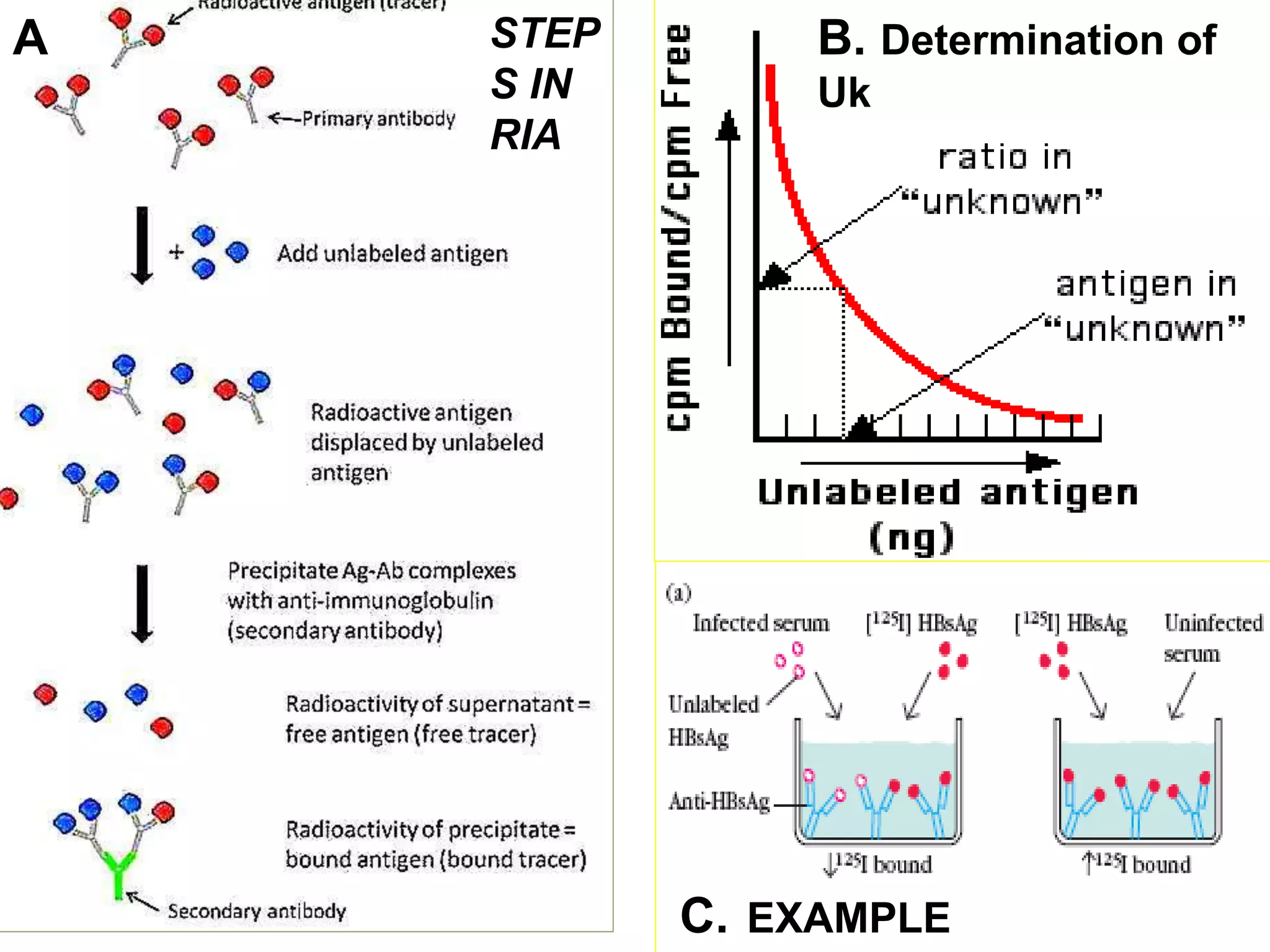
o As the concentration of unlabelled antigen increases
amount of labelled antigen-antibody complex decreases.
o Thus the concentration of Ag-Ab is inversely related to the
concentration of unlabelled Ag i.e. the substance to be
determined.
o This relation is almost linear.
o A standard curve can be drawn by using different
concentrations of unlabelled antigen and the same
quantities of antibody and labelled antigen.
A STEP
S IN
RIA
B. Determination of
Uk
C. EXAMPLE
APPLICATIONS OF RIA
Analysis of hormones, vitamins, metabolites,
diagnostic markers
• Eg. ACTH, FSH, T3, T4, Glucagon, Insulin, Testosterone,
vitamin B12, prostaglandins, glucocorticoids,
Therapeutic drug monitoring:
• Barbiturates, morphine, digoxin,
Diagnostic procedures for detecting infection
• HIV, Hepatitis A, B etc
RADIOIMMUNOASSAY: PROS
AND CONS
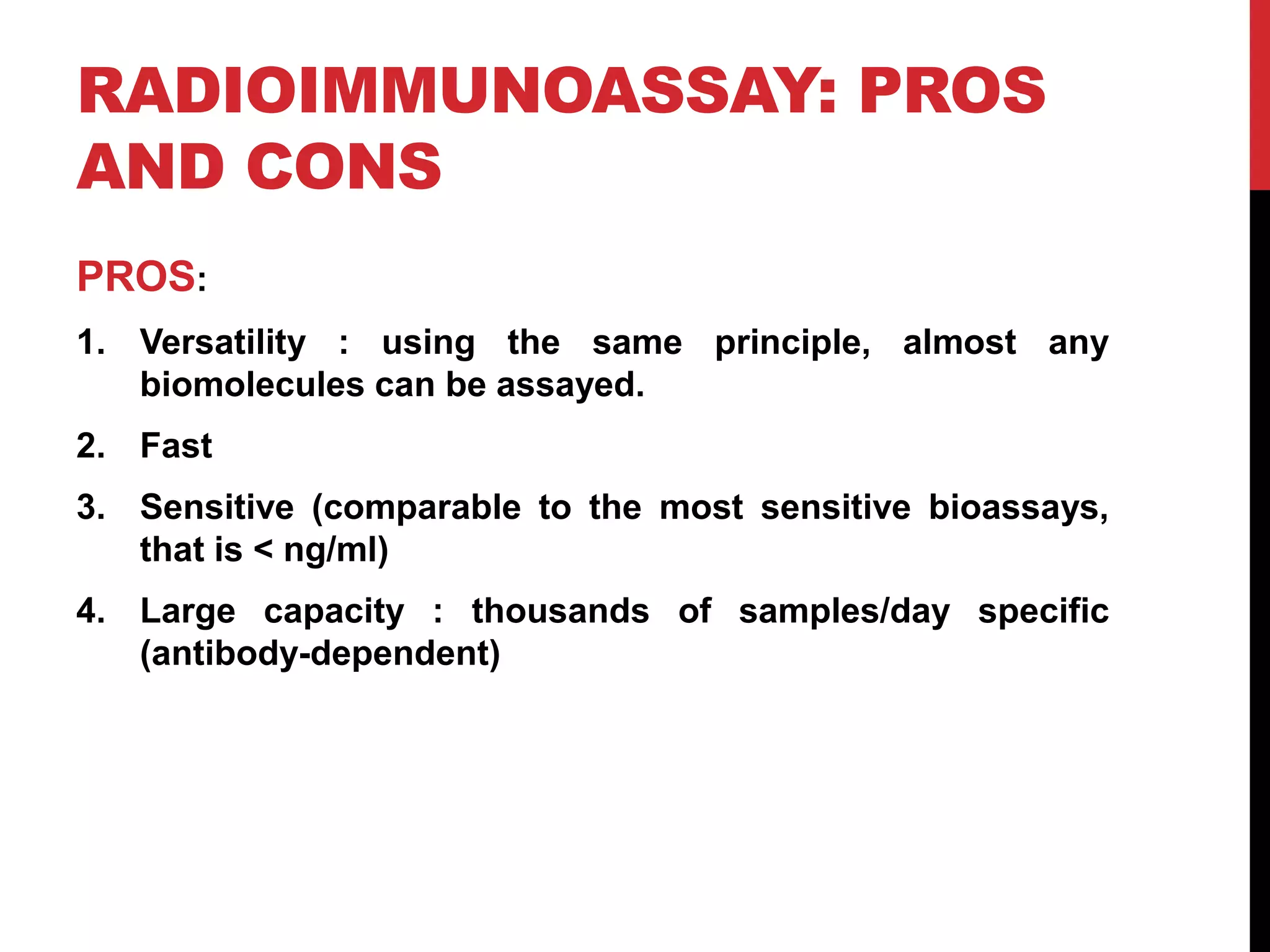
PROS:
1. Versatility : using the same principle, almost any
biomolecules can be assayed.
2. Fast
3. Sensitive (comparable to the most sensitive bioassays,
that is < ng/ml)
4. Large capacity : thousands of samples/day specific
(antibody-dependent)
CONS
o Use of radioactivity: hazardous
o Expensive equipment
o Requires specially trained persons
o Labs require special license to handle radioactive
material
o Requires special arrangements for
oRequisition, storage of radioactive material
oradioactive waste disposal.
THERAPEUTIC APPLICATIONS
o Radioisotopes have role in management of malignancies.
o Tumors tissues are attacked by beam of radiation .
o Radioactive material is impregnated into body in form of beads
or needles or either as surface applicants .
o 131I is used for treatment of thyroid cancer.
o 60Co or radium rods are used in treatment of cervical cancer .
o Yttrium90 synovectomy is useful in management of arthrites in
hemophelics .
o 48Au ( gold ) is used for treatment of malignant pleural &
peritoneal effusions.
o Boron 10 neutron irradiation has been recently used in the
treatment of the inoperable & rapidly fatal brain tumour like
glioblastoma multiforme.
RADIATION HAZARDS
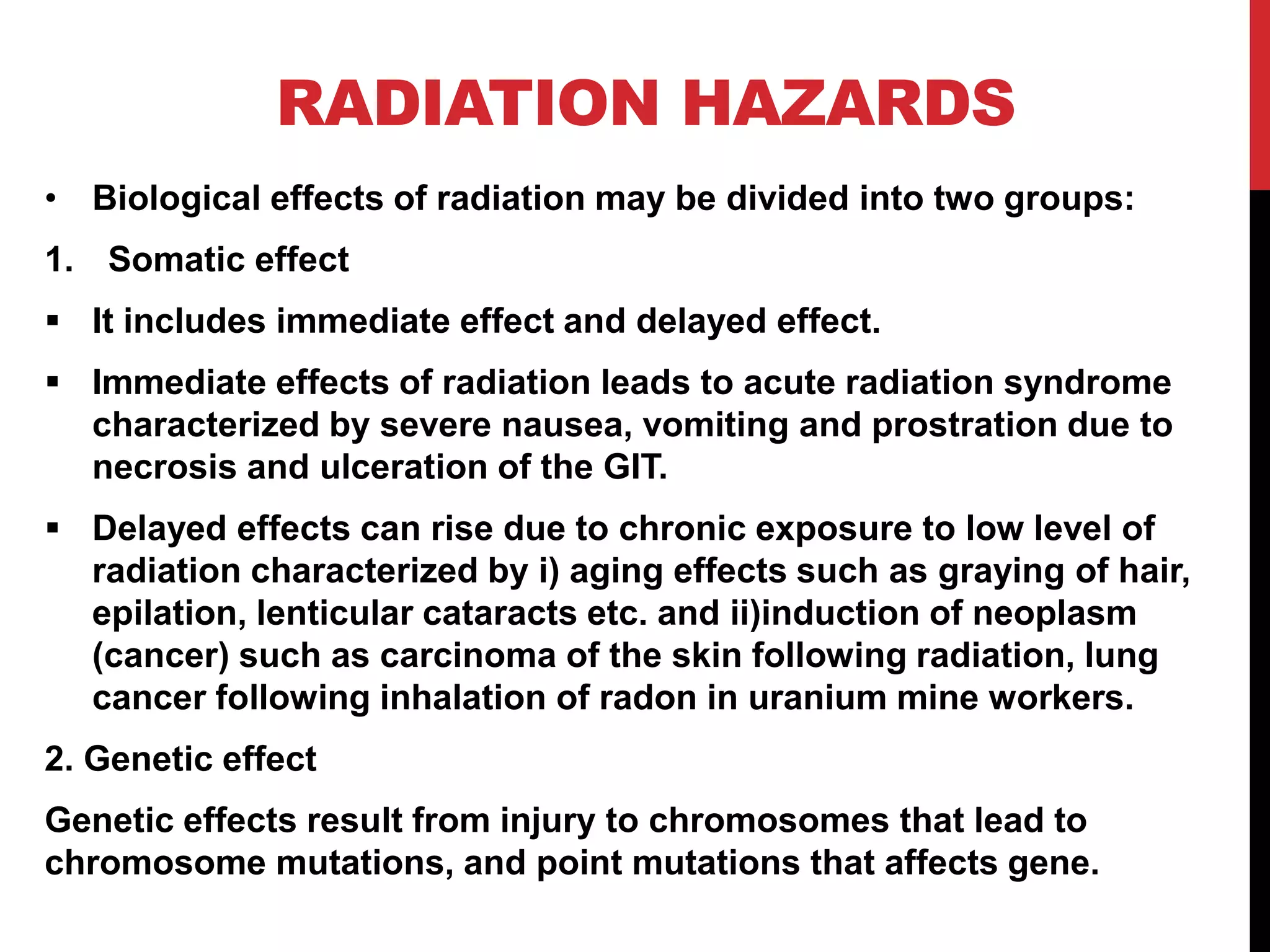
• Biological effects of radiation may be divided into two groups:
1. Somatic effect
 It includes immediate effect and delayed effect.
 Immediate effects of radiation leads to acute radiation syndrome
characterized by severe nausea, vomiting and prostration due to
necrosis and ulceration of the GIT.
 Delayed effects can rise due to chronic exposure to low level of
radiation characterized by i) aging effects such as graying of hair,
epilation, lenticular cataracts etc. and ii)induction of neoplasm
(cancer) such as carcinoma of the skin following radiation, lung
cancer following inhalation of radon in uranium mine workers.
2. Genetic effect
Genetic effects result from injury to chromosomes that lead to
chromosome mutations, and point mutations that affects gene.
RADIATION SAFETYAND PROTECTION
1. Prevention of External exposure
Methods that help to reduce exposure from external sources are:
 Reduce time
 Increase distance
 Use shielding
2. Prevention of Internal exposure
 Limiting inhalation
 Limiting ingestion
 Limiting absorption through skin
 Proper storage
 Proper disposal
Radioisotopes jps

Radioisotopes jps

  • 1.
  • 2.
    INTRODUCTION An Atom iscomposed of a positively charged nucleus that is surrounded by a cloud of negatively charged electrons. The number of orbital electrons is equal to the number of protons present in the nucleus , this number is known as atomic number ( Z ) . The sum of protons & neutrons in a given nucleus is the mass number. A = Z + N ( N is the number of neutrons )
  • 3.
    DEFINITION ISOTOPES These are elementswith the same atomic number but different mass numbers. RADIOISOTOPES Radioactive isotopes of an element.
  • 4.
    o Isotopes maybe stable or unstable. o Isotopes containing unstable combination regain stability by shedding radiation or particles. o Thus, this spontaneous degradation of nucleus and transmutation of one isotope to another with consequent emission of rays or particles is known as radioactivity. RADIOACTIVITY
  • 5.
    EXAMPLES OF SOME IMPORTANTRADIOISOTOPES ELEMENT ISOTOPE IMPORTANT APPLICATION Carbon ¹⁴C Research in metabolism Hydrogen ³H Research in cell biology Iodine ¹²⁵I Radio immunoassay Iodine 131I Treating hyperthyroidism and thyroid cancer Phosphorus ³²P Nucleic acid research Radium ²²⁶Ra Treatment of cancer
  • 6.
    APPLICATIONS Radioisotopes are usedfor the following : A. Research B. Diagnostic C. Therapeutic
  • 7.
    RESEARCH Radioisotopes are usedfor the study of pathways and there intermediate metabolites.
  • 8.
    DIAGNOSTIC APPLICATIONS OF RADIOISOTOPES oThe branch of medicine that deals with the diagnostic applications of radioisotope is referred to as nuclear medicine. o Diagnostic techniques in nuclear medicine use radioactive tracers which emit gamma rays from within the body. o These tracers are generally short-lived isotopes linked to chemical compounds which permit specific physiological processes to be scrutinized. They can be given by injection, inhalation or orally.
  • 9.
    Here there aresome important application of radioisotopes : 1. RBC’s can be tagged with 51Cr. These cells when injected back will remain in circulation till the RBC is lysed. Therefore life span of RBC and intravascular hemolysis , if any may be detected. 2. Thyroid uptake studies by 131I are used to detect functional derangement of thyroid gland. In hyperthyroidism there will be increased uptake and in hypothyroidism shows the reverse effect. 3. Thyroid scanning. 24 hour after administering the dose of ¹³¹I intravenously, the patient is placed under the scanner, which detects the radioactive emissions from the neck region. In hyperthyroidism increased radioactivity uptake is shown as heavily shaded areas. Sometimes the uptake of iodine is seen defective in certain circumscribed region of the gland, such a ‘silent nodule’ is suggestive of cancer thyroid.
  • 10.
    4. Bone scanning.90Sr is employed. Osteoblastoma could be detected very early by this method. 5. Kidney scanning. Done by injecting ¹³¹I- labelled hippuran or 131I-labelled diodrast. Both are excreted by kidney within a few minutes after injection. Anatomical and physiological defects in the renal excretion could be easily identified. 6. Technetium for blood flow studies. Blood flow of heart could be analysed by 99mTc. The method is sometime called ‘nuclear stethoscope’.
  • 11.
    7. Positron emissiontomography scan. In this technique2- [18F]fluoro-2-deoxy-glucose(FDG) is used as a molecular probe which is taken up by all cells and gets phosphorylated to FDG-6- Phosphate by hexokinase. Cells accumulate FDG as per the rate of glycolysis. Tumour cells accumulate more FDG since they have higher rate of glycolysis and detected by PET Scan. 8. Radioimmuno assay (RIA): Assays using 125I labelled antigens are used to quantitate hormones, tumor markers and other biological substances present in blood in very small quantities.
  • 12.
  • 13.
    INTRODUCTION o Developed bySolomon, Benson and Rosalyn in 1959. o A revolutionary technique to estimate some compounds found in exceedingly low concentration in biological fluids. o Highly sensitive and specific analytical tool.
  • 14.
    PRINCIPLE o RIA combinesthe principles of radioactivity of isotopes and immunological reactions of antigen and antibody. o The principles of RIA is primarily based on the competition between the labelled and unlabelled antigens to bind with antibody to form antigen-antibody complexes(either labelled or unlabelled). o The unlabelled antigen is the substance (say insulin) to be determined. o The antibody to it binds is produced by injecting the antigen to a goat or a rabbit. o The specific antibody is then subjected to react with unlabelled antigen in the presence of excess amounts of isotopically labelled (131I) antigen with known radioactivity.
  • 15.
    o As theconcentration of unlabelled antigen increases amount of labelled antigen-antibody complex decreases. o Thus the concentration of Ag-Ab is inversely related to the concentration of unlabelled Ag i.e. the substance to be determined. o This relation is almost linear. o A standard curve can be drawn by using different concentrations of unlabelled antigen and the same quantities of antibody and labelled antigen.
  • 16.
    A STEP S IN RIA B.Determination of Uk C. EXAMPLE
  • 17.
    APPLICATIONS OF RIA Analysisof hormones, vitamins, metabolites, diagnostic markers • Eg. ACTH, FSH, T3, T4, Glucagon, Insulin, Testosterone, vitamin B12, prostaglandins, glucocorticoids, Therapeutic drug monitoring: • Barbiturates, morphine, digoxin, Diagnostic procedures for detecting infection • HIV, Hepatitis A, B etc
  • 18.
    RADIOIMMUNOASSAY: PROS AND CONS PROS: 1.Versatility : using the same principle, almost any biomolecules can be assayed. 2. Fast 3. Sensitive (comparable to the most sensitive bioassays, that is < ng/ml) 4. Large capacity : thousands of samples/day specific (antibody-dependent)
  • 19.
    CONS o Use ofradioactivity: hazardous o Expensive equipment o Requires specially trained persons o Labs require special license to handle radioactive material o Requires special arrangements for oRequisition, storage of radioactive material oradioactive waste disposal.
  • 20.
    THERAPEUTIC APPLICATIONS o Radioisotopeshave role in management of malignancies. o Tumors tissues are attacked by beam of radiation . o Radioactive material is impregnated into body in form of beads or needles or either as surface applicants . o 131I is used for treatment of thyroid cancer. o 60Co or radium rods are used in treatment of cervical cancer .
  • 21.
    o Yttrium90 synovectomyis useful in management of arthrites in hemophelics . o 48Au ( gold ) is used for treatment of malignant pleural & peritoneal effusions. o Boron 10 neutron irradiation has been recently used in the treatment of the inoperable & rapidly fatal brain tumour like glioblastoma multiforme.
  • 22.
    RADIATION HAZARDS • Biologicaleffects of radiation may be divided into two groups: 1. Somatic effect  It includes immediate effect and delayed effect.  Immediate effects of radiation leads to acute radiation syndrome characterized by severe nausea, vomiting and prostration due to necrosis and ulceration of the GIT.  Delayed effects can rise due to chronic exposure to low level of radiation characterized by i) aging effects such as graying of hair, epilation, lenticular cataracts etc. and ii)induction of neoplasm (cancer) such as carcinoma of the skin following radiation, lung cancer following inhalation of radon in uranium mine workers. 2. Genetic effect Genetic effects result from injury to chromosomes that lead to chromosome mutations, and point mutations that affects gene.
  • 23.
    RADIATION SAFETYAND PROTECTION 1.Prevention of External exposure Methods that help to reduce exposure from external sources are:  Reduce time  Increase distance  Use shielding 2. Prevention of Internal exposure  Limiting inhalation  Limiting ingestion  Limiting absorption through skin  Proper storage  Proper disposal