Review Article:- A REVIEW ON RADIOISOTOPES IN CANCER THERAPY
1.
Niranjan Giri, Int.J. of Pharm. Sci., 2024, Vol 2, Issue 2, 217-223 | Review
*Corresponding Author: Niranjan Giri
Address: Mangaldeep Institute of pharmacy, DBATU University Maharashtra
Email : niranjangiri5566@hmail.com
Relevant conflicts of interest/financial disclosures: The authors declare that the research was conducted in the absence of
any commercial or financial relationships that could be construed as a potential conflict of interest.
INTERNATIONAL JOURNAL OF PHARMACEUTICAL SCIENCES 217 | P a g e
This work points out importance of medical radioisotopes in nuclear medicine based on
treatment and diagnosis of cancer. Moreover, possible production methods of medical
radioisotopes are evaluated, and an application for the production of two medical
radioisotopes through neutron and deuteron induced reaction processes is discussed by
comparing with experimental data in the literature.
INTERNATIONAL JOURNAL OF
PHARMACEUTICAL SCIENCES
[ISSN: 0975-4725; CODEN(USA):IJPS00]
Journal Homepage: https://www.ijpsjournal.com
Review Article
A Review On Radioisotopes In Cancer Therapy
Niranjan Giri*
Student Mangaldeep Institute of Pharmacy, DBATU University Maharashtra .
ARTICLE INFO ABSTRACT
Received: 06 Feb 2024
Accepted: 09 Feb 2024
Published: 10 Feb 2024
Keywords:
Radioisotopes, Cancer,
Therapy
DOI:
10.5281/zenodo.10642989
INTRODUCTION
Radiopharmaceutical are radioactive isotopes
which are used to diagnose [to find the traces] or
work as a cancer therapy. Radioactive isotopes
have unstable nucleus that decays or emit excess
radiation or energy until the becomes stable.
To date, researcher have discovered radioactive
substances that can target various cancer like
thyroid cancer, lymphoma, ovarian cancer, brain
cancer or cancer which widespread to the bones.
In the thyroid cancer the cause is unknown or
poorly understood but may involve the genetic
and environmental factors. To treat the thyroid
cancer patients, undergo the medication, surgery
and radiation therapy to kill the cancerous cell
which left after the surgery. Radioactive
substances administered in the different form
such as orally [in form of pill], IV and
interstitial [inserted into the cavity]. Isotopes
have the same number of protons but different
number of neutrons and these elements have same
atomic number but differ in atomic mass. These
unstable element decay by emission of energy in
the form of alpha, beta (electron)/beta plus
(positron) and gamma rays. Such isotopes, which
emit radiation, are called radioisotopes. These
radioisotopes are also known as radionuclides.
These isotopes are used in various sectors like
industries, agriculture, healthcare and research
centres because of their characteristic nature of
2.
Niranjan Giri, Int.J. of Pharm. Sci., 2024, Vol 2, Issue 2, 217-223 | Review
INTERNATIONAL JOURNAL OF PHARMACEUTICAL SCIENCES 218 | P a g e
emitting radiation and their energies. Radioactive
products which are used in medicine are referred
to as radiopharmaceuticals. Radiopharmaceuticals
differ from other medically employed drugs since
they generally elicit no pharmacological response
(owing to the minute quantities administered) and
they contain radionuclide. They are prepared by
tagging the chosen carrier component with an
appropriate radioactive isotope. The carrier
component of the radiopharmaceutical is a
biologically active molecule used to localize the
drug in a specific organ or group of organs to
provide diagnostic information about those tissues
such as pyrophosphate and methylene
diphosphonate (MDP) compounds in skeleton
bone tissues.
EVOLUTION OF RADIOISOTOPES:-
In 1898, discovery of polonium by Pierre and
Marie Curie introduced the term “radioactive”.
Radium was discovered by the Curie six months
after the discovery of polonium with the
collaboration of the chemist G. Be mont. Radium
played by far a more important role than polonium.
Its separation in significant amount opened the
way to its medical and industrial application and
also its use in laboratories. Later ‘uranic rays’ was
discovered by Henri Becquerel in 1900.Overall
1800 isotopes are present, but at present only up to
200 radioisotopes are used on a regular basis, and
most of them are produced artificially.
Radioisotopes can be manufactured in several
ways. The most common is by neutron activation
in a nuclear reactor. This involves the capture of a
neutron by the nucleus of an atom resulting in an
excess of neutrons(neutron rich) which leads to the
production of desired radioisotope .Some
radioisotopes are manufactured in a cyclotron
,devised by Lawrence and Livingston in 1932
which charged particles such as protons, deuterons
and alpha particles are introduced to the nucleus
resulting in a deficiency of neutrons (proton rich).
These particles are accelerated to high energy
levels and are allowed to impinge on the target
material. 11C, 13N, 18F, 123I, etc. are some of the
isotopes that can be produced in a cyclotron.
Isotopes in Medicine:-
Radioisotopes are used in medicine in two
different ways:
1. as radiation sources or
2. as radioactive tracers
As radiation sources their principal role is in
therapy.
As radioactive tracers they are used mainly for
diagnostic purposes. A radiopharmaceutical is a
preparation, intended for in vivo use, containing a
radionuclide in the form of an element, a simple
salt or a complex and may exist in the form of a
solid, liquid or gas. Radiopharmaceuticals are used
for diagnosis and therapy. For diagnostic
applications, a radiopharmaceutical should not be
pharmacologically active in that it should not
produce a physiological effect. For therapy, the
radiopharmaceutical preparation contains enough
radioactivity to produce the intended specific
changes in tissue.
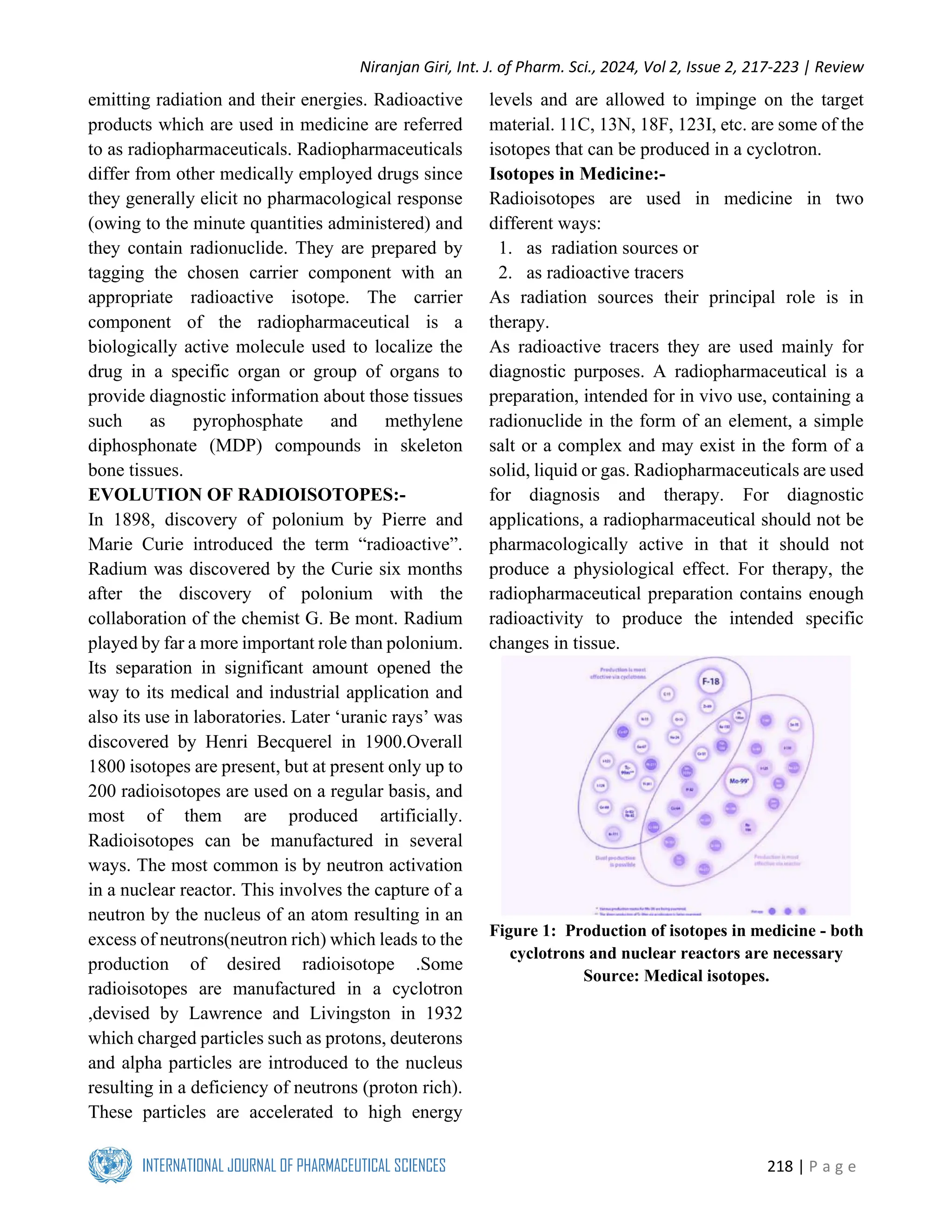
Figure 1: Production of isotopes in medicine - both
cyclotrons and nuclear reactors are necessary
Source: Medical isotopes.
3.
Niranjan Giri, Int.J. of Pharm. Sci., 2024, Vol 2, Issue 2, 217-223 | Review
INTERNATIONAL JOURNAL OF PHARMACEUTICAL SCIENCES 219 | P a g e
Figure 2: Number of procedures with medical isotopes
Table 53.2. Commonly used radioisotopes
Element Isotope
Approximate
half- life
Major
radiation
Important Application
Carbon 14C 5600 years Beta
Research in metabolism,
carbon dating
Hydrogen 3H 12 years Beta Research in cell biology
Phosphorus 32P 14 day Beta
Nucleic acid research,
treatment for
polycythemia
Chromium 51Cr 28 day Gamma
RBC kinetics in
diagnosis
Iodine 125I 60 day Gamma Radio immunoassay
Technetium 99Tc 6 hour Gamma
Blood flow experiments;
gamma imaging
Radium 226Ra 1600 years Gamma
Interstitial implantation
for treating cancer
Cobalt 60Co 5.3 years Gamma Teletherapy for cancer
Caesium 137Cs 30 years Gamma Teletherapy for cancer
APPLICATIONS OF RADIOISOTOPES :-
Radioisotopes can also be used, typically in higher
doses than as a tracer, as treatment. Radiation
therapy is the use of high-energy radiation to
damage the DNA of cancer cells, which kills them
or keeps them from dividing (Figure
(PageIndex{3})). A cancer patient may receive
external beam radiation therapy delivered by a
machine outside the body, or internal radiation
therapy (brachytherapy) from a radioactive
substance that has been introduced into the body.
Note that chemotherapy is similar to internal
radiation therapy in that the cancer treatment is
injected into the body, but differs in that
chemotherapy uses chemical rather than
radioactive substances to kill the cancer cells.
Isotopes are atoms of the same element that have
different numbers of neutrons. The most common
isotope of carbon is carbon-12, which has six
protons and six neutrons. Another common
isotope of carbon is carbon-14, which has six
protons and eight neutrons. Carbon-14 is unstable
4.
Niranjan Giri, Int.J. of Pharm. Sci., 2024, Vol 2, Issue 2, 217-223 | Review
INTERNATIONAL JOURNAL OF PHARMACEUTICAL SCIENCES 220 | P a g e
and decays over time. The rate of decay is known,
so scientists can use it to calculate the age of
something that contains carbon-14. For example,
if a scientist found a sample of wood that contained
carbon-14, they could use the rate of decay to
calculate how long ago the tree died. Isotopes of
an element will have identical chemical reactions.
Hence when a radiolabelled compound is
administered, these molecules are metabolized by
the body similar to normal molecules. This is
called Tracer technique. Almost all biochemical
research will utilise such tracer methods. A few
examples are given below.
i. Almost all the pathways described in earlier
chapters were studied by using tracers. For
example, 14 C-labelled aceto acetic acid is
shown to be incorporated into palmitic acid.
Suppose labelled "A" is administered to an
animal. After a few minutes, liver contains
labelled "B" and after one hour, labelled "C"
is seen in liver. Thus, we can say that the
pathway is A to B to C.
ii. The turnover rate of a substance in the body,
that is, the rate of synthesis and breakdown
could also be studied by tracer techniques. For
example, if 131 I-labelled immunoglobulin is
injected, the quantity of the labelled
molecules in the circulation will be
proportional to the catabolism of the Ig. By
such methods, it is shown that the half-life of
IgG is 15 days, of albumin is about 21 days.
iii. 32P is useful to trace the nucleic acid
synthesis in vivo and in vitro. It is therefore
employed in genetic research. 3H-labelled
thymidine is incorporated in the newly
synthesized DNA and therefore used in
assessing cell division kinetics. 51Cr is taken
up by living cells and the label is liberated
when the cell is lysed. Therefore, it is used in
vitro to quantitate the cell lysis by
immunological or pathological mechanisms.
iv. The total body content of a particular
substance (also designated as the "pool" of the
substance) can be quantitated by the isotope
dilution technique. To cite an example, 1 ml
of 131 I-labelled albumin is seen to have 1
million dps. This is injected intravenously to a
man. The radioactivity will be uniformly
mixed in the total blood volume. After 10-15
minutes, a blood sample is withdrawn. One ml
of blood is shown to have a radioactivity with
200 dps. The volume injected and removed is
the same 1 ml, but the original count is now
diluted 5,000 times. Thus, the intravascular
space is 5,000 times more than the volume
injected. Therefore, the blood volume is 5,000
ml.
v. Similarly extracellular volume (intravascular
+ interstitial spaces) is determined by 24 Na-
labelled NaCl, and the total body water by
means of 3 H-labelled water. From such
experiments it is shown that intracellular
compartment is 40%, interstitial compartment
is 16% and intravascular volume is 4% of the
total body weight.
BIOLOGICAL EFFECTS OF RADIATION:-
1. Direct Effects on Cancer Tissues The
radiation damages DNA molecules. No
effects are visible immediately. But the
damage is observed during the next mitosis.
Since new DNA cannot be synthesized, cells
die at the attempt of the next division.
Chromosome breakage is often noticed.
Radiation produces large quantities of free
radicals in tissues. The catastrophic effects of
free radicals on different biological
compounds (including DNA) are described in
Chapter 20.
2. Indirect Effects on Cancer Tissues Damage to
local blood supply cuts off the nutrition and
causes local necrosis and cell death.
3. Effects of Radiation on Normal Tissues In
1904, Madam Curie went for a lecture-
5.
Niranjan Giri, Int.J. of Pharm. Sci., 2024, Vol 2, Issue 2, 217-223 | Review
INTERNATIONAL JOURNAL OF PHARMACEUTICAL SCIENCES 221 | P a g e
demonstration class, keeping a few mg of
impure radium ore in her breast pocket.
Within 1 hour, this caused severe dermatitis.
That was the first indication of a health hazard
by radioactivity. Madam Curie succumbed to
radiation-induced leukaemia in 1934
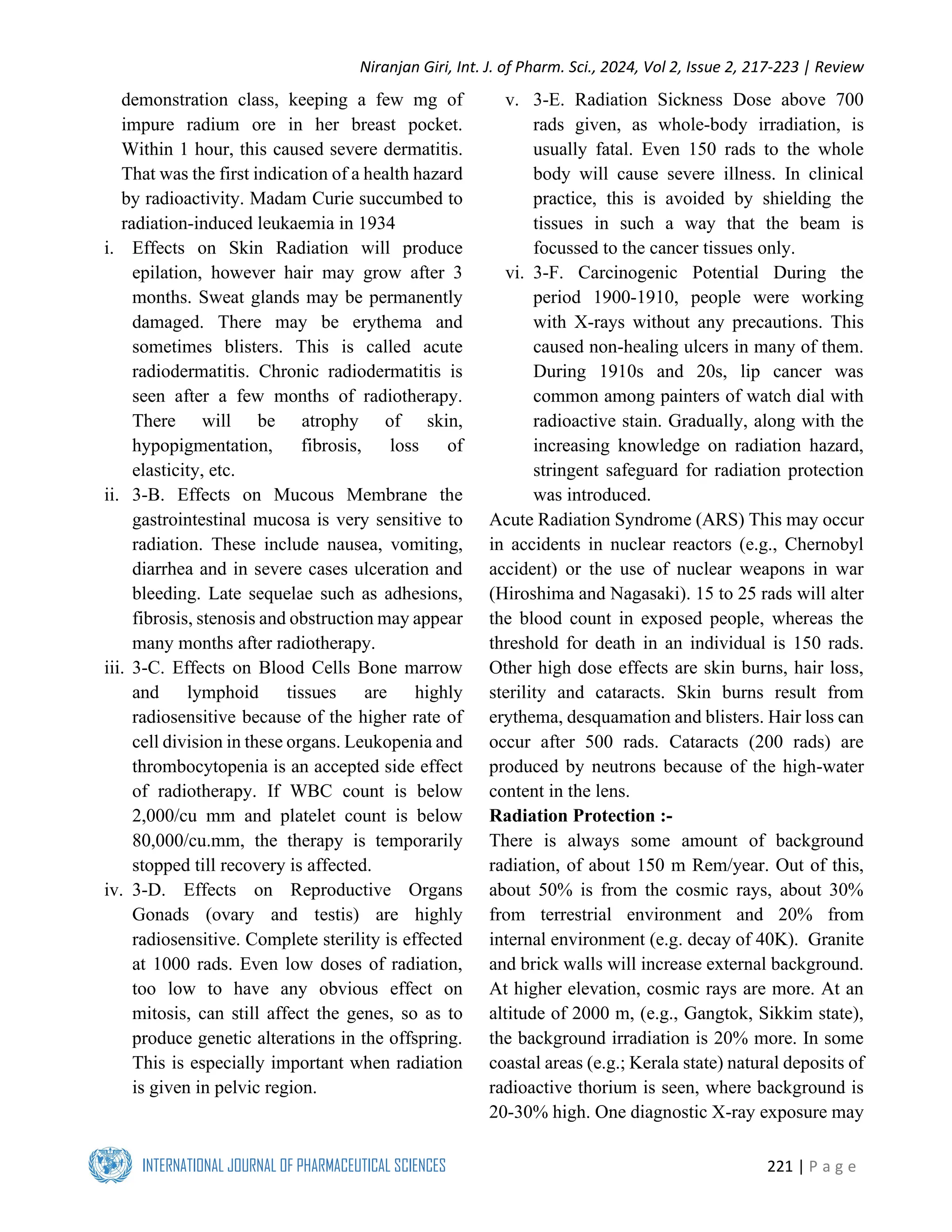
i. Effects on Skin Radiation will produce
epilation, however hair may grow after 3
months. Sweat glands may be permanently
damaged. There may be erythema and
sometimes blisters. This is called acute
radiodermatitis. Chronic radiodermatitis is
seen after a few months of radiotherapy.
There will be atrophy of skin,
hypopigmentation, fibrosis, loss of
elasticity, etc.
ii. 3-B. Effects on Mucous Membrane the
gastrointestinal mucosa is very sensitive to
radiation. These include nausea, vomiting,
diarrhea and in severe cases ulceration and
bleeding. Late sequelae such as adhesions,
fibrosis, stenosis and obstruction may appear
many months after radiotherapy.
iii. 3-C. Effects on Blood Cells Bone marrow
and lymphoid tissues are highly
radiosensitive because of the higher rate of
cell division in these organs. Leukopenia and
thrombocytopenia is an accepted side effect
of radiotherapy. If WBC count is below
2,000/cu mm and platelet count is below
80,000/cu.mm, the therapy is temporarily
stopped till recovery is affected.
iv. 3-D. Effects on Reproductive Organs
Gonads (ovary and testis) are highly
radiosensitive. Complete sterility is effected
at 1000 rads. Even low doses of radiation,
too low to have any obvious effect on
mitosis, can still affect the genes, so as to
produce genetic alterations in the offspring.
This is especially important when radiation
is given in pelvic region.
v. 3-E. Radiation Sickness Dose above 700
rads given, as whole-body irradiation, is
usually fatal. Even 150 rads to the whole
body will cause severe illness. In clinical
practice, this is avoided by shielding the
tissues in such a way that the beam is
focussed to the cancer tissues only.
vi. 3-F. Carcinogenic Potential During the
period 1900-1910, people were working
with X-rays without any precautions. This
caused non-healing ulcers in many of them.
During 1910s and 20s, lip cancer was
common among painters of watch dial with
radioactive stain. Gradually, along with the
increasing knowledge on radiation hazard,
stringent safeguard for radiation protection
was introduced.
Acute Radiation Syndrome (ARS) This may occur
in accidents in nuclear reactors (e.g., Chernobyl
accident) or the use of nuclear weapons in war
(Hiroshima and Nagasaki). 15 to 25 rads will alter
the blood count in exposed people, whereas the
threshold for death in an individual is 150 rads.
Other high dose effects are skin burns, hair loss,
sterility and cataracts. Skin burns result from
erythema, desquamation and blisters. Hair loss can
occur after 500 rads. Cataracts (200 rads) are
produced by neutrons because of the high-water
content in the lens.
Radiation Protection :-
There is always some amount of background
radiation, of about 150 m Rem/year. Out of this,
about 50% is from the cosmic rays, about 30%
from terrestrial environment and 20% from
internal environment (e.g. decay of 40K). Granite
and brick walls will increase external background.
At higher elevation, cosmic rays are more. At an
altitude of 2000 m, (e.g., Gangtok, Sikkim state),
the background irradiation is 20% more. In some
coastal areas (e.g.; Kerala state) natural deposits of
radioactive thorium is seen, where background is
20-30% high. One diagnostic X-ray exposure may
6.
Niranjan Giri, Int.J. of Pharm. Sci., 2024, Vol 2, Issue 2, 217-223 | Review
INTERNATIONAL JOURNAL OF PHARMACEUTICAL SCIENCES 222 | P a g e
cause 75 millirem. Maximum Permissible Dose
the MPD of radiation for whole body among
radiation workers, (doctors, technicians) is 5
mRem/year, and for general population is 0.5
mRem/year. Small doses (less than 10 cGy) of
radiation may be good to living systems, while
large doses are harmful; this is called Hormesis.
Radiation Monitoring and Precautions Doctors,
nurses, radiographers and research workers using
the radioactive substances should wear a badge
containing a piece of film. If radiation is reaching
the film, it is blackened, and hence exposure could
be detected. The following precautions will reduce
the radiation hazards:
a. Keep the source farther away.
b. Shield the radioactive sources; cover them
with lead bricks.
c. Handling is done by remote devices. Use lead-
rubber gloves and aprons.
d. Radioactive materials are to be handled with
speed. The shorter the time spent near the
source, the lower the dose received.
Advantages of radioisotope imaging :-
• Target tissue function is investigated.
• All similar target tissues can be imaged during
one
• investigation. For example, whole skeleton
can be imaged in one bone scan.
• It can display blood flow.
• Assessment of physiologic or functional
change in
• tissues, because of disease process.
• Computer analysis and enhancement of
results are available.
Disadvantages radioisotope imaging :-
• Poor image resolution—often only minimal
information is obtained on target tissue
anatomy.
• The radiation dose to the whole body can be
• relatively high.
• Images are not usually disease-specific.
• Difficult to localize exact anatomical site of
source of emissions.
CONCLUSION :-
Imaging technologies have become increasingly
sophisticated in recent years. Nuclear medicine
and molecular imaging, which provides the only
means of assessing physiologic changes that is a
direct result of biochemical alterations at cellular
and molecular levels, and in combination with
traditional anatomic imaging such as computed
tomography scan and magnetic resonance
imaging (MRI) scan, provide precise localization
of functional abnormalities. These imaging
techniques are based on the radiotracer method,
and allow the measurement of tissue function in
vivo and provide an early marker of disease
through measurement of biochemical change.
Many elements which found on earth exists in
different atomic configurations used in medicine
are referred to as radiopharmaceuticals which are
useful to get diagnostic and therapeutic
information about those tissues.
REFERENCES
1. Wadas TJ, Pandya DN, Solingapuram Sai KK
et al.; Molecular targeted a-particle therapy
for oncologic applications. AJR Am J
Roentgenol, 2014; 203(2): 253–260.
2. Baidoo KE, Yong K, Brechbiel MW et al.
Molecular pathways: targeted a-particle
radiation therapy. Clin Cancer Res., 2013;
19(3): 530–537.
3. Zalutsky MR et al. Radioimmunotherapy
with particle emitting radio- nuclides. Q J
Nucl Med Mol Imaging, 2004; 48: 289–296.
4. Sahoo S. Production and Applications of
Radioisotopes Physics Education 2006; 3:1-
11.
5. Becquerel H. Emission des radiations
Nouvelles par l’uranium metallique. C R
Acad Sci Paris. 1896; 122:1086.
6. Curie P, Curie M, Bémont G. Sur une
nouvelle substance fortement radio-active
7.
Niranjan Giri, Int.J. of Pharm. Sci., 2024, Vol 2, Issue 2, 217-223 | Review
INTERNATIONAL JOURNAL OF PHARMACEUTICAL SCIENCES 223 | P a g e
contenue dans la pechblende. C R Acad Sci
Gen. 1898; 127:1215–18.
7. Roy RR and Nigam BP. Nuclear Physics-
Theory and Experiment. John Wiley and
Sons, Inc., New York (1967); Manchanda
VK, Technical talk on Radiation Technology
Applications and Indian Nuclear Programme:
Societal Benefits, in Aarohan 2K5 at NIT,
Durgapur; Beiser A, Concepts of Modern
Physics, McGraw-Hill Book Company,
Singapore (1987).
8. 592 n Textbook of Biochemistry; Section G:
Advanced Biochemistry.
HOW TO CITE: Niranjan Giri, A Review On
Radioisotopes In Cancer Therapy, Int. J. of Pharm. Sci.,
2024, Vol 2, Issue 2, 217-223.
https://doi.org/10.5281/zenodo.10642989
![Niranjan Giri, Int. J. of Pharm. Sci., 2024, Vol 2, Issue 2, 217-223 | Review
*Corresponding Author: Niranjan Giri
Address: Mangaldeep Institute of pharmacy, DBATU University Maharashtra
Email : niranjangiri5566@hmail.com
Relevant conflicts of interest/financial disclosures: The authors declare that the research was conducted in the absence of
any commercial or financial relationships that could be construed as a potential conflict of interest.
INTERNATIONAL JOURNAL OF PHARMACEUTICAL SCIENCES 217 | P a g e
This work points out importance of medical radioisotopes in nuclear medicine based on
treatment and diagnosis of cancer. Moreover, possible production methods of medical
radioisotopes are evaluated, and an application for the production of two medical
radioisotopes through neutron and deuteron induced reaction processes is discussed by
comparing with experimental data in the literature.
INTERNATIONAL JOURNAL OF
PHARMACEUTICAL SCIENCES
[ISSN: 0975-4725; CODEN(USA):IJPS00]
Journal Homepage: https://www.ijpsjournal.com
Review Article
A Review On Radioisotopes In Cancer Therapy
Niranjan Giri*
Student Mangaldeep Institute of Pharmacy, DBATU University Maharashtra .
ARTICLE INFO ABSTRACT
Received: 06 Feb 2024
Accepted: 09 Feb 2024
Published: 10 Feb 2024
Keywords:
Radioisotopes, Cancer,
Therapy
DOI:
10.5281/zenodo.10642989
INTRODUCTION
Radiopharmaceutical are radioactive isotopes
which are used to diagnose [to find the traces] or
work as a cancer therapy. Radioactive isotopes
have unstable nucleus that decays or emit excess
radiation or energy until the becomes stable.
To date, researcher have discovered radioactive
substances that can target various cancer like
thyroid cancer, lymphoma, ovarian cancer, brain
cancer or cancer which widespread to the bones.
In the thyroid cancer the cause is unknown or
poorly understood but may involve the genetic
and environmental factors. To treat the thyroid
cancer patients, undergo the medication, surgery
and radiation therapy to kill the cancerous cell
which left after the surgery. Radioactive
substances administered in the different form
such as orally [in form of pill], IV and
interstitial [inserted into the cavity]. Isotopes
have the same number of protons but different
number of neutrons and these elements have same
atomic number but differ in atomic mass. These
unstable element decay by emission of energy in
the form of alpha, beta (electron)/beta plus
(positron) and gamma rays. Such isotopes, which
emit radiation, are called radioisotopes. These
radioisotopes are also known as radionuclides.
These isotopes are used in various sectors like
industries, agriculture, healthcare and research
centres because of their characteristic nature of](https://image.slidesharecdn.com/document-20240210073828-240711054542-c1da9a78/75/Review-Article-A-REVIEW-ON-RADIOISOTOPES-IN-CANCER-THERAPY-1-2048.jpg)